
The Week Just Past and the Week Ahead
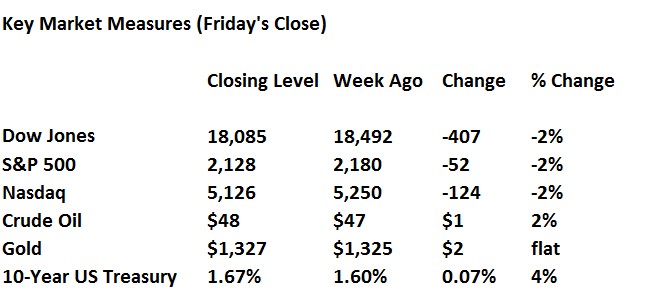
A sharp sell-off on Friday has rattled confidence. This was the first time in over two months that the S&P 500 moved more than 1% in a day. There are several driving forces. Due to a wave of profit warnings, the consensus expectations for a second half EPS recovery is now being reset lower. Moreover, the ongoing interest rate hike debate saga continues. While economists who watch Yellen conclude that she is signaling the Federal Open Market Committee will start raising rates in June, the futures market indicates no such thing. Bloomberg's World Interest Rate Probability function, which is based on futures trading data, sees only a 17% probability that the top end of the Fed's target range will go up at or before the June meeting of the rate-setting committee. Bottom line, new concerns that a rate hike is in the cards this month was a factor to the sharp market movements seen on Friday. We are not at all surprised to see the markets fade from recent all-time highs. While there may be more volatility ahead this week, our bias is to stand by ready to buy and scoop up our favorite stocks. This week we highlight Microsoft, Facebook, Alphabet, and Twitter.
Here is How Last Week Progressed
Monday (9/5) - S&P 500 -0.1%
Traders returned from vacation to find S&P futures flat, oil and the dollar lower, and a flurry of M&A activity. In fact, analysts at Morgan Stanley caved on their bearish call by raising their 12-month price targets for the S&P 500 – base case from 2200 to 2300, their bear case from 1600 to 1800, and their bull case from 2400 to 2500. For the bull case, Morgan Stanley left their EPS outlook essentially unchanged, but raised the multiple from 18x to 19x to yield their new 2500 bull target.
Tuesday (9/6) - S&P 500 +0.2%
Abysmal Class 8 truck net orders came out and continued to just get worse with each passing month. August net orders were down over 25% compared to last year. In fact, the level of trailing 12-month net orders is the lowest since 2011 with the annual change trend line now in negative territory for 18 consecutive months. The truck order data combined with Institute of Supply Management data that is flirting dangerously with recession levels are painting a very concerning picture about the core health of parts of the economy. Separately, billionaire Mark Cuban publicly stated that he has no doubt the market will tank if Donald wins. Could we see a Brexit like sell-off in the US should Trump win?
Wednesday (9/7) - S&P 500 +0.1%
Quant strategies on Wall Street are increasing in popularity. Did you know that the signals picked up by many quant strategies were able to get many investors out of oil prior to the massive sell off? Accordingly, we note that JP Morgan’s head quant has released a new report saying that the recent period of record calm across asset classes is about to end, warning of an increase in realized volatility, correlations, and tail risk* in September and October.
* Tail risk is something that is unlikely to happen - but still could. Broadly speaking, a tail risk is an event with a small probability of happening, says Bob Conroy, professor of finance at the University of Virginia Darden School of Business. “In every event there are tails; there are really good things that can happen and really bad things.”
Thursday (9/8) - S&P 500 -0.1%
Total consumer credit rose by $17.7 billion in July, up from last month's $14.5 billion, and above the $16.0 billion expected, as US consumers continued to get increasingly more indebted. However, while the credit spigot appears to be fully functional once again, it does not explain the disappointing car sales numbers in recent months, which prompted Ford earlier this week to warn that US car sales have now hit a plateau. Moreover, there are already concerning signs of credit performance. In July, 60 day subprime loan delinquencies were up 13% on a month-over-month basis and were up 17% compared to the same month last year. Prime delinquencies were up 12% on a month-over-month basis and were up 21% compared to the same month last year. Ouch.
Friday (9/9) - S&P 500 -2.5%
Markets were in a turmoil as the S&P moved more than 1% in a day for the first time in over two months. In fact, it was the 11th biggest jump in VIX in history, as August saw the volatility at a 2-year low. (The VIX (^VIX) was up 40% to 17.50 from 12.51.) What is going on here? Among other issues, we note deteriorating earnings expectations as the second half earnings growth rate pick-up baked into consensus appears to now not be materializing. This week we observed a wave of profit warnings from some large- and small-cap companies including Ford Motor, Barnes & Noble, Tractor Supply, SuperValu, Sprout’s Farmers Market, Pier 1 Imports, General Mills, HD Supply Holdings and Dave & Buster’s.
Separately, the ongoing stream of cautious data points continues to flow. Last week, we learned that PIK Toggle note* issuance is growing sharply. Looking back, the 2007 ramp in PIK Toggle note issuance was a pretty good indicator that the high-yield market was frothing over and the party was near an end. After all it's probably not a good sign when a market completely loses discipline to the point of rushing to hand out nearly $20 billion to companies that are basically admitting they may not even be able to afford the interest on the loan.
* A payment-in-kind bond, where the issuer has the option to defer an interest payment by agreeing to pay an increased coupon in the future. It is a sign that the company is having trouble repaying its debts. It's financing for companies undergoing a bankruptcy / restructuring process. The very nature of the loans is risky.
The Bull Market Report Companies and Commentary
Microsoft (MSFT: $56, -3% for the week) Microsoft is a high quality bellwether. Recent reports indicate that channel partners* see strong business trends for the company’s Cloud product, Azure. Azure is a key pillar of expected EPS growth embedded in consensus forecasts. Accordingly, it is a good sign to hear that Azure is on track with expectations.
* A channel partner is a company that partners with a manufacturer or producer to market and sell the manufacturer's products, services, or technologies, usually done through a co-branding relationship. Channel partners may be distributors, vendors, retailers, consultants, systems integrators (SI), technology deployment consultancies, and value-added resellers (VARs) and other such organizations.
To be more specific, channel partners are seeing strong sustained growth for Microsoft Cloud products, with a couple of partners underscoring a pronounced uptick with respect to Azure. One partner recently observed a renewed push by Microsoft to make inroads into the federal government vertical with its government Cloud. Lastly, a few channel partners referred to overall softness in their legacy Microsoft practices, partially driven by a faster-than-expected transition into the Cloud. This should be read as good news. Basically, the use of office desktop products is slowing because companies are transitioning to the Cloud.
We like that trend. We are fine with the legacy Microsoft business declining if the customers are moving to the Microsoft Cloud. It’s quicker and better, and a higher valuation is applied by the Street for the Cloud versus the desktop business
While Microsoft’s Azure product faces fierce competition from Amazon’s comparable AWS offering, one channel partner noted that Microsoft’s head start in the market with Office 365, along with their inherent long term relationships in Enterprise IT gives Microsoft a slight advantage in the Cloud space as compared to Amazon.
In fact, there is currently talk of an enormous energy conglomerate that has physical data centers in multiple countries which they are finding incredibly difficult to manage and scale and hence is thinking of moving to a Cloud infrastructure model. While this company has engaged both Microsoft and Amazon, the company appears to have a preference to go with Microsoft Azure because of the long standing relationship with Microsoft. This case study reinforces the storyline that Microsoft has created enough of a reputation now so that Amazon doesn’t seem like the only company in the public Cloud space.
BMR Take: The Cloud business is booming. Microsoft’s Azure product is recording revenue growth of greater than 100% a year. Channel partners are suggesting momentum is building. We view Microsoft as a high quality portfolio holding with an attractive dividend yield and substantial upside ahead.
Facebook (FB: $127, +2%) Weak sentiment surrounding the stock presents a buying opportunity. Facebook has delivered three consecutive quarters of 60%+ ad revenue growth, with an acceleration in four of the past five quarters. Street estimates have an upward revision bias with the 2017 consensus EPS having increased 35% so far this year. The overall lack of enthusiasm is reflected in the lower forward PE multiple and creates an opportunity.
One debatable topic right now is ad growth. Despite management’s caution on the 2Q16 earnings call, ad loads still have room to increase. Ad loads are a less significant growth driver of EPS estimates than many appreciate. Street estimates now call for slowing ad load growth to around 10% this year and actually declining in 2017-2018. Though there are several levers for management to focus on to drive improvement. For example, the company is currently working on ad targeting, relevancy, formats, and profitability in ways that don't alter the user experience. Facebook still has opportunity ahead for ad load growth despite the recent near term headwinds.
Another debatable topic right now is engagement. Despite a small sequential drop in 2Q16 daily and monthly active users across all regions, the overall ratio of daily to monthly active users remains steady at 66%, which highlights the stickiness of the customer base. Moreover, Facebook’s share of US mobile Internet time of 13% is 2x greater than Snapchat, Twitter, Instagram combined, which highlights how healthy engagement remains. Recent product changes such as prioritizing friends and family in the Facebook and Instagram feeds and the launch of Instagram Stories may acknowledge shifting usage and increased competition, at least in certain demographics, but we expect Facebook to remain innovative on products. We are not concerned about a slight slowing of engagement.
BMR Take: We think weak sentiment surrounding ad growth and engagement presents a buying opportunity. Street price targets are as high as $170, framing the compelling upside potential. We added the stock in February at $97, and we are approaching our Price Target of $140. We are pleased.
Alphabet (GOOG: $760, -2%). Building on the discussion above surrounding the booming Cloud business, Google’s efforts with its Cloud product Google Cloud Platform (GCP) are gaining momentum. We think there is plenty of room in the massive end market for several winners, so we do not view Google’s progress as a negative for Microsoft.
GCP is getting more aggressive and gaining traction in part due to a renewed focus and alignment with heavier investment and financial commitment with over $1 billion in acquisitions in the past year. In summary, the narrative around GCP being a distant third place in the public Cloud race may start to improve going forward.
Channel partners say that Google is targeting a select number of marquee Silicon Valley prospects, including a few that might be Amazon AWS displacements. GCP may soon make some material product announcements. Some partners are saying that GCP is hiring sales reps aggressively and the consensus view is that GCP is trying to win on its products and infrastructure, not on price.
Most firms still see GCP well behind AWS and Azure in the large enterprise market, with a less mature sales effort and premium service suite. That said, it is now believed that a $400 million revenue run-rate estimate for GCP in 2016 might be too low and that it could be closer to $750 million. On its 2Q16 call, Google called out the Cloud as the primary driver of the re-accelerating growth for Licensing and Other revenue, the first time the business has been mentioned in such manner.
BMR Take: Google Cloud Platform is a small but growing part of the Google investment thesis. We put it in the bucket of Google businesses with potential upside surprise versus consensus thinking. We would be buyers of Google all day long.
Twitter (TWTR: $18.11, -7%). Shares rose in the last week of August on rumors of a take-out, but the Board met on Thursday and thereafter communicated there were no offers to buy the company on the table right now. Accordingly, Twitter is now left (again) to deal with proving out their business model independently. Some analysts are now saying that if CEO Jack Dorsey can’t fix the business model in the next few quarters, he should volunteer to step down.
Shareholders want Twitter to become one of the first news sources users turn to. Many social media users see what Twitter provides as a basic necessity of an emerging digital age. Users offer unpaid labor hours to create content, which generates data that can be recorded, measured, and sold. They believe the trade is fair. Twitter maintains extensive databases of this information to exploit the content. The key will be figuring out how to satisfy shareholders for playing matchmaker without disturbing the part of the model that is working.
BMR Take: We see value in the Twitter platform. The company continues to take efforts to improve the model, with recent emphasis on live-streaming technology and new partnerships with the NFL and other sports leagues. While we likely won’t see a near-term takeout at a sizeable premium, we still see lots of opportunity ahead.
Upcoming Economic News
This week we have a few Fed governors speaking on Monday at various conferences. Then a wave of data comes out Thursday. We hope to see stable to healthy Retail sales figures and some signs of stabilizing weakness in the Industrial sector. Any pick-up in inflation figures would also be a positive. The Fed is in a real bind if the aforementioned trends go the opposite direction because they would then be having to raise rates into an incrementally worsening economic situation. Doing so could produce lost confidence in the Fed, which could have more of an effect on markets than even the math of the rate hike. Stay tuned.

Some Thoughts on the Markets
With Gary Jefferson
UBS Financial Services, Inc.
For the past several quarters "bad news" has been treated by the market as a good thing; i.e., no rate hike and a continuation of easy money. A well-known research firm on the Street has used an equation for this scenario for a couple of years: "Low interest rates + no recession = stock market gains."
However, according to the Stock Trader's Almanac, "The market is now navigating the weakest part of the calendar year, September. Since 1950, September is the worst performing month of the year for DJIA and S&P 500. Even in election years the month has been challenging. Once tans begin to fade and the new school year begins, fund managers tend to clean house as the end of the third quarter approaches, causing some nasty selloffs near month-end over the years…….."
Thus, investors should not be surprised to see a pullback in the market as we go through the month. We would view it as a buying opportunity ahead of the expected year-end rally fueled by improving earnings in both the 3rd and 4th quarters.
Meantime, the experts are all over the board:
Goldman Sachs says a bear market is inevitable. The bank contends that: “There are only three possible ways forward for the market. Firstly, there is the “Reflation” option, which sees inflation reignited, but bond yields rising too, hurting stocks and bonds. The second option is “Stagflation,” which would send yields higher because of rising inflation, but a lack of growth would hurt stocks. And thirdly, “Fat and Flat,” which is basically a continuation of the status quo, but accompanied by weakening earnings, reversing investor sentiment, and falling prices."
Morgan Stanley’s equities team has just gone on the record calling for a jump in the S&P 500 over the next year. The bank now thinks the S&P 500 will rise to 2,300 within 12 months.
A lot of people are worried because of the fresh highs at which the S&P 500 is trading, [this was written before Friday’s rout!] but in a recent article Bank of America argues that now is a great time to buy stocks. The bank runs a “Sell Side Indicator” which measures the bullishness of Wall Street analysts. That indicator is now sitting at its lowest sentiment reading since 2013. Basically, BOA's summary of the situation is: “Historically, when our indicator has been this low or lower, total returns over the subsequent 12 months have been positive 100 percent of the time, with median 12-month returns of more than 27%.”
In the real scheme of things, however, the whole Fed question shouldn’t be a big deal for folks making long-term investment decisions. What difference does it make whether the Fed announces a quarter of a percent increase in rates today, in December or some future date? Higher rates may become problematic for several industries, but given Yellen's clear indication that she will raise rates very slowly, we are nowhere near problematic interest rates and likely will not be for a long time to come. And, at this juncture, we still don't see the U.S. heading for a recession, although we certainly need to see some evidence fairly soon that 3rd quarter earnings are picking up some momentum.
We would modify the equation referred to above: "Historically low interest rates + improving corporate earnings + no recession = a rising stock market."
BMR Take: Well said, Gary Jefferson. Friday was a bad day, but the sun will come up Monday and the United States economy will continue pumping out goods and services, and entrepreneurs will continue building new ideas and creating wealth. We want to be fully invested in high quality stocks. If you are nervous about the markets and want to reduce risk, look at the High Yield Portfolio. These stocks have been knocking the cover off the ball, many of them are up over 10% this year, and all are paying from 4% to 10% dividends on top of the rise in prices – just absolutely stellar overall returns.
HIGH YIELD CORNER
Has the Bottom Finally Fallen Out of the Market?
Friday’s correction turned into a self-reinforcing bear market, with the S&P 500 closing down over 2%. Keep in mind this was a short trading week because of Labor Day, and Tuesday and Wednesday were particularly slow-action markets. That makes the downturn on Friday more worrisome.
What exactly caused the downturn? Most financial pundits are citing rate hike fears, after Eric Rosengren, president of the Boston Federal Reserve, hinted at the chance of an increase in interest rates in the near term. This is a significant development, because Rosengren has been one of the more dovish Fed officials, so his caution about the need to raise rates suggests the Fed really is getting serious about raising.
Why did that cause stocks to fall? Simple: With higher interest rates, there will be more of an incentive to buy U.S. Treasuries, and people will sell stocks to buy those Treasuries. At least, that’s the theory. But note that moves to higher interest rates in the past have not always correlated with a steep fall in stock prices, so this logic isn’t as certain as many market participants assume. In fact, we have said many times before that in more than half of the cases of the first or second interest rate raise by the Fed, the stock market is higher one year later.
However, interest rate hikes have a much more direct impact on the debt market, and this is where high yield investors need to stand up and pay attention.
Higher interest rates will do many things to debt markets. For one, higher interest rates will make existing notes and bonds less valuable. Secondly, higher interest rates could cause companies to default more.
Are debt markets ready for an interest rate hike? The answer is yes, somewhat. Corporate bonds fell significantly in value at the end of 2015 as investors prepared for rate hikes. As those hikes were delayed this year, the market realized it had oversold bonds and we saw a huge increase in the price of corporate bonds, especially junk bonds and high quality funds like our own favorites: Pimco Dynamic Income Fund (PDI: $28, down 3%) and AllianzGI Equity & Convertible Income Fund (NIE: $18.60, down 2%). Both of these funds had a bad week and underperformed the S&P 500, but are up 8% and 4% respectively over the last six months. That’s excluding dividends - PDI’s yield is 9% and NIE’s is 8%.
What now? The real key right now is buying dips. It seems that the market is just starting a correction, and this could easily last another few weeks. High yield defaults continue to rise, which is a good enough reason for junk bond markets to continue to correct. This trend has been ignored by the market for months now, which again suggests a correction can continue for a while. One way to think about this is to focus on the "BofA Merrill Lynch US High Yield Option-Adjusted Spread,” an ugly name for a simple concept but an economic metric tracked by the Federal Reserve. This measures the difference between average junk bond yields and the yield on a U.S. government bond. The lower the number, the more investors are willing to pay for junk bonds. When the number gets too low, it usually suggests junk bonds are overpriced and will fall in price as the market realizes it has gotten too greedy and ignored risks too much.
This number has fallen to its lowest point in a year, although junk bond defaults are at their highest point in a year. This is a clear disconnect, and the market is likely going to focus on this for a while, possibly producing a massive sell-off in high yield followed by a recovery.
Does this mean we recommend selling the AllianzGI and Pimco funds? Absolutely not. For one, these funds are not entirely in junk bonds; Pimco’s fund focuses on mortgage-backed securities (where default rates are falling), and AllianzGI has a lot of equity holdings.
Of course both will be hurt as the market focuses on risk and begins panic selling, so prices may go down in the short term. But the fundamentals are strong on both, so it is likely that their prices will recover whenever the market realizes it has gotten too nervous about rate hikes. On top of that, an interest rate hike’s impact on equities and MBS’s is much less significant than on high yield bonds, which have much of this risk already priced in over the last two years anyhow. With that in mind, the long-term risks are minimal even as the market is getting extra nervous.
Does this mean buy the dip? Simply put, yes. But no one will be able to call a bottom, so a systematic approach to adding to high yield positions probably makes sense over the next few weeks. If your favorites go down 2%, buy a little more. If it goes lower from there, buy a little more. When things calm down, these stocks will come bouncing right back.
What about other high yield sectors? The now infamous growth in REITs throughout 2016 has reversed, and the SPDR Dow Jones REIT ETF (RWR: $97) was down 4% over the past week. That may continue as the rate hike fears cause weakness in high yield sectors, but there is little reason to believe the best quality REITs are suffering any fundamental weakness in their operations or are likely to be unable to continue to pay out and grow dividends to shareholders.
Similarly, BDCs were down 2%, as we see from the UBS Etracs BDC ETF (BDCS: $22), but that is actually slightly better than the S&P 500. BDCs have been less exposed to moments of market panic in 2016 after their severe underperformance in 2014 and 2015, but there is no guarantee that will continue. Non-accruals* have become less of a concern for BDCs right now, but if junk bond defaults are rising, debts to smaller companies are likely to rise even more. If a surprising growth of non-accruals hits BDCs, this sector could face a more severe downturn. We aren’t seeing this yet, but focusing on quality is important here. That is why we still see Main Street Capital (MAIN: $34, down 1%) as a strong hold.
* Nonpayment of an interest payment due on a debt.
The Apple Corner
We think about Apple (AAPL: $103, down 4%) all the time and have had some thoughts about the recent new product announcement that some say was a bit flat. We agree to a certain extent, but we also are believers in not changing a good thing. The iPhone 7 looks like the 6, although the insides were beefed up a great deal – it’s faster and offers more storage. The Watch came out with a new version and is now fully waterproof. We could go on here for 10 more pages about the new products, but we will let you scour the web for more details if you like. You can start here if you haven’t done so already:
http://www.Apple.com Suffice it to say that the iPhone 7 will sell in big numbers this fall and Christmas, generating more profits and more cash to the bottom line for the company. And knowing the company the way we do, we wouldn't be surprised to see more exciting products announced sooner rather than later.
Additionally, with Friday’s sell-off it makes us think about how much Apple could go down from here. Here’s our take: It is unlikely that the stock can go down too far. Sure, if the market goes to 16,000, then we all have problems, and Apple will go to $90 again and maybe lower. But that cash cushion is unmatched in the annals of Wall Street. They literally have $42 a share in cash. (We know most of it is overseas, but with the EU’s demand of Ireland to get $14 billion from Apple in back taxes is spurring talk in Washington of allowing repatriation of the $3 trillion or so of cash that US companies hold overseas. This is a good thing.)
So for every share you own at $103, 41% is in cash. Now Apple management is not stupid. They will figure out a way to monetize the cash – through buying technology; buying people; buying income producing assets (companies); buying back stock; increasing the dividend; and a host of other ways you and I haven’t thought about yet. We believe in Apple management .
Under Armour Update:
Kevin Plank, CEO and Founder of Under Armour (UA: $38, flat) announced that he will be selling 2.1 million shares of stock starting in October. A subscriber wrote in and asked our opinion of the situation, as he thought this was a bad thing.
Here’s what we wrote back:
“Hi Samuel –
“We generally don’t mind if executives sell stock. Plank currently owns 34 million shares of the company’s Class B stock, 135,000 shares of Class A stock and 34 million shares of Class C stock, representing 65% of the voting power in the company. So 2 million shares is a small part of his holdings. He is just diversifying.”
That’s how we feel. Of course, we secretly wish we had 2 million shares to sell of our own, and we admire Plank and all the others that have created all of the amazing companies out there, like Amazon and Facebook and Google, and so on. This is America. The entrepreneurs and the risk takers shall reap the rewards. Again, we would not even blink a negative eye over this CEO selling a small part of his stake in the company. Bill Gates has been selling 20 million shares a quarter since 2002. Wow. And we still love Microsoft.
That’s all for this week.
Good Investing,
Todd Shaver
Editor in Chief