by Todd Shaver | Apr 4, 2017 | 11am News Flash
Tesla delivered over 25,000 vehicles in the first quarter, exceeding analysts’ estimates. Analysts had expected deliveries between 23,000 and 24,500. The number of deliveries marked a quarterly record, rising 70% from the year-ago quarter. It also keeps Tesla on pace to deliver on its projections to deliver 50,000 vehicles in the first half of 2017.
Tesla (TSLA: $301) is ramping up production as it prepares to launch its less expensive Model 3 sedan. Production of that car is expected to begin in July with the first deliveries made by the end of the year. Tesla’s goal is to produce 500,000 vehicles a year by the end of 2018.
BMR Take: The stock set a new all-time high yesterday as it was up $10, or 7%, as well as earlier today when it hit $300, despite the overall stock market being down today. It crossed our Target Price of $290 yesterday in that big move, so we hereby set a new Target of $325 on the stock. The Sell Price is raised from $240 to $280. We don’t want to lose the 50% gains on this stock – we added it to the Special Opportunities portfolio at $199 in January of last year.
The market cap is now $49 billion, surpassing Ford which is at $45 billion. GM is the next target, as it sits at $51 billion. What a story. And they haven’t even started production of the Model 3 yet, for which they are holding deposits for 400,000 cars!
by Todd Shaver | Feb 21, 2017 | 11am News Flash
Mazor Robotics (MZOR: $23)
Company Description:
Mazor Robotics is an Israeli-based medical device company engaged in the development of miniature semi-robotic, bone-mounted positioning systems for orthopedic procedures. Mazor's flagship product, Renaissance Surgical Guidance System, transforms spine surgery from a freehand procedure to a robotic-guided procedure. The company's core technologies and clinical pipeline include surgical robotics, robotic-guided implants, new procedures using these technologies, and medical 3D imaging for surgery.
Earnings Summary:
Mazor announced 4Q16 results, with system unit sales in line with levels announced on January 4th. Revenue for the quarter came in at $14.0 million, ahead of consensus of $12.7 million. Gross margin was down meaningfully from last year, as expected, driven primarily by lower pricing to Medtronic. EPS of $0.09 beat the consensus of -$0.12 on lower G&A and R&D expenditures.
The big news was incremental Mazor X orders that surprised to the upside which bodes well for the future. The company received orders for 21 systems in the quarter, including 16 Mazor X orders and recognized revenue on 18 of the 21. Exiting the quarter, there were 21 system orders in backlog, including 18 for Mazor X (with six of those from Medtronic). The company officially launched the Mazor X system in October, and recent results appear to support an ongoing increase in surgeon interest. All of the above indicates future revenue growth realization will be strong.
Earnings Takeaways:
1) Mazor is at a key inflection point having generated record sales in the quarter. The 21 systems ordered during the quarter illustrate strong ongoing demand (there were 25 system orders the previous quarter, including a 15-system initial order from Medtronics). To put this in perspective, the company sold 25 systems worldwide in 2015.
2) The Mazor X platform expands the field of spine surgery by assisting surgeons with a total patient treatment strategy. Following their recently formed partnership with Medtronic and the increased market access it provides them, the launch of the Mazor X positions them for accelerated growth and long term leadership in the spine market.
There is a clear and significant shift toward orders for the Mazor X system. Importantly, of the 21 systems currently in backlog, 18 are for Mazor X and only six of those are from Medtronic, indicating significant bottom-up demand from surgeons.
3) Until this quarter, Mazor had never received an initial multi-system order. It received two of these this quarter, each for three systems which signals that these customers have high confidence in the value of the technology.
4) Medtronic ordered 15 Mazor X systems during 3Q16. Last quarter, four were delivered. Importantly, the 3Q16 systems were all training systems that sell roughly at cost, which impacted last quarter's revenue and earnings, but was part of the plan for fully developing the Medtronic partnership. This quarter, five systems were delivered, leaving six in backlog.
5) The installed base increased to 149, from 108 in the prior year, up 38%. The majority of growth was driven by the U.S., where the installed base of 94 systems grew 47% from last year from 64 systems in 4Q15. The international installed base grew 27%, to 56 systems.
6) Utilization continues to increase; recurring revenue grew by 30%, with increasing system usage cited by management as a key driver, with systems in the field for 12+ months averaging 85 procedures per system vs. 80 a year ago.
7) Sales force update: Mazor ended the quarter with 20 capital sales reps, up from 16 at the end of 3Q16 and plans to continue adding more during 2017 to support the ongoing commercialization of the Mazor X system. Recall, during phase 1 of the agreement with Medtronic, that Medtronic’s reps are only responsible for generating awareness of Mazor X and then handing off leads to the Mazor team. In addition, the Mazor team is responsible for generating its own leads and supporting Mazor X cases.
BMR Take:
We are surprised that Mazor shares are basically unchanged from the January 4th earnings announcement, especially after seeing the strength in Mazor X this quarter. We see the current situation to be a buying opportunity.
by Todd Shaver | Jan 31, 2017 | 11am News Flash
Under Armour (UA: $19.50) is down 22% as we write this, after its sales forecast missed analysts’ estimates by a wide margin. The company said that ales this year will increase as much as 12% to $5.4 billion. Analysts were expecting $6.05 billion. Revenue rose just 12% to $1.3 billion last quarter, marking the smallest year-over-year gain since 2009 and trailed analysts’ $1.4 billion average estimate. Earnings were 23 cents a share, missing analysts’ 25-cent average estimate.
Under Amour, which has doubled its sales about every three years, is now having a hard time maintaining that rapid growth. The increased popularity of athletic wear as everyday apparel has brought many new competitors. Under Armour is facing much more competition in its core business of clothing, which still accounts for about 70% of its sales. The company also took a hit last year when one of its largest customers, Sports Authority liquidated.
Kevin Plank, the company’s chief executive officer and founder, said that they will be opening retail stores as well as increasing spending on technology, all of which will cause profits to be under pressure for years to come.
We received an email this morning:
Hi Todd
UA is getting crushed this morning.
Any thoughts?
I'm inclined to buy more for the long haul but curious for your opinion.
Thanks
Adam Harder
PS - I understand the miss and growth adjustment moving forward but I still think this seems like an over-reaction. The only things my son wears are made by under armour and that's the case for his entire class as well. I don't see the brand disappearing.
Our response:
"Hi Adam - This is VERY disappointing. VERY devastating. The company has been a solid performer for years and years and now this. Revenues were really not bad. It looks like future revenues will be lower than their normal 20% growth, but the fact remains that they make good, solid products and should do well in the coming five years. But waiting for the stock to rebound is going to be painful, because it is not going anywhere for months and possibly years. We would buy more here but we would be prepared to buy more at $15 and possibly $12. The market is getting spooky lately with the new president and his actions so anything is possible."
Unfortunately, we are removing Under Armour from our Stocks for Success portfolio. We added the stock a year ago at $40; it hit $46.50 in April and has moved steadily lower ever since. Today’s move is the straw that broke the camel’s back. We hate to see such a great company get hurt so badly
by Todd Shaver | Jan 25, 2017 | 11am News Flash
Point72 Asset Management recently reported a 5.6% passive stake in Tesoro Corporation (TSO: $82). Point72 is run by hedge fund titan Steven Cohen. Cohen has a net worth of $13 billion and regarded on Wall Street as a top investor based on his long term performance track record. This news re-affirms our confidence in owning Tesoro.
Who is Steven Cohen? Steven A. Cohen is the Chairman and Chief Executive Officer of Point72 Asset Management, a 1,000-person family office managing the assets of Cohen and certain eligible employees. Mr. Cohen founded S.A.C. Capital Advisors in 1992 and converted his investment operations to the Point72 Asset Management family office in 2014.
Why have Tesoro shares been doing so poorly? Donald Trump continues to foreshadow a major border adjusted tax (BTA) is coming. This tax will be applied to imported goods from other countries. Since Tesoro imports crude oil from international markets in order to run their refining operations, analysts estimate that a border adjusted tax could negatively impact EPS by 10-15%.
It remains to be seen what exactly Trump will do, but we think there is a good chance the border adjusted tax will be less onerous to Tesoro than current expectations predict. If we see a less onerous BTA regime unfold, this would be a big positive catalyst for Tesoro shares.
Why? If domestic oil prices remained at the same level as imported crude oil prices upon implementation of the BTA, (1) US refiners would have an incentive to consume only domestically produced crude instead of importing crude, since only the cost of domestic crude would be deducted for tax purposes, and (2) US producers would have an incentive to only export crude rather than to sell to domestic refiners, as there would be no taxes on exports. This would lead to a sharp appreciation of the US domestic oil price relative to the global price oil, leading to greater US supply in a global oil market that is already over-supplied. This could be problematic. Goldman Sachs research warns that OPEC would probably raise production further, prolonging the global energy glut. So perhaps Trump can’t do his strict version of BTA in the Energy sector.
Lastly, digging into the details of the fundamentals, we still remain optimistic on the outlook for Tesoro.
Energy is in clear recovery. We print the oil rig count figures for you in our weekly reports. You can see the gradual improvement occurring as production comes back online. Many large energy companies have already provided favorable multi-year outlooks for oil price increases, which is not just words but backed by capital allocation commitments. Specifically, overall capital spending is expected to increase 8% in 2017 for the US industry, but 45% excluding Exxon, Chevron, and Conoco Phillips (that is, within the mid to small cap part of the market). Moreover, the possibilities of Trumpflation could be big for oil, adding a 10-15% lift to pricing by some measures, which would pad the profits of the Energy sector.
BMR Take: Tesoro has a net asset value near $120 yet trades at just two-thirds of this level. In comparison, peer Phillips66, with stakeholder Berkshire Hathaway, trades at a premium to net asset value. We think the valuation gap is unwarranted. Re-visit our initiation report on the website for more details about why we like the refining sector, Tesoro specifically, and Tesoro’s recent acquisition of Western Refining.
by Todd Shaver | Jan 18, 2017 | 11am News Flash
Hybrid Cloud Opportunity Can Take Shares Higher
VMware: (VMW: $82)
January 18, 2017

Company Description
VMware provides virtualization solutions from the desktop to the data center. The company's products address a range of IT problems, which includes cost and operational inefficiencies, business continuity, software lifecycle management, and desktop management.
VMware was founded in 1998 and was acquired by EMC for $625 million in cash in 2004. Looking to unlock some of the value in its subsidiary, EMC sold some of its stake in a 2007 IPO. Today, EMC holds 80% of the company and controls about 96% of VMware's voting shares. EMC was acquired by Michael Dell late last year for $67 billion, operating as Dell Technologies.
Business Description
VMware makes a virtue of being virtual. The company’s legacy business is developing software used to create and manage virtual machines -- computer functions spread across multiple systems. Companies use its applications to more efficiently integrate and manage server, storage, and networking functions, to lower the cost of operating their IT systems. VMware also provides an extensive range of consulting, technical support, training, and certification services that account for just over half of sales. The company has marketing relationships with top computer hardware vendors, including Dell, Hewlett-Packard, and Cisco. Lastly, but most importantly, more recently the company has been working on new products aimed at the hybrid-cloud opportunity with partners like Amazon AWS and IBM.
Operations and Geographic Reach
VMware derives its revenue from the licensing of software and related services, which includes software maintenance, professional services, and software as service subscriptions. Overall, maintenance and services account for about 57% of the firm's total revenue. More than half of Silicon Valley-based VMware's revenue comes from outside the US. The company operates about 100 offices across the Americas, Europe, the Asia-Pacific Region, and the Middle East and Africa. With all the geopolitical changes occurring with the Trump Administration, we do need to be conscious of the international exposure, from the standpoint of currency risk at the very least. But in actuality, this international exposure makes the firm stronger in our opinion.
Strategy
Going beyond providing services that enable cloud computing, VMware offers its own cloud computing services: VMware vCloud Air. While opening new markets, the move also opens VMware up to additional competitors. VMware vCloud Air's infrastructure-as-a-service goes head-to-head with services from Amazon, Microsoft, Google, IBM, and newer companies. Companies such as Cisco Systems that provide software for managing systems as well as hardware also compete with VMware. We say: bring it on.
Central to VMware's strategy is partnerships with hardware, software, and cloud computing service vendors to sell each other's products through joint marketing, product interoperability, collaboration, and cooperative development. VMware extended its partnership with security firm Palo Alto Networks to offer secure access to information from mobile devices, including those covered in bring-your-own-device plans.
In another step that combines security and mobility, VMware acquired AirWatch in 2014. AirWatch offers services for enterprise mobile management and security. The deal propelled the release of VMware's AirWatch Chat product, a secure instant messaging application for iOS devices and Android devices.
As you can see, the company does it all right now. That said, the legacy business is virtualization products. The standalone cloud opportunity has tough uphill battles facing Amazon AWS, Google Cloud, and Microsoft Azure. But there is a real niche for VMware in the hybrid-cloud market. Hybrid-cloud is Amazon/VMware offering a middle ground solution so companies that have tons of on-premise equipment can also do the cloud.
Framing The Bull Case
Most recently, VMware reported Q316 financial performance, which topped expectations. Specifically, they reported total revenue of $1.78 billion (up 6% from last year) and EPS of $1.14, both of which were ahead of consensus of $1.76 billion and $1.10, respectively. License revenue of $690 million (up 1% from last year) also beat consensus of $685 million. We note that total and license billings growth accelerated for the second consecutive quarter and grew 13% from a year ago. Management indicated that Asia performed “particularly well” during the quarter and a major customer doubled down on the amount of money being spent on VMware technologies. Looking out to 2017, for total and license revenue growth, management indicated that VMware expects to see at least the same levels that it is seeing this year. This implies at least 6% growth at the mid-point, versus consensus at 4.8% currently.
The bullish case for the stock is closely tied to VMware’s partnerships with Amazon Web Services (AWS) – the clear leader in the cloud - and IBM, which help establish VMware as a critical hybrid cloud partner. VMware has done a good job of addressing the public cloud through partnerships with IBM and, more significantly, AWS. Hybrid cloud is the future for enterprise IT, and VMware’s dominant position puts it in a strong position to enable hybrid cloud architectures. In other words, companies used to build out their technology department in-house by buying hardware, software, and services. However, now they are using cloud services like Amazon. But the hybrid-cloud option VMware can provide with a AWS or IBM is playing a key role in the transition of the market.
The bulls are also very excited about all of VMware’s new products. We were going to tell you all about them here, but they are so complex it is best to just sum it up. All that you need to know is that the new solutions are now of size, and can drive an improvement in license revenue growth in 2017. The proof is in the numbers. In 3Q16, VMware posted the strongest license bookings growth since 4Q14. We’ll keep a close eye on the numbers to make sure they remain healthy.
Lastly, we are balanced here at The Bull Market Report, so we must give you what the bears say. For much of the past three years, the investor debate around VMware has centered on whether the company could produce an Act 2 of enough scale (and growth) to offset the declines in the core server virtualization infrastructure business (an incredibly successful Act 1). We’ll say this, the debate continues and won’t go away. That said, we note some of the smartest guys in the room have this to say on the debate: “Newer product categories have now reached sufficient scale to overcome the drag on overall growth from the maturing virtualization business. With hardware and software bookings now accounting for less than half of overall license bookings, the key inflection point has been reached and overall license growth is poised to trend higher. Better cost discipline should end the recent downward estimate revision cycle, creating a favorable backdrop for management to exceed consensus estimates in the quarters ahead.”
Amazon and IBM Partnerships
Amazon has partnered with VMware to extend its cloud computing business into a segment of the market it previously could not serve on its own. The partnership allows customers the ability to run computing operations on both their VMware-equipped data centers and/or Amazon’s web-based servers. The partnership is huge for VMware because it connects their business to the explosive growth being recorded in the Cloud.
The deal bolsters Amazon’s competitive position against other cloud providers like Google, IBM, and Microsoft. It is a big step for Amazon Web Services, which started out catering to startups that had little or no on-premise operations, but now is increasingly serving corporate clients that have their own data centers, many of which are built on VMware technology.
Amazon and VMware announced a service for hybrid-cloud deployments, applications that run partly on a customer’s private servers and partly in publicly available cloud data centers. The service, called VMware Cloud on AWS, lets VMware customers take advantage of the cloud without abandoning their data centers and attendant investments in servers and software. This announcement is exciting for VMware, as it is an offensive move to mitigate potential attrition of customers moving over to AWS or other cloud services.
The VMware deal should help Amazon go after Microsoft’s customers, who, like IBM’s, often use VMware’s technology. This absolutely should be seen as creating a risk to Microsoft. Stepping back, it is interesting to see how VMware is the key to opening the door to winning new customer relationships for a company like Amazon. Clearly, the VMware franchise is valuable.
In fact, the Amazon AWS deal actually followed a similar, earlier agreement between IBM and VMware. Those companies announced a collaboration to help VMware customers move some computing tasks from their own servers to IBM’s cloud services. The companies also agreed to collaborate on marketing and selling hybrid-cloud products and services. It is great to see VMware working with multiple big tech players.
BMR Take:
Few software companies have achieved VMware’s scale of nearly $7 billion in annual revenue, and even fewer have been able to reinvent themselves to sustainably reaccelerate growth. We believe VMware’s bold new vision in hybrid cloud represents an attractive opportunity for an otherwise stable business with low-teens revenue growth and long-term cash flow growth to match.
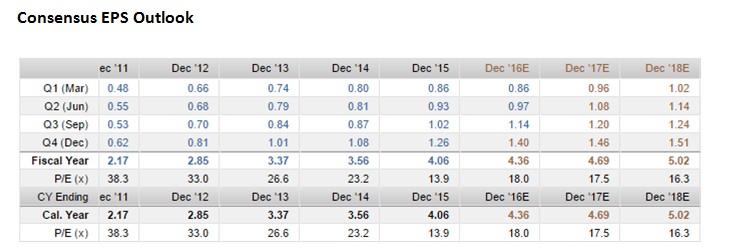
We are bullish on the shares with a $95 price target equal to 19x the consensus 2018 EPS outlook of $5. We do not think this is a stretch in terms of valuation as the historical trading range has been upward of 40x earnings. Admittedly, growth remains robust though not what it once was. Either way, we see the next chapter for the company to continue to bring ongoing lucrative cash flow generation, which will ultimately be returned to shareholders.
Consensus EPS Outlook
(This chart may be hard to read. Sorry.)
Good investing,
Todd Shaver, CEO and Founder
The Bull Market Report
by Todd Shaver | Jan 13, 2017 | 11am News Flash
The stocks we love are being bought heavily this week. Amazon (AMZN: $819) is up $70 since the end of the year. Apple (AAPL: $119) is up $4. Facebook (FB: $129) is on a tear too, up almost $14 since December 30th. That’s 12%. Even First Solar (FSLR: $36), a stock we love, but a stock that has been hammered by the market, is up nicely – rising $4 or 12% since the end of the year.
We can’t understand Under Armour (UA: $26) as it continues to lag but we are very happy we are out of Mylan (MYL: $37), having gotten out at $45 in August. And good old Annaly Capital (NLY: $10.12) continues to stay steady, paying out its 11%+ dividend, despite the 10-year US Treasury note moving from 1.7% to 2.4% in the last three months.
We will cover these stocks and more this weekend. Stay tuned.