by Todd Shaver | Jan 10, 2017 | 11am News Flash
Symbol: VKQ
Key Measures
52-Week Price Range: $12-$14
Shares Outstanding: 55 million
Market Capitalization: $690 million
Dividend: $0.0614 per share
Yield: 5.8%
Target Price: $15
Sell Price: $10
Price at time of publication on Jan 10, 2107: $12.47
Invesco Municipal Trust Overview and Dividend
Invesco Municipal Trust is a high quality diversified municipal bond fund that uses active management of a leveraged portfolio of municipal bonds to provide income to investors. Dividends are paid monthly, and the fund uses approximately 38% leverage. The fund’s management fees are 0.9%, which is low for an actively managed bond fund. The fund is also one of the oldest muni-bond closed-end funds, having been established in the early 1990s.
The fund’s dividend has been uneven, with several specials causing much higher yields in prior years. However, the fund has not paid a special dividend since 2006, although we believe one may be coming in the next few years for reasons discussed below.
The fund currently covers its distributions with net investment income, and all dividends are considered qualified distributions. This means they are tax free for many investors.
Fund Composition and Quality
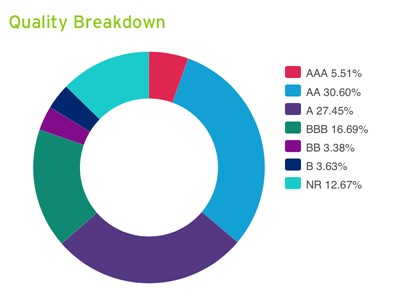
Despite Invesco Municipal Trust’s generous yield, the fund does not expose investors to high risk bonds that are prone to bankruptcy. In fact, the majority of the fund’s holdings have an A-rating or better:
With only 7% in bonds rated BB or below, Invesco Municipal is not playing the trick of buying very low quality issues to boost payouts. This is a dangerous “reach for yield” strategy that has caused many funds to blow up or lower payouts. An infamous example is the Pimco High Income Fund, which had to reduce its payouts in 2015 and saw the fund’s value plummet as a result. This is an almost impossible scenario for Invesco Municipal Trust, thanks to the high quality issues it owns.
Additionally, Invesco Municipal Trust is broadly exposed to most U.S. states and territories without heavy exposure to bankruptcy prone regions like Puerto Rico. Its five largest holdings are also the largest states:
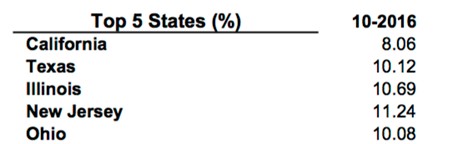
The fiscal responsibility of states like California are contentious to say the least. Many disagree with the political leanings in California. However, investors need to ignore these issues and focus on the facts. California has an AA- rating with both Fitch and Standard & Poors, which is the state’s best credit rating since 1999. The state’s credit rating was upgraded in 2015 and 2016. In August 2016, Fitch said this about the state: "California is fundamentally better positioned to withstand a future economic downturn than has been the case in prior recessions due to numerous institutional improvements.” The fact that Invesco Municipal Trust is invested in one of the better-positioned states is a testament to the stability and security of its returns for shareholders.
Fund Performance
Returns have been impressive both recently and on a long-term basis:
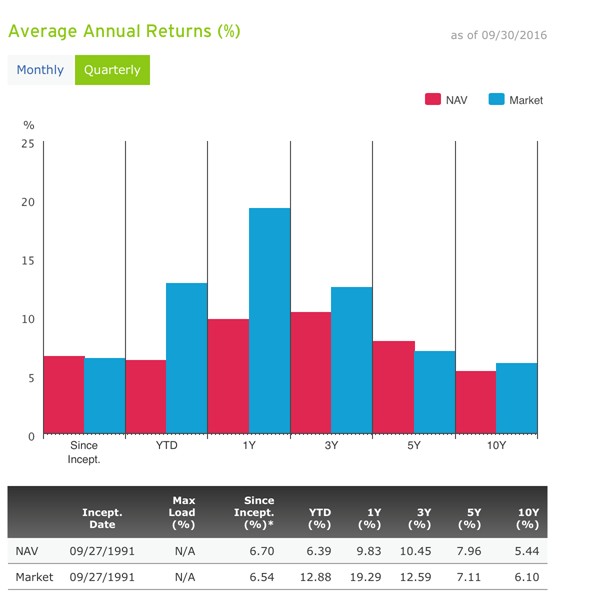
Its near 7% return since inception is an impressive feat in itself, but note the strong recent performance both in 2016 and over the last three years. Invesco Municipal Trust has withstood the financial troubles of the Great Recession and the rate hike fears of the last few years.
Of course, not everything has been rosy for the Trust. Lower yields on municipal bonds in our low interest rate world has caused dividends to fall for years:

The most recent dividend cut was in September, and was broadly expected both for this fund and for municipal bond funds broadly.
Paradoxically, that makes this Trust a very good buy right now. After its dividend cut, the undistributed net income balance went positive, which means it is now covering payouts with the income it is earning from its holdings.
Future View
The fund is extremely well positioned to cover its dividend in the long term, leading us to make a bold prediction: After years of cutting distributions, Invesco Municipal Trust will actually raise its dividend by the end of 2018. That increase might happen in 2017 - the wild card is the Federal Reserve.
Here’s why we think payouts are going to go up. Firstly, interest rates are already rising on bonds of all stripes, and this is causing municipal bond rates to rise:
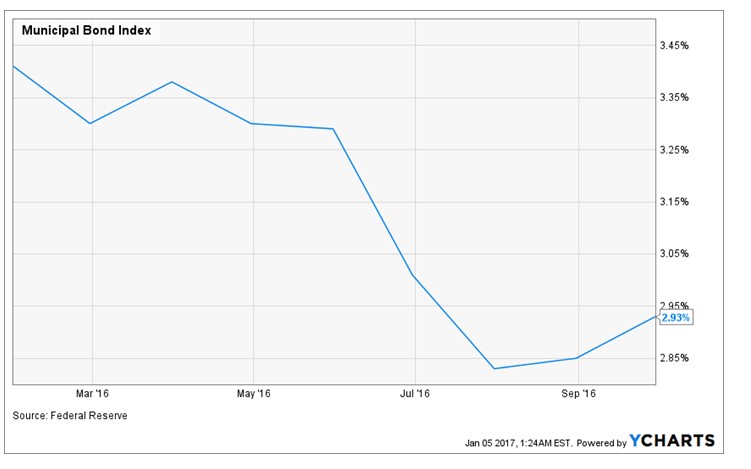
We are only in the first stages of this rate increase, but it means investment income from municipal bonds is poised to go northwards.
This is good for the Trust for one reason: Several of its holdings are callable or expiring in the next two years. Already over 15% of its holdings will be callable by the end of 2018:

Additionally, the average duration of the munis in the fund is a bit over five years. Twenty holdings expire in 2017 and 32 expire in 2018. In total, that represents over 8% of the fund’s total holdings, meaning that nearly a quarter of its bonds will either be called or redeemed by the end of 2018. They will be able to reinvest that 25% into new, higher yielding issues, thereby raising net investment income and the yield on its assets. That, in turn, will cause the fund’s dividend to rise.
Market View
The market is not pricing in this potential.

The municipal bond market has struggled significantly in the last few months for several reasons. Expectations of better returns elsewhere; fears that rate hikes will lead investors to flee municipal bonds; expected changes to the tax-advantaged status of municipal bonds; and other fears have caused a massive sell off.
However, the market has fully priced in these risks. We see this in the fund’s performance over the last two months:

Having found its bottom, the municipal bond market is finally recovering, although slowly and tentatively. This has given us some time to determine that the recovery has legs and assert that we are finally past the bottom. This encourages us to recommend this fund both for long-term income potential and short-term capital gains potential.
BMR TAKE:
Invesco Municipal Trust is one of the best quality municipal bond funds, and its potential is underpriced by the market. We recommend buying and holding to enjoy the 6% yield, and we expect its yield to rise to closer to 7% by the end of 2018. Meanwhile, capital gains potential are extremely likely as the bounce in municipal bonds continues. And of course, you realize that if you are in the 30% tax bracket, that 6% yield is the tax-equivalent yield of 8.6%.
by Todd Shaver | Oct 14, 2016 | 11am News Flash
Twilio (TWLO: $49, up 3% today) released a third-quarter earnings and revenue forecast, Tuesday. The company expects total revenue of $70-71 million in the three months ended Sept. 30, compared to revenue of $44 million in the year-earlier period, a growth rate of 60%. It expects a loss per share of 4-5 cents, compared to a loss per share of 7 cents in the year-earlier period. Consensus expects a loss of 8 cents and revenue of $65 million. The company is saying they will beat consensus by a wide margin.
This is very positive news. We added the stock Monday at $52 after the stock dropped $8 from $60 on Friday of last week. As you can see, Twilio is a very volatile stock, so if you want a conservative investment, please move over to Microsoft. We are very early in the life of this powerful new force in the world of providing phone and text messaging services to app developers.
We will have more to say in our newsletter, to be published Sunday evening.
by Todd Shaver | Oct 11, 2016 | 11am News Flash
Twilio: (TWLO: $52, down 14% yesterday)
Twilio fell the most since it started trading in June after the mobile and web-applications maker said the company and select shareholders will sell more stock. Despite Monday’s drop, Twilio is still up more than 250% since its IPO at $15 in June, closing up at $29, up 92% the first day. Now is the opportunity we’ve been waiting for to invest.
Twilio is a rare opportunity to invest in the only pure-play Platform-as-a-Service (“PaaS”) provider that is taking large slices of the Communications Software market, which IDC estimates to reach $46 billion in 2017. This new greenfield opportunity is being called Communications-Platform-as-a-Service (“CPaaS”). Twilio is known as the cloud-based category leader in CPaaS.
Riding the wave of the app and developer economy is a great place to invest. The clear growth in cloud computing is widely recognized. High-growth trajectories from Amazon Web Services (AWS), Microsoft Azure, Google Cloud, and Salesforce.com’s PaaS reflect the paradigm shift in how developers are building applications.
What does all that PaaS and CPaaS jargon mean in layman terms? The Information Technology (IT) department across Corporate America is undergoing a massive transformation. Historically, companies used to build out internal IT departments with staff and equipment. Right now, everything is shifting to the cloud. Instead of purchasing all the equipment to store data, the process is being run through massive data storage centers made available through the cloud for a simple license fee that scales up and down with volume. Instead of hiring a team of mobile software developers, the process is taking place through open sourcing the projects through the cloud, again on a pay-as-you-go basis. Twilio is leading the trend with a tight grip on communication services. Specifically, Twilio enables developers to build, scale, and operate real-time communications within software applications – to include SMS (texting), voice, video, and authentication.
The company is led by Jeff Lawson who is low-key and personable, but high in engineering intensity and entrepreneurial discipline. He is brilliant, and we at The Bull Market Report believe in him and hold him in high regard. You WILL hear more from this man and this company in the future.
Why is Twilio’s platform considered to be the leader? Listen to this: Twilio has 30,000 customers - from small developers to large enterprises - who use Twilio to power some 75 billion annual connections that reach 1 billion devices. Match.com makes matches without revealing phone numbers; Airbnb sends rental notifications, and the American Red Cross deploys volunteers, all through Twilio. ING, the European banking giant, recently announced it was closing down 17 hardware and software systems across its global call centers and replacing all of it with Twilio. Twilio’s largest customer, WhatsApp, uses them to verify customer accounts and logins. Apps from Lyft, Expedia, Netflix, Coca-Cola, Salesforce and the New York Times all have Twilio inside. The company saw 70% growth last quarter.
Here is more about the business model. The revenue model is transactional. Twilio largely prices its products on a transactional usage-based model. For example, its voice business is priced on a per-minute basis, while its message business is on a per-message sent basis. Programmable video is priced per gigabit. The reality is that Corporate America wants a scale-up/scale-down service on a pay-as-you-go basis, so the entire technology industry is just going to have to get used to no longer having the degree of revenue visibility that once existed.
Due to the nature of the business model, we look at revenue growth as the key indicator of business momentum. The outlook is exciting. There is substantial growth opportunity ahead through international expansion, adding other enterprise customers, and the roll-out of new products. While Twilio has been experiencing high revenue growth running 80-90%, there is strong likelihood for continued explosive growth, primarily via expanding the business internationally, which accounted for just 14% of revenue in 2015. Twilio began investing in Europe only in 2014 and Asia just in 2015 and has already yielded strong results. These geographic regions are just getting going. Additionally, Twilio is gearing its sales force to pursue business with a greater number of enterprise customers such as ING and Nike, where the more big names the company can win the more likely we are to see trickle-through effects in terms of enterprise-level retention rates.
The financial picture calls for the major inflection point to come in 2018. Twilio did $167 million in sales last year, up from $90 million the year before. At its current growth rate Twilio would hit a $1 billion annual run rate in the second half of 2018. Lawson calls telecommunications services a trillion-dollar market, with big portions of it poised to migrate from hardware to software. Following Twilio’s total revenue growth of 88% YoY in 2015, consensus estimates call for growth to decelerate to 50% per year in 2016-2018 but we think they can outdo these estimates. By 2018, management has committed to be EPS, operating cash flow, and free cash flow positive. This inflection point considers ongoing investments to build out partnerships that will support the future of the company.
Customer concentration risk* is among the single biggest concerns investors currently have. In 2015, Twilio’s 10 largest customers contributed 32% of total revenue. A meaningful though undisclosed revenue contribution came from just two customers – WhatsApp and Uber. These two customers, however, have very different profiles and it is important to understand the nuances. The bottom line is that investors will just have to live with the customer concentration until the business can grow out of it. WhatsApp is a mobile instant messaging platform with approximately 1 billion users globally and was acquired by Facebook in 2014. WhatsApp has been a Twilio customer for about four years and was a customer before Facebook purchased it. WhatsApp uses Twilio for both voice and messaging.
Uber uses Twilio’s Programmable Voice products to enable voice calls between the driver and the rider, uses Twilio’s Programmable Messaging products to notify riders of an approaching ride or to engage drivers during increasing demand, and finally uses Twilio’s Authy product to authenticate phone numbers of new users.. Overall, both the relationships with WhatsApp and Uber appear to be on solid footing.
The other main concern is the long-term competitive threat of Amazon’s AWS. However, AWS, the leading cloud platform, is not currently a competitor. Should AWS decide to provide a competitive cloud platform for communications, it would pose a threat to Twilio’s business but that talk is just speculative. Twilio has noted that it has a “great” relationship with Amazon, which is an investor in Twilio. In July, Twilio announced that it now “helps AWS extend text message delivery for SNS customers.” AWS VP of Mobile and IoT Marco Argenti commented, "AWS believes in the value of efficient, scalable technology solutions that can elevate the developers' role to concentrate on building great applications, rather than managing infrastructure. We are thrilled to be working with Twilio, and we'll continue to work together to help empower developers to communicate with their users seamlessly across devices." All in all, we find some comfort in the close relationship the two companies currently share.
BMR Take: Twilio is not cheap, trading at 12x 2017 sales, relative to its peer group average of around 4x. However, Twilio is better positioned than all its peers by a large distance as a pure play in CPaaS, an explosive growth opportunity. We believe Twilio is on the path to ultimately produce annual sales greater than the current market cap of $4.4 billion with sales this year of $315 million. The timeline is a ways out, but the recent sell-off is an opportunity to invest in this powerful, explosive company.
*Note that we at The Bull Market Report do not view the customer concentration as a worrisome issue. With growth as noted above, we don’t see it as a threat to the well-being of the company.
And one more thing. The world is always looking for The Next Big Thing. Twilio just might be a candidate for this exciting category.
by Todd Shaver | Oct 4, 2016 | 11am News Flash
Netflix: (NFLX: $103, up 7% since Thursday)
If you're willing to look out 3+ years, we think Netflix is one of the very few names in the large cap Internet universe that can be a double. Analysts are calling for EPS of $10 by 2020. A 20x multiple would get you to $200 a share. What is all the excitement about?
First, there is a major technological shift underway. The transformation from cable and standalone TVs to streaming content over connected devices is happening now. The living room of the future may have only a Netflix and/or HULU subscription with a few connected devices, and no TV or cable! Why is this happening? People love TV content, but they don't love the linear TV experience, where channels present programs only at particular times on non-portable screens with complicated remote controls and tons of commercials. Now Internet TV - which is on-demand, personalized, and available on any screen - is replacing the linear TV experience.
Second, there is upside to winning more share of leisure time. Netflix competes with all the activities that consumers have at their disposal in their leisure time. This includes watching content on other streaming services, cable TV, watching DVDs, but also reading a book, surfing YouTube, playing video games, socializing on Facebook, going out to dinner with friends, and enjoying a glass of wine, to name a few. Netflix currently earns a tiny fraction of consumers’ time and money, and has lots of opportunity to win a larger share, if the business can keep improving.
Third, exclusive content is building. One key driver for Netflix becoming a powerhouse is their focus on becoming a producer of content, that provides a high-quality, curated offering, and therefore has increasingly licensed content on an exclusive basis. Management is behind the effort in full force. Netflix’s new original - The Get Down, (a musical drama television series set in the South Bronx in the late 1970s, created by Baz Luhrmann, the director of Moulin Rouge, our favorite movie of all time) cost $10 million per episode! In 2016, Netflix expects to spend $6 billion on content for its members. SIX BILLION DOLLARS. In addition, Netflix will spend $1 billion on marketing in 2016, getting people so excited about the content that they pony up and join Netflix.
Fourth, the company is now a franchise with global scale. Last year Netflix launched in Australia, New Zealand, Japan, Spain, Italy and Portugal. In January, Netflix added an additional 130 countries, making Netflix available virtually everywhere in the world except for China and places where US companies are not allowed to operate (North Korea, Crimea, and Syria)
Fifth, the US market isn’t over yet. Netflix targets 60-90 million members in the US, based upon its trajectory to date and the continued growth of Internet TV. Currently, domestic subscribers total around 46 million.
The stock is still working to get the courage to retest 52 week highs ($133 in December). Last quarter’s performance didn’t help – they provided lower-than-expected subscriber growth guidance than some expected. We don’t see any reasons to be concerned. All signs show demand for Netflix's services remains robust. We see the current level as an opportunity to accumulate shares.
BMR Take: We admit that at a valuation of 100x earnings and 50x EBITDA there is a risk to any sharp near term hiccup in the business, or overall stock market. However, Netflix represents one of the more lucrative growth stock stories of a generation, and it isn’t over yet. The company is transforming our living room, a place where we spend a lot of time. $10 a month to Netflix and no cable bill is something that millions are willing and will be willing to spend for decades to come. Reiterate Buy.
by Todd Shaver | Sep 28, 2016 | 11am News Flash
Twitter (TWTR: $23.40) has had a strong run these past two weeks. There are rumors swirling around about various firms buying the company and as we said in the newsletter Monday, there are many scenarios that could take place to cause the stock to move dramatically in either direction.
If more suitors join the fray, the stock could shoot higher. If they all drop, out the stock could reverse course and drop down to $18 or lower.
So we thought you may wish to consider a GTC* stop order if you still have the stock. A stop order as you may know already, will execute if a certain price is reached. You can have a buy stop or a sell stop. A buy stop is used if you want to acquire more shares if the stock goes higher. You would use this so that you don’t miss out on a stock if it goes higher as you expect it to do. A sell stop (which used to be called a stop loss) is used to get out of a stock if it goes lower.
*GTC – Good ‘Til Cancelled
With Twitter at around $23, you can place an order below this price that will execute when that price is reached, say $22, or $21. Thus, if the stock goes to $22 your stop becomes a market order and you are generally executed at your price. If the stock is headed to $18 or lower, this will get you out without giving back all the gains you made in the past few weeks. We think this is such a good idea, we are going to place an imaginary stop (since we don't own any of our stocks) at $22.45, thus protecting our gains.
One caveat – stops work about 99.9% of the time. Where they don’t work is when the stock is halted and the stock reopens at a price below your price. For example, if you have a stop at $22 and the stock opens at $19, that’s where your order will be executed. Not pretty. Why would that happen? Well, if there was some bad news that came out overnight causing investors to rush to the exits, this could cause the stock to plummet. But again, this is rare.
Good luck with your Twitter. And good investing overall.

by Todd Shaver | Sep 16, 2016 | 11am News Flash
52 Week Price Range: $23-$35
EPS: $1.61
Shares Outstanding: 84 million
Market Capitalization: $2.5 billion
Dividend: $2.28
Yield: 7.7%
Target Price: $33
Sell Price: $24
Price as we publish: $28
Background and Company Overview
Care Capital Properties (CCP) was spun off from Ventas (VTR; $67), with a $24 billion market cap, last summer. This was done to offer Care Capital the opportunity to add value to shareholders by focusing on its investments in skilled nursing facilities and real estate assets catering to Healthcare industry tenants. The company focuses on triple-net lease assets, where tenants pay rent plus real estate taxes, insurance, and maintenance.
Usually, only the highest quality tenants choose triple-net leases because the large overhead is a hurdle for smaller, more cash-strapped companies. This is why triple-net lease real estate investment trusts (REITs) are more popular with risk-averse investors, and usually offer lower yields.
At a near 8% yield, however, Care Capital Properties offers this lower risk focus and with a higher yield. This is largely a result of its specialization in Healthcare facilities, which have received little attention from investors in 2016, and the fact that the company is very new as a standalone firm. However, its longer history as part of Ventas means the company already has a portfolio of 340 properties across the United States. With properties in California, Oregon, Washington, Nevada, Arizona, New Mexico, Wyoming, Texas, Arkansas, Missouri, Minnesota, Wisconsin, Illinois, New York, Georgia, and several other states, Care Capital Properties is geographically diversified, offering you more security.
The vast majority of its assets are skilled nursing facilities, with less than a dozen specialty hospitals and senior housing facilities. Skilled nursing facilities are seeing strong growth, with a combined annual revenue of $130 billion, according to Ibis World*. They see growth to continue for several years:
"Due to the necessary nature of services provided by nursing care facilities, the industry was able to grow despite broad economic stagnation. Additionally, the continued aging of the population has spurred demand for industry services. Since the elderly are more prone to injury and illness, the larger share of senior adults has propelled demand for nursing care facilities. We see favorable demographic trends: Over the five years to 2021, the industry is expected to continue expanding. Continued aging of the population, which is expected to accelerate over the five-year period, will drive industry growth."
*IBISWorld is a global business intelligence leader specializing in Industry Market Research and Procurement and Purchasing research reports.
Healthcare REIT Marketplace
Care Capital Properties has several competitors in the Skilled Nursing facilities and Healthcare real estate marketplace. Of the largest and well known are Welltower (HCN), HCP (HCP), and Omega Healthcare Investors (OHI). Additionally, smaller firms Sabra Healthcare (SBRA) and Medical Properties Trust (MPW) have gained tremendous interest in 2016. A quick comparison of these stocks is below:
Note that Welltower's lower yield is largely due to its large size and sustainable payouts. With funds from operation (FFO) at 132% of dividend payouts, Welltower's dividend is secure and expected to rise as it has for over 30 years.
Price to Earnings and Dividend Coverage
However, Care Capital Properties is in a better position to raise dividends although it lacks the history of the larger Healthcare REITs. The company’s dividend coverage is 144%, as FFO has risen markedly since the company went public in 2015. In fact, it has the second highest dividend coverage of this basket of Healthcare REITs:
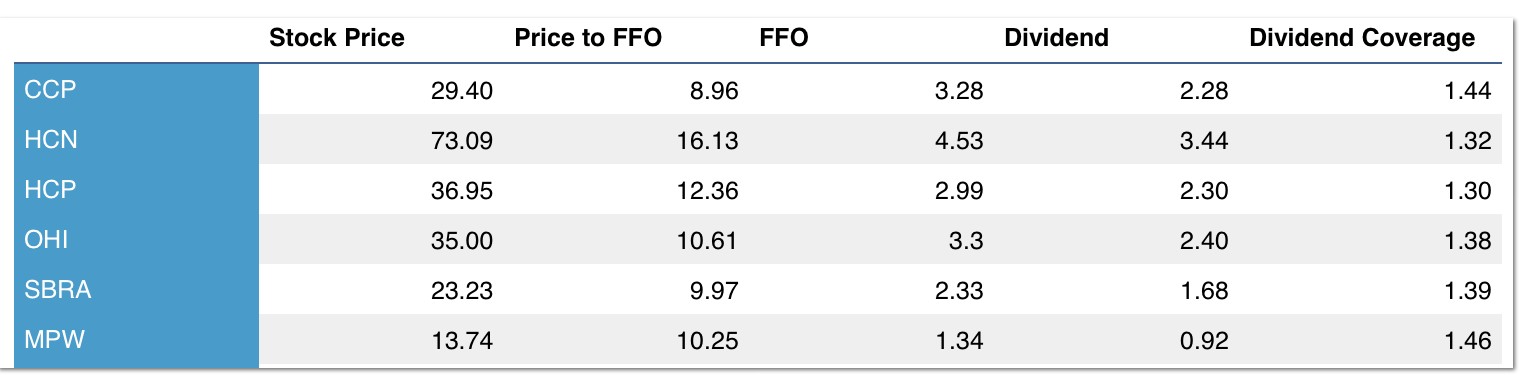
In addition to a higher dividend coverage, implying both a safe payout and room for dividend increases, the company’s price-to-FFO is the lowest of this group. Price-to-FFO, like the more familiar price-to-earnings ratio, is used to see exactly how much an investor is paying for a REIT’s earnings. Because FFO is a more accurate metric of rental income than EPS, we can use this metric to see how expensive each stock is.
Business Growth
Care Capital’s low price-to-FFO is largely a result of the newness of the company, while Welltower’s high price-to-FFO is a result of the company’s established track record. However new and small Care Capital Properties is, the company’s FFO growth and rising revenue demonstrate its ability to increase payouts. On the growth of the company’s size, note its trailing 12-month revenue increase since going public:

Over the last year, revenue has grown by over 12% on a year-over-year basis. This is largely the result of continued investment in new real estate opportunities, and the company is positioned to further its investments, as the CEO stated in the company’s last earnings release:
"Based on our first half results in 2016 and the revised timing as it relates to optimization of the portfolio, we are able to raise our guidance. We intend to continue to reinvest and upgrade the portfolio, while evaluating recycling of capital through dispositions. The net result of these activities will make our company even stronger over the long term."
BMR Take:
As one of the few REIT sectors to rise significantly in 2016, the Healthcare REIT sector is a rare place where investors can get high yields and earnings at a good price. Additionally, demographic headwinds due to an aging population make Healthcare REITs a lower risk bet for a long-term hold than many alternatives in the market. Finally, when choosing which Healthcare REIT to choose, we have chosen Care Capital Properties due to its low price and high dividend coverage.
We see future growth over the long term for the company in both dividend payout and stock price. The company has not yet increased dividends despite its very high dividend coverage. Being just a year old, the company may surprise the market with a dividend increase, and that may cause a sharp inflow of capital into the stock. We recommend buying and holding Care Capital Properties now in anticipation of growing demand for the stock in the market as its FFO and dividends rise.
