
Cloudera (CLDR: $22.45)

June 2, 2017
Company Description:
Cloudera offers the leading platform for data management, machine learning, and related analytics, leveraging the open source Big Data technology framework known as Apache Hadoop [stay tuned!] Cloudera’s solution not only allows enterprises to ingest any type of data and store it in a centralized place, but also provides various other capabilities, such as real-time analytics at a fraction of the cost of legacy systems. Cloudera’s differentiation versus other commercial players in the market stems from its enterprise-grade proprietary capabilities wrapped around the open source core that preserves the open-source nature of the product while giving the largest companies in the world the confidence to use the platform. The broad-based success of Cloudera’s platform is underscored by its list of more than 1,000 customers, including about 500 Global 8,000 customers such as Cisco, Barclays, SanDisk, Samsung, NYSE, ADP, Siemens, Cerner, PWC, Cox Automotive, Caesars Entertainment, and MasterCard. All these great corporations know about Cloudera. It’s time you do too.
So what’s the short and simple investment thesis? If you think data is valuable, then Big Data is a sector you want to be in. If you think Machine Learning can advance the way companies and the world interpret information, then you have to find an investment that gets you in the game of artificial intelligence. Cloudera checks both boxes. The company is pioneering the space. Cloudera’s partnership with Intel places the company way ahead of its competition. We think shares are worth $25-30 based on 5x the consensus estimate of 2020 sales. This is a very realistic valuation compared to other technology companies in huge growth markets.
Background
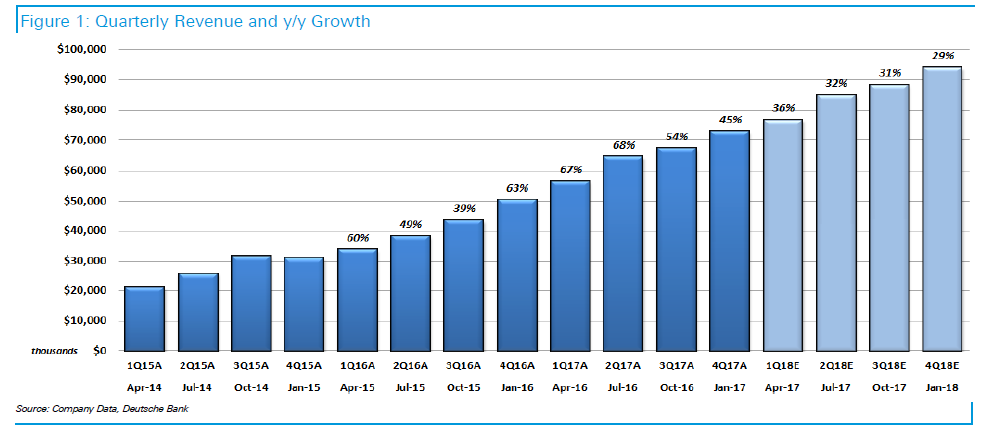
Cloudera was formed in 2008, founded by Michael Olson, now the Chairman and Chief Strategy Officer. In fiscal 2017 (ended January 2017), the company generated total revenues of $260 million, and grew to 1,500 employees. From its roots as a simple open source technology company, Cloudera has pivoted to now serve major enterprises with an industrial-strength technology platform. Cloudera hired Tom Reilly as its CEO in 2013, the former CEO of ArcSight before its sale to HP. In 2014, Cloudera closed an enormous $750 million equity raise from Intel that valued Cloudera at $4 billion. The company went public in April of this year at $15 and is on track to exceed $330 million in annualized revenues, as they grew by 60% in fiscal 2017, one of the fastest growth rates in the enterprise software sector for a company at this scale.
The Evolution of Hadoop
[This is going to get technical, so stick with it or skip to the next section!]
Before discussing Cloudera’s business model, competitive differentiators and financials, let’s take a step back and describe Hadoop technology (the historical underpinning of Cloudera’s platform), how Hadoop has evolved over the years and how and why Cloudera has now moved well beyond core open source Hadoop software.
It all started with Google. The evolution of Hadoop can be traced back to Google’s internal effort in the early 2000s to deal with massive data volumes as it began to digest and crawl the entire web and do very sophisticated data analysis. Traditional off-the-shelf data management solutions couldn’t handle the data volumes and types that Google was acquiring, at least not at a reasonable cost. Google engineers created an alternative, more scalable, and much cheaper data environment rooted in a software framework known as MapReduce, a data storage system called Google File System (GFS), a distributed database called BigTable, and an underlying hardware layer made up of thousands of servers linked to form a cluster or grid.
MapReduce enabled Google’s programmers to replicate and scatter data to many different servers or nodes and effectively split the analytics tasks among these machines. This allowed for parallelization (improving query speeds), data protection in the event of a node failure (high availability), and the ability to add servers to the grid without the need to make any changes to the MapReduce code (maximizing scalability). BigTable added much greater flexibility. These core elements gave Google a competitive edge and spawned Hadoop, Cassandra and an entire ecosystem of open source data management technologies.
In late 2004, Google engineers published a paper describing GFS, BigTable, MapReduce and other components of Google’s proprietary data processing infrastructure. Soon after, Yahoo software engineer Doug Cutting (who since joined Cloudera) combined these Google technologies with other open source software components and created Hadoop, which is now the centerpiece of Yahoo’s data processing and analytics environment. Hadoop was open-sourced by Yahoo and is now part of the Apache Software Foundation, a non-profit that incorporates Hadoop code improvements from the open source community. The technology was commercialized by a number of specialized vendors including Cloudera.
Of course Google was early! We digress for just a minute here to reiterate our recommendation of this amazing company, given how repeatedly it’s proven to be a pioneer.
The Addressable Market For Cloudera Is Enormous
Cloudera is targeting the existing $40+ billion data management market dominated by incumbents such as Oracle, IBM, and Microsoft for a host of Big Data applications. The addressable market is likely larger, as high as $66 billion according to Cloudera. Data is increasingly becoming a top priority strategy for how companies build themselves a competitive advantage. Accordingly, demand for data management technology is on the rise. In particular, everybody wants new innovative technologies that can do things that were previously not possible. Cloudera is right in the mix on this front.
Strategic Partnership with Intel Provides Strong Competitive Moat
Cloudera’s partnership with Intel is a key competitive differentiator. The partnership allows Cloudera to have exclusive visibility into Intel’s chipset roadmap for the next 5-10 years. Intel is also committing a dedicated R&D team focused on working with Cloudera engineers to optimize performance of Cloudera’s Hadoop distribution on the Intel chipset. The $750 million capital infusion from Intel in 2014 gave Cloudera an advantage in the market to accelerate investments for global expansion and into emerging technologies like Machine Learning and Advanced Analytics, ahead of its competitors. Finally, the partnership has helped Cloudera to gain the confidence of large global organizations as well as influence new channel relationships. Do you realize how hard it is to be a close partner of Intel’s like this! The Intel partnership is worth some serious money.
Best-in-Class Leadership Team
You have to have good people at the helm or it just never works. Fortunately, check this box as excellent. The maturity and intellectual capital within the management team, with a solid mix of technical and business expertise, is a competitive differentiator and highly regarded seemingly everywhere across Wall Street. On the technical side, the team includes Doug Cutting (Chief Architect), one of the two cofounders of Apache Hadoop; Mike Olson (co-founder of Cloudera) with more than 30+ years of experience in database technology; and Dan Sturman (SVP Engineering), one of the brains behind Google Compute Cloud. The technical prowess is balanced by solid public company business experience from Tom Reilly, CEO, with 30+ years of enterprise software experience, including as the ex-CEO of a firm acquired by SAP; and Vishal Rao, SVP Field Ops, who was the head of sales at Splunk.
Strong Predictable Business Model
Cloudera enjoys a highly visible and predictable business model, as over 77% of its revenue is recurring in nature (on long term contracts) with best-in-class customer retention rates of over 90% (nobody leaves!) It all adds up to a healthy installed base of technology at companies across the globe. It so hard to get in the door, but once you do, the opportunities for add-on sales can be lucrative.
The Knock On The Company Is Large Operating Losses
It’s large operating losses running around $140 million currently, undeniably stand out when considering the risk profile of the business. The operating losses are staggering, especially when compared to other recurring revenue companies of similar size, but are partially a function of this stage of the Big Data platform market, which has some very different characteristics versus other enterprise software markets. It is a technical sale with a longer-than-average sales cycle, thus leading to higher-than-average expenses as a percent of revenue, but which improves over time as the customer scales. Additionally, the capital infusion from Intel led Cloudera to accelerate its investments, not only in building a global infrastructure, but also to accelerate investments in R&D to capture workloads for emerging use-cases. While it is typical to see a better growth vs. margin profile for companies pioneering a new industry, we and everybody else on Wall Street will remain critical of losing money and hope to see the profitability inflection point sooner than later.
Financial Outlook
