
by Todd Shaver | Jan 4, 2018 | 3pm News Flash
A Robotics and Artificial Intelligence Company
Set to Dominate Medical Technology
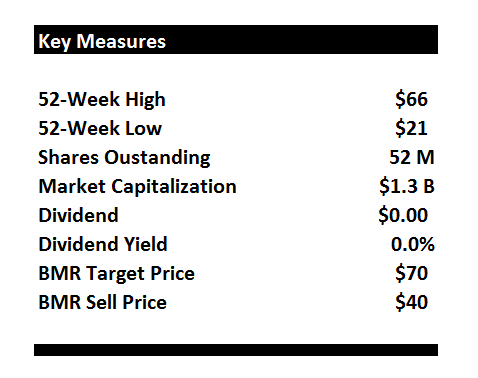
Company Overview: Mazor Robotics is a medical device company, which engages in the development and marketing of innovative surgical guidance systems and complementary products. It specializes in robotic, computerized and imaging-based systems, primarily in the field of spine surgery. Its flagship product, Renaissance, is a surgical guidance system that enables surgeons to conduct spine surgeries in an accurate and secure manner. The company was founded in 2001 and is headquartered in Israel.
Focused on the development of surgical robotic systems. Mazor Robotics is dedicated to the development of robotic surgical guidance systems and complementary products in the spine surgical markets that provide a safer surgical environment for patients, surgeons and operating room staff. Mazor’s flagship product, Renaissance Surgical Guidance System, is designed to transform spine surgery from freehand procedures to highly-accurate, state-of-the-art procedures that offer higher standard of care with proven clinical results.
Favorable clinical reviews validate accuracy, usability, and clinical advantages. Peer-reviewed publications and presentations at leading scientific conferences worldwide in the last few years have validated the accuracy, usability, and clinical advantages of Mazor Robotics technology for spine surgery. The company’s robotic systems (Renaissance and SpineAssist) are FDA cleared and CE-marked and are in use in over 40 medical centers worldwide. Renaissance and SpineAssist have been used successfully in over 4,000 surgeries, involving over 35,000 implants.
Poised to benefit from the sizable and growing market for spinal implants and biologics. Back pain is the second most common neurological ailment in the U.S. (behind headache). According to the National Institute of Neurological Disorders and Stroke, Americans spend at least $50 billion each year on the treatment of lower back pain. It has also been estimated that there are about 360,000 thoracic-lumbar spinal fusions performed annually in the U.S., and on average about $13,000 worth of implants and biologics are used in a thoracic-lumbar fusion surgery. The spinal implants and biologics market is estimated at $6.7 billion annually. Favorable megatrends such as the growth of the global middle class with increased spending on healthcare in both developed and emerging countries are expected to drive the continued growth of the spinal implants market in coming years.
Management team focuses on driving sales. Mazor’s management team remains focused on driving sales of the Renaissance systems and generating recurring revenue through sales of disposable products and service contracts by establishing Renaissance spine surgery as the “standard-of-care.” The company expects to continue to work with hospitals as part of the company’s outreach program to demonstrate the key benefits of Renaissance. We believe that growing the company’s top-line which hinges upon the company’s execution of sales and marketing strategies remains a top priority for the management team and is critical to the success of the company. The sales and marketing strategies include: (i) expanding the U.S. commercial organization, ii) continuously improving the company’s product offering to help surgeons deliver the best clinical care to their patients, (iii) targeting the early adopters of technology, (iv) offering the highest level of training and support to customers, and (v) demonstrating the clinical and financial value proposition of Renaissance. With the sales and marketing strategies, favorable clinical outcomes and industry peer reviews, we anticipate greater market adoption of the Renaissance platform in coming years.
Solid pipeline positions the company well for growth. Provides revenue upside opportunity. Mazor Robotics’ core technologies and clinical pipeline include surgical robotics, robotic-guided implants, new procedures using these technologies, and medical 3D imaging for surgery. Renaissance Brain is a new application of the Renaissance system that is expected to provide precise control over the insertion of surgical instruments and other brain accessories or implants, during brain surgery. From a timeline standpoint, head-mounted application for brain surgeries was cleared by the FDA in 2012.
BMR Take: Mazor shares increased 150% in 2017 and we believe the momentum is going to continue. The company is coming off of a record 3Q17 earnings where it was announced that orders were received for 22 systems comprised of 19 Mazor X and 3 Renaissance. Medtronic was responsible for 11 of the 19 Mazor X purchase orders, which is only the second phase of the commercial agreement between the two firms. Additional orders are in the pipeline. There is just clear surgeon interest in everything Mazor is doing. Why? When you step back and think of it, this is the start of artificial intelligence and robots beginning to take over the healthcare and other industries to increase productivity. Mazor is at the center of the action in the Medical Technology sector where the advancement will change lives and the economic opportunity for investors will be lucrative. Mazor’s sales are set to scale from $62 million this year to over $100 million by 2019. We see an addressable market opportunity for Mazor to do $1 billion in revenue if they can expand their expertise in robotics and artificial intelligence into new products within the sector.
As you know, we had Mazor in our portfolio last year for a bit and it did well for us. But it had a sharp drop in June which scared us out of the stock. Did you know that the toughest thing for an investor to do is to buy back a stock at a higher price than he sold it? Well, we are going to do just that. We believe in the future of the company and expect big things from the firm in the coming years.
Sales:
by Todd Shaver | Aug 24, 2017 | 3pm News Flash
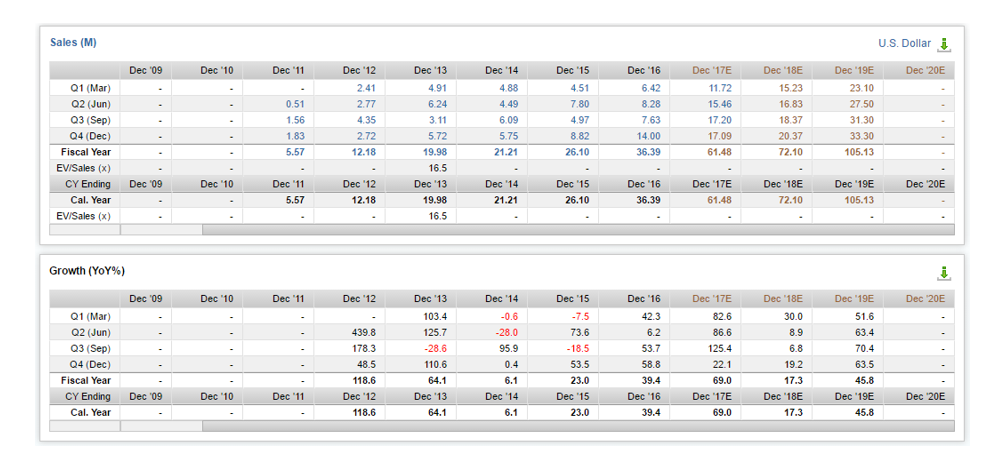
Splunk (SPLK: $61)
Bull Market Report Target Price: $75
Bull Market Report Sell Price: $60
Earnings Date: Thursday, 4:00 PM ET
Consensus: 2Q17
Revenues: $270 million
EPS: $0.06
Year Ago Quarter Results
Revenues: $213 million
EPS: $0.05
Key Things to Watch For in the Quarter
Splunk is expected to report a 26% increase in revenues and a 20% increase in earnings per share for 2Q17. Splunk has beaten estimates in each of the past four quarters, and we expect them to uphold this trend as they have been able to consistently increase their sales 25% in previous quarters. As one of the largest providers of software solutions that enable organizations to gain real-time operational intelligence, Splunk is likely going to grow alongside the large corporations that use their products.
----------------------------------------------------------------------------------------------------------------------------------------------------
VMware (VMW: $101)
Bull Market Report Target Price: $108
Bull Market Report Sell Price: $90
Earnings Date: Thursday, 5:00 PM ET
Consensus: 2Q17
Revenues: $2.0 billion
EPS: $1.15
Year Ago Quarter Results
Revenues: $1.8 billion
EPS: $0.97
Key Things to Watch For in the Quarter
Wall Street expects VMware to report a 12% increase in revenues and an 18% increase in earnings per share for 2Q17. VMware has beaten estimates in each of the past four quarters, contributing to its 35% year-over-year appreciation. Insiders at the firm still own 20% of the company indicating their confidence and vested interest in the performance of the stock. Despite slight overvaluation at the moment (PE of 33), our long-term vision for VMware is extremely bullish. With a market cap of $41 billion, this is no small company. In fact, they are changing the cloud world through their innovative software. Sitting at a new 10-year high today as we write this, they are operating with almost $9 billion of cash, and just $1.5 billion in long term debt.

by Todd Shaver | Jun 6, 2017 | 3pm News Flash
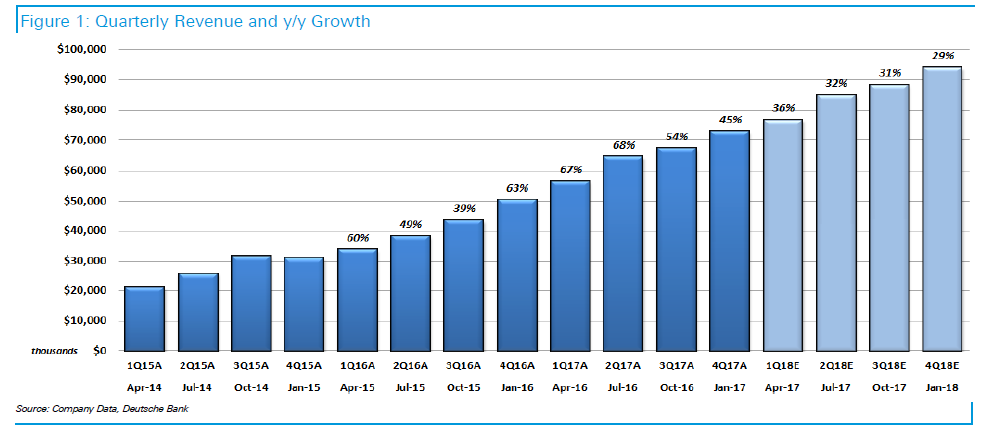
Cloudera (CLDR: $22.45)
June 2, 2017
Company Description:
Cloudera offers the leading platform for data management, machine learning, and related analytics, leveraging the open source Big Data technology framework known as Apache Hadoop [stay tuned!] Cloudera’s solution not only allows enterprises to ingest any type of data and store it in a centralized place, but also provides various other capabilities, such as real-time analytics at a fraction of the cost of legacy systems. Cloudera’s differentiation versus other commercial players in the market stems from its enterprise-grade proprietary capabilities wrapped around the open source core that preserves the open-source nature of the product while giving the largest companies in the world the confidence to use the platform. The broad-based success of Cloudera’s platform is underscored by its list of more than 1,000 customers, including about 500 Global 8,000 customers such as Cisco, Barclays, SanDisk, Samsung, NYSE, ADP, Siemens, Cerner, PWC, Cox Automotive, Caesars Entertainment, and MasterCard. All these great corporations know about Cloudera. It’s time you do too.
So what’s the short and simple investment thesis? If you think data is valuable, then Big Data is a sector you want to be in. If you think Machine Learning can advance the way companies and the world interpret information, then you have to find an investment that gets you in the game of artificial intelligence. Cloudera checks both boxes. The company is pioneering the space. Cloudera’s partnership with Intel places the company way ahead of its competition. We think shares are worth $25-30 based on 5x the consensus estimate of 2020 sales. This is a very realistic valuation compared to other technology companies in huge growth markets.
Background
Cloudera was formed in 2008, founded by Michael Olson, now the Chairman and Chief Strategy Officer. In fiscal 2017 (ended January 2017), the company generated total revenues of $260 million, and grew to 1,500 employees. From its roots as a simple open source technology company, Cloudera has pivoted to now serve major enterprises with an industrial-strength technology platform. Cloudera hired Tom Reilly as its CEO in 2013, the former CEO of ArcSight before its sale to HP. In 2014, Cloudera closed an enormous $750 million equity raise from Intel that valued Cloudera at $4 billion. The company went public in April of this year at $15 and is on track to exceed $330 million in annualized revenues, as they grew by 60% in fiscal 2017, one of the fastest growth rates in the enterprise software sector for a company at this scale.
The Evolution of Hadoop
[This is going to get technical, so stick with it or skip to the next section!]
Before discussing Cloudera’s business model, competitive differentiators and financials, let’s take a step back and describe Hadoop technology (the historical underpinning of Cloudera’s platform), how Hadoop has evolved over the years and how and why Cloudera has now moved well beyond core open source Hadoop software.
It all started with Google. The evolution of Hadoop can be traced back to Google’s internal effort in the early 2000s to deal with massive data volumes as it began to digest and crawl the entire web and do very sophisticated data analysis. Traditional off-the-shelf data management solutions couldn’t handle the data volumes and types that Google was acquiring, at least not at a reasonable cost. Google engineers created an alternative, more scalable, and much cheaper data environment rooted in a software framework known as MapReduce, a data storage system called Google File System (GFS), a distributed database called BigTable, and an underlying hardware layer made up of thousands of servers linked to form a cluster or grid.
MapReduce enabled Google’s programmers to replicate and scatter data to many different servers or nodes and effectively split the analytics tasks among these machines. This allowed for parallelization (improving query speeds), data protection in the event of a node failure (high availability), and the ability to add servers to the grid without the need to make any changes to the MapReduce code (maximizing scalability). BigTable added much greater flexibility. These core elements gave Google a competitive edge and spawned Hadoop, Cassandra and an entire ecosystem of open source data management technologies.
In late 2004, Google engineers published a paper describing GFS, BigTable, MapReduce and other components of Google’s proprietary data processing infrastructure. Soon after, Yahoo software engineer Doug Cutting (who since joined Cloudera) combined these Google technologies with other open source software components and created Hadoop, which is now the centerpiece of Yahoo’s data processing and analytics environment. Hadoop was open-sourced by Yahoo and is now part of the Apache Software Foundation, a non-profit that incorporates Hadoop code improvements from the open source community. The technology was commercialized by a number of specialized vendors including Cloudera.
Of course Google was early! We digress for just a minute here to reiterate our recommendation of this amazing company, given how repeatedly it’s proven to be a pioneer.
The Addressable Market For Cloudera Is Enormous
Cloudera is targeting the existing $40+ billion data management market dominated by incumbents such as Oracle, IBM, and Microsoft for a host of Big Data applications. The addressable market is likely larger, as high as $66 billion according to Cloudera. Data is increasingly becoming a top priority strategy for how companies build themselves a competitive advantage. Accordingly, demand for data management technology is on the rise. In particular, everybody wants new innovative technologies that can do things that were previously not possible. Cloudera is right in the mix on this front.
Strategic Partnership with Intel Provides Strong Competitive Moat
Cloudera’s partnership with Intel is a key competitive differentiator. The partnership allows Cloudera to have exclusive visibility into Intel’s chipset roadmap for the next 5-10 years. Intel is also committing a dedicated R&D team focused on working with Cloudera engineers to optimize performance of Cloudera’s Hadoop distribution on the Intel chipset. The $750 million capital infusion from Intel in 2014 gave Cloudera an advantage in the market to accelerate investments for global expansion and into emerging technologies like Machine Learning and Advanced Analytics, ahead of its competitors. Finally, the partnership has helped Cloudera to gain the confidence of large global organizations as well as influence new channel relationships. Do you realize how hard it is to be a close partner of Intel’s like this! The Intel partnership is worth some serious money.
Best-in-Class Leadership Team
You have to have good people at the helm or it just never works. Fortunately, check this box as excellent. The maturity and intellectual capital within the management team, with a solid mix of technical and business expertise, is a competitive differentiator and highly regarded seemingly everywhere across Wall Street. On the technical side, the team includes Doug Cutting (Chief Architect), one of the two cofounders of Apache Hadoop; Mike Olson (co-founder of Cloudera) with more than 30+ years of experience in database technology; and Dan Sturman (SVP Engineering), one of the brains behind Google Compute Cloud. The technical prowess is balanced by solid public company business experience from Tom Reilly, CEO, with 30+ years of enterprise software experience, including as the ex-CEO of a firm acquired by SAP; and Vishal Rao, SVP Field Ops, who was the head of sales at Splunk.
Strong Predictable Business Model
Cloudera enjoys a highly visible and predictable business model, as over 77% of its revenue is recurring in nature (on long term contracts) with best-in-class customer retention rates of over 90% (nobody leaves!) It all adds up to a healthy installed base of technology at companies across the globe. It so hard to get in the door, but once you do, the opportunities for add-on sales can be lucrative.
The Knock On The Company Is Large Operating Losses
It’s large operating losses running around $140 million currently, undeniably stand out when considering the risk profile of the business. The operating losses are staggering, especially when compared to other recurring revenue companies of similar size, but are partially a function of this stage of the Big Data platform market, which has some very different characteristics versus other enterprise software markets. It is a technical sale with a longer-than-average sales cycle, thus leading to higher-than-average expenses as a percent of revenue, but which improves over time as the customer scales. Additionally, the capital infusion from Intel led Cloudera to accelerate its investments, not only in building a global infrastructure, but also to accelerate investments in R&D to capture workloads for emerging use-cases. While it is typical to see a better growth vs. margin profile for companies pioneering a new industry, we and everybody else on Wall Street will remain critical of losing money and hope to see the profitability inflection point sooner than later.
Financial Outlook


by Todd Shaver | May 24, 2017 | 3pm News Flash
May 24, 2017
Company Description
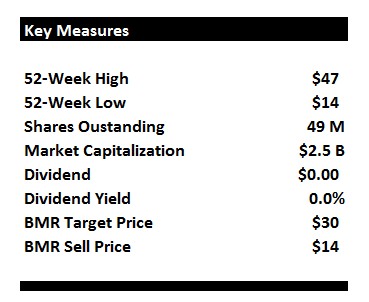
Nutanix (NTNX: $17.30) was founded in 2009, simplifies datacenter infrastructure by integrating server, storage, networking and virtualization resources into a turnkey hyperconverged* solution that runs any application at any scale and can be deployed rapidly. Nutanix makes infrastructure invisible, elevating IT to focus on the applications and services that power their business. The Nutanix Enterprise Cloud Platform blends web-scale engineering and consumer-grade design to converge server, storage, virtualization and networking into a resilient, software-defined solution with rich machine intelligence. Nutanix is based in San Jose, CA and has about 2,000 employees. They went public in September at $16.
* What is hyperconverged Infrastructure? OK, you asked for it:
Defining Hyperconvergence
At the highest level, hyperconvergence is a way to enable cloudlike economics and scale without compromising the performance, reliability, and availability expected in the data center. Hyperconverged infrastructure provides significant benefits:
Data efficiency: Reduces storage, bandwidth, and IOPS requirements.
Elasticity: Makes it easy to scale out/in resources as required by business demands.
VM-centricity: Focuses on the virtual machine (VM) or workload as the cornerstone of enterprise IT, with all supporting constructs revolving around individual VMs.
Data protection: Ensuring that data can be restored in the event of loss or corruption is a key IT requirement, made far easier by hyperconverged infrastructure.
VM mobility: Enables greater application/workload mobility.
High availability: Enables higher levels of availability than possible in legacy systems.
Cost efficiency: Hyperconverged infrastructure brings to IT a sustainable step-based economic model that eliminates waste. Hyperconvergence is the ultimate in an overall trend of convergence that has hit the market in recent years. Convergence is intended to bring simplicity to increasingly complex data center
OK, back to Nutanix. We hereby add Nutanix to our Special Opportunities Portfolio. The stock made its public debut in September of last year priced at $16 a share, well above the expected range of $13 to $15. The stock opened at $26.50 and closed at $37, hitting $47 that first week. We have been watching the stock patiently and now believe the stock is fairly priced and has the potential to move much higher from here.
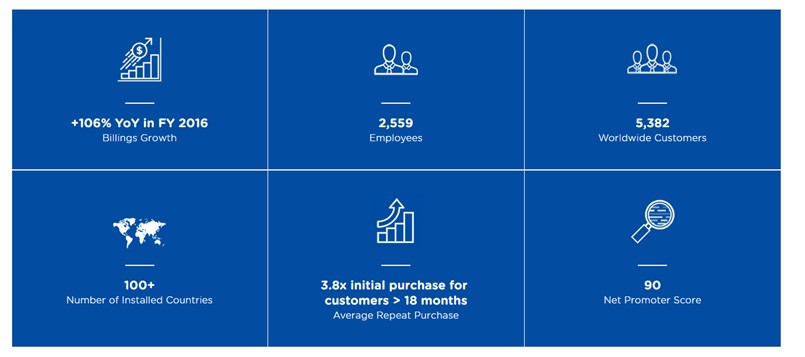
Nutanix provides enterprise cloud platform solutions that converge server, virtualization, and storage into one integrated solution. The company’s software products include a product that delivers performance-distributed storage and application mobility solutions; and delivers integrated virtualization and infrastructure management, operational analytics, and one-click administration solutions. Now THERE’S a mouthful! Nutanix’s compelling value proposition is reinventing the IT infrastructure playbook. While the competitive landscape for hyperconverged infrastructure (HCI) continues to evolve quickly as the legacy IT infrastructure competitors recognize the threat that HCI poses and are quickly pivoting toward it, Nutanix leads the pack in terms of market share as well as mind share.
Key Highlights
#1 – The company’s compelling value proposition is disrupting the status quo. According to a study conducted by IDC, Nutanix’s solution can reduce total cost of ownership* by up to 60%, can reduce the time required for infrastructure management by up to 70%, can reduce virtualization costs by 80%, and can lead to 85% faster deployment of storage. That’s real value to customers!
*Total cost of ownership is how much money and resources a company has to dedicate to running their IT department. A really good partner like Nutanix, can reduce costs up to 60% through more efficient software solutions
#2 – The company has highly differentiated software-based intellectual property. Although Nutanix sells its technology in the form of an appliance, its competitive advantage sits in its software; for example, patent-protected innovations such as software-based storage solves issues that hardware-based solutions face such as dealing with significant increases in capacity.
The bottom line is this - Nutanix software engineers are as brilliant as anything you find in Silicon Valley.
#3 – The outlook calls for a strong growth trajectory. Nutanix has enjoyed extremely rapid growth in the last few years, fueled by strong new customer growth and a very high repeat purchase rate from existing customers. Momentum has been built and this business is now ready to soar to the $1 billion level of revenue. Revenues were $450 million in 2016 with negative earnings of $1.24. See chart at bottom of this report.
#4 – This company is a pioneer. Nutanix pioneered the Hyperconverged Infrastructure market six to seven years ago. Its solution brings public cloud virtues like consumer-grade user experience and pay-as-you-grow economics into the private cloud. The broad-based success of the solution is underscored by Nutanix’s 3,800 customers - 160% compound annual growth rate (CAGR) from 2013-2016.
#5 – The market opportunity is big. We mean gigantic. Nutanix competes across all aspects of a data center or an IT environment including compute, storage, networking, and virtualization as well as cloud management and systems management software, which sums up to a total addressable market of over $100 billion.
#6 – High customer satisfaction is driving strong repeat purchases. Nutanix has high customer satisfaction scores (NPS* of 92 out of 100). The high customer satisfaction helps Nutanix engender a loyal customer base which drives more customers. The loyal customer base also fuels strong repeat purchase trends: as of 2016, 75% of Nutanix’s end customers who have been with company for over 18 months have made a repeat purchase and have total lifetime orders to-date in an amount that is more than 3.6x greater, on average, than their initial order. The latter metric improves by 2-4x when filtered for Nutanix’s larger customers.
* Net Promoter Score is an index used to measure the willingness of customers to recommend a company's products or services to others.
#7 – Cash flow positive is such a nice thing to see in the Tech sector proving this story is far from hype. Fueled by strong new customer growth and a high repeat purchase rate from existing customers, Nutanix has enjoyed extremely rapid growth in the last few years. For FY13-16, Nutanix’s revenue has grown at a 145% Compound annual growth rate (CAGR.) CAGR doubled in 2015 versus the prior year. Additionally, the “software only” mix in the model is increasing rapidly, which is a much higher margin revenue stream. While we expect growth to decelerate a bit in the next few years, we still expect the company to grow revenue and billings at 35-45% y/y as Nutanix crosses the billion dollar threshold. It is important to note that while maintaining such a strong growth profile, Nutanix has also shown cash flow discipline. In FY16, Nutanix generated positive operating cash flow, and we expect the company to soon produce sustainably operating cash flow positive on an annual basis. The company is unprofitable on a P&L basis as it continues to invest for growth, although a significant accounting change in 2H 2017 might pull forward P&L profitability in the model.
Technology Overview
What the heck is Hyperconverged Infrastructure? Sounds like something from Star Trek! We gave you the complicated definition above, and now we take a shot at providing a layman’s explanation below. It’s still probably too technical, but we hope it is helpful for you to have some context. In our mind, we are comfortable just thinking of Nutanix as simply a provider of business software for large, medium, and small corporations.
Hyperconverged infrastructure is a software-defined approach to infrastructure delivered on normal commodity computer servers, with tight integration between different parts of the IT ecosystem such as storage and networking. One of the main differences between a hyperconverged and a converged infrastructure is the software-centric architecture of the former.
The traditional approach to IT infrastructure for supporting a workload is to have a physical computer server, typically with a virtualized environment, and a complex array of storage servers that are then interconnected using networking equipment. Each of these components typically has its own proprietary operating system, hardware platform, and management interface and hence extensive training and experience is needed to operate them, requiring an independent IT organization structure with specialized teams handling each component. Every time infrastructure needs to be provisioned for a new initiative, the different IT teams need to coordinate, assess the compute and storage requirements, and separately procure the components and put them together. This process of provisioning an IT environment takes time and inhibits rapid development and deployment of new applications and services, which is an increasingly important need for companies.
Traditional IT infrastructure is more costly for storage of data. You used to have to buy all sorts of hardware. Now you can just save everything through the cloud. In such environments, scaling capacity by adding more hard-drives or flash drives doesn’t proportionally improve performance because the storage controller that actually reads and writes the data is often fixed at the time of initial deployment. Upgrading the storage controller typically requires an expensive and time-consuming upgrade.
Due to the scalability issues related to traditional storage and the time-consuming complex deployment processes, companies often over-provision servers and storage arrays to take care of longer term peak capacity while often sitting idle and underutilized for extensive periods. Additionally, traditional hardware and software products involve extensive manual administration for routine tasks and add to the operating overhead of IT organizations.
Today’s virtualization products were not designed with the ability to migrate workloads across different emerging computing environments like public clouds. As more enterprises seek to adopt hybrid computing environments, complexity challenges are created for customers to figure out how to do it and Nutanix is well-positioned to help them solve this problem.
Limitations of the public cloud include:
• Public clouds often lead to higher lifetime costs.
• Most public cloud providers don’t easily allow portability of application and data to on-premise environments. Porting an application from the public cloud is expensive and time consuming and may lead to long downtime.
• Customers are largely dependent on public cloud providers to ensure data security and compliance with regulatory requirements.
Here are ways in which Nutanix’s solution differs from the traditional approach:
• The system allows infrastructure to be deployed and provisioned in minutes by a single IT administrator, thus bringing agility back into enterprise IT. Nutanix’s customers can deploy the system in 85% less time compared to deploying traditional IT infrastructure.
• Nutanix has developed automation capabilities in its platform that eliminate time-consuming routine tasks, thus not only eliminating chances of human error but also reducing the time needed to manage the infrastructure. The consumer grade design for its management interface, Prism, further simplifies IT admin workflows and makes management quick and easy, reducing the need for a highly-specialized IT workforce. According to the same study conducted by IDC referenced above, Nutanix is able to reduce the time to manage infrastructure by 70%.
• Nutanix is also a scale-out system, which means customers can start with any number of nodes based on their needs and then just add additional nodes to scale their environment, without any performance degradation per node. Nutanix achieves this by using a software-based storage controller in every node that can dynamically allocate memory as needed vs. fixed hardware-based controllers used by traditional storage systems.
• Additionally, Nutanix’s software provides customers flexibility and choice to decide where they want to run the application. Customers can choose from multiple hypervisors*, including Nutanix’s own. Nutanix is also working toward a high degree of application mobility that would let customers selectively adopt the public cloud for specific workloads and scenarios, while preserving the flexibility to bring those workloads back on premise or move them across different public cloud providers should requirements or costs change.
* https://en.wikipedia.org/wiki/Hypervisor
Market Opportunity
Nutanix competes across all aspects of a data center or an IT environment, including compute, storage, networking, and virtualization as well cloud management and systems management software. Summing up the total addressable market (TAM) across all these different segments, the company estimates its TAM at over $100 billion. We believe Nutanix’s highly differentiated solution with a clear value proposition positions it well to go after this market opportunity.
Below we list the estimated TAM for these segments (for 2016):
• x86 server market is expected to be $52 billion (source: Gartner)
• Storage systems market is expected to be $44 billion (source: IDC)
• Virtualization infrastructure market is expected to be $5 billion (source: Gartner)
• The cloud management market is expected to be $4 billion (source: IDC)
• The systems management software market is expected to be $21 billion (source: IDC)
Hyperconverged infrastructure (HCI) is a market that was pioneered by Nutanix six to seven years ago. Garner estimates that about 6% of the integrated system market ($10 billion) in 2015 was related to HCI, or roughly $500 million, of which Nutanix constituted a 65% share. Additionally, according to Gartner, HCI is disrupting the integrated systems market and has the strongest growth profile within the broader group. Gartner also expects 20% of mission-critical applications currently deployed on IT infrastructure to transition to HCIs by 2020, implying massive opportunity for HCI and Nutanix in the coming years.
Competitive Landscape
We believe that the competitive landscape for Nutanix can be divided into four different parts.
1. Traditional IT infrastructure players
2. Hyperconverged players
3. New-age storage companies
4. Public cloud
Traditional IT Infrastructure Players
This group refers to vendors offering products that constitute the traditional silos of an IT environment such as compute, storage, networking, virtualization, and management software. The list includes companies like HPE, Cisco Systems, Dell Technologies, Lenovo Systems, IBM, NetApp, Hitachi Data Systems, VMware (VMW: $91) among others.
Other Hyperconverged Players
This group mainly comprises vendors such as EMC, Cisco, and Hewlett Packard.
Business Model
Nutanix generates revenue by selling its enterprise cloud platform as an appliance or as software only. In the first case, customers typically have two options: 1) buy the appliance directly from Nutanix or 2) buy it from an OEM partner like Dell or Lenovo.
Nutanix’s own appliance is based on commodity x86 servers with Nutanix’s software Intellectual Property on top.
Nutanix also has software-only partnerships with two OEMs (original equipment manufacturers) - Dell and Lenovo. For both these partnerships, Nutanix provides its software, and these companies package it with their hardware to create the hyperconverged offerings. Dell and Lenovo pay Nutanix royalties for the distribution of the software together with their hardware and the sale of support and maintenance contracts for the integrated products. Revenue from the OEM relationships is deferred and recognized over the support period, typically three years.
Occasionally, Nutanix sells its software directly to the end customer by signing multi-year software-only enterprise license agreements. Additionally, when customers purchase the platform, they typically purchase one or more years of support and maintenance in order to receive software upgrades, bug fixes, and parts replacement.
Nutanix also generates services revenue related to installation, training, and onsite engineering support services, which are recognized as the services are provided to the customer.
Financial Outlook
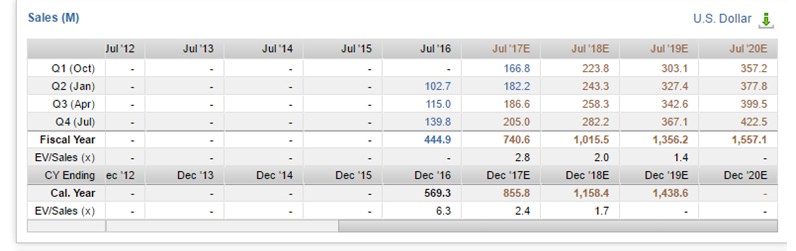
We expect Nutanix to continue to grow revenue and billings at a fairly strong clip as it scales beyond $1 billion in revenue while quickly reaching a positive annual cash flow profile and a clear path to profitability.
We think the stock can be worth $40 or more. We base this target price on a typical 5x revenue multiple for high-growth technology companies. We apply this multiple to the consensus 2020 revenue outlook for $1.5+ billion.
