

May 24, 2017
Company Description
Nutanix (NTNX: $17.30) was founded in 2009, simplifies datacenter infrastructure by integrating server, storage, networking and virtualization resources into a turnkey hyperconverged* solution that runs any application at any scale and can be deployed rapidly. Nutanix makes infrastructure invisible, elevating IT to focus on the applications and services that power their business. The Nutanix Enterprise Cloud Platform blends web-scale engineering and consumer-grade design to converge server, storage, virtualization and networking into a resilient, software-defined solution with rich machine intelligence. Nutanix is based in San Jose, CA and has about 2,000 employees. They went public in September at $16.
* What is hyperconverged Infrastructure? OK, you asked for it:
Defining Hyperconvergence
At the highest level, hyperconvergence is a way to enable cloudlike economics and scale without compromising the performance, reliability, and availability expected in the data center. Hyperconverged infrastructure provides significant benefits:
Data efficiency: Reduces storage, bandwidth, and IOPS requirements.
Elasticity: Makes it easy to scale out/in resources as required by business demands.
VM-centricity: Focuses on the virtual machine (VM) or workload as the cornerstone of enterprise IT, with all supporting constructs revolving around individual VMs.
Data protection: Ensuring that data can be restored in the event of loss or corruption is a key IT requirement, made far easier by hyperconverged infrastructure.
VM mobility: Enables greater application/workload mobility.
High availability: Enables higher levels of availability than possible in legacy systems.
Cost efficiency: Hyperconverged infrastructure brings to IT a sustainable step-based economic model that eliminates waste. Hyperconvergence is the ultimate in an overall trend of convergence that has hit the market in recent years. Convergence is intended to bring simplicity to increasingly complex data center
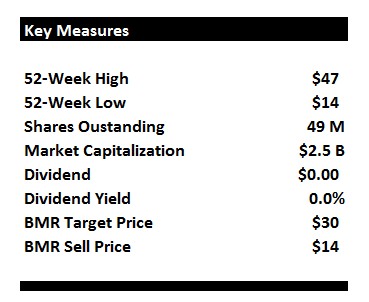
OK, back to Nutanix. We hereby add Nutanix to our Special Opportunities Portfolio. The stock made its public debut in September of last year priced at $16 a share, well above the expected range of $13 to $15. The stock opened at $26.50 and closed at $37, hitting $47 that first week. We have been watching the stock patiently and now believe the stock is fairly priced and has the potential to move much higher from here.
Nutanix provides enterprise cloud platform solutions that converge server, virtualization, and storage into one integrated solution. The company’s software products include a product that delivers performance-distributed storage and application mobility solutions; and delivers integrated virtualization and infrastructure management, operational analytics, and one-click administration solutions. Now THERE’S a mouthful! Nutanix’s compelling value proposition is reinventing the IT infrastructure playbook. While the competitive landscape for hyperconverged infrastructure (HCI) continues to evolve quickly as the legacy IT infrastructure competitors recognize the threat that HCI poses and are quickly pivoting toward it, Nutanix leads the pack in terms of market share as well as mind share.
Key Highlights
#1 – The company’s compelling value proposition is disrupting the status quo. According to a study conducted by IDC, Nutanix’s solution can reduce total cost of ownership* by up to 60%, can reduce the time required for infrastructure management by up to 70%, can reduce virtualization costs by 80%, and can lead to 85% faster deployment of storage. That’s real value to customers!
*Total cost of ownership is how much money and resources a company has to dedicate to running their IT department. A really good partner like Nutanix, can reduce costs up to 60% through more efficient software solutions
#2 – The company has highly differentiated software-based intellectual property. Although Nutanix sells its technology in the form of an appliance, its competitive advantage sits in its software; for example, patent-protected innovations such as software-based storage solves issues that hardware-based solutions face such as dealing with significant increases in capacity.
The bottom line is this - Nutanix software engineers are as brilliant as anything you find in Silicon Valley.
#3 – The outlook calls for a strong growth trajectory. Nutanix has enjoyed extremely rapid growth in the last few years, fueled by strong new customer growth and a very high repeat purchase rate from existing customers. Momentum has been built and this business is now ready to soar to the $1 billion level of revenue. Revenues were $450 million in 2016 with negative earnings of $1.24. See chart at bottom of this report.
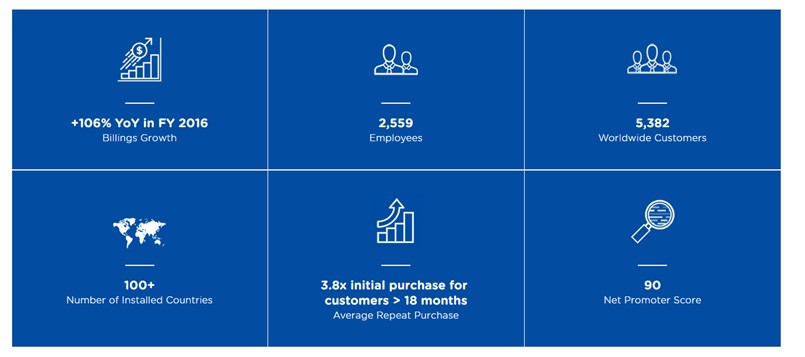
#4 – This company is a pioneer. Nutanix pioneered the Hyperconverged Infrastructure market six to seven years ago. Its solution brings public cloud virtues like consumer-grade user experience and pay-as-you-grow economics into the private cloud. The broad-based success of the solution is underscored by Nutanix’s 3,800 customers - 160% compound annual growth rate (CAGR) from 2013-2016.
#5 – The market opportunity is big. We mean gigantic. Nutanix competes across all aspects of a data center or an IT environment including compute, storage, networking, and virtualization as well as cloud management and systems management software, which sums up to a total addressable market of over $100 billion.
#6 – High customer satisfaction is driving strong repeat purchases. Nutanix has high customer satisfaction scores (NPS* of 92 out of 100). The high customer satisfaction helps Nutanix engender a loyal customer base which drives more customers. The loyal customer base also fuels strong repeat purchase trends: as of 2016, 75% of Nutanix’s end customers who have been with company for over 18 months have made a repeat purchase and have total lifetime orders to-date in an amount that is more than 3.6x greater, on average, than their initial order. The latter metric improves by 2-4x when filtered for Nutanix’s larger customers.
* Net Promoter Score is an index used to measure the willingness of customers to recommend a company's products or services to others.
#7 – Cash flow positive is such a nice thing to see in the Tech sector proving this story is far from hype. Fueled by strong new customer growth and a high repeat purchase rate from existing customers, Nutanix has enjoyed extremely rapid growth in the last few years. For FY13-16, Nutanix’s revenue has grown at a 145% Compound annual growth rate (CAGR.) CAGR doubled in 2015 versus the prior year. Additionally, the “software only” mix in the model is increasing rapidly, which is a much higher margin revenue stream. While we expect growth to decelerate a bit in the next few years, we still expect the company to grow revenue and billings at 35-45% y/y as Nutanix crosses the billion dollar threshold. It is important to note that while maintaining such a strong growth profile, Nutanix has also shown cash flow discipline. In FY16, Nutanix generated positive operating cash flow, and we expect the company to soon produce sustainably operating cash flow positive on an annual basis. The company is unprofitable on a P&L basis as it continues to invest for growth, although a significant accounting change in 2H 2017 might pull forward P&L profitability in the model.
Technology Overview
What the heck is Hyperconverged Infrastructure? Sounds like something from Star Trek! We gave you the complicated definition above, and now we take a shot at providing a layman’s explanation below. It’s still probably too technical, but we hope it is helpful for you to have some context. In our mind, we are comfortable just thinking of Nutanix as simply a provider of business software for large, medium, and small corporations.
Hyperconverged infrastructure is a software-defined approach to infrastructure delivered on normal commodity computer servers, with tight integration between different parts of the IT ecosystem such as storage and networking. One of the main differences between a hyperconverged and a converged infrastructure is the software-centric architecture of the former.
The traditional approach to IT infrastructure for supporting a workload is to have a physical computer server, typically with a virtualized environment, and a complex array of storage servers that are then interconnected using networking equipment. Each of these components typically has its own proprietary operating system, hardware platform, and management interface and hence extensive training and experience is needed to operate them, requiring an independent IT organization structure with specialized teams handling each component. Every time infrastructure needs to be provisioned for a new initiative, the different IT teams need to coordinate, assess the compute and storage requirements, and separately procure the components and put them together. This process of provisioning an IT environment takes time and inhibits rapid development and deployment of new applications and services, which is an increasingly important need for companies.
Traditional IT infrastructure is more costly for storage of data. You used to have to buy all sorts of hardware. Now you can just save everything through the cloud. In such environments, scaling capacity by adding more hard-drives or flash drives doesn’t proportionally improve performance because the storage controller that actually reads and writes the data is often fixed at the time of initial deployment. Upgrading the storage controller typically requires an expensive and time-consuming upgrade.
Due to the scalability issues related to traditional storage and the time-consuming complex deployment processes, companies often over-provision servers and storage arrays to take care of longer term peak capacity while often sitting idle and underutilized for extensive periods. Additionally, traditional hardware and software products involve extensive manual administration for routine tasks and add to the operating overhead of IT organizations.
Today’s virtualization products were not designed with the ability to migrate workloads across different emerging computing environments like public clouds. As more enterprises seek to adopt hybrid computing environments, complexity challenges are created for customers to figure out how to do it and Nutanix is well-positioned to help them solve this problem.
Limitations of the public cloud include:
• Public clouds often lead to higher lifetime costs.
• Most public cloud providers don’t easily allow portability of application and data to on-premise environments. Porting an application from the public cloud is expensive and time consuming and may lead to long downtime.
• Customers are largely dependent on public cloud providers to ensure data security and compliance with regulatory requirements.
Here are ways in which Nutanix’s solution differs from the traditional approach:
• The system allows infrastructure to be deployed and provisioned in minutes by a single IT administrator, thus bringing agility back into enterprise IT. Nutanix’s customers can deploy the system in 85% less time compared to deploying traditional IT infrastructure.
• Nutanix has developed automation capabilities in its platform that eliminate time-consuming routine tasks, thus not only eliminating chances of human error but also reducing the time needed to manage the infrastructure. The consumer grade design for its management interface, Prism, further simplifies IT admin workflows and makes management quick and easy, reducing the need for a highly-specialized IT workforce. According to the same study conducted by IDC referenced above, Nutanix is able to reduce the time to manage infrastructure by 70%.
• Nutanix is also a scale-out system, which means customers can start with any number of nodes based on their needs and then just add additional nodes to scale their environment, without any performance degradation per node. Nutanix achieves this by using a software-based storage controller in every node that can dynamically allocate memory as needed vs. fixed hardware-based controllers used by traditional storage systems.
• Additionally, Nutanix’s software provides customers flexibility and choice to decide where they want to run the application. Customers can choose from multiple hypervisors*, including Nutanix’s own. Nutanix is also working toward a high degree of application mobility that would let customers selectively adopt the public cloud for specific workloads and scenarios, while preserving the flexibility to bring those workloads back on premise or move them across different public cloud providers should requirements or costs change.
* https://en.wikipedia.org/wiki/Hypervisor
Market Opportunity
Nutanix competes across all aspects of a data center or an IT environment, including compute, storage, networking, and virtualization as well cloud management and systems management software. Summing up the total addressable market (TAM) across all these different segments, the company estimates its TAM at over $100 billion. We believe Nutanix’s highly differentiated solution with a clear value proposition positions it well to go after this market opportunity.
Below we list the estimated TAM for these segments (for 2016):
• x86 server market is expected to be $52 billion (source: Gartner)
• Storage systems market is expected to be $44 billion (source: IDC)
• Virtualization infrastructure market is expected to be $5 billion (source: Gartner)
• The cloud management market is expected to be $4 billion (source: IDC)
• The systems management software market is expected to be $21 billion (source: IDC)
Hyperconverged infrastructure (HCI) is a market that was pioneered by Nutanix six to seven years ago. Garner estimates that about 6% of the integrated system market ($10 billion) in 2015 was related to HCI, or roughly $500 million, of which Nutanix constituted a 65% share. Additionally, according to Gartner, HCI is disrupting the integrated systems market and has the strongest growth profile within the broader group. Gartner also expects 20% of mission-critical applications currently deployed on IT infrastructure to transition to HCIs by 2020, implying massive opportunity for HCI and Nutanix in the coming years.
Competitive Landscape
We believe that the competitive landscape for Nutanix can be divided into four different parts.
1. Traditional IT infrastructure players
2. Hyperconverged players
3. New-age storage companies
4. Public cloud
Traditional IT Infrastructure Players
This group refers to vendors offering products that constitute the traditional silos of an IT environment such as compute, storage, networking, virtualization, and management software. The list includes companies like HPE, Cisco Systems, Dell Technologies, Lenovo Systems, IBM, NetApp, Hitachi Data Systems, VMware (VMW: $91) among others.
Other Hyperconverged Players
This group mainly comprises vendors such as EMC, Cisco, and Hewlett Packard.
Business Model
Nutanix generates revenue by selling its enterprise cloud platform as an appliance or as software only. In the first case, customers typically have two options: 1) buy the appliance directly from Nutanix or 2) buy it from an OEM partner like Dell or Lenovo.
Nutanix’s own appliance is based on commodity x86 servers with Nutanix’s software Intellectual Property on top.
Nutanix also has software-only partnerships with two OEMs (original equipment manufacturers) - Dell and Lenovo. For both these partnerships, Nutanix provides its software, and these companies package it with their hardware to create the hyperconverged offerings. Dell and Lenovo pay Nutanix royalties for the distribution of the software together with their hardware and the sale of support and maintenance contracts for the integrated products. Revenue from the OEM relationships is deferred and recognized over the support period, typically three years.
Occasionally, Nutanix sells its software directly to the end customer by signing multi-year software-only enterprise license agreements. Additionally, when customers purchase the platform, they typically purchase one or more years of support and maintenance in order to receive software upgrades, bug fixes, and parts replacement.
Nutanix also generates services revenue related to installation, training, and onsite engineering support services, which are recognized as the services are provided to the customer.
Financial Outlook
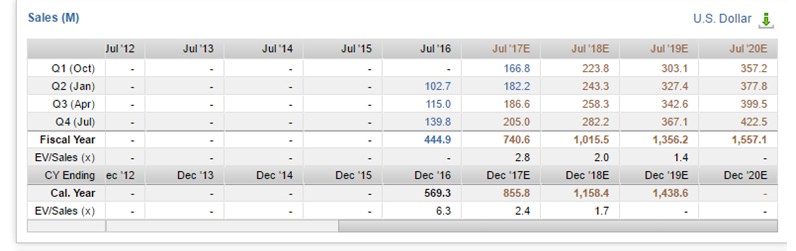
We expect Nutanix to continue to grow revenue and billings at a fairly strong clip as it scales beyond $1 billion in revenue while quickly reaching a positive annual cash flow profile and a clear path to profitability.
We think the stock can be worth $40 or more. We base this target price on a typical 5x revenue multiple for high-growth technology companies. We apply this multiple to the consensus 2020 revenue outlook for $1.5+ billion.