February 6, 2017
by Todd Shaver | Feb 6, 2017 | Earnings Preview 6 PM
Tesoro (TSO: $84)
Target Price: $110
Sell Price: $75
Earnings Date: Monday, 8:30 AM ET
Consensus: 4Q16
Revenues: $7B
EPS: -$0.14
Year Ago Quarter Results
Revenues: $6.3B
EPS: $1.83
Key Things to Watch for in the Quarter
Analysts see a revenue increase of 11% to $7 billion and earnings turning to a deficit of $0.14. The first three earnings reports of 2016 provided investors a little unease as Tesoro beat estimates in Q1, underperformed estimates in Q2, and met estimates in Q3. The stock received a better reaction in Q3 (+5% in the weeks following the report) than in Q1 and Q2, which each generated an approximate 2% gain in the weeks following the report. Shares are up nearly 15% over the past year, and with a relatively low PE of 14, we look forward to Tesoro’s climb to our $110 target.
Twilio (TWLO: $32)
Target Price: $72
Sell Price: $29
Earnings Date: Tuesday, Exact Time N/A
Consensus: 4Q16
Revenues: $74M
EPS: -$0.05
Year Ago Quarter Results
Revenues: Not public then
EPS: N/A
Key Things to Watch for in the Quarter
Analysts see revenue of $74 million for the recently concluded fourth quarter in this week's report, 44% ahead of what it rang up during the prior year's holiday quarter before they were public. Twilio's own guidance three months ago was calling for a 41% to 45% top-line ascent. Wall Street pros see a deficit of $0.06 a share for the quarter, but Twilio has managed to post a smaller loss than analysts were targeting in each of its two first quarterly reports as a public company. The past year has been a roller coaster ride for the stock, but with its consistent ability to decrease losses we remain confident that we will see a strong quarter.
Gilead Sciences (GILD: $72)
Target price: $80
Sell price: $60
Earnings Date: Tuesday, 4:30 PM ET
Consensus: 4Q16
Revenues: $7.0B
EPS: $2.61
Year Ago Quarter Results
Revenues: $8.5B
EPS: $3.32
Key Things to Watch for in the Quarter
Wall Street analysts expect Gilead Sciences to report a decrease in earnings per share of 21% to $2.61 and a 6% revenue increase to $7.0 billion for 4Q16. Shares have fallen 15% over the past year in part due to the firm’s earnings performance compared to estimates. Gilead missed estimates in Q1 and Q3, but beat estimates in Q2 by 2%. Q3 saw strong performance from HIV and other antiviral products. The stock is trading extremely cheaply at 7 times earnings, when compared to the 60 PE of the Pharmaceutical Drug industry.
CBRE (CBG: $31)
Target price: $35
Sell price: We would not sell CBRE
Earnings Date: Friday, 8:30 AM ET
Consensus: 4Q16
Revenues: $4.0B
EPS: $0.80
Year Ago Quarter Results
Revenues: $3.7B
EPS: $0.81
Key Things to Watch for in the Quarter
Analysts estimate that CBRE will report a revenue increase of 8% to $4.0 billion and a 1% decrease in earnings per share to $0.80. CBRE beat analyst’s earnings estimates in 1Q16 and 2Q16 by a penny, but met estimates in 3Q16. Investors reacted fairly harshly to the first two quarterly reports this year with the stock falling 5% in the week following the reports. However, the stock did climb nearly 5% following the third quarter earnings release. CBRE is up 35% over the past year, and currently trades at a 21 PE. We are very happy with CBRE’s performance over the past year and look forward to seeing CBRE hitting our $35 target.
January 1, 2017
by Todd Shaver | Jan 1, 2017 | Weekly Newsletter 7pm Sunday
The Week Ahead
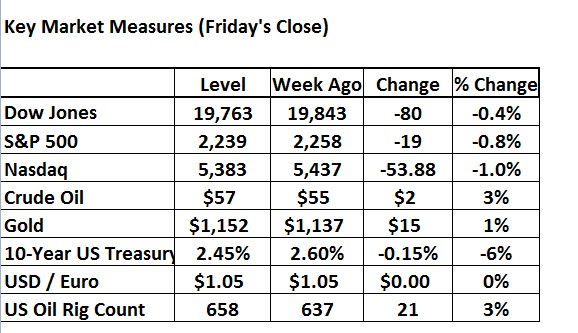
The Dow Jones Industrial Average shook off its worst start to a year ever to score its best performance since 2013, as investors banked on an improving economy. What’s ahead for 2017? US-Russia relations, Trump-flation, and stagflation will be central themes. We see an Energy sector recovery gaining momentum. Higher interest rates could pressure stock prices. Gold could be putting in a bottom as we speak.
It’s a light week ahead for economic news. But here we provide some insights on our latest thinking for Opko, Apple, Microsoft, Facebook, Kinder Morgan, Twilio, Celgene, Gilead, Bristol-Myers Squibb, and AstraZeneca. Happy New Year!
Highlights From The Past Week
US-Russia Relations. Trump and Putin have emerged as two of the most cunning leaders on the global scene. What these two men are up to in 2017 will certainly impact markets. Recently, Russian diplomats have been sanctioned by the US. Are dicey relations emerging? Putin says, “We reserve the right to retaliate, but we will not sink to the level of this irresponsible ‘kitchen’ diplomacy. We will take further moves on restoring Russian-American relations based on the policies that the administration of President-elect Donald Trump adopts.” Separately, the appointment of Rex Tillerson, Chairman and Chief Executive Officer of ExxonMobil, as Secretary of State, as well as various insinuations by the President-Elect to lift sanctions, all point to possibly greater oil production from Russia ahead. Russia has recently claimed that it will beat 2016’s estimated oil production total of 253 million tons in 2017.
Trump-flation. One idea most widely agreed upon is that Trump will spur inflation and US Treasuries are the last place to be. There is growing fear of a bond bubble. Trump-flation should drive equity prices higher and could kick-start a big rally in gold. We will be keeping an eye on inflation expectations in 2017.
Stagflation. Admittedly, the current economic expansion is quite advanced. It has already lasted about 18 months longer than the median completed expansion since the mid-1800s. And while expansions do not die of old age, history shows that they are at greater risk when spare capacity is exhausted, as it probably is now. So it is especially important to monitor whether growth may be running out of steam. The most important recession predictors, at horizons longer than the next few quarters, are spare capacity and past credit growth. Spare capacity has dwindled, which has boosted the recession probability somewhat, but output is not yet meaningfully above potential.
BMR Companies and Commentary
Opko Health (OPK: $9.30, -21% for the week)
Opko said its experimental drug for growth hormone deficiency (GHD) in adults failed to provide a statistically significant benefit over a placebo in a late-stage study. Investors were counting on the drug for future growth. Consequently, the disappointing news sent Opko’s shares much lower.
GHD is a rare disorder characterized by the inadequate secretion of the growth hormone from the pituitary gland, an organ responsible for the production of multiple hormones. The disorder can be hereditary, can be acquired as a result of trauma, infection, radiation therapy or brain tumor growth, and can even emerge without a diagnosable cause. OPKO was developing the drug with Pfizer to address GHD.
Is everything lost at this point? No.
While the recent study failed, Opko said it had started another late-stage study to evaluate the drug against Genotripin, which is another type of growth hormone disease more narrowly found in children. Opko will have world-wide collaboration rights and licensing rights with Pfizer for this drug to target Genotripin, if it is successful.
BMR Take: We have high hopes for this company and the new drug. We added the stock at $10 in September and it rallied to a shade under $12 just a few days ago. But Wall Street has been known for its mean responses to situations like this. They don’t have the patience that we generally have. So with that said, we are going to stick with our Sell Price of $8. If it hits $8 we are out.
Apple (AAPL: $116, flat for the week)
Some news just out - Apple will trim production of its iPhones by at least 10% in the first quarter of 2017.
The latest news comes after Apple slashed output in the January-March quarter of 2016 due to accumulated inventory of the iPhone 6S line at the end of 2015. That experience led Apple to curb production of the iPhone 7, introduced in September, by around 20%. Information on production of the latest models and global sales suggest cuts in both the 7 and 7 Plus lines in the coming quarter.
BMR Take: Don’t get too concerned about this discussion of product cuts in the first part of 2017. We have been talking about this for a while. Buy the stock on weakness. As we move through 2017, investors will be focused on growing anticipation around the iPhone 8 and a favorable long-term trajectory for Services growth.
With Trump working on a plan to help companies return the cash they hold overseas, there is no company that will benefit more than Apple, with their hoard of well over $240 billion in cash, most of which is overseas. We expect a good year for Apple’s stock performance in 2017.
Microsoft (MSFT: $62, flat)
Microsoft had a tremendous year in 2016. Let’s re-visit some of the big events. We understand it’s a backward looking exercise, but sometimes it’s helpful to do such a review in order to reaffirm our confidence that the franchise is on very solid footing.
Microsoft released its first major feature update for Windows 10. Dubbed the "Anniversary Update", this release featured improvements to the Start Menu, Action Center, Settings and Microsoft Edge, among other upgrades.
The Universal Windows Platform went even more universal this year, with Microsoft announcing Universal Apps for Xbox One. This unleashed a whole new market of apps for the Xbox, essentially turning it into a PC.
Microsoft surprised the entire gaming industry this year by announcing its brand new console, scheduled to launch in the fall of 2017, a whole year early. Microsoft originally had no plans to announce Project Scorpio in 2016, but with looming pressure coming from Sony and the PlayStation 4 Pro, the company felt they needed to get something out there and let gamers know Microsoft is serious about gaming.
Microsoft blew the crowds away with the Surface Studio announcement. It was known for some time that the company was interested in building an All-In-One PC, but we didn't know exactly what they had planned. When the unveiling finally arrived, the company once again proved to be staying current with product cycles.
The Creators Update is the next major version of Windows 10, scheduled to launch in early 2017 and is bringing several new features designed for creators.
BMR Take: The era for Microsoft under CEO Satya Nadella is blossoming. It is not just about all the product innovation discussed above that he is bringing to the forefront as a former engineer at the company. He is also quietly leveraging the balance sheet to buy back stock. In September 2016 he announced a $40 billion stock buyback program.
Facebook (FB: $115, -2%)
What’s in the news for Facebook lately? A bunch of noise about censorship. Facebook put a temporary ban on Kevin Sessums, who is well known for his celebrity profiles for Vanity Fair and two best-selling memoirs. The event triggered civil unrest over free speech and Facebook was painted as the enemy.
The journalist was temporarily banned from Facebook after sharing a post from an ABC political analyst, which called Trump supporters some derogatory names.
Facebook “reviewed and restored” Kevin Sessums’s ability to post messages. “We’re very sorry about this mistake,” a Facebook spokesman said. “The post was removed in error and restored as soon as we were able to investigate. Our team processes millions of reports each week, and we sometimes get things wrong.”
BMR Take: Facebook is on track to be the greatest advertising money-making machine of all-time. Censorship is a reality of the business, but not new nor disruptive. We think recent softness in the shares presents a great spot to buy more.
Kinder Morgan (KMI: $21, -2%)
Massachusetts has agreed to a $640,000 settlement from Kinder Morgan to allow the company to run a pipeline through conservation land in Berkshire County on its way from New York to Connecticut. The money will be spent on “mitigation and improvements” in the Otis State Forest and also to buy more conservation land in the area.
The Massachusetts Pipeline Awareness Network continues to object to the pipeline based on water quality concerns, and the disruption of stone walls important to Native American tribes.
There is a big shift going on regarding the above situation. A Trump administration is about jobs, jobs, jobs. He has been very outspoken about putting business above people’s sensitivities to the environment. The settlement Kinder Morgan just did may be a very early indicator of the courts moving in Trump’s direction to squash disputes and get business rolling. The Dakota Access Pipeline owned by Energy Transfer Partners (ETE: $36, a $20 billion market cap company) may be the first big test of this Trump concept. It will not be pretty if he reverses the hold that Obama has ruled.
BMR Take: Kinder Morgan is the best operators in a very tough business to enter. It requires a large sum of cash to acquire land rights to lay down a pipeline and a lot of expertise to obtain all the needed permits. With the energy sector on the recovery road, and Kinder Morgan’s un-rivaled assets, the outlook is very positive for the stock price.
Twilio (TWLO: $29, -10%)
While potential future competition from Amazon is a risk factor that investors must consider with respect to Twilio, today the Amazon relationship is healthy. The association is multi-faceted. First, Twilio runs entirely on AWS, Amazon Web Services. Second, Rick Dalzell (Amazon's former SVP of Worldwide Architecture and Platform Software and CIO) has been a member of Twilio's board of directors since 2014. Third, Twilio is already helping AWS build better products.
How tight is Dalzell to Amazon? Mr. Dalzell was Amazon CEO Jeff Bezos’ “right-hand man” at Amazon for a decade before retiring in 2007. As retold in the book, The Everything Store: Jeff Bezos and the Age of Amazon by Brad Stone, (a great book we have just finished reading and highly recommend), Bezos gave Mr. Dalzell quite a going away party: Four months later, enjoying retirement, Dalzell decided to visit his daughter in college in Oregon. His wife chartered a private plane for her husband, herself, and Dalzell’s parents. Strangely, their driver took them not to their usual airport but to a private airfield down the street from Boeing Field. Dalzell finally started to notice something was amiss when the car pulled up to a familiar hangar sheltering a Dassault Falcon. When he walked into the airplane, he found it full of friends, colleagues, and Jeff Bezos, all of whom shouted, “Surprise!” They were going to Hawaii for a gala given in appreciation of Dalzell’s longtime service. Andy Jassy, who attended the party, is the CEO of Amazon Web Services today.
Counter to concerns about the counterparty risk, in the near-term, the AWS relationship could improve, not get worse. At AWS re:Invent in November 2016, Twilio CEO Jeff Lawson hinted at an increasing level of collaboration between Twilio and Amazon when he said, "We're really excited to announce some upcoming collaboration soon."
BMR Take: Sentiment and the volatility in Twilio has been a roll coaster. The Amazon risk factor seems to be getting blown out of proportion right now. We actually like the prospects for the Amazon relationship in the near-term. As to the stock we remain a big believer in the company even as the stock is down dramatically from where we recommended it in October.
Celgene (CELG: $116, -3%)
Celgene must face a whistleblower lawsuit accusing it of promoting its cancer drugs Revlimid and Thalomid for off-label uses that were paid for by Medicare and Medicaid, a federal judge has ruled. Yikes! A U.S. District Judge in Los Angeles ruled that the lawsuit, brought by a former Celgene sales representative, can go forward for claims submitted to Medicare and most state Medicaid programs.
It’s not good, but things like this happen at big companies. Remember the London Whale incident for JP Morgan. Don’t panic.
There is much to like about Celgene. The drug in Celgene's lineup with the fastest sales growth is Otezla. Sales for the anti-inflammatory drug nearly doubled in recent quarters. Otezla appears poised to become yet another blockbuster for Celgene. Celgene's president of global inflammation and immunology, describes Otezla as transformational in the psoriasis market. When the drug was first approved, there was some skepticism about how it would compete against a crowded field of powerful biologics. However, Smith explains that 80% to 90% of Otezla patients weren't previously treated by biologics. Otezla didn't have to just grab its sliver of pie, it made the pie bigger.
BMR Take: Celgene hopes to expand the indications for Otezla. Late-stage studies are underway for treating ankylosing spondylitis (a form of arthritis affecting the spine and large joints) and Behcet's disease (a rare inflammation of blood vessels). Two mid-stage studies are also in progress for treatment of atopic dermatitis and ulcerative colitis. Celgene expects Otezla to reach peak annual sales of $2 billion if it wins regulatory approval for these additional indications. Rock on Celgene shares!
Gilead Sciences (GILD: $72, -3%)
Things are getting worse more slowly at Gilead Sciences, which should offer some comfort to investors. Recent data shows that total prescriptions for the company’s portfolio of hepatitis C drugs were down 4% in the fourth quarter compared with the previous three months. This is a significant improvement from the third quarter, when prescriptions were down by about 9%.
The stabilization should be a relief for investors. The stock has shed about 30% of its value this year as the hepatitis C franchise, which accounts for about half the company’s sales, has slowed down. A complete picture of the hepatitis C business won’t be available until Gilead reports fourth-quarter results in early February. So we are admittedly in more of a wait and see mode at the moment. In particular, our sources do not cover Gilead’s major customer the Department of Veteran Affairs, so there may be some inaccuracy.
BMR Take: We would be adding to our positions in Gilead here. The stock trades at less than seven times forward earnings estimates. Any glimmer of positive news will push the stock higher.
Bristol-Myers Squibb (BMY: $58, down 2%)
Bristol-Myers Squibb and Calithera Biosciences announced a clinical trial collaboration to evaluate Bristol’s Opdivo in combination with Calithera’s CB-839 in patients with clear cell renal cell carcinoma (ccRCC). CB-839 is an orally administered glutaminase inhibitor currently in Phase 1/2 clinical studies.
We will stop talking science right there.
Why does the above matter? We recently spoke to several executives at major Healthcare companies. All of them say the Opdivo franchise of Bristol will be a strong business for the company over a 5 year horizon. Bristol’s stock has been crushed because of some mishaps over Opdivo in the near-term. The above event just highlights there is a path forward for the Opdivo franchise, which our discussion with industry executives confirms is very likely to happen.
BMR Take: Don’t be timid here. Bristol is one of the top franchises in all of Healthcare. Now is an opportune time to be buying the shares for the long term.
AstraZeneca (AZN: $27, flat)
AstraZeneca has completed the sale of its small molecule antibiotics business to Pfizer. As part of the deal, Pfizer has acquired the commercialization and development rights of AstraZeneca’s approved antibiotics Merrem, Zinforo, and Zavicefta, as well as its ATM-AVI and CXL which are in the clinical development stage.
Pfizer has paid an upfront payment of $550 million for the late-stage antibiotics business in all markets where AstraZeneca holds the rights, mainly outside the US. Pfizer will make a deferred payment of $175 million in January 2019. Additionally, Pfizer had also agreed to make milestone payments for the small molecule antibiotics to AstraZeneca up to $250 million and up to $600 million related to sales and tiered royalties on sales of Zavicefta and ATM-AVI in select markets.
BMR Take: This deal was announced back in August. We highlight it again now because we are excited to see the cash flow on the way to AstraZeneca’s bank account. The cash cushion is like a 5% dividend yield at current levels. We see compelling value in the stock reaffirmed by the recent Pfizer deal.
Upcoming Economic News
It’s the first week of the New Year. Very light news flow. Lots more to discuss in the weeks ahead.
Have you heard about the BORDER TAX?
If not, READ THIS from Phil Verleger:
Notes at the Margin
Philip K. Verleger, Jr.
Former Director of the Office of Energy Policy at the United States Department of Treasury
Preparing for a Border Tax
This report can be described as nerdy or geeky. It never gets the attention that publications by Goldman Sachs, PIRA, or IHS receive. Its author is regularly ignored by the editors and reporters for Argus Media, the Energy Intelligence Group, and Platts. He is never invited to speak at conferences sponsored by these organizations, probably because he does not engage in the group think that is so essential to those attending. The lack of coverage is a source of dismay. We acknowledge, though, that the goal of our report is to inform and challenge, not to comfort. As noted last week, the oil industry prefers group think as it marches to oblivion.
However, the annoyance is offset by the fact that this publication was the first to understand the implications of the border tax adjustment proposed by House Republicans, a tax that now could become law. If it does, the change will impose billions if not tens of billions of losses on the industry. Most of those in it will be blindsided by this.
News organizations such as Argus Media, Platts, EIG, Financial Times, and The Wall Street Journal did not see the border tax coming.
Now as the tax comes hurtling toward us, everyone is scrambling to understand it. OPEC has been rendered irrelevant and the recent program to eliminate the global stock overhang “Trumped.” As The Wall Street Journal reports, House Ways and Means Committee chairman Kevin Brady intends to have a tax bill on President Trump’s desk within one hundred days of the inauguration. By May 1, the US may have a new corporate tax structure.
How the Tax Works
With apologies to readers who long ago moved away from algebra, we offer here a short mathematical explanation of how a border adjustment tax would work. Those not wishing to endure the pain—and believe me I understand—can jump to “Results” below. I add that the presentation here resulted from a long night lying in bed developing the equations as sleep refused to come. The equations have since been confirmed to be accurate and not the ramblings of a crazy insomniac.
Results. The analysis shows that domestic prices would be 25% percent higher with a 20% tax. Domestic prices would be 18% higher with a 15% tax.
The RACE
Google (GOOG: $772, down $18)
Apple (AAPL: $116, down $1) – Equivalent of $812, after reversing out the 7-1 stock split.
Amazon (AMZN: $750, down $11)
And let’s add Facebook (FB: $115, down $2) – Multiplying by 7 gives us a price of $805.
We’d say that Apple and Facebook are neck and neck. Google and Amazon had a rough week. Of course, we would put our money on all four of these great stocks. We just wonder who will win the race this year!
CBRE Group (CBG: $31, flat) continues on its powerful path to future success. We know how strong this company is in the commercial real estate world in NYC, London, Paris, Miami, Los Angeles, etc., but most on Wall Street don’t. But from the low of $23 in February we have seen a steady rise. We see no reason for this company to halt its tremendous growth. From $6.5 billion in annual revenue in 2012, to $7.2 billion in 2013, to $9.0 billion in 2014 and $10.8 billion in 2015, the company looks on track to report well over $12 billion in 2016, which we will be able to verify when they report earnings in the first week of February.
Earnings? From 86 cents in 2013 to $1.63 is pretty powerful. We expect around $2.20 for all of 2016. We’d buy this stock at $31, at $26 and at $36. We wouldn’t be surprised to see the stock in the 40s a year from now.
The High Yield Corner
By Michael Foster
An Integral part of The Bull Market Report Team
Happy new year everyone! 2016 was an exciting and eventful year both in and out of the markets. High yield investing had a banner year, with many assets reaching new heights while others saw intense volatility. The volatility wasn’t where most would naturally expect it; in fact, one of the biggest underperforming assets was municipal bonds, ending the year down slightly and falling 4% from their 2016 high.
This is partly why we hesitated to offer many muni bond picks this year (although more are coming very soon), limiting ourselves to just one high-quality muni fund: the Nuveen AMT-Free Municipal Credit Fund (NVG: $14.50), which ended the year with a 6% total return. That is better than many muni funds, thanks in large part to the fund’s strategic bond selection that has helped its NAV grow.
There were several picks that were much kinder to us in 2016.
At the end of February, we added our first high yield pick: the AllianzGI Equity & Convertible Fund (NIE: $18.40), which offered an 15% total return from the day when we picked it.
Shortly after recommending AllianzGI Equity & Convertible Fund, we recommended the Pimco Dynamic Income Fund (PDI: $28), which rose 22% since our recommendation. But even this stellar return was not our best performing high yield pick for 2016, but remains a mainstay of our high yield recommendations for 2017. This is a great, overlooked, high-yielding fund that offered a whopping 15% dividend yield including its December special dividend, which exceeded our conservative estimates with a $1.45 special payout on December 22nd. We were right to suggest keeping this fund for its special dividend, and we are confident it will continue to deliver in 2017 and beyond.
Our next pick is a classic story of growth and value: Digital Realty Trust (DLR: $98), which offered an 18% total return since our recommendation. This was the first of several REIT picks, and has withstood the recent correction in REITs that has tempered our returns and also urged us to be more cautious about the REIT universe in recent months. That caution is waning, however, and we expect to add more REITs to the High Yield portfolio throughout 2017.
In addition to Digital Realty, March brought Omega Healthcare Investors (OHI: $31) to the High Yield portfolio. Omega Healthcare has been a bit of a disappointment, falling 2% since our pick on a total return basis. However, its dividend has gone up twice in the 9 months since we picked it, and is set to continue to rise. If you bought this stock on our recommendation and held it have so far received a reliable 7% income stream that will continue to grow. Yes, the capital losses have offset that in the short term - but we recommend holding and waiting for the selling in Omega to stop. And we are confident that the selling will stop at some point in the next year.
Our final REIT pick for March was Kimco Realty (KIM: $25), which fell 3% on a total-return basis since our recommendation. Again, the massive REIT correction has caused the gains in this stock (which rose as much as 28% from our pick to its peak last year) has been the cause of this fall. We again expect this to be a short-term issue, as Kimco’s dividend coverage is better than the majority of REITs, and, like Omega Healthcare, Kimco raised its dividend after we recommended it.
Our next pick was admittedly a short-term dud: AstraZeneca (AZN: $27), which has fallen 7% on a total-return basis since our recommendation. However, we remain confident in the company’s product pipeline and remain confident that the political grandstanding about reigning in drug prices is more hot air than real policy, and drug companies will continue to financially benefit from improving people’s lives. Note that AstraZeneca and its biopharma peers fell steeply at the end of the presidential campaign as Hillary Clinton put them in the crosshairs; Trump’s recent populist snipe at these firms has caused that selling to continue. We expect this rout to abate next year as Trump’s policies on drug prices become clearer and less extreme. That makes AstraZeneca a better buy now than ever before.
Our next pick did so well that we had to change our target price several times. Main Street Capital (MAIN: $37) soared 26% at its peak and is up 24% from our recommendation date. Obviously this remains a good company, but is expensive at this level, which is why we remain cautious about buying it back now. But we do like it as a long-term dividend machine, although we remain worried that its price will correct in 2017.
We removed the stock at $37 in November. Here’s what we said in our newsletter of November 20th:
At the same time, we have finally gotten to a point where Main Street Capital has gotten overbought. The BDC is now up 16% from when we recommended it in April after rising 8% in the past month alone. We waited for this week’s dividend distribution to see if the stock would fall further after the payout, but it hasn’t; in fact the stock is up over 1% after its recent payout. That now means Main Street is selling at a 70% premium to its net asset value and it has passed our target price. We are keeping our price targets on Main Street, which means recommending selling at these levels and waiting for the price to correct before jumping back in. Main Street remains an excellent firm with impressive advisors and the capability to increase dividends for a long time, but the cost of that expertise and growth potential is too high now. We will buy again when the stock is more fairly priced.
In April we added a new and controversial REIT to the portfolio: Government Properties Trust (GOV: $19.07), which is up 11% since we recommended it. Shortly after we recommended this company, several professional investment bank analysts recommended selling it. The stock soared after they made the wrong call, and was up 40% at one point from the date of our recommendation. It’s corrected since then, but may return to that high point soon.
In September, we added a new Healthcare REIT to the portfolio: Care Capital Properties (CCP: $25), which has fallen 11% on a total-return basis since our recommendation. We ascribe that fall to short-term volatility and the broader correction in the REIT market. Nonetheless, the basis of our recommendation was its 8% dividend yield and the hopes for long-term capital gains. This short-term volatility, which has impacted all Healthcare REITs, should not be confused with the fundamental long-term strength of this company. We urge you to wait out this bump in the road and give Care Capital a chance - at least until a year has passed since our recommendation.
Our final recommendation in 2016 was Ventas (VTR: $62.50), which has gone up 5% since we recommended it in November. Again, short-term price gains are more a sign of volatility than anything else, so we won’t crow about this quite yet. In fact, the gains from Ventas help offset the declines in Care Capital Properties and provide a better averaged entry point for a diversified high yield portfolio. Still, it is far too early for us to see how our Healthcare REIT picks have shaped up, and we recommend holding all of these names until later in 2017 when the market’s mispricing of the industry and broader panic abates.
Overall, it has been a very good year for our High Yield portfolio. We had several double-digit gainers and an average yield of 8% across the portfolio. Providing an 8% income stream while also delivering capital gains across the portfolio is extremely difficult to do; in fact, many financial advisors will dismiss such a goal as impossible. Yet we have delivered it here at The Bull Market Report in 2016 and will deliver it again—and more—in 2017.
Equity Raise
The Bull Market Report will be raising some angel money this month directly from you, our subscribers, under a 506(b) offering, in order for us to grow the company to new heights. We want to increase the number of portfolios to at least eight and have 8-10 stocks in each. We wish to start an options newsletter, specializing in covered calls. We want to have more News Flashes each week. And we want to hire a CEO to run and company and add additional research analysts to give you the best consumer newsletter offering institutional-quality research.
We will be raising $100,000 or more from 2-3 investors and offering an equity stake in the company. If you are interested, write me directly at Todd@BullMarket.com. Include your phone number – I will call you personally.
Good Investing,
Todd Shaver
CEO, Founder and Editor
The Bull Market Report
November 6, 2016
by Todd Shaver | Nov 6, 2016 | Weekly Newsletter 7pm Sunday
The Week Ahead
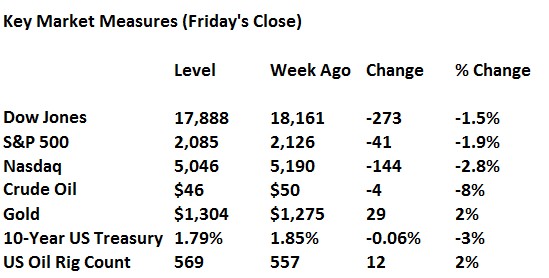
The S&P 500 on Friday logged its first nine-day losing streak in 36 years. However, the magnitude of the sell-off has been a modest decline of just 3%. The re-pricing better reflects election uncertainty and the likelihood of a December rate hike. While it can be tough to sit through markets grinding lower, we think such pullbacks offer good opportunities. This week we consider Facebook, Google, CBRE, Goldman Sachs, First Solar, Home Depot, Apple and Twilio.
Highlights From The Past Week
Overblown inflation fear roils markets Thus far, financial assets have fared poorly during the fourth quarter. Fear of a fundamentally unwarranted climb by Treasury yields has weighed on performance. The latest climb by the 10-year Treasury yield from a September average of 1.63% to a more recent 1.81% has been ascribed to expectations of a series of Fed rate hikes in response to a possibly much faster than 2% annual rate of inflation. However, the current bout of inflation anxiety may be overblown, as the Fed is constrained by long-term borrowing costs reaching burdensome levels, particularly regarding the effect to the national debt.
Housing-sector stocks plunge The fourth-quarter-to-date’s 8% plunge incurred by the Nasdaq Housing index reflects considerable worry over a possible rise in borrowing costs that will stifle housing activity. Markets remember all too well how a climb in mortgage rates during the “taper tantrum”* of 2013 reduced home sales. Yes, the 10-year Treasury yield could jump up to 2% or higher, but its stay will be limited if housing buckles under the weight of higher rates. Recall, the housing market is one of the primary sectors driving the economy.
* Taper tantrum is the term used to refer to the 2013 surge in U.S. Treasury yields, which resulted from the Federal Reserve's use of tapering to gradually reduce the amount of money it was feeding into the economy. The taper tantrum ensued when investors panicked in reaction to news of this tapering and drew their money rapidly out of the bond market, which drastically increased bond yields.
Risk-off trade seen in big FANG sell-off In the last week the so-called FANG stocks (Facebook, Amazon, Netflix, and Google) have stumbled. As earnings and outlooks disappointed, shareholders have awoken to the new normal low growth world and wiped out over $100 billion in market capitalization of the four horsemen of the Fed's wealth creation bubble.
BMR Companies and Commentary
First Solar (FSLR: $32, -20%)
First Solar, the world’s largest manufacturer of solar solutions, reported EPS of $1.22 per share for the third quarter, beating analysts’ bottom line expectations of $0.75. Unfortunately, the quarter’s profitability was not enough to please inventors.
Sales fell 46% to $690 million. Worse, CEO Mark Widmar slashed sales guidance for 2016 to $2.9 billion from $3.9 billion due to the timing of certain utility-scale solar project sales. Widmar withheld comment on the company’s 2017 outlook deferring until November 17th when First Solar will give an outlook update. The combination of the decline for 2016 revenues and uncertainty in articulating visibility to 2017 revenues and earnings left the investing community with little choice but to sell first and ask questions later. First Solar sold off over 14% after the release.
BMR Take: The long term view is unchanged. Solar is a key pillar of our country’s future energy infrastructure. First Solar is a market leader. We think the choppy near-term sales trends and much lower stock price present an attractive entry point.
Admittedly, the volatility and the fall-off in the stock is hard to watch. One positive is that the company is trading at a little over one times sales. The market cap is $3.2 billion with sales projected to be $2.9 billion this year. The company has for years been trading at 2-3x sales. When the company rights itself next year we can see the stock trading at least 2x sales which should give us a price in the 50s or 60s towards the end of 2017.
We understand this is not a pretty picture at the moment. But the company isn’t going to dry up and go away, not with $3 billion in sales, and not within an industry that has such unlimited potential.
Goldman Sachs (GS: $176, -1%)
Goldman Sachs' recently made its 3Q16 quarterly filing with the SEC, the 10Q. Reading through 10Qs offers extra insights on business trends. What we learned in Goldman’s 10Q this time was very positive.
Goldman experienced just three loss days in its trading business in the quarter. This is significantly lower than the uptick last quarter to more than 10 loss days. The recovery highlights greater control over volatile markets. This is a favorable trend for their trading business.
Also, we note progress with regulatory issues, specifically the Volcker rule. The Volcker rule constrains Goldman from trading for itself where there could be a conflict of interest with its clients. Consequently, Goldman has not been able to make as much money as prior to when the rule went into effect. However, in the 10Q, it was disclosed that the negative impact from the Volcker rule is moderating. We see this as a strong positive.
BMR Take: Goldman is the #1 investment banking franchise. Given our recent findings reading the 10Q, as well as the recent flurry of deal activity, we see compelling value in the shares.
CBRE Group (CBG: $26, +2%)
CBRE is the world’s largest commercial real estate and services firm. The company just released a new report that provides a comprehensive analysis of real estate trends in the 20 major cities of the world.
The report provides perspective on key variables such as economic trends, occupier trends, supply trends, rent trends, yield trends, and investment activity, so that investors can quickly and easily understand pricing and market conditions. We live in an age of cities. In the developed world, where the service sector drives economic activity, cities have reinvented themselves as vibrant live-work-play destinations.
Beijing, Boston, Chicago, Frankfurt, Hong Kong, London, Los Angeles, Madrid, Milan, Munich, New York, Paris, San Francisco, Shanghai, Singapore, Sydney, Tokyo, Toronto, Vancouver and Washington, D.C. are featured in the report as key targets for international investors. These cities were selected based on size, transport infrastructure, corporate presence, real estate investment flows and several other indicators of importance.
BMR Take: CBRE is one of the top real estate services companies in the world, operating under the radar to most outside investors. The company is active in each of the major cities around the globe. We continue to believe in the company and are waiting patiently for other investors to notice as well, to move this stock in the mid-30s where it belongs.
Home Depot (HD: $121, -2%)
Home Depot has been languishing in recent weeks. Concerns include a softening traffic trend, the cyclical nature of the business, and a lack of upcoming catalysts to push shares higher. We think these views are short-sighted.
The consumer sector of the economy remains healthy. While we might not be seeing households spend at a particularly fast pace, household net worth is back to all-time highs and unemployment is low.
BMR Take: Home Depot may not have the exciting appeal of a stock that could double, but this blue chip is on very stable ground and we expect solid performance to continue.
Twilio (TWLO: $32, -10%)
After reporting strong results in each of its first two quarters as a public company, the tone of business at Twilio this quarter continues to be very positive. Management pointed out on the recent earnings call that the inputs to the business remain strong, the fundamentals are solid, and it feels strongly about its competitive position. Twilio continues to demonstrate remarkable growth with its business-to-developer model, cloud communications platform, and steady stream of new product innovations, including Voice Insights and the Twilio Enterprise Plan.
We still see a path to profitability. Twilio’s operating margin of -5% was above consensus of -10%, while EPS of -4 cents was above consensus of -8 cents. Operating cash flow of -$700,000 and free cash flow of -$7.1 million were above estimates. Management said it targets operating income breakeven in 4Q17.
BMR Take: Twilio is the leading cloud platform for communications. Similar to Amazon Web Services, Twilio plays a critical role for software developers by allowing them to easily and securely build communications services. We see bright future prospects for the space as seen by very strong performances at Amazon AWS, Microsoft Azure, and Google Cloud. The end market cloud opportunity is exploding and we see Twilio participating in a big way. But what a volatile stock! Not for the faint of heart.
Facebook (FB: $121, -8%)
The company reported earnings results that were outright stellar. As we said in our News Flash Thursday morning, 3Q16 net income rose to $2.4 billion from $900 million a year earlier. Earnings came in at $1.09 per share up from 57 cents a year earlier. The $1.09 handily beat the 97 cents that analysts expected. The company said that mobile was responsible for much of this growth. Revenue hit $7.0 billion in the third quarter, up 56% from $4.5 billion a year earlier, topping expectations of $6.9 billion. Management said that 2017 is expected to be an investment year with technology hiring ramping, while also reiterating that ad load growth is expected to slow in 2H17 impacting ad revenue growth. The market didn’t take to that and hammered the stock.
We are not concerned. In each of the past several years, management has been upfront about things like this and set a similarly low bar. The outlook is very beatable and most analysts argue that nothing new really surfaced this quarter (except for this amazing growth.) Fast money is driving the near term trading trends for Facebook. When the focus returns to the fundamentals, we see a lot of upside ahead.
One key indicator of health was that the ratio of daily to monthly active users stabilized this quarter. This demonstrates stronger engagement trends, which confronts a key issue institutional investors have.
BMR Take: Facebook remains a top pick in the internet/social media sector. The fundamental prospects remain bright. Monthly active users increased 16% to 1.8 billion this quarter. Wow! That is a lot of people – 25% of the total population of the world. Some say Facebook is set up to become the most profitable advertising company in the history of the world. We are not fighting anyone on that at all.
Upcoming Economic News
Tuesday, November 8th
US Presidential Election
Time: All Day
This week all eyes will be on the big event, Trump versus Clinton. We expect a close race. The thinking on the Street is that if Clinton wins, things will remain calm and peachy, just like things are now with Obama. In other words, a Clinton win will maintain the status quo. However, if Trump wins, the uncertainly of what he is and what he will do will cause the market to head straight down. And of course, this has been happening for the past few months due to the uncertainty of it all. The market hates uncertainty.
We have a different take. Presidents have been coming and going for over 200 years. This is no different. The market will assimilate the victor and then be able to go up or down over time as the economy moves higher or lower. At the moment, the Fed has interest rates at record lows – they have never been lower. Yes, they may raise next month but then again they may not. In either case, the market will accept it and move through it. And the country will survive and thrive and we will see higher stock prices in the future.
After the winner is chosen the market will have this veil of uncertainty lifted. It may not be who you expect, nor be what you wanted but the market will be able to adapt to it and get back to business.
A Word From Gary Jefferson
Jefferson Financial Group
First Vice-President, Investments
UBS Financial Services, Inc.
Last December the Fed hiked interest rates for the first time since the financial crisis of 2008. The market dropped a little, and then rallied back, dropped a little again, rallied back and then plunged straight down to result in what many call the worst January in the market's history. At the time, the market was experiencing an earnings recession with YoY earnings growth comparisons negative. It looks like 3rd Qtr earnings this year are going to finally be positive and break the streak of five consecutive down quarters. The question then becomes, "Can investors expect a repeat of last year's decline if the Fed hikes rates again this December now that the earnings recession is over?"
There is quite a bit of growing sentiment throughout the investment community (and excitement) that, because the earnings recession is finally over, we need not worry about a drastic decline based on any Fed hike this time around. Instead, they look for clear sailing ahead. But there are other experts who make a very valid argument that this market is not and has not been driven by earnings. The clear evidence for this is how it shrugged off five quarters in a row of earnings declines. Rather, the market has been all about low interest rates; i.e., there is no way it is trading at 18x earnings based on the earnings outlook. Thus, higher rates are a big threat to equities if this continues and current valuations provide little, if any, margin of safety at all. (Welcome to the wonderful world of clear and easy investment decision making).
We have always believed trying to time the market is never a good thing. However, while we don't believe a rate hike will be what triggers the next financial crisis, we do believe it has a potential short-term market risk attached to it. Long-term investors weather these types of risks year in and year out. Tactically, however, having some extra cash to take advantage of any pullback triggered by a rate hike could, at best, be a good thing and, at worst, not much of a bad thing. Kind of like, "Heads I win and tails we almost tie".
We are also not looking at a rate hike standing alone. Obamacare premiums are going up 25% for 2017. What we see is a double whammy for the average American – increased health premiums and a rate hike will directly and negatively affect the disposable income of nearly everyone. So, in spite of the end of the earnings recession, it is far from clear how the market may react to a rate hike considering other factors that tie in to it.
Adeptus Health Update (ADPT)
We loved this stock when we researched it in the Spring, as they were going to take over the hospital Emergency Room market, but by July we thought something was fishy, so we issued a News Flash on July 21st removing the stock at the $50 level. We even mentioned the possibility of fraud. Well, guess what? One quarter later the company announced terrible earnings and the stock which had sold off to the $27 level by Tuesday, the 1st of November, opened at $11 on Wednesday. It closed Friday at $8.50. Wow. What a story. We expect lawsuits.
Two Titles Here:
Update on Twitter - A Pure Speculative Play
The Options Corner
We have a hunch. We think Twitter (TWTR: $18.02) might just get bought out after all. We certainly don’t have any inside information and even if we did we couldn’t tell you about it! But we have been reading a lot about this company, the culture, the worldwide impact it has had and continues to have, the 317 million users. We can see someone stepping up and buying them now that the shark-feeding frenzy has worn off and the stock has receded. The company has a market cap of $12.5 billion now, down from $17.5 billion last month. That’s a lot of money, but to an Apple or a Google or a bunch of other companies that’s really not a lot of money. Someone just might step up to the plate with a nice $25 per share offer. Just a hunch.
Well, what if the stock is bought out for $28 a share? How would one profit from a move like this? You could buy a January 25 call for just 23 cents. 10 options that control 1000 shares would cost just $230. If the stock went to $28 the option would trade for $3.00 or $3,000. Not a bad profit. Of course, if the stock doesn’t go to $25 by January 20th, you would lose your entire $230. And if you did 100 options, controlling 10,000 shares for $2,300 and it went to $28, the option would be worth $30,000. Very interesting.
If you think you need more time, you could buy the January $25 2018 call (LEAP) for around $1.25. 10 options that control 1000 shares would cost you $1,250. If the stock went to $30, the option would trade for $5, or $5,000. Very interesting. (Oh – we just said that above!) Again – this is pure speculation. 90%+ of options buyers lose all their money, so be careful.
High Yield Corner
If you read the New York Times, then you saw this terrifying headline: "S&P 500 Index Marks Its Longest Losing Streak in 36 Years.” Scary, isn’t it? We are entering a period of intense de-risking that is causing people to sell off equities at a breakneck pace. The streak is pretty severe, but the trend is a lot like last year when stocks, bonds, and just about everything else fell shortly before (and after) the Federal Reserve’s rate hike in December. Something similar is happening now.
This time there are some extra jitters because of the election cycle, and several analysts have recently published notes warning that a Donald Trump victory could cause stocks to fall 5% or more. Whatever your politics, the volatility of the presidential election is something to be aware of and to look at objectively. The market is telling us that it does not want a Trump victory, with several economists and financial publications (including the Wall Street Journal, The Economist, and the Financial Times) warning that Trump’s win would be a bad thing. You need to be aware that many people are selling stocks off for this very reason.
Ironically, if the market sells off enough between now and election day, it might actually rise with a Trump victory even if the market still doesn’t like Trump. Why? Because the market hates uncertainty more than anything else, and until the election is over we will remain uncertain about what happens.
The volatility in stocks is amplified in the high yield world. Everything is down. The last month has been shockingly cruel for high yield assets. But not all of this is because of the election. The worst performers have been REITs. The SPDR Dow Jones REIT ETF (RWR: $89) is down over 7% in the last month. This massive decline is due to the run-up in REITs earlier in 2016. Many REITs are still up year-to-date, such as Bull Market Report pick Digital Realty Trust (DLR: $91), which is up 20% year-to-date and is still yielding a safe 4% with funds from operations far in excess of dividend distributions. Others aren’t doing so well. Omega Healthcare Investors (OHI: $29) fell over 6% this week and is down 16% year-to-date.
But Omega Healthcare is one of the best buys in the REIT space right now, which is why we encourage investors to double down on this great name. The decline has less to do with Omega’s fundamentals than with a sharp fall at HCP (HCP: $29.50), one of the biggest REITs, a S&P 500 constituent, and a dividend aristocrat. HCP is spinning off riskier assets which has negatively affected its income statement. EPS was a 6 cent disappointment partly because of the spinoff, and the firm’s future post-spinoff is less clear than many would like. Thus its sharp decline after reporting earnings this week.
But none of this has anything to do with Omega, which fell in sympathy because it’s another Healthcare REIT. This is indiscriminate selling. We recommended Omega over HCP for a number of reasons. Its FFO remains above distributions. The company announced results this week and, although FFO was one penny below expectations, it was up 5% on a year-over-year basis, and full year FFO is guided to be $3.39. Its annual dividend payments are $2.44, meaning the dividend coverage ratio is 140%. And that’s after the company raised dividends three times this year. There is more room for dividend increases and it is a very safe dividend. Should such a firm be yielding 8.4%? Of course not - but the market is scared and is indiscriminately selling. That makes it a great time to double down on Omega, and wait for it to recover. After the rate hike and election decision, that recovery is almost inevitable. (Powerful words from The Bull Market Report – hold us to it!)
The second-worst performers of late were the BDCs. The UBS Etracs BDC ETF (BDCS: $21) fell over 6% in the last month, after falling nearly 4% last week alone. The ETF has erased almost all of its gains and is no longer outperforming the S&P 500. This makes sense with such a volatile asset class.
Again, rising interest rates are a big part of the concern. Higher interest rates could cause non-performing debts to rise for BDCs, lowering their NAV and interest income. It will also make borrowing costs higher for BDCs, causing their profit margins to fall. This is all worrying - and is reminiscent of similar worries causing the industry to fall in 2015 (and in 2013 and 2011 before that).
That’s why we recommend a light and selective BDC allocation. Currently we only like Main Street Capital (MAIN: $33) and continue to rate it a hold thanks to its growing 8% total dividend yield including special payouts. Main Street reported earnings last week and beat on both net investment income and revenue. Its NAV is up 2% year-over-year, but its current price is a 50% premium to book value. That high premium is worrisome to risk-averse investors, which is why Main Street might not see much capital appreciation in the short term. However, its steady and long-term performance suggests it’s the best BDC to hold. We probably haven’t seen the bottom for BDCs yet, which is why we are cautious about the industry as a whole in the short term. Long term, though, we continue to like Main Street’s ability to continually deliver a high income stream, with no hint that this is going to stop anytime soon.
Let’s turn to MLPs. This was a wild week for oil, with reports and counter-reports about an OPEC oil production freeze deal causing spikes and declines in oil futures. It’s unclear whether Saudi Arabia and Iran are going to agree on an output freeze or not. This has big implications for MLPs, even the ones that do little in oil. Oil futures ended Friday down, finishing the week sharply lower. As a result, the Alerian MLP ETF (AMLP: $11.90) lost 5% of its value this week. The fund is now down slightly year-to-date. With MLP values so closely tied to the volatile oil market, it’s impossible to rate MLPs based on fundamentals alone, and it’s impossible to expect these to start trading higher if oil doesn’t go higher. A bet on MLPs is a bet on higher oil prices, and that’s frankly unpredictable. We remain cautious on MLPs and energy-related stocks as a general rule, but special opportunities can and do arise.
Finally, let’s turn to junk bonds and the corporate debt world. Rising interest rates are very bad for this asset class. It lowers the value of outstanding debts and makes it harder for companies to issue new debt and to pay back their new debts. Yet the Fed seems intent on raising interest rates next month. Thus the SPDR High Yield Bond ETF (JNK: $36) is down 2% over the past month after a 1% decline this week. The market is worried about rising default rates, but we remain contrarian on this point. Default rates have been rising for a while and high yield bonds have fallen in value for even longer as the market anticipated this dynamic. Keep in mind that the SPDR junk bond fund is down over 7% from the beginning of 2015, when the anticipated default rates really started to hit this market. We see the defaults and the interest rate increase priced in more readily than they were a year ago, so a steep decline isn’t likely. However, a short-term fall from now until the FOMC meeting in December remains a strong probability as short-term fear grips the market.
This is why we recommend doubling down on the Pimco Dynamic Income Fund (PDI: $28) despite its 3% decline this week. We recommend adding to this position slowly over the next three weeks. Its 9.5% dividend yield is about to get a huge boost, as the fund still has over $1 in undistributed net income, which will be paid out in a special dividend by the year’s end. Pimco Dynamic Income is trading at a slight premium to NAV (2%), and normally we would like to buy the fund at a discount. However, this is a tricky time to estimate when to buy PDI. Many investors may jump in after the special dividend is announced, which could happen any day this month. That could easily offset weakness in the corporate bond market. As a result, we suggest staggering purchases in PDI slowly on down days.
This is a moment of intense fear in the market. That fear is likely going to continue. Do not let it sway you; remember Buffett’s advice to be greedy when others are fearful. That’s what he did in 2009 and made a killing as a result. Now’s your chance. Don’t get swayed by the fear in the market and sell at the bottom. Wait this weakness out, perhaps adding to positions where conditions are clearly the most oversold, and enjoy the high income stream until the market realizes its error and starts buying again.
Michael Foster, High Yield Analyst
The Bull Market Report
Berkshire Hathaway (BRK-A and BRK-B) has a record amount of cash. At the end of June Berkshire had $73 billion and that is now up to $85 billion as of September 30th. Many are conjecturing on what the 86-year old Warren Buffett will buy next. This year he bought battery-maker Duracell for $5 billion and he paid $32 billion for Precision Castparts, a global supplier to the aerospace industry. The latter was one of his biggest acquisitions ever.
Operating earnings climbed 7% in the third quarter to $4.85 billion. Revenue was flat at $59.0 billion. The stock is trading at $214,545 per share! The stock is up 8% this year. The B shares are trading at $143, after a 50-1 stock split in 2010. The company is worth $353 billion, making it one of the world’s most valuable companies.
Apple Corner
Nothing much new this week, as the stock sold off as did most of the other heavyweights in the Tech realm. Apple (AAPL) closed at $109, down 4% for the week. They added another $750 million in cash to their coffers increasing the “pressure” on Tim Cook to do something with it: big dividend, buying some tech startups, and so on. We say “pressure” even though in reality there is not really any pressure for the company to do anything. They like it the way it is. We’re hoping that we will see an election relief rally later this week after the uncertainty is lifted. We are buyers here and expect a new all-time in the stock later this year or early next.
Good Investing,
Todd Shaver
Editor in Chief
The Bull Market Report
October 25, 2016
by Todd Shaver | Oct 25, 2016 | 7am News Flash
Visa (V: $83) reported a 28% rise in quarterly profit yesterday. Net income rose to $1.93 billion, or 79 cents per share in its fiscal fourth quarter ending September 30, from $1.51 billion, or 62 cents per share, a year earlier. Total operating revenue rose 19% to $4.26 billion.
The world's largest payments network operator had a great quarter. We expect even better things from Visa in the future.
Apple (AAPL: $117)
Earnings Date: Tuesday 4:10 PM ET
Consensus: Fiscal 4Q2016
Revenues: $46.9B
EPS: $1.65
Year Ago Quarter Results
Revenues: $51.5B
EPS: $1.96
Key Things to Watch For in the Quarter
Analysts throughout Wall Street forecast that Apple will earn $1.65 per share in the third quarter. This value represents a 16% decrease in comparison to last year’s third quarter. Revenues are also forecast to slip, by about 9% to $46.9 billion. So far this year the Silicon Valley technology goliath has underperformed revenue estimates in both of the previous quarters.
In addition to releasing their quarterly earnings report, this week Apple is expected to launch its newest MacBook Pro, a major event for the firm given the year-over-year decline in iPhone sales. This will benefit them in the interim between now and the release of the 10th anniversary iPhone next summer. Apple won’t let that magical date go without releasing something major. An increase of sales is expected.
Since the meltdown of Samsung’s Note 7, Apple shares have gained approximately $15 indicating that the market expects the Silicon Valley technology machine to regain some market share in the smartphone space from the Korean company.
Under Armour (UA: $38)
Earnings Date: Tuesday, 4:00 PM ET
Consensus: 3Q2016
Revenues: $1.45B
EPS: $0.25
Year Ago Quarter Results
Revenues: $1.2B
EPS: $0.23
Key Things to Watch For in the Quarter
Under Armour has made a lot of positive strides over the years. It has seen 25 consecutive quarters of uninterrupted growth. This quarter’s analysts’ consensus puts EPS flat while reaching $1.45 billion in revenue, representing a 20% climb from last year’s third quarter.
For the fourth quarter, consensus calls for earnings of 28 cents per share, up from 24 cents a year-ago. Revenue is expected to jump by 22% percent to $1.43 billion.
Under Armour is expected to report 2016 earnings per share of 59 cents on revenues of $4.95 billion. This represents an 11% increase in profits and a 25% increase in revenue.
With strong management, led CEO Kevin Plank, the sportswear company has continued to grow over the past two decades with much thanks to its increased brand visibility. This can be credited to its athlete endorsers including NBA MVP Stephen Curry, NFL MVP Cam Newton and MLB National League MVP Bryce Harper. Currently, the stock is undervalued. We will continue investing in a company that is filled with high growth and great potential. Although the firm has beat estimates in the past two quarters, the stock is down 20% year-over-year, making it an amazing value for growth investors. We hereby beat the drums for Under Armour.
Equity Residential (EQR: $61)
Earnings Date: Tuesday, 4:00 PM ET
Consensus: 3Q2016
Revenues: $602 M
EPS: $0.78
Year Ago Quarter Results
Revenues: $666 M
EPS: $0.80
Key Things to Watch For in the Quarter
Consensus for the third quarter of 2016 has Equity Residential’s earnings decreasing approximately 10% to $0.78. Revenue estimates are also expected to decline 10%, to $600 million. Of the past four quarters, Equity Residential has met EPS expectations of analysts twice, in 1Q16 and 4Q15. This residential Real Estate Investment Trust (REIT) with primary holdings in New York, Los Angeles and San Francisco, has long been benefiting from the high rental market. The company strategically avoided the threats of Hurricane Matthew by liquidating large holdings of apartments in Florida last quarter, giving the firm flexibility to diversify its portfolio with other emerging cities throughout the nation. The healthy 3.3% dividend also makes it an attractive play as investors struggle to find reasonable returns in today’s low interest rate environment. The stock is down 23% year-to-date giving us an opportunity to invest in one of the finest apartment owning company in the country.
CBRE Group (CBG: $28)
Earnings Date: Wednesday, 6:00 AM ET
Consensus: 3Q2016
Revenues: $3.3B
EPS: $0.50
Year Ago Quarter Results
Revenues: $2.7B
EPS: $0.51
Key Things to Watch For in the Quarter
The firm is a commercial real estate services and investment company that operates through its subsidiary divisions: The Americas; Europe, Middle East and Africa; Asia Pacific; Global Investment Management, and Development Services.
Revenue is strong this quarter as they continue to expand into other real estate markets. Last year’s quarter revenues were at $2.7 billion compared to the expected revenues of $3.3 billion this quarter.
CBRE is one of those under-the-radar companies. We find this amazing for a company worth $9 billion, but we have exposure to some of the things the company is doing and believe the stock to be very undervalued. The company has a wide range of tentacles in the US real estate market, all of which are designed to make money for their clients and produce revenue for CBRE itself. They also have strong international exposure. The company continues to grow and enhance their global geographic reach. Their stellar management and trajectory puts them on a path for continued growth.
October 25, 2016
July 21, 2016
by Todd Shaver | Jul 21, 2016 | 1pm News Flash
Qualcomm (QCOM: $60, up 7%) The company reported good results yesterday for its June quarter and issued a solid outlook for the current three-month period. The company earned $1.45 billion, or 97 cents per share, up from $1.2 billion, or 73 cents per share in the year-ago quarter, topping expectations.
Revenue hit $6.0 billion in the period, vs. expected revs of $5.6 billion. A year ago Qualcomm posted revenue of $5.8 billion.
Qualcomm said results in the latest quarter reflect "meaningful progress" with licensees in China as well as a strong new product ramp among original equipment manufacturers in that country.
Referring to the next generation of mobile telecommunications technology, the president was quoted as saying: "We are executing well on our strategic priorities, and we remain confident that our focused investments in 5G and other advanced technologies will create a strong foundation for long-term earnings growth."
BMR Take: We said just this week in the newsletter: “4% dividend, $80 billion market cap. We should see a slow and steady rise in revenues and earnings as the company moves into new markets.” We see nothing but good news ahead as the stock reaches for the 52-week high of $65 and our target of $62. We hereby raise our price target to $72 and our Sell Price from $39 to $52.
BTW, the market cap is now closer to $90 billion!
Microsoft (MSFT: $56, up 6% yesterday) Microsoft led all Dow components with a 5% jump after announcing strong quarterly results to close out its 2016 fiscal year. Revenue rose 2% as healthy growth in its cloud segment more than offset the declining personal computing division. The company hit $22.6 billion in revenue beating estimates of $22.1 billion. Profits also significantly outpaced targets, rising 11% year-over-year to $0.69 per share compared to the $0.57 per share that Wall Street was forecasting.
Microsoft's cloud services , called Azure, spiked to $12 billion as revenue doubled. It is on track to meet management's $20 billion annual goal by 2018, and now sits at over half the revenue of the company. Amazing.
BMR Take: We hereby raise the Price Target of Microsoft to $66 from $62. And note that $60 is the all-time high for the company reached in 1999! Look out ahead for this cash machine.
Netflix (NFLX: $86) The company reported second quarter EPS of $0.09, up from $0.06 a year ago. The consensus estimate was for EPS of $0.02. The company announced that it added 1.7 million subscribers in the quarter, which was below its forecast of 2.5 million. Second quarter EPS is expected to be $0.05. Street expectations are for EPS of $0.07.
BMR Take: We are very disappointed. Our overriding emotions are telling us to remove this stock from our Stocks For Success. But we can’t bring ourselves to do this at the moment. So what do YOU do? Be careful. Be very careful. With the very high PE (over 100) This stock could go to $70, or it could go back it $120. It’s like an Amazon. Trading at a triple-digit PE for years, and now producing profits.
Hedging your position in Netflix by selling calls against it is not a bad idea. You could even do a collar, whereby you sell a call and use that money to buy a put. This stock is not for the weak of heart. If you have any qualms about it, get out now and invest in something much more solid.
APPLE (AAPL: $99.50) The stock hit $100 yesterday and earlier today. This value stock is going to go a lot higher from here.
TESLA (TSLA: $220) Elon Musk, has published a new "master plan," which involves installing a solar panel system into cars, building heavier vehicles and introducing a ride-hailing business.
In a blog post, Musk espoused some bigger ideas for the company and its new potential acquisition of S0lar City. He discussed building semi trucks and buses, as well as pursuing self-driving technology, which would allow people to use their cars for ride-sharing.."
Mr. Musk acknowledged the scale of his ambitions: "Starting a car company is idiotic and an electric car company is idiocy squared." Analysts followed suit. One said: "As is typical, Elon Musk has laid out a grandiose plan for the future with no timeframes and few specifics, and no mention of how and when Tesla will be profitable."
BMR Take: Another volatile stock which could shoot to $300 or move to $150. Buyers beware.
Blackstone (BX: $27) The stock continues to trickle higher each day. See our newsletter this week.
CBRE: (CBG: $29) See comment just above for Blackstone, and repeat out loud for CBRE.
Under Armour (UA: $43) Is $50 on the horizon again? Look out ahead.
