
Summer Calm
Last week was much like the Shakespearean quote: Full of sound and fury signifying nothing. We constantly look for clues to the future of stock prices but the market is playing its cards close to the vest these days. There was continued upward movement in oil prices early in the week above the $50 dollar level. But an uptick in the rig count quickly put an end to the rally. We’re at 414 now (compared with 635 this time last year), but we were up 3 the previous week and +6 this week. Stocks started out the week nicely before giving up some gains on Friday.
Meanwhile yields on the 10-Year US Treasury Note ended the week yielding 1.64%, one of the lowest levels of the year. Even so, the dollar rose modestly against the Euro, Yen and British Pound. These days, Gold is the star, gaining steadily in each of the last two weeks.
What this market needs is less Shakespeare and more action. Be patient, it’s only a matter of time.
Here is How The Major Averages Performed
Key Market Measures (Friday Close)

Looking For Leadership
For the last few months we have been locked in a sideways market ranging from 2050 to 2100 on the S&P 500. The exact numbers are less important than the question this raises. What is needed to break the stalemate? Of course there are any number of possibilities here. The most likely are the major forces of oil and interest rates which continue to dominate the conversation. Of these two, oil is the most volatile so let’s focus on this for a moment.
The dramatic recovery from the $26 low in February to Friday’s close at $49 has surprised many pundits and propelled the entire Energy sector into one of the top performing groups of 2016. But with that recovery, domestic drilling rigs are being brought back on line, a dozen in the past two weeks alone. Any further increase above $50 per barrel will result in even more rigs being added.
This week we see another FOMC meeting where the odds are low that any action on interest rates will take place. We can’t imagine any rate increase being helpful to economic growth, and it is economic growth in the long run that moves stocks. Our guess is the Janet Yellen will hold her customary press conference on Wednesday at 2:30 PM and hedge her position. Financial stocks echoed this message, being one of the weakest performers last week. Until then the S&P Financial Sector had been chugging along, increasing over 4% in the last three months.
So what could shake things up? Second quarter earnings reports will start in early July. That is almost always good for a pre-announcement run-up in prices. And then there is that nagging reality, the presidential election campaign. This is a real wildcard for the market to digest. Until now, the primaries have had no impact. But that will change as the summer progresses.
Economic News This Week
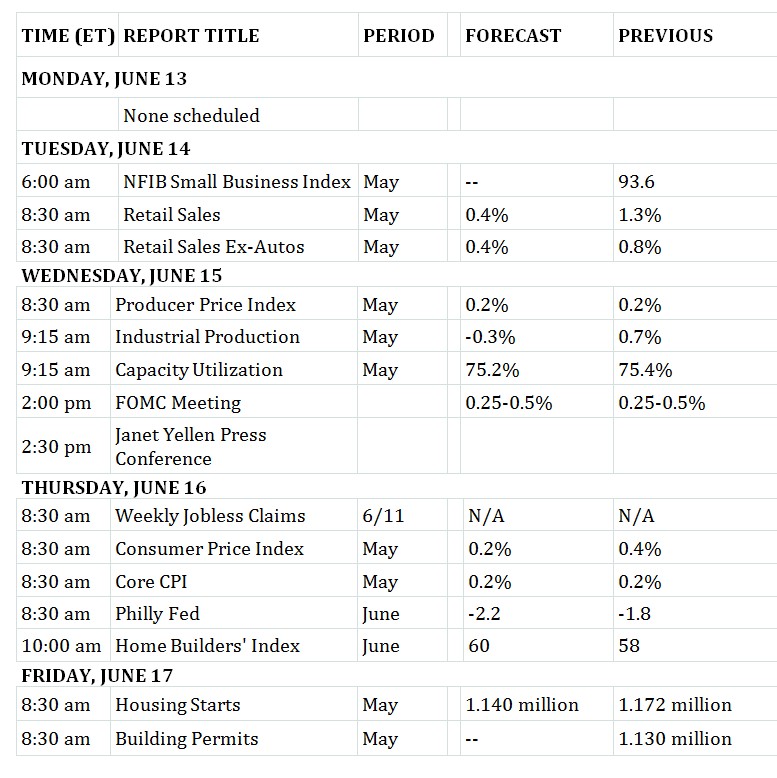
The consumer is the key to the direction of the economy. Retail sales will be released Tuesday followed at the end of the week by Housing Starts and Building Permits. After a huge bump in April, expectations are for a Retail Sales drop to a modest 0.4% from the 1.3% the previous month.
The June FOMC meeting takes place on Tuesday and Wednesday with Janet Yellen’s press conference at 2:30 PM on Wednesday. Rather than any change in rates, you should look for subtle changes in Yellen’s posture.
BMR Companies and Comments
For many weeks in this newsletter we have shared the view that 2016 is a year when stock picking will be the key to investment success. So this week we want to spend most of the Bull Market Report on money-making stock ideas. Here we go.
Twitter (TWTR: $14.02, down 8% on the week) The stock has had a rough ride this year. There is no shortage of naysayers about the future of Twitter. We disagree. Here is why: Twitter is an iconic service and a globally recognized brand. It has over 310 million users and growing. Twitter has compiled a treasure trove of data that many social media companies would pay dearly to own.
Since founder Jack Dorsey returned to the CEO spot last year, he set out to improve Twitter’s user experience and that means committing serious resources to Live Steaming Video. Execution of this strategy will begin to bear fruit later this year when Twitter will stream certain NFL games on Thursday nights. Twitter usage has always been at its highest during big real time sporting events so don’t be surprised when more deals of this type are announced.
In the meantime, active users grew 3% to 310 million in 1Q16. The company is doing a great job in monetizing its users as advertising revenue in 1Q16 jumped 36%.
Dorsey is taking the company in the right direction. Even the skeptics concede, the company customer database is an asset that competitors would love to get their hands on. The list of potential suitors includes giants like Google and Facebook as well as desperate companies like Yahoo. Will one of these firms, or another that we haven’t thought of yet, like Sony or Samsung, make a play for the firm and drive the price to $20 or higher? How this all works out will not take much longer. Our guess is less than a year. Twitter is relevant in 2016 and will be relevant in 2017 and beyond, and thus has tremendous value at $14 a share, just $10 billion in market cap.
Gilead Sciences (GILD: $84, down 2%) Last Monday, a US District Judge threw out Merck’s patent infringement suit against Gilead. The judge accused Merck of perjury and unethical practices. Gilead had already paid $200 million to Merck in compliance with the lower court ruling and charged this to 1Q16 earnings. Not only does this charge get reversed, but the requirement of a 10% royalty payment is also eliminated.
This changes everything. Let’s focus on its drugs, Harvoni and Sovaldi. These two drugs have generated sales of more than $30 billion, marking the biggest drug launch in history. Merck’s version of the drug contains the patented formula called sofosbuvir, and is priced about one half of Harvoni. But if Gilead is the legal owner of sofosbuvir, it is Merck that will have to license it from Gilead. Once investors appreciate the implications of Monday’s ruling, the stock will move higher. We are strong believers in this company.
Facebook (FB: $117, down 2%) Facebook has been a top performing stock in the Social Media sector this year and one of the big gainers in the market overall. When you are on top as Facebook is there are lots of critics that try to chip away looking for any flaws in their strategy. How can you fault a company strategy that has created a stock valuation of $330 billion and that grew revenues 52% in the latest quarter?
Team Zuckerberg is doing an amazing job keeping the company relevant. Remember, Facebook is only 12 years old, ancient in tech circles. The company showed their smarts by adapting to mobile platforms, messaging, and importantly, with the 2012 acquisition of Instagram where the demographic is younger than the average Facebook user. Month after month both Facebook and Instagram rank in the top 10 of free app downloads. This is a sure sign of enduring customer loyalty.
It is Facebook’s constant attention to improving user experience that keeps them on top. At the same time, they haven’t lost sight of longer-term diversification opportunities. That’s what makes the company so compelling. Here are two great examples: Last Wednesday, Facebook added video capability to the Comments window. Now instead of typing or texting, users simply tap an icon and send a live video comment. According to the industry authority, TechCrunch, by 2020, video will represent over 80% of Internet traffic.
Finally, we also learned last week that Facebook has begun testing a new money transfer and payment system in China. This is the beginning of a giant long term opportunity. Faithful investors in Facebook are being rewarded and the end is nowhere in sight.
Qualcomm (QCOM: $54, down 2.0%) Call it smart stock picking or good timing. Qualcomm, with a 26% gain after being added to our Stocks for Success in February, is a winner. (We think it is just fabulous stock picking!) As you know, Qualcomm is all about mobile computing with its Snapdragon - System on a Chip. Qualcomm offers a range of models from basic mobile phones to the latest Smartphone’s from Apple and Samsung.
Mobile phones are simply the largest selling consumer electronics device ever invented. Almost 1.5 billion Smartphone’s were sold worldwide in 2015. Add to that an additional 500 million non-internet feature phones and you have a picture of how big Qualcomm’s market measures. By 2019, according to Gartner Research, sales of all types of mobile phones will reach 2.4 billion.
The wind is still at Qualcomm’s back and we feel the stock is still undervalued. Wall Street is estimating 2016 earnings of $4.10, giving the company a lowly multiple of 13. The dividend is running at $2.12 annually, a tidy 3.9% yield. Wall Street believes earnings will grow more than 10% a year over the next five years. The balance sheet is loaded with $30 billion in cash and more is piling up every year. This is a huge reserve for future dividend increases or value-enhancing stock buybacks. A stock with all this going for it is worth much more than today’s price. It is time to get invested in this high quality issue.
LinkedIn (LNKD: $131, down 3%) The stock got a nice boost last week by RBC Capital, upgrading their recommendation to Outperform with a $160 price target. We agree the stock will trade higher but $160 is just a short-term objective. Remember, the all-time high was reached a little more than a year ago when it hit $276.
LinkedIn is the place to go to connect to jobs and career advancement advice. The site has a lot of “stickiness” – a measure of the time spent browsing the website. Advertisers love to use this measure and LinkedIn has a lot of it. It consistently ranks among the highest traffic websites and in a recent survey, 20% of LinkedIn followers even use the site as their primary news resource.
Two thirds of its global business is what LinkedIn calls Talent Solutions. The search for a new or better job remains vibrant. Revenues in 1Q16 from LinkedIn Talent Search jumped 40%. The low unemployment rate in the US hasn’t slowed business a bit. Now the company is launching Profinder, its own freelancing service. The temporary and part time labor force amounts to about 20% of all employment. Intuit predicts by 2020, the total will rise to 40%. So, this is a smart and timely move by LinkedIn.
Fitbit (FIT: $14.10, down 4%) We made the tough decision last week to remove Fitbit from our Special Opportunities Portfolio. We added the stock in March at $14.55 and removed it last week at $14.40. The stock has done nothing in that time and this may be the case in the future. There are some real questions that concern us about the market for wearable devices. Such as: 40% of fitness devices wind up sitting in a drawer after only a few months of purchase. The accuracy of the devices is also being brought into question by a class action lawsuit. This is not good news. Interestingly, there was an upgrade on the stock that came out Friday that we issued a News Flash on, but the stock dropped anyway. Listen: We took a shot and the stock is down only 1%. It didn’t work out but just as importantly, we didn’t lose any money.
The Apple Corner
Apple (AAPL: $99, up 1%). Apple held up nicely this week. Watch for announcements from Apple's hotly anticipated Worldwide Developers Conference (WWDC), which takes place Monday. There are a few rumors about it of course. Apple is reportedly looking for real estate in the San Francisco Bay Area to serve their self-driving car project. They are said to be looking at an 800,000-square-foot plot. (That’s big.)
We continue to be amazed at how many iPhones are out there compared to the Androids. We live in a wealthy area, Aspen, so our results are skewed, but in our town we would guess the split between Apple and others is in the neighborhood of 80-20, and we might just be low. We think intelligent people see the tremendous value the iPhone offers. And even though iPhone sales were in a “slowdown” last quarter, it was just a smidge, as sales continue at an amazing pace, and the cumulative number sold could reach 1 billion by late 2017. In April, CEO Tim Cook stated that the iPhone installed base had grown by 80% in the past two years. Upgrades now drive most of Apple's iPhone sales, but the iPhone is still bringing in tons of new users. We are looking for iPhone sales to rise by over 10% in 2017. And Apple is poised for another year of 10%+ growth in 2018. The number of people switching to the iPhone from Android is at a record high. There is plenty of room for smartphone ownership to rise in emerging markets, too. Both of these trends support the continued growth of Apple's iPhone installed base.
These numbers talk to us as we know that it will produce revenues from the App Store, and from the fact that people fall in love with the device and then want an iMac and an iPad. The iPhone is a franchise that won’t quit and with the iPhone 7 coming out in September there is only more good news to report about late this year and next.
BMR Take: Things are quiet lately on the Apple stock price front. But not with the company. They have 110,000 employees working to make life better for all of us. The cash hoard is huge and growing, and it’s only a matter of time before something new and exciting happens at this firm. We are strong buyers here at $99 a share.
Tesla Update
Today, Apple is the largest company in the world by market cap. But Tesla Motors (TSLA: $219, flat) could rocket so high in the next 10 or 15 years that the current $32 billion market cap could exceed even Apple’s $540 billion.
This is according to Ron Baron, CEO of Baron Capital, who went on CNBC recently to rave about Tesla. He has a $300 million position in the company and he thinks the stock could grow up to 20 times its size in the next 10-15 years to the $650 billion level. He expects to make $6-7 billion off of that position as Tesla becomes one of the biggest companies in the entire world.
He says: “The competition is nowhere. They could have caught Elon Musk four or five years ago, but they can’t catch him now. He’s too far ahead.”
Why? Well, for starters, all the things we have been saying about the company. Like the billions of dollars they’ve invested in its Gigafactory, which is nearing completion in Nevada and will be responsible for supplying batteries to the millions of Tesla Model 3s it produces once the car hits the streets in 2018.
Baron sees the ability to mass-produce batteries at such a massive scale as an absolute necessity for anyone hoping to compete with Tesla head-on in electric vehicles. The Gigafactory, according Musk, will have the largest footprint of any building in the world - the Gigafactory will be the largest building by area on the planet earth.
BMR Take: What can we say? We agree!
ENERGY CORNER
Notes at the Margin
by Phil Verleger, Jr., International Energy Expert
Former Director of the Office of Energy Policy at the Dept. of Treasury
www.PKVerlegerLLC.com
Markets were pulled and pushed last week. Attacks on producing facilities in Nigeria and new fires in Canada added upward pressure. Our estimate of a $15-per-barrel disruption premium is probably out of date. By Wednesday, it may have risen to $20.
However, the disruptions do not seem to have attracted hot money. At this juncture, we see a decrease in prices back toward $30 per barrel as disruptions in Canada are resolved and the Nigerian situation stabilizes. The forecast, though, depends on such developments, an assumption that may not be reasonable.
BMR Take: With Crude hovering at $50 the world just feels better. This might seem simplistic to you but remember how we felt when crude hit $30 and then saw it dip below into the 20s? People were talking about $20 oil then and the massive bankruptcies that were going to go with it. And people were afraid and worried. Even at $50 we are seeing some bankruptcies and restructurings, the latter generally a good thing. So at $50 there is hope. If crude heads to $30 again as Phil Verleger thinks above, then things could get dicey again, with the overall stock market more than likely heading lower. Conversely, at $50 the Energy world is much more stable, which lends itself to a stable stock market and growth in the economy.
High Yield Portfolio Corner
The iShares High Yield Corporate Bond ETF (JNK: $84) ended the week with no price action, after jumping up over 1% in the middle of the week and falling by the end of the week. Similarly, the UBS ETRACS BDC ETF (BDCS: $20) saw no real move this week, although it was significantly weaker and more volatile than junk bonds, which is not terribly unusual. The dramatic no-move of the week is a result of broader macroeconomic fears. With weak jobs growth, investors are starting to get scared that the fundamentals of America may be a tad weaker. Still, the market remains in risk-on mode, as evidenced by junk bonds still managing to hold their pricing for now.
Government Properties Income Trust (GOV: $20, up 1%) had a modest gain that outperformed most high yield stocks, thanks in part to an end-of-the week bump that moderated on Friday as the market broadly became more cautious. Still, market confidence in management remains solid, and for good reason. The company has changed the structure of its operations somewhat in recent months to find higher returns. They began investing in non-government office properties to offset weak government expansion. So far this helped bolster overall occupancy rates and FFO. We see this as more of an opportunity as a risk. The company's continued strong dividend payout coverage is a testament to management's ability to invest wisely and enrich shareholders.
Pimco Dynamic Income Fund (PDI: $27, down 1%) saw a decline this week, but that's good news - the fund paid a dividend this week, which accounted for almost all of those losses. (As we’re sure you know, when a stock pays a dividend it goes “x-dividend” and the stock opens for trading on that day, down the amount of the dividend it is paying.) This fund continues to maintain its payout and is now trading at a slight premium to Net Asset Value, making it still an attractive hold. With continued declining defaults in the mortgage market and a stable corporate bond market, this fund is having no problem maintaining its 10% dividend. We hope you bought some earlier this year when we recommended it, as you got this stock much cheaper - and got a yield of 11% (plus some hefty unrealized short-term capital gains). We are still holding on to this one as it's one of the best income producers out there.
Enough about steady stocks - let's talk about a monster. Digital Realty Trust (DLR: $102, up 3%) posted another week of sharp gains, helping it to rise 36% year-to-date! That's a staggering number, which just goes to show that REITs can sometimes provide more than just income. What's the story here? Two things are going on. Firstly, Digital Realty had an awful 2015, where the REIT industry broadly suffered from a broad-based de-risking. Investors, fearing the next market downturn, began to offload REITs, and Digital Realty was a victim. Secondly, and more importantly, Digital Realty has made some significant operating expansions that will grow its Funds From Operations more than many had anticipated. Late to the party, those bulls are now jumping in. Good for us, since we got in much earlier and closer to the bottom. If you are not in, we would still be buyers here. Paying a solid 3.4% dividend, we expect a dividend increase in the next six months.
Overall, this was a ho-hum week for high yield in general and a good week for our High Yield Portfolio. The overall stock market still is looking for a reason to correct. The awful jobs report from last month, where just 38,000 new jobs were added and the unemployment rate dropped because people gave up looking for jobs, is the beginning of a good excuse. We're not necessarily bearish on the market, but we are cautious - and our cautiousness grows every week the junk bond market doesn't decline. Junk bond yields as measured by the Merrill Lynch High Yield benchmark have fallen to their lowest point in a year and have not been this low since seeing major corrections late in 2015 and earlier this year. This is happening despite higher bankruptcy rates, which suggests higher risk and thus higher yields for these bonds.
The gains we had in the last few weeks were great for our portfolio and give us some confidence, This will be a great opportunity to add a bit more to the portfolio and gain more income at higher yields.
Good Investing!
Todd Shaver, Editor in Chief
Info@BullMarket.com