
Climbing A Wall Of Worry
At the moment, everyone’s focus is on Trump’s G20 meeting as well as his first sit down with Vladimir Putin. Why care? Well… The G20 is comprised of the world’s wealthiest nations, so it is quite a powerful platform for business discussion. The big takeaway from the meeting was leaders like China’s Xi Jinping promoting an open world economy that contrasts Trump’s nationalist push. Trump believes in fair trade as opposed to free trade. Global trade policy has a huge potential impact on the bull market so watch closely.
Trump also sat down with Putin for their first face to face meeting. The two confronted issues over election meddling in addition to a variety of topics. Everybody is on guard about Russia and North Korea starting another war, so again this is really important stuff, in terms of watching out for the next Recession. But for now, the outlook is bright and the bull market continues to climb a wall of worry, which it has done for 100 years. In fact, there are no good old days. The market wakes up every day and worries about something. And the market generally goes higher, decade after decade.
There is always a bull market here at The Bull Market Report! This week we highlight the following stocks: Tesla, Shopify, Apple, Facebook, Square, and PayPal.
Highlights From The Past Week
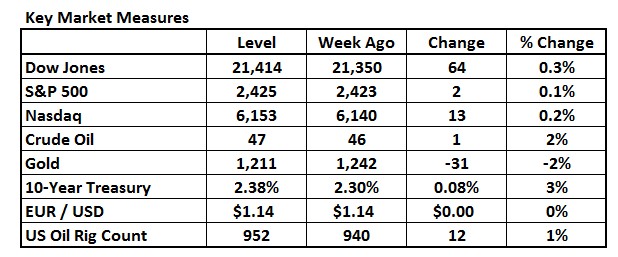
Concerns over falling oil prices just won’t go away. After rig count falling for the first time this year last week, Baker Hughes reports US oil rig count rose once again for the 23rd week in the last 24. To support prices in the mid-$50s, OPEC would need to lower production by another 200,000-300,000 barrels a day and extend the output agreement to the end of 2018. We find this unlikely. OPEC cuts have had a tough impact on the oil market, driving prices much lower. Based on current trends, the oil market will be oversupplied again in 2018. Accordingly, we are likely to see the U.S. rig count steady to lower to keep oil output from flooding the market in the next 12-18 months. Ouch! More pain for oil ahead!
Second quarter numbers are in. The Nasdaq was up 4%, the Dow was up 3%, and the S&P 500 was up 2.6%. Not a bad quarter. So despite the Tech falloff since June 9th, the Nasdaq outshone the overall market. What will the third quarter bring? Well wouldn’t you like to know! We are not telling. We know, but aren’t telling. Well – not really. No one knows of course, but we think the Tech selloff will blow over as the FAAMG* stocks report fabulous earnings and the buying resumes.
* FAAMG – Facebook, Apple, Amazon, Microsoft and Google. Over $2.8 trillion in market cap.
Are central banks blowing bubbles? Wall Street strategists are calling attention to how central banks policies around the world are promoting inequality through Wall Street inflation coupled with Main Street deflation. In other words, the rich get richer from low interest rates spurring asset price bubbles, and the poor struggle against lackluster real economic growth. Now central banks need to quickly and painlessly undo their error. There are only two ways to cure inequality - you can make the poor richer or you can make the rich poorer. What a mess. They need to get GDP growth actually going again and normalize interest rates. So far not much progress to report.
This week we observed that the Swiss government could have issued a 50-year bond at a negative yield. Does this make any sense? If so, feel free to send us your money here at The Bull Market Report along with some interest and we are sure to be happy to hold onto it for you and return it in 50 years!
Tech titans could trigger rewrite of antitrust rules. Investors have spotted a vulnerability in the giant companies like Alphabet, Facebook, and Amazon. Since June 26 - the day before European regulators fined Google a record $2.7 billion in an antitrust case - the search giant’s stock has fallen 5%, versus a flat performance for the S&P 500. That works out to more than $30 billion in market value erased. Europe regulators have challenged the monopolistic business models Silicon Valley is printing money with. Well, stay tuned. There is a bunch of talk these tech titans will soon fight back. This may be the beginning of a big buying opportunity in Tech.
BMR Companies & Commentary
Tesla (TSLA: $313, down 11%)
After a week full of abysmal news for Tesla, the weekend couldn't come fast enough for Elon Musk. Tesla registrations in the country fell 10% in April from a year ago, based on IHS Markit data. The latest report showing a plateau for Tesla's products comes amid both investor concerns that demand for Tesla's luxury Model S sedan is waning ahead of the mass market Model 3 launch. With the sales of its Model X actually declining. Tesla may likely have to kiss its aggressive growth forecasts goodbye. Then again, they may not. There is lot going on here at the company and the future is wide open.
Tesla said that second-quarter global deliveries rose 53% from a year earlier, to just over 12,000 of the Model S and over 10,000 of the Model X. Musk blamed battery pack production problems for holding back vehicle output in the second quarter until early June, even though Tesla produced 2,000 more cars than it sold.
BMR Take: Things don’t always go right. That’s life. That’s business. But Elon Musk has been here before. This is what he does best. He solves problems. He innovates. He overcomes. It’s a controversial mood in the stock market for Tesla. But that creates a buying opportunity. While the company is losing money now, the Street consensus is for $12 in 2020, making this situation very interesting. As we have said many a time, this stock is not for the faint of heart. It could go to $250 or $200 before it goes to $400 or $500. But if you can handle the volatility, we believe it can get to $500 and beyond in the years ahead.
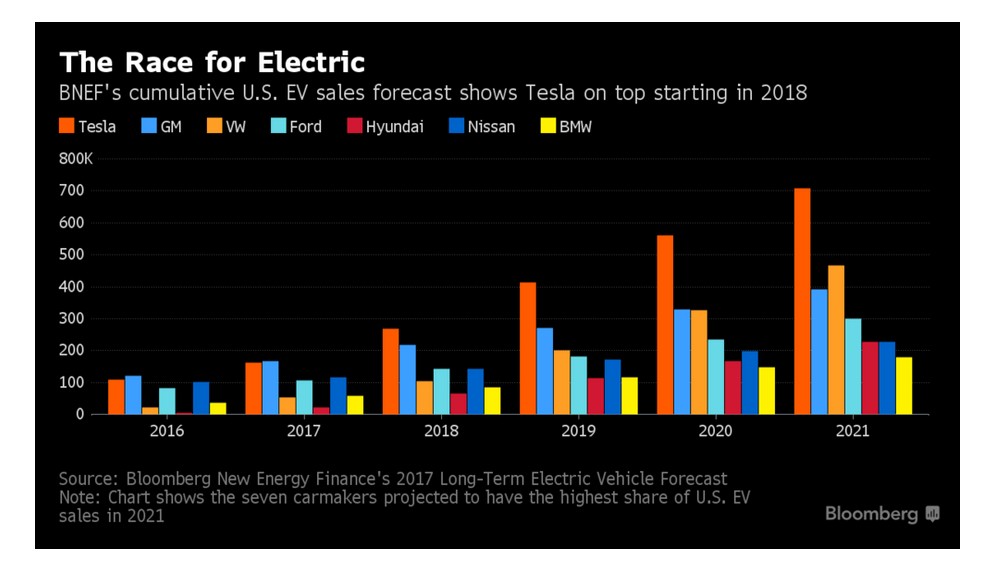
We saw a pretty good article from Bloomberg recently. The headline was “Tesla Projected to Win U.S. Electric-Car Race.” More than a dozen automakers are jostling to lead the U.S. electric-car race, but Bloomberg New Energy Finance (BNEF) sees a clear winner separating from the pack: Tesla.
BNEF expects Toyota’s Prius Prime plug-in hybrid to be the exception and hold the title of best-selling electrified vehicle in the U.S. this year. Tesla will get off to too late of a start with its Model 3 to catch up, with Musk planning to hold a handover party for its first 30 sedan customers on July 28. The company is aiming to ramp-up production to a rate of 20,000 cars per month in December.
“In the long term, we see battery electric vehicles winning because of the battery cost curve,” Bloomberg said.
Shopify (SHOP: $89, up 2%)
This past week, as you logged in to Shopify to check your sales or fulfill orders, you noticed a change: Shopify has had a makeover. The new look and feel is part of a broader effort to build the future of Shopify and supporting apps with one design mind, using the same set of guidelines. The improved design is now live in every Shopify store.
Why does it matter? Change can be hard sometimes, but these changes were actually designed to simplify the day-to-day navigation. The fresh look brings consistency across Shopify products, helps pages load faster, and makes content and menus easier to find and read.
BMR Take: Shopify is among the most exciting growth stories in the market today. EPS is expected to go from negative this year to $1.25 by 2020 starting what is expected to be a long term trail of sustainable EPS growth.
Apple (AAPL: $144, flat)
Apple has declined 7% from its all-time closing high of $156.10 in May, but the recent selloff represents yet another buying opportunity as investors turn their focus to the iPhone 8 launching this fall. Apple's quarterly results will be less important this summer as investors focus on the iPhone 8 this fall, along with the company's increased dividends and stock buybacks, lower valuation and new innovations as showcased at Apple’s Worldwide Developers Conference.
The upcoming iPhone cycle is setting up Apple to reach fresh all-time highs in the next 12 months, which would value the iPhone maker at over a trillion dollars. Apple's current market capitalization is around $750 billion. Wow!
There has long been an expectation that the next high-end version of the iPhone would have a new type of screen called an OLED (organic light-emitting diode). OLED screens boast more vivid colors and improved battery life. But they are also more difficult to produce, particularly at the levels that Apple requires for the iPhone. We believe that Apple will introduce this screen in the iPhone 8.
BMR Take: Apple remains among the most underappreciated stocks in the world. We looking at about $9 of EPS this year heading toward $11 in the next 1-2 years, giving it a forward PE of 13. Very low in our opinion.
Facebook (FB: $151, flat)
Facebook is building a village that will include housing, a grocery store and a hotel. Billions of people spend a lot of time living their lives on Facebook's social network. Now Facebook wants to try its hand at creating a community in the real world. In short, Facebook wants to build its own town.
Facebook unveiled plans on Thursday for the massive new construction project at its Menlo Park, California corporate campus, which is part of Facebook's plans to expand its home base. The 56-acre site, which Facebook bought in 2015 for $400 million, is located directly across the street from Facebook's headquarters. It will offer 1.6 million square feet of housing, or 1,500 units.
In a blog post announcing the plans, Facebook described the future development as a "mixed-use village" that will provide residents, many of which will be Facebook employees, with housing, transportation services and other amenities.
It will take roughly a decade to build. The initial phase of the project, which will include the housing and a grocery store, will be wrapped up in the first half of 2021. The subsequent phases will be completed every two years.
BMR Take: What can we take from this? The company is pretty confident in their 10-year plan and the outlook for their business to be making these kinds of internal investments. This year’s EPS of $5 is expected to double by 2020. With 2 billion users now, don’t miss being involved in this adverting giant’s success.
Mark Zuckerberg was quoted in the past week: “Give people the power to build community and bring the world closer together." Zuckerberg called the statement an extension of the company's original mission of making the world "more open and connected."
Facebook's unprecedented reach can be a powerful tool for tackling global problems and democratizing access to people and knowledge. "We feel like our responsibility is expanding, especially around passing this milestone of 2 billion people in the community," he said. "We’ve been thinking about what our responsibility is in the world and what we need to do."
We’re with you, Zuck!
PayPal (PYPL: $54, flat)
PayPal launched a campaign to reward freelancers in India. PayPal India has launched two new campaigns - Shopping Buddy and Go Global. The new campaigns will encourage Indian consumers and freelancers to buy and sell across outside of the country. Both campaigns will work on the concept of referrals. Available in more than 200 markets around the world, the PayPal platform, including Braintree, Venmo and Xoom, enables its over 200 million users to receive money in more than 100 currencies, withdraw funds and hold balances in their PayPal accounts.
Why did PayPal design the campaigns specially for the Indian market? India is the 2nd largest freelancer market outside of the US. India is also a hub for software exports, hence software and web related services constitute a significant portion of the freelancing business. Additionally, skilled women who have taken a break from their careers to manage the household, and retired professionals also contribute to this growing number in India.
BMR Take: PayPal is quietly emerging as a global payments power. India is so important to winning this battle and the above news is a great step in the right direction and a demonstration of the company being locked in on what needs to be done. With greater than 20% EPS growth as far as the eye can see, how can you not be involved here?
Square (SQ: $24, up 1%)
Payment-processing stocks had a hot week after a $10 billion deal between two industry players was announced. The news that Vantiv was buying London-based Worldpay for $10 billion has investors suddenly thinking about other combinations. Square shares rose 4% on Wednesday as result and finished the week strong.
For Square investors, consolidation in the payments industry is encouraging, because it means the fast-growing company could also be thought of as an acquisition target. PayPal is a much larger company than Square, with a market value of $66 billion, compared to $9 billion for Square, and it’s less likely a target. In fact, it’s a company that likes to acquire.
However, you look at it, the market is quickly realizing that the world is migrating to eCommerce and Square is as best-positioned as anybody.
BMR Take: Square is currently growing revenue at a 30% clip. Takeout valuations could be anywhere over a 20% premium to the current stock price. A compelling opportunity.
Upcoming Economic News
Consumer Credit SA
Monday, July 10, 3:00 PM
Period: MAY
Actual: N/A
Consensus: $13.3B
Prior: $8.2B
Note: Federal Reserve Statistical Release G. 19, Consumer Credit, reports most short- and intermediate-term credit extended to individuals, excluding loans secured by real estate.
JOLTS Job Openings
Tuesday, July 11, 10:00 AM
Period: MAY
Actual: N/A
Consensus: 5,975K
Prior: 6,044K
Note: Part of the US Bureau of Labor Statistics, the Job Openings and Labor Turnover Survey (JOLTS) program produces a monthly study that has been developed to address the need for data on job openings, hires, and separations. With the release of May 2003 data, the JOLTS program began publishing industry estimates based on the North American Industry Classification System (NAICS).
PPI ex-Food & Energy
Thursday, July 13, 8:30 AM
Period: JUN
Actual: N/A
Consensus: 0.10%
Prior: 0.30%
Note: The Producer Price Index (PPI) for all items less food and energy, often referred to as Core PPI, excludes the two most volatile components of the overall PPI for Finished Goods.
Manufacturing Production M/M
Friday, July 14, 9:15 AM
Period: JUN
Actual: N/A
Consensus: 0.10%
Prior: -0.39%
Note: Manufacturing production index measures real output in manufacturing. According to the NAICS, manufacturing relates to the mechanical, physical, or chemical transformation of materials, substances, or components into new products. Data is percentage change in relation to the last month.
An Update on Government Properties Income Trust (GOV: $17.90, down 2%)
This is what we said a week ago Wednesday, June 28th:
“First Potomac Realty Trust (FPO) is being acquired in a $1.4 billion deal announced today. The stock of Government Properties (GOV) is down 7% this morning to $20.25. First Potomac is a REIT with 11 million square feet of office space in and around Washington, DC. Government Properties, at a market cap of $1.4 billion, will now have an opportunity to prove its worth and assimilate the properties. This is creating a buying opportunity if you believe that management can turn around this company We believe they can and would be buyers of the stock here at the $20 level.”
Then last week we wrote this:
“Government Properties Income Trust (GOV: $18, down 19%)
“Don’t fall over in your chair! The stock got crushed this week, but it was because of an acquisition. Let us explain.
“First Potomac Realty Trust (FPO) will be acquired by Government Properties. To finance the deal, the company sold 25 million shares in a secondary at $18.50, raising over $450 million. They had to knock the stock lower to get the funds they needed. This is typical. We believe the deal will work out well, and that we will see a full recovery and then some.
“And the underwriters have been granted a 30-day option to purchase up to an additional 3,750,000 common shares. Two things: These overallotments are exercised about 99% of the time so expect to see another $65 million of cash in the bank. And expect to see the stock stay around this level for a month. Then there is a great likelihood that the stock will move back into the low 20s.
“You should be excited. The acquisition of First Potomac Realty Trust enables Government Properties to expand its business strategy to include the acquisition, ownership and operation of office properties leased to both government and private sector tenants in the metropolitan Washington, D.C. market area. The metropolitan Washington market area is one of the largest office markets in the U.S. and the nation’s largest beneficiary of spending by the U.S. government. Outside of the metropolitan Washington market area, Government Properties will continue to focus on acquiring, owning and operating office properties that are majority leased to government tenants.
“In addition to this transaction providing Government Properties with new potential growth opportunities, management expects to realize approximately $11 million of annual general and administrative expense savings compared to First Potomac Realty Trust on a standalone basis.
“Management is very pleased that they were able to achieve an attractive per share purchase price. Their preliminary estimates call for meaningful accretion and more detail will be forthcoming.
“BMR Take: NAV was $20.90 prior to raising some equity at $18.50. We don’t see any reason for the stock to trade at a discount to the lower level of $18.50. This is a buying opportunity for sure. Why do you think institutional investors just took down 25 million shares at $18.50? Get on board and put new money to work at a 9.4% yield right here in this name!”
Here’s our Take this week:
There have been no changes in the situation since the announcement. The stock is down 2% this past week, which is just noise, but we see that the stock has stabilized here at the $18 level, and in our opinion the only move the stock can make from here is up. The stock is paying a 9.6% dividend which is a bit too high historically, and thus a higher stock price will lower the dividend to the 8-9% ranges which we believe is quite sustainable. We are holding here and await the move back to the $20 level in the next few months.
A Word from Gary Jefferson
Jefferson Financial Group
First Vice-President, Investments
UBS Financial Services, Inc
An old stock market adage is "Calling a market top is a fool's errand." A Wall Street research firm wrote last week that calling a market top in today's market is just such a fool's errand because there is simply too much empirical evidence against it. First, the employment picture is pretty good from the standpoint of new jobs creation. (Of course, "if" new job numbers begin to substantially decline, it would be a red flag). Secondly, the latest Consumer Confidence Board report topped expectations. This indicates that consumers (70% of our economy is consumerism) are going to continue to consume. This is the engine that drives earnings. Lastly, the usual red flags that signal a major top just aren't visible – things like an inverted yield curve, a major technical breakdown (Nasdaq plunging below its 50 or 100-day moving averages), or, on a global basis, a major event such as a default by Italy or an economic collapse in China.
This is by no means to say that the market won't have a "top" in the sense of a "10% correction". It can happen even when nothing has really changed the fundamentals of the corporate earnings picture or for no real reason except media-hyped panic. There are many things happening in the market today that historically signal the possibility of a pullback in the 3-7% range. But long-term investors don't sweat the small stuff. It just isn't worth the aggravation and mental stress to try to time market corrections other than to possibly raise a little cash or to have some ready cash available to buy the dip. This is because it is nearly impossible to exit a stock, watch it drop 10% and then get back in before it jumps back up 5% before the opening bell one morning. It is literally impossible for anyone to successfully employ this kind of strategy.
The greatest risk ahead now seems to be what happens in Washington over the next few months, which is unfortunate. These events could either cause a market melt-up or a worse than average pullback – neither of which is predictable. Regardless of current conditions, in 90% of any market environment it makes sense to dollar-cost average large cash positions over several months as opposed to going all-in. That's because (quoting Ben Bernanke), "…….the 'market' is a very difficult subject. I've compared it to trying to learn how to repair a car when the engine is running…." It is difficult, but a long-term investor who is diversified and in quality assets will be just fine.
The High Yield Corner
By Michael Foster
Special to The Bull Market Report
The week was a bit harsh to many high yield investments, but a quick glance at The Bull Market Report picks shows that this is the result of a weak and temporarily frightened market The fundamentals, however, remain as strong as ever.
Starting with REITs, we saw Welltower (HCN: $73) fall 2% for the week, with those losses occurring almost entirely on Thursday. The marketwide weakness we saw did not leave REITs alone, so the decline was particularly pronounced here. However, Welltower shareholders should not despair; they’re up 9% year-to-date including the current near 5% dividend yield thanks to a dividend increase earlier this year. And dividend increases are very likely to continue. Over the last 12 months, Welltower has earned Funds from Operations (FFO) of $4.45, which gives the company a 130% dividend coverage ratio. As a rule of thumb, anything over 120% in REITs is healthy and anything over 125% indicates that the current schedule of dividend increases is likely to continue. For Welltower, that means a once-yearly pay raise is likely to continue.
This is a pretty big relief because higher borrowing costs in recent months have not been offset by higher rents for many REITs. That’s caused a lot of panicked selloffs throughout the sector, and Omega Healthcare Investors (OHI: $32) is no exception. The stock has been pretty heavily range bound after falling significantly in late 2016 - it's down 5% from a year ago - as it has been several times in 2017. Fortunately, the stock is up 3% from the start of the year so the bearish trend is clearly over even if we haven’t seen a breakout.
The interesting thing with Omega Healthcare is that investors frequently fret over the company’s dividend coverage. Omega’s management increases the dividend by a penny per share every quarter - and that is attractive to shareholders while also threatening the dividend coverage ratio. The only way Omega can cover those higher payouts is to aggressively expand. That causes frequent panics and a lot of anxiety, but a quick look at the numbers shows how silly those worries are. For the last four quarters, Omega’s FFO of $3.45 is far above the $2.50 annualized payouts at the current dividend rate and still higher if we assume penny-per-quarter payouts for the next four quarters. Either way, we’re talking about a dividend coverage ratio in excess of 130%, indicating that the dividend is absurdly safe despite the 8% yield that the stock currently offers.
In addition to the dividend payout growth fears, Omega has suffered from worries about uncertainty in Healthcare and the future funding of Medicare. Of course, Omega isn’t the only REIT suffering from this concern. Sabra Health Care REIT (SBRA: $23) fell 4% in the last week at a much higher rate than the marketwide decline in REITs. Fortunately, however, Sabra has been doing extremely well for a long time, meaning this selloff has little significant for long term shareholders. The stock is up over 12% from a year ago excluding its 7% dividend payout. And, as with Omega, the dividend is being covered by strong FFO - over the last 12 months the dividend coverage ratio for Sabra has been 130%, which is extremely solid, as with Omega. But investors fret over politics more often than they should, meaning Sabra isn’t getting the buy-in from investors that it deserves. That will change when the market goes back into risk-on mode*.
* When the market goes back to having an appetite for things like growth stocks, junk bonds, and REITs, instead of plowing into Treasuries.
Finally, Ventas (VTR: $67) is The Bull Market Report’s third Healthcare REIT pick that is known for its longer history and reliable dividend payments. As such, its yield is 4.6% following the near 3% price decline for the week. But as with our other Healthcare picks, Ventas is up for 2017 - up a solid 7% since the start of the year. The panicked Healthcare REIT selloff of late 2016 has been correcting itself in recent weeks and that is likely to restart again in the future as soon as this week’s hysterical fear ceases. No one knows when that will come, but it surely will; we’ve seen the market freak out suddenly several times since President Trump’s election, but the selloffs tend to be very brief and very shallow.
An interesting question to ponder is how this selloff and fear-based selling impacts municipal bonds, a safe haven for risk-averse investors. So far, 2017 has been pretty good for the asset class after a brutal 2016 selloff thanks to risk-hungry investors shifting to stocks. So far for the year, Invesco Municipal Trust (VKQ: $12.69) is up 4% - but the stock is still down 10% from a year ago. That gives the fund plenty of room to run in 2017, especially when we consider the fact that the fund is trading at a 6% discount to its net asset value. Similarly, Nuveen Municipal (NVG: $15.15) is up 5% for the year but is down 7% from a year ago. Like the Invesco fund, this is trading at a 6% discount to its NAV, providing another opportunity for gains as the market gets more excited about municipal bonds as a viable and lower-risk alternative to stocks and Treasuries, especially given the extra value that late 2016’s selloff provided. We are at the beginning of a trend in that direction, and it is likely to continue for quite some time.
Good Investing,
Todd Shaver
Founder, CEO and Editor
The Bull Market Report