
The Weekly Summary
It was rough week with lots of domestic and international issues popping up, producing anguish. In particular, nine CEOs turned their back on Trump. It all started when first Merck’s Kenneth Frazier, then Under Armour’s Kevin Plank and Intel’s Brian Krzanich stepped down from a White House business group set up to advise Donald Trump. While none mentioned the president, Frazier, one of the country’s most-prominent black chief executive officers, quit the council as Trump was being assailed for failing to quickly condemn white supremacists for deadly violence at a rally Saturday in Charlottesville. Frazier said he was acting on a “matter of personal conscience.” Trump shot back on Twitter Tuesday morning, saying, “For every CEO that drops out of the Manufacturing Council, I have many to take their place.
Then on Wednesday President Trump rushed to announce that he was shutting down the two advisory councils of business leaders, after the members had decided on their own to disband in the wake of the president’s comments on the events in Charlottesville. Of course, these kinds of advisory councils seldom accomplish much of anything.
Look, all this drama will pass. The market will move on. But there is definitely an unsettled feeling out there. It is good that the market showed signs of turning around at week’s end, but we did see a few glimpses of nasty selloffs in a few trading sessions this week. It was a rough week. If you are super worried, then we suggest you take some profits off the table. There are many choices for you to move your money to in the High Yield and the REIT portfolios. These are much more secure, stable stocks with very nice dividends that you can enjoy and sleep better with.
No matter what is happening out there, there is always a bull market here at The Bull Market Report! This week we highlight some of our favorite stocks/funds where we think you can still make good money, including: high yield equities like Annaly and larger caps like Apple, Google, Microsoft, Home Depot, and Visa,

BMR Companies & Commentary
Annaly Capital Management (NLY: $12.34, up 1%)
Annaly recently reported respectable earnings at the beginning of the month. Here are our thoughts on the outlook for the rest of the year and what to watch. Many people are cautious given Annaly’s fixed-rate agency exposure and the current valuation. We know that the company has a set yield on government guaranteed paper. So while there is no credit risk other than the full faith and credit of the United States, there is interest rate risk – we know this and accept this. The newer investments are coming on at lower rates with higher yielding holdings rolling off. And we know that if short term rates rise the current portfolio valuation will be sensitive to the movements. We are likely to see some pressure on Annaly’s business model.
But what can the company do? They can rotate into higher yielding MBS* investments. They can increase leverage. They can do a number of things to cover the dividend. Look, if you think a business model is flawless without risk then you don’t know it well enough. Annaly has rsk to higher rates, but higher rates are ultimately good for the company. And investors are missing all the offsetting possible moves management can take. Remember, this is a company that is 18x the size of the median mortgage REIT by market cap, has outperformed the S&P 500 by 3x since its IPO for total return, and has successfully raised $1.5 billion in new capital this year. They know the world they live in and have survived and thrived for 20 years.
* Mortgage-backed Securities
BMR Take: A Director at the company just bought 13,500 shares. Another one just bought 17,700 shares. We love love love to see that! We are looking at a $0.30 dividend paid quarterly for the time being which is good. The stock looks compelling based on this income stream, producing a dividend over 10%.
Apple (AAPL: $158, flat) is Getting into Programming
Apple has set a 12-month budget of $1 billion to develop original programming. Apple could buy and produce as many as 10 TV shows. Apple's first two efforts -- Planet of the Apps and Carpool Karaoke -- have not been warmly received by critics. Apple executives are talking with Hollywood agents about shows that Apple can buy.
BMR Take: Note that Apple has $260 billion in cash now, and with a market cap of $813 billion cash is 32% of the stock price. So $50 of the stock price is in cash. This is UNPRECEDENTED in the history of Wall Street. Apple remains an exciting investment opportunity. The services business is projected to double in revenue to $50 billion over the next several years. The Services business is much more profitable than hardware so the impact to earnings is even better. Don’t sell a share. We believe Apple has a lot more room to go on the upside.
And how about Apple's performance last week in a very tough week for equities.
Google (GOOG: $911, flat)
The Cloud is a huge opportunity in technology and all the industry giants are fighting to grab their fair share. Let's stipulate up front that Amazon Web Services (AWS) remains the top choice for most companies that are thinking about moving their data and software into cloud data centers. Having said that, however, Amazon's cloud is no longer the only option that companies consider. For example, those companies wanting extensive analytics are taking a good hard look at the Google Cloud Platform. And many firms are hedging their bets by using multiple cloud providers to avoid being stuck with one down the road.
While AWS is still the largest cloud provider by far, Microsoft and Google are coming on strong. AWS's revenue growth appears to be slowing, in part because it's hard for such a huge business - AWS is expected to produce $16 billion in revenue this year - to grow as fast as its younger, smaller incarnations. Startups are considering alternatives now for several reasons: standard cloud computing and storage services from the three top players are all seen as competitive, and no one thinks any of the three major cloud contenders is going away. Basically, AWS, Microsoft, and Google are seen as safe bets.
BMR Take: Google took a hit on the recent earnings report. Buy the dip. This company will generate over $40 of EPS in 2018. The stock is far from a stretched valuation.
Microsoft (MSFT: $72, up 1%)
As Internet-of-Things (IoT), artificial intelligence (AI), smart factories and intelligent applications continue to advance, businesses are increasingly turning to these technologies to create new business solutions with greater agility in order to drive competitive advantages. Microsoft launched its IoT Innovation Center in Taiwan last October to spur development between IoT partners and international enterprises and organizations. In September, Microsoft will hold its second IoT Expo in conjunction with the World Congress on Information Technology. Jason Zander, Corporate Vice President, Microsoft Azure, will deliver a keynote on "Leading Digital Transformation and Landing IOT Value with a Strong IoT Partner." Zander oversees the development and global deployment of cloud infrastructure and technology, including Microsoft Azure IoT. In addition to sharing the success of Microsoft's IoT Innovation Center and its partners, Mr. Zander will also provide Microsoft's vision of the development of IoT and in-depth analysis on the integrated application solutions of the world's leading IoT partners.
BMR Take: The Internet of Things is a megatrend. We are going from 10 billion devices connected to the internet to 30 billion. Your hair dryer will be connected to the internet someday. All of this is going to be a huge opportunity for Microsoft. The company is on track to generate $4 of EPS in 2018. The valuation remains compelling.
And note how strong Microsoft was last week in the very rough week on Wall Street. This company is solid.
The Home Depot (HD: $147, down 4%)
Home Depot took a bad hit on earnings. But we feel this is a great time to initiate a position or add to an existing one. A few Wall Street analysts upgraded the stock to Buy reaffirming our confidence.
Revenue for the quarter was $28.1 billion versus the consensus for $27.8 billion. Revenue guidance for the year is $95 billion, short of the $99 billion consensus. EPS of $2.25 beat the consensus of $2.21. Chairman, CEO Craig Menear said: "We were pleased with our results this quarter as our customers rewarded us with the highest quarterly sales in company history. We also achieved the highest quarterly net earnings in company history."
So what happened? Analysts were largely upbeat on the results, with same store sales beating expectations despite a tough backdrop for all of the Retail industry. Specifically, same store comparable sales growth was +5.5% beating the +4.6% guidance. So all the momentum looked good this quarter but why the bad outlook for lower revenue? The shares traded down because of this guidance miss. But under the covers many people just think it is conservatism from management, not something serious.
BMR Take: We expect to see momentum continue over the rest of the year following what was the largest quarter ever, pointing to strong sales growth, operating margin expansion and EPS growth. With EPS heading to $9 in 2018 we this valuation is compelling right here to be buying.
Visa (V: $103, up 3%)
Visa announced a multi-year, global partnership with Marqeta, the open API payment card issuing platform, to drive further innovations in commercial and consumer payments. Additionally, Visa has made a strategic investment in Marqeta to support both company’s domestic and international growth objectives.
The Fintech industry is booming, Fintech being short for financial technology. Everybody in financial services from banks like JP Morgan to networks like Visa are having to figure out how to keep up with the technology revolution in finance. That is why this deal is so key for Visa. Visa is embracing the change and going to be delivering the most innovative solutions in payments for years to come. This supports why we love the Visa EPS growth story and believe the stock should be a core holding in your portfolio.
The initial efforts of the partnership will involve growing opportunities for virtual, physical and tokenized payments across a number of commercial markets and use cases that can benefit from Marqeta’s developer-friendly platform.
The market for electronic payments continues to grow in commercial payables, alternative lending, disbursements, eCommerce, on-demand services and P2P payments. To enable this growth, Marqeta’s platform allows companies of all sizes to authorize their own card transactions, fundamentally changing how companies engage with card issuing and transaction processing.
This is the latest partnership and investment for Visa with an emerging innovator within the payments ecosystem. As a global payments technology company, Visa continually evaluates technologies of all kinds – especially those that have the potential to advance digital payments for Visa’s clients and their customers. Recently, Visa has made investments in Chain, Klarna, Square and Stripe, among others.
BMR Take: Visa is a safe haven investment. With EPS heading to $4, we continue to see tremendous value here.
Upcoming Economic News
Richmond Fed Index
August 22th, 10:00 AM
Period: August
Consensus: 12.0
Prior: 14.0
New Home Sales
August 23th, 10:00 AM
Period: July
Consensus: 614,000
Prior: 610,000
Building Permits
August 24th, 8:00 AM
Period: July
Consensus: 1,223,000
Prior: 1,223,000
Blackstone (BX: $32, down 1%) Entity Merging with Starwood Homes
Invitation Homes (INVH, $23), a portfolio company of The Blackstone Group, is merging with Starwood Waypoint Homes. The combined company, to be called Invitation Homes, will have 82,000 homes. Once the deal closes Invitation Homes stockholders will own about 59% of the combined company. The total enterprise value of the deal is $20 billion.
Invitation Homes, a U.S. home rental company, went public in February. Blackstone will own about 40% of Invitation.
--- The portfolio of homes will be focused on high-growth markets, with nearly 70% of revenue coming from the Western US and Florida.
--- The merger is expected to drive $50 million in annual synergies.
--- Continued strong performance with the combined company experiencing 7% same-store NOI growth in Q217 with over 95% occupancy.
--- The two companies have invested nearly $2 billion, an average of approximately $22,000 per home, in renovations and maintenance, improving resident experience and driving economic growth and job creation in local communities.
BMR Take: Just one more example of the innovation that Blackstone is involved with day in and day out. With a dividend of 7% and a leader (Schwarzman) dedicated 24-7 to moving the stock higher, what is there not to like. $38 billion market cap. Reaching the all-time high of $44 set in 2012 is surely on the horizon.
Tesla Near to Completion of Gigafactory
Tesla ($348, down 3%) has released some interesting pictures and a video of their gigafactory in Nevada, 95 times (sic) bigger than a football field. New drone footage shows how massive Tesla's Gigafactory is.
http://www.businessinsider.com/tesla-gigafactory-pictures-facts-2017-8
In other news, Tesla raised $1.8 billion in a bond sale on Friday, boosting the amount by $300 million to meet demand. The 8-year bonds were priced at a record-low yield of 5.3%. The 5.3% coupon is a record low for a bond of its rating and maturity, according to data compiled by Bloomberg. The sale was managed by Goldman Sachs Group and Morgan Stanley.
BMR Take: The bond market loves this company. We do too. But we know the risk involved here is on the high end of the scale. Tesla is either headed to $400 a share or $300. And one could make an argument for either. If it hits $400 and they continue to ramp up production as promised, then $500 is a great possibility. But if it goes to $300, $200 would be in range. You want a risky stock? Then Tesla is your baby.
A Word from Gary Jefferson
Jefferson Financial Group
First Vice-President, Investments
UBS Financial Services, Inc.
Earnings were everything expected, plus a little more. So here we are with about six weeks before the 3rd quarter comes to a close. Unemployment is low, interest rates are low, energy costs are low and consumer confidence is fairly high. Besides a garden variety correction, what could derail the markets? - not counting a war, which in our opinion and most experts we listen to is a fairly low probability. The most likely candidate would be a recession. With earnings growth better now than the past eight years, this critical element in the recession scenario seems relatively safe for the next several quarters.
However, after speaking with some very learned folks in the banking industry, there is one problem that has caught our attention. We have been told that it is very difficult for banks to make enough profit to lend money when short-term and long-term interest rates are less than 1%. Today, the difference between a 2-year Treasury note and a 10-year Treasury bond remains less than 1%. Rate hikes have a history of producing bear markets in the past and could do so again because there just isn’t enough profit for commercial banks to lend money. Recessions develop out of these situations. We are not yet in an "inverted yield curve" situation (where short-term rates are higher than long-term rates), which is a classic signal of a coming recession, and we don't believe banks are to the point that they are going to substantially curtail lending. However, it is something we will watch for over the coming quarters.
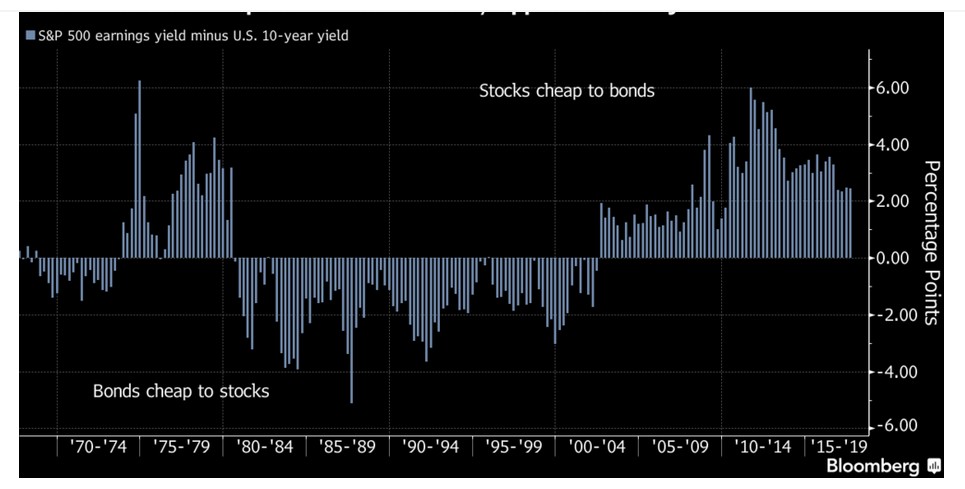
As we said last week, stocks don't go straight up forever. There will be volatility and pullbacks as Fed-tightening continues, but until we see actual signs of an approaching recession, we believe stocks continue to offer better value than bonds.
Amazon Sells Bonds for Whole Foods Acquisition
Speaking of bond sales, Amazon (AMZN: $958, down 1%) went to the markets for money last week and sold $16 billion of unsecured bonds to fund its $14 billion acquisition of Whole Foods Market. And in a sign of market interest, the longest portion of the offering, a 40-year security, was sold at a yield of 1.45 percentage points above Treasuries.
BMR Take: Now that is just unreal low. The company has $21 billion in cash so they didn’t need to go to the bond market but did because rates are so low. Smart thinking, Jeff. The deal is the 4th largest this year, behind ATT and Microsoft.
Apple Goes to the Debt Market in Canada
Apple raised $2.5 billion at a rate of 2.51% in a 7-year note sale in Canada on Tuesday. At $2.5 billion the financing is the largest corporate non-financial borrowing in Canadian history.
Stocks Cheap Compared to Bonds
 We’re Just Sayin’
Cantor Fitzgerald: OPKO Health - Overweight Rating, $20 Price Target
And how about this:
In other Opko Health news, Director John A. Paganelli purchased 5,000 shares of the company’s stock on June 1st. Following the transaction, the director now owns 350,000 shares in the company. Director Richard A. Lerner purchased 10,000 shares of the company’s stock on June 5th. Insiders have bought a total of 1,600,000 shares of company stock worth $10,000,000 in the last three months. Insiders own 40% of the company’s stock.
There are eight research companies following Opko. Six have a buy rating; two have a hold. Their average price target is $16.40.
BMR Take: For those of you still hanging in there with Opko Health (OPK: $6.12, down 2%) this report from Cantor Fitzgerald is good news. $20 Wow. That is over three times the current price. What are we missing here? Oh – I know. We are missing a higher stock price! Well maybe, just maybe this is the start of the re-rising (is that a word?) of the stock to the $8 level and then $10 and then on to the races from there. Hope springs eternal, doesn’t it? Well, yes, but with all the good things this company has going for it, for it to stay at $6 any longer JUST DOESN’T MAKE ANY SENSE!
The High Yield Report
By Michael Foster
We’re continuing to see market chaos and a lot of selling of high quality assets although the macro risks from political uncertainty are dwindling. But the current selloff is very different from the previous week’s in one very telling, interesting way: Not all assets are falling at the same rate, and some are actually doing very well.
To wit, take a look at The Bull Market Report’s Healthcare REIT pick Omega Healthcare Investors (OHI: $31) which had a strong showing this week after some initial weakness, helping Omega Healthcare end the week up 2%.
We’re seeing a lot of reshuffling in the markets, with investors rotating in and out of funds, stocks, and assets as they rise or fall due to market demand. This is the real “random walk” of Wall Street, and it’s a dynamic that makes short term trends for any individual asset to be unpredictable. In reality, we’re seeing a lot of individual investors making choices to buy on the dip - and they’re pulling money from other assets to do so.
What can an investor do in such an environment? Simple: sit tight. If you have extra cash on the sidelines, now is the time to deploy into the high yield picks that The Bull Market Report has been recommending for a long time. Last week we suggested buying more of Omega Healthcare shares; it’s up 2% since then. Now is the time to do the same with other REITs seeing irrational weakness like Sabra.
You can also consider adding Kimco Realty Corporation (KIM: $19.34) and Apollo Commercial Real Estate (ARI: $17.92) to your shopping list after Kimco fell over 3% in the last week and Apollo remained flat. There is no change in these companies FFO to justify the decline, and Kimco’s year-long weakness on the often-touted (and always inaccurate) “death of retail” has made it just that much more compelling. We have discussed at length here why Retail isn’t dead, and how Amazon’s recent purchase of Whole Foods indicates that the shift from pre-dotcom retail to mobile “bricks and clicks” commerce is far more complicated than the simple narrative of dying malls. In any case, Kimco doesn’t buy enclosed malls! It’s a high-quality strip mall-focused REIT, and Whole Foods (and thus soon Amazon) is one of its biggest tenants.
There are more buying opportunities beyond REITs, and investors are keen to lighten up their cash allocation to consider the other funds and stocks in the High Yield portfolio. However, there is one word of caution to consider when it comes to one of our best performing picks, the PIMCO Dynamic Income Fund (PDI: $29). This fund was flat last week.
What’s going on here is a pretty basic misunderstanding of the fund’s future income potential. You see, Pimco releases a monthly scorecard of net investment income (NII) on its website, while also calculating its dividend coverage ratio. And, simply put, the news isn’t good for the Dynamic Income Fund.
In the past, Pimco easily out-earned its dividend and had a tremendous amount of undistributed net investment income (UNII). That’s why the fund paid a special dividend of $1.45 at the end of 2016. By this time last year, the fund had around $1 in UNII, so it was pretty obvious that a big special dividend was coming (we discussed this at the time and estimated a strong special dividend at the end of last year – and nailed it). This year, however, the Dynamic Income fund has only 4 cents in UNII - a pretty tremendous drop from a year ago!
There are a few reasons why the fund isn’t earning as much income as it used to, most of which revolves around the crowding out of great investment opportunities in mortgage backed securities. The MBS is a pretty daunting asset made sinister by The Big Short and growing awareness of their role in the subprime housing crisis. However, that crisis is a decade behind us, and the quality of MBS investments has skyrocketed. While Pimco was one of the few asset managers aggressively buying up these assets in the past, there are now a lot of people wanting to buy them. That means lower yields for the assets, thus weaker income for the Dynamic Income Fund.
However, at the same time, it also means growing market prices for these assets. This fund’s NAV has risen by 10% so far in 2017, largely a result of that constant demand for MBS’s in the market. Last year, the Dynamic Income Fund’s NAV had risen by far less than 1% over the same time period, because the demand for these assets simply wasn’t there. That means that the fund is sitting on a lot of capital gains with dwindling income.
What does this mean for shareholders? In all honesty, it’s hard to tell. The fund hasn’t really faced a crowding out of supply due to strong demand since 2012. It has enjoyed both NAV and income gains in earlier years, and the end-of-year special dividends reflected that. We simply don’t know if the fund’s managers will decide to return some of those capital gains to shareholders or hold on to it and give a massively reduced special dividend at the end of the year.
It seems that the market has begun to price in the likelihood of a lower special dividend. The fund’s premium to NAV has plummeted from over 10% earlier this year to just 3%. It may fall even further as we get closer to December. If Pimco surprises and gives a big special payout at the end of the year, that could reverse quickly. If it doesn’t, we’ll probably see middling price growth throughout 2017.
The risk with the fund is that its Net Investment Income continues to fall and it fails to cover its dividend on a long-term basis. While we’ve seen hints of that now, it’s far too early to conclude that this risk is really here and it’s time to sell. But investors need to prepare for that eventuality. We will keep a close eye on this trend and advise you if it’s time to move out of this great fund. Hopefully we won’t have to recommend selling anytime soon.
How should you react? Holding the fund for its income stream makes sense now, and buying more when the fund’s premium disappears and it starts trading at a discount also makes sense. That means there’s no reason for investors to get scared and sell off the fund, but it also means investors shouldn’t expect a massive jump in the fund’s price throughout 2017. That’s not a bad thing - it really reflects what the fund should be seen as: A source of steady and reliable income.
Good Investing,
Todd Shaver, Founder, CEO and Editor
The Bull Market Report
Since 1998