
The Weekly Summary
We sadly observed Hurricane Harvey devastate Texas this past week. 52,000 people are in shelters as thousands of homes are flooded. The state of Texas ranks as the 2nd largest contributor to GDP in the US trailing only California and ahead of New York. So the economic impact has yet to be fully seen. Real estate portfolios caught without flood and business disruption insurance may be seriously in trouble. Auto sales are already seeing a sizeable dip. Chemical plants are shut down. We could go on and on. What an unfortunately troublesome situation to watch and one with the potential for lingering negative impacts for months to come.
In other news, lawmakers decide to give bipartisanship a shot on healthcare. The Senate Health Committee will turn its attention to bipartisan legislation aimed at shoring up Obamacare markets for 2018. The drift toward compromise follows high profile repeal failures, but still faces an uphill battle as many Republicans have spent years railing against the health law. Staff has been working on it over the summer break and there is general agreement that insurer payments will continue, though specifics are sparse.
Separately, we have yet to see formal action following Trump’s opioid emergency declaration. No formal paperwork has been filed and no new policies have been announced. This appears to be new territory for the government as the national emergency designation is typically used for relief of temporary issues like natural disasters rather than chronic problems like opioid abuse. In addition, administration officials seem to have been caught off guard by Trump's statement. The White House has indicated that it is considering all options for action. Why should we care? This is a big deal for labor force participation, which is at historical lows. If we can get everybody back to work contributing to our economy and off drugs, that is the path to 3.0% GDP growth versus where we are now at 1-2%.
No matter what is happening out there, there is always a bull market here at The Bull Market Report! This week we highlight some of our favorite stocks where we think you can still make good money, including: Apple, Gilead, Bristol-Myers, Amazon, and PayPal.
BMR Companies and Commentary
Apple (AAPL: $164, up 1.5%, all prices are for the week)
Apple has officially scheduled its first-ever event in the company's Steve Jobs Theater, a September 12th invitation-only press conference expected to reveal the latest iPhones and possibly a revamped Watch and Apple TV. The company emailed invitations Thursday that read "Let's meet at our place," with an picture of an Apple logo in red, white and blue. The event, hosted at the company's new spaceship-style Apple Park headquarters is scheduled to start at 1 PM ET. For several years, Apple has revealed its latest iPhones in September, in time to promote them for the holiday season. This year, 10 years after the first iPhone hit the market, Apple is widely expected to reveal the iPhone 8, and the rumor mill has already churned out reports that the device will have a larger OLED* screen and a virtual home button. There are also reports Apple will reveal a Watch that has its own cellular connection and an Apple TV that adds 4K UHD. This is likely it—the big event for Apple’s new iPhone launch! We will all be watching closely.
* Organic light-emitting diode. An OLED display works without a backlight; thus, it can display deep black levels and can be thinner and lighter than a liquid crystal display (LCD). In low ambient light conditions (such as a dark room), an OLED screen can achieve a higher contrast ratio than an LCD.
The main risk to keep an eye on is prices. The argument is that costs are getting so high on new smartphones that customers will not be willing to keep paying up to get them. If this is so, we will see margin compression and perhaps fewer sales by Apple.
Apple Consensus on the Street
Apple was upgraded by analysts at Cleveland Research from a “neutral” rating to a “buy” rating in a report released on Tuesday, and they raised their price target to $197.
On the Street there are 10 Hold Ratings, 39 Buy Ratings, 1 Strong Buy Rating
9/1/2017 Royal Bank Of Canada Target: $180
8/29/2017 Cleveland Research Target: $197
8/24/2017 Bank of America Target: $180
8/24/2017 Drexel Hamilton Target: $208
8/22/2017 Canaccord Genuity Target: $180
8/14/2017 Sanford C. Bernstein Target: $175
BMR Take: Remember the big story for Apple is their services business. They have all these iPhones out there in use by a huge customer base. Can they now get more money from these customers through services? The iPhone 8 is a key part of the strategy. We note that Apple has $260 billion in cash now, which is the equivalent of $50 a share, and greater than 30% of the stock price. This is UNPRECEDENTED in the history of Wall Street. Apple remains an exciting investment opportunity. The services business is projected to double in revenue to $50 billion over the next several years. The Services business is much more profitable than hardware so the impact to earnings is even better. Don’t sell a share. We believe Apple has a lot more room to go on the upside.
Gilead Sciences (GILD: $84)
We removed Gilead from our Healthcare portfolio in February after holding them for a year with poor results. Things have changed dramatically since that time as management has tackled various issues head-on, so we give you an update as things have changed even more this past week.
Gilead announced a big acquisition. Gilead will acquire Kite Pharma for about $12 billion in cash; it was unanimously approved by both the Gilead and Kite Boards of Directors and is anticipated to close in the fourth quarter of 2017. The transaction will provide opportunities for diversification of revenues, and is expected to be neutral to earnings by year three and accretive thereafter.
The acquisition of Kite establishes Gilead as a leader in cellular therapy and provides a foundation from which to drive continued innovation for people with advanced cancers. We are greatly impressed with the Kite team and what they have accomplished, and believe they are on the cutting edge of cell therapy that will be the cornerstone of treating cancer. The field of cell therapy has advanced very quickly, to the point where the science and technology have opened a clear path toward a potential cure for patients. The two company’s similar cultures and histories of driving rapid innovation in order to bring more effective and safer products to as many patients as possible make this an excellent strategic fit.
BMR Take: Gilead is losing two major drugs this year with big revenues due to the expiration of their patents and was the reason we removed the stock earlier this year . Over the past several years they were among the largest sellers in the history of Healthcare so replacing them will be a tough uphill climb. Could Kite provide a way to do it? We will see.
Bristol-Myers Squibb (BMY: $60, up 3%)
This week Bristol-Myers will announce more than 60 presentations, including seven late-breaking abstracts, from its Oncology portfolio featured at the European Society for Medical Oncology 2017 Congress in Spain. Presentations of data from company-sponsored studies, clinical collaborations and research will explore the potential role of Opdivo (nivolumab) as monotherapy and in combination with Yervoy (ipilimumab) and with relatlimab, a fully human monoclonal antibody that targets lymphocyte activation gene-3 (LAG-3); or with chemotherapy in 13 types of cancer.
All this news matters a lot because healthcare investors love new data! We are seeing the stock pick up some momentum getting ready for what is likely to be a wave of good news.
BMR Take: We are still optimistic Bristol-Myers could be a take-out candidate. Activist investor Carl Icahn is in the stock and pushing for change. We believe we could see a 25-50% premium from today’s price if a sale gets done. Further supporting our view, we note Jana Partners is now also building a position in the stock. Jana had a big stake in Whole Foods, and was taken out by Amazon this past week as you know.
Amazon (AMZN: $978, up 4%)
Amazon announced 3,000 more jobs coming to Ohio. This follows news a few weeks ago about doing a major facility in New Jersey. We continue to highlight the Amazon machine because this single company alone is now a major driving force behind the economy.
The internet retailer received approval on Wednesday for state tax incentives for two distribution operations in Ohio. The project approved by the Ohio Tax Credit Authority will create 2,000 jobs. The company said it will invest $100 million at the site, which eventually will result in a 855,000 square-foot facility. The second distribution-center project, will result in an estimated 1,000 jobs if the company goes ahead with the project. Amazon had no presence in the state until recently.
BMR Take: The Amazon powerhouse is steamrolling the real economy and the stock market. With over $20 of EPS potential by 2020 according to analyst consensus estimates, we see a lot of potential ahead.
We noticed that the stock is on a little roll lately. The stock hit a closing high of $1052 a month ago in late July and then proceeded to drop over $140 to the low 900s. But this week the stock was up a little bit every day until Friday when it took a breather. We have watched these high-priced stocks for years and many times it is human nature to not be able to bring yourself to buy a stock that is almost $1000 a share. But we always mentally build in a stock split. Say 10-1 in Amazon’s case. If the stock were a $98 stock, would you buy 100 shares? Sure you would. So we just look to buy 10 shares for $980. Same difference. If you think the stock is going to $2000 a share in the future like we do, 10 shares here, 20 shares there, and 30 shares beyond, adds up to real money.
PayPal (PYPL: $61, up 2.5%)
PayPal customers in the U.S. can now earn cash back on every purchase online and in stores with the recent launch of the new PayPal Cashback Mastercard issued by Synchrony Bank. The PayPal Cashback Mastercard, designed exclusively for PayPal members, offers cardholders 2% cash back every day, on every purchase – everywhere Mastercard is accepted.
Unlike other rewards credit cards, there is no annual cash back limit, no minimum redemption amount, no restriction on how to spend cash rewards and no expiration. The PayPal Cashback Mastercard offers all the security and convenience expected from PayPal, plus all the traditional benefits of a Mastercard. All accounts are automatically added to the member’s PayPal wallet to simplify checkout and provide peace of mind.
The introduction of the PayPal Cashback Mastercard with Synchrony Bank continues PayPal’s commitment to provide customers with rewarding product experiences and a range of innovative credit options. By providing a simple way for people to earn cash rewards for the shopping they’re already doing, the PayPal Cashback Mastercard will give consumers yet another reason to shop with PayPal.
BMR Take: PayPal has 200 million customers on the way to over 1 billion longer-term (after all, Facebook has over 2 billion, showing the possibilities for a global internet-based business model). With EPS closing in on $3 by 2020, and EPS growth moving along in the mid-teens, we see growth at a reasonable price here in the stock and like it a lot!
Nutanix (NTNX: $22, flat)
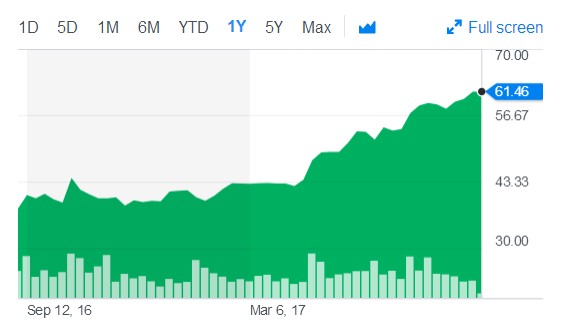
We reported via News Flash on Friday on the stellar earnings report the company issued on Thursday. The stock shot higher on Friday, hitting $24, but settled at $22, flat for the week. We’re not traders as you know, but long term investors, and we have seen this many times in our career. We are going out on a limb here and will say that the stock will move higher from here over the coming weeks and months.
We mentioned the high level of sales that were booked but not reported as revenues – the backlog. Management indicated that billings growth was 40% year over year and that the company continued to build up a significant backlog of deals that booked but did not ship in the quarter. The sales transition toward large enterprise is progressing nicely. Management's next quarter guidance implies billings growth of 25% YoY compared to consensus of 17%, due to the significant backlog build.
To recap:
Fiscal 4Q 2017 Financials
Revenue: $226 million, up 62% year-over-year from $140 million in 4Q16
Net Loss: $50 million, compared to a net loss of $47 million in 4Q16
Operating Cash Flow: $6 million, compared to $2.5 million in 4Q16
Cash and Short-term Investments: $350 million, up 90% from 4Q16
Deferred Revenue: $525 million, up 77% from 4Q16*
Free Cash Flow: $(6.5) million, compared to $(6.5) million in the fourth quarter of fiscal 2016
Billings: $289 million, growing 40% year-over-year from $207 million in 4Q16
BMR Take: We added the stock in May at $17.45 and have a Target of $30. Our Sell Price at $14 is way too low, so we hereby raise it to $19. This was a great quarter and if Wall Street doesn’t wake up to the potential of this company, we would be very surprised.
Upcoming Economic News
Domestic Auto Sales
Monday, September 4th, 8:00 AM ET
Period: August
Consensus: 4.6 Million
Prior: 4.5 Million
Trade Balance
Wednesday, September 6th, 8:30 AM
Period: July
Consensus: -$44.5 billion
Prior: -$43.6 billion
Initial Claims
Thursday, September 7th, 8:30 AM
Period: 09/02
Consensus: 240,000
Prior: 236,000
Consumer Credit
Friday, September 8th, 3:00 PM
Period: July
Consensus: $15.0 billion
Prior: $12.4 billion
A Word from Gary Jefferson
Jefferson Financial Group
First Vice-President, Investments
UBS Financial Services, Inc.
Over the previous weekend, these were the economic headlines:
--- Robust Retail Sales
--- Disappointing Durable Goods
--- Strong Business Inventories
--- Uneven Industrial Activity
--- Mixed Housing Data
Economic data suggests that things are good, but not great.
Fed Chair Janet Yellen's signaling of continued restraint on monetary policy at Jackson Hole triggered another rally in US stocks last week. This extends the current bull market to 102 months, surpassed in length only by the 113-month run leading up to the dotcom crash. Skepticism over valuations is even higher now with a record 46% of investors believing equities are overvalued.
While the bull market may be entering the later stages of the cycle, UBS strategists believe it can run further based on these observations:
--- The earnings yield on the S&P 500 is 4.8% compared with a yield of 2.17% for 10-year Treasuries.
--- At 18x, current market PE ratio is near long-term averages. Historically when valuations have been in an 18x to 23x range, the MSCI AC World Index has returned 6% over the subsequent six months (versus an overall average of 5%). And relative valuations of equities also suggest long-term outperformance versus bonds.
--- Corporate earnings growth remains robust, at 12% in the US and around 10% in the Eurozone in the last quarter. Synchronized global growth should continue to support this, with all 45 OECD economies on track to expand this year.
There are, however, some caution flags appearing here and there. We prefer to look at price-to-sales ratios rather than PE's, and they haven't been this high since the peak of the dotcom bubble in 1999. This means that new investors are paying more for every dollar of sales than at almost any time since the dotcom bust. However, if sales continue to grow as expected this ratio will normalize to some degree. Put another way, stocks are priced almost to perfection and if the earnings growth story were to falter, it could cause some real volatility.
VMware (VMW: $107, up 5%) Has 500,000 Customers
BMR Take: Think about this. Half a million customers. Can you imagine? We think this is just fabulous. We’re up 30% since we added them in January at $83. What a great company. Our Target is $108 which it hit Friday, an all-time high (not counting the euphoria 10 years ago when they went public). With a market cap of $44 billion, and Dell Technologies being the principal owner (80%+) we think very highly of this company. So we hereby raise our Target to $120 and raise the Sell Price from $90 to $100.
The Blackstone Group (BX: $33, up 4%) had its Target Price set at Credit Suisse Group at $45
A Few Wall Street research firm targets
8/30/2017 Credit Suisse Group $45
7/25/2017 Morgan Stanley $40
7/21/2017 Deutsche Bank $33
7/14/2017 Keefe, Bruyette & Woods $37
7/14/2017 Oppenheimer Holdings $38
5/28/2017 Citigroup $41
Blackstone Considers IPO of Gates Corp.
Blackstone Group is considering an initial public offering of Gates Corp. that could value the auto-parts maker at as much as $9 billion. Its products include belts, hoses, industrial power transmission, fluid power, and automotive. The company was founded by Charles Gates in 1911 and is headquartered in Denver. In 2014, the company was acquired by Blackstone in a deal worth $5.4 billion.
The private-equity giant is in the early stages of laying the groundwork for the possible offering, according to people familiar with the matter. The business could be worth $8 billion to $9 billion, one of the people said. It isn't clear whether that includes debt.
BMR Take: We can’t tell you how good this company is. Well, maybe we can: This company is great! Look at the wealth being created by this firm. In 3-4 years in this one deal alone, they have created $3-4 billion of equity. Absolutely amazing. Our Target is $35 but we are dying for the stock to hit this price so we can raise it to $42. This is a value stock like no other.
The High Yield Corner
By Michael Foster
Significant news came this week from AstraZeneca (AZN: $30, up 3%), helping the shares rise solidly by the end of the week. The biggest news is the company’s presentations at a conference in Spain that will demonstrate the company’s phase-3 study of imfinzi for non-small cell lung cancer and tagrisso for. EGFR cancers.* The science is complex and far for non-specialists to understand without a lot of deep reading, but the market is a great place because it prices in that knowledge instantaneously, which is why AstraZeneca shares rose 2% on the news.
* EGFR is short for estimated glomerular filtration rate. The EGFR is a number based on your blood test for creatinine, a waste product in your blood. It tells how well your kidneys are working.
Another intriguing tidbit from AstraZeneca: the company announced on Tuesday that it was recruiting Takeda Pharmaceutical to work on an antibody for Parkinson’s disease treatment. Again, more exciting developments that prove the mega-pharma company’s pipeline is very healthy. Remember a year ago when this was a primary concern on the company and thus the stock? Those concerns are gone now; instead, investors have finally realized that there is tremendous value in this company and it is still innovating; thus it’s no surprise shares are up 10% in 2017 so far. Paying a solid 3.1% dividend, we can see some dividend increases in the months and years ahead. We’ve got a $42 Price Target on the stock and would hope to see this level sometime next year.
Elsewhere in The Bull Market Report High Yield portfolio we see green across the board. There’s only one exception: Invesco Municipal Trust (VKQ: $12.93), which ended the week flat. No surprise; municipal bonds are a low volatility asset class, and there’s not really any news in the municipal bond market to warrant a massive jump. That includes the latest tragedy in Texas. While large storms and ecological disaster might intuitively seem like they will hurt municipal bond markets (lower economic activity should mean lower government revenue and thus higher default risks), it’s important to remember that this “common sense” is actually false. (Often, the common sense view doesn’t quite work in finance.) In reality, credit agencies do not downgrade bond issuers faced with economic disasters; furthermore, the lower revenue may make the state’s budget tighter in the short term, but the risk of that hurting municipal bonds is negligible. Additionally, natural disasters rarely result in massive new bond issuances to fund repairs, so it’s not like existing bonds will get priced out by new issues.
We saw Nuveen AMT-Free Municipal Credit Fund (NVG: $15. 64, up 1%) have a solid showing. Also a nice surprise from Nuveen this week: the company announced dividends for all of its closed-end funds, but did not lower dividends on NVG - although many other funds did see their distributions decline slightly. Again, good news for municipal bond investors long this fund.
The Bull Market Report’s other closed-end fund picks also ended the week in the green and announced distributions that were in-line with previous dividends. AllianzGI Equity & Convertible Fund (NIE: $20, up 1%) announced that its 38 cent quarterly dividend would continue at the same level, and PIMCO Dynamic Income Fund (PDI: $30, up 1%) also announced its monthly dividend would stay at the same level. These funds are paying 8% in income, year-in and year-out, while also seeing their share prices rise. Closed-end funds are typically income vehicles that aren’t often traded for short-term capital gains, but both funds have given investors that opportunity this year. AllianzGI is up 10% year-to-date and Pimco Dynamic is up 14% year-to-date - extremely impressive returns for such diversified funds. And the income does not look to be threatened anytime soon, so investors can continue to hold them with confidence.
Now, let’s turn to REITs. Digital Realty Trust (DLR: $118, flat) announced that its COO was leaving the company in September. Markets shrugged; while he obviously has done well for the company in the past, there’s no reason to assume he’s irreplaceable. We’re sure that his replacement will be skillful.
Despite little news elsewhere affecting REITs, we saw price gains for Omega Healthcare Investors (OHI: $32, up 3%), Government Properties Income Trust (GOV: $18.50, up 1%), Apollo Commercial Real Estate (ARI: $18.18, up 2%), Ventas (VTR: $69, up 1%), and Welltower (HCN: $74, up 2%).
Also, there wasn’t any real news on Kimco Realty (KIM: $20, flat), but it’s interesting to note that this retail-focused REIT has had a bit of a resurgence lately thanks to the surprising strength in retail. (Note that we removed Kimco from our portfolio in May, but we wanted to give you an update.) If you remember, several weeks ago in this column we wrote at length at how the “death of retail” cliché was really more about shock financial journalism trying to get clicks from disaster-starved readers and had little to do with the reality of our economy. Well, we were right. In addition to beats from Macy’s, Dollar General, Target, Wal-Mart, and several other retailers, even the near-death dogs like Sears Holdings and Abercrombie & Fitch impressed the market with their quarterly results, beating expectations. Retail is not the healthiest sector on Earth, but it isn’t dead or dying. But Kimco was priced for a dying retail sector. So what does that mean? Kimco shares are up 11% in the last three months.
We want to go on record with another prediction that drives bullishness on retail REITs like Kimco. Amazon’s recent acquisition of Whole Foods and their price drop at the supermarket is going to drive retail sales for two reasons. Firstly, Amazon Prime members will be incentivized to leave their computers and shop in person more. Secondly, more people can now afford Whole Foods and will shop there. That also means people are going to spend more time shopping at auxiliary stores adjacent to Whole Foods. This is a rising tide that is going to lift many boats, which is why buying retail REITs right now makes a lot of sense. Check back in after about six months and see if we’re right.
Good investing,
Todd Shaver, CEO, Founder and Editor
The Bull Market Report
Since 1998