
The Weekly Summary
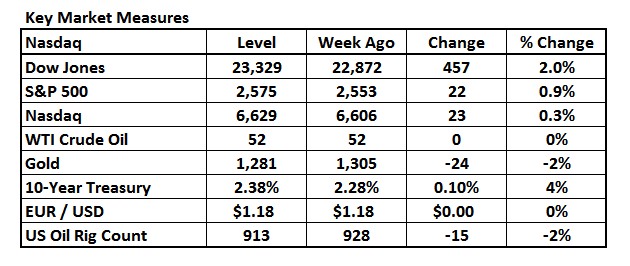
Earnings-day blowups, leverage warnings in China, Apple’s worst rout since August. Oh, and a sixth straight week of gains for the S&P 500. No matter what happens lately, stocks just keep rising, with record closes piling up in U.S. markets at a rate that is starting to defy precedent. The Nasdaq 100 Index has finished at all-time highs 62 different times this year, on par with the most ever in 1999, while the S&P 500 and Dow Jones Industrial Average are closing in on historic levels, too. For bears, the elongating list of highs bespeaks euphoria, particularly when the market has been spared a 3% pullback for more than a year. Investors have ignored bad news ranging from North Korea to political drama at the White House to what may be the biggest profit slowdown in six years. It has been a great ride this year. We remind you, our dear reader, it certainly will not always be this good.
No matter what is happening out there, there is always a bull market here at The Bull Market Report! This week we highlight some of our favorite stocks where we think you can still make good money, including: PayPal, Shopify, Celgene, WageWorks, Amazon, and Blackstone.
BMR Companies & Commentary
PayPal (PYPL: $71, up 3%)
PayPal delivered another great quarter for investors. The company not only showed no signs that its platform growth is slowing, it demonstrated that it is actually increasing its rate of growth as the network effects that management has repeatedly cited during the past couple of years continue in earnest. Yet many of its initiatives – the monetization of social peer-to-peer payment app Venmo, the expansion of instant-checkout feature One Touch, customer choice – are still in the very early innings of the game.
Toss in the $7.1 billion in cash that PayPal had on its balance sheet that could be used to fund M&A initiatives and the potential of the company’s worldwide network becomes daunting. We recall that PayPal acquired Braintree – the online and mobile payment platform that has fueled much of the company’s recent growth – in 2013 for just $800 million. And Braintree had spent just $26 million to purchase Venmo, which is a game-changing driver of revenue and earnings for PayPal.
BMR Take: PayPal has been the best way for equity investors to play the global growth of mobile payments. Again we see PayPal deliver an exceptional quarter backing up that point of view. We find nothing to critique about the firm. We raised our Target from $67 to $77 last week. We look forward to raising it again.

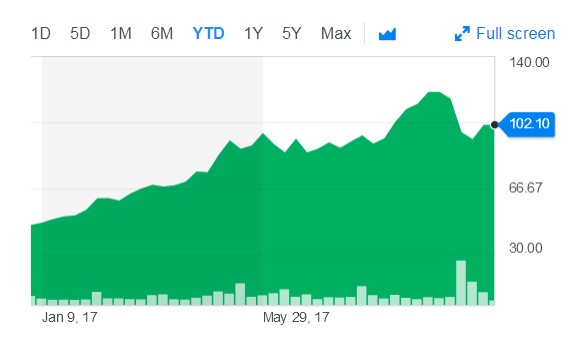
Now THERE’s a great chart. What’s next? 75? $80? $100. We think they are all possible.
Shopify (SHOP: $102, up 9%)
Remember that scary short seller, Andrew Left of Citron. Well the short call they were making on Shopify is turning out to be terribly wrong. Ouch! What good news for us and all the other shareholders behind the company.
Since 2014, Shopify, the leading multi-channel commerce platform, has been steadily building its presence in Waterloo, the cornerstone of Canada’s technology Corridor. Just recently, the company announced that it plans to grow its full-time, Waterloo-based workforce by 300-500 new jobs over the next couple of years. Growth continues!
These new positions in Waterloo will focus on growing Shopify Plus, which supports the largest and most complex customers on the Shopify platform. Roles in engineering, product, sales, and merchant services will range from entry-level to senior manager-level, and all will focus on developing innovative solutions capable of scaling for the changing retail landscape.
To accommodate this growth, Shopify also formally announced the opening of their second building in Waterloo. Steps from their current building, the new space will nearly double their physical footprint and further demonstrates Shopify’s dedication to building a strong and sustainable economy. The new space is expected to open in the first quarter of 2018.
BMR Take: It was admittedly a bit nerve-racking to see a short seller like Citron, who nailed Valeant, come out against one of our holdings. But we trust our research and our hard work. Shopify is a remarkable well-positioned technology company for the future of eCommerce.
Celgene (CELG: $121, down 11%)
Rough week for Celgene. Celgene announced the discontinuation of the Phase III REVOLVE trial in GED-0301 for Crohn’s disease (CD). This was unexpected and unfortunate news.
Celgene’s decision comes after recommendation by the independent data monitoring committee upon its review of
the overall benefit/risk during a recent interim futility analysis. The company points to no meaningful safety imbalances identified during this analysis, suggesting a lack of efficacy for the drug.
At this time, Celgene has chosen to not initiate the Phase III DEFINE trial in CD. The company is awaiting review of the full dataset from the Phase II trial of GED-0301 in ulcerative colitis to determine next steps in this situation.
In our opinion, this represents more of a psychological blow than a fundamental one to the company. Recall that Celgene paid $710 million upfront to Nogra Pharma Limited for the rights to this drug in 2014 and has since funded development of the asset.
BMR Take: Sometimes you just have to sift through the headlines to find the real facts. This one drug was only supposed to be a $1 billion revenue contributor. But the company is expected to still do more than $20 billion by 2020. So we see no reason to panic. We added the stock at $95 a little over a year ago so we have a nice 28% return and our Target is still a hefty $150. We continue to believe in Celgene. But if you are worried, then get out of the kitchen. There are lots of other choices for your money.

WageWorks (WAGE: $65, up 1%)
WageWorks a little over a year ago acquired Automatic Data Processing’s Consumer Health Spending Account (CHSA) and Consolidated Omnibus Reconciliation Act (COBRA) businesses. This transaction further strengthened WageWorks' leadership position in the Consumer-Directed Benefits market.
Why do we bring it up? Because WageWorks is eating ADP’s lunch and sometimes it’s good to reflect and remind ourselves why.
ADP’s CHSA and COBRA businesses provide a range of services including HSA, HRA, FSA, commuter benefits, and direct bill administration to approximately 10,000 employer clients in the United States.
Not long after this deal, WageWorks won a contract to service the entire federal government with consumer benefits programs, taking away the business from Automatic Data Processing.
BMR Take: WageWorks is serving a niche in the world of payments running consumer benefits programs for employers. It’s a tricky business. The global opportunity is huge and they are just getting started. We don’t hear a lot out of WageWorks week in and week out, but that doesn’t mean it's not exciting. Remember, the company just raised equity and we could see another acquisition occur in the near future.
Amazon (AMZN: $982, down 2%)
Amazon and Google (GOOG: $988) are at virtually the same price. Who will be first to $1100? Let the race begin. We think Amazon will win.
Why? Just look at the craze around the world competing for Amazon’s new headquarters. You can just see the excitement.
New York City mayor Bill de Blasio said that key landmarks around the city like the Empire State Building, billboards, and Wi-Fi charging stations are going to light up in Amazon’s signature orange color. The four bids that New York is pitching Amazon on - including areas upstate and in the city - just aren’t enough, so New York is also going for frills and extra decorations to pretty up its proposal.
Tucson certainly whipped out the big guns when its economic development group hauled a 21-foot saguaro cactus to Amazon’s main Seattle headquarters via a truck. The plan didn’t turn out the way that Tucson’s economic group had hoped: Amazon refused to accept the gift.
Kansas City mayor Sly James is not one to let the competition outdo him. He wrote 1,000 reviews about Amazon products, giving them all five stars. His reviews had slick one-liners like, “I live in beautiful Kansas City where the average home price is just $122K, so I know luxe living doesn’t have to cost a ton.“ Of course, in every review, he never failed to drop a mention of why Kansas City is great. Then, he posted a trendy “unboxing” video on social media to share his efforts. You gotta love this guy.
On Tuesday, Ottawans were told to cheer for Amazon during intermission for a hockey game between the Vancouver Canucks and the Ottawa Senators. A gauge showed up on screen, with Calgary at the bottom if the audience made the least noise and Ottawa on top. It being Canada, of course, the message to make noise was reiterated in French: “Faites du bruit!”
Pittsburgh has local restaurant Primanti Bros. offering free sandwiches to every Amazon employee who ends up working there. Each Pitts-Burger and Cheese sandwich goes for $7.39 normally, so if each of the 50,000 new employees got a sandwich, that would run for a total of $350,000, the Pittsburgh Post-Gazette hypothesizes.
Birmingham tried wooing Amazon online and in person. The city set up three giant Amazon boxes around town. It also set up giant replicas of Amazon’s Dash Buttons that send pregenerated flirty tweets to the company, according to AP, like “Amazon, we got a 100% match on Bumble. Wanna go on a date?” Another tweet reads, "We are Chipotle and these other cities are Taco Bell.”
Honestly, it’s hard to top this next one: This small, recently formed town, located close to Atlanta, offered to rename itself Amazon, Georgia. Stonecrest’s proposal also includes 345 acres of land if Amazon selects it as the HQ destination.
BMR Take: Amazon is the world’s greatest innovation machine. We think the new headquarters is going to spur even more great things and send the stock much higher.
The Blackstone Group (BX: $34, up 5%)
The U.S. real estate market may have slowed down, but Blackstone Group President Tony James still sees plenty of opportunities for profit. “Real estate is a gargantuan market. There are always undermanaged assets,” he said.
Blackstone has been investing heavily in logistics real estate, hoping to capitalize in the rise of online retail, and more acquisitions are possible.
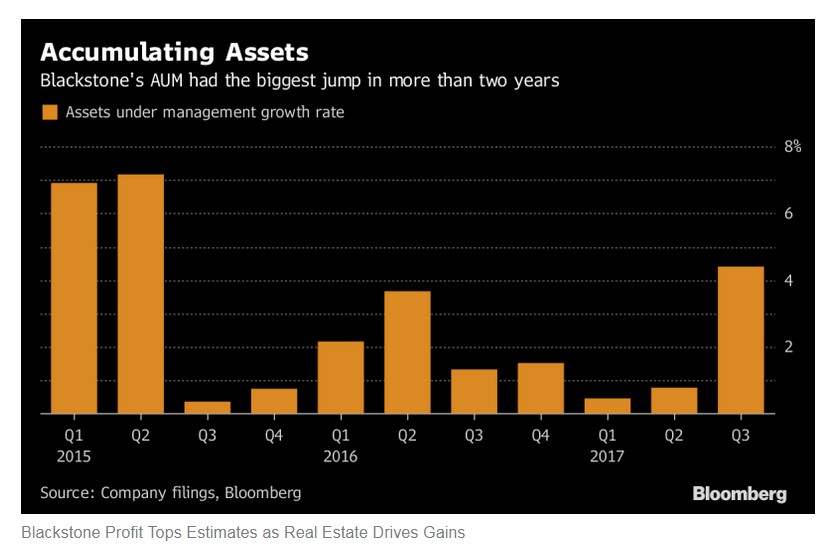
Blackstone’s real estate assets under management grew to $110 billion in the second quarter, up 9% from $102 billion a year ago. Its core-plus portfolio, which includes Stuyvesant Town-Peter Cooper Village, grew 36% to $18 billion.
In May, Blackstone won a $20 billion commitment from Saudi Arabia’s sovereign wealth fund for a new infrastructure investment fund, but it may be a while before the money gets spent. Saudi Arabia’s commitment depends on Blackstone raising additional cash from other investors, and the firm has only just began marketing the fund.
Real estate continues to fuel gains for Blackstone, which reported a jump in third-quarter profit that exceeded all analysts’ estimates. Economic net income, a measure of earnings that reflects both realized and unrealized investment gains, was $835 million, or 69 cents a share, compared with $690 million a year earlier.
Real estate led the charge for Blackstone’s asset sales in the quarter. The unit, sold $3.1 billion in holdings, including a U.K. office property and a portfolio of French hotels. The firm also continued trimming its stake in Hilton, selling shares it held in both its real estate and private equity funds.
Asset sales helped fuel $625 million of distributable earnings, which reflect profits on those disposals and fund management fees, compared with $590 million a year earlier. The metric is on track for its second-best year ever, President Tony James said on a call with media Thursday. Blackstone plans to draw from that pool to pay stockholders a dividend of 44 cents a share on Nov. 6.
BMR Take: We are really excited about Blackstone, especially real estate. Real estate is a “hard asset” meaning the value is more stable than for instance technology or biotech companies where the value is based on expectations of future growth. This real estate angle to Blackstone should give you less downside risk in a tough market.
Our Target is $36 and we fully expect to see this shortly. We can’t wait to raise the Target to the all-time high set in 2015 at $44. This $42 billion market cap company ought to be in the mid-40s for sure.
Upcoming Economic News
New Home Sales
Wednesday, October 25th, 10:00 AM
Period: September
Consensus: 552,500
Prior: 560,000
Initial Claims
Thursday, October 26th, 8:30 AM
Period: 10/21
Consensus: 231,500
Prior: 222,000
GDP
Friday, October 27th, 8:30 AM
Period: Q3
Consensus: 2.2%
Prior: 2.2%
The Word on the Street about Apple
Street Consensus Ratings for Apple (AAPL: $156, flat)
Ratings Breakdown: 7 Hold, 41 Buy Ratings
Consensus Price Target: $193
Wall Street Targets:
10/16/2017 KeyCorp $187
10/16/2017 Pacific Crest $187
10/15/2017 Rosenblatt Securities $150
10/13/2017 Barclays $161
10/11/2017 Piper Jaffray $196
10/11/2017 Morgan Stanley $199
10/10/2017 Royal Bank Of Canada $180
10/9/2017 Drexel Hamilton $208
Microsoft (MSFT: $79, up 2%) Sets New All-Time High
My Oh My. What shall we do? What shall we do with this stock at its all-time high of $79? Sell, Hold, Buy more?
BMR Take: WE SAY THE LATTER. Why would you sell one of the greatest companies in the history of the world? Yes, revenues are slowing, but profits are increasing and the profitability of software is second to none. For the year ended June 30th the company did $90 billion in revenue and had $21 billion in net income AFTER TAX. That’s 23% after tax. Wow. So for every $1 of software they sell, 23 cents goes to the bottom line, and much of that is in cash. The company has over $130 billion in cash, albeit over $80 billion in debt, much of it taken out at historically low interest rates. With a $607 billion market cap there are only two stocks higher. – Google at $690 billion and Apple at $810 billion.
We hereby raise our Target from $78 to $84. Go M S F T!
The Word on the Street about AstraZeneca
Street Consensus Ratings for AstraZeneca (AZN: $35, flat)
Ratings Breakdown: 2 Sell Ratings, 9 Hold Ratings, 14 Buy Ratings
Consensus Price Target: $37
Wall Street Targets:
10/17/2017 Cowen $37
09/6/2017 BMO Capital Markets $38
09/1/2017 Argus $35
BMR Take: We added the stock just below $30 last year. We are being very patient with this one. We have a 17% gain in over a year and the 2.6% dividend helps, but we would like to see this thing take off to our Target of $42. It’s no small company at a $85 billion market cap. Revenues are solid at $23 billion and profitability is strong at $5 billion but we want to see more in 2018. If you have patience, you will win.
A Word from Gary Jefferson
Jefferson Financial Group
First Vice-President, Investments
UBS Financial Services, Inc.
We are getting ready to get down to the nitty-gritty of tax-reform. Listening to all the political pundits (which is extremely hard to stomach), it appears that the odds are now slightly favoring the failure of tax reform happening this year. Admittedly, we are talking about a government which is trillions of dollars in debt already, but that number seems to be "just a number". How do we actually comprehend a trillion dollars? One market guru described it as follows:
"Numbers, like billions and trillions tend to numb the mind. They are too large to grasp in any “real” sense. Thirty years ago an older member of the NYSE gave me a graphic and memorable example. “Young man,” he said, “would you like a million dollars?” “I sure would, sir!”, I replied anxiously. “Then just put aside $500 every week for the next 40 years.” I have never forgotten that a million dollars is enough to pay you $500 per week for 40 years (and that’s without benefit of interest). To get a billion dollars you would have to set aside $500,000 dollars per week for 40 years. And a trillion that would require $500 million every week for 40 years. Even with these examples, the enormity is difficult to grasp."
Despite our debt, the market wants and believes that a smaller government (lower taxes) will result in a higher GDP which in turn means higher tax revenues. Thus, the argument that the government has to "pay" for any tax cuts - by raising taxes on the left hand if lowering them on the right hand so as to keep the "debt" constant - is tantamount to keeping the status quo and, ultimately, the same drag on business that we have today. It is apparent that the $5 trillion gain in the overall stock market since the election is because of both increased earnings and the perception that those earnings will continue to grow in part due to lower taxes which drop directly to the bottom line of businesses. Our view is that it will be difficult for the market to act as if tax reform failure is a non-event. It's a major event that could make US companies more competitive in world markets and super-charge domestic small business like nothing has for the past 20 or 30 years.
Business and the markets both need an overhaul of a tax system that is so out-of-control that, as a generality, if one hundred experts file the same tax return, there will be ninety-nine different results. That said, tax reform failure by itself should not derail the current bull market - rather it will likely result in a "reset", or as the pundits like to say, a "consolidation of gains" before the next move higher. Until we see a recession or a bad policy move that, for example, results in an inverted yield curve, we expect that the market will continue to grind higher based on the quality and stability of earnings growth.
The High Yield Corner
By Michael Foster
Let’s start with the elephant in the room.
Government Properties Income Trust (GOV: $18.22, down -2%*) fell just 1% on Friday after receiving an unfavorable mention on Jim Cramer’s Mad Money. This move surprised us for two reasons. Firstly, we didn’t think anyone still watched Cramer’s show, and, secondly, we didn’t think anyone actually listened to him for investing advice. Apparently this failed hedge funder still has a following, though, and the selloff is a result of that.
* The company paid a 43 cent dividend on Friday and a stock that goes x-dividend always opens up down the amount of the dividend on that day, so in reality, the stock was down just a touch last week.
And what exactly is Cramer’s thesis? To be honest, we’re not sure. We’ve seen the clips and read a couple of takes, but the dismissal seems to be without any substance beyond “it’s a high dividend stock and it’s not for me.” No close look at FFO, dividend coverage, or revenue growth.
So, we will give you that here.
Let’s start with revenues. Government Properties Trust saw a 9% year-over-year increase last quarter, an acceleration from a decline at the start of 2016. Revenue growth acceleration has been occurring for nearly two years now, fueled in part by acquisitions and the company’s diversification away from government offices and towards office space leased to think tanks, public companies, private contractors, and so on. That investment has cost money, which means FFO has been weaker than it was back in 2014-2015, which also means dividend coverage is below 100% (it’s actually about 76% over the last 12 months).
Investors should in theory be rewarded for that lower dividend coverage with a higher yield, and at 9% that is exactly what they are getting. But really what we need to think about is the REIT’s ability to generate cash from operations to fuel the distribution in a sustainable manner.
If its expansion efforts bear fruit, this is exactly what we should see. But keep in mind that a bet on Government Properties is a bet on its future growth potential - and with revenue growth still accelerating, it remains a REIT growth stock. The second we see that sales growth weaken is the second we reconsider the stock. No matter what the bald guy on CNBC says.
Elsewhere in REIT land, things were extremely quiet. Omega Healthcare Investors, Inc (OHI: $32, up 1.5%) saw slight gains, whereas we saw a little dip in Ventas (VTR: $63, flat). Welltower (HCN: $68) ended the week flat, as did Apollo Commercial Real Estate (ARI: $18.44). One other REIT had a very fine showing, which is little surprise to us, since it’s been doing a lot of that lately.
Namely, Digital Realty Trust (DLR: $124, up 1%) had another strong week that pushed its dividend yield even lower, and we’ve finally hit the 3% mark yet again. Last week we discussed the significance of this barrier, and it’s not too surprising that it was hit. That should also make investors pause and consider why exactly they’re in the stock. At a 3% dividend or less, it’s more than generous to call Digital Realty a high yield stock. Yet it is unquestionably a high growth stock. Revenue growth, at 10% last quarter, fell from the 20%+ growth of 2016, but considering just how tough it was to compare revenues to 2016’s figures, that slowdown was more than expected. And at near 10% sales growth, the company is still growing like a weed. That has helped FFO growth accelerate markedly, which should indicate more aggressive dividend increases are on their way.
That leads us to the question: what to do with this stock. If you aren’t in need of a high yield, Digital Realty is a great place to be, because you’re essentially Google and Amazon’s landlord for their most precious assets: their data and global presence. But if your goal is to target a 7% income stream or higher, you could easily make do with removing allocations to Digital Realty with a nice profit and move into other higher yielding stocks in our two high-dividend-paying stocks. That’s especially true now that we’ve seen Digital’s stock soar 83% in 3 years. Yes, more upside is on the way, but maybe not as quickly and as profoundly as we’ve seen so far this year and in recent history.
Now let’s move on to the other, somewhat smaller elephant in the room: PIMCO Dynamic Income Fund (PDI: $30, down 4%), which wasn’t the worst performing Pimco fund of the week, although it was pretty close. Across the board, the market punished Pimco’s funds after the company announced that net investment income for most of its funds was far from covering distributions. This wasn’t a surprise, but the market has mostly ignored this issue until just now. Both the Dynamic fund and other Pimco funds have seen dividend coverage slip to less than 100%, although Dynamic’s coverage is not the worst of the lot. Still, the market is worried that the fund won’t be able to cover its payouts.
This is an overly simplistic view. Dynamic’s NAV has gone up 12% in 2017 - more than many bond funds and even some other Pimco funds. Since closed-end funds can fund distributions from Net Investment Income (NII), this just means Dynamic’s payouts can come from capital gains instead of NII. There are some tax issues here, but in terms of dividend sustainability, Dynamic’s distributions are fine.
But there is one implication many aren’t talking about, and we have addressed it earlier this year: the specials. Dynamic is famous for paying a huge special dividend at the end of the year, which has historically come from massive NII. Now that NII is weak, Pimco has a great excuse to tell investors, “Worry, income was weak, so no big special dividend this year.” We are not sure this will happen, but we’re leaning more to this being likely than we were earlier this year. If you were depending on this fund’s special distribution like the big one we saw last year, be prepared for disappointment. Also be prepared for that to hit the stock at the end of the year.
Is this a bad thing? Not really. The regular dividends are still safe, and the fund’s yield is a very nice 9%. And we could see NII improve significantly next year. There’s definitely more to come with Pimco funds in the coming months! But, if you don’t like drama, take your profits and squirrel them away in Annaly Mortgage (NLY – 10% div.) or any of the other stocks in our two high-yield portfolios and sleep like a baby.
Good Investing,
Todd Shaver, Founder and CEO
The Bull Market Report
Since 1998