
The Weekly Summary
Everybody has an opinion. Go search the internet and you’ll hear one fellow say the market is going to crumble, the next person say new highs are on the horizon, and the third individual tell you something that doesn’t make sense because they don’t even know what they are talking about. Accordingly, we feel the need to break it all down this week. No fluff. No spin. No wild opinions. Just a little ‘telling it like it is’ as a reminder that this The Bull Market Report. We aren’t like what you see on TV. And we aren’t like what you read elsewhere. We are just like you. Looking for the cold hard honest facts.
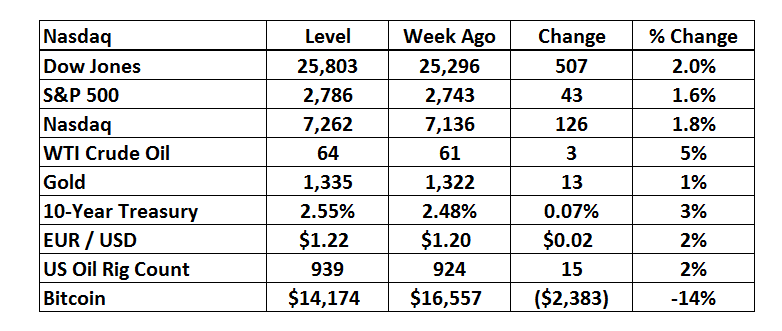
US equities ended the week higher in a quiet Friday of trading. Cyclical and value plays were among the better performers. The equity market is already up over 3% this year with some of our stocks like Amazon and Nutanix up more. Bonds are down this year and Treasuries were mostly weaker as investors realize the Fed is serious about raising rates. We saw more flattening of the yield curve indicating caution. In fact, the two-year T-note rose and hit 2.0% for the first time since 2008. Gold was higher for fifth straight week. Crude ended higher for the fourth straight week.
No matter what is happening out there, there is always a bull market here at The Bull Market Report! This week we highlight: Cloudera, Blackstone, Amazon, Google, Eli Lilly, and Home Depot.
BMR Companies & Commentary
Cloudera (CLDR: $18.14, up 5%)
Cloudera met with investors this week at Citi’s Global TMT West Conference. The CEO discussed all that they are doing in terms of new technology. Let’s recap. Remember, understanding the big picture of what the company is doing is how you build real confidence in your investments.
First it is important to understand the backdrop of why Cloudera is such an exciting company. Everything right now is going through a major technological revolution. Look what is happening in cars, health, and virtual reality. Everything is getting connected. This newly-created connected world is creating a backdrop for data that is unprecedented. And in this area of the economy is where the world’s most valuable companies reside—Apple, Google, Facebook, and Amazon. They are all data driven. Economists say the world’s most valuable resource is now no longer oil, but data.
So where does Cloudera fit it? Cloudera helps enterprises enter this new world of machine learnings and artificial intelligence. Cloudera gives them access to this data to transform their business to become data dependent. The old days of just working with a database storage provider and some simple analytics are gone. Today, companies turn to Cloudera to build best-in-class artificial intelligence solutions that optimize all the available data out there, not just their own.
BMR Take: Machine learning and artificial intelligence are megatrends for the next 5 years. Get involved. Cloudera is a great opportunity. Revenue will explode from $360 million this year to $570 million in 2 years. We see Cloudera breaking the $1 billion revenue mark possibly as early as 2020. We added the stock at $22 in June so it has certainly been an underperformer for us. But we are very confident in the success of this company and continue to have a $28 price target on the stock. Sometimes one has to be patient to see the big gains that we expect. Cloudera is still tiny with a market cap of $2.5 billion. But they are growing 40% a year. We would expect to see this little gem grow to the $10 billion level at some point and then get plucked up by one of the big boys. And this might even happen sooner than you think.
------------------------------------------------------------------------------
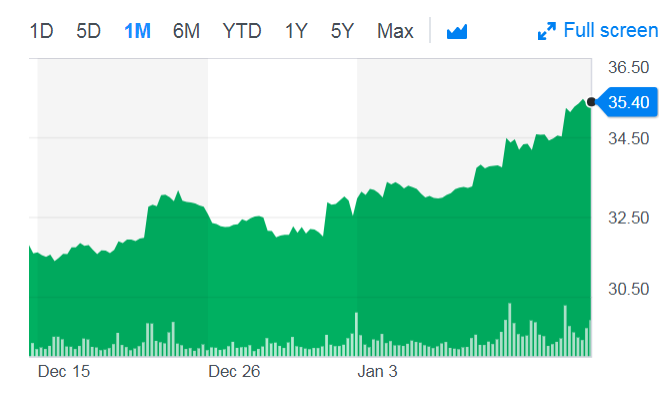
Blackstone (BX: $35, up 7%)
Blackstone is on a roll and caught an upgrade from JP Morgan. We love it when the professionals come around to our side of the table!
The reason to be excited at this point is that there is going to be a major fundraising cycle for Blackstone over the next two years. The company is expected to raise over $200 billion. The way the company makes money is through these massive fundraisings, then deploying the capital, and then getting a share in the profits from the investments.
The fundraising will happen in two funds. The first is Flagship Real Estate BREP-IX in 2018. The second is Flagship Private Equity BCP-VII in 2019.
BMR Take: Blackstone has been an underperformer relative to its peer group. And the peer group of these private equity companies hasn’t done too well. The entire space is relatively new to the public equity markets. Retail investors just don’t have the comfort level they have with other financials like AIG or JP Morgan. But we think that will all change. These companies print money. Blackstone will do over $3.00 of EPS in 2018. The stock is very inexpensive right now.
We’re up 30% on the stock since we added it in early 2016. Good but not great. The dividend has helped though, as that 5% a year adds up. But we expect more from this great company. Our Target was just reached this week, so we are going to go out on a limb and raise the Target to $42. If things go right, we would expect to see this by year end, but perhaps sooner.

------------------------------------------------------------------------------
Amazon (AMZN: $1,305, up 6%)
Amazon Fresh prices are up to 20% cheaper than major UK supermarkets.
Look out! We are going to see Amazon really shake-up the grocery market this year. Amazon's online grocery service Amazon Fresh is selling some products up to 19% cheaper than major supermarkets, new research suggests.
Amazon Fresh is a subsidiary of the Amazon.com. It is a grocery delivery service currently available in some U.S. states, London, Tokyo, Berlin, Hamburg and Munich. It will also launch in Australia soon.
The cost of a shopping cart from Amazon Fresh turned out to be 11% cheaper than the same online shopping from Tesco, and up to 19% cheaper than other competitors. The study was done by the consulting firm Oliver Wyman. The geography was in London.
Amazon Fresh is still relatively small but the internet giant has very serious ambitions in the grocery sector, suggesting that it may be looking at more acquisitions.
BMR Take: Amazon is a never-ending innovation machine; essentially a massive start-up. Look, the company will do $177 billion of revenue this year and we could rant and rave about the revenue growth outlook. But nobody knows what businesses Amazon will even be in over the next 3 years. They are knocking down doors and running through walls into new markets. Grocery will be tens of billions of dollars for Amazon in a market that the firm has been in for less than a year.
The stock had a banner week and hit our $1300 Target, setting a new all-time high. We believe we will see $2,000 someday in the future, but obviously not right away. But we can see $1,500 in the not-too-distant future, so we hereby raise our target to that level. The Sell Price is raised from $1,030 to $ 1,225.
------------------------------------------------------------------------------
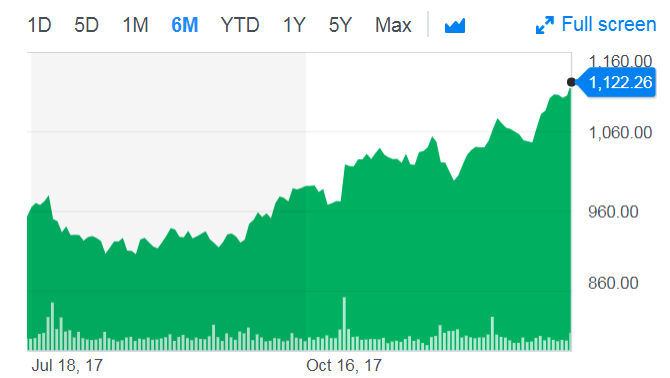
Google (GOOG: $1,122, up 2%)
Apple came under massive scrutiny this week. Parental oversight organizations said Apple should take more responsibility over how children use their devices in particular addition to the technology. We think Apple, Google, and Facebook in particular are making so much money they are likely to be the target of increased scrutiny by governmental authorities. In fact, we saw this week similar outcries against Google. We keep an eye on this risk but would not let it shake us out of any of these holdings.
Google has been profiting from a practice in the United Kingdom but banned in the US, in which brokers secretly reap millions of pounds from addicts seeking treatment in the UK. An undercover investigation by the Sunday Times has discovered a large fraud in this area. As a result of an in-house investigation, Google pulled all addiction-industry-related advertisements from its UK platforms.
BMR Take: Without question, Google and its peers will have to invest more in meeting social responsibilities and being a good corporate citizen. That said, Google can manage through this. We are looking at EPS going from $32 this year to nearly $60 by 2020. We can live without $1 or $2 of EPS if the company addresses these social issues and spends money to prevent thing like this advertising scheme being run through the platform in the UK. In fact, we encourage it, as it could result in a premium valuation.
Google set a new all-time high this week and is now worth $780 billion, closing in on Apple at $900 billion. (Of course, Apple set a new all-time high this week as well, so it’s certainly a good race!) Our Target has been $11,00 which was hit this week, and we expect a continued strong stock market which should proper Google higher. Thus, we hereby raise our Target to $1,450 and our Sell Price to $1,010.
Don’t like high-priced stocks? GET OVER IT. Buy some Google. Buy some Amazon. Buy 7 shares. Buy 23 shares. Just own these fabulous companies!
------------------------------------------------------------------------------
Eli Lilly (LLY: $87, flat)
Eli Lilly caught a big upgrade from Argus Research. Again, we love it when the professionals come around to liking our holdings!
What’s the excitement? Tax reform is a major positive for the company. Additionally, the company is working to sell its Animal Health business. The combination of these two events will create a cash windfall. Now the CEO is talking about doing a large acquisition.
Previously, big time M&A was just a distraction for the company as Lilly could not be competitive due to its balance sheet. However, now there is some real interest to move bigger into immune-oncology. Could we see them try to buy Bristol-Myers? (BMY: $63) Maybe; but that’s a big bite to chew off – around $120 billion.
BMR Take: Lilly is going to do $4.65 of EPS in 2018. They have $4.5 billion of cash. They have more cash than debt. They could do a mega-deal and this could get really exciting. We see why Argus upgraded the stock with a $115 price target.
We at The Bull Market Report have a Price Target of $88 on the stock at the moment, but we expect mid-90s by summer, so we hereby raise our Target to $96. Our Sell Price moves higher too, from $76 to $82.
------------------------------------------------------------------------------
Home Depot (HD: $196, up 2%)
To be honest, we are frankly a bit upset at Home Depot right now. We expect a lot from our companies - we wouldn’t recommend them to you otherwise. Home Depot put out this official statement on tax reform back in November, “The Home Depot is very supportive of tax reform that would fuel the economy by putting more money in the majority of Americans' pockets while improving the competitive position of companies so they can create more jobs. We applaud Congress for its efforts in moving tax reform forward.”
What is it missing?
Where is the minimum wage hike? Where is the $1,000+ bonus to employees. Walmart, some big banks, and many other companies took additional actions. All Home Depot did was issue a press release of encouragement.
We will get over it. But Home Depot missed an opportunity to demonstrate its corporate leadership in this country.
BMR Take: Home Depot is going to do nearly $9 of EPS in 2019. EPS should grow at least mid-single digits. The housing market is doing great and we expect ongoing favorable tailwinds for Home Depot. The stock is still going to go higher, but it could go much higher if they would not miss opportunities to build goodwill with the market as an exceptional corporate citizen.
Our Price Target is $205 which we will leave here for the time being. The Sell Price of $178 is hereby increased to $186.
------------------------------------------------------------------------------
------------------------------------------------------------------------------
Economic Calendar
Capacity Utilization
Wednesday, January 17th, 9:15 AM
Period: December
Consensus: 77.3%
Prior: 77.1%
Housing Starts
Thursday, January 18th, 8:30 AM
Period: December
Consensus: 1,278,000
Prior: 1,297,000
Michigan Sentiment
Friday, January 19th, 10:00 AM
Period: January
Consensus: 97.0
Prior: 95.9
------------------------------------------------------------------------------
------------------------------------------------------------------------------
Time to Take Our Profits in Tesla?
Tesla (TSLA: $336, up 6%) had a great week, but the more we think about it, the more worried we become. They have orders for 400,000 Model S cars and said last year that they would be delivering 5,000 a week starting in October, 2017. Well, guess what, this 5,000 number has slipped a number of times so that now they are talking about the 2nd quarter of this year. That’s a big slip. Maybe there is something seriously wrong here. No one seems to know and the company certainly isn’t helping us with solid information.
The company is going to need massive amounts of cash this year. They are bleeding money each day, each week, each month, so we expect more secondaries this year, diluting existing stockholders. And more bond sales as well.
Can the company survive and thrive? That’s the question that we are wrestling with.
We love the company; the world loves the cars. We love Elon Musk, but he is a promoter for sure. A loveable genius with a $56 billion market cap company.
The more we think about it and the more we write about it, we just have to book our profits. We are up 69% since we added the company two years ago at $199. OK, wait a minute. We’ll let the market tell us when to sell: If the stock goes to $320, we are OUT.
It’s tough to invest in a visionary. The vision always takes longer than the genius or the masses of followers expect.
------------------------------------------------------------------------------
Apple's App Store Broke Records this Holiday Season
Apple’s App Store started off 2018 by breaking app purchasing records on New Year's Day. Consumers spent $300 million in app purchases on January 1, 2018, marking the highest sales day for the App Store since its launch in 2008.
This outstrips last year’s record-breaking figure of $240 million in purchases on New Year’s Day. Customers spent $890 million on apps from December 24th-31st. Insights into app spending during the holiday season are indicative of the strength of the iOS platform for the year to come, as many consumers receive smartphone devices and purchase new apps, games, and subscriptions over the holiday period.
Apple’s App Store revenue gets bigger each quarter and each year. Developers received $26.5 billion for the year, up 30% year-over-year, and is now over $86 billion since 2008. For 2017 the $11.4 billion in revenue was almost 5% of the company’s projected $237 billion in total revenue.
------------------------------------------------------------------------------
------------------------------------------------------------------------------
A Word from Gary Jefferson
Jefferson Financial Group
First Vice-President, Investments
UBS Financial Services, Inc.
Earnings season officially kicked off last week with the big banks leading the way. We expect decent to good numbers, but the big thing to watch for will be forward guidance, particularly on how much tax cuts will impact the bottom lines. Some sectors like Energy will likely benefit more than others which traditionally have been able to pay lower effective rates such astech.
Last week, Bank of America analysts raised their earnings forecast for the S&P 500 by $14 to $153 per share, as a result of the new lower 21% tax rate. (Source: Merrill Lynch). In market-speak, that means that if corporate earnings for 2018 reach $153, and the market's trailing PE is 18, the S&P 500 will be trading at 2754. Today it is trading at 2786…………………….oops, that doesn't sound very promising. For the market to reach 3029 (a 9% gain), the S&P 500 would need to trade around 20X trailing earnings. That is of course doable, and not outside the realm of just being a high-priced market rather than a bubble, but it would be a lot better from a fundamental standpoint if the market could see fit to earn a higher number this year. We should have a better grasp on a projected year-end earnings target after earnings and guidance are announced over the next several weeks.
Meanwhile, what a week the market enjoyed two weeks ago. It was one of the best first weeks of any new year in history. There are plenty of historical stats which show that if the market has a good January, most of the time the year will end up with positive numbers as well.
Even though the jobs report missed expectations for 191,000 new jobs being created last month by coming in at 148,000 instead, the great big story was that this number had 146,000 private sector jobs versus only 2,000 public sector ones. Always remember that government doesn't create jobs – it only takes away from the private sector when it grows, and because it is the private sector that creates jobs, a growing government is the worst case scenario for a growing economy. So "hip, hip hooray" for this ratio of jobs because it is just what the doctor could order for a healthy and robust economy.
The biggest winners for job creation were in Healthcare with 31,000 new jobs (300,000 for 2017), Construction with 30,000 new jobs (210,000 for all of last year), and Manufacturing with 25,000 new jobs (196,000). We also saw gains in Food Services & Drinking Places (government-speak for restaurants and bars), and Professional & Business Services. Thus, these are not part time or low paying jobs for the most part, which is equally important for a growing economy.
Again, we have to keep everything in perspective. The following stats are from Pension Partners:
"From August 18th to November 29th, the Dow went 72 straight trading days without an intraday move greater than 1%, by far the longest stretch in history.
“The S&P has now risen for 14 consecutive months, the longest run in history.
“The Dow closed at an all-time high 71 times during the year, the most in history.
“There was a sharp flattening in the yield curve throughout 2017. At 0.51%, the spread between 10-year and 2-year yields on the last day of trading was the flattest level of the expansion. (This is a "flag" we are watching).
“In spite of this backdrop, the Fed only hiked rates 3 times in 2017, to a year-end range of 1.25 to 1.50%. After subtracting inflation (core CPI of 1.7%), this leaves the Real Effective Fed Funds Rate in negative territory for the 9th year in a row – another longest stretch in history.
“On the flip side:
Unemployment rate (4.1%) – lowest since 2000
Jobless Claims – lowest since 1973
Consumer Confidence – highest since 2004
ISM Manufacturing Index – highest since 2004"
Our take is that we should expect a correction along the way this year to keep this market from reaching the dreaded "bubble status", but we should also not be scared out of the market due to the length of this bull market. All good things eventually come to an end, but all records are also made to be broken. We have no idea when this earnings growth cycle will come to an end, but we simply do not see earnings growth stuttering or falling at this time - just the opposite, in fact, as corporations become ever so more competitive with the reduction of what had been among the world's highest and most onerous tax rates. (35% now cut to 21%). In this environment, we believe earnings will be the game changer – i.e., we are in the proverbial market of stocks, not a stock market. Companies with outstanding earnings growth will continue to provide outstanding returns.
------------------------------------------------------------------------------
PayPal Holdings (PYPL: $80.50) was upgraded by analysts at Cowen from a "market perform" rating to an "outperform" rating. They now have a $88 price target on the stock, up previously from $79. They must be reading The Bull Market Report. Interesting: Our price Target is $87, because that’s the price at which the company will be worth $100 billion. The stock set a new all-time high on Friday.
------------------------------------------------------------------------------
------------------------------------------------------------------------------
The High Yield Corner
By Michael Foster
Vice President, High Yield
Let’s start with a stock that fell below an important number and then quickly recovered.
Omega Healthcare Investors, Inc (OHI: $26, down 3%) has been The Bull Market Report’s big contrarian call for a while now. If you’re a regular reader, you know that we’ve frequently discussed the issues regarding Omega’s tenant insolvency and current negotiations. This has spooked a lot of investors and turned a once 8% yielding stock into a 9% yielding one. At the start of last week, the stock dipped below $27 for the first time since 2014 - a significant development.
There’s no news to drive this. No insider selling announcements, no updates on the ongoing negotiations with Orianna, which could result in a small decline in income or a protracted dispute in bankruptcy court. In either case, Omega is very likely to get paid out something. In both cases, though, Omega’s cash flow is going to suffer.
And what of that cash flow? Again, it’s helpful to look at the numbers. FFO for the last 12 months is $3.40, while annualized dividends are $2.60. In other words, the dividend coverage ratio is 131% - just above the important 130% level that we demarcate as the start of the safest REIT distributions. At its current level, Omega will maintain its payouts with ease.
But what about the haircuts? Orianna provides 5% of Omega’s FFO, so if Omega lost all of that money (a virtual impossibility), the FFO would fall to $3.23, leaving Omega with a 124% coverage ratio. That’s lower than we like, but it’s still over 100%, meaning we aren’t anywhere near a cut.
Let’s project into the future to see exactly when the dividend would get risky. If Omega lost 5% of its portfolio every year, 2019’s FFO would fall to $3.07. The next year’s would be $2.92…and in fact, it would take until 2023 (i.e., 5 years from now) before Omega’s FFO would fall to less than its current payouts. Then, it would hit $2.50.
Keep in mind that we’re playing with the worst possible case here - but let’s play with the math and see what happens to our income stream.
If the future was as bleak as this, 2023 would result in a 3.8% dividend cut to make payouts sustainable. At current prices, that would make Omega Healthcare yield 9.2% (instead of its current 9.6%).
If this is our worst case scenario, it looks pretty rosy. Getting a near 10% dividend over 5 years before a dividend cut that then brings your yield to a still impressive 9% - that’s not much downside.
There is one other consideration. Omega increases its dividend by a penny per quarter. We’ve have written in the past about this; it’s good for investors in the short term, but it will expedite the schedule for when Omega will have to cut its distributions. For that reason, we think it would be best for Omega to stop its quarterly hikes and telegraph to the market its plans to do so many, many months in advance.
We are disappointed that Omega hasn’t done that yet, but we also wouldn’t be surprised if they did this sometime this year. The recent price action demonstrates that the market is expecting the dividend hikes to stop relatively soon. That gives Omega a nice window to make the move without hitting the stock too much further - but we are not sure they will actually make this move at all.
And the reason is simple. We on the outside see a very slow demise of the dividend - management does not. In the last earnings call, CEO Taylor Pickett addressed the issue with some promising numbers:
"We are hopeful, we can develop an out-of-court plan, which if successful, would likely result in cash rents of $32 million to $38 million per year, as compared to the current annual contractual rent of $46 million.”
If successful, that would lower FFO by 1.5% - in other words, hardly anything at all.
Additionally, Omega continues to expand. The company invested over $300 million in the third quarter of 2016, which on its own more than covers the lost FFO from the Orianna issue. By how much? Pickett noted that Omega targets a 9% capitalization rate for investments, meaning that $300 million investment will be almost twice that of the lost cash rents from Orianna.
What about the properties currently occupied by Orianna? Omega is currently working to sell or rent to new operators who are in a better financial position. If successful, this could cause FFO to grow significantly in the next 2 years - and that will make Omega shares skyrocket.
We have faith that Omega’s managers can navigate this admittedly complicated and tricky transition, and that’s why we remain constructive on the stock.
Finally, let’s quickly turn to some other high yield assets: Municipal bonds and closed-end funds. Nuveen AMT-Free Municipal Credit (NVG: $15.65, down 2%) and Invesco Municipal Trust (VKQ: $12.65, down 1%) had a decent showing for the week, in no small part thanks to a seasonal and rather predictable trend. Retail investors sell municipal bonds at the end of the year and buy again in January. This is classic tax loss harvesting at work, and any year where losses in munis are to be found, this trend is noticeable. So far, 2018 has been good to munis - and that is likely to continue. Thanks to the investors looking for their tax-free income streams, both the Nuveen and Invesco funds are seeing positive inflows - something that we are also seeing across the municipal bond market.
Good Investing,
Todd Shaver, CEO and Founder
The Bull Market Report
Since 1998