
The Weekly Summary
The countdown to Christmas is underway, which means this year is coming to an end and the focus is turning to the outlook for 2018. This bull market has been nothing short of spectacular. We expect high-single digit returns in the stock market again in 2018. Our view is supported by rigorous analysis from Guggenheim Research, which points to the US not reaching a recession until late 2019 or 2020. Specifically, they say, the business cycle is one of the most important drivers of investment performance. It is therefore critical for investors to have a well-informed view on the business cycle so portfolio allocations can be adjusted accordingly.
At this stage, with the current U.S. expansion showing signs of aging, focus is now just gradually shifting toward the timing of the next downturn. Using history as a guide, however, you will find that it is possible to get an early read on when the next recession will begin by analyzing the late-cycle behavior of several key economic and market indicators. Together, they have provided advance warnings of a downturn. The best indicator is the Leading Economic Indicator Index, which compiles all the various indicators into one data set. The 10 components of the index cover weekly hours worked, manufacturing orders, initial jobless claims, building permits, new private housing units, interest rate spreads, and consumer sentiment. An analysis of these metrics suggests that the current expansion won’t end until late 2019. So keep your foot on the gas!
No matter what is happening out there, there is always a bull market here at The Bull Market Report! This week we highlight some of our favorite stocks where you can still make good money, including: Tesla, Twilio, PIMCO Dynamic Income Fund, Amazon, Google, First Solar, and more.

BMR Companies & Commentary
Tesla (TSLA: $315, up 3%)
Anheuser-Busch has placed an order for 40 of Tesla’s new all-electric Semi trucks. The maker of Budweiser seeks to reduce fuel costs and vehicle emissions, along with other companies across sectors through the Tesla revolution.
Anheuser-Busch plans to use the trucks for shipments to wholesalers within 150 to 200 miles of its brewery locations - well within the 500-mile range that Tesla Chief Executive Elon Musk has promised. The vehicles would be deployed among the brewer’s dedicated fleet of 750 trucks, which bear the company’s branding but are owned and managed by outside carriers.
Anheuser-Busch’s preorder is still tiny relative to the broader heavy-duty-truck market, which produces 250,000 to 300,000 big rigs a year. Anheuser-Busch spends about $120 million on fuel each year for its dedicated fleets and long-haul transportation by for-hire carriers moving beer between breweries and wholesalers. The company wants to cut its carbon footprint by 30% by 2025, and has invested in alternative-fuel vehicles, such delivery trucks that run on compressed natural gas. This is big stuff!
BMR Take: Tesla is currently losing money, but the consensus 2020 EPS outlook is over $10. At some point we see all the innovation, like electric trucks, turning into major profits. Tesla remains one of the most exciting businesses in America.

--------------------------------------------------------------------
Twilio (TWLO: $25, down 5%)
Twilio hosted its analyst day in San Francisco this week. It was a good day. Twilio did a nice job of conveying the momentum in its business and how it plans to continue to drive rapid revenue growth at scale, but it did not guide to gross margins for 2018, and suggested that near term, gross margins may still move around a bit, even though management is confident in its longer-term target of 60-65%. The stock was under modest pressure accordingly.
Twilio provided three new disclosures to help investors better understand these gross margin dynamics, including: 1) gross margins have consistently been around 60%; 2) gross margins are negatively impacted by the international mix, which was 53% in 3Q17 for core voice and messages, far higher than the 24% figure Twilio discloses for the international revenue breakdown by account location; and 3) gross margins are positively impacted by application services revenue, which was $10 million in 3Q17, up 100% from a year ago and representing 9% of total revenue.
The company reinforced that demand is not an issue for Twilio. For example, the COO shared a story about how one sales representative was “drowning in leads.” He also disclosed that Twilio receives more than 7,000 “data-driven alerts,” or leads per month.
Twilio claims that it won 80% of new business opportunities against the top-five competitors in the first three quarters of the year. According to management, the top reasons customers select Twilio include: 1) trust; 2) omni-channel capabilities; 3) flexibility; and 4) innovation.
Twilio Investor Day tone was positive, says Baird. They remain positive on the company's competitive position and long-term growth opportunity fueled by increasing cloud communications use cases. They also remain positive on its stronger revenue growth and ability to improve margins long term. Baird reiterated their Outperform rating and $37 price target on Twilio shares.
BMR Take: Twilio currently trades at a big discount to where comparable high-growth cloud communications companies trade. We think this valuation disconnect will correct itself, leading to strong stock appreciation. With revenue exploding at greater than 60% per year towards $600 million by 2019, we see a compelling value here. The stock has been painful to watch but one of these days, Wall Street will take notice (again) and we will all be rewarded with our patience. If you can't take the pain, then you may just want to switch to some of the larger, safer investments like Apple or Google. We’re going to be right on this. Eventually. Watch and wait.
--------------------------------------------------------------------
PIMCO Dynamic Income Fund (PDI $31, up 1%)
With rising geopolitical tensions and good money been made in the stock market, we stress the importance of increasing your bond allocation. Pimco Dynamic Income is a great way to do it.
The portfolio maintains moderate exposure to US interest rates, where Pimco continues to emphasize the intermediate portion of the yield curve. However, due to historically low yield levels and continued flattening of the yield curve, the fund has some exposure to the long end of the US Treasury curve. Outside of the US, Pimco also has modest exposure to UK rates and an underweight to Eurozone rates.
Pimco maintains a focus on non-agency Mortgage-back securities (MBS) purchased at discounts to par, which provide a potential source of income and capital appreciation, as prices in this asset class continue to be supported by limited new supply and a strong US housing market. Pimco maintains exposure to corporate credit, including an allocation to high yield bonds in the Financial sector. The banking exposure is focused on slightly more risky opportunities that are more lucrative, given how stable the banking system is at this moment. PDI has exposure elsewhere in corporate credit, including allocations to select attractive names in Retail, Media, and Telecom. Pimco’s exposure to emerging markets remains highly selective and is focused on issues offering attractive spread premium and real yields coupled with strong underlying fundamentals, such as select Brazilian and Russian corporates, as well as Argentinian sovereign debt.
BMR Take: Pimco is offering just less than a 9% yield. And the fund is up over 20% this year. For fixed income this is amazing. This fund is a great place to increase your fixed income exposure and protect against unexpected drawdowns in the stock market.
--------------------------------------------------------------------
Amazon (AMZN: $1,162, flat)
The road is not always easy. Not even for Amazon.
Maine has canceled Amazon’s application to become a pharmaceuticals wholesaler. Their applications were canceled because they did not contain all the required information, and no action had been taken by the applicant to complete them, according to the state Department of Professional & Financial Regulation.
Amazon had submitted three pharmaceutical applications in October – all three expired on Friday, Dec. 1, according to the board’s online license check. Analysts are trying to decide whether Amazon merely stumbled and missed a local deadline, or if Amazon abandoned the license applications because it realized they were unnecessary if all it wants to sell are medical devices, not pharmaceuticals.
We have confidence Amazon will get it right!
BMR Take: The innovation machine is disrupting the globe. EPS estimates are now up over $20 by 2020. Amazon continues to have a long way to run. Our Target is $1200, but in our heads we are looking for $1500 and then $2000. We can’t tell you when the latter will occur, but we sure would like to see the former happen sometime next year.
--------------------------------------------------------------------
Google (GOOG: $1,037, up 3%)
Google is about to launch a small but useful update to Google Maps that will give you live guidance and interactive real-time notifications during your journey. The idea here is to give you real-time updates while you are traveling.
To get started, you search for your transit directions in Google Maps as usual. So far, so good. What’s new here is that you’ll soon be able to tap a “start” button at the bottom the screen with the details about your route and get live updates as you walk or ride on your local buses and trains.
Our understanding is that Google Maps will even remind you to get off your bus or train when you get close to your stop. That’s definitely useful when you’re traveling somewhere new. The notifications on the lock screen are also new. One nifty feature here is that they are interactive, so you can scroll right through your journey’s steps.
While Google Maps always did a good job of giving you detailed directions, the process generally involved keeping track of your own progress along the route. With this update, transit notifications become a bit more like using Maps for walking, biking and driving. This update is to go live soon.
BMR Take: Google is always advancing the world and this is just the latest example. When you can make the world a better place, revenue and profits follow. Google is expected to earn $57 of EPS by 2020 up from $32 this year. What a great place to invest!
The information here isn’t earth-shattering – (it’s hard to come up with earth-shattering news every single day (but we try)), but we’re trying to make a point here and that is that this company continues to innovate every day. A little here and a little there and eventually it goes to the bottom line. Revenues for the past few years look like this: $55 billion in 2013, $66 billion in 2014, $75 billion in 2015 and $90 billion in 2016. What about 2017? They’re on track for $105 billion. They made $19 billion after tax last year and they are going to better that for 2017, and with $100 billion in cash on the books and virtually no debt, we can’t think of a better place to put some of our hard-earnings savings.
--------------------------------------------------------------------
First Solar (FSLR: $70, up 16%)
A lot of bad press is confusing the outlook for renewables. Don’t get confused. Renewables are the future and First Solar is going to play a critical role.
What is being said? Less than a year into President Trump’s time in office, clean energy developers face a slew of unanticipated threats from the White House and Republicans in Congress that could slow the industry’s growth in ways unimaginable just a year ago. During Trump’s presidential campaign, energy analysts were skeptical of his promise to preserve the coal industry at the expense of wind and solar. Even the most aggressive attempts at regulatory rollback couldn’t reverse the market forces driving the decline in coal, they reasoned.
But the administration has not stopped at mere deregulation. From the threat of a subsidy for coal-fired power plants to a tax bill that hurts the financing of clean-energy projects, Republicans in Washington have launched a campaign against renewable energy that includes market interventions that alarm other industries, including Oil and Gas. Even if these measures never come to fruition (advocates of transitioning from fossil fuels are pushing back) the changed mood in Washington threatens to undermine the confidence of companies planning to invest in renewables.
BMR Take: First Solar is taking the Energy sector forward with the most sustainable technology on the market. Expected EPS of nearly $4 by 2020 is up from $2.50 this year, but the 10-year outlook is where the real money is. This company is just getting started. Our Target is $65, but the stock has blown through this. So we hereby raise our Target to $78 and our Sell Price from $45 to $61.
--------------------------------------------------------------------
--------------------------------------------------------------------
Economic Calendar
JOLTS Job Openings
Monday, December 11th, 10 AM Eastern
Period: October
Actual: N/A
Consensus: 6,100,000
Prior: 6,093,000
PPI ex-Food & Energy NSA
Tuesday, December 12th, 8:30AM
Period: November
Actual: N/A
Consensus: +2.3%
Prior: +2.4%
Initial Claims
Thursday, December 14th, 8:30 AM
Period: December 9th
Actual: N/A
Consensus: 240,000
Prior: 236,000
Capacity Utilization
Friday, December 15th, 9:15 AM
Period: November
Actual: N/A
Consensus: 77.2%
Prior: 77.0%
--------------------------------------------------------------------
--------------------------------------------------------------------
Some Tidbits – Apple, Home Depot, Cloudera, Bitcoin
Apple (AAPL: $169, down 1%) is confident that apps removed from the China app store will be reinstated, Reuters says. Apple's CEO Tim Cook said the company is optimistic that apps that were pulled from its China App Store will be reinstated.
Also, Dialog Semiconductor is losing staff to Apple, Business Insider reports. Apple is continuing to hire away designers and engineers from Dialog Semiconductor (DLGNF), one of its suppliers. Around 28 Dialog engineers and designers have moved to Apple between March 2016 and now.
Also, the new tax plan would cut $47 billion from Apple's tax liability, The Financial Times reports, if Republicans push through their current tax plan, making it the biggest beneficiary of the legislation now working its way through Congress.
--------------------------------------------------------------------
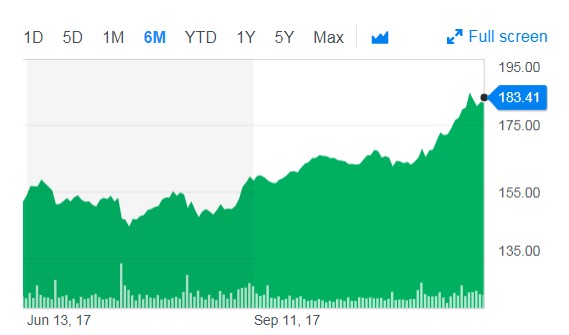
Home Depot (HD: $183, up 2%) set a new all-time high this week. It is now worth $215 billion. Wow. The company announced a $15 billion stock buyback, and the initial reaction on the Street was a slight sell-off. Silly.
How’s this for a 6-month chart?
--------------------------------------------------------------------
Cloudera Reports Strong Revenues
Cloudera (CLDR: $16.84, up 6%) reported that revenue rose to $95 million from $67 million in the year-ago period, a gain of 42%. Profits were in the negative, so although we are pleased with the revenue growth, we’re not happy with the losses. The stock had a little bump last week and it may go a bit higher, but it is not going to $30 or higher where it ought to be until it starts actually making money. We love this company but realize this is a multi-year investment from here. Patience is key here. But our patience is certainly running thin. The quarter was strong, so that gives us hope.
Bitcoin (BTC-USD: $14,840) has a market cap of about $250 billion, about the size of Visa. It was quite a week, as it rose from the $11,000 just one week ago. In the interim it hit $17,000 or so, and futures trading starts Sunday (the 10th).
Bitcoin Chart for the Past Month

--------------------------------------------------------------------
--------------------------------------------------------------------
The High Yield Corner
By Michael Foster
While the stock market went nowhere fast last week, high yield investments were a bit more mixed. We saw strength in municipal bonds for the first time in a long while, as this was overdue. The uncertainty regarding tax reforms caused some selling, but now the market is realizing that muni bonds are vastly oversold, which is helping to bring some money back into the market. Additionally, the slightly more risk-averse market is helping some money flow into muni bond funds, driving them up again.
As a result, Nuveen AMT-Free Municipal Credit (NVG: $15.68, up 2%) and Invesco Municipal Trust (VKQ: $12.57, up 2%) both had a good week, meaning the strong buying opportunity is mostly over. It’s not entirely over, however. Both funds are trading at about a 6% discount to NAV on average, a bit lower than the 5% discount we saw for much of 2017. What’s much more encouraging is the positive change in NAV we’ve enjoyed throughout 2017 - these funds are up about 5% on average on their net asset value even after their 5% dividend payouts. That means these dividend payouts remain sustainable and investors can expect a strong total return in addition to the tax-free income stream these funds provide. We wouldn’t be surprised if we saw more investors jump into the muni market, driving these funds higher and their discounts lower.
Elsewhere in the high yield world, we saw growing discontent. Specifically, Government Properties Income Trust (GOV: $18.29, down 3%) had a challenging weak on no news. This is largely a result of continued concern that Government Properties is overly levered and highly dependent on government agencies who are squarely in the majority Republicans’ crosshairs when it comes to cutting expenses wherever possible.
Of course, neither of these facts have changed in the last week, but admittedly the 8% and 7.5% yields that this stock offered earlier in the year were too low to compensate for the risks that the fund’s portfolio afforded.
Some context is important here. The Bull Market Report first recommended this stock back in April of last year when it was yielding 9.5%. Since then, the stock has given a near 14% total return to investors thanks to a slight bump in price and a consistent 43 cent quarterly dividend payout.
The Bull Market Report did not recommend selling this fund during its run-up earlier in 2017 for one specific reason: income sustainability. The most crucial metric to look at with REITs is FFO* and its relation to dividend payouts. Over the last 12 months, this REIT’s FFO was $2.15, while the dividend is an annualized $1.72. That’s a 125% dividend coverage ratio, slightly short of our preferred 130% dividend coverage target. But that shortfall is compensated for by the higher yield.
* Funds From Operations
To put that into context, let’s think about another beaten-down REIT: Omega Healthcare Investors, Inc (OHI: $28, up 1%), which has around a 130% dividend coverage ratio and a 9.4% dividend yield. With such a strong and sustainable income stream and a high yield, these are ideal contrarian income plays despite the justifiable concerns about the fundamentals. With Omega, the worry is that there are too many skilled nursing facilities and lower-than-expected demand. With Government Properties, the worry is that there is going to be depressed demand from a belt-tightening government.
These concerns are well compensated for by yields over 9%. When you get to double-digit yields (which is very unlikely with Omega but not impossible with Government Properties), you’re getting paid too much for the risks. We believe there is a chance of seeing its stock drop to a level where yields are 10%, which makes it a hold right now but not an absolute great buy. But when it comes to the sustainability of the dividend, we clearly see no risks at all to the dividend for a long time - in fact, possibly for several years.
How many years? To answer that, we need to look at the duration of outstanding leases in Government Properties’ portfolio. At 5.1 years, 28% of the company’s leases will expire before 2020. And in the next 5 years, almost 60% of the company’s leases will expire.
This is a double-edged sword. On the one hand, there is a risk that the company won’t be able to lease those properties to new tenants, causing occupancy rates to fall, income to fall as well, and the dividend to be increasingly at risk. On the other hand, there’s an opportunity for the company to lease those properties to those tenants or new tenants at the same or higher (possibly much higher) rents. This latter scenario is how we feel. The government needs the space and the record of the government in cutting down its size is, as you know, abominable.
So what is the likelier scenario - falling occupancies or rising rents? Bears are arguing for the former, and we would argue that that scenario is already priced in. However, falling occupancies is more unlikely than the market is expecting for a couple reasons.
Firstly, commercial leasing activities are going up. According to Jones Lang LaSalle, one of the biggest commercial leasing firms in America, leasing activity is at its highest point in 2 years and it’s trending higher. Government Properties has been shifting away from government leasing to office leasing, so it will benefit more and more from this trend. Thus the chances of finding new tenants paying higher rents is actually pretty good.
Secondly, there’s a paradoxical market lockup in commercial real estate REITs despite strong rent growth. Office-space REITs are one of the most heavily discounted (infrastructure and data centers are the most premium priced) in large part because of the market jitters about future occupancy rates, which paradoxically is forcing more conservative fiscal decisions among office REITs like Government Properties. But we have clearly hit a bottom in terms of pessimism, and when enthusiasm comes back to office space REITs, which will likely come as soon as the market notes the strong growth in leasing activity and rent growth, companies like Government Properties will be able to expand even more.
That means patience is in order. Expect more negativity and worries about Government Properties in the short term. But the fears about its soon-to-expire portfolio are overblown, and when the market realizes this, more capital will flood into the stock. It may take until 2019, when 18% of the company’s portfolio expires. If those spaces are re-leased at the same or higher rates (which seems inevitable given the strength in the commercial real estate market), expect the stock to rise. Best to hold the stock now, collect the income, and wait for that bump in a couple of years.
Good Investing,
Todd Shaver, Founder and CEO
The Bull Market Report
Since 1998