
The Weekly Summary
US stocks rebounded to have the best weekly gain since 2011 - how do you like that for a turnaround? So it turns out the bull is still running after a quick breather. Now all the talk on TV is “don’t worry about volatility. That markets had been abnormally calm for years. That we should now just expect more noise.” We concur. We adhere to the old adage: “Bull markets are born on pessimism, grow on skepticism, mature on optimism, and die on euphoria.” This means that bear markets are born on euphoria and grow on pessimism. Frankly we just don’t see that much euphoria in the markets. For example, while bank stocks are up 50% since the election, profits are up more, which suggests gains in bank stocks are honestly tied to the realities of profit levels. As another example, GDPnow suggests first quarter GDP is above 3.0%, again meeting the growth targets underpinning recent stock market gains. All in all, wake us up when you see broad-based euphoria, because until then this bull market is on cruise control, the ride might be a bit more bumpy going forward.
No matter what is happening out there, there is always a bull market here at The Bull Market Report! This week we highlight: Twilio, Shopify, Square, Splunk, Amazon, and AstraZeneca.
Key Market Measures (Friday’s Close)

----------------------------------------------------------------------------------------
BMR Companies & Commentary
Twilio (TWLO: $33, up 35%)
Twilio crushed the quarter. We mean absolutely crushed it. Revenue was $115 million up 41% from a year ago. EPS was a loss of $0.03 versus breakeven a year ago. There were so many good things that happened we can’t cover them all, but we will share a few.
The tone of business at Twilio continues to be exceptional. Founder/Chairman/CEO Jeff Lawson commented, “We feel we are poised for a great year ahead.”
The big focus for investors was on Twilio’s gross margins. Specifically, after Twilio’s gross margin declined for three consecutive quarters from a peak of 59% in 4Q16, investors were concerned it might continue to trend downwards into the 40s. Twilio’s 4Q17 gross margin of 53.5% was up sequentially from 3Q17. In addition, CFO Lee Kirkpatrick said, “For 2018, you should expect gross margins around this level or better.” That’s a relief!
Uber has been the biggest area of concern for investors. After peaking at $14 million in 4Q16, revenue from Uber declined sequentially three quarters in a row to $5.0 million in 3Q17, but ticked back up to $5.8 million in 4Q17. Despite the drop off in Uber revenue, the company continues to grow the top line greater than 40% and we haven’t seen any other big customers leave, which is a major reassurance.
BMR Take: Founded in 2008, Twilio is the leading cloud platform for communications. Similar to Amazon Web Services, Twilio plays a critical role for software developers by allowing them to easily and securely build communications services, such as voice, messaging, video, and authentication into their software applications and then scale those services elastically and globally. This stock has a bright future and the current valuation of 5x sales is still at an unwarranted discount to the peer group of high-growth cloud communication companies trading for 7x.
----------------------------------------------------------------------------------------
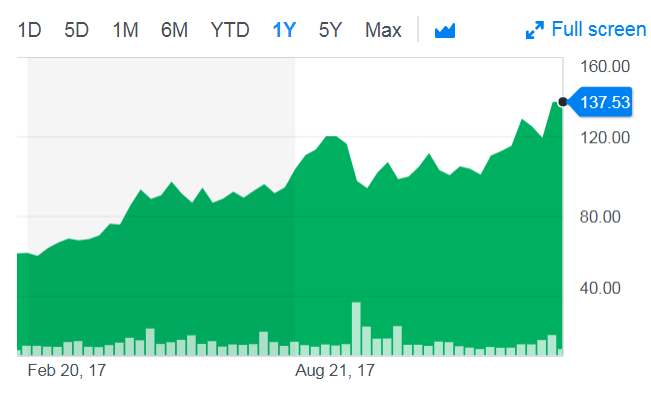
Shopify (SHOP: $138, up 15%)
Another stock crushed earnings for us this week. Shopify. Revenue of $223 million was up 71% from a year ago. EPS was a loss of $0.16 versus a loss of $0.12 a year ago.
2017 was undoubtedly the company’s best year yet. There was exceptional top line growth, but also immense learnings that will drive meaningful progress in terms of product and geographic expansion in the future.
The proof is in the pudding. Fourth quarter is the seasonally strongest of the year with the holidays. Shopify’s merchants sold more in this fourth quarter than in all of 2015, in fact doing $1 billion of sales over just a 4-day period.
For all of 4Q, Shopify’s merchants sold $9.1 billion, an increase of 65% or $3.6 billion from a year ago. This is the definition of sales flying off the shelf. The more Shopify’s merchants sell, the more opportunity there is for Shopify shareholders to make money.
BMR Take: Shopify is a clear leader in commerce, that is building scale, realizing strong growth consistently, and the firm is now considering additional product and geographic expansion to sustain these explosive growth rates for a long time. Revenue is set to double from $675 million in 2017 to $1.4 billion in 2019.
Our Target has been $125 and we wanted to make sure it smashed this target before we raised. Well, “smashed” is the right word here, as the stock shot higher to $140, before dropping a tad on Friday. Yup – an all-time high – never been higher. The company is now worth $14 billion and anyone buying the firm would have to pay $20 billion and we think that management would probably fight any buyout at that level. Why? Because they feel like we do that the company will be worth $30 billion someday. What? Yes. You heard it here first - $250 a share. (We didn’t say when!)
We hereby raise the Target to $160 and the Sell Price from $105 to $122.
----------------------------------------------------------------------------------------
Square (SQ: $44, up 11%)
The one and only CEO of two publicly traded companies at the same time, Mr. Jack (Billionaire) Dorsey tweeted this week that Square’s Cash App is now up and running for instant buying and selling of bitcoin. We’ll cover the product below, but first the most important point needs to be made.
CEO’s like JP Morgan Jamie Dimon called bitcoin a fraud. Countless more expressed dissent or caution about the new sector. Regardless of what is the truth and what you or we think, the question to ask is what did Jack do? Well, he is already out with a product. It is undeniable that wherever the world is going in payments, Jack and Square are the NextGen warriors that are moving … and moving fast. The innovation is impressive.
According to Square’s Cash App, you can buy and sell bitcoin right from your Square Cash App. You have to fund it with a cash balance and have to read and agree to Square’s virtual currency terms of service, prior to proceeding. Interestingly, the terms of agreement are very onerous giving Square the right to withhold payments if fraud is suspected, for example.
BMR Take: We see Square growing revenue from just under $1 billion 2017 to $1.3 billion in 2018 driving EPS growth from $0.25 to $0.45 over the period. To be honest, we care a lot more about the long run revenue growth than the EPS picture. Visa’s market cap is $275 billion. MasterCard’s is $185 billion. Square is only worth $17 billion today and we believe the company can easily chip away at these giants to find strong growth over the next 10 years.
----------------------------------------------------------------------------------------
Splunk (SPLK: $93, up 7%)
Splunk was up but did not participate in the broad equity market rally as much as it should have. What’s the deal?
The big news was selling by key stakeholders. Activist Jana Partners was a large 5% holder. They exited completely. It was also reported that a Senior VP sold a big block of his stock. Several other prominent investors sold out, like Sands Capital, Clearbridge, and Winslow Capital.
You just have to take note of insider selling. There is no reason to fall in love with any stock. When money has been made, recycle it into the next idea when the time comes.
BMR Take: Splunk is covered by 43 Wall Street analysts. 80% rate the stock a buy. However, the average price target is only $92. (Our Target is $95 which it just hit this week.) With the stock up about 50% over the last year, we are taking a closer look at rotating into a new idea. The risk we see is that with big owners selling, and analysts not raising target valuations higher, we could be in a big correction in sentiment.
So, with that said, we are hereby raising our Sell Price from $83 to $88. If it falls to this level, we are out. Having added the stock at $46 in 2016, we are up exactly 100%. We want to make sure we don’t lose these gains.
----------------------------------------------------------------------------------------
Amazon (AMZN: $1,449, up 8%)
Amazon seems to announce a new disruptive business idea every week. This week Amazon is looking to expand its medical supplies Amazon Business marketplace offering to serve the Healthcare industry. Amazon is pushing to turn its nascent medical-supplies business into a major supplier to U.S. hospitals and outpatient clinics that could compete with incumbent distributors of items from gauze to hip implants.
Amazon has been making moves and dramatically disrupting the Healthcare industry over the last year. In October, analysts and the media noticed that Amazon was granted wholesale distribution licenses for medical devices in several states. CVS Health announced in December it will acquire Aetna for about $69 billion in cash and stock. Many Wall Street analysts said the merger was triggered by concerns Amazon will enter the drug business. Last month, Amazon, Berkshire Hathaway and J.P. Morgan Chase announced a partnership to cut health costs and improve services for employees. The announcement was light on details, but said three top executives from each company will take the lead on the project.
BMR Take: The stock was up $110 this week to another new all-time high! It’s leader is the richest man in the world by far, at $121 billion. Amazon just won’t stop. The company is an innovation machine. They are disrupting new industries seemingly every week. Essentially the company is the world's biggest start-up. There could be $50 billion or more of revenue down the road to come from Healthcare. We say you just have to have Amazon in your portfolio. We know it can look expensive on current revenue and earnings, but we don't know who Amazon will grow up to be yet. It's all still developing.
----------------------------------------------------------------------------------------
AstraZeneca (AZN: $34, up 4%)
There was a big drug development this week. According to the FDA, AstraZeneca has been granted Orphan drug designation for selumetinib (MK-2206 & AZD6244) for the treatment of Neurofibromatosis Type 1 (a disease causing tumors on nerve tissue). AstraZeneca and Merck collaborated to investigate the combination of the two compounds. All development costs are shared jointly. FDA orphan drug designation is primarily a function of the disease not the drug - drugs that target diseases with fewer than 200,000 US patients will be granted orphan designation, and in some cases drugs targeting more than 200,000 patients can be granted the designation when the FDA judges that costs could not otherwise be recovered.
The bigger driver right now is the oncology business. While the company has gone all-out in immuno-oncology, there is more work to be done. The potential of the broader cancer portfolio should see growth in 2018, in part by acquisition. We are excited to see new data and potential acquisitions related to immune-oncology this year. Remember, we are in a new era of fighting cancer that is honestly more exciting to think about than just simply what it means for stocks. It’s a big deal for the world.
BMR Take: We feel AstraZeneca is a strong value here. Revenues are steadily running around $16-17 billion annually. EPS is closing in on $3. Many argue the stock could be worth 20x EPS or more. And you get a 4% dividend yield while you wait. This feels like a profitable situation to us. And if we are wrong, it is hard to see the stock trading too much lower as the dividend yield should hold the stock up.
----------------------------------------------------------------------------------------
----------------------------------------------------------------------------------------
Economic Calendar
Existing Home Sales
Wednesday, February 21st, 10:00 AM
Period: January
Consensus: 5,600,000
Prior: 5,570,000
Initial Claims
Thursday, February 22nd, 8:30 AM
Period: 2/17
Consensus: 230,000
Prior: 230,000
Leading Indicators
Thursday, February 22nd, 10:00 AM
Period: January
Consensus: 0.65%
Prior: 0.60%
----------------------------------------------------------------------------------------
----------------------------------------------------------------------------------------
A Word from Gary Jefferson
Jefferson Financial Group
First Vice-President, Investments
UBS Financial Services, Inc.
Let’s talk about the recent volatility and what happened, why and what's next, and put it all in a historical perspective. The bottom line is that, from peak to trough, the S&P 500 fell 10.2% this month, while the VIX volatility index (^VIX: 19, down 33%) spiked to multi-year highs. We believe that the selloff itself was largely technical in nature, driven by forced selling among investors employing systematic strategies. These strategies are compounded (negatively, in our opinion) by the fact that there are now 5,025 exchange-traded funds (ETFs) trading globally and 9,510 publicly traded mutual funds that are all tied to computerized systems causing redemptions and liquidations of stocks during a market free fall. Yet, there are only about 4,000 companies that are actively traded on the NYSE or Nasdaq. Thus, ETF's and mutual funds outnumber available domestic stocks to own by nearly 4 to 1.
Whether the lows of this correction are in or not, volatility is baked into the cake – the numbers simply won't allow anything less than extreme moves whenever these "systems" are triggered. This brings to mind a quote from Peter Lynch, made nearly 30 years ago: "Everyone has the brainpower to make money in stocks. Not everyone has the stomach." Keeping emotions in check and sticking to the philosophy of being a "long-term" investor are more important today than ever before.
That said, from here, provided the fundamental economic and earnings growth picture remains unchanged (UBS forecasts 4.1% global GDP growth and 16% US earnings growth), we should still be confident that the market will eventually regain its footing.
----------------------------------------------------------------------------------------
Square is Upgraded on the Street
Nomura Instinet reiterated its buy rating for Square (SQ: $44, up 11%) and raised its price target to $64 from $48. This represents a substantial upside potential.
According to Nomura, Square is like Amazon and Google in their early days, meaning that it’s difficult to decode the company’s true potential using traditional valuation methods. Using a discounted cash flow model to value Square, Nomura gave it the highest price target on Wall Street. Amazon and Google have disrupted their industries of course, so this type of pronouncement carried some serious weight in our book.
Square is a financial technology company whose services span payment processing, cash transfer, investing, and lending, an area where it competes with PayPal and Amazon. Square has supplied more than $1.8 billion in loans since launching its credit service in 2014. PayPal and Amazon have loaned about $3.0 billion each.
Over $17 billion in payments processed
Nomura sees Square taking market share from its competitors, which could transform the company’s fortunes in the coming decade. Square processed $17.4 billion in payments in 3Q17, an increase of 31% from 3Q16.
BMR Take: If you’ve been reading The Bull Market Report you’ll know that we love this company and think a lot of its future potential. Our Target is $45 which it reached in November, a bit ahead of schedule. After a pullback at the end of last year which washed out a lot of non-believers, the stock has moved back nicely in the first six weeks of the new year. We can’t WAIT to move our Target up to $53! We are moving up the Sell Price from $32 to $38.

----------------------------------------------------------------------------------------
----------------------------------------------------------------------------------------
The High Yield Investor
By Michael Foster
VP, High Yield
The Bull Market Report
For the Bull Market Report portfolios, the story of the week was the multitude of earnings reports. Two reports came from our High Yield portfolio while the other two came from the REIT portfolio. The recap and analysis of these reports will be covered below, after a brief discussion of the broad market action over the past week. As we noted in last week’s summary, the quick drop in the S&P 500 Index was not a worrisome event. Fear might have taken control of your mind if you paid attention to the general financial media. If you didn’t, you probably saw many opportunities to add more to the positions in your portfolio. One prime example of this, which we’ll talk about in more detail below, is the situation with Apollo Commercial Real Estate Finance (ARI: $18.70, up 6%). The overall market drop pulled Apollo down by approximately 5% since the beginning of February, offering a fantastic price area to pick up shares before their earnings report.
With that said, it’s also true that short term price movements to the upside should not be immediately praised, just as one should not immediately become fearful when a drawdown occurs. While volatility may maintain a presence for the next few weeks, it should die down as the earnings season wraps up and investors realize how positive the 4th quarter was for most companies. Along with that note, inflation fears were slightly quelled after CPI (inflation) numbers were reported under the 2% mark at 1.8% for the month of January.
In relation to our portfolios, all signs are bullish. High Yield and REITs both lagged behind the market bounce last week, indicating slight caution among investors.
AllianzGI Equity & Convertible Income Fund (NIE: $21.53, up 4.5%) has been in line with the S&P’s rebound over the past week. Much of the increase can be attributed to the broad market. The fund’s investment in Tech stocks, in which it holds Microsoft, Alphabet, and Amazon, led to the strong performance for the fund, which comes during the best weekly gain for the Nasdaq since 2011.
Let’s dive deeper into Apollo’s report. As stated above, the dip prior to earnings ended up being a great opportunity and we should be content with this position. The Q4 results were stellar. While the company posted a 29% YoY growth in NII of $69 million, beating the consensus estimates of $68 million, it firm also posted an EPS of $0.12 against the consensus estimate of $0.10. Full-year operating earnings (backing out the CMBS sale – see below) of $191 million or $1.89 per share vs. $137 million in 2016 also helps maintain the bullish thesis. The total loan portfolio at the end of the year was about $3.7 billion, with a weighted average remaining term of 2.8 years and all-in yield of 9%. The company announced dividends of $0.46 per share, which translates to a dividend yield of 10%. The ending book value per share was $16.30 with a P/B ratio of 1.1x. The company also got rid of its loss-creating CMBS portfolio, which had become a lesser focus for ARI. Although the sale of CMBS portfolio resulted in one-time losses, the event was viewed positively by analysts.
Digital Realty Trust (DLR: $102, flat), the second earnings report within the High Yield portfolio, had relatively poor performance compared with the broader market, based on poor Q4 results. It dropped over 3% after the announcement. While the company showed a 27% YoY growth in Q4 revenues to $730 million, the company reported FFO of $1.48, down 6% from the year ago period of $1.58. These numbers led to a small drop in share price. Guidance is generally more important and this area left us reassured: the company reiterated a 2018 outlook for core FFO/share of $6.50 and EPS of $1.50. These numbers were based on assumptions of total revenues equaling $3.1 billion, and adjusted EBITDA margins of 59%.
Invesco Municipal Trust (VKQ: $11.90, up 2%) lagged slightly behind the broader market for the week, with no significant news to note. Nuveen Municipal (NVG: $14.45, up 2%), another fund with major investments in US investment grade municipal bonds, also ended up a bit for the week. We’ll take it. Little by little.
As we move on to the REIT portfolio, one should keep the CPI data that we noted above in mind. Annaly Capital Management (NLY: $10.68, up 5%) had a GREAT week. The company reported Q4 earnings, which was in-line with the consensus estimates. The interest income was down 7% YoY to $745 million in Q4, while core EPS was at $0.31 per share vs $0.30 per share in Q3. The ending book value per share, $11.34, was up from $11.16 in 2016. This represents the stock trading at a significant discount to its book value, so we are in no way paying a premium for this company with an 11.3% dividend yield. In fact, Annaly was another example of the general market in the large February drawdown pulling down a solid company, falling to $10.03 a week ago Friday when the S&P hit its lows. This drop provided prudent investors with bargain prices.
Government Properties (GOV: $16.10, down 2%) underperformed the market. The company posted a 52-week low of $15.63, although it recovered 3% at the close of the week with a sudden spike in volume during the last trading day. The spike should be viewed favorably, as it was the highest level of volume since mid-2017. When selling or buying occurs on small amounts of volume, the movement shouldn’t be taken as seriously as when large volume appears. Since this spike in volume corresponded with buy orders, we remain confident about the position.
Omega Healthcare Investors (OHI: $26.74, up 2%) didn’t fare especially well after posting its Q4 results and 2018 guidance, although the drop was a meager 2%. The company posted Q4 FFO per share at $0.77, in-line with estimates and slightly worse than the $0.84 per share one year ago. Rental revenue was flat at $194 million and missed the consensus of $220 million. The company guided full year FFO for 2018 at $3.00, much lower than the $3.60 reported in the current year. The company stated that 2018 would not be a growth year due to its strategic re-positioning of assets, with an estimated $300 million worth of assets to be sold in 2018. The company increased the dividend to $0.66, leaving the annual yield at close to 10%. However, the company highlighted challenges in increasing the dividend in 2018.
Owning this company requires patience. In past newsletters we’ve highlighted the events occurring within the company, from missed payments by Signature HealthCARE to the Orianna developments. During the earnings conference call, executives made sure to note considerable progress being made with Signature. The firm is in good hands and we can sit tight knowing the attractive dividend yield is being covered nicely by cash flow.
Good Investing,
Todd Shaver, Founder and CEO
The Bull Market Report
Since 1998