
The Weekly Summary
The stock market took a hit this week. It was down almost 200 on Monday, almost 400 on Tuesday, rallied a tad on Wednesday and Thursday, and got hammered on Friday to the tune of 666 points. It’s a week we can happily say has been put to bed and we can now forget about it. The long-awaited correction has now occurred. Happy now Wall Street pundits? (We don’t feel this way.) The big reason for the sell-off was interest rates. The 10-year was up again to 2.84%. And the 30-year moved up above 3%. But this is what happens when you have a strong economy – interest rates move up. This has been happening for over 100 years. The economy shines; interest rates go up. Why do you think rates have been so low? Because the Fed drove down rates after the debacle of 2008-2009 and kept them there for almost 10 years. Look at this chart here; it’s a bit hard to read at first – note that the right column shows the rate today – 1.48% and in 2008 it was 1.04%. 
Now take a look at these two charts. The first one is the 10-year Treasury for the past six months. It's gone straight up.
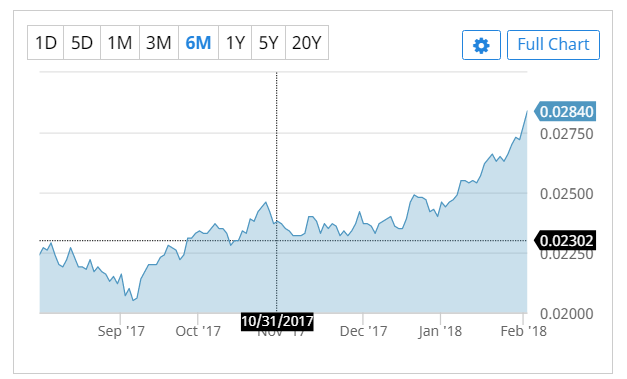
And this one is the 10-year for the past 20 years. Basically straight down.

The key takeaway here is the interest rates are STILL VERY LOW HISTORICALLY. This is actually good news for the economy and stocks. Thus it is our take that 1) We had a bad week last week 2) Things will calm down this week and in the coming months, and 3) Good solid companies will continue to thrive and grow as the US economy continues to strengthen.
Easy for us to say. Hard for you to implement. We understand that. But we want you to put this past weekly move in perspective. The market is where it was just three weeks ago, at 25,500. A year ago it was at 20,000.
The big oil companies came up a bit short on the earnings front last week. Most of the Street was expecting good things, as the price of crude has remained strong at $65. But Exxon’s production dropped by 130,000 barrels a day and has lost money now for 12 quarters a row on its US drilling business, even as US production touched the record production of 10 million barrels a day in November, the previous record being set in 1970. Plus they took a $1.3 billion write-down on its natural gas business. But overall, Exxon made $3.73 billion, a decline of just 2%. These big companies are expected to generate huge amounts of cash in 2018, so we aren’t feeling too sorry for them. The number could be over $40 billion, in excess of dividends and new spending.
Super Bowl Sunday is here! $5 million for a 30 seconds ad. Over 110 million viewers likely watched. The legacy of Tom Brady’s Patriots against the surprisingly better than you think Eagles. The Patriots are favored by 4.5 points. It is interesting. Very often in sports or in the markets whatever people expect to happen, doesn’t materialize. For all sorts of reasons: Cognitive dissonance. Conservative bias. Confirmation bias. Extrapolating past performance. Loss aversion. Overconfidence. Self-control. Regret aversion. Affinity. Status quo. The list of mental mistakes people make when investing is long and always at play. We saw a 666 point drop on the Dow on Friday. This was the 3rd largest one-day point decline in history. The market is digesting something. The Bull & Bear indicator managed by Merrill Lynch has finally flashed a firm sell signal after weeks of overextended conditions. We will see what happens Monday. The unexpected could happen. Just like in football.
No matter what is happening out there, there is always a bull market here at The Bull Market Report! This week we highlight: Microsoft, Google, Amazon, Facebook, PayPal, and Blackstone.
Key Market Measures

BMR Companies & Commentary
Microsoft (MSFT: $92, down 2%)
Revenue was $28.9 billion and increased 12%. EPS hit a solid $0.96 crushing the $0.87 consensus. This quarter’s results speak to the differentiated value Microsoft is delivering to customers across productivity solutions and as the hybrid cloud provider of choice. The firm’s investments in IoT, data, and AI services across cloud, position the business to further accelerate growth. In particular, Microsoft delivered another strong quarter with commercial cloud revenue growing 56% year-over-year to $5.3 billion, which is just amazing to see such a huge growth figure in the lucrative cloud opportunity. Guidance for Q3 was largely in-line or better than consensus expectations. All in all, a very good quarter.
BMR Take: Microsoft is a stock market darling. The business is well-rounded. Legacy Window products to the up and coming Azure product in commercial cloud. We see Microsoft continuing to piece together solid earnings results in the year ahead. With $4.25 of EPS in direct sight, the stock still screens reasonable at around 22x.
----------------------------------------------------------------------------------
Google (GOOG: $1,112, down 5%)
Revenue of $32 billion increased 24% from a year ago. EPS of $9.70 just missed the consensus for $10.00. Overall, we are interpreting the quarter’s results favorably (unlike the Street.) Mobile and desktop search along with YouTube are powering accelerating growth and these trends should drive sustained above average growth going forward. Google Cloud momentum is good now generating $1 billion in revenue per quarter, where the number of $1 million or more contracts across cloud products tripled in 2017. Google has now sold ‘tens of millions’ of its Mini, Max, and Chromecast devices as Google Assistant is now on over 400 million devices globally. Waymo’s progress is accelerating. They plan to launch a ride-sharing program in Phoenix operated by self-driving cars this year. Wow.
BMR Take: We really don’t care much about the slight EPS miss. The stock being down is an opportunity to accumulate shares. Scouring through all the analysis on the quarter, nobody is really saying anything that seriously concerns us. What we want to see going forward is more progress on the cloud business. Amazon AWS is now at 35% market share versus Google Cloud only in the high single digits. If Google can close that gap, this stock can continue its strong move higher. With nearly $50 of EPS coming into view, the current valuation of 23x is far from stretched.
----------------------------------------------------------------------------------
Amazon (AMZN: $1,430, up 2%)
Amazon is crushing it. What else is new? (!) Net sales increased 38% to $60 billion in the fourth quarter, compared with $44 billion in 4Q16. EPS of $6.15 was well above $4.90 a year ago. There is so much to discuss here. What we are really excited about is the Echo business. Earlier in the year Amazon introduced three new Echo devices: the all-new Echo ($100), featuring a new design, improved sound, a lower price, and a choice of colors to personalize your device; Echo Plus ($150) with a built-in smart home hub so customers can easily set up and control their smart home devices; and Echo Spot ($130), a compact Echo with a screen so you can see the weather, get the news with a video flash briefing, view lyrics with Amazon Music, watch a camera monitor, browse and listen to Audible, and more.
This new business opportunity could be huge. Said Jeff Bezos, Amazon founder and CEO, “Our 2017 projections for Alexa were very optimistic, and we far exceeded them. We don’t see positive surprises of this magnitude very often — expect us to double down. We’ve reached an important point where other companies and developers are accelerating adoption of Alexa. There are now over 30,000 skills from outside developers; customers can control more than 4,000 smart home devices from 1,200 unique brands with Alexa; and we’re seeing strong response to our new far-field voice kit for manufacturers. Much more to come and a huge thank you to our customers and partners.”
While Amazon doesn’t break out the financials on Alexa and its other electronics business, the results from its cloud-computing business, Amazon Web Services (AWS), were obvious and contributed much more to the company’s record profit total. AWS saw revenue shoot 45% higher to $5.1 billion, with profits of $1.3 billion. Wow – that’s 26% after tax. AWS and the tax gain of $790 million for the changes in the U.S. tax code, which lowers Amazon’s tax rate to 21%, were the biggest contributors to the company’s overall net income of $1.86 billion. Watch for a possible spin-off of the cloud business sometime this year. Can you imagine what this will do to the stock? Does “shoot higher” ring in your head?
BMR Take: Look, when Jeff Bezos gets surprised by how good a business is doing, and says he is doubling down, you have to take note. But don’t just take note. Take action on it too. You have to have Amazon in your portfolio. You can’t look at the business on current revenue or earnings and say it’s cheap or expensive. It’s an innovation machine. They are constantly doing start-ups, like Echo. More new paid members joined Prime in 2017 than any previous year — both worldwide and in the US. The business is roaring with momentum and still has a very bright future ahead even at the current stock price level.
----------------------------------------------------------------------------------
Facebook (FB: $190, flat)
Flat for the week. Not bad in the whole scheme of things. Facebook increased revenue 47% to $13 billion. EPS of $1.44 was up 19%. What a good quarter frankly. Though while 2017 was a strong year for Facebook, it was also a hard one," said Mark Zuckerberg, Facebook founder and CEO. "In 2018, we're focused on making sure Facebook isn't just fun to use, but also good for people's well-being and for society. We're doing this by encouraging meaningful connections between people rather than passive consumption of content. Already last quarter, we made changes to show fewer viral videos to make sure people's time is well spent. In total, we made changes that reduced time spent on Facebook by roughly 50 million hours every day. By focusing on meaningful connections, our community and business will be stronger over the long term."
Some analysts were scrambling a bit to figure out what this all mean. But monthly active users increased 14% from a year ago to 2.13 billion. Essentially, the issue is that Facebook has had a huge growth engine coming from adding users. Seriously 2.2 billion users is huge. The runway here is slowing down and that means Facebook is going to have to find another way to take over the world. And that is what Zuckerberg is saying. They will be focusing on quality of usage and fully monetizing existing users.
BMR Take: The company is look at EPS growing from $5.40 in 2017 to $8.70 in 2019. It is not easy to find a 20% earnings growth story. We really like the global platform Facebook has built and all the future opportunities it creates for advertising and other revenue opportunities. We see the same story here as elsewhere in large cap tech, trading for 22x is just not stretched.
The stock hit a new all-time high of $195 on Thursday and even traded at $194 on Friday, before the deluge. What a great company.
Stay the course.
Look at this 5-year chart. Where do you think it is headed, as it moves to 2.5 billion users?

Active Users Chart

----------------------------------------------------------------------------------
PayPal (PYPL: $77, down 10%)
PayPal delivered strong numbers. Revenue increased 26% to $3.7 billion. EPS increased 57% to $0.50. Overall, PayPal had a transformative year in 2017. The company brought record numbers of new customer accounts to the platform by simplifying life for consumers and merchants.
PayPal also substantially expanded its opportunities for future growth and redefined its competitive position through successful partnership strategies. For example, PayPal and Synchrony Financial announced an agreement expanding their consumer credit relationship. Under the terms of the transaction, Synchrony Financial will acquire PayPal's U.S. consumer credit receivables portfolio, which totaled approximately $6.4 billion at the end of 2017.
BMR Take: So why is the stock down? PayPal and eBay have signed a term sheet to make PayPal available as a way to pay on eBay, through July 2023. But the fact that PayPal’s exclusivity on eBay is going away has people up in arms. This aspect of the PayPal and eBay relationship has been well-discussed and should not surprise people. Don’t let it fool you.
We look at PayPal like this. This quarter new customers increased 9 million up to 227 million total customers. Facebook has over 2 billion users. With time PayPal could look a lot more like Facebook. That means massive growth still lies ahead. We believe in riding this train. We are talking about the next gen MasterCard or Visa here. A 10% drop in the stock is a good opportunity to take advantage of.
----------------------------------------------------------------------------------
The Blackstone Group (BX: $35, down 4%)
Total revenue ended the year at $7 billion up 39% from last year. EPS of $2.21 compared to just $1.56 a year ago, a huge 42% jump. This business is grooving! It was another strong quarter of core business trends. Specifically, total assets under management increased an elevated 12% sequentially to a record $435 billion, driven primarily by $62 billion of inflows. Capital deployment of $20 billion in the quarter represented a record. And dry powder remained elevated at $95 billion, which bodes well for future capital deployment levels. Just to put that in perspective, Blackstone realized half of the $7 billion of revenue this year from carried interest on prior year inflows, that were deployed to generate big gains of which Blackstone gets a percentage of the profits.
You are telling me the company has $95 billion to put to work to do more of this? Let’s assume on average they can collect a 10% carry on that money. They just doubled the business.
BMR Take: It was a truly exceptional year for Blackstone, reflected by outstanding earnings growth and record capital activity that drove their highest-ever level of aggregate cash distributions to shareholders. Blackstone’s tireless drive to innovate has enabled the company to launch large-scale new product areas that reach a wider client base and serve existing clients in new ways. Our investors in turn have entrusted the company with more capital than ever before, leading to a new record total assets under management of $435 billion, up 18% year-over-year. The stock is a good value at just 10x the current EPS of $3.25.
----------------------------------------------------------------------------------
----------------------------------------------------------------------------------
Economic Calendar
Total Light Vehicle Sales
Monday, February 5th, 10:00 AM
Period: January
Consensus: 17.2 million
Prior: 17.8 million
Consumer Credit
Wednesday, February 7th, 3:00 PM
Period: December
Consensus: $19.5 billion
Prior: $28.0 billion
Initial Claims
Thursday, February 8th 8:30 AM
Period: February 3rd
Consensus: 233,000
Prior: 230,000
----------------------------------------------------------------------------------
----------------------------------------------------------------------------------
Apple Reports Earnings
Apple (AAPL: $161, down 6%) sold 77 million iPhones in the holiday quarter. Apple’s forecast for the next quarter was also lighter than expected. Apple says they expect to sell 50 million iPhones this quarter, slightly lower than the Street expected, and this equates to slightly lower revenue and the main reason the stock got hammered last week.
Apple still blew past its own and analysts’ expectations for revenue and profit for its fiscal first quarter, reporting record sales of $88.3 billion and net income of slightly more than $20 billion. The company was able to increase revenue by 13% year-over-year by increasing iPhone prices and generating more money from the people buying Apple’s smartphones.
Apple jacked up the price on its premium iPhone X smartphone, starting the 10th-anniversary model at $1,000, pushing the average selling price, or ASP, of an iPhone far higher than analysts had ever experienced. IPhone buyers paid an average of more than $796 for their phones in Apple’s fiscal first quarter; iPhone ASP had never previously topped $700.
Apple also boosted its software and services segment revenue 18% year-over-year in the quarter to $8.5 billion. And listen to this:The App Store, Apple Music, iCloud and Apple Pay all had their biggest quarters ever.
Apple said, “During the week beginning Dec. 24, a record number of customers made purchases or downloaded apps from the App Store, spending $900 million in that 7-day period, followed by $300 million in purchases on New Year’s Day alone.”
“Other products” revenue grew the biggest of all. This includes smartphone accessories like the Apple Watch, which grew sales 50% year-over-year for the fourth consecutive quarter, as well as AirPods. Revenue hit $5.5 billion by selling such hardware, up 36% more than a year ago.
Apple is capitalizing on the opportunity at hand by producing more money out of iPhone users in every way possible. Apple is making more money on each iPhone, selling a few accessories to go with it, then signing up iPhone users for monthly subscription plans for services such as Apple Music and iCloud.
If Apple Music continues to grow at its current rate, it will officially overtake Spotify this summer as the streaming world's number one service. Apple Music has a monthly growth rate of around 5%. Spotify has a growth rate of just around 2%. If that keeps up, Apple Music will officially bump Spotify off the top in summer - and there's no reason to believe it can't, given that part of Apple's success in building an audience for Apple Music lies in the fact that the service comes bundled with most of the major devices the company sells.
BMR Take: The all-time high of $180 was hit January 18th. Two weeks ago the stock was down $7 and last week $11. Looks like a sale is going on in shares of this great company. Wait until that overseas cash starts hitting the books here in the US.

----------------------------------------------------------------------------------
VMware (VMW: $123) is Wrapped Up in a Dell Move
One way or the other it’s time to move on from VMware. Why? Dell Technologies owns 80% of the company and is discussing in the press whether to have VMware buy Dell in order for Dell to go public. It’s a back door tactic very rarely, if ever used before. It has impacted VMware greatly because no one really knows how it is going to play out. It looks like VMware might end up owning Dell, creating a behemoth Tech company consisting of Dell, VMware and EMC, plus a host of other tech businesses like cloud computing and cybersecurity. This might be a good investment, but little is known of its financials at this time, so we feel it best to wait and see how things shake out.
VMware was much higher a week ago, and Wall Street is quite nervous because it doesn’t really understand what is going on. The Street doesn’t like uncertainty, remember? (!)
BMR Take: We added the stock a year ago at $83 and we are up a shade under 50%. We think that’s a nice return (a GREAT return) and with everything going on with these new moves by Dell, we think it is time to take profits, sit on the sidelines and watch. Dell may be a stock to buy someday after they go public, but we will leave that decision for another day.
----------------------------------------------------------------------------------
----------------------------------------------------------------------------------
The High Yield Corner
By Michael Foster
Vice President of High Yield
After the S&P 500’s 2% drop on Friday, which has inspired headlines such as “stocks have worst decline in 2 years”, it’s easy to lose sight of the fact that the S&P 500 is up 3.4% YTD.
Before the decline, stocks were up 7.5%, so a drop was clearly necessary [so they say.] Investors who have gotten comfortable with a bull market may be a little scared, because they aren’t used to down days. And it’s easy to forget what is driving the bull market. Wages are up nearly 3% in the U.S., unemployment keeps dropping, corporate earnings are rising, and, perhaps most impressively, this strong economy is being mirrored around the world. The typically cautious IMF and World Bank have asserted that growth is strong around the world, and while these institutions have made a lot of blunders in the past, they aren’t SO euphoric as to bring out the contrarian bear in us.
For high yield, the cautions are amplified. Riskier income producers like Government Properties Income Trust (GOV: $16.65, down 7%) and AllianzGI Equity & Convertible Fund (NIE: $21, down 5%) are down heavy, although they operate in very different markets and are entirely different asset classes (REITs versus convertible bonds and covered-call stocks). To wit: the AllianzGI’s 5% decline on the stock is far steeper than its 2.9% NAV decline, which is itself slightly better than the S&P 500’s 3.2%. Now, of course we can’t read too heavily into short-term price movements, but at the very least this tells us something about the AllianzGI Fund: it is not making extremely risky bets on very volatile assets, so it isn’t in any danger right now. So why did it sell off in excess of its NAV selloff? You got it. Because of fear. And that’s why the fund remains a buy. It’s up 1.6% for the year, lagging the overall market by a bit.
And what about Government Properties Trust (GOV: $16.65, down 7%)? We recommended this REIT back in 2016 and although the REIT is down 7% since then on a price return basis, much more importantly its dividend has not been cut since then, and investors have actually gotten cash dividends of about 19% on their original investment since our recommendation. As a result, we’ve made a profit on a total return basis. And the dynamics of the fund haven’t changed. The REIT’s FFO over the last 12 months is $2.28, while the dividend is $1.72. Thus its FFO is 133% of dividend payouts, so it’s out-earning its dividend. There is no threat to the dividend stream in the short term, and rising rents thanks to a booming economy mean FFO will go up, resulting in even higher FFO coverage.
The income stream here is not at any risk, despite the implications of the recent absurd sell-off. Revenues have been rising by about 8%, so we don’t see any indication that revenues can’t support the current dividend payout. For this reason, there’s no reason to be more cautious about Government Properties, and plenty of reason to shrug off the recent price declines. In fact, it is a great time to add more to this very stable company that is absurdly undervalued.
Elsewhere in REITs, declines were much less severe. Only Omega Healthcare Investors (OHI: $26, down 3%) saw a decline in-line with the S&P 500, but that’s not surprising. We’ve discussed at length why this company’s dividend hikes are threatened, but the threat won’t materialize for years (we’ve estimated 5 years). Dips are buying opportunities for now, as long as investors are cognizant of the fact that the dividend hikes won’t last forever and the stock could sell off in a few years as a result. But if you want a strong and secure high income stream now, Omega is one way to do it.
Digital Realty Trust (DLR: $108) was the second-best investment in the Bull Market Report High Yield portfolio. It was flat for the week. That sounds bad, especially if you’ve gotten used to gains upon gains and few down days, which has been the market norm since the High Yield portfolio began in 2016. But it also shows, interestingly, that the market has a lot of confidence in Digital Realty (which also outperformed a lot of the Tech sector). This week, Amazon, Apple, and Alphabet reported earnings that proved the world’s demand for data centers isn’t going away. Alas, Digital Realty’s yield is tiny, but as an investment in a good company, it’s a great option for investors.
Apollo Commercial Real Estate (ARI: $18.14, down 1%), Ventas, (VTR: $54, down 3%), and Welltower (HCN: $58, down 3%) all saw slight declines, which we can consider to be more a result of REIT investors following the broader market trend. No big news came from any of these companies last week to warrant the selloff.
Similarly, AstraZeneca (AZN: $36, down 2%) fell a lot less than the broader market after weeks of strength in the Biopharma sector. AstraZeneca has not released any major news and there wasn’t any major sector announcements. We can dismiss this 2% decline as being relatively good in a week of short-term worriers cutting bets on all kinds of things more because of fear than for any fundamental reason.
Now, on to municipal bonds. The end-of-year sell-off in this asset class in anticipation of 2018’s rate cuts meant that these funds were attractively priced for income investors, and we still think long-term capital gains are in the cards. What we need to see is the market get used to our new Fed Chairman. While Janet Yellen did a wonderful job of managing monetary policy and bringing the Fed funds rate closer to historical norms, the job isn’t done. Jay Powell has already said that he will continue in the same mode. And that will limit enthusiasm for municipal bonds. that is, until the booming economy results in higher tax revenues for municipalities that, in turn, results in credit upgrades and thus increasing NAVs for our muni Closed End Funds. The timing on this eventuality is unclear, but there is good reason to be confident that it will happen eventually. Nuveen AMT-Free Municipal Credit Fund (NVG: $14.48, down 3%) and Invesco Municipal Trust (VKQ: $11.83, down 4%) are worth holding for the tax-free income as we wait.
PIMCO Dynamic Income Fund (PDI: $30) is the only High Yield holding to be up for the week, and for that we are grateful! But just as there’s little to read into the short-term declines, the short-term gain here isn’t a reason to celebrate. The market is all about short-term emotion-driven trading. If anything, the fact that the panic didn’t hit the Pimco fund may indicate that no matter how crazy the broader market is, we aren’t in full-blown panic mode. And that, quite possibly, could mean this correction won’t last very long.
Good Investing,
Todd Shaver, Founder and CEO
The Bull Market Report
Since 1998