
The Weekly Summary
The big news this week was Davos. Davos is an annual event hosted by the World Economic Forum that’s mission is to improve the state of the world by engaging business, political, academic, and other leaders of society to share global, regional and industry agendas. Davos is a mountain resort in the Alps of Switzerland. All of the top brass from companies and countries attend. Trump rocked the party with his message of America first. He said America first does not mean America alone, and that America is open for business. He promoted our 3% GDP growth, our massive tax reform, and our historic reduction in regulation. We put a billionaire in office exactly to do this. The S&P 500 is already up 6% so far this year and Trump’s deals in Davos could drive gains higher.
No matter what is happening out there, there is always a bull market here at The Bull Market Report! This week we highlight: Gilead, Shopify, Bristol Myers, Nutanix, Google, and Tesla.
Key Market Measures

BMR Companies & Commentary
Gilead (GILD: $86, up 6%)
Gilead has had a tough time since 2015; however, its fortunes may finally be changing. The big event is that Celgene is buying Juno Therapeutics for a 50% premium. One of Juno’s most promising drugs directly competes with Gilead. Clearly, Gilead is playing in the right sandbox. The Wall Street research firm Jefferies poured some gas on the fire of excitement now burning for Gilead. They upgraded the stock this week and said to look for good things to happen soon. The company is looking at a February approval and launch of a drug for HIV, and highlighted some key Phase 3 data on another drug to be released by 2019.
BMR Take: The stock appears to be inexpensive at this level, as it trades at just 8x this year’s EPS of $8.70. But we know that earnings are set to decline to $6.50-$7.25 over the next few years as Gilead’s top two drugs face declining sales. These two drugs were among the top three best sellers of all time – but nothing lasts forever. Could Gilead fetch 15-20x EPS when the dust settles and new drugs re-invigorate some excitement? Possibly, but it’s going to take quite some time.
As you may remember, we had the stock in our portfolio and removed it a year ago as we were tired of waiting. It took a year to come back, but from here we think the run is over for at least the next few years. We will remain on the sidelines.
=========================================================
Shopify (SHOP: $129, up 12%)
Somebody stopped by Shopify this week to work on collaboration for the future of augmented reality. Tim Cook. CEO of Apple. No big deal. (HA!) He praised the companies “profound” emerging technology. No further explanation needed. Apple + Shopify = $1.8 billion added to Shopfy’s market cap, now at $13 billion. Wow.
BMR Take: Tim Cook met with developers and coders and listened to demonstrations. Augmented and virtual reality is a major part of Apple’s future plans. These markets are likely to balloon to $215 billion by just 2021. Maybe Apple works with Shopify. Maybe Apple buys Shopify. Either way we see this all leading to good things ahead for Shopify. Their sales are expected to grow from $660 million this year to $1.6 billion by 2020, without factoring in anything from the possibilities with Apple.
Andrew Left of Citron is crying in his beer. (He’s the guy who shorted the stock at $119 and made a big deal about it in the press. He drove it down to $92, and now is losing money big-time. YES!!! We don't like the way this guy operates.) Remember, if you hear that a stock is heavily shorted, that’s a BULLISH signal. Why? Because after you short a stock the only thing you can do from that point on is to BUY THE STOCK BACK. Very bullish.
Look at this chart:

=========================================================
Bristol-Myers Squibb (BMY: $64, up 3%)
Bristol-Myers received a big regulatory approval in Europe this week. The European Commission (EC) expanded the indication of Yervoy to include treatment of advanced melanoma in pediatric patients. The EC approval marks Bristol-Myers’ first pediatric indication for an Immuno-Oncology medicine in the European Union and allows for the marketing of Yervoy for this indication in all 28 Member States of the EU. This is just a key development for geographic market expansion and ultimately sales. Hip hip hooray!
BMR Take: Bristol-Myers is a leader in Immuno-Oncology. This space is red hot. Bristol’s EPS is expected to grow from $3.00 this year to $4.00 in 24 months. This Healthcare bellwether is overdue for a breakout in the stock. Remember, activist Carl Icahn is making some noise here and pushing for good things for all shareholders.
Looking at the 1-year chart, you can see that it is a slow mover, but steadily up. We’ll take that any day. The company is no small firm. The market cap is $105 billion and the stock is moving towards its all-time high of $74 set two years ago.

=========================================================
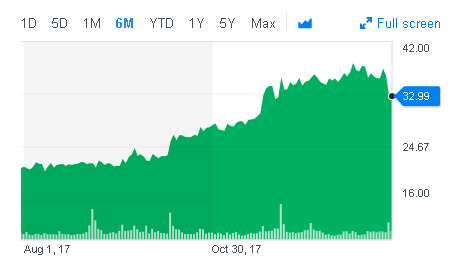
Nutanix (NTNX: $33, down 8%)
Nutanix caught some heat this week from a downgrade at JP Morgan. The report said nothing specific. They said: The market rally has gone on for eight long years. Valuations aren’t cheap. Nutanix is up a lot lately.
We say: Ignore this report – it appears to be just one person’s opinion. We believe there is more money to be made here. In fact, just this week Nutanix spoke to investors about how hosting providers like Amazon Web Services are taking steps to work with customers more broadly to support bare services, expanding the market opportunity for Nutanix.
BMR Take: Nutanix is a must-own stock. “The opportunity of a decade,” says Goldman Sachs. The customer base has doubled in 18 months. The average annual sales per customer is expanding from $1 million to $5 million, fueling greater than 30% top line growth. And we could see this $5 billion market cap company get bought by the likes of an IBM or Oracle any day. The stock is down this week to where it was in December. But in October, just three months ago, it was $22. Stay on this train!
More on Nutanix below.
=========================================================
Google (GOOG: $1,176, up 3%)
The future of the Smart Home is a big deal. Whoever wins this market is going to make some big bucks. Google Home is now installed in 14 million homes and is well on its way to cementing itself as a key player in the space. The Smart Home of the future will allow you to use voice to control your thermostat, your TV, your lights, your locks, your security cameras, your car ignition, your coffee machine, and on and on. The hardware sales and the multi-year services contracts make for a lucrative revenue opportunity. Google is positioning itself to get in on the action.
BMR Take: One thing we really like about Google is its valuation. When you look elsewhere in Tech – like Facebook, Amazon, Netflix, or Adobe – the price to earnings ratios are way up there. Look, we understand growth and innovation can’t be valued just on a price to earnings ratio alone. But that subjectivity in the analysis leaves room for the high flyers to be in for a rougher valuation reversal in a correction. In contrast, Google is set to generate about $42 of EPS in 2018, which is 29% growth from 2017, and the price to earnings ratio is exactly 29. When the price to earnings ratio is equal to or is less than the earnings growth rate you know as an investor you are paying a reasonable price for growth. Again, that is why we like Google’s valuation.
And again, please have no fear of the high stock price. It’s just a number. Pretend that it has a 20-1 split tomorrow. The price would drop to $59. Would you buy more then? It’s all psychological. Google HAS split their stock 2-1 – once – in 2014. They just might be thinking of doing that again. And we would suggest the stock would shoot higher.

=========================================================
Tesla (TSLA: $343, down 2%)
Tesla’s Gigafactory is exciting! Tesla’s mission is to accelerate the world’s transition to sustainable energy through increasingly affordable electric vehicles and energy products. To achieve its planned production rate of 500,000 cars per year by 2018, Tesla alone will require today’s entire worldwide supply of lithium-ion batteries. The Tesla Gigafactory was born out of necessity and will supply enough batteries to support Tesla’s projected vehicle demand.
Tesla broke ground on the Gigafactory in 2014 in Nevada. The name Gigafactory comes from the word “Giga,” the unit of measurement representing “billions.” The factory’s planned annual battery production capacity is 35 gigawatt-hours (GWh), with one GWh being the equivalent of 1 billion watts for one hour. This is nearly as much as the entire world’s current battery production combined. With the Gigafactory ramping up production, Tesla’s cost of battery cells will decline significantly through economies of scale, innovative manufacturing, reduction of waste, and the simple optimization of locating most manufacturing processes under one roof. By reducing the cost of batteries, Tesla can make products available to more and more people, allowing them to make the biggest possible impact on transitioning the world to sustainable energy.
BMR Take: Seriously. Who builds a Gigafactory in Nevada because their business is using up all of the world’s lithium-ion batteries? Only Elon Musk. So innovative. So groundbreaking. World changing. If Tesla is right about the future of vehicles and takes over the crown of the auto industry from the old guards in Detroit, you don’t want to miss out on the future earnings potential of the company and what this stock could do in your portfolio.
As noted last week, we do have a $335 Sell Price on the stock because of our concern about how much capital they will have to raise this year. It would upset us to have to sell this wonderful company run by a genius, but we have to protect our gains. Watch closely this week.
Note on Musk’s New Pay Package:
Tesla announced a huge pay package this week for Elon Musk that again ties his compensation to key performance benchmarks. This time the goals include taking the electric-car maker to $650 billion in market value
Tesla outlined a massive compensation plan for its unorthodox CEO on Tuesday, setting a series of ambitious growth targets that, if various conditions are met, could net Musk as much as $55 billion over the next decade The package is based entirely on performance, guaranteeing no salary and no bonus, and requires Musk to reach aggressive market capitalization and financial goals in order to be paid. He would also have to hold onto his shares for five years after he receives them before selling. Musk would only receive the full payout if the company reaches a market capitalization of $650 billion, a more than 11-fold increase over its current $57 billion market cap.
=========================================================
=========================================================
Economic Calendar
Consumer Confidence
Tuesday, January 30th, 10:00 AM
Period: January
Consensus: 122.1
Prior: 122.1
Pending Home Sales
Wednesday, January 31st, 10:00 AM
Period: December
Consensus: 109.5
Prior: 109.5
Nonfarm Payrolls
Friday, February 2nd, 8:30 AM
Period: January
Consensus: 172.5K
Prior: 148.0K
=========================================================
=========================================================
We got a letter about Nutanix from Stanley Makovsky, of Stan Lee Marketing, one of our subscribers. He said:
"Todd,
Any opinion on the below report?
Nutanix Stock Falls After J.P. Morgan Warns That Software Shift Could Prove Disruptive"
Stanley Makovsky
Stan Lee Marketing
Hi Stanley – I many times take these things with a grain of salt. Yes, the stock is down 8%, but will it stay down here? Maybe. It might go to $30. But that just might be an amazing buying opportunity.
JP Morgan wrote this opinion based on this:
“on concerns that shares could lag those of peers in the near future following a recent rally.”
Lagging peers? What does that really mean? Who cares about their peers.
This is what matters to us:
The last four quarters of revenue:
$275 million
$226 million
$192 million
$160 million.
I call that growth.
Todd Shaver
=========================================================
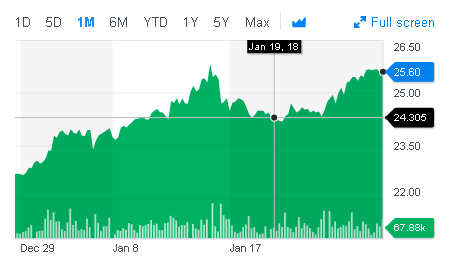
The Carlyle Group (CG: $25.60, up 5%)
We've been pounding the table on this stock for months. On December 19th the stock was $21.50. It's now at $26, up 21%. We are pounding the table on this one NOW. We expect $30 in a few months. Do the math. That's another 17%. We have it on good authority that one of the major stockholders is not selling a share until it hits $30. Our Target is $28, but we sure will be happy to raise it to $33 when it hits $28. The Sell Price is hereby raised from $20 to $24. We're up 54% on this one in less than a year; it's paying a 5% dividend. How can you go wrong.
Look at this chart:
=========================================================
CBRE (CBG: $46) Hits All-Time High
Friday saw another all-time high. Earnings are coming out soon and we understand that they will be announcing another solid quarter. Some say it might be called a blowout. We've passed our Target of $40 so we hereby raise it to $52. Our Sell Price is at $35, so we are raising that to $40. The company is in business to save corporations money with their real estate. And that they are doing with relish. This one is a sleeper.

=========================================================
=========================================================
The High Yield Corner
By Michel Foster
VP High Yield, The Bull Market Report
We wish to do a bit of a deep dive into what’s happening in stocks, the economy, and society at large - and what this tells us about high yield.
The reason we want to do this now is that there is a trend that looks very alarming on the surface that is actually not a problem at all. We’re referring to the incessant bull market of 2018.
January is ending in a few days, yet the S&P 500 is up over 6% already this year. Remember that this index goes up about 8% on average every year, so that a 6% gain in a month is very intense. So intense, in fact, that the market has already hit and surpassed the price target that a lot of big bank analysts had on the market for the entire year.
At the same time volatility is down, the financial mass media is getting more bullish, and the general anxieties in society seem to be drifting further and further away from economic issues and towards other domains of human life - politics, religion, identity. This is usually a cyclical trend.
To explain what we mean, think back to 2005 and 2011. Very different years with very different social concerns and economies. 2005 was the height of the housing bubble - a time when exotic dancers in Las Vegas were buying multiple homes to flip (as brilliantly documented in Michael Lewis’s The Big Short.) But Americans are a contentious bunch, so there was plenty of angst and debate going around - a lot of it about gender equality, the war in Iraq, Guantanamo Bay, race relations, and other things. Little talk about income inequality, wage growth, or other economic issues.
Now think about 2011. This was the time of the short-lived Occupy Wall Street movement. The Iraq War, still going on, wasn’t an issue; Guantanamo Bay didn’t come up unless you brought it up to the protestors. Race relations, gender issues were given brief lip service. But the real concern? Income inequality. “We are the 99%” was a rally cry of socio-economically disaffected people.
Whether or not you agreed with their message, their means or their complaints, doesn’t really matter - not for rational investors like us who want to grow our wealth by understanding what’s happening in the world. What matters much more is acknowledging what was going on and why it was going on. Namely, 2011 was a time when political and social unrest hinged on economic issues - because the 99% weren’t getting richer and weren’t even getting the illusion of getting richer that the debt-fueled housing bubble gave so many Americans.
Fast forward to 2018. What are the hot topics of the day? Donald Trump is the obvious one. And, again, whether you support Trump or do not, what does matter is acknowledging that the cultural fixation of the moment is on an issue that has relatively little to do with the economy.
From this perspective, 2018 feels a lot like 2005. The economy is, at least on the surface, showing enough strength to keep people from focusing on economic and financial issues. Corporate profits are rising and look to rise even further. Stocks are going up, as are housing prices and U.S. incomes. A weaker U.S. dollar is hurting imports, but it’s also helping exports and encouraging more tourism to the U.S. - another big boost.
What does all this have to do with the stock market and high yield investments? Two things. First, we seem to be at that stage in the business cycle where hope has already turned into optimism. But we aren’t at the point where optimism turns into euphoria, although it’s getting closer and closer on the horizon. In other words, a lot like 2005.
This tells us that the best thing to do is to buy and hold stocks. Stay in the market. Despite the monstrous gains in the market for 2018, the S&P 500 P/E ratio is down from where it was in the middle of 2016, and if earnings growth meets expectations (13% growth for the year), that P/E ratio isn’t going to go up much further.
It also tells us that high yield remains an option, but investors may become choosier when it comes to high yield as we go further into the greedy stage of the business cycle and away from the fearful stage. That could mean municipal bond prices will remain lower while junk bonds remain higher. That may mean little capital gains from Invesco Municipal Trust (VKQ: $12.30, flat) and Nuveen AMT-Free Municipal Credit (NVG: $15.09, down 2%) despite the fundamental strength in both funds’ incomes. Income may begin to rise if municipal bond yields rise alongside Treasuries. It does not mean a big crash in either fund, however - so don’t rush to sell. Just recognize that these funds’ income streams will remain intact, with some possible upside.
AllianzGI Equity & Convertible (NIE: $22.55, up 2%) and Pimco Dynamic Income Fund (PDI: $30, up 1%) are interesting options for investors. Since these funds have exposure to junk bonds and convertible bonds, the continued increase in profitability and financial strength among America’s companies could drive demand for these funds in excess of what we’ve seen in the past. Both have provided strong total returns since The Bull Market Report first recommended them. More good returns are becoming more likely, thanks to America’s increasingly complacent and euphoric economic mood.
Where does that leave us investors, concerned about volatility, wishing to preserve capital, and hoping for a reliable high income stream? It is too early to worry about a euphoric market, but it is time to recognize that worrisome euphoria and the bubbles they produce could come. That could take a couple of years, perhaps even longer. What matters is that we remain keenly aware of what’s happening in our economy and our society in an impartial and calm way, investing accordingly, and constantly looking, listening, and watching.
Good investing,
Todd Shaver
The Bull Market Report
Since 1998