
In America They Trust
Public opinion polls show a majority of voters distrust both presidential candidates for the White House. But don’t tell THAT to the millions of foreign investors that poured billions of dollars into our market last week. Yields on the US 10-year note and 30-year bond fell to record lows on Friday leaving US income investors reaching elsewhere for yield. But if you are a British investor, faced with negative interest rates and a tumbling Pound, US government yields are sweet music. In reality they are the third highest in the world of all major currencies. The Brits aren’t the only ones flooding our stock and bond markets. The financial world is paying a visit. The inscription on the dollar bill needs to be updated: “In America They Trust”.
It is this trust that sent stocks to the best weekly gain in 2016. For the first time in a long while, stocks turned in a better performance than Gold. Meanwhile Crude held its own, amid mixed news. Crude inventories were down 3.2 million barrels but gasoline inventories gained 1 million barrels. On Friday Baker Hughes announced that its weekly rig count increased by 11 to 341. This is the third consecutive gain.
Overall, investors seized opportunities, turning last week’s concerns into sudden confidence. Ironically, this week’s biggest winner was the week’s biggest loser. We are referring to the tremendous drop in fear measured by the CBOE Volatility Index, the VIX (^VIX: 14.77). For the few brave and bold who sold the VIX short a week ago Friday, these lucky soles made a tidy 43% return on investment in a week. This is hardly our style but hats off to those who put their bucks on the line.
Here is How The Major Averages Performed For The Week:

Last week’s economic news in the US was completely overshadowed by the UK, the EU and all related matters. With the holiday-shortened week here at home, this will again be the case. As long as negative European money yields exist and uncertainty prevails, money flows will head west. Happy 4th of July America.
BREXIT LEAVE: A Post Mortem
To leave or not to leave, that is still the question. We pointed out last week, leaving the EU under Article 50 takes lots of time; perhaps two-three years. In this time many things can happen. Rather than adding to the uncertainty, the period of the next few months will form a framework of negotiation between the UK and the EU. This is good for all sides.
Already there are petitions calling for a new vote. International investor George Soros sees this as a real force and believes there will very soon be more signatures on the new petition than there were Brexit Leave votes. Who knows if this will result in a revote on British EU membership, but for all of us investors, it will make for interesting summer watching. This is where opportunities will arise.
Where To Now?
For the past three months, the S&P 500 has traded in a fairly narrow 6% range between 2000 and 2120, including the initial sharp pull back from Brexit Leave victory.
This type of trading range market is why we get excited about events like Brexit. It creates the opportunity to buy good companies at even better prices. While the Brits are sitting on the table negotiating “To Be or Not To Be”, we have a decisive strategy. And here it is:
The Bull Market Report Company Commentary
Buy America
Whole Foods (WFM: $33, Up 6% on the week)/Sprouts Farmers Market (SFM: $23, up 4%) Buy America. This is our investment mantra. What could fit that notion better than the two biggest Organic grocery outfits in the country? Grown, shipped and sold right here with virtually no foreign uncertainties.
Investing in these two companies makes more sense than ever. First of all, there is great value. Both stocks are off about 50% from their all-time highs back in 2013. They trade at about the same 21 times 2016 earnings, less than the average S&P 500 Company. This has never happened before for these two stocks and the market is now starting to take notice. Since the Brexit vote, both have performed like true winners. But there is still lots more good news to come. It is time for action on these two favorites.
Splunk (SPLK: $55, flat) Another feather in the cap for this company was handed out last week when they inked a multi-year deal with eCommerce giant Groupon to provide a full suite of Operational Intelligence and security. Every day, tons of data is generated from the Groupon eCommerce operation from many different sources and software platforms. Splunk software allows the management of data to be seamlessly assimilated thus allowing maximum usefulness and security.
The agreement signals that Splunk’s software is very much on fire. Wall Street is finally taking note. Over the past 30 days, there have been 25 upward revisions for 2016 and 2017 EPS. Compared with EPS of $0.18 earned in 2015, a 50% increase is predicted, to $0.28 this year. An even larger 75% gain to $0.49 is expected for 2017. Splunk has become a key player in the Operational Intelligence business and now is a great time to own this stock.
CBRE (CBG: $26, down 5%) The Sky Is Not Falling. However, the stock has been hammered by the Brexit Leave decision. The price fell 20% from $31 on June 8, just before the Brexit vote to a low on Monday to just under $25. Is this justified? The answer is no and here is why.
CBRE has enjoyed the benefits of the huge bull market in London office property. The region CBRE classifies as Europe, Middle East and Africa is the fastest growing segment of their global empire. This huge geographic region accounts for 27% of worldwide revenues. But the UK slice amounts to 5% to 10% at most.
Remember, the stock fell 20%, which discounts a great deal of uncertainty. In our view, the price action is telling us that all of the business from this region is going to be lost. This notion is ridiculous.
CBRE management is as good as you will find in the real estate business. Here are two things to remember. If Brexit results in the relocation of the financial industry away from London (which we doubt), CBRE services in places like Paris, Frankfort and Switzerland will benefit. And guess who has a strong base in all of these countries? Additionally, with the drubbing of the British currency, residential property values become more attractive, so there will be increased activity in this market as well. (The same is true to a less extent in Europe).
The PE multiple pre-Brexit is only 11. Even if Wall Street drops the consensus for 2016 by 20% (which we have stated is ridiculous), the multiple is still only 14. The world is not coming to an end. It is time to buy CBRE, the best real estate services company on the planet.
PayPal Holdings. (PYPL: $36, up 4%) Of the 70 technology companies in the S&P 500 index, PayPal has the second largest revenue exposure to the UK at 13%. Should that cause concern? Until last week, the month of June had been pretty tough on the stock, down almost 6%. But our take is that the price decline had already discounted the worst possible outcome for PayPal business prior to the vote. When more sober minds prevailed, the stock staged a strong rally of 4% last week. This is a great example on how to improve investment returns when others overreact.
PayPal’s business model is unique and we do not exaggerate in the least. As a recent public company, they now have the capital and have spent the time to build a financial technology network that is rock solid. Others would love to be in their shoes. Apple, Google and Samsung are trying, but none is close. This makes PayPal a target of acquisition offers. The day any of these big three giants gets tired of playing the payments game at the minor league level, that’s the day when PayPal shareholders cash in big time. With a market cap of $44 billion, this is unlikely. But what is NOT unlikely is for PayPal to continue to dominate and grow. We are holders for the LONG term.
Mazor Robotics (MZOR: $18.32, up 3%) Anybody watching this stock in the past two weeks of market turbulence must be impressed with its relative strength. It acts like a seasoned veteran. We are clearly biased toward this robotic spine and brain surgery pioneer. The fact that the stock is outperforming many giants of the Healthcare industry, tells us that Mazor is on the right track. Our analysis points to a present value of $25. Longer term the numbers are staggering. We invite you to read our full report on the company by clicking on the Opportunities in Healthcare section of The Bull Market Report website, here:
https://www.bullmarket.com/healthcare-portfolio
Gilead Sciences (GILD: $85, up 5%) It was a big week for Gilead as it received approvals in the US and Europe for Epclusa, the first pill to treat all major forms of hepatitis C. This is a breakthrough. No other treatment has ever been given this type of blanket clearance. It can even be prescribed for patients with existing levels of liver damage. When you take just the 2.7 million US hepatitis C cases, the domestic potential alone for Epclusa is enormous. With a PE of only 7 and a dividend yield of 2.3%, Gilead Sciences is screaming to be bought.
First Solar (FSLR: $49, up 5.4%) In the middle of Brexit-driven volatility, the wisdom of owning businesses concentrated in the United States points to First Solar. But the stock certainly doesn’t lack volatility. Monday the stock sold down 9% to an intraday low of $44 before bouncing back. There is an explanation for this tendency.
First Solar focuses on building utility-size solar energy plants rather than residential systems. The company generates business in giant spurts which results in “lumpy revenues.” This is inconvenient but worth it in the long run.
First Solar is able to deliver utility scale solar power for $0.03-$0.05 per kilowatt, less than one half the cost for home-mounted systems. First Solar has all the advantages of being the lowest cost provider. This is a huge competitive advantage.
Short-term swing traders love the volatility but this action is not our style. First Solar is a company we want to own for many years to come. We think the business is just that good. The best approach is to buy and hold. We don’t recommend watching it on a daily or even a monthly basis. Important to remember: As long as the sun rises (Hail to Apollo), there will be opportunities in solar power. First Solar is our first choice.
Goldman Sachs Group (GS: $148, up 5%) According to Barron’s, the stock could rise as much as 30% over the next year if the company buys back stock and cuts costs. The Barron's report said the company's shares have fallen too far, especially after losing 7% of their value a week ago Friday after Britain's referendum vote to leave the European Union. The report stated that the bank's book value has tripled in the last 10 years, while its stock has stayed basically flat.
We couldn’t agree more. Goldman makes money in up markets and down; in high interest rate environments and low. Risky? Well, certainly more so than owning JP Morgan or Wells Fargo (Warren Buffett now owns more than 10% of Wells.) So if you want calmness and lower risk in the Banking sector, go for the big banks. But if you want a stock that has a shot of moving from $150 to $200 in the next year or two, Goldman is your best bet.
Upcoming US Economic News
Washington reserves this week for patriotic and political speeches and very little economic data. Friday is the only meaty day when June non-farm payrolls will be announced. When the data for May showed a gain of only 38,000, that was a big disappointment. A safer bet for June is an improvement of 100,000. Otherwise the Washington data factory is basically taking the week off. We hope you got some time away this weekend as well.
For What It’s Worth Department – George Soros’s Opinions
In a report from Reuters, billionaire investor George Soros a week ago Saturday called for thorough reconstruction of the European Union in order to save it, even though he warned that Britain's vote to leave the bloc makes "disintegration of the EU practically irreversible."
Before Thursday’s vote, Soros had warned of a financial meltdown if Britain voted to leave the European Union. He had said the effects of the decision will likely damage Britain.
"Britain eventually may or may not be relatively better off than other countries by leaving the EU, but its economy and people stand to suffer significantly in the short to medium term."
Soros made huge profits in 1992 by betting against the British pound as it crashed and had to be withdrawn from the European Exchange Rate Mechanism. Many said he caused it.
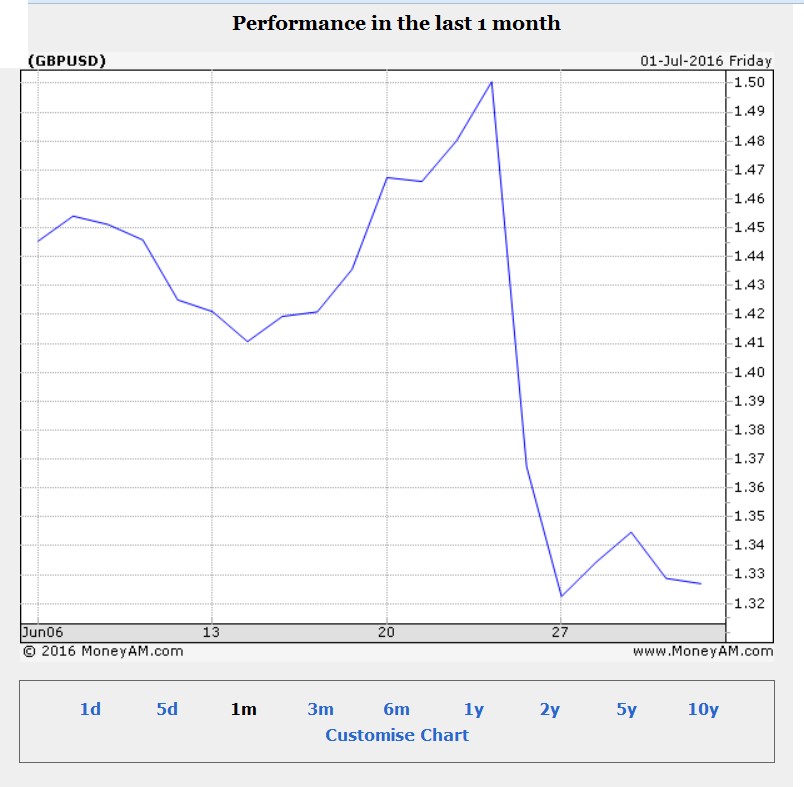
He warned in an article in British newspaper The Guardian, before the vote, predicting a Brexit victory would send the pound down by at least 15%, and perhaps more than 20%, to go below $1.15. What did happen is that the pound fell around 10% on Friday the 24th, hitting a 31-year low, but never went below $1.32. No one knows if Soros bet against the pound, as he declined to comment on whether he placed bets on Brexit. We think he did.
The pound started at $1.50 just before the vote and closed Friday at $1.33, a 30-year low. Some analysts are looking for the pound to hit parity with the U.S. dollar by the end of the year or early in 2017. A team of currency strategists at Bank of America sees the pound ending the year at $1.30. Economists at Capital Economics see it ending the year at $1.20.
THE POUND
"Now the catastrophic scenario that many feared has materialized, making the disintegration of the EU practically irreversible," wrote Soros. "The financial markets worldwide are likely to remain in turmoil as the long, complicated process of political and economic divorce from the EU is negotiated." He said the consequences for the real economy would be comparable to the financial crisis of 2007-2008.
S&P Strips the United Kingdom of Its Triple-A Credit Rating
Standard & Poor's stripped the U.K. of its pristine triple-A credit rating, warning the country's vote to leave the European Union will lead to a less predictable, stable and effective policy framework.
The firm also said the vote for "Remain" in Scotland and Northern Ireland creates wider constitutional issues for the country as a whole.
A Word or Two from Gary Jefferson of Jefferson Financial Group
First Vice-President, Investments
If we heard Brexit once, we’ve heard it a thousand times over the weekend.
As former Secretary of Defense Donald Rumsfeld once famously said, “... because, as we know, there are known knowns; there are things we know we know. We also know there are known unknowns; that is to say we know there are some things we do not know. But there are also unknown unknowns - the ones we don't know we don't know.”
What we know is that no one was prepared for Brexit... nor were they expecting it. 99.9% of every "expert" we heard opined that the Brits would not exit.
We know there was an unmitigated selling panic across global markets resulting in the biggest ever one-day fall in equity prices in history.
We know the British pound fell to a 31-year low. (Bloomberg 6/25/16)
We know the selling started when hedge funds began unwinding positions. (Fox Sunday Market Futures 6/26/16)
We know the 10-year Treasury note tumbled to 1.47%, hitting a new 150 year low, before ending back up slightly above 1.50%. (Bloomberg 6/27/16)
We know that there are more than enough "pouting pundits of pessimism" crying that "the sky is falling". But this is the key to knowing what you know and don't know when it comes to their dire predictions, or anyone else's for that matter: Countless mainstream analysts and economists are going to be competing amongst themselves trying to predict what will happen next as Britain stumbles toward splitting with the European Union. But no one has any idea how it will all play out……so just ignore predictions. As always, anyone who tells you they know exactly how everything is going to play out is full of you-"know"-what. (pun intended)
We know that uncertainty causes market volatility. Specifically, we know that Brexit unleashed a number of possible and probable headwinds regarding trade, currency, tariffs and regulations. We know we don't know how all this will play out because it has never happened before. And, this uncertainty will create volatility until some things become more certain.
We know that, as the famous sportswriter Blackie Sherrod said, "History must repeat itself because we pay such little attention to it the first time…."
The key is simple: Don't panic. We've been here before. We would agree with this quote we read, "Today's move is going to be just a blip in the markets longer term. Don't get wrapped up in the media and political panic. Stick to the buy and sell disciplines you have always used."
We know that the S&P 500 started the year at 2040, plunged to 1830, then rallied back above 2100. Basically, this worldwide panic crash has, thus far, not done too much more than take back all of this year's gains.
One thing we feel optimistic about is the fact that the carnage in equities has not yet spilled over into high-yield bonds. We have never seen a terrible bear market develop that didn't include a concurrent terrible bear market in the high-yield income area. To us, this indicates that our equity market is still stuck in a trading range. Hopefully we don't go all the way back down to retest the February lows, but we know that is possible because we've already been there earlier this year. Unfortunately, we know that in these kinds of panic selloffs, many leveraged investor accounts get margin calls the next day and they are forced to sell, causing a vicious cycle which drops the market more than expected, but we know these sell-offs are not based on company fundamentals.
Finally, we know that Brexit very probably means no rate hikes in the U.S. and more money printing in Europe, Japan and the U.K. More money means more stimuli and more demand for commodities.
This is more of a clear path for growth than not.
Bottom line: Long-term investors should stand firm, watch for opportunities and take confidence in the fact that every sell-off in history has been followed by a market that has gone on to higher highs over time. The average S&P500 company pays a dividend higher than the 10-year Treasury, and that alone will eventually attract investors back into equities.
Reading Elon Musk’s Mind with Tesla’s Addition of Solar City
Tesla is playing the long game. Musk’s vision isn’t next year; It’s 2027.
And SolarCity (SCTY: $24) is integral to that vision, and that's what everybody is missing here. If the SolarCity deal goes through, then Tesla ($217: up 7%) will be a carmaker; a battery maker, with the Gigafactory being built in Nevada; an energy storage company, selling residential battery packs; and a solar finance firm. Musk says: Put all that together under one roof and you get a company that can give you transportation, heat your home, and do it all off the grid.
Yes, all that debt could eventually be a major problem for Tesla. It’s debt levels are high, but so is its cash level. The $400 million from the 400,000 orders for the new Model 3 certainly help. But it is burning cash at a high level and the things to watch closely is how the company handles this cash burn as we move into the latter part of the decade.
Note that Tesla had a great week after Wall Street hammered the company for announcing the buyout of Solar City. It was up 7% for the week. Wall Street loves this company, as do we, but the stock is not for the faint of heart. There are tremendous risks involved here – the stock could be $300 in a year or $100. We think the former, but buyer beware.
Silver Wheaton (SLW: $25, up 16%) was upgraded by analysts at Credit Suisse from a neutral rating to an outperform rating. They now have a $35 price target on the stock, up previously from $28.00.
Brexit Drives Down U.S. Mortgage Rates, With the 30-Year at 3.48%
• Home-loan costs decline to the lowest level since 2013
• The 30-year T-bond drops close to record low of 2.24%
Rates for 30-year U.S. mortgages dropped to the lowest level in more than three years as U.K. voters’ decision to leave the European Union drove investors to the safety of American government bonds that guide home loans.
The average rate for a 30-year fixed mortgage was 3.48%, down from 3.56% last week and the lowest since early May 2013, Freddie Mac said in a statement Thursday. The average 15-year mortgage slipped to 2.78% from 2.83%, the mortgage-finance company said.
The good news for both buyers and homeowners looking to refinance is that the Federal Reserve isn’t likely to raise interest rates any time soon. Brexit has only heightened concerns about the global economy that have been pushing down borrowing costs since the start of the year.
The average 30-year mortgage rate has been below 4% since the start of the year. It reached a record low of 3.31% in November 2012.
Energy Corner
Exxon Mobil (XOM: $94) announced a big discovery at its new well in the waters offshore in Guyana, called Liza-2. It builds on the success of 2015’s Liza-1. At Exxon’s recent annual meeting, CEO Rex Tillerson declared that first Liza to be the world’s biggest discovery of 2015. Together, the reservoirs could hold more than 1.4 billion recoverable barrels of high-quality oil.
In the virtually unexplored waters of Guyana, the former British colony east of Venezuela, Exxon is going big, having expanded its position to 8 million acres. “To put this in perspective, this is the equivalent of 1,400 Gulf of Mexico blocks,” Tillerson said. Exxon says the 3-D seismic survey that it conducted on the lease was the biggest in company history.
Exxon has 45% of the Liza prospect. Hess (HES: $60) has 30% and China’s Cnooc (CEO: $126) 25%. If Liza is a big deal for Exxon, it’s a bigger deal for smaller Hess, at a $19 billion market cap. In a statement, CEO John Hess called it an “exciting prospect” and “world-class” with additional wells planned.
BMR TAKE: Exxon is reaching for its all-time high of $101 set in 2013 when crude was over $100 a barrel. Crude is half that now and the company is going strong. It is still paying over 3% a year in dividends. We don’t have it in our portfolios, because we can’t have EVERY stock in our portfolios, but we SHOULD have it in our Stocks For Success, because you cannot keep this goliath down.
Almost $400 billion in market cap, it is the 2nd or 3rd largest in the world. And they buy back their own stock like there is no tomorrow. We burn 95 million barrels of oil a day in this world of ours, and Exxon is involved in just about every barrel. (Well, that is an exaggeration. We just wanted to see if you are paying attention. But the 95 million barrels a day is NOT an exaggeration, and our love for this stock is not either!)
UPDATE ON RIG COUNT
Total U.S. rig count (oil and gas) increased by 10
Total U.S. oil rig count increased by 11
The horizontal count increased by 7 (6 are oil rigs)
This brings the increase in horizontal rigs over the last five weeks to 18 (most of them being oil rigs).
This week's report from Baker Hughes brings the largest increase in horizontal rigs since November of last year, with a corresponding large increase in the U.S. oil rig count. Whereas last week's report showed a relatively large decline in oil rigs, these were very low quality rigs and the trend pointed to an acceleration in the rate of new rig additions. This week's increase consists of very high quality rigs, with the bulk being either horizontal or located in very productive basins. After the new additions, the total domestic oil rig count is now back to April levels; a reasonably large increase over a short period of time, but nevertheless still far from being able to compensate for declining production of existing fields.
HIGH YIELD REPORT
Now that the market has fully digested Brexit, just about everything is rallying. The S&P 500 has recovered its losses, but the real action is in high yield, as investors realize income-producing assets in the United States are likely to outperform no matter what happens in Europe.
The clearest winner here are REITs, with the SPDR Dow Jones REIT ETF (RWR: $100, up 5%) enjoying an amazing run in the last week, and bringing other REITs to 2016 highs. Our favorites are doing really well.
Government Properties Income Trust (GOV: $23, up 9%) soared for the week and reached a 52-week high. It’s up 22% in the past year, with most of those gains coming since we recommended the stock earlier this year. With dividends still covered by funds from operations and the expectation that government demand for properties is not going to let up anytime soon, investors are quickly realizing their earlier sell-off of the stock was a mistake.
Similarly, Digital Realty Trust (DLR: $109, up 5%) had a great week as the company’s earnings announcement approaches later this month. Expectations have gotten extremely high for the company, but we’re not worried. Here’s why: Deals with Amazon, AT&T, and other tech giants have been driving their funds from operations higher for over a year, and the growth rate is likely to far exceed their competitors. Digital Realty’s scale and penetration into key geographic regions in California and Virginia give it a wide moat that is increasingly impenetrable.
Business Development Corporations (BDCs) also did a fine job this week, with the UBS BDC ETF* (BDCS: $21) getting a 2.4% rise this week. But for more stability and high income, we are also pleased to see municipal bonds rise, as seen by the iShares National AMT Municipal Bond Fund (MUB: $114) staying flat for the week and keeping its gains for the year.
* The investment seeks to replicate, net of expenses, the performance of the Wells Fargo Business Development Company index. The index is a float adjusted, capitalization-weighted index that is intended to measure the performance of all Business Development Companies (“BDC”) that are listed on the New York Stock Exchange or NASDAQ and satisfy specified market capitalization and other eligibility requirements.
The reason for municipal bond strength? Interest rates. Now that Brexit has put tremendous uncertainty into the global economy, the Fed has little choice but to abandon its plans to raise interest rates in the short term - maybe for the rest of the year. That means less reason for investors to dump munis for lower-yielding Treasuries - and in fact, 10-year and 30-year Treasury yields have fallen t0 all-time lows. This means retirees will need to stick with municipals if they want dividends above 3%, but the municipal bond market is still seeing no rise in defaults or greater stress among debtors.
For this reason, The Bull Market Report is planning to release a series of reports on municipal bond funds with in-depth analysis of which funds will get you the highest yields with the lowest risk. Some of these funds yield over 6% - and that will be tax free for most Americans! That means a taxable equivalent yield of as much as 10%, depending on your tax bracket. That’s a great reason to consider bolstering your income portfolio with municipals, while the strength in the market and the low bankruptcy rate just makes the deal sweeter.
Blackstone (BX: $24.50) Why we love this company.
In Forbes recently, CEO Stephen Schwarzman and Blackstone were profiled. Some excerpts:
Early last year Stephen Schwarzman got a telephone call from JPMorgan. They were helping General Electric unload $30 billion in commercial real estate assets lingering on its books. GE boss Jeffrey Immelt was uncomfortable with the massive financial services business his predecessor, Jack Welch, had slowly built up. Schwarzman was told that the real estate sale was the keystone to Immelt’s reinvention plan.
The hang-up: finding a single buyer for a portfolio that included financing for everything from Mexican warehouses to Parisian office buildings to commercial mortgages in Australia. The billions in real estate and commercial mortgages were scattered across six countries, comprising all sorts of risks. Immelt knew that Blackstone Group was the only firm with three key traits: the global reach to understand all the different assets, the resources to close a deal quickly and the financial firepower to swallow the entire package.
Four weeks later, on Apr. 10, Immelt announced that Blackstone would purchase $14 billion of GE’s assets.
“It was a perfect deal for us,” Schwarzman says. “No one else in the world is set up to buy both equity assets and real estate debt on a global basis.”
Indeed, Blackstone’s massive 2015 purchase, executed flawlessly, announced to the world that there was a new pecking order that put private equity firms on top – with Blackstone at the apex and its chairman and chief executive, Schwarzman, as the most powerful banker on the planet.
In the past eight years Blackstone’s footprint and influence under Schwarzman have become nothing short of breathtaking. Since the financial crisis Blackstone’s assets have nearly quadrupled. More than 85% of its 2,070 employees have joined since 2007, and the firm has introduced dozens of new products. Blackstone has major stakes in 92 companies, from Hilton Hotels and Michaels Stores, to iconic brands like Versace and Leica Camera; it owns thousands of pieces of commercial real estate, including Manhattan’s Stuyvesant Town and Chicago’s Willis Tower, and more single-family homes in the U.S. than any other private entity. In nearly every business in which it operates, including hedge funds and credit, Blackstone is the leader.
In its core private equity business, Blackstone hasn’t had a single fund lose money since it launched its first one in 1987. The average annual returns realized by its private equity funds (19%), real estate funds (20%) and credit funds (14%) have all trounced the S&P 500, which has delivered an annualized return of 10% over the past 30 years.
“There’s some perception that turning out great returns over 30 years is going to stop in year 31,” Schwarzman says. “I don’t know what the reason for that is. People have been saying that since the first 5 years we were in business. We have a system that works.”
On the eve of the financial crisis and the collapse in the stock market, Schwarzman decided to bolster Blackstone’s permanent capital via an initial public stock offering. On June 21, 2007 Blackstone raised $4.1 billion in capital, valuing the firm at $34 billion. The deal was so coveted that China’s sovereign fund invested $3 billion just prior to the offering and agreed to give up its voting rights. Schwarzman held on to 23% and sold $500 million of stock.
“I had this desire for permanent capital,” Schwarzman says. “I just felt something bad was going to happen. The markets were peaking, and I just wanted to be prepared for the nuclear winter.” Within two years Blackstone’s new partnership units (as its shares are formally known) cratered from the $31 IPO price to $4.00. “It was a deluge which didn’t have anything to do with us.”
Schwarzman’s directive to his team of dealmakers was clear: Be smart, be entrepreneurial, but above all, don’t lose capital. A good example: Schwarzman’s 2013 purchase from Credit Suisse of Strategic Partners, a business that raises money to buy investor stakes in existing private equity funds. The big Swiss bank managed about $9 billion. Blackstone ran with it, doubling its assets to $19 billion today.
By nearly all measures business is booming. Blackstone has raised $80 billion for its funds in the past 12 months, dwarfing rivals like KKR, Carlyle Group and Apollo. Perhaps even more impressive is the fact that Blackstone’s analyst program has become the most coveted ticket at elite schools. Some 15,000 candidates from every Ivy League school applied for just 84 positions in 2015. That’s a 0.6% acceptance rate, compared with 4% for the analyst program at Goldman Sachs.
If there is any blemish in Schwarzman’s impressive tenure, it’s probably Blackstone’s stock: While it has returned 63% in the past three years, it is still trading at less than its IPO price and sells at a steep multiple discount to the shares of other asset managers.
Public shareholders hate volatility, and Blackstone’s earnings depend on the timing of asset sales and mark-to-market adjustments. For the 12 months through Mar. 31, Blackstone earned $900 million, an 83% drop from the $5.2 billion earned a year earlier. During the first quarter Blackstone marked its fee-earning holdings down by $1.6 billion as global equity and credit markets went on a roller-coaster ride tied to oil prices and central bank actions. Across the firm’s total assets under management, there was still a positive appreciation during the quarter of $382 million.
Taking a page from “buy and hold” sages Warren Buffett and Jack Bogle, Schwarzman may have devised a novel solution to his earnings-volatility problem. Blackstone recently introduced “core-plus” funds in real estate: essentially open-ended investment vehicles that use less leverage, have longer holding periods and offer lower returns. They also tend to lock up capital.
Core-plus funds are a great way for Blackstone to capitalize on the huge and growing demand among its clients for “safe yields.” These funds charge fees of 1% and 10%, and there is no expectation that Blackstone will “fix” or “sell” the assets. The firm’s $5.3 billion purchase of New York residential complex Stuyvesant Town in 2015 is an example. “Stuytown” is a 68-year-old, 110-building apartment complex just north of Manhattan’s East Village and should generate market rents for a very long time to come. The core-plus real estate strategy gained 4.4% in the first quarter of 2016 alone, and it has already amassed $12 billion in assets.
Perhaps this latest financial innovation – which Schwarzman thinks could reach $100 billion within a decade – will smooth earnings and finally afford Schwarzman the status he thinks he deserves among the financial greats.
Blackstone’s new mantra: “The power of this business is holding the assets forever.”
BMR TAKE: Schwarzman will win in the end. We would be buyers of the stock at these levels. The all-time high occurred last year in the spring at around $44. We don’t see any reason why the stock won’t get back to these levels, and higher in the future. We wish we could tell you WHEN, but while you wait you’ll get a company worth $15 billion that ought to be worth $25 billion, and is paying you 4.5% per year, AND you get to let a master company builder do all the work for you.
Good investing this week!
Todd Shaver, Editor in Chief
The Bull Market Report
LEGAL TERMS/DISCLAIMER
The Bull Market Report editorial staff are not registered investment advisors, broker/dealers, or research analysts.
Readers are advised that the commentary and reports on The Bull Market Report website (the “Website”) and in its newsletters are issued solely for informational purposes and should not to be construed as an offer to sell or the solicitation of an offer to buy any security. The opinions and analyses included herein are based on sources believed to be reliable and written in good faith, but no representation or warranty, expressed or implied is made as to their accuracy, completeness or correctness.
YOU SHOULD VERIFY ALL CLAIMS AND DO YOUR OWN RESEARCH BEFORE INVESTING IN ANY SECURITY MENTIONED IN THE BULL MARKET REPORT, OR THAT IS DISCUSSED ON THE BULLMARKET.COM WEBSITE. INVESTING IN SECURITIES IS SPECULATIVE AND CARRIES A HIGH DEGREE OF RISK. YOU MAY LOSE PART OR ALL OF YOUR PRINCIPAL INVESTMENT.
Readers are urged to consult with their own independent financial advisers with respect to any investment. All information contained in this report should be independently verified with the companies mentioned. Neither The Bull Market Report, nor Todd Shaver, nor their officers, directors, partners, members, contributors or employees/consultants accept any liability whatsoever for any direct or consequential loss arising from any use of information on this website or any use of information in its newsletters.
Todd Shaver and his partners, contributors or employees and consultants may on occasion hold positions in the securities mentioned on the Website. These positions may change at any time. Please note that neither Todd Shaver nor any of the Website editorial staff receives compensation of any kind for mentioning a company on the Website.
The Website is limited to the dissemination of general information pertaining to investments, together with access to additional investment-related information and links. Accordingly, the publication of the Website on the Internet should not be construed by any subscriber, consumer or prospective subscriber as the rendering of personalized investment advice for compensation, over the Internet. We are neither attorneys nor accountants and no portion of the Website content should be interpreted as legal, accounting or tax advice.
Certain portions of the Website may contain a discussion of, or provide access to, positions or recommendations as of a specific prior date. Due to various factors, including changing market conditions, such discussions may no longer be reflective of current positions or recommendations. Moreover, no prospective or existing subscriber should assume that any such discussion serves as the receipt of, or a substitute for, personalized advice from an investment professional.
Past performance may not be indicative of future results. Therefore, no prospective or existing subscriber should assume that future performance of any specific investment or investment strategy, including the investments or investment strategies made reference to directly or indirectly in the Website, or indirectly via a link to an unaffiliated third party website, will be profitable or equal any historical performance levels.
Please remember that different types of investments involve varying degrees of risk, and there can be no assurance that any specific investment will be suitable for a prospective or existing subscriber’s investment portfolio. Historical performance results for investment indices or categories generally do not reflect the deduction of transaction or custodial charges, the deduction of an investment management fee, nor the impact of taxes, the occurrence of which would have the effect of decreasing historical performance results.
USE OF THIS SITE AND THE ASSOCIATED EMAILS THAT ARE SENT OUT SIGNIFIES YOUR AGREEMENT TO OUR TERMS OF USE AGREEMENT