
[Note that the formatting is not up to our normal layout. We are having some editing issues. Next week should be better.]
The Weekly Summary
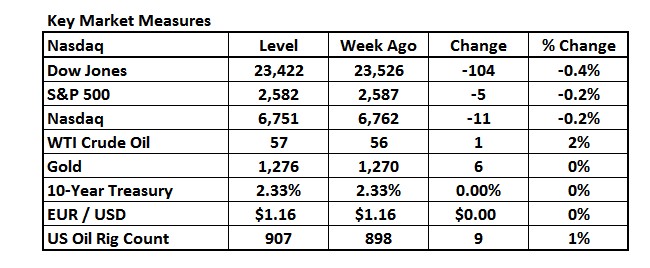
The big story right now remains central banks. The reversal of easy central bank monetary policies across the globe has begun to reverse. Quantitative easing had a meaningful favorable impact to asset prices to the upside. The removal of this stimulus will work in reverse. Accordingly, investors should be prepared for more volatility in the months ahead. Major central banks say they want to normalize monetary policy, which suggests higher interest rates and the eventual end of nearly a decade of quantitative easing. As widely expected, the US Federal Reserve said in September that it would begin the multiyear process of reducing its $4.5 trillion portfolio of US Treasury and mortgage-backed bonds. But it also confirmed that another interest-rate hike is likely in December and we could see three more hikes in each of 2018 and 2019. By this time next year, investors will be staring at a completely different market environment.
No matter what is happening out there, there is always a bull market here at The Bull Market Report! This week we highlight some of our favorite stocks and one not so favorite including: First Solar, Opko Health, Apple, CBRE Group, Twilio, and Andeavor.
BMR Companies & Commentary
First Solar (FSLR: $62, up 3%)
First Solar designs and manufactures solar modules using a proprietary thin film semiconductor technology that is one of the lowest cost in the world. The firm’s objective is to reduce the cost of solar electricity to levels that compete on a non-subsidized basis with the price of retail electricity in key markets throughout the world. What a lofty goal and an exciting opportunity!
What is the most recent progress to report? First Solar has confirmed that PlantPredict, the company’s solar photovoltaic energy prediction software, has been used to generate the reference energy predictions in the sale of three utility-scale projects totaling more than 350 MW.
PlantPredict is a sophisticated solar energy modeling tool designed to develop energy estimates for utility-scale solar PV installations. Easy to use with advanced modeling options, PlantPredict reduces uncertainty to generate more accurate energy predictions. More than 500 companies have already used PlantPredict to model energy predictions for their solar sites.
The transactions demonstrate that the cloud-based modeling tool has gained acceptance by lenders and asset owners as a bankable primary resource in analyzing and predicting performance of utility-scale solar projects.
This is a lot of jargon. What it means is that there remains big demand out there for solar.
BMR Take: First Solar is doing $3 billion in sales and $2 of EPS right now. Looking down the road, we think there is plenty of room in the overall market opportunity for sales and EPS to double. Now that is the kind of growth we love to find.
----------------------------------------------
Opko Health (OPK: $5.50, down 16%)
Opko took an unfortunate nose dive on its earnings report this week. Revenue of $264 million badly missed the consensus for $319 million and was down from $298 million a year ago. OPKNet loss was $46 million compared to a loss of $15 million for the comparable 2016 period.
What the heck happened?
Rayaldee commercial activities continued to progress, but just not as much as expected. Total prescriptions for Rayaldee, as reported by IMS, increased 66% during the three months ended September 30th compared to the three months ended June 30th. Opko expanded its sales force from 35 to 71 as of October 1st. The commercial and medical science liaison teams now total more than 80 professionals.
BMR Take: Many are saying to be patient; that Rayaldee still has big time long term potential and this is just one of multiple opportunities in front of Opko; that revenue is forecast to double from $1.0 billion to $2.0 billion by 2020. Some say that if we see this top line growth, profitability is going to come quickly, and when that happens, the stock is off to the races.
Well, we say hogwash. We are VERY DISAPPOINTED in this company. They have one of the biggest hype machines out there and we have fallen for it. We have waited and waited, being very patient, as the stock goes down down and down.
Look, if you wish to stay in an wait another year, more power to you and I hope the company crushes from here and the stock goes to $15.
But we are OUT. We added the stock 14 months ago at $10 and exit Monday at $5.50. Not happy about this one.
----------------------------------------------
Apple (AAPL: $175, up 2%)
Augmented reality (AR) is a big theme in the markets. The technology is going to shake things up. This means some people are going to make money and some people are going to lose money. Apple is on the right side of the trend.
Apple is working on a augmented reality display. In the company’s most recent financial results conference call, Apple CEO Tim Cook once again made it clear that AR is at the top of his agenda, saying it will “change the way we use technology forever.”
Of the new iPhones and a new version of iOS just released, all boast augmented reality as a selling point. Apple says the A11 Bionic chip inside both the iPhone X and the iPhone 8 series is specifically designed for AR.
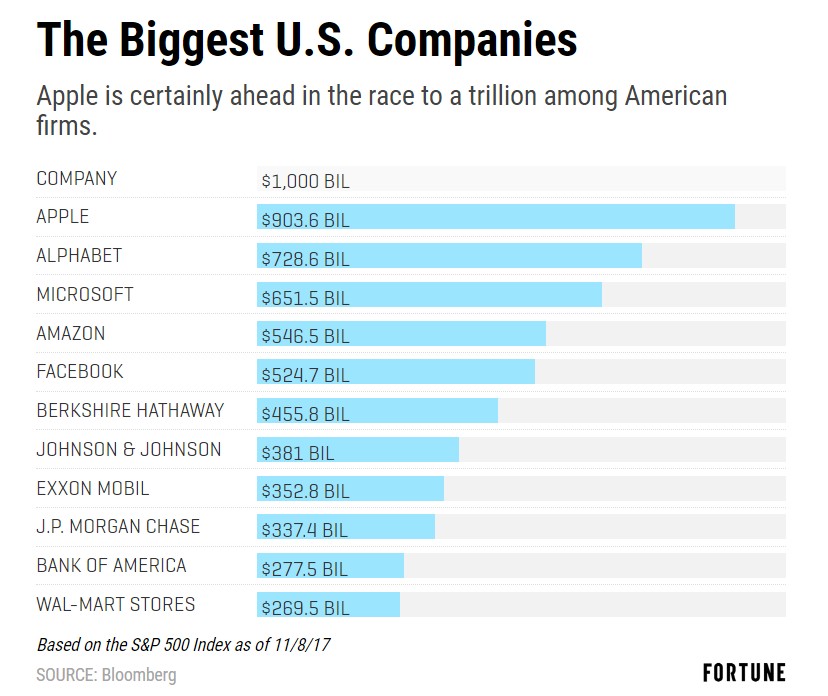
At least 13 brokerages raised their price targets on the stock, with Citigroup making the most bullish move by raising its price target by $30 to $200.Of the 37 analysts that track the stock, 31 had a “buy”, or higher rating. None had a “sell”. With the latest brokerage actions, at least nine Wall Street analysts now have target prices that put Apple’s market value above $1 trillion. Drexel Hamilton is still the most bullish raising their target price further to $235.
Apple has 5.17 billion shares outstanding and could reach the $1 trillion-dollar market cap level if its shares rose to $194.
Apple is already the largest market cap stock in the S&P 500 and made up 4.5% of the index's market cap as of Friday's close. If Apple's market cap rose to $1 trillion, the stock would be 4.75% of the S&P 500's market cap, ranking Apple ninth when looking at the stocks with the largest percentage of the S&P's market cap at year-end since 1980. IBM holds the top four spots with AT&T taking the next two and Exxon and Microsoft (in 1999) rounding out the top eight.
If Apple's stock can reach the $1 trillion market cap some on Wall Street say that it validates the belief that Apple is not just a smartphone business but a platform.
BMR Take: Apple did $9.21 of EPS this year and estimates call for greater than $11 next year. AR technology is the future and Apple’s ability to participate supports EPS growth continuing on like we are seeing now for a long time ahead. Apple set a new all-time high last week and since the stock has passed our Target of $170, we hereby raise our target to the level to which the market cap will reach $1 trillion. That number is $194. Our Sell Price remains: “We would not sell Apple.”
CBRE Group (CBG: $41.50, up 4%)
Never higher. CBRE has never been higher. CBRE is arguably the leading real estate company on the planet. As a highlight of how locked in the company is, look at CBRE Research’s 2017 Tech-30 report that was just published where they demonstrated exceptional expertise. The company ranked the strength of tech job growth across 30 North American office markets, which is creating stability and demand-driven performance through occupancy gains and rent premiums. Four key points are highlighted below.
--- Tech jobs grew four times faster than the national average. San Francisco was the top high-tech job growth market for the sixth year in a row.
--- Eighteen markets added more tech jobs over the past two years than the prior two-year period.
--- Tech’s share of major leasing activity has nearly doubled to 19% over the past five years, resulting in strong occupancy and net absorption gains.
--- Desirable tech submarkets are priced at a premium, while emerging submarkets often offer discounts. The overall average asking rent of tech submarkets is priced at a 16% premium.
BMR Take: We are staring at the company’s EPS power closing in on $3. This stock remains a compelling value at the current level. We don’t see the company doing anything but maintaining and growing its leading market share for the foreseeable future.
----------------------------------------------
Twilio (TWLO: $25.50, down 15%) on Earnings Report
Revenue reported was strong, and you know how we feel about revenue. We will tell you what happened, and let’s stay focused on the long term.
The company lost $0.08 versus $0.04 a year ago. Revenue was $101 million versus $72 million a year ago. The good news is that revenue beat the consensus of $93 million. Moreover, the company guided to a better outlook for the remainder of the year.
So what the happened here? Uber.
While total revenue growth of 41% was strong, we believe it is important to look at the underlying growth of Twilio’s core business. In particular, we consider base revenue excluding Uber, which came in at $87 million, up 63% from a year ago. Revenue from Uber hit $14 million in 4Q16 and came in at $5 million in 3Q17, down 53% y/y. Management expects a modest sequential decline in Uber revenue in 4Q17. The loss of Uber business continues to weigh on results.
Total revenue rose to $100 million from $71 million. Management itself had called for a net loss of $0.08 per share on sales near $92 million. The adjusted loss was right in line with that forecast, but Twilio crushed its own sales expectations.
For the upcoming quarter, Twilio expects an adjusted loss per share of 6 cents and revenue of $103 million. Analysts are predicting an adjusted loss per share of 6 cents and revenue of $99 million.
Jeff Lawson, Twilio’s Co-Founder and Chief Executive Officer said, “We hit a number of exciting milestones in Q3, including our first $100 million revenue quarter, our first enterprise license agreement for our higher level software products, and the launch of Twilio Studio. With Twilio Studio, the visual builder for Twilio, we can accelerate our customers’ roadmaps and help an even larger set of users build on our platform. We are excited by the size, scale and diversity of what new and existing customers are creating with Twilio.”
Recent Business Highlights – released by the company:
46,500 Active Customer Accounts compared to 34,400 a year ago. Twilio Studio was introduced in the third quarter, giving clients a simple drag-and-drop tool to simplify and accelerate their production efforts. Twilio already offers separate production tools for popular platforms such as Android and iOS, but the new Studio streamlines the development process in ways that had not been available before.
Announced our commitment to meet the new GDPR (General Data Protection Regulation) requirements coming from the EU, using this as an opportunity to raise the bar for data protection worldwide for all of our customers.
Expanded the reach of our Super Network by announcing the availability of Twilio phone numbers in more than 100 countries.
Average revenue per user rose 18% to $8,000.
Cash position strong: Twilio held $284 million of cash equivalents at the end of the third quarter, down from $289 million in the second quarter and $306 million by the end of fiscal year 2016.
Guidance: – released by the company:
Full year ending December 31, 2017:
Total Revenue - $387 million
Loss from operations (millions) $22.0 to $23.0
Net loss per share - 0.22 to 0.23
BMR Take: The good news is Twilio continues to innovate and add net new customers at a remarkable clip (3,100 in 3Q17), which is driving strong underlying revenue growth. The company remains one of the fastest top line growers in all of cloud computing.
This company is one the most frustrating that we follow. With another stellar report like we describe above, any normal stock would be up 10%. Not Twilio. Down 15%, now well below our Sell Price of $29. We are going to stay the course but you might get tired of waiting and sell in order to redeploy these assets into something better like Nutanix or Square. With that said, we believe Twilio should be a $50 stock, a long way from where it is today. But again, top line growth will win in the end. Do you and we have enough patience to endure these losses? That is the ultimate question.
----------------------------------------------
Andeavor (ANDV: $107, down 3%)
Could oil breech $80 before Christmas? Some options traders think so. With oil trading near its highest level in two years, some traders are betting that the price rise could have more room to run.
A total of 48,000 option contracts traded over the last few days that would profit most if crude spikes before Christmas, including several large individual trades. They all expire on Dec. 21.
Oil prices have rallied in recent weeks as OPEC supply cuts help to rebalance an oil market plagued by oversupply. More recently, growing tensions between Saudi Arabia, OPEC’s largest oil producer, and some of its neighbors helped prices break above $60 a barrel for the first time since 2015.
Andeavor Reported Third Quarter 2017 Results on November 8th.
Earnings of $550 million, or $3.50 per share; results included the following pre-tax items
Returned $345 million to shareholders including $252 million in share repurchases; they expect to repurchase $300 million of shares in 4Q17
Total retail and branded stations up 27% year-over-year to over 3,100 stores
On October 30th, Andeavor closed its $1.7 billion acquisition of Western Refining Logistics
New totals for Andeavor
Number of Refineries: 10
Refining Capacity: 1.2 million bpd
Employee Count: More than 13,000
Retail Sites: More than 3,100
Barrels of Storage Capacity: More than 46 million
Miles of Pipelines: More than 5,300
Marine, Rail and Storage Terminals: 40
Natural Gas Processing Complexes: 6
States where they operate: 18
BMR Take: Higher oil prices above $80 could be a huge positive for many companies including our beloved refiner Andeavor. Recall, Andeavor’s net asset value is $120 and the stock still trades an unwarranted discount. We think more stable energy markets are the first step needed for good sentiment to return to the oil patch stocks like Andeavor. And we’re certainly on the way with crude being so strong of late.
----------------------------------------------
Upcoming Economic News
PPI ex-Food & Energy
Tuesday, November 14th, 8:30 AM Eastern
Period: October
Consensus: 2.2%Prior: 2.2%
Retail Sales ex-Auto Wednesday, November 15th, 8:30 AM
Period: October
Consensus: 0.20%
Prior: 1.0%
Initial Claims
Thursday, November 16th, 8:30 AM
Period: 11/11
Consensus: 235,000
Prior: 239,000
Housing Starts
Friday, November 17th, 8:30 AM
Period: October
Consensus: 1,193,000
Prior: 1,127,000
----------------------------------------------
A Word from Gary Jefferson
Jefferson Financial Group
First Vice-President, Investments
UBS Financial Services, Inc.
The markets seem to be firing on all cylinders. Is there anything that could derail it before year-end? About all we can see is the Russian investigation (none and no chance), the tax-cut drama (possibly, but more likely to cause a correction rather than a derailment), a government shutdown (slim if any chance at all) or a major Fed rate hike (little to no chance).
A couple of things have caught our attention, however. What usually derails a bull market is a recession. At this point, we don't see the usual suspects that signal a coming recession, such as widening credit spreads, deteriorating market internals, collapsing commodity prices, falling new orders or falling earnings. In fact, it is just the opposite.
However, two things are not making sense from a historical perspective. First, with near full employment and accelerating worldwide growth, inflation remains stubbornly low. This is usually not the case. Inflation signals rising prices and continued rising earnings. It should be readily apparent but it simply isn't expressing itself even at this stage of the earnings growth cycle.
Secondly, if there is one warning signal for an approaching recession that is more reliable than all the others, it might be an inverted yield curve. Since January, the spread between the 10-year Treasury and the 2-year Treasury has fallen from about 1.30% to 0.75%. In our experience, whenever we have seen accelerating revenue growth, rising earnings, potential tax cuts – i.e. so many positives – the yield curve should be steepening, not flattening. Maybe we are experiencing a "new norm" in the markets, or it "is different this time" (the four most dangerous words in our industry), or this is going to be normal as part of the 4th Industrial Revolution we have supposedly entered (artificial intelligence, augmented reality etc.). In any event, we are going to closely follow the lack of inflation and the yield curve because neither is "confirming" this bull market rally as each would normally do if one looks back at the history of the market.
----------------------------------------------
Square (SQ: $39, up 6%) Continues to Shine
A few Wall Street firms had some new announcements on Square this week. The target raised to $38 from $34 at Stephens. They believe the stock "can grind higher" following the company's Q3 report. They still sees Square as likely to change the game for Small and Mid-sized business payments and thinks the likelihood of it achieving true "platform for small business" status gets more likely every quarter.
Square price target raised to $33 from $23 at Craig-Hallum
Square price target raised to $35 from $24 at SunTrust. SunTrust said that it is entering a period requiring heavier investment which will weigh on margin expansion. They said that Square trades at a significant premium of about 60-times FY18 EBITDA relative to 13-times for its peer group.
GoDaddy (GDDY: $48) announced two new integrations with Square that help small businesses thrive with online and offline selling and payment capabilities. By collaborating with Square, GoDaddy is making this an easy reality for tens of millions of people building small businesses. Integrating GoCentral Online Store and Square online payments enables small businesses to easily sell their products and services online and in person through a single Square account and GoDaddy website. The second integration provides service-based businesses, such as personal trainers, hair stylists and photographers, the ability to book client appointments online, sync calendars using GoCentral, and get paid using Square. Payment transactions can be processed online, in-person or both without switching accounts.
Square target raised to $41 from $31 at Cantor Fitzgerald citing accelerating revenue growth. The firm expects Square's "rapid growth" to continue and further margin expansion going forward. He notes that Gross Payment Volume growth remained above 30% in the quarter.
Square target raised to $41 from $31 at RBC Capital. The firm says the Q3 beat and raise for 2017 outlook is indicative of the company's ability to drive its products into existing partners and expanding to larger merchants.
BMR Take: This one has a long way to go on the upside.
----------------------------------------------
Options Corner – All about Square
From time to time we like to bring you an interesting options trade. We like to do long-term bullish trades on stocks, unless we find one that is going to go bankrupt in which case we can design a trade to profit from the demise of a firm using puts.
Square has been knocking the cover off of the ball of late. We added the stock at $17 in March of this year and it is now $39, setting a new all-time high on Friday, so we are up 130% in 8 months, giving us an annualized return of ……. Well, you get the point! A great stock pick. A great stock. Better yet: A great company. With a market cap of $15 billion now, it is moving into the big leagues. We have said quite a few times that Square would be a great buyout candidate for one of the big boys (Amazon, Microsoft, Apple, etc.) but they better move fast before the stock hits $20 billion.
And in fact, we think a $20 billion valuation is quite possible next year. That would equate to a $52 stock. Can that happen here with Square? We certainly think so.
An options trade can produce much bigger returns than this 33% increase, if it were to happen. But guess what? OPTIONS ARE RISKY! Please repeat after us. Options are very risky.
OK. Let’s get started.
We love long term options called LEAPS. They expire in January as long as they have at least six months of life. So the January 2018 options aren’t called LEAPs any more. But the Jan 2019 options are. And soon we should see the Jan 2020 options start trading. We can’t wait.
We like to buy options that are in the money. With the stock at $39, the 35s are $4 in the money. Better yet the 30s are $9 in the money. They are worth $9 but they trade for $13. Why is that? The $4 is the TIME PREMIUM. And note that that time premium will go to zero eventually as it approaches the end of its life in January 2019.
In order to pay for the time premium we like to SELL calls against the long LEAP to recoup this time premium and also to help us get our cost down on the option that we bought. Let’s look at some real numbers.
Buy the Jan 2019 30 LEAPs for $13,Sell the June 45 call for a little less than $6.
The cost of this trade is now $7 for an option WORTH $9. Do you understand this? If not, go back to the top of this article and re-read. These options discussions are confusing the first time, but It WILL come to you if you re-read this 3-4 times. We are serious.
Now, let’s say the stock goes up a bit and is selling at $45 in June. Your June option is going to expire worthless (great) and now you SELL a January 2019 call, say the 50 call, for approximately $7. (We are not sure of these numbers because it is so far into the future but we think this is about right -- we hope you get the point.) The cost of the trade is now zero. You are in this trade for zero dollars. (Gosh, we love this trade!)
Now, let’s tally up. If the stock goes to $50 or higher by January 2019, you will be left with an option worth $20 ($50-$30). If you had bought 10 options for $7,000, they are now worth $20,000, almost a triple (185%), with a stock that went from $39 to $50 or 28%. If you had put $25,000 in this trade (the equivalent of buying 640 shares of Square) you would now have $75,000 and that’s real money.
This options trade will more than likely take lots of tweaking of your position and the return could be better or worse depending on where the stock goes. No one is going to hand you a triple without a little bit of work. But it could be a super trade IF the stock heads to $50.
The downside is that the stock goes down to $30. You will lose money but if you religiously sell calls against your position, you can get your cost down to close to zero, thus minimizing your losses.
Note that if this all-options trade is too risky or confusing to you, you can just do a normal covered call trade by buying the stock and selling calls against it. If you were to buy 1000 shares at $39 for $39,000 and the sell the calls as described above, you would bring in $6000 for the June $45 call and $7000 for the January $50 call giving you a purchase price of $26,000. If the stock goes to $50 you have a $50,000 position, and a return of 92%. Not bad.
But, again, lots of “ifs” in these scenarios. Invest with caution.
----------------------------------------------
The High Yield Corner
By Michael Foster
Last week, AstraZeneca PLC (AZN: $33, down 5%) reported strong revenue and earnings above expectations, but that wasn’t enough to keep the stock from being the biggest loser of the week for the Bull Market Report’s high yield portfolio. A deeper dive into the results can explain what happened—and why this isn’t really a cause for concern.
To start with: revenues rose 9.3% on a year-over-year basis in the third quarter to $6.23 billion with solid EPS of $0.54, which was a little shy of expectations: analysts were expecting just 55 cents per share in earnings. In their press release, the company highlighted weak sales in the U.S. as a cause of the weaker earnings, while also pointing out that weakness was offset by major growth elsewhere: emerging markets were up 5%, China was up 12%, and Japan was up 3%. Those numbers were all higher on a constant currency basis.
But the U.S. weakness is a large part of the stock decline. AstraZeneca pointed to continued weakness in Symbicort as a cause for the weakness; the asthma drug’s challenges have been a major issue for this company, which analysts see as being heavily reliant on for future sales. Nonetheless, a closer look at the drug pipeline indicates there are other sources of growth to come.
More specifically, AstraZeneca highlighted that Lynparza, a breast cancer drug, has received priority reviews in America and Japan, while Imfinzi, a lung cancer drug, has received the same in America while also getting regulatory acceptance in the EU and Japan. A total of 7 drugs got new regulatory approvals as of the end of the reporting period, including two type-2 diabetes drugs that will obviously have tremendous appeal for this widespread ailment.
So the company’s pipeline looks fine. The focus on Symbicort unquestionably overlooks that fact, and provides a buying opportunity at this current price—provided the pipeline remains healthy.
Elsewhere in high yield investing, we saw a really mixed week despite the market’s weakness towards the end of the week. This is pretty unusual—high yield tends to be more volatile in REITs, high yield bonds, and BDCs, but we didn’t see that happen yet. That could mean more aggressive selling is yet to come in late 2017, especially as tax-loss harvesting becomes more commonplace, but that doesn’t change the fundamental strength and attractiveness of many high yield assets.
There are exceptions, however. Municipal bonds were relatively untouched by last week’s jitters, possibly as risk-averse investors were adding to municipal allocations as a result of what they saw in the stock market. Invesco Municipal Trust (VKQ: $12.34, flat) saw little movement on strong volume while Nuveen AMT-Free Municipal Credit (NVG: $15.36, up 1%) gained slightly. Both remain high-quality municipal bond funds with above-average yields and excellent management teams. Neither looks significantly overpriced right now.
Bigger news came from the REIT world, but the news had little effect. Welltower (HCN: $68, up 2.5%) had strong earnings, with FFO per share of $1.08 a 2 cent jump from the prior quarter and NOI up 4.1% on same-store senior housing operations. RevPAR also gained by 3.9%, which helped the company’s revenue rise nearly 1% to $1.1 billion for the quarter. FFO was a 3 cent beat over expectations, and higher earnings guidance (the company now expects normalized FFO per share of $4.19 to $4.25 for the full year) make Welltower’s valuations even more attractive, especially after the stock price remained stuck for the week. Defying negativity in the skilled nursing facility world, Welltower’s massive size and market penetration are proving stores of value and investor safety; the stock is a better buy now than it’s been for most of this year.
*Revenue per available room
That’s it for earnings news this week, but a lack of major news didn’t stop Government Properties Income Trust (GOV: $18.76, up 2%) from having a strong week, thanks in small part to the continued recovery from last month’s anxiety that the company’s earnings results at the end of October proved to be a paranoid non-issue. However, protracted worries about Omega Healthcare Investors, Inc (OHI: $28, down 1%) and their very disappointing earnings are keeping shares down and the yield up at the 9% level. That more than compensates for the risks, which makes this a very appealing option for investors who accept that the dividend growth is likely going to end in 3-5 years’ time. The market is discounting a cut to dividend growth much sooner, making this an irrational price and a good bargain right now.
Elsewhere, we are seeing growing anxiety in Collateralized loan obligations (CLO) and high yield corporate bonds, but that hasn’t stopped AllianzGI Equity & Convertible (NIE: $21, unch.) and PIMCO Dynamic Income Fund (PDI: $30, up 1%) from proving resilient. That’s in no small part thanks to the high-quality management teams of each, which have wisely avoided the more exotic high-yielding CLO markets and shifted towards much safer MBS’s and away from the riskiest junk bonds. The market is rewarding both with price stability. That may not last - after all, irrational selling is still very much a thing in modern markets - but that just means a buying opportunity will open up. Neither fund shows any indication of weakness despite the broader worries growing in the credit sectors.
Good Investing,
Todd Shaver, Founder and CEO
The Bull Market Report
Since 1998
(Again, sorry about the crazy formatting this week.)