
The Weekly Summary
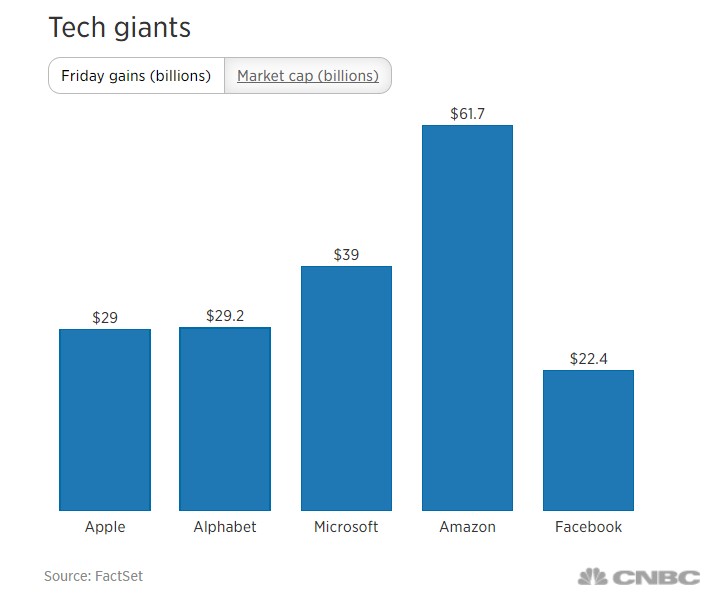
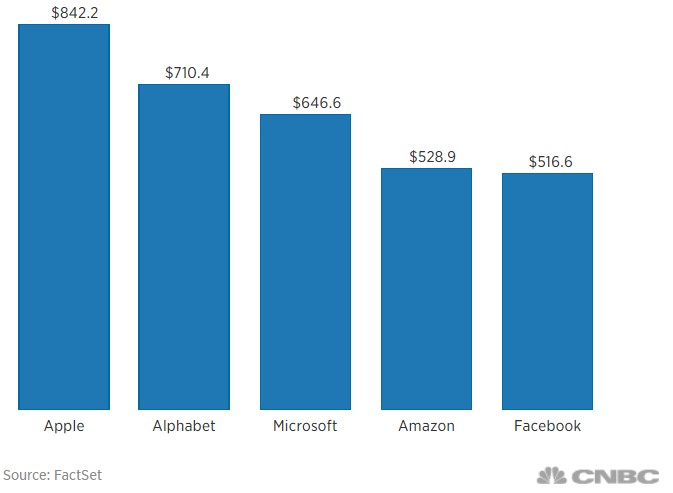
US equities finished the week higher on Friday again. There was a notable rally in Tech with several mega-cap names hitting all-time highs after earnings. Apple, Alphabet, Microsoft, Amazon and Facebook, the world's five most valuable public companies, added $180 billion to their combined market value on Friday. Investors piled into the group a day after Alphabet, Microsoft and Amazon reported better-than-expected earnings. For the stock market, it was more of the same. Those five companies have gained almost $900 billion in market cap over the past year.
Shares of Amazon and Google both surged past the $1,000 mark and approached all-time highs, with Amazon closing above $1100. To many people’s surprise, we continue to see favorable broad market trends with US equities seeing $14 billion of inflows over the last three weeks.
Friday's Gains:
Market Caps:
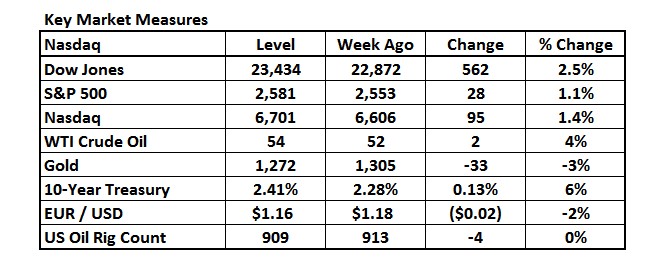
There was nothing particularly incremental on tax overhaul this week, as the House narrowly adopted the Senate budget, paving the way for release of initial tax legislation next week. Trump is leaning toward Powell for Fed chair, and the official announcement is expected next week.
No matter what is happening out there, there is always a bull market here at The Bull Market Report! This week we highlight some of our favorite stocks where you can still make good money, including: Apple, Microsoft, Amazon, Celgene, Bristol-Myers, and UPS and a few others.
BMR Companies & Commentary
Apple (AAPL: $163, up 4%)
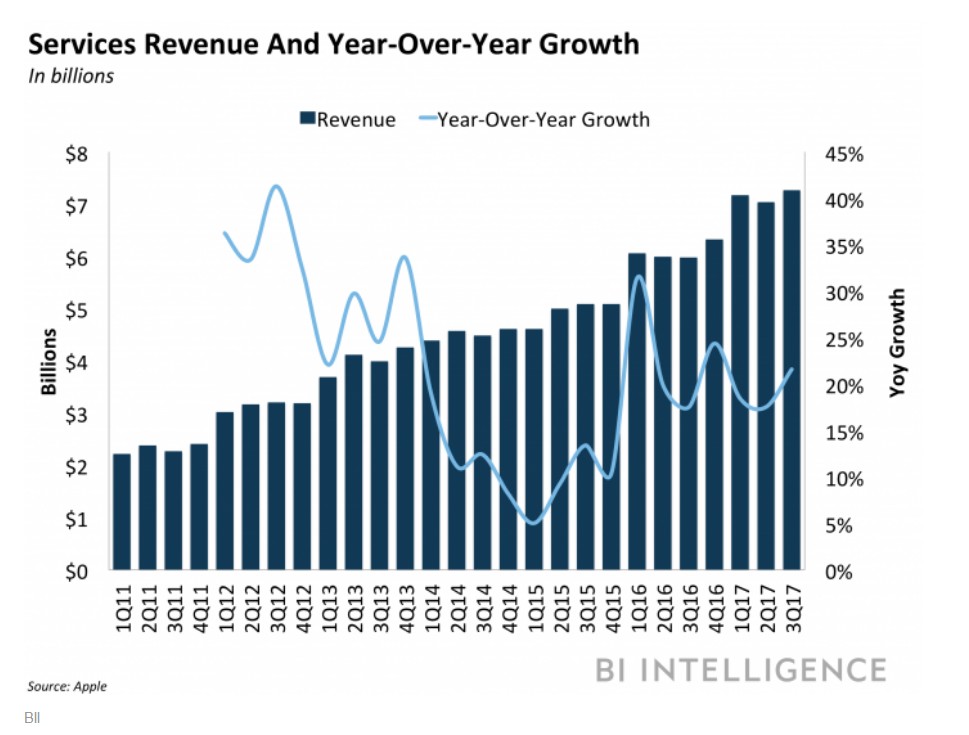
Well, Apple has still got it! Apple sold out iPhone X pre-orders. Thousands of Apple fans from around the world flooded the website to lock in their pre-orders for the iPhone X. Apple sold out pre-orders for the phone to arrive on the November 3rd launch day in 17 minutes, and the wait time has grown to five to six weeks.
Apple said, "We can see from the initial response, customer demand is off the charts. We're working hard to get this revolutionary new product into the hands of every customer who wants one, as quickly as possible."
Why is this so important? Despite major concerns over manufacturing the deluxe iPhone, and the high price of $999, demand is not lacking at all. This finding bodes well for the stock and future prospects.
BMR Take: Apple sold 41 million iPhones last quarter and will sell over 200 million this year. The holiday quarter is the busiest season of the year, of course, and this year Apple is projected to sell over 80 million iPhones in the Christmas quarter, a new record. With iPhone sales fueling great than 10% EPS growth, we continue to see bright prospects for the stock.
Microsoft (MSFT: $84, up 6%)
Microsoft crushed the quarter. Revenue of $24.5 billion increased 12% from a year ago and beat expectations for $23.5 billion. EPS of $0.84 increased 17% from a year ago and smashed expectations for $0.71.
Earnings rose to $6.6 billion, or 84 cents a share, from $5.7 billion, or 72 cents a share, a year earlier. They are still making 27% profits on sales, AFTER TAX! The strength was broad based.
Analysts were most impressed by momentum in cloud that pushed Commercial Cloud above the company's $20 billion targeted goal they set two years ago approximately three quarters ahead of schedule.
Microsoft’s Azure's cloud revenue increased 90% in the period and has exceeded Amazon’s AWS growth for at least eight straight quarters, but Microsoft has yet to break out the unit's sales. AWS controls 34% of the market while Azure has 12%. However, Microsoft is picking up high-profile clients as it adds features, lowers prices and expands data center capacity around the world.
Amazon’s AWS brought in $4.6 billion in sales, which represents an annualized run rate of $18.3 billion. So you heard it here first, Microsoft is leading Amazon in the world of cloud.
Microsoft continues to increase its share in overall IT spending, and momentum in its results was a clear theme this quarter. Margin performance and free cash flow generation also stood out in the quarter.
BMR Take: With the cloud business tracking way ahead of plan, free cash flow per share forecasts now closing in on $5, and with so many other great things happening at Microsoft we continue to view this stock as a core tech holding for any portfolio. The stock blew through our Target of $78 to a new all-time high, so we hereby adjust it to $92. Our Sell Price remains “We would not sell Microsoft.”
Amazon (AMZN: $1,100, up 13% - $129 a share on Friday!)
Revenue: $43.7 billion growing 34% from last year, but only $1.3 billion in sales included from Whole Foods, which Amazon acquired in late-August. North American sales were $25.4 billion, up 35% from last year, while international sales grew 29% to $13.7 billion. Amazon gave fourth quarter guidance in the range of $56-60 billion. Wow.
The company’s net income was $256 million, or 52 cents a share. Analysts on average expected earnings of 2 cents a share. (Now THAT is funny. 2 cents a share expected and they report 52 cents! Gotta love this company.
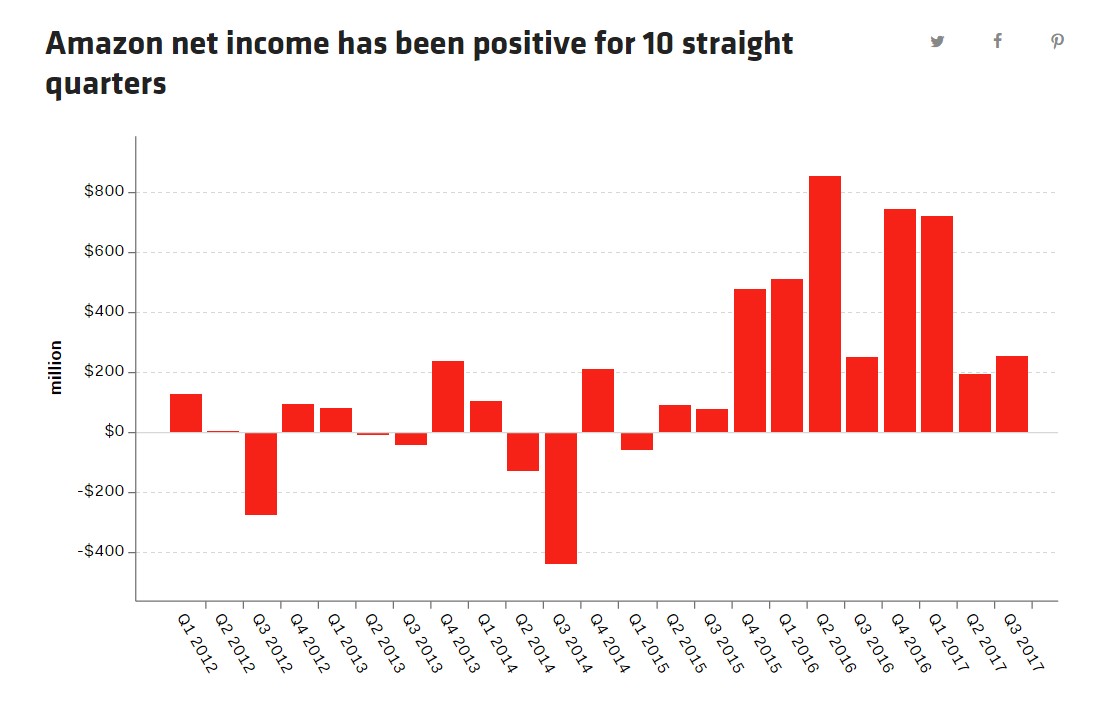
Here we go again! Another industry is about to get “Amazon-ed”. This should be fun to watch and great for the stock:
Pharmacies and Healthcare Distributors continue to trade lower following news that Amazon eying the space. The St. Louis Post-Dispatch reported that Amazon has received approval for wholesale pharmacy licenses in at least 12 states. The topic was discussed further on Amazon’s earnings conference call with the company noting that hospitals and labs were among the areas that could be served under its Amazon Business initiatives. Both distributors and pharmacies are reacting negatively to the perceived threat.
And one potential competitor has jumped the gun by looking to buy a Healthcare company. CVS Health is offering to buy Aetna (AET: $173, down 3% Friday) for more than $200 per share, which would value the company at more than $66 billion. Aetna rallied 12% after the reports. According to the WSJ sources, the merger proposal was spurred by expectations that Amazon might enter the pharmacy business. A tie-up between a retailer like CVS and a health insurer like Aetna may seem surprising on the surface. But experts say both parties need to make strategic moves to address the changes in the sector, including the possible threat from Amazon.
While the above news stole the news headlines this week, keep in mind the core business delivered stellar results.
Revenue beat across all three segment. AWS revenue grew 42% - matching Q2's growth rate, assuaging fears of a deterioration, and beating consensus AWS income by $130 million.

BMR Take: Amazon didn’t just hit smash $1,000 again, the stock rolled right on to $1,102, closing up $128 a share to a new all-time high. With the potential entry into pharmacy, the “innovation machine” called Amazon is alive and well. We see EPS heading to $20 taking the stock much higher over time. We hereby raise our Target of $1100 which it will hit Monday morning, to $1300. Our Sell Price is raised from $970 to $1030.
Celgene (CELG: $98, down 19%)
Celgene had the biggest drop in 17 years on Thursday. Celgene has stumbled, but now is the time to stick with it and accumulate. Why?
Let’s take out all the noise. The fact is the company’s long-term EPS guidance was hardly cut at all from $13 to $12.50. We are still looking at greater than 20% EPS growth through 2020 as revenue explodes from $13 to $20 billion. Specifically, consensus EPS currently resides at $7.30 in 2017, $8.80 in 2018, $10.50 in 2019, and $12.60 in 2020.
Admittedly, it may take a while and we must be patient. There is all sorts of debate about how R&D expenses could disappoint and there are no major catalysts on the drug development front foreseeable in the next 12 months. Then there is also a camp out there that believes that any day now management could make a transformation acquisition that re-ignites excitement about the prospects for the business.
BMR Take: Celgene is the 7th largest component of the Healthcare sector and a $77 billion market cap juggernaut. You have to trust that the franchise is viable and will learn and progress past this current point of disappointment. This looks to us like a classic case of Wall Street exuberance on the downside with this out-of-favor sentiment swing. Take advantage of the drop and accumulate the stock down here.
Bristol-Myers Squibb (BMY: $60, down 7%)
Oh Bristol-Myers. Thou shalt no longer disappoint us at The Bull Market Report. Overall third-quarter revenue rose 7% to $5.25 billion, meeting Wall Street estimates. Earnings rose to $845 million, or 51 cents a share, from $385 million, or 24 cents a share, a year earlier.
Bristol said its gross margin as a percentage of revenue fell to 70% from 73.5% a year earlier due to product mix and higher costs, including a $70 million write-off of inventory for hepatitis C products.
Sales of cancer immunotherapy Opdivo rose 39% to $1.27 billion, in line with the average estimate of $1.21 billion, while sales of blood thinner Eliquis rose 38% to $1.23 billion, matching analyst estimates.
Bristol’s Chairman & CEO had this to say, “We had a good quarter, demand for Eliquis and Opdivo was strong and we advanced our portfolio with important clinical and regulatory milestones, including exciting data for kidney cancer patients with Opdivo + Yervoy. Looking forward, our focus is on continuing to deliver strong commercial performance, advancing our pipeline and ensuring our resources are applied to priority areas of our portfolio for sustainable, long-term growth.”
That said, there remains plenty of merger and acquisition talk, so we are sticking around for what could be a one-day 20-30% premium or higher.
BMR Take: Remember, activist investor Carl Icahn who has a stellar long-term track record is in the stock as one of the largest shareholders. He believes the business is suspect to being taken over and such a sale could unlock tremendous value for shareholders overnight. Stay the course!
The quarter looked pretty good to us. We wouldn’t worry about it too much. The stock may sell off for a few weeks, but we expect it to slowly start to move higher by Christmas.
UPS (UPS: $121, up 1%)
UPS forecasts record holiday delivery of about 750 million packages globally in the 25 days between Thanksgiving and New Year’s Eve. The record-breaking seasonal global delivery volume is about 5% above last year’s season. Of the 21 holiday delivery days before December 25th, 17 are expected to exceed 30 million delivered packages. Mind boggling!
With the launch of UPS Saturday ground pickup and delivery service, customers in nearly 4,700 cities and towns across the country will benefit from five additional ground pickup and delivery days between Thanksgiving and Christmas.
Online and mobile commerce has transformed the retail industry, and UPS is ideally positioned to serve both consumer and business customers during even these busiest of times.
According to the National Retail Federation, retail sales in November and December are forecast to increase 4%, reaching between $680 billion. During the busy holiday shipping season, UPS flexes its global delivery network to process nearly double the regular daily volume of 19 million packages and documents.
UPS continues to invest in the operational and consumer technologies and facility improvements that enable the company to deliver the holidays for customers. Enhanced customer visibility tools, increased consumer convenience, and the availability of the new Saturday ground delivery and pick-up services are all part of the expanding solutions UPS is providing customers, to take full advantage of the holiday season.
This peak season, UPS plans to employ 95,000 temporary seasonal workers, including drivers, delivery helpers who ride with drivers, package sorters, and loaders. Candidates for seasonal jobs can apply on UPSjobs.com. This holiday work often is an entry point for future permanent jobs and career advancement. Almost 35% of those hired seasonally over the last three years now have permanent jobs with the company.
BMR Take: It is crazy to think about just where our country would be without UPS. This business is the backbone of our culture and our economy. It is a must-own in any portfolio. With EPS on track to crack $20 in a few years, the stock remains a good value.
Upcoming Economic News
Personal Income
Monday, October 30th, 8:30 AM
Period: September
Consensus: 0.40%
Prior: 0.20%
Consumer Confidence
Tuesday, October 31st, 10:00 AM
Period: October
Consensus: 121.0
Prior: 119.8
ADP Employment Survey
Wednesday, November 1st, 8:15 AM
Period: October
Consensus: 200,000
Prior: 135,000
Total Light Vehicle Sales
Thursday, November 2nd, 8:00 PM
Period: October
Consensus: 17,500,000
Prior: 18,500,000
Update on Tesla (TSLA: $321, down 7%)
Tesla had a rough week in the markets, dropping $24. We uncovered some information about how the firm is doing in China. It looks like Tesla is making great progress in the difficult China market after all. Elon is great! 🙂
Tesla is moving to begin manufacturing in China. The firm won agreement with Shanghai's government to build a wholly-owned factory in the city's free-trade zone, the first arrangement of its kind in China for a foreign auto maker. Generally, the government makes firms partner with a Chinese company. They didn’t require that in this case with Tesla.
The deal would help Tesla slash its production costs as it would bring down shipping costs and the final price on its electric cars. More significant, it would give Tesla a base from which to export to the rest of Asia. Beijing has mandated a dramatic increase in production of electric vehicles.
BMR Take: The ride with Tesla has its bumps in the road for sure. This week is a further indication of that. They are close to starting substantial deliveries of the Model 3 this year, as they hold cash deposits for almost 500,000 cars. But just as they get closer, production snafus are leaking out from the company and the stock gets hit.
You should only be an investor in this company if you are breathing the happy gas that Elon Musk is sending out. Again, the stock can go to $500 from here, or $200. We’re just not sure which will come first.
A Word From Gary Jefferson
Jefferson Financial Group
First Vice-President, Investments
UBS Financial Services
What's Right with the Market?
As we mentioned last week there had to first be a move to get 51 votes or "it was all just a waste of time". Well, the Senate did pass a budget bill which sets the stage for tax legislation later this year. The significance of the budget passage is that it allows the Senate to now pass their tax legislation with a simple majority of 51 votes rather than the needed 60 votes without one. And since literally no Democrats appear willing to vote for the plan, this was a crucial step for the administration to get their plan approved. The President's plan to cut corporate and individual taxes and to make other business-friendly changes to the tax code have helped to push stocks higher. And, under this potential first major overhaul in about 30 years, corporations would see their top tax rate cut from 35% to 20% - which should obviously be a continuing tailwind for shareholders.
[BMR: Of course, whether this happens or not is certainly not clear. But we will say this: If it doesn’t happen, we are going to see a lower stock market.]
Some thoughts about the length of this bull market and stock overvaluations.
When Treasuries are paying less than 3%, certificates of deposit (CDs) less than 2% and cash less than 1%, it makes quite a bit of sense to continue to use stocks in a portfolio, and not pile into bonds that are tied to the fate of a bond market where when rates rise, bond prices fall.
Anything else right with the market?
Yes. Earnings season started strong and consumer sentiment hit a 13-year high. Companies have started releasing their 3rd quarter earnings reports, and so far, 78% of them beat bottom-line expectations. Corporate earnings have been strong since 4Q16, and this quarter will likely continue that trend, although it may come in a little light due to all the natural disasters. And, the University of Michigan's consumer sentiment poll for September revealed that consumers held positive perspectives overall - across income, age, and political spectrums. Last month's reading reported the highest consumer sentiment since 2004.
One final note – don't get faked out by another 1000 point move in the Dow. That’s because, as the market rises, each 1,000-point advance becomes smaller in percentage terms. For example, the rally between 10,000 and 11,000 in 1999 was, of course, a 10% rise, while the climb from 20,000 to 21,000 for the Dow marked a 5% rise. It's still a good thing, but a 1,000 points is not what it used to be.
That said, next year we may have to get concerned about extended valuations if earnings don't keep up, the length of this bull market if the yield curve inverts, the bearish tendencies of midterm election years, and the ever present Geopolitical risk (N. Korea). Thus, there will still be a wall of worry for the market to climb ……..but this is a good thing. For now, at least, we can enjoy the fact that the "trend is your friend".
Ventas (VTR: $62.50, down 1%)
The company owns more than 1200 healthcare properties in the United States, Canada and the United Kingdom. They are paying a 5% dividend (just raised 6%) and the firm just keeps humming along.
The real estate investment trust, based in Chicago, said it had funds from operations of $373 million, or $1.04 per share, in the period. Funds from operations takes net income and adds back items such as depreciation and amortization. The company had net income of $615 million, or $1.71 per share, on revenue of $900 million in the period.
Ventas expects full-year funds from operations in the range of $4.13 to $4.16 per share.
“We delivered yet another strong quarter for our shareholders. With positive earnings and property growth, improved financial strength and recognition of over $500 million in gains from our ongoing divestiture of our skilled nursing assets, we are in an excellent position,” said Debra A. Cafaro, Ventas Chairman and Chief Executive Officer.
Note that Cafaro was recognized by the Harvard Business Review as one of “The Best-Performing CEOs in the World.” She is one of 23 CEOs named to the Harvard Business Review list for four consecutive years and one of only two women on this year’s list. Ventas’s financial performance ranked 32nd of 900 companies globally for Ms. Cafaro’s tenure, which exceeds 18 years.
During and immediately following the quarter, Ventas sold properties and received final repayments on loans receivable for proceeds of $630 million, with gains exceeding $500 million, consisting principally of the Company’s completed sales of 29 of its Kindred Healthcare skilled nursing facilities (“SNFs”) for proceeds of approximately $570 million. The Company continues to expect total aggregate proceeds of $700 million from sales of its 36 Kindred SNFs in 2017, representing a 7% yield on cash.
The Company has excellent liquidity with $2.9 billion of available borrowing capacity and over $100 million of cash on hand.
BMR Take: We have a Target of $72 so we have a ways to go, but we are happy collecting the dividend and looking for a move to the upper 60s when the world finally wakes up to what a great company this is. Our Sell Price is $58. If you are nervous about the stock market as a whole (and we are not) then moving assets from the Tech sector to Ventas would be a smart move. Big, solid, growth.
From: Trent Thompson [mailto:Trent@xxxxx.com]
Sent: Wednesday, October 25, 2017 2:23 PM
To: info@bullmarket.com
Subject: Options on Nutanix
Hi Mr. Shaver,
I have profited nicely from Nutanix. I have also done well on options strategies as recommended by Bull Market for both Twitter and Microsoft.
I am wondering if you can propose a simple bullish option strategy for Nutanix.
Thanks, Trent.
PS - I very much appreciate your newsletter especially the weekly and ad-hoc reports!
Trent Thompson wanted to see an options strategy for Nutanix (NTNX: $28, up 5%) in his letter above. Good idea, Trent.
So here it is:
Dear Trent:
[Note that this is a RISKY STRATEGY – check with your broker or advisor.]
I like to buy in-the-money LEAPS if I can and if they exist (some stocks don’t have LEAPS.) The reason is that you are not paying as much time premium for the LEAP. Time premium always goes away – it disappears over time and you can be left with losses.
I also like to sell calls against the long LEAP in order to get that time premium back. It’s like selling a covered call but using the LEAP instead of the stock.
The 2020 LEAPs exist, so that is good, but note that the spread is high (bid-ask) so that makes the numbers a little tougher. We are looking for the stock which is currently $28 to go to $40 or higher by January 2020, over two years from now. If this happens we have a home run.
You can buy the 20 LEAP for about $14. With the stock at $28 that means that $8 is the intrinsic part of the price of the option and $6 is the time premium. In order to get some of the time premium back you can sell some options against it. I like to go out 3-6 months to sell the calls and when they expire, just do it again. You can sell the January 30s for about $2 and if the stock stays below $30 they will expire worthless, lowering your price of the LEAP by that $2, to $12. (If it goes over $30, that’s a good thing and you can just buy back the 30 call and sell a 35 call or another option.) You could also sell the April 35 for $2 if you don’t want to get too close to stock price. Or you could sell the April 30 for $3. There are lots of choices!
If the stock is at $30 or below in January, you then sell the June 35s for another $2, lowering the cost basis to $10. Then in June if the stock is at $30 or $35, you sell the January 35 or 40 for another $3-4, lowering your cost basis to $6. NOW WE’RE TALKING! Now you have an option you paid $6 for that is worth $15 if the stock is at $35 and $20 if the stock is at $40.
Obviously this is a very movable strategy and you have to watch the stock and move in and out of the short calls. Plus it is very risky, as the stock could go below $20 and you would lose all of your money. Some of you don’t like to have to watch things so closely, in which case this is not for you. But if you pay attention you can get the cost basis close to zero and if the stock goes to $35 or $40 in two years your return can be very, very big. Did someone say infinity?
With that said, good luck to you, Trent! (And all of our readers.)
Todd Shaver, CEO
The Bull Market Report
I use this site for my pricing, but there are others.
https://finance.yahoo.com/quote/NTNX/options?p=NTNX&date=1579219200
Letter from a Subscriber about Cloudera (CLDR: $14.90, down 8%)
From: Robert Jolliffe [mailto:rjolly1@xxxxxx.com]
Sent: Thursday, October 26, 2017 1:41 PM
To: The Bull Market Report
Subject: Re: News Flash for October 26, 2017: Celgene Lowers 2020 Guidance – Stock Gets Killed
I feel your pain and feel the same with Cloudera. They beat as well and have been falling like a rock the last couple of weeks. I've looked everywhere and can't find anything negative about Cloudera. In fact they just picked up Hitachi as a customer*. WTF! I doubled down here and hope no bad news comes out in the near future.
Our Answer:
I can’t agree more, Robert. What can we do now when we like a company so much, but the market is not cooperating? We can have faith, buy more down here and hope there are no skeletons in the attic.
Look what Nutanix has done lately. And Shopify. And Square. Square has been AWESOME. (Nutanix too.)
Even little old Opko Health. Eventually good companies win out in the end ESPECIALLY when they have GOOD REVENUES. Last quarter saw revenues of $89 million up from $64 million in the year ago quarter, a 39% jump.
Todd Shaver, CEO
The Bull Market Report
* Earlier in the month, Cloudera announced a strategic partnership with Hitachi to offer customers advanced services, support, and training to strengthen adoption of Cloudera Enterprise, the leading machine learning and analytics platform. "Developments in Cloudera's sweet spots - such as machine learning and IoT - are already starting to transform businesses across Asia Pacific and Japan," said Mark Micallef, Vice President, Asia Pacific and Japan at Cloudera. "Partnering with Hitachi is a critical milestone in our journey to simplify the creation of IoT, machine learning, and analytic solutions. It offers a great deal of promise to global enterprises looking to use data to generate new business models and revenue sources, enrich the customer experience and innovate industries."
Some Research from the Street on Shopify (SHOP: $107, up 5%)
We uncovered a research report on Shopify from a big-name Wall Street firm. We found it timely in that the company has been under attack from a firm called Citron, run by Andrew Left. He has made a name for himself by shorting various stocks including Valeant Pharmaceuticals. That was his big winner, but he has had losers too. He shorted Nvidia at $108 in December and it is now at $195. And he has had others.
From the research report we gathered the following:
We expect Shopify to deliver strong 3Q results with revenue and operating income exceeding Barclays and consensus estimates when it reports earnings on October 31. Shares of SHOP have pulled back by 15% in the last month (vs. S&P 500 up 3%) after bearish reports on the company's customer acquisition strategies but are still trading up 130% YTD (S&P 500 up 8%) despite FY18 revenue estimates only increasing by 25% YTD. At 10x FY2 revenues, SHOP's valuation is still a significant premium to peers. We are bullish on SHOP's competitive position in the Small Business ecommerce platform space and the opportunity with Shopify Plus in mid-market category.
Key Metrics for 3Q17: In terms of key metrics, we are modeling total revenue of $166m (+67% y/y), in-line with consensus, near the high-end of company guidance. SHOP has exceeded the high-end of its revenue guidance by an average of 6% over the last five quarters.
FY17 Guidance: Despite the recent pullback, expectations are high for SHOP to raise its FY outlook on 3Q earnings. We forecast FY17 revenues of $650 million, near the high-end of SHOP's current guidance, but we think buy-side expectations are higher.
Subscription Services: We are modeling subscription revenue of $80m in 3Q, up +61% or 5-pt deceleration on 2-yr basis.
BMR Take: We’ve been saying the same thing for a long time. We sure hope the company doesn’t disappoint on Halloween when they report earnings. Because if they do, the stock is going to the 80s. If they produce, like they have been for the past few years, the stock will stay at its current level and may even shoot higher as Mr. Manic, Andrew Left, will have to BUY BACK HIS STOCK. We love short sellers!
But – note what we just said above. The stock could get sacked or it might shoot higher. This stock is not for the faint of heart. If you don’t like the story here then you have two days to sell. You can always get back in.
The Carlyle Group (CG: $22.40) was down 8% this week due to the changeover in leadership. We’re really not concerned and in fact think it was a good move as the founders have reached their late 60s (that’s really young if you know what I mean) and they have outlined the management progression plan that investors are always concerned with. Here’s the gist of the announcement this week:
The Carlyle Group Names New Executive Leadership Team
Glenn Youngkin and Kewsong Lee to Become Co-CEOs
Peter Clare to Become Co-CIO Alongside William Conway
Global alternative asset manager The Carlyle Group announced the following executive leadership changes, effective January 1, 2018: Kewsong Lee and Glenn A. Youngkin will become Co-Chief Executive Officers of The Carlyle Group. Peter J. Clare will become Co-Chief Investment Officer alongside current CIO William E. Conway, Jr.
Carlyle’s current Chairman Daniel A. D’Aniello will become Chairman Emeritus and continue to serve on the Carlyle Board and Executive Group
Current Co-CEOs David M. Rubenstein and William E. Conway, Jr. will become Co-Executive Chairmen of the Board and continue to serve on the Carlyle Executive Group
Glenn, Kewsong and Peter will join the Carlyle Board of Directors
Carlyle Co-Founders Conway, D’Aniello and Rubenstein said, “These promotions ensure continuity in our leadership and maintain the investment processes that have driven our success for 30 years. “As Founders, we are passionate about Carlyle. We will continue to be actively engaged at Carlyle. We are fully committed to and confident in the firm’s future and will continue to be substantial investors in Carlyle funds for years to come.”
BMR Take: This stock is vastly undervalued. We would back up the truck. The dividend is 5.3% and the Chairman of the Board, David Rubenstein, is not selling a share until it hits $30.
The Carlyle Group was founded in 1987 and is based in Washington, DC with additional offices in 33 countries across six continents (North America, South America, Asia, Australia, Europe, and Africa). Carlyle is a global alternative asset manager with $170 billion of assets under management across 300 investment vehicles
Our Price Target is $28 and our Sell Price is moved up from $13 to $20. It’s hard for us to like a stock more.
The High Yield Corner
By Michael Foster
It was a really busy week for The Bull Market Report's High Yield portfolio, with earnings releases and other news events causing a lot of excitement. But at the end of the week, the numbers actually didn’t move all that much.
Of course, there are exceptions. Digital Realty Trust, Inc. (DLR: $117, down 5.5%) saw a sharp decline over the week after reporting earnings that were far above expectations on both the top and bottom lines. The company saw 12% year-over-year revenue growth and FFO growth of 5%. At $1.51 per share, FFO is covering dividends at an even higher rate, which again indicates the need for aggressive dividend increases as we have mentioned over the last few weeks.
Dividend increases should be extremely easy to fund if the company meets its pretty modest guidance. Digital Realty is looking for full-year FFO at $6.00-$6.10, which is about a 3 cent increase from previous guidance. Revenue guidance also bumped up to $2.4-$2.5 billion for the full year.
So why did the stock get hammered so much?
The devil is always in the details, and this time is no different. Digital Realty announced a 4% decline in lease renewals as a result of a 11% decline in Turn-Key Flex renewals (see explanation below.) That was offset by increases for colocation and Powered Base Building products, which combined are slightly more in square feet than Turn-Key. But the massive size of Turn-Key as part of Digital Realty’s entire operations inspired a lot of panic.
So why were the renewals down? It has to do with falling prices. Keep in mind that the decline is in dollar terms, so what happened is a lot of companies renewed at lower prices, driving total revenue for the Turn-Key services lower.
So what exactly is this Turn-Key Flex? Simply put, it’s a 5-year old product that allows renters to design their own server space - meaning electrical, cooling, and other control systems are custom made before the customer moves in. This is different from colocation services, where you simply rent out offsite data facilities without bothering to design the space.
You might be able to see the problem. Turn-Key Flex is obviously a really big ticket item for really big spenders. It’s the kind of white glove service that companies paying 7 or 8 figures are going to demand. And these big customers, who are also dominating tech as the sector gets more consolidated (think Amazon destroying little competitors like Blue Apron), are demanding more discounts as they expand.
That means low sales growth or dollar sales declines, which is what we’ve seen for Digital Realty. But this is hardly a bad thing - it means big clients are spending more with Digital Realty and, as a result, are negotiating lower prices. It’s an understandable trend and actually a good one for Digital Realty.
Note that the company’s data center experts have designed, developed and currently manage over 3.6 million square feet of enterprise-quality data center space throughout the U.S., Europe and Asia Pacific, with over 500,000 square feet of additional, fully improved data center space under construction.
Digital Realty's customers include domestic and international companies across multiple industry verticals ranging from information technology and Internet enterprises, to manufacturing and financial services. Digital Realty's 157 properties comprise approximately 26 million square feet. Digital Realty's portfolio is located in 33 markets throughout Europe, North America, Singapore and Australia.
Elsewhere in earnings news, we saw Ventas (VTR: $63) fall slightly on the week thanks to a Friday recovery on earnings. Revenues rose 4% to beat expectations slightly, but $1.03 FFO was a slight 1 cent miss from expectations. That wasn’t really enough to hurt the stock by the end of the week, and definitely isn’t enough to adjust our expectations for this company.
Again, the details are key. Ventas announced it is expanding its university-based life science operations, meaning the firm is continuing to focus renting space for university research. This is incredibly good, because its mainstay in senior housing is not a growth industry. As paradoxically as it seems, the aging American demographic trend hasn’t actually been as good for senior housing as expected, partly because a lot of aging boomers don’t want to live in senior facilities. But much more importantly, there is a structural reason: seniors can’t afford massive rent raises, which limits organic growth for a senior housing provider.
Seeing this problem, Ventas has diversified into research facility rents, where growth is easy. Why? Because university tuitions keep going up and up, and universities have an incentive to spend as much as they can on research facilities without the market discipline of being cost conscious. In many cases, the signaling benefit of renting shiny new research facilities far outweighs expense concerns for universities struggling to compete in prestige, so that’s a nice profitable business to be in. And Ventas is getting more and more into it, which should result in better margins and a brighter future for Ventas shareholders.
While most of the High Yield portfolio was flat or down 1%, we did see municipal bond funds slide. This is not going to stop anytime soon. Nuveen AMT-Free Municipal Credit (NVG: $15.17, down 2%) and Invesco Municipal Trust (VKQ: $12.33, down 2%) are down largely as a result of selling in anticipation of end-of-year tax-loss harvesting and retail investors taking bets off bonds because of the December interest rate hike that seems a given by the market. While investors could sell these funds to save a possible 1-2% decline in the coming weeks, an even better long-term strategy would be to buy more and more of these funds over the next couple weeks as their yields get closer to 6%. Municipal bonds remain a great place for tax-free income, and the fears of muni regulations changing to remove that tax-advantaged status have dissipated entirely. Washington can’t touch munis. As a result, demand for munis is going to trickle in, especially from the start of 2018. Why not get ahead of that and buy now?
Good Investing,
Todd Shaver
CEO, Editor and Founder
The Bull Market Report
Since 1998