by Todd Shaver | Oct 25, 2016 | Monthly Newsletter Daily 6am if new
The Week Ahead
Year to date the S&P 500 is up 5%. The train keeps on rolling. Weak GDP in the US - no problem. Energy industry falls apart - no big deal. Lack of middle class household income growth doesn’t matter. Troubling student debt burden is what it is. With low rates and bond prices and record low levels, the only game in town is equities. There is a record amount of cash sitting on the sidelines waiting to go into stocks.
Wall Street enters the thick of earnings in week three of the season with Apple (Tuesday) and Alphabet (Thursday) reporting this week (see our Earnings Preview to be sent out Monday morning). Instead of a widely expected earnings decline, Thomson Reuters now anticipates 1% growth in the S&P 500 companies the quarter, reversing previous expectations of a decline. This could be the first time we see an increase since the second quarter of last year. So far this quarter, 20% of S&P 500 companies have reported on their recent quarters with 80% beating estimates.
It has been a good not great year for stocks, though we are coming to an inflection point. They say if Republicans win the White House the market will sell off. They say if Democrats win the White House the Fed will raise rates in December and the markets will sell off. So brace for some turbulence, but don’t stop investing in great stocks. This week we highlight Facebook, Google, First Solar, Microsoft, Qualcomm, Amazon, and PayPal, among others.
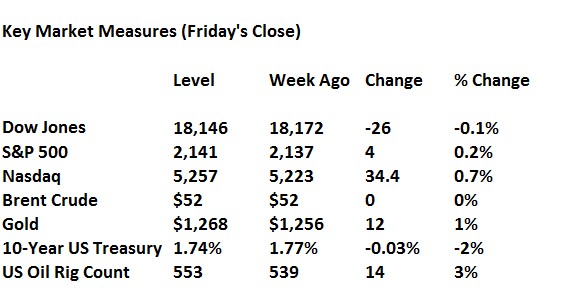
Highlights From The Past Week
Record Cash Levels. Investor cash levels jump to levels not last seen since 9/11. Fund managers are now holding 5.8% of their portfolios in cash, up from 5.5% last month. The current level was a bit higher than what happened right after Brexit. We haven’t seen cash levels this high since 2001, shortly after the terrorist attacks in the US. It’s hard to get a total reading on cash levels, but some say there is $1.5 trillion in corporate cash on the sidelines. What is driving the caution? The commonly cited reasons are an EU breakup, a bond market crash, and a certain Republican winning the White House.
What Junk Bonds Are Saying About Risk. High yield bonds, also known as Junk Bonds, are a key indicator of appetite for risk. There are two things occurring providing insight into market sentiment. First, the interest rate spread of junk over treasuries has compressed to the point where history suggests there is not much further to go. This could predict a reversal soon coming. In other words, investors are so thirsty for yield they are overpaying for risk assets, where all it will take is a little turbulence to rattle confidence. Second, actual defaults on junk bonds are decelerating. This is due to the improving Energy sector. The key point is that while we might see more risk start to get priced into the market there is still little evidence of a recession happening in the next 12 months based on default rates.
European Taper Tantrum. European Central Bank President Mario Draghi came out this week and said he will not be scaling back bond purchases prior to March. After March there is risk of doing so, but for right now the window for bond purchases is ongoing. Recall that in the US when the Fed started scaling back bond purchases, interest rates spiked impacting various sectors. For instance, Mortgage REITs went down as much as 50% and banks rose, as the steepness of the yield curve hurt/helped the respective business models. Accordingly, all eyes are on Draghi and the ECB for a European Taper Tantrum and any flow-through effect to US markets.
BMR Companies and Commentary
Alphabet (GOOG: $799, up 3% for last week; currently $807)
The stock hit an all-time high Wednesday at $804. Alphabet is schedule to release its earnings on Thursday after the market closes. The Street is looking for $8.62 of EPS on $18.2 billion of revenue.
We expect to see Google's search revenue growth momentum be sustained. We understand that expectations for search budget growth earlier this year were around the 12-15% level, but now these expectations have been ratcheted higher to the 15-20% range. In particular, we understand that feedback from advertisers suggests that budget deployment into search started to accelerate over the course of the quarter as the market gears up for the crucial holiday period. Advertisers are specifically citing the newly-released Expanded Text Ads feature as one of the reasons for their pick-up in spend.
Outside of search, we like Google Cloud and we like YouTube. Neither business is the size or impact of Search. But we like that they are heading in the right direction. The larger and larger contribution from YouTube is particularly exciting. There have been some rumors of YouTube soon doing large deals with content providers like Disney. This could be very exciting and we want to see more. By owning Google, we own the best asset in all of media - YouTube.
BMR Take: We expect a very strong quarter and will look to be revising our $850 price target higher.
Amazon (AMZN: $819, flat last week, currently $835)
The long term Amazon Web Services (AWS) operating margin expansion potential remains a controversial topic for Amazon. Let’s discuss it.
We are in the camp that expects to ultimately see a 40% long term operating margin in the AWS division. This outlook includes the fact that they have aggressive expense growth projections, specifically an incremental $1.5 billion over the next five years versus the historical ramp of $600 million to $1.0 billion. What we are saying is that it's not like they need to stop spending money. In fact, they can spend a lot. That's okay. They are bringing in the revenue – and ultimately profits.
Many are concerned about all the competition in the space, namely Microsoft Azure, Google Cloud, Oracle, and so on. Right now there is no evidence of a price war but there certainly is the possibility as these three giants fight it out. We will keep a close eye out for any change.
Why is all this talk of AWS operating margin important? Within five years, AWS will account for roughly 40% of the company’s consolidated free cash flow, if the profitability ramp plays out. Given the total addressable market of $1 trillion for AWS, it is very likely the 40% figure proves conservative. Free cash flow is the basis for how most analysts are valuing the stock. Some valuation models are inferring a price target of $1,600 for Amazon should we see the free cash flow production really start to ramp. Now that would be interesting, $1,600! We aren’t ready to place our rational expectation for the stock there yet, but there is real potential and we are watching closely.
BMR Take: Amazon is an invention machine and the latest breakthrough is AWS. AWS has the potential to unlock substantial value for shareholders. So we care about its prospects and free cash flow contribution. We think the stock has tremendous value here at this price.
Facebook (FB: $132, up 3%, currently $133)
FB shares are currently trading at 25x and 20x our 2017 and 2018 earnings estimates respectively. This is versus expectations of 26% EPS growth per year over the next five years. What value! In fact, the stock hit an all-time high Friday and is now worth $380 billion, just behind Amazon at $390 billion, Microsoft at $465 billion and Google at $560 billion. All we can say is Wow.
Investors are overcoming concerns around two things - tougher comparisons beginning in 4Q16, and moderation of ad load growth. While the former is a mathematic reality as the company gets bigger (you can’t grow revenues at 40% forever), we expect the latter to become less of a concern as Facebook has taken steps to modify existing ad units and release new products.
Why is slowing ad load growth not an issue? Did you hear during the Presidential debates the constant reference to “on Facebook over 100 million people are saying…”
Additionally, we believe Facebook is taking steps to introduce a new prospecting product to help advertisers find new customers, as well as to monetize Messenger in 2017. Recent feedback from advertisers suggest that the company continues to innovate on product development.
BMR Take: Now is a great time to buy this technology blue chip. Our $140 price target is a layup with many analysts already pushing the bar much higher. We hereby raise our price target to $150.
Netflix (NFLX: $127, up $26 since we wrote this piece on 10/16)
We think Netflix is ultimately heading to $200 based on 20x a 2020 EPS outlook of $10. However, Deutsche Bank initiated the stock with a Sell rating and a $90 price target last week. We recap their call below so you have all the information. We believe you should side with us because there is a lot of money to make if we are right.
The report admits to be positive on the business and but cautious on the stock. Netflix has a long runway for growth due to its first mover advantage and self-reinforcing model.* They say and we agree, that increasing content and user experience investment drives subscriber growth and pricing power, which funds further content and user experience investment. The report doesn’t take issue with the business model, but only the valuation on the stock, saying this is a very long duration, high multiple investment with market expectations that appear too high through 2020.
* The self-reinforcing model entails increasing content, and user experience investment drives subscriber growth and pricing power, which funds further content and user experience investment in an endless loop of growth.
Folks, they have been saying this same thing about Netflix’s valuation for years. The business is doing so well, that is why the valuation is high, unless you are telling us the business is turning south. In our view the valuation is going to stay where it is. The business is heading in a healthy direction.
The report argues there is no take-out value*, specifically citing that nobody on the speculative list of buyers would have an interest. This list includes among others Disney, Amazon, and 21st Century Fox. They say severe economic/earnings dilution would be a major obstacle to a potential combination. They say there would be 25% EPS dilution for Disney. This is all true we must admit. But we don’t really care. You don’t need a take-out to do well in your investment as we like Netflix on a standalone basis.
* The estimated value of a company if it were to be taken private or acquired.
Netflix’s pivot to original programming, the development of its own in-house studio, the growth in aggregate studio output, and the size of Netflix’s programming budget all mitigate the apparent risk from Amazon, Hulu, and local international players increasing their subscription video on demand programming spend. This is the sell report’s argument not ours. This seems like a reason to own the stock not sell it, don’t you agree?
BMR Take: Netflix has a long runway for growth due to its first mover advantage and self-reinforcing model. The business is firing on all cylinders. Don’t pass on this just because it’s not a thrift store cheap stock. We like Netflix and have a $133 target price on the stock but are considering raising this soon.
High Yield Report
This was the week when markets breathed a sigh of relief. The S&P 500’s slightly positive performance for the week helped reverse recent weakness and fears that a major correction is imminent. At the same time, most high yield assets outperformed the market slightly as income continues to remain a key motivator for buyers in the market.
Energy was a top performer this week, especially when we look at the High Yield space. The Alerian MLP fund (AMLP: $12.70) rose 1% this week, helping it reach a 5% year-to-date return excluding its dividend. (13%+ return so far YTD.) That’s a healthy return, but many MLPs are still struggling against weak energy prices, and oil’s close of the week around the $51 mark suggests the weaker firms will still struggle to produce positive cash flow.
When it comes to oil and gas exposure, we are still most positive about Kinder Morgan Inc. (KMI: $21), which soared 4% this week. The stock got a boost after reporting strong cash flow. It’s true that revenue and earnings disappointed, with negative EPS of 10 cents, with lower oil and gas volumes contributing to the results. However, the fact that Kinder Morgan is able to deliver strong cash flow that will exceed dividend payouts “for the foreseeable futures,” as management put it, indicates the firm’s resilience in the face of weak energy prices. That helped the company get three upgrades this week from Credit Suisse, Stifel Nicolaus, and Wolfe Research. We remain positive on the stock and expect it to continue to outperform.
The junk bond market saw a weaker but still strong performance, as the SPDR High Yield Fund (JNK: $37) rose nearly 1% this week, bringing the year-to-date price return up to over 8%. That’s double the S&P 500, indicating that the corporate bond market is continuing to enjoy its protracted correction after the panic of late 2015. That panic was driven by a fear that the Federal Reserve’s interest rate hike would decimate corporate bonds, and it’s true that we have seen a steady increase in corporate defaults throughout 2016. But those defaults seem largely priced into the market. So junk bonds remain risky but not riskier than the market had been expecting.
If junk bonds remain risky but still provide opportunities, investors need to avoid an index approach to the market and diversify among corporate bonds and other high yield instruments. That’s why we continue to like Pimco Dynamic Income Fund (PDI: $29), which rose nearly 1% this week and is currently yielding 50% higher (at 9.2%) than the JNK SPDR fund. That higher yield implies greater risk, but since the Pimco fund diversifies between mortgage-backed securities and high yield corporate bonds, we see it as a much less risky alternative to a junk bond index fund. Additionally, the fund’s undistributed net income has hit a one-year high and December is just around the corner: Pimco will announce its special dividend, and we are confident it will be over $1. That will bring its annual dividend to over 12%, making it one of the highest yielding funds out there, especially when considering its risk profile (fairly low) and its dividend stability (high). Since inception, PDI has both grown dividend payouts and never cut distributions. It’s impossible to find such a performance elsewhere.
Let’s turn to REITs. These investments have been interesting to look at this year. Changes to indexes have meant a reclassification of REITs away from other Financials, which the market interpreted as higher demand for REITs from index funds. That helped many of these stocks soar throughout 2016, but now the indexes have completed their restructuring and the last few weeks saw a correction in REIT prices as investors felt there was no further growth to come. Yet this week the SPDR Dow Jones REIT ETF (RWR: $93, flat) remains up 2% year-to-date.
Let’s compare our REIT picks. Kimco Realty (KIM: $28, paying 3.6%) is up 6% year-to-date and remains a low volatile and low risk REIT that still has the potential for dividend growth for years to come. Digital Realty Trust (DLR: $96) is up 27% year-to-date and continues to benefit from demand for server space thanks to the explosion in cloud computing. Government Properties Trust (GOV: $21) is up 30% year-to-date and remains the most controversial of our picks. Some people are worried about the company’s shift in strategy towards moving beyond its leases to government agencies, which is partly why the fund is still yielding 8% (although it was yielding 11% when we first recommended it). It’s still covering its dividend by 140%, suggesting dividend growth is easily obtainable. Or, if the bears contend, the company cannot grow funds from operations, it should still be able to manage payouts for quite some time.
We continue to recommend holding these three REITs instead of indexing the market both for a higher yield and for sustainable dividends. These picks, in addition to our bond, energy, and other high yield picks, provide a portfolio of 8% yields on average and sustainable payouts. This is not easy to do in a market where Treasuries are yielding less than 2%, but these great companies deliver it and are capable of continuing to deliver it for quite some time.
Good Investing,
Todd Shaver
Editor in Chief
The Bull Market Report

by Todd Shaver | Sep 19, 2016 | Monthly Newsletter Daily 6am if new
The Week Ahead
It was a week of ups and downs last week, with the Nasdaq up big, due to Apple and other Tech, and two out of the three major indices ending flat. There is clear confusion. World class investors at the Delivering Alpha Conference hosted by CNBC in NYC this week could not even agree which way the market is heading. While volatility has started to rise, we believe the moderation that was seen toward week end reflects a wait and see attitude surrounding what the Fed will do next week at their meeting. The probability for a rate hike is only 20%, but we are bracing for a potential surprise, as the Fed needs to prove to the market that it will hike rates, counter to low market probabilities, in order to demonstrate that they are leading the market and not the other way around. With all the volatility and uncertainty, we continue to stress top quality stocks as the place to be.
Here is How Last Week Progressed:
Monday (9/12) – S&P 500 +1.8%
— Markets rallied after Friday’s big selloff. Goldman Sachs issued a report calling for last week’s bond market selloff, triggered by UK concerns and Japan monetary policy, to extend into the 4th quarter, with US Treasuries reaching 2% by year-end (currently 1.69%).
— In Energy, a ratings agency issued a new report discussing how recovery rates for 15 US exploration and production bankruptcies averaged a “catastrophic” 20% last year, well below the historical average of 60%. (So out of those that go bankrupt, lenders are getting back just 20 cents on the dollar vs. 60 cents. Not good.)
— In Financials, Wells Fargo (WFC: $45, down 7% last week)admitted to secretly creating millions of bank and credit card accounts over the past five years without their customers’ knowledge or consent. An entire arm of the bank was fired over the matter and the stock is down sharply.
Tuesday (9/13) – S&P 500 -1.5%
— Monday’s recovery turned wobbly as concerns of general global economic conditions are increasing.
— The Delivering Alpha Conference in NYC hosted some of the brightest and richest minds in investing. Billionaire Paul Singer issued cautionary words for the path ahead discussing how it’s a very dangerous time in the global economy and global financial markets, adding that gold was under-represented in investors’ portfolios. Billionaire Ray Dalio warned that the current environment is analogous to the 1935 to 1945 period in America where we reached the limits of central banking’s ability to stimulate the economy and raise global asset prices.
— A US think tank warned that Australia has about six weeks or so to turn their situation around or face a massive hit to property valuations.
— Another Fed president has decided to call it a day. President of the Atlanta Fed Dennis Lockhart announced he will be stepping down on February, 2017.
Wednesday (9/14) – S&P 500 -0.1%
— Markets stood still.
— Goldman Sachs issued reports reducing their odds for a hike next week to 25% from 40% previously.
— CNBC hosted numerous conversations about the volatile mechanics of the stock and bond markets simultaneously selling off over the past week.
— In Healthcare, an undercover investigation by the Government Accountability Office found that 100% of their fictitious enrollees were able to sign-up and maintain Obamacare coverage and taxpayer subsidies despite submitting fictitious documents and/or refusal to submit any documentation at all.
Thursday (9/15) – S&P 500 +1.1%
— The morning began with news of the biggest German M&A deal in history. Monsanto accepted Bayer’s takeover offer for $66 billion creating an agriculture giant.
— More concerns about markets soon followed. Former Fed Chairman Allen Greenspan made public comments discussing how this is the worst economic and political environment that he has ever been remotely related to, noting that the U.S. is headed toward stagflation. New data soon after the statement confirmed Greenspan’s concerns.
— Year-over-year growth in Retail Sales rose just 1.9%, which represented the weakest level since March’s plunge and is now worryingly in historical recession territory.
Friday (9/16) – S&P 500 -0.9%
— Market performance was soft into the weekend. In Autos, just weeks after warning that sales had reached a plateau, Ford is now warning investors that operating profit will fall in 2017 and as a result the company is relocating small car production to Mexico.
— In Transportation, bankrupt shipping giant Hanjin said that as of this morning it had 93 vessels, including 79 container ships, stranded at 51 ports in 26 countries.
— Gearing up for next week’s Fed meeting, former Fed leader Ben Bernanke was out with some noteworthy comments foreshadowing the future path of interest rates in the US – negative! Specifically, he said, “The fact that negative rates would be temporary and deployed only during severely adverse economic conditions, would be an advantage. Like quantitative easing, which was also unpopular in many quarters, a period of negative rates would probably be tolerated by politicians if properly motivated and explained.”
Bull Market Report Companies and Commentary
Microsoft (MSFT: $57) Microsoft is a high quality bellwether. Recent reports indicate that channel partners* see strong business trends for the company’s Cloud product, Azure. Azure is a key pillar of expected EPS growth embedded in consensus forecasts. Accordingly, it is a good sign to hear that Azure is on track with expectations.
* A channel partner is a company that partners with a manufacturer or producer to market and sell the manufacturer’s products, services, or technologies, usually done through a co-branding relationship. Channel partners may be distributors, vendors, retailers, consultants, systems integrators (SI), technology deployment consultancies, and value-added resellers (VARs) and other such organizations.
To be more specific, channel partners are seeing strong sustained growth for Microsoft Cloud products, with a couple of partners underscoring a pronounced uptick with respect to Azure. One partner recently observed a renewed push by Microsoft to make inroads into the federal government vertical with its government Cloud. Lastly, a few channel partners referred to overall softness in their legacy Microsoft practices, partially driven by a faster-than-expected transition into the Cloud. This should be read as good news. Basically, the use of office desktop products is slowing because companies are transitioning to the Cloud.
We like that trend. We are fine with the legacy Microsoft business declining if the customers are moving to the Microsoft Cloud. It’s quicker and better, and a higher valuation is applied by the Street for the Cloud versus the desktop business
While Microsoft’s Azure product faces fierce competition from Amazon’s comparable AWS offering, one channel partner noted that Microsoft’s head start in the market with Office 365, along with their inherent long term relationships in Enterprise IT gives Microsoft a slight advantage in the Cloud space as compared to Amazon.
In fact, there is currently talk of an enormous energy conglomerate that has physical data centers in multiple countries which they are finding incredibly difficult to manage and scale and hence is thinking of moving to a Cloud infrastructure model. While this company has engaged both Microsoft and Amazon, the company appears to have a preference to go with Microsoft Azure because of the long standing relationship with Microsoft. This case study reinforces the storyline that Microsoft has created enough of a reputation now so that Amazon doesn’t seem like the only company in the public Cloud space.
BMR Take: The Cloud business is booming. Microsoft’s Azure product is recording revenue growth of greater than 100% a year. Channel partners are suggesting momentum is building. We view Microsoft as a high quality portfolio holding with an attractive dividend yield and substantial upside ahead.
Facebook (FB: $128) Weak sentiment surrounding the stock presents a buying opportunity. Facebook has delivered three consecutive quarters of 60%+ ad revenue growth, with an acceleration in four of the past five quarters. Street estimates have an upward revision bias with the 2017 consensus EPS having increased 35% so far this year. The overall lack of enthusiasm is reflected in the lower forward PE multiple and creates an opportunity.
One debatable topic right now is ad growth. Despite management’s caution on the 2Q16 earnings call, ad loads still have room to increase. Ad loads are a less significant growth driver of EPS estimates than many appreciate. Street estimates now call for slowing ad load growth to around 10% this year and actually declining in 2017-2018. Though there are several levers for management to focus on to drive improvement. For example, the company is currently working on ad targeting, relevancy, formats, and profitability in ways that don’t alter the user experience. Facebook still has opportunity ahead for ad load growth despite the recent near term headwinds.
Another debatable topic right now is engagement. Despite a small sequential drop in 2Q16 daily and monthly active users across all regions, the overall ratio of daily to monthly active users remains steady at 66%, which highlights the stickiness of the customer base. Moreover, Facebook’s share of US mobile Internet time of 13% is 2x greater than Snapchat, Twitter, Instagram combined, which highlights how healthy engagement remains. Recent product changes such as prioritizing friends and family in the Facebook and Instagram feeds and the launch of Instagram Stories may acknowledge shifting usage and increased competition, at least in certain demographics, but we expect Facebook to remain innovative on products. We are not concerned about a slight slowing of engagement.
BMR Take: We think weak sentiment surrounding ad growth and engagement presents a buying opportunity. Street price targets are as high as $170, framing the compelling upside potential. We added the stock in February at $97, and we are approaching our Price Target of $140. We are pleased.
Tesla (TSLA: $206) Tesla released an Autopilot update announcing advanced signal processing capabilities for its radar, which can now act as a primary control sensor and does not require the camera to confirm visual image recognition. It is just another sign of the transformational shift in auto manufacturing, where Tesla is leading the way,
Digging into the new technology a bit, the software upgrade collects more data in order to better determine the risk of a collision and prevent unnecessary braking. All very exciting stuff. In fact, just in the past few days at Ford’s annual investor day, Chairman Bill Ford acknowledged that “the technology is here in the world of autonomous driving, but there are a lot of things to work through and we have something to learn from every competitor [inferring Tesla]”. This was quiet the notable endorsement for the direction Tesla is heading.
Note that Robert W. Baird set a $338 price target on Tesla on Monday. FBN Securities upped their price target from $260 to $275 and gave the stock an outperform rating. Morgan Stanley reaffirmed an equal weight rating and set a $245 price target. Six research analysts have rated the stock with a sell rating, 13 have a hold, 10 have a buy rating and two have assigned a strong buy to the company. The consensus target price is $253.
BMR Take: We view the AutoPilot announcement as a positive that shifts focus back to Tesla’s core competitive advantage as a leader in the development, distribution, and monetization of ground-breaking automotive technologies. With that said, we await more news of the Gigafactory progress; the progress of the integration of SolarCity into the future of Tesla; and how in the world they can deliver on the 400,000 orders for the new Model 3 (for which they received $400 million in cash from the down payments.) These are the big picture items. And again, Tesla is RISKY. The stock could go to $400 in the next year or two, or it could go to $70. Or both. This one is volatile and not for the faint of heart.
Visa (V: $82) We have seen some big headlines in the stock market in recent weeks, but this company just quietly continues to perform. We want to be sure this stock doesn’t fall off your radar.
There are several catalysts that appear to be pushing stronger top line revenue growth including improved cross-border volumes, new deal wins (Costco, USAA), price increases (adds 100 bps to the growth rate), and accretion from the Visa Europe deal.
On cross-border volume, Visa is optimistic about improving trends as oil and the stronger US dollar comparables ease. Visa isn’t seeing any pricing pressure on cross border fees and is seeing significant growth in online commerce (the growth of digital grows at double the rate of offline). Cross border is 6-7x more profitable than domestic transactions.
Another big opportunity coming out soon is their entering the China market. Although there is no specific timeline yet, there is a big future opportunity to process Chinese domestic volumes and more Chinese cross-border transactions. In fact, some analysts size the opportunity to be $3 billion of revenue by 2020. Currently, Visa is focused on adding-single branded Visa cards to the Chinese market, while the cobrand relationships move towards expiration.
BMR Take: Visa is a very steady business model and a proven stock. The global opportunity to convert cash to electronic forms of payments remains lucrative. We continue to view this stock as a long term core holding.
Qualcomm (QCOM: $63) With all the news out on the Apple iPhone 7 launch, we can’t overlook the implications to Qualcomm. Eyes are on the Intel baseband share of the iPhone 7 business because the remaining share falls to Qualcomm.
Multiple reports have surfaced claiming to be able to discern the amount of share that Intel has taken in the iPhone 7. It is a bit premature to make a pronouncement on this, given that Apple is likely only slowing letting Intel into their phones. Either way, the impact is confined to only a 65% subset of iPhones that are non-CDMA* capable. Moreover, it is very likely that Apple is very slowly introducing Intel into the product line, considering recent major disruptions others in the industry have experienced, like with Samsung’s recent migration to a new chip stumbled.
*CDMA stands for code division multiple access, which is a channel access method used by various radio communication technologies. It often determines what network (Verizon, AT&T, etc.) your iPhone will work on).
To be clear, Qualcomm is expected to continue to hold 100% share in CDMA capable smartphones. According to industry estimates, CDMA capable smartphones represented 30% of total iPhone unit volume over the past 12 months and 35% in the 2nd quarter. As referenced above, the 65% of 2Q unit volume that was not CDMA capable is where Intel is possibly taking share. Some more aggressive expectations presume Intel may take the lion’s share of this 65% bucket. However, more in-depth analysis from industry experts points out that it is entirely possible that even where Apple is using Intel they may also be using Qualcomm in the same model. Bottom line, the Intel versus Qualcomm market share discussion in the iPhone remains pure speculation at this point, but is a must-watch trend going forward.
The most important trend to watch, however, is overall smartphone demand which remains strong.
BMR Take: We continue to like the prospects for the Apple ecosystem, which includes Qualcomm. Moreover, shares look attractive here with a 3.3% dividend yield. Qualcomm is a cash machine riding the smartphone wave to higher levels.
Home Depot (HD: $126) Management was on the road these past two weeks meeting with investors. Several favorable takeaways on the business surfaced. The Western part of the US continues to see strength, as Home Depot attributes it to more than just a California story, with a mini Silicon Valley forming in the Northwest states and great momentum around this build out. Phoenix is also improving and they believe there is a strong upside to the market based on how much there is left for that housing market to appreciate to reach the prior peak. Home Depot generates 1/3rd of its sales in the West.
Management highlights that the Pros customer base (professionals) are a little less price conscious given that they want to be able to know their costs and seem to have less patience for following promotions. Recall that 40% of sales is generated by the Pro customer.
Lastly, management noted that their second half guidance is not just based on the strength of the housing market but also feedback from the Pro customer base; that the project pipeline is strong for at least the next six months. Management noted that the Pros are taking vacations for the first time in years based on the healthy labor market.
BMR Take: Solid trends are seen over at Home Depot. The implications are good for the broad economy and stock market. We continue to favor this blue chip.
Gilead Sciences (GILD: $79) We thought we would give you some news on recent upgrades and research reports have been issued on Gilead. A large bank in Germany issued a buy rating and a $112 price target on the stock. Barclays reaffirmed an overweight rating. RBC Capital Markets set a $105 target price on Gilead and gave the stock a buy rating. Morgan Stanley has a price target of $103. Nine research analysts rate the stock with a hold, 18 have a buy and two have issued a strong buy rating on the company. The company has a consensus rating of Buy and a consensus price target of $105.
Gilead last posted its earnings results on July 25th. They reported $3.08 EPS for the quarter with revenue of $7.8 billion. On average, equities analysts predict that Gilead Sciences will post $11.80 for the current year.
The business also recently announced a quarterly dividend, to be paid on September 29th. The $1.88 annualized dividend produces a yield of 2.4%, paying out just 17% of earnings. There is plenty of room for growth in the dividend here.
Hedge funds and other institutional investors have recently added to their stakes in the company. Norges Bank acquired a new position in Gilead valued at about $1.3 billion. Bank of Montreal acquired a new position in Gilead Sciences during the second quarter valued at $430 million. Capital World Investors boosted its position in Gilead Sciences by 28% in the second quarter. They now own stock valued at $1.3 billion. Investec Asset Management acquired a new position during the first quarter of $280 million. Finally, Parnassus Investments CA boosted its position by 45% in the second quarter. Parnassus now owns $700 million. 78% of the stock is owned by institutional investors and hedge funds.
BMR Take: The stock has a market cap of $102 billion and a price-to-earnings ratio of 7. The stock is grossly undervalued and we expect the stock to go back to the triple-digit level late this year or next.
Upcoming Economic News
It is a very light week for economic news. The focus will be on the FOMC statement out Wednesday. The probability of a rate hike is just 20% with >50% odds that a hike will not occur until December. But who knows! Yellen now has Bernanke in her corner prescribing possible negative rates.

Under Armour Update:
Kevin Plank, CEO and Founder of Under Armour (UA: $39) announced that he will be selling 2.1 million shares of stock starting in October. A subscriber wrote in and asked our opinion of the situation, as he thought this was a bad thing.
Here’s what we wrote back:
“Hi Samuel –
“We generally don’t mind if executives sell stock. Plank currently owns 34 million shares of the company’s Class B stock, 135,000 shares of Class A stock and 34 million shares of Class C stock, representing 65% of the voting power in the company. So 2 million shares is a small part of his holdings. He is just diversifying.”
That’s how we feel. Of course, we secretly wish we had 2 million shares to sell of our own, and we admire Plank and all the others that have created all of the amazing companies out there, like Amazon and Facebook and Google, and so on. This is America. The entrepreneurs and the risk takers shall reap the rewards. Again, we would not even blink a negative eye over this CEO selling a small part of his stake in the company. Bill Gates has been selling 20 million shares a quarter since 2002. Wow. And we still love Microsoft.
THE APPLE CORNER
Apple had a great week. The stock was up $12, or 11%, closing at $115. I hope you are listening to us here at The Bull Market Report as we’ve been pounding the table on Apple for months! The stock saw its strongest four-day streak in over two years and is destroying short sellers who bet against it. The newest fuel was Apple’s announcement that initial quantities of the iPhone 7 Plus have sold out globally. Sprint said sales set records, far out-pacing sales of the iPhone 6 two years ago. That sent the stock up 3% on Thursday, after a 3% rise on Wednesday.
It was the strongest 4-day percentage increase since 2014, when Apple shot 13% higher over four days after the company increased its share buybacks and announced better-than-expected quarterly result.
Apple was responsible for much of this week’s gains in the Dow Jones Industrial Average. If Apple had been unchanged this week, the Dow would have been down 0.1%, instead of the 0.2% gain it recorded.
Apple on Tuesday made available new software (at no charge) for iPads and iPhones bringing huge enhancements to Messages, Maps, Siri, Photos, Apple Music, News, and more. This is what customers love about the company. And this is what WE at The Bull Market Report love about the company.
BMR Take: The stock trades at a PE of 14 times its past 12 months of earnings compared with 20 for the S&P 500. Will we see new highs ($134) in the stock by Christmas?
Good Investing,
Todd Shaver
Editor in Chief
![THE BULL MARKET REPORT FREE MONTHLY for August 15, 2016]()
by Todd Shaver | Aug 15, 2016 | Monthly Newsletter Daily 6am if new, Uncategorized
Welcome to The Bull Market Report Monthly for August 15, 2016. This is a free publication from the subscription-based Bull Market Report, with access to News Flashes as they occur, and access to our four portfolios – Stocks for Success; Special Opportunities; High Yield; and Opportunities in Healthcare. The High Yield portfolio has been very special to our subscribers, as these are stocks paying 4%, 8% and even 12% dividends per year. AND the stocks themselves have been up 5% and 10% and even more than 20%, which amazes US!
In any case, and without further ADO, here is this month’s Bull Market Report MONTHLY. Enjoy!
Oh – we have a SPECIAL OFFER for you at the bottom of this newsletter. You know – they are ALWAYS SPECIAL, right? Will this one really is?!
Let’s Get Ready to Rumble!
On Thursday the Dow, S&P and Nasdaq all closed at records on the same day for the first time since 1999. (And the markets are in record territory again as we compile this on Monday.) Last time around this historic trifecta meant a fantastic year for stocks. Many on Wall Street are now hollering for a repeat. Some say the money flows are pointing to “the final melt up” and “a blow off top”. We don’t buy that. Everybody from pension funds to retirees are desperately searching for yield in a world of historically low bond returns. The new mentality that prevails is being called “TINA” investing, which stands for “there is no alternative”. If you are looking for new ideas in a market that may approach continued new highs, we highlight Mazor, Twitter, Netflix, and Splunk as places to find value. Have a great week!
Here is How The Major Indices Performed Last Week

Here is How Last Week Progressed
Monday (8/8) - S&P 500 -0.1%
The markets opened at fresh all-time highs only to drift toward an end result that was about flat for the day. China reported July trade data that confirmed a global slowdown. Specifically exports were down 4.4% versus the -3.5% consensus, and imports were down 12.5% versus the -7.0% consensus. The hoped-for moderation that would signal gearing up for orders heading into peak shopping season at year end did not come. Oil prices rose despite the glut of crude supply. Data revealed that corporate bond issuance totaled $88 billion worldwide in the first week of August, the most since 1999, which clearly highlights the amazing strength of the bond market, despite historic low yields.
Tuesday (8/9) - S&P 500 +0.1%
It was a very tepid day. The VIX nearly touched 11, which was last seen in July 2014. The 10-year US Treasury Note closed at 1.55%, which compares to the consensus forecast 8 months ago for the level to be 2.80%. Some savvy market participants are pointing to a 10-year of 0.80% in the intermediate term due to global spreads that face a widespread negative yield curve. (Of course, given consensus results as noted just above, it is obvious that no one has any idea.) Wholesale inventories rose mildly and sales surged to 4-year highs. The interpretation is that the inventory-to-sales ratio of 1.3x is in recession territory. Analysis from Morgan Stanley shined light on trailing 12 month profit margin now at the lowest levels since before the global financial crisis back in 2006 when the S&P was trading 700 points lower.
Wednesday (8/10) - S&P 500 -0.3%
The market continued grinding sideways. The BOJ disclosed in a policy report that tapering of its stimulus program in September is unlikely. The JOLTS data for job openings showed 5.62 million new jobs versus the expectation for 5.68 million. While the pace of hiring rebounded to 5.13 million from 5.05 million a month ago, the annual growth rate for hiring decelerated, which some pointed to as a key indicator that the US jobs market has peaked. Crude fell due to surprising builds despite gasoline drawdowns and production cuts. DOE data confirmed the build in crude of +1.05 million marked the third weekly rise. A rare event was seen in global treasury markets. The spread of the 10-year US Treasury Note to the 10-year GILT (UK bonds) exceeded 100bps, the widest spread seen since 2000.
Thursday (8/11) - S&P 500 +0.5%
The best day of the week so far. The Europe Stoxx 600 Index officially fully recovered from the Brexit decision. Oil prices rose 4% on the Saudi Minister’s OPEC remarks, saying that there is now a meeting scheduled for late September to discuss stabilizing prices, though is past times this rhetoric has led to little. The aforementioned good news overlooked lingering concern of the BLS massive downward revision of the 1Q16 annual growth rate for real wages to -0.4% from +4.2%. US federal tax receipts increased a modest +1% from last year slowing dramatically from the +13% pace of growth recorded just last summer.
Friday (8/12) - S&P 500 -0.1%
Word started circulating calling for a major melt-up in equity price indices. The upcoming Jackson Hole meeting with the leading economists in the US including Fed officials is anticipated to kick-start a discussion about the health of the US economy and a slow rate-hike cycle. At the same time, institutional investors will be returning from summer vacations needing to put money to work, where low interest rates is likely to force money flows into risk assets. St. Louis Fed President James Bullard was already on a radio show today talking about how the Fed sees no recession risk in the near term. A big firm in Europe sold $5 billion of gold futures right before the close perhaps bracing for a sell off on Monday.
Bull Market Report Companies and Commentary
Splunk (SPLK: $64, +5% for the week) Splunk caught a bid early in the week when Morgan Stanley raised its price target to $74 from $58 while reiterating an Overweight rating. What is there to like? The company is the leader in operational intelligence software that helps enterprises make sense of machine data. This end market is large and expanding, which offers a runway for sustainable 30% revenue growth. The business model is increasingly more predictable as the revenue base grows. In the most recent quarter, Splunk’s bookings accelerated to 48% annual growth, which was the highest pace recorded in six quarters. Moreover, the company guided well for the full year raising revenue guidance from $880 million to a new level of $895 million. We should also note that Splunk added 450 new customers and completed 320 deals over $100,000, up 40% from a year ago, which highlights very healthy demand. And this: The Splunk Cloud business doubled from last year, as well!
BMR Take: We see momentum carrying the shares to the $70+ level. This valuation assumes a premium to the peer group justified by the company’s leadership position.
Netflix (NFLX: $97, +1% for the week) Shares started the week off wobbly on news that Alibaba would not be making an investment in Netflix. However, by the end of the week, investor focus returned to the fundamentals, where there is a lot to like. A comparison of Google search volume suggests that "Stranger Things" has had the biggest debut of any new series in 2016 on traditional cable or online, and there is not even a close second place. The extraordinary consumer interest in this science fiction TV show is particularly notable given the lack of a large marketing budget and high profile talent on the show. We believe this demonstrates the power of scaled distribution online, as well as the benefits of full season releases, which allow for instant immersion in a series.
At this point, we do not believe any cable network could replicate this type of performance with a new series. Looking ahead, the release schedule includes Narcos 2 and Disney’s The Crown. While there was concern in the recent quarter over lighter than expected US and International subscribers, it was all driven by elevated churn, which is mostly believed to be the result of price increases in contrast to something more concerning like competition or saturation. Historically, 40% of churning subscribers ultimately return considering the content is increasingly irresistible as we just discussed, which means the recent softness may very well ease.
BMR Take: We remain positive on the long term outlook and expect shares to recover their footing to test 52-week highs of $133.
Mazor (MZOR: $24, +3%). We saw impressive gains in Mazor last week. The focus remains on continued performance improvement building off of the recent solid quarter result. Mazor recently received orders for 11 new Renaissance systems, six in the US, and five internationally. Importantly, there were 16 orders in 1H16, which marked the best six month period in company history. Sales in 2Q16 were up an impressive 30% sequentially. The outlook for the US pipeline in the second half of the year was strong. Utilization continues to increase as recurring revenue growth is running above 30% with increasing system usage cited by management as a key driver. Management has indicated confidence that 2016 will be a record year for both systems sales and procedure volumes. Lastly, the headcount of sales professionals during the quarter increased by one to 17. This compares to plans to reach hundreds of sales reps, which will be transformational.
BMR Take: We see strong fundamentals for long term growth. That said, the stock has appreciated significantly in a short period, so watch it closely.
Twitter (TWTR: $20, +7%). The company had a great week as it was in the headlines this week for a few whacky storylines, plus the prospects for an acquisition, the latest mentioned buyer being Alphabet. The core fundamentals have been steady in terms of revenue deceleration and slowing engagement growth. In fact, management’s latest 3Q revenue guidance of $600 million came in well below the consensus of $680 million. However, there are encouraging signs. In particular, there is much discussion over the new product pipeline. Growth in engagement is now being driven by product changes and marketing efforts, versus previously what were only marketing efforts. The fact that engagement growth is now coming from product changes is a clear sign of increased business momentum. We believe engagement growth coming from product changes is positive, and we would like to see this continue.
Additionally, there is opportunity in video. The company notes that video is one of the two big opportunities for growth, as online video ad budgets for clients across the marketing ecosystem have only recently been revised to permit allocations to Twitter. Note that video is the number one ad format in terms of revenue on Twitter. We likely will not see an impact from live video until 4Q16 since only three events were live on Twitter thus far and just two NFL games will be on Twitter in 3Q16.
BMR Take: Good things will happen here.
Apple Corner
Nothing much new with Apple (AAPL: $108) except another $800 million in cash in the bank this past week. Ha. Nothing new. Right. And the stock TRICKLED UP another 1%. This week? Well if the market moves higher, then Apple is going to add another few dollars. We really do believe we will see new highs in Apple down the road. This year? Maybe. But certainly next year. Can you wait for a year for the stock to move from $108 to $134? Well, let’s see. That’s a 24% return in a year if it happens. I guess we can wait for that! We are quite confident that this will happen.
Upcoming Economic News
It is a very quiet upcoming week for the economic data release schedule. The highlight will be housing starts, out Tuesday. A month ago, we observed the US Census released June housing start data that supported the long-term outlook for a slow-paced recovery to normalized levels. We believe the industry is benefitting from a return of the first-time homebuyer which has accelerated as 3% FHA loans have become more commonplace. We also see the recent decline in interest rates as a potential catalyst in the second half of the year as homebuyers look to take advantage of incrementally attractive financing opportunities. However, we note that permits are now lagging starts by over 5%, which is a relatively large margin from historical standards and does not verify future acceleration to be a given.

High Yield Corner
High yield assets continue to see strong performance throughout 2016, again confirming The Bull Market Report’s recommendation to go heavy into these sectors earlier this year. However, new warning signs suggest more caution is necessary as we plow through the second half of the year.
Junk bonds had another strong week, with the SPDR Barclays Capital High Yield Bond ETF (JNK: $36) up over 1% for the week. That means high yield is now up over 7% for 2016, and up 15% from the lowest point in February.
That’s all great news, but fundamentals urge greater caution right now. The junk bond default rate rose to 5.5% by the end of July, according to a new report by Moody’s, and the number of defaults in July rose by 11, meaning 102 defaults in total for 2016. That’s the highest amount of defaults since 2009. What’s causing the defaults? Oil, of course. Moody’s expects a shocking 10% default rate for metals and mining sectors and 7% for oil and gas. Defaults are also expected to continue to climb for the year, peaking at 6% by the end of the year.
Is the corporate bond market pricing these defaults in and offering creditors a higher yield on bonds to compensate for the risk? Simply put: no, it is not. The average yield on junk bonds fell again this week by nearly 2%, and yields have fallen over 30% from their highest point during the great risk-off moment in February. Right now the market seems to have an insatiable appetite for risk, meaning that investors are willing to buy high risk bonds even if the interest rate they are getting is lower than it was when the bond market was less risky. Why? Simple: there are few alternatives. U.S. Treasury yields continue to stay around all-time lows, meaning there are less places to get income than ever before without taking on more risk. Income-hungry investors are willing to accept the higher risks in the corporate bond world because there are few options out there.
This trend has also driven money into REITs, with the SPDR Dow Jones REIT ETF (RWR: $101) up over 10% year-to-date and up over 23% from the lowest point in February. The REIT world’s strength in 2016 has astounded us, even though we were bullish on REITs earlier this year.
Our favorite REITs continue to be strong performers and continue to cover dividends with funds from operations (FFO). Omega Healthcare Investors (OHI: $37) rose 5% this week, although the SPDR Dow Jones REIT ETF actually fell slightly, due largely to underperformance from large and low-yielding REITs that make up that index.
Our other favorite REIT, Digital Realty Trust (DLR: $103) is up another 2% for the week, and is up over 36% year-to-date. Digital Realty Trust has been one of our best picks this year, and the strong recent performance makes it tempting to sell the REIT and go elsewhere, but this temptation needs to be resisted. Why? Digital Realty Trust is optimally positioned to benefit from the continued explosive growth in cloud computing and companies’ and governments’ need for server space. As a competitive, attractively priced, and highly reliable lessor of server space, Digital Realty Trust has gained the respect and business of Amazon, AT&T, and the U.S. Federal Government - and each of these entities is not only renewing leases but demanding more. We want to profit from that continued high demand.
Another place where we have seen cautious growth is the BDC sector. The UBS Etracs BDC ETF (BDCS: $22) rose less than 1% this week and is up 7% year-to-date. That’s good, but our super pick Main Street Capital (MAIN: $34) is up over 1% for the week and a shocking 18% year-to-date. Plus, dividend coverage remains well over 100% and the company’s recent special dividend payout - and expected December payout - means this stock is yielding nearly 8% on an annualized basis. Such a high yield from a company that can cover payouts so well is unprecedented both inside and outside of the BDC world. Thus it’s no surprise that investors have been flocking to this stock in recent months, and that capital flow is likely to continue. Main Street’s management is just too good, and the company is too well positioned in the BDC world to attract the best quality debtors in need of cash. Thus the increased corporate default rate - which of course means higher defaults among smaller businesses - is not a concern for Main Street, while it dos remain a concern for smaller and less competent BDCs.
In summary, there are growing signs that investors need to be more cautious now that high yield defaults are up but yields are down. This means that a more careful and diligent allocation of capital to the best funds and companies is essential. The lower-quality companies are going to suffer, and that is going to impact indexes and the more risky funds. Sadly, this means investors cannot simply index the market and ride the valleys and troughs. It means investors need to be very careful, pick the best high yielding assets out there, and hold them in thick times and thin.
Note that our Weekly Newsletter has a lot more information - things like the Options Corner; commentary from one of the world's most renowned Energy expert, Philip Verleger; commentary from Gary Jefferson of UBS Financial Services; and a whole lot more. Plus we send out News Flashes when appropriate during the week if any news or announcements affect the stocks in our portfolio. Please join us and take advantage of some super discounts below.
Good Investing,
Todd Shaver
Editor in Chief
The Bull Market Report
![THE BULL MARKET REPORT FREE MONTHLY for August 15, 2016]()
by Todd Shaver | Jul 5, 2016 | Monthly Newsletter Daily 6am if new
Welcome to FREE The Bull Market Report Monthly. We want to keep you informed on what’s going on in the markets and give you ideas for investments that are designed to outperform the stock market as a whole.
The subscription-based Bull Market Report is produced Weekly with News Flashes on an almost daily basis keeping you up-to-date on the stocks in our four (soon to be five) stock portfolios. We have the following portfolios:
Stocks for Success – Stocks you want to hold for the long haul.
Special Opportunities – Stocks that are down 70% and sometimes as much as 90% that have great franchises and thus the chance to turn around and go back up, and that may just be buyout candidates. LinkedIn was one of our stocks and Microsoft offered a 50% premium for the company with the stock moving from $130 to $195 in one day.
High Yield Portfolio – These are stocks that pay from 6 to 15% dividends. The dividends are REAL and are not return of capital. We cover REITs (Real Estate Investment Trusts), BDCs (Business Development Companies), and other types of high yielding stocks. Our favorite company has been paying between 10% and 16% since its founding in 1997 and is currently paying 11%. It’s a stock that trades for just over $10, pays $1.20 a year in dividends; is traded on the New York Stock Exchange; and is worth $10 billion.
Opportunities in Healthcare. We have four stocks in the portfolio and will move to about 10 in the next few months. 10,000 people a day turn 65 in the US and we all will need some type of healthcare in the future. One of ours stocks is a real gem. Worth less than one third of a billion dollars, we think it could be worth $2-3 billion in five years. Do the math on that!
So without further ado, here is the FREE MONTHLY Bull Market Report.
In America They Trust
Public opinion polls show a majority of voters distrust both presidential candidates for the White House. But don’t tell THAT to the millions of foreign investors that poured billions of dollars into our market last week. Yields on the US 10-year note and 30-year bond fell to record lows on Friday leaving US income investors reaching elsewhere for yield. But if you are a British investor, faced with negative interest rates and a tumbling Pound, US government yields are sweet music. In reality they are the third highest in the world of all major currencies. The Brits aren’t the only ones flooding our stock and bond markets. The financial world is paying a visit. The inscription on the dollar bill needs to be updated: “In America They Trust”.
It is this trust that sent stocks to the best weekly gain in 2016. For the first time in a long while, stocks turned in a better performance than Gold. Meanwhile Crude held its own, amid mixed news. Crude inventories were down 3.2 million barrels but gasoline inventories gained 1 million barrels. On Friday Baker Hughes announced that its weekly rig count increased by 11 to 341. This is the third consecutive gain.
Overall, investors seized opportunities, turning last week’s concerns into sudden confidence. Ironically, this week’s biggest winner was the week’s biggest loser. We are referring to the tremendous drop in fear measured by the CBOE Volatility Index, the VIX (^VIX: 14.77). For the few brave and bold who sold the VIX short a week ago Friday, these lucky soles made a tidy 43% return on investment in a week. This is hardly our style but hats off to those who put their bucks on the line.
Here is How The Major Averages Performed For The Week

Last week’s economic news in the US was completely overshadowed by the UK, the EU and all related matters. With the holiday-shortened week here at home, this will again be the case. As long as negative European money yields exist and uncertainty prevails, money flows will head west. Happy 4th of July America.
BREXIT LEAVE: A Post Mortem
To leave or not to leave, that is still the question. We pointed out last week, leaving the EU under Article 50 takes lots of time; perhaps two-three years. In this time many things can happen. Rather than adding to the uncertainty, the period of the next few months will form a framework of negotiation between the UK and the EU. This is good for all sides.
Already there are petitions calling for a new vote. International investor George Soros sees this as a real force and believes there will very soon be more signatures on the new petition than there were Brexit Leave votes. Who knows if this will result in a revote on British EU membership, but for all of us investors, it will make for interesting summer watching. This is where opportunities will arise.
Where To Now?
For the past three months, the S&P 500 has traded in a fairly narrow 6% range between 2000 and 2120, including the initial sharp pull back from Brexit Leave victory.
This type of trading range market is why we get excited about events like Brexit. It creates the opportunity to buy good companies at even better prices. While the Brits are sitting on the table negotiating “To Be or Not To Be”, we have a decisive strategy. And here it is:
Invest In The USA
So a picture emerges that favors US companies with either a major domestic concentration in businesses like services (Healthcare, Real Estate, etc.), or those that import manufactured components or finished products (Technology). Uncertainty creates demand for precious metals and the Brexit vote supplies plenty of this. Companies with little debt and great cash flow characteristics are more valuable now than ever. A quick look at fixed income yields will get us up to date.
In the aftermath of the Brexit vote, 10-year US Treasury note yields reached the lowest level since 1962 of 1.42%. This makes high cash flow, dividend paying companies the obvious choice of investors seeking income. It also shines a special light on certain financials like REITs where payouts are well above the average S&P 500 dividend yield of 2.1%. (See table below: Superior Dividend Yields)
STOCKS WE LIKE at The Bull Market Report:
Whole Foods (WFM: $33, Up 6% on the week)/Sprouts Farmers Market (SFM: $23, up 4%) Buy America. This is our investment mantra. What could fit that notion better than the two biggest Organic grocery outfits in the country? Grown, shipped and sold right here with virtually no foreign uncertainties.
Investing in these two companies makes more sense than ever. First of all, there is great value. Both stocks are off about 50% from their all-time highs back in 2013. They trade at about the same 21 times 2016 earnings, less than the average S&P 500 Company. This has never happened before for these two stocks and the market is now starting to take notice. Since the Brexit vote, both have performed like true winners. But there is still lots more good news to come. It is time for action on these two favorites.
More on Whole Foods Market
The stock got hit big time two weeks ago as news got out about an FDA inspection of the company’s North Atlantic Kitchen that found food that was “prepared, packed or held under insanitary condition whereby they may have been contaminated with filth or rendered injurious to health.” Obviously, this is never good news and especially not for a company with a reputation as pristine as Whole Foods.
News organizations jumped on the story comparing this to the disaster that hit Chipotle. That drove investors to reach for their computer mouse and click on the SELL box. As typically happens, the emotion of fear overwhelms everything else.
We will try to be more objective. To begin, the problem is correctable and the bad publicity is containable. The FDA did not order a shutdown of the facility, which it certainly would have if the problem was truly serious. But with that said, once you get the FDA on your back, you can be guaranteed there will be more inspections. Knowing the management mindset at Whole Foods, the alarm bells are going off in every regional food kitchen in the entire system. That should provide you with comfort. We don’t believe one issue like this will do lasting harm to the Whole Foods brand. These days, all major corporations have crisis management plans.
We have always preached the gospel that profits are the easiest to be made when stocks are driven by emotion. Whole Foods is an example of this. In the past, the stock has commanded a super premium multiple. But at the present time the stock is at the same level as the market in general, creating a buying opportunity. Whole Foods’ earnings prospects are better than average and that spells value. The stock moved nicely higher last week. We are buyers of Whole Foods.
Barrick Gold (ABX: $22, up 8% on the week) When in doubt, buy Gold. Not just the metal, buy Barrick. Here is why. We added the stock to our Special Opportunities List in February at $11.69. Since then it has added 80% in value. For the record, buying Gold (the metal) over the same period would have resulted in a gain of 20%. So give yourself high fives, you made a good decision and we hope we helped you in that process.
Barrick is doing better than most because it is hunkering down, ridding itself on non-core assets ($3 billion so far), getting a good handle on operating costs and making some overly conservative assumptions on the price of gold ($1,000 – it’s over $1300 now).
No wonder Wall Street expectations have been rising over the past 60 days. Consensus earnings for 2016 is $0.56 per share, nearly double the $0.30 earned last year. As for 2017, EPS are estimated as high as $1.20. Barrick Gold is delivering riches to investors and there is more to come.
Equity Residential (EQR: $69, up 4%) Two weeks ago we added the residential REIT, Equity Residential to our favored group of Stocks for Success at $66. When you put your money to work here, you are investing with the Real Estate Legend Sam Zell. They own or have investments in 315 properties consisting of 85,000 apartment units located primarily in Boston, New York, Washington DC, Seattle, San Francisco and Southern California. Occupancy rates typically run 95% or better. These markets are where the most high paying jobs are being created and where job growth is likely to remain the strongest.
These are white-hot markets where property values are well above Mr. Zell’s cost. So he has been selectively selling certain locations - $6 billion worth most recently. This has been great for investors.
Lately the price of Equity Residential has been under loads of pressure. The big springtime apartment-hunting season has been a bit cool. The company announced it expects occupancy to dip from 95% to 94.9%. As they say on the streets of New York, what’s the big deal? As we point out in our report, this is a temporary condition. Investors overreact all the time and we want to take advantage and start investing with the real estate genius Sam Zell.
Apple (AAPL: $95, up 3%)
Get this: a certain Beijing regulator is trying to bar Apple from selling iPhone 6 and 6 Plus models claiming “patent infringement” against a local Chinese company. In the copycat capital of the world, the Chinese government is suddenly enforcing its patent laws. CNBC conducted an exhaustive search for the company that is supposed to be the patent holder only to find a tiny company with sales of less than $5 million.
This is pure politics and it suggests that Apple needs to improve the way they play ball in China as China is a big part of the future for the iPhone. Apple announced it will appeal the ruling and the order has been put on hold pending the appeal. In the heyday of Steve Jobs, Apple grew stubborn and inflexible. Now things must change.
China is too important a market for Apple to turn its back on. Our take: They will find a solution and the stock will recover.
Bank of America (BAC: $13.10, flat) [Note: We said this in our newsletter before the debacle on Friday with Brexit.] We’ve been thinking about Bank of America and we think the risk outweighs the reward at the moment. We added the stock in February at $13.16 and it’s gone mostly up, hitting $15 in late April, but lately has come down. It’s down 7% in the last two weeks. We’re worried. We love the bank. They are huge; they have a great leader in Brian Moynihan; and the company is moving into online banking heavily, as we all know bricks and mortar are doomed. But the one thing the bank can’t fight is the interest rate market. With negative rates in Japan and Germany, can this happen here? WOW. Good question, Todd! This is a big discussion for another day, and we will have it in the coming weeks, but for now, the possibility exists. They didn’t think it could happen in Germany but it did. People are saying it can’t happen here, but it could. Now with Brexit upon us and the disruption that that could cause, we think it prudent to exit Bank of America. We hereby remove it from our portfolio.
We will revisit the stock and those of JP Morgan Chase (JPM: $62). We LOVE Jamie Dimon, but he too is subject to the MARKET. We’re going to watch and wait.
TESLA Update
Today, Apple is the largest company in the world by market cap. But Tesla Motors (TSLA: $216, up 12%) could rocket so high in the next 10 or 15 years that the current $32 billion market cap could exceed even Apple’s $540 billion.
This is according to Ron Baron, CEO of Baron Capital, who went on CNBC recently to rave about Tesla. He has a $300 million position in the company and he thinks the stock could grow up to 20 times its size in the next 10-15 years to the $650 billion level. He expects to make $6-7 billion off of that position as Tesla becomes one of the biggest companies in the entire world.
He says: “The competition is nowhere. They could have caught Elon Musk four or five years ago, but they can’t catch him now. He’s too far ahead.”
Why? Well, for starters, all the things we have been saying about the company. Like the billions of dollars they’ve invested in its Gigafactory, which is nearing completion in Nevada and will be responsible for supplying batteries to the millions of Tesla Model 3s it produces once the car hits the streets in 2018.
Baron sees the ability to mass-produce batteries at such a massive scale as an absolute necessity for anyone hoping to compete with Tesla head-on in electric vehicles. The Gigafactory, according Musk, will have the largest footprint of any building in the world - the Gigafactory will be the largest building by area on the planet earth.
BMR Take: What can we say? We agree!
That’s all for this month. Remember, if you want the Weekly Newsletter and Daily News Flashes to keep you informed of major developments in the stocks in our portfolios, click HERE for a FREE TRIAL. We don’t ask for your name and we don’t ask for your credit card, so it’s easy. But we do want to get to know you, so write me directly at Info@BullMarket.com or call 800.687.3401 if you have questions.
Good Investing,
Todd Shaver, Editor in Chief
The Bull Market Report
by Todd Shaver | Jun 27, 2016 | Monthly Newsletter Daily 6am if new
Welcome to FREE The Bull Market Report Monthly. We want to keep you informed on what’s going on in the markets and give you ideas for investments that are designed to outperform the stock market as a whole.
The subscription-based Bull Market Report is produced Weekly with News Flashes on an almost daily basis keeping you up-to-date on the stocks in our four (soon to be five) stock portfolios. We have the following portfolios:
Stocks for Success – stocks you want to hold for the long haul. These are your core holdings. Put them away and outperform the market year after year.
Special Opportunities – stocks that are down 70% and sometimes as much as 90% that have great franchises and thus the chance to turn around and go back up, and that may just be buyout candidates. LinkedIn was one of our stocks and Microsoft offered a 50% premium for the company with the stock moving from $130 to $195 in one day.
High Yield Portfolio – These are stocks that pay from 6 to 15% dividends. The dividends are REAL and are not return of capital. We cover REITs (Real Estate Investment Trusts), BDCs (Business Development Companies), and other types of high yielding stocks. Our favorite company has been paying between 10% and 16% since its founding in 1997 and is currently paying 11%. It’s a stock that trades for just over $10, pays $1.20 a year in dividends; is traded on the New York Stock Exchange; and is worth $10 billion.
Opportunities in Healthcare. We have four stocks in the portfolio and will move to about 10 in the next few months. 10,000 people a day turn 65 in the US and we all will need some type of healthcare in the future. One of ours stocks is a real gem. Worth less than one third of a billion dollars, we think it could be worth $2-3 billion in five years. Do the math on that!
So without further ado, here is the FREE MONTHLY Bull Market Report.
Brexit: Shock and Awe
Two weeks ago in The Bull Market Report entitled Summer Calm, we mention how it would take something really big to move the market. Well Friday, that something happened. British citizens expressed their desire to exit the European Union (EU). Global markets were caught totally off guard. Before the markets around the world even opened Friday morning, S&P 500 futures had dropped nearly 6%. The financial markets around the world collapsed to kick things off and by the close on Friday, all three major US market indices had fallen on the day by more than 3.5%. Every S&P industry sector except Utilities was in the red by the day’s end.
The only clear cut winner on Friday was the US dollar and Gold. The British Pound hit a 40-year low following the Leave victory, falling more than 8%. The rush into the dollar drove fixed yields down. The US 10-Yr. Treasury Note dropped as low as 1.4% during the day, closing at 1.58%. Crude, being priced in dollars was under continuous selling pressure before bouncing off its $47 low for the day.
In all, last week was a five-day rollercoaster ride with early week optimism for a Brexit STAY victory giving way to complete shock and awe at the end. Public opinion polls completely missed it; they weren’t even close.
The Summer Calm Is Officially Over: VIX Rises 50% on Friday
In the last Bull Market Report we noted the exceptionally relaxed state of the market as measured by the VIX. The Volatility Index measures the level of fear in the market. The VIX been has been as low as 11 this year; but spent most of the past three months around the 13-14 level. Well, since the beginning of June the VIX has jumped 80%, the biggest increase in many years.
The average level for the VIX over the last 25 years is about 16. For a good chart on the VIX (^VIX: 23.42) go here:
http://yhoo.it/28XAsNs
Volatility was also evident in the Crude market last week with prices ranging from a Monday high of $49 to a Thursday low of $46 before closing out the week at $48. Total US rig count rose by 9 last week according to Baker Hughes. This is the third week in a row of gains bringing the total count in the US to 337. That is still way below peak levels of 1600, but the very suggestion of rising production was just enough to keep the bulls at bay.
What we said last week in The Bull Market Report about BREXIT:
Brexit: Too Close To Call And That Spells Fear
All eyes are on Britain and this is going to make for a wild ride in global stock prices from financial companies to giant multinationals.
Things “could” get ugly. We don’t know for sure, but with the higher VIX; with the macro uncertainties like China; low Energy prices; deflation worries causing negative interest rates (Could this happen in the US?); we think that one should watch events this week closely. This week could be wildly volatile and negative. Note that the “anticipation” of an event is worse than the actual result. On Friday, after the vote and if they vote to STAY, the markets could rally. So it’s a tough call.
What to do now that we know what Brexit has done to stocks around the world? We do like our portfolio of stocks in the High Yield Portfolio and these companies are much more stable than ordinary equities. So if you have funds in stocks that in your mind are marginal and you’ve thought of selling them, a swap out of them and into some stocks like Digital Realty Trust (DLR: $103, 3.4% yield) or Government Properties Income Trust (GOV: $21.10, 8.6% yield) might not be a bad idea. We like Annaly (NLY: $11.02, 11% yield) too. A lot. Of course, Warren Buffett will do nothing, as the way he looks at things is that there’s a huge world out there and it will all work out, and he’s in it for the long haul, so why worry and make big changes.
Meanwhile Back At Home
Let’s take a breath and look at the immediate implication for what happened in Europe Friday for the US markets. Gold and the dollar are in high demand as safe havens. The US offers a positive yielding bond market and economic strength. Plus, Brexit puts any doubt to rest about future US monetary policy: There is zero likelihood of an interest rate increase this year. We have suggested repeatedly how global forces, not the FOMC are in charge of policy. Last Friday showed us a perfect example.
All this means that money flows still favor US stocks. But not all stocks. Strength of the dollar for multinational companies translates into lower foreign earnings. A higher valued dollar raises the cost of Crude, cutting into global economic growth. Finally, foreign trade outcomes are going to depend on Europe but we can’t forget about Chinese monetary policy either. If Beijing does not realign currencies, US exports will get hammered. The higher dollar is great for US inflation but not for the trade deficit.
Invest In The USA
So a picture emerges that favors US companies with either a major domestic concentration in businesses like services (Healthcare, Real Estate, etc.), or those that import manufactured components or finished products (Technology). Uncertainty creates demand for precious metals and the Brexit vote supplies plenty of this. Companies with little debt and great cash flow characteristics are more valuable now than ever. A quick look at fixed income yields will get us up to date.
In the aftermath of the Brexit vote, 10-year US Treasury note yields reached the lowest level since 1962 of 1.42%. This makes high cash flow, dividend paying companies the obvious choice of investors seeking income. It also shines a special light on certain financials like REITs where payouts are well above the average S&P 500 dividend yield of 2.1%. (See table below: Superior Dividend Yields)
STOCKS WE LIKE at The Bull Market Report:
Barrick Gold (ABX: $21, up 1.8% on the week and up 3% today) When in doubt, buy Gold. Not just the metal, buy Barrick. Here is why. We added the stock to our Special Opportunities List in February at $11.69. Since then it has added 75% in value. For the record, buying Gold (the metal) over the same period would have resulted in a gain of 18%. So give yourself high fives, you made a good decision and we hope we helped you in that process.
Barrick is doing better than most because it is hunkering down, ridding itself on non-core assets ($3 billion so far), getting a good handle on operating costs and making some overly conservative assumptions on the price of gold ($1,000 – it’s over $1300 now).
No wonder Wall Street expectations have been rising over the past 60 days. Consensus earnings for 2016 is $0.56 per share, nearly double the $0.30 earned last year. As for 2017, EPS are estimated as high as $1.20. Barrick Gold is delivering riches to investors and there is more to come.
Equity Residential (EQR: $66, up 2%) Last week we added the residential REIT, Equity Residential to our favored group of Stocks for Success. When you put your money to work here, you are investing with the Real Estate Legend Sam Zell. They own or have investments in 315 properties consisting of 85,000 apartment units located primarily in Boston, New York, Washington DC, Seattle, San Francisco and Southern California. Occupancy rates typically run 95% or better. These markets are where the most high paying jobs are being created and where job growth is likely to remain the strongest.
These are white-hot markets where property values are well above Mr. Zell’s cost. So he has been selectively selling certain locations - $6 billion worth most recently. This has been great for investors.
Lately the price of Equity Residential has been under loads of pressure. The big springtime apartment-hunting season has been a bit cool. The company announced it expects occupancy to dip from 95% to 94.9%. As they say on the streets of New York, what’s the big deal? As we point out in our report, this is a temporary condition. Investors overreact all the time and we want to take advantage and start investing with the real estate genius Sam Zell.
Whole Foods Market (WFM: $31, down 11%) The stock got hit big time last week as news got out about an FDA inspection of the company’s North Atlantic Kitchen that found food that was “prepared, packed or held under insanitary condition whereby they may have been contaminated with filth or rendered injurious to health.” Obviously, this is never good news and especially not for a company with a reputation as pristine as Whole Foods.
News organizations jumped on the story comparing this to the disaster that hit Chipotle. That drove investors to reach for their computer mouse and click on the SELL box. As typically happens, the emotion of fear overwhelms everything else.
We will try to be more objective. To begin, the problem is correctable and the bad publicity is containable. The FDA did not order a shutdown of the facility, which it certainly would have if the problem was truly serious. But with that said, once you get the FDA on your back, you can be guaranteed there will be more inspections. Knowing the management mindset at Whole Foods, the alarm bells are going off in every regional food kitchen in the entire system. That should provide you with comfort. We don’t believe one issue like this will do lasting harm to the Whole Foods brand. These days, all major corporations have crisis management plans.
We have always preached the gospel that profits are the easiest to be made when stocks are driven by emotion. Whole Foods is an example of this. In the past, the stock has commanded a super premium multiple. But at the present time the stock is at the same level as the market in general, creating a buying opportunity. Whole Foods’ earnings prospects are better than average and that spells value. We are buyers of Whole Foods.
APPLE CORNER
Apple (AAPL: $92, down 3.5% for the week, and down 1.5% today) Get this: A certain Beijing regulator is trying to bar Apple from selling iPhone 6 and 6 Plus models claiming “patent infringement” against a local Chinese company. In the copycat capital of the world, the Chinese government is suddenly enforcing its patent laws. CNBC conducted an exhaustive search for the company that is supposed to be the patent holder only to find a tiny company with sales of less than $5 million.
This is pure politics and it suggests that Apple needs to improve the way they play ball in China as China is a big part of the future for the iPhone. Apple announced it will appeal the ruling and the order has been put on hold pending the appeal. In the heyday of Steve Jobs, Apple grew stubborn and inflexible. Now things must change.
China is too important a market for Apple to turn its back on.
BMR Take: They will find a solution and the stock will recover.
BANK OF AMERICA (BAC: $12.16, down 3% for the week and down 6% today) [Note: We said this in our newsletter before the debacle on Friday with Brexit.] We’ve been thinking about Bank of America and we think the risk outweighs the reward at the moment. We added the stock in February at $13.16 and it’s gone mostly up, hitting $15 in late April, but lately has come down. It’s down 7% in the last two weeks. We’re worried. We love the bank. They are huge; they have a great leader in Brian Moynihan; and the company is moving into online banking heavily, as we all know bricks and mortar are doomed. But the one thing the bank can’t fight is the interest rate market. With negative rates in Japan and Germany, can this happen here? WOW. Good question, Todd! This is a big discussion for another day, and we will have it in the coming weeks, but for now, the possibility exists. They didn’t think it could happen in Germany but it did. People are saying it can’t happen here, but it could. Now with Brexit upon us and the disruption that that could cause, we think it prudent to exit Bank of America. We hereby remove it from our portfolio at $13.40.
We will revisit the stock and those of JP Morgan Chase (JPM: $58). We LOVE Jamie Dimon, but he too is subject to the MARKET. We’re going to watch and wait.
Tesla Update
Today, Apple is the largest company in the world by market cap. But Tesla Motors (TSLA: $198, up 3% today) could rocket so high in the next 10 or 15 years that the current $32 billion market cap could exceed even Apple’s $540 billion.
This is according to Ron Baron, CEO of Baron Capital, who went on CNBC recently to rave about Tesla. He has a $300 million position in the company and he thinks the stock could grow up to 20 times its size in the next 10-15 years to the $650 billion level. He expects to make $6-7 billion off of that position as Tesla becomes one of the biggest companies in the entire world.
He says: “The competition is nowhere. They could have caught Elon Musk four or five years ago, but they can’t catch him now. He’s too far ahead.”
Why? Well, for starters, all the things we have been saying about the company. Like the billions of dollars they’ve invested in its Gigafactory, which is nearing completion in Nevada and will be responsible for supplying batteries to the millions of Tesla Model 3s it produces once the car hits the streets in 2018.
Baron sees the ability to mass-produce batteries at such a massive scale as an absolute necessity for anyone hoping to compete with Tesla head-on in electric vehicles. The Gigafactory, according Musk, will have the largest footprint of any building in the world - the Gigafactory will be the largest building by area on the planet earth.
BMR Take: What can we say? We agree!
That’s all for this month. If you would like to write me directly, go here: Info@BullMarket.com or call 800.687.3401 if you have questions.
Good Investing,
Todd Shaver, Editor in Chief
The Bull Market Report
