September 17, 2017
by Todd Shaver | Sep 17, 2017 | Weekly Newsletter 7pm Sunday
The Weekly Summary
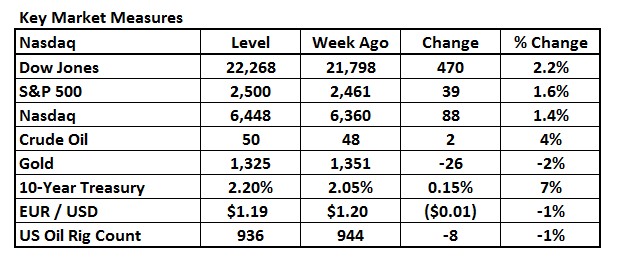
Equity markets ended the week up, again! New all-time highs were set Friday (again) with all three indices. The threat of conflict with North Korea can’t stop the bull market. Gridlock in DC isn’t shaking confidence. The unemployment rate is low. GDP growth is fair though under pressure from severe weather. It’s really a “Goldilocks” economy and a market backdrop of not too hot and not too cold. The biggest threat might simply be the Fed’s Janet Yellen who must unwind a $4.5 trillion balance sheet. The September Fed meeting is upon us and nobody is expecting a rate hike because of the pressures on GDP growth from weather. Though pay attention to plans for the Fed balance sheet as these moves could be worth as much as three rate hikes depending on the pace of unwinding. We are as eager as you to see what happens.
No matter what is happening out there, there is always a bull market here at The Bull Market Report! This week we highlight some of our favorite stocks where we think you can still make good money, including: First Solar, Apple, Twilio, Bristol-Myers, Amazon, Google, and Square.
BMR Companies & Commentary
First Solar (FSLR: $51, up 8%)
First Solar caught a lot of press this week as Deutsche Bank upgraded the stock to a Buy and said the stock is heading to the mid-60s.
What is there not to like? First, US demand is so strong it is driving pricing higher. Beyond the typical demand there is something else happening. Customers are flocking to make purchases ahead of the ruling on the section 201 tariff.
What is this? There is a high likelihood of the International Trade Commission finding injury in the section 201 case. This case basically makes a determination on the safety of the product. A favorable decision is expected to result in 2018 margins between 20 and 30%, against a 2017 rate of 17.5%. This regulatory relief for First Solar is welcomed!
Lastly, monetization of the phase 1 California Flats Solar Project coupled with the anticipated sale of the company’s stake in 8Point3 Energy Partners (CAFD: $14.49) could result in upward revisions to EPS estimate.
BMR Take: Putting it all together, First Solar is in the right spot at the right time. We recognized it early. Now we see a big Wall Street investment bank get behind the name. Yea! With EPS running around $2.50, the stock is not expensive here considering the quality and future of the franchise.
Apple (AAPL: $160, up 1%)
Apple unveiled its latest slate of new products on Tuesday including a new $1,000 iPhone that is sure to bring out aficionados of the company's devices when they arrive in local stores later this month and again in early November.
In a live-streaming event, Apple introduced a new version of its Apple Watch and Apple TV set-top box, plus two new phones, the iPhone 8 ($700) and a larger iPhone 8 Plus ($800) version. But the highlight was the iPhone X (pronounced “10”), a thin, sleek phone that has 3D face-recognition technology, a state-of-the-art camera, and a $1000 price tag -- double the price of the first iPhone that Apple introduced 10 years ago.
The other products will be available for pre-order starting Friday and should hit stores a week later.
The $1,000 price tag is causing all sorts of buzz. Will consumers pay that much? Well, most think so because you just make monthly payments through a plan and not a lump sum. Is there new technology that is exciting? Yes, from face recognition for security to the largest screen yet. All in all, the timing of the launch could push sales from 4Q to 1Q, but we expect Apple to sell a lot of phones.
BMR Take: Apple is going to do over $250 billion of sales this year. This is a staggering amount of money pouring into the company’s bank accounts from consumers who love Apple. Remember, as long as Apple continues to be a fan-favorite for customers, we think there is a huge opportunity for the company to do more and more services on top of selling hardware. The future is bright!
Remember, 65% of Apple is now the iPhone. And every new user is going right to the App Store to buy apps, increasing the Services business incrementally. Recurring income, baby. That’s what it’s all about.
We have a few notes we made from a research report from UBS Securities.
Apple Price Target - $180 (We are at $170) with a $195 potential upside.
iPhone growth in F18/19 – UBS expects double-digit unit growth in F18 and single-digit growth in F19 driven by a growing installed base and high retention rate. They expect a bulge of F15 iPhone 6 owners to upgrade in F18, creating a strong year if not a "supercycle." Supply and pricing could affect the degree of growth.
“Apple innovation to drive long-term revenue growth?
“Augmented reality (AR) is an area where Apple could leapfrog competition in offering a superior user experience. Features will take time to be released as the technology must reach a level of maturity suitable for Apple's brand. Other products like the Watch and AirPods are slowly
becoming material to the business and represent another way to monetize a loyal base of customers.
“The installed base continues to grow double digits and retention rates remain high. The retention rate for Apple above 80%, at a seven point premium to the Android retention rate. There is pent-up demand for the iPhone 8, with over a third of the base consisting of handsets older than two years old, the highest ever.
“Around the world Apple is gaining share everywhere except China. China remains a wildcard. Encouragingly, shipments to Mainland China stabilized in June. Our survey indicates interest in the next iPhone is similar to last year.
“At a P/E of 15x, Apple is trading at near an all-time high valuation. This suggests the market is pricing in a strong product cycle in F18 with double-digit EPS growth. It's also possible investors are gradually re-rating the multiple to recognize the strength and stability of the brand.”
Twilio (TWLO: $31, up 4%)
Twilio is one of the most exciting growth stories out there. And the CEO’s recent Bloomberg TV interview re-ignited our conviction in the story.
As you have been following the growth of Twilio lately, you’ll know it’s an exciting addition to the communications space. Twilio is a developer platform that powers communications for more than 40,000 global companies, including Netflix, Airbnb, and Lyft.
Twilio has emerged as a simple way for companies and software teams to begin adding communications capabilities to their applications in the form of text, video, and voice, providing companies with the flexibility that they need to implement more engaging customer experiences into their daily operations.
Twilio was built around the growing desire to provide a better customer experience for end-users and companies alike. Across numerous industries, enterprises have begun to recognize that the only way to truly differentiate their businesses from other competitors in the marketplace, is to give their customers an experience that is seamless, integrated, and engaging. Unfortunately, it’s difficult to achieve that level of service when your communication technology is not all run from one central place.
BMR Take: Sometimes the daily news is just noise. You have to step back and do a simple fundamental analysis. What does this company do? Why is the value proposition a winner? What is the big picture story? Twilio has this nailed in spades and the CEO provided a great reminder of that to the equity markets this week talking on Bloomberg.
Look at revenues for the past three years. $89 million in 2014. $167 million in 2015. $277 million in 2016. (Note: they’ve already done $180 million in the first six months of 2017.) With revenue growing greater than 30% and nearing $500 million, the momentum is there and we are still early. Repeat, we are still VERY EARLY on this company. Where is this company’s growth going to stop? (Hint: it isn’t.) Take a hard look at owning this company.
Bristol-Myers Squibb (BMY: $62, flat)
At Bristol-Myers, patients are at the center of the universe. The company’s vision for the future of cancer care is focused on researching and developing transformational Immuno-Oncology (I-O) medicines for hard-to-treat cancers that could improve outcomes for these patients. The I-O opportunity is a breakthrough for cancer, and Bristol is a key player.
Bristol is in fact leading the scientific understanding of I-O through its extensive portfolio of investigational compounds and approved agents. The company’s differentiated clinical development program is studying broad patient populations across more than 50 types of cancers with 14 clinical-stage molecules designed to target different immune system pathways. Bristol continues to pioneer research that will help facilitate a deeper understanding of the role of immune biomarkers and how patients’ tumor biology can be used as a guide for treatment decisions throughout their journey.
This week Bristol announced some good data on I-O drugs. This reaffirmed the market’s confidence is Bristol’s ability to execute on the important I-O market opportunity.
BMR Take: Bristol is a top franchise is the Drug industry. The stock has been badly beaten down for about a year but now is coming back, as top franchises always do. With nearly $4 of EPS potential, this drugmaker is a screaming deal in our view.
Amazon (AMZN: $987, up 2%)
The future is here and guess what? Amazon created it! Alexa, Amazon's voice-activated digital assistant for the home, has learned a new skill -- dispensing medical information about first aid from one of the best-known names in medicine, Minnesota's Mayo Clinic.
The information is accessible by speaking to the Amazon device, which users appreciate if they're busy doing something with their hands, like putting aloe on a burn or examining someone who has stopped breathing.
The device advises in its robotic-female voice to begin cardiopulmonary resuscitation for one minute and then call 911 if the person is unresponsive from suffocation. If the user asks for it, the device will go on to discuss specific techniques for doing CPR on an adult, child, or baby.
BMR Take: Amazon is the innovation machine and to see Echo break through into the medical field is a just another key data point about the possibilities of the future. With over $20 of future EPS power or more, Amazon is unlike any stock ever in the history of the world. We are strong believers in the future of Amazon.
Google (GOOG: $920, down 1%)
There is talk that Google is considering making a $1 billion investment in Lyft to take on Uber. This could be exciting!
Google and Lyft can really help each other. With the possibility of autonomous driving being central to its future, Lyft badly needs a solution. Google is considering putting up to $1 billion into Lyft in a move that would see it become one of Lyft’s biggest shareholders at a crucial time.
Lyft is far smaller than Uber and when it comes to market places that can be fatal. For money to be made, generally, one player needs to have 60% share or be twice the size of its nearest competitor. In the US, Uber has already achieved this hallowed status and in theory should be able to crush Lyft simply by applying sustained competitive pressure until Lyft runs out of money.
Google could be the solution for Lyft to emerge as a fierce Uber competitor.
BMR Take: Google is a tech giant, a robust franchise, and reasonably priced versus EPS of $40. The all-time high is $988, set in early June, so it is off 7% from that high. With driverless cars a key part of the future economy, and Google paving the way, we are excited about what a Lyft investment could mean and think the general market will be too if the deal is announced. UBS Securities has a $1,080 Price Target with a $1,410 upside. We have $1000 as our Target, but will raise it when it hits.
Square (SQ: $28.50, up 7%)
Square is at all-time highs. Last week we talked about Square getting into banking. That was all the buzz. This week Jack Dorsey, CEO, is talking a hard look at blockchain technology and what it could mean for Square. This company is on the leading edge of innovation all the time.
You’ve been hearing or reading a lot about blockchain but you probably still aren’t entirely certain how to define it. You’re not alone. It’s something that Jack Dorsey, the CEO of Square (and CEO of Twitter), describes as the “next big unlock”.
Blockchain is often defined as a ledger that enables secure, encrypted transactions. Some financial and technical experts have described it as analogous to the early days of the internet: it’s a framework or backbone for transactions.
But Dorsey also went beyond that interpretation of it, adding that the ability to “distribute and decentralize the ledger enables proof of work, and proof of one entity, in an untrusted network.” “Even if there’s a hostile entity or a mistrust in the network,” Dorsey continued, “we can still account for value creation and the transfer of values as well.”
BMR Take: If Square can get blockchain right, the company could take on the likes of Visa and/or MasterCard to change the world of payments how we know it. How exciting. This is sending the stock to new all-time highs and we are only at the beginning stages of Square’s life as a publicly traded company. Note that JP Morgan and Bank of America as well as Goldman Sachs are experimenting with blockchain. With a market cap of just $11 billion we see very big times ahead for this innovative company. And they could be bought out for $15-18 billion in a whisker by one of the big boys.
Upcoming Economic News
Housing Starts
Tuesday, September 19th, 8:30 AM ET
Period: August
Consensus: 1,175,000
Prior: 1,155,000
Fed Funds Target Upper Bound
Wednesday, September 20th, 2:00 PM
Consensus: 1.3%
Prior: 1.3%
Leading Indicators
Thursday, September 21st, 10:00 AM
Period: August
Consensus: 0.20%
Prior: 0.30%
BlackRock Consensus Ratings on the Street
(BLK: $429, up 3%)
4 Hold Ratings, 8 Buy Ratings
Consensus Price Target: $448
9/08/2017 Barclays $475
8/18/2017 Jefferies Group $440
7/18/2017 Morgan Stanley $476.
7/18/2017 Deutsche Bank $455
7/14/2017 Keefe, Bruyette & Woods $440
6/19/2017 Bank of America Corporation $450
BMR Take: Market cap is $69 billion. Huge. They manage over $5.7 trillion of assets. HUGE. All-time high is $443 set in July. We think this is easily breakable. The Street likes this stock. We like this stock.
Cloudera Consensus Ratings on the Street
(CLDR: $18.38, down 12%)
4 Hold Ratings, 4 Buy Ratings
Consensus Price Target: $23
9/8/2017 J P Morgan Chase $24
9/8/2017 Morgan Stanley $19
9/8/2017 Stifel Nicolaus $24
5/24/2017 Bank of America $23
5/23/2017 Raymond James $23
5/23/2017 Deutsche Bank $25
BMR Take: Bad week for Cloudera. The stock got hammered. They announced a follow-on offering of shares from the IPO they did in April. This is normal stuff – some shares will be sold by insiders and some by the company. No details yet. We are not concerned, although it would be nice to see the stock at $25 where it ought to be. Remember, this is a tiny company. Market cap is $2.4 billion – a puppy. Very speculative. But we are believers.
Andeavor (ANDV: $102, up 1%)
We have a note we made from a research report from UBS Securities.
“The recent Western Refining merger is expected to generate $350-
$425 million in synergies.”
Their Price Target is $116, with an upside to $125. Ours is $110, but if it hits that we would consider raising it.
Cryptocurrencies Update
Bitcoin had a wild week, closing at around $3500 on Friday. Bitcoin doesn’t really “close” as it trades 24-7. Bitcoin began a colossal price reversal on Tuesday that finally culminated with the latest $2,972 weekly low, which ended up becoming the new monthly low as well. The massive 32% reduction, was followed by a flurry of negative news coverage with China shutting down the biggest bitcoin exchange in the country and Jamie Dimon of JP Morgan saying that this is the biggest bubble since tulip bulbs in 1637. He said that the cryptocurrency "won't end well." Dimon was speak at a conference presented by CNBC and Institutional Investor.
Bitcoin hit $4,980 all-time high on September 1st. It plunged about 13% Thursday after one of the biggest exchanges in China said it will shut down its operation. Bitcoin surged more than 10% on Friday, but was still on track for a big weekly loss during a tumultuous period of trading.
JPMorgan's global head of quantitative and derivatives strategy, said in a note on Wednesday that in addition to being volatile and difficult to value, "another worrying aspect of cryptocurrencies are some parallels to fraudulent pyramid schemes."
But to be sure, many see bitcoin as a huge opportunity.
Former JPMorgan strategist Tom Lee said the cryptocurrency could surge another 600% in five years. "It's not worth it to look at bitcoin two months, two weeks ahead," Lee argued, saying he still believes each bitcoin will be worth $25,000 in five years.
We at The Bull Market Report find this whole story fascinating and have been following bitcoin and Ethereum closely. If you would like to know more about it, please write us here: Info@BullMarket.com.
Opko Health Update
Opko (OPK: $5.97) had a wild week. It rallied the first three days of the week, closing at $6.47 on Wednesday. Then it got hammered on Thursday and was flat on Friday. We have seen no news to account for this, but please note that this one is quite speculative. Opko has had to deal with disappointment on multiple fronts, including less-than-encouraging results in clinical studies and slow starts for approved drugs. Yet even though several institutional investors have thrown in the towel and given up on the company, Opko has strong potential for sales of its chronic kidney disease treatment Rayaldee to pick up. Moreover, Opko's diagnostic testing business has good prospects as well. Although the company hasn't executed well yet, some are optimistic. We have high hopes for the company but it is testing our patience.
The High Yield Investor
By Michael Foster
After a lot of good weeks, we’ve had a week that was - well, slow.
Almost everything in the Bull Market Report high yield portfolio ended the week flat, as investors focused on the big headlines (North Korea, Irma, etc.), which actually had minimal impact on any high yield investment.
This might be surprising, so let’s talk a little bit about why the big macro events aren’t moving the needle. You’d be right to wonder why municipal bonds, especially bonds in Texas, Florida, and nearby weren’t negatively affected by the hurricanes that have caused still undetermined billions of dollars of damage and human misery. In light of that tremendous destruction, municipal bonds barely budged. Even bonds issued in the hardest hit areas were unaffected. To take one example, Miami’s transit authority issues bonds are backed by the revenue received from toll roads, parking lots, and so on. Surely less travel to the city and less use of parking lots by tourists due to the storm will hit revenue and thus put these bonds at risk - yet their prices barely budged.
The reality is that municipal bond issues use a combination of insurance and risk management to plan for major catastrophes, especially in catastrophe-prone areas like southern Florida. The storms were severe, but Florida financiers and civil servants plan for these things as part of their regular work. So while the timing of the storms was a bit of a surprise, the reality of hurricanes hitting Florida every once in a while is priced into the municipal bond market.
Thus muni funds continue to have a strong year after last week’s relatively small price movements. Nuveen AMT-Free Municipal Credit Fund (NVG: $15.70, down -1%) took a very slight hit, but that was counterbalanced by the small rise in Invesco Municipal Trust (VKQ: $12.96, up 1%). The most important lesson to learn, by far, is that big catastrophic events don’t really hurt muni bonds - at least, not in the way that the mainstream financial press would like you to believe (since, after all, they’re desperate for controversy and know fear-mongering headlines get clicks and pageviews).
Moving on to taxable income funds, we saw more quietness among AllianzGI Equity & Convertible Fund (NIE: $20, up 1%) and PIMCO Dynamic Income Fund (PDI: $30, up 0%). There are a couple of things to note about both of these funds with regards to their pricing. The income stream for both remains somewhat reliable, although the Pimco fund’s net investment income has dropped significantly in 2017 (this, however, is being counterbalanced by an increase in NAV growth). What investors should focus more of their time on is the pricing. The Pimco fund is now priced at a 4.8% premium to NAV, which is significantly lower than the 10% premium that it reached earlier this year. A big drop-off in the premium this summer has caused that pricing to go closer to its historical norm, and a small premium to NAV is a lot more tolerable than 10%. For that reason, investors who like the Pimco fund and have been waiting to buy more are finally in a position where they can seriously consider adding to their positions. However, if you can wait for a discount to show up, you might be wise to wait for a bigger market sell-off to provide that opportunity.
As for the AllianzGI fund - its discount to NAV has been steadily disappearing throughout 2017, and we’re now at slightly less than a 9% discount, which is a relatively high price for the fund relative to its historical average. That means investors should be a tad more cautious about adding to their position right now, but the fund is far from a sell. We’ll need to see discounts of 5% before offloading this fund makes any sense at all. In reality, the fund’s continued NAV appreciation (NAV is up 6% even after paying its 7.5% dividend consistently over the last year, giving a total NAV return of over 13%) demonstrates that the fund’s management knows what they’re doing and are able to provide a stable, reliable income by picking the right stocks and convertible bonds and handing profits to shareholders. At the end of the day, we can’t really ask more from a fund.
So with all of the humdrum, low level action of the last week, let’s discuss the two stocks that actually had pretty big moves. The first is Digital Realty Trust, Inc. (DLR: $118, down -3%), which closed its DuPont merger and proceeded to fall significantly thereafter. We’re pretty much off the 52-week high hit on Monday, so it’s hard to say whether the decline is a result of profit taking or a lack of faith in the value of the merger. We see no reason to be skeptical of the merger, so we are not changing our view on the stock.
There is, however, one other issue with cloud-based REITs like Digital Realty - earlier this week, a Silicon Valley venture capitalist gave a presentation arguing that server size was about to decline significantly due to semiconductor and other technological innovations. Obviously, this will be bad for datacenter stocks - or is it? Considering the explosive growth in data storage and users’ tendency to fill up datacenters faster than the space needed to store data shrinks, demonstrates that this is a pretty specious reason to be bearish on datacenter stocks.
Finally, AstraZeneca (AZN: $32.50, 1%) took a bit of a hit earlier this week on little news. Again, this seems to be a bit of profit taking, considering the significant rise in the stock from a month ago. There’s little news about the company’s product pipeline or balance sheet to indicate caution, so we’ll wait and see how the stock performs next week before concluding this price movement is anything more than noise.
Good Investing,
Todd Shaver, CEO, Editor and Founder
The Bull Market Report
Since 1998
September 10, 2017

by Todd Shaver | Sep 10, 2017 | Weekly Newsletter 7pm Sunday
The Weekly Summary
Sloane Stephens beat Madison Keys to win the woman’s United States Open Tennis Championship and Rafael Nadal faced off against Kevin Anderson (who?) for the men’s title Sunday. World class tennis looks a lot like the market these days. Lots of long rallies. Excitement. Unexpected turn of events.
The primary news right now is all the hurricanes. Florida and Texas are taking the brunt of the unfortunate weather. We are seeing disruption across industries, from cruise lines to power generation to real estate.
The North Korea crisis lingers. Trump continues to say to China that you handle this. China keeps looking right back at Trump saying, well, you got it. While the US and China agree that North Korea needs to be rid of nuclear weapons, the lack of agreement on how best to achievement that goal has created a stalemate and a lingering overhang on the markets.
Another major event that has sure caught your attention recently was the Equifax data breach. Sensitive data on two of every five Americans was exposed in the cyberattack, making it one of the largest ever recorded. The future of online crime presents serious threats to the economy and the markets. We must keep an eye on these events as they could serve as a sell-off if they all gang up on each other.
If you wish to know what to do about the Equifax issue, here are two articles from The Washington Post and the Chicago Tribune:
https://www.washingtonpost.com/news/the-switch/wp/2017/09/09/after-the-equifax-breach-heres-how-to-freeze-your-credit-to-protect-your-identity/?utm_term=.af2b2f7fb8f8
http://www.chicagotribune.com/business/ct-equifax-consumer-protection-0910-biz-20170908-story.html
No matter what is happening out there, there is always a bull market here at The Bull Market Report! This week we highlight some of our favorite stocks where we know you can still make good money, including: Andeavor, Square, Eli Lilly, Shopify, Home Depot, Cloudera and Celgene.
BMR Companies & Commentary
Andeavor (ANDV: $102, flat)
Andeavor recently announced that it has officially begun operating in Mexico and has successfully opened the first ARCO station in Tijuana, Mexico. Andeavor and ProFuels have an established wholesale marketing agreement and have outlined plans to expand the ARCO brand to achieve a leading market position in the Mexico. Opening the first ARCO station in Northwest Mexico is a natural and strategic link for West Coast operations and the company’s integrated value chain, which furthers marketing integration in a growing market.
This first station marks the beginning of growth to include an anticipated 200 to 400 ARCO stations over the next several years. ProFuels also intends to grow the ARCO brand through supply contracts with independent owners and operators of existing and new gas stations that are interested in marketing fuel under the ARCO brand.
BMR Take: This is a nice catalyst for growth ahead for Andeavor. The company currently trades at 18x this year’s anticipated EPS of $5.60. But the EPS outlook is heading to $7.50-$8.00 next year, which should push the stock price higher. Our Price Target is $110 and our Sell Price is $95.
Square (SQ: $27, up 6%)
Square is applying for a US banking license, signifying the beginning of the firm’s long-speculated push into financial services.
The bank should help bolster Square Capital, the firm’s business lending segment. The bank will be focused squarely on merchants, not consumers. Square Financial Services (SFS) won’t extend consumer loans or house services like Square Cash, but will rather focus on the extension of Square Capital.
And it should help Square grow its burgeoning lending business. Square Capital has posted consistent, steady growth, issuing $1.8 billion in loans to over 140,000 merchants since its launch. SFS could improve that offering by bringing operations in-house, which could increase efficiency and allow the firm to grow or diversify its portfolio and offerings.
BMR Take: Square is among the most exciting companies in all of payments. They are sparking change across the ecosystem and now integrating a bank into their model is just the latest example. Consensus calls for nearly $1 billion of revenue this year with growth running 30% for the foreseeable future. It’s hard to find this kind of growth in the market today making Square a gem. Our Price Target is $29 and we are up 54% on the stock since March. Not bad in six months. But this Square story is just in Chapter One.
Eli Lilly (LLY: $83, up 3.5%)
Eli Lilly recently presented data showing their clinical trial drug lasmiditan significantly reduces pain in patients with migraine. This was very well received by the market. The company presented key primary and secondary endpoint data for lasmiditan, an oral, first-in-class molecule for the acute treatment of migraine, which demonstrated statistically significant improvements compared to placebo in the Phase 3 study. Detailed results were highlighted at the 18th Congress of the International Headache Society (IHC) in Vancouver. Lilly plans to submit a new drug application for lasmiditan to the FDA in the 2nd half of 2018.
BMR Take: Lilly is a healthcare powerhouse. Sales this year will exceed $22 billion. This new drug is just another piece of the story. Hopefully it can contribute $1+ billion of annual revenue when it hits full potential. With many drugs like this, Lilly has a well-diversified portfolio making the stock attractive to us at 20x this year’s consensus EPS estimate of $4.25. Our Target is $88 and we would love to see this by the end of the year.
Shopify (SHOP: $114, up 10%)
Shopify announced the winners of Inaugural Build, a business competition. Winners receive a one-of-a-kind, eight-day entrepreneurship experience, including mentorship from some of the world’s most successful entrepreneurs - Tony Robbins, Daymond John, Debbie Sterling and more.
From March to July 2017, Build a BIGGER Business competitors were asked to grow or scale their businesses using traditional and non-traditional strategies and tactics. To help with this growth, competitors were given access to the exclusive Build a BIGGER Business online academy, including immersion sessions with mentors on topics ranging from organizational leadership to how to optimize your sales funnel. The Build a BIGGER Business Competition attracted applicants from 70 different countries, spread over 750 different cities. Over the course of five months, competitors generated over 8 million orders, resulting in more than half a billion dollars in gross merchandise volume (GMV).
The average growth for the businesses participating in the competition was 14% during the competition period. The Top 10 participants with the highest percentage growth increased their GMV by an average of over 500%. The Top 50 participants with the highest percentage growth increased their GMV by an average of over 100%. To enter the Build a BIGGER Business competition, participants needed to have an existing business on the Shopify Platform with sales between $1 million and $50 million.
BMR Take: You might be saying why do I care about some business competition? Well, you should. Just think about how many businesses took interest in Shopify due to the competition and what the results looked like. It’s proof of the Shopify business model. The whole situation is a genius marketing event by the company and reaffirms why we like the stock. With $650 million of revenue expected this year growing at a rate of greater than 50%, and over 400,000 customers and growing, Shopify is the next best thing to Amazon in eCommerce.
We’re up 56% on this one since late March and our Price Target is $115. We hereby raise our Target to $125 and our Sell Price from $93 to $105. The stock set a new all-time high Friday and is worth $11 billion. That’s a big number for the founders and employees, but a tiny number for the big boys* that are on the lookout for acquisitions. If it were taken out it would have to be $125 to $135 a share.
* Facebook, Amazon, Microsoft, Apple, Google. But you knew that!
Home Depot (HD: $160, up 7%)
Shop from Home Depot with just your voice thanks to the Google Assistant. Really? Sweet!
Need something from The Home Depot? Just ask the Google Assistant. The Home Depot will join Google Express this fall, adding the ability for its customers to shop through voice with the Assistant on Google Home, making it more convenient than ever for customers to shop however they want.
The Home Depot offers customers flexibility with its 2,282 stores and digital endless aisle. Later this fall, customers will have an additional way to purchase innovative products - with the Assistant on Google Home or on the Google Express website or app.

BMR Take: There is a lot going on out there impacting Home Depot. Obviously, the floods could boost sales as repair efforts begin. Beyond this seasonal event, we think it is important to keep an eye on the long term core part of the business, technology. We are really excited to see Home Depot focused on digital. At 22x this year’s EPS of $7.25, we continue to think the stock is a compelling buy.
The stock set a new all-time high on Friday and is now worth almost $190 billion. The company knows what it is doing. Our Target of $160 has GOT TO GO. We hereby raise it to $170, leaving our Sell Price at $150.
Cloudera (CLDR: $21, up 9%)
Cloudera is acquiring Fast Forward Labs, a startup that gives companies the latest information on how to apply machine learning and AI to their businesses, as well as consulting.
Cloudera specializes in operating on top of open-source technology, looking to deliver an enterprise-grade product for larger organizations. The enterprise is more excited about machine learning and applied artificial intelligence than ever. Collecting that kind of expertise is going to be critical as it looks to woo enterprises into paying for additional support and services on top of open-source software.
Cloudera’s business can be a tricky one. Cloudera has to show companies that it can build a better product than they might be able to implement themselves, or simply make it much easier to deploy by paying the company, so it’s another thing those companies don’t have to worry about. This acquisition really helps toward this end.
BMR Take: With $360 million of sales this year growing 40%, Cloudera is an emerging growth stock worth keep an eye on. With acquisitions building out the product suite and accelerating revenue growth, momentum is undeniably picking up. Still under $3 billion in market cap, this company is a pipsqueak in the world of commerce. But given its high growth rate, in 2-3 years, the firm will be a major factor (if the company doesn’t get taken out by the big boys.)
Upcoming Economic News
JOLTS Job Openings
Tuesday, September 12th, 10:00 AM ET
Period: July
Consensus: 6,000,000
Prior: 6,160,000
PPI ex-Food & Energy
Wednesday, September 13th, 8:30 AM
Period: August
Consensus: 0.20%
Prior: -0.10%
CPI
Thursday. September 14th, 8:30 AM
Period: August
Consensus: 0.30%
Prior: 0.10%
Retail Sales
Friday, September 15th, 8:30 AM
Period: August
Consensus: 0.10%
Prior: 0.60%
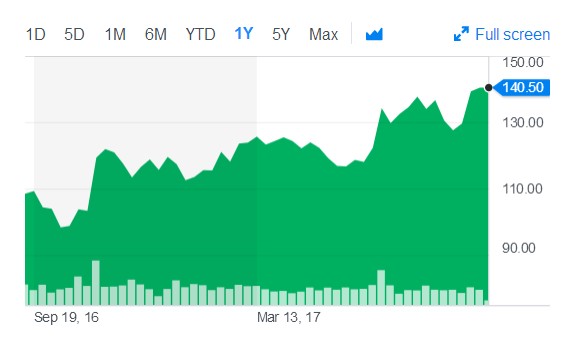
Celgene (CELG: $140, up 1%)
This company has been a big winner for us here at The Bull Market Report. We added the stock at $95 last summer and it is up almost 50% now. The firm is worth a staggering $110 billion. They have $10 billion in cash and just $14 billion in long-term debt. Revenues for the past three years are $7.7 billion, $9.2 billion and $11.2 billion. That’s what we call growth. We would love to see more profitability as they reported $2 billion last year, the same as in 2014. But 2Q17 hit $1.06 billion in earnings, so our wishes are being answered.
Celgene discovers, develops, and commercializes therapies to treat cancer and inflammatory diseases worldwide and they are firing on all cylinders. If you want to be invested in cancer research, this is the place to be. Our Target is $150 and our Sell Price is $125.
A Word from Gary Jefferson
Jefferson Financial Group
First Vice-President, Investments
UBS Financial Services, Inc.
If there is going to be a real market pullback (5% to 10%), history shows us that the Sept-Oct period is the most likely time for it to happen. So, we thought this would be an opportune time to get on the Market Jet, climb to 30,000 feet, and look down at the current "Big Picture". Here is the view from above:
The market has been good to us. We have been in a real bull market since 2009. Until 2015, most experts we respect were split, with one group believing we were still in a secular bear market which began in 2000 and that the bull market beginning in 2009 is only a cyclical bull still within the overall larger secular bear market; i.e. when this 2009 bull ends, the market will reverse course so that we end up back at the year 2000 levels. The other group believes the secular bear market ended in 2013, and that we are now in the 4th year of a new secular bull market. Secular bull markets historically last from 8 to 20 years – in other words we have between 4 and 16 years left for this bull market to run. (The last secular bull market ran from 1982 to 2000). Relying on dozens of experts as well as our 30+ years of experience, we believe we are in a new secular bull market with higher highs to be made over the next 4 to 16 years. We should expect to see a cyclical bear market at some point within the bull market run, but in the "big picture", investors should do well over the coming years.
Several other "big" things are going on. While the DOW and S&P 500 have hit new highs – because the economy is posting GDP growth of 2.5%-3.0% (finally!) – the Utility index hit a new high last week, while copper prices also hit a 3-year high. This is way out of whack. Historically, high copper prices have always signaled higher world growth. Higher growth in turn signals higher interest rates and inflation – all bad news for utilities. What seems to be happening in the "big picture" is that investors are frustrated and tired of waiting for interest rates to rise so they are chasing anything with yields- i.e. utilities. What this is really signaling, however, is that institutional money is buying in to the belief that interest rates are going to remain low for an extended time. Investors cannot ignore the bond market, and when it tells us it believes in lower rates for longer, it bodes well for the bull market hypothesis.
Again, looking at the "big picture" of the overall stock market, it is clear that the market is shrinking big-time. According to CNN Money "America's Stock Market is Shrinking", the number of public US stocks peaked at 7,600 in 1988. By 2015, there were just 3,800 US public companies. Obviously, there are more companies exiting than entering the market. It is shrinking because of an increase in mergers, companies going private and a slowdown in IPO's. Thus, please consider the math – there is a lot more money today chasing a lot fewer stocks. In the big picture, this is also a favorable trend for the stock market.
Finally, the big picture is a little less clear on the subject of taxes. What is obvious is that tax cuts and real tax reform will be great for individuals, businesses and the overall economy. A simple formula would be: Lower taxes = higher profits, more money in consumer pockets, higher spending, higher dividends, more stock buybacks = higher stock prices. Unfortunately, at 30,000 feet or 3 feet, it's impossible to see through the swamp. The only thing that could derail this part of the bull market movement is politicians.
For those worried about the end of the bull market, Barron’s recently put out a new article warning that it may be looming. The piece describes several scenarios for how the bull market might end. There are seven different factors which it identifies as possible catalysts to ending the bull run: a Fed mistake, inflation, China, antitrust, the end of QE, geopolitics, local politics. It does, however, make the point that longevity, high prices, and bad politics are usually not enough to cause a bear market. Recession is what usually causes it, and it makes the further point that the first four catalysts could trigger a recession. The fed mistiming rate hikes could cause big issues, as could a collapse in China, or a big antitrust movement against large tech companies.
These things are all possible, of course, but we believe Barron's should have made their argument in the context of secular bull and bear markets. A secular bear market historically lasts from 8 to 20 years, with intermittent cyclical bull markets within it. We may see a cyclical bear market (normally lasting from a few months to one or two years) inside the current 4-16 year bull move we see ahead of us, but that would not be anything similar to a long term secular bear. Understanding the difference between cyclical and secular market moves is important to being able to see the "big picture". Those that jumped out of the market in 1987 when the bear "crash" (a cyclical bear market) occurred, missed the rest of the move up in the most recent 1982-2000 secular bull market.
The High Yield Investor
By Michael Foster
Part of The Bull Market Report Team
It was another mixed week for stocks and another strong week for The Bull Market Report High Yield portfolio. We saw REITs mostly deliver strong returns, municipal bond funds rise, and a big boost from Pharma.
Let’s start with REITs. Omega Healthcare Investors (OHI: $32, up 0.5%) had another solid week of gains that were neither too extravagant nor disappointing. We’ve seen a lot of investors question the durability of Omega Healthcare’s dividend growth trend, and the doubts have increased lately as a result of one very simple (and, to our mind, naive) hypothesis. The thinking goes like this: Omega focuses on skilled nursing facilities (SNFs), and those facilities are losing popularity among Americans. This is quite surprising, considering America’s demographics: the country is aging rapidly, so expectations of growing demand for SNFs has been somewhat baked into Healthcare REITs’ stock prices for a long time.
Again, that’s the theory, but it’s not quite accurate. While it’s true that SNFs are seeing a decline in demand, it isn’t actually impacting Omega as much as a lot of critics would suggest. Yes, revenue has been challenged by the trend, and a lot of Omega’s tenants have seen more disappointing demand than they were expecting. Nonetheless, again this is all baked into Omega’s stock price. Keep in mind that Omega’s current price point is at the exact same spot where it was 4 and ½ years ago despite the substantial growth in Omega’s operations since then. The reason for this is simple; the disappointing SNF market growth has been priced into Omega’s stock price for a long time.
That’s why this has been a particularly good REIT to buy on dips, especially when it yields 8% or more. We’re at 8% right now, so it’s a strong buy in our book for the reasons mentioned above and for its tremendous income stream. And the income is not under threat. As we’ve mentioned in the past, Omega’s dividend coverage ratio is on the higher end for Healthcare REITs, despite its higher yield. That combination makes this a perfect buy and hold.
Elsewhere in the Healthcare REIT sector, Welltower (HCN: $75, up 1%) ended the week up nicely. Now might be a good time to talk about how this company is different from Omega and why we recommend both. Omega is about 16 years old and has been rapidly growing over the last decade. Welltower started in 1970 and has been an S&P 500 component for years. It also has a tremendous dividend growth track record thanks to improving net income and steady, higher-than-average occupancy rates. In part, that’s because of Welltower’s more diversified approach. While Omega focuses on the riskier SNF sector, Welltower offsets that risk with investments in post-acute care facilities, medical office buildings, and senior housing facilities. As a result of that diversification and longer track record, it is considered more seasoned and conservative and thus their dividend yield is almost half of Omega’s, at less than 5%.
But we still maintain owning both, because the lower volatility in Welltower’s stock can help you offset the psychological impact of temporary dips in Omega’s stock, as we’ve seen in the past. Additionally, there’s a lot more capital gains upside potential with Welltower. The stock isn’t up much over the last 5 years - just about 25% - but that’s a lot better than Omega’s flat pricing. Additionally, we’ve seen Welltower climb steadily throughout 2017 despite the more jittery market demand for Omega. The steady but low-yielding holdings in one offset the more volatile but opportunity-yielding pricing of the other.
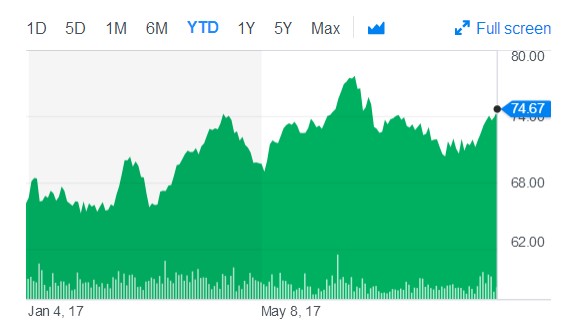
Welltower Chart from the beginning of the year
On the subject of healthcare, let’s jump into AstraZeneca (AZN: $32, up 4%) and its wonderful week. We’ve been watching this one with intense amusement, because a number of bears have come out of the woodwork to attack the company’s product pipeline - ironic, considering the firm’s pipeline looks stronger than ever, with recent trial successes that indicate its R&D department is still yielding a lot of fruit. AstraZeneca scientists are busy presenting on Imfinzi (durvalumab) and Tagrisso (osimertinib) at a lung cancer congress in Europe, and the feedback remains solid enough to drive shares sharply higher. Ignore the bears, because, frankly, they just don’t know enough about the science behind AstraZeneca’s pipeline.
Finally, let’s turn to municipal bonds. A number of Wall Street analysts are noticing that municipal bonds were a sleeper winner in 2017, with modest price gains that were often ignored because of the obsessive focus on the so-call Trump rally. That’s helped Nuveen AMT-Free Municipal Credit (NVG: $15.77, up 1%) and Invesco Municipal Trust (VKQ: $13, flat) recover nicely from their 2016 lows, when The Bull Market Report first recommended these funds. It’s nice to see the mainstream pick up on the quality of this asset class, but we also need to acknowledge how late they are to the party.
Unfortunately, there is a bit of a gray cloud for munis that we need to think about. Inflation trends are weakening and expectations of a third interest rate hike from the Federal Reserve in 2017 are dwindling. A longer path towards raising interest rates is bad for municipal bond closed-end funds, which depend on leverage to extend returns and maintain high yields for investors. The spread between the rate that funds borrow at and the rate that funds can earn through munis has been narrowing. This means dividend cuts might be on the horizon.
We don’t expect the cuts to be massive or come soon, but we do expect the income from these funds to decline slightly (and by slightly we mean less than 5%) in the next few months. I don’t think this is going to impact the pricing of these funds - muni funds often cut dividends without getting a hit to their stock. But keep in mind that the dividend stream from these funds is going to be a bit uneven. That doesn’t mean 5% annualized total returns won’t still come in if we average over a long period of time, but it does mean short-term returns from dividends will be a bit meeker than we’ve seen in the last few months. But that’s ok - we’re up way more than 5% in the last few months alone from both of these funds.
Good Investing,
Todd Shaver
CEO, Editor and Founder
The Bull Market Report
Since 1998
September 4, 2017
by Todd Shaver | Sep 4, 2017 | Weekly Newsletter 7pm Sunday
The Weekly Summary
We sadly observed Hurricane Harvey devastate Texas this past week. 52,000 people are in shelters as thousands of homes are flooded. The state of Texas ranks as the 2nd largest contributor to GDP in the US trailing only California and ahead of New York. So the economic impact has yet to be fully seen. Real estate portfolios caught without flood and business disruption insurance may be seriously in trouble. Auto sales are already seeing a sizeable dip. Chemical plants are shut down. We could go on and on. What an unfortunately troublesome situation to watch and one with the potential for lingering negative impacts for months to come.
In other news, lawmakers decide to give bipartisanship a shot on healthcare. The Senate Health Committee will turn its attention to bipartisan legislation aimed at shoring up Obamacare markets for 2018. The drift toward compromise follows high profile repeal failures, but still faces an uphill battle as many Republicans have spent years railing against the health law. Staff has been working on it over the summer break and there is general agreement that insurer payments will continue, though specifics are sparse.
Separately, we have yet to see formal action following Trump’s opioid emergency declaration. No formal paperwork has been filed and no new policies have been announced. This appears to be new territory for the government as the national emergency designation is typically used for relief of temporary issues like natural disasters rather than chronic problems like opioid abuse. In addition, administration officials seem to have been caught off guard by Trump's statement. The White House has indicated that it is considering all options for action. Why should we care? This is a big deal for labor force participation, which is at historical lows. If we can get everybody back to work contributing to our economy and off drugs, that is the path to 3.0% GDP growth versus where we are now at 1-2%.
No matter what is happening out there, there is always a bull market here at The Bull Market Report! This week we highlight some of our favorite stocks where we think you can still make good money, including: Apple, Gilead, Bristol-Myers, Amazon, and PayPal.
BMR Companies and Commentary
Apple (AAPL: $164, up 1.5%, all prices are for the week)
Apple has officially scheduled its first-ever event in the company's Steve Jobs Theater, a September 12th invitation-only press conference expected to reveal the latest iPhones and possibly a revamped Watch and Apple TV. The company emailed invitations Thursday that read "Let's meet at our place," with an picture of an Apple logo in red, white and blue. The event, hosted at the company's new spaceship-style Apple Park headquarters is scheduled to start at 1 PM ET. For several years, Apple has revealed its latest iPhones in September, in time to promote them for the holiday season. This year, 10 years after the first iPhone hit the market, Apple is widely expected to reveal the iPhone 8, and the rumor mill has already churned out reports that the device will have a larger OLED* screen and a virtual home button. There are also reports Apple will reveal a Watch that has its own cellular connection and an Apple TV that adds 4K UHD. This is likely it—the big event for Apple’s new iPhone launch! We will all be watching closely.
* Organic light-emitting diode. An OLED display works without a backlight; thus, it can display deep black levels and can be thinner and lighter than a liquid crystal display (LCD). In low ambient light conditions (such as a dark room), an OLED screen can achieve a higher contrast ratio than an LCD.
The main risk to keep an eye on is prices. The argument is that costs are getting so high on new smartphones that customers will not be willing to keep paying up to get them. If this is so, we will see margin compression and perhaps fewer sales by Apple.
Apple Consensus on the Street
Apple was upgraded by analysts at Cleveland Research from a “neutral” rating to a “buy” rating in a report released on Tuesday, and they raised their price target to $197.
On the Street there are 10 Hold Ratings, 39 Buy Ratings, 1 Strong Buy Rating
9/1/2017 Royal Bank Of Canada Target: $180
8/29/2017 Cleveland Research Target: $197
8/24/2017 Bank of America Target: $180
8/24/2017 Drexel Hamilton Target: $208
8/22/2017 Canaccord Genuity Target: $180
8/14/2017 Sanford C. Bernstein Target: $175
BMR Take: Remember the big story for Apple is their services business. They have all these iPhones out there in use by a huge customer base. Can they now get more money from these customers through services? The iPhone 8 is a key part of the strategy. We note that Apple has $260 billion in cash now, which is the equivalent of $50 a share, and greater than 30% of the stock price. This is UNPRECEDENTED in the history of Wall Street. Apple remains an exciting investment opportunity. The services business is projected to double in revenue to $50 billion over the next several years. The Services business is much more profitable than hardware so the impact to earnings is even better. Don’t sell a share. We believe Apple has a lot more room to go on the upside.
Gilead Sciences (GILD: $84)
We removed Gilead from our Healthcare portfolio in February after holding them for a year with poor results. Things have changed dramatically since that time as management has tackled various issues head-on, so we give you an update as things have changed even more this past week.
Gilead announced a big acquisition. Gilead will acquire Kite Pharma for about $12 billion in cash; it was unanimously approved by both the Gilead and Kite Boards of Directors and is anticipated to close in the fourth quarter of 2017. The transaction will provide opportunities for diversification of revenues, and is expected to be neutral to earnings by year three and accretive thereafter.
The acquisition of Kite establishes Gilead as a leader in cellular therapy and provides a foundation from which to drive continued innovation for people with advanced cancers. We are greatly impressed with the Kite team and what they have accomplished, and believe they are on the cutting edge of cell therapy that will be the cornerstone of treating cancer. The field of cell therapy has advanced very quickly, to the point where the science and technology have opened a clear path toward a potential cure for patients. The two company’s similar cultures and histories of driving rapid innovation in order to bring more effective and safer products to as many patients as possible make this an excellent strategic fit.
BMR Take: Gilead is losing two major drugs this year with big revenues due to the expiration of their patents and was the reason we removed the stock earlier this year . Over the past several years they were among the largest sellers in the history of Healthcare so replacing them will be a tough uphill climb. Could Kite provide a way to do it? We will see.
Bristol-Myers Squibb (BMY: $60, up 3%)
This week Bristol-Myers will announce more than 60 presentations, including seven late-breaking abstracts, from its Oncology portfolio featured at the European Society for Medical Oncology 2017 Congress in Spain. Presentations of data from company-sponsored studies, clinical collaborations and research will explore the potential role of Opdivo (nivolumab) as monotherapy and in combination with Yervoy (ipilimumab) and with relatlimab, a fully human monoclonal antibody that targets lymphocyte activation gene-3 (LAG-3); or with chemotherapy in 13 types of cancer.
All this news matters a lot because healthcare investors love new data! We are seeing the stock pick up some momentum getting ready for what is likely to be a wave of good news.
BMR Take: We are still optimistic Bristol-Myers could be a take-out candidate. Activist investor Carl Icahn is in the stock and pushing for change. We believe we could see a 25-50% premium from today’s price if a sale gets done. Further supporting our view, we note Jana Partners is now also building a position in the stock. Jana had a big stake in Whole Foods, and was taken out by Amazon this past week as you know.
Amazon (AMZN: $978, up 4%)
Amazon announced 3,000 more jobs coming to Ohio. This follows news a few weeks ago about doing a major facility in New Jersey. We continue to highlight the Amazon machine because this single company alone is now a major driving force behind the economy.
The internet retailer received approval on Wednesday for state tax incentives for two distribution operations in Ohio. The project approved by the Ohio Tax Credit Authority will create 2,000 jobs. The company said it will invest $100 million at the site, which eventually will result in a 855,000 square-foot facility. The second distribution-center project, will result in an estimated 1,000 jobs if the company goes ahead with the project. Amazon had no presence in the state until recently.
BMR Take: The Amazon powerhouse is steamrolling the real economy and the stock market. With over $20 of EPS potential by 2020 according to analyst consensus estimates, we see a lot of potential ahead.
We noticed that the stock is on a little roll lately. The stock hit a closing high of $1052 a month ago in late July and then proceeded to drop over $140 to the low 900s. But this week the stock was up a little bit every day until Friday when it took a breather. We have watched these high-priced stocks for years and many times it is human nature to not be able to bring yourself to buy a stock that is almost $1000 a share. But we always mentally build in a stock split. Say 10-1 in Amazon’s case. If the stock were a $98 stock, would you buy 100 shares? Sure you would. So we just look to buy 10 shares for $980. Same difference. If you think the stock is going to $2000 a share in the future like we do, 10 shares here, 20 shares there, and 30 shares beyond, adds up to real money.
PayPal (PYPL: $61, up 2.5%)
PayPal customers in the U.S. can now earn cash back on every purchase online and in stores with the recent launch of the new PayPal Cashback Mastercard issued by Synchrony Bank. The PayPal Cashback Mastercard, designed exclusively for PayPal members, offers cardholders 2% cash back every day, on every purchase – everywhere Mastercard is accepted.
Unlike other rewards credit cards, there is no annual cash back limit, no minimum redemption amount, no restriction on how to spend cash rewards and no expiration. The PayPal Cashback Mastercard offers all the security and convenience expected from PayPal, plus all the traditional benefits of a Mastercard. All accounts are automatically added to the member’s PayPal wallet to simplify checkout and provide peace of mind.
The introduction of the PayPal Cashback Mastercard with Synchrony Bank continues PayPal’s commitment to provide customers with rewarding product experiences and a range of innovative credit options. By providing a simple way for people to earn cash rewards for the shopping they’re already doing, the PayPal Cashback Mastercard will give consumers yet another reason to shop with PayPal.
BMR Take: PayPal has 200 million customers on the way to over 1 billion longer-term (after all, Facebook has over 2 billion, showing the possibilities for a global internet-based business model). With EPS closing in on $3 by 2020, and EPS growth moving along in the mid-teens, we see growth at a reasonable price here in the stock and like it a lot!
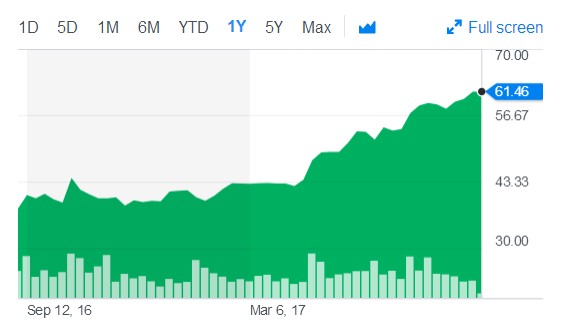
Nutanix (NTNX: $22, flat)
We reported via News Flash on Friday on the stellar earnings report the company issued on Thursday. The stock shot higher on Friday, hitting $24, but settled at $22, flat for the week. We’re not traders as you know, but long term investors, and we have seen this many times in our career. We are going out on a limb here and will say that the stock will move higher from here over the coming weeks and months.
We mentioned the high level of sales that were booked but not reported as revenues – the backlog. Management indicated that billings growth was 40% year over year and that the company continued to build up a significant backlog of deals that booked but did not ship in the quarter. The sales transition toward large enterprise is progressing nicely. Management's next quarter guidance implies billings growth of 25% YoY compared to consensus of 17%, due to the significant backlog build.
To recap:
Fiscal 4Q 2017 Financials
Revenue: $226 million, up 62% year-over-year from $140 million in 4Q16
Net Loss: $50 million, compared to a net loss of $47 million in 4Q16
Operating Cash Flow: $6 million, compared to $2.5 million in 4Q16
Cash and Short-term Investments: $350 million, up 90% from 4Q16
Deferred Revenue: $525 million, up 77% from 4Q16*
Free Cash Flow: $(6.5) million, compared to $(6.5) million in the fourth quarter of fiscal 2016
Billings: $289 million, growing 40% year-over-year from $207 million in 4Q16
BMR Take: We added the stock in May at $17.45 and have a Target of $30. Our Sell Price at $14 is way too low, so we hereby raise it to $19. This was a great quarter and if Wall Street doesn’t wake up to the potential of this company, we would be very surprised.
Upcoming Economic News
Domestic Auto Sales
Monday, September 4th, 8:00 AM ET
Period: August
Consensus: 4.6 Million
Prior: 4.5 Million
Trade Balance
Wednesday, September 6th, 8:30 AM
Period: July
Consensus: -$44.5 billion
Prior: -$43.6 billion
Initial Claims
Thursday, September 7th, 8:30 AM
Period: 09/02
Consensus: 240,000
Prior: 236,000
Consumer Credit
Friday, September 8th, 3:00 PM
Period: July
Consensus: $15.0 billion
Prior: $12.4 billion
A Word from Gary Jefferson
Jefferson Financial Group
First Vice-President, Investments
UBS Financial Services, Inc.
Over the previous weekend, these were the economic headlines:
--- Robust Retail Sales
--- Disappointing Durable Goods
--- Strong Business Inventories
--- Uneven Industrial Activity
--- Mixed Housing Data
Economic data suggests that things are good, but not great.
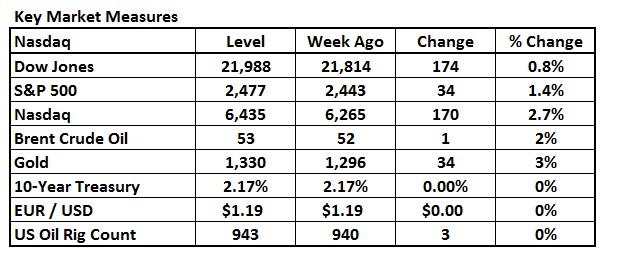
Fed Chair Janet Yellen's signaling of continued restraint on monetary policy at Jackson Hole triggered another rally in US stocks last week. This extends the current bull market to 102 months, surpassed in length only by the 113-month run leading up to the dotcom crash. Skepticism over valuations is even higher now with a record 46% of investors believing equities are overvalued.
While the bull market may be entering the later stages of the cycle, UBS strategists believe it can run further based on these observations:
--- The earnings yield on the S&P 500 is 4.8% compared with a yield of 2.17% for 10-year Treasuries.
--- At 18x, current market PE ratio is near long-term averages. Historically when valuations have been in an 18x to 23x range, the MSCI AC World Index has returned 6% over the subsequent six months (versus an overall average of 5%). And relative valuations of equities also suggest long-term outperformance versus bonds.
--- Corporate earnings growth remains robust, at 12% in the US and around 10% in the Eurozone in the last quarter. Synchronized global growth should continue to support this, with all 45 OECD economies on track to expand this year.
There are, however, some caution flags appearing here and there. We prefer to look at price-to-sales ratios rather than PE's, and they haven't been this high since the peak of the dotcom bubble in 1999. This means that new investors are paying more for every dollar of sales than at almost any time since the dotcom bust. However, if sales continue to grow as expected this ratio will normalize to some degree. Put another way, stocks are priced almost to perfection and if the earnings growth story were to falter, it could cause some real volatility.
VMware (VMW: $107, up 5%) Has 500,000 Customers
BMR Take: Think about this. Half a million customers. Can you imagine? We think this is just fabulous. We’re up 30% since we added them in January at $83. What a great company. Our Target is $108 which it hit Friday, an all-time high (not counting the euphoria 10 years ago when they went public). With a market cap of $44 billion, and Dell Technologies being the principal owner (80%+) we think very highly of this company. So we hereby raise our Target to $120 and raise the Sell Price from $90 to $100.
The Blackstone Group (BX: $33, up 4%) had its Target Price set at Credit Suisse Group at $45
A Few Wall Street research firm targets
8/30/2017 Credit Suisse Group $45
7/25/2017 Morgan Stanley $40
7/21/2017 Deutsche Bank $33
7/14/2017 Keefe, Bruyette & Woods $37
7/14/2017 Oppenheimer Holdings $38
5/28/2017 Citigroup $41
Blackstone Considers IPO of Gates Corp.
Blackstone Group is considering an initial public offering of Gates Corp. that could value the auto-parts maker at as much as $9 billion. Its products include belts, hoses, industrial power transmission, fluid power, and automotive. The company was founded by Charles Gates in 1911 and is headquartered in Denver. In 2014, the company was acquired by Blackstone in a deal worth $5.4 billion.
The private-equity giant is in the early stages of laying the groundwork for the possible offering, according to people familiar with the matter. The business could be worth $8 billion to $9 billion, one of the people said. It isn't clear whether that includes debt.
BMR Take: We can’t tell you how good this company is. Well, maybe we can: This company is great! Look at the wealth being created by this firm. In 3-4 years in this one deal alone, they have created $3-4 billion of equity. Absolutely amazing. Our Target is $35 but we are dying for the stock to hit this price so we can raise it to $42. This is a value stock like no other.
The High Yield Corner
By Michael Foster
Significant news came this week from AstraZeneca (AZN: $30, up 3%), helping the shares rise solidly by the end of the week. The biggest news is the company’s presentations at a conference in Spain that will demonstrate the company’s phase-3 study of imfinzi for non-small cell lung cancer and tagrisso for. EGFR cancers.* The science is complex and far for non-specialists to understand without a lot of deep reading, but the market is a great place because it prices in that knowledge instantaneously, which is why AstraZeneca shares rose 2% on the news.
* EGFR is short for estimated glomerular filtration rate. The EGFR is a number based on your blood test for creatinine, a waste product in your blood. It tells how well your kidneys are working.
Another intriguing tidbit from AstraZeneca: the company announced on Tuesday that it was recruiting Takeda Pharmaceutical to work on an antibody for Parkinson’s disease treatment. Again, more exciting developments that prove the mega-pharma company’s pipeline is very healthy. Remember a year ago when this was a primary concern on the company and thus the stock? Those concerns are gone now; instead, investors have finally realized that there is tremendous value in this company and it is still innovating; thus it’s no surprise shares are up 10% in 2017 so far. Paying a solid 3.1% dividend, we can see some dividend increases in the months and years ahead. We’ve got a $42 Price Target on the stock and would hope to see this level sometime next year.
Elsewhere in The Bull Market Report High Yield portfolio we see green across the board. There’s only one exception: Invesco Municipal Trust (VKQ: $12.93), which ended the week flat. No surprise; municipal bonds are a low volatility asset class, and there’s not really any news in the municipal bond market to warrant a massive jump. That includes the latest tragedy in Texas. While large storms and ecological disaster might intuitively seem like they will hurt municipal bond markets (lower economic activity should mean lower government revenue and thus higher default risks), it’s important to remember that this “common sense” is actually false. (Often, the common sense view doesn’t quite work in finance.) In reality, credit agencies do not downgrade bond issuers faced with economic disasters; furthermore, the lower revenue may make the state’s budget tighter in the short term, but the risk of that hurting municipal bonds is negligible. Additionally, natural disasters rarely result in massive new bond issuances to fund repairs, so it’s not like existing bonds will get priced out by new issues.
We saw Nuveen AMT-Free Municipal Credit Fund (NVG: $15. 64, up 1%) have a solid showing. Also a nice surprise from Nuveen this week: the company announced dividends for all of its closed-end funds, but did not lower dividends on NVG - although many other funds did see their distributions decline slightly. Again, good news for municipal bond investors long this fund.
The Bull Market Report’s other closed-end fund picks also ended the week in the green and announced distributions that were in-line with previous dividends. AllianzGI Equity & Convertible Fund (NIE: $20, up 1%) announced that its 38 cent quarterly dividend would continue at the same level, and PIMCO Dynamic Income Fund (PDI: $30, up 1%) also announced its monthly dividend would stay at the same level. These funds are paying 8% in income, year-in and year-out, while also seeing their share prices rise. Closed-end funds are typically income vehicles that aren’t often traded for short-term capital gains, but both funds have given investors that opportunity this year. AllianzGI is up 10% year-to-date and Pimco Dynamic is up 14% year-to-date - extremely impressive returns for such diversified funds. And the income does not look to be threatened anytime soon, so investors can continue to hold them with confidence.
Now, let’s turn to REITs. Digital Realty Trust (DLR: $118, flat) announced that its COO was leaving the company in September. Markets shrugged; while he obviously has done well for the company in the past, there’s no reason to assume he’s irreplaceable. We’re sure that his replacement will be skillful.
Despite little news elsewhere affecting REITs, we saw price gains for Omega Healthcare Investors (OHI: $32, up 3%), Government Properties Income Trust (GOV: $18.50, up 1%), Apollo Commercial Real Estate (ARI: $18.18, up 2%), Ventas (VTR: $69, up 1%), and Welltower (HCN: $74, up 2%).
Also, there wasn’t any real news on Kimco Realty (KIM: $20, flat), but it’s interesting to note that this retail-focused REIT has had a bit of a resurgence lately thanks to the surprising strength in retail. (Note that we removed Kimco from our portfolio in May, but we wanted to give you an update.) If you remember, several weeks ago in this column we wrote at length at how the “death of retail” cliché was really more about shock financial journalism trying to get clicks from disaster-starved readers and had little to do with the reality of our economy. Well, we were right. In addition to beats from Macy’s, Dollar General, Target, Wal-Mart, and several other retailers, even the near-death dogs like Sears Holdings and Abercrombie & Fitch impressed the market with their quarterly results, beating expectations. Retail is not the healthiest sector on Earth, but it isn’t dead or dying. But Kimco was priced for a dying retail sector. So what does that mean? Kimco shares are up 11% in the last three months.
We want to go on record with another prediction that drives bullishness on retail REITs like Kimco. Amazon’s recent acquisition of Whole Foods and their price drop at the supermarket is going to drive retail sales for two reasons. Firstly, Amazon Prime members will be incentivized to leave their computers and shop in person more. Secondly, more people can now afford Whole Foods and will shop there. That also means people are going to spend more time shopping at auxiliary stores adjacent to Whole Foods. This is a rising tide that is going to lift many boats, which is why buying retail REITs right now makes a lot of sense. Check back in after about six months and see if we’re right.
Good investing,
Todd Shaver, CEO, Founder and Editor
The Bull Market Report
Since 1998
August 13, 2017
by Todd Shaver | Aug 13, 2017 | Weekly Newsletter 7pm Sunday
The Weekly Summary
Talk of “fire and fury, the likes of which the world has never seen” aimed at North Korea spooked anybody listening. The markets have been calm for so long and then BOOM, the VIX (^VIX: 15.45) spiked 44% in one day and 60% in two days of trading this week. Our take is that we had been in an unsustainable lull of inactivity. These things happen and you have to be prepared for them. But in the long run, they work themselves out and things get better. Stay the course. If you are worried, consider dialing back your exposure to some of the more aggressive equities out there in favor of looking toward our REIT and High Yield portfolios, where the income stream of dividends offers greater downside protection.
But no matter what is happening out there, there is always a bull market here at The Bull Market Report! This week we highlight some of our favorite stocks/funds: Shopify, Apple, The Carlyle Group, Sabra, AstraZeneca, AllianzGI Equity & Convertible Income Fund, Twilio and Amazon.
BMR Companies & Commentary
Apple (AAPL: $158, up 1% - all prices are for the week)
Apple is hard at work sublet shifting its brand. Everybody knows Apple. But Apple isn’t the name of its products. Apple's greatest hits over the past 30 years don't have "Apple" in their name: Macintosh, PowerBook, iTunes, iPod, iPad, iPhone, Siri. The newer stuff that does carry the Apple moniker -- Apple Watch, Apple Music, Apple TV-- have been either outright disappointments or solid but not wildly popular businesses.
But Apple is as good a brand as any. Think Proctor & Gamble, Ford, General Electric - you get the point. It's hard to transition from a corporate brand to additional brand franchises, but if you can do it, the future is bright!
CEO Tim Cook is working hard to make it happen. The Apple brand speaks to the firm's culture and reputation to employees, shareholders and governments. A product brand communicates a specific message about the item's quality, design, or function to consumers. There is so much potential.
BMR Take: Apple is just one of the companies that always figures it out - just as we are seeing them do now with the focus on services revenue and rethinking the brand.
We remain very bullish. The stock is trading at 17x this year’s consensus EPS of $9.00. The Services business is on pace to double over the next few years. Our Target of $155 has now been breached. Yea! We hereby raise our Target Price to $170. This will bring the company close to a $900 billion valuation, now at $813 billion. Our Sell Price remains the same: “We would not sell Apple.”
The Carlyle Group (CG, $21, flat*)
Carlyle is really a master of the universe. The company’s private equity investments are behind so much of the world’s underlining economic activity it’s ridiculous. The latest example is with McDonald's.
This week McDonald's announced the successful completion of a strategic partnership with CITIC Capital Partners and The Carlyle Group. Ramping up a new era of growth and innovation, the partnership will operate and manage McDonald's businesses in mainland China and Hong Kong, leveraging combined expertise and strength to drive an expansion strategy.
The transaction has obtained China's regulatory approval and was completed on July 31st, creating the largest McDonald's franchisee outside of the United States. The sale to the new McDonald's China franchisee includes McDonald's existing businesses in Mainland China (2,500 restaurants) and Hong Kong (240 restaurants).
The new partnership announced a series of development initiatives for mainland China. Termed "Vision 2022," this strategy aims to drive double-digit sales growth in each of the next five years by increasing the number of restaurants from 2,500 to 4,500 by the end of 2022, bringing unparalleled convenience to Chinese customers. The opening pace of new McDonald's restaurants in mainland China is expected to progressively ramp up from approximately 250 per year in 2017 to 500 per year in 2022 under the new partnership. Vision 2022 also includes an increase of "Experience of the Future" restaurants to over 90%, which will enable the brand to offer a digitalized and personalized dining experience to more customers.
BMR Take: We believe Carlyle is heading to $30. Consensus is looking for a solid dividend of $1.80 next year and $2.15 the following. EPS is running closer to $3. Few institutional investors can buy the stock because the K1 tax structure creates issues. But that will change and when it does, look out on the upside.
* The stock was down 40 cents this week, but CG paid a 42 cent dividend on Thursday and when a stock pays a dividend the stock always opens that day down the amount of the dividend. Thus Carlyle was flat this past week.
Shopify (SHOP: $92, down 5%)
Shopify’s plan is to let half a million merchants run their business via Alexa and bots. Shopify wants its 500,000 merchants to be able to run their businesses almost entirely through the use of bots or voice apps like Alexa.
At F8, Facebook’s annual developer conference, Shopify announced plans to launch a Facebook Messenger bot, named “Kit”, the first commerce platform to do so. Through conversations on Facebook Messenger or SMS, Kit can do things like place a Facebook ad or start an email marketing campaign.
The development roadmaps of voice apps like the Shopify Alexa* skillset and text bots like Kit will begin to converge, so that the same merchant analytics available today by voice will become available in a text interface, and the same actions to run your business available today through text will someday be available with your voice.
* Shopify Alexa is a partnership with Amazon to use Alexa.
The Shopify Alexa skill first became available in January, but was launched with no marketing or promotion in order listen to the queries put forward by merchants to better understand the kinds of questions they want the skill to be able to answer. Before merchants are given the ability to run business operations in a conversational interface, a few other features will be added first.
Based on merchant feedback, more long-term business performance insights are on the way, and work will continue with engineers to ensure the bot can handle the range of questions a merchant has and understands the variety of ways a merchant may ask a question.
BMR Take: When we look at the core building blocks of how this company is advancing its growth potential of Total Addressable Market (TAM) is expanding. In addition, we see opportunities in international, in new merchant solutions and apps, and building scale with Shopify Plus, the company’s enterprise-focused solution. In our view, the valuation is supported by the long runway and expanding TAM given Shopify’s lower relative market share, still less than 5%. We reiterate our bullishness on the stock. The stock is currently trading at about 9 times the estimate of next year’s sales. This valuation is rich but justified.
Sabra Health Care REIT (SBRA: $21.45, down 7%)
We have decided to take our chips off the table in Sabra. Two reasons. First, the core senior housing portfolio growth is essentially flat so it’s hard to see any organic upside from the business. Second, the pending merger with Care Capital is being fought creating noise and possibly more risk.
Regarding the latter, two activist investors are urging Sabra to drop the Care Capital deal. They say shareholders of the healthcare-focused real estate investment trust should reject the merger at a shareholder meeting next month. Why? Sabra was overpaying for Care Capital's assets by up to 30%, the hedge fund said in a presentation. Ouch.
Consensus for Sabra Healthcare REIT:
1 Sell Rating, 6 Hold Ratings, 1 Buy Rating
BMR Take: We like to listen to the market and to other shareholders invested in the stocks we own. Especially when the other shareholders do great research and make objective points. We added the stock at $24 in May and are down a bit, but with the dividend, it wasn’t a great loss. Let’s move on to the next one.
AllianzGI Equity & Convertible Income Fund (NIE: $19.79, down 2%)
This fund seeks total return with capital appreciation and high current income through investment in convertible equity, income producing securities and through utilizing an options strategy. It’s top holdings are Microsoft, Apple, Amazon, Facebook, and Google. It does not use leverage. It does not hold fixed income.
60% of the stocks it holds are in the largest giant companies, and 37% in large cap companies. The Funds PE ratio is 19 versus the 17.2 benchmark, but sales, EPS, book value, and cash flow growth is all better than the benchmark.
See more discussion in The High Yield Report later in this newsletter.
BMR Take: Sometimes it is nice to own a fund and have some help picking all the right places to be. We like AllianzGI with its 7.7% yield. You can buy right now at a discount to the net asset value of $21.75, a very opportune entry point.
AstraZeneca (AZN: $29, flat*)
Fierce pharma rivals collaborating on cancer treatments are increasing the competitive landscape, hurting AstraZeneca. But we believe we must stay the course. AstraZeneca reported disappointing results for its clinical trials examining Tremelimumab combined with Imfinzi for the treatment of lung cancer. The market has become crowded with checkpoint inhibitors and immunotherapy drugs, which means that the number of such potential combinations of treatments is growing. Pharma rivals are now cooperating -- last week Merck bought half the rights to AstraZeneca's Lynparza, and in July Eli Lilly said it would out-license or co-develop one-third of its oncology pipeline.
BMR Take: Healthcare has been a minefield for months now. AstraZeneca has been beaten down. Analysts have been upgrading the stock on valuation. It is very cheap versus expectations for around $2 of EPS for next few years. Consider the 3% dividend yield on top of that. It’s a classic value here as the stock is truly undervalued. Our Target remains $42, and our Sell Price of $32 has been breached, so please make a decision with your own portfolio as to whether you personally wish to stay the course. We are trying to be patient here to give the company more time to perform.
*A dividend was paid on Wednesday of 45 cents.
Upcoming Economic News
Retail Sales
August 15th , 8:30 AM
Period: July
Consensus: 0.40%
Prior: -0.20%
Housing Starts
August 16th, 8:30 AM
Period: June
Consensus: 1,220,000
Prior: 1,215,000
Initial Claims
August 17th, 8:30 AM
Period: Through August 12
Consensus: 240,000
Prior: 244,000
A Word from Gary Jefferson
Jefferson Financial Group
First Vice-President, Investments
UBS Financial Services, Inc.
Stocks finished mostly higher again the week before last, mainly because of good corporate earnings, a stronger-than-expected Jobs report, solid GDP performance, healthy Consumer Confidence and a little better than expected Export & Import numbers. Is it all "too good to be true?" [Well, indeed it was!]
According to the latest American Association of Individual Investors survey, individual investors are now holding their lowest cash allocation since 2000. They are now among the most invested in financial markets since 1988. The three other time periods with the lowest cash allocations were in 1998, 2000, and 2015, and all of these preceded times when investors probably wished they had more of a cushion.
We certainly do not think we're on the brink of another 1999 dotcom bubble or a 2008 financial crisis crater. But one thing's for sure, stocks don't always go straight up forever. There will be volatility and pullbacks as Fed-tightening continues. According to recent news reports, there is now a 50/50 chance the Fed will raise rates again in December. Whenever a pullback occurs, it is not going to be unexpected. It's overdue and as natural to the market as hot dogs are to ball games. With a backdrop of really solid earnings, we expect any pullback to be fairly brief in duration. If earnings keep growing and the job numbers keep getting stronger, pullbacks will just be setting up the next move higher. If Congress grows up and we get tax relief and corporate tax reform, investors will be saying, "Laissez les bon temps roulez".
Note what UBS has to say in their latest report on the Equity Markets: The bottom line: stocks are not cheap, BUT ARE NOT in "bubble" territory.
Amazon Update (AMZN: $968, down 2%)
The stock got hit last week as the rest of the market had some tough times as you know. There is an ongoing discussion over valuation with this company. We had a heated argument with a very astute investor who thinks the stock is overvalued saying that the company will NEVER report substantial earnings; that Bezos will ALWAYS have a new project in mind that will cause him to spend, spend, spend on new infrastructure.
We agree to a certain extent, but disagree with the profit story. As you know, we have said many times revenues are the key to all success in the market. Amazon had revenues of $89 billion, $107 billion and $136 billion in the last three calendar years. This year? Hard to say, but it looks like at least $175 billion? This is just huge of course. We remain bullish for as far as we can see forward.
We hereby raise our Price Target from $1000 to $1100 and leave the Sell Price at $900.
Twilio (TWLO: $31, up 7%)
Twilio had a huge week after reporting blowout revenues as we reported via News Flash on Tuesday. Total revenue – $96 million, up 49% from the second quarter of 2016 and 10% sequentially from the first quarter of 2017.
Loss from operations – $7 million, compared with a loss of $11 million for 2Q16.
And we love this stat: 43,000 Active Customer Accounts as of June 30, 2017, compared to 31,000 Active Customer Accounts as of June 30, 2016.
Profits are still at slightly below breakeven, but as you know, we are banking on the huge revenue gain.
Here is the consensus on the Street:
2 Hold Ratings, 15 Buy Ratings
Price Targets:
8/8/2017 Canaccord Genuity $38
8/8/2017 Robert W. Baird $39
8/8/2017 J P Morgan Chase $40
8/8/2017 Mitsubishi UFJ Financial Group $35
7/17/2017 Summit Redstone $36
BMR Take: We love this company and think it can be a monster. An Apple? A Microsoft? Hard to predict the next 10-15 years, but watch this one closely.
Wall Street Consensus for United Parcel Service (UPS: $111, up 1% in a very tough week, and after an 83 cent dividend on Thursday)
Consensus: 10 Hold Ratings, 5 Buy Ratings
Price Targets:
8/8/2017 Citigroup $128
7/3/2017 Sanford C. Bernstein $127
SNAP (SNAP: $11.83, down 13% - still at a $14 billion market cap)
Don’t buy SNAP
Don’t buy SNAP
Don’t buy SNAP
Revenues: $182 million up from $72 million
Loss: $443 million up from a loss of $116 million last year. WOW! (How is this actually possible?)
Don’t Buy SNAP
Don’t Buy SNAP
A Letter from a Subscriber about Netflix (NFLX: $171, down 5%)
From: Stan Makovsky [mailto:stan@stanxxxx.com]
Sent: Wednesday, August 09, 2017 3:11 PM
To: 'Todd at The Bull Market Report'
Subject: Netflix
Hi Todd,
Disney pulling out of Netflix seems to be a big deal for both stocks. Your thoughts please?
Best Regards,
Stan Makovsky
Our Response:
Hi Stan –
I am not really concerned too much. The market is getting slammed today as I write this [Wednesday] and Netflix is down just $4. If it were down $20 I’d be a little concerned. But I believe Disney needs Netflix more than Netflix needs Disney. Netflix is a force now and as you know is spending billions of dollars a year on programming. They will be just fine. The scary thing about Netflix is their profit level – which is tiny. This needs to change.
Todd Shaver
Founder and Editor in Chief
The Bull Market Report
A Powerful Financial Newsletter
Since 1998
@BullMarketRept on Twitter
The High Yield Report
By Michael Foster
Special to The Bull Market Report
It’s been a long time coming, but we finally see a bit of fear entering the market.
For high yield investors, this is a concern because downturns and mini-corrections tend to be amplified in high yield investments. The S&P 500 slid over 1% last week but many high yield investments fell much more, especially closed-end funds (CEF). The AllianzGI Equity and Convertible Income Fund (NIE: $19.80) fell nearly 2% over the last week due to a considerable decline in the fund’s NAV, which fell over 1% in a single day of trading last week. In many cases, a market correction will result in CEFs’ discounts widening as investors sell off the fund. Surprisingly, however, holders of the AGIC fund have been surprisingly calm, resulting in the discount staying less than 10% by the week’s end. Recently, the discount had shrunk to less than 9%, so this is definitely not as good as it has recently been. But it’s surprisingly not as bad as it could be.
Of course, if the selloff continues throughout the coming week, it would be more than reasonable to expect Allianz to see a larger discount as slower and more risk-averse investors finally get around to selling this and other closed-end funds. What does this mean for you? Well, we maintain a bullish outlook for the economy and for stocks, with corporate profits continuing to rise year-over-year and the Allianz fund in particular maintains a strong portfolio of respected and strong-performing stocks. There’s no reason to sell off amongst the fearful, but anyone with extra cash on the sidelines who wants a sustainable near-8% dividend stream could consider picking up some of this fund.
Similarly, The Bull Market Report’s second CEF pick, the Pimco Dynamic Income Fund (PDI: $29), had a rough week during the market’s selloff, falling over 4%, after paying out a 22 cent dividend on Wednesday. This has resulted in PDI’s premium price falling slightly, and now the fund trades at slightly over a 2% premium to NAV.
After the sell-off, investors may be eager to buy more of the Pimco fund and capture that 9% dividend yield plus the potential upside of special dividends at the end of the year. Before rushing to buy, however, there are a few things to consider. The fund’s NAV has risen 10% so far this year even after accounting for dividend payouts, which means the fund’s payout remains sustainable. However, this is a relatively weak performance compared to its past performance. Part of the reason for that is the growing burden of its promised payouts. Because it trades at a premium, it has been significantly harder for the fund to pay out dividends than to earn the comparable income in the open market. Since the fund’s premium rose to as much as 10% earlier this year, those dividend payouts were particularly burdensome for Pimco’s managers. Now that the premium is at its lowest point since November last year, that dividend is going to be slightly easier to pay.
Easier, but not easy. The real problem with this fund is that it has years and years of a solid track record thanks to its contrarian nature. The fund invested heavily in mortgage-backed securities (MBS’s) after 2008, when they were synonymous with financial ruin. In reality, however, many of these assets were extremely undervalued because of investor fear, and Pimco had the chops to find the good ones and buy them. Hence the fund’s massive outperformance.
However, 2008-2009 is becoming a fainter memory, and the market is finally realizing the huge mistake it made in avoiding many quite valuable MBS’s. As a result, more capital is coming into that market and creating more competition for Pimco. Ultimately, that means diminished returns for investors holding this fund.
Unfortunately, this has also happened as more investors have discovered the fund’s tremendous returns. Holding this fund has become a crowded trade. Back in 2013-2015, the fund almost always traded at a discount; in late 2015, shortly before The Bull Market Report recommended it, its discount fell to 11%. But now a flood of capital has come in and driven the fund to a consistent premium, while earning superior returns through MBS’s is getting harder for the fund.
This doesn’t mean you should sell the Pimco Dynamic Income Fund. But it does mean one has to wait before buying more and instead choose other strong dividend payers like the AllianzGI fund.
Finally, let’s briefly discuss REITs. These were a mixed bag, with pretty much all REITs down and some down much more than others. Omega Healthcare Investors (OHI: $30) fell 2% over the week alongside the broader market, with its greater volatility amplifying losses. Yet the similarly volatile Government Properties Trust (GOV: $18.13) fell about 1% over the same period, even beating the market. There are a couple of pretty obvious reasons for this. For one, Government Properties Trust’s big decline earlier this month means it’s found a bottom and can’t plunge much lower. Obviously this means buying now makes sense. Omega, however, hasn’t exactly found its bottom yet and only went negative YTD at the end of last month. There’s no fundamental reason for this – there is sustainable income, the dividend is still rising, and Omega’s expansionary plans are on track. But there is a lot of fear in the market, and that is reflected in the rapidly fluctuating price of this stock.
While buying Omega now is buying a bargain, investors should be prepared for more volatility. Government Properties, while not exactly strong, seems to have found a floor that is limiting further downside, making it a more appealing buy right now. But no matter what you do right now, selling is not a good idea. There is no fundamental reason to fear for the future of equities or high yield assets, so ignore the panic selling. It will be intense but brief-lived, as always.
Good Investing,
Todd Shaver, Editor, CEO and Founder
The Bull Market Report
Since 1998
July 30, 2017

by Todd Shaver | Jul 30, 2017 | Weekly Newsletter 7pm Sunday
The Weekly Summary
North Korea test-fired its second intercontinental ballistic missile within a month on Friday, a provocation that heightens pressure on the U.S. and China to find ways to rein in Kim Jong Un’s nuclear ambitions. The U.S. said its top general called his South Korean counterpart to discuss “military response options.” The missile traveled about 620 miles. Trump called the launch a reckless and dangerous action and said "the United States will take all necessary steps to ensure the security of the American homeland and protect our allies in the region.” Why is this so important? It is more than the obvious geopolitical risks. The CBOE Volatility Index (^VIX) touched multi-decade lows earlier this past week at 8.84, but closing Friday at 10.29. It is really hard to see the markets remaining as calm as they are right now. This North Korea news is a fresh reminder that it is highly unlikely the markets remain this placid for long.
However, there is always a bull market here at The Bull Market Report! This week we highlight some of our favorite stocks: Amazon, First Solar, Shopify, Square, Facebook, and AstraZeneca.
Highlights From The Past Week
Tech Slide in Week of Upbeat Earnings Underscores Growing Unease. Better earnings equals higher share prices, or so goes the customary thinking. For Technology stocks during this reporting season, it’s the exact opposite. Companies from Google to Microsoft announced quarterly results that beat analyst estimates by a combined 8%, more than any other industry group in the S&P 500 Index. Be reminded, that too much love can prove perilous when momentum reverses. In June, after investors had flocked to Tech stocks anticipating faster earnings growth in a move that pushed the Nasdaq 100 Index to rise twice as fast as the S&P 500, they rushed for the exit all at once, sparking the worst selloff since 2008 relative to the rest of the market.
Focus Turns To The Fed's Balance Sheet. If the Federal Reserve delivers any surprises in the near-future, it will probably come from news on when it plans to start shrinking its balance sheet. Economists don’t foresee an interest-rate hike anytime soon. Yet policy makers might update their language on inflation, because weakness in price data has persisted since they last met, but those changes should be minor.
A larger source of uncertainty stems from the timing of when the Fed will start to shrink its $4.5 trillion holdings of mainly Treasuries and mortgage-related debt. Everyone wants to know how the Fed will cut the bloat after building assets to record levels to help shield the U.S. economy during the financial crisis. Officials expect to begin the process this year and Chair Janet Yellen has said it could get under way “relatively soon.” Her lack of specific guidance has us looking toward the Fed’s meeting in September for an announcement. It sure seems like they would like to get the process started in the Fall. This will undoubtedly be a big shift for markets. But, it is expected and seems to be priced into the markets now. The 10-year Treasury is still very, very low from a historical standpoint at 2.29%. We don’t expect that to change much in the near future.
Howard Marks Sounds Alarm on Tech Stocks. We love to follow what the billionaires say. After all, they have made a lot of money and that is what we are trying to do. Just this week, billionaire Howard Marks, who’s warned of excessive risk in the markets for the past five years, is now sounding the alarm as hazards converge from red-hot Tech stocks, and investor confidence in SoftBank’s $100 billion fund raise. In a 22-page memo -- longer than most of his missives to clients -- the Oaktree Capital Group co-chairman said he sees several phenomena that by themselves seem reasonable but together reveal markets to be heated and risky. “Since we never know when risky behavior will result in a market correction, I’m going to issue a warning today rather than wait until one is upon us,” Marks said. “This warning is likely to feel premature, and perhaps it is, but I think it’s better to turn cautious too soon rather than wait until it’s too late.”
We’re not saying we are in this camp. To the contrary, we remain bullish on America and the stocks in our portfolio. But we want to let you know that there is another side to the bullishness and Marks above is just one of them. But this is nothing new. There are always two sides to every market and guess what? No one knows what the market is going to do in the future. So as we have said many times, if you find yourself with too much worry at night, move out of those stocks that make you nervous and move into the High Yield stocks in our High Yield and REIT portfolios. They are sleep-well stocks that are paying nice 5-10% dividends.
BMR Companies & Commentary
Amazon (AMZN: $1,020, down 1/2% - all changes are for the week)
Amazon traded lower after the company forecast a potential quarterly loss for the first time in two years, a reminder to investors that its reshaping of the worlds of Retailing and Cloud-computing industries doesn’t come without a cost. The company indicated the investment cycle is likely to continue, as it gave third quarter operating income guidance in the range of a $400 million loss to a $300 million profit. Amazon CFO Brian Olsavsky said the third quarter typically sees lower operating income because it has to prepare for the holiday peak season. Revenue guidance came in between $39 billion and $42 billion.
Amazon Web Services remains the company's main growth driver, growing 42% year-over-year, and generating $915 million in operating income. That's more than double the Amazon’s North American business's $435 million in operating income. Its international business continues to lose money with an operating loss of $725 million.
To accommodate exploding growth, the online giant has gone on a hiring spree, pledging to hire more than 100,000 people earlier this year.
The company blew away revenues but came up short on earnings. Revenues were $38 billion in the quarter, up from $30 billion a year ago. Earnings were 40 cents a share, vs. $1.78 last year.
Cash levels remain strong with over $21 billion on the balance sheet vs. just $8 billion in debt.
The company on Thursday said it is boosting spending on new warehouses to meet growing eCommerce demand, data centers for its Amazon Web Services division, video programming to keep customers engaged, and gadgets like the Echo line of voice-activated speakers to stay on the cutting edge of the emerging smart-home market. This comes after shares hit all-time highs Thursday, briefly making Jeff Bezos the richest man in the world. But Gates has staying power after Microsoft reported solid earnings, while Amazon missed estimates and the stock fell a bit.
While analysts remain optimistic about the future of Amazon and their growing revenue, the 2nd quarter earnings report from the company underscored the high cost of its business model. We at The Bull Market Report believe we are in the early stages of the shift of compute to the cloud and the transition of traditional retail online, and that the market is underestimating the long-term financial impact of both to Amazon. That said, Amazon continues to generate high returns on cash invested despite the growing scale of its investments, with significant value in early stage efforts in AI, voice, and robotics. The top line growth acceleration like that we saw in the second quarter is likely to continue in the long term
BMR Take: While EPS estimates are getting knocked around, don’t take your eye off the long term picture. Some analyst models are calling for EPS potential of near $25 in 2020. This could send the stock a lot higher. At the same time, there are many who believe Amazon is a bubble and that Bezos will never allow the company to report sizeable earnings. This is a tough one for us. We believe that Amazon will eventually turn the spigot on and report strong earnings. We aren’t sure when this will happen but we believe it will happen. But others say that he never will.
Oh my – the bulls and the bears fight it out in the end. We are sticking with our bullish stance as we believe revenues ultimately win out (as earnings are destined to follow.)
First Solar (FSLR: $49, up 8%)
First Solar raised this year’s profit forecast on improving terms for power plant sales and unexpectedly strong demand for technology that’s being phased out. This year’s EPS is now seen as up to $2.20, up from earlier guidance of 40 cents. Wow. Gross margins and sales will also come in higher after they shipped a record of 900 megawatts of its Series 4 panel in the second quarter. Big.
First Solar is benefiting from higher module prices in the U.S. as developers and distributors stock up ahead of a potential tariff on U.S. imports. First Solar’s thin-film technology has also seen gains. The sale of its 180-megawatt Switch Station solar farm also came in higher than expected, and management was optimistic for higher margins on two more plant sales later this year. They’re doing a better job of extracting cash out of their sales of plants and modules.
First Solar has begun installing equipment for its larger, more efficient Series 6 panel at its factory in Ohio and plans to ramp up production next year. Analysts estimate that panels can be produced for about 25 cents per watt, less than the 72 cents per watt floor price that may be imposed on imported panels by President Trump under a trade dispute later this year. Chief Executive Officer Mark Widmar said that he may extend production of the Series 4 module even as initial output of series 6 starts this year in Ohio and next year in Malaysia and Vietnam. Stable pricing globally and U.S. tariffs on competing suppliers will factor in that decision. The outlook sure looks good.
BMR Take: First Solar is a top player in a sweet market niche. Better energy efficiency is so important to our future. First Solar’s earnings are re-setting and returning to growth. The stock has almost doubled in the last three months.
Shopify (SHOP: $93, up 4%)
Shopify, the rising e-commerce platform dominated by small business owners, is teaming up with eBay to allow its merchants to sell directly through the online marketplace. The move adds another outlet for Shopify’s roughly 400,000 users. When Shopify signed a similar deal with Amazon in January, its stock surged as investors predicted a boost to revenue.
The company’s strategy has been to integrate with as many online channels as possible, letting its customers diversify away from their personal websites and sell on Twitter, Pinterest, Facebook, BuzzFeed and Amazon. Shopify also provides payment tools, shipping and small loans to help its users build their businesses.
Shopify is a growing player in the battle for turf in the rapidly growing world of online shopping. Instead of building a centralized marketplace such as Amazon and eBay, it provides tools for independent merchants, both large and small to sell online in various ways. It also provides point-of-sale software and hardware for physical stores, similar to Square.
Customers have been asking for Shopify to integrate with eBay for a while. We think a lot of merchants will gravitate toward this new announcement.
BMR Take: Like Amazon? Then you’ll like Shopify. It’s the same big picture story of massive eCommerce growth with a twist of being less widely known. With EPS on track to reach profitability next year, there is a big turn in the stock happening and now is an opportune time to be involved.
Square (SQ: $26, down 2%)
After building a unique payment solution that caters to micro and small merchants, Square is now in the process of rolling out more services (financing, payroll, capital) that accommodates a wider array of merchants and has been successfully moving up-market with a strengthening platform-based approach.
The company has entered a stretch where it’s investing to consolidate its services onto a singular platform with access to services, which should help improve already solid retention, and increase engagement with the company’s services driving robust volume growth. In addition, the company has successfully expanded into four countries outside the US (latest launch in the U.K.)
The company is complementing robust growth with a planned annual margin expansion from operational efficiencies utilizing machine learning and other artificial intelligence techniques.
BMR Take: Given the aforementioned factors, we believe Square is well-positioned to continue solid top-line momentum in 2017, continuing to capture the +$60 billion US market opportunity and beyond (6x opportunity globally) while driving leverage in the business. The company reports EPS on August 2nd. We see compelling upside ahead over the longer term.
Facebook (FB: $172, up 5%) Reported Earnings Last Week
For its second quarter, revenues spiked 45% year-over-year to $9.3 billion, and earnings per share came to $1.32, up 69%. Wall Street’s pros were looking for $1.13 per share in profits. They killed. The stock was up big last week in response, on top of a 44% year-to-date gain.
A few other highlights from the report:
• Daily active users (DAUs) reached 1.32 billion, while monthly active users (MAUs) hit 2.01 billion. Both were up a huge 17%.
• Mobile advertising revenues represented 87% of the total, compared to 84% in the same period a year ago. (We are amazed. 87% of revenues is astounding. We had to double-check what we read.) Remember when they went public and the world thought they had no mobile strategy? What a switch.
• During the past year, Facebook increased global headcount by 43% to 20,700.
• Facebook has $35 billion in the bank and no debt.
Here are the numbers for advertising:
Mobile ad revenue accounted for 87% of the company's total advertising revenue of $9.15 billion in the latest quarter, up from 84% a year earlier. Net income rose to $3.9 billion, or $1.32 per share, from $2.3 billion, or 78 cents per share, a year earlier.
Facebook's CFO once again warned the Street the company's revenue growth is being slowed down by a lower rate of advertisements on its properties, but the Street hardly cared, pushing price targets as high as $210, and the stock zoomed to half a trillion dollars in market capitalization, joining the exclusive club of Google, Microsoft and Apple.
The company noted that there are opportunities for incremental ad load on Instagram, increased engagement from Instagram stories, and potential for new monetization levers through Messenger and WhatsApp.
BMR Take: Facebook is an ad machine like the world has never seen. There is still so much potential ahead. With EPS pushing towards $10 over the next few years, we love this stock.
AstraZeneca (AZN: $30, down 11%)
AstraZeneca plunged after the U.K. drugmaker suffered a blow to its next-generation cancer therapy, with a new drug combination failing to do better than chemotherapy in checking the growth of lung tumors. This has posed a major setback to Chief Executive Officer Pascal Soriot’s ambitions. Imfinzi, used in combination with tremelimumab, didn’t meet a primary endpoint for progression-free survival in the study dubbed Mystic. The drugs were poised to generate more than $7 billion in sales by 2022, according to analysts’ estimates.
The failure calls into question Soriot’s ability to deliver on his growth strategy, put in place to keep the company independent when he rebuffed Pfizer Inc.’s $117 billion-takeover bid in 2014, and may make the firm vulnerable again. Imfinzi, which was poised to become Astra’s biggest medicine by sales, is the cornerstone of its cancer portfolio and key for meeting Soriot’s goal, set in 2014, of boosting revenue to $45 billion by 2023. Sales were $23 billion for 2016, so he has some serious work to do.
“Despite the outcome of the initial readout, we must be patient as the Mystic trial continues as planned to evaluate overall survival,” Soriot said in the statement. The study will continue to assess whether imfinzi or the combination of drugs can help improve life expectancy, with the results expected in the first half of next year.
The Mystic study was a crucial test for Astra’s two immuno- therapies -- a new class of drugs that activate the body’s defense system to attack tumors -- in a race with rivals including Merck, Roche Holding and Bristol-Myers Squibb to dominate the market for cancer treatments.
BMR Take: This is tough news to hear. We will keep a close eye on the situation and consider what to do about it after more careful analysis in the weeks ahead. We don’t like to panic. The stock dropped below our Sell Price of $32, so if you wish to get out you can do so on Monday. The stock came back over $1 on Friday and we are going to stick with it for a little bit more, watching the price closely.
Upcoming Economic News
Pending Home Sales Index
Monday, July 31st, 10:00 AM
Period: June
Consensus: 109.6
Prior: 108.5
Personal Consumption Expenditure
Tuesday, August 1st, 8:30 AM
Period: June
Consensus: 0.20%
Prior: 0.10%
Note: Monthly Personal Income and Outlays data are published by the U.S. Bureau of Economic Analysis. Personal consumption expenditures include consumer spending for all goods and services. These data are published on a quarterly basis in the GDP data release.
Total Light Vehicle Sales
Wednesday, August 2nd, 8:00 AM
Period: July
Consensus: 16.7 million
Prior: 16.4 million
Source: U.S. Bureau of Economic Analysis.
Average Workweek
Friday, August 4th, 8:30 AM
Period: July
Consensus: 34.5
Prior: 34.5
Note: Establishment survey data measuring the average workweek for production or nonsupervisory workers on private nonfarm payrolls.
A Word from Gary Jefferson
Jefferson Financial Group
First Vice-President, Investments
UBS Financial Services, Inc.
It looks like it's a pretty done deal for the S&P 500 to hit 2500 based on a very good earnings trend reported so far. One exception was Google - it went down even though its gross revenues and underlying ad metrics were good. It also beat its earnings per share estimates, but the investment community figured out this beat was driven by taxes and that for the first time in 5 years, traffic acquisition spending outpaced revenue growth. This reminds us of the typical slaughter of a stock because its earnings missed by a penny.
When you think about investing to grow your money into the future, an investor has to be more of a longer-term investor than one single quarter. Big trends don't come and go on a single quarter's earnings. And, speaking of big trends, what giant long-term trends come to mind first? The "no-brainer" is of course Technology – everything from mobile, the cloud, augmented reality, artificial intelligence, alternative energy and autonomous cars. But there is a sector that is bigger than Technology and has beaten it by 300% since 1999.
Healthcare. In a way, it is comprised of a great deal of "technology" on its own – think biotechnology and all of the remarkable medical devices being created. Healthcare also offers just as much innovation and diversification as technology – there are 800 companies and 12 industries to choose from. And today, there is not one but four "mega-trends" fueling the long-term trend behind Healthcare.
The first and most important is of course the once-in-a-lifetime baby boomer demographic tsunami which will drive it for another decade. Secondly, there is a new age of genetics and medical technology which has ushered in unprecedented advances in scientific and medical research. Companies, investors and charities are pouring billions of dollars yearly into R&D, and this is a trend with no end in sight as they seek to find cures for every disease on earth. Thirdly, earnings have been a classic example of what a mega-trend looks like. In 2016, the Healthcare sector was responsible for nearly 20% of the earnings in the S&P 500, bigger than the Financial, Energy, and Telecom sectors combined.
Yes, we are aware there are concerns that the government will try and hold down drug prices. These are, we believe, going to be overcome by the simple concept that everyone can agree they do not want companies to stop trying to find a cure because they no longer can make a profit.
The last trend is that of mergers and acquisitions. The big Pharma companies need to keep their pipelines full and avoid the revenue drops created when patents expire. During this bull market, over $500 billion in deals have been done, mostly by big drug companies buying emerging Giotechs. While the pace of M&A may slow down, we believe it will always be a positive force driving values in the Healthcare sector - especially if any tax reform policy unleashes a tidal wave of overseas corporate cash onto US shores.
Thus, the moral of this story is: If you own a "mega-trend" such as Healthcare, don't let a bad quarter in the stock market make you react like the investor who bails out of a stock because it missed that quarter's expected numbers. Markets go up and down, but Healthcare is a mega- trend we believe won't stop this decade and probably not in the next one either. We think we are right in the middle of this one.
Tesla Update
Tesla (TSLA: $335, up 2%) announced the first deliveries of Its Model 3 on Friday. There was big fanfare and discussion of the 500,000 orders they have for the car and how they are going to ramp up production from 90,000 cars this year to 500,000 next year. We see a coming let-down on this number and we are sure Elon is working on the language now that he will use to tell us that he is not going to make the numbers. But with that said, the company is amazing. The cars are spectacular. Customers rave about their cars like never before. And in the next five years this firm will become one of the greatest firms in the world. (You heard that here first at The Bull Market Report!)
Here are a few tidbits of things the Elon Musk is talking about:
Musk said that by 2020 Tesla will likely be able to make its cars go as far as 745 miles per charge.
The current record for hypermiling in a Tesla is about 560 miles. What is hypermiling? By taking it easy on the gas pedal and brakes, hypermilers achieve gas mileage feats far beyond the fuel economy ratings given to cars by the Environmental Protection Agency. They coast to stop signs, accelerate slowly, and sometimes raise the ire of other drivers.
The official range for Tesla's Model S is about 315 miles per charge, and note that the Model 3 was announced Friday with a range of 310 miles, up from 220 miles that most thought. Do you think Tesla will NOT continue to enhance the batteries over time? If you don’t, you are delusional. There is no question about this in our mind.
Here is some of the Press Release from Tesla on Friday, paraphrased by Bloomberg.
“Three hundred ten.
“That’s the electric range of a $44,000 version of Tesla’s Model 3, unveiled in its final form Friday night. It’s a jaw-dropping new benchmark for cheap range in an electric car, and it’s just one of several surprises Tesla had in store as it handed over the keys to its first 30 customers.
“Tesla has taken in more than 500,000 deposits at $1,000 a piece, Chief Executive Officer Elon Musk told reporters ahead of the event. This has created a daunting backlog that could take more than a year to fulfill - and that was before Musk took the stage in front of thousands of employees, owners, and reservation-holders to lift the curtain on the company’s most monumental achievement yet.
“We finally have a great, affordable, electric car - that’s what this day means,” Musk said. “I’m really confident this will be the best car in this price range, hands down. Judge for yourself.”
Here’s some of what Tesla disclosed at its plant in Fremont, California:
Two Battery Versions
Tesla has simplified the manufacturing process “dramatically,” Musk said. In the same factory space where Tesla can build 50,000 Model S or Model X cars, it will soon be able to produce 200,000 Model 3s. Part of that is due to a simplified package of options.
The car comes in two battery types: standard and extended range. Here’s how they break down:
Standard Battery:
Price: $35,000
Range: 220 miles (EPA estimated)
Supercharging rate: 130 miles in 30 minutes
Zero to 60 mph time: 5.6 seconds
Long Range Battery:
Price: $44,000
Range: 310 miles
Supercharging rate: 170 miles in 30 minutes (Same as Tesla’s Model S)
Zero to 60 mph time: 5.1 seconds
Only one other electric car in the world has broken the 300-mile range barrier: The most expensive versions of Tesla’s Model S, an ultra-luxury car that costs $97,500 or more. The new Model 3 has cheaper range availability than the current record holder, the $37,500 Chevy Bolt, which is outclassed in nearly every way by the Model 3.
Take a look at this video of the introduction of the Model 3:
https://www.bloomberg.com/news/articles/2017-07-29/tesla-s-model-3-arrives-with-a-surprise-310-mile-range
The High Yield Report
By Michael Foster
Special to The Bull Market Report
One of the biggest stories this week in high yield was Welltower’s (HCN: $73) earnings report, which was a very slight disappointment. Revenue fell 2%, slightly short of expectations, to $1.06 billion. FFO of $1.06 was a one-cent beat, again demonstrating Welltower’s continued acumen at financial discipline. The stock was offer a minor 1% for the week.
What about the dividend? Well, the company’s annual dividends are currently $3.48, with an annualized dividend coverage of 122%. That’s good, but admittedly not fantastic - our general rule of thumb is 130% or more dividend coverage should be every REIT’s target. Yet the company’s massive scale - we’re talking about a $27 billion market capitalization company with $30 billion in assets on the balance sheet - indicates that the income stream is extremely well insulated from a sudden market shock. Welltower also reported some interesting developments both in this quarter and in the future, including two properties spanning over 100,000 square feet that are 100% fully occupied. Partly because of this, the company raised its guidance.
Also significantly, Welltower’s borrowing costs went down. The company has lowered its net debt and improved its debt ratio in the quarter - a wise move considering the higher borrowing costs that are impacting the entire high yield universe. This is another indication that Welltower’s dividend coverage, while slightly soft now, will improve over the coming quarters. For this reason, there is a good reason to hold firm and keep buying this stock.
Also this week, we saw Omega Healthcare Investors (OHI: $31) report results quite similar to Welltower, and it too fell over 1% following the news on that day. The company saw revenue rise 4% a touch short of expectations at $194 million with EPS of 87 cents, which was a 2 cent beat. Again financial discipline was at play for the dynamic. Adjusted FFO rose over 3% from a year ago and the company raised its guidance, now expecting full year FFO to be between $3.42 and $3.44. The company also raised its dividend by a penny, continuing its history of raising dividends every quarter.
How did it do this? A big part of the REIT’s results center around its financing strategy. The company retired some unsecured credit and borrowed with new senior lines of credit, helping to lower overall borrowing costs for the firm. Omega also spent $8 million in new investments in the first quarter while spending another $30 million to renovate existing and build new facilities. The new investments include $180 million worth of property - $115 million in the U. K. and the rest in America.
Omega is doing what it does best: expanding its footprint, finding new opportunities, and improving rent potential with existing properties while increasing its dividend. If the REIT reaches its FFO guidance, the dividend coverage ratio will stay over 130%. Yet the stock is down 3% for the week (after the 64 cent dividend Friday) and is yielding a monstrous 8.2%. This is clear irrationality, and tells us that Omega isn’t just a hold - it’s a strong buy. Investors long this stock should continue to appreciate the dividends and expect their growth to continue. Now is a good time to buy more.
Elsewhere in REIT earnings, Ventas (VTR: $67) reported a revenue beat with 5.6% year-over-year growth to $895 million and EPS of $1.06, a penny above expectations. The company also re-affirmed full-year guidance of $4.15 FFO per share, giving it a dividend coverage ratio of about 133%, around the same as Omega Healthcare. Ventas’s long history means that its yield is quite a bit lower as the market trusts this bigger company. Its $24 billion market cap shows strength and diversification. But 4.6% is a very strong income stream in today’s reality of low interest rates, so this stock continues to be a buy for investors who are looking for income.
What about their future? The company spent $110 million on investments in the second quarter to expand its footprint and provide greater dividend growth for investors in the future. There’s just one snag - Ventas funded this with common stock instead of debt, as Omega did. That’s a trifle concerning. Does the Ventas management believe their company’s stock is overpriced? Total liabilities of $13 billion are 56% of the company’s total assets, giving it a pretty decent debt-to-asset ratio that would justify more lending activity. So why is the company issuing shares, thus diluting investors’ positions in the firm?
A large part of it has to do with the relatively low yield on common shares right now - that 4.6% is lower than the rising borrowing costs that floating-rate loans would cost Ventas in the future. So there’s some logic to the move, whereas Omega’s 8% yield is far too costly to issue too many shares versus the 5% or less borrowing costs on debt that Omega can get through bonds and loans. Thus the financial activities of both REITs, while different, make a lot of sense in their own context.
It seems pretty clear that, in a busy week for Healthcare REITs, the recent earnings releases give renewed confidence to stay long these companies and to continue to collect their dividends. Omega seems to be the strongest buy right now, and it makes sense to buy the company at any point when the dividend is more than 8%. We suspect that won’t last long, so it makes sense to add on to your Omega positions now.
Good Investing,
Todd Shaver, CEO, Editor in Chief, Founder
The Bull Market Report
Since 1998
