June 25, 2017

by Todd Shaver | Jun 25, 2017 | Weekly Newsletter 7pm Sunday
The Week Ahead
Two themes are dominating the headlines heading into next week. First, several GOP Senators have come out to say they won’t vote for the Health Bill in its current form. But this is a yawn. Healthcare stocks rallied to end the week pushing past the uncertainty. Congress knows they need to do a good job because Americans are tired of their lack of accomplishments.
Second, everybody is talking about how Amazon will rule the world. Literally, the common question on conference calls now is: “Does your company have any Amazon risk?”. From Capitol Hill to Silicon Valley the bull market is rockin’ and rollin’. What a great time to be an investor. It won’t always be this good that’s for sure.
There is always a bull market here at The Bull Market Report! This week we highlight the following stocks: First Solar, Athenahealth, Tesla, Twilio, Bristol-Myers, and Eli Lilly.
Highlights From The Past Week
Fed Stress test results are in. And everyone passes. On Thursday the Fed released the first phase of its annual stress test which, once again, found that all 34 of the US largest banks "passed", exceeding minimum projected capital and leverage ratios under severely adverse scenarios, based on their projected ability to withstand economic shocks, which shows that "firms are getting the hang of the once-dreaded reviews." The result marks the third straight year all firms cleared the minimum requirements in the exams’ first phase, begging the question just how "stressful" this test truly is. Results covered the "Dodd-Frank Act Stress Test" that measures banks’ capital under stress over the nine quarters. The banking system is very healthy. This is good news for the bull market!
OPEC deal to impact the oil market. OPEC’s production cut deal is unlikely to survive beyond its current deadline in March 2018 many believe. This would result in a huge amount of extra oil to hit the market. OPEC’s most recent deal has not had the cartel’s desired effect on the markets, neither in terms of oil prices nor in drawing down the global glut. Why? OPEC finally decided to cut back production. This should have reduced supply and in turn led to oil prices recovering. But what happened instead? Those darn US swing producers just jumped right back into ramping up production at the opportunity of the void left by the OPEC cuts. Now we are seeing oil prices fall again.
OPEC can’t be pleased with the US nullifying their efforts. The ongoing oil drama is likely to continue. Fortunately, the bull market doesn’t seem to care. We will keep a close eye on the situation just in case as historically, energy boom and busts have had far reaching effects.
BMR Companies & Commentary
First Solar (FSLR: $40, up 11% for the week)
President Donald Trump proposed a solar wall across the Mexican border. And guess who is the likely winner of the contract, First Solar!
At a rally this week in Iowa, Trump announced plans to build a solar wall across the Mexico border.
It appears that the department of Homeland Security has issued 2 RFPs for border wall design prototypes - one for a solid concrete wall and a second for other alternative designs. One of the applicants has submitted plans to construct a border wall with solar panels that would be used for lighting, sensors and patrol stations at the border site as well as to sell excess electricity to the U.S. and Mexican customers. Selection of winning bids is expected sometime this month.
Media reports suggest that the border wall could be about 50 feet tall and would require anywhere between 1.5 to 5GW of solar panels resulting in $10-15 billion of expenditures. While more details have yet to be announced around transmission, permitting constraints, and so on, we expect this announcement to be an incremental positive as it shows that despite pulling out of the Paris accord, the current administration is actually thinking of plans to increase the use of solar and renewables. Moreover, a number of state governments have recently announced plans to promote solar
In terms of actual beneficiaries of the Trump wall, we note that the bidding process would likely involve a number of solar companies but considering the company's established market position, First Solar remain best-positioned to win much of this business opportunity.
BMR Take: Not including the above contract, First Solar EPS is expected to ramp from $0.51 this y ear to $1.34 in 2019, according to consensus estimates. This earnings level is expected off of a revenue base of $2.8 billion this year. You add the potential for a multi-billion dollar government contract and you can see why we like the stock.
Yes, we are underwater on this stock as the firm disappointed investors right after we added it to our Special Opportunities portfolio early last year. It happened fast and we elected to stay with the company through the turmoil. We have noted many times that a turnaround is in full force but it is going to take time, at least into 2018 for the turnaround to be fully successful. It appears to be on track and the stock is on a long slow trajectory to get back to the $60 level and beyond. Last week was a strong statement.
Athenahealth (ATHN: $146, flat)
Would Apple acquire Athenahealth? It might make sense. If Apple were looking to plunge deeper into the digital health market, it would make sense for Apple to buy Athenahealth in order to quickly get some scale. After all, the company’s market cap is less than $6 billion.
CNBC previously reported that Apple is working on ways to turn the iPhone into a way for patients to centrally manage their health data, with connection to a cloud-hosting platform. The idea rings familiar, as it’s the same strategy the company deployed with music.
While the industry continues to make progress, a major issue in Healthcare is adequate interoperability to ensure the seamless exchange of medical data. Apple has more than 1 billion iPhone users, but currently has limited access to clinical systems that capture data in hospitals and physician offices. Meanwhile, Athenahealth has instant access to approximately 10% of the market, 83 million patient records, and roughly half of all U.S. doctors through its health app. Athena’s platform could be a ‘disruptor’ for Apple.
Putting some credibility to the talk, we point out this interested fact - Athena’s CEO & co-founder Jonathan Bush is passionate about making a difference in Healthcare including bringing its technology into the 21st century and according to sources, apparently Apple would be one of few homes for the firm he’d consider.
BMR Take: Athena’s EPS is on track to grow from $0.65 this year to $1.45 in 2019. This growth was good enough for a major activist investor, Elliott Management, to get involved in recent months, which has sent the stock price soaring. But the upside is not done yet. A takeout could push shares much higher.
Tesla (TSLA: $383, up 3%)
Tesla set a new all-time high on Friday at $387, before settling a bit to close at $383. The market cap is $63 billion, as compared with GM at $52 billion and Ford at $44 billion. It’s got a ways to go to catch Toyota at $165 billion, but after you read our BMR Take, below, catching Toyota is not out of the question.
Tesla is reportedly considering launching its own streaming music service. The company has already spoken to the major labels about acquiring the rights to stream songs and albums from the biggest names in the world.
The company may still be a niche player in the auto world, but it is quickly becoming a more serious competitor, and there is no cooler or more in-demand product than Tesla right now.
It is already fairly easy to link a streaming platform and listen to music in a Tesla, but Musk and his employees are clearly interested in upping their offerings, which could make their cars that much more enticing to potential buyers.
Tesla apparently wants to offer several different tiers of this new musical product, all available at different price points. That’s a solid plan that few streaming outlets have been able to master, and few have even tried. If the company can deliver several different options for music lovers looking for different features at different prices, it could give the new service a competitive edge. And by helping it sell more cars, it could generate serious marketing revenue for Tesla.
BMR Take: Tesla is just one of the most innovative companies in the world. Who would of thought of a doing a music service? But they have the resources to pull it off. While Tesla is losing money this year (consensus calls for -$5.80 of EPS), the long term vision and potential here is unrivaled in the Auto sector. If you can’t drive a Tesla, at least ride the stock.
Note that we can foresee another secondary coming in the not too distant future. Tesla goes to the market to raise capital since they are still losing money in a huge way. The have 3.0 billion shares outstanding so selling just 1% of this in new shares, 30 million, would raise over $11 billion in fresh new capital. As we write this we are astounded at the math. No wonder the shorts are getting absolutely destroyed.
Twilio (TWLO: $29.70, up 10.5%)
We see several positive indicators ahead of Twilio. First, Twilio is seeing 20,000 inbound leads per month, up from 5-10,000 at the beginning of the year. Twilio hosted its Signal 2017 Developer Conference in May, which may have helped increase the lead flow. Twilio recently disclosed that it now has 1.6 million developer accounts on its platform, up from 1.0 million a year ago
Second, the sales organization at Twilio remains quite bullish and optimistic about the company’s prospects. According to reports, the long-time sales people at Twilio “have never been more bullish about this company.” Customer reviews show that 85% of reviewers have a positive business outlook about the company, 92% approve of CEO Jeff Lawson, and the overall rating for the company is 4.2 out of 5.0.
Lastly, there is a wisp of hope surrounding the Uber relationship. On the 1Q17 earnings call, management announced that its largest customer, Uber, was “changing the way they utilize and consume communications services.” Twilio said it expects Uber to remain an “important customer…going forward,” but lowered its 2017 base revenue guidance by $11-12 million as a result of the diminishing relationship.
All this aside, some people in the industry are now saying that Uber business might be back. Apparently, after an adjustment period in which Uber implements and executes on its multisourcing strategy, Twilio might be able to see its Uber business return to a growth phase. We sure hope this is the case.
BMR Take: We believe the stock represents an excellent opportunity for long-term capital appreciation. With sales ramping from $275 million a year ago to $360 million this year and heading to $600+ million by 2019, the lucrative 25% top line growth is an impressive feat.
Bristol-Myers (BMY: $57, up 4%)
Bristol-Myers’ stock has doubled the Healthcare sector index since April. While it has taken longer than expected for Bristol, the business outlook is finally starting to improve.
Hospital sales of Opdivo rose 13% in May compared with the 4-month moving average, according to data compiled by Symphony Health Solutions. Opdivo provided 23% of the latest quarterly revenue at the company. This blockbuster drug is having a major effect on lung cancer. It’s great to see these strong growth figures.
BMR Take: Many people continue to speculate that Bristol could be acquired. Recall that famous hedge fund investor Carl Icahn took a major stake in Bristol on this investment thesis and remains one of the company’s top shareholders. But at $93 billion, this would be a BIG acquisition. We don’t think a buyout will happen, but we are a secret admirer of Icahn. After all, he is worth $16 billion. We think he knows a thing or two.
Bristol is a healthcare bellwether. The EPS outlook is $2.90 this year and $3.15 next year, placing the P/E multiple attractively under 20x. With a 2.7% dividend yield, we like the fact that you get paid while you hold the shares. We see substantial upside potential with or without a takeout.
Eli Lilly (LLY: $84, up 2.4%)
As CEO of a 141-year-old Big Pharma company, Eli Lilly’s David Ricks has a fairly good platform for surveying the Healthcare ecosystem. He gave an interview this week and we highlight below some of the key takeaways.
Innovation and productivity are always a challenge for Big Pharma, so the unveiling of Lilly’s new expanded R&D facility warranted some celebration. Right now, the most exciting place is oncology. Something like half of the venture-backed investment is going into oncology companies. That’s because there’s a massive opportunity.
As everyone knows, the battle doesn’t end with an FDA approval. Drug pricing is a heated debate right now and soured sentiment on all of healthcare lingers. Obviously, there’s a lot of frustration with the drug pricing topic. Though one of the core problems is the changing model for insurance design, which is impacting the affordability of medications for people with chronic illnesses. A lot of the cost burden in the healthcare market right now has been shifted to premiums paid by consumers. The high level of premiums being paid today by consumers is not necessary. If political leadership can set new policies that take healthcare back to operating more efficiently, the cost burden currently being placed on consumer can ease up meaningfully.
BMR Take: Lilly is a top franchise in its market. With EPS of $4.10 this year expected to rise 5-10% a year for the foreseeable future, we like the prospects just on this alone. You add upside from innovation in oncology, and the possibility for drug price reform to increase sentiment, and a 2.5% dividend yield while you wait, it adds up to a recipe for investment success.
Upcoming Economic News
Dallas Fed Index
Monday, June 26, 10:30 AM
Period: JUN
Actual: N/A
Consensus: 18.2
Prior: 17.2
Notes: This is an indication of business activity.
Consumer Confidence
Tuesday, June 27, 10:00 AM
Period: JUN
Actual: N/A
Consensus: 116.7
Prior: 117.9
Note: The Conference Board's Consumer Confidence Survey is a monthly measure of the public's confidence in the health of the U.S. economy.
Pending Home Sales Index
Wednesday, June 28, 10:00 AM
Period: MAY
Actual: N/A
Consensus: 110.5
Prior: 109.8
Note: The National Association of Realtor's Pending Home Sales Index is designed to be a leading indicator of housing activity. This index measures housing contract activity.
Personal Income
Friday, June 30, 8:30 AM
Period: MAY
Actual: N/A
Consensus: 0.30%
Prior: 0.40%
Note: Monthly Personal Income and Outlays data are published by the U.S. Bureau of Economic Analysis. Personal income measures total pretax income earned by individuals, non-profit organizations, and private trust funds.
A Word from Gary Jefferson
Jefferson Financial Group
First Vice-President, Investments
UBS Financial Services, Inc.
The week which follows June option expirations (two weeks ago) has historically been one of the worst. But not this year. What we also like is the fact that oil has broken down below $45 per barrel and it hasn't dragged the market with it. Plus, the Fed raised rates AND laid out a plan to unwind its $4.5 trillion balance sheet (which represents its bond portfolio.) We said last week that such a move would likely be a headwind for the market, so one would think that the economy would have to be rather strong for them to approve both moves. It isn't, however, so we are at somewhat of a loss to understand the "exuberance" of the market in light of the statistics that clearly show a "softening" economy as opposed to a strong one:
Wholesale and Retail Inventories Down: Revised wholesale inventories shrunk 0.5% in April, the largest contraction in more than 12 months. The Commerce Department reported that retail sales fell 0.3% in May, marking the largest one-month drop since January of last year. That is just not a signal of a strong and growing economy, particularly in view of the fact that consumers are 70% of our economy.
Housing Data Weaker: U.S. homebuilding fell for a third straight month in May to the lowest level in eight months. Housing starts dropped 5.5% to a seasonally adjusted annual rate of 1.09 million units, which is well below forecasts of a 4.1% increase. Remember, 10,000 people turn 65 every day in the US (and will for the next 10+ years). These folks will eventually move, so homebuilding will have its own demographic headwinds to contend with in addition to the usual economic ones.
Economic Slowdown: The Fed has always targeted 2% inflation, but inflation slowed in April to an annual rate increase of 1.7% year-over-year, down from 1.9% recorded in March and 2.1% in February. Falling oil prices, excessive auto inventories and increasing apartment rental inventories will pretty much put the kibosh on reaching the Fed's target rate of 2% unless there is a dramatic turnaround in the last half of the year. We know that economic growth slowed in the first quarter, with GDP increasing at only a 1.2% annual rate - down from 2.1% in Q416. It's supposed to come in above 2% for the 2nd Qtr, but we'll have to wait for the numbers to come out.
Lower Expectations: Last but not least, the Bloomberg U.S. Economic Surprise Index, which measures whether economic data beat expectations, fell below zero for the first time this year. This signals potential headwinds moving forward.
Many experts believe the market has already priced in some of the new Administration's "growth agenda". However, the "Trump" trifecta (lower taxes, infrastructure spending and healthcare reform) is a nofecta at this point. Unless something gets done before the August recess, the markets will have to face the probability that zero gets done this year. If that happens, we will really need to get excellent earnings to avoid hearing the dreaded sound of air coming out of the market's balloon. And, it will be interesting to see if the Fed moves forward with another rate hike in 2017 in light of the weaker "Big Picture."
Cloudera Update
Cloudera (CLDR: $16.35, down 6%) had another rough week. The stock has gone straight down since we added it three weeks ago. In the earnings report for the June quarter, revenue was $80 million, an increase of 41% from the year ago quarter – a strong showing in our book. They operated at a loss which had been expected, but the market didn’t like this and took it out on the stock. The company went public two months ago at $15 and the firm was able to pocket $250 million in cash, so the company can stand a few quarters of losses, as long as revenues continue growing at this exalted rate.
BMR Take: Nothing has changed in the last three weeks except for the price of the stock. The company is still moving forward dramatically with increased revenues and we don’t expect this to change. Big revenue increases like this always win in the end. But this is not a stock for the weak. It is below our Sell Price, so if it is too painful for you, you should reduce or eliminate your position and watch from the sidelines. We believe in the company but obviously are too early on this one.
Nutanix Update
Nutanix (NTNX: $19.31) had a great week, up 9%. The firm is knocking down new business in bigger chunks lately, with two of its new orders valued at more than $5 million, while 35 deals were more than $1 million each. The firm added 800 new customers last quarter, hitting the 6000 customer mark, and the market is just starting to recognize this and is anticipating another strong quarter ending this week.
BMR Take: Revenues last quarter were big, hitting $192 million, up from $115 million a year ago. That’s 67% growth. We’ll take that to the bank any day of the week. This is still a relatively small firm, with a market cap of just $2.3 billion, so it’s not like investing in a Google at $675 billion, almost 300 times as big. So when you invest in firms that we recommend, do some serious thinking about the relative risk involved. Of course, Nutanix at $19 can go to $38 a lot easier than Google going from $966 to $1932. And for that matter, Nutanix and go to $9.50 a lot easier than Google can go to $483. It’s all relative. Risk vs. reward.
The High Yield Corner
By Michael Foster
Special to The Bull Market Report
The AGIC Equity and Convertible Income Fund (NIE: $19.69) had a relatively flat week despite a fall in price on Wednesday with volumes slightly higher than the fund’s average. That’s helped the fund achieve a 7% year-to-date return on top of the current 7.7% yield, which is in excess of the 6% annualized return since the fund’s inception in 2007. We’ve seen the fund maintain its dividends with no evidence so far that the dividend will be cut. The fund’s NAV has also seen a 9% return year to date, meaning the fund’s discount to its NAV has improved slightly from the start of the year. We like this one.
The PIMCO Dynamic Income Fund (PDI: $30, flat) had a similarly solid week, although the price action here has been more steady. The stock is up 2% in the last 30 days. The fund is currently trading at a 7% premium to its NAV as a result of a strong price appreciation over the last two years. Currently, Pimco Dynamic is up 8% year-to-date and is up 11% from a year ago, which excludes the fund’s 9% dividend yield. Huge.
And keep in mind that this excludes the fund’s special dividends, which have been 3% or more of the fund’s market price in recent years. While it’s too early to make any estimates of what that special dividend will be at the end of 2017, it is evident that we will see another special dividend come to shareholders. Remember last year in the fall and early winter? We talked about it incessantly and guess what? They came through in flying colors, issuing a $1.45 dividend on December 22nd. What an awesome Christmas present.
And now, let’s take a look at REITs. The Bull Market Report High Yield portfolio is heavily focused on a variety of REITs of various types. This week was favorable to all of them.
Digital Realty Trust (DLR: $120, up 4%) has been on a non-stop tear as investors continue to bet positively on the firm’s recent merger with DuPont Fabros Technology (DFT: $65), with synergies from the merger, making this an increasingly valuable reason to buy the stock. Shareholders can rejoice in the 23% gain in 2017.
While the data center space is seeing continued mergers and investor enthusiasm, the Healthcare sector is enjoying a much more low-key run. Omega Healthcare Investors (OHI: $34, up 4%) saw steady price gains for the week. Omega has been an interesting stock for a few reasons. After hitting the current level in April, we saw a pretty heavy dip to bring the REIT to be flat for the year, a rarity in 2017, which has treated REITs kindly. Previously at The Bull Market Report, we have discussed this as a somewhat random outflow of capital with no clear catalyst. The firm’s funds from operations, which is the primary metric when analyzing income and dividend sustainability, is stronger than ever, and the stock’s 7.5% yield is not at risk. So what’s driven the decline? There really is no clear answer, but it doesn’t matter much anyhow; no bad news has come from the firm and it’s since recovered to be up 8% for 2017. Omega Healthcare remains a firm hold for income investors.
Our other Healthcare REIT recommendation has also done extremely well. Care Capital Properties (CCP: $28) is up a whopping 5% for the week, being one of the best REIT performers of the week. That brings Care Capital’s price growth to 10% for the year. This is an eventuality that we have been waiting for for a long time. Care Capital was significantly oversold late in 2016 as a result of market fears that the Healthcare REIT sector would be decimated by President-elect Trump’s plans to overhaul Medicare/Medicaid. But nowadays the news from D.C. has much more to do with politics than policy, and healthcare reforms seem to be sidelined as D.C. focuses on other things. This has helped investors return to Care Capital. As they well should. It’s a solid REIT with over 100% dividend coverage and growing FFO, making us long term holders.
Note that Capital Care is being acquired by Sabra Health Care REIT (SBRA: $25) and it too, had a good week, up 5%.
Government Properties Trust (GOV: $23) was flat on the week with very little volume. In fact, volume has plummeted from a year ago. This may in part be a result of the strong showing the stock has had in 2017 - we’re up 19% already. When The Bull Market Report first recommended this stock, it was yielding 11% thanks to market fear around the company’s pivot towards more private office acquisitions. We did not see a problem with this, identifying it more as a diversification strategy that would lower the firm’s risk profile. The market seems to have taken to this view, as the stock now yields less than 8% thanks to its recent price run-up. Despite the significant capital gains this stock has provided The Bull Market Report REIT portfolio, we encourage investors to hold on to their shares and see what happens at the firm’s late-July earnings call. Any dramatic change in FFO or occupancy rates could make us change our view, but that seems to be an extremely unlikely eventuality.
Finally, a note on AstraZeneca (AZN: $35, up 1.5%). This was one of our big contrarian recommendations last year and we saw the stock fall significantly after our recommendation. Stubbornly, we stuck it out and encouraged readers to hold the company while the market gets its act together and recognizes that dividend coverage is solid thanks to well-managed cash flows, and a pipeline with many promising drugs ensures earnings growth is around the corner. Finally the market has realized its mistakes, and shares are up 29% in 2017. We are now up 17% from our initial recommendation, but more price growth is expected down the road. Again, investors should keep their AstraZeneca shares and enjoy the unrealized gains they’ve had, along with the gains in other High Yield Portfolio holdings. We see more gains coming ahead.
Good Investing,
Todd Shaver, CEO, Founder and Editor
The Bull Market Report
Since 1998
June 4, 2017
by Todd Shaver | Jun 4, 2017 | Weekly Newsletter 7pm Sunday
The Week Ahead
Skepticism mounts for a post-June rate hike at the Fed. While Janet Yellen and her Federal Reserve colleagues are poised to raise interest rates at their meeting this month, investors increasingly doubt the central bank’s projection for additional hikes following soft reports on U.S. employment and inflation. Goldman Sachs pushed back its forecast for a third rate increase this year to December from September. Investors are now pricing in less than one rate hike in 2018 for the first time since the eve of the U.S. elections in November. What does it all mean? As long as the Fed is accommodative with low interest rates, we see the bull market continuing.
There is always a bull market here at The Bull Market Report! This week we highlight the following stocks: Nutanix, VMware, Microsoft, Tesla, Tesoro and Splunk.
Highlights From The Past Week
"It's Not Just Wages" - Workers Without College Degrees Face "More Instability" If you believe San Francisco Fed President John Williams, the US labor market has almost never been more robust than it is today. Of course, middle- and working-class Americans who are struggling with levels of financial uncertainty that would be unfamiliar to their parents’ generation don’t necessarily care that the official unemployment rate is 4.3%. They’re too busy struggling to make ends meet when real wages have been stagnant for decades and economic growth is expected to slouch along at 2% for the foreseeable future. While researching their new book “The Financial Diaries,” Jonathan Morduch and Rachel Schneider followed more than 200 working and middle-class families around for a year and tracked “every dollar of their financial lives." They found that millions of workers without college degrees, especially those who are paid hourly, or who are paid by commission, experience what they call “income variability” - when their pay fluctuates by 25% above or below their average. Perhaps some of us can relate to facing "income variability" challenges, which is why you look to The Bull Market Report for good investment ideas to help supplement your future financial plans.
Stockman Warns Trump "Not a Chance of Reaching 4% Growth" Stuart Varney, the Fox Business economic host, recently interviewed David Stockman, the former Director of Office of Management & Budget under Ronald Regan. Stockman said that, during Reagan’s tax cut policy ranging from 1983 until Reagan’s exit in 1989, the U.S economy grew at an annual rate of 4.8%. However, he went on to say that there is no way we get to that level under Trump. To do so will require Trump-style inflation first, or “Trumpflation”. Doing so might not even be a good idea, he reminded the audience, by pointing out that Reagan’s greater than 4% growth was followed by a massive and deep recession in 1991 and 1992.
Central Bank Cash Flood Spurring Borrowing The good news for investors is that riskier assets will probably keep rallying in the near term. Companies and consumers have substantially boosted their leverage in the past few years as central bankers worldwide flood the market with cash to suppress borrowing costs. Though one thing to watch out for is lower recoveries in the future. In other words, companies and consumers that eventually become insolvent will have fewer assets available to repay their growing mountain of obligations. This is already happening on a small scale in the U.S. Auto industry, which has been suffering recently from falling sales and lower used-car values. Consumers borrowed more money than they could repay to buy new cars and trucks and are now defaulting on those loans at an increasing pace. Ultimate recoveries have declined to levels not seen since 2009.
BMR Companies & Commentary
Note: We would like to reiterate a part of our philosophy of investing here at The Bull Market Report. First of all, we primarily pick and follow stocks from this country. We don’t really have any great interest in Chinese companies. There are a few exceptions, but there are plenty of stocks to look at in this country, without worrying about what’s happening in Europe or Asia.
OK, on to the BMR Company section.
Nutanix (NTNX: $18.58, -5% - net changes in this newsletter are for the week)
Nutanix is a United States-based company that is an enterprise cloud platform that converges servers, virtualization and storage into an integrated solution.
Dheeraj Pandey, founder, chairman and CEO of "hyper-converged" technology vendor Nutanix is going up against all the old guard of tech, including Cisco. Hewlett Packard, Dell and VMware. He is undaunted, explaining his views on how companies and people evolve to new circumstances. He was recently interviewed and some of the excerpts are below.
Will Nutanix ever go all software? Is there are time when Nutanix will be all software, and stop making its own hardware appliances? Not anytime soon, he suggests. "Customers want a consistent experience, and the appliance will always be important for us. So, it’s very early to say that, for at least the next three to five years, it’s still an important part of our strategy” to have hardware. One reason is that some customers might want a “low-end” appliance. Pandey has noticed that other companies that were all software stumbled when they tried to meet such demands because it hit their high profit margins. “It’s about how we use the software gross margins to do a better job,” he says. "Oracle has done a good job of this, with their appliances. They started in software, and for us it’s the other way around. But think about how our software balances out the total company profit."
What about cloud computing? Doesn’t it constrain Nutanix’s growth? Not in Pandey’s view. In fact, he quickly rattles off the figures about Amazon’s AWS cloud service that he has committed to memory. When it was at $8 billion in annual sales, it was growing 84% per annum. When it reached $13 billion the slowed to 43%. "At $30 billion annually, they will be maxed out,” he says. "When we started this company, combined we had a $35 billion incumbency we were up against,” he says, referring to Cisco, privately held Dell, EMC, and the many other enterprise companies. In other words, $30 billion of AWS is not unlike the $35 billion of entrenched vendors Nutanix has already taken on. Then he adds, "What is the overall TAM [total addressable market] of computing? It’s about $215 billion, between servers and storage and networking. But OPEX [operating expenses] is over $400 billion annually." “So, it's more than a $600 billion market that needs to be addressed."
BMR Take: We feel Nutanix is undervalued, trading at 2.6x the consensus 2018 estimated sales forecast with Nutanix growing revenues 52% faster than peers.
VMware (VMW: $95, -2%)
Founded in 1998 and headquartered in Palo Alto, CA, VMware is the leading provider of virtualization solutions. Its virtualization solutions separate the operating system and application software from the underlying hardware, resulting in improvements in efficiency, availability, flexibility, and manageability, while lowering IT costs. In recent years, VMware has expanded beyond virtualization to include Software-Defined Data Center, Hybrid Cloud Computing, and End-User Computing.
The company reported strong F1Q18 results, with EPS of $0.99 (consensus $0.95) on revenue of $1.74 billion (consensus $1.71 billion) and also raised guidance for the year.
Overall, a number of things are going well for VMware, including: 1) its new products like NSX and vSAN, which grew license bookings 50%+ and 150%+ y/y, respectively; 2) its partnership with Dell, which is beginning to yield revenue synergies; and 3) perhaps most interestingly, the VMware Cloud on Amazon Web Services (AWS) seems to have relieved CTOs of some cloud transition anxiety and unlocked spending on VMware solutions.
In terms of the tech spending environment overall, CEO Pat Gelsinger made two key points. First, he simply said, “From the macro sense, we feel good.” Second, he argued that VMware is a beneficiary of the concept of digital transformation. In particular, as “every business is becoming a tech business,” VMware is “uniquely positioned to benefit from many of those trends” with its cloud offerings and software-driven offerings.
VMware said that it “made great progress with Dell this quarter.” In particular, Dell “grew well and performed a bit better” than VMware had expected in F1Q18. Management cited a number of key product areas that are benefiting from that partnership. In addition, VMware expects roughly $250 million of the $1 billion of revenue synergies from the partnership to be materialized in FY18.
BMR Take: We see VMware as a compelling value trading at just 18-19x the consensus 2018 earnings of $5.25, compared with $4.75 for 2017. Fundamentals are strong, revenue growth is in double-digits, and the new partnership with Dell brings excitement and much promise.
Microsoft (MSFT: $72, +3% - a new all-time high)
Microsoft is an American multinational technology company headquartered in Redmond, Washington, that develops, manufactures, licenses, supports and sells computer software, consumer electronics and personal computers and services. As we all know!
[Follow us here closely, as this discussion is about to get technical.] Microsoft Azure is a growing collection of integrated cloud services that developers and IT professionals use to build, deploy, and manage applications through the company’s global network of datacenters. With Azure, customers get the freedom to build and deploy software, using the tools, applications, and frameworks of the their choice. Azure modernizes IT applications. [For those of you more technically savvy folks, below is some of the specifics on how. For those of you who are bored by this, skip down to BMR Take, below.]
Microsoft will soon be delivering the Azure Stack capabilities that will provide Azure cloud services to customer and partner data centers. Combining current Azure cloud capabilities with the Azure stack will position Microsoft as the market leader in true hybrid platform and solutions which meet customers where they are, based on their current cloud adoption maturity. This hybrid approach translates into increased Microsoft hybrid platform adoption regardless of their current cloud maturity but more importantly secures an organization's future modern IT growth on the Microsoft hybrid platform.
A key reason Microsoft can leapfrog competitors is that its hybrid solution will allow customers to maintain their current Microsoft investments (e.g. platform, identity, infrastructure, tools, and resource skills) and extend their IT experience across cloud, hybrid, and on-premise.
It also overcomes connected and disconnected scenarios and data sovereignty limitations that limit many customer’s abilities to develop modern IT applications and accelerate their movement to hybrid models that best meet their risk and data requirements. Also, most Azure marketplace solutions will work on Azure Stack without modification driving more ISVs to promote their cloud-only offerings to on-premise opportunities expanding their potential revenue stream.
A key driver for Azure Stack adoption will also be the hardware and chip companies that can sell a full solution combining their hardware and Microsoft services for on-premise solutions. This will incent hardware manufacturers like Intel, HP, Lenovo to promote an Azure stack solution to maximize their hardware margins. It will also increase Microsoft hybrid adoption by customers driven by hardware partners.
Microsoft is best positioned to maintain its current on-premise customer base and to accelerate further Microsoft Azure adoption through unified development and operations capabilities and by Hardware and Cloud Software providers that want to take advantage of on-premise scenarios.
BMR Take: Microsoft Azure is one of the best assets in cloud technology and is fueling a new wave of growth for the company. While Microsoft is at all-time high, set Friday, the valuation of just 18x the ability to generate $4 of EPS with healthy dividends and buybacks, culminates in what we believe to be a compelling value.
Splunk (SPLK: $63, flat)
Splunk is an American multinational corporation based in San Francisco, that produces software for searching, monitoring, and analyzing machine-generated big data.
Splunk sold off quickly following Q1 earnings 10 days ago. However, most of the Q1 metrics in terms of revenue, billings and operating cash flow were solid. Furthermore, the revenue guide for Q2 and 2018 were raised a bit relative to consensus. The negative reaction towards Q1 results stemmed from License revenue and current product billings metrics that were soft and were attributable to Cloud revenue contribution and Europe region revenue under-performance.
The European results may have been related to deal-timing issues. Field contacts indicate that demand generation events have been well attended by prospects and sales activity in that region has been robust. Nevertheless, the shortfall in Q1 is going to necessitate that Splunk make organizational changes to get that region back on track.
Post Q1 checks indicate the Cloud business continues to enjoy momentum. AWS established a Quick Starts deployment option for Splunk this past February which could facilitate additional business on the AWS platform. Splunk continues to get tremendous leverage from the AWS platform.
Splunk has over 745 active partners globally, and the company wants to grow that number carefully, as we have seen other IT Security vendors suffer from being over distributed.
BMR Take: After a strong performance in the seasonally weakest quarter of the year, we would be buyers of Splunk on any weakness. Despite more than tripling revenue between FY:2014 to FY:2017 and consistently beating analyst expectations, the stock is 37% below the peak made in 2014. Now is a great time to take a closer look if you have not already.
Upcoming Economic News
United States - Total Light Vehicle Sales
Sunday, June 4 8:00 PM
Period: MAY
Actual: N/A
Consensus: 17.0M
Prior: 16.8M R
Unit: Millions of Vehicles
Institute for Supply Management (ISM) - Non-Manufacturing
Monday, June 5, 10:00 AM
Period: MAY
Actual: N/A
Consensus: 57.0
Prior: 57.5
Unit: Index
Notes: The Non-Manufacturing ISM Report on Business is based on data compiled from monthly replies to questions asked of more than 370 purchasing and supply executives in over 62 different industries representing nine divisions from the Standard Industrial Classification categories. A reading above 50 indicates that the non-manufacturing economy is expanding; below 50, that it is declining.
JOLTS* Job Openings
*Job opening and labor turnover survey – Janet Yellen’s favorite
Tuesday, June 6, 10:00 AM
Period: APR
Actual: N/A
Consensus: 5,725K
Prior: 5,743K
Unit: Thousands of Units
Notes: Part of the US Bureau of Labor Statistics, the Job Openings and Labor Turnover Survey (JOLTS) program produces a monthly study that has been developed to address the need for data on job openings, hires, and separations. With the release of May 2003 data, the JOLTS program began publishing industry estimates based on the North American Industry Classification System (NAICS).
Consumer Credit
Wednesday, June 7, 3:00 PM
Period: APR
Actual: N/A
Consensus: $15.0B
Prior: $16.4B
Initial Unemployment Claims
Thursday, June 8, 8:30 AM
Period: 6/03
Actual: N/A
Consensus: 240K
Prior: 248K
United States - Wholesale Inventories
Friday, June 9, 10:00 AM
Period: APR
Actual: N/A
Consensus: -0.3%
Prior: -0.3%
Notes: The Monthly Wholesale Trade Survey provides monthly estimates of sales and inventories of wholesale trade industries. .
A Word from Gary Jefferson
Jefferson Financial Group
First Vice-President, Investments
UBS Financial Services, Inc.
Well, finally, the market broke out and set a new all-time high, with the Dow closing above 21,200. This was despite some concerning bad economic news. New Home Sales for April fell 11%. The Richmond Fed Manufacturing Index for May fell off a cliff. The headline number declined from 20.0 to 1.0 and it was the first time in five months to be in single digits. New orders fell from 26 to zero. Order backlogs dropped from 4.0 to -15. The shipments component fell from +25 to -1. This suggests the post-election optimism in manufacturing sector is crashing. Another troubling component was shopper traffic that fell from 27 to 7 and expected demand fell from 96 to 73. Inventories fell from 24 to 1.
As we have said repeatedly, earnings fundamentals, of course, are ultimately the key in determining the price or value of a stock. Numerous research articles have shown that companies receiving upward earnings estimate revisions outperform the market while companies receiving downward earnings estimate revisions underperform the market. That's pretty much just plain old common sense. The fact remains that earnings estimate revisions are still the most powerful force impacting stock prices. Therefore, earnings, not other economic data, carried the day. Earnings are going to be the key that determines where the market ends up this year – i.e., they need to stay on track for the market to remain above 2400 and continue to move higher (2436 now.) And there was some good news to counter the weak numbers listed above which was found in the most recent GDP numbers:
GDPNow released it estimate at +3.7% for Q2 estimates and the Blue Chip economist consensus was at +3.1%. After eight years of sub 2%, these are very good numbers.
There are a couple of questions which need answering in order to get more clarity on the future of earnings. These include:
1) How many rate hikes will we get this year? Most analysts expect two more. The bigger question may be what the Fed will do to its balance sheet – if they decide to reduce it, this could create some issues for earnings and stocks.
2) Are current earnings growth estimates without a tax cut already priced into today's market? We think so. The question is raised whether tax cuts are still even possible or whether Trump's pro-growth agenda is completely derailed by a dysfunctional Congress caught up in all the political drama. It still seems to us that the market wants tax reform and wants the economic stimulus that will be provided by tax cuts, repatriation and infrastructure programs. As long as these things are still possible, we think the market will grind higher.
And, there are always the wild cards of 1) oil prices 2) an acceleration in the recent bond rally (bonds still compete with stocks) and 3) the overall world economy, in particular China. The bottom line at this juncture: The market is still signaling that it expects the current expansion to continue.
More on VMware (VMW: $95, down 1%)
VMware set a new all-time high on Thursday at $98 before settling a bit on Friday in a calm market. Here’s an update.
There are 34 Wall Street analysts that follow the stock:
18 Hold Ratings, 16 Buy Ratings
Targets:
5/31/2017 Royal Bank of Canada $110
5/31/2017 Robert W. Baird $115
5/25/2017 Cowen and Company $98
What are analysts saying about VMware stock?
Here are some recent quotes from research analysts:
"VMware’s revenues continue to register strong growth driven by its innovative product offerings. The company continues to benefit from its strength in the virtualization and hybrid cloud market. Its innovative product pipeline, strategic partnerships, frequent contract wins and robust international sales are expected to drive overall results.”
Drexel Hamilton: "VMware delivered a better than expected 4Q16 and we are pleased with the outlook for FY18. Moreover, VMware authorized an additional $1.2 billion stock repurchase program. As such, we are raising our price target to $105 from $90 and reiterate our BUY rating."
Robert W. Baird: "VMware posted a good Q4 and F18 guide. Its public cloud strategy is actually beginning to make sense, and we believe Dell has a better chance of driving revenue synergies than EMC.”
Jefferies Group: "Midway through an earnings season when many infrastructure software companies either reported soft results, guidance, or both, VMW reported one of its best quarters in years and gave very strong guidance that easily exceeded expectations.”
Note that VMware's management team includes the following:
Michael S. Dell, Chairman of the Board
Patrick P. Gelsinger, Chief Executive Officer, Director
Zane C. Rowe, Chief Financial Officer, Executive Vice President
Ownership of the company.
VMware's stock is owned primarily by Dell Technologies at 82%.
VMware declared that its board has authorized a share repurchase program in April, which allows the company to repurchase $1,2 billion in shares.
Cash and Debt
The company has $8 billion in cash and just $1.5 billion in debt. We like these numbers.
BMR Take: VMware is a fabulous company and we are seeing the rewards of the past few years as the company continues to tweak its business model and management continues to improve. With Michael Dell in control now, we expect even bigger things in the future. We wouldn’t be surprised if he decided to buy out the small interest in the company that he doesn’t already own. We added the stock at $83 and our Target is $95. The stock shot through our target recently so we hereby raise our Price Target to $108, and our Sell Price to $90 from $80. With the bull market continuing we expect to see the Target reached this year.
Tesla CEO and the Paris Climate Accord
Elon Musk had vowed to leave President Donald Trump’s advisory councils if the president were to pull the U.S. out of the Paris climate accord. Tim Cook of Apple placed a call to the White House on Tuesday with the same message. 25 companies, including Intel and Microsoft, have signed on to a letter that ran as a full page advertisement in the New York Times and Wall Street Journal on Thursday. A television ad ran Wednesday showed CEOs of top U.S. companies backing the pact.
To many of Musk’s fans, it’s about time. The accord was decades in the making, involving more than 200 nations representing almost the entirety of humanity.
He said Wednesday via Twitter before the announcement on Thursday:
“Don’t know which way Paris will go, but I’ve done all I can” to convince Trump to stick with U.S. commitments made under his predecessor, Barack Obama. Asked what he’d do if Trump decides to leave, the chief executive said he “will have no choice but to depart councils.”
Well, guess what? Trump ruled that we leave. Musk stuck to his word and left.
Tesla Motors (TSLA; $340) had another amazing week on Wall Street. The stock was up 5% to a new all-time high set Thursday. The company is worth $56 billion now.
The founder of Tesla and SpaceX angered many of his supporters earlier this year when he started meeting with Trump and joined the president’s business and manufacturing advisory councils. Some customers even canceled their $1,000 reservations for Tesla’s upcoming Model 3 electric car and posted their refunds on Twitter. Musk continued to advise Trump even as Uber CEO Travis Kalanick succumbed to similar pressure to step down. Musk insisted that it was his chance to ensure the president was hearing from people who take the threat of climate change seriously. Obviously, Trump doesn’t listen to the top minds of the world.
The only nations that haven’t signed on are Nicaragua and Syria.
Tesoro (TSO: $84.50, up 1%)
Tesoro is an independent petroleum refining, logistics and marketing company. The Company operates through three segments. The Refining operating segment refines crude oil and other feedstocks into transportation fuels, such as gasoline and gasoline blendstocks, jet fuel and diesel fuel, as well as other products, including heavy fuel oils, liquefied petroleum gas and petroleum coke for sale in bulk markets to a range of customers within its markets. The Logistics segment includes crude oil and natural gas gathering assets, natural gas and natural gas liquids processing assets, and crude oil and refined products terminaling, transportation and storage assets acquired from third parties. The marketing segment sells transportation fuels through branded and unbranded channels.
On the Street there are 19 firms that follow the stock.
There are 3 Hold Ratings and 16 Buy Ratings
Here are the Targets that a few firms have on the stock
5/30/2017 Morgan Stanley $110
5/19/2017 Credit Suisse Group $100
4/27/2017 Royal Bank of Canada $98
4/22/2017 Citigroup $104
4/19/2017 Jefferies Group $94
BMR Take: We’ve been saying for quite some time now that Tesoro is undervalued. But it’s been frustrating waiting and waiting. As you can see above, the Street has a strong following and high hopes for the company. Our Target remains at the high end as well at $110.
The Weekly High Yield Corner
By Michael Foster
AstraZeneca (AZN: $35, up 4%) had another strong week to help the stock reach a 52-week high, bringing the stock’s 1-year return to 18% excluding dividends. AstraZeneca has been an interesting company for a while, because it suffered both from market worries about pharmaceutical regulation and worries about British companies following Brexit. Both concerns have so far failed to materialize, with both the British economy showing consistently strong numbers and threats of pharma regulation having little bite in a Trump administration.
Instead, pharma is having something of a renaissance. FDA drug approvals have doubled from a year ago. At the same time, AstraZeneca’s pipeline is looking extremely strong. The company has unveiled new products on top of three recently released cancer-fighting drugs, bringing the firm halfway to its 2020 target to release six new medications for a variety of cancers. Ovarian cancer and lung cancer drug studies are so far looking good, with new drugs in Phase 2 and Phase 3 testing. That indicates a continually strong pipeline.
That, in turn, has made the stock more expensive in more than one way. Not only is the price up, but the stock’s PE ratio has risen to over 26. With new drugs in the works, this higher valuation is not unsurprising. It also means that Bull Market Report readers who bought this stock when it was down big got in at a much better valuation and are now better positioned to profit from the future earnings that drug pipeline will deliver.
Our Target has been $37 and our Sell Price has been $29. We raise both to $42 and $32 respectively. The all-time high of $39 set in 2014 is within reach.
More diversified Bull Market Report picks had a less strong but still good showing in the last week, with Invesco Municipal Trust (VKQ: $12.80) and Nuveen AMT-Free Municipal Credit Income Fund (NVG: $15.15) rising over 1% each in the last week. These funds are still delivering a 5%+ tax-free income stream and have delivered modest capital gains since the start of 2017. Both are also offering modest discounts to their net asset values (i.e., the value of the total assets in the fund if sold at market price and immediately distributed to shareholders).
Since Nuveen’s early 2017 dividend cut, the fund’s net investment income has been exceeding distributions on average and the fund is clearly better positioned to have a more sustainable dividend payments in the future. In fact, many municipal bond funds, following dividend cuts in the last five years or so, have been showing greater dividend sustainability in recent months. Why is this? Well, in part it’s because of the weakness in municipal bond markets last year. When muni bond prices go down, their yields rise, and that is actually a good thing for municipal bond funds like these. At the recent higher interest rates paid by already-issued municipal bonds, these funds can buy more aggressively by increasing leverage and/or by buying higher yielding bonds after older bonds in the portfolio are called away or expire. Since both the Nuveen and Invesco funds have loaded their portfolios with lower-duration municipal bonds (that is, bonds that expire in the next 3-4 years) over the last half decade, they have been in a prime position to buy more bonds.
If this sounds complicated, rest assured: These guys know what they’re doing. Nuveen and Invesco have seen their bond funds attract significant capital this year. They have the market experience and knowledge to take advantage of the recent weakness in the municipal bond market.
Now let’s talk REITs. We have been recommending Omega Healthcare Investors (OHI: $31) for a long time, which is why the early 2017 bump in the stock was a welcome sign that the market had caught on to our point of view. In fact, in April and May we came across several articles on various websites pounding the table on Omega Healthcare, arguing that demographic tailwinds, a sound and growing income stream, and an absurdly cheap valuation made this a great stock to buy.
We couldn’t agree more, as we have been saying this for over a year. And at the start of 2017, it seemed the market as a whole had accepted this way of thinking. Then, in the last few weeks something odd has happened with Omega. On May 25, the stock tanked for no clear reason. Again, exactly a week later, the stock tanked again - but recovered slightly to end this past week flat. After all of this, the stock is down over 3% from a year ago excluding dividends that yield 8% at the current price (and note those dividends have gone up every quarter). So no one who owns Omega should be crying just yet. In fact, it would make sense to buy at these current levels. The stock remains very well-valued considering its recent funds from operations report (think of it as EPS for REITs).
Elsewhere, we’ve seen Digital Realty Trust (DLR: $120, up 2%) continue to soar. The stock is now up over 21% year to date. That sounds like a heady number, but keep in mind that the stock was up a similar amount from the year before that. Why? We’re anniversaring the big REIT run-up of 2016, which was both great for Digital Realty and something of a curse in the late months of the year. Of course, that wasn’t a curse for us, since The Bull Market Report continued to recommend buying aggressively as the stock fell. Investors who did that in late 2016 are now sitting on more than 20% gains in a few months on top of the 20%+ gains from two years ago in June, 2015. Granted, the big price run-up means Digital Realty doesn’t really qualify as a “high yielder”, and one may question whether its 3% yield really prices in the risks of the data center rental space. That means the risks of buying at these levels are greater than before, and one may prefer to just hold the stock.
Let’s look at our Target and Sell Prices. We added the stock at $85 in early 2016 so we are up 41% not counting the dividend. The Target is currently $120 and the Sell Price is $89. We always hate to sell stocks that are doing well because of a previously picked Target Price. After all, the stock might go higher. So we will do this. We are going to set the Target at $125 but move the Sell Price up to $115. If it hits $115 we are out.
Good Investing,
Todd Shaver
Founder, Editor and CEO
The Bull Market Report
Since 1998
May 15, 2017

by Todd Shaver | May 15, 2017 | Monthly Newsletter Daily 12pm if new
The Week Ahead
“President Fires FBI Director” was the headline of the week. Think of it. When was the last time you can recall the head of the FBI getting fired? What does this mean about the stability of the FBI (one of our most important institutions)? What does this mean about President’s Trump future in Washington DC? Democrats are not letting this one go. Democrats are now openly discussing impeaching Trump. Who knows what will happen. But one thing is for sure, uncertainty is at a high in terms of geopolitical risks. So far, the Bull Market doesn’t seem to mind. We hope that continues to be the case.
There is always a bull market here at The Bull Market Report! This week we highlight the following securities: Amazon, Netflix, Tesla, PayPal and Apple.
Highlights From The Past Week
Earnings season is off to a good start. Over 90% of the companies in the S&P 500 have now reported results for Q1. The blended Q1 S&P 500 EPS growth rate is 14%, better than the 9% expected at the end of the quarter. It also represents the strongest growth since the 17% in Q3 2011. We note favorable top-line trends and recognition of improving sentiment and growth expectations is prevalent on Q1 earnings calls. However, not all managers have seen it translate to higher demand. CEOs expressed hope for widespread deregulation and improved regulatory clarity, but uncertainty remains high. The US economy is at full employment and wage growth is accelerating. Rising labor costs as a headwind to profit margins.
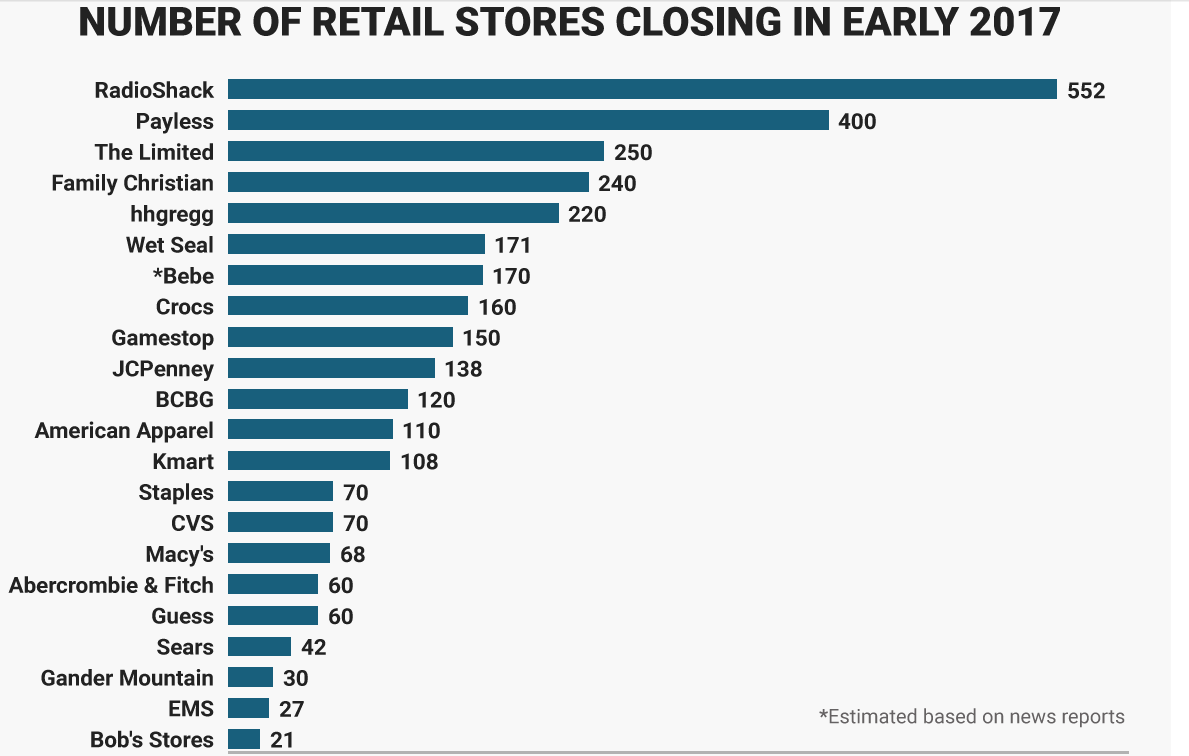
Watchful eye on the Retail sector. Headline retail sales increased 0.4% year over year in April following an upwardly revised 0.1% increase in March (originally -0.2%). However, consensus was for a 0.6% increase. Sales at both general merchandise stores and clothing and clothing accessories stores were down 0.5%. However, it was not all bad. Nine of the 13 categories in fact posted sequential increases. The non-store category (Internet) was a standout, increasing 1.4%. All in all, we are concerned about the Retail sector and need to be mindful of what it means to the broader economy. Case and point, this week we saw Macy’s (M: $24, down 19%) crater on a worse than expected update to its financial outlook. Many are now calling for large scale bankruptcies.
Financials and Industrials lag; Utilities and Tech higher. This week Industrials were the worst performer. The weakness was fairly broad based with GE (GE: $28, down 3%) causing much of the drag. Energy and Construction and Machinery also saw outsized pullbacks. Financials also underperformed. The lower rate backdrop is an easy excuse for bank sluggishness. Regional banks fared much worst that the large money center banks. Life insurers and online brokers also were notable decliners. Pharma found a big rally following upbeat trial data for lung cancer treatment for an industry bellwether. Though hospitals were laggards. Tech outperformed as FAANG stocks are up $250 billion in market cap for the year with the rest of the S&P 500 down $250 billion (so the equity market is essentially down excluding FAANG).
BMR Companies and Commentary
Amazon (AMZN: $962, +3%)
Our dear beloved Amazon. Another week has come and gone. What new world-changing breakthrough do you have for us? Space exploration trips? No, not yet. Home furniture? Alrighty then!
Amazon now wants to furnish your home. The online retail giant is making a major push into furniture and appliances, including building at least four massive warehouses focused on fulfilling and delivering bulky items. With that move, the Seattle-based retailer is taking on the two companies that dominate online furniture sales -- Wayfair and Pottery Barn owner Williams-Sonoma. Furniture is one of the fastest-growing segments of U.S. online Retail, growing 18% in 2015, second only to Groceries. About 15% of the $70 billion U.S. furniture market has moved online.
But even the biggest players in online furniture are struggling to get the market right. Unlike established categories such as books and music or even apparel, retailers are still hammering out basic concepts like how much variety to offer on their sites and the most efficient ways to deliver couches and dining sets to customers' homes.
While Amazon has been selling furniture for years, it has lately decided to tackle the sector more forcefully. Furniture is one of the fastest-growing retail categories at Amazon. The company is expanding its selection of products, with offerings including Ashley Furniture sofas and Jonathan Adler home décor, and it is adding custom-furniture design services. Amazon is also speeding up delivery to one or two days in some cities.
While Amazon has disrupted industries from publishing to fashion with free, fast shipping and easy, one-click buying, furniture can be a tough sector to crack. For one, it is expensive to deliver a couch and other big items, and consumers typically want what are known as "white glove" services, extras like bringing it into the home, setting it up and removing trash. And while packing more small packages onto a delivery van brings the costs down because it can make more stops, you can only fit so many pieces of furniture onto a truck.
Shoppers are still generally willing to pay for furniture delivery, but some retailers and logistics companies say they are facing growing pressure to ship online orders faster. Wayfair offers free shipping on orders over $49, but delivery times can range up to two weeks and longer. Pottery Barn charges on a sliding scale based on price, with delivery costs running above $100 for more expensive items. Furniture sold and shipped directly by Amazon is free for Prime members, while items sold by third-party sellers may cost extra.
To guarantee two-day shipping to 99% of consumers, a retailer or logistics company needs up to a dozen large warehouses spread around the country, plus around 110 smaller facilities to stage deliveries to customers' homes. Amazon is expected to rely on other third-party providers to manage distribution centers and handle delivery of furniture and appliances for the near future, even as it takes more of its logistics in house in other parts of its business. Rising sales may help reduce delivery costs by creating better density. Costs go up for transportation companies as deliveries get more spread out and infrequent.
BMR Take: We see Amazon winning this business opportunity, as they normally do.
Total sales growth is projected to run greater than 20% for several years from the current level of $165 billion predicted this year (up from $135 billion last year.) What an extraordinary growth story Amazon is. What a great ride this stock has and will continue to be. If the company can reach the $30 of EPS analysts project by 2020, this stock easily goes much. Much higher.
Note: See more on Amazon below in “The Death of Retail?”
Netflix (NFLX: $161, +3%)
Netflix announced 400 new jobs in Europe and two new European original series. The expanding workforce complements $1.75 billion of investment in European content, with at least six new Netflix European original projects to be announced in 2017. Netflix is now taking over Europe!
The creation of 400 jobs is happening at its new European customer service hub, which opened this week in Amsterdam. The customer service center will support customers across 11 European countries (Belgium, Denmark, Finland, Ireland, Luxembourg, the Netherlands, Norway, Poland, Romania, Sweden and the UK). The multilingual hub will employ initially a workforce of 170, growing to 400 by the end of 2018.
Amsterdam is the location also of Netflix’s recently expanded European, Middle East and Africa headquarters, which has doubled its workforce since the beginning of 2016. More than 120 employees from 18 countries work at the HQ in business development, marketing, PR, public policy and corporate functions such as finance, legal and recruiting.
The ongoing expansion of Netflix’s workforce in Europe complements the company’s ever-growing investment in European productions (licensed, original and co-productions). The company confirmed plans to announce at least six new European original projects before the end of 2017. Netflix has committed more than $1.75 billion to European productions since entering Europe in 2012, including more than 90 original productions in various stages of development.
BMR Take: We are delighted to see the creation of jobs in Europe and the opening of a new customer service hub in Amsterdam, as well as two new European original series. Moving outside the US, Europe is a great market for Netflix to tap in to to make money longer term. We think Netflix is on track to meet or exceed analyst estimates for $10 of EPS in 2020, meaning the stock can not only grow into the current valuation, but likely head much higher. Our Target is $165. We can’t wait to raise it soon. We do hereby raise the Sell Price from $125 to $145.
Tesla (TSLA: $325, +5%)
Elon Musk has discovered a new passion in life — and it could be Tesla's best product yet. Tesla CEO Elon is the best car salesman in history. And as CEO of SpaceX, he's declared his intention to retire on Mars. But electric vehicles and low-Earth orbits might not hold a candle to what Musk ultimately ends up doing in the roofing business.
Against all odds, Musk has become the biggest booster in the history of the roofing business, thanks to a new Tesla product, the Solar Roof, that officially went on sale last week. It's the first post-Solar City-acquisition product that Tesla is selling, and it sounds as if it's been occupying at least as much of Musk's attention as the forthcoming launch of Tesla's Model 3 car.
Musk has always been big on solar power. Prior to Tesla buying SolarCity for over $2 billion, Musk was the company's Chairman (his cousin was the CEO). He likes to point out that humanity has a compelling alternative to fossil-fuel energy: the giant fusion reactor in the sky that bathes the planet every day with free power. Solar also fits into his master plan, which involves eliminating greenhouse-gas emissions by electrifying transportation; backing up the biosphere with SpaceX, which would make humanity a multi-planetary species; and powering it all with solar energy.
SolarCity has long been able to sell or lease a homeowner solar panels, but the Solar Roof offers a different value proposition. If you have to replace your roof anyway, why not replace it with a roof that generates power and saves you money over the long haul? With a 30-year-mortgage if you stay in the house, you'll replace your roof at least once. At a cost of about $10,000, you maintain the value of the home, but you don't necessarily add much to it. The Solar Roof should last twice as long as a traditional roof (and maybe much longer) and it will both mitigate your electricity costs and, paired with a Tesla Powerpack battery, provide you with backup energy. The up-front costs are high, but the overall economics are compelling. And in sunny states where electricity is costly, such as California, a Solar Roof could net a homeowner tens of thousands of dollars over 30 years.
BMR Take: Solar is the future of energy. Elon Musk and Tesla are already finding opportunities to tap into the trend. Solar roofs have a very bright future and can be a key driver of EPS for Tesla. Analysts currently project EPS to flip from a loss of $5.15 this year to over $11 in 2020. This stock has great potential. The stock set new all-time highs last week, defying the bears. Let’s put it this way – the shorts are getting killed.
PayPal (PYPL: $49, +3%)
The PayPal network effect is working like charm. Investors in PayPal had plenty of reason to cheer last week when the company reported earnings. Nearly every metric was up by a better-than-expected percentage, surpassing expectations of all but the most bullish on the company.
More exciting to long-term investors, however, was the account growth and increase in user engagement with the company's core platform. Six million active accounts were added during the quarter, increasing the total to 203 million for the digital payments company. These active accounts now average almost 32 transactions per year, a 12% increase year over year. More customers using the company's platforms more often was a winning combination that the market liked.
PayPal's growth is beginning to fuel a powerful network effect opening a new window for the company. The beauty of this type of growth is that it drives itself. The more users that sign up for the platform the more important the service becomes for retailers to adopt it and the more places that accept it, the more attractive it becomes to new users. Get it?
At the end of March, 16 million retailers were accepting PayPal's core platform as a method of payment. Management is well aware of this virtuous cycle. During the conference call, CEO Dan Schulman stated: “Our powerful two-sided network engages both consumers and merchants, and the larger our scale, the stronger our network effect becomes. We made meaningful progress in advancing merchant adoption of PayPal in the quarter. At the end of March, the number of active merchant accounts on our platform increased to 16 million. The size of our merchant base is a formidable competitive advantage and is extraordinarily difficult for others to replicate.”
BMR Take: We think PayPal is in the middle of a decade-plus growth cycle that will deliver real value for shareholders. Stick around. They are already closing in on $3 of EPS.
Apple (AAPL: $156, +5%)
Apple chose Corning as the recipient of the first investment from its Advanced Manufacturing Fund, giving $200 million to the maker of glass used in iPhone and iPad screens. Corning, a longtime Apple partner, will use the cash on equipment and glass-processing technology mainly at its Kentucky facility that developed the protective Gorilla Glass used on smartphones. Some of the money will also go toward research and development costs. Corning’s partnership with Apple started 10 years ago with the first iPhone.
Apple Chief Executive Officer Tim Cook said in May that the company planned to invest at least $1 billion to back advanced manufacturing companies in the U.S. and help create jobs in the industry. President Donald Trump has been a vocal critic of American companies -- and Apple in particular -- that outsource production to non-U.S. manufacturers. Apple said it now supports 2 million jobs in the U.S. and that the Corning relationship has helped create about 1,000.
The investment is also a good-will gesture toward Republicans, including President Trump, who has criticized Apple for building its iPhones in China, and the Senate majority leader, Mitch McConnell, who represents Kentucky. Apple said it spent $50 billion last year with American suppliers, although it manufactures just one product line, the Mac Pro, in the United States.
Last month, Mr. Trump sketched out a plan to slash overall corporate tax rates and offer companies a special break for bringing back profits held overseas. Apple has accumulated more cash than any other company in the United States — $260 billion now - and virtually all of it is stashed untaxed in foreign bank accounts. Cook, has repeatedly complained that taxes in the United States are too high and has vowed not to bring the cash home until taxes are cut. The Corning investment is a nice gesture for Apple to show the US government that it is a good US citizen.
BMR Take: EPS are on track to be near $9 this year and grow to $10-11 in the years ahead. The Corning investment and improving government relations is reassuring for us to see. Apple remains a favorite for us. We’re up 66% on our investment since we added the stock early last year. Not bad for the largest a company with the largest market cap in the world, now $814 billion. Our Target is $155, which it has just eclipsed. Yes!!!!!!!
We’ve been waiting to say this: WE HEREBY RAISE THE TARGET PRICE ON APPLE TO $170. The Sell Price is “We would not sell Apple” and we no reason to change this. Good investing out there!
Economic Outlook for the Coming Week
Monday, May 15, 2017 10:00 AM ET
NAHB Housing Market Index SA
Period: MAY
Actual: N/A
Consensus: 68.5
Prior: 68.0
The NAHB/Wells Fargo Housing Market Index is derived from a monthly survey of builders conducted by NAHB . Home builders are asked to rate current sales of single-family homes, and prospects for sales activity in the next six months, as "good," "fair" or "poor." They are also asked to rate traffic of prospective buyers as "high to very high," "average" or "low to very low." Scores for each component are then used to calculate a seasonally adjusted index where any number over 50 indicates that more builders view sales conditions as good than poor. 68.5 is a pretty strong indication of future growth.
Tuesday, May 16, 2017 8:30 AM
Housing Starts SAAR
Period: APR
Actual: N/A
Consensus: 1,263K
Prior: 1,215K
The number of housing units started in the United States. The U.S. Census Bureau's New Residential Construction release provides statistics on the construction of new privately-owned residential structures in the United States. The data relate to new housing units intended for occupancy and maintained by the occupants. They exclude hotels, motels, and group residential structures such as nursing homes and college dormitories. Also excluded are "HUD-code" manufactured (mobile) home units.
Thursday, May 18, 2017 8:30 AM
Initial Unemployment Insurance Claims
Period: 05/13
Actual: N/A
Consensus: 240K
Prior: 236.0K
Weekly data on initial claims for unemployment insurance under state programs. The U.S. Department of Labor's Employment and Training Administration collects weekly data on new and continued claims for unemployment insurance benefits under state programs.
Thursday, May 18, 2017 10:00 AM
Period: APR
Actual: N/A
Consensus: 0.30%
Prior: 0.40%
Leading indicators are economic series that tend to change direction ahead of shifts in the business cycle. There are 10 components of the U.S. Leading Composite Indicator published by The Conference Board. The index is constructed by averaging the individual components in order to smooth out a good part of the volatility of the individual series. Historically, the cyclical turning points in the leading index have occurred before those in aggregate economic activity.
Second Quarter Earnings Reports
About 50% of firms have beaten earnings forecasts, above the long-term average of 46%, according to Goldman Sachs. Further, 40% of companies have exceeded revenue estimates, the most positive ratio of surprises in almost six years.
The VIX (^VIX: 10.40)
The lack of concern amongst US equity investors can be seen in the CBOE Volatility Index, the VIX, a 30-day barometer of investor nervousness calculated using S&P 500 options. The so-called fear gauge on fell on Tuesday to the lowest on record, at 9.67, according to data compiled by Bloomberg, before rallying to close at 10.40.
BMR Take: Low volatility is a sign of bullishness. In times of panic when the market is falling day after day, the Vix is usually in the 20s and sometimes in the 30s. In 2008 when the world was caving in financially, the Vix reached the 60s at the worst of the financial crisis and even spiked into the 90s. The historical average is about 15-16, so at 10 we are in very calm, uncharted territories. Because of this ultra-low volatility level some people say: LOOK OUT; watch for something to happen. We’re not like that. If this market can handle this last week of Trumponomics, then it can handle anything.

c/o Business Insider
The Death of Retail?
Warren Buffett just proclaimed the death of Retail as we know it. In an article in Business Insider he says the future of the retail department store is online. This is not rocket science to us, but to hear Warren say these things holds a lot of weight in our book. Berkshire Hathaway fired a warning signal for the retail industry in February when it sold off $900 million of Walmart stock, choosing instead to invest billions in airlines.
In the age of Amazon, "I think retailing is just too tough for me, generally," Buffett said. "We bought a department store in 1966, and I got my head handed to me. I've been in various things in Retailing. ... I bought Tesco over in the UK and got my head handed to me. Retailing is very tough, and I think the online thing is hard to figure out."
Brick-and-mortar retailers have announced more than 3,200 store closures so far this year, and Credit Suisse expects that number to increase to more than 8,600 before the end of the year. For comparison, 6,200 stores shut down in 2008, the worst year for closures on record. Department stores like Macy's, Sears, and J. C. Penney have been hit the hardest by these trends - since 2001, department stores have lost half a million jobs.
BMR Take: In March we thought about buying Simon Property Group (SPG: $157, down from $186 in February), but we changed our minds quickly. Instead, we would buy Amazon now. The stock closed at $962 Friday, up $27 or 3% last week. Yikes – 10-year bonds pay less than 3% PER YEAR.
Please DON’T WORRY ABOUT THE HIGH STOCK PRICE – pretend it is trading for 1/10 or $93 a share. Buy 11 shares, or 32 shares, or 100 shares – but buy some Amazon. We can see $1000 a share soon; then $1100; then $1200. This one might hit $2000 sometime next year.
c/o Business Insider
Snap Posts $2.2 Billion Loss in First Quarterly Report
Snap (SNAP: $19.14, down 17%) reported a $2.2 billion loss Wednesday, in its first quarter as a publicly traded company, much deeper than the $105 million loss it posted a year ago, hurt by a one-time hit from IPO-related compensation expenses totaling $2 billion. The loss is one of the biggest in American corporate history. Snap had revenues of $150 million which more than quadrupled from the year-ago quarter but missed the consensus estimate of $158 million. Losses more than doubled to $188 million. We always find it strange for a company to lose more money than it actually took in in revenues.
Daily active users rose 36% to 166 million from the year-ago quarter, but the average revenue per user fell, while daily active user growth also disappointed.
Snap went public at $17 in March and reached $27 the second day of trading. We’ve been saying since the IPO that the company is overvalued. This earnings report goes a long way to backing us up on that.
Tesla Starts Taking Orders for its Rooftop Solar Tiles
Tesla has begun taking $1,000 deposits for its remarkable solar roof tiles at a lower price point than most folks expected. The company said it will begin with production of two of the four styles it unveiled in October: a smooth glass and a textured glass tile. They say that roofing a 2,000 square-foot home with 40% coverage of active solar tiles and battery backup for night-time use would cost about $50,000 after federal tax credits and generate $64,000 in energy over 30 years. That’s more expensive upfront than a typical roof, but less expensive than a typical roof with traditional solar and back-up batteries. The warranty is for the lifetime of your home.
They are obviously going after the wealthier clientele to start. Then again, so does Apple. And so do most companies. The cost for active solar tiles is about $42 per square foot, whereas normal roof tiles cost about $11 per foot. Tesla will manage the entire process of solar roof installation, including removal of existing roofs, design, permits, installation and maintenance. The company estimates that installation will take about a week.

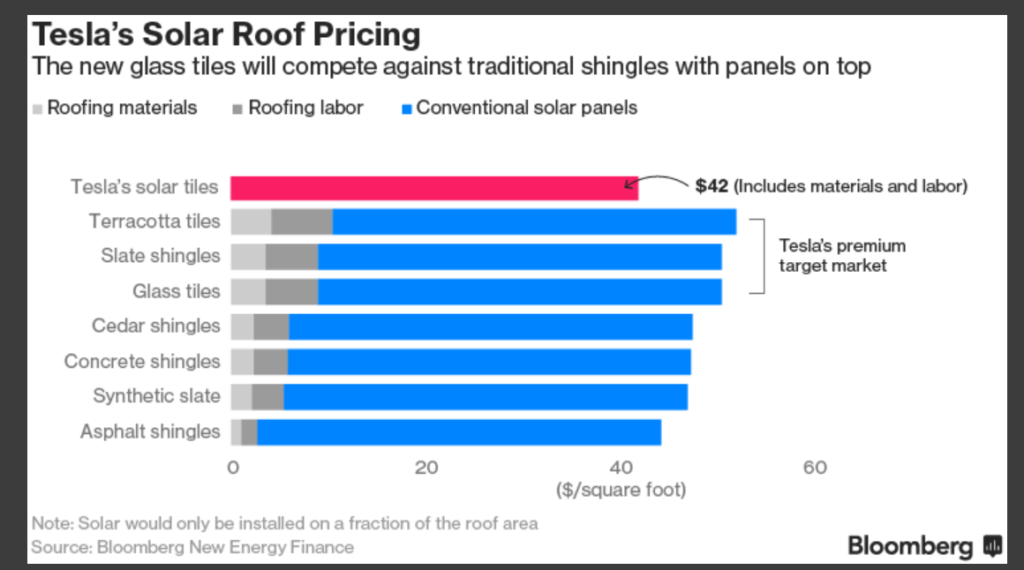
High Yield Report
The High Yield Corner
By Michael Foster
The biggest news of the week for The Bull Market Report’s High Yield portfolio came from AstraZeneca (AZN: $34), which jumped 9% thanks to positive results from a phase 3 study of its Imfinzi drug, a non-small cell lung cancer treatment. The FDA has already approved the drug for bladder cancer treatment, but of course lung cancer is a much bigger and more serious disease, so this is significant news for the company.
The stock had been struggling for nearly a year, falling precipitously both before and after the election. Before the election, fears that Clinton would gut pharma profits caused a big selloff, but that selling pressure increased tremendously following Trump’s election and the surprising news that Trump had little sympathy for pharma either, and he was going to take a scalpel to their profit margins as well. Things hit a low at the beginning of 2017, but recent political scandals and attention elsewhere, as well as the perhaps not too shocking news that Trump is finding it difficult to repeal the Affordable Care Act, have helped pharma companies revert back to a pre-election equilibrium.
Where does that leave us now? Clearly the market has taken its eye off the pipeline ball for a long time, and one has to wonder if the recent news on Imfinzi may in fact force some greater discipline on the market and make investors realize that a sub-30 P/E ratio on a company with many life-saving drugs in various stages of regulatory approval is perhaps unfair. Credit Suisse recently upgraded the stock for that very reason, and we expect more upgrades to come in coming weeks. We’re still 3% off the 52-week high, so there’s no reason to think the sudden buying pressure on Friday is a one-off.
In the more conventional world of ultra-high yield, we’re seeing a continuation of the BDC selloff and junk bond complacency that we have written about for several weeks now. BDC earnings results continue to come in, and for the most part things do not look good. The UBS BDC ETF (BDCS: $22, down 3%) was pummeled by a mix of falling NAVs at constituent firms and analyst downgrades. The downgrades partly come from the aforementioned weakness in NAV, but portfolio yields are also deteriorating at many BDCs. What is portfolio yield? Remember, a BDC is a collection of loans to small and medium-sized businesses. The BDC gets a coupon from each loan, which is the BDC’s yield per loan. Average those together and you get the BDC portfolio yield.
Here’s the real problem: those yields have been going down for a decade. That’s made investing in BDCs particularly tricky, and has caused the BDCs themselves to do a lot of things (lower fees, issue more stock, take on greater risk) to keep investors happy. But all that was supposed to stop when the Fed started raising interest rates, which would cause rates to rise everywhere else. And that is indeed happening elsewhere in the Financial world. Margin rates, preferred note rates, corporate debt rates, and even municipal bond rates have been inching up in anticipation of the Fed’s rate hikes. BDC rates have been on an almost constant slide downward - but the interest rates they need to pay for debt-based capital is going up. So BDCs’ cost of capital is broadly rising and their portfolio yields are going down, compressing margins.
This is a mess. Why is this happening? As far as we can tell, it’s a result of supply and demand. The supply of capital looking for yields has just grown and grown; there are more investors looking to lend to small and medium-sized businesses, thus competing with BDCs. Newer BDCs are showing up. Leveraged lending firms are competing with BDCs. Regional banks are getting back into the small business lending business too. All of this is a structural headwind to BDCs, as they face more competition and thus have to take on more risk or lower the rates they offer on loans. That’s a horrible place to be in, and is why we remain cautious on BDCs as a general rule.
So it’s not surprising that BDCs are down 3%, and we expect that to continue. At the same time, however, there is incredible calm in the junk bond market. The SPDR Barclays High Yield Bond ETF (JNK: $37, flat) barely shrugged this week thanks to little news of significance and a continuation of the declining bankruptcy trend that we’ve seen since early 2016. Again, this is a strong reminder that markets should be forward-looking. Bankruptcy rates were rising in 2015-2016, and junk bond funds were collapsing at the same time. But in early 2016 the bankruptcy problem largely came to a stop, partly thanks to a recovery in oil and partly thanks to the wave of bankruptcies already shaking out most of the weak hands. Yet investors were very slow to realize and jump in.
Now that oil is getting weaker again, one has to wonder if junk bonds are getting ready to peak and a new wave of defaults may be upon us. For sure, that is a possibility but few signs indicate that we will see a repeat of 2015-2016. Instead, we could see a lot of investors anticipate a repeat that never happens, resulting in a mini-correction that provides a buying opportunity.
This means right now is a good time to stick to well-yielding junk bond and high yield bond funds. The Bull Market Report portfolio includes the PIMCO Dynamic Income Fund (PDI: $29, down 1%) and the AGIC Equity and Convertible Income Fund (NIE: $20, down 1%). Admittedly, the discount to NAV on either fund is not particularly compelling right now, but the portfolio quality and historical track record are so good that investors are wise to hold onto these stocks if you have them. New purchases in new bond funds may be something worth considering in the future. More of that in future issues of The Bull Market Report.
Good Investing,
Todd Shaver, Founder, CEO and Editor
The Bull Market Report
www.BullMarket.com
Please consider subscribing to the Weekly Bull Market Report with all of our super research, as well as News Flashes during the week. We are just trying to help you find those stocks that will help you increase your wealth!
Go here: www.BullMarket.com/subscription
Thanks and Good Investing!
May 14, 2017
by Todd Shaver | May 14, 2017 | Weekly Newsletter 7pm Sunday
The Week Ahead
“President Fires FBI Director” was the headline of the week. Think of it. When was the last time you can recall the head of the FBI getting fired? What does this mean about the stability of the FBI (one of our most important institutions)? What does this mean about President’s Trump future in Washington DC? Democrats are not letting this one go. Democrats are now openly discussing impeaching Trump. Who knows what will happen. But one thing is for sure, uncertainty is at a high in terms of geopolitical risks. So far, the Bull Market doesn’t seem to mind. We hope that continues to be the case.
There is always a bull market here at The Bull Market Report! This week we highlight the following securities: Square, Amazon, Splunk, Netflix, Tesla, and Apple.
Highlights From The Past Week
Earnings season is off to a good start. Over 90% of the companies in the S&P 500 have now reported results for Q1. The blended Q1 S&P 500 EPS growth rate is 14%, better than the 9% expected at the end of the quarter. It also represents the strongest growth since the 17% in Q3 2011. We note favorable top-line trends and recognition of improving sentiment and growth expectations is prevalent on Q1 earnings calls. However, not all managers have seen it translate to higher demand. CEOs expressed hope for widespread deregulation and improved regulatory clarity, but uncertainty remains high. The US economy is at full employment and wage growth is accelerating. Rising labor costs as a headwind to profit margins.
Watchful eye on the Retail sector. Headline retail sales increased 0.4% year over year in April following an upwardly revised 0.1% increase in March (originally -0.2%). However, consensus was for a 0.6% increase. Sales at both general merchandise stores and clothing and clothing accessories stores were down 0.5%. However, it was not all bad. Nine of the 13 categories in fact posted sequential increases. The non-store category (Internet) was a standout, increasing 1.4%. All in all, we are concerned about the Retail sector and need to be mindful of what it means to the broader economy. Case and point, this week we saw Macy’s (M: $24, down 19%) crater on a worse than expected update to its financial outlook. Many are now calling for large scale bankruptcies.
Financials and Industrials lag; Utilities and Tech higher. This week Industrials were the worst performer. The weakness was fairly broad based with GE (GE: $28, down 3%) causing much of the drag. Energy and Construction and Machinery also saw outsized pullbacks. Financials also underperformed. The lower rate backdrop is an easy excuse for bank sluggishness. Regional banks fared much worst that the large money center banks. Life insurers and online brokers also were notable decliners. Pharma found a big rally following upbeat trial data for lung cancer treatment for an industry bellwether. Though hospitals were laggards. Tech outperformed as FAANG stocks are up $250 billion in market cap for the year with the rest of the S&P 500 down $250 billion (so the equity market is essentially down excluding FAANG).
BMR Companies and Commentary
Square (SQ: $20, +2%)
Square jumped to a record high after reporting results that beat analysts’ expectations, impressing investors with its ability to woo bigger sellers and offer newer software products that help merchants manage their businesses. Revenue in the first quarter rose 39% as more businesses signed on for payments processing, loans and software to help manage inventory. Square raised full-year sales and profit forecasts, adding an exclamation point to the quarter. The shares have now more than doubled from a low nearly a year ago.
Not long ago, investors questioned Square’s prospects as a provider of credit card processing for food trucks amid rising competition from PayPal and First Data. But the company, run by Twitter Chief Executive Officer Jack Dorsey, has plowed ahead with international expansion, partnerships and acquisitions. Square is targeting larger merchants with a growing suite of more-profitable services, including loans and software that manage inventory and analyze sales. In the fourth quarter of 2016, those newer offerings made up a quarter of revenue. It was even higher by the first quarter, Chief Financial Officer Sarah Friar said.
What continues to make us pleased with results is growth in large businesses. That ongoing shift is good to see because those folks are not net new to the payments world. They’ve probably had an alternate supplier, but now they want to be on the latest technology and their action of migrating over to Square speaks volumes. Square said revenue from larger sellers -- those with at least $125,000 in annualized gross payment volume -- grew 44% in the first quarter from a year earlier.
BMR Take: Square is battling it out with industry titans such as Visa, MasterCard, American Express, and PayPal. So far so good. The company is in growth mode as the top line is set to expand from $900 million this year to $1.8 billion in 2020. Profitability and EPS growth will follow, with some analysts calling for $0.50 of EPS as early as 2020. All in all, we think Square is a very sturdy long term growth story, one you definitely need in your portfolio.
Amazon (AMZN: $962, +3%)
Our dear Amazon. Another week has come and gone. What new world-changing breakthrough have you for us? Home furniture? Alrighty then!
Amazon now wants to furnish your home. The online retail giant is making a major push into furniture and appliances, including building at least four massive warehouses focused on fulfilling and delivering bulky items. With that move, the Seattle-based retailer is taking on the two companies that dominate online furniture sales -- Wayfair and Pottery Barn owner Williams-Sonoma. Furniture is one of the fastest-growing segments of U.S. online Retail, growing 18% in 2015, second only to Groceries. About 15% of the $70 billion U.S. furniture market has moved online.
But even the biggest players in online furniture are struggling to get the market right. Unlike established categories such as books and music or even apparel, retailers are still hammering out basic concepts like how much variety to offer on their sites and the most efficient ways to deliver couches and dining sets to customers' homes.
While Amazon has been selling furniture for years, it has lately decided to tackle the sector more forcefully. Furniture is one of the fastest-growing retail categories at Amazon. The company is expanding its selection of products, with offerings including Ashley Furniture sofas and Jonathan Adler home décor, and it is adding custom-furniture design services. Amazon is also speeding up delivery to one or two days in some cities.
While Amazon has disrupted industries from publishing to fashion with free, fast shipping and easy, one-click buying, furniture can be a tough sector to crack. For one, it is expensive to deliver a couch and other big items, and consumers typically want what are known as "white glove" services, extras like bringing it into the home, setting it up and removing trash. And while packing more small packages onto a delivery van brings the costs down because it can make more stops, you can only fit so many pieces of furniture onto a truck.
Shoppers are still generally willing to pay for furniture delivery, but some retailers and logistics companies say they are facing growing pressure to ship online orders faster. Wayfair offers free shipping on orders over $49, but delivery times can range up to two weeks and longer. Pottery Barn charges on a sliding scale based on price, with delivery costs running above $100 for more expensive items. Furniture sold and shipped directly by Amazon is free for Prime members, while items sold by third-party sellers may cost extra.
To guarantee two-day shipping to 99% of consumers, a retailer or logistics company needs up to a dozen large warehouses spread around the country, plus around 110 smaller facilities to stage deliveries to customers' homes. Amazon is expected to rely on other third-party providers to manage distribution centers and handle delivery of furniture and appliances for the near future, even as it takes more of its logistics in house in other parts of its business. Rising sales may help reduce delivery costs by creating better density. Costs go up for transportation companies as deliveries get more spread out and infrequent.
BMR Take: We see Amazon winning this business opportunity, as they normally do.
Total sales growth is projected to run greater than 20% for several years from the current level of $165 billion predicted this year (up from $135 billion last year.) What an extraordinary growth story Amazon is. What a great ride this stock has and will continue to be. If the company can reach the $30 of EPS analysts project by 2020, this stock easily goes much. Much higher.
Note: See more on Amazon below in “The Death of Retail?”
Splunk (SPLK: $67, +1%)
Splunk, a provider of the leading software platform for real-time Operational Intelligence, announced the results of new research that shows digital transformation* initiatives are more successful when they have buy-in from across the business.
* Digital transformation is the change associated with the application of digital technology in all aspects of human society. The transformation stage means that digital usages inherently enable new types of innovation and creativity in a particular domain, rather than simply enhance and support the traditional methods.
Findings from a survey of 400 senior IT executives across the U.S., U.K. and Germany show that adoption of digital transformation initiatives is widespread. When asked where they are in the journey, 36% believe they are ahead of the curve, while 55% believe they are moving with the masses. They said that 30% of their IT budget is dedicated to digital transformation projects, but the research reveals these initiatives are more likely to succeed when funded from outside IT. The organizations that are most mature when it comes to digital-first strategies are more likely to indicate that funding comes from departments such as product development, customer service, sales and marketing.
Having a digital transformation strategy and executing on it no longer means you have an edge. If the majority of organizations are ‘moving with the masses’ or believe they are ‘ahead of the curve’ then no one is really standing out. Organizations that rely on machine data to make better decisions gain a strategic advantage over their competitors. It is not surprising that those organizations with the most success are the ones collaborating – and funding – cross-functionally. Data is a key driver in enabling that collaboration and can help companies drive real-time business insights to move faster to differentiate, innovate, raise revenues, reduce costs and mitigate risks.
Key findings from the report include: (i) 67% of respondents expect digital transformation budgets to increase, while only 8% expect a decrease; (ii) 70% of respondents cite IT as a key funding source. (iii) 77% of respondents say security was a critical or very important driver; and (iv) insight into machine data is key to success: When asked about the ability to derive real-time insights and business value from machine data to achieve their digital business goals, more than two-thirds say this is a critical or very important priority.
BMR Take: Splunk is the market leader in analyzing machine data to deliver Operational Intelligence for security, IT and the business. Splunk software provides the enterprise machine data fabric that drives digital transformation. More than 13,000 customers in over 110 countries use Splunk solutions in the cloud and on premise. It is an exciting time for Splunk in this business. With EPS on track to go from $0.41 in this most recent fiscal year to $1.35 in 2020, the prospects for the stock look exciting too. We are up 46% since we added it in March of last year. Our Target is $75.
Netflix (NFLX: $161, +3%)
Netflix announced 400 new jobs in Europe and two new European original series. The expanding workforce complements $1.75 billion of investment in European content, with at least six new Netflix European original projects to be announced in 2017. Netflix is now taking over Europe!
The creation of 400 jobs is happening at its new European customer service hub, which opened this week in Amsterdam. The customer service center will support customers across 11 European countries (Belgium, Denmark, Finland, Ireland, Luxembourg, the Netherlands, Norway, Poland, Romania, Sweden and the UK). The multilingual hub will employ initially a workforce of 170, growing to 400 by the end of 2018.
Amsterdam is the location also of Netflix’s recently expanded European, Middle East and Africa headquarters, which has doubled its workforce since the beginning of 2016. More than 120 employees from 18 countries work at the HQ in business development, marketing, PR, public policy and corporate functions such as finance, legal and recruiting.
The ongoing expansion of Netflix’s workforce in Europe complements the company’s ever-growing investment in European productions (licensed, original and co-productions). The company confirmed plans to announce at least six new European original projects before the end of 2017. Netflix has committed more than $1.75 billion to European productions since entering Europe in 2012, including more than 90 original productions in various stages of development.
BMR Take: We are delighted to see the creation of jobs in Europe and the opening of a new customer service hub in Amsterdam, as well as two new European original series. Moving outside the US, Europe is a great market for Netflix to tap in to to make money longer term. We think Netflix is on track to meet or exceed analyst estimates for $10 of EPS in 2020, meaning the stock can not only grow into the current valuation, but likely head much higher. Our Target is $165. We can’t wait to raise it soon. We do hereby raise the Sell Price from $125 to $145.
Tesla (TSLA: $325, +5%)
Elon Musk has discovered a new passion in life — and it could be Tesla's best product yet. Tesla CEO Elon is the best car salesman in history. And as CEO of SpaceX, he's declared his intention to retire on Mars. But electric vehicles and low-Earth orbits might not hold a candle to what Musk ultimately ends up doing in the roofing business.
Against all odds, Musk has become the biggest booster in the history of the roofing business, thanks to a new Tesla product, the Solar Roof, that officially went on sale last week. It's the first post-Solar City-acquisition product that Tesla is selling, and it sounds as if it's been occupying at least as much of Musk's attention as the forthcoming launch of Tesla's Model 3 car.
Musk has always been big on solar power. Prior to Tesla buying SolarCity for over $2 billion, Musk was the company's Chairman (his cousin was the CEO). He likes to point out that humanity has a compelling alternative to fossil-fuel energy: the giant fusion reactor in the sky that bathes the planet every day with free power. Solar also fits into his master plan, which involves eliminating greenhouse-gas emissions by electrifying transportation; backing up the biosphere with SpaceX, which would make humanity a multi-planetary species; and powering it all with solar energy.
SolarCity has long been able to sell or lease a homeowner solar panels, but the Solar Roof offers a different value proposition. If you have to replace your roof anyway, why not replace it with a roof that generates power and saves you money over the long haul? With a 30-year-mortgage if you stay in the house, you'll replace your roof at least once. At a cost of about $10,000, you maintain the value of the home, but you don't necessarily add much to it. The Solar Roof should last twice as long as a traditional roof (and maybe much longer) and it will both mitigate your electricity costs and, paired with a Tesla Powerpack battery, provide you with backup energy. The up-front costs are high, but the overall economics are compelling. And in sunny states where electricity is costly, such as California, a Solar Roof could net a homeowner tens of thousands of dollars over 30 years.
BMR Take: Solar is the future of energy. Elon Musk and Tesla are already finding opportunities to tap into the trend. Solar roofs have a very bright future and can be a key driver of EPS for Tesla. Analysts currently project EPS to flip from a loss of $5.15 this year to over $11 in 2020. This stock has great potential. The stock set new all-time highs last week, defying the bears. Let’s put it this way – the shorts are getting killed.
Apple (AAPL: $156, +5%)
Apple chose Corning as the recipient of the first investment from its Advanced Manufacturing Fund, giving $200 million to the maker of glass used in iPhone and iPad screens. Corning, a longtime Apple partner, will use the cash on equipment and glass-processing technology mainly at its Kentucky facility that developed the protective Gorilla Glass used on smartphones. Some of the money will also go toward research and development costs. Corning’s partnership with Apple started 10 years ago with the first iPhone.
Apple Chief Executive Officer Tim Cook said in May that the company planned to invest at least $1 billion to back advanced manufacturing companies in the U.S. and help create jobs in the industry. President Donald Trump has been a vocal critic of American companies -- and Apple in particular -- that outsource production to non-U.S. manufacturers. Apple said it now supports 2 million jobs in the U.S. and that the Corning relationship has helped create about 1,000.
The investment is also a good-will gesture toward Republicans, including President Trump, who has criticized Apple for building its iPhones in China, and the Senate majority leader, Mitch McConnell, who represents Kentucky. Apple said it spent $50 billion last year with American suppliers, although it manufactures just one product line, the Mac Pro, in the United States.
Last month, Mr. Trump sketched out a plan to slash overall corporate tax rates and offer companies a special break for bringing back profits held overseas. Apple has accumulated more cash than any other company in the United States — $260 billion now - and virtually all of it is stashed untaxed in foreign bank accounts. Cook, has repeatedly complained that taxes in the United States are too high and has vowed not to bring the cash home until taxes are cut. The Corning investment is a nice gesture for Apple to show the US government that it is a good US citizen.
BMR Take: EPS are on track to be near $9 this year and grow to $10-11 in the years ahead. The Corning investment and improving government relations is reassuring for us to see. Apple remains a favorite for us. We’re up 66% on our investment since we added the stock early last year. Not bad for the largest a company with the largest market cap in the world, now $814 billion. Our Target is $155, which it has just eclipsed. Yes!!!!!!!
We’ve been waiting to say this: WE HEREBY RAISE THE TARGET PRICE ON APPLE TO $170. The Sell Price is “We would not sell Apple” and we no reason to change this. Good investing out there!
Economic Outlook for the Coming Week
Monday, May 15, 2017 10:00 AM ET
NAHB Housing Market Index SA
Period: MAY
Actual: N/A
Consensus: 68.5
Prior: 68.0
The NAHB/Wells Fargo Housing Market Index is derived from a monthly survey of builders conducted by NAHB . Home builders are asked to rate current sales of single-family homes, and prospects for sales activity in the next six months, as "good," "fair" or "poor." They are also asked to rate traffic of prospective buyers as "high to very high," "average" or "low to very low." Scores for each component are then used to calculate a seasonally adjusted index where any number over 50 indicates that more builders view sales conditions as good than poor. 68.5 is a pretty strong indication of future growth.
Tuesday, May 16, 2017 8:30 AM
Housing Starts SAAR
Period: APR
Actual: N/A
Consensus: 1,263K
Prior: 1,215K
The number of housing units started in the United States. The U.S. Census Bureau's New Residential Construction release provides statistics on the construction of new privately-owned residential structures in the United States. The data relate to new housing units intended for occupancy and maintained by the occupants. They exclude hotels, motels, and group residential structures such as nursing homes and college dormitories. Also excluded are "HUD-code" manufactured (mobile) home units.
Thursday, May 18, 2017 8:30 AM
Initial Unemployment Insurance Claims
Period: 05/13
Actual: N/A
Consensus: 240K
Prior: 236.0K
Weekly data on initial claims for unemployment insurance under state programs. The U.S. Department of Labor's Employment and Training Administration collects weekly data on new and continued claims for unemployment insurance benefits under state programs.
Thursday, May 18, 2017 10:00 AM
Period: APR
Actual: N/A
Consensus: 0.30%
Prior: 0.40%
Leading indicators are economic series that tend to change direction ahead of shifts in the business cycle. There are 10 components of the U.S. Leading Composite Indicator published by The Conference Board. The index is constructed by averaging the individual components in order to smooth out a good part of the volatility of the individual series. Historically, the cyclical turning points in the leading index have occurred before those in aggregate economic activity.
An Update on Twilio
Twilio (TWLO: $24, flat) survived another week in the low 20s. They reported earnings on Monday, two weeks ago with glowing revenues, weak earnings (expected), but gave notice that they are losing one of their big customers – Uber at 12% of revenues. They mentioned that they added 4,000 customers in the quarter to reach over 40,000 customers but the market only took notice of their losing the one customer. They have another big customer at over 10% of revenues – WhatsApp, which is owned by Facebook – and the market is worried about their losing this customer. We are not. We are focusing on the 12,000 customers a year that they are adding to their base.
Here is a letter to us on the day we issued the News Flash, from one of our subscribers, Bob Rood:
I bought some at the low yesterday. Bob
And our response:
OK, good, Bob. It has rallied a tad this morning. But be prepared for anything that might happen. We could see $20 before we see $30. I hope this is not the case, but it could happen. It looks like Uber is slowly leaving as a customer and they had 12% of revenues. So, this will take some time to work out. They did add 4,000 customers last quarter and are now at 41,000. They normally add 2,800 a quarter. But note that this is going to take some time.
Todd Shaver
Second Quarter Earnings Reports
About 50% of firms have beaten earnings forecasts, above the long-term average of 46%, according to Goldman Sachs. Further, 40% of companies have exceeded revenue estimates, the most positive ratio of surprises in almost six years.
The VIX (^VIX: 10.40)
The lack of concern amongst US equity investors can be seen in the CBOE Volatility Index, the VIX, a 30-day barometer of investor nervousness calculated using S&P 500 options. The so-called fear gauge on fell on Tuesday to the lowest on record, at 9.67, according to data compiled by Bloomberg, before rallying to close at 10.40.
BMR Take: Low volatility is a sign of bullishness. In times of panic when the market is falling day after day, the Vix is usually in the 20s and sometimes in the 30s. In 2008 when the world was caving in financially, the Vix reached the 60s at the worst of the financial crisis and even spiked into the 90s. The historical average is about 15-16, so at 10 we are in very calm, uncharted territories. Because of this ultra-low volatility level some people say: LOOK OUT; watch for something to happen. We’re not like that. If this market can handle this last week of Trumponomics, then it can handle anything.
c/o Business Insider
The Death of Retail?
Warren Buffett just proclaimed the death of Retail as we know it. In an article in Business Insider he says the future of the retail department store is online. This is not rocket science to us, but to hear Warren say these things holds a lot of weight in our book. Berkshire Hathaway fired a warning signal for the retail industry in February when it sold off $900 million of Walmart stock, choosing instead to invest billions in airlines.
In the age of Amazon, "I think retailing is just too tough for me, generally," Buffett said. "We bought a department store in 1966, and I got my head handed to me. I've been in various things in Retailing. ... I bought Tesco over in the UK and got my head handed to me. Retailing is very tough, and I think the online thing is hard to figure out."
Brick-and-mortar retailers have announced more than 3,200 store closures so far this year, and Credit Suisse expects that number to increase to more than 8,600 before the end of the year. For comparison, 6,200 stores shut down in 2008, the worst year for closures on record. Department stores like Macy's, Sears, and J. C. Penney have been hit the hardest by these trends - since 2001, department stores have lost half a million jobs.
BMR Take: In March we thought about buying Simon Property Group (SPG: $157, down from $186 in February), but we changed our minds quickly. Instead, we would buy Amazon now. The stock closed at $962 Friday, up $27 or 3% last week. Yikes – 10-year bonds pay less than 3% PER YEAR.
Please DON’T WORRY ABOUT THE HIGH STOCK PRICE – pretend it is trading for 1/10 or $93 a share. Buy 11 shares, or 32 shares, or 100 shares – but buy some Amazon. We can see $1000 a share soon; then $1100; then $1200. This one might hit $2000 sometime next year.
c/o Business Insider
A Word from Gary Jefferson
Jefferson Financial Group
First Vice-President, Investments
UBS Financial Services, Inc.
We have often referred to them as the four most dangerous words in our business – "this time is different.” We are beginning to pick up quite a bit of commentary lately that talks in terms of it being different this time. The words are not all the same, but the general gist is that "American equities may not be significantly overpriced; The market may be discounting a far-larger rise in future corporate earnings than most investors realize is possible (Trump tax cuts); or foreign investment may be altering the traditional valuation parameters used to determine share-price multiples so that it is quite possible that we have entered a new era for share price evaluation".
The bottom line to all of this is that we don't believe there are any "It's different this time fundamentals" that are going to change this market. There are obviously new and varied "wrinkles" attached to today's market scenario relative to history, but it will still, in our opinion, move in the direction that earnings take it. Earnings thus far have met or exceeded expectations. We believe that until they disappoint, the market will advance, but only so far as earnings allow……..not because of a pundit's idea that the market is going up due to some new theory about share price evaluation or of it being "different" this time.
Opko Health: A Letter from a Subscriber
We're sure you have all read the news on Opko Health (OPK: $7.19, down 4%) about their earnings report that we put out via News Flash on Thursday. After much consideration, we have decided to stick with it, even as the stock is down significantly from the price at which we added it in September. A reader wrote us on Friday:
From: John <jotenn@xxxxx.com>
To: The Bull Market Report <Info@BullMarket.com>
Sent: Thursday, May 11, 2017 11:03 AM
Subject: News Flash for May 11, 2017: Opko Health: An Uneventful Quarter. Time to Step Aside? Or Be Patient?
Hi Todd:
You are right about others buying OPKO. The CTO just bought 40,000 shares, and I see the Executive VP just picked up another couple of thousand shares under $7 too.
I bought a few hundred more shares at 6.80 yesterday also. I believe CEO Frost is playing the long game here. Lots of irons in the fire, and he is spending money to develop them, thus, less profit than analysts expected although revenue was good. Anyway, you win some (MZOR is a real home run, thanks!) and lose some, but I am still holding in there, and I keep averaging down whenever a whole number is breached. Did that with VRX too, and it is now paying off, big time!
Best, John Tennant
And we sent this back to John:
OK, thanks for sending this news, John. We were going to comment on it in the newsletter this weekend [which we are doing now!] Revenues are key. What do you have with no revenues? Nothing. Most biotech companies have no revenues and all they have is hope that their products will work out. Opko can coast while they work on the new stuff. But it sure is frustrating waiting and waiting….
Can’t wait to see if CEO Frost is buying more down here.
Todd Shaver
Snap Posts $2.2 Billion Loss in First Quarterly Report
Snap (SNAP: $19.14, down 17%) reported a $2.2 billion loss Wednesday, in its first quarter as a publicly traded company, much deeper than the $105 million loss it posted a year ago, hurt by a one-time hit from IPO-related compensation expenses totaling $2 billion. The loss is one of the biggest in American corporate history. Snap had revenues of $150 million which more than quadrupled from the year-ago quarter but missed the consensus estimate of $158 million. Losses more than doubled to $188 million. We always find it strange for a company to lose more money than it actually took in in revenues.
Daily active users rose 36% to 166 million from the year-ago quarter, but the average revenue per user fell, while daily active user growth also disappointed.
Snap went public at $17 in March and reached $27 the second day of trading. We’ve been saying since the IPO that the company is overvalued. This earnings report goes a long way to backing us up on that.
Tesla Starts Taking Orders for its Rooftop Solar Tiles
Tesla has begun taking $1,000 deposits for its remarkable solar roof tiles at a lower price point than most folks expected. The company said it will begin with production of two of the four styles it unveiled in October: a smooth glass and a textured glass tile. They say that roofing a 2,000 square-foot home with 40% coverage of active solar tiles and battery backup for night-time use would cost about $50,000 after federal tax credits and generate $64,000 in energy over 30 years. That’s more expensive upfront than a typical roof, but less expensive than a typical roof with traditional solar and back-up batteries. The warranty is for the lifetime of your home.
They are obviously going after the wealthier clientele to start. Then again, so does Apple. And so do most companies. The cost for active solar tiles is about $42 per square foot, whereas normal roof tiles cost about $11 per foot. Tesla will manage the entire process of solar roof installation, including removal of existing roofs, design, permits, installation and maintenance. The company estimates that installation will take about a week.
Kinder Morgan to raise up to $1.3 billion in Canadian IPO
Kinder Morgan (KMI: $19.91, down 1%) has a Canadian unit that is seeking to raise up to $1.3 billion in an IPO in Toronto. The deal would help fund the expansion of Kinder Morgan's Trans Mountain pipeline. Trans Mountain currently transports 300,000 barrels per day (bpd) of crude oil and refined petroleum products from the oil sands in Alberta to Vancouver, British Columbia and Washington State. In November, the Government of Canada granted approval for the $6.8 billion Trans Mountain Expansion Project, which will increase the capacity of the system to 890,000 bpd. The expanded pipeline is expected to be completed in 2019.
The company plans to offer between 80 million and 92 million shares. Toronto Dominion Bank and Royal Bank of Canada are the lead underwriters for the IPO.
The pipeline project has already won approval from the B.C. and federal governments.
Kinder Morgan will retain about 75% of Kinder Morgan Canada if the share sale were to proceed, the filing shows. Toronto-Dominion Bank and Royal Bank of Canada are leading the share sale.
BMR Take: We continue to feel Kinder Morgan is undervalued but we are content to wait patiently, collecting the 2.5% dividend. The stock was at $44 in the spring of 2015 and is now less than half that. It will start moving higher any day now.
High Yield Report
The High Yield Corner
By Michael Foster
The biggest news of the week for The Bull Market Report’s High Yield portfolio came from AstraZeneca (AZN: $34), which jumped 9% thanks to positive results from a phase 3 study of its Imfinzi drug, a non-small cell lung cancer treatment. The FDA has already approved the drug for bladder cancer treatment, but of course lung cancer is a much bigger and more serious disease, so this is significant news for the company.
The stock had been struggling for nearly a year, falling precipitously both before and after the election. Before the election, fears that Clinton would gut pharma profits caused a big selloff, but that selling pressure increased tremendously following Trump’s election and the surprising news that Trump had little sympathy for pharma either, and he was going to take a scalpel to their profit margins as well. Things hit a low at the beginning of 2017, but recent political scandals and attention elsewhere, as well as the perhaps not too shocking news that Trump is finding it difficult to repeal the Affordable Care Act, have helped pharma companies revert back to a pre-election equilibrium.
Where does that leave us now? Clearly the market has taken its eye off the pipeline ball for a long time, and one has to wonder if the recent news on Imfinzi may in fact force some greater discipline on the market and make investors realize that a sub-30 P/E ratio on a company with many life-saving drugs in various stages of regulatory approval is perhaps unfair. Credit Suisse recently upgraded the stock for that very reason, and we expect more upgrades to come in coming weeks. We’re still 3% off the 52-week high, so there’s no reason to think the sudden buying pressure on Friday is a one-off.
In the more conventional world of ultra-high yield, we’re seeing a continuation of the BDC selloff and junk bond complacency that we have written about for several weeks now. BDC earnings results continue to come in, and for the most part things do not look good. The UBS BDC ETF (BDCS: $22, down 3%) was pummeled by a mix of falling NAVs at constituent firms and analyst downgrades. The downgrades partly come from the aforementioned weakness in NAV, but portfolio yields are also deteriorating at many BDCs. What is portfolio yield? Remember, a BDC is a collection of loans to small and medium-sized businesses. The BDC gets a coupon from each loan, which is the BDC’s yield per loan. Average those together and you get the BDC portfolio yield.
Here’s the real problem: those yields have been going down for a decade. That’s made investing in BDCs particularly tricky, and has caused the BDCs themselves to do a lot of things (lower fees, issue more stock, take on greater risk) to keep investors happy. But all that was supposed to stop when the Fed started raising interest rates, which would cause rates to rise everywhere else. And that is indeed happening elsewhere in the Financial world. Margin rates, preferred note rates, corporate debt rates, and even municipal bond rates have been inching up in anticipation of the Fed’s rate hikes. BDC rates have been on an almost constant slide downward - but the interest rates they need to pay for debt-based capital is going up. So BDCs’ cost of capital is broadly rising and their portfolio yields are going down, compressing margins.
This is a mess. Why is this happening? As far as we can tell, it’s a result of supply and demand. The supply of capital looking for yields has just grown and grown; there are more investors looking to lend to small and medium-sized businesses, thus competing with BDCs. Newer BDCs are showing up. Leveraged lending firms are competing with BDCs. Regional banks are getting back into the small business lending business too. All of this is a structural headwind to BDCs, as they face more competition and thus have to take on more risk or lower the rates they offer on loans. That’s a horrible place to be in, and is why we remain cautious on BDCs as a general rule.
So it’s not surprising that BDCs are down 3%, and we expect that to continue. At the same time, however, there is incredible calm in the junk bond market. The SPDR Barclays High Yield Bond ETF (JNK: $37, flat) barely shrugged this week thanks to little news of significance and a continuation of the declining bankruptcy trend that we’ve seen since early 2016. Again, this is a strong reminder that markets should be forward-looking. Bankruptcy rates were rising in 2015-2016, and junk bond funds were collapsing at the same time. But in early 2016 the bankruptcy problem largely came to a stop, partly thanks to a recovery in oil and partly thanks to the wave of bankruptcies already shaking out most of the weak hands. Yet investors were very slow to realize and jump in.
Now that oil is getting weaker again, one has to wonder if junk bonds are getting ready to peak and a new wave of defaults may be upon us. For sure, that is a possibility but few signs indicate that we will see a repeat of 2015-2016. Instead, we could see a lot of investors anticipate a repeat that never happens, resulting in a mini-correction that provides a buying opportunity.
This means right now is a good time to stick to well-yielding junk bond and high yield bond funds. The Bull Market Report portfolio includes the PIMCO Dynamic Income Fund (PDI: $29, down 1%) and the AGIC Equity and Convertible Income Fund (NIE: $20, down 1%). Admittedly, the discount to NAV on either fund is not particularly compelling right now, but the portfolio quality and historical track record are so good that investors are wise to hold onto these stocks if you have them. New purchases in new bond funds may be something worth considering in the future. More of that in future issues of The Bull Market Report.
Good Investing,
Todd Shaver, Founder, CEO and Editor
The Bull Market Report
www.BullMarket.com
April 30, 2017
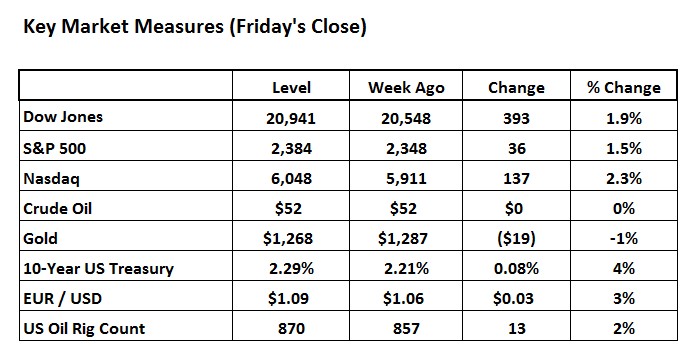
by Todd Shaver | Apr 30, 2017 | Weekly Newsletter 7pm Sunday
The Week Ahead
Tax season came to a close two weeks ago. We filed an extension of course. Now Tax Reform is front and center. A new plan released by the Trump Administration got the market excited about the prospects. The bull in us hopes to see the corporate tax rate dropped to 15% from 35% and tax repatriation bring home the bacon from overseas – they are talking 10% for this cash that totals $2.6 trillion. We personally are excited about that prospect. We look for more progress in the weeks ahead to drive continued improvement in sentiment and higher stock market prices.
There is always a bull market here at The Bull Market Report! This week we highlight the following securities: Amazon, PayPal, CBRE Group, UPS, Google, Celgene and Athenahealth.
Highlights From The Past Week
The biggest tax cut in US history? The announcement outlined the general principles of proposed US tax cuts and reform. The proposals outline the lowering of the marginal corporate tax rate to 15% from 35%. This rate will be applied to a simplified tax code. Border tax adjustments have been said not to work in their current form but discussions are continuing. Overseas cash will be repatriated at a one-time lower tax rate, although this rate is yet to be determined. The timeline for US tax reform is still unclear. The budget neutrality of these proposals has not been outlined in detail. Secretary Mnuchin stated that the reform would pay for itself with economic growth. But we know this is just impossible. Arthur Laffer would be laughing from the grave. Oh wait – he is still around – a healthy 76 years old.
Remember the Laffer Curve? Google it. It has come to be remembered as the concept of lowering taxes (thus cutting tax revenue to the government) causing so much growth that the increased tax revenues pays for the tax cut. Again – this has been completely debunked over the past four decades.
Cash repatriation a big deal for the Technology sector. In recent years, US companies have accumulated estimated overseas cash balances of $2.6 trillion on their balance sheets. Overseas cash holdings are dominated by the Information Technology sector. Companies such as Apple ($255 billion), Microsoft ($110 billion) and Google ($75 billion) have significant cash holdings well in excess of their working capital requirement. If this cash starts coming back we think it will be a boost to the economy and the stock market.
No healthcare vote this past week. The latest House attempt to pass a revised Obamacare replacement bill seems to have stalled. Despite continued pressure from the White House and recent speculation that a vote could take place over the weekend, House Speaker Ryan and his top lieutenants decided during a late-night meeting on Thursday that they still do not have the votes to pass the legislation. Note that at least 15 House Republicans remain firmly opposed to the bill, while at least another 20 are leaning towards no or are still undecided. Recall that Republicans can lose only 22 votes. The Hill recently reported that at least 21 Republicans have said they would vote no on the bill.
Big inflows to equities. Dampened risk aversion surrounding the French election, tax reform back in the headlines, and better earnings sentiment all are reflected in the latest flow data. Equities saw $21 billion of inflows this week, the largest since the US election. US equities saw inflows of $14 billion, the largest in 19 weeks. Inflows to European equities were $2.4 billion, the most since December 2015. Emerging market equities saw its sixth straight week of inflows. US value has now seen outflows in five of the last six weeks. At the same time, we saw the biggest inflows to small caps in 23 weeks, the biggest inflows to Financials in seven weeks and outflows from bond proxies like real estate, utilities and telecom. Investment grade bond funds attracted funds for an 18th straight week. At the same time, the biggest inflows to Treasury/government bond funds in 13 weeks occurred.
BMR Companies and Commentary
Amazon (AMZN: $925, up 3% - but being up $27 sounds better!)
Amazon reported better than expected 1Q17 results, whereby revenue came in 1% above consensus and operating income was 10% above consensus despite a continued ramp in investments globally. All around it was a great quarter. Check out the News Flash from Thursday.
While Amazon continues to invest globally with a focus on content and fulfillment center expansion, in addition to starting up newer markets, like India, and services such as Prime in Mexico, we believe it is increasingly attracting a greater share of consumer wallets globally as a result of these investments and is focused on cost discipline and efficiency where possible. It’s a great strategy – one that is working and working well.
Amazon remains in investment mode globally, and we believe margins can be sustained as the company continues to focus on cost discipline, as earlier projects become increasingly efficient. As an example, most fulfillment centers typically need to go through three peak periods before reaching sustained efficiency levels. To this end, the maturing of existing fulfillment centers helped Amazon’s operating margin of 5.2% in 1Q17 beat projections. This is great news. Recall, a few quarters ago the stock sank on weak operating margin.
Internationally, Amazon is investing in newer markets and is rolling out many of its products and Prime benefits globally sooner than prior, pressuring profitability in the short term as international losses reached $1.5 billion over the prior three quarters alone. We note that Prime recently launched in Mexico with 20 million eligible items. We believe these member benefits should result in greater adoption of Amazon’s services globally.
Amazon Web Services (AWS) revenue of $3.7 billion increased 44% from last year and was largely in line with projections. AWS continues to launch newer products and we note recent customer additions, Snap, Dunkin Brands, and Liberty Mutual, among others.
BMR Take: Our $1,000 price target is quickly approaching. We expect around $19 of EPS in 2018 versus the $13 in 2017. We believe Bezos will be focusing on earnings as the company moves forward and with nearly 50% EPS growth in the cards, Amazon moving to $1,000 is not a stretch at all.
PayPal (PYPL: $48, up 9%)
PayPal delivered a solid set of results and raised its revenue and earnings outlook modestly by around 3%. The metrics were quite robust all around, starting with acceleration in active accounts (partly helped by consumer choice), robust transaction growth, healthy growth in total payment volume, a lower deceleration in take rate and numerous partnership announcements in the quarter highlighting business momentum.
In particular, we love to see big growth as that confirms a bull market is alive and well. On this front, PayPal delivered through mobile. Mobile volume growth was +50% overall with Venmo doing +115%.
First-quarter revenue of $3.0 billion (up 17% annually) and EPS of $0.44 (up from $0.37), beat estimates of $2.94 billion and $0.41. PayPal expects second quarter revenue of $3.1 billion and EPS of $0.42; and full-year revenue of $12.6 billion (up 16%) and EPS of $1.76. Over $2.7 billion in free cash flow is expected this year. Wow.
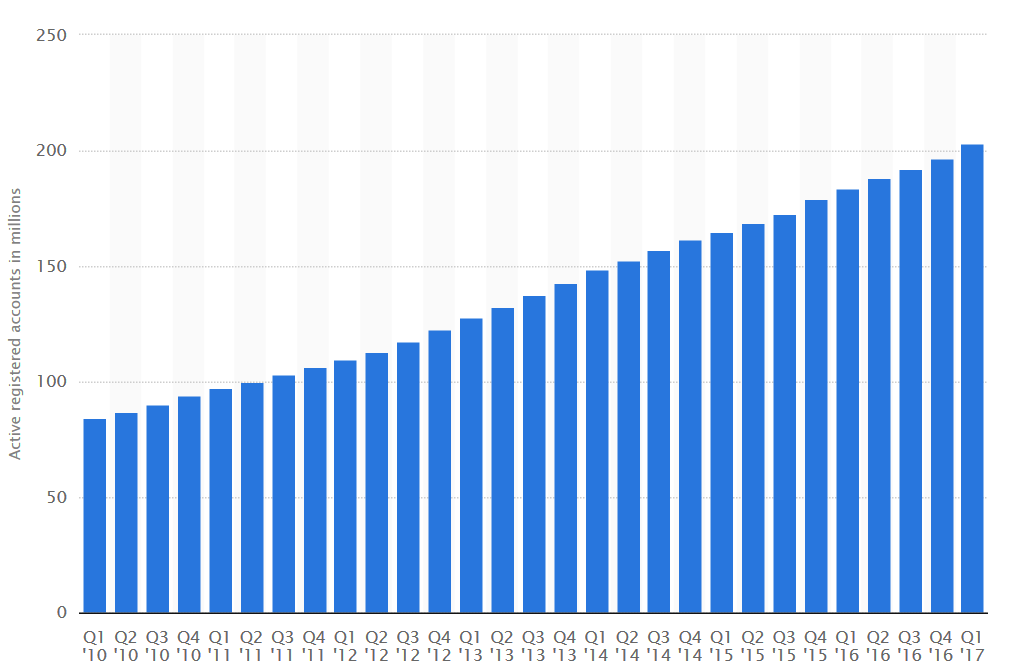
Number of PayPal's total active registered user accounts from 1Q10 to 1Q17 (in millions)
And check this out:
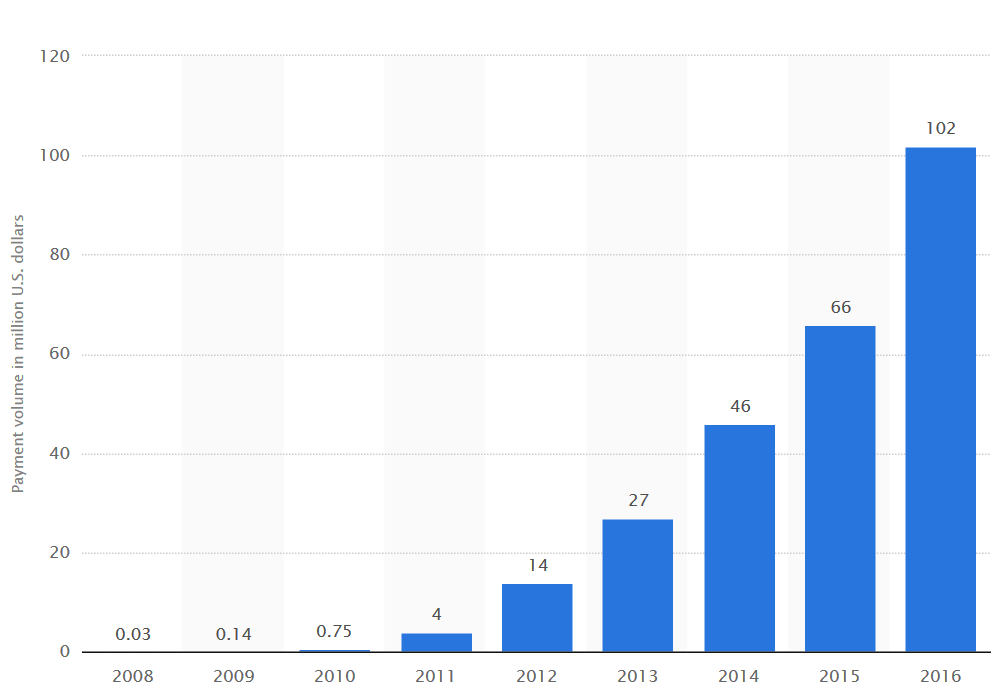
PayPal's annual mobile payment volume from 2008 to 2016 (in $billions)
PayPal announced a new $5 billion stock repurchase authorization. This news caught investor’s attention and was one of the key drivers to send the shares up 7% in the trading session the day after posting results.
One noteworthy ongoing debate is the option to move to more of an “asset light” model, which should increase the valuation the business receives from the market. This strategy would require selling PayPal Credit so the company doesn’t do any lending but only runs technology and processing operations. We would be pleased to see this catalyst occur.
BMR Take: EPS estimates call for around 15% growth to upwards of $2.50 in 2019. With all fundamentals looking great, this freight train is rolling, baby! Our Price Target is $48. Since it hit this price on Thursday, we hereby raise our Target to $56. With a market cap of $57 billion now, if it reaches this new target we will see the cap reach $67 billion. Now THAT’S a story.
Oh – our Sell Price? It remains the same: We would not sell PayPal.
Google (GOOG: $906, +8%, or $63 a share)
Results were better than expected in 1Q17. Gross revenue of $24.8 billion grew a nice 24% from a year ago and was 2% above consensus. The results reflected continued strength from mobile search, YouTube, and programmatic ads as paid clicks growth accelerated 53% from a year ago.
What is really exciting? There is a belief that it remains relatively early days for “mobile search monetization”. To this end, we saw local shopping queries increase by 45% from a year ago and the company achieved 2 billion app installs since September 2016. What does this all mean? More and more people are on their phones searching for stuff as they walk through malls, sit in their cars, and do whatever they do every day. This trend is unlocking “mobile search monetization” we described above. Bottom line, mobile search continues to lead to good results for Google for the foreseeable future.
YouTube did great. YouTube usage was 1+ billion hours of video watched daily in February. Holy cow! This might be the best asset in all of video media. During the quarter, we saw large brand advertisers increasingly come back to the platform after some recent mishaps around inappropriate video uploads being attached to the marketing campaigns of some advertisers on the platform. Very nice to see the recovery unfold here.
BMR Take: We continue to believe Google is among the best-positioned Internet companies due to its leadership position in artificial intelligence, mobile, search, video, and programming, all of which are core Internet growth drivers. With EPS on track to do over $50 in 2018, you just have to own this one.
CBRE Group (CBG: $36, up 4%)
Another Bull Market Report stock delivered a good quarter. It was a clean beat for CBRE. EPS of $0.43 came in well-ahead of the $0.33 consensus, as expenses trended materially below expectations.
CBRE Group’s resilient first quarter result validated the persistent strength of the commercial real estate cycle and the company’s first-rate global platform.
EMEA* and Asia stood out for the company. Asia posted 10% revenue growth.
*Europe, Middle East and Africa
The company has a strong outlook. Management commented that it was not making any adjustments to its 2017 earnings outlook of $2.40. The backdrop remains favorable as rates have retreated, the election fallout has stabilized, global economies are growing and new construction remains strong.
M&A is emerging again. This could be a big boost for the company. The company closed two investments in the quarter, and an additional one at quarter end. Management suggested that after a year of remaining mostly absent from the acquisition markets, pricing was becoming more rational again, suggesting we could see slightly more activity from the company. With a balance sheet that remains healthy, with in excess of $3 billion of dry powder on hand, management could step on the gas if they choose to.
BMR Take: CBRE Group is the Rolls Royce of real estate. With nearly $3.00 in EPS due in 2018 with upside from possible M&A, the current price in the mid $30s sure looks like a cheap value to us.
Celgene (CELG: $124, up 1%)
Celgene reported 1Q17 light on revenues, but modestly ahead of Street consensus on lower spending, and provided positive 2017 guidance. EPS of $1.68 was above Street consensus of $1.64. Revenues of $2.95 billion were slightly below consensus of $3.05 billion.
The modest revenue softness was largely due to weakness in sales of Otezla, which were negatively affected by a greater than anticipated contraction in U.S. prescriptions for psoriasis/psoriatic arthritis, and a modest inventory draw-down through 1Q17. Other products - namely Revlimid and Pomalyst - were also negatively affected by Medicare prescription problems.
We note that previous guidance of $1.5-$1.7 billion in net Otezla sales for 2017 remains intact despite this soft quarter. Further, the contracts negotiated with large payers have significantly broadened access to Otezla for up to 100 million covered lives, intimating future tailwinds for the asset.
BMR Take: We remain bullish on Celgene and forecast total revenues to rise strongly. We expect Celgene’s four drugs (Revlimid, Abraxane, Otezla, and Pomalyst) to drive revenues to over $13 billion by 2017, and over $21 billion by 2020. Note that revenues were $7.7 billion in 2014, $9.3 billion in 2015, and $11.2 billion 2016. Now that’s growth. Recent acquisitions of Receptos and Delinia along with investments in collaborators such as Acceleron, Epizyme, Agios, and others likely ensure growth from 2017 and beyond. We continue to view Celgene as a top large cap pick in healthcare. The market cap is at $96 billion now.
United Parcel Services (UPS: $107, +2%)
UPS pleased investors with earnings results too, mainly on the top line. Total revenue climbed 6.2%. Revenue grew in all segments and in all major product categories, as balanced market demand occurred across the company’s broad product portfolio.
There was a wave of other good news to report. Total fuel expense increased $187 million or 43% over Q1 2016. The fuel surcharge revenue lagged expense, however a February 2017 surcharge change mitigates this variance for future periods. Capital expenditures to support network enhancements were $938 million during the quarter, demonstrating a run-rate at the annualized guidance level.
UPS paid dividends of $775 million, an increase of 6% per share over the prior year, rewarding shareowners with continued strong dividend yield. The company repurchased 4.2 million shares for approximately $450 million in line with the company’s capital allocation policy.
What is exciting? The company is accelerating investments to create the industry's leading smart global logistics network and value-creating portfolio. UPS customers are benefiting from expanded capacity, choice and improved time-in-transit, while technology solutions continue to deliver efficiencies. One example of expanded service is the company's new Saturday delivery program, which began rolling out this year. While the roll-out cost the company $35 million this quarter, UPS is hoping it will give the company a leg up on competitors. The service is now in 15 metro areas. By the holiday season, the company hopes to have Saturday delivery capability in 4,700 cities.
BMR Take: UPS is without question a top logistics franchise globally. With projections pushing towards strong EPS growth and nearly $8 of EPS potential in a few years, we expect the company to deliver. The stock is slowly making a comeback from the sharp drop we saw from $117 to $103 in early February. We wouldn’t be surprised to see $110 soon and $115 again in a month or so. This $93 billion market cap company is a well-oiled machine and with more and more people buying online instead in malls, their business is assure of growth in the future.
US Economic Outlook
The first quarter can be full of surprises. During the existing expansion, first quarter GDP growth has come in short of consensus expectations every time, with an average absolute forecast error of 0.5%. Initially, disappointing first quarter GDP growth led some to question the durability of the expansion, but that should fade now that the issue of residual seasonality has come to the forefront.
Residual seasonality in GDP implies that there is a predictable seasonal pattern. This is clear in the first quarter, as GDP tends to be noticeably weaker than in the subsequent three quarters. The differences are frequent and large enough that they are unlikely a fluke. Also, residual seasonality is evident across many of the major components of GDP, including parts of services spending, exports, federal and state and local government expenditures, and nonresidential structures.
The Bureau of Economic Analysis has made adjustments to correct some of the issues related to residual seasonality, but it likely remains a sizable weight on GDP growth. GDP came in weak in the first quarter, rising 0.7% at an annualized rate. Residual seasonality appears to be shaving 0.5% off first quarter GDP growth. There are other reasons for the weakness in the first quarter, including weather and possibly the delay in tax refunds.

We believe the Fed will look through the poor start of the year, as GDP is inconsistent with other hard data, including employment. Still, sub-1% GDP growth could create a challenge for the Fed, since we still expect it to raise rates in June. Though GDP is heavily scrutinized, the employment cost index for the first quarter could have greater influence on monetary policy. The Fed is worried that the tight job market will lead to a sudden acceleration in wages that would then boost inflation.
Federal Reserve policy makers are set to meet next week, and while there is little expectation that an interest-rate increase will be announced when the meeting ends on Wednesday, the latest economic reading could sway the Fed’s outlook. The monthly report on job creation is due next Friday, and a strong showing could ease some of the concern over the lack of vigor in the first quarter.
Reaffirming its recent findings, the University of Michigan said its consumer sentiment index finished April with a decidedly bullish reading of 97, up from 87 just before the election.
A Word from Gary Jefferson
Jefferson Financial Group
First Vice-President, Investments
UBS Financial Services, Inc.
Viva Le Pen! Laissez les bon temps roulez! But wait a minute……..the market wants Macron to win and therefore is acting as though his election is a foregone conclusion. Does that ring a bell? Remember how Clinton was a "foregone conclusion" and how that night the market absolutely crashed……but made a miraculous recovery after the Trump victory. As far as we can tell, US stocks shouldn't be materially affected one way or the other and we view this as a "sideshow" to the earnings season that is under way here at home. Or, as Alfred E. Neuman might comment on the whole French thing, "What, me worry?"
President Trump announced a new tax plan which he called "bigger, I believe, than any tax cut ever". This news is, in our humble opinion, of much greater interest to the US investor than the French election. We are seeing a plan that is pro-growth and nothing but pro-growth, and which has a realistic chance of garnering enough support to get passed. If that happens, we expect a nice rally. If it doesn't, then we would expect the market to react with some sort of displeasure.
Earnings update: Thomson Reuters is reporting that earnings are expected to grow by more than 11% in the first quarter. 76% of the earnings reports have already come in above estimates. 62% of companies have beat revenue forecasts, and revenues are expected to be up just under 7% on the quarter. These are good, solid numbers. Numbers like these should provide durable support for the market.
Blackstone (BX: $31) killed in the first quarter of 2017. They earned 82 cents a share on revenue that rose 108% year over year to $1.94 billion. Analysts were looking for 68 cents on revenue of $1.6 billion. Total assets under management climbed to a record $368 billion. The company said that realizations totaled $16.6 billion, a company record. The bulk of the realizations came from the firm’s flagship private equity and real estate strategies, with an average multiple on invested capital of 2.6 times.
Underlying portfolio company fundamentals appear strong. Management noted its private equity portfolio companies are experiencing high single-digit EBITDA growth and in real estate, both rents and occupancy continue to improve.
BMR Take: And the stock took off this week. It was up 5%, counting the fabulous 87 cent dividend that it paid a few days ago. You know, we are always looking for new companies to invest in that will give you above-average gains. We will tell you this: There is going to come a time when this stock will skyrocket. We can see it hitting $40 down the road and it just might come sooner rather than later. Why? Because this stock has been undervalued so long that investors have given up on it. But don’t forget that Stephen Allen Schwarzman has NOT given up on it. From what we can gather he has 230 million shares. WOW. That’s 45% of the company, worth north of $15 billion. He thinks the stock is WAY undervalued and is working on a million ways to get the stock higher. We’re going with Steve on this one. We’re up 25% on Blackstone since early 2016, but our Target is $36 and we think hitting this is quite possible in the next few months.
Athenahealth (ATHN: $98) got hammered on Friday, dropping $23, all of our gains since we added the stock in November at $103. We’re down 5% now, not pretty, but not bad in the whole scheme of things. We just hate to see these overreactions. Look at this: revenues for the past three years are $750 million in 2014, $925 million in 2015, and $1.1 billion for 2016. The company reported revenue of $285 million in the quarter up from $255 million in the year ago quarter. And the company stated last week that they expect full-year revenue of $1.23 billion. So really, if you look at the numbers, everything is still solid. Earnings were $22 million, down from $24 million. Yes, earnings were a bit weaker, but revenue growth is key in our book.
We are going to stick with this company for now. We can see the overreaction continuing a bit, taking the stock down to $95 or even a little lower, so you have to make a decision – stick with it or bail. These are always tough decisions and of course, it is impossible to predict what will happen. Many investors say to cut your losses and move on. Others say, like we are saying here, that this great company is being punished by the market for a silly little miss on the earnings front.
Trump’s Repatriation Initiative
Credit Suisse told investors to buy high tech shares because the companies will thrive under President Donald Trump's tax reform, saying it will enable an increase to its shareholder return program and allow for more strategic acquisitions.
The firm raised its rating on one of the giant tech companies two notches, to outperform from underperform, a rare "double upgrade."
"We believe the possibility of an upcoming repatriation and balanced approach towards M&A [mergers and acquisitions] and capital return could drive long term earnings power," they said.
There is over $2.6 trillion of cash offshore, which can be "unleashed" under tax repatriation reform, at least half of which is controlled by Tech firms. If Trump's tax plan is passed, Credit Suisse estimated that about half of this ($650 billion) can return to shareholders during the next five years and another $500 billion could be used for mergers and acquisitions.
"The combination of a potential buyback combined with accretion from M&A, has the capacity to drive these firms’ earnings materially higher in the coming years," they wrote.
BMR Take: The firms with the largest hordes of cash are Apple with over $255 billion, Facebook, Google and Oracle, so we expect them to be the biggest beneficiaries of this tax cut if it every happens.
AstraZeneca (AZN: $30, flat) went up and down after reporting earnings. Revenue of $5.4 billion fell 12% from a year ago and EPS of 99 cents was 4 cents up from a year ago. The company’s ability to grow earnings with falling sales is impressive, and partly justifies the 24 P/E ratio. Most impressive was the company’s ability to lower core SG&A costs by 14% - greater than the sales decline, suggesting greater operational efficiency.
Why were sales down so much? Really this is a one-story issue: Crestor. This drug lost its patent in the U.S. and is a big hit to sales. The company still has plenty of cancer and diabetes drugs in the pipeline, indicating upside is still possible. We will be paying close attention to the company’s pipeline in the months ahead.
Shopify (SHOP: $76) hit an all-time high on Monday. Two weeks ago the stock surged from the $70 level to the $76 level and last week the gains were sustained. The market cap is still a tiny $7 billion and we continue to maintain that a firm could come in a make a $90 or $100 offer for them and it wouldn’t make a dent on the acquirer’s balance sheet. Apple with $255 billion in cash, or Oracle (ORCL: $45) worth $185 billion with $60 billion in cash are just two possible buyers. Don’t get me started on Google or Facebook or Amazon! With over 300,000 websites using Shopify software we expect great things for this company in the future.
The High Yield Corner
By Michael Foster
Special to The Bull Market Report
Of all the high yield sectors as a whole, junk bonds performed the best. The SPDR Barclays High Yield Bond ETF (JNK: $37, up 1%) closed the week stronger despite slightly disappointing GDP news, with the trend starting last Monday at its strongest and continuing throughout the week. The asset class did far better than U.S. Treasuries, especially on the long-term end of the curve, where yields slipped this week, although that slip began before the GDP data. This trend is not sustainable in the long term; junk bond yields cannot keep falling and U.S. Treasury yields cannot keep rising at the same time. At one point or another the gap between the two would narrow and there would be no risk premium for investing in assets that can and do default a lot (junk bonds), versus an asset that cannot default, outside of a major apocalyptic event (U.S. Treasury).
While junk had a good week, BDCs have had a good year so far. The UBS BDC ETF (BDCS: $24, up 1%) is up over 4% year-to-date versus junk bonds’ 1%, with the more popular BDCs becoming an increasingly popular trade. Main Street Capital Corporation (MAIN: $40) is now up 9% year-to-date after another 1% gain this week. But note that Friday was a peak that very swiftly and steeply fell, causing the stock to lose 1% in a day. With a premium to net asset value of 80% by the end of the week, we cannot expect this trend to continue. Of course, we have been saying this ever since we removed Main Street from the high yield portfolio and while we haven’t seen a correction, we have seen the stock’s run up stalling slightly. Timing a top exactly is impossible, but recognizing that we’re at or near a top is easy. This is the case with Main Street as well as several other popular BDCs. While we suspect a correction in the junk bond market to be uncomfortable, we expect a similar trend in BDCs to be much more severe. That may come next week or next year, but these 80% premium valuations cannot last forever.
We’ve given a similar word of caution regarding REITs. Last year, especially the start of the year, was a stellar time for the asset class, with post-August proving much more challenging and post-Trump proving even more difficult. The SPDR Dow Jones REIT ETF (RWR: $92, down 2%) had yet another rough week. Despite the problems surrounding REITs, we have not recommended exiting the sector entirely as we found most prudent with BDCs. The reason for that was simple: REIT valuations remained modest and much less efficient than in BDCs. Part of this is due to the greater ease of valuing BDCs in terms of the market value of their debt portfolio. Due to the strategy of accounting for depreciation with REITs, this sector is much more complicated. As a result, valuing these assets in terms of their book value is largely useless or must be done with extreme care. For this reason, many investors prefer to focus on price to FFO as a ratio - in other words, determining how much you’re paying for income instead of paying for the underlying assets producing this income. This of course is unwise because FFO and asset values can be extremely divorced from each other as a result of a variety of market factors.
Ultimately, this means a closer analysis of the underlying business is necessary when analyzing REITs, and in doing so investors can find amazing deals. This is the back story of our REIT picks, and is why Digital Realty Trust (DLR: $115, up 3%) has remained a major pick for a long time. This income stock is now up over 33% in the last year and the dividend has grown 6%, with more dividend hikes inevitable thanks to its strong and growing FFO. The market has no qualms giving this REIT a high valuation, so it’s no surprise that it jumped this week despite weakness in REITs elsewhere.
That weakness, however, impacted several other Bull Market Report picks. Omega Healthcare Investors (OHI: $33, down 4%), Kimco Realty (KIM: $20, down 6%), Government Properties Trust (GOV: $21, down 2%), and Care Capital Properties (CCP: $27, down 4%) fell with the broader market. These are extremely big movements, largely a result of market panic in the sector. It has also created tremendous opportunities, especially with the very safe Kimco Realty, which has an amazing track record and solid dividend coverage. This is a “buy the dip” opportunity.
A Note on Facebook’s Growth:
Facebook (FB: $150) has four operations that have over one billion users. There is Facebook itself with 1.9 billion. Messenger is at 1.2 billion, as is WhatsApp at 1.2 billion. Then there is Instagram. Listen to this: Since inception, the company has been adding 100 million users about every nine months. But something happened when they hit 500 million. Going from 500 million to 600 million took just six months. And getting to 700 million took just FOUR months. This is unreal growth. When will Instagram reach 1 billion? Good question, but at this rate it just might be in early 2018. And people wonder why the stock hit $150 this week, up 5%. Repeat – Facebook has FOUR operations with over 1 billion users. One billion. That’s 1000 millions. We are just in shock.
OK – the stock hit our Target of $150 Friday and we are now up 55% since we added it in January last year. The stock is going a lot higher folks, so we hereby raise our Price Target to $165 and our Sell Price from $125 to $140.
Good Investing,
Todd Shaver, CEO and Editor
The Bull Market Report
Since 1998