January 28, 2018

by Todd Shaver | Jan 28, 2018 | Weekly Newsletter 7pm Sunday
The Weekly Summary
The big news this week was Davos. Davos is an annual event hosted by the World Economic Forum that’s mission is to improve the state of the world by engaging business, political, academic, and other leaders of society to share global, regional and industry agendas. Davos is a mountain resort in the Alps of Switzerland. All of the top brass from companies and countries attend. Trump rocked the party with his message of America first. He said America first does not mean America alone, and that America is open for business. He promoted our 3% GDP growth, our massive tax reform, and our historic reduction in regulation. We put a billionaire in office exactly to do this. The S&P 500 is already up 6% so far this year and Trump’s deals in Davos could drive gains higher.
No matter what is happening out there, there is always a bull market here at The Bull Market Report! This week we highlight: Gilead, Shopify, Bristol Myers, Nutanix, Google, and Tesla.
Key Market Measures
BMR Companies & Commentary
Gilead (GILD: $86, up 6%)
Gilead has had a tough time since 2015; however, its fortunes may finally be changing. The big event is that Celgene is buying Juno Therapeutics for a 50% premium. One of Juno’s most promising drugs directly competes with Gilead. Clearly, Gilead is playing in the right sandbox. The Wall Street research firm Jefferies poured some gas on the fire of excitement now burning for Gilead. They upgraded the stock this week and said to look for good things to happen soon. The company is looking at a February approval and launch of a drug for HIV, and highlighted some key Phase 3 data on another drug to be released by 2019.
BMR Take: The stock appears to be inexpensive at this level, as it trades at just 8x this year’s EPS of $8.70. But we know that earnings are set to decline to $6.50-$7.25 over the next few years as Gilead’s top two drugs face declining sales. These two drugs were among the top three best sellers of all time – but nothing lasts forever. Could Gilead fetch 15-20x EPS when the dust settles and new drugs re-invigorate some excitement? Possibly, but it’s going to take quite some time.
As you may remember, we had the stock in our portfolio and removed it a year ago as we were tired of waiting. It took a year to come back, but from here we think the run is over for at least the next few years. We will remain on the sidelines.
=========================================================
Shopify (SHOP: $129, up 12%)
Somebody stopped by Shopify this week to work on collaboration for the future of augmented reality. Tim Cook. CEO of Apple. No big deal. (HA!) He praised the companies “profound” emerging technology. No further explanation needed. Apple + Shopify = $1.8 billion added to Shopfy’s market cap, now at $13 billion. Wow.
BMR Take: Tim Cook met with developers and coders and listened to demonstrations. Augmented and virtual reality is a major part of Apple’s future plans. These markets are likely to balloon to $215 billion by just 2021. Maybe Apple works with Shopify. Maybe Apple buys Shopify. Either way we see this all leading to good things ahead for Shopify. Their sales are expected to grow from $660 million this year to $1.6 billion by 2020, without factoring in anything from the possibilities with Apple.
Andrew Left of Citron is crying in his beer. (He’s the guy who shorted the stock at $119 and made a big deal about it in the press. He drove it down to $92, and now is losing money big-time. YES!!! We don't like the way this guy operates.) Remember, if you hear that a stock is heavily shorted, that’s a BULLISH signal. Why? Because after you short a stock the only thing you can do from that point on is to BUY THE STOCK BACK. Very bullish.
Look at this chart:

=========================================================
Bristol-Myers Squibb (BMY: $64, up 3%)
Bristol-Myers received a big regulatory approval in Europe this week. The European Commission (EC) expanded the indication of Yervoy to include treatment of advanced melanoma in pediatric patients. The EC approval marks Bristol-Myers’ first pediatric indication for an Immuno-Oncology medicine in the European Union and allows for the marketing of Yervoy for this indication in all 28 Member States of the EU. This is just a key development for geographic market expansion and ultimately sales. Hip hip hooray!
BMR Take: Bristol-Myers is a leader in Immuno-Oncology. This space is red hot. Bristol’s EPS is expected to grow from $3.00 this year to $4.00 in 24 months. This Healthcare bellwether is overdue for a breakout in the stock. Remember, activist Carl Icahn is making some noise here and pushing for good things for all shareholders.
Looking at the 1-year chart, you can see that it is a slow mover, but steadily up. We’ll take that any day. The company is no small firm. The market cap is $105 billion and the stock is moving towards its all-time high of $74 set two years ago.

=========================================================
Nutanix (NTNX: $33, down 8%)
Nutanix caught some heat this week from a downgrade at JP Morgan. The report said nothing specific. They said: The market rally has gone on for eight long years. Valuations aren’t cheap. Nutanix is up a lot lately.
We say: Ignore this report – it appears to be just one person’s opinion. We believe there is more money to be made here. In fact, just this week Nutanix spoke to investors about how hosting providers like Amazon Web Services are taking steps to work with customers more broadly to support bare services, expanding the market opportunity for Nutanix.
BMR Take: Nutanix is a must-own stock. “The opportunity of a decade,” says Goldman Sachs. The customer base has doubled in 18 months. The average annual sales per customer is expanding from $1 million to $5 million, fueling greater than 30% top line growth. And we could see this $5 billion market cap company get bought by the likes of an IBM or Oracle any day. The stock is down this week to where it was in December. But in October, just three months ago, it was $22. Stay on this train!
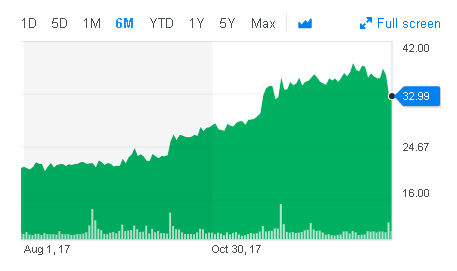
More on Nutanix below.
=========================================================
Google (GOOG: $1,176, up 3%)
The future of the Smart Home is a big deal. Whoever wins this market is going to make some big bucks. Google Home is now installed in 14 million homes and is well on its way to cementing itself as a key player in the space. The Smart Home of the future will allow you to use voice to control your thermostat, your TV, your lights, your locks, your security cameras, your car ignition, your coffee machine, and on and on. The hardware sales and the multi-year services contracts make for a lucrative revenue opportunity. Google is positioning itself to get in on the action.
BMR Take: One thing we really like about Google is its valuation. When you look elsewhere in Tech – like Facebook, Amazon, Netflix, or Adobe – the price to earnings ratios are way up there. Look, we understand growth and innovation can’t be valued just on a price to earnings ratio alone. But that subjectivity in the analysis leaves room for the high flyers to be in for a rougher valuation reversal in a correction. In contrast, Google is set to generate about $42 of EPS in 2018, which is 29% growth from 2017, and the price to earnings ratio is exactly 29. When the price to earnings ratio is equal to or is less than the earnings growth rate you know as an investor you are paying a reasonable price for growth. Again, that is why we like Google’s valuation.
And again, please have no fear of the high stock price. It’s just a number. Pretend that it has a 20-1 split tomorrow. The price would drop to $59. Would you buy more then? It’s all psychological. Google HAS split their stock 2-1 – once – in 2014. They just might be thinking of doing that again. And we would suggest the stock would shoot higher.

=========================================================
Tesla (TSLA: $343, down 2%)
Tesla’s Gigafactory is exciting! Tesla’s mission is to accelerate the world’s transition to sustainable energy through increasingly affordable electric vehicles and energy products. To achieve its planned production rate of 500,000 cars per year by 2018, Tesla alone will require today’s entire worldwide supply of lithium-ion batteries. The Tesla Gigafactory was born out of necessity and will supply enough batteries to support Tesla’s projected vehicle demand.
Tesla broke ground on the Gigafactory in 2014 in Nevada. The name Gigafactory comes from the word “Giga,” the unit of measurement representing “billions.” The factory’s planned annual battery production capacity is 35 gigawatt-hours (GWh), with one GWh being the equivalent of 1 billion watts for one hour. This is nearly as much as the entire world’s current battery production combined. With the Gigafactory ramping up production, Tesla’s cost of battery cells will decline significantly through economies of scale, innovative manufacturing, reduction of waste, and the simple optimization of locating most manufacturing processes under one roof. By reducing the cost of batteries, Tesla can make products available to more and more people, allowing them to make the biggest possible impact on transitioning the world to sustainable energy.
BMR Take: Seriously. Who builds a Gigafactory in Nevada because their business is using up all of the world’s lithium-ion batteries? Only Elon Musk. So innovative. So groundbreaking. World changing. If Tesla is right about the future of vehicles and takes over the crown of the auto industry from the old guards in Detroit, you don’t want to miss out on the future earnings potential of the company and what this stock could do in your portfolio.
As noted last week, we do have a $335 Sell Price on the stock because of our concern about how much capital they will have to raise this year. It would upset us to have to sell this wonderful company run by a genius, but we have to protect our gains. Watch closely this week.
Note on Musk’s New Pay Package:
Tesla announced a huge pay package this week for Elon Musk that again ties his compensation to key performance benchmarks. This time the goals include taking the electric-car maker to $650 billion in market value
Tesla outlined a massive compensation plan for its unorthodox CEO on Tuesday, setting a series of ambitious growth targets that, if various conditions are met, could net Musk as much as $55 billion over the next decade The package is based entirely on performance, guaranteeing no salary and no bonus, and requires Musk to reach aggressive market capitalization and financial goals in order to be paid. He would also have to hold onto his shares for five years after he receives them before selling. Musk would only receive the full payout if the company reaches a market capitalization of $650 billion, a more than 11-fold increase over its current $57 billion market cap.
=========================================================
=========================================================
Economic Calendar
Consumer Confidence
Tuesday, January 30th, 10:00 AM
Period: January
Consensus: 122.1
Prior: 122.1
Pending Home Sales
Wednesday, January 31st, 10:00 AM
Period: December
Consensus: 109.5
Prior: 109.5
Nonfarm Payrolls
Friday, February 2nd, 8:30 AM
Period: January
Consensus: 172.5K
Prior: 148.0K
=========================================================
=========================================================
We got a letter about Nutanix from Stanley Makovsky, of Stan Lee Marketing, one of our subscribers. He said:
"Todd,
Any opinion on the below report?
Nutanix Stock Falls After J.P. Morgan Warns That Software Shift Could Prove Disruptive"
Stanley Makovsky
Stan Lee Marketing
Hi Stanley – I many times take these things with a grain of salt. Yes, the stock is down 8%, but will it stay down here? Maybe. It might go to $30. But that just might be an amazing buying opportunity.
JP Morgan wrote this opinion based on this:
“on concerns that shares could lag those of peers in the near future following a recent rally.”
Lagging peers? What does that really mean? Who cares about their peers.
This is what matters to us:
The last four quarters of revenue:
$275 million
$226 million
$192 million
$160 million.
I call that growth.
Todd Shaver
=========================================================
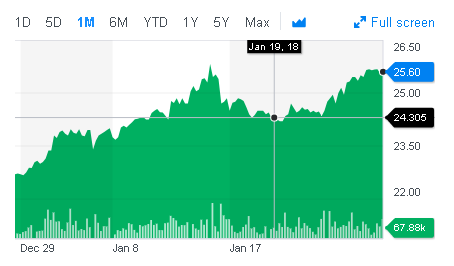
The Carlyle Group (CG: $25.60, up 5%)
We've been pounding the table on this stock for months. On December 19th the stock was $21.50. It's now at $26, up 21%. We are pounding the table on this one NOW. We expect $30 in a few months. Do the math. That's another 17%. We have it on good authority that one of the major stockholders is not selling a share until it hits $30. Our Target is $28, but we sure will be happy to raise it to $33 when it hits $28. The Sell Price is hereby raised from $20 to $24. We're up 54% on this one in less than a year; it's paying a 5% dividend. How can you go wrong.
Look at this chart:
=========================================================
CBRE (CBG: $46) Hits All-Time High
Friday saw another all-time high. Earnings are coming out soon and we understand that they will be announcing another solid quarter. Some say it might be called a blowout. We've passed our Target of $40 so we hereby raise it to $52. Our Sell Price is at $35, so we are raising that to $40. The company is in business to save corporations money with their real estate. And that they are doing with relish. This one is a sleeper.

=========================================================
=========================================================
The High Yield Corner
By Michel Foster
VP High Yield, The Bull Market Report
We wish to do a bit of a deep dive into what’s happening in stocks, the economy, and society at large - and what this tells us about high yield.
The reason we want to do this now is that there is a trend that looks very alarming on the surface that is actually not a problem at all. We’re referring to the incessant bull market of 2018.
January is ending in a few days, yet the S&P 500 is up over 6% already this year. Remember that this index goes up about 8% on average every year, so that a 6% gain in a month is very intense. So intense, in fact, that the market has already hit and surpassed the price target that a lot of big bank analysts had on the market for the entire year.
At the same time volatility is down, the financial mass media is getting more bullish, and the general anxieties in society seem to be drifting further and further away from economic issues and towards other domains of human life - politics, religion, identity. This is usually a cyclical trend.
To explain what we mean, think back to 2005 and 2011. Very different years with very different social concerns and economies. 2005 was the height of the housing bubble - a time when exotic dancers in Las Vegas were buying multiple homes to flip (as brilliantly documented in Michael Lewis’s The Big Short.) But Americans are a contentious bunch, so there was plenty of angst and debate going around - a lot of it about gender equality, the war in Iraq, Guantanamo Bay, race relations, and other things. Little talk about income inequality, wage growth, or other economic issues.
Now think about 2011. This was the time of the short-lived Occupy Wall Street movement. The Iraq War, still going on, wasn’t an issue; Guantanamo Bay didn’t come up unless you brought it up to the protestors. Race relations, gender issues were given brief lip service. But the real concern? Income inequality. “We are the 99%” was a rally cry of socio-economically disaffected people.
Whether or not you agreed with their message, their means or their complaints, doesn’t really matter - not for rational investors like us who want to grow our wealth by understanding what’s happening in the world. What matters much more is acknowledging what was going on and why it was going on. Namely, 2011 was a time when political and social unrest hinged on economic issues - because the 99% weren’t getting richer and weren’t even getting the illusion of getting richer that the debt-fueled housing bubble gave so many Americans.
Fast forward to 2018. What are the hot topics of the day? Donald Trump is the obvious one. And, again, whether you support Trump or do not, what does matter is acknowledging that the cultural fixation of the moment is on an issue that has relatively little to do with the economy.
From this perspective, 2018 feels a lot like 2005. The economy is, at least on the surface, showing enough strength to keep people from focusing on economic and financial issues. Corporate profits are rising and look to rise even further. Stocks are going up, as are housing prices and U.S. incomes. A weaker U.S. dollar is hurting imports, but it’s also helping exports and encouraging more tourism to the U.S. - another big boost.
What does all this have to do with the stock market and high yield investments? Two things. First, we seem to be at that stage in the business cycle where hope has already turned into optimism. But we aren’t at the point where optimism turns into euphoria, although it’s getting closer and closer on the horizon. In other words, a lot like 2005.
This tells us that the best thing to do is to buy and hold stocks. Stay in the market. Despite the monstrous gains in the market for 2018, the S&P 500 P/E ratio is down from where it was in the middle of 2016, and if earnings growth meets expectations (13% growth for the year), that P/E ratio isn’t going to go up much further.
It also tells us that high yield remains an option, but investors may become choosier when it comes to high yield as we go further into the greedy stage of the business cycle and away from the fearful stage. That could mean municipal bond prices will remain lower while junk bonds remain higher. That may mean little capital gains from Invesco Municipal Trust (VKQ: $12.30, flat) and Nuveen AMT-Free Municipal Credit (NVG: $15.09, down 2%) despite the fundamental strength in both funds’ incomes. Income may begin to rise if municipal bond yields rise alongside Treasuries. It does not mean a big crash in either fund, however - so don’t rush to sell. Just recognize that these funds’ income streams will remain intact, with some possible upside.
AllianzGI Equity & Convertible (NIE: $22.55, up 2%) and Pimco Dynamic Income Fund (PDI: $30, up 1%) are interesting options for investors. Since these funds have exposure to junk bonds and convertible bonds, the continued increase in profitability and financial strength among America’s companies could drive demand for these funds in excess of what we’ve seen in the past. Both have provided strong total returns since The Bull Market Report first recommended them. More good returns are becoming more likely, thanks to America’s increasingly complacent and euphoric economic mood.
Where does that leave us investors, concerned about volatility, wishing to preserve capital, and hoping for a reliable high income stream? It is too early to worry about a euphoric market, but it is time to recognize that worrisome euphoria and the bubbles they produce could come. That could take a couple of years, perhaps even longer. What matters is that we remain keenly aware of what’s happening in our economy and our society in an impartial and calm way, investing accordingly, and constantly looking, listening, and watching.
Good investing,
Todd Shaver
The Bull Market Report
Since 1998
December 21, 2017

by Todd Shaver | Dec 21, 2017 | Monthly Newsletter Daily 12pm if new
The Weekly Summary
Star Wars ‘The Last Jedi’ topped $100 million on opening weekend, only the second film to do it, the first being Star Wars ‘The Force Awakens’. Americans are feeling good right now watching movies and buying Christmas gifts, as all-time high equity markets have their portfolios in great shape. Mergers and acquisitions are popping off with Disney buying assets from Fox and several other big-name deals announced this week. These are great times. It has been an incredible bull market. In fact, they say this past year was the least volatile on record in a hundred years. From the depths of the Financial Crisis to today marks an amazing journey for the markets. We can’t help but keep stressing that it won’t always be this good.
We’re not worried – just watching. We heard a presentation from a research specialist from Citibank on Thursday and he talked about and gave us charts on where the market is historically. He said the PE of the market (S&P 500) is 26, way above the historical average of 16. He said the VIX (^VIX) is sitting at about 10, way below the historical average of 14 or so. And he said the market ALWAYS REVERTS TO THE HISTORICAL MEAN. We took this all in, have thought about it for days and much before that and we must say that we effectively agree with this analysis. Remember the phrase “the new normal”? They said this about Internet stocks in 1999-2000 – remember what happened. They said that about the bull market leading up to 2008. Remember what happened. And they are saying that about this bull market and the low interest rate environment that we have seen for decades, with the 10-year Treasury still at historic lows of 2.35%.
Again, we’re not worried – but we are watching. We think this bull can run for another two years at a minimum.
No matter what is happening out there, there is always a bull market here at The Bull Market Report! This week we highlight some of our favorite stocks where we think you can still make good money, including: Bristol-Myers Squibb, Nutanix, Annaly, Tesla, Twilio and asset managers (Blackstone, BlackRock, and Carlyle Group).
SPECIAL HOLIDAY OFFERING
Get The Bull Market Report for just $199 for the entire year. It is published Weekly on Sunday evenings and we send you News Flashes during the week. We have six portfolios with over 40 stocks that we follow. Some are up 25%; some are up 50%; a few are up over 100%. And in our High Yield Portfolio we have stocks paying 6%, 8% and 10%.
Give a GIFT TO YOURSELF or a loved one or a good friend. It will be the best Christmas present EVER.
Go here now:
https://www.bullmarket.com/subscription/
BMR Companies & Commentary
Asset Managers:
Blackstone (BX: $33)
BlackRock (BLK: $517)
The Carlyle Group (CG: $22)
Asset managers sure look like a compelling place to put money to work. We highlight some of the key data points about current market conditions. The strong fundamentals point to more and more money being made on Wall Street, which means more money for asset managers, and in turn more money for the investors in asset managers, meaning you of course.
Investment banking data were mixed in the week. Equity underwriting volume was 12% above the 4Q17 weekly average, and announced M&A volume was 67% above the 4Q17 weekly average, while completed M&A and debt underwriting were 45% and 20% below the 4Q17 weekly average, respectively; debt underwriting is steady.
Equity trading volume was 8% above the 4Q17 weekly average level, while equity option volume was 10% below the 4Q17 weekly average.
Corporate bond trading volume was steady. The 10-year Treasury yield increased 1 bp to 2.38% (up 4 bps quarter to date (QTD)), the Bank of America U.S. High yield increased 3 bps (up 32 bps QTD), and MBS securities yields (15-year and 30-year) declined 3 bps and 0 bps, respectively (up 14 bps and up 4 bps QTD, respectively).
Equity fund outflows (on a one-week lag) persisted, totaling $3.6B ($36B QTD), while bond fund inflows (also on a one-week lag) continued, totaling $4.3B ($52.0B QTD). This is certainly not good and amazing that the stock market has been able to absorb this negative news and rally like it has.
BMR Take: Take your pick between Blackstone, BlackRock, and The Carlyle Group, or own them all. These companies make money from all of the fees, deals, and rising asset prices. They are a center of profits. We see opportunity for meaningful stock price appreciation if current fundamental trends persist, as we believe it will. They are WAY UNDERVALUED in our opinion.
-------------------------------------------------------------------
Bristol-Myers Squibb (BMY: $61)
Bristol-Myers Squibb has licensed a phase 1 immuno-oncology drug from Japan’s Ono in a $40 million upfront pact. This geographically complex deal, which builds on a collaboration the pair have had for a number of years now, sees Bristol-Myers solely responsible for the development, manufacturing and commercialization of Ono’s selective Prostaglandin E2 receptor 4 antagonist. This program is aimed at targeting immuno-suppressive factors in the tumor microenvironment.
To improve long-term outcomes for more patients with cancer, Bristol believes more immuno-oncology-based combinations may be required, and they are pleased to continue the long-standing collaboration with Ono with this focus in mind. This new program offers the potential to develop targeted therapies that counteract the effects of an immunosuppressive tumor microenvironment. Researching Prostaglandin E2 receptor antagonists in combination with the oncology portfolio has the potential to result in an enhanced response in a broad range of tumors.
BMR Take: Bristol is going to generate $3.00 of EPS this year and around $3.25 next year, then growing toward $4.50 by 2020 as the immune-oncology drugs gain traction. That means the stock is dirt cheap and now is a great entry point. Remember, activist investor Carl Icahn is in the stock and we could see him push for a sale of the company resulting in a huge M&A premium some day in the future.
-------------------------------------------------------------------
Nutanix (NTNX: $35, up 3% last week)
Wow, Nutanix has doubled in recent months. Got your attention now? Let’s review what’s happening.
Nutanix started out as a hyperconverged (HCI) vendor. Starting in 2009, they created the market for HCI. They thought that HCI was a step in the journey to where organizations were headed, which was around becoming truly enterprise cloud software companies. This is what you hear and see Nutanix focusing all their energy on. Nutanix customers are looking at HCI as a critical step in this new era journey. They're looking at Nutanix as a full stack offering that allows them to build this platform, above, that's beyond storage and compute and includes virtualization. It helps them with networking, security, but most importantly now helps them with the transition that's happening in the market around the world of multiple clouds, where customers are trying to figure out how to handle a hybrid cloud environment, where customers want to put some of their workloads in the public cloud, but they also have a private cloud infrastructure that gives them the security that actually is probably even more cost effective for their enterprise apps like SAP, Microsoft and Splunk.
BMR Take: Look, we can’t explain all the finer details around the inner workings of HCI. However, we know that tech-savvy people are thrilled about what is going on at Nutanix. The company is on track to swing from losses to over $1 of EPS in 2021. The company’s customer base has doubled. The stock has doubled. We see all the elements of success and continue to like the stock at this level.
-------------------------------------------------------------------
Annaly Capital Mortgage (NLY: $12.01, up 2%)
The Fed raised rates and guess what, Annaly’s stock went up. What? The company is going to be able to navigate the interest-rate environment just fine. In fact, the Chairman of the Board just bought 125,000 shares this week at $12. At the end of the day, it’s been proven by numerous studies, that following insider buying from key business leaders is a way to make money in the markets. People sell stocks for all sorts of reasons, but they only buy stocks with one thought in mind, “I am going to make money on this purchase.” When that buyer is the Chairman of the Board with all that insight and industry expertise, you have to assume either this guy is a reckless idiot with his money or he is on to something.
Who is Denahan J. Wellington? She is Chairman of the Board of Directors and Executive Chairman of Annaly. Ms. Denahan is a co-founder of Annaly and has over 20 years of financial services experience. She was one of the co-founders of Annaly in 1994 and has been with the firm all this time. Ms. Denahan holds a B.A. in Finance from Florida State University and is the third-highest paid female CEO making over $26 million a year.
BMR Take: We see value in Annaly shares which are trading just above book value of $11.20 with a dividend yield of 10%. We think placing your capital alongside Ms. Denahan is a smart move. We have to say we love this company. We’ve loved them for about 20 years through high interest rate environments, through bull and bear equity markets, through negative naysayers both personally and on the Street, and they just keep coming through year after year. Sorry for gushing!
-------------------------------------------------------------------
Tesla (TSLA: $329, up 9%)
Tesla looks to be catching a break in Congress, as electric vehicle tax breaks appear to be maintained in the current legislation.
House and Senate negotiators have agreed to spare the electric-vehicle tax credit and wind production tax credit in their compromise package, according to a Republican familiar with the process. As part of the $1.5 trillion House tax bill, the $7,500 electric-vehicle tax credit would have been eliminated and the wind production tax credit would have been curtailed. The Senate bill didn’t do either, and that is part of the package set for release.
The vehicle tax credit, adopted as part of the 2009 stimulus bill, helps automakers from Detroit to Yokohama bet big on an electric future with plans to spend billions of dollars on new pure-electric models to be rolled-out in the coming years despite limited sales of the vehicles to-date. Availability of the credit has been capped at the first 200,000 qualifying vehicles sold by each manufacturer. No automaker has reached that cap yet. Tesla sold about 127,000 Model S sedans and Model X sport utility vehicles through August.
BMR Take: The tax credit is a nice incentive for sales of Tesla vehicles. More sales means more cash flow. More cash flow means a greater franchise value on the stock. We like what we see happening with Tesla, from innovation to DC policies. Keep this stock tucked away in your portfolio (but know that is one of your most speculative holdings.)
-------------------------------------------------------------------
-------------------------------------------------------------------
Economic Calendar
Initial Claims
Thursday, December 21st, 10 AM
Period: 12/16
Actual: N/A
Consensus: 235,000
Prior: 225,000
New Home Sales
Friday, December 22nd, 10 AM
Period: November
Actual: N/A
Consensus: 655,000
Prior: 685,000
-------------------------------------------------------------------
Update on Twilio (TWLO: $25, up 3%)
Twilio hosted its first-ever investor day two weeks ago. Despite many quarters of strong results, the stock has remained under pressure.
Twilio aims to be the "future of communications," the way other cloud platforms like AWS has reshaped compute infrastructure and Stripe has revolutionized payments.
Twilio addresses a huge marketplace and has the potential to scale into a much larger company than it is today. The company continues to grow at a 40% rate, even as it approaches a $500 million run-rate.
Twilio's gross margin is much lower than most software companies due to its position of being a "middleman" between developers and telecom networks. The rise of possible competition from services like AWS is a concern.
Based on research from Gartner, the leading software industry analyst, Twilio believes its opportunity in communications to be 40% of the global IT market ($3.6 trillion).
Twilio also reminded investors that its sales model is unique among enterprise software companies by focusing on software developers rather than enterprise CIOs, attributing to its lower spending on sales and marketing. In its most recent quarter, it spent just 23% of its revenues on sales and marketing. This is low compared to the majority of high-growth software companies, that can typically spend upwards of 50% of revenues on sales and marketing.
Twilio also plans to greatly expand its count of quota-carrying reps (QCRs). At the end of 2016, Twilio's sales organization only had 23% of its headcount as QCRs - indicating that the bulk of the company's new sales hires weren't fully ramped yet to the $1.5-$2 million in revenue that the typical QCR brings in. At the end of 2017, however, Twilio estimates that 46% of its sales organization will be QCRs. This will drive further growth in the company.
Revenue guidance calls for $104 million, a strong 25% growth rate. More good news is that active developer accounts are up 35% over last year, and customer retention rate is literally close to 100%.
The company has generated 56% in gross margins year-to-date, the company believes it can attain gross margins of up to 65% in the long term. Twilio is operating at near-breakeven now, but the company expects to attain an operating margin of at least 20% in the future.
BMR Take: We are hanging tough with this great company. Patience will win out in the end, as revenues drive all.
-------------------------------------------------------------------
-------------------------------------------------------------------
Cryptocurrency Update
Bitcoin (BTC-USD, $15,100 – prices change by the minute and trade 24-7)
The bitcoin boom is raging. It’s being discussed on every news network, in every paper, and even in questions asked to the Chairman of the Federal Reserve. The bitcoin rage is best exemplified by the following tale, which is a true story. Erik Finman invested a $1,000 cash gift from his grandmother into bitcoin six years ago. He was 12 years old. Erik is now a millionaire at 18. There are dozens and dozens of these situations being reported. Bitcoin has turned into a full-blown frenzy. It is said that the wealth created in bitcoin has served as an economic stimulus for millennials. Many feel that it going much higher The future of digital gold is here. The end of government controlled fiat money manipulation is upon us. That is what they are saying. But some more cautious investors are saying we will look back and call this the obvious bitcoin bubble. Will we? Only time will tell. Either way the frenzy is an exciting dynamic rarely seen in the markets. Place your bets wisely on the future of cryptocurrencies.
If you wish to learn more about bitcoin and other cryptocurrencies, go to www.Bitcoin.com and sign up for their daily newsletter. Also, www.CoinTelegraph.com has a great one. For info on the 1300 ICOs – Initial Coin Offerings – go to www.CoinMarketCap.com.
-------------------------------------------------------------------
A Word from Gary Jefferson
Jefferson Financial Group
First Vice-President, Investments
UBS Financial Services, Inc.
The year is basically over and we will leave it with the following comments on what may lie ahead. The only thing we can be sure of next year is that the vast majority of predictions or forecasts will end up missing the mark to one degree or another, as the market never follows a predictable pattern or does what everyone, especially the experts, expect. The bottom line to all the following information is simply this - Investors should not get all worked up about the numbers or economic forecasts for 2018. We believe the single most important economic fact that investors need to know is that the world is doing OK.
The current UBS "technical" forecast:
[Be prepared for some serious technical jargon.]
“It is remains our contention that the confusion within the US equity markets, pitting the bulls against the bears, lies in the lack of understanding by investors and traders about the significance of the two current powerful but competing market trends. That is, there is a maturing/aging cyclical bull trend (March 2009) operating within a newly confirmed structural bull trend (secular bull markets last an average of 8 to 20 years in length) that began in earnest in May 2013 via a breakout above 1,576/1,600, which was further validated in 2016 by a positive outside year. As with all cyclical trends, the current 9-year cyclical bull will likely end as early as the second half of 2018 and possibly into early 2019. This will be followed by either a deep correction (10–20%) or by a cyclical bear decline (20–30%) rather than by another structural bear decline (30%-plus). Since the current structural bull trend is only four years old, this long-term trend can sustain for another four years (2021) and possibly extend for another 16 years under ideal conditions. This would imply that the S&P 500 may quickly achieve our technical target of 2,850 as early as the first half of 2018 and possibly overshooting to 3,000 before sustaining a major drawdown. Under the backdrop of a structural bull trend, the S&P 500 can reach an optimistic technical target as high as 3,685 in the years ahead."
Thus, under a worst-case scenario where this new secular bull market which began in 2013 only lasts the minimum 8 years instead of the maximum 20 years - therefore lasting another four years - the technicians are forecasting the S&P 500 could reach 3685 over that 4 year period. This would equate to about 40% upside or 10% annually. However, trying to time this projected correction or cyclical bear decline in later 2018 or the first half of 2019 (or reaching the level of 2994-3045) will be nearly impossible, and could cause timers to miss an important move higher.
Keep in mind that this is a "technical" forecast based on charting and technical historical patterns. It is one of many tools used by money managers in reaching their final investment strategy and asset allocation decisions.
The UBS "fundamental" forecast also offers a positive outlook:
“US stocks rarely experience a sustained downturn outside of economic recessions. In fact, since 1960, the median S&P 500 calendar year total return is 15% in non-recession years. While gains in 2018 are unlikely to match the advance of this past year, US equities should continue to rise and outperform bonds as the US and global economic expansion continues. Historically, stocks rise 88% of the time in non-recession years.
2017 review: Solid S&P 500 EPS growth of 10% underpinned US equities in 2017. Market gains were amplified by higher valuations driven by strengthening and synchronized global growth and inflation generally undershooting market expectations.
2018 outlook. We forecast 2018 S&P 500 EPS to rise another 8% to $141 if tax reform is not passed. With expected tax reform benefits, profits could get an additional 6-10% boost. Solid and steady economic growth and still-low interest rates should continue to support above-average market valuations, although we are not assuming further multiple expansions. Putting it all together, we expect that the S&P 500 will end 2018 between 2,850 and 2,950 if tax reform legislation is enacted. Should tax reform efforts fail, 2,600-2,700 is a more likely base case."
At this point we are going to assume that tax reform happens. Thus, the read we get on the economy is overwhelmingly positive. Maybe it's the Christmas Spirit, but it seems there’s so much going on right now that investors should celebrate. We just had two consecutive quarters of 3%+ GDP growth. We have historically low interest rates which make it cheaper for consumers and businesses and the government to borrow and spend. Inflation, which is a great enemy of both bond and stock investors, has been kept in check through many things such as demographics and technology innovation. We have cheap energy thanks to the technological revolution in fracking and horizontal drilling, and, most importantly, we have rising corporate profits. Ultimately, as they have for all of history, share prices will follow earnings.
So, if you look at this confluence of events: strong economic growth, strong corporate profit growth, low inflation, low interest rates, cheap energy – it’s almost ideal. Several noted stock "gurus" even refer to it as a “Goldilocks economy” where things could hardly be much better. We remain positive about 2018.
-------------------------------------------------------------------
The High Yield Corner
By Michael Foster
We need to spend this week discussing one our favorites - Pimco.
For nearly two years, The Bull Market Report has recommended PIMCO Dynamic Income Fund (PDI: $30, down -3%) for two reasons. The first and most important is the income. The Dynamic Fund has a sustainable 8.9% dividend yield, and it has earned that dividend solidly for as long as the fund has been around. Such a high-income stream is hard to find anywhere - but finding one that is as sustainable and high as this is near impossible. So there has always been good reason to buy and hold the fund.
The second reason to hold this fund is the underlying trends that are good for the main asset class in this fund: mortgage-backed securities. Without getting into a slew of data, the U.S. economy is improving and Americans are paying their mortgages on time more frequently than they did a decade ago. That has translated into a solid run-up for MBSs, many of which were bid down to absurdly cheap levels shortly after the housing crisis in 2007-2009. That, by the way, is what caused Pimco to start the Dynamic fund in the first place; they saw a ton of attractive assets in the mortgage market that were discounted to as little as pennies on the dollar, and they knew those mortgages were a lot safer than the market expected. So they launched the fund to capitalize on that unusual inefficiency in the market, and the Dynamic fund has benefitted healthily since then. It’s up 18% per year on average since its IPO nearly 6 years ago.
That massive run-up is the result of two things: strong income from the portfolio and capital gains from the value of the bonds in the portfolio. In years past, one or the other caused extra upside. In 2017, the upside was from capital gains: the value of the bonds went up. Income, on the other hand, did not exceed expectations. The reasons for that are complicated, but it largely is the result of the MBS market getting crowded. Back in 2011-2013, many people were so terrified of the MBS market that they wouldn’t touch it with a 10-foot pole. Yet it was the absolute bottom of the market. Pimco realized this, and bought when the assets were cheap. They were cheap because the market was expecting net investment income (NII) to be a lot lower on those bonds, but in reality, the income turned out to be higher because defaults were going down. Pimco benefitted handsomely in excess NII.
Closed End Funds tend to return excess NII to investors in the form of a year-end dividend. That’s why at the end of 2016 there was a special $1.45 dividend payout. The fund paid an extra $1.00 in 2015. In 2013? An eye-watering $5.00 in extra income! The special payout in 2013 was so high because the market just wasn’t expecting MBSs to be as safe as they were, so the yield on those bond prices was extremely high. Over time, MBSs in the fund’s portfolio have matured, and Pimco has been buying MBSs at a higher price and lower yield. So NII has declined - but there is still less demand in the MBS market than an equilibrium would assume, so there are still NAV gains in the Pimco fund.
It’s a little complicated, but the moral of the story is this: 2017 saw the Dynamic Fund's NAV total return at 21% and an 18% total price return. PDI’s fundamentals are still outperforming the stock, which is very good. It also means PDI’s NAV is going up. NAV started 2017 at $25.90 and it’s now at $28.70 (11%). The Dynamic Fund is both an appreciating asset and a sustainable high yield asset - both things that The Bull Market Report looks for in its high yield portfolio.
There is just one problem: The lower NII means there isn’t extra income to pass out to investors in the form of a special dividend. We had been saying earlier this year that we did not expect PDI to pay out a special dividend, and it looks like we’re right. Last week on Friday, the company announced that one of its other funds would issue a small special dividend, and the Dynamic Fund would issue no extra dividend at all. This means its yield is going to stay at 8.9% instead of the huge double-digit yields we’ve seen in the past. But the normal dividend is going to remain, and NAV gains could continue throughout 2018 and beyond.
Is it time to sell? No. Although the fund’s special dividends may have come to an end, and with it the near 18% annualized returns, this fund is still good for 10% or more annualized for at least a few years. There will come a day when the MBS market is overbought and it’s time to sell this fund. That day has not come yet. The lack of a special dividend might be a slight disappointment now, but the long-term gains this fund has provided are not going to stop. Enjoy the 8.9% yield and sleep well at night knowing it’s not going to get cut anytime soon.
Good Investing,
Todd Shaver
Founder and CEO
The Bull Market Report
Since 1998
December 17, 2017
by Todd Shaver | Dec 17, 2017 | Weekly Newsletter 7pm Sunday
The Weekly Summary
Star Wars ‘The Last Jedi’ topped $100 million on opening weekend, only the second film to do it, the first being Star Wars ‘The Force Awakens’. Americans are feeling good right now watching movies and buying Christmas gifts, as all-time high equity markets have their portfolios in great shape. Mergers and acquisitions are popping off with Disney buying assets from Fox and several other big-name deals announced this week. These are great times. It has been an incredible bull market. In fact, they say this past year was the least volatile on record in a hundred years. From the depths of the Financial Crisis to today marks an amazing journey for the markets. We can’t help but keep stressing that it won’t always be this good.
We’re not worried – just watching. We heard a presentation from a research specialist from Citibank on Thursday and he talked about and gave us charts on where the market is historically. He said the PE of the market (S&P 500) is 26, way above the historical average of 16. He said the VIX (^VIX) is sitting at about 10, way below the historical average of 14 or so. And he said the market ALWAYS REVERTS TO THE HISTORICAL MEAN. We took this all in, have thought about it for days and much before that and we must say that we effectively agree with this analysis. Remember the phrase “the new normal”? They said this about Internet stocks in 1999-2000 – remember what happened. They said that about the bull market leading up to 2008. Remember what happened. And they are saying that about this bull market and the low interest rate environment that we have seen for decades, with the 10-year Treasury still at historic lows of 2.35%.
Again, we’re not worried – but we are watching. We think this bull can run for another two years at a minimum.
No matter what is happening out there, there is always a bull market here at The Bull Market Report! This week we highlight some of our favorite stocks where we think you can still make good money, including: Bristol-Myers Squibb, Nutanix, Annaly, Tesla, Splunk, and asset managers (Blackstone, BlackRock, and Carlyle Group).
BMR Companies & Commentary
Asset Managers:
Blackstone (BX: $31, down 2%)
BlackRock (BLK: $512, down 1%)
The Carlyle Group (CG: $22, up 3%)
Asset managers sure look like a compelling place to put money to work. We highlight some of the key data points about current market conditions. The strong fundamentals point to more and more money being made on Wall Street, which means more money for asset managers, and in turn more money for the investors in asset managers, meaning you of course.
Investment banking data were mixed in the week. Equity underwriting volume was 12% above the 4Q17 weekly average, and announced M&A volume was 67% above the 4Q17 weekly average, while completed M&A and debt underwriting were 45% and 20% below the 4Q17 weekly average, respectively; debt underwriting is steady.
Equity trading volume was 8% above the 4Q17 weekly average level, while equity option volume was 10% below the 4Q17 weekly average.
Corporate bond trading volume was steady. The 10-year Treasury yield increased 1 bp to 2.38% (up 4 bps quarter to date (QTD)), the Bank of America U.S. High yield increased 3 bps (up 32 bps QTD), and MBS securities yields (15-year and 30-year) declined 3 bps and 0 bps, respectively (up 14 bps and up 4 bps QTD, respectively).
Equity fund outflows (on a one-week lag) persisted, totaling $3.6B ($36B QTD), while bond fund inflows (also on a one-week lag) continued, totaling $4.3B ($52.0B QTD). This is certainly not good and amazing that the stock market has been able to absorb this negative news and rally like it has.
BMR Take: Take your pick between Blackstone, BlackRock, and The Carlyle Group, or own them all. These companies make money from all of the fees, deals, and rising asset prices. They are a center of profits. We see opportunity for meaningful stock price appreciation if current fundamental trends persist, as we believe it will. They are WAY UNDERVALUED in our opinion.
-------------------------------------------------------------------
Bristol-Myers Squibb (BMY: $62, flat)
Bristol-Myers Squibb has licensed a phase 1 immuno-oncology drug from Japan’s Ono in a $40 million upfront pact. This geographically complex deal, which builds on a collaboration the pair have had for a number of years now, sees Bristol-Myers solely responsible for the development, manufacturing and commercialization of Ono’s selective Prostaglandin E2 receptor 4 antagonist. This program is aimed at targeting immuno-suppressive factors in the tumor microenvironment.
To improve long-term outcomes for more patients with cancer, Bristol believes more immuno-oncology-based combinations may be required, and they are pleased to continue the long-standing collaboration with Ono with this focus in mind. This new program offers the potential to develop targeted therapies that counteract the effects of an immunosuppressive tumor microenvironment. Researching Prostaglandin E2 receptor antagonists in combination with the oncology portfolio has the potential to result in an enhanced response in a broad range of tumors.
BMR Take: Bristol is going to generate $3.00 of EPS this year and around $3.25 next year, then growing toward $4.50 by 2020 as the immune-oncology drugs gain traction. That means the stock is dirt cheap and now is a great entry point. Remember, activist investor Carl Icahn is in the stock and we could see him push for a sale of the company resulting in a huge M&A premium some day in the future.
-------------------------------------------------------------------
Nutanix (NTNX: $36, up 3%)
Wow, Nutanix has doubled in recent months. Got your attention now? Let’s review what’s happening.
Nutanix started out as a hyperconverged (HCI) vendor. Starting in 2009, they created the market for HCI. They thought that HCI was a step in the journey to where organizations were headed, which was around becoming truly enterprise cloud software companies. This is what you hear and see Nutanix focusing all their energy on. Nutanix customers are looking at HCI as a critical step in this new era journey. They're looking at Nutanix as a full stack offering that allows them to build this platform, above, that's beyond storage and compute and includes virtualization. It helps them with networking, security, but most importantly now helps them with the transition that's happening in the market around the world of multiple clouds, where customers are trying to figure out how to handle a hybrid cloud environment, where customers want to put some of their workloads in the public cloud, but they also have a private cloud infrastructure that gives them the security that actually is probably even more cost effective for their enterprise apps like SAP, Microsoft and Splunk.
BMR Take: Look, we can’t explain all the finer details around the inner workings of HCI. However, we know that tech-savvy people are thrilled about what is going on at Nutanix. The company is on track to swing from losses to over $1 of EPS in 2021. The company’s customer base has doubled. The stock has doubled. We see all the elements of success and continue to like the stock at this level.
-------------------------------------------------------------------
Annaly Capital Mortgage (NLY: $12.24, up 2%)
The Fed raised rates and guess what, Annaly’s stock went up. What? The company is going to be able to navigate the interest-rate environment just fine. In fact, the Chairman of the Board just bought 125,000 shares this week at $12. At the end of the day, it’s been proven by numerous studies, that following insider buying from key business leaders is a way to make money in the markets. People sell stocks for all sorts of reasons, but they only buy stocks with one thought in mind, “I am going to make money on this purchase.” When that buyer is the Chairman of the Board with all that insight and industry expertise, you have to assume either this guy is a reckless idiot with his money or he is on to something.
Who is Denahan J. Wellington? She is Chairman of the Board of Directors and Executive Chairman of Annaly. Ms. Denahan is a co-founder of Annaly and has over 20 years of financial services experience. She was one of the co-founders of Annaly in 1994 and has been with the firm all this time. Ms. Denahan holds a B.A. in Finance from Florida State University and is the third-highest paid female CEO making over $26 million a year.
BMR Take: We see value in Annaly shares which are trading just above book value of $11.20 with a dividend yield of 10%. We think placing your capital alongside Ms. Denahan is a smart move. We have to say we love this company. We’ve loved them for about 20 years through high interest rate environments, through bull and bear equity markets, through negative naysayers both personally and on the Street, and they just keep coming through year after year. Sorry for gushing!
-------------------------------------------------------------------
Tesla (TSLA: $343, up 9%)
Tesla looks to be catching a break in Congress, as electric vehicle tax breaks appear to be maintained in the current legislation.
House and Senate negotiators have agreed to spare the electric-vehicle tax credit and wind production tax credit in their compromise package, according to a Republican familiar with the process. As part of the $1.5 trillion House tax bill, the $7,500 electric-vehicle tax credit would have been eliminated and the wind production tax credit would have been curtailed. The Senate bill didn’t do either, and that is part of the package set for release.
The vehicle tax credit, adopted as part of the 2009 stimulus bill, helps automakers from Detroit to Yokohama bet big on an electric future with plans to spend billions of dollars on new pure-electric models to be rolled-out in the coming years despite limited sales of the vehicles to-date. Availability of the credit has been capped at the first 200,000 qualifying vehicles sold by each manufacturer. No automaker has reached that cap yet. Tesla sold about 127,000 Model S sedans and Model X sport utility vehicles through August.
BMR Take: The tax credit is a nice incentive for sales of Tesla vehicles. More sales means more cash flow. More cash flow means a greater franchise value on the stock. We like what we see happening with Tesla, from innovation to DC policies. Keep this stock tucked away in your portfolio (but know that is one of your most speculative holdings.)
-------------------------------------------------------------------
Splunk (SPLK: $83, up 2.5%)
Kaminario, a leading all-flash storage company, announced a partnership with Splunk to demonstrate compelling performance gains for customers running Splunk Analytics on the Kaminario K2 storage platform. The K2 Splunk Enterprise app provides users with actionable insight into real-time operational infrastructure.
It is imperative for enterprise customers to gain real-time insight into their infrastructure and turn machine-generated data into usable intelligence to stay competitive, with information automatically streamed and visualized into dashboards, alerts and reports,
Additionally, by supercharging Splunk on the K2 platform, organizations have the ability to meet modern information technology infrastructure needs. Splunk has a modern architecture that can leverage next-gen hardware to eliminate bottlenecks for Splunk’s heavy machine-learning-based processing.
With the Internet of Things and connected devices gaining in popularity, companies have to process and analyze the mountain of machine-generated data super-fast and in real time. This collaboration will allow customers using Splunk and K2 to gain critical insight from their infrastructure backed by the industry’s best performing all-flash array, further enhancing the capabilities to run an autonomous and intelligent datacenter.
BMR Take: Splunk is right at the center of the hottest trend in tech - the Internet of Things. EPS is set to explode from $0.57 this year to over $2.00 by 2021. Grab your share of this stock.
-------------------------------------------------------------------
-------------------------------------------------------------------
Economic Calendar
Housing Starts
Tuesday, December 19th, 10 AM ET
Period: November
Actual: N/A
Consensus: 1,240,000
Prior: 1,290,000
Initial Claims
Thursday, December 21st, 10 AM
Period: 12/16
Actual: N/A
Consensus: 235,000
Prior: 225,000
New Home Sales
Friday, December 22nd, 10 AM
Period: November
Actual: N/A
Consensus: 655,000
Prior: 685,000
-------------------------------------------------------------------
Update on Twilio (TWLO: $25, up 3%)
Twilio hosted its first-ever investor day two weeks ago. Despite many quarters of strong results, the stock has remained under pressure.
Twilio aims to be the "future of communications," the way other cloud platforms like AWS has reshaped compute infrastructure and Stripe has revolutionized payments.
Twilio addresses a huge marketplace and has the potential to scale into a much larger company than it is today. The company continues to grow at a 40% rate, even as it approaches a $500 million run-rate.
Twilio's gross margin is much lower than most software companies due to its position of being a "middleman" between developers and telecom networks. The rise of possible competition from services like AWS is a concern.
Based on research from Gartner, the leading software industry analyst, Twilio believes its opportunity in communications to be 40% of the global IT market ($3.6 trillion).
Twilio also reminded investors that its sales model is unique among enterprise software companies by focusing on software developers rather than enterprise CIOs, attributing to its lower spending on sales and marketing. In its most recent quarter, it spent just 23% of its revenues on sales and marketing. This is low compared to the majority of high-growth software companies, that can typically spend upwards of 50% of revenues on sales and marketing.
Twilio also plans to greatly expand its count of quota-carrying reps (QCRs). At the end of 2016, Twilio's sales organization only had 23% of its headcount as QCRs - indicating that the bulk of the company's new sales hires weren't fully ramped yet to the $1.5-$2 million in revenue that the typical QCR brings in. At the end of 2017, however, Twilio estimates that 46% of its sales organization will be QCRs. This will drive further growth in the company.
Revenue guidance calls for $104 million, a strong 25% growth rate. More good news is that active developer accounts are up 35% over last year, and customer retention rate is literally close to 100%.
The company has generated 56% in gross margins year-to-date, the company believes it can attain gross margins of up to 65% in the long term. Twilio is operating at near-breakeven now, but the company expects to attain an operating margin of at least 20% in the future.
BMR Take: We are hanging tough with this great company. Patience will win out in the end, as revenues drive all.
-------------------------------------------------------------------
-------------------------------------------------------------------
An Update on iShares US Energy ETF (IYE: $38, flat)
This is an ETF that owns a basket of 20 or 30 Energy stocks. If you want to own Energy you should own this stock. It holds about $1 billion of these stocks and is paying a dividend of just less than 3%. 40% of the fund is in two stocks – Exxon and Chevron, which together are worth almost $600 billion.
But it certainly has gone nowhere fast. We added the stock in September last year and it up a whopping 2%. Our Target is $44 which we believe to be in reach, if crude where to move higher from here. But even with the strength in crude of the past few months the stock has been flat. But it is up from the low of $34 in August.
BMR Take: Again, if you want to be in Energy, this is an easy place to be instead of trying to pick one of the many Energy companies out there. Energy will come back some day, of that there is no doubt. But when is the ultimate question and that is something The Bull Market Report can’t tell you!
-------------------------------------------------------------------
Cryptocurrency Update
Bitcoin (BTC-USD, $19,000 Sunday – prices change by the minute and trade 24-7)
The bitcoin boom is raging. It’s being discussed on every news network, in every paper, and even in questions asked to the Chairman of the Federal Reserve. The bitcoin rage is best exemplified by the following tale, which is a true story. Erik Finman invested a $1,000 cash gift from his grandmother into bitcoin six years ago. He was 12 years old. Erik is now a millionaire at 18. There are dozens and dozens of these situations being reported. Bitcoin has turned into a full-blown frenzy. It is said that the wealth created in bitcoin has served as an economic stimulus for millennials. Many feel that it going much higher The future of digital gold is here. The end of government controlled fiat money manipulation is upon us. That is what they are saying. But some more cautious investors are saying we will look back and call this the obvious bitcoin bubble. Will we? Only time will tell. Either way the frenzy is an exciting dynamic rarely seen in the markets. Place your bets wisely on the future of cryptocurrencies.
If you wish to learn more about bitcoin and other cryptocurrencies, go to bitcoin.com and sign up for their daily newsletter. Also, CoinTelegraph.com has a great one. For info on the 1300 ICOs – Initial Coin Offerings – go to CoinMarketCap.com.
-------------------------------------------------------------------
A Word from Gary Jefferson
Jefferson Financial Group
First Vice-President, Investments
UBS Financial Services, Inc.
The year is basically over and we will leave it with the following comments on what may lie ahead. The only thing we can be sure of next year is that the vast majority of predictions or forecasts will end up missing the mark to one degree or another, as the market never follows a predictable pattern or does what everyone, especially the experts, expect. The bottom line to all the following information is simply this - Investors should not get all worked up about the numbers or economic forecasts for 2018. We believe the single most important economic fact that investors need to know is that the world is doing OK.
The current UBS "technical" forecast:
[Be prepared for some serious technical jargon.]
“It is remains our contention that the confusion within the US equity markets, pitting the bulls against the bears, lies in the lack of understanding by investors and traders about the significance of the two current powerful but competing market trends. That is, there is a maturing/aging cyclical bull trend (March 2009) operating within a newly confirmed structural bull trend (secular bull markets last an average of 8 to 20 years in length) that began in earnest in May 2013 via a breakout above 1,576/1,600, which was further validated in 2016 by a positive outside year. As with all cyclical trends, the current 9-year cyclical bull will likely end as early as the second half of 2018 and possibly into early 2019. This will be followed by either a deep correction (10–20%) or by a cyclical bear decline (20–30%) rather than by another structural bear decline (30%-plus). Since the current structural bull trend is only four years old, this long-term trend can sustain for another four years (2021) and possibly extend for another 16 years under ideal conditions. This would imply that the S&P 500 may quickly achieve our technical target of 2,850 as early as the first half of 2018 and possibly overshooting to 3,000 before sustaining a major drawdown. Under the backdrop of a structural bull trend, the S&P 500 can reach an optimistic technical target as high as 3,685 in the years ahead."
Thus, under a worst-case scenario where this new secular bull market which began in 2013 only lasts the minimum 8 years instead of the maximum 20 years - therefore lasting another four years - the technicians are forecasting the S&P 500 could reach 3685 over that 4 year period. This would equate to about 40% upside or 10% annually. However, trying to time this projected correction or cyclical bear decline in later 2018 or the first half of 2019 (or reaching the level of 2994-3045) will be nearly impossible, and could cause timers to miss an important move higher.
Keep in mind that this is a "technical" forecast based on charting and technical historical patterns. It is one of many tools used by money managers in reaching their final investment strategy and asset allocation decisions.
The UBS "fundamental" forecast also offers a positive outlook:
“US stocks rarely experience a sustained downturn outside of economic recessions. In fact, since 1960, the median S&P 500 calendar year total return is 15% in non-recession years. While gains in 2018 are unlikely to match the advance of this past year, US equities should continue to rise and outperform bonds as the US and global economic expansion continues. Historically, stocks rise 88% of the time in non-recession years.
2017 review: Solid S&P 500 EPS growth of 10% underpinned US equities in 2017. Market gains were amplified by higher valuations driven by strengthening and synchronized global growth and inflation generally undershooting market expectations.
2018 outlook. We forecast 2018 S&P 500 EPS to rise another 8% to $141 if tax reform is not passed. With expected tax reform benefits, profits could get an additional 6-10% boost. Solid and steady economic growth and still-low interest rates should continue to support above-average market valuations, although we are not assuming further multiple expansions. Putting it all together, we expect that the S&P 500 will end 2018 between 2,850 and 2,950 if tax reform legislation is enacted. Should tax reform efforts fail, 2,600-2,700 is a more likely base case."
At this point we are going to assume that tax reform happens. Thus, the read we get on the economy is overwhelmingly positive. Maybe it's the Christmas Spirit, but it seems there’s so much going on right now that investors should celebrate. We just had two consecutive quarters of 3%+ GDP growth. We have historically low interest rates which make it cheaper for consumers and businesses and the government to borrow and spend. Inflation, which is a great enemy of both bond and stock investors, has been kept in check through many things such as demographics and technology innovation. We have cheap energy thanks to the technological revolution in fracking and horizontal drilling, and, most importantly, we have rising corporate profits. Ultimately, as they have for all of history, share prices will follow earnings.
So, if you look at this confluence of events: strong economic growth, strong corporate profit growth, low inflation, low interest rates, cheap energy – it’s almost ideal. Several noted stock "gurus" even refer to it as a “Goldilocks economy” where things could hardly be much better. We remain positive about 2018.
-------------------------------------------------------------------
The High Yield Corner
By Michael Foster
We need to spend this week discussing one our favorites - Pimco.
For nearly two years, The Bull Market Report has recommended PIMCO Dynamic Income Fund (PDI: $30, down -3%) for two reasons. The first and most important is the income. The Dynamic Fund has a sustainable 8.9% dividend yield, and it has earned that dividend solidly for as long as the fund has been around. Such a high-income stream is hard to find anywhere - but finding one that is as sustainable and high as this is near impossible. So there has always been good reason to buy and hold the fund.
The second reason to hold this fund is the underlying trends that are good for the main asset class in this fund: mortgage-backed securities. Without getting into a slew of data, the U.S. economy is improving and Americans are paying their mortgages on time more frequently than they did a decade ago. That has translated into a solid run-up for MBSs, many of which were bid down to absurdly cheap levels shortly after the housing crisis in 2007-2009. That, by the way, is what caused Pimco to start the Dynamic fund in the first place; they saw a ton of attractive assets in the mortgage market that were discounted to as little as pennies on the dollar, and they knew those mortgages were a lot safer than the market expected. So they launched the fund to capitalize on that unusual inefficiency in the market, and the Dynamic fund has benefitted healthily since then. It’s up 18% per year on average since its IPO nearly 6 years ago.
That massive run-up is the result of two things: strong income from the portfolio and capital gains from the value of the bonds in the portfolio. In years past, one or the other caused extra upside. In 2017, the upside was from capital gains: the value of the bonds went up. Income, on the other hand, did not exceed expectations. The reasons for that are complicated, but it largely is the result of the MBS market getting crowded. Back in 2011-2013, many people were so terrified of the MBS market that they wouldn’t touch it with a 10-foot pole. Yet it was the absolute bottom of the market. Pimco realized this, and bought when the assets were cheap. They were cheap because the market was expecting net investment income (NII) to be a lot lower on those bonds, but in reality, the income turned out to be higher because defaults were going down. Pimco benefitted handsomely in excess NII.
Closed End Funds tend to return excess NII to investors in the form of a year-end dividend. That’s why at the end of 2016 there was a special $1.45 dividend payout. The fund paid an extra $1.00 in 2015. In 2013? An eye-watering $5.00 in extra income! The special payout in 2013 was so high because the market just wasn’t expecting MBSs to be as safe as they were, so the yield on those bond prices was extremely high. Over time, MBSs in the fund’s portfolio have matured, and Pimco has been buying MBSs at a higher price and lower yield. So NII has declined - but there is still less demand in the MBS market than an equilibrium would assume, so there are still NAV gains in the Pimco fund.
It’s a little complicated, but the moral of the story is this: 2017 saw the Dynamic Fund's NAV total return at 21% and an 18% total price return. PDI’s fundamentals are still outperforming the stock, which is very good. It also means PDI’s NAV is going up. NAV started 2017 at $25.90 and it’s now at $28.70 (11%). The Dynamic Fund is both an appreciating asset and a sustainable high yield asset - both things that The Bull Market Report looks for in its high yield portfolio.
There is just one problem: The lower NII means there isn’t extra income to pass out to investors in the form of a special dividend. We had been saying earlier this year that we did not expect PDI to pay out a special dividend, and it looks like we’re right. Last week on Friday, the company announced that one of its other funds would issue a small special dividend, and the Dynamic Fund would issue no extra dividend at all. This means its yield is going to stay at 8.9% instead of the huge double-digit yields we’ve seen in the past. But the normal dividend is going to remain, and NAV gains could continue throughout 2018 and beyond.
Is it time to sell? No. Although the fund’s special dividends may have come to an end, and with it the near 18% annualized returns, this fund is still good for 10% or more annualized for at least a few years. There will come a day when the MBS market is overbought and it’s time to sell this fund. That day has not come yet. The lack of a special dividend might be a slight disappointment now, but the long-term gains this fund has provided are not going to stop. Enjoy the 8.9% yield and sleep well at night knowing it’s not going to get cut anytime soon.
Good Investing,
Todd Shaver
Founder and CEO
The Bull Market Report
Since 1998
October 23, 2017
by Todd Shaver | Oct 23, 2017 | Earnings Preview 12 PM
Eli Lilly (LLY: $88)
Bull Market Report Target Price: $88
Bull Market Report Sell Price: $76
Earnings Date: Tuesday, 9:00 AM ET
Consensus: 3Q17
Revenues: $5.5 billion
EPS: $1.03
Year Ago Quarter Results
Revenues: $5.2 billion
EPS: $0.88
Key Things to Watch For in the Quarter
Eli Lilly is expected to report a 17% increase in earnings per share and a 5% increase in revenues for 3Q17. This moderate growth in revenues accompanied by a strong growth in EPS indicates a reduction of the firm’s costs. Although Lilly has only beaten analyst estimates in two of the past four quarters, the stock still trades up 12% since this time last year. By cutting costs in SG&A Eli Lilly has freed up capital for R&D, which will help drive future sales and contribute to the company’s prolonged growth.
Our Target has been reached, so we hereby raise it to $96.
-----------------------------------------------------------------------------------------------------------------------------
Equity Residential (EQR: $66)
Bull Market Report Target Price: $85
Bull Market Report Sell Price: $55
Earnings Date: Tuesday, 4:00 PM ET
Consensus: 3Q17
Revenues: $620 million
EPS: $0.33
Year Ago Quarter Results
Revenues: $605 million
EPS: $0.56
Key Things to Watch For in the Quarter
Analysts expect Equity Residential to report a 2% increase in revenues and a 41% decrease in earnings per share for 3Q17. The stock has beaten estimates in each of the past four quarters, and has still managed to appreciate 8% over the past year. This is most likely a result of the shrinking of the company’s earnings over the past two years. The stock is currently trading 4% off its 52-week high and has been trading with lower volume than it did in the beginning of the year, indicating it could be oversold.
-----------------------------------------------------------------------------------------------------------------------------
Visa (V: $107)
Bull Market Report Target Price: $110
Bull Market Report Sell Price: We would not sell Visa
Earnings Date: Wednesday, 8:00 AM ET
Consensus: 3Q17
Revenues: $4.6 billion
EPS: $0.85
Year Ago Quarter Results
Revenues: $4.2 billion
EPS: $0.78
Key Things to Watch For in the Quarter
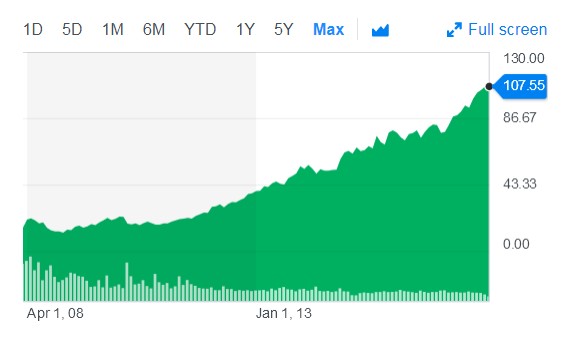
Analysts estimate Visa will report a 9% increase in revenues and a 9% increase in earnings per share for 3Q17. Visa has surpassed estimates in each of the past four quarters, contributing to the stock’s 30% appreciation since this time last year. Visa has seen significant increase in sales over the past few years and we expect this growth to continue as consumers shift from cash to online and credit card payments.
How’s this for a nice looking chart over the past five years? Where would you say it is headed?
-----------------------------------------------------------------------------------------------------------------------------
United Parcel Service (UPS: $120)
Bull Market Report Target Price: $125
Bull Market Report Sell Price: $106
Earnings Date: Thursday, 8:00 AM ET
Consensus: 3Q17
Revenues: $15.6 billion
EPS: $1.45
Year Ago Quarter Results
Revenues: $15.0 billion
EPS: $1.44
Key Things to Watch For in the Quarter
UPS is expected to report a 4% increase in revenues and no change in earnings per share for 3Q17. Despite only having beaten estimates in two of the past four quarters, the stock has still managed to climb 10% since this time last year and is currently trading 16% above its 52-week low. Companies like UPS and FedEx are perfectly positioned to benefit from the growing trend of online shopping. Growth in e-commerce has been accelerating over the past few years, up 16% from 2016 alone, and shows no signs of slowing down. The stock currently yields 2.75% making it a good investment for investors who are seeking both growth and income.
-----------------------------------------------------------------------------------------------------------------------------
Celgene (CELG: $123)
Bull Market Report Target Price: $150
Bull Market Report Sell Price: $125
Earnings Date: Thursday, 9:00 AM ET
Consensus: 3Q17
Revenues: $3.4 billion
EPS: $1.87
Year Ago Quarter Results
Revenues: $3.0 billion
EPS: $1.58
Key Things to Watch For in the Quarter
Celgene is expected to report a 13% increase in sales and a 18% increase in earnings per share for 3Q17. The stock has beaten analyst estimates in each of the past four quarters and was up nearly 50% this year until recent weeks when it announced that it would not continue to phase 3 trials for its Crohn’s disease drug. The stock pulled back 17% on the announcement and opened a window of opportunity for investors who felt the stock was overbought at its previous levels. Celgene continues to invest heavily in R&D and we expect it will continue to produce growing sales with the rest of its pipeline.
The stock is below our Sell Price and we covered Celgene in our report that went out Sunday evening the 22nd. Please review for our thoughts on the stock.
-----------------------------------------------------------------------------------------------------------------------------
Bristol-Meyers Squibb (BMY: $64)
Bull Market Report Target Price: $77
Bull Market Report Sell Price: $51
Earnings Date: Thursday, 10:30 AM ET
Consensus: 3Q17
Revenues: $5.2 billion
EPS: $0.77
Year Ago Quarter Results
Revenues: $5.0 billion
EPS: $0.77
Key Things to Watch For in the Quarter
Analysts estimate that Bristol Meyers will report a slight 4% increase in sales and no change in earnings per share for 3Q17. Bristol has beaten estimates in three of the past four quarters, contributing to the stock’s 30% gain over the past year. The company generates about 30% of its revenues from oncology related drugs, and we expect the stock to continue growing as it gains more market share.
We hereby raise our Sell Price from $51 to $59.
-----------------------------------------------------------------------------------------------------------------------------
Alphabet (GOOG: $978)
Bull Market Report Target Price: $1100
Bull Market Report Sell Price: We would not sell Alphabet
Earnings Date: Thursday, 4:30 PM ET
Consensus: 3Q17
Revenues: $27 billion
EPS: $8.33
Year Ago Quarter Results
Revenues: $22 billion
EPS: $9.06
Key Things to Watch For in the Quarter
Analysts estimate that Alphabet will report a 22% increase in revenues and an 8% decrease in earnings per share for 3Q17. The stock is up 21% over the past, which has been driven by its ability to beat analyst estimates in three of the past four quarters and to grow revenues and earnings. Alphabet’s institutional owners have been increasing their positions in the company over the past six months by 3%, indicating they believe in the long-term success of the business. Alphabet has recently released new products that have put pressure on some of the largest tech companies like Apple and Samsung.
Our Price Target is $1000, but we think somehow that has been an uncorrected error and we believe it was and should be $1100. Thus we hereby make the change. The all-time high is $997 set just last week, and if the stock market remains stable, we expect to see the stock blow through $1000 and move significantly higher by the end of the year.
-----------------------------------------------------------------------------------------------------------------------------
First Solar (FSLR: $49)
Bull Market Report Target Price: $55
Bull Market Report Sell Price: $39
Earnings Date: Thursday, 4:30 PM ET
Consensus: 3Q17
Revenues: $800 million
EPS: $0.85
Year Ago Quarter Results
Revenues: $ 690 million
EPS: $1.22
Key Things to Watch For in the Quarter
While First Solar is expected to increase its revenues by 15%, analysts estimate that earnings per share will decrease by 30% for 3Q17. The stock has beaten earnings estimates in each of the past four quarters. We expect First Solar to continue with its positive performance as the year ends and on into 2018 as well.
This has been a long slog with this firm. We have been patient and have stuck with it and now the stock is moving up to where it belongs. This is a great company management is on the right path and the firm is certainly in the right business.
-----------------------------------------------------------------------------------------------------------------------------
Amazon (AMZN: $972)
Bull Market Report Target Price: $1,100
Bull Market Report Sell Price: $900
Earnings Date: Thursday, 5:30 AM ET
Consensus: 3Q17
Revenues: $42 billion
EPS: $0.52
Year Ago Quarter Results
Revenues: $33 billion
EPS: $0.03
Key Things to Watch For in the Quarter
Amazon is expected to report a 27% increase in sales and a 94% decrease in earnings per share for 3Q17. We expect this large reduction in EPS is from the company’s increased spending on R&D, which should pay off with large revenue increases down the road. Despite having only beaten estimates in two of the past four quarters, the stock is still up 17% since last year. In each of the two quarters it missed, the stock pulled back no more than 5% and provided investors with an entry opportunity. With the firm’s continued domination of e-commerce, we remain bullish on Amazon here at The Bull Market Report.
-----------------------------------------------------------------------------------------------------------------------------
Microsoft (MSFT: $79)
Bull Market Report Target Price: $84
Bull Market Report Sell Price: We would not sell Microsoft
Earnings Date: Thursday, 5:30 PM ET
Consensus: 3Q17
Revenues: $23 billion
EPS: $0.72
Year Ago Quarter Results
Revenues: $22 billion
EPS: $0.72
Key Things to Watch For in the Quarter
Analysts expect that Microsoft will report a 4.5% increase in sales and no change in earnings per share for 3Q17. The stock has climbed 30% over the past year, especially having beaten estimates in each of the past four quarters. Microsoft is another great investment for those seeking both growth and income. The stock has appreciated 180% over the past five years while paying out a 2% dividend. In addition to improving product sales, Microsoft has made a number of upgrades on its Windows operating system, driving growth over the years.
-----------------------------------------------------------------------------------------------------------------------------
Ventas (VTR: $63)
Bull Market Report Target Price: $82
Bull Market Report Sell Price: $61
Earnings Date: Friday, 8:00 AM ET
Consensus: 3Q17
Revenues: $880 million
EPS: $0.45
Year Ago Quarter Results
Revenues: $865 million
EPS: $0.42
Key Things to Watch For in the Quarter
Ventas is expected to report a slight 2% increase in revenues and a 7% increase in earnings per share for 3Q17. Despite having beaten estimates in three of the past four quarters, the stock is down 8% since last year. With most of its properties focused in senior housing and healthcare facilities, Ventas’s long-term growth looks very positive. Ventas owns a highly diversified portfolio of nearly 1,300 seniors housing and healthcare properties in the United States, Canada and the United Kingdom. The underperformance of the stock has given investors the opportunity to enter into this high dividend yielding (5%) growth stock.
September 17, 2017
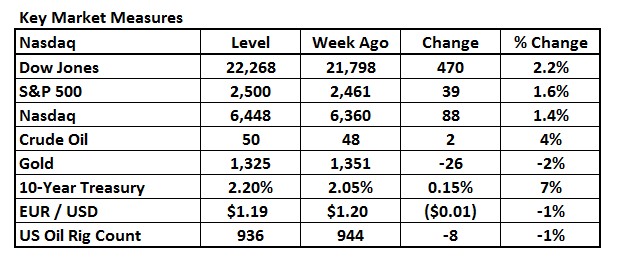
by Todd Shaver | Sep 17, 2017 | Weekly Newsletter 7pm Sunday
The Weekly Summary
Equity markets ended the week up, again! New all-time highs were set Friday (again) with all three indices. The threat of conflict with North Korea can’t stop the bull market. Gridlock in DC isn’t shaking confidence. The unemployment rate is low. GDP growth is fair though under pressure from severe weather. It’s really a “Goldilocks” economy and a market backdrop of not too hot and not too cold. The biggest threat might simply be the Fed’s Janet Yellen who must unwind a $4.5 trillion balance sheet. The September Fed meeting is upon us and nobody is expecting a rate hike because of the pressures on GDP growth from weather. Though pay attention to plans for the Fed balance sheet as these moves could be worth as much as three rate hikes depending on the pace of unwinding. We are as eager as you to see what happens.
No matter what is happening out there, there is always a bull market here at The Bull Market Report! This week we highlight some of our favorite stocks where we think you can still make good money, including: First Solar, Apple, Twilio, Bristol-Myers, Amazon, Google, and Square.
BMR Companies & Commentary
First Solar (FSLR: $51, up 8%)
First Solar caught a lot of press this week as Deutsche Bank upgraded the stock to a Buy and said the stock is heading to the mid-60s.
What is there not to like? First, US demand is so strong it is driving pricing higher. Beyond the typical demand there is something else happening. Customers are flocking to make purchases ahead of the ruling on the section 201 tariff.
What is this? There is a high likelihood of the International Trade Commission finding injury in the section 201 case. This case basically makes a determination on the safety of the product. A favorable decision is expected to result in 2018 margins between 20 and 30%, against a 2017 rate of 17.5%. This regulatory relief for First Solar is welcomed!
Lastly, monetization of the phase 1 California Flats Solar Project coupled with the anticipated sale of the company’s stake in 8Point3 Energy Partners (CAFD: $14.49) could result in upward revisions to EPS estimate.
BMR Take: Putting it all together, First Solar is in the right spot at the right time. We recognized it early. Now we see a big Wall Street investment bank get behind the name. Yea! With EPS running around $2.50, the stock is not expensive here considering the quality and future of the franchise.
Apple (AAPL: $160, up 1%)
Apple unveiled its latest slate of new products on Tuesday including a new $1,000 iPhone that is sure to bring out aficionados of the company's devices when they arrive in local stores later this month and again in early November.
In a live-streaming event, Apple introduced a new version of its Apple Watch and Apple TV set-top box, plus two new phones, the iPhone 8 ($700) and a larger iPhone 8 Plus ($800) version. But the highlight was the iPhone X (pronounced “10”), a thin, sleek phone that has 3D face-recognition technology, a state-of-the-art camera, and a $1000 price tag -- double the price of the first iPhone that Apple introduced 10 years ago.
The other products will be available for pre-order starting Friday and should hit stores a week later.
The $1,000 price tag is causing all sorts of buzz. Will consumers pay that much? Well, most think so because you just make monthly payments through a plan and not a lump sum. Is there new technology that is exciting? Yes, from face recognition for security to the largest screen yet. All in all, the timing of the launch could push sales from 4Q to 1Q, but we expect Apple to sell a lot of phones.
BMR Take: Apple is going to do over $250 billion of sales this year. This is a staggering amount of money pouring into the company’s bank accounts from consumers who love Apple. Remember, as long as Apple continues to be a fan-favorite for customers, we think there is a huge opportunity for the company to do more and more services on top of selling hardware. The future is bright!
Remember, 65% of Apple is now the iPhone. And every new user is going right to the App Store to buy apps, increasing the Services business incrementally. Recurring income, baby. That’s what it’s all about.
We have a few notes we made from a research report from UBS Securities.
Apple Price Target - $180 (We are at $170) with a $195 potential upside.
iPhone growth in F18/19 – UBS expects double-digit unit growth in F18 and single-digit growth in F19 driven by a growing installed base and high retention rate. They expect a bulge of F15 iPhone 6 owners to upgrade in F18, creating a strong year if not a "supercycle." Supply and pricing could affect the degree of growth.
“Apple innovation to drive long-term revenue growth?
“Augmented reality (AR) is an area where Apple could leapfrog competition in offering a superior user experience. Features will take time to be released as the technology must reach a level of maturity suitable for Apple's brand. Other products like the Watch and AirPods are slowly
becoming material to the business and represent another way to monetize a loyal base of customers.
“The installed base continues to grow double digits and retention rates remain high. The retention rate for Apple above 80%, at a seven point premium to the Android retention rate. There is pent-up demand for the iPhone 8, with over a third of the base consisting of handsets older than two years old, the highest ever.
“Around the world Apple is gaining share everywhere except China. China remains a wildcard. Encouragingly, shipments to Mainland China stabilized in June. Our survey indicates interest in the next iPhone is similar to last year.
“At a P/E of 15x, Apple is trading at near an all-time high valuation. This suggests the market is pricing in a strong product cycle in F18 with double-digit EPS growth. It's also possible investors are gradually re-rating the multiple to recognize the strength and stability of the brand.”
Twilio (TWLO: $31, up 4%)
Twilio is one of the most exciting growth stories out there. And the CEO’s recent Bloomberg TV interview re-ignited our conviction in the story.
As you have been following the growth of Twilio lately, you’ll know it’s an exciting addition to the communications space. Twilio is a developer platform that powers communications for more than 40,000 global companies, including Netflix, Airbnb, and Lyft.
Twilio has emerged as a simple way for companies and software teams to begin adding communications capabilities to their applications in the form of text, video, and voice, providing companies with the flexibility that they need to implement more engaging customer experiences into their daily operations.
Twilio was built around the growing desire to provide a better customer experience for end-users and companies alike. Across numerous industries, enterprises have begun to recognize that the only way to truly differentiate their businesses from other competitors in the marketplace, is to give their customers an experience that is seamless, integrated, and engaging. Unfortunately, it’s difficult to achieve that level of service when your communication technology is not all run from one central place.
BMR Take: Sometimes the daily news is just noise. You have to step back and do a simple fundamental analysis. What does this company do? Why is the value proposition a winner? What is the big picture story? Twilio has this nailed in spades and the CEO provided a great reminder of that to the equity markets this week talking on Bloomberg.
Look at revenues for the past three years. $89 million in 2014. $167 million in 2015. $277 million in 2016. (Note: they’ve already done $180 million in the first six months of 2017.) With revenue growing greater than 30% and nearing $500 million, the momentum is there and we are still early. Repeat, we are still VERY EARLY on this company. Where is this company’s growth going to stop? (Hint: it isn’t.) Take a hard look at owning this company.
Bristol-Myers Squibb (BMY: $62, flat)
At Bristol-Myers, patients are at the center of the universe. The company’s vision for the future of cancer care is focused on researching and developing transformational Immuno-Oncology (I-O) medicines for hard-to-treat cancers that could improve outcomes for these patients. The I-O opportunity is a breakthrough for cancer, and Bristol is a key player.
Bristol is in fact leading the scientific understanding of I-O through its extensive portfolio of investigational compounds and approved agents. The company’s differentiated clinical development program is studying broad patient populations across more than 50 types of cancers with 14 clinical-stage molecules designed to target different immune system pathways. Bristol continues to pioneer research that will help facilitate a deeper understanding of the role of immune biomarkers and how patients’ tumor biology can be used as a guide for treatment decisions throughout their journey.
This week Bristol announced some good data on I-O drugs. This reaffirmed the market’s confidence is Bristol’s ability to execute on the important I-O market opportunity.
BMR Take: Bristol is a top franchise is the Drug industry. The stock has been badly beaten down for about a year but now is coming back, as top franchises always do. With nearly $4 of EPS potential, this drugmaker is a screaming deal in our view.
Amazon (AMZN: $987, up 2%)
The future is here and guess what? Amazon created it! Alexa, Amazon's voice-activated digital assistant for the home, has learned a new skill -- dispensing medical information about first aid from one of the best-known names in medicine, Minnesota's Mayo Clinic.
The information is accessible by speaking to the Amazon device, which users appreciate if they're busy doing something with their hands, like putting aloe on a burn or examining someone who has stopped breathing.
The device advises in its robotic-female voice to begin cardiopulmonary resuscitation for one minute and then call 911 if the person is unresponsive from suffocation. If the user asks for it, the device will go on to discuss specific techniques for doing CPR on an adult, child, or baby.
BMR Take: Amazon is the innovation machine and to see Echo break through into the medical field is a just another key data point about the possibilities of the future. With over $20 of future EPS power or more, Amazon is unlike any stock ever in the history of the world. We are strong believers in the future of Amazon.
Google (GOOG: $920, down 1%)
There is talk that Google is considering making a $1 billion investment in Lyft to take on Uber. This could be exciting!
Google and Lyft can really help each other. With the possibility of autonomous driving being central to its future, Lyft badly needs a solution. Google is considering putting up to $1 billion into Lyft in a move that would see it become one of Lyft’s biggest shareholders at a crucial time.
Lyft is far smaller than Uber and when it comes to market places that can be fatal. For money to be made, generally, one player needs to have 60% share or be twice the size of its nearest competitor. In the US, Uber has already achieved this hallowed status and in theory should be able to crush Lyft simply by applying sustained competitive pressure until Lyft runs out of money.
Google could be the solution for Lyft to emerge as a fierce Uber competitor.
BMR Take: Google is a tech giant, a robust franchise, and reasonably priced versus EPS of $40. The all-time high is $988, set in early June, so it is off 7% from that high. With driverless cars a key part of the future economy, and Google paving the way, we are excited about what a Lyft investment could mean and think the general market will be too if the deal is announced. UBS Securities has a $1,080 Price Target with a $1,410 upside. We have $1000 as our Target, but will raise it when it hits.
Square (SQ: $28.50, up 7%)
Square is at all-time highs. Last week we talked about Square getting into banking. That was all the buzz. This week Jack Dorsey, CEO, is talking a hard look at blockchain technology and what it could mean for Square. This company is on the leading edge of innovation all the time.
You’ve been hearing or reading a lot about blockchain but you probably still aren’t entirely certain how to define it. You’re not alone. It’s something that Jack Dorsey, the CEO of Square (and CEO of Twitter), describes as the “next big unlock”.
Blockchain is often defined as a ledger that enables secure, encrypted transactions. Some financial and technical experts have described it as analogous to the early days of the internet: it’s a framework or backbone for transactions.
But Dorsey also went beyond that interpretation of it, adding that the ability to “distribute and decentralize the ledger enables proof of work, and proof of one entity, in an untrusted network.” “Even if there’s a hostile entity or a mistrust in the network,” Dorsey continued, “we can still account for value creation and the transfer of values as well.”
BMR Take: If Square can get blockchain right, the company could take on the likes of Visa and/or MasterCard to change the world of payments how we know it. How exciting. This is sending the stock to new all-time highs and we are only at the beginning stages of Square’s life as a publicly traded company. Note that JP Morgan and Bank of America as well as Goldman Sachs are experimenting with blockchain. With a market cap of just $11 billion we see very big times ahead for this innovative company. And they could be bought out for $15-18 billion in a whisker by one of the big boys.
Upcoming Economic News
Housing Starts
Tuesday, September 19th, 8:30 AM ET
Period: August
Consensus: 1,175,000
Prior: 1,155,000
Fed Funds Target Upper Bound
Wednesday, September 20th, 2:00 PM
Consensus: 1.3%
Prior: 1.3%
Leading Indicators
Thursday, September 21st, 10:00 AM
Period: August
Consensus: 0.20%
Prior: 0.30%
BlackRock Consensus Ratings on the Street
(BLK: $429, up 3%)
4 Hold Ratings, 8 Buy Ratings
Consensus Price Target: $448
9/08/2017 Barclays $475
8/18/2017 Jefferies Group $440
7/18/2017 Morgan Stanley $476.
7/18/2017 Deutsche Bank $455
7/14/2017 Keefe, Bruyette & Woods $440
6/19/2017 Bank of America Corporation $450
BMR Take: Market cap is $69 billion. Huge. They manage over $5.7 trillion of assets. HUGE. All-time high is $443 set in July. We think this is easily breakable. The Street likes this stock. We like this stock.
Cloudera Consensus Ratings on the Street
(CLDR: $18.38, down 12%)
4 Hold Ratings, 4 Buy Ratings
Consensus Price Target: $23
9/8/2017 J P Morgan Chase $24
9/8/2017 Morgan Stanley $19
9/8/2017 Stifel Nicolaus $24
5/24/2017 Bank of America $23
5/23/2017 Raymond James $23
5/23/2017 Deutsche Bank $25
BMR Take: Bad week for Cloudera. The stock got hammered. They announced a follow-on offering of shares from the IPO they did in April. This is normal stuff – some shares will be sold by insiders and some by the company. No details yet. We are not concerned, although it would be nice to see the stock at $25 where it ought to be. Remember, this is a tiny company. Market cap is $2.4 billion – a puppy. Very speculative. But we are believers.
Andeavor (ANDV: $102, up 1%)
We have a note we made from a research report from UBS Securities.
“The recent Western Refining merger is expected to generate $350-
$425 million in synergies.”
Their Price Target is $116, with an upside to $125. Ours is $110, but if it hits that we would consider raising it.
Cryptocurrencies Update
Bitcoin had a wild week, closing at around $3500 on Friday. Bitcoin doesn’t really “close” as it trades 24-7. Bitcoin began a colossal price reversal on Tuesday that finally culminated with the latest $2,972 weekly low, which ended up becoming the new monthly low as well. The massive 32% reduction, was followed by a flurry of negative news coverage with China shutting down the biggest bitcoin exchange in the country and Jamie Dimon of JP Morgan saying that this is the biggest bubble since tulip bulbs in 1637. He said that the cryptocurrency "won't end well." Dimon was speak at a conference presented by CNBC and Institutional Investor.
Bitcoin hit $4,980 all-time high on September 1st. It plunged about 13% Thursday after one of the biggest exchanges in China said it will shut down its operation. Bitcoin surged more than 10% on Friday, but was still on track for a big weekly loss during a tumultuous period of trading.
JPMorgan's global head of quantitative and derivatives strategy, said in a note on Wednesday that in addition to being volatile and difficult to value, "another worrying aspect of cryptocurrencies are some parallels to fraudulent pyramid schemes."
But to be sure, many see bitcoin as a huge opportunity.
Former JPMorgan strategist Tom Lee said the cryptocurrency could surge another 600% in five years. "It's not worth it to look at bitcoin two months, two weeks ahead," Lee argued, saying he still believes each bitcoin will be worth $25,000 in five years.
We at The Bull Market Report find this whole story fascinating and have been following bitcoin and Ethereum closely. If you would like to know more about it, please write us here: Info@BullMarket.com.
Opko Health Update
Opko (OPK: $5.97) had a wild week. It rallied the first three days of the week, closing at $6.47 on Wednesday. Then it got hammered on Thursday and was flat on Friday. We have seen no news to account for this, but please note that this one is quite speculative. Opko has had to deal with disappointment on multiple fronts, including less-than-encouraging results in clinical studies and slow starts for approved drugs. Yet even though several institutional investors have thrown in the towel and given up on the company, Opko has strong potential for sales of its chronic kidney disease treatment Rayaldee to pick up. Moreover, Opko's diagnostic testing business has good prospects as well. Although the company hasn't executed well yet, some are optimistic. We have high hopes for the company but it is testing our patience.
The High Yield Investor
By Michael Foster
After a lot of good weeks, we’ve had a week that was - well, slow.
Almost everything in the Bull Market Report high yield portfolio ended the week flat, as investors focused on the big headlines (North Korea, Irma, etc.), which actually had minimal impact on any high yield investment.
This might be surprising, so let’s talk a little bit about why the big macro events aren’t moving the needle. You’d be right to wonder why municipal bonds, especially bonds in Texas, Florida, and nearby weren’t negatively affected by the hurricanes that have caused still undetermined billions of dollars of damage and human misery. In light of that tremendous destruction, municipal bonds barely budged. Even bonds issued in the hardest hit areas were unaffected. To take one example, Miami’s transit authority issues bonds are backed by the revenue received from toll roads, parking lots, and so on. Surely less travel to the city and less use of parking lots by tourists due to the storm will hit revenue and thus put these bonds at risk - yet their prices barely budged.
The reality is that municipal bond issues use a combination of insurance and risk management to plan for major catastrophes, especially in catastrophe-prone areas like southern Florida. The storms were severe, but Florida financiers and civil servants plan for these things as part of their regular work. So while the timing of the storms was a bit of a surprise, the reality of hurricanes hitting Florida every once in a while is priced into the municipal bond market.
Thus muni funds continue to have a strong year after last week’s relatively small price movements. Nuveen AMT-Free Municipal Credit Fund (NVG: $15.70, down -1%) took a very slight hit, but that was counterbalanced by the small rise in Invesco Municipal Trust (VKQ: $12.96, up 1%). The most important lesson to learn, by far, is that big catastrophic events don’t really hurt muni bonds - at least, not in the way that the mainstream financial press would like you to believe (since, after all, they’re desperate for controversy and know fear-mongering headlines get clicks and pageviews).
Moving on to taxable income funds, we saw more quietness among AllianzGI Equity & Convertible Fund (NIE: $20, up 1%) and PIMCO Dynamic Income Fund (PDI: $30, up 0%). There are a couple of things to note about both of these funds with regards to their pricing. The income stream for both remains somewhat reliable, although the Pimco fund’s net investment income has dropped significantly in 2017 (this, however, is being counterbalanced by an increase in NAV growth). What investors should focus more of their time on is the pricing. The Pimco fund is now priced at a 4.8% premium to NAV, which is significantly lower than the 10% premium that it reached earlier this year. A big drop-off in the premium this summer has caused that pricing to go closer to its historical norm, and a small premium to NAV is a lot more tolerable than 10%. For that reason, investors who like the Pimco fund and have been waiting to buy more are finally in a position where they can seriously consider adding to their positions. However, if you can wait for a discount to show up, you might be wise to wait for a bigger market sell-off to provide that opportunity.
As for the AllianzGI fund - its discount to NAV has been steadily disappearing throughout 2017, and we’re now at slightly less than a 9% discount, which is a relatively high price for the fund relative to its historical average. That means investors should be a tad more cautious about adding to their position right now, but the fund is far from a sell. We’ll need to see discounts of 5% before offloading this fund makes any sense at all. In reality, the fund’s continued NAV appreciation (NAV is up 6% even after paying its 7.5% dividend consistently over the last year, giving a total NAV return of over 13%) demonstrates that the fund’s management knows what they’re doing and are able to provide a stable, reliable income by picking the right stocks and convertible bonds and handing profits to shareholders. At the end of the day, we can’t really ask more from a fund.
So with all of the humdrum, low level action of the last week, let’s discuss the two stocks that actually had pretty big moves. The first is Digital Realty Trust, Inc. (DLR: $118, down -3%), which closed its DuPont merger and proceeded to fall significantly thereafter. We’re pretty much off the 52-week high hit on Monday, so it’s hard to say whether the decline is a result of profit taking or a lack of faith in the value of the merger. We see no reason to be skeptical of the merger, so we are not changing our view on the stock.
There is, however, one other issue with cloud-based REITs like Digital Realty - earlier this week, a Silicon Valley venture capitalist gave a presentation arguing that server size was about to decline significantly due to semiconductor and other technological innovations. Obviously, this will be bad for datacenter stocks - or is it? Considering the explosive growth in data storage and users’ tendency to fill up datacenters faster than the space needed to store data shrinks, demonstrates that this is a pretty specious reason to be bearish on datacenter stocks.
Finally, AstraZeneca (AZN: $32.50, 1%) took a bit of a hit earlier this week on little news. Again, this seems to be a bit of profit taking, considering the significant rise in the stock from a month ago. There’s little news about the company’s product pipeline or balance sheet to indicate caution, so we’ll wait and see how the stock performs next week before concluding this price movement is anything more than noise.
Good Investing,
Todd Shaver, CEO, Editor and Founder
The Bull Market Report
Since 1998
