October 16, 2017
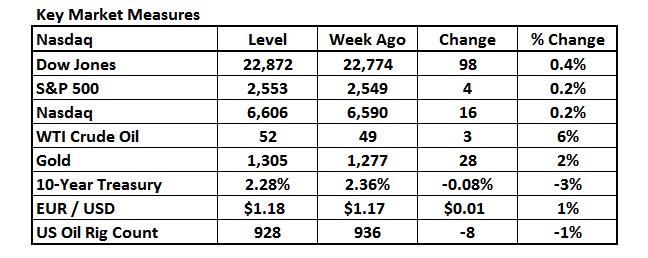
by Todd Shaver | Oct 16, 2017 | Monthly Newsletter Daily 12pm if new
The Weekly Summary
Tulip Mania was a period in the Dutch Golden Age when the price of bulbs reach ridiculously high levels in a craze only to eventually have the price crash badly in 1637. While we are not seeing broad-based craze in today’s markets, we must be mindful that there are pockets of risk out there, and that while market prices today haven’t reached “ridiculously high levels” they have still come a long way, raising the bar for how much risk lingers around out there. For example, this week the mainstream news media extensively covered Wall Street’s junk market bond binge. Junk rated companies are raising debt at the fastest pace since 2012. Not just is the issuance up a lot, but the terms of the deals (i.e. the debt covenants) are getting looser and looser, and thus easier to borrow money. We only raise these points to say, please be mindful of the risks, but there remains plenty of opportunity for future profits!
No matter what is happening out there, there is always a bull market here at The Bull Market Report! This week we highlight some of our favorite stocks/funds where we think you can still make good money, including: Nutanix, Opko, Apple, Annaly and BlackRock.
BMR Companies & Commentary
Another week, another all-time record high. Does this scare you? Not us. Why should it scare you? The economy is strong. We have 325 million people who are trying to better themselves by starting companies, by investing in real estate, by buying equities and bonds. No one thing or no one event can bring down the entrepreneurial nature of this country. The market is climbing a wall of worry. Trump, North Korea, breaking the Iran deal, the Taliban, our war in Afghanistan (that Trump is escalating now – ouch), Trump – oh wait, we just said that above. Yes, climbing a wall of worry. But the stock market has been doing this for over 100 years. Seriously. Look what it has been through and look where it is now. Look where our economy is now. Amazing. So Dow 23,000 look out and who knows, maybe in a year or two we will be saying “Dow 30,000 look out.”
If you really are worried and/or if things do get worse, sell your growth stocks and buy some income producing stocks from our REIT portfolio or our High Yield portfolio. Annaly Capital Mortgage (NLY: $12.22, up 1%) has been paying over 10% for over 20 years. I am going to repeat this for you here: Annaly Capital Mortgage has been paying over 10% for over 20 years. Since 1997 they have operated through bull and bear markets in stocks and bonds and they have survived and thrived. You’re worried about the stock market? Buy some Annaly – it is non-correlated with the market.*
*It has a beta of 0.30. A beta of 1 means it follows the overall stock market equally – if the market is up 1%, Annaly is up 1%. But no, Annaly has a beta of 0.30% meaning little to no correlation. The beta of an investment indicates whether the investment is more or less volatile than the market as a whole. In general, a beta less than 1 indicates that the investment is less volatile than the market, while a beta more than 1 indicates that the investment is more volatile than the market Beta can be zero. Some zero-beta assets are risk-free, such as treasury bonds and cash.
You want diversification? There are many other stocks in those two portfolios that pay from 4% to 9% dividends. Buy a basket of them and sit back and sleep like a baby at night!
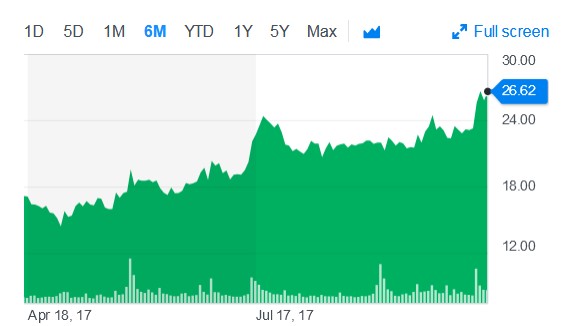
Nutanix (NTNX: $27, up 15%)
Goldman Sachs called Nutanix the investment opportunity of a decade. Why?
The demand pendulum appears to be swinging toward emerging, best-of-breed vendors with more modern approaches, and away from traditional, one-stop shop vendors that are often viewed to be out-of-step with the latest trends.
The proof is in the success or failure of new clients. Just this past quarter Nutanix had a strong quarter for large deals, including multiple deals in the high seven-figure range (several of these in the public sector). Nutanix is now working with a big chunk of the Fortune 500.
The big exciting part about Nutanix is that the company has doubled the number of clients in the past year. The typical client starts with a small contract, but then increases the amount of business they do, often 3x, 5x, or even 10x within a few years. So if Nutanix does nothing else but take care of the clients it already has, we should see strong growth in the years ahead.
BMR Take: We think Nutanix is a must-buy at current levels. Don't be worried about the current valuation. Let's look at why. This year the consensus is for EPS of $0.07, which is nothing much. However, the company is plowing money into sales and marketing to grow the business. Did you know they could save a few hundred million dollars tomorrow generating $1.50+ of EPS if they wanted to stop investing for growth? You see this analysis reveals the serious earnings power embedded in the business model, which is why we like the company so much.
Opko Health (OPK: $6.95, flat)
Opko is a diversified healthcare company that seeks to establish industry leading positions in large, rapidly growing markets. The diagnostics business includes BioReference Laboratories, the nation's third largest clinical laboratory with a core genetic testing business and a 400 person sales and marketing team to drive growth and leverage new products, including the 4Kscore® prostate cancer test and the Claros® 1 in-office immunoassay platform. The pharmaceutical business features Rayaldee, an FDA approved treatment for Secondary hyperparathyroidism in stage 3-4 chronic kidney disease (CKD) patients with vitamin D insufficiency.
Opko recently announced that it has entered into an exclusive agreement with Japan Tobacco (JT) for the development and commercialization in Japan of Rayaldee for the treatment of SHPT in dialysis patients with chronic kidney disease. This is great news for growth!
Under the terms of the agreement, JT will make an upfront payment to Opko of $6 million with another $6 million payment to be made upon initiation of Opko’s planned phase 2 study of Rayaldee in US dialysis patients. In addition, Opko will be eligible to receive up to an additional $31 million in development and regulatory milestones and $75 million in sales-based milestones. JT will also pay Opko tiered, double digit royalties on net product sales. Wow!
BMR Take: Consensus calls for about $1.2 billion of revenue for the company this year heading to $2 billion in a few years. We could be in for some major upside to estimates. Now wouldn’t that be nice, after being so patient with this little $3.9 billion company.
Apple (AAPL: $157, up 1%)
Apple could be disrupting more industries soon.
Barclays, the British bank, will need to defend its advantages in the payments business from encroachment by technology companies including Amazon and Apple, according to Barclay’s CEO Jes Staley.
There are some tectonic shifts going on, driven by tech and the geopolitical environment. The banks are very focused on the payments space and that may be where the battleground of finance is fought over the next 15 years. Could you imagine if Apple started taking share of the banking business from the world’s largest banks (like Barclays, JP Morgan, and Wells Fargo) as well as the world’s largest payments companies (like Visa and MasterCard). This would be another huge long-term growth driver.
BMR Take: Note that Apple has $260 billion in cash now, and with a market cap of $810 billion cash is 32% of the stock price. So more than $50 of the stock price is in cash. This is UNPRECEDENTED in the history of Wall Street. Apple remains an exciting investment opportunity. The services business is projected to double in revenue to $50 billion over the next several years. The Services business is much more profitable than hardware so the impact to earnings is even better. Don’t sell a share. We believe Apple has a lot more room to go on the upside.
BlackRock (BLK: $475, up 3%)
BlackRock, the world's largest money manager with $5.7 trillion in assets under management, reported better-than-expected earnings on Wednesday, which sent its stock to a record high.
And shares could go even higher, according to Credit Suisse (and us!) Following 3Q17 results, BlackRock remains the best-positioned traditional asset manager in the world with EPS growth expected to run 15-20% through 2019.
Most of the company's growth has come from its wildly successful exchange-traded fund business, known as iShares, which now accounts for half of all US investments in the products. There continues to be strong demand for iShares's ETFs driven by the evolution of the US retail channel (from commission-based to fee-based) and increased adoption by institutional clients and pricing reductions in its core series. Year to date, iShares accounted for about 50% of total ETF flows in the US.
Passive investments, like ETFs and other products that track a weighted index rather than a single equity, have steadily eaten away at active managers' portfolios in recent years.
BMR Take: BlackRock is among the best-positioned companies in investment management owning the top ETF franchise that is growing rapidly due to passive investing, as well as an increasing product portfolio of technology. Recall, there are several top hedge funds on the list of shareholders in BlackRock. With EPS set to approach $30 over the next 3 years, this stock pick is among our favorites.
Upcoming Economic News
Industrial Production
Tuesday, October 17, 2017 09:15 AM
Period: September
Consensus: 0.30%
Prior: -0.90%
Housing Starts
Wednesday, October 18th, 8:30 AM
Period: September
Consensus: 1,180,000
Prior: 1,180,000
Continuing Jobless Claims
Thursday, October 19th, 8:30 AM
Period: October
Consensus: 1,895,000
Prior: 1,889,000
A Word from Gary Jefferson
Jefferson Financial Group
First Vice-President, Investments
UBS Financial Services, Inc.
The 4th quarter is off and running strongly, which is not uncommon. Even though it includes October (Octoberphobia), Q4 has historically been the strongest quarter of the year for the S&P 500. Since 1950, the S&P 500 has gained 4% on average in the fourth quarter, advancing 79% of the time. Oil dipped back under $50 per barrel and gold has fallen over 7% in just the last month because the US Dollar has strengthened due to the belief that the Fed will hike rates again in December. Maybe or maybe not. We still think tax reform is a bigger wild card than another Fed hike. The expectation of tax reform has resulted in just about everything with the exception of energy being up for the year, but even energy has some building tailwinds.
According to Boone Pickens Advisors, worldwide demand is soaring and set to hit 100 million barrels per day next year – a feat that was only expected around 2025 by most long-term forecasts including those from OPEC and Exxon. Growing energy demand is normally associated with growing economies, so this continues to be good news for future market gains based on earnings growth. The point being made is that if the market suffers a setback due to the failure of tax reform, it should not develop into a real bear market because of the support to be found in continued earnings growth. If Boone Pickens Advisors is right about soaring demand for energy, there is plenty of upside left in this bull.
General Electric (GE: $23, down 10% this week, and down from $32 in December - wow)
The drop in the stock in the last 10 months is almost 30%. With a market cap of $200 billion GE is not going away. But they are the Dog of the Dow. You know what the Dogs of the Dow are, right? They are the five worst performing stocks of the 30 Dow stocks. GE is gunning for THE DOG of the Dow this year. Many value money managers love this stuff. They buy the Dogs and historically, they have been big winners the following year and years.
We are thinking of adding GE to our Stocks For Success portfolio, not just because of the thinking in the above paragraph but for a host of other reasons. It has just had a shakeup in management, which will continue for the next few months. Old CEO out (Immelt), new CEO in (John Flannery). Lots of executives leaving or getting pushed out. Dividend is 4% which is pretty darn good for a Dow stock. 100+ year history of success as a global business leader. Lots going on with this huge company.
A note about the dividend. Some analysts think the dividend could get cut in order to conserve cash. This would be bad and good news. The stock would probably get nailed by another 10% down to $21 or even lower, but that would most likely mark the bottom. So if you are thinking of taking a position, keep this in mind. In other words, keep some cash around (keep your powder dry) in order to buy more at a lower price. If this dividend cut doesn’t happen, then buy some more as the stock moves up over the coming 24 months as it gets back into the $30s. The all-time high is about $58 back in 2000, right after the bubble started bursting in the dotcoms. It dropped to $24 in 2002 and then rallied to $41 in 2007. It got whacked to $12 in 2009 in the financial crisis and has moved straight up for eight years to $32 in 2016. We think there is a good possibility of seeing $30 and $40 in this great franchise as we move into the latter stages of the twenty teens.
Again, we are thinking of writing a research piece on GE soon. We believe it is a long term winner for the super conservative investor.
Update on Shopify
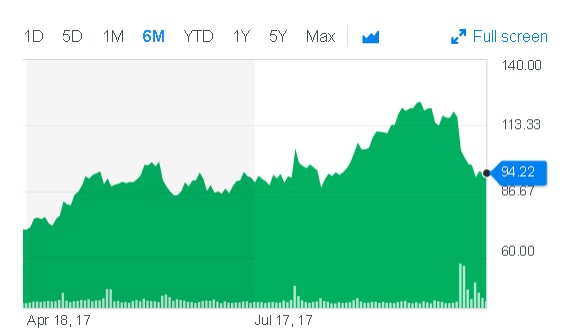
As you know, we love Shopify (SHOP: $94, down 4%) but along came Andrew Left and his firm Citron announcing that he was short the stock, that it was going way down, and that the company was fraudulent, among other silly claims. Many analysts jumped in this past week on the story. Here’s what one of them said:
"Citron’s Argument is Weak
"Let’s call a spade a spade - Shopify is selling a dream.
"So, is the Shopify stock news on-point? Is Shopify using illegal marketing tactics in selling that dream? That’s a gray area to be sure, but is the marketing message remarkably more misleading than the TV commercials inviting consumers to participate in class action lawsuits that mostly enrich attorneys, but rarely pan out as well as expected for the actual plaintiffs?
"Is a vision of a healthy cancer patient within a television commercial for a cancer drug some sort of unspoken guarantee of long-term survival? Does a young man that uses the Axe brand of personal-hygiene products actually expect to be besieged by young women, as depicted in Axe’s television commercials?
"The answer to all these questions is, of course, no. The FTC tolerates the imagery simply because it knows it has to give consumers at least a modicum of credit in distinguishing the difference between a contract and a commercial.
"And as for Shopify’s lack of profits, Shopify is in good company. Most young companies don’t turn a profit until after they’ve matured, but savvy investors know the time to get into some of them is before, not after, that fact. Look at Amazon, the most prominent of the rags-to-riches stories. It’s been one of the best long-term investments anyone could have made over the course of the past couple of decades. Investors don’t care where a company is, they care about where it’s going.
"Looking Ahead for SHOP Stock
"Don’t misread the message. The FTC might crack down on Shopify’s advertising. The company might never turn a profit. The market might not care if Shopify does eventually turn a profit. Nobody really knows the future. That’s the speculative nature of stock-picking.
"Andrew Left, however, seems to be grasping at straws with this one. Though he certainly rattled shareholders by generating some rather alarming Shopify stock news headlines, this time his claims are more bark than bite.
"If your gut is telling you this may be a time to scoop up shares at bargain prices, you may want to trust your gut."
BMR Take: Again, this was an opinion of a consensus of Wall Street analysts. But we certainly concur. We think this guy Left is out in left field. Here’s a chart of the last six months. You can see that the stock is where it was in August, just two short months ago. In April it was $71. We think there is tremendous value here with this company and believe Andrew Left will be left high and dry.
The High Yield Corner
By Michael Foster
Remember the slight volatility we recently saw in REITs? That’s gone. Instead, 4 of the 6 REITs in the High Yield portfolio were up this week, while two were flat. While not rising the most, Omega Healthcare Investors, Inc (OHI: $32, up 1%) is the most important and interesting story of the week. Extremely cautious, risk-averse investors dislike this stock because of its high yield (8%) and relative youth. Having been around since the late 1990s, it lacks the history of many dividend growth stocks. It also had a pretty disastrous collapse in its dividend back in 2000. However, that’s all long history by now. More recently, Omega Healthcare has devoted itself to a penny-per-quarter dividend hike that makes it a uniquely high yielding dividend growth stock. Some will warn that these dividend increases are unsustainable, and that may be true. But if the hikes last 10 years instead of 2 quarters and you avoid it because it won’t last forever, you’re giving up some extreme gains over a decade. This is how risk averse behavior cuts into returns.
The more aggressive investors who own Omega realize this, which is why they look at both the firm’s FFO and its dividend growth rate like a hawk. Last week, Omega yet again gave investors a penny-per-share raise. At the new payout, FFO covers the dividend pretty well - at a 125% rate. Bear in mind that that’s below the 130% threshold that we frequently write about here, which makes us cautious about the longevity of the rate hikes. We need to see FFO per share slow significantly before that dividend coverage ratio gets hurt and a cut becomes a mathematical necessity.
But how long could that take? Our best guess is that we have at least three years until a cut becomes necessary, but there are two factors that could grossly change that estimate. For one, shares outstanding growth. The more shares Omega releases, the more dividends it has to pay, which makes its FFO less powerful in covering payouts. Total shares outstanding have risen to 197 million from 196 million in the last year - a pretty small jump. But shares were just 68 million a decade ago, meaning an 11% annualized growth rate in total shares outstanding. That brings us to our second factor: FFO - funds from operations. During that same decade, FFO has risen 22% annualized over the same period. So you can see how Omega has been able to grow far beyond its obligations to shareholders and keep that growth rate going!
Can Omega continue? The real answer is no one knows, but there is reason to be concerned. The growth rate has slowed significantly in recent years, especially since Omega was smart to expand during the post-2009 years when all real estate was on sale. Deals are harder to find now, making growth a lot harder.
There’s another lever Omega can pull, though: Getting strong rent hikes. Keep in mind that Omega’s wheelhouse is a customer base that struggles with inflation, which makes rent hikes particularly challenging. For that reason, we think the long term trend of strong growth at Omega is definitely a thing of the past, and the penny-per-quarter hike cannot continue forever. But selling now and missing out on years of high yield dividend growth would be folly. Instead, we need to keep our positions and look closely at the numbers before jumping out. Now is not the time.
Our strongest REIT of the week is in many ways the exact opposite of Omega. Digital Realty Trust (DLR: $122, up 3%) saw a really strong week without too much relevant news. Last week the firm announced it would expand its Silicon Valley Connected Campus, with a new six-megawatt facility planned for 1Q18 delivery. This is a really small part of Digital Realty’s portfolio, comprising just a $75 million investment, so it isn’t enough to move the needle. Also, as counterintuitive as it sounds, Digital Realty’s strength isn’t in the Valley but in its distributed presence around the country. The company has many retail-facing clients, as well as the U.S. government, where the need is to have many hubs where human beings who use the Valley’s services are located.
Digital Realty is on track to grow that business, but the real story of last week’s price movement is more technical than fundamental. The stock has retreated from its 52-week high hit last month ($127), and after this week’s gains is approaching it yet again. The dividend yield is also nearing the sub-3% level, which it hit in September briefly before rising. We fear we may have a repeat of that in the short term - but that’s hardly a cause for concern. It simply means that Digital Realty is for the most part range bound right now, and we need to content ourselves with that while we wait for the company to aggressively ramp up its dividend. The last rate hike was in March, and another one by the end of the year would be nice. In reality, this company’s management has settled itself into a predictable pattern of one-per-year dividend hikes despite a rapid acceleration in FFO growth. FFO per share is now over double payouts - an absurd ratio to say the least! We would like to see Digital Realty aggressively ramp up its dividend hike schedule.
We doubt we’ll see it anytime soon, but we do think it’s an inevitability with this company. Simply put, it cannot stop making money, and its business is growing too rapidly for it to be at risk anytime soon. Eventually, Digital Realty will need to start increasing its dividend more frequently or doing much more aggressive dividend hikes. Either way, its 3% yield at current prices is destined to turn into more of a 5% yield in the next 3-5 years. For that reason, investors long the stock should stay tight even if you’ve been in it for the past year and are sitting on some attractive capital gains.

Good Investing,
Todd Shaver, CEO, Founder and Editor
The Bull Market Report
Since 1998
Now wouldn't you want to get this newsletter every week? You bet you would! Just click here or go to BullMarket.com/subscription. You'll be glad you did!
October 15, 2017
by Todd Shaver | Oct 15, 2017 | Weekly Newsletter 7pm Sunday
The Weekly Summary
Tulip Mania was a period in the Dutch Golden Age when the price of bulbs reach ridiculously high levels in a craze only to eventually have the price crash badly in 1637. While we are not seeing broad-based craze in today’s markets, we must be mindful that there are pockets of risk out there, and that while market prices today haven’t reached “ridiculously high levels” they have still come a long way, raising the bar for how much risk lingers around out there. For example, this week the mainstream news media extensively covered Wall Street’s junk market bond binge. Junk rated companies are raising debt at the fastest pace since 2012. Not just is the issuance up a lot, but the terms of the deals (i.e. the debt covenants) are getting looser and looser, and thus easier to borrow money. We only raise these points to say, please be mindful of the risks, but there remains plenty of opportunity for future profits!
No matter what is happening out there, there is always a bull market here at The Bull Market Report! This week we highlight some of our favorite stocks/funds where we think you can still make good money, including: Athenahealth, Nutanix, Cloudera , Opko, Apple, Annaly and BlackRock.
BMR Companies & Commentary
Another week, another all-time record high. Does this scare you? Not us. Why should it scare you? The economy is strong. We have 325 million people who are trying to better themselves by starting companies, by investing in real estate, by buying equities and bonds. No one thing or no one event can bring down the entrepreneurial nature of this country. The market is climbing a wall of worry. Trump, North Korea, breaking the Iran deal, the Taliban, our war in Afghanistan (that Trump is escalating now – ouch), Trump – oh wait, we just said that above. Yes, climbing a wall of worry. But the stock market has been doing this for over 100 years. Seriously. Look what it has been through and look where it is now. Look where our economy is now. Amazing. So Dow 23,000 look out and who knows, maybe in a year or two we will be saying “Dow 30,000 look out.”
If you really are worried and/or if things do get worse, sell your growth stocks and buy some income producing stocks from our REIT portfolio or our High Yield portfolio. Annaly Capital Mortgage (NLY: $12.22, up 1%) has been paying over 10% for over 20 years. I am going to repeat this for you here: Annaly Capital Mortgage has been paying over 10% for over 20 years. Since 1997 they have operated through bull and bear markets in stocks and bonds and they have survived and thrived. You’re worried about the stock market? Buy some Annaly – it is non-correlated with the market.*
*It has a beta of 0.30. A beta of 1 means it follows the overall stock market equally – if the market is up 1%, Annaly is up 1%. But no, Annaly has a beta of 0.30% meaning little to no correlation. The beta of an investment indicates whether the investment is more or less volatile than the market as a whole. In general, a beta less than 1 indicates that the investment is less volatile than the market, while a beta more than 1 indicates that the investment is more volatile than the market Beta can be zero. Some zero-beta assets are risk-free, such as treasury bonds and cash.
You want diversification? There are many other stocks in those two portfolios that pay from 4% to 9% dividends. Buy a basket of them and sit back and sleep like a baby at night!
Athenahealth (ATHN: $115, down 7%)
While Athenahealth didn’t perform well this week, as far as we can tell the issues are just some pre-earnings jitters, not anything serious. The company is scheduled to report earnings on Friday. The consensus is looking for EPS of $0.50 on $310 million of revenue.
We expect all the key fundamentals to remain solid. Recall, the company recently committed to several key initiatives, including: (i) targeting approximately $100 million in cost-savings to increase profitability and drive growth; (ii) committing to significant operating margin expansion; (iii) launching a search to recruit a seasoned independent chairman of the board and additional independent director; and (iv) augmenting the senior management structure to establish the role of president, in addition to an ongoing CFO search.
We do note that the interim CFO sold 4,000 shares this week. Sometimes this news spooks people, but in this case we see no reasons to be concerned about it.
BMR Take: With Elliott Management in there shaking things up, there is a lot of excitement ahead. We love this company but believe now is the time to take profits. For those of you who bought on our recommendation, we made a fair amount of money since we added the stock at $103 in November. While we already officially removed the stock from our portfolio on 8/7/17, we once more reiterate taking profits. Why again? We know some of you out there may have stayed the course selling calls, as that’s what we recommended to do at the time if you weren’t ready to get out. Well, we want to be sure to now say without any hedging - time to exit completely! Let’s buy this one back below $100.
Nutanix (NTNX: $27, up 15%)
Goldman Sachs called Nutanix the investment opportunity of a decade. Why?
The demand pendulum appears to be swinging toward emerging, best-of-breed vendors with more modern approaches, and away from traditional, one-stop shop vendors that are often viewed to be out-of-step with the latest trends.
The proof is in the success or failure of new clients. Just this past quarter Nutanix had a strong quarter for large deals, including multiple deals in the high seven-figure range (several of these in the public sector). Nutanix is now working with a big chunk of the Fortune 500.
The big exciting part about Nutanix is that the company has doubled the number of clients in the past year. The typical client starts with a small contract, but then increases the amount of business they do, often 3x, 5x, or even 10x within a few years. So if Nutanix does nothing else but take care of the clients it already has, we should see strong growth in the years ahead.
BMR Take: We think Nutanix is a must-buy at current levels. Don't be worried about the current valuation. Let's look at why. This year the consensus is for EPS of $0.07, which is nothing much. However, the company is plowing money into sales and marketing to grow the business. Did you know they could save a few hundred million dollars tomorrow generating $1.50+ of EPS if they wanted to stop investing for growth? You see this analysis reveals the serious earnings power embedded in the business model, which is why we like the company so much.
Cloudera (CLDR: $15.72, down 6%)
Remember the company we really like just mentioned above, Nutanix? Well they are doing great things with Cloudera, which means there is more than one way to make money here.
Nutanix, a leader in enterprise cloud computing, announced that its Enterprise Cloud Platform software has been certified to run Cloudera Enterprise workloads. Through this certification, joint customers can reduce management complexity and derive more value by deploying and managing their Cloudera analytics workloads on the market’s leading hyperconverged software platform.
For big data deployments, choosing the right hardware and software is critical to success but often challenging for IT teams balancing ambitious corporate goals with smaller budgets and fewer resources. Joint customers can now run Cloudera workloads on an on-premises, elastic, software-driven infrastructure that can scale on-demand, one node at a time. And because Cloudera workloads can run on the same shared infrastructure as other workloads, IT teams can reduce costs and focus their attention on strategic projects, rather than managing multiple silos of underutilized infrastructure. Great news!
BMR Take: With $360 million of sales projected this year, a growth of 40%, Cloudera is an emerging growth stock worth keeping an eye on. With acquisitions building out the product suite and accelerating revenue growth, momentum is undeniably picking up. A $2 billion market cap, this company is a pipsqueak in the world of commerce. But given its high growth rate, in 2-3 years, the firm can be a major factor (if the company doesn’t get taken out by the big boys.)
Wall Street Consensus Ratings for Cloudera
Ratings Breakdown: 5 Hold Ratings, 4 Buy Ratings
Consensus Price Target: $22.40
10/11/2017 Mizuho $18
9/8/2017 J P Morgan Chase $24
9/8/2017 Morgan Stanley $19
9/8/2017 Stifel Nicolaus $24
5/24/2017 Bank of America $23
5/23/2017 Raymond James Financial $23
5/23/2017 Citigroup $23
5/23/2017 Deutsche Bank $25
Opko Health (OPK: $6.95, flat)
Opko is a diversified healthcare company that seeks to establish industry leading positions in large, rapidly growing markets. The diagnostics business includes BioReference Laboratories, the nation's third largest clinical laboratory with a core genetic testing business and a 400 person sales and marketing team to drive growth and leverage new products, including the 4Kscore® prostate cancer test and the Claros® 1 in-office immunoassay platform. The pharmaceutical business features Rayaldee, an FDA approved treatment for Secondary hyperparathyroidism in stage 3-4 chronic kidney disease (CKD) patients with vitamin D insufficiency.
Opko recently announced that it has entered into an exclusive agreement with Japan Tobacco (JT) for the development and commercialization in Japan of Rayaldee for the treatment of SHPT in dialysis patients with chronic kidney disease. This is great news for growth!
Under the terms of the agreement, JT will make an upfront payment to Opko of $6 million with another $6 million payment to be made upon initiation of Opko’s planned phase 2 study of Rayaldee in US dialysis patients. In addition, Opko will be eligible to receive up to an additional $31 million in development and regulatory milestones and $75 million in sales-based milestones. JT will also pay Opko tiered, double digit royalties on net product sales. Wow!
BMR Take: Consensus calls for about $1.2 billion of revenue for the company this year heading to $2 billion in a few years. We could be in for some major upside to estimates. Now wouldn’t that be nice, after being so patient with this little $3.9 billion company.
Apple (AAPL: $157, up 1%)
Apple could be disrupting more industries soon.
Barclays, the British bank, will need to defend its advantages in the payments business from encroachment by technology companies including Amazon and Apple, according to Barclay’s CEO Jes Staley.
There are some tectonic shifts going on, driven by tech and the geopolitical environment. The banks are very focused on the payments space and that may be where the battleground of finance is fought over the next 15 years. Could you imagine if Apple started taking share of the banking business from the world’s largest banks (like Barclays, JP Morgan, and Wells Fargo) as well as the world’s largest payments companies (like Visa and MasterCard). This would be another huge long-term growth driver.
BMR Take: Note that Apple has $260 billion in cash now, and with a market cap of $810 billion cash is 32% of the stock price. So more than $50 of the stock price is in cash. This is UNPRECEDENTED in the history of Wall Street. Apple remains an exciting investment opportunity. The services business is projected to double in revenue to $50 billion over the next several years. The Services business is much more profitable than hardware so the impact to earnings is even better. Don’t sell a share. We believe Apple has a lot more room to go on the upside.
BlackRock (BLK: $475, up 3%)
BlackRock, the world's largest money manager with $5.7 trillion in assets under management, reported better-than-expected earnings on Wednesday, which sent its stock to a record high.
And shares could go even higher, according to Credit Suisse (and us!) Following 3Q17 results, BlackRock remains the best-positioned traditional asset manager in the world with EPS growth expected to run 15-20% through 2019.
Most of the company's growth has come from its wildly successful exchange-traded fund business, known as iShares, which now accounts for half of all US investments in the products. There continues to be strong demand for iShares's ETFs driven by the evolution of the US retail channel (from commission-based to fee-based) and increased adoption by institutional clients and pricing reductions in its core series. Year to date, iShares accounted for about 50% of total ETF flows in the US.
Passive investments, like ETFs and other products that track a weighted index rather than a single equity, have steadily eaten away at active managers' portfolios in recent years.
BMR Take: BlackRock is among the best-positioned companies in investment management owning the top ETF franchise that is growing rapidly due to passive investing, as well as an increasing product portfolio of technology. Recall, there are several top hedge funds on the list of shareholders in BlackRock. With EPS set to approach $30 over the next 3 years, this stock pick is among our favorites.
Upcoming Economic News
Industrial Production
Tuesday, October 17, 2017 09:15 AM
Period: September
Consensus: 0.30%
Prior: -0.90%
Housing Starts
Wednesday, October 18th, 8:30 AM
Period: September
Consensus: 1,180,000
Prior: 1,180,000
Continuing Jobless Claims
Thursday, October 19th, 8:30 AM
Period: October
Consensus: 1,895,000
Prior: 1,889,000
A Word from Gary Jefferson
Jefferson Financial Group
First Vice-President, Investments
UBS Financial Services, Inc.
The 4th quarter is off and running strongly, which is not uncommon. Even though it includes October (Octoberphobia), Q4 has historically been the strongest quarter of the year for the S&P 500. Since 1950, the S&P 500 has gained 4% on average in the fourth quarter, advancing 79% of the time. Oil dipped back under $50 per barrel and gold has fallen over 7% in just the last month because the US Dollar has strengthened due to the belief that the Fed will hike rates again in December. Maybe or maybe not. We still think tax reform is a bigger wild card than another Fed hike. The expectation of tax reform has resulted in just about everything with the exception of energy being up for the year, but even energy has some building tailwinds.
According to Boone Pickens Advisors, worldwide demand is soaring and set to hit 100 million barrels per day next year – a feat that was only expected around 2025 by most long-term forecasts including those from OPEC and Exxon. Growing energy demand is normally associated with growing economies, so this continues to be good news for future market gains based on earnings growth. The point being made is that if the market suffers a setback due to the failure of tax reform, it should not develop into a real bear market because of the support to be found in continued earnings growth. If Boone Pickens Advisors is right about soaring demand for energy, there is plenty of upside left in this bull.
General Electric (GE: $23, down 10% this week, and down from $32 in December - wow)
The drop in the stock in the last 10 months is almost 30%. With a market cap of $200 billion GE is not going away. But they are the Dog of the Dow. You know what the Dogs of the Dow are, right? They are the five worst performing stocks of the 30 Dow stocks. GE is gunning for THE DOG of the Dow this year. Many value money managers love this stuff. They buy the Dogs and historically, they have been big winners the following year and years.
We are thinking of adding GE to our Stocks For Success portfolio, not just because of the thinking in the above paragraph but for a host of other reasons. It has just had a shakeup in management, which will continue for the next few months. Old CEO out (Immelt), new CEO in (John Flannery). Lots of executives leaving or getting pushed out. Dividend is 4% which is pretty darn good for a Dow stock. 100+ year history of success as a global business leader. Lots going on with this huge company.
A note about the dividend. Some analysts think the dividend could get cut in order to conserve cash. This would be bad and good news. The stock would probably get nailed by another 10% down to $21 or even lower, but that would most likely mark the bottom. So if you are thinking of taking a position, keep this in mind. In other words, keep some cash around (keep your powder dry) in order to buy more at a lower price. If this dividend cut doesn’t happen, then buy some more as the stock moves up over the coming 24 months as it gets back into the $30s. The all-time high is about $58 back in 2000, right after the bubble started bursting in the dotcoms. It dropped to $24 in 2002 and then rallied to $41 in 2007. It got whacked to $12 in 2009 in the financial crisis and has moved straight up for eight years to $32 in 2016. We think there is a good possibility of seeing $30 and $40 in this great franchise as we move into the latter stages of the twenty teens.
Again, we are thinking of writing a research piece on GE soon. We believe it is a long term winner for the super conservative investor.
Update on Shopify
As you know, we love Shopify (SHOP: $94, down 4%) but along came Andrew Left and his firm Citron announcing that he was short the stock, that it was going way down, and that the company was fraudulent, among other silly claims. Many analysts jumped in this past week on the story. Here’s what one of them said:
"Citron’s Argument is Weak
"Let’s call a spade a spade - Shopify is selling a dream.
"So, is the Shopify stock news on-point? Is Shopify using illegal marketing tactics in selling that dream? That’s a gray area to be sure, but is the marketing message remarkably more misleading than the TV commercials inviting consumers to participate in class action lawsuits that mostly enrich attorneys, but rarely pan out as well as expected for the actual plaintiffs?
"Is a vision of a healthy cancer patient within a television commercial for a cancer drug some sort of unspoken guarantee of long-term survival? Does a young man that uses the Axe brand of personal-hygiene products actually expect to be besieged by young women, as depicted in Axe’s television commercials?
"The answer to all these questions is, of course, no. The FTC tolerates the imagery simply because it knows it has to give consumers at least a modicum of credit in distinguishing the difference between a contract and a commercial.
"And as for Shopify’s lack of profits, Shopify is in good company. Most young companies don’t turn a profit until after they’ve matured, but savvy investors know the time to get into some of them is before, not after, that fact. Look at Amazon, the most prominent of the rags-to-riches stories. It’s been one of the best long-term investments anyone could have made over the course of the past couple of decades. Investors don’t care where a company is, they care about where it’s going.
"Looking Ahead for SHOP Stock
"Don’t misread the message. The FTC might crack down on Shopify’s advertising. The company might never turn a profit. The market might not care if Shopify does eventually turn a profit. Nobody really knows the future. That’s the speculative nature of stock-picking.
"Andrew Left, however, seems to be grasping at straws with this one. Though he certainly rattled shareholders by generating some rather alarming Shopify stock news headlines, this time his claims are more bark than bite.
"If your gut is telling you this may be a time to scoop up shares at bargain prices, you may want to trust your gut."
BMR Take: Again, this was an opinion of a consensus of Wall Street analysts. But we certainly concur. We think this guy Left is out in left field. Here’s a chart of the last six months. You can see that the stock is where it was in August, just two short months ago. In April it was $71. We think there is tremendous value here with this company and believe Andrew Left will be left high and dry.
Update on Cloudera (CLDR: $15.72, down 6%)
Nothing new this week, just a lower stock price, giving the stock even more value for the investor.
Here’s what we said three weeks ago on September 24th.
Cloudera (CLDR: $16.90, down 8%)
Cloudera is issuing new stock, diluting existing stockholders, hence why the stock is down. Specifically, Cloudera announced that it has filed a registration statement with the U.S. Securities and Exchange Commission relating to a proposed follow-on public offering of its common stock. A portion of the shares to be sold in the offering will be sold by existing stockholders of Cloudera, and a portion of the shares will be sold by the company. Cloudera will not retain any proceeds from the shares sold by existing stockholders. The number of shares to be sold and the allocation of the shares between existing stockholders and the company have not yet been determined.
Morgan Stanley, J.P. Morgan, and Allen & Company are acting as lead bookrunners for the offering. Merrill Lynch, Citigroup, and Deutsche Bank Securities are acting as book-running managers and Stifel, JMP Securities, and Raymond James are acting as co-managers.
BMR Take: Two weeks ago they reported this:
Recent Business and Financial Highlights:
Subscription revenue was up 46% year-over-year to $74 million
Subscription revenue represented 82% of total revenue, up from 79% in year-ago period
Subscription gross margin for the quarter was 85%, 200 basis points higher than second quarter fiscal 2017
Dollar-based net expansion rate was 140% for the quarter
45 net new Global 8000 customers added
And they have $500 million in the bank. Yes, they aren’t profitable yet, but remember, revenues tell all.
Taking a step back, companies do what Cloudera just did all the time — raise equity and use the proceeds for corporate purposes. It is not a reason for us to sell the stock or for the stock to be down as much as it is. The fundamental business has not changed one iota on this development. So it makes sense for us to stay invested. We will certainly keep a close eye on this management team though. For the time being, we are sticking with the company.
The High Yield Corner
By Michael Foster
Remember the slight volatility we recently saw in REITs? That’s gone. Instead, 4 of the 6 REITs in the High Yield portfolio were up this week, while two were flat. While not rising the most, Omega Healthcare Investors, Inc (OHI: $32, up 1%) is the most important and interesting story of the week. Extremely cautious, risk-averse investors dislike this stock because of its high yield (8%) and relative youth. Having been around since the late 1990s, it lacks the history of many dividend growth stocks. It also had a pretty disastrous collapse in its dividend back in 2000. However, that’s all long history by now. More recently, Omega Healthcare has devoted itself to a penny-per-quarter dividend hike that makes it a uniquely high yielding dividend growth stock. Some will warn that these dividend increases are unsustainable, and that may be true. But if the hikes last 10 years instead of 2 quarters and you avoid it because it won’t last forever, you’re giving up some extreme gains over a decade. This is how risk averse behavior cuts into returns.
The more aggressive investors who own Omega realize this, which is why they look at both the firm’s FFO and its dividend growth rate like a hawk. Last week, Omega yet again gave investors a penny-per-share raise. At the new payout, FFO covers the dividend pretty well - at a 125% rate. Bear in mind that that’s below the 130% threshold that we frequently write about here, which makes us cautious about the longevity of the rate hikes. We need to see FFO per share slow significantly before that dividend coverage ratio gets hurt and a cut becomes a mathematical necessity.
But how long could that take? Our best guess is that we have at least three years until a cut becomes necessary, but there are two factors that could grossly change that estimate. For one, shares outstanding growth. The more shares Omega releases, the more dividends it has to pay, which makes its FFO less powerful in covering payouts. Total shares outstanding have risen to 197 million from 196 million in the last year - a pretty small jump. But shares were just 68 million a decade ago, meaning an 11% annualized growth rate in total shares outstanding. That brings us to our second factor: FFO - funds from operations. During that same decade, FFO has risen 22% annualized over the same period. So you can see how Omega has been able to grow far beyond its obligations to shareholders and keep that growth rate going!
Can Omega continue? The real answer is no one knows, but there is reason to be concerned. The growth rate has slowed significantly in recent years, especially since Omega was smart to expand during the post-2009 years when all real estate was on sale. Deals are harder to find now, making growth a lot harder.
There’s another lever Omega can pull, though: Getting strong rent hikes. Keep in mind that Omega’s wheelhouse is a customer base that struggles with inflation, which makes rent hikes particularly challenging. For that reason, we think the long term trend of strong growth at Omega is definitely a thing of the past, and the penny-per-quarter hike cannot continue forever. But selling now and missing out on years of high yield dividend growth would be folly. Instead, we need to keep our positions and look closely at the numbers before jumping out. Now is not the time.
Our strongest REIT of the week is in many ways the exact opposite of Omega. Digital Realty Trust (DLR: $122, up 3%) saw a really strong week without too much relevant news. Last week the firm announced it would expand its Silicon Valley Connected Campus, with a new six-megawatt facility planned for 1Q18 delivery. This is a really small part of Digital Realty’s portfolio, comprising just a $75 million investment, so it isn’t enough to move the needle. Also, as counterintuitive as it sounds, Digital Realty’s strength isn’t in the Valley but in its distributed presence around the country. The company has many retail-facing clients, as well as the U.S. government, where the need is to have many hubs where human beings who use the Valley’s services are located.
Digital Realty is on track to grow that business, but the real story of last week’s price movement is more technical than fundamental. The stock has retreated from its 52-week high hit last month ($127), and after this week’s gains is approaching it yet again. The dividend yield is also nearing the sub-3% level, which it hit in September briefly before rising. We fear we may have a repeat of that in the short term - but that’s hardly a cause for concern. It simply means that Digital Realty is for the most part range bound right now, and we need to content ourselves with that while we wait for the company to aggressively ramp up its dividend. The last rate hike was in March, and another one by the end of the year would be nice. In reality, this company’s management has settled itself into a predictable pattern of one-per-year dividend hikes despite a rapid acceleration in FFO growth. FFO per share is now over double payouts - an absurd ratio to say the least! We would like to see Digital Realty aggressively ramp up its dividend hike schedule.
We doubt we’ll see it anytime soon, but we do think it’s an inevitability with this company. Simply put, it cannot stop making money, and its business is growing too rapidly for it to be at risk anytime soon. Eventually, Digital Realty will need to start increasing its dividend more frequently or doing much more aggressive dividend hikes. Either way, its 3% yield at current prices is destined to turn into more of a 5% yield in the next 3-5 years. For that reason, investors long the stock should stay tight even if you’ve been in it for the past year and are sitting on some attractive capital gains.
Good Investing,
Todd Shaver, CEO, Founder and Editor
The Bull Market Report
Since 1998
September 24, 2017
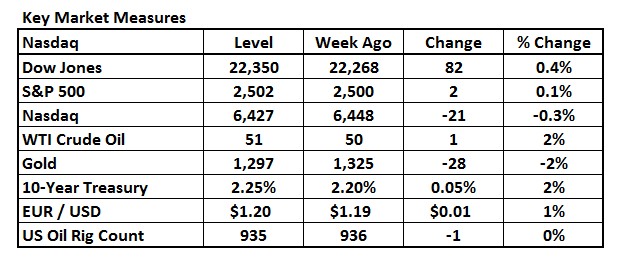
by Todd Shaver | Sep 24, 2017 | Weekly Newsletter 7pm Sunday
The Weekly Summary
Repetitive. That’s what the talking heads are on CNBC. That’s what you see in the local newspaper and even in the Wall Street Journal. All anybody talks about is Trump this and Trump that. Rising interest rates and the Fed. So on and so on. It’s all in hindsight too. Rarely ever do you hear forward thinking. Well, not here at the Bull Market Report. We aren’t anchored to the mainstream. We aren’t beholden to anything or anybody other than giving fresh perspective to you, our subscribers.
This week the one thing that caught our eye was hardly discussed at all in the media. China’s travel and tourism growth rate over the next 10 years is expected to outpace the USA and all other major nations. We are sure you know that China has 1.4 billion people versus our 325 million. We are at a major disadvantage in terms of population size. We better be smart in all we do. We better remember what got us here -- the wisdom of the founding fathers and bold actions (like starting a fight over tax reform by sinking a ship). What wise and bold actions are we taking today? Politically? Financially? Socially? Our Fed can’t even raise rates one-quarter of a point eight years after a crisis. While we are stalled, places like China with 4x the people-power we have are taking over. Let’s go!
No matter what is happening out there, there is always a bull market here at The Bull Market Report! This week we highlight some of our favorite stocks/funds where we think you can still make good money, including: Nutanix, Opko, Apple, Cloudera, Carlyle Group, PayPal, and we discuss Bitcoin.
BMR Companies & Commentary
Nutanix (NTNX: $24.50, up 14% for the week)
Nutanix is on a role. You know why? We’ll tell you the secret. Here is what the smart money sees: It all comes down to new customer growth and average revenue per customer. Sometimes it is just this simple. You look at the business model. You see what is happening with the leading indicators. These are the drivers of where the business is going. And it’s clear what is going to happen.
As of the end of July, Nutanix had 7,050 customers up from 3,770 customers in the year ago period. Out of this pool, there were just 400 customers doing over $1 million of business versus 210 customers in the year ago period.
What does this mean?
The total number of customers just doubled. Hardly any are doing over $1 million of business yet. An analysis of lifetime value from seasoned customers reveals this initial buy is 1x; after 18 months customers spend 4x the initial buy, and the top 25 customers end up around 19x.
So you see it’s just math. We could analyze the product all day (which is fabulous) and the market is buying it. Customers are flocking in.
BMR Take: Nutanix is a once-in-a-generation opportunity according to Goldman Sachs. But note that Nutanix is the classic busted IPO. Busted IPOs are where the initial hype around the first day of official trading on a public exchange gets a bit too high. There is a lot of excitement after all. And there is a lot on the line for investment bankers and management to get top dollar on the IPO price. Then the stock deflates. This is where it is a good time to buy. Nutanix is a great business - not much has changed since the IPO, aside from the fact that now is a much better time to start buying.
Opko Health (OPK: $6.71, up 12%)
The CEO bought 15,000 shares at around $6 per share. They say people sell stocks for any number of reasons. But there is only one reason you buy a stock – you think it’s worth a lot more. Now, when that person happens to be the CEO, that is interesting. The CEO should know the business really, really well. Many academic studies have shown that following insider buying by top executives is a money making strategy in the markets. So again why is the CEO buying shares right now? Whatever he sees leads him to believe he is going to make some money.
BMR Take: Consensus calls for about $1.2 billion of revenue for the company this year heading to $2 billion in a few years. We could be in for some major upside to estimates. Now wouldn’t that be nice, after being so patient with this little $3.75 billion company.
Apple (AAPL: $152, down 5%)
Apple had its worst week in 17 months for a number of reasons but what some say is muted demand. They say the old Apple of Steve Jobs never would have even come out with this phone. Today they just do an upgrade, throw a party, and expect people to flock to it. In fact, they are charging $1,000 now. The old Apple wouldn’t do something unless it was innovative. Nowadays it’s just boring old corporate culture. While demand for the new iPhone was weaker than expected, the reality is it is not a needle-moving matter or a reason to sell the stock. Apple is among the best franchises in the world and they are still selling a millions of iPhones. This is a great buying opportunity.
What else? If you updated to iOS 11 after it launched on Tuesday, chances are that you’ve noticed your battery is draining at an alarming rate. On Thursday, mobile security firm Wandera dove into the update and discovered that iPhone and iPad users who upgraded to iOS 11 are seeing their battery life decay more than twice as fast as it was on iOS 10. So clearly there are some kinks to work through.
BMR Take: We are not particularly concerned with these recent developments. Many times the bad news comes out first after a product launch and then the good news trickles out over the coming weeks and months. Apple is approaching their big selling season here shortly and in October will start taking orders for the Apple X. We will suggest to you here that the orders will be big and the hype bigger, and expect the stock to recover nicely in the coming months.
Cloudera (CLDR: $16.90, down 8%)
Cloudera is issuing new stock, diluting existing stockholders, hence why the stock is down. Specifically, Cloudera announced that it has filed a registration statement with the U.S. Securities and Exchange Commission relating to a proposed follow-on public offering of its common stock. A portion of the shares to be sold in the offering will be sold by existing stockholders of Cloudera, and a portion of the shares will be sold by the company. Cloudera will not retain any proceeds from the shares sold by existing stockholders. The number of shares to be sold and the allocation of the shares between existing stockholders and the company have not yet been determined.
Morgan Stanley, J.P. Morgan, and Allen & Company are acting as lead bookrunners for the offering. BofA Merrill Lynch, Citigroup, and Deutsche Bank Securities are acting as book-running managers and Stifel, JMP Securities, and Raymond James are acting as co-managers.
BMR Take: Two weeks ago they reported this:
Recent Business and Financial Highlights:
Subscription revenue was up 46% year-over-year to $74 million
Subscription revenue represented 82% of total revenue, up from 79% in year-ago period
Subscription gross margin for the quarter was 85%, 200 basis points higher than second quarter fiscal 2017
Dollar-based net expansion rate was 140% for the quarter
45 net new Global 8000 customers added
And they have $500 million in the bank. Yes, they aren’t profitable yet, but remember, revenues tell all.
Taking a step back, companies do what Cloudera just did all the time -- raise equity and use the proceeds for corporate purposes. It is not a reason for us to sell the stock or for the stock to be down as much as it is. The fundamental business has not changed one iota on this development. So it makes sense for us to stay invested. We will certainly keep a close eye on this management team though. For the time being, we are sticking with the company.
The Carlyle Group (CG: $24, up 4% this past week and 17% in the past two weeks)
We have written often about liking Carlyle since it was trading much lower than here. We think $30 is in the cards. Many investors still don’t understand or appreciate the business.
But what is really interesting is that the company just issued a new preferred. But in today’s low interest rate environment, many investors aren’t interested in bonds but still need to find a yield. A lot of money is being made in preferred stocks with their higher yields. Well, Carlyle just issued a preferred stock you can now buy. The Carlyle Group announced the pricing of a $400 million offering of its 5.875% Series A Preferred Units.
BMR Take: We would be buyers of the stock up to $30 a share. But now take a look at this new preferred and make close to a 6% yield. We know that Carlyle knows what to do with $400 million in cash! We just interviewed David Rubenstein, founder and Co-CEO. He is a powerhouse and we are quite happy investing in him and his management team. Have you seen his TV show on Bloomberg TV? Peer To Peer Conversations. Watch this show and buy some stock. You will be happy you did.
PayPal (PYPL: $65, up 6%)
CEO Dan Schulman says the company is looking for acquisitions. Schulman told the media that nothing is imminent but that they are on the hunt.
What could they do?
Historically, they bought money transfer services XOOM and Venmo. These services were natural extensions to PayPal’s brand. They spent a lot of money on tiny revenue producing business, but the technology of these companies is top notch and can scale big time under PayPal brand, so it was a strategic way to not pay a lot for something completely already built.
What would we like to see?
We would like to see the company do something exciting! Little small M&A deals are boring because they take forever to work. We would like to see PayPal take a swing at doing something big.
BMR Take: PayPal is a growth story for decades to come. EPS is growing greater than 10% and has been for a very long time. We see PayPal eventually taking on Visa and Mastercard for the top spot in payments. Setting a new all-time high on Friday, the company is now worth $78 billion. Do you have a PayPal account yet? You will.
Upcoming Economic News
Consumer Confidence
Tuesday, September 26th at 10:00 AM
Period: SEP
Consensus: 120.0
Prior: 122.9
Durable Orders
Wednesday, September 27th at 8:30 AM
Period: AUG
Consensus: 1.0%
Prior: -6.8%
GDP
Thursday, September 28th at 8:30 AM
Period: Q2
Consensus: 2.2%
Prior: 2.2%
A Word from Gary Jefferson
Jefferson Financial Group
First Vice-President, Investments
UBS Financial Services, Inc.
We have looked at the effect the hurricanes might have on the US economy. This is important to the stock market because any disruption to the expectations of continued earnings growth and GDP expansion could trigger a serious correction. The good news is that, although there will be a negative impact, it is not expected to be large enough to "derail" the upward trajectory of earnings growth and higher GDP numbers.
Meantime, one of our favorite resources recently said, "This is now the 2nd longest bull market in history. And I'm betting that it ultimately becomes the longest running bull market in history, eclipsing the current record of 12.3 years. We're less than four years away from surpassing that. And I think we most certainly will, and more……."
We can't argue with this because, fundamentally, the market's gains are rooted in real earnings numbers and economic stats - not speculation. Just one example is the recent solid reading from the Empire State Manufacturing Survey which came in at 24.4 vs. the consensus for just 19.0, and in which analysts noted that the New Orders component grew at the fastest monthly rate in eight years.
And, last but certainly not least, stock valuations, although being higher than historical averages, are nowhere close to "bubble" territory.
Today, if we had to worry, our main fear would be if tax reform ever gets labeled as "dead". If that happens, expect a selloff, but not the beginning of a new long-term bear market. On the whole, the upside momentum for the markets should remain on track.
The Bitcoin Corner
Wow. Where do we start? Discussion of Bitcoin and Ethereum and a host of other cryptocurrencies is skyrocketing. Anything that goes from $2 to $4000 in five years is going to get talked about. Repeat: $2.00 to $4,000.00 – this is not a misprint. The Bitcoin world is now worth about $42 billion which is a tiny part of the world’s money supply, but then again, $42 billion is a big number. We wouldn’t mind having 0.01% of this!
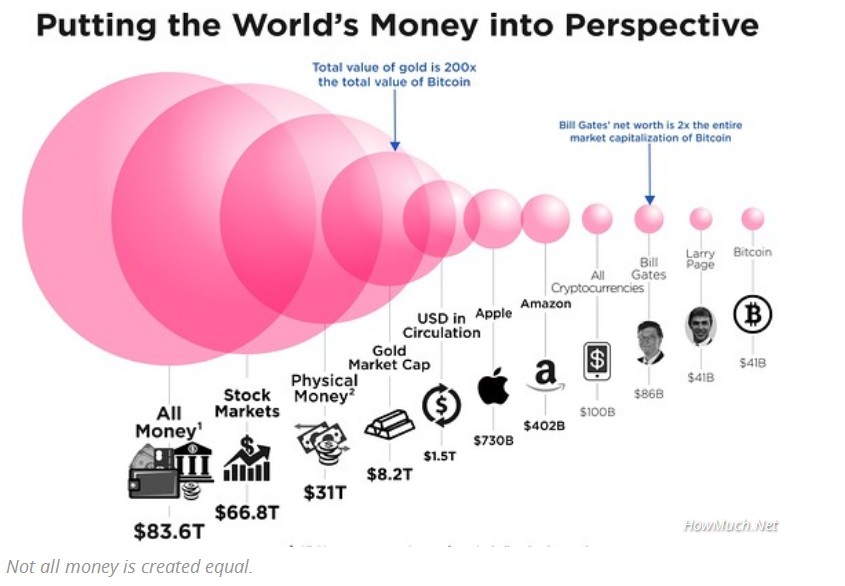
What is Bitcoin?
That’s a good question. For one thing, there can be no more than 21 million of them. There about 16.7 million in circulation and it is getting harder and harder to “mine” them. So one of the reasons for its great rise recently is the scarcity value.
Here is one definition:
Bitcoin is a worldwide cryptocurrency and digital payment system, called the first decentralized digital currency, since the system works without a central repository or single administrator. It was invented by an unknown group of programmers, under the name Satoshi Nakamoto and released as open-source software in 2009. The system is peer-to-peer, and transactions take place between users directly, without an intermediary. These transactions are verified by the network and recorded in a public distributed ledger called a blockchain.
What is a blockchain?
The blockchain is a public ledger that records bitcoin transactions. A novel solution accomplishes this without any trusted central authority: The maintenance of the blockchain is performed by a network of communicating nodes running bitcoin software. Network nodes can validate transactions, add them to their copy of the ledger, and then broadcast these ledger additions to other nodes. The blockchain is a distributed database – to achieve independent verification of the chain of ownership of any and every bitcoin amount, each network node stores its own copy of the blockchain, Approximately six times per hour, a new group of accepted transactions, a block, is created, added to the blockchain, and quickly published to all nodes. This allows bitcoin software to determine when a particular bitcoin amount has been spent, which is necessary in order to prevent double-spending in an environment without central oversight.
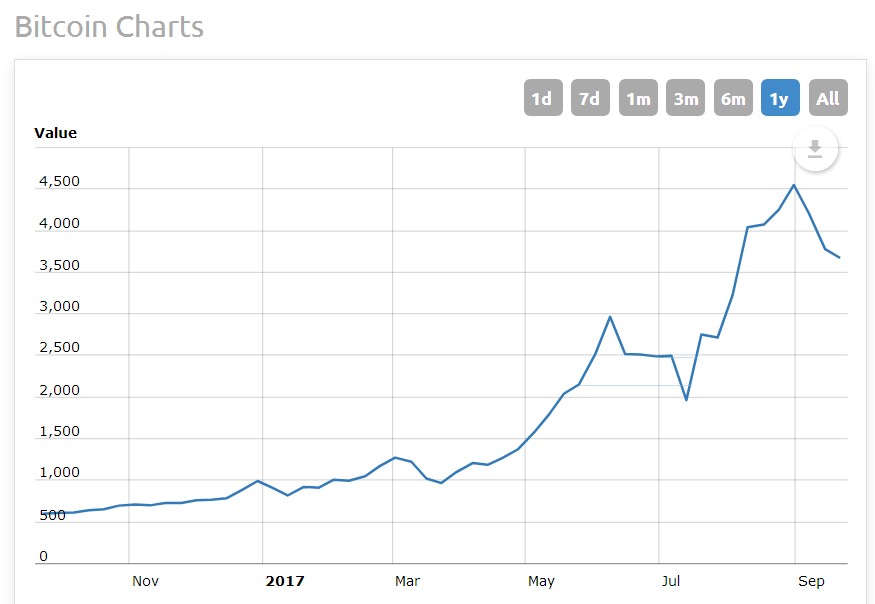
We at The Bull Market Report have started buying some ether, another cryptocurrency. We will explain what this cryptocurrency is all about next week. It peaked at about $390 on the 1st of this month and with all the news about China shutting down the exchanges*, the price fell to $206 on the 15th and is around $285 at the moment. But a year ago it was around $12. Don’t ever say that cryptocurrencies aren’t volatile!
Bitcoin peaked at about $4,900 at the start of the month and dropped to $3,000 by the 15th. It is now at $3,670 as we write this. But note that these two cryptocurrencies trade 24-7. That’s right, they trade 24 hours a day, 7 days a week. So by the time you read this, the price will have changed. A year ago it was around $500.
Some symbols for these two are BTCUSD or BTCUSD=X for bitcoin and ETHUSD or ETHUSD+X for ethererum.
* Chinese cryptocurrency exchange ViaBTC has announced its plans to launch a trading platform based outside of China. The decision to establish an overseas-based platform follows announcements that the exchange will shut down operations in mainland China on September 30th.
The debate on bitcoin is raging. The CEO of JP Morgan, Jamie Dimon, called it a speculative bubble and a fraud. The same day Jack Dorsey of Twitter and Square said blockchain is the future and a major unlock opportunity for technology.
So which is it?
The High Yield Corner
By Michael Foster
We have now enjoyed a second week of calm in the high yield world, with a lot of Bull Market Report recommendations seeing slight upticks for the week and a few dipping slightly. The biggest declines, which weren’t really all that big to begin with, were in the REIT space, where nerves about the upcoming interest rate hikes from the Federal Reserve are making investors cautious about future borrowing costs for these firms.
But not all of the declines are in Janet Yellen’s shadow. Digital Realty Trust (DLR: $115, down -2%) continues to see a mixture of profit taking and selling pressure as a result of more predictions about future server needs. Additionally, the debate is hitting many major financial and technology publications, with a growing number of experts weighing in to express caution or contempt for the bearish viewpoint.
Since this debate is heating up, we should dig in a little deeper into its history and the bull and bear cases. We will take this whole issue of The High Yield Corner to discuss this fabulous company (market cap $24 billion, 3% dividend.)
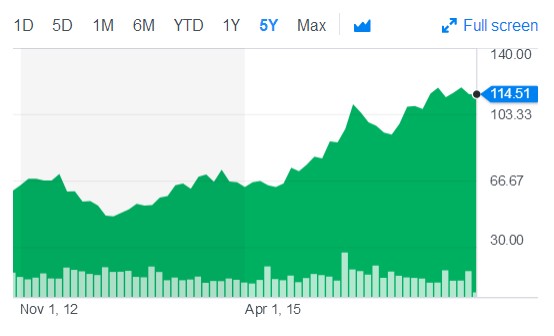
It all began with Social Capital's Chamath Palihapitiya, a CEO who left Facebook to head his own tech investment firm. Palihapitiya has serious tech chops (an is worth $1 billion.) He also worked at AOL and Winamp back when those were big names in tech, and he’s become a titan of the industry by moving to the Next Big Thing before the rest of us realized where the Tech world was going. So when he talks, we should all listen.
Palihapitiya’s idea is simple: Technological improvements are going to cause a rapid and accelerating reduction in the physical size of individual servers. The numbers he threw out boil down to this: 50% of all computing needs will one day run on 10% of the silicon that is currently required. This drastic reduction in the server size will also result in servers being small enough to fit in an RV that you could park beside a data center. "Plug it into some air conditioning and power and it will take those data centers out of business,” he said.
The rebuttal is that it’s going to take a very long time for those developments to come into play. Digital Realty CEO Andy Power made a pretty simple rebuttal: Amazon, Google, and other big tech giants developing and expanding their content delivery network systems around the world are still signing 10 to 15 year leases with Digital Realty. Since Palihapitiya’s bearish view depends on Google developing their own tech to displace Digital Realty, it seems like what Google is really doing contradicts his theory of what they may do at some unspecified point in the future.
That would definitely be a point in Power’s favor. However, we should remember that Digital Realty and Google are counterparties, and tech companies are notorious for trying their best to become less reliant on partners. Google, for instance, famously went against Apple and tried to compete head-on with Android. Then they went against Samsung and acquired their own cell phone company - something that Google recently did yet again. Google is obviously interested in taking as much “in house” as possible, and they have the cash to buy their own real estate and create their own server farms - especially if the size required will be so much smaller in the future.
With that in mind, there’s definitely a pretty strong chance that Palihapitiya will be proven right. Eventually. And that’s the key. In finance, there is a famous adage that “being too early is the same as being wrong.” If Palihapitiya is proven right in, say, 2025, and it causes Digital Realty’s revenues to drop 20% then, but the markets have knocked off 10% of Digital Realty’s valuation in 2017, can we really say that the price hit was fair? Probably not.
And this is the key - a kind of miscommunication between tech and finance that happens all the time. The time horizons are so different, and techies and investors will almost always disagree on the implications of when and how to move investments as a result of changes to the landscape. That, we believe, is what is happening here. Investors are acting too quickly to price in an event because no one really knows how long it’s going to take to actually happen.
What does this mean for Digital Realty’s stock? In most cases of a massive misunderstanding of an emergent technology, you get an S-curve. This happened with Baidu, Facebook, and plenty of other tech stocks. Initial enthusiasm causes a surge in valuations - then the uncertainties around the new technology causes a panic, driving valuations down sharply. Then there’s a recovery as the market realizes they had over-exaggerated the risks, and underestimated the power of the new technology.
With Digital Realty, we think there’s a good chance that we will get this kind of movement. Initial enthusiasm about the technology will cause the REIT to fall further, maybe dragging the price down 10% from its top. Maybe it will go down even more. Then the market will realize they have dramatically overestimated the time frame of these new “microservers” and the stock will recover. Hence an S-curve. The time horizon for this price movement is obviously unpredictable, but tech does tend to move fast. Investors should be prepared for a bit more volatility with Digital Realty over the next few weeks.
Investors should sit tight. If Digital Realty’s dividend yield falls below 4%, it will obviously be a strong buy. Funds from operations and organic growth are strong enough to support the dividend for many years. We may also see Digital Realty increase their dividend (they have the coverage ratio to do it any day now) if the stock falls too heavily. That would be Power’s way of telling investors clearly: “We are confident in our ability to make money.” And that will help the stock recover even faster.
Good Investing,
Todd Shaver
Editor, Founder and CEO
The Bull Market Report
Since 1998

September 17, 2017
by Todd Shaver | Sep 17, 2017 | Weekly Newsletter 7pm Sunday
The Weekly Summary
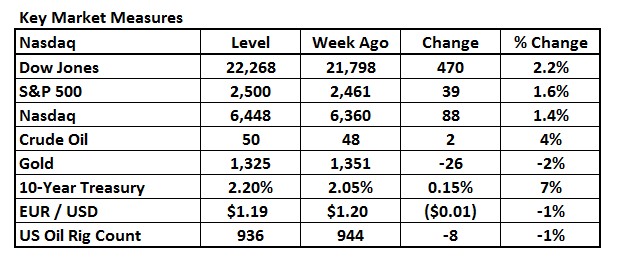
Equity markets ended the week up, again! New all-time highs were set Friday (again) with all three indices. The threat of conflict with North Korea can’t stop the bull market. Gridlock in DC isn’t shaking confidence. The unemployment rate is low. GDP growth is fair though under pressure from severe weather. It’s really a “Goldilocks” economy and a market backdrop of not too hot and not too cold. The biggest threat might simply be the Fed’s Janet Yellen who must unwind a $4.5 trillion balance sheet. The September Fed meeting is upon us and nobody is expecting a rate hike because of the pressures on GDP growth from weather. Though pay attention to plans for the Fed balance sheet as these moves could be worth as much as three rate hikes depending on the pace of unwinding. We are as eager as you to see what happens.
No matter what is happening out there, there is always a bull market here at The Bull Market Report! This week we highlight some of our favorite stocks where we think you can still make good money, including: First Solar, Apple, Twilio, Bristol-Myers, Amazon, Google, and Square.
BMR Companies & Commentary
First Solar (FSLR: $51, up 8%)
First Solar caught a lot of press this week as Deutsche Bank upgraded the stock to a Buy and said the stock is heading to the mid-60s.
What is there not to like? First, US demand is so strong it is driving pricing higher. Beyond the typical demand there is something else happening. Customers are flocking to make purchases ahead of the ruling on the section 201 tariff.
What is this? There is a high likelihood of the International Trade Commission finding injury in the section 201 case. This case basically makes a determination on the safety of the product. A favorable decision is expected to result in 2018 margins between 20 and 30%, against a 2017 rate of 17.5%. This regulatory relief for First Solar is welcomed!
Lastly, monetization of the phase 1 California Flats Solar Project coupled with the anticipated sale of the company’s stake in 8Point3 Energy Partners (CAFD: $14.49) could result in upward revisions to EPS estimate.
BMR Take: Putting it all together, First Solar is in the right spot at the right time. We recognized it early. Now we see a big Wall Street investment bank get behind the name. Yea! With EPS running around $2.50, the stock is not expensive here considering the quality and future of the franchise.
Apple (AAPL: $160, up 1%)
Apple unveiled its latest slate of new products on Tuesday including a new $1,000 iPhone that is sure to bring out aficionados of the company's devices when they arrive in local stores later this month and again in early November.
In a live-streaming event, Apple introduced a new version of its Apple Watch and Apple TV set-top box, plus two new phones, the iPhone 8 ($700) and a larger iPhone 8 Plus ($800) version. But the highlight was the iPhone X (pronounced “10”), a thin, sleek phone that has 3D face-recognition technology, a state-of-the-art camera, and a $1000 price tag -- double the price of the first iPhone that Apple introduced 10 years ago.
The other products will be available for pre-order starting Friday and should hit stores a week later.
The $1,000 price tag is causing all sorts of buzz. Will consumers pay that much? Well, most think so because you just make monthly payments through a plan and not a lump sum. Is there new technology that is exciting? Yes, from face recognition for security to the largest screen yet. All in all, the timing of the launch could push sales from 4Q to 1Q, but we expect Apple to sell a lot of phones.
BMR Take: Apple is going to do over $250 billion of sales this year. This is a staggering amount of money pouring into the company’s bank accounts from consumers who love Apple. Remember, as long as Apple continues to be a fan-favorite for customers, we think there is a huge opportunity for the company to do more and more services on top of selling hardware. The future is bright!
Remember, 65% of Apple is now the iPhone. And every new user is going right to the App Store to buy apps, increasing the Services business incrementally. Recurring income, baby. That’s what it’s all about.
We have a few notes we made from a research report from UBS Securities.
Apple Price Target - $180 (We are at $170) with a $195 potential upside.
iPhone growth in F18/19 – UBS expects double-digit unit growth in F18 and single-digit growth in F19 driven by a growing installed base and high retention rate. They expect a bulge of F15 iPhone 6 owners to upgrade in F18, creating a strong year if not a "supercycle." Supply and pricing could affect the degree of growth.
“Apple innovation to drive long-term revenue growth?
“Augmented reality (AR) is an area where Apple could leapfrog competition in offering a superior user experience. Features will take time to be released as the technology must reach a level of maturity suitable for Apple's brand. Other products like the Watch and AirPods are slowly
becoming material to the business and represent another way to monetize a loyal base of customers.
“The installed base continues to grow double digits and retention rates remain high. The retention rate for Apple above 80%, at a seven point premium to the Android retention rate. There is pent-up demand for the iPhone 8, with over a third of the base consisting of handsets older than two years old, the highest ever.
“Around the world Apple is gaining share everywhere except China. China remains a wildcard. Encouragingly, shipments to Mainland China stabilized in June. Our survey indicates interest in the next iPhone is similar to last year.
“At a P/E of 15x, Apple is trading at near an all-time high valuation. This suggests the market is pricing in a strong product cycle in F18 with double-digit EPS growth. It's also possible investors are gradually re-rating the multiple to recognize the strength and stability of the brand.”
Twilio (TWLO: $31, up 4%)
Twilio is one of the most exciting growth stories out there. And the CEO’s recent Bloomberg TV interview re-ignited our conviction in the story.
As you have been following the growth of Twilio lately, you’ll know it’s an exciting addition to the communications space. Twilio is a developer platform that powers communications for more than 40,000 global companies, including Netflix, Airbnb, and Lyft.
Twilio has emerged as a simple way for companies and software teams to begin adding communications capabilities to their applications in the form of text, video, and voice, providing companies with the flexibility that they need to implement more engaging customer experiences into their daily operations.
Twilio was built around the growing desire to provide a better customer experience for end-users and companies alike. Across numerous industries, enterprises have begun to recognize that the only way to truly differentiate their businesses from other competitors in the marketplace, is to give their customers an experience that is seamless, integrated, and engaging. Unfortunately, it’s difficult to achieve that level of service when your communication technology is not all run from one central place.
BMR Take: Sometimes the daily news is just noise. You have to step back and do a simple fundamental analysis. What does this company do? Why is the value proposition a winner? What is the big picture story? Twilio has this nailed in spades and the CEO provided a great reminder of that to the equity markets this week talking on Bloomberg.
Look at revenues for the past three years. $89 million in 2014. $167 million in 2015. $277 million in 2016. (Note: they’ve already done $180 million in the first six months of 2017.) With revenue growing greater than 30% and nearing $500 million, the momentum is there and we are still early. Repeat, we are still VERY EARLY on this company. Where is this company’s growth going to stop? (Hint: it isn’t.) Take a hard look at owning this company.
Bristol-Myers Squibb (BMY: $62, flat)
At Bristol-Myers, patients are at the center of the universe. The company’s vision for the future of cancer care is focused on researching and developing transformational Immuno-Oncology (I-O) medicines for hard-to-treat cancers that could improve outcomes for these patients. The I-O opportunity is a breakthrough for cancer, and Bristol is a key player.
Bristol is in fact leading the scientific understanding of I-O through its extensive portfolio of investigational compounds and approved agents. The company’s differentiated clinical development program is studying broad patient populations across more than 50 types of cancers with 14 clinical-stage molecules designed to target different immune system pathways. Bristol continues to pioneer research that will help facilitate a deeper understanding of the role of immune biomarkers and how patients’ tumor biology can be used as a guide for treatment decisions throughout their journey.
This week Bristol announced some good data on I-O drugs. This reaffirmed the market’s confidence is Bristol’s ability to execute on the important I-O market opportunity.
BMR Take: Bristol is a top franchise is the Drug industry. The stock has been badly beaten down for about a year but now is coming back, as top franchises always do. With nearly $4 of EPS potential, this drugmaker is a screaming deal in our view.
Amazon (AMZN: $987, up 2%)
The future is here and guess what? Amazon created it! Alexa, Amazon's voice-activated digital assistant for the home, has learned a new skill -- dispensing medical information about first aid from one of the best-known names in medicine, Minnesota's Mayo Clinic.
The information is accessible by speaking to the Amazon device, which users appreciate if they're busy doing something with their hands, like putting aloe on a burn or examining someone who has stopped breathing.
The device advises in its robotic-female voice to begin cardiopulmonary resuscitation for one minute and then call 911 if the person is unresponsive from suffocation. If the user asks for it, the device will go on to discuss specific techniques for doing CPR on an adult, child, or baby.
BMR Take: Amazon is the innovation machine and to see Echo break through into the medical field is a just another key data point about the possibilities of the future. With over $20 of future EPS power or more, Amazon is unlike any stock ever in the history of the world. We are strong believers in the future of Amazon.
Google (GOOG: $920, down 1%)
There is talk that Google is considering making a $1 billion investment in Lyft to take on Uber. This could be exciting!
Google and Lyft can really help each other. With the possibility of autonomous driving being central to its future, Lyft badly needs a solution. Google is considering putting up to $1 billion into Lyft in a move that would see it become one of Lyft’s biggest shareholders at a crucial time.
Lyft is far smaller than Uber and when it comes to market places that can be fatal. For money to be made, generally, one player needs to have 60% share or be twice the size of its nearest competitor. In the US, Uber has already achieved this hallowed status and in theory should be able to crush Lyft simply by applying sustained competitive pressure until Lyft runs out of money.
Google could be the solution for Lyft to emerge as a fierce Uber competitor.
BMR Take: Google is a tech giant, a robust franchise, and reasonably priced versus EPS of $40. The all-time high is $988, set in early June, so it is off 7% from that high. With driverless cars a key part of the future economy, and Google paving the way, we are excited about what a Lyft investment could mean and think the general market will be too if the deal is announced. UBS Securities has a $1,080 Price Target with a $1,410 upside. We have $1000 as our Target, but will raise it when it hits.
Square (SQ: $28.50, up 7%)
Square is at all-time highs. Last week we talked about Square getting into banking. That was all the buzz. This week Jack Dorsey, CEO, is talking a hard look at blockchain technology and what it could mean for Square. This company is on the leading edge of innovation all the time.
You’ve been hearing or reading a lot about blockchain but you probably still aren’t entirely certain how to define it. You’re not alone. It’s something that Jack Dorsey, the CEO of Square (and CEO of Twitter), describes as the “next big unlock”.
Blockchain is often defined as a ledger that enables secure, encrypted transactions. Some financial and technical experts have described it as analogous to the early days of the internet: it’s a framework or backbone for transactions.
But Dorsey also went beyond that interpretation of it, adding that the ability to “distribute and decentralize the ledger enables proof of work, and proof of one entity, in an untrusted network.” “Even if there’s a hostile entity or a mistrust in the network,” Dorsey continued, “we can still account for value creation and the transfer of values as well.”
BMR Take: If Square can get blockchain right, the company could take on the likes of Visa and/or MasterCard to change the world of payments how we know it. How exciting. This is sending the stock to new all-time highs and we are only at the beginning stages of Square’s life as a publicly traded company. Note that JP Morgan and Bank of America as well as Goldman Sachs are experimenting with blockchain. With a market cap of just $11 billion we see very big times ahead for this innovative company. And they could be bought out for $15-18 billion in a whisker by one of the big boys.
Upcoming Economic News
Housing Starts
Tuesday, September 19th, 8:30 AM ET
Period: August
Consensus: 1,175,000
Prior: 1,155,000
Fed Funds Target Upper Bound
Wednesday, September 20th, 2:00 PM
Consensus: 1.3%
Prior: 1.3%
Leading Indicators
Thursday, September 21st, 10:00 AM
Period: August
Consensus: 0.20%
Prior: 0.30%
BlackRock Consensus Ratings on the Street
(BLK: $429, up 3%)
4 Hold Ratings, 8 Buy Ratings
Consensus Price Target: $448
9/08/2017 Barclays $475
8/18/2017 Jefferies Group $440
7/18/2017 Morgan Stanley $476.
7/18/2017 Deutsche Bank $455
7/14/2017 Keefe, Bruyette & Woods $440
6/19/2017 Bank of America Corporation $450
BMR Take: Market cap is $69 billion. Huge. They manage over $5.7 trillion of assets. HUGE. All-time high is $443 set in July. We think this is easily breakable. The Street likes this stock. We like this stock.
Cloudera Consensus Ratings on the Street
(CLDR: $18.38, down 12%)
4 Hold Ratings, 4 Buy Ratings
Consensus Price Target: $23
9/8/2017 J P Morgan Chase $24
9/8/2017 Morgan Stanley $19
9/8/2017 Stifel Nicolaus $24
5/24/2017 Bank of America $23
5/23/2017 Raymond James $23
5/23/2017 Deutsche Bank $25
BMR Take: Bad week for Cloudera. The stock got hammered. They announced a follow-on offering of shares from the IPO they did in April. This is normal stuff – some shares will be sold by insiders and some by the company. No details yet. We are not concerned, although it would be nice to see the stock at $25 where it ought to be. Remember, this is a tiny company. Market cap is $2.4 billion – a puppy. Very speculative. But we are believers.
Andeavor (ANDV: $102, up 1%)
We have a note we made from a research report from UBS Securities.
“The recent Western Refining merger is expected to generate $350-
$425 million in synergies.”
Their Price Target is $116, with an upside to $125. Ours is $110, but if it hits that we would consider raising it.
Cryptocurrencies Update
Bitcoin had a wild week, closing at around $3500 on Friday. Bitcoin doesn’t really “close” as it trades 24-7. Bitcoin began a colossal price reversal on Tuesday that finally culminated with the latest $2,972 weekly low, which ended up becoming the new monthly low as well. The massive 32% reduction, was followed by a flurry of negative news coverage with China shutting down the biggest bitcoin exchange in the country and Jamie Dimon of JP Morgan saying that this is the biggest bubble since tulip bulbs in 1637. He said that the cryptocurrency "won't end well." Dimon was speak at a conference presented by CNBC and Institutional Investor.
Bitcoin hit $4,980 all-time high on September 1st. It plunged about 13% Thursday after one of the biggest exchanges in China said it will shut down its operation. Bitcoin surged more than 10% on Friday, but was still on track for a big weekly loss during a tumultuous period of trading.
JPMorgan's global head of quantitative and derivatives strategy, said in a note on Wednesday that in addition to being volatile and difficult to value, "another worrying aspect of cryptocurrencies are some parallels to fraudulent pyramid schemes."
But to be sure, many see bitcoin as a huge opportunity.
Former JPMorgan strategist Tom Lee said the cryptocurrency could surge another 600% in five years. "It's not worth it to look at bitcoin two months, two weeks ahead," Lee argued, saying he still believes each bitcoin will be worth $25,000 in five years.
We at The Bull Market Report find this whole story fascinating and have been following bitcoin and Ethereum closely. If you would like to know more about it, please write us here: Info@BullMarket.com.
Opko Health Update
Opko (OPK: $5.97) had a wild week. It rallied the first three days of the week, closing at $6.47 on Wednesday. Then it got hammered on Thursday and was flat on Friday. We have seen no news to account for this, but please note that this one is quite speculative. Opko has had to deal with disappointment on multiple fronts, including less-than-encouraging results in clinical studies and slow starts for approved drugs. Yet even though several institutional investors have thrown in the towel and given up on the company, Opko has strong potential for sales of its chronic kidney disease treatment Rayaldee to pick up. Moreover, Opko's diagnostic testing business has good prospects as well. Although the company hasn't executed well yet, some are optimistic. We have high hopes for the company but it is testing our patience.
The High Yield Investor
By Michael Foster
After a lot of good weeks, we’ve had a week that was - well, slow.
Almost everything in the Bull Market Report high yield portfolio ended the week flat, as investors focused on the big headlines (North Korea, Irma, etc.), which actually had minimal impact on any high yield investment.
This might be surprising, so let’s talk a little bit about why the big macro events aren’t moving the needle. You’d be right to wonder why municipal bonds, especially bonds in Texas, Florida, and nearby weren’t negatively affected by the hurricanes that have caused still undetermined billions of dollars of damage and human misery. In light of that tremendous destruction, municipal bonds barely budged. Even bonds issued in the hardest hit areas were unaffected. To take one example, Miami’s transit authority issues bonds are backed by the revenue received from toll roads, parking lots, and so on. Surely less travel to the city and less use of parking lots by tourists due to the storm will hit revenue and thus put these bonds at risk - yet their prices barely budged.
The reality is that municipal bond issues use a combination of insurance and risk management to plan for major catastrophes, especially in catastrophe-prone areas like southern Florida. The storms were severe, but Florida financiers and civil servants plan for these things as part of their regular work. So while the timing of the storms was a bit of a surprise, the reality of hurricanes hitting Florida every once in a while is priced into the municipal bond market.
Thus muni funds continue to have a strong year after last week’s relatively small price movements. Nuveen AMT-Free Municipal Credit Fund (NVG: $15.70, down -1%) took a very slight hit, but that was counterbalanced by the small rise in Invesco Municipal Trust (VKQ: $12.96, up 1%). The most important lesson to learn, by far, is that big catastrophic events don’t really hurt muni bonds - at least, not in the way that the mainstream financial press would like you to believe (since, after all, they’re desperate for controversy and know fear-mongering headlines get clicks and pageviews).
Moving on to taxable income funds, we saw more quietness among AllianzGI Equity & Convertible Fund (NIE: $20, up 1%) and PIMCO Dynamic Income Fund (PDI: $30, up 0%). There are a couple of things to note about both of these funds with regards to their pricing. The income stream for both remains somewhat reliable, although the Pimco fund’s net investment income has dropped significantly in 2017 (this, however, is being counterbalanced by an increase in NAV growth). What investors should focus more of their time on is the pricing. The Pimco fund is now priced at a 4.8% premium to NAV, which is significantly lower than the 10% premium that it reached earlier this year. A big drop-off in the premium this summer has caused that pricing to go closer to its historical norm, and a small premium to NAV is a lot more tolerable than 10%. For that reason, investors who like the Pimco fund and have been waiting to buy more are finally in a position where they can seriously consider adding to their positions. However, if you can wait for a discount to show up, you might be wise to wait for a bigger market sell-off to provide that opportunity.
As for the AllianzGI fund - its discount to NAV has been steadily disappearing throughout 2017, and we’re now at slightly less than a 9% discount, which is a relatively high price for the fund relative to its historical average. That means investors should be a tad more cautious about adding to their position right now, but the fund is far from a sell. We’ll need to see discounts of 5% before offloading this fund makes any sense at all. In reality, the fund’s continued NAV appreciation (NAV is up 6% even after paying its 7.5% dividend consistently over the last year, giving a total NAV return of over 13%) demonstrates that the fund’s management knows what they’re doing and are able to provide a stable, reliable income by picking the right stocks and convertible bonds and handing profits to shareholders. At the end of the day, we can’t really ask more from a fund.
So with all of the humdrum, low level action of the last week, let’s discuss the two stocks that actually had pretty big moves. The first is Digital Realty Trust, Inc. (DLR: $118, down -3%), which closed its DuPont merger and proceeded to fall significantly thereafter. We’re pretty much off the 52-week high hit on Monday, so it’s hard to say whether the decline is a result of profit taking or a lack of faith in the value of the merger. We see no reason to be skeptical of the merger, so we are not changing our view on the stock.
There is, however, one other issue with cloud-based REITs like Digital Realty - earlier this week, a Silicon Valley venture capitalist gave a presentation arguing that server size was about to decline significantly due to semiconductor and other technological innovations. Obviously, this will be bad for datacenter stocks - or is it? Considering the explosive growth in data storage and users’ tendency to fill up datacenters faster than the space needed to store data shrinks, demonstrates that this is a pretty specious reason to be bearish on datacenter stocks.
Finally, AstraZeneca (AZN: $32.50, 1%) took a bit of a hit earlier this week on little news. Again, this seems to be a bit of profit taking, considering the significant rise in the stock from a month ago. There’s little news about the company’s product pipeline or balance sheet to indicate caution, so we’ll wait and see how the stock performs next week before concluding this price movement is anything more than noise.
Good Investing,
Todd Shaver, CEO, Editor and Founder
The Bull Market Report
Since 1998
September 10, 2017

by Todd Shaver | Sep 10, 2017 | Weekly Newsletter 7pm Sunday
The Weekly Summary
Sloane Stephens beat Madison Keys to win the woman’s United States Open Tennis Championship and Rafael Nadal faced off against Kevin Anderson (who?) for the men’s title Sunday. World class tennis looks a lot like the market these days. Lots of long rallies. Excitement. Unexpected turn of events.
The primary news right now is all the hurricanes. Florida and Texas are taking the brunt of the unfortunate weather. We are seeing disruption across industries, from cruise lines to power generation to real estate.
The North Korea crisis lingers. Trump continues to say to China that you handle this. China keeps looking right back at Trump saying, well, you got it. While the US and China agree that North Korea needs to be rid of nuclear weapons, the lack of agreement on how best to achievement that goal has created a stalemate and a lingering overhang on the markets.
Another major event that has sure caught your attention recently was the Equifax data breach. Sensitive data on two of every five Americans was exposed in the cyberattack, making it one of the largest ever recorded. The future of online crime presents serious threats to the economy and the markets. We must keep an eye on these events as they could serve as a sell-off if they all gang up on each other.
If you wish to know what to do about the Equifax issue, here are two articles from The Washington Post and the Chicago Tribune:
https://www.washingtonpost.com/news/the-switch/wp/2017/09/09/after-the-equifax-breach-heres-how-to-freeze-your-credit-to-protect-your-identity/?utm_term=.af2b2f7fb8f8
http://www.chicagotribune.com/business/ct-equifax-consumer-protection-0910-biz-20170908-story.html
No matter what is happening out there, there is always a bull market here at The Bull Market Report! This week we highlight some of our favorite stocks where we know you can still make good money, including: Andeavor, Square, Eli Lilly, Shopify, Home Depot, Cloudera and Celgene.
BMR Companies & Commentary
Andeavor (ANDV: $102, flat)
Andeavor recently announced that it has officially begun operating in Mexico and has successfully opened the first ARCO station in Tijuana, Mexico. Andeavor and ProFuels have an established wholesale marketing agreement and have outlined plans to expand the ARCO brand to achieve a leading market position in the Mexico. Opening the first ARCO station in Northwest Mexico is a natural and strategic link for West Coast operations and the company’s integrated value chain, which furthers marketing integration in a growing market.
This first station marks the beginning of growth to include an anticipated 200 to 400 ARCO stations over the next several years. ProFuels also intends to grow the ARCO brand through supply contracts with independent owners and operators of existing and new gas stations that are interested in marketing fuel under the ARCO brand.
BMR Take: This is a nice catalyst for growth ahead for Andeavor. The company currently trades at 18x this year’s anticipated EPS of $5.60. But the EPS outlook is heading to $7.50-$8.00 next year, which should push the stock price higher. Our Price Target is $110 and our Sell Price is $95.
Square (SQ: $27, up 6%)
Square is applying for a US banking license, signifying the beginning of the firm’s long-speculated push into financial services.
The bank should help bolster Square Capital, the firm’s business lending segment. The bank will be focused squarely on merchants, not consumers. Square Financial Services (SFS) won’t extend consumer loans or house services like Square Cash, but will rather focus on the extension of Square Capital.
And it should help Square grow its burgeoning lending business. Square Capital has posted consistent, steady growth, issuing $1.8 billion in loans to over 140,000 merchants since its launch. SFS could improve that offering by bringing operations in-house, which could increase efficiency and allow the firm to grow or diversify its portfolio and offerings.
BMR Take: Square is among the most exciting companies in all of payments. They are sparking change across the ecosystem and now integrating a bank into their model is just the latest example. Consensus calls for nearly $1 billion of revenue this year with growth running 30% for the foreseeable future. It’s hard to find this kind of growth in the market today making Square a gem. Our Price Target is $29 and we are up 54% on the stock since March. Not bad in six months. But this Square story is just in Chapter One.
Eli Lilly (LLY: $83, up 3.5%)
Eli Lilly recently presented data showing their clinical trial drug lasmiditan significantly reduces pain in patients with migraine. This was very well received by the market. The company presented key primary and secondary endpoint data for lasmiditan, an oral, first-in-class molecule for the acute treatment of migraine, which demonstrated statistically significant improvements compared to placebo in the Phase 3 study. Detailed results were highlighted at the 18th Congress of the International Headache Society (IHC) in Vancouver. Lilly plans to submit a new drug application for lasmiditan to the FDA in the 2nd half of 2018.
BMR Take: Lilly is a healthcare powerhouse. Sales this year will exceed $22 billion. This new drug is just another piece of the story. Hopefully it can contribute $1+ billion of annual revenue when it hits full potential. With many drugs like this, Lilly has a well-diversified portfolio making the stock attractive to us at 20x this year’s consensus EPS estimate of $4.25. Our Target is $88 and we would love to see this by the end of the year.
Shopify (SHOP: $114, up 10%)
Shopify announced the winners of Inaugural Build, a business competition. Winners receive a one-of-a-kind, eight-day entrepreneurship experience, including mentorship from some of the world’s most successful entrepreneurs - Tony Robbins, Daymond John, Debbie Sterling and more.
From March to July 2017, Build a BIGGER Business competitors were asked to grow or scale their businesses using traditional and non-traditional strategies and tactics. To help with this growth, competitors were given access to the exclusive Build a BIGGER Business online academy, including immersion sessions with mentors on topics ranging from organizational leadership to how to optimize your sales funnel. The Build a BIGGER Business Competition attracted applicants from 70 different countries, spread over 750 different cities. Over the course of five months, competitors generated over 8 million orders, resulting in more than half a billion dollars in gross merchandise volume (GMV).
The average growth for the businesses participating in the competition was 14% during the competition period. The Top 10 participants with the highest percentage growth increased their GMV by an average of over 500%. The Top 50 participants with the highest percentage growth increased their GMV by an average of over 100%. To enter the Build a BIGGER Business competition, participants needed to have an existing business on the Shopify Platform with sales between $1 million and $50 million.
BMR Take: You might be saying why do I care about some business competition? Well, you should. Just think about how many businesses took interest in Shopify due to the competition and what the results looked like. It’s proof of the Shopify business model. The whole situation is a genius marketing event by the company and reaffirms why we like the stock. With $650 million of revenue expected this year growing at a rate of greater than 50%, and over 400,000 customers and growing, Shopify is the next best thing to Amazon in eCommerce.
We’re up 56% on this one since late March and our Price Target is $115. We hereby raise our Target to $125 and our Sell Price from $93 to $105. The stock set a new all-time high Friday and is worth $11 billion. That’s a big number for the founders and employees, but a tiny number for the big boys* that are on the lookout for acquisitions. If it were taken out it would have to be $125 to $135 a share.
* Facebook, Amazon, Microsoft, Apple, Google. But you knew that!
Home Depot (HD: $160, up 7%)
Shop from Home Depot with just your voice thanks to the Google Assistant. Really? Sweet!
Need something from The Home Depot? Just ask the Google Assistant. The Home Depot will join Google Express this fall, adding the ability for its customers to shop through voice with the Assistant on Google Home, making it more convenient than ever for customers to shop however they want.
The Home Depot offers customers flexibility with its 2,282 stores and digital endless aisle. Later this fall, customers will have an additional way to purchase innovative products - with the Assistant on Google Home or on the Google Express website or app.

BMR Take: There is a lot going on out there impacting Home Depot. Obviously, the floods could boost sales as repair efforts begin. Beyond this seasonal event, we think it is important to keep an eye on the long term core part of the business, technology. We are really excited to see Home Depot focused on digital. At 22x this year’s EPS of $7.25, we continue to think the stock is a compelling buy.
The stock set a new all-time high on Friday and is now worth almost $190 billion. The company knows what it is doing. Our Target of $160 has GOT TO GO. We hereby raise it to $170, leaving our Sell Price at $150.
Cloudera (CLDR: $21, up 9%)
Cloudera is acquiring Fast Forward Labs, a startup that gives companies the latest information on how to apply machine learning and AI to their businesses, as well as consulting.
Cloudera specializes in operating on top of open-source technology, looking to deliver an enterprise-grade product for larger organizations. The enterprise is more excited about machine learning and applied artificial intelligence than ever. Collecting that kind of expertise is going to be critical as it looks to woo enterprises into paying for additional support and services on top of open-source software.
Cloudera’s business can be a tricky one. Cloudera has to show companies that it can build a better product than they might be able to implement themselves, or simply make it much easier to deploy by paying the company, so it’s another thing those companies don’t have to worry about. This acquisition really helps toward this end.
BMR Take: With $360 million of sales this year growing 40%, Cloudera is an emerging growth stock worth keep an eye on. With acquisitions building out the product suite and accelerating revenue growth, momentum is undeniably picking up. Still under $3 billion in market cap, this company is a pipsqueak in the world of commerce. But given its high growth rate, in 2-3 years, the firm will be a major factor (if the company doesn’t get taken out by the big boys.)
Upcoming Economic News
JOLTS Job Openings
Tuesday, September 12th, 10:00 AM ET
Period: July
Consensus: 6,000,000
Prior: 6,160,000
PPI ex-Food & Energy
Wednesday, September 13th, 8:30 AM
Period: August
Consensus: 0.20%
Prior: -0.10%
CPI
Thursday. September 14th, 8:30 AM
Period: August
Consensus: 0.30%
Prior: 0.10%
Retail Sales
Friday, September 15th, 8:30 AM
Period: August
Consensus: 0.10%
Prior: 0.60%
Celgene (CELG: $140, up 1%)
This company has been a big winner for us here at The Bull Market Report. We added the stock at $95 last summer and it is up almost 50% now. The firm is worth a staggering $110 billion. They have $10 billion in cash and just $14 billion in long-term debt. Revenues for the past three years are $7.7 billion, $9.2 billion and $11.2 billion. That’s what we call growth. We would love to see more profitability as they reported $2 billion last year, the same as in 2014. But 2Q17 hit $1.06 billion in earnings, so our wishes are being answered.
Celgene discovers, develops, and commercializes therapies to treat cancer and inflammatory diseases worldwide and they are firing on all cylinders. If you want to be invested in cancer research, this is the place to be. Our Target is $150 and our Sell Price is $125.
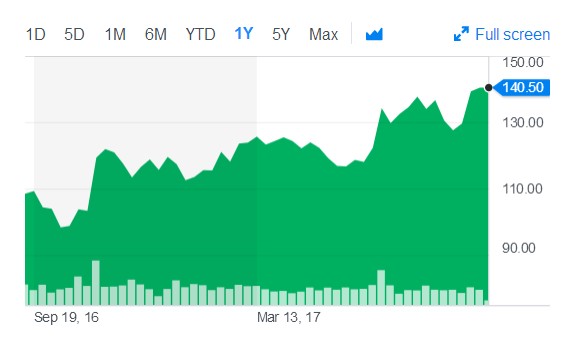
A Word from Gary Jefferson
Jefferson Financial Group
First Vice-President, Investments
UBS Financial Services, Inc.
If there is going to be a real market pullback (5% to 10%), history shows us that the Sept-Oct period is the most likely time for it to happen. So, we thought this would be an opportune time to get on the Market Jet, climb to 30,000 feet, and look down at the current "Big Picture". Here is the view from above:
The market has been good to us. We have been in a real bull market since 2009. Until 2015, most experts we respect were split, with one group believing we were still in a secular bear market which began in 2000 and that the bull market beginning in 2009 is only a cyclical bull still within the overall larger secular bear market; i.e. when this 2009 bull ends, the market will reverse course so that we end up back at the year 2000 levels. The other group believes the secular bear market ended in 2013, and that we are now in the 4th year of a new secular bull market. Secular bull markets historically last from 8 to 20 years – in other words we have between 4 and 16 years left for this bull market to run. (The last secular bull market ran from 1982 to 2000). Relying on dozens of experts as well as our 30+ years of experience, we believe we are in a new secular bull market with higher highs to be made over the next 4 to 16 years. We should expect to see a cyclical bear market at some point within the bull market run, but in the "big picture", investors should do well over the coming years.
Several other "big" things are going on. While the DOW and S&P 500 have hit new highs – because the economy is posting GDP growth of 2.5%-3.0% (finally!) – the Utility index hit a new high last week, while copper prices also hit a 3-year high. This is way out of whack. Historically, high copper prices have always signaled higher world growth. Higher growth in turn signals higher interest rates and inflation – all bad news for utilities. What seems to be happening in the "big picture" is that investors are frustrated and tired of waiting for interest rates to rise so they are chasing anything with yields- i.e. utilities. What this is really signaling, however, is that institutional money is buying in to the belief that interest rates are going to remain low for an extended time. Investors cannot ignore the bond market, and when it tells us it believes in lower rates for longer, it bodes well for the bull market hypothesis.
Again, looking at the "big picture" of the overall stock market, it is clear that the market is shrinking big-time. According to CNN Money "America's Stock Market is Shrinking", the number of public US stocks peaked at 7,600 in 1988. By 2015, there were just 3,800 US public companies. Obviously, there are more companies exiting than entering the market. It is shrinking because of an increase in mergers, companies going private and a slowdown in IPO's. Thus, please consider the math – there is a lot more money today chasing a lot fewer stocks. In the big picture, this is also a favorable trend for the stock market.
Finally, the big picture is a little less clear on the subject of taxes. What is obvious is that tax cuts and real tax reform will be great for individuals, businesses and the overall economy. A simple formula would be: Lower taxes = higher profits, more money in consumer pockets, higher spending, higher dividends, more stock buybacks = higher stock prices. Unfortunately, at 30,000 feet or 3 feet, it's impossible to see through the swamp. The only thing that could derail this part of the bull market movement is politicians.
For those worried about the end of the bull market, Barron’s recently put out a new article warning that it may be looming. The piece describes several scenarios for how the bull market might end. There are seven different factors which it identifies as possible catalysts to ending the bull run: a Fed mistake, inflation, China, antitrust, the end of QE, geopolitics, local politics. It does, however, make the point that longevity, high prices, and bad politics are usually not enough to cause a bear market. Recession is what usually causes it, and it makes the further point that the first four catalysts could trigger a recession. The fed mistiming rate hikes could cause big issues, as could a collapse in China, or a big antitrust movement against large tech companies.
These things are all possible, of course, but we believe Barron's should have made their argument in the context of secular bull and bear markets. A secular bear market historically lasts from 8 to 20 years, with intermittent cyclical bull markets within it. We may see a cyclical bear market (normally lasting from a few months to one or two years) inside the current 4-16 year bull move we see ahead of us, but that would not be anything similar to a long term secular bear. Understanding the difference between cyclical and secular market moves is important to being able to see the "big picture". Those that jumped out of the market in 1987 when the bear "crash" (a cyclical bear market) occurred, missed the rest of the move up in the most recent 1982-2000 secular bull market.
The High Yield Investor
By Michael Foster
Part of The Bull Market Report Team
It was another mixed week for stocks and another strong week for The Bull Market Report High Yield portfolio. We saw REITs mostly deliver strong returns, municipal bond funds rise, and a big boost from Pharma.
Let’s start with REITs. Omega Healthcare Investors (OHI: $32, up 0.5%) had another solid week of gains that were neither too extravagant nor disappointing. We’ve seen a lot of investors question the durability of Omega Healthcare’s dividend growth trend, and the doubts have increased lately as a result of one very simple (and, to our mind, naive) hypothesis. The thinking goes like this: Omega focuses on skilled nursing facilities (SNFs), and those facilities are losing popularity among Americans. This is quite surprising, considering America’s demographics: the country is aging rapidly, so expectations of growing demand for SNFs has been somewhat baked into Healthcare REITs’ stock prices for a long time.
Again, that’s the theory, but it’s not quite accurate. While it’s true that SNFs are seeing a decline in demand, it isn’t actually impacting Omega as much as a lot of critics would suggest. Yes, revenue has been challenged by the trend, and a lot of Omega’s tenants have seen more disappointing demand than they were expecting. Nonetheless, again this is all baked into Omega’s stock price. Keep in mind that Omega’s current price point is at the exact same spot where it was 4 and ½ years ago despite the substantial growth in Omega’s operations since then. The reason for this is simple; the disappointing SNF market growth has been priced into Omega’s stock price for a long time.
That’s why this has been a particularly good REIT to buy on dips, especially when it yields 8% or more. We’re at 8% right now, so it’s a strong buy in our book for the reasons mentioned above and for its tremendous income stream. And the income is not under threat. As we’ve mentioned in the past, Omega’s dividend coverage ratio is on the higher end for Healthcare REITs, despite its higher yield. That combination makes this a perfect buy and hold.
Elsewhere in the Healthcare REIT sector, Welltower (HCN: $75, up 1%) ended the week up nicely. Now might be a good time to talk about how this company is different from Omega and why we recommend both. Omega is about 16 years old and has been rapidly growing over the last decade. Welltower started in 1970 and has been an S&P 500 component for years. It also has a tremendous dividend growth track record thanks to improving net income and steady, higher-than-average occupancy rates. In part, that’s because of Welltower’s more diversified approach. While Omega focuses on the riskier SNF sector, Welltower offsets that risk with investments in post-acute care facilities, medical office buildings, and senior housing facilities. As a result of that diversification and longer track record, it is considered more seasoned and conservative and thus their dividend yield is almost half of Omega’s, at less than 5%.
But we still maintain owning both, because the lower volatility in Welltower’s stock can help you offset the psychological impact of temporary dips in Omega’s stock, as we’ve seen in the past. Additionally, there’s a lot more capital gains upside potential with Welltower. The stock isn’t up much over the last 5 years - just about 25% - but that’s a lot better than Omega’s flat pricing. Additionally, we’ve seen Welltower climb steadily throughout 2017 despite the more jittery market demand for Omega. The steady but low-yielding holdings in one offset the more volatile but opportunity-yielding pricing of the other.
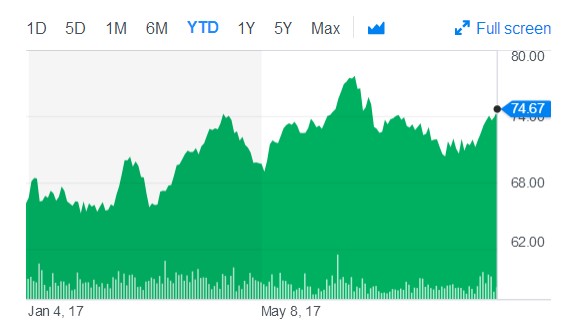
Welltower Chart from the beginning of the year
On the subject of healthcare, let’s jump into AstraZeneca (AZN: $32, up 4%) and its wonderful week. We’ve been watching this one with intense amusement, because a number of bears have come out of the woodwork to attack the company’s product pipeline - ironic, considering the firm’s pipeline looks stronger than ever, with recent trial successes that indicate its R&D department is still yielding a lot of fruit. AstraZeneca scientists are busy presenting on Imfinzi (durvalumab) and Tagrisso (osimertinib) at a lung cancer congress in Europe, and the feedback remains solid enough to drive shares sharply higher. Ignore the bears, because, frankly, they just don’t know enough about the science behind AstraZeneca’s pipeline.
Finally, let’s turn to municipal bonds. A number of Wall Street analysts are noticing that municipal bonds were a sleeper winner in 2017, with modest price gains that were often ignored because of the obsessive focus on the so-call Trump rally. That’s helped Nuveen AMT-Free Municipal Credit (NVG: $15.77, up 1%) and Invesco Municipal Trust (VKQ: $13, flat) recover nicely from their 2016 lows, when The Bull Market Report first recommended these funds. It’s nice to see the mainstream pick up on the quality of this asset class, but we also need to acknowledge how late they are to the party.
Unfortunately, there is a bit of a gray cloud for munis that we need to think about. Inflation trends are weakening and expectations of a third interest rate hike from the Federal Reserve in 2017 are dwindling. A longer path towards raising interest rates is bad for municipal bond closed-end funds, which depend on leverage to extend returns and maintain high yields for investors. The spread between the rate that funds borrow at and the rate that funds can earn through munis has been narrowing. This means dividend cuts might be on the horizon.
We don’t expect the cuts to be massive or come soon, but we do expect the income from these funds to decline slightly (and by slightly we mean less than 5%) in the next few months. I don’t think this is going to impact the pricing of these funds - muni funds often cut dividends without getting a hit to their stock. But keep in mind that the dividend stream from these funds is going to be a bit uneven. That doesn’t mean 5% annualized total returns won’t still come in if we average over a long period of time, but it does mean short-term returns from dividends will be a bit meeker than we’ve seen in the last few months. But that’s ok - we’re up way more than 5% in the last few months alone from both of these funds.
Good Investing,
Todd Shaver
CEO, Editor and Founder
The Bull Market Report
Since 1998
