September 11, 2016
by Todd Shaver | Sep 11, 2016 | Weekly Newsletter 7pm Sunday
The Week Just Past and the Week Ahead
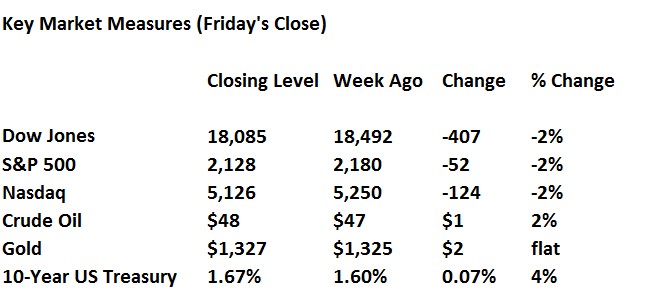
A sharp sell-off on Friday has rattled confidence. This was the first time in over two months that the S&P 500 moved more than 1% in a day. There are several driving forces. Due to a wave of profit warnings, the consensus expectations for a second half EPS recovery is now being reset lower. Moreover, the ongoing interest rate hike debate saga continues. While economists who watch Yellen conclude that she is signaling the Federal Open Market Committee will start raising rates in June, the futures market indicates no such thing. Bloomberg's World Interest Rate Probability function, which is based on futures trading data, sees only a 17% probability that the top end of the Fed's target range will go up at or before the June meeting of the rate-setting committee. Bottom line, new concerns that a rate hike is in the cards this month was a factor to the sharp market movements seen on Friday. We are not at all surprised to see the markets fade from recent all-time highs. While there may be more volatility ahead this week, our bias is to stand by ready to buy and scoop up our favorite stocks. This week we highlight Microsoft, Facebook, Alphabet, and Twitter.
Here is How Last Week Progressed
Monday (9/5) - S&P 500 -0.1%
Traders returned from vacation to find S&P futures flat, oil and the dollar lower, and a flurry of M&A activity. In fact, analysts at Morgan Stanley caved on their bearish call by raising their 12-month price targets for the S&P 500 – base case from 2200 to 2300, their bear case from 1600 to 1800, and their bull case from 2400 to 2500. For the bull case, Morgan Stanley left their EPS outlook essentially unchanged, but raised the multiple from 18x to 19x to yield their new 2500 bull target.
Tuesday (9/6) - S&P 500 +0.2%
Abysmal Class 8 truck net orders came out and continued to just get worse with each passing month. August net orders were down over 25% compared to last year. In fact, the level of trailing 12-month net orders is the lowest since 2011 with the annual change trend line now in negative territory for 18 consecutive months. The truck order data combined with Institute of Supply Management data that is flirting dangerously with recession levels are painting a very concerning picture about the core health of parts of the economy. Separately, billionaire Mark Cuban publicly stated that he has no doubt the market will tank if Donald wins. Could we see a Brexit like sell-off in the US should Trump win?
Wednesday (9/7) - S&P 500 +0.1%
Quant strategies on Wall Street are increasing in popularity. Did you know that the signals picked up by many quant strategies were able to get many investors out of oil prior to the massive sell off? Accordingly, we note that JP Morgan’s head quant has released a new report saying that the recent period of record calm across asset classes is about to end, warning of an increase in realized volatility, correlations, and tail risk* in September and October.
* Tail risk is something that is unlikely to happen - but still could. Broadly speaking, a tail risk is an event with a small probability of happening, says Bob Conroy, professor of finance at the University of Virginia Darden School of Business. “In every event there are tails; there are really good things that can happen and really bad things.”
Thursday (9/8) - S&P 500 -0.1%
Total consumer credit rose by $17.7 billion in July, up from last month's $14.5 billion, and above the $16.0 billion expected, as US consumers continued to get increasingly more indebted. However, while the credit spigot appears to be fully functional once again, it does not explain the disappointing car sales numbers in recent months, which prompted Ford earlier this week to warn that US car sales have now hit a plateau. Moreover, there are already concerning signs of credit performance. In July, 60 day subprime loan delinquencies were up 13% on a month-over-month basis and were up 17% compared to the same month last year. Prime delinquencies were up 12% on a month-over-month basis and were up 21% compared to the same month last year. Ouch.
Friday (9/9) - S&P 500 -2.5%
Markets were in a turmoil as the S&P moved more than 1% in a day for the first time in over two months. In fact, it was the 11th biggest jump in VIX in history, as August saw the volatility at a 2-year low. (The VIX (^VIX) was up 40% to 17.50 from 12.51.) What is going on here? Among other issues, we note deteriorating earnings expectations as the second half earnings growth rate pick-up baked into consensus appears to now not be materializing. This week we observed a wave of profit warnings from some large- and small-cap companies including Ford Motor, Barnes & Noble, Tractor Supply, SuperValu, Sprout’s Farmers Market, Pier 1 Imports, General Mills, HD Supply Holdings and Dave & Buster’s.
Separately, the ongoing stream of cautious data points continues to flow. Last week, we learned that PIK Toggle note* issuance is growing sharply. Looking back, the 2007 ramp in PIK Toggle note issuance was a pretty good indicator that the high-yield market was frothing over and the party was near an end. After all it's probably not a good sign when a market completely loses discipline to the point of rushing to hand out nearly $20 billion to companies that are basically admitting they may not even be able to afford the interest on the loan.
* A payment-in-kind bond, where the issuer has the option to defer an interest payment by agreeing to pay an increased coupon in the future. It is a sign that the company is having trouble repaying its debts. It's financing for companies undergoing a bankruptcy / restructuring process. The very nature of the loans is risky.
The Bull Market Report Companies and Commentary
Microsoft (MSFT: $56, -3% for the week) Microsoft is a high quality bellwether. Recent reports indicate that channel partners* see strong business trends for the company’s Cloud product, Azure. Azure is a key pillar of expected EPS growth embedded in consensus forecasts. Accordingly, it is a good sign to hear that Azure is on track with expectations.
* A channel partner is a company that partners with a manufacturer or producer to market and sell the manufacturer's products, services, or technologies, usually done through a co-branding relationship. Channel partners may be distributors, vendors, retailers, consultants, systems integrators (SI), technology deployment consultancies, and value-added resellers (VARs) and other such organizations.
To be more specific, channel partners are seeing strong sustained growth for Microsoft Cloud products, with a couple of partners underscoring a pronounced uptick with respect to Azure. One partner recently observed a renewed push by Microsoft to make inroads into the federal government vertical with its government Cloud. Lastly, a few channel partners referred to overall softness in their legacy Microsoft practices, partially driven by a faster-than-expected transition into the Cloud. This should be read as good news. Basically, the use of office desktop products is slowing because companies are transitioning to the Cloud.
We like that trend. We are fine with the legacy Microsoft business declining if the customers are moving to the Microsoft Cloud. It’s quicker and better, and a higher valuation is applied by the Street for the Cloud versus the desktop business
While Microsoft’s Azure product faces fierce competition from Amazon’s comparable AWS offering, one channel partner noted that Microsoft’s head start in the market with Office 365, along with their inherent long term relationships in Enterprise IT gives Microsoft a slight advantage in the Cloud space as compared to Amazon.
In fact, there is currently talk of an enormous energy conglomerate that has physical data centers in multiple countries which they are finding incredibly difficult to manage and scale and hence is thinking of moving to a Cloud infrastructure model. While this company has engaged both Microsoft and Amazon, the company appears to have a preference to go with Microsoft Azure because of the long standing relationship with Microsoft. This case study reinforces the storyline that Microsoft has created enough of a reputation now so that Amazon doesn’t seem like the only company in the public Cloud space.
BMR Take: The Cloud business is booming. Microsoft’s Azure product is recording revenue growth of greater than 100% a year. Channel partners are suggesting momentum is building. We view Microsoft as a high quality portfolio holding with an attractive dividend yield and substantial upside ahead.
Facebook (FB: $127, +2%) Weak sentiment surrounding the stock presents a buying opportunity. Facebook has delivered three consecutive quarters of 60%+ ad revenue growth, with an acceleration in four of the past five quarters. Street estimates have an upward revision bias with the 2017 consensus EPS having increased 35% so far this year. The overall lack of enthusiasm is reflected in the lower forward PE multiple and creates an opportunity.
One debatable topic right now is ad growth. Despite management’s caution on the 2Q16 earnings call, ad loads still have room to increase. Ad loads are a less significant growth driver of EPS estimates than many appreciate. Street estimates now call for slowing ad load growth to around 10% this year and actually declining in 2017-2018. Though there are several levers for management to focus on to drive improvement. For example, the company is currently working on ad targeting, relevancy, formats, and profitability in ways that don't alter the user experience. Facebook still has opportunity ahead for ad load growth despite the recent near term headwinds.
Another debatable topic right now is engagement. Despite a small sequential drop in 2Q16 daily and monthly active users across all regions, the overall ratio of daily to monthly active users remains steady at 66%, which highlights the stickiness of the customer base. Moreover, Facebook’s share of US mobile Internet time of 13% is 2x greater than Snapchat, Twitter, Instagram combined, which highlights how healthy engagement remains. Recent product changes such as prioritizing friends and family in the Facebook and Instagram feeds and the launch of Instagram Stories may acknowledge shifting usage and increased competition, at least in certain demographics, but we expect Facebook to remain innovative on products. We are not concerned about a slight slowing of engagement.
BMR Take: We think weak sentiment surrounding ad growth and engagement presents a buying opportunity. Street price targets are as high as $170, framing the compelling upside potential. We added the stock in February at $97, and we are approaching our Price Target of $140. We are pleased.
Alphabet (GOOG: $760, -2%). Building on the discussion above surrounding the booming Cloud business, Google’s efforts with its Cloud product Google Cloud Platform (GCP) are gaining momentum. We think there is plenty of room in the massive end market for several winners, so we do not view Google’s progress as a negative for Microsoft.
GCP is getting more aggressive and gaining traction in part due to a renewed focus and alignment with heavier investment and financial commitment with over $1 billion in acquisitions in the past year. In summary, the narrative around GCP being a distant third place in the public Cloud race may start to improve going forward.
Channel partners say that Google is targeting a select number of marquee Silicon Valley prospects, including a few that might be Amazon AWS displacements. GCP may soon make some material product announcements. Some partners are saying that GCP is hiring sales reps aggressively and the consensus view is that GCP is trying to win on its products and infrastructure, not on price.
Most firms still see GCP well behind AWS and Azure in the large enterprise market, with a less mature sales effort and premium service suite. That said, it is now believed that a $400 million revenue run-rate estimate for GCP in 2016 might be too low and that it could be closer to $750 million. On its 2Q16 call, Google called out the Cloud as the primary driver of the re-accelerating growth for Licensing and Other revenue, the first time the business has been mentioned in such manner.
BMR Take: Google Cloud Platform is a small but growing part of the Google investment thesis. We put it in the bucket of Google businesses with potential upside surprise versus consensus thinking. We would be buyers of Google all day long.
Twitter (TWTR: $18.11, -7%). Shares rose in the last week of August on rumors of a take-out, but the Board met on Thursday and thereafter communicated there were no offers to buy the company on the table right now. Accordingly, Twitter is now left (again) to deal with proving out their business model independently. Some analysts are now saying that if CEO Jack Dorsey can’t fix the business model in the next few quarters, he should volunteer to step down.
Shareholders want Twitter to become one of the first news sources users turn to. Many social media users see what Twitter provides as a basic necessity of an emerging digital age. Users offer unpaid labor hours to create content, which generates data that can be recorded, measured, and sold. They believe the trade is fair. Twitter maintains extensive databases of this information to exploit the content. The key will be figuring out how to satisfy shareholders for playing matchmaker without disturbing the part of the model that is working.
BMR Take: We see value in the Twitter platform. The company continues to take efforts to improve the model, with recent emphasis on live-streaming technology and new partnerships with the NFL and other sports leagues. While we likely won’t see a near-term takeout at a sizeable premium, we still see lots of opportunity ahead.
Upcoming Economic News
This week we have a few Fed governors speaking on Monday at various conferences. Then a wave of data comes out Thursday. We hope to see stable to healthy Retail sales figures and some signs of stabilizing weakness in the Industrial sector. Any pick-up in inflation figures would also be a positive. The Fed is in a real bind if the aforementioned trends go the opposite direction because they would then be having to raise rates into an incrementally worsening economic situation. Doing so could produce lost confidence in the Fed, which could have more of an effect on markets than even the math of the rate hike. Stay tuned.

Some Thoughts on the Markets
With Gary Jefferson
UBS Financial Services, Inc.
For the past several quarters "bad news" has been treated by the market as a good thing; i.e., no rate hike and a continuation of easy money. A well-known research firm on the Street has used an equation for this scenario for a couple of years: "Low interest rates + no recession = stock market gains."
However, according to the Stock Trader's Almanac, "The market is now navigating the weakest part of the calendar year, September. Since 1950, September is the worst performing month of the year for DJIA and S&P 500. Even in election years the month has been challenging. Once tans begin to fade and the new school year begins, fund managers tend to clean house as the end of the third quarter approaches, causing some nasty selloffs near month-end over the years…….."
Thus, investors should not be surprised to see a pullback in the market as we go through the month. We would view it as a buying opportunity ahead of the expected year-end rally fueled by improving earnings in both the 3rd and 4th quarters.
Meantime, the experts are all over the board:
Goldman Sachs says a bear market is inevitable. The bank contends that: “There are only three possible ways forward for the market. Firstly, there is the “Reflation” option, which sees inflation reignited, but bond yields rising too, hurting stocks and bonds. The second option is “Stagflation,” which would send yields higher because of rising inflation, but a lack of growth would hurt stocks. And thirdly, “Fat and Flat,” which is basically a continuation of the status quo, but accompanied by weakening earnings, reversing investor sentiment, and falling prices."
Morgan Stanley’s equities team has just gone on the record calling for a jump in the S&P 500 over the next year. The bank now thinks the S&P 500 will rise to 2,300 within 12 months.
A lot of people are worried because of the fresh highs at which the S&P 500 is trading, [this was written before Friday’s rout!] but in a recent article Bank of America argues that now is a great time to buy stocks. The bank runs a “Sell Side Indicator” which measures the bullishness of Wall Street analysts. That indicator is now sitting at its lowest sentiment reading since 2013. Basically, BOA's summary of the situation is: “Historically, when our indicator has been this low or lower, total returns over the subsequent 12 months have been positive 100 percent of the time, with median 12-month returns of more than 27%.”
In the real scheme of things, however, the whole Fed question shouldn’t be a big deal for folks making long-term investment decisions. What difference does it make whether the Fed announces a quarter of a percent increase in rates today, in December or some future date? Higher rates may become problematic for several industries, but given Yellen's clear indication that she will raise rates very slowly, we are nowhere near problematic interest rates and likely will not be for a long time to come. And, at this juncture, we still don't see the U.S. heading for a recession, although we certainly need to see some evidence fairly soon that 3rd quarter earnings are picking up some momentum.
We would modify the equation referred to above: "Historically low interest rates + improving corporate earnings + no recession = a rising stock market."
BMR Take: Well said, Gary Jefferson. Friday was a bad day, but the sun will come up Monday and the United States economy will continue pumping out goods and services, and entrepreneurs will continue building new ideas and creating wealth. We want to be fully invested in high quality stocks. If you are nervous about the markets and want to reduce risk, look at the High Yield Portfolio. These stocks have been knocking the cover off the ball, many of them are up over 10% this year, and all are paying from 4% to 10% dividends on top of the rise in prices – just absolutely stellar overall returns.
HIGH YIELD CORNER
Has the Bottom Finally Fallen Out of the Market?
Friday’s correction turned into a self-reinforcing bear market, with the S&P 500 closing down over 2%. Keep in mind this was a short trading week because of Labor Day, and Tuesday and Wednesday were particularly slow-action markets. That makes the downturn on Friday more worrisome.
What exactly caused the downturn? Most financial pundits are citing rate hike fears, after Eric Rosengren, president of the Boston Federal Reserve, hinted at the chance of an increase in interest rates in the near term. This is a significant development, because Rosengren has been one of the more dovish Fed officials, so his caution about the need to raise rates suggests the Fed really is getting serious about raising.
Why did that cause stocks to fall? Simple: With higher interest rates, there will be more of an incentive to buy U.S. Treasuries, and people will sell stocks to buy those Treasuries. At least, that’s the theory. But note that moves to higher interest rates in the past have not always correlated with a steep fall in stock prices, so this logic isn’t as certain as many market participants assume. In fact, we have said many times before that in more than half of the cases of the first or second interest rate raise by the Fed, the stock market is higher one year later.
However, interest rate hikes have a much more direct impact on the debt market, and this is where high yield investors need to stand up and pay attention.
Higher interest rates will do many things to debt markets. For one, higher interest rates will make existing notes and bonds less valuable. Secondly, higher interest rates could cause companies to default more.
Are debt markets ready for an interest rate hike? The answer is yes, somewhat. Corporate bonds fell significantly in value at the end of 2015 as investors prepared for rate hikes. As those hikes were delayed this year, the market realized it had oversold bonds and we saw a huge increase in the price of corporate bonds, especially junk bonds and high quality funds like our own favorites: Pimco Dynamic Income Fund (PDI: $28, down 3%) and AllianzGI Equity & Convertible Income Fund (NIE: $18.60, down 2%). Both of these funds had a bad week and underperformed the S&P 500, but are up 8% and 4% respectively over the last six months. That’s excluding dividends - PDI’s yield is 9% and NIE’s is 8%.
What now? The real key right now is buying dips. It seems that the market is just starting a correction, and this could easily last another few weeks. High yield defaults continue to rise, which is a good enough reason for junk bond markets to continue to correct. This trend has been ignored by the market for months now, which again suggests a correction can continue for a while. One way to think about this is to focus on the "BofA Merrill Lynch US High Yield Option-Adjusted Spread,” an ugly name for a simple concept but an economic metric tracked by the Federal Reserve. This measures the difference between average junk bond yields and the yield on a U.S. government bond. The lower the number, the more investors are willing to pay for junk bonds. When the number gets too low, it usually suggests junk bonds are overpriced and will fall in price as the market realizes it has gotten too greedy and ignored risks too much.
This number has fallen to its lowest point in a year, although junk bond defaults are at their highest point in a year. This is a clear disconnect, and the market is likely going to focus on this for a while, possibly producing a massive sell-off in high yield followed by a recovery.
Does this mean we recommend selling the AllianzGI and Pimco funds? Absolutely not. For one, these funds are not entirely in junk bonds; Pimco’s fund focuses on mortgage-backed securities (where default rates are falling), and AllianzGI has a lot of equity holdings.
Of course both will be hurt as the market focuses on risk and begins panic selling, so prices may go down in the short term. But the fundamentals are strong on both, so it is likely that their prices will recover whenever the market realizes it has gotten too nervous about rate hikes. On top of that, an interest rate hike’s impact on equities and MBS’s is much less significant than on high yield bonds, which have much of this risk already priced in over the last two years anyhow. With that in mind, the long-term risks are minimal even as the market is getting extra nervous.
Does this mean buy the dip? Simply put, yes. But no one will be able to call a bottom, so a systematic approach to adding to high yield positions probably makes sense over the next few weeks. If your favorites go down 2%, buy a little more. If it goes lower from there, buy a little more. When things calm down, these stocks will come bouncing right back.
What about other high yield sectors? The now infamous growth in REITs throughout 2016 has reversed, and the SPDR Dow Jones REIT ETF (RWR: $97) was down 4% over the past week. That may continue as the rate hike fears cause weakness in high yield sectors, but there is little reason to believe the best quality REITs are suffering any fundamental weakness in their operations or are likely to be unable to continue to pay out and grow dividends to shareholders.
Similarly, BDCs were down 2%, as we see from the UBS Etracs BDC ETF (BDCS: $22), but that is actually slightly better than the S&P 500. BDCs have been less exposed to moments of market panic in 2016 after their severe underperformance in 2014 and 2015, but there is no guarantee that will continue. Non-accruals* have become less of a concern for BDCs right now, but if junk bond defaults are rising, debts to smaller companies are likely to rise even more. If a surprising growth of non-accruals hits BDCs, this sector could face a more severe downturn. We aren’t seeing this yet, but focusing on quality is important here. That is why we still see Main Street Capital (MAIN: $34, down 1%) as a strong hold.
* Nonpayment of an interest payment due on a debt.
The Apple Corner
We think about Apple (AAPL: $103, down 4%) all the time and have had some thoughts about the recent new product announcement that some say was a bit flat. We agree to a certain extent, but we also are believers in not changing a good thing. The iPhone 7 looks like the 6, although the insides were beefed up a great deal – it’s faster and offers more storage. The Watch came out with a new version and is now fully waterproof. We could go on here for 10 more pages about the new products, but we will let you scour the web for more details if you like. You can start here if you haven’t done so already:
http://www.Apple.com Suffice it to say that the iPhone 7 will sell in big numbers this fall and Christmas, generating more profits and more cash to the bottom line for the company. And knowing the company the way we do, we wouldn't be surprised to see more exciting products announced sooner rather than later.
Additionally, with Friday’s sell-off it makes us think about how much Apple could go down from here. Here’s our take: It is unlikely that the stock can go down too far. Sure, if the market goes to 16,000, then we all have problems, and Apple will go to $90 again and maybe lower. But that cash cushion is unmatched in the annals of Wall Street. They literally have $42 a share in cash. (We know most of it is overseas, but with the EU’s demand of Ireland to get $14 billion from Apple in back taxes is spurring talk in Washington of allowing repatriation of the $3 trillion or so of cash that US companies hold overseas. This is a good thing.)
So for every share you own at $103, 41% is in cash. Now Apple management is not stupid. They will figure out a way to monetize the cash – through buying technology; buying people; buying income producing assets (companies); buying back stock; increasing the dividend; and a host of other ways you and I haven’t thought about yet. We believe in Apple management .
Under Armour Update:
Kevin Plank, CEO and Founder of Under Armour (UA: $38, flat) announced that he will be selling 2.1 million shares of stock starting in October. A subscriber wrote in and asked our opinion of the situation, as he thought this was a bad thing.
Here’s what we wrote back:
“Hi Samuel –
“We generally don’t mind if executives sell stock. Plank currently owns 34 million shares of the company’s Class B stock, 135,000 shares of Class A stock and 34 million shares of Class C stock, representing 65% of the voting power in the company. So 2 million shares is a small part of his holdings. He is just diversifying.”
That’s how we feel. Of course, we secretly wish we had 2 million shares to sell of our own, and we admire Plank and all the others that have created all of the amazing companies out there, like Amazon and Facebook and Google, and so on. This is America. The entrepreneurs and the risk takers shall reap the rewards. Again, we would not even blink a negative eye over this CEO selling a small part of his stake in the company. Bill Gates has been selling 20 million shares a quarter since 2002. Wow. And we still love Microsoft.
That’s all for this week.
Good Investing,
Todd Shaver
Editor in Chief
August 31, 2016
by Todd Shaver | Aug 31, 2016 | 7am News Flash
Twitter: (TWTR: $19.21)
Shares popped 5% yesterday on comments made directly by the company’s co-founder that a sale of the company should be considered.
Co-founder Ev Williams said in an interview with Bloomberg TV that the company has to weigh all options amid ongoing speculation it’s a takeover target. Williams initially declined to comment when asked by Bloomberg whether Twitter can remain an independent company. He went on to say, "We’re in a strong position now, and as a board member we have to consider the right options."
Board members are obliged to consider credible takeover overtures and often make similar boilerplate pronouncements when asked about deal-making. Even so, the Williams's comments come at a time when Twitter is often mentioned publicly as an acquisition target, as has been mentioned many times here at The Bull Market Report. The stock ran up 9% in early August amid unsubstantiated speculation that former Microsoft Chief Executive Officer Steve Ballmer and Saudi Prince Alwaleed bin Talal Al Saud were teaming up to buy the company. While analysts played down the chatter, Axiom Capital said that if Twitter’s business doesn’t turn around by mid-2017, a case could be made for a sale.
CEO Jack Dorsey, the co-founder who took the top job again officially in October, is trying to reshape the company’s reputation and product mix to draw a more mainstream audience. Investors have lamented Twitter’s recent user-growth slowdown, and the stock has fallen more than 17% this year. Revenue at Twitter is growing slower than expected, even as the company steps up efforts to court advertisers. The company is cutting deals to stream more live events, from sporting matches to political debates, and this year acquired an artificial intelligence startup to make live video look more professional.
BMR Take: The current situation feels eerily similar to LinkedIn, which was eventually acquired by Microsoft at a 50% markup. We see value in Twitter at these levels – that’s why it’s in the Special Opportunities Portfolio. We believe there are two opportunities here. The first is for the company to start the turnaround, growing users and revenues and profits. The second is for a firm with a ton of cash or valuable stock to swoop in and pick up the company. Google? Apple? Facebook? A Saudi Prince? A Steve Ballmer with all that Microsoft money? After all, Twitter started the Arab Spring; Twitter has been able to handle Donald Trump's comments; Jimmy Fallon starts a “trending topic” every Wednesday. Twitter is no Blackberry. It is a company of the future with a huge upside.
August 28, 2016
![The Bull Market Report for August 29, 2016]()
by Todd Shaver | Aug 28, 2016 | Weekly Newsletter 7pm Sunday
The Week Ahead
This week marks the end of August and the beginning of September. We are expecting a very eventful back half of the year. We are watching everything about the Presidential election. The Fed’s comments at the Jackson Hold conference this past week alludes to what is shaping up to be another rate hike in December. Back to school and the holidays are key spending seasons for consumers, where we suspect this year’s results will show the strength of this economic expansion on the consumer side. The market is down slightly from record highs compared to last week, which if anything explains why we favor stock picking at this time as compared to just taking on broader market exposure. This week we highlight Facebook, Devon Energy, Brookdale Senior Living, and Sprouts Farmers Market.
Here is How The Major Indices Performed Last Week

Here is How Last Week Progressed
Monday (8/22) - S&P 500 flat
--- Pfizer (PFE: $35), still stinging from its foiled mega-acquisition with Allergan (AGN: $238) earlier in the year, announced it would acquire prostate-cancer drug maker Medivation for $82, a 21% premium, in a $14 billion deal.
--- Italian Prime Minister Matteo Renzi hosted German Chancellor Angela Merkel and French President Francois Hollande on an island off the coast of Naples ahead of September's EU summit, which was called to discuss reverberations from the Brexit vote, which we highlight because Italy and France possibly leaving next is a critical inflection point to the future of the EU.
--- Bank of America published analysis looking at the "what if" scenario of the increasingly discussed credit market bubble, but found that as long as rates rise gradually rather than sharply concerns are overblown.
Tuesday (8/23) - S&P 500 +0.2%
--- Billionaire Jeff Gundlach at DoubleLine Capital reiterated expectations for a Trump victory, which will likely mean a Brexit-like selloff for stocks, but ultimately massive new fiscal programs for roads, airports, and the wall. He also stressed how his now 100% net short position is focused on shorting stocks that are believed to be safe, but not safe at all.
---Pension funds in Hawaii and South Carolina have adopted a new strategy, in their thirst for yield that involves selling puts, which highlights an extreme thirst for yield to the point of taking on terrible risk/reward, a behavior that many are saying is reminiscent of 2006.
--- The census reported that in July, the US saw a whopping 654,000 new home sales, up 12%, from the prior month and higher by 31% from a year ago, smashing expectations.
Wednesday (8/24) - S&P 500 -0.6%
--- We learned that 8 out of 12 regional Fed Presidents voted to hike the discount rate in July, which was 1 shy of last November.
--- Illinois' biggest public pension fund, Teachers Retirement System, may have to lower its expected rate of return, which would cripple the state's already fragile finances, warned Governor Rauner, which we highlight as just the surface of major pension issues widespread across the country.
--- According to the Tennessee insurance commissioner, the Obamacare exchange in Tennessee is very near collapse as insurers are imposing nearly 60% premium hikes and pulling back on coverage areas which could leave certain counties with no health insurance.
Thursday (8/25) - S&P 500 -0.1%
--- According to the latest Fitch auto subprime report, things in the auto subprime space are progressively deteriorating, with subprime 60+ day delinquencies in July rising 13% from last month to 4.6%.
--- Subprime Asset Backed Securities annualized net losses hit 7.4% in July, which was an increase of 17% from last month and 28% from last year.
--- Separately, in yet another stunning example of the unintended consequences of minimum wage hikes, restaurants in Washington DC are slashing jobs, as the data show that DC restaurant jobs were down in 5 out of the past 6 months, which hasn’t happened in 25 years.
Friday (8/26) - S&P 500 -0.2%
--- This was the biggest day of the year for our central bankers at the Jackson Hole conference occurred. Goldman published a kneejerk response to Yellen’s speech, which discussed her to be so hawkish that it raised their odds for a September rate hike from 30% to 40%.
--- Alternative analysis from Macquarie proved a thoughtful explanation, saying that the conventional wisdom prevailed on Wall Street, namely that Yellen's speech is a whole lot of nothing and likely didn’t change any minds on expectations for a rate increase this year, with December still most likely the next hike followed by two hikes next year.
--- Beyond interest rate talk, the conference kickstarted a number of other new debates, perhaps most interesting is the St. Louis Fed President calling out how Fed GDP forecasts keep trending down as actual GDP keeps running below trend, which raises an array of issues much more important that the timing of the next rate hike.
The Bull Market Report Companies and Commentary
Facebook (FB: $125, +1%) We are bulls on Facebook for many reasons we have given you these past seven months. We are very pleased with revenues and earnings and their takeover of mobile. However, one of the bear cases on Facebook is that ad revenue may shift away from the company as the users of connected devices are increasingly tired of dealing with bad ads. We’ve all experienced a lot of bad ads - ads that obscure the content we’re trying to read. Ads that slow down load times. Ads that try to sell us things we have no interest in buying. Bad ads are disruptive and a waste of everybody’s time.
To hold onto market share, it is critical that Facebook’s products and services address this real problem users are having. Competitor Google is taking steps through banning certain types of ad words. Now recently we note Facebook is moving forward as well. Facebook recently announced the expansion of tools given to users to control their advertise experience, as well as providing an updated approach to ad blocking.
Going forward, Facebook users now have more control over their experience, which helps them improve how to determine what ads to show. Specifically, ad preferences are easier to use. Users can now outright stop seeing certain types of ads. For example, if you don’t want to see ads about a certain area like travel or cats, you can remove the interest from your ad preferences. People can also now elect to stop seeing ads from certain businesses or organizations. These improvements are designed to give people even more control over how their data informs the ads they see.
BMR Take: All in all, the new developments Facebook recently provided users should drive reduced ad blocking usage, ultimately protecting Facebook’s market share. You may consider this stretching for results, but we consider it important that management sees these things and acts. Yes, they act. With Facebook’s user base at 1.15 billion on average for June, increasing a very healthy 17% from a year ago, there is nothing more important for Facebook than to keep them happy and engaged. We see further upside ahead for the stock.
Devon Energy (DVN: $44, flat) Devon Energy’s CEO is scheduled to present at an investor conference on Sept 7th. Investors have a number of concerns about the company’s near-term prospects. However, we think the conference is a catalyst to build investor confidence.
Let’s review where we are. The company has reported a loss of over $9 billion in the last three quarters and the losses are expected to continue. Consequently, in order to offset losses, the company has had to sell $3.2 billion in assets in the first half of this year, and additional asset sales are likely coming into the second half. Fortunately, the company’s liquidity situation is strong. The company has $1.7 billion of cash and no debt due within the next 12 months. If oil prices hold up, there appears to be a path forward to returned glory for Devon Energy, which could result in substantial upside for shareholders from here.
Why stay the course? Devon is a leading exploration and production player. Its premier asset portfolio is concentrated in top tier locations (namely Canadian heavy oil, the STACK, Rockies Oil, Eagle Ford, Barnett Shale, and the Delaware Basin). There is a deep inventory of future opportunities. The current portfolio mix is balanced 35% gas, 44% oil, and 19% Natural gas liquids. Management believes the entire inventory is positioned well on the cost curve to turn profits at a $50 price for oil. In particular, management continues to see +30% IRRs in select areas (like the Delaware Basin, the STACK, and Eagle Ford). Most importantly, management is standing by ready to step on the accelerator when the industry imbalances stabilize and return to growth mode.
BMR Take: As the oil industry recovers, we see substantial upside ahead for Devon. The company has a premier asset portfolio with $7.5 billion of liquidity to make it through the downturn. Stay the course.
Brookdale Senior Living (BKD: $17, flat) Investors have their worries ranging from a lack of confidence in management, the 2016 guidance outlook, current leverage, and the pending supply of new unit inventory coming online in 2016 and 2017. However, management is taking more decisive action to lower leverage and to reposition the operating model. Moreover, we see a path for substantial upside for shareholders as integration issues subside, the portfolio is rationalized, and operating margins improve.
We dug into one issue, occupancy rate commentary, to further explain what is driving the lack of confidence in management. Specifically, on its 2Q16 earnings call, management stated that average June consolidated occupancy was “nearly back to January 2016 levels”. This sounds positive, but as in the fall of 2015, management is referencing an average that does not match data provided in quarterly releases. This is really uncommon to be frank. Management needs to get it straight and talk about the numbers they put on their press release. Without giving you all the confusing numbers, basically the reported figures on the press release are trending to flat to down slightly, but the more important calculation that management is using to run the business is showing sharper declines.
BMR Take: We see many levers for upside here even though management is not helping us out. We can’t give them a free pass forever, but with many analysts valuing the shares around $30 or nearly double the current price, we see reason to stick around. But with that said, we are watching closely.
Sprouts Farmers Market (SFM: $23, +2.3%). There is significant runway ahead for Sprouts. One comparison investors are drawing is to Shoppers, which saw revenue steadily grow from $3 billion to $12 billion over a 20 year period. Everybody from management, to investors, to the analysts are saying there is a similar greenfield opportunity ahead for Sprouts.
Sprouts will open 36 stores this year. The company sees an ongoing 14% square footage growth rate ahead. What is fueling the expansion? The Sprouts brand. Consumers across demographics are coming to the store because they are interested in health and wellness and nutrition, and Sprouts’ market position as “healthy living for less,” is really resonating with people across the country.
The stores are very profitable. Management is tells investors to expect 35-45% cash on cash returns when they deploy shareholder capital to a new store at this time. Behind the impressive figures is a business model that is now dialed in running both operationally efficient and capital efficient. In fact, the business is able to maintain a price premium of 20-25% above peers due to a streamlined operating process refined over a number of years to now include monitoring on a weekly basis the total basket in fresh inventory relative to key competitors on a market by market basis.
BMR Take: If you think healthier eating for less is the future, then this is a great bet. We are in this one for the long haul. Let management go to work opening and running the stores. We expect solid results ahead.
Upcoming Economic News
The focus this week is on the jobs numbers out Friday. We are looking at an economy with an unemployment rate below 5%, but very weak labor force participation of just 63%. Average earnings are rising just slightly and the number of hours worked per week is running flat. When you step back and think about our country’s current situation of below trend GDP, ultimately we are going to have to work at improving all the different levers we can. Monetary policy has been the sole focus, but we need to be discussing real fiscal reforms. We need to take a look at how we can improve the labor force participation rate and number of hours worked per week. More people working more hours equal more output. All of this is possible as we move into the last half of 2016. 2017 could be a good year as well.

Silver Wheaton and Barrick Gold
These two stocks are The Bull Market Report’s counter strategy stocks. But they had a bad week. The saying goes that if the world is falling apart, you want to own gold and silver. What does it mean to say the world is falling apart? Well, there is no answer to that - you have to have your own definition. The way we see things, everything is just wonderful, just wonderful out there. We are trying to use a little humor here, because as we know there are a MILLION challenges out there right now (the election, ISIS, Brexit, China imploding, Wall Street at highs that can only go lower. We hope you get the picture here.) Yet despite of all this, the market goes higher. After all, where else can you put your money? (That’s what everyone says.) So why wouldn’t the stock market go to 20,000 and higher? (We are actually believers in this theory. Where ELSE can you put your money?)
OK, back to silver and gold. Gold is at $1324 an oz., up from $1050 at the beginning of the year. Silver is at $18.66 an oz., up from $13.70 at the beginning of the year. Will they go higher as the world implodes? Well, yes….. assuming the world implodes. But we don’t think this will happen. The “world” wants commerce; it wants peace; it wants a safe environment for its kids. We are optimists and we believe the “world” will make it. We believe the world will survive and THRIVE.
But if this happens, then theoretically interest in gold and silver will wane. We’ll see.
At the moment, Silver Wheaton (SLW: $27, down 9%) is up 37% from the $19 when we added it in early May, just four months ago. Our target is $33, but our Sell Price is $26. We’ll have to honor that so we don’t give away all of our gains. If it closes below $26 in the coming days and weeks, we are out.
Same story with Barrick Gold (ABX: $18.22, down 12%). We added the stock at $11 in February and it is now up 63% at $18.22. Our Target is $18. We hit it. But it was at $22 in July and again early this month, so we hate to give back any more profits. We are going to remove it here and lock in this amazing gain.
What should you do? That is up to you of course. The stock WAS at $50 in 2011. If the world implodes, Barrick is going to $30 and $40 and maybe back to all-time highs above $52. But even if the world calms down, Barrick Gold has gone through a lot of heavy fiscal changes for the good. Cash is up ($2.4 billion); debt is down (but still $9 billion). Revenues are steady now at a run-rate of $8 billion; and profits are back. So there is an argument to be made to hang in there with the company and watch and wait. We don’t tell you what to do at The Bull Market Report. We give you the facts and our opinions. Ultimately it is up to you.

Options Corner
LET’S COVER THOSE CALLS
Last week we gave you two great examples of how to buy high-quality stocks, Microsoft and Apple, using longer term options (LEAPS*) that expire in January 2018. (Note that the 2019 options will start appearing in September and October. Keep your eyes peeled on your Yahoo options site:
http://finance.yahoo.com/quote/AAPL/options?p=AAPL&date=1516320000
Last week we discussed how you can buy a deep-in-the-money option on Apple for $1,700, controlling 100 shares worth $10,900, (or 10 options for $17,000 controlling 1000 shares worth $109,000.) This week we will show you how to get some money back for those options. In fact, if you are diligent you can get ALL of your money back. How can you do that? By selling calls against the long LEAP* that you bought.
OK, to review. You decide to buy the Apple January 2018 100 call. (This gives you control of Apple at a price of $100 a share.) Last week it was priced at $17. Apple was down $2.40 this week to $107, so the options dropped a bit as well, to $15.50. So how to you get back some of the cost of the option that you just paid $15.50 for? You sell an option against it. There are lots of choices of course. The easiest, requiring the least amount of “work” would be to sell a January 2018 call, say the $120 or the $130. The $120 would give you $6.50 reducing the cost of your long option to $9.00. If the stock goes to $120 or higher by January 2018, your option will be worth $20 ($120-$100) and since you paid $9 for it, your return would be over 100% in less than a year and a half, with Apple going to $120, a rise of 12%. Could Apple go to $120 from here? Only YOU can answer that! Of course, you don’t participate or profit in anything over $120. If the stock goes to $140, your return is exactly the same as noted above.
So maybe you think Apple can get to $130. Then don’t sell the $120, sell the $130 call. The January 2018 130 call will get you about $4, reducing the cost of your option to $11.50. If Apple goes to $130, the long option you bought would be worth $30, for a return of 160%.
Now, if you want to tweak things and look for a higher return from this trade, you will have to spend more time doing so. But your return could be a lot higher. For example, instead of going all the way out to January 2018 and selling a call, you could sell the January 2017 call first. When that expires, you can sell the April or July call, and so on. It’s too complicated to explain here, but your broker can help you, or you can write us at Info@BullMarket.com. Many investors have gotten the cost of their option down close to zero over an 18 month time frame. Now THAT’S exciting. BUT – it takes work AND there are many more ways for the trade to go sour. These are the challenges, of course, when you are trying to produce a triple or quadruple using options, when a stock goes up just 20-30%. Did we say this trade is risky? OK. It sure is. Please consult a professional broker for advice .
*LEAP – an option that expires in January that has a life of more than six months. Thus the January 2017 options aren’t LEAPs anymore. They are just options. The January 2018 options are LEAPs. It’s kind of silly really – there is no difference at all. So why do they try to confuse us?
Thoughts from Gary Jefferson
UBS Securities
First Vice-President, Investments
Fully invested portfolios have enjoyed a rare summer rally that has the major averages recording new all-time highs during the month of August. Very few pros, however, have had their Buy Lights on solid green during the past few months and so investors with cash shouldn't feel left out or underinvested. This market is simply not acting normally. It's more like "Dang the fundamentals - full speed ahead!"
The most recent Atlanta GDPNow forecast is for GDP to grow about 3.5% in the 3rd quarter. That's good – but remember, 1st Qtr GDP grew a measly 0.8% and 2nd Qtr GDP barely beat that at 1.2%. So, if 3rd Qtr hits its number, the average for the year would then be 1.9% -- not so good. Thus, to get GDP growth above 2% for the year the economy has to expand by an average of 3% in both the 3rd and 4th quarters. That's doable. But to get growth above 2.5% for the year (still fairly pathetic at this stage of the "recovery") growth would have to average 4% for the next two quarters. That’s probably not going to happen.
This rally has mostly been on the backs of central bank shoulders and low inflation as opposed to stellar earnings. Yet, as of August 16th, 74% of all stocks are above their 50-day moving averages. Fundamental rules of gravity say that shouldn't be the case with 2% or 2.5% GDP growth. We think there are companies which are generating outstanding earnings growth and they should continue to do well. Conversely, those which are not should at some point lose support. The result is that the market "average" may not be able to keep tripling the average GDP growth. Cost cutting and share buybacks can only work for so long. We are already hearing a lot of the pundits declaring that we are in a classic "stock-picker's market".
We'll just sum it up with a reference you’ve heard before but which is ever more important in today’s market: Investor's daily chore: "Stay with dividend growers and good stock pickers.” Using companies with a long history of growing dividends – and reinvesting those dividends - has been one of the surest ways to accumulate wealth in the stock market. And in today's market, picking stocks which can maintain solid earnings growth should provide much better than average potential returns.
[Thank you Gary.]
So, where do we find those stocks?
Have you checked out The High Yield Portfolio lately?
Go here: https://www.bullmarket.com/high-yield
The Bull Market Report High Yield Portfolio follows stocks that pay from 4% to 11% dividends. Most are paying 6% and 8% but listen to this: Here are the returns the stocks themselves have made: 13%, 15%, 13% 18%, 34%, 8%, 12%, 10%, 8%, 15%, 16%. This is not counting dividends. So you have 11 stocks that are paying above-average dividends averaging 7% and you have these same 11 stocks that have risen in price since we added them of an average of (exactly) 11%. Since most of these stocks were added since The Bull Market Report was reincarnated in January, you are looking at annual returns of 20% or so, PLUS the average 7% dividends.
Thus, if you are worried about the stock market climbing this wall of worry and the “worry” is getting to you and outweighing the fact that we are within a whisker of all-time highs, then take a look at the High Yield portfolio. It will ease your mind to know that a stock like Annaly (NLY: $10.78, down 1%) has been paying a dividend of 10%+ since 1997 through bull and bear markets, and high and low interest rate environments. Are they going to keep paying their 11% dividend? No one knows; but you have to admire their track record and it gives you a strong sense that they can continue for the years ahead.
You remember what Annaly does, right? They invest their capital into Fannie Mae and Ginnie Mae securities, leveraging their capital 4-5 times. They invest in securities of the US Government – not much risk here. The risk, the pundits say, is if short-term interest rates spike up. This is true, but in general, rates don’t jump 1% or 2% in short periods of time. It usually takes months and years for rates to move this much higher. And if rates do move up, mostly long rates go up too, thus providing more opportunity for Annaly to lock in even larger spreads.
We like the company, their concept of producing profits; we believe in management – most have been with the firm for 10-20 years; and we believe they can continue to pay double-digit dividends with the stock itself staying in double digits.
And without further ado, here is…
THE HIGH YIELD CORNER
The market’s turn downward continued this week, as the S&P 500 fell slightly. Part of the problem is the Federal Reserve. Janet Yellen hinted at an interest rate hike Friday as GDP growth was revised down to 1.1% for the second quarter. The GDP data wasn’t much of a surprise, but Yellen’s words were. As a result, the market fell from green to red after she spoke as investors fretted about what higher interest rates will mean for the stock market.
The theory is this: With higher interest rates on U.S. Treasuries, conservative investors will leave stocks and go into government bonds. Such a move would lead dividend growth stocks and large caps most vulnerable, which is why the market fell a bit for the week.
One would expect a similar, even more violent response from high yield investments. At least that’s one theory for the monstrous return high yield stocks have offered this year. Because many investors jump into these assets to reach for yield since they cannot get above-inflation returns from Treasuries, if Treasuries go up they will lose their appetite for junk bonds, BDCs, REITs, and MLPs. That’s the idea. The reality is more complicated.
High yield bonds closed the week flat, as evidenced by the SPDR Barclays Capital High Yield Bond ETF (JNK: $37), which actually closed flat for the week. The fund’s over 6% yield remains durable, and investors continue to have an appetite for high risk corporate bonds. This is even more astounding since default rates are up for junk bonds - over 5% - and expected to rise to over 6% by the end of the year. So why isn’t everyone selling in a panic?
The same question should be asked about BDCs. The UBS Wells Fargo BDC Index (BDCS: $22) closed the week up 1%, rising strongly on Friday, where it picked up most of this week’s gains. BDCs lend to small and medium-sized companies at high interest rates - usually in excess of 8%. They also borrow money through the bond market to fund those lending activities. Higher interest rates will make their expenses go up, and higher defaults from companies will make their revenues go down. This should be a cause for panic selling, so why did BDCs show continued strength this week?
The conundrum over junk bonds and BDCs is easily explained if we look at things from a broader perspective. Both asset classes fell dramatically in the last year, and junk bonds still haven’t recovered from a year ago. BDCs haven’t recovered from the beginning of 2015. In fact, the market knew about the defaults and risks of higher interest rates long ago. Remember, Yellen hinted at interest rate hikes in early 2015. The actual timeline of those rate hikes has been delayed, meaning the market over-discounted BDCs and junk bonds in anticipation of those rate hikes.
Likewise, the rate of defaults, while rising, has been a known factor in the market for years. Defaults have been steadily climbing since 2014, and the market knows this is a reality. The discounting of junk bonds has already taken this into account. Unless default rates rise higher than expected - which has not yet happened - there’s no reason to sell off junk bonds.
This is why both asset classes are doing much better in 2016 than one would intuitively expect. The bigger conundrum for the market is elsewhere, with REITs and MLPs.
Let’s start with MLPs. The Alerian MLP ETF (AMLP: $12.55) ended the week down 1%. Year-to-date the ETF is up 4%, which is good, but nowhere near as good as The Bull Market Report’s high yield picks such as Digital Realty Trust (DLR: $99, up 30% YTD) and Main Street Capital (MAIN: $34, up 17% YTD).
We stand by these picks and our recommendation earlier this year to look beyond the MLP world for income for one simple reason: commodity prices. Oil has been volatile but has not really seen an improvement year-to-date, and constant shifts in oil and natural gas prices simply make MLPs a rocky ride. If you want to ride that volatility, you should be compensated for it by a higher yield, but AMLP’s 8.9% yield isn’t good enough, as it’s on par with Main Street and is less than other Bull Market Report picks. This week’s weakness in MLPs confirms our recommendation to stay away.
Now when we look at REITs, things look even more complicated, but in a good way. The SPDR Dow Jones REIT ETF (RWR: $99) closed the week flat, but has fallen 3% in the last month and is down a bit from its top at $104. Compare that to our preferred REIT Omega Healthcare Investors (OHI: $36, flat), which is up 4% over the past month. REITs have had an incredible year due to the yield-reaching of income hungry investors, but some have done better than others. Selective purchases are key here. Omega remains up moderately YTD, compared to a REIT like CorSite Realty (COR: $78) which is up over 37% YTD. Such a run-up has made some REITs too expensive, but Omega’s strong management, high dividend coverage, and lower price growth YTD make it a good buy right now.
Looking forward, we will need to see how the market interprets the Fed next week while also looking for more clues from the job market about third quarter GDP growth. Nonetheless, things look solid for much of the high yield world, and we’re happy to continue recommending selective, high-quality assets in this corner of the market.
By Michael Foster
The Bull Market Report High Yield Research Expert
Let’s Look Closer at Main Street Capital
Main Street is a Business Development Corporation (BDC) that has been quite successful of late. It’s payout structure is different than most. It pays out 18.5 cents PER MONTH and then twice a year issues a special dividend of 24.5 cents. Thus it makes 14 payments a year totaling $2.77, for a return of 8.1%. Note that the monthly dividend was just upped from 18 cents. And the company said this: Including all dividends declared to date, Main Street will have paid $18.33 per share in cumulative cash dividends since its 2007 IPO at $15.00 per share. Now that’s quite a statistic!
Baird raised Main Street’s price target from $36 to $37, not a terribly big deal, but maintains the company's Outperform rating. Baird noted the company’s continued differentiated operating strategy, allowing it to take in attractive risk-adjusted returns. They said: "Unlike the majority of its BDC peers, Main Street does not rely on outside sponsors to generate investment opportunities and instead sources its deal flow internally. By being able to employ customizable one-stop financing solutions for its portfolio companies, MAIN is able to benefit from attractive risk-adjusted pricing and terms on its investments."
Furthermore, Baird said that Main Street's heavy exposure to senior secured debt investments allowed its capital structure to afford "some downside protection, while at the same time, the meaningful equity component of this portfolio provides the opportunity for significant capital gains. Their dividend payout provides an attractive 8% yield. With a sizable liquidity position, healthy asset quality, and the likelihood for continued investment growth and realized portfolio gains, we feel confident Main Street can maintain and grow its dividend over time."
BMR Take: We agree with Baird. If we are looking for yield, we are reaching for Main Street. At a $2 billion market cap, the company isn’t huge, but certainly has room to growth both its stock and its dividend.
Good Investing,
Todd Shaver
The Bull Market Report
August 7, 2016
![The Bull Market Report for August 29, 2016]()
by Todd Shaver | Aug 7, 2016 | Weekly Newsletter 7pm Sunday
The Week Ahead
What a week. The Dow and S&P 500 ended the week at fresh all-time highs. Early in the week there was some early turbulence around Europe and oil. However, momentum recovered with the Jobs report and the Atlanta Fed’s GDP growth outlook for 3Q16 on Friday. It seems that despite an array of concerns here and there, the big picture is comprised of general stability for the current economic expansion, enough to be able to handle a moderate rise in rates, should the Fed so decide.
As we look to the week ahead, it sets up to be a very quiet five trading sessions. We are in the middle of the seasonally slowest period of the year for Wall Street - August is when most go on vacation. Don’t stop reading though! We think now is the opportune time to be bottom fishing for good ideas. Once everybody gets back to work after their summer vacations we expect to see the usual stampede into what is increasingly a shorter list of investment opportunities. We see Under Armour, Goldman Sachs, Blackstone, and UPS are worth a closer look. Have a great week!
Here is How The Major Indices Performed Last Week

Here is How Last Week Progressed
Monday (8/1) - S&P 500 (down 0.1%)
US investors woke up on Monday morning to learn the results of the EU stress tests, which initially seemed to restore confidence, but Italian banks reversed gains in short order as the concerning debate over the Eurozone banking system continued. The NY FRB President Bill Dudley proceeded to tell the markets that a flatter path for US short-term interest rates seems broadly appropriate, but it’s premature to rule out further monetary policy tightening this year. Tumbling oil prices reflected how hopes for the near term rebalancing were pushed out a few more months following reports of a prolonged inventory overhang coupled with lackluster demand. Tesla and SolarCity announced a $2.6 billion merger. Uber sold its money losing business in China. The NY Fed announced 15% of American’s currently have a negative net worth. US construction spending data revealed growth hit fresh 5 year lows. JP Morgan’s equity strategist joined Goldman’s strategist, so now both are making a bearish three month call on equities.
Tuesday (8/2) - S&P 500 (down 0.6%)
New data revealed that US personal income growth slumped to the lowest level seen since 2013, but consumer spending remained near the trailing 12-month highs as savings are falling and credit is growing. Earnings season results began to sink in with two-thirds of companies having now reported results. The consensus 2Q16 S&P EPS estimate was $26.70 in early April, $26.40 as of late June, fell sharply to $24.90 as of late July after the initial third of companies reported, and drifted lower to $24.10 at this time. Sentiment about the EU stress test finally arrived at a more definitive view, unfortunately ‘all is not well’ causing the EU bank index to end down mid-single digits.
Oil tumbled below $40 until the unexpected Cushing inventory draw of 1.3 million was reported better than the 1.0 million expected.
Wednesday (8/3) - S&P 500 (up 0.3%)
A report published by the IMF’s Independent Evaluation Office crushed the credibility of a very visible IMF Managing Director. Nomera’s top credit analyst sent a chilling message calling for 30-year UST yield to trend toward zero over the next two years as a result of yield-starved foreign money running to the US. Ongoing concerns about central bank policy were for the moment eased by stabilizing oil prices. Kate Spade shares fell 17% on lowered guidance in part attributable to a lack of tourists, which reverberated across Retail markets. ADP employment data showed slowing in small business hiring and particular weakness in construction jobs. Bill Gross of Janus Capital Group caught everyone’s attention as usual, this time with a scandalous headline for institutional speak, where he proceeded to explain not liking bonds, most stocks, private equity, but rather being in favor of land, gold, and tangible plant and equipment. (We take his comments with a grain of salt.)
Note this rarity: The S&P 500 exceeded the average year-end forecast by Wall Street strategists, which for the 21 brokerages stands at 2,146. And it’s only August. Amazing.
Thursday (8/4) - S&P 500 (up 0.1%)
The big news came right away. The Bank of England cut rates for the first time since 2009 in a unanimous 9-0 vote, as widely expected, to a 322 year low. (This is not a misprint.) However, in a somewhat surprising move, the BOE also expanded its QE (qualitative easing) by €60 billion to €435 billion, in a more indecisive 6-3 vote. The FTSE (The British market) ended the day up just over 1.5% thanks to the BOE. In the US, Class A truck orders for July came in at an abysmal 10,500, down 57% YoY to a level and now 77% off their 2014 peak, reflecting uncharacteristic levels of order cancelations due to too lofty growth expectations, with the industry now frantically dealing with waning freight shipments. Barclays called out that the debt-to-EBITDA ratio for the S&P 500 excluding financials is now at the highest point this century at 2.3x compared to the last peak seen in 2002 of 2.1x. US factory orders fell 5.6% YoY marking the worst drop since September, extending the trend line to a 20 consecutive month period, a move that historically has spelled out a leading indicator for recession. Crude recovered 6% in 24 hours continuing the prior day’s recovering sentiment.
Friday (8/5) - S&P 500 (up 0.8%)
Good news. The whisper number for the Jobs report was below the 180,000 consensus, after two consecutive months of missing expectations. However, the Bureau of Labor Statistics reported a surge in July to 255,000 new jobs, which surpassed even the highest Wall Street estimate. The strength was in the (not so core) sector of Leisure and Hospitality, while performance out of Construction and Retail was wobbly. Way more importantly, the industrial arena of Mining, Manufacturing, Truck and Rail, while weak showed warmly welcomed signs of a bottoming. On top of the jobs data, the Atlanta Fed came out with the highest forecast for GDP growth since 1Q15 of +3.8% for 3Q16 versus the 1.6% consensus estimate. The onslaught of good data pushed the S&P 500 to all-time record highs with Financials outperforming.
Upcoming Economic News
The highlights of this week’s economic data release schedule come in the back half of the week. On Wednesday, we will see the US Job Openings figure, which is popularly known for being Yellen’s favorite labor market indicator, as it sheds light into the velocity of new hiring activity for the amount of job openings, where increasing/decreasing velocity is a leading indicator for upcoming unemployment rate statistics. On Thursday, the initial jobless claims figure comes out, which while a key metric in times past is currently bouncing along historical lows and less of an emphasis right now. On Friday, retail sales figures are due, where the most interesting story line we see is what the growth trends mean for brick and mortar retailers, or more importantly the commercial real estate sector exposure, as we and many others have serious concerns over the downside risk.

BMR: Companies and Commentary
Under Armour (UA: $40, up 3%) Our interest in the new Kohl’s agreement has carried over from last week’s earnings report. The agreement starts in March, and adds 600 locations of distribution in the first phase, with the potential for 500 more locations to be added later, specifically aimed at capturing more of Kohl’s female consumers and Kohl’s most loyal consumers that shop there on average 18 times per year. However, investors are myopic right now about the near-term outlook, specifically the Sports Authority liquidation, and expectations for inventory clearance continuing through the 3rd quarter. Under Armour shares are 10% below levels prior to the most recent earnings report.
Is this a good entry point? 20 out of 34 Wall Street analysts say Buy, with an average price target of $50. Analysts expect the 1,100 new Kohl’s stores when up and running to be worth around $250 million of annual sales or 6 cents of EPS, which is over and above what is in current consensus figures.
BMR Take: The consensus EPS growth outlook is already a stellar 32% and this Kohl’s agreement extends the visibility of this growth trajectory, if not enhances it. Consequently, we see the Kohl’s agreement as a catalyst and attractive upside in the stock. The price of Under Amour reflects the track record of consist high quality EPS growth. Businesses delivering results like this is what we look for here at The Bull Market Report. Under Armour's valuation based on historical levels is arguably not expensive.
Goldman Sachs (GS: $162, up 2%) Goldman said this week in a regulatory filing that the UK vote to exit the European Union could force it to restructure some of its activities in the Kingdom. Specifically, Brexit would likely change the arrangements by which UK firms are able to provide services to the EU. The timing and outcome is uncertain, they said. Recall that Goldman employs 5,500 in its London office. The noise of Brexit has contributed to keeping the stock trading below tangible book value of $173. There are a number of levers for the upside, however. The recently announced $700 million cost savings effort is worth $1.00 of incremental EPS by some estimates. While the investment banking backlog is down mid-single digits YoY, the outlook is relatively upbeat around Goldman's market share.
The new digital consumer lending initiative at Goldman, which is an online lending effort similar to Lending Club aimed at capturing market share of one of the most explosive growth areas in all of consumer finance, will launch its first product this fall. This is a big thing at Goldman, as they are building a new business, something they haven’t done in years. Lastly, the recent Comprehensive Capital Analysis and Review approval was a success. Recall, CCAR is the annual process whereby Goldman and others receive regulatory approval to pay dividends and make share repurchases. So the current $0.65 dividend is here to stay and the company is now accretively buying back stock below book value, a very good thing.
BMR Take: We maintain Goldman to be undervalued.
Blackstone Group (BX: $27, up 2%) Shares have nearly recovered back to their $27.50 level prior to last week’s earnings report, which confirmed long term investor interest. The bull case for the shares is a low to middle $30 level, based on a low double digit PE. It is currently at 9 times earnings. You also get the current 6.5% dividend yield while you wait. While the reaction to last week’s earnings was somewhat mixed, the key long term drivers were solid and worth revisiting in more depth, so we at BMR did more work for you.
First, Blackstone has signed or closed $7 billion of transactions across more than 15 transactions over the past two months. Management stated it expected to be in “active disposition mode” in the second half of this year signaling more to come.
Secondly, fundraising totaled $21 billion in the quarter and $70 billion over the past 12 months. The firm has won “multiple mandates of $1 billion or greater each” over the past two months and continues to see strong demand for the alternative asset class as a whole.
Third, late cycle concerns about deteriorating credit quality have been a major overhang throughout the first part of the year for any company with exposure. To the surprise of many, we have seen credit performance remain resilient across several areas ranging from subprime consumer loans to junk bonds, even including pockets linked to the oil patch. For Blackstone this has meant a reversal of the past few quarters of weak credit and distressed strategy performance. The most recent quarter credit and distressed strategy gross returns of 10% and 7% prove there is a lot more left in the tank for this economic expansion in terms of credit quality.
Lastly, concerns around the Brexit impact are not so material as originally thought. The company noted only 3% of total assets under management are in the United Kingdom, with a meaningful portion of these assets currency-hedged or invested in euro-denominated funds.
BMR Take: We remain positive on the long term outlook. The stock is WAY undervalued.
United Parcel Service (UPS: $109, +1%) Investors have now had a bit over a week to digest the most recent earnings report, and shares look poised to test 52 week highs of $112. The latest Jobs data on Friday directly addressed concerns over a sluggish macroeconomic outlook weighing on UPS. Core trends for the company are solid, in particular eCommerce growth and this year’s peak holiday season outlook.
First, UPS should continue to benefit from its increased exposure to eCommerce activity. Business performance for the company is a tale of two cities with strong B2C* and eCommerce growth offsetting softer B2B* and industrial activity. In fact, B2C is now 45% of the business and grew more than 5 times faster than the B2B business this past quarter.
Second, the outlook for peak season is shaping up well and will benefit from an extra workday between Thanksgiving and Christmas. In fact, management expects fourth quarter operating profit growth to be roughly 10%, above its annual guidance.
BMR Take: At $109, the stock trades at 18x the consensus 2017 EPS. Valuation has consistently been able to hold a 20x PE in recent history. We like this company a lot.
*B2B – Business to Business
*B2C – Business to Consumer
Mobile Advertising Rises at Facebook
Facebook (FB: $125, up 1%, after rising 2% the week before) once again reported growing profit on the strength of its mobile-advertising business. For the latest quarter, the company saw net income of $2.05 billion, or 71 cents a share, compared with $720 million, or 25 cents a share, a year ago. The stock closed near the all-time high of $128 hit after earnings were released a week ago Thursday. Facebook is now tied with Exxon with a market cap of $360 billion. Unreal.
Energy News of Note
Exxon Mobil (XOM: $88) reported its quarterly profit fell 60% to the lowest level since 1999, while Chevron disclosed its biggest quarterly loss since 2001. With its other businesses struggling, Exxon Mobil’s chemical division delivered more than half of the company’s profits in the first six months of 2016. Two years earlier, during better times, chemicals accounted for less than 10% of profits.
The Apple Corner
Apple keeps chugging away. To use our favorite term lately, it is TRICKLING UP day by day, week by week. Two weeks ago it was at $99. Now it’s at $107.50, up 3% for the week, and paying their whopping dividend of 57 cents. Well, not whopping. But nice nevertheless. (If you want more income from Apple, read our Options Corner (below.)
There is lots of negativity about Apple out there. We read it and generally discard it. Why? Well, for one thing, they have $232 billion in cash. Yes, we know – most of it is overseas and to get it back they would have to pay a 30-40% tax. Let’s think about this for a minute. Let’s say you have $5 million overseas and can’t get it back here without paying a tax. Nice problem to have, right? So you go to Europe and spend it. Or you pay some tax and bring back $3-4 million free and clear.
Need we go further? OK – we will: $232 billion in cash is the equivalent of $43 a share in cash (OK – we KNOW that they have to pay tax on the cash.) But still, no other company in history has had 40% of its stock price in cash. [Google (GOOG: $782) has $77 billion in cash – that’s $112 per share, but only 14% of their stock price. (Wait – did we say “only”?)]
Secondly, they have the iPhone. So sales were a little slower last quarter. But they still sold 40 million iPhones! That’s still 440,000 A DAY! And every one of them is going to load up iTunes and buy music, and go to the App Store and buy stuff. And love it so much that they will buy a Mac down the road. Need we go further?
Third – a new version of the iWatch is coming out, a truly revolutionary product.
4th – They are working on the TV market. They WILL get it right one of these days.
5th – Autonomous cars. It’s coming, and Apple will be at the forefront. (This is certainly a way off, so we are not banking on it, but felt we had to mention it.)
6th – The iMac. The greatest computer ever made. Need we say more?
BMR Take: We firmly believe we will see new all-time highs in the stock if the market behaves. What’s its all-time high? $134.
Words from Gary Jefferson
First Vice-President, Investments
Jefferson Financial Group
Forget for a moment that the consensus earnings forecast is for a strong 3rd Quarter followed by a stronger 4th Quarter. If the remainder of the 2Q earnings season ends as it has shaped up thus far, it will be the fifth straight quarter of earnings growth decline. (Note that the 2Q GDP has just been officially declared worse than expected, coming in at 1.2% versus a consensus for 2.6%) Of all the fundamentals that support stock market value, corporate earnings is "the big dog." After five straight declines, one might ask, "Why isn't the market in the doghouse instead of acting like everything is great?"
Energy companies have been devastated by falling prices; banks were hurt by artificially low rates; and multinationals got hit by a stronger dollar. Over the past year we have seen a rally in oil prices, a bump up in interest rates and the US dollar has taken a significant breather - all good. But recently, "negative rates" have appeared around the globe, oil has retreated over 15% and the dollar has surged upward – not good. Yet the market has continued to surprise to the upside. So what's the deal?
According to the rule of KISS, the simple answer is investors are betting that corporate America is turning the corner; i.e., the earnings contraction that started over a year ago has bottomed out earlier this year. From everything we read, however, a good bit of the much rosier outlook for the rest of this year is based on oil prices and the idea of forever-low interest rates. The very recent wrong-way moves in oil and the dollar, raise concerns about their possible negative impact on manufacturing and further disruption in the Energy patch. And heck, why stop with just a couple of "worries" – there are countless worries to be had.
All of this brings to mind one of the oldest and most respected stock market epigrams: "Stocks climb a wall of worry". Meaning, without worry there would be no opportunities in the stock market. There's plenty to worry about – oil, the dollar, rates, the election, Brexit, China and terrorism, just to name a few. But what we see is a wall that will crumble under the pressure of good earnings, despite all the worries. However, should earnings surprise to the downside we will see a wall the market can't climb over. The majority of experts believe that earnings will come through just fine, and if they are right, the market should continue to “climb” its way higher by year end.
HIGH YIELD CORNER
One week is not enough to make a trend, but this week’s action could be the beginning of a change in the high yield markets.
The broader market was up less than 1% for the week, helped by another strong Friday after a somewhat humdrum week. Similar performance was seen in the UBS Etracs BDC ETF (BDCS: $21.60), which was up just about as much as the S&P 500 for the week. Everything else high yield was a disappointment, however. High yield bonds were flat, as the iShares High Yield Corporate Bond ETF (HYG: $86) ended the week flat, helped in large part by strength on Thursday and Friday.
Similarly, the MLP world ended the week flat after early-week volatility, as the Alerian MLP (AMLP: $12.85) ended the week flat after losing nearly 4% at its lowest point on Tuesday. This extreme volatility, combined with a 1-year decline of 17%, again strengthens our resolve that the MLP world is fraught with danger and volatility - the kinds of things that long-term investors seeking reliable income do not want. Combine that with a dividend cut in May for the MLP ETF - a necessary move after dividend cuts (or halts entirely) in the Energy sector. While further dividend cuts in the short term are likely for some MLPs, being selective in this market - or avoiding it altogether for higher quality income instruments - seems the prudent thing to do. At a 9% yield, the Alerian MLP retains a poor risk/reward profile even as oil markets become increasingly volatile. We’re not back to the darkest days of 2014 or 2016 for that matter, but we definitely aren’t out of the woods quite yet in the Energy sector.
So what income instruments are a better option? For a while, The Bull Market Report has been recommending REITs as a great income opportunity, with the best players in this asset class providing tremendous returns so far in 2016. However, it may be time to look elsewhere. The SPDR Dow Jones REIT ETF (RWR: $102) fell over 2% last week, falling every day except Friday, when the rest of the market rallied and REITs closed slightly in the green. This is stunning since the SPDR Dow Jones ETF has a very conservative allocation among low-risk REITs. Unfortunately, it is those low-risk REITs that are getting hit the hardest. If we compare Realty Income Corporation (O: $69) to one of our more contrarian picks, this paradox of volatile low risk stocks becomes clear. Realty Income is an old favorite of high yield investors thanks to its size, diversified portfolio, excellent management team, and incredible dividend coverage. That’s why the stock soared 40% from the beginning of 2016 to the beginning of this week. But this week showed consecutive declines, causing the stock to fall 4%. Meanwhile, Bull Market Report pick Government Properties Income Trust (GOV: $23.90) ended the week flat and remains up 50% year-to-date.
This doesn’t mean declines for some REITS or some MLPs aren’t in the cards. In fact, a major correction in the REIT space seems to be coming soon after meteoric rises earlier this year. However, the selling pressure we saw this week demonstrates that the more risk-averse investors - the ones who prefer Realty Income over Government Properties - are the ones who are selling off the most aggressively. With strong dividend coverage but thin volumes and relative unpopularity, we actually see Government Properties better positioned to hold onto its gains longer than other REITs for as long as this risk-averse sell-off continues.
That doesn’t mean we are aggressively buying more REITs right now. The capital gains The Bull Market Report portfolio has enjoyed are wonderful, and justify considering a reallocation to other high yielding assets that remain well-valued and less at risk.
On that topic, let’s turn back to the bond world. Formerly Pimco Dynamic Credit Income Fund has renamed itself to PIMCO Dynamic Credit and Mortgage Income Fund (PCI: $19.95), properly reflecting its new investment mandate. Like the high yield bond world, the Pimco Fund was flat for the week and saw minimal volatility. Up 10% year-to-date with a 10% dividend yield excluding special dividends, which the fund has a history of paying, we remain in love with this fund and see it as a great place to pick up income in the current market. The fund is still trading at a discount (6%) to its net asset value, and net investment income still remains above dividend payouts, with a massive amount of undistributed income still remaining in the fund.
We especially like the Pimco Fund because of trouble that is hitting the corporate bond and BDC markets. We also still like its sister fund, Pimco Dynamic Income Fund (PDI: $29), which is up only 6% and may have more room to go in 2016 thanks to its more aggressive focus on mortgage bonds and its limited use of corporate bonds. Why? Simple: Corporate defaults are up. In fact, they reached a 6-year high this week, and Moody’s released another warning about the credit markets. This news didn’t cause high yield bonds to fall - in fact, the markets shrugged off the news. Meanwhile, average yields on high yield debt have plummeted to less than 7% - their lowest point in a couple years. The danger of non-accruals to BDCs is also mounting, leaving investors in the credit market to face a dilemma.
The way we see it, the increased risks and falling yields on corporate debt mean that you cannot simply hold a corporate bond or a corporate bond index fund. You need active management to avoid these surging defaults. This is especially true as junk bond interest rates fall, and the likelihood of rising rates later this year or in 2017. We would like to limit our exposure to junk bonds right now, while still enjoying the high income that an aggressive credit strategy offers. These funds offer it. In the coming weeks, we will need to continue to monitor the junk bond and BDC markets to see if this week’s relative weakness in credit gets worse.
THE OPTIONS CORNER
Two weeks ago we wrote about an options strategy for Apple. Here’s how it went:
Let’s look at some Apple strategies. Do you like Apple? We do. Has it been a laggard lately? Yes. Will it jump out of its trading range here in the upper 90s? We certainly think so. As you know, the stock closed Friday at $99, up 1% for the week.
How do you get a huge bump in income from the stock? Answer: Sell the January 100 call. Let’s say you have 100 shares worth just less than $10,000. The dividend is currently 2.3% giving you an income of $230 per year. If you sell the January 100 call for its current price of $5.25, you would have an immediate inflow of $525, or an annual return of 10.6%. [The math: $9900 investment; Income of $525; Time period – six months.] Now, if the stock goes higher than $100, you will get called away and have to sell the stock. But we are not talking about anything other than an income plan here. If you don’t want to lose the stock, then you should consider selling a higher-priced options like the January $110. That only gives you $2.00 ($200) on 100 shares. But, it does give you $10 of upside on the stock which is worth $1000.
Let’s review what happened in the last two weeks, and what moves you can make if you like. The stock was at $99 two weeks ago and is now at $107. This is good news, as you have made 8 points on the stock, $800, but if you had sold the $100 call, you are at risk of having the stock called from you. So what you can do is BUY BACK the January 100 call for $11 and SELL the January 110 for $5. You are ROLLING OUT the options and this gives you the upside to $110 for a potential gain of 11 points from the $99 that you paid, which is a good thing, and you would only lose a point on selling the calls. All in all, a good trade.
News of Note:
We discovered some news from The Mercury News about the amount of cash that is being held by Tech companies. We know about Apple, with $232 billion at the end of June, with about 90% held overseas, but listen to how much cash these companies have using end of 2015 numbers:
Microsoft: $100 billion, 95% overseas
Google: $73 billion, 60% overseas
Oracle: $52 billion, 87 overseas
Cisco: $60 billion, 95% overseas
Other companies with a lot of cash include Intel, Gilead Sciences, Facebook, Amazon, and Qualcomm.
That’s a wrap! (We almost wrote – That’s a warp!)
We’re pumped on announcing our new Bull Market app. Check it out at the iTunes store or on Android.
Good investing,
Todd Shaver
Editor in Chief
The Bull Market Report
July 31, 2016
![The Bull Market Report for August 29, 2016]()
by Todd Shaver | Jul 31, 2016 | Weekly Newsletter 7pm Sunday
Economy is Steady but Slower than Expected
This week has been a busy one as many longstanding financial deals and events have come to pass. The Federal Reserve is leaving rates unchanged for now as Brexit is fading into the past a bit, although the Fed has suggested they may raise rates as early as next month. The Democratic National Convention has formally nominated Hilary Clinton, as Bernie Sanders fully endorsed her, securing party unity. The race is on – The Donald vs. The Hilary. We hope you realize that we don’t make predictions in politics here at The Bull Market Report and we find it very difficult to predict what the markets may do if one or the other is victorious. Anyone who claims they know is just grasping at straws in our opinion.
Apple reported earnings this week and we cover it at great length just below. Alphabet investors are also hoping to see an increase in operating margins alongside a 17% increase in revenue. These stocks and more are covered in more details below.
U.S. economic growth unexpectedly remained lukewarm in the second quarter. We saw business investment weakening further with inventories falling for the first time in five years, despite strong consumer spending. GDP increased at a 1.25% annual rate according to the Commerce Department. And they said the 3rd and 4th quarters look weak as well. They are looking for GDP to come in around the 1% mark. Economists aren’t as pessimistic going forward, as they believe consumers will continue their high spending levels.
Excluding inventories, GDP growth rose at a 2.4% rate and domestic demand increased at a 2.7% pace, not really all that bad. Interest rates should remain low, although the Fed is hinting of raising in the next few months. But what else is new? They’ve been threatening this for years. They raised in December and look what happened in January. We think little or nothing will happen on the interest rate front for many months.

The Bull Market Report Companies and Commentary:
Apple (AAPL: $104, up 6%)
Apple saw a big move higher this Wednesday after reporting earnings that exceeded analysts’ predictions. Raymond James Financial recently upgraded the company from a “market perform” to an “outperform” rating. The target price is now $129, which is about a 33% increase from last week’s close of $97. Our Target is $140 and we do not have a Sell Price, as we have said many times that if the stock goes to $90 or $85, we would buy more.
Apple ran up 6% Wednesday to close at a three-month high. The split-adjusted price gain of $6.30 was the second-biggest one-day rise in Apple’s history, due to the better-than-expected quarterly results. It was close to the biggest-ever gain of $7.10 on April 25, 2012. (A 7-for-1 stock split went into effect on June, 2014, meaning the actual April 2012 price gain was really $50).
Apple reported revenues of $42.4 billion and quarterly net income of $7.8 billion with EPS of $1.42. Last year, Apple had revenues of $49.6 billion and net income of $10.7 billion with EPS of $1.85 in fiscal 3Q15. Revenues fell 14.5% YoY driven by lower iPhone sales and a 33% decline in sales from Greater China.
iPhone revenue fell 27% $24.0 billion in fiscal 3Q16 from $33 billion in fiscal 3Q15. iPhone unit shipments also fell 21% to 40 million units from 51 million units in the same period last year.
Revenue from services rose 19% to almost $6 billion from $5 billion. Services revenue accounted for 14% of Apple’s total revenue in fiscal 3Q16, a rise from 10% a year ago. The Services segment is now the second-largest revenue producer for Apple. It consists of revenue from the iTunes, App Store, AppleCare, and Apple Pay businesses. Apple’s App Store revenue rose 37% YoY. The CEO of Apple, Tim Cook, stated, “In the last 12 months, our Services revenue is up almost $4 billion year on year to $23 billion, and we expect it to be the size of a Fortune 100 company next year. Most of our terrific Services performance during the quarter was fueled by our active installed base of devices, with installed base-related purchases of $10.3 billion accelerating to 29% growth year on year.”
This is interesting: Warrant Buffett disclosed in May that his Berkshire Hathaway owned 10 million shares of Apple as of the end of the first quarter. We knew this but hadn’t focused on it recently. We wonder if he is adding to his position.
Listen, we know that this wasn’t a great quarter for Apple as iPhone shipments in China fell 25% YoY to 7.3 million units. This was steeper than its worldwide unit sales decline last quarter of 15%. Part of the iPhone shipment decline in China is related to the company’s effort last quarter to reduce its bloated sales channel inventory. Tim Cook had this to say: "By far, the largest portion of our global channel inventory reduction was in Greater China, so our underlying business there is stronger than our results imply." But, note that Apple's iPhone installed base in China has grown by 34% over the last year alone.
Apple also announced this week that the billionth iPhone had been sold. Plus 2016 marks an even numbered year in which Apple generally launches another flagship product. We should see the iPhone 7 in September.
And finally, we note that Apple raised $7 billion this week in the bond markets through a complex bond sale. Listen to these low interest rates they received: They sold notes consisting of $350 million maturing in 2019 with a floating interest rate based 14 points over three month LIBOR; $1.15 billion maturing in 2019 with a fixed 1.1% interest rate; $1.25 billion maturing in 2021 with a fixed 1.55% interest rate; $2.25 billion maturing in 2026 with a fixed 2.45% interest rate; and $2 billion maturing in 2046 with a fixed 3.85% interest rate. That’s the beauty of having a AA+ bond rating on Wall Street.
BMR TAKE: The bad news: Two down earnings quarters in a row. The good news: Apple is still selling iPhones like crazy (40 million in the quarter) and they have $232 billion in cash with just $70 billion in long term debt. We are buyers here at $104 and expect many more good things coming from the company this year and next.
Google (GOOG: $769, up 3%) reported blowout earnings this week for 2Q16. Google (Alphabet) shocked Wall Street by posting earnings of $8.42 per share, smashing the consensus of $8.04 per share. Revenue also beat consensus by $1 billion, coming in at $21 billion, up 21% from a year ago.
Google’s market cap is trying to catch Apple. The company is valued at $538 billion with Apple at $571 billion. Of course, Google is at their all-time highs and Apple is off 30% from theirs. It’s going to be an interesting dog fight from here on out. We hope it’s a dead heat.
Many analyst firms upped their targets for Alphabet. Credit Suisse raised their target from $920 to $940. Pacific Crest moves from $910 to $960, and Stifel Nicolaus raised its target from $888 to $925. Goldman Sachs upped their target from $810 to $930, while Morgan Stanley analysts moved from $865 to $880 per share. The Bull Market Report has a target of $850 and if it hits that Target you can be assured that we will raise it to $1000 or more. Our Sell Price? We would not sell Google.
BMR TAKE: See the last sentence above!
Facebook (FB: $124, up 2.5%)
Facebook defied all previous expectations as it reported stellar second-quarter earnings. Sales totaled $6.4 billion for the quarter, 59% more than the same period a year ago. Facebook has an active count of 1.7 billion monthly users. The company makes an average of $14 per user per year in United States and Canada, its most important markets. Mobile advertising revenue for Facebook represents approximately 84% of total revenue, an increase of nearly 8% from last year.
Facebook has come across a problem, one that’s actually a good one. The company is running out of space to display more advertisements, the crux of the business. Instead of cramming more in there, it is focusing on developing more targeted and better performing ads. It hopes to remedy this by producing commercial grade advertisements while continuing to add new Facebook users at a constant rate.
Last quarter Facebook added 60 million new users to its base. Facebook is a company that is adept at shifting towards new ad formats and incorporating them into its core business. This is evident in the desktop to mobile switch that occurred in the past five years. Facebook easily captured all of that revenue, showing it’s a company that can shift with the times.
Dig this: Facebook just passed Berkshire Hathaway in market cap. Facebook: $360 billion. Berkshire Hathaway (BRK.A, $216,000 (not a misprint!), $356 billion. Who’s going to win this race? We have our money on Facebook. Don’t get us wrong. We LOVE Warren, but we are backing Zuckerberg with our cash.
Facebook had its price target raised by analysts at Credit Suisse from $145 to $154 on Thursday. This is a 24% upside from current prices. They now have an "outperform" rating on the stock. Our Target is $140 and we are going to hold that here. But we are raising our Sell Price from $105 to $115.
Home Depot (HD: $138, up 1%)
This home improvement store has constantly outperformed over the past 10 years, through thick and thin, with “thin” being the housing crash of 2008-2011. The stock is up over 300% since 2006. Home Depot can count itself among the ranks of other blue-chip stocks. During July, Home Depot’s stock was up 6%.
No major events seem to be affecting the stock at the moment. Home Depot remains as safe a buy as ever for investors. There is a lot of upside to continuing to invest in this company, as more people require home services. The company’s earnings report will be coming out on August 16th.
Gilead Sciences (GILD: $79)
This company had a terrible week, dropping 8%. The company reported last week that it had $7.8 billion in revenue and $3.08 in EPS. Estimates had called for $3.02 in EPS on revenue of $7.8 billion. A year ago it posted EPS of $3.15 and $8.25 billion in revenue. Revenues down a bit, earnings down a bit, but so far, not so bad.
Gilead repurchased $1 billion of stock in open market in the 2Q16 after the $8 billion buyback in 1Q16. They have a strong balance sheet consisting of $25 billion in cash, $24 billion of debt, and nearly $20 billion in cash flow per year so we expect more stock buybacks, but certainly not at the pace of the first quarter. They will be spending more money on R&D instead of buying back stock. OK by us.
Another reason for the pullback was that a few firms lowered their ratings on the stock. Credit Suisse still has a Buy rating but lowered its price target to $115 from $120. Barclays reiterated an Overweight rating. S&P Equity Research reiterated a Strong Buy rating.
We are not too happy about the stock lately. We think the selling is way overdone as consensus has earnings for 2016 of $11.80. That puts the stock at a PE of 7. Downright silly. Our Sell Price is “We would not sell this stock,” but what worries us is not so much the company, but the stock market as a whole. We don’t believe the stock market will fall from here, but IF IT DOES, then a rising tide lifts all boats with the opposite true as well. Please read between the lines here and be careful.
Kinder Morgan (KMI: $20, down 3%) The stock was down a little for the week, but up from the $18-19 level a month ago. The company restructured significantly in 2014 and it has taken two years for the market to digest what the company has done. They rolled all of the their limited partnerships into one entity. (We like.) They cut the dividend by 75% from 50 cents to 12.5 cents (which they paid last week.) This is a yield of 2.5% down from a yield of 3-4 times that. Forget crude. We believe it has a lot to do with the price of natural gas, which has run from $1.55 earlier this year to the $2.75 level. Their balance sheet is strong now with the dividend cut and the sale of an electric utility (why were they in electricity delivery?) They got $1.5 billion from that sale and it went right to paying down debt.
Revenue has been down just a bit over the past two years, but earnings after non-recurring items have actually been steady. We don’t like the company’s long term debt situation. It’s very high and thus highly leveraged. So for that reason we are going to watch this one like a hawk. Our Target is $27 which we are going to leave there, but we are raising our Sell Price from $15 to $18, the price we added the stock at in February. If it hits that level we are out. The high debt level worries us.
Twitter (TWTR: $16.64, down 9%) had a bad week. They reported decelerating revenue growth for 2Q16 and forecast lower-than-expected revenue for 3Q16. Shares fell 15% on Wednesday but bounced a bit on Thursday and Friday. The stock actually had a good run in July starting at this same level, rising to the $18 level, and now dropping back to where it started at the beginning of July.
Revenue was $602 million, in the top half of the company's guidance range for the quarter of $590 - $610 million. Some are saying that 2Q16 YoY revenue growth of 20%, which was down from 1Q16 YoY growth of 36%, is disappointing. But advertising revenue - 90% of the company’s total revenue - increased 18%. Not bad, but lower than the 35% growth in 1Q. Earnings were 13 cents vs. 15 cents a year ago.
Future: Management guided for 3Q revenue in the range of $590 - $610 million, but consensus expectations are for 3Q revenue of $680 million. This is one reason why the stock got hammered.
Average monthly active users reached 313 million, up 3% YoY. But engagement and daily active usage improved. Management said: “This growth was driven by marketing initiatives, organic growth and product improvements, including better relevance in both the enhanced timeline and push notifications. We are seeing the direct benefit of recent product changes, and with disciplined execution, we believe we can drive improved engagement and audience growth over time.”
BMR TAKE: The company is going through a huge internal turnaround and it may or may not work out. If it doesn’t, the stock is going to $10. If it does, we can see $20 or $25. With $2.4 billion of revenues, it’s certainly not going out of business. We like it better here at $16 rather than its all-time high of $69, and $52 a little over a year ago. Will Apple buy them out? Will Google? Will Facebook? Maybe. Maybe not. (Will Donald Trump? He sure is an advocate!) So if this one is too hot for you, get out of the kitchen. We are watching and waiting.
HIGH YIELD CORNER
We are moving this section up a little higher in The Bull Market Report because it is our best performing portfolio. Not only are the stocks in this portfolio paying 5% and 8% and 10% and higher, but the stocks themselves are up 5% and 15% and 25% and more! We generally think of stocks in the High Yield portfolio as being slow and a bot boring and STEADY.) But with the stocks up so much we are loving it.
Are cracks showing in the world of high yield investments?
We've seen many weeks of persistent strength for many high yield asset classes, so it's no surprise that some would start to take a break. This isn't a cause for concern, but some investors might worry that any pause in the continued bull market for high yield might be the beginning of a turn. While this may be true, a sudden free-fall is unlikely to come in the short term because of several tailwinds at the backs of some of these investments.
To understand those tailwinds, let's first consider the big news: the GDP report. Second quarter expectations were upgraded several times from several quarters, with 2.6% growth the average estimate before Friday's bombshell: actually GDP growth was less than half that, at a meager 1.2%. Markets rallied on the bad news, as paradoxical as that might seem, for one simple reason: We now can expect a more dovish position from the Federal Reserve.
That's why the 10-year U.S. Treasury fell to 1.45% on Friday, reversing an increase that we have seen in July as Brexit fears were replaced with macro optimism. But America's economic recovery isn't as great as many may have expected, and so Janet Yellen company will have no choice but to pause the interest rate hikes - which are inherently bad for high yield investments - for the foreseeable future. Thus high yield assets rallied on Friday after a sluggish week.
Weak growth means a monetary policy that will benefit high yield, but it doesn't mean companies are going to struggle to pay their bills and cause a rife of corporate defaults. That's good news for BDCs and junk bonds, which would decline in value if bankruptcies began to accelerate. Why are we so confident that companies can continue debt payments? Simple: despite the weak economic growth, the U.S. consumer is actually gaining ground.
Within the Census Bureau's data was a startling and somewhat paradoxical data point: household purchases rose 4.2%, the strongest growth rate in two years. That's a continuation of the first quarter of this year, when retail sales rose 8% YoY. Even as the U.S. economy stumbles, consumer spending is not.
What this means is that companies exposed to the Retail world will continue to survive, even if they don't thrive. High yield investments exposed to Retail will also continue to do well.
This means REITs that specialize in anything retail related - strip mall REITs, hotel REITs, and apartment REITs - will be fine. If anything, they may see funds from operations (FFO) grow as more activity in those sectors creates expansion opportunities and drives higher rents.
This is good news for Bull Market Report pick Kimco Realty (KIM: $32), which rose 2% this week and is up 21% year-to-date and 17% since we added it on March 24th. Kimco's specialty in outdoor shopping centers and strip malls, and its portfolio of top tier tenants, makes it a great hold even though it has surpassed our previous target price. This is why we are upgrading Kimco with a new target sell price of $38, which is likely to come later this year. If there is a market correction and Kimco falls, it will just be a great opportunity to buy more. We are raising our Sell Price from $25 to $28. All of this can be found on the website, of course, at https://www.bullmarket.com/high-yield
Similarly, a stronger consumer means more Americans will have fewer problems paying their mortgages, or buying new homes, especially if mortgage rates continue to sink with the U.S. Treasury rates. This is great for the secondary mortgage market, which in turn is great for Pimco Dynamic Income Fund (PDI: $29), another Bull Market Report favorite that is up 3% over the last week. Like Kimco, the Dynamic Income Fund has just edged past our previous sell price and so we are again upgrading the fund with a new Target of $33 (and a new Sell Price of $24, up from $21.) With continued strength in the mortgage backed security market where the fund invests, finding income should remain no problem for the fund--and a strong special dividend at the end of the year is becoming likelier than ever, especially as the fund has recorded a significant amount of undistributed net income over its last fiscal year.
A final word about the high yield market: The iShares High yield Corporate Bond ETF (JNK: $85) fell 1% last week but remains up 6% year to date. With several weeks of strength and a raging bull market since February, this decline appears worrying on the surface. However, we remain unconcerned for the reasons stated above. With default rates remaining at a similar, albeit slightly elevated level, junk bonds remain attractive as a hold in funds like the Pimco Dynamic Income Fund. While some future slight declines in value may affect high junk bond funds that are poorly allocated to underperforming companies, our picks are managed much better than that. This again demonstrates the need to choose high yield assets carefully.
The same goes even more for BDCs, which is why Main Street Capital (MAIN: $33, up 1%) remains a favorite. This is an extremely well managed Business Development Company and one of the few to grow NAV (Net Asset Value), dividends, and share price since inception. The company's ability to consistently provide value is also the reason why we have our Target price at $40, a level far above the BDC's NAV and a level it only briefly touched in early 2014. We do not expect it to reach that Target any time soon, if ever - and that's a good thing, because we don't want to sell MAIN and lose out on the 6% yield and special dividend upside.
That’s all for now on High Yield. Suffice it to say that we are very pleased to have these consistently high returns (stock appreciation and dividend) in this portfolio, in the midst of a very turbulent world.
Thoughts from Gary Jefferson
First Vice-President, Investments
Jefferson Financial Group
UBS Financial Services, Inc.
Earnings season heated up this past week with a whole host of big names reporting. According to Thomson Reuters, 65% of S&P companies that reported earnings so far have beat Wall Street estimates.
Art Cashin (managing director of UBS Financial Services) said last week, "Earnings slipped but not as much as some had feared…." Normally, that would in and of itself not be enough to spark a stock rally. So what is behind the recent move to new highs? If we had to guess it would be because investors like a low interest rate and no recession environment. And, they like the US market better than the rest – there are few places around the globe to invest that have the appeal of today's US equity market. As one market guru recently commented, "If the US stock market is the de facto standard bearer for global equities, then this new move higher is only in its early stages and will steal the thunder from the political theatre we're all having to endure".
Well, that may be stretching it somewhat since the S&P500 is trading at 19 times trailing 12-month earnings. If stocks go higher they will need higher earnings (which have to be supported by rising sales). Fortunately, the consensus forecast is for higher earnings for both the 3rd and 4th quarters. And, one has to remember that many groups of stocks endured bear markets over the past year. For example, the iShares Nasdaq Biotechnology ETF is still down 30% from its August 2015 high. Many other sectors are at or near highs but have yet to "break out". As we repeatedly say, "it is all about earnings, earnings and earnings".
The US dollar staged a massive breakout that could snap the greenback out of a 16-month funk. We’ve already seen the effects of a stronger dollar on crude. Oil topped out at $51 in early June and has slowly dropped lower ever since. At $41/barrel, it’s now 20% off its highs.
All of this brings to mind one of the oldest and most respected stock market epigrams: "Stocks always climb a wall of worry". Meaning, without worry there would be no opportunities in the stock market. There's plenty to worry about – oil, the dollar, rates, the election, Brexit, China and terrorism, just to name a few. What we see is a wall that will crumble under the pressure of good earnings notwithstanding all the worries. Likewise, we see a wall that the market likely can't climb over should earnings surprise to the downside. The majority of experts believe the earnings will be there, and if they are right the market should continue to climb its way higher by year end.
Thank you, Gary Jefferson.
Whole Foods Market (WFM: $31, down 10%) The company’s results for this quarter were not good. L&F Capital Management refers to them as “Not that appetizing” and this certainly seems accurate. Their latest quarter can only be described as weak. Earnings have been sliding and show no signs of reversing. Comparable store sales haven’t increased in an entire year, decreasing by 3% in this last quarter.
The shares, which have declined 18% in the past 12 months, trades at 22 times forward earnings, compared with the competition at 19.
"The most worrisome development about Whole Foods' latest results is the continued sales deceleration heading into 2017," Pivotal Research Group wrote in a note.
The company is getting badly hit by competition from cheaper alternatives such as Kroger, Wegmans and H-E-B supermarkets, which have successfully expanded into fresh and organic products that Whole Foods pioneered. Walter Robb, co-CEO, added: “That’s the world we’re in, and customers have lots of choices.”
Whole Foods has responded by lowering prices on produce. Robb noted that customers are “trading down” to cheaper products, too. On top of the discounts, Whole Foods has launched a pilot loyalty program that will cut into profits even more.
Whole Foods, dubbed as "Whole Paycheck" for its lofty prices, has been spending heavily on a new chain called "365 by Whole Foods Market", which offers lower prices.
In the last year, net income fell by 22%. Free Cash Flow margin is also very low at 1.1%. Revenue of $3.7 billion missed estimates and on Tuesday, Goldman Sachs cut Whole Foods to a sell. Until then, their view on the retailing chain had been neutral. They had this to say on the subject; “Whole Foods is experiencing a competitive barrage, losing share in its core natural and organic business to a variety of players.” When asked about Whole Foods’ long-term potential, they stated that “Wellness has gone mass market, and it is not coming back, never again to be relegated to niche specialty retailers serving price-insensitive, early adopters.”
Goldman Sachs just might be correct when they spoke negatively of Whole Foods’ long-term potential. Analysts believe that a turnaround in sales will not come quickly, especially given the decline in comparable-store sales. L&F Capital Management is skeptical of the long-term potential as well. During a previous cycle, they presented an original bear thesis in which they suggested that “the mainstreaming of natural organics” presented great risk to a company such as Whole Foods. It certainly seems to be coming true, given the numbers from this quarter.
The company has discussed a plan to improve on costs and spending. If it works, the plan could save them $300 million in annual expenses, but given the rising costs of healthcare expenses that the chain continues to face, there is some speculation as to just how feasible such a plan is. Gross margins have declined a full point to 35%, but the company claims that it is intentional, as it is part of a recently engineered strategy aiming to lower their prices. This strategy includes an anticipated decline of 200 more basis points.
BMR TAKE: It seems that the organic foods giant has become too successful for their own good. The stiff spike in competition that we are seeing is troubling and only seems to be getting worse. Management has expressed deep concerns regarding the competition and if they are concerned, then we should be as well. Unfortunately this appears to be a good time to exit Whole Foods Markets. We added the stock in January at $29 so we are going to eke out a profit here, but we are not at all happy. We are just tired of waiting and waiting and waiting. We hereby remove it from our Stocks for Success.
Mazor Robotics (MZOR: $23) had a great week, up 13%. It’s still a relatively small cap at just less than $500 million, and the company is certainly a buyout candidate for one of the big Healthcare stocks. We like this one a lot. Let’s see what happened this week. Well, for one thing, Medtronic (MDT) is set to enter the robotic surgery market through a partnership deal with Mazor. As you know, Mazor manufactures robotic systems, specifically the Renaissance Guidance System, which is used for spinal surgeries.
The US robotic surgery market is dominated by Intuitive Surgical (ISRG). Another recent major entrant in this market space is Verb Surgical, a joint venture of Johnson & Johnson (JNJ) and Google.
The Medtronic-Mazor partnership includes co-development, co-promotion, and global distribution for some of Mazor’s spine products. Medtronic is expected to invest about $50 million in three separate cash infusions. Initially, the deal entails a co-promotion phase in the United States. If the expected milestones in this phase are met by the end of 2017, Medtronic will gain the sales and distribution rights of Mazor’s future spine product sales. Medtronic will earn commission on sales of the products, and Mazor will earn the consumable and service revenues. The Renaissance Guidance System will continue to be sold and distributed by Mazor.
The Renaissance Guidance System enables surgeons to execute spine and brain surgeries more accurately and more safely. It allows the surgeon to execute minimally invasive guided procedures instead of freehand surgery, thus reducing risks of complications during surgery. The system also reduces the patient’s exposure to radiation due to the minimal need for X-rays. Radiation levels in robotic-assisted surgeries are 56% lower than in traditional surgeries. Also, patients are found to have a shorter recovery time and better outcomes.
Mazor Robotics sells its Renaissance Guidance System on the “razor and blades” business model similar to Intuitive Surgical’s (and Gillette.) The Renaissance Guidance System sells for $850,000. The disposables sell for $1,500 per procedure. In comparison, Intuitive Surgical’s system sells for $1.5 million on average, and the disposables cost $1,840 per procedure. Surgeons have used the Mazor Renaissance Guidance System over 12,000 times for spinal surgery successfully.
BMR Take: We like 13% up-weeks. We are looking for a much higher stock ahead. We hereby raise the Target from $25 to $29 and the Sell Price from $14 to $18.
That’s it for this week.
Good Investing,
Todd Shaver
Editor in Chief
