July 17, 2016
![THE BULL MARKET REPORT - JULY 18, 2016]()
by Todd Shaver | Jul 17, 2016 | Weekly Newsletter 7pm Sunday
Dow and S&P 500 Hit Record Levels
It was amazing, wonderful even mind-boggling. No we are not talking about Pokemon, we are reflecting on the record levels hit on Friday by the Dow and S&P 500. Closing prices were a bit off record highs; nevertheless, any investment measure that sets a new record says a lot about investor confidence. The term confidence is used here purposefully. Looking at the tragic events in Nice on Thursday, the fact that all major European and US markets were calm on Friday is remarkable. The other barometer of confidence of course is Gold. The metal fell 2.1% for the week. Logic would have predicted different results. Almost everything about last week had a different and unexpected tone. We learn something new every day.
Here is How The Major Averages Performed For The Week

Stocks at Record Levels - Follow The Money
When seeking investing success, it is often advised, “don’t fight the tape”. In other words, if huge amounts of money are pursuing a limited number of stocks, prices will rise. It is a simple matter of supply and demand. It is never a good idea to apply intellectual reasoning during these times because prices will rise no matter what we think. In the end, stocks discount the future and sometimes the future turns out better than anticipated.
According to Reuters, investors poured $12.6 billion into US equity funds last week, the second highest amount ever. In addition, $4.4 billion went into high yield bonds as the search for yield continues. More demand. Limited supply. Prices go up.
Last week’s record-setting milestone was surprising considering how bearish sentiment was immediately following the chaotic Brexit vote. This is a pretty impressive event. But what made last week so interesting (and puzzling) is hidden below these numbers.
On Thursday, the government released the Producer Price Index for June showing a huge leap. The index was up 0.5% versus consensus of 0.2%, an annual pace of 6%. In different times, investors would conclude the next step would be an increase in interest rates, generally not good news for stocks. But for the first time in a while, stock prices hit record levels while the yield on the US 10-Year Note increased as well.
Aside from the search for yield, investors in the American economy did have several bits of good news to reinforce their faith. Industrial output surged in June by 0.6% from big gains in the Auto sector, and Retail sales also increased 0.6% in June. The Auto sector actually held down the overall result. Excluding Autos, Retail sales increased 0.7%.
Bull Market Report Companies and Comments
CBRE Group (CBG: $28, up 5% for the week) We commented in our previous Bull Market Report newsletter how the stock was taking an unfair shellacking from the Brexit fiasco. The stock was down 17% during this period and was acting as if the end of one of the world’s foremost Real Estate Services Companies was only a matter of time. We didn’t buy into this at all. The stock had a nice bounce last week and still remains well below the all-time high of $39 reached in March last year. Earnings for 2Q16 will be reported July 25. Look for details in next week’s Earnings Preview.
Who will benefit more if every financial firm in London decides to move to other places in Europe? We know this won’t happen, but some of this is indeed happening as firms look to relocate their operations to Brussels, and Geneva and Paris, etc. This is what CBRE does! They help firms move, consolidate, and save money with their real estate needs. Case closed. We LOVE this quiet and powerful company.
PayPal (PYPL: $39, up 5%) We also recently pointed out how PayPal has a big share of its business in the UK. The notion that this could spell the end of PayPal sent the stock into the type of tailspin that invites savvy investors to buy more of this gem. The stock has appreciated 8% so far this year and now we can appreciate how the concern about Brexit is nothing more than a price discount in disguise.
Aetna (AET: $119, up 1%) The newswires last week carried lots of chatter about the pending Aetna/Humana combination. Word was that both sides held a meeting with the Justice Department. For some time there has been talk of Aetna being forced to divest several billion dollars of assets in order to get the deal done. Sure, it would be great if this turns out not to be the case. But we see no problem either way as there are plenty of buyers at favorable prices. Aetna management is determined to get the deal done. Earnings for 2Q16 will be out this August 2nd.
Kinder Morgan (KMI: $21, up 13%) The sun, moon and stars are finally in alignment for Kinder Morgan. It helps that Crude prices have recovered. It is also a good omen that drilling activity has picked up in the US and Canada. The stock is up 35% year-to-date with a lot of the move having taken place in the last two months. Wall Street is getting enamored once again because Kinder Morgan’s turnaround is starting to take shape. It starts with a deleveraging of the balance sheet by selling underperforming assets. Two deals in recent weeks have netted $4.5 billion in a combination of cash and reduced debt. More of this sort of music is coming.
Now, here is something for yield-oriented investors to consider. The current 2.4% dividend offers a competitive yield. This is good. But remember, Kinder Morgan’s current dividend of $0.50 a year was cut just last January from $2.00. We don’t know when the full dividend will be restored. But what we do know is the balance sheet deleveraging makes the prospects for some increases in the payout very likely.
Mylan Labs (MYL: $45, up 2.4%) Mylan is the latest addition to our Opportunities in Healthcare Portfolio. They are the world’s second largest generic drug company behind Teva Pharmaceuticals. With more than 1400 products, Mylan is highly diversified. Mylan has distinct advantages and is using its size and financial muscle to accelerate its growth through acquisitions. Over the past two years the company has entered into six agreements to acquire businesses, products or marketing rights. The company has deployed more than $700 million in cash and $6.3 billion in stock in the process of becoming the industry leading consolidator of products and brands.
The heavy initial costs of these transactions are behind it and this shows in Wall Street’s expectation for EPS to recover from $1.80 in 2015 to $4.95 this year, rising 20% in 2017 to $5.90.
When we find a company that is growing rapidly and selling at a low multiple, we get very excited. The most critical of Wall Street analysts see Mylan’s EPS growth at a 14% annual average over the next five years. That is the sort of rate that normally begets big premiums but here we have Mylan selling at less the 9 times 2016 EPS and 7 times next year’s estimates. We are not making up these numbers; they are the average of 15 of the best drug analysts in the business. Need we say more? Mylan has to be one of best the real values we have come across in a long time.
Alphabet (GOOG: $720, up 2%) [Somehow we just don’t feel comfortable calling this company anything but Google. Alphabet just doesn’t roll off our tongue yet. I guess it will over time.] Google is on a roll lately. It is the kind of roll that occurs with this company and a few others like Apple (AAPL: $98, up 2%) and Facebook (FB: $117, flat) from time to time where the stock TRICKLES UP day after day. Google is TRICKLING UP lately. (So is CBRE as discussed above, and so is Blackstone (BX; $25, up 4%) and so is Twitter (TWTR: $18.08, flat)). Google was at $702 the day before Brexit and $675 the day after. That sounds terrible but it is like a $70 stock going to $67 – not the end of the world. The next day it went to $668, but has trickled up day after day to its present $720. Love it.
Where next? Well, we added the stock in February at $765 so it hasn’t been the greatest performer in our arsenal. But we are believers in the company and are confident that it will hit $1000 in the future. They are a cash machine and have some of the smartest people in the world of Technology. They have $73 billion in cash and just $8 billion in long term debt. Sales have gone from $46 billion to $55 billion to $66 billion to $75 billion in the last four years. Do you think this growth is going to stop? No way.
We could go on and on. But we would suggest that Google is on sale here; you know, like going to the store and getting 20% off the price of a new car. A year from now if the market stays steady and moves higher, we would expect to see an “8” or a “9” in front of the stock price. And wouldn’t it be grand if they decide to split the stock like Apple did. Would they do a 7-1 split like Apple? Or maybe a 10-1 split and bring the price down to $90!
BRIEF MENTIONS
Blackstone (BX; $25, up 4%) We think this is one of the most compelling buys of all of our stocks.
Under Armour (UA: $42, up 3%) Trickling up from $36 after Brexit. The stock should be in the 50s or 60s.
Goldman Sachs (GS: $162, up 7%) Not trickling up, but SURGING up. $70 billion market cap for a company that knows how to mint money. $215 52-week high last year. The stock should be in the 200s.
Qualcomm (QCOM: $55, up 1%) 4% dividend, $80 billion market cap. We should see a slow and steady rise in revenues and earnings as the company moves into new markets.
Upcoming Economic News: Summer Silence
After a busy data-filled week just passed, the upcoming days are conspicuously absent of any market moving elements. Aside from the normal New Jobless Claims (250,000 expected - Wednesday at 8:30 AM) and June Existing Home Sales (5.5 million Thursday at 8:30 AM) there is little else.
Thoughts from Jefferson Financial Group
Gary Jefferson
First Vice President
Jefferson Financial Group
A week ago Friday a popular research firm had this to say: "We have a green light from all the important economic indicators (Manufacturing, Services, Employment, Retail, Sentiment and overall GDP). Add to that the ultra-low rates for bonds = buy stocks. This is what SHOULD happen.
“However, there are some very vocal bears like Soros and Icahn who are playing from the old investing textbook which sees slowing worldwide growth and low rates as signs of trouble. Indeed those measures have historically been true. HOWEVER, the new investing textbook which is focused on a world awash in low/negative rates says that this environment is plenty good enough for further stock advances. So yes, we should make new highs shortly. But don't be surprised if there is a hearty battle that ensues between bulls and bears at 2135."
So let's look at the big picture:
• 10- and 30-Year Treasury yields just hit all-time lows
• The British Pound fell to a new 31-year low last week
• The key European bank index dropped to a new multi-year low last week
• US stocks (S&P500 Index) are at all-time highs
Which one of the above seems to somehow "not belong"? There is no doubt that stocks are acting resiliently, but bonds, banks and currencies are sending "caution" signals. For example, 17% of all loans in Italy are bad. By comparison, at the height of the '08/'09 financial crises, only 5% of US loans were bad.
In this market it is easy for anyone, advisors or investors, to feel confused and conflicted. After all, this is the fourth time this year the market has climbed up to these levels. We prefer sticking with the basics when sorting through all the "noise." In other words, just look at earnings.
Last week was the beginning of earnings season with Alcoa, JP Morgan Chase, Citigroup, Wells Fargo, CSX, Yum Brands and Delta Air Lines reporting
According to numerous 'experts', earnings are expected to be poor again this quarter with this quarter expected to be the fifth consecutive quarter of earnings declines. According to Thomson Reuters, earnings are expected to fall by 5% after a 5% decrease last quarter. The third quarter is also expected to be slightly negative. Energy companies are forecast to turn in the worst results again, with a roughly 75% reduction expected for the sector. Financials, whose results come in abundance this week, are expected to see earnings fall by about 5.5%.
What's our best guess in light of this scenario? The Fed will continue to flip-flop (Fed tightens policy through hawkish statements, then eases policy with a dovish speech – it has had 10 flip-flops in just over three years), and, while the flip-flops will likely continue, we don't expect any rate hike for the next six months. Combining low rates with all the political uncertainty and the ever-present oil wild card, stocks will likely remain volatile without really going much of anywhere until there are either stronger earnings or serious convictions that they are just ahead. That said, "Don't fight the Fed" and the "trend is your friend" are two of the oldest saws in the industry which have to be considered. A solid break above the old trading range top of 2135 could mean it is time to begin adding more stock exposure to portfolios – but let's see how the earnings season shapes up meantime, because right now stocks are pricing in earnings to perfection.
Apple and Google Want to Control Your Wallet -- But PayPal Has a Secret Weapon
From www.businessinsider.com
PayPal earned its fame as the internet's original electronic payment system for consumers. But thanks to an acquisition it made three years ago, PayPal is now a contender in one of the fastest-growing and most promising parts of the payments business. PayPal's secret weapon is Braintree, a payments startup it bought for $800 million in 2013. The deal gave PayPal vital technology for the back-end payment processing that's used by a slew of new apps and services, from Uber to Airbnb. It's a competitive business, but Braintree says it's seeing robust growth in an important part of its business, providing an important engine for its PayPal parent.
Braintree is doing three times as many transactions as it was this time last year. Assuming the average dollar amount per transaction hasn't dropped significantly, that increasing usage could help Braintree accelerate the growth in its overall payment volume, which totaled $50 billion in 2015 out of the $280 billion in payment volume PayPal did in 2015.
And at a time when companies like Apple, Google and Amazon are all trying to eat into PayPal's traditional market with rival payment services, Braintree is providing PayPal with a new way to stay competitive. Braintree makes it easy as it lets developers quickly and easily build payment systems that blend right in with their own apps and websites. They can take credit cards, Bitcoin, Apple Pay, Google Pay, or whatever comes next, without having to be a specialist in any of those things. Just plug in Braintree and go.
Airbnb is a customer. So are Uber, Pinterest, GitHub, OpenTable, and lots more companies large and small. When you pay for an Uber on your phone, no matter what payment method you use, it all gets invisibly handled by Braintree. So even when Tim Cook promotes Apple Pay at big Apple events, it's Braintree and its customers who get the push. Braintree is a strategic must-have for PayPal in many ways. While PayPal itself has rapidly improved its technology, both in terms of its app and its behind-the-scenes plumbing, the world is changing. People are doing more and more shopping from mobile apps. Braintree gives PayPal a way to always be a part of those transactions, wherever and whenever they take place, so long as developers put it in their apps. As computing becomes increasingly mobile, that's a shift PayPal needs to make to survive in the long-term.
PayPal’s drive is to help get merchants of all sizes to accept digital payments - a must in 2016, as smartphones and wearable technology promise to change the way we think of commerce.
How Brexit Will Affect the United States Economy and the Stock Market
If you have been current with recent events, you know that Brexit has become the latest news. While ordinary people may just read the news and gloss over it, economists, investors and other related stakeholders certainly don’t. The term is a coinage from two words; “BRitain” and “EXIT”. It literally explains the Exit of Britons from the European Union. There have been several campaigns, debates and agitations for Britain to quit the European Union on the premise of protecting and restoring the country’s independence, culture and place and its identity in the world. Part of the cause arises from restricting and possibly eliminating immigration.
Whatever the reasons adduced for leaving the European Union, it is here now and the reality is the fact that it will tell on Britain’s economy. This is because without access to the open markets of the EU, there is the likelihood that Britain will lose significant trade. With her agitation against migrants who have contributed to a greater percentage of her labor force, there will obviously be decreased job opportunities, lower productivity and slower economic growth in the country.
Great Britain consists of about a 6th of the economy of the EU, and the implication to the them is great. The Exit is akin to both Florida and California being lopped off our economy.
The EU happens to be one of the largest trading blocs in the world. This break will cause restructuring of trade deals and give birth to several global problems, many unforeseen. For one, Brexit could lead to a further breakup of the EU and the end of the use of the euro as their central currency.
In the wake of this Exit, most Americans (both consumers and business owners) are likely to restrict their normal spending plans, and restricted spending means slower economic growth for the US, which is not burning any barns down at the moment anyway. In addition, this Exit has caused serious volatility in stock markets globally. One of the characteristics of Americans is cutting short expenditures when things become bleak, and the future seems troublesome now with Brexit, as no one knows what will happen next. Adding spending reduction to the already sluggish world economic growth and high unemployment rate could have dire results.
Exit might further strengthen the dollar, lowering exports of US goods. This will make our manufactured products more expensive, and at the same time less attractive to outsiders, our buyers.
It will however be good news to American travelers, and we do love less expensive European travel.
More in coming weeks as things develop in Europe.
Options Corner
Buying Way-Out-of-the-Money Calls: Pure Speculation
(A quick one this week, as this newsletter is LONG!)
We like Under Armour a lot. The stock has been punished for no discernible reason. At $42, it is down from its all-time high of $53 last year. We think it will come back nicely, so let’s look at buying an out of the money option. Pure speculation. Pure unadulterated risk. (You know that buying options are risky. That’s why we like to sell covered calls. Less risk.) But if you want to play with some money you could lose, you could buy the January 2018 70 call for about $1.00. That’s the $70 call (the LEAP). In a nutshell, if the stock does not reach $70 you lose all your money. But if the stock goes to $75, you make four times your money. If it goes to $81 you make 10x. What’s the chance of Under Armour reaching $75? Only you can answer that, but you are buying a fabulous company that is clearly undervalued, so there is certainly a chance it could happen. And that’s what buying way-out-of-the-money options is all about: There’s always a chance.
Too slim a chance? Then look at the $50 call in January of 2018. This trades for about $4.50. So you have about 18 months for the stock to get to the strike price + the premium ($50+$4.50, or $54.50) to break even. Could the stock get to $54.50? Again, only you can answer that. If it does, you break even. If it goes another $4.50 higher to $59 you double your money. If it goes to $63.50, you have a 3-bagger. And so on. And if it doesn’t get to $50 by expiration? You lose _____ your money. (Fill in the blank. Hint: It’s spelled “A-L-L.”)
High Yield Corner
It was another strong week for the market, but high yield is showing signs of weakness. The S&P 500 gained 1.5% in the week to close at the record high levels we’ve enjoyed after the post-Brexit recovery, despite a small sell-off on Friday that may be more a matter of profit-taking than anything else. However, with the Nice tragedy and an attempted coup in Turkey, markets might begin to get more concerned with the potential of volatility in the future, causing these record-breaking levels to fall a bit.
Meanwhile, High Yield was a mixed bag. The junk bond market was flat, with the Barclays Capital High Yield Bond ETF (JNK: $36) staying at roughly the same level after an early-week jump. This is not really a bad thing, since junk bonds are up about 7% for the year. As this has happened, bond yields have fallen to extremely low levels. The curiously named BofA Merrill Lynch US High Yield Master II Effective Yield, an index of below-investment grade corporate debt yields, fell to less than 7% by the end of the week, although the index was as high as 10% earlier in the year when we first recommended buying selective corporate bond funds. The fears of massive defaults have not really materialized. While bond defaults are up, they are not impacting the best-of-breed bond funds that have wisely avoided such troublesome debts.
Here’s a chart of that Index if you are interested:
https://fred.stlouisfed.org/series/BAMLH0A0HYM2EY
The same goes for the municipal bond market. Much confusion and fear surrounds this market, for one simple reason: it appeals to unsophisticated and risk-averse investors who often overestimate the likelihood of municipal bankruptcies. This fear drove munis far too low in 2015, and made them a steal earlier this year. The iShares S&P National AMT Municipal Bond Fund (MUB: $113, down 1%) has held on to solid gains for the year despite losing a chunk of those gains this week. After peaking two weeks ago, the municipal bond market is showing fear at a rate we have not seen since last year. Municipals are down nearly 2% from their peak two weeks ago, and further declines may come as investors lose their appetite for risk. Of course, when the prices come down, the yields go up.
Nonetheless, select municipal bond funds are showing renewed strength and have proven themselves. Recent Bull Market Report pick Nuveen Enhanced AMT-Free Municipal Credit Opportunities Fund (NVG: $16.08) has maintained a solid credit portfolio and has grown its NAV substantially since inception, with many of those gains coming this year. Despite those strengths, the fund is down 3% in the last week, but is still up 11% year-to-date. While further weakness in the municipal bond market may hit this fund in the short term, it may not. Now trading at nearly a 10% discount, the fund is a true bargain and the market may not allow it to get much cheaper, since its credit portfolio continues to increase in value.
We say other weakness in the Business Development Corporation world, with the UBS BDC ETF (BDCS: $21) falling 1% in the week. Like junk bonds, BDCs tend to fall in times of high risk and fears about credit quality, since these companies lend to smaller firms that cannot access the corporate bond market. This higher risk is compensated for with higher yields, as many BDCs yield over 8%.
The best ones, however, are bucking the trend. Main Street Capital (MAIN: $33) rose 1% in the week, effectively moving in the opposite direction by the same amount as the broader BDC market. Like the Nuveen Muni bond fund, Main Street has proven itself to be a rare gem in its sector, actually growing NAV per share significantly over the last few years. Main Street has also continually grown its dividend. But the last dividend increase was in 2015, so another is due. This is especially apparent when we see that the fund’s net investment income far exceeds payouts, leaving Main Street management plenty of room to increase payments to shareholders. Despite its high premium, we rate it a continued hold although significant capital gains profits could be had by selling since Bull Market Report’s first recommendation at $30.70 in April.
One exception to the weak high yield market is in the MLP sector. The Alerian MLP (AMLP: $12.90) is up over 1% for the week, holding a respectable 7% gain for the year so far. It’s also seen its beta, a measure of volatility, fall to 0.73 - a sign of improvement after the massive swings we have seen over the last few years. This may be a sign to start looking at higher quality MLPs, with a focus on how their ability to pay out dividends has been impacted by recent fluctuations in oil and natural gas prices.
Finally, the REIT sector was essentially flat, with the SPDR Dow Jones REIT ETF (RWR: $101) seeing less than half of 1% gains in the week. But the sector continues to be an impressive performer. Bull Market Report picks Government Properties Trust (GOV: $24) and Digital Realty Trust (DLR: $107) are up 52% and 41% for 2016, respectively. These are massive gains one doesn’t normally see from a dividend vehicle, and are a testament to how much growth potential high-quality REITs have despite the market’s misunderstanding of them in 2015.
Who Are You Going to Believe - The Experts and Politicians or Your Lying Eyes
Larry Gellman, Guest Contributor
Managing Director
RW Baird Private Wealth
That question - a paraphrase of the famous line attributed to both Groucho Marx and Richard Pryor seems to perfectly sum up the disconnect between our consistent bullishness in recent years and the increasingly daunting narratives of most pundits and politicians who have regaled us with predictions of doom and gloom and daunting assessments of the state and downward trajectory of our economy.
In early 2009, our country was in the midst of the worst economic catastrophe of our lifetimes. Millions of Americans were losing their homes and life savings while iconic banks and corporations that had survived the Great Depression of 1929 were suddenly collapsing left and right and faced bankruptcy. The stock market averages around the world were in free fall. In the U.S. we were shedding 700,000 net jobs a month for many months in a row. After a decade of a Wall Street-fueled debt explosion and real estate and mortgage bubbles, it was suddenly virtually impossible for anyone to borrow money at any price. Warren Buffet was called a great patriot for agreeing to loan money to Goldman Sachs and General Electric at an interest rate of 10%, and he received stock options as part of the bargain because 10% wasn’t considered adequate compensation for the risk he was taking. In March of 2009, the S&P-500 Average had dropped from 1500 to 650, and the experts warned us that Obamanomics and Obamacare would ruin the economy. Ads on the radio and TV featured respected pundits and gurus urging investors to keep their money in cash and gold to survive the upcoming disaster.
But, regardless of who or what is entitled to the credit for what has happened since, look where we are just over six years later. The same S&P-500 is sitting at an all-time high of 2150, more than triple where it was just seven years ago. The collapsed real estate market has now recovered and tens of millions of individuals and companies have been able to pay down their crushing debt and/or refinance at interest rates none of us thought we would ever see in our lifetimes. We had added 12 million new jobs in the U.S. (73 consecutive months of job growth for the first time in history), and the unemployment rate has been cut in half from almost 10% to below 5%. Our national annual deficit, which had ballooned to more than $1 trillion just a few years ago, has been cut in half. For the first time in American history, just 11% of Americans are without health insurance and our fastest growing demographic (older folks) are collecting more than $35,000 a year in Social Security (much more than a working person making $15 an hour) and benefiting from Medicare having paid in at rates which assumed we would live to be 65, and instead most of us are living much, much longer.
A reasonable person would assume that in the face of these facts and the way things have gone in real life that a record number of Americans would be invested in stocks and be feeling pretty giddy about the bonanza they have reaped. But just last month data came out showing the percentage of Americans who own NO STOCKS AT ALL has never been higher in modern history. And investors here and around the world are still willing to loan our country money for 10 years at a record low interest rate of 1.5%.
The point: We have been consistently bullish on the stock market and remain so not because we are cockeyed optimists or to make a political statement. We are bullish today because it is still possible to buy and own great American companies at reasonable prices, particularly when compared to the alternative investments that are available. Having said that, it is important to acknowledge that the risks have grown. The most obvious risk is the upcoming election. In addition, as we recently saw with the surprise decision of Great Britain to pull out of the European Union, voters often don’t think things through as well as they should.
At the end of the day, we continue to believe that owning great companies and living a long time is still the best way to BUILD wealth. That argument is even more compelling right now when investors are so pessimistic about the future.
Going forward, out plan is to own a broadly-diversified group of outstanding companies which we believe present us with outstanding risk/reward opportunities. We still believe that the best way to manage wealth is to continue to build it.
WELL SAID, Larry. We at The Bull Market Report believe in the same things that you mention above.
Good Investing,
Todd Shaver
Editor in Chief
The Bull Market Report
June 12, 2016
![THE BULL MARKET REPORT - JULY 18, 2016]()
by Todd Shaver | Jun 12, 2016 | Weekly Newsletter 7pm Sunday
Summer Calm
Last week was much like the Shakespearean quote: Full of sound and fury signifying nothing. We constantly look for clues to the future of stock prices but the market is playing its cards close to the vest these days. There was continued upward movement in oil prices early in the week above the $50 dollar level. But an uptick in the rig count quickly put an end to the rally. We’re at 414 now (compared with 635 this time last year), but we were up 3 the previous week and +6 this week. Stocks started out the week nicely before giving up some gains on Friday.
Meanwhile yields on the 10-Year US Treasury Note ended the week yielding 1.64%, one of the lowest levels of the year. Even so, the dollar rose modestly against the Euro, Yen and British Pound. These days, Gold is the star, gaining steadily in each of the last two weeks.
What this market needs is less Shakespeare and more action. Be patient, it’s only a matter of time.
Here is How The Major Averages Performed
Key Market Measures (Friday Close)

Looking For Leadership
For the last few months we have been locked in a sideways market ranging from 2050 to 2100 on the S&P 500. The exact numbers are less important than the question this raises. What is needed to break the stalemate? Of course there are any number of possibilities here. The most likely are the major forces of oil and interest rates which continue to dominate the conversation. Of these two, oil is the most volatile so let’s focus on this for a moment.
The dramatic recovery from the $26 low in February to Friday’s close at $49 has surprised many pundits and propelled the entire Energy sector into one of the top performing groups of 2016. But with that recovery, domestic drilling rigs are being brought back on line, a dozen in the past two weeks alone. Any further increase above $50 per barrel will result in even more rigs being added.
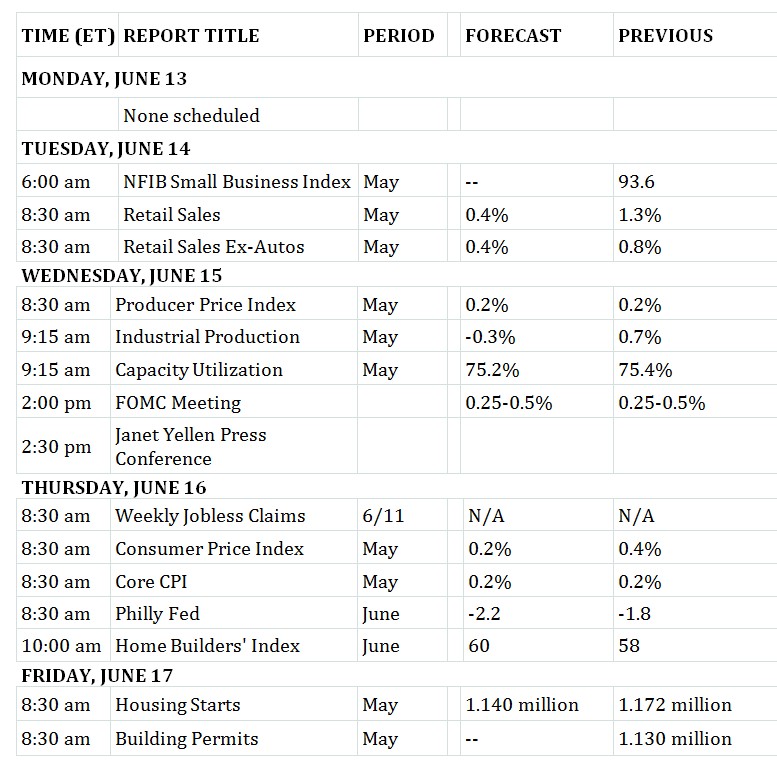
This week we see another FOMC meeting where the odds are low that any action on interest rates will take place. We can’t imagine any rate increase being helpful to economic growth, and it is economic growth in the long run that moves stocks. Our guess is the Janet Yellen will hold her customary press conference on Wednesday at 2:30 PM and hedge her position. Financial stocks echoed this message, being one of the weakest performers last week. Until then the S&P Financial Sector had been chugging along, increasing over 4% in the last three months.
So what could shake things up? Second quarter earnings reports will start in early July. That is almost always good for a pre-announcement run-up in prices. And then there is that nagging reality, the presidential election campaign. This is a real wildcard for the market to digest. Until now, the primaries have had no impact. But that will change as the summer progresses.
Economic News This Week
The consumer is the key to the direction of the economy. Retail sales will be released Tuesday followed at the end of the week by Housing Starts and Building Permits. After a huge bump in April, expectations are for a Retail Sales drop to a modest 0.4% from the 1.3% the previous month.
The June FOMC meeting takes place on Tuesday and Wednesday with Janet Yellen’s press conference at 2:30 PM on Wednesday. Rather than any change in rates, you should look for subtle changes in Yellen’s posture.

BMR Companies and Comments
For many weeks in this newsletter we have shared the view that 2016 is a year when stock picking will be the key to investment success. So this week we want to spend most of the Bull Market Report on money-making stock ideas. Here we go.
Twitter (TWTR: $14.02, down 8% on the week) The stock has had a rough ride this year. There is no shortage of naysayers about the future of Twitter. We disagree. Here is why: Twitter is an iconic service and a globally recognized brand. It has over 310 million users and growing. Twitter has compiled a treasure trove of data that many social media companies would pay dearly to own.
Since founder Jack Dorsey returned to the CEO spot last year, he set out to improve Twitter’s user experience and that means committing serious resources to Live Steaming Video. Execution of this strategy will begin to bear fruit later this year when Twitter will stream certain NFL games on Thursday nights. Twitter usage has always been at its highest during big real time sporting events so don’t be surprised when more deals of this type are announced.
In the meantime, active users grew 3% to 310 million in 1Q16. The company is doing a great job in monetizing its users as advertising revenue in 1Q16 jumped 36%.
Dorsey is taking the company in the right direction. Even the skeptics concede, the company customer database is an asset that competitors would love to get their hands on. The list of potential suitors includes giants like Google and Facebook as well as desperate companies like Yahoo. Will one of these firms, or another that we haven’t thought of yet, like Sony or Samsung, make a play for the firm and drive the price to $20 or higher? How this all works out will not take much longer. Our guess is less than a year. Twitter is relevant in 2016 and will be relevant in 2017 and beyond, and thus has tremendous value at $14 a share, just $10 billion in market cap.
Gilead Sciences (GILD: $84, down 2%) Last Monday, a US District Judge threw out Merck’s patent infringement suit against Gilead. The judge accused Merck of perjury and unethical practices. Gilead had already paid $200 million to Merck in compliance with the lower court ruling and charged this to 1Q16 earnings. Not only does this charge get reversed, but the requirement of a 10% royalty payment is also eliminated.
This changes everything. Let’s focus on its drugs, Harvoni and Sovaldi. These two drugs have generated sales of more than $30 billion, marking the biggest drug launch in history. Merck’s version of the drug contains the patented formula called sofosbuvir, and is priced about one half of Harvoni. But if Gilead is the legal owner of sofosbuvir, it is Merck that will have to license it from Gilead. Once investors appreciate the implications of Monday’s ruling, the stock will move higher. We are strong believers in this company.
Facebook (FB: $117, down 2%) Facebook has been a top performing stock in the Social Media sector this year and one of the big gainers in the market overall. When you are on top as Facebook is there are lots of critics that try to chip away looking for any flaws in their strategy. How can you fault a company strategy that has created a stock valuation of $330 billion and that grew revenues 52% in the latest quarter?
Team Zuckerberg is doing an amazing job keeping the company relevant. Remember, Facebook is only 12 years old, ancient in tech circles. The company showed their smarts by adapting to mobile platforms, messaging, and importantly, with the 2012 acquisition of Instagram where the demographic is younger than the average Facebook user. Month after month both Facebook and Instagram rank in the top 10 of free app downloads. This is a sure sign of enduring customer loyalty.
It is Facebook’s constant attention to improving user experience that keeps them on top. At the same time, they haven’t lost sight of longer-term diversification opportunities. That’s what makes the company so compelling. Here are two great examples: Last Wednesday, Facebook added video capability to the Comments window. Now instead of typing or texting, users simply tap an icon and send a live video comment. According to the industry authority, TechCrunch, by 2020, video will represent over 80% of Internet traffic.
Finally, we also learned last week that Facebook has begun testing a new money transfer and payment system in China. This is the beginning of a giant long term opportunity. Faithful investors in Facebook are being rewarded and the end is nowhere in sight.
Qualcomm (QCOM: $54, down 2.0%) Call it smart stock picking or good timing. Qualcomm, with a 26% gain after being added to our Stocks for Success in February, is a winner. (We think it is just fabulous stock picking!) As you know, Qualcomm is all about mobile computing with its Snapdragon - System on a Chip. Qualcomm offers a range of models from basic mobile phones to the latest Smartphone’s from Apple and Samsung.
Mobile phones are simply the largest selling consumer electronics device ever invented. Almost 1.5 billion Smartphone’s were sold worldwide in 2015. Add to that an additional 500 million non-internet feature phones and you have a picture of how big Qualcomm’s market measures. By 2019, according to Gartner Research, sales of all types of mobile phones will reach 2.4 billion.
The wind is still at Qualcomm’s back and we feel the stock is still undervalued. Wall Street is estimating 2016 earnings of $4.10, giving the company a lowly multiple of 13. The dividend is running at $2.12 annually, a tidy 3.9% yield. Wall Street believes earnings will grow more than 10% a year over the next five years. The balance sheet is loaded with $30 billion in cash and more is piling up every year. This is a huge reserve for future dividend increases or value-enhancing stock buybacks. A stock with all this going for it is worth much more than today’s price. It is time to get invested in this high quality issue.
LinkedIn (LNKD: $131, down 3%) The stock got a nice boost last week by RBC Capital, upgrading their recommendation to Outperform with a $160 price target. We agree the stock will trade higher but $160 is just a short-term objective. Remember, the all-time high was reached a little more than a year ago when it hit $276.
LinkedIn is the place to go to connect to jobs and career advancement advice. The site has a lot of “stickiness” – a measure of the time spent browsing the website. Advertisers love to use this measure and LinkedIn has a lot of it. It consistently ranks among the highest traffic websites and in a recent survey, 20% of LinkedIn followers even use the site as their primary news resource.
Two thirds of its global business is what LinkedIn calls Talent Solutions. The search for a new or better job remains vibrant. Revenues in 1Q16 from LinkedIn Talent Search jumped 40%. The low unemployment rate in the US hasn’t slowed business a bit. Now the company is launching Profinder, its own freelancing service. The temporary and part time labor force amounts to about 20% of all employment. Intuit predicts by 2020, the total will rise to 40%. So, this is a smart and timely move by LinkedIn.
Fitbit (FIT: $14.10, down 4%) We made the tough decision last week to remove Fitbit from our Special Opportunities Portfolio. We added the stock in March at $14.55 and removed it last week at $14.40. The stock has done nothing in that time and this may be the case in the future. There are some real questions that concern us about the market for wearable devices. Such as: 40% of fitness devices wind up sitting in a drawer after only a few months of purchase. The accuracy of the devices is also being brought into question by a class action lawsuit. This is not good news. Interestingly, there was an upgrade on the stock that came out Friday that we issued a News Flash on, but the stock dropped anyway. Listen: We took a shot and the stock is down only 1%. It didn’t work out but just as importantly, we didn’t lose any money.
The Apple Corner
Apple (AAPL: $99, up 1%). Apple held up nicely this week. Watch for announcements from Apple's hotly anticipated Worldwide Developers Conference (WWDC), which takes place Monday. There are a few rumors about it of course. Apple is reportedly looking for real estate in the San Francisco Bay Area to serve their self-driving car project. They are said to be looking at an 800,000-square-foot plot. (That’s big.)
We continue to be amazed at how many iPhones are out there compared to the Androids. We live in a wealthy area, Aspen, so our results are skewed, but in our town we would guess the split between Apple and others is in the neighborhood of 80-20, and we might just be low. We think intelligent people see the tremendous value the iPhone offers. And even though iPhone sales were in a “slowdown” last quarter, it was just a smidge, as sales continue at an amazing pace, and the cumulative number sold could reach 1 billion by late 2017. In April, CEO Tim Cook stated that the iPhone installed base had grown by 80% in the past two years. Upgrades now drive most of Apple's iPhone sales, but the iPhone is still bringing in tons of new users. We are looking for iPhone sales to rise by over 10% in 2017. And Apple is poised for another year of 10%+ growth in 2018. The number of people switching to the iPhone from Android is at a record high. There is plenty of room for smartphone ownership to rise in emerging markets, too. Both of these trends support the continued growth of Apple's iPhone installed base.
These numbers talk to us as we know that it will produce revenues from the App Store, and from the fact that people fall in love with the device and then want an iMac and an iPad. The iPhone is a franchise that won’t quit and with the iPhone 7 coming out in September there is only more good news to report about late this year and next.
BMR Take: Things are quiet lately on the Apple stock price front. But not with the company. They have 110,000 employees working to make life better for all of us. The cash hoard is huge and growing, and it’s only a matter of time before something new and exciting happens at this firm. We are strong buyers here at $99 a share.
Tesla Update
Today, Apple is the largest company in the world by market cap. But Tesla Motors (TSLA: $219, flat) could rocket so high in the next 10 or 15 years that the current $32 billion market cap could exceed even Apple’s $540 billion.
This is according to Ron Baron, CEO of Baron Capital, who went on CNBC recently to rave about Tesla. He has a $300 million position in the company and he thinks the stock could grow up to 20 times its size in the next 10-15 years to the $650 billion level. He expects to make $6-7 billion off of that position as Tesla becomes one of the biggest companies in the entire world.
He says: “The competition is nowhere. They could have caught Elon Musk four or five years ago, but they can’t catch him now. He’s too far ahead.”
Why? Well, for starters, all the things we have been saying about the company. Like the billions of dollars they’ve invested in its Gigafactory, which is nearing completion in Nevada and will be responsible for supplying batteries to the millions of Tesla Model 3s it produces once the car hits the streets in 2018.
Baron sees the ability to mass-produce batteries at such a massive scale as an absolute necessity for anyone hoping to compete with Tesla head-on in electric vehicles. The Gigafactory, according Musk, will have the largest footprint of any building in the world - the Gigafactory will be the largest building by area on the planet earth.
BMR Take: What can we say? We agree!
ENERGY CORNER
Notes at the Margin
by Phil Verleger, Jr., International Energy Expert
Former Director of the Office of Energy Policy at the Dept. of Treasury
www.PKVerlegerLLC.com
Markets were pulled and pushed last week. Attacks on producing facilities in Nigeria and new fires in Canada added upward pressure. Our estimate of a $15-per-barrel disruption premium is probably out of date. By Wednesday, it may have risen to $20.
However, the disruptions do not seem to have attracted hot money. At this juncture, we see a decrease in prices back toward $30 per barrel as disruptions in Canada are resolved and the Nigerian situation stabilizes. The forecast, though, depends on such developments, an assumption that may not be reasonable.
BMR Take: With Crude hovering at $50 the world just feels better. This might seem simplistic to you but remember how we felt when crude hit $30 and then saw it dip below into the 20s? People were talking about $20 oil then and the massive bankruptcies that were going to go with it. And people were afraid and worried. Even at $50 we are seeing some bankruptcies and restructurings, the latter generally a good thing. So at $50 there is hope. If crude heads to $30 again as Phil Verleger thinks above, then things could get dicey again, with the overall stock market more than likely heading lower. Conversely, at $50 the Energy world is much more stable, which lends itself to a stable stock market and growth in the economy.
High Yield Portfolio Corner
The iShares High Yield Corporate Bond ETF (JNK: $84) ended the week with no price action, after jumping up over 1% in the middle of the week and falling by the end of the week. Similarly, the UBS ETRACS BDC ETF (BDCS: $20) saw no real move this week, although it was significantly weaker and more volatile than junk bonds, which is not terribly unusual. The dramatic no-move of the week is a result of broader macroeconomic fears. With weak jobs growth, investors are starting to get scared that the fundamentals of America may be a tad weaker. Still, the market remains in risk-on mode, as evidenced by junk bonds still managing to hold their pricing for now.
Government Properties Income Trust (GOV: $20, up 1%) had a modest gain that outperformed most high yield stocks, thanks in part to an end-of-the week bump that moderated on Friday as the market broadly became more cautious. Still, market confidence in management remains solid, and for good reason. The company has changed the structure of its operations somewhat in recent months to find higher returns. They began investing in non-government office properties to offset weak government expansion. So far this helped bolster overall occupancy rates and FFO. We see this as more of an opportunity as a risk. The company's continued strong dividend payout coverage is a testament to management's ability to invest wisely and enrich shareholders.
Pimco Dynamic Income Fund (PDI: $27, down 1%) saw a decline this week, but that's good news - the fund paid a dividend this week, which accounted for almost all of those losses. (As we’re sure you know, when a stock pays a dividend it goes “x-dividend” and the stock opens for trading on that day, down the amount of the dividend it is paying.) This fund continues to maintain its payout and is now trading at a slight premium to Net Asset Value, making it still an attractive hold. With continued declining defaults in the mortgage market and a stable corporate bond market, this fund is having no problem maintaining its 10% dividend. We hope you bought some earlier this year when we recommended it, as you got this stock much cheaper - and got a yield of 11% (plus some hefty unrealized short-term capital gains). We are still holding on to this one as it's one of the best income producers out there.
Enough about steady stocks - let's talk about a monster. Digital Realty Trust (DLR: $102, up 3%) posted another week of sharp gains, helping it to rise 36% year-to-date! That's a staggering number, which just goes to show that REITs can sometimes provide more than just income. What's the story here? Two things are going on. Firstly, Digital Realty had an awful 2015, where the REIT industry broadly suffered from a broad-based de-risking. Investors, fearing the next market downturn, began to offload REITs, and Digital Realty was a victim. Secondly, and more importantly, Digital Realty has made some significant operating expansions that will grow its Funds From Operations more than many had anticipated. Late to the party, those bulls are now jumping in. Good for us, since we got in much earlier and closer to the bottom. If you are not in, we would still be buyers here. Paying a solid 3.4% dividend, we expect a dividend increase in the next six months.
Overall, this was a ho-hum week for high yield in general and a good week for our High Yield Portfolio. The overall stock market still is looking for a reason to correct. The awful jobs report from last month, where just 38,000 new jobs were added and the unemployment rate dropped because people gave up looking for jobs, is the beginning of a good excuse. We're not necessarily bearish on the market, but we are cautious - and our cautiousness grows every week the junk bond market doesn't decline. Junk bond yields as measured by the Merrill Lynch High Yield benchmark have fallen to their lowest point in a year and have not been this low since seeing major corrections late in 2015 and earlier this year. This is happening despite higher bankruptcy rates, which suggests higher risk and thus higher yields for these bonds.
The gains we had in the last few weeks were great for our portfolio and give us some confidence, This will be a great opportunity to add a bit more to the portfolio and gain more income at higher yields.
Good Investing!
Todd Shaver, Editor in Chief
Info@BullMarket.com
May 15, 2016
by Todd Shaver | May 15, 2016 | Weekly Newsletter 7pm Sunday
THE BULL MARKET REPORT
MAY 16, 2016
Corporate CEOs Are Lowering Expectations
After the third week of lower stock prices, any froth left over from the February rally has evaporated. To paraphrase Shakespeare, Friday closed not with a whimper but with a bang. Unfortunately, lower. Nasdaq is leading the downside move but all major markets experienced a bit of sober thinking. Don’t let this be a distraction. The adjustment is creating opportunities for us.
Are investors selling in May and going away or just confused by May and hiding away? There is a chasm between economists who, after taking a look at poor 1Q16 GDP numbers, believe there will be a step up in the pace of growth from here. The very corporate executives whose job it is to deliver results disagree. The companies lowering guidance for 2016 is substantial. Last week the consumer sector got a full dose of lowered expectations and for these companies, things got ugly.
| Key Market Measures (Friday Close) |
|
|
|
|
|
| Dow Jones |
17,535 |
-206 |
-1.2% |
| S&P 500: |
2,047 |
-10 |
-0.5% |
| Nasdaq |
4,718 |
-18 |
-0.4% |
| Crude Oil: |
$46 |
+$1 |
+2.2% |
| Gold: |
$1,290 |
-$15 |
-1.2% |
What Is Going On with Consumers?
Stocks had a rough week. Just when you thought the risk of earnings season was over, along comes Disney and Macy’s. Both of these consumer bellwethers did the unthinkable. Macy’ s reported disappointing numbers, falling short on revenues and earnings. Disney (DIS: $101) was down 5% for the week while Macy’s (M: $31) was even less fortunate, down 17%. For Disney, it was soft theme park attendance while Macy’s is struggling with lower store traffic.
Then came Thursday’s news after the market closed. Nordstrom (JWN: $39, down 18% for the week – all prices are for the week), Kohl’s (KSS: $36, down 14%) and JC Penny (JCP: $7.58, down 8%) each reported a big miss in earnings. Worse yet, each lowered guidance. Wham, suddenly the woodshed got really crowded. Double-digit stock declines followed in many cases.
Pieces of the mosaic began to fit together with the Wednesday surprise jump of 24,000 in Jobless Claims. Bonds rallied reducing yields to their lowest levels since February. The odds of an interest rate hike anytime soon further diminished.
So, the conclusion is obvious: The consumer is in trouble and recession is ahead. There is no other possible explanation. Wrong. Friday showed April retail sales jumped an incredible 1.3% led by surprisingly strong Autos, while the Consumer Sentiment Index took its biggest jump in years going from 89.0 to 95.8. Forecasting the future is not as easy as it used to be.
Are these signs of a continued trend toward online shopping or is everybody shifting to discount stores? Nobody we spoke with has the answer. This is why our favorite retailer is Home Depot (HD: $133, down 2%). Online commerce is a blessing, not a threat. And when you are looking to buy a 2x4, it is hard to find a lower price for lumber anywhere. Note: We just got back from a visit to Home Depot as we travel the country this month, now in New Hampshire. Let us tell you – it was packed. A very good sign for Home Depot and for the economy.
Tech: The Secret of the Market
For the third week, the Nasdaq has lagged the overall market and is down 6% year to date. That is a whole lot worse than either the Dow Jones or S&P 500. Last week we talked about a market correction, pointing out the deteriorating of the Nasdaq as the traditional leading indicator. There is a reason for this and it comes from Tech stocks. The index is market weighted so the higher the market cap, the more the influence in the level of the Nasdaq Composite Index. The 10 largest companies include the best-known names in technology. This group represents 50% of the index, including Amazon (AMZN: $710, up 5%), Apple (AAPL: $91, down 2%), Alphabet (GOOG: $711, unch.) and Facebook (FB: $120, unch.). All 10 represent a staggering $2 trillion of stockholder value.
As Technology goes, so goes the market and with some of the biggest names like Apple and Netflix (NFLX: $88, down 3%) under pressure, others could follow. There are some great opportunities being created. Let’s take a look at a few.
BMR Company Commentary
Apple. This week Tim Cook announced Apple will invest $1 billion in Chinese ride-sharing company Didi Chuxing. The Didi investment is small change as Apple has $220 billion in cash and over $230 billion in revenues, but will give analysts plenty to talk about. Didi is the Uber of China. Analysts speculate the move could boost Apple’s plans for autonomous driving vehicles as well as a ready-made customer base for Apple Pay. We agree, both options represent huge markets. Apple needs a lot more big, creative ideas like this.
Meanwhile the stock is selling at its lowest valuation in years: 10 times earnings and you get a 2.5% dividend while waiting for the next wave of technology to drive the stock to new highs. This is outstanding value we haven’t seen in years.
United Parcel Service (UPS: $101, down 1%) UPS is an obvious beneficiary of the transition in retail from bricks and mortar to home delivery. Last week, one of CNBC’s retail experts predicted online commerce would rise from the present 7% share to 50% over time. Translated into English, we are talking about several trillion dollars of incremental business. This is huge. The stock sells for a bit less than the overall stock market multiple (18 versus 22) and you get a 3% dividend yield. We see no upper limit to the growth of this firm, in revenues nor stock price.
First Solar (FSLR: $49, down 6%) Solar stocks have had a rough ride this year. Price competition and the drop in competing energy costs have not helped. But we see light at the end of the tunnel: and it is sunlight! What we like most about First Solar is their superior production techniques, followed by the volume produced by their Systems Operations division. These are the folks that design, engineer and install large systems for public utilities, corporations and the major energy users in technology. The stock is finally getting the respect it deserves. In the past month, three Wall Street firms have initiated coverage; two with buy recommendations. You can add our buy recommendation to that list.
Twitter (TWTR: $14.10, down 1%) It seems true, nobody loves you when you are down and out. Well Twitter may be down, but far from out. Founder Jack Dorsey’s return has hardly had time to produce much beyond the Thursday Night Football deal with the NFL. Don’t forget the value of over 300 million Twitter users. And with the stock selling at less than half its 2013 IPO, at current levels the company is an attractive takeover. Some might say a bargain.
Barrick Gold (ABX: $18.41, unch.) Barrick has been a monster since the February 9th addition to our list of favorite stocks - up 64% in a little over three months. It’s not over by any means. In a time of negative interest rates in key global economies, gold is a logical alternative. Unlike the bullion, with the shares of Barrick Gold there is no added cost for storage. Lately, earnings haven’t been much to write home about but that hasn’t deterred Wall Street analysts who have been upgrading the stock, now with a $25 price target. Yea team, go for the (Barrick) Gold!
Annaly Capital Mortgage (NLY: $11.05, up 2%) We had a letter to us on our website from Jerald Wilks:
Is it too late to buy this stock since it is at its 52 week high and nearing your target price?
Hi Jerald - We have loved Annaly for almost 20 years, since we started The Bull Market Report in 1998. The stock has gone up and down during this time for various reasons. They have survived bull markets and bear, high interest rate environments and low, and the one thing that has been constant is that they have paid a high dividend year in and year out. The company was formed in the late 90s and early on paid a constant dividend each quarter. Years ago they switched to a variable interest rate which is much smarter because obviously earnings vary month to month.
Wall Street always gets worried about Annaly when there is a threat of higher interest rates (like now and for the past 10 years!) but what most don’t realize is that the company actually thrives during higher interest rates environments. The Street just doesn't get it. The company’s portfolio of mortgages is laddered so if rates go up, the money they get back from maturing issues is reinvested at higher rates. Simple. Elegant.
More Commentary on Annaly: To review, the company makes money by leveraging their equity 4 to 5 times and investing in US Government backed securities, like Freddie Mac and Fannie Mae. The spread on their borrowings is about 3%, multiplied by the 4-5 times leverage. Thus they are able to pay their executives ridiculous amounts ($25 million+ - which makes us CRAZY at The Bull Market Report – but if you can get over this and just look at the dividend, then you can go on with your lives. We have, but it’s not easy.)
One more thing. If interest rates go up, yes, their cost of borrowing goes up, but so does the return from their investments. This is why we don’t get worried like the Street does.
Annaly is currently paying a dividend of 10.9%.
Economic Data This Week: CPI and Housing
Is inflation finely hitting the Fed’s target? We get some insights this week when both Consumer Price Index and core CPI are released before the opening on Tuesday. The consensus is for a big jump in both which is consistent with the resurgence of higher energy prices. Nevertheless, the news will reignite speculation in the interest rate futures market and this brings the FOMC back to center stage. We still hold strongly to the belief that interest rates will remain stable and that monetary policy is no longer as an effective tool for managing the economy as it used to be.
The Washington Data factory will be busy cranking out housing numbers this week with expectations for stability in the month of April. The word stability is not what option traders feast on but that is the way some weeks unfold.
Industrial Production and Capacity Utilization are normally two boring statistics but this week could be different. Believers in the theory that the economy is rebounding from a soft first quarter will be watching Tuesday at 9:15 AM. Our own theory is that expectations are too high and if things turn out that way, it will affect Tuesday trading, not in a positive way.
| RELEASE TIME (EST) |
REPORT TITLE |
PERIOD |
|
FORECAST |
PREVIOUS |
| MONDAY, MAY 16 |
| 8:30 am |
Empire State Index |
May |
|
9.0 |
9.6 |
| 10:00 am |
Home Builders' Index |
May |
|
-- |
58 |
| TUESDAY, MAY 17 |
| 8:30 am |
Consumer Price Index |
April |
|
0.4% |
0.1% |
| 8:30 am |
Core CPI |
April |
|
0.2% |
0.1% |
| 8:30 am |
Housing Starts |
April |
|
1.090 million |
1.089 million |
| 8:30 am |
Building Permits |
April |
|
-- |
1.076 million |
| 9:15 am |
Industrial Production |
April |
|
0.5% |
-0.6% |
| 9:15 am |
Capacity Utilization |
April |
|
75.2% |
74.8% |
| WEDNESDAY, MAY 18 |
| 2 pm |
FOMC Minutes |
April 27 |
|
|
|
| THURSDAY, MAY 19 |
| 8:30 am |
Weekly Jobless Claims |
May 14 |
|
N/A |
N/A |
| 8:30 am |
Philly Fed |
May |
|
3.0 |
-1.6 |
| 8:30 am |
Chicago Fed National Index |
April |
|
-- |
-0.44 |
| 10:00 am |
Leading Indicators |
April |
|
-- |
0.2% |
| FRIDAY, MAY 20 |
| 10:00am |
Existing Home Sales |
April |
|
5.40 million |
5.33 million |
Alibaba Group (BABA: $77, down 2%) Famous short seller Jim Chanos is betting against Alibaba. The company reported strong revenue growth last week, but now this quite powerful short seller revealed a short position in the company last week.
We’ve all heard that the Chinese economy is slowing down and some say it’s only a matter of time before it takes consumer spending with it. This is one reason Chanos thinks the stock is going lower but he also says that Alibaba doesn’t report the costs of its delivery operations on its U.S. financial statements. The company classifies the delivery segment as a separate entity. Chanos says that it uses up most of the company’s cash flow. He says that if the costs of the delivery operations are unknown, then it’s impossible to know the truth about their bottom line.
BMR Take: We don’t know and it appears no one else knows the true story either. This is why we have stated that we generally don’t invest in Chinese stocks. (We have always felt that there are enough stocks in the US to satisfy us and most investors.) We do hope that the authorities in China and this country wouldn’t allow a company to cheat or lie on their audited financial reports. One would think that there would have to be an awful lot of collusion among many professional firms and people for this to happen. Are we naïve? Maybe so. So this is about all we can say until the financials become more clear. We continue to remain bullish on the company.
We do know this: Chanos HAS a short position, which we assume to be large. But remember, a large short position is quite bullish.* We are watching closely and will update you via News Flash if our position changes.
*Because the shares have already been sold which has pushed down the price. The only thing a person with a short position can do is to buy back the stock, which is bullish.
Energy Corner - Market Commentary
Notes at the Margin
By Phil Verleger
www.VerlegerLLC.com
Phil Verleger is one of the foremost authorities on energy in the world.
Oil is behaving like a true commodity. Last week buyers and sellers learned that the Canadian “crop size” had been cut by the fires that destroyed Fort McMurray. Buyers and sellers also learned that production in Nigeria had been disrupted by terrorists. Argus Media reported that Nigerian output dropped to 1.65 million barrels per day, 150,000 barrels per day below the 2015 average. Further declines can be anticipated as the civil war in the country’s south resumes.
There were also more indications of problems in Venezuela. US news media reported Friday on fears of a coup d'état. Friday night President Maduro extended emergency rule, and there were widespread reports of looting. Meanwhile, PetroChina canceled plans to build a refinery jointly with the country. Existing Venezuelan refineries were operating at 50% of capacity. The available information suggests Venezuelan production may have dropped below 2.0 barrels per day even though the Venezuelan state oil company keeps telling everyone that output is 2.3 million.
There are hints that worldwide crude oil inventories will start declining in the next week or two. Market data are generally good predictors of changes in reported stock levels. One may conclude that global supply at this minute is less than global consumption. The data suggest that global inventories will rise by 700,000 barrels per day in the second quarter assuming OPEC production holds at 31.9 million barrels per day, non-OPEC production at 56.5 million barrels per day, and global use averages 95.3 million barrels per day.
Expect crude prices to move towards $50 per barrel next week as further disruptions around the world depress supplies.
Options Corner
We’ve covered a lot of ground in the Options world in the last few months. We’ve discussed covered calls, deep in the money calls, naked puts, naked calls. A strategy for you if you think prices are going lower would be shorting a stock and covering it with a put that you sell, but you know what? We would guess that only 1% of options investors would be interested in this strategy. And options investors are only 1% of the world of investors, so you are looking at only 1% of the 1% which would be .01% of investors out there. Our numbers may be an approximation but we hope you get the point. So let's not cover this. If you do wish to hear a discussion of this concept, please write us at Info@BullMarket.com.
Let’s do this: As noted above, we have discussed selling naked puts and naked calls. What about selling a naked put and a naked call at the same time? This is called a strangle. The advantage of this is that if you are wrong on one side of the trade, you will be right on the other. But also, it’s possible to be right on BOTH of them too, which can be very lucrative. Let’s use a real example. Let’s pick a stock that you have no idea whether it will go up or go down from here. How about IBM. IBM is a $148 stock and has ranged from $117 to $174 in the past 52 weeks. Is it going higher or lower? Hard to tell. What if you went out to January and sold the $170 call and the $125 put. The call is selling for $2.25 and the put is selling for about $4.00. (Note that the market is telling us it thinks the stock may go down more than it will go up. The put is $22 away from the current price and call is $23 away, about equidistant, but the price of the put is way higher than the call. Puts are more dangerous than calls of course (Why? Markets don’t CRASH to the upside. They mostly crash to the downside; thus more risk.))
OK. So you sell the put and the call. You get $6.25 per share in your account the next day. That’s $625 for the two options (each option is for 100 shares) or $6,250 for selling 10 puts and 10 calls. Now, the fun begins - you sit back and watch IBM. The ultimate goal is for the stock to stay between the two strike prices of $125 and $170. If it does, you get to keep the $6,250. The danger is if the stock goes up or down and approaches or surpasses the strike price. If the stock goes down, the put will go up in price and the call will go down. What you want is for the stock to remain CALM. If the stock stays around $150 you are a happy camper. If it heads lower, that’s fine as long as it doesn’t drop sharply and quickly. So if the stock moves to $130 or so over a few months, that’s OK, but what you don’t want is for the stock to drop to $130 in the first week or month of this trade. Again, your goal is for the stock to stay calm and stay in the middle of the two strike prices of $125 and $170.
You aren’t stuck with these two positions. You can always buy back one or both of the options at any time. So if the stock drops and gets too close to the $125 strike, you can buy back the $125 put and sell one that is further away, like the $120 or the $110.
The key to selling naked puts and calls is to be safe. Remember, you are living in a very risky world here. VERY risky. But the goal is to produce cash without having to invest any capital, but just by using the margin in your account from your existing portfolio of stocks.
Questions: Write us at Info@BullMarket.com. We love to hear from you.
High Yield Corner
In a week of broad market declines, several high yield sectors suffered much worse.
The S&P 500 lost half of 1% in a week of light macroeconomic data. Much of that decline was a result of Apple’s dramatic losses, which came mostly from renewed worries that the company’s decline in iPhone sales is just beginning. In addition, Retail was weak, as discussed above.
Yet other markets are hinting at underlying macroeconomic weakness that could also be contributing to stocks’ weak showing. REITs saw a drop, with the SPDR Dow Jones REIT ETF (RWR: $95) losing nearly 2%. Of course, part of this is a correction, since the ETF rose 7% from the start of 2016 to its peak earlier this week. But the weakness is also due to several REITs announcing earnings that were far from stellar. The strong fundamentals in REITs remain, but the market is realizing some may have been a tad overpriced.
In energy, MLPs saw a smaller decline, of a little less than 1.5% in the year as evidenced by the Alerian MLP ETF (AMLP: $11.90). The decline in MLPs is interesting. Oil rose by 5% during the week and MLPs have been closely correlated to oil since the commodity’s decline began in 2014, although management at many MLPs assured investors that their business model would not be negatively impacted by oil price shocks. The market didn’t listen, because it began discounting MLPs significantly, and the correlation lasted until just a few weeks ago, as we discussed here at The Bull Market Report. The decoupling in MLPs and oil prices may indicate that MLPs are trading much more on fundamentals, a good thing in our book.
Earnings season for BDCs is mostly over, and the USB Wells Fargo BDC ETF (BDCS: $20) was up slightly as most companies reported better than expected earnings, as we discussed last week. Finally, we saw Prospect Capital (PSEC: $7.57) report earnings this week, and the company’s light decline in net asset value was not enough to keep the stock from gaining 3% this week. Fortunately, the company's dividend coverage remained intact, as BDCs are finding it easier to cover dividends with their net investment income.
We still much prefer Main Street Capital (MAIN: $32), which had an increase this week of 1%. Its high net asset value and continually growing net investment income per share make us still believers. The BDC sector more broadly is looking much better for investors as a whole.
Todd Shaver
Editor in Chief
The Bull Market Report
May 1, 2016
by Todd Shaver | May 1, 2016 | Weekly Newsletter 7pm Sunday
The Good News and The Bad News
It’s true. The market finished April with the third month in a row of gains. The Dow gained 8%. The S&P 500 showed a 6.5% increase. Meanwhile the Nasdaq posted a 3.5% increase. That should all be good news - except for last week.
That’s when the market had it toughest period in over two months. Stocks in the Nasdaq fell the biggest. This caused a renewed bit of fear. The CBOE volatility index, generally considered a gauge of investor fear, jumped 10% to the highest level since mid-March - ^VIX: 15.70.
What was the cause of this newfound fear and trepidation? Earnings report season no less. It was a week of key earnings reports being joyfully good or painfully bad.
Elsewhere in world, Crude continued to march upward closing the week at $46, up another $2 while gold added 5% and the US Dollar was weak.
Here is how the week measured up:
| Key Market Measures (Friday Close) |
|
|
|
|
|
| Dow Jones |
17,774 |
-230 |
-1.3% |
| S&P 500: |
2,065 |
-27 |
-1.3% |
| Nasdaq |
4,775 |
-131 |
-2.7% |
| Crude Oil: |
$46 |
+2.00 |
+4.6% |
| Gold: |
1,295 |
+59 |
+4.8% |
We are now through the heaviest period of 1Q16 earnings season. One thing is quite evident. Woe be to those who disappoint. The list of some of those who disappointed includes Xerox (XRX: $9.60, down 14%), Goodyear (GT: $29, down 11%) and Corning (GLW: $18.67 down 11%). The cost was double digit declines for each. However, an equally big bomb last week was Apple (AAPL: $94, down 11%) followed by Gilead Sciences (GILD: $88, down 14%). Little wonder the Nasdaq ended the week in the dumps.
Before going into more detail on Apple and Gilead, there are several questions raised. If the market weren’t so highly valued, would the reaction to earnings disappointments have been so draconian? The answer is obviously no. But this is a key signal; something to keep in mind as we move forward. The second thing that jumps out when we compare these five companies above, is how much they reflect the broad base of the economy. In other words, are weak earnings a corporate level disappointment or, as the phrase was coined in the first Clinton Administration, “It’s the economy, stupid.” We raise this issue after pouring over the stack of quarterly earnings reports and noticing the large number of reporting companies that managed to hit their target EPS but were short of target on revenues. The past month has proven that our cautious attitude has been premature as the market rises to record levels. That’s OK; we prefer to protect your interests even if that means being a bit too conservative.
Mixed Results with the FANG Stocks
Facebook (FB: $118, up 7%) and Amazon (AMZN: $660, up 6%), were both rewarded after blowout quarters. Alphabet (GOOG: $694, down 3%) felt the pain of falling short both in revenues and earnings. Netflix (NFLX: $90, down 4%) reported last week showing solid results. More later about these stocks.
GDP: It’s The Economy
Data was pouring out of Washington at a fast pace last week. Unfortunately, it revealed the economy wasn’t moving much at all; only 0.5% in the first quarter. This was less than the often-reduced expectation of 0.7%. When the number was released before the opening bell on Thursday, it only added a bit more fuel to the market sell off.
Reports on the consumer front showed that people are getting cautious. Weekly Jobless Claims were pretty much on target. Personal Income grew a tidy 0.4% which also matched expectations. But Consumer Spending gained only 0.1%, half as much the previous month while both Consumer Confidence and Consumer Sentiment fell unexpectedly. And other measures of consumer behavior, like housing, showed disappointing results in both New and Existing Home Sales.
FOMC - The Family Feud Continues
Hope you weren’t surprised that last week as we failed to mention so much as a single word about Thursday’s Federal Open Market Committee (FOMC) meeting. That’s because, with the exception of the continuing public disagreement among its members, there was nothing worth discussing. Our take is that we still don’t look for more than one interest rate increase, at most this year. When this finally sinks in with the market, things should calm a bit and this should counteract some of the other negative news.
Technology: Changing Leadership
It is an interesting time for technology. The latest cycle in technology that began with the introduction of the first iPhone in 2004 has been long and glorious. Smartphones have helped usher in all the bells and whistles that followed like mobile computing, the Cloud, an App for everything, and on and on the list goes.
Even if the iPhone 7, when introduced this coming September, turns out to be truly awesome the Smartphone era is waning. Technology has been through this many times so there is nothing new here. The Cloud may still have a glorious future, but nobody would ever camp out for three days in front of an Apple Store to buy a Cloud. So, for investors and gadget freaks, the question is - what is the next “Big Thing” and when is it arriving?
The future is filled with some giant opportunities wrapped in acronyms like AV (Autonomous Vehicle), VR (Virtual Reality), and AI (Artificial Intelligence). Each of these is still a ways off.
Until that day arrives, gadgets are giving way to software and social media in answering the question: Who has the highest growth opportunities? This is why the light is shining so brightly on companies like Facebook and Amazon.
Economic Reports This Week
This week Washington Data Dump will provide a few additional economic clues. If 1Q16 GDP weakness is likely to continue, one sign will come on today at 10:00 AM with the Institute for Supply Management. It is the first and the freshest reading on how things shaped up in April.
The best read of the week on the consumer comes on Tuesday with Motor Vehicle Sales for April. Again, this is an early read on the month just ended and forecasters are looking for a 1 million-unit bump up in sales. This is very aggressive and offers a strong probability for disappointment. Earlier we pointed out how Goodyear had a disappointing first quarter. There is a reason we mentioned that. If tires aren’t selling, cars probably aren’t either.
For further information about this week’s earning reports please check out our Earning Previews report we emailed you Sunday and here on the website.
| Release TIME (ET) |
REPORT TITLE
|
PERIOD |
|
FORECAST |
PREVIOUS |
| MONDAY, MAY 2 |
|
| 10:00 am |
ISM |
April |
|
51.5% |
51.8% |
| 10:00 am |
Construction Spending |
March |
|
0.7% |
-0.5% |
| TUESDAY, MAY 3 |
|
| TBA |
Motor Vehicle Sales |
April |
|
17.0 million |
16.5 million |
| WEDNESDAY, MAY 4 |
|
| 8:15 am |
ADP Employment |
April |
|
-- |
200,000 |
| 8:30 am |
Trade Deficit |
March |
|
-$44.5 billion |
-$47.1 billion |
| 8:30 am |
Productivity |
Q1 |
|
-1.1% |
-2.2% |
| 8:30 am |
Unit Labor Costs |
Q1 |
|
2.4% |
3.3% |
| 10:00 am |
ISM Nonmanufacturing |
April |
|
54.7% |
54.5% |
| 10:00 am |
Factory Orders |
March |
|
-- |
-1.7% |
| THURSDAY, MAY 5 |
|
| 8:30 am |
Weekly Jobless Claims |
4/30 |
|
N/A |
257,000 |
| FRIDAY, MAY 6 |
|
| 8:30 am |
Nonfarm Payrolls |
April |
|
200,000 |
215,000 |
| 8:30 am |
Unemployment Rate |
April |
|
5.0% |
5.0% |
| 8:30 am |
Average Hourly Earnings |
April |
|
0.4% |
0.3% |
| 3:00 pm |
Consumer Credit |
March |
|
-- |
$17 billion |
Discussion of Stocks in our Portfolios
Alibaba (BABA, $77, down $3 for the week) Alibaba Executive Chairman Jack Ma and Executive Vice Chairman Joseph Tsai are spending $500 million to buy company stock as the Chinese Internet giant tries to shake off concerns that shopping on its sites will take a hit as China’s economy slows. This news is from late February but we thought it newsworthy to bring it to you. These two guys run the company and believe in it enough to put their money where their mouths are.
Following is an interesting story about Alibaba:
Chinese eCommerce giant Alibaba owns a 31% stake in Weibo. Weibo, which means “microblog” in Chinese, had 235 million monthly active users as of December, with Stephen Hawking the latest high profile figure joining the universe. Its revenue last year jumped more than 7fold from 2012. WOW. And unlike Twitter, it is making a profit.
Now enter Sina. Sina is a Twitter-like microblog social network, which has 55% of the Chinese microblogging market. The company has more than 500 million users with millions of posts per day, and is adding 20 million new users per monthly. Sina owns a prized a majority stake in Weibo. If Sina were to put their Weibo stake up for sale, Alibaba is the natural buyer. The good news: Alibaba has the right of first refusal. Apart from being Weibo’s second largest shareholder, Alibaba also contributed to most of Weibo’s revenue as Alibaba puts ads from its online merchants on the microblog.
Alibaba’s has plans to borrow up to $4 billion which has stirred up rumors that a bid for Weibo is forthcoming. Weibo’s shares have doubled since February as a result. But Sina is only up 27%. This means Sina’s 56% stake in Weibo now makes up about three quarters of its market value. Throw in the net cash and other Internet assets it owns, and Sina trades at a nearly 30% discount to the sum of its parts, assuming its portal business is worth nothing, according to an analyst at MCM Partners in Hong Kong. This raises an interesting possibility that instead of going after Weibo, Alibaba could pick up Sina instead. Alibaba has been acquisitive in the media space lately, buying Hong Kong’s South China Morning Post and the financial media firm China Business News. Sina’s assets, which include popular news and finance websites, may fit Alibaba’s media ambitions. Stay tuned.
Gilead Sciences (GILD: $88, down 14%) Gilead's 1Q16 results were below target and with that, the market severely punished the stock. Is this the end for Gilead? Not in the least. Here is what happened: During the first quarter, Gilead’s hepatitis C drugs Harvoni and Sovaldi saw $3.0 billion and $1.3 billion in sales, respectively. Analysts had expected $3.1 billion and $1.4 billion in sales so actual results were a shade light in both cases but certainly not earth shattering.
During the quarter, Merck (MRK, $55) introduced their hepatitis drug, priced considerably lower than Harvoni. This was known beforehand this so no one should have been surprised. We have little short-term concern because the potential market is so large. Harvoni and Sovaldi could rack up sales 2-3 times present levels. The market is that large.
Meanwhile after the close on Friday, Bloomberg News released a report that a Federal Judge had reopened the patent suit between Merck and Gilead. The existing ruling was favorable to Gilead, and although this move on the surface looks bleak, ironically, the judge’s action could be a huge blessing in disguise for Gilead. The judge cited perjured testimony from a key Merck witness. That could turn the whole case around putting Merck even more on the defense. We will keep you posted. In the meantime, we believe this is a great opportunity to buy the stock.
Alphabet
Google (GOOG: $693, down 4% for the week) The company showed consistent revenue growth, stable margins and gave cash back in the form of a $5.1 billion stock buyback last year. Last, but certainly not least, the company remains one of the best overall portfolio plays that focuses on the biggest Internet trends: The shift to mobile, wearable devices, video, the Internet of Things and much more. Alphabet delivers investors the full package.
The company reported results for the quarter that were below expectations, with JPMorgan calling it a “good quarter.” Despite missing expectations, the results overall were still very good, with revenue up 23%, and income growing 21% Y/Y on 1% margin expansion. JPMorgan lowered its price target to $925, with Wall Street consensus at $910, a lot higher than its current price. We would buy more here.
Thoughts on Upcoming Earnings for the Rest of the Quarter
From Gary Jefferson at Jefferson Financial
According to UBS, current earnings estimates now imply a growth rate of 1.5% for 2016, with a recovery in 2017 to 14% growth. If the already reported numbers are indicative of what the final outcome for the quarter will be, it looks like both the 1st and 2nd quarters will be on the bleak side, with most of the earnings being back-end loaded into the 3rd and 4th quarters. Baron's poll of money managers indicates that only 38% think the market is going higher. That makes sense – the market is a discounting mechanism, generally looking out 6 to 9 months into the future. There just isn't much "growth" expected this year. The way this scenario is shaping up, stocks don't have much room to rise until late this year when expectations may be better for mid- to late 2017.
Meantime, even though earnings don't look so bad given their greatly reduced expectations, fundamentally, global growth remains anemic and weaker earnings has caused a stretch in stock valuations. Mr. Market may be in a "consolidation" mood for a while.
Subscriber Question:
We had a question this week from a subscriber on why we have so many stocks in our portfolios.
[We don’t feel that we have too many stocks. We like to give you a choice.]
Here is what we wrote her:
Hi Margie –
We are sticking with about 20 companies in our Stocks for Success Portfolio. In the High Yield Portfolio, we are eventually going to have 15 or so, and Special Opportunities come up from time to time so we will add a few in this portfolio. We will be creating an Aggressive Growth Portfolio for those that are looking for bigger gains.
[Note: Please send us your thoughts at Info@BullMarket.com]
Apple Corner
Apple (AAPL, $94 down $11) had a good quarter but it wasn’t as good as the market wished. They sold 51 million iPhones; iPad sales were strong; the Apple Watch did well; their cash hoard went from $216 billion to $233 billion. In fact, for every share you own at $94, $42 of that is in cash – 45% of the stock price. This is an unheard of amount in the annals of investment. No other company still operating has had this much cash. They raised their dividend 10% and will be buying back more stock. Yes, Apple is now a Value stock. And what a value it is. If we owned it we would hold. If we didn't own it and were liquid and looking for a good investment, we would buy more here. Next year at this time the you will be happy you did.
Want to read about the Apple Watch on its 1-year anniversary? Good article here from a Tech Journalist:
http://mashable.com/2016/04/30/apple-watch-year-one/#VjEFEgk0sgqm
High Yield Corner
This was a fascinating week of significant contradictory divergences in the high yield world that is presenting significant opportunities to rotate holdings to take capital gains and get higher yields at lower prices.
Update on REITs: The property REIT world suffered a slight downturn last week but held up well compared to the overall stock market. The S&P 500 (^GSPC: 2065) fell 1.3% this week as investors mulled seemingly disastrous results at Apple (AAPL: $94, down $11), Gilead Sciences (GILD: $88, down $14), Twitter (TWTR: $14.602, down $2.60) and a few other companies, although it was a good week for Facebook (FB: $118, up $7) after they crushed expectations thanks to dramatically strong advertising revenues. The broadly weak earnings brought the market lower despite continued dovishness from the Federal Reserve, who hinted that a rate hike in June is possible, but not probable.
Property REITs suffered a small sell-off as a result, with the SPDR Jones REIT ETF (RWR: $92) ending the week down less than half of 1%, a performance matched by Realty Income Corp (O: $59), which fell about the same amount. Hospitality Properties Trust (HPT: $26) fell a bit more, at 1%, and was one of the hardest hit in the week.
But you should pay attention to the intraweek action. The week was mostly flat until Friday, when the SPDR Jones REIT ETF fell over 1% and Hospitality Properties Trust fell over 2%. That was the day when many REITs gave up their gains for the week, just as the S&P 500 suffered its major loss.
Friday’s price action is largely due to disappointment in the weak GDP spooking investors. With 1st quarter U.S. growth at just 0.5%, more investors have begun to worry that we are approaching a recession.
This has particularly affected stocks, but high yield bonds are being surprisingly resilient. While REITs are beginning to act in line with the stock market, high yield bonds are diverging. Friday actually saw a slight rise in the iShares iBoxx High Yield Corporate Bond Fund (HYG: $84), which rose to close the week up over half of 1 percent. Many bond Closed End Funds (CEF), like Bull Market Report favorite Pimco Dynamic Income Fund (PDI: $28), did even better; the Pimco fund ended the week up over 2%, and is still offering an income stream of nearly 10%, excluding special dividends, which it has been known to award recently.
Does this mean the debt world is getting complacent just as folks are getting fearful of equities? It seems so. The business development corporation (BDC) world had a slightly bad week, as evidenced by the Wells Fargo BDC ETF (BDCS: $21), which ended the week down 1%. That’s still better than the broader market, but isn’t exactly great. However, it should be noted that the BDC ETF did end Friday up as stocks were down, so it is holding the inverse correlation that high yield bonds are holding vis-a-vis stocks, as noted above.
The inverse correlation is actually much stronger if we ignore Prospect Capital (PSEC: $7.50), which suffered a 1.6% drop on a Deutsche Bank downgrade on concerns that its derivatives holdings are overvalued in its accounting. This brought the stock down 1.6% and brought the BDC market down with it, whereas Bull Market Report pick Main Street Capital (MAIN: $31) ended the week down less than 1%.
So if BDCs and high yield are remaining strong even as the market looks to turn lower, what can we expect going forward? Considering the big drop on Friday, we might be at the beginning of a mini-correction similar to - if not as bad as - the one we saw in February. The “sell in May and go away” adage may play out this year, although it hasn’t in previous years. But it looks like that trend will affect stocks first, and income second.
This could mean junk bonds and BDCs will lose value a short time after the market itself drops. If this trend plays out as it seems to be starting now, this could be a great opportunity to buy more high quality high income stocks while waiting for the market to come back to its senses.
Notes at the Margin
By Philip K. Verleger, Jr.
Energy Expert
http://www.pkverlegerllc.com
Venezuela Breakdown
The oil market story for 2016 is Venezuela. The country’s economic collapse has been spectacular. Within the last month Schlumberger (SLB) and Haliburton (HAL) have pulled out because they have not been paid. The firms that have been printing massive amounts of bolivar bills for the country have also not been paid. In February the media reported that the government chartered thirty-six Boeing 747s to bring additional currency in to meet the needs of citizens confronting seven-hundred percent inflation. The use of the planes brings to mind, in a much more inflated (pun intended) way, the experience of Germans ninety years ago. Back then it was wheelbarrows rather than 747s that shunted currency around, but the situation was just as dire.
This last week the Venezuelan government, attempting to deal with drastically reduced power supplies, ordered its employees to work only two days per week. Now all official business will be transacted on Monday and Tuesday—if, that is, workers can get to their posts.
The situation will degenerate. Last week people rioted in several Venezuelan cities. The uprising in one, Maracaibo, occurred after a twelve-hour blackout. Maracaibo is not just any city. It is the country’s second largest. It is also closest to the nations primary oil fields at Lake Maracaibo. The revolts are a harbinger of the breakdown of society in the country—and ultimately that of its oil production. The question is not if but when. Table 1 shows the potential effect of the collapse on IEA oil balances.
Historians will likely note the last week of April 2016 for the actions taken by Saudi Arabia to move beyond petroleum. On Monday, Deputy Crown Prince Mohammad Salman announced a $2 trillion program to change the direction of the Kingdom’s economy.
BMR Take: This mess in Venezuela will have profound effects on the world oil market as we know it. The Prince stated that they have no care whatsoever in the price of crude. $30? $70? They have couldn’t care less. Thus we believe they will pump like there is no tomorrow. Prices? Despite Venezuela: Staying lower.
Options Corner
Let’s talk about selling naked puts. First: Is this risky? YES IT IS RISKY. It is the riskiest type of option trading. Why? Because you can lose more than you invested. Repeat – you can lose more than you have invested. Why talk about this then? Because in moderation, selling naked puts can be very lucrative. It is a way to buy a stock at a lower price than it is now. Really? We like to say: Would you rather buy Apple at $94 now, or in three months at $86? (Love that question!) OF COURSE we would rather buy Apple at a lower price in the future than it is now.
OK, let’s use real numbers. Apple is at $94 now, as we know. The August $90 put is selling for $4.10 (let’s round it to $4). If you SELL this put, you are obligated to buy the stock at $90 if the put owner decides he wants you to do that. But since you got $4 for the put, your price would be $86. Get it? Now, let’s look at some scenarios on what could happen, and note that these are just a few of the possible scenarios. Remember, with options, there are countless ways to lose money. Thus the risk.
Scenario #1 – The stock goes to $85 a share by the expiration of the option. If this happens, you will be obligated to buy the stock at $90. Since you got $4 for the option, your cost will be $86, so you will lose $1/share. Not a big deal.
Scenario #2 – Stock goes to $80. Result: You will lose $6 per share. If you had sold 10 puts you would have lost $6000. (Each option is for 100 shares.) This is not a killer, but you would be out $6,000, but you would own the stock and if it rose to $86, you would be at breakeven. Of course, we are believers in Apple since it has $42 a share in cash and if it goes to $80, well over 50% of it would be in cash. How low can it go, really? (The ultimate question with this stock!)
Scenario #3. The stock stays in the 90s or goes higher. If the stock stays in the 90s you’re in good shape. However, you will NOT be forced to buy the stock. Hmmmm. Not good, you might say. We said above: Would you rather buy Apple at $94 or in three months at $86? So in actuality this is not really a yes/no question. Because if the stock stays above $90 you won’t be able to buy the stock at $86. BUT, you will have $4/share in your account. If you sold 10 puts, at the expiration in August you would have $4,000 in your account that you can spend. We say: NOT BAD! (Please check with your advisor before you do any of these naked options trades.)
You can reduce the risk a bit by selling a lower priced put, farther away from the current stock price of $94. If you think the stock could go to $85, maybe selling the $85 put is not a good idea for you. So why not sell the $80 put? What’s the price of that one? It is $1.40. So for 10 puts you would get $1,400 and it would be less risky, as your breakeven, instead of being $86 in the first example, would be $80 less $1.40 or $78.60 a share. What’s the chance of Apple going to $78.60? (Our favorite question. With no answer of course. But it is certainly less likely than going to $86. Get it?)
If you have options questions, write us at Info@BullMarket.com.
Good Investing,
Todd Shaver, Editor in Chief
April 27, 2016
by Todd Shaver | Apr 27, 2016 | 7am News Flash
Facebook (FB: $109, flat on the day, but up $9 in overnight trading to $118) Facebook reported 1Q16 earnings of 77 cents per share on revenue of $5.4 billion. Analysts were looking for 62 cents per share on $5.25 billion in revenue. Advertising revenue rose 57% Y/Y to $5.2 billion in the quarter, and Mobile Ad Revenue now amounts to 82% of total ad revenue. Monthly users reached 1.65 billion, of which 66% - 1.1 billion - are Daily Active Users.
Facebook also said it will create of new class C share. Shareholders would get two C shares for each class A or class B share they own, effecting a 3-1 split and allowing CEO Mark Zuckerberg to sell some of his shares while still maintaining control of the company.
Check this out from the Associated Press wire that just came out:
“It's now possible to buy stuff on Facebook via automated messaging "bots." Last month, Facebook announced that people can use its Messenger chat service [900 million users and counting!] to order flowers, keep up with the news and buy shoes or other goods from participating companies. If the feature takes off, we could all be chatting with artificially intelligent bots to reserve plane tickets, book hotel rooms or order salmon teriyaki before long.”
This looks like an Amazon knock-off and you know how much Amazon is worth, right? $285 billion. Have you noticed Facebook’s market cap? $320 billion! And don’t forget that Facebook has $18 billion in cash and NO debt.
BMR Take: BOY DID WE NEED THIS. After Netflix, Apple and Twitter had some rough quarters, we needed an UPBEAT report. And we got it from Facebook. The numbers are huge. Let the shorts jump in and push it down a little over the next few days so we can all buy some more because this one is headed to $130 and higher. Like Elon Musk at Tesla and Solar City, like Jack Dorsey at Twitter, like Nick Woodman at GoPro, the leader of this company is a genius. We like to invest in geniuses as they see the world differently than you and I and allow us to invest in their ideas.
We hereby raised our Price Target to $140 from $120 and our Sell Price to $105 up from $92.