![THE BULL MARKET REPORT for JUNE 13, 2016]()
by Todd Shaver | Jun 12, 2016 | Weekly Newsletter 7pm Sunday
Summer Calm
Last week was much like the Shakespearean quote: Full of sound and fury signifying nothing. We constantly look for clues to the future of stock prices but the market is playing its cards close to the vest these days. There was continued upward movement in oil prices early in the week above the $50 dollar level. But an uptick in the rig count quickly put an end to the rally. We’re at 414 now (compared with 635 this time last year), but we were up 3 the previous week and +6 this week. Stocks started out the week nicely before giving up some gains on Friday.
Meanwhile yields on the 10-Year US Treasury Note ended the week yielding 1.64%, one of the lowest levels of the year. Even so, the dollar rose modestly against the Euro, Yen and British Pound. These days, Gold is the star, gaining steadily in each of the last two weeks.
What this market needs is less Shakespeare and more action. Be patient, it’s only a matter of time.
Here is How The Major Averages Performed
Key Market Measures (Friday Close)

Looking For Leadership
For the last few months we have been locked in a sideways market ranging from 2050 to 2100 on the S&P 500. The exact numbers are less important than the question this raises. What is needed to break the stalemate? Of course there are any number of possibilities here. The most likely are the major forces of oil and interest rates which continue to dominate the conversation. Of these two, oil is the most volatile so let’s focus on this for a moment.
The dramatic recovery from the $26 low in February to Friday’s close at $49 has surprised many pundits and propelled the entire Energy sector into one of the top performing groups of 2016. But with that recovery, domestic drilling rigs are being brought back on line, a dozen in the past two weeks alone. Any further increase above $50 per barrel will result in even more rigs being added.
This week we see another FOMC meeting where the odds are low that any action on interest rates will take place. We can’t imagine any rate increase being helpful to economic growth, and it is economic growth in the long run that moves stocks. Our guess is the Janet Yellen will hold her customary press conference on Wednesday at 2:30 PM and hedge her position. Financial stocks echoed this message, being one of the weakest performers last week. Until then the S&P Financial Sector had been chugging along, increasing over 4% in the last three months.
So what could shake things up? Second quarter earnings reports will start in early July. That is almost always good for a pre-announcement run-up in prices. And then there is that nagging reality, the presidential election campaign. This is a real wildcard for the market to digest. Until now, the primaries have had no impact. But that will change as the summer progresses.
Economic News This Week
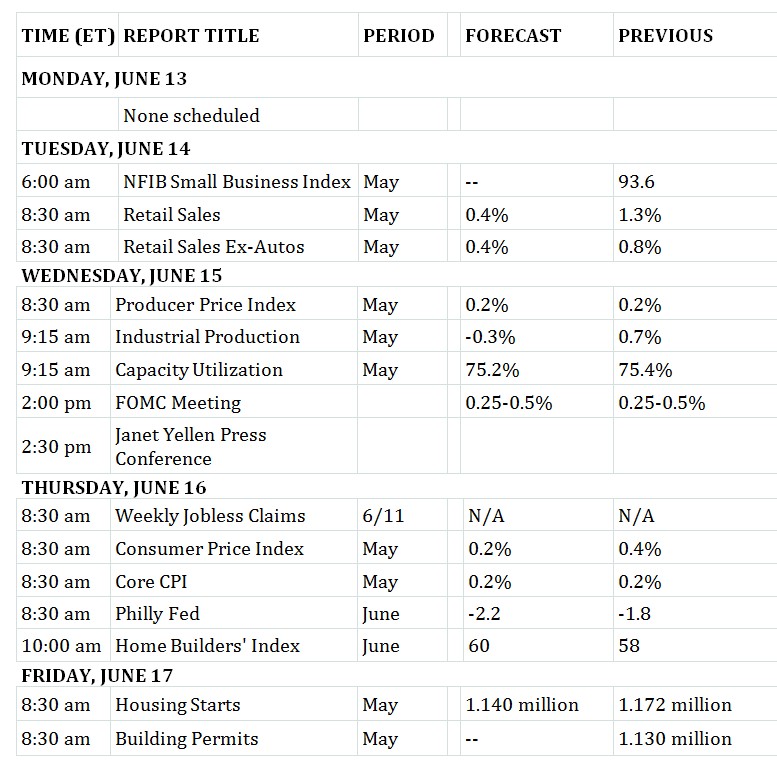
The consumer is the key to the direction of the economy. Retail sales will be released Tuesday followed at the end of the week by Housing Starts and Building Permits. After a huge bump in April, expectations are for a Retail Sales drop to a modest 0.4% from the 1.3% the previous month.
The June FOMC meeting takes place on Tuesday and Wednesday with Janet Yellen’s press conference at 2:30 PM on Wednesday. Rather than any change in rates, you should look for subtle changes in Yellen’s posture.

BMR Companies and Comments
For many weeks in this newsletter we have shared the view that 2016 is a year when stock picking will be the key to investment success. So this week we want to spend most of the Bull Market Report on money-making stock ideas. Here we go.
Twitter (TWTR: $14.02, down 8% on the week) The stock has had a rough ride this year. There is no shortage of naysayers about the future of Twitter. We disagree. Here is why: Twitter is an iconic service and a globally recognized brand. It has over 310 million users and growing. Twitter has compiled a treasure trove of data that many social media companies would pay dearly to own.
Since founder Jack Dorsey returned to the CEO spot last year, he set out to improve Twitter’s user experience and that means committing serious resources to Live Steaming Video. Execution of this strategy will begin to bear fruit later this year when Twitter will stream certain NFL games on Thursday nights. Twitter usage has always been at its highest during big real time sporting events so don’t be surprised when more deals of this type are announced.
In the meantime, active users grew 3% to 310 million in 1Q16. The company is doing a great job in monetizing its users as advertising revenue in 1Q16 jumped 36%.
Dorsey is taking the company in the right direction. Even the skeptics concede, the company customer database is an asset that competitors would love to get their hands on. The list of potential suitors includes giants like Google and Facebook as well as desperate companies like Yahoo. Will one of these firms, or another that we haven’t thought of yet, like Sony or Samsung, make a play for the firm and drive the price to $20 or higher? How this all works out will not take much longer. Our guess is less than a year. Twitter is relevant in 2016 and will be relevant in 2017 and beyond, and thus has tremendous value at $14 a share, just $10 billion in market cap.
Gilead Sciences (GILD: $84, down 2%) Last Monday, a US District Judge threw out Merck’s patent infringement suit against Gilead. The judge accused Merck of perjury and unethical practices. Gilead had already paid $200 million to Merck in compliance with the lower court ruling and charged this to 1Q16 earnings. Not only does this charge get reversed, but the requirement of a 10% royalty payment is also eliminated.
This changes everything. Let’s focus on its drugs, Harvoni and Sovaldi. These two drugs have generated sales of more than $30 billion, marking the biggest drug launch in history. Merck’s version of the drug contains the patented formula called sofosbuvir, and is priced about one half of Harvoni. But if Gilead is the legal owner of sofosbuvir, it is Merck that will have to license it from Gilead. Once investors appreciate the implications of Monday’s ruling, the stock will move higher. We are strong believers in this company.
Facebook (FB: $117, down 2%) Facebook has been a top performing stock in the Social Media sector this year and one of the big gainers in the market overall. When you are on top as Facebook is there are lots of critics that try to chip away looking for any flaws in their strategy. How can you fault a company strategy that has created a stock valuation of $330 billion and that grew revenues 52% in the latest quarter?
Team Zuckerberg is doing an amazing job keeping the company relevant. Remember, Facebook is only 12 years old, ancient in tech circles. The company showed their smarts by adapting to mobile platforms, messaging, and importantly, with the 2012 acquisition of Instagram where the demographic is younger than the average Facebook user. Month after month both Facebook and Instagram rank in the top 10 of free app downloads. This is a sure sign of enduring customer loyalty.
It is Facebook’s constant attention to improving user experience that keeps them on top. At the same time, they haven’t lost sight of longer-term diversification opportunities. That’s what makes the company so compelling. Here are two great examples: Last Wednesday, Facebook added video capability to the Comments window. Now instead of typing or texting, users simply tap an icon and send a live video comment. According to the industry authority, TechCrunch, by 2020, video will represent over 80% of Internet traffic.
Finally, we also learned last week that Facebook has begun testing a new money transfer and payment system in China. This is the beginning of a giant long term opportunity. Faithful investors in Facebook are being rewarded and the end is nowhere in sight.
Qualcomm (QCOM: $54, down 2.0%) Call it smart stock picking or good timing. Qualcomm, with a 26% gain after being added to our Stocks for Success in February, is a winner. (We think it is just fabulous stock picking!) As you know, Qualcomm is all about mobile computing with its Snapdragon - System on a Chip. Qualcomm offers a range of models from basic mobile phones to the latest Smartphone’s from Apple and Samsung.
Mobile phones are simply the largest selling consumer electronics device ever invented. Almost 1.5 billion Smartphone’s were sold worldwide in 2015. Add to that an additional 500 million non-internet feature phones and you have a picture of how big Qualcomm’s market measures. By 2019, according to Gartner Research, sales of all types of mobile phones will reach 2.4 billion.
The wind is still at Qualcomm’s back and we feel the stock is still undervalued. Wall Street is estimating 2016 earnings of $4.10, giving the company a lowly multiple of 13. The dividend is running at $2.12 annually, a tidy 3.9% yield. Wall Street believes earnings will grow more than 10% a year over the next five years. The balance sheet is loaded with $30 billion in cash and more is piling up every year. This is a huge reserve for future dividend increases or value-enhancing stock buybacks. A stock with all this going for it is worth much more than today’s price. It is time to get invested in this high quality issue.
LinkedIn (LNKD: $131, down 3%) The stock got a nice boost last week by RBC Capital, upgrading their recommendation to Outperform with a $160 price target. We agree the stock will trade higher but $160 is just a short-term objective. Remember, the all-time high was reached a little more than a year ago when it hit $276.
LinkedIn is the place to go to connect to jobs and career advancement advice. The site has a lot of “stickiness” – a measure of the time spent browsing the website. Advertisers love to use this measure and LinkedIn has a lot of it. It consistently ranks among the highest traffic websites and in a recent survey, 20% of LinkedIn followers even use the site as their primary news resource.
Two thirds of its global business is what LinkedIn calls Talent Solutions. The search for a new or better job remains vibrant. Revenues in 1Q16 from LinkedIn Talent Search jumped 40%. The low unemployment rate in the US hasn’t slowed business a bit. Now the company is launching Profinder, its own freelancing service. The temporary and part time labor force amounts to about 20% of all employment. Intuit predicts by 2020, the total will rise to 40%. So, this is a smart and timely move by LinkedIn.
Fitbit (FIT: $14.10, down 4%) We made the tough decision last week to remove Fitbit from our Special Opportunities Portfolio. We added the stock in March at $14.55 and removed it last week at $14.40. The stock has done nothing in that time and this may be the case in the future. There are some real questions that concern us about the market for wearable devices. Such as: 40% of fitness devices wind up sitting in a drawer after only a few months of purchase. The accuracy of the devices is also being brought into question by a class action lawsuit. This is not good news. Interestingly, there was an upgrade on the stock that came out Friday that we issued a News Flash on, but the stock dropped anyway. Listen: We took a shot and the stock is down only 1%. It didn’t work out but just as importantly, we didn’t lose any money.
The Apple Corner
Apple (AAPL: $99, up 1%). Apple held up nicely this week. Watch for announcements from Apple's hotly anticipated Worldwide Developers Conference (WWDC), which takes place Monday. There are a few rumors about it of course. Apple is reportedly looking for real estate in the San Francisco Bay Area to serve their self-driving car project. They are said to be looking at an 800,000-square-foot plot. (That’s big.)
We continue to be amazed at how many iPhones are out there compared to the Androids. We live in a wealthy area, Aspen, so our results are skewed, but in our town we would guess the split between Apple and others is in the neighborhood of 80-20, and we might just be low. We think intelligent people see the tremendous value the iPhone offers. And even though iPhone sales were in a “slowdown” last quarter, it was just a smidge, as sales continue at an amazing pace, and the cumulative number sold could reach 1 billion by late 2017. In April, CEO Tim Cook stated that the iPhone installed base had grown by 80% in the past two years. Upgrades now drive most of Apple's iPhone sales, but the iPhone is still bringing in tons of new users. We are looking for iPhone sales to rise by over 10% in 2017. And Apple is poised for another year of 10%+ growth in 2018. The number of people switching to the iPhone from Android is at a record high. There is plenty of room for smartphone ownership to rise in emerging markets, too. Both of these trends support the continued growth of Apple's iPhone installed base.
These numbers talk to us as we know that it will produce revenues from the App Store, and from the fact that people fall in love with the device and then want an iMac and an iPad. The iPhone is a franchise that won’t quit and with the iPhone 7 coming out in September there is only more good news to report about late this year and next.
BMR Take: Things are quiet lately on the Apple stock price front. But not with the company. They have 110,000 employees working to make life better for all of us. The cash hoard is huge and growing, and it’s only a matter of time before something new and exciting happens at this firm. We are strong buyers here at $99 a share.
Tesla Update
Today, Apple is the largest company in the world by market cap. But Tesla Motors (TSLA: $219, flat) could rocket so high in the next 10 or 15 years that the current $32 billion market cap could exceed even Apple’s $540 billion.
This is according to Ron Baron, CEO of Baron Capital, who went on CNBC recently to rave about Tesla. He has a $300 million position in the company and he thinks the stock could grow up to 20 times its size in the next 10-15 years to the $650 billion level. He expects to make $6-7 billion off of that position as Tesla becomes one of the biggest companies in the entire world.
He says: “The competition is nowhere. They could have caught Elon Musk four or five years ago, but they can’t catch him now. He’s too far ahead.”
Why? Well, for starters, all the things we have been saying about the company. Like the billions of dollars they’ve invested in its Gigafactory, which is nearing completion in Nevada and will be responsible for supplying batteries to the millions of Tesla Model 3s it produces once the car hits the streets in 2018.
Baron sees the ability to mass-produce batteries at such a massive scale as an absolute necessity for anyone hoping to compete with Tesla head-on in electric vehicles. The Gigafactory, according Musk, will have the largest footprint of any building in the world - the Gigafactory will be the largest building by area on the planet earth.
BMR Take: What can we say? We agree!
ENERGY CORNER
Notes at the Margin
by Phil Verleger, Jr., International Energy Expert
Former Director of the Office of Energy Policy at the Dept. of Treasury
www.PKVerlegerLLC.com
Markets were pulled and pushed last week. Attacks on producing facilities in Nigeria and new fires in Canada added upward pressure. Our estimate of a $15-per-barrel disruption premium is probably out of date. By Wednesday, it may have risen to $20.
However, the disruptions do not seem to have attracted hot money. At this juncture, we see a decrease in prices back toward $30 per barrel as disruptions in Canada are resolved and the Nigerian situation stabilizes. The forecast, though, depends on such developments, an assumption that may not be reasonable.
BMR Take: With Crude hovering at $50 the world just feels better. This might seem simplistic to you but remember how we felt when crude hit $30 and then saw it dip below into the 20s? People were talking about $20 oil then and the massive bankruptcies that were going to go with it. And people were afraid and worried. Even at $50 we are seeing some bankruptcies and restructurings, the latter generally a good thing. So at $50 there is hope. If crude heads to $30 again as Phil Verleger thinks above, then things could get dicey again, with the overall stock market more than likely heading lower. Conversely, at $50 the Energy world is much more stable, which lends itself to a stable stock market and growth in the economy.
High Yield Portfolio Corner
The iShares High Yield Corporate Bond ETF (JNK: $84) ended the week with no price action, after jumping up over 1% in the middle of the week and falling by the end of the week. Similarly, the UBS ETRACS BDC ETF (BDCS: $20) saw no real move this week, although it was significantly weaker and more volatile than junk bonds, which is not terribly unusual. The dramatic no-move of the week is a result of broader macroeconomic fears. With weak jobs growth, investors are starting to get scared that the fundamentals of America may be a tad weaker. Still, the market remains in risk-on mode, as evidenced by junk bonds still managing to hold their pricing for now.
Government Properties Income Trust (GOV: $20, up 1%) had a modest gain that outperformed most high yield stocks, thanks in part to an end-of-the week bump that moderated on Friday as the market broadly became more cautious. Still, market confidence in management remains solid, and for good reason. The company has changed the structure of its operations somewhat in recent months to find higher returns. They began investing in non-government office properties to offset weak government expansion. So far this helped bolster overall occupancy rates and FFO. We see this as more of an opportunity as a risk. The company's continued strong dividend payout coverage is a testament to management's ability to invest wisely and enrich shareholders.
Pimco Dynamic Income Fund (PDI: $27, down 1%) saw a decline this week, but that's good news - the fund paid a dividend this week, which accounted for almost all of those losses. (As we’re sure you know, when a stock pays a dividend it goes “x-dividend” and the stock opens for trading on that day, down the amount of the dividend it is paying.) This fund continues to maintain its payout and is now trading at a slight premium to Net Asset Value, making it still an attractive hold. With continued declining defaults in the mortgage market and a stable corporate bond market, this fund is having no problem maintaining its 10% dividend. We hope you bought some earlier this year when we recommended it, as you got this stock much cheaper - and got a yield of 11% (plus some hefty unrealized short-term capital gains). We are still holding on to this one as it's one of the best income producers out there.
Enough about steady stocks - let's talk about a monster. Digital Realty Trust (DLR: $102, up 3%) posted another week of sharp gains, helping it to rise 36% year-to-date! That's a staggering number, which just goes to show that REITs can sometimes provide more than just income. What's the story here? Two things are going on. Firstly, Digital Realty had an awful 2015, where the REIT industry broadly suffered from a broad-based de-risking. Investors, fearing the next market downturn, began to offload REITs, and Digital Realty was a victim. Secondly, and more importantly, Digital Realty has made some significant operating expansions that will grow its Funds From Operations more than many had anticipated. Late to the party, those bulls are now jumping in. Good for us, since we got in much earlier and closer to the bottom. If you are not in, we would still be buyers here. Paying a solid 3.4% dividend, we expect a dividend increase in the next six months.
Overall, this was a ho-hum week for high yield in general and a good week for our High Yield Portfolio. The overall stock market still is looking for a reason to correct. The awful jobs report from last month, where just 38,000 new jobs were added and the unemployment rate dropped because people gave up looking for jobs, is the beginning of a good excuse. We're not necessarily bearish on the market, but we are cautious - and our cautiousness grows every week the junk bond market doesn't decline. Junk bond yields as measured by the Merrill Lynch High Yield benchmark have fallen to their lowest point in a year and have not been this low since seeing major corrections late in 2015 and earlier this year. This is happening despite higher bankruptcy rates, which suggests higher risk and thus higher yields for these bonds.
The gains we had in the last few weeks were great for our portfolio and give us some confidence, This will be a great opportunity to add a bit more to the portfolio and gain more income at higher yields.
Good Investing!
Todd Shaver, Editor in Chief
Info@BullMarket.com

by Todd Shaver | Apr 17, 2016 | Weekly Newsletter 7pm Sunday
Special Note: We are going to publish our 2nd Earnings Preview Monday morning. Netflix (NFLX) is the first to report Monday after the close and then there are a bunch on Wednesday – Kinder Morgan and Qualcomm, and a few more on Thursday. We can’t wait to send it to you.
LAST WEEK: Oil prices continued to strongly influence U.S. equities, and on the whole, with crude rallying sharply on news of potential Saudi and Russian production freezes, markets enjoyed bullish sentiment. Sledding was a bit tougher last week than the one before, however, as earnings season kicked into full swing - causing market participants to exercise a bit more caution, even in the wake of the previous week’s dovish interest rate posture from the Fed.
No Deal From Doha:
Oil ministers from around the world are meeting over the weekend in the Qatar city of Doha. In times past this might have sent Crude prices soaring and equity prices tumbling. The exact opposite was the case last week with Crude virtually unchanged and stocks enjoying a good week, across the board.
Investors have come to discount any outward signs of unity in this group. Politics is where this group has nothing in common. So, no reliable agreement restricting output is in store. We think very little will come out of this meeting as Iran has not agreed to appear. Saudi Arabia is upset and going to close the store and take all their marbles home like a sore loser. The net result is that they will continue to produce oil at high levels, which can only cause lower prices since demand is so low worldwide. We’ll know more later this week.
THIS JUST IN: No Oil-Freeze Deal at Doha Meeting
Delegates from more than a dozen oil-producing countries who gathered in Qatar this weekend hoping to freeze crude output failed to clinch a deal, according to ministers leaving the meeting late Sunday. It was unclear if oil officials from Russia and Saudi Arabia, the world's two biggest producers, and most OPEC members, would try to reconvene again, either later Sunday night or on Monday.
The futures just opened. Stocks down 11 S&P points; crude down $2.50 to $37.65. Nasty.
Here is how the week ended:
| Key Market Measures - Friday Close |
|
|
|
|
|
| Dow Jones |
17,898 |
+321 |
+1.8% |
| S&P 500: |
2,081 |
+34 |
+1.7% |
| Nasdaq |
4,938 |
+23 |
+0.5% |
| Crude Oil: |
$40 |
UNCH. |
UNCH. |
| Gold: |
1,236 |
-6 |
-0.5% |
Fire the Forecasters: What Inflation?
Last week was just chock full of market moving data. In last week’s Bull Market Report we listed the estimates of all of Wall Street’s leading economic soothsayers. The only trouble is, these expert forecasters missed every estimate with the exception of one. What is the adage about a blind squirrel finding an acorn?
Inflation, or the lack thereof, was the spark that ignited Tuesday’s rally. The key Producer Price Index was down 0.1% for March compared to a 0.3% increase expected. The March PPI included the price spike in Crude. This means the core PPI dropped more like 0.2%. Very quickly investors realized this news put a dagger in the hearts of the Fed’s interest rate hawks. The only logical thing that followed was to buy stocks aggressively. And that is pretty much what drove the markets to levels within striking distance of all-time highs.
Investors were further encouraged by Thursday’s lower than expected report of The Consumer Price Index and Core CPI. If this trend in data continues in the months ahead, the Fed will have no reason to increase interest rates anytime this year.
Financial Stocks Back from the Abyss
At long last, Financial stocks came to life as the group ushered in the 1Q16 round of earning reports. JPMorgan Chase (JPM, $62, up 7% for the week) provided the spark on Wednesday with better than expected results. To be clear, applying the term “better than expected” really means, “less miserable than we feared”. Those fears are based on factors like the Y/Y decline in stock prices, a soft underwriting calendar, and paper-thin interest spreads. Wall Street expectations were reduced to the minimum. Stocks got taken to the proverbial cleaners. That is what makes financial stocks like these so attractive: Bank of America (BAC: $14.00, up 9% for the week), Goldman Sachs Group (GS: $159, up 5%), The Blackstone Group (BX: $29, up 8%) and Annaly Capital Management (NLY: $10.40, unch.) Any half-decent news and these stocks will take flight higher.
Note that we saw a successful IPO this week. Shares of BATS Global Markets (BATS) jumped 21% to $23 after the exchange operator went public, the first non-healthcare IPO of 2016.
Auto Market In Trouble
The recent unveiling of Tesla’s Model 3 so far has resulted in reservations for nearly 400,000 units of the sleek new $35,000 model. The first deliveries won’t take place until the next president of the United States delivers his or her first State of the Union address in 2018 but thus far, Elon Musk has succeeded in raising $400 million in capital without the need of an investment banker or filing a registration statement with the SEC, all from the $1,000 deposit put down by its buyers. Pretty smooth work Elon! No wonder the stock is approaching its 2015 high.
As for the rest of the Auto industry, things are not so great. We have been digging through lots of data for months now that point to a slowdown. Wednesday’s data on retail sales confirmed it has happened. Except for Tesla, we have no other recommendations in the Auto industry for which we are quite happy. However, since autos, along with housing, have formed the backbone of economic strength for several years, this is not great news in general for investors.
A Fiscal Fix Is Needed
If, as we have often suggested, monetary policy has run out of gas, how does the economy get fuel for growth? For the past 75 years, the answer was simply, have Congress spend more money. With $20 trillion debt and a Congress that is frozen, spending more is not an option.
We see that the big problem the Fed fails to recognize is the quality of the US labor force in relation to the high paying skills needed. Worker skills in a manufacturing economy are a poor match with the preponderance of high paying jobs being created in Technology. And with technology changing so rapidly, today’s job skills are becoming obsolete faster than any time in history. There is a major gap here as Silicon Valley and the whole Tech industry has thousands of unfilled jobs while the true level of unemployment, the E6 number, remains close to 10%. (E6 is the broad measurement of unemployment including people who are unsuccessful long term job seekers that have left the labor force entirely. In other words this includes people that lack the skills to fill existing job vacancies.)
With this in mind, we applaud this week’s announcement by Oracle chairman Larry Ellison. He is donating $200 million to the government’s effort to train students in computer coding. This is creative fiscal stimulus. If the concept spreads throughout the Tech community, it could create new opportunities for investors. Keep your fingers crossed. Smart thinking Mr. Ellison.
Upcoming Economic News
This week the Washington Data Machine shifts from inflation to housing. Monday, Tuesday and Wednesday are the days to watch. Existing Home Sales is the most likely to have market impact, as this has been weak recently.
On a broader scale, the total Housing picture is important to stocks, since Housing, like Autos have been key economic drivers. We will be keeping an eye on this data sending out our thoughts during the week.
| Release TIME (ET) |
REPORT Title |
PERIOD |
|
FORECAST |
PREVIOUS |
| MONDAY, APRIL 18 |
| 10:00 AM |
Home Builders' Index |
April |
|
-- |
58 |
| TUESDAY, APRIL 19 |
| 8:30 AM |
Housing Starts |
March |
|
-- |
1.18 million |
| 8:30 AM |
Building Permits |
March |
|
-- |
1.18 million |
| WEDNESDAY, APRIL 20 |
| 10:00 AM |
Existing Home Sales |
March |
|
-- |
5.1 million |
| THURSDAY, APRIL 21 |
| 8:30 AM |
Weekly Jobless Claims |
4/16 |
|
N/A |
N/A |
| 8:30 AM |
Philly Fed |
April |
|
-- |
12.4 |
| 8:30 AM |
Chicago Fed National Activity Index |
March |
|
-- |
-0.29 |
| 10:00 AM |
Leading Indicators |
March |
|
-- |
0.1% |
| FRIDAY, APRIL 22 |
| 9:45 AM |
Market PMI Flash |
April |
|
-- |
51.5 |
|
|
|
|
|
|
High Yield Corner
It was another great week for High Yield. All sectors ended the week in the green, including a surprising resurgence in the world of MLPs. Alerian MLP ETF (AMLP: $11.04, up 1.3% for the week), which has struggled significantly throughout the year. Even in weeks when oil surged, MLPs failed to recover, so this week’s movement is significant. The movement also came on no news, which may suggest investors are calling a bottom in this asset class.
Caution is needed here. MLPs are closely correlated to many asset classes, including the S&P 500. Already some analysts are calling for a pullback after the market has skyrocketed 12% since its lows in January. Whether that happens or not depends on earnings season, which has just started. Unfortunately, things kicked off poorly with Alcoa (AA: $10.00) seeing sales fall 15% on a Y/Y basis, guiding lower due to a disappointing growth rate was the Airline sector. The company will cut an extra 1,000 jobs.
Things aren’t all bad, though. The banks are actually doing very well, with strong earnings results coming from Citigroup (C: $45) and JP Morgan (JPM: $62) offsetting news of Goldman Sachs's (GS: $159) $5 billion settlement for fraudulent transactions related to the 2008 crash. This is good news for the BDC world, as seen by the strong showing of the UBS Wells Fargo BDC ETF (BDCS: $20), which ended the week up 1%. As lenders to mid-sized companies, BDCs are benefitting from the same tailwind helping the big banks: More lending activity for companies as they begin investing more heavily in growth.
Similarly, high yield bonds - as seen in the iShares High Yield Corporate Bond Fund (HYG, $82) - rose over 1% for the week as investors forgot their fears of growing defaults in the Energy sector spreading to the rest of the market. The week’s action left HYG up over 2.5% YTD and BDCS flat YTD, excluding dividends.
Property REITs, as seen in the SPDR Dow Jones REIT ETF (RWR: $94), were the weakest this week, essentially closing flat after a strong Friday showing. We are two weeks away from the REIT earnings season, and this will be a crucial one. Many REITs are still down in the past year after a significant pullback, even if funds from operations (FFO) show a strong Y/Y growth rate. Now that sentiment is improving, REITs will need to show more FFO growth to get their stock to rise further. If they fail, a sharp reversal of the 9% gain over the last three months may be in order.
The Options Corner
We thought we would show you a concept of attempting to produce fairly strong returns by buying a stock and immediately selling an at-the-money call on it. This is a strategy for sophisticated investors only, so get your broker and advisor involved before you try any of these ideas because in the short few paragraphs below it is impossible to tell you about all the scenarios that can play out. So by definition, this description will be somewhat superficial. AND RISKY. But we are looking to produce a 10% gain in a month or two. Did we say RISKY?
The concept is this: Buy a stock you like and that you think the stock might stay steady or go up in the next 30-60 days. Then immediately sell an at-the-money call on it. Let’s look at some numbers. How about one of favorites Solar City (SCTY: $29, up 4% last week). Say you buy 1000 shares at $29. Then you sell the May $30 call, which is trading for $2.25.
The cost of the stock is $29,000. But selling the 30 call brings in $2.25 per share or $2,250. So your net cost is $26,750 [($29-$2.25 = $26.75) x 1000 shares]. If the stock stays at $30 or higher until the expiration of the option on May 20th (3rd Friday of the month for ALL options), your stock will be called away at $30, which is exactly what we want to happen in this trade. Let’s look at your cash position. After the stock is called you will receive $30,000 for the stock and since your investment was $26,750, you will have made $3,250 for a return of 12% in a month. Not bad.
Let’s look at a negative scenario? What is the downside risk? (After all, no one is going to hand you a 12% return in a month without some risk, right? What if the stock goes to $27 by May 20th? If this happens you have lost $2,000 on the stock but since you got $2,250 for the option, you are at about breakeven. (Your exact breakeven price is $26.75.) At this point, you can turn around and sell a June option bringing in another $2,000 or so, thus lowering your breakeven to around $25 a share. Get the idea?
Again, many, many things can happen during these months so it is not as easy as it looks, but selling at-the-money calls on stocks that stay the same or move higher can be very lucrative. Would you like to see another example next week? Write us at Info@BullMarket.com.
The Energy Corner
Notes at the Margin
By Phil Verleger
http://PKVerlegerLLC.com
Last week saw several important developments in the global economy related to the oil industry. Most who follow oil closely will focus on the results of the Doha meeting completed yesterday. [Results are not complete yet, although we know there was no agreement to cut production, so stay tuned.]
Several other events of note took place. First, on Tuesday the International Monetary Fund issued its annual world economic outlook. The report made for dismal reading. The bleak outlook was summed up succinctly in an opinion piece published in Financial Times by Olivier Blanchard. His summary is grim:
“According to the IMF, slow growth is now a fact of life after 2009.
“Productivity growth has dropped sharply, especially in Europe. It has fallen in the United States as well.
“The slowdown in advanced economies explains slowdowns in emerging markets.”
Blanchard offers the disturbing observation that “bad news about future potential growth can lead to a recession.” He explains that companies, seeing bad prospects for sales, cut investments, while consumers, confronting prospects of stagnant income, cut consumption. It is not the optimistic view one wants to read:
“If this new narrative is right, the baseline forecast is for slow but continued recovery.”
Under these circumstances, those hoping for strong increases in global oil use over the next two or three years need to go back to the drawing board. Demand will grow slowly. Price increases, if they are to occur, will require significant cuts in supply.
A more significant development was the announcement that Schlumberger was leaving Venezuela. It seems the firm has not been paid. Schlumberger’s departure is further demonstration of the nation’s destitution. Later, the country’s oil companies offered “take it or leave it” contracts to the companies producing with it. We guess most will choose to leave.
Finally, on Saturday The New York Times printed a front-page article “Saudis Tell U.S. to Back Off a bill on 9/11 Lawsuits.” The piece explained that Saudi Arabia would immediately remove [sell] its investments in the US - including a large holding of treasury bills - if the law were passed. While the chance of this is remote, this threat should be taken seriously. The economic consequences could be severe.
US Crude Oil Production Fell for the Tenth Consecutive Week
The U.S. Energy Information Administration released its “This Week in Petroleum” report on April 6th. It reported that the weekly US crude oil production fell marginally by 14,000 bpd (barrels per day) to 9 million barrels per day for the week ending April 1st, compared to the previous week. Production fell for the 10th consecutive week. It’s the lowest level since November 14, 2014. The monthly US crude oil production peaked at 9.7 million bpd in April 2015.
North Dakota crude oil production fell for the third month in a row, ticking down 0.4% in February and hitting its lowest level in 18 months. Slumping oil prices are starting to affect output in U.S. shale fields, including the prolific Bakken formation in North Dakota. Oil production in the state dropped to 1.1 million barrels a day in February, down a tick from January. The state’s output hasn’t been that low since July 2014. The slightly lower production in February follows a 2.6% drop in January and a 2.5% slide in December. The Bakken formation is one of the highest-cost sources of U.S. production. The state’s drilling rig count, a barometer of future production, stands at 26 active units, down from 32 in March, showing the fewest rigs at work in oil fields since 2005. At its peak, North Dakota had 218 rigs drilling in 2012.
The Gold Corner
In a new research report, Merrill Lynch raised price targets on many of the gold stocks that they cover. They like a number of stocks and one of them is Silver Wheaton (SLW; $17.05), what they call the largest pure precious metals streaming company in the world. Forecast 2015 estimated production is 45 million ounces of silver, and 225,000 ounces of gold. By 2019 production is anticipated to increase to approximately 55-60 million silver ounces, and 325-330,000 ounces of gold.
Silver Wheaton has 20 long-term purchase agreements in place. It has silver and gold interests all over the world so they are diversified as to country political risk. The company is currently paying a 1.2% dividend. The Merrill Lynch price target is $20 a share with the consensus target on the Street at $22.
If you wish to hear about more ideas in the gold and silver realm, let us know at Info@BullMarket.com.
Portfolio Trackers
Have you checked out our Portfolio Trackers? They are on the website at the bottom of the portfolio pages. Go to “Our Portfolios” and click on one of the portfolios and then scroll down to the bottom of the page. There you will find all the info about the stocks we have in each of our portfolios – Stocks For Success, Special Opportunities, and High Yield. All the details are right there in front of you. We love this new feature of The Bull Market Report.
BMR Companies and Commentary
Our Stocks for Success and Special Opportunities portfolios have been carefully selected to provide diversification and best in class in each sector. Last week was the beginning of 1Q16 earnings report season with Bank of America reporting earnings on target. We will be sending out our new Bull Market Report Earnings Previews providing you with a weekly update throughout earnings season on our favored stocks. We think you will find it helpful and look forward to receiving your comments.
Fitbit (FIT: $17.20, up 19% for the week) The stock is a long way from it high of $52 last August but steady progress is rewarding investors. From the February low of $12, the stock is making a strong comeback.
Last week was a leap in the right direction with the stock gaining a stellar 19%. So here is what happened: On Wednesday analysts at both Citigroup and Pacific Crest recommended the stock and raised their estimates, pointing to sales for their newest product, the Blaze, as the main reason. The Blaze competes directly with the Apple Watch but at a lower price of $200 versus $300. Blaze is on fire, selling over 1.3 million units since the late February launch.
Finally the momentum is shifting in favor of Fitbit stockholders. The Citi analyst has a price target of $30. Fitbit has scheduled the 1Q16 earnings report for May 2. The consensus is $0.02. Citi just raised their number from $0.01 to $0.04. Not terribly exciting in real numbers, but exciting enough to get the stock moving higher big time.
Twitter (TWTR: $17.60, up 6%) Many times investing contrary to conventional wisdom can be rewarding. For some time we have held this belief with regard to Twitter. The stock is well down from the 2014 high of $65. Many investors gave up when the company languished. Yet the Twitter mindset is every bit a part of today’s culture as ever; it just needs some sprucing up.
Founder Jack Dorsey’s recent return to run day-to-day operations started to turn heads. The missing ingredient is that social media, more and more, is turning to video, and Twitter needed to take action to stay relevant. The April 5, agreement with the National Football League to live stream 10 Thursday Night Football games created the big headline. What is less well known is that Twitter paid less than $1 million per game. That compares with $45 million per game at CBS. Nice going Jack.
Devon Energy Corp. (DVN, $31, up 9%) was raised to Buy from Hold and the price target was raised to $40 from $30 by one analyst. It has a consensus analyst price target of $32. Devon paid a 24 cent dividend on March 31st maintaining the dividend it paid in 2015 of 96 cents per year. In February, Devon announced a 75% reduction in the quarterly dividend on its common stock, which will bring its 2Q16 dividend to $0.06 per share. The reduced dividend will provide over $320 million in additional cash flow. Thus the company’s indicated annual dividend rate for 2016 is $0.42 per share.
Devon has $2.3 billion in cash and $10.8 billion in debt. The firm is a bit over-leveraged, but management is dedicated to getting the debt level down to more meaningful levels. We are watching this development closely. The stock is up 68% now since we added it the Special Opportunities portfolio in February with a target of $28. Because of the sharp run-up in the stock we hereby raise the Sell Price from $15 to $27, locking in our gains. The Target Price is hereby raised as well to $37.
Trader’s Corner
This section is designed to bring you some different ideas for short term traders.
Cashing in On Cannabis with Zynerba Pharmaceuticals, Inc. (ZYNE, $9.59)
(We’ve got an interesting one for you this week, but the market cap is TINY so be careful out there! Read this if you have an open mind and want to learn about a micro-cap. At $90 million, this is not a typical Bull Market Report stock. But we want to bring you all facets of the investing world, so here goes!)
If the number 4/20 doesn’t mean anything special to you, then you probably haven’t been following developments in the emerging, multi-billion dollar legal cannabis industry. Long ago cannabis users co-opted the police penal code for marijuana possession - 4/20 - and turned it into a national day of celebration every year on April 20th. With another 4/20 holiday set for mid-week, it’s a good time to identify a related trade.
Regardless of where you stand on the legality of cannabis, the drug has gained increasing acceptance in the U.S. and abroad, for both medical and recreational use. Currently, opportunities to invest in cannabis companies are almost exclusively limited to over-the-counter traded issues, as a gamut of dicey legal uncertainties continue to pose significant business challenges. There are, however two firms in the industry trading on the Nasdaq: GW Pharma (GWPH: $82 with a market cap of $1.8 billion), based in the UK, and the subject of today’s alert, Zynerba Pharmaceuticals.
Founded in 2007, Zynerba Pharmaceuticals is a specialty pharmaceutical company developing and commercializing proprietary synthetic cannabinoid therapeutics. Its products candidates include ZYN002 and ZYN001 - synthetic transdermal cannabinoid therapeutics for various types of pain that people have including refractory epilepsy, osteoarthritis, fibromyalgia, and peripheral neuropathic pain. (Transdermal means applied through the skin, like a patch.) Earlier this year, the FDA granted orphan-drug designation to ZYN002 cannabidiol (CBD) gel, for the treatment of Fragile X syndrome. In addition, Zynerba has already secured patents related to ZYN002 and ZYN001, with two in the U.S., five in Europe and two pending in Canada and Japan.
In August, 2015, ZYNE shares came to market in the IPO at $14, amid a great fanfare, in the wake of the growing trend among U.S. voters and lawmakers to usher in laws allowing the use of medical marijuana by adults, as well as legalization in Colorado, Oregon and other jurisdictions. The appeal was clear: an increasing number of studies, as well as countless anecdotal stories, documented the many beneficial effects of CBDs - one of the active ingredients in pot - for helping a wide variety of conditions.
With a tiny public float of five million shares, which gave the company an initial market cap of $48 million, the issue surged to an opening day top of $22 before closing at $16.25. By the time the buying frenzy peaked soon after the IPO’s debut, Zynerba had touched a 52-week top of $43. From there, the issue had an epic fall from grace, tumbling all the way to $5 during the early 2016 market meltdown.
We don’t currently own any ZYNE shares so there is no conflict of interest here, but we are watching closely for a potential buy of shares next week. No doubt the small float, the story behind the stock, and bull market conditions, helped put Zynerba on traders’ radar, with that $43 mark unsustainable and arguably irrational - giving Zynerba a momentary market cap of about $350 million.
When GW Pharma recently announced extremely encouraging Phase III results for its CBD-derived drug to treat epilepsy, however, ZYNE once again surged north of $20, before profiteers knocked the stock price back down to under $10. Around the same time GW Pharma shares more than doubled overnight, jumping from $35 to $80, where they currently remain. We wouldn’t invest in GW Pharma at this point, but would consider it if the stock were to drop to the $50 level, a level probably not in the cards for a while.
Our hunch is that cannabis stocks will grab the spotlight again this 4/20 week, making Zynerba worthy of monitoring for some potential momentum trading gains. Longer term, there’s the potential for significant buying catalysts as the company navigates the serpentine path to FDA approval. ZYN002 is currently being evaluated in a Phase 1 trial in healthy volunteers and patients with epilepsy, and the company expects to report results from that study in the next three months. In addition, the company’s proprietary transdermal technology, if successfully developed, would be the first product on the market providing sustained, consistent and controlled delivery of therapeutic levels of two cannabinoids: cannabidiol (CBD), and THC, the principal constituent of cannabis.
On the political front, several more states are expected to usher in the medical and recreational use of cannabis during November’s election, with California and its $2.7 billion cannabis market leading the charge. Just as significantly, later this year the Federal government will consider delisting cannabis as a Schedule 1 drug - in the same category as heroin - which has proved to be a huge barrier to the industry’s growth and acceptance.
If you haven’t traded low-float issues like Zynerba before, it’s not for the faint of heart or risk averse, and obviously there’s no guarantee that 4/20 will be a stock price catalyst. Longer term, however, Zynerba could emerge as an industry leader in the promising field of medical cannabis treatments.
By Analyst Jon Slotnik
For The Bull Market Report
MAIN STREET CAPITAL (MAIN)
A NEW ADDITION to our HIGH YIELD PORTFOLIO
Key Measures
52-Week Price Range: $24-$33
Shares Outstanding: 50 million
Market Capitalization: $1.6 billion
Dividend: $2.70 per share
Yield: 8.7%
Target Price: $40
Sell Price: $26
Price at time of publishing - $31
Fundamentals and Company Overview
Main Street Capital Corporation is a Texas-based Business Development Corporation specializing in lending to smaller middle market companies with revenues between $50 million and $500 million. Most lending is in the form of a senior debt that must be paid back in the case of a bankruptcy or company liquidation, although Main Street will also do smaller deals of subordinated debt and equity, which carry slightly higher risk.
Part of Main Street’s value proposition to investors is its ability to manage risk by identifying which companies are solvent enough and have the highest growth potential to be offered higher-risk credit, and which companies deserve any credit at all. With a two-decade history and over 200 companies in its portfolio in that time, Main Street has proven its ability to find companies that have growth potential and quality credit.
Portfolio Quality and Leverage History
The company’s portfolio is weighed towards senior debt, but Main Street has a history of using riskier equity investments to boost overall investment returns, providing extra income beyond the debt portfolio that can be used to pay special dividends (which it has done for the last four years). Here is CEO Vince Foster on the portfolio structure in February: "We continue to seek and receive significant equity participation in our lower middle market investments and as of quarter-end, we owned an average of 36% equity ownership in the 96% of these investments in which we currently have equity exposure."
The company’s portfolio has shifted towards larger companies, with 40% in lower middle market firms, 36% in middle market, and 14% private loans.
Main Street has also maintained what is a low debt-to-equity ratio by BDC standards. Having stayed around a 75% debt-to-equity ratio for three years, Main Street has been able to keep a balanced portfolio even as it has increased its Net Asset Value (NAV) significantly, and has issued new shares over the years, discussed below.
NAV Trend and Dividend Track Record
Main Street increased dividends in March 2015 and two special dividends in 2015 of $0.275 per share each. Including those dividends, Main Street’s yield is over 8.7%. Since going public four years ago, the company has consistently raised dividends while also issuing special dividends every year:
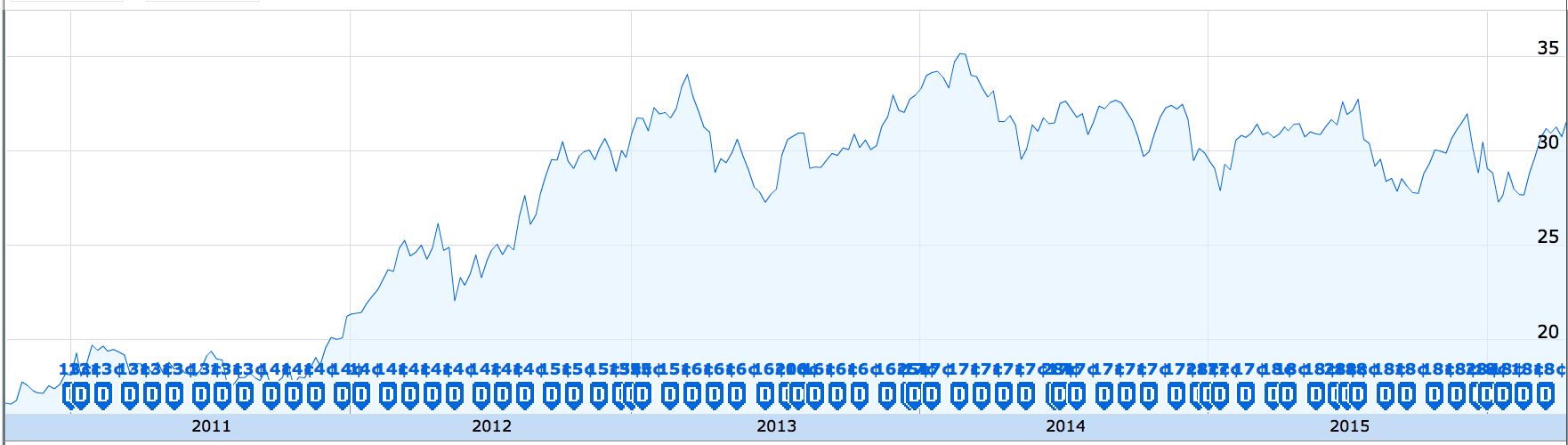
At the same time, the company has also seen steady capital gains as a result of a higher NAV thanks to the company’s high quality investments:
In 2015, the company’s NAV rose 4% per share on a Y/Y basis. However, it should be noted that the company’s NAV since then has fallen 2% largely as a result of the company’s energy exposure. Nonetheless, the company’s overall performance in its investments is impressive. For example, the company’s investment in energy service provider irth Solutions (that IS the correct spelling!) earned the company a $6 million return on an equity stake and an internal rate of return of 40%.
While such staggering returns aren’t always to be expected, the company is very good at earning returns of between 8% and 12% on its credit offerings to firms, while keeping costs lower than many other BDCs. Its expenses are usually about 1.5% of its assets under management - a low figure considering fees are over 2% for competitors like Prospect Capital (PSEC: $7.30). Furthermore Main Street has significantly outperformed them in both dividends, capital gains, and NAV growth.
Risks and Considerations
The biggest risk with Main Street is its exposure to energy. In the past, it has invested nearly 10% of assets in energy and energy-related companies, but has recently shied away from the industry by recognizing investor concerns about taking on too much exposure to oil prices, as CEO Vince Foster said during the third quarter earnings call: "We probably would not be looking at new service type, energy service type investments. I don't think that our investors, our lenders and our [bankers] particularly don’t want to see us having much more in a way of energy exposure, particular on the service side."
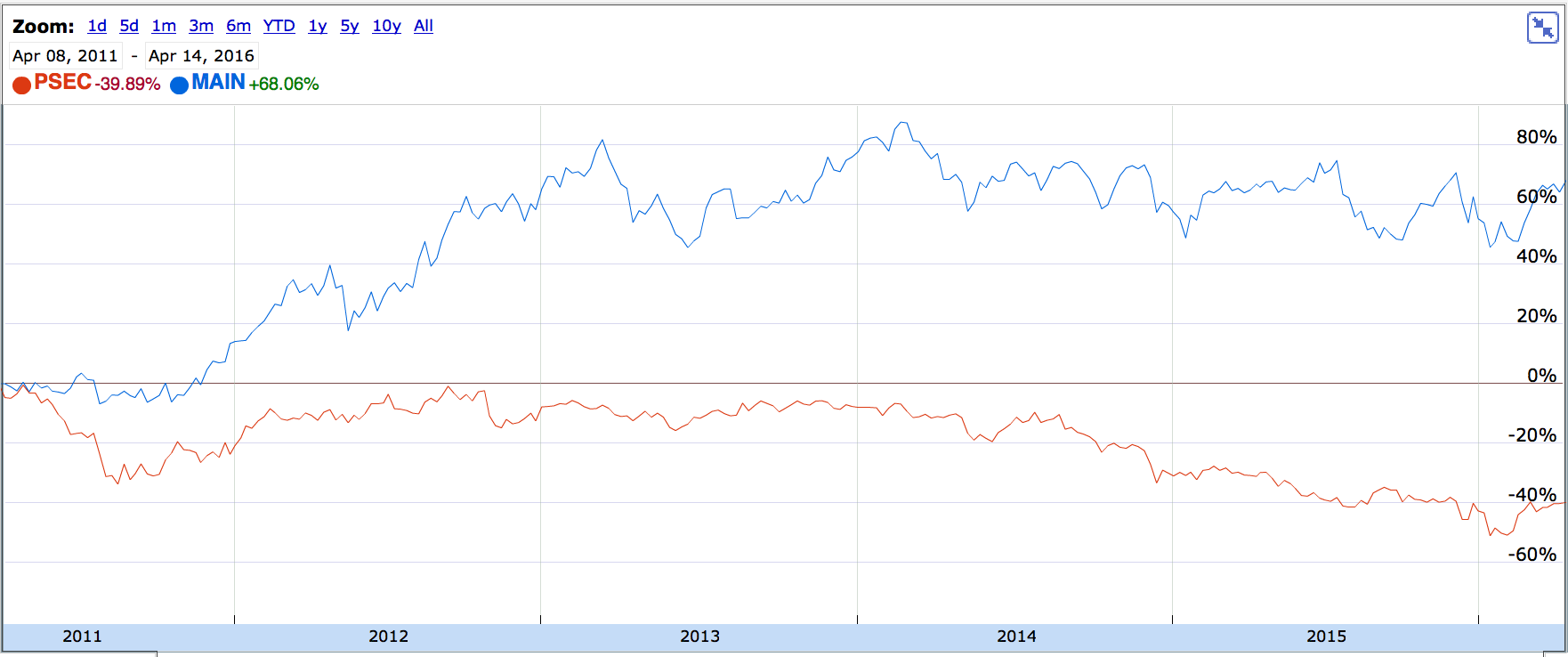
Another consideration is that Main Street is trading above net asset value, when some BDCs are trading at significant discounts. Prospect’s current discount of around 30% makes it appear to be a bargain, while Main Street’s 45% premium to NAV looks like a foolish overpayment.
The easy counterargument can be made with one chart:

A more cogent response would be to bear in mind that the market has priced in expected mark-to-market discounting of Prospect Capital’s portfolio, which contains several leveraged loan derivatives that analysts have argued are overvalued. While Prospect has already discounted some of these, causing its NAV to fall, more discounting is expected. Main Street, however, has no such derivatives in its portfolio.
BMR Take:
All considered, Main Street can be considered one of the lowest risk 8% yielders on the market. Even forgetting the special dividends, a 6.9% dividend growth stock is incredibly good, and the risks from its energy exposure and premium to NAV look to be fairly inconsiderate relative to the company’s track record of high returns by investing smartly in growth-positioned firms.
Finding an entry point is difficult, however; Main Street is up 14% from February’s low point and is 5% below its 52-week high. The BDC sector has substantially outperformed just about everything else as the market realizes just how oversold the sector was earlier this year, making timing purchases tricky. If a market correction comes, Main Street is a definite buy at any point below $30, but buying now will still secure a solid income stream for many years to come.
Good Investing,
Todd Shaver
Editor in Chief