November 6, 2016
by Todd Shaver | Nov 6, 2016 | Weekly Newsletter 7pm Sunday
The Week Ahead
The S&P 500 on Friday logged its first nine-day losing streak in 36 years. However, the magnitude of the sell-off has been a modest decline of just 3%. The re-pricing better reflects election uncertainty and the likelihood of a December rate hike. While it can be tough to sit through markets grinding lower, we think such pullbacks offer good opportunities. This week we consider Facebook, Google, CBRE, Goldman Sachs, First Solar, Home Depot, Apple and Twilio.
Highlights From The Past Week
Overblown inflation fear roils markets Thus far, financial assets have fared poorly during the fourth quarter. Fear of a fundamentally unwarranted climb by Treasury yields has weighed on performance. The latest climb by the 10-year Treasury yield from a September average of 1.63% to a more recent 1.81% has been ascribed to expectations of a series of Fed rate hikes in response to a possibly much faster than 2% annual rate of inflation. However, the current bout of inflation anxiety may be overblown, as the Fed is constrained by long-term borrowing costs reaching burdensome levels, particularly regarding the effect to the national debt.
Housing-sector stocks plunge The fourth-quarter-to-date’s 8% plunge incurred by the Nasdaq Housing index reflects considerable worry over a possible rise in borrowing costs that will stifle housing activity. Markets remember all too well how a climb in mortgage rates during the “taper tantrum”* of 2013 reduced home sales. Yes, the 10-year Treasury yield could jump up to 2% or higher, but its stay will be limited if housing buckles under the weight of higher rates. Recall, the housing market is one of the primary sectors driving the economy.
* Taper tantrum is the term used to refer to the 2013 surge in U.S. Treasury yields, which resulted from the Federal Reserve's use of tapering to gradually reduce the amount of money it was feeding into the economy. The taper tantrum ensued when investors panicked in reaction to news of this tapering and drew their money rapidly out of the bond market, which drastically increased bond yields.
Risk-off trade seen in big FANG sell-off In the last week the so-called FANG stocks (Facebook, Amazon, Netflix, and Google) have stumbled. As earnings and outlooks disappointed, shareholders have awoken to the new normal low growth world and wiped out over $100 billion in market capitalization of the four horsemen of the Fed's wealth creation bubble.
BMR Companies and Commentary
First Solar (FSLR: $32, -20%)
First Solar, the world’s largest manufacturer of solar solutions, reported EPS of $1.22 per share for the third quarter, beating analysts’ bottom line expectations of $0.75. Unfortunately, the quarter’s profitability was not enough to please inventors.
Sales fell 46% to $690 million. Worse, CEO Mark Widmar slashed sales guidance for 2016 to $2.9 billion from $3.9 billion due to the timing of certain utility-scale solar project sales. Widmar withheld comment on the company’s 2017 outlook deferring until November 17th when First Solar will give an outlook update. The combination of the decline for 2016 revenues and uncertainty in articulating visibility to 2017 revenues and earnings left the investing community with little choice but to sell first and ask questions later. First Solar sold off over 14% after the release.
BMR Take: The long term view is unchanged. Solar is a key pillar of our country’s future energy infrastructure. First Solar is a market leader. We think the choppy near-term sales trends and much lower stock price present an attractive entry point.
Admittedly, the volatility and the fall-off in the stock is hard to watch. One positive is that the company is trading at a little over one times sales. The market cap is $3.2 billion with sales projected to be $2.9 billion this year. The company has for years been trading at 2-3x sales. When the company rights itself next year we can see the stock trading at least 2x sales which should give us a price in the 50s or 60s towards the end of 2017.
We understand this is not a pretty picture at the moment. But the company isn’t going to dry up and go away, not with $3 billion in sales, and not within an industry that has such unlimited potential.
Goldman Sachs (GS: $176, -1%)
Goldman Sachs' recently made its 3Q16 quarterly filing with the SEC, the 10Q. Reading through 10Qs offers extra insights on business trends. What we learned in Goldman’s 10Q this time was very positive.
Goldman experienced just three loss days in its trading business in the quarter. This is significantly lower than the uptick last quarter to more than 10 loss days. The recovery highlights greater control over volatile markets. This is a favorable trend for their trading business.
Also, we note progress with regulatory issues, specifically the Volcker rule. The Volcker rule constrains Goldman from trading for itself where there could be a conflict of interest with its clients. Consequently, Goldman has not been able to make as much money as prior to when the rule went into effect. However, in the 10Q, it was disclosed that the negative impact from the Volcker rule is moderating. We see this as a strong positive.
BMR Take: Goldman is the #1 investment banking franchise. Given our recent findings reading the 10Q, as well as the recent flurry of deal activity, we see compelling value in the shares.
CBRE Group (CBG: $26, +2%)
CBRE is the world’s largest commercial real estate and services firm. The company just released a new report that provides a comprehensive analysis of real estate trends in the 20 major cities of the world.
The report provides perspective on key variables such as economic trends, occupier trends, supply trends, rent trends, yield trends, and investment activity, so that investors can quickly and easily understand pricing and market conditions. We live in an age of cities. In the developed world, where the service sector drives economic activity, cities have reinvented themselves as vibrant live-work-play destinations.
Beijing, Boston, Chicago, Frankfurt, Hong Kong, London, Los Angeles, Madrid, Milan, Munich, New York, Paris, San Francisco, Shanghai, Singapore, Sydney, Tokyo, Toronto, Vancouver and Washington, D.C. are featured in the report as key targets for international investors. These cities were selected based on size, transport infrastructure, corporate presence, real estate investment flows and several other indicators of importance.
BMR Take: CBRE is one of the top real estate services companies in the world, operating under the radar to most outside investors. The company is active in each of the major cities around the globe. We continue to believe in the company and are waiting patiently for other investors to notice as well, to move this stock in the mid-30s where it belongs.
Home Depot (HD: $121, -2%)
Home Depot has been languishing in recent weeks. Concerns include a softening traffic trend, the cyclical nature of the business, and a lack of upcoming catalysts to push shares higher. We think these views are short-sighted.
The consumer sector of the economy remains healthy. While we might not be seeing households spend at a particularly fast pace, household net worth is back to all-time highs and unemployment is low.
BMR Take: Home Depot may not have the exciting appeal of a stock that could double, but this blue chip is on very stable ground and we expect solid performance to continue.
Twilio (TWLO: $32, -10%)
After reporting strong results in each of its first two quarters as a public company, the tone of business at Twilio this quarter continues to be very positive. Management pointed out on the recent earnings call that the inputs to the business remain strong, the fundamentals are solid, and it feels strongly about its competitive position. Twilio continues to demonstrate remarkable growth with its business-to-developer model, cloud communications platform, and steady stream of new product innovations, including Voice Insights and the Twilio Enterprise Plan.
We still see a path to profitability. Twilio’s operating margin of -5% was above consensus of -10%, while EPS of -4 cents was above consensus of -8 cents. Operating cash flow of -$700,000 and free cash flow of -$7.1 million were above estimates. Management said it targets operating income breakeven in 4Q17.
BMR Take: Twilio is the leading cloud platform for communications. Similar to Amazon Web Services, Twilio plays a critical role for software developers by allowing them to easily and securely build communications services. We see bright future prospects for the space as seen by very strong performances at Amazon AWS, Microsoft Azure, and Google Cloud. The end market cloud opportunity is exploding and we see Twilio participating in a big way. But what a volatile stock! Not for the faint of heart.
Facebook (FB: $121, -8%)
The company reported earnings results that were outright stellar. As we said in our News Flash Thursday morning, 3Q16 net income rose to $2.4 billion from $900 million a year earlier. Earnings came in at $1.09 per share up from 57 cents a year earlier. The $1.09 handily beat the 97 cents that analysts expected. The company said that mobile was responsible for much of this growth. Revenue hit $7.0 billion in the third quarter, up 56% from $4.5 billion a year earlier, topping expectations of $6.9 billion. Management said that 2017 is expected to be an investment year with technology hiring ramping, while also reiterating that ad load growth is expected to slow in 2H17 impacting ad revenue growth. The market didn’t take to that and hammered the stock.
We are not concerned. In each of the past several years, management has been upfront about things like this and set a similarly low bar. The outlook is very beatable and most analysts argue that nothing new really surfaced this quarter (except for this amazing growth.) Fast money is driving the near term trading trends for Facebook. When the focus returns to the fundamentals, we see a lot of upside ahead.
One key indicator of health was that the ratio of daily to monthly active users stabilized this quarter. This demonstrates stronger engagement trends, which confronts a key issue institutional investors have.
BMR Take: Facebook remains a top pick in the internet/social media sector. The fundamental prospects remain bright. Monthly active users increased 16% to 1.8 billion this quarter. Wow! That is a lot of people – 25% of the total population of the world. Some say Facebook is set up to become the most profitable advertising company in the history of the world. We are not fighting anyone on that at all.
Upcoming Economic News
Tuesday, November 8th
US Presidential Election
Time: All Day
This week all eyes will be on the big event, Trump versus Clinton. We expect a close race. The thinking on the Street is that if Clinton wins, things will remain calm and peachy, just like things are now with Obama. In other words, a Clinton win will maintain the status quo. However, if Trump wins, the uncertainly of what he is and what he will do will cause the market to head straight down. And of course, this has been happening for the past few months due to the uncertainty of it all. The market hates uncertainty.
We have a different take. Presidents have been coming and going for over 200 years. This is no different. The market will assimilate the victor and then be able to go up or down over time as the economy moves higher or lower. At the moment, the Fed has interest rates at record lows – they have never been lower. Yes, they may raise next month but then again they may not. In either case, the market will accept it and move through it. And the country will survive and thrive and we will see higher stock prices in the future.
After the winner is chosen the market will have this veil of uncertainty lifted. It may not be who you expect, nor be what you wanted but the market will be able to adapt to it and get back to business.
A Word From Gary Jefferson
Jefferson Financial Group
First Vice-President, Investments
UBS Financial Services, Inc.
Last December the Fed hiked interest rates for the first time since the financial crisis of 2008. The market dropped a little, and then rallied back, dropped a little again, rallied back and then plunged straight down to result in what many call the worst January in the market's history. At the time, the market was experiencing an earnings recession with YoY earnings growth comparisons negative. It looks like 3rd Qtr earnings this year are going to finally be positive and break the streak of five consecutive down quarters. The question then becomes, "Can investors expect a repeat of last year's decline if the Fed hikes rates again this December now that the earnings recession is over?"
There is quite a bit of growing sentiment throughout the investment community (and excitement) that, because the earnings recession is finally over, we need not worry about a drastic decline based on any Fed hike this time around. Instead, they look for clear sailing ahead. But there are other experts who make a very valid argument that this market is not and has not been driven by earnings. The clear evidence for this is how it shrugged off five quarters in a row of earnings declines. Rather, the market has been all about low interest rates; i.e., there is no way it is trading at 18x earnings based on the earnings outlook. Thus, higher rates are a big threat to equities if this continues and current valuations provide little, if any, margin of safety at all. (Welcome to the wonderful world of clear and easy investment decision making).
We have always believed trying to time the market is never a good thing. However, while we don't believe a rate hike will be what triggers the next financial crisis, we do believe it has a potential short-term market risk attached to it. Long-term investors weather these types of risks year in and year out. Tactically, however, having some extra cash to take advantage of any pullback triggered by a rate hike could, at best, be a good thing and, at worst, not much of a bad thing. Kind of like, "Heads I win and tails we almost tie".
We are also not looking at a rate hike standing alone. Obamacare premiums are going up 25% for 2017. What we see is a double whammy for the average American – increased health premiums and a rate hike will directly and negatively affect the disposable income of nearly everyone. So, in spite of the end of the earnings recession, it is far from clear how the market may react to a rate hike considering other factors that tie in to it.
Adeptus Health Update (ADPT)
We loved this stock when we researched it in the Spring, as they were going to take over the hospital Emergency Room market, but by July we thought something was fishy, so we issued a News Flash on July 21st removing the stock at the $50 level. We even mentioned the possibility of fraud. Well, guess what? One quarter later the company announced terrible earnings and the stock which had sold off to the $27 level by Tuesday, the 1st of November, opened at $11 on Wednesday. It closed Friday at $8.50. Wow. What a story. We expect lawsuits.
Two Titles Here:
Update on Twitter - A Pure Speculative Play
The Options Corner
We have a hunch. We think Twitter (TWTR: $18.02) might just get bought out after all. We certainly don’t have any inside information and even if we did we couldn’t tell you about it! But we have been reading a lot about this company, the culture, the worldwide impact it has had and continues to have, the 317 million users. We can see someone stepping up and buying them now that the shark-feeding frenzy has worn off and the stock has receded. The company has a market cap of $12.5 billion now, down from $17.5 billion last month. That’s a lot of money, but to an Apple or a Google or a bunch of other companies that’s really not a lot of money. Someone just might step up to the plate with a nice $25 per share offer. Just a hunch.
Well, what if the stock is bought out for $28 a share? How would one profit from a move like this? You could buy a January 25 call for just 23 cents. 10 options that control 1000 shares would cost just $230. If the stock went to $28 the option would trade for $3.00 or $3,000. Not a bad profit. Of course, if the stock doesn’t go to $25 by January 20th, you would lose your entire $230. And if you did 100 options, controlling 10,000 shares for $2,300 and it went to $28, the option would be worth $30,000. Very interesting.
If you think you need more time, you could buy the January $25 2018 call (LEAP) for around $1.25. 10 options that control 1000 shares would cost you $1,250. If the stock went to $30, the option would trade for $5, or $5,000. Very interesting. (Oh – we just said that above!) Again – this is pure speculation. 90%+ of options buyers lose all their money, so be careful.
High Yield Corner
If you read the New York Times, then you saw this terrifying headline: "S&P 500 Index Marks Its Longest Losing Streak in 36 Years.” Scary, isn’t it? We are entering a period of intense de-risking that is causing people to sell off equities at a breakneck pace. The streak is pretty severe, but the trend is a lot like last year when stocks, bonds, and just about everything else fell shortly before (and after) the Federal Reserve’s rate hike in December. Something similar is happening now.
This time there are some extra jitters because of the election cycle, and several analysts have recently published notes warning that a Donald Trump victory could cause stocks to fall 5% or more. Whatever your politics, the volatility of the presidential election is something to be aware of and to look at objectively. The market is telling us that it does not want a Trump victory, with several economists and financial publications (including the Wall Street Journal, The Economist, and the Financial Times) warning that Trump’s win would be a bad thing. You need to be aware that many people are selling stocks off for this very reason.
Ironically, if the market sells off enough between now and election day, it might actually rise with a Trump victory even if the market still doesn’t like Trump. Why? Because the market hates uncertainty more than anything else, and until the election is over we will remain uncertain about what happens.
The volatility in stocks is amplified in the high yield world. Everything is down. The last month has been shockingly cruel for high yield assets. But not all of this is because of the election. The worst performers have been REITs. The SPDR Dow Jones REIT ETF (RWR: $89) is down over 7% in the last month. This massive decline is due to the run-up in REITs earlier in 2016. Many REITs are still up year-to-date, such as Bull Market Report pick Digital Realty Trust (DLR: $91), which is up 20% year-to-date and is still yielding a safe 4% with funds from operations far in excess of dividend distributions. Others aren’t doing so well. Omega Healthcare Investors (OHI: $29) fell over 6% this week and is down 16% year-to-date.
But Omega Healthcare is one of the best buys in the REIT space right now, which is why we encourage investors to double down on this great name. The decline has less to do with Omega’s fundamentals than with a sharp fall at HCP (HCP: $29.50), one of the biggest REITs, a S&P 500 constituent, and a dividend aristocrat. HCP is spinning off riskier assets which has negatively affected its income statement. EPS was a 6 cent disappointment partly because of the spinoff, and the firm’s future post-spinoff is less clear than many would like. Thus its sharp decline after reporting earnings this week.
But none of this has anything to do with Omega, which fell in sympathy because it’s another Healthcare REIT. This is indiscriminate selling. We recommended Omega over HCP for a number of reasons. Its FFO remains above distributions. The company announced results this week and, although FFO was one penny below expectations, it was up 5% on a year-over-year basis, and full year FFO is guided to be $3.39. Its annual dividend payments are $2.44, meaning the dividend coverage ratio is 140%. And that’s after the company raised dividends three times this year. There is more room for dividend increases and it is a very safe dividend. Should such a firm be yielding 8.4%? Of course not - but the market is scared and is indiscriminately selling. That makes it a great time to double down on Omega, and wait for it to recover. After the rate hike and election decision, that recovery is almost inevitable. (Powerful words from The Bull Market Report – hold us to it!)
The second-worst performers of late were the BDCs. The UBS Etracs BDC ETF (BDCS: $21) fell over 6% in the last month, after falling nearly 4% last week alone. The ETF has erased almost all of its gains and is no longer outperforming the S&P 500. This makes sense with such a volatile asset class.
Again, rising interest rates are a big part of the concern. Higher interest rates could cause non-performing debts to rise for BDCs, lowering their NAV and interest income. It will also make borrowing costs higher for BDCs, causing their profit margins to fall. This is all worrying - and is reminiscent of similar worries causing the industry to fall in 2015 (and in 2013 and 2011 before that).
That’s why we recommend a light and selective BDC allocation. Currently we only like Main Street Capital (MAIN: $33) and continue to rate it a hold thanks to its growing 8% total dividend yield including special payouts. Main Street reported earnings last week and beat on both net investment income and revenue. Its NAV is up 2% year-over-year, but its current price is a 50% premium to book value. That high premium is worrisome to risk-averse investors, which is why Main Street might not see much capital appreciation in the short term. However, its steady and long-term performance suggests it’s the best BDC to hold. We probably haven’t seen the bottom for BDCs yet, which is why we are cautious about the industry as a whole in the short term. Long term, though, we continue to like Main Street’s ability to continually deliver a high income stream, with no hint that this is going to stop anytime soon.
Let’s turn to MLPs. This was a wild week for oil, with reports and counter-reports about an OPEC oil production freeze deal causing spikes and declines in oil futures. It’s unclear whether Saudi Arabia and Iran are going to agree on an output freeze or not. This has big implications for MLPs, even the ones that do little in oil. Oil futures ended Friday down, finishing the week sharply lower. As a result, the Alerian MLP ETF (AMLP: $11.90) lost 5% of its value this week. The fund is now down slightly year-to-date. With MLP values so closely tied to the volatile oil market, it’s impossible to rate MLPs based on fundamentals alone, and it’s impossible to expect these to start trading higher if oil doesn’t go higher. A bet on MLPs is a bet on higher oil prices, and that’s frankly unpredictable. We remain cautious on MLPs and energy-related stocks as a general rule, but special opportunities can and do arise.
Finally, let’s turn to junk bonds and the corporate debt world. Rising interest rates are very bad for this asset class. It lowers the value of outstanding debts and makes it harder for companies to issue new debt and to pay back their new debts. Yet the Fed seems intent on raising interest rates next month. Thus the SPDR High Yield Bond ETF (JNK: $36) is down 2% over the past month after a 1% decline this week. The market is worried about rising default rates, but we remain contrarian on this point. Default rates have been rising for a while and high yield bonds have fallen in value for even longer as the market anticipated this dynamic. Keep in mind that the SPDR junk bond fund is down over 7% from the beginning of 2015, when the anticipated default rates really started to hit this market. We see the defaults and the interest rate increase priced in more readily than they were a year ago, so a steep decline isn’t likely. However, a short-term fall from now until the FOMC meeting in December remains a strong probability as short-term fear grips the market.
This is why we recommend doubling down on the Pimco Dynamic Income Fund (PDI: $28) despite its 3% decline this week. We recommend adding to this position slowly over the next three weeks. Its 9.5% dividend yield is about to get a huge boost, as the fund still has over $1 in undistributed net income, which will be paid out in a special dividend by the year’s end. Pimco Dynamic Income is trading at a slight premium to NAV (2%), and normally we would like to buy the fund at a discount. However, this is a tricky time to estimate when to buy PDI. Many investors may jump in after the special dividend is announced, which could happen any day this month. That could easily offset weakness in the corporate bond market. As a result, we suggest staggering purchases in PDI slowly on down days.
This is a moment of intense fear in the market. That fear is likely going to continue. Do not let it sway you; remember Buffett’s advice to be greedy when others are fearful. That’s what he did in 2009 and made a killing as a result. Now’s your chance. Don’t get swayed by the fear in the market and sell at the bottom. Wait this weakness out, perhaps adding to positions where conditions are clearly the most oversold, and enjoy the high income stream until the market realizes its error and starts buying again.
Michael Foster, High Yield Analyst
The Bull Market Report
Berkshire Hathaway (BRK-A and BRK-B) has a record amount of cash. At the end of June Berkshire had $73 billion and that is now up to $85 billion as of September 30th. Many are conjecturing on what the 86-year old Warren Buffett will buy next. This year he bought battery-maker Duracell for $5 billion and he paid $32 billion for Precision Castparts, a global supplier to the aerospace industry. The latter was one of his biggest acquisitions ever.
Operating earnings climbed 7% in the third quarter to $4.85 billion. Revenue was flat at $59.0 billion. The stock is trading at $214,545 per share! The stock is up 8% this year. The B shares are trading at $143, after a 50-1 stock split in 2010. The company is worth $353 billion, making it one of the world’s most valuable companies.
Apple Corner
Nothing much new this week, as the stock sold off as did most of the other heavyweights in the Tech realm. Apple (AAPL) closed at $109, down 4% for the week. They added another $750 million in cash to their coffers increasing the “pressure” on Tim Cook to do something with it: big dividend, buying some tech startups, and so on. We say “pressure” even though in reality there is not really any pressure for the company to do anything. They like it the way it is. We’re hoping that we will see an election relief rally later this week after the uncertainty is lifted. We are buyers here and expect a new all-time in the stock later this year or early next.
Good Investing,
Todd Shaver
Editor in Chief
The Bull Market Report
October 18, 2016
by Todd Shaver | Oct 18, 2016 | 7am News Flash
Goldman Sachs (GS: $173, up $4 yesterday)
Goldman Sachs reported 3Q16 EPS of $4.88, well ahead of the consensus at $3.82. The 11% Return on Equity (ROE) was its best quarter of the year. The key story was that profits climbed as trading revenue picked up and costs were curtailed.
Revenue beat expectations due to strength in fixed income and equity trading, which was warmly welcomed as both areas have been weak so far this year. Also, while investment banking revenue was down from a year ago as expected, Goldman held the top spot as the #1 dealmaker for completed M&A transactions, which points to the maintained health of the franchise. Revenue per employee ticked up from last quarter to $322,000, which finally put a stop to several consecutive quarters of declines, which was a key revenue trend that analysts flocked to as a strong sign.
Analysts were also very pleased with expense discipline seen in the results. Non-compensation related expenses were down 2% sequentially. While compensation as a percent of revenue was 39% or modestly above expectations, and the forward outlook for improvement next quarter was comforting.
The company repurchased $1.3 billion of its stock, which was not quite the nearly $2.0 billion some analysts were looking for. That’s okay though in our view. EPS firmly beat expectations without the extra juice of more share repurchases. So we are glad to see management save some dry powder for a rainy day.
In aggregate, we and most others are characterizing the quarter as all around a solid result. Revenues were pretty healthy across the board, particularly in the context that the third quarter is generally seasonally quiet. The news of the investment banking backlog increasing sequentially was a very encouraging sign considering what has been a sluggish year so far.
BMR Take: We continue to see compelling value in the shares trading at 95% of book value. The Street is looking to see ROE break out to the upside as a catalyst to send the stock higher. On that front, this quarter’s favorable ROE result and commentary about the investment banking backlog were noteworthy positives reaffirming we are heading in the direction of our $190 price target. Any indication around the sustainability of some of the areas of recent strength in the months ahead could be an upside lever for the stock, so we will be watching closely!
October 17, 2016
by Todd Shaver | Oct 17, 2016 | Earnings Preview 6 PM
Netflix (NFLX: $100)
Earnings Date: Today 4:00 PM ET
Consensus: 3Q16
Revenues: $2.3B
EPS: $0.06
Year Ago Quarter Results
Revenues: $1.74B
EPS: $0.07
Key Things to Watch For in the Quarter
Netflix has a forecasted range of earnings per share at $0.06 this quarter and revenue of $2.3 billion for the 3rd quarter of the 2016 fiscal year. Last quarter it beat a consensus of $0.02 with earnings per share at $0.09. Last quarter hit $2.11 billion compared to estimations at that exact mark. The estimates for this quarter are lower than the previous quarter, but would exceed last year’s third quarter if estimates are met.
BMR Take: Netflix is the leading Internet television network boosting over 75 million subscribers all around the world. Subscribers collectively spend hundreds of millions of hours watching Netflix every day. There is a paradigm shift in terms of online television, with companies like Amazon, Google, and Apple all shifting services in that direction.
Netflix was one of the original providers for pushing forward this new way of watching media and that is what puts them on track to continuing to grow and flourish. At the low price of $10 a month, we see millions more customers adding to the worth of the company and stock.
Goldman Sachs (GS: $169)
Earnings Date: Tomorrow, 2016 6:00 AM ET
Consensus: 3Q2016
Revenues: $7.42B
EPS: $3.86
Year Ago Quarter Results
Revenues: $6.86B
EPS: $2.90
Key Things to Watch For in the Quarter
In the third-quarter at this New York based Financial behemoth, the anticipation is for a huge increase of earnings per share at $3.86. The general consensus is much larger than last year’s EPS in the third quarter at $2.90. revenues for this quarter are also up, at $7.4 billion – 8% higher than it was last year. Numbers have improved lately as the company’s profits shot up to $1.8 billion last quarter.
Goldman is also innovating by bringing back an old service. The company is bringing back a segment called Marcus, which would re-launch its old retail banking loans. The company hasn’t done something like this for 100 years. They’ll loan out up to $30,000 to the general public at interest rates between 6 – 23% and between two to six years. (We’ll take 23% any day!)
BMR Take: Goldman Sachs is a mainstay on Wall Street. Most financial services and banks are usually priced at a market discount to benchmarks such as the S&P 500 and Goldman is no exception. It is a great value and offers an above average dividend yield.
PayPal (PYPL: $39)
Earnings Date: October 20, 2016 4:00 PM ET
Consensus: 3Q2016
Revenues: $2.65B
EPS: $0.35
Year Ago Quarter Results
Revenues: $2.3B
EPS: $0.31
Key Things to Watch For in the Quarter
The consensus for this quarter is earnings per share of $0.35. Last year PayPal managed to beat out analysts’ expectations and come in with an EPS of $0.31. So far revenues are exceeding that of last year as PayPal continues to grow and push forward.
BMR Take: PayPal is another one of those companies that started on a huge technological trend and then became the leader in its respective market. The mobile and digital banking system is one that PayPal dominates. Not many consumers know this, but PayPal owns Venmo, a popular alternative to PayPal used with the younger generation. Its core being is that of a financial service and can continue to grow as the mobile market becomes more ubiquitous.
Microsoft (MSFT: $57)
Earnings Date: October 20, 2016 4:00 PM ET
Consensus: 1Q2017
Revenues: $21.7B
EPS: $0.68
Year Ago Quarter Results
Revenues: $21.0B
EPS: $0.59
Key Things to Watch For in the Quarter
Microsoft has managed to beat quarterly earnings per share estimates in 10 of the last 12 quarters. For example last quarter, consensus expectations were $0.58 and they surpassed it with $0.69. This quarter should also be ahead of last year’s quarter with projected revenue that is greater than it was a year ago.
BMR Take: Microsoft continues to grow and exceed expectations. The priority lately has been to continue selling copies of Windows 10 and get at least 1 billion sold by 2018. The focus is also to shift commercial cloud revenues up to $20 billion as well. A powerful company that just gets better with age.
October 9, 2016

by Todd Shaver | Oct 9, 2016 | Weekly Newsletter 7pm Sunday
The Week Ahead
What uncertainty! Confusion is seemingly everywhere we look. The Presidential debates are underway and the future direction of the country is in the balance. Both candidates are staying far away from discussing any meaningful fiscal reform. Trump’s plan for a $1 trillion infrastructure stimulus is 4 times greater than Clinton’s. Monetary policy is clear as mud. Markets were pricing a 63% chance of a December rate hike prior to the Jobs report, which missed badly, but I guess it didn’t matter because by the end of the day odds of the rate hike were 69%.
Many investment professionals are calling this moment among the most treacherous periods they’ve ever faced. After all, a 5-year certificate of deposit yields 1.80% or above many of the highest quality investment grade corporate bonds - how does that make sense? Bond bubble? We continue to stress to stay selective and disciplined with your investments, with good stock picks being the best opportunity for making money.
The newsletter was delayed today - we normally like to get this to you by 6 PM Eastern. Now you’ll just have to read this during the debate!
Highlights From The Past Week
Oil Recovery. The United States saw three new oil rigs brought online, bringing the total count to 428, according to Baker Hughes. The number of rigs marks the highest number of oil rigs in production since February, and with 15 straight weeks of increases in the rig count, we are in the middle of one of the biggest recoveries in US oil.
Labor market. The US added 156,000 new jobs in September, which missed the whisper number of 200,000 many were hoping for. Worse, the number was far weaker when observed from a quality standpoint – a surge in part-time jobs, the dip in full-time jobs, and the jump in multiple jobholders to the highest since the financial crisis.
Consumer credit. The latest consumer credit report revealed that in August, total US credit surged by $26 billion, smashing expectations of a $16 billion increase, and marking the third biggest monthly jump since 2001. This is not good. This borrowing is a byproduct of lack of savings and soaring healthcare costs.
Bank of Japan. In a fresh new move to counteract failing monetary policy, the BOJ announced it will now be targeting a 10-year interest rate of 0%. This is a new move for central banks called permanent "yield curve targeting." Markets have not experienced this before from any central bank and are having to learn quickly what it means. One conclusion everybody is worried about is that the BOJ is one step ahead of Europe’s ECB, which is one step ahead of Yellen at the Fed here in the US. This means if BOJ’s decade+ of extremely easy monetary policies have failed to the point of having to prop up their 10-year government rate from dangerous negative levels, then logic follows that Mrs. Yellen at the Fed here in the US is in for an ordeal of ultimately having to admit failed inflation targeting and is not far behind from having to deal with similar issues.
BMR Companies and Commentary
Facebook (FB: $129, +1%)
Facebook launched a local Marketplace this week. The Marketplace is a mobile app feature that connects local buyers and sellers – a Craigslist competitor. The new feature enables classified listings on Facebook that include a photo, title, description and asking price that are then viewable by the public. The Marketplace landing page shows a mesh of photos (with pricing) of local postings with complete search and filter functionality. Postings include Make Offer and Message Seller buttons, which are managed in the “Your Items” section. Facebook does not execute the final transaction, but instead focuses on making the connections and managing interactions between buyer and seller.
This is not the first time Facebook has tried a local shopping service. The difference this time is emphasis on mobile. In 2007, Facebook launched a Facebook App also called Marketplace with similar functionality of classified postings for friends and networks, but was desktop-centric. The service never gained meaningful traction and was eventually off-loaded. The new Marketplace is mobile-centric in terms of user-interface, ease of posting, and ability to manage posts and interactions on your phone.
Why does this matter? Marketplace ads are another feature to drive engagement, with positive benefit to usage if the feature gains transaction. Among the main bear cases about Facebook is that the company is unable to find new ways to sustain and grow user engagement. Well, Marketplace directly addresses this issue.
BMR Take: We remain positive on Facebook heading into the third quarter, as we believe strong engagement, pricing tailwinds, and underlying growth in advertisers position the company well for a potential EPS beat. Longer term, we are positive given the attractive revenue growth outlook supported by growth in global users.
Goldman Sachs (GS: $170, +5%)
Improving operating conditions should help Goldman Sachs. Investment Banking activity started percolating in 3Q16 after a slow start to the year, which could have bigger revenue implications into 4Q16. According to Morgan Stanley’s CFO at a recent conference, “It’s the first time in a long time we had real good breadth in terms of deal backlog for the industry.”
It has been a tough year for Mergers and Acquisitions (M&A). So far the trend has carried into 3Q16 according to analysis that track announced deals in real-time. The number of announced M&A deals declined 18% from a year ago in 3Q16. Worse, global announced M&A volumes for 3Q16 declined 27% from a year ago, as the deals we did see were of smaller size. The M&A business has always been boom and bust. While we aren't seeing the record activity experienced a year ago, we are fortunately still seeing a steady flow of business. We also point out that expectations were arguably too high for this year as last year's string of "mega" deals was not likely to be repeated.
Equity and debt capital markets businesses have been in a sluggish downtrend for a while. Encouragingly, we are seeing some pockets of strength. Global equity issuance activity during 3Q16 improved modestly from 2Q16 and global debt underwriting experienced another solid quarter as volume increased 21% from last year.
BMR Take: While M&A is having a tough year, the indications of improving backlog are welcomed. Global equity issuance and debt underwriting have improved slightly in recent months. With the stock trading at 91% of book value, we think valuation is compelling and continue to look for signs of an Return on Equity breakout to skew the risk/reward profile upwards.
Alphabet (GOOG: $775, flat)
This past week Google announced five new or updated hardware products, including a new flagship phone and Home device that are connected to Google’s updated Google Assistant* as it transitions from mobile first to artificial intelligence (AI) first**. While many of these new devices were expected and pre-announced at the company’s recent conference, the news is still a positive for the company.
* If you want to know all the details about Google Assistant, go here:
http://www.pocket-lint.com/news/137722-what-is-google-assistant-how-does-it-work-and-when-can-you-use-it
** "Mobile first" used to be the focus. Now it is “AI first.” It's how Tech looks at product cycles and where the world is going. They are saying that before, they would build everything with the primary focus on how to integrate Mobile. Now the focus is how to integrate AI.
The importance of Machine Learning, AI, and Voice are increasingly hard to ignore. These technologies are being embedded across products as digital is playing an increasingly larger role in our lives as connected devices proliferate. In many ways, we now view Voice as the new on-ramp to the Internet. Google’s voice activated Assistant is a central feature across devices, such as the new Pixel and Google Home. Strategically, at least 20% of Google’s queries are now voice enabled and we think of these new devices as an extension of Google’s reach that now includes the connected home.
Other product launches include Google’s VR headset, Daydream, Google Wi-Fi, and an updated Chromecast capable of streaming 4K video. While we view many of the announcements as a catch-up of sorts to devices currently on the market and as an extension of Search beyond laptops/tablets/phones, we believe they position Google well going forward as engagement expands across devices and increasingly through voice and AI.
BMR Take: The ecosystem Google is building is enviable. The intersection of hardware with new technologies like AI, voice, and machine learning, leveraged through an ecosystem of products creates a remarkable business. We think the stock is worth a lot more. Some analysts' price targets based on sum of the parts analysis suggest a value near $950/share.
First Solar (FSLR: $38, -5%)
We want to circle back to an industry we think has a great future, solar and wind power. There has been a lot of positive news flow for the industry in the past week. A summary is below. We continue to see compelling value in First Solar.
Solar and wind power plant deals are getting done at remarkably low prices. We conducted an analysis of recently released data for newly awarded wind and solar power plant projects around the world. Prices for power from new projects are plummeting to remarkable levels. We see the transition away from coal-fired power plants to renewable energy exceeding expectations. At this point, prices are now below the cost for power from new gas plants, according to Energy Information Agency analysis.
New deals in Mexico, Chile, and Dubai are coming in at less than $30/MWh (million watts/hour.) The second power auction from Mexico’s state-owned utility was completed last week with record low pricing for any technology type. According to analysis of the 56 winning bids, a 300MW solar farm was bid in at $27/MWh, which bests previous pricing records set in Chile and Dubai earlier this year.
Markets with a high preference for renewable energy (think lots of people who are on the "green living" train) - like Germany or California – are still struggling with striking the right balance between renewable and fossil fuel energy consumption. Why? Storage of renewable energy has been an issue. Fortunately, the trend toward lower prices means that these markets are more likely to soon start making the expensive investments in storage, in order to solve the problem. We see a dramatic increase in energy storage investments on the horizon which is ultimately a good thing for companies like First Solar.
BMR Take: We see well-capitalized, well-run companies like First Solar winning the long run opportunity in this market. We think concerns about the transitional 2017 year present an exceptional buying opportunity.
Brookdale Senior Living (BKD: $16, -8%)
Following our review of the 3Q16 senior housing market segment data, our thesis remains that inventory increases will outweigh demand, presenting pressure on earnings for operators. We think that secondary markets will experience more pain than the top 31 major metro markets. Fortunately, Brookdale’s geographic reach and scale is well-positioned to weather these trends.
Does the operating backdrop even matter for the stock though? Not so much in this case as expectations are already very low. With the stock trading well below real estate value, the market is clearly indicating little confidence in operational improvements. In other words, the weak operating backdrop is already priced.
What matters more to the stock is simply confidence in management’s ability to execute and a few one-off items. For the stock to work we need to see investors re-gain confidence is a few particularly concerning areas, specifically: 1) what the plan is for additional facility sales; 2) how much government reimbursement exposure can be reduced; 3) if further G&A and operating expense savings are possible; 4) more clarity about the ideal long-term leverage levels; and 5) more specifics about the plans for use of additional free cash flow for a stock buyback program. Answers to these questions can take the stock much higher.
BMR Take: Analysis suggests a real estate value of $6-7 billion versus the current market value of $3 billion. We are watching for management to focus on rebuilding investor confidence over a few key concerning areas, primarily leverage and the stock buyback. We expect operating conditions to remain tough, but with the stock trading so far under real estate value this critique is a moot point.
Gilead Sciences (GILD: $75, down 5%) had its price target raised by analysts at Royal Bank Of Canada from $95 to $105 on Monday. They now have an "outperform" rating on the stock. This is good news despite some negative news about their patent in Europe. The key patent for the Sovaldi drug has come under the scanner of the European Patent Office (EPO). The news from the EPO office confirms that part of the Gilead-held patent is already nixed by the officials. This development could mean that generic versions of the drug could hit the market four years earlier than expected, in 2024 rather than 2028. Revenues could be severely impacted. But these things can be challenged in patent court, all of which will take years, so we are not overly concerned.
Opko Health (OPK: $9.91, down 6%) The stock had a rough week as medical claims-processing firm Palmetto posted a no-coverage decision on Opko’s 4Kscore prostate cancer test. The 4Kscore had been widely perceived as a growth driver for this Medicare Processing firm. The company said this: “Opko believes there is more than enough scientific and clinical data to justify a positive local coverage decision by Medicare administrative contractors, and intends to work closely with these organizations to demonstrate the value of the 4Kscore test to improve individual patient care as well as the efficiency of healthcare systems.”
We feel that this is just a small bump in the road and that it will have little impact on the company going forward.
Upcoming Economic News
Wednesday, October 12th
FOMC Meeting Minutes
Time: 2:00 pm
Minutes from the September FOMC meeting will clarify how eager policymakers are to hike rates before the year is through. Fed Chair Janet Yellen has noted that labor market slack has proven to be greater than anticipated, which reduces the urgency to tighten policy. A December Fed Funds increase is likely.
Friday, October 14th
Retail Sales – September
Time: 8:30 am
Forecast: 0.4% overall, 0.5% ex auto
Retail sales are projected to rebound solidly in September after falling for the first time in five months in August. Steady job and income gains provide reassurance that August’s shortfall was only a temporary blip. But as the long-term boom in auto sales swings into reverse, the broad vigor of retail sales will be limited.
University of Michigan Consumer Sentiment – October Preliminary
Time: 10:00 am
Forecast: 92.1
The first reading on sentiment in the October Michigan survey is forecast to reach the highest level in four months as expectations about the future are on the rise. Yet the assessment of current conditions fell to a year-to-date low in September, perhaps as concerns about the election build. Getting past the election would remove a major source of uncertainty for both consumers and financial markets.
A Few Words from Gary Jefferson
First Vice-President, Investments
Jefferson Financial Group
We believe The Stock Trader's Almanac (STA) is without question the foremost historian of the U.S. stock markets. It has chronicled just about every conceivable stat that has to do with stock market patterns such as the 4-year presidential cycle; the best six months; sector seasons; the best and worst months, just to name a very few. STA has charted and identified a clear pattern of the market "predicting" a presidential win by an incumbent party or a win by the non-incumbent party going all the way back to 1950.
Last week, STA wrote, "As of today’s close S&P 500 is down 0.8% and appears to be casting its vote early against the incumbent party’s candidate. Admittedly it is too early in October to make such a call. However; it is notable that S&P 500 has already deviated from its typical path in October compared to past incumbent party victories. Should S&P 500 continue to track the Incumbent Party Defeat pattern, weakness is likely to persist until near the end of October before a modest rally ensues. This presidential election has been unique, and an unusual response from the market is not out of the question.
Recent weakness likely has more to do with the IMF lowering its growth forecast for the U.S., and an increasingly hawkish tone from the Fed. Brexit fears are also weighing with the British pound trading at its lowest level in decades today. These are all legitimate concerns, but nothing exactly new. The Fed has been a pendulum swinging between yes and no since the start of the year and U.S. (and global) growth has been tepid for years now while an actual Brexit is still unsorted. Earnings season just around the corner will either confirm concerns and fears or alleviate them."
That's the key – “Earnings season will either confirm concerns and fears or alleviate them.” With regard to your investment portfolio, forget about all the political noise (we know - it is almost impossible to do) because, at least historically, we are in somewhat of a win-win. If the market votes incumbent, STA's research shows that the market will trend up throughout October. If not, the market should still begin to rally near the end of the month possibly giving investors another good entry point for the anticipated year-end rally.
But it is still all about earnings. The broad NYSE Composite Index is at a lower level than it set more than two years ago, in 2014. Including dividends, the index has gained hardly 2%. Over the past two years, the behavior of the stock market is hardly an ongoing bull market
In other words, the broad stock market has basically gone nowhere in over two years. A well-diversified portfolio that included foreign stocks, gold and energy (commodities) and emerging markets like China did much worse. It's been a tough two years, and guess what? Earnings growth rates have been revised downward for six straight quarters. The market is clearly saying, "Show me the money". If we finally get the long expected bump up in earnings growth this 3rd and 4th quarter, that should alleviate fear that the recovery has stalled as well as concerns about recession. And that will trump emotions every time (no pun intended).
HIGH YIELD CORNER
The biggest news of the last week was the Jobs report from the Bureau of Labor Statistics. Nonfarm payrolls rose by 156,000, a big disappointment that drove the unemployment rate up a tick to 5%, a marginal rise, but any increase is bad news right now. The market is hoping for stronger demand from consumers to help companies’ revenues and earnings rise, but weak employment will not help that.
There are two macroeconomic theories going around right now regarding the future of the S&P 500. On the one hand, there is the “bad news is good news” crowd who are hoping that weak economic conditions force the Federal Reserve to slow or even halt its interest rate hikes, thus keeping more money in the stock market and bolstering the S&P. On the other hand, there is the “good news is good news” crowd who think the Fed is facing too much pressure to raise rates, and they cannot delay rate hikes much longer.
The latter crowd seems to be winning, and the proof is in Treasury futures that predict the Federal Reserve’s next move. These futures are predicting a 69% chance of a rate hike in December - even after the weak Jobs report. The market seems to have accepted that the Fed needs to move, no matter what happens to the labor market. With that in mind, we need fundamental strength to boost stocks.
We didn’t get that, which is why the S&P 500 fell nearly 1% last week. We’re still up over 5% year-to-date, so it isn’t all bad. Which brings us to High Yield.
Corporate bonds are still outperforming the S&P 500. The SPDR High Yield Bond ETF (JNK: $37) was flat for the week and is up over 8% year-to-date, excluding dividends. The market seems to have accepted the rising tide of default rates and isn’t worried too much that the weak Jobs report is going to increase defaults beyond the current clip. Since most defaults are still in the Energy sector, this makes sense, especially when we consider that oil rose this week on surprisingly low supplies in the U.S. Corporate balance sheets, especially in the Energy world, will not get worse even with the disappointing Jobs report - and that means corporate bonds are safe.
It’s no surprise that the Pimco Dynamic Income Fund (PDI: $29) had another good week. Rising over 1%, the fund is now up over 5% year-to-date and its dividend is safer than it’s ever been this year thanks to continually rising undistributed net investment income. This is an important point as we get nearer the end of the year. Investors may be tempted to sell, especially since the fund is over our initial target price of $28. However, investors need to wait and heed our new target price of $31. The reason for this is that a special dividend is going to come soon, and it is likely to be in excess of $1. The buying pressure to capture that special dividend plus the cash payout itself values the fund much higher than its current price point, which is why we recommend holding the stock until the end of the year unless the price surges - which is not entirely impossible.
Now let’s look at BDCs, since this industry was closely tied to oil at the beginning of the year and throughout almost all of 2015. That correlation seems to be breaking, as the UBS Etracs BDC ETF (BDCS: $22) was down slightly (less than 1%) for the week despite oil’s surge. BDCs have had an excellent year, with this fund rising over 8% year-to-date. Comparable metrics from the prior year are quite easy, and many BDCs have beaten the low expectations that were set in 2015. This has helped this sector rise. Additionally, oil-related defaults don’t seem to be increasing for most BDCs anymore, so a sigh of relief is blowing over the entire market.
This is why we still like Main Street Capital (MAIN: $34), which is up 19% year-to-date and actually went up slightly in the last week while the BDC market as a whole went down. This continued outperformance has caused a hefty premium for Main Street shares, which is why we recommend holding the stock with our new target price of $38. There are two reasons for this upgrade. Firstly, the company’s NAV is set to rise organically, which will close the gap between its premium pricing and its book value. Secondly, competition in the BDC world is not a threat to Main Street. This company is known for its high quality dealmaking among both investors and lenders, and that will reinforce the company’s business as it encourages more companies to seek out Main Street for loans. We see good reasons to benefit from this virtuous cycle by keeping our shares.
Finally, a quick word on REITs. The market has been extremely volatile, and last week was frankly a disaster for the sector. The SPDR Dow Jones REIT ETF (RWR: $92) plunged 5% last week. This is a diversified fund with “safe” REITs, so this decline is astounding. Popular low-yielding REITs like Realty Income (O: $61, down 8% this week) saw huge declines after big run-ups earlier this year. We have warned readers that a correction in REITs is likely to come soon, and we are in the midst of it. No one knows where the bottom will be, which is why we recommend adding slowly to REIT positions to capture the income these companies provide.
Our favorite REIT picks remain Digital Realty Trust (DLR: $92, down 6%), Kimco Realty (KIM: $28, down 3% - dividend paid of 25 cents), and Government Properties Income Trust (GOV: $20, down 10%). Each of these companies saw big declines last week along with the entire REIT market. Expect more declines to come, but see these as opportunities to get good quality high dividend payers at a discount. And don’t worry - after the market realizes its mistake, REITs will go back up again.
Note that Government Properties is below our Sell Price of $21 which we raised from $11 last week. If you are the nervous type you may wish to sell here, but as noted above we are still believers in the company. We are lowering our Sell Price to $17.
One more favorite, Annaly Capital Management (NLY: $10.02, down 5%) had another rough week. A reader wrote us this week:
Good morning Todd,
What a difference a week makes. I still cannot believe the pullback in REITs. Take for example, Annaly - wow. Do you consider NLY at $9.90 still a "buy"? The obvious follow up is the dividend safety. It seems with the share price drop, NLY is even more of a bargain.
Even if the Fed decides to increase in "any" upcoming month, a 0.25% increase should not be a negative. I wonder what the market is really trying to price in with these types of moves?
Thanks.
Vince Kostoff
We answered him here:
Hi Vince -
We have said this countless times. The market gets nervous when there is a hint of a rate rise. So Annaly has been knocked down more than 10% because of it. And this presents an amazing buying opportunity. The stock has done this countless times over the past 20 years and I am quite sure that the stock will be at $10.50 or higher sometime in the next 3-6 months.
The stock market is up 40 points as we publish this Sunday evening and the 10-year Treasury is down 2 basis points. Gold is coming back too – it’s up $11. Let this be the start of a good week in the markets.
Good Investing,
Todd Shaver
Editor in Chief
August 7, 2016
![THE BULL MARKET REPORT for August 8, 2016]()
by Todd Shaver | Aug 7, 2016 | Weekly Newsletter 7pm Sunday
The Week Ahead
What a week. The Dow and S&P 500 ended the week at fresh all-time highs. Early in the week there was some early turbulence around Europe and oil. However, momentum recovered with the Jobs report and the Atlanta Fed’s GDP growth outlook for 3Q16 on Friday. It seems that despite an array of concerns here and there, the big picture is comprised of general stability for the current economic expansion, enough to be able to handle a moderate rise in rates, should the Fed so decide.
As we look to the week ahead, it sets up to be a very quiet five trading sessions. We are in the middle of the seasonally slowest period of the year for Wall Street - August is when most go on vacation. Don’t stop reading though! We think now is the opportune time to be bottom fishing for good ideas. Once everybody gets back to work after their summer vacations we expect to see the usual stampede into what is increasingly a shorter list of investment opportunities. We see Under Armour, Goldman Sachs, Blackstone, and UPS are worth a closer look. Have a great week!
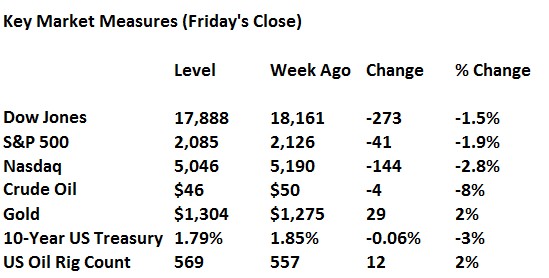
Here is How The Major Indices Performed Last Week

Here is How Last Week Progressed
Monday (8/1) - S&P 500 (down 0.1%)
US investors woke up on Monday morning to learn the results of the EU stress tests, which initially seemed to restore confidence, but Italian banks reversed gains in short order as the concerning debate over the Eurozone banking system continued. The NY FRB President Bill Dudley proceeded to tell the markets that a flatter path for US short-term interest rates seems broadly appropriate, but it’s premature to rule out further monetary policy tightening this year. Tumbling oil prices reflected how hopes for the near term rebalancing were pushed out a few more months following reports of a prolonged inventory overhang coupled with lackluster demand. Tesla and SolarCity announced a $2.6 billion merger. Uber sold its money losing business in China. The NY Fed announced 15% of American’s currently have a negative net worth. US construction spending data revealed growth hit fresh 5 year lows. JP Morgan’s equity strategist joined Goldman’s strategist, so now both are making a bearish three month call on equities.
Tuesday (8/2) - S&P 500 (down 0.6%)
New data revealed that US personal income growth slumped to the lowest level seen since 2013, but consumer spending remained near the trailing 12-month highs as savings are falling and credit is growing. Earnings season results began to sink in with two-thirds of companies having now reported results. The consensus 2Q16 S&P EPS estimate was $26.70 in early April, $26.40 as of late June, fell sharply to $24.90 as of late July after the initial third of companies reported, and drifted lower to $24.10 at this time. Sentiment about the EU stress test finally arrived at a more definitive view, unfortunately ‘all is not well’ causing the EU bank index to end down mid-single digits.
Oil tumbled below $40 until the unexpected Cushing inventory draw of 1.3 million was reported better than the 1.0 million expected.
Wednesday (8/3) - S&P 500 (up 0.3%)
A report published by the IMF’s Independent Evaluation Office crushed the credibility of a very visible IMF Managing Director. Nomera’s top credit analyst sent a chilling message calling for 30-year UST yield to trend toward zero over the next two years as a result of yield-starved foreign money running to the US. Ongoing concerns about central bank policy were for the moment eased by stabilizing oil prices. Kate Spade shares fell 17% on lowered guidance in part attributable to a lack of tourists, which reverberated across Retail markets. ADP employment data showed slowing in small business hiring and particular weakness in construction jobs. Bill Gross of Janus Capital Group caught everyone’s attention as usual, this time with a scandalous headline for institutional speak, where he proceeded to explain not liking bonds, most stocks, private equity, but rather being in favor of land, gold, and tangible plant and equipment. (We take his comments with a grain of salt.)
Note this rarity: The S&P 500 exceeded the average year-end forecast by Wall Street strategists, which for the 21 brokerages stands at 2,146. And it’s only August. Amazing.
Thursday (8/4) - S&P 500 (up 0.1%)
The big news came right away. The Bank of England cut rates for the first time since 2009 in a unanimous 9-0 vote, as widely expected, to a 322 year low. (This is not a misprint.) However, in a somewhat surprising move, the BOE also expanded its QE (qualitative easing) by €60 billion to €435 billion, in a more indecisive 6-3 vote. The FTSE (The British market) ended the day up just over 1.5% thanks to the BOE. In the US, Class A truck orders for July came in at an abysmal 10,500, down 57% YoY to a level and now 77% off their 2014 peak, reflecting uncharacteristic levels of order cancelations due to too lofty growth expectations, with the industry now frantically dealing with waning freight shipments. Barclays called out that the debt-to-EBITDA ratio for the S&P 500 excluding financials is now at the highest point this century at 2.3x compared to the last peak seen in 2002 of 2.1x. US factory orders fell 5.6% YoY marking the worst drop since September, extending the trend line to a 20 consecutive month period, a move that historically has spelled out a leading indicator for recession. Crude recovered 6% in 24 hours continuing the prior day’s recovering sentiment.
Friday (8/5) - S&P 500 (up 0.8%)
Good news. The whisper number for the Jobs report was below the 180,000 consensus, after two consecutive months of missing expectations. However, the Bureau of Labor Statistics reported a surge in July to 255,000 new jobs, which surpassed even the highest Wall Street estimate. The strength was in the (not so core) sector of Leisure and Hospitality, while performance out of Construction and Retail was wobbly. Way more importantly, the industrial arena of Mining, Manufacturing, Truck and Rail, while weak showed warmly welcomed signs of a bottoming. On top of the jobs data, the Atlanta Fed came out with the highest forecast for GDP growth since 1Q15 of +3.8% for 3Q16 versus the 1.6% consensus estimate. The onslaught of good data pushed the S&P 500 to all-time record highs with Financials outperforming.
Upcoming Economic News
The highlights of this week’s economic data release schedule come in the back half of the week. On Wednesday, we will see the US Job Openings figure, which is popularly known for being Yellen’s favorite labor market indicator, as it sheds light into the velocity of new hiring activity for the amount of job openings, where increasing/decreasing velocity is a leading indicator for upcoming unemployment rate statistics. On Thursday, the initial jobless claims figure comes out, which while a key metric in times past is currently bouncing along historical lows and less of an emphasis right now. On Friday, retail sales figures are due, where the most interesting story line we see is what the growth trends mean for brick and mortar retailers, or more importantly the commercial real estate sector exposure, as we and many others have serious concerns over the downside risk.

BMR: Companies and Commentary
Under Armour (UA: $40, up 3%) Our interest in the new Kohl’s agreement has carried over from last week’s earnings report. The agreement starts in March, and adds 600 locations of distribution in the first phase, with the potential for 500 more locations to be added later, specifically aimed at capturing more of Kohl’s female consumers and Kohl’s most loyal consumers that shop there on average 18 times per year. However, investors are myopic right now about the near-term outlook, specifically the Sports Authority liquidation, and expectations for inventory clearance continuing through the 3rd quarter. Under Armour shares are 10% below levels prior to the most recent earnings report.
Is this a good entry point? 20 out of 34 Wall Street analysts say Buy, with an average price target of $50. Analysts expect the 1,100 new Kohl’s stores when up and running to be worth around $250 million of annual sales or 6 cents of EPS, which is over and above what is in current consensus figures.
BMR Take: The consensus EPS growth outlook is already a stellar 32% and this Kohl’s agreement extends the visibility of this growth trajectory, if not enhances it. Consequently, we see the Kohl’s agreement as a catalyst and attractive upside in the stock. The price of Under Amour reflects the track record of consist high quality EPS growth. Businesses delivering results like this is what we look for here at The Bull Market Report. Under Armour's valuation based on historical levels is arguably not expensive.
Goldman Sachs (GS: $162, up 2%) Goldman said this week in a regulatory filing that the UK vote to exit the European Union could force it to restructure some of its activities in the Kingdom. Specifically, Brexit would likely change the arrangements by which UK firms are able to provide services to the EU. The timing and outcome is uncertain, they said. Recall that Goldman employs 5,500 in its London office. The noise of Brexit has contributed to keeping the stock trading below tangible book value of $173. There are a number of levers for the upside, however. The recently announced $700 million cost savings effort is worth $1.00 of incremental EPS by some estimates. While the investment banking backlog is down mid-single digits YoY, the outlook is relatively upbeat around Goldman's market share.
The new digital consumer lending initiative at Goldman, which is an online lending effort similar to Lending Club aimed at capturing market share of one of the most explosive growth areas in all of consumer finance, will launch its first product this fall. This is a big thing at Goldman, as they are building a new business, something they haven’t done in years. Lastly, the recent Comprehensive Capital Analysis and Review approval was a success. Recall, CCAR is the annual process whereby Goldman and others receive regulatory approval to pay dividends and make share repurchases. So the current $0.65 dividend is here to stay and the company is now accretively buying back stock below book value, a very good thing.
BMR Take: We maintain Goldman to be undervalued.
Blackstone Group (BX: $27, up 2%) Shares have nearly recovered back to their $27.50 level prior to last week’s earnings report, which confirmed long term investor interest. The bull case for the shares is a low to middle $30 level, based on a low double digit PE. It is currently at 9 times earnings. You also get the current 6.5% dividend yield while you wait. While the reaction to last week’s earnings was somewhat mixed, the key long term drivers were solid and worth revisiting in more depth, so we at BMR did more work for you.
First, Blackstone has signed or closed $7 billion of transactions across more than 15 transactions over the past two months. Management stated it expected to be in “active disposition mode” in the second half of this year signaling more to come.
Secondly, fundraising totaled $21 billion in the quarter and $70 billion over the past 12 months. The firm has won “multiple mandates of $1 billion or greater each” over the past two months and continues to see strong demand for the alternative asset class as a whole.
Third, late cycle concerns about deteriorating credit quality have been a major overhang throughout the first part of the year for any company with exposure. To the surprise of many, we have seen credit performance remain resilient across several areas ranging from subprime consumer loans to junk bonds, even including pockets linked to the oil patch. For Blackstone this has meant a reversal of the past few quarters of weak credit and distressed strategy performance. The most recent quarter credit and distressed strategy gross returns of 10% and 7% prove there is a lot more left in the tank for this economic expansion in terms of credit quality.
Lastly, concerns around the Brexit impact are not so material as originally thought. The company noted only 3% of total assets under management are in the United Kingdom, with a meaningful portion of these assets currency-hedged or invested in euro-denominated funds.
BMR Take: We remain positive on the long term outlook. The stock is WAY undervalued.
United Parcel Service (UPS: $109, +1%) Investors have now had a bit over a week to digest the most recent earnings report, and shares look poised to test 52 week highs of $112. The latest Jobs data on Friday directly addressed concerns over a sluggish macroeconomic outlook weighing on UPS. Core trends for the company are solid, in particular eCommerce growth and this year’s peak holiday season outlook.
First, UPS should continue to benefit from its increased exposure to eCommerce activity. Business performance for the company is a tale of two cities with strong B2C* and eCommerce growth offsetting softer B2B* and industrial activity. In fact, B2C is now 45% of the business and grew more than 5 times faster than the B2B business this past quarter.
Second, the outlook for peak season is shaping up well and will benefit from an extra workday between Thanksgiving and Christmas. In fact, management expects fourth quarter operating profit growth to be roughly 10%, above its annual guidance.
BMR Take: At $109, the stock trades at 18x the consensus 2017 EPS. Valuation has consistently been able to hold a 20x PE in recent history. We like this company a lot.
*B2B – Business to Business
*B2C – Business to Consumer
Mobile Advertising Rises at Facebook
Facebook (FB: $125, up 1%, after rising 2% the week before) once again reported growing profit on the strength of its mobile-advertising business. For the latest quarter, the company saw net income of $2.05 billion, or 71 cents a share, compared with $720 million, or 25 cents a share, a year ago. The stock closed near the all-time high of $128 hit after earnings were released a week ago Thursday. Facebook is now tied with Exxon with a market cap of $360 billion. Unreal.
Energy News of Note
Exxon Mobil (XOM: $88) reported its quarterly profit fell 60% to the lowest level since 1999, while Chevron disclosed its biggest quarterly loss since 2001. With its other businesses struggling, Exxon Mobil’s chemical division delivered more than half of the company’s profits in the first six months of 2016. Two years earlier, during better times, chemicals accounted for less than 10% of profits.
The Apple Corner
Apple keeps chugging away. To use our favorite term lately, it is TRICKLING UP day by day, week by week. Two weeks ago it was at $99. Now it’s at $107.50, up 3% for the week, and paying their whopping dividend of 57 cents. Well, not whopping. But nice nevertheless. (If you want more income from Apple, read our Options Corner (below.)
There is lots of negativity about Apple out there. We read it and generally discard it. Why? Well, for one thing, they have $232 billion in cash. Yes, we know – most of it is overseas and to get it back they would have to pay a 30-40% tax. Let’s think about this for a minute. Let’s say you have $5 million overseas and can’t get it back here without paying a tax. Nice problem to have, right? So you go to Europe and spend it. Or you pay some tax and bring back $3-4 million free and clear.
Need we go further? OK – we will: $232 billion in cash is the equivalent of $43 a share in cash (OK – we KNOW that they have to pay tax on the cash.) But still, no other company in history has had 40% of its stock price in cash. [Google (GOOG: $782) has $77 billion in cash – that’s $112 per share, but only 14% of their stock price. (Wait – did we say “only”?)]
Secondly, they have the iPhone. So sales were a little slower last quarter. But they still sold 40 million iPhones! That’s still 440,000 A DAY! And every one of them is going to load up iTunes and buy music, and go to the App Store and buy stuff. And love it so much that they will buy a Mac down the road. Need we go further?
Third – a new version of the iWatch is coming out, a truly revolutionary product.
4th – They are working on the TV market. They WILL get it right one of these days.
5th – Autonomous cars. It’s coming, and Apple will be at the forefront. (This is certainly a way off, so we are not banking on it, but felt we had to mention it.)
6th – The iMac. The greatest computer ever made. Need we say more?
BMR Take: We firmly believe we will see new all-time highs in the stock if the market behaves. What’s its all-time high? $134.
Words from Gary Jefferson
First Vice-President, Investments
Jefferson Financial Group
Forget for a moment that the consensus earnings forecast is for a strong 3rd Quarter followed by a stronger 4th Quarter. If the remainder of the 2Q earnings season ends as it has shaped up thus far, it will be the fifth straight quarter of earnings growth decline. (Note that the 2Q GDP has just been officially declared worse than expected, coming in at 1.2% versus a consensus for 2.6%) Of all the fundamentals that support stock market value, corporate earnings is "the big dog." After five straight declines, one might ask, "Why isn't the market in the doghouse instead of acting like everything is great?"
Energy companies have been devastated by falling prices; banks were hurt by artificially low rates; and multinationals got hit by a stronger dollar. Over the past year we have seen a rally in oil prices, a bump up in interest rates and the US dollar has taken a significant breather - all good. But recently, "negative rates" have appeared around the globe, oil has retreated over 15% and the dollar has surged upward – not good. Yet the market has continued to surprise to the upside. So what's the deal?
According to the rule of KISS, the simple answer is investors are betting that corporate America is turning the corner; i.e., the earnings contraction that started over a year ago has bottomed out earlier this year. From everything we read, however, a good bit of the much rosier outlook for the rest of this year is based on oil prices and the idea of forever-low interest rates. The very recent wrong-way moves in oil and the dollar, raise concerns about their possible negative impact on manufacturing and further disruption in the Energy patch. And heck, why stop with just a couple of "worries" – there are countless worries to be had.
All of this brings to mind one of the oldest and most respected stock market epigrams: "Stocks climb a wall of worry". Meaning, without worry there would be no opportunities in the stock market. There's plenty to worry about – oil, the dollar, rates, the election, Brexit, China and terrorism, just to name a few. But what we see is a wall that will crumble under the pressure of good earnings, despite all the worries. However, should earnings surprise to the downside we will see a wall the market can't climb over. The majority of experts believe that earnings will come through just fine, and if they are right, the market should continue to “climb” its way higher by year end.
HIGH YIELD CORNER
One week is not enough to make a trend, but this week’s action could be the beginning of a change in the high yield markets.
The broader market was up less than 1% for the week, helped by another strong Friday after a somewhat humdrum week. Similar performance was seen in the UBS Etracs BDC ETF (BDCS: $21.60), which was up just about as much as the S&P 500 for the week. Everything else high yield was a disappointment, however. High yield bonds were flat, as the iShares High Yield Corporate Bond ETF (HYG: $86) ended the week flat, helped in large part by strength on Thursday and Friday.
Similarly, the MLP world ended the week flat after early-week volatility, as the Alerian MLP (AMLP: $12.85) ended the week flat after losing nearly 4% at its lowest point on Tuesday. This extreme volatility, combined with a 1-year decline of 17%, again strengthens our resolve that the MLP world is fraught with danger and volatility - the kinds of things that long-term investors seeking reliable income do not want. Combine that with a dividend cut in May for the MLP ETF - a necessary move after dividend cuts (or halts entirely) in the Energy sector. While further dividend cuts in the short term are likely for some MLPs, being selective in this market - or avoiding it altogether for higher quality income instruments - seems the prudent thing to do. At a 9% yield, the Alerian MLP retains a poor risk/reward profile even as oil markets become increasingly volatile. We’re not back to the darkest days of 2014 or 2016 for that matter, but we definitely aren’t out of the woods quite yet in the Energy sector.
So what income instruments are a better option? For a while, The Bull Market Report has been recommending REITs as a great income opportunity, with the best players in this asset class providing tremendous returns so far in 2016. However, it may be time to look elsewhere. The SPDR Dow Jones REIT ETF (RWR: $102) fell over 2% last week, falling every day except Friday, when the rest of the market rallied and REITs closed slightly in the green. This is stunning since the SPDR Dow Jones ETF has a very conservative allocation among low-risk REITs. Unfortunately, it is those low-risk REITs that are getting hit the hardest. If we compare Realty Income Corporation (O: $69) to one of our more contrarian picks, this paradox of volatile low risk stocks becomes clear. Realty Income is an old favorite of high yield investors thanks to its size, diversified portfolio, excellent management team, and incredible dividend coverage. That’s why the stock soared 40% from the beginning of 2016 to the beginning of this week. But this week showed consecutive declines, causing the stock to fall 4%. Meanwhile, Bull Market Report pick Government Properties Income Trust (GOV: $23.90) ended the week flat and remains up 50% year-to-date.
This doesn’t mean declines for some REITS or some MLPs aren’t in the cards. In fact, a major correction in the REIT space seems to be coming soon after meteoric rises earlier this year. However, the selling pressure we saw this week demonstrates that the more risk-averse investors - the ones who prefer Realty Income over Government Properties - are the ones who are selling off the most aggressively. With strong dividend coverage but thin volumes and relative unpopularity, we actually see Government Properties better positioned to hold onto its gains longer than other REITs for as long as this risk-averse sell-off continues.
That doesn’t mean we are aggressively buying more REITs right now. The capital gains The Bull Market Report portfolio has enjoyed are wonderful, and justify considering a reallocation to other high yielding assets that remain well-valued and less at risk.
On that topic, let’s turn back to the bond world. Formerly Pimco Dynamic Credit Income Fund has renamed itself to PIMCO Dynamic Credit and Mortgage Income Fund (PCI: $19.95), properly reflecting its new investment mandate. Like the high yield bond world, the Pimco Fund was flat for the week and saw minimal volatility. Up 10% year-to-date with a 10% dividend yield excluding special dividends, which the fund has a history of paying, we remain in love with this fund and see it as a great place to pick up income in the current market. The fund is still trading at a discount (6%) to its net asset value, and net investment income still remains above dividend payouts, with a massive amount of undistributed income still remaining in the fund.
We especially like the Pimco Fund because of trouble that is hitting the corporate bond and BDC markets. We also still like its sister fund, Pimco Dynamic Income Fund (PDI: $29), which is up only 6% and may have more room to go in 2016 thanks to its more aggressive focus on mortgage bonds and its limited use of corporate bonds. Why? Simple: Corporate defaults are up. In fact, they reached a 6-year high this week, and Moody’s released another warning about the credit markets. This news didn’t cause high yield bonds to fall - in fact, the markets shrugged off the news. Meanwhile, average yields on high yield debt have plummeted to less than 7% - their lowest point in a couple years. The danger of non-accruals to BDCs is also mounting, leaving investors in the credit market to face a dilemma.
The way we see it, the increased risks and falling yields on corporate debt mean that you cannot simply hold a corporate bond or a corporate bond index fund. You need active management to avoid these surging defaults. This is especially true as junk bond interest rates fall, and the likelihood of rising rates later this year or in 2017. We would like to limit our exposure to junk bonds right now, while still enjoying the high income that an aggressive credit strategy offers. These funds offer it. In the coming weeks, we will need to continue to monitor the junk bond and BDC markets to see if this week’s relative weakness in credit gets worse.
THE OPTIONS CORNER
Two weeks ago we wrote about an options strategy for Apple. Here’s how it went:
Let’s look at some Apple strategies. Do you like Apple? We do. Has it been a laggard lately? Yes. Will it jump out of its trading range here in the upper 90s? We certainly think so. As you know, the stock closed Friday at $99, up 1% for the week.
How do you get a huge bump in income from the stock? Answer: Sell the January 100 call. Let’s say you have 100 shares worth just less than $10,000. The dividend is currently 2.3% giving you an income of $230 per year. If you sell the January 100 call for its current price of $5.25, you would have an immediate inflow of $525, or an annual return of 10.6%. [The math: $9900 investment; Income of $525; Time period – six months.] Now, if the stock goes higher than $100, you will get called away and have to sell the stock. But we are not talking about anything other than an income plan here. If you don’t want to lose the stock, then you should consider selling a higher-priced options like the January $110. That only gives you $2.00 ($200) on 100 shares. But, it does give you $10 of upside on the stock which is worth $1000.
Let’s review what happened in the last two weeks, and what moves you can make if you like. The stock was at $99 two weeks ago and is now at $107. This is good news, as you have made 8 points on the stock, $800, but if you had sold the $100 call, you are at risk of having the stock called from you. So what you can do is BUY BACK the January 100 call for $11 and SELL the January 110 for $5. You are ROLLING OUT the options and this gives you the upside to $110 for a potential gain of 11 points from the $99 that you paid, which is a good thing, and you would only lose a point on selling the calls. All in all, a good trade.
News of Note:
We discovered some news from The Mercury News about the amount of cash that is being held by Tech companies. We know about Apple, with $232 billion at the end of June, with about 90% held overseas, but listen to how much cash these companies have using end of 2015 numbers:
Microsoft: $100 billion, 95% overseas
Google: $73 billion, 60% overseas
Oracle: $52 billion, 87 overseas
Cisco: $60 billion, 95% overseas
Other companies with a lot of cash include Intel, Gilead Sciences, Facebook, Amazon, and Qualcomm.
That’s a wrap! (We almost wrote – That’s a warp!)
We’re pumped on announcing our new Bull Market app. Check it out at the iTunes store or on Android.
Good investing,
Todd Shaver
Editor in Chief
The Bull Market Report
