July 24, 2016
![THE BULL MARKET REPORT for July 25, 2016]()
by Todd Shaver | Jul 24, 2016 | Weekly Newsletter 7pm Sunday
New Records Set Once Again
Even after a week of heavy earnings reports and a pile of political campaign promises, this market can’t be stopped. Both the Dow and S&P 500 made new records, while the Nasdaq showed the strongest weekly gains out of the three major averages. It is the fourth week in a row of rising prices. Not even the prospect of another week of political conventions can dampen investors’ spirits.
S&P 500 Closes at Record High as Investors Bet on U.S. Stability
The S&P 500 hit new all-time records this week. A better-than-expected jobs report a week ago Friday was the latest boost to the S&P, which has gained more than 16% since falling to a yearly low in February. Stocks have been bolstered by signs of strength in the U.S. economy, a recovery in oil prices and the Federal Reserve's cautious stance toward raising interest rates. The S&P 500 climbed 13 to close at 2,175, a record high. The Dow Jones Industrial Average rose 54 points to 18,571, closing just 24 points off its all-time high set Wednesday at 18,595.
There was a slug of company earnings out last week. It is too early to make a final analysis, but there appear to be more upside surprises coming like Microsoft, Qualcomm, and Goldman Sachs already did. Of these three, only Qualcomm blew through revenue forecasts. Revenue comparisons from the others were unimpressive. The reason for mentioning this is simply that the corporate mantra of cost control is working hard these days, and when revenue growth resumes, this will provide outsized profit gains.
One of the only commodities that went down last week was Crude Oil. On Friday the Baker Hughes rig count showed 14 US additions, the fourth straight weekly gain which brought the total to 371.
Let the good times flow.
Here is How The Major Indices Performed Last Week

BMR: Companies and Commentary
Qualcomm (QCOM: $61, up 12% for the week) 2Q16 results beat the Street both in revenues ($6.0 billion versus consensus $5.6 billion). EPS at $1.03 was $0.20 greater than most estimates. More good news is the double-digit gains in CDMA chipsets, up 15%. These are the very chipsets used in the iPhone and Smartphones from many other makers. This should dispel all the chatter going around that Qualcomm was on the losing end of business for the iPhone 7.
Between these results and the analyst call, estimates are expected to rise in the days and weeks ahead. The stock had a strong positive reaction to the news, but the ride is not over. The price is still well below the high of $82.
Adeptus Health (ADPT: $47, down 13%) Last week, we took the unpleasant but necessary step of removing Adeptus Health from our list Opportunities in Healthcare. We remain a believer in the business model of free-standing Emergency Care because this addresses one of the worst problems in the American healthcare system.
The explanation offered by management for revenues falling almost 30% below guidance as a “bit of softness” in June is inconsistent with common sense. If we cannot trust management’s guidance, we are compelled to bid adios. Not everyone will agree with us as this is what makes markets interesting. The stock may bounce from here so there may be good reason to be patient. But if Wall Street picks up on this the way we have, the stock could drop sharply in the coming weeks. We sadly say goodbye.
Kinder Morgan (KMI: $21, up 1%) The company hit the $0.15 per share target for 2Q16 on 9% lower revenues of $3.1 billion. This revenue number was a cool $400 million shy of estimates, but even so, earnings hit their target, which means management’s plan for cost reduction is working effectively. The deleveraging of the balance sheet and the recovery of drilling activity represents the appeal of Kinder Morgan at this stage in its life.
For the full year, operating cash flow equals about $1 billion, with capital expenditures slashed by over 60% to less than $3 billion. The stock has been a winner. In just the last month, the price has moved up about 15% on its way back to the 2015 high of $43.
Netflix (NFLX: $86, down 13%) As we noted in our Earnings Preview, the only thing worth watching in 2Q16 results is the number and growth of subscribers. US subscriber growth in 2Q16 fell at 11% rate from 17% in the same quarter a year earlier. In the earnings call, management noted that the slowing is expected to continue. There are several possible explanations including customer adverse response to price increases for long standing users. But the data, does not suggest this is solely the problem. This conclusion is based on the fact that slowing growth took place in new users (+11%) as well as customer renewals (+12%). For this reason, our belief is that the slowdown is a fluke and not the reflection of weak strategy or management errors. Nevertheless, this key metric will be watched like a hawk with even more intensity that ever before.
Netflix shares took a beating following the 2Q16 report. It raised questions about the company’s growth prospects and more importantly about the so called “ungrandfathering” move to raise prices on long standing customers that are still paying monthly fees of less than $10. Critics don’t like these moves. We understand and agree. When this issue came up in the past, management backed down. This could happen again. The stock could be volatile until this becomes a reality. There is a clear line between taking an intelligent risk and being foolishly greedy. Netflix management has proven to be a savvy group; this is not their first rodeo. We always like to stand behind intelligent management.
One research firm that we admire says Netflix is positioned to be a leader in global video. They said: "Despite soft Q2 results and Q3 guidance, we continue to believe Netflix's core competitive advantages and long-term opportunity are intact, and that growth can re-accelerate following the negative impact of the price increase." With that said, this firm lowered its price target just $5, from $130 to $125, basically a non-event, telling us that there is still strong belief in this company on the Street.
But we will say this. If they let investors down again, the stock could get slammed. The PE is still in the triple digits which is insane, so any disappointment in future growth rates could be punished harshly. Thus, this stock is not for the weak investor. With that said, they are like an Amazon -- growing fast, hoarding cash, not producing profits, but capturing market share. Repeat - capturing market share. For Netflix, that’s what it’s all about. Disappoint the world however, and the stock goes to $50.
Goldman Sachs (GS: $160, down 1%) Management demonstrated how effective their cost control efforts have been with a positive earnings surprise for 2Q16. The company announced cost-cutting plan in the first half of the year that will save $700 million a year. Earnings rose 78%, easily beating much lower analyst expectations, but overall revenue declined 13% as all of its other businesses reported weaker results. Goldman's profit was buoyed by cost cuts and the fact that it had a large legal provision in the second quarter of 2015.
Overall, Goldman's net income rose to $1.63 billion, or $3.72 per share, from $915 million, or $2.00 per share a year earlier. Analysts had expected earnings of $3 per share.
Revenues of $7.9 billion also beat the Street’s numbers. Unfortunately there was still a YoY decline of 13%. The stock remains a value at 15 times earnings with a very respectable dividend yield of 1.6%, better than the US 10-Yr Note, and probably about as safe, and yet offers the upside of a stock. To us, this is the definition of value.
Headcount is down 2% annually and 6% quarterly. Its cost-cutting program has involved staff reductions, and will have related severance expenses of about $350 million, Schwartz said. As a result, the bank will only see about half of the annual savings of its cost-cutting initiative in 2016.
But at least they are working on it. We still maintain Goldman to be undervalued.
Blackstone Group (BX: $28, up 10%) The adage on Wall Street is “you are judged by your bottom line.” Never has this been truer than 2016 where growth in world economies has been elusive. In 2Q16, Blackstone produced a better bottom line beating consensus by 10% reaching $0.44. Lower performance-based fees were the big drag on revenues that fell 3% to $1.2 billion.
Bull markets help Blackstone’s prospects, and opportunistic investors have gotten the message lately. Over the last month, the stock gained over 10% including the positive reaction to 2Q16 results. There is only one way to interpret this action. Investors have realized the strong upside operating leverage to Blackstone’s business. The stock is performing well lately but is still a long way from its all-time high of $44.
And listen to this: Blackstone may take one of its divisions focused on single-family rentals public in the first half of 2017. Their wholly-owned subsidiary, Invitation Homes currently owns 50,000 single-family homes across the country that are rented out. Bloomberg News reported that it would go public as a real estate investment trust.
Blackstone bought most of these homes after the 2008 debacle and most of them are up dramatically in price. They feel now is the time to take profits from this investment. Furthermore, this is just one step that Chairman and CEO Schwarzman is taking to boost the price of the stock. Look for much more of this ahead.
Microsoft (MSFT: $57, up 5.3%) The company matched revenue expectations at $22 billion but solidly beat EPS forecasts of $0.58 at $0.69. The quarter showed how much the future is moving away from traditional markets like PC software. Not that software with its 90%+ profit margins are bad. They just aren’t the growth engine of the past. The growth engine of the present and future is the Cloud. Microsoft’s key cloud product, Azure, put up big numbers in 4Q16 increasing at a rate of 108%.
Finally, expectations for Microsoft are rising along with rising earnings estimates. In the coming days, look for Wall Street’s new herd of bulls to put out glowing opinions. July is turning out to be one of the most productive for the stock. There are still a few more days to go but if you look at the last 30 days, the stock is up 11% and in positive territory for the entire year. Don’t forget the dividend of $1.44 that goes with the stock. It offers an attractive yield of 2.6%. The future of Microsoft is just beginning.
Visa (V: $80, up 2%) 3Q16 results beat EPS estimates by $0.02 reaching $0.69. Visa’s huge multinational operations can best be measured using constant dollar translations rates. By this measure, revenues increased 6%. Were it not for the strong dollar that penalized translations, Visa would have ranked as one of the best financial service companies of the June quarter.
Each major segment performed well: Data Processing (+10%), Services (+6%), International (+4%). Virtually every part of the company showed above-average performance. Unfortunately, the market invests in dollars, so much is lost in currency conversion. Long-term investors understand the nature of investing in multinational financial services companies and this is why Visa has been a steady winner since before the turn of the decade.
Upcoming Economic News
This week is time once again for monthly housing numbers, starting on Tuesday with the Case-Shiller index of home prices, along with New Home Sales the same day. Wednesday brings Pending Home Sales and on Thursday something new, the 2Q Rental Vacancy Rate.
What we are constantly looking for is insight into housing affordability. In many metropolitan regions the sharply rising cost to purchase or rent is an inflationary issue that gets overlooked by many economists. Our interest in the rental vacancy measure, of course relates to our friends at Equity Residential (EQR).

PayPal (PYPL: $37, down 4% for the week) PayPal Holdings dropped 7% Friday after two new announcements. The company reported its 2Q16 results on Thursday night; the results first went over well - in after-hour trading hours PayPal rose to $40 a share. But after the news sunk in, the stock sold off.
Here’s what has gotten investors so unnerved. On July 22nd the current deal with Visa (V: $80, up 2%) went through, which proved to be a point of contention for investors. There were varying negative opinions from investors. PayPal and rivals have entered into a partnership to collaborate in its market. Investors believe that PayPal agreed to terms that were more advantageous to Visa. Part of the deal is to offer Visa Cards as an option to pay as opposed to having PayPal members link bank accounts.
Initially a reaction like this was expected, but the long-term effect of this deal bodes well for PayPal’s future. PayPal has argued that the partnership will speed up digital payment adaption in the retail sectors, thus increasing revenue for the company.
Exceeding Expectations
PayPal beat predictions from Wall Street by a slim amount, but still exceeded them. The company brought in $2.65 billion in revenue, more than the expected $2.6 billion. It’s also a great time to be an investor in PayPal as last quarter it repurchased 8 million shares back for around $300 million.
This is a transitionary period for PayPal as the company is shifting its focus to more areas of moneymaking services. Some of these include business and personal loans and one-touch online checkout. This is a sign of a company that is looking forward to the future to stay competitive. Venmo, a PayPal company, doubled its volume to $3.9 billion in the second quarter, allowing PayPal to stay ahead of other instant mobile app payment companies. PayPal needs to stay cutting edge and ahead of the competition and with deals like this, it is doing just that.
The Option Corner
Let’s look at some Apple strategies. Do you like Apple? We do. Has it been a laggard lately? Yes. Will it jump out of its trading range here in the upper 90s? We certainly think so. As you know, the stock closed Friday at $99, up 1% for the week.
Strategy #1 – How to get a huge bump in income from the stock. Answer: Sell the January 100 call. Let’s say you have 100 shares worth just less than $10,000. The dividend is currently 2.3% giving you an income of $230 per year. If you sell the January 100 call for its current price of $5.25, you would have an immediate inflow of $525, or an annual return of 10.6% . [The math: $9900 investment; Income of $525; Time period – six months.] Now, if the stock goes higher than $100, you will get called away and have to sell the stock. But we are not talking about anything other than an income plan here. If you don’t want to lose the stock, then you should consider selling a higher-priced options like the January $110. That only gives you $2.00 ($200) on 100 shares. But, it does give you $10 of upside on the stock which is worth $1000.
Strategy #2 - We all know that the all-time high for Apple is $134, but obviously it is stuck in a range and many investors have given up on it. Not us. We think it will go there again, but just don’t know the time frame. If you think it could happen in the next 18 months, you could buy a call at the $130 level for a fairly small premium and sit back and wait to see what will happen. Now this is a purely speculative undertaking, so be prepared to lose all of your investment here. The cost of a $130 call expiring in January of 2018 is $2.60. You could buy one of them or 10, or more. One would cost you $260; 10 would be $2,600. Obviously, you are buying a wasting asset and if the stock doesn’t get to $130 in 18 months, the option will expire worthless. However, if it gets to $135, if you had bought 10 of them, the options will be worth $5,000 and you will just about double your money. If it goes to $150, which is quite possible, they will be worth $20,000. And that folks, again, is called sheer speculation.
Notes from the Margin
By Phil Verleger
Former Director of the Office of Energy Policy
www.PKVerlegerLLC.com
“Insanity” as defined by Albert Einstein is “doing the same thing over and over and expecting different results.” By this definition, the oil industry seems to be certifiably insane. We provide evidence for this assertion by comparing the rise in global inventories to the oil price forecasts being widely circulated. The world is awash in petroleum products. Across the globe, traders are scrambling to find tanks and ships for storing unneeded crude and product. Excess returns to storage point to a widening glut. Yet oil prices forecasters (with the exception of this author and a few others) expect significantly higher prices.
Forecasters today are seeing the same cycle of stock increases as observed in the past. However, they somehow expect prices to rise rather than fall, which seems to meet the Einstein definition of insanity.
The situation in the current oil market is not unique. Recently Financial Times published a story headlined “World Grain Glut to Enter Fourth Year.” The author explained that four years of record harvests have left inventories high and prices low. Corn stocks as of June 1, for example, were at their highest levels since 1988, almost 30 years ago. Prospects for a turnaround are slim thanks to recent rainfalls and record per-acre yields. Matters have been made worse by increased plantings.
While some believe energy and especially oil markets are different, the historical evidence does not support their view. From our perspective, it appears that oil markets are following the pattern set in other markets. This suggests that lower prices are in the offing for some time to come, absent a coordinated production cut by some group of oil-exporting countries
BMR Take: Love this guy Verleger! Hmmm. Let’s watch Devon Energy (DVN: $38) closely from here. If you bought when we recommended it you are up over 100%. If Verleger is right, above, this stock may be heading lower.
High Yield Corner
It was another strong week for the markets, with some high yield assets outperforming the broader stock market yet again. With earnings season in full swing, and some relatively strong results coming out so far, investors realize that the Brexit selloff was a foolish mistake, and there are still great values and high quality assets to be bought and held even as stock prices continue to reach new all-time highs.
The strongest performing sector this week was Business Development Companies (BDCs), which jumped 2% amidst continued inflows from yield-hungry investors. The UBS BDC Etrac ETF (BDCS: $21, up 2%) rose the most on Friday, when it climbed over 1% as investors piled into its constituent companies. But not all BDCs performed alike. For instance, Medley Capital Corporation (MCC: $7.40) rose half of 1% on Friday and closed the week up less than 1%, while the largest BDC, Ares Capital Corporation (ARCC: $15.10) rose over 1% on Friday and closed the week up an impressive 6%. While this is good for short-term traders, the stock is still down 8% over the past year as a result of weak net asset value growth and persistent concerns about defaults in the energy sector, which Ares Capital is particularly exposed to.
Bull Market Report’s favorite BDC, Main Street Capital Corporation (MAIN: $33) had a less eventful week, staying mostly range bound and ending the week up very slightly on thin trading. But this is actually a good thing for Main Street holders, as paradoxical as it may seem. The company is currently trading at a massive premium to net asset value - one of the highest premiums the stock has ever seen. Up over 14% for 2016, it is also one of the best BDC performers on these longer time horizons (and the best BDC performer since its IPO). We still see Main Street covering its dividend nicely thanks to its high quality loan portfolio, with the chance of dividend increases growing stronger as we head to the end of 2017. With strong management and high dividend coverage, its premium is well-deserved and we maintain holding Main Street as a great way to get reliable and lower-risk current high income.
Another strong asset class this week was REITs, with the SPDR Dow Jones REIT ETF (RWR: $103) rising 2% for the week, again with most of those gains coming on Friday. But The Bull Market Report picks fared much better.
Omega Healthcare Investors (OHI: $36) had a monstrous week, climbing over 6% with steady gains every day of the week. The rise is in anticipation of the company’s earnings release, which is due in a little over a week. The market is expecting a strong release, and investors are buying ahead of the announcement. While this puts the stock in a dangerous “buy the rumor, sell the news” situation, we remain unconcerned. When looking at Omega Healthcare’s price to FFO ratio, we see that the stock is significantly cheaper than its peers - at a 13x ratio whereas others in the healthcare REIT sector are closer to 22. Yet Omega Healthcare is significantly larger and better positioned to gain on current investments, making it a strong stock to keep, even with its recent climb.
Another Bull Market Report favorite had a less impressive week. Government Properties Income Trust (GOV: $23.10) fell just 2% on analyst downgrades, but paid a 43 cent dividend. After a 45% year-to-date climb, downgrades aren’t surprising - analysts are getting scared that the large stock growth is unsustainable, and it’s time to call a top. We don’t see a top, however, since the company is still more than covering dividends with FFO and its expansionary plans are still on track to help the REIT boost payouts even further. The company will release earnings next week, and we will look closely at what they report to see if those investments will help the company fly even higher.
Finally, another important sector to watch this week is the junk bond market. The SPDR Barclays High Yield Bond ETF (JNK: $36) rose slightly more than the S&P 500 this week, again with most gains coming on Friday. There are growing concerns that junk bond yields are getting too low. At 6.6%, the average yield of junk is now over 3 percentage points lower than it was in February, startling many investors. But the yield on junk bonds is a volatile metric, often changing radically from one level to another. This massive decline has happened in tandem with a major decline in the U.S. Treasury yield - currently at 1.57%, much lower than the 2.0% we saw back in February. With Treasury yields falling, it’s no surprise junk bond yields would fall as well. For this reason, we see relative safety in the junk bond market right now, although this could change very quickly and very soon.
Note that we have no junk bonds in our High Yield portfolio. We think owning individual junk issues is not someplace we want to be. If you want to venture into junk then buy the SPDR Barclays High Yield Bond ETF (JNK: $36), discussed above. Founded in 2007, it is an $11 billion fund, pays 6.3% and is professionally managed.
Our favorite bond fund remains the Pimco Dynamic Income Fund (PDI: $28), which rose nearly 3% this week, helping it stay in positive territory year-to-date. The fund is still covering dividends and has very high quality assets. Although it has swung from trading at a discount (when we first recommended it) to now trading at a premium, it remains one of the highest quality bond funds out there with very high payout coverage.
All in all, it was a very good week for high yield investors, and an even better week for those who bought our recommendations. Looking forward, we remain eager to see how earnings results play out for REITs and how the bond market will evolve next, which could get us to rethink our current positions in the high income space. No guesses here though, as we are very pleased with our portfolio entries and look for further steadiness and high dividend payouts ahead.
Good Investing,
Todd Shaver
Editor in Chief
July 17, 2016
![THE BULL MARKET REPORT for July 25, 2016]()
by Todd Shaver | Jul 17, 2016 | Weekly Newsletter 7pm Sunday
Dow and S&P 500 Hit Record Levels
It was amazing, wonderful even mind-boggling. No we are not talking about Pokemon, we are reflecting on the record levels hit on Friday by the Dow and S&P 500. Closing prices were a bit off record highs; nevertheless, any investment measure that sets a new record says a lot about investor confidence. The term confidence is used here purposefully. Looking at the tragic events in Nice on Thursday, the fact that all major European and US markets were calm on Friday is remarkable. The other barometer of confidence of course is Gold. The metal fell 2.1% for the week. Logic would have predicted different results. Almost everything about last week had a different and unexpected tone. We learn something new every day.
Here is How The Major Averages Performed For The Week

Stocks at Record Levels - Follow The Money
When seeking investing success, it is often advised, “don’t fight the tape”. In other words, if huge amounts of money are pursuing a limited number of stocks, prices will rise. It is a simple matter of supply and demand. It is never a good idea to apply intellectual reasoning during these times because prices will rise no matter what we think. In the end, stocks discount the future and sometimes the future turns out better than anticipated.
According to Reuters, investors poured $12.6 billion into US equity funds last week, the second highest amount ever. In addition, $4.4 billion went into high yield bonds as the search for yield continues. More demand. Limited supply. Prices go up.
Last week’s record-setting milestone was surprising considering how bearish sentiment was immediately following the chaotic Brexit vote. This is a pretty impressive event. But what made last week so interesting (and puzzling) is hidden below these numbers.
On Thursday, the government released the Producer Price Index for June showing a huge leap. The index was up 0.5% versus consensus of 0.2%, an annual pace of 6%. In different times, investors would conclude the next step would be an increase in interest rates, generally not good news for stocks. But for the first time in a while, stock prices hit record levels while the yield on the US 10-Year Note increased as well.
Aside from the search for yield, investors in the American economy did have several bits of good news to reinforce their faith. Industrial output surged in June by 0.6% from big gains in the Auto sector, and Retail sales also increased 0.6% in June. The Auto sector actually held down the overall result. Excluding Autos, Retail sales increased 0.7%.
Bull Market Report Companies and Comments
CBRE Group (CBG: $28, up 5% for the week) We commented in our previous Bull Market Report newsletter how the stock was taking an unfair shellacking from the Brexit fiasco. The stock was down 17% during this period and was acting as if the end of one of the world’s foremost Real Estate Services Companies was only a matter of time. We didn’t buy into this at all. The stock had a nice bounce last week and still remains well below the all-time high of $39 reached in March last year. Earnings for 2Q16 will be reported July 25. Look for details in next week’s Earnings Preview.
Who will benefit more if every financial firm in London decides to move to other places in Europe? We know this won’t happen, but some of this is indeed happening as firms look to relocate their operations to Brussels, and Geneva and Paris, etc. This is what CBRE does! They help firms move, consolidate, and save money with their real estate needs. Case closed. We LOVE this quiet and powerful company.
PayPal (PYPL: $39, up 5%) We also recently pointed out how PayPal has a big share of its business in the UK. The notion that this could spell the end of PayPal sent the stock into the type of tailspin that invites savvy investors to buy more of this gem. The stock has appreciated 8% so far this year and now we can appreciate how the concern about Brexit is nothing more than a price discount in disguise.
Aetna (AET: $119, up 1%) The newswires last week carried lots of chatter about the pending Aetna/Humana combination. Word was that both sides held a meeting with the Justice Department. For some time there has been talk of Aetna being forced to divest several billion dollars of assets in order to get the deal done. Sure, it would be great if this turns out not to be the case. But we see no problem either way as there are plenty of buyers at favorable prices. Aetna management is determined to get the deal done. Earnings for 2Q16 will be out this August 2nd.
Kinder Morgan (KMI: $21, up 13%) The sun, moon and stars are finally in alignment for Kinder Morgan. It helps that Crude prices have recovered. It is also a good omen that drilling activity has picked up in the US and Canada. The stock is up 35% year-to-date with a lot of the move having taken place in the last two months. Wall Street is getting enamored once again because Kinder Morgan’s turnaround is starting to take shape. It starts with a deleveraging of the balance sheet by selling underperforming assets. Two deals in recent weeks have netted $4.5 billion in a combination of cash and reduced debt. More of this sort of music is coming.
Now, here is something for yield-oriented investors to consider. The current 2.4% dividend offers a competitive yield. This is good. But remember, Kinder Morgan’s current dividend of $0.50 a year was cut just last January from $2.00. We don’t know when the full dividend will be restored. But what we do know is the balance sheet deleveraging makes the prospects for some increases in the payout very likely.
Mylan Labs (MYL: $45, up 2.4%) Mylan is the latest addition to our Opportunities in Healthcare Portfolio. They are the world’s second largest generic drug company behind Teva Pharmaceuticals. With more than 1400 products, Mylan is highly diversified. Mylan has distinct advantages and is using its size and financial muscle to accelerate its growth through acquisitions. Over the past two years the company has entered into six agreements to acquire businesses, products or marketing rights. The company has deployed more than $700 million in cash and $6.3 billion in stock in the process of becoming the industry leading consolidator of products and brands.
The heavy initial costs of these transactions are behind it and this shows in Wall Street’s expectation for EPS to recover from $1.80 in 2015 to $4.95 this year, rising 20% in 2017 to $5.90.
When we find a company that is growing rapidly and selling at a low multiple, we get very excited. The most critical of Wall Street analysts see Mylan’s EPS growth at a 14% annual average over the next five years. That is the sort of rate that normally begets big premiums but here we have Mylan selling at less the 9 times 2016 EPS and 7 times next year’s estimates. We are not making up these numbers; they are the average of 15 of the best drug analysts in the business. Need we say more? Mylan has to be one of best the real values we have come across in a long time.
Alphabet (GOOG: $720, up 2%) [Somehow we just don’t feel comfortable calling this company anything but Google. Alphabet just doesn’t roll off our tongue yet. I guess it will over time.] Google is on a roll lately. It is the kind of roll that occurs with this company and a few others like Apple (AAPL: $98, up 2%) and Facebook (FB: $117, flat) from time to time where the stock TRICKLES UP day after day. Google is TRICKLING UP lately. (So is CBRE as discussed above, and so is Blackstone (BX; $25, up 4%) and so is Twitter (TWTR: $18.08, flat)). Google was at $702 the day before Brexit and $675 the day after. That sounds terrible but it is like a $70 stock going to $67 – not the end of the world. The next day it went to $668, but has trickled up day after day to its present $720. Love it.
Where next? Well, we added the stock in February at $765 so it hasn’t been the greatest performer in our arsenal. But we are believers in the company and are confident that it will hit $1000 in the future. They are a cash machine and have some of the smartest people in the world of Technology. They have $73 billion in cash and just $8 billion in long term debt. Sales have gone from $46 billion to $55 billion to $66 billion to $75 billion in the last four years. Do you think this growth is going to stop? No way.
We could go on and on. But we would suggest that Google is on sale here; you know, like going to the store and getting 20% off the price of a new car. A year from now if the market stays steady and moves higher, we would expect to see an “8” or a “9” in front of the stock price. And wouldn’t it be grand if they decide to split the stock like Apple did. Would they do a 7-1 split like Apple? Or maybe a 10-1 split and bring the price down to $90!
BRIEF MENTIONS
Blackstone (BX; $25, up 4%) We think this is one of the most compelling buys of all of our stocks.
Under Armour (UA: $42, up 3%) Trickling up from $36 after Brexit. The stock should be in the 50s or 60s.
Goldman Sachs (GS: $162, up 7%) Not trickling up, but SURGING up. $70 billion market cap for a company that knows how to mint money. $215 52-week high last year. The stock should be in the 200s.
Qualcomm (QCOM: $55, up 1%) 4% dividend, $80 billion market cap. We should see a slow and steady rise in revenues and earnings as the company moves into new markets.
Upcoming Economic News: Summer Silence
After a busy data-filled week just passed, the upcoming days are conspicuously absent of any market moving elements. Aside from the normal New Jobless Claims (250,000 expected - Wednesday at 8:30 AM) and June Existing Home Sales (5.5 million Thursday at 8:30 AM) there is little else.
Thoughts from Jefferson Financial Group
Gary Jefferson
First Vice President
Jefferson Financial Group
A week ago Friday a popular research firm had this to say: "We have a green light from all the important economic indicators (Manufacturing, Services, Employment, Retail, Sentiment and overall GDP). Add to that the ultra-low rates for bonds = buy stocks. This is what SHOULD happen.
“However, there are some very vocal bears like Soros and Icahn who are playing from the old investing textbook which sees slowing worldwide growth and low rates as signs of trouble. Indeed those measures have historically been true. HOWEVER, the new investing textbook which is focused on a world awash in low/negative rates says that this environment is plenty good enough for further stock advances. So yes, we should make new highs shortly. But don't be surprised if there is a hearty battle that ensues between bulls and bears at 2135."
So let's look at the big picture:
• 10- and 30-Year Treasury yields just hit all-time lows
• The British Pound fell to a new 31-year low last week
• The key European bank index dropped to a new multi-year low last week
• US stocks (S&P500 Index) are at all-time highs
Which one of the above seems to somehow "not belong"? There is no doubt that stocks are acting resiliently, but bonds, banks and currencies are sending "caution" signals. For example, 17% of all loans in Italy are bad. By comparison, at the height of the '08/'09 financial crises, only 5% of US loans were bad.
In this market it is easy for anyone, advisors or investors, to feel confused and conflicted. After all, this is the fourth time this year the market has climbed up to these levels. We prefer sticking with the basics when sorting through all the "noise." In other words, just look at earnings.
Last week was the beginning of earnings season with Alcoa, JP Morgan Chase, Citigroup, Wells Fargo, CSX, Yum Brands and Delta Air Lines reporting
According to numerous 'experts', earnings are expected to be poor again this quarter with this quarter expected to be the fifth consecutive quarter of earnings declines. According to Thomson Reuters, earnings are expected to fall by 5% after a 5% decrease last quarter. The third quarter is also expected to be slightly negative. Energy companies are forecast to turn in the worst results again, with a roughly 75% reduction expected for the sector. Financials, whose results come in abundance this week, are expected to see earnings fall by about 5.5%.
What's our best guess in light of this scenario? The Fed will continue to flip-flop (Fed tightens policy through hawkish statements, then eases policy with a dovish speech – it has had 10 flip-flops in just over three years), and, while the flip-flops will likely continue, we don't expect any rate hike for the next six months. Combining low rates with all the political uncertainty and the ever-present oil wild card, stocks will likely remain volatile without really going much of anywhere until there are either stronger earnings or serious convictions that they are just ahead. That said, "Don't fight the Fed" and the "trend is your friend" are two of the oldest saws in the industry which have to be considered. A solid break above the old trading range top of 2135 could mean it is time to begin adding more stock exposure to portfolios – but let's see how the earnings season shapes up meantime, because right now stocks are pricing in earnings to perfection.
Apple and Google Want to Control Your Wallet -- But PayPal Has a Secret Weapon
From www.businessinsider.com
PayPal earned its fame as the internet's original electronic payment system for consumers. But thanks to an acquisition it made three years ago, PayPal is now a contender in one of the fastest-growing and most promising parts of the payments business. PayPal's secret weapon is Braintree, a payments startup it bought for $800 million in 2013. The deal gave PayPal vital technology for the back-end payment processing that's used by a slew of new apps and services, from Uber to Airbnb. It's a competitive business, but Braintree says it's seeing robust growth in an important part of its business, providing an important engine for its PayPal parent.
Braintree is doing three times as many transactions as it was this time last year. Assuming the average dollar amount per transaction hasn't dropped significantly, that increasing usage could help Braintree accelerate the growth in its overall payment volume, which totaled $50 billion in 2015 out of the $280 billion in payment volume PayPal did in 2015.
And at a time when companies like Apple, Google and Amazon are all trying to eat into PayPal's traditional market with rival payment services, Braintree is providing PayPal with a new way to stay competitive. Braintree makes it easy as it lets developers quickly and easily build payment systems that blend right in with their own apps and websites. They can take credit cards, Bitcoin, Apple Pay, Google Pay, or whatever comes next, without having to be a specialist in any of those things. Just plug in Braintree and go.
Airbnb is a customer. So are Uber, Pinterest, GitHub, OpenTable, and lots more companies large and small. When you pay for an Uber on your phone, no matter what payment method you use, it all gets invisibly handled by Braintree. So even when Tim Cook promotes Apple Pay at big Apple events, it's Braintree and its customers who get the push. Braintree is a strategic must-have for PayPal in many ways. While PayPal itself has rapidly improved its technology, both in terms of its app and its behind-the-scenes plumbing, the world is changing. People are doing more and more shopping from mobile apps. Braintree gives PayPal a way to always be a part of those transactions, wherever and whenever they take place, so long as developers put it in their apps. As computing becomes increasingly mobile, that's a shift PayPal needs to make to survive in the long-term.
PayPal’s drive is to help get merchants of all sizes to accept digital payments - a must in 2016, as smartphones and wearable technology promise to change the way we think of commerce.
How Brexit Will Affect the United States Economy and the Stock Market
If you have been current with recent events, you know that Brexit has become the latest news. While ordinary people may just read the news and gloss over it, economists, investors and other related stakeholders certainly don’t. The term is a coinage from two words; “BRitain” and “EXIT”. It literally explains the Exit of Britons from the European Union. There have been several campaigns, debates and agitations for Britain to quit the European Union on the premise of protecting and restoring the country’s independence, culture and place and its identity in the world. Part of the cause arises from restricting and possibly eliminating immigration.
Whatever the reasons adduced for leaving the European Union, it is here now and the reality is the fact that it will tell on Britain’s economy. This is because without access to the open markets of the EU, there is the likelihood that Britain will lose significant trade. With her agitation against migrants who have contributed to a greater percentage of her labor force, there will obviously be decreased job opportunities, lower productivity and slower economic growth in the country.
Great Britain consists of about a 6th of the economy of the EU, and the implication to the them is great. The Exit is akin to both Florida and California being lopped off our economy.
The EU happens to be one of the largest trading blocs in the world. This break will cause restructuring of trade deals and give birth to several global problems, many unforeseen. For one, Brexit could lead to a further breakup of the EU and the end of the use of the euro as their central currency.
In the wake of this Exit, most Americans (both consumers and business owners) are likely to restrict their normal spending plans, and restricted spending means slower economic growth for the US, which is not burning any barns down at the moment anyway. In addition, this Exit has caused serious volatility in stock markets globally. One of the characteristics of Americans is cutting short expenditures when things become bleak, and the future seems troublesome now with Brexit, as no one knows what will happen next. Adding spending reduction to the already sluggish world economic growth and high unemployment rate could have dire results.
Exit might further strengthen the dollar, lowering exports of US goods. This will make our manufactured products more expensive, and at the same time less attractive to outsiders, our buyers.
It will however be good news to American travelers, and we do love less expensive European travel.
More in coming weeks as things develop in Europe.
Options Corner
Buying Way-Out-of-the-Money Calls: Pure Speculation
(A quick one this week, as this newsletter is LONG!)
We like Under Armour a lot. The stock has been punished for no discernible reason. At $42, it is down from its all-time high of $53 last year. We think it will come back nicely, so let’s look at buying an out of the money option. Pure speculation. Pure unadulterated risk. (You know that buying options are risky. That’s why we like to sell covered calls. Less risk.) But if you want to play with some money you could lose, you could buy the January 2018 70 call for about $1.00. That’s the $70 call (the LEAP). In a nutshell, if the stock does not reach $70 you lose all your money. But if the stock goes to $75, you make four times your money. If it goes to $81 you make 10x. What’s the chance of Under Armour reaching $75? Only you can answer that, but you are buying a fabulous company that is clearly undervalued, so there is certainly a chance it could happen. And that’s what buying way-out-of-the-money options is all about: There’s always a chance.
Too slim a chance? Then look at the $50 call in January of 2018. This trades for about $4.50. So you have about 18 months for the stock to get to the strike price + the premium ($50+$4.50, or $54.50) to break even. Could the stock get to $54.50? Again, only you can answer that. If it does, you break even. If it goes another $4.50 higher to $59 you double your money. If it goes to $63.50, you have a 3-bagger. And so on. And if it doesn’t get to $50 by expiration? You lose _____ your money. (Fill in the blank. Hint: It’s spelled “A-L-L.”)
High Yield Corner
It was another strong week for the market, but high yield is showing signs of weakness. The S&P 500 gained 1.5% in the week to close at the record high levels we’ve enjoyed after the post-Brexit recovery, despite a small sell-off on Friday that may be more a matter of profit-taking than anything else. However, with the Nice tragedy and an attempted coup in Turkey, markets might begin to get more concerned with the potential of volatility in the future, causing these record-breaking levels to fall a bit.
Meanwhile, High Yield was a mixed bag. The junk bond market was flat, with the Barclays Capital High Yield Bond ETF (JNK: $36) staying at roughly the same level after an early-week jump. This is not really a bad thing, since junk bonds are up about 7% for the year. As this has happened, bond yields have fallen to extremely low levels. The curiously named BofA Merrill Lynch US High Yield Master II Effective Yield, an index of below-investment grade corporate debt yields, fell to less than 7% by the end of the week, although the index was as high as 10% earlier in the year when we first recommended buying selective corporate bond funds. The fears of massive defaults have not really materialized. While bond defaults are up, they are not impacting the best-of-breed bond funds that have wisely avoided such troublesome debts.
Here’s a chart of that Index if you are interested:
https://fred.stlouisfed.org/series/BAMLH0A0HYM2EY
The same goes for the municipal bond market. Much confusion and fear surrounds this market, for one simple reason: it appeals to unsophisticated and risk-averse investors who often overestimate the likelihood of municipal bankruptcies. This fear drove munis far too low in 2015, and made them a steal earlier this year. The iShares S&P National AMT Municipal Bond Fund (MUB: $113, down 1%) has held on to solid gains for the year despite losing a chunk of those gains this week. After peaking two weeks ago, the municipal bond market is showing fear at a rate we have not seen since last year. Municipals are down nearly 2% from their peak two weeks ago, and further declines may come as investors lose their appetite for risk. Of course, when the prices come down, the yields go up.
Nonetheless, select municipal bond funds are showing renewed strength and have proven themselves. Recent Bull Market Report pick Nuveen Enhanced AMT-Free Municipal Credit Opportunities Fund (NVG: $16.08) has maintained a solid credit portfolio and has grown its NAV substantially since inception, with many of those gains coming this year. Despite those strengths, the fund is down 3% in the last week, but is still up 11% year-to-date. While further weakness in the municipal bond market may hit this fund in the short term, it may not. Now trading at nearly a 10% discount, the fund is a true bargain and the market may not allow it to get much cheaper, since its credit portfolio continues to increase in value.
We say other weakness in the Business Development Corporation world, with the UBS BDC ETF (BDCS: $21) falling 1% in the week. Like junk bonds, BDCs tend to fall in times of high risk and fears about credit quality, since these companies lend to smaller firms that cannot access the corporate bond market. This higher risk is compensated for with higher yields, as many BDCs yield over 8%.
The best ones, however, are bucking the trend. Main Street Capital (MAIN: $33) rose 1% in the week, effectively moving in the opposite direction by the same amount as the broader BDC market. Like the Nuveen Muni bond fund, Main Street has proven itself to be a rare gem in its sector, actually growing NAV per share significantly over the last few years. Main Street has also continually grown its dividend. But the last dividend increase was in 2015, so another is due. This is especially apparent when we see that the fund’s net investment income far exceeds payouts, leaving Main Street management plenty of room to increase payments to shareholders. Despite its high premium, we rate it a continued hold although significant capital gains profits could be had by selling since Bull Market Report’s first recommendation at $30.70 in April.
One exception to the weak high yield market is in the MLP sector. The Alerian MLP (AMLP: $12.90) is up over 1% for the week, holding a respectable 7% gain for the year so far. It’s also seen its beta, a measure of volatility, fall to 0.73 - a sign of improvement after the massive swings we have seen over the last few years. This may be a sign to start looking at higher quality MLPs, with a focus on how their ability to pay out dividends has been impacted by recent fluctuations in oil and natural gas prices.
Finally, the REIT sector was essentially flat, with the SPDR Dow Jones REIT ETF (RWR: $101) seeing less than half of 1% gains in the week. But the sector continues to be an impressive performer. Bull Market Report picks Government Properties Trust (GOV: $24) and Digital Realty Trust (DLR: $107) are up 52% and 41% for 2016, respectively. These are massive gains one doesn’t normally see from a dividend vehicle, and are a testament to how much growth potential high-quality REITs have despite the market’s misunderstanding of them in 2015.
Who Are You Going to Believe - The Experts and Politicians or Your Lying Eyes
Larry Gellman, Guest Contributor
Managing Director
RW Baird Private Wealth
That question - a paraphrase of the famous line attributed to both Groucho Marx and Richard Pryor seems to perfectly sum up the disconnect between our consistent bullishness in recent years and the increasingly daunting narratives of most pundits and politicians who have regaled us with predictions of doom and gloom and daunting assessments of the state and downward trajectory of our economy.
In early 2009, our country was in the midst of the worst economic catastrophe of our lifetimes. Millions of Americans were losing their homes and life savings while iconic banks and corporations that had survived the Great Depression of 1929 were suddenly collapsing left and right and faced bankruptcy. The stock market averages around the world were in free fall. In the U.S. we were shedding 700,000 net jobs a month for many months in a row. After a decade of a Wall Street-fueled debt explosion and real estate and mortgage bubbles, it was suddenly virtually impossible for anyone to borrow money at any price. Warren Buffet was called a great patriot for agreeing to loan money to Goldman Sachs and General Electric at an interest rate of 10%, and he received stock options as part of the bargain because 10% wasn’t considered adequate compensation for the risk he was taking. In March of 2009, the S&P-500 Average had dropped from 1500 to 650, and the experts warned us that Obamanomics and Obamacare would ruin the economy. Ads on the radio and TV featured respected pundits and gurus urging investors to keep their money in cash and gold to survive the upcoming disaster.
But, regardless of who or what is entitled to the credit for what has happened since, look where we are just over six years later. The same S&P-500 is sitting at an all-time high of 2150, more than triple where it was just seven years ago. The collapsed real estate market has now recovered and tens of millions of individuals and companies have been able to pay down their crushing debt and/or refinance at interest rates none of us thought we would ever see in our lifetimes. We had added 12 million new jobs in the U.S. (73 consecutive months of job growth for the first time in history), and the unemployment rate has been cut in half from almost 10% to below 5%. Our national annual deficit, which had ballooned to more than $1 trillion just a few years ago, has been cut in half. For the first time in American history, just 11% of Americans are without health insurance and our fastest growing demographic (older folks) are collecting more than $35,000 a year in Social Security (much more than a working person making $15 an hour) and benefiting from Medicare having paid in at rates which assumed we would live to be 65, and instead most of us are living much, much longer.
A reasonable person would assume that in the face of these facts and the way things have gone in real life that a record number of Americans would be invested in stocks and be feeling pretty giddy about the bonanza they have reaped. But just last month data came out showing the percentage of Americans who own NO STOCKS AT ALL has never been higher in modern history. And investors here and around the world are still willing to loan our country money for 10 years at a record low interest rate of 1.5%.
The point: We have been consistently bullish on the stock market and remain so not because we are cockeyed optimists or to make a political statement. We are bullish today because it is still possible to buy and own great American companies at reasonable prices, particularly when compared to the alternative investments that are available. Having said that, it is important to acknowledge that the risks have grown. The most obvious risk is the upcoming election. In addition, as we recently saw with the surprise decision of Great Britain to pull out of the European Union, voters often don’t think things through as well as they should.
At the end of the day, we continue to believe that owning great companies and living a long time is still the best way to BUILD wealth. That argument is even more compelling right now when investors are so pessimistic about the future.
Going forward, out plan is to own a broadly-diversified group of outstanding companies which we believe present us with outstanding risk/reward opportunities. We still believe that the best way to manage wealth is to continue to build it.
WELL SAID, Larry. We at The Bull Market Report believe in the same things that you mention above.
Good Investing,
Todd Shaver
Editor in Chief
The Bull Market Report
July 15, 2016
![THE BULL MARKET REPORT for July 25, 2016]()
by Todd Shaver | Jul 15, 2016 | Earnings Preview 6 PM
Earnings Preview
Taking a Look at:

Published by the Bull Market Report July 15, 2016
Please Note: All earnings dates are subject to change. We urge you to confirm dates on a company’s investor relations (IR) website if an exact date is important to your investment or trading strategy.
ADEPTUS HEALTH (ADPT: $54)
Earnings Date: July 20, 6:50 AM ET
Consensus: 2Q16
Revenues: $123 million
EPS: $0.58
Last Quarter Results
Revenues: $90 million
EPS: $0.44

Key Things To Watch: We can’t wait to get a reading on the revenue growth per Emergency Room location. We expect it to be strong. Management recently raised guidance for the full year 2016 as the number of new Emergency Room locations coming on stream in the third and fourth quarters will be ahead of schedule. Earnings in the second quarter will be outstanding even while carrying additional preopening costs for the new 3Q and 4Q units.
BMR TAKE: We typically take a cautious approach to our investment favorites. But the business model and growth opportunities for Emergency Room facilities are a rare find. They don’t come along every day. Being early in discovering a major trend is what makes for good returns. What is exiting to us is being able to combine all these features with a stock that is less than one half of its all-time high of $124.
GOLDMAN SACHS (GS: $161)
Earnings Date: July 19, 7:40 AM ET
Consensus: 2Q16
Revenues: $7.7 billion
EPS: $3.03
Last Quarter Results
Revenues: $ 9.0 billion
EPS: $1.98

Key Things To Watch: The success of the quarter will come down to the very same cost controls that Goldman has been pursuing throughout this year. Business conditions have been helped by rising equity trading activities and some improvement in equity underwritings. In the analyst call following the earnings announcement, we expect to hear more about Goldman’s announced move into the middle tier market for individual brokerage accounts.
BMR TAKE: How would you react to being offered stock in a company with some of the brightest people anywhere in the financial world? What if you could buy this brain trust at a discount: something like 60% of the price earnings multiple of the average Standard & Poor’s 500 company? Well what if we threw in a $2.60 per share dividend? It is true that profits have been under pressure in 2016, but even so there are enough earning assets to produce profits above the previous record of $17.07 per share. This makes waiting for better days worth the price.
GOPRO (GPRO: $12.14)
Earnings Date: July 21, 4:15 PM ET
Consensus: 2Q16
Revenues: $202.0 million
EPS: ($0.58)
Last Quarter Results
Revenues: $420 million
EPS: $0.35
EPS Trend Not Available
Note: We removed GoPro from our Special Opportunities portfolio in our newsletter dated July 11th.
Key Things To Watch: Revenues are expected to drop and the company will report a loss of $0.58 for the quarter. Will there be a launch of a GoPro drone that in turn leads the company back to its previous glory days? If so, the stock today will look like a bargain. If not, will the strength and cache of the GoPro brand push the company into finding a deep pocket buyer? This quarter will provide lots of answers.
BMR TAKE: GoPro stock is a fallen angel having dropped from an all-time high of $66. However, this once highflying maker of the HERO line of high performance mountable cameras is not headed for the junk pile. There is still value here. The second half of 2016 is a turnaround opportunity. If its planned entry into the $1.5 billion quad copter market works out, it will bring needed diversification along with substantial new demand for GoPro’s Session compact camera. No question, the stock has lost some of it cachet. However, with $475 million in cash, GoPro is an attractive target for acquisition.
KINDER MORGAN (KMI: $21)
Earnings Date: July 20, 4:05 AM ET
Consensus: 2Q16
Revenues: $3.5 billion
EPS: $0.15
Last Quarter Results
Revenues: $3.5 billion
EPS: $0.16

Key Things To Watch: The rise in Crude and the accompanying increase in US and Canadian rig count is a welcome sign for investors. After languishing for much of this year so far, the stock is coming to life. This is the payoff for being patient investors and there are more rewards ahead. The company is also working to reduce some of its heavy long-term debt which is gaining cheers from Kinder Morgan fans.
BMR TAKE: Kinder Morgan is a hidden nugget tucked inside an oil business that has been ugly for some time now. We love to find value in these castoffs. When times change or financial results contradict conventional wisdom, great returns can be had. With the stock severely beaten down from its $45 high, conventional wisdom has spoken. Now is time to stop listening to conventional wisdom and start making money.
MICROSOFT (MSFT: $53)
Earnings Date: July 19, 4:20 PM ET
Consensus: 4Q16
Revenues: $22.0 billion
EPS: $0.58
Last Quarter Results
Revenues: $22.0 billion
EPS: $0.60

Key Things To Watch: The quarterly numbers will be neither exciting nor even that relevant. Instead, Wall Street will focus on the recently announced acquisition of LinkedIn and the July announcement to partner with GE to combine Microsoft’s Azure cloud storage with GE’s Predix platform that serves the industrial Internet. All this information will come out in the post announcement Conference Call and we will send you a News Flash as important information is divulged.
BMR TAKE: We are big believers in Microsoft for several reasons. The company is regaining its lost luster under CEO, Satya Nadella. The company is now far better positioned in key cloud computing and Internet search markets. Even though Windows 10 growth is slowing, it is still a game changer for the company.
Over the past 5 years the stock has outperformed the market having fallen only modestly from its $57 intraday high. In a market of extreme volatility, the company’s above average dividend yield provides stability while the base of earnings offers well above average predictability.
NETFLIX (NFLX: $98)
Earnings Date: July 18, 4:05 PM ET
Consensus: 2Q16
Revenues: $2.1 billion
EPS: $0.02
Last Quarter Results
Revenues: $1.6 billion
EPS: $0.06

Key Things To Watch: Netflix followers are locked into two key measures. How many total users there are worldwide, and is user growth stepping up or slowing. With the market expecting quarterly revenue gains totaling 31%, Wall Street will be quite happy with these results.
BMR TAKE: What is not to love about Netflix? It has been a super investment providing a near 20-fold return in just five years. Netflix is cut from the same cloth as Amazon where the drive to grow revenues with disruptive technology is the single imperative. Unlike Amazon, Netflix has lower fixed costs and thus better cash flow characteristics so maximizing earnings is not absolutely essential to maintain high rates of growth. We know that the level of earnings is low relative to the price of the stock (high PE). Thus volatility is not uncommon for Netflix and that is why dollar cost averaging is a good idea.
THE BLACKSTONE GROUP (BX: $25)
Earnings Date: July 21, 7:55 AM ET
Consensus: 2Q16
Revenues: $1.6 billion
EPS: $0.53
Last Quarter Results
Revenues: $1.2 billion
EPS: $0.43

Key Things To Watch: The climate for private equity firms in 2016 has not been kind to firms like Blackstone. The second quarter remained under pressure from a reduced level of activity in this sector. However, the company also has a steady stream of fee related income, and Wall Street supporters of Blackstone project a stock value of $33 per share on this alone.
BMR TAKE: Last year’s results were cut in half by a poor global economy. The stock is way off its all-time high of $44 and presents an opportunity to buy into smart money at depressed prices. This is a real value proposition.
Assets under management grew 16% last year, a great sign. Providing a good basis for the future, Blackstone has more than $80 billion in uncommitted capital that can be invested as opportunities arise during this period of uncertainty. Led by Stephen Schwarzman, Blackstone has some of the best and brightest minds in the investment world.
QUALCOMM (QCOM: $55)
Earnings Date: July 20, 4:00 PM ET
Consensus: 2Q16
Revenues: $5.6 billion
EPS: $0.98
Last Quarter Results
Revenues: $5.8 billion
EPS: $0.99

Key Things To Watch: The results for 2Q16 will be flat. What will make all the difference is what happens on the post-announcement analyst conference call. We look for management to clear up confusion over stories the company lost business to iPhone 7. We will also be looking for more information about Qualcomm’s Smart Car Technology that is the next big thing for chip companies like Qualcomm.
BMR TAKE: A true champion gets tested all the time. Qualcomm was once the undisputed champion of the wireless industry, dominating the design and fabrication of semiconductor chips for cellular phones and wireless modems. Increasing challenges to that supremacy have been showing up as the likes of Apple and Samsung. In the face of temporarily declining fortunes, Qualcomm has set out to cut costs and shake up management. While the turnaround takes place, investors are offered a stock at half its $81 high and a secure 3.9% dividend yield.
VISA (V: $78)
Earnings Date: July 21, 4:05 PM ET
Consensus: 2Q16
Revenues: $3.6 billion
EPS: $0.67
Last Quarter Results
Revenues: $3.5 billion
EPS: $0.74

Key Things To Watch: The big focus will be on Visa’s June acquisition of Visa Europe. There is a lot of opportunity here but in the face of the Brexit vote, there is much confusion as well. Management will address these issues in the analyst call and we will let you know what they say. We see opportunity as Visa exports US developed payment technology to mobile customers in Europe. Confusion over the Brexit issues will subside over time so it really doesn’t concern us at this time.
BMR TAKE: During the gold rush of 1849, most of the money was made in selling picks and shovels. In the early days of the Internet, most of the money was made in technology that created high-speed connections, the so-called “plumbing”.
Visa is not a bank. It is a financial technology plumbing stock that is in the right place in the payments business, holding a near monopoly. This is an extremely rare position. The stock has been a bastion of stability during the worst of market conditions. That alone merits the premium valuation to the shares.
July 4, 2016
![THE BULL MARKET REPORT for July 25, 2016]()
by Todd Shaver | Jul 4, 2016 | Weekly Newsletter 7pm Sunday
In America They Trust
Public opinion polls show a majority of voters distrust both presidential candidates for the White House. But don’t tell THAT to the millions of foreign investors that poured billions of dollars into our market last week. Yields on the US 10-year note and 30-year bond fell to record lows on Friday leaving US income investors reaching elsewhere for yield. But if you are a British investor, faced with negative interest rates and a tumbling Pound, US government yields are sweet music. In reality they are the third highest in the world of all major currencies. The Brits aren’t the only ones flooding our stock and bond markets. The financial world is paying a visit. The inscription on the dollar bill needs to be updated: “In America They Trust”.
It is this trust that sent stocks to the best weekly gain in 2016. For the first time in a long while, stocks turned in a better performance than Gold. Meanwhile Crude held its own, amid mixed news. Crude inventories were down 3.2 million barrels but gasoline inventories gained 1 million barrels. On Friday Baker Hughes announced that its weekly rig count increased by 11 to 341. This is the third consecutive gain.
Overall, investors seized opportunities, turning last week’s concerns into sudden confidence. Ironically, this week’s biggest winner was the week’s biggest loser. We are referring to the tremendous drop in fear measured by the CBOE Volatility Index, the VIX (^VIX: 14.77). For the few brave and bold who sold the VIX short a week ago Friday, these lucky soles made a tidy 43% return on investment in a week. This is hardly our style but hats off to those who put their bucks on the line.
Here is How The Major Averages Performed For The Week:

Last week’s economic news in the US was completely overshadowed by the UK, the EU and all related matters. With the holiday-shortened week here at home, this will again be the case. As long as negative European money yields exist and uncertainty prevails, money flows will head west. Happy 4th of July America.
BREXIT LEAVE: A Post Mortem
To leave or not to leave, that is still the question. We pointed out last week, leaving the EU under Article 50 takes lots of time; perhaps two-three years. In this time many things can happen. Rather than adding to the uncertainty, the period of the next few months will form a framework of negotiation between the UK and the EU. This is good for all sides.
Already there are petitions calling for a new vote. International investor George Soros sees this as a real force and believes there will very soon be more signatures on the new petition than there were Brexit Leave votes. Who knows if this will result in a revote on British EU membership, but for all of us investors, it will make for interesting summer watching. This is where opportunities will arise.
Where To Now?
For the past three months, the S&P 500 has traded in a fairly narrow 6% range between 2000 and 2120, including the initial sharp pull back from Brexit Leave victory.
This type of trading range market is why we get excited about events like Brexit. It creates the opportunity to buy good companies at even better prices. While the Brits are sitting on the table negotiating “To Be or Not To Be”, we have a decisive strategy. And here it is:
The Bull Market Report Company Commentary
Buy America
Whole Foods (WFM: $33, Up 6% on the week)/Sprouts Farmers Market (SFM: $23, up 4%) Buy America. This is our investment mantra. What could fit that notion better than the two biggest Organic grocery outfits in the country? Grown, shipped and sold right here with virtually no foreign uncertainties.
Investing in these two companies makes more sense than ever. First of all, there is great value. Both stocks are off about 50% from their all-time highs back in 2013. They trade at about the same 21 times 2016 earnings, less than the average S&P 500 Company. This has never happened before for these two stocks and the market is now starting to take notice. Since the Brexit vote, both have performed like true winners. But there is still lots more good news to come. It is time for action on these two favorites.
Splunk (SPLK: $55, flat) Another feather in the cap for this company was handed out last week when they inked a multi-year deal with eCommerce giant Groupon to provide a full suite of Operational Intelligence and security. Every day, tons of data is generated from the Groupon eCommerce operation from many different sources and software platforms. Splunk software allows the management of data to be seamlessly assimilated thus allowing maximum usefulness and security.
The agreement signals that Splunk’s software is very much on fire. Wall Street is finally taking note. Over the past 30 days, there have been 25 upward revisions for 2016 and 2017 EPS. Compared with EPS of $0.18 earned in 2015, a 50% increase is predicted, to $0.28 this year. An even larger 75% gain to $0.49 is expected for 2017. Splunk has become a key player in the Operational Intelligence business and now is a great time to own this stock.
CBRE (CBG: $26, down 5%) The Sky Is Not Falling. However, the stock has been hammered by the Brexit Leave decision. The price fell 20% from $31 on June 8, just before the Brexit vote to a low on Monday to just under $25. Is this justified? The answer is no and here is why.
CBRE has enjoyed the benefits of the huge bull market in London office property. The region CBRE classifies as Europe, Middle East and Africa is the fastest growing segment of their global empire. This huge geographic region accounts for 27% of worldwide revenues. But the UK slice amounts to 5% to 10% at most.
Remember, the stock fell 20%, which discounts a great deal of uncertainty. In our view, the price action is telling us that all of the business from this region is going to be lost. This notion is ridiculous.
CBRE management is as good as you will find in the real estate business. Here are two things to remember. If Brexit results in the relocation of the financial industry away from London (which we doubt), CBRE services in places like Paris, Frankfort and Switzerland will benefit. And guess who has a strong base in all of these countries? Additionally, with the drubbing of the British currency, residential property values become more attractive, so there will be increased activity in this market as well. (The same is true to a less extent in Europe).
The PE multiple pre-Brexit is only 11. Even if Wall Street drops the consensus for 2016 by 20% (which we have stated is ridiculous), the multiple is still only 14. The world is not coming to an end. It is time to buy CBRE, the best real estate services company on the planet.
PayPal Holdings. (PYPL: $36, up 4%) Of the 70 technology companies in the S&P 500 index, PayPal has the second largest revenue exposure to the UK at 13%. Should that cause concern? Until last week, the month of June had been pretty tough on the stock, down almost 6%. But our take is that the price decline had already discounted the worst possible outcome for PayPal business prior to the vote. When more sober minds prevailed, the stock staged a strong rally of 4% last week. This is a great example on how to improve investment returns when others overreact.
PayPal’s business model is unique and we do not exaggerate in the least. As a recent public company, they now have the capital and have spent the time to build a financial technology network that is rock solid. Others would love to be in their shoes. Apple, Google and Samsung are trying, but none is close. This makes PayPal a target of acquisition offers. The day any of these big three giants gets tired of playing the payments game at the minor league level, that’s the day when PayPal shareholders cash in big time. With a market cap of $44 billion, this is unlikely. But what is NOT unlikely is for PayPal to continue to dominate and grow. We are holders for the LONG term.
Mazor Robotics (MZOR: $18.32, up 3%) Anybody watching this stock in the past two weeks of market turbulence must be impressed with its relative strength. It acts like a seasoned veteran. We are clearly biased toward this robotic spine and brain surgery pioneer. The fact that the stock is outperforming many giants of the Healthcare industry, tells us that Mazor is on the right track. Our analysis points to a present value of $25. Longer term the numbers are staggering. We invite you to read our full report on the company by clicking on the Opportunities in Healthcare section of The Bull Market Report website, here:
https://www.bullmarket.com/healthcare-portfolio
Gilead Sciences (GILD: $85, up 5%) It was a big week for Gilead as it received approvals in the US and Europe for Epclusa, the first pill to treat all major forms of hepatitis C. This is a breakthrough. No other treatment has ever been given this type of blanket clearance. It can even be prescribed for patients with existing levels of liver damage. When you take just the 2.7 million US hepatitis C cases, the domestic potential alone for Epclusa is enormous. With a PE of only 7 and a dividend yield of 2.3%, Gilead Sciences is screaming to be bought.
First Solar (FSLR: $49, up 5.4%) In the middle of Brexit-driven volatility, the wisdom of owning businesses concentrated in the United States points to First Solar. But the stock certainly doesn’t lack volatility. Monday the stock sold down 9% to an intraday low of $44 before bouncing back. There is an explanation for this tendency.
First Solar focuses on building utility-size solar energy plants rather than residential systems. The company generates business in giant spurts which results in “lumpy revenues.” This is inconvenient but worth it in the long run.
First Solar is able to deliver utility scale solar power for $0.03-$0.05 per kilowatt, less than one half the cost for home-mounted systems. First Solar has all the advantages of being the lowest cost provider. This is a huge competitive advantage.
Short-term swing traders love the volatility but this action is not our style. First Solar is a company we want to own for many years to come. We think the business is just that good. The best approach is to buy and hold. We don’t recommend watching it on a daily or even a monthly basis. Important to remember: As long as the sun rises (Hail to Apollo), there will be opportunities in solar power. First Solar is our first choice.
Goldman Sachs Group (GS: $148, up 5%) According to Barron’s, the stock could rise as much as 30% over the next year if the company buys back stock and cuts costs. The Barron's report said the company's shares have fallen too far, especially after losing 7% of their value a week ago Friday after Britain's referendum vote to leave the European Union. The report stated that the bank's book value has tripled in the last 10 years, while its stock has stayed basically flat.
We couldn’t agree more. Goldman makes money in up markets and down; in high interest rate environments and low. Risky? Well, certainly more so than owning JP Morgan or Wells Fargo (Warren Buffett now owns more than 10% of Wells.) So if you want calmness and lower risk in the Banking sector, go for the big banks. But if you want a stock that has a shot of moving from $150 to $200 in the next year or two, Goldman is your best bet.
Upcoming US Economic News
Washington reserves this week for patriotic and political speeches and very little economic data. Friday is the only meaty day when June non-farm payrolls will be announced. When the data for May showed a gain of only 38,000, that was a big disappointment. A safer bet for June is an improvement of 100,000. Otherwise the Washington data factory is basically taking the week off. We hope you got some time away this weekend as well.
For What It’s Worth Department – George Soros’s Opinions
In a report from Reuters, billionaire investor George Soros a week ago Saturday called for thorough reconstruction of the European Union in order to save it, even though he warned that Britain's vote to leave the bloc makes "disintegration of the EU practically irreversible."
Before Thursday’s vote, Soros had warned of a financial meltdown if Britain voted to leave the European Union. He had said the effects of the decision will likely damage Britain.
"Britain eventually may or may not be relatively better off than other countries by leaving the EU, but its economy and people stand to suffer significantly in the short to medium term."
Soros made huge profits in 1992 by betting against the British pound as it crashed and had to be withdrawn from the European Exchange Rate Mechanism. Many said he caused it.
He warned in an article in British newspaper The Guardian, before the vote, predicting a Brexit victory would send the pound down by at least 15%, and perhaps more than 20%, to go below $1.15. What did happen is that the pound fell around 10% on Friday the 24th, hitting a 31-year low, but never went below $1.32. No one knows if Soros bet against the pound, as he declined to comment on whether he placed bets on Brexit. We think he did.
The pound started at $1.50 just before the vote and closed Friday at $1.33, a 30-year low. Some analysts are looking for the pound to hit parity with the U.S. dollar by the end of the year or early in 2017. A team of currency strategists at Bank of America sees the pound ending the year at $1.30. Economists at Capital Economics see it ending the year at $1.20.
THE POUND
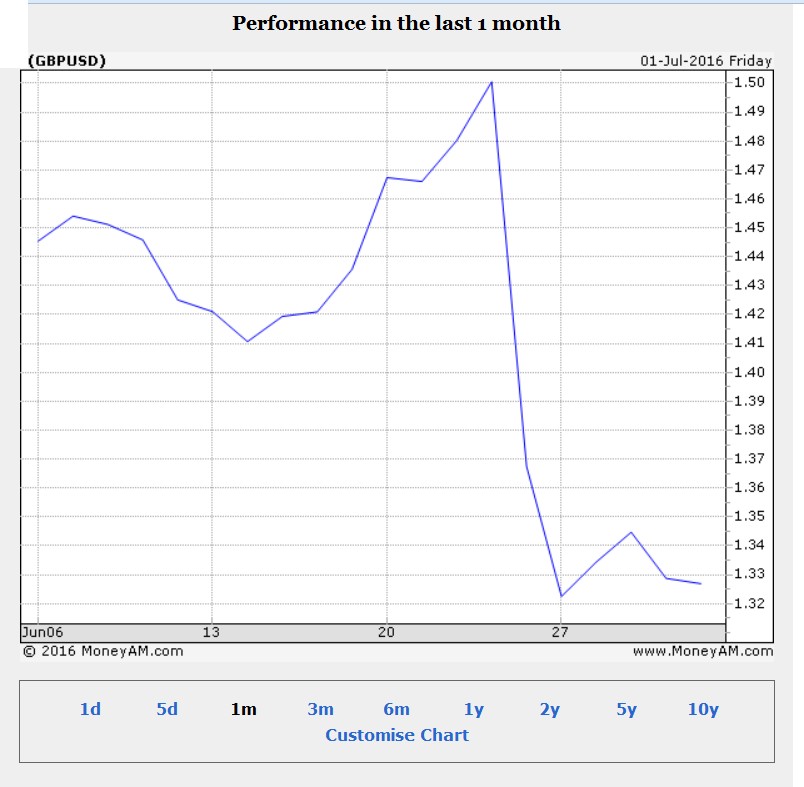
"Now the catastrophic scenario that many feared has materialized, making the disintegration of the EU practically irreversible," wrote Soros. "The financial markets worldwide are likely to remain in turmoil as the long, complicated process of political and economic divorce from the EU is negotiated." He said the consequences for the real economy would be comparable to the financial crisis of 2007-2008.
S&P Strips the United Kingdom of Its Triple-A Credit Rating
Standard & Poor's stripped the U.K. of its pristine triple-A credit rating, warning the country's vote to leave the European Union will lead to a less predictable, stable and effective policy framework.
The firm also said the vote for "Remain" in Scotland and Northern Ireland creates wider constitutional issues for the country as a whole.
A Word or Two from Gary Jefferson of Jefferson Financial Group
First Vice-President, Investments
If we heard Brexit once, we’ve heard it a thousand times over the weekend.
As former Secretary of Defense Donald Rumsfeld once famously said, “... because, as we know, there are known knowns; there are things we know we know. We also know there are known unknowns; that is to say we know there are some things we do not know. But there are also unknown unknowns - the ones we don't know we don't know.”
What we know is that no one was prepared for Brexit... nor were they expecting it. 99.9% of every "expert" we heard opined that the Brits would not exit.
We know there was an unmitigated selling panic across global markets resulting in the biggest ever one-day fall in equity prices in history.
We know the British pound fell to a 31-year low. (Bloomberg 6/25/16)
We know the selling started when hedge funds began unwinding positions. (Fox Sunday Market Futures 6/26/16)
We know the 10-year Treasury note tumbled to 1.47%, hitting a new 150 year low, before ending back up slightly above 1.50%. (Bloomberg 6/27/16)
We know that there are more than enough "pouting pundits of pessimism" crying that "the sky is falling". But this is the key to knowing what you know and don't know when it comes to their dire predictions, or anyone else's for that matter: Countless mainstream analysts and economists are going to be competing amongst themselves trying to predict what will happen next as Britain stumbles toward splitting with the European Union. But no one has any idea how it will all play out……so just ignore predictions. As always, anyone who tells you they know exactly how everything is going to play out is full of you-"know"-what. (pun intended)
We know that uncertainty causes market volatility. Specifically, we know that Brexit unleashed a number of possible and probable headwinds regarding trade, currency, tariffs and regulations. We know we don't know how all this will play out because it has never happened before. And, this uncertainty will create volatility until some things become more certain.
We know that, as the famous sportswriter Blackie Sherrod said, "History must repeat itself because we pay such little attention to it the first time…."
The key is simple: Don't panic. We've been here before. We would agree with this quote we read, "Today's move is going to be just a blip in the markets longer term. Don't get wrapped up in the media and political panic. Stick to the buy and sell disciplines you have always used."
We know that the S&P 500 started the year at 2040, plunged to 1830, then rallied back above 2100. Basically, this worldwide panic crash has, thus far, not done too much more than take back all of this year's gains.
One thing we feel optimistic about is the fact that the carnage in equities has not yet spilled over into high-yield bonds. We have never seen a terrible bear market develop that didn't include a concurrent terrible bear market in the high-yield income area. To us, this indicates that our equity market is still stuck in a trading range. Hopefully we don't go all the way back down to retest the February lows, but we know that is possible because we've already been there earlier this year. Unfortunately, we know that in these kinds of panic selloffs, many leveraged investor accounts get margin calls the next day and they are forced to sell, causing a vicious cycle which drops the market more than expected, but we know these sell-offs are not based on company fundamentals.
Finally, we know that Brexit very probably means no rate hikes in the U.S. and more money printing in Europe, Japan and the U.K. More money means more stimuli and more demand for commodities.
This is more of a clear path for growth than not.
Bottom line: Long-term investors should stand firm, watch for opportunities and take confidence in the fact that every sell-off in history has been followed by a market that has gone on to higher highs over time. The average S&P500 company pays a dividend higher than the 10-year Treasury, and that alone will eventually attract investors back into equities.
Reading Elon Musk’s Mind with Tesla’s Addition of Solar City
Tesla is playing the long game. Musk’s vision isn’t next year; It’s 2027.
And SolarCity (SCTY: $24) is integral to that vision, and that's what everybody is missing here. If the SolarCity deal goes through, then Tesla ($217: up 7%) will be a carmaker; a battery maker, with the Gigafactory being built in Nevada; an energy storage company, selling residential battery packs; and a solar finance firm. Musk says: Put all that together under one roof and you get a company that can give you transportation, heat your home, and do it all off the grid.
Yes, all that debt could eventually be a major problem for Tesla. It’s debt levels are high, but so is its cash level. The $400 million from the 400,000 orders for the new Model 3 certainly help. But it is burning cash at a high level and the things to watch closely is how the company handles this cash burn as we move into the latter part of the decade.
Note that Tesla had a great week after Wall Street hammered the company for announcing the buyout of Solar City. It was up 7% for the week. Wall Street loves this company, as do we, but the stock is not for the faint of heart. There are tremendous risks involved here – the stock could be $300 in a year or $100. We think the former, but buyer beware.
Silver Wheaton (SLW: $25, up 16%) was upgraded by analysts at Credit Suisse from a neutral rating to an outperform rating. They now have a $35 price target on the stock, up previously from $28.00.
Brexit Drives Down U.S. Mortgage Rates, With the 30-Year at 3.48%
• Home-loan costs decline to the lowest level since 2013
• The 30-year T-bond drops close to record low of 2.24%
Rates for 30-year U.S. mortgages dropped to the lowest level in more than three years as U.K. voters’ decision to leave the European Union drove investors to the safety of American government bonds that guide home loans.
The average rate for a 30-year fixed mortgage was 3.48%, down from 3.56% last week and the lowest since early May 2013, Freddie Mac said in a statement Thursday. The average 15-year mortgage slipped to 2.78% from 2.83%, the mortgage-finance company said.
The good news for both buyers and homeowners looking to refinance is that the Federal Reserve isn’t likely to raise interest rates any time soon. Brexit has only heightened concerns about the global economy that have been pushing down borrowing costs since the start of the year.
The average 30-year mortgage rate has been below 4% since the start of the year. It reached a record low of 3.31% in November 2012.
Energy Corner
Exxon Mobil (XOM: $94) announced a big discovery at its new well in the waters offshore in Guyana, called Liza-2. It builds on the success of 2015’s Liza-1. At Exxon’s recent annual meeting, CEO Rex Tillerson declared that first Liza to be the world’s biggest discovery of 2015. Together, the reservoirs could hold more than 1.4 billion recoverable barrels of high-quality oil.
In the virtually unexplored waters of Guyana, the former British colony east of Venezuela, Exxon is going big, having expanded its position to 8 million acres. “To put this in perspective, this is the equivalent of 1,400 Gulf of Mexico blocks,” Tillerson said. Exxon says the 3-D seismic survey that it conducted on the lease was the biggest in company history.
Exxon has 45% of the Liza prospect. Hess (HES: $60) has 30% and China’s Cnooc (CEO: $126) 25%. If Liza is a big deal for Exxon, it’s a bigger deal for smaller Hess, at a $19 billion market cap. In a statement, CEO John Hess called it an “exciting prospect” and “world-class” with additional wells planned.
BMR TAKE: Exxon is reaching for its all-time high of $101 set in 2013 when crude was over $100 a barrel. Crude is half that now and the company is going strong. It is still paying over 3% a year in dividends. We don’t have it in our portfolios, because we can’t have EVERY stock in our portfolios, but we SHOULD have it in our Stocks For Success, because you cannot keep this goliath down.
Almost $400 billion in market cap, it is the 2nd or 3rd largest in the world. And they buy back their own stock like there is no tomorrow. We burn 95 million barrels of oil a day in this world of ours, and Exxon is involved in just about every barrel. (Well, that is an exaggeration. We just wanted to see if you are paying attention. But the 95 million barrels a day is NOT an exaggeration, and our love for this stock is not either!)
UPDATE ON RIG COUNT
Total U.S. rig count (oil and gas) increased by 10
Total U.S. oil rig count increased by 11
The horizontal count increased by 7 (6 are oil rigs)
This brings the increase in horizontal rigs over the last five weeks to 18 (most of them being oil rigs).
This week's report from Baker Hughes brings the largest increase in horizontal rigs since November of last year, with a corresponding large increase in the U.S. oil rig count. Whereas last week's report showed a relatively large decline in oil rigs, these were very low quality rigs and the trend pointed to an acceleration in the rate of new rig additions. This week's increase consists of very high quality rigs, with the bulk being either horizontal or located in very productive basins. After the new additions, the total domestic oil rig count is now back to April levels; a reasonably large increase over a short period of time, but nevertheless still far from being able to compensate for declining production of existing fields.
HIGH YIELD REPORT
Now that the market has fully digested Brexit, just about everything is rallying. The S&P 500 has recovered its losses, but the real action is in high yield, as investors realize income-producing assets in the United States are likely to outperform no matter what happens in Europe.
The clearest winner here are REITs, with the SPDR Dow Jones REIT ETF (RWR: $100, up 5%) enjoying an amazing run in the last week, and bringing other REITs to 2016 highs. Our favorites are doing really well.
Government Properties Income Trust (GOV: $23, up 9%) soared for the week and reached a 52-week high. It’s up 22% in the past year, with most of those gains coming since we recommended the stock earlier this year. With dividends still covered by funds from operations and the expectation that government demand for properties is not going to let up anytime soon, investors are quickly realizing their earlier sell-off of the stock was a mistake.
Similarly, Digital Realty Trust (DLR: $109, up 5%) had a great week as the company’s earnings announcement approaches later this month. Expectations have gotten extremely high for the company, but we’re not worried. Here’s why: Deals with Amazon, AT&T, and other tech giants have been driving their funds from operations higher for over a year, and the growth rate is likely to far exceed their competitors. Digital Realty’s scale and penetration into key geographic regions in California and Virginia give it a wide moat that is increasingly impenetrable.
Business Development Corporations (BDCs) also did a fine job this week, with the UBS BDC ETF* (BDCS: $21) getting a 2.4% rise this week. But for more stability and high income, we are also pleased to see municipal bonds rise, as seen by the iShares National AMT Municipal Bond Fund (MUB: $114) staying flat for the week and keeping its gains for the year.
* The investment seeks to replicate, net of expenses, the performance of the Wells Fargo Business Development Company index. The index is a float adjusted, capitalization-weighted index that is intended to measure the performance of all Business Development Companies (“BDC”) that are listed on the New York Stock Exchange or NASDAQ and satisfy specified market capitalization and other eligibility requirements.
The reason for municipal bond strength? Interest rates. Now that Brexit has put tremendous uncertainty into the global economy, the Fed has little choice but to abandon its plans to raise interest rates in the short term - maybe for the rest of the year. That means less reason for investors to dump munis for lower-yielding Treasuries - and in fact, 10-year and 30-year Treasury yields have fallen t0 all-time lows. This means retirees will need to stick with municipals if they want dividends above 3%, but the municipal bond market is still seeing no rise in defaults or greater stress among debtors.
For this reason, The Bull Market Report is planning to release a series of reports on municipal bond funds with in-depth analysis of which funds will get you the highest yields with the lowest risk. Some of these funds yield over 6% - and that will be tax free for most Americans! That means a taxable equivalent yield of as much as 10%, depending on your tax bracket. That’s a great reason to consider bolstering your income portfolio with municipals, while the strength in the market and the low bankruptcy rate just makes the deal sweeter.
Blackstone (BX: $24.50) Why we love this company.
In Forbes recently, CEO Stephen Schwarzman and Blackstone were profiled. Some excerpts:
Early last year Stephen Schwarzman got a telephone call from JPMorgan. They were helping General Electric unload $30 billion in commercial real estate assets lingering on its books. GE boss Jeffrey Immelt was uncomfortable with the massive financial services business his predecessor, Jack Welch, had slowly built up. Schwarzman was told that the real estate sale was the keystone to Immelt’s reinvention plan.
The hang-up: finding a single buyer for a portfolio that included financing for everything from Mexican warehouses to Parisian office buildings to commercial mortgages in Australia. The billions in real estate and commercial mortgages were scattered across six countries, comprising all sorts of risks. Immelt knew that Blackstone Group was the only firm with three key traits: the global reach to understand all the different assets, the resources to close a deal quickly and the financial firepower to swallow the entire package.
Four weeks later, on Apr. 10, Immelt announced that Blackstone would purchase $14 billion of GE’s assets.
“It was a perfect deal for us,” Schwarzman says. “No one else in the world is set up to buy both equity assets and real estate debt on a global basis.”
Indeed, Blackstone’s massive 2015 purchase, executed flawlessly, announced to the world that there was a new pecking order that put private equity firms on top – with Blackstone at the apex and its chairman and chief executive, Schwarzman, as the most powerful banker on the planet.
In the past eight years Blackstone’s footprint and influence under Schwarzman have become nothing short of breathtaking. Since the financial crisis Blackstone’s assets have nearly quadrupled. More than 85% of its 2,070 employees have joined since 2007, and the firm has introduced dozens of new products. Blackstone has major stakes in 92 companies, from Hilton Hotels and Michaels Stores, to iconic brands like Versace and Leica Camera; it owns thousands of pieces of commercial real estate, including Manhattan’s Stuyvesant Town and Chicago’s Willis Tower, and more single-family homes in the U.S. than any other private entity. In nearly every business in which it operates, including hedge funds and credit, Blackstone is the leader.
In its core private equity business, Blackstone hasn’t had a single fund lose money since it launched its first one in 1987. The average annual returns realized by its private equity funds (19%), real estate funds (20%) and credit funds (14%) have all trounced the S&P 500, which has delivered an annualized return of 10% over the past 30 years.
“There’s some perception that turning out great returns over 30 years is going to stop in year 31,” Schwarzman says. “I don’t know what the reason for that is. People have been saying that since the first 5 years we were in business. We have a system that works.”
On the eve of the financial crisis and the collapse in the stock market, Schwarzman decided to bolster Blackstone’s permanent capital via an initial public stock offering. On June 21, 2007 Blackstone raised $4.1 billion in capital, valuing the firm at $34 billion. The deal was so coveted that China’s sovereign fund invested $3 billion just prior to the offering and agreed to give up its voting rights. Schwarzman held on to 23% and sold $500 million of stock.
“I had this desire for permanent capital,” Schwarzman says. “I just felt something bad was going to happen. The markets were peaking, and I just wanted to be prepared for the nuclear winter.” Within two years Blackstone’s new partnership units (as its shares are formally known) cratered from the $31 IPO price to $4.00. “It was a deluge which didn’t have anything to do with us.”
Schwarzman’s directive to his team of dealmakers was clear: Be smart, be entrepreneurial, but above all, don’t lose capital. A good example: Schwarzman’s 2013 purchase from Credit Suisse of Strategic Partners, a business that raises money to buy investor stakes in existing private equity funds. The big Swiss bank managed about $9 billion. Blackstone ran with it, doubling its assets to $19 billion today.
By nearly all measures business is booming. Blackstone has raised $80 billion for its funds in the past 12 months, dwarfing rivals like KKR, Carlyle Group and Apollo. Perhaps even more impressive is the fact that Blackstone’s analyst program has become the most coveted ticket at elite schools. Some 15,000 candidates from every Ivy League school applied for just 84 positions in 2015. That’s a 0.6% acceptance rate, compared with 4% for the analyst program at Goldman Sachs.
If there is any blemish in Schwarzman’s impressive tenure, it’s probably Blackstone’s stock: While it has returned 63% in the past three years, it is still trading at less than its IPO price and sells at a steep multiple discount to the shares of other asset managers.
Public shareholders hate volatility, and Blackstone’s earnings depend on the timing of asset sales and mark-to-market adjustments. For the 12 months through Mar. 31, Blackstone earned $900 million, an 83% drop from the $5.2 billion earned a year earlier. During the first quarter Blackstone marked its fee-earning holdings down by $1.6 billion as global equity and credit markets went on a roller-coaster ride tied to oil prices and central bank actions. Across the firm’s total assets under management, there was still a positive appreciation during the quarter of $382 million.
Taking a page from “buy and hold” sages Warren Buffett and Jack Bogle, Schwarzman may have devised a novel solution to his earnings-volatility problem. Blackstone recently introduced “core-plus” funds in real estate: essentially open-ended investment vehicles that use less leverage, have longer holding periods and offer lower returns. They also tend to lock up capital.
Core-plus funds are a great way for Blackstone to capitalize on the huge and growing demand among its clients for “safe yields.” These funds charge fees of 1% and 10%, and there is no expectation that Blackstone will “fix” or “sell” the assets. The firm’s $5.3 billion purchase of New York residential complex Stuyvesant Town in 2015 is an example. “Stuytown” is a 68-year-old, 110-building apartment complex just north of Manhattan’s East Village and should generate market rents for a very long time to come. The core-plus real estate strategy gained 4.4% in the first quarter of 2016 alone, and it has already amassed $12 billion in assets.
Perhaps this latest financial innovation – which Schwarzman thinks could reach $100 billion within a decade – will smooth earnings and finally afford Schwarzman the status he thinks he deserves among the financial greats.
Blackstone’s new mantra: “The power of this business is holding the assets forever.”
BMR TAKE: Schwarzman will win in the end. We would be buyers of the stock at these levels. The all-time high occurred last year in the spring at around $44. We don’t see any reason why the stock won’t get back to these levels, and higher in the future. We wish we could tell you WHEN, but while you wait you’ll get a company worth $15 billion that ought to be worth $25 billion, and is paying you 4.5% per year, AND you get to let a master company builder do all the work for you.
Good investing this week!
Todd Shaver, Editor in Chief
The Bull Market Report
LEGAL TERMS/DISCLAIMER
The Bull Market Report editorial staff are not registered investment advisors, broker/dealers, or research analysts.
Readers are advised that the commentary and reports on The Bull Market Report website (the “Website”) and in its newsletters are issued solely for informational purposes and should not to be construed as an offer to sell or the solicitation of an offer to buy any security. The opinions and analyses included herein are based on sources believed to be reliable and written in good faith, but no representation or warranty, expressed or implied is made as to their accuracy, completeness or correctness.
YOU SHOULD VERIFY ALL CLAIMS AND DO YOUR OWN RESEARCH BEFORE INVESTING IN ANY SECURITY MENTIONED IN THE BULL MARKET REPORT, OR THAT IS DISCUSSED ON THE BULLMARKET.COM WEBSITE. INVESTING IN SECURITIES IS SPECULATIVE AND CARRIES A HIGH DEGREE OF RISK. YOU MAY LOSE PART OR ALL OF YOUR PRINCIPAL INVESTMENT.
Readers are urged to consult with their own independent financial advisers with respect to any investment. All information contained in this report should be independently verified with the companies mentioned. Neither The Bull Market Report, nor Todd Shaver, nor their officers, directors, partners, members, contributors or employees/consultants accept any liability whatsoever for any direct or consequential loss arising from any use of information on this website or any use of information in its newsletters.
Todd Shaver and his partners, contributors or employees and consultants may on occasion hold positions in the securities mentioned on the Website. These positions may change at any time. Please note that neither Todd Shaver nor any of the Website editorial staff receives compensation of any kind for mentioning a company on the Website.
The Website is limited to the dissemination of general information pertaining to investments, together with access to additional investment-related information and links. Accordingly, the publication of the Website on the Internet should not be construed by any subscriber, consumer or prospective subscriber as the rendering of personalized investment advice for compensation, over the Internet. We are neither attorneys nor accountants and no portion of the Website content should be interpreted as legal, accounting or tax advice.
Certain portions of the Website may contain a discussion of, or provide access to, positions or recommendations as of a specific prior date. Due to various factors, including changing market conditions, such discussions may no longer be reflective of current positions or recommendations. Moreover, no prospective or existing subscriber should assume that any such discussion serves as the receipt of, or a substitute for, personalized advice from an investment professional.
Past performance may not be indicative of future results. Therefore, no prospective or existing subscriber should assume that future performance of any specific investment or investment strategy, including the investments or investment strategies made reference to directly or indirectly in the Website, or indirectly via a link to an unaffiliated third party website, will be profitable or equal any historical performance levels.
Please remember that different types of investments involve varying degrees of risk, and there can be no assurance that any specific investment will be suitable for a prospective or existing subscriber’s investment portfolio. Historical performance results for investment indices or categories generally do not reflect the deduction of transaction or custodial charges, the deduction of an investment management fee, nor the impact of taxes, the occurrence of which would have the effect of decreasing historical performance results.
USE OF THIS SITE AND THE ASSOCIATED EMAILS THAT ARE SENT OUT SIGNIFIES YOUR AGREEMENT TO OUR TERMS OF USE AGREEMENT
June 5, 2016
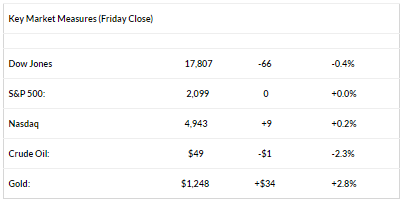
by Todd Shaver | Jun 5, 2016 | Weekly Newsletter 7pm Sunday
JUNE 6, 2016
Low Volatility Indicates Little Change In Stock Prices
The CBOE Volatility Index (^VIX: 13.42) measures the level of investor fear in the market. To give you some perspective, last August just after the market peaked, it ran up to 53. At the height of the 2008 financial crisis, it was all the way up to 90. Since March of this year, the VIX has pretty consistently been down around 15, and is below 14 now. (Note that the historical average for the VIX is about 16.) What these developments indicate to us is pretty clear. The market may move around a bit but it is going to take something really major to generate enough volatility to get a sustainable rally started.
Most of the week was filled with better than expected data that we will elaborate on below. But then came Friday’s news that the economy added only 38,000 jobs in May. The Friday opening was ugly; however by the closing bell the market had come all the way back. The price movements for the week were in falling Crude and rising Gold. Bond yields narrowed and the Dollar was on the weak side.
All in all, it was a fitting introduction to the first week of summer trading.
Here is How The Major Averages Performed:
Economic Give And Take
It was a holiday-shortened week, but that did not stop some key economic reports from creating a stir. What good news the economy gave us, it also took back. Yes, Crude bounced around a bit, coming off recent highs near $50. But, in the end, it was the amount of conflicting information from the Washington data factory that defined the week.
We started the trading week on Tuesday with Consumer Spending not only jumping a full 1% for April but also exceeding extremely bullish estimates. Core inflation remains tame at 0.2% while Personal Income gained 0.4% indicating a rise in real earnings.
Wednesday continued the story. Motor Vehicle Sales hit the 17.4 million annual target in May and the ISM index of Manufacturing also showed a nice bump. By Thursday things were looking even better on the employment front with jobless claims down.
But then Friday came along and took away the party hats and the rum-filled punch bowl. Suddenly Nonfarm Payrolls* fell like a giant stone from 123,000 in April to only 38,000 in May. Factory Orders fell, as did hourly earnings.
*What is the 'Nonfarm Payroll?': It is a statistic researched, recorded and reported by the U.S. Bureau of Labor Statistics intended to represent the total number of paid U.S. workers of any business, excluding the following employees:
- general government employees
- private household employees
- employees of nonprofit organizations that provide assistance to individuals
- farm employees
This monthly report also includes estimates on the average work week and the average weekly earnings of all non-farm employees.
Breaking down 'Nonfarm Payroll': The total nonfarm payroll accounts for approximately 80% of the workers who produce the entire gross domestic product of the United States.
It is rare that any week of data paints a clear picture of the economy’s direction, but this one presents some serious issues for Fed policy and for interest rate forecasters. Until Friday, the data was pure ammunition for Fed interest rate hawks. But after Friday, the hawks have less to crow about. Translation: Both interest rates and stocks will remain largely range bound in the weeks ahead.
When Will the Financial Sector Catch on Fire?
There is no question that Bank earnings overall have had very little good going for them this year. If you bought the group back in February when they were beaten down from the Fed’s first rate hike last December, more power to you. You are indeed a smart value-oriented investor. But, where do they go from here?
Higher interest rates will help salvage earnings of companies like Bank of America (BAC: $14.42, down 3% for the week), and Goldman Sachs (GS: $156, down 2%) These two giants have had to deal with a skinny interest rate environment, a quiet time for mergers and acquisitions, and a poor financing market for equity offerings. Right now, expense control is the operative strategy until conditions change. This is all good but at the same time, rising interest rates make it more difficult for equity prices to rise. Could this time be different? The underlying question is whether financial stocks are already so depressed that they discount an inevitable increase in rates. Based on the performance of the S&P Financial Stock Index in recent weeks the answer is yes.
We got a critical insight into this riddle on Friday when the disappointing jobs numbers were released. The S&P Financials were the worst performing sector of the market that day. In other words, the weak jobs numbers told investors to lower expectations for higher interest rates. When we get signals like this, it is a sign that Financials will outperform in a rising interest rate environment.
In the meantime, there are choices in the Financial sector.
Blackstone Group (BX: $26, down 3%) When looking at total return, let’s not forget about dividends and yield. The company should start to benefit from even the slightest improvements in the public financing markets. Recently we saw the successful $1 billion IPO of US Foods Holding Corp, an encouraging sign.
This is one very powerful firm, dedicated to making money for its investors. Listen to the description of the firm from Yahoo Finance:
"Blackstone is a publicly owned investment manager. The firm also provides financial advisory services to its clients. It provides its services to public and corporate pension funds, academic, cultural, and charitable organizations. The firm manages separate client focused portfolios. It launches and manages private equity funds, real estate funds, funds of hedge funds, and credit-focused funds for its clients. It invests in private equity, public equity, fixed income, and alternative investment markets." Wow, we say.
Steven Schwarzman, the Chairman and CEO is a powerful man, running this $300 billion+ portfolio of real estate and investments. They are the largest alternative investment firm in the world. (Alternative investments are anything other than stocks, bonds and cash.
The current dividend is a pretty compelling 4.3%. If you don’t own the stock, now is a good time to get acquainted.
Annaly Capital Management (NLY: $10.81, up 2%) We are pleased that Annaly has maintained its new price level of $10.80, up from the $10.30 plateau it established in March and April and up from the $9.50 level of December through February. And it still pays a stellar 11% dividend. We’ve said this before that we believe in Annaly’s management team and feel that they have the ability to handle a higher interest rate environment very comfortably should rates indeed go higher. (Rates just may stay lower here for the foreseeable future, so don’t count on higher rates.) If rates stay where they are then they should chug along comfortably, continuing to pay this strong dividend. If rates do start to rise the company the maturing laddered debt will be reinvested at the higher rates, so there is really nothing to get all worked up about, as many on Wall Street do. They’ve been doing this for 20 years through thick and thin and doing quite fine, thank you very much.
Welltower (HCN: $71, up 3%) Welltower is really a financial company wrapped around the business of Senior Living. By that we mean (taking this from our original research report on the website): Welltower doesn't operate Senior Living, they invest in properties that are run by Senior Living companies like Brookdale and Sunrise. In other words, they are a real estate investment company. They are a REIT.
Baby boomers are no longer on their way to old age; they are arriving at the rate of 10,000 per day. Real Estate REITs like Welltower are valued based on fund flows from operations . FFO is projected to grow 9% this year. This will produce a $3.45 payout which makes for an attractive yield of 4.8%. You have to look long and hard to find a more stable business that offers this level of dividend income.
Speaking of Senior Living stocks, take note that Brookdale (BKD: $17.76, down 1%) will make a pitch at the Jefferies Healthcare Conference in New York on Tuesday. Since the big shakeup in management last year, we have been looking for signs of changes including shifting to a REIT status that will save big money. We have seen estimates that value the company-owned real estate 30%-40% above current book value.
Over the past year, this stock has taken a major beating losing over half its value. This resulted in the 3Q15 management shakeup. The pressure is on and value investors are beginning to get the message. Over the past four months, the stock has gained 30%. A year ago in April the stock was at $39 so there is still a long way to go on the upside.
Key Economic News
There are two potential market-moving dates to watch this week. Obviously, Monday’s speech by Janet Yellen at 12:30 PM in Philadelphia will be closely watched. This is the last public statement before the June FOMC meeting. After last week’s data, anything can happen. Next in importance are clues on employment. After last week’s drop in payrolls, the next report won’t take place until early July. In the meantime, the market will be looking at any data points that could shed some light on the consumer, employment or spending. So watch out for Consumer Credit on Tuesday, Job Openings on Wednesday and Jobless Claims on Thursday.
Until then, hope your summer is off to a good start and that we have given you some food for thought and a fresh look at what’s going on in Financial stocks as well as others.

High Yield Corner
Last week was a bit humdrum for the markets, with the S&P 500 ending flat in a 4-day trading week. Meanwhile, all high yield classes except junk bonds had a strong week. MLPs had a sharp recovery driving the Alerian MLP ETF (AMLP: $12.60) up 3% by the end of the week. Alerian has also helped to boost the sector’s gains for the year, so now MLPs are up over 4% year-to-date, beating the S&P’s 3%.
Not all is rosy, though. Last week ended with a shockingly bad unemployment report: just 38,000 added jobs, and a huge drop in the labor force participation rate that brought the unemployment rate to 4.7%. That’s not good, because it means America is less productive, more people are discouraged in the job market, and less earnings power across the country could mean less demand for goods and services—so less revenue for companies.
This caused the stock market to dip slightly on Friday, but musing over whether the Federal Reserve will step in by putting rate hikes on hold—or even something more daring like more quantitative easing—helped the market from falling significantly. Next week has little economic data, so fears about unemployment might linger like a hangover and impact the market.
The results on the high yield world will be interesting, to be sure. This week, the high yield market was roughly flat, with the SPDR Barclays Capital High Yield Bond ETF (JNK: $35) ending down less than 1% for the week - the only high yield asset class to fall, as the USB Wells Fargo BDC ETF (BDCS: $20) ended the week up 1%, and the SPDR Jones REIT ETF (RWR: $95) also ended up about 1%.
The Bull Market Report favorites had an extremely good week, especially our REITs. Kimco Realty (KIM: $29), Digital Realty Corp (DLR: $98), and Government Properties Income Trust (GOV: $20) rose over 2% this week, and are up substantially from the start of the year. Meanwhile, our favorite BDC, Main Street Capital (MAIN: $33) rose over 1% for the week, holding on to a solid performance for 2016, despite still selling at a major premium to NAV.
While the high yield market dipped a bit this week, our favorite bond fund Pimco Dynamic Income Fund (PDI: $27) gained nearly 2%, bringing the fund to a flat year-to-date performance excluding its over 9% dividend payout (and likely special dividend, which should bring its yield up to over 11%). This price appreciation, if it continues, could bring the fund’s market price to our sell price. Until then, its premium to NAV remains modest and it remains an attractive income producer, and fortunately this isn’t a crowded trade just yet.
Looking at next week, we foresee some strong, delayed reactions due to the unemployment data. Expect increasing volatility and more de-risking in the market. We still believe in the fundamentals of our high yield picks and see them outperforming in the long term, but the market looks ready to go from greedy to fearful.
BMR Company Commentary
LinkedIn (LNKD: $135, up 3%) LinkedIn had another strong week, rising 3% as noted. A month ago the stock was at $125. We see quite a bit of room on the upside for this one. LinkedIn was darling of Wall Street and they had one hiccup of lowering guidance and the market killed the stock, dropping it from the 12-month high of $258 in November to $101 in February. Bang. You’re dead. No – Wait. The company is not dead. It has risen steadily since then, now up 35%. We maintain that it WILL REMAIN a darling of Wall Street. It will just take time. We expect this stock to be $150 or higher by this Fall.
Why do we say this? Look at their revenues. 2012 - $970 million. 2013 - $1.5 billion. 2014 - $2.2 billion. 2015 - $3 billion. Profits aren’t great, but that’s because they are spending a HUGE amount each year for Research and Development - $775 million in 2015! Most companies spend 10% at best, which would have made the numbers around $300 million. Because of this LinkedIn is the leader in the professional networking business and will stay there for the years to come. With 400 million members in over 200 countries and territories, they are way ahead of the competition.
(Are you on LinkedIn? You should be!)
Qualcomm (QCOM: $55, flat) paid its 53 cent dividend last week and is up 27% since we added it in February. The stock is steadily rising lately – slowly but surely. Some might say it’s boring, but we like slow and steady. The dividend is a huge 3.8% and with the company being worth $81 billion, it’s a rock. The 12-month high is $68 which it set exactly a year ago. It hit $80 two years ago.
Qualcomm sells the chips that connect iPhones to their cell networks and the internet. They signed a contract with Apple, locking in selling their chips to Apple for the last five years, as well as the foreseeable future.
Check out the chart on Qualcomm for the last five years:
http://finance.yahoo.com/echarts?s=QCOM+Interactive#{%22range%22:%225y%22,%22allowChartStacking%22:true}
Now, wouldn’t you say the stock has a strong chance of moving back into the upswing from here? We sure would. Of course you have to have the fundamentals and this company does. The company does $23 billion year in business and puts $5 billion to the bottom line. That’s big. Revenues have flattened out a bit in the past 12 months, but we can see them picking up the ball and running with it as we continue on into 2016 and beyond. Profit-wise, consensus estimates are looking for $4.10 a share this year and $4.65 next. So with a PE of 13, we think the stock should be bought at these levels.
Aetna (AET: $120) is another boring big-cap. It’s so boring that it was up 6% last week! At a $42 billion market cap, Aetna is big and powerful. They raised $13 billion last week in a bond sale that will be used to fund the purchase of Humana (HUM, $186), itself sporting a $27 billion market cap. So the combination will push Aetna into the $70 billion league. Then watch them integrate Humana, cut costs and increase profitability. Wall Street loves this stuff. It’s up 14% since we add the stock in February – we would buy more here.
Bank of America (BAC: $14.42, down 3%) The stock got hit last week with all the shenanigans in the interest rate world. But all in all we think the stock held up well. The thinking on the Street is that Banks make less money when interest rates stay low. This is true to a certain extent, but rates have been so low for so long that these big banks, including Bank of America, have learned how to survive with low rates. The company made $15 billion last year on $93 billion in revenues. Revs were down a hair, but profits grew to $15 billion from $5 billion. We would say they have learned to survive for sure.
The stock is up 10% from where we added it in February, but we think we will see the $15 and $16 level with this stock by the end of the summer when we have some answers about rates.
Good Investing,
Todd Shaver
Editor in Chief
The Bull Market Report
Disclaimer: Please visit our website at https://www.bullmarket.com/disclaimer for important disclosures and information about our e-mail policies.
