December 4, 2016
by Todd Shaver | Dec 4, 2016 | Weekly Newsletter 7pm Sunday
The Week Ahead
The S&P was up 4% in the month of November. We've seen a 6% rally since the US Presidential election. With so much money being made in the month of November, we are hopeful for December’s prospects but realistic that repeating November’s performance is a tall order. One particular area to focus on this month is the upcoming Fed meeting. Everyone will be watching for clues from Yellen about the pace of interest rate hikes for next year. The market is currently pricing in two hikes so anything more would be troubling.
This week we provide some insights on our latest thinking for Athenahealth, Apple, Amazon, Splunk, and the iShares Dow Jones US Energy Sector ETF.
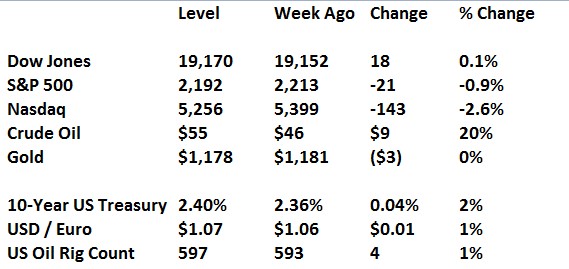
Key Market Measures (Friday’s Close)
Highlights From The Past Week
Looming Pension Crisis. Stanford University’s pension tracker database pegs the 2015 market value of California’s total pension debt at $1 trillion or $93,000 per California household. In 2014, California’s total pension debt was calculated at $77,700 per household, but has increased dramatically in response to abysmal investment returns at California’s public pension funds that hover at or below 0% annual returns. Looking back to 2008, the under-funding levels of California's public pension have skyrocketed 157%. The fact that CalPERS is having such a difficult time with what should have been an easy decision to lower their long-term return expectations to 6% from 7.5%, just further reinforces how big of a mess this entire pension issue is.
Italian Referendum. The vote happens today. While the post-Trump euphoria in US stocks has been the perfect distraction from the ugly realities elsewhere, this weekend's Italian Referendum could well be the biggest 'revolt' yet, topping Brexit and Trump. Should Italy vote "no", as polls forecast, Prime Minister Renzi may quit, which would leave the Italian bank recapitalization underway in jeopardy. Some say, this could cause a Greece-like market reaction on steroids.
The Future of the Fed. As Trump and his new appointments take power, the Federal Reserve could be targeted for overdue changes and reforms. Let’s take a look at how the Trump administration may change the Fed, as ultimately, the future leadership of the Fed will mean a lot for interest rate levels and so much more. It’s no secret that Trump has a bone to pick with the Fed, so he could be the first President in years to strip away its independence. There’s no law on the books that protects the Fed’s independence. The broad freedom assumed by the Fed over the past several decades relies solely on the president’s discretion. Just days before the election, perhaps sensing reason to be worried, Fed Chair Janet Yellen started to publicly argue the importance of an independent Fed.
Separately, Trump himself has toyed with the idea of putting America back on the gold standard. There are two empty seats on the Board to fill. Fed Chair and Vice Chair appointments will happen very soon in 2018. So much to watch.
BMR Companies and Commentary
Athena (ATHN: $96, -6% for the week) The stock struggled this week. There was no company-specific news; rather, broader industry events developing. President-elect Donald Trump’s selection of Republican Tom Price to head the Department of Health and Human Services signals that the new administration is all-in on both efforts to repeal the Affordable Care Act and restructure Medicare and Medicaid. This change is going to matter for Athena.
Privatizing the Medicare program for seniors and disabled people and turning the Medicaid program for the poor back to the states are long-time goals for Republicans in Congress and the White House. They say the moves could help put the brakes on healthcare spending.
Why does the policy change have to be done? Healthcare spending is out of control. Medicare, which covers roughly 57 million elderly and disabled Americans, and Medicaid, which covers more than 77 million people with low incomes, are among the biggest items in the federal budget, together costing an estimated $1 trillion in 2016, according to the Congressional Budget Office.
However, cutbacks to healthcare spending will weigh on companies in the industry, like Athena. Estimates from the Urban Institute say that new proposals could result in 17 million people losing coverage and that payments to healthcare providers could be cut by nearly a third. Ouch.
We want to point out that that the potential repeal of The Affordable Care Act does not impact Athena as their market share as of this point is virtually zero. While the numbers look big at first glance, don’t panic because it doesn’t mean the cuts will hit everybody equally. Athena is very well-positioned to see much less headwind than others. Plus, whatever reimbursement headwinds surface to pricing, Athena can offset that by more volume through working with more providers and offering more products.
BMR Take: We think now is an opportunistic time to be buying Athena. The company is a leading provider of cloud-based services and mobile applications for medical groups and health systems. Sentiment around healthcare is at noteworthy low levels. You can buy a superior company in the space for under $100 that was not long ago greater than $165.
Amazon (AAPL: $740, -5%) Amazon’s annual AWS re:Invent conference was held in Las Vegas this week. New products, features, and services are extending Amazon’s cloud lead across the cloud computing sector.
AWS (Amazon Web Services) introduced over 24 new products and features this week and is on track to add 1,000 new products this year (up 40% from a year ago). One of the key announcements was improvements to the database storage product, Aurora, which is the fast growing product within AWS.
Enterprises, both large and small, are increasingly adopting more of AWS’s products and services, creating a more loyal base among its 1 million+ users. As an example, the government agency FINRA (Financial Industry Regulatory Agency) was at the conference discussing how they not long ago made the decision to move to AWS. FINRA’s adoption of AWS took 2.5 years to complete and is one of the largest migrations to-date due to its vast amount of data. FINRA oversees around 4,000 financial institutions, 64,000 brokers, and stores 75 billion events per day generating 20+ petabytes of data and trillions of records, and now 90% of its total data volumes are stored in AWS. What a success story!
BMR Take: AWS is on track to contribute $17.5 billion of revenue for Amazon this year, that’s up 40% from a year ago. The cloud business remains explosive and one of the core reasons we are positive on the stock.
Apple (AAPL: $110, -2%) After skipping Black Friday last year, Apple returned to the traditional one-day shopping event with Apple Gift Card discounts across products such as the iPhone, iPad, Apple Watch, Mac and Apple TV. Apple remains one of the best-positioned tech companies to benefit from spending trends this holiday season with a well-received iPhone 7 and 7 Plus, a new Apple Watch, and a new MacBook Pro with Touch Bar. It was exciting to see the company get back in the discount game with the “one-day shopping event” and we are confident the marketing strategy boosted holiday sales.
For several years, Apple participated in the Black Friday celebration; however, the company surprised everyone when it sat out last year's Black Friday celebration. The company returned this year with Apple Gift Cards with the purchase of certain iPhones, iPads, Apple Watches, Macs and Apple TVs. In 2014, Apple offered RED iTunes Gift Cards during Black Friday but this year is offering Apple Gift Cards.
Specifically, for iPhones Apple was offering $25 and $50 Apple Gift Cards. This implies a discount of 6-9%.
BMR Take: We think Apple at $110 is a compelling value (with $44 of that in cash.) We see the return to discount pricing as a potential game changer for holiday sales this year. If true, the Wall Street adage of “better numbers means the stock is going higher,” seems at play.
Splunk (SPLK: $54, -8%) Splunk reported earnings this week. The company delivered a strong quarter, with revenue of $245 million, up 40% from a year ago, versus consensus of $230 million and EPS of $0.12 versus consensus of $0.08 and $0.05 a year ago. Splunk raised full-year guidance as overall execution is running solid. A very strong report.
The highlight of the quarter was an acceleration in license growth from 32% a year ago in Q2 to 34% in Q3, which dramatically beat consensus expectations calling for deceleration to 23%. Splunk added 500 new customers and completed 480 deals over $100k, up 30% from last year. Cloud business tripled, once again exceeding the company’s plan. All great stuff!
BMR Take: It was nice to see quarterly results largely confirm why we like the outlook for the stock. Many analyst price targets remain at $70 or higher. In fact, one investment bank just recently initiated the company with a $80 price target. All signs point higher.
iShares Dow Jones US Energy Sector (IYE: $41, +3%) Did you catch the crude oil price change in the Key Market Measures chart earlier in this report? Crude oil at $55 up 20% from just last week. Not a typo! OPEC reached a deal to cut production. Oil prices surged upon Saudi Arabia and Iran signing on to a deal at the OPEC meeting in Vienna.
They say Russian President Vladimir Putin played a crucial role in helping OPEC rivals Iran and Saudi Arabia set aside differences to forge the cartel's first deal with non-OPEC Russia in 15 years. Putin’s role was also a testament to the rising influence of Russia in the Middle East since its military intervention in the Syrian civil war just over a year ago.
BMR Take: With OPEC, Putin, and Trump all pushing for higher oil prices, it sure seems like the $50-60 level is here to stay, or even perhaps the $60-70 level may be quickly approached. Investing in the Energy sector recovery remains one of our favorite ideas.
Upcoming Economic News
MONDAY, DECEMBER 5
ISM Non-Manufacturing Index – November
Time: 10:00 am
Forecast: 55.1
The ISM Non-Manufacturing Index looks to edge higher in November as consumer spending on services continues to advance at a steady pace. Real spending on services rose at least 2.5% in each of the past two quarters, avoiding the letdown seen in the Manufacturing sector. The new orders component of the Non-Manufacturing index exceeded the solidly expansionary level of 57 in four of the past five months. That indicator supports growing demand for services in the months ahead.
TUESDAY, DECEMBER 6
Trade Balance – October
Time: 8:30 am
Forecast: -$40.0 billion
Rising imports are expected to cause the US trade deficit to widen in October. Exports have been on a tear of late, adding 1.2% to real growth in the third quarter - the largest contribution in 11 quarters. Yet that boost came before the latest run-up of the dollar, which will challenge export growth going forward.
Productivity & Unit Labor Costs – Third Quarter
Final Time: 8:30 am
Forecast: 3.2% productivity, 0.3% unit labor costs
The revision of third quarter productivity figures will likely confirm the strongest result of the past eight quarters. Positive effects from growing inventories and relatively restrained hiring growth has boosted output efficiency. Yet with productivity growing a mere 0.3% annualized over the past two years, stronger sustained trends in investment are needed to improve the long-term pace.
Factory Orders – October
Time: 10:00 am
Forecast: 2.4%
A bulge in Transportation sector orders is forecast to lead overall factory orders higher for the fourth consecutive month in October. Near-term business investment trends are looking solid after core capital goods orders rose 4.4% annualized in the quarter ending October. Yet continued progress is needed to lift industrial output trends, as such orders fell 3.6% against the same period in 2015.
FRIDAY, DECEMBER 9
University of Michigan Consumer Sentiment – December
Preliminary Time: 10:00 am
Forecast: 94.0
Consumer sentiment may rise to the highest level in 7-months in December, perhaps reflecting some of the same post-election optimism seen in the stock market. Prior to recent OPEC moves to tighten supply, consumers benefitted from gasoline prices that fell to 7-month lows in late November. However, those gains may not filter to retailers, who are being hurt by having to offer consumers greater discounts.
Eli Lilly (LLY; $67, down 2%) The Latest News
Eli Lilly is a $71 billion machine that has seen a rocky road these past few weeks. After hitting the $78 level in early November the stock got hammered down to its current level due to Lilly’s announcement that its Alzheimer's drug solanezumab had failed to significantly improve on cognition. But then on Friday we saw some good news with an announcement that the FDA approved Lilly's new drug application for Jardiance to be used in reducing cardiovascular mortality in adults with type 2 diabetes. One analyst reported that Lilly’s revenue could increase by $1.7 billion in 2025 on expanded Jardiance sales. Wow. The good with the bad. The bad with the good. All in all, Lilly will survive and thrive. And we are preparing a research report and should be able to publish this mid-week.
Apple Investment Idea
The Options Corner
Here’s an idea for the aggressive investor to put some cash in your account using this stock. If you agree with the premise that every share of stock at $110 includes $44 in cash, you might conclude, like we do, that there is somewhat of a floor under the stock. There is no other company in the history of Wall Street that has had this much cash as a percentage of the stock price. $44 a share is in cash. That’s 40% of the price of the stock. So you get the entire company, ex-cash for only $66. Now, with that said, what we are going to suggest here is a very risky idea: Selling naked puts on Apple.
Selling naked puts offers you two things: Being able to but the stock at a lower price than it is now (if the stock falls), and a way to put cash in your account immediately. But it comes with great risk.
There are lots of choices of selling puts on Apple, but let’s say you think the stock going down to $100 by February 17th is not likely. And in fact, if it did, you wouldn’t mind buying the stock down there. What you can do is to sell the February 100 put for $1.45. Since options are traded in 100 share lots, that means you can get $1,450 for every 10 options that you sell. Now by doing this transaction you are obligated to buy 1000 shares at $100 if it goes below $100. So you must have $100,000 at the ready to do this. The stock is at $110 now so buying it a $100 sounds good at this point. Also, since you got $1.45 a share for selling the put your actual purchase price is $98.50. Again, this sounds good, unless the stock goes to $95 and you are forced to buy it at $100, which can happen, and that’s why selling naked puts is risky.
However, you can always BUY BACK the options that you sold to get out of the trade. In other words, you are not 100% obligated to buy the shares if it goes lower – you can always buy back the option which leaves you with no position and thus no risk. You may have to pay a higher price for it since the price will go up as the stock goes down, and thus you will lose money on the trade, but at least you can get out of the trade if you like. Note that as time goes by – as you get closer to the expiration of the option, February 17th, and if the stock stays in the same general area of $110, the price of that option will approach zero which of course is exactly what you want to have happen. (If you sell something first, you want it to go to zero. If you buy something, you want it to go up. Right?)
That’s our discussion of options this week. You can do this with most stocks, so it doesn’t have to be Apple. Virtually all stocks have listed options and you can check them out here:
http://finance.yahoo.com/quote/AAPL/options?p=AAPL&date=1487289600
This is a great site with a wealth of information about option pricing. You can spend hours here researching all of your favorite stocks.
Groundbreaking news: The US is Now a Net Exporter of Natural Gas The U.S. exported an average of 7.4 billion cubic feet of gas a day in November, more than the 7.0 billion it imported, with the biggest buyers being Mexico and Canada. Gas exports have risen more than 50% since 2010. The Energy Department says the country will be the world’s 3rd-largest producer of liquefied natural gas by 2025, trailing Australia and Qatar.
FANG Stocks Taking a Breather
Three of the four big internet stocks that make up the FANG group took a pounding last week, despite upbeat reports from various firms on the Street. FANG is made up of Facebook (FB: $115, down 4%), Amazon.com (AMZN: $740, down 5%), Netflix (NFLX: $121, up 3%) and Google-parent Alphabet (GOOG: $750, down 1%). We always like to add Apple, to make it FAANG because there is so much value represented here, Facebook - $330 billion; Amazon - $350 billion; Apple - $585 billion (largest in the world); Netflix - $52 billion – just a puppy; Google - $520 billion - Going to catch Apple some day?
BMR Take: Since Trump was elected these stocks have been poor performers. Do we care? Well, we care but we are not worried. Why? Because we know that the companies don’t care – in other words, all they care about is increasing revenues and profits; well, at least all of them except Amazon! We kid about Amazon. We just read the book The Everything Store by Brad Stone. Shall we say this is a must-read? Wow – what a story. Read this and you will think like we do that Amazon can go to $1500 a share in the near future. Amazon is making money – it’s just that they are spending it just as fast on infrastructure build. We secretly believe that they could report stellar earnings any time they darn well please. But since DAY ONE they have been building for the future. And selling over $30 billion each QUARTER is proof that they are on to something big.
We digress. Our point is this: Each of these five stocks is growing revenues in a big way. Profits have followed at all of them but Netflix, but they are building for the next decade and are spending big money on content ($6 billion next year). So again, we are not worried about a slight lull in the upward march of the stock prices for these five. It will come in due time,
Ferrellgas Update
Ferrellgas (FGP: $5.65, down 14%) cut the dividend from $2.00 a share to 40 cents, bigger than what we had thought and bigger than the market had anticipated. This is a savings for about $160 million a year. The company cited difficulties in its midstream business due to the loss of its largest customer (supplier Jamex Marketing), a warmer-than-expected early winter season, and "general market conditions." Blah, blah, blah. We’ve heard that story before. A lot of this mess was caused by buying troubled midstream company Bridger Logistics last year which has caused big writedowns and liquidity issues. What a way to destroy a strong, old line, profitable company.
Obviously, we should have stuck to our guns of selling at $15 when we first issued our research report in September. Why didn’t we? Well, discipline. The lack thereof. It’s human nature and we are human just like you are. We added the stock at $17, we had a Sell Price of $15 so we should have removed the stock at $15. That’s it, pure and simple. But we got swayed by the lower stock price and how cheap the stock was, being down from its 52-week high of $21 and an all-time high of $28 set in 2014. We couldn’t see the forest of the trees, and certainly didn’t anticipate that management would make such a big mistake by buying Bridger.
What to do now? It all depends on how much stock that you have and what percentage this investment is in your overall portfolio. So we can’t answer this question for you here personally in this forum. The company is operating on thin ice and the stock could stay here for many months, if not years. But if you want a personal opinion on what to do in your own portfolio, don’t hesitate to write us here at Info@BullMarket.com. Give us some details and we’ll give you our opinion.
Goldman Sachs Group Update
Goldman Sachs (GS: $223, up 6%) had another amazing week and hit $227 on Thursday before pulling back a bit on Friday. We hereby raise our Sell Price from $196 to $214, preserving our big gains, currently up 52%. And we are raising our Target Price from $220 to $245.
The High Yield Report
A Close Look at the Municipal Market
The biggest news in the high yield world right now is actually hard to find; many leveraged closed-end funds reduced distributions this week, after Nuveen cut dividends on a number of funds. This impacted one of the funds in the Bull Market Report portfolio: the Nuveen Enhanced AMT Free Municipal Bond Fund (NVG: $13.90), which fell a little less than 1% this week as the municipal bond market continued to struggle. The decline seems unrelated to the distribution cut, but it is something that investors should be aware of.
At the same time, there’s no reason to panic. The distribution cut was a little over 4% to 7.25 cents from 7.6 cents every month. That’s a loss of 4.2 cents per year, meaning the fund’s yield is still above 6%. Dividend cuts are never welcome news, but as these things go this one is quite small.
Could this cut have been predicted? In a broad sense, yes; as a general rule the ultra-low interest rate world we live in puts inevitable pressure on high yield, which is why investing in these selectively is crucial. On the other hand, the timing of this cut is odd. Interest rates have actually been rising lately, with A-rated bond yields up 18% in the last month. To make things even stranger, Nuveen did not cut distributions on all municipal bond funds. On top of that, Nuveen cut distributions on dozens of funds, ranging from equity-focused to municipals. It seems Nuveen decided to lower distributions to make payouts more manageable across its fund offerings except in those cases where distributions where already so very low that distributions could easily be maintained.
Nuveen is a good fund manager and has done a good job with the Enhanced AMT Free Fund. The fund’s NAV has grown over 6% since inception and the stock has gone up over 7% in the last three years. The recent collapse in the municipal bond market means its NAV is down 3% year-to-date, which is the case for pretty much all municipal bond funds. Cutting distributions to protect future payouts and keep some capital to invest in new municipal bonds makes sense right now, despite the frustrations to investors.
Fortunately, NVG is just one of the 14 high yield recommendations in the Bull Market Report portfolio, so the distribution cut will have a marginal impact on our total payouts. We are still bullish on the fund as an outperformer in the municipal bond market and we are still bullish on municipal bonds, so we are not changing our recommendation for this fund right now. Instead, we encourage you to consider slowly building on your position in the Nuveen fund in anticipation of the inevitable municipal bond recovery.
That brings us to a bigger question - why are munis tanking? Most municipal bond indexes have fallen over 3% in a month’s time. A muni index fund like the iShares S&P National AMT-Free Municipal Bond Fund (MUB: $107) lost 1% this week (more than the Nuveen fund did) and is down nearly 6% over the last three months. Munis are supposed to be a stable asset class. What is going on here?
There are two main causes of the municipal bond rout, and they’re worth understanding in detail.
1. Retail fears. Retail investors dominate the municipal bond market and they will sell off in moments of particular panic. We are in such an environment right now, with greater uncertainty about the future of Treasuries, the economy as a whole, and trade relations between America and foreign nations. Fear is motivating selling.
2. Possible tax cuts. This is arguably the biggest driver behind the municipal bond sell-off. Why do investors choose munis over corporates? One is the relative safety of munis, but a much bigger reason is the tax benefits. Muni bond distributions are tax free, corporate bond distributions are not. With President-elect Trump widely expected to change the tax code, the future of muni tax treatment is uncertain. The thinking is that a big tax cut could motivate people to leave munis because the tax benefits are less than they used to be.
Will Trump change the tax code? We’re not political analysts, and Trump is very unpredictable, so we can’t give an answer with any sort of confidence. What we can say is that the municipal market is over-reacting to the risks of this eventuality. To understand how this is the case, let’s take a close look at the spread between corporate and muni 5-year bond yields. A-rated 5-year munis yield 2.11% on average versus 2.28% for corporates. That’s a difference of 0.17%, or $1.70 for every $100 invested. A month ago, the difference was 0.28%, or $2.8 for every $100 invested.
This means that the market has removed 39% of the tax-based arbitrage opportunity investors have to buy municipal bonds instead of corporates. In other words, the market is anticipating that the tax benefits of munis will disappear and is pricing them accordingly.
The closer municipal bond yields come to corporate bond yields, the bigger opportunity there is for municipal bond prices to rise if the tax benefits do not disappear, since prices are inverse to yields. Additionally, the arbitration opportunity for investing in munis because of their lower default rate also goes up as their yields get closer to corporates. For this reason, we are going to keep a close look at municipal and corporate bond rates to identify when we reach the bottom for munis. It is clearly coming soon, and may arrive before the end of the year.
On the topic of closed end fund distributions, we also heard from one of our favorite funds - the Pimco Dynamic Income Fund (PDI: $29), which soared 3% this week. The fund is now up 5% year-to-date. The fund’s regular dividend is staying the same at a 9% yield, but we did not hear about the fund’s special dividend yet. Pimco seems to be waiting a bit before announcing special dividends on its funds; we expect to hear about this next week or, at the latest, the week after. We know many folks who are buying this stock to get the anticipated big dividend. Of course, be aware that on ex-dividend date the stock opens lower that morning the exact amount of the dividend. So it’s not all icing on the cake, but generally over time the stock moves back to where it was. The operative word is “generally” so be a good investor and be wary.
Finally, on BDCs: The UBS Etracs BDC ETF (BDCS: $21.90) fell 1%, mostly in line with the broader market. This is a modest move, indicating that BDCs are maintaining their strength alongside the Financial sector. We remain constructive on Main Street Capital (MAIN: $36, down 1%) but are still waiting for it to reach a lower level before jumping back in.
Good Investing,
Todd Shaver
Founder and Editor
The Bull Market Report
November 27, 2016
by Todd Shaver | Nov 27, 2016 | Weekly Newsletter 7pm Sunday
The Week Ahead
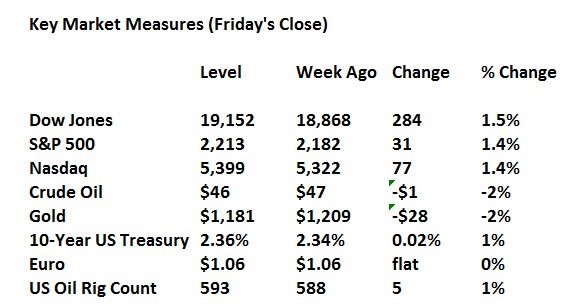
We finished this week at all-time highs - again! The ‘Trump’ rally has turned into the ‘feel-good’ rally we often see around Thanksgiving and Christmas. With the election over, political uncertainty is down (but not out.) With the post-election rally, the odds of a December rate hike is being priced in by the bond market at 100%, (actually 100.2%), reducing rate uncertainty. What’s left to focus on? We dare say company-specific fundamentals. If that’s the case, we really like the prospects for active stock selection. This week we provide some insights on our latest thinking for Apple, Blackstone, Tesla, Facebook, and Welltower.
Highlights From The Past Week
First, there was Brexit. Then, there was Trump. Now the discussion is turning to Frexit - France electing to exit the European Union (EU). Many are saying that the European Union could not conceivably survive in its current form if France elects National Front leader Marine Le Pen to the Presidency next May. Le Pen is campaigning for a wholesale renegotiation of the EU’s treaties, restoring the primacy of national law, de-emphasizing the European Central Bank, and ending the free movement of labor and goods across the region. We all must watch closely. The political system as we know it in several regions across the globe is crumbling.
Mortgage Market. The rapid rise in interest rates since Election Day is taking a toll on the mortgage market, and lenders are scrambling to adjust. Since Donald Trump’s surprise victory, average rates for a 30-year, fixed-rate mortgage have leapt by more than half a point, to 4.18% on Wednesday. The fast rise in rates has spurred homeowners to pull back from refinancing their mortgages. Applications dropped 3% in the week ended November 18th from the prior one, the seventh consecutive weekly decline, and the second since Election Day. The Mortgage Bankers Association estimates refinances will fall 46% next year, to $485 billion, which will hurt Americans’ ability to free up cash by reducing the cost of their monthly mortgages. As we learned from the 2008 Financial Crisis, given its size, the Mortgage market is a key pillar of the economy. Higher monthly mortgage payments and slower loan growth for banks matter to the economy and sentiment. We need to care about what goes on here.
Infrastructure. The talk of the town right now is Trump’s $1 trillion fiscal stimulus plan for infrastructure investments in the United States. But what many people don’t realized yet is that the amount might be much, much bigger. Why? The concept of Public Private Partnerships (PPPs). PPPs were used by Obama under the Build America Investment Initiative that helped fund the Denver FasTracks commuter and light rail projects in Colorado, the Goethals Bridge reconstruction project linking New York City and New Jersey, and the Bayonne Water Joint Venture project in New Jersey. What PPPs do is match every $1 of private capital offered for a project with $1+ or more of fiscal stimulus money. So Trump’s $1 trillion will really end up resulting in $2+ trillion of infrastructure investment. Exciting stuff! Oh wait – a little bird just told us he has to deal with Congress to get this approved. Now that will be fun to watch.
BMR Companies and Commentary
Apple (AAPL: $112, +2%)
President-elect Trump recently spoke to Apple CEO Tim Cook. Trump asked Cook to think about opening multiple plants in the US to make their products. Trump said he will institute tax breaks for him to do this. Will Apple comply? Can Trump pull it off? What are the implications?
Trump doesn’t want Apple to continue going to China or Vietnam to manufacture iPhones. He wants Apple to do it right here in the US. Trump says it will be a major achievement for the US middle class if he can find the solution to make it happen.
The jury is still out on what it all means, however. Does the US have the skilled labor to do the task? Is this a waste of time because machines are soon going to be doing the work regardless? How many more jobs are we actually talking about here?
Trump’s first line of defense to force the issue on Apple is the threat to tax imports from China. However, China has already committed to a tit for tat trade policy against Trump (whatever he does they will respond equally). Not good. Trump must be careful.
We understand Cook very much wants to repatriate Apple’s foreign cash and Trump has mentioned that he will work on ways to reduce taxes to make this happen. We believe much of the money will likely go to dividends and repurchases. So we will be watching very closely to see if new incentives arise that detour the money into capital expenditures such as new manufacturing facilities.
BMR Take: As long as the repatriation of foreign cash happens, we are content either way with the outcome. If the money goes to dividends and stock repurchases, Apple will head a bit higher in the near-term. If the money goes back into re-building America, this better long term picture for US GDP would be a positive for all stocks.
Blackstone (BX: $27, flat)
Blackstone was solid this week, as we await a move to $30. What’s happening here? So many headlines: Key executive Jon Gray won’t be heading to DC to serve as Treasury Secretary; there is a lucrative deal swirling to pick-up some of Valeant Pharmaceuticals assets on the cheap; a deal is pending to sell a chunk of Japanese real estate holdings; the investment in Optiv has reached a successful exit through the recent $100 million IPO.
We think the big story is simply the broad-based strength seen in the US equity markets. US equity markets are breaking all-time highs. This is a major tailwind for Blackstone. The company has $350+ billion of capital invested where the fees coming back to shareholders are very closely linked to overall valuation levels of the market. The M&A frenzy we’ve recently seen, the return of a healthy IPO window, and the generally more positive sentiment about the US GDP outlook - it all means upside to earnings at Blackstone.
BMR Take: The consensus EPS outlook calls for nearly $3 of earnings in 2017. The current dividend yield is greater than 6%. Why is this not a $30 stock? Why is this not a $40 stock? What a bargain.
Tesla Motors (TSLA: $197, +6%)
Tesla moved up nicely last week. One driver is all the talk of rolling back regulation and placing bigger incentives are what matters most. Despite some of the negative press Tesla gets, you may be surprised to learn that Tesla receives nowhere near the government support of other industries. Perhaps the future for the company will include greater government support.
Tesla has received only a fraction of the subsidies the Big Three auto manufactures have received. Specifically, since inception Tesla has received about $2.4 billion of subsidies or tax breaks. About $1 billion of that was for tax breaks over a 20-year period that started in 2014 when Tesla started construction on the Gigafactory in Nevada. Tesla has yet to utilize those tax breaks and it will have to spend tens of billions of dollars in the state of Nevada over the next decade in order to fully take advantage of them. Look at what other US-based automakers have received over the years. Here are the report cards for Fiat/Chrysler, General Motors, and Ford, in that order: $17 billion, $50 billion, and $27 billion. Wow! Not even close!
Turning to the Energy industry, it’s hard to even quantify considering the influence of using national defense to protect oil interests. Most agree the numbers are much bigger than auto.
BMR Take: Tesla’s receives a lot of flak for the subsidies it receives, but the fact of the matter is that it’s not a lot of money compared to other companies and other industries. The subsidy discussion matters a lot particularly following the November approval by shareholders for the Solar City acquisition. We think Tesla is an even more exciting company with SolarCity and we don’t see a reason to think government support is going away.
Facebook (FB: $120, +3%)
Late last week, Facebook announced authorization to repurchase $6 billion in existing stock. At face value, the authorization reflects 23% of the 3Q16 cash balance and approximately 2% of the market cap. Assuming 100% repurchase in 2017, we estimate about 1-2% potential accretion to 2017 earnings. In terms of timing, the company indicated the repurchase program goes into effect in 1Q17, but gave no specific deadline. One could argue that Facebook is now prepared to act on expected future stock volatility post the 1Q earnings call. One could also argue the buyback announcement now suggests that Facebook sees the stock as attractive today.
BMR Take: We think Facebook is on track to be the greatest advertising machine ever. This repurchase authorization just further supports management’s confidence in the cash flow capability of the company. They must know something we don’t. Can Facebook hit $150 or higher and start to catch Google in market cap? (Facebook is at $347 billion. Google is at $430 billion.) We wouldn’t bet against them.
Welltower (HCN: $63, flat)
The entire Real Estate segment of the market has not been performing well these past few weeks for a variety of reasons. Rising rates hurts the value of real estate prices through higher cap rates. Tepid economic growth limits the ability of raise rents. Sector-specific concerns in Healthcare around drug prices and reimbursement rates have been severely impairing to some tenants.
That said, we continue to see compelling value in Welltower. Welltower is the largest Healthcare REIT and the sixth largest REIT in the US. The 85+ age population is set to double in the next 20 years and Welltower will directly benefit. In fact, the company is increasing its senior living concentration from 65% of the portfolio to 70% in order to capitalize on the opportunity. Compared to other larger diversified Healthcare REITs, Welltower claims the lowest leverage. The company’s real estate holdings touch all major markets in the US, offering strong diversification. The stability of the business is further supported by an investment grade credit rating. The 5.5% dividend yield is more than covered by cash flow, as the payout ratio is greater than 85%.
BMR Take: In real estate, Welltower is a blue chip. We think the 5.5% dividend yield is particularly attractive. We see continued cash flow growth translating into dividend increases, supported by the growth driver of an aging US population occupying Welltower’s real estate holdings.
Upcoming Economic News
Special Edition: 2017 Outlook
There are four key pillars forming our outlook:
--- We look for GDP in 2017 to expand just under 2%...again
--- Fiscal policy, though highly uncertain, should be more of a tailwind.
--- And monetary policy more of a headwind, as the Fed is expected to deliver two more hikes next year
--- Productivity growth will remain subdued
As 2016 draws to a close, the US economy appears to have grown at a hum-drum pace of about 1.8%, quite similar to last year’s 1.9% performance. We’ve been looking for a similar slow slog going forward next year, though recent political developments add an interesting mix to that otherwise boring forecast. On the one hand, if President-elect Trump and his Republican allies in Congress push through the large tax cuts and equally large increases in defense and infrastructure spending that he campaigned on, the implied fiscal stimulus could push growth above 3%. (We won’t mention the big deficits this will incur - ouch.) On the other hand, if the incoming administration prioritizes increasing import duties, the disruptions to critical supply chains could have a chilling effect on business activity. The likelihood of the former, more benign, outcome seems greater than that of the latter, although the change in the outlook for growth would be larger under the latter outcome. For the time being we are penciling in a small fiscal boost, which would add to annualized GDP growth beginning in 3Q17 and extend into 2018. Even with this fiscal stimulus, we only see GDP growth next year getting to 1.9%.
While policy can potentially lift aggregate demand next year, there are fewer reliable remedies for the slow productivity growth that has plagued the economy. This slow productivity growth is the reason that even growth in the neighborhood of 2% has been enough to support a robust need for businesses to keep hiring. And six consecutive years of job creation in excess of two million jobs per year has finally tightened labor markets to the point where we are seeing more convincing evidence of accelerating wage growth, albeit from a low starting point.
Consumer price inflation has only partly followed suit. After averaging 1.4% in 2015, core inflation has recently been running around 1.7%. The continued upward move in wages should put downward pressure on margins and upward pressure on prices, and we see core inflation getting back to the Fed’s target of 2.0% by the end of 2017. The ongoing progress toward the Fed's inflation and employment objectives should keep them on track to slowly normalize short-term interest rates: we look for a hike in December and two more next year.
Digging a little deeper into sector performance, we note the consumer was the mainstay of the economy in 2016, an outcome which we expect will continue in 2017. Although the pace of job growth may be slowing modestly, wage gains are picking up. This vigor in labor income could get added support from tax cuts, further boosting disposable personal income. Household balance sheets remain healthy, supported by ongoing valuation gains in stocks and, particularly, housing, and the appetite for debt growth has remained modest. Consumer sentiment has also been supportive, as households have been mostly unfazed by global stress and political uncertainties. The one fundamental that looks a little less supportive relative to last year is energy prices. The tailwind of earlier declines in retail gas prices helped fuel a spending binge in early 2016 that is moderating a bit as we head into 2017.
More Apple Info
CNBC has noted that “If the company’s massive cash pile was its own company, it would be the seventh largest in the S&P 500 and the 14th largest public company in the world.” This pile is now $238 billion and growing at almost $1 billion a week, so it is well over $240 billion now. We’ve noted many times that that cash can be used to invest in new products, buy other companies or be paid out to stockholders through dividends and stock repurchases. It seems to us that many investors just forget about it. We certainly don’t. We don’t understand. It’s like having a net worth of $1 million and having $400,000 in cash in Ireland. How would YOU feel? We say pretty good!
At current prices, Apple has a PE of about 13, a significant discount to the overall stock market with a PE of 19. The stock didn’t participate in the stock market rally post-election and there seem to be many rumors about why. We don’t think it is necessary to go into them all, as most of them are made-up, meaningless excuses, and in the long run the only thing that matters is where the company is going with new products and increased sales and earnings. We believe they are going in the right direction. The current Christmas quarter is always their best one – they continue to sell iPhones at extraordinary rates
Gilead Sciences News
Stifel Nicolaus initiated coverage on Gilead Sciences (GILD: $75, up 1%) in a research note issued on Monday. The firm set a buy rating and a $100 price target on the biopharmaceutical company’s stock. The price target price would indicate a potential upside of 33% from the company’s current price.
Several other equities analysts have also recently commented on Gilead. Piper Jaffray set a $108 price target and gave the stock a buy rating in a research note in August. Cowen set a $120 price target on the stock in October. RBC Capital Markets reaffirmed an outperform rating and set a $105 price target in July. 10 research firms rate the stock with a hold rating, 19 have assigned a buy rating and two have given a strong buy rating to the company’s stock. Gilead Sciences has a consensus rating of “Buy” and an average price target of $98.
BMR Take: What can we say. We think these analysts are secretly reading The Bull Market Report. We have a Target of $115 on the stock.
Netflix News
Brean Capital began coverage on shares of Netflix (NFLX: $117, up 2%) in a research note issued on Monday. The firm set a $145 price target on the stock. Several other research firms also recently weighed in on Netflix. Cantor Fitzgerald set a $135 target price on October 27th. Guggenheim reissued a “buy” rating and set a $140 target price on October 26th. Finally, FBN Securities reissued an “outperform” rating and set a $130 target price on October 21st. 8 analysts have rated the stock with a sell rating, 13 have issued a hold rating and 30 have given a buy rating to the company.
BMR Take: This stock is not for the weak. It has little in the way of earnings now, but huge potential down the road as it moves into the programming side of TV and movies. We have a price target of $133. And if this price is hit, we think it will go a lot higher in the coming years. But this stock could go to $100 before it gets to $133. In fact, it could go to $80 first. So be careful out there. We hereby change our Sell Price to $105, from “We would not sell Netflix.” Why? Well it all depends on Wall Street. With the Dow at 19,000 everything is rosy. But if the Trump rally fades with the market falling sharply, and the Dow heads to 17,000, this will bring all stocks down harshly. We just want you to be prepared.
A Letter to The Bull Market Report about First Solar
Hi Todd,
Hope you are well. It is hard to watch First Solar (FSLR: $31, up 5%) continue to plummet. I had lost on Solar in the past but bought on your recommendation. I am holding now as you feel it can double over the next year. What do you see as the catalyst?
Thanks.
Richard Reed
We said:
Richard -
First Solar looks sick, yes, but it will come back. It has done so many times in its history. And really, the world is poised for solar installations. But earnings are not going to happen until late 2017 and possibly on into 2018 and in the world of Wall Street this is a long time to wait. And the market will overdo it to the downside, especially now with higher interest rates on the horizon. They always do. So if you have strength and courage, you should stay in. If not, just call it quits. I am very upset about this outcome, Richard.
Todd
Hi Todd,
Thanks for your response. The tough thing for me was I held my nose buying this stock because your thesis made sense. Despite having lost on Solar stocks in the past I thought this may be the time. My tendency is to get out but I continue to hold on your recommendation. You have given up on some stocks recently so I know when you are sufficiently disenchanted you will sell. The question for me at this point is how much lower this will go before the possible upturn. I am assuming you feel that the risk-reward is in favor of holding. Thanks again.
Richard Reed
The Google vs. Amazon Race
Google (GOOG: $761, flat) and Amazon (AMZN: $780, up $20) were neck and neck last week, but look at the results for the past week. Amazon came back with a vengeance to take the lead in this race.
Now we want to add another stock to this complex race. Apple. Apple closed at $112, but they split their stock two years ago 7-1. So multiply by 7 and you have $784, the same price as Amazon. So we are adding Apple to the race. For fun, let’s put a time limit on this race. Let’s pick the end of the first quarter of 2017. Who do you think will win? Send your votes here: Info@BullMarket.com. Who do you think WE believe will win the race?
Tons of Cash Leads to Stock Buybacks
The biggest US companies are set to spend a record amount of cash buying their own shares in 2017, according to Goldman Sachs. Goldman estimates that S&P 500 buyback spending will total $780 billion next year. That would be more than their estimate of $600 billion in 2016, which is on track to be a record. Buybacks reduce the number of outstanding shares, boosting earnings per share. Some say the companies buy their own stock because they think the stock is undervalued, which we tend to agree with.
Goldman thinks the splurge on share repurchases it expects in 2017 will be driven by a 12% increase in total cash use and $2.6 trillion in spending. There’s a lot of cash held overseas and Trump has proposed to cut the rate to 15% from 35%, which Goldman thinks is very likely. And they think that most of the cash repatriated will go towards share repurchases. They even mention a number - $150 billion. That’s a lot of buying power.
Musk Says Tesla’s Solar Shingles Will Cost Less Than a Dumb Roof
Electricity is Just a Bonus
Tesla shareholders approved the acquisition of SolarCity. (85% of them voted yes.) And Chief Executive Officer Elon Musk didn’t take long to make his first big announcement as head of this new enterprise. Minutes after shareholders approved the deal, Musk told the crowd that he had just returned from a meeting with his new solar engineering team. Tesla’s new solar roof product, he proclaimed, will actually cost less to manufacture and install than a traditional roof - even before savings from the power bill. “Electricity,” Musk said, “is just a bonus.”
Well, we are taking this with a grain of salt, but it sure makes good headlines. Musk is making some big comments: He says: So the basic proposition will be: Would you like a roof that looks better than a normal roof, lasts twice as long, costs less and by the way generates electricity? Why would you get anything else?”
The company says that on a large house over a long period of time, the value of that electricity could exceed $100,000.
BMR Take: We’re drinking the Kool-Aid, just like everyone else. That’s why we keep saying that this company is risky and could go to $150 or lower before it goes to $250 and higher. Listen, we love this company and its leader. But again, be careful.
A Word from Gary Jefferson
Jefferson Financial Group
First Vice-President, Investments
UBS Financial Services, Inc.
Bond markets have literally been beaten up since Donald Trump’s election, with 10-year Treasuries currently seeing 2.36% yields (up 30% from the 1.8% range!) and total losses at well over $1 trillion. Last week we wrote that one of the reasons for the plunge was the market discounting a new era of inflation - however, the exact reasons why bond markets are falling were and are still not entirely obvious. Does higher expected inflation really account for the steep rise in yields?
An article last week from Money and Market had some new information into what else is going on. It said that world governments were selling Treasury bonds hand over fist leading up to the election because of yuan-supporting in China and budget reasons in Saudi Arabia, so the market already had a lot of downward momentum. Also, investors may fear inflation, but they also are fearful of another huge pile of Treasury debt. The bottom line with all this is that no matter the reason, there are too many of them. Especially if you believe in any of the old investment maxims such as, "don't fight the Fed", "the trend is your friend", "don't fight the tape", and "don't catch falling knives," etc. Bonds are under pressure and likely to stay so until the new administration's agenda becomes more clearly understood.
In this wonderful new period of optimism for the market, we want to issue one caveat. Let's consider that the entire recovery, at least post 2010, has been built on fake economic data to perpetuate a fake narrative of growth. In other words, it may be much harder for a new administration to get the economy going again because the true condition of it has been "covered up." For example, according to Value Bit News last week, "There is no way on earth that the real unemployment rate is less than 5%. Over 45 million people are on food stamps and over 94 million people are out of the work force. Claiming unemployment is at 5% in the context of these two other data points is like claiming you’re in incredible shape provided you don’t count body fat or cardiovascular health".
It's well known that the US has yet to achieve a single year of 3% GDP growth in the last eight years. Moreover, many analysts say even these weak growth numbers were doctored and that in reality the US’s economy stripped of accounting gimmicks is in fact much worse. What we do know is that the recovery has been weak despite the US spending a truly staggering amount of money.
Again, according to Value Bit News, "During a period in which tax revenues have risen every year since 2009 with record tax revenues hitting in 2013, 2014, 2015 and soon to be 2016, the US Government has still managed to outspend this amount to the tune of $8.1 TRILLION. Put another way, despite the US Government raking in RECORD amounts of tax revenues in the last four years, it still managed to grow the debt by $2.5 trillion. And if you go back to 2009, the debt has grown $8 trillion. And what has the US got to show for it? Let’s be clear here. We’ve spent a staggering amount of money, increasing the US’s Debt to GDP ratio from 77% to 105%, and yet we’ve had the weakest recovery in US economic history…"
Trust in the media is at all-time lows and for good reason. Don't let media "noise" deflect you from staying focused on earnings and quality stocks if the mainstream narrative suddenly reverses in the coming months.
We don't doubt good things are on the way - we're just trying to temper expectations that it will be fast and easy to turn around an economy that probably isn't as strong as we have been led to believe.
Well, that is some powerful stuff to think about, Gary. We look forward to your input each week.
The Dollar and the Euro are Moving Towards Parity
The euro and the U.S. dollar could be trading one-for-one next year as Europe struggles with political uncertainty and the U.S. is expected to go on a fiscal splurge. Goldman Sachs predicted the two currencies will reach parity by the fourth quarter of 2017. The dollar has risen 4.4% against the euro, and 2% against a basket of world currencies since Donald Trump won the U.S. presidential election Nov. 8. The euro is currently trading at $1.06.
Investors have viewed Trump's proposals to spend heavily on infrastructure, while cutting taxes, as a catalyst for further domestic growth and inflation. They're also expecting more interest rate hikes from the Federal Reserve to match rising inflation. Other analysts expect the euro and dollar to reach parity even sooner. Nomura thinks it could hit as soon as six months, which would see parity as early as May. Citigroup said it had shifted its euro-dollar forecast “180 degrees.” The bank now predicts the euro will tumble to 98 cents in the next 6-12 months.
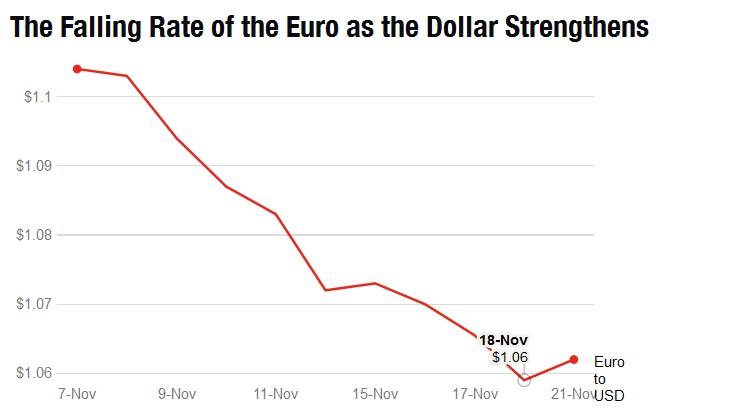
The market is watching Trump like a hawk, and the Fed is doing everything it can to strengthen the dollar, and at the same time the European Central Bank will probably do nothing to support the euro. If the Federal Reserve increases rates, expectations are the dollar would rise further by drawing money to the U.S. looking for higher returns. The European Central Bank, meanwhile, is showing no changes in monetary policy that has pushed rates into negative territory and includes a huge bond-buying program.
We have seen a 10-day losing streak for the euro against the U.S. dollar as we write this over the weekend. In the last two weeks, the euro has fallen 4% against the dollar, hitting $1.06, a level last seen 12 months ago.
Introduced in 1999, the common currency spent much of its early years below parity, falling to as low as 83 cents in 2000, when there was a strong U.S. economy and a weak one in Europe. But the currency has traded above $1 since late 2002, climbing to a high of $1.60 as the U.S. struggled with the financial crisis in 2008.
Goldman expects one interest-rate increase soon from the Fed, followed by three more in 2017, and thinks the ECB will extend its quantitative-easing program to the end of 2017.
Europe has already witnessed one political earthquake this year, when the British surprised investors by voting to leave the European Union. Now, the eurozone’s political diary is full of potential market shocks. Early next month, a constitutional referendum in Italy could sink the government of Prime Minister Matteo Renzi. The resignation of Mr. Renzi, one of Europe’s most reform-minded leaders, could freeze Italy’s economic overhaul and erase the meager growth the country has generated.
Also lining up are key elections in France, Germany and the Netherlands, all of which have seen populist right-wing parties move higher in the polls.
A strong dollar is good for the US, as it draws investment to the country, and it could actually be good for Europe as it makes their goods less expensive here in the US which should increase trade.
The High Yield Report
Due to internet issues, we don’t have the High Yield Report for this week. We will send it out as a News Flash as soon as we are able.
$8.2 billion Withdrawn from Bond funds
Investors withdrew $8.2 billion from U.S. bond funds in the week ending November 16, 2016, the largest outflow since June 2013. Investors have liquidated fixed-income funds more than they have over the past three years. This sell-off has depressed fixed-income fund prices, which have driven up the yields, as there is a negative correlation between the two.
Check out the price action over the past 14 days in several popular fixed-income funds. The iShares Barclays Aggregate Bond Fund (AGG) is down 2.4%, the iShares IBoxx Investment Grade Corporate Bond Fund (LQD) is both down 2%. The iShares iBoxx High Yield Corporate Bond (HYG) fund has rebounded, and is flat. While at first glance that may seem optimistic, recent developments in the junk bond market cause reason for concern.
The high-yield market has been smooth with more than $5 billion in debt issued following the election. High-yield has not been immune to withdrawals as in the three-week period ending November 16, investors liquidated $7.1 billion from junk bond funds, the largest three-week outflow since 2015.
The bottom line is that as long as we continue to see outflows in the fixed-income bond funds, prices will be depressed, and investors will be cautious. As we see a return to higher interest rates there could be an influx of money into U.S. fixed-income as the global hunt for yield continues. In Europe and Japan, pension funds and insurance companies remain hungry for yield, especially given the rise of negative interest rates.
Good Investing,
Todd Shaver
Founder and Editor in Chief
The Bull Market Report
Since 1998
November 21, 2016
by Todd Shaver | Nov 21, 2016 | Monthly Newsletter Daily 6am if new
The Week Ahead
We finished this week above the fresh all-time highs set just a week ago. But we raise the question - have we come too far to fast? The frenzy seen post- election is seemingly pricing in a lot of good to come from new leadership in Washington. Are expectations reasonable or too aggressive? We note that Caterpillar recently said even if a $1 trillion infrastructure spending bill was passed today, it would take at least a year for projects to start, given the timelines for making the equipment needed. And we haven’t yet passed a $1 trillion infrastructure bill nor have we any clarity about how one would be funded. This infrastructure example highlights one market over-reaction to Trump, which is happening across many more sectors.
Good stock picks can make money in any market. This week we provide some insights on our latest thinking for Under Armour, Tesoro, Facebook, Amazon, and Microsoft.
Highlights From The Past Week
Repatriation. Many people are asking the question - If new leadership in Washington does lower repatriation taxes so that US companies bring home the $2+ trillion currently parked overseas, what will the money be used for?
The prevailing view at this time seems to be that much of the capital repatriated from overseas will be returned to shareholders, via repurchases and dividends. This is good for the stock market and for investors like us. However, we need to keep a close eye on how everything develops. Some are saying if the money just goes to buybacks and dividends rather than capital expenditures, then we won't see the big benefits to job growth and middle class income. There is talk of a flat 10% repatriation tax which should bring billions back to the US, but we’ll have to wait and see!
Fiscal Stimulus. Like Andrew Jackson’s populism, people are saying that we’re going to build an entirely new political movement: It’s everything related to jobs. They will be able to push a trillion-dollar infrastructure plan. With negative interest rates throughout the world, it’s the greatest opportunity to rebuild everything. Ship yards, iron works, new infrastructure projects get them all jacked up. We can just throw it up against the wall and see if it sticks. It will be as exciting as the 1930s, greater than the Reagan revolution. Exciting times! (We shall see.)
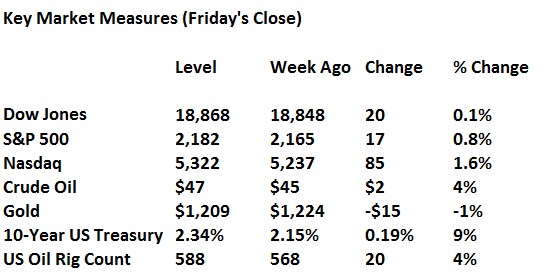
Interest Rates. The bond market bloodbath continues. The 10-year US Treasury yield is up a stunning 65 basis points from the Trump-win lows, spiking to 2.35% - the highest since December 2015. In fact, the entire Treasury yield curve is now higher in yield on the year, leaving most of everything newly issued in 2016 now under water. We are going to have to keep a close eye on where rates stand going forward. The cornerstone of fiscal stimulus will be low rates. But if the bond market re-prices rates much higher, the increased interest expense could throw a wrench in gears turning all of the current excitement.
BMR Companies and Commentary
Facebook (FB: $121, up 3% today)
Again, Facebook has found more miscalculated advertising metrics. The company said it has uncovered several more miscalculated metrics related to how consumers interact with content from marketers and publishers, and it unveiled additional independent review of some measurements to calm unease over the their data. An internal metrics audit found that discrepancies led to the undercounting or overcounting of four measurements, including the weekly and monthly reach of marketers' posts, the number of full video views and time spent with publishers' Instant Articles.
Does it matter? Should we be worried? What is the impact?
None of the metrics in question impact Facebook's billing. The only financial impact would be from customer perception about what has occurred, leading to customers shying away from spending money to advertise with Facebook because they have new concerns over these metrics. It is a stretch to go there. Facebook has well over 1 billion users. Just because a few mistakes were made on some back-office tasks doesn’t change how the business model connects advertisers to world. (We are not discounting this issue, but we think the market will perceive it to be a small matter. The company is already working on the PR to reduce the impact on perception.)
Let’s stay focused on what matters. Recall, it was a stellar quarter just recently reported. Facebook's Q3 earnings update that came in better than expected on top line revenues of $7.0 billion versus the $6.92 billion consensus and EPS of $1.09 was ahead of the Street's $0.97 expectations. Daily active users of 1.18 billion and monthly active users of 1.8 billion were both ahead of the Street's expectations as well. Management offered updated guidance on expense growth of 40-45% that was lower than the prior 45-50%. The negative takeaways were comments about decelerating revenue growth and heavy investments in 4Q16 and 2017. Many people think this was just management setting the bar low so they can beat it more easily. We agree.
BMR Take: If the first time miscalculated metrics didn’t shatter the Facebook growth story, we don’t think the second time around will. Clearly an operational mistake we don’t like to see, but we don’t see reason to exit our position in the stock over it. We think the company is set up to deliver better than expected financial results over the next several quarters. Stick around!
And this just in: Facebook will repurchase up to $6 billion in stock (first time they have ever done a stock buyback.) The buyback will start in the first quarter of 2017, using some of their $26 billion in cash. The market liked the news: the stock was up over a $1 in after-hours trading Friday.
BTW, we just noticed that Facebook’s all-time high is the same as Apple’s - $134. We wonder who will get their first. Our guess? Facebook. Why? Smaller market cap - $340 billion vs. $590 billion. Higher growth rate. So now we have two races to watch. Google vs. Amazon is the other. They both closed at the same price Friday. Love it!
Amazon (AMZN: $776, up 3% last week and up $16 today)
The word is CEO Jeff Bezos is telling executives to “Do what it takes to succeed” in India. Amazon fell a little behind in China early and business never quiet was able to recover to be as big as it could have been. Bezos is going on all in on India to ensure the same thing doesn’t happen twice.
Amazon had been India’s #2 ecommerce player. But that has changed. Bezos is now communicating to the market that Amazon has pulled ahead to be #1, with market share estimated around 28%.
India is a huge opportunity for Amazon. India has a population of 1.2 billion with about 40 million online shoppers. Goldman Sachs calls for ecommerce sales in India to grow 10-fold from today’s level of $11 billion over the next decade. And since only about one-third of Amazon’s sales are international, there is tremendous room for growth here. We understand that Bezos is going to invest another $3 billion in June into the India operation, in order to make the business even better. Amazon currently has over 80 million products selling in India. (This is not a misprint.) And they have more than 120,000 sellers, compared to 40,000 sellers a year ago. In June, the company said it will invest an additional $3 billion in India after it exhausted its earlier investment pledge of $2 billion. The company also launched its Prime membership program in July in more than 100 Indian cities, offering one-day and two-day delivery
BMR Take: Amazon’s stock has been down since the latest earnings report. The concern is that they are in a short term cycle of big investment spending. This news of more investments in India certainly plays right into the bearish outlook. Long-term, we think every dollar Bezos spends re-investing in the business will pay dividends later on. In the near-term, we brace for negative sentiment about how profits are being weighed down today due to these investments. Listen, we are not negative on the company nor the stock. We just want to give you both sides of the story. In fact, we think the market will shrug off this news and do what it always does, buy the story of bigger is better, awaiting huge profits in the future. But you never know…
Microsoft (MSFT: $61, up 2% last week)
Goldman Sachs upgraded the stock to Buy with a $68 price target. What’s the story here? Why did they upgrade? What are they now saying? Why is Microsoft all the sudden a buy?
The company got off to a strong start to FY17 as revenue and EPS came in above consensus estimates. The strength was driven by growth of Azure (the cloud business) and adoption of Office 365 (the web version of Office).
Many are now expecting the upcoming quarter to be an inflection point for Microsoft, as the company will complete the sale of its phone business and the acquisition of LinkedIn, signifying the end of the old and the beginning of the new.
We believe the integration of LinkedIn will enhance the value proposition of Microsoft’s entire platform, including Azure, Office 365, and Dynamics. As such, we believe the best is yet to come as we expect revenue growth acceleration and margin expansion ahead.
BMR Take: Glad to see Goldman Sachs come around to support our outlook. What a humbling game investing is. The world’s most powerful investment bank is playing catch up to a little tiny newsletter service out of Aspen, Colorado.
Goldman Sachs (GS: $210, +19% in the past two weeks)
Financials including Goldman Sachs rallied the most this past week. With rates finally rising, a steeper yield curve is good for banking and capital markets. More importantly, plans to roll back regulation are coming, which is huge for all of Financials, as they have had a bad stigma for years under the Elizabeth Warren era of denouncing Wall Street.
The regulatory discussion is currently all over the map right now about what we could see. The end of Dodd Frank? The termination of the Consumer Financial Protection Bureau? No more Volcker Rule allowing proprietary trading (again)? Some even say Glass-Steagall* could be on the table (again). Note that Trump has called for a general guideline of allowing new regulations to be implemented only if they replace two existing regulations. This all amounts to positive implications for Goldman Sachs.
*The Glass–Steagall Act describes four provisions of the U.S. Banking Act of 1933 that limited securities, activities, and affiliations within commercial banks and securities firms.
One more thing to ponder - who will Trump name as Treasury Secretary? The position once held by Alexander Hamilton is considered one of the highest honors in all of Finance for those asked to serve. Rumors are floating that Goldman’s CEO Lloyd Blankfein is possible candidate, as well as CEO Jamie Dimon of JP Morgan Chase.
BMR Take: Goldman is the #1 investment banking franchise. The investment banking business follows a boom-bust cycle. With the sharp rally recently, we are implementing a stop at $196 to protect our gains but we do not want you to miss more upside if the train keeps rolling. We added the stock at $147 in February, so we are up 43% in nine months.
Upcoming Economic News
Tuesday, November 22nd
Existing Home Sales – October
Time: 10:00 am
Forecast: 5.46 million
Existing home sales are projected to be little changed in October with tight inventories constraining transactions. Sales fell 0.4% year-over-year last quarter for the first decline of the past two years. Sharply rising Treasury bond rates will feed through into higher mortgage rates, adding another impediment to existing home sales growth.
Wednesday, November 23rd
Durable Goods Orders – October
Time: 8:30 am
Forecast: 1.0% overall, 0.2% ex transportation
Rising aircraft orders in October following two straight deep monthly declines can lead a strong overall gain in durable goods orders. Industrial demand has shown some recent promise; core capital goods orders increased 5.2% annualized in the third quarter against the previous quarter. Yet that recent burst in activity is tempered by the weak long-term trend; such orders fell 4.1% year-over-year during the same period.
New Home Sales – October
Time: 10:00 am
Forecast: 585,000
New home sales can dip a bit in October yet still point to strong long-term growth. Third quarter sales rose 23% year-over-year, as volumes continued to trend higher from depressed post-crisis levels. Though up substantially on an annual basis, last quarter’s 600,000 unit annualized pace trails the average rate of the past 20 years by 18%.
University of Michigan Consumer Sentiment – November
Time: 10:00 am
Forecast: 91.6
The post-election bounce in the stock market may ultimately feed into somewhat higher readings in consumer sentiment. The preliminary reading in the November Michigan survey was the highest in five months as consumers are reporting improved financial conditions. Renewed declines in oil prices can also spur stronger inclinations to increase spending on other items.
FOMC Meeting Minutes
Time: 2:00 pm
Given the jolt to interest rates and inflation expectations following the election, the minutes of the early November FOMC meeting will be somewhat stale. Yet the general push toward hiking the Fed Funds target in December will likely find additional support in the minutes. The next key question for monetary policy is how much policy tightening is likely in the year ahead. Economic projections released by the Federal Reserve next month will provide crucial guidance on this subject.
Twilio (TWLO: $37) had a good week, rising 17%. We’ve said many times how much we like this one, but the market has been hammering the stock these past few weeks. The turnaround in a week when most Tech stocks were hit hard, is impressive. Again, we think this is a $75 stock if they continue their phenomenal revenue gains that we saw in the past few years, and certainly last quarter. Twilio did $167 million in sales last year, up from $90 million the year before and the company is on a $1 billion annual run rate by the second half of 2018. Can’t wait for next quarter’s earnings. If strong, the stock should get back to the 50s and 60s in no time.
The Energy Corner
North Dakota’s crude-oil production in September dropped to the lowest level in more than two years. Crude production fell 1.1% on the month to 970,000 barrels a day in September, the lowest level since February 2014. North Dakota is home to the Bakken Shale formation, one of the world’s highest-cost oil fields. Growing confidence that crude prices will rise in coming months is sustaining the expansion of oil drilling in the shale patch. Rigs targeting crude rose 19 to 470 this week, the biggest increase in the last 16 months, according to Baker Hughes data reported Friday. Shale drillers have now added 155 rigs since an expansion started at the end of May. Gas rugs were flat, bringing the total for oil and gas up by 20 to 588.
This news just in - the Obama administration on Friday banned offshore drilling in the Arctic, setting a likely collision course with President-elect Donald Trump, who has vowed to “unleash” new energy production in the United States by rolling back restrictions on oil. Great – a new story for us to worry about.
So, US rig count is up sharply, which should produce greater volumes as we move into 2017. This counteracts the move by OPEC to cut production, which hasn’t been approved yet, and may indeed never happen
Interest Rate Corner
Federal Reserve Chairwoman Janet Yellen reiterated that an increase in short-term interest rates "could well become appropriate relatively soon" but offered no new signals about what the central bank will do at its meeting next month.
We are in the camp at The Bull Market Report that a ¼ point rise is baked in for December. Of course, she could surprise us with a ½ point rise, which would probably tank the markets like what happened last December. We hope she maintains some sense here. The 10-year Treasury note has exploded, from a low of 1.37% in July to 1.80% before the election to 2.34% Friday.
Tesla Update: It’s official: Tesla (TSLA: $187, down 2% last week) shareholders approved the acquisition of SolarCity. The company is now an unequivocal sun-to-vehicle energy firm. And Chief Executive Officer Elon Musk didn’t take long to make his first big announcement as head of this new enterprise. Minutes after shareholders approved the deal - about 85 %of them voted yes - Musk told the crowd that he had just returned from a meeting with his new solar engineering team. Tesla’s new solar roof product, he proclaimed, will actually cost less to manufacture and install than a traditional roof - even before savings from the power bill. “Electricity,” Musk said, “is just a bonus.”
If Musk’s claims prove true, this could be a real turning point in the evolution of solar power. The newly announced rooftop shingles are made of textured glass and are virtually indistinguishable from high-end roofing products. They also transform light into power for your home and your electric car.
“So the basic proposition will be: Would you like a roof that looks better than a normal roof, lasts twice as long, costs less and - by the way - generates electricity?” Musk said. “Why would you get anything else?” On a large house over a long period of time, the value of that electricity could exceed $100,000. The new roofing material he unveiled this past week is considerably cheaper, and it's considerably more promising for the future of rooftop solar power.
We love Musk. He never ceases to amaze and shock. Can he pull this off? Will he have enough cash to make it work? We think yes. But again, this stock could hit $150 before it hits $250. Volatile!
Goldman Sachs Maps Out Its Top Market Themes for 2017
They're heavily influenced by President-elect Trump.
Goldman Predicts: U.S. recession risk remains low in 2017
Goldman released its top 10 market themes for next year. "High growth, higher risk, slightly higher returns," is how their strategists view the year ahead - and it's clear that their outlook has been heavily influenced by the pending regime change in Washington.
Here's a brief summary some of the themes Goldman sees as forming the backdrop for investing in 2017. All thoughts and comments are for Goldman.
Expected returns: Only slightly higher
Relative to its 2016 forecasts, Goldman says owners of financial assets can reasonably able to expect more upside - but stresses that these returns will still likely remain low. The best improvement in the opportunity in global equities is in Asia ex-Japan, where we forecast returns of 12.5% (versus 3.8% for 2016.) At the other end of the equity spectrum, in Japan we are forecasting declines of 3.7% on the Topix (vs. +5.2% for 2016).
U.S. fiscal policy: A pro-growth agenda
President-elect Donald Trump's focus on infrastructure spending during his victory speech on Nov. 9 - rather than trade protectionism or immigration restrictions - catalyzed the risk-on sentiment that's pervaded markets.
Markets are starved for growth
This is plainly visible in the eagerness with which markets seized on Trump’s growth-focused message. It is also visible in the speed with which the market’s narrative on the economic outlook under Trump has shifted from uncertainty to growth. Fiscal stimulus in the U.S. will help reflate the economy, and stands a good chance of passing through Congress.
U.S. trade policy: Concerns are likely overdone
Goldman doesn't see an imminent trade war on the horizon, and expects any re-negotiation of agreements currently in place (like NAFTA) to focus on attempts to improve the prospects for the U.S. manufacturing sector. We think the popular media narrative on the downside risk of a trade war is overstated. Our tentative view is that Trump’s use of punitive tariffs will be just as pragmatic as President Obama’s, albeit more vocal.
Emerging markets risk: “Trump tantrum” is temporary
Emerging market assets have been crushed since the election, as the rise in Treasury yields has reduced the need to reach for yield overseas, and the potential for protectionist trade policies threatens to curtail growth opportunities.
Monetary policy: Focusing the toolkit on credit creation
Better-targeted monetary stimulus could help avoid some negative side effects associated with quantitative easing and negative rates that inhibit credit creation.
Corporate revenue growth recession: Signs of inflection
For years, S&P 500 companies have exceeded analysts' expectations on the bottom line more often than the top line during quarterly earnings seasons, as a combination of cost-cutting and shrinking share count, rather than soaring sales, fueled the growth in earnings per share. However, Goldman expects 2017 to confirm that the U.S. corporate sector has emerged from its recent 'revenue recession.' A firming global economy and recovery in oil prices from their February lows significantly buoys the outlook for revenue growth stateside.
For 2017, Goldman expects that modest improvements in the macroeconomic backdrop will help lift S&P 500 operating EPS by 10% and they have a year-end S&P 500 target of 2200, currently 2180 now. [Not terribly exciting if you ask us. We differ. We don’t normally predict, but we would certainly be looking for 2300 or 2400.]
Inflation: Moving higher across developed markets
Market-based measures of inflation expectations in the U.S. have spiked since the election, as traders bet that Donald Trump will be the inflation president.
What seems clear to us, as argued above, is that economic issues, notably tax cuts, infrastructure spending and defense spending, are high on the agenda - a recipe for reflation. We are forecasting large boosts to public spending in Japan, China, the U.S., and Europe, which should fuel inflationary pressures in those economies.
The next credit cycle: Kinder and gentler
While commodity-sensitive segments of the credit market have suffered pain in 2016, there hasn't been much in the way of contagion. Goldman's team expects more of the same in 2017, with the credit cycle not making a turn for the worse. The strong ‘business cycle’ component in the behavior of high yield defaults, and our view that U.S. recession risk remains low in 2017, leave us comfortable with the view that the inflection point is unlikely to materialize next year, despite the weak state of corporate balance sheets.
Mortgage Rates Surge After Election
Here is some news on the state of the mortgage market. Mortgage rates surged after the election win of Donald Trump. But housing experts say consumers shouldn't get carried away by the post-election wave. The advance of the past week or so, stoked by a surprise victory that turned economic expectations on their head, could soon settle.
"Consumers considering buying or refinancing now should stay patient, as we'll likely see rates stabilize once markets find a new equilibrium," says Zillow, the mortgage rate real estate company.
In the week ended Thursday, the average rate on the 30-year fixed-rate loan jumped to 3.94% from 3.57% the previous week, mortgage company Freddie Mac reported. A year ago the market was at 3.97%. The average for a 15-year mortgage climbed to 3.14% from 2.88%
The High Yield Corner
We have seen our first full post-Trump trading week, and it wasn’t bad. Actually, things were impressive considering the expectations and last week’s bull run. The S&P 500 rose nearly 1% by the end of the week, but the really interesting story is the difference between different stock groups. Large caps underperformed small caps significantly - this has a lot of important implications for high-yield investors, so is worth a closer look.
The Dow Jones Industrial was pretty much flat last week, while the Russell 2000 went up 2.6%. The difference between these two is the result of different trends between different investors: the risk-averse are more worried than the less risk-averse, who are willing to give small caps a chance in the hopes that they will deliver the higher-than-big-cap returns that they gave in the past. This has pushed small caps up to a 17% year-to-date return after rising 8% in the last month.
But here’s the really interesting part: the Dow Jones is up 10% year-to-date after a 4% return over the last month. The S&P, however, is up 7% year-to-date after rising 2% in the last month.
What this means is that risk appetites have grown in the last month while the more cautious are less eager to jump into the Trump rally. They aren’t avoiding it, but they aren’t going into it as much as the more risk-tolerant investors. In other words, we’re having a growing disagreement about future risks with the economy as a whole.
This is not uncommon, but wasn’t the case earlier in 2016. Both large caps and small caps had similar high returns for much of 2016 - and now that convergence is subsiding.
This is important for high yield investors for two reasons. First, junk bonds and BDCs tend to trade closely with small cap stocks as they attract similar investors: risk-tolerant institutions. Second, a market where the risk-averse are more cautious and the risk-hungry are less so often portends a bubble followed by a crash. That is not in the cards quite yet, but it does make one wonder if the industries getting a big boost - Financials in particular - might get overbought if they haven’t already.
With this as our backdrop, let’s take a look at how each asset class performed in the last week and why:
REITs - Initially REITs were the hardest hit by Trump’s victory on fears that his spending plans would kickstart inflation and thus increase REITs’ borrowing costs. This remains a concern, as the U.S. Treasury 10-year keeps going higher, but we’ve finally gotten to a point where the risks are priced in. Fortunately for REITs they already began correcting before the election, so this week’s return was just barely green, according to the SPDR Dow Jones REIT ETF (RWR: $89. Flat).
Results for individual REITs varied, but our picks did OK. Kimco Realty (KIM: $26) rose slightly, Digital Realty Trust (DLR: $90) rose over 1%, Omega Healthcare Investors (OHI: $28) was flat, Care Capital Properties (CCP: $24) rose 4%, and Government Properties Income Trust (GOV: $18.90) rose less than 1%. We also added a new REIT to our portfolio: Ventas (VTR: $60), which rose 2% this week. Ventas is one of the few REITs that is up year-to-date in the Healthcare space: rising 6% so far this year, but its price-to-FFO ratio and growth potential make it extremely attractive.
Junk bonds - The corporate bond market is now dominated with changing inflation expectations. Love him or hate him, but the market believes Trump is going to cause inflation to accelerate. This isn’t a testament to his failures or abilities, however; much of these expectations are the end result of the Fed’s constant efforts to improve inflation rates and a time when low oil prices and high supplies are priced in. There are many reasons beyond Trump to think inflation will not stay low forever, and having a president in the office (whoever it may be) who is focused on rising inflation with a House and Senate that will work with him, almost seems a perfect formula for rising inflation.
That is why junk bonds have done particularly badly after Trump, but the real surprising thing is that they didn’t do poorly for longer. Last week the SPDR Barclays High Yield Bond ETF (JNK: $36) rose over 1% and is now up 5% from the beginning of the year. Yet the fund has a near 7% dividend yield that is far higher than it has been in recent years. This is partly because of expectations of a rate cut for the fund*, which has happened in the past, so it’s important to keep in mind the more actively managed alternatives that aren’t tied to an index** and thus have more flexibility to ensure payouts remain constant. Note that the ETF recently registered $342 million asset inflows for a 3.15% increase.
*JNK's distribution cut is expected because the BofA High Yield index has fallen. Since JNK tracks that, its distribution should fall too.
**Active funds like PDI vs. passive indexing funds like JNK. In other words, “alternative funds that are actively managed" makes that clearer.
Our pick to take advantage of this strategy remains Pimco’s Dynamic Income Fund (PDI: $27), which had a nice 4% gain this week to offset last week’s massive decline. The fund is still down over 4% from a month ago which means it is poised to improve in recent weeks. The fund is also now flat year-to-date with a near 10% dividend and a looming special dividend that we believe will be at least 3%. That turns this fund into a 13% dividend payer with a sustainable dividend. That is almost impossible to find in the market (we know as we’ve looked for more, but Pimco’s fund seems to be it!)
Municipal bonds - Rising interest rates are a problem for all bonds, but they are actually worse for corporate bonds than municipal bonds because of the risks and the way these are structured. Yet looking at the municipal bond world lately, you’d think it’s the riskiest asset in the world. The iShares National Municipal Bond ETF (MUB: $108) fell 1% this week and is down 3% over the last month. The ETF is also down 2% for the year, making municipal bonds one of the few asset classes that has had negative returns for the year.
We have been wary of municipal bonds this year because of their massive run-up before the summer and rate hike concerns. We don’t believe rate hikes directly are a drain on municipal bonds, but fears about rate hikes often overshoot the real risks and cause a big and prolonged selloff. We saw this in 2015 and have seen this to a lesser extent this year. This is why we have only recommended one municipal bond fund this year: the Nuveen Enhanced AMT-Free Municipal Credit Opportunities Fund (NVG: $14:04). The fund is down 2% over the last week and is down 3% year-to-date. The most shocking figure is the three-months metric: the fund is down 14% in that time.
We expect these massive declines to reverse, but it is going to take a while for that to happen and it is difficult to time. While municipal bonds are already oversold, that does not mean the market knows they are oversold, and they can go down even lower. Nuveen’s fund is a good long-term hold and we expect it to hold its NAV for the long term, as it has done for over a decade already. However, we also expect greater volatility to hit this and all municipal funds. Anyone wishing to invest in munis now will have to endure these short-term price declines with patience, buying more as the stock goes down.
From one extreme of the risk/reward spectrum to the other, let’s turn to BDCs. The UBS BDC ETF (BDCS: $22) rose over 1% over the last week and has had a somewhat strong showing after the Trump election. While BDCs aren’t going up nearly as much as Financials, they are both rising for the same reason: an expectation that deregulation is going to cause credit to flow and the Financial sector to boom. BDCs cannot help but benefit from this, so they are rising with the Financial sector. However, they are not rising from an extreme bottom as Financials are, so the asset class’s 2% monthly return is a fraction of the double-digit returns of the Financial sector as a whole. This is unlikely to change.
At the same time, we have finally gotten to a point where Main Street Capital (MAIN: $36.50) has gotten overbought. The BDC is now up 16% from when we recommended it in April after rising 8% in the past month alone. We waited for this week’s dividend distribution to see if the stock would fall further after the payout, but it hasn’t; in fact the stock is up over 1% after its recent payout. That now means Main Street is selling at a 70% premium to its net asset value and it has passed our target price. We are keeping our price targets on Main Street, which means recommending selling at these levels and waiting for the price to correct before jumping back in. Main Street remains an excellent firm with impressive advisors and the capability to increase dividends for a long time, but the cost of that expertise and growth potential is too high now. We will buy again when the stock is more fairly priced.
Good Investing,
Todd Shaver, Founder and Editor in Chief
The Bull Market Report
November 20, 2016
by Todd Shaver | Nov 20, 2016 | Weekly Newsletter 7pm Sunday
The Week Ahead
We finished this week above the fresh all-time highs set just a week ago. But we raise the question - have we come too far to fast? The frenzy seen post- election is seemingly pricing in a lot of good to come from new leadership in Washington. Are expectations reasonable or too aggressive? We note that Caterpillar recently said even if a $1 trillion infrastructure spending bill was passed today, it would take at least a year for projects to start, given the timelines for making the equipment needed. And we haven’t yet passed a $1 trillion infrastructure bill nor have we any clarity about how one would be funded. This infrastructure example highlights one market over-reaction to Trump, which is happening across many more sectors.
Good stock picks can make money in any market. This week we provide some insights on our latest thinking for Under Armour, Tesoro, Facebook, Amazon, and Microsoft.
Highlights From The Past Week
Repatriation. Many people are asking the question - If new leadership in Washington does lower repatriation taxes so that US companies bring home the $2+ trillion currently parked overseas, what will the money be used for?
The prevailing view at this time seems to be that much of the capital repatriated from overseas will be returned to shareholders, via repurchases and dividends. This is good for the stock market and for investors like us. However, we need to keep a close eye on how everything develops. Some are saying if the money just goes to buybacks and dividends rather than capital expenditures, then we won't see the big benefits to job growth and middle class income. There is talk of a flat 10% repatriation tax which should bring billions back to the US, but we’ll have to wait and see!
Fiscal Stimulus. Like Andrew Jackson’s populism, people are saying that we’re going to build an entirely new political movement: It’s everything related to jobs. They will be able to push a trillion-dollar infrastructure plan. With negative interest rates throughout the world, it’s the greatest opportunity to rebuild everything. Ship yards, iron works, new infrastructure projects get them all jacked up. We can just throw it up against the wall and see if it sticks. It will be as exciting as the 1930s, greater than the Reagan revolution. Exciting times! (We shall see.)
Interest Rates. The bond market bloodbath continues. The 10-year US Treasury yield is up a stunning 65 basis points from the Trump-win lows, spiking to 2.35% - the highest since December 2015. In fact, the entire Treasury yield curve is now higher in yield on the year, leaving most of everything newly issued in 2016 now under water. We are going to have to keep a close eye on where rates stand going forward. The cornerstone of fiscal stimulus will be low rates. But if the bond market re-prices rates much higher, the increased interest expense could throw a wrench in gears turning all of the current excitement.
BMR Companies and Commentary
Under Armour (UA: $31, down 3% for the week)
Sneaker outlet Foot Locker reported earnings. The CFO commented that inventory is fresh and well-positioned for the important holiday selling season, which keeps the company on track to achieve mid-single digit comparable-store sales gains and double-digit earnings growth.
So the shoe business is going well? Perhaps not so much for Under Armour. Foot Locker’s CEO raised concerns that the Curry 3.0 is not selling as well as anticipated. The CEO said the third iteration of the Curry basketball shoe is off to a slower start than the first two. Recall that Under Armour recently signed NBA All Star Stephen Curry of the Golden State Warriors to an endorsement contract. They took him on a marketing trip through China to stir up excitement, and expectations for what Curry and his dedicated shoe line-up could do for Under Armour’s brand and revenue have been set high.
Under Armour ended the week near a fresh 52-week low after the comments out of Footlocker hit the market.
BMR Take: We think all of the above is just market noise. The Under Armour brand is growing because Stephen Curry is now on the team. Whether his shoes sell a little more or less doesn’t really matter. Literally, the revenue doesn’t move the needle for the company, and it doesn’t change the fact that more and more big name athletes are increasingly likely to sign with Under Armour over Nike. We view weakness in the stock as a buying opportunity.
Tesoro (TSO: $83, down 3%)
Tesoro announced a $6.4 billion acquisition of Western Refining (WNR: $37, up 29%) It’s good news. The company expects 2018 EPS to go up 10-13% because of the deal.
Through the purchase, Tesoro adds two very respected refineries to the portfolio - El Paso, TX and St Paul, MN. This expands Tesoro’s footprint beyond the West Coast, which makes Tesoro’s portfolio even more attractive to a potentially larger buyer one day.
There are an estimated $350 to $425 million of cost synergies to be realized in the deal. This level represents about 33-45% of Western Refining’s normalized EBITDA. That is a big percentage! Typically, in M&A perhaps you see 10% synergies. The number is so big in this deal because of the nature of the refining business. It’s all about scale.
BMR Take: The Western Refining acquisition is yet another solid deal by Tesoro to build out the portfolio, which already ranked as the best asset on the West Coast. Net asset value post the deal is now expected to be around $140 versus the current stock price of $83. We, along with many people on Wall Street, see a lot of value management can create for shareholders by realizing net asset value. With this common knowledge on the Street why isn’t the stock trading at $125 or $140 now? You have to sell assets to unlock net asset value. Until then Wall Street will just give you credit for the cash flow you are generating from the assets. Phillips 66 (PSX: $84) trades at 120% of NAV because everybody thinks Warren Buffett is going to buy it. Right now Tesoro is a big lumbering asset that is just producing income. So the gap in valuation for Tesoro from the current price to NAV would close quickly if management were to sell off some assets, raising cash and reducing debt and readying itself for sale (to Warren Buffett.)
Facebook (FB: $117, -2%)
Again, Facebook has found more miscalculated advertising metrics. The company said it has uncovered several more miscalculated metrics related to how consumers interact with content from marketers and publishers, and it unveiled additional independent review of some measurements to calm unease over the their data. An internal metrics audit found that discrepancies led to the undercounting or overcounting of four measurements, including the weekly and monthly reach of marketers' posts, the number of full video views and time spent with publishers' Instant Articles.
Does it matter? Should we be worried? What is the impact?
None of the metrics in question impact Facebook's billing. The only financial impact would be from customer perception about what has occurred, leading to customers shying away from spending money to advertise with Facebook because they have new concerns over these metrics. It is a stretch to go there. Facebook has well over 1 billion users. Just because a few mistakes were made on some back-office tasks doesn’t change how the business model connects advertisers to world. (We are not discounting this issue, but we think the market will perceive it to be a small matter. The company is already working on the PR to reduce the impact on perception.)
Let’s stay focused on what matters. Recall, it was a stellar quarter just recently reported. Facebook's Q3 earnings update that came in better than expected on top line revenues of $7.0 billion versus the $6.92 billion consensus and EPS of $1.09 was ahead of the Street's $0.97 expectations. Daily active users of 1.18 billion and monthly active users of 1.8 billion were both ahead of the Street's expectations as well. Management offered updated guidance on expense growth of 40-45% that was lower than the prior 45-50%. The negative takeaways were comments about decelerating revenue growth and heavy investments in 4Q16 and 2017. Many people think this was just management setting the bar low so they can beat it more easily. We agree.
BMR Take: If the first time miscalculated metrics didn’t shatter the Facebook growth story, we don’t think the second time around will. Clearly an operational mistake we don’t like to see, but we don’t see reason to exit our position in the stock over it. We think the company is set up to deliver better than expected financial results over the next several quarters. Stick around!
And this just in: Facebook will repurchase up to $6 billion in stock (first time they have ever done a stock buyback.) The buyback will start in the first quarter of 2017, using some of their $26 billion in cash. The market liked the news: the stock was up over a $1 in after-hours trading Friday.
BTW, we just noticed that Facebook’s all-time high is the same as Apple’s - $134. We wonder who will get their first. Our guess? Facebook. Why? Smaller market cap - $340 billion vs. $590 billion. Higher growth rate. So now we have two races to watch. Google vs. Amazon is the other. They both closed at the same price Friday. Love it!
Amazon (AMZN: $760, up $21, +3%)
The word is CEO Jeff Bezos is telling executives to “Do what it takes to succeed” in India. Amazon fell a little behind in China early and business never quiet was able to recover to be as big as it could have been. Bezos is going on all in on India to ensure the same thing doesn’t happen twice.
Amazon had been India’s #2 ecommerce player. But that has changed. Bezos is now communicating to the market that Amazon has pulled ahead to be #1, with market share estimated around 28%.
India is a huge opportunity for Amazon. India has a population of 1.2 billion with about 40 million online shoppers. Goldman Sachs calls for ecommerce sales in India to grow 10-fold from today’s level of $11 billion over the next decade. And since only about one-third of Amazon’s sales are international, there is tremendous room for growth here. We understand that Bezos is going to invest another $3 billion in June into the India operation, in order to make the business even better. Amazon currently has over 80 million products selling in India. (This is not a misprint.) And they have more than 120,000 sellers, compared to 40,000 sellers a year ago. In June, the company said it will invest an additional $3 billion in India after it exhausted its earlier investment pledge of $2 billion. The company also launched its Prime membership program in July in more than 100 Indian cities, offering one-day and two-day delivery
BMR Take: Amazon’s stock has been down since the latest earnings report. The concern is that they are in a short term cycle of big investment spending. This news of more investments in India certainly plays right into the bearish outlook. Long-term, we think every dollar Bezos spends re-investing in the business will pay dividends later on. In the near-term, we brace for negative sentiment about how profits are being weighed down today due to these investments. Listen, we are not negative on the company nor the stock. We just want to give you both sides of the story. In fact, we think the market will shrug off this news and do what it always does, buy the story of bigger is better, awaiting huge profits in the future. But you never know…
Microsoft (MSFT: $60, +2%)
Goldman Sachs upgraded the stock to Buy with a $68 price target. What’s the story here? Why did they upgrade? What are they now saying? Why is Microsoft all the sudden a buy?
The company got off to a strong start to FY17 as revenue and EPS came in above consensus estimates. The strength was driven by growth of Azure (the cloud business) and adoption of Office 365 (the web version of Office).
Many are now expecting the upcoming quarter to be an inflection point for Microsoft, as the company will complete the sale of its phone business and the acquisition of LinkedIn, signifying the end of the old and the beginning of the new.
We believe the integration of LinkedIn will enhance the value proposition of Microsoft’s entire platform, including Azure, Office 365, and Dynamics. As such, we believe the best is yet to come as we expect revenue growth acceleration and margin expansion ahead.
BMR Take: Glad to see Goldman Sachs come around to support our outlook. What a humbling game investing is. The world’s most powerful investment bank is playing catch up to a little tiny newsletter service out of Aspen, Colorado.
Goldman Sachs (GS: $210, up 5%)
Another strong week for Goldman as the stock reached its highest level of 2015 and well as this year. It was only higher in 2007, hitting $248. Keep a tight stop in case the market starts to sell off, to protect your gains. But there’s a good chance we might see new all-time highs in Goldman in 2017.
Upcoming Economic News
Tuesday, November 22nd
Existing Home Sales – October
Time: 10:00 am
Forecast: 5.46 million
Existing home sales are projected to be little changed in October with tight inventories constraining transactions. Sales fell 0.4% year-over-year last quarter for the first decline of the past two years. Sharply rising Treasury bond rates will feed through into higher mortgage rates, adding another impediment to existing home sales growth.
Wednesday, November 23rd
Durable Goods Orders – October
Time: 8:30 am
Forecast: 1.0% overall, 0.2% ex transportation
Rising aircraft orders in October following two straight deep monthly declines can lead a strong overall gain in durable goods orders. Industrial demand has shown some recent promise; core capital goods orders increased 5.2% annualized in the third quarter against the previous quarter. Yet that recent burst in activity is tempered by the weak long-term trend; such orders fell 4.1% year-over-year during the same period.
New Home Sales – October
Time: 10:00 am
Forecast: 585,000
New home sales can dip a bit in October yet still point to strong long-term growth. Third quarter sales rose 23% year-over-year, as volumes continued to trend higher from depressed post-crisis levels. Though up substantially on an annual basis, last quarter’s 600,000 unit annualized pace trails the average rate of the past 20 years by 18%.
University of Michigan Consumer Sentiment – November
Time: 10:00 am
Forecast: 91.6
The post-election bounce in the stock market may ultimately feed into somewhat higher readings in consumer sentiment. The preliminary reading in the November Michigan survey was the highest in five months as consumers are reporting improved financial conditions. Renewed declines in oil prices can also spur stronger inclinations to increase spending on other items.
FOMC Meeting Minutes
Time: 2:00 pm
Given the jolt to interest rates and inflation expectations following the election, the minutes of the early November FOMC meeting will be somewhat stale. Yet the general push toward hiking the Fed Funds target in December will likely find additional support in the minutes. The next key question for monetary policy is how much policy tightening is likely in the year ahead. Economic projections released by the Federal Reserve next month will provide crucial guidance on this subject.
Twilio (TWLO: $37) had a good week, rising 17%. We’ve said many times how much we like this one, but the market has been hammering the stock these past few weeks. The turnaround in a week when most Tech stocks were hit hard, is impressive. Again, we think this is a $75 stock if they continue their phenomenal revenue gains that we saw in the past few years, and certainly last quarter. Twilio did $167 million in sales last year, up from $90 million the year before and the company is on a $1 billion annual run rate by the second half of 2018. Can’t wait for next quarter’s earnings. If strong, the stock should get back to the 50s and 60s in no time.
Two Questions from The Bull Market Report:
Last week, we asked you if a high stock price intimidates you. And we asked which stock, Google or Amazon that are both trading at virtually the same price, will win the ultimate race. Here is a letter from John Herlihy, one of our subscribers.
Hi Todd, To answer your first question, Yes, I do feel intimidated by the high price of those two stocks, although I am not sure "intimidated" is the right word. Logic demands some common sense, so that if a person's stock purchase gains by 2%, it doesn't matter whether you have 500 shares of an expensive stock or 5,000 shares of a less expensive stock, if the amount spent is the same. I play around with about $100,000. At $750 a share, that's about 135 shares. Doesn't sound like much. A $25 stock would be 4,000 shares. Just sounds better even if the profit would be the same on a percentage gain.
To answer your second question: I would go for Google. Amazon seems to be more at the risk of the market place and the consumer spender, while Google just seems to be a powerhouse, not necessarily at the whim of the consumer.
As always, I value (and treasure) The Bull Market Report and its stock advice. I couldn't do without it.
John Herlihy
University Professor
Qatar University
Doha, Qatar
And this was our response:
Hi John –
Just what we thought about a high-priced stock. It’s that good old human nature thing. And of course this is the reason that most companies split their stock. Of course, Google and Amazon don’t give a damn. Apple finally succumbed with the 7-1 split in 2014. (I wonder if they will ever succumb on giving back some of their cash!)
Hard to say who will win – tough to count out Bezos though, as his Cloud operation is exploding.
Thanks and good investing.
Todd Shaver, Editor in Chief
The Bull Market Report
A Powerful Financial Newsletter
@BullMarketRept on Twitter

A Word from Gary Jefferson
Jefferson Financial Group
First Vice-President, Investments
UBS Financial Services, Inc.
Yogi Berra proved once again last week why he's the greatest philosopher of the modern era with his Yogism "It ain't over 'til it's over." Instead of the Trump crash predicted by 99% of all the financial pundits, the market took off for its best week in over five years.
The Financial Times published an article last week laying out the seven key ways that Donald Trump is set to change America, and in doing so, change the investment landscape and financial markets:
1.Trade - Where Trump may tear up trade agreements and start a trade war by raising tariffs on China to 45%. We didn't come to the same conclusion as this fairly radical interpretation, but rather that he wants a level playing field for US companies. Remember, Trump's expertise is in making deals, not breaking them, and we believe the end result will be good for American business.
2. Foreign policy - Likely to change under Trump, such as abandonment of the deal with Iran and closer ties with Russia.
3. Healthcare - Likely to drastically change (for the better), as Trump has said he will get rid of Obamacare. We think this is a BIG deal for healthcare, big pharma and especially biotech companies, all of which should have a real tailwind next year from the expected changes. [Trump is already tempering his position, so stay tuned.]
4. Tax reform will be another huge area where Trump wants radical reform, promising that companies will not pay more than 15% tax and individuals less than now. This should be big for equities and not so good for bonds. In fact, bonds are already getting hit hard. The total global value of bonds declined by over $1 trillion these past eight days as U.S. President-elect Donald Trump’s policies are seen boosting spending and quickening inflation, according to Bloomberg. Bank of America Merrill Lynch data indicates that the $1 trillion-plus weekly plunge has only happened twice in two decades. Where is all that bond money going? The total global value of equities increased by $1.3 trillion during that same period.
5. The Supreme Court - Trump is likely to be able to easily replace one or two judges with his conservative picks.
6. Climate change policy - Trump has called climate change a “hoax” and says he wants to cancel the Paris accord and cut funding to UN climate initiatives.
7. Immigration - Trump wants to dramatically tighten immigration policy.
All of these policies tell us several things: overweight equities versus bonds; buy American companies with a higher degree of sales and production inside the US; be sure to include biotechs, pharma and healthcare in portfolios. If earnings growth next year is in the 12-14% range, we should have a very good equity market over the next 12 months. And, if the 10-year Treasury rate rises to 3%-3 ½% as some predict, bonds should struggle as will interest rate sensitive equities like utilities.
The Energy Corner
North Dakota’s crude-oil production in September dropped to the lowest level in more than two years. Crude production fell 1.1% on the month to 970,000 barrels a day in September, the lowest level since February 2014. North Dakota is home to the Bakken Shale formation, one of the world’s highest-cost oil fields. Growing confidence that crude prices will rise in coming months is sustaining the expansion of oil drilling in the shale patch. Rigs targeting crude rose 19 to 470 this week, the biggest increase in the last 16 months, according to Baker Hughes data reported Friday. Shale drillers have now added 155 rigs since an expansion started at the end of May. Gas rugs were flat, bringing the total for oil and gas up by 20 to 588.
This news just in - the Obama administration on Friday banned offshore drilling in the Arctic, setting a likely collision course with President-elect Donald Trump, who has vowed to “unleash” new energy production in the United States by rolling back restrictions on oil. Great – a new story for us to worry about.
So, US rig count is up sharply, which should produce greater volumes as we move into 2017. This counteracts the move by OPEC to cut production, which hasn’t been approved yet, and may indeed never happen
Interest Rate Corner
Federal Reserve Chairwoman Janet Yellen reiterated that an increase in short-term interest rates "could well become appropriate relatively soon" but offered no new signals about what the central bank will do at its meeting next month.
We are in the camp at The Bull Market Report that a ¼ point rise is baked in for December. Of course, she could surprise us with a ½ point rise, which would probably tank the markets like what happened last December. We hope she maintains some sense here. The 10-year Treasury note has exploded, from a low of 1.37% in July to 1.80% before the election to 2.34% Friday.
Tesla Update: It’s official: Tesla (TSLA: $188, down 2%) shareholders approved the acquisition of SolarCity. The company is now an unequivocal sun-to-vehicle energy firm. And Chief Executive Officer Elon Musk didn’t take long to make his first big announcement as head of this new enterprise. Minutes after shareholders approved the deal - about 85 %of them voted yes - Musk told the crowd that he had just returned from a meeting with his new solar engineering team. Tesla’s new solar roof product, he proclaimed, will actually cost less to manufacture and install than a traditional roof - even before savings from the power bill. “Electricity,” Musk said, “is just a bonus.”
If Musk’s claims prove true, this could be a real turning point in the evolution of solar power. The newly announced rooftop shingles are made of textured glass and are virtually indistinguishable from high-end roofing products. They also transform light into power for your home and your electric car.
“So the basic proposition will be: Would you like a roof that looks better than a normal roof, lasts twice as long, costs less and - by the way - generates electricity?” Musk said. “Why would you get anything else?” On a large house over a long period of time, the value of that electricity could exceed $100,000. The new roofing material he unveiled this past week is considerably cheaper, and it's considerably more promising for the future of rooftop solar power.
We love Musk. He never ceases to amaze and shock. Can he pull this off? Will he have enough cash to make it work? We think yes. But again, this stock could hit $150 before it hits $250. Volatile!
Goldman Sachs Maps Out Its Top Market Themes for 2017
They're heavily influenced by President-elect Trump.
Goldman Predicts: U.S. recession risk remains low in 2017
Goldman released its top 10 market themes for next year. "High growth, higher risk, slightly higher returns," is how their strategists view the year ahead - and it's clear that their outlook has been heavily influenced by the pending regime change in Washington.
Here's a brief summary some of the themes Goldman sees as forming the backdrop for investing in 2017. All thoughts and comments are for Goldman.
Expected returns: Only slightly higher
Relative to its 2016 forecasts, Goldman says owners of financial assets can reasonably able to expect more upside - but stresses that these returns will still likely remain low. The best improvement in the opportunity in global equities is in Asia ex-Japan, where we forecast returns of 12.5% (versus 3.8% for 2016.) At the other end of the equity spectrum, in Japan we are forecasting declines of 3.7% on the Topix (vs. +5.2% for 2016).
U.S. fiscal policy: A pro-growth agenda
President-elect Donald Trump's focus on infrastructure spending during his victory speech on Nov. 9 - rather than trade protectionism or immigration restrictions - catalyzed the risk-on sentiment that's pervaded markets.
Markets are starved for growth
This is plainly visible in the eagerness with which markets seized on Trump’s growth-focused message. It is also visible in the speed with which the market’s narrative on the economic outlook under Trump has shifted from uncertainty to growth. Fiscal stimulus in the U.S. will help reflate the economy, and stands a good chance of passing through Congress.
U.S. trade policy: Concerns are likely overdone
Goldman doesn't see an imminent trade war on the horizon, and expects any re-negotiation of agreements currently in place (like NAFTA) to focus on attempts to improve the prospects for the U.S. manufacturing sector. We think the popular media narrative on the downside risk of a trade war is overstated. Our tentative view is that Trump’s use of punitive tariffs will be just as pragmatic as President Obama’s, albeit more vocal.
Emerging markets risk: “Trump tantrum” is temporary
Emerging market assets have been crushed since the election, as the rise in Treasury yields has reduced the need to reach for yield overseas, and the potential for protectionist trade policies threatens to curtail growth opportunities.
Monetary policy: Focusing the toolkit on credit creation
Better-targeted monetary stimulus could help avoid some negative side effects associated with quantitative easing and negative rates that inhibit credit creation.
Corporate revenue growth recession: Signs of inflection
For years, S&P 500 companies have exceeded analysts' expectations on the bottom line more often than the top line during quarterly earnings seasons, as a combination of cost-cutting and shrinking share count, rather than soaring sales, fueled the growth in earnings per share. However, Goldman expects 2017 to confirm that the U.S. corporate sector has emerged from its recent 'revenue recession.' A firming global economy and recovery in oil prices from their February lows significantly buoys the outlook for revenue growth stateside.
For 2017, Goldman expects that modest improvements in the macroeconomic backdrop will help lift S&P 500 operating EPS by 10% and they have a year-end S&P 500 target of 2200, currently 2180 now. [Not terribly exciting if you ask us. We differ. We don’t normally predict, but we would certainly be looking for 2300 or 2400.]
Inflation: Moving higher across developed markets
Market-based measures of inflation expectations in the U.S. have spiked since the election, as traders bet that Donald Trump will be the inflation president.
What seems clear to us, as argued above, is that economic issues, notably tax cuts, infrastructure spending and defense spending, are high on the agenda - a recipe for reflation. We are forecasting large boosts to public spending in Japan, China, the U.S., and Europe, which should fuel inflationary pressures in those economies.
The next credit cycle: Kinder and gentler
While commodity-sensitive segments of the credit market have suffered pain in 2016, there hasn't been much in the way of contagion. Goldman's team expects more of the same in 2017, with the credit cycle not making a turn for the worse. The strong ‘business cycle’ component in the behavior of high yield defaults, and our view that U.S. recession risk remains low in 2017, leave us comfortable with the view that the inflection point is unlikely to materialize next year, despite the weak state of corporate balance sheets.
Mortgage Rates Surge After Election
Here is some news on the state of the mortgage market. Mortgage rates surged after the election win of Donald Trump. But housing experts say consumers shouldn't get carried away by the post-election wave. The advance of the past week or so, stoked by a surprise victory that turned economic expectations on their head, could soon settle.
"Consumers considering buying or refinancing now should stay patient, as we'll likely see rates stabilize once markets find a new equilibrium," says Zillow, the mortgage rate real estate company.
In the week ended Thursday, the average rate on the 30-year fixed-rate loan jumped to 3.94% from 3.57% the previous week, mortgage company Freddie Mac reported. A year ago the market was at 3.97%. The average for a 15-year mortgage climbed to 3.14% from 2.88%
The High Yield Corner
We have seen our first full post-Trump trading week, and it wasn’t bad. Actually, things were impressive considering the expectations and last week’s bull run. The S&P 500 rose nearly 1% by the end of the week, but the really interesting story is the difference between different stock groups. Large caps underperformed small caps significantly - this has a lot of important implications for high-yield investors, so is worth a closer look.
The Dow Jones Industrial was pretty much flat last week, while the Russell 2000 went up 2.6%. The difference between these two is the result of different trends between different investors: the risk-averse are more worried than the less risk-averse, who are willing to give small caps a chance in the hopes that they will deliver the higher-than-big-cap returns that they gave in the past. This has pushed small caps up to a 17% year-to-date return after rising 8% in the last month.
But here’s the really interesting part: the Dow Jones is up 10% year-to-date after a 4% return over the last month. The S&P, however, is up 7% year-to-date after rising 2% in the last month.
What this means is that risk appetites have grown in the last month while the more cautious are less eager to jump into the Trump rally. They aren’t avoiding it, but they aren’t going into it as much as the more risk-tolerant investors. In other words, we’re having a growing disagreement about future risks with the economy as a whole.
This is not uncommon, but wasn’t the case earlier in 2016. Both large caps and small caps had similar high returns for much of 2016 - and now that convergence is subsiding.
This is important for high yield investors for two reasons. First, junk bonds and BDCs tend to trade closely with small cap stocks as they attract similar investors: risk-tolerant institutions. Second, a market where the risk-averse are more cautious and the risk-hungry are less so often portends a bubble followed by a crash. That is not in the cards quite yet, but it does make one wonder if the industries getting a big boost - Financials in particular - might get overbought if they haven’t already.
With this as our backdrop, let’s take a look at how each asset class performed in the last week and why:
REITs - Initially REITs were the hardest hit by Trump’s victory on fears that his spending plans would kickstart inflation and thus increase REITs’ borrowing costs. This remains a concern, as the U.S. Treasury 10-year keeps going higher, but we’ve finally gotten to a point where the risks are priced in. Fortunately for REITs they already began correcting before the election, so this week’s return was just barely green, according to the SPDR Dow Jones REIT ETF (RWR: $89. Flat).
Results for individual REITs varied, but our picks did OK. Kimco Realty (KIM: $26) rose slightly, Digital Realty Trust (DLR: $89) rose over 1%, Omega Healthcare Investors (OHI: $28) was flat, Care Capital Properties (CCP: $24) rose 4%, and Government Properties Income Trust (GOV: $18.70) rose less than 1%. We also added a new REIT to our portfolio: Ventas (VTR: $60), which rose 2% this week. Ventas is one of the few REITs that is up year-to-date in the Healthcare space: rising 6% so far this year, but its price-to-FFO ratio and growth potential make it extremely attractive.
Junk bonds - The corporate bond market is now dominated with changing inflation expectations. Love him or hate him, but the market believes Trump is going to cause inflation to accelerate. This isn’t a testament to his failures or abilities, however; much of these expectations are the end result of the Fed’s constant efforts to improve inflation rates and a time when low oil prices and high supplies are priced in. There are many reasons beyond Trump to think inflation will not stay low forever, and having a president in the office (whoever it may be) who is focused on rising inflation with a House and Senate that will work with him, almost seems a perfect formula for rising inflation.
That is why junk bonds have done particularly badly after Trump, but the real surprising thing is that they didn’t do poorly for longer. Last week the SPDR Barclays High Yield Bond ETF (JNK: $36) rose over 1% and is now up 5% from the beginning of the year. Yet the fund has a near 7% dividend yield that is far higher than it has been in recent years. This is partly because of expectations of a rate cut for the fund*, which has happened in the past, so it’s important to keep in mind the more actively managed alternatives that aren’t tied to an index** and thus have more flexibility to ensure payouts remain constant. Note that the ETF recently registered $342 million asset inflows for a 3.15% increase.
*JNK's distribution cut is expected because the BofA High Yield index has fallen. Since JNK tracks that, its distribution should fall too.
**Active funds like PDI vs. passive indexing funds like JNK. In other words, “alternative funds that are actively managed" makes that clearer.
Our pick to take advantage of this strategy remains Pimco’s Dynamic Income Fund (PDI: $27), which had a nice 4% gain this week to offset last week’s massive decline. The fund is still down over 4% from a month ago which means it is poised to improve in recent weeks. The fund is also now flat year-to-date with a near 10% dividend and a looming special dividend that we believe will be at least 3%. That turns this fund into a 13% dividend payer with a sustainable dividend. That is almost impossible to find in the market (we know as we’ve looked for more, but Pimco’s fund seems to be it!)
Municipal bonds - Rising interest rates are a problem for all bonds, but they are actually worse for corporate bonds than municipal bonds because of the risks and the way these are structured. Yet looking at the municipal bond world lately, you’d think it’s the riskiest asset in the world. The iShares National Municipal Bond ETF (MUB: $108) fell 1% this week and is down 3% over the last month. The ETF is also down 2% for the year, making municipal bonds one of the few asset classes that has had negative returns for the year.
We have been wary of municipal bonds this year because of their massive run-up before the summer and rate hike concerns. We don’t believe rate hikes directly are a drain on municipal bonds, but fears about rate hikes often overshoot the real risks and cause a big and prolonged selloff. We saw this in 2015 and have seen this to a lesser extent this year. This is why we have only recommended one municipal bond fund this year: the Nuveen Enhanced AMT-Free Municipal Credit Opportunities Fund (NVG: $14:04). The fund is down 2% over the last week and is down 3% year-to-date. The most shocking figure is the three-months metric: the fund is down 14% in that time.
We expect these massive declines to reverse, but it is going to take a while for that to happen and it is difficult to time. While municipal bonds are already oversold, that does not mean the market knows they are oversold, and they can go down even lower. Nuveen’s fund is a good long-term hold and we expect it to hold its NAV for the long term, as it has done for over a decade already. However, we also expect greater volatility to hit this and all municipal funds. Anyone wishing to invest in munis now will have to endure these short-term price declines with patience, buying more as the stock goes down.
From one extreme of the risk/reward spectrum to the other, let’s turn to BDCs. The UBS BDC ETF (BDCS: $22) rose over 1% over the last week and has had a somewhat strong showing after the Trump election. While BDCs aren’t going up nearly as much as Financials, they are both rising for the same reason: an expectation that deregulation is going to cause credit to flow and the Financial sector to boom. BDCs cannot help but benefit from this, so they are rising with the Financial sector. However, they are not rising from an extreme bottom as Financials are, so the asset class’s 2% monthly return is a fraction of the double-digit returns of the Financial sector as a whole. This is unlikely to change.
At the same time, we have finally gotten to a point where Main Street Capital (MAIN: $36.50) has gotten overbought. The BDC is now up 16% from when we recommended it in April after rising 8% in the past month alone. We waited for this week’s dividend distribution to see if the stock would fall further after the payout, but it hasn’t; in fact the stock is up over 1% after its recent payout. That now means Main Street is selling at a 70% premium to its net asset value and it has passed our target price. We are keeping our price targets on Main Street, which means recommending selling at these levels and waiting for the price to correct before jumping back in. Main Street remains an excellent firm with impressive advisors and the capability to increase dividends for a long time, but the cost of that expertise and growth potential is too high now. We will buy again when the stock is more fairly priced.
That’s all for this week.
Good Investing,
Todd Shaver, Founder and Editor in Chief
The Bull Market Report
November 13, 2016
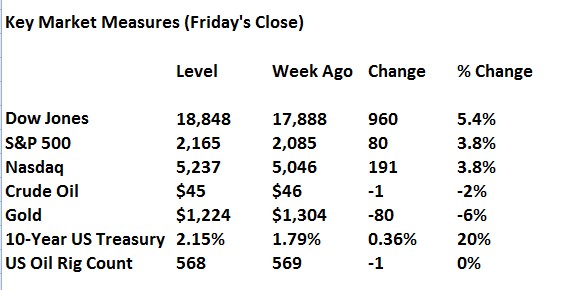
by Todd Shaver | Nov 13, 2016 | Weekly Newsletter 7pm Sunday
The Week Ahead
The stock market hit fresh all-time highs on news of the Donald Trump victory. This was despite one of the larger components of the market, the Technology sector, trading lower. The rally is being fueled by the outlook for what new leadership brings to Washington and its future impact on the economy and financial markets. It is not as much Trump the markets are cheering, but rather the Republican sweep of the White House, the Senate, and the House, because for the first time in quite a while the balance of power falls with one party, meaning there finally will be an end to at some of the gridlock we all have become numb to.
That said, stocks have moved higher fast and could be pricing in too much optimism about how much change can come and how quickly. This week we provide some insights on our latest thinking for Goldman Sachs, Amazon, Home Depot, Bristol-Myers Squibb, Annaly Capital Management, and Netflix.
Highlights from the Past Week
In this edition of ‘Highlights from the Past Week’, we recap what are being discussed as the key things to watch for from new leadership in Washington.
Investors embraced the election of Donald Trump as president, snapping up stocks and selling bonds in a bet the Republican's plans for fiscal stimulus will succeed in breaking the U.S. out of a post-crisis economic funk. The Dow had its best week in five years.
The Dow Jones Industrial Average rallied on Monday and then posted its second large gain of the week Thursday, rising 257 points to 18,590, led by a rally in Financial and Healthcare firms. Meanwhile, the yield on the 10-year U.S. Treasury note surged to 2.07%, its highest level since January. Then on Friday, the Dow set another all-time high, closing up 40 points to 18,847, even though the overall market was down a shade.
Tax Reform & Budget Policy. Corporate tax reform is probably the top Republican priority. Expect lower taxes rates here and the end of double taxation on overseas earnings. Congress may target eliminating corporate deductions, but will be pressed to maintain small business tax breaks. Trump has proposed infrastructure spending programs of at least $500 billion over 5 years with an increase in the defense budget of 15%.
Trade. The White House will seek to tax imports and renegotiate proposed and existing trade deals. Extensive tariffs may quickly generate opposition from the many US firms whose supply chains stretch overseas.
Immigration. Trump’s plans to build a wall along the Mexican border and threats to deport many immigrants remain controversial. Republicans in Congress are likely to support improved border security and law enforcement but reject the more contentious issues of a wall and large-scale deportation.
Economic Policy. The administration and Congress may reach consensus to support fossil fuels and approve the energy pipeline projects that have stalled on environmental concerns. There have been proposals for a temporary moratorium on new financial and environment regulations.
Healthcare. Republicans and the President-elect both agree with repealing and replacing the Affordable Care Act. The new program is likely to feature market-oriented solutions, such as health savings accounts. The use of block grants to states for Medicaid spending could grant states flexibility (but may not cover all constituents.)
BMR Companies and Commentary
Goldman Sachs (GS: $204, +16% for the week)
Financials including Goldman Sachs rallied the most this past week. With rates finally rising, a steeper yield curve is good for banking and capital markets. More importantly, plans to roll back regulation are coming, which is huge for all of Financials, as they have had a bad stigma for years under the Elizabeth Warren era of denouncing Wall Street.
The regulatory discussion is currently all over the map right now about what we could see. The end of Dodd Frank? The termination of the Consumer Financial Protection Bureau? No more Volcker Rule allowing proprietary trading (again)? Some even say Glass-Steagall* could be on the table (again). Note that Trump has called for a general guideline of allowing new regulations to be implemented only if they replace two existing regulations. This all amounts to positive implications for Goldman Sachs.
*The Glass–Steagall Act describes four provisions of the U.S. Banking Act of 1933 that limited securities, activities, and affiliations within commercial banks and securities firms.
One more thing to ponder - who will Trump name as Treasury Secretary? The position once held by Alexander Hamilton is considered one of the highest honors in all of Finance for those asked to serve. Rumors are floating that Goldman’s CEO Lloyd Blankfein is possible candidate, as well as CEO Jamie Dimon of JP Morgan Chase.
BMR Take: Goldman is the #1 investment banking franchise. The investment banking business follows a boom-bust cycle. With the sharp rally recently, we are implementing a stop at $196 to protect our gains but we do not want you to miss more upside if the train keeps rolling. We added the stock at $147 in February, so we are up 39% in nine months.
Amazon (AMZN: $739, -2%)
CEO Jeff Bezos has had several past run-ins with President-Elect Donald Trump. The run-ins are now putting his shareholders in a nervous place, as the outcome of this election could have implications for the stock. Using his private funds, Bezos bought the Washington Post for $250 million in 2013. The paper (and on occasion Bezos himself) has been sharply critical in review of Trump’s campaign, something which the incoming president did not appreciate. Trump has fought back saying that “if Amazon ever had to pay fair taxes, its stock would crash and it would crumble like a paper bag”; “The Washington Post scam is saving Amazon by lobbying DC to not tax online retail”; and “I would go after him for antitrust, because he’s got a huge antitrust problem, because he’s controlling so much. Amazon is controlling so much of what they’re doing.”
BMR Take: Trump is not going to go after Amazon anytime in the near future. A big chunk of this country depends on Amazon. Amazon is improving many parts of the economy. The pullback in the stock is a strong buy opportunity.
Bristol-Myers Squibb (BMY: $56, +10.5%)
Many Healthcare investors are breathing a sigh of relief now that Trump has defeated Clinton in the presidential race. Shares of Pharmaceutical giants and big Biotech firms surged this week, largely due to hopes that a President Trump will not be as concerned about high drug prices as Clinton would have been. Trump still will fight high drug prices, but it is not a top priority of his administration, as instead his first choice in Healthcare is to repeal and replace Obamacare. (The latest news now is that he will just modify the Affordable Care Act.)
Drug and Biotech companies have been under attack on Capitol Hill for the past year due to price increases for life-saving drugs like Mylan's (MYL: $38) EpiPen, so the change in the landscape is big.
Separately, this week Bristol Myers benefited from some more specific events for the company, such as: (i) licensing a new liver drug from a Japanese company for $100 million that is believed to be a $1 billion+ drug; (ii) announcing a new pact with John’s Hopkins University to research immune-oncology; and (iii) its blockbuster drug Opdivo succeeded in a key stomach cancer study.
BMR Take: We are reassured to see signs of life out of our Bristol-Myers position. The stock had come under heavy poor sentiment, but now we have a string of good news from the recent quarter’s results that promised big stock buybacks and flat operating expenses, to a more favorable political landscape, to general good news about the core business. We think the stock is putting in a firm bottom and now is a great time to be accumulating.
Home Depot (HD: $130, +7%)
This business had been sagging with US GDP running 1-2%. With monetary policy out of gas, sentiment was turning negative that sluggish growth would re-accelerate. However, now with Trump’s idea of spending $500 billion on infrastructure over 5 years, and exciting prospects for GDP growth to return to 3-4%, means a lot better backdrop for Home Depot as the economy will be picking up, and more and more people will be employed. Home Depot will be reporting earnings this week on Tuesday. Watch for any commentary on the general economic outlook, customer traffic trends, and marketing spend - as key details aside from earnings results. Just three months ago CEO Craig Menear and his team projected that comps will rise at a 5% pace for the full fiscal year, marking a slight slowdown from 2015's 7% spike, which we hear could be on track to a recovery to high single digits, considering what’s recently changed in terms of fiscal stimulus for the economy.
BMR Take: Home Depot is a blue chip on very stable ground and we expect solid performance to continue. With only 15% market share of a $500+ billion US market opportunity, this is not a stalled-out growth story by any measure.
Annaly Capital Management (NLY: $10.09, -2%)
Interest rates moved sharply higher this past week. The 10-year Treasury note moved from 1.79% to 2.15%. We have not seen such a rapid rise since the Taper Tantrum that occurred three years ago. The stock has held up well. Why? More confidence in hedging programs? Better portfolio mix? More reasonable expectations for performance in a rising rate environment? Yes. Yes. And yes.
Rates are rising because expectations now call for fiscal stimulus to reaccelerate GDP growth from 1-2% to 3-4%, which in combination with higher headline inflation figures, will perhaps force the Fed to raise rates. The jury is still out on if the 10-year will spike to 2.75% from here, hold, or give back some of the recent move. In any event, it was very re-assuring to see Annaly’s stock hold firm around $10 this week.
BMR Take: We at The Bull Market Report actually think that rates my hold here and move lower in the next few weeks and make life even more difficult for the Fed on its decision-making about the rate rise in December. Annaly has the best long-term total return record of any Mortgage REIT. The company has paid out $14 billion in dividends since inception in the 1990s. With rates up a bit just recently, Annaly’s 10.4% dividend yield continues to look compelling.
Netflix (NFLX: $115, -6%)
Another company under fire right now is Netflix. The president-elect has tweeted his displeasure with net neutrality, but there is no formal plan in place at this time to address the issue. Everybody is in wait and see mode. As Republicans prepare to swarm Washington, the fate of net neutrality, or the policy that broadband providers do not favor traffic from one source or destination over another, is in question*. Netflix has the most to gain or lose. Without net neutrality rules in place, broadband providers would be able to charge online video services for bandwidth usage, as well as priority access (guaranteed streaming quality) and favor their own services. This could potentially crush Netflix. For instance, let's look at an example of somebody who has their home internet through Comcast. Comcast could start their own streaming service, as they are already are working on. They could then provide you with unlimited internet connection to watch their Comcast streaming service, but restrict internet access for other services like Netflix.
*Net neutrality – a very complex subject. Google it for details if you are so inclined.
BMR Take: As with Amazon, we think the fear here presents opportunity. Netflix and CEO Reed Hastings are bringing a lot of innovation and customer satisfaction to TV. We just don’t see net neutrality as a top priority for new leadership in Washington and thus we continue to hold Netflix in high regard as they continue to build their customer base and work on new content in their quest to become the next big TV network.
Upcoming Economic News
TUESDAY, NOVEMBER 15
Import Price Index* – October
Time: 8:30 am
Forecast: 0.3%
Import prices are projected to rise for the second straight month in October, bringing the index nearly even with the year-ago level. Yet in September the Import Index still trailed 2012’s cycle high by 16%, as long-term commodity cost pressures have not developed. Future movements in import prices are shrouded in doubt given the uncertain direction of the dollar and difficulties for OPEC in implementing oil supply cuts.
*The International Price Program produces Import/Export Price Indexes containing data on changes in the prices of nonmilitary goods and services traded between the U.S. and the rest of the world.
Retail Sales – October
Time: 8:30 am
Forecast: 0.6% overall, 0.5% ex-auto
Retail sales in October look to equal September’s hearty 0.6% monthly gain. Sales are supported by wage gains, with the 2.8% yearly change in average hourly earnings in October representing the fastest pace in seven years.
Business Inventories – September
Time: 10:00 am
Forecast: 0.2%
Business inventories are forecast to grow steadily in September, as the economic drag from the reduced pace of stockpiling appears to have ended. Inventories were initially estimated to have added 0.6% to real GDP growth last quarter after subtracting from output in the five previous quarters. Modest acceleration in revenues and slim inventories raise the prospects for higher corporate profits in the quarters ahead.
WEDNESDAY, NOVEMBER 16
Producer Price Index – October
Time: 8:30 am
Forecast: 0.3% overall, 0.2% core
Some uplift in fuel costs are expected to lead to a sturdy gain in the October Producer Price Index. Past deflationary trends in commodity costs are fading out as the PPI rose 0.7% yearly in September after annual declines were recorded in most of the prior 18 months. Underlying business cost trends remain weak, with the core PPI rising only 1.2% yearly through September.
Industrial Production & Capacity Utilization – October
Time: 9:15 am
Forecast: 0.2% industrial production, 75.5% capacity utilization
Industrial production can creep higher in October amid limited signs of rising industrial sector demand. The ISM Manufacturing Index reading on new orders has held in positive territory for two straight months. Monthly readings on core capital goods orders have also largely expanded in recent months.
THURSDAY, NOVEMBER 17
Housing Starts & Building Permits – October
Time: 8:30 am
Forecast: 1.16 million starts, 1.19 million permits
Housing starts are expected to leap higher in October after September’s disappointing 18-month low. Building permits hint of a turnaround in construction activity after rising 13% annualized in the third quarter. Though multi-family building is contracting, single-family home construction has expanded annually in every quarter since early 2014.
Consumer Price Index – October
Time: 8:30 am
Forecast: 0.4% overall, 0.2% core
Higher gasoline costs may lead the Consumer Price Index in October to equal the largest monthly increase of the past three years. The extended period of minimal price gains might be over after the CPI failed to grow faster than 1.5% annually in nearly two years. Higher observed price growth can help lift consumer inflation expectations, which would allow for some limited tightening of monetary policy.
FRIDAY, NOVEMBER 18
Leading Economic Indicators – October
Time: 10:00 am
Forecast: 0.1%
Encouraging labor market trends can push the Leading Economic Indicators Index higher for the second consecutive month in October. Sustained gains in the labor market participation rate among prime age workers this year is a sign that improved job prospects are resonating with previously idled individuals. That expansion of the work force boosts overall personal income growth and bolsters consumer spending.
A Word from Gary Jefferson
Jefferson Financial Group
First Vice-President, Investments
UBS Financial Services, Inc.
[Gary hinted Monday before the election not to rule out a Trump victory. Very astute prediction, Gary! These comments below are from Monday, the day before the election.]
From a longer-term perspective, and regardless of who wins, we believe the best "candidates" for potential future dividend growth (going into and out of this election) may be found in the Consumer Discretionary, Healthcare, Financials, and Information Technology sectors. It all goes back to earnings – not who is president. Companies that grow their earnings and dividends at an accelerated rate year in and year out will, as they have throughout history, offer the best potential for outperformance on an absolute and risk-adjusted basis.
The bottom line: These sectors are expected to be able to grow earnings notwithstanding any political headwinds they may face. So, while elections are extremely important to the well-being of our country, earnings are also important to the well-being of the markets and your individual portfolio. If we stay focused on earnings as opposed to elections, media "noise" and emotions, we expect good things will happen over the next four years.
[Well said, Gary.]
A Question For You
We always secretly wonder whether folks will avoid a stock like Amazon or Google because the stock price is so high. So we’d like to do an informal survey on whether you are intimidated by a high priced stock like Amazon or Google.
And here’s a second question: These two stocks are at about the same price now with Google at $753 and Amazon at $740. Which company do you think will be leading in 6-12 months? Write me directly here: Info@BullMarket.com.
The Energy Information Administration: Higher US Crude Oil Output in 2017
The Energy Information Administration (EIA)*, says this is due to the ramp-up in drilling in west Texas. They boosted their forecast of U.S. oil output this year and 2017 to average 8.8 million barrels a day this year and 8.7 million barrels a day next year, up from its prior forecasts of 8.7 million in 2016 and 8.6 million in 2017.
U.S. oil production has dropped from an average of 9.4 million barrels a day last year. But the EIA’s expectations for U.S. oil output have crept up this year as oil prices have increased.
* The U.S. Energy Information Administration (EIA) is responsible for collecting, analyzing, and disseminating energy information to promote sound policymaking, efficient markets, and public understanding of energy and its interaction with the economy and the environment. EIA programs cover data on coal, petroleum, natural gas, electric, renewable and nuclear energy and is part of the U.S. Department of Energy.
Listen To This: After talking cuts, OPEC members have pumped record amounts of oil
The Organization of the Petroleum Exporting Countries has ramped up production to record levels beyond 33.5 million barrels a day. Plus Russia has added about 500,000 barrels a day of oil production in the past two months, while the combined production of Libya and Nigeria brought another 500,000 barrels of new output. No wonder this increase in crude production has depressed crude, which is down 15% in the last three weeks.
The International Energy Agency said OPEC’s oil production rose to record highs in October and is expected to remain elevated this month, despite word of production cuts.
OPEC crude output rose by 230,000 barrels a day to a record high of 33.8 million barrels a day in October. Production recovered in Nigeria and Libya and flows from Iraq hit an all-time high of 4.6 million barrels a day.
OPEC is going to have big problems cutting global oil supplies since there are many producers that are not part of OPEC, such as Russia, Canada, Kazakhstan and Brazil, which are attempting to increase their own production levels.
Our prediction: Oil will stay in the 40s and might even move into the 30s in the next few weeks and months.
Tesla Update
The company announced a slew of new products including a more powerful Powerwall 2 (it stores the electricity produced from the solar array on your house), and a new Solar Roof – an AMAZING new product. We have a video for you to watch, but first, note that this is not going to happen under the auspices of Tesla, unless the merger with Solar City takes place. We think it WILL happen, due to the persuasiveness of Elon Musk but if the government decides against it, even Musk might not be able to make it work. Check out Musk explaining these new products here:
https://www.youtube.com/watch?v=0v_qqtlN8j8
Interest Rate Rise in December?
The Federal Reserve is on course to raise interest rates next month, a Reuters poll of economists showed. Before the election, many economists had said ensuing uncertainty from a Trump win might put up a roadblock. But roughly 85% of 62 respondents in a survey taken on Wednesday after the shock vote said the Fed would go ahead with a rate rise, its first in a year. But don’t forget what happened last year in December when the Fed raised. January of this year was a disaster. (BTW, the Wall Street expression “As January goes, so goes the year.” This year you can throw this one right out the window.
Gosh we hate platitudes like that one.
How about the talk that if the Fed starts raising rates, the market will go down? Well, look at December 2015 with the Fed raising rates and what happened this year. Note that historically the market rallies 1-2 years after the Fed starts raising. We think 2017 is going to be a good year.
More News on Goldman Sachs
We read a great article in The Economist about Goldman Sachs entitled Too Squid to Fail. Silly title, but good article. Write us if you wish to read the whole article: Info@BullMarket.com. Some highlights: It has the best brand name in the business. But like the rest of its industry, it has not fully recovered from the near-death experience of 2008. Even the boss of one, Credit Suisse, has described them as “not really investable”, and, sure enough, shares in many of the most prominent firms - Deutsche Bank, Citigroup, Bank of America - trade well below book value, suggesting they would be better off liquidated. Goldman’s shares trade virtually at book value. But even it is a shadow of its former self. [Since the article was written last week, the stock is up sharply, so it is trading at 110% of book. We wonder if this article had something to do with its sharp rise this week.]
Goldman is turning into an industry leader in another way: as an exemplar of the wrenching transformation banks need to undertake in order to survive and prosper.
Goldman reported its first double-digit return on equity for six quarters, and it did so by making money in its traditional trading and advisory businesses. The results seemed to vindicate those who have argued that the ever-thinner elite of global investment banks would eventually come good, as weaker rivals retrench and leave the field.
Far from it. The good quarter was a single swallow. Returns on equity and assets have not rescaled former peaks. Rather, they have fallen to a new, significantly lower, plateau. The industry remains squeezed between two secular trends that are not going to ease. One is towards the “disintermediation” of banks, a decades-long process accelerated by a technological revolution. This led Wall Street firms to seek profits as risk-takers rather than intermediaries. But that trend runs counter to the second: tighter regulation imposed in the wake of the crisis in 2008, to try to ensure it never happens again. This is eliminating whole lines of business, and, through the imposition of higher capital requirements, is making others less profitable.
An obvious response to this squeeze is the most brutal and immediate form of cost-cutting: redundancies and the elimination of any expense seen as discretionary. Buried within recent upbeat earnings reports by the banks were announcements of more job losses, including at Goldman. A more profound response, however, is to go beyond retrenchment to recognize that banks are, at their core, technology companies, whose business is to push numbers down digital pipes. Money has long been primarily an electronic construct.
Goldman is ahead of the pack in embracing the changes this recognition implies. A plethora of new initiatives seeks to turn technology into its friend and take it into entirely new lines of business. In-house, it is automating and streamlining its traditional businesses, identifying 146 steps across 45 systems that can be simplified in an initial public share offering, for instance. This month it launched a new internet operation, named Marcus, to lend to consumers. It has incubated a number of tech firms. One, Symphony, offers a messaging platform, and dreams of rivaling Bloomberg. Another, Kensho, offers a kind of real-time cyber-encyclopedia to find correlations between world events and price-sensitive assets.
Some of these Goldman initiatives may come to be seen as faddish indulgences and fail - and they are mirrored by a scramble for new ideas at its peers. But the effort puts Goldman on the right side of an embattled industry that, unable to transform its operating environment, must transform itself.
Tech Stocks Get Hammered
Nearly every major Tech stock was down on Thursday, one day after Donald Trump was elected president. Facebook, Apple, Alphabet, Microsoft, and Amazon were all down sharply, despite the overall market being up. The Dow was up more than 200 points on Thursday (1.2%), but the tech-heavy Nasdaq ended down 1.6%. Amazon was down 3.8%, Apple down 2.8%, Facebook down 1.9%, Alphabet down 2.9%, Microsoft down 2.4%, and Netflix down 5.4%. We’ve seen Tech stocks drop like this before, but never on a day when the overall market is skyrocketing.
Some analysts said Tech stocks are getting hit because people are concerned inflation might be higher under Trump. We’re not really buying this pitch. But note that Trump and the Tech industry have been sparring throughout the presidential campaign. Trump made curtailing immigration a centerpiece of his platform - a potential problem for the tech firms that employ a large number of foreign engineers. He pledged to force Apple to manufacture the iPhone in the US, which probably won’t happen, as well as to crack down on Amazon's tax practices.
BMR Take: We see a buying opportunity in Tech.
HIGH YIELD CORNER
We have a new president-elect, and the results were a shock to almost everyone. Whatever your politics, the change in office is something we need to look at carefully as market participants, because this is a clear shake-up to the stock market.
Some sectors are rallying. Financials in particular are doing well on the hope that Dodd-Frank will be repealed or Trump will initiate bank-friendly policies. At the very least, there is speculation that Trump will encourage inflation and thus higher interest rates, again pushing bank margins higher. This means Wells Fargo (WFC: $52) is up an eye-watering 16% in a single week. Other mainstream banks and big financial companies are up big as well. Similarly, BDCs did well with the hopes of higher interest rates and relaxed credit rules; the UBS BDC ETF (BDCS: $22) rose 5% last week.
How does this impact the high yield world?
Let’s take it one sector at a time. High yield bonds did not like the news. The SPDR High Yield Bond ETF (JNK: $35, down 2%) fell significantly for the same reason banks rose. An expectation that interest rates will rise is going to hurt corporate bond values. That doesn’t mean it’s time to sell junk bonds - but it does mean it’s a good idea to diversify and get a higher yield than you’d get from the SPDR fund (6.1%).
We recommend adding to a position in the Pimco Dynamic Income Fund (PDI: $26) on its recent weakness. Yes, the 5% decline in one week is hard to swallow - and the fund is now down year-to-date for the first time since May. We’re also now flat from our initial recommendation. But that doesn’t mean it’s time to sell - it means it is time to buy more. The fundamentals of this fund are stronger than when we first recommended it: Its undistributed net income is higher; it can match its dividend with bonds thanks to rising yields earlier this year; and the much anticipated special dividend is literally weeks away. Hold on and buy more.
What about REITs? Ironically, the REIT sector has done badly with a real estate mogul getting into the White House. It’s also doubly ironic, since Donald Trump owns several REITs. Still, the SPDR Dow Jones REIT ETF (RWR: $89) ended the week just flat after falling sharply on Wednesday and Thursday after the election results came out. Many individual REITs did much worse, but Healthcare REITs were one of the worst hit.
This is a problem for us, because Healthcare REITs are our favorite subsector in the asset class. Does this recent downturn change our positions on the two Healthcare REITs in the Bull Market Report portfolio?
Simply put: no. Irrational fears of unknown healthcare reforms to come are driving the sell-off, but there’s no justification for the worries.
Care Capital Properties (CCP: $23) had a disastrous week, falling over 7%. The stock is now down 26% year-to-date. This is extremely alarming, especially in light of a Mizuho report on the company with a new $26 price target.
They reported Funds from operations of $63 million, or 75 cents per share, in the period. Net income came in at $19 million or 23 cents, down from $36 million or 57 cents last year. Revenue hit $87 million in the period vs. $81 million last year. The company is looking for full-year funds from operations of $3 per share.
The drama around Care Capital might seem worrying at first glance, but we remain optimistic. First, the company reported a 5 cent FFO beat for the third quarter and revenues rose 6% year-over-year. The company is also expanding its skilled nursing facility (SNF) and senior housing community properties for $39 million in a sale-leaseback deal with an existing customer. This is good news, because Care Capital knows their customers and knows their financial health, so a sale-leaseback to an existing customer is a promising source of incremental cash. On top of that, Care Capital is now covering dividends with a 140% coverage ratio. Not only are payouts far from threatened, but likely to rise soon. Yet the market is pricing in risk with a 10% yield.
Part of this is fear over Medicare’s future. With President-elect Trump in a position to scrap Obamacare and replace Medicare with a voucher system, SNFs seem a prime risk. But Trump’s actual decisions regarding medical care are unknown; we don’t know if he really will scrap Obamacare, since he’s reiterated post-victory that there are parts of the plan he likes. What’s more, even if he revamps or removes Obamacare and Medicare completely, that doesn’t necessarily mean he won’t replace it with something that will benefit firms like Care Capital.
But the markets are playing it safe and punishing Care Capital as well as another Healthcare REIT favorite of ours, Omega Healthcare Investors (OHI: $28), which fell 3% in the last week. We see this as folly. As with Care Capital, Omega outearns its dividend and has strong growth potential. We recommend aggressive purchasing on these fears of a cut to Medicare hurting these firms.
What about Energy? Trump has been perceived as a champion of the Energy industry, with promises to increase coal mining in America and domestic energy production. However, domestic energy production is already booming and the real problem is the volatile and declining commodity costs that have come from higher supplies. There’s little reason to see Trump’s presidency impacting energy at all.
It’s no surprise, then, that the Alerian MLP (AMLP: $12) ended the week up over 1% - not unusual for the sector. (Alerian is a collection of energy MLPs. Since MLPs tend to trade in tandem with energy prices and they pay out 90% of income in the form of dividends, an MLP ETF is one of the highest yield ways to invest in energy.) Wednesday and Thursday were strong, with a correction on Friday, indicating there isn’t a Trump momentum here. The market is focusing much more on upcoming temperatures in gas-dependent cold climates; OPEC’s ability to strike an output freeze deal; and how a change or repeal of NAFTA will ultimately affect energy production in America. These are a lot of complicated issues with too many unknowns, so we remain on the sidelines for MLPs right now - but if there’s a serious correction that may change in the future. Volatility is likely to continue in the high yield world as investors get their bearings and prepare for rising interest rates and Trump’s still unclear economic plans. But this is a buying opportunity, as high yield investments will continue to be in demand as investors search for yield and diversify away from equities.
Michel Foster
High Yield Analyst
For The Bull Market Report
That’s all for this week. We look forward to how the market will handle the election news this coming week, a week after the fact.
Good Investing,
Todd Shaver, Founder and Editor in Chief
The Bull Market Report
