July 23, 2017
by Todd Shaver | Jul 23, 2017 | Weekly Newsletter 7pm Sunday
The Weekly Summary
Have equity markets come too far too fast this year? Year-to-date the S&P 500 is up 12%. We are certainly not ringing any alarm bells. Rather we note that the market can’t just go up in a straight line for extended periods. While stock indexes ended the week higher, the underlining story is we are seeing the steadiest outflows of cash since 2009. Even as the S&P 500 clawed its way to a fresh record and squeezed out a third consecutive weekly gain, signs of fading enthusiasm in U.S. stocks have become increasingly difficult to ignore. The latest can be seen in the SPDR S&P 500 Trust, the biggest exchange-traded fund tracking the U.S. equity benchmark. As of Thursday, investors had pulled $3.8 billion out of it in July. That puts the fund on pace for a fourth consecutive monthly outflow, which would be the longest streak since the start of the bull rally in 2009. This push and pull will continue of course. The S&P 500 touched new highs this week before retreating as an intensifying investigation into President Donald Trump stoked concern that his economic agenda may stall. We expect more of the same in the week ahead.
However, there is always a bull market here at The Bull Market Report! This week we highlight some of our favorite stocks: Microsoft, Visa, Athenahealth, Netflix, and Blackstone. We believe in these companies.
Highlights From The Past Week
Tech Index Eclipses Record From Dot-Com Era. Tech stocks broke a nearly two-decade-old record this past week. The S&P 500's Information-Technology sector ended the day on Wednesday at 992.29, closing above its previous all-time high of 988.49 set in March 2000 at the peak of the dot-com bubble. Tech stocks are by far the best-performing among the index's 11 sectors this year, up 23% after posting their ninth consecutive day of gains Wednesday.
Bank of America Chooses Dublin for Main EU Hub After Brexit. Bank of America has picked Dublin to locate its main European Union hub in preparation for Britain quitting the bloc in 2019, the latest global bank to finalize its contingency arrangements after Brexit. The bank will move some roles from London to the Irish capital and other cities across the EU. Bank of America already has a fully licensed operation in Dublin, and employs more than 700 people in the country. London has flourished as a hub for global finance in part because firms based in the capital have the right to do business across the 28-nation EU. British banks, as well as firms from the U.S., Japan and other non-EU countries with a base in London, stand to lose this “passport” after Brexit and may need to channel business throughout other locations in the bloc.
Dublin is the second most popular destination, after Frankfurt, for Financial Services companies seeking uninterrupted EU access post-Brexit. The city provides a low-tax English-speaking location and has similar laws and regulations to its U.K. neighbor. It is fascinating to watch the evolution of the European Union and what it means for business. There are certainly major changes ahead for companies.
Draghi Says ECB Isn't There Yet as Inflation Lag Takes Time. Mario Draghi said policy makers are still waiting for inflation to catch up with the economy’s recovery, as they put off any discussion on winding back stimulus until after the summer. Specifically, he said the EU is finally experiencing a robust recovery where one only has to wait for wages and prices to follow course. “We need to be persistent and patient and prudent, because we’re not there yet.” While the ongoing economic expansion provides confidence that inflation will gradually glide toward levels in line with the inflation aim, it has yet to translate into stronger inflation dynamics. A very substantial degree of monetary accommodation is still needed for underlying inflation pressures to gradually build up. What does this all mean? Continued easy money policy from Europe’s central bank is a big benefit for global equity markets including the US. Good for the US stock markets.
Congress Must Avoid Spooking Markets on Debt Limit. The U.S. debt limit needs to be raised in a calm, thoughtful manner that steers clear of political uncertainty that would spook markets. But will they do it? Congress must avoid any political standoff that could set in motion disruptive activities such as a need to choose which bills to pay and which to delay. The government will reach its statutory limit on borrowing in early October. President Donald Trump’s administration has asked Congress to raise the ceiling before then. Concerns have surfaced in the Treasuries market, with traders willing to pay more for bills maturing after October 19th to avoid being caught holding securities vulnerable to a technical default. Watch for the upcoming political discussion over the debt and let’s hope it doesn’t get contentious.
BMR Companies & Commentary
Microsoft (MSFT: $74, up 1% - all prices in the newsletter are for the week)
The company reported earnings this week. Revenue of $25 billion beat the consensus by 2% while EPS of 98 cents beat by a big 27 cents. Analysts were positive on the quarter itself, especially around commercial cloud and commercial bookings which both came in nicely above Street expectations. Commercial cloud growth accelerated and is also experiencing margin expansion which is helping increase both operating income and free cash flow generation. Some went further and talked on how Microsoft looks to be taking share from Amazon Web Services (AWS) and is becoming a larger force in the space.
Despite the strong revenue quarter, operating expenses came in higher than expected and the company is also seen to have a higher tax rate than estimated. On top of this, some wanted to see the “billings beat” seen in the quarter to flow into greater revenue guidance for Q1.
The cloud business – Azure - was the main story from the quarter due to 30% growth in commercial bookings. Office 365 and servers were both healthy, and execution on renewals was strong.
BMR Take: All in all a very solid quarter from Microsoft. The stock hit NATHs* this week and we see NATHs ahead. We believe the stock will hit $80 in the coming months, which represents 20x EPS. The market cap is now $570 billion, only topped by Apple at $780 billion and Google at $680 billion.
*NATH – New All-Time High
Visa (V: $100, up 3%)
Visa reported strong earnings. EPS beat on stronger revenue and the company raised expectations for the forward outlook.
Visa reported EPS of $0.86, $0.05 ahead of the Street. Visa is now guiding to approximately 20% EPS growth, which compares to the "high end of mid-teens" growth which was issued previously.
From management at the earnings announcement: “Results reflect strong growth in payments volume, cross-border volume, and processed transactions, which were powered by economic tailwinds in the U.S. and globally. Results and growth reflect the company’s strategy to pursue the conversion of cash and checks to electronic payments in partnership with our clients around the world.”
The story at Visa has been strong for decades and not much has changed. And that’s a good thing. Visa is a global payments technology company working to enable consumers, businesses, banks and governments to use digital currency. Visa connects billions of consumers, businesses, banks and governments in more than 200 countries and territories worldwide. The company is as close to an unstoppable machine as can be at this point.
Take a look at this chart of Visa for the past nine years:
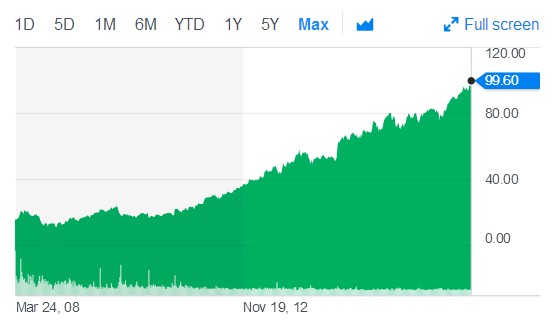
With a market cap of $230 billion, it is one of the greatest companies in the world. We would highly suggest you own some.
BMR Take: Consensus now sees EPS closing in on $5.00 in the next 1-2 years. With EPS growth running 20%, valuation looks awfully compelling to us still. We added the stock in early 2016 at $70. Our current Target is $95 which it has blown through this month, so we hereby raise our Price Target to $110. Our Sell Price remains “We would not sell Visa.”
Athenahealth (ATHN: $156, up 9%)
Athenahealth delivered an exciting quarter. The company believes it is at a key inflection point in its history and that 2017 will be a productive year for building out what differentiates them in the market. The company is demonstrating the power of its co-source model by simplifying and reducing client work. It’s building a new hospital service. It’s re-platforming AthenaNet. It’s grown its network to 100,000 providers, 98 million unique patient records, and 2.8 million covered lives, and is now positioned to be healthcare’s first true technology company. Stellar!
So many highlights from the quarter to discuss. Revenue increased 15% from last year to $293 million beating the consensus by $2 million. EPS of $0.51 crushed the consensus estimate of $0.39.
Moreover, the company continued the implementation waves at New York-Presbyterian Medical Groups, Adventist Health, and Tenet Health. The company gained access to the Centers of Medicare and Medicaid Services (“CMS”) claims data in certain states as a CMS Certified Qualified Entity. The company acquired Praxify Technologies to advance its platform strategy and mobile capabilities and accelerate its research and development initiatives by leveraging Praxify’s powerful app development platform. We could go on and on…
BMR Take: Athenahealth is a sleepy, off-the-radar company that is now firing on all cylinders. There is real upside potential ahead. Recall, big time activist investor Elliot Management has taken a stake in the company. Could we see all-time highs ahead which would be near $200? We feel this is a more than small probability.
Netflix (NFLX: $189, up 17%)
Netflix just does what it always does: Crushes expectations and the naysayers. The company delivered EPS of $0.15 just missing the consensus by a penny. But revenue of $2.8 billion was on the mark. The big story was the strength of subscriber growth and that was enough to send the stock soaring.
Netflix added 5.2 million net new subscribers in the June quarter vs. Wall Street's consensus estimate of 3.2 million. It also guided higher for the current quarter, with a forecast of 4.4 million net new subscribers, topping the consensus view for 4.0 million. This is huge subscriber growth. The company ended Q2 with 104 million subscribers worldwide, including 52 million in the U.S. and 52 million in foreign markets. Netflix's international streaming subscribers topped those in the U.S. for the first time.
Domestic net additions of 1.1 million represented the highest level of Q2 net adds since the second quarter of 2011. Better yet, Q3 guidance assumed much of this momentum will continue with the caveat that management is cognizant of the lessons of prior quarters when its over-forecasted.
The underlining fundamental story remains rock solid. With its content strategy paying off in strong member, revenue and profit growth. Management continues to believe that it is wise to continue to invest. In continued success, Netflix will deploy increased capital in content, particularly in owned originals, and, as management has said before, the business is likely to remain free cash flow negative for many years. That’s what it takes to build greatness!
The entertainment market is so broad that Netflix has now grown from zero to over 50 million streaming households in the US over the last 10 years. Netflix is growing with an expanding market, being co-pioneers of internet TV. The future is quite exciting.
BMR Take: Netflix is a premier growth story. The long term potential opportunity is quite big and we are still so early. This is one stock you just have to figure out how to own and hold onto.
The Blackstone Group (BX: $34, flat)
Blackstone delivered a decent quarter. EPS of $0.59 was just light of the $0.62 consensus. But revenue of $1.55 billion beat the $1.50 billion consensus. Total assets-under-management (AUM) was a ridiculous $370 billion. The $0.54 dividend was paid, giving the stock a dividend run-rate of 6.5%.
Management noted that it is continuing to see the benefits of its sustained large-scale capital deployment around the world, a patient focus on value creation in those investments, and then being able to choose the right moment to exit. They expect this momentum to continue. With pending realizations, including the historic sale of its European logistics portfolio, the company is on track for one of the best years for cash distributions to shareholders in its history. Wow!
In particular, the CEO said, the company’s distribution should not be viewed as one-off special dividends. They have demonstrated an ability to deliver consistently high payouts over time. Over the past three years for example, the company has distributed an average of nearly $2.50 per year, driven by over $130 billion of gains on investments.
BMR Take: EPS is running around $3.00 so the PE multiple is just over 10. The dividend yield strong and management is saying they can deliver you this dividend in the future as they have now done it now consistently for many years. We see compelling value here.
Upcoming Economic News
Existing Home Sales
Monday, July 24th, 10:00 AM
Period: June
Consensus: 5,560,000
Prior: 5,620,000
Consumer Confidence
Tuesday, July 25th, 10:00 AM
Period: July
Consensus: 116.0
Prior: 118.9
Note: The Conference Board's Consumer Confidence Survey is a monthly measure of the public's confidence in the health of the U.S. economy.
New Home Sales
Wednesday, July 26th, 10:00 AM
Period: June
Consensus: 615,000
Prior: 610,000
GDP
Friday, July 28th, 8:30 AM
Period: Q2
Consensus: +2.5%
Prior: +2.1%
Wall Street Consensus for Apple (AAPL: $150, up 1%)
Ratings Breakdown: 9 Hold Ratings, 39 Buy Ratings, No Sells
Targets
Wall Street Consensus Price Target: $16
7/22/2017 Wells Fargo $140
7/21/2017 Guggenheim $180
7/17/2017 Morgan Stanley $182
7/12/2017 Goldman Sachs Group $170
7/12/2017 Merrill Lynch $180
7/10/2017 Canaccord Genuity $180
7/9/2017 Credit Suisse Group $170
7/6/2017 Drexel Hamilton $202
BMR Take: Buy.
Wall Street Consensus for Opko Health (OPK: $6.59, up 8%)
Ratings Breakdown: 2 Hold Ratings, 6 Buy Ratings
Targets
Wall Street Consensus Price Target: $16
7/18/2017 Barrington Research $11
6/16/2017 Ladenburg Thalmann $19.50
6/12/2017 Jefferies Group $8
3/14/2017 Guggenheim $25
3/5/2017 Standpoint Research $14
1/3/2017 Laidlaw $19
BMR Take: We’re sticking with this one and are looking for a BIG upside. Look at what the brains of Wall Street think about the stock. We remain astounded that the stock has stayed down here for all this time. And the CEO and Founder just keeps buying shares.
Nutanix Insider Trading
We generally love it when insiders in a company are buying stock. Conversely, we get a little crazy when insiders are selling. Check this out about Nutanix (NTNX: $24), which had another great week, up 7%.
--- Director Jeffrey T. Parks sold 1,235,000 shares of the firm's stock in a transaction that occurred on July 14th. The stock was sold at an average price of $21.97, for a total transaction of $27,100,000.
--- Sr. VP Rajiv Mirani sold 20,000 shares of the firm's stock in a transaction that occurred on July 13th. The stock was sold at an average price of $19.63, for a total transaction of $400,000. Following the transaction, the senior vice president now directly owns 271,000 shares in the company, valued at $5,300,000. The sale was disclosed in a document filed with the Securities & Exchange Commission.
--- VP Kenneth W. Long III sold 30,000 shares of the firm's stock in a transaction that occurred on July 19th. The stock was sold at an average price of $24.00, for a total transaction of $720,000. Following the transaction, the vice president now directly owns 240,000 shares in the company, valued at $5,765,000. The sale was disclosed in a document filed with the Securities & Exchange Commission.
BMR Take: We are not happy about this. We want them to be buying the stock because as insiders, they know that the company is killing them and that the stock is going to go higher. This selling by insiders makes us very wary. We love this company and after adding the stock at $17.45 in late May, two months later we are up 36% and have high hopes for more gains. But our antennas are out do to these insider transactions and if the stock falls to the $22 level, we are out.
Amazon – A Discussion
People say Amazon (AMZN: $1,025, up 2.5%) is not making any money. The stock set a NATH this week and many see the stock peaking here, believing the stock is way over-valued since they are not making any money. We beg to differ.
The facts:
Profits the last five quarters, latest first:
$724,000,000
$749,000,000
$252,000,000
$857,000,000
$513,000,000
Revenues the past four years:
$136,000,000,000
$107,000,000,000
$89,000,000,000
$74,000,000,000
Check out this story about a new business to business website and operation in the UK and the US. This could be BIG:
http://www.businessinsider.com/interview-amazon-business-bill-burkland-017-7
A little survey on Amazon:
a) I have enough Amazon
b) I am thinking of buying more
c) I am going to buy more now
d) The stock price is too high – if they split I would buy some
e) The stock is way overvalued – their profits are too low and the PE at 190 is insanely too high.
Send your thoughts to us at Info@BullMarket.com
Home Depot, Best Buy Hit as Amazon Teams Up With Sears
Sears will sell Alexa-enabled Kenmore appliances via Amazon. But Whirlpool (WHR) and major sellers of appliances Home Depot (HD: $147, down 3%), Lowe's (LOW) and Best Buy (BBY) were hit. Home improvement chains Home Depot and Lowe's had been seen as Amazon-proof, or at least Amazon-resistant.
BMR Take: We are not ready to throw in the towel because of this one announcement, but we have to watch this development from Amazon. We added the stock to our Stocks for Success portfolio in early 2016 at $121 and are up 21%, so we don’t want to give up any of these gains. The market cap is $175 billion, they have $3.6 billion in cash supporting a sizeable debt load of $23 billion.
BMR Take: They are not going away anytime soon, but as noted above, Amazon is a monster that one needs to keep an eye on.
Google (GOOG: $973, up 2%)
July 3rd - $898. Today - $973. That’s an 8% move in three weeks.
BMR Take: Yes, they got fined big-time in Europe, but the $2.7 billion fine is peanuts to the company that has $92 billion in cash and virtually no debt, and makes over $20 billion a year. Yes, we have to watch the EU to see if there are any sanctions they will be putting on the company. But we believe the company will weather the storm and thrive. We await the break-through to NATHs of $988+ and raising our own Price Target from $1000 to $1100 or higher. Stay tuned. This just might happen sooner than you think.
Apollo Global Is Getting Ready to Take Security Firm ADT Public
Private-equity firm Apollo Global Management (APO: $28, up 2.5%) is preparing an initial public offering for ADT, just a year after it bought the home-security company.
The offering could value ADT at well over $15 billion, according to people familiar with the matter, making it one of the largest IPOs of the year. They paid $7 billion for the firm a little over a year ago. An offering would mark a quick turnaround for the private-equity firm, which began consolidating home-security providers two years ago.
BMR Take: This is just one example of the power of this firm. Apollo is way undervalued. With a 7% dividend, it's a joy waiting for a higher stock price.
The High Yield Corner
By Michael Foster
Special to The Bull Market Report
This week, we saw the AGIC Equity and Convertible Income Fund (NIE: $20) rise over 1% in the week thanks in no small part to a strong gain in the fund’s NAV. That increase was attributable to a solid week for the stocks in its portfolio, like Priceline (its second highest convertible holding) rising over 2% in the week. We’ve seen AGIC raise its equity exposure while using convertible bonds to provide a strong income stream throughout 2017, and that has resulted in two positives for investors. First, the dividend remains well-covered by investments; second, the fund has benefitted from this year’s bull market, despite how much many on the sidelines seem to hate this bull market. [That’s not us by the way. We like this bull market.]
The strong performance in the fund has helped its discount to NAV fall. This is the result of intense demand from investors for the fund, which is why the market price for the fund has risen over 11% YTD while its NAV has risen 6% over the same time period. We’re now seeing a discount of less than 10%, which is the fund’s highest since 2015. The AGIC fund has seen its discount shrink considerably from reaching a near 15% low in late 2016, which itself was an improvement from the near 20% discount at the start of 2016. This demonstrates continued interest in the fund from market participants, who see its 7.5% dividend yield as an attractive income stream, especially considering how sustainable it is.
Another Bull Market Report pick saw a similar gain this week. The Pimco Dynamic Income Fund (PDI: $30) rose nearly 1% for the week and is up 10% year-to-date. That’s not including the fund’s massive income stream, however. With an 8% yield from common dividends alone, Pimco Dynamic Income has already given an annualized return of 30%. Add in the special dividend and that number gets absolutely astronomic. This fund offered a similar return in 2016, thanks in part to its higher NAV but also thanks to investor demand. The fund has gone from a discount in 2016 to its current 7.4% premium to NAV, again indicating sustained demand for the fund from a variety of investors.
While diversified funds had a strong week, REITs were a bit less impressive. One of Bull Market Report’s top picks, Digital Realty Trust (DLR: $112), was flat for the week with little volatility. This is unusual; Digital Realty tends to bounce around a lot. But the fund has gone from a 6% yield in the past to now a 3% yield, thanks almost exclusively to its meteoric price appreciation. We’ve seen the stock jump 14% in 2017 alone, with 53% total capital gains in the last five years. It’s pretty obvious that, at this juncture, Digital Realty is no longer seen as a “high yield” risky opportunity, but is rather a low yielding REIT with long-term staying power. This makes sense; Digital Realty’s business of renting server space, is in no danger of shrinking anytime soon. This industry is also too new for us to determine whether it is cyclical or counter-cyclical. If it turns out that server space demand doesn’t go down during recessions in a cloud-computing world, then Digital Realty could quickly be perceived as one of the safest long term investments out there. For that reason, holding Digital Realty makes sense no matter what your investment profile or goals are, although the 3% yield is of course lower compared to many other REITs.
For instance, there’s Omega Healthcare Investors (OHI: $33), which also had a flat week with little volatility. Volume was much lower than average (nearly 50% of average daily shares traded). Omega has gone from a mid-8% yield to a mid-7% yield over the last couple of years, as investors have become much more aware of this stock. We’ve also seen the penny-per-quarter dividend jump continue, with dividend coverage ratios that demand respect.
There is much reason to believe this company is on solid ground, although the long-term and countercyclical sustainability of its business model (focusing on skilled nursing facilities - SNF) has been brought into question. Counterintuitively, we’ve seen an aging U.S. population be bad for SNFs for a variety of reasons. The relative wealth of aging baby boomers and the stigma associated with these facilities has made them much less popular than previous expectations. That, in turn, has put Omega and many of its peers under the spotlight, with mounting worries keeping stock prices muted (Omega is flat from a year ago and remains in the same range seen in late 2013). Five years ago and before, a lot of excitement around SNF-focused REITs drove price gains up a lot. The new perspective, and data from the industry, has kept investors more cautious.
Does this mean it’s time to sell Omega? Absolutely not. While the market is more competitive because demand is not as strong as previously expected, Omega Healthcare’s management has proven several times that they have the skill and acumen to identify and capitalize on those available opportunities in this tight market. The market, focused on the macro sentiment, has not priced in the premium that Omega Healthcare’s management should command. That makes them a buy, especially when the yield remains above 7%.
Looking ahead, investors should keep a close eye on the upcoming reports - Jobs, GDP, and Federal Reserve actions to come in late July and mid-August. This data is going to have a pretty significant impact on the future price trends for REITs and diversified funds. For now, however, The Bull Market Report’s High Yield stock picks look like solid holds, thanks to the high income stream and capital gains potential of a few of its constituents.
Good Investing,
Todd Shaver, CEO, Founder and Editor in Chief
The Bull Market Report
Since 1998
June 11, 2017

by Todd Shaver | Jun 11, 2017 | Weekly Newsletter 7pm Sunday
To end the week, the market experienced a notable rotation out of Tech (particularly the mega-cap FAAMG* stocks) and into Financials and Energy. Recall that Tech is the market-leading sector this year (+19% YTD) while Financials and Energy have been two notable laggards relative to the S&P 500 (+4% and -13% YTD, respectively). The FAANG complex has seen some significant strength this year, though concerns have been raised about valuation, positioning extremes, and complex risk narratives. We wouldn’t worry too much about the weakness to end the week related to the sector rotation just described. The bull market is alive and well.
* Facebook, Amazon, Apple, Microsoft and Google. This moniker keeps changing. From FANG – which left out Apple, to FAANG, which had Netflix, to FAAMG. We like this the best. The market cap of these five stocks is $2.4 trillion, led by Apple at $780 billion (it was over $800 billion on Thursday). Amazon is at $470 billion, Google is at $665 billion and Facebook is sitting at $450 billion. Combined, the FAAMG stocks have added $660 billion in market value this year.
Friday was a wild day. Listen to this: the Dow was up 89 points to close at 21, 272, a new all-time high. But, the S&P was flat and the Nasdaq was hammered, down 1.8%. It was the Tech stocks, that did it. It started at about 11 AM – the sellers stepped up and sold and never quit until the close. We’re going to watch the futures as they open tonight (Sunday) at 6 PM eastern. We are hopeful things will be calm, but watch out for some fireworks Monday.
The cost to have lunch with Warren Buffett fell this year. Is that a sign of an impending bear market? Of course not – how silly people can be. Lunch went for $2,680,000, down from $3,460,000 last year. The new winner is anonymous. It’s amazing how much money he has, this Mr. Anonymous! The winner gets to bring seven friends to dine with Buffett, 86, at New York’s Smith & Wollensky Steakhouse. Proceeds benefit Glide, a San Francisco charity.
There is always a bull market here at The Bull Market Report! This week we highlight the following stocks: Apple, PayPal, Cloudera, Facebook, and Visa.
Highlights From The Past Week
Credit Card Defaults Surge Most Since Financial Crisis. In late April, after some disturbing monthly charge-off reports from major credit card vendors, per the latest data from the S&P/Experian Bankcard Default Index, as of March the default rate on US credit cards jumped to 3.3%, an increase of 13% from a year ago, and the highest default rate since 2013. The troubling deterioration prompted Moody's to warn investors about the steep increase in credit card charge-off rates in 1Q17 and 4Q16 that were the largest since 2009. The size of the jump was particularly surprising considering the ongoing strength of the US employment market.
Oil Price Drought Lingers On. With crude (and gasoline) prices doing nothing but tumble since OPEC announced that it was extending the production cutbacks, erasing all the hope-fueled bounce off cycle lows, the question once again becomes, is $50 oil still realistic? Oil prices have plunged back to levels not seen since OPEC announced its original production cut deal last November. The underlying factors for the price drop are the same as before: U.S. shale production continues to rise; inventories remain elevated; and the markets are concerned that the OPEC cuts are not doing enough to drain the surplus. But, in fact, the outlook has grown a bit darker more recently, as downside risks to the market have grown. Note that for the 21st week in a row, US rig count is up.
Household Wealth Has Never Been Higher Relative To Income. For 45 years - until roughly 1994 - the average wealth-to-income of American households had held steady around 4.9x. Then the stock bubbles started, first under Greenspan, then Bernanke, and now Yellen, and as a result, as of 1Q17 for the first time in US history, household wealth reached a point where it is over 6.6x larger than household disposable income in America. The surge in wealth, driven almost entirely by new all-time highs in the S&P, has pushed this measure of rational exuberance (think of it as the country's price-to-earnings ratio), above the housing boom peak of the mid-2000s and well above the dot-com bubble-driven highs of the late 1990s.
BMR Companies & Commentary
Apple (AAPL: $149, -4%. Note that all prices in the newsletter are for the week)
Founded in 1976 by Steve Jobs and Steve Wozniak, Apple began as a personal computer vendor. Today, Apple enjoys a more diverse portfolio with the iPhone, iPad, Mac, Apple TV, Apple Watch and iPod, combined with a growing service and software offering that includes Apple Pay, iTunes, Apple Music, CarPlay, iCloud, iBooks, the App Store and more.
Apple's quarterly results will be less important this summer as investors are focused on the iPhone 8 this fall, along with the potential for increased dividend payments, P/E multiple expansion, and new innovations as showcased at Worldwide Developers Conference this week.
On Monday, Apple's innovation engine was in full force at WWDC with a plethora of software and hardware announcements that further expanded the depth and breadth of “Planet Apple”. This included the introduction of a new product category called HomePod, combined with important augmented and virtual reality announcements.
The star of WWDC was HomePod, which Apple believes will “reinvent home music” and will be a “go to” gift this holiday season. It is designed to fight it out with Amazon’s Echo – Alexa (which we have at home and love.) The HomePod will be available just in time for the holidays. As part of the iOS 11 announcement, Apple unveiled ARKit that allows developers to create apps that will enable users to place virtual content over real-world scenes. Apple believes it will create the “largest augmented reality platform in the world” given the hundreds of millions of iPads and iPhones in the market. Also, Apple announced that virtual reality support for content creation will be coming to the Mac for the first time.
BMR Take: We can’t say it enough about this company. Apple remains among the most underappreciated stocks in the world. The stock trades at 9x this year’s consensus EPS estimate of $9, and sits there with over $255 billion of cash.
PayPal (PYPL: $54, flat)
PayPal Holdings provides a leading technology platform company that enables digital and mobile payments on behalf of consumers and merchants worldwide. PayPal’s Payments Platform offers a wide range of products, including PayPal, PayPal Credit, Venmo, Braintree, Paydiant, and Xoom.
The stock has steadily appreciated since the 1Q17 earnings announcement in April. Why? Fears about take-rate* deceleration have diminished, among other things. Qualms over the Apple Cash announcement and impending Zelle** launch have faded. Instead investors have re-focused on fundamental usage trends. We expect consistent performance in operating metrics in the quarters ahead will bolster the cause.
* take-rate is the % collected per transaction.
** Bank of America is launching a person to person payments platform called Zelle.
Instead investors have re-focused on fundamental usage trends. We expect consistent performance in operating metrics in the quarters ahead will bolster the cause.
Payments is obviously not just about the transaction. There is a lot that goes into the user interface, risk decision, merchant- and consumer-side protection and services, and easy onboarding. All these factors build platform relevance, which in turn supports ongoing robust growth.
BMR Take: We continue to view PayPal as the way to invest in the digital commerce trend. The stock is compelling, trading at 25x next year’s consensus EPS of $2.12, versus long-term EPS growth prospects of 20%. Don’t forget about the $9 billion of cash with no debt.
Cloudera (CLDR: $19.40, -15%)
Cloudera is a developer of a data management and analytics platform designed to turn data into real business value. The company's Enterprise Data Hub is a secure and flexible big data software program that offers data engineering, real-time insights for modern data-driven businesses, all within this single, easy-to-use product, enabling businesses to access untapped opportunities currently hidden within their data which allows them to gain value from both data at rest and data in motion and to explore data in deeper context.
A subscriber wrote in to us and said that it wasn’t clear that we were adding Cloudera to the portfolio. We’ll he was right. We didn’t actually say that. But we should have. So yes, we are adding Cloudera to our Special Opportunities Portfolio.
Cloudera reported a solid first quarter. We will walk through what happened Friday as the stock was down hard. We are buyers on the weakness.
The company reported strong 1QF18 results this week – its first quarter as a public company. EPS came in at -27 cents, beating consensus of -36 cents on revenue of $80 million, beating the consensus of $76 million. Sales were fueled by impressive subscription revenue growth of 60%. Moreover, the net expansion rate* remained best-in-class at 140%, cash flow from operations was a pleasant surprise at $5 million, versus consensus of -$15 million, and the company guided well for future quarters this year.
* How much sales did you have ffrom a customer this year? How much last year? 140% means your old customers are growing their revenue nearly 2.5x over how much business they did with you a year ago.
Total revenue in the quarter was $80 million, an increase of 41% from the first quarter fiscal 2017. Subscription revenue was $65 million, an increase of 60% from the year-ago period. Subscription revenue represented 81% of total revenue, up from 72% in first quarter fiscal 2017.
"We had a strong first quarter as a public company, making progress against many of our key objectives," said Tom Reilly, CEO.
Loss from operations for the quarter was $30 million, compared to a loss from operations of $37 million in the year-ago period. Operating cash flow for the quarter was +$5.0 million compared to operating cash flow of negative $24 million in the first quarter of fiscal 2017.
After brushing against the all-time high on Thursday, the stock traded down 15% Friday due to billings that came in below consensus expectations. Management does not consider billings to be an accurate proxy for its business. We note that the company was satisfied with the performance of its sales team.
BMR Take: We think management has credibility on the outlook and just can’t view the stock’s sell-off as anything other than a major over-reaction. Stepping back from the quarter details, our thesis on Cloudera remains unchanged - we like its huge top-line growth (60%), enterprise focus, subscription-based model, large addressable market opportunity, solid gross margins, and opportunities for operating leverage. The stock looks compelling now trading at 4x the 2020 consensus revenue forecast of $540 million (which is nearly double this year’s revenue target).
Facebook (FB: $149, down 3%)
Facebook is focused on building products that enable people to connect and share, through mobile devices, personal computers and other surfaces. The company's products include Facebook, Instagram, Messenger, WhatsApp and Oculus. Facebook enables people to connect, share, discover and communicate with each other on mobile devices and personal computers.
The door is open for Facebook to knock the cover off the ball in the second half of this year. We expect ad revenue growth outperformance. Let’s re-visit why.
Facebook will be able to drive long term revenue growth without a material lift in ad load volume as the rollout of Instagram, Premium Video, and Dynamic Ads* will increase the amount Facebook can charge to advertise.
* From the Facebook website: Facebook dynamic ads automatically promote products to people who have expressed interest on your website, in your app or elsewhere on the internet. Simply upload your product catalog and set up your campaign one time, and it will continue working for you — finding the right people for each product - for as long as you want, and always using up-to-date pricing and availability. [Wow. One more reason for us to love this company. And stock.]
Street models are too conservative and underestimate the long-term monetization potential of upcoming new products. So we see optionality and upward bias to estimates, which do not contemplate contributions from multiple other products including Messenger and WhatsApp.
There was a change in ad impressions and pricing growth which came in this most recent quarter at +32% on impressions and +14% on pricing (versus prior quarters' range of +50% on impressions and 6% on pricing. The company took steps to prioritize longer form video content higher up in the newsfeed. Hence, this opens the door for pricing growth to accelerate further in 2H17 when Facebook takes more deliberate steps to moderate ad load – and presumably ad impression growth.
BMR Take: We believe Facebook can continue to dominate advertising. The stock's valuation has room to the upside as it is trading at 28x the consensus EPS outlook for this year of $5.42 despite the massive long term growth prospects. EPS is expected to double by 2020. Stick around!
Visa (V: $95, -2%)
Visa is a global payments technology company that connects consumers, businesses, financial institutions, and governments in more than 200 countries and territories to fast, secure and reliable electronic payments. Visa operates one of the world’s most advanced processing networks — VisaNet — that is capable of handling more than 65,000 transaction messages a second, while offering fraud protection for consumers and assured payment for merchants.
What’s new at this blue chip? Visa recently added 13 new token service providers to broaden global access to Visa Token Service. What? Let us tell you why this is so cool and important.
Visa announced it has signed 13 new partners to participate in its token service provider (TSP) program, as the payments industry shifts from plastic to digital and broader access to new standards, such as tokenization*, are needed. With demand expected to increase for payments to be embedded into a growing number of devices, services and experiences, Visa has built out a global network of partners to offer secure, digital payment token services and ensure that regardless of form factor, an Internet-of-Things (IoT) device, appliance, wearable or beyond, can become a more secure place for commerce.
* Tokenization, when applied to data security, is the process of substituting a sensitive data element with a non-sensitive equivalent, referred to as a token, that has no extrinsic or exploitable meaning or value. In other words, when you swipe your Visa card at the Starbucks counter, your debit/credit card information gets tokenized. So if it gets stolen later on, it is just a random number and not your actual bank info.
IoT is a monster trend. Billions of devices in the next several decades are going to end up being connected to the internet. Your refrigerator. Cars. Tractors. And anything you can think of. Why not? Hence the name—Internet of Things.
By Visa getting in now with tokenization, the company will be able to process payments on all these devices. Money, money, money! The growth we see at Visa is going to continue.
Don’t just take it from just us. Jim McCarthy, executive vice president, innovation and strategic partnerships at Visa said: “A potential tidal wave of new payment accounts is approaching — conservative estimates expect 21 billion Internet-connected devices in just three more years, so having both the partner network and the right technology in place are fundamental to driving payments on those devices.”
BMR Take: Visa defines the word blue chip. Do you remember how much Visa is worth now? $220 billion. Unreal big. And getting bigger. The stock trades at 24x next year’s consensus EPS estimate of $3.94 with EPS growth running at 15-20%. And it will stay that way for a long time with the IoT mega-trend coming online in the next few years. Plenty of growth ahead for this cash machine. Speaking of cash, they have $8 billion, with $16 billion of debt. A good ratio.
Upcoming Economic News
Producer Price Index ex-Food & Energy Y/Y
Tuesday, 8:30 AM
Period: MAY
Actual: N/A
Consensus: 2.0%
Prior: 1.9%
The Producer Price Index (PPI) is for all items less food and energy, often referred to as Core PPI.
Consumer Price Index ex-Food & Energy Y/Y
Wednesday, 8:30 AM
Period: MAY
Actual: N/A
Consensus: 1.9%
Prior: 1.9%
The Consumer Price Index for all items less food and energy, often referred to as Core CPI, excludes the two most volatile components of the overall CPI.
Industrial Production M/M
Thursday, 9:15 AM
Period: MAY
Actual: N/A
Consensus: 0.20%
Prior: 0.98%
This includes data measuring output in the industrial sector, which the Federal Reserve defines as manufacturing, mining, and electric and gas utilities.
Housing Starts
Friday, 8:30 AM
Period: MAY
Actual: N/A
Consensus: 1,225,000
Prior: 1,172,000
The number of housing units started in the United States. The U.S. Census Bureau's New Residential Construction release provides statistics on the construction of new privately-owned residential structures in the United States.
Some Thoughts on Splunk (SPLK: $58, down 7%)
Growing Pains Emerge in Q1, but the Opportunity Remains. Splunk billings grew 30% YoY, beating consensus expectations by a solid 6% in FY1Q18. The Americas region showed strong execution despite a recent sales reorganization, but European execution faltered, necessitating a change in sales leadership in the region. We see Q1 more as evidence of near-term growing pains as the company puts into place a distribution channel capable of efficiently taking revenues to the $2 billion FY20 target.
Total billings of $240 million grew 30% YoY, a deceleration from 35% in Q4, but still 6% ahead of consensus. Total revenues at $242 million also sustained 30% YoY growth, despite a growing contribution from subscription based Cloud business pushing license growth down to +16% YoY in the quarter versus
35% in Q4. Splunk added 500 new customers in the quarter, in-line with the 500 added in each Q1-Q3 FY17.
FY18 Outlook Moves Modestly Higher. Despite European execution issues, management expressed confidence in the fundamental demand environment (and Splunk's ability to accrue that demand) via an increase to full year top line targets. The revenue guidance moves up modestly from $1.18 billion to $1.19 billion. Further, the company remains committed to expanded sales capacity in line with last year's increase, as the company remains capacity constrained versus opportunity constrained.
Large Deal Growth Slows. Splunk signed 360 deals over $100K in value, up 13% YoY, however this represents a deceleration vs. the 34% growth in large deals seen thru FY17 and 33% growth in Q4. The company saw 80% of business derived from existing customers in the quarter. We don’t really think getting 80% of its revenue from existing clients is a bad thing. In fact, that means 20% came from new business. We’ll buy that logic.
Q2 Guidance Brackets Consensus, FY18 Top Line Guidance Moves Higher. Management is looking for 2Q18 revenue of $268 million and operating margins of 4%.
BMR Take: We like this company; we like the numbers they are doing; we are long term investors at this price level.
SNAP (SNAP: $18.08, down 14%)
Snap, owner of Snapchat, had a rough week. We don’t like this one here at The Bull Market Report and we want to make you aware of why. We just think they are losing too much money and their user numbers are slowing. They are the most shorted Tech IPO out there, with a 28% short interest. Now some, including us, say that a large short position is bullish. Well, yes and no. It is bullish because those shares have to be bought back at some point. But it is bearish because many of the smartest minds on Wall St. think it is going lower. We’re in the latter camp this time.
Some negatives –
User growth is slowing.
Citigroup downgraded the stock.
CEO Evan Spiegel got a $750 million bonus for taking Snap public.
They lost $200 million in the 1st quarter of 2017. That’s a lot of dough.
BMR Take: Some say this is the next Facebook, so that’s the positive angle and this cannot be discounted – there is a lot of money riding on this company succeeding. We just don’t want to be playing this game at this time. A year or two from now? Maybe. We’re happy to watch and wait patiently on the sidelines.
Apple Corner
There was a rumor that the new Apple 8 can’t handle the new, faster data speeds that are coming down the pike. Well, let us say this. First of all, Apple doesn’t comment on new products that haven’t been announced, so there is no way we can know if this is true. Secondly, the new data speeds of the internet are years away. And guess what? Apple will have new software to handle the bigger speeds, AND they will have the Apple 9 out by then. So we say: Bunk.
Apple (AAPL: $149) had a bad day Friday, down $6 from $155, and after flirting with its all-time high of $156.65, set May 15th. We’re really not too concerned about this one-day, 3% drop. Nothing has changed really – just the perception that the Tech stocks can go down from time to time. But we already knew that. Stocks are inherently risky, but we’d rather take the risk of owning an Apple, as we are up 54% from the date we added it 16 months ago. And all the while the 10-year Treasury note is paying a little over 2% a year. Take your pick.
Tesla (TSLA: $357) Update
Pacific Crest, a Wall Street research firm, put a new price target on Tesla of $439. Wahoo! The stock hit an all-time high Friday of $377 and then got hammered down to $357, finishing the week up $17 or 5%. Our Target was $350 which we raised just a week or two ago. We actually think the stock can go a lot higher, as the future of the company is ahead of it, especially as they get closer to delivering cars in massive quantities later this year and next. But what if what happened Friday is indeed the beginning of the end for Tech stocks, including Tesla?
BMR Take: Let’s do this. If the stock gets hammered Monday and Tuesday and falls below $350, let’s get out, take a breather and watch what happens. After all, having added the stock at $199 17 months ago, we have had quite a run, now up 80%. We wouldn’t want to give up these gains.
The High Yield Corner
By Michael Foster
Before we start talking about high yield, we want to talk about oil.
Oil futures have not been doing well. If you’re a futures trader, you’re probably laughing at the absurd understatement of that sentence. Crude oil futures slumped 4% this week after the steep drop on Wednesday, bringing it closer to its 52-week low of $44, which it reached in early May during another moment of energy volatility. Oil is now down about 20% year-to-date, leading to the somewhat rational question of whether 2017 proves to be the worst year for the commodity since the blood bath of 2014.
With oil prices tumbling, everyone is affected. Of course, the effect is quite different depending on where you are in the market and who your customer base is. The classic argument is that low oil is good for consumer discretionary stocks. If Americans are spending less at the pump, so the theory goes, they’ll have more money to spend buying all kinds of stuff they normally wouldn’t buy.
Simple theory. It sounds logical enough to be compelling, although it’s very wrong. The problem with the theory is that it doesn’t take into account things like income growth, ex-energy CPI trends, and labor participation rates. The macroeconomics are quite different now, so consumer discretionary may not be as unaffected by cheaper oil than in 2014, but the Consumer Discretionary SPDR (XLY: $91) is already up 12% for 2017, so it may be too late to play oil’s weakness this way—especially since other macroeconomic factors make the correlation not so 1-to-1.
Likewise, other sectors and entire asset classes get impacted by changes in oil. High yield is one of them. Back in 2014, high yield assets were hit pretty hard with the fall in oil; when oil prices got even worse in 2015, high yield assets were hit yet again. To make matters worse, the Federal Reserve was hinting at raising interest rates, which itself tends to be bad for high yield. All of this meant high yield funds like the SPDR High Yield Bond Fund (JNK: $37) had an awful run, and high yield was being rejected as an asset class by the broader market.
Now that oil is repeating its 2014-2015 decline and consumer discretionary is repeating its 2014 run-up, you would expect high yield to also repeat its historical weakness and be at best on the decline and at worst in a full-on bearish downtrend. But the SPDR fund and most high yield bond funds are up healthily for 2017. The SPDR fund is up 2% so far excluding its near 6% yield, and The Bull Market Report pick Pimco Dynamic Income Fund (PDI: $30) is up 8% for the year excluding its near 9% dividend (which doesn’t exclude special dividends, which last year brought the yield up to a whopping 14%). From the start of 2016, the Pimco fund is up over 9% excluding the $5.19 in dividend payouts since then (giving the fund a 19% total return over the period, well above the S&P’s 15% return over the same period).
That leads to the question of whether it’s time to sell, since you’d expect cheap oil and rising interest rates to be significant problems for bonds. Remember the Fed is widely expected to raise rates this week. Cheaper oil will cause poor performing energy companies to be insolvent and default on loans; higher interest rates will make it harder for existing firms to pay back their loans while also lowering the price in the market for corporate bonds. All of this is really, really bad for junk bond funds.
Again: So the simple theory goes. In reality many of these problems have been priced into junk bonds for a long time. The low and depressed prices of junk bonds in 2014-2015 helped create the bull market from 2016 to today. But it goes back even further than that. If you look at the SPDR High Yield fund’s price return from 2013 to 2015, you’ll see that every year saw the fund’s net asset value go down due to lower and lower demand for risky corporate bonds. Junk was really acting like junk.
Go back even further, and you’ll see that junk bonds stayed pretty much at the same price range from the end of 2009 to early 2015, which is actually 8% lower than today’s current price for high yield corporate bonds.
High yield debt isn’t supposed to act this way. These debts are supposed to go up in price during times of economic growth and go down very sharply in times of economic weakness and/or recession. But the U.S. since 2012 has been in a state of admittedly slow but steady improvement. Corporate bonds should be attracting more capital, not less.
Finally, starting last year, this began to happen in a noticeable way. But the bonds are still not priced where they should be relative to the business cycle. This means high yield bonds still have room to go up in value.
This isn’t just true of corporate bonds. In fact, something very similar has been happening to municipal bonds and REITs, which is why we have been aggressively recommending them for a long time. Sadly, there isn’t enough room this week to go into the details of why these asset classes are also well-positioned in this odd business cycle. But next week we’ll take a closer look at why both of these, like junk bonds, are deeply underappreciated in today’s market.
Good Investing,
Todd Shaver
Editor, Founder and CEO
The Bull Market Report
Since 1998
Disclosure: The Bull Market Report is a compilation of original writings, news from publicly available sources, and third-party research. The subscriber agreement acknowledges that The Bull Market Report is an information source to give you the background to invest in the stock market.
April 23, 2017
by Todd Shaver | Apr 23, 2017 | Weekly Newsletter 7pm Sunday
The Week Ahead
Global tensions are escalating. Since the United States dropped the Mother of all Bombs (MOAB), the world has come to learn that President Trump’s words carry weight. The newspapers are filled with stories of military angling between Russia, North Korea, China and the US. Peace through strength will hopefully prevail, which will be a major boost to equity markets, but in the interim, we are seeing elevated volatility as fears run rampant. Economic fundamentals remain great as optimism is at record highs and many bankers such as JP Morgan and Wells Fargo expect the optimism to translate to real growth in the economy in the near-future.
There is always a bull market here at The Bull Market Report! This week we highlight the following securities: Mazor, PayPal, Shopify, Digital Realty Trust, Care Capital, and Amazon.
Highlights From The Past Week
More Executive Orders From Trump. As pressure mounts on Trump to post some victories within the totally arbitrary window of the "First 100 Days," the President this week joined Treasury Secretary Steven Mnuchin to sign a combination of executive orders and memos targeting the reduction of tax regulations and certain components of Dodd-Frank. The executive orders and memos signed are expected to 1) initiate a review and potential unwind of executive orders signed by Obama in 2016 to limit corporate inversions and 2) initiate a thorough review of the orderly liquidation authority granted to the Federal Deposit Insurance Corp under Dodd-Frank.
Government Shutdown Looms. The Trump administration is quietly preparing for the possibility of a government shutdown, even though the president and his staff believe one is unlikely to occur. We will know at the end on Friday if the government can reach a deal. We expect Washington to figure it out in the 11th hour as they usually do, but we admit the risk of the government’s potential inability to come to consensus on how to manage its finances poses a risk to the bull market and may present volatility next week. In fact, the Vix (^VIX) has risen from 11.42 on March 29th to 14.63 today.
Oil Recovery Update. Global oil inventories are falling because of OPEC and non-OPEC production cuts, but the road to market balance will be long. Production cuts have removed approximately 1.8 million barrels per day from the world market since November. The latest IEA Oil Market Report stated, “It can be argued confidently that the market is already very close to balance.” What does that mean? Market balance means that production and consumption are approximately equal. That is an important first step for a market in which production has exceeded consumption for most of the last 3 years, but it hardly means that $70 oil prices are around the corner.
BMR Companies and Commentary
Mazor Robotics (MZOR: $36, +15% - all percentage changes in this report are for the week.)
The CEO of Mazor Robotics, Ori Hadomi, our beloved surgical robotics maker was on TV on Thursday. Shares of Mazor jumped on the publicity, among other reasons.
Hadomi explained that Mazor derives revenue from three pillars. It sells the robots themselves for about $1.1 million each. It sells the disposables the robot consumes, and it offers service and support. The company has always been focused on the patient, he continued, which is why he's privileged to be in this business. Mazor machines are seeing six times fewer complications and 10 times lower numbers for repeated procedures, and the hospitals that have Mazor robots are promoting and marketing the fact that they can offer procedures that others can't, generating new business for them that they didn’t have before. Hadomi also spoke about his company's partnership with Medtronic (MDT: $80), saying there are many synergies in culture and mission, and both are the leaders in their respective areas.
Mazor announced that it has received the FDA clearance for its Mazor X Align software. Mazor X Align software is designed to assist surgeons in planning spinal deformity correction and spinal alignment for procedures performed with the Mazor X Surgical Assurance Platform.
The new software is being demonstrated this weekend at the 2017 American Association of Neurological Surgeons Annual Scientific Meeting in Los Angeles. Mazor X Align will be initially released to select customers in early May, followed by a widespread release in the second half of 2017.
Mazor X Surgical Assurance Platform is a transformative guidance system for simplifying spine surgeries. Strong demand for Mazor X systems during the first quarter brought the total number of its orders to 40 since its introduction in the second half of 2016. The company ended the first quarter with an order backlog of 14 Mazor X systems and will deliver these in 2017. It is slated to report financial results for the first quarter on May 10th.
BMR Take: The company is putting every penny into its growth strategy and is not profitable and won’t be this year. Street estimates call for the company’s earnings to turn positive in 2019. With the inflection point in sight, we think EPS growth is coming and are happy to participate in what is shaping up to be an exciting stock. The stock has reached our Price Target of $36. Since we added the stock at $16 in June we are up 128%. We are hereby raising our Price Target to $44 and raising our Sell Price from $28 to $32. We don’t want to give away these amazing gains.
PayPal (PYPL: $44, +3%)
Earlier this week, it was announced that PayPal and Google will be partnering to integrate PayPal’s mobile payment options into Google’s smartphone payment app, Android Pay. No specific details of the arrangements were revealed, but according to Fortune, “PayPal’s chief operating officer, Bill Ready, said that his company’s partnership with Google will be implemented in the coming weeks.”
Executives at both Google and PayPal hope that the addition of PayPal as a funding source for Android Pay will serve to increase the number of smartphone owners who actively use Google’s digital wallet, while also making PayPal a more common choice for consumers making in-store purchases.
For years, PayPal has led the industry. Last year, PayPal processed more than 6 billion mobile transactions worth more than $350 billion. PayPal holds a commanding lead in the mobile payments industry, with 76% of digital wallet users reporting that they used PayPal.
BMR Take: PayPal is a one of the biggest growth stories of our generation. The company has 200 million users compared to Facebook’s 1.9 billion users. That leaves room for 10x growth still!
Shopify (SHOP: $76, +8%)
Shopify announced its new free Chip and Swipe card reader for in-person selling. With EMV support, the new Chip and Swipe reader lets any merchant in the United States sell offline in a fast and secure way. The card reader was launched at Unite, Shopify’s annual partner and developer conference.
Shopify makes every aspect of starting, running and growing a business easier. With the new Chip and Swipe reader, business owners can have the full power of Shopify behind them when selling in-person. The reader seamlessly connects with a seller’s Shopify store, eliminating the need for multiple systems to run a single business. Merchants benefit from the ability to manage their entire business from just one place and do not need to spend hours updating in-person sales with those made on their online store.
The first piece of hardware created in-house by Shopify, the new reader’s design was created using extensive research and user-experience feedback from their merchants. The Chip and Swipe reader is made for selling at festivals, pop-ups and markets. Unlike other readers that must plug into a headphone jack, the reader features wireless functionality and an extra-long battery life. The card reader was also developed to grow with business owners as they move from casual selling to a permanent retail location.
BMR Take: What can we say, Shopify is plugged into the massive growth of online, mobile e-commerce. Street estimates see sales growing from $390 million last year to $600 million this year to $1.4 billion by 2020. We saw a new all-time high this week ($78) and expect a LOT more from this stock.
Digital Reality Trust (DLR: $113, +3%)
Digital Realty, a leading global provider of data center, colocation and interconnection solutions, announced its 10th consecutive year of "five nines" of uptime – with 99.999 percent availability throughout 2016.
We are thrilled that the company has reached this important milestone, which reflects a steadfast commitment to developing and delivering the world's most dependable data center solutions. The company’s data centers are built and operated to rigorous standards by the most talented and best-trained team in the industry, which allows the business to consistently deliver solutions that provide the reliability customers require to run their businesses.
Digital Realty has 145 properties, encompassing approximately 23 million square feet in 33 metropolitan areas around the world. The company's global portfolio and comprehensive solutions enable their customers to expand from a single cabinet to a multi-megawatt facility as their needs grow, with no change in providers and no interruption in service.
BMR Take: With a 3.3% dividend yield and EPS power of $2+, the stock is a stable performer we think that should add nice gains in your portfolio.
Care Capital Properties (CCP: $28, +3%)
Care Capital Properties announced that it has entered into a definitive agreement to acquire six behavioral health hospitals in a sale-leaseback transaction for $400 million and to fund up to $50 million in capital expenditures to finance expansion and improvements in the portfolio. The properties are currently owned by affiliates of Signature Healthcare Services, one of the largest privately owned behavioral health care providers in the United States.
Upon completion of the transaction, which is expected to occur in Q2 of 2017, Care Capital will lease the properties to affiliates of Signature on a 10-year triple-net basis, with five renewals of five years each. The initial yield on the transaction is just under 9%, which is fantastic considering the leverage used to finance the deal was modest.
The acquired portfolio is comprised of six behavioral health hospitals located in California, Arizona and Illinois. The properties contain a total of 712 beds, and all six properties either have recently been expanded or are currently in planning or under development to increase bed capacity. The whole company now has about 350 properties, which is a nice size already and could potentially be much larger.
BMR Take: With an 8% dividend yield and a visible EPS run rate of $1.68, we like the value we see here.
Amazon (AMZN: $899, +2%)
As delivery firms struggle to manage overwhelming numbers of parcels, e-commerce giant Amazon is expanding its same-day Prime Now delivery service to include cooked meals and other items.
Amazon Japan said Tuesday it teamed up with Mitsukoshi's flagship store in Tokyo's Nihonbashi district to deliver foods such as deli fare and Japanese wagashi confections sold at the store. The online retailer also announced it has teamed up with pharmacy chains Cocokara Fine and Matsumotokiyoshi Holdings to deliver cosmetics and other daily supplies within one hour after an order is placed.
The Prime Now service, launched in 2015, has been available to Amazon Prime members who pay an annual fee of $36. Customers may choose items via a smartphone app with a minimum purchase of at least $23. The service is currently available to customers in parts of Tokyo, and a few other prefectures.
Amazon is also reportedly considering a rollout of same-day delivery service of fresh food including fish and vegetables. Similar options already exist in other countries such as the United States and the United Kingdom.
Competition over same-day delivery of groceries via online shopping is heating up in Japan but when Amazon puts its mind to something, great things usually happen.
BMR Take: We seem to say this every week: The Amazon innovation machine did it again. With so many new services being launched like the latest in Japan, earnings are expected to go to $20 in 2020 from $7 this year. The ride is far from over.
US Economic Outlook
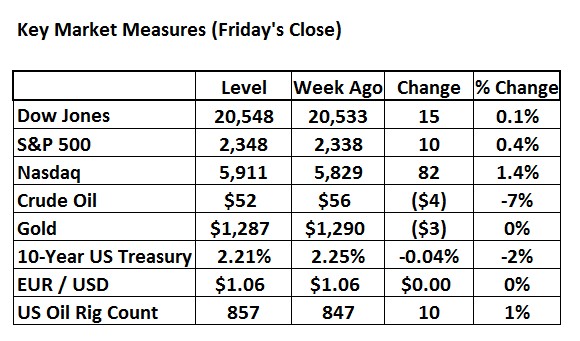
Industrial production will look decent on the surface; we forecast it to have risen 0.4% in March. Mining production will likely increase, consistent with rising rig counts, as noted above in the Key Market Measures chart. Manufacturing production will be weak and is forecast to have dropped 0.4% in March, held back by Autos.
Unseasonably warm weather in January and February likely boosted housing starts, but temperatures were more seasonably normal in March. Also, an East Coast snowstorm should have hurt starts temporarily. Other housing data will look better, as we expect existing-home sales to have risen from 5.48 million annualized units in February to 5.58 million in March.
The first two regional manufacturing surveys for April are expected to have weakened, generally consistent with other survey-based data that have begun to surrender some of their post-election gains.
Financial market conditions also bear watching. Long-term interest rates have slid, which is a positive for investment and housing. However, equity prices have struggled recently. Though the immediate implications are minor, further declines would lend more downside risk to our outlook for consumer spending. Volatility could continue to rise because of geopolitical tensions, particularly in North Korea. Tensions are building between there and our forecast does not include a military conflict. Odds favor this conflict being eased with China imposing economic sanctions on North Korea.
We wouldn’t be surprised if the VIX continues to climb. The VIX curve is strangely inverted. In other words, investors expect volatility to be higher in the near term but revert to lower levels in the longer term. Volatility is normal and the economic implications of the VIX rising to the level consistent with fundamentals are not significant at the moment. If there were a sudden, significant and persistent increase in the VIX, there would be economic costs which would weigh on hiring and investment.
Goldman Sachs (GS: $217) had another bad week, dropping $7 or 3%. We removed the stock from our portfolio on Jan 19th at $232. Weighing on the bank’s results was a 2.4% decline in trading revenue to $3.36 billion. But the overall numbers were surprisingly good in our opinion: Profits per share of $5.15 were higher than the $2.68 it earned during the same period of 2015, but below Wall Street’s expectation for $5.31 a share. Revenue, meanwhile, came in at $8.0 billion, 27% above the year ago period, but missed the Street’s target of $8.44 billion. Wall Street is just funny sometimes. Those numbers appear pretty good to us. If the stock gets down below $200 we would be buyers again. Goldman is a money minting machine and they had a little hiccup last quarter, but you can’t hold this company down for long.
Home Depot (HD: $150) sets a new all-time high this week. The market cap is now $180 billion. Huge. Our Target is $160 which we are keeping, but we are raising our sell price from $130 to $144. We don’t want to lose these gains. We added them at $118 over a year ago and are up 27% on this powerful company.
Microsoft (MSFT: $66) quietly set a new all-time high this week. Go Bill Gates! The stock is up 14% since the election. Not bad for a company worth over $510 billion. Our target is $70 which we would love to see this summer. Our Sell Price remains the same: “We would not sell Microsoft.”
Splunk (SPLK: $62) had another good week, up 5%, and it is approaching its 52-week high of $66. Our Target is $70. Earnings are coming up in the 3rd week of May and we are quite optimistic that we will see strong revenues and earnings to keep this stock going higher.
Visa (V: $91) sets a new all-time high this week. We love this $210 billion market cap company. Ah – the business of MONEY. How can you beat it? The company reported revenue of $4.48 billion, up from $3.63 billion from a year ago, a gain of 23%. Wow. Excluding one-time items, Visa earned 86 cents a share, beating analysts' average estimate of 79 cents. The company said total payments volume jumped 37% to $1.73 trillion in the second quarter. The growth in payments volume was helped by the addition to Visa's results of Visa Europe, a former subsidiary Visa bought in June last year in a deal worth $23 billion. Visa Europe made up nearly a fifth of total payments volume. This company is truly and international company. We can’t wait to raise our Price Target of $95 to $110 when it hits $95. We would not sell Visa.
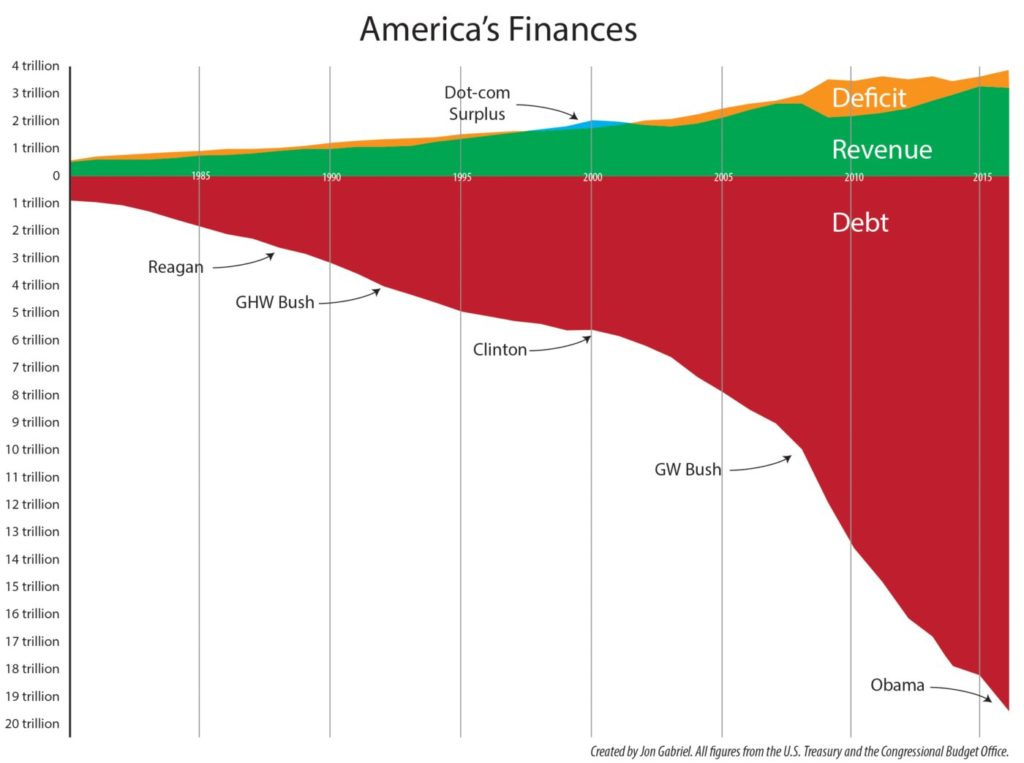
This stuff scares us here at The Bull Market Report. What more can we say? Well, Herbert Stein had a few things to say about these types of things. Herbert Stein (August 27, 1916 – September 8, 1999) was an American economist, a senior fellow at the American Enterprise Institute. He was chairman of the Council of Economic Advisers under Richard Nixon and Gerald Ford. Stein was the formulator of "Herbert Stein's Law," which he expressed as "If something cannot go on forever, it will stop," by which he meant that if a trend cannot go on forever, there is no need for action or a program to make it stop, much less to make it stop immediately; it will stop of its own accord. It is often rephrased as: "Trends that can't continue, won't."
A Word From Gary Jefferson
Jefferson Financial Group
First Vice-President, Investments
UBS Financial Services, Inc.
The pundits are all hopping on the "sentiment-remains-depressed-by-geopolitical-risks" bandwagon. Maybe, but sabre rattling has never really been a reliable forecaster of market direction. It's more likely that sentiment is flattening out because the Atlanta Fed’s real GDP forecast for the first quarter of 2017 is a measly 0.6% as of April 7th. Everyone knows the Fed would prefer to have some additional leeway to combat future economic weakness, but with that paltry number it may need to reconsider its current projected pace of rate increases as 0.6% is not near enough "runaway growth” to use as an excuse for rate hikes. Nor does it indicate inflation is going to become an urgent issue anytime soon.
There are other things worrying the market besides geopolitical risks. Transports, which have always played a meaningful role in measuring market moods, have fallen from a high of around 6% in March to the low for the year of about -1.5%. And small cap stocks, which roared at the end of 2016, have completely stalled out so far this year.
Maybe the market will digress back into the "bad news is good news". Hopefully not. Many pundits are now talking up a gridlock scenario where all the Republican squabbling and Democratic grandstanding will create the type of gridlock that the market thrives on where Washington does little to interfere with the private sector. Again, hopefully not.
Another pause in rate hikes means earnings aren't there and the economy is still stuck in low gear. That would be a serious headwind against further market gains if you consider that in the first quarter the S&P 500 was up 5.5% versus that 0.6% GDP performance. That kind of stock market performance needs better GDP support. We still feel that, contrary to what the mainstream media would have you believe, the Trump growth agenda has not been derailed. Yes, corporate tax reform hasn't gone anywhere. Basically, it is not happening as fast as many hoped for, but what else is new in the world of politics and bureaucracies?
What we still see in the countless projected earnings reports we have read is that, even with a derailment of the growth agenda, earnings this year will beat last year. Earnings should remain the catalyst for a decent year in which stocks end up higher than they are today.
The High Yield Corner
Special to The Bull Market Report
by Michael Foster
There’s one data point that we find particularly worrisome: the 10-year Treasury constant maturity minus the 2-year Treasury constant maturity. This somewhat esoteric macroeconomic metric effectively measures the market’s expectations for government bond yields in the short and long term. By comparing the two side by side, we can see how the market expects economic growth, inflation, and bond yields to trend in the future.
This metric was in a constant decline from its peak in 2014 to the Trump election for one simple reason: Expectations about inflation were getting weaker and weaker. Of course this made sense in a world where oil prices seemed to be in a never-ending freefall, so it’s not surprising that the trend was virtually uninterrupted until November’s election. Then it jumped to its highest point in a year and has been steadily declining since.
Why does this matter? Because that short-term spike, combined with the inevitable decline afterwards, indicates that the bond market simply doesn’t really believe that inflation and economic growth are going to spike. What’s more, the bond market also doesn’t really believe the Federal Reserve is going to raise interest rates three times in 2017.
We have been somewhat agnostic on the matter. While the bond market has made this pronouncement loud and clear, the stock market has been saying the opposite. The S&P 500’s P/E ratio keeps climbing, and the rationale behind the higher valuations rests largely on a belief that price inflation and strong economic growth will boost earnings. We have recently written about the 12% EPS growth expectations for 2017; those expectations have not disappeared. Thus it’s no surprise that the S&P 500 is still up 5% even after the slight pullback following early March’s peak.
As high yield investors, we are constantly trying to reconcile the stock and bond markets. There are two reasons for this. Firstly, corporate bonds, BDCs, preferred stocks and convertible bonds are a tad schizophrenic. Sometimes they trade with equities, sometimes they trade with bonds. When both markets are in agreement, there’s no problem; when they disagree, however, there’s a chance for a major price correction. Since the run-up in stocks and in bonds has caused all of these instruments to perform strongly, the chance of a downside correction, if not a brief bear market, deserves serious attention.
The other reason we always try to reconcile both markets is because our high yield strategy involves an incorporation of stocks and bonds. Bull Market Report pick AGIC Equity and Convertible Income Fund (NIE: $19.51) is a perfect example of this strategy at work. This fund has both stocks and convertible bonds in it, and its net asset value can often fluctuate because of one or other side of the portfolio. The balanced approach means the fund has massively outperformed the market, rising 6% year-to-date while paying an 8% dividend. It also outperformed the broader market this week, with a 1.3% boost.
Compared to standalone bond funds, the AGIC fund has been a massive outperformer. Bull Market Report pick Invesco Municipal Trust (VKQ: $12.68) was flat for the week and is up a bit over 3% year-to-date. Here’s a question for us all: Why is the AGIC fund performing so much better, despite the fact that the Invesco fund and other municipal bonds had a major correction in 2016 and are in recovery mode, while AGIC had an awesome 2016?
The key to this puzzle is in conflating what’s going on in the bond markets and the stock markets. AGIC is doing better than bonds alone because it has both equities and bonds, and both markets are doing extremely well for different reasons. Stocks are strong because of higher earnings expectations, and bonds are strong because the market doesn’t believe the Fed’s threats to jack up yields several times in the near term. We don’t either!
Can we merge both of these hypotheses into a coherent market view that makes sense?
We can. Both markets seem to be telling us that company performance is going to be strong but this will not result in runaway inflation that will give the Federal Reserve the justification it needs to raise interest rates. How can stronger earnings and more sales NOT translate into inflation? This seems like economic gibberish from a micro or a macro perspective - but it actually makes a lot of sense if you synthesize the two. Stronger earnings and more sales on the micro level can easily be offset by weak population growth; keep in mind that the population growth rate in the U.S. has fallen from 1.0% in 2008 to 0.7% in 2013 and has fallen below 0.7% this year for the first time since the 1930s.
Of course, if Donald Trump’s promises to lower immigration and deport illegal/undocumented immigrants are fulfilled, this will put downward pressure on population growth even further. Regardless of your political beliefs on the topic, the economics of such a dynamic are quite simple: Fewer people will mean lower GDP growth. However, that doesn’t mean you’ll have lower GDP per capita growth or that companies won’t be able to make higher profits in U.S. dollar terms.
We actually have a historical precedent for such a trend: Japan. GDP per capita has been going up since the late 1990s to today despite the fact that total GDP has barely budged. In 1995, Japan’s GDP exceeded $5 trillion. Its GDP is $4.1 trillion as of the last reading in 2016. However, GDP per capita has gone from less than $40,000 in the middle 1990s to $45,000 as of the last reading. That’s not terribly great growth, but it is growth - whereas GDP in total has gone down.
We could see a similar situation in America: Fewer people but more GDP per person.
Of course this kind of GDP growth hasn’t really translated itself into strong earnings at Japanese companies because the country depends on exports and has faced growing competition from South Korea and China. And that’s where the comparison between Japan and America falls apart. America is a net importer, not exporter, so the loss of people could impact firms quite differently. As a consumption-focused economy, that higher GDP per person could result in higher consumption, thus higher sales and higher profits. Or it could give companies room to grow prices (thus increasing revenue per customer) without actually causing inflation (because there will be fewer customers, meaning total spending isn’t going up). Thus we would be in a world of weak inflation, weak aggregate growth, but strong growth per person and higher earnings. Good for bonds and good for stocks.
This kind of granular analysis is foreign to the talking heads, political pundits, and headline writers who are financially motivated to stir up controversy, anger, fear, and all sorts of portfolio-destroying emotions.
So the Fed is not going to face the kind of economic conditions that can justify raising interest rates significantly. At the same time, there is tremendous pressure on the Fed to raise interest rates, so we can’t expect them to lower rates either, unless the bond market shoots higher from here and rates collapse. In other words, a very slow pace of interest rate hikes alongside higher earnings is probably going to be the big macroeconomic story for the next couple of years.
Is this good or bad for high yield investors? We believe it’s very good for a number of reasons. Firstly, it means lower bankruptcies for junk bonds (default rates have been falling for quite some time). Secondly, it means higher earnings potential for companies (thus more bond issuances and more tolerance for higher interest rates on new issues). Thirdly, it means that big capital flows out of high yield investments and into safer Treasuries is unlikely to happen. (This was the big bear case for junk bonds in 2014, 2015, 2016 and it’s a tired thesis that has been proven wrong so many times that it’s no longer a big hindrance to high yield bond price growth).
Is there any reason this could be bad for high yield investors? Perhaps the biggest risk is of the market overpricing the upside of this high earnings/low interest rate paradox.
For that reason there’s good reason to remain cautiously optimistic and look closely at what happens in the bond and stock markets over the next few weeks. But that doesn’t mean it’s time to sell or start to worry.
Good investing,
Todd Shaver, Editor in Chief
Founder and CEO
The Bull Market Report
Since 1998
April 17, 2017
by Todd Shaver | Apr 17, 2017 | Earnings Preview 12 PM
Netflix (NFLX: $146)
Bull Market Report Target Price: $165
Bull Market Report Sell Price: $125
Earnings Date: Monday, 3:00 PM ET
Consensus: 1Q17
Revenues: $2.6B
EPS: $0.37
Year Ago Quarter Results
Revenues: $2.0B
EPS: $0.06
Key Things to Watch For in the Quarter
Wall Street analysts estimate that for 1Q17, Netflix will report healthy revenue growth at 35% to $2.64 billion and strong EPS growth of 517% to $0.37, although the percentage number is misleading since their last quarter was so tiny. Netflix beat analyst estimates in all 4 quarters of 2017. The stock reflected this success, climbing 32% over the past year. Despite beating estimates in the first two quarters of 2016, the stock fell over 10% following the earnings releases primarily due to skepticism of the firm’s ability to expand overseas memberships. However, the stock made up for these losses upon the release of 3Q16 earnings when it climbed 25%. As Netflix continues to produce positive growth numbers and expand its business abroad, we look forward to watching the price climb towards our $165 target.
Kinder Morgan (KMI: $21)
Bull Market Report Target Price: $27
Bull Market Report Sell Price: $18
Earnings Date: Wednesday, 4:30 PM ET
Consensus: 2Q17
Revenues: $3.4B
EPS: $0.18
Year Ago Quarter Results
Revenues: $3.2B
EPS: $0.18
Key Things to Watch For in the Quarter
Analyst estimates suggest that Kinder Morgan will report a 5% increase in sales to $3.35 billion and no change in EPS for 1Q17. Kinder Morgan missed analyst estimates this quarter last year, but made up for it in the last three quarters of 2016. Shares dropped 5% in the week following the firm’s release of 1Q16 earnings, however it has since made up for this small loss providing investors with a 15% return over the past year. The company has made significant progress on a number of growth projects, especially its Trans Mountain Expansion Project, which had faced pushback from environmentalists.
Kinder Morgan is one of the largest energy infrastructure companies in North America. It owns an interest in or operates approximately 84,000 miles of pipelines and 155 terminals. KMI’s pipelines transport natural gas, refined petroleum products, crude oil, condensate, CO2 and other products, and its terminals transload and store petroleum products, ethanol and chemicals, and handle products such as steel, coal and petroleum coke. It is also a leading producer of CO2 that is used for enhanced oil recovery projects primarily in the Permian basin.
Blackstone Group (BX: $29)
Bull Market Report Target Price: $36
Bull Market Report Sell Price: We would not sell Blackstone
Earnings Date: Thursday, 11:00 AM ET
Consensus: 1Q17
Revenues: $1.7B
EPS: $0.67
Year Ago Quarter Results
Revenues: $930 M
EPS: $0.31
Key Things to Watch For in the Quarter
Analysts across Wall Street expect Blackstone Group to report revenue growth of 80% to $1.7 billion and 115% growth in EPS to $0.67. The firm has beaten analyst estimates in the past 3 quarters. Share prices in the weeks following the earnings release of Q1-Q4 of 2016 reflected the company’s ability to meet analyst expectations. It’s a bit volatile after earnings releases, as in all four events, shares either climbed or dropped at least 5%. In a recent interview with CNBC, Blackstone CEO Steve Schwartzman mentioned that the firm is in advanced talks to acquire Ascend Learning, a U.S. maker of educational software, in an attempt to capitalize on the increased use of technology in American classrooms. The stock has remained relatively unchanged over the past year, but continues to provide a healthy dividend at over 5%, making it an attractive investment for dividend-seeking investors.
Visa (V: $89)
Bull Market Report Target Price: $95
Bull Market Report Sell Price: We would not sell Visa
Earnings Date: Thursday, 5:00 PM ET
Consensus: 2Q17
Revenues: $4.3B
EPS: $0.79
Year Ago Quarter Results
Revenues: $3.6B
EPS: $0.68
Key Things to Watch For in the Quarter
Analysts expect Visa will report modest growth in both earnings and revenue for 1Q17. Earnings are estimated to grow 16% to $0.79 and revenue 19% to $4.3 billion. The stock has reflected the company’s ability to beat analyst estimates throughout all of 2016 having climbed 9% over the past year. Visa leads the payment processing industry and still finds room to grow primarily because it has no direct competition within its market. Analysts expect international transaction revenues to be the engine of growth for a number of reasons, including international tourism growth. We look forward to resetting our $95 price target as the stock continues to appreciate.
April 2, 2017
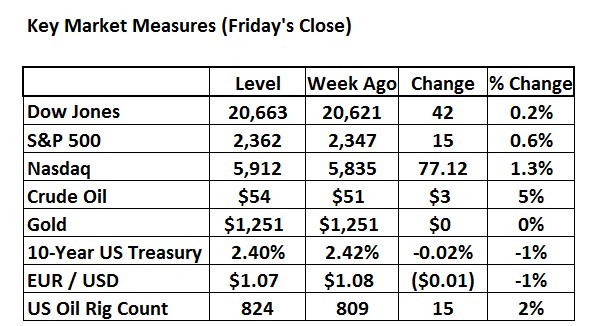
by Todd Shaver | Apr 2, 2017 | Weekly Newsletter 7pm Sunday
The Week Ahead
This past week was more of the same calm and collected march higher for the stock market. Optimism is at record highs for business and consumers. There are pockets of softness in the economy, like historically low labor force participation and declining commercial and industrial loan activity at banks, but with the credit market dealing with the stresses of low interest rates the stock market just keeps drawing interest from investors. We now head into April after what was a strong 1Q 2017. The consensus estimate for 2017 S&P 500 EPS is currently $129 revealing a reasonable 18x P/E multiple for today’s overall stock market.
The first quarter closed Friday with the S&P 500 notching its best quarter since 2015, up 5.5%. The Nasdaq had its best quarter since 2013, up 10%. The Volatility Index (^VIX), the fear gauge, posted its second lowest quarterly average in history at 12.37. And listen to this, the average daily percentage change for the Dow Jones during the quarter was the lowest since 1965. Things are CALM out there!
Apple (AAPL: $144, up 2%. All changes in this report are for the WEEK), a component in all three major indexes, jumped 24% during the quarter, nestled next to an all-time high set again this week. The company added $145 billion to its market cap in the quarter, besting its own record set in 2012 of adding more market cap in a quarter than any other company. It was the biggest gainer in the Dow Jones 30. Facebook, Amazon and Netflix all added 18%.
There is always a bull market right here at The Bull Market Report! This week we highlight the following securities: Visa, Amazon, Microsoft, Tesla, Splunk, and Shopify.
Highlights From The Past Week
Trump Talks Tough on U.S.-China Trade. President Trump appeared to follow through Friday on his promises to get tough on trade with China, less than a week before he is to meet with President Xi Jinping of China. In two executive orders, Mr. Trump called for tighter enforcement of tariffs imposed in anti-dumping and anti-subsidy trade cases, as well as a comprehensive review of the United States trade deficits - measures that reflect America’s economic tensions with China. Straightening out the US trade balance with China would be a major positive for US GDP growth, if Trump can accomplish the goal.
Why the Urge to Merge Could Return to Wall Street. Nothing appears to be off the table for the Trump administration as it seeks to pare back the regulations imposed on Wall Street and banks after the financial crisis. There has already been considerable talk about rolling back much of the Dodd-Frank Act of 2010, as well as the Volcker Rule that is intended to prevent Wall Street firms from engaging in proprietary trading. Already, the acting chairman of the Securities and Exchange Commission, Michael Piwowar, says his agency has stopped writing the rules and regulations mandated by Dodd-Frank - more than 20,000 pages so far - in anticipation of the confirmation of Jay Clayton as the commission’s new chairman. There is little doubt change is coming. But no one seems to be talking about whether Wall Street banks will again be able to engage in what has historically been one of their favorite pastimes: getting bigger through mergers and acquisitions. We could be in for an M&A boom across sectors not just Financials.
"Valeant Bet Was a ‘Huge Mistake," Hedge Fund Chief Ackman Says. It is rare that William Ackman, the brash activist investor, apologizes for anything. As a successful hedge fund manager, Mr. Ackman has made billions of dollars for himself and his investors with bold and counterintuitive bets. But this week he conceded that his firm’s biggest wager yet - on Valeant Pharmaceuticals International - was “a huge mistake” that has cost his hedge fund firm, Pershing Square Capital Management, “a tremendous amount.” “I deeply and profoundly apologize,” Mr. Ackman added in an annual letter to investors. It was an unusual moment of contrition for Mr. Ackman and a stark contrast to his emphatic support of Valeant in recent years. In the bigger picture, this event is just the latest of many recent developments pointing to troubling times for hedge fund managers as more and more investors turn to do-it-yourself and/or ETF investing.
BMR Companies and Commentary
Visa (V: $89, flat)
Samsung Electronics announced a strategic partnership with Visa to help bring Samsung Pay to online merchants. Starting later this year, Samsung Pay users will be able to shop online at hundreds of thousands of merchants around the world where Visa Checkout is accepted. The partnership just goes to show everybody in payments relies heavily on Visa.
Samsung Pay’s simple, secure checkout experience using fingerprint authentication gives users a more streamlined online shopping experience, eliminating the lengthy process of adding their payment card data, billing or shipping details each time they shop. Users with fingerprint authentication-enabled Samsung devices will be able to click the Visa Checkout/Samsung Pay co-branded button and touch the fingerprint sensor and the payment will proceed instantly, without needing to enter a user name and password for each purchase.
How cool! The days of filling out long forms or remembering usernames and passwords to make online purchases are continuing to wind down, as options like Visa Checkout’s open platform become accessible on hundreds of thousands of merchant sites, and companies like Samsung see the value in simplifying the process for both consumers and merchants.
BMR Take: Visa trades at 26x the consensus estimate for this year’s fiscal EPS of $3.45. Take a look at this 5-year chart from Yahoo. Where do you think they are headed in 2017/8 and beyond?
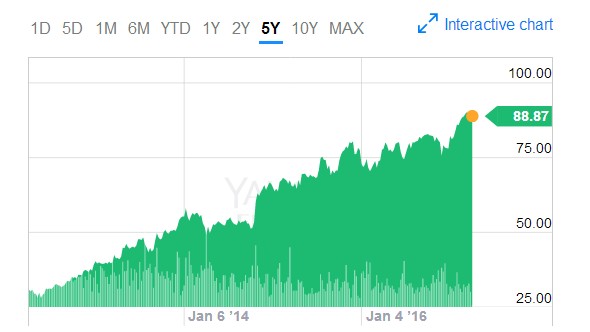
Amazon (AMZN: $887, +5%)
Amazon is expected to enter the Australian market soon. Estimates call for this region to eventually contribute upward to $15 billion of sales to Amazon’s top line, which compares to this year’s sales tracking to be around $165 billion for the company.
What is great about Australia for Amazon? Online sales will account for just 12.5% of Australian retail sales by 2025, up from only 7% in 2016. In other words, Australia is just barely into the online sales phenomenon. We are likely heading to online sales being greater than 25% so there is just much growth runway ahead for Amazon in Australia.
What will be interesting to watch is what Amazon’s entry into Australia means for local retailers. Could it be an imminent disaster? Certainly, many local players will have to adjust to smaller store footprints, change pricing, and improve their customer engagement.
BMR Take: Amazon trades at 125x the consensus estimate for this year’s fiscal EPS of $7.09. It’s a big valuation, but growth is exceptional. EPS was a loss in 2014, $1.25 in 2015, and $4.90 in 2016 and now we see estimates for $7.10 in 2017, $12.35 in 2018, and almost $20 in 2019.
Consensus Ratings for Amazon
4 Hold Ratings, 45 Buy Ratings
Targets:
3/30/2017 Loop Capital $1,100
3/29/2017 Cantor Fitzgerald $970
3/28/2017 Stifel Nicolaus $1,025
3/17/2017 Pacific Crest $895
Apple (AAPL: $144, +2%)
In January, Forbes reported that a White House advisory panel issued a report recommending that the U.S. strengthen protection of the Semiconductor industry, especially against threats posed by Chinese policies to dominate the sector.
Then in March, Apple discussed publicly that the Japanese government is likely to ensure Toshiba is acquired. Prime Minister Shinzo Abe recently met with President Trump to discuss among other topics this one. There are now swirling talks that Apple is going to buy part of Toshiba. The deal could be executed for as much as $18 billion.
What does it all mean? Apple farms out their production for Macs, iDevices and accessories so that they can focus the bulk of their investments on software and engineering companies, setting up R&D centers around the world and building out new flagship Apple stores. We very well might be looking at the early signs of Apple soon making many of their products in the United States. Exciting.
BMR Take: Apple is again setting new all-time highs this week. The stock trades for just 15.5x this year’s consensus EPS estimate of $9.25. We are still seeing healthy EPS growth from Apple, as seen in the consensus forecast for EPS of $10.35 in 2018 and almost $11 in 2019.
Microsoft (MSFT: $66, +1%)
Last October Microsoft released the preview of Azure Analysis Services, which is built on the proven analytics engine in Microsoft SQL Server Analysis Services. With Azure Analysis Services, you can host data in the cloud. Users in your organization can then connect to your data models using tools like Excel, Power BI, and many others to create reports and perform ad-hoc data analysis. This is exciting stuff for the business community. You no longer need to run a big back office. You have Microsoft Azure!
Well, just this week, Microsoft announced that Azure Analysis Services is now available in two additional regions: Japan and the UK. This means that Azure Analysis Services is now available in the following regions: Australia, Canada, Brazil, Southeast Asia, North Europe, West Europe, the US, Japan and the UK.
BMR Take: Again a new all-time high for Microsoft this week as the cloud is taking over and Microsoft Azure is one of the top players. The stock trades at 21x this year’s EPS estimate of $3.10 though estimates call for EPS of $3.50 in 2018 and $4 in 2019.
Tesla (TSLA: $278, +6%)
Earlier this week, Tesla announced that Chinese Internet firm Tencent had acquired a 5% stake in the company for $1.8 billion. The cash infusion is good news for Tesla’s financial health, and the company’s growth prospects in the region.
In a recent filing, Tesla said that 2016 sales in China were $1.06 billion. That’s roughly a quarter of what the company made in the U.S. last year. And while the China figures represent significant growth from 2015, it’s still well below what CEO Elon Musk once imagined. In a 2014 interview with Bloomberg, Musk projected that China could eventually become the electric-car maker’s largest market. Admittedly, that day is a long way off, but we are moving closer and closer.
One big hurdle left to clear in China for Tesla is market share. According to CleanTechnica, 352,000 electric car sales were registered in China last year, which is nearly half of all plug-ins sold worldwide. Tesla, however, is the underdog. Despite being the best-selling foreign electric vehicle manufacturer to crack the Chinese market, the company only had a 3% share in 2016. Plenty of room left for improvement to drive more growth.
BMR Take: Tesla is selling cars in China like hotcakes. China LOVES Tesla and Elon Musk. We are excited to see the company make some progress in the attractive China market. The company is still losing money, basically because they are not making cars in mass quantities yet, so the extra money raised from the 5% stake sold is a welcomed boost of cash on the balance sheet. Tesla ended last quarter with over $8 billion in debt on total assets of $23 billion, a definitely elevated level.
Splunk (SPLK: $62, +2%)
An activist may have just shown up at the Splunk table. A notable language change in Splunk’s 10k filing was noticed this week. The new disclosure alerted investors to possible activist involvement in company operations.
The 2017 10-K included following phrasing absent from the previous year’s filing: "From time to time, public companies are subject to campaigns by investors seeking to increase short-term stockholder value through actions such as financial restructuring, increased debt, special dividends, stock repurchases or sales of assets or the entire company. If stockholders attempt to effect such changes or acquire control over us, responding to such actions would be costly, time-consuming and disruptive, which could adversely affect our results of operations, financial results and the value of our common stock. These factors could also make it more difficult for us to attract and retain qualified employees, executive officers and members of our board of directors."
BMR Take: The added language essentially fulfills the company’s legal obligation to warn investors of activist interference. So we would be in a for a nice catalyst here. We really like Splunk. All anybody ever talks about now is cybersecurity. The company has $1 billion in cash and just $100 million in debt. Consensus estimates call for meaningful growth from $0.40 of EPS last year to $0.60 this year and $0.90 next year.
Shopify (SHOP: $68, -1%)
There was a whirlwind of poor press circulating on the company this week. First of all, a research firm downgraded Shopify to a strong sell to reflect negative estimate revisions following an unimpressive full-year 2017 outlook and growing near-term headwinds. This is just near-term noise. We are focused on the longer term big picture, which is very attractive for Shopify. In particular, many investors are asking the question if it would make sense for Amazon to acquire Shopify. After all, the market cap is only $6 billion. This would be a rounding error on Amazon’s balance sheet.
Shopify offers an easy-to-use multi-channel commerce platform that targets small and medium-sized businesses. Its 2016 revenue was $390 million. This would be a bolt-on acquisition for the Amazon Web Services (AWS) business if the rumor is true. As far as what Amazon or another buyer might get for a bid of $7-8 billion or so, the Shopify website showed that more than 380,000 people have sold over $29 billion using Shopify. The service allows small and mid-sized businesses to fully customize their online stores and to add new sales channels, while managing unlimited products and inventory and tracking sales.
BMR Take: We are not worried that the stock took a few points of pullback this past week. This is a long-term investment that will pay off big in five years. EPS is expected to go from a slight loss this year of $0.18 to something like $1.25 by 2020. Given all the potential of Shopify’s technology and the earnings ramp set to occur, we remain excited about the future for this company.
Upcoming Economic News
It is a very quiet week ahead for economics news. Stay tuned for more economic news next week.
A Letter from a Reader
To: The Bull Market Report
From: Arthur Weed
Twilio, First Solar and Ferrellgas were all recommended at the high end of the price range. Shopify also is at the high end of the range in this market. Sometimes riding the market out for lower prices is a good option. I just prefer to watch for weakness and then go for it.
Hi Art –
OK, I understand. We all have our personal philosophies. I like to shoot for the fences with some of my assets. I missed Microsoft at 3 cents. And Apple at 11 cents . But I got AOL at $1 in the 90s and it went to $71. And I got Iomega at $17 even though the low was $3 for the year and it went to $330.
The facts:
Twilio was added after it dropped from its high of $71, and in fact, it had a fairly sharp drop from that level to $52 where we added it.
First Solar was added at $63 and a month later was $73. Revenues have fallen sharply.
The average price of Ferrellgas for the last 23 years is around $20. At $17 we thought we had a nice discount and an opportunity for it to go to $20 and then $25.
Our thoughts:
--- We believe Twilio will be a huge player in the internet communications marketplace. And we believe the stock can triple or more from $50.
--- First Solar has been a leader in this business for decades and until recently has the revenue to go with it. Unfortunately, we have to wait until 2019 for this one to play out. And that is not guaranteed, but we believe management can do it.
Note: First Solar was given a hold rating at JPMorgan Chase. They now have a $38.00 price target on the stock.
--- Ferrellgas has been a leader in the natural gas business forever. We didn’t know their big acquisition would go down as one of the worst in Wall Street history.
--- Shopify is the leader in e-Commerce by a wide margin and has big growth ahead of it. It is a potential Microsoft-like opportunity as the world is moving to mobile every single day, every week, every month, every year. We wish we had discovered it at $25 or $50. But if the stock goes to $100 and then $150-200 we won’t mind too much. We think this is quite possible over time.
Todd Shaver
A Letter from a Reader
From: Chet Malek
Sent: Thursday, March 30, 2017 9:07 AM
To: info@bullmarket.com
Subject: SNAP and Twitter
Todd – Do you have any thoughts on SNAP? Do you like Twitter better (I assume you do)?
Hi Chet –
We do not like Snap. They may surprise me and go to $50 and $100 but at the moment they are WAY behind where Facebook was when Facebook went public. And if you remember, they went public at $37, hit $43 that day, closed at $37 and then proceeded to go down to $16 in the next few months. Now the stock is at $142. BUT Facebook had big revenues and big profits at that time. Snap has good revenues but super negative earnings – They lost $515 million last year and $380 million in 2015! And they are a niche business unlike Facebook which covers it all.
We do like Twitter. One day they will figure it out. And one day someone will buy them at a 40% premium. If I were a gambling man I would buy 2-year LEAP options with a strike price of $25 or $30, cheap. [This is not for all. Consult your broker. High risk here.]
We really like Twilio – good business concept; strong revenues last quarter. No profits yet. But profits will come if the revenue is there, and it is.
Todd Shaver, Founder and Editor in Chief
Twilio Extends Relationship with Amazon
Twilio (TWLO: $29, flat) announced a further step in their relationship with Amazon. They said: Amazon Connect will use Twilio's programmable APIs to provide enhanced capabilities for customers.
(What are APIs? An Application Programming Interface is a set of subroutine definitions, protocols, and tools for building application software. In general terms, it is a set of clearly defined methods of communication between various software components. A good API makes it easier to develop a computer program by providing all the building blocks, which are then put together by the programmer. An API may be for a web-based system, operating system, database system, computer hardware or software library.)
From their public announcement Tuesday: Twilio, the leading cloud communications platform company, today announced support for Amazon Connect, the newly announced cloud-based contact center service from Amazon Web Services (AWS). Twilio's Programmable APIs will enable a range of new capabilities, including integrating phone intelligence lookup to personalize Amazon Connect contact flows, enhance customer contact details, and follow up with post-call surveys via text.
"We're pleased to further extend our work with Amazon Web Services by helping to power and further enhancing the capabilities of Amazon Connect," said Twilio CEO and co-founder Jeff Lawson. "Supporting the continued advancement of the contact center to its more agile future in software, frees developers and businesses from the legacy approach to contact centers -- an approach that simply can't keep pace with customer expectations today."
The announcement furthers the long-standing relationship between the two companies. Note that Twilio is built and globally deployed on the highly scalable AWS Cloud. Some say that Amazon can do what Twilio does and that all this hype is bad news for Twilio. We say the opposite. We think there is a symbiotic relationship here that appears to grow stronger and stronger each month.
Here’s what the company includes in their press releases:
About Twilio
Twilio's mission is to fuel the future of communications. Developers and businesses use Twilio to make communications relevant and contextual by embedding messaging, voice and video capabilities directly into their software applications. Founded in 2008, Twilio has over 650 employees, with headquarters in San Francisco and other offices in Bogotá, Dublin, Hong Kong, London, Madrid, Mountain View, Munich, Sweden, New York City, Singapore, and Tallinn [the capital of Estonia.]
Alphabet (GOOG: $830) is now covered by Barclays. They set an "overweight" rating and a target of $1,065. Our target is $900 but when that level is hit we fully expect to raise it to at least $1100. The only question is when.
The High Yield Corner
By Michael Foster, Special to The Bull Market Report
We start this week’s high yield summary with the GDP report. The headline news looks good: GDP grew at 2.1% versus 2% in the fourth quarter. Politically-minded Americans may want to dismiss this (and who isn’t politically minded these days?), arguing either things will get better or worse under Trump, depending on the flag they bear. We would suggest resisting the urge to devolve the topic to partisan bickering, because the details under this report are very important because they signal where exactly we are in the credit cycle. This, in turn, is important for one of the world’s biggest credit markets: U.S. corporate bonds.
The mainstream press focused on a couple of dynamics under the headline number, although both are relatively unimportant. A big theme, according to journalists, was consumer spending. This rose 3.5%, a sharp upwards revision from 3% previously. Since consumer consumption is the biggest driver of demand in the U.S., which in turn drives demand for the big industries abroad (manufacturing in China and Germany, exporting in Hong Kong and Singapore, commodities in Latin America, and so on), this is good news.
But it’s actually not the most important bit of good news from the report. The National Income and Product Accounts (NIPA) data, which makes up part of the GDP, gave significant and good surprises that have much more predictive power than consumer activity. According to the NIPA release, corporate profits rose after declining for three years. The “corporate profits” metric, jumped over 9% on a year-over-year basis in the 4th quarter of 2016, a sharp acceleration from the 2% increase seen in the 3rd quarter. Some economists have already said the so-called “corporate profit recession” has ended.
This decline, which was partly a result of the crash in commodity prices and partly the result of cash-strapped consumers pulling back, was a primary reason why the S&P 500 got more expensive. Because stock values are measured by dividing their current price by their earnings over a one-year period (the “price-to-earnings” ratio), stock values climbed higher and higher because profits were falling lower even as stock prices were going up. This caused the S&P 500 P/E ratio to shoot up to over 26 by the end of March, about 50% higher than its historical average. That definitely looked and smelled like an overbought market, but investors held their noses and bought stocks anyway.
We’re here to tell you that you can stop holding your nose. While the corporate profits measurement is not identical to the way S&P 500 companies report their earnings, they’re close enough. And with a 9% jump, that means the S&P 500’s one-year forward P/E ratio is less than 20, a very reasonable level.
At the same time, this increase in earnings is extremely good for corporate bonds, BDCs, and REITs for similar reasons. Let us go through these one by one to explain why.
Firstly, corporate bonds. The SPDR Barclays High Yield Bond ETF (JNK: $37) had a good week (up 1%) thanks in no small part to the GDP data, although investors are continuing to recognize what we have been saying for a long time: the default risks are over and will decline significantly because corporate profits are going up, meaning firms will have enough cash to pay their debts. What does this mean? All the risks that were priced into junk bonds back in 2015 are evaporating but the price hasn’t fully recovered on a real adjusted basis. Great news - this means we can buy junk bonds. But we can’t be indiscriminate about it. Well-managed funds like the PIMCO Dynamic Income Fund (PDI: $29) are ideally positioned to outperform. Last year PDI paid out a special dividend well over 4% of the fund’s value, bringing the annualized yield to over 13%. With the strength in junk bonds this type of return will be even easier for this fund to do this year, making it an obvious strong hold even though it is priced at a premium.
A similar rationale exists for why BDCs shot up this week: more corporate profits mean less concern companies will default on their debts. The UBS BDC ETF (BDCS: $24, up 2%) had an incredibly strong week as a result. However, we do not see this as a good enough reason to buy BDCs, especially the larger cap ones that are facing growing competition from banks that are increasing their middle market business lending practices. The market is cheering the macro conditions for BDCs, which are clearly much better than a year or two ago. However, the market is not taking into account the industry conditions for BDCs, which is more competitive and thus will force some BDCs to look for lower yielding or higher risk loans. This makes us cautious on BDCs just as we are more positive about their lower yielding competitors - namely, financial stocks.
Finally, let’s talk REITs. In the simplest sense, higher corporate profits mean more room to raise rents for industrial, commercial, and infrastructural tenants. Retail and commercial REITs make up a healthy chunk of the SPDR Dow Jones REIT ETF (RWR: $92, up 1%), but it also plays into the wheelhouse of The Bull Market Report’s favorite REITs.
Digital Realty Trust (DLR: $105, up 2.5%), Omega Healthcare Investors (OHI: $33, up 2%), Kimco Realty (KIM: $22, down 2%), Government Properties Trust (GOV: $21, up 2%), and Care Capital Properties (CCP: $27, up 6%) are all exposed to corporate and government tenants whose ability to tolerate raising rents is going up as corporate profits rise. This doesn’t mean the market is irrationally exuberant about the sector like they were in mid-2016, which again makes this a good sector to be into, especially if you’re choosing firms relying on commercial rents.
The market is stronger than the fearmongers would have you expect, and that strength is particularly acute in the high yield universe. It’s a great time to buy income.
Funny – as we write this last sentence above we think of all the folks out there who are thinking: How can I buy yield when interest rates are going to go up which means prices will go down? Well, we at The Bull Market Report don’t believe rates are going that much higher. In fact, if anything, we think rates could go lower, despite the Fed’s best wishes. Besides, as noted above and every week that we write this report, you surely notice that we are writing about strong companies with strong management who are well-aware of the world of interest rate risk. We believe in management of the companies we follow. Look at Annaly (NLY:$11.11). They paid a 30 cent divided this week (11% annualized), and the stock was flat. That’s a 2.7% gain for the week in our book. The stock is up over 10% from its low in December! And they’ve been doing this for 20 years.
Good Investing,
Todd Shaver
Founder and Editor in Chief
The Bull Market Report
Since 1998