
JUNE 6, 2016
Low Volatility Indicates Little Change In Stock Prices
The CBOE Volatility Index (^VIX: 13.42) measures the level of investor fear in the market. To give you some perspective, last August just after the market peaked, it ran up to 53. At the height of the 2008 financial crisis, it was all the way up to 90. Since March of this year, the VIX has pretty consistently been down around 15, and is below 14 now. (Note that the historical average for the VIX is about 16.) What these developments indicate to us is pretty clear. The market may move around a bit but it is going to take something really major to generate enough volatility to get a sustainable rally started.
Most of the week was filled with better than expected data that we will elaborate on below. But then came Friday’s news that the economy added only 38,000 jobs in May. The Friday opening was ugly; however by the closing bell the market had come all the way back. The price movements for the week were in falling Crude and rising Gold. Bond yields narrowed and the Dollar was on the weak side.
All in all, it was a fitting introduction to the first week of summer trading.
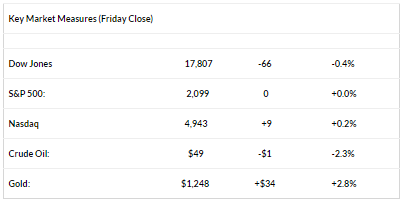
Here is How The Major Averages Performed:
Economic Give And Take
It was a holiday-shortened week, but that did not stop some key economic reports from creating a stir. What good news the economy gave us, it also took back. Yes, Crude bounced around a bit, coming off recent highs near $50. But, in the end, it was the amount of conflicting information from the Washington data factory that defined the week.
We started the trading week on Tuesday with Consumer Spending not only jumping a full 1% for April but also exceeding extremely bullish estimates. Core inflation remains tame at 0.2% while Personal Income gained 0.4% indicating a rise in real earnings.
Wednesday continued the story. Motor Vehicle Sales hit the 17.4 million annual target in May and the ISM index of Manufacturing also showed a nice bump. By Thursday things were looking even better on the employment front with jobless claims down.
But then Friday came along and took away the party hats and the rum-filled punch bowl. Suddenly Nonfarm Payrolls* fell like a giant stone from 123,000 in April to only 38,000 in May. Factory Orders fell, as did hourly earnings.
*What is the 'Nonfarm Payroll?': It is a statistic researched, recorded and reported by the U.S. Bureau of Labor Statistics intended to represent the total number of paid U.S. workers of any business, excluding the following employees:
- general government employees
- private household employees
- employees of nonprofit organizations that provide assistance to individuals
- farm employees
This monthly report also includes estimates on the average work week and the average weekly earnings of all non-farm employees.
Breaking down 'Nonfarm Payroll': The total nonfarm payroll accounts for approximately 80% of the workers who produce the entire gross domestic product of the United States.
It is rare that any week of data paints a clear picture of the economy’s direction, but this one presents some serious issues for Fed policy and for interest rate forecasters. Until Friday, the data was pure ammunition for Fed interest rate hawks. But after Friday, the hawks have less to crow about. Translation: Both interest rates and stocks will remain largely range bound in the weeks ahead.
When Will the Financial Sector Catch on Fire?
There is no question that Bank earnings overall have had very little good going for them this year. If you bought the group back in February when they were beaten down from the Fed’s first rate hike last December, more power to you. You are indeed a smart value-oriented investor. But, where do they go from here?
Higher interest rates will help salvage earnings of companies like Bank of America (BAC: $14.42, down 3% for the week), and Goldman Sachs (GS: $156, down 2%) These two giants have had to deal with a skinny interest rate environment, a quiet time for mergers and acquisitions, and a poor financing market for equity offerings. Right now, expense control is the operative strategy until conditions change. This is all good but at the same time, rising interest rates make it more difficult for equity prices to rise. Could this time be different? The underlying question is whether financial stocks are already so depressed that they discount an inevitable increase in rates. Based on the performance of the S&P Financial Stock Index in recent weeks the answer is yes.
We got a critical insight into this riddle on Friday when the disappointing jobs numbers were released. The S&P Financials were the worst performing sector of the market that day. In other words, the weak jobs numbers told investors to lower expectations for higher interest rates. When we get signals like this, it is a sign that Financials will outperform in a rising interest rate environment.
In the meantime, there are choices in the Financial sector.
Blackstone Group (BX: $26, down 3%) When looking at total return, let’s not forget about dividends and yield. The company should start to benefit from even the slightest improvements in the public financing markets. Recently we saw the successful $1 billion IPO of US Foods Holding Corp, an encouraging sign.
This is one very powerful firm, dedicated to making money for its investors. Listen to the description of the firm from Yahoo Finance:
"Blackstone is a publicly owned investment manager. The firm also provides financial advisory services to its clients. It provides its services to public and corporate pension funds, academic, cultural, and charitable organizations. The firm manages separate client focused portfolios. It launches and manages private equity funds, real estate funds, funds of hedge funds, and credit-focused funds for its clients. It invests in private equity, public equity, fixed income, and alternative investment markets." Wow, we say.
Steven Schwarzman, the Chairman and CEO is a powerful man, running this $300 billion+ portfolio of real estate and investments. They are the largest alternative investment firm in the world. (Alternative investments are anything other than stocks, bonds and cash.
The current dividend is a pretty compelling 4.3%. If you don’t own the stock, now is a good time to get acquainted.
Annaly Capital Management (NLY: $10.81, up 2%) We are pleased that Annaly has maintained its new price level of $10.80, up from the $10.30 plateau it established in March and April and up from the $9.50 level of December through February. And it still pays a stellar 11% dividend. We’ve said this before that we believe in Annaly’s management team and feel that they have the ability to handle a higher interest rate environment very comfortably should rates indeed go higher. (Rates just may stay lower here for the foreseeable future, so don’t count on higher rates.) If rates stay where they are then they should chug along comfortably, continuing to pay this strong dividend. If rates do start to rise the company the maturing laddered debt will be reinvested at the higher rates, so there is really nothing to get all worked up about, as many on Wall Street do. They’ve been doing this for 20 years through thick and thin and doing quite fine, thank you very much.
Welltower (HCN: $71, up 3%) Welltower is really a financial company wrapped around the business of Senior Living. By that we mean (taking this from our original research report on the website): Welltower doesn't operate Senior Living, they invest in properties that are run by Senior Living companies like Brookdale and Sunrise. In other words, they are a real estate investment company. They are a REIT.
Baby boomers are no longer on their way to old age; they are arriving at the rate of 10,000 per day. Real Estate REITs like Welltower are valued based on fund flows from operations . FFO is projected to grow 9% this year. This will produce a $3.45 payout which makes for an attractive yield of 4.8%. You have to look long and hard to find a more stable business that offers this level of dividend income.
Speaking of Senior Living stocks, take note that Brookdale (BKD: $17.76, down 1%) will make a pitch at the Jefferies Healthcare Conference in New York on Tuesday. Since the big shakeup in management last year, we have been looking for signs of changes including shifting to a REIT status that will save big money. We have seen estimates that value the company-owned real estate 30%-40% above current book value.
Over the past year, this stock has taken a major beating losing over half its value. This resulted in the 3Q15 management shakeup. The pressure is on and value investors are beginning to get the message. Over the past four months, the stock has gained 30%. A year ago in April the stock was at $39 so there is still a long way to go on the upside.
Key Economic News
There are two potential market-moving dates to watch this week. Obviously, Monday’s speech by Janet Yellen at 12:30 PM in Philadelphia will be closely watched. This is the last public statement before the June FOMC meeting. After last week’s data, anything can happen. Next in importance are clues on employment. After last week’s drop in payrolls, the next report won’t take place until early July. In the meantime, the market will be looking at any data points that could shed some light on the consumer, employment or spending. So watch out for Consumer Credit on Tuesday, Job Openings on Wednesday and Jobless Claims on Thursday.
Until then, hope your summer is off to a good start and that we have given you some food for thought and a fresh look at what’s going on in Financial stocks as well as others.

High Yield Corner
Last week was a bit humdrum for the markets, with the S&P 500 ending flat in a 4-day trading week. Meanwhile, all high yield classes except junk bonds had a strong week. MLPs had a sharp recovery driving the Alerian MLP ETF (AMLP: $12.60) up 3% by the end of the week. Alerian has also helped to boost the sector’s gains for the year, so now MLPs are up over 4% year-to-date, beating the S&P’s 3%.
Not all is rosy, though. Last week ended with a shockingly bad unemployment report: just 38,000 added jobs, and a huge drop in the labor force participation rate that brought the unemployment rate to 4.7%. That’s not good, because it means America is less productive, more people are discouraged in the job market, and less earnings power across the country could mean less demand for goods and services—so less revenue for companies.
This caused the stock market to dip slightly on Friday, but musing over whether the Federal Reserve will step in by putting rate hikes on hold—or even something more daring like more quantitative easing—helped the market from falling significantly. Next week has little economic data, so fears about unemployment might linger like a hangover and impact the market.
The results on the high yield world will be interesting, to be sure. This week, the high yield market was roughly flat, with the SPDR Barclays Capital High Yield Bond ETF (JNK: $35) ending down less than 1% for the week - the only high yield asset class to fall, as the USB Wells Fargo BDC ETF (BDCS: $20) ended the week up 1%, and the SPDR Jones REIT ETF (RWR: $95) also ended up about 1%.
The Bull Market Report favorites had an extremely good week, especially our REITs. Kimco Realty (KIM: $29), Digital Realty Corp (DLR: $98), and Government Properties Income Trust (GOV: $20) rose over 2% this week, and are up substantially from the start of the year. Meanwhile, our favorite BDC, Main Street Capital (MAIN: $33) rose over 1% for the week, holding on to a solid performance for 2016, despite still selling at a major premium to NAV.
While the high yield market dipped a bit this week, our favorite bond fund Pimco Dynamic Income Fund (PDI: $27) gained nearly 2%, bringing the fund to a flat year-to-date performance excluding its over 9% dividend payout (and likely special dividend, which should bring its yield up to over 11%). This price appreciation, if it continues, could bring the fund’s market price to our sell price. Until then, its premium to NAV remains modest and it remains an attractive income producer, and fortunately this isn’t a crowded trade just yet.
Looking at next week, we foresee some strong, delayed reactions due to the unemployment data. Expect increasing volatility and more de-risking in the market. We still believe in the fundamentals of our high yield picks and see them outperforming in the long term, but the market looks ready to go from greedy to fearful.
BMR Company Commentary
LinkedIn (LNKD: $135, up 3%) LinkedIn had another strong week, rising 3% as noted. A month ago the stock was at $125. We see quite a bit of room on the upside for this one. LinkedIn was darling of Wall Street and they had one hiccup of lowering guidance and the market killed the stock, dropping it from the 12-month high of $258 in November to $101 in February. Bang. You’re dead. No – Wait. The company is not dead. It has risen steadily since then, now up 35%. We maintain that it WILL REMAIN a darling of Wall Street. It will just take time. We expect this stock to be $150 or higher by this Fall.
Why do we say this? Look at their revenues. 2012 - $970 million. 2013 - $1.5 billion. 2014 - $2.2 billion. 2015 - $3 billion. Profits aren’t great, but that’s because they are spending a HUGE amount each year for Research and Development - $775 million in 2015! Most companies spend 10% at best, which would have made the numbers around $300 million. Because of this LinkedIn is the leader in the professional networking business and will stay there for the years to come. With 400 million members in over 200 countries and territories, they are way ahead of the competition.
(Are you on LinkedIn? You should be!)
Qualcomm (QCOM: $55, flat) paid its 53 cent dividend last week and is up 27% since we added it in February. The stock is steadily rising lately – slowly but surely. Some might say it’s boring, but we like slow and steady. The dividend is a huge 3.8% and with the company being worth $81 billion, it’s a rock. The 12-month high is $68 which it set exactly a year ago. It hit $80 two years ago.
Qualcomm sells the chips that connect iPhones to their cell networks and the internet. They signed a contract with Apple, locking in selling their chips to Apple for the last five years, as well as the foreseeable future.
Check out the chart on Qualcomm for the last five years:
http://finance.yahoo.com/echarts?s=QCOM+Interactive#{%22range%22:%225y%22,%22allowChartStacking%22:true}
Now, wouldn’t you say the stock has a strong chance of moving back into the upswing from here? We sure would. Of course you have to have the fundamentals and this company does. The company does $23 billion year in business and puts $5 billion to the bottom line. That’s big. Revenues have flattened out a bit in the past 12 months, but we can see them picking up the ball and running with it as we continue on into 2016 and beyond. Profit-wise, consensus estimates are looking for $4.10 a share this year and $4.65 next. So with a PE of 13, we think the stock should be bought at these levels.
Aetna (AET: $120) is another boring big-cap. It’s so boring that it was up 6% last week! At a $42 billion market cap, Aetna is big and powerful. They raised $13 billion last week in a bond sale that will be used to fund the purchase of Humana (HUM, $186), itself sporting a $27 billion market cap. So the combination will push Aetna into the $70 billion league. Then watch them integrate Humana, cut costs and increase profitability. Wall Street loves this stuff. It’s up 14% since we add the stock in February – we would buy more here.
Bank of America (BAC: $14.42, down 3%) The stock got hit last week with all the shenanigans in the interest rate world. But all in all we think the stock held up well. The thinking on the Street is that Banks make less money when interest rates stay low. This is true to a certain extent, but rates have been so low for so long that these big banks, including Bank of America, have learned how to survive with low rates. The company made $15 billion last year on $93 billion in revenues. Revs were down a hair, but profits grew to $15 billion from $5 billion. We would say they have learned to survive for sure.
The stock is up 10% from where we added it in February, but we think we will see the $15 and $16 level with this stock by the end of the summer when we have some answers about rates.
Good Investing,
Todd Shaver
Editor in Chief
The Bull Market Report
Disclaimer: Please visit our website at https://www.bullmarket.com/disclaimer for important disclosures and information about our e-mail policies.