August 20, 2017

by Todd Shaver | Aug 20, 2017 | Weekly Newsletter 7pm Sunday
The Weekly Summary
It was rough week with lots of domestic and international issues popping up, producing anguish. In particular, nine CEOs turned their back on Trump. It all started when first Merck’s Kenneth Frazier, then Under Armour’s Kevin Plank and Intel’s Brian Krzanich stepped down from a White House business group set up to advise Donald Trump. While none mentioned the president, Frazier, one of the country’s most-prominent black chief executive officers, quit the council as Trump was being assailed for failing to quickly condemn white supremacists for deadly violence at a rally Saturday in Charlottesville. Frazier said he was acting on a “matter of personal conscience.” Trump shot back on Twitter Tuesday morning, saying, “For every CEO that drops out of the Manufacturing Council, I have many to take their place.
Then on Wednesday President Trump rushed to announce that he was shutting down the two advisory councils of business leaders, after the members had decided on their own to disband in the wake of the president’s comments on the events in Charlottesville. Of course, these kinds of advisory councils seldom accomplish much of anything.
Look, all this drama will pass. The market will move on. But there is definitely an unsettled feeling out there. It is good that the market showed signs of turning around at week’s end, but we did see a few glimpses of nasty selloffs in a few trading sessions this week. It was a rough week. If you are super worried, then we suggest you take some profits off the table. There are many choices for you to move your money to in the High Yield and the REIT portfolios. These are much more secure, stable stocks with very nice dividends that you can enjoy and sleep better with.
No matter what is happening out there, there is always a bull market here at The Bull Market Report! This week we highlight some of our favorite stocks/funds where we think you can still make good money, including: high yield equities like Annaly and larger caps like Apple, Google, Microsoft, Home Depot, and Visa,
BMR Companies & Commentary
Annaly Capital Management (NLY: $12.34, up 1%)
Annaly recently reported respectable earnings at the beginning of the month. Here are our thoughts on the outlook for the rest of the year and what to watch. Many people are cautious given Annaly’s fixed-rate agency exposure and the current valuation. We know that the company has a set yield on government guaranteed paper. So while there is no credit risk other than the full faith and credit of the United States, there is interest rate risk – we know this and accept this. The newer investments are coming on at lower rates with higher yielding holdings rolling off. And we know that if short term rates rise the current portfolio valuation will be sensitive to the movements. We are likely to see some pressure on Annaly’s business model.
But what can the company do? They can rotate into higher yielding MBS* investments. They can increase leverage. They can do a number of things to cover the dividend. Look, if you think a business model is flawless without risk then you don’t know it well enough. Annaly has rsk to higher rates, but higher rates are ultimately good for the company. And investors are missing all the offsetting possible moves management can take. Remember, this is a company that is 18x the size of the median mortgage REIT by market cap, has outperformed the S&P 500 by 3x since its IPO for total return, and has successfully raised $1.5 billion in new capital this year. They know the world they live in and have survived and thrived for 20 years.
* Mortgage-backed Securities
BMR Take: A Director at the company just bought 13,500 shares. Another one just bought 17,700 shares. We love love love to see that! We are looking at a $0.30 dividend paid quarterly for the time being which is good. The stock looks compelling based on this income stream, producing a dividend over 10%.
Apple (AAPL: $158, flat) is Getting into Programming
Apple has set a 12-month budget of $1 billion to develop original programming. Apple could buy and produce as many as 10 TV shows. Apple's first two efforts -- Planet of the Apps and Carpool Karaoke -- have not been warmly received by critics. Apple executives are talking with Hollywood agents about shows that Apple can buy.
BMR Take: Note that Apple has $260 billion in cash now, and with a market cap of $813 billion cash is 32% of the stock price. So $50 of the stock price is in cash. This is UNPRECEDENTED in the history of Wall Street. Apple remains an exciting investment opportunity. The services business is projected to double in revenue to $50 billion over the next several years. The Services business is much more profitable than hardware so the impact to earnings is even better. Don’t sell a share. We believe Apple has a lot more room to go on the upside.
And how about Apple's performance last week in a very tough week for equities.
Google (GOOG: $911, flat)
The Cloud is a huge opportunity in technology and all the industry giants are fighting to grab their fair share. Let's stipulate up front that Amazon Web Services (AWS) remains the top choice for most companies that are thinking about moving their data and software into cloud data centers. Having said that, however, Amazon's cloud is no longer the only option that companies consider. For example, those companies wanting extensive analytics are taking a good hard look at the Google Cloud Platform. And many firms are hedging their bets by using multiple cloud providers to avoid being stuck with one down the road.
While AWS is still the largest cloud provider by far, Microsoft and Google are coming on strong. AWS's revenue growth appears to be slowing, in part because it's hard for such a huge business - AWS is expected to produce $16 billion in revenue this year - to grow as fast as its younger, smaller incarnations. Startups are considering alternatives now for several reasons: standard cloud computing and storage services from the three top players are all seen as competitive, and no one thinks any of the three major cloud contenders is going away. Basically, AWS, Microsoft, and Google are seen as safe bets.
BMR Take: Google took a hit on the recent earnings report. Buy the dip. This company will generate over $40 of EPS in 2018. The stock is far from a stretched valuation.
Microsoft (MSFT: $72, up 1%)
As Internet-of-Things (IoT), artificial intelligence (AI), smart factories and intelligent applications continue to advance, businesses are increasingly turning to these technologies to create new business solutions with greater agility in order to drive competitive advantages. Microsoft launched its IoT Innovation Center in Taiwan last October to spur development between IoT partners and international enterprises and organizations. In September, Microsoft will hold its second IoT Expo in conjunction with the World Congress on Information Technology. Jason Zander, Corporate Vice President, Microsoft Azure, will deliver a keynote on "Leading Digital Transformation and Landing IOT Value with a Strong IoT Partner." Zander oversees the development and global deployment of cloud infrastructure and technology, including Microsoft Azure IoT. In addition to sharing the success of Microsoft's IoT Innovation Center and its partners, Mr. Zander will also provide Microsoft's vision of the development of IoT and in-depth analysis on the integrated application solutions of the world's leading IoT partners.
BMR Take: The Internet of Things is a megatrend. We are going from 10 billion devices connected to the internet to 30 billion. Your hair dryer will be connected to the internet someday. All of this is going to be a huge opportunity for Microsoft. The company is on track to generate $4 of EPS in 2018. The valuation remains compelling.
And note how strong Microsoft was last week in the very rough week on Wall Street. This company is solid.
The Home Depot (HD: $147, down 4%)
Home Depot took a bad hit on earnings. But we feel this is a great time to initiate a position or add to an existing one. A few Wall Street analysts upgraded the stock to Buy reaffirming our confidence.
Revenue for the quarter was $28.1 billion versus the consensus for $27.8 billion. Revenue guidance for the year is $95 billion, short of the $99 billion consensus. EPS of $2.25 beat the consensus of $2.21. Chairman, CEO Craig Menear said: "We were pleased with our results this quarter as our customers rewarded us with the highest quarterly sales in company history. We also achieved the highest quarterly net earnings in company history."
So what happened? Analysts were largely upbeat on the results, with same store sales beating expectations despite a tough backdrop for all of the Retail industry. Specifically, same store comparable sales growth was +5.5% beating the +4.6% guidance. So all the momentum looked good this quarter but why the bad outlook for lower revenue? The shares traded down because of this guidance miss. But under the covers many people just think it is conservatism from management, not something serious.
BMR Take: We expect to see momentum continue over the rest of the year following what was the largest quarter ever, pointing to strong sales growth, operating margin expansion and EPS growth. With EPS heading to $9 in 2018 we this valuation is compelling right here to be buying.
Visa (V: $103, up 3%)
Visa announced a multi-year, global partnership with Marqeta, the open API payment card issuing platform, to drive further innovations in commercial and consumer payments. Additionally, Visa has made a strategic investment in Marqeta to support both company’s domestic and international growth objectives.
The Fintech industry is booming, Fintech being short for financial technology. Everybody in financial services from banks like JP Morgan to networks like Visa are having to figure out how to keep up with the technology revolution in finance. That is why this deal is so key for Visa. Visa is embracing the change and going to be delivering the most innovative solutions in payments for years to come. This supports why we love the Visa EPS growth story and believe the stock should be a core holding in your portfolio.
The initial efforts of the partnership will involve growing opportunities for virtual, physical and tokenized payments across a number of commercial markets and use cases that can benefit from Marqeta’s developer-friendly platform.
The market for electronic payments continues to grow in commercial payables, alternative lending, disbursements, eCommerce, on-demand services and P2P payments. To enable this growth, Marqeta’s platform allows companies of all sizes to authorize their own card transactions, fundamentally changing how companies engage with card issuing and transaction processing.
This is the latest partnership and investment for Visa with an emerging innovator within the payments ecosystem. As a global payments technology company, Visa continually evaluates technologies of all kinds – especially those that have the potential to advance digital payments for Visa’s clients and their customers. Recently, Visa has made investments in Chain, Klarna, Square and Stripe, among others.
BMR Take: Visa is a safe haven investment. With EPS heading to $4, we continue to see tremendous value here.
Upcoming Economic News
Richmond Fed Index
August 22th, 10:00 AM
Period: August
Consensus: 12.0
Prior: 14.0
New Home Sales
August 23th, 10:00 AM
Period: July
Consensus: 614,000
Prior: 610,000
Building Permits
August 24th, 8:00 AM
Period: July
Consensus: 1,223,000
Prior: 1,223,000
Blackstone (BX: $32, down 1%) Entity Merging with Starwood Homes
Invitation Homes (INVH, $23), a portfolio company of The Blackstone Group, is merging with Starwood Waypoint Homes. The combined company, to be called Invitation Homes, will have 82,000 homes. Once the deal closes Invitation Homes stockholders will own about 59% of the combined company. The total enterprise value of the deal is $20 billion.
Invitation Homes, a U.S. home rental company, went public in February. Blackstone will own about 40% of Invitation.
--- The portfolio of homes will be focused on high-growth markets, with nearly 70% of revenue coming from the Western US and Florida.
--- The merger is expected to drive $50 million in annual synergies.
--- Continued strong performance with the combined company experiencing 7% same-store NOI growth in Q217 with over 95% occupancy.
--- The two companies have invested nearly $2 billion, an average of approximately $22,000 per home, in renovations and maintenance, improving resident experience and driving economic growth and job creation in local communities.
BMR Take: Just one more example of the innovation that Blackstone is involved with day in and day out. With a dividend of 7% and a leader (Schwarzman) dedicated 24-7 to moving the stock higher, what is there not to like. $38 billion market cap. Reaching the all-time high of $44 set in 2012 is surely on the horizon.
Tesla Near to Completion of Gigafactory
Tesla ($348, down 3%) has released some interesting pictures and a video of their gigafactory in Nevada, 95 times (sic) bigger than a football field. New drone footage shows how massive Tesla's Gigafactory is.
http://www.businessinsider.com/tesla-gigafactory-pictures-facts-2017-8
In other news, Tesla raised $1.8 billion in a bond sale on Friday, boosting the amount by $300 million to meet demand. The 8-year bonds were priced at a record-low yield of 5.3%. The 5.3% coupon is a record low for a bond of its rating and maturity, according to data compiled by Bloomberg. The sale was managed by Goldman Sachs Group and Morgan Stanley.
BMR Take: The bond market loves this company. We do too. But we know the risk involved here is on the high end of the scale. Tesla is either headed to $400 a share or $300. And one could make an argument for either. If it hits $400 and they continue to ramp up production as promised, then $500 is a great possibility. But if it goes to $300, $200 would be in range. You want a risky stock? Then Tesla is your baby.
A Word from Gary Jefferson
Jefferson Financial Group
First Vice-President, Investments
UBS Financial Services, Inc.
Earnings were everything expected, plus a little more. So here we are with about six weeks before the 3rd quarter comes to a close. Unemployment is low, interest rates are low, energy costs are low and consumer confidence is fairly high. Besides a garden variety correction, what could derail the markets? - not counting a war, which in our opinion and most experts we listen to is a fairly low probability. The most likely candidate would be a recession. With earnings growth better now than the past eight years, this critical element in the recession scenario seems relatively safe for the next several quarters.
However, after speaking with some very learned folks in the banking industry, there is one problem that has caught our attention. We have been told that it is very difficult for banks to make enough profit to lend money when short-term and long-term interest rates are less than 1%. Today, the difference between a 2-year Treasury note and a 10-year Treasury bond remains less than 1%. Rate hikes have a history of producing bear markets in the past and could do so again because there just isn’t enough profit for commercial banks to lend money. Recessions develop out of these situations. We are not yet in an "inverted yield curve" situation (where short-term rates are higher than long-term rates), which is a classic signal of a coming recession, and we don't believe banks are to the point that they are going to substantially curtail lending. However, it is something we will watch for over the coming quarters.
As we said last week, stocks don't go straight up forever. There will be volatility and pullbacks as Fed-tightening continues, but until we see actual signs of an approaching recession, we believe stocks continue to offer better value than bonds.
Amazon Sells Bonds for Whole Foods Acquisition
Speaking of bond sales, Amazon (AMZN: $958, down 1%) went to the markets for money last week and sold $16 billion of unsecured bonds to fund its $14 billion acquisition of Whole Foods Market. And in a sign of market interest, the longest portion of the offering, a 40-year security, was sold at a yield of 1.45 percentage points above Treasuries.
BMR Take: Now that is just unreal low. The company has $21 billion in cash so they didn’t need to go to the bond market but did because rates are so low. Smart thinking, Jeff. The deal is the 4th largest this year, behind ATT and Microsoft.
Apple Goes to the Debt Market in Canada
Apple raised $2.5 billion at a rate of 2.51% in a 7-year note sale in Canada on Tuesday. At $2.5 billion the financing is the largest corporate non-financial borrowing in Canadian history.
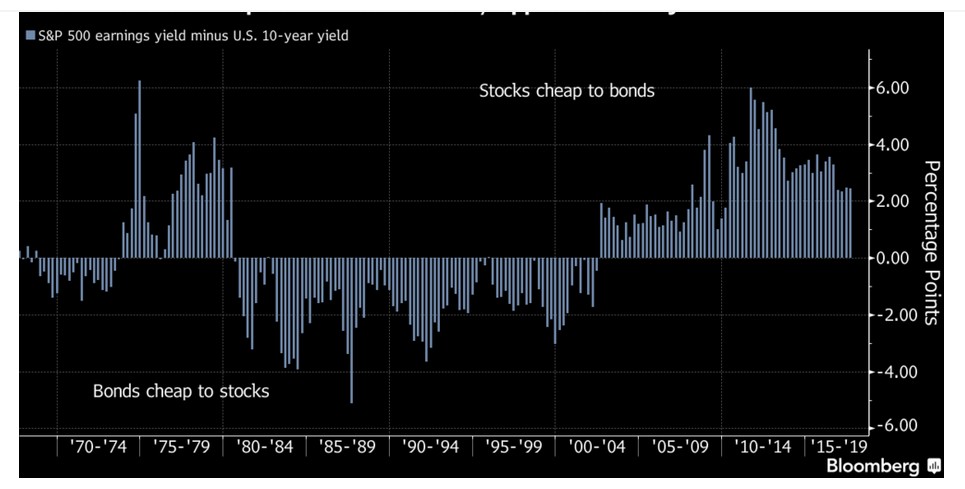
Stocks Cheap Compared to Bonds
 We’re Just Sayin’
Cantor Fitzgerald: OPKO Health - Overweight Rating, $20 Price Target
And how about this:
In other Opko Health news, Director John A. Paganelli purchased 5,000 shares of the company’s stock on June 1st. Following the transaction, the director now owns 350,000 shares in the company. Director Richard A. Lerner purchased 10,000 shares of the company’s stock on June 5th. Insiders have bought a total of 1,600,000 shares of company stock worth $10,000,000 in the last three months. Insiders own 40% of the company’s stock.
There are eight research companies following Opko. Six have a buy rating; two have a hold. Their average price target is $16.40.
BMR Take: For those of you still hanging in there with Opko Health (OPK: $6.12, down 2%) this report from Cantor Fitzgerald is good news. $20 Wow. That is over three times the current price. What are we missing here? Oh – I know. We are missing a higher stock price! Well maybe, just maybe this is the start of the re-rising (is that a word?) of the stock to the $8 level and then $10 and then on to the races from there. Hope springs eternal, doesn’t it? Well, yes, but with all the good things this company has going for it, for it to stay at $6 any longer JUST DOESN’T MAKE ANY SENSE!
The High Yield Report
By Michael Foster
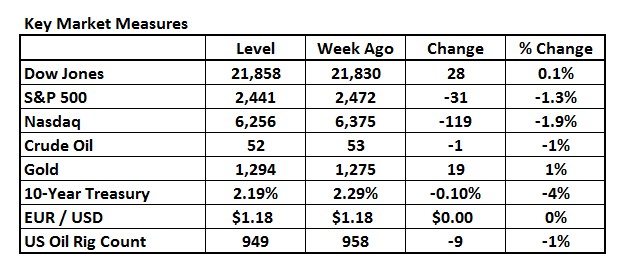
We’re continuing to see market chaos and a lot of selling of high quality assets although the macro risks from political uncertainty are dwindling. But the current selloff is very different from the previous week’s in one very telling, interesting way: Not all assets are falling at the same rate, and some are actually doing very well.
To wit, take a look at The Bull Market Report’s Healthcare REIT pick Omega Healthcare Investors (OHI: $31) which had a strong showing this week after some initial weakness, helping Omega Healthcare end the week up 2%.
We’re seeing a lot of reshuffling in the markets, with investors rotating in and out of funds, stocks, and assets as they rise or fall due to market demand. This is the real “random walk” of Wall Street, and it’s a dynamic that makes short term trends for any individual asset to be unpredictable. In reality, we’re seeing a lot of individual investors making choices to buy on the dip - and they’re pulling money from other assets to do so.
What can an investor do in such an environment? Simple: sit tight. If you have extra cash on the sidelines, now is the time to deploy into the high yield picks that The Bull Market Report has been recommending for a long time. Last week we suggested buying more of Omega Healthcare shares; it’s up 2% since then. Now is the time to do the same with other REITs seeing irrational weakness like Sabra.
You can also consider adding Kimco Realty Corporation (KIM: $19.34) and Apollo Commercial Real Estate (ARI: $17.92) to your shopping list after Kimco fell over 3% in the last week and Apollo remained flat. There is no change in these companies FFO to justify the decline, and Kimco’s year-long weakness on the often-touted (and always inaccurate) “death of retail” has made it just that much more compelling. We have discussed at length here why Retail isn’t dead, and how Amazon’s recent purchase of Whole Foods indicates that the shift from pre-dotcom retail to mobile “bricks and clicks” commerce is far more complicated than the simple narrative of dying malls. In any case, Kimco doesn’t buy enclosed malls! It’s a high-quality strip mall-focused REIT, and Whole Foods (and thus soon Amazon) is one of its biggest tenants.
There are more buying opportunities beyond REITs, and investors are keen to lighten up their cash allocation to consider the other funds and stocks in the High Yield portfolio. However, there is one word of caution to consider when it comes to one of our best performing picks, the PIMCO Dynamic Income Fund (PDI: $29). This fund was flat last week.
What’s going on here is a pretty basic misunderstanding of the fund’s future income potential. You see, Pimco releases a monthly scorecard of net investment income (NII) on its website, while also calculating its dividend coverage ratio. And, simply put, the news isn’t good for the Dynamic Income Fund.
In the past, Pimco easily out-earned its dividend and had a tremendous amount of undistributed net investment income (UNII). That’s why the fund paid a special dividend of $1.45 at the end of 2016. By this time last year, the fund had around $1 in UNII, so it was pretty obvious that a big special dividend was coming (we discussed this at the time and estimated a strong special dividend at the end of last year – and nailed it). This year, however, the Dynamic Income fund has only 4 cents in UNII - a pretty tremendous drop from a year ago!
There are a few reasons why the fund isn’t earning as much income as it used to, most of which revolves around the crowding out of great investment opportunities in mortgage backed securities. The MBS is a pretty daunting asset made sinister by The Big Short and growing awareness of their role in the subprime housing crisis. However, that crisis is a decade behind us, and the quality of MBS investments has skyrocketed. While Pimco was one of the few asset managers aggressively buying up these assets in the past, there are now a lot of people wanting to buy them. That means lower yields for the assets, thus weaker income for the Dynamic Income Fund.
However, at the same time, it also means growing market prices for these assets. This fund’s NAV has risen by 10% so far in 2017, largely a result of that constant demand for MBS’s in the market. Last year, the Dynamic Income Fund’s NAV had risen by far less than 1% over the same time period, because the demand for these assets simply wasn’t there. That means that the fund is sitting on a lot of capital gains with dwindling income.
What does this mean for shareholders? In all honesty, it’s hard to tell. The fund hasn’t really faced a crowding out of supply due to strong demand since 2012. It has enjoyed both NAV and income gains in earlier years, and the end-of-year special dividends reflected that. We simply don’t know if the fund’s managers will decide to return some of those capital gains to shareholders or hold on to it and give a massively reduced special dividend at the end of the year.
It seems that the market has begun to price in the likelihood of a lower special dividend. The fund’s premium to NAV has plummeted from over 10% earlier this year to just 3%. It may fall even further as we get closer to December. If Pimco surprises and gives a big special payout at the end of the year, that could reverse quickly. If it doesn’t, we’ll probably see middling price growth throughout 2017.
The risk with the fund is that its Net Investment Income continues to fall and it fails to cover its dividend on a long-term basis. While we’ve seen hints of that now, it’s far too early to conclude that this risk is really here and it’s time to sell. But investors need to prepare for that eventuality. We will keep a close eye on this trend and advise you if it’s time to move out of this great fund. Hopefully we won’t have to recommend selling anytime soon.
How should you react? Holding the fund for its income stream makes sense now, and buying more when the fund’s premium disappears and it starts trading at a discount also makes sense. That means there’s no reason for investors to get scared and sell off the fund, but it also means investors shouldn’t expect a massive jump in the fund’s price throughout 2017. That’s not a bad thing - it really reflects what the fund should be seen as: A source of steady and reliable income.
Good Investing,
Todd Shaver, Founder, CEO and Editor
The Bull Market Report
Since 1998
August 13, 2017
by Todd Shaver | Aug 13, 2017 | Weekly Newsletter 7pm Sunday
The Weekly Summary
Talk of “fire and fury, the likes of which the world has never seen” aimed at North Korea spooked anybody listening. The markets have been calm for so long and then BOOM, the VIX (^VIX: 15.45) spiked 44% in one day and 60% in two days of trading this week. Our take is that we had been in an unsustainable lull of inactivity. These things happen and you have to be prepared for them. But in the long run, they work themselves out and things get better. Stay the course. If you are worried, consider dialing back your exposure to some of the more aggressive equities out there in favor of looking toward our REIT and High Yield portfolios, where the income stream of dividends offers greater downside protection.
But no matter what is happening out there, there is always a bull market here at The Bull Market Report! This week we highlight some of our favorite stocks/funds: Shopify, Apple, The Carlyle Group, Sabra, AstraZeneca, AllianzGI Equity & Convertible Income Fund, Twilio and Amazon.
BMR Companies & Commentary
Apple (AAPL: $158, up 1% - all prices are for the week)
Apple is hard at work sublet shifting its brand. Everybody knows Apple. But Apple isn’t the name of its products. Apple's greatest hits over the past 30 years don't have "Apple" in their name: Macintosh, PowerBook, iTunes, iPod, iPad, iPhone, Siri. The newer stuff that does carry the Apple moniker -- Apple Watch, Apple Music, Apple TV-- have been either outright disappointments or solid but not wildly popular businesses.
But Apple is as good a brand as any. Think Proctor & Gamble, Ford, General Electric - you get the point. It's hard to transition from a corporate brand to additional brand franchises, but if you can do it, the future is bright!
CEO Tim Cook is working hard to make it happen. The Apple brand speaks to the firm's culture and reputation to employees, shareholders and governments. A product brand communicates a specific message about the item's quality, design, or function to consumers. There is so much potential.
BMR Take: Apple is just one of the companies that always figures it out - just as we are seeing them do now with the focus on services revenue and rethinking the brand.
We remain very bullish. The stock is trading at 17x this year’s consensus EPS of $9.00. The Services business is on pace to double over the next few years. Our Target of $155 has now been breached. Yea! We hereby raise our Target Price to $170. This will bring the company close to a $900 billion valuation, now at $813 billion. Our Sell Price remains the same: “We would not sell Apple.”
The Carlyle Group (CG, $21, flat*)
Carlyle is really a master of the universe. The company’s private equity investments are behind so much of the world’s underlining economic activity it’s ridiculous. The latest example is with McDonald's.
This week McDonald's announced the successful completion of a strategic partnership with CITIC Capital Partners and The Carlyle Group. Ramping up a new era of growth and innovation, the partnership will operate and manage McDonald's businesses in mainland China and Hong Kong, leveraging combined expertise and strength to drive an expansion strategy.
The transaction has obtained China's regulatory approval and was completed on July 31st, creating the largest McDonald's franchisee outside of the United States. The sale to the new McDonald's China franchisee includes McDonald's existing businesses in Mainland China (2,500 restaurants) and Hong Kong (240 restaurants).
The new partnership announced a series of development initiatives for mainland China. Termed "Vision 2022," this strategy aims to drive double-digit sales growth in each of the next five years by increasing the number of restaurants from 2,500 to 4,500 by the end of 2022, bringing unparalleled convenience to Chinese customers. The opening pace of new McDonald's restaurants in mainland China is expected to progressively ramp up from approximately 250 per year in 2017 to 500 per year in 2022 under the new partnership. Vision 2022 also includes an increase of "Experience of the Future" restaurants to over 90%, which will enable the brand to offer a digitalized and personalized dining experience to more customers.
BMR Take: We believe Carlyle is heading to $30. Consensus is looking for a solid dividend of $1.80 next year and $2.15 the following. EPS is running closer to $3. Few institutional investors can buy the stock because the K1 tax structure creates issues. But that will change and when it does, look out on the upside.
* The stock was down 40 cents this week, but CG paid a 42 cent dividend on Thursday and when a stock pays a dividend the stock always opens that day down the amount of the dividend. Thus Carlyle was flat this past week.
Shopify (SHOP: $92, down 5%)
Shopify’s plan is to let half a million merchants run their business via Alexa and bots. Shopify wants its 500,000 merchants to be able to run their businesses almost entirely through the use of bots or voice apps like Alexa.
At F8, Facebook’s annual developer conference, Shopify announced plans to launch a Facebook Messenger bot, named “Kit”, the first commerce platform to do so. Through conversations on Facebook Messenger or SMS, Kit can do things like place a Facebook ad or start an email marketing campaign.
The development roadmaps of voice apps like the Shopify Alexa* skillset and text bots like Kit will begin to converge, so that the same merchant analytics available today by voice will become available in a text interface, and the same actions to run your business available today through text will someday be available with your voice.
* Shopify Alexa is a partnership with Amazon to use Alexa.
The Shopify Alexa skill first became available in January, but was launched with no marketing or promotion in order listen to the queries put forward by merchants to better understand the kinds of questions they want the skill to be able to answer. Before merchants are given the ability to run business operations in a conversational interface, a few other features will be added first.
Based on merchant feedback, more long-term business performance insights are on the way, and work will continue with engineers to ensure the bot can handle the range of questions a merchant has and understands the variety of ways a merchant may ask a question.
BMR Take: When we look at the core building blocks of how this company is advancing its growth potential of Total Addressable Market (TAM) is expanding. In addition, we see opportunities in international, in new merchant solutions and apps, and building scale with Shopify Plus, the company’s enterprise-focused solution. In our view, the valuation is supported by the long runway and expanding TAM given Shopify’s lower relative market share, still less than 5%. We reiterate our bullishness on the stock. The stock is currently trading at about 9 times the estimate of next year’s sales. This valuation is rich but justified.
Sabra Health Care REIT (SBRA: $21.45, down 7%)
We have decided to take our chips off the table in Sabra. Two reasons. First, the core senior housing portfolio growth is essentially flat so it’s hard to see any organic upside from the business. Second, the pending merger with Care Capital is being fought creating noise and possibly more risk.
Regarding the latter, two activist investors are urging Sabra to drop the Care Capital deal. They say shareholders of the healthcare-focused real estate investment trust should reject the merger at a shareholder meeting next month. Why? Sabra was overpaying for Care Capital's assets by up to 30%, the hedge fund said in a presentation. Ouch.
Consensus for Sabra Healthcare REIT:
1 Sell Rating, 6 Hold Ratings, 1 Buy Rating
BMR Take: We like to listen to the market and to other shareholders invested in the stocks we own. Especially when the other shareholders do great research and make objective points. We added the stock at $24 in May and are down a bit, but with the dividend, it wasn’t a great loss. Let’s move on to the next one.
AllianzGI Equity & Convertible Income Fund (NIE: $19.79, down 2%)
This fund seeks total return with capital appreciation and high current income through investment in convertible equity, income producing securities and through utilizing an options strategy. It’s top holdings are Microsoft, Apple, Amazon, Facebook, and Google. It does not use leverage. It does not hold fixed income.
60% of the stocks it holds are in the largest giant companies, and 37% in large cap companies. The Funds PE ratio is 19 versus the 17.2 benchmark, but sales, EPS, book value, and cash flow growth is all better than the benchmark.
See more discussion in The High Yield Report later in this newsletter.
BMR Take: Sometimes it is nice to own a fund and have some help picking all the right places to be. We like AllianzGI with its 7.7% yield. You can buy right now at a discount to the net asset value of $21.75, a very opportune entry point.
AstraZeneca (AZN: $29, flat*)
Fierce pharma rivals collaborating on cancer treatments are increasing the competitive landscape, hurting AstraZeneca. But we believe we must stay the course. AstraZeneca reported disappointing results for its clinical trials examining Tremelimumab combined with Imfinzi for the treatment of lung cancer. The market has become crowded with checkpoint inhibitors and immunotherapy drugs, which means that the number of such potential combinations of treatments is growing. Pharma rivals are now cooperating -- last week Merck bought half the rights to AstraZeneca's Lynparza, and in July Eli Lilly said it would out-license or co-develop one-third of its oncology pipeline.
BMR Take: Healthcare has been a minefield for months now. AstraZeneca has been beaten down. Analysts have been upgrading the stock on valuation. It is very cheap versus expectations for around $2 of EPS for next few years. Consider the 3% dividend yield on top of that. It’s a classic value here as the stock is truly undervalued. Our Target remains $42, and our Sell Price of $32 has been breached, so please make a decision with your own portfolio as to whether you personally wish to stay the course. We are trying to be patient here to give the company more time to perform.
*A dividend was paid on Wednesday of 45 cents.
Upcoming Economic News
Retail Sales
August 15th , 8:30 AM
Period: July
Consensus: 0.40%
Prior: -0.20%
Housing Starts
August 16th, 8:30 AM
Period: June
Consensus: 1,220,000
Prior: 1,215,000
Initial Claims
August 17th, 8:30 AM
Period: Through August 12
Consensus: 240,000
Prior: 244,000
A Word from Gary Jefferson
Jefferson Financial Group
First Vice-President, Investments
UBS Financial Services, Inc.
Stocks finished mostly higher again the week before last, mainly because of good corporate earnings, a stronger-than-expected Jobs report, solid GDP performance, healthy Consumer Confidence and a little better than expected Export & Import numbers. Is it all "too good to be true?" [Well, indeed it was!]
According to the latest American Association of Individual Investors survey, individual investors are now holding their lowest cash allocation since 2000. They are now among the most invested in financial markets since 1988. The three other time periods with the lowest cash allocations were in 1998, 2000, and 2015, and all of these preceded times when investors probably wished they had more of a cushion.
We certainly do not think we're on the brink of another 1999 dotcom bubble or a 2008 financial crisis crater. But one thing's for sure, stocks don't always go straight up forever. There will be volatility and pullbacks as Fed-tightening continues. According to recent news reports, there is now a 50/50 chance the Fed will raise rates again in December. Whenever a pullback occurs, it is not going to be unexpected. It's overdue and as natural to the market as hot dogs are to ball games. With a backdrop of really solid earnings, we expect any pullback to be fairly brief in duration. If earnings keep growing and the job numbers keep getting stronger, pullbacks will just be setting up the next move higher. If Congress grows up and we get tax relief and corporate tax reform, investors will be saying, "Laissez les bon temps roulez".
Note what UBS has to say in their latest report on the Equity Markets: The bottom line: stocks are not cheap, BUT ARE NOT in "bubble" territory.
Amazon Update (AMZN: $968, down 2%)
The stock got hit last week as the rest of the market had some tough times as you know. There is an ongoing discussion over valuation with this company. We had a heated argument with a very astute investor who thinks the stock is overvalued saying that the company will NEVER report substantial earnings; that Bezos will ALWAYS have a new project in mind that will cause him to spend, spend, spend on new infrastructure.
We agree to a certain extent, but disagree with the profit story. As you know, we have said many times revenues are the key to all success in the market. Amazon had revenues of $89 billion, $107 billion and $136 billion in the last three calendar years. This year? Hard to say, but it looks like at least $175 billion? This is just huge of course. We remain bullish for as far as we can see forward.
We hereby raise our Price Target from $1000 to $1100 and leave the Sell Price at $900.
Twilio (TWLO: $31, up 7%)
Twilio had a huge week after reporting blowout revenues as we reported via News Flash on Tuesday. Total revenue – $96 million, up 49% from the second quarter of 2016 and 10% sequentially from the first quarter of 2017.
Loss from operations – $7 million, compared with a loss of $11 million for 2Q16.
And we love this stat: 43,000 Active Customer Accounts as of June 30, 2017, compared to 31,000 Active Customer Accounts as of June 30, 2016.
Profits are still at slightly below breakeven, but as you know, we are banking on the huge revenue gain.
Here is the consensus on the Street:
2 Hold Ratings, 15 Buy Ratings
Price Targets:
8/8/2017 Canaccord Genuity $38
8/8/2017 Robert W. Baird $39
8/8/2017 J P Morgan Chase $40
8/8/2017 Mitsubishi UFJ Financial Group $35
7/17/2017 Summit Redstone $36
BMR Take: We love this company and think it can be a monster. An Apple? A Microsoft? Hard to predict the next 10-15 years, but watch this one closely.
Wall Street Consensus for United Parcel Service (UPS: $111, up 1% in a very tough week, and after an 83 cent dividend on Thursday)
Consensus: 10 Hold Ratings, 5 Buy Ratings
Price Targets:
8/8/2017 Citigroup $128
7/3/2017 Sanford C. Bernstein $127
SNAP (SNAP: $11.83, down 13% - still at a $14 billion market cap)
Don’t buy SNAP
Don’t buy SNAP
Don’t buy SNAP
Revenues: $182 million up from $72 million
Loss: $443 million up from a loss of $116 million last year. WOW! (How is this actually possible?)
Don’t Buy SNAP
Don’t Buy SNAP
A Letter from a Subscriber about Netflix (NFLX: $171, down 5%)
From: Stan Makovsky [mailto:stan@stanxxxx.com]
Sent: Wednesday, August 09, 2017 3:11 PM
To: 'Todd at The Bull Market Report'
Subject: Netflix
Hi Todd,
Disney pulling out of Netflix seems to be a big deal for both stocks. Your thoughts please?
Best Regards,
Stan Makovsky
Our Response:
Hi Stan –
I am not really concerned too much. The market is getting slammed today as I write this [Wednesday] and Netflix is down just $4. If it were down $20 I’d be a little concerned. But I believe Disney needs Netflix more than Netflix needs Disney. Netflix is a force now and as you know is spending billions of dollars a year on programming. They will be just fine. The scary thing about Netflix is their profit level – which is tiny. This needs to change.
Todd Shaver
Founder and Editor in Chief
The Bull Market Report
A Powerful Financial Newsletter
Since 1998
@BullMarketRept on Twitter
The High Yield Report
By Michael Foster
Special to The Bull Market Report
It’s been a long time coming, but we finally see a bit of fear entering the market.
For high yield investors, this is a concern because downturns and mini-corrections tend to be amplified in high yield investments. The S&P 500 slid over 1% last week but many high yield investments fell much more, especially closed-end funds (CEF). The AllianzGI Equity and Convertible Income Fund (NIE: $19.80) fell nearly 2% over the last week due to a considerable decline in the fund’s NAV, which fell over 1% in a single day of trading last week. In many cases, a market correction will result in CEFs’ discounts widening as investors sell off the fund. Surprisingly, however, holders of the AGIC fund have been surprisingly calm, resulting in the discount staying less than 10% by the week’s end. Recently, the discount had shrunk to less than 9%, so this is definitely not as good as it has recently been. But it’s surprisingly not as bad as it could be.
Of course, if the selloff continues throughout the coming week, it would be more than reasonable to expect Allianz to see a larger discount as slower and more risk-averse investors finally get around to selling this and other closed-end funds. What does this mean for you? Well, we maintain a bullish outlook for the economy and for stocks, with corporate profits continuing to rise year-over-year and the Allianz fund in particular maintains a strong portfolio of respected and strong-performing stocks. There’s no reason to sell off amongst the fearful, but anyone with extra cash on the sidelines who wants a sustainable near-8% dividend stream could consider picking up some of this fund.
Similarly, The Bull Market Report’s second CEF pick, the Pimco Dynamic Income Fund (PDI: $29), had a rough week during the market’s selloff, falling over 4%, after paying out a 22 cent dividend on Wednesday. This has resulted in PDI’s premium price falling slightly, and now the fund trades at slightly over a 2% premium to NAV.
After the sell-off, investors may be eager to buy more of the Pimco fund and capture that 9% dividend yield plus the potential upside of special dividends at the end of the year. Before rushing to buy, however, there are a few things to consider. The fund’s NAV has risen 10% so far this year even after accounting for dividend payouts, which means the fund’s payout remains sustainable. However, this is a relatively weak performance compared to its past performance. Part of the reason for that is the growing burden of its promised payouts. Because it trades at a premium, it has been significantly harder for the fund to pay out dividends than to earn the comparable income in the open market. Since the fund’s premium rose to as much as 10% earlier this year, those dividend payouts were particularly burdensome for Pimco’s managers. Now that the premium is at its lowest point since November last year, that dividend is going to be slightly easier to pay.
Easier, but not easy. The real problem with this fund is that it has years and years of a solid track record thanks to its contrarian nature. The fund invested heavily in mortgage-backed securities (MBS’s) after 2008, when they were synonymous with financial ruin. In reality, however, many of these assets were extremely undervalued because of investor fear, and Pimco had the chops to find the good ones and buy them. Hence the fund’s massive outperformance.
However, 2008-2009 is becoming a fainter memory, and the market is finally realizing the huge mistake it made in avoiding many quite valuable MBS’s. As a result, more capital is coming into that market and creating more competition for Pimco. Ultimately, that means diminished returns for investors holding this fund.
Unfortunately, this has also happened as more investors have discovered the fund’s tremendous returns. Holding this fund has become a crowded trade. Back in 2013-2015, the fund almost always traded at a discount; in late 2015, shortly before The Bull Market Report recommended it, its discount fell to 11%. But now a flood of capital has come in and driven the fund to a consistent premium, while earning superior returns through MBS’s is getting harder for the fund.
This doesn’t mean you should sell the Pimco Dynamic Income Fund. But it does mean one has to wait before buying more and instead choose other strong dividend payers like the AllianzGI fund.
Finally, let’s briefly discuss REITs. These were a mixed bag, with pretty much all REITs down and some down much more than others. Omega Healthcare Investors (OHI: $30) fell 2% over the week alongside the broader market, with its greater volatility amplifying losses. Yet the similarly volatile Government Properties Trust (GOV: $18.13) fell about 1% over the same period, even beating the market. There are a couple of pretty obvious reasons for this. For one, Government Properties Trust’s big decline earlier this month means it’s found a bottom and can’t plunge much lower. Obviously this means buying now makes sense. Omega, however, hasn’t exactly found its bottom yet and only went negative YTD at the end of last month. There’s no fundamental reason for this – there is sustainable income, the dividend is still rising, and Omega’s expansionary plans are on track. But there is a lot of fear in the market, and that is reflected in the rapidly fluctuating price of this stock.
While buying Omega now is buying a bargain, investors should be prepared for more volatility. Government Properties, while not exactly strong, seems to have found a floor that is limiting further downside, making it a more appealing buy right now. But no matter what you do right now, selling is not a good idea. There is no fundamental reason to fear for the future of equities or high yield assets, so ignore the panic selling. It will be intense but brief-lived, as always.
Good Investing,
Todd Shaver, Editor, CEO and Founder
The Bull Market Report
Since 1998
August 6, 2017
by Todd Shaver | Aug 6, 2017 | Weekly Newsletter 7pm Sunday
The Weekly Summary
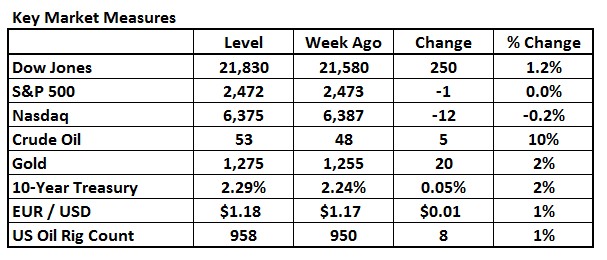
Months of boredom broken up by moments of terror. And then quickly back to the boredom. That’s how it’s been for U.S. stocks lately, where vast stretches of tranquility are occasionally interrupted by sudden bouts of selling on headlines trumpeting entanglements of President Donald Trump. It happened again during the last 30 minutes of trading Thursday, when the S&P 500 Index surrendered a quick five points after the Wall Street Journal reported special counsel Robert Mueller was said to have impaneled a grand jury in the Russia probe. More than half the swoon was erased by the close. A similar frenzy occurred July 20th, when Bloomberg News said Mueller was examining a broad range of financial transactions involving Trump’s businesses. The message from professional investors: In a market where the CBOE Volatility Index has consistently hovered just above 10 at historic lows, get used to it. Both the drops and the recoveries.
However, there is always a bull market here at The Bull Market Report! This week we highlight some of our favorite stocks: Apple, The Carlyle Group, Athenahealth, PayPal, Teva Pharmaceutical Industries, and Tesla.
BMR Companies & Commentary
Apple (AAPL: $156, up 5%)
Apple delivered solid third quarter results. Let’s break it down for you.
iPhone revenue was $24.9 billion versus the $25.5 billion consensus. Just shy. iPad revenue was $5.0 billion versus the $4.0 billion consensus. Mac revenue was $5.6 billion versus the $5.7 billion consensus. Services (the App Store) – the spot to watch – did $7.3 billion versus the $7.1 billion consensus. All in all, no complaints on the top line.
Average selling prices did trend lower, but who cares. The iPhone sold for an average of $606 versus the $621 consensus. The iPad sold for $435 versus $440 last year. Mac was $1,303 versus the $1,334 consensus. This is minor stuff in the long run. People should be concerned about the long term, big picture vision like we are.
Gross margin of 38.5% beat the Street’s 38.3% and hit the top end of guidance. Operating expenses were $6.7 billion vs. the consensus of $6.6 billion. Profits continue to flood in to the tune of about $800 million per week and now sit at $262 billion.
At the bottom line the company did $8.7 billion in earnings or $1.67 per share vs. $7.8 billion a year ago, $1.42 per share. Fabulous.
An overall great quarter. Apple reported unit and revenue growth in all product categories in the June quarter, driving 17% growth in EPS. The business also returned $11.7 billion to investors during the quarter, bringing total cumulative capital returns to almost $223 billion. Wow!
BMR Take: We remain very bullish. The stock is trading at 17x this year’s consensus EPS of $9.00. The Services business is on pace to double over the next few years supporting growth.
The Carlyle Group (CG: $22, up 6%)
Carlyle reported another strong quarter with EPS of $0.81, beating the $0.41 consensus by a mile. Revenue was $910 million versus the $680 million consensus. The company paid the $0.41 dividend shutting up all the naysayers about the businesses’ ability to consistently return capital.
Part of the big out-performance was admittedly just due to a one-time insurance recovery. But the core business looks great. The company is fundraising hand over fist and continues to generate great investment returns.
Overall, Carlyle produced another strong value creation quarter, with net unrealized gains awaiting to be returned to investors increasing 46% year to date. As a result of the strong performance Carlyle has delivered to fund investors, demand for new funds is high. The company raised over $8 billion of capital in the second quarter with acceleration likely in the second half of 2017.
BMR Take: Carlyle is probably heading to $30. Consensus is looking for a solid dividend of $1.80 next year and $2.15 the following. EPS is running closer to $3. Few institutional investors can buy the stock because the K1 tax structure creates issues. But that will change and when it does, look out on the upside!
Athenahealth (ATHN: $141, up 1%)
Athenahealth announced that the board and management team are conducting a strategic review of the company’s operational and financial strategy, leadership. and governance. Management has commenced a comprehensive review of its operations, cost structure and capital allocation, with the assistance of a globally recognized consulting firm. In conducting its review, the company has identified $100 million in cost-savings opportunities that will drive efficiency and targeted investment in the company's hospital and network services businesses. Athenahealth will provide additional information regarding details of these strategic initiatives by its Q3 earnings release in October. Co-founder Jonathan Bush, a cousin to former U.S. President George W. Bush, will remain as the chief executive of the company.
Athenahealth also intends to augment its senior management structure to establish the role of president. The president will be responsible for the execution of Athenahealth’s business operations and will report to Athenahealth CEO, Jonathan Bush. As previously announced, the company is also working to identify a CFO. The board has retained a search firm to fill the president and CFO roles promptly. Finally, the board plans to separate the roles of chairman and CEO and is working to recruit an independent chairman. In addition, the board has begun a search process to appoint an additional independent director. Recall, all this has been brought about by Elliott Management, a major activist hedge fund that disclosed a 9.2% stake in the company back in May.
"Athena needs a management team and operating plan that can successfully tackle the next stage of growth," said a portfolio manager for T. Rowe Price New Horizons Fund. "This plan is a large step in the right direction."
The company said its bottom line climbed to $20.5 million, or $0.51 per share in 2Q. This was higher than $13 million, or $0.34 per share, in last year's second quarter. Revenue for the quarter rose 15% to $300 million, up from $260 million last year.
The company, said it would invest in its fast-growing hospital and network services businesses.
BMR Take: With Elliott Management in there shaking things up, there is a lot of excitement ahead. We love this company but believe now is the time to take profits. We are up 38% since we added the stock at $103 in November. The PE is still a ridiculous 280 and to get it down to a ridiculous 70, profits will have to quadruple, which will take years. We hereby remove the stock from the portfolio.
What should YOU do? Totally up to you of course. You can sell, or you can stay the course and maybe the stock will continue its big ride. If you stay, you can protect yourself two ways. You can sell calls on the stock, say the December $150 for $10. Or you can put a stop order in place at say $135 or $130, to protect your gains. If the stocks goes higher, fabulous.
PayPal (PYPL: $59, down 1%)
PayPal is on a roll with new partnerships. The latest - Skype!
Skype is all about trying to make your life easier and more efficient. That’s why they recently developed Send Money, a Skype feature that allows you to transfer funds via the Skype mobile app while you’re in the middle of a conversation using PayPal. Sweet!
Skype users wishing to send money from a PayPal balance or a U.S. debit card won’t be charged for transactions, making it similar to how PayPal’s other peer-to-peer payment platforms function.
Potentially more important than this alone is that this is a deal with Skype's parent company, Microsoft, which now establishes a relationship with them. Last month, PayPal inked deals with the likes of Samsung Electronics, Apple, and JPMorgan. Skype has reportedly been downloaded over a billion times and boasts approximately 300 million monthly active users. Wow!
BMR Take: PayPal is at 200 million users in a world where Facebook is running a global internet business model with 2 billion. You see the growth here? !! We are riding PayPal far into the future.
Teva Pharmaceutical Industries (TEVA: $21, down 36%)
Teva announced earnings and got rocked. Revenues of $5.7 billion versus $5.0 billion last year. EPS of $1.02 versus $1.25 a year ago. Dividend of 8.5 cents, down 75% from 34 cents in the first quarter of 2017. The company only lowered EPS guidance from $5.10 to $4.40, which makes the stock very inexpensive relative to where it is trading right now on earnings. However, the problems are big.
Second quarter results were lower than anticipated due to the performance of the U.S. Generics business and the continued deterioration in Venezuela. In the U.S. Generics business, the company experienced accelerated price erosion and decreased volume mainly due to customer consolidation, and greater competition as a result of an increase in generic drug approvals by the FDA, and some new product launches that were either delayed or subjected to more competition. Not good.
In response, Teva must take swift and decisive actions. The company is now focused on executing meaningful cost reductions, rationalizing assets and maximizing value, actively pursuing divestiture opportunities and strengthening the balance sheet.
BMR Take: Life brings adversity. You, dear reader, have been around long enough to know this. This stock has just been rocked as bad as the loser in a UFC title fight. But it is just silly cheap right here. Buy more? Yes, if you are ready to take on some volatility. Sell? Not here. Hold? This seems like the best course of action with intentions to exit once the price gets up off the floor mat.
Tesla (TSLA: $357, up 7%)
Tesla reported Wednesday that its net loss widened in the second quarter as they opened new stores and prepared for the launch of its new lower-cost Model 3 sedan.
The loss grew 15% percent to $335 million from a loss of $290 million in the year ago quarter. But Tesla's adjusted loss of $1.33 per share, handily beat Wall Street's forecast of a $1.88 loss.
Revenue more than doubled to $2.8 billion, also beating Wall Street's forecast of $2.5 billion. Tesla's shares jumped 6% percent after the earnings release. Tesla saw significant growth in its energy generation and storage business, which contributed about 14% of its revenues. It bought solar panel maker SolarCity late last year and said it began taking orders for its new solar roof tiles in the second quarter, and recently began installations.
But most attention was focused on the Model 3, which was delivered to its first 30 customers — all Tesla employees — last week. CEO Elon Musk said the company has 500,000 reservations for a Model 3 and it wants to ramp of production as quickly as possible. But Musk has warned of “production hell” for the next six months or longer as the company goes from building 100 Model 3’s in August to 20,000 Model 3’s by December. He wants Model 3 output to grow to 40,000 cars per month by sometime in 2018.
Musk made a surprise announcement during Wednesday's second-quarter earnings call. Musk said Tesla will no longer use an entirely different vehicle architecture to build the Model Y, the compact SUV due to hit the market by 2020. Tesla will instead borrow from the Model 3's platform. That should make Model Y production a lot easier in the future. "Upon the council of my executive team to reel me back from the cliffs of insanity, the Model Y will, in fact, be using substantial carry over from Model 3 in order to bring it to market faster," Musk said. "I have to thank my executive team from stopping me from being a fool," Musk said. "Model Y will have relatively low technical and production risk as a result."
Tesla is averaging about 1,800 orders per day for its Model 3 since its big event a week ago Friday. Extrapolated, that’s over 50,000 orders a month. It opened 29 new stores and service centers in the second quarter in order to meet Model 3 demand. It's also planning to double the number of fast-charging Supercharger outlets this year to 10,000 worldwide. The company delivered 22,000 Model S and Model X vehicles in the second quarter. That was up 53% from the same quarter a year ago, but down from 25,000 in the first quarter.
Management is expecting positive Model 3 gross margin in Q4 and targeting 25% margin in 2018. Model S and Model X deliveries are expected to increase dramatically in the 2nd half of 2017.
During the initial phase of the Model 3 ramp in Q317, the volume produced will be tiny relative to the installed production capacity. As a result, Model 3 gross margin in Q3 will be impacted by the excessive allocation of labor and overhead costs and depreciation over this tiny volume. In the absence of these one-time elevated cost allocations, Model 3 gross margin in Q3 would already be positive, resulting in a positive cash contribution.
BMR Take: The future of automobiles are electric and Tesla runs the show. We are looking at EPS estimates of $14 in 2020.
Upcoming Economic News
Consumer Credit
August 7th, 3:00 PM
Period: June
Consensus: $16.0 billion
Prior: $18.4 billion
JOLTS Job Openings
Tuesday, August 8th, 10:00 AM
Period: June
Consensus: N/A
Prior: 5,666,000
Wholesale Trade
Wednesday, August 9th, 10:00 AM
Period: June
Consensus: 0.40%
Prior: -0.50%
PPI
Thursday, August 10th, 8:30 AM
Period: July
Consensus: 0.10%
Prior: 0.10%
CPI
Friday, August 11th, 8:30 AM
Period: July
Consensus: 0.15%
Prior: 0.0%
Google Reports Earnings
Google (GOOG: $928, down 1%) continues to reports huge gains in sales and earnings, despite having to pay the European Commission a $2.7 billion fine. EPS of $5.01 beat estimates by $0.60 and revenues of $26.0 billion beating estimates by $400 million. Total revenue was up 20% year over year, and was in fact up 23% when adjusted for currency fluctuations. 87% of Alphabet's $26 billion of revenue during the quarter came from advertising, which was up 18%. Google’s “other” business - everything that’s not advertising, including its cloud business and Google Play app store - grew 40% year over year to $3.1 billion. “Other” now represents 12% of Google’s business, up from 10%. Sales from the Europe and Africa account for about 34% of the company’s overall revenue,
Google's paid clicks were up 52% year over year. The average cost-per-click was down 23% year over year. We are not fretting over the last statistic. But we are salivating over the first. 52% growth. Huge.
Advertising revenue growth was driven by mobile and YouTube. And the cloud business was big. Cloud deals larger than $500,000 tripled year over year.
BMR Take: Buy today. Buy tomorrow. Buy next month. Buy next year.
A Word from Gary Jefferson
Jefferson Financial Group
First Vice-President, Investments
UBS Financial Services, Inc.
The number one question to us over the past few weeks has been, "When is this bull market going to end?" Run away as fast as you can from anyone who tells you they know. That said, however, it is a very important question to ask because, believe it or not, risk matters. And you can rest assured that Murphy's Law will prove that risk matters most when it appears risk no longer exists. The S&P 500 is up nine straight months and the VIX hit an all-time historical low last week. The media seems to think that, somehow, no one seems nervous. That's not what we see. We see a lot of nervousness and the question we prefer to answer instead of being asked to foresee the future is, "What signs of a bear market do you see today?"
Aside from the always present danger of a global conflict, we do not see the most common indicators used to predict coming recessions such as falling sales, production and earnings. What is happening instead is a real turnaround in earnings growth momentum to the upside. The key ingredients for a typical bull market are still in place:
The economy is expanding.
Earnings growth is accelerating – we've seen three quarters in a row and 2Q17 looks like it will be the best so far. Stocks are not cheap, but with few exceptions they still offer a more attractive value than bonds (The 10-year Treasury is still around 2.3%)
One Wall Street research firm recently said, "Just realize that this bull is eight years old. The easy gains have been made. Now it's a slower grind higher. So stay focused on the key long term trends and be patient waiting for the profits to unfold".
What we read into the words, "a slower grind higher" is a market that has more of a pattern of two steps higher and one or one-and-a-half steps lower, rather than the four or five steps higher to each step backward that we have enjoyed for several years. It is a rare year that the market doesn't experience a 5% pullback at some point – we think that would be not only be normal but also a "healthy" thing to see. Stock Traders Almanac, researching patterns in the market over the past 50 years, reports that strong post-election years typically point to summer selloffs. Looking at the 50-year charts, these seem to range in the 4% or the 9% area with the "average" being somewhere in-between. We don't see anything that would make us disagree with historical norms because "It's different this time". Thus, we expect to see some sort of sell-off over the August-October time frame that's in line with historical averages.
However – Oppenheimer announced last week that it was raising its 2017 earnings estimates for the S&P 500 from $125 to $129 per share, and raising its year-end target for the index from 2450 to 2650. Most resources we follow have a price target between 2500 and 2650. Should we see a decline from 3% to 10%, most experts are saying that there will be a substantial year-end rally from that low point which will propel the market to further all-time highs by next year. But that's the "slower grind higher", and watching the market drop 10% and then going all the way back up to get another 5% or 6% will not be "easy". To that end, patience will be a true friend and we would also keep in mind that, "Without a selloff, there can be no rally".
The High Yield Report
By Michael Foster
Special to The Bull Market Report
Earnings season for REITs continues, and the news for Bull Market Report subscribers has been great.
Government Properties Trust (GOV: $18.35, up 1.5%) saw sales and earnings beat expectations by a healthy margin. Revenues rose 9% year-over-year to $70 million and FFO for the quarter beat expectations by a penny at 60 cents per share. On a trailing 12-month basis, dividend coverage is now 132%, above the 130% cutoff that we prefer and far beyond many more “conservative” REITs.
Government Properties Trust is a really interesting stock, because it is always seen as extremely high risk despite its business model and fundamental results. Quarter after quarter, Government Properties Trust reports high occupancy rates, strong revenue, and a healthy amount of income that is higher than dividend payouts. So why does the market give this stock a 9.5% dividend yield, when some REITs with worse dividend coverage ratios are yielding 5% or even less?
A large part of it has to do with the company’s size. At a $1.8 billion market capitalization, the firm is definitely one of the smaller and less geographically diverse. But that lack of diversification is more than offset by its business model: renting to United States government agencies and offices, usually with long-term lease contracts. Back in 2013-2016, when expectations of a shrinking government were rampant (and actual downsizing was happening a bit), this didn’t seem like a good thing. But we’ve seen this REIT weather that storm, thanks in no small part to its tenant mix and, most recently, its move into more conventional office leasing.
But now that government downsizing is not as sharp of a focus in D.C., Government Properties is quietly driving revenue with strong demand from government agencies, who are also quietly expanding. On the firm’s earnings call, President David Blackman announced that 290,000 square feet of new and renewal leases were completed in the second quarter, with 235,000 square feet being rented to government tenants. The weighted average lease term for those leases is 8 years.
This means 82% of the revenue the company is going to get over the next 8 years is virtually guaranteed by the full faith and credit of the United States. On top of this safety, the REIT reported that 22% of the firm’s rented space is going to face an expiration in the next two years. Let’s dig into that. If that 22% remains vacant, and there’s no growth anywhere else in the firm’s portfolio, that means annualized FFO would drop to about $1.76 just a hair above the company’s $1.72 dividend.
Obviously, this is an extreme scenario that is virtually impossible to occur. Even in the depths of the 2008-2009 recession, REITs simply did not have a 78% occupancy rate. So even in the most absurdly dire, extreme hypothetical scenario, Government Property’s dividend is secure.
This is why the stock is really worth buying even as its yield is over 9% and despite the 24% price drop we have seen over the last year. The stock is volatile because there’s a lack of investor enthusiasm - but as a vehicle for capturing an income stream, it’s a solid choice, especially now after its drop.
Let’s talk about another REIT that released earnings this week - Apollo Commercial Real Estate Finance (ARI: $18.01, up 1%), which reported a slight miss on revenues that rose 33% year-over-year and EPS of 46 cents, in line with expectations.
Looking over the press release and listening to the earnings calendar, there really isn’t much to raise eyebrows - which is why the stock didn’t really change much. In a way, the firm’s results are best summarized by CEO Stuart Rothstein, who said this during the earnings presentation:
"Importantly for Apollo's business, transaction volume remains healthy driven by both a significant amount of capital committed to or targeted for value add real estate equity investment and the availability of various debt financing alternatives. At present, Apollo has a strong pipeline consisting of both new opportunities many of which involve repeat clients, as well as the option and opportunity to participate in the refinancing of some existing transactions.”
There are no surprise new investments, no sudden influx of demand for commercial loans or new borrowers coming to the table. It’s very much business as usual. And that means $800 million in new investments year-to-date for the firm and an extra $150 million in funding on previously closed transactions. This contributed to 46 cents in net interest income, giving the dividend a pretty worrisome coverage ratio on a trailing 12-month basis: 98%.
There are a couple of things to keep in mind. This is a mortgage REIT (mREIT), where dividend coverages tend to be significantly lower than in property REITs. Investors are compensated for this with a higher dividend yield, and Apollo Commercial is giving a 10% yield right now. However, investors need to brace for the possibility that the dividend could get cut in the future - although the cut could be miniscule to bring the company back to a 100% dividend coverage ratio.
Fortunately, that is extremely unlikely for one reason: This company has been growing like a weed, as you can see from revenue jumping by a third from a year ago. This is very much a growth income stock - an odd thing that is hard to find, but needs to be thought about differently. High yield stocks tend to rise in price, and thus have a lower yield, as the company proves the sustainability of its income stream over time.
Of course, there is a risk that the growth will slow or stop, and that’s one of the big risks that this stock’s big yield is compensating investors with. So far, there is no indication that the growth will stop - the healthy pipeline of loans makes it clear that there’s still room for the company to grow into its dividend. But there’s also no indication that growth is on track for a rapid expansion - instead, it’s simply chugging along. That probably means investors can expect its yield to continue and its stock to stay where it is - which means it’s a great hold for now to capture those 10% dividends.
Good Investing,
Todd Shaver, CEO, Editor and Founder
The Bull Market Report
Since 1998
July 31, 2017
by Todd Shaver | Jul 31, 2017 | Earnings Preview 6 AM
Shopify (SHOP: $92)
Bull Market Report Target Price: $90
Bull Market Report Sell Price: $65
Earnings Date: Tuesday, 8:00 AM ET
Consensus: 2Q17
Revenues: $145 million
EPS: -$0.07
Year Ago Quarter Results
Revenues: $85 million
EPS: -$0.04
Key Things to Watch For in the Quarter
Analysts estimate that Shopify will report a 65% increase in revenue to $144 million but still show earnings slightly in the red. Shopify has beaten estimates in the past four quarters, contributing to the 150% appreciation in the stock since this time last year. The stock has started to level out over the past few months in the $90-$92 range, but we are confident this is merely a hesitation before the next breakout.
……………………………………………………………………………..
Apple (AAPL: $149)
Bull Market Report Target Price: $155
Bull Market Report Sell Price: We would not sell Apple
Earnings Date: Tuesday, 04:00 PM ET
Consensus: 2Q17
Revenues: $42 billion
EPS: $1.57
Year Ago Quarter Results
Revenues: $45 billion
EPS: $1.42
Key Things to Watch For in the Quarter
Analysts across Wall Street expect that Apple will report a healthy 10% growth in EPS to $1.57 and a 5% decrease in revenue to $42 billion. Apple has beaten estimates in each of the past four quarters. This success has contributed to the 40% appreciation in the stock since this same time last year. Although Apple’s top line has slowed down, we expect its innovative board and executives will roll out offerings to spur growth in future quarters.
……………………………………………………………………………..
Carlyle Group (CG: $20)
Bull Market Report Target Price: $22
Bull Market Report Sell Price: $13
Earnings Date: Wednesday, 8:00 AM ET
Consensus: 2Q17
Revenues: $680 million
EPS: $0.43
Year Ago Quarter Results
Revenues: $530 million
EPS: $0.35
Key Things to Watch For in the Quarter
Carlyle Group is expected to report strong revenue and EPS growth for 2Q17. Analysts estimate that Carlyle will report an 18% increase in revenue and a 23% increase in EPS. Despite having only beaten analyst estimates in two of the past four quarters, the stock is still up over 20% since this time last year. Carlyle’s stock currently trades at a PE ratio of 23, which is extremely cheap compared to the industry’s average PE of well over 50.
……………………………………………………………………………..
Tesla (TSLA: $335)
Bull Market Report Target Price: $350
Bull Market Report Sell Price: $280
Earnings Date: Wednesday, 04:00 PM ET
Consensus: 2Q17
Revenues: $2.5 B
EPS: -$1.80
Year Ago Quarter Results
Revenues: $1.3 B
EPS: -$1.61
Key Things to Watch For in the Quarter
Analysts across Wall Street expect that Tesla will report revenue growth of 100% to $2.5 billion and an increase in its earnings deficit to -$1.80 per share. Tesla’s is unique because unlike most equities its price is not driven by earnings. Yet. Of the past four quarters, Tesla has only beaten estimates once, but the stock has still appreciated 45% year-over-year. Tesla recently took a 20% hit in early July from the $380 range all the way down to $308, providing investors with a window of opportunity to enter the stock.
……………………………………………………………………………..
Square (SQ: $26)
Bull Market Report Target Price: $29
Bull Market Report Sell Price: $20
Earnings Date: Wednesday, 04:00 PM ET
Consensus: 2Q17
Revenues: $535 M
EPS: -$0.05
Year Ago Quarter Results
Revenues: $440 M
EPS: -$0.08
Key Things to Watch For in the Quarter
We believe Square will increase its revenues by 22% to $440 million and improve its earnings deficit. Square has beaten estimates the past four quarters rewarding stockholders with 135% year-over-year appreciation. We are very bullish on Square as they continue to break all-time highs and continue to set themselves up for growth in future quarters.
……………………………………………………………………………..
Annaly Capital Management (NLY: $11.93)
Bull Market Report Target Price: $12
Bull Market Report Sell Price: $11
Earnings Date: Wednesday, 04:00 PM ET
Consensus: 2Q17
Revenues: $595 M
EPS: $0.30
Year Ago Quarter Results
Revenues: $455 M
EPS: $0.29
Key Things to Watch For in the Quarter
We expect Annaly will report EPS growth of 3% to $0.30 and a 23% increase in revenue. Annaly has beaten estimates in two of the past four quarters and is up 7% year-over-year. Yielding a 10% dividend makes Annaly an extremely attractive stock for investors who are looking for both growth and income potential.
……………………………………………………………………………..
Sabra Health Care REIT (SBRA: $23)
Bull Market Report Target Price: $30
Bull Market Report Sell Price: $21
Earnings Date: Wednesday, 04:00 PM ET
Consensus: 2Q17
Revenues: $55 M
EPS: $0.29
Year Ago Quarter Results
Revenues: $57 M
EPS: $0.53
Key Things to Watch For in the Quarter
Sabra is expected to report a slight decrease in revenue and a big drop in earnings for 2Q17. Sabra has missed estimates in the last three of four quarters, but its stock has remained fairly flat over the past year, only losing about 3% of its overall value. It still trades at a relatively cheap PE of 16 and yields a 7.4% dividend. We expect Sabra to turn things around as the economy continues to show signs of strong growth.
July 30, 2017

by Todd Shaver | Jul 30, 2017 | Weekly Newsletter 7pm Sunday
The Weekly Summary
North Korea test-fired its second intercontinental ballistic missile within a month on Friday, a provocation that heightens pressure on the U.S. and China to find ways to rein in Kim Jong Un’s nuclear ambitions. The U.S. said its top general called his South Korean counterpart to discuss “military response options.” The missile traveled about 620 miles. Trump called the launch a reckless and dangerous action and said "the United States will take all necessary steps to ensure the security of the American homeland and protect our allies in the region.” Why is this so important? It is more than the obvious geopolitical risks. The CBOE Volatility Index (^VIX) touched multi-decade lows earlier this past week at 8.84, but closing Friday at 10.29. It is really hard to see the markets remaining as calm as they are right now. This North Korea news is a fresh reminder that it is highly unlikely the markets remain this placid for long.
However, there is always a bull market here at The Bull Market Report! This week we highlight some of our favorite stocks: Amazon, First Solar, Shopify, Square, Facebook, and AstraZeneca.
Highlights From The Past Week
Tech Slide in Week of Upbeat Earnings Underscores Growing Unease. Better earnings equals higher share prices, or so goes the customary thinking. For Technology stocks during this reporting season, it’s the exact opposite. Companies from Google to Microsoft announced quarterly results that beat analyst estimates by a combined 8%, more than any other industry group in the S&P 500 Index. Be reminded, that too much love can prove perilous when momentum reverses. In June, after investors had flocked to Tech stocks anticipating faster earnings growth in a move that pushed the Nasdaq 100 Index to rise twice as fast as the S&P 500, they rushed for the exit all at once, sparking the worst selloff since 2008 relative to the rest of the market.
Focus Turns To The Fed's Balance Sheet. If the Federal Reserve delivers any surprises in the near-future, it will probably come from news on when it plans to start shrinking its balance sheet. Economists don’t foresee an interest-rate hike anytime soon. Yet policy makers might update their language on inflation, because weakness in price data has persisted since they last met, but those changes should be minor.
A larger source of uncertainty stems from the timing of when the Fed will start to shrink its $4.5 trillion holdings of mainly Treasuries and mortgage-related debt. Everyone wants to know how the Fed will cut the bloat after building assets to record levels to help shield the U.S. economy during the financial crisis. Officials expect to begin the process this year and Chair Janet Yellen has said it could get under way “relatively soon.” Her lack of specific guidance has us looking toward the Fed’s meeting in September for an announcement. It sure seems like they would like to get the process started in the Fall. This will undoubtedly be a big shift for markets. But, it is expected and seems to be priced into the markets now. The 10-year Treasury is still very, very low from a historical standpoint at 2.29%. We don’t expect that to change much in the near future.
Howard Marks Sounds Alarm on Tech Stocks. We love to follow what the billionaires say. After all, they have made a lot of money and that is what we are trying to do. Just this week, billionaire Howard Marks, who’s warned of excessive risk in the markets for the past five years, is now sounding the alarm as hazards converge from red-hot Tech stocks, and investor confidence in SoftBank’s $100 billion fund raise. In a 22-page memo -- longer than most of his missives to clients -- the Oaktree Capital Group co-chairman said he sees several phenomena that by themselves seem reasonable but together reveal markets to be heated and risky. “Since we never know when risky behavior will result in a market correction, I’m going to issue a warning today rather than wait until one is upon us,” Marks said. “This warning is likely to feel premature, and perhaps it is, but I think it’s better to turn cautious too soon rather than wait until it’s too late.”
We’re not saying we are in this camp. To the contrary, we remain bullish on America and the stocks in our portfolio. But we want to let you know that there is another side to the bullishness and Marks above is just one of them. But this is nothing new. There are always two sides to every market and guess what? No one knows what the market is going to do in the future. So as we have said many times, if you find yourself with too much worry at night, move out of those stocks that make you nervous and move into the High Yield stocks in our High Yield and REIT portfolios. They are sleep-well stocks that are paying nice 5-10% dividends.
BMR Companies & Commentary
Amazon (AMZN: $1,020, down 1/2% - all changes are for the week)
Amazon traded lower after the company forecast a potential quarterly loss for the first time in two years, a reminder to investors that its reshaping of the worlds of Retailing and Cloud-computing industries doesn’t come without a cost. The company indicated the investment cycle is likely to continue, as it gave third quarter operating income guidance in the range of a $400 million loss to a $300 million profit. Amazon CFO Brian Olsavsky said the third quarter typically sees lower operating income because it has to prepare for the holiday peak season. Revenue guidance came in between $39 billion and $42 billion.
Amazon Web Services remains the company's main growth driver, growing 42% year-over-year, and generating $915 million in operating income. That's more than double the Amazon’s North American business's $435 million in operating income. Its international business continues to lose money with an operating loss of $725 million.
To accommodate exploding growth, the online giant has gone on a hiring spree, pledging to hire more than 100,000 people earlier this year.
The company blew away revenues but came up short on earnings. Revenues were $38 billion in the quarter, up from $30 billion a year ago. Earnings were 40 cents a share, vs. $1.78 last year.
Cash levels remain strong with over $21 billion on the balance sheet vs. just $8 billion in debt.
The company on Thursday said it is boosting spending on new warehouses to meet growing eCommerce demand, data centers for its Amazon Web Services division, video programming to keep customers engaged, and gadgets like the Echo line of voice-activated speakers to stay on the cutting edge of the emerging smart-home market. This comes after shares hit all-time highs Thursday, briefly making Jeff Bezos the richest man in the world. But Gates has staying power after Microsoft reported solid earnings, while Amazon missed estimates and the stock fell a bit.
While analysts remain optimistic about the future of Amazon and their growing revenue, the 2nd quarter earnings report from the company underscored the high cost of its business model. We at The Bull Market Report believe we are in the early stages of the shift of compute to the cloud and the transition of traditional retail online, and that the market is underestimating the long-term financial impact of both to Amazon. That said, Amazon continues to generate high returns on cash invested despite the growing scale of its investments, with significant value in early stage efforts in AI, voice, and robotics. The top line growth acceleration like that we saw in the second quarter is likely to continue in the long term
BMR Take: While EPS estimates are getting knocked around, don’t take your eye off the long term picture. Some analyst models are calling for EPS potential of near $25 in 2020. This could send the stock a lot higher. At the same time, there are many who believe Amazon is a bubble and that Bezos will never allow the company to report sizeable earnings. This is a tough one for us. We believe that Amazon will eventually turn the spigot on and report strong earnings. We aren’t sure when this will happen but we believe it will happen. But others say that he never will.
Oh my – the bulls and the bears fight it out in the end. We are sticking with our bullish stance as we believe revenues ultimately win out (as earnings are destined to follow.)
First Solar (FSLR: $49, up 8%)
First Solar raised this year’s profit forecast on improving terms for power plant sales and unexpectedly strong demand for technology that’s being phased out. This year’s EPS is now seen as up to $2.20, up from earlier guidance of 40 cents. Wow. Gross margins and sales will also come in higher after they shipped a record of 900 megawatts of its Series 4 panel in the second quarter. Big.
First Solar is benefiting from higher module prices in the U.S. as developers and distributors stock up ahead of a potential tariff on U.S. imports. First Solar’s thin-film technology has also seen gains. The sale of its 180-megawatt Switch Station solar farm also came in higher than expected, and management was optimistic for higher margins on two more plant sales later this year. They’re doing a better job of extracting cash out of their sales of plants and modules.
First Solar has begun installing equipment for its larger, more efficient Series 6 panel at its factory in Ohio and plans to ramp up production next year. Analysts estimate that panels can be produced for about 25 cents per watt, less than the 72 cents per watt floor price that may be imposed on imported panels by President Trump under a trade dispute later this year. Chief Executive Officer Mark Widmar said that he may extend production of the Series 4 module even as initial output of series 6 starts this year in Ohio and next year in Malaysia and Vietnam. Stable pricing globally and U.S. tariffs on competing suppliers will factor in that decision. The outlook sure looks good.
BMR Take: First Solar is a top player in a sweet market niche. Better energy efficiency is so important to our future. First Solar’s earnings are re-setting and returning to growth. The stock has almost doubled in the last three months.
Shopify (SHOP: $93, up 4%)
Shopify, the rising e-commerce platform dominated by small business owners, is teaming up with eBay to allow its merchants to sell directly through the online marketplace. The move adds another outlet for Shopify’s roughly 400,000 users. When Shopify signed a similar deal with Amazon in January, its stock surged as investors predicted a boost to revenue.
The company’s strategy has been to integrate with as many online channels as possible, letting its customers diversify away from their personal websites and sell on Twitter, Pinterest, Facebook, BuzzFeed and Amazon. Shopify also provides payment tools, shipping and small loans to help its users build their businesses.
Shopify is a growing player in the battle for turf in the rapidly growing world of online shopping. Instead of building a centralized marketplace such as Amazon and eBay, it provides tools for independent merchants, both large and small to sell online in various ways. It also provides point-of-sale software and hardware for physical stores, similar to Square.
Customers have been asking for Shopify to integrate with eBay for a while. We think a lot of merchants will gravitate toward this new announcement.
BMR Take: Like Amazon? Then you’ll like Shopify. It’s the same big picture story of massive eCommerce growth with a twist of being less widely known. With EPS on track to reach profitability next year, there is a big turn in the stock happening and now is an opportune time to be involved.
Square (SQ: $26, down 2%)
After building a unique payment solution that caters to micro and small merchants, Square is now in the process of rolling out more services (financing, payroll, capital) that accommodates a wider array of merchants and has been successfully moving up-market with a strengthening platform-based approach.
The company has entered a stretch where it’s investing to consolidate its services onto a singular platform with access to services, which should help improve already solid retention, and increase engagement with the company’s services driving robust volume growth. In addition, the company has successfully expanded into four countries outside the US (latest launch in the U.K.)
The company is complementing robust growth with a planned annual margin expansion from operational efficiencies utilizing machine learning and other artificial intelligence techniques.
BMR Take: Given the aforementioned factors, we believe Square is well-positioned to continue solid top-line momentum in 2017, continuing to capture the +$60 billion US market opportunity and beyond (6x opportunity globally) while driving leverage in the business. The company reports EPS on August 2nd. We see compelling upside ahead over the longer term.
Facebook (FB: $172, up 5%) Reported Earnings Last Week
For its second quarter, revenues spiked 45% year-over-year to $9.3 billion, and earnings per share came to $1.32, up 69%. Wall Street’s pros were looking for $1.13 per share in profits. They killed. The stock was up big last week in response, on top of a 44% year-to-date gain.
A few other highlights from the report:
• Daily active users (DAUs) reached 1.32 billion, while monthly active users (MAUs) hit 2.01 billion. Both were up a huge 17%.
• Mobile advertising revenues represented 87% of the total, compared to 84% in the same period a year ago. (We are amazed. 87% of revenues is astounding. We had to double-check what we read.) Remember when they went public and the world thought they had no mobile strategy? What a switch.
• During the past year, Facebook increased global headcount by 43% to 20,700.
• Facebook has $35 billion in the bank and no debt.
Here are the numbers for advertising:
Mobile ad revenue accounted for 87% of the company's total advertising revenue of $9.15 billion in the latest quarter, up from 84% a year earlier. Net income rose to $3.9 billion, or $1.32 per share, from $2.3 billion, or 78 cents per share, a year earlier.
Facebook's CFO once again warned the Street the company's revenue growth is being slowed down by a lower rate of advertisements on its properties, but the Street hardly cared, pushing price targets as high as $210, and the stock zoomed to half a trillion dollars in market capitalization, joining the exclusive club of Google, Microsoft and Apple.
The company noted that there are opportunities for incremental ad load on Instagram, increased engagement from Instagram stories, and potential for new monetization levers through Messenger and WhatsApp.
BMR Take: Facebook is an ad machine like the world has never seen. There is still so much potential ahead. With EPS pushing towards $10 over the next few years, we love this stock.
AstraZeneca (AZN: $30, down 11%)
AstraZeneca plunged after the U.K. drugmaker suffered a blow to its next-generation cancer therapy, with a new drug combination failing to do better than chemotherapy in checking the growth of lung tumors. This has posed a major setback to Chief Executive Officer Pascal Soriot’s ambitions. Imfinzi, used in combination with tremelimumab, didn’t meet a primary endpoint for progression-free survival in the study dubbed Mystic. The drugs were poised to generate more than $7 billion in sales by 2022, according to analysts’ estimates.
The failure calls into question Soriot’s ability to deliver on his growth strategy, put in place to keep the company independent when he rebuffed Pfizer Inc.’s $117 billion-takeover bid in 2014, and may make the firm vulnerable again. Imfinzi, which was poised to become Astra’s biggest medicine by sales, is the cornerstone of its cancer portfolio and key for meeting Soriot’s goal, set in 2014, of boosting revenue to $45 billion by 2023. Sales were $23 billion for 2016, so he has some serious work to do.
“Despite the outcome of the initial readout, we must be patient as the Mystic trial continues as planned to evaluate overall survival,” Soriot said in the statement. The study will continue to assess whether imfinzi or the combination of drugs can help improve life expectancy, with the results expected in the first half of next year.
The Mystic study was a crucial test for Astra’s two immuno- therapies -- a new class of drugs that activate the body’s defense system to attack tumors -- in a race with rivals including Merck, Roche Holding and Bristol-Myers Squibb to dominate the market for cancer treatments.
BMR Take: This is tough news to hear. We will keep a close eye on the situation and consider what to do about it after more careful analysis in the weeks ahead. We don’t like to panic. The stock dropped below our Sell Price of $32, so if you wish to get out you can do so on Monday. The stock came back over $1 on Friday and we are going to stick with it for a little bit more, watching the price closely.
Upcoming Economic News
Pending Home Sales Index
Monday, July 31st, 10:00 AM
Period: June
Consensus: 109.6
Prior: 108.5
Personal Consumption Expenditure
Tuesday, August 1st, 8:30 AM
Period: June
Consensus: 0.20%
Prior: 0.10%
Note: Monthly Personal Income and Outlays data are published by the U.S. Bureau of Economic Analysis. Personal consumption expenditures include consumer spending for all goods and services. These data are published on a quarterly basis in the GDP data release.
Total Light Vehicle Sales
Wednesday, August 2nd, 8:00 AM
Period: July
Consensus: 16.7 million
Prior: 16.4 million
Source: U.S. Bureau of Economic Analysis.
Average Workweek
Friday, August 4th, 8:30 AM
Period: July
Consensus: 34.5
Prior: 34.5
Note: Establishment survey data measuring the average workweek for production or nonsupervisory workers on private nonfarm payrolls.
A Word from Gary Jefferson
Jefferson Financial Group
First Vice-President, Investments
UBS Financial Services, Inc.
It looks like it's a pretty done deal for the S&P 500 to hit 2500 based on a very good earnings trend reported so far. One exception was Google - it went down even though its gross revenues and underlying ad metrics were good. It also beat its earnings per share estimates, but the investment community figured out this beat was driven by taxes and that for the first time in 5 years, traffic acquisition spending outpaced revenue growth. This reminds us of the typical slaughter of a stock because its earnings missed by a penny.
When you think about investing to grow your money into the future, an investor has to be more of a longer-term investor than one single quarter. Big trends don't come and go on a single quarter's earnings. And, speaking of big trends, what giant long-term trends come to mind first? The "no-brainer" is of course Technology – everything from mobile, the cloud, augmented reality, artificial intelligence, alternative energy and autonomous cars. But there is a sector that is bigger than Technology and has beaten it by 300% since 1999.
Healthcare. In a way, it is comprised of a great deal of "technology" on its own – think biotechnology and all of the remarkable medical devices being created. Healthcare also offers just as much innovation and diversification as technology – there are 800 companies and 12 industries to choose from. And today, there is not one but four "mega-trends" fueling the long-term trend behind Healthcare.
The first and most important is of course the once-in-a-lifetime baby boomer demographic tsunami which will drive it for another decade. Secondly, there is a new age of genetics and medical technology which has ushered in unprecedented advances in scientific and medical research. Companies, investors and charities are pouring billions of dollars yearly into R&D, and this is a trend with no end in sight as they seek to find cures for every disease on earth. Thirdly, earnings have been a classic example of what a mega-trend looks like. In 2016, the Healthcare sector was responsible for nearly 20% of the earnings in the S&P 500, bigger than the Financial, Energy, and Telecom sectors combined.
Yes, we are aware there are concerns that the government will try and hold down drug prices. These are, we believe, going to be overcome by the simple concept that everyone can agree they do not want companies to stop trying to find a cure because they no longer can make a profit.
The last trend is that of mergers and acquisitions. The big Pharma companies need to keep their pipelines full and avoid the revenue drops created when patents expire. During this bull market, over $500 billion in deals have been done, mostly by big drug companies buying emerging Giotechs. While the pace of M&A may slow down, we believe it will always be a positive force driving values in the Healthcare sector - especially if any tax reform policy unleashes a tidal wave of overseas corporate cash onto US shores.
Thus, the moral of this story is: If you own a "mega-trend" such as Healthcare, don't let a bad quarter in the stock market make you react like the investor who bails out of a stock because it missed that quarter's expected numbers. Markets go up and down, but Healthcare is a mega- trend we believe won't stop this decade and probably not in the next one either. We think we are right in the middle of this one.
Tesla Update
Tesla (TSLA: $335, up 2%) announced the first deliveries of Its Model 3 on Friday. There was big fanfare and discussion of the 500,000 orders they have for the car and how they are going to ramp up production from 90,000 cars this year to 500,000 next year. We see a coming let-down on this number and we are sure Elon is working on the language now that he will use to tell us that he is not going to make the numbers. But with that said, the company is amazing. The cars are spectacular. Customers rave about their cars like never before. And in the next five years this firm will become one of the greatest firms in the world. (You heard that here first at The Bull Market Report!)
Here are a few tidbits of things the Elon Musk is talking about:
Musk said that by 2020 Tesla will likely be able to make its cars go as far as 745 miles per charge.
The current record for hypermiling in a Tesla is about 560 miles. What is hypermiling? By taking it easy on the gas pedal and brakes, hypermilers achieve gas mileage feats far beyond the fuel economy ratings given to cars by the Environmental Protection Agency. They coast to stop signs, accelerate slowly, and sometimes raise the ire of other drivers.
The official range for Tesla's Model S is about 315 miles per charge, and note that the Model 3 was announced Friday with a range of 310 miles, up from 220 miles that most thought. Do you think Tesla will NOT continue to enhance the batteries over time? If you don’t, you are delusional. There is no question about this in our mind.
Here is some of the Press Release from Tesla on Friday, paraphrased by Bloomberg.
“Three hundred ten.
“That’s the electric range of a $44,000 version of Tesla’s Model 3, unveiled in its final form Friday night. It’s a jaw-dropping new benchmark for cheap range in an electric car, and it’s just one of several surprises Tesla had in store as it handed over the keys to its first 30 customers.
“Tesla has taken in more than 500,000 deposits at $1,000 a piece, Chief Executive Officer Elon Musk told reporters ahead of the event. This has created a daunting backlog that could take more than a year to fulfill - and that was before Musk took the stage in front of thousands of employees, owners, and reservation-holders to lift the curtain on the company’s most monumental achievement yet.
“We finally have a great, affordable, electric car - that’s what this day means,” Musk said. “I’m really confident this will be the best car in this price range, hands down. Judge for yourself.”
Here’s some of what Tesla disclosed at its plant in Fremont, California:
Two Battery Versions
Tesla has simplified the manufacturing process “dramatically,” Musk said. In the same factory space where Tesla can build 50,000 Model S or Model X cars, it will soon be able to produce 200,000 Model 3s. Part of that is due to a simplified package of options.
The car comes in two battery types: standard and extended range. Here’s how they break down:
Standard Battery:
Price: $35,000
Range: 220 miles (EPA estimated)
Supercharging rate: 130 miles in 30 minutes
Zero to 60 mph time: 5.6 seconds
Long Range Battery:
Price: $44,000
Range: 310 miles
Supercharging rate: 170 miles in 30 minutes (Same as Tesla’s Model S)
Zero to 60 mph time: 5.1 seconds
Only one other electric car in the world has broken the 300-mile range barrier: The most expensive versions of Tesla’s Model S, an ultra-luxury car that costs $97,500 or more. The new Model 3 has cheaper range availability than the current record holder, the $37,500 Chevy Bolt, which is outclassed in nearly every way by the Model 3.
Take a look at this video of the introduction of the Model 3:
https://www.bloomberg.com/news/articles/2017-07-29/tesla-s-model-3-arrives-with-a-surprise-310-mile-range
The High Yield Report
By Michael Foster
Special to The Bull Market Report
One of the biggest stories this week in high yield was Welltower’s (HCN: $73) earnings report, which was a very slight disappointment. Revenue fell 2%, slightly short of expectations, to $1.06 billion. FFO of $1.06 was a one-cent beat, again demonstrating Welltower’s continued acumen at financial discipline. The stock was offer a minor 1% for the week.
What about the dividend? Well, the company’s annual dividends are currently $3.48, with an annualized dividend coverage of 122%. That’s good, but admittedly not fantastic - our general rule of thumb is 130% or more dividend coverage should be every REIT’s target. Yet the company’s massive scale - we’re talking about a $27 billion market capitalization company with $30 billion in assets on the balance sheet - indicates that the income stream is extremely well insulated from a sudden market shock. Welltower also reported some interesting developments both in this quarter and in the future, including two properties spanning over 100,000 square feet that are 100% fully occupied. Partly because of this, the company raised its guidance.
Also significantly, Welltower’s borrowing costs went down. The company has lowered its net debt and improved its debt ratio in the quarter - a wise move considering the higher borrowing costs that are impacting the entire high yield universe. This is another indication that Welltower’s dividend coverage, while slightly soft now, will improve over the coming quarters. For this reason, there is a good reason to hold firm and keep buying this stock.
Also this week, we saw Omega Healthcare Investors (OHI: $31) report results quite similar to Welltower, and it too fell over 1% following the news on that day. The company saw revenue rise 4% a touch short of expectations at $194 million with EPS of 87 cents, which was a 2 cent beat. Again financial discipline was at play for the dynamic. Adjusted FFO rose over 3% from a year ago and the company raised its guidance, now expecting full year FFO to be between $3.42 and $3.44. The company also raised its dividend by a penny, continuing its history of raising dividends every quarter.
How did it do this? A big part of the REIT’s results center around its financing strategy. The company retired some unsecured credit and borrowed with new senior lines of credit, helping to lower overall borrowing costs for the firm. Omega also spent $8 million in new investments in the first quarter while spending another $30 million to renovate existing and build new facilities. The new investments include $180 million worth of property - $115 million in the U. K. and the rest in America.
Omega is doing what it does best: expanding its footprint, finding new opportunities, and improving rent potential with existing properties while increasing its dividend. If the REIT reaches its FFO guidance, the dividend coverage ratio will stay over 130%. Yet the stock is down 3% for the week (after the 64 cent dividend Friday) and is yielding a monstrous 8.2%. This is clear irrationality, and tells us that Omega isn’t just a hold - it’s a strong buy. Investors long this stock should continue to appreciate the dividends and expect their growth to continue. Now is a good time to buy more.
Elsewhere in REIT earnings, Ventas (VTR: $67) reported a revenue beat with 5.6% year-over-year growth to $895 million and EPS of $1.06, a penny above expectations. The company also re-affirmed full-year guidance of $4.15 FFO per share, giving it a dividend coverage ratio of about 133%, around the same as Omega Healthcare. Ventas’s long history means that its yield is quite a bit lower as the market trusts this bigger company. Its $24 billion market cap shows strength and diversification. But 4.6% is a very strong income stream in today’s reality of low interest rates, so this stock continues to be a buy for investors who are looking for income.
What about their future? The company spent $110 million on investments in the second quarter to expand its footprint and provide greater dividend growth for investors in the future. There’s just one snag - Ventas funded this with common stock instead of debt, as Omega did. That’s a trifle concerning. Does the Ventas management believe their company’s stock is overpriced? Total liabilities of $13 billion are 56% of the company’s total assets, giving it a pretty decent debt-to-asset ratio that would justify more lending activity. So why is the company issuing shares, thus diluting investors’ positions in the firm?
A large part of it has to do with the relatively low yield on common shares right now - that 4.6% is lower than the rising borrowing costs that floating-rate loans would cost Ventas in the future. So there’s some logic to the move, whereas Omega’s 8% yield is far too costly to issue too many shares versus the 5% or less borrowing costs on debt that Omega can get through bonds and loans. Thus the financial activities of both REITs, while different, make a lot of sense in their own context.
It seems pretty clear that, in a busy week for Healthcare REITs, the recent earnings releases give renewed confidence to stay long these companies and to continue to collect their dividends. Omega seems to be the strongest buy right now, and it makes sense to buy the company at any point when the dividend is more than 8%. We suspect that won’t last long, so it makes sense to add on to your Omega positions now.
Good Investing,
Todd Shaver, CEO, Editor in Chief, Founder
The Bull Market Report
Since 1998
