July 23, 2017
by Todd Shaver | Jul 23, 2017 | Weekly Newsletter 7pm Sunday
The Weekly Summary
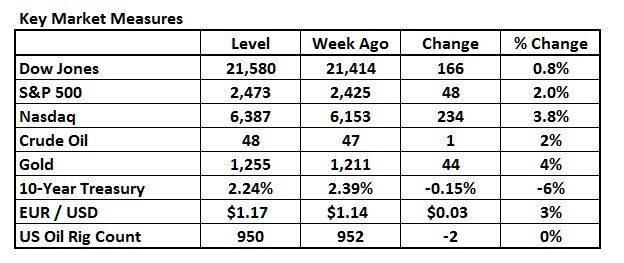
Have equity markets come too far too fast this year? Year-to-date the S&P 500 is up 12%. We are certainly not ringing any alarm bells. Rather we note that the market can’t just go up in a straight line for extended periods. While stock indexes ended the week higher, the underlining story is we are seeing the steadiest outflows of cash since 2009. Even as the S&P 500 clawed its way to a fresh record and squeezed out a third consecutive weekly gain, signs of fading enthusiasm in U.S. stocks have become increasingly difficult to ignore. The latest can be seen in the SPDR S&P 500 Trust, the biggest exchange-traded fund tracking the U.S. equity benchmark. As of Thursday, investors had pulled $3.8 billion out of it in July. That puts the fund on pace for a fourth consecutive monthly outflow, which would be the longest streak since the start of the bull rally in 2009. This push and pull will continue of course. The S&P 500 touched new highs this week before retreating as an intensifying investigation into President Donald Trump stoked concern that his economic agenda may stall. We expect more of the same in the week ahead.
However, there is always a bull market here at The Bull Market Report! This week we highlight some of our favorite stocks: Microsoft, Visa, Athenahealth, Netflix, and Blackstone. We believe in these companies.
Highlights From The Past Week
Tech Index Eclipses Record From Dot-Com Era. Tech stocks broke a nearly two-decade-old record this past week. The S&P 500's Information-Technology sector ended the day on Wednesday at 992.29, closing above its previous all-time high of 988.49 set in March 2000 at the peak of the dot-com bubble. Tech stocks are by far the best-performing among the index's 11 sectors this year, up 23% after posting their ninth consecutive day of gains Wednesday.
Bank of America Chooses Dublin for Main EU Hub After Brexit. Bank of America has picked Dublin to locate its main European Union hub in preparation for Britain quitting the bloc in 2019, the latest global bank to finalize its contingency arrangements after Brexit. The bank will move some roles from London to the Irish capital and other cities across the EU. Bank of America already has a fully licensed operation in Dublin, and employs more than 700 people in the country. London has flourished as a hub for global finance in part because firms based in the capital have the right to do business across the 28-nation EU. British banks, as well as firms from the U.S., Japan and other non-EU countries with a base in London, stand to lose this “passport” after Brexit and may need to channel business throughout other locations in the bloc.
Dublin is the second most popular destination, after Frankfurt, for Financial Services companies seeking uninterrupted EU access post-Brexit. The city provides a low-tax English-speaking location and has similar laws and regulations to its U.K. neighbor. It is fascinating to watch the evolution of the European Union and what it means for business. There are certainly major changes ahead for companies.
Draghi Says ECB Isn't There Yet as Inflation Lag Takes Time. Mario Draghi said policy makers are still waiting for inflation to catch up with the economy’s recovery, as they put off any discussion on winding back stimulus until after the summer. Specifically, he said the EU is finally experiencing a robust recovery where one only has to wait for wages and prices to follow course. “We need to be persistent and patient and prudent, because we’re not there yet.” While the ongoing economic expansion provides confidence that inflation will gradually glide toward levels in line with the inflation aim, it has yet to translate into stronger inflation dynamics. A very substantial degree of monetary accommodation is still needed for underlying inflation pressures to gradually build up. What does this all mean? Continued easy money policy from Europe’s central bank is a big benefit for global equity markets including the US. Good for the US stock markets.
Congress Must Avoid Spooking Markets on Debt Limit. The U.S. debt limit needs to be raised in a calm, thoughtful manner that steers clear of political uncertainty that would spook markets. But will they do it? Congress must avoid any political standoff that could set in motion disruptive activities such as a need to choose which bills to pay and which to delay. The government will reach its statutory limit on borrowing in early October. President Donald Trump’s administration has asked Congress to raise the ceiling before then. Concerns have surfaced in the Treasuries market, with traders willing to pay more for bills maturing after October 19th to avoid being caught holding securities vulnerable to a technical default. Watch for the upcoming political discussion over the debt and let’s hope it doesn’t get contentious.
BMR Companies & Commentary
Microsoft (MSFT: $74, up 1% - all prices in the newsletter are for the week)
The company reported earnings this week. Revenue of $25 billion beat the consensus by 2% while EPS of 98 cents beat by a big 27 cents. Analysts were positive on the quarter itself, especially around commercial cloud and commercial bookings which both came in nicely above Street expectations. Commercial cloud growth accelerated and is also experiencing margin expansion which is helping increase both operating income and free cash flow generation. Some went further and talked on how Microsoft looks to be taking share from Amazon Web Services (AWS) and is becoming a larger force in the space.
Despite the strong revenue quarter, operating expenses came in higher than expected and the company is also seen to have a higher tax rate than estimated. On top of this, some wanted to see the “billings beat” seen in the quarter to flow into greater revenue guidance for Q1.
The cloud business – Azure - was the main story from the quarter due to 30% growth in commercial bookings. Office 365 and servers were both healthy, and execution on renewals was strong.
BMR Take: All in all a very solid quarter from Microsoft. The stock hit NATHs* this week and we see NATHs ahead. We believe the stock will hit $80 in the coming months, which represents 20x EPS. The market cap is now $570 billion, only topped by Apple at $780 billion and Google at $680 billion.
*NATH – New All-Time High
Visa (V: $100, up 3%)
Visa reported strong earnings. EPS beat on stronger revenue and the company raised expectations for the forward outlook.
Visa reported EPS of $0.86, $0.05 ahead of the Street. Visa is now guiding to approximately 20% EPS growth, which compares to the "high end of mid-teens" growth which was issued previously.
From management at the earnings announcement: “Results reflect strong growth in payments volume, cross-border volume, and processed transactions, which were powered by economic tailwinds in the U.S. and globally. Results and growth reflect the company’s strategy to pursue the conversion of cash and checks to electronic payments in partnership with our clients around the world.”
The story at Visa has been strong for decades and not much has changed. And that’s a good thing. Visa is a global payments technology company working to enable consumers, businesses, banks and governments to use digital currency. Visa connects billions of consumers, businesses, banks and governments in more than 200 countries and territories worldwide. The company is as close to an unstoppable machine as can be at this point.
Take a look at this chart of Visa for the past nine years:
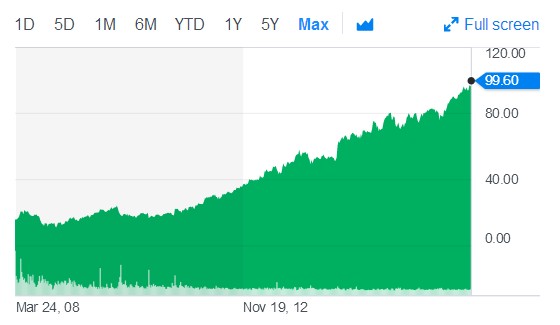
With a market cap of $230 billion, it is one of the greatest companies in the world. We would highly suggest you own some.
BMR Take: Consensus now sees EPS closing in on $5.00 in the next 1-2 years. With EPS growth running 20%, valuation looks awfully compelling to us still. We added the stock in early 2016 at $70. Our current Target is $95 which it has blown through this month, so we hereby raise our Price Target to $110. Our Sell Price remains “We would not sell Visa.”
Athenahealth (ATHN: $156, up 9%)
Athenahealth delivered an exciting quarter. The company believes it is at a key inflection point in its history and that 2017 will be a productive year for building out what differentiates them in the market. The company is demonstrating the power of its co-source model by simplifying and reducing client work. It’s building a new hospital service. It’s re-platforming AthenaNet. It’s grown its network to 100,000 providers, 98 million unique patient records, and 2.8 million covered lives, and is now positioned to be healthcare’s first true technology company. Stellar!
So many highlights from the quarter to discuss. Revenue increased 15% from last year to $293 million beating the consensus by $2 million. EPS of $0.51 crushed the consensus estimate of $0.39.
Moreover, the company continued the implementation waves at New York-Presbyterian Medical Groups, Adventist Health, and Tenet Health. The company gained access to the Centers of Medicare and Medicaid Services (“CMS”) claims data in certain states as a CMS Certified Qualified Entity. The company acquired Praxify Technologies to advance its platform strategy and mobile capabilities and accelerate its research and development initiatives by leveraging Praxify’s powerful app development platform. We could go on and on…
BMR Take: Athenahealth is a sleepy, off-the-radar company that is now firing on all cylinders. There is real upside potential ahead. Recall, big time activist investor Elliot Management has taken a stake in the company. Could we see all-time highs ahead which would be near $200? We feel this is a more than small probability.
Netflix (NFLX: $189, up 17%)
Netflix just does what it always does: Crushes expectations and the naysayers. The company delivered EPS of $0.15 just missing the consensus by a penny. But revenue of $2.8 billion was on the mark. The big story was the strength of subscriber growth and that was enough to send the stock soaring.
Netflix added 5.2 million net new subscribers in the June quarter vs. Wall Street's consensus estimate of 3.2 million. It also guided higher for the current quarter, with a forecast of 4.4 million net new subscribers, topping the consensus view for 4.0 million. This is huge subscriber growth. The company ended Q2 with 104 million subscribers worldwide, including 52 million in the U.S. and 52 million in foreign markets. Netflix's international streaming subscribers topped those in the U.S. for the first time.
Domestic net additions of 1.1 million represented the highest level of Q2 net adds since the second quarter of 2011. Better yet, Q3 guidance assumed much of this momentum will continue with the caveat that management is cognizant of the lessons of prior quarters when its over-forecasted.
The underlining fundamental story remains rock solid. With its content strategy paying off in strong member, revenue and profit growth. Management continues to believe that it is wise to continue to invest. In continued success, Netflix will deploy increased capital in content, particularly in owned originals, and, as management has said before, the business is likely to remain free cash flow negative for many years. That’s what it takes to build greatness!
The entertainment market is so broad that Netflix has now grown from zero to over 50 million streaming households in the US over the last 10 years. Netflix is growing with an expanding market, being co-pioneers of internet TV. The future is quite exciting.
BMR Take: Netflix is a premier growth story. The long term potential opportunity is quite big and we are still so early. This is one stock you just have to figure out how to own and hold onto.
The Blackstone Group (BX: $34, flat)
Blackstone delivered a decent quarter. EPS of $0.59 was just light of the $0.62 consensus. But revenue of $1.55 billion beat the $1.50 billion consensus. Total assets-under-management (AUM) was a ridiculous $370 billion. The $0.54 dividend was paid, giving the stock a dividend run-rate of 6.5%.
Management noted that it is continuing to see the benefits of its sustained large-scale capital deployment around the world, a patient focus on value creation in those investments, and then being able to choose the right moment to exit. They expect this momentum to continue. With pending realizations, including the historic sale of its European logistics portfolio, the company is on track for one of the best years for cash distributions to shareholders in its history. Wow!
In particular, the CEO said, the company’s distribution should not be viewed as one-off special dividends. They have demonstrated an ability to deliver consistently high payouts over time. Over the past three years for example, the company has distributed an average of nearly $2.50 per year, driven by over $130 billion of gains on investments.
BMR Take: EPS is running around $3.00 so the PE multiple is just over 10. The dividend yield strong and management is saying they can deliver you this dividend in the future as they have now done it now consistently for many years. We see compelling value here.
Upcoming Economic News
Existing Home Sales
Monday, July 24th, 10:00 AM
Period: June
Consensus: 5,560,000
Prior: 5,620,000
Consumer Confidence
Tuesday, July 25th, 10:00 AM
Period: July
Consensus: 116.0
Prior: 118.9
Note: The Conference Board's Consumer Confidence Survey is a monthly measure of the public's confidence in the health of the U.S. economy.
New Home Sales
Wednesday, July 26th, 10:00 AM
Period: June
Consensus: 615,000
Prior: 610,000
GDP
Friday, July 28th, 8:30 AM
Period: Q2
Consensus: +2.5%
Prior: +2.1%
Wall Street Consensus for Apple (AAPL: $150, up 1%)
Ratings Breakdown: 9 Hold Ratings, 39 Buy Ratings, No Sells
Targets
Wall Street Consensus Price Target: $16
7/22/2017 Wells Fargo $140
7/21/2017 Guggenheim $180
7/17/2017 Morgan Stanley $182
7/12/2017 Goldman Sachs Group $170
7/12/2017 Merrill Lynch $180
7/10/2017 Canaccord Genuity $180
7/9/2017 Credit Suisse Group $170
7/6/2017 Drexel Hamilton $202
BMR Take: Buy.
Wall Street Consensus for Opko Health (OPK: $6.59, up 8%)
Ratings Breakdown: 2 Hold Ratings, 6 Buy Ratings
Targets
Wall Street Consensus Price Target: $16
7/18/2017 Barrington Research $11
6/16/2017 Ladenburg Thalmann $19.50
6/12/2017 Jefferies Group $8
3/14/2017 Guggenheim $25
3/5/2017 Standpoint Research $14
1/3/2017 Laidlaw $19
BMR Take: We’re sticking with this one and are looking for a BIG upside. Look at what the brains of Wall Street think about the stock. We remain astounded that the stock has stayed down here for all this time. And the CEO and Founder just keeps buying shares.
Nutanix Insider Trading
We generally love it when insiders in a company are buying stock. Conversely, we get a little crazy when insiders are selling. Check this out about Nutanix (NTNX: $24), which had another great week, up 7%.
--- Director Jeffrey T. Parks sold 1,235,000 shares of the firm's stock in a transaction that occurred on July 14th. The stock was sold at an average price of $21.97, for a total transaction of $27,100,000.
--- Sr. VP Rajiv Mirani sold 20,000 shares of the firm's stock in a transaction that occurred on July 13th. The stock was sold at an average price of $19.63, for a total transaction of $400,000. Following the transaction, the senior vice president now directly owns 271,000 shares in the company, valued at $5,300,000. The sale was disclosed in a document filed with the Securities & Exchange Commission.
--- VP Kenneth W. Long III sold 30,000 shares of the firm's stock in a transaction that occurred on July 19th. The stock was sold at an average price of $24.00, for a total transaction of $720,000. Following the transaction, the vice president now directly owns 240,000 shares in the company, valued at $5,765,000. The sale was disclosed in a document filed with the Securities & Exchange Commission.
BMR Take: We are not happy about this. We want them to be buying the stock because as insiders, they know that the company is killing them and that the stock is going to go higher. This selling by insiders makes us very wary. We love this company and after adding the stock at $17.45 in late May, two months later we are up 36% and have high hopes for more gains. But our antennas are out do to these insider transactions and if the stock falls to the $22 level, we are out.
Amazon – A Discussion
People say Amazon (AMZN: $1,025, up 2.5%) is not making any money. The stock set a NATH this week and many see the stock peaking here, believing the stock is way over-valued since they are not making any money. We beg to differ.
The facts:
Profits the last five quarters, latest first:
$724,000,000
$749,000,000
$252,000,000
$857,000,000
$513,000,000
Revenues the past four years:
$136,000,000,000
$107,000,000,000
$89,000,000,000
$74,000,000,000
Check out this story about a new business to business website and operation in the UK and the US. This could be BIG:
http://www.businessinsider.com/interview-amazon-business-bill-burkland-017-7
A little survey on Amazon:
a) I have enough Amazon
b) I am thinking of buying more
c) I am going to buy more now
d) The stock price is too high – if they split I would buy some
e) The stock is way overvalued – their profits are too low and the PE at 190 is insanely too high.
Send your thoughts to us at Info@BullMarket.com
Home Depot, Best Buy Hit as Amazon Teams Up With Sears
Sears will sell Alexa-enabled Kenmore appliances via Amazon. But Whirlpool (WHR) and major sellers of appliances Home Depot (HD: $147, down 3%), Lowe's (LOW) and Best Buy (BBY) were hit. Home improvement chains Home Depot and Lowe's had been seen as Amazon-proof, or at least Amazon-resistant.
BMR Take: We are not ready to throw in the towel because of this one announcement, but we have to watch this development from Amazon. We added the stock to our Stocks for Success portfolio in early 2016 at $121 and are up 21%, so we don’t want to give up any of these gains. The market cap is $175 billion, they have $3.6 billion in cash supporting a sizeable debt load of $23 billion.
BMR Take: They are not going away anytime soon, but as noted above, Amazon is a monster that one needs to keep an eye on.
Google (GOOG: $973, up 2%)
July 3rd - $898. Today - $973. That’s an 8% move in three weeks.
BMR Take: Yes, they got fined big-time in Europe, but the $2.7 billion fine is peanuts to the company that has $92 billion in cash and virtually no debt, and makes over $20 billion a year. Yes, we have to watch the EU to see if there are any sanctions they will be putting on the company. But we believe the company will weather the storm and thrive. We await the break-through to NATHs of $988+ and raising our own Price Target from $1000 to $1100 or higher. Stay tuned. This just might happen sooner than you think.
Apollo Global Is Getting Ready to Take Security Firm ADT Public
Private-equity firm Apollo Global Management (APO: $28, up 2.5%) is preparing an initial public offering for ADT, just a year after it bought the home-security company.
The offering could value ADT at well over $15 billion, according to people familiar with the matter, making it one of the largest IPOs of the year. They paid $7 billion for the firm a little over a year ago. An offering would mark a quick turnaround for the private-equity firm, which began consolidating home-security providers two years ago.
BMR Take: This is just one example of the power of this firm. Apollo is way undervalued. With a 7% dividend, it's a joy waiting for a higher stock price.
The High Yield Corner
By Michael Foster
Special to The Bull Market Report
This week, we saw the AGIC Equity and Convertible Income Fund (NIE: $20) rise over 1% in the week thanks in no small part to a strong gain in the fund’s NAV. That increase was attributable to a solid week for the stocks in its portfolio, like Priceline (its second highest convertible holding) rising over 2% in the week. We’ve seen AGIC raise its equity exposure while using convertible bonds to provide a strong income stream throughout 2017, and that has resulted in two positives for investors. First, the dividend remains well-covered by investments; second, the fund has benefitted from this year’s bull market, despite how much many on the sidelines seem to hate this bull market. [That’s not us by the way. We like this bull market.]
The strong performance in the fund has helped its discount to NAV fall. This is the result of intense demand from investors for the fund, which is why the market price for the fund has risen over 11% YTD while its NAV has risen 6% over the same time period. We’re now seeing a discount of less than 10%, which is the fund’s highest since 2015. The AGIC fund has seen its discount shrink considerably from reaching a near 15% low in late 2016, which itself was an improvement from the near 20% discount at the start of 2016. This demonstrates continued interest in the fund from market participants, who see its 7.5% dividend yield as an attractive income stream, especially considering how sustainable it is.
Another Bull Market Report pick saw a similar gain this week. The Pimco Dynamic Income Fund (PDI: $30) rose nearly 1% for the week and is up 10% year-to-date. That’s not including the fund’s massive income stream, however. With an 8% yield from common dividends alone, Pimco Dynamic Income has already given an annualized return of 30%. Add in the special dividend and that number gets absolutely astronomic. This fund offered a similar return in 2016, thanks in part to its higher NAV but also thanks to investor demand. The fund has gone from a discount in 2016 to its current 7.4% premium to NAV, again indicating sustained demand for the fund from a variety of investors.
While diversified funds had a strong week, REITs were a bit less impressive. One of Bull Market Report’s top picks, Digital Realty Trust (DLR: $112), was flat for the week with little volatility. This is unusual; Digital Realty tends to bounce around a lot. But the fund has gone from a 6% yield in the past to now a 3% yield, thanks almost exclusively to its meteoric price appreciation. We’ve seen the stock jump 14% in 2017 alone, with 53% total capital gains in the last five years. It’s pretty obvious that, at this juncture, Digital Realty is no longer seen as a “high yield” risky opportunity, but is rather a low yielding REIT with long-term staying power. This makes sense; Digital Realty’s business of renting server space, is in no danger of shrinking anytime soon. This industry is also too new for us to determine whether it is cyclical or counter-cyclical. If it turns out that server space demand doesn’t go down during recessions in a cloud-computing world, then Digital Realty could quickly be perceived as one of the safest long term investments out there. For that reason, holding Digital Realty makes sense no matter what your investment profile or goals are, although the 3% yield is of course lower compared to many other REITs.
For instance, there’s Omega Healthcare Investors (OHI: $33), which also had a flat week with little volatility. Volume was much lower than average (nearly 50% of average daily shares traded). Omega has gone from a mid-8% yield to a mid-7% yield over the last couple of years, as investors have become much more aware of this stock. We’ve also seen the penny-per-quarter dividend jump continue, with dividend coverage ratios that demand respect.
There is much reason to believe this company is on solid ground, although the long-term and countercyclical sustainability of its business model (focusing on skilled nursing facilities - SNF) has been brought into question. Counterintuitively, we’ve seen an aging U.S. population be bad for SNFs for a variety of reasons. The relative wealth of aging baby boomers and the stigma associated with these facilities has made them much less popular than previous expectations. That, in turn, has put Omega and many of its peers under the spotlight, with mounting worries keeping stock prices muted (Omega is flat from a year ago and remains in the same range seen in late 2013). Five years ago and before, a lot of excitement around SNF-focused REITs drove price gains up a lot. The new perspective, and data from the industry, has kept investors more cautious.
Does this mean it’s time to sell Omega? Absolutely not. While the market is more competitive because demand is not as strong as previously expected, Omega Healthcare’s management has proven several times that they have the skill and acumen to identify and capitalize on those available opportunities in this tight market. The market, focused on the macro sentiment, has not priced in the premium that Omega Healthcare’s management should command. That makes them a buy, especially when the yield remains above 7%.
Looking ahead, investors should keep a close eye on the upcoming reports - Jobs, GDP, and Federal Reserve actions to come in late July and mid-August. This data is going to have a pretty significant impact on the future price trends for REITs and diversified funds. For now, however, The Bull Market Report’s High Yield stock picks look like solid holds, thanks to the high income stream and capital gains potential of a few of its constituents.
Good Investing,
Todd Shaver, CEO, Founder and Editor in Chief
The Bull Market Report
Since 1998
July 17, 2017
by Todd Shaver | Jul 17, 2017 | Monthly Newsletter Daily 12pm if new
The Weekly Summary
Billionaire CEO of JP Morgan Chase Jamie Dimon says being an American abroad is “almost an embarrassment.” The rant came on JP Morgan’s widely followed earnings call held Friday. Dimon says the media should focus more on major issues. He doesn’t like listening to the “stupid stuff” Americans have to deal with, expressing frustration over the nation’s inability to invest in infrastructure and overhaul the tax code. There would be much stronger growth if there were more intelligent decisions and less gridlock. Reporters should focus on the major issues the nation faces rather than the vagaries of the firm’s trading businesses, he said. The United States of America has to start to focus on policy which is good for all Americans, and that is infrastructure, regulation, taxation, education. He screamed, “Why you guys don’t write about it every day is completely beyond me. And, like, who cares about fixed-income trading in the last two weeks of June? I mean, seriously.” Dimon is one of the best businessmen in America and his words are known for being the hard truth. It makes sense to us that for the bull market to continue our citizens must wake up to the realities we face and take actions.
There is always a bull market here at The Bull Market Report! This week we highlight the following stocks: PayPal, Splunk, Microsoft, and Tesoro.
Highlights From The Past Week
US Bank earnings season started on Friday. Q2 earnings season for the banks kicked off on Friday morning with results from JP Morgan, Citigroup, Wells Fargo and PNC Financial. Some analysts have highlighted a more difficult setup for the group following a June rally on the back of higher bond yields and capital return announcements that beat elevated expectations. There have also been thoughts that earnings season could shift some of the focus back to the more challenging operating environment for the group. However, there really did not seem to be any meaningful discussion about downside risk to estimates. Analysts seem to be looking for the bulk of the support for Q2 to come from additional net interest margin expansion. This should offset sluggish loan growth and weaker capital markets (near double-digit declines). The latter dynamic has been widely discussed by bank executives and in the press and was a key driver of estimate reductions. Despite some pickup in concerns surrounding the Auto sector, credit is expected to remain benign. Analysts also highlighted expectations for another solid quarter of cost control. This is our first glimpse into the new earnings season.
More conjecture on ECB policy. There is further speculation on ECB policy where the ECB is likely to signal that it is gradually winding down its QE plan at its September 7th policy meeting, and President Draghi could use his appearance at the Fed Reserve's Jackson Hole conference in August to signal a policy shift. The ECB is wary of putting an end date to its QE plan. There is a need to retain flexibility in case the economic outlook sours and also the ECB wants to follow the Fed example of exiting the policy of retaining open-ended nature of program. A Reuters poll of over 75 economists showed consensus thinks the ECB is likely to shift away from ultra-easy policy in September. The Fed and ECB are two of the most powerful institutions in the world for capital markets. This is important stuff.
CBO says Trump budget would not balance. The Congressional Budget Office (CBO) said Trump’s fiscal 2018 budget would reduce the deficit by about a third over next decade. This is a smaller estimated deficit reduction than the White House forecast due to lower revenue projections. Trump’s budget would result in average GDP growth over next decade of 0.1% more than the CBO baseline. CBO also estimated that revenues under Trump’s budget would be almost $1 trillion lower than his estimates over the next decade. Trump budget's deficit reduction would stem from lower spending, including decreasing the $2 trillion base in mandatory spending, mostly from healthcare. Press reports said CBO’s findings creates new complications for Republicans who need to build a coalition of conservatives and moderates to vote for a single budget proposal. We need to start seeing some real progress out of the White House.
Britain acknowledges Brexit bill for the first time. Ahead of this week's Brexit talks between Brexit Secretary Davis and EU negotiator Barnier, a written statement was released to parliament, which acknowledged Britain has financial obligations to the EU, which will continue beyond Brexit. The Financial Times cited EU diplomats saying it goes further than UK Prime Minister May’s previous reference to Britain being willing to reach a “fair settlement” of unspecified obligations. It noted that Davis did not refer to financial issues when he released three position papers ahead of Brexit talks. The article pointed out that the British team sees the statement on financial obligations as an effort to improve the tone of talks rather than a change in substance. Meanwhile, at least 15 Conservative MPs are in talks with Labour on keeping Britain in the European Economic Area after Brexit, which would require accepting free movement of people and paying some money to the EU. The rationale for this approach is that it would give Britain time to reach a final deal with the EU and give certainty for businesses and workers. What a mess.
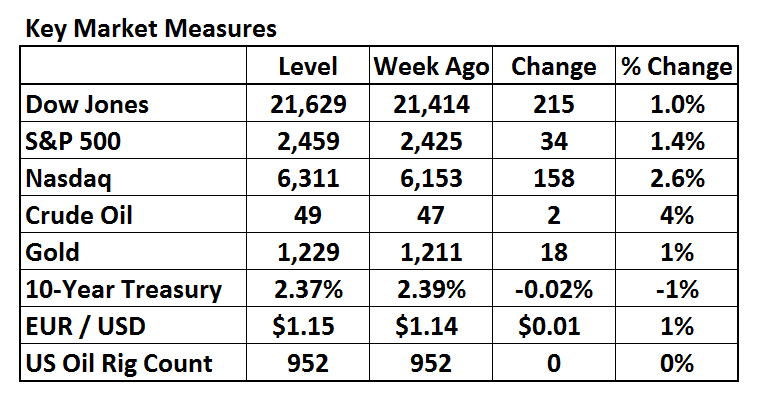
Dow, S&P 500 Hit Records to Close Winning Week
The S&P 500 hit a fresh record Friday and posted its best weekly performance since late May, and the Dow Industrials notched their third consecutive record close. Let’s keep this going!
BMR Companies & Commentary
PayPal (PYPL: $57, up 6% - new all-time high [NATH) set Friday)
The price target was raised to $70 from $54 at a research firm on the Street. PayPal is the firm's "top idea" for 2017, followed by Google (GOOG: $956, up $37, 4%). Coming opportunities with PayPal's Venmo and with partnerships caused the research firm to become even more bullish.
PayPal and Apple entered into an exciting major partnership this week that sent shares to all-time highs. PayPal and Apple have partnered to give users the ability to use PayPal as a payment method when paying for Apple’s services, which includes the App Store, Apple Music, and iTunes, to name a few. The feature will be introduced in 12 markets, including the US and the UK, and it will be integrated with several devices across Apple’s ecosystem, including the iPhone, iPod, Apple TV, and Apple Watch.
The immediate impact for PayPal is getting access to a massive revenue stream. Revenue from Apple services, which is mostly from the App Store, reached $7 billion in Q416, up 18% from last year. Although the financial terms of this deal have not been disclosed, we can estimate the potential impact. If PayPal were to charge Apple 1.25% per transaction, which is much lower than the 2.9% fee it often charges merchants, and if PayPal accounts for a third of spend on the App Store in 2017 — which will be based on consumers spending a total of $40 billion on the iOS App Store, according to Street sources — PayPal would see $165 million in revenue for 2017.
In the long run, PayPal’s partnership with Apple could give the firm an opportunity to integrate itself into additional Apple services. Over the last few years, Apple has indicated that it plans to turn its chat app, iMessage, into a robust ecosystem. The app now includes peer-to-peer payments, games, and other apps, with even more features coming in the fall with the launch of iOS 11. Although it hasn't been confirmed, it's reasonable to assume that one feature coming down the pipeline is the ability to buy products via iMessage. With PayPal already being a payment option within Apple's ecosystem, users may be more willing to use it going forward.
BMR Take: PayPal ranks among the best growth stories in all of technology and this Apple deal is just another reason as to why. Earnings are growing greater than 20% per year for as far as the eye can see and should break $3 by 2020.
Microsoft (MSFT: $73, up 5%, set a NATH* on Friday)
Early in the week Microsoft proposed a $10 billion effort to bring broadband internet to the rural U.S., an economic-development program aimed at a core constituency of the Trump administration. The plan, which calls for corporate and government cash, would send internet data over unused broadcast frequencies set aside for television channels. If developed, the initiative would help connect 23 million Americans in rural areas who lack high-speed internet access.
*NATH - New All-Time High
Broadband is important for all kinds of things. It’s not just streaming high-definition movies. Slow or nonexistent connections can hinder agriculture, business, education and healthcare. Broadband is arguable now a necessity of life. Microsoft’s proposal calls for a 5-year program of corporate investment and matching federal and state grants to end the gap between rural and urban access, starting with the company’s own efforts. The aim of Microsoft’s new Rural Airband Initiative is to be up and running in 12 states by next year and connect 2 million people over the next five years.
BMR Take: Doing big things like what is described above is why Microsoft is not just a tech titan, but a leader amongst the entire S&P 500. News like this continues to push the stock toward 20x consensus estimates of $4 per share of free cash flow. Do the math – that’s $80 a share.
Tesoro (TSO: $97, up 1%)
Tesoro has been a big winner and it could keep getting better. This week the company announced plans to study the possibility of turning vegetable oil into diesel fuel at its Dickinson refinery, which it purchased in 2016.
The crude oil refiner is making plans to retrofit an 8,000-barrel-per-day diesel hydrotreater to process soy and corn oil into renewable diesel alongside its Bakken crude oil processing. This $3.5 million project would use 17,000 gallons per day of vegetable oils to create a 5% renewable diesel mix to be marketed in North Dakota by the end of 2017. The North Dakota Industrial Commission granted the company a $500,000 grant to help cover the project's cost.
Compared to biodiesel that is blended into petroleum diesel at truck racks, renewable diesel is a superior quality product because, unlike biodiesel, renewable diesel is a pure hydrocarbon stream containing no oxygen. This results in a superior quality fuel that maintains vehicle performance. The company says the project is “unique and exciting.” Of course they do!
BMR Take: The stock continues to trade at a big discount to the consensus NAV* estimate of $120. In comparison, Buffet’s ownership of peer Phillips66 is valued at a premium to NAV in the market. Disconnect that the market will correct down the road? We think so. Tesoro still looks compelling to us even after the recent appreciation.
*NAV – net asset value
Upcoming Economic News
Export Price Index
Tuesday, July 18th, 8:30 AM
Period: June
Consensus: 0.05%
Prior: -0.70%
Note: The U.S. Bureau of Labor Statistics' International Price Program produces Import Price Indexes (MPI) and Export Price Indexes (XPI) containing data on changes in the prices of nonmilitary goods and services traded between the U.S. and the rest of the world.
Housing Starts
Wednesday, July 19th, 8:30 AM
Period: June
Consensus: 1,146,000
Prior: 1,092,000
Note: The number of housing units started in the United States.
Leading Economic Index
Thursday, July 20th, 10:00 AM
Period: June
Consensus: +0.30%
Prior: +0.30%
Note: The Conference Board Leading Economic Index (LEI) for the U.S. increased 0.3% in May to 127.0 (2010 = 100, following a 0.2% increase in April, and a 0.4% increase in March. Leading Indicators are economic series that tend to change direction ahead of shifts in the business cycle. There are 10 components of the U.S. Leading Composite Indicator* published by The Conference Board. The index is constructed by averaging the individual components in order to smooth out a good part of the volatility of the individual series. Historically, the cyclical turning points in the leading index have occurred before those in aggregate economic activity. Prior to 1996, the composite leading, coincident, and lagging indicators were calculated and published by the U.S. Department of Commerce.
* Average weekly hours, manufacturing
Average weekly initial claims for unemployment insurance
Manufacturers’ new orders, consumer goods and materials
ISM Index of New Orders
Manufacturers' new orders, non-defense capital goods excluding aircraft orders
Building permits, new private housing units
Stock prices, 500 common stocks
Leading Credit Index
Interest rate spread, 10-year Treasury bonds less federal funds
Average consumer expectations for business conditions
An Interview with Tim Cook
We read a lengthy interview of Apple CEO Tim Cook by Bloomberg Businessweek Editor Megan Murphy. We thought the following few paragraphs from it were particularly insightful:
Murphy: I was a little surprised the HomePod was pitched primarily as a music device when the competitive talk is of Amazon Echo’s Alexa and the immersive experience in the home. How will the HomePod better integrate Apple inside people’s lives?
Cook: We’re actually already in the home through the iPhone you take with you everywhere. It’s in your pocket or laying on a stand. Today, pre-HomePod, I can control my home using Siri through the iPhone. When I get up in the morning, my iPhone is my alarm clock. I say, “Good morning,” and all of a sudden, my lights come on. The temperature adjusts and a series of things occur. We’re also in the home through Apple TV. Many people use iPad as their computing device. The desktop Mac enjoys a place in the home. The thing that has arguably not gotten a great level of focus is music in the home. So we decided we would combine great sound and an intelligent speaker.
Murphy: So, it’s going to be a holistic process joining up all those touch points so people can exercise control over their lives, whether through Siri or iPad?
Cook: To put it in perspective, Siri is getting requests from 375 million devices right now. My guess is it’s the largest by far of any kind of assistant. Some of those requests are done in the home. Some of those are done on the go. That’s the platform that we build off. It’s very different from our starting point. We’re also in so many languages around the world: Siri isn’t just in English. We’re well-positioned around the world. So, again, what is the thing that’s missing in this equation? The combination of quality audio and instinct.
“I am so excited about it, I just want to yell out and scream”
Murphy: Do you think people will pay $349?
Cook: If you remember when the iPod was introduced, a lot of people said, “Why would anybody pay $399 for an MP3 player?” And when iPhone was announced, it was, “Is anybody gonna pay - whatever it was at that time - for an iPhone?” The iPad went through the same thing. We have a pretty good track record of giving people something that they may not have known that they wanted.
When I was growing up, audio was No. 1 on the list of things that you had to have. You were jammin’ out on your stereo. Audio is still really important in all age groups, not just for kids. We’re hitting on something people will be delighted with. It’s gonna blow them away. It’s gonna rock the house.
BMR Take: We were pleased to see Tim Cook’s responses for two reasons. 1) the iPhone is already the home controller of choice. We knew this, but Cook really put it in perspective. And 2) The takeover of a market is Apple’s modus operandi. Start late with a high price. Then lower prices and dominate. We have no doubt the home assistant will be any different. Amazon – watch out.
Nutanix Has a Rip-Roaring Week
The stock of Nutanix (NTNX: $22) was up 16% last week. We’ve been harping on this stock for weeks, and then along comes Goldman Sachs and says Nutanix is a “once-in-a-decade” opportunity and are looking for a $31 Target. Our Price Target is $30. Is Goldman reading The Bull Market Report? We certainly think so.
We’re already up 27% in the six weeks since we added the stock in late May. And we expect more good things from the company in the future. Nutanix is the leader in hyperconverged infrastructure, meaning it uses software to combine different storage and computing functions on one device. That space has been heating up among enterprises. More businesses are looking to adapt the technology, with 18% of chief information officers saying they expect to move to hyperconverged systems in the next two years, according to Goldman Sachs.
The company’s leadership in the space, including the combination of hardware and software it offers, makes it a “once-in-a-decade tech infrastructure story,” wrote the lead Goldman analyst on the note. They see Nutanix on a path for long-term double-digit growth, high gross margins and large operating leverage.
Additionally, in the shorter-term, Nutanix should benefit from changed accounting rules that will move its software revenues, which are currently deferred, to its profit and loss statement.
BMR Take: What more can we say? All good.
First Solar Continues its Tear
First Solar (FSLR: $43) was up another 9% this past week. We’re still down 30% or so on the stock but we are big believers in the company and management. Our timing on the addition to the Special Opportunities portfolio was bad. But we believe we will be winners in the long run. The stock is up over 55% in the last three months. Keep hanging in there.
Apple Back Up To $150.
Almost. Closed at $149, up $5 for the week. The market just can’t keep this one down. We sincerely hope you have some of this wonderful firm. You think it’s too high. Not on your life.
Annaly Just Keeps Chugging Along
And it is paying 10% a year in dividends. Annaly Capital Management (NLY: $12.33) added 2% last week. The stock has been paying double-digit dividends since inception in 1997. That’s right – 20 years. Where will the stock be in a year? Good question. We would say right about at this level, after paying another four quarterly dividends of 30 cents each. Do the math – that’s a shade under a 10% return. We love this one.
The High Yield Corner
By Michael Foster
Special to The Bull Market Report
We’re getting close to earnings season for Healthcare REITs, and the market’s expectations seem to be getting increasingly bullish. Over the last week, all of The Bull Market Report’s Healthcare REIT picks were in the green, with Omega Healthcare Investors (OHI: $33) leading the pack with a 2% gain for the week. That’s pushed the stock’s year-to-date performance much higher, with a 7% gain on top of half of the fund’s 8% dividend yield. There’s been a relatively low amount of volatility in Omega Healthcare relative to what we saw both in 2015 (where rate hike fears hit all REITs) and 2016 (when the REIT bull market suddenly corrected at the end of the year).
But what about the upcoming earnings report on July 27th? So far, analysts are expecting 86 cent FFO for the quarter, up from 83 cents from a year ago. The company has reaffirmed their 86 cent guidance as recently as early May, bringing the stock’s dividend coverage ratio to 134% if they hit the number. Gotta love it.
Before we discuss whether they will hit it or not, let’s take a quick look at Welltower (HCN: $74, up 1%), which had a similarly strong week and is also planning to release earnings soon - on July 28th before the market open. Welltower has far outperformed Omega for 2017, with a 10% price jump - although the lower dividend (5%) mostly offsets this. Like Omega Healthcare, Welltower is showing strikingly little volatility as of late, a development that makes a lot of sense given Welltower’s tremendous track record and strong dividend coverage. However, it’s surprising to see that Welltower’s dividend coverage is a shade lower than Omega’s at 128%. While that’s still good (general rule of thumb: any number over 115% is good for a REIT), it’s interesting to see how the dividend coverage ratio has slipped in the last couple of years as a result of falling funds from operations. Welltower’s earnings were down 6% from a year ago last quarter, and guidance suggests that decline is set to continue. But Welltower is also increasing dividends, which is a setup for a worrisome dynamic in which, eventually, the company will under-earn its dividend. How soon could that happen? At the current clip we’re safe for another 3-4 years, but the company clearly needs to adapt, lest it find itself suddenly in a position to halt or even cut dividends. For this reason, the company’s earnings results on the 28th and especially its forward guidance will be a key issue to watch for. We will keep a close eye on this.
Finally, Sabra Health Care REIT (SBRA: $23) had a flat week (up less than 1%) despite being one of the smallest Healthcare REITs in terms of market cap and property footprint. It’s quite unusual to see the smaller stock be less volatile than its bigger cousins, but Sabra is one of the less popular REITs out there (investors, especially retail investors, spend a lot more time focusing on Omega), and there was little news on the stock to justify much price action. On top of that, the company’s massive underperformance relative to its peers has soured a lot of investors on the company, while fundamental investors know this is a very good company with strong dividend coverage and growth potential.
So, if you have few sellers and few buyers, you end up with little price change. But how is Sabra doing as we near its earnings release at the end of July? Over the last 12 months, earnings have been weak relative to expectations, with two misses out of the last four quarters. But dividend coverage is impressive, at 132%. Some investors may be a bit concerned about the company’s relatively weak revenue growth, but it’s important to remember that Sabra is pausing on acquisitions right now and reorganizing its new property portfolio additions to maximize income. This process naturally makes revenue look bad, which again is why impatient investors have shied away. Nonetheless, the ongoing restructuring continues to be successful, as the strong dividend coverage ratio proves. Expect to see good things from Sabra in the future that will help the stock recover, but we may not see those developments for a year or more. For investors, that means sitting tight with your Sabra shares, collecting a 7% dividend while you wait for the market to catch up.
Now, with upcoming earnings for these stocks, we need to ask ourselves the likelihood of them hitting their numbers. While there are differences in each company that makes some stronger than others, the broader issue that impacts all of them is the regulatory overhang. A lot of chatter about the future of Obamacare and plans from the Republicans and President Trump to change or obliterate current regulations has left a lot of investors skittish on Healthcare for a long time. But interestingly, we’ve seen the market swiftly realize how silly these concerns are - at least as it impacts the Biopharma sector, which is up solidly for 2017 and is beating the S&P 500. But why isn’t that same relief coming to Healthcare REITs with the same speed?
Simply put, REIT investors are far more risk averse as a group, and they are much slower to recognize a change in the political landscape than growth stock investors. This puts those holding Healthcare REITs in the awkward position of needing to be patient. However, it is clear that there is little change to the regulatory environment coming, and some analysts are already noting that recent GOP proposals to change Obamacare actually look a lot like Obamacare. Whatever your political leanings and opinions on the subject, it seems pretty clear that the status quo isn’t going to change anytime soon.
Again, no matter your opinions on the growing D.C.-based controversies, there is a clear conclusion: Healthcare as it operates in America is not about to change anytime soon. Healthcare REITs have been discounted for a change that would negatively impact them. Putting these together, it’s a clear time to buy or to continue to hold Healthcare REITs both before and after the upcoming earnings season.
Good Investing,
Todd Shaver, Founder, Editor and CEO
The Bull Market Report
Since 1998
July 16, 2017
by Todd Shaver | Jul 16, 2017 | Weekly Newsletter 7pm Sunday
The Weekly Summary
Billionaire CEO of JP Morgan Chase Jamie Dimon says being an American abroad is “almost an embarrassment.” The rant came on JP Morgan’s widely followed earnings call held Friday. Dimon says the media should focus more on major issues. He doesn’t like listening to the “stupid stuff” Americans have to deal with, expressing frustration over the nation’s inability to invest in infrastructure and overhaul the tax code. There would be much stronger growth if there were more intelligent decisions and less gridlock. Reporters should focus on the major issues the nation faces rather than the vagaries of the firm’s trading businesses, he said. The United States of America has to start to focus on policy which is good for all Americans, and that is infrastructure, regulation, taxation, education. He screamed, “Why you guys don’t write about it every day is completely beyond me. And, like, who cares about fixed-income trading in the last two weeks of June? I mean, seriously.” Dimon is one of the best businessmen in America and his words are known for being the hard truth. It makes sense to us that for the bull market to continue our citizens must wake up to the realities we face and take actions.
There is always a bull market here at The Bull Market Report! This week we highlight the following stocks: PayPal, Splunk, Microsoft, and Tesoro.
Highlights From The Past Week
US Bank earnings season started on Friday. Q2 earnings season for the banks kicked off on Friday morning with results from JP Morgan, Citigroup, Wells Fargo and PNC Financial. Some analysts have highlighted a more difficult setup for the group following a June rally on the back of higher bond yields and capital return announcements that beat elevated expectations. There have also been thoughts that earnings season could shift some of the focus back to the more challenging operating environment for the group. However, there really did not seem to be any meaningful discussion about downside risk to estimates. Analysts seem to be looking for the bulk of the support for Q2 to come from additional net interest margin expansion. This should offset sluggish loan growth and weaker capital markets (near double-digit declines). The latter dynamic has been widely discussed by bank executives and in the press and was a key driver of estimate reductions. Despite some pickup in concerns surrounding the Auto sector, credit is expected to remain benign. Analysts also highlighted expectations for another solid quarter of cost control. This is our first glimpse into the new earnings season.
More conjecture on ECB policy. There is further speculation on ECB policy where the ECB is likely to signal that it is gradually winding down its QE plan at its September 7th policy meeting, and President Draghi could use his appearance at the Fed Reserve's Jackson Hole conference in August to signal a policy shift. The ECB is wary of putting an end date to its QE plan. There is a need to retain flexibility in case the economic outlook sours and also the ECB wants to follow the Fed example of exiting the policy of retaining open-ended nature of program. A Reuters poll of over 75 economists showed consensus thinks the ECB is likely to shift away from ultra-easy policy in September. The Fed and ECB are two of the most powerful institutions in the world for capital markets. This is important stuff.
CBO says Trump budget would not balance. The Congressional Budget Office (CBO) said Trump’s fiscal 2018 budget would reduce the deficit by about a third over next decade. This is a smaller estimated deficit reduction than the White House forecast due to lower revenue projections. Trump’s budget would result in average GDP growth over next decade of 0.1% more than the CBO baseline. CBO also estimated that revenues under Trump’s budget would be almost $1 trillion lower than his estimates over the next decade. Trump budget's deficit reduction would stem from lower spending, including decreasing the $2 trillion base in mandatory spending, mostly from healthcare. Press reports said CBO’s findings creates new complications for Republicans who need to build a coalition of conservatives and moderates to vote for a single budget proposal. We need to start seeing some real progress out of the White House.
Britain acknowledges Brexit bill for the first time. Ahead of this week's Brexit talks between Brexit Secretary Davis and EU negotiator Barnier, a written statement was released to parliament, which acknowledged Britain has financial obligations to the EU, which will continue beyond Brexit. The Financial Times cited EU diplomats saying it goes further than UK Prime Minister May’s previous reference to Britain being willing to reach a “fair settlement” of unspecified obligations. It noted that Davis did not refer to financial issues when he released three position papers ahead of Brexit talks. The article pointed out that the British team sees the statement on financial obligations as an effort to improve the tone of talks rather than a change in substance. Meanwhile, at least 15 Conservative MPs are in talks with Labour on keeping Britain in the European Economic Area after Brexit, which would require accepting free movement of people and paying some money to the EU. The rationale for this approach is that it would give Britain time to reach a final deal with the EU and give certainty for businesses and workers. What a mess.
Dow, S&P 500 Hit Records to Close Winning Week
The S&P 500 hit a fresh record Friday and posted its best weekly performance since late May, and the Dow Industrials notched their third consecutive record close. Let’s keep this going!
Special Profile - Leon Black of Apollo
Private equity firm Apollo Global Management (APO: $27, up 3%) this week agreed to acquire ClubCorp Holdings, one of the largest owners and operators of private golf and country clubs in the United States, for $1.1 billion. ClubCorp owns and operates 200 golf, country, business, sports and alumni clubs in 28 states, Washington D.C. and two foreign countries,
The deal comes three months after ClubCorp announced the retirement of is CEO Eric Affeldt and said it had decided not to pursue a "strategic transaction," after efforts to explore a sale did not result in any offer for the entire company. So much for those thoughts!
Apollo said it will pay a 31% premium over its closing price on Friday, in cash for ClubCorp, a but less than the 12-month high the shares reached in February.
Who is the man behind the curtain? Apollo Chairman and CEO Leon Black. He founded Apollo in 1990 to manage investment capital on behalf of a group of institutional investors, focusing on corporate restructuring, leveraged buyouts, and taking minority positions in growth-oriented companies. From 1977 to 1990, Mr. Black worked at Drexel Burnham Lambert, where he served as Managing Director, head of the Mergers & Acquisitions Group and co-head of the Corporate Finance Department. He now serves on the boards of directors of Apollo Global Management, and The Partnership for New York City. Mr. Black is Co-chairman of The Museum of Modern Art, and a trustee of Mount Sinai Hospital, The Metropolitan Museum of Art, and The Asia Society. He is a member of The Council on Foreign Relations. Mr. Black is also a member of the board of FasterCures and the Port Authority Task Force. He graduated summa cum laude from Dartmouth College with a major in Philosophy and History and received an MBA from Harvard Business School.
BMR Take: This man is a powerhouse and the success of your investment in Apollo will depend on Mr. Black. We put him in that category of people like Elon Musk, Steve Jobs and Bill Gates. We are big believers.
BMR Companies & Commentary
PayPal (PYPL: $57, up 6% - new all-time high [NATH) set Friday)
The price target was raised to $70 from $54 at a research firm on the Street. PayPal is the firm's "top idea" for 2017, followed by Google (GOOG: $956, up $37, 4%). Coming opportunities with PayPal's Venmo and with partnerships caused the research firm to become even more bullish.
PayPal and Apple entered into an exciting major partnership this week that sent shares to all-time highs. PayPal and Apple have partnered to give users the ability to use PayPal as a payment method when paying for Apple’s services, which includes the App Store, Apple Music, and iTunes, to name a few. The feature will be introduced in 12 markets, including the US and the UK, and it will be integrated with several devices across Apple’s ecosystem, including the iPhone, iPod, Apple TV, and Apple Watch.
The immediate impact for PayPal is getting access to a massive revenue stream. Revenue from Apple services, which is mostly from the App Store, reached $7 billion in Q416, up 18% from last year. Although the financial terms of this deal have not been disclosed, we can estimate the potential impact. If PayPal were to charge Apple 1.25% per transaction, which is much lower than the 2.9% fee it often charges merchants, and if PayPal accounts for a third of spend on the App Store in 2017 — which will be based on consumers spending a total of $40 billion on the iOS App Store, according to Street sources — PayPal would see $165 million in revenue for 2017.
In the long run, PayPal’s partnership with Apple could give the firm an opportunity to integrate itself into additional Apple services. Over the last few years, Apple has indicated that it plans to turn its chat app, iMessage, into a robust ecosystem. The app now includes peer-to-peer payments, games, and other apps, with even more features coming in the fall with the launch of iOS 11. Although it hasn't been confirmed, it's reasonable to assume that one feature coming down the pipeline is the ability to buy products via iMessage. With PayPal already being a payment option within Apple's ecosystem, users may be more willing to use it going forward.
BMR Take: PayPal ranks among the best growth stories in all of technology and this Apple deal is just another reason as to why. Earnings are growing greater than 20% per year for as far as the eye can see and should break $3 by 2020.
Splunk (SPLK: $60, up 4.5%)
Splunk has come under some selling pressure and stock is still below the highs of the year at $69 set in May, providing yet another buying opportunity as the company exits this seasonal lull. In a market where the "FAAMG*" stocks and other rapidly growing tech companies are making all-time highs, Splunk is down 43% from its high made in 2014. This comes despite Splunk more than tripling its revenue in the last three years and consistently beating analyst expectations.
*FAAMG – Facebook, Apple, Amazon, Microsoft and Google
In our view, Splunk has been one of the most consistent companies over the years and one of the best pure-plays of the Big Data movement. In June, Splunk's growing importance in this market was on display at Cisco Live!, the Data Works Summit and the Cloud Expo. A prime example of Splunk's expanded importance is with Cisco, which is now indexing approximately 9-10 terabytes per day with Splunk versus 2 TB per day in 2015, significantly above the 300 GB of data per day in 2010.
After reporting strong April quarter results during its seasonally weakest quarter of the year, Splunk came under selling pressure in late May and still has not recovered from this downdraft. The market got hung up on "inconsistent performance" during the April quarter that resulted in a leadership change, while license revenue missed forecasts given the strength in the company's cloud business that drove big upside in maintenance and services revenue. As Splunk begins to head into the stronger part of the year, we believe the stock can play catch-up.
Given rising security threats, including the WannaCry Ransomware attack in May, Splunk introduced Splunk Insights for Ransomware in late June. This new offering allows smaller organizations (they offer user-based pricing for up to 1,000 employees) to fight malware in real time with a cost-effective solution.
BMR Take: By leveraging a proprietary machine data technology to turn data into real-time operational intelligence, Splunk is benefiting from its position as a pioneer and leader in the world of machine data with its core software platform called Splunk Enterprise. We see substantial upside for the stock as the current valuation is only 6x revenue versus a high-water market of 28x. We’re up 29% on the stock in a little over a year, but we would await even better returns this next six months as the market comes to recognize how strong the company is.
Microsoft (MSFT: $73, up 5%, setting a NATH* on Friday)
Early in the week Microsoft proposed a $10 billion effort to bring broadband internet to the rural U.S., an economic-development program aimed at a core constituency of the Trump administration. The plan, which calls for corporate and government cash, would send internet data over unused broadcast frequencies set aside for television channels. If developed, the initiative would help connect 23 million Americans in rural areas who lack high-speed internet access.
*NATH - New All-Time High
Broadband is important for all kinds of things. It’s not just streaming high-definition movies. Slow or nonexistent connections can hinder agriculture, business, education and healthcare. Broadband is arguable now a necessity of life. Microsoft’s proposal calls for a 5-year program of corporate investment and matching federal and state grants to end the gap between rural and urban access, starting with the company’s own efforts. The aim of Microsoft’s new Rural Airband Initiative is to be up and running in 12 states by next year and connect 2 million people over the next five years.
BMR Take: Doing big things like what is described above is why Microsoft is not just a tech titan, but a leader amongst the entire S&P 500. News like this continues to push the stock toward 20x consensus estimates of $4 per share of free cash flow. Do the math – that’s $80 a share.
Tesoro (TSO: $97, up 1%)
Tesoro has been a big winner and it could keep getting better. This week the company announced plans to study the possibility of turning vegetable oil into diesel fuel at its Dickinson refinery, which it purchased in 2016.
The crude oil refiner is making plans to retrofit an 8,000-barrel-per-day diesel hydrotreater to process soy and corn oil into renewable diesel alongside its Bakken crude oil processing. This $3.5 million project would use 17,000 gallons per day of vegetable oils to create a 5% renewable diesel mix to be marketed in North Dakota by the end of 2017. The North Dakota Industrial Commission granted the company a $500,000 grant to help cover the project's cost.
Compared to biodiesel that is blended into petroleum diesel at truck racks, renewable diesel is a superior quality product because, unlike biodiesel, renewable diesel is a pure hydrocarbon stream containing no oxygen. This results in a superior quality fuel that maintains vehicle performance. The company says the project is “unique and exciting.” Of course they do!
BMR Take: The stock continues to trade at a big discount to the consensus NAV* estimate of $120. In comparison, Buffet’s ownership of peer Phillips66 is valued at a premium to NAV in the market. Disconnect that the market will correct down the road? We think so. Tesoro still looks compelling to us even after the recent appreciation.
*NAV – net asset value
Upcoming Economic News
Export Price Index
Tuesday, July 18th, 8:30 AM
Period: June
Consensus: 0.05%
Prior: -0.70%
Note: The U.S. Bureau of Labor Statistics' International Price Program produces Import Price Indexes (MPI) and Export Price Indexes (XPI) containing data on changes in the prices of nonmilitary goods and services traded between the U.S. and the rest of the world.
Housing Starts
Wednesday, July 19th, 8:30 AM
Period: June
Consensus: 1,146,000
Prior: 1,092,000
Note: The number of housing units started in the United States.
Leading Economic Index
Thursday, July 20th, 10:00 AM
Period: June
Consensus: +0.30%
Prior: +0.30%
Note: The Conference Board Leading Economic Index (LEI) for the U.S. increased 0.3% in May to 127.0 (2010 = 100, following a 0.2% increase in April, and a 0.4% increase in March. Leading Indicators are economic series that tend to change direction ahead of shifts in the business cycle. There are 10 components of the U.S. Leading Composite Indicator* published by The Conference Board. The index is constructed by averaging the individual components in order to smooth out a good part of the volatility of the individual series. Historically, the cyclical turning points in the leading index have occurred before those in aggregate economic activity. Prior to 1996, the composite leading, coincident, and lagging indicators were calculated and published by the U.S. Department of Commerce.
* Average weekly hours, manufacturing
Average weekly initial claims for unemployment insurance
Manufacturers’ new orders, consumer goods and materials
ISM Index of New Orders
Manufacturers' new orders, non-defense capital goods excluding aircraft orders
Building permits, new private housing units
Stock prices, 500 common stocks
Leading Credit Index
Interest rate spread, 10-year Treasury bonds less federal funds
Average consumer expectations for business conditions
A Word From Gary Jefferson
First Vice-President, Investments
UBS Financial Services, Inc.
Q2 GDP estimate - +2.7%. Anything above 2% is a real plus after eight years of mostly sub -2%, and should provide the momentum needed to get to the 3%+ level.
222,000 jobs added versus 170,000 expected – A lot more should come with passage of any of the three main Trump growth initiatives.
57.8 ISM - Manufacturing is highest since 2014 – This is just what the doctor ordered!
57.4 ISM Services is nice. 60.8 forward-looking New Orders component is even nicer.
None of this means the economy is safe forever. Another recession is inevitable. But what these stats are telling us is that it's just not coming anytime soon.
We still like the Technology, Healthcare, and Financial sectors. While some folks think some of the Tech stocks are bubbly, we agree with those who simply ask about why Tech has led, and if anything has changed. The answers are "earnings" and "no"………. or how about, "FANG is dead – long live FAAMG". [We think you might have to read this last paragraph a few times to get his point!]
2nd Quarter earnings season starts this week. If it lives up to expectations we shouldn't even have to worry about a pullback. Right now, the stats favor another good earnings session. We don't expect the Fed to raise rates until September, and that will depend on how year-end earnings guidance looks. The two dates which will probably have as much if not greater effect on the market are September 5th and 30th. If nothing gets done in Washington before the August recess on September 5th, it could signal the end of any chance for growth stimulus to happen this year. That will likely create a fairly strong headwind. On September 30th, government funding expires. Hopefully we won't have to endure another ridiculous dog-and-pony show in Washington and this will not become a major distraction for investors.
An Interview with Tim Cook
We read a lengthy interview of Apple CEO Tim Cook by Bloomberg Businessweek Editor Megan Murphy. We thought the following few paragraphs from it were particularly insightful:
Murphy: I was a little surprised the HomePod was pitched primarily as a music device when the competitive talk is of Amazon Echo’s Alexa and the immersive experience in the home. How will the HomePod better integrate Apple inside people’s lives?
Cook: We’re actually already in the home through the iPhone you take with you everywhere. It’s in your pocket or laying on a stand. Today, pre-HomePod, I can control my home using Siri through the iPhone. When I get up in the morning, my iPhone is my alarm clock. I say, “Good morning,” and all of a sudden, my lights come on. The temperature adjusts and a series of things occur. We’re also in the home through Apple TV. Many people use iPad as their computing device. The desktop Mac enjoys a place in the home. The thing that has arguably not gotten a great level of focus is music in the home. So we decided we would combine great sound and an intelligent speaker.
Murphy: So, it’s going to be a holistic process joining up all those touch points so people can exercise control over their lives, whether through Siri or iPad?
Cook: To put it in perspective, Siri is getting requests from 375 million devices right now. My guess is it’s the largest by far of any kind of assistant. Some of those requests are done in the home. Some of those are done on the go. That’s the platform that we build off. It’s very different from our starting point. We’re also in so many languages around the world: Siri isn’t just in English. We’re well-positioned around the world. So, again, what is the thing that’s missing in this equation? The combination of quality audio and instinct.
“I am so excited about it, I just want to yell out and scream”
Murphy: Do you think people will pay $349?
Cook: If you remember when the iPod was introduced, a lot of people said, “Why would anybody pay $399 for an MP3 player?” And when iPhone was announced, it was, “Is anybody gonna pay - whatever it was at that time - for an iPhone?” The iPad went through the same thing. We have a pretty good track record of giving people something that they may not have known that they wanted.
When I was growing up, audio was No. 1 on the list of things that you had to have. You were jammin’ out on your stereo. Audio is still really important in all age groups, not just for kids. We’re hitting on something people will be delighted with. It’s gonna blow them away. It’s gonna rock the house.
BMR Take: We were pleased to see Tim Cook’s responses for two reasons. 1) the iPhone is already the home controller of choice. We knew this, but Cook really put it in perspective. And 2) The takeover of a market is Apple’s modus operandi. Start late with a high price. Then lower prices and dominate. We have no doubt the home assistant will be any different. Amazon – watch out.
Nutanix Has a Rip-Roaring Week
The stock of Nutanix (NTNX: $22) was up 16% last week. We’ve been harping on this stock for weeks, and then along comes Goldman Sachs and says Nutanix is a “once-in-a-decade” opportunity and are looking for a $31 Target. Our Price Target is $30. Is Goldman reading The Bull Market Report? We certainly think so.
We’re already up 27% in the six weeks since we added the stock in late May. And we expect more good things from the company in the future. Nutanix is the leader in hyperconverged infrastructure, meaning it uses software to combine different storage and computing functions on one device. That space has been heating up among enterprises. More businesses are looking to adapt the technology, with 18% of chief information officers saying they expect to move to hyperconverged systems in the next two years, according to Goldman Sachs.
The company’s leadership in the space, including the combination of hardware and software it offers, makes it a “once-in-a-decade tech infrastructure story,” wrote the lead Goldman analyst on the note. They see Nutanix on a path for long-term double-digit growth, high gross margins and large operating leverage.
Additionally, in the shorter-term, Nutanix should benefit from changed accounting rules that will move its software revenues, which are currently deferred, to its profit and loss statement.
BMR Take: What more can we say? All good.
First Solar Continues its Tear
First Solar (FSLR: $43) was up another 9% this past week. We’re still down 30% or so on the stock but we are big believers in the company and management. Our timing on the addition to the Special Opportunities portfolio was bad. But we believe we will be winners in the long run. The stock is up over 55% in the last three months. Keep hanging in there.
Twilio Hanging in There
Twilio (TWLO: $29, up 3%) had a good week. It’s down from where we added it for sure, but slowly creeping back up as the Street slowly begins to realize the potential of this company. We are again looking for another strong revenue quarter in early August when they announce. That will show the Street!
Apple Back Up To $150.
Almost. Closed at $149, up $5 for the week. The market just can’t keep this one down. We sincerely hope you have some of this wonderful firm. You think it’s too high. Not on your life.
Annaly Just Keeps Chugging Along
And it is paying 10% a year in dividends. Annaly Capital Management (NLY: $12.33) added 2% last week. The stock has been paying double-digit dividends since inception in 1997. That’s right – 20 years. Where will the stock be in a year? Good question. We would say right about at this level, after paying another four quarterly dividends of 30 cents each. Do the math – that’s a shade under a 10% return. We love this one.
The High Yield Corner
By Michael Foster
Special to The Bull Market Report
We’re getting close to earnings season for Healthcare REITs, and the market’s expectations seem to be getting increasingly bullish. Over the last week, all of The Bull Market Report’s Healthcare REIT picks were in the green, with Omega Healthcare Investors (OHI: $33) leading the pack with a 2% gain for the week. That’s pushed the stock’s year-to-date performance much higher, with a 7% gain on top of half of the fund’s 8% dividend yield. There’s been a relatively low amount of volatility in Omega Healthcare relative to what we saw both in 2015 (where rate hike fears hit all REITs) and 2016 (when the REIT bull market suddenly corrected at the end of the year).
But what about the upcoming earnings report on July 27th? So far, analysts are expecting 86 cent FFO for the quarter, up from 83 cents from a year ago. The company has reaffirmed their 86 cent guidance as recently as early May, bringing the stock’s dividend coverage ratio to 134% if they hit the number. Gotta love it.
Before we discuss whether they will hit it or not, let’s take a quick look at Welltower (HCN: $74, up 1%), which had a similarly strong week and is also planning to release earnings soon - on July 28th before the market open. Welltower has far outperformed Omega for 2017, with a 10% price jump - although the lower dividend (5%) mostly offsets this. Like Omega Healthcare, Welltower is showing strikingly little volatility as of late, a development that makes a lot of sense given Welltower’s tremendous track record and strong dividend coverage. However, it’s surprising to see that Welltower’s dividend coverage is a shade lower than Omega’s at 128%. While that’s still good (general rule of thumb: any number over 115% is good for a REIT), it’s interesting to see how the dividend coverage ratio has slipped in the last couple of years as a result of falling funds from operations. Welltower’s earnings were down 6% from a year ago last quarter, and guidance suggests that decline is set to continue. But Welltower is also increasing dividends, which is a setup for a worrisome dynamic in which, eventually, the company will under-earn its dividend. How soon could that happen? At the current clip we’re safe for another 3-4 years, but the company clearly needs to adapt, lest it find itself suddenly in a position to halt or even cut dividends. For this reason, the company’s earnings results on the 28th and especially its forward guidance will be a key issue to watch for. We will keep a close eye on this.
Finally, Sabra Health Care REIT (SBRA: $23) had a flat week (up less than 1%) despite being one of the smallest Healthcare REITs in terms of market cap and property footprint. It’s quite unusual to see the smaller stock be less volatile than its bigger cousins, but Sabra is one of the less popular REITs out there (investors, especially retail investors, spend a lot more time focusing on Omega), and there was little news on the stock to justify much price action. On top of that, the company’s massive underperformance relative to its peers has soured a lot of investors on the company, while fundamental investors know this is a very good company with strong dividend coverage and growth potential.
So, if you have few sellers and few buyers, you end up with little price change. But how is Sabra doing as we near its earnings release at the end of July? Over the last 12 months, earnings have been weak relative to expectations, with two misses out of the last four quarters. But dividend coverage is impressive, at 132%. Some investors may be a bit concerned about the company’s relatively weak revenue growth, but it’s important to remember that Sabra is pausing on acquisitions right now and reorganizing its new property portfolio additions to maximize income. This process naturally makes revenue look bad, which again is why impatient investors have shied away. Nonetheless, the ongoing restructuring continues to be successful, as the strong dividend coverage ratio proves. Expect to see good things from Sabra in the future that will help the stock recover, but we may not see those developments for a year or more. For investors, that means sitting tight with your Sabra shares, collecting a 7% dividend while you wait for the market to catch up.
Now, with upcoming earnings for these stocks, we need to ask ourselves the likelihood of them hitting their numbers. While there are differences in each company that makes some stronger than others, the broader issue that impacts all of them is the regulatory overhang. A lot of chatter about the future of Obamacare and plans from the Republicans and President Trump to change or obliterate current regulations has left a lot of investors skittish on Healthcare for a long time. But interestingly, we’ve seen the market swiftly realize how silly these concerns are - at least as it impacts the Biopharma sector, which is up solidly for 2017 and is beating the S&P 500. But why isn’t that same relief coming to Healthcare REITs with the same speed?
Simply put, REIT investors are far more risk averse as a group, and they are much slower to recognize a change in the political landscape than growth stock investors. This puts those holding Healthcare REITs in the awkward position of needing to be patient. However, it is clear that there is little change to the regulatory environment coming, and some analysts are already noting that recent GOP proposals to change Obamacare actually look a lot like Obamacare. Whatever your political leanings and opinions on the subject, it seems pretty clear that the status quo isn’t going to change anytime soon.
Again, no matter your opinions on the growing D.C.-based controversies, there is a clear conclusion: Healthcare as it operates in America is not about to change anytime soon. Healthcare REITs have been discounted for a change that would negatively impact them. Putting these together, it’s a clear time to buy or to continue to hold Healthcare REITs both before and after the upcoming earnings season.
Good Investing,
Todd Shaver, Founder, Editor and CEO
The Bull Market Report
Since 1998
July 9, 2017
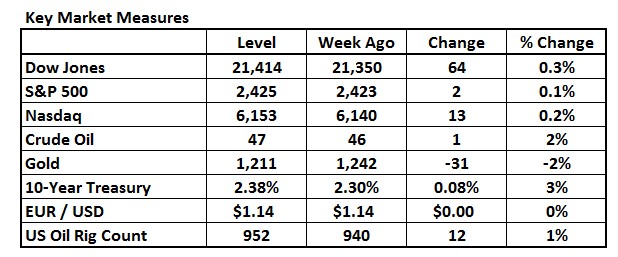
by Todd Shaver | Jul 9, 2017 | Weekly Newsletter 7pm Sunday
Climbing A Wall Of Worry
At the moment, everyone’s focus is on Trump’s G20 meeting as well as his first sit down with Vladimir Putin. Why care? Well… The G20 is comprised of the world’s wealthiest nations, so it is quite a powerful platform for business discussion. The big takeaway from the meeting was leaders like China’s Xi Jinping promoting an open world economy that contrasts Trump’s nationalist push. Trump believes in fair trade as opposed to free trade. Global trade policy has a huge potential impact on the bull market so watch closely.
Trump also sat down with Putin for their first face to face meeting. The two confronted issues over election meddling in addition to a variety of topics. Everybody is on guard about Russia and North Korea starting another war, so again this is really important stuff, in terms of watching out for the next Recession. But for now, the outlook is bright and the bull market continues to climb a wall of worry, which it has done for 100 years. In fact, there are no good old days. The market wakes up every day and worries about something. And the market generally goes higher, decade after decade.
There is always a bull market here at The Bull Market Report! This week we highlight the following stocks: Tesla, Shopify, Apple, Facebook, Square, and PayPal.
Highlights From The Past Week
Concerns over falling oil prices just won’t go away. After rig count falling for the first time this year last week, Baker Hughes reports US oil rig count rose once again for the 23rd week in the last 24. To support prices in the mid-$50s, OPEC would need to lower production by another 200,000-300,000 barrels a day and extend the output agreement to the end of 2018. We find this unlikely. OPEC cuts have had a tough impact on the oil market, driving prices much lower. Based on current trends, the oil market will be oversupplied again in 2018. Accordingly, we are likely to see the U.S. rig count steady to lower to keep oil output from flooding the market in the next 12-18 months. Ouch! More pain for oil ahead!
Second quarter numbers are in. The Nasdaq was up 4%, the Dow was up 3%, and the S&P 500 was up 2.6%. Not a bad quarter. So despite the Tech falloff since June 9th, the Nasdaq outshone the overall market. What will the third quarter bring? Well wouldn’t you like to know! We are not telling. We know, but aren’t telling. Well – not really. No one knows of course, but we think the Tech selloff will blow over as the FAAMG* stocks report fabulous earnings and the buying resumes.
* FAAMG – Facebook, Apple, Amazon, Microsoft and Google. Over $2.8 trillion in market cap.
Are central banks blowing bubbles? Wall Street strategists are calling attention to how central banks policies around the world are promoting inequality through Wall Street inflation coupled with Main Street deflation. In other words, the rich get richer from low interest rates spurring asset price bubbles, and the poor struggle against lackluster real economic growth. Now central banks need to quickly and painlessly undo their error. There are only two ways to cure inequality - you can make the poor richer or you can make the rich poorer. What a mess. They need to get GDP growth actually going again and normalize interest rates. So far not much progress to report.
This week we observed that the Swiss government could have issued a 50-year bond at a negative yield. Does this make any sense? If so, feel free to send us your money here at The Bull Market Report along with some interest and we are sure to be happy to hold onto it for you and return it in 50 years!
Tech titans could trigger rewrite of antitrust rules. Investors have spotted a vulnerability in the giant companies like Alphabet, Facebook, and Amazon. Since June 26 - the day before European regulators fined Google a record $2.7 billion in an antitrust case - the search giant’s stock has fallen 5%, versus a flat performance for the S&P 500. That works out to more than $30 billion in market value erased. Europe regulators have challenged the monopolistic business models Silicon Valley is printing money with. Well, stay tuned. There is a bunch of talk these tech titans will soon fight back. This may be the beginning of a big buying opportunity in Tech.
BMR Companies & Commentary
Tesla (TSLA: $313, down 11%)
After a week full of abysmal news for Tesla, the weekend couldn't come fast enough for Elon Musk. Tesla registrations in the country fell 10% in April from a year ago, based on IHS Markit data. The latest report showing a plateau for Tesla's products comes amid both investor concerns that demand for Tesla's luxury Model S sedan is waning ahead of the mass market Model 3 launch. With the sales of its Model X actually declining. Tesla may likely have to kiss its aggressive growth forecasts goodbye. Then again, they may not. There is lot going on here at the company and the future is wide open.
Tesla said that second-quarter global deliveries rose 53% from a year earlier, to just over 12,000 of the Model S and over 10,000 of the Model X. Musk blamed battery pack production problems for holding back vehicle output in the second quarter until early June, even though Tesla produced 2,000 more cars than it sold.
BMR Take: Things don’t always go right. That’s life. That’s business. But Elon Musk has been here before. This is what he does best. He solves problems. He innovates. He overcomes. It’s a controversial mood in the stock market for Tesla. But that creates a buying opportunity. While the company is losing money now, the Street consensus is for $12 in 2020, making this situation very interesting. As we have said many a time, this stock is not for the faint of heart. It could go to $250 or $200 before it goes to $400 or $500. But if you can handle the volatility, we believe it can get to $500 and beyond in the years ahead.
We saw a pretty good article from Bloomberg recently. The headline was “Tesla Projected to Win U.S. Electric-Car Race.” More than a dozen automakers are jostling to lead the U.S. electric-car race, but Bloomberg New Energy Finance (BNEF) sees a clear winner separating from the pack: Tesla.
BNEF expects Toyota’s Prius Prime plug-in hybrid to be the exception and hold the title of best-selling electrified vehicle in the U.S. this year. Tesla will get off to too late of a start with its Model 3 to catch up, with Musk planning to hold a handover party for its first 30 sedan customers on July 28. The company is aiming to ramp-up production to a rate of 20,000 cars per month in December.
“In the long term, we see battery electric vehicles winning because of the battery cost curve,” Bloomberg said.
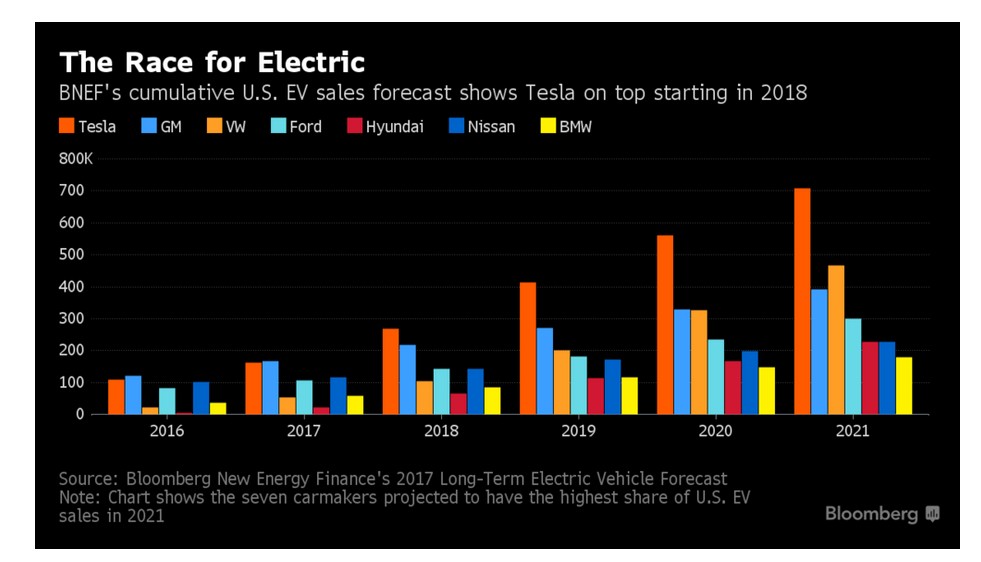
Shopify (SHOP: $89, up 2%)
This past week, as you logged in to Shopify to check your sales or fulfill orders, you noticed a change: Shopify has had a makeover. The new look and feel is part of a broader effort to build the future of Shopify and supporting apps with one design mind, using the same set of guidelines. The improved design is now live in every Shopify store.
Why does it matter? Change can be hard sometimes, but these changes were actually designed to simplify the day-to-day navigation. The fresh look brings consistency across Shopify products, helps pages load faster, and makes content and menus easier to find and read.
BMR Take: Shopify is among the most exciting growth stories in the market today. EPS is expected to go from negative this year to $1.25 by 2020 starting what is expected to be a long term trail of sustainable EPS growth.
Apple (AAPL: $144, flat)
Apple has declined 7% from its all-time closing high of $156.10 in May, but the recent selloff represents yet another buying opportunity as investors turn their focus to the iPhone 8 launching this fall. Apple's quarterly results will be less important this summer as investors focus on the iPhone 8 this fall, along with the company's increased dividends and stock buybacks, lower valuation and new innovations as showcased at Apple’s Worldwide Developers Conference.
The upcoming iPhone cycle is setting up Apple to reach fresh all-time highs in the next 12 months, which would value the iPhone maker at over a trillion dollars. Apple's current market capitalization is around $750 billion. Wow!
There has long been an expectation that the next high-end version of the iPhone would have a new type of screen called an OLED (organic light-emitting diode). OLED screens boast more vivid colors and improved battery life. But they are also more difficult to produce, particularly at the levels that Apple requires for the iPhone. We believe that Apple will introduce this screen in the iPhone 8.
BMR Take: Apple remains among the most underappreciated stocks in the world. We looking at about $9 of EPS this year heading toward $11 in the next 1-2 years, giving it a forward PE of 13. Very low in our opinion.
Facebook (FB: $151, flat)
Facebook is building a village that will include housing, a grocery store and a hotel. Billions of people spend a lot of time living their lives on Facebook's social network. Now Facebook wants to try its hand at creating a community in the real world. In short, Facebook wants to build its own town.
Facebook unveiled plans on Thursday for the massive new construction project at its Menlo Park, California corporate campus, which is part of Facebook's plans to expand its home base. The 56-acre site, which Facebook bought in 2015 for $400 million, is located directly across the street from Facebook's headquarters. It will offer 1.6 million square feet of housing, or 1,500 units.
In a blog post announcing the plans, Facebook described the future development as a "mixed-use village" that will provide residents, many of which will be Facebook employees, with housing, transportation services and other amenities.
It will take roughly a decade to build. The initial phase of the project, which will include the housing and a grocery store, will be wrapped up in the first half of 2021. The subsequent phases will be completed every two years.
BMR Take: What can we take from this? The company is pretty confident in their 10-year plan and the outlook for their business to be making these kinds of internal investments. This year’s EPS of $5 is expected to double by 2020. With 2 billion users now, don’t miss being involved in this adverting giant’s success.
Mark Zuckerberg was quoted in the past week: “Give people the power to build community and bring the world closer together." Zuckerberg called the statement an extension of the company's original mission of making the world "more open and connected."
Facebook's unprecedented reach can be a powerful tool for tackling global problems and democratizing access to people and knowledge. "We feel like our responsibility is expanding, especially around passing this milestone of 2 billion people in the community," he said. "We’ve been thinking about what our responsibility is in the world and what we need to do."
We’re with you, Zuck!
PayPal (PYPL: $54, flat)
PayPal launched a campaign to reward freelancers in India. PayPal India has launched two new campaigns - Shopping Buddy and Go Global. The new campaigns will encourage Indian consumers and freelancers to buy and sell across outside of the country. Both campaigns will work on the concept of referrals. Available in more than 200 markets around the world, the PayPal platform, including Braintree, Venmo and Xoom, enables its over 200 million users to receive money in more than 100 currencies, withdraw funds and hold balances in their PayPal accounts.
Why did PayPal design the campaigns specially for the Indian market? India is the 2nd largest freelancer market outside of the US. India is also a hub for software exports, hence software and web related services constitute a significant portion of the freelancing business. Additionally, skilled women who have taken a break from their careers to manage the household, and retired professionals also contribute to this growing number in India.
BMR Take: PayPal is quietly emerging as a global payments power. India is so important to winning this battle and the above news is a great step in the right direction and a demonstration of the company being locked in on what needs to be done. With greater than 20% EPS growth as far as the eye can see, how can you not be involved here?
Square (SQ: $24, up 1%)
Payment-processing stocks had a hot week after a $10 billion deal between two industry players was announced. The news that Vantiv was buying London-based Worldpay for $10 billion has investors suddenly thinking about other combinations. Square shares rose 4% on Wednesday as result and finished the week strong.
For Square investors, consolidation in the payments industry is encouraging, because it means the fast-growing company could also be thought of as an acquisition target. PayPal is a much larger company than Square, with a market value of $66 billion, compared to $9 billion for Square, and it’s less likely a target. In fact, it’s a company that likes to acquire.
However, you look at it, the market is quickly realizing that the world is migrating to eCommerce and Square is as best-positioned as anybody.
BMR Take: Square is currently growing revenue at a 30% clip. Takeout valuations could be anywhere over a 20% premium to the current stock price. A compelling opportunity.
Upcoming Economic News
Consumer Credit SA
Monday, July 10, 3:00 PM
Period: MAY
Actual: N/A
Consensus: $13.3B
Prior: $8.2B
Note: Federal Reserve Statistical Release G. 19, Consumer Credit, reports most short- and intermediate-term credit extended to individuals, excluding loans secured by real estate.
JOLTS Job Openings
Tuesday, July 11, 10:00 AM
Period: MAY
Actual: N/A
Consensus: 5,975K
Prior: 6,044K
Note: Part of the US Bureau of Labor Statistics, the Job Openings and Labor Turnover Survey (JOLTS) program produces a monthly study that has been developed to address the need for data on job openings, hires, and separations. With the release of May 2003 data, the JOLTS program began publishing industry estimates based on the North American Industry Classification System (NAICS).
PPI ex-Food & Energy
Thursday, July 13, 8:30 AM
Period: JUN
Actual: N/A
Consensus: 0.10%
Prior: 0.30%
Note: The Producer Price Index (PPI) for all items less food and energy, often referred to as Core PPI, excludes the two most volatile components of the overall PPI for Finished Goods.
Manufacturing Production M/M
Friday, July 14, 9:15 AM
Period: JUN
Actual: N/A
Consensus: 0.10%
Prior: -0.39%
Note: Manufacturing production index measures real output in manufacturing. According to the NAICS, manufacturing relates to the mechanical, physical, or chemical transformation of materials, substances, or components into new products. Data is percentage change in relation to the last month.
An Update on Government Properties Income Trust (GOV: $17.90, down 2%)
This is what we said a week ago Wednesday, June 28th:
“First Potomac Realty Trust (FPO) is being acquired in a $1.4 billion deal announced today. The stock of Government Properties (GOV) is down 7% this morning to $20.25. First Potomac is a REIT with 11 million square feet of office space in and around Washington, DC. Government Properties, at a market cap of $1.4 billion, will now have an opportunity to prove its worth and assimilate the properties. This is creating a buying opportunity if you believe that management can turn around this company We believe they can and would be buyers of the stock here at the $20 level.”
Then last week we wrote this:
“Government Properties Income Trust (GOV: $18, down 19%)
“Don’t fall over in your chair! The stock got crushed this week, but it was because of an acquisition. Let us explain.
“First Potomac Realty Trust (FPO) will be acquired by Government Properties. To finance the deal, the company sold 25 million shares in a secondary at $18.50, raising over $450 million. They had to knock the stock lower to get the funds they needed. This is typical. We believe the deal will work out well, and that we will see a full recovery and then some.
“And the underwriters have been granted a 30-day option to purchase up to an additional 3,750,000 common shares. Two things: These overallotments are exercised about 99% of the time so expect to see another $65 million of cash in the bank. And expect to see the stock stay around this level for a month. Then there is a great likelihood that the stock will move back into the low 20s.
“You should be excited. The acquisition of First Potomac Realty Trust enables Government Properties to expand its business strategy to include the acquisition, ownership and operation of office properties leased to both government and private sector tenants in the metropolitan Washington, D.C. market area. The metropolitan Washington market area is one of the largest office markets in the U.S. and the nation’s largest beneficiary of spending by the U.S. government. Outside of the metropolitan Washington market area, Government Properties will continue to focus on acquiring, owning and operating office properties that are majority leased to government tenants.
“In addition to this transaction providing Government Properties with new potential growth opportunities, management expects to realize approximately $11 million of annual general and administrative expense savings compared to First Potomac Realty Trust on a standalone basis.
“Management is very pleased that they were able to achieve an attractive per share purchase price. Their preliminary estimates call for meaningful accretion and more detail will be forthcoming.
“BMR Take: NAV was $20.90 prior to raising some equity at $18.50. We don’t see any reason for the stock to trade at a discount to the lower level of $18.50. This is a buying opportunity for sure. Why do you think institutional investors just took down 25 million shares at $18.50? Get on board and put new money to work at a 9.4% yield right here in this name!”
Here’s our Take this week:
There have been no changes in the situation since the announcement. The stock is down 2% this past week, which is just noise, but we see that the stock has stabilized here at the $18 level, and in our opinion the only move the stock can make from here is up. The stock is paying a 9.6% dividend which is a bit too high historically, and thus a higher stock price will lower the dividend to the 8-9% ranges which we believe is quite sustainable. We are holding here and await the move back to the $20 level in the next few months.
A Word from Gary Jefferson
Jefferson Financial Group
First Vice-President, Investments
UBS Financial Services, Inc
An old stock market adage is "Calling a market top is a fool's errand." A Wall Street research firm wrote last week that calling a market top in today's market is just such a fool's errand because there is simply too much empirical evidence against it. First, the employment picture is pretty good from the standpoint of new jobs creation. (Of course, "if" new job numbers begin to substantially decline, it would be a red flag). Secondly, the latest Consumer Confidence Board report topped expectations. This indicates that consumers (70% of our economy is consumerism) are going to continue to consume. This is the engine that drives earnings. Lastly, the usual red flags that signal a major top just aren't visible – things like an inverted yield curve, a major technical breakdown (Nasdaq plunging below its 50 or 100-day moving averages), or, on a global basis, a major event such as a default by Italy or an economic collapse in China.
This is by no means to say that the market won't have a "top" in the sense of a "10% correction". It can happen even when nothing has really changed the fundamentals of the corporate earnings picture or for no real reason except media-hyped panic. There are many things happening in the market today that historically signal the possibility of a pullback in the 3-7% range. But long-term investors don't sweat the small stuff. It just isn't worth the aggravation and mental stress to try to time market corrections other than to possibly raise a little cash or to have some ready cash available to buy the dip. This is because it is nearly impossible to exit a stock, watch it drop 10% and then get back in before it jumps back up 5% before the opening bell one morning. It is literally impossible for anyone to successfully employ this kind of strategy.
The greatest risk ahead now seems to be what happens in Washington over the next few months, which is unfortunate. These events could either cause a market melt-up or a worse than average pullback – neither of which is predictable. Regardless of current conditions, in 90% of any market environment it makes sense to dollar-cost average large cash positions over several months as opposed to going all-in. That's because (quoting Ben Bernanke), "…….the 'market' is a very difficult subject. I've compared it to trying to learn how to repair a car when the engine is running…." It is difficult, but a long-term investor who is diversified and in quality assets will be just fine.
The High Yield Corner
By Michael Foster
Special to The Bull Market Report
The week was a bit harsh to many high yield investments, but a quick glance at The Bull Market Report picks shows that this is the result of a weak and temporarily frightened market The fundamentals, however, remain as strong as ever.
Starting with REITs, we saw Welltower (HCN: $73) fall 2% for the week, with those losses occurring almost entirely on Thursday. The marketwide weakness we saw did not leave REITs alone, so the decline was particularly pronounced here. However, Welltower shareholders should not despair; they’re up 9% year-to-date including the current near 5% dividend yield thanks to a dividend increase earlier this year. And dividend increases are very likely to continue. Over the last 12 months, Welltower has earned Funds from Operations (FFO) of $4.45, which gives the company a 130% dividend coverage ratio. As a rule of thumb, anything over 120% in REITs is healthy and anything over 125% indicates that the current schedule of dividend increases is likely to continue. For Welltower, that means a once-yearly pay raise is likely to continue.
This is a pretty big relief because higher borrowing costs in recent months have not been offset by higher rents for many REITs. That’s caused a lot of panicked selloffs throughout the sector, and Omega Healthcare Investors (OHI: $32) is no exception. The stock has been pretty heavily range bound after falling significantly in late 2016 - it's down 5% from a year ago - as it has been several times in 2017. Fortunately, the stock is up 3% from the start of the year so the bearish trend is clearly over even if we haven’t seen a breakout.
The interesting thing with Omega Healthcare is that investors frequently fret over the company’s dividend coverage. Omega’s management increases the dividend by a penny per share every quarter - and that is attractive to shareholders while also threatening the dividend coverage ratio. The only way Omega can cover those higher payouts is to aggressively expand. That causes frequent panics and a lot of anxiety, but a quick look at the numbers shows how silly those worries are. For the last four quarters, Omega’s FFO of $3.45 is far above the $2.50 annualized payouts at the current dividend rate and still higher if we assume penny-per-quarter payouts for the next four quarters. Either way, we’re talking about a dividend coverage ratio in excess of 130%, indicating that the dividend is absurdly safe despite the 8% yield that the stock currently offers.
In addition to the dividend payout growth fears, Omega has suffered from worries about uncertainty in Healthcare and the future funding of Medicare. Of course, Omega isn’t the only REIT suffering from this concern. Sabra Health Care REIT (SBRA: $23) fell 4% in the last week at a much higher rate than the marketwide decline in REITs. Fortunately, however, Sabra has been doing extremely well for a long time, meaning this selloff has little significant for long term shareholders. The stock is up over 12% from a year ago excluding its 7% dividend payout. And, as with Omega, the dividend is being covered by strong FFO - over the last 12 months the dividend coverage ratio for Sabra has been 130%, which is extremely solid, as with Omega. But investors fret over politics more often than they should, meaning Sabra isn’t getting the buy-in from investors that it deserves. That will change when the market goes back into risk-on mode*.
* When the market goes back to having an appetite for things like growth stocks, junk bonds, and REITs, instead of plowing into Treasuries.
Finally, Ventas (VTR: $67) is The Bull Market Report’s third Healthcare REIT pick that is known for its longer history and reliable dividend payments. As such, its yield is 4.6% following the near 3% price decline for the week. But as with our other Healthcare picks, Ventas is up for 2017 - up a solid 7% since the start of the year. The panicked Healthcare REIT selloff of late 2016 has been correcting itself in recent weeks and that is likely to restart again in the future as soon as this week’s hysterical fear ceases. No one knows when that will come, but it surely will; we’ve seen the market freak out suddenly several times since President Trump’s election, but the selloffs tend to be very brief and very shallow.
An interesting question to ponder is how this selloff and fear-based selling impacts municipal bonds, a safe haven for risk-averse investors. So far, 2017 has been pretty good for the asset class after a brutal 2016 selloff thanks to risk-hungry investors shifting to stocks. So far for the year, Invesco Municipal Trust (VKQ: $12.69) is up 4% - but the stock is still down 10% from a year ago. That gives the fund plenty of room to run in 2017, especially when we consider the fact that the fund is trading at a 6% discount to its net asset value. Similarly, Nuveen Municipal (NVG: $15.15) is up 5% for the year but is down 7% from a year ago. Like the Invesco fund, this is trading at a 6% discount to its NAV, providing another opportunity for gains as the market gets more excited about municipal bonds as a viable and lower-risk alternative to stocks and Treasuries, especially given the extra value that late 2016’s selloff provided. We are at the beginning of a trend in that direction, and it is likely to continue for quite some time.
Good Investing,
Todd Shaver
Founder, CEO and Editor
The Bull Market Report
June 19, 2017

by Todd Shaver | Jun 19, 2017 | Monthly Newsletter Daily 12pm if new
The Week Just Passed and the Week Ahead
Amazon set fire to the market on Friday as they announced a major deal to buy Whole Foods. Grocery stocks plunged as everybody wonders how much havoc Amazon will have in the new industry vertical. The M&A announcement re-energized the market that had been sagging due to FAAMG* stocks slowing down. But clearly there is a reason the FAAMG stocks are market leaders: they are the most innovative, the most savvy, and the most aggressive companies on the planet when it comes to raising the bar. The bull market in Technology that everybody was questioning just last week is alive and well!
* FAAMG – Facebook, Apple, Amazon, Microsoft and Google.
We are pleased to see the market come back strongly today, Monday, as we write this. The market is up 110 points on the Dow, with Apple, Facebook and Shopify making strong moves. And good old Amazon, which we profile below, just hit $1000 a share again. Go Bull Market.
There is always a bull market here at The Bull Market Report! This week we highlight the following stocks: Amazon, Apple, Facebook, Tesla, Annaly, and Google.
Highlights From The Past Week
Trump Says ‘Very Good’ GDP Numbers Are Coming. He May Be Right. President Donald Trump said Thursday that “some very good numbers” are coming out soon on U.S. economic growth. If he’s talking about the second quarter, he’s probably right, though the figures are about six weeks away from publication. While the White House didn’t immediately respond to a request to clarify Trump’s comments, there are wide expectations among researchers that the rate of expansion in the April-to- June period will rebound from a first-quarter slowdown. The pace of gross domestic product gains was dragged down earlier this year by temporary factors such as warm weather that resulted in lower utility bills. Seeing a pick-up in GDP growth is a major positive for the stock market.
The Sweetest Stretch of Bull Run Since 1995 is At Risk as Buy-The-Dip Strategy Fails. The sell-off in the Tech sector that started a week ago has erased $250 billion from the value of technology shares and is threatening to end the industry’s longest stretch of uptrend in more than two decades. Down around 4% since the decline started, this move has put the Tech sector on the edge of breaking its 50-day moving average. It’s stayed above the threshold for 131 consecutive days, the longest stretch since 1995. Are the good days ending? The last two times when the 50-day average was broken, Tech shares did poorly in the next few months. What do we make of this? Stocks can’t go up forever. We are seeing the Tech sector take a breather and would buy this weakness.
Don’t Be Tempted To Buy High-Flying Equities. Stick With Solid Stock Picks Recommended By The Bull Market Report. Bond investor Bill Gross warned on Tuesday that investors should reduce their risk appetite, given the U.S. growth rate is stunted by secular forces "which monetary and even future fiscal policies seem unable to reverse." In his June investment outlook letter, Gross of Janus Henderson said: "Strategies involving risk reduction should ultimately outperform 'faux' surefire winners generated by central bank printing of money.” He continued, "It’s the real economy that counts and global real economic growth is and should continue to be below par." Gross runs the $2.1 billion Janus Henderson Global Unconstrained Bond Fund.
BMR Companies & Commentary
Amazon (AMZN; $988, +1% for the week; up $23 on Friday)
Amazon is guided by four principles: customer obsession rather than competitor focus; passion for invention; commitment to operational excellence; and long-term thinking. Customer reviews, 1-Click shopping, personalized recommendations, Prime, Fulfillment by Amazon, Amazon Web Services - AWS, Kindle Direct Publishing, Kindle, Fire tablets, Fire TV, Amazon Echo, and Alexa are some of the products and services pioneered by Amazon.
Amazon and Whole Foods Market announced that they have entered into a definitive merger agreement under which Amazon will acquire Whole Foods Market for $42 per share in an all-cash transaction valued at $13.7 billion, including debt. This is Amazon’s biggest acquisition ever. Whole Foods will continue to operate stores under the Whole Foods Market brand and continue to buy from trusted vendors and partners around the world. John Mackey will remain as CEO of Whole Foods and the headquarters will stay in Austin. The deal is expected to close by the end of this year.
For Amazon, the deal marks an ambitious push into the mammoth grocery business, an industry that in the United States accounts for around $800 billion in annual sales. Amazon is also amplifying the competition with Walmart, which has been struggling to play catch-up to the online juggernaut. Amazon has designs on expanding beyond online retail into physical stores. The company is slowly building a fleet of outlets, and much attention has been focused on its supermarket dreams. It has already made an initial push through AmazonFresh, its grocery delivery service. Now, BANG, just like that, they will have 430 stores in place for delivery and warehousing. Is Bezos smart or is Bezos smart?
BMR Take: The current consensus EPS outlook calls for almost $7 this year going to $27 by 2020. That’s explosive growth and the innovation machine known as Amazon is far from done. Amazon remains one of our top favorites. And DO NOT be disconcerted by the price of the stock. If you want to buy $15,000 of Amazon, buy 15 shares. Don’t agonize over it. Just be invested in this great company.
Apple (AAPL; $142, down 4.5%)
After an action-packed world-wide developers conference (WWDC) with a plethora of new software and hardware announcements last week, the stock was under pressure all week. The sell-off in Apple represents yet another buying opportunity. With the expanding capabilities of Apple's network of hardware and software products, Apple is very well-positioned to capitalize on the trend toward more "things" becoming a computer. Last week, Apple filled key gaps in its portfolio with entry into the digital home assistant market with HomePod, combined with new AR and VR initiatives* to support these important trends. This further expands the breadth and depth of Planet Apple, making it more difficult for competitors to offer an experience at the same level of Apple.
* Augmented and Virtual Reality
BMR Take: Earnings are expected to be $9 this year and increasing toward $11 over the next 2 years. The business is steadily generating a massive amount of money – $800 million a week, totaling over $255 billion now. The naysayers will be proven wrong on Apple again – remember when it hit $91 exactly a year ago, after peaking at the $125 level in 2015? Well guess what – the new all-time high is $156 set just last month. That number is sitting there ready to be broken again
Facebook (FB; $151, up 1%)
Facebook is focused on building products that enable people (better yet – the world) to connect and share through mobile devices, personal computers and other surfaces. The company's products include Facebook, Instagram, Messenger, WhatsApp and Oculus.
Facebook has hired more than 150 counterterrorism experts and is increasingly using artificial intelligence that can understand language and analyze images to try to keep terrorists from using the social network for recruiting and propaganda. Facebook says, “We agree with those who say that social media should not be a place where terrorists have a voice.” The move comes as Facebook is being hounded by governments to do more to combat terrorism.
Mark Zuckerberg, Facebook’s co-founder and chief executive officer, has also been trying to position the company as a positive force for building communities both online and off. This new emphasis from Zuckerberg has followed discussion over Facebook’s role in the proliferation of false news accounts during the U.S. election campaign last year, as well as the spread of extreme content posted to Facebook.
Many of these new hires have backgrounds in law enforcement and they collectively speak almost 30 languages. In addition, Facebook has thousands of employees and contractors around the world that respond to reports of violations of its terms of service, whether that’s online bullying, posting inappropriate content or hate speech.
BMR Take: One of the major risks in front of Facebook is dealing with free speech rights versus meeting obligations to be a model corporate citizen. We are glad to see steps in the right direction. EPS is expected to go from almost $5 this year to $9.50 in 2020. This stock can go much higher if the company can avoid a few key risks.
Google (GOOG; $940, down 1%)
Google spans Internet products, such as Search, Ads, Commerce, Maps, YouTube, Google Cloud, Android, Chrome and Google Play, as well as its hardware initiatives. Google is engaged in advertising, sales of digital content, applications and cloud offerings, and sales of hardware products. This is a mouthful, so one other way of looking at Google is: Most of their revenue comes from search. Period.
This week Google launched a new cloud computing platform in Singapore that aims to reduce data transmission delays for its cloud customers here, as it seeks to gain ground against rivals Amazon and Microsoft globally. It has opened dedicated cloud platform servers - called a "Google Cloud Platform (GCP) region" - in Singapore and this is the group's first GCP region in South-east Asia.
The Singapore cloud platform is the company's third in Asia, after Taiwan and Tokyo, and it is looking to launch dedicated servers in Mumbai and Sydney as well, they added. The launch of the Singapore service has significantly reduced latency, which refers to delays in data transfer over a network connection, for Google's cloud platform customers and users in Singapore and South-east Asia. The platform offers products and services such as application hosting, security, language translation and analytics.
Businesses can save anywhere from 50-70% by using a cloud platform in general compared to other options such as hosting data storage themselves. The migration to the cloud is a mega-trend and Google is in the forefront of this new world.
We mention these new events to give you the scope of what this company is doing. While you and I worry about what’s happening here in our own little worlds, Google is out there setting the stage for controlling and profiting from places around the world this year, next and for decades to come.
BMR Take: EPS is on track for $34 this year going to $55 by 2020. We see a compelling opportunity in this large cap tech giant.
Upcoming Economic News
Current Account
Tuesday, June 20th, 8:30 AM
Period: Q1
Actual: N/A
Consensus: -$121B
Prior: -$112B
Notes: The international transactions accounts are a quarterly statistical summary of transactions between U.S. and foreign residents organized into three major categories: The current account, the capital account, and the financial account. The current account includes exports and imports of goods, services, income, and current transfers. The capital account includes capital transfers, such as debt forgiveness. The financial account includes transactions for official assets, for U.S. Government assets other than official reserve assets, for direct investment, for portfolio investment, and for other investment.
Existing Home Sales
Wednesday, June 21st 10:00 AM
Period: MAY
Actual: N/A
Consensus: 5,545,000
Prior: 5,570,000
Notes: Each month, the National Association of Realtors (NAR) collects data on existing single-family home sales from Boards or multiple listing services (MLS) nationwide. NAR estimates that it captures between 30-40% of all existing home sale transactions with its monthly survey. The data provide the total number of closed existing home sales in each area as well as total sales within price categories ranging from less than $30,000 at the bottom to more than $500,000 at the top.
Leading Indicators
Thursday, June 22nd,10:00 AM
Period: MAY
Actual: N/A
Consensus: 0.40%
Prior: 0.30%
Notes: Leading indicators are economic series that tend to change direction ahead of shifts in the business cycle. There are 10 components of the U.S. Leading Composite Indicator published by The Conference Board. The index is constructed by averaging the individual components in order to smooth out a good part of the volatility of the individual series. Historically, the cyclical turning points in the leading index have occurred before those in economic activity.
New Home Sales SAAR
Friday, June 23rd, 10:00 AM
Period: MAY
Actual: N/A
Consensus: 600,000
Prior: 569,000
Notes: The U.S. Census Bureau collects new home sales based upon the following definition: "A sale of the new house occurs with the signing of a sales contract or the acceptance of a deposit." The house can be in any stage of construction: not yet started, under construction, or already completed.
Tesla Week
Tesla (TSLA: $371, up 4%) had a great week, in spite of the Fed and the Tech sell-off and everything else. Up 4%. Huge. The stock was upgraded by Berenberg Bank from a "hold" rating to a "buy" rating. They now have a $464 price target on the stock, up previously from $193.
BMR Take: This is a car company and this is a Tech company, and it is run by a one of the smartest men on the planet.
Annaly Update
We love this stock. We have been following Annaly Capital Management (NLY: $12.36, up 2%) since 1997 when they first went public. They have survived thick and thin: bull markets and bear; high interest rates and low; recessions and boom. And they continue to give you a 10% dividend, year in and year out.
With that said however, it may be time to take some profits in the stock. We added the stock in early 2016 at $10 and it is now over $12, up 25%. The key is book value. It is currently at $11.23, thus trading at 10% over book. Annaly generally sells right at book, so it is getting ahead of itself. Our Target is $12, so one could certainly sell now and be happy campers. Or you could watch and wait. We are going to watch book like a hawk. If it keeps moving higher we are golden. But if it stalls, and the stock moves back towards $12, we will most likely be saying so long to a great company.
Letter to the Editor about Shopify (SHOP: $87, down 5%)
From: John Hoogerheide [mailto:johnhooger17@xxxx.net]
Sent: Thursday, June 15, 2017 11:23 AM
To: Todd at The Bull Market Report
Subject: SHOP
Todd - A while back you had suggested Shopify as a stock just to own and forget in your portfolio as it will have very large daily bounces. In your reports you indicated the stock COULD be a likely candidate for a buyout and that their fundamentals looked solid. Shopify had been on a tear but the Nasdaq fallout has killed the stock. I assume the Nasdaq fallout is only temporary and things will go back to normal. BUT has anything changed in your attitude towards Shopify? Thanks Todd
Hi John –
No. Just the price. And it is very frustrating. I’m trying to be patient and get through the Fed raise which is just about done. The bond market was WAY up yesterday (10-year Treasury down big to 2.13%. Up a tad today, but not much.) Then the question is – are we in a Tech AND overall stock selloff? If so, then we should move to high yield, like Apollo, Annaly, etc., and bide our time until things become normal in Washington. If not, then the bull market continues. Where ELSE can you put your money? And this is not an idle question. People have been say it for YEARS, with interest rates at historic lows. And they are STILL at historic lows, really. Thus, we have this amazing bull market since 2009.
Note that I don’t believe we ever said you could put it away and not look at it. But we certainly feel that it is a long term hold and the prospects look good.
Todd Shaver, Founder and Editor in Chief
And then on Friday we wrote to him:
Nice bounce-back yesterday and today, John, after hitting $81.50 at the low point yesterday.
This one is real.
The sell-off was not.
Let’s hope it holds.
Todd Shaver
[Note that the stock closed at $87 Friday. Our take? This is a volatile stock in a nervous Tech market right now. If it’s too hot for you get out of the kitchen. Again, we are trying to be patient here with this amazing company.]
More (Good) News on Shopify
Shopify sold 5.5 million shares at $91 on May 24th in a secondary, raising $500 million. Then just last week they completed the overallotment. Do you know what that is? It is an extra block of stock that can be sold as part of the original secondary if there is demand. Well, there was, and Shopify sold another 825,000 shares at the same price worth $75 million. Not bad. So now the company is sitting on a ton of cash (we believe the total to be close to $1 billion), they have no debt, and revenues are growing like a weed.
So here dear Bull Market Reader, are a few thoughts on Sell and Target prices:
When we add a stock to our portfolio we have a Target and a Sell Price. The Target is where we think it can go and the Sell Price is the price that if it hits, you have some thinking to do. The Sell Price is usually 10-15% below the price where we added the stock. Taking a 10-15% hit is a big deal, and some may even say that if a stock drops 5-7% you should get out. Everyone has their own rules to follow. However, there are companies that are young and unproven that we feel have the potential to be 2-baggers and 5-baggers and more. Cloudera, Twilio and Nutanix are three of these. What happens with these stocks is that the world as a whole doesn’t recognize their greatness yet, and aren’t willing to hold them through tough times. It’s called the Market. (There were times in Amazon’s young life when the market sold off the stock because of various reasons. The strong held on, the weak got out.)
The problem however, is that hindsight is 20-20 and we at The Bull Market Report a) might be wrong on a stock, or b) might be early. Both of these scenarios can cause a Cloudera to go from $23 on June 6th when we added it, to the level it is at today. Not pretty, but this is the life we lead when we invest.
Now, with that said, what do we mean with the Sell Price? The answer actually is not what do WE do, it is what YOU do. The Bull Market Report very rarely tells you to SELL a stock. We SUGGEST things to you based on FACTS. We leave it up to you to decide as intelligent human beings. In this case we believed in Cloudera at $23, and now at $17.40 we believe in it more. Why? The only thing that has changed is the PRICE. It is less expensive than it was. We still think it can go to $28, and $40 and beyond, and now it is cheaper. Yea! BUT – WHAT IF IT GOES LOWER FROM HERE? What if it goes to $14? What if it goes to $10? Then we have a big problem as you can see.
So the safest thing to do is to “Sell.”* We take a licking in our portfolio, and if you follow suit, you do too, and it prevents a disaster if it goes to $14 or $10. BUT, what if this recent Tech sell-off is over now. What if Apple and the rest of them start to shoot higher over the coming weeks, which we fully expect? And what if Cloudera heads back into the 20s like we believe it will do?
No guaranteed answers here as you can see. But plenty of food for thought. Speaking of thoughts, if you have a question about this or anything else, please write us at Info@BullMarket.com.
* No one at The Bull Market Report buys or owns the stocks in our portfolios. We don’t play that game.
The High Yield Corner
By Michael Foster
The biggest news of the week was the interest rate hike, but before we get to that, let’s talk a little bit about Digital Realty Trust (DLR: $117, up 4%, plus a 93 cent dividend paid on Tuesday.)
This data center REIT has been a Bull Market Report pick since March last year. Since then the stock has gone up 38% while paying 4% in dividends. A 42% return in a little over a year is breathtaking for any type of investment, but it’s relatively uncommon in the high yield world where you often sacrifice big short-term gains for cash flow. But Digital Realty is different.
The reason is simple: Digital Realty isn’t just a high yield stock; it’s also a Tech stock. Digital Realty has a very simple business model that positions it to benefit from the hypergrowth of tech companies: it rents out server space for firms that exist in the cloud. Any cloud computing startup depends on Digital Realty for the bare infrastructure that makes their product possible; and, unlike startups, Digital Realty’s revenue stream and profitability come first.
From that perspective, Digital Realty is a very attractive business; it’s part utility and part a hypergrowth tech stock. It’s rare to find a company that combines the two extremes of the finance world - dull safety with cutting-edge high-risk technological innovation - but Digital Realty has combined the best of both worlds for years. As a result, the company has attracted capital slowly over time, but the stock was limited until the middle of 2015 by one risk factor: competition from others in the space. At the end of 2015, Digital Realty initiated some expansion efforts that essentially gave the business a “moat” and protected it from competition. The firm very smartly placed facilities in ideal geographical positions to get the attention and demand from telecommunications giants and government agencies, putting the company at a distinct competitive advantage.
The stock market swiftly reacted, and the stock has doubled since the middle of 2015. Insiders have also taken notice, which is why DuPont Fabros Technology (DFT: $64) announced it would merge with Digital Realty in an all-stock transaction*. What exactly does this merger mean for Digital Realty shareholders? Well, the stock initially fell on the news but very swiftly recovered (it’s now up about 4% for the week following the initial decline). Apparently the market first thought the merger was a bad idea and then changed their minds. The market loved the news for DuPont, however; that stock is up 20% following the news.
* June 9, 2017 San Francisco's Digital Realty Trust has agreed to acquire Washington, D.C.-based data center developer Dupont Fabros Technology for $7.6 billion in stock, bolstering its reach in and around Silicon Valley. The companies operate as real estate investment trusts that rent out space to corporations to house their high-powered computer servers, used in cloud supercomputing, streaming video and data storage. Dupont Fabros has a dozen such complexes, including one in Santa Clara, two near Chicago and nine in Northern Virginia.
The merger is extremely good for Digital Realty shareholders for one simple reason: it adds a new dimension to the company’s incremental expansion efforts. Now with DuPont’s properties, Digital Realty will have 157 properties in 12 different countries added to its portfolio. The combined firm is going to have 26 data centers operating at 97% occupancy. Remember that Digital Realty had been mostly a U.S. focused REIT with most of its properties in Northern Virginia, Chicago, and Silicon Valley. The firm clearly saw an opportunity in providing for the government’s and tech startups’ growing digital footprint.
Note that the market cap of Digital Realty is $19 billion. After the merger it will be around the $25 billion mark.
But this also means buying and holding Digital Realty has become a very different game. When The Bull Market Report originally recommended the stock, it was yielding 4%; even with dividend hikes, the stock is now yielding a little more than 3%. The company will undoubtedly have enough funds from operations to keep growing payouts, but Digital Realty has become more of a tech growth stock than a high yielding stock. Holding it now is more a bet on capital gains appreciation than a way to capture a high stream of income.
The big news for the market last week was the Federal Reserve’s rate hike. Now for the first time in over a decade the Federal funds rate is over 1%. This sounds like big news, but the market shrugged. the S&P 500 was down slightly and the Dow and Nasdaq flat following the announcement, indicating the very risk-on and risk-averse equity investors agree that this isn’t important news.
What’s even more shocking is the bond market. With higher interest rates on the short end of the curve, you’d naturally expect higher interest rates on the long end of the curve. But interest rates barely budged following the announcement, and actually went down sharply shortly before the announcement. There are a lot of ways to interpret this, but each is a variation on a singular theme: the bond market is daring the Fed to raise rates further. Either the bond market isn’t expecting the Fed to keep raising rates (the next rate hike, Yellen pretty much said, is coming at the end of this year), or bond traders are waiting until the last possible moment to sell Treasuries, or there is too much demand for Treasuries and not enough supply. Each of these moves is either a bet on or a hope for the Federal Reserve to go more dovish in the future.
Personally, we disagree. We think the Fed will blink first and slow their rate hike plans. This is essential to avoiding an inverted yield curve, which generally portends a recession here in the United States. At the Fed’s currently stated rate of rate hikes, that inverted yield curve would likely come at the end of 2018 or the beginning of 2019, indicating a recession in the middle to end of 2019. A slower rate of increases would delay that eventuality to more like 2020 or 2021.
In either case, all indications suggest that we are nowhere near a market downturn or an economic contraction. While the interest rate hikes have been big financial news for years now, and many doomsayers have said this portends a sharp downturn soon, a more reasonable interpretation is that we still have at least two years before the first sign of trouble. So it isn’t time to sell yet, but vigilance will slowly become more and more important.
There is one more pressing issue, however, especially for the high yield world: Higher interest rates on the short end and lower interest rates on the long end cut the profitability of leverage. This makes it tougher for Mortgage REITs, although a few particularly well-managed and differently structured firms (such as Bull Market Report’s recent pick, Apollo Commercial Real Estate Finance (ARI: $18.92), and Annaly Capital Management (NLY: $12.36)) are exceptions to this rule. It’s also a concern for business development corporations, which have suffered “yield compression” for years and are now suffering higher borrowing costs on top of that.
The trend is also not good for junk bonds, although many junk bond funds have priced this in over the last two years, so it’s not a major issue. However, if the Federal Reserve continues on its promised rate hike path, high yield investors will need to get ready to rotate out of the most at-risk asset classes. We’re not quite at that point yet, but it is definitely visible on the horizon.
Good Investing,
Todd Shaver, CEO, Founder and Editor in Chief
The Bull Market Report
Since 1998
