The Bull Market Report for August 29, 2016
The Week Ahead
This week marks the end of August and the beginning of September. We are expecting a very eventful back half of the year. We are watching everything about the Presidential election. The Fed’s comments at the Jackson Hold conference this past week alludes to what is shaping up to be another rate hike in December. Back to school and the holidays are key spending seasons for consumers, where we suspect this year’s results will show the strength of this economic expansion on the consumer side. The market is down slightly from record highs compared to last week, which if anything explains why we favor stock picking at this time as compared to just taking on broader market exposure. This week we highlight Facebook, Devon Energy, Brookdale Senior Living, and Sprouts Farmers Market.
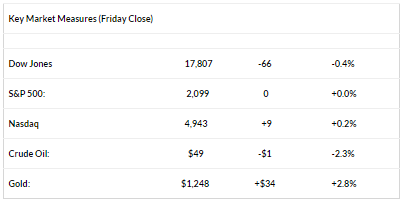
Here is How The Major Indices Performed Last Week

Here is How Last Week Progressed
Monday (8/22) - S&P 500 flat
--- Pfizer (PFE: $35), still stinging from its foiled mega-acquisition with Allergan (AGN: $238) earlier in the year, announced it would acquire prostate-cancer drug maker Medivation for $82, a 21% premium, in a $14 billion deal.
--- Italian Prime Minister Matteo Renzi hosted German Chancellor Angela Merkel and French President Francois Hollande on an island off the coast of Naples ahead of September's EU summit, which was called to discuss reverberations from the Brexit vote, which we highlight because Italy and France possibly leaving next is a critical inflection point to the future of the EU.
--- Bank of America published analysis looking at the "what if" scenario of the increasingly discussed credit market bubble, but found that as long as rates rise gradually rather than sharply concerns are overblown.
Tuesday (8/23) - S&P 500 +0.2%
--- Billionaire Jeff Gundlach at DoubleLine Capital reiterated expectations for a Trump victory, which will likely mean a Brexit-like selloff for stocks, but ultimately massive new fiscal programs for roads, airports, and the wall. He also stressed how his now 100% net short position is focused on shorting stocks that are believed to be safe, but not safe at all.
---Pension funds in Hawaii and South Carolina have adopted a new strategy, in their thirst for yield that involves selling puts, which highlights an extreme thirst for yield to the point of taking on terrible risk/reward, a behavior that many are saying is reminiscent of 2006.
--- The census reported that in July, the US saw a whopping 654,000 new home sales, up 12%, from the prior month and higher by 31% from a year ago, smashing expectations.
Wednesday (8/24) - S&P 500 -0.6%
--- We learned that 8 out of 12 regional Fed Presidents voted to hike the discount rate in July, which was 1 shy of last November.
--- Illinois' biggest public pension fund, Teachers Retirement System, may have to lower its expected rate of return, which would cripple the state's already fragile finances, warned Governor Rauner, which we highlight as just the surface of major pension issues widespread across the country.
--- According to the Tennessee insurance commissioner, the Obamacare exchange in Tennessee is very near collapse as insurers are imposing nearly 60% premium hikes and pulling back on coverage areas which could leave certain counties with no health insurance.
Thursday (8/25) - S&P 500 -0.1%
--- According to the latest Fitch auto subprime report, things in the auto subprime space are progressively deteriorating, with subprime 60+ day delinquencies in July rising 13% from last month to 4.6%.
--- Subprime Asset Backed Securities annualized net losses hit 7.4% in July, which was an increase of 17% from last month and 28% from last year.
--- Separately, in yet another stunning example of the unintended consequences of minimum wage hikes, restaurants in Washington DC are slashing jobs, as the data show that DC restaurant jobs were down in 5 out of the past 6 months, which hasn’t happened in 25 years.
Friday (8/26) - S&P 500 -0.2%
--- This was the biggest day of the year for our central bankers at the Jackson Hole conference occurred. Goldman published a kneejerk response to Yellen’s speech, which discussed her to be so hawkish that it raised their odds for a September rate hike from 30% to 40%.
--- Alternative analysis from Macquarie proved a thoughtful explanation, saying that the conventional wisdom prevailed on Wall Street, namely that Yellen's speech is a whole lot of nothing and likely didn’t change any minds on expectations for a rate increase this year, with December still most likely the next hike followed by two hikes next year.
--- Beyond interest rate talk, the conference kickstarted a number of other new debates, perhaps most interesting is the St. Louis Fed President calling out how Fed GDP forecasts keep trending down as actual GDP keeps running below trend, which raises an array of issues much more important that the timing of the next rate hike.
The Bull Market Report Companies and Commentary
Facebook (FB: $125, +1%) We are bulls on Facebook for many reasons we have given you these past seven months. We are very pleased with revenues and earnings and their takeover of mobile. However, one of the bear cases on Facebook is that ad revenue may shift away from the company as the users of connected devices are increasingly tired of dealing with bad ads. We’ve all experienced a lot of bad ads - ads that obscure the content we’re trying to read. Ads that slow down load times. Ads that try to sell us things we have no interest in buying. Bad ads are disruptive and a waste of everybody’s time.
To hold onto market share, it is critical that Facebook’s products and services address this real problem users are having. Competitor Google is taking steps through banning certain types of ad words. Now recently we note Facebook is moving forward as well. Facebook recently announced the expansion of tools given to users to control their advertise experience, as well as providing an updated approach to ad blocking.
Going forward, Facebook users now have more control over their experience, which helps them improve how to determine what ads to show. Specifically, ad preferences are easier to use. Users can now outright stop seeing certain types of ads. For example, if you don’t want to see ads about a certain area like travel or cats, you can remove the interest from your ad preferences. People can also now elect to stop seeing ads from certain businesses or organizations. These improvements are designed to give people even more control over how their data informs the ads they see.
BMR Take: All in all, the new developments Facebook recently provided users should drive reduced ad blocking usage, ultimately protecting Facebook’s market share. You may consider this stretching for results, but we consider it important that management sees these things and acts. Yes, they act. With Facebook’s user base at 1.15 billion on average for June, increasing a very healthy 17% from a year ago, there is nothing more important for Facebook than to keep them happy and engaged. We see further upside ahead for the stock.
Devon Energy (DVN: $44, flat) Devon Energy’s CEO is scheduled to present at an investor conference on Sept 7th. Investors have a number of concerns about the company’s near-term prospects. However, we think the conference is a catalyst to build investor confidence.
Let’s review where we are. The company has reported a loss of over $9 billion in the last three quarters and the losses are expected to continue. Consequently, in order to offset losses, the company has had to sell $3.2 billion in assets in the first half of this year, and additional asset sales are likely coming into the second half. Fortunately, the company’s liquidity situation is strong. The company has $1.7 billion of cash and no debt due within the next 12 months. If oil prices hold up, there appears to be a path forward to returned glory for Devon Energy, which could result in substantial upside for shareholders from here.
Why stay the course? Devon is a leading exploration and production player. Its premier asset portfolio is concentrated in top tier locations (namely Canadian heavy oil, the STACK, Rockies Oil, Eagle Ford, Barnett Shale, and the Delaware Basin). There is a deep inventory of future opportunities. The current portfolio mix is balanced 35% gas, 44% oil, and 19% Natural gas liquids. Management believes the entire inventory is positioned well on the cost curve to turn profits at a $50 price for oil. In particular, management continues to see +30% IRRs in select areas (like the Delaware Basin, the STACK, and Eagle Ford). Most importantly, management is standing by ready to step on the accelerator when the industry imbalances stabilize and return to growth mode.
BMR Take: As the oil industry recovers, we see substantial upside ahead for Devon. The company has a premier asset portfolio with $7.5 billion of liquidity to make it through the downturn. Stay the course.
Brookdale Senior Living (BKD: $17, flat) Investors have their worries ranging from a lack of confidence in management, the 2016 guidance outlook, current leverage, and the pending supply of new unit inventory coming online in 2016 and 2017. However, management is taking more decisive action to lower leverage and to reposition the operating model. Moreover, we see a path for substantial upside for shareholders as integration issues subside, the portfolio is rationalized, and operating margins improve.
We dug into one issue, occupancy rate commentary, to further explain what is driving the lack of confidence in management. Specifically, on its 2Q16 earnings call, management stated that average June consolidated occupancy was “nearly back to January 2016 levels”. This sounds positive, but as in the fall of 2015, management is referencing an average that does not match data provided in quarterly releases. This is really uncommon to be frank. Management needs to get it straight and talk about the numbers they put on their press release. Without giving you all the confusing numbers, basically the reported figures on the press release are trending to flat to down slightly, but the more important calculation that management is using to run the business is showing sharper declines.
BMR Take: We see many levers for upside here even though management is not helping us out. We can’t give them a free pass forever, but with many analysts valuing the shares around $30 or nearly double the current price, we see reason to stick around. But with that said, we are watching closely.
Sprouts Farmers Market (SFM: $23, +2.3%). There is significant runway ahead for Sprouts. One comparison investors are drawing is to Shoppers, which saw revenue steadily grow from $3 billion to $12 billion over a 20 year period. Everybody from management, to investors, to the analysts are saying there is a similar greenfield opportunity ahead for Sprouts.
Sprouts will open 36 stores this year. The company sees an ongoing 14% square footage growth rate ahead. What is fueling the expansion? The Sprouts brand. Consumers across demographics are coming to the store because they are interested in health and wellness and nutrition, and Sprouts’ market position as “healthy living for less,” is really resonating with people across the country.
The stores are very profitable. Management is tells investors to expect 35-45% cash on cash returns when they deploy shareholder capital to a new store at this time. Behind the impressive figures is a business model that is now dialed in running both operationally efficient and capital efficient. In fact, the business is able to maintain a price premium of 20-25% above peers due to a streamlined operating process refined over a number of years to now include monitoring on a weekly basis the total basket in fresh inventory relative to key competitors on a market by market basis.
BMR Take: If you think healthier eating for less is the future, then this is a great bet. We are in this one for the long haul. Let management go to work opening and running the stores. We expect solid results ahead.
Upcoming Economic News
The focus this week is on the jobs numbers out Friday. We are looking at an economy with an unemployment rate below 5%, but very weak labor force participation of just 63%. Average earnings are rising just slightly and the number of hours worked per week is running flat. When you step back and think about our country’s current situation of below trend GDP, ultimately we are going to have to work at improving all the different levers we can. Monetary policy has been the sole focus, but we need to be discussing real fiscal reforms. We need to take a look at how we can improve the labor force participation rate and number of hours worked per week. More people working more hours equal more output. All of this is possible as we move into the last half of 2016. 2017 could be a good year as well.

Silver Wheaton and Barrick Gold
These two stocks are The Bull Market Report’s counter strategy stocks. But they had a bad week. The saying goes that if the world is falling apart, you want to own gold and silver. What does it mean to say the world is falling apart? Well, there is no answer to that - you have to have your own definition. The way we see things, everything is just wonderful, just wonderful out there. We are trying to use a little humor here, because as we know there are a MILLION challenges out there right now (the election, ISIS, Brexit, China imploding, Wall Street at highs that can only go lower. We hope you get the picture here.) Yet despite of all this, the market goes higher. After all, where else can you put your money? (That’s what everyone says.) So why wouldn’t the stock market go to 20,000 and higher? (We are actually believers in this theory. Where ELSE can you put your money?)
OK, back to silver and gold. Gold is at $1324 an oz., up from $1050 at the beginning of the year. Silver is at $18.66 an oz., up from $13.70 at the beginning of the year. Will they go higher as the world implodes? Well, yes….. assuming the world implodes. But we don’t think this will happen. The “world” wants commerce; it wants peace; it wants a safe environment for its kids. We are optimists and we believe the “world” will make it. We believe the world will survive and THRIVE.
But if this happens, then theoretically interest in gold and silver will wane. We’ll see.
At the moment, Silver Wheaton (SLW: $27, down 9%) is up 37% from the $19 when we added it in early May, just four months ago. Our target is $33, but our Sell Price is $26. We’ll have to honor that so we don’t give away all of our gains. If it closes below $26 in the coming days and weeks, we are out.
Same story with Barrick Gold (ABX: $18.22, down 12%). We added the stock at $11 in February and it is now up 63% at $18.22. Our Target is $18. We hit it. But it was at $22 in July and again early this month, so we hate to give back any more profits. We are going to remove it here and lock in this amazing gain.
What should you do? That is up to you of course. The stock WAS at $50 in 2011. If the world implodes, Barrick is going to $30 and $40 and maybe back to all-time highs above $52. But even if the world calms down, Barrick Gold has gone through a lot of heavy fiscal changes for the good. Cash is up ($2.4 billion); debt is down (but still $9 billion). Revenues are steady now at a run-rate of $8 billion; and profits are back. So there is an argument to be made to hang in there with the company and watch and wait. We don’t tell you what to do at The Bull Market Report. We give you the facts and our opinions. Ultimately it is up to you.

Options Corner
LET’S COVER THOSE CALLS
Last week we gave you two great examples of how to buy high-quality stocks, Microsoft and Apple, using longer term options (LEAPS*) that expire in January 2018. (Note that the 2019 options will start appearing in September and October. Keep your eyes peeled on your Yahoo options site:
http://finance.yahoo.com/quote/AAPL/options?p=AAPL&date=1516320000
Last week we discussed how you can buy a deep-in-the-money option on Apple for $1,700, controlling 100 shares worth $10,900, (or 10 options for $17,000 controlling 1000 shares worth $109,000.) This week we will show you how to get some money back for those options. In fact, if you are diligent you can get ALL of your money back. How can you do that? By selling calls against the long LEAP* that you bought.
OK, to review. You decide to buy the Apple January 2018 100 call. (This gives you control of Apple at a price of $100 a share.) Last week it was priced at $17. Apple was down $2.40 this week to $107, so the options dropped a bit as well, to $15.50. So how to you get back some of the cost of the option that you just paid $15.50 for? You sell an option against it. There are lots of choices of course. The easiest, requiring the least amount of “work” would be to sell a January 2018 call, say the $120 or the $130. The $120 would give you $6.50 reducing the cost of your long option to $9.00. If the stock goes to $120 or higher by January 2018, your option will be worth $20 ($120-$100) and since you paid $9 for it, your return would be over 100% in less than a year and a half, with Apple going to $120, a rise of 12%. Could Apple go to $120 from here? Only YOU can answer that! Of course, you don’t participate or profit in anything over $120. If the stock goes to $140, your return is exactly the same as noted above.
So maybe you think Apple can get to $130. Then don’t sell the $120, sell the $130 call. The January 2018 130 call will get you about $4, reducing the cost of your option to $11.50. If Apple goes to $130, the long option you bought would be worth $30, for a return of 160%.
Now, if you want to tweak things and look for a higher return from this trade, you will have to spend more time doing so. But your return could be a lot higher. For example, instead of going all the way out to January 2018 and selling a call, you could sell the January 2017 call first. When that expires, you can sell the April or July call, and so on. It’s too complicated to explain here, but your broker can help you, or you can write us at Info@BullMarket.com. Many investors have gotten the cost of their option down close to zero over an 18 month time frame. Now THAT’S exciting. BUT – it takes work AND there are many more ways for the trade to go sour. These are the challenges, of course, when you are trying to produce a triple or quadruple using options, when a stock goes up just 20-30%. Did we say this trade is risky? OK. It sure is. Please consult a professional broker for advice .
*LEAP – an option that expires in January that has a life of more than six months. Thus the January 2017 options aren’t LEAPs anymore. They are just options. The January 2018 options are LEAPs. It’s kind of silly really – there is no difference at all. So why do they try to confuse us?
Thoughts from Gary Jefferson
UBS Securities
First Vice-President, Investments
Fully invested portfolios have enjoyed a rare summer rally that has the major averages recording new all-time highs during the month of August. Very few pros, however, have had their Buy Lights on solid green during the past few months and so investors with cash shouldn't feel left out or underinvested. This market is simply not acting normally. It's more like "Dang the fundamentals - full speed ahead!"
The most recent Atlanta GDPNow forecast is for GDP to grow about 3.5% in the 3rd quarter. That's good – but remember, 1st Qtr GDP grew a measly 0.8% and 2nd Qtr GDP barely beat that at 1.2%. So, if 3rd Qtr hits its number, the average for the year would then be 1.9% -- not so good. Thus, to get GDP growth above 2% for the year the economy has to expand by an average of 3% in both the 3rd and 4th quarters. That's doable. But to get growth above 2.5% for the year (still fairly pathetic at this stage of the "recovery") growth would have to average 4% for the next two quarters. That’s probably not going to happen.
This rally has mostly been on the backs of central bank shoulders and low inflation as opposed to stellar earnings. Yet, as of August 16th, 74% of all stocks are above their 50-day moving averages. Fundamental rules of gravity say that shouldn't be the case with 2% or 2.5% GDP growth. We think there are companies which are generating outstanding earnings growth and they should continue to do well. Conversely, those which are not should at some point lose support. The result is that the market "average" may not be able to keep tripling the average GDP growth. Cost cutting and share buybacks can only work for so long. We are already hearing a lot of the pundits declaring that we are in a classic "stock-picker's market".
We'll just sum it up with a reference you’ve heard before but which is ever more important in today’s market: Investor's daily chore: "Stay with dividend growers and good stock pickers.” Using companies with a long history of growing dividends – and reinvesting those dividends - has been one of the surest ways to accumulate wealth in the stock market. And in today's market, picking stocks which can maintain solid earnings growth should provide much better than average potential returns.
[Thank you Gary.]
So, where do we find those stocks?
Have you checked out The High Yield Portfolio lately?
Go here: https://www.bullmarket.com/high-yield
The Bull Market Report High Yield Portfolio follows stocks that pay from 4% to 11% dividends. Most are paying 6% and 8% but listen to this: Here are the returns the stocks themselves have made: 13%, 15%, 13% 18%, 34%, 8%, 12%, 10%, 8%, 15%, 16%. This is not counting dividends. So you have 11 stocks that are paying above-average dividends averaging 7% and you have these same 11 stocks that have risen in price since we added them of an average of (exactly) 11%. Since most of these stocks were added since The Bull Market Report was reincarnated in January, you are looking at annual returns of 20% or so, PLUS the average 7% dividends.
Thus, if you are worried about the stock market climbing this wall of worry and the “worry” is getting to you and outweighing the fact that we are within a whisker of all-time highs, then take a look at the High Yield portfolio. It will ease your mind to know that a stock like Annaly (NLY: $10.78, down 1%) has been paying a dividend of 10%+ since 1997 through bull and bear markets, and high and low interest rate environments. Are they going to keep paying their 11% dividend? No one knows; but you have to admire their track record and it gives you a strong sense that they can continue for the years ahead.
You remember what Annaly does, right? They invest their capital into Fannie Mae and Ginnie Mae securities, leveraging their capital 4-5 times. They invest in securities of the US Government – not much risk here. The risk, the pundits say, is if short-term interest rates spike up. This is true, but in general, rates don’t jump 1% or 2% in short periods of time. It usually takes months and years for rates to move this much higher. And if rates do move up, mostly long rates go up too, thus providing more opportunity for Annaly to lock in even larger spreads.
We like the company, their concept of producing profits; we believe in management – most have been with the firm for 10-20 years; and we believe they can continue to pay double-digit dividends with the stock itself staying in double digits.
And without further ado, here is…
THE HIGH YIELD CORNER
The market’s turn downward continued this week, as the S&P 500 fell slightly. Part of the problem is the Federal Reserve. Janet Yellen hinted at an interest rate hike Friday as GDP growth was revised down to 1.1% for the second quarter. The GDP data wasn’t much of a surprise, but Yellen’s words were. As a result, the market fell from green to red after she spoke as investors fretted about what higher interest rates will mean for the stock market.
The theory is this: With higher interest rates on U.S. Treasuries, conservative investors will leave stocks and go into government bonds. Such a move would lead dividend growth stocks and large caps most vulnerable, which is why the market fell a bit for the week.
One would expect a similar, even more violent response from high yield investments. At least that’s one theory for the monstrous return high yield stocks have offered this year. Because many investors jump into these assets to reach for yield since they cannot get above-inflation returns from Treasuries, if Treasuries go up they will lose their appetite for junk bonds, BDCs, REITs, and MLPs. That’s the idea. The reality is more complicated.
High yield bonds closed the week flat, as evidenced by the SPDR Barclays Capital High Yield Bond ETF (JNK: $37), which actually closed flat for the week. The fund’s over 6% yield remains durable, and investors continue to have an appetite for high risk corporate bonds. This is even more astounding since default rates are up for junk bonds - over 5% - and expected to rise to over 6% by the end of the year. So why isn’t everyone selling in a panic?
The same question should be asked about BDCs. The UBS Wells Fargo BDC Index (BDCS: $22) closed the week up 1%, rising strongly on Friday, where it picked up most of this week’s gains. BDCs lend to small and medium-sized companies at high interest rates - usually in excess of 8%. They also borrow money through the bond market to fund those lending activities. Higher interest rates will make their expenses go up, and higher defaults from companies will make their revenues go down. This should be a cause for panic selling, so why did BDCs show continued strength this week?
The conundrum over junk bonds and BDCs is easily explained if we look at things from a broader perspective. Both asset classes fell dramatically in the last year, and junk bonds still haven’t recovered from a year ago. BDCs haven’t recovered from the beginning of 2015. In fact, the market knew about the defaults and risks of higher interest rates long ago. Remember, Yellen hinted at interest rate hikes in early 2015. The actual timeline of those rate hikes has been delayed, meaning the market over-discounted BDCs and junk bonds in anticipation of those rate hikes.
Likewise, the rate of defaults, while rising, has been a known factor in the market for years. Defaults have been steadily climbing since 2014, and the market knows this is a reality. The discounting of junk bonds has already taken this into account. Unless default rates rise higher than expected - which has not yet happened - there’s no reason to sell off junk bonds.
This is why both asset classes are doing much better in 2016 than one would intuitively expect. The bigger conundrum for the market is elsewhere, with REITs and MLPs.
Let’s start with MLPs. The Alerian MLP ETF (AMLP: $12.55) ended the week down 1%. Year-to-date the ETF is up 4%, which is good, but nowhere near as good as The Bull Market Report’s high yield picks such as Digital Realty Trust (DLR: $99, up 30% YTD) and Main Street Capital (MAIN: $34, up 17% YTD).
We stand by these picks and our recommendation earlier this year to look beyond the MLP world for income for one simple reason: commodity prices. Oil has been volatile but has not really seen an improvement year-to-date, and constant shifts in oil and natural gas prices simply make MLPs a rocky ride. If you want to ride that volatility, you should be compensated for it by a higher yield, but AMLP’s 8.9% yield isn’t good enough, as it’s on par with Main Street and is less than other Bull Market Report picks. This week’s weakness in MLPs confirms our recommendation to stay away.
Now when we look at REITs, things look even more complicated, but in a good way. The SPDR Dow Jones REIT ETF (RWR: $99) closed the week flat, but has fallen 3% in the last month and is down a bit from its top at $104. Compare that to our preferred REIT Omega Healthcare Investors (OHI: $36, flat), which is up 4% over the past month. REITs have had an incredible year due to the yield-reaching of income hungry investors, but some have done better than others. Selective purchases are key here. Omega remains up moderately YTD, compared to a REIT like CorSite Realty (COR: $78) which is up over 37% YTD. Such a run-up has made some REITs too expensive, but Omega’s strong management, high dividend coverage, and lower price growth YTD make it a good buy right now.
Looking forward, we will need to see how the market interprets the Fed next week while also looking for more clues from the job market about third quarter GDP growth. Nonetheless, things look solid for much of the high yield world, and we’re happy to continue recommending selective, high-quality assets in this corner of the market.
By Michael Foster
The Bull Market Report High Yield Research Expert
Let’s Look Closer at Main Street Capital
Main Street is a Business Development Corporation (BDC) that has been quite successful of late. It’s payout structure is different than most. It pays out 18.5 cents PER MONTH and then twice a year issues a special dividend of 24.5 cents. Thus it makes 14 payments a year totaling $2.77, for a return of 8.1%. Note that the monthly dividend was just upped from 18 cents. And the company said this: Including all dividends declared to date, Main Street will have paid $18.33 per share in cumulative cash dividends since its 2007 IPO at $15.00 per share. Now that’s quite a statistic!
Baird raised Main Street’s price target from $36 to $37, not a terribly big deal, but maintains the company's Outperform rating. Baird noted the company’s continued differentiated operating strategy, allowing it to take in attractive risk-adjusted returns. They said: "Unlike the majority of its BDC peers, Main Street does not rely on outside sponsors to generate investment opportunities and instead sources its deal flow internally. By being able to employ customizable one-stop financing solutions for its portfolio companies, MAIN is able to benefit from attractive risk-adjusted pricing and terms on its investments."
Furthermore, Baird said that Main Street's heavy exposure to senior secured debt investments allowed its capital structure to afford "some downside protection, while at the same time, the meaningful equity component of this portfolio provides the opportunity for significant capital gains. Their dividend payout provides an attractive 8% yield. With a sizable liquidity position, healthy asset quality, and the likelihood for continued investment growth and realized portfolio gains, we feel confident Main Street can maintain and grow its dividend over time."
BMR Take: We agree with Baird. If we are looking for yield, we are reaching for Main Street. At a $2 billion market cap, the company isn’t huge, but certainly has room to growth both its stock and its dividend.
Good Investing,
Todd Shaver
The Bull Market Report