July 30, 2017

by Todd Shaver | Jul 30, 2017 | Weekly Newsletter 7pm Sunday
The Weekly Summary
North Korea test-fired its second intercontinental ballistic missile within a month on Friday, a provocation that heightens pressure on the U.S. and China to find ways to rein in Kim Jong Un’s nuclear ambitions. The U.S. said its top general called his South Korean counterpart to discuss “military response options.” The missile traveled about 620 miles. Trump called the launch a reckless and dangerous action and said "the United States will take all necessary steps to ensure the security of the American homeland and protect our allies in the region.” Why is this so important? It is more than the obvious geopolitical risks. The CBOE Volatility Index (^VIX) touched multi-decade lows earlier this past week at 8.84, but closing Friday at 10.29. It is really hard to see the markets remaining as calm as they are right now. This North Korea news is a fresh reminder that it is highly unlikely the markets remain this placid for long.
However, there is always a bull market here at The Bull Market Report! This week we highlight some of our favorite stocks: Amazon, First Solar, Shopify, Square, Facebook, and AstraZeneca.
Highlights From The Past Week
Tech Slide in Week of Upbeat Earnings Underscores Growing Unease. Better earnings equals higher share prices, or so goes the customary thinking. For Technology stocks during this reporting season, it’s the exact opposite. Companies from Google to Microsoft announced quarterly results that beat analyst estimates by a combined 8%, more than any other industry group in the S&P 500 Index. Be reminded, that too much love can prove perilous when momentum reverses. In June, after investors had flocked to Tech stocks anticipating faster earnings growth in a move that pushed the Nasdaq 100 Index to rise twice as fast as the S&P 500, they rushed for the exit all at once, sparking the worst selloff since 2008 relative to the rest of the market.
Focus Turns To The Fed's Balance Sheet. If the Federal Reserve delivers any surprises in the near-future, it will probably come from news on when it plans to start shrinking its balance sheet. Economists don’t foresee an interest-rate hike anytime soon. Yet policy makers might update their language on inflation, because weakness in price data has persisted since they last met, but those changes should be minor.
A larger source of uncertainty stems from the timing of when the Fed will start to shrink its $4.5 trillion holdings of mainly Treasuries and mortgage-related debt. Everyone wants to know how the Fed will cut the bloat after building assets to record levels to help shield the U.S. economy during the financial crisis. Officials expect to begin the process this year and Chair Janet Yellen has said it could get under way “relatively soon.” Her lack of specific guidance has us looking toward the Fed’s meeting in September for an announcement. It sure seems like they would like to get the process started in the Fall. This will undoubtedly be a big shift for markets. But, it is expected and seems to be priced into the markets now. The 10-year Treasury is still very, very low from a historical standpoint at 2.29%. We don’t expect that to change much in the near future.
Howard Marks Sounds Alarm on Tech Stocks. We love to follow what the billionaires say. After all, they have made a lot of money and that is what we are trying to do. Just this week, billionaire Howard Marks, who’s warned of excessive risk in the markets for the past five years, is now sounding the alarm as hazards converge from red-hot Tech stocks, and investor confidence in SoftBank’s $100 billion fund raise. In a 22-page memo -- longer than most of his missives to clients -- the Oaktree Capital Group co-chairman said he sees several phenomena that by themselves seem reasonable but together reveal markets to be heated and risky. “Since we never know when risky behavior will result in a market correction, I’m going to issue a warning today rather than wait until one is upon us,” Marks said. “This warning is likely to feel premature, and perhaps it is, but I think it’s better to turn cautious too soon rather than wait until it’s too late.”
We’re not saying we are in this camp. To the contrary, we remain bullish on America and the stocks in our portfolio. But we want to let you know that there is another side to the bullishness and Marks above is just one of them. But this is nothing new. There are always two sides to every market and guess what? No one knows what the market is going to do in the future. So as we have said many times, if you find yourself with too much worry at night, move out of those stocks that make you nervous and move into the High Yield stocks in our High Yield and REIT portfolios. They are sleep-well stocks that are paying nice 5-10% dividends.
BMR Companies & Commentary
Amazon (AMZN: $1,020, down 1/2% - all changes are for the week)
Amazon traded lower after the company forecast a potential quarterly loss for the first time in two years, a reminder to investors that its reshaping of the worlds of Retailing and Cloud-computing industries doesn’t come without a cost. The company indicated the investment cycle is likely to continue, as it gave third quarter operating income guidance in the range of a $400 million loss to a $300 million profit. Amazon CFO Brian Olsavsky said the third quarter typically sees lower operating income because it has to prepare for the holiday peak season. Revenue guidance came in between $39 billion and $42 billion.
Amazon Web Services remains the company's main growth driver, growing 42% year-over-year, and generating $915 million in operating income. That's more than double the Amazon’s North American business's $435 million in operating income. Its international business continues to lose money with an operating loss of $725 million.
To accommodate exploding growth, the online giant has gone on a hiring spree, pledging to hire more than 100,000 people earlier this year.
The company blew away revenues but came up short on earnings. Revenues were $38 billion in the quarter, up from $30 billion a year ago. Earnings were 40 cents a share, vs. $1.78 last year.
Cash levels remain strong with over $21 billion on the balance sheet vs. just $8 billion in debt.
The company on Thursday said it is boosting spending on new warehouses to meet growing eCommerce demand, data centers for its Amazon Web Services division, video programming to keep customers engaged, and gadgets like the Echo line of voice-activated speakers to stay on the cutting edge of the emerging smart-home market. This comes after shares hit all-time highs Thursday, briefly making Jeff Bezos the richest man in the world. But Gates has staying power after Microsoft reported solid earnings, while Amazon missed estimates and the stock fell a bit.
While analysts remain optimistic about the future of Amazon and their growing revenue, the 2nd quarter earnings report from the company underscored the high cost of its business model. We at The Bull Market Report believe we are in the early stages of the shift of compute to the cloud and the transition of traditional retail online, and that the market is underestimating the long-term financial impact of both to Amazon. That said, Amazon continues to generate high returns on cash invested despite the growing scale of its investments, with significant value in early stage efforts in AI, voice, and robotics. The top line growth acceleration like that we saw in the second quarter is likely to continue in the long term
BMR Take: While EPS estimates are getting knocked around, don’t take your eye off the long term picture. Some analyst models are calling for EPS potential of near $25 in 2020. This could send the stock a lot higher. At the same time, there are many who believe Amazon is a bubble and that Bezos will never allow the company to report sizeable earnings. This is a tough one for us. We believe that Amazon will eventually turn the spigot on and report strong earnings. We aren’t sure when this will happen but we believe it will happen. But others say that he never will.
Oh my – the bulls and the bears fight it out in the end. We are sticking with our bullish stance as we believe revenues ultimately win out (as earnings are destined to follow.)
First Solar (FSLR: $49, up 8%)
First Solar raised this year’s profit forecast on improving terms for power plant sales and unexpectedly strong demand for technology that’s being phased out. This year’s EPS is now seen as up to $2.20, up from earlier guidance of 40 cents. Wow. Gross margins and sales will also come in higher after they shipped a record of 900 megawatts of its Series 4 panel in the second quarter. Big.
First Solar is benefiting from higher module prices in the U.S. as developers and distributors stock up ahead of a potential tariff on U.S. imports. First Solar’s thin-film technology has also seen gains. The sale of its 180-megawatt Switch Station solar farm also came in higher than expected, and management was optimistic for higher margins on two more plant sales later this year. They’re doing a better job of extracting cash out of their sales of plants and modules.
First Solar has begun installing equipment for its larger, more efficient Series 6 panel at its factory in Ohio and plans to ramp up production next year. Analysts estimate that panels can be produced for about 25 cents per watt, less than the 72 cents per watt floor price that may be imposed on imported panels by President Trump under a trade dispute later this year. Chief Executive Officer Mark Widmar said that he may extend production of the Series 4 module even as initial output of series 6 starts this year in Ohio and next year in Malaysia and Vietnam. Stable pricing globally and U.S. tariffs on competing suppliers will factor in that decision. The outlook sure looks good.
BMR Take: First Solar is a top player in a sweet market niche. Better energy efficiency is so important to our future. First Solar’s earnings are re-setting and returning to growth. The stock has almost doubled in the last three months.
Shopify (SHOP: $93, up 4%)
Shopify, the rising e-commerce platform dominated by small business owners, is teaming up with eBay to allow its merchants to sell directly through the online marketplace. The move adds another outlet for Shopify’s roughly 400,000 users. When Shopify signed a similar deal with Amazon in January, its stock surged as investors predicted a boost to revenue.
The company’s strategy has been to integrate with as many online channels as possible, letting its customers diversify away from their personal websites and sell on Twitter, Pinterest, Facebook, BuzzFeed and Amazon. Shopify also provides payment tools, shipping and small loans to help its users build their businesses.
Shopify is a growing player in the battle for turf in the rapidly growing world of online shopping. Instead of building a centralized marketplace such as Amazon and eBay, it provides tools for independent merchants, both large and small to sell online in various ways. It also provides point-of-sale software and hardware for physical stores, similar to Square.
Customers have been asking for Shopify to integrate with eBay for a while. We think a lot of merchants will gravitate toward this new announcement.
BMR Take: Like Amazon? Then you’ll like Shopify. It’s the same big picture story of massive eCommerce growth with a twist of being less widely known. With EPS on track to reach profitability next year, there is a big turn in the stock happening and now is an opportune time to be involved.
Square (SQ: $26, down 2%)
After building a unique payment solution that caters to micro and small merchants, Square is now in the process of rolling out more services (financing, payroll, capital) that accommodates a wider array of merchants and has been successfully moving up-market with a strengthening platform-based approach.
The company has entered a stretch where it’s investing to consolidate its services onto a singular platform with access to services, which should help improve already solid retention, and increase engagement with the company’s services driving robust volume growth. In addition, the company has successfully expanded into four countries outside the US (latest launch in the U.K.)
The company is complementing robust growth with a planned annual margin expansion from operational efficiencies utilizing machine learning and other artificial intelligence techniques.
BMR Take: Given the aforementioned factors, we believe Square is well-positioned to continue solid top-line momentum in 2017, continuing to capture the +$60 billion US market opportunity and beyond (6x opportunity globally) while driving leverage in the business. The company reports EPS on August 2nd. We see compelling upside ahead over the longer term.
Facebook (FB: $172, up 5%) Reported Earnings Last Week
For its second quarter, revenues spiked 45% year-over-year to $9.3 billion, and earnings per share came to $1.32, up 69%. Wall Street’s pros were looking for $1.13 per share in profits. They killed. The stock was up big last week in response, on top of a 44% year-to-date gain.
A few other highlights from the report:
• Daily active users (DAUs) reached 1.32 billion, while monthly active users (MAUs) hit 2.01 billion. Both were up a huge 17%.
• Mobile advertising revenues represented 87% of the total, compared to 84% in the same period a year ago. (We are amazed. 87% of revenues is astounding. We had to double-check what we read.) Remember when they went public and the world thought they had no mobile strategy? What a switch.
• During the past year, Facebook increased global headcount by 43% to 20,700.
• Facebook has $35 billion in the bank and no debt.
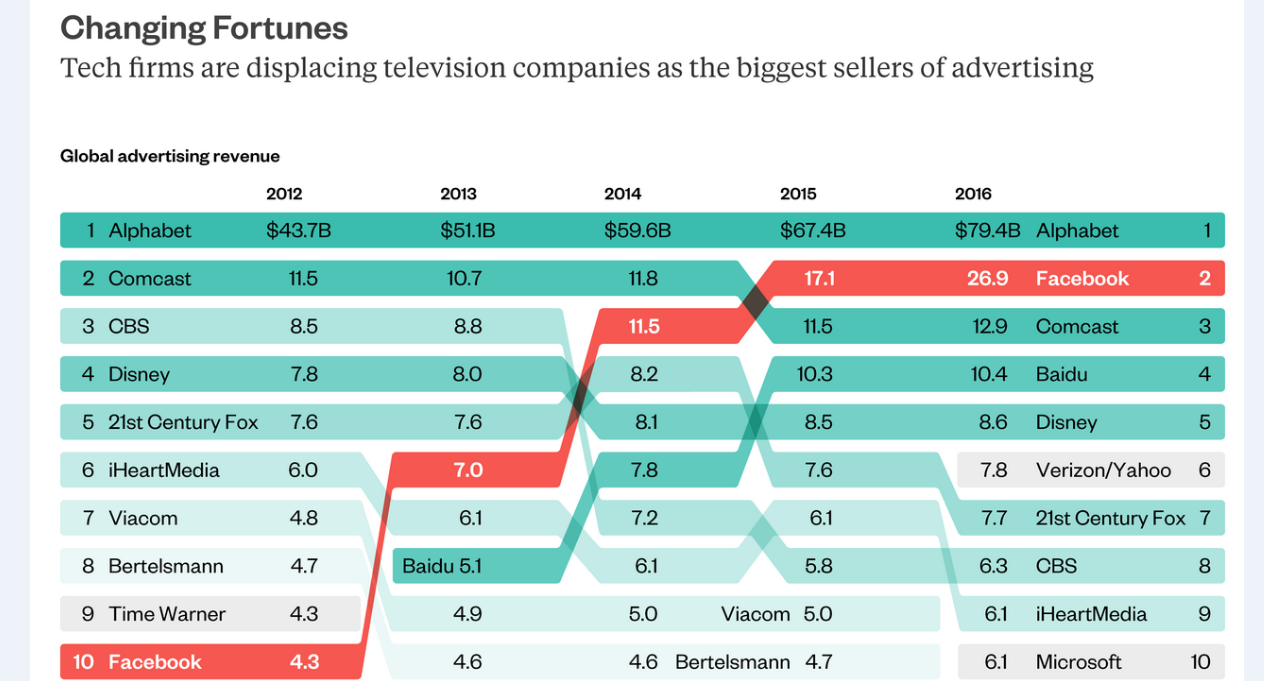
Here are the numbers for advertising:
Mobile ad revenue accounted for 87% of the company's total advertising revenue of $9.15 billion in the latest quarter, up from 84% a year earlier. Net income rose to $3.9 billion, or $1.32 per share, from $2.3 billion, or 78 cents per share, a year earlier.
Facebook's CFO once again warned the Street the company's revenue growth is being slowed down by a lower rate of advertisements on its properties, but the Street hardly cared, pushing price targets as high as $210, and the stock zoomed to half a trillion dollars in market capitalization, joining the exclusive club of Google, Microsoft and Apple.
The company noted that there are opportunities for incremental ad load on Instagram, increased engagement from Instagram stories, and potential for new monetization levers through Messenger and WhatsApp.
BMR Take: Facebook is an ad machine like the world has never seen. There is still so much potential ahead. With EPS pushing towards $10 over the next few years, we love this stock.
AstraZeneca (AZN: $30, down 11%)
AstraZeneca plunged after the U.K. drugmaker suffered a blow to its next-generation cancer therapy, with a new drug combination failing to do better than chemotherapy in checking the growth of lung tumors. This has posed a major setback to Chief Executive Officer Pascal Soriot’s ambitions. Imfinzi, used in combination with tremelimumab, didn’t meet a primary endpoint for progression-free survival in the study dubbed Mystic. The drugs were poised to generate more than $7 billion in sales by 2022, according to analysts’ estimates.
The failure calls into question Soriot’s ability to deliver on his growth strategy, put in place to keep the company independent when he rebuffed Pfizer Inc.’s $117 billion-takeover bid in 2014, and may make the firm vulnerable again. Imfinzi, which was poised to become Astra’s biggest medicine by sales, is the cornerstone of its cancer portfolio and key for meeting Soriot’s goal, set in 2014, of boosting revenue to $45 billion by 2023. Sales were $23 billion for 2016, so he has some serious work to do.
“Despite the outcome of the initial readout, we must be patient as the Mystic trial continues as planned to evaluate overall survival,” Soriot said in the statement. The study will continue to assess whether imfinzi or the combination of drugs can help improve life expectancy, with the results expected in the first half of next year.
The Mystic study was a crucial test for Astra’s two immuno- therapies -- a new class of drugs that activate the body’s defense system to attack tumors -- in a race with rivals including Merck, Roche Holding and Bristol-Myers Squibb to dominate the market for cancer treatments.
BMR Take: This is tough news to hear. We will keep a close eye on the situation and consider what to do about it after more careful analysis in the weeks ahead. We don’t like to panic. The stock dropped below our Sell Price of $32, so if you wish to get out you can do so on Monday. The stock came back over $1 on Friday and we are going to stick with it for a little bit more, watching the price closely.
Upcoming Economic News
Pending Home Sales Index
Monday, July 31st, 10:00 AM
Period: June
Consensus: 109.6
Prior: 108.5
Personal Consumption Expenditure
Tuesday, August 1st, 8:30 AM
Period: June
Consensus: 0.20%
Prior: 0.10%
Note: Monthly Personal Income and Outlays data are published by the U.S. Bureau of Economic Analysis. Personal consumption expenditures include consumer spending for all goods and services. These data are published on a quarterly basis in the GDP data release.
Total Light Vehicle Sales
Wednesday, August 2nd, 8:00 AM
Period: July
Consensus: 16.7 million
Prior: 16.4 million
Source: U.S. Bureau of Economic Analysis.
Average Workweek
Friday, August 4th, 8:30 AM
Period: July
Consensus: 34.5
Prior: 34.5
Note: Establishment survey data measuring the average workweek for production or nonsupervisory workers on private nonfarm payrolls.
A Word from Gary Jefferson
Jefferson Financial Group
First Vice-President, Investments
UBS Financial Services, Inc.
It looks like it's a pretty done deal for the S&P 500 to hit 2500 based on a very good earnings trend reported so far. One exception was Google - it went down even though its gross revenues and underlying ad metrics were good. It also beat its earnings per share estimates, but the investment community figured out this beat was driven by taxes and that for the first time in 5 years, traffic acquisition spending outpaced revenue growth. This reminds us of the typical slaughter of a stock because its earnings missed by a penny.
When you think about investing to grow your money into the future, an investor has to be more of a longer-term investor than one single quarter. Big trends don't come and go on a single quarter's earnings. And, speaking of big trends, what giant long-term trends come to mind first? The "no-brainer" is of course Technology – everything from mobile, the cloud, augmented reality, artificial intelligence, alternative energy and autonomous cars. But there is a sector that is bigger than Technology and has beaten it by 300% since 1999.
Healthcare. In a way, it is comprised of a great deal of "technology" on its own – think biotechnology and all of the remarkable medical devices being created. Healthcare also offers just as much innovation and diversification as technology – there are 800 companies and 12 industries to choose from. And today, there is not one but four "mega-trends" fueling the long-term trend behind Healthcare.
The first and most important is of course the once-in-a-lifetime baby boomer demographic tsunami which will drive it for another decade. Secondly, there is a new age of genetics and medical technology which has ushered in unprecedented advances in scientific and medical research. Companies, investors and charities are pouring billions of dollars yearly into R&D, and this is a trend with no end in sight as they seek to find cures for every disease on earth. Thirdly, earnings have been a classic example of what a mega-trend looks like. In 2016, the Healthcare sector was responsible for nearly 20% of the earnings in the S&P 500, bigger than the Financial, Energy, and Telecom sectors combined.
Yes, we are aware there are concerns that the government will try and hold down drug prices. These are, we believe, going to be overcome by the simple concept that everyone can agree they do not want companies to stop trying to find a cure because they no longer can make a profit.
The last trend is that of mergers and acquisitions. The big Pharma companies need to keep their pipelines full and avoid the revenue drops created when patents expire. During this bull market, over $500 billion in deals have been done, mostly by big drug companies buying emerging Giotechs. While the pace of M&A may slow down, we believe it will always be a positive force driving values in the Healthcare sector - especially if any tax reform policy unleashes a tidal wave of overseas corporate cash onto US shores.
Thus, the moral of this story is: If you own a "mega-trend" such as Healthcare, don't let a bad quarter in the stock market make you react like the investor who bails out of a stock because it missed that quarter's expected numbers. Markets go up and down, but Healthcare is a mega- trend we believe won't stop this decade and probably not in the next one either. We think we are right in the middle of this one.
Tesla Update
Tesla (TSLA: $335, up 2%) announced the first deliveries of Its Model 3 on Friday. There was big fanfare and discussion of the 500,000 orders they have for the car and how they are going to ramp up production from 90,000 cars this year to 500,000 next year. We see a coming let-down on this number and we are sure Elon is working on the language now that he will use to tell us that he is not going to make the numbers. But with that said, the company is amazing. The cars are spectacular. Customers rave about their cars like never before. And in the next five years this firm will become one of the greatest firms in the world. (You heard that here first at The Bull Market Report!)
Here are a few tidbits of things the Elon Musk is talking about:
Musk said that by 2020 Tesla will likely be able to make its cars go as far as 745 miles per charge.
The current record for hypermiling in a Tesla is about 560 miles. What is hypermiling? By taking it easy on the gas pedal and brakes, hypermilers achieve gas mileage feats far beyond the fuel economy ratings given to cars by the Environmental Protection Agency. They coast to stop signs, accelerate slowly, and sometimes raise the ire of other drivers.
The official range for Tesla's Model S is about 315 miles per charge, and note that the Model 3 was announced Friday with a range of 310 miles, up from 220 miles that most thought. Do you think Tesla will NOT continue to enhance the batteries over time? If you don’t, you are delusional. There is no question about this in our mind.
Here is some of the Press Release from Tesla on Friday, paraphrased by Bloomberg.
“Three hundred ten.
“That’s the electric range of a $44,000 version of Tesla’s Model 3, unveiled in its final form Friday night. It’s a jaw-dropping new benchmark for cheap range in an electric car, and it’s just one of several surprises Tesla had in store as it handed over the keys to its first 30 customers.
“Tesla has taken in more than 500,000 deposits at $1,000 a piece, Chief Executive Officer Elon Musk told reporters ahead of the event. This has created a daunting backlog that could take more than a year to fulfill - and that was before Musk took the stage in front of thousands of employees, owners, and reservation-holders to lift the curtain on the company’s most monumental achievement yet.
“We finally have a great, affordable, electric car - that’s what this day means,” Musk said. “I’m really confident this will be the best car in this price range, hands down. Judge for yourself.”
Here’s some of what Tesla disclosed at its plant in Fremont, California:
Two Battery Versions
Tesla has simplified the manufacturing process “dramatically,” Musk said. In the same factory space where Tesla can build 50,000 Model S or Model X cars, it will soon be able to produce 200,000 Model 3s. Part of that is due to a simplified package of options.
The car comes in two battery types: standard and extended range. Here’s how they break down:
Standard Battery:
Price: $35,000
Range: 220 miles (EPA estimated)
Supercharging rate: 130 miles in 30 minutes
Zero to 60 mph time: 5.6 seconds
Long Range Battery:
Price: $44,000
Range: 310 miles
Supercharging rate: 170 miles in 30 minutes (Same as Tesla’s Model S)
Zero to 60 mph time: 5.1 seconds
Only one other electric car in the world has broken the 300-mile range barrier: The most expensive versions of Tesla’s Model S, an ultra-luxury car that costs $97,500 or more. The new Model 3 has cheaper range availability than the current record holder, the $37,500 Chevy Bolt, which is outclassed in nearly every way by the Model 3.
Take a look at this video of the introduction of the Model 3:
https://www.bloomberg.com/news/articles/2017-07-29/tesla-s-model-3-arrives-with-a-surprise-310-mile-range
The High Yield Report
By Michael Foster
Special to The Bull Market Report
One of the biggest stories this week in high yield was Welltower’s (HCN: $73) earnings report, which was a very slight disappointment. Revenue fell 2%, slightly short of expectations, to $1.06 billion. FFO of $1.06 was a one-cent beat, again demonstrating Welltower’s continued acumen at financial discipline. The stock was offer a minor 1% for the week.
What about the dividend? Well, the company’s annual dividends are currently $3.48, with an annualized dividend coverage of 122%. That’s good, but admittedly not fantastic - our general rule of thumb is 130% or more dividend coverage should be every REIT’s target. Yet the company’s massive scale - we’re talking about a $27 billion market capitalization company with $30 billion in assets on the balance sheet - indicates that the income stream is extremely well insulated from a sudden market shock. Welltower also reported some interesting developments both in this quarter and in the future, including two properties spanning over 100,000 square feet that are 100% fully occupied. Partly because of this, the company raised its guidance.
Also significantly, Welltower’s borrowing costs went down. The company has lowered its net debt and improved its debt ratio in the quarter - a wise move considering the higher borrowing costs that are impacting the entire high yield universe. This is another indication that Welltower’s dividend coverage, while slightly soft now, will improve over the coming quarters. For this reason, there is a good reason to hold firm and keep buying this stock.
Also this week, we saw Omega Healthcare Investors (OHI: $31) report results quite similar to Welltower, and it too fell over 1% following the news on that day. The company saw revenue rise 4% a touch short of expectations at $194 million with EPS of 87 cents, which was a 2 cent beat. Again financial discipline was at play for the dynamic. Adjusted FFO rose over 3% from a year ago and the company raised its guidance, now expecting full year FFO to be between $3.42 and $3.44. The company also raised its dividend by a penny, continuing its history of raising dividends every quarter.
How did it do this? A big part of the REIT’s results center around its financing strategy. The company retired some unsecured credit and borrowed with new senior lines of credit, helping to lower overall borrowing costs for the firm. Omega also spent $8 million in new investments in the first quarter while spending another $30 million to renovate existing and build new facilities. The new investments include $180 million worth of property - $115 million in the U. K. and the rest in America.
Omega is doing what it does best: expanding its footprint, finding new opportunities, and improving rent potential with existing properties while increasing its dividend. If the REIT reaches its FFO guidance, the dividend coverage ratio will stay over 130%. Yet the stock is down 3% for the week (after the 64 cent dividend Friday) and is yielding a monstrous 8.2%. This is clear irrationality, and tells us that Omega isn’t just a hold - it’s a strong buy. Investors long this stock should continue to appreciate the dividends and expect their growth to continue. Now is a good time to buy more.
Elsewhere in REIT earnings, Ventas (VTR: $67) reported a revenue beat with 5.6% year-over-year growth to $895 million and EPS of $1.06, a penny above expectations. The company also re-affirmed full-year guidance of $4.15 FFO per share, giving it a dividend coverage ratio of about 133%, around the same as Omega Healthcare. Ventas’s long history means that its yield is quite a bit lower as the market trusts this bigger company. Its $24 billion market cap shows strength and diversification. But 4.6% is a very strong income stream in today’s reality of low interest rates, so this stock continues to be a buy for investors who are looking for income.
What about their future? The company spent $110 million on investments in the second quarter to expand its footprint and provide greater dividend growth for investors in the future. There’s just one snag - Ventas funded this with common stock instead of debt, as Omega did. That’s a trifle concerning. Does the Ventas management believe their company’s stock is overpriced? Total liabilities of $13 billion are 56% of the company’s total assets, giving it a pretty decent debt-to-asset ratio that would justify more lending activity. So why is the company issuing shares, thus diluting investors’ positions in the firm?
A large part of it has to do with the relatively low yield on common shares right now - that 4.6% is lower than the rising borrowing costs that floating-rate loans would cost Ventas in the future. So there’s some logic to the move, whereas Omega’s 8% yield is far too costly to issue too many shares versus the 5% or less borrowing costs on debt that Omega can get through bonds and loans. Thus the financial activities of both REITs, while different, make a lot of sense in their own context.
It seems pretty clear that, in a busy week for Healthcare REITs, the recent earnings releases give renewed confidence to stay long these companies and to continue to collect their dividends. Omega seems to be the strongest buy right now, and it makes sense to buy the company at any point when the dividend is more than 8%. We suspect that won’t last long, so it makes sense to add on to your Omega positions now.
Good Investing,
Todd Shaver, CEO, Editor in Chief, Founder
The Bull Market Report
Since 1998
July 26, 2017
by Todd Shaver | Jul 26, 2017 | Earnings Preview 6 AM
We are a shade late this week. We had computer and internet issues. Sorry.
Alphabet (GOOG: $954)
Bull Market Report Target Price: $1000
Bull Market Report Sell Price: We would not sell Alphabet
Earnings Date: Monday, 4:00 PM ET
Consensus: 2Q17
Revenues: $26 billion
EPS: $5.01
Alphabet reported a heavy drop in 2Q17 EPS due to the $2.7 billion fine from the European antitrust regulators. Shares currently trade down about 3% as the company missed expectations on its cost per click which rose by 23%. We are still bullish on Alphabet as they continue to innovate and bring to market new technologies like their most recent Google Home.
****************************************************
Eli Lilly (LLY: $82)
Bull Market Report Target Price: $88
Bull Market Report Sell Price: $76
Earnings Date: Tuesday, 8:00 AM ET
Consensus: 2Q17
Revenues: $5.4 B
EPS: $1.05
Year Ago Quarter Results
Revenues: $5.5 B
EPS: $0.86
Lilly reported yesterday with revenues up 8% and earnings up a powerful 22% to $1.11. Despite having missed estimates in two of the past four quarters, the stock is up 3% since this time last year and is currently trading 28% above its 52-week-low. Like other companies in our portfolios, Eli Lilly is also trading relatively cheap in comparison to the overall industry. Eli’s PE is 40 while Healthcare industry PE is around 60.
****************************************************
Equity Residential (EQR: $66)
Bull Market Report Target Price: $85
Bull Market Report Sell Price: $55
Earnings Date: Tuesday, 4:00 PM ET
Consensus: 2Q17
Revenues: $610 M
EPS: $0.35
Year Ago Quarter Results
Revenues: $595 M
EPS: $0.59
Key Things to Watch For in the Quarter
The company reported yesterday that it had net income of $195 million, or 53 cents per share, well above the Street estimate. Revenues came in at $613 million. Although Equity Residential has beaten estimates in the past four quarters, the stock still trades down 5% from this time last year. However, EQR is trading 13% above its 52-week low indicating positive investor sentiment within the Real Estate industry. The stock currently trades at a PE ratio of 20, relatively low compared to the industry’s PE of 40.
****************************************************
PayPal (PYPL: $58)
Bull Market Report Target Price: $56
Bull Market Report Sell Price: We would not sell PayPal
Earnings Date: Wednesday, 11:00 AM ET
Consensus: 2Q17
Revenues: $3.1 B
EPS: $0.43
Year Ago Quarter Results
Revenues: $2.7 B
EPS: $0.36
Key Things to Watch For in the Quarter
Analysts across Wall Street expect that PayPal will report a healthy 16% growth in EPS to $0.36 and a 14% increase in revenue to $3.1 billion. PayPal has either met or beaten estimates in each of the past four quarters. This success has contributed to the 55% appreciation in the stock since this same time last year. We expect PayPal to continue its top line growth as more transactions shift away from cash and onto digital platforms.
PayPal has hit our Target of $56. We still love the company and expect big things in the future. We hereby raise our Price Target to $66, and maintain our Sell Price as “We would not sell PayPal.”
****************************************************
Facebook (FB: $165)
Bull Market Report Target Price: $165
Bull Market Report Sell Price: $140
Earnings Date: Wednesday, 4:00 PM ET
Consensus: 2Q17
Revenues: $9.2 B
EPS: $1.12
Year Ago Quarter Results
Revenues: $6.4 B
EPS: $0.97
Key Things to Watch For in the Quarter
Analysts across Wall Street expect that Facebook will report strong EPS growth of 15% growth to $0.97 and a 30% increase in revenue to $9.2 billion. Despite having missed estimates last quarter, Facebook’s stock has climbed 36% since this time last year. In addition to the flagship Facebook.com, Zuckerberg has been innovating through his various offerings which include WhatsApp, Instagram, and Oculus Virtual Reality. We expect Facebook will continue to thrive as it tries to connect people throughout the world.
Facebook has hit our Target of $165. We added the stock at $97 a year and half ago and have been beating the drums every chance we get. We are still beating the drums. This company is amazing and is changing the world. We hereby raise our Target Price to $178 and raise the Sell Price from $140 to $155.
****************************************************
Omega Healthcare Investors (OHI: $33)
Bull Market Report Target Price: $45
Bull Market Report Sell Price: $28
Earnings Date: Wednesday, 4:00 PM ET
Consensus: 2Q17
Revenues: $235 M
EPS: $0.49
Year Ago Quarter Results
Revenues: $185 M
EPS: $0.57
Key Things to Watch For in the Quarter
Analysts estimate that Omega will report a 20% increase in revenue to $235 million and a 14% decrease in EPS to $0.49. Although Omega beat estimates in three of the past four quarters, the stock is down 6% this past year. This price depreciation has provided investors with an opportunity for entry especially as the stock only trades at a PE of 16 compared to the industry average of 60.
The stock hasn’t gone anywhere in a year, but that’s OK as we love the almost 8% dividend it pays.
****************************************************
CBRE (CBG: $38)
Bull Market Report Target Price: $40
Bull Market Report Sell Price: $32
Earnings Date: Thursday, 8:00 AM ET
Consensus: 2Q17
Revenues: $3.4 B
EPS: $0.53
Year Ago Quarter Results
Revenues: $3.2 B
EPS: $0.52
Key Things to Watch For in the Quarter
CBRE is expected to report moderate revenue and EPS growth for 1Q17. Analysts estimate that CBRE will report a 6% increase in revenue to $3.4 billion and a 2% increase in EPS to $0.53. The firm reported earnings that beat estimates in 3 of the last 4 quarters and provided investors with a 31% return year-over-year. CBRE’s stock currently trades at a PE ratio of 20, which is extremely cheap compared to the industry’s average PE of 91.
We love this one and can’t wait for it to hit $40 so we can raise the Target. The company is doing amazing things in real estate, saving companies money and manpower, and they are so low-key very few investors know about the firm. The market cap is a shade under $13 billion now, and this coming weekend we will give you some examples of what they do for their customers and why $38 for this stock will seem cheap in a year. We hereby raise the Sell Price from $32 to $35. We don’t want to lose the 48% gains we have in the stock since we added it at $26 last year.
****************************************************
United Parcel Service (UPS: $113)
Bull Market Report Target Price: $125
Bull Market Report Sell Price: $106
Earnings Date: Thursday, 8:00 AM ET
Consensus: 2Q17
Revenues: $15.5 B
EPS: $1.47
Year Ago Quarter Results
Revenues: $14.6 B
EPS: $1.43
Key Things to Watch For in the Quarter
UPS is expected to report moderate revenue and EPS growth for 2Q17. Analysts estimate that UPS will report a 5% increase in revenue to $15.5 billion and a 3% increase in EPS to $1.47. The firm reported mixed earnings in the last four quarters. Having only beat estimates once, the stock has underperformed the market at a mere 2% increase. It currently trades at a PE ratio of 28, which is slightly high compared to its competitors in the 25 range.
We still like the company a lot, as they have to deliver all those packages from Amazon! We are maintaining our Price Target of $125.
****************************************************
Bristol Myers Squibb (BMY: $56)
Bull Market Report Target Price: $77
Bull Market Report Sell Price: $51
Earnings Date: Thursday, 8:00 AM ET
Consensus: 2Q17
Revenues: $5.1 B
EPS: $0.73
Year Ago Quarter Results
Revenues: $4.9 B
EPS: $0.69
Key Things to Watch For in the Quarter
Bristol Myers is expected to report moderate revenue and EPS growth for 2Q17. Analysts estimate that Bristol will report a 4% increase in revenue to $5.1 billion and a 6% increase in EPS to $0.73. Although Bristol Myer beat estimates in three of the past four quarters, the stock is down over 25% this past year. This price depreciation has provided investors with cheaper opportunities for entry especially as the stock only trades at a PE of 20 compared to the industry average of 60.
****************************************************
Celgene (CELG: $137)
Bull Market Report Target Price: $135
Bull Market Report Sell Price: $115
Earnings Date: Thursday, 8:00 AM ET
Consensus: 1Q17
Revenues: $3.2 B
EPS: $1.78
Year Ago Quarter Results
Revenues: $2.8 B
EPS: $1.44
Key Things to Watch For in the Quarter
Analysts across Wall Street expect that Celgene will report both strong revenue and EPS growth of 15% and 24% to $3.2 billion and $1.44 respectively. while Amazon will increase its revenues by 19% to $37 billion, it will decrease its EPS nearly 20% to $1.42. Amazon has beat estimates in all of the past 4 quarters and has helped return investors 27% since this time last year. Celgene still only trades at a PE ratio of 50, making it relatively cheap compared to the industry’s PE of 60.
Since June at $114, the stock has gone straight up. It has reached our Target of $135, but we still love this huge company ($107 billion market cap,) so we hereby raise our Price Target to $150 and raise our Sell Price from $115 to $125. We added the stock at $95 a year ago and are now up 44% as it just set a new all-time high last week. Lovin’ it.
****************************************************
Amazon (AMZN: $1,040 – a new all-time high)
Bull Market Report Target Price: $1,100
Bull Market Report Sell Price: $875
Earnings Date: Thursday, 4:00 PM ET
Consensus: 1Q17
Revenues: $37 B
EPS: $1.42
Year Ago Quarter Results
Revenues: $30 B
EPS: $1.78
Key Things to Watch For in the Quarter
Wall Street expects that while Amazon will increase its revenues by 19% to $37 billion, it will show a decrease in EPS of nearly 20% to $1.42. Amazon has beat estimates in three the past four quarters and has helped carry many tech heavy indices. Amazon traded at $765 this time last year and has since climbed over 35% to its current levels. This past Prime Day, Amazon’s version of Black Friday, the company broke its own record for the largest online shopping day in history.
We are keeping the Target Price at $1100, but raise our Sell Price to $970 from $875.
****************************************************
First Solar (FSLR: $45)
Bull Market Report Target Price: $55
Bull Market Report Sell Price: $28
Earnings Date: Thursday, 4:00 PM ET
Consensus: 2Q17
Revenues: $540 M
EPS: $0.10
Year Ago Quarter Results
Revenues: $935 M
EPS: $0.87
Key Things to Watch For in the Quarter
This company is regrouping, as we know, and the comparisons are not pretty. Analysts estimate that First Solar will report a decrease in revenues by 43% to $540 million and an 88% decrease in EPS to $0.10. Although First Solar has beat estimates in the past four quarters, the stock is down 5% this year.
The stock is inching its way back, little by little. We certainly had bad timing on the addition of the stock to our Special Opportunities portfolio last year in February, but we are believers in the business and the company and have had amazing patience with this one. We hereby raise the Sell Price from $28 to $39.
****************************************************
Ventas (VTR: $68)
Bull Market Report Target Price: $82
Bull Market Report Sell Price: $43
Earnings Date: Friday, 8:00 AM ET
Consensus: 2Q17
Revenues: $880 M
EPS: $0.44
Year Ago Quarter Results
Revenues: $850 M
EPS: $0.42
Key Things to Watch For in the Quarter
Wall Street expects that Ventas will report moderate EPS growth of 7% to $0.45 and a 4% increase in revenue to $880 million. Although the firm has beat estimates in the past four quarters, its stock is down 8% over the past year. The company’s 5% dividend and relatively cheap PE of 35 make it an attractive stock in today’s markets. This is not a small company, as the market cap of $25 billion tells us.
We hereby raise our Sell Price from $43 to $61.
****************************************************
Welltower (HCN: $73)
Bull Market Report Target Price: $84
Bull Market Report Sell Price: $60
Earnings Date: Friday, 8:00 AM ET
Consensus: 2Q17
Revenues: $1 B
EPS: $0.44
Year Ago Quarter Results
Revenues: $1 B
EPS: $0.54
Key Things to Watch For in the Quarter
Analysts estimate that Welltower will report no change in revenues at $1 billion and a 18% decrease in EPS to $0.44. Although Welltower has beat estimates in the past 4 quarters, its stock is down 7% this past year. This move has provided investors with cheaper opportunities for entry especially as the stock continues to pay a 5% dividend and trades at a PE that is 25% lower than its industry’s.
We hereby raise the Sell Price from $60 to $68.
July 16, 2017
by Todd Shaver | Jul 16, 2017 | Weekly Newsletter 7pm Sunday
The Weekly Summary
Billionaire CEO of JP Morgan Chase Jamie Dimon says being an American abroad is “almost an embarrassment.” The rant came on JP Morgan’s widely followed earnings call held Friday. Dimon says the media should focus more on major issues. He doesn’t like listening to the “stupid stuff” Americans have to deal with, expressing frustration over the nation’s inability to invest in infrastructure and overhaul the tax code. There would be much stronger growth if there were more intelligent decisions and less gridlock. Reporters should focus on the major issues the nation faces rather than the vagaries of the firm’s trading businesses, he said. The United States of America has to start to focus on policy which is good for all Americans, and that is infrastructure, regulation, taxation, education. He screamed, “Why you guys don’t write about it every day is completely beyond me. And, like, who cares about fixed-income trading in the last two weeks of June? I mean, seriously.” Dimon is one of the best businessmen in America and his words are known for being the hard truth. It makes sense to us that for the bull market to continue our citizens must wake up to the realities we face and take actions.
There is always a bull market here at The Bull Market Report! This week we highlight the following stocks: PayPal, Splunk, Microsoft, and Tesoro.
Highlights From The Past Week
US Bank earnings season started on Friday. Q2 earnings season for the banks kicked off on Friday morning with results from JP Morgan, Citigroup, Wells Fargo and PNC Financial. Some analysts have highlighted a more difficult setup for the group following a June rally on the back of higher bond yields and capital return announcements that beat elevated expectations. There have also been thoughts that earnings season could shift some of the focus back to the more challenging operating environment for the group. However, there really did not seem to be any meaningful discussion about downside risk to estimates. Analysts seem to be looking for the bulk of the support for Q2 to come from additional net interest margin expansion. This should offset sluggish loan growth and weaker capital markets (near double-digit declines). The latter dynamic has been widely discussed by bank executives and in the press and was a key driver of estimate reductions. Despite some pickup in concerns surrounding the Auto sector, credit is expected to remain benign. Analysts also highlighted expectations for another solid quarter of cost control. This is our first glimpse into the new earnings season.
More conjecture on ECB policy. There is further speculation on ECB policy where the ECB is likely to signal that it is gradually winding down its QE plan at its September 7th policy meeting, and President Draghi could use his appearance at the Fed Reserve's Jackson Hole conference in August to signal a policy shift. The ECB is wary of putting an end date to its QE plan. There is a need to retain flexibility in case the economic outlook sours and also the ECB wants to follow the Fed example of exiting the policy of retaining open-ended nature of program. A Reuters poll of over 75 economists showed consensus thinks the ECB is likely to shift away from ultra-easy policy in September. The Fed and ECB are two of the most powerful institutions in the world for capital markets. This is important stuff.
CBO says Trump budget would not balance. The Congressional Budget Office (CBO) said Trump’s fiscal 2018 budget would reduce the deficit by about a third over next decade. This is a smaller estimated deficit reduction than the White House forecast due to lower revenue projections. Trump’s budget would result in average GDP growth over next decade of 0.1% more than the CBO baseline. CBO also estimated that revenues under Trump’s budget would be almost $1 trillion lower than his estimates over the next decade. Trump budget's deficit reduction would stem from lower spending, including decreasing the $2 trillion base in mandatory spending, mostly from healthcare. Press reports said CBO’s findings creates new complications for Republicans who need to build a coalition of conservatives and moderates to vote for a single budget proposal. We need to start seeing some real progress out of the White House.
Britain acknowledges Brexit bill for the first time. Ahead of this week's Brexit talks between Brexit Secretary Davis and EU negotiator Barnier, a written statement was released to parliament, which acknowledged Britain has financial obligations to the EU, which will continue beyond Brexit. The Financial Times cited EU diplomats saying it goes further than UK Prime Minister May’s previous reference to Britain being willing to reach a “fair settlement” of unspecified obligations. It noted that Davis did not refer to financial issues when he released three position papers ahead of Brexit talks. The article pointed out that the British team sees the statement on financial obligations as an effort to improve the tone of talks rather than a change in substance. Meanwhile, at least 15 Conservative MPs are in talks with Labour on keeping Britain in the European Economic Area after Brexit, which would require accepting free movement of people and paying some money to the EU. The rationale for this approach is that it would give Britain time to reach a final deal with the EU and give certainty for businesses and workers. What a mess.
Dow, S&P 500 Hit Records to Close Winning Week
The S&P 500 hit a fresh record Friday and posted its best weekly performance since late May, and the Dow Industrials notched their third consecutive record close. Let’s keep this going!
Special Profile - Leon Black of Apollo
Private equity firm Apollo Global Management (APO: $27, up 3%) this week agreed to acquire ClubCorp Holdings, one of the largest owners and operators of private golf and country clubs in the United States, for $1.1 billion. ClubCorp owns and operates 200 golf, country, business, sports and alumni clubs in 28 states, Washington D.C. and two foreign countries,
The deal comes three months after ClubCorp announced the retirement of is CEO Eric Affeldt and said it had decided not to pursue a "strategic transaction," after efforts to explore a sale did not result in any offer for the entire company. So much for those thoughts!
Apollo said it will pay a 31% premium over its closing price on Friday, in cash for ClubCorp, a but less than the 12-month high the shares reached in February.
Who is the man behind the curtain? Apollo Chairman and CEO Leon Black. He founded Apollo in 1990 to manage investment capital on behalf of a group of institutional investors, focusing on corporate restructuring, leveraged buyouts, and taking minority positions in growth-oriented companies. From 1977 to 1990, Mr. Black worked at Drexel Burnham Lambert, where he served as Managing Director, head of the Mergers & Acquisitions Group and co-head of the Corporate Finance Department. He now serves on the boards of directors of Apollo Global Management, and The Partnership for New York City. Mr. Black is Co-chairman of The Museum of Modern Art, and a trustee of Mount Sinai Hospital, The Metropolitan Museum of Art, and The Asia Society. He is a member of The Council on Foreign Relations. Mr. Black is also a member of the board of FasterCures and the Port Authority Task Force. He graduated summa cum laude from Dartmouth College with a major in Philosophy and History and received an MBA from Harvard Business School.
BMR Take: This man is a powerhouse and the success of your investment in Apollo will depend on Mr. Black. We put him in that category of people like Elon Musk, Steve Jobs and Bill Gates. We are big believers.
BMR Companies & Commentary
PayPal (PYPL: $57, up 6% - new all-time high [NATH) set Friday)
The price target was raised to $70 from $54 at a research firm on the Street. PayPal is the firm's "top idea" for 2017, followed by Google (GOOG: $956, up $37, 4%). Coming opportunities with PayPal's Venmo and with partnerships caused the research firm to become even more bullish.
PayPal and Apple entered into an exciting major partnership this week that sent shares to all-time highs. PayPal and Apple have partnered to give users the ability to use PayPal as a payment method when paying for Apple’s services, which includes the App Store, Apple Music, and iTunes, to name a few. The feature will be introduced in 12 markets, including the US and the UK, and it will be integrated with several devices across Apple’s ecosystem, including the iPhone, iPod, Apple TV, and Apple Watch.
The immediate impact for PayPal is getting access to a massive revenue stream. Revenue from Apple services, which is mostly from the App Store, reached $7 billion in Q416, up 18% from last year. Although the financial terms of this deal have not been disclosed, we can estimate the potential impact. If PayPal were to charge Apple 1.25% per transaction, which is much lower than the 2.9% fee it often charges merchants, and if PayPal accounts for a third of spend on the App Store in 2017 — which will be based on consumers spending a total of $40 billion on the iOS App Store, according to Street sources — PayPal would see $165 million in revenue for 2017.
In the long run, PayPal’s partnership with Apple could give the firm an opportunity to integrate itself into additional Apple services. Over the last few years, Apple has indicated that it plans to turn its chat app, iMessage, into a robust ecosystem. The app now includes peer-to-peer payments, games, and other apps, with even more features coming in the fall with the launch of iOS 11. Although it hasn't been confirmed, it's reasonable to assume that one feature coming down the pipeline is the ability to buy products via iMessage. With PayPal already being a payment option within Apple's ecosystem, users may be more willing to use it going forward.
BMR Take: PayPal ranks among the best growth stories in all of technology and this Apple deal is just another reason as to why. Earnings are growing greater than 20% per year for as far as the eye can see and should break $3 by 2020.
Splunk (SPLK: $60, up 4.5%)
Splunk has come under some selling pressure and stock is still below the highs of the year at $69 set in May, providing yet another buying opportunity as the company exits this seasonal lull. In a market where the "FAAMG*" stocks and other rapidly growing tech companies are making all-time highs, Splunk is down 43% from its high made in 2014. This comes despite Splunk more than tripling its revenue in the last three years and consistently beating analyst expectations.
*FAAMG – Facebook, Apple, Amazon, Microsoft and Google
In our view, Splunk has been one of the most consistent companies over the years and one of the best pure-plays of the Big Data movement. In June, Splunk's growing importance in this market was on display at Cisco Live!, the Data Works Summit and the Cloud Expo. A prime example of Splunk's expanded importance is with Cisco, which is now indexing approximately 9-10 terabytes per day with Splunk versus 2 TB per day in 2015, significantly above the 300 GB of data per day in 2010.
After reporting strong April quarter results during its seasonally weakest quarter of the year, Splunk came under selling pressure in late May and still has not recovered from this downdraft. The market got hung up on "inconsistent performance" during the April quarter that resulted in a leadership change, while license revenue missed forecasts given the strength in the company's cloud business that drove big upside in maintenance and services revenue. As Splunk begins to head into the stronger part of the year, we believe the stock can play catch-up.
Given rising security threats, including the WannaCry Ransomware attack in May, Splunk introduced Splunk Insights for Ransomware in late June. This new offering allows smaller organizations (they offer user-based pricing for up to 1,000 employees) to fight malware in real time with a cost-effective solution.
BMR Take: By leveraging a proprietary machine data technology to turn data into real-time operational intelligence, Splunk is benefiting from its position as a pioneer and leader in the world of machine data with its core software platform called Splunk Enterprise. We see substantial upside for the stock as the current valuation is only 6x revenue versus a high-water market of 28x. We’re up 29% on the stock in a little over a year, but we would await even better returns this next six months as the market comes to recognize how strong the company is.
Microsoft (MSFT: $73, up 5%, setting a NATH* on Friday)
Early in the week Microsoft proposed a $10 billion effort to bring broadband internet to the rural U.S., an economic-development program aimed at a core constituency of the Trump administration. The plan, which calls for corporate and government cash, would send internet data over unused broadcast frequencies set aside for television channels. If developed, the initiative would help connect 23 million Americans in rural areas who lack high-speed internet access.
*NATH - New All-Time High
Broadband is important for all kinds of things. It’s not just streaming high-definition movies. Slow or nonexistent connections can hinder agriculture, business, education and healthcare. Broadband is arguable now a necessity of life. Microsoft’s proposal calls for a 5-year program of corporate investment and matching federal and state grants to end the gap between rural and urban access, starting with the company’s own efforts. The aim of Microsoft’s new Rural Airband Initiative is to be up and running in 12 states by next year and connect 2 million people over the next five years.
BMR Take: Doing big things like what is described above is why Microsoft is not just a tech titan, but a leader amongst the entire S&P 500. News like this continues to push the stock toward 20x consensus estimates of $4 per share of free cash flow. Do the math – that’s $80 a share.
Tesoro (TSO: $97, up 1%)
Tesoro has been a big winner and it could keep getting better. This week the company announced plans to study the possibility of turning vegetable oil into diesel fuel at its Dickinson refinery, which it purchased in 2016.
The crude oil refiner is making plans to retrofit an 8,000-barrel-per-day diesel hydrotreater to process soy and corn oil into renewable diesel alongside its Bakken crude oil processing. This $3.5 million project would use 17,000 gallons per day of vegetable oils to create a 5% renewable diesel mix to be marketed in North Dakota by the end of 2017. The North Dakota Industrial Commission granted the company a $500,000 grant to help cover the project's cost.
Compared to biodiesel that is blended into petroleum diesel at truck racks, renewable diesel is a superior quality product because, unlike biodiesel, renewable diesel is a pure hydrocarbon stream containing no oxygen. This results in a superior quality fuel that maintains vehicle performance. The company says the project is “unique and exciting.” Of course they do!
BMR Take: The stock continues to trade at a big discount to the consensus NAV* estimate of $120. In comparison, Buffet’s ownership of peer Phillips66 is valued at a premium to NAV in the market. Disconnect that the market will correct down the road? We think so. Tesoro still looks compelling to us even after the recent appreciation.
*NAV – net asset value
Upcoming Economic News
Export Price Index
Tuesday, July 18th, 8:30 AM
Period: June
Consensus: 0.05%
Prior: -0.70%
Note: The U.S. Bureau of Labor Statistics' International Price Program produces Import Price Indexes (MPI) and Export Price Indexes (XPI) containing data on changes in the prices of nonmilitary goods and services traded between the U.S. and the rest of the world.
Housing Starts
Wednesday, July 19th, 8:30 AM
Period: June
Consensus: 1,146,000
Prior: 1,092,000
Note: The number of housing units started in the United States.
Leading Economic Index
Thursday, July 20th, 10:00 AM
Period: June
Consensus: +0.30%
Prior: +0.30%
Note: The Conference Board Leading Economic Index (LEI) for the U.S. increased 0.3% in May to 127.0 (2010 = 100, following a 0.2% increase in April, and a 0.4% increase in March. Leading Indicators are economic series that tend to change direction ahead of shifts in the business cycle. There are 10 components of the U.S. Leading Composite Indicator* published by The Conference Board. The index is constructed by averaging the individual components in order to smooth out a good part of the volatility of the individual series. Historically, the cyclical turning points in the leading index have occurred before those in aggregate economic activity. Prior to 1996, the composite leading, coincident, and lagging indicators were calculated and published by the U.S. Department of Commerce.
* Average weekly hours, manufacturing
Average weekly initial claims for unemployment insurance
Manufacturers’ new orders, consumer goods and materials
ISM Index of New Orders
Manufacturers' new orders, non-defense capital goods excluding aircraft orders
Building permits, new private housing units
Stock prices, 500 common stocks
Leading Credit Index
Interest rate spread, 10-year Treasury bonds less federal funds
Average consumer expectations for business conditions
A Word From Gary Jefferson
First Vice-President, Investments
UBS Financial Services, Inc.
Q2 GDP estimate - +2.7%. Anything above 2% is a real plus after eight years of mostly sub -2%, and should provide the momentum needed to get to the 3%+ level.
222,000 jobs added versus 170,000 expected – A lot more should come with passage of any of the three main Trump growth initiatives.
57.8 ISM - Manufacturing is highest since 2014 – This is just what the doctor ordered!
57.4 ISM Services is nice. 60.8 forward-looking New Orders component is even nicer.
None of this means the economy is safe forever. Another recession is inevitable. But what these stats are telling us is that it's just not coming anytime soon.
We still like the Technology, Healthcare, and Financial sectors. While some folks think some of the Tech stocks are bubbly, we agree with those who simply ask about why Tech has led, and if anything has changed. The answers are "earnings" and "no"………. or how about, "FANG is dead – long live FAAMG". [We think you might have to read this last paragraph a few times to get his point!]
2nd Quarter earnings season starts this week. If it lives up to expectations we shouldn't even have to worry about a pullback. Right now, the stats favor another good earnings session. We don't expect the Fed to raise rates until September, and that will depend on how year-end earnings guidance looks. The two dates which will probably have as much if not greater effect on the market are September 5th and 30th. If nothing gets done in Washington before the August recess on September 5th, it could signal the end of any chance for growth stimulus to happen this year. That will likely create a fairly strong headwind. On September 30th, government funding expires. Hopefully we won't have to endure another ridiculous dog-and-pony show in Washington and this will not become a major distraction for investors.
An Interview with Tim Cook
We read a lengthy interview of Apple CEO Tim Cook by Bloomberg Businessweek Editor Megan Murphy. We thought the following few paragraphs from it were particularly insightful:
Murphy: I was a little surprised the HomePod was pitched primarily as a music device when the competitive talk is of Amazon Echo’s Alexa and the immersive experience in the home. How will the HomePod better integrate Apple inside people’s lives?
Cook: We’re actually already in the home through the iPhone you take with you everywhere. It’s in your pocket or laying on a stand. Today, pre-HomePod, I can control my home using Siri through the iPhone. When I get up in the morning, my iPhone is my alarm clock. I say, “Good morning,” and all of a sudden, my lights come on. The temperature adjusts and a series of things occur. We’re also in the home through Apple TV. Many people use iPad as their computing device. The desktop Mac enjoys a place in the home. The thing that has arguably not gotten a great level of focus is music in the home. So we decided we would combine great sound and an intelligent speaker.
Murphy: So, it’s going to be a holistic process joining up all those touch points so people can exercise control over their lives, whether through Siri or iPad?
Cook: To put it in perspective, Siri is getting requests from 375 million devices right now. My guess is it’s the largest by far of any kind of assistant. Some of those requests are done in the home. Some of those are done on the go. That’s the platform that we build off. It’s very different from our starting point. We’re also in so many languages around the world: Siri isn’t just in English. We’re well-positioned around the world. So, again, what is the thing that’s missing in this equation? The combination of quality audio and instinct.
“I am so excited about it, I just want to yell out and scream”
Murphy: Do you think people will pay $349?
Cook: If you remember when the iPod was introduced, a lot of people said, “Why would anybody pay $399 for an MP3 player?” And when iPhone was announced, it was, “Is anybody gonna pay - whatever it was at that time - for an iPhone?” The iPad went through the same thing. We have a pretty good track record of giving people something that they may not have known that they wanted.
When I was growing up, audio was No. 1 on the list of things that you had to have. You were jammin’ out on your stereo. Audio is still really important in all age groups, not just for kids. We’re hitting on something people will be delighted with. It’s gonna blow them away. It’s gonna rock the house.
BMR Take: We were pleased to see Tim Cook’s responses for two reasons. 1) the iPhone is already the home controller of choice. We knew this, but Cook really put it in perspective. And 2) The takeover of a market is Apple’s modus operandi. Start late with a high price. Then lower prices and dominate. We have no doubt the home assistant will be any different. Amazon – watch out.
Nutanix Has a Rip-Roaring Week
The stock of Nutanix (NTNX: $22) was up 16% last week. We’ve been harping on this stock for weeks, and then along comes Goldman Sachs and says Nutanix is a “once-in-a-decade” opportunity and are looking for a $31 Target. Our Price Target is $30. Is Goldman reading The Bull Market Report? We certainly think so.
We’re already up 27% in the six weeks since we added the stock in late May. And we expect more good things from the company in the future. Nutanix is the leader in hyperconverged infrastructure, meaning it uses software to combine different storage and computing functions on one device. That space has been heating up among enterprises. More businesses are looking to adapt the technology, with 18% of chief information officers saying they expect to move to hyperconverged systems in the next two years, according to Goldman Sachs.
The company’s leadership in the space, including the combination of hardware and software it offers, makes it a “once-in-a-decade tech infrastructure story,” wrote the lead Goldman analyst on the note. They see Nutanix on a path for long-term double-digit growth, high gross margins and large operating leverage.
Additionally, in the shorter-term, Nutanix should benefit from changed accounting rules that will move its software revenues, which are currently deferred, to its profit and loss statement.
BMR Take: What more can we say? All good.
First Solar Continues its Tear
First Solar (FSLR: $43) was up another 9% this past week. We’re still down 30% or so on the stock but we are big believers in the company and management. Our timing on the addition to the Special Opportunities portfolio was bad. But we believe we will be winners in the long run. The stock is up over 55% in the last three months. Keep hanging in there.
Twilio Hanging in There
Twilio (TWLO: $29, up 3%) had a good week. It’s down from where we added it for sure, but slowly creeping back up as the Street slowly begins to realize the potential of this company. We are again looking for another strong revenue quarter in early August when they announce. That will show the Street!
Apple Back Up To $150.
Almost. Closed at $149, up $5 for the week. The market just can’t keep this one down. We sincerely hope you have some of this wonderful firm. You think it’s too high. Not on your life.
Annaly Just Keeps Chugging Along
And it is paying 10% a year in dividends. Annaly Capital Management (NLY: $12.33) added 2% last week. The stock has been paying double-digit dividends since inception in 1997. That’s right – 20 years. Where will the stock be in a year? Good question. We would say right about at this level, after paying another four quarterly dividends of 30 cents each. Do the math – that’s a shade under a 10% return. We love this one.
The High Yield Corner
By Michael Foster
Special to The Bull Market Report
We’re getting close to earnings season for Healthcare REITs, and the market’s expectations seem to be getting increasingly bullish. Over the last week, all of The Bull Market Report’s Healthcare REIT picks were in the green, with Omega Healthcare Investors (OHI: $33) leading the pack with a 2% gain for the week. That’s pushed the stock’s year-to-date performance much higher, with a 7% gain on top of half of the fund’s 8% dividend yield. There’s been a relatively low amount of volatility in Omega Healthcare relative to what we saw both in 2015 (where rate hike fears hit all REITs) and 2016 (when the REIT bull market suddenly corrected at the end of the year).
But what about the upcoming earnings report on July 27th? So far, analysts are expecting 86 cent FFO for the quarter, up from 83 cents from a year ago. The company has reaffirmed their 86 cent guidance as recently as early May, bringing the stock’s dividend coverage ratio to 134% if they hit the number. Gotta love it.
Before we discuss whether they will hit it or not, let’s take a quick look at Welltower (HCN: $74, up 1%), which had a similarly strong week and is also planning to release earnings soon - on July 28th before the market open. Welltower has far outperformed Omega for 2017, with a 10% price jump - although the lower dividend (5%) mostly offsets this. Like Omega Healthcare, Welltower is showing strikingly little volatility as of late, a development that makes a lot of sense given Welltower’s tremendous track record and strong dividend coverage. However, it’s surprising to see that Welltower’s dividend coverage is a shade lower than Omega’s at 128%. While that’s still good (general rule of thumb: any number over 115% is good for a REIT), it’s interesting to see how the dividend coverage ratio has slipped in the last couple of years as a result of falling funds from operations. Welltower’s earnings were down 6% from a year ago last quarter, and guidance suggests that decline is set to continue. But Welltower is also increasing dividends, which is a setup for a worrisome dynamic in which, eventually, the company will under-earn its dividend. How soon could that happen? At the current clip we’re safe for another 3-4 years, but the company clearly needs to adapt, lest it find itself suddenly in a position to halt or even cut dividends. For this reason, the company’s earnings results on the 28th and especially its forward guidance will be a key issue to watch for. We will keep a close eye on this.
Finally, Sabra Health Care REIT (SBRA: $23) had a flat week (up less than 1%) despite being one of the smallest Healthcare REITs in terms of market cap and property footprint. It’s quite unusual to see the smaller stock be less volatile than its bigger cousins, but Sabra is one of the less popular REITs out there (investors, especially retail investors, spend a lot more time focusing on Omega), and there was little news on the stock to justify much price action. On top of that, the company’s massive underperformance relative to its peers has soured a lot of investors on the company, while fundamental investors know this is a very good company with strong dividend coverage and growth potential.
So, if you have few sellers and few buyers, you end up with little price change. But how is Sabra doing as we near its earnings release at the end of July? Over the last 12 months, earnings have been weak relative to expectations, with two misses out of the last four quarters. But dividend coverage is impressive, at 132%. Some investors may be a bit concerned about the company’s relatively weak revenue growth, but it’s important to remember that Sabra is pausing on acquisitions right now and reorganizing its new property portfolio additions to maximize income. This process naturally makes revenue look bad, which again is why impatient investors have shied away. Nonetheless, the ongoing restructuring continues to be successful, as the strong dividend coverage ratio proves. Expect to see good things from Sabra in the future that will help the stock recover, but we may not see those developments for a year or more. For investors, that means sitting tight with your Sabra shares, collecting a 7% dividend while you wait for the market to catch up.
Now, with upcoming earnings for these stocks, we need to ask ourselves the likelihood of them hitting their numbers. While there are differences in each company that makes some stronger than others, the broader issue that impacts all of them is the regulatory overhang. A lot of chatter about the future of Obamacare and plans from the Republicans and President Trump to change or obliterate current regulations has left a lot of investors skittish on Healthcare for a long time. But interestingly, we’ve seen the market swiftly realize how silly these concerns are - at least as it impacts the Biopharma sector, which is up solidly for 2017 and is beating the S&P 500. But why isn’t that same relief coming to Healthcare REITs with the same speed?
Simply put, REIT investors are far more risk averse as a group, and they are much slower to recognize a change in the political landscape than growth stock investors. This puts those holding Healthcare REITs in the awkward position of needing to be patient. However, it is clear that there is little change to the regulatory environment coming, and some analysts are already noting that recent GOP proposals to change Obamacare actually look a lot like Obamacare. Whatever your political leanings and opinions on the subject, it seems pretty clear that the status quo isn’t going to change anytime soon.
Again, no matter your opinions on the growing D.C.-based controversies, there is a clear conclusion: Healthcare as it operates in America is not about to change anytime soon. Healthcare REITs have been discounted for a change that would negatively impact them. Putting these together, it’s a clear time to buy or to continue to hold Healthcare REITs both before and after the upcoming earnings season.
Good Investing,
Todd Shaver, Founder, Editor and CEO
The Bull Market Report
Since 1998
June 25, 2017

by Todd Shaver | Jun 25, 2017 | Weekly Newsletter 7pm Sunday
The Week Ahead
Two themes are dominating the headlines heading into next week. First, several GOP Senators have come out to say they won’t vote for the Health Bill in its current form. But this is a yawn. Healthcare stocks rallied to end the week pushing past the uncertainty. Congress knows they need to do a good job because Americans are tired of their lack of accomplishments.
Second, everybody is talking about how Amazon will rule the world. Literally, the common question on conference calls now is: “Does your company have any Amazon risk?”. From Capitol Hill to Silicon Valley the bull market is rockin’ and rollin’. What a great time to be an investor. It won’t always be this good that’s for sure.
There is always a bull market here at The Bull Market Report! This week we highlight the following stocks: First Solar, Athenahealth, Tesla, Twilio, Bristol-Myers, and Eli Lilly.
Highlights From The Past Week
Fed Stress test results are in. And everyone passes. On Thursday the Fed released the first phase of its annual stress test which, once again, found that all 34 of the US largest banks "passed", exceeding minimum projected capital and leverage ratios under severely adverse scenarios, based on their projected ability to withstand economic shocks, which shows that "firms are getting the hang of the once-dreaded reviews." The result marks the third straight year all firms cleared the minimum requirements in the exams’ first phase, begging the question just how "stressful" this test truly is. Results covered the "Dodd-Frank Act Stress Test" that measures banks’ capital under stress over the nine quarters. The banking system is very healthy. This is good news for the bull market!
OPEC deal to impact the oil market. OPEC’s production cut deal is unlikely to survive beyond its current deadline in March 2018 many believe. This would result in a huge amount of extra oil to hit the market. OPEC’s most recent deal has not had the cartel’s desired effect on the markets, neither in terms of oil prices nor in drawing down the global glut. Why? OPEC finally decided to cut back production. This should have reduced supply and in turn led to oil prices recovering. But what happened instead? Those darn US swing producers just jumped right back into ramping up production at the opportunity of the void left by the OPEC cuts. Now we are seeing oil prices fall again.
OPEC can’t be pleased with the US nullifying their efforts. The ongoing oil drama is likely to continue. Fortunately, the bull market doesn’t seem to care. We will keep a close eye on the situation just in case as historically, energy boom and busts have had far reaching effects.
BMR Companies & Commentary
First Solar (FSLR: $40, up 11% for the week)
President Donald Trump proposed a solar wall across the Mexican border. And guess who is the likely winner of the contract, First Solar!
At a rally this week in Iowa, Trump announced plans to build a solar wall across the Mexico border.
It appears that the department of Homeland Security has issued 2 RFPs for border wall design prototypes - one for a solid concrete wall and a second for other alternative designs. One of the applicants has submitted plans to construct a border wall with solar panels that would be used for lighting, sensors and patrol stations at the border site as well as to sell excess electricity to the U.S. and Mexican customers. Selection of winning bids is expected sometime this month.
Media reports suggest that the border wall could be about 50 feet tall and would require anywhere between 1.5 to 5GW of solar panels resulting in $10-15 billion of expenditures. While more details have yet to be announced around transmission, permitting constraints, and so on, we expect this announcement to be an incremental positive as it shows that despite pulling out of the Paris accord, the current administration is actually thinking of plans to increase the use of solar and renewables. Moreover, a number of state governments have recently announced plans to promote solar
In terms of actual beneficiaries of the Trump wall, we note that the bidding process would likely involve a number of solar companies but considering the company's established market position, First Solar remain best-positioned to win much of this business opportunity.
BMR Take: Not including the above contract, First Solar EPS is expected to ramp from $0.51 this y ear to $1.34 in 2019, according to consensus estimates. This earnings level is expected off of a revenue base of $2.8 billion this year. You add the potential for a multi-billion dollar government contract and you can see why we like the stock.
Yes, we are underwater on this stock as the firm disappointed investors right after we added it to our Special Opportunities portfolio early last year. It happened fast and we elected to stay with the company through the turmoil. We have noted many times that a turnaround is in full force but it is going to take time, at least into 2018 for the turnaround to be fully successful. It appears to be on track and the stock is on a long slow trajectory to get back to the $60 level and beyond. Last week was a strong statement.
Athenahealth (ATHN: $146, flat)
Would Apple acquire Athenahealth? It might make sense. If Apple were looking to plunge deeper into the digital health market, it would make sense for Apple to buy Athenahealth in order to quickly get some scale. After all, the company’s market cap is less than $6 billion.
CNBC previously reported that Apple is working on ways to turn the iPhone into a way for patients to centrally manage their health data, with connection to a cloud-hosting platform. The idea rings familiar, as it’s the same strategy the company deployed with music.
While the industry continues to make progress, a major issue in Healthcare is adequate interoperability to ensure the seamless exchange of medical data. Apple has more than 1 billion iPhone users, but currently has limited access to clinical systems that capture data in hospitals and physician offices. Meanwhile, Athenahealth has instant access to approximately 10% of the market, 83 million patient records, and roughly half of all U.S. doctors through its health app. Athena’s platform could be a ‘disruptor’ for Apple.
Putting some credibility to the talk, we point out this interested fact - Athena’s CEO & co-founder Jonathan Bush is passionate about making a difference in Healthcare including bringing its technology into the 21st century and according to sources, apparently Apple would be one of few homes for the firm he’d consider.
BMR Take: Athena’s EPS is on track to grow from $0.65 this year to $1.45 in 2019. This growth was good enough for a major activist investor, Elliott Management, to get involved in recent months, which has sent the stock price soaring. But the upside is not done yet. A takeout could push shares much higher.
Tesla (TSLA: $383, up 3%)
Tesla set a new all-time high on Friday at $387, before settling a bit to close at $383. The market cap is $63 billion, as compared with GM at $52 billion and Ford at $44 billion. It’s got a ways to go to catch Toyota at $165 billion, but after you read our BMR Take, below, catching Toyota is not out of the question.
Tesla is reportedly considering launching its own streaming music service. The company has already spoken to the major labels about acquiring the rights to stream songs and albums from the biggest names in the world.
The company may still be a niche player in the auto world, but it is quickly becoming a more serious competitor, and there is no cooler or more in-demand product than Tesla right now.
It is already fairly easy to link a streaming platform and listen to music in a Tesla, but Musk and his employees are clearly interested in upping their offerings, which could make their cars that much more enticing to potential buyers.
Tesla apparently wants to offer several different tiers of this new musical product, all available at different price points. That’s a solid plan that few streaming outlets have been able to master, and few have even tried. If the company can deliver several different options for music lovers looking for different features at different prices, it could give the new service a competitive edge. And by helping it sell more cars, it could generate serious marketing revenue for Tesla.
BMR Take: Tesla is just one of the most innovative companies in the world. Who would of thought of a doing a music service? But they have the resources to pull it off. While Tesla is losing money this year (consensus calls for -$5.80 of EPS), the long term vision and potential here is unrivaled in the Auto sector. If you can’t drive a Tesla, at least ride the stock.
Note that we can foresee another secondary coming in the not too distant future. Tesla goes to the market to raise capital since they are still losing money in a huge way. The have 3.0 billion shares outstanding so selling just 1% of this in new shares, 30 million, would raise over $11 billion in fresh new capital. As we write this we are astounded at the math. No wonder the shorts are getting absolutely destroyed.
Twilio (TWLO: $29.70, up 10.5%)
We see several positive indicators ahead of Twilio. First, Twilio is seeing 20,000 inbound leads per month, up from 5-10,000 at the beginning of the year. Twilio hosted its Signal 2017 Developer Conference in May, which may have helped increase the lead flow. Twilio recently disclosed that it now has 1.6 million developer accounts on its platform, up from 1.0 million a year ago
Second, the sales organization at Twilio remains quite bullish and optimistic about the company’s prospects. According to reports, the long-time sales people at Twilio “have never been more bullish about this company.” Customer reviews show that 85% of reviewers have a positive business outlook about the company, 92% approve of CEO Jeff Lawson, and the overall rating for the company is 4.2 out of 5.0.
Lastly, there is a wisp of hope surrounding the Uber relationship. On the 1Q17 earnings call, management announced that its largest customer, Uber, was “changing the way they utilize and consume communications services.” Twilio said it expects Uber to remain an “important customer…going forward,” but lowered its 2017 base revenue guidance by $11-12 million as a result of the diminishing relationship.
All this aside, some people in the industry are now saying that Uber business might be back. Apparently, after an adjustment period in which Uber implements and executes on its multisourcing strategy, Twilio might be able to see its Uber business return to a growth phase. We sure hope this is the case.
BMR Take: We believe the stock represents an excellent opportunity for long-term capital appreciation. With sales ramping from $275 million a year ago to $360 million this year and heading to $600+ million by 2019, the lucrative 25% top line growth is an impressive feat.
Bristol-Myers (BMY: $57, up 4%)
Bristol-Myers’ stock has doubled the Healthcare sector index since April. While it has taken longer than expected for Bristol, the business outlook is finally starting to improve.
Hospital sales of Opdivo rose 13% in May compared with the 4-month moving average, according to data compiled by Symphony Health Solutions. Opdivo provided 23% of the latest quarterly revenue at the company. This blockbuster drug is having a major effect on lung cancer. It’s great to see these strong growth figures.
BMR Take: Many people continue to speculate that Bristol could be acquired. Recall that famous hedge fund investor Carl Icahn took a major stake in Bristol on this investment thesis and remains one of the company’s top shareholders. But at $93 billion, this would be a BIG acquisition. We don’t think a buyout will happen, but we are a secret admirer of Icahn. After all, he is worth $16 billion. We think he knows a thing or two.
Bristol is a healthcare bellwether. The EPS outlook is $2.90 this year and $3.15 next year, placing the P/E multiple attractively under 20x. With a 2.7% dividend yield, we like the fact that you get paid while you hold the shares. We see substantial upside potential with or without a takeout.
Eli Lilly (LLY: $84, up 2.4%)
As CEO of a 141-year-old Big Pharma company, Eli Lilly’s David Ricks has a fairly good platform for surveying the Healthcare ecosystem. He gave an interview this week and we highlight below some of the key takeaways.
Innovation and productivity are always a challenge for Big Pharma, so the unveiling of Lilly’s new expanded R&D facility warranted some celebration. Right now, the most exciting place is oncology. Something like half of the venture-backed investment is going into oncology companies. That’s because there’s a massive opportunity.
As everyone knows, the battle doesn’t end with an FDA approval. Drug pricing is a heated debate right now and soured sentiment on all of healthcare lingers. Obviously, there’s a lot of frustration with the drug pricing topic. Though one of the core problems is the changing model for insurance design, which is impacting the affordability of medications for people with chronic illnesses. A lot of the cost burden in the healthcare market right now has been shifted to premiums paid by consumers. The high level of premiums being paid today by consumers is not necessary. If political leadership can set new policies that take healthcare back to operating more efficiently, the cost burden currently being placed on consumer can ease up meaningfully.
BMR Take: Lilly is a top franchise in its market. With EPS of $4.10 this year expected to rise 5-10% a year for the foreseeable future, we like the prospects just on this alone. You add upside from innovation in oncology, and the possibility for drug price reform to increase sentiment, and a 2.5% dividend yield while you wait, it adds up to a recipe for investment success.
Upcoming Economic News
Dallas Fed Index
Monday, June 26, 10:30 AM
Period: JUN
Actual: N/A
Consensus: 18.2
Prior: 17.2
Notes: This is an indication of business activity.
Consumer Confidence
Tuesday, June 27, 10:00 AM
Period: JUN
Actual: N/A
Consensus: 116.7
Prior: 117.9
Note: The Conference Board's Consumer Confidence Survey is a monthly measure of the public's confidence in the health of the U.S. economy.
Pending Home Sales Index
Wednesday, June 28, 10:00 AM
Period: MAY
Actual: N/A
Consensus: 110.5
Prior: 109.8
Note: The National Association of Realtor's Pending Home Sales Index is designed to be a leading indicator of housing activity. This index measures housing contract activity.
Personal Income
Friday, June 30, 8:30 AM
Period: MAY
Actual: N/A
Consensus: 0.30%
Prior: 0.40%
Note: Monthly Personal Income and Outlays data are published by the U.S. Bureau of Economic Analysis. Personal income measures total pretax income earned by individuals, non-profit organizations, and private trust funds.
A Word from Gary Jefferson
Jefferson Financial Group
First Vice-President, Investments
UBS Financial Services, Inc.
The week which follows June option expirations (two weeks ago) has historically been one of the worst. But not this year. What we also like is the fact that oil has broken down below $45 per barrel and it hasn't dragged the market with it. Plus, the Fed raised rates AND laid out a plan to unwind its $4.5 trillion balance sheet (which represents its bond portfolio.) We said last week that such a move would likely be a headwind for the market, so one would think that the economy would have to be rather strong for them to approve both moves. It isn't, however, so we are at somewhat of a loss to understand the "exuberance" of the market in light of the statistics that clearly show a "softening" economy as opposed to a strong one:
Wholesale and Retail Inventories Down: Revised wholesale inventories shrunk 0.5% in April, the largest contraction in more than 12 months. The Commerce Department reported that retail sales fell 0.3% in May, marking the largest one-month drop since January of last year. That is just not a signal of a strong and growing economy, particularly in view of the fact that consumers are 70% of our economy.
Housing Data Weaker: U.S. homebuilding fell for a third straight month in May to the lowest level in eight months. Housing starts dropped 5.5% to a seasonally adjusted annual rate of 1.09 million units, which is well below forecasts of a 4.1% increase. Remember, 10,000 people turn 65 every day in the US (and will for the next 10+ years). These folks will eventually move, so homebuilding will have its own demographic headwinds to contend with in addition to the usual economic ones.
Economic Slowdown: The Fed has always targeted 2% inflation, but inflation slowed in April to an annual rate increase of 1.7% year-over-year, down from 1.9% recorded in March and 2.1% in February. Falling oil prices, excessive auto inventories and increasing apartment rental inventories will pretty much put the kibosh on reaching the Fed's target rate of 2% unless there is a dramatic turnaround in the last half of the year. We know that economic growth slowed in the first quarter, with GDP increasing at only a 1.2% annual rate - down from 2.1% in Q416. It's supposed to come in above 2% for the 2nd Qtr, but we'll have to wait for the numbers to come out.
Lower Expectations: Last but not least, the Bloomberg U.S. Economic Surprise Index, which measures whether economic data beat expectations, fell below zero for the first time this year. This signals potential headwinds moving forward.
Many experts believe the market has already priced in some of the new Administration's "growth agenda". However, the "Trump" trifecta (lower taxes, infrastructure spending and healthcare reform) is a nofecta at this point. Unless something gets done before the August recess, the markets will have to face the probability that zero gets done this year. If that happens, we will really need to get excellent earnings to avoid hearing the dreaded sound of air coming out of the market's balloon. And, it will be interesting to see if the Fed moves forward with another rate hike in 2017 in light of the weaker "Big Picture."
Cloudera Update
Cloudera (CLDR: $16.35, down 6%) had another rough week. The stock has gone straight down since we added it three weeks ago. In the earnings report for the June quarter, revenue was $80 million, an increase of 41% from the year ago quarter – a strong showing in our book. They operated at a loss which had been expected, but the market didn’t like this and took it out on the stock. The company went public two months ago at $15 and the firm was able to pocket $250 million in cash, so the company can stand a few quarters of losses, as long as revenues continue growing at this exalted rate.
BMR Take: Nothing has changed in the last three weeks except for the price of the stock. The company is still moving forward dramatically with increased revenues and we don’t expect this to change. Big revenue increases like this always win in the end. But this is not a stock for the weak. It is below our Sell Price, so if it is too painful for you, you should reduce or eliminate your position and watch from the sidelines. We believe in the company but obviously are too early on this one.
Nutanix Update
Nutanix (NTNX: $19.31) had a great week, up 9%. The firm is knocking down new business in bigger chunks lately, with two of its new orders valued at more than $5 million, while 35 deals were more than $1 million each. The firm added 800 new customers last quarter, hitting the 6000 customer mark, and the market is just starting to recognize this and is anticipating another strong quarter ending this week.
BMR Take: Revenues last quarter were big, hitting $192 million, up from $115 million a year ago. That’s 67% growth. We’ll take that to the bank any day of the week. This is still a relatively small firm, with a market cap of just $2.3 billion, so it’s not like investing in a Google at $675 billion, almost 300 times as big. So when you invest in firms that we recommend, do some serious thinking about the relative risk involved. Of course, Nutanix at $19 can go to $38 a lot easier than Google going from $966 to $1932. And for that matter, Nutanix and go to $9.50 a lot easier than Google can go to $483. It’s all relative. Risk vs. reward.
The High Yield Corner
By Michael Foster
Special to The Bull Market Report
The AGIC Equity and Convertible Income Fund (NIE: $19.69) had a relatively flat week despite a fall in price on Wednesday with volumes slightly higher than the fund’s average. That’s helped the fund achieve a 7% year-to-date return on top of the current 7.7% yield, which is in excess of the 6% annualized return since the fund’s inception in 2007. We’ve seen the fund maintain its dividends with no evidence so far that the dividend will be cut. The fund’s NAV has also seen a 9% return year to date, meaning the fund’s discount to its NAV has improved slightly from the start of the year. We like this one.
The PIMCO Dynamic Income Fund (PDI: $30, flat) had a similarly solid week, although the price action here has been more steady. The stock is up 2% in the last 30 days. The fund is currently trading at a 7% premium to its NAV as a result of a strong price appreciation over the last two years. Currently, Pimco Dynamic is up 8% year-to-date and is up 11% from a year ago, which excludes the fund’s 9% dividend yield. Huge.
And keep in mind that this excludes the fund’s special dividends, which have been 3% or more of the fund’s market price in recent years. While it’s too early to make any estimates of what that special dividend will be at the end of 2017, it is evident that we will see another special dividend come to shareholders. Remember last year in the fall and early winter? We talked about it incessantly and guess what? They came through in flying colors, issuing a $1.45 dividend on December 22nd. What an awesome Christmas present.
And now, let’s take a look at REITs. The Bull Market Report High Yield portfolio is heavily focused on a variety of REITs of various types. This week was favorable to all of them.
Digital Realty Trust (DLR: $120, up 4%) has been on a non-stop tear as investors continue to bet positively on the firm’s recent merger with DuPont Fabros Technology (DFT: $65), with synergies from the merger, making this an increasingly valuable reason to buy the stock. Shareholders can rejoice in the 23% gain in 2017.
While the data center space is seeing continued mergers and investor enthusiasm, the Healthcare sector is enjoying a much more low-key run. Omega Healthcare Investors (OHI: $34, up 4%) saw steady price gains for the week. Omega has been an interesting stock for a few reasons. After hitting the current level in April, we saw a pretty heavy dip to bring the REIT to be flat for the year, a rarity in 2017, which has treated REITs kindly. Previously at The Bull Market Report, we have discussed this as a somewhat random outflow of capital with no clear catalyst. The firm’s funds from operations, which is the primary metric when analyzing income and dividend sustainability, is stronger than ever, and the stock’s 7.5% yield is not at risk. So what’s driven the decline? There really is no clear answer, but it doesn’t matter much anyhow; no bad news has come from the firm and it’s since recovered to be up 8% for 2017. Omega Healthcare remains a firm hold for income investors.
Our other Healthcare REIT recommendation has also done extremely well. Care Capital Properties (CCP: $28) is up a whopping 5% for the week, being one of the best REIT performers of the week. That brings Care Capital’s price growth to 10% for the year. This is an eventuality that we have been waiting for for a long time. Care Capital was significantly oversold late in 2016 as a result of market fears that the Healthcare REIT sector would be decimated by President-elect Trump’s plans to overhaul Medicare/Medicaid. But nowadays the news from D.C. has much more to do with politics than policy, and healthcare reforms seem to be sidelined as D.C. focuses on other things. This has helped investors return to Care Capital. As they well should. It’s a solid REIT with over 100% dividend coverage and growing FFO, making us long term holders.
Note that Capital Care is being acquired by Sabra Health Care REIT (SBRA: $25) and it too, had a good week, up 5%.
Government Properties Trust (GOV: $23) was flat on the week with very little volume. In fact, volume has plummeted from a year ago. This may in part be a result of the strong showing the stock has had in 2017 - we’re up 19% already. When The Bull Market Report first recommended this stock, it was yielding 11% thanks to market fear around the company’s pivot towards more private office acquisitions. We did not see a problem with this, identifying it more as a diversification strategy that would lower the firm’s risk profile. The market seems to have taken to this view, as the stock now yields less than 8% thanks to its recent price run-up. Despite the significant capital gains this stock has provided The Bull Market Report REIT portfolio, we encourage investors to hold on to their shares and see what happens at the firm’s late-July earnings call. Any dramatic change in FFO or occupancy rates could make us change our view, but that seems to be an extremely unlikely eventuality.
Finally, a note on AstraZeneca (AZN: $35, up 1.5%). This was one of our big contrarian recommendations last year and we saw the stock fall significantly after our recommendation. Stubbornly, we stuck it out and encouraged readers to hold the company while the market gets its act together and recognizes that dividend coverage is solid thanks to well-managed cash flows, and a pipeline with many promising drugs ensures earnings growth is around the corner. Finally the market has realized its mistakes, and shares are up 29% in 2017. We are now up 17% from our initial recommendation, but more price growth is expected down the road. Again, investors should keep their AstraZeneca shares and enjoy the unrealized gains they’ve had, along with the gains in other High Yield Portfolio holdings. We see more gains coming ahead.
Good Investing,
Todd Shaver, CEO, Founder and Editor
The Bull Market Report
Since 1998
May 7, 2017
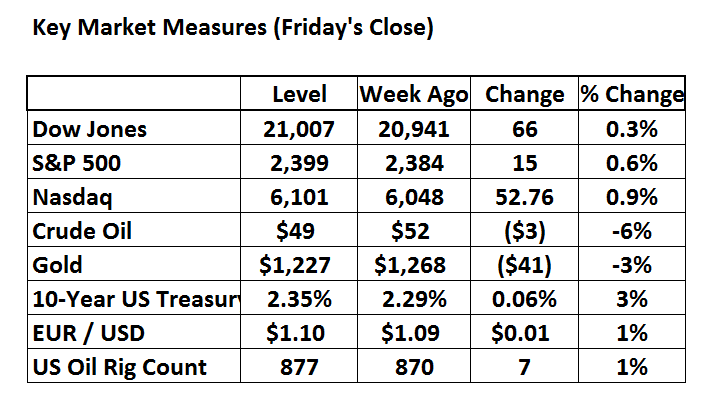
by Todd Shaver | May 7, 2017 | Weekly Newsletter 7pm Sunday
The Week Ahead
Well, it’s graduation week. Class of 2017 graduates are hitting the stage to accept their diplomas, listen to a keynote speech, make one last party, and then head out into the great big world. What will they find? GDP growth moving to 4% or stalling out around 2%. Will geopolitical tensions escalate as early as this year or find a sustainable comfort zone? Can equity prices hold? How bad will rising rates hurt the bond market? Everybody from the newest participant in the labor force to the most experienced must wrestle with these questions in the year ahead. We at The Bull Market Report hope to help you with some good insights about what to make of it all—week in and week out.
There is always a bull market here at The Bull Market Report! This week we highlight the following securities: Eli Lilly, Home Depot, Netflix, Splunk, PayPal, and VMWare. And a few others!
Highlights From The Past Week
Federal government expanding investigation of Fox News. The aggression against the media continues. Current and former Fox News employees have been interviewed, as authorities try to determine how settlement payments for sexual-harassment allegations were structured and which executives played roles in the payments. One source tells the WSJ that the investigators seem to be interested in intimidation tactics that former CEO Roger Ailes signed off on. The investigators are in the securities unit of the US attorney’s office, and no prosecution will necessarily follow. What does this all mean? You need to find trusted sources of information in this world. We strive to make The Bull Market Report a reliable and honest source of information for you to rely on.
It's the strangest thing: A hedge-fund manager apologizing for bad calls. Wellington Management Sr. VP Nick Adams isn't just apologizing for his mistakes on Silicon Valley venture deals -- which differ from the bank stocks he has a proven record with -- he's refunding fees. Adams, who has lost money two out of the past three years, put hundreds of millions of dollars into Mozido and Powa Technologies, which are both financially distressed. Adams has promised he won't ever invest in similar private deals in his flagship fund again. People familiar with the firm's finances say that after investors including Blackstone (BX) withdrew their cash, Adams's portfolio at the start of 2017 was $6 billion, down 40% from 2014. Adams has now returned to investing in traditional lenders like Bank of America and Citi, and his main fund rose 12% in Q1. We think there are lots of lessons to learn from this situation. For instance, if you ever wonder why many of The Bull Market Report’s stock picks are in household names that are often large cap stocks, well, now you know why. Traditional investing is a proven money maker and we try to take you where you can make money.
Don't assume the Healthcare industry will be fine. We think the market is right to assume that the Republican replacement for Obamacare won't be passed in its current version, but anything that hurts earnings for the sector could bring prices down, and the failure to pass any sort of healthcare reform may make a tax reform harder to achieve, which will be a negative for stocks more broadly. We all must keep an eye on this important event unfolding in Washington in the weeks ahead.
BMR Companies and Commentary
Eli Lilly (LLY: $83, +0.5% - All changes are for the week) Eli Lilly has more growth drivers than all its peers, but its continued pledge of "at least 5% annual sales growth" for 2015-20 is being called into question because a big portion of growth comes from two drugs - Jardiance and Trulicity - that have recently faced setbacks. We think Eli Lilly is a topnotch franchise in Healthcare and will overcome these hurdles.
Jardiance is a drug for type 2 diabetes. Johnson & Johnson has a competing drug called, Invokana, which is set to release new trial data in June. Everybody is saying that if Johnson & Johnson’s drug has good data, then there will be more pricing competition in 2018 for Eli Lilly’s drug. We think this risk is widely known, already factored into the numbers, and not a reason to not own Eli Lilly’s common stock.
Trulicity is also used for type 2 diabetes. It faces risks from the FDA's decision last August on Novo Victoza, specifically that this drug had problematic heart effects. Will the FDA say the same thing about Trulicity? We will find out in 2018. For now, it is overly pessimistic to assume Trulicity faces serious FDA challenges.
Note that Lilly's drug unit accounted for 83% of 2016 sales, with the balance coming from animal health, so the story is not just all about drugs. Also, Eli Lilly's operating margin trails most of its peers, except Bayer, and by leveraging new-drug launches, it aims to reduce R&D and SG&A expenses to 50% or less of sales in 2018 versus 56% in 2015. This target is achievable by Pharma standards as Jardiance's new heart label drives growth and Trulicity, an established product, continues to add to margins.
Lilly investors may be relieved by the good set of results in 1Q following recent drug setbacks. Older drugs, such as Cymbalta and Strattera, beat consensus, lifting margins and feeding through to the 2% EPS beat. Diabetes was strong with both Trulicity and Humalog beating consensus, while Jardiance missed by a little. Jardiance is a key driver of growth and while the miss raised eyebrows we say stay the course.
BMR Take: Eli Lilly is a top franchise in Healthcare boasting a market cap of $91 billion. On track to clear $5 of EPS, the stock is a good value.
Home Depot (HD: $156, flat)
A lingering debit/credit card breach has kept a lid on shares of Home Depot. The bad news is that it is so sad to see some large-scale breaches at US companies like Target and now Home Depot. The good news is Home Depot has taken strong steps to remedy the situation. In any case the stock is $1 from an all-time high, fast approaching $200 billion in market cap.
Companies hit by data breaches often face class action complaints filed by consumers. They also face lawsuits from shareholders looking to thwart future breaches and restore financial stability to companies in which they have invested. Home Depot's willingness to take meaningful but financially limited remedial mitigating action achieves a mutually beneficial resolution that companies facing any kind of data breach lawsuits, such as Yahoo, may rely on to improve their corporate data governance.
Under the proposed settlement, Home Depot will change many of its cybersecurity corporate governance policies. Home Depot agreed to document the duties and responsibilities of the chief information security officer; conduct table top exercises; monitor computer networks; maintain a “Data Security and Privacy Governance Committee;” hire a “dark web mining service;” receive reports on the company's information technology budget; join an information sharing program; and authorize the board to retain its own IT and data security professionals. Home Depot also agreed to pay $1.1 million in attorney’s fees and and $1.5 million to the shareholder representatives. They agreed to the settlement because it saw the attorneys’ fees as a minimal money issue and it believed the actions “would restore trust” in the company.
BMR Take: Home Depot is on track to deliver $10 of EPS and $100+ billion of sales. Don’t sweat the small stuff. Sorry to see the cyber breach, but the core business is doing great.
Netflix (NFLX: $157, +3%)
What could be more exciting than a Netflix merger with Apple? The world continues to talk about the prospects. Let’s break down the potential reality.
There may be as good as 40% odds that Apple acquires Netflix. The research arm of the investment bank Citi released a report with seven potential merger and acquisition targets for Apple. Tops on the list is Netflix. Elon Musk's Tesla, on the other hand, is only 5% likely. The full list of acquisition targets includes three media firms, three game developers, and, of course, one car manufacturer. Disney and Hulu are the media firms joining Netflix, while Activision, Electronic Arts, and Take-Two are the gaming companies.
Netflix makes a ton of sense, of course, as the company dominates streaming media both domestically and abroad. Disney has a strong list of properties as well, but slightly more oriented to traditional media consumption, whereas Netflix is well-positioned to take advantage of the continuing trend to cut the cord (cord-cutting has jumped 5x). Plus, Disney is worth $177 billion, whereas Netflix is worth $67 billion.
BMR Take: The future of TV consumption swings in the balance as the world moves away from traditional cable to the internet. Netflix is the powerhouse making the company a coveted asset in media. On track to do $10 of EPS by 2020 we see compelling value in the shares as a standalone entity even at current levels. A take-out could offer huge upside.
PayPal (PYPL: $49, +3%)
The PayPal network effect is working like charm. Investors in PayPal had plenty of reason to cheer last week when the company reported earnings. Nearly every metric was up by a better-than-expected percentage, surpassing expectations of all but the most bullish on the company.
More exciting to long-term investors, however, was the account growth and increase in user engagement with the company's core platform. Six million active accounts were added during the quarter, increasing the total to 203 million for the digital payments company. These active accounts now average almost 32 transactions per year, a 12% increase year over year. More customers using the company's platforms more often was a winning combination that the market liked.
PayPal's growth is beginning to fuel a powerful network effect opening a new window for the company. The beauty of this type of growth is that it drives itself. The more users that sign up for the platform the more important the service becomes for retailers to adopt it and the more places that accept it, the more attractive it becomes to new users. Get it?
At the end of March, 16 million retailers were accepting PayPal's core platform as a method of payment. Management is well aware of this virtuous cycle. During the conference call, CEO Dan Schulman stated: “Our powerful two-sided network engages both consumers and merchants, and the larger our scale, the stronger our network effect becomes. We made meaningful progress in advancing merchant adoption of PayPal in the quarter. At the end of March, the number of active merchant accounts on our platform increased to 16 million. The size of our merchant base is a formidable competitive advantage and is extraordinarily difficult for others to replicate.”
BMR Take: We think PayPal is in the middle of a decade-plus growth cycle that will deliver real value for shareholders. Stick around. They are already closing in on $3 of EPS.
Splunk (SPLK: $67, +4%)
Progress at Splunk is happening. Splunk, a provider of the leading software platform for real-time Operational Intelligence, recently announced support for SaaS Contracts in AWS Marketplace. Working with Amazon is a big deal!
The new globally available API capability* enables seamless procurement and deployment of Splunk® Cloud. The automated and accelerated purchasing process for Splunk Cloud via AWS Marketplace ensures fast time-to-value for customers leveraging Splunk solutions to gain real-time security, operational and cost management insights across their Amazon Web Services (AWS) and hybrid environment.
* Application program interface (API) is a set of routines, protocols, and tools for building software applications
The University of San Francisco is home to an innovative academic community of more than 12,000 students, faculty and staff. “As a higher education institution, USF prides itself on being at the forefront of technology, which is why we turned to Splunk and AWS,” said the vice president of information technology and chief information technology officer, University of San Francisco.
BMR Take: Working with Amazon gives Splunk big growth potential. The EPS outlook calls for great than 3x growth from $0.41 of EPS in 2017 to $1.35 of EPS in 2020. Ride this growth wave!
VMware (VMW: $94, flat)
VMware is out with some good news. The company is the first mobile application management provider to manage and secure hundreds of Oracle business applications and custom applications. As such, enterprise IT organizations can manage their Oracle application suite on a single unified platform together with their other business-critical applications and devices. Users who count on Oracle's business applications to make better decisions, reduce costs and increase performance can benefit by being able to access these applications through a simple digital workspace environment – be it from a mobile device, laptop or desktop – with VMware Workspace ONE and AirWatch.
What does that mean? VMware is continuing to make end roads in the lucrative cloud business, where growth is driving real results for stockholders.
The Chief Operating Officer, customer operations, said: "Mobilizing critical business processes is at the core of both of our organizations' DNA and this collaboration will help us advance this shared vision for our customers and their end users alike. We're proud to come together with Oracle to make it easier for IT administrators to secure and manage these critical mobile apps and help their end users seamlessly access them from any endpoint.” VMware Workspace ONE is the industry's only integrated platform for application and access management and unified endpoint management that enables simple enterprise secure access to any app from any device, accelerating adoption of digital workspaces.
BMR Take: The company is working. EPS is on track for $4.90 this year with growth upside to $6 in the next few years led by the cloud business and partnerships like the one described above serving Oracle.
Economic Outlook for the Coming Week
Monday, May 08, 2017 10:00 AM ET
United States - Labor Market Conditions
Period: APR
Actual: N/A
Consensus: N/A
Prior: 0.40
Labor market conditions index is derived from a dynamic factor model that extracts the primary common variation from 19 labor market indicators. It measures the changes of condition in the labor market. We expect to continue to see signs of a healthy labor market.
Tuesday, May 09, 2017 6:00 AM ET
United States - NFIB Small Business Index
Period: APR
Actual: N/A
Consensus: N/A
Prior: -$176B
NFIB Research Foundation has collected Small Business Economic Trends data from a sample of members from the National Federation of Independent Business (NFIB). Data from quarterly surveys since 1973 is based on 10 survey indicators. We expect to see an improving small business economy.
Tuesday, May 09, 2017 10:00 AM ET
United States - JOLTS Job Openings
Period: MAR
Actual: N/A
Consensus: 5,750K
Prior: 5,740K
Part of the US Bureau of Labor Statistics, the Job Openings and Labor Turnover Survey (JOLTS) program produces a monthly study that has been developed to address the need for data on job openings, hires, and separations. With the release of 2003 data, the JOLTS program began publishing industry estimates. We expect to see the JOLTS figures reveal a healthy labor market.
Wednesday, May 10, 2017 2:00 PM ET
United States - Treasury Budget NSA
Period: APR
Consensus: $166B
The monthly U.S. government surplus/deficit is published in the Monthly Treasury Statement (MTS). The MTS is assembled from data in the central accounting system. The major sources of data include monthly accounting reports by Federal entities and disbursing officers, and daily reports from the Federal Reserve banks. These reports detail accounting transactions affecting receipts and outlays of the Federal Government and off-budget Federal entities, and their related effect on the assets and liabilities of the U.S. Government. It is very critical what happens with Trump now negotiating the government budget and we are excited to see if he can get it under control and address the national debt.
Friday, May 12, 2017 08:30 AM ET
United States - Retail Sales ex-Auto
Period: APR
Actual: N/A
Consensus: 0.45%
Prior: 0.0%
Retail and food service sales data excluding motor vehicle are included in the Advance Monthly Sales for Retail and Food Service report, which provides an early indication of sales of retail and food service companies. We are keenly concerned about brick and mortar Retail sales declines and look to this economic release to assess the damage and potential impact.
MORE COMMENTARY ON BULL MARKET REPORT STOCKS
First Solar (FSLR: $35, up 17%) reported first-quarter earnings of 25 cents a share. The Street was looking for a loss of 13 cents.
Revenues hit $890 million in the quarter destroying the estimate of $700 million. (Who are these analysts anyway?) Revenues grew slightly from last year, up 2%. Profit was $84 million, down from $275 million a year ago. Ouch, but expected.
First Solar has $1.65 billion in cash, up from $1.35 billion at the end of the previous quarter. Long-term debt is $265 million at the end of the first quarter.
The big news is guidance. The company raised its revenue guidance to $2.9 billion from $2.85 billion. This is minuscule, but the Street liked it, pushing the stock up big. Gross margins guidance was moved to 13.5% from 12%.
Full-year earnings are now expected in the range of 25−75 cents per share, compared with the prior guidance of a breakeven to 50 cents.
We’ve said many times that this company is innovative and successful and that the turnaround will take time. This is the first positive information we have seen publicly that good things are actually happening. If you have patience, stick with First Solar. If you don’t, now is the time to take it off the table after this nice 17% run-up.
Facebook (FB: $150, flat)
Monthly active users totaled 1.94 billion while daily active users hit 1.28 billion. Expectations were for these numbers to hit 1.90 billion and 1.26 billion, respectively.
Facebook reported earnings of $2.5 billion or $1.04 per share on revenue of $8.03 billion. Expectations were for earnings of $0.87 on revenue of $7.83 billion. Huge beat. “We had a good start to 2017,” Mark Zuckerberg, Facebook founder and CEO, said. “We’re continuing to build tools to support a strong global community.”
Mobile is big at the company, as advertising revenue on mobile represented 85% of total advertising revenue, up from 82% a year ago. Ad revenue grew 51% over last year to $7.85 billion.
As of the end of the first quarter, the company had $32 billion in cash, and had almost 19,000 employees, up 38% from last year.
As Facebook nears the 5-year anniversary of its initial public offering, note this: In 2012, Facebook was the world's 10th-biggest seller of ads behind a bunch of traditional media companies such as CBS and 21st Century Fox. It has trounced almost all of them to rise to number two in the rankings, surpassed only by Alphabet, the Google parent that dominates search ads. Together, these two companies controlled 20% of the $550 billion spent on ads last year, up from 10% in 2012.
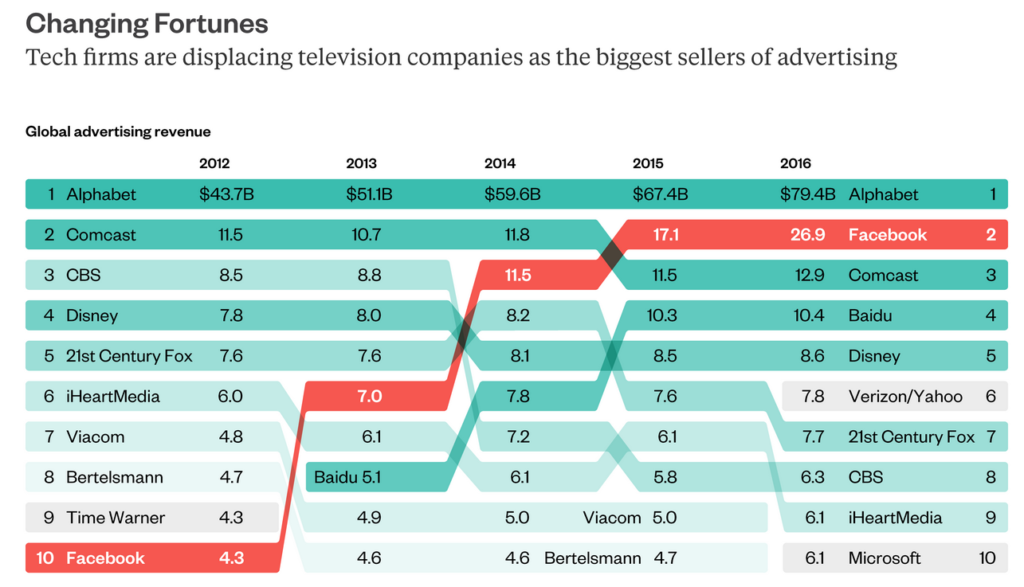
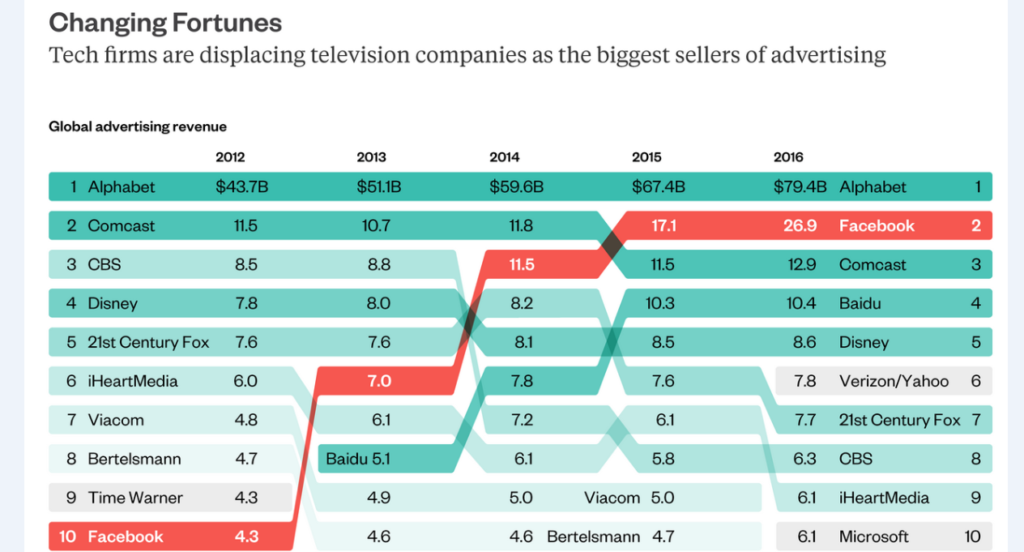
Source: Zenith Media
Jefferies hiked its price target on Facebook to $192 from $175, JPMorgan to $182 from $170, RBC Capital to $185 from $175, and Cowen to $170 from $156.
BMR Take: Our Target is in reach at $165. We would add to our positions at every opportunity. Wait until they hit 2 billion users. There will be fireworks and articles about the company galore and we just might see this as early as July. When this happens we can predict new all-time highs hit left and right.
Shopify News
We Tweeted this out on Friday:
“Shopify is on fire! All-time high at $86, up 5%. Stock was $73 a week ago. STRONG REVENUES will do it! Will eBay make an offer?” [The stock closed at $86 on Friday, up 13% for the week!]
The stock (SHOP) closed at $86 on Friday. We’re up 18% since we added the stock a little over a month ago. Our Target is $90. We can’t wait for it to hit so we can raise it to $100 or higher. And wouldn’t it be nice to see a stock split soon? What ever happened to stock splits? The markets in the 80s and 90s LOVED splits. We could see a 10-1 split for Amazon, bringing the price down to $93, and Google could split 20-1 bringing the price down to $46. Now wouldn’t THAT shake things up on Wall Street! The market would go wild.
Square (SQ: $19.78, up 8%) had a super good week. Square makes credit-card readers that plug into mobile phones and tablets and we were happy to see Square swing to a profit in the first quarter and raise full-year revenue guidance.
Led by Twitter Chief Executive Jack Dorsey, the company posted a quarterly loss of 4 cents per share on a revenue jump of 22% of $460 million. Analysts had expected a loss of 8 cents per share on revenue of $450 million, so of course the market liked what they saw. Square has predicted 2017 total revenue of $2.14 billion.
The company's gross payment volume - the total dollar amount of all credit card payments processed by sellers - jumped 33% to about $14 billion. We like numbers like this.
Another subsidiary, Square Capital, which offers loans to customers in exchange for a fixed percentage of their daily card sales, originated $250 million in loans in the first quarter of 2017, up 64% from a year earlier. We like large percentage increases like this. (We sound like a broken record…)
Square continues to move towards bigger customers. They said that 44% of the money flowing through its systems came from merchants that have over $125,000 in volume on the company’s platform, up from 39% a year ago. CFO Sarah Friar said: “That ongoing shift is good to see because those folks are not new to the payments world.”
Citigroup upped its price target on Square to $23 from $21, and Pacific Crest to $21 from $19.
BMR Take: We’re looking for $24, and hereby raise our Sell Price from $14 to $17.
Apple (AAPL: $148, up 4%) announced that it has $257 billion in cash as of the end of the quarter. They added $10 billion in the quarter which equates to about $800 million a week, or over $150 million per work day! Repeat: $150 million per work day. The company said it will return more of that to shareholders, announcing $50 billion in new stock buybacks and a 63-cent quarterly dividend. The company had already announced $175 billion in repurchases, helping maintain the stock price in lulls between new products, so the upcoming total is now $225 billion. Take a look at this chart of their cash buildup over the years:
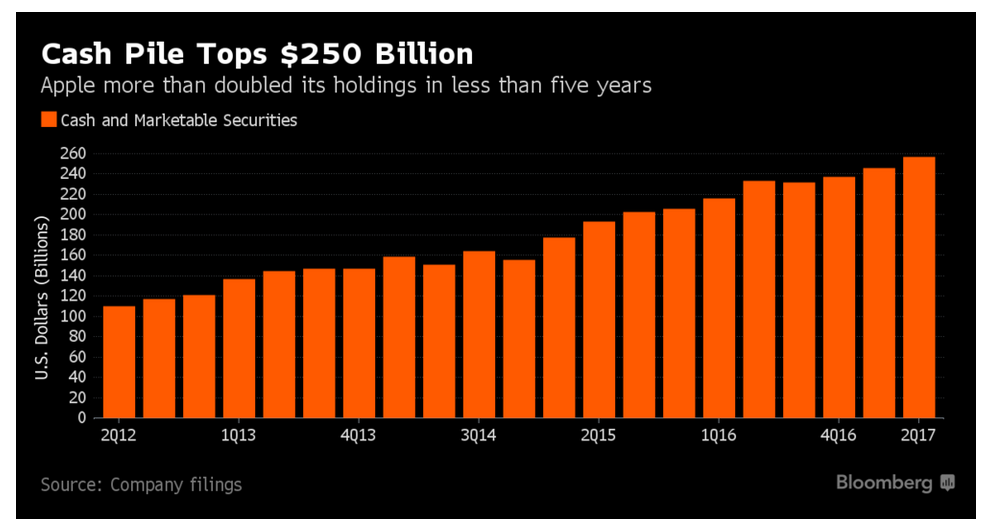
Twilio (TWLO: $24, down 27%) We reported via News Flash on Tuesday that despite strong revenues the market didn’t like the results. The biggest knockoff was the fact that one of their big customers, Uber, has decided to go it alone. Uber provides 12% of total revenue for the company, but Twilio grew revenue by 60% not including Uber. So ultimately, we are not that worried about future revenues. We believe they will continue strong. (We think they will come back to Twilio at some point.) WhatsApp, owned by Facebook is also a large customer, so some people are worried about this large concentration of revenue in one customer. We’re not. There is no word as to whether they are considering leaving. We would suggest that they are quite happy with the service they receive. And again, note that the company added 4,000 customers in the quarter – amazing really – giving them more than 41,000 customers, up from 29,000 at this time last year.
We had a letter from a reader about Twilio and we said this to him:
Bob -- Be prepared for anything that might happen. We could see $20 before we see $30. I hope this is not the case, but it could happen. Uber is slowly leaving as a customer and they had 12% of revenues. So, this will take some time to work out. They did add 4000 customers last quarter and are now over 40,000. They normally add 2800 a quarter. But unfortunately, like First Solar, this is going to take some time.
The Options Corner
We had mentioned in our News Flash about Twilio that we would do a column about options if anyone was interested. Well, we had a strong show of support for this. So here you go.
There are myriad of options strategies if you want to maintain a position in Twilio and you believe it will come back like we do. Of course, most options trades are risky except for selling covered calls, which are still risky but less so than buying options outright. The premiums on Twilio options are relatively high so that usually points to two types of options trades: doing covered calls, and selling naked puts or calls. The latter two are very dangerous.
Selling covered calls: Selling covered calls on Twilio is fairly straight forward. With the stock at $24 you can get about $1.80 for the January $30 call. If you have 1000 shares, you can sell 10 options and receive $1800 in your account that day. The downside is that you would be obligated to sell your stock at $30 if it goes higher than that. But, you can always buy back the option if the stock goes above $30. Depending on how long it takes the stock to get there will determine the price at which you have to buy back the options. If the stock goes to say $32 by January, then you could buy them back for about $2, losing about 20 cents, or $200. But with the stock at $32, you would feel good about that. The downside is that if someone buys Twilio out at $40 a share, you would be forced to sell your stock at $30. Not pretty.
If the stock stays below $30 until January, then you can turn around and sell another out-of-the-money option for a few dollars and wait for the stock to move higher and each time you do this you put cash into your account.
As you can see there are lots of scenarios that can happen so you have to watch carefully. Make sure you have the advice of your broker.
Buying options: If you think the stock can get to the $40 level or higher by say January 2019, you can buy out-of-the-money options inexpensively. But you could lose all of your money if the stock doesn’t reach the strike price that you choose. For example, you can buy 10 options, controlling 1000 shares, at a strike price of $40 expiring in January 2019 for about $2,300. If the stock goes to $45, these options would be worth at least $5,000. If it goes to $50, the options would be worth $10,000.
Or you could buy the January 2019 50s for about $1400 and if the stock goes to $55 they would be worth $5,000. BUT, if the stock doesn’t get to your strike price, they expire worthless.
Selling naked puts: YOU SHOULD ONLY DO THIS IF YOU WISH TO BUY THE STOCK and if you have the money to do so. You could sell the January 2019 $25 put for about $7, or $7,000 for 10 options. That would obligate you to buy the stock at some point between now and the expiration date at $25, BUT you got $7 per share so your net price is $18. You could do the same thing with a $20 put and get $4.30 per share, obligating you to buy the stock for a bit below $16. We like this latter strategy. Suffice it to say that selling naked puts on stocks you want to buy at a lower price, is a good thing. Again – very risky. Why? What if the stock goes to $10. You would be forced to buy the stock at $18 or $16 as described above. Not fun.
Send us your questions and comments please! Info@BullMarket.com.
Tesoro (TSO: $80, up 1%) moves in the wind with crude oil. Crude got down to $45 early Friday and bounced back to $46 by the close. We like the company but can’t be part of it if crude is headed to $40. If you know where crude is headed you’ll know what to do with your position in this fabulous refiner. Unfortunately, we don’t. If we knew, we could make $1 million trading crude oil futures. We added the stock at $85 in November and have a Sell Price of $75. But we would hate to have the stock go that low, so we are hereby raising our Sell Price to $78, which is two dollars below the current price. So, if Tesoro closes below $78 we are out.
Carlyle Group (CG: $18.10, up 2%) posted first quarter earnings that handily beat expectations on Wednesday, in line with its peers, after a strong stock market last quarter lifted investment returns. Carlyle's peer Blackstone Group (BX: $30, down 2%), a Bull Market Report favorite, reported first-quarter earnings that surpassed expectations.
Carlyle said it earned economic net income (ENI)* of $365 million after taxes, more than six times what it earned a year earlier. That translated into $1.09 EPS, well above analyst forecasts for 38 cents per share and the second-highest on record since the fourth quarter of 2013.
* ENI is a crucial performance measure for U.S. private equity firms as it accounts for unrealized gains or losses in investments.
Carlyle said its private equity investments appreciated 9% in the first three months, better than a 5% gain in the S&P 500 index in the same period. Carlyle Co-CEO William E. Conway, Jr. said, “We deployed capital at a strong pace in the first quarter, with $4.4 billion of capital invested despite a difficult environment. We believe we are well-positioned to continue this strong pace. We have already announced substantial new investments and almost $4 billion of exits that we expect to close in the coming quarters.”
BMR Take: Carlyle is still way undervalued but is paying you 4% while you wait. We’re waiting patiently for the market to recognize this situation. We are up 12% since March, but we sure would like to see our Target hit of $20.
The High Yield Corner
By Michael Foster
It’s finally started.
It’s a bit late, but we’re finally seeing a correction in the BDC world. The UBS BDC ETF (BDCS: $23, down 3%) got hammered in a week that was pretty humdrum for high yield and not bad for the stock market as a whole, despite a lot of drama. Yet BDCs are back to underperforming, as they should. Overstretched valuations and high premiums to NAV were unjustifiable before this week. Now that many companies have reported lackluster earnings, those premiums are even less justifiable.
Ironically, however, this isn’t hurting the most overvalued BDC of them all: Main Street Capital Corporation (MAIN: $40, up 1%), which closed the week strong as investors sighed relief following the company’s earnings. Net interest income rose 9% from a year ago to 61 cents per share and the company’s NAV rose nearly 2% to $22.44. There are two big implications for this: firstly, the company’s dividend coverage is 109% and there’s room for years of dividend growth to continue. We have a feeling Main Street management has the ultimate goal of becoming the first BDC Dividend Aristocrat*. We’ve still got about two decades until they can qualify, so it won’t be easy. But if that is their goal, Main Street is easily the best managed and most long-term focused BDC in the world.
* The Dividend Aristocrats are a select group of 51 S&P 500 stocks with 25+ years of consecutive dividend increases.
That doesn’t mean you should go out and buy. We at The Bull Market Report were happy with our pick and happy to see it rise. But we are not happy to pay an 80% premium to net asset value. Consider this: if you considered Main Street to be the best BDC in the world, you wouldn’t want to compare its premium valuation to the valuation of other BDCs. You’d probably want something safer, like a megabank like Bank of America, which not only lends to small and medium sized banks but also mega-corps and governments while diversifying in other banking activities like M&A advisory, retail deposits, and so on. Or at least you’d want your BDC valuation to be less than the valuation of these banks, right? But if you compare Main Street’s valuation to the price-to-book valuations of these big banks, Main Street is overvalued by 40% at a minimum. This just isn’t good enough for a very well-run but extremely undiversified asset.
The market has begun to realize just how silly BDC valuations were getting, but the market has made an exception for main Street largely due to the fact that just about every other BDC reported awful earnings. Net investment income fell for almost all BDCs that have reported so far, with Hercules Capital (HTGC: $13) seeing NII down 33% from the prior quarter. The dividend is now less than 100% covered. NAV fell a bit as well (over 1%). What happened? The market dumped shares, which fell over 16% in a week. This used to be considered one of the safest and best specialty BDCs out there, but the market can turn very quickly on this asset class. We’re not saying anything similar will happen to Main Street anytime soon, but it is a serious risk.
Then there’s Goldman Sachs’s BDC (GSBD: $24), which fell 3% this week due to a decline in net investment income and virtually flat NAV. The stock is still up 3% year-to-date so you’re paying a higher premium for shares, though. Now you’re paying 32% over what the underlying assets are worth. Of course, this BDC is up big over the past year, thanks in part to the secular bull market in BDCs and thanks in part to the Goldman brand. But, as we’ve written here previously, there is a complicated conflict of interest going on with this BDC that makes us extremely cautious. Goldman Sachs’s management is not duty bound to restrict their deal making just to this BDC, and so there’s a chance (although no evidence this is the case) that management can select better deals for the parent company and keep lesser deals for the BDC business. Without clearer governance resolutions, this makes us extremely cautious. And, at the end of the day, this demonstrates one of the structural problems with many BDCs: management and investors’ interests do not align.
Some of the BDCs in the business were loved for avoiding this trap. The big Ares Capital Corporation (ARCC: $16.60, down 6%) is a good example. But this stock tanked as well, after reporting earnings fell 50% from a quarter ago and NAV rose less than 1%. We don’t need to emphasize how bad those results are, and how they deserve a discounted valuation. But Ares is still trading at a slight premium to NAV.
Obviously, a bigger correction in the BDC market is coming, so where else can we look? REITs and municipal bonds remain our favorite corners of the high yield market. The iShares S&P National AMT-Free Municipal Bond Fund (MUB: $109, flat) remained sleepy due to the risk-on nature of the market encouraging more investors to avoid the asset class, despite the growing number of undervalued bonds and great opportunities to get low risk yield for fund managers. Bull Market Report favorites remained flat for the week, Invesco Municipal Trust (VKQ: $12.69, flat) and The Nuveen AMT-Free Fund (NVG: $14.79, flat) Buying more of either fund at this juncture would make a lot of sense.
And then as REITs go, the SPDR Dow Jones REIT ETF (RWR: $92, down 1%) fell slightly with investor apathy hitting the asset class on little news. This again is resulting in plenty of good deals among REITs, and The Bull Market Report continues to have high conviction for long-term sustainable yields from Digital Realty Trust (DLR: $114, down 1%), Omega Healthcare Investors (OHI: $32, down 2%), and Care Capital Properties (CCP: $27, flat) in particular. Looking forward, we will be looking closely at how REIT earnings results and more market responses from the BDC market causes a reset in high-yield land that offers an opportunity to rebalance the portfolio.
Good Investing,
Todd Shaver, Founder
The Bull Market Report
CEO and Editor in Chief
Founded 1998