May 2, 2017
by Todd Shaver | May 2, 2017 | 6pm News Flash
WE ARE VERY UPSET AT WALL STREET. Read the information below, and tell us why the stock is down over 30% in after-hours trading.
Twilio (TWLO: $34, down 1% during the day, and down 29% to $24 in overnight trading) reported Q1 revenue that topped analysts' expectations, and reported a smaller-than-expected net loss. READ THIS AGAIN. They topped expectations for REVENUES and topped expectations for profits – a SMALLER loss than expected.
Revenue in the three months ended in March rose 47%, year over year, to $87 million, yielding a net loss per share of 4 cents. 4 cents a share. That’s $3.5 million. THE COMPANY HAS $305 MILLION IN CASH. But wait – what is their DEBT level? THEY HAVE NO DEBT.
Analysts had been modeling $84 million and a 6-cent loss per share. OK – I see – so Twilio BEAT ESTIMATES – in revenues and earnings.
For the current quarter, the company sees revenue of about $86.5 million and a net loss of 10 cents a share. That compares to consensus for $88 million and an 8-cent loss per share. OK – I get it. They are forecasting a SLIGHTLY lower level of sales in the upcoming quarter. Who exactly knows how the quarter will come in? Certainly, not the analysts. Apple does this all the time. They forecast that the upcoming quarter is going to be VERY TOUGH. Well, Twilio is doing that here. Except that it is a TINY bit different from the analysts who are basically TERRIBLE at guessing revenues and earnings. And the stock gets destroyed. Great.
For the full year, the company sees revenue of about $360 million, and a net loss of 27 cents to 30 cents. That compares to consensus for $370 million and a loss of 16 cents per share. Again the company is missing by a HUGE MARGIN. No wait, sorry. By a small margin.
Here are some comments from the Co-Founder and CEO, Jeff Lawson, one of the most brilliant minds on the planet:
“We made continued progress across a number of our key initiatives in the first quarter, delivering further product innovation and adding new customers of all types at a rapid pace around the globe. While we are seeing some changes in the relationship with our largest customer, our momentum across the business continues to be strong, with a 42% year over year growth in Active Customer Accounts and a 62% year over year growth in Base Revenue during the quarter.”
Listen to this: The company has 40,700 Active Customer Accounts as of March 31st, compared to 28,600 Active Customer Accounts as of March 31st, last year. This looks like 50% growth to us.
Note that the company hired George Hu as their Chief Operating Officer. Prior to joining Twilio, Hu spent 13 years at Salesforce in a variety of leadership roles, culminating with four years as Chief Operating Officer.
And note that Twilio extended the long-standing relationship with Amazon Web Services by helping to power and further enhance the capabilities of Amazon Connect.
WE ARE VERY UPSET ABOUT WHAT THE MARKET HAS DONE TO THIS AMAZING COMPANY. We are NOT removing the company from our Special Opportunities Portfolio. In fact we are suggesting a 2nd BUY at this $24 price. Will it go to $20 first? Maybe, but we can’t see it going below this number, unless the market drops from the 21,000 level to 19,000 or below. At $24 this stock could be one of the best buys in the recent history of Wall Street.
Do you want to know about options? Write me at Todd@BullMarket.com and if enough people are interested, we will do a segment this weekend.
Apple Reports Earnings
Apple produced a second consecutive increase in revenue and earnings.
iPhone unit shipments, which fell 1% from a year ago. 51 million iPhones were sold, down 1% from the same quarter last year; iPad sales fell 13% to 9 million units; and Mac sales rose 4% to 4.2 million units.
Total revenue in the quarter was up 5% to $53 billion. Profit in the three months through April 1 rose 5% to $11 billion, or $2.10 a share, beating expectations for $2.02 a share.
The company raised its dividend 10% to $0.63 per share, and boosted its share buyback authorization to $210 billion. The company said it plans to return $300 billion to shareholders by the end of March 2019. Apple is now the world’s largest dividend payer at $13.2 billion annually.
Apple, which has in recent quarters touted its services business, reported revenue from this unit of $7.04 billion during the quarter, up 18% against last year. The company’s “Other Products” segment, which includes Beats, Apple TV, and Apple Watch, among other things, reported revenue of $2.87 billion, up 31% against last year.
The stock set a new all-time high earlier today, but is down $2 in overnight trading to $144.
More Earnings News:
Shopify (SHOP: $82, up 6%) killed in the quarter. Revenues were up 75%. The stock took off and set a new all-time high.
PayPal (PYPL: $49) set a new all-time high, up 2%.
First Solar (FSLR: $33, up 8%) is coming back nicely.
Netflix (NFLX: $156) hit a new all-time high yesterday of $157. It was $143 six days ago. The stock is worth $67 billion now.
Facebook (FB: $152) set a new all-time high today. Market cap is $440 billion.
Amazon (AMZN: $948) set a new all-time yesterday. Market cap is $452 billion.
But this Twilio thing has us very, very upset.
February 26, 2017
by Todd Shaver | Feb 26, 2017 | Weekly Newsletter 7pm Sunday
The Week Ahead
“US Talks With Mexico Clouded By Mixed Message” was the front page Wall Street Journal headline going into the weekend. For months now all the focus has been on the new administration. Does anything else matter? Washington DC policy is seemingly the only driver of financial markets right now. Accordingly, we will likely need to start seeing some tangible results on healthcare, tax, and trade reform sooner than later. We eagerly await to see where reality meets the promises made on the campaign trail.
No matter what, there is always a bull market here. Week in and week out, we you can find it right here at The Bull Market Report. This week we highlight evidence of a bull market in the following securities: Amazon, Apple, Home Depot, Netflix, Bristol-Myers Squibb, and Tesla.
Highlights From The Past Week
Top Investor Says He Is Disinvesting. Jeffrey Ubben, the CEO of activist investor ValueAct Capital, told the press that his firm had been taking money out of the capital markets as valuations have become overextended, leaving it with $3 billion in cash. "I really feel that the large-cap activist plays are very treacherous with high PEs and not a lot of growth," Ubben said, speaking at the Reuters "Future of Shareholder Activism" event in New York.
Well, it takes all kinds. That’s what makes a market. We certainly aren’t jumping on his bandwagon. We’re watching, but this market may have a LONG way to go on the upside. Over-extended markets can get more over-extended and who’s to say the market is over-extended? We don’t think so. Either way, we at The Bull Market Report are not trying to predict the macro direction of the world. Our philosophy is that it is unknowable. What we can do is recognize good companies that will do well no matter what the world throws its way.
Are Trump’s Aggressive Plans Achievable? Concerns about Trump's tax cut plan - arguably the biggest catalyst behind the market's daily record highs - are mounting. Rising opposition to a simple "repeal and replace" of Obamacare could spill-over into other domestic policy targets, most notably tax reform. The current debate suggests that tax legislation might not be finalized until late 2017 or early 2018. Along with the potential for a phased-in tax cut, this would likely spread the growth effects between 2018 and 2019. That’s a long way away and lots can happen in the meantime.
We at The Bull Market Report feel that a tax cut is a bad idea. The budget is operating at a deficit now, so a tax cut will make it worse. David Stockman, former Budget Director under Reagan and the perennial bear feels this would be a disaster financially for the United States. We generally don’t agree with Stockman much because he is SO negative but we sure do in this case.
Look – we are flirting with a debt of $20 trillion. Cut taxes and we could be looking at $22 trillion to $25 trillion in debt. It just scares us to write this. And it seems like no one is talking about the debt any more. Listen, if you own a company and it brings in $5 million in revenue but you have $5.5 million in expenses you have to borrow that $500,000 to move to the next year. If it happens the following year, you now owe $1 million. If you do it EVERY YEAR you eventually have to cut people, cut expenses, and ultimately if you don’t act fast enough, you go bankrupt. Just add 10 or 20 zeros to this example to get the results for the United States. (Just kidding about the 20 zeros, but we hope you get our point.)
BMR Companies and Commentary
Amazon (AMZN: $845, flat for the week – all prices in The Bull Market Report are for the week)
This week was the launch of DXagents, a first-of-its-kind group of business leaders and technologists from leading private, public and not-for-profit organizations in Canada, that aims to accelerate the national digital transformation. The year-long partnership includes Deloitte, SAP, Amazon Web Services (AWS), Intel, and others. The mission of the group is to help Canadian businesses better understand and get on the path to realizing their digital transformation opportunities.
Digital transformation refers to the adoption of digital technologies such as cloud, big data, mobile and social media. With recent IDC research finding that 63% of Canadian companies are 'digital laggards' leaving themselves vulnerable to competition from less risk-averse global peers, DXagents was created as a community for Canada-based CIOs, CFOs and other decision makers to more easily and effectively share and discuss experiences related to digital innovation.
BMR Take: Here is a big growth opportunity (this time Canada). Yet again, guess who is involved? (Amazon). Where is Microsoft Azure? Where is Google Cloud? It sure looks like Amazon Web Services has an “in” to doing more business with Canadian companies.
Apple (AAPL: $137, +1%)
Apple has Samsung on the ropes like never before. The competition for the lucrative high-end of the smartphone market is a race between these two companies, which ship over 36% of smartphones globally, according to an IDC estimate.
The war between the two companies for smartphone buyers has raged for years, but the power balance is shifting in favor of Apple, especially after last year's Galaxy Note 7 fiasco and the rising anticipation for the next iPhone.
Mobile World Congress kicks off Monday. This event is one of the biggest smartphone trade shows of the year. Although Apple never makes announcements at the conference, competitors, especially Samsung, usually launch their new mobile product in order to get some press. This year, Samsung is not expected to launch a new phone at the show. Instead, it will likely launch new tablets. While it could be nothing, it could also be a leading indicator that Samsung is really in a tough spot this year, perhaps something has gone really wrong with this year’s model. In contrast, over in Apple’s camp, Apple's Asian supply chain is raising rumors of a very cool redesigned iPhone, with a better screen, longer battery life, and a next-generation 3D selfie sensor.
BMR Take: Apple is taking a bigger bite out of the smartphone market as Samsung is stumbling. Apple is leading the way by innovation. That is what we love to see for our stock picks at The Bull Market Report.
SEE MORE on Apple below in this Report.
Home Depot (HD: $146, +2%)
It’s not too late to buy into the housing recovery. While some fear we are in the 8th or 9th inning of the housing cycle, a recent fundamental analysis published by a major Wall Street investment bank suggests we are not yet that far along. This mean there is still some gas left in the tank for Home Depot.
Home Depot is enjoying strong fundamentals as housing demand continues to outstrip supply. Rising interest rates are not likely to hurt the industry near-term as bad as some may think. For example, it usually takes as much as eight quarters for tightening interest rate cycles to hurt home improvement spending, and Home Depot stock has performed well in rising rate environments in the past.
There is more to like. Home Depot has more stores than peer Lowe’s in yet-to-recover and recovering markets. Accordingly, many think there is upside to the consensus same-store growth outlook of 4-4.5% for Home Depot in 2017-2018. One can also argue that the stock is nowhere near stretched, trading at a PE of 20 that is on par with the 3-year average, and is compelling relative to expectations for low-teens EPS growth.
BMR Take: Business at Home Depot is charging forward. Don’t let all the “late-cycle” discussion talk you out of this holding.
Bristol-Myers Squibb (BMY: $56, +3%)
Bristol is our featured story of the week. It has been a bit of a turbulent ride so far. But hang in there, big time help has just arrived. While JANA Partners pushing for more buybacks and board seats has been helpful, the one and only Mr. Carl Icahn just showed up. Icahn has a history of taking positions in companies and then working to force a sale. Worth about $20 billion, Icahn primarily invests his own fortune.
Icahn was reported to see this drug-maker as potentially ripe for a takeover. Possible buyers could include Pfizer, Gilead Sciences. and Novartis, all of which have an interest in cancer drugs and have money to spend. “I think everybody is looking at Bristol,” Allergan CEO Brent Saunders said in an interview.
Bristol-Myers was itself once one of the drug industry’s major acquirers, snapping up pipeline assets in what it referred to as its “string of pearls” strategy. Those deals landed it the drug Opdivo, which uses the immune system to attack cancers and got remarkable results in once-fatal diseases like advanced melanoma. More recently, though, it’s lost ground to rivals like Merck, which has a similar drug, Keytruda, that has taken the lead in some oncology markets.
Bristol-Myers is still a tempting takeout target. If you believe in the immuno-oncology franchise, then it’s obviously an attractive asset because there’s not many ways to get into this space. While Pfizer has a partnership in immune-system-based cancer drugs, it’s well behind Bristol-Myers and Merck. Novartis, another player in oncology, could raise the cash to do a deal through asset sales and debt. Gilead has amassed billions of dollars from sales of its hepatitis C drugs and is looking for its next move.
BMR Take: Icahn has made a fortune for himself as well as the shareholders who have been there alongside him. Bristol just became one of the most interesting holdings in your portfolio.
Tesla (TSLA: $257, -6%)
What does Tesla's new CFO mean for business? Tesla CFO Jason Wheeler is leaving the company after just 14 months on the job and will be replaced by the electric car maker's original CFO. Tough to be the new guy?
Wheeler, who left his job as vice president of finance at Google to join Tesla in 2015, is leaving to pursue a position in public policy. Hmmm. We wonder what the real story is. When a company changes CFOs -- particularly by returning to a previous CFO -- it's often an indication that it's "tightening up operating performance” and specifically focusing on margins. Tesla's gross margins showed a drastic decline from 28% in the third quarter to 19% in the fourth quarter. The executive level change is likely a step to fix this problem.
Investors want to know if Tesla is going to lose money on each car it manufactures now as it ramps up production, or if it can come close to earning money off each sale. Tesla said that its Model 3 automobiles will start at a price of $35,000, but the company spends about $80,000 to build each car. Many say that this includes capital investment so it not a comparable statistic. There is a lot of heavy lifting to be done to get to profitability.
BMR Take: Change can be good or bad. In this case, we see good things happening. Tesla is getting back some needed deep expertise at a critical juncture. We continue to see long term value in Tesla. Who else is disrupting the Auto industry is such a big way? (Hint: no one.) But we also note that innovation in the Auto industry is a tough business. It hasn’t been done for decades, so an investment here is fraught with risk. As we’ve said many times using different numbers, Tesla could be heading to $400, or $150, we’re not sure which. And if it does go to $400, it just might hit $150 first. If you don’t like risk, please exit the kitchen.
Netflix (NFLX: $143, +1%)
Competition is getting red hot. Sling TV is helping Dish Networks add subscribers. U.S. satellite TV provider Dish Network reported a better-than-expected profit as it unexpectedly added more pay-TV subscribers in the fourth quarter than expected.
Analysts said the subscriber additions were largely driven by Dish's lower-priced streaming service Sling TV, even as the company's quarterly revenue missed estimates. Sling TV, launched in 2015, is a way for Dish to target cord-cutters, or customers who are dropping traditional cable TV for streaming services like Netflix.
BMR Take: The success of Sling TV can be viewed from a few different angles. On one hand, it further reaffirms the momentum in chord cutting, meaning the sandbox Netflix is playing in is extremely lucrative. On the other hand, perhaps Sling TV is turning into more of a competitor for Netflix. Even if the latter trend is true, we think the former trend is big enough overall to take Netflix shares higher. Remember we also have the potential upside of the rumored Apple Services move into TV. People are saying Apple is going to get much, much bigger in this area. After all, everyone is watching Netflix on their Apple phones and tablets!
Upcoming Economic News
MONDAY, FEBRUARY 27
Durable Goods Orders – January
Time: 8:30 am
Forecast: 2.0% overall, 0.5% ex transportation
Durable goods orders are forecast to expand in January after being held back by the Transportation sector in the two previous months. Core orders growth is steadily improving, rising 2.1% year-over-year in the fourth quarter for the largest gain in two years. The general strengthening of global growth prospects and the upturn in the commodity sector are lifting demand for US produced goods.
Pending Home Sales Index – January
Time: 10:00 am
Forecast: 0.9%
The Pending Home Sales Index is set to rise for the second straight month in January as the housing recovery remains firmly on track. Existing home sales rose to a 10-year high in January, lifting sales over the past three months by 6% year-over-year. The home sales pace is aided by rising home lending volume. The MBA index of mortgage applications for home purchases saw its moving four-week average reach a 7-month high in January before dipping a bit in February.
TUESDAY, FEBRUARY 28
GDP – Fourth Quarter (Second Estimate)
Time: 8:30 am
Forecast: 2.1%
Trade activity held back GDP growth in the fourth quarter and continued gains in imports may produce a similar result in the current quarter. But the underlying pace of consumer spending is holding firm, with Retail sales excluding autos and gasoline rising 0.7% in January, equaling an 11-month high. Though annual growth for real GDP is still likely to top 2% this year, lowered expectations for fiscal stimulus reduce much of the potential upside.
S&P Case-Shiller Home Price Index – December
Time: 9:00 am
Forecast: 5.2% yearly change of 20-city index
Historically tight supply of existing home available for sales can keep the S&P Case-Shiller Home Price Index chugging along in excess of 5% annually to December. The four months’ worth of inventory of existing homes at January’s sales pace is near the record low. That has kept home prices rising significantly faster than broad inflation growth for over four years, as seen in the 6.9% yearly rise of the median price of existing homes sold in January.
Conference Board Consumer Confidence – February
Time: 10:00 am
Forecast: 110.9
The Conference Board measure of consumer confidence can continue to ease back a bit in February after reaching the 15-year high in December. Robust levels of confidence will not necessarily translate into a big burst of consumer spending, as the share consumers who indicated in January that they intend to buy a car or home lags the average of the past three years. Yet firmly positive income expectations still point to a solid pace of spending among other consumer goods and services.
WEDNESDAY, MARCH 1
Personal Income & Spending – January
Time: 8:30 am
Forecast: 0.3% income, 0.3% spending
Skimpy recent monthly gains in average hourly earnings hint of a restrained advance for personal income in January. The recent 2.5% annual advance in hourly earnings is not showing the break out in wages many expected, although some other indicators point to faster growth. Continued labor market progress will be needed to push annual income growth back above 4% for the first time since late 2015.
ISM Manufacturing Index – February
Time: 10:00 am
Forecast: 55.8
Heightened business sector confidence and positive output trends are forecast to keep the February ISM Manufacturing Index near January’s two-year high. The new orders component of the index topped 60 in each of the past two months, a firm signal of rising demand. And manufacturing output’s annual pace was positive in each of the three months ending January after declining on this basis throughout much of last year.
Construction Spending – January
Time: 10:00 am
Forecast: 0.8%
Sturdier growth in residential activity is expected to lift overall January construction spending after a decline in December. Housing starts rose 6% year-over-year in the three months ending January following lackluster results towards the middle of last year. And private commercial construction is also aiding the cause, rising 7% year-over-year last quarter.
Vehicle Sales – February
Forecast: 17.6 million
Vehicle sales may show little movement in February relative to January after falling sharply from December’s 11-year high. Even including December’s cyclical high, the yearly advance in the three months ending January was a mere 0.7%. While vehicle sales volume is likely to remain strong in 2017 amid improving consumer finances, sharp gains of the recent past leave little room for further growth.
FRIDAY, MARCH 3
ISM Non-Manufacturing Index – February
Time: 10:00 am
Forecast: 56.5
The ISM Non-Manufacturing Index is projected to hold onto its post-election bounce in February due to sturdy demand for domestic services. The sub-index measuring general business activity in the service sector topped 60 in each of the past three months, signaling a sustained upturn in sales growth. Yet businesses will have to contend with some rising cost pressures, as the Non-Manufacturing index reading on prices rose to the 30-month high in January
Our Take on the Snap IPO
If you are looking at the soon-to-come Snap IPO, look long and hard. It’s coming out at a high valuation and the market may push it much higher after it starts trading. Note that management has gone overboard on the different classes of stock, offering stock to you with NO voting rights, and maintaining 100% control, no matter how many shares you own. This is not the American way. Google has done this and Facebook has done this, but they have done it in a quiet, professional way. And furthermore we know their track record. Snap is being belligerent about it and they have no public track record. We are passing on the stock.
How to Use Options to Lower the Cost of Buying High-Priced Stocks
Tesla ($257), Google (GOOG: $829) and Amazon (AMZN: $845) have risen so much that sometimes folks don’t like to buy the stock at these lofty levels. After all, with Google, 100 shares will cost you $83,000. We at The Bull Market Report don’t have a problem with this but many of you do. If you only have $20,000 to invest in Google then just buy 24 shares. After all, they could split the stock tomorrow 10 for 1 and the price would drop to $83, and you would then have 240 shares. It’s all the same. It is just psychological.
OK, with that said, using options you can control 100 shares of Google for only $18,000. How? You could buy the January $700 2019 option (called a LEAP) for $18,000, or $180 per share. There are two negatives though. 1) You would control the stock for only two years, and 2) You would pay a $50 premium to the price of the stock today. In this example this option allows you to buy the stock at $700, but you have to pay $180 for it, which gives you a breakeven price of $880. If the stock goes higher than $880 in two years you make money, possibly a lot. If it goes lower, you can lose some or all of your investment. So it is not for all. And like everything in life there are at least two sides to every story. If you would like us to expound on this concept please drop us a note at Info@BullMarket.com.
A Word from Gary Jefferson
First Vice-President, Investments
Jefferson Financial Group
UBS Financial Services
"Don't fight the tape." "The trend is your friend." "If you're not long, you're wrong"…………..These are just a few of the Wall Street adages being bantered about as the market continues to climb higher.
What the market senses and, more importantly, expects, is a reduction in corporate and personal income taxes and a meaningful reduction in government regulations that stand to increase (perhaps doubling) the rate of gross domestic product (GDP) growth by the year's end. Investors who are betting against this inertia are, in track parlance, trying to beat the favorite horse by picking longshots.
How high can the market go? That's the biggest question on investors' minds. What we have learned over the past 30 years is that market predictions are not much better than a coin flip. In fact, a lot of them are mostly headline grabbers and entertainment marketing rather than a serious study of behavioral science. Remember back in the 1990s, when some of the best sellers were "DOW 36,000: Why This Time Is Different"…….or "DOW 40,000: Strategies for Profiting from the Greatest Bull Market in History". That said, every serious investment firm is obligated to make a prediction, and each one generally has one which is reasonably based on a set of "what if's"; i.e., if earnings are this, then the market should be that. One publication that has taken forecasting to a new level based on scientific quantifying of "uncertainty" is Modern Trader. They say that there is a possible downside of about 6% and upside of about 24%.
Some other interesting forecasts we read recently include what many experts believe will be the most profitable sectors. There is a consensus that the best performers include Healthcare (biotechs), Financials (regional banking) and Technology, with a lot of support for Energy.
There are many opinions on what will be the biggest fundamental factors affecting the market. Some of our favorite picks were:
1. Interest rates, the dollar, and the price of oil. (Throughout our 30 years in the business, oil has always been a wild card for the market.)
2. Tax cuts and infrastructure investment.
3. Brexit, Chinese economic growth, South China Sea tension.
4. Three things: Trump, Trump and Trump.
Finally, Modern Trader selected Cybersecurity as the one sector every investor should own in 2017, citing the consistently growing number of cyber incidents across the globe and analyst expectation of worldwide spending on cybersecurity to eclipse $1 trillion cumulatively for the five-year period from 2017 to 2021.
[Note that The Bull Market Report pick Splunk (SPLK: $63) is up 36% since we added it 11 months ago. Our Target Price is $75.]
Letter to the Editor – about First Solar (FSLR: $38, up 9%)
From: Peter Goransson
[Note that we had sent out a News Flash last week saying that the stock was down sharply in after-hours trading after the earnings report came out, and we were a bit worried about the stock.]
Peter said: “First Solar is actually up 11% today [Thursday]. Looks like yesterday's movement may have been an overreaction. Are you still considering removing this from portfolio?”
Our response:
Hi Peter –
The market turned around this morning when level heads prevailed. We are breathing a sigh of relief.
It was terribly disappointing to us to see the reaction to the earnings announcement Wednesday evening, so this 11% move today is very heartening. No, we are not going to remove the stock from our portfolios. We are going to hang with it for a while.
We really do love this company and if you look at their history, their revenues have been very big, and we believe they will get big again. And earnings will follow, because historically they are very profitable.
Todd Shaver
Ferrellgas (FGP: $5.89, down 8%)
This stock continues to disappoint and we’ve decided not to wait any longer. The company made a terrible decision in buying Bridger Logistics with the whopping price tag of $840 million. And it bought Sable Environmental for $125 million in 2014. These purchases were financed mostly by new debt and this is what is dragging down the company. The firm has made over 240 acquisitions over the past 75 years but these two are icing on the cake – heavily, sludge-filled icing – that is bringing down the company. When we added Ferrellgas to our High Yield portfolio last year we had no idea how bad a deal this was for the firm and more importantly for the stockholders. We have said many times that the turnaround is going to take 12-18 months. We now feel it may be on the order of 2-3 years, if not longer, and may in fact bring the entire company down.
We’re not going to wait any longer. We hereby remove the stock from our High Yield portfolio. (It’s not even a high yield stock anymore. As they have cut their dividend so drastically because they are losing money.)
Now, what should YOU do? If you have a small position in the company you might just forget about it, keep it in your portfolio, and take a look in a year. If you have a big position then you might consider taking a loss and moving into some stable growth companies.
More on Apple
Berkshire Hathaway’s gain on Apple is more than $1.6 billion after shares have surged since it hit $105 in November. In fact, Apple was the Dow’s best performer in 2016. The news just came out on Warren Buffett’s investment in Apple: Berkshire Hathaway bought 61 million shares last year for $6.75 billion, at an average of about $110 apiece. The holding was valued at more than $8.3 billion as of Friday’s $137 closing price.
Berkshire became one of the top 10 Apple investors in 2016, taking a stake of more than 9 million shares in the first quarter and then accelerating purchases in the last three months of the year. The initial purchases were for an average of $99. Not that Buffett’s company bought $12 billion in stocks after the Nov. 8 U.S. election, indicating a continued strong faith in the American economy. Buffett said the market system that has propelled U.S. economic growth for more than two centuries will continue unabated, echoing his optimism about the country. “The build-up of wealth will be interrupted for short periods from time to time, but it will not, however, be stopped. I’ll repeat what I’ve both said in the past and expect to say in future years: Babies born in America today are the luckiest crop in history.”
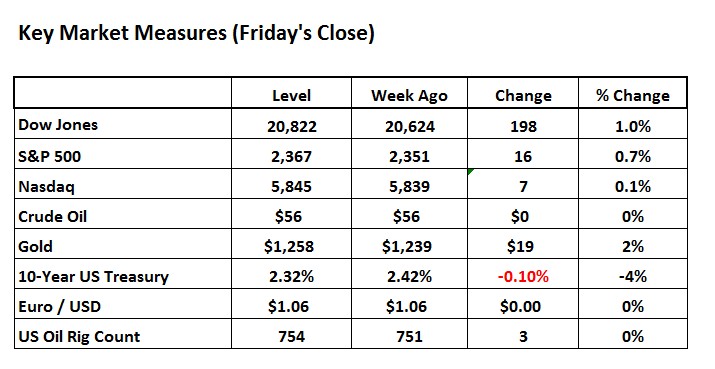
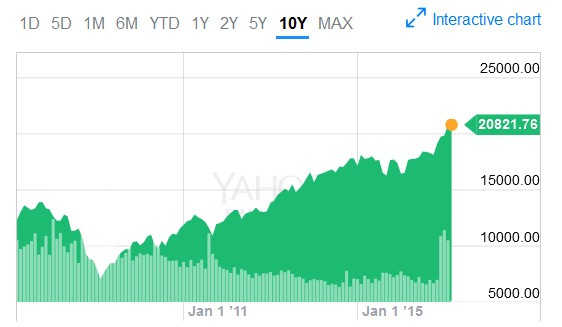
Now there is one bullish investor! (With a stock price of over $250,000 a share!) We tend to agree with Warren and we would be vigilant in making changes in our portfolio if the market decides it has peaked. If, and we repeat IF that were to happen, there are lots of great stocks in our High Yield portfolio that will allow us 6, 8 and more than 10% a year returns while we sit and watch the market take a breather. However, at this time the market remains strong, with the Dow at 20 thousand eight. That’s 20.8 thousand. Or 20,822. For heaven’s sake, we just hit 20,000 on February 3rd!
The Weekly High Yield Report
By Michael Foster
Special to The Bull Market Report
It's been another quiet week in the markets, and even quieter in high yield than anywhere else. But before we get to that, we want to talk a bit about some Wall Street chatter we've been hearing from friends both on the buy side and the sell side of the business. Hiring is up in fixed income, especially in the high yield and distressed debt sectors. This bit of insider gossip doesn't sound all that exciting, but it's actually a really big deal. Wall Street hiring is trend driven and often a leading contrarian indicator. When Wall Street starts to invest heavily in one particular corner of the market that is a signal that that part of the market is at or near its peak and a downturn in the next couple of years is likely.
Let's take a look at why that's the case. If you're an investment bank, you make money buying and selling assets for investors. Investors tend to avoid assets when they're down (thus exacerbating the trend) and pile in when they're up (think of how many people were buying investment houses in 2005-2006). When more investors want to buy, say, junk bonds, that creates more demand for people to buy and sell junk bonds, thus turning into more jobs in that sector.
This is especially worrying because hiring is down across Wall Street. This has been an issue since 2008 and it is just getting worse. The fact that fixed income has a temporary reprieve suggests that demand in that sector is really getting hot.
If you want proof, just look at the SPDR Barclays High Yield Bond ETF (JNK: $37). This fund is already up 20% including dividends over the last year, the best one-year performance since 2009. Volumes have also exploded five-fold over the same period. Demand for high yield bonds has heated up.
But what about those surging defaults? Remember in late 2015 when everyone was panicking about the oil-driven defaults in corporate bonds? There was worry that the real risk that higher interest rates would cause even more defaults as cash-strapped companies struggled to keep cash flow enough to service their outstanding obligations. Remember that revenues hadn't been growing for years back then? That's why high yield bonds fell 20% in a little over a year after Yellen raised interest rates.
Those risks remain, but investors don't care anymore. This doesn't surprise us, as the risk of those defaults have been priced into the corporate bond market for over a year now.
There are two lessons to learn here. Firstly, ignore financial press headlines warning about an upcoming apocalypse in an asset class. Trading on that noise is a fast track to poverty. Secondly, being a contrarian investor and rotating into unfavored assets can produce strong medium-term returns.
But now that corporate bonds aren't unfavored, does that mean it's time to sell? Not exactly. There remain good funds that trade in corporate bonds or similar assets like the AGIC Equity and Convertible Income Fund (NIE: $19.46) and the PIMCO Dynamic Income Fund (PDI: $28), which are up about 24% and 26% respectively, including dividend payouts, over the last year. And the dividend payouts haven't gone down and remain safe. If anything, they're getting safer as interest rates go up. That means there is no reason to sell either of these until the market bids their prices to an absurd premium. The Pimco fund is unfortunately trading at an 8% premium to NAV, almost its highest premium in history.
This is especially disconcerting because the Pimco fund historically trades at a discount and it's rarely desirable to buy a closed-end fund at a premium pricing. We would not recommend buying this fund at its current price level, but selling is not a good idea yet either. This is a very obvious hold in lieu of desirable alternatives. Outside of Pimco, there are few funds that can deliver such a substantial market out-performance.
But we also don't think the fund's premium is going to disappear anytime soon. The closed-end fund investment world is getting smarter and the fund's primary income stream (mortgage-backed securities) are getting less underpriced. In the past, a lot of money avoided this sector because of the hangover of the subprime mortgage crisis. That was an irrational mispricing of the sector, so now money is coming back. As money comes back, it makes sense for Mortgage Backed-focused funds to start trading at smaller discounts or, in the case of Pimco's Dynamic Income Fund, at a premium.
Elsewhere in the high yield world, funds have had a muted week indicating there's still time to buy where there is an undervaluation relative to history. The Invesco Municipal Trust (VKQ: $12.65 , down -1%) and Nuveen AMT-Free Fund (NVG: $14.64, flat) had a week of muted action although the news regarding interest rate hikes remains unchanged: The Fed signaled what everyone was already expecting this week, which is great for high yield. Similarly, things were quiet in REITs as higher borrowing costs is causing less panic than it used to. The SPDR Dow Jones REIT ETF (RWR: $95) rose a bit over 1%, with only a few REITs under- or over-performing in a week of little news.
For now, high yield remains an attractive sector but it's not a "no brainer buy” like it was a year ago. There are pockets of attractive undervaluations, especially municipal bonds and some REITs, while fair valuation is becoming more common in the junk bond sector. This is a trend that's likely to continue for a while, assuming we don't get any shocking news to the upside or downside. This confirms our view to buy and hold these funds, since they have outperformed the broader market and are likely to continue to do so for a very long time.
Good Investing,
Todd Shaver, CEO, Founder and Editor
The Bull Market Report
Since 1998
February 23, 2017
by Todd Shaver | Feb 23, 2017 | 7am News Flash
First Solar (FSLR: $34) fell 8% yesterday, on the heels of its fourth quarter which was better than expected, but not good enough for many investors. The company earned $1.24 per share, above the 98 cents analysts forecast, but took a huge write-down of assets. Revenues fell 50% to $480 million, beating the $395 million consensus.
Credit Suisse was one of the skeptics, cutting their rating on the stock to Underweight and lowering their price target by $1, to $29.
BMR Take: We like to look at the bright side. First of all revenues show the company running at a $2 billion per year run-rate now, but the company raised its 2017 revenue outlook from $2.55 billion to $2.85 billion, and EPS to "up to" $0.50 versus $0.41 estimated. Wells Fargo raised its target to $36, citing its strong balance sheet. Forbes has a $40 price target. Many on the Street think 2017 will be a transitional year, which is exactly what we have been saying for months now. The question you have to ask yourself is: Are you willing to wait this out for the next 12-18 months. And of course there are no guarantees that it will all work out rosy by then. It's tough to take a loss but sometimes it just might be better to do so and then you won't have to look at the stock every day and get upset. We are going to think this through hard and make some decisions in the next few days. We're not sure we have the patience to wait up to two years for the turnaround.
February 20, 2017
by Todd Shaver | Feb 20, 2017 | Earnings Preview 6 PM
The Home Depot (HD: $143)
Bull Market Report Target Price: $160
Bull Market Report Sell Price: $130
Earnings Date: Tuesday, 9:00 AM ET
Consensus: 4Q2016
Revenues: $22B
EPS: $1.33
Year Ago Quarter Results
Revenues: $21B
EPS: $1.17
Key Things to Watch For in the Quarter
Analysts expect Home Depot to report a 5% increase in revenue to $22 billion and a 14% increase in EPS to $1.33 for 4Q16. In response to the company’s ability to outperform analyst estimates in the first three quarters of 2016, the stock has gained 16% since the middle of last February. Investors remained stagnant upon the immediate release of earnings in Q1 and Q2 of 2016, however shares climbed nearly 5% in the weeks following the earnings report in 3Q16. Most recent developments in Home Depot’s business include an investment in a wind-powered renewable energy project that will provide the company the ability to power 100 Home Depot stores along with providing $150,000 in local community benefits.
First Solar (FSLR: $35)
Bull Market Report Target Price: $55
Bull Market Report Sell Price: $28
Earnings Date: Tuesday, 4:30 PM ET
Consensus: 4Q2016
Revenues: $410M
EPS: $0.97
Year Ago Quarter Results
Revenues: $940M
EPS: $1.6
Key Things to Watch For in the Quarter
Analysts across Wall Street expect First Solar to report a sharp decrease in both revenue and EPS, (56% to $410 million and 39% to $0.97 respectively) for the fourth quarter of 2016. Although the stock has plummeted 45% over the past year, it has beaten analyst earnings estimates for the past three quarters, and continues to provide investors with an inexpensive buying opportunity (PE of 7).
Splunk (SPLK: $64)
Bull Market Report Target Price: $75
Bull Market Report Sell Price: $55
Earnings Date: Thursday, after market hours (exact time unavailable)
Consensus: 4Q2016
Revenues: $290M
EPS: $0.17
Year Ago Quarter Results
Revenues: $220M
EPS: $0.11
Key Things to Watch For in the Quarter
Wall Street analysts estimate that Splunk will report a 54% increase in EPS and a 30% increase in revenues. The first three quarters of 2016 proved the company’s ability to continue beating analyst estimates, driving up the stock by a healthy 76%. Splunk continues to grow its operations, now operating in 110 countries across the world. In addition, it has actively brought together 20 industry leading security domains through its Adaptive Response Initiative, expediting the response to advanced cyber-attacks. We remain bullish on Splunk as they continue to grow revenues and earnings, and lead the industry with their ability to form profitable relationships.
December 18, 2016
by Todd Shaver | Dec 18, 2016 | Weekly Newsletter 7pm Sunday
The Week Ahead
The stock market is trading at all-time highs on a price basis, a price to sales basis, and a price to book basis. Price to earnings ranks in the top decile of historical valuations. The optimism/pessimism index is now over the 70 level on the optimistic side, but which has never been sustained for very long. Times are good. We don’t see the weeks ahead with the holidays disrupting the market’s current feeling. But prices are starting to bake in high expectations. We are going to need to see some real tangible progress from the economy starting off the year in 2017.
This week we provide some insights on our latest thinking for Annaly Capital Management, Apple, Bristol-Myers Squibb, Eli Lilly, Home Depot, and Netflix.
Highlights From The Past Week
China-US Relations. China must have access to US consumer markets, and President Elect Donald Trump knows it. The US is not dependent upon China for any strategically important commodities or products and the US has significant extra capacity in many of its manufacturing sectors. Data and opinions are pouring in about a potential US-China trade war. Sorry to break it to some of these folks, but trade has and will always be a war. Donald Trump is just way more outspoken about negotiation tactics. There is nothing new under the sun here. Get ready for some near term negative consequences from US-China relations stemming from US leadership turnover, but keep your head up, the trade deficit with China is so bad for the US it is hard to see how Donald Trump can do any worse. Trump named Iowa Governor Branstad the Ambassador to China and billionaire Wilbur Ross Secretary of Commerce - these guys are seriously qualified and talented and accomplished, although there are many that will fight them in Congress. What else is new?
Technology Sector Visits Trump Tower. Many of the companies we cover had their CEOs invited to Trump Tower to meet with the President Elect. The gathering included Jeff Bezos of Amazon; Elon Musk of Tesla; Tim Cook of Apple; Sheryl Sandberg of Facebook; Larry Page and Eric Schmidt of Alphabet, Google’s parent company; and Satya Nadella of Microsoft, among others. Trump told the crowd, “There is nobody like you in the world;” “I am here to help you;” and “We want you all to do really well.” Microsoft CEO Satya Nadella brought up perhaps the most thorny issue, immigration, saying how the government can help Tech with things like H-1B visas to keep and bring in more talent. Alphabet Executive Chairman Eric Schmidt, who briefly noted that he pondered what he would do if he were president, then made the point that governmental information technology programs were antiquated and unsafe, and needed to be upgraded. How exciting is this - to see our greatest leaders finally all sitting around the table discussing and solving problems!
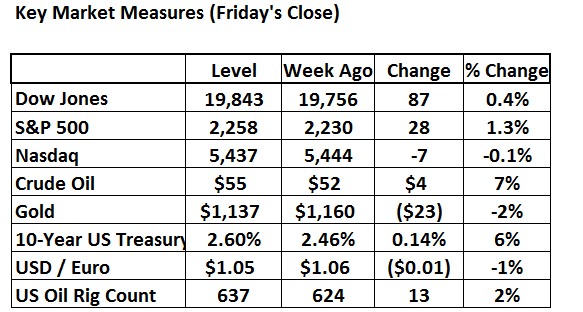
Interest Rate Outlook. We have to keep an eye on the interest rate situation. The 10-year US treasury is now at 2.60%, up from 1.70% before the election. On the one hand, the stock market has been STRONG in the face of this rate risk, the exact opposite situation many were inferring would happen whereby stocks go down when rates go up. However, we are not yet out of the woods. Fed Chairwoman Yellen suggested that three rate hikes likely in 2017, up from two. Goldman Sachs claims that at the current pace of interest rate hikes, the yield curve will finally start to offer decent returns by the end of 2017. This means we could see some investors who have been sticking around the stock market due to the terrible bond rates start to finally reallocate their money into the bond market. This is a trend that could develop and would not be great for the stock market. Interest rates have risen at one of the fastest rates in history. We would love to see a breather here in order for all markets to assimilate this big move. And we are talking the US stock market as well as overseas markets. The latter needs to assimilate the much stronger dollar as well as the higher rates.
BMR Companies and Commentary
Annaly Capital Management (NLY: $10.20, -3%) Interest rates have been on the rise and are likely to continue moving higher. The market assumes that rising rates hurt Annaly. This is actually not so. Yes, the company can be impacted in the short term. But in the long term the company receives a much higher return from their investments and is more profitable for the firm. Book value was $11.69 at the end of the third quarter. Analyst estimates call for book to decrease by 9% to $10.62 in the fourth quarter. But in this case numbers don’t tell the whole story.
Let’s revisit how Annaly makes money. Annaly invests in US Government MBS (Mortgage Backed Securities). Recall, Agency MBS is simply all the good residential loans made to the qualified deserving buyers who meet minimum standards (such as income, debt to income, loan to value, etc.) as set by the government agencies (Fannie Mae, Freddie Mac, and so on). The government agencies buy all these loans from banks and other lenders, then package them up into huge pools, and sell them through MBS to investors like Annaly.
Annaly’s portfolio of Agency MBS declines in value as interest rates rise, just like a bond. The company hedges to help dampen the impact. Analyst estimates say that in the fourth quarter the net decline in book value was $1.26.
BMR Take: Rising rates is a tough backdrop for Annaly but what people forget is that Annaly is laddered. They have notes maturing every month of the year. And guess what? They get to invest that at the higher interest rates that prevail at that time. So yes, book will be down in the short term, but soon enough book will pop right back up again as the company continues to roll over lower interest rate vehicles and invests in the new higher rates. This is what we love so much about Annaly.
Apple (AAPL: $116, +2%) The Apple train keeps rolling. One of the top Wall Street analysts who started following the company at $2 per share wrote his last note, as he is moving on to start a venture capital fund. He told everyone to stick with the stock as the train is heading toward $150.
As we move into 2017 investors will be focused on growing anticipation around iPhone 8 and a favorable long-term trajectory for Services growth. Some investors might be concerned that Apple could miss iPhone sales estimates for the first half of the year because of relatively little innovation in the iPhone 7 and buyers holding out for the next version. (We’ve heard this SO many times.) Should there be a first-half 2017 iPhone hiccup, we expect minimal downside, as investor focus narrows on the iPhone 8, which is why we started this paragraph making this point.
For those in the know, the Services business is actually a reason to be excited about 2017. Apple's Services business includes Apple Music, Apple Pay, iCloud backup and other offerings. Services accounted for 11% of Apple's total revenue in the fiscal year ended September 25, which amounted to $24.3 billion. Services revenue in fact rose 22%, where Apple's overall revenue fell 8%. Note that if Apple’s Services business were a standalone company it would rank in the Fortune 100. Look for Services revenue to clear $28 billion in 2017.
BMR Take: There is much conjecture and anticipation of the new Trump presidency and his talk about lowering taxes for repatriation of corporate cash overseas. With more than $200 billion overseas, Apple is listening and watching and so are we. We believe the Trump hype. We think it will happen. All signs point to more upside ahead for the Apple story.
Bristol-Myers Squibb (BMY: $59, +3%) Bristol is roaring back, up 20% from the recent sell-off lows. Recall that in October, Bristol announced an evolution of its operating model to drive the company’s success in the near and long term through a more focused investment in commercial opportunities, streamlined operations, and realigned manufacturing facilities. We are already seeing progress.
This week, Bristol announced investments in the (i) construction of a new R&D building at the company’s New Jersey campus that will co-locate lab-based Discovery and Translational Medicine activities, (ii) construction at its New Brunswick, New Jersey facility to support biologics development, and (iii) construction to continue expansion of its biologics campus Massachusetts.
The company also announced it intends to initiate a phased multi-year closure of its Hopewell, New Jersey site by mid-2020 and will not renew its lease in Seattle in 2019. The company confirmed previously announced plans to close its Wallingford, Connecticut site by the end of 2018, and also announced it will no longer build a Connecticut Development site. The company expects many of the roles from Wallingford, Hopewell and Seattle will transition to other U.S. locations.
BMR Take: We were so excited on the last earnings call to hear the company commit to operating expense discipline. Watching them follow through so quickly is encouraging.
Eli Lilly (LLY: $73, +8%) Lilly’s stock took a big hit last month on the failure of an experimental Alzheimer’s drug. However, this week, Lilly gave an upbeat outlook for the coming year, estimating that both sales and earnings will come in above Wall Street’s expectations.
This huge Pharmaceutical company expects adjusted earnings between $4.05 and $4.15 a share on revenue of $21.8 billion to $22.3 billion, well above analysts’ forecasts for earnings of $3.97 a share on $21.7 billion. Lilly is not a broken company just like we thought!
Lilly said the new estimates signal mid-single-digit growth from the current year, boosted by increased volume from new products. Lilly also projected an increase in gross margin despite offering discounts for its insulin brands for certain patients, as the Pharmaceutical industry has come under fire for soaring prices.
Some upgrades from the major research firms certainly helped. Morgan Stanley bumped their Target to $82. Goldman Sachs raised them to a “Conviction Buy,” whatever that means. We’ll say that is good(!) Jefferies is at $100 and Argus is at $95. All good. Our Price Target remains at a very doable $80 but we are secretly ready to raise the Target by $10. Don’t tell anyone. Having added the stock on Tuesday at $69, we are quite pleased so far. This one is big company with a $77 billion market cap. And while you wait, it is paying close to 3%. We expect good things from this company.
BMR Take: Lilly's new product growth drivers are in place, and we believe Lilly's guidance is low risk and achievable. Additionally, management has a history of providing conservative guidance, so we should see more weeks of solid stock performance ahead like this past week.
Home Depot (HD: $135, +1%) Housing starts tumbled 19% in November, which was way more than most expected, and we need to keep an eye on how higher interest rates impact household’s ability to buy new homes or spend money on their existing homes. Despite this issue , the 2017 outlook for Home Depot is encouraging.
Home Depot’s sales growth last quarter accelerated to a 6% pace from 5%, which trounced rival Lowe's 3% uptick. Professional customers are descending on the company’s stores. These shoppers spend far more than the company average -- over $900 per transaction in many cases -- so even a small increase in demand from these customers translates into significant gains. Last quarter we saw high-dollar transactions grow 11%.
The company is generating excess capital, enough to fund nearly $5 billion of stock repurchases and $2.6 billion of dividend payments annually. Home Depot is more generous with the dividend payout of 50% of earnings versus Lowe’s 35% target. We look for a similar smart use of capital to lift results in 2017.
BMR Take: We are encouraged by what is happening at Home Depot as the economy slowly churns out bigger numbers with no let-up in sight. The stock is closing in on all-time highs at $139.
Netflix (NFLX: $124, +1%) Netflix members worldwide can now download as well as stream great TV series and films at no extra cost.
While many members enjoy watching Netflix at home, the company has often heard customers also want to continue their binges while on airplanes and other places where Internet is expensive or limited. Now, customers can just click the download button for a film or TV series and can watch it later without an internet connection.
Many of people’s favorite streaming series and movies are already available for download, with more on the way, so there is plenty of content available for those times when customers are offline.
BMR Take: Aside from maybe You Tube, nobody is winning in the television and movie game as big as Netflix right now. They will spend $6 billion on content in 2017 and as we know, content is king. We see so much opportunity for the business ahead. Yes, they are taking a big step and some say a big risk, but they continue to blow away their competition by adding huge numbers of subscribers each quarter.
Athenahealth (ATHN: $115, +19%) Athena soared nearly 23% Thursday after the company reaffirmed its guidance for the fiscal year and issued an upbeat forecast for 2017.
The company, which provides cloud-based services for Healthcare, said for 2016 it expects earnings in the range of $1.65 and $1.85 per share on revenue between $1.085 billion to $1.115 billion. Analysts expected $1.79 a share on revenue of $1.10 billion.
Athena also said total annual revenue could hit as much as $1.33 billion in the new year. These are very healthy figures confirming that the company’s core services are in hot demand.
BMR Take: We like where we added the stock to our portfolio ($101 on November 11th.) And we like the prospects for the business. Now it’s time to enjoy the ride.
Upcoming Economic News
WEDNESDAY, DECEMBER 21
Existing Home Sales – November
Time: 10:00 am
Forecast: 5.5 million
As with housing starts, existing home sales in November are expected to decline following October’s 9-year high. Home sales continue to push higher, but tight inventory is limiting the pace of growth. The volume of existing homes available for sale in October is equivalent to 4.2 months at the latest sales pace, well behind the historical average of 6.1 months.
THURSDAY, DECEMBER 22
GDP – Third Quarter (Third Estimate)
Time: 8:30 am
Forecast: 3.3%
Third quarter economic output was underpinned by the firm 2.8% pace of consumer spending. Yet over the long-term, spending has shifted lower, with the yearlong advance of 2.6% to the third quarter representing the slowest pace in eight quarters. The slower pace of jobs gains and renewed monetary tightening will push against the potential growth boosts from fiscal stimulus in the year ahead.
Durable Goods Orders – November
Time: 8:30 am
Forecast: -3.8% overall, 0.4% ex transportation
A large downshift in Transportation sector orders is forecast to lead a decline in November durable goods orders after producing the sharp gain of the previous month. Core orders can show more stability in industrial demand by rising for the third straight month in November. Core capital goods orders rose 4.4% annualized in the months ending October, a promising signal for business investment after deep declines were registered in the first half of this year.
Personal Income & Spending – November
Time: 10:00 am
Forecast: 0.3% income, 0.5% spending
Personal income may only expand at a measured pace in November after a weak result for average hourly earnings growth. The 2.5% yearly advance of hourly earnings to November equals the slowest pace of the last eight months, which can prevent income growth from approaching 5% in the near future. Yet with alternative measures of wage growth showing more vigor and the labor market continuing to tighten, both hourly wages and income may skew higher in the quarters ahead.
Leading Economic Indicators Index – November
Time: 10:00 am
Forecast: 0.2%
Exceptionally few unemployment insurance claims and higher stock prices can push the Leading Economic Indicators Index up for the third straight month in November. Recent tallies of unemployment claims have produced some of the lowest counts of the past four decades. The indicator of a robust job market can feed into quicker wage growth and limited letup in the solid pace of hiring.
FRIDAY, DECEMBER 23
New Home Sales – November
Time: 10:00 am
Forecast: 575,000
Insatiable demand for new construction has new home sales positioned to rise in November. Sales rose 18% year-over-year in the quarter ending October, more than making up for the more measured gains seen earlier this year. Given how the level of homebuilding remains historically depressed, the uptrend in new home sales has some room to resist the recent rise in mortgage rates.
University of Michigan Consumer Sentiment – December
Final Time: 10:00 am
Forecast: 98.2
The final reading on consumer sentiment in the December Michigan survey can improve on the initial 2-year high result. The end of a trying election season has reduced the anxiety of many consumers.
Tesoro Petroleum (TSO: $91, flat) was upgraded recently by Wells Fargo to Outperform without putting a Price Target on it. Credit Suisse has a $100 Target, Citigroup has a $102 Target, Barclays is at $105 and Bank of America is at $109. We are in good company here. We added the stock on November 15h at $85 and we sit with our Price Target of $110. With OPEC bringing Christmas presents to the Energy markets, we’re looking for slow and steady growth from this medium-sized $11 billion market cap company, paying you a 2.4% dividend while you wait.
THE RACE
Google (GOOG: $791)
Apple (AAPL: $116 - $810 equivalent)
Amazon (AMZN: $758)
For the week:
Google was flat. (BTW, we love calling them Google, rather than…… A to Z.)
Amazon was down 1%.
Apple – Up 2%. Yea. Remember that we are reversing out the 7-1 split in 2014 so that Apple is now at the equivalent of $812. Apple is the clear winner so far! And Apple is doing it with the far bigger market cap than the other two. Apple is at $618 billion. Amazon is at $360 billion and Google is at $550 billion. It should be easier theoretically for Amazon to grow faster. But Apple just keeps chugging higher. Love this company! We can’t wait for it to set a new high at $134 and then shoot to $150. That will show all those naysayers. Yea.
A Discussion of Twilio (TWLO: $29, flat)
Twilio’s high valuation builds in a great deal of growth, and there is a lot of downside risk. The stock trades at 11 times sales while operating at a loss. The market has high expectations for the stock. Buying Twilio here at such expensive prices is a risky proposition. As richly valued as Twilio stock may be, however, it was trading at an even higher multiple of sales in October. The stock reached its 52-week high of $71 in September, and at that price we saw a multiple of nearly 25 times sales, a very high expectation.
The lock-up period is expiring on December 20th and Twilio’s largest stockholder, Bessemer Venture Partners at 25%, may sell some stock. So look for a drop this week and then the bottom will be set.
First Solar (FSLR: $35) had a good week, rising 4%. As we have mentioned many times, this is a great company that is going through tough times. We think it will take until late 2017 for them to straighten things out, but this company has a history of big revenues and strong earnings. Perhaps they will turn it around sooner. We don’t know, but we do know we wouldn’t sell the stock here. In fact, we would take some of our aggressive money and add to positions here.
The High Yield Corner
The biggest news for our High Yield portfolio came from Pimco. The special end-of-year distributions were finally announced, and as we expected, our Pimco fund had the highest special payout of all the Pimco funds. It’s important to reflect on what this means for high yield investors.
Throughout 2016, we have consistently and constantly recommended Pimco Dynamic Income Fund (PDI: $29, up 1%) even as the fund soared to our Target Price and its discount to Net Asset Value (NAV) turned into a premium. Often, investors and financial advisors sell Closed End Funds when they reach a premium to their NAV, because it looks like an opportunity to sell $1.00 of assets for more than $1.00 - every value investor’s dream. We recommended not falling for this temptation for one simple reason: The Pimco fund has been a monster in earning a strong return, building up an income reserved, and paying investors a high yield.
In fact, the yield on the fund has been so high - over 9% for most of the year and briefly over 10% - that many investors felt it had to be too good to be true. This yield is over a 4 times the premium to the 10-year U.S. Treasury, now at 2.6%, implying a massive amount of risk and danger. That, in turn, has kept unsophisticated investors out. The reality is that the Pimco fund offers a tremendous return on NAV for several reasons.
First and foremost is the mandate. The fund operates by investing in mortgage backed securities as well as other high quality high yield assets, including some well-picked junk bonds. This has made it possible for the fund to outearn its dividend since its inception.
Additionally, there is the quality of fund management. Pimco is one of the best asset managers in the world with unique access to opaque assets most investors simply cannot get their hands on. This is true of all of Pimco’s funds, and the Dynamic fund is no exception.
This means that Pimco’s closed-end funds are declaring tons of special dividends now that the calendar year is ending. Pimco Corporate & Income Opportunity Fund (PTY: $14.40) is offering the smallest special dividend of just 16 cents. Our pick is offering the most - $1.45.
This is more than we previously estimated, and brings the fund’s annualized yield to 14%. That is not a typo. That also means the fund’s annual yield is higher than Pimco High Income Fund (PHK: $9.10), which cut its payouts last year while the Dynamic fund increased payouts. The High Income fund’s price has also gone down 40% since inception, while the Dynamic fund has gone up 15%. At the same time, the High Income fund has suffered massive asset erosion while the Dynamic fund’s net asset value has gone up.
In short, The Dynamic fund has provided capital gains and the highest yield possible from Pimco. This is why we picked the fund earlier this year and why we recommended keeping it even when it had gained over 6% year-to-date. Now we get to enjoy the payoff in the form of that special dividend.
The world at large. Let’s extend our vantage point here at talk about the big picture. The FOMC* made its much-anticipated rate hike with a new Fed funds rate target 25 basis points above the previous one. That wasn’t the shocking news, but the expectation of three rate hikes in 2017, up from two expected, was the surprise. Apparently the Federal Reserve is expecting more inflation next year and a tighter monetary policy will be necessary. That caused the broader market to dip slightly, but a recovery later in the week saw equities close out flat for the week. The S&P 500 is holding on to its double-digit gains for the year, and it seems likely that it will close out the year with those gains.
*FOMC – Federal Open Market Committee, part of the Federal Reserve Board
This surge in equities means the market is now outperforming high yield assets after underperforming them for most of the year. The SPDR Barclays High Yield Bond ETF (JNK: $36) was flat this week, giving it a year-to-date return of 7% excluding dividends. Granted, those dividends bring it near S&P 500 performance, and the low beta on the fund means that junk bonds are also lower risk and lower volatility than stocks. So, in all, holding a junk bond index fund meant you outperformed the market in 2016 on a risk-adjusted basis. This should be good news for high yield investors. They can sleep soundly knowing that they are not sacrificing safety by looking for income, which was certainly the case back in 2013 and in years past.
Will this trend continue in a rising rate environment? We think so. The lack of a real correction in junk bonds after the rate announcement indicates that the market has priced in higher rates in junk as well as corporate bonds. This also is good news for rate-sensitive assets. This week we saw Main Street Capital ($37) and Digital Realty Trust (DLR: $95) resist the rate hike expectations and end the week flat. On the other hand, more rate sensitivity was felt in Omega Healthcare Investors (OHI: $30, down 1%) and Kimco Realty (KIM: $26, down 2%), although fundamental strength in funds from operations and occupancy rates keeps us invested in these REITs. More worrying is the greater weakness in Government Properties Trust (GOV: $19), which fell 5% this week. More short-term declines are likely if investors remain worried about interest rates. Government Properties is one of the more volatile REITs in the marketplace, suggesting it will fall steeply in moments of panic. Since its dividend is sustainable for a while, we do not believe its income stream is at risk. However, keeping a close eye on its price, and rebalancing your portfolio accordingly would be a prudent position in the short term.
Christmas Season is Upon Us
That’s a wrap for this week. Next week is Christmas and the markets are usually quite calm with most of Wall Street taking off for the Holidays. So we will not publish next week. BUT, if major events happen we will keep you informed via News Flash.
If you have a moment, we would love to hear from you on two fronts. What section of The Bull Market Report do you like best? And which section do you skip over every week? And as always, we are all ears for any input, suggestions, commentary, complaints or kudos. Send them our way at Info@BullMarket.com.
The Bull Market Report will be raising some angel money in January directly from our subscribers under a 506(b) offering, in order for us to grow the company to new heights. We will be raising just $100,000 from 4-5 investors and offering an equity stake in the company. If you are interested, write me directly at Todd@BullMarket.com. Include your phone number – Todd or one of our staff will call you.
Good Investing,
Todd Shaver
CEO, Founder and Editor
The Bull Market Report
