November 5, 2017

by Todd Shaver | Nov 5, 2017 | Weekly Newsletter 7pm Sunday
The Weekly Summary
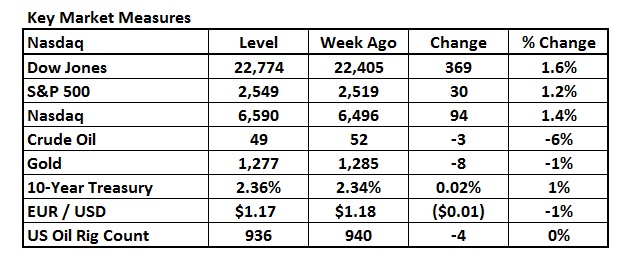
US equities ended higher this week, again! Major indexes ended at their best levels in history. Economic data, earnings, M&A and the recently released House tax plan grabbed most of the attention. Tech and Healthcare were the best performing sectors. There was lots of focus on the recently released House tax plan. As expected, backlash has heated up quickly, particularly when it comes to who get the benefits of new incentives between the super-rich and the middle class. The tax bill is not expected to survive in current form and some focus is already shifting to the Senate’s revisions.
In terms of other developments surrounding Washington, Trump said "We'll see" if Secretary of State Tillerson makes it through his term. Jay Powell was named by President Donald Trump as his nominee to serve as the next chair of the Federal Reserve, as he moved to make his mark on the world’s most powerful central bank. The news ends months of speculation ahead of the end of Janet Yellen’s first term as chair in February. The 64-year-old Mr. Powell has been a serving Fed governor since 2012. A centrist on monetary policy, he is known as a pragmatic and down-to-earth official with private sector and government experience. A trained lawyer and former partner at private equity firm Carlyle Group, he also served in the Treasury under former president George H. W. Bush in the 1990s. Powell is worth upwards of $50 million.
Consumer Confidence hit a 17 year high. Are you confident in this bull market? Good. We are too. And again, if you want to cash in some chips and buy some REITs and some high-yield stocks, we have two fabulous portfolios loaded with stocks that are paying 4%, 6%, 8% and 10%. But we are sticking with our Tech stocks, especially FAAMG stocks – Facebook, Apple, Amazon, Microsoft and Google. Their combined market cap is $3.3 trillion. We’re looking for $4 trillion next year. With Apple at $890 billion now, we could see them be the first trillion dollar company in history. (That price would be around $194 – not too far away.)
No matter what is happening out there, there is always a bull market here at The Bull Market Report! This week we highlight some of our favorite stocks where we know you can still make good money, including: Facebook, Microsoft, Home Depot, CBRE Group, Tesla, and Apple.
BMR Companies & Commentary
Facebook (FB: $179, up 0.5% - all % changes are for the week)
Facebook reported revenue of $10.3 billion compared to just $7.0 billion last year. EPS was $1.59 versus $1.09 last year. Revenue beat expectations by nearly 5% and EPS was a big $0.31 ahead of the consensus.
Wow.
“Our community continues to grow and our business is doing well," said Mark Zuckerberg, Facebook founder and CEO. "But none of that matters if our services are used in ways that don't bring people closer together. We're serious about preventing abuse on our platforms. We're investing so much in security that it will impact our profitability. Protecting our community is more important than maximizing our profits."
The majority of analysts were bullish on the report. Facebook continues to grow at an impressive rate with strong profitability as gross margin was way better than expected. User engagement continues to increase and is helping drive demand and in turn pricing. One of the more negative data points brought up was how duplicate accounts now compromise 10% of global monthly active users, but nonetheless both monthly and daily active users came in slightly ahead of consensus expectations.
BMR Take: Facebook remains the greatest advertising machine the world has ever known. With consensus EPS forecasts of $5.80 this year heading to $10.00 by 2020, this stock remains a compelling value.

A 1-year Chart for Facebook
+++++++++++++++++++++++++++++++++++++++++++++++++++
Microsoft (MSFT: $84, flat)
We love to see marquee deals and partnerships. They are symbolic signs of a vibrant business.
Microsoft and United Technologies (UTX: $121 - $97 billion market cap), a major industrial company, on Wednesday announced a strategic agreement that will create a differentiated customer and employee experience using intelligent technology innovation.
United Technologies builds and services millions of products in the field, from elevators in some of the world's tallest buildings, to engines and aerospace equipment in the skies, to commercial products that power smart buildings. Leveraging Microsoft Dynamics 365 and Azure, United Technologies intends to empower employees globally with the digital tools and information needed to support customer interactions for faster, better and more personalized service.
"United Technologies is a global leader in the aerospace and building industries and has a deep commitment to innovation," said the executive vice president, Worldwide Commercial Business, Microsoft. "The combination of United Technologies’ customer service expertise together with Microsoft's intelligent cloud will provide a digital business model for United Technologies businesses across multiple industries."
BMR Take: One of the reasons we see so much upside ahead for Microsoft is the breadth of their customer base that includes so much of the Fortune 500. This deal with United Technologies is just a reminder that Microsoft can sell the right product into this customer base with ease. Recall that earnings expectations were recently reset much higher by most analysts, calling for upward of $5.00 of EPS, which supports this stock heading much higher.

A 1-year chart for Microsoft
+++++++++++++++++++++++++++++++++++++++++++++++++++
The Home Depot (HD: $164, down 2%)
Don’t fret about Home Depot being down a bit this week. There was some chat that concerns about e-commerce have driven down the valuations of some retailers, and that short interest in the six largest brick-and-mortar retailers is currently higher than the levels hit in 2008 during the throes of the economic downturn. This impacted Home Depot’s stock this week.
There was also chat about how management teams at a number of beaten-up retailers are buying back shares, and that the economy should keep consumers shopping during the holiday season. So the world is not coming to end this year.
In other news, while online competition may be pressuring some retailers to hire fewer seasonal workers this holiday season, staffing firms suggest the problem is deeper, with prospective employees seeking more flexibility with their schedules, training, and pay. This could cause some more ongoing headline news that negatively impacts Home Depot.
BMR Take: Home Depot is a bellwether of industry. In such cases, these types of stocks are more susceptible to the large macroeconomic factors as opposed to company specific fundamentals. Stay focused on the latter. Home Depot is due to report EPS of $7.25+ this year heading to around $10.00 by 2020. Earnings power ultimately drives stock prices and we expect that to happen here. Can you believe this company is worth almost $200 billion? $170 a share will do it!

A 1-year chart for Home Depot
+++++++++++++++++++++++++++++++++++++++++++++++++++
CBRE Group (CBG: $40, up 1%)
CBRE reported revenue of $3.6 billion versus $3.2 billion last year. EPS was $0.64 versus $0.50 a year ago. Revenue was about $100 million above the consensus estimate. EPS beat expectations by $0.07. The strength in the quarter was expected to be maintained as the company raised its full year EPS guidance up by $0.05. Awesome quarter!
The strength of performance in Q3 was broad-based. Each of the company’s three global regions produced solid organic growth. Leasing returned to double-digit growth, and was especially strong in the U.S. Revenue growth accelerated in outsourcing business, as the company continue to capitalize on its commanding position in this growing sector. Global property sales saw healthy growth, despite a generally tepid market for transaction activity, reflecting the strength of the company’s brand and ability to take market share. Finally, the business also delivered excellent performance across all of their real estate investment businesses.
BMR Take: With the business closing in on $3 of EPS, we think the current stock price undervalues this leading franchise. CBRE is the ‘Mercedes Benz’ of the real estate world. Own this one for the long-haul!
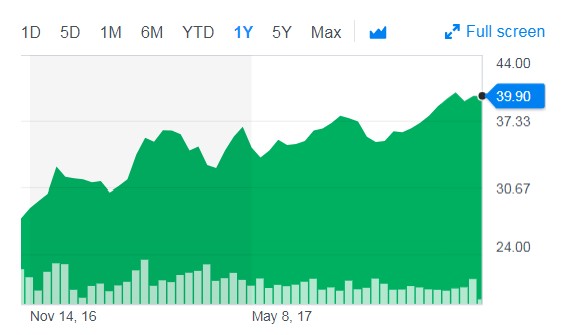
1-year chart for CBRE
+++++++++++++++++++++++++++++++++++++++++++++++++++
Tesla (TSLA: $306, down 5%)
Tesla reported revenue of $3.0 billion versus $2.3 billion a year ago. EPS was -$2.92 versus +$0.71 a year ago. Revenue barely beat expectations but earnings were much worse than expected. Ouch!
Tesla is one of the most closely watched tech companies in the world, where its zero-emissions vehicles resonate with environmental sensibilities. But with that scrutiny has come a great deal of criticism over labor issues in its plant, along with customer complaints about materials and workmanship, and frequent production delays with all of its vehicles.
Analysts were quick to jump on the per-share losses and problems getting the entry-level Model 3 sedan to market. Though Tesla is promising more Model 3 production in 2018, 2017 has been a miss to this point in terms of model production. Of note is Tesla pointing to difficulties in producing the battery packs at the Gigafactory for the vehicle. On a brighter note, Model S and Model X demand still seems to be doing well, but the fact remains that Tesla is still burning cash and needs to right the ship with Model 3 in order to succeed.
BMR Take: Tesla is set to lose over $3 per share this year. But the 2020 consensus forecast is for great than $11. Somewhere here we expect a major swing to profitability. With a brand that stands for innovation, we can see Tesla emerging to become a cherished stock once the profits start rolling in. Speculative? You bet. But we love that buy Musk.
+++++++++++++++++++++++++++++++++++++++++++++++++++
Apple (AAPL: $173, up 6%)
Apple delivered $53 billion of revenue versus $47 billion a year ago. EPS was $2.07 versus $1.67 a year ago. It was a really good quarter for Apple.
In a quarter which many thought would be more subpar due to delayed shipments of the iPhone X and due to many reports indicating weaker than expected sales of the iPhone 8, Apple delivered results that were much better than expected, and it is guiding for a generally strong next quarter as well.
iPhone sales of 47 million grew by 3% from a year ago and were slightly above consensus of 46 million. We saw strong and accelerating growth in services (up 24% from last year). Apple’s Services revenue of $8.5 billion is heading towards $50 billion annually. We observed good growth in China and strong growth in emerging markets (with India more than doubling). iPhone X is about to ramp in sales helping the average selling price. The iPhone X, with a price of $999 to $1,149 (vs. Apple’s blended price of $618 last quarter) becomes available this week, and we expect iPhone average selling price to increase to over $700. We could go on and on.
BMR Take: We reiterate our strong enthusiasm for Apple that we had before the quarter now that the results are in. EPS was $9.20+ this year and heading to greater than $11 next year. With cash and equivalents now totaling $270 billion, wow, this company remains as solid as a rock!
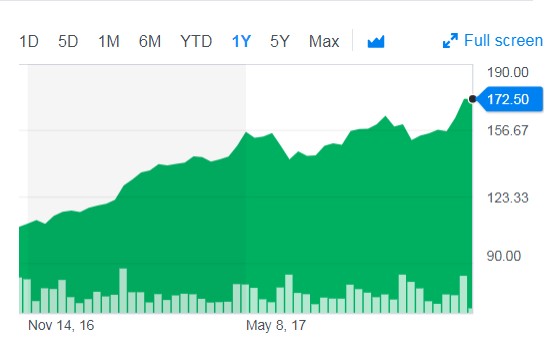
1-year Chart for Apple
+++++++++++++++++++++++++++++++++++++++++++++++++++
+++++++++++++++++++++++++++++++++++++++++++++++++++
Upcoming Economic News
JOLTS Job Openings
Tuesday, November 7th, 10:00 AM, Eastern
Period: September
Consensus: 6,082,000
Prior: 6,082,000
Initial Claims
Thursday, November 9th, 8:30 AM
Period: Week of 11/4
Consensus: 230,000
Prior: 229,000
Michigan Sentiment (Preliminary)
Friday, November 10th, 10:00 AM
Period: October
Consensus: 100.2
Prior: 100.7
+++++++++++++++++++++++++++++++++++++++++++++++++++
Eli Lilly ($87, flat)
Solidity Personified
If you want solidity and stability you can get it here. Eli Lilly and Company was founded in 1876 and is headquartered in Indianapolis. The company is worth $87 billion, pays a 2.5% dividend and has moved from $20 in 2008 to its current level, in a pretty straight line. Revenues are solid too. Revenues had a nice bump from the $20 billion in 2015 to the 2016 total of $21.2 billion. This year looks like $23 billion is in the bag. Slow and steady. And profitable. $2.7 billion ($3.00 a share) to the bottom line after taxes in 2016 up from $2.4 billion in 2015. Not counting some non-recurring charges this year, the company should hit north of $4 billion before tax and about the same as last year in 2017. Solid.
The company is in two primary areas of pharmaceuticals: Human Pharmaceutical Products and Animal Health Products. The company offers products to treat diabetes; osteoporosis in postmenopausal women and men; human growth hormone deficiency; and testosterone deficiency. It also provides neuroscience products for the treatment of depressive disorders, diabetic peripheral neuropathic pain, anxiety disorders, fibromyalgia, and chronic musculoskeletal pain; schizophrenia; attention-deficit hyperactivity disorders; depressive, obsessive-compulsive, bulimia nervosa, and panic disorders; and adult brain imaging. In addition, the company offers products to treat non-small cell lung, colorectal, head and neck, pancreatic, metastatic breast, ovarian, bladder, and metastatic gastric cancers, as well as malignant pleural mesothelioma; and cardiovascular products to treat erectile dysfunction and benign prostatic hyperplasia; and migraine headaches. And this is just a small part of what they do for humans. They do similar things for animals and are noted for their science and expertise. Plus they have collaboration agreements with Daiichi Sankyo, Incyte, Pfizer, AstraZeneca, William Sansum Diabetes Center, Purdue University, and Nektar Therapeutics. Truly a worldwide leader in big pharma.
BMR Take: This amazing company should hit another $3 a share in 2017, giving the firm a PE of under 28. We expect the company to hit the $4 level in a few years and wouldn’t be surprised to see the stock in the 90s within two years. Solid as a rock.
+++++++++++++++++++++++++++++++++++++++++++++++++++
Amazon’s Jeff Bezos Sells Shares
Jeff Bezos sold 1 million shares of Amazon (AMZN: $1112, up 1%) this week for $1.1 billion. The sale represented 1.3% of his holding and leaves Bezos with a 16.4% stake in the company. The world’s richest man said in April he would sell $1 billion a year in Amazon stock to fund Blue Origin, the rocket company he owns to explore Mars and outer space. He had already sold another batch of a million shares in May. So that’s 2 million shares in our book.
+++++++++++++++++++++++++++++++++++++++++++++++++++
From: Ron Shepro [ronshepro@xxxzz.com]
Sent: Tuesday, October 24, 2017 8:50 PM
To: 'The Bull Market Report'
Subject: RE: EARNINGS PREVIEW FOR THE WEEK AHEAD
Hi Todd – I Just wanted to say thanks for your good work. I find it interesting that Paul Mxxxxxx (a money manager), comes up with new recommendations that you had ages ago. Latest one being Splunk (SPLK: $68, up 1.5%). Looks like you are ahead of the legends. There are more, but I am sure you are aware of them. You also made the call on Paypal earlier.
Our Answer: Thanks, Ron. I think we have a fine little financial newsletter here. We just need another 5000 subscribers! We’ve had some nice wins with Nutanix, Square, PayPal as you mentioned, and CBRE (CBG) – the quiet real estate company.) And of course Splunk, which we added at $46.
Good Investing,
Todd Shaver
+++++++++++++++++++++++++++++++++++++++++++++++++++
A Word from Gary Jefferson
Jefferson Financial Group
First Vice-President, Investments
UBS Financial Services
After the week before "melt-up", we noticed that the fear factor kicked up another notch. This past weekend, media pundits again started making comparisons to the March 2000 crash. Back then it was referred to as either the dot.Com bubble or the Tech Wreck. But there are some differences that should be noted. In 2000, the PE of the S&P 500 was about 30X, and many tech stocks had PE's in the triple digits or no PE's at all because they didn't even have revenues yet, much less earnings. Today's trailing PE is estimated to end the year somewhere in the area of 18X. This is higher than average, but not nearly as frothy as the 2000 period.
The question now becomes, "With this being the second longest and second biggest bull market in history, and with valuations as high as they are, can stocks keep climbing?" The easy answer is "yes", and the reasons are readily apparent. We have a strong economy and it is getting stronger. It is not just the US economy either – most major world economies such as Europe, Japan and China are also experiencing solid economic growth. Thus, we are part of a worldwide bull market, which makes it much easier on the US market.
More importantly, earnings are still getting stronger rather than leveling off or declining. According to Thomson Reuters, earnings growth for the third quarter is now 6.7%. Of the companies that have posted earnings, 74% have topped expectations - compared to the 72% average that beat expectations over the past four quarters. Good earnings growth is the key reason stocks can and should continue to climb higher. And, any tax reform will make it all the more likely that earnings growth will continue to be robust for the next year or two.
We also have history on our side. In the year after reaching a new peak, the S&P 500 has had positive growth 72% of the time. (Bloomberg) We would, however, caution investors that the bar is much higher today than it was over the past several years, and therefore the pace of growth may not be as rapid or the returns as high as we have experienced over recent years. In our experience, "euphoria" has never been a part of any successful investment strategy.
+++++++++++++++++++++++++++++++++++++++++++++++++++
The High Yield Corner
By Michael Foster
Obviously, the biggest news of the week for high yield investors came from Omega Healthcare Investors ($28), which fell massively on an earnings and revenue miss. The stock immediately fell over 3% on the news and has been falling further, causing a stock that was flat year-to-date to suddenly be down 7%. Panic selling also means the dividend yield has risen to 9.2% - a level we haven’t seen since 2011. Note that the company paid out a 65 cent dividend on Monday. So it really wasn’t as bad as it seemed.
This sounds like a time to sell, but it really isn’t. When we take a deeper look at the earnings result, we quickly see why.
The company reported a 2.2% decline in revenues on a year-over-year basis and a near 5% decline in FFO per share for the same period. This was all due to a $6.3 million loss in FFO, which was itself the result of late rent payments from the company’s biggest tenant, Orianna Health Systems. The story is pretty complicated, but it means that Omega Healthcare and Orianna are going to need to renegotiate their current arrangement, which could mean Omega cutting their rent down (this would be the best case), or an outright bankruptcy that results in Omega fighting for their back payments in court (the worst case).
If they are able to reduce rents, it could mean Orianna will start paying their bills again and FFO will start to trend upwards. And even if we are stuck with a bankruptcy proceeding, Omega will still get some money back, but predicting how much and when would be impossible (anyone who has ever been through America’s civil court system knows rulings can get pretty bizarre).
So what we are facing now with the stock, following Omega’s write-down of Orianna, is the worst situation. There is upside in either the best or worst case, but the amount of upside will depend on which route they go and how fast a deal is made. For now, Omega Healthcare’s dividend coverage has taken a hit - there’s no denying that. With the decline in earnings, the dividend is now only covered by… 130%.
That’s right. What we are looking at right now is a REIT yielding 9% that still has 130% dividend coverage. That’s at the bottom end of what’s ideal for REITs in our mind (regular readers know we look for 130% dividend coverage for REITs as the starting point for a safe yield), and that’s more than compensated by the 9% dividend yield.
It also means that a dividend cut is really unlikely to happen anytime soon. Omega Healthcare has established a track record of penny-per-quarter dividend increases, and if it continues that trend for the next year, its dividend coverage will fall to 128% by the end of next year, assuming no increase in earnings.
Do we think Omega will be able to continue its penny-per-quarter dividend increases forever? No. But we do think it can continue this trend for the next five years at the very least. But with the latest price drop, the market is pricing in the company stopping these increases much sooner. The market will probably realize the error of its ways pretty soon. Maybe next quarter when Omega shows stability or improvements, the market will buy in again. Maybe it’ll take a few quarters until Omega and Orianna reach a deal and the market realizes their fears were overblown.
Either way, now’s a great time to buy a 9% yielding stock with 130% dividend coverage.
Let’s move on to other news - there was a lot last week.
Digital Realty (DLR: $119, up 2%) announced another dividend (the December one) at a 93 cent per share distribution, in-line with the previous payout. This is not good. As we’ve written about frequently, we want Digital Realty to increase distributions because of their exploding FFO, which is far ahead of the dividend. But we understand why the company sees no need to give shareholders a pay raise quite yet - the stock has rebounded about 3% off its post-earnings low, so demand for the stock is definitely still there.
That, by the way, is why investors should continue to hold Digital Realty. There is tremendous value here, and the recent price dip was a buying opportunity - not unlike the more recent dip in Omega.
In other earnings results, Apollo Commercial Real Estate Finance (ARI: $18.35) saw NII jump 34% from a year ago, above expectations. This is pretty impressive, because expectations have heated up for this specialty mortgage REIT, and its stock price has soared in recent months accordingly. But the company is not running out of deals to make, with $425 million in new investments in the recent quarter, bringing the annualized deal flow to $1 billion by the end of the year. Also, last quarter’s dividend coverage ratio was a nice 117%. Keep in mind that coverage ratio thresholds are different for mREITs compared to property REITs. Because of their use of bond spreads to make a profit and their lack of dividend growth, lower coverage ratios are to be expected. And from a mREIT perspective, 117% is nice.
The stock got a slight price bump after the results, but nothing major. That was no surprise - the market has had high expectations for this firm for a while.
Finally, another REIT reported earnings last week: Government Properties (GOV: $18.43, up 2%), which beat on revenues thanks to a near 9% year-over-year increase, but FFO was a penny shy of expectations. That’s really too small of a miss to matter, especially since the market has discounted poor earnings for months now. So the stock actually went up over 1% following the release and over 2% for the week. We still need to see dividend coverage improve, but there is fundamental stability which indicates this remains an attractive 9% yielder.
Good Investing,
Todd Shaver, Founder and CEO
The Bull Market Report
Since 1998
October 29, 2017
by Todd Shaver | Oct 29, 2017 | Weekly Newsletter 7pm Sunday
The Weekly Summary
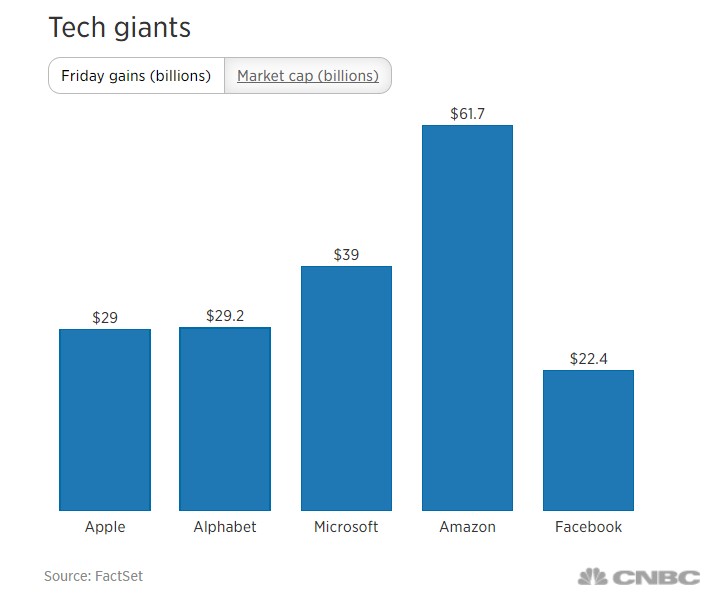
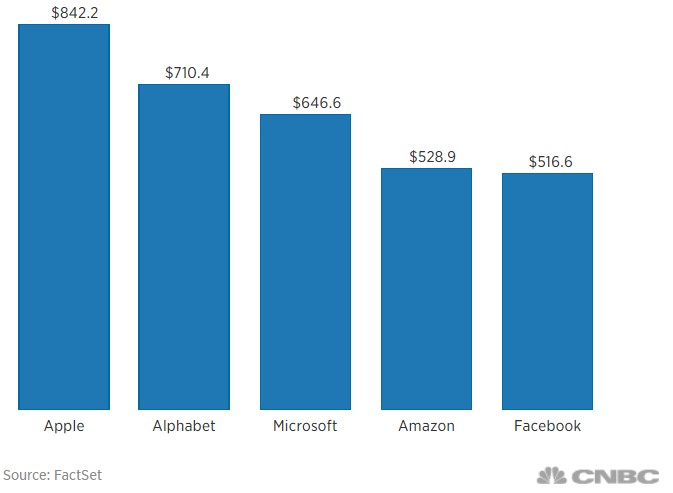
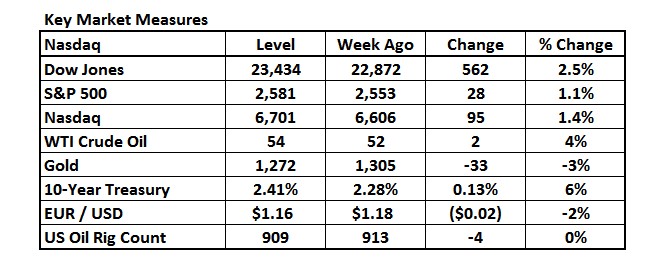
US equities finished the week higher on Friday again. There was a notable rally in Tech with several mega-cap names hitting all-time highs after earnings. Apple, Alphabet, Microsoft, Amazon and Facebook, the world's five most valuable public companies, added $180 billion to their combined market value on Friday. Investors piled into the group a day after Alphabet, Microsoft and Amazon reported better-than-expected earnings. For the stock market, it was more of the same. Those five companies have gained almost $900 billion in market cap over the past year.
Shares of Amazon and Google both surged past the $1,000 mark and approached all-time highs, with Amazon closing above $1100. To many people’s surprise, we continue to see favorable broad market trends with US equities seeing $14 billion of inflows over the last three weeks.
Friday's Gains:
Market Caps:
There was nothing particularly incremental on tax overhaul this week, as the House narrowly adopted the Senate budget, paving the way for release of initial tax legislation next week. Trump is leaning toward Powell for Fed chair, and the official announcement is expected next week.
No matter what is happening out there, there is always a bull market here at The Bull Market Report! This week we highlight some of our favorite stocks where you can still make good money, including: Apple, Microsoft, Amazon, Celgene, Bristol-Myers, and UPS and a few others.
BMR Companies & Commentary
Apple (AAPL: $163, up 4%)
Well, Apple has still got it! Apple sold out iPhone X pre-orders. Thousands of Apple fans from around the world flooded the website to lock in their pre-orders for the iPhone X. Apple sold out pre-orders for the phone to arrive on the November 3rd launch day in 17 minutes, and the wait time has grown to five to six weeks.
Apple said, "We can see from the initial response, customer demand is off the charts. We're working hard to get this revolutionary new product into the hands of every customer who wants one, as quickly as possible."
Why is this so important? Despite major concerns over manufacturing the deluxe iPhone, and the high price of $999, demand is not lacking at all. This finding bodes well for the stock and future prospects.
BMR Take: Apple sold 41 million iPhones last quarter and will sell over 200 million this year. The holiday quarter is the busiest season of the year, of course, and this year Apple is projected to sell over 80 million iPhones in the Christmas quarter, a new record. With iPhone sales fueling great than 10% EPS growth, we continue to see bright prospects for the stock.
Microsoft (MSFT: $84, up 6%)
Microsoft crushed the quarter. Revenue of $24.5 billion increased 12% from a year ago and beat expectations for $23.5 billion. EPS of $0.84 increased 17% from a year ago and smashed expectations for $0.71.
Earnings rose to $6.6 billion, or 84 cents a share, from $5.7 billion, or 72 cents a share, a year earlier. They are still making 27% profits on sales, AFTER TAX! The strength was broad based.
Analysts were most impressed by momentum in cloud that pushed Commercial Cloud above the company's $20 billion targeted goal they set two years ago approximately three quarters ahead of schedule.
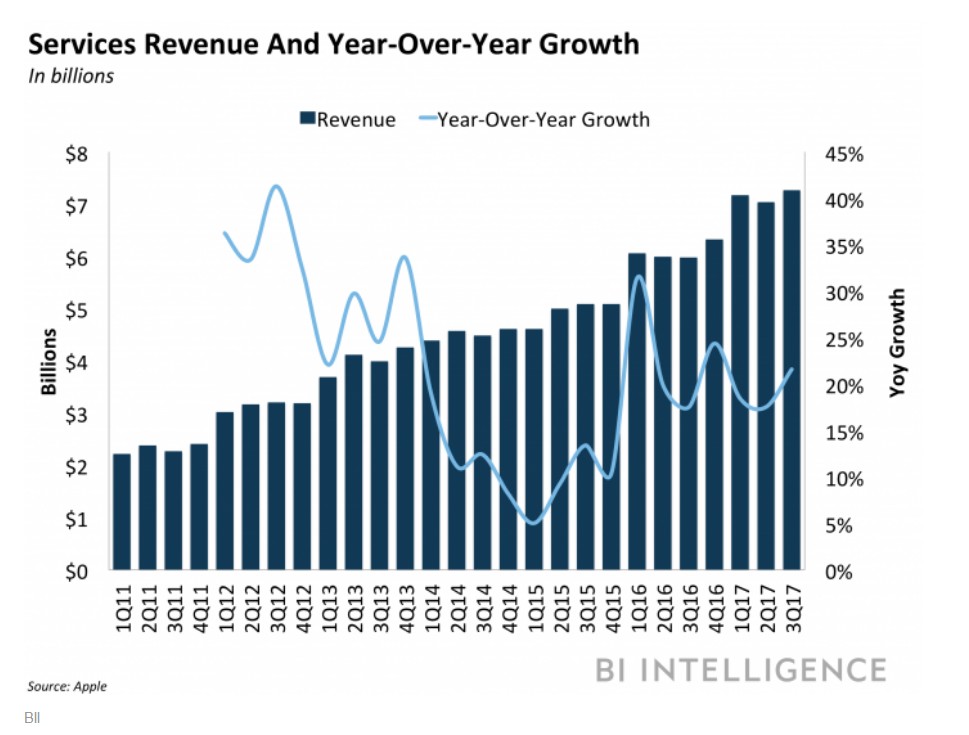
Microsoft’s Azure's cloud revenue increased 90% in the period and has exceeded Amazon’s AWS growth for at least eight straight quarters, but Microsoft has yet to break out the unit's sales. AWS controls 34% of the market while Azure has 12%. However, Microsoft is picking up high-profile clients as it adds features, lowers prices and expands data center capacity around the world.
Amazon’s AWS brought in $4.6 billion in sales, which represents an annualized run rate of $18.3 billion. So you heard it here first, Microsoft is leading Amazon in the world of cloud.
Microsoft continues to increase its share in overall IT spending, and momentum in its results was a clear theme this quarter. Margin performance and free cash flow generation also stood out in the quarter.
BMR Take: With the cloud business tracking way ahead of plan, free cash flow per share forecasts now closing in on $5, and with so many other great things happening at Microsoft we continue to view this stock as a core tech holding for any portfolio. The stock blew through our Target of $78 to a new all-time high, so we hereby adjust it to $92. Our Sell Price remains “We would not sell Microsoft.”
Amazon (AMZN: $1,100, up 13% - $129 a share on Friday!)
Revenue: $43.7 billion growing 34% from last year, but only $1.3 billion in sales included from Whole Foods, which Amazon acquired in late-August. North American sales were $25.4 billion, up 35% from last year, while international sales grew 29% to $13.7 billion. Amazon gave fourth quarter guidance in the range of $56-60 billion. Wow.
The company’s net income was $256 million, or 52 cents a share. Analysts on average expected earnings of 2 cents a share. (Now THAT is funny. 2 cents a share expected and they report 52 cents! Gotta love this company.

Here we go again! Another industry is about to get “Amazon-ed”. This should be fun to watch and great for the stock:
Pharmacies and Healthcare Distributors continue to trade lower following news that Amazon eying the space. The St. Louis Post-Dispatch reported that Amazon has received approval for wholesale pharmacy licenses in at least 12 states. The topic was discussed further on Amazon’s earnings conference call with the company noting that hospitals and labs were among the areas that could be served under its Amazon Business initiatives. Both distributors and pharmacies are reacting negatively to the perceived threat.
And one potential competitor has jumped the gun by looking to buy a Healthcare company. CVS Health is offering to buy Aetna (AET: $173, down 3% Friday) for more than $200 per share, which would value the company at more than $66 billion. Aetna rallied 12% after the reports. According to the WSJ sources, the merger proposal was spurred by expectations that Amazon might enter the pharmacy business. A tie-up between a retailer like CVS and a health insurer like Aetna may seem surprising on the surface. But experts say both parties need to make strategic moves to address the changes in the sector, including the possible threat from Amazon.
While the above news stole the news headlines this week, keep in mind the core business delivered stellar results.
Revenue beat across all three segment. AWS revenue grew 42% - matching Q2's growth rate, assuaging fears of a deterioration, and beating consensus AWS income by $130 million.

BMR Take: Amazon didn’t just hit smash $1,000 again, the stock rolled right on to $1,102, closing up $128 a share to a new all-time high. With the potential entry into pharmacy, the “innovation machine” called Amazon is alive and well. We see EPS heading to $20 taking the stock much higher over time. We hereby raise our Target of $1100 which it will hit Monday morning, to $1300. Our Sell Price is raised from $970 to $1030.
Celgene (CELG: $98, down 19%)
Celgene had the biggest drop in 17 years on Thursday. Celgene has stumbled, but now is the time to stick with it and accumulate. Why?
Let’s take out all the noise. The fact is the company’s long-term EPS guidance was hardly cut at all from $13 to $12.50. We are still looking at greater than 20% EPS growth through 2020 as revenue explodes from $13 to $20 billion. Specifically, consensus EPS currently resides at $7.30 in 2017, $8.80 in 2018, $10.50 in 2019, and $12.60 in 2020.
Admittedly, it may take a while and we must be patient. There is all sorts of debate about how R&D expenses could disappoint and there are no major catalysts on the drug development front foreseeable in the next 12 months. Then there is also a camp out there that believes that any day now management could make a transformation acquisition that re-ignites excitement about the prospects for the business.
BMR Take: Celgene is the 7th largest component of the Healthcare sector and a $77 billion market cap juggernaut. You have to trust that the franchise is viable and will learn and progress past this current point of disappointment. This looks to us like a classic case of Wall Street exuberance on the downside with this out-of-favor sentiment swing. Take advantage of the drop and accumulate the stock down here.
Bristol-Myers Squibb (BMY: $60, down 7%)
Oh Bristol-Myers. Thou shalt no longer disappoint us at The Bull Market Report. Overall third-quarter revenue rose 7% to $5.25 billion, meeting Wall Street estimates. Earnings rose to $845 million, or 51 cents a share, from $385 million, or 24 cents a share, a year earlier.
Bristol said its gross margin as a percentage of revenue fell to 70% from 73.5% a year earlier due to product mix and higher costs, including a $70 million write-off of inventory for hepatitis C products.
Sales of cancer immunotherapy Opdivo rose 39% to $1.27 billion, in line with the average estimate of $1.21 billion, while sales of blood thinner Eliquis rose 38% to $1.23 billion, matching analyst estimates.
Bristol’s Chairman & CEO had this to say, “We had a good quarter, demand for Eliquis and Opdivo was strong and we advanced our portfolio with important clinical and regulatory milestones, including exciting data for kidney cancer patients with Opdivo + Yervoy. Looking forward, our focus is on continuing to deliver strong commercial performance, advancing our pipeline and ensuring our resources are applied to priority areas of our portfolio for sustainable, long-term growth.”
That said, there remains plenty of merger and acquisition talk, so we are sticking around for what could be a one-day 20-30% premium or higher.
BMR Take: Remember, activist investor Carl Icahn who has a stellar long-term track record is in the stock as one of the largest shareholders. He believes the business is suspect to being taken over and such a sale could unlock tremendous value for shareholders overnight. Stay the course!
The quarter looked pretty good to us. We wouldn’t worry about it too much. The stock may sell off for a few weeks, but we expect it to slowly start to move higher by Christmas.
UPS (UPS: $121, up 1%)
UPS forecasts record holiday delivery of about 750 million packages globally in the 25 days between Thanksgiving and New Year’s Eve. The record-breaking seasonal global delivery volume is about 5% above last year’s season. Of the 21 holiday delivery days before December 25th, 17 are expected to exceed 30 million delivered packages. Mind boggling!
With the launch of UPS Saturday ground pickup and delivery service, customers in nearly 4,700 cities and towns across the country will benefit from five additional ground pickup and delivery days between Thanksgiving and Christmas.
Online and mobile commerce has transformed the retail industry, and UPS is ideally positioned to serve both consumer and business customers during even these busiest of times.
According to the National Retail Federation, retail sales in November and December are forecast to increase 4%, reaching between $680 billion. During the busy holiday shipping season, UPS flexes its global delivery network to process nearly double the regular daily volume of 19 million packages and documents.
UPS continues to invest in the operational and consumer technologies and facility improvements that enable the company to deliver the holidays for customers. Enhanced customer visibility tools, increased consumer convenience, and the availability of the new Saturday ground delivery and pick-up services are all part of the expanding solutions UPS is providing customers, to take full advantage of the holiday season.
This peak season, UPS plans to employ 95,000 temporary seasonal workers, including drivers, delivery helpers who ride with drivers, package sorters, and loaders. Candidates for seasonal jobs can apply on UPSjobs.com. This holiday work often is an entry point for future permanent jobs and career advancement. Almost 35% of those hired seasonally over the last three years now have permanent jobs with the company.
BMR Take: It is crazy to think about just where our country would be without UPS. This business is the backbone of our culture and our economy. It is a must-own in any portfolio. With EPS on track to crack $20 in a few years, the stock remains a good value.
Upcoming Economic News
Personal Income
Monday, October 30th, 8:30 AM
Period: September
Consensus: 0.40%
Prior: 0.20%
Consumer Confidence
Tuesday, October 31st, 10:00 AM
Period: October
Consensus: 121.0
Prior: 119.8
ADP Employment Survey
Wednesday, November 1st, 8:15 AM
Period: October
Consensus: 200,000
Prior: 135,000
Total Light Vehicle Sales
Thursday, November 2nd, 8:00 PM
Period: October
Consensus: 17,500,000
Prior: 18,500,000
Update on Tesla (TSLA: $321, down 7%)
Tesla had a rough week in the markets, dropping $24. We uncovered some information about how the firm is doing in China. It looks like Tesla is making great progress in the difficult China market after all. Elon is great! 🙂
Tesla is moving to begin manufacturing in China. The firm won agreement with Shanghai's government to build a wholly-owned factory in the city's free-trade zone, the first arrangement of its kind in China for a foreign auto maker. Generally, the government makes firms partner with a Chinese company. They didn’t require that in this case with Tesla.
The deal would help Tesla slash its production costs as it would bring down shipping costs and the final price on its electric cars. More significant, it would give Tesla a base from which to export to the rest of Asia. Beijing has mandated a dramatic increase in production of electric vehicles.
BMR Take: The ride with Tesla has its bumps in the road for sure. This week is a further indication of that. They are close to starting substantial deliveries of the Model 3 this year, as they hold cash deposits for almost 500,000 cars. But just as they get closer, production snafus are leaking out from the company and the stock gets hit.
You should only be an investor in this company if you are breathing the happy gas that Elon Musk is sending out. Again, the stock can go to $500 from here, or $200. We’re just not sure which will come first.
A Word From Gary Jefferson
Jefferson Financial Group
First Vice-President, Investments
UBS Financial Services
What's Right with the Market?
As we mentioned last week there had to first be a move to get 51 votes or "it was all just a waste of time". Well, the Senate did pass a budget bill which sets the stage for tax legislation later this year. The significance of the budget passage is that it allows the Senate to now pass their tax legislation with a simple majority of 51 votes rather than the needed 60 votes without one. And since literally no Democrats appear willing to vote for the plan, this was a crucial step for the administration to get their plan approved. The President's plan to cut corporate and individual taxes and to make other business-friendly changes to the tax code have helped to push stocks higher. And, under this potential first major overhaul in about 30 years, corporations would see their top tax rate cut from 35% to 20% - which should obviously be a continuing tailwind for shareholders.
[BMR: Of course, whether this happens or not is certainly not clear. But we will say this: If it doesn’t happen, we are going to see a lower stock market.]
Some thoughts about the length of this bull market and stock overvaluations.
When Treasuries are paying less than 3%, certificates of deposit (CDs) less than 2% and cash less than 1%, it makes quite a bit of sense to continue to use stocks in a portfolio, and not pile into bonds that are tied to the fate of a bond market where when rates rise, bond prices fall.
Anything else right with the market?
Yes. Earnings season started strong and consumer sentiment hit a 13-year high. Companies have started releasing their 3rd quarter earnings reports, and so far, 78% of them beat bottom-line expectations. Corporate earnings have been strong since 4Q16, and this quarter will likely continue that trend, although it may come in a little light due to all the natural disasters. And, the University of Michigan's consumer sentiment poll for September revealed that consumers held positive perspectives overall - across income, age, and political spectrums. Last month's reading reported the highest consumer sentiment since 2004.
One final note – don't get faked out by another 1000 point move in the Dow. That’s because, as the market rises, each 1,000-point advance becomes smaller in percentage terms. For example, the rally between 10,000 and 11,000 in 1999 was, of course, a 10% rise, while the climb from 20,000 to 21,000 for the Dow marked a 5% rise. It's still a good thing, but a 1,000 points is not what it used to be.
That said, next year we may have to get concerned about extended valuations if earnings don't keep up, the length of this bull market if the yield curve inverts, the bearish tendencies of midterm election years, and the ever present Geopolitical risk (N. Korea). Thus, there will still be a wall of worry for the market to climb ……..but this is a good thing. For now, at least, we can enjoy the fact that the "trend is your friend".
Ventas (VTR: $62.50, down 1%)
The company owns more than 1200 healthcare properties in the United States, Canada and the United Kingdom. They are paying a 5% dividend (just raised 6%) and the firm just keeps humming along.
The real estate investment trust, based in Chicago, said it had funds from operations of $373 million, or $1.04 per share, in the period. Funds from operations takes net income and adds back items such as depreciation and amortization. The company had net income of $615 million, or $1.71 per share, on revenue of $900 million in the period.
Ventas expects full-year funds from operations in the range of $4.13 to $4.16 per share.
“We delivered yet another strong quarter for our shareholders. With positive earnings and property growth, improved financial strength and recognition of over $500 million in gains from our ongoing divestiture of our skilled nursing assets, we are in an excellent position,” said Debra A. Cafaro, Ventas Chairman and Chief Executive Officer.
Note that Cafaro was recognized by the Harvard Business Review as one of “The Best-Performing CEOs in the World.” She is one of 23 CEOs named to the Harvard Business Review list for four consecutive years and one of only two women on this year’s list. Ventas’s financial performance ranked 32nd of 900 companies globally for Ms. Cafaro’s tenure, which exceeds 18 years.
During and immediately following the quarter, Ventas sold properties and received final repayments on loans receivable for proceeds of $630 million, with gains exceeding $500 million, consisting principally of the Company’s completed sales of 29 of its Kindred Healthcare skilled nursing facilities (“SNFs”) for proceeds of approximately $570 million. The Company continues to expect total aggregate proceeds of $700 million from sales of its 36 Kindred SNFs in 2017, representing a 7% yield on cash.
The Company has excellent liquidity with $2.9 billion of available borrowing capacity and over $100 million of cash on hand.
BMR Take: We have a Target of $72 so we have a ways to go, but we are happy collecting the dividend and looking for a move to the upper 60s when the world finally wakes up to what a great company this is. Our Sell Price is $58. If you are nervous about the stock market as a whole (and we are not) then moving assets from the Tech sector to Ventas would be a smart move. Big, solid, growth.
From: Trent Thompson [mailto:Trent@xxxxx.com]
Sent: Wednesday, October 25, 2017 2:23 PM
To: info@bullmarket.com
Subject: Options on Nutanix
Hi Mr. Shaver,
I have profited nicely from Nutanix. I have also done well on options strategies as recommended by Bull Market for both Twitter and Microsoft.
I am wondering if you can propose a simple bullish option strategy for Nutanix.
Thanks, Trent.
PS - I very much appreciate your newsletter especially the weekly and ad-hoc reports!
Trent Thompson wanted to see an options strategy for Nutanix (NTNX: $28, up 5%) in his letter above. Good idea, Trent.
So here it is:
Dear Trent:
[Note that this is a RISKY STRATEGY – check with your broker or advisor.]
I like to buy in-the-money LEAPS if I can and if they exist (some stocks don’t have LEAPS.) The reason is that you are not paying as much time premium for the LEAP. Time premium always goes away – it disappears over time and you can be left with losses.
I also like to sell calls against the long LEAP in order to get that time premium back. It’s like selling a covered call but using the LEAP instead of the stock.
The 2020 LEAPs exist, so that is good, but note that the spread is high (bid-ask) so that makes the numbers a little tougher. We are looking for the stock which is currently $28 to go to $40 or higher by January 2020, over two years from now. If this happens we have a home run.
You can buy the 20 LEAP for about $14. With the stock at $28 that means that $8 is the intrinsic part of the price of the option and $6 is the time premium. In order to get some of the time premium back you can sell some options against it. I like to go out 3-6 months to sell the calls and when they expire, just do it again. You can sell the January 30s for about $2 and if the stock stays below $30 they will expire worthless, lowering your price of the LEAP by that $2, to $12. (If it goes over $30, that’s a good thing and you can just buy back the 30 call and sell a 35 call or another option.) You could also sell the April 35 for $2 if you don’t want to get too close to stock price. Or you could sell the April 30 for $3. There are lots of choices!
If the stock is at $30 or below in January, you then sell the June 35s for another $2, lowering the cost basis to $10. Then in June if the stock is at $30 or $35, you sell the January 35 or 40 for another $3-4, lowering your cost basis to $6. NOW WE’RE TALKING! Now you have an option you paid $6 for that is worth $15 if the stock is at $35 and $20 if the stock is at $40.
Obviously this is a very movable strategy and you have to watch the stock and move in and out of the short calls. Plus it is very risky, as the stock could go below $20 and you would lose all of your money. Some of you don’t like to have to watch things so closely, in which case this is not for you. But if you pay attention you can get the cost basis close to zero and if the stock goes to $35 or $40 in two years your return can be very, very big. Did someone say infinity?
With that said, good luck to you, Trent! (And all of our readers.)
Todd Shaver, CEO
The Bull Market Report
I use this site for my pricing, but there are others.
https://finance.yahoo.com/quote/NTNX/options?p=NTNX&date=1579219200
Letter from a Subscriber about Cloudera (CLDR: $14.90, down 8%)
From: Robert Jolliffe [mailto:rjolly1@xxxxxx.com]
Sent: Thursday, October 26, 2017 1:41 PM
To: The Bull Market Report
Subject: Re: News Flash for October 26, 2017: Celgene Lowers 2020 Guidance – Stock Gets Killed
I feel your pain and feel the same with Cloudera. They beat as well and have been falling like a rock the last couple of weeks. I've looked everywhere and can't find anything negative about Cloudera. In fact they just picked up Hitachi as a customer*. WTF! I doubled down here and hope no bad news comes out in the near future.
Our Answer:
I can’t agree more, Robert. What can we do now when we like a company so much, but the market is not cooperating? We can have faith, buy more down here and hope there are no skeletons in the attic.
Look what Nutanix has done lately. And Shopify. And Square. Square has been AWESOME. (Nutanix too.)
Even little old Opko Health. Eventually good companies win out in the end ESPECIALLY when they have GOOD REVENUES. Last quarter saw revenues of $89 million up from $64 million in the year ago quarter, a 39% jump.
Todd Shaver, CEO
The Bull Market Report
* Earlier in the month, Cloudera announced a strategic partnership with Hitachi to offer customers advanced services, support, and training to strengthen adoption of Cloudera Enterprise, the leading machine learning and analytics platform. "Developments in Cloudera's sweet spots - such as machine learning and IoT - are already starting to transform businesses across Asia Pacific and Japan," said Mark Micallef, Vice President, Asia Pacific and Japan at Cloudera. "Partnering with Hitachi is a critical milestone in our journey to simplify the creation of IoT, machine learning, and analytic solutions. It offers a great deal of promise to global enterprises looking to use data to generate new business models and revenue sources, enrich the customer experience and innovate industries."
Some Research from the Street on Shopify (SHOP: $107, up 5%)
We uncovered a research report on Shopify from a big-name Wall Street firm. We found it timely in that the company has been under attack from a firm called Citron, run by Andrew Left. He has made a name for himself by shorting various stocks including Valeant Pharmaceuticals. That was his big winner, but he has had losers too. He shorted Nvidia at $108 in December and it is now at $195. And he has had others.
From the research report we gathered the following:
We expect Shopify to deliver strong 3Q results with revenue and operating income exceeding Barclays and consensus estimates when it reports earnings on October 31. Shares of SHOP have pulled back by 15% in the last month (vs. S&P 500 up 3%) after bearish reports on the company's customer acquisition strategies but are still trading up 130% YTD (S&P 500 up 8%) despite FY18 revenue estimates only increasing by 25% YTD. At 10x FY2 revenues, SHOP's valuation is still a significant premium to peers. We are bullish on SHOP's competitive position in the Small Business ecommerce platform space and the opportunity with Shopify Plus in mid-market category.
Key Metrics for 3Q17: In terms of key metrics, we are modeling total revenue of $166m (+67% y/y), in-line with consensus, near the high-end of company guidance. SHOP has exceeded the high-end of its revenue guidance by an average of 6% over the last five quarters.
FY17 Guidance: Despite the recent pullback, expectations are high for SHOP to raise its FY outlook on 3Q earnings. We forecast FY17 revenues of $650 million, near the high-end of SHOP's current guidance, but we think buy-side expectations are higher.
Subscription Services: We are modeling subscription revenue of $80m in 3Q, up +61% or 5-pt deceleration on 2-yr basis.
BMR Take: We’ve been saying the same thing for a long time. We sure hope the company doesn’t disappoint on Halloween when they report earnings. Because if they do, the stock is going to the 80s. If they produce, like they have been for the past few years, the stock will stay at its current level and may even shoot higher as Mr. Manic, Andrew Left, will have to BUY BACK HIS STOCK. We love short sellers!
But – note what we just said above. The stock could get sacked or it might shoot higher. This stock is not for the faint of heart. If you don’t like the story here then you have two days to sell. You can always get back in.
The Carlyle Group (CG: $22.40) was down 8% this week due to the changeover in leadership. We’re really not concerned and in fact think it was a good move as the founders have reached their late 60s (that’s really young if you know what I mean) and they have outlined the management progression plan that investors are always concerned with. Here’s the gist of the announcement this week:
The Carlyle Group Names New Executive Leadership Team
Glenn Youngkin and Kewsong Lee to Become Co-CEOs
Peter Clare to Become Co-CIO Alongside William Conway
Global alternative asset manager The Carlyle Group announced the following executive leadership changes, effective January 1, 2018: Kewsong Lee and Glenn A. Youngkin will become Co-Chief Executive Officers of The Carlyle Group. Peter J. Clare will become Co-Chief Investment Officer alongside current CIO William E. Conway, Jr.
Carlyle’s current Chairman Daniel A. D’Aniello will become Chairman Emeritus and continue to serve on the Carlyle Board and Executive Group
Current Co-CEOs David M. Rubenstein and William E. Conway, Jr. will become Co-Executive Chairmen of the Board and continue to serve on the Carlyle Executive Group
Glenn, Kewsong and Peter will join the Carlyle Board of Directors
Carlyle Co-Founders Conway, D’Aniello and Rubenstein said, “These promotions ensure continuity in our leadership and maintain the investment processes that have driven our success for 30 years. “As Founders, we are passionate about Carlyle. We will continue to be actively engaged at Carlyle. We are fully committed to and confident in the firm’s future and will continue to be substantial investors in Carlyle funds for years to come.”
BMR Take: This stock is vastly undervalued. We would back up the truck. The dividend is 5.3% and the Chairman of the Board, David Rubenstein, is not selling a share until it hits $30.
The Carlyle Group was founded in 1987 and is based in Washington, DC with additional offices in 33 countries across six continents (North America, South America, Asia, Australia, Europe, and Africa). Carlyle is a global alternative asset manager with $170 billion of assets under management across 300 investment vehicles
Our Price Target is $28 and our Sell Price is moved up from $13 to $20. It’s hard for us to like a stock more.
The High Yield Corner
By Michael Foster
It was a really busy week for The Bull Market Report's High Yield portfolio, with earnings releases and other news events causing a lot of excitement. But at the end of the week, the numbers actually didn’t move all that much.
Of course, there are exceptions. Digital Realty Trust, Inc. (DLR: $117, down 5.5%) saw a sharp decline over the week after reporting earnings that were far above expectations on both the top and bottom lines. The company saw 12% year-over-year revenue growth and FFO growth of 5%. At $1.51 per share, FFO is covering dividends at an even higher rate, which again indicates the need for aggressive dividend increases as we have mentioned over the last few weeks.
Dividend increases should be extremely easy to fund if the company meets its pretty modest guidance. Digital Realty is looking for full-year FFO at $6.00-$6.10, which is about a 3 cent increase from previous guidance. Revenue guidance also bumped up to $2.4-$2.5 billion for the full year.
So why did the stock get hammered so much?
The devil is always in the details, and this time is no different. Digital Realty announced a 4% decline in lease renewals as a result of a 11% decline in Turn-Key Flex renewals (see explanation below.) That was offset by increases for colocation and Powered Base Building products, which combined are slightly more in square feet than Turn-Key. But the massive size of Turn-Key as part of Digital Realty’s entire operations inspired a lot of panic.
So why were the renewals down? It has to do with falling prices. Keep in mind that the decline is in dollar terms, so what happened is a lot of companies renewed at lower prices, driving total revenue for the Turn-Key services lower.
So what exactly is this Turn-Key Flex? Simply put, it’s a 5-year old product that allows renters to design their own server space - meaning electrical, cooling, and other control systems are custom made before the customer moves in. This is different from colocation services, where you simply rent out offsite data facilities without bothering to design the space.
You might be able to see the problem. Turn-Key Flex is obviously a really big ticket item for really big spenders. It’s the kind of white glove service that companies paying 7 or 8 figures are going to demand. And these big customers, who are also dominating tech as the sector gets more consolidated (think Amazon destroying little competitors like Blue Apron), are demanding more discounts as they expand.
That means low sales growth or dollar sales declines, which is what we’ve seen for Digital Realty. But this is hardly a bad thing - it means big clients are spending more with Digital Realty and, as a result, are negotiating lower prices. It’s an understandable trend and actually a good one for Digital Realty.
Note that the company’s data center experts have designed, developed and currently manage over 3.6 million square feet of enterprise-quality data center space throughout the U.S., Europe and Asia Pacific, with over 500,000 square feet of additional, fully improved data center space under construction.
Digital Realty's customers include domestic and international companies across multiple industry verticals ranging from information technology and Internet enterprises, to manufacturing and financial services. Digital Realty's 157 properties comprise approximately 26 million square feet. Digital Realty's portfolio is located in 33 markets throughout Europe, North America, Singapore and Australia.
Elsewhere in earnings news, we saw Ventas (VTR: $63) fall slightly on the week thanks to a Friday recovery on earnings. Revenues rose 4% to beat expectations slightly, but $1.03 FFO was a slight 1 cent miss from expectations. That wasn’t really enough to hurt the stock by the end of the week, and definitely isn’t enough to adjust our expectations for this company.
Again, the details are key. Ventas announced it is expanding its university-based life science operations, meaning the firm is continuing to focus renting space for university research. This is incredibly good, because its mainstay in senior housing is not a growth industry. As paradoxically as it seems, the aging American demographic trend hasn’t actually been as good for senior housing as expected, partly because a lot of aging boomers don’t want to live in senior facilities. But much more importantly, there is a structural reason: seniors can’t afford massive rent raises, which limits organic growth for a senior housing provider.
Seeing this problem, Ventas has diversified into research facility rents, where growth is easy. Why? Because university tuitions keep going up and up, and universities have an incentive to spend as much as they can on research facilities without the market discipline of being cost conscious. In many cases, the signaling benefit of renting shiny new research facilities far outweighs expense concerns for universities struggling to compete in prestige, so that’s a nice profitable business to be in. And Ventas is getting more and more into it, which should result in better margins and a brighter future for Ventas shareholders.
While most of the High Yield portfolio was flat or down 1%, we did see municipal bond funds slide. This is not going to stop anytime soon. Nuveen AMT-Free Municipal Credit (NVG: $15.17, down 2%) and Invesco Municipal Trust (VKQ: $12.33, down 2%) are down largely as a result of selling in anticipation of end-of-year tax-loss harvesting and retail investors taking bets off bonds because of the December interest rate hike that seems a given by the market. While investors could sell these funds to save a possible 1-2% decline in the coming weeks, an even better long-term strategy would be to buy more and more of these funds over the next couple weeks as their yields get closer to 6%. Municipal bonds remain a great place for tax-free income, and the fears of muni regulations changing to remove that tax-advantaged status have dissipated entirely. Washington can’t touch munis. As a result, demand for munis is going to trickle in, especially from the start of 2018. Why not get ahead of that and buy now?
Good Investing,
Todd Shaver
CEO, Editor and Founder
The Bull Market Report
Since 1998
October 23, 2017
by Todd Shaver | Oct 23, 2017 | Earnings Preview 12 PM
Eli Lilly (LLY: $88)
Bull Market Report Target Price: $88
Bull Market Report Sell Price: $76
Earnings Date: Tuesday, 9:00 AM ET
Consensus: 3Q17
Revenues: $5.5 billion
EPS: $1.03
Year Ago Quarter Results
Revenues: $5.2 billion
EPS: $0.88
Key Things to Watch For in the Quarter
Eli Lilly is expected to report a 17% increase in earnings per share and a 5% increase in revenues for 3Q17. This moderate growth in revenues accompanied by a strong growth in EPS indicates a reduction of the firm’s costs. Although Lilly has only beaten analyst estimates in two of the past four quarters, the stock still trades up 12% since this time last year. By cutting costs in SG&A Eli Lilly has freed up capital for R&D, which will help drive future sales and contribute to the company’s prolonged growth.
Our Target has been reached, so we hereby raise it to $96.
-----------------------------------------------------------------------------------------------------------------------------
Equity Residential (EQR: $66)
Bull Market Report Target Price: $85
Bull Market Report Sell Price: $55
Earnings Date: Tuesday, 4:00 PM ET
Consensus: 3Q17
Revenues: $620 million
EPS: $0.33
Year Ago Quarter Results
Revenues: $605 million
EPS: $0.56
Key Things to Watch For in the Quarter
Analysts expect Equity Residential to report a 2% increase in revenues and a 41% decrease in earnings per share for 3Q17. The stock has beaten estimates in each of the past four quarters, and has still managed to appreciate 8% over the past year. This is most likely a result of the shrinking of the company’s earnings over the past two years. The stock is currently trading 4% off its 52-week high and has been trading with lower volume than it did in the beginning of the year, indicating it could be oversold.
-----------------------------------------------------------------------------------------------------------------------------
Visa (V: $107)
Bull Market Report Target Price: $110
Bull Market Report Sell Price: We would not sell Visa
Earnings Date: Wednesday, 8:00 AM ET
Consensus: 3Q17
Revenues: $4.6 billion
EPS: $0.85
Year Ago Quarter Results
Revenues: $4.2 billion
EPS: $0.78
Key Things to Watch For in the Quarter
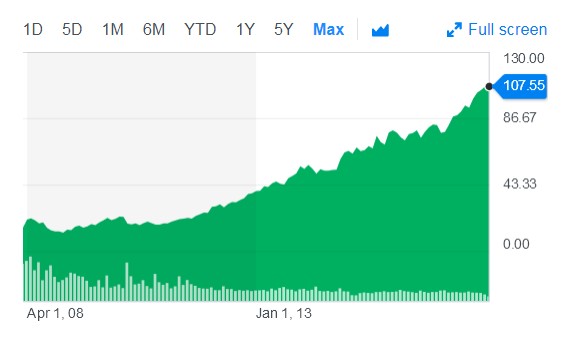
Analysts estimate Visa will report a 9% increase in revenues and a 9% increase in earnings per share for 3Q17. Visa has surpassed estimates in each of the past four quarters, contributing to the stock’s 30% appreciation since this time last year. Visa has seen significant increase in sales over the past few years and we expect this growth to continue as consumers shift from cash to online and credit card payments.
How’s this for a nice looking chart over the past five years? Where would you say it is headed?
-----------------------------------------------------------------------------------------------------------------------------
United Parcel Service (UPS: $120)
Bull Market Report Target Price: $125
Bull Market Report Sell Price: $106
Earnings Date: Thursday, 8:00 AM ET
Consensus: 3Q17
Revenues: $15.6 billion
EPS: $1.45
Year Ago Quarter Results
Revenues: $15.0 billion
EPS: $1.44
Key Things to Watch For in the Quarter
UPS is expected to report a 4% increase in revenues and no change in earnings per share for 3Q17. Despite only having beaten estimates in two of the past four quarters, the stock has still managed to climb 10% since this time last year and is currently trading 16% above its 52-week low. Companies like UPS and FedEx are perfectly positioned to benefit from the growing trend of online shopping. Growth in e-commerce has been accelerating over the past few years, up 16% from 2016 alone, and shows no signs of slowing down. The stock currently yields 2.75% making it a good investment for investors who are seeking both growth and income.
-----------------------------------------------------------------------------------------------------------------------------
Celgene (CELG: $123)
Bull Market Report Target Price: $150
Bull Market Report Sell Price: $125
Earnings Date: Thursday, 9:00 AM ET
Consensus: 3Q17
Revenues: $3.4 billion
EPS: $1.87
Year Ago Quarter Results
Revenues: $3.0 billion
EPS: $1.58
Key Things to Watch For in the Quarter
Celgene is expected to report a 13% increase in sales and a 18% increase in earnings per share for 3Q17. The stock has beaten analyst estimates in each of the past four quarters and was up nearly 50% this year until recent weeks when it announced that it would not continue to phase 3 trials for its Crohn’s disease drug. The stock pulled back 17% on the announcement and opened a window of opportunity for investors who felt the stock was overbought at its previous levels. Celgene continues to invest heavily in R&D and we expect it will continue to produce growing sales with the rest of its pipeline.
The stock is below our Sell Price and we covered Celgene in our report that went out Sunday evening the 22nd. Please review for our thoughts on the stock.
-----------------------------------------------------------------------------------------------------------------------------
Bristol-Meyers Squibb (BMY: $64)
Bull Market Report Target Price: $77
Bull Market Report Sell Price: $51
Earnings Date: Thursday, 10:30 AM ET
Consensus: 3Q17
Revenues: $5.2 billion
EPS: $0.77
Year Ago Quarter Results
Revenues: $5.0 billion
EPS: $0.77
Key Things to Watch For in the Quarter
Analysts estimate that Bristol Meyers will report a slight 4% increase in sales and no change in earnings per share for 3Q17. Bristol has beaten estimates in three of the past four quarters, contributing to the stock’s 30% gain over the past year. The company generates about 30% of its revenues from oncology related drugs, and we expect the stock to continue growing as it gains more market share.
We hereby raise our Sell Price from $51 to $59.
-----------------------------------------------------------------------------------------------------------------------------
Alphabet (GOOG: $978)
Bull Market Report Target Price: $1100
Bull Market Report Sell Price: We would not sell Alphabet
Earnings Date: Thursday, 4:30 PM ET
Consensus: 3Q17
Revenues: $27 billion
EPS: $8.33
Year Ago Quarter Results
Revenues: $22 billion
EPS: $9.06
Key Things to Watch For in the Quarter
Analysts estimate that Alphabet will report a 22% increase in revenues and an 8% decrease in earnings per share for 3Q17. The stock is up 21% over the past, which has been driven by its ability to beat analyst estimates in three of the past four quarters and to grow revenues and earnings. Alphabet’s institutional owners have been increasing their positions in the company over the past six months by 3%, indicating they believe in the long-term success of the business. Alphabet has recently released new products that have put pressure on some of the largest tech companies like Apple and Samsung.
Our Price Target is $1000, but we think somehow that has been an uncorrected error and we believe it was and should be $1100. Thus we hereby make the change. The all-time high is $997 set just last week, and if the stock market remains stable, we expect to see the stock blow through $1000 and move significantly higher by the end of the year.
-----------------------------------------------------------------------------------------------------------------------------
First Solar (FSLR: $49)
Bull Market Report Target Price: $55
Bull Market Report Sell Price: $39
Earnings Date: Thursday, 4:30 PM ET
Consensus: 3Q17
Revenues: $800 million
EPS: $0.85
Year Ago Quarter Results
Revenues: $ 690 million
EPS: $1.22
Key Things to Watch For in the Quarter
While First Solar is expected to increase its revenues by 15%, analysts estimate that earnings per share will decrease by 30% for 3Q17. The stock has beaten earnings estimates in each of the past four quarters. We expect First Solar to continue with its positive performance as the year ends and on into 2018 as well.
This has been a long slog with this firm. We have been patient and have stuck with it and now the stock is moving up to where it belongs. This is a great company management is on the right path and the firm is certainly in the right business.
-----------------------------------------------------------------------------------------------------------------------------
Amazon (AMZN: $972)
Bull Market Report Target Price: $1,100
Bull Market Report Sell Price: $900
Earnings Date: Thursday, 5:30 AM ET
Consensus: 3Q17
Revenues: $42 billion
EPS: $0.52
Year Ago Quarter Results
Revenues: $33 billion
EPS: $0.03
Key Things to Watch For in the Quarter
Amazon is expected to report a 27% increase in sales and a 94% decrease in earnings per share for 3Q17. We expect this large reduction in EPS is from the company’s increased spending on R&D, which should pay off with large revenue increases down the road. Despite having only beaten estimates in two of the past four quarters, the stock is still up 17% since last year. In each of the two quarters it missed, the stock pulled back no more than 5% and provided investors with an entry opportunity. With the firm’s continued domination of e-commerce, we remain bullish on Amazon here at The Bull Market Report.
-----------------------------------------------------------------------------------------------------------------------------
Microsoft (MSFT: $79)
Bull Market Report Target Price: $84
Bull Market Report Sell Price: We would not sell Microsoft
Earnings Date: Thursday, 5:30 PM ET
Consensus: 3Q17
Revenues: $23 billion
EPS: $0.72
Year Ago Quarter Results
Revenues: $22 billion
EPS: $0.72
Key Things to Watch For in the Quarter
Analysts expect that Microsoft will report a 4.5% increase in sales and no change in earnings per share for 3Q17. The stock has climbed 30% over the past year, especially having beaten estimates in each of the past four quarters. Microsoft is another great investment for those seeking both growth and income. The stock has appreciated 180% over the past five years while paying out a 2% dividend. In addition to improving product sales, Microsoft has made a number of upgrades on its Windows operating system, driving growth over the years.
-----------------------------------------------------------------------------------------------------------------------------
Ventas (VTR: $63)
Bull Market Report Target Price: $82
Bull Market Report Sell Price: $61
Earnings Date: Friday, 8:00 AM ET
Consensus: 3Q17
Revenues: $880 million
EPS: $0.45
Year Ago Quarter Results
Revenues: $865 million
EPS: $0.42
Key Things to Watch For in the Quarter
Ventas is expected to report a slight 2% increase in revenues and a 7% increase in earnings per share for 3Q17. Despite having beaten estimates in three of the past four quarters, the stock is down 8% since last year. With most of its properties focused in senior housing and healthcare facilities, Ventas’s long-term growth looks very positive. Ventas owns a highly diversified portfolio of nearly 1,300 seniors housing and healthcare properties in the United States, Canada and the United Kingdom. The underperformance of the stock has given investors the opportunity to enter into this high dividend yielding (5%) growth stock.
October 8, 2017
by Todd Shaver | Oct 8, 2017 | Weekly Newsletter 7pm Sunday
The Weekly Summary
It’s market mania for assets around the world! Financial markets posted fresh records this week, as the upswing in global manufacturing added fresh legs to the relentless rally in equity and credit markets around the world. The most eye-catching: The U.S. stock market’s volatility gauge set an all-time low Thursday while the S&P 500 Index jumped to a fresh high, its sixth consecutive record close -- a feat last repeated back in 1997. Global stocks posted new record highs amid strong economic data. Credit premiums hit fresh post-crisis lows. Let the good times roll.
No matter what is happening out there, there is always a bull market here at The Bull Market Report! This week we highlight some of our favorite stocks where we think you can still make good money, including: Celgene, PayPal, Google, WageWorks, VMware, and Blackrock.
BMR Companies & Commentary
Celgene (CELG: $139, down 5% - all prices herein are for the week)
Celgene entered into a long-term strategic alliance with Nimbus Therapeutics (private) centered on autoimmune disorders.
Nimbus’s preclinical programs target central mediators of inflammation. Nimbus competes in this area against Bristol-Myers and Gilead. But given Nimbus’s demonstrated track record of success and the promising nature of the targets, the consensus view this alliance as particularly encouraging and indicative of Celgene’s dedication to expanding its presence in immunology and inflammation. Awesome!
Celgene will be given an option to acquire each program. Nimbus will receive an upfront payment and potential milestone payments per program that Celgene chooses to acquire. In the interim, Nimbus will retain full control of R&D activities for each program. Financial terms will be disclosed only in the event that Celgene chooses to acquire a program.
BMR Take: We remain bullish on Celgene as total revenues are expected to rise from $13 billion this year to $21 billion by 2020. We expect Celgene’s four blockbuster drugs (Revlimid, Abraxane, Otezla, and Pomalyst) to drive the revenue growth, while the recent acquisitions of Receptos and Delinia as well as investments in collaborators like Acceleron, Epizyme, Agios, and others will ensure growth from 2017 and beyond. We continue to view Celgene as a top large-cap pick in Healthcare.
PayPal (PYPL: $66, up 3%)
Mastercard and PayPal announced a significant expansion of their longstanding partnership into Canada, Europe, Latin America and the Caribbean, and the Middle East and Africa, to make Mastercard the clear payment option within PayPal across the globe. With the addition of these markets – and following the recent expansion of their partnership into the U.S. and Asia Pacific – Mastercard and PayPal have now reached a global agreement.
Similar to previous agreements, the global expansion will create a number of joint growth opportunities that will advance Mastercard and PayPal’s shared vision to offer consumers greater choice and flexibility to manage and move their money.
For example, PayPal will have the opportunity to expand its presence at the point of sale by utilizing services from Mastercard, allowing consumers to use their Mastercard in their PayPal Wallet to make in-store purchases at more than 6.5 million contactless-enabled locations across the globe. Consumers will also have the ability to quickly cash out funds held in their PayPal accounts to a Mastercard debit card.
BMR Take: People everywhere know and trust the familiar Mastercard brand, whether they’re paying in the physical or digital world. The expanded partnership with PayPal affirms the attractive growth outlook for PayPal’s users could go from the current 200 million to upwards of 1 billion, in our view. This should take the stock much higher.
Google (GOOG: $979, up 2%)
Google parent Alphabet’s internet-by-balloon Project Loon tweeted that they hoped to bring emergency connectivity to Puerto Rico after Hurricanes Irma and Maria left more than 90% of the island without cellphone coverage. Just 7 days later, the Federal Communications Commission Friday gave the company a green light to fly 30 balloons over Puerto Rico and the US Virgin Islands for up to 6 months.
If all goes to plan, Alphabet's balloons will soon help replace the thousands of cellphone towers knocked down by hurricane-strength winds. The balloons would provide voice and data service through local carriers to users’ phones.
Alphabet has previously deployed Loon to provide emergency phone service in Peru following flooding there earlier this year. They had already been working closely with a local wireless network, Telefonica, to coordinate spectrum use and prepare handsets to work with its balloons.
Project Loon was born in Alphabet’s moonshot X division, with the aim of serving the half of the world’s population that is still without internet access. It has launched several successful pilot projects, but Loon has yet to be deployed commercially on a wide scale.
BMR Take: This is such a cool innovative initiative to see from one of the US’s leading tech companies. They are truly improving the world. Companies that do that tend to improve the performance of your portfolio. We remain bullish on Google. We see EPS heading to $60 over the next 3-5 years pushing the stock much higher.
We have been reminding you that this stock was cheap in March at $815 and after setting highs in June, got cheap again in July at $900. It has been on one of these slow Google rolls lately, moving up $3-6 a day for weeks now. We sure hope you have some of this great company. And if you don’t it is NOT too late to buy. It is within a whisker of an all-time high at $988 and we can see it breaking four figures and moving much higher from there.
WageWorks (WAGE: $63, up 4%)
WageWorks cares about people and wants to empower everyone - employers, employees, and their families - to lead healthier, happier, and more productive lives. The company simplifies the complex world of Consumer-Directed Benefits. They make benefits programs easier to understand and use so that everyone can take advantage of pre-tax savings and focus on what matters most.
The latest new development is a partnership with none other than Uber! WageWorks and Uber are revolutionizing your commute, giving you more options on how to get to and from work.
WageWorks has entered into a first-in-market partnership with Uber, the world’s leading rideshare company, to offer you the convenience of using a WageWorks Commuter Prepaid MasterCard, WageWorks Visa Prepaid Commuter Card and TransitChek QuickPay Prepaid Visa Card to pay for uberPOOL rides. This new partnership gives the customer the flexibility to use his or her pre-tax funds to pay for uberPOOL rides when they commute.
What does this mean? Customers can now save up to 40% when they rideshare to work via uberPOOL. That’s more money back in their pocket every month. Use of WageWorks commuter benefits with Uber is currently available in the following markets: Atlanta, Boston, Chicago, Denver, Las Vegas, Los Angeles, Miami, New York, Philadelphia, San Diego, San Francisco, Seattle, Washington D.C., and the state of New Jersey. And this will expand dramatically in the coming year.
BMR Take: WageWorks is on track to generate $1.75 of EPS this year. We see a sizeable market opportunity where earnings can double over the next 5 years. WageWorks serves a unique market niche and is an off-the-radar business many people have never heard of, making this name a unique opportunity to outperform the S&P500
VMware (VMW: $112, up 2%)
VMware announced that it is helping Partner Communications (PTNR: $5.20) implement a novel approach to network functions virtualization (NFV) that has resulted in a rapid conversion to NFV and a reduction in cost-per-customer to deliver network services.
What does this mean? First, we will give you the technical jargon. Then, we’ll break it down, as we do best.
Partner Communications, a leading Israeli Telco group, selected Cloudify and VMware to launch its new solution called V-NET. V-NET is delivered through a unique, cloud-based approach to network service orchestration using an incremental approach referred to as "orchestration first."
In layman’s terms, NFV is fundamentally changing the way communications services are provided. The Partner V-NET platform creates intelligent management of communications networks, services and cloud access, enabling IT managers to have direct access to any point or branch of the management interface, while saving significant manpower, time, hardware and money.
BMR Take: VMware has been a solid performer since we started covering the name. We see EPS settling in at around the $5-$6 level. We will continue to scan the opportunities in front of the company for reasons to reassess our EPS outlook higher. This deal above, is just another small reason for the great success of this not-so-small $46 billion market cap company. Remember Dell Technologies owns 83% of VMware. It’s only a matter of time before they make an offer for the 17% it doesn’t own.
We added the stock in January at $83 and currently have a $120 target. We see no reason why this can’t be reached later this year if the stock market stays steady.
BlackRock (BLK: $463, up 4%)
BlackRock is in discussions to invest in financial technology company Capital Preferences to help bolster its focus on retail investors.
Capital Preferences gathers data to help wealth managers understand the risk tolerance and preferences of clients, allowing firms to create portfolios suited to investors’ needs. The talks, which are preliminary, include determining ways of incorporating the company’s software into BlackRock’s existing technology offerings.
The world’s largest asset manager is investing in technology in part to diversify revenue as investor money flows into cheaper passive strategies. BlackRock is also using technology to indirectly expand its reach to retail investors, who are typically charged higher fees than institutions.
BlackRock, which manages $5.7 trillion in assets, has made several strategic investments in startups in recent years with the aim to eventually acquire some. It owns FutureAdvisor and has participated in a funding round for iCapital Network, an online marketplace that offers ultra-wealthy investors and their financial advisers alternative investments.
CEO Larry Fink has recently said that he hopes technology will account for 30% of revenue in the next five years up from 7% currently. BlackRock is counting on its risk management system, known as Aladdin, to help push it toward that goal.
BlackRock's Rob Goldstein, the chief operating officer of BlackRock, thinks there are a lot of misconceptions around one of the biggest trends overtaking Wall Street. BlackRock. One, for instance, is the name.
"We actually believe one of the greatest misnomers is this word “passive” because we don't believe any investment decision is a passive decision."
Passive investing, which means tracking a market-weighted index rather than actively trading single stocks, has steadily eaten away at active-investment management over the past several decades. Index investing has been revolutionary for investors, allowing them to bypass high-fee investment managers, many of which have not performed well. The firms that specialize in index investing and exchange-traded funds, another form of passive investing, have become giants of the industry.
BlackRock is one of them. They pulled in more money into its ETF arm in the first half of this year than all of last year.
And Goldstein added this:
My sales pitch is very simple: BlackRock is a growth company. BlackRock is a growth technology company and we're growing our technology functions. We have a very ambitious plan that we call "Tech 2020." And as part of that, we are looking to extend the 2,000-plus technologists we already have within BlackRock. And we're really excited about the opportunity to take BlackRock, which is already at the forefront of technology in its industry, and keep expanding that.
BMR Take: BlackRock is among the best-positioned companies in investment management, owning the top Exchange Traded Fund franchise (iShares), that is growing rapidly due to “passive” investing, as well as an increasing product portfolio of technology. Recall, there are several top hedge funds on the list of shareholders in BlackRock. With EPS set to approach $30 over the next 3 years, this stock is among our favorites. What a great week the stock had, and we expect much more of the same. Don’t be put off by the high stock price. Think Google at $980 a share!
Upcoming Economic News
JOLTS Job Openings
Wednesday, October 11th,10:00 AM
Period: August
Consensus: 6,170,000
Prior: 6,170,000
PPI ex-Food & Energy
Thursday, October 12th, 8:30 AM
Period: September
Consensus: 2.0%
Prior: 2.0%
Retail Sales ex-Auto
Friday, October 13th, 8:30 AM
Period: September
Consensus: 0.80%
Prior: 0.20%
Update on Shopify
We were able to get our hands on a report from Morgan Stanley recently. Here are some excerpts from it.
Shopify (SHOP: $98, down 16%) Trading at roughly 18 times its forward sales estimate and having never turned a profit, Shopify certainly looks expensive. The company has delivered impressive sales growth so far, but even then, investors are paying a premium for the promise of its business. That tends to be a risky proposition, but sometimes it's one worth pursuing. With that in mind, we think Shopify's momentum and expansion potential actually make the stock cheap, even as it currently trades at all-time highs.
For those unfamiliar with the company, Shopify provides e-commerce platforms as a service -- allowing sellers to quickly launch and conveniently maintain online sales portals. It mostly caters to small- and medium-sized businesses. However, it also counts some larger brands, including Budweiser and Red Bull, among its customers. All told, the company provides service to over 500,000 merchants worldwide -- up from 165,000 roughly two years ago. That's an impressive reach for a young company, but it still leaves lots of room for expansion.
Last quarter saw revenues climb 75% year over year, and the company is doing a good job of growing sales relative to expenses even as it prioritizes expansion over near-term earnings. With Shopify's current customers more or less locked in, reducing its advertising and marketing expenses could quickly shift the company to profitability.
While Shopify is not cheap by the established guidelines of value investing, ownership involves a greater degree of speculation than some investors will be comfortable with. However, Shopify's current price could look like an absolute steal five years from now.
BMR Take: This report was written before this ridiculous Andrew Left started shorting the stock and making a fool of himself on Bloomberg TV and elsewhere. We believe he is wrong and we believe the market will prove him wrong. He is “winning” at the moment as the stock dropped $13 on Wednesday when he went public with his diatribe, $3 on Thursday and $3 on Friday. It had hit $93 on Thursday, so it came back sharply. But he will lose in the end. Remember, he has to BUY BACK his short position at some time, pushing the stock up when he does.
We have to say that the stock was quite strong in the weeks leading up to this Wednesday. This maniac had been shorting the stock in a big way, putting downward pressure on the stock, and yet the stock was moving higher and higher since the middle of August when it was at the $95 level. That tells us there is buying power out there, and as soon as this blows over we expect the stock to start moving back up again. We could easily just bow out of the stock, since we added it in the spring at $73 and thus have a nice gain. But we are going to stay with it because we believe in the company, plus their revenue growth is huge – on the order of 75% last quarter. And you know what we are going to say here: Revenues always win out in the end.
Here is some more from Morgan Stanley:
With Shopify declining 16% this week following circulation of a short report, investors have been digging into details on the company's model. We continue to believe that Shopify has a strong core business model and highlight several of the more frequent questions asked, along with responses:
--- How does Shopify's model compare to a pyramid marketing model?
Answer: Shopify has a success-based model where its revenue is reliant on the success of its merchants. Unlike some pyramid models, there is typically little upfront investment required by merchants on the Shopify platform with no annual commitment required. If a merchant is not successful on SHOP's platform, it can exit the platform with little cost of failure. Historically, we believe churn has been high but Shopify's growth has been supported by the growth of its successful merchants which have outweighed the cost of those that have failed on its platform.
--- How does the company's affiliate marketing platform work?
Answer: Shopify has over 13,000 ad agencies, consultants, and partners that support its marketing efforts with over 500,000 merchants now on its platform. When a partner refers business into Shopify, they can be eligible to receive a bounty. Where bounties are paid, Shopify may continue paying fees associated with referred merchants while they remain on the platform. Affiliate marketing models are not uncommon among small to medium sized web services vendors.
--- How much revenue does Shopify generate from its business exchange?
Answer: Shopify rolled out a myriad of new products and services for its merchants this year. The company's exchange was rolled out this summer and, like other services, is in its early stages and its size is not yet disclosed. We do not believe the company has generated a meaningful amount of revenue from this platform yet. Last quarter, 47% of the company's revenue was generated from Subscription Solutions (subscriptions, themes and apps).
The remainder of the company's revenue (53% of total) can be attributed to its Merchant Solutions business which is primarily payments driven and benefited from approximately $5.8 billion sold over the platform.
--- How much do bloggers contribute to the company's customer acquisition?
Answer: Shopify does not disclose this number. However, the company has stated that most of its merchants are introduced to the platform organically. Paid advertising is the second most meaningful source of new merchants followed by partners, of which bloggers are a subset.
--- To what extent do non-Plus merchants contribute to revenue growth?
Answer: We do not have a breakout of total revenue by merchant category but for Subscription Solutions, management stated that Shopify Plus merchants accounted for over 18% of total monthly recurring revenue last quarter compared to 13% for 2Q16, implying approximately 127% growth for Shopify Plus and 55% for non-Plus business. On the Merchant Solutions side, the company has disclosed that Advanced and Shopify Plus merchants are responsible for over 50% of volume processed over its platform.
Update on Tesla’s Delivery “Problems”
Excerpted from a BusinessInsider article
Tesla has over-promised and under-delivered ever since the company was founded. But investors continue to believe in the genius who runs the company.
Tesla does not benefit from being normal. The company is organized around being special, different, extraordinary. You don't change the world by restraining yourself. And Wall Street doesn't care. Over the past two years, Tesla's stock is up over 1,200% since the company's 2010 IPO.
Tesla's third-quarter delivery numbers were both impressive and depressing. The carmaker is on pace to sell 100,000 vehicles this year for the first time in its 14-year history. But it's also far, far behind with the production of its new Model 3 sedan, the vehicle that's supposed to bring Tesla to the masses and spell the beginning of the end for gas-powered cars.
Getting to 20,000 in monthly production by December now seems like a hopeless expectation, as does CEO Elon Musk's prediction that Tesla will be manufacturing 500,000 vehicles annually by the end of 2018. But the markets are unconcerned. Tesla stock is still up 65% in 2017 and the brand has lost none of its captivating aura.
But it's also obvious that for a car maker that's been around as long as Tesla, they aren’t good at building vehicles.
So why is Tesla struggling to build the Model 3 on its own admittedly ambitious schedule?
1. The Model 3 is all-new production.
Tesla is reasonably good at manufacturing its expensive, luxurious Model S sedans and Model X SUV. Production of these vehicles was designed around a run-rate of about 100,000 per year, and Tesla will hit that mark most likely in 2018.
Of course, the Model X endured "production hell," as Musk memorably put it, during its roll-out in 2016. The Model S also endured early production issues that were later corrected. And Musk declared that production hell would be back for the Model 3.
Musk talks about Model 3 production in terms of an "S curve," with a very slow ramp rapidly speeding up before leveling off at a desired point. But Tesla also has a second S curve, related to learning. It doesn't know, exactly, how to build the Model 3. Established automakers build cheaper cars in volume all the time; Tesla never has.
2. Tesla enjoys endless patience from everybody.
Tesla's brand equity is probably its most valuable asset. And Tesla knows it. Yes, we aren't going to make our goals — but we also aren't going to lose focus on the big picture, which isn't to sell more cars, but rather to save the planet.
3. Tesla isn't actually mass-producing the Model 3 yet.
Even if Tesla had hit its goal of 1,500 Model 3s in September, it would still be a long way from the levels of production needed to meet demand. The low numbers, which the company chalked up to production "bottlenecks," suggest that the ramp to just pre-mass-production is taking longer than expected.
If Tesla hadn't fallen so short of its own run-rate for September, we could assume some bobbles, but unfortunately, it looks more like the decision to forego the process of testing out the Model 3 assembly line before trying to accelerate the production ramp isn't working out.
4. The Model 3 looks simpler then the Model S and Model X — but is it?
The Model X is complicated. The Model 3 is supposed to be simple. Tesla designed the Model 3 to be easier to build than the Model S and Model X, but compared with electric cars that have now been in production for a while - the Chevy Bolt and the Nissan Leaf, for example - there's a lot of "clean slate" to the newest Tesla.
To build an EV that they can get to market quickly, build easily, and price below $40,000, other manufacturers are just adapting existing gas-car platform to the task. The Bolt doesn't feel all that futuristic inside, and the Leaf has a fairly conventional interior. Neither car is dramatic to look at on the outside.
Tesla has eliminated as much dashboard instrumentation as possible with the Model 3, going for a very clean, minimalist vibe that stars a single, horizontal touchscreen. Although that might sound like it makes everything easier, it doesn't necessarily because it's a major departure from how cars are currently put together.
Ultimately, Tesla's plan to simplify will pay off, but in the short term, negotiating the learning curve could slow them down.
BMR Take: As we’ve said many times, this company is speculative. But it sure is fun being on the ride with them.
A Word from Gary Jefferson
Jefferson Financial Group
First Vice-President, Investments
UBS Financial Services
Some good news – bad news. According to Stock Trader's Almanac (STA), October is the last month of the “Worst Six Months” for DJIA and S&P 500 and the last month of Nasdaq’s “Worst Four Months”. The bad news is that in post-election years, the DJIA has been up 11 times in 17 years with an average gain of 0.7%, but in the last three years ending in “7,” October has been trouble. In 2007, the bull ended and the financial crisis began, in 1997 the Dow plunged 12% and in 1987 the market crashed on "Black Monday", a day we will never forget. [We don’t buy these types of things at The Bull Market Report.]
The good news is that, looking back through history, a big upside move of over a 5% gain on the S&P 500 during the Worst Six Months (or the “Sell in May” period) from May through October has usually been followed by great gains in the overall market. Thus far, that 5% gain has happened. There is just one month left in the Worst Six Months. So if the market can pick up further gains in October and not succumb to the historical and often self-fulfilling prophecy of "Octoberphobia" – and particularly the curse of the 7th year - that would be, according to STA, a solid indication for stronger gains over the next Best Six Months (November to April) and 2018.
We understand the argument that this bull market is way long in the tooth. However, there is another maxim of Wall Street that says, "Bull markets don't die of old age; they die because of recessions or policy mistakes". We see nothing on the horizon indicating we are headed for a recession. The Fed could overplay its hand by hiking interest rates too high and too fast. However, we think if the Fed errs it will be on the side of "too little" rather than "too much" because, so far, it has been very conservative in its approach to normalizing both its balance sheet and interest rates. We do think it will be a "policy mistake" for Congress not to pass meaningful tax reform – the market is 100% counting on this happening and if it doesn't, good earnings might keep the market afloat, but probably won't be enough of a catalyst to produce meaningful gains until some of the PE multiple expansions are digested. Bottom line: Tax cuts are now the most credible and legitimate “bullish” or “bearish” wildcard remaining for the markets in 2017.
From a bullish standpoint, real tax cuts could easily push the S&P 500 up another 4% or 5% because that will increase expected 2018 EPS to a conservative $145/share.
From a bearish standpoint, while tax cuts aren’t quite yet "fully" priced into stocks, there is the expectation they will get done, especially regarding foreign profit repatriation. If tax cuts, like healthcare, fail, then we’re now sitting with a market at 18X next year’s earnings and no identifiable future growth catalyst (and a Fed raising rates). We believe that will cause investors to reduce exposure and, if we had to make a guess based on these fundamentals, we would expect a potential pullback in the 5-10% range should Congress fail to enact promised tax reforms, compared to anticipated 5-10% gains over the next Best Six Months if reforms are passed.
An Update on Teva Pharmaceuticals
The FDA approves Mylan's generic Copaxone, Teva shares lower
Shares of Mylan (MYL; $38, up 23%) are 18% higher while shares of Teva Pharmaceuticals (TEVA: $15.94, down 9%) drop sharply following the FDA's approval of Mylan's generic Copaxone: Glatiramer Acetate Injection. Teva management followed up the announcement with a press release estimating the impact of the two launches to its Q4 earnings of at least $0.25/share and while they have planned for the introduction of eventual generic competition and remain confident in Copaxone, but that it is too soon to officially comment on any change to their full year business outlook.
Most analysts see it as a clear negative for Teva as the generic approval comes earlier than expected with most firms anticipating a 1Q18 arrival. That said, this is a long anticipated event and firms estimated the impact to shares should be closer to the 5% range with some preferring to see the news as removing an overhang on shares that could clear the deck for management.
For Mylan, analysts call it a significant win/positive, given the process was a long drawn out 7-year pursuit and Mylan landed the first approval with potential exclusivity.
The firms suggest that any generic entry may take some time and/or over a protracted period, which could make the opportunity for Mylan quite long-tailed with high margins and thus quite negative for Teva.
This is the day that TEVA investors have dreaded for many years. We believe the bulk of the downside from the loss of Copaxone sales is already priced into TEVA shares.
This news comes earlier than Teva expected and some investors had thought possible. Given the potential $0.25 impact per quarter and applying this to full year 2018, it is possible Teva's new 2018 guidance could fall well below $3.00.
BMR Take: We’ve had it. We have put up with a lot of negatives with this company. What’s next? What will they disappoint us with next?
We’re out. We added the stock in May at $29 and it has gone straight down. Bad choice on our part. We are truly sorry.
If you want to stay in and wait, you can. These suggestions of ours are just that. It is always up to you depending on your own goals. More than likely the stock will stay at this level for months and if things go well, will slowly inch back up. We say this is likely, but if things get worse, we could see $13 at this time next year.
The High Yield Corner
By Michael Foster
For a long time, the market simply didn’t believe the Federal Reserve would hike rates three times in 2017. The probability of a rate hike in December, as calculated by Treasury futures markets, was far below 30% for a long time. Then in September Janet Yellen made it very clear that a rate hike was coming. Even through the fog of “Fed speak,” the Fed’s intentions are incredibly clear, and futures markets responded accordingly. As of this time of writing, the futures market is implying an 89% probability of rates going up.
We’ve been here before. In 2015, the market reacted swiftly to Yellen’s public statements, and we saw a lot of carnage in the high yield world as a result. If you were in the market back then, you remember seeing just about anything with a big yield, from BDCs to municipal bonds and everything in between, falling hard at the end of the year. Several analysts (myself included) rightly called this a buying opportunity of a lifetime. Since the start of 2016 to now, many high yield investments, including those recommended by The Bull Market Report, rose by double digits not including dividends. That’s big.
Yet with this reversal in market expectations, the high yield market has remained mostly unfazed. Traders and investors have learned their lesson: A sudden collapse in yield just means a buying opportunity, because the income stream from these investments remains largely sound and trustworthy. This is why the recent Fed announcements haven’t caused as much of a buying opportunity as they did two years ago.
There are, however, exceptions. Unsurprisingly, those exceptions tend to be very popular with retail investors who are somewhat risk averse and tend to sell off too aggressively in times of caution. This is why we’re seeing a pretty big hit among some high yielding REITs, although there’s been virtually no news to suggest there’s any problem with any of these companies.
Among Bull Market Report picks, Welltower (HCN: $68, down 3%) was hit the hardest last week. While there hasn’t been any news that has any material impact on the REIT, Welltower shares continued a protracted slide that began in mid-September and has been aggravated by the Fed’s comments. Nothing has changed in the company’s business operations, and its FFO still exceeds payouts by a healthy margin (although, it must be admitted, not the healthiest). Now shares are yielding 5%, the highest yield since March of this year. And just like March was a great buying opportunity, so is right now, although we may see yields climb up to 5.5% before the stock bottoms, as we saw happen in November 2016 when, you guessed it, investors sold off in a panic over rising interest rates.
Considering the stock is similar to Welltower in many ways, it is not surprising to see Ventas (VTR: $63, down 3%) react similarly. At a 4.6% yield, Ventas’s recent slide also brings it to its lowest point since March, although there’s no news to indicate the firm is facing any new hardships. In fact, one of the exciting things about Ventas is that it’s been diversifying aggressively into the medical office space, where capitalization rates can often grow faster than with skilled nursing facilities. Additionally, medical offices are less exposed to the whims of regulators and Medicare funding. The market isn’t rewarding this shift - at least not yet. Instead, traders are focusing on interest rate issues. Considering Ventas’s size gives it a relatively low borrowing cost, its 0.56 debt-to-asset ratio is conservative in the REIT sector. It’s clear that the selling pressure on this stock is unjustifiable. That doesn’t mean it won’t go lower in the coming weeks, but it does mean the stock is quite likely to go higher after the rate hike and the market realizes this actually didn’t hurt their balance sheet.
Elsewhere in the REIT space, we saw a lot of dull action. Digital Realty Trust (DLR: $118) and Apollo Commercial Real Estate Finance (ARI: $18.20) ended the week flat, despite both REITs’ relative price outperformance throughout 2017. Similarly, we saw Nuveen AMT-Free Municipal Credit Fund (NVG: $15.43) and Invesco Municipal Trust (VKQ: $12.72) stay flat for the week. While comparing muni funds to REITs is very much apples to oranges, in this case the comparison is illuminating. Here we’re seeing a trend that encompasses much of the high yield universe - the market is largely shrugging off Yellen’s rate hike talk. In part that’s because municipal bonds, especially after the recent hurricanes, and these REITs in particular (thanks to their cloud computing and complex financial structure, respectively) are less popular with retail investors right now and more popular with institutional investors, who tend to react less aggressively to upcoming rate hikes.
What, then, should high yield investors do? Right now, there’s no reason to sell anything in The Bull Market Report portfolio. What’s more, the more aggressively sold-off REITs are becoming increasingly attractive. What we are seeing is a buying opportunity more than a cause for concern. Sadly, it’s not as good of an opportunity as late 2015, but we should be grateful for whatever we can get in this incessant bull market.
Good Investing,
Todd Shaver
CEO, Founder and Editor
The Bull Market Report
Since 1998
September 17, 2017
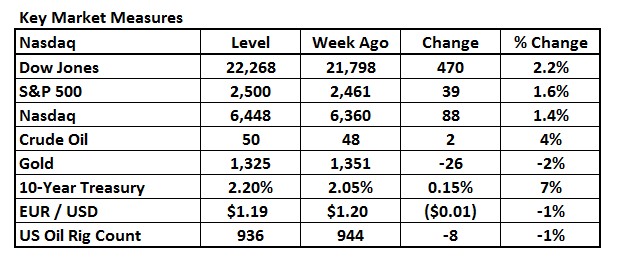
by Todd Shaver | Sep 17, 2017 | Weekly Newsletter 7pm Sunday
The Weekly Summary
Equity markets ended the week up, again! New all-time highs were set Friday (again) with all three indices. The threat of conflict with North Korea can’t stop the bull market. Gridlock in DC isn’t shaking confidence. The unemployment rate is low. GDP growth is fair though under pressure from severe weather. It’s really a “Goldilocks” economy and a market backdrop of not too hot and not too cold. The biggest threat might simply be the Fed’s Janet Yellen who must unwind a $4.5 trillion balance sheet. The September Fed meeting is upon us and nobody is expecting a rate hike because of the pressures on GDP growth from weather. Though pay attention to plans for the Fed balance sheet as these moves could be worth as much as three rate hikes depending on the pace of unwinding. We are as eager as you to see what happens.
No matter what is happening out there, there is always a bull market here at The Bull Market Report! This week we highlight some of our favorite stocks where we think you can still make good money, including: First Solar, Apple, Twilio, Bristol-Myers, Amazon, Google, and Square.
BMR Companies & Commentary
First Solar (FSLR: $51, up 8%)
First Solar caught a lot of press this week as Deutsche Bank upgraded the stock to a Buy and said the stock is heading to the mid-60s.
What is there not to like? First, US demand is so strong it is driving pricing higher. Beyond the typical demand there is something else happening. Customers are flocking to make purchases ahead of the ruling on the section 201 tariff.
What is this? There is a high likelihood of the International Trade Commission finding injury in the section 201 case. This case basically makes a determination on the safety of the product. A favorable decision is expected to result in 2018 margins between 20 and 30%, against a 2017 rate of 17.5%. This regulatory relief for First Solar is welcomed!
Lastly, monetization of the phase 1 California Flats Solar Project coupled with the anticipated sale of the company’s stake in 8Point3 Energy Partners (CAFD: $14.49) could result in upward revisions to EPS estimate.
BMR Take: Putting it all together, First Solar is in the right spot at the right time. We recognized it early. Now we see a big Wall Street investment bank get behind the name. Yea! With EPS running around $2.50, the stock is not expensive here considering the quality and future of the franchise.
Apple (AAPL: $160, up 1%)
Apple unveiled its latest slate of new products on Tuesday including a new $1,000 iPhone that is sure to bring out aficionados of the company's devices when they arrive in local stores later this month and again in early November.
In a live-streaming event, Apple introduced a new version of its Apple Watch and Apple TV set-top box, plus two new phones, the iPhone 8 ($700) and a larger iPhone 8 Plus ($800) version. But the highlight was the iPhone X (pronounced “10”), a thin, sleek phone that has 3D face-recognition technology, a state-of-the-art camera, and a $1000 price tag -- double the price of the first iPhone that Apple introduced 10 years ago.
The other products will be available for pre-order starting Friday and should hit stores a week later.
The $1,000 price tag is causing all sorts of buzz. Will consumers pay that much? Well, most think so because you just make monthly payments through a plan and not a lump sum. Is there new technology that is exciting? Yes, from face recognition for security to the largest screen yet. All in all, the timing of the launch could push sales from 4Q to 1Q, but we expect Apple to sell a lot of phones.
BMR Take: Apple is going to do over $250 billion of sales this year. This is a staggering amount of money pouring into the company’s bank accounts from consumers who love Apple. Remember, as long as Apple continues to be a fan-favorite for customers, we think there is a huge opportunity for the company to do more and more services on top of selling hardware. The future is bright!
Remember, 65% of Apple is now the iPhone. And every new user is going right to the App Store to buy apps, increasing the Services business incrementally. Recurring income, baby. That’s what it’s all about.
We have a few notes we made from a research report from UBS Securities.
Apple Price Target - $180 (We are at $170) with a $195 potential upside.
iPhone growth in F18/19 – UBS expects double-digit unit growth in F18 and single-digit growth in F19 driven by a growing installed base and high retention rate. They expect a bulge of F15 iPhone 6 owners to upgrade in F18, creating a strong year if not a "supercycle." Supply and pricing could affect the degree of growth.
“Apple innovation to drive long-term revenue growth?
“Augmented reality (AR) is an area where Apple could leapfrog competition in offering a superior user experience. Features will take time to be released as the technology must reach a level of maturity suitable for Apple's brand. Other products like the Watch and AirPods are slowly
becoming material to the business and represent another way to monetize a loyal base of customers.
“The installed base continues to grow double digits and retention rates remain high. The retention rate for Apple above 80%, at a seven point premium to the Android retention rate. There is pent-up demand for the iPhone 8, with over a third of the base consisting of handsets older than two years old, the highest ever.
“Around the world Apple is gaining share everywhere except China. China remains a wildcard. Encouragingly, shipments to Mainland China stabilized in June. Our survey indicates interest in the next iPhone is similar to last year.
“At a P/E of 15x, Apple is trading at near an all-time high valuation. This suggests the market is pricing in a strong product cycle in F18 with double-digit EPS growth. It's also possible investors are gradually re-rating the multiple to recognize the strength and stability of the brand.”
Twilio (TWLO: $31, up 4%)
Twilio is one of the most exciting growth stories out there. And the CEO’s recent Bloomberg TV interview re-ignited our conviction in the story.
As you have been following the growth of Twilio lately, you’ll know it’s an exciting addition to the communications space. Twilio is a developer platform that powers communications for more than 40,000 global companies, including Netflix, Airbnb, and Lyft.
Twilio has emerged as a simple way for companies and software teams to begin adding communications capabilities to their applications in the form of text, video, and voice, providing companies with the flexibility that they need to implement more engaging customer experiences into their daily operations.
Twilio was built around the growing desire to provide a better customer experience for end-users and companies alike. Across numerous industries, enterprises have begun to recognize that the only way to truly differentiate their businesses from other competitors in the marketplace, is to give their customers an experience that is seamless, integrated, and engaging. Unfortunately, it’s difficult to achieve that level of service when your communication technology is not all run from one central place.
BMR Take: Sometimes the daily news is just noise. You have to step back and do a simple fundamental analysis. What does this company do? Why is the value proposition a winner? What is the big picture story? Twilio has this nailed in spades and the CEO provided a great reminder of that to the equity markets this week talking on Bloomberg.
Look at revenues for the past three years. $89 million in 2014. $167 million in 2015. $277 million in 2016. (Note: they’ve already done $180 million in the first six months of 2017.) With revenue growing greater than 30% and nearing $500 million, the momentum is there and we are still early. Repeat, we are still VERY EARLY on this company. Where is this company’s growth going to stop? (Hint: it isn’t.) Take a hard look at owning this company.
Bristol-Myers Squibb (BMY: $62, flat)
At Bristol-Myers, patients are at the center of the universe. The company’s vision for the future of cancer care is focused on researching and developing transformational Immuno-Oncology (I-O) medicines for hard-to-treat cancers that could improve outcomes for these patients. The I-O opportunity is a breakthrough for cancer, and Bristol is a key player.
Bristol is in fact leading the scientific understanding of I-O through its extensive portfolio of investigational compounds and approved agents. The company’s differentiated clinical development program is studying broad patient populations across more than 50 types of cancers with 14 clinical-stage molecules designed to target different immune system pathways. Bristol continues to pioneer research that will help facilitate a deeper understanding of the role of immune biomarkers and how patients’ tumor biology can be used as a guide for treatment decisions throughout their journey.
This week Bristol announced some good data on I-O drugs. This reaffirmed the market’s confidence is Bristol’s ability to execute on the important I-O market opportunity.
BMR Take: Bristol is a top franchise is the Drug industry. The stock has been badly beaten down for about a year but now is coming back, as top franchises always do. With nearly $4 of EPS potential, this drugmaker is a screaming deal in our view.
Amazon (AMZN: $987, up 2%)
The future is here and guess what? Amazon created it! Alexa, Amazon's voice-activated digital assistant for the home, has learned a new skill -- dispensing medical information about first aid from one of the best-known names in medicine, Minnesota's Mayo Clinic.
The information is accessible by speaking to the Amazon device, which users appreciate if they're busy doing something with their hands, like putting aloe on a burn or examining someone who has stopped breathing.
The device advises in its robotic-female voice to begin cardiopulmonary resuscitation for one minute and then call 911 if the person is unresponsive from suffocation. If the user asks for it, the device will go on to discuss specific techniques for doing CPR on an adult, child, or baby.
BMR Take: Amazon is the innovation machine and to see Echo break through into the medical field is a just another key data point about the possibilities of the future. With over $20 of future EPS power or more, Amazon is unlike any stock ever in the history of the world. We are strong believers in the future of Amazon.
Google (GOOG: $920, down 1%)
There is talk that Google is considering making a $1 billion investment in Lyft to take on Uber. This could be exciting!
Google and Lyft can really help each other. With the possibility of autonomous driving being central to its future, Lyft badly needs a solution. Google is considering putting up to $1 billion into Lyft in a move that would see it become one of Lyft’s biggest shareholders at a crucial time.
Lyft is far smaller than Uber and when it comes to market places that can be fatal. For money to be made, generally, one player needs to have 60% share or be twice the size of its nearest competitor. In the US, Uber has already achieved this hallowed status and in theory should be able to crush Lyft simply by applying sustained competitive pressure until Lyft runs out of money.
Google could be the solution for Lyft to emerge as a fierce Uber competitor.
BMR Take: Google is a tech giant, a robust franchise, and reasonably priced versus EPS of $40. The all-time high is $988, set in early June, so it is off 7% from that high. With driverless cars a key part of the future economy, and Google paving the way, we are excited about what a Lyft investment could mean and think the general market will be too if the deal is announced. UBS Securities has a $1,080 Price Target with a $1,410 upside. We have $1000 as our Target, but will raise it when it hits.
Square (SQ: $28.50, up 7%)
Square is at all-time highs. Last week we talked about Square getting into banking. That was all the buzz. This week Jack Dorsey, CEO, is talking a hard look at blockchain technology and what it could mean for Square. This company is on the leading edge of innovation all the time.
You’ve been hearing or reading a lot about blockchain but you probably still aren’t entirely certain how to define it. You’re not alone. It’s something that Jack Dorsey, the CEO of Square (and CEO of Twitter), describes as the “next big unlock”.
Blockchain is often defined as a ledger that enables secure, encrypted transactions. Some financial and technical experts have described it as analogous to the early days of the internet: it’s a framework or backbone for transactions.
But Dorsey also went beyond that interpretation of it, adding that the ability to “distribute and decentralize the ledger enables proof of work, and proof of one entity, in an untrusted network.” “Even if there’s a hostile entity or a mistrust in the network,” Dorsey continued, “we can still account for value creation and the transfer of values as well.”
BMR Take: If Square can get blockchain right, the company could take on the likes of Visa and/or MasterCard to change the world of payments how we know it. How exciting. This is sending the stock to new all-time highs and we are only at the beginning stages of Square’s life as a publicly traded company. Note that JP Morgan and Bank of America as well as Goldman Sachs are experimenting with blockchain. With a market cap of just $11 billion we see very big times ahead for this innovative company. And they could be bought out for $15-18 billion in a whisker by one of the big boys.
Upcoming Economic News
Housing Starts
Tuesday, September 19th, 8:30 AM ET
Period: August
Consensus: 1,175,000
Prior: 1,155,000
Fed Funds Target Upper Bound
Wednesday, September 20th, 2:00 PM
Consensus: 1.3%
Prior: 1.3%
Leading Indicators
Thursday, September 21st, 10:00 AM
Period: August
Consensus: 0.20%
Prior: 0.30%
BlackRock Consensus Ratings on the Street
(BLK: $429, up 3%)
4 Hold Ratings, 8 Buy Ratings
Consensus Price Target: $448
9/08/2017 Barclays $475
8/18/2017 Jefferies Group $440
7/18/2017 Morgan Stanley $476.
7/18/2017 Deutsche Bank $455
7/14/2017 Keefe, Bruyette & Woods $440
6/19/2017 Bank of America Corporation $450
BMR Take: Market cap is $69 billion. Huge. They manage over $5.7 trillion of assets. HUGE. All-time high is $443 set in July. We think this is easily breakable. The Street likes this stock. We like this stock.
Cloudera Consensus Ratings on the Street
(CLDR: $18.38, down 12%)
4 Hold Ratings, 4 Buy Ratings
Consensus Price Target: $23
9/8/2017 J P Morgan Chase $24
9/8/2017 Morgan Stanley $19
9/8/2017 Stifel Nicolaus $24
5/24/2017 Bank of America $23
5/23/2017 Raymond James $23
5/23/2017 Deutsche Bank $25
BMR Take: Bad week for Cloudera. The stock got hammered. They announced a follow-on offering of shares from the IPO they did in April. This is normal stuff – some shares will be sold by insiders and some by the company. No details yet. We are not concerned, although it would be nice to see the stock at $25 where it ought to be. Remember, this is a tiny company. Market cap is $2.4 billion – a puppy. Very speculative. But we are believers.
Andeavor (ANDV: $102, up 1%)
We have a note we made from a research report from UBS Securities.
“The recent Western Refining merger is expected to generate $350-
$425 million in synergies.”
Their Price Target is $116, with an upside to $125. Ours is $110, but if it hits that we would consider raising it.
Cryptocurrencies Update
Bitcoin had a wild week, closing at around $3500 on Friday. Bitcoin doesn’t really “close” as it trades 24-7. Bitcoin began a colossal price reversal on Tuesday that finally culminated with the latest $2,972 weekly low, which ended up becoming the new monthly low as well. The massive 32% reduction, was followed by a flurry of negative news coverage with China shutting down the biggest bitcoin exchange in the country and Jamie Dimon of JP Morgan saying that this is the biggest bubble since tulip bulbs in 1637. He said that the cryptocurrency "won't end well." Dimon was speak at a conference presented by CNBC and Institutional Investor.
Bitcoin hit $4,980 all-time high on September 1st. It plunged about 13% Thursday after one of the biggest exchanges in China said it will shut down its operation. Bitcoin surged more than 10% on Friday, but was still on track for a big weekly loss during a tumultuous period of trading.
JPMorgan's global head of quantitative and derivatives strategy, said in a note on Wednesday that in addition to being volatile and difficult to value, "another worrying aspect of cryptocurrencies are some parallels to fraudulent pyramid schemes."
But to be sure, many see bitcoin as a huge opportunity.
Former JPMorgan strategist Tom Lee said the cryptocurrency could surge another 600% in five years. "It's not worth it to look at bitcoin two months, two weeks ahead," Lee argued, saying he still believes each bitcoin will be worth $25,000 in five years.
We at The Bull Market Report find this whole story fascinating and have been following bitcoin and Ethereum closely. If you would like to know more about it, please write us here: Info@BullMarket.com.
Opko Health Update
Opko (OPK: $5.97) had a wild week. It rallied the first three days of the week, closing at $6.47 on Wednesday. Then it got hammered on Thursday and was flat on Friday. We have seen no news to account for this, but please note that this one is quite speculative. Opko has had to deal with disappointment on multiple fronts, including less-than-encouraging results in clinical studies and slow starts for approved drugs. Yet even though several institutional investors have thrown in the towel and given up on the company, Opko has strong potential for sales of its chronic kidney disease treatment Rayaldee to pick up. Moreover, Opko's diagnostic testing business has good prospects as well. Although the company hasn't executed well yet, some are optimistic. We have high hopes for the company but it is testing our patience.
The High Yield Investor
By Michael Foster
After a lot of good weeks, we’ve had a week that was - well, slow.
Almost everything in the Bull Market Report high yield portfolio ended the week flat, as investors focused on the big headlines (North Korea, Irma, etc.), which actually had minimal impact on any high yield investment.
This might be surprising, so let’s talk a little bit about why the big macro events aren’t moving the needle. You’d be right to wonder why municipal bonds, especially bonds in Texas, Florida, and nearby weren’t negatively affected by the hurricanes that have caused still undetermined billions of dollars of damage and human misery. In light of that tremendous destruction, municipal bonds barely budged. Even bonds issued in the hardest hit areas were unaffected. To take one example, Miami’s transit authority issues bonds are backed by the revenue received from toll roads, parking lots, and so on. Surely less travel to the city and less use of parking lots by tourists due to the storm will hit revenue and thus put these bonds at risk - yet their prices barely budged.
The reality is that municipal bond issues use a combination of insurance and risk management to plan for major catastrophes, especially in catastrophe-prone areas like southern Florida. The storms were severe, but Florida financiers and civil servants plan for these things as part of their regular work. So while the timing of the storms was a bit of a surprise, the reality of hurricanes hitting Florida every once in a while is priced into the municipal bond market.
Thus muni funds continue to have a strong year after last week’s relatively small price movements. Nuveen AMT-Free Municipal Credit Fund (NVG: $15.70, down -1%) took a very slight hit, but that was counterbalanced by the small rise in Invesco Municipal Trust (VKQ: $12.96, up 1%). The most important lesson to learn, by far, is that big catastrophic events don’t really hurt muni bonds - at least, not in the way that the mainstream financial press would like you to believe (since, after all, they’re desperate for controversy and know fear-mongering headlines get clicks and pageviews).
Moving on to taxable income funds, we saw more quietness among AllianzGI Equity & Convertible Fund (NIE: $20, up 1%) and PIMCO Dynamic Income Fund (PDI: $30, up 0%). There are a couple of things to note about both of these funds with regards to their pricing. The income stream for both remains somewhat reliable, although the Pimco fund’s net investment income has dropped significantly in 2017 (this, however, is being counterbalanced by an increase in NAV growth). What investors should focus more of their time on is the pricing. The Pimco fund is now priced at a 4.8% premium to NAV, which is significantly lower than the 10% premium that it reached earlier this year. A big drop-off in the premium this summer has caused that pricing to go closer to its historical norm, and a small premium to NAV is a lot more tolerable than 10%. For that reason, investors who like the Pimco fund and have been waiting to buy more are finally in a position where they can seriously consider adding to their positions. However, if you can wait for a discount to show up, you might be wise to wait for a bigger market sell-off to provide that opportunity.
As for the AllianzGI fund - its discount to NAV has been steadily disappearing throughout 2017, and we’re now at slightly less than a 9% discount, which is a relatively high price for the fund relative to its historical average. That means investors should be a tad more cautious about adding to their position right now, but the fund is far from a sell. We’ll need to see discounts of 5% before offloading this fund makes any sense at all. In reality, the fund’s continued NAV appreciation (NAV is up 6% even after paying its 7.5% dividend consistently over the last year, giving a total NAV return of over 13%) demonstrates that the fund’s management knows what they’re doing and are able to provide a stable, reliable income by picking the right stocks and convertible bonds and handing profits to shareholders. At the end of the day, we can’t really ask more from a fund.
So with all of the humdrum, low level action of the last week, let’s discuss the two stocks that actually had pretty big moves. The first is Digital Realty Trust, Inc. (DLR: $118, down -3%), which closed its DuPont merger and proceeded to fall significantly thereafter. We’re pretty much off the 52-week high hit on Monday, so it’s hard to say whether the decline is a result of profit taking or a lack of faith in the value of the merger. We see no reason to be skeptical of the merger, so we are not changing our view on the stock.
There is, however, one other issue with cloud-based REITs like Digital Realty - earlier this week, a Silicon Valley venture capitalist gave a presentation arguing that server size was about to decline significantly due to semiconductor and other technological innovations. Obviously, this will be bad for datacenter stocks - or is it? Considering the explosive growth in data storage and users’ tendency to fill up datacenters faster than the space needed to store data shrinks, demonstrates that this is a pretty specious reason to be bearish on datacenter stocks.
Finally, AstraZeneca (AZN: $32.50, 1%) took a bit of a hit earlier this week on little news. Again, this seems to be a bit of profit taking, considering the significant rise in the stock from a month ago. There’s little news about the company’s product pipeline or balance sheet to indicate caution, so we’ll wait and see how the stock performs next week before concluding this price movement is anything more than noise.
Good Investing,
Todd Shaver, CEO, Editor and Founder
The Bull Market Report
Since 1998