January 24, 2017
by Todd Shaver | Jan 24, 2017 | Earnings Preview 6 AM
Blackstone (BX: $30)
Earnings Date: Thursday, before the market opens
Consensus: 4Q16
Revenues: $1.5B
EPS: $0.64
Year Ago Quarter Results
Revenues: $880M
EPS: $0.37
Key Things to Watch For in the Quarter
2016 started off slow for Blackstone, which missed EPS estimates in the first quarter, however it made up for its losses by outperforming in the second and third quarters. Analysts estimate that the fourth quarter will be another one of healthy growth. Earnings per share are estimated to grow 40% to $0.64 along with growth in revenue of 50% to $1.5 billion. Although the firm beat analyst estimates for the past two quarters, it still saw a decline in the stock following the earnings release. These small hiccups should not be looked at too deeply especially with its year-to-date performance of 20%. As one of the leading asset managers, Blackstone has seen significant gains over the course of the past year, contributing its success to its diversified investment vehicles including private equity, real estate and hedge funds.
*************************************************************
PayPal (PYPL: $42)
Earnings Date: Thursday, 1:30 PM ET
Consensus: 4Q16
Revenues: $3.0B
EPS: $0.42
Year Ago Quarter Results
Revenues: $2.5B
EPS: $0.36
Key Things to Watch For in the Quarter
PayPal reported its previous quarter in October with earnings that matched estimates of $0.35. The stock surged the next day, up 10%. Analysts expect 20% growth in revenue and 16% growth in EPS for the fourth quarter of 2016. Wall Street certainly reacts to earnings with this stock. In 1Q16, when PayPal beat earnings estimates, the stock fell nearly 5% by the end of the week. We saw an even more severe reaction to the second quarter’s earnings release when shares dove 9% to $34. PayPal remains a strong buy at The Bull Market Report, especially with management raising its 3-year outlook for revenue growth to a range of 16%-17% largely because of partnerships with credit card issuers and banks.
*************************************************************
Tesla (TSLA: $249)
Earnings Date: Wednesday afternoon (exact time not stated)
Consensus: 4Q16
Revenues: $2.0B
EPS: -$0.28
Year Ago Quarter Results
Revenues: $1.5B
EPS: -$0.87
Key Things to Watch For in the Quarter
The early quarters of 2016 were a struggle for Tesla as they underperformed compared to estimates. The first quarter earnings report received a negative response from investors as shares declined to $211 by the end of the week earnings were released. Shares remained relatively unchanged after the announcement of the second quarter 2016 earnings report. Tesla really surprised analysts in the third quarter however, when it reported EPS of $0.71 compared to estimates of -$0.54. Analysts estimate negative EPS for the fourth quarter of 2016, however earnings are definitely headed in the right direction. We continue to support our call about Tesla, especially with their stellar leadership from the great visionary Elon Musk.
*************************************************************
Bristol-Myers Squibb (BMY: $50)
Earnings Date: Thursday, 10:30 AM ET
Consensus: 4Q16
Revenues: $5.1B
EPS: $0.66
Year Ago Quarter Results
Revenues: $4.3B
EPS: $0.38
Key Things to Watch For in the Quarter
Bristol-Myers has exceeded analyst’s expectations for the first three quarters of 2016, however the stock has not responded positively. Shares remained relatively unchanged with the release of the first quarter’s earnings, however when the announcement was made for the second quarter, shares fell nearly $13. The stock reacted best to the earnings release for the third quarter, when shares climbed nearly 20% in the weeks following the release. Analysts estimate a 25% increase in revenue and a 73% increase in EPS for the fourth quarter of 2016. The stock is down nearly 20% over the course of the year, however with a low PE ratio of 24 compared to the Healthcare Industry’s P/E of 60, we like the buying opportunity that this lower prices presents to us at this level.
*************************************************************
Celgene (CELG: $112)
Earnings Date: Thursday, 9:00 AM ET
Consensus: 4Q16
Revenues: $3.0B
EPS: $1.59
Year Ago Quarter Results
Revenues: $2.5B
EPS: $1.18
Key Things to Watch For in the Quarter
Celgene has sustained healthy growth in earnings and revenue over the course of 2016. Although investors responded fairly negatively to the first quarter results, pushing the stock down 5% over the course of the following week, the second and third quarters definitely impressed. The second quarter release resulted in a 4% increase in the stock followed by a stunning 20% jump after the release of the third quarter earnings on October 27th. Analysts estimate a 20% increase in revenue to $3 billion, and a 41% increase in earnings per share for the fourth quarter of 2016. Shares have seen modest gains over the past year, climbing almost 5%. We continue to be bullish on Celgene with a target of $125.
*************************************************************
Alphabet (GOOG: $819)
Earnings Date: Thursday, 4:30 PM ET
Consensus: 4Q16
Revenues: $25B
EPS: $9.65
Year Ago Quarter Results
Revenues: $21B
EPS: $8.67
Key Things to Watch For in the Quarter
Alphabet shares have climbed 15% over the past year, making it one of the best performing stocks in our portfolio. Alphabet made up for its missed earnings in the first quarter of 2016 when it beat estimates in the second and third quarters. Investors responded with fear after the first quarter report. Shares dropped $70 over the course of the next week following the release, but had recovered by the time the third quarter’s earnings were released. Estimates for 4Q16 include a 19% increase in revenue and 12% increase in earnings per share. We expect unrelenting future growth from Alphabet, as the company continues to introduce society to technological innovation.
*************************************************************
Microsoft (MSFT: $63)
Earnings Date: Thursday, after market hours
Consensus: 4Q16
Revenues: $25B
EPS: $0.78
Year Ago Quarter Results
Revenues: $26B
EPS: $0.78
Key Things to Watch For in the Quarter
The first three earnings releases of the year were a bit of a roller coaster for Microsoft shareholders in 2016. Shares were down 10% following the release of the first earnings report. In the second and third quarters investors responded much better with shares climbing around 5% on each occasion. Analysts do not expect much growth from Microsoft in the fourth quarter. Earnings per share are estimated to remain the same as compared to last year’s fourth quarter, and revenues are expected to decline by 4% to $25 billion. Microsoft currently trades at a PE of 30, which is relatively low compared to its competitors. We remain bullish on Microsoft with a target of $66. The stock has increased 21% since a year ago.
*************************************************************
Amazon (AMZN: $818)
Earnings Date: Thursday afternoon (exact time not available)
Consensus: 4Q16
Revenues: $45B
EPS: $1.35
Year Ago Quarter Results
Revenues: $36B
EPS: $1.86
Key Things to Watch For in the Quarter
Amazon has made a killing for its investors over the course of the past fiscal year. The stock is 33% higher than a year ago. Amazon reported earnings of $1.07 and $1.78 in the first and second quarters, surprising analysts by 84% and 80% respectively. The 10% jump in the stock following the first quarter highlighted investors’ excitement with the company. Analysts expect EPS for the fourth quarter of 2016 to decrease by 33% to $1.35. However revenue is expected to increase by nearly 25% to $45 billion. The recent holiday season once again proved the migration of consumers from brick and mortar to online shopping, keeping Amazon at the helm of our picks with a target of $1,000.
January 18, 2017
by Todd Shaver | Jan 18, 2017 | 11am News Flash
Hybrid Cloud Opportunity Can Take Shares Higher
VMware: (VMW: $82)
January 18, 2017

Company Description
VMware provides virtualization solutions from the desktop to the data center. The company's products address a range of IT problems, which includes cost and operational inefficiencies, business continuity, software lifecycle management, and desktop management.
VMware was founded in 1998 and was acquired by EMC for $625 million in cash in 2004. Looking to unlock some of the value in its subsidiary, EMC sold some of its stake in a 2007 IPO. Today, EMC holds 80% of the company and controls about 96% of VMware's voting shares. EMC was acquired by Michael Dell late last year for $67 billion, operating as Dell Technologies.
Business Description
VMware makes a virtue of being virtual. The company’s legacy business is developing software used to create and manage virtual machines -- computer functions spread across multiple systems. Companies use its applications to more efficiently integrate and manage server, storage, and networking functions, to lower the cost of operating their IT systems. VMware also provides an extensive range of consulting, technical support, training, and certification services that account for just over half of sales. The company has marketing relationships with top computer hardware vendors, including Dell, Hewlett-Packard, and Cisco. Lastly, but most importantly, more recently the company has been working on new products aimed at the hybrid-cloud opportunity with partners like Amazon AWS and IBM.
Operations and Geographic Reach
VMware derives its revenue from the licensing of software and related services, which includes software maintenance, professional services, and software as service subscriptions. Overall, maintenance and services account for about 57% of the firm's total revenue. More than half of Silicon Valley-based VMware's revenue comes from outside the US. The company operates about 100 offices across the Americas, Europe, the Asia-Pacific Region, and the Middle East and Africa. With all the geopolitical changes occurring with the Trump Administration, we do need to be conscious of the international exposure, from the standpoint of currency risk at the very least. But in actuality, this international exposure makes the firm stronger in our opinion.
Strategy
Going beyond providing services that enable cloud computing, VMware offers its own cloud computing services: VMware vCloud Air. While opening new markets, the move also opens VMware up to additional competitors. VMware vCloud Air's infrastructure-as-a-service goes head-to-head with services from Amazon, Microsoft, Google, IBM, and newer companies. Companies such as Cisco Systems that provide software for managing systems as well as hardware also compete with VMware. We say: bring it on.
Central to VMware's strategy is partnerships with hardware, software, and cloud computing service vendors to sell each other's products through joint marketing, product interoperability, collaboration, and cooperative development. VMware extended its partnership with security firm Palo Alto Networks to offer secure access to information from mobile devices, including those covered in bring-your-own-device plans.
In another step that combines security and mobility, VMware acquired AirWatch in 2014. AirWatch offers services for enterprise mobile management and security. The deal propelled the release of VMware's AirWatch Chat product, a secure instant messaging application for iOS devices and Android devices.
As you can see, the company does it all right now. That said, the legacy business is virtualization products. The standalone cloud opportunity has tough uphill battles facing Amazon AWS, Google Cloud, and Microsoft Azure. But there is a real niche for VMware in the hybrid-cloud market. Hybrid-cloud is Amazon/VMware offering a middle ground solution so companies that have tons of on-premise equipment can also do the cloud.
Framing The Bull Case
Most recently, VMware reported Q316 financial performance, which topped expectations. Specifically, they reported total revenue of $1.78 billion (up 6% from last year) and EPS of $1.14, both of which were ahead of consensus of $1.76 billion and $1.10, respectively. License revenue of $690 million (up 1% from last year) also beat consensus of $685 million. We note that total and license billings growth accelerated for the second consecutive quarter and grew 13% from a year ago. Management indicated that Asia performed “particularly well” during the quarter and a major customer doubled down on the amount of money being spent on VMware technologies. Looking out to 2017, for total and license revenue growth, management indicated that VMware expects to see at least the same levels that it is seeing this year. This implies at least 6% growth at the mid-point, versus consensus at 4.8% currently.
The bullish case for the stock is closely tied to VMware’s partnerships with Amazon Web Services (AWS) – the clear leader in the cloud - and IBM, which help establish VMware as a critical hybrid cloud partner. VMware has done a good job of addressing the public cloud through partnerships with IBM and, more significantly, AWS. Hybrid cloud is the future for enterprise IT, and VMware’s dominant position puts it in a strong position to enable hybrid cloud architectures. In other words, companies used to build out their technology department in-house by buying hardware, software, and services. However, now they are using cloud services like Amazon. But the hybrid-cloud option VMware can provide with a AWS or IBM is playing a key role in the transition of the market.
The bulls are also very excited about all of VMware’s new products. We were going to tell you all about them here, but they are so complex it is best to just sum it up. All that you need to know is that the new solutions are now of size, and can drive an improvement in license revenue growth in 2017. The proof is in the numbers. In 3Q16, VMware posted the strongest license bookings growth since 4Q14. We’ll keep a close eye on the numbers to make sure they remain healthy.
Lastly, we are balanced here at The Bull Market Report, so we must give you what the bears say. For much of the past three years, the investor debate around VMware has centered on whether the company could produce an Act 2 of enough scale (and growth) to offset the declines in the core server virtualization infrastructure business (an incredibly successful Act 1). We’ll say this, the debate continues and won’t go away. That said, we note some of the smartest guys in the room have this to say on the debate: “Newer product categories have now reached sufficient scale to overcome the drag on overall growth from the maturing virtualization business. With hardware and software bookings now accounting for less than half of overall license bookings, the key inflection point has been reached and overall license growth is poised to trend higher. Better cost discipline should end the recent downward estimate revision cycle, creating a favorable backdrop for management to exceed consensus estimates in the quarters ahead.”
Amazon and IBM Partnerships
Amazon has partnered with VMware to extend its cloud computing business into a segment of the market it previously could not serve on its own. The partnership allows customers the ability to run computing operations on both their VMware-equipped data centers and/or Amazon’s web-based servers. The partnership is huge for VMware because it connects their business to the explosive growth being recorded in the Cloud.
The deal bolsters Amazon’s competitive position against other cloud providers like Google, IBM, and Microsoft. It is a big step for Amazon Web Services, which started out catering to startups that had little or no on-premise operations, but now is increasingly serving corporate clients that have their own data centers, many of which are built on VMware technology.
Amazon and VMware announced a service for hybrid-cloud deployments, applications that run partly on a customer’s private servers and partly in publicly available cloud data centers. The service, called VMware Cloud on AWS, lets VMware customers take advantage of the cloud without abandoning their data centers and attendant investments in servers and software. This announcement is exciting for VMware, as it is an offensive move to mitigate potential attrition of customers moving over to AWS or other cloud services.
The VMware deal should help Amazon go after Microsoft’s customers, who, like IBM’s, often use VMware’s technology. This absolutely should be seen as creating a risk to Microsoft. Stepping back, it is interesting to see how VMware is the key to opening the door to winning new customer relationships for a company like Amazon. Clearly, the VMware franchise is valuable.
In fact, the Amazon AWS deal actually followed a similar, earlier agreement between IBM and VMware. Those companies announced a collaboration to help VMware customers move some computing tasks from their own servers to IBM’s cloud services. The companies also agreed to collaborate on marketing and selling hybrid-cloud products and services. It is great to see VMware working with multiple big tech players.
BMR Take:
Few software companies have achieved VMware’s scale of nearly $7 billion in annual revenue, and even fewer have been able to reinvent themselves to sustainably reaccelerate growth. We believe VMware’s bold new vision in hybrid cloud represents an attractive opportunity for an otherwise stable business with low-teens revenue growth and long-term cash flow growth to match.
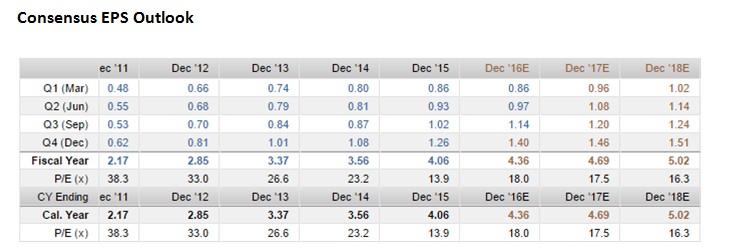
We are bullish on the shares with a $95 price target equal to 19x the consensus 2018 EPS outlook of $5. We do not think this is a stretch in terms of valuation as the historical trading range has been upward of 40x earnings. Admittedly, growth remains robust though not what it once was. Either way, we see the next chapter for the company to continue to bring ongoing lucrative cash flow generation, which will ultimately be returned to shareholders.
Consensus EPS Outlook
(This chart may be hard to read. Sorry.)
Good investing,
Todd Shaver, CEO and Founder
The Bull Market Report
January 8, 2017

by Todd Shaver | Jan 8, 2017 | Weekly Newsletter 7pm Sunday
The Week Ahead
As the champagne glasses clink in Washington over a record-breaking streak of job growth, the percent of the population employed (aka the labor force participation rate) has slumped. Indeed, the Obama "recovery" has officially been the worst recovery in US history as measured by cumulative real GDP growth. After 32 quarters we are up barely double digits. The standard for an economic recovery is up 15-25%. The great expansions recorded real GDP growth of up 30%, 40%, and even 50% over the cycle. Even worse, we got not just weak results, but added $10 trillion to the national debt in the process. 2017 will be the year of the Orange Swan (aka Trump). Did America pick the right man to lead us back to economic prosperity? Can we get there without geopolitical turmoil?
This week we provide some insights on our latest thinking for Under Armour, Eli Lilly, Microsoft, Alphabet, Apple, Amazon, and Facebook.
Highlights From The Past Week
Tech’s Optimism For Cash Repatriation. Record high-grade US Tech debt issuance has been driven by over $530 billion of offshore cash and investments. The Tech companies can’t get their money back here to the United States so they borrow – at historically low rates. However, the industry’s cautious optimism on a potential 10% cash repatriation centers on gaining access to these funds, which could boost domestic capital spending, M&A, and buybacks. Repatriation would be a windfall for shareholders.
FAANG Stocks Bite Back Adding $85 Billion In Market Cap This Week. Technology stocks have found a cure for whatever was plaguing them during the early stages of the Donald Trump bull market. In especially brisk health is the FAANG block of Facebook, Amazon, Apple, Netflix and Google, which have rallied at 3.8% on average this week, poised for their best performance since October. About $85 billion has been added to their value as investors rotate back into post-election laggards. FAANG stocks were oversold after the election, although there’s likely no real impact from a Trump administration on the highest quality internet names. These five stocks could potentially outperform in 2017, despite pretty clear skepticism among almost all investors, who see a sustained rotation away from growth stocks in the wake of the Trump election. Not us. We are sticking with them. Like glue.
Alphabet (GOOG: $806, up $34)
Apple (AAPL: $118, up $2)
Facebook (FB: $123, up $8)
Amazon (AMZN: $796, up $46)
Netflix (NFLX: $131, up $7)
THE RACE:
[Whereby Apple, Google, Amazon and Facebook are racing with a pure stock price number. Listen – this is not a sophisticated lineup here. It is pure price – nothing to do with percentage increase or market cap increase. We’re just having fun here!]
Converting Apple back to its pre-split price gives us $826, up $14 for the week. Same for Facebook (multiplying by 7) gives us $861, up $56. Wow. Google was up $34 to $801 and Amazon was up $46 to $796.
Clear winner this week? Gotta go with Facebook!
Dismal Year For Brick & Mortar Retail. Disappointing holiday-season sales at Macy's, Kohl's, and Sears underscored the uphill task facing department stores to win back shoppers, who are increasingly turning to online retailers and spending less on apparel. Macy's reported comparable sales fell 2.1% in November and December combined, and the company said it expected a similar decline in 2017. Ouch. Sears and Kmart stores reported a 12-13% drop in same-store sales for November and December - even bigger ouch. The companies are struggling against an overall holiday season that was modestly good. The National Retail Federation estimates that 2016 holiday period delivered sales growth of 3.6% helped by a jump in spending in the last days of December making up for a slow start to the shopping season. By the way, Amazon said it had its "best ever" holiday season shipping more than 1 billion items worldwide -- just crushing it.
BMR Companies and Commentary
Facebook (FB: $123, up 7% for the week)
Facebook is turning to a former television news journalist to help smooth over its strained ties to the news media. It has hired Campbell Brown, a former NBC News correspondent and CNN prime-time host, to lead its news partnerships team, starting immediately. The company does have some seasoned journalists in its ranks. But it does not have any in a senior position working on its newsroom partnerships, contributing to a disconnect between the company and news organizations.
The addition of Ms. Brown comes as Facebook is struggling with its position as a content provider that does not produce its own content — that is, as a platform, not a media company. In the past few months, Facebook has faced criticism for giving too much prominence to fake news; for censoring as offensive an iconic Vietnam War photograph of a naked girl fleeing a bombing attack; and for allegations that members of its “trending topics” team, which is now disbanded, penalized news of interest to conservatives.
BMR Take: The new hires goes a long way to addressing the weak sentiment around Facebook’s content quality and control. Investors can now return focus on the 1.8 billion user franchise and all the possibilities for marketing revenue. We continue to remain long term investors in the company as they move towards their short term goal of 2 billion users, and their next goal of 3 billion. We at The Bull Market Report are starting to use Facebook for marketing the newsletter. Of the 1.8 billion users, we are confident that 100 million+ have an interest in the stock market.
Amazon (AMZN: $796, up 6%)
Prior to the holiday season, it was estimated that Amazon’s Echo device had reached a sales milestone, with a recent report suggesting that the retail giant had sold 5.1 million of the smart speakers in the US since it debuted two years ago. Now reports say the Amazon Echo was among the best sellers this holiday season. Momentum continues building.
Amazon Echo is a hands-free speaker you control with your voice. Echo plays music, provides information, news, sports, and so on. We at The Bull Market Report bought one. We love it, especially for music. We can ask it to play a specific song or symphony and it starts playing within two seconds. We are also big Wikipedia users. Now we don’t have to open our iPhone and punch in the buttons, we just talk to Alexa and ask her to find the information and tell us about it.
We see endless possibilities for the voice control technology. When you give a command to Alexa, a recording of that command is stored on Amazon's servers. Right now on the Echo you can place an order to buy something from Amazon simply by saying the words and the goods will be at your door in two days, if you have Prime. Imagine how this technology could be leveraged across enterprise systems. For instance, perhaps in 10 years when you want to buy a stock you just speak the order to the computer and it executes.
Note that Prime now has over 70 million users, paying $99 a year. That’s $7 billion coming in each year – in cash. More than half of all Amazon users subscriber to Prime. (We love it because it comes with Amazon Music for free. And millions of movies as well. For free.)
The e-commerce giant is hardly done with wooing new potential members - and for good reason. Prime shoppers spent about $1,200 on average last year, compared to about $500 for non-members.
BMR Take: We go back to our initiation report on Amazon, which we discussed the business as not an e-commerce company, but rather an innovation machine. Well, they just did it again!
And don’t be intimidated by the price of the stock. Just imagine that they split the stock 10-1, which they just may do some day. That $800 price would then be $80. So if you don’t have $80,000 for a 100 share order, just buy 10 shares, or 40 shares, or 72 shares. The stock price is IRRELEVANT. What IS relevant is the value of the services the company provides and the profit it makes from the revenue it generates. Amazon just celebrated its 22 year anniversary, but we are here to tell you that they are just in the bottom of the 4th inning in a 9-inning game. They have a LONG way to go. $1000 a share is quite possible this year. $1500 a share? Quite possible next year.
Apple (AAPL: $118, up 2%)
Apple customers’ App Store spending jumped 40% in 2016 - fueled by games such as Pokémon Go and Super Mario Run - to provide a much-needed boost to services revenues, at a time when iPhone growth remains sluggish. Payments to app developers, after Apple took its cut, rose to more than $20 billion last year, with growth accelerating in China. This would suggest that Apple itself produced $8 billion in revenue, as Apple gives 70% to the developers and keeps 30% for itself. Both Apple and the developer community are thriving on this front of the business. Very important.
“2016 was an amazingly great year for the App Store," said Apple's senior vice president of worldwide marketing. "We continue to advance what is available for developers to create. And our catalog of apps grew 20% to 2.2 million." We have always loved this part of Apple’s business. For every iPhone, iPad and Mac that is sold, that new user goes right to the App Store for all types of products, especially music and productivity tools. And that revenue goes right to the bottom line and is recurring. We LOVE recurring income.
Why does it matter? In the early years of the App Store, much of the growth was driven by the increasing installed base for smartphones and tablet. But now as the market is maturing, it is notable that Apple’s success is based on driving increased revenues from its existing users. So we need to see solid fundamental trends out of the service business for the stock to work. And we are.
In recent months, Apple has put a spotlight on revenues from online services such as the App Store, iCloud and Apple Music, in order to counterbalance concerns on Wall Street about the iPhone, which saw its first ever drop in sales last year. The App Store growth figures are another great data point.
BMR Take: Even as unit sales are declining, the total number of people who own and use an Apple device has continued to grow, sustaining the App Store’s momentum. The jump in spending is a indicator of health. We look for the services business to support investor confidence in the stock at unit sales face the realities of a mature growth profile.
Alphabet (GOOG: $806, up 5%)
Google's Android Auto is facing a pushback from automakers led by Ford and Toyota. Ford and Toyota recently said four medium-sized automakers — Mazda Motor, PSA Group, Fuji Heavy Industries and Suzuki Motor - have joined their SmartDeviceLink Consortium, which aims to develop an open-source software platform that app developers can use as an alternative to Apple's CarPlay and Google's Android Auto.
We don’t think the news necessarily spells doom. Google has some of the best technologists in the world. Open-source will allow other talented engineers to be able to compete, but that doesn’t mean they will win.
Google has revved up efforts to integrate their smartphone technologies with auto communications systems. Google and Fiat Chrysler Automobiles, which have teamed on autonomous-driving technology, recently said they would expand their relationship to create an in-car infotainment system using Google's software.
BMR Take: We see Google as a leader in autonomous cars and connected communication software in vehicles. Both are lucrative end markets and support our favorable outlook for the business.
Microsoft (MSFT: $63, up 1%)
A new survey found that enterprises strongly prefer Microsoft’s Azure cloud technology. The survey was conducted in order to gain more knowledge on the "Big Three" cloud providers: Amazon Web Services (AWS), Google Cloud Platform (GCP), and Microsoft Azure.
Nearly 40% of Azure users surveyed identified as enterprises. The trends among enterprises reflect the strength of the Microsoft platform. It goes back to the trust and familiarity issues. Windows Server and other Microsoft technologies are prevalent in the enterprise world. Azure provides the consistency required by developers and IT staff to tightly integrate with the tools that Microsoft-leaning organizations are familiar with.
(This previous paragraph may need to be read again. It is a powerful little piece of information.)
Interestingly, breaking down the Cloud opportunity, the research suggested that infrastructure-as-a-service will reside mainly on AWS, cloud services will be on Microsoft's side, while Google will dominate analytics. While every platform offers each type of service, people will want the best.
BMR Take: We are thrilled to learn Microsoft’s enterprise relationships are healthy and transferring over into the Cloud opportunity. Overall, this looks like a win win win as three of the companies in our portfolio benefit from the Cloud.
Eli Lilly (LLY: $76, up 3%)
Eli Lilly announced a series of changes to its organization and leadership structure to better align them with the company's growth opportunities. Lilly begins 2017 with a clear view of its opportunities for growth in the years ahead. The adjustments announced to pharmaceutical therapeutic and geographic business areas are designed to maximize the potential of the late-stage pipeline and newly launched medicines, while improving productivity.
The organizational changes are expected to increase productivity and simplify Lilly's global commercial organization. These changes also result in a reduction in leadership positions. In December, the company announced reductions to its US field force in anticipation of patent expirations for key products later this year and in response to clinical trial results on solanezumab.
With new medicines recently launched - and potential new medicines in development for cancer, diabetes, autoimmune diseases, neurodegeneration, and pain - Lilly is in the early stages of a new growth period. Now is the time to make sure that the organization is set up to make the most of these opportunities. With clear priorities and the right structure, achieving growth while improving productivity will go hand-in-hand.
BMR Take: We are excited to see these leadership changes be announced. Eli Lilly is in a turnaround situation. Change is warmly welcomed.
Under Armour (UAA: $30, up 5%)
Under Armour revealed a new revolutionary sleep and recovery system including the brand's first-ever Athlete Recovery Sleepwear powered by TB12™ and a new UA Record™ app experience, both designed to improve sleep and overall athlete performance. UA Athlete Recovery Sleepwear was developed in collaboration with Under Armour athlete Tom Brady, who credits sleep as one of the most important components to his training regimen.
Through the new UA Athlete Recovery Sleepwear, Brady and Under Armour aim to provide all athletes with the off-field support that will maximize their ability to perform. Under Armour has incorporated the bioceramics technology - used and validated by TB12 - into a pattern lining the garments, which are designed to maximize comfort and fit. The pattern includes special bioceramic particles that absorb infrared wavelengths emitted by the body and reflect back Far Infrared, helping the body recover faster while promoting better sleep.
By using the Athlete Recovery Sleepwear and UA Record together as a system, athletes will be able to accelerate recovery time and gain a deeper understanding of their sleep. As part of the system, Brady also helped develop six steps to better sleep to further educate athletes, which will be incorporated in retail packaging and available on UA.com/TB12.
Under Armour's science-backed approach to sleep and recovery is strengthened by a new collaboration with Johns Hopkins Medicine centered around tracking, understanding and analyzing sleep patterns. Under Armour has engaged a team of sleep experts at Johns Hopkins Medicine who are working to study the effectiveness of sustained patterns in improving overall sleep behaviors. This in-depth evaluation on sleep comprises the first scientific study powered by the Under Armour Connected Fitness platform and will help shape the brand's sleep products and UA Record user experience.
BMR Take: There is a big opportunity in health data analytics. Under Armour is well positioned to win it. The news of this sleep product is just the tip of the iceberg. Stay tuned. And stay tuned for a higher stock price in 2017. This stock WAY underperformed in 2016. This year the company will outperform.
Upcoming Economic News
THURSDAY, JANUARY 12
Import Price Index – December
Time: 8:30 am
Forecast: 0.8%
Rising commodity prices can lead the December Import Price Index to the biggest gain in seven months. Yet even with frequent monthly gains throughout last year, the yearly decline of 0.1% for the Import Index in November hints that price pressures on consumers and businesses have not been overly burdensome.
FRIDAY, JANUARY 13
Producer Price Index – December
Time: 8:30 am
Forecast: 0.3% overall, 0.1% core
Higher fuel costs can lead the Producer Price Index to the second straight substantial monthly gain in December. The PPI now points to an end of a disinflationary period, rising at the two-year high rate of 1.3% yearly to November. That trend gives the Federal Reserve some confidence that it can tighten monetary policy.
Retail Sales – December
Time: 8:30 am
Forecast: 0.4% overall, 0.5% ex auto
Rising incomes and higher gasoline costs can lead a solid gain for retail sales in December. Sales have shown some uplift of late, rising 3.8% yearly in the three months ending November - the best such result in seven months. But while the rate of retail sales and personal income point to healthy consumer trends, they fall short of the more dynamic growth periods of the recent past when these items rose in excess of 5%.
Business Inventories – November
Time: 10:00 am
Forecast: 0.3%
Business inventories are projected to expand in November at the fastest rate in eight months after sliding in the previous month. The inventories-to-sales ratio of 1.37 in October is the lowest in 15 months. A positive sales trend is now lifting the corporate outlook.
University of Michigan Consumer Sentiment – January
Preliminary Time: 10:00 am
Forecast: 99.0
Consumer sentiment in the Michigan survey may reach its highest level in over a decade as postelection optimism persists. Higher fuel costs may have a key role in influencing sentiment in the months ahead. Though more expensive fuel can weigh a bit on confidence, it can also lift consumer inflation expectations from their record lows.
Some Recent Upgrades for Apple ($118).
1/5/2017 Longbow Research set its Price Target to $140
1/4/2017 Nomura Securities set its Price Target to $135
1/4/2017 Guggenheim initiated coverage with a Buy and a Target of $140. (Where have you been all these years Guggenheim?)
1/3/2017 Drexel Hamilton reiterated a Buy rating of $185.
Remember, Apple’s all-time high is $134 – only $16 away. We have been predicting that this record will fall. Wait until Trump starts talking repatriation of all the cash that is overseas.
Opko Health News
Two interesting events popped up in the insider trading report for Opko Health (OPK: $9.38, flat). Executive VP for Administration, Steven Rubin, purchased 2,000 shares at $9.17 a week ago Friday, and CEO Philip Frost has continued his open market purchases too - 25,000 shares the same day.
Interestingly, Rubin owns 5,573,000 - and yet he is still buying more. Let’s hope they know something positive is coming.
A Word from Gary Jefferson of UBS Securities
Jefferson Financial Group
First Vice-President, Investments
2017 won't be any different from any other year in that it will bring unlimited challenges and opportunities for investors. The new year also always brings with it a "market opinion", which provides the basis for building or adjusting portfolios around that investment outlook. Additionally, when there is a change in market sentiment, it’s usually also time for a change in portfolio direction. For example, during the past few years the sentiment favored deflation. After the election, it clearly favors inflation.
The market has just experienced a post-election melt-up which is utterly opposite of what was predicted by nearly every expert. Because it is the same elites and mainstream media who now are predicting a strong bull market ahead, we are going to take a slightly more cautious approach. We are bullish, but it is simply too early to know whether this rally is the start of a new bull market or just a big sigh-of-relief rally that will eventually fall back into a wait-and-see market. The "what-ifs" are still here, and are too many to just shrug off with abandon. Some of these include: 1) What if the repeal of Obamacare bogs down? 2) What if there is a serious breakdown in China trade relations? 3) What if the Fed raises rates too fast? 4) What if Brexit creates disorder in the European markets? And we could go on and on. (And don’t forget about black swans. Black swans are events that happen that NO ONE thought about beforehand.)
That said, we are optimistic about the US markets for the primary reason that corporate earnings are expected to rise by double digits in 2017 and again in 2018. As long as we have reasonable expectations of earnings growth, we believe the market will rise higher on those expectations. We will remain somewhat cautious so that we can better adjust to any "What-ifs" that may occur, but we enter 2017 with a confidence we didn't have the past two years when we were in an earnings recession. This new "Trump Revolution", as some are calling it, could be a once-in-a-generation changing of the guard that will have a powerful impact on domestic policy, geopolitics and the American economy. It has the potential to provide a powerful tailwind for the US stock market over the coming years and, at this juncture, we are excited about the potential that 2017 and beyond holds.
Twilio Update
A reader, Rob Jolly, wrote us and mentioned a negative article about Twilio from one of our competitors. We find this company to be very superficial sometimes. Here is what we wrote him back.
Hi Rob –
There is nothing new in this report. It is just an advertising puff piece. What IS new is the lower stock price. It is very distressing and we really won’t know anything until earnings come out on February 2nd or so. It is torture waiting for this date though, especially after last week’s showing. The earnings release will show if Twilio is still on track for great things as we expect. But the stock dropping like this can cause great upset.
Todd Shaver
Twilio Consensus Ratings
There are six Hold Ratings and six Buy Ratings on Twilio (TWLO: $28, down 4%)
The Consensus Price Target is $41.
1/5/2017 KeyCorp has a Price Target of $36
1/5/2017 Pacific Crest - $36 Price Target
12/19/16 Drexel Hamilton initiated coverage with a Buy and a $45 Target
A Review: (Some of this may be dry to you, but if you can wade through it, you may see the potential in this company like we do.)
Twilio offers Cloud Communications Platforms. The Company enables developers to build, scale and operate real-time communications within software applications. Its Programmable Communications Cloud software enables developers to embed voice, messaging, video and authentication capabilities into their applications via its Application Programming Interfaces. The Super Network is its software layer that allows its customers' software to communicate with connected devices globally. It interconnects with communications networks around the world and continually analyzes data to optimize the quality and cost of communications that flow through its platform. The Programmable Communications Cloud consists of software products that can be used individually or in combination to build rich contextual communications within applications. The Programmable Communications Cloud includes Programmable Voice, Programmable Messaging, Programmable Video, and Add-on Marketplace.
The Options Corner
Buying LEAPS
What are LEAPS? They are options that expire in January that have a least six months of life. Thus we are looking at January 2018, January 2019 and occasionally January 2020.
Why LEAPS? They allow you to control a stock for 20-40% of the cost of buying it outright. Also, it allows you to buy an $800 stock for $100-200 or less.
Here’s an example: Say you want to buy Google because you think it is heading to $900. The stock closed at $806 on Friday, but let’s round this to $805. You could buy the January 2018 700 LEAP for $145 a share, or just 18% of the stock price. Let us explain. That gives you control of the stock at $700 a share. In other words, the option gives you the right to buy the stock for $700 a share for the next year. But as you can see, there is a cost to that. The option is WORTH just $105. Do you see that? If you can buy the stock for $700 and it is trading at $805, then the option is WORTH $105 (intrinsic value). Since the option is trading for $145, what is the rest of the cost? TIME VALUE. And that time value will go away between now and the expiration on the 3rd Friday of January, 2018. Is it worth it to you to do this? Well, that is the age-old question.
Let’s look at some scenarios. Let’s first look at the bullish argument and then the bearish argument. Oh – By The Way (BTW), OPTIONS ARE RISKY. Consult your advisor before jumping in.
OK – let’s say the stock goes to $900 by expiration. Is that possible? Well, it sure is. It’s like a $81 stock going to $90 in a year. Is that possible? Sure.
Now, if the stock goes to $900, the option HAS TO TRADE for at least $200. Why? Because you have the right to buy Google at $700. Do you see this? If not, go back and re-read the above. You could sell the option then and take your profit. (Keep in mind that options are mostly fairly liquid, so unless there is a market panic, there is a market for the option, meaning you can sell it whenever you like.)
How about a negative scenario. If the stock goes to $700 by expiration guess what the option will be trading for? ZERO. And here’s the rub: If you own the stock, you have lost 13% - it went from $805 to $700. But if you bought the LEAP, you have lost 100%. The good thing is you only had 18% of the value of the stock invested.
SELLING OPTIONS AGAINST THE LONG LEAP
Since about $40 of the cost of the LEAP in the above example is TIME PREMIUM which goes away a little every day (wasting asset), it is a wise idea to SELL an option against the LEAP in order to get the cost of the options down. If you owned the stock and sold options against it, it is called a covered call. In this case it is a covered LEAP.
Example: Using the same option above, you could SELL an option on Google. You could go out to June and SELL the 850 call. That would bring in about $28 per share. Since you paid $145 for the call, your cost has just been lowered to $117. If the stock stays below $850, the 850 call will expire worthless and then in June you can do this again – you could sell a December or January call and bring in another $28-30, further reducing the price of the LEAP to around $90. If the stock stays above $790 you will make money from this trade. In fact, if the stock goes to $900, you would more than double your money (Cost - $90, LEAP would be worth $200.)
There are endless strike prices and expiration dates for options. The January 2019 700 LEAP for example trades for $180. More expensive than the example above, but you have one more year that the 2018 option, giving time for Google to rise AND to sell options against the LEAP. The January 2019 800 call trades for $120. This gives you another year, but most of it is time premium. Ah – so many choices and decisions!
There is so much more to write about trades like these. And there are many ways that things can change during the year, that this is not for the conservative investor. But if you are aggressive, I think you can begin to see the potential benefits of options. And the risks!
The High Yield Corner
Last week was one of the strongest weeks for high yield assets in the last year. That’s saying a lot. We’ve seen double-digit returns yields on many of our picks and throughout various high yield sectors and asset classes. The fact that this strength is continuing deserves some consideration.
Keep in mind that mainstream media outlets have pounded the table with a clear warning: “Interest rates are going to go up, and high yield assets will lose favor as a result. Investors will sell corporate bonds, municipals, and other high yielders in favor of better-yielding U.S. Treasuries.” This warning has been in the air since 2011, but there’s real bite to it now. The Federal Reserve has hinted that three rate hikes are coming in 2017, and they even more recently asserted that a path towards higher interest rates is “appropriate” for America’s economy today. It seems clear that interest rates are bound to rise.
Yet high yield assets are not selling off as expected. There are several reasons for this, which we discuss below. But before we get into that, it’s important to put this in perspective. We have been hearing for half a decade that higher interest rates will cause massive selling of high yield assets. We saw those sell-offs in 2013 and 2014 when the Fed postponed rate hikes. Now the Fed is raising interest rates - and the high yield assets aren’t selling off. Is the market just too slow to respond?
Of course not. A slow market would provide arbitrage opportunities for hedge funds. The reality is more mundane - and more predictable.
The mainstream media outlets are wrong.
They are wrong that high yield assets will sell off in a rising interest rate environment because: They are working on the overly simplistic assumption that people who are buying REITs, junk bonds, etc. will jump into U.S. Treasuries en masse. While we must expect some migration, the question is how much. A spread between those yields and U.S. Treasury yields must exist - but as long as it exceeds the expected risk of those asset classes, people will still demand REITs, junk bonds, and so on.
Right now the spread between high yield assets and Treasuries is about 4%. We are nowhere near the peak levels of 1997 and 2007, when the spread was less than 3%. If we get to that point, we may see a serious high yield selloff, and that will encourage us to be less bullish on high yield assets. Until that point, however, we are maintaining our high yield recommendations with conviction.
The UBS Etracs BDC ETF (BDCS: $23) was an exceptional performer, rising 3% this week on little news but continued optimism about inflation and demand for financial activity. Remember that many BDCs finance firms in the infrastructure sector - and that sector is poised to get a lot of demand if President-elect Trump’s promised spending plans actually materialize. The market is betting on that, driving the sector higher.
The SPDR Barclays High Yield Bond ETF (JNK: $37) was the weakest high yield asset class this week, up a mere 1%. The fact that a 1% weekly increase is the worst performer demonstrates the serious strength in high yield assets, and steels our resolve to hold on to both our favored high yield bond funds and high yield assets in general.
The Alerian MLP ETF (AMLP: $12.81) saw a near 2% rise this week, driven in part by higher oil prices. There is renewed confidence that OPEC will succeed in its oil production cut, which in turn is driving energy stocks up all over the place. However, the impact of higher oil prices on MLPs is unclear, since many deal in natural gas and most don’t benefit from higher oil prices in any direct manner. This leaves us cautious about jumping into this sector as always; it remains uncertain whether MLPs will continue to shoot up this year even if oil prices go up. We will need to see fundamentals at MLPs improve first before recommending this sector.
The SPDR Dow Jones REIT ETF (RWR: $95) was the biggest winner this week, rising over 3%. There are two reasons for this strength. First and most important, REITs are still recovering from their oversold correction in late 2016. Again, rising inflation and higher infrastructure spending will have a positive impact on many REITs, both in and out of the infrastructure sector. Commercial REITs and REITs that lease retail shops should see a benefit from the increased spending, as well as renewed consumer confidence. And that confidence seems to be coming. Hourly wages rose 2.9% according to the government’s last study - a very strong increase indeed, and one of the best readings we’ve seen in a decade. What this means for REITs is simple: More money in Americans’ pockets will mean more spending at retail shops, which will mean more demand for retail space. The benefits for REITs across the board are clear, which is why the market is finally realizing it made a big mistake selling these stocks and is buying them back at a quick pace. This purchasing is likely to continue for a few weeks.
With this bullish activity, our picks had a great week.
Digital Realty Trust (DLR: $98) rose nearly 6% in just one week. Our resolve to hold onto this high growth REIT has paid off, and we are enjoying the 3% dividend yield and appreciate the highly sustainable income that is set to grow. We expect one very large dividend increase from DLR this year, or possibly two small ones; with that in mind we are not considering selling even after the surge last week.
Similarly, Kimco Realty (KIM: $26) rose over 4% as the strength in REITs swept this firm up in its tide. It’s a topsy-turvy world. Kimco is a larger, slower-growth REIT yet its dividend is over 4%, significantly higher than Digital Realty’s. This will not last. We expect Kimco to rise significantly in price this year until its yield falls lower than Digital Realty. For this reason, our strategy with this stock is a bit different: We’re waiting for enough price appreciation to warrant selling. For this reason we are lifting our target price to $35, which is above its 52-week high. This would be a great exit point for Kimco, and we expect it to reach that price either this year or next.
Municipal bonds are continuing their recovery, giving us more confidence in our soon to be added stock: Invesco Municipal Trust (VKQ: $12.42) to the High Yield Portfolio. The Trust rose 2% in the last week and is now over 4% above its 52-week low. We like its price right now for more purchases, and we expect it to keep rising in the coming weeks as the Municipal Bond market returns to reality. This fund is down nearly 3% in the past year, giving us plenty of room for capital gains in the short term. With this in mind, there is a good reason to bet heavy on municipal bonds, and this is a great fund to do it.
Look for the Research Report Tuesday morning.
Additionally, we saw the Nuveen AMT-Free Municipal Credit Income Fund (NVG: $14.70) rise over 3% last week. That’s helped the fund go positive on a year-over-year basis, excluding payouts.
That’s all for High Yield this week and for this week's newsletter.
Good Investing,
Todd Shaver
CEO and Founder
The Bull Market Report
January 1, 2017
by Todd Shaver | Jan 1, 2017 | Weekly Newsletter 7pm Sunday
The Week Ahead
The Dow Jones Industrial Average shook off its worst start to a year ever to score its best performance since 2013, as investors banked on an improving economy. What’s ahead for 2017? US-Russia relations, Trump-flation, and stagflation will be central themes. We see an Energy sector recovery gaining momentum. Higher interest rates could pressure stock prices. Gold could be putting in a bottom as we speak.
It’s a light week ahead for economic news. But here we provide some insights on our latest thinking for Opko, Apple, Microsoft, Facebook, Kinder Morgan, Twilio, Celgene, Gilead, Bristol-Myers Squibb, and AstraZeneca. Happy New Year!
Highlights From The Past Week
US-Russia Relations. Trump and Putin have emerged as two of the most cunning leaders on the global scene. What these two men are up to in 2017 will certainly impact markets. Recently, Russian diplomats have been sanctioned by the US. Are dicey relations emerging? Putin says, “We reserve the right to retaliate, but we will not sink to the level of this irresponsible ‘kitchen’ diplomacy. We will take further moves on restoring Russian-American relations based on the policies that the administration of President-elect Donald Trump adopts.” Separately, the appointment of Rex Tillerson, Chairman and Chief Executive Officer of ExxonMobil, as Secretary of State, as well as various insinuations by the President-Elect to lift sanctions, all point to possibly greater oil production from Russia ahead. Russia has recently claimed that it will beat 2016’s estimated oil production total of 253 million tons in 2017.
Trump-flation. One idea most widely agreed upon is that Trump will spur inflation and US Treasuries are the last place to be. There is growing fear of a bond bubble. Trump-flation should drive equity prices higher and could kick-start a big rally in gold. We will be keeping an eye on inflation expectations in 2017.
Stagflation. Admittedly, the current economic expansion is quite advanced. It has already lasted about 18 months longer than the median completed expansion since the mid-1800s. And while expansions do not die of old age, history shows that they are at greater risk when spare capacity is exhausted, as it probably is now. So it is especially important to monitor whether growth may be running out of steam. The most important recession predictors, at horizons longer than the next few quarters, are spare capacity and past credit growth. Spare capacity has dwindled, which has boosted the recession probability somewhat, but output is not yet meaningfully above potential.
BMR Companies and Commentary
Opko Health (OPK: $9.30, -21% for the week)
Opko said its experimental drug for growth hormone deficiency (GHD) in adults failed to provide a statistically significant benefit over a placebo in a late-stage study. Investors were counting on the drug for future growth. Consequently, the disappointing news sent Opko’s shares much lower.
GHD is a rare disorder characterized by the inadequate secretion of the growth hormone from the pituitary gland, an organ responsible for the production of multiple hormones. The disorder can be hereditary, can be acquired as a result of trauma, infection, radiation therapy or brain tumor growth, and can even emerge without a diagnosable cause. OPKO was developing the drug with Pfizer to address GHD.
Is everything lost at this point? No.
While the recent study failed, Opko said it had started another late-stage study to evaluate the drug against Genotripin, which is another type of growth hormone disease more narrowly found in children. Opko will have world-wide collaboration rights and licensing rights with Pfizer for this drug to target Genotripin, if it is successful.
BMR Take: We have high hopes for this company and the new drug. We added the stock at $10 in September and it rallied to a shade under $12 just a few days ago. But Wall Street has been known for its mean responses to situations like this. They don’t have the patience that we generally have. So with that said, we are going to stick with our Sell Price of $8. If it hits $8 we are out.
Apple (AAPL: $116, flat for the week)
Some news just out - Apple will trim production of its iPhones by at least 10% in the first quarter of 2017.
The latest news comes after Apple slashed output in the January-March quarter of 2016 due to accumulated inventory of the iPhone 6S line at the end of 2015. That experience led Apple to curb production of the iPhone 7, introduced in September, by around 20%. Information on production of the latest models and global sales suggest cuts in both the 7 and 7 Plus lines in the coming quarter.
BMR Take: Don’t get too concerned about this discussion of product cuts in the first part of 2017. We have been talking about this for a while. Buy the stock on weakness. As we move through 2017, investors will be focused on growing anticipation around the iPhone 8 and a favorable long-term trajectory for Services growth.
With Trump working on a plan to help companies return the cash they hold overseas, there is no company that will benefit more than Apple, with their hoard of well over $240 billion in cash, most of which is overseas. We expect a good year for Apple’s stock performance in 2017.
Microsoft (MSFT: $62, flat)
Microsoft had a tremendous year in 2016. Let’s re-visit some of the big events. We understand it’s a backward looking exercise, but sometimes it’s helpful to do such a review in order to reaffirm our confidence that the franchise is on very solid footing.
Microsoft released its first major feature update for Windows 10. Dubbed the "Anniversary Update", this release featured improvements to the Start Menu, Action Center, Settings and Microsoft Edge, among other upgrades.
The Universal Windows Platform went even more universal this year, with Microsoft announcing Universal Apps for Xbox One. This unleashed a whole new market of apps for the Xbox, essentially turning it into a PC.
Microsoft surprised the entire gaming industry this year by announcing its brand new console, scheduled to launch in the fall of 2017, a whole year early. Microsoft originally had no plans to announce Project Scorpio in 2016, but with looming pressure coming from Sony and the PlayStation 4 Pro, the company felt they needed to get something out there and let gamers know Microsoft is serious about gaming.
Microsoft blew the crowds away with the Surface Studio announcement. It was known for some time that the company was interested in building an All-In-One PC, but we didn't know exactly what they had planned. When the unveiling finally arrived, the company once again proved to be staying current with product cycles.
The Creators Update is the next major version of Windows 10, scheduled to launch in early 2017 and is bringing several new features designed for creators.
BMR Take: The era for Microsoft under CEO Satya Nadella is blossoming. It is not just about all the product innovation discussed above that he is bringing to the forefront as a former engineer at the company. He is also quietly leveraging the balance sheet to buy back stock. In September 2016 he announced a $40 billion stock buyback program.
Facebook (FB: $115, -2%)
What’s in the news for Facebook lately? A bunch of noise about censorship. Facebook put a temporary ban on Kevin Sessums, who is well known for his celebrity profiles for Vanity Fair and two best-selling memoirs. The event triggered civil unrest over free speech and Facebook was painted as the enemy.
The journalist was temporarily banned from Facebook after sharing a post from an ABC political analyst, which called Trump supporters some derogatory names.
Facebook “reviewed and restored” Kevin Sessums’s ability to post messages. “We’re very sorry about this mistake,” a Facebook spokesman said. “The post was removed in error and restored as soon as we were able to investigate. Our team processes millions of reports each week, and we sometimes get things wrong.”
BMR Take: Facebook is on track to be the greatest advertising money-making machine of all-time. Censorship is a reality of the business, but not new nor disruptive. We think recent softness in the shares presents a great spot to buy more.
Kinder Morgan (KMI: $21, -2%)
Massachusetts has agreed to a $640,000 settlement from Kinder Morgan to allow the company to run a pipeline through conservation land in Berkshire County on its way from New York to Connecticut. The money will be spent on “mitigation and improvements” in the Otis State Forest and also to buy more conservation land in the area.
The Massachusetts Pipeline Awareness Network continues to object to the pipeline based on water quality concerns, and the disruption of stone walls important to Native American tribes.
There is a big shift going on regarding the above situation. A Trump administration is about jobs, jobs, jobs. He has been very outspoken about putting business above people’s sensitivities to the environment. The settlement Kinder Morgan just did may be a very early indicator of the courts moving in Trump’s direction to squash disputes and get business rolling. The Dakota Access Pipeline owned by Energy Transfer Partners (ETE: $36, a $20 billion market cap company) may be the first big test of this Trump concept. It will not be pretty if he reverses the hold that Obama has ruled.
BMR Take: Kinder Morgan is the best operators in a very tough business to enter. It requires a large sum of cash to acquire land rights to lay down a pipeline and a lot of expertise to obtain all the needed permits. With the energy sector on the recovery road, and Kinder Morgan’s un-rivaled assets, the outlook is very positive for the stock price.
Twilio (TWLO: $29, -10%)
While potential future competition from Amazon is a risk factor that investors must consider with respect to Twilio, today the Amazon relationship is healthy. The association is multi-faceted. First, Twilio runs entirely on AWS, Amazon Web Services. Second, Rick Dalzell (Amazon's former SVP of Worldwide Architecture and Platform Software and CIO) has been a member of Twilio's board of directors since 2014. Third, Twilio is already helping AWS build better products.
How tight is Dalzell to Amazon? Mr. Dalzell was Amazon CEO Jeff Bezos’ “right-hand man” at Amazon for a decade before retiring in 2007. As retold in the book, The Everything Store: Jeff Bezos and the Age of Amazon by Brad Stone, (a great book we have just finished reading and highly recommend), Bezos gave Mr. Dalzell quite a going away party: Four months later, enjoying retirement, Dalzell decided to visit his daughter in college in Oregon. His wife chartered a private plane for her husband, herself, and Dalzell’s parents. Strangely, their driver took them not to their usual airport but to a private airfield down the street from Boeing Field. Dalzell finally started to notice something was amiss when the car pulled up to a familiar hangar sheltering a Dassault Falcon. When he walked into the airplane, he found it full of friends, colleagues, and Jeff Bezos, all of whom shouted, “Surprise!” They were going to Hawaii for a gala given in appreciation of Dalzell’s longtime service. Andy Jassy, who attended the party, is the CEO of Amazon Web Services today.
Counter to concerns about the counterparty risk, in the near-term, the AWS relationship could improve, not get worse. At AWS re:Invent in November 2016, Twilio CEO Jeff Lawson hinted at an increasing level of collaboration between Twilio and Amazon when he said, "We're really excited to announce some upcoming collaboration soon."
BMR Take: Sentiment and the volatility in Twilio has been a roll coaster. The Amazon risk factor seems to be getting blown out of proportion right now. We actually like the prospects for the Amazon relationship in the near-term. As to the stock we remain a big believer in the company even as the stock is down dramatically from where we recommended it in October.
Celgene (CELG: $116, -3%)
Celgene must face a whistleblower lawsuit accusing it of promoting its cancer drugs Revlimid and Thalomid for off-label uses that were paid for by Medicare and Medicaid, a federal judge has ruled. Yikes! A U.S. District Judge in Los Angeles ruled that the lawsuit, brought by a former Celgene sales representative, can go forward for claims submitted to Medicare and most state Medicaid programs.
It’s not good, but things like this happen at big companies. Remember the London Whale incident for JP Morgan. Don’t panic.
There is much to like about Celgene. The drug in Celgene's lineup with the fastest sales growth is Otezla. Sales for the anti-inflammatory drug nearly doubled in recent quarters. Otezla appears poised to become yet another blockbuster for Celgene. Celgene's president of global inflammation and immunology, describes Otezla as transformational in the psoriasis market. When the drug was first approved, there was some skepticism about how it would compete against a crowded field of powerful biologics. However, Smith explains that 80% to 90% of Otezla patients weren't previously treated by biologics. Otezla didn't have to just grab its sliver of pie, it made the pie bigger.
BMR Take: Celgene hopes to expand the indications for Otezla. Late-stage studies are underway for treating ankylosing spondylitis (a form of arthritis affecting the spine and large joints) and Behcet's disease (a rare inflammation of blood vessels). Two mid-stage studies are also in progress for treatment of atopic dermatitis and ulcerative colitis. Celgene expects Otezla to reach peak annual sales of $2 billion if it wins regulatory approval for these additional indications. Rock on Celgene shares!
Gilead Sciences (GILD: $72, -3%)
Things are getting worse more slowly at Gilead Sciences, which should offer some comfort to investors. Recent data shows that total prescriptions for the company’s portfolio of hepatitis C drugs were down 4% in the fourth quarter compared with the previous three months. This is a significant improvement from the third quarter, when prescriptions were down by about 9%.
The stabilization should be a relief for investors. The stock has shed about 30% of its value this year as the hepatitis C franchise, which accounts for about half the company’s sales, has slowed down. A complete picture of the hepatitis C business won’t be available until Gilead reports fourth-quarter results in early February. So we are admittedly in more of a wait and see mode at the moment. In particular, our sources do not cover Gilead’s major customer the Department of Veteran Affairs, so there may be some inaccuracy.
BMR Take: We would be adding to our positions in Gilead here. The stock trades at less than seven times forward earnings estimates. Any glimmer of positive news will push the stock higher.
Bristol-Myers Squibb (BMY: $58, down 2%)
Bristol-Myers Squibb and Calithera Biosciences announced a clinical trial collaboration to evaluate Bristol’s Opdivo in combination with Calithera’s CB-839 in patients with clear cell renal cell carcinoma (ccRCC). CB-839 is an orally administered glutaminase inhibitor currently in Phase 1/2 clinical studies.
We will stop talking science right there.
Why does the above matter? We recently spoke to several executives at major Healthcare companies. All of them say the Opdivo franchise of Bristol will be a strong business for the company over a 5 year horizon. Bristol’s stock has been crushed because of some mishaps over Opdivo in the near-term. The above event just highlights there is a path forward for the Opdivo franchise, which our discussion with industry executives confirms is very likely to happen.
BMR Take: Don’t be timid here. Bristol is one of the top franchises in all of Healthcare. Now is an opportune time to be buying the shares for the long term.
AstraZeneca (AZN: $27, flat)
AstraZeneca has completed the sale of its small molecule antibiotics business to Pfizer. As part of the deal, Pfizer has acquired the commercialization and development rights of AstraZeneca’s approved antibiotics Merrem, Zinforo, and Zavicefta, as well as its ATM-AVI and CXL which are in the clinical development stage.
Pfizer has paid an upfront payment of $550 million for the late-stage antibiotics business in all markets where AstraZeneca holds the rights, mainly outside the US. Pfizer will make a deferred payment of $175 million in January 2019. Additionally, Pfizer had also agreed to make milestone payments for the small molecule antibiotics to AstraZeneca up to $250 million and up to $600 million related to sales and tiered royalties on sales of Zavicefta and ATM-AVI in select markets.
BMR Take: This deal was announced back in August. We highlight it again now because we are excited to see the cash flow on the way to AstraZeneca’s bank account. The cash cushion is like a 5% dividend yield at current levels. We see compelling value in the stock reaffirmed by the recent Pfizer deal.
Upcoming Economic News
It’s the first week of the New Year. Very light news flow. Lots more to discuss in the weeks ahead.
Have you heard about the BORDER TAX?
If not, READ THIS from Phil Verleger:
Notes at the Margin
Philip K. Verleger, Jr.
Former Director of the Office of Energy Policy at the United States Department of Treasury
Preparing for a Border Tax
This report can be described as nerdy or geeky. It never gets the attention that publications by Goldman Sachs, PIRA, or IHS receive. Its author is regularly ignored by the editors and reporters for Argus Media, the Energy Intelligence Group, and Platts. He is never invited to speak at conferences sponsored by these organizations, probably because he does not engage in the group think that is so essential to those attending. The lack of coverage is a source of dismay. We acknowledge, though, that the goal of our report is to inform and challenge, not to comfort. As noted last week, the oil industry prefers group think as it marches to oblivion.
However, the annoyance is offset by the fact that this publication was the first to understand the implications of the border tax adjustment proposed by House Republicans, a tax that now could become law. If it does, the change will impose billions if not tens of billions of losses on the industry. Most of those in it will be blindsided by this.
News organizations such as Argus Media, Platts, EIG, Financial Times, and The Wall Street Journal did not see the border tax coming.
Now as the tax comes hurtling toward us, everyone is scrambling to understand it. OPEC has been rendered irrelevant and the recent program to eliminate the global stock overhang “Trumped.” As The Wall Street Journal reports, House Ways and Means Committee chairman Kevin Brady intends to have a tax bill on President Trump’s desk within one hundred days of the inauguration. By May 1, the US may have a new corporate tax structure.
How the Tax Works
With apologies to readers who long ago moved away from algebra, we offer here a short mathematical explanation of how a border adjustment tax would work. Those not wishing to endure the pain—and believe me I understand—can jump to “Results” below. I add that the presentation here resulted from a long night lying in bed developing the equations as sleep refused to come. The equations have since been confirmed to be accurate and not the ramblings of a crazy insomniac.
Results. The analysis shows that domestic prices would be 25% percent higher with a 20% tax. Domestic prices would be 18% higher with a 15% tax.
The RACE
Google (GOOG: $772, down $18)
Apple (AAPL: $116, down $1) – Equivalent of $812, after reversing out the 7-1 stock split.
Amazon (AMZN: $750, down $11)
And let’s add Facebook (FB: $115, down $2) – Multiplying by 7 gives us a price of $805.
We’d say that Apple and Facebook are neck and neck. Google and Amazon had a rough week. Of course, we would put our money on all four of these great stocks. We just wonder who will win the race this year!
CBRE Group (CBG: $31, flat) continues on its powerful path to future success. We know how strong this company is in the commercial real estate world in NYC, London, Paris, Miami, Los Angeles, etc., but most on Wall Street don’t. But from the low of $23 in February we have seen a steady rise. We see no reason for this company to halt its tremendous growth. From $6.5 billion in annual revenue in 2012, to $7.2 billion in 2013, to $9.0 billion in 2014 and $10.8 billion in 2015, the company looks on track to report well over $12 billion in 2016, which we will be able to verify when they report earnings in the first week of February.
Earnings? From 86 cents in 2013 to $1.63 is pretty powerful. We expect around $2.20 for all of 2016. We’d buy this stock at $31, at $26 and at $36. We wouldn’t be surprised to see the stock in the 40s a year from now.
The High Yield Corner
By Michael Foster
An Integral part of The Bull Market Report Team
Happy new year everyone! 2016 was an exciting and eventful year both in and out of the markets. High yield investing had a banner year, with many assets reaching new heights while others saw intense volatility. The volatility wasn’t where most would naturally expect it; in fact, one of the biggest underperforming assets was municipal bonds, ending the year down slightly and falling 4% from their 2016 high.
This is partly why we hesitated to offer many muni bond picks this year (although more are coming very soon), limiting ourselves to just one high-quality muni fund: the Nuveen AMT-Free Municipal Credit Fund (NVG: $14.50), which ended the year with a 6% total return. That is better than many muni funds, thanks in large part to the fund’s strategic bond selection that has helped its NAV grow.
There were several picks that were much kinder to us in 2016.
At the end of February, we added our first high yield pick: the AllianzGI Equity & Convertible Fund (NIE: $18.40), which offered an 15% total return from the day when we picked it.
Shortly after recommending AllianzGI Equity & Convertible Fund, we recommended the Pimco Dynamic Income Fund (PDI: $28), which rose 22% since our recommendation. But even this stellar return was not our best performing high yield pick for 2016, but remains a mainstay of our high yield recommendations for 2017. This is a great, overlooked, high-yielding fund that offered a whopping 15% dividend yield including its December special dividend, which exceeded our conservative estimates with a $1.45 special payout on December 22nd. We were right to suggest keeping this fund for its special dividend, and we are confident it will continue to deliver in 2017 and beyond.
Our next pick is a classic story of growth and value: Digital Realty Trust (DLR: $98), which offered an 18% total return since our recommendation. This was the first of several REIT picks, and has withstood the recent correction in REITs that has tempered our returns and also urged us to be more cautious about the REIT universe in recent months. That caution is waning, however, and we expect to add more REITs to the High Yield portfolio throughout 2017.
In addition to Digital Realty, March brought Omega Healthcare Investors (OHI: $31) to the High Yield portfolio. Omega Healthcare has been a bit of a disappointment, falling 2% since our pick on a total return basis. However, its dividend has gone up twice in the 9 months since we picked it, and is set to continue to rise. If you bought this stock on our recommendation and held it have so far received a reliable 7% income stream that will continue to grow. Yes, the capital losses have offset that in the short term - but we recommend holding and waiting for the selling in Omega to stop. And we are confident that the selling will stop at some point in the next year.
Our final REIT pick for March was Kimco Realty (KIM: $25), which fell 3% on a total-return basis since our recommendation. Again, the massive REIT correction has caused the gains in this stock (which rose as much as 28% from our pick to its peak last year) has been the cause of this fall. We again expect this to be a short-term issue, as Kimco’s dividend coverage is better than the majority of REITs, and, like Omega Healthcare, Kimco raised its dividend after we recommended it.
Our next pick was admittedly a short-term dud: AstraZeneca (AZN: $27), which has fallen 7% on a total-return basis since our recommendation. However, we remain confident in the company’s product pipeline and remain confident that the political grandstanding about reigning in drug prices is more hot air than real policy, and drug companies will continue to financially benefit from improving people’s lives. Note that AstraZeneca and its biopharma peers fell steeply at the end of the presidential campaign as Hillary Clinton put them in the crosshairs; Trump’s recent populist snipe at these firms has caused that selling to continue. We expect this rout to abate next year as Trump’s policies on drug prices become clearer and less extreme. That makes AstraZeneca a better buy now than ever before.
Our next pick did so well that we had to change our target price several times. Main Street Capital (MAIN: $37) soared 26% at its peak and is up 24% from our recommendation date. Obviously this remains a good company, but is expensive at this level, which is why we remain cautious about buying it back now. But we do like it as a long-term dividend machine, although we remain worried that its price will correct in 2017.
We removed the stock at $37 in November. Here’s what we said in our newsletter of November 20th:
At the same time, we have finally gotten to a point where Main Street Capital has gotten overbought. The BDC is now up 16% from when we recommended it in April after rising 8% in the past month alone. We waited for this week’s dividend distribution to see if the stock would fall further after the payout, but it hasn’t; in fact the stock is up over 1% after its recent payout. That now means Main Street is selling at a 70% premium to its net asset value and it has passed our target price. We are keeping our price targets on Main Street, which means recommending selling at these levels and waiting for the price to correct before jumping back in. Main Street remains an excellent firm with impressive advisors and the capability to increase dividends for a long time, but the cost of that expertise and growth potential is too high now. We will buy again when the stock is more fairly priced.
In April we added a new and controversial REIT to the portfolio: Government Properties Trust (GOV: $19.07), which is up 11% since we recommended it. Shortly after we recommended this company, several professional investment bank analysts recommended selling it. The stock soared after they made the wrong call, and was up 40% at one point from the date of our recommendation. It’s corrected since then, but may return to that high point soon.
In September, we added a new Healthcare REIT to the portfolio: Care Capital Properties (CCP: $25), which has fallen 11% on a total-return basis since our recommendation. We ascribe that fall to short-term volatility and the broader correction in the REIT market. Nonetheless, the basis of our recommendation was its 8% dividend yield and the hopes for long-term capital gains. This short-term volatility, which has impacted all Healthcare REITs, should not be confused with the fundamental long-term strength of this company. We urge you to wait out this bump in the road and give Care Capital a chance - at least until a year has passed since our recommendation.
Our final recommendation in 2016 was Ventas (VTR: $62.50), which has gone up 5% since we recommended it in November. Again, short-term price gains are more a sign of volatility than anything else, so we won’t crow about this quite yet. In fact, the gains from Ventas help offset the declines in Care Capital Properties and provide a better averaged entry point for a diversified high yield portfolio. Still, it is far too early for us to see how our Healthcare REIT picks have shaped up, and we recommend holding all of these names until later in 2017 when the market’s mispricing of the industry and broader panic abates.
Overall, it has been a very good year for our High Yield portfolio. We had several double-digit gainers and an average yield of 8% across the portfolio. Providing an 8% income stream while also delivering capital gains across the portfolio is extremely difficult to do; in fact, many financial advisors will dismiss such a goal as impossible. Yet we have delivered it here at The Bull Market Report in 2016 and will deliver it again—and more—in 2017.
Equity Raise
The Bull Market Report will be raising some angel money this month directly from you, our subscribers, under a 506(b) offering, in order for us to grow the company to new heights. We want to increase the number of portfolios to at least eight and have 8-10 stocks in each. We wish to start an options newsletter, specializing in covered calls. We want to have more News Flashes each week. And we want to hire a CEO to run and company and add additional research analysts to give you the best consumer newsletter offering institutional-quality research.
We will be raising $100,000 or more from 2-3 investors and offering an equity stake in the company. If you are interested, write me directly at Todd@BullMarket.com. Include your phone number – I will call you personally.
Good Investing,
Todd Shaver
CEO, Founder and Editor
The Bull Market Report
November 21, 2016
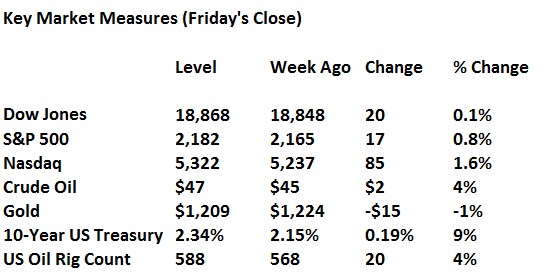
by Todd Shaver | Nov 21, 2016 | Monthly Newsletter Daily 6am if new
The Week Ahead
We finished this week above the fresh all-time highs set just a week ago. But we raise the question - have we come too far to fast? The frenzy seen post- election is seemingly pricing in a lot of good to come from new leadership in Washington. Are expectations reasonable or too aggressive? We note that Caterpillar recently said even if a $1 trillion infrastructure spending bill was passed today, it would take at least a year for projects to start, given the timelines for making the equipment needed. And we haven’t yet passed a $1 trillion infrastructure bill nor have we any clarity about how one would be funded. This infrastructure example highlights one market over-reaction to Trump, which is happening across many more sectors.
Good stock picks can make money in any market. This week we provide some insights on our latest thinking for Under Armour, Tesoro, Facebook, Amazon, and Microsoft.
Highlights From The Past Week
Repatriation. Many people are asking the question - If new leadership in Washington does lower repatriation taxes so that US companies bring home the $2+ trillion currently parked overseas, what will the money be used for?
The prevailing view at this time seems to be that much of the capital repatriated from overseas will be returned to shareholders, via repurchases and dividends. This is good for the stock market and for investors like us. However, we need to keep a close eye on how everything develops. Some are saying if the money just goes to buybacks and dividends rather than capital expenditures, then we won't see the big benefits to job growth and middle class income. There is talk of a flat 10% repatriation tax which should bring billions back to the US, but we’ll have to wait and see!
Fiscal Stimulus. Like Andrew Jackson’s populism, people are saying that we’re going to build an entirely new political movement: It’s everything related to jobs. They will be able to push a trillion-dollar infrastructure plan. With negative interest rates throughout the world, it’s the greatest opportunity to rebuild everything. Ship yards, iron works, new infrastructure projects get them all jacked up. We can just throw it up against the wall and see if it sticks. It will be as exciting as the 1930s, greater than the Reagan revolution. Exciting times! (We shall see.)
Interest Rates. The bond market bloodbath continues. The 10-year US Treasury yield is up a stunning 65 basis points from the Trump-win lows, spiking to 2.35% - the highest since December 2015. In fact, the entire Treasury yield curve is now higher in yield on the year, leaving most of everything newly issued in 2016 now under water. We are going to have to keep a close eye on where rates stand going forward. The cornerstone of fiscal stimulus will be low rates. But if the bond market re-prices rates much higher, the increased interest expense could throw a wrench in gears turning all of the current excitement.
BMR Companies and Commentary
Facebook (FB: $121, up 3% today)
Again, Facebook has found more miscalculated advertising metrics. The company said it has uncovered several more miscalculated metrics related to how consumers interact with content from marketers and publishers, and it unveiled additional independent review of some measurements to calm unease over the their data. An internal metrics audit found that discrepancies led to the undercounting or overcounting of four measurements, including the weekly and monthly reach of marketers' posts, the number of full video views and time spent with publishers' Instant Articles.
Does it matter? Should we be worried? What is the impact?
None of the metrics in question impact Facebook's billing. The only financial impact would be from customer perception about what has occurred, leading to customers shying away from spending money to advertise with Facebook because they have new concerns over these metrics. It is a stretch to go there. Facebook has well over 1 billion users. Just because a few mistakes were made on some back-office tasks doesn’t change how the business model connects advertisers to world. (We are not discounting this issue, but we think the market will perceive it to be a small matter. The company is already working on the PR to reduce the impact on perception.)
Let’s stay focused on what matters. Recall, it was a stellar quarter just recently reported. Facebook's Q3 earnings update that came in better than expected on top line revenues of $7.0 billion versus the $6.92 billion consensus and EPS of $1.09 was ahead of the Street's $0.97 expectations. Daily active users of 1.18 billion and monthly active users of 1.8 billion were both ahead of the Street's expectations as well. Management offered updated guidance on expense growth of 40-45% that was lower than the prior 45-50%. The negative takeaways were comments about decelerating revenue growth and heavy investments in 4Q16 and 2017. Many people think this was just management setting the bar low so they can beat it more easily. We agree.
BMR Take: If the first time miscalculated metrics didn’t shatter the Facebook growth story, we don’t think the second time around will. Clearly an operational mistake we don’t like to see, but we don’t see reason to exit our position in the stock over it. We think the company is set up to deliver better than expected financial results over the next several quarters. Stick around!
And this just in: Facebook will repurchase up to $6 billion in stock (first time they have ever done a stock buyback.) The buyback will start in the first quarter of 2017, using some of their $26 billion in cash. The market liked the news: the stock was up over a $1 in after-hours trading Friday.
BTW, we just noticed that Facebook’s all-time high is the same as Apple’s - $134. We wonder who will get their first. Our guess? Facebook. Why? Smaller market cap - $340 billion vs. $590 billion. Higher growth rate. So now we have two races to watch. Google vs. Amazon is the other. They both closed at the same price Friday. Love it!
Amazon (AMZN: $776, up 3% last week and up $16 today)
The word is CEO Jeff Bezos is telling executives to “Do what it takes to succeed” in India. Amazon fell a little behind in China early and business never quiet was able to recover to be as big as it could have been. Bezos is going on all in on India to ensure the same thing doesn’t happen twice.
Amazon had been India’s #2 ecommerce player. But that has changed. Bezos is now communicating to the market that Amazon has pulled ahead to be #1, with market share estimated around 28%.
India is a huge opportunity for Amazon. India has a population of 1.2 billion with about 40 million online shoppers. Goldman Sachs calls for ecommerce sales in India to grow 10-fold from today’s level of $11 billion over the next decade. And since only about one-third of Amazon’s sales are international, there is tremendous room for growth here. We understand that Bezos is going to invest another $3 billion in June into the India operation, in order to make the business even better. Amazon currently has over 80 million products selling in India. (This is not a misprint.) And they have more than 120,000 sellers, compared to 40,000 sellers a year ago. In June, the company said it will invest an additional $3 billion in India after it exhausted its earlier investment pledge of $2 billion. The company also launched its Prime membership program in July in more than 100 Indian cities, offering one-day and two-day delivery
BMR Take: Amazon’s stock has been down since the latest earnings report. The concern is that they are in a short term cycle of big investment spending. This news of more investments in India certainly plays right into the bearish outlook. Long-term, we think every dollar Bezos spends re-investing in the business will pay dividends later on. In the near-term, we brace for negative sentiment about how profits are being weighed down today due to these investments. Listen, we are not negative on the company nor the stock. We just want to give you both sides of the story. In fact, we think the market will shrug off this news and do what it always does, buy the story of bigger is better, awaiting huge profits in the future. But you never know…
Microsoft (MSFT: $61, up 2% last week)
Goldman Sachs upgraded the stock to Buy with a $68 price target. What’s the story here? Why did they upgrade? What are they now saying? Why is Microsoft all the sudden a buy?
The company got off to a strong start to FY17 as revenue and EPS came in above consensus estimates. The strength was driven by growth of Azure (the cloud business) and adoption of Office 365 (the web version of Office).
Many are now expecting the upcoming quarter to be an inflection point for Microsoft, as the company will complete the sale of its phone business and the acquisition of LinkedIn, signifying the end of the old and the beginning of the new.
We believe the integration of LinkedIn will enhance the value proposition of Microsoft’s entire platform, including Azure, Office 365, and Dynamics. As such, we believe the best is yet to come as we expect revenue growth acceleration and margin expansion ahead.
BMR Take: Glad to see Goldman Sachs come around to support our outlook. What a humbling game investing is. The world’s most powerful investment bank is playing catch up to a little tiny newsletter service out of Aspen, Colorado.
Goldman Sachs (GS: $210, +19% in the past two weeks)
Financials including Goldman Sachs rallied the most this past week. With rates finally rising, a steeper yield curve is good for banking and capital markets. More importantly, plans to roll back regulation are coming, which is huge for all of Financials, as they have had a bad stigma for years under the Elizabeth Warren era of denouncing Wall Street.
The regulatory discussion is currently all over the map right now about what we could see. The end of Dodd Frank? The termination of the Consumer Financial Protection Bureau? No more Volcker Rule allowing proprietary trading (again)? Some even say Glass-Steagall* could be on the table (again). Note that Trump has called for a general guideline of allowing new regulations to be implemented only if they replace two existing regulations. This all amounts to positive implications for Goldman Sachs.
*The Glass–Steagall Act describes four provisions of the U.S. Banking Act of 1933 that limited securities, activities, and affiliations within commercial banks and securities firms.
One more thing to ponder - who will Trump name as Treasury Secretary? The position once held by Alexander Hamilton is considered one of the highest honors in all of Finance for those asked to serve. Rumors are floating that Goldman’s CEO Lloyd Blankfein is possible candidate, as well as CEO Jamie Dimon of JP Morgan Chase.
BMR Take: Goldman is the #1 investment banking franchise. The investment banking business follows a boom-bust cycle. With the sharp rally recently, we are implementing a stop at $196 to protect our gains but we do not want you to miss more upside if the train keeps rolling. We added the stock at $147 in February, so we are up 43% in nine months.
Upcoming Economic News
Tuesday, November 22nd
Existing Home Sales – October
Time: 10:00 am
Forecast: 5.46 million
Existing home sales are projected to be little changed in October with tight inventories constraining transactions. Sales fell 0.4% year-over-year last quarter for the first decline of the past two years. Sharply rising Treasury bond rates will feed through into higher mortgage rates, adding another impediment to existing home sales growth.
Wednesday, November 23rd
Durable Goods Orders – October
Time: 8:30 am
Forecast: 1.0% overall, 0.2% ex transportation
Rising aircraft orders in October following two straight deep monthly declines can lead a strong overall gain in durable goods orders. Industrial demand has shown some recent promise; core capital goods orders increased 5.2% annualized in the third quarter against the previous quarter. Yet that recent burst in activity is tempered by the weak long-term trend; such orders fell 4.1% year-over-year during the same period.
New Home Sales – October
Time: 10:00 am
Forecast: 585,000
New home sales can dip a bit in October yet still point to strong long-term growth. Third quarter sales rose 23% year-over-year, as volumes continued to trend higher from depressed post-crisis levels. Though up substantially on an annual basis, last quarter’s 600,000 unit annualized pace trails the average rate of the past 20 years by 18%.
University of Michigan Consumer Sentiment – November
Time: 10:00 am
Forecast: 91.6
The post-election bounce in the stock market may ultimately feed into somewhat higher readings in consumer sentiment. The preliminary reading in the November Michigan survey was the highest in five months as consumers are reporting improved financial conditions. Renewed declines in oil prices can also spur stronger inclinations to increase spending on other items.
FOMC Meeting Minutes
Time: 2:00 pm
Given the jolt to interest rates and inflation expectations following the election, the minutes of the early November FOMC meeting will be somewhat stale. Yet the general push toward hiking the Fed Funds target in December will likely find additional support in the minutes. The next key question for monetary policy is how much policy tightening is likely in the year ahead. Economic projections released by the Federal Reserve next month will provide crucial guidance on this subject.
Twilio (TWLO: $37) had a good week, rising 17%. We’ve said many times how much we like this one, but the market has been hammering the stock these past few weeks. The turnaround in a week when most Tech stocks were hit hard, is impressive. Again, we think this is a $75 stock if they continue their phenomenal revenue gains that we saw in the past few years, and certainly last quarter. Twilio did $167 million in sales last year, up from $90 million the year before and the company is on a $1 billion annual run rate by the second half of 2018. Can’t wait for next quarter’s earnings. If strong, the stock should get back to the 50s and 60s in no time.
The Energy Corner
North Dakota’s crude-oil production in September dropped to the lowest level in more than two years. Crude production fell 1.1% on the month to 970,000 barrels a day in September, the lowest level since February 2014. North Dakota is home to the Bakken Shale formation, one of the world’s highest-cost oil fields. Growing confidence that crude prices will rise in coming months is sustaining the expansion of oil drilling in the shale patch. Rigs targeting crude rose 19 to 470 this week, the biggest increase in the last 16 months, according to Baker Hughes data reported Friday. Shale drillers have now added 155 rigs since an expansion started at the end of May. Gas rugs were flat, bringing the total for oil and gas up by 20 to 588.
This news just in - the Obama administration on Friday banned offshore drilling in the Arctic, setting a likely collision course with President-elect Donald Trump, who has vowed to “unleash” new energy production in the United States by rolling back restrictions on oil. Great – a new story for us to worry about.
So, US rig count is up sharply, which should produce greater volumes as we move into 2017. This counteracts the move by OPEC to cut production, which hasn’t been approved yet, and may indeed never happen
Interest Rate Corner
Federal Reserve Chairwoman Janet Yellen reiterated that an increase in short-term interest rates "could well become appropriate relatively soon" but offered no new signals about what the central bank will do at its meeting next month.
We are in the camp at The Bull Market Report that a ¼ point rise is baked in for December. Of course, she could surprise us with a ½ point rise, which would probably tank the markets like what happened last December. We hope she maintains some sense here. The 10-year Treasury note has exploded, from a low of 1.37% in July to 1.80% before the election to 2.34% Friday.
Tesla Update: It’s official: Tesla (TSLA: $187, down 2% last week) shareholders approved the acquisition of SolarCity. The company is now an unequivocal sun-to-vehicle energy firm. And Chief Executive Officer Elon Musk didn’t take long to make his first big announcement as head of this new enterprise. Minutes after shareholders approved the deal - about 85 %of them voted yes - Musk told the crowd that he had just returned from a meeting with his new solar engineering team. Tesla’s new solar roof product, he proclaimed, will actually cost less to manufacture and install than a traditional roof - even before savings from the power bill. “Electricity,” Musk said, “is just a bonus.”
If Musk’s claims prove true, this could be a real turning point in the evolution of solar power. The newly announced rooftop shingles are made of textured glass and are virtually indistinguishable from high-end roofing products. They also transform light into power for your home and your electric car.
“So the basic proposition will be: Would you like a roof that looks better than a normal roof, lasts twice as long, costs less and - by the way - generates electricity?” Musk said. “Why would you get anything else?” On a large house over a long period of time, the value of that electricity could exceed $100,000. The new roofing material he unveiled this past week is considerably cheaper, and it's considerably more promising for the future of rooftop solar power.
We love Musk. He never ceases to amaze and shock. Can he pull this off? Will he have enough cash to make it work? We think yes. But again, this stock could hit $150 before it hits $250. Volatile!
Goldman Sachs Maps Out Its Top Market Themes for 2017
They're heavily influenced by President-elect Trump.
Goldman Predicts: U.S. recession risk remains low in 2017
Goldman released its top 10 market themes for next year. "High growth, higher risk, slightly higher returns," is how their strategists view the year ahead - and it's clear that their outlook has been heavily influenced by the pending regime change in Washington.
Here's a brief summary some of the themes Goldman sees as forming the backdrop for investing in 2017. All thoughts and comments are for Goldman.
Expected returns: Only slightly higher
Relative to its 2016 forecasts, Goldman says owners of financial assets can reasonably able to expect more upside - but stresses that these returns will still likely remain low. The best improvement in the opportunity in global equities is in Asia ex-Japan, where we forecast returns of 12.5% (versus 3.8% for 2016.) At the other end of the equity spectrum, in Japan we are forecasting declines of 3.7% on the Topix (vs. +5.2% for 2016).
U.S. fiscal policy: A pro-growth agenda
President-elect Donald Trump's focus on infrastructure spending during his victory speech on Nov. 9 - rather than trade protectionism or immigration restrictions - catalyzed the risk-on sentiment that's pervaded markets.
Markets are starved for growth
This is plainly visible in the eagerness with which markets seized on Trump’s growth-focused message. It is also visible in the speed with which the market’s narrative on the economic outlook under Trump has shifted from uncertainty to growth. Fiscal stimulus in the U.S. will help reflate the economy, and stands a good chance of passing through Congress.
U.S. trade policy: Concerns are likely overdone
Goldman doesn't see an imminent trade war on the horizon, and expects any re-negotiation of agreements currently in place (like NAFTA) to focus on attempts to improve the prospects for the U.S. manufacturing sector. We think the popular media narrative on the downside risk of a trade war is overstated. Our tentative view is that Trump’s use of punitive tariffs will be just as pragmatic as President Obama’s, albeit more vocal.
Emerging markets risk: “Trump tantrum” is temporary
Emerging market assets have been crushed since the election, as the rise in Treasury yields has reduced the need to reach for yield overseas, and the potential for protectionist trade policies threatens to curtail growth opportunities.
Monetary policy: Focusing the toolkit on credit creation
Better-targeted monetary stimulus could help avoid some negative side effects associated with quantitative easing and negative rates that inhibit credit creation.
Corporate revenue growth recession: Signs of inflection
For years, S&P 500 companies have exceeded analysts' expectations on the bottom line more often than the top line during quarterly earnings seasons, as a combination of cost-cutting and shrinking share count, rather than soaring sales, fueled the growth in earnings per share. However, Goldman expects 2017 to confirm that the U.S. corporate sector has emerged from its recent 'revenue recession.' A firming global economy and recovery in oil prices from their February lows significantly buoys the outlook for revenue growth stateside.
For 2017, Goldman expects that modest improvements in the macroeconomic backdrop will help lift S&P 500 operating EPS by 10% and they have a year-end S&P 500 target of 2200, currently 2180 now. [Not terribly exciting if you ask us. We differ. We don’t normally predict, but we would certainly be looking for 2300 or 2400.]
Inflation: Moving higher across developed markets
Market-based measures of inflation expectations in the U.S. have spiked since the election, as traders bet that Donald Trump will be the inflation president.
What seems clear to us, as argued above, is that economic issues, notably tax cuts, infrastructure spending and defense spending, are high on the agenda - a recipe for reflation. We are forecasting large boosts to public spending in Japan, China, the U.S., and Europe, which should fuel inflationary pressures in those economies.
The next credit cycle: Kinder and gentler
While commodity-sensitive segments of the credit market have suffered pain in 2016, there hasn't been much in the way of contagion. Goldman's team expects more of the same in 2017, with the credit cycle not making a turn for the worse. The strong ‘business cycle’ component in the behavior of high yield defaults, and our view that U.S. recession risk remains low in 2017, leave us comfortable with the view that the inflection point is unlikely to materialize next year, despite the weak state of corporate balance sheets.
Mortgage Rates Surge After Election
Here is some news on the state of the mortgage market. Mortgage rates surged after the election win of Donald Trump. But housing experts say consumers shouldn't get carried away by the post-election wave. The advance of the past week or so, stoked by a surprise victory that turned economic expectations on their head, could soon settle.
"Consumers considering buying or refinancing now should stay patient, as we'll likely see rates stabilize once markets find a new equilibrium," says Zillow, the mortgage rate real estate company.
In the week ended Thursday, the average rate on the 30-year fixed-rate loan jumped to 3.94% from 3.57% the previous week, mortgage company Freddie Mac reported. A year ago the market was at 3.97%. The average for a 15-year mortgage climbed to 3.14% from 2.88%
The High Yield Corner
We have seen our first full post-Trump trading week, and it wasn’t bad. Actually, things were impressive considering the expectations and last week’s bull run. The S&P 500 rose nearly 1% by the end of the week, but the really interesting story is the difference between different stock groups. Large caps underperformed small caps significantly - this has a lot of important implications for high-yield investors, so is worth a closer look.
The Dow Jones Industrial was pretty much flat last week, while the Russell 2000 went up 2.6%. The difference between these two is the result of different trends between different investors: the risk-averse are more worried than the less risk-averse, who are willing to give small caps a chance in the hopes that they will deliver the higher-than-big-cap returns that they gave in the past. This has pushed small caps up to a 17% year-to-date return after rising 8% in the last month.
But here’s the really interesting part: the Dow Jones is up 10% year-to-date after a 4% return over the last month. The S&P, however, is up 7% year-to-date after rising 2% in the last month.
What this means is that risk appetites have grown in the last month while the more cautious are less eager to jump into the Trump rally. They aren’t avoiding it, but they aren’t going into it as much as the more risk-tolerant investors. In other words, we’re having a growing disagreement about future risks with the economy as a whole.
This is not uncommon, but wasn’t the case earlier in 2016. Both large caps and small caps had similar high returns for much of 2016 - and now that convergence is subsiding.
This is important for high yield investors for two reasons. First, junk bonds and BDCs tend to trade closely with small cap stocks as they attract similar investors: risk-tolerant institutions. Second, a market where the risk-averse are more cautious and the risk-hungry are less so often portends a bubble followed by a crash. That is not in the cards quite yet, but it does make one wonder if the industries getting a big boost - Financials in particular - might get overbought if they haven’t already.
With this as our backdrop, let’s take a look at how each asset class performed in the last week and why:
REITs - Initially REITs were the hardest hit by Trump’s victory on fears that his spending plans would kickstart inflation and thus increase REITs’ borrowing costs. This remains a concern, as the U.S. Treasury 10-year keeps going higher, but we’ve finally gotten to a point where the risks are priced in. Fortunately for REITs they already began correcting before the election, so this week’s return was just barely green, according to the SPDR Dow Jones REIT ETF (RWR: $89. Flat).
Results for individual REITs varied, but our picks did OK. Kimco Realty (KIM: $26) rose slightly, Digital Realty Trust (DLR: $90) rose over 1%, Omega Healthcare Investors (OHI: $28) was flat, Care Capital Properties (CCP: $24) rose 4%, and Government Properties Income Trust (GOV: $18.90) rose less than 1%. We also added a new REIT to our portfolio: Ventas (VTR: $60), which rose 2% this week. Ventas is one of the few REITs that is up year-to-date in the Healthcare space: rising 6% so far this year, but its price-to-FFO ratio and growth potential make it extremely attractive.
Junk bonds - The corporate bond market is now dominated with changing inflation expectations. Love him or hate him, but the market believes Trump is going to cause inflation to accelerate. This isn’t a testament to his failures or abilities, however; much of these expectations are the end result of the Fed’s constant efforts to improve inflation rates and a time when low oil prices and high supplies are priced in. There are many reasons beyond Trump to think inflation will not stay low forever, and having a president in the office (whoever it may be) who is focused on rising inflation with a House and Senate that will work with him, almost seems a perfect formula for rising inflation.
That is why junk bonds have done particularly badly after Trump, but the real surprising thing is that they didn’t do poorly for longer. Last week the SPDR Barclays High Yield Bond ETF (JNK: $36) rose over 1% and is now up 5% from the beginning of the year. Yet the fund has a near 7% dividend yield that is far higher than it has been in recent years. This is partly because of expectations of a rate cut for the fund*, which has happened in the past, so it’s important to keep in mind the more actively managed alternatives that aren’t tied to an index** and thus have more flexibility to ensure payouts remain constant. Note that the ETF recently registered $342 million asset inflows for a 3.15% increase.
*JNK's distribution cut is expected because the BofA High Yield index has fallen. Since JNK tracks that, its distribution should fall too.
**Active funds like PDI vs. passive indexing funds like JNK. In other words, “alternative funds that are actively managed" makes that clearer.
Our pick to take advantage of this strategy remains Pimco’s Dynamic Income Fund (PDI: $27), which had a nice 4% gain this week to offset last week’s massive decline. The fund is still down over 4% from a month ago which means it is poised to improve in recent weeks. The fund is also now flat year-to-date with a near 10% dividend and a looming special dividend that we believe will be at least 3%. That turns this fund into a 13% dividend payer with a sustainable dividend. That is almost impossible to find in the market (we know as we’ve looked for more, but Pimco’s fund seems to be it!)
Municipal bonds - Rising interest rates are a problem for all bonds, but they are actually worse for corporate bonds than municipal bonds because of the risks and the way these are structured. Yet looking at the municipal bond world lately, you’d think it’s the riskiest asset in the world. The iShares National Municipal Bond ETF (MUB: $108) fell 1% this week and is down 3% over the last month. The ETF is also down 2% for the year, making municipal bonds one of the few asset classes that has had negative returns for the year.
We have been wary of municipal bonds this year because of their massive run-up before the summer and rate hike concerns. We don’t believe rate hikes directly are a drain on municipal bonds, but fears about rate hikes often overshoot the real risks and cause a big and prolonged selloff. We saw this in 2015 and have seen this to a lesser extent this year. This is why we have only recommended one municipal bond fund this year: the Nuveen Enhanced AMT-Free Municipal Credit Opportunities Fund (NVG: $14:04). The fund is down 2% over the last week and is down 3% year-to-date. The most shocking figure is the three-months metric: the fund is down 14% in that time.
We expect these massive declines to reverse, but it is going to take a while for that to happen and it is difficult to time. While municipal bonds are already oversold, that does not mean the market knows they are oversold, and they can go down even lower. Nuveen’s fund is a good long-term hold and we expect it to hold its NAV for the long term, as it has done for over a decade already. However, we also expect greater volatility to hit this and all municipal funds. Anyone wishing to invest in munis now will have to endure these short-term price declines with patience, buying more as the stock goes down.
From one extreme of the risk/reward spectrum to the other, let’s turn to BDCs. The UBS BDC ETF (BDCS: $22) rose over 1% over the last week and has had a somewhat strong showing after the Trump election. While BDCs aren’t going up nearly as much as Financials, they are both rising for the same reason: an expectation that deregulation is going to cause credit to flow and the Financial sector to boom. BDCs cannot help but benefit from this, so they are rising with the Financial sector. However, they are not rising from an extreme bottom as Financials are, so the asset class’s 2% monthly return is a fraction of the double-digit returns of the Financial sector as a whole. This is unlikely to change.
At the same time, we have finally gotten to a point where Main Street Capital (MAIN: $36.50) has gotten overbought. The BDC is now up 16% from when we recommended it in April after rising 8% in the past month alone. We waited for this week’s dividend distribution to see if the stock would fall further after the payout, but it hasn’t; in fact the stock is up over 1% after its recent payout. That now means Main Street is selling at a 70% premium to its net asset value and it has passed our target price. We are keeping our price targets on Main Street, which means recommending selling at these levels and waiting for the price to correct before jumping back in. Main Street remains an excellent firm with impressive advisors and the capability to increase dividends for a long time, but the cost of that expertise and growth potential is too high now. We will buy again when the stock is more fairly priced.
Good Investing,
Todd Shaver, Founder and Editor in Chief
The Bull Market Report