November 5, 2017

by Todd Shaver | Nov 5, 2017 | Weekly Newsletter 7pm Sunday
The Weekly Summary
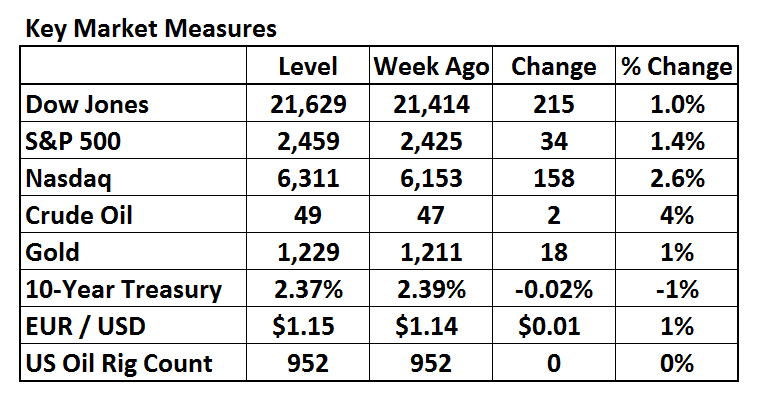
US equities ended higher this week, again! Major indexes ended at their best levels in history. Economic data, earnings, M&A and the recently released House tax plan grabbed most of the attention. Tech and Healthcare were the best performing sectors. There was lots of focus on the recently released House tax plan. As expected, backlash has heated up quickly, particularly when it comes to who get the benefits of new incentives between the super-rich and the middle class. The tax bill is not expected to survive in current form and some focus is already shifting to the Senate’s revisions.
In terms of other developments surrounding Washington, Trump said "We'll see" if Secretary of State Tillerson makes it through his term. Jay Powell was named by President Donald Trump as his nominee to serve as the next chair of the Federal Reserve, as he moved to make his mark on the world’s most powerful central bank. The news ends months of speculation ahead of the end of Janet Yellen’s first term as chair in February. The 64-year-old Mr. Powell has been a serving Fed governor since 2012. A centrist on monetary policy, he is known as a pragmatic and down-to-earth official with private sector and government experience. A trained lawyer and former partner at private equity firm Carlyle Group, he also served in the Treasury under former president George H. W. Bush in the 1990s. Powell is worth upwards of $50 million.
Consumer Confidence hit a 17 year high. Are you confident in this bull market? Good. We are too. And again, if you want to cash in some chips and buy some REITs and some high-yield stocks, we have two fabulous portfolios loaded with stocks that are paying 4%, 6%, 8% and 10%. But we are sticking with our Tech stocks, especially FAAMG stocks – Facebook, Apple, Amazon, Microsoft and Google. Their combined market cap is $3.3 trillion. We’re looking for $4 trillion next year. With Apple at $890 billion now, we could see them be the first trillion dollar company in history. (That price would be around $194 – not too far away.)
No matter what is happening out there, there is always a bull market here at The Bull Market Report! This week we highlight some of our favorite stocks where we know you can still make good money, including: Facebook, Microsoft, Home Depot, CBRE Group, Tesla, and Apple.
BMR Companies & Commentary
Facebook (FB: $179, up 0.5% - all % changes are for the week)
Facebook reported revenue of $10.3 billion compared to just $7.0 billion last year. EPS was $1.59 versus $1.09 last year. Revenue beat expectations by nearly 5% and EPS was a big $0.31 ahead of the consensus.
Wow.
“Our community continues to grow and our business is doing well," said Mark Zuckerberg, Facebook founder and CEO. "But none of that matters if our services are used in ways that don't bring people closer together. We're serious about preventing abuse on our platforms. We're investing so much in security that it will impact our profitability. Protecting our community is more important than maximizing our profits."
The majority of analysts were bullish on the report. Facebook continues to grow at an impressive rate with strong profitability as gross margin was way better than expected. User engagement continues to increase and is helping drive demand and in turn pricing. One of the more negative data points brought up was how duplicate accounts now compromise 10% of global monthly active users, but nonetheless both monthly and daily active users came in slightly ahead of consensus expectations.
BMR Take: Facebook remains the greatest advertising machine the world has ever known. With consensus EPS forecasts of $5.80 this year heading to $10.00 by 2020, this stock remains a compelling value.

A 1-year Chart for Facebook
+++++++++++++++++++++++++++++++++++++++++++++++++++
Microsoft (MSFT: $84, flat)
We love to see marquee deals and partnerships. They are symbolic signs of a vibrant business.
Microsoft and United Technologies (UTX: $121 - $97 billion market cap), a major industrial company, on Wednesday announced a strategic agreement that will create a differentiated customer and employee experience using intelligent technology innovation.
United Technologies builds and services millions of products in the field, from elevators in some of the world's tallest buildings, to engines and aerospace equipment in the skies, to commercial products that power smart buildings. Leveraging Microsoft Dynamics 365 and Azure, United Technologies intends to empower employees globally with the digital tools and information needed to support customer interactions for faster, better and more personalized service.
"United Technologies is a global leader in the aerospace and building industries and has a deep commitment to innovation," said the executive vice president, Worldwide Commercial Business, Microsoft. "The combination of United Technologies’ customer service expertise together with Microsoft's intelligent cloud will provide a digital business model for United Technologies businesses across multiple industries."
BMR Take: One of the reasons we see so much upside ahead for Microsoft is the breadth of their customer base that includes so much of the Fortune 500. This deal with United Technologies is just a reminder that Microsoft can sell the right product into this customer base with ease. Recall that earnings expectations were recently reset much higher by most analysts, calling for upward of $5.00 of EPS, which supports this stock heading much higher.

A 1-year chart for Microsoft
+++++++++++++++++++++++++++++++++++++++++++++++++++
The Home Depot (HD: $164, down 2%)
Don’t fret about Home Depot being down a bit this week. There was some chat that concerns about e-commerce have driven down the valuations of some retailers, and that short interest in the six largest brick-and-mortar retailers is currently higher than the levels hit in 2008 during the throes of the economic downturn. This impacted Home Depot’s stock this week.
There was also chat about how management teams at a number of beaten-up retailers are buying back shares, and that the economy should keep consumers shopping during the holiday season. So the world is not coming to end this year.
In other news, while online competition may be pressuring some retailers to hire fewer seasonal workers this holiday season, staffing firms suggest the problem is deeper, with prospective employees seeking more flexibility with their schedules, training, and pay. This could cause some more ongoing headline news that negatively impacts Home Depot.
BMR Take: Home Depot is a bellwether of industry. In such cases, these types of stocks are more susceptible to the large macroeconomic factors as opposed to company specific fundamentals. Stay focused on the latter. Home Depot is due to report EPS of $7.25+ this year heading to around $10.00 by 2020. Earnings power ultimately drives stock prices and we expect that to happen here. Can you believe this company is worth almost $200 billion? $170 a share will do it!

A 1-year chart for Home Depot
+++++++++++++++++++++++++++++++++++++++++++++++++++
CBRE Group (CBG: $40, up 1%)
CBRE reported revenue of $3.6 billion versus $3.2 billion last year. EPS was $0.64 versus $0.50 a year ago. Revenue was about $100 million above the consensus estimate. EPS beat expectations by $0.07. The strength in the quarter was expected to be maintained as the company raised its full year EPS guidance up by $0.05. Awesome quarter!
The strength of performance in Q3 was broad-based. Each of the company’s three global regions produced solid organic growth. Leasing returned to double-digit growth, and was especially strong in the U.S. Revenue growth accelerated in outsourcing business, as the company continue to capitalize on its commanding position in this growing sector. Global property sales saw healthy growth, despite a generally tepid market for transaction activity, reflecting the strength of the company’s brand and ability to take market share. Finally, the business also delivered excellent performance across all of their real estate investment businesses.
BMR Take: With the business closing in on $3 of EPS, we think the current stock price undervalues this leading franchise. CBRE is the ‘Mercedes Benz’ of the real estate world. Own this one for the long-haul!
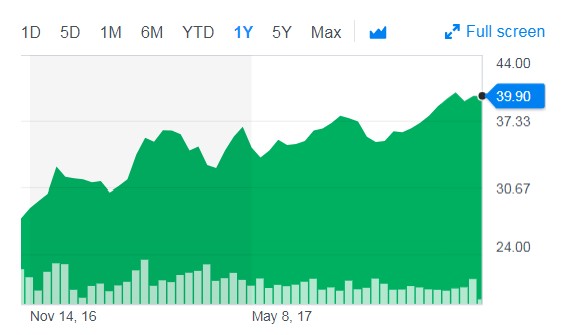
1-year chart for CBRE
+++++++++++++++++++++++++++++++++++++++++++++++++++
Tesla (TSLA: $306, down 5%)
Tesla reported revenue of $3.0 billion versus $2.3 billion a year ago. EPS was -$2.92 versus +$0.71 a year ago. Revenue barely beat expectations but earnings were much worse than expected. Ouch!
Tesla is one of the most closely watched tech companies in the world, where its zero-emissions vehicles resonate with environmental sensibilities. But with that scrutiny has come a great deal of criticism over labor issues in its plant, along with customer complaints about materials and workmanship, and frequent production delays with all of its vehicles.
Analysts were quick to jump on the per-share losses and problems getting the entry-level Model 3 sedan to market. Though Tesla is promising more Model 3 production in 2018, 2017 has been a miss to this point in terms of model production. Of note is Tesla pointing to difficulties in producing the battery packs at the Gigafactory for the vehicle. On a brighter note, Model S and Model X demand still seems to be doing well, but the fact remains that Tesla is still burning cash and needs to right the ship with Model 3 in order to succeed.
BMR Take: Tesla is set to lose over $3 per share this year. But the 2020 consensus forecast is for great than $11. Somewhere here we expect a major swing to profitability. With a brand that stands for innovation, we can see Tesla emerging to become a cherished stock once the profits start rolling in. Speculative? You bet. But we love that buy Musk.
+++++++++++++++++++++++++++++++++++++++++++++++++++
Apple (AAPL: $173, up 6%)
Apple delivered $53 billion of revenue versus $47 billion a year ago. EPS was $2.07 versus $1.67 a year ago. It was a really good quarter for Apple.
In a quarter which many thought would be more subpar due to delayed shipments of the iPhone X and due to many reports indicating weaker than expected sales of the iPhone 8, Apple delivered results that were much better than expected, and it is guiding for a generally strong next quarter as well.
iPhone sales of 47 million grew by 3% from a year ago and were slightly above consensus of 46 million. We saw strong and accelerating growth in services (up 24% from last year). Apple’s Services revenue of $8.5 billion is heading towards $50 billion annually. We observed good growth in China and strong growth in emerging markets (with India more than doubling). iPhone X is about to ramp in sales helping the average selling price. The iPhone X, with a price of $999 to $1,149 (vs. Apple’s blended price of $618 last quarter) becomes available this week, and we expect iPhone average selling price to increase to over $700. We could go on and on.
BMR Take: We reiterate our strong enthusiasm for Apple that we had before the quarter now that the results are in. EPS was $9.20+ this year and heading to greater than $11 next year. With cash and equivalents now totaling $270 billion, wow, this company remains as solid as a rock!
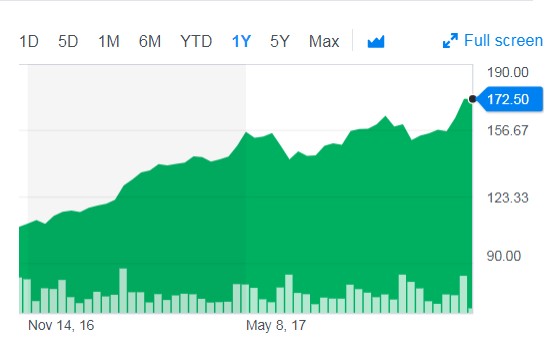
1-year Chart for Apple
+++++++++++++++++++++++++++++++++++++++++++++++++++
+++++++++++++++++++++++++++++++++++++++++++++++++++
Upcoming Economic News
JOLTS Job Openings
Tuesday, November 7th, 10:00 AM, Eastern
Period: September
Consensus: 6,082,000
Prior: 6,082,000
Initial Claims
Thursday, November 9th, 8:30 AM
Period: Week of 11/4
Consensus: 230,000
Prior: 229,000
Michigan Sentiment (Preliminary)
Friday, November 10th, 10:00 AM
Period: October
Consensus: 100.2
Prior: 100.7
+++++++++++++++++++++++++++++++++++++++++++++++++++
Eli Lilly ($87, flat)
Solidity Personified
If you want solidity and stability you can get it here. Eli Lilly and Company was founded in 1876 and is headquartered in Indianapolis. The company is worth $87 billion, pays a 2.5% dividend and has moved from $20 in 2008 to its current level, in a pretty straight line. Revenues are solid too. Revenues had a nice bump from the $20 billion in 2015 to the 2016 total of $21.2 billion. This year looks like $23 billion is in the bag. Slow and steady. And profitable. $2.7 billion ($3.00 a share) to the bottom line after taxes in 2016 up from $2.4 billion in 2015. Not counting some non-recurring charges this year, the company should hit north of $4 billion before tax and about the same as last year in 2017. Solid.
The company is in two primary areas of pharmaceuticals: Human Pharmaceutical Products and Animal Health Products. The company offers products to treat diabetes; osteoporosis in postmenopausal women and men; human growth hormone deficiency; and testosterone deficiency. It also provides neuroscience products for the treatment of depressive disorders, diabetic peripheral neuropathic pain, anxiety disorders, fibromyalgia, and chronic musculoskeletal pain; schizophrenia; attention-deficit hyperactivity disorders; depressive, obsessive-compulsive, bulimia nervosa, and panic disorders; and adult brain imaging. In addition, the company offers products to treat non-small cell lung, colorectal, head and neck, pancreatic, metastatic breast, ovarian, bladder, and metastatic gastric cancers, as well as malignant pleural mesothelioma; and cardiovascular products to treat erectile dysfunction and benign prostatic hyperplasia; and migraine headaches. And this is just a small part of what they do for humans. They do similar things for animals and are noted for their science and expertise. Plus they have collaboration agreements with Daiichi Sankyo, Incyte, Pfizer, AstraZeneca, William Sansum Diabetes Center, Purdue University, and Nektar Therapeutics. Truly a worldwide leader in big pharma.
BMR Take: This amazing company should hit another $3 a share in 2017, giving the firm a PE of under 28. We expect the company to hit the $4 level in a few years and wouldn’t be surprised to see the stock in the 90s within two years. Solid as a rock.
+++++++++++++++++++++++++++++++++++++++++++++++++++
Amazon’s Jeff Bezos Sells Shares
Jeff Bezos sold 1 million shares of Amazon (AMZN: $1112, up 1%) this week for $1.1 billion. The sale represented 1.3% of his holding and leaves Bezos with a 16.4% stake in the company. The world’s richest man said in April he would sell $1 billion a year in Amazon stock to fund Blue Origin, the rocket company he owns to explore Mars and outer space. He had already sold another batch of a million shares in May. So that’s 2 million shares in our book.
+++++++++++++++++++++++++++++++++++++++++++++++++++
From: Ron Shepro [ronshepro@xxxzz.com]
Sent: Tuesday, October 24, 2017 8:50 PM
To: 'The Bull Market Report'
Subject: RE: EARNINGS PREVIEW FOR THE WEEK AHEAD
Hi Todd – I Just wanted to say thanks for your good work. I find it interesting that Paul Mxxxxxx (a money manager), comes up with new recommendations that you had ages ago. Latest one being Splunk (SPLK: $68, up 1.5%). Looks like you are ahead of the legends. There are more, but I am sure you are aware of them. You also made the call on Paypal earlier.
Our Answer: Thanks, Ron. I think we have a fine little financial newsletter here. We just need another 5000 subscribers! We’ve had some nice wins with Nutanix, Square, PayPal as you mentioned, and CBRE (CBG) – the quiet real estate company.) And of course Splunk, which we added at $46.
Good Investing,
Todd Shaver
+++++++++++++++++++++++++++++++++++++++++++++++++++
A Word from Gary Jefferson
Jefferson Financial Group
First Vice-President, Investments
UBS Financial Services
After the week before "melt-up", we noticed that the fear factor kicked up another notch. This past weekend, media pundits again started making comparisons to the March 2000 crash. Back then it was referred to as either the dot.Com bubble or the Tech Wreck. But there are some differences that should be noted. In 2000, the PE of the S&P 500 was about 30X, and many tech stocks had PE's in the triple digits or no PE's at all because they didn't even have revenues yet, much less earnings. Today's trailing PE is estimated to end the year somewhere in the area of 18X. This is higher than average, but not nearly as frothy as the 2000 period.
The question now becomes, "With this being the second longest and second biggest bull market in history, and with valuations as high as they are, can stocks keep climbing?" The easy answer is "yes", and the reasons are readily apparent. We have a strong economy and it is getting stronger. It is not just the US economy either – most major world economies such as Europe, Japan and China are also experiencing solid economic growth. Thus, we are part of a worldwide bull market, which makes it much easier on the US market.
More importantly, earnings are still getting stronger rather than leveling off or declining. According to Thomson Reuters, earnings growth for the third quarter is now 6.7%. Of the companies that have posted earnings, 74% have topped expectations - compared to the 72% average that beat expectations over the past four quarters. Good earnings growth is the key reason stocks can and should continue to climb higher. And, any tax reform will make it all the more likely that earnings growth will continue to be robust for the next year or two.
We also have history on our side. In the year after reaching a new peak, the S&P 500 has had positive growth 72% of the time. (Bloomberg) We would, however, caution investors that the bar is much higher today than it was over the past several years, and therefore the pace of growth may not be as rapid or the returns as high as we have experienced over recent years. In our experience, "euphoria" has never been a part of any successful investment strategy.
+++++++++++++++++++++++++++++++++++++++++++++++++++
The High Yield Corner
By Michael Foster
Obviously, the biggest news of the week for high yield investors came from Omega Healthcare Investors ($28), which fell massively on an earnings and revenue miss. The stock immediately fell over 3% on the news and has been falling further, causing a stock that was flat year-to-date to suddenly be down 7%. Panic selling also means the dividend yield has risen to 9.2% - a level we haven’t seen since 2011. Note that the company paid out a 65 cent dividend on Monday. So it really wasn’t as bad as it seemed.
This sounds like a time to sell, but it really isn’t. When we take a deeper look at the earnings result, we quickly see why.
The company reported a 2.2% decline in revenues on a year-over-year basis and a near 5% decline in FFO per share for the same period. This was all due to a $6.3 million loss in FFO, which was itself the result of late rent payments from the company’s biggest tenant, Orianna Health Systems. The story is pretty complicated, but it means that Omega Healthcare and Orianna are going to need to renegotiate their current arrangement, which could mean Omega cutting their rent down (this would be the best case), or an outright bankruptcy that results in Omega fighting for their back payments in court (the worst case).
If they are able to reduce rents, it could mean Orianna will start paying their bills again and FFO will start to trend upwards. And even if we are stuck with a bankruptcy proceeding, Omega will still get some money back, but predicting how much and when would be impossible (anyone who has ever been through America’s civil court system knows rulings can get pretty bizarre).
So what we are facing now with the stock, following Omega’s write-down of Orianna, is the worst situation. There is upside in either the best or worst case, but the amount of upside will depend on which route they go and how fast a deal is made. For now, Omega Healthcare’s dividend coverage has taken a hit - there’s no denying that. With the decline in earnings, the dividend is now only covered by… 130%.
That’s right. What we are looking at right now is a REIT yielding 9% that still has 130% dividend coverage. That’s at the bottom end of what’s ideal for REITs in our mind (regular readers know we look for 130% dividend coverage for REITs as the starting point for a safe yield), and that’s more than compensated by the 9% dividend yield.
It also means that a dividend cut is really unlikely to happen anytime soon. Omega Healthcare has established a track record of penny-per-quarter dividend increases, and if it continues that trend for the next year, its dividend coverage will fall to 128% by the end of next year, assuming no increase in earnings.
Do we think Omega will be able to continue its penny-per-quarter dividend increases forever? No. But we do think it can continue this trend for the next five years at the very least. But with the latest price drop, the market is pricing in the company stopping these increases much sooner. The market will probably realize the error of its ways pretty soon. Maybe next quarter when Omega shows stability or improvements, the market will buy in again. Maybe it’ll take a few quarters until Omega and Orianna reach a deal and the market realizes their fears were overblown.
Either way, now’s a great time to buy a 9% yielding stock with 130% dividend coverage.
Let’s move on to other news - there was a lot last week.
Digital Realty (DLR: $119, up 2%) announced another dividend (the December one) at a 93 cent per share distribution, in-line with the previous payout. This is not good. As we’ve written about frequently, we want Digital Realty to increase distributions because of their exploding FFO, which is far ahead of the dividend. But we understand why the company sees no need to give shareholders a pay raise quite yet - the stock has rebounded about 3% off its post-earnings low, so demand for the stock is definitely still there.
That, by the way, is why investors should continue to hold Digital Realty. There is tremendous value here, and the recent price dip was a buying opportunity - not unlike the more recent dip in Omega.
In other earnings results, Apollo Commercial Real Estate Finance (ARI: $18.35) saw NII jump 34% from a year ago, above expectations. This is pretty impressive, because expectations have heated up for this specialty mortgage REIT, and its stock price has soared in recent months accordingly. But the company is not running out of deals to make, with $425 million in new investments in the recent quarter, bringing the annualized deal flow to $1 billion by the end of the year. Also, last quarter’s dividend coverage ratio was a nice 117%. Keep in mind that coverage ratio thresholds are different for mREITs compared to property REITs. Because of their use of bond spreads to make a profit and their lack of dividend growth, lower coverage ratios are to be expected. And from a mREIT perspective, 117% is nice.
The stock got a slight price bump after the results, but nothing major. That was no surprise - the market has had high expectations for this firm for a while.
Finally, another REIT reported earnings last week: Government Properties (GOV: $18.43, up 2%), which beat on revenues thanks to a near 9% year-over-year increase, but FFO was a penny shy of expectations. That’s really too small of a miss to matter, especially since the market has discounted poor earnings for months now. So the stock actually went up over 1% following the release and over 2% for the week. We still need to see dividend coverage improve, but there is fundamental stability which indicates this remains an attractive 9% yielder.
Good Investing,
Todd Shaver, Founder and CEO
The Bull Market Report
Since 1998
August 24, 2017
by Todd Shaver | Aug 24, 2017 | 3pm News Flash
Splunk (SPLK: $61)
Bull Market Report Target Price: $75
Bull Market Report Sell Price: $60
Earnings Date: Thursday, 4:00 PM ET
Consensus: 2Q17
Revenues: $270 million
EPS: $0.06
Year Ago Quarter Results
Revenues: $213 million
EPS: $0.05
Key Things to Watch For in the Quarter
Splunk is expected to report a 26% increase in revenues and a 20% increase in earnings per share for 2Q17. Splunk has beaten estimates in each of the past four quarters, and we expect them to uphold this trend as they have been able to consistently increase their sales 25% in previous quarters. As one of the largest providers of software solutions that enable organizations to gain real-time operational intelligence, Splunk is likely going to grow alongside the large corporations that use their products.
----------------------------------------------------------------------------------------------------------------------------------------------------
VMware (VMW: $101)
Bull Market Report Target Price: $108
Bull Market Report Sell Price: $90
Earnings Date: Thursday, 5:00 PM ET
Consensus: 2Q17
Revenues: $2.0 billion
EPS: $1.15
Year Ago Quarter Results
Revenues: $1.8 billion
EPS: $0.97
Key Things to Watch For in the Quarter
Wall Street expects VMware to report a 12% increase in revenues and an 18% increase in earnings per share for 2Q17. VMware has beaten estimates in each of the past four quarters, contributing to its 35% year-over-year appreciation. Insiders at the firm still own 20% of the company indicating their confidence and vested interest in the performance of the stock. Despite slight overvaluation at the moment (PE of 33), our long-term vision for VMware is extremely bullish. With a market cap of $41 billion, this is no small company. In fact, they are changing the cloud world through their innovative software. Sitting at a new 10-year high today as we write this, they are operating with almost $9 billion of cash, and just $1.5 billion in long term debt.
July 17, 2017
by Todd Shaver | Jul 17, 2017 | Monthly Newsletter Daily 12pm if new
The Weekly Summary
Billionaire CEO of JP Morgan Chase Jamie Dimon says being an American abroad is “almost an embarrassment.” The rant came on JP Morgan’s widely followed earnings call held Friday. Dimon says the media should focus more on major issues. He doesn’t like listening to the “stupid stuff” Americans have to deal with, expressing frustration over the nation’s inability to invest in infrastructure and overhaul the tax code. There would be much stronger growth if there were more intelligent decisions and less gridlock. Reporters should focus on the major issues the nation faces rather than the vagaries of the firm’s trading businesses, he said. The United States of America has to start to focus on policy which is good for all Americans, and that is infrastructure, regulation, taxation, education. He screamed, “Why you guys don’t write about it every day is completely beyond me. And, like, who cares about fixed-income trading in the last two weeks of June? I mean, seriously.” Dimon is one of the best businessmen in America and his words are known for being the hard truth. It makes sense to us that for the bull market to continue our citizens must wake up to the realities we face and take actions.
There is always a bull market here at The Bull Market Report! This week we highlight the following stocks: PayPal, Splunk, Microsoft, and Tesoro.
Highlights From The Past Week
US Bank earnings season started on Friday. Q2 earnings season for the banks kicked off on Friday morning with results from JP Morgan, Citigroup, Wells Fargo and PNC Financial. Some analysts have highlighted a more difficult setup for the group following a June rally on the back of higher bond yields and capital return announcements that beat elevated expectations. There have also been thoughts that earnings season could shift some of the focus back to the more challenging operating environment for the group. However, there really did not seem to be any meaningful discussion about downside risk to estimates. Analysts seem to be looking for the bulk of the support for Q2 to come from additional net interest margin expansion. This should offset sluggish loan growth and weaker capital markets (near double-digit declines). The latter dynamic has been widely discussed by bank executives and in the press and was a key driver of estimate reductions. Despite some pickup in concerns surrounding the Auto sector, credit is expected to remain benign. Analysts also highlighted expectations for another solid quarter of cost control. This is our first glimpse into the new earnings season.
More conjecture on ECB policy. There is further speculation on ECB policy where the ECB is likely to signal that it is gradually winding down its QE plan at its September 7th policy meeting, and President Draghi could use his appearance at the Fed Reserve's Jackson Hole conference in August to signal a policy shift. The ECB is wary of putting an end date to its QE plan. There is a need to retain flexibility in case the economic outlook sours and also the ECB wants to follow the Fed example of exiting the policy of retaining open-ended nature of program. A Reuters poll of over 75 economists showed consensus thinks the ECB is likely to shift away from ultra-easy policy in September. The Fed and ECB are two of the most powerful institutions in the world for capital markets. This is important stuff.
CBO says Trump budget would not balance. The Congressional Budget Office (CBO) said Trump’s fiscal 2018 budget would reduce the deficit by about a third over next decade. This is a smaller estimated deficit reduction than the White House forecast due to lower revenue projections. Trump’s budget would result in average GDP growth over next decade of 0.1% more than the CBO baseline. CBO also estimated that revenues under Trump’s budget would be almost $1 trillion lower than his estimates over the next decade. Trump budget's deficit reduction would stem from lower spending, including decreasing the $2 trillion base in mandatory spending, mostly from healthcare. Press reports said CBO’s findings creates new complications for Republicans who need to build a coalition of conservatives and moderates to vote for a single budget proposal. We need to start seeing some real progress out of the White House.
Britain acknowledges Brexit bill for the first time. Ahead of this week's Brexit talks between Brexit Secretary Davis and EU negotiator Barnier, a written statement was released to parliament, which acknowledged Britain has financial obligations to the EU, which will continue beyond Brexit. The Financial Times cited EU diplomats saying it goes further than UK Prime Minister May’s previous reference to Britain being willing to reach a “fair settlement” of unspecified obligations. It noted that Davis did not refer to financial issues when he released three position papers ahead of Brexit talks. The article pointed out that the British team sees the statement on financial obligations as an effort to improve the tone of talks rather than a change in substance. Meanwhile, at least 15 Conservative MPs are in talks with Labour on keeping Britain in the European Economic Area after Brexit, which would require accepting free movement of people and paying some money to the EU. The rationale for this approach is that it would give Britain time to reach a final deal with the EU and give certainty for businesses and workers. What a mess.
Dow, S&P 500 Hit Records to Close Winning Week
The S&P 500 hit a fresh record Friday and posted its best weekly performance since late May, and the Dow Industrials notched their third consecutive record close. Let’s keep this going!
BMR Companies & Commentary
PayPal (PYPL: $57, up 6% - new all-time high [NATH) set Friday)
The price target was raised to $70 from $54 at a research firm on the Street. PayPal is the firm's "top idea" for 2017, followed by Google (GOOG: $956, up $37, 4%). Coming opportunities with PayPal's Venmo and with partnerships caused the research firm to become even more bullish.
PayPal and Apple entered into an exciting major partnership this week that sent shares to all-time highs. PayPal and Apple have partnered to give users the ability to use PayPal as a payment method when paying for Apple’s services, which includes the App Store, Apple Music, and iTunes, to name a few. The feature will be introduced in 12 markets, including the US and the UK, and it will be integrated with several devices across Apple’s ecosystem, including the iPhone, iPod, Apple TV, and Apple Watch.
The immediate impact for PayPal is getting access to a massive revenue stream. Revenue from Apple services, which is mostly from the App Store, reached $7 billion in Q416, up 18% from last year. Although the financial terms of this deal have not been disclosed, we can estimate the potential impact. If PayPal were to charge Apple 1.25% per transaction, which is much lower than the 2.9% fee it often charges merchants, and if PayPal accounts for a third of spend on the App Store in 2017 — which will be based on consumers spending a total of $40 billion on the iOS App Store, according to Street sources — PayPal would see $165 million in revenue for 2017.
In the long run, PayPal’s partnership with Apple could give the firm an opportunity to integrate itself into additional Apple services. Over the last few years, Apple has indicated that it plans to turn its chat app, iMessage, into a robust ecosystem. The app now includes peer-to-peer payments, games, and other apps, with even more features coming in the fall with the launch of iOS 11. Although it hasn't been confirmed, it's reasonable to assume that one feature coming down the pipeline is the ability to buy products via iMessage. With PayPal already being a payment option within Apple's ecosystem, users may be more willing to use it going forward.
BMR Take: PayPal ranks among the best growth stories in all of technology and this Apple deal is just another reason as to why. Earnings are growing greater than 20% per year for as far as the eye can see and should break $3 by 2020.
Microsoft (MSFT: $73, up 5%, set a NATH* on Friday)
Early in the week Microsoft proposed a $10 billion effort to bring broadband internet to the rural U.S., an economic-development program aimed at a core constituency of the Trump administration. The plan, which calls for corporate and government cash, would send internet data over unused broadcast frequencies set aside for television channels. If developed, the initiative would help connect 23 million Americans in rural areas who lack high-speed internet access.
*NATH - New All-Time High
Broadband is important for all kinds of things. It’s not just streaming high-definition movies. Slow or nonexistent connections can hinder agriculture, business, education and healthcare. Broadband is arguable now a necessity of life. Microsoft’s proposal calls for a 5-year program of corporate investment and matching federal and state grants to end the gap between rural and urban access, starting with the company’s own efforts. The aim of Microsoft’s new Rural Airband Initiative is to be up and running in 12 states by next year and connect 2 million people over the next five years.
BMR Take: Doing big things like what is described above is why Microsoft is not just a tech titan, but a leader amongst the entire S&P 500. News like this continues to push the stock toward 20x consensus estimates of $4 per share of free cash flow. Do the math – that’s $80 a share.
Tesoro (TSO: $97, up 1%)
Tesoro has been a big winner and it could keep getting better. This week the company announced plans to study the possibility of turning vegetable oil into diesel fuel at its Dickinson refinery, which it purchased in 2016.
The crude oil refiner is making plans to retrofit an 8,000-barrel-per-day diesel hydrotreater to process soy and corn oil into renewable diesel alongside its Bakken crude oil processing. This $3.5 million project would use 17,000 gallons per day of vegetable oils to create a 5% renewable diesel mix to be marketed in North Dakota by the end of 2017. The North Dakota Industrial Commission granted the company a $500,000 grant to help cover the project's cost.
Compared to biodiesel that is blended into petroleum diesel at truck racks, renewable diesel is a superior quality product because, unlike biodiesel, renewable diesel is a pure hydrocarbon stream containing no oxygen. This results in a superior quality fuel that maintains vehicle performance. The company says the project is “unique and exciting.” Of course they do!
BMR Take: The stock continues to trade at a big discount to the consensus NAV* estimate of $120. In comparison, Buffet’s ownership of peer Phillips66 is valued at a premium to NAV in the market. Disconnect that the market will correct down the road? We think so. Tesoro still looks compelling to us even after the recent appreciation.
*NAV – net asset value
Upcoming Economic News
Export Price Index
Tuesday, July 18th, 8:30 AM
Period: June
Consensus: 0.05%
Prior: -0.70%
Note: The U.S. Bureau of Labor Statistics' International Price Program produces Import Price Indexes (MPI) and Export Price Indexes (XPI) containing data on changes in the prices of nonmilitary goods and services traded between the U.S. and the rest of the world.
Housing Starts
Wednesday, July 19th, 8:30 AM
Period: June
Consensus: 1,146,000
Prior: 1,092,000
Note: The number of housing units started in the United States.
Leading Economic Index
Thursday, July 20th, 10:00 AM
Period: June
Consensus: +0.30%
Prior: +0.30%
Note: The Conference Board Leading Economic Index (LEI) for the U.S. increased 0.3% in May to 127.0 (2010 = 100, following a 0.2% increase in April, and a 0.4% increase in March. Leading Indicators are economic series that tend to change direction ahead of shifts in the business cycle. There are 10 components of the U.S. Leading Composite Indicator* published by The Conference Board. The index is constructed by averaging the individual components in order to smooth out a good part of the volatility of the individual series. Historically, the cyclical turning points in the leading index have occurred before those in aggregate economic activity. Prior to 1996, the composite leading, coincident, and lagging indicators were calculated and published by the U.S. Department of Commerce.
* Average weekly hours, manufacturing
Average weekly initial claims for unemployment insurance
Manufacturers’ new orders, consumer goods and materials
ISM Index of New Orders
Manufacturers' new orders, non-defense capital goods excluding aircraft orders
Building permits, new private housing units
Stock prices, 500 common stocks
Leading Credit Index
Interest rate spread, 10-year Treasury bonds less federal funds
Average consumer expectations for business conditions
An Interview with Tim Cook
We read a lengthy interview of Apple CEO Tim Cook by Bloomberg Businessweek Editor Megan Murphy. We thought the following few paragraphs from it were particularly insightful:
Murphy: I was a little surprised the HomePod was pitched primarily as a music device when the competitive talk is of Amazon Echo’s Alexa and the immersive experience in the home. How will the HomePod better integrate Apple inside people’s lives?
Cook: We’re actually already in the home through the iPhone you take with you everywhere. It’s in your pocket or laying on a stand. Today, pre-HomePod, I can control my home using Siri through the iPhone. When I get up in the morning, my iPhone is my alarm clock. I say, “Good morning,” and all of a sudden, my lights come on. The temperature adjusts and a series of things occur. We’re also in the home through Apple TV. Many people use iPad as their computing device. The desktop Mac enjoys a place in the home. The thing that has arguably not gotten a great level of focus is music in the home. So we decided we would combine great sound and an intelligent speaker.
Murphy: So, it’s going to be a holistic process joining up all those touch points so people can exercise control over their lives, whether through Siri or iPad?
Cook: To put it in perspective, Siri is getting requests from 375 million devices right now. My guess is it’s the largest by far of any kind of assistant. Some of those requests are done in the home. Some of those are done on the go. That’s the platform that we build off. It’s very different from our starting point. We’re also in so many languages around the world: Siri isn’t just in English. We’re well-positioned around the world. So, again, what is the thing that’s missing in this equation? The combination of quality audio and instinct.
“I am so excited about it, I just want to yell out and scream”
Murphy: Do you think people will pay $349?
Cook: If you remember when the iPod was introduced, a lot of people said, “Why would anybody pay $399 for an MP3 player?” And when iPhone was announced, it was, “Is anybody gonna pay - whatever it was at that time - for an iPhone?” The iPad went through the same thing. We have a pretty good track record of giving people something that they may not have known that they wanted.
When I was growing up, audio was No. 1 on the list of things that you had to have. You were jammin’ out on your stereo. Audio is still really important in all age groups, not just for kids. We’re hitting on something people will be delighted with. It’s gonna blow them away. It’s gonna rock the house.
BMR Take: We were pleased to see Tim Cook’s responses for two reasons. 1) the iPhone is already the home controller of choice. We knew this, but Cook really put it in perspective. And 2) The takeover of a market is Apple’s modus operandi. Start late with a high price. Then lower prices and dominate. We have no doubt the home assistant will be any different. Amazon – watch out.
Nutanix Has a Rip-Roaring Week
The stock of Nutanix (NTNX: $22) was up 16% last week. We’ve been harping on this stock for weeks, and then along comes Goldman Sachs and says Nutanix is a “once-in-a-decade” opportunity and are looking for a $31 Target. Our Price Target is $30. Is Goldman reading The Bull Market Report? We certainly think so.
We’re already up 27% in the six weeks since we added the stock in late May. And we expect more good things from the company in the future. Nutanix is the leader in hyperconverged infrastructure, meaning it uses software to combine different storage and computing functions on one device. That space has been heating up among enterprises. More businesses are looking to adapt the technology, with 18% of chief information officers saying they expect to move to hyperconverged systems in the next two years, according to Goldman Sachs.
The company’s leadership in the space, including the combination of hardware and software it offers, makes it a “once-in-a-decade tech infrastructure story,” wrote the lead Goldman analyst on the note. They see Nutanix on a path for long-term double-digit growth, high gross margins and large operating leverage.
Additionally, in the shorter-term, Nutanix should benefit from changed accounting rules that will move its software revenues, which are currently deferred, to its profit and loss statement.
BMR Take: What more can we say? All good.
First Solar Continues its Tear
First Solar (FSLR: $43) was up another 9% this past week. We’re still down 30% or so on the stock but we are big believers in the company and management. Our timing on the addition to the Special Opportunities portfolio was bad. But we believe we will be winners in the long run. The stock is up over 55% in the last three months. Keep hanging in there.
Apple Back Up To $150.
Almost. Closed at $149, up $5 for the week. The market just can’t keep this one down. We sincerely hope you have some of this wonderful firm. You think it’s too high. Not on your life.
Annaly Just Keeps Chugging Along
And it is paying 10% a year in dividends. Annaly Capital Management (NLY: $12.33) added 2% last week. The stock has been paying double-digit dividends since inception in 1997. That’s right – 20 years. Where will the stock be in a year? Good question. We would say right about at this level, after paying another four quarterly dividends of 30 cents each. Do the math – that’s a shade under a 10% return. We love this one.
The High Yield Corner
By Michael Foster
Special to The Bull Market Report
We’re getting close to earnings season for Healthcare REITs, and the market’s expectations seem to be getting increasingly bullish. Over the last week, all of The Bull Market Report’s Healthcare REIT picks were in the green, with Omega Healthcare Investors (OHI: $33) leading the pack with a 2% gain for the week. That’s pushed the stock’s year-to-date performance much higher, with a 7% gain on top of half of the fund’s 8% dividend yield. There’s been a relatively low amount of volatility in Omega Healthcare relative to what we saw both in 2015 (where rate hike fears hit all REITs) and 2016 (when the REIT bull market suddenly corrected at the end of the year).
But what about the upcoming earnings report on July 27th? So far, analysts are expecting 86 cent FFO for the quarter, up from 83 cents from a year ago. The company has reaffirmed their 86 cent guidance as recently as early May, bringing the stock’s dividend coverage ratio to 134% if they hit the number. Gotta love it.
Before we discuss whether they will hit it or not, let’s take a quick look at Welltower (HCN: $74, up 1%), which had a similarly strong week and is also planning to release earnings soon - on July 28th before the market open. Welltower has far outperformed Omega for 2017, with a 10% price jump - although the lower dividend (5%) mostly offsets this. Like Omega Healthcare, Welltower is showing strikingly little volatility as of late, a development that makes a lot of sense given Welltower’s tremendous track record and strong dividend coverage. However, it’s surprising to see that Welltower’s dividend coverage is a shade lower than Omega’s at 128%. While that’s still good (general rule of thumb: any number over 115% is good for a REIT), it’s interesting to see how the dividend coverage ratio has slipped in the last couple of years as a result of falling funds from operations. Welltower’s earnings were down 6% from a year ago last quarter, and guidance suggests that decline is set to continue. But Welltower is also increasing dividends, which is a setup for a worrisome dynamic in which, eventually, the company will under-earn its dividend. How soon could that happen? At the current clip we’re safe for another 3-4 years, but the company clearly needs to adapt, lest it find itself suddenly in a position to halt or even cut dividends. For this reason, the company’s earnings results on the 28th and especially its forward guidance will be a key issue to watch for. We will keep a close eye on this.
Finally, Sabra Health Care REIT (SBRA: $23) had a flat week (up less than 1%) despite being one of the smallest Healthcare REITs in terms of market cap and property footprint. It’s quite unusual to see the smaller stock be less volatile than its bigger cousins, but Sabra is one of the less popular REITs out there (investors, especially retail investors, spend a lot more time focusing on Omega), and there was little news on the stock to justify much price action. On top of that, the company’s massive underperformance relative to its peers has soured a lot of investors on the company, while fundamental investors know this is a very good company with strong dividend coverage and growth potential.
So, if you have few sellers and few buyers, you end up with little price change. But how is Sabra doing as we near its earnings release at the end of July? Over the last 12 months, earnings have been weak relative to expectations, with two misses out of the last four quarters. But dividend coverage is impressive, at 132%. Some investors may be a bit concerned about the company’s relatively weak revenue growth, but it’s important to remember that Sabra is pausing on acquisitions right now and reorganizing its new property portfolio additions to maximize income. This process naturally makes revenue look bad, which again is why impatient investors have shied away. Nonetheless, the ongoing restructuring continues to be successful, as the strong dividend coverage ratio proves. Expect to see good things from Sabra in the future that will help the stock recover, but we may not see those developments for a year or more. For investors, that means sitting tight with your Sabra shares, collecting a 7% dividend while you wait for the market to catch up.
Now, with upcoming earnings for these stocks, we need to ask ourselves the likelihood of them hitting their numbers. While there are differences in each company that makes some stronger than others, the broader issue that impacts all of them is the regulatory overhang. A lot of chatter about the future of Obamacare and plans from the Republicans and President Trump to change or obliterate current regulations has left a lot of investors skittish on Healthcare for a long time. But interestingly, we’ve seen the market swiftly realize how silly these concerns are - at least as it impacts the Biopharma sector, which is up solidly for 2017 and is beating the S&P 500. But why isn’t that same relief coming to Healthcare REITs with the same speed?
Simply put, REIT investors are far more risk averse as a group, and they are much slower to recognize a change in the political landscape than growth stock investors. This puts those holding Healthcare REITs in the awkward position of needing to be patient. However, it is clear that there is little change to the regulatory environment coming, and some analysts are already noting that recent GOP proposals to change Obamacare actually look a lot like Obamacare. Whatever your political leanings and opinions on the subject, it seems pretty clear that the status quo isn’t going to change anytime soon.
Again, no matter your opinions on the growing D.C.-based controversies, there is a clear conclusion: Healthcare as it operates in America is not about to change anytime soon. Healthcare REITs have been discounted for a change that would negatively impact them. Putting these together, it’s a clear time to buy or to continue to hold Healthcare REITs both before and after the upcoming earnings season.
Good Investing,
Todd Shaver, Founder, Editor and CEO
The Bull Market Report
Since 1998
July 16, 2017
by Todd Shaver | Jul 16, 2017 | Weekly Newsletter 7pm Sunday
The Weekly Summary
Billionaire CEO of JP Morgan Chase Jamie Dimon says being an American abroad is “almost an embarrassment.” The rant came on JP Morgan’s widely followed earnings call held Friday. Dimon says the media should focus more on major issues. He doesn’t like listening to the “stupid stuff” Americans have to deal with, expressing frustration over the nation’s inability to invest in infrastructure and overhaul the tax code. There would be much stronger growth if there were more intelligent decisions and less gridlock. Reporters should focus on the major issues the nation faces rather than the vagaries of the firm’s trading businesses, he said. The United States of America has to start to focus on policy which is good for all Americans, and that is infrastructure, regulation, taxation, education. He screamed, “Why you guys don’t write about it every day is completely beyond me. And, like, who cares about fixed-income trading in the last two weeks of June? I mean, seriously.” Dimon is one of the best businessmen in America and his words are known for being the hard truth. It makes sense to us that for the bull market to continue our citizens must wake up to the realities we face and take actions.
There is always a bull market here at The Bull Market Report! This week we highlight the following stocks: PayPal, Splunk, Microsoft, and Tesoro.
Highlights From The Past Week
US Bank earnings season started on Friday. Q2 earnings season for the banks kicked off on Friday morning with results from JP Morgan, Citigroup, Wells Fargo and PNC Financial. Some analysts have highlighted a more difficult setup for the group following a June rally on the back of higher bond yields and capital return announcements that beat elevated expectations. There have also been thoughts that earnings season could shift some of the focus back to the more challenging operating environment for the group. However, there really did not seem to be any meaningful discussion about downside risk to estimates. Analysts seem to be looking for the bulk of the support for Q2 to come from additional net interest margin expansion. This should offset sluggish loan growth and weaker capital markets (near double-digit declines). The latter dynamic has been widely discussed by bank executives and in the press and was a key driver of estimate reductions. Despite some pickup in concerns surrounding the Auto sector, credit is expected to remain benign. Analysts also highlighted expectations for another solid quarter of cost control. This is our first glimpse into the new earnings season.
More conjecture on ECB policy. There is further speculation on ECB policy where the ECB is likely to signal that it is gradually winding down its QE plan at its September 7th policy meeting, and President Draghi could use his appearance at the Fed Reserve's Jackson Hole conference in August to signal a policy shift. The ECB is wary of putting an end date to its QE plan. There is a need to retain flexibility in case the economic outlook sours and also the ECB wants to follow the Fed example of exiting the policy of retaining open-ended nature of program. A Reuters poll of over 75 economists showed consensus thinks the ECB is likely to shift away from ultra-easy policy in September. The Fed and ECB are two of the most powerful institutions in the world for capital markets. This is important stuff.
CBO says Trump budget would not balance. The Congressional Budget Office (CBO) said Trump’s fiscal 2018 budget would reduce the deficit by about a third over next decade. This is a smaller estimated deficit reduction than the White House forecast due to lower revenue projections. Trump’s budget would result in average GDP growth over next decade of 0.1% more than the CBO baseline. CBO also estimated that revenues under Trump’s budget would be almost $1 trillion lower than his estimates over the next decade. Trump budget's deficit reduction would stem from lower spending, including decreasing the $2 trillion base in mandatory spending, mostly from healthcare. Press reports said CBO’s findings creates new complications for Republicans who need to build a coalition of conservatives and moderates to vote for a single budget proposal. We need to start seeing some real progress out of the White House.
Britain acknowledges Brexit bill for the first time. Ahead of this week's Brexit talks between Brexit Secretary Davis and EU negotiator Barnier, a written statement was released to parliament, which acknowledged Britain has financial obligations to the EU, which will continue beyond Brexit. The Financial Times cited EU diplomats saying it goes further than UK Prime Minister May’s previous reference to Britain being willing to reach a “fair settlement” of unspecified obligations. It noted that Davis did not refer to financial issues when he released three position papers ahead of Brexit talks. The article pointed out that the British team sees the statement on financial obligations as an effort to improve the tone of talks rather than a change in substance. Meanwhile, at least 15 Conservative MPs are in talks with Labour on keeping Britain in the European Economic Area after Brexit, which would require accepting free movement of people and paying some money to the EU. The rationale for this approach is that it would give Britain time to reach a final deal with the EU and give certainty for businesses and workers. What a mess.
Dow, S&P 500 Hit Records to Close Winning Week
The S&P 500 hit a fresh record Friday and posted its best weekly performance since late May, and the Dow Industrials notched their third consecutive record close. Let’s keep this going!
Special Profile - Leon Black of Apollo
Private equity firm Apollo Global Management (APO: $27, up 3%) this week agreed to acquire ClubCorp Holdings, one of the largest owners and operators of private golf and country clubs in the United States, for $1.1 billion. ClubCorp owns and operates 200 golf, country, business, sports and alumni clubs in 28 states, Washington D.C. and two foreign countries,
The deal comes three months after ClubCorp announced the retirement of is CEO Eric Affeldt and said it had decided not to pursue a "strategic transaction," after efforts to explore a sale did not result in any offer for the entire company. So much for those thoughts!
Apollo said it will pay a 31% premium over its closing price on Friday, in cash for ClubCorp, a but less than the 12-month high the shares reached in February.
Who is the man behind the curtain? Apollo Chairman and CEO Leon Black. He founded Apollo in 1990 to manage investment capital on behalf of a group of institutional investors, focusing on corporate restructuring, leveraged buyouts, and taking minority positions in growth-oriented companies. From 1977 to 1990, Mr. Black worked at Drexel Burnham Lambert, where he served as Managing Director, head of the Mergers & Acquisitions Group and co-head of the Corporate Finance Department. He now serves on the boards of directors of Apollo Global Management, and The Partnership for New York City. Mr. Black is Co-chairman of The Museum of Modern Art, and a trustee of Mount Sinai Hospital, The Metropolitan Museum of Art, and The Asia Society. He is a member of The Council on Foreign Relations. Mr. Black is also a member of the board of FasterCures and the Port Authority Task Force. He graduated summa cum laude from Dartmouth College with a major in Philosophy and History and received an MBA from Harvard Business School.
BMR Take: This man is a powerhouse and the success of your investment in Apollo will depend on Mr. Black. We put him in that category of people like Elon Musk, Steve Jobs and Bill Gates. We are big believers.
BMR Companies & Commentary
PayPal (PYPL: $57, up 6% - new all-time high [NATH) set Friday)
The price target was raised to $70 from $54 at a research firm on the Street. PayPal is the firm's "top idea" for 2017, followed by Google (GOOG: $956, up $37, 4%). Coming opportunities with PayPal's Venmo and with partnerships caused the research firm to become even more bullish.
PayPal and Apple entered into an exciting major partnership this week that sent shares to all-time highs. PayPal and Apple have partnered to give users the ability to use PayPal as a payment method when paying for Apple’s services, which includes the App Store, Apple Music, and iTunes, to name a few. The feature will be introduced in 12 markets, including the US and the UK, and it will be integrated with several devices across Apple’s ecosystem, including the iPhone, iPod, Apple TV, and Apple Watch.
The immediate impact for PayPal is getting access to a massive revenue stream. Revenue from Apple services, which is mostly from the App Store, reached $7 billion in Q416, up 18% from last year. Although the financial terms of this deal have not been disclosed, we can estimate the potential impact. If PayPal were to charge Apple 1.25% per transaction, which is much lower than the 2.9% fee it often charges merchants, and if PayPal accounts for a third of spend on the App Store in 2017 — which will be based on consumers spending a total of $40 billion on the iOS App Store, according to Street sources — PayPal would see $165 million in revenue for 2017.
In the long run, PayPal’s partnership with Apple could give the firm an opportunity to integrate itself into additional Apple services. Over the last few years, Apple has indicated that it plans to turn its chat app, iMessage, into a robust ecosystem. The app now includes peer-to-peer payments, games, and other apps, with even more features coming in the fall with the launch of iOS 11. Although it hasn't been confirmed, it's reasonable to assume that one feature coming down the pipeline is the ability to buy products via iMessage. With PayPal already being a payment option within Apple's ecosystem, users may be more willing to use it going forward.
BMR Take: PayPal ranks among the best growth stories in all of technology and this Apple deal is just another reason as to why. Earnings are growing greater than 20% per year for as far as the eye can see and should break $3 by 2020.
Splunk (SPLK: $60, up 4.5%)
Splunk has come under some selling pressure and stock is still below the highs of the year at $69 set in May, providing yet another buying opportunity as the company exits this seasonal lull. In a market where the "FAAMG*" stocks and other rapidly growing tech companies are making all-time highs, Splunk is down 43% from its high made in 2014. This comes despite Splunk more than tripling its revenue in the last three years and consistently beating analyst expectations.
*FAAMG – Facebook, Apple, Amazon, Microsoft and Google
In our view, Splunk has been one of the most consistent companies over the years and one of the best pure-plays of the Big Data movement. In June, Splunk's growing importance in this market was on display at Cisco Live!, the Data Works Summit and the Cloud Expo. A prime example of Splunk's expanded importance is with Cisco, which is now indexing approximately 9-10 terabytes per day with Splunk versus 2 TB per day in 2015, significantly above the 300 GB of data per day in 2010.
After reporting strong April quarter results during its seasonally weakest quarter of the year, Splunk came under selling pressure in late May and still has not recovered from this downdraft. The market got hung up on "inconsistent performance" during the April quarter that resulted in a leadership change, while license revenue missed forecasts given the strength in the company's cloud business that drove big upside in maintenance and services revenue. As Splunk begins to head into the stronger part of the year, we believe the stock can play catch-up.
Given rising security threats, including the WannaCry Ransomware attack in May, Splunk introduced Splunk Insights for Ransomware in late June. This new offering allows smaller organizations (they offer user-based pricing for up to 1,000 employees) to fight malware in real time with a cost-effective solution.
BMR Take: By leveraging a proprietary machine data technology to turn data into real-time operational intelligence, Splunk is benefiting from its position as a pioneer and leader in the world of machine data with its core software platform called Splunk Enterprise. We see substantial upside for the stock as the current valuation is only 6x revenue versus a high-water market of 28x. We’re up 29% on the stock in a little over a year, but we would await even better returns this next six months as the market comes to recognize how strong the company is.
Microsoft (MSFT: $73, up 5%, setting a NATH* on Friday)
Early in the week Microsoft proposed a $10 billion effort to bring broadband internet to the rural U.S., an economic-development program aimed at a core constituency of the Trump administration. The plan, which calls for corporate and government cash, would send internet data over unused broadcast frequencies set aside for television channels. If developed, the initiative would help connect 23 million Americans in rural areas who lack high-speed internet access.
*NATH - New All-Time High
Broadband is important for all kinds of things. It’s not just streaming high-definition movies. Slow or nonexistent connections can hinder agriculture, business, education and healthcare. Broadband is arguable now a necessity of life. Microsoft’s proposal calls for a 5-year program of corporate investment and matching federal and state grants to end the gap between rural and urban access, starting with the company’s own efforts. The aim of Microsoft’s new Rural Airband Initiative is to be up and running in 12 states by next year and connect 2 million people over the next five years.
BMR Take: Doing big things like what is described above is why Microsoft is not just a tech titan, but a leader amongst the entire S&P 500. News like this continues to push the stock toward 20x consensus estimates of $4 per share of free cash flow. Do the math – that’s $80 a share.
Tesoro (TSO: $97, up 1%)
Tesoro has been a big winner and it could keep getting better. This week the company announced plans to study the possibility of turning vegetable oil into diesel fuel at its Dickinson refinery, which it purchased in 2016.
The crude oil refiner is making plans to retrofit an 8,000-barrel-per-day diesel hydrotreater to process soy and corn oil into renewable diesel alongside its Bakken crude oil processing. This $3.5 million project would use 17,000 gallons per day of vegetable oils to create a 5% renewable diesel mix to be marketed in North Dakota by the end of 2017. The North Dakota Industrial Commission granted the company a $500,000 grant to help cover the project's cost.
Compared to biodiesel that is blended into petroleum diesel at truck racks, renewable diesel is a superior quality product because, unlike biodiesel, renewable diesel is a pure hydrocarbon stream containing no oxygen. This results in a superior quality fuel that maintains vehicle performance. The company says the project is “unique and exciting.” Of course they do!
BMR Take: The stock continues to trade at a big discount to the consensus NAV* estimate of $120. In comparison, Buffet’s ownership of peer Phillips66 is valued at a premium to NAV in the market. Disconnect that the market will correct down the road? We think so. Tesoro still looks compelling to us even after the recent appreciation.
*NAV – net asset value
Upcoming Economic News
Export Price Index
Tuesday, July 18th, 8:30 AM
Period: June
Consensus: 0.05%
Prior: -0.70%
Note: The U.S. Bureau of Labor Statistics' International Price Program produces Import Price Indexes (MPI) and Export Price Indexes (XPI) containing data on changes in the prices of nonmilitary goods and services traded between the U.S. and the rest of the world.
Housing Starts
Wednesday, July 19th, 8:30 AM
Period: June
Consensus: 1,146,000
Prior: 1,092,000
Note: The number of housing units started in the United States.
Leading Economic Index
Thursday, July 20th, 10:00 AM
Period: June
Consensus: +0.30%
Prior: +0.30%
Note: The Conference Board Leading Economic Index (LEI) for the U.S. increased 0.3% in May to 127.0 (2010 = 100, following a 0.2% increase in April, and a 0.4% increase in March. Leading Indicators are economic series that tend to change direction ahead of shifts in the business cycle. There are 10 components of the U.S. Leading Composite Indicator* published by The Conference Board. The index is constructed by averaging the individual components in order to smooth out a good part of the volatility of the individual series. Historically, the cyclical turning points in the leading index have occurred before those in aggregate economic activity. Prior to 1996, the composite leading, coincident, and lagging indicators were calculated and published by the U.S. Department of Commerce.
* Average weekly hours, manufacturing
Average weekly initial claims for unemployment insurance
Manufacturers’ new orders, consumer goods and materials
ISM Index of New Orders
Manufacturers' new orders, non-defense capital goods excluding aircraft orders
Building permits, new private housing units
Stock prices, 500 common stocks
Leading Credit Index
Interest rate spread, 10-year Treasury bonds less federal funds
Average consumer expectations for business conditions
A Word From Gary Jefferson
First Vice-President, Investments
UBS Financial Services, Inc.
Q2 GDP estimate - +2.7%. Anything above 2% is a real plus after eight years of mostly sub -2%, and should provide the momentum needed to get to the 3%+ level.
222,000 jobs added versus 170,000 expected – A lot more should come with passage of any of the three main Trump growth initiatives.
57.8 ISM - Manufacturing is highest since 2014 – This is just what the doctor ordered!
57.4 ISM Services is nice. 60.8 forward-looking New Orders component is even nicer.
None of this means the economy is safe forever. Another recession is inevitable. But what these stats are telling us is that it's just not coming anytime soon.
We still like the Technology, Healthcare, and Financial sectors. While some folks think some of the Tech stocks are bubbly, we agree with those who simply ask about why Tech has led, and if anything has changed. The answers are "earnings" and "no"………. or how about, "FANG is dead – long live FAAMG". [We think you might have to read this last paragraph a few times to get his point!]
2nd Quarter earnings season starts this week. If it lives up to expectations we shouldn't even have to worry about a pullback. Right now, the stats favor another good earnings session. We don't expect the Fed to raise rates until September, and that will depend on how year-end earnings guidance looks. The two dates which will probably have as much if not greater effect on the market are September 5th and 30th. If nothing gets done in Washington before the August recess on September 5th, it could signal the end of any chance for growth stimulus to happen this year. That will likely create a fairly strong headwind. On September 30th, government funding expires. Hopefully we won't have to endure another ridiculous dog-and-pony show in Washington and this will not become a major distraction for investors.
An Interview with Tim Cook
We read a lengthy interview of Apple CEO Tim Cook by Bloomberg Businessweek Editor Megan Murphy. We thought the following few paragraphs from it were particularly insightful:
Murphy: I was a little surprised the HomePod was pitched primarily as a music device when the competitive talk is of Amazon Echo’s Alexa and the immersive experience in the home. How will the HomePod better integrate Apple inside people’s lives?
Cook: We’re actually already in the home through the iPhone you take with you everywhere. It’s in your pocket or laying on a stand. Today, pre-HomePod, I can control my home using Siri through the iPhone. When I get up in the morning, my iPhone is my alarm clock. I say, “Good morning,” and all of a sudden, my lights come on. The temperature adjusts and a series of things occur. We’re also in the home through Apple TV. Many people use iPad as their computing device. The desktop Mac enjoys a place in the home. The thing that has arguably not gotten a great level of focus is music in the home. So we decided we would combine great sound and an intelligent speaker.
Murphy: So, it’s going to be a holistic process joining up all those touch points so people can exercise control over their lives, whether through Siri or iPad?
Cook: To put it in perspective, Siri is getting requests from 375 million devices right now. My guess is it’s the largest by far of any kind of assistant. Some of those requests are done in the home. Some of those are done on the go. That’s the platform that we build off. It’s very different from our starting point. We’re also in so many languages around the world: Siri isn’t just in English. We’re well-positioned around the world. So, again, what is the thing that’s missing in this equation? The combination of quality audio and instinct.
“I am so excited about it, I just want to yell out and scream”
Murphy: Do you think people will pay $349?
Cook: If you remember when the iPod was introduced, a lot of people said, “Why would anybody pay $399 for an MP3 player?” And when iPhone was announced, it was, “Is anybody gonna pay - whatever it was at that time - for an iPhone?” The iPad went through the same thing. We have a pretty good track record of giving people something that they may not have known that they wanted.
When I was growing up, audio was No. 1 on the list of things that you had to have. You were jammin’ out on your stereo. Audio is still really important in all age groups, not just for kids. We’re hitting on something people will be delighted with. It’s gonna blow them away. It’s gonna rock the house.
BMR Take: We were pleased to see Tim Cook’s responses for two reasons. 1) the iPhone is already the home controller of choice. We knew this, but Cook really put it in perspective. And 2) The takeover of a market is Apple’s modus operandi. Start late with a high price. Then lower prices and dominate. We have no doubt the home assistant will be any different. Amazon – watch out.
Nutanix Has a Rip-Roaring Week
The stock of Nutanix (NTNX: $22) was up 16% last week. We’ve been harping on this stock for weeks, and then along comes Goldman Sachs and says Nutanix is a “once-in-a-decade” opportunity and are looking for a $31 Target. Our Price Target is $30. Is Goldman reading The Bull Market Report? We certainly think so.
We’re already up 27% in the six weeks since we added the stock in late May. And we expect more good things from the company in the future. Nutanix is the leader in hyperconverged infrastructure, meaning it uses software to combine different storage and computing functions on one device. That space has been heating up among enterprises. More businesses are looking to adapt the technology, with 18% of chief information officers saying they expect to move to hyperconverged systems in the next two years, according to Goldman Sachs.
The company’s leadership in the space, including the combination of hardware and software it offers, makes it a “once-in-a-decade tech infrastructure story,” wrote the lead Goldman analyst on the note. They see Nutanix on a path for long-term double-digit growth, high gross margins and large operating leverage.
Additionally, in the shorter-term, Nutanix should benefit from changed accounting rules that will move its software revenues, which are currently deferred, to its profit and loss statement.
BMR Take: What more can we say? All good.
First Solar Continues its Tear
First Solar (FSLR: $43) was up another 9% this past week. We’re still down 30% or so on the stock but we are big believers in the company and management. Our timing on the addition to the Special Opportunities portfolio was bad. But we believe we will be winners in the long run. The stock is up over 55% in the last three months. Keep hanging in there.
Twilio Hanging in There
Twilio (TWLO: $29, up 3%) had a good week. It’s down from where we added it for sure, but slowly creeping back up as the Street slowly begins to realize the potential of this company. We are again looking for another strong revenue quarter in early August when they announce. That will show the Street!
Apple Back Up To $150.
Almost. Closed at $149, up $5 for the week. The market just can’t keep this one down. We sincerely hope you have some of this wonderful firm. You think it’s too high. Not on your life.
Annaly Just Keeps Chugging Along
And it is paying 10% a year in dividends. Annaly Capital Management (NLY: $12.33) added 2% last week. The stock has been paying double-digit dividends since inception in 1997. That’s right – 20 years. Where will the stock be in a year? Good question. We would say right about at this level, after paying another four quarterly dividends of 30 cents each. Do the math – that’s a shade under a 10% return. We love this one.
The High Yield Corner
By Michael Foster
Special to The Bull Market Report
We’re getting close to earnings season for Healthcare REITs, and the market’s expectations seem to be getting increasingly bullish. Over the last week, all of The Bull Market Report’s Healthcare REIT picks were in the green, with Omega Healthcare Investors (OHI: $33) leading the pack with a 2% gain for the week. That’s pushed the stock’s year-to-date performance much higher, with a 7% gain on top of half of the fund’s 8% dividend yield. There’s been a relatively low amount of volatility in Omega Healthcare relative to what we saw both in 2015 (where rate hike fears hit all REITs) and 2016 (when the REIT bull market suddenly corrected at the end of the year).
But what about the upcoming earnings report on July 27th? So far, analysts are expecting 86 cent FFO for the quarter, up from 83 cents from a year ago. The company has reaffirmed their 86 cent guidance as recently as early May, bringing the stock’s dividend coverage ratio to 134% if they hit the number. Gotta love it.
Before we discuss whether they will hit it or not, let’s take a quick look at Welltower (HCN: $74, up 1%), which had a similarly strong week and is also planning to release earnings soon - on July 28th before the market open. Welltower has far outperformed Omega for 2017, with a 10% price jump - although the lower dividend (5%) mostly offsets this. Like Omega Healthcare, Welltower is showing strikingly little volatility as of late, a development that makes a lot of sense given Welltower’s tremendous track record and strong dividend coverage. However, it’s surprising to see that Welltower’s dividend coverage is a shade lower than Omega’s at 128%. While that’s still good (general rule of thumb: any number over 115% is good for a REIT), it’s interesting to see how the dividend coverage ratio has slipped in the last couple of years as a result of falling funds from operations. Welltower’s earnings were down 6% from a year ago last quarter, and guidance suggests that decline is set to continue. But Welltower is also increasing dividends, which is a setup for a worrisome dynamic in which, eventually, the company will under-earn its dividend. How soon could that happen? At the current clip we’re safe for another 3-4 years, but the company clearly needs to adapt, lest it find itself suddenly in a position to halt or even cut dividends. For this reason, the company’s earnings results on the 28th and especially its forward guidance will be a key issue to watch for. We will keep a close eye on this.
Finally, Sabra Health Care REIT (SBRA: $23) had a flat week (up less than 1%) despite being one of the smallest Healthcare REITs in terms of market cap and property footprint. It’s quite unusual to see the smaller stock be less volatile than its bigger cousins, but Sabra is one of the less popular REITs out there (investors, especially retail investors, spend a lot more time focusing on Omega), and there was little news on the stock to justify much price action. On top of that, the company’s massive underperformance relative to its peers has soured a lot of investors on the company, while fundamental investors know this is a very good company with strong dividend coverage and growth potential.
So, if you have few sellers and few buyers, you end up with little price change. But how is Sabra doing as we near its earnings release at the end of July? Over the last 12 months, earnings have been weak relative to expectations, with two misses out of the last four quarters. But dividend coverage is impressive, at 132%. Some investors may be a bit concerned about the company’s relatively weak revenue growth, but it’s important to remember that Sabra is pausing on acquisitions right now and reorganizing its new property portfolio additions to maximize income. This process naturally makes revenue look bad, which again is why impatient investors have shied away. Nonetheless, the ongoing restructuring continues to be successful, as the strong dividend coverage ratio proves. Expect to see good things from Sabra in the future that will help the stock recover, but we may not see those developments for a year or more. For investors, that means sitting tight with your Sabra shares, collecting a 7% dividend while you wait for the market to catch up.
Now, with upcoming earnings for these stocks, we need to ask ourselves the likelihood of them hitting their numbers. While there are differences in each company that makes some stronger than others, the broader issue that impacts all of them is the regulatory overhang. A lot of chatter about the future of Obamacare and plans from the Republicans and President Trump to change or obliterate current regulations has left a lot of investors skittish on Healthcare for a long time. But interestingly, we’ve seen the market swiftly realize how silly these concerns are - at least as it impacts the Biopharma sector, which is up solidly for 2017 and is beating the S&P 500. But why isn’t that same relief coming to Healthcare REITs with the same speed?
Simply put, REIT investors are far more risk averse as a group, and they are much slower to recognize a change in the political landscape than growth stock investors. This puts those holding Healthcare REITs in the awkward position of needing to be patient. However, it is clear that there is little change to the regulatory environment coming, and some analysts are already noting that recent GOP proposals to change Obamacare actually look a lot like Obamacare. Whatever your political leanings and opinions on the subject, it seems pretty clear that the status quo isn’t going to change anytime soon.
Again, no matter your opinions on the growing D.C.-based controversies, there is a clear conclusion: Healthcare as it operates in America is not about to change anytime soon. Healthcare REITs have been discounted for a change that would negatively impact them. Putting these together, it’s a clear time to buy or to continue to hold Healthcare REITs both before and after the upcoming earnings season.
Good Investing,
Todd Shaver, Founder, Editor and CEO
The Bull Market Report
Since 1998
June 11, 2017

by Todd Shaver | Jun 11, 2017 | Weekly Newsletter 7pm Sunday
To end the week, the market experienced a notable rotation out of Tech (particularly the mega-cap FAAMG* stocks) and into Financials and Energy. Recall that Tech is the market-leading sector this year (+19% YTD) while Financials and Energy have been two notable laggards relative to the S&P 500 (+4% and -13% YTD, respectively). The FAANG complex has seen some significant strength this year, though concerns have been raised about valuation, positioning extremes, and complex risk narratives. We wouldn’t worry too much about the weakness to end the week related to the sector rotation just described. The bull market is alive and well.
* Facebook, Amazon, Apple, Microsoft and Google. This moniker keeps changing. From FANG – which left out Apple, to FAANG, which had Netflix, to FAAMG. We like this the best. The market cap of these five stocks is $2.4 trillion, led by Apple at $780 billion (it was over $800 billion on Thursday). Amazon is at $470 billion, Google is at $665 billion and Facebook is sitting at $450 billion. Combined, the FAAMG stocks have added $660 billion in market value this year.
Friday was a wild day. Listen to this: the Dow was up 89 points to close at 21, 272, a new all-time high. But, the S&P was flat and the Nasdaq was hammered, down 1.8%. It was the Tech stocks, that did it. It started at about 11 AM – the sellers stepped up and sold and never quit until the close. We’re going to watch the futures as they open tonight (Sunday) at 6 PM eastern. We are hopeful things will be calm, but watch out for some fireworks Monday.
The cost to have lunch with Warren Buffett fell this year. Is that a sign of an impending bear market? Of course not – how silly people can be. Lunch went for $2,680,000, down from $3,460,000 last year. The new winner is anonymous. It’s amazing how much money he has, this Mr. Anonymous! The winner gets to bring seven friends to dine with Buffett, 86, at New York’s Smith & Wollensky Steakhouse. Proceeds benefit Glide, a San Francisco charity.
There is always a bull market here at The Bull Market Report! This week we highlight the following stocks: Apple, PayPal, Cloudera, Facebook, and Visa.
Highlights From The Past Week
Credit Card Defaults Surge Most Since Financial Crisis. In late April, after some disturbing monthly charge-off reports from major credit card vendors, per the latest data from the S&P/Experian Bankcard Default Index, as of March the default rate on US credit cards jumped to 3.3%, an increase of 13% from a year ago, and the highest default rate since 2013. The troubling deterioration prompted Moody's to warn investors about the steep increase in credit card charge-off rates in 1Q17 and 4Q16 that were the largest since 2009. The size of the jump was particularly surprising considering the ongoing strength of the US employment market.
Oil Price Drought Lingers On. With crude (and gasoline) prices doing nothing but tumble since OPEC announced that it was extending the production cutbacks, erasing all the hope-fueled bounce off cycle lows, the question once again becomes, is $50 oil still realistic? Oil prices have plunged back to levels not seen since OPEC announced its original production cut deal last November. The underlying factors for the price drop are the same as before: U.S. shale production continues to rise; inventories remain elevated; and the markets are concerned that the OPEC cuts are not doing enough to drain the surplus. But, in fact, the outlook has grown a bit darker more recently, as downside risks to the market have grown. Note that for the 21st week in a row, US rig count is up.
Household Wealth Has Never Been Higher Relative To Income. For 45 years - until roughly 1994 - the average wealth-to-income of American households had held steady around 4.9x. Then the stock bubbles started, first under Greenspan, then Bernanke, and now Yellen, and as a result, as of 1Q17 for the first time in US history, household wealth reached a point where it is over 6.6x larger than household disposable income in America. The surge in wealth, driven almost entirely by new all-time highs in the S&P, has pushed this measure of rational exuberance (think of it as the country's price-to-earnings ratio), above the housing boom peak of the mid-2000s and well above the dot-com bubble-driven highs of the late 1990s.
BMR Companies & Commentary
Apple (AAPL: $149, -4%. Note that all prices in the newsletter are for the week)
Founded in 1976 by Steve Jobs and Steve Wozniak, Apple began as a personal computer vendor. Today, Apple enjoys a more diverse portfolio with the iPhone, iPad, Mac, Apple TV, Apple Watch and iPod, combined with a growing service and software offering that includes Apple Pay, iTunes, Apple Music, CarPlay, iCloud, iBooks, the App Store and more.
Apple's quarterly results will be less important this summer as investors are focused on the iPhone 8 this fall, along with the potential for increased dividend payments, P/E multiple expansion, and new innovations as showcased at Worldwide Developers Conference this week.
On Monday, Apple's innovation engine was in full force at WWDC with a plethora of software and hardware announcements that further expanded the depth and breadth of “Planet Apple”. This included the introduction of a new product category called HomePod, combined with important augmented and virtual reality announcements.
The star of WWDC was HomePod, which Apple believes will “reinvent home music” and will be a “go to” gift this holiday season. It is designed to fight it out with Amazon’s Echo – Alexa (which we have at home and love.) The HomePod will be available just in time for the holidays. As part of the iOS 11 announcement, Apple unveiled ARKit that allows developers to create apps that will enable users to place virtual content over real-world scenes. Apple believes it will create the “largest augmented reality platform in the world” given the hundreds of millions of iPads and iPhones in the market. Also, Apple announced that virtual reality support for content creation will be coming to the Mac for the first time.
BMR Take: We can’t say it enough about this company. Apple remains among the most underappreciated stocks in the world. The stock trades at 9x this year’s consensus EPS estimate of $9, and sits there with over $255 billion of cash.
PayPal (PYPL: $54, flat)
PayPal Holdings provides a leading technology platform company that enables digital and mobile payments on behalf of consumers and merchants worldwide. PayPal’s Payments Platform offers a wide range of products, including PayPal, PayPal Credit, Venmo, Braintree, Paydiant, and Xoom.
The stock has steadily appreciated since the 1Q17 earnings announcement in April. Why? Fears about take-rate* deceleration have diminished, among other things. Qualms over the Apple Cash announcement and impending Zelle** launch have faded. Instead investors have re-focused on fundamental usage trends. We expect consistent performance in operating metrics in the quarters ahead will bolster the cause.
* take-rate is the % collected per transaction.
** Bank of America is launching a person to person payments platform called Zelle.
Instead investors have re-focused on fundamental usage trends. We expect consistent performance in operating metrics in the quarters ahead will bolster the cause.
Payments is obviously not just about the transaction. There is a lot that goes into the user interface, risk decision, merchant- and consumer-side protection and services, and easy onboarding. All these factors build platform relevance, which in turn supports ongoing robust growth.
BMR Take: We continue to view PayPal as the way to invest in the digital commerce trend. The stock is compelling, trading at 25x next year’s consensus EPS of $2.12, versus long-term EPS growth prospects of 20%. Don’t forget about the $9 billion of cash with no debt.
Cloudera (CLDR: $19.40, -15%)
Cloudera is a developer of a data management and analytics platform designed to turn data into real business value. The company's Enterprise Data Hub is a secure and flexible big data software program that offers data engineering, real-time insights for modern data-driven businesses, all within this single, easy-to-use product, enabling businesses to access untapped opportunities currently hidden within their data which allows them to gain value from both data at rest and data in motion and to explore data in deeper context.
A subscriber wrote in to us and said that it wasn’t clear that we were adding Cloudera to the portfolio. We’ll he was right. We didn’t actually say that. But we should have. So yes, we are adding Cloudera to our Special Opportunities Portfolio.
Cloudera reported a solid first quarter. We will walk through what happened Friday as the stock was down hard. We are buyers on the weakness.
The company reported strong 1QF18 results this week – its first quarter as a public company. EPS came in at -27 cents, beating consensus of -36 cents on revenue of $80 million, beating the consensus of $76 million. Sales were fueled by impressive subscription revenue growth of 60%. Moreover, the net expansion rate* remained best-in-class at 140%, cash flow from operations was a pleasant surprise at $5 million, versus consensus of -$15 million, and the company guided well for future quarters this year.
* How much sales did you have ffrom a customer this year? How much last year? 140% means your old customers are growing their revenue nearly 2.5x over how much business they did with you a year ago.
Total revenue in the quarter was $80 million, an increase of 41% from the first quarter fiscal 2017. Subscription revenue was $65 million, an increase of 60% from the year-ago period. Subscription revenue represented 81% of total revenue, up from 72% in first quarter fiscal 2017.
"We had a strong first quarter as a public company, making progress against many of our key objectives," said Tom Reilly, CEO.
Loss from operations for the quarter was $30 million, compared to a loss from operations of $37 million in the year-ago period. Operating cash flow for the quarter was +$5.0 million compared to operating cash flow of negative $24 million in the first quarter of fiscal 2017.
After brushing against the all-time high on Thursday, the stock traded down 15% Friday due to billings that came in below consensus expectations. Management does not consider billings to be an accurate proxy for its business. We note that the company was satisfied with the performance of its sales team.
BMR Take: We think management has credibility on the outlook and just can’t view the stock’s sell-off as anything other than a major over-reaction. Stepping back from the quarter details, our thesis on Cloudera remains unchanged - we like its huge top-line growth (60%), enterprise focus, subscription-based model, large addressable market opportunity, solid gross margins, and opportunities for operating leverage. The stock looks compelling now trading at 4x the 2020 consensus revenue forecast of $540 million (which is nearly double this year’s revenue target).
Facebook (FB: $149, down 3%)
Facebook is focused on building products that enable people to connect and share, through mobile devices, personal computers and other surfaces. The company's products include Facebook, Instagram, Messenger, WhatsApp and Oculus. Facebook enables people to connect, share, discover and communicate with each other on mobile devices and personal computers.
The door is open for Facebook to knock the cover off the ball in the second half of this year. We expect ad revenue growth outperformance. Let’s re-visit why.
Facebook will be able to drive long term revenue growth without a material lift in ad load volume as the rollout of Instagram, Premium Video, and Dynamic Ads* will increase the amount Facebook can charge to advertise.
* From the Facebook website: Facebook dynamic ads automatically promote products to people who have expressed interest on your website, in your app or elsewhere on the internet. Simply upload your product catalog and set up your campaign one time, and it will continue working for you — finding the right people for each product - for as long as you want, and always using up-to-date pricing and availability. [Wow. One more reason for us to love this company. And stock.]
Street models are too conservative and underestimate the long-term monetization potential of upcoming new products. So we see optionality and upward bias to estimates, which do not contemplate contributions from multiple other products including Messenger and WhatsApp.
There was a change in ad impressions and pricing growth which came in this most recent quarter at +32% on impressions and +14% on pricing (versus prior quarters' range of +50% on impressions and 6% on pricing. The company took steps to prioritize longer form video content higher up in the newsfeed. Hence, this opens the door for pricing growth to accelerate further in 2H17 when Facebook takes more deliberate steps to moderate ad load – and presumably ad impression growth.
BMR Take: We believe Facebook can continue to dominate advertising. The stock's valuation has room to the upside as it is trading at 28x the consensus EPS outlook for this year of $5.42 despite the massive long term growth prospects. EPS is expected to double by 2020. Stick around!
Visa (V: $95, -2%)
Visa is a global payments technology company that connects consumers, businesses, financial institutions, and governments in more than 200 countries and territories to fast, secure and reliable electronic payments. Visa operates one of the world’s most advanced processing networks — VisaNet — that is capable of handling more than 65,000 transaction messages a second, while offering fraud protection for consumers and assured payment for merchants.
What’s new at this blue chip? Visa recently added 13 new token service providers to broaden global access to Visa Token Service. What? Let us tell you why this is so cool and important.
Visa announced it has signed 13 new partners to participate in its token service provider (TSP) program, as the payments industry shifts from plastic to digital and broader access to new standards, such as tokenization*, are needed. With demand expected to increase for payments to be embedded into a growing number of devices, services and experiences, Visa has built out a global network of partners to offer secure, digital payment token services and ensure that regardless of form factor, an Internet-of-Things (IoT) device, appliance, wearable or beyond, can become a more secure place for commerce.
* Tokenization, when applied to data security, is the process of substituting a sensitive data element with a non-sensitive equivalent, referred to as a token, that has no extrinsic or exploitable meaning or value. In other words, when you swipe your Visa card at the Starbucks counter, your debit/credit card information gets tokenized. So if it gets stolen later on, it is just a random number and not your actual bank info.
IoT is a monster trend. Billions of devices in the next several decades are going to end up being connected to the internet. Your refrigerator. Cars. Tractors. And anything you can think of. Why not? Hence the name—Internet of Things.
By Visa getting in now with tokenization, the company will be able to process payments on all these devices. Money, money, money! The growth we see at Visa is going to continue.
Don’t just take it from just us. Jim McCarthy, executive vice president, innovation and strategic partnerships at Visa said: “A potential tidal wave of new payment accounts is approaching — conservative estimates expect 21 billion Internet-connected devices in just three more years, so having both the partner network and the right technology in place are fundamental to driving payments on those devices.”
BMR Take: Visa defines the word blue chip. Do you remember how much Visa is worth now? $220 billion. Unreal big. And getting bigger. The stock trades at 24x next year’s consensus EPS estimate of $3.94 with EPS growth running at 15-20%. And it will stay that way for a long time with the IoT mega-trend coming online in the next few years. Plenty of growth ahead for this cash machine. Speaking of cash, they have $8 billion, with $16 billion of debt. A good ratio.
Upcoming Economic News
Producer Price Index ex-Food & Energy Y/Y
Tuesday, 8:30 AM
Period: MAY
Actual: N/A
Consensus: 2.0%
Prior: 1.9%
The Producer Price Index (PPI) is for all items less food and energy, often referred to as Core PPI.
Consumer Price Index ex-Food & Energy Y/Y
Wednesday, 8:30 AM
Period: MAY
Actual: N/A
Consensus: 1.9%
Prior: 1.9%
The Consumer Price Index for all items less food and energy, often referred to as Core CPI, excludes the two most volatile components of the overall CPI.
Industrial Production M/M
Thursday, 9:15 AM
Period: MAY
Actual: N/A
Consensus: 0.20%
Prior: 0.98%
This includes data measuring output in the industrial sector, which the Federal Reserve defines as manufacturing, mining, and electric and gas utilities.
Housing Starts
Friday, 8:30 AM
Period: MAY
Actual: N/A
Consensus: 1,225,000
Prior: 1,172,000
The number of housing units started in the United States. The U.S. Census Bureau's New Residential Construction release provides statistics on the construction of new privately-owned residential structures in the United States.
Some Thoughts on Splunk (SPLK: $58, down 7%)
Growing Pains Emerge in Q1, but the Opportunity Remains. Splunk billings grew 30% YoY, beating consensus expectations by a solid 6% in FY1Q18. The Americas region showed strong execution despite a recent sales reorganization, but European execution faltered, necessitating a change in sales leadership in the region. We see Q1 more as evidence of near-term growing pains as the company puts into place a distribution channel capable of efficiently taking revenues to the $2 billion FY20 target.
Total billings of $240 million grew 30% YoY, a deceleration from 35% in Q4, but still 6% ahead of consensus. Total revenues at $242 million also sustained 30% YoY growth, despite a growing contribution from subscription based Cloud business pushing license growth down to +16% YoY in the quarter versus
35% in Q4. Splunk added 500 new customers in the quarter, in-line with the 500 added in each Q1-Q3 FY17.
FY18 Outlook Moves Modestly Higher. Despite European execution issues, management expressed confidence in the fundamental demand environment (and Splunk's ability to accrue that demand) via an increase to full year top line targets. The revenue guidance moves up modestly from $1.18 billion to $1.19 billion. Further, the company remains committed to expanded sales capacity in line with last year's increase, as the company remains capacity constrained versus opportunity constrained.
Large Deal Growth Slows. Splunk signed 360 deals over $100K in value, up 13% YoY, however this represents a deceleration vs. the 34% growth in large deals seen thru FY17 and 33% growth in Q4. The company saw 80% of business derived from existing customers in the quarter. We don’t really think getting 80% of its revenue from existing clients is a bad thing. In fact, that means 20% came from new business. We’ll buy that logic.
Q2 Guidance Brackets Consensus, FY18 Top Line Guidance Moves Higher. Management is looking for 2Q18 revenue of $268 million and operating margins of 4%.
BMR Take: We like this company; we like the numbers they are doing; we are long term investors at this price level.
SNAP (SNAP: $18.08, down 14%)
Snap, owner of Snapchat, had a rough week. We don’t like this one here at The Bull Market Report and we want to make you aware of why. We just think they are losing too much money and their user numbers are slowing. They are the most shorted Tech IPO out there, with a 28% short interest. Now some, including us, say that a large short position is bullish. Well, yes and no. It is bullish because those shares have to be bought back at some point. But it is bearish because many of the smartest minds on Wall St. think it is going lower. We’re in the latter camp this time.
Some negatives –
User growth is slowing.
Citigroup downgraded the stock.
CEO Evan Spiegel got a $750 million bonus for taking Snap public.
They lost $200 million in the 1st quarter of 2017. That’s a lot of dough.
BMR Take: Some say this is the next Facebook, so that’s the positive angle and this cannot be discounted – there is a lot of money riding on this company succeeding. We just don’t want to be playing this game at this time. A year or two from now? Maybe. We’re happy to watch and wait patiently on the sidelines.
Apple Corner
There was a rumor that the new Apple 8 can’t handle the new, faster data speeds that are coming down the pike. Well, let us say this. First of all, Apple doesn’t comment on new products that haven’t been announced, so there is no way we can know if this is true. Secondly, the new data speeds of the internet are years away. And guess what? Apple will have new software to handle the bigger speeds, AND they will have the Apple 9 out by then. So we say: Bunk.
Apple (AAPL: $149) had a bad day Friday, down $6 from $155, and after flirting with its all-time high of $156.65, set May 15th. We’re really not too concerned about this one-day, 3% drop. Nothing has changed really – just the perception that the Tech stocks can go down from time to time. But we already knew that. Stocks are inherently risky, but we’d rather take the risk of owning an Apple, as we are up 54% from the date we added it 16 months ago. And all the while the 10-year Treasury note is paying a little over 2% a year. Take your pick.
Tesla (TSLA: $357) Update
Pacific Crest, a Wall Street research firm, put a new price target on Tesla of $439. Wahoo! The stock hit an all-time high Friday of $377 and then got hammered down to $357, finishing the week up $17 or 5%. Our Target was $350 which we raised just a week or two ago. We actually think the stock can go a lot higher, as the future of the company is ahead of it, especially as they get closer to delivering cars in massive quantities later this year and next. But what if what happened Friday is indeed the beginning of the end for Tech stocks, including Tesla?
BMR Take: Let’s do this. If the stock gets hammered Monday and Tuesday and falls below $350, let’s get out, take a breather and watch what happens. After all, having added the stock at $199 17 months ago, we have had quite a run, now up 80%. We wouldn’t want to give up these gains.
The High Yield Corner
By Michael Foster
Before we start talking about high yield, we want to talk about oil.
Oil futures have not been doing well. If you’re a futures trader, you’re probably laughing at the absurd understatement of that sentence. Crude oil futures slumped 4% this week after the steep drop on Wednesday, bringing it closer to its 52-week low of $44, which it reached in early May during another moment of energy volatility. Oil is now down about 20% year-to-date, leading to the somewhat rational question of whether 2017 proves to be the worst year for the commodity since the blood bath of 2014.
With oil prices tumbling, everyone is affected. Of course, the effect is quite different depending on where you are in the market and who your customer base is. The classic argument is that low oil is good for consumer discretionary stocks. If Americans are spending less at the pump, so the theory goes, they’ll have more money to spend buying all kinds of stuff they normally wouldn’t buy.
Simple theory. It sounds logical enough to be compelling, although it’s very wrong. The problem with the theory is that it doesn’t take into account things like income growth, ex-energy CPI trends, and labor participation rates. The macroeconomics are quite different now, so consumer discretionary may not be as unaffected by cheaper oil than in 2014, but the Consumer Discretionary SPDR (XLY: $91) is already up 12% for 2017, so it may be too late to play oil’s weakness this way—especially since other macroeconomic factors make the correlation not so 1-to-1.
Likewise, other sectors and entire asset classes get impacted by changes in oil. High yield is one of them. Back in 2014, high yield assets were hit pretty hard with the fall in oil; when oil prices got even worse in 2015, high yield assets were hit yet again. To make matters worse, the Federal Reserve was hinting at raising interest rates, which itself tends to be bad for high yield. All of this meant high yield funds like the SPDR High Yield Bond Fund (JNK: $37) had an awful run, and high yield was being rejected as an asset class by the broader market.
Now that oil is repeating its 2014-2015 decline and consumer discretionary is repeating its 2014 run-up, you would expect high yield to also repeat its historical weakness and be at best on the decline and at worst in a full-on bearish downtrend. But the SPDR fund and most high yield bond funds are up healthily for 2017. The SPDR fund is up 2% so far excluding its near 6% yield, and The Bull Market Report pick Pimco Dynamic Income Fund (PDI: $30) is up 8% for the year excluding its near 9% dividend (which doesn’t exclude special dividends, which last year brought the yield up to a whopping 14%). From the start of 2016, the Pimco fund is up over 9% excluding the $5.19 in dividend payouts since then (giving the fund a 19% total return over the period, well above the S&P’s 15% return over the same period).
That leads to the question of whether it’s time to sell, since you’d expect cheap oil and rising interest rates to be significant problems for bonds. Remember the Fed is widely expected to raise rates this week. Cheaper oil will cause poor performing energy companies to be insolvent and default on loans; higher interest rates will make it harder for existing firms to pay back their loans while also lowering the price in the market for corporate bonds. All of this is really, really bad for junk bond funds.
Again: So the simple theory goes. In reality many of these problems have been priced into junk bonds for a long time. The low and depressed prices of junk bonds in 2014-2015 helped create the bull market from 2016 to today. But it goes back even further than that. If you look at the SPDR High Yield fund’s price return from 2013 to 2015, you’ll see that every year saw the fund’s net asset value go down due to lower and lower demand for risky corporate bonds. Junk was really acting like junk.
Go back even further, and you’ll see that junk bonds stayed pretty much at the same price range from the end of 2009 to early 2015, which is actually 8% lower than today’s current price for high yield corporate bonds.
High yield debt isn’t supposed to act this way. These debts are supposed to go up in price during times of economic growth and go down very sharply in times of economic weakness and/or recession. But the U.S. since 2012 has been in a state of admittedly slow but steady improvement. Corporate bonds should be attracting more capital, not less.
Finally, starting last year, this began to happen in a noticeable way. But the bonds are still not priced where they should be relative to the business cycle. This means high yield bonds still have room to go up in value.
This isn’t just true of corporate bonds. In fact, something very similar has been happening to municipal bonds and REITs, which is why we have been aggressively recommending them for a long time. Sadly, there isn’t enough room this week to go into the details of why these asset classes are also well-positioned in this odd business cycle. But next week we’ll take a closer look at why both of these, like junk bonds, are deeply underappreciated in today’s market.
Good Investing,
Todd Shaver
Editor, Founder and CEO
The Bull Market Report
Since 1998
Disclosure: The Bull Market Report is a compilation of original writings, news from publicly available sources, and third-party research. The subscriber agreement acknowledges that The Bull Market Report is an information source to give you the background to invest in the stock market.
