January 14, 2018
by Todd Shaver | Jan 14, 2018 | Weekly Newsletter 7pm Sunday
The Weekly Summary
Everybody has an opinion. Go search the internet and you’ll hear one fellow say the market is going to crumble, the next person say new highs are on the horizon, and the third individual tell you something that doesn’t make sense because they don’t even know what they are talking about. Accordingly, we feel the need to break it all down this week. No fluff. No spin. No wild opinions. Just a little ‘telling it like it is’ as a reminder that this The Bull Market Report. We aren’t like what you see on TV. And we aren’t like what you read elsewhere. We are just like you. Looking for the cold hard honest facts.
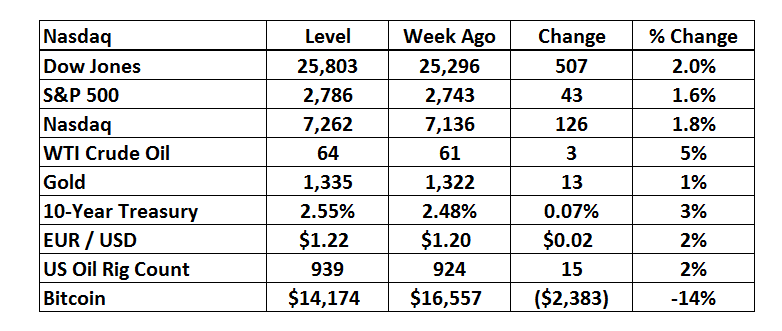
US equities ended the week higher in a quiet Friday of trading. Cyclical and value plays were among the better performers. The equity market is already up over 3% this year with some of our stocks like Amazon and Nutanix up more. Bonds are down this year and Treasuries were mostly weaker as investors realize the Fed is serious about raising rates. We saw more flattening of the yield curve indicating caution. In fact, the two-year T-note rose and hit 2.0% for the first time since 2008. Gold was higher for fifth straight week. Crude ended higher for the fourth straight week.
No matter what is happening out there, there is always a bull market here at The Bull Market Report! This week we highlight: Cloudera, Blackstone, Amazon, Google, Eli Lilly, and Home Depot.
BMR Companies & Commentary
Cloudera (CLDR: $18.14, up 5%)
Cloudera met with investors this week at Citi’s Global TMT West Conference. The CEO discussed all that they are doing in terms of new technology. Let’s recap. Remember, understanding the big picture of what the company is doing is how you build real confidence in your investments.
First it is important to understand the backdrop of why Cloudera is such an exciting company. Everything right now is going through a major technological revolution. Look what is happening in cars, health, and virtual reality. Everything is getting connected. This newly-created connected world is creating a backdrop for data that is unprecedented. And in this area of the economy is where the world’s most valuable companies reside—Apple, Google, Facebook, and Amazon. They are all data driven. Economists say the world’s most valuable resource is now no longer oil, but data.
So where does Cloudera fit it? Cloudera helps enterprises enter this new world of machine learnings and artificial intelligence. Cloudera gives them access to this data to transform their business to become data dependent. The old days of just working with a database storage provider and some simple analytics are gone. Today, companies turn to Cloudera to build best-in-class artificial intelligence solutions that optimize all the available data out there, not just their own.
BMR Take: Machine learning and artificial intelligence are megatrends for the next 5 years. Get involved. Cloudera is a great opportunity. Revenue will explode from $360 million this year to $570 million in 2 years. We see Cloudera breaking the $1 billion revenue mark possibly as early as 2020. We added the stock at $22 in June so it has certainly been an underperformer for us. But we are very confident in the success of this company and continue to have a $28 price target on the stock. Sometimes one has to be patient to see the big gains that we expect. Cloudera is still tiny with a market cap of $2.5 billion. But they are growing 40% a year. We would expect to see this little gem grow to the $10 billion level at some point and then get plucked up by one of the big boys. And this might even happen sooner than you think.
------------------------------------------------------------------------------
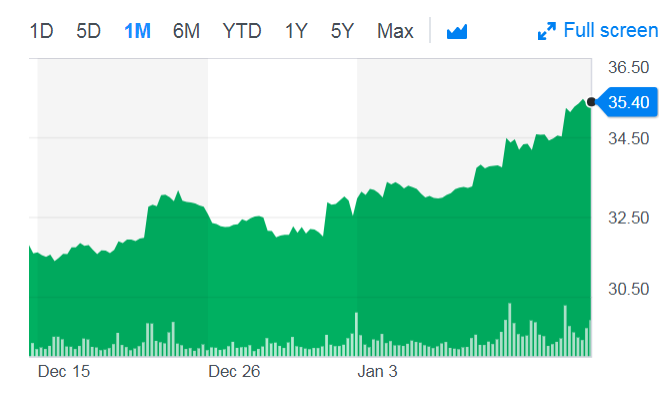
Blackstone (BX: $35, up 7%)
Blackstone is on a roll and caught an upgrade from JP Morgan. We love it when the professionals come around to our side of the table!
The reason to be excited at this point is that there is going to be a major fundraising cycle for Blackstone over the next two years. The company is expected to raise over $200 billion. The way the company makes money is through these massive fundraisings, then deploying the capital, and then getting a share in the profits from the investments.
The fundraising will happen in two funds. The first is Flagship Real Estate BREP-IX in 2018. The second is Flagship Private Equity BCP-VII in 2019.
BMR Take: Blackstone has been an underperformer relative to its peer group. And the peer group of these private equity companies hasn’t done too well. The entire space is relatively new to the public equity markets. Retail investors just don’t have the comfort level they have with other financials like AIG or JP Morgan. But we think that will all change. These companies print money. Blackstone will do over $3.00 of EPS in 2018. The stock is very inexpensive right now.
We’re up 30% on the stock since we added it in early 2016. Good but not great. The dividend has helped though, as that 5% a year adds up. But we expect more from this great company. Our Target was just reached this week, so we are going to go out on a limb and raise the Target to $42. If things go right, we would expect to see this by year end, but perhaps sooner.

------------------------------------------------------------------------------
Amazon (AMZN: $1,305, up 6%)
Amazon Fresh prices are up to 20% cheaper than major UK supermarkets.
Look out! We are going to see Amazon really shake-up the grocery market this year. Amazon's online grocery service Amazon Fresh is selling some products up to 19% cheaper than major supermarkets, new research suggests.
Amazon Fresh is a subsidiary of the Amazon.com. It is a grocery delivery service currently available in some U.S. states, London, Tokyo, Berlin, Hamburg and Munich. It will also launch in Australia soon.
The cost of a shopping cart from Amazon Fresh turned out to be 11% cheaper than the same online shopping from Tesco, and up to 19% cheaper than other competitors. The study was done by the consulting firm Oliver Wyman. The geography was in London.
Amazon Fresh is still relatively small but the internet giant has very serious ambitions in the grocery sector, suggesting that it may be looking at more acquisitions.
BMR Take: Amazon is a never-ending innovation machine; essentially a massive start-up. Look, the company will do $177 billion of revenue this year and we could rant and rave about the revenue growth outlook. But nobody knows what businesses Amazon will even be in over the next 3 years. They are knocking down doors and running through walls into new markets. Grocery will be tens of billions of dollars for Amazon in a market that the firm has been in for less than a year.
The stock had a banner week and hit our $1300 Target, setting a new all-time high. We believe we will see $2,000 someday in the future, but obviously not right away. But we can see $1,500 in the not-too-distant future, so we hereby raise our target to that level. The Sell Price is raised from $1,030 to $ 1,225.
------------------------------------------------------------------------------
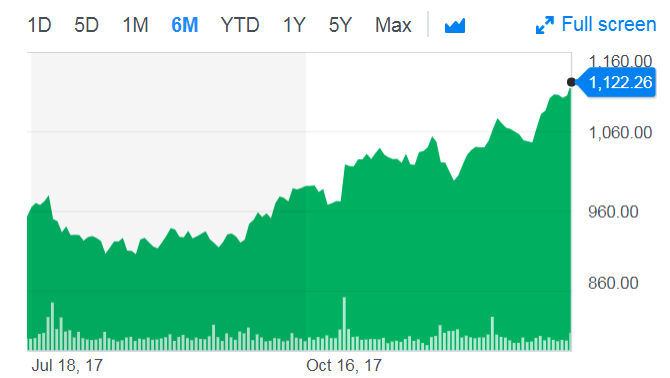
Google (GOOG: $1,122, up 2%)
Apple came under massive scrutiny this week. Parental oversight organizations said Apple should take more responsibility over how children use their devices in particular addition to the technology. We think Apple, Google, and Facebook in particular are making so much money they are likely to be the target of increased scrutiny by governmental authorities. In fact, we saw this week similar outcries against Google. We keep an eye on this risk but would not let it shake us out of any of these holdings.
Google has been profiting from a practice in the United Kingdom but banned in the US, in which brokers secretly reap millions of pounds from addicts seeking treatment in the UK. An undercover investigation by the Sunday Times has discovered a large fraud in this area. As a result of an in-house investigation, Google pulled all addiction-industry-related advertisements from its UK platforms.
BMR Take: Without question, Google and its peers will have to invest more in meeting social responsibilities and being a good corporate citizen. That said, Google can manage through this. We are looking at EPS going from $32 this year to nearly $60 by 2020. We can live without $1 or $2 of EPS if the company addresses these social issues and spends money to prevent thing like this advertising scheme being run through the platform in the UK. In fact, we encourage it, as it could result in a premium valuation.
Google set a new all-time high this week and is now worth $780 billion, closing in on Apple at $900 billion. (Of course, Apple set a new all-time high this week as well, so it’s certainly a good race!) Our Target has been $11,00 which was hit this week, and we expect a continued strong stock market which should proper Google higher. Thus, we hereby raise our Target to $1,450 and our Sell Price to $1,010.
Don’t like high-priced stocks? GET OVER IT. Buy some Google. Buy some Amazon. Buy 7 shares. Buy 23 shares. Just own these fabulous companies!
------------------------------------------------------------------------------
Eli Lilly (LLY: $87, flat)
Eli Lilly caught a big upgrade from Argus Research. Again, we love it when the professionals come around to liking our holdings!
What’s the excitement? Tax reform is a major positive for the company. Additionally, the company is working to sell its Animal Health business. The combination of these two events will create a cash windfall. Now the CEO is talking about doing a large acquisition.
Previously, big time M&A was just a distraction for the company as Lilly could not be competitive due to its balance sheet. However, now there is some real interest to move bigger into immune-oncology. Could we see them try to buy Bristol-Myers? (BMY: $63) Maybe; but that’s a big bite to chew off – around $120 billion.
BMR Take: Lilly is going to do $4.65 of EPS in 2018. They have $4.5 billion of cash. They have more cash than debt. They could do a mega-deal and this could get really exciting. We see why Argus upgraded the stock with a $115 price target.
We at The Bull Market Report have a Price Target of $88 on the stock at the moment, but we expect mid-90s by summer, so we hereby raise our Target to $96. Our Sell Price moves higher too, from $76 to $82.
------------------------------------------------------------------------------
Home Depot (HD: $196, up 2%)
To be honest, we are frankly a bit upset at Home Depot right now. We expect a lot from our companies - we wouldn’t recommend them to you otherwise. Home Depot put out this official statement on tax reform back in November, “The Home Depot is very supportive of tax reform that would fuel the economy by putting more money in the majority of Americans' pockets while improving the competitive position of companies so they can create more jobs. We applaud Congress for its efforts in moving tax reform forward.”
What is it missing?
Where is the minimum wage hike? Where is the $1,000+ bonus to employees. Walmart, some big banks, and many other companies took additional actions. All Home Depot did was issue a press release of encouragement.
We will get over it. But Home Depot missed an opportunity to demonstrate its corporate leadership in this country.
BMR Take: Home Depot is going to do nearly $9 of EPS in 2019. EPS should grow at least mid-single digits. The housing market is doing great and we expect ongoing favorable tailwinds for Home Depot. The stock is still going to go higher, but it could go much higher if they would not miss opportunities to build goodwill with the market as an exceptional corporate citizen.
Our Price Target is $205 which we will leave here for the time being. The Sell Price of $178 is hereby increased to $186.
------------------------------------------------------------------------------
------------------------------------------------------------------------------
Economic Calendar
Capacity Utilization
Wednesday, January 17th, 9:15 AM
Period: December
Consensus: 77.3%
Prior: 77.1%
Housing Starts
Thursday, January 18th, 8:30 AM
Period: December
Consensus: 1,278,000
Prior: 1,297,000
Michigan Sentiment
Friday, January 19th, 10:00 AM
Period: January
Consensus: 97.0
Prior: 95.9
------------------------------------------------------------------------------
------------------------------------------------------------------------------
Time to Take Our Profits in Tesla?
Tesla (TSLA: $336, up 6%) had a great week, but the more we think about it, the more worried we become. They have orders for 400,000 Model S cars and said last year that they would be delivering 5,000 a week starting in October, 2017. Well, guess what, this 5,000 number has slipped a number of times so that now they are talking about the 2nd quarter of this year. That’s a big slip. Maybe there is something seriously wrong here. No one seems to know and the company certainly isn’t helping us with solid information.
The company is going to need massive amounts of cash this year. They are bleeding money each day, each week, each month, so we expect more secondaries this year, diluting existing stockholders. And more bond sales as well.
Can the company survive and thrive? That’s the question that we are wrestling with.
We love the company; the world loves the cars. We love Elon Musk, but he is a promoter for sure. A loveable genius with a $56 billion market cap company.
The more we think about it and the more we write about it, we just have to book our profits. We are up 69% since we added the company two years ago at $199. OK, wait a minute. We’ll let the market tell us when to sell: If the stock goes to $320, we are OUT.
It’s tough to invest in a visionary. The vision always takes longer than the genius or the masses of followers expect.
------------------------------------------------------------------------------
Apple's App Store Broke Records this Holiday Season
Apple’s App Store started off 2018 by breaking app purchasing records on New Year's Day. Consumers spent $300 million in app purchases on January 1, 2018, marking the highest sales day for the App Store since its launch in 2008.
This outstrips last year’s record-breaking figure of $240 million in purchases on New Year’s Day. Customers spent $890 million on apps from December 24th-31st. Insights into app spending during the holiday season are indicative of the strength of the iOS platform for the year to come, as many consumers receive smartphone devices and purchase new apps, games, and subscriptions over the holiday period.
Apple’s App Store revenue gets bigger each quarter and each year. Developers received $26.5 billion for the year, up 30% year-over-year, and is now over $86 billion since 2008. For 2017 the $11.4 billion in revenue was almost 5% of the company’s projected $237 billion in total revenue.
------------------------------------------------------------------------------
------------------------------------------------------------------------------
A Word from Gary Jefferson
Jefferson Financial Group
First Vice-President, Investments
UBS Financial Services, Inc.
Earnings season officially kicked off last week with the big banks leading the way. We expect decent to good numbers, but the big thing to watch for will be forward guidance, particularly on how much tax cuts will impact the bottom lines. Some sectors like Energy will likely benefit more than others which traditionally have been able to pay lower effective rates such astech.
Last week, Bank of America analysts raised their earnings forecast for the S&P 500 by $14 to $153 per share, as a result of the new lower 21% tax rate. (Source: Merrill Lynch). In market-speak, that means that if corporate earnings for 2018 reach $153, and the market's trailing PE is 18, the S&P 500 will be trading at 2754. Today it is trading at 2786…………………….oops, that doesn't sound very promising. For the market to reach 3029 (a 9% gain), the S&P 500 would need to trade around 20X trailing earnings. That is of course doable, and not outside the realm of just being a high-priced market rather than a bubble, but it would be a lot better from a fundamental standpoint if the market could see fit to earn a higher number this year. We should have a better grasp on a projected year-end earnings target after earnings and guidance are announced over the next several weeks.
Meanwhile, what a week the market enjoyed two weeks ago. It was one of the best first weeks of any new year in history. There are plenty of historical stats which show that if the market has a good January, most of the time the year will end up with positive numbers as well.
Even though the jobs report missed expectations for 191,000 new jobs being created last month by coming in at 148,000 instead, the great big story was that this number had 146,000 private sector jobs versus only 2,000 public sector ones. Always remember that government doesn't create jobs – it only takes away from the private sector when it grows, and because it is the private sector that creates jobs, a growing government is the worst case scenario for a growing economy. So "hip, hip hooray" for this ratio of jobs because it is just what the doctor could order for a healthy and robust economy.
The biggest winners for job creation were in Healthcare with 31,000 new jobs (300,000 for 2017), Construction with 30,000 new jobs (210,000 for all of last year), and Manufacturing with 25,000 new jobs (196,000). We also saw gains in Food Services & Drinking Places (government-speak for restaurants and bars), and Professional & Business Services. Thus, these are not part time or low paying jobs for the most part, which is equally important for a growing economy.
Again, we have to keep everything in perspective. The following stats are from Pension Partners:
"From August 18th to November 29th, the Dow went 72 straight trading days without an intraday move greater than 1%, by far the longest stretch in history.
“The S&P has now risen for 14 consecutive months, the longest run in history.
“The Dow closed at an all-time high 71 times during the year, the most in history.
“There was a sharp flattening in the yield curve throughout 2017. At 0.51%, the spread between 10-year and 2-year yields on the last day of trading was the flattest level of the expansion. (This is a "flag" we are watching).
“In spite of this backdrop, the Fed only hiked rates 3 times in 2017, to a year-end range of 1.25 to 1.50%. After subtracting inflation (core CPI of 1.7%), this leaves the Real Effective Fed Funds Rate in negative territory for the 9th year in a row – another longest stretch in history.
“On the flip side:
Unemployment rate (4.1%) – lowest since 2000
Jobless Claims – lowest since 1973
Consumer Confidence – highest since 2004
ISM Manufacturing Index – highest since 2004"
Our take is that we should expect a correction along the way this year to keep this market from reaching the dreaded "bubble status", but we should also not be scared out of the market due to the length of this bull market. All good things eventually come to an end, but all records are also made to be broken. We have no idea when this earnings growth cycle will come to an end, but we simply do not see earnings growth stuttering or falling at this time - just the opposite, in fact, as corporations become ever so more competitive with the reduction of what had been among the world's highest and most onerous tax rates. (35% now cut to 21%). In this environment, we believe earnings will be the game changer – i.e., we are in the proverbial market of stocks, not a stock market. Companies with outstanding earnings growth will continue to provide outstanding returns.
------------------------------------------------------------------------------
PayPal Holdings (PYPL: $80.50) was upgraded by analysts at Cowen from a "market perform" rating to an "outperform" rating. They now have a $88 price target on the stock, up previously from $79. They must be reading The Bull Market Report. Interesting: Our price Target is $87, because that’s the price at which the company will be worth $100 billion. The stock set a new all-time high on Friday.
------------------------------------------------------------------------------
------------------------------------------------------------------------------
The High Yield Corner
By Michael Foster
Vice President, High Yield
Let’s start with a stock that fell below an important number and then quickly recovered.
Omega Healthcare Investors, Inc (OHI: $26, down 3%) has been The Bull Market Report’s big contrarian call for a while now. If you’re a regular reader, you know that we’ve frequently discussed the issues regarding Omega’s tenant insolvency and current negotiations. This has spooked a lot of investors and turned a once 8% yielding stock into a 9% yielding one. At the start of last week, the stock dipped below $27 for the first time since 2014 - a significant development.
There’s no news to drive this. No insider selling announcements, no updates on the ongoing negotiations with Orianna, which could result in a small decline in income or a protracted dispute in bankruptcy court. In either case, Omega is very likely to get paid out something. In both cases, though, Omega’s cash flow is going to suffer.
And what of that cash flow? Again, it’s helpful to look at the numbers. FFO for the last 12 months is $3.40, while annualized dividends are $2.60. In other words, the dividend coverage ratio is 131% - just above the important 130% level that we demarcate as the start of the safest REIT distributions. At its current level, Omega will maintain its payouts with ease.
But what about the haircuts? Orianna provides 5% of Omega’s FFO, so if Omega lost all of that money (a virtual impossibility), the FFO would fall to $3.23, leaving Omega with a 124% coverage ratio. That’s lower than we like, but it’s still over 100%, meaning we aren’t anywhere near a cut.
Let’s project into the future to see exactly when the dividend would get risky. If Omega lost 5% of its portfolio every year, 2019’s FFO would fall to $3.07. The next year’s would be $2.92…and in fact, it would take until 2023 (i.e., 5 years from now) before Omega’s FFO would fall to less than its current payouts. Then, it would hit $2.50.
Keep in mind that we’re playing with the worst possible case here - but let’s play with the math and see what happens to our income stream.
If the future was as bleak as this, 2023 would result in a 3.8% dividend cut to make payouts sustainable. At current prices, that would make Omega Healthcare yield 9.2% (instead of its current 9.6%).
If this is our worst case scenario, it looks pretty rosy. Getting a near 10% dividend over 5 years before a dividend cut that then brings your yield to a still impressive 9% - that’s not much downside.
There is one other consideration. Omega increases its dividend by a penny per quarter. We’ve have written in the past about this; it’s good for investors in the short term, but it will expedite the schedule for when Omega will have to cut its distributions. For that reason, we think it would be best for Omega to stop its quarterly hikes and telegraph to the market its plans to do so many, many months in advance.
We are disappointed that Omega hasn’t done that yet, but we also wouldn’t be surprised if they did this sometime this year. The recent price action demonstrates that the market is expecting the dividend hikes to stop relatively soon. That gives Omega a nice window to make the move without hitting the stock too much further - but we are not sure they will actually make this move at all.
And the reason is simple. We on the outside see a very slow demise of the dividend - management does not. In the last earnings call, CEO Taylor Pickett addressed the issue with some promising numbers:
"We are hopeful, we can develop an out-of-court plan, which if successful, would likely result in cash rents of $32 million to $38 million per year, as compared to the current annual contractual rent of $46 million.”
If successful, that would lower FFO by 1.5% - in other words, hardly anything at all.
Additionally, Omega continues to expand. The company invested over $300 million in the third quarter of 2016, which on its own more than covers the lost FFO from the Orianna issue. By how much? Pickett noted that Omega targets a 9% capitalization rate for investments, meaning that $300 million investment will be almost twice that of the lost cash rents from Orianna.
What about the properties currently occupied by Orianna? Omega is currently working to sell or rent to new operators who are in a better financial position. If successful, this could cause FFO to grow significantly in the next 2 years - and that will make Omega shares skyrocket.
We have faith that Omega’s managers can navigate this admittedly complicated and tricky transition, and that’s why we remain constructive on the stock.
Finally, let’s quickly turn to some other high yield assets: Municipal bonds and closed-end funds. Nuveen AMT-Free Municipal Credit (NVG: $15.65, down 2%) and Invesco Municipal Trust (VKQ: $12.65, down 1%) had a decent showing for the week, in no small part thanks to a seasonal and rather predictable trend. Retail investors sell municipal bonds at the end of the year and buy again in January. This is classic tax loss harvesting at work, and any year where losses in munis are to be found, this trend is noticeable. So far, 2018 has been good to munis - and that is likely to continue. Thanks to the investors looking for their tax-free income streams, both the Nuveen and Invesco funds are seeing positive inflows - something that we are also seeing across the municipal bond market.
Good Investing,
Todd Shaver, CEO and Founder
The Bull Market Report
Since 1998
December 21, 2017

by Todd Shaver | Dec 21, 2017 | Monthly Newsletter Daily 12pm if new
The Weekly Summary
Star Wars ‘The Last Jedi’ topped $100 million on opening weekend, only the second film to do it, the first being Star Wars ‘The Force Awakens’. Americans are feeling good right now watching movies and buying Christmas gifts, as all-time high equity markets have their portfolios in great shape. Mergers and acquisitions are popping off with Disney buying assets from Fox and several other big-name deals announced this week. These are great times. It has been an incredible bull market. In fact, they say this past year was the least volatile on record in a hundred years. From the depths of the Financial Crisis to today marks an amazing journey for the markets. We can’t help but keep stressing that it won’t always be this good.
We’re not worried – just watching. We heard a presentation from a research specialist from Citibank on Thursday and he talked about and gave us charts on where the market is historically. He said the PE of the market (S&P 500) is 26, way above the historical average of 16. He said the VIX (^VIX) is sitting at about 10, way below the historical average of 14 or so. And he said the market ALWAYS REVERTS TO THE HISTORICAL MEAN. We took this all in, have thought about it for days and much before that and we must say that we effectively agree with this analysis. Remember the phrase “the new normal”? They said this about Internet stocks in 1999-2000 – remember what happened. They said that about the bull market leading up to 2008. Remember what happened. And they are saying that about this bull market and the low interest rate environment that we have seen for decades, with the 10-year Treasury still at historic lows of 2.35%.
Again, we’re not worried – but we are watching. We think this bull can run for another two years at a minimum.
No matter what is happening out there, there is always a bull market here at The Bull Market Report! This week we highlight some of our favorite stocks where we think you can still make good money, including: Bristol-Myers Squibb, Nutanix, Annaly, Tesla, Twilio and asset managers (Blackstone, BlackRock, and Carlyle Group).
SPECIAL HOLIDAY OFFERING
Get The Bull Market Report for just $199 for the entire year. It is published Weekly on Sunday evenings and we send you News Flashes during the week. We have six portfolios with over 40 stocks that we follow. Some are up 25%; some are up 50%; a few are up over 100%. And in our High Yield Portfolio we have stocks paying 6%, 8% and 10%.
Give a GIFT TO YOURSELF or a loved one or a good friend. It will be the best Christmas present EVER.
Go here now:
https://www.bullmarket.com/subscription/
BMR Companies & Commentary
Asset Managers:
Blackstone (BX: $33)
BlackRock (BLK: $517)
The Carlyle Group (CG: $22)
Asset managers sure look like a compelling place to put money to work. We highlight some of the key data points about current market conditions. The strong fundamentals point to more and more money being made on Wall Street, which means more money for asset managers, and in turn more money for the investors in asset managers, meaning you of course.
Investment banking data were mixed in the week. Equity underwriting volume was 12% above the 4Q17 weekly average, and announced M&A volume was 67% above the 4Q17 weekly average, while completed M&A and debt underwriting were 45% and 20% below the 4Q17 weekly average, respectively; debt underwriting is steady.
Equity trading volume was 8% above the 4Q17 weekly average level, while equity option volume was 10% below the 4Q17 weekly average.
Corporate bond trading volume was steady. The 10-year Treasury yield increased 1 bp to 2.38% (up 4 bps quarter to date (QTD)), the Bank of America U.S. High yield increased 3 bps (up 32 bps QTD), and MBS securities yields (15-year and 30-year) declined 3 bps and 0 bps, respectively (up 14 bps and up 4 bps QTD, respectively).
Equity fund outflows (on a one-week lag) persisted, totaling $3.6B ($36B QTD), while bond fund inflows (also on a one-week lag) continued, totaling $4.3B ($52.0B QTD). This is certainly not good and amazing that the stock market has been able to absorb this negative news and rally like it has.
BMR Take: Take your pick between Blackstone, BlackRock, and The Carlyle Group, or own them all. These companies make money from all of the fees, deals, and rising asset prices. They are a center of profits. We see opportunity for meaningful stock price appreciation if current fundamental trends persist, as we believe it will. They are WAY UNDERVALUED in our opinion.
-------------------------------------------------------------------
Bristol-Myers Squibb (BMY: $61)
Bristol-Myers Squibb has licensed a phase 1 immuno-oncology drug from Japan’s Ono in a $40 million upfront pact. This geographically complex deal, which builds on a collaboration the pair have had for a number of years now, sees Bristol-Myers solely responsible for the development, manufacturing and commercialization of Ono’s selective Prostaglandin E2 receptor 4 antagonist. This program is aimed at targeting immuno-suppressive factors in the tumor microenvironment.
To improve long-term outcomes for more patients with cancer, Bristol believes more immuno-oncology-based combinations may be required, and they are pleased to continue the long-standing collaboration with Ono with this focus in mind. This new program offers the potential to develop targeted therapies that counteract the effects of an immunosuppressive tumor microenvironment. Researching Prostaglandin E2 receptor antagonists in combination with the oncology portfolio has the potential to result in an enhanced response in a broad range of tumors.
BMR Take: Bristol is going to generate $3.00 of EPS this year and around $3.25 next year, then growing toward $4.50 by 2020 as the immune-oncology drugs gain traction. That means the stock is dirt cheap and now is a great entry point. Remember, activist investor Carl Icahn is in the stock and we could see him push for a sale of the company resulting in a huge M&A premium some day in the future.
-------------------------------------------------------------------
Nutanix (NTNX: $35, up 3% last week)
Wow, Nutanix has doubled in recent months. Got your attention now? Let’s review what’s happening.
Nutanix started out as a hyperconverged (HCI) vendor. Starting in 2009, they created the market for HCI. They thought that HCI was a step in the journey to where organizations were headed, which was around becoming truly enterprise cloud software companies. This is what you hear and see Nutanix focusing all their energy on. Nutanix customers are looking at HCI as a critical step in this new era journey. They're looking at Nutanix as a full stack offering that allows them to build this platform, above, that's beyond storage and compute and includes virtualization. It helps them with networking, security, but most importantly now helps them with the transition that's happening in the market around the world of multiple clouds, where customers are trying to figure out how to handle a hybrid cloud environment, where customers want to put some of their workloads in the public cloud, but they also have a private cloud infrastructure that gives them the security that actually is probably even more cost effective for their enterprise apps like SAP, Microsoft and Splunk.
BMR Take: Look, we can’t explain all the finer details around the inner workings of HCI. However, we know that tech-savvy people are thrilled about what is going on at Nutanix. The company is on track to swing from losses to over $1 of EPS in 2021. The company’s customer base has doubled. The stock has doubled. We see all the elements of success and continue to like the stock at this level.
-------------------------------------------------------------------
Annaly Capital Mortgage (NLY: $12.01, up 2%)
The Fed raised rates and guess what, Annaly’s stock went up. What? The company is going to be able to navigate the interest-rate environment just fine. In fact, the Chairman of the Board just bought 125,000 shares this week at $12. At the end of the day, it’s been proven by numerous studies, that following insider buying from key business leaders is a way to make money in the markets. People sell stocks for all sorts of reasons, but they only buy stocks with one thought in mind, “I am going to make money on this purchase.” When that buyer is the Chairman of the Board with all that insight and industry expertise, you have to assume either this guy is a reckless idiot with his money or he is on to something.
Who is Denahan J. Wellington? She is Chairman of the Board of Directors and Executive Chairman of Annaly. Ms. Denahan is a co-founder of Annaly and has over 20 years of financial services experience. She was one of the co-founders of Annaly in 1994 and has been with the firm all this time. Ms. Denahan holds a B.A. in Finance from Florida State University and is the third-highest paid female CEO making over $26 million a year.
BMR Take: We see value in Annaly shares which are trading just above book value of $11.20 with a dividend yield of 10%. We think placing your capital alongside Ms. Denahan is a smart move. We have to say we love this company. We’ve loved them for about 20 years through high interest rate environments, through bull and bear equity markets, through negative naysayers both personally and on the Street, and they just keep coming through year after year. Sorry for gushing!
-------------------------------------------------------------------
Tesla (TSLA: $329, up 9%)
Tesla looks to be catching a break in Congress, as electric vehicle tax breaks appear to be maintained in the current legislation.
House and Senate negotiators have agreed to spare the electric-vehicle tax credit and wind production tax credit in their compromise package, according to a Republican familiar with the process. As part of the $1.5 trillion House tax bill, the $7,500 electric-vehicle tax credit would have been eliminated and the wind production tax credit would have been curtailed. The Senate bill didn’t do either, and that is part of the package set for release.
The vehicle tax credit, adopted as part of the 2009 stimulus bill, helps automakers from Detroit to Yokohama bet big on an electric future with plans to spend billions of dollars on new pure-electric models to be rolled-out in the coming years despite limited sales of the vehicles to-date. Availability of the credit has been capped at the first 200,000 qualifying vehicles sold by each manufacturer. No automaker has reached that cap yet. Tesla sold about 127,000 Model S sedans and Model X sport utility vehicles through August.
BMR Take: The tax credit is a nice incentive for sales of Tesla vehicles. More sales means more cash flow. More cash flow means a greater franchise value on the stock. We like what we see happening with Tesla, from innovation to DC policies. Keep this stock tucked away in your portfolio (but know that is one of your most speculative holdings.)
-------------------------------------------------------------------
-------------------------------------------------------------------
Economic Calendar
Initial Claims
Thursday, December 21st, 10 AM
Period: 12/16
Actual: N/A
Consensus: 235,000
Prior: 225,000
New Home Sales
Friday, December 22nd, 10 AM
Period: November
Actual: N/A
Consensus: 655,000
Prior: 685,000
-------------------------------------------------------------------
Update on Twilio (TWLO: $25, up 3%)
Twilio hosted its first-ever investor day two weeks ago. Despite many quarters of strong results, the stock has remained under pressure.
Twilio aims to be the "future of communications," the way other cloud platforms like AWS has reshaped compute infrastructure and Stripe has revolutionized payments.
Twilio addresses a huge marketplace and has the potential to scale into a much larger company than it is today. The company continues to grow at a 40% rate, even as it approaches a $500 million run-rate.
Twilio's gross margin is much lower than most software companies due to its position of being a "middleman" between developers and telecom networks. The rise of possible competition from services like AWS is a concern.
Based on research from Gartner, the leading software industry analyst, Twilio believes its opportunity in communications to be 40% of the global IT market ($3.6 trillion).
Twilio also reminded investors that its sales model is unique among enterprise software companies by focusing on software developers rather than enterprise CIOs, attributing to its lower spending on sales and marketing. In its most recent quarter, it spent just 23% of its revenues on sales and marketing. This is low compared to the majority of high-growth software companies, that can typically spend upwards of 50% of revenues on sales and marketing.
Twilio also plans to greatly expand its count of quota-carrying reps (QCRs). At the end of 2016, Twilio's sales organization only had 23% of its headcount as QCRs - indicating that the bulk of the company's new sales hires weren't fully ramped yet to the $1.5-$2 million in revenue that the typical QCR brings in. At the end of 2017, however, Twilio estimates that 46% of its sales organization will be QCRs. This will drive further growth in the company.
Revenue guidance calls for $104 million, a strong 25% growth rate. More good news is that active developer accounts are up 35% over last year, and customer retention rate is literally close to 100%.
The company has generated 56% in gross margins year-to-date, the company believes it can attain gross margins of up to 65% in the long term. Twilio is operating at near-breakeven now, but the company expects to attain an operating margin of at least 20% in the future.
BMR Take: We are hanging tough with this great company. Patience will win out in the end, as revenues drive all.
-------------------------------------------------------------------
-------------------------------------------------------------------
Cryptocurrency Update
Bitcoin (BTC-USD, $15,100 – prices change by the minute and trade 24-7)
The bitcoin boom is raging. It’s being discussed on every news network, in every paper, and even in questions asked to the Chairman of the Federal Reserve. The bitcoin rage is best exemplified by the following tale, which is a true story. Erik Finman invested a $1,000 cash gift from his grandmother into bitcoin six years ago. He was 12 years old. Erik is now a millionaire at 18. There are dozens and dozens of these situations being reported. Bitcoin has turned into a full-blown frenzy. It is said that the wealth created in bitcoin has served as an economic stimulus for millennials. Many feel that it going much higher The future of digital gold is here. The end of government controlled fiat money manipulation is upon us. That is what they are saying. But some more cautious investors are saying we will look back and call this the obvious bitcoin bubble. Will we? Only time will tell. Either way the frenzy is an exciting dynamic rarely seen in the markets. Place your bets wisely on the future of cryptocurrencies.
If you wish to learn more about bitcoin and other cryptocurrencies, go to www.Bitcoin.com and sign up for their daily newsletter. Also, www.CoinTelegraph.com has a great one. For info on the 1300 ICOs – Initial Coin Offerings – go to www.CoinMarketCap.com.
-------------------------------------------------------------------
A Word from Gary Jefferson
Jefferson Financial Group
First Vice-President, Investments
UBS Financial Services, Inc.
The year is basically over and we will leave it with the following comments on what may lie ahead. The only thing we can be sure of next year is that the vast majority of predictions or forecasts will end up missing the mark to one degree or another, as the market never follows a predictable pattern or does what everyone, especially the experts, expect. The bottom line to all the following information is simply this - Investors should not get all worked up about the numbers or economic forecasts for 2018. We believe the single most important economic fact that investors need to know is that the world is doing OK.
The current UBS "technical" forecast:
[Be prepared for some serious technical jargon.]
“It is remains our contention that the confusion within the US equity markets, pitting the bulls against the bears, lies in the lack of understanding by investors and traders about the significance of the two current powerful but competing market trends. That is, there is a maturing/aging cyclical bull trend (March 2009) operating within a newly confirmed structural bull trend (secular bull markets last an average of 8 to 20 years in length) that began in earnest in May 2013 via a breakout above 1,576/1,600, which was further validated in 2016 by a positive outside year. As with all cyclical trends, the current 9-year cyclical bull will likely end as early as the second half of 2018 and possibly into early 2019. This will be followed by either a deep correction (10–20%) or by a cyclical bear decline (20–30%) rather than by another structural bear decline (30%-plus). Since the current structural bull trend is only four years old, this long-term trend can sustain for another four years (2021) and possibly extend for another 16 years under ideal conditions. This would imply that the S&P 500 may quickly achieve our technical target of 2,850 as early as the first half of 2018 and possibly overshooting to 3,000 before sustaining a major drawdown. Under the backdrop of a structural bull trend, the S&P 500 can reach an optimistic technical target as high as 3,685 in the years ahead."
Thus, under a worst-case scenario where this new secular bull market which began in 2013 only lasts the minimum 8 years instead of the maximum 20 years - therefore lasting another four years - the technicians are forecasting the S&P 500 could reach 3685 over that 4 year period. This would equate to about 40% upside or 10% annually. However, trying to time this projected correction or cyclical bear decline in later 2018 or the first half of 2019 (or reaching the level of 2994-3045) will be nearly impossible, and could cause timers to miss an important move higher.
Keep in mind that this is a "technical" forecast based on charting and technical historical patterns. It is one of many tools used by money managers in reaching their final investment strategy and asset allocation decisions.
The UBS "fundamental" forecast also offers a positive outlook:
“US stocks rarely experience a sustained downturn outside of economic recessions. In fact, since 1960, the median S&P 500 calendar year total return is 15% in non-recession years. While gains in 2018 are unlikely to match the advance of this past year, US equities should continue to rise and outperform bonds as the US and global economic expansion continues. Historically, stocks rise 88% of the time in non-recession years.
2017 review: Solid S&P 500 EPS growth of 10% underpinned US equities in 2017. Market gains were amplified by higher valuations driven by strengthening and synchronized global growth and inflation generally undershooting market expectations.
2018 outlook. We forecast 2018 S&P 500 EPS to rise another 8% to $141 if tax reform is not passed. With expected tax reform benefits, profits could get an additional 6-10% boost. Solid and steady economic growth and still-low interest rates should continue to support above-average market valuations, although we are not assuming further multiple expansions. Putting it all together, we expect that the S&P 500 will end 2018 between 2,850 and 2,950 if tax reform legislation is enacted. Should tax reform efforts fail, 2,600-2,700 is a more likely base case."
At this point we are going to assume that tax reform happens. Thus, the read we get on the economy is overwhelmingly positive. Maybe it's the Christmas Spirit, but it seems there’s so much going on right now that investors should celebrate. We just had two consecutive quarters of 3%+ GDP growth. We have historically low interest rates which make it cheaper for consumers and businesses and the government to borrow and spend. Inflation, which is a great enemy of both bond and stock investors, has been kept in check through many things such as demographics and technology innovation. We have cheap energy thanks to the technological revolution in fracking and horizontal drilling, and, most importantly, we have rising corporate profits. Ultimately, as they have for all of history, share prices will follow earnings.
So, if you look at this confluence of events: strong economic growth, strong corporate profit growth, low inflation, low interest rates, cheap energy – it’s almost ideal. Several noted stock "gurus" even refer to it as a “Goldilocks economy” where things could hardly be much better. We remain positive about 2018.
-------------------------------------------------------------------
The High Yield Corner
By Michael Foster
We need to spend this week discussing one our favorites - Pimco.
For nearly two years, The Bull Market Report has recommended PIMCO Dynamic Income Fund (PDI: $30, down -3%) for two reasons. The first and most important is the income. The Dynamic Fund has a sustainable 8.9% dividend yield, and it has earned that dividend solidly for as long as the fund has been around. Such a high-income stream is hard to find anywhere - but finding one that is as sustainable and high as this is near impossible. So there has always been good reason to buy and hold the fund.
The second reason to hold this fund is the underlying trends that are good for the main asset class in this fund: mortgage-backed securities. Without getting into a slew of data, the U.S. economy is improving and Americans are paying their mortgages on time more frequently than they did a decade ago. That has translated into a solid run-up for MBSs, many of which were bid down to absurdly cheap levels shortly after the housing crisis in 2007-2009. That, by the way, is what caused Pimco to start the Dynamic fund in the first place; they saw a ton of attractive assets in the mortgage market that were discounted to as little as pennies on the dollar, and they knew those mortgages were a lot safer than the market expected. So they launched the fund to capitalize on that unusual inefficiency in the market, and the Dynamic fund has benefitted healthily since then. It’s up 18% per year on average since its IPO nearly 6 years ago.
That massive run-up is the result of two things: strong income from the portfolio and capital gains from the value of the bonds in the portfolio. In years past, one or the other caused extra upside. In 2017, the upside was from capital gains: the value of the bonds went up. Income, on the other hand, did not exceed expectations. The reasons for that are complicated, but it largely is the result of the MBS market getting crowded. Back in 2011-2013, many people were so terrified of the MBS market that they wouldn’t touch it with a 10-foot pole. Yet it was the absolute bottom of the market. Pimco realized this, and bought when the assets were cheap. They were cheap because the market was expecting net investment income (NII) to be a lot lower on those bonds, but in reality, the income turned out to be higher because defaults were going down. Pimco benefitted handsomely in excess NII.
Closed End Funds tend to return excess NII to investors in the form of a year-end dividend. That’s why at the end of 2016 there was a special $1.45 dividend payout. The fund paid an extra $1.00 in 2015. In 2013? An eye-watering $5.00 in extra income! The special payout in 2013 was so high because the market just wasn’t expecting MBSs to be as safe as they were, so the yield on those bond prices was extremely high. Over time, MBSs in the fund’s portfolio have matured, and Pimco has been buying MBSs at a higher price and lower yield. So NII has declined - but there is still less demand in the MBS market than an equilibrium would assume, so there are still NAV gains in the Pimco fund.
It’s a little complicated, but the moral of the story is this: 2017 saw the Dynamic Fund's NAV total return at 21% and an 18% total price return. PDI’s fundamentals are still outperforming the stock, which is very good. It also means PDI’s NAV is going up. NAV started 2017 at $25.90 and it’s now at $28.70 (11%). The Dynamic Fund is both an appreciating asset and a sustainable high yield asset - both things that The Bull Market Report looks for in its high yield portfolio.
There is just one problem: The lower NII means there isn’t extra income to pass out to investors in the form of a special dividend. We had been saying earlier this year that we did not expect PDI to pay out a special dividend, and it looks like we’re right. Last week on Friday, the company announced that one of its other funds would issue a small special dividend, and the Dynamic Fund would issue no extra dividend at all. This means its yield is going to stay at 8.9% instead of the huge double-digit yields we’ve seen in the past. But the normal dividend is going to remain, and NAV gains could continue throughout 2018 and beyond.
Is it time to sell? No. Although the fund’s special dividends may have come to an end, and with it the near 18% annualized returns, this fund is still good for 10% or more annualized for at least a few years. There will come a day when the MBS market is overbought and it’s time to sell this fund. That day has not come yet. The lack of a special dividend might be a slight disappointment now, but the long-term gains this fund has provided are not going to stop. Enjoy the 8.9% yield and sleep well at night knowing it’s not going to get cut anytime soon.
Good Investing,
Todd Shaver
Founder and CEO
The Bull Market Report
Since 1998
December 17, 2017
by Todd Shaver | Dec 17, 2017 | Weekly Newsletter 7pm Sunday
The Weekly Summary
Star Wars ‘The Last Jedi’ topped $100 million on opening weekend, only the second film to do it, the first being Star Wars ‘The Force Awakens’. Americans are feeling good right now watching movies and buying Christmas gifts, as all-time high equity markets have their portfolios in great shape. Mergers and acquisitions are popping off with Disney buying assets from Fox and several other big-name deals announced this week. These are great times. It has been an incredible bull market. In fact, they say this past year was the least volatile on record in a hundred years. From the depths of the Financial Crisis to today marks an amazing journey for the markets. We can’t help but keep stressing that it won’t always be this good.
We’re not worried – just watching. We heard a presentation from a research specialist from Citibank on Thursday and he talked about and gave us charts on where the market is historically. He said the PE of the market (S&P 500) is 26, way above the historical average of 16. He said the VIX (^VIX) is sitting at about 10, way below the historical average of 14 or so. And he said the market ALWAYS REVERTS TO THE HISTORICAL MEAN. We took this all in, have thought about it for days and much before that and we must say that we effectively agree with this analysis. Remember the phrase “the new normal”? They said this about Internet stocks in 1999-2000 – remember what happened. They said that about the bull market leading up to 2008. Remember what happened. And they are saying that about this bull market and the low interest rate environment that we have seen for decades, with the 10-year Treasury still at historic lows of 2.35%.
Again, we’re not worried – but we are watching. We think this bull can run for another two years at a minimum.
No matter what is happening out there, there is always a bull market here at The Bull Market Report! This week we highlight some of our favorite stocks where we think you can still make good money, including: Bristol-Myers Squibb, Nutanix, Annaly, Tesla, Splunk, and asset managers (Blackstone, BlackRock, and Carlyle Group).
BMR Companies & Commentary
Asset Managers:
Blackstone (BX: $31, down 2%)
BlackRock (BLK: $512, down 1%)
The Carlyle Group (CG: $22, up 3%)
Asset managers sure look like a compelling place to put money to work. We highlight some of the key data points about current market conditions. The strong fundamentals point to more and more money being made on Wall Street, which means more money for asset managers, and in turn more money for the investors in asset managers, meaning you of course.
Investment banking data were mixed in the week. Equity underwriting volume was 12% above the 4Q17 weekly average, and announced M&A volume was 67% above the 4Q17 weekly average, while completed M&A and debt underwriting were 45% and 20% below the 4Q17 weekly average, respectively; debt underwriting is steady.
Equity trading volume was 8% above the 4Q17 weekly average level, while equity option volume was 10% below the 4Q17 weekly average.
Corporate bond trading volume was steady. The 10-year Treasury yield increased 1 bp to 2.38% (up 4 bps quarter to date (QTD)), the Bank of America U.S. High yield increased 3 bps (up 32 bps QTD), and MBS securities yields (15-year and 30-year) declined 3 bps and 0 bps, respectively (up 14 bps and up 4 bps QTD, respectively).
Equity fund outflows (on a one-week lag) persisted, totaling $3.6B ($36B QTD), while bond fund inflows (also on a one-week lag) continued, totaling $4.3B ($52.0B QTD). This is certainly not good and amazing that the stock market has been able to absorb this negative news and rally like it has.
BMR Take: Take your pick between Blackstone, BlackRock, and The Carlyle Group, or own them all. These companies make money from all of the fees, deals, and rising asset prices. They are a center of profits. We see opportunity for meaningful stock price appreciation if current fundamental trends persist, as we believe it will. They are WAY UNDERVALUED in our opinion.
-------------------------------------------------------------------
Bristol-Myers Squibb (BMY: $62, flat)
Bristol-Myers Squibb has licensed a phase 1 immuno-oncology drug from Japan’s Ono in a $40 million upfront pact. This geographically complex deal, which builds on a collaboration the pair have had for a number of years now, sees Bristol-Myers solely responsible for the development, manufacturing and commercialization of Ono’s selective Prostaglandin E2 receptor 4 antagonist. This program is aimed at targeting immuno-suppressive factors in the tumor microenvironment.
To improve long-term outcomes for more patients with cancer, Bristol believes more immuno-oncology-based combinations may be required, and they are pleased to continue the long-standing collaboration with Ono with this focus in mind. This new program offers the potential to develop targeted therapies that counteract the effects of an immunosuppressive tumor microenvironment. Researching Prostaglandin E2 receptor antagonists in combination with the oncology portfolio has the potential to result in an enhanced response in a broad range of tumors.
BMR Take: Bristol is going to generate $3.00 of EPS this year and around $3.25 next year, then growing toward $4.50 by 2020 as the immune-oncology drugs gain traction. That means the stock is dirt cheap and now is a great entry point. Remember, activist investor Carl Icahn is in the stock and we could see him push for a sale of the company resulting in a huge M&A premium some day in the future.
-------------------------------------------------------------------
Nutanix (NTNX: $36, up 3%)
Wow, Nutanix has doubled in recent months. Got your attention now? Let’s review what’s happening.
Nutanix started out as a hyperconverged (HCI) vendor. Starting in 2009, they created the market for HCI. They thought that HCI was a step in the journey to where organizations were headed, which was around becoming truly enterprise cloud software companies. This is what you hear and see Nutanix focusing all their energy on. Nutanix customers are looking at HCI as a critical step in this new era journey. They're looking at Nutanix as a full stack offering that allows them to build this platform, above, that's beyond storage and compute and includes virtualization. It helps them with networking, security, but most importantly now helps them with the transition that's happening in the market around the world of multiple clouds, where customers are trying to figure out how to handle a hybrid cloud environment, where customers want to put some of their workloads in the public cloud, but they also have a private cloud infrastructure that gives them the security that actually is probably even more cost effective for their enterprise apps like SAP, Microsoft and Splunk.
BMR Take: Look, we can’t explain all the finer details around the inner workings of HCI. However, we know that tech-savvy people are thrilled about what is going on at Nutanix. The company is on track to swing from losses to over $1 of EPS in 2021. The company’s customer base has doubled. The stock has doubled. We see all the elements of success and continue to like the stock at this level.
-------------------------------------------------------------------
Annaly Capital Mortgage (NLY: $12.24, up 2%)
The Fed raised rates and guess what, Annaly’s stock went up. What? The company is going to be able to navigate the interest-rate environment just fine. In fact, the Chairman of the Board just bought 125,000 shares this week at $12. At the end of the day, it’s been proven by numerous studies, that following insider buying from key business leaders is a way to make money in the markets. People sell stocks for all sorts of reasons, but they only buy stocks with one thought in mind, “I am going to make money on this purchase.” When that buyer is the Chairman of the Board with all that insight and industry expertise, you have to assume either this guy is a reckless idiot with his money or he is on to something.
Who is Denahan J. Wellington? She is Chairman of the Board of Directors and Executive Chairman of Annaly. Ms. Denahan is a co-founder of Annaly and has over 20 years of financial services experience. She was one of the co-founders of Annaly in 1994 and has been with the firm all this time. Ms. Denahan holds a B.A. in Finance from Florida State University and is the third-highest paid female CEO making over $26 million a year.
BMR Take: We see value in Annaly shares which are trading just above book value of $11.20 with a dividend yield of 10%. We think placing your capital alongside Ms. Denahan is a smart move. We have to say we love this company. We’ve loved them for about 20 years through high interest rate environments, through bull and bear equity markets, through negative naysayers both personally and on the Street, and they just keep coming through year after year. Sorry for gushing!
-------------------------------------------------------------------
Tesla (TSLA: $343, up 9%)
Tesla looks to be catching a break in Congress, as electric vehicle tax breaks appear to be maintained in the current legislation.
House and Senate negotiators have agreed to spare the electric-vehicle tax credit and wind production tax credit in their compromise package, according to a Republican familiar with the process. As part of the $1.5 trillion House tax bill, the $7,500 electric-vehicle tax credit would have been eliminated and the wind production tax credit would have been curtailed. The Senate bill didn’t do either, and that is part of the package set for release.
The vehicle tax credit, adopted as part of the 2009 stimulus bill, helps automakers from Detroit to Yokohama bet big on an electric future with plans to spend billions of dollars on new pure-electric models to be rolled-out in the coming years despite limited sales of the vehicles to-date. Availability of the credit has been capped at the first 200,000 qualifying vehicles sold by each manufacturer. No automaker has reached that cap yet. Tesla sold about 127,000 Model S sedans and Model X sport utility vehicles through August.
BMR Take: The tax credit is a nice incentive for sales of Tesla vehicles. More sales means more cash flow. More cash flow means a greater franchise value on the stock. We like what we see happening with Tesla, from innovation to DC policies. Keep this stock tucked away in your portfolio (but know that is one of your most speculative holdings.)
-------------------------------------------------------------------
Splunk (SPLK: $83, up 2.5%)
Kaminario, a leading all-flash storage company, announced a partnership with Splunk to demonstrate compelling performance gains for customers running Splunk Analytics on the Kaminario K2 storage platform. The K2 Splunk Enterprise app provides users with actionable insight into real-time operational infrastructure.
It is imperative for enterprise customers to gain real-time insight into their infrastructure and turn machine-generated data into usable intelligence to stay competitive, with information automatically streamed and visualized into dashboards, alerts and reports,
Additionally, by supercharging Splunk on the K2 platform, organizations have the ability to meet modern information technology infrastructure needs. Splunk has a modern architecture that can leverage next-gen hardware to eliminate bottlenecks for Splunk’s heavy machine-learning-based processing.
With the Internet of Things and connected devices gaining in popularity, companies have to process and analyze the mountain of machine-generated data super-fast and in real time. This collaboration will allow customers using Splunk and K2 to gain critical insight from their infrastructure backed by the industry’s best performing all-flash array, further enhancing the capabilities to run an autonomous and intelligent datacenter.
BMR Take: Splunk is right at the center of the hottest trend in tech - the Internet of Things. EPS is set to explode from $0.57 this year to over $2.00 by 2021. Grab your share of this stock.
-------------------------------------------------------------------
-------------------------------------------------------------------
Economic Calendar
Housing Starts
Tuesday, December 19th, 10 AM ET
Period: November
Actual: N/A
Consensus: 1,240,000
Prior: 1,290,000
Initial Claims
Thursday, December 21st, 10 AM
Period: 12/16
Actual: N/A
Consensus: 235,000
Prior: 225,000
New Home Sales
Friday, December 22nd, 10 AM
Period: November
Actual: N/A
Consensus: 655,000
Prior: 685,000
-------------------------------------------------------------------
Update on Twilio (TWLO: $25, up 3%)
Twilio hosted its first-ever investor day two weeks ago. Despite many quarters of strong results, the stock has remained under pressure.
Twilio aims to be the "future of communications," the way other cloud platforms like AWS has reshaped compute infrastructure and Stripe has revolutionized payments.
Twilio addresses a huge marketplace and has the potential to scale into a much larger company than it is today. The company continues to grow at a 40% rate, even as it approaches a $500 million run-rate.
Twilio's gross margin is much lower than most software companies due to its position of being a "middleman" between developers and telecom networks. The rise of possible competition from services like AWS is a concern.
Based on research from Gartner, the leading software industry analyst, Twilio believes its opportunity in communications to be 40% of the global IT market ($3.6 trillion).
Twilio also reminded investors that its sales model is unique among enterprise software companies by focusing on software developers rather than enterprise CIOs, attributing to its lower spending on sales and marketing. In its most recent quarter, it spent just 23% of its revenues on sales and marketing. This is low compared to the majority of high-growth software companies, that can typically spend upwards of 50% of revenues on sales and marketing.
Twilio also plans to greatly expand its count of quota-carrying reps (QCRs). At the end of 2016, Twilio's sales organization only had 23% of its headcount as QCRs - indicating that the bulk of the company's new sales hires weren't fully ramped yet to the $1.5-$2 million in revenue that the typical QCR brings in. At the end of 2017, however, Twilio estimates that 46% of its sales organization will be QCRs. This will drive further growth in the company.
Revenue guidance calls for $104 million, a strong 25% growth rate. More good news is that active developer accounts are up 35% over last year, and customer retention rate is literally close to 100%.
The company has generated 56% in gross margins year-to-date, the company believes it can attain gross margins of up to 65% in the long term. Twilio is operating at near-breakeven now, but the company expects to attain an operating margin of at least 20% in the future.
BMR Take: We are hanging tough with this great company. Patience will win out in the end, as revenues drive all.
-------------------------------------------------------------------
-------------------------------------------------------------------
An Update on iShares US Energy ETF (IYE: $38, flat)
This is an ETF that owns a basket of 20 or 30 Energy stocks. If you want to own Energy you should own this stock. It holds about $1 billion of these stocks and is paying a dividend of just less than 3%. 40% of the fund is in two stocks – Exxon and Chevron, which together are worth almost $600 billion.
But it certainly has gone nowhere fast. We added the stock in September last year and it up a whopping 2%. Our Target is $44 which we believe to be in reach, if crude where to move higher from here. But even with the strength in crude of the past few months the stock has been flat. But it is up from the low of $34 in August.
BMR Take: Again, if you want to be in Energy, this is an easy place to be instead of trying to pick one of the many Energy companies out there. Energy will come back some day, of that there is no doubt. But when is the ultimate question and that is something The Bull Market Report can’t tell you!
-------------------------------------------------------------------
Cryptocurrency Update
Bitcoin (BTC-USD, $19,000 Sunday – prices change by the minute and trade 24-7)
The bitcoin boom is raging. It’s being discussed on every news network, in every paper, and even in questions asked to the Chairman of the Federal Reserve. The bitcoin rage is best exemplified by the following tale, which is a true story. Erik Finman invested a $1,000 cash gift from his grandmother into bitcoin six years ago. He was 12 years old. Erik is now a millionaire at 18. There are dozens and dozens of these situations being reported. Bitcoin has turned into a full-blown frenzy. It is said that the wealth created in bitcoin has served as an economic stimulus for millennials. Many feel that it going much higher The future of digital gold is here. The end of government controlled fiat money manipulation is upon us. That is what they are saying. But some more cautious investors are saying we will look back and call this the obvious bitcoin bubble. Will we? Only time will tell. Either way the frenzy is an exciting dynamic rarely seen in the markets. Place your bets wisely on the future of cryptocurrencies.
If you wish to learn more about bitcoin and other cryptocurrencies, go to bitcoin.com and sign up for their daily newsletter. Also, CoinTelegraph.com has a great one. For info on the 1300 ICOs – Initial Coin Offerings – go to CoinMarketCap.com.
-------------------------------------------------------------------
A Word from Gary Jefferson
Jefferson Financial Group
First Vice-President, Investments
UBS Financial Services, Inc.
The year is basically over and we will leave it with the following comments on what may lie ahead. The only thing we can be sure of next year is that the vast majority of predictions or forecasts will end up missing the mark to one degree or another, as the market never follows a predictable pattern or does what everyone, especially the experts, expect. The bottom line to all the following information is simply this - Investors should not get all worked up about the numbers or economic forecasts for 2018. We believe the single most important economic fact that investors need to know is that the world is doing OK.
The current UBS "technical" forecast:
[Be prepared for some serious technical jargon.]
“It is remains our contention that the confusion within the US equity markets, pitting the bulls against the bears, lies in the lack of understanding by investors and traders about the significance of the two current powerful but competing market trends. That is, there is a maturing/aging cyclical bull trend (March 2009) operating within a newly confirmed structural bull trend (secular bull markets last an average of 8 to 20 years in length) that began in earnest in May 2013 via a breakout above 1,576/1,600, which was further validated in 2016 by a positive outside year. As with all cyclical trends, the current 9-year cyclical bull will likely end as early as the second half of 2018 and possibly into early 2019. This will be followed by either a deep correction (10–20%) or by a cyclical bear decline (20–30%) rather than by another structural bear decline (30%-plus). Since the current structural bull trend is only four years old, this long-term trend can sustain for another four years (2021) and possibly extend for another 16 years under ideal conditions. This would imply that the S&P 500 may quickly achieve our technical target of 2,850 as early as the first half of 2018 and possibly overshooting to 3,000 before sustaining a major drawdown. Under the backdrop of a structural bull trend, the S&P 500 can reach an optimistic technical target as high as 3,685 in the years ahead."
Thus, under a worst-case scenario where this new secular bull market which began in 2013 only lasts the minimum 8 years instead of the maximum 20 years - therefore lasting another four years - the technicians are forecasting the S&P 500 could reach 3685 over that 4 year period. This would equate to about 40% upside or 10% annually. However, trying to time this projected correction or cyclical bear decline in later 2018 or the first half of 2019 (or reaching the level of 2994-3045) will be nearly impossible, and could cause timers to miss an important move higher.
Keep in mind that this is a "technical" forecast based on charting and technical historical patterns. It is one of many tools used by money managers in reaching their final investment strategy and asset allocation decisions.
The UBS "fundamental" forecast also offers a positive outlook:
“US stocks rarely experience a sustained downturn outside of economic recessions. In fact, since 1960, the median S&P 500 calendar year total return is 15% in non-recession years. While gains in 2018 are unlikely to match the advance of this past year, US equities should continue to rise and outperform bonds as the US and global economic expansion continues. Historically, stocks rise 88% of the time in non-recession years.
2017 review: Solid S&P 500 EPS growth of 10% underpinned US equities in 2017. Market gains were amplified by higher valuations driven by strengthening and synchronized global growth and inflation generally undershooting market expectations.
2018 outlook. We forecast 2018 S&P 500 EPS to rise another 8% to $141 if tax reform is not passed. With expected tax reform benefits, profits could get an additional 6-10% boost. Solid and steady economic growth and still-low interest rates should continue to support above-average market valuations, although we are not assuming further multiple expansions. Putting it all together, we expect that the S&P 500 will end 2018 between 2,850 and 2,950 if tax reform legislation is enacted. Should tax reform efforts fail, 2,600-2,700 is a more likely base case."
At this point we are going to assume that tax reform happens. Thus, the read we get on the economy is overwhelmingly positive. Maybe it's the Christmas Spirit, but it seems there’s so much going on right now that investors should celebrate. We just had two consecutive quarters of 3%+ GDP growth. We have historically low interest rates which make it cheaper for consumers and businesses and the government to borrow and spend. Inflation, which is a great enemy of both bond and stock investors, has been kept in check through many things such as demographics and technology innovation. We have cheap energy thanks to the technological revolution in fracking and horizontal drilling, and, most importantly, we have rising corporate profits. Ultimately, as they have for all of history, share prices will follow earnings.
So, if you look at this confluence of events: strong economic growth, strong corporate profit growth, low inflation, low interest rates, cheap energy – it’s almost ideal. Several noted stock "gurus" even refer to it as a “Goldilocks economy” where things could hardly be much better. We remain positive about 2018.
-------------------------------------------------------------------
The High Yield Corner
By Michael Foster
We need to spend this week discussing one our favorites - Pimco.
For nearly two years, The Bull Market Report has recommended PIMCO Dynamic Income Fund (PDI: $30, down -3%) for two reasons. The first and most important is the income. The Dynamic Fund has a sustainable 8.9% dividend yield, and it has earned that dividend solidly for as long as the fund has been around. Such a high-income stream is hard to find anywhere - but finding one that is as sustainable and high as this is near impossible. So there has always been good reason to buy and hold the fund.
The second reason to hold this fund is the underlying trends that are good for the main asset class in this fund: mortgage-backed securities. Without getting into a slew of data, the U.S. economy is improving and Americans are paying their mortgages on time more frequently than they did a decade ago. That has translated into a solid run-up for MBSs, many of which were bid down to absurdly cheap levels shortly after the housing crisis in 2007-2009. That, by the way, is what caused Pimco to start the Dynamic fund in the first place; they saw a ton of attractive assets in the mortgage market that were discounted to as little as pennies on the dollar, and they knew those mortgages were a lot safer than the market expected. So they launched the fund to capitalize on that unusual inefficiency in the market, and the Dynamic fund has benefitted healthily since then. It’s up 18% per year on average since its IPO nearly 6 years ago.
That massive run-up is the result of two things: strong income from the portfolio and capital gains from the value of the bonds in the portfolio. In years past, one or the other caused extra upside. In 2017, the upside was from capital gains: the value of the bonds went up. Income, on the other hand, did not exceed expectations. The reasons for that are complicated, but it largely is the result of the MBS market getting crowded. Back in 2011-2013, many people were so terrified of the MBS market that they wouldn’t touch it with a 10-foot pole. Yet it was the absolute bottom of the market. Pimco realized this, and bought when the assets were cheap. They were cheap because the market was expecting net investment income (NII) to be a lot lower on those bonds, but in reality, the income turned out to be higher because defaults were going down. Pimco benefitted handsomely in excess NII.
Closed End Funds tend to return excess NII to investors in the form of a year-end dividend. That’s why at the end of 2016 there was a special $1.45 dividend payout. The fund paid an extra $1.00 in 2015. In 2013? An eye-watering $5.00 in extra income! The special payout in 2013 was so high because the market just wasn’t expecting MBSs to be as safe as they were, so the yield on those bond prices was extremely high. Over time, MBSs in the fund’s portfolio have matured, and Pimco has been buying MBSs at a higher price and lower yield. So NII has declined - but there is still less demand in the MBS market than an equilibrium would assume, so there are still NAV gains in the Pimco fund.
It’s a little complicated, but the moral of the story is this: 2017 saw the Dynamic Fund's NAV total return at 21% and an 18% total price return. PDI’s fundamentals are still outperforming the stock, which is very good. It also means PDI’s NAV is going up. NAV started 2017 at $25.90 and it’s now at $28.70 (11%). The Dynamic Fund is both an appreciating asset and a sustainable high yield asset - both things that The Bull Market Report looks for in its high yield portfolio.
There is just one problem: The lower NII means there isn’t extra income to pass out to investors in the form of a special dividend. We had been saying earlier this year that we did not expect PDI to pay out a special dividend, and it looks like we’re right. Last week on Friday, the company announced that one of its other funds would issue a small special dividend, and the Dynamic Fund would issue no extra dividend at all. This means its yield is going to stay at 8.9% instead of the huge double-digit yields we’ve seen in the past. But the normal dividend is going to remain, and NAV gains could continue throughout 2018 and beyond.
Is it time to sell? No. Although the fund’s special dividends may have come to an end, and with it the near 18% annualized returns, this fund is still good for 10% or more annualized for at least a few years. There will come a day when the MBS market is overbought and it’s time to sell this fund. That day has not come yet. The lack of a special dividend might be a slight disappointment now, but the long-term gains this fund has provided are not going to stop. Enjoy the 8.9% yield and sleep well at night knowing it’s not going to get cut anytime soon.
Good Investing,
Todd Shaver
Founder and CEO
The Bull Market Report
Since 1998
October 22, 2017
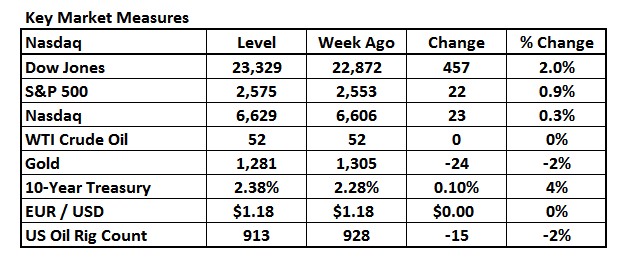
by Todd Shaver | Oct 22, 2017 | Weekly Newsletter 7pm Sunday
The Weekly Summary
Earnings-day blowups, leverage warnings in China, Apple’s worst rout since August. Oh, and a sixth straight week of gains for the S&P 500. No matter what happens lately, stocks just keep rising, with record closes piling up in U.S. markets at a rate that is starting to defy precedent. The Nasdaq 100 Index has finished at all-time highs 62 different times this year, on par with the most ever in 1999, while the S&P 500 and Dow Jones Industrial Average are closing in on historic levels, too. For bears, the elongating list of highs bespeaks euphoria, particularly when the market has been spared a 3% pullback for more than a year. Investors have ignored bad news ranging from North Korea to political drama at the White House to what may be the biggest profit slowdown in six years. It has been a great ride this year. We remind you, our dear reader, it certainly will not always be this good.
No matter what is happening out there, there is always a bull market here at The Bull Market Report! This week we highlight some of our favorite stocks where we think you can still make good money, including: PayPal, Shopify, Celgene, WageWorks, Amazon, and Blackstone.
BMR Companies & Commentary
PayPal (PYPL: $71, up 3%)
PayPal delivered another great quarter for investors. The company not only showed no signs that its platform growth is slowing, it demonstrated that it is actually increasing its rate of growth as the network effects that management has repeatedly cited during the past couple of years continue in earnest. Yet many of its initiatives – the monetization of social peer-to-peer payment app Venmo, the expansion of instant-checkout feature One Touch, customer choice – are still in the very early innings of the game.
Toss in the $7.1 billion in cash that PayPal had on its balance sheet that could be used to fund M&A initiatives and the potential of the company’s worldwide network becomes daunting. We recall that PayPal acquired Braintree – the online and mobile payment platform that has fueled much of the company’s recent growth – in 2013 for just $800 million. And Braintree had spent just $26 million to purchase Venmo, which is a game-changing driver of revenue and earnings for PayPal.
BMR Take: PayPal has been the best way for equity investors to play the global growth of mobile payments. Again we see PayPal deliver an exceptional quarter backing up that point of view. We find nothing to critique about the firm. We raised our Target from $67 to $77 last week. We look forward to raising it again.

Now THERE’s a great chart. What’s next? 75? $80? $100. We think they are all possible.
Shopify (SHOP: $102, up 9%)
Remember that scary short seller, Andrew Left of Citron. Well the short call they were making on Shopify is turning out to be terribly wrong. Ouch! What good news for us and all the other shareholders behind the company.
Since 2014, Shopify, the leading multi-channel commerce platform, has been steadily building its presence in Waterloo, the cornerstone of Canada’s technology Corridor. Just recently, the company announced that it plans to grow its full-time, Waterloo-based workforce by 300-500 new jobs over the next couple of years. Growth continues!
These new positions in Waterloo will focus on growing Shopify Plus, which supports the largest and most complex customers on the Shopify platform. Roles in engineering, product, sales, and merchant services will range from entry-level to senior manager-level, and all will focus on developing innovative solutions capable of scaling for the changing retail landscape.
To accommodate this growth, Shopify also formally announced the opening of their second building in Waterloo. Steps from their current building, the new space will nearly double their physical footprint and further demonstrates Shopify’s dedication to building a strong and sustainable economy. The new space is expected to open in the first quarter of 2018.
BMR Take: It was admittedly a bit nerve-racking to see a short seller like Citron, who nailed Valeant, come out against one of our holdings. But we trust our research and our hard work. Shopify is a remarkable well-positioned technology company for the future of eCommerce.
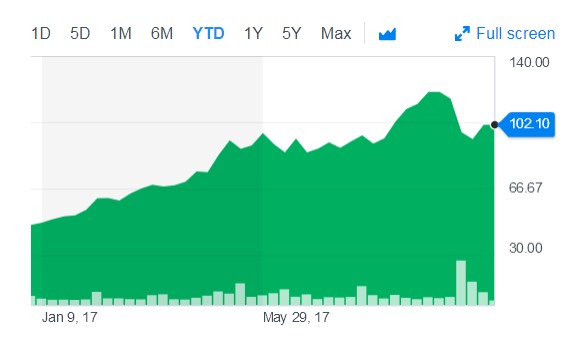
Celgene (CELG: $121, down 11%)
Rough week for Celgene. Celgene announced the discontinuation of the Phase III REVOLVE trial in GED-0301 for Crohn’s disease (CD). This was unexpected and unfortunate news.
Celgene’s decision comes after recommendation by the independent data monitoring committee upon its review of
the overall benefit/risk during a recent interim futility analysis. The company points to no meaningful safety imbalances identified during this analysis, suggesting a lack of efficacy for the drug.
At this time, Celgene has chosen to not initiate the Phase III DEFINE trial in CD. The company is awaiting review of the full dataset from the Phase II trial of GED-0301 in ulcerative colitis to determine next steps in this situation.
In our opinion, this represents more of a psychological blow than a fundamental one to the company. Recall that Celgene paid $710 million upfront to Nogra Pharma Limited for the rights to this drug in 2014 and has since funded development of the asset.
BMR Take: Sometimes you just have to sift through the headlines to find the real facts. This one drug was only supposed to be a $1 billion revenue contributor. But the company is expected to still do more than $20 billion by 2020. So we see no reason to panic. We added the stock at $95 a little over a year ago so we have a nice 28% return and our Target is still a hefty $150. We continue to believe in Celgene. But if you are worried, then get out of the kitchen. There are lots of other choices for your money.

WageWorks (WAGE: $65, up 1%)
WageWorks a little over a year ago acquired Automatic Data Processing’s Consumer Health Spending Account (CHSA) and Consolidated Omnibus Reconciliation Act (COBRA) businesses. This transaction further strengthened WageWorks' leadership position in the Consumer-Directed Benefits market.
Why do we bring it up? Because WageWorks is eating ADP’s lunch and sometimes it’s good to reflect and remind ourselves why.
ADP’s CHSA and COBRA businesses provide a range of services including HSA, HRA, FSA, commuter benefits, and direct bill administration to approximately 10,000 employer clients in the United States.
Not long after this deal, WageWorks won a contract to service the entire federal government with consumer benefits programs, taking away the business from Automatic Data Processing.
BMR Take: WageWorks is serving a niche in the world of payments running consumer benefits programs for employers. It’s a tricky business. The global opportunity is huge and they are just getting started. We don’t hear a lot out of WageWorks week in and week out, but that doesn’t mean it's not exciting. Remember, the company just raised equity and we could see another acquisition occur in the near future.
Amazon (AMZN: $982, down 2%)
Amazon and Google (GOOG: $988) are at virtually the same price. Who will be first to $1100? Let the race begin. We think Amazon will win.
Why? Just look at the craze around the world competing for Amazon’s new headquarters. You can just see the excitement.
New York City mayor Bill de Blasio said that key landmarks around the city like the Empire State Building, billboards, and Wi-Fi charging stations are going to light up in Amazon’s signature orange color. The four bids that New York is pitching Amazon on - including areas upstate and in the city - just aren’t enough, so New York is also going for frills and extra decorations to pretty up its proposal.
Tucson certainly whipped out the big guns when its economic development group hauled a 21-foot saguaro cactus to Amazon’s main Seattle headquarters via a truck. The plan didn’t turn out the way that Tucson’s economic group had hoped: Amazon refused to accept the gift.
Kansas City mayor Sly James is not one to let the competition outdo him. He wrote 1,000 reviews about Amazon products, giving them all five stars. His reviews had slick one-liners like, “I live in beautiful Kansas City where the average home price is just $122K, so I know luxe living doesn’t have to cost a ton.“ Of course, in every review, he never failed to drop a mention of why Kansas City is great. Then, he posted a trendy “unboxing” video on social media to share his efforts. You gotta love this guy.
On Tuesday, Ottawans were told to cheer for Amazon during intermission for a hockey game between the Vancouver Canucks and the Ottawa Senators. A gauge showed up on screen, with Calgary at the bottom if the audience made the least noise and Ottawa on top. It being Canada, of course, the message to make noise was reiterated in French: “Faites du bruit!”
Pittsburgh has local restaurant Primanti Bros. offering free sandwiches to every Amazon employee who ends up working there. Each Pitts-Burger and Cheese sandwich goes for $7.39 normally, so if each of the 50,000 new employees got a sandwich, that would run for a total of $350,000, the Pittsburgh Post-Gazette hypothesizes.
Birmingham tried wooing Amazon online and in person. The city set up three giant Amazon boxes around town. It also set up giant replicas of Amazon’s Dash Buttons that send pregenerated flirty tweets to the company, according to AP, like “Amazon, we got a 100% match on Bumble. Wanna go on a date?” Another tweet reads, "We are Chipotle and these other cities are Taco Bell.”
Honestly, it’s hard to top this next one: This small, recently formed town, located close to Atlanta, offered to rename itself Amazon, Georgia. Stonecrest’s proposal also includes 345 acres of land if Amazon selects it as the HQ destination.
BMR Take: Amazon is the world’s greatest innovation machine. We think the new headquarters is going to spur even more great things and send the stock much higher.
The Blackstone Group (BX: $34, up 5%)
The U.S. real estate market may have slowed down, but Blackstone Group President Tony James still sees plenty of opportunities for profit. “Real estate is a gargantuan market. There are always undermanaged assets,” he said.
Blackstone has been investing heavily in logistics real estate, hoping to capitalize in the rise of online retail, and more acquisitions are possible.
Blackstone’s real estate assets under management grew to $110 billion in the second quarter, up 9% from $102 billion a year ago. Its core-plus portfolio, which includes Stuyvesant Town-Peter Cooper Village, grew 36% to $18 billion.
In May, Blackstone won a $20 billion commitment from Saudi Arabia’s sovereign wealth fund for a new infrastructure investment fund, but it may be a while before the money gets spent. Saudi Arabia’s commitment depends on Blackstone raising additional cash from other investors, and the firm has only just began marketing the fund.
Real estate continues to fuel gains for Blackstone, which reported a jump in third-quarter profit that exceeded all analysts’ estimates. Economic net income, a measure of earnings that reflects both realized and unrealized investment gains, was $835 million, or 69 cents a share, compared with $690 million a year earlier.
Real estate led the charge for Blackstone’s asset sales in the quarter. The unit, sold $3.1 billion in holdings, including a U.K. office property and a portfolio of French hotels. The firm also continued trimming its stake in Hilton, selling shares it held in both its real estate and private equity funds.
Asset sales helped fuel $625 million of distributable earnings, which reflect profits on those disposals and fund management fees, compared with $590 million a year earlier. The metric is on track for its second-best year ever, President Tony James said on a call with media Thursday. Blackstone plans to draw from that pool to pay stockholders a dividend of 44 cents a share on Nov. 6.
BMR Take: We are really excited about Blackstone, especially real estate. Real estate is a “hard asset” meaning the value is more stable than for instance technology or biotech companies where the value is based on expectations of future growth. This real estate angle to Blackstone should give you less downside risk in a tough market.
Our Target is $36 and we fully expect to see this shortly. We can’t wait to raise the Target to the all-time high set in 2015 at $44. This $42 billion market cap company ought to be in the mid-40s for sure.
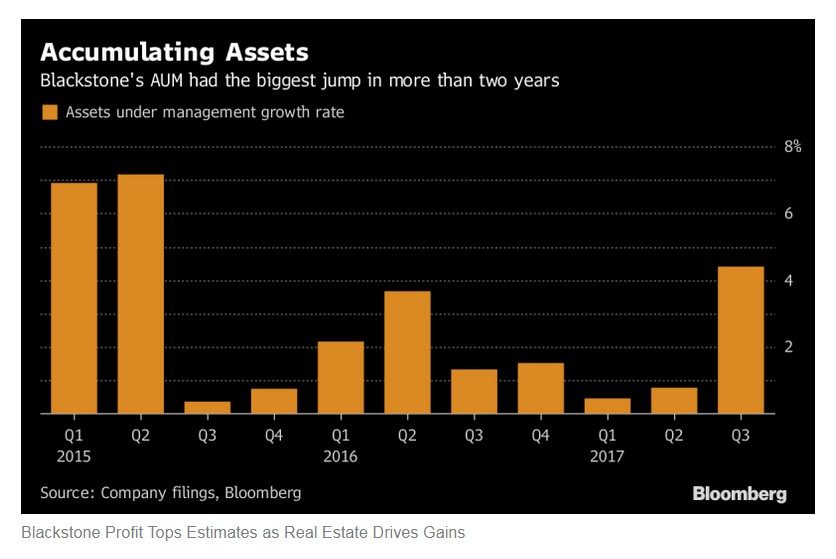
Upcoming Economic News
New Home Sales
Wednesday, October 25th, 10:00 AM
Period: September
Consensus: 552,500
Prior: 560,000
Initial Claims
Thursday, October 26th, 8:30 AM
Period: 10/21
Consensus: 231,500
Prior: 222,000
GDP
Friday, October 27th, 8:30 AM
Period: Q3
Consensus: 2.2%
Prior: 2.2%
The Word on the Street about Apple
Street Consensus Ratings for Apple (AAPL: $156, flat)
Ratings Breakdown: 7 Hold, 41 Buy Ratings
Consensus Price Target: $193
Wall Street Targets:
10/16/2017 KeyCorp $187
10/16/2017 Pacific Crest $187
10/15/2017 Rosenblatt Securities $150
10/13/2017 Barclays $161
10/11/2017 Piper Jaffray $196
10/11/2017 Morgan Stanley $199
10/10/2017 Royal Bank Of Canada $180
10/9/2017 Drexel Hamilton $208
Microsoft (MSFT: $79, up 2%) Sets New All-Time High
My Oh My. What shall we do? What shall we do with this stock at its all-time high of $79? Sell, Hold, Buy more?
BMR Take: WE SAY THE LATTER. Why would you sell one of the greatest companies in the history of the world? Yes, revenues are slowing, but profits are increasing and the profitability of software is second to none. For the year ended June 30th the company did $90 billion in revenue and had $21 billion in net income AFTER TAX. That’s 23% after tax. Wow. So for every $1 of software they sell, 23 cents goes to the bottom line, and much of that is in cash. The company has over $130 billion in cash, albeit over $80 billion in debt, much of it taken out at historically low interest rates. With a $607 billion market cap there are only two stocks higher. – Google at $690 billion and Apple at $810 billion.
We hereby raise our Target from $78 to $84. Go M S F T!
The Word on the Street about AstraZeneca
Street Consensus Ratings for AstraZeneca (AZN: $35, flat)
Ratings Breakdown: 2 Sell Ratings, 9 Hold Ratings, 14 Buy Ratings
Consensus Price Target: $37
Wall Street Targets:
10/17/2017 Cowen $37
09/6/2017 BMO Capital Markets $38
09/1/2017 Argus $35
BMR Take: We added the stock just below $30 last year. We are being very patient with this one. We have a 17% gain in over a year and the 2.6% dividend helps, but we would like to see this thing take off to our Target of $42. It’s no small company at a $85 billion market cap. Revenues are solid at $23 billion and profitability is strong at $5 billion but we want to see more in 2018. If you have patience, you will win.
A Word from Gary Jefferson
Jefferson Financial Group
First Vice-President, Investments
UBS Financial Services, Inc.
We are getting ready to get down to the nitty-gritty of tax-reform. Listening to all the political pundits (which is extremely hard to stomach), it appears that the odds are now slightly favoring the failure of tax reform happening this year. Admittedly, we are talking about a government which is trillions of dollars in debt already, but that number seems to be "just a number". How do we actually comprehend a trillion dollars? One market guru described it as follows:
"Numbers, like billions and trillions tend to numb the mind. They are too large to grasp in any “real” sense. Thirty years ago an older member of the NYSE gave me a graphic and memorable example. “Young man,” he said, “would you like a million dollars?” “I sure would, sir!”, I replied anxiously. “Then just put aside $500 every week for the next 40 years.” I have never forgotten that a million dollars is enough to pay you $500 per week for 40 years (and that’s without benefit of interest). To get a billion dollars you would have to set aside $500,000 dollars per week for 40 years. And a trillion that would require $500 million every week for 40 years. Even with these examples, the enormity is difficult to grasp."
Despite our debt, the market wants and believes that a smaller government (lower taxes) will result in a higher GDP which in turn means higher tax revenues. Thus, the argument that the government has to "pay" for any tax cuts - by raising taxes on the left hand if lowering them on the right hand so as to keep the "debt" constant - is tantamount to keeping the status quo and, ultimately, the same drag on business that we have today. It is apparent that the $5 trillion gain in the overall stock market since the election is because of both increased earnings and the perception that those earnings will continue to grow in part due to lower taxes which drop directly to the bottom line of businesses. Our view is that it will be difficult for the market to act as if tax reform failure is a non-event. It's a major event that could make US companies more competitive in world markets and super-charge domestic small business like nothing has for the past 20 or 30 years.
Business and the markets both need an overhaul of a tax system that is so out-of-control that, as a generality, if one hundred experts file the same tax return, there will be ninety-nine different results. That said, tax reform failure by itself should not derail the current bull market - rather it will likely result in a "reset", or as the pundits like to say, a "consolidation of gains" before the next move higher. Until we see a recession or a bad policy move that, for example, results in an inverted yield curve, we expect that the market will continue to grind higher based on the quality and stability of earnings growth.
The High Yield Corner
By Michael Foster
Let’s start with the elephant in the room.
Government Properties Income Trust (GOV: $18.22, down -2%*) fell just 1% on Friday after receiving an unfavorable mention on Jim Cramer’s Mad Money. This move surprised us for two reasons. Firstly, we didn’t think anyone still watched Cramer’s show, and, secondly, we didn’t think anyone actually listened to him for investing advice. Apparently this failed hedge funder still has a following, though, and the selloff is a result of that.
* The company paid a 43 cent dividend on Friday and a stock that goes x-dividend always opens up down the amount of the dividend on that day, so in reality, the stock was down just a touch last week.
And what exactly is Cramer’s thesis? To be honest, we’re not sure. We’ve seen the clips and read a couple of takes, but the dismissal seems to be without any substance beyond “it’s a high dividend stock and it’s not for me.” No close look at FFO, dividend coverage, or revenue growth.
So, we will give you that here.
Let’s start with revenues. Government Properties Trust saw a 9% year-over-year increase last quarter, an acceleration from a decline at the start of 2016. Revenue growth acceleration has been occurring for nearly two years now, fueled in part by acquisitions and the company’s diversification away from government offices and towards office space leased to think tanks, public companies, private contractors, and so on. That investment has cost money, which means FFO has been weaker than it was back in 2014-2015, which also means dividend coverage is below 100% (it’s actually about 76% over the last 12 months).
Investors should in theory be rewarded for that lower dividend coverage with a higher yield, and at 9% that is exactly what they are getting. But really what we need to think about is the REIT’s ability to generate cash from operations to fuel the distribution in a sustainable manner.
If its expansion efforts bear fruit, this is exactly what we should see. But keep in mind that a bet on Government Properties is a bet on its future growth potential - and with revenue growth still accelerating, it remains a REIT growth stock. The second we see that sales growth weaken is the second we reconsider the stock. No matter what the bald guy on CNBC says.
Elsewhere in REIT land, things were extremely quiet. Omega Healthcare Investors, Inc (OHI: $32, up 1.5%) saw slight gains, whereas we saw a little dip in Ventas (VTR: $63, flat). Welltower (HCN: $68) ended the week flat, as did Apollo Commercial Real Estate (ARI: $18.44). One other REIT had a very fine showing, which is little surprise to us, since it’s been doing a lot of that lately.
Namely, Digital Realty Trust (DLR: $124, up 1%) had another strong week that pushed its dividend yield even lower, and we’ve finally hit the 3% mark yet again. Last week we discussed the significance of this barrier, and it’s not too surprising that it was hit. That should also make investors pause and consider why exactly they’re in the stock. At a 3% dividend or less, it’s more than generous to call Digital Realty a high yield stock. Yet it is unquestionably a high growth stock. Revenue growth, at 10% last quarter, fell from the 20%+ growth of 2016, but considering just how tough it was to compare revenues to 2016’s figures, that slowdown was more than expected. And at near 10% sales growth, the company is still growing like a weed. That has helped FFO growth accelerate markedly, which should indicate more aggressive dividend increases are on their way.
That leads us to the question: what to do with this stock. If you aren’t in need of a high yield, Digital Realty is a great place to be, because you’re essentially Google and Amazon’s landlord for their most precious assets: their data and global presence. But if your goal is to target a 7% income stream or higher, you could easily make do with removing allocations to Digital Realty with a nice profit and move into other higher yielding stocks in our two high-dividend-paying stocks. That’s especially true now that we’ve seen Digital’s stock soar 83% in 3 years. Yes, more upside is on the way, but maybe not as quickly and as profoundly as we’ve seen so far this year and in recent history.
Now let’s move on to the other, somewhat smaller elephant in the room: PIMCO Dynamic Income Fund (PDI: $30, down 4%), which wasn’t the worst performing Pimco fund of the week, although it was pretty close. Across the board, the market punished Pimco’s funds after the company announced that net investment income for most of its funds was far from covering distributions. This wasn’t a surprise, but the market has mostly ignored this issue until just now. Both the Dynamic fund and other Pimco funds have seen dividend coverage slip to less than 100%, although Dynamic’s coverage is not the worst of the lot. Still, the market is worried that the fund won’t be able to cover its payouts.
This is an overly simplistic view. Dynamic’s NAV has gone up 12% in 2017 - more than many bond funds and even some other Pimco funds. Since closed-end funds can fund distributions from Net Investment Income (NII), this just means Dynamic’s payouts can come from capital gains instead of NII. There are some tax issues here, but in terms of dividend sustainability, Dynamic’s distributions are fine.
But there is one implication many aren’t talking about, and we have addressed it earlier this year: the specials. Dynamic is famous for paying a huge special dividend at the end of the year, which has historically come from massive NII. Now that NII is weak, Pimco has a great excuse to tell investors, “Worry, income was weak, so no big special dividend this year.” We are not sure this will happen, but we’re leaning more to this being likely than we were earlier this year. If you were depending on this fund’s special distribution like the big one we saw last year, be prepared for disappointment. Also be prepared for that to hit the stock at the end of the year.
Is this a bad thing? Not really. The regular dividends are still safe, and the fund’s yield is a very nice 9%. And we could see NII improve significantly next year. There’s definitely more to come with Pimco funds in the coming months! But, if you don’t like drama, take your profits and squirrel them away in Annaly Mortgage (NLY – 10% div.) or any of the other stocks in our two high-yield portfolios and sleep like a baby.
Good Investing,
Todd Shaver, Founder and CEO
The Bull Market Report
Since 1998
October 16, 2017
by Todd Shaver | Oct 16, 2017 | Earnings Preview 6 AM
Blackstone (BX: $33)
Bull Market Report Target Price: $36
Bull Market Report Sell Price: $31
Market Cap: $40 billion
Earnings Date: Thursday, 11:00 AM ET
Consensus: 3Q17
Revenues: $1.45 billion
EPS: $0.57
Year Ago Quarter Results
Revenues: $ 1.40 billion
EPS: $0.57
Key Things to Watch For in the Quarter
Blackstone is expected to report a 4% increase in revenues and no change in earnings per share for 3Q17. Blackstone has beaten estimates in three of the past four quarters, helping contribute to its outperformance of the Financial Services industry and 40% year-over-year appreciation. The stock yields a strong 6.5% dividend and currently trades at 14 times earnings, a fair value compared to its competitors whose average PE is around 14 as well.
----------------------
PayPal Holdings (PYPL: $69)
Bull Market Report Target Price: $66
Bull Market Report Sell Price: We would not sell PayPal
Market Cap: $82 billion
Earnings Date: Thursday, 5:00 PM ET
Consensus: 3Q17
Revenues: $3.2 billion
EPS: $0.44
Year Ago Quarter Results
Revenues: $ 2.7 billion
EPS: $0.35
Key Things to Watch For in the Quarter
Analysts expect PayPal to report a 19% increase in revenues and a 25% increase in earnings per share for 3Q17. PayPal was trading at $39 this time last year and has since posted earnings that have beaten estimates in all four quarters. Although PayPal currently trades at a PE of 55, which looks slightly overvalued, we do believe this valuation is justified. Year-over-year growth in e-commerce was 14%, 15%, and 16% in 4Q16, 1Q17 to 2Q17 respectively. This pattern of accelerated growth has moved the valuation of companies in the industry higher and PayPal is the leader, having strategically positioned itself to maintain and grow market share.
