September 4, 2017
by Todd Shaver | Sep 4, 2017 | Weekly Newsletter 7pm Sunday
The Weekly Summary
We sadly observed Hurricane Harvey devastate Texas this past week. 52,000 people are in shelters as thousands of homes are flooded. The state of Texas ranks as the 2nd largest contributor to GDP in the US trailing only California and ahead of New York. So the economic impact has yet to be fully seen. Real estate portfolios caught without flood and business disruption insurance may be seriously in trouble. Auto sales are already seeing a sizeable dip. Chemical plants are shut down. We could go on and on. What an unfortunately troublesome situation to watch and one with the potential for lingering negative impacts for months to come.
In other news, lawmakers decide to give bipartisanship a shot on healthcare. The Senate Health Committee will turn its attention to bipartisan legislation aimed at shoring up Obamacare markets for 2018. The drift toward compromise follows high profile repeal failures, but still faces an uphill battle as many Republicans have spent years railing against the health law. Staff has been working on it over the summer break and there is general agreement that insurer payments will continue, though specifics are sparse.
Separately, we have yet to see formal action following Trump’s opioid emergency declaration. No formal paperwork has been filed and no new policies have been announced. This appears to be new territory for the government as the national emergency designation is typically used for relief of temporary issues like natural disasters rather than chronic problems like opioid abuse. In addition, administration officials seem to have been caught off guard by Trump's statement. The White House has indicated that it is considering all options for action. Why should we care? This is a big deal for labor force participation, which is at historical lows. If we can get everybody back to work contributing to our economy and off drugs, that is the path to 3.0% GDP growth versus where we are now at 1-2%.
No matter what is happening out there, there is always a bull market here at The Bull Market Report! This week we highlight some of our favorite stocks where we think you can still make good money, including: Apple, Gilead, Bristol-Myers, Amazon, and PayPal.
BMR Companies and Commentary
Apple (AAPL: $164, up 1.5%, all prices are for the week)
Apple has officially scheduled its first-ever event in the company's Steve Jobs Theater, a September 12th invitation-only press conference expected to reveal the latest iPhones and possibly a revamped Watch and Apple TV. The company emailed invitations Thursday that read "Let's meet at our place," with an picture of an Apple logo in red, white and blue. The event, hosted at the company's new spaceship-style Apple Park headquarters is scheduled to start at 1 PM ET. For several years, Apple has revealed its latest iPhones in September, in time to promote them for the holiday season. This year, 10 years after the first iPhone hit the market, Apple is widely expected to reveal the iPhone 8, and the rumor mill has already churned out reports that the device will have a larger OLED* screen and a virtual home button. There are also reports Apple will reveal a Watch that has its own cellular connection and an Apple TV that adds 4K UHD. This is likely it—the big event for Apple’s new iPhone launch! We will all be watching closely.
* Organic light-emitting diode. An OLED display works without a backlight; thus, it can display deep black levels and can be thinner and lighter than a liquid crystal display (LCD). In low ambient light conditions (such as a dark room), an OLED screen can achieve a higher contrast ratio than an LCD.
The main risk to keep an eye on is prices. The argument is that costs are getting so high on new smartphones that customers will not be willing to keep paying up to get them. If this is so, we will see margin compression and perhaps fewer sales by Apple.
Apple Consensus on the Street
Apple was upgraded by analysts at Cleveland Research from a “neutral” rating to a “buy” rating in a report released on Tuesday, and they raised their price target to $197.
On the Street there are 10 Hold Ratings, 39 Buy Ratings, 1 Strong Buy Rating
9/1/2017 Royal Bank Of Canada Target: $180
8/29/2017 Cleveland Research Target: $197
8/24/2017 Bank of America Target: $180
8/24/2017 Drexel Hamilton Target: $208
8/22/2017 Canaccord Genuity Target: $180
8/14/2017 Sanford C. Bernstein Target: $175
BMR Take: Remember the big story for Apple is their services business. They have all these iPhones out there in use by a huge customer base. Can they now get more money from these customers through services? The iPhone 8 is a key part of the strategy. We note that Apple has $260 billion in cash now, which is the equivalent of $50 a share, and greater than 30% of the stock price. This is UNPRECEDENTED in the history of Wall Street. Apple remains an exciting investment opportunity. The services business is projected to double in revenue to $50 billion over the next several years. The Services business is much more profitable than hardware so the impact to earnings is even better. Don’t sell a share. We believe Apple has a lot more room to go on the upside.
Gilead Sciences (GILD: $84)
We removed Gilead from our Healthcare portfolio in February after holding them for a year with poor results. Things have changed dramatically since that time as management has tackled various issues head-on, so we give you an update as things have changed even more this past week.
Gilead announced a big acquisition. Gilead will acquire Kite Pharma for about $12 billion in cash; it was unanimously approved by both the Gilead and Kite Boards of Directors and is anticipated to close in the fourth quarter of 2017. The transaction will provide opportunities for diversification of revenues, and is expected to be neutral to earnings by year three and accretive thereafter.
The acquisition of Kite establishes Gilead as a leader in cellular therapy and provides a foundation from which to drive continued innovation for people with advanced cancers. We are greatly impressed with the Kite team and what they have accomplished, and believe they are on the cutting edge of cell therapy that will be the cornerstone of treating cancer. The field of cell therapy has advanced very quickly, to the point where the science and technology have opened a clear path toward a potential cure for patients. The two company’s similar cultures and histories of driving rapid innovation in order to bring more effective and safer products to as many patients as possible make this an excellent strategic fit.
BMR Take: Gilead is losing two major drugs this year with big revenues due to the expiration of their patents and was the reason we removed the stock earlier this year . Over the past several years they were among the largest sellers in the history of Healthcare so replacing them will be a tough uphill climb. Could Kite provide a way to do it? We will see.
Bristol-Myers Squibb (BMY: $60, up 3%)
This week Bristol-Myers will announce more than 60 presentations, including seven late-breaking abstracts, from its Oncology portfolio featured at the European Society for Medical Oncology 2017 Congress in Spain. Presentations of data from company-sponsored studies, clinical collaborations and research will explore the potential role of Opdivo (nivolumab) as monotherapy and in combination with Yervoy (ipilimumab) and with relatlimab, a fully human monoclonal antibody that targets lymphocyte activation gene-3 (LAG-3); or with chemotherapy in 13 types of cancer.
All this news matters a lot because healthcare investors love new data! We are seeing the stock pick up some momentum getting ready for what is likely to be a wave of good news.
BMR Take: We are still optimistic Bristol-Myers could be a take-out candidate. Activist investor Carl Icahn is in the stock and pushing for change. We believe we could see a 25-50% premium from today’s price if a sale gets done. Further supporting our view, we note Jana Partners is now also building a position in the stock. Jana had a big stake in Whole Foods, and was taken out by Amazon this past week as you know.
Amazon (AMZN: $978, up 4%)
Amazon announced 3,000 more jobs coming to Ohio. This follows news a few weeks ago about doing a major facility in New Jersey. We continue to highlight the Amazon machine because this single company alone is now a major driving force behind the economy.
The internet retailer received approval on Wednesday for state tax incentives for two distribution operations in Ohio. The project approved by the Ohio Tax Credit Authority will create 2,000 jobs. The company said it will invest $100 million at the site, which eventually will result in a 855,000 square-foot facility. The second distribution-center project, will result in an estimated 1,000 jobs if the company goes ahead with the project. Amazon had no presence in the state until recently.
BMR Take: The Amazon powerhouse is steamrolling the real economy and the stock market. With over $20 of EPS potential by 2020 according to analyst consensus estimates, we see a lot of potential ahead.
We noticed that the stock is on a little roll lately. The stock hit a closing high of $1052 a month ago in late July and then proceeded to drop over $140 to the low 900s. But this week the stock was up a little bit every day until Friday when it took a breather. We have watched these high-priced stocks for years and many times it is human nature to not be able to bring yourself to buy a stock that is almost $1000 a share. But we always mentally build in a stock split. Say 10-1 in Amazon’s case. If the stock were a $98 stock, would you buy 100 shares? Sure you would. So we just look to buy 10 shares for $980. Same difference. If you think the stock is going to $2000 a share in the future like we do, 10 shares here, 20 shares there, and 30 shares beyond, adds up to real money.
PayPal (PYPL: $61, up 2.5%)
PayPal customers in the U.S. can now earn cash back on every purchase online and in stores with the recent launch of the new PayPal Cashback Mastercard issued by Synchrony Bank. The PayPal Cashback Mastercard, designed exclusively for PayPal members, offers cardholders 2% cash back every day, on every purchase – everywhere Mastercard is accepted.
Unlike other rewards credit cards, there is no annual cash back limit, no minimum redemption amount, no restriction on how to spend cash rewards and no expiration. The PayPal Cashback Mastercard offers all the security and convenience expected from PayPal, plus all the traditional benefits of a Mastercard. All accounts are automatically added to the member’s PayPal wallet to simplify checkout and provide peace of mind.
The introduction of the PayPal Cashback Mastercard with Synchrony Bank continues PayPal’s commitment to provide customers with rewarding product experiences and a range of innovative credit options. By providing a simple way for people to earn cash rewards for the shopping they’re already doing, the PayPal Cashback Mastercard will give consumers yet another reason to shop with PayPal.
BMR Take: PayPal has 200 million customers on the way to over 1 billion longer-term (after all, Facebook has over 2 billion, showing the possibilities for a global internet-based business model). With EPS closing in on $3 by 2020, and EPS growth moving along in the mid-teens, we see growth at a reasonable price here in the stock and like it a lot!
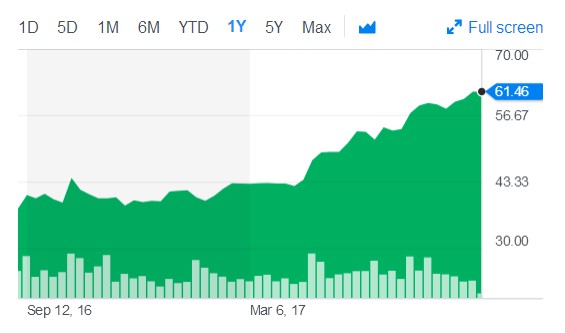
Nutanix (NTNX: $22, flat)
We reported via News Flash on Friday on the stellar earnings report the company issued on Thursday. The stock shot higher on Friday, hitting $24, but settled at $22, flat for the week. We’re not traders as you know, but long term investors, and we have seen this many times in our career. We are going out on a limb here and will say that the stock will move higher from here over the coming weeks and months.
We mentioned the high level of sales that were booked but not reported as revenues – the backlog. Management indicated that billings growth was 40% year over year and that the company continued to build up a significant backlog of deals that booked but did not ship in the quarter. The sales transition toward large enterprise is progressing nicely. Management's next quarter guidance implies billings growth of 25% YoY compared to consensus of 17%, due to the significant backlog build.
To recap:
Fiscal 4Q 2017 Financials
Revenue: $226 million, up 62% year-over-year from $140 million in 4Q16
Net Loss: $50 million, compared to a net loss of $47 million in 4Q16
Operating Cash Flow: $6 million, compared to $2.5 million in 4Q16
Cash and Short-term Investments: $350 million, up 90% from 4Q16
Deferred Revenue: $525 million, up 77% from 4Q16*
Free Cash Flow: $(6.5) million, compared to $(6.5) million in the fourth quarter of fiscal 2016
Billings: $289 million, growing 40% year-over-year from $207 million in 4Q16
BMR Take: We added the stock in May at $17.45 and have a Target of $30. Our Sell Price at $14 is way too low, so we hereby raise it to $19. This was a great quarter and if Wall Street doesn’t wake up to the potential of this company, we would be very surprised.
Upcoming Economic News
Domestic Auto Sales
Monday, September 4th, 8:00 AM ET
Period: August
Consensus: 4.6 Million
Prior: 4.5 Million
Trade Balance
Wednesday, September 6th, 8:30 AM
Period: July
Consensus: -$44.5 billion
Prior: -$43.6 billion
Initial Claims
Thursday, September 7th, 8:30 AM
Period: 09/02
Consensus: 240,000
Prior: 236,000
Consumer Credit
Friday, September 8th, 3:00 PM
Period: July
Consensus: $15.0 billion
Prior: $12.4 billion
A Word from Gary Jefferson
Jefferson Financial Group
First Vice-President, Investments
UBS Financial Services, Inc.
Over the previous weekend, these were the economic headlines:
--- Robust Retail Sales
--- Disappointing Durable Goods
--- Strong Business Inventories
--- Uneven Industrial Activity
--- Mixed Housing Data
Economic data suggests that things are good, but not great.
Fed Chair Janet Yellen's signaling of continued restraint on monetary policy at Jackson Hole triggered another rally in US stocks last week. This extends the current bull market to 102 months, surpassed in length only by the 113-month run leading up to the dotcom crash. Skepticism over valuations is even higher now with a record 46% of investors believing equities are overvalued.
While the bull market may be entering the later stages of the cycle, UBS strategists believe it can run further based on these observations:
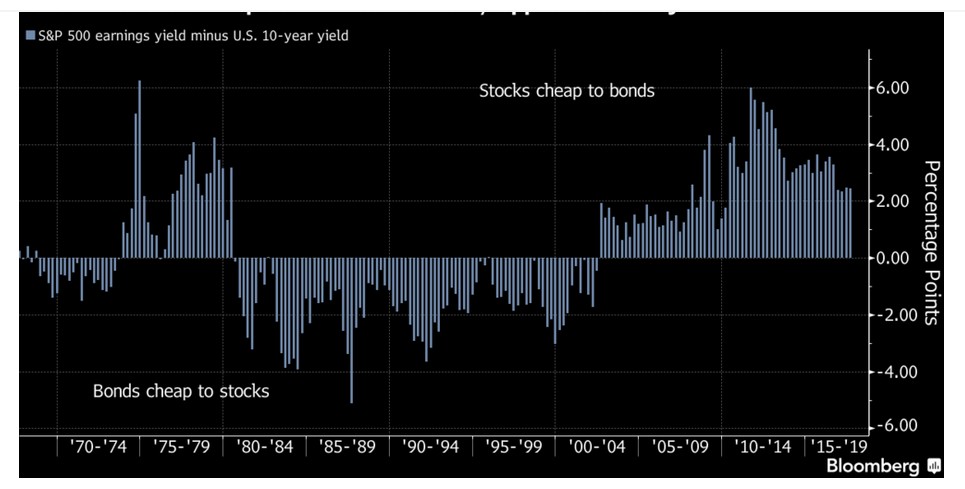
--- The earnings yield on the S&P 500 is 4.8% compared with a yield of 2.17% for 10-year Treasuries.
--- At 18x, current market PE ratio is near long-term averages. Historically when valuations have been in an 18x to 23x range, the MSCI AC World Index has returned 6% over the subsequent six months (versus an overall average of 5%). And relative valuations of equities also suggest long-term outperformance versus bonds.
--- Corporate earnings growth remains robust, at 12% in the US and around 10% in the Eurozone in the last quarter. Synchronized global growth should continue to support this, with all 45 OECD economies on track to expand this year.
There are, however, some caution flags appearing here and there. We prefer to look at price-to-sales ratios rather than PE's, and they haven't been this high since the peak of the dotcom bubble in 1999. This means that new investors are paying more for every dollar of sales than at almost any time since the dotcom bust. However, if sales continue to grow as expected this ratio will normalize to some degree. Put another way, stocks are priced almost to perfection and if the earnings growth story were to falter, it could cause some real volatility.
VMware (VMW: $107, up 5%) Has 500,000 Customers
BMR Take: Think about this. Half a million customers. Can you imagine? We think this is just fabulous. We’re up 30% since we added them in January at $83. What a great company. Our Target is $108 which it hit Friday, an all-time high (not counting the euphoria 10 years ago when they went public). With a market cap of $44 billion, and Dell Technologies being the principal owner (80%+) we think very highly of this company. So we hereby raise our Target to $120 and raise the Sell Price from $90 to $100.
The Blackstone Group (BX: $33, up 4%) had its Target Price set at Credit Suisse Group at $45
A Few Wall Street research firm targets
8/30/2017 Credit Suisse Group $45
7/25/2017 Morgan Stanley $40
7/21/2017 Deutsche Bank $33
7/14/2017 Keefe, Bruyette & Woods $37
7/14/2017 Oppenheimer Holdings $38
5/28/2017 Citigroup $41
Blackstone Considers IPO of Gates Corp.
Blackstone Group is considering an initial public offering of Gates Corp. that could value the auto-parts maker at as much as $9 billion. Its products include belts, hoses, industrial power transmission, fluid power, and automotive. The company was founded by Charles Gates in 1911 and is headquartered in Denver. In 2014, the company was acquired by Blackstone in a deal worth $5.4 billion.
The private-equity giant is in the early stages of laying the groundwork for the possible offering, according to people familiar with the matter. The business could be worth $8 billion to $9 billion, one of the people said. It isn't clear whether that includes debt.
BMR Take: We can’t tell you how good this company is. Well, maybe we can: This company is great! Look at the wealth being created by this firm. In 3-4 years in this one deal alone, they have created $3-4 billion of equity. Absolutely amazing. Our Target is $35 but we are dying for the stock to hit this price so we can raise it to $42. This is a value stock like no other.
The High Yield Corner
By Michael Foster
Significant news came this week from AstraZeneca (AZN: $30, up 3%), helping the shares rise solidly by the end of the week. The biggest news is the company’s presentations at a conference in Spain that will demonstrate the company’s phase-3 study of imfinzi for non-small cell lung cancer and tagrisso for. EGFR cancers.* The science is complex and far for non-specialists to understand without a lot of deep reading, but the market is a great place because it prices in that knowledge instantaneously, which is why AstraZeneca shares rose 2% on the news.
* EGFR is short for estimated glomerular filtration rate. The EGFR is a number based on your blood test for creatinine, a waste product in your blood. It tells how well your kidneys are working.
Another intriguing tidbit from AstraZeneca: the company announced on Tuesday that it was recruiting Takeda Pharmaceutical to work on an antibody for Parkinson’s disease treatment. Again, more exciting developments that prove the mega-pharma company’s pipeline is very healthy. Remember a year ago when this was a primary concern on the company and thus the stock? Those concerns are gone now; instead, investors have finally realized that there is tremendous value in this company and it is still innovating; thus it’s no surprise shares are up 10% in 2017 so far. Paying a solid 3.1% dividend, we can see some dividend increases in the months and years ahead. We’ve got a $42 Price Target on the stock and would hope to see this level sometime next year.
Elsewhere in The Bull Market Report High Yield portfolio we see green across the board. There’s only one exception: Invesco Municipal Trust (VKQ: $12.93), which ended the week flat. No surprise; municipal bonds are a low volatility asset class, and there’s not really any news in the municipal bond market to warrant a massive jump. That includes the latest tragedy in Texas. While large storms and ecological disaster might intuitively seem like they will hurt municipal bond markets (lower economic activity should mean lower government revenue and thus higher default risks), it’s important to remember that this “common sense” is actually false. (Often, the common sense view doesn’t quite work in finance.) In reality, credit agencies do not downgrade bond issuers faced with economic disasters; furthermore, the lower revenue may make the state’s budget tighter in the short term, but the risk of that hurting municipal bonds is negligible. Additionally, natural disasters rarely result in massive new bond issuances to fund repairs, so it’s not like existing bonds will get priced out by new issues.
We saw Nuveen AMT-Free Municipal Credit Fund (NVG: $15. 64, up 1%) have a solid showing. Also a nice surprise from Nuveen this week: the company announced dividends for all of its closed-end funds, but did not lower dividends on NVG - although many other funds did see their distributions decline slightly. Again, good news for municipal bond investors long this fund.
The Bull Market Report’s other closed-end fund picks also ended the week in the green and announced distributions that were in-line with previous dividends. AllianzGI Equity & Convertible Fund (NIE: $20, up 1%) announced that its 38 cent quarterly dividend would continue at the same level, and PIMCO Dynamic Income Fund (PDI: $30, up 1%) also announced its monthly dividend would stay at the same level. These funds are paying 8% in income, year-in and year-out, while also seeing their share prices rise. Closed-end funds are typically income vehicles that aren’t often traded for short-term capital gains, but both funds have given investors that opportunity this year. AllianzGI is up 10% year-to-date and Pimco Dynamic is up 14% year-to-date - extremely impressive returns for such diversified funds. And the income does not look to be threatened anytime soon, so investors can continue to hold them with confidence.
Now, let’s turn to REITs. Digital Realty Trust (DLR: $118, flat) announced that its COO was leaving the company in September. Markets shrugged; while he obviously has done well for the company in the past, there’s no reason to assume he’s irreplaceable. We’re sure that his replacement will be skillful.
Despite little news elsewhere affecting REITs, we saw price gains for Omega Healthcare Investors (OHI: $32, up 3%), Government Properties Income Trust (GOV: $18.50, up 1%), Apollo Commercial Real Estate (ARI: $18.18, up 2%), Ventas (VTR: $69, up 1%), and Welltower (HCN: $74, up 2%).
Also, there wasn’t any real news on Kimco Realty (KIM: $20, flat), but it’s interesting to note that this retail-focused REIT has had a bit of a resurgence lately thanks to the surprising strength in retail. (Note that we removed Kimco from our portfolio in May, but we wanted to give you an update.) If you remember, several weeks ago in this column we wrote at length at how the “death of retail” cliché was really more about shock financial journalism trying to get clicks from disaster-starved readers and had little to do with the reality of our economy. Well, we were right. In addition to beats from Macy’s, Dollar General, Target, Wal-Mart, and several other retailers, even the near-death dogs like Sears Holdings and Abercrombie & Fitch impressed the market with their quarterly results, beating expectations. Retail is not the healthiest sector on Earth, but it isn’t dead or dying. But Kimco was priced for a dying retail sector. So what does that mean? Kimco shares are up 11% in the last three months.
We want to go on record with another prediction that drives bullishness on retail REITs like Kimco. Amazon’s recent acquisition of Whole Foods and their price drop at the supermarket is going to drive retail sales for two reasons. Firstly, Amazon Prime members will be incentivized to leave their computers and shop in person more. Secondly, more people can now afford Whole Foods and will shop there. That also means people are going to spend more time shopping at auxiliary stores adjacent to Whole Foods. This is a rising tide that is going to lift many boats, which is why buying retail REITs right now makes a lot of sense. Check back in after about six months and see if we’re right.
Good investing,
Todd Shaver, CEO, Founder and Editor
The Bull Market Report
Since 1998
August 21, 2017

by Todd Shaver | Aug 21, 2017 | Monthly Newsletter Daily 12pm if new
The Weekly Summary
It was rough week with lots of domestic and international issues popping up, producing anguish. In particular, nine CEOs turned their back on Trump. It all started when first Merck’s Kenneth Frazier, then Under Armour’s Kevin Plank and Intel’s Brian Krzanich stepped down from a White House business group set up to advise Donald Trump. While none mentioned the president, Frazier, one of the country’s most-prominent black chief executive officers, quit the council as Trump was being assailed for failing to quickly condemn white supremacists for deadly violence at a rally Saturday in Charlottesville. Frazier said he was acting on a “matter of personal conscience.” Trump shot back on Twitter Tuesday morning, saying, “For every CEO that drops out of the Manufacturing Council, I have many to take their place.
Then on Wednesday President Trump rushed to announce that he was shutting down the two advisory councils of business leaders, after the members had decided on their own to disband in the wake of the president’s comments on the events in Charlottesville. Of course, these kinds of advisory councils seldom accomplish much of anything.
Look, all this drama will pass. The market will move on. But there is definitely an unsettled feeling out there. It is good that the market showed signs of turning around at week’s end, but we did see a few glimpses of nasty selloffs in a few trading sessions this week. It was a rough week. If you are super worried, then we suggest you take some profits off the table. There are many choices for you to move your money to in the High Yield and the REIT portfolios. These are much more secure, stable stocks with very nice dividends that you can enjoy and sleep better with.
No matter what is happening out there, there is always a bull market here at The Bull Market Report! This week we highlight some of our favorite stocks/funds where we think you can still make good money, including: high yield equities like Annaly and larger caps like Apple, Google, Microsoft, Home Depot, and Visa,
BMR Companies & Commentary
Annaly Capital Management (NLY: $12.34, up 1%)
Annaly recently reported respectable earnings at the beginning of the month. Here are our thoughts on the outlook for the rest of the year and what to watch. Many people are cautious given Annaly’s fixed-rate agency exposure and the current valuation. We know that the company has a set yield on government guaranteed paper. So while there is no credit risk other than the full faith and credit of the United States, there is interest rate risk – we know this and accept this. The newer investments are coming on at lower rates with higher yielding holdings rolling off. And we know that if short term rates rise the current portfolio valuation will be sensitive to the movements. We are likely to see some pressure on Annaly’s business model.
But what can the company do? They can rotate into higher yielding MBS* investments. They can increase leverage. They can do a number of things to cover the dividend. Look, if you think a business model is flawless without risk then you don’t know it well enough. Annaly has rsk to higher rates, but higher rates are ultimately good for the company. And investors are missing all the offsetting possible moves management can take. Remember, this is a company that is 18x the size of the median mortgage REIT by market cap, has outperformed the S&P 500 by 3x since its IPO for total return, and has successfully raised $1.5 billion in new capital this year. They know the world they live in and have survived and thrived for 20 years.
* Mortgage-backed Securities
BMR Take: A Director at the company just bought 13,500 shares. Another one just bought 17,700 shares. We love love love to see that! We are looking at a $0.30 dividend paid quarterly for the time being which is good. The stock looks compelling based on this income stream, producing a dividend over 10%.
Apple (AAPL: $158, flat) is Getting into Programming
Apple has set a 12-month budget of $1 billion to develop original programming. Apple could buy and produce as many as 10 TV shows. Apple's first two efforts -- Planet of the Apps and Carpool Karaoke -- have not been warmly received by critics. Apple executives are talking with Hollywood agents about shows that Apple can buy.
BMR Take: Note that Apple has $260 billion in cash now, and with a market cap of $813 billion cash is 32% of the stock price. So $50 of the stock price is in cash. This is UNPRECEDENTED in the history of Wall Street. Apple remains an exciting investment opportunity. The services business is projected to double in revenue to $50 billion over the next several years. The Services business is much more profitable than hardware so the impact to earnings is even better. Don’t sell a share. We believe Apple has a lot more room to go on the upside.
And how about Apple's performance last week in a very tough week for equities.
Google (GOOG: $911, flat)
The Cloud is a huge opportunity in technology and all the industry giants are fighting to grab their fair share. Let's stipulate up front that Amazon Web Services (AWS) remains the top choice for most companies that are thinking about moving their data and software into cloud data centers. Having said that, however, Amazon's cloud is no longer the only option that companies consider. For example, those companies wanting extensive analytics are taking a good hard look at the Google Cloud Platform. And many firms are hedging their bets by using multiple cloud providers to avoid being stuck with one down the road.
While AWS is still the largest cloud provider by far, Microsoft and Google are coming on strong. AWS's revenue growth appears to be slowing, in part because it's hard for such a huge business - AWS is expected to produce $16 billion in revenue this year - to grow as fast as its younger, smaller incarnations. Startups are considering alternatives now for several reasons: standard cloud computing and storage services from the three top players are all seen as competitive, and no one thinks any of the three major cloud contenders is going away. Basically, AWS, Microsoft, and Google are seen as safe bets.
BMR Take: Google took a hit on the recent earnings report. Buy the dip. This company will generate over $40 of EPS in 2018. The stock is far from a stretched valuation.
Microsoft (MSFT: $72, up 1%)
As Internet-of-Things (IoT), artificial intelligence (AI), smart factories and intelligent applications continue to advance, businesses are increasingly turning to these technologies to create new business solutions with greater agility in order to drive competitive advantages. Microsoft launched its IoT Innovation Center in Taiwan last October to spur development between IoT partners and international enterprises and organizations. In September, Microsoft will hold its second IoT Expo in conjunction with the World Congress on Information Technology. Jason Zander, Corporate Vice President, Microsoft Azure, will deliver a keynote on "Leading Digital Transformation and Landing IOT Value with a Strong IoT Partner." Zander oversees the development and global deployment of cloud infrastructure and technology, including Microsoft Azure IoT. In addition to sharing the success of Microsoft's IoT Innovation Center and its partners, Mr. Zander will also provide Microsoft's vision of the development of IoT and in-depth analysis on the integrated application solutions of the world's leading IoT partners.
BMR Take: The Internet of Things is a megatrend. We are going from 10 billion devices connected to the internet to 30 billion. Your hair dryer will be connected to the internet someday. All of this is going to be a huge opportunity for Microsoft. The company is on track to generate $4 of EPS in 2018. The valuation remains compelling.
And note how strong Microsoft was last week in the very rough week on Wall Street. This company is solid.
Upcoming Economic News
Richmond Fed Index
August 22th, 10:00 AM
Period: August
Consensus: 12.0
Prior: 14.0
New Home Sales
August 23th, 10:00 AM
Period: July
Consensus: 614,000
Prior: 610,000
Building Permits
August 24th, 8:00 AM
Period: July
Consensus: 1,223,000
Prior: 1,223,000
Blackstone Entity Merging with Starwood Homes
Invitation Homes (INVH, $23), a portfolio company of The Blackstone Group (BX: $32, down 1%) , is merging with Starwood Waypoint Homes. The combined company, to be called Invitation Homes, will have 82,000 homes. Once the deal closes Invitation Homes stockholders will own about 59% of the combined company. The total enterprise value of the deal is $20 billion.
Invitation Homes, a U.S. home rental company, went public in February. Blackstone will own about 40% of Invitation.
--- The portfolio of homes will be focused on high-growth markets, with nearly 70% of revenue coming from the Western US and Florida.
--- The merger is expected to drive $50 million in annual synergies.
--- Continued strong performance with the combined company experiencing 7% same-store NOI growth in Q217 with over 95% occupancy.
--- The two companies have invested nearly $2 billion, an average of approximately $22,000 per home, in renovations and maintenance, improving resident experience and driving economic growth and job creation in local communities.
BMR Take: Just one more example of the innovation that Blackstone is involved with day in and day out. With a dividend of 7% and a leader (Schwarzman) dedicated 24-7 to moving the stock higher, what is there not to like. $38 billion market cap. Reaching the all-time high of $44 set in 2012 is surely on the horizon.
Tesla Near to Completion of Gigafactory
Tesla ($348, down 3%) has released some interesting pictures and a video of their gigafactory in Nevada, 95 times bigger (sic) than a football field. New drone footage shows how massive Tesla's Gigafactory is.
http://www.businessinsider.com/tesla-gigafactory-pictures-facts-2017-8
In other news, Tesla raised $1.8 billion in a bond sale on Friday, boosting the amount by $300 million to meet demand. The 8-year bonds were priced at a record-low yield of 5.3%. The 5.3% coupon is a record low for a bond of its rating and maturity, according to data compiled by Bloomberg. The sale was managed by Goldman Sachs Group and Morgan Stanley.
BMR Take: The bond market loves this company. We do too. But we know the risk involved here is on the high end of the scale. Tesla is either headed to $400 a share or $300. And one could make an argument for either. If it hits $400 and they continue to ramp up production as promised, then $500 is a great possibility. But if it goes to $300, $200 would be in range. You want a risky stock? Then Tesla is your baby.
Amazon Sells Bonds for Whole Foods Acquisition
Speaking of bond sales, Amazon (AMZN: $958, down 1%) went to the markets for money last week and sold $16 billion of unsecured bonds to fund its $14 billion acquisition of Whole Foods Market. And in a sign of market interest, the longest portion of the offering, a 40-year security, was sold at a yield of 1.45 percentage points above Treasuries.
BMR Take: Now that is just unreal low. The company has $21 billion in cash so they didn’t need to go to the bond market but did because rates are so low. Smart thinking, Jeff. The deal is the 4th largest this year, behind ATT and Microsoft.
Apple Goes to the Debt Market in Canada
Apple raised $2.5 billion at a rate of 2.51% in a 7-year note sale in Canada on Tuesday. At $2.5 billion the financing is the largest corporate non-financial borrowing in Canadian history.
Stocks Cheap Compared to Bonds
 We’re Just Sayin’
The High Yield Report
By Michael Foster
We’re continuing to see market chaos and a lot of selling of high quality assets although the macro risks from political uncertainty are dwindling. But the current selloff is very different from the previous week’s in one very telling, interesting way: Not all assets are falling at the same rate, and some are actually doing very well.
To wit, take a look at The Bull Market Report’s Healthcare REIT pick Omega Healthcare Investors (OHI: $31) which had a strong showing this week after some initial weakness, helping Omega Healthcare end the week up 2%.
We’re seeing a lot of reshuffling in the markets, with investors rotating in and out of funds, stocks, and assets as they rise or fall due to market demand. This is the real “random walk” of Wall Street, and it’s a dynamic that makes short term trends for any individual asset to be unpredictable. In reality, we’re seeing a lot of individual investors making choices to buy on the dip - and they’re pulling money from other assets to do so.
What can an investor do in such an environment? Simple: sit tight. If you have extra cash on the sidelines, now is the time to deploy into the high yield picks that The Bull Market Report has been recommending for a long time. Last week we suggested buying more of Omega Healthcare shares; it’s up 2% since then. Now is the time to do the same with other REITs seeing irrational weakness like Sabra.
You can also consider adding Kimco Realty Corporation (KIM: $19.34) and Apollo Commercial Real Estate (ARI: $17.92) to your shopping list after Kimco fell over 3% in the last week and Apollo remained flat. There is no change in these companies FFO to justify the decline, and Kimco’s year-long weakness on the often-touted (and always inaccurate) “death of retail” has made it just that much more compelling. We have discussed at length here why Retail isn’t dead, and how Amazon’s recent purchase of Whole Foods indicates that the shift from pre-dotcom retail to mobile “bricks and clicks” commerce is far more complicated than the simple narrative of dying malls. In any case, Kimco doesn’t buy enclosed malls! It’s a high-quality strip mall-focused REIT, and Whole Foods (and thus soon Amazon) is one of its biggest tenants.
There are more buying opportunities beyond REITs, and investors are keen to lighten up their cash allocation to consider the other funds and stocks in the High Yield portfolio. However, there is one word of caution to consider when it comes to one of our best performing picks, the PIMCO Dynamic Income Fund (PDI: $29). This fund was flat last week.
What’s going on here is a pretty basic misunderstanding of the fund’s future income potential. You see, Pimco releases a monthly scorecard of net investment income (NII) on its website, while also calculating its dividend coverage ratio. And, simply put, the news isn’t good for the Dynamic Income Fund.
In the past, Pimco easily out-earned its dividend and had a tremendous amount of undistributed net investment income (UNII). That’s why the fund paid a special dividend of $1.45 at the end of 2016. By this time last year, the fund had around $1 in UNII, so it was pretty obvious that a big special dividend was coming (we discussed this at the time and estimated a strong special dividend at the end of last year – and nailed it). This year, however, the Dynamic Income fund has only 4 cents in UNII - a pretty tremendous drop from a year ago!
There are a few reasons why the fund isn’t earning as much income as it used to, most of which revolves around the crowding out of great investment opportunities in mortgage backed securities. The MBS is a pretty daunting asset made sinister by The Big Short and growing awareness of their role in the subprime housing crisis. However, that crisis is a decade behind us, and the quality of MBS investments has skyrocketed. While Pimco was one of the few asset managers aggressively buying up these assets in the past, there are now a lot of people wanting to buy them. That means lower yields for the assets, thus weaker income for the Dynamic Income Fund.
However, at the same time, it also means growing market prices for these assets. This fund’s NAV has risen by 10% so far in 2017, largely a result of that constant demand for MBS’s in the market. Last year, the Dynamic Income Fund’s NAV had risen by far less than 1% over the same time period, because the demand for these assets simply wasn’t there. That means that the fund is sitting on a lot of capital gains with dwindling income.
What does this mean for shareholders? In all honesty, it’s hard to tell. The fund hasn’t really faced a crowding out of supply due to strong demand since 2012. It has enjoyed both NAV and income gains in earlier years, and the end-of-year special dividends reflected that. We simply don’t know if the fund’s managers will decide to return some of those capital gains to shareholders or hold on to it and give a massively reduced special dividend at the end of the year.
It seems that the market has begun to price in the likelihood of a lower special dividend. The fund’s premium to NAV has plummeted from over 10% earlier this year to just 3%. It may fall even further as we get closer to December. If Pimco surprises and gives a big special payout at the end of the year, that could reverse quickly. If it doesn’t, we’ll probably see middling price growth throughout 2017.
The risk with the fund is that its Net Investment Income continues to fall and it fails to cover its dividend on a long-term basis. While we’ve seen hints of that now, it’s far too early to conclude that this risk is really here and it’s time to sell. But investors need to prepare for that eventuality. We will keep a close eye on this trend and advise you if it’s time to move out of this great fund. Hopefully we won’t have to recommend selling anytime soon.
How should you react? Holding the fund for its income stream makes sense now, and buying more when the fund’s premium disappears and it starts trading at a discount also makes sense. That means there’s no reason for investors to get scared and sell off the fund, but it also means investors shouldn’t expect a massive jump in the fund’s price throughout 2017. That’s not a bad thing - it really reflects what the fund should be seen as: A source of steady and reliable income.
Good Investing,
Todd Shaver, Founder, CEO and Editor
The Bull Market Report
Since 1998
August 20, 2017
by Todd Shaver | Aug 20, 2017 | Weekly Newsletter 7pm Sunday
The Weekly Summary
It was rough week with lots of domestic and international issues popping up, producing anguish. In particular, nine CEOs turned their back on Trump. It all started when first Merck’s Kenneth Frazier, then Under Armour’s Kevin Plank and Intel’s Brian Krzanich stepped down from a White House business group set up to advise Donald Trump. While none mentioned the president, Frazier, one of the country’s most-prominent black chief executive officers, quit the council as Trump was being assailed for failing to quickly condemn white supremacists for deadly violence at a rally Saturday in Charlottesville. Frazier said he was acting on a “matter of personal conscience.” Trump shot back on Twitter Tuesday morning, saying, “For every CEO that drops out of the Manufacturing Council, I have many to take their place.
Then on Wednesday President Trump rushed to announce that he was shutting down the two advisory councils of business leaders, after the members had decided on their own to disband in the wake of the president’s comments on the events in Charlottesville. Of course, these kinds of advisory councils seldom accomplish much of anything.
Look, all this drama will pass. The market will move on. But there is definitely an unsettled feeling out there. It is good that the market showed signs of turning around at week’s end, but we did see a few glimpses of nasty selloffs in a few trading sessions this week. It was a rough week. If you are super worried, then we suggest you take some profits off the table. There are many choices for you to move your money to in the High Yield and the REIT portfolios. These are much more secure, stable stocks with very nice dividends that you can enjoy and sleep better with.
No matter what is happening out there, there is always a bull market here at The Bull Market Report! This week we highlight some of our favorite stocks/funds where we think you can still make good money, including: high yield equities like Annaly and larger caps like Apple, Google, Microsoft, Home Depot, and Visa,
BMR Companies & Commentary
Annaly Capital Management (NLY: $12.34, up 1%)
Annaly recently reported respectable earnings at the beginning of the month. Here are our thoughts on the outlook for the rest of the year and what to watch. Many people are cautious given Annaly’s fixed-rate agency exposure and the current valuation. We know that the company has a set yield on government guaranteed paper. So while there is no credit risk other than the full faith and credit of the United States, there is interest rate risk – we know this and accept this. The newer investments are coming on at lower rates with higher yielding holdings rolling off. And we know that if short term rates rise the current portfolio valuation will be sensitive to the movements. We are likely to see some pressure on Annaly’s business model.
But what can the company do? They can rotate into higher yielding MBS* investments. They can increase leverage. They can do a number of things to cover the dividend. Look, if you think a business model is flawless without risk then you don’t know it well enough. Annaly has rsk to higher rates, but higher rates are ultimately good for the company. And investors are missing all the offsetting possible moves management can take. Remember, this is a company that is 18x the size of the median mortgage REIT by market cap, has outperformed the S&P 500 by 3x since its IPO for total return, and has successfully raised $1.5 billion in new capital this year. They know the world they live in and have survived and thrived for 20 years.
* Mortgage-backed Securities
BMR Take: A Director at the company just bought 13,500 shares. Another one just bought 17,700 shares. We love love love to see that! We are looking at a $0.30 dividend paid quarterly for the time being which is good. The stock looks compelling based on this income stream, producing a dividend over 10%.
Apple (AAPL: $158, flat) is Getting into Programming
Apple has set a 12-month budget of $1 billion to develop original programming. Apple could buy and produce as many as 10 TV shows. Apple's first two efforts -- Planet of the Apps and Carpool Karaoke -- have not been warmly received by critics. Apple executives are talking with Hollywood agents about shows that Apple can buy.
BMR Take: Note that Apple has $260 billion in cash now, and with a market cap of $813 billion cash is 32% of the stock price. So $50 of the stock price is in cash. This is UNPRECEDENTED in the history of Wall Street. Apple remains an exciting investment opportunity. The services business is projected to double in revenue to $50 billion over the next several years. The Services business is much more profitable than hardware so the impact to earnings is even better. Don’t sell a share. We believe Apple has a lot more room to go on the upside.
And how about Apple's performance last week in a very tough week for equities.
Google (GOOG: $911, flat)
The Cloud is a huge opportunity in technology and all the industry giants are fighting to grab their fair share. Let's stipulate up front that Amazon Web Services (AWS) remains the top choice for most companies that are thinking about moving their data and software into cloud data centers. Having said that, however, Amazon's cloud is no longer the only option that companies consider. For example, those companies wanting extensive analytics are taking a good hard look at the Google Cloud Platform. And many firms are hedging their bets by using multiple cloud providers to avoid being stuck with one down the road.
While AWS is still the largest cloud provider by far, Microsoft and Google are coming on strong. AWS's revenue growth appears to be slowing, in part because it's hard for such a huge business - AWS is expected to produce $16 billion in revenue this year - to grow as fast as its younger, smaller incarnations. Startups are considering alternatives now for several reasons: standard cloud computing and storage services from the three top players are all seen as competitive, and no one thinks any of the three major cloud contenders is going away. Basically, AWS, Microsoft, and Google are seen as safe bets.
BMR Take: Google took a hit on the recent earnings report. Buy the dip. This company will generate over $40 of EPS in 2018. The stock is far from a stretched valuation.
Microsoft (MSFT: $72, up 1%)
As Internet-of-Things (IoT), artificial intelligence (AI), smart factories and intelligent applications continue to advance, businesses are increasingly turning to these technologies to create new business solutions with greater agility in order to drive competitive advantages. Microsoft launched its IoT Innovation Center in Taiwan last October to spur development between IoT partners and international enterprises and organizations. In September, Microsoft will hold its second IoT Expo in conjunction with the World Congress on Information Technology. Jason Zander, Corporate Vice President, Microsoft Azure, will deliver a keynote on "Leading Digital Transformation and Landing IOT Value with a Strong IoT Partner." Zander oversees the development and global deployment of cloud infrastructure and technology, including Microsoft Azure IoT. In addition to sharing the success of Microsoft's IoT Innovation Center and its partners, Mr. Zander will also provide Microsoft's vision of the development of IoT and in-depth analysis on the integrated application solutions of the world's leading IoT partners.
BMR Take: The Internet of Things is a megatrend. We are going from 10 billion devices connected to the internet to 30 billion. Your hair dryer will be connected to the internet someday. All of this is going to be a huge opportunity for Microsoft. The company is on track to generate $4 of EPS in 2018. The valuation remains compelling.
And note how strong Microsoft was last week in the very rough week on Wall Street. This company is solid.
The Home Depot (HD: $147, down 4%)
Home Depot took a bad hit on earnings. But we feel this is a great time to initiate a position or add to an existing one. A few Wall Street analysts upgraded the stock to Buy reaffirming our confidence.
Revenue for the quarter was $28.1 billion versus the consensus for $27.8 billion. Revenue guidance for the year is $95 billion, short of the $99 billion consensus. EPS of $2.25 beat the consensus of $2.21. Chairman, CEO Craig Menear said: "We were pleased with our results this quarter as our customers rewarded us with the highest quarterly sales in company history. We also achieved the highest quarterly net earnings in company history."
So what happened? Analysts were largely upbeat on the results, with same store sales beating expectations despite a tough backdrop for all of the Retail industry. Specifically, same store comparable sales growth was +5.5% beating the +4.6% guidance. So all the momentum looked good this quarter but why the bad outlook for lower revenue? The shares traded down because of this guidance miss. But under the covers many people just think it is conservatism from management, not something serious.
BMR Take: We expect to see momentum continue over the rest of the year following what was the largest quarter ever, pointing to strong sales growth, operating margin expansion and EPS growth. With EPS heading to $9 in 2018 we this valuation is compelling right here to be buying.
Visa (V: $103, up 3%)
Visa announced a multi-year, global partnership with Marqeta, the open API payment card issuing platform, to drive further innovations in commercial and consumer payments. Additionally, Visa has made a strategic investment in Marqeta to support both company’s domestic and international growth objectives.
The Fintech industry is booming, Fintech being short for financial technology. Everybody in financial services from banks like JP Morgan to networks like Visa are having to figure out how to keep up with the technology revolution in finance. That is why this deal is so key for Visa. Visa is embracing the change and going to be delivering the most innovative solutions in payments for years to come. This supports why we love the Visa EPS growth story and believe the stock should be a core holding in your portfolio.
The initial efforts of the partnership will involve growing opportunities for virtual, physical and tokenized payments across a number of commercial markets and use cases that can benefit from Marqeta’s developer-friendly platform.
The market for electronic payments continues to grow in commercial payables, alternative lending, disbursements, eCommerce, on-demand services and P2P payments. To enable this growth, Marqeta’s platform allows companies of all sizes to authorize their own card transactions, fundamentally changing how companies engage with card issuing and transaction processing.
This is the latest partnership and investment for Visa with an emerging innovator within the payments ecosystem. As a global payments technology company, Visa continually evaluates technologies of all kinds – especially those that have the potential to advance digital payments for Visa’s clients and their customers. Recently, Visa has made investments in Chain, Klarna, Square and Stripe, among others.
BMR Take: Visa is a safe haven investment. With EPS heading to $4, we continue to see tremendous value here.
Upcoming Economic News
Richmond Fed Index
August 22th, 10:00 AM
Period: August
Consensus: 12.0
Prior: 14.0
New Home Sales
August 23th, 10:00 AM
Period: July
Consensus: 614,000
Prior: 610,000
Building Permits
August 24th, 8:00 AM
Period: July
Consensus: 1,223,000
Prior: 1,223,000
Blackstone (BX: $32, down 1%) Entity Merging with Starwood Homes
Invitation Homes (INVH, $23), a portfolio company of The Blackstone Group, is merging with Starwood Waypoint Homes. The combined company, to be called Invitation Homes, will have 82,000 homes. Once the deal closes Invitation Homes stockholders will own about 59% of the combined company. The total enterprise value of the deal is $20 billion.
Invitation Homes, a U.S. home rental company, went public in February. Blackstone will own about 40% of Invitation.
--- The portfolio of homes will be focused on high-growth markets, with nearly 70% of revenue coming from the Western US and Florida.
--- The merger is expected to drive $50 million in annual synergies.
--- Continued strong performance with the combined company experiencing 7% same-store NOI growth in Q217 with over 95% occupancy.
--- The two companies have invested nearly $2 billion, an average of approximately $22,000 per home, in renovations and maintenance, improving resident experience and driving economic growth and job creation in local communities.
BMR Take: Just one more example of the innovation that Blackstone is involved with day in and day out. With a dividend of 7% and a leader (Schwarzman) dedicated 24-7 to moving the stock higher, what is there not to like. $38 billion market cap. Reaching the all-time high of $44 set in 2012 is surely on the horizon.
Tesla Near to Completion of Gigafactory
Tesla ($348, down 3%) has released some interesting pictures and a video of their gigafactory in Nevada, 95 times (sic) bigger than a football field. New drone footage shows how massive Tesla's Gigafactory is.
http://www.businessinsider.com/tesla-gigafactory-pictures-facts-2017-8
In other news, Tesla raised $1.8 billion in a bond sale on Friday, boosting the amount by $300 million to meet demand. The 8-year bonds were priced at a record-low yield of 5.3%. The 5.3% coupon is a record low for a bond of its rating and maturity, according to data compiled by Bloomberg. The sale was managed by Goldman Sachs Group and Morgan Stanley.
BMR Take: The bond market loves this company. We do too. But we know the risk involved here is on the high end of the scale. Tesla is either headed to $400 a share or $300. And one could make an argument for either. If it hits $400 and they continue to ramp up production as promised, then $500 is a great possibility. But if it goes to $300, $200 would be in range. You want a risky stock? Then Tesla is your baby.
A Word from Gary Jefferson
Jefferson Financial Group
First Vice-President, Investments
UBS Financial Services, Inc.
Earnings were everything expected, plus a little more. So here we are with about six weeks before the 3rd quarter comes to a close. Unemployment is low, interest rates are low, energy costs are low and consumer confidence is fairly high. Besides a garden variety correction, what could derail the markets? - not counting a war, which in our opinion and most experts we listen to is a fairly low probability. The most likely candidate would be a recession. With earnings growth better now than the past eight years, this critical element in the recession scenario seems relatively safe for the next several quarters.
However, after speaking with some very learned folks in the banking industry, there is one problem that has caught our attention. We have been told that it is very difficult for banks to make enough profit to lend money when short-term and long-term interest rates are less than 1%. Today, the difference between a 2-year Treasury note and a 10-year Treasury bond remains less than 1%. Rate hikes have a history of producing bear markets in the past and could do so again because there just isn’t enough profit for commercial banks to lend money. Recessions develop out of these situations. We are not yet in an "inverted yield curve" situation (where short-term rates are higher than long-term rates), which is a classic signal of a coming recession, and we don't believe banks are to the point that they are going to substantially curtail lending. However, it is something we will watch for over the coming quarters.
As we said last week, stocks don't go straight up forever. There will be volatility and pullbacks as Fed-tightening continues, but until we see actual signs of an approaching recession, we believe stocks continue to offer better value than bonds.
Amazon Sells Bonds for Whole Foods Acquisition
Speaking of bond sales, Amazon (AMZN: $958, down 1%) went to the markets for money last week and sold $16 billion of unsecured bonds to fund its $14 billion acquisition of Whole Foods Market. And in a sign of market interest, the longest portion of the offering, a 40-year security, was sold at a yield of 1.45 percentage points above Treasuries.
BMR Take: Now that is just unreal low. The company has $21 billion in cash so they didn’t need to go to the bond market but did because rates are so low. Smart thinking, Jeff. The deal is the 4th largest this year, behind ATT and Microsoft.
Apple Goes to the Debt Market in Canada
Apple raised $2.5 billion at a rate of 2.51% in a 7-year note sale in Canada on Tuesday. At $2.5 billion the financing is the largest corporate non-financial borrowing in Canadian history.
Stocks Cheap Compared to Bonds
We’re Just Sayin’
Cantor Fitzgerald: OPKO Health - Overweight Rating, $20 Price Target
And how about this:
In other Opko Health news, Director John A. Paganelli purchased 5,000 shares of the company’s stock on June 1st. Following the transaction, the director now owns 350,000 shares in the company. Director Richard A. Lerner purchased 10,000 shares of the company’s stock on June 5th. Insiders have bought a total of 1,600,000 shares of company stock worth $10,000,000 in the last three months. Insiders own 40% of the company’s stock.
There are eight research companies following Opko. Six have a buy rating; two have a hold. Their average price target is $16.40.
BMR Take: For those of you still hanging in there with Opko Health (OPK: $6.12, down 2%) this report from Cantor Fitzgerald is good news. $20 Wow. That is over three times the current price. What are we missing here? Oh – I know. We are missing a higher stock price! Well maybe, just maybe this is the start of the re-rising (is that a word?) of the stock to the $8 level and then $10 and then on to the races from there. Hope springs eternal, doesn’t it? Well, yes, but with all the good things this company has going for it, for it to stay at $6 any longer JUST DOESN’T MAKE ANY SENSE!
The High Yield Report
By Michael Foster
We’re continuing to see market chaos and a lot of selling of high quality assets although the macro risks from political uncertainty are dwindling. But the current selloff is very different from the previous week’s in one very telling, interesting way: Not all assets are falling at the same rate, and some are actually doing very well.
To wit, take a look at The Bull Market Report’s Healthcare REIT pick Omega Healthcare Investors (OHI: $31) which had a strong showing this week after some initial weakness, helping Omega Healthcare end the week up 2%.
We’re seeing a lot of reshuffling in the markets, with investors rotating in and out of funds, stocks, and assets as they rise or fall due to market demand. This is the real “random walk” of Wall Street, and it’s a dynamic that makes short term trends for any individual asset to be unpredictable. In reality, we’re seeing a lot of individual investors making choices to buy on the dip - and they’re pulling money from other assets to do so.
What can an investor do in such an environment? Simple: sit tight. If you have extra cash on the sidelines, now is the time to deploy into the high yield picks that The Bull Market Report has been recommending for a long time. Last week we suggested buying more of Omega Healthcare shares; it’s up 2% since then. Now is the time to do the same with other REITs seeing irrational weakness like Sabra.
You can also consider adding Kimco Realty Corporation (KIM: $19.34) and Apollo Commercial Real Estate (ARI: $17.92) to your shopping list after Kimco fell over 3% in the last week and Apollo remained flat. There is no change in these companies FFO to justify the decline, and Kimco’s year-long weakness on the often-touted (and always inaccurate) “death of retail” has made it just that much more compelling. We have discussed at length here why Retail isn’t dead, and how Amazon’s recent purchase of Whole Foods indicates that the shift from pre-dotcom retail to mobile “bricks and clicks” commerce is far more complicated than the simple narrative of dying malls. In any case, Kimco doesn’t buy enclosed malls! It’s a high-quality strip mall-focused REIT, and Whole Foods (and thus soon Amazon) is one of its biggest tenants.
There are more buying opportunities beyond REITs, and investors are keen to lighten up their cash allocation to consider the other funds and stocks in the High Yield portfolio. However, there is one word of caution to consider when it comes to one of our best performing picks, the PIMCO Dynamic Income Fund (PDI: $29). This fund was flat last week.
What’s going on here is a pretty basic misunderstanding of the fund’s future income potential. You see, Pimco releases a monthly scorecard of net investment income (NII) on its website, while also calculating its dividend coverage ratio. And, simply put, the news isn’t good for the Dynamic Income Fund.
In the past, Pimco easily out-earned its dividend and had a tremendous amount of undistributed net investment income (UNII). That’s why the fund paid a special dividend of $1.45 at the end of 2016. By this time last year, the fund had around $1 in UNII, so it was pretty obvious that a big special dividend was coming (we discussed this at the time and estimated a strong special dividend at the end of last year – and nailed it). This year, however, the Dynamic Income fund has only 4 cents in UNII - a pretty tremendous drop from a year ago!
There are a few reasons why the fund isn’t earning as much income as it used to, most of which revolves around the crowding out of great investment opportunities in mortgage backed securities. The MBS is a pretty daunting asset made sinister by The Big Short and growing awareness of their role in the subprime housing crisis. However, that crisis is a decade behind us, and the quality of MBS investments has skyrocketed. While Pimco was one of the few asset managers aggressively buying up these assets in the past, there are now a lot of people wanting to buy them. That means lower yields for the assets, thus weaker income for the Dynamic Income Fund.
However, at the same time, it also means growing market prices for these assets. This fund’s NAV has risen by 10% so far in 2017, largely a result of that constant demand for MBS’s in the market. Last year, the Dynamic Income Fund’s NAV had risen by far less than 1% over the same time period, because the demand for these assets simply wasn’t there. That means that the fund is sitting on a lot of capital gains with dwindling income.
What does this mean for shareholders? In all honesty, it’s hard to tell. The fund hasn’t really faced a crowding out of supply due to strong demand since 2012. It has enjoyed both NAV and income gains in earlier years, and the end-of-year special dividends reflected that. We simply don’t know if the fund’s managers will decide to return some of those capital gains to shareholders or hold on to it and give a massively reduced special dividend at the end of the year.
It seems that the market has begun to price in the likelihood of a lower special dividend. The fund’s premium to NAV has plummeted from over 10% earlier this year to just 3%. It may fall even further as we get closer to December. If Pimco surprises and gives a big special payout at the end of the year, that could reverse quickly. If it doesn’t, we’ll probably see middling price growth throughout 2017.
The risk with the fund is that its Net Investment Income continues to fall and it fails to cover its dividend on a long-term basis. While we’ve seen hints of that now, it’s far too early to conclude that this risk is really here and it’s time to sell. But investors need to prepare for that eventuality. We will keep a close eye on this trend and advise you if it’s time to move out of this great fund. Hopefully we won’t have to recommend selling anytime soon.
How should you react? Holding the fund for its income stream makes sense now, and buying more when the fund’s premium disappears and it starts trading at a discount also makes sense. That means there’s no reason for investors to get scared and sell off the fund, but it also means investors shouldn’t expect a massive jump in the fund’s price throughout 2017. That’s not a bad thing - it really reflects what the fund should be seen as: A source of steady and reliable income.
Good Investing,
Todd Shaver, Founder, CEO and Editor
The Bull Market Report
Since 1998
July 23, 2017
by Todd Shaver | Jul 23, 2017 | Weekly Newsletter 7pm Sunday
The Weekly Summary
Have equity markets come too far too fast this year? Year-to-date the S&P 500 is up 12%. We are certainly not ringing any alarm bells. Rather we note that the market can’t just go up in a straight line for extended periods. While stock indexes ended the week higher, the underlining story is we are seeing the steadiest outflows of cash since 2009. Even as the S&P 500 clawed its way to a fresh record and squeezed out a third consecutive weekly gain, signs of fading enthusiasm in U.S. stocks have become increasingly difficult to ignore. The latest can be seen in the SPDR S&P 500 Trust, the biggest exchange-traded fund tracking the U.S. equity benchmark. As of Thursday, investors had pulled $3.8 billion out of it in July. That puts the fund on pace for a fourth consecutive monthly outflow, which would be the longest streak since the start of the bull rally in 2009. This push and pull will continue of course. The S&P 500 touched new highs this week before retreating as an intensifying investigation into President Donald Trump stoked concern that his economic agenda may stall. We expect more of the same in the week ahead.
However, there is always a bull market here at The Bull Market Report! This week we highlight some of our favorite stocks: Microsoft, Visa, Athenahealth, Netflix, and Blackstone. We believe in these companies.
Highlights From The Past Week
Tech Index Eclipses Record From Dot-Com Era. Tech stocks broke a nearly two-decade-old record this past week. The S&P 500's Information-Technology sector ended the day on Wednesday at 992.29, closing above its previous all-time high of 988.49 set in March 2000 at the peak of the dot-com bubble. Tech stocks are by far the best-performing among the index's 11 sectors this year, up 23% after posting their ninth consecutive day of gains Wednesday.
Bank of America Chooses Dublin for Main EU Hub After Brexit. Bank of America has picked Dublin to locate its main European Union hub in preparation for Britain quitting the bloc in 2019, the latest global bank to finalize its contingency arrangements after Brexit. The bank will move some roles from London to the Irish capital and other cities across the EU. Bank of America already has a fully licensed operation in Dublin, and employs more than 700 people in the country. London has flourished as a hub for global finance in part because firms based in the capital have the right to do business across the 28-nation EU. British banks, as well as firms from the U.S., Japan and other non-EU countries with a base in London, stand to lose this “passport” after Brexit and may need to channel business throughout other locations in the bloc.
Dublin is the second most popular destination, after Frankfurt, for Financial Services companies seeking uninterrupted EU access post-Brexit. The city provides a low-tax English-speaking location and has similar laws and regulations to its U.K. neighbor. It is fascinating to watch the evolution of the European Union and what it means for business. There are certainly major changes ahead for companies.
Draghi Says ECB Isn't There Yet as Inflation Lag Takes Time. Mario Draghi said policy makers are still waiting for inflation to catch up with the economy’s recovery, as they put off any discussion on winding back stimulus until after the summer. Specifically, he said the EU is finally experiencing a robust recovery where one only has to wait for wages and prices to follow course. “We need to be persistent and patient and prudent, because we’re not there yet.” While the ongoing economic expansion provides confidence that inflation will gradually glide toward levels in line with the inflation aim, it has yet to translate into stronger inflation dynamics. A very substantial degree of monetary accommodation is still needed for underlying inflation pressures to gradually build up. What does this all mean? Continued easy money policy from Europe’s central bank is a big benefit for global equity markets including the US. Good for the US stock markets.
Congress Must Avoid Spooking Markets on Debt Limit. The U.S. debt limit needs to be raised in a calm, thoughtful manner that steers clear of political uncertainty that would spook markets. But will they do it? Congress must avoid any political standoff that could set in motion disruptive activities such as a need to choose which bills to pay and which to delay. The government will reach its statutory limit on borrowing in early October. President Donald Trump’s administration has asked Congress to raise the ceiling before then. Concerns have surfaced in the Treasuries market, with traders willing to pay more for bills maturing after October 19th to avoid being caught holding securities vulnerable to a technical default. Watch for the upcoming political discussion over the debt and let’s hope it doesn’t get contentious.
BMR Companies & Commentary
Microsoft (MSFT: $74, up 1% - all prices in the newsletter are for the week)
The company reported earnings this week. Revenue of $25 billion beat the consensus by 2% while EPS of 98 cents beat by a big 27 cents. Analysts were positive on the quarter itself, especially around commercial cloud and commercial bookings which both came in nicely above Street expectations. Commercial cloud growth accelerated and is also experiencing margin expansion which is helping increase both operating income and free cash flow generation. Some went further and talked on how Microsoft looks to be taking share from Amazon Web Services (AWS) and is becoming a larger force in the space.
Despite the strong revenue quarter, operating expenses came in higher than expected and the company is also seen to have a higher tax rate than estimated. On top of this, some wanted to see the “billings beat” seen in the quarter to flow into greater revenue guidance for Q1.
The cloud business – Azure - was the main story from the quarter due to 30% growth in commercial bookings. Office 365 and servers were both healthy, and execution on renewals was strong.
BMR Take: All in all a very solid quarter from Microsoft. The stock hit NATHs* this week and we see NATHs ahead. We believe the stock will hit $80 in the coming months, which represents 20x EPS. The market cap is now $570 billion, only topped by Apple at $780 billion and Google at $680 billion.
*NATH – New All-Time High
Visa (V: $100, up 3%)
Visa reported strong earnings. EPS beat on stronger revenue and the company raised expectations for the forward outlook.
Visa reported EPS of $0.86, $0.05 ahead of the Street. Visa is now guiding to approximately 20% EPS growth, which compares to the "high end of mid-teens" growth which was issued previously.
From management at the earnings announcement: “Results reflect strong growth in payments volume, cross-border volume, and processed transactions, which were powered by economic tailwinds in the U.S. and globally. Results and growth reflect the company’s strategy to pursue the conversion of cash and checks to electronic payments in partnership with our clients around the world.”
The story at Visa has been strong for decades and not much has changed. And that’s a good thing. Visa is a global payments technology company working to enable consumers, businesses, banks and governments to use digital currency. Visa connects billions of consumers, businesses, banks and governments in more than 200 countries and territories worldwide. The company is as close to an unstoppable machine as can be at this point.
Take a look at this chart of Visa for the past nine years:
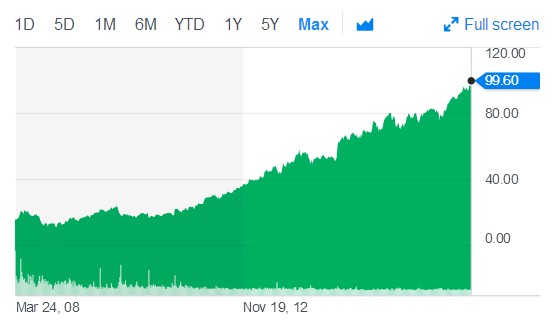
With a market cap of $230 billion, it is one of the greatest companies in the world. We would highly suggest you own some.
BMR Take: Consensus now sees EPS closing in on $5.00 in the next 1-2 years. With EPS growth running 20%, valuation looks awfully compelling to us still. We added the stock in early 2016 at $70. Our current Target is $95 which it has blown through this month, so we hereby raise our Price Target to $110. Our Sell Price remains “We would not sell Visa.”
Athenahealth (ATHN: $156, up 9%)
Athenahealth delivered an exciting quarter. The company believes it is at a key inflection point in its history and that 2017 will be a productive year for building out what differentiates them in the market. The company is demonstrating the power of its co-source model by simplifying and reducing client work. It’s building a new hospital service. It’s re-platforming AthenaNet. It’s grown its network to 100,000 providers, 98 million unique patient records, and 2.8 million covered lives, and is now positioned to be healthcare’s first true technology company. Stellar!
So many highlights from the quarter to discuss. Revenue increased 15% from last year to $293 million beating the consensus by $2 million. EPS of $0.51 crushed the consensus estimate of $0.39.
Moreover, the company continued the implementation waves at New York-Presbyterian Medical Groups, Adventist Health, and Tenet Health. The company gained access to the Centers of Medicare and Medicaid Services (“CMS”) claims data in certain states as a CMS Certified Qualified Entity. The company acquired Praxify Technologies to advance its platform strategy and mobile capabilities and accelerate its research and development initiatives by leveraging Praxify’s powerful app development platform. We could go on and on…
BMR Take: Athenahealth is a sleepy, off-the-radar company that is now firing on all cylinders. There is real upside potential ahead. Recall, big time activist investor Elliot Management has taken a stake in the company. Could we see all-time highs ahead which would be near $200? We feel this is a more than small probability.
Netflix (NFLX: $189, up 17%)
Netflix just does what it always does: Crushes expectations and the naysayers. The company delivered EPS of $0.15 just missing the consensus by a penny. But revenue of $2.8 billion was on the mark. The big story was the strength of subscriber growth and that was enough to send the stock soaring.
Netflix added 5.2 million net new subscribers in the June quarter vs. Wall Street's consensus estimate of 3.2 million. It also guided higher for the current quarter, with a forecast of 4.4 million net new subscribers, topping the consensus view for 4.0 million. This is huge subscriber growth. The company ended Q2 with 104 million subscribers worldwide, including 52 million in the U.S. and 52 million in foreign markets. Netflix's international streaming subscribers topped those in the U.S. for the first time.
Domestic net additions of 1.1 million represented the highest level of Q2 net adds since the second quarter of 2011. Better yet, Q3 guidance assumed much of this momentum will continue with the caveat that management is cognizant of the lessons of prior quarters when its over-forecasted.
The underlining fundamental story remains rock solid. With its content strategy paying off in strong member, revenue and profit growth. Management continues to believe that it is wise to continue to invest. In continued success, Netflix will deploy increased capital in content, particularly in owned originals, and, as management has said before, the business is likely to remain free cash flow negative for many years. That’s what it takes to build greatness!
The entertainment market is so broad that Netflix has now grown from zero to over 50 million streaming households in the US over the last 10 years. Netflix is growing with an expanding market, being co-pioneers of internet TV. The future is quite exciting.
BMR Take: Netflix is a premier growth story. The long term potential opportunity is quite big and we are still so early. This is one stock you just have to figure out how to own and hold onto.
The Blackstone Group (BX: $34, flat)
Blackstone delivered a decent quarter. EPS of $0.59 was just light of the $0.62 consensus. But revenue of $1.55 billion beat the $1.50 billion consensus. Total assets-under-management (AUM) was a ridiculous $370 billion. The $0.54 dividend was paid, giving the stock a dividend run-rate of 6.5%.
Management noted that it is continuing to see the benefits of its sustained large-scale capital deployment around the world, a patient focus on value creation in those investments, and then being able to choose the right moment to exit. They expect this momentum to continue. With pending realizations, including the historic sale of its European logistics portfolio, the company is on track for one of the best years for cash distributions to shareholders in its history. Wow!
In particular, the CEO said, the company’s distribution should not be viewed as one-off special dividends. They have demonstrated an ability to deliver consistently high payouts over time. Over the past three years for example, the company has distributed an average of nearly $2.50 per year, driven by over $130 billion of gains on investments.
BMR Take: EPS is running around $3.00 so the PE multiple is just over 10. The dividend yield strong and management is saying they can deliver you this dividend in the future as they have now done it now consistently for many years. We see compelling value here.
Upcoming Economic News
Existing Home Sales
Monday, July 24th, 10:00 AM
Period: June
Consensus: 5,560,000
Prior: 5,620,000
Consumer Confidence
Tuesday, July 25th, 10:00 AM
Period: July
Consensus: 116.0
Prior: 118.9
Note: The Conference Board's Consumer Confidence Survey is a monthly measure of the public's confidence in the health of the U.S. economy.
New Home Sales
Wednesday, July 26th, 10:00 AM
Period: June
Consensus: 615,000
Prior: 610,000
GDP
Friday, July 28th, 8:30 AM
Period: Q2
Consensus: +2.5%
Prior: +2.1%
Wall Street Consensus for Apple (AAPL: $150, up 1%)
Ratings Breakdown: 9 Hold Ratings, 39 Buy Ratings, No Sells
Targets
Wall Street Consensus Price Target: $16
7/22/2017 Wells Fargo $140
7/21/2017 Guggenheim $180
7/17/2017 Morgan Stanley $182
7/12/2017 Goldman Sachs Group $170
7/12/2017 Merrill Lynch $180
7/10/2017 Canaccord Genuity $180
7/9/2017 Credit Suisse Group $170
7/6/2017 Drexel Hamilton $202
BMR Take: Buy.
Wall Street Consensus for Opko Health (OPK: $6.59, up 8%)
Ratings Breakdown: 2 Hold Ratings, 6 Buy Ratings
Targets
Wall Street Consensus Price Target: $16
7/18/2017 Barrington Research $11
6/16/2017 Ladenburg Thalmann $19.50
6/12/2017 Jefferies Group $8
3/14/2017 Guggenheim $25
3/5/2017 Standpoint Research $14
1/3/2017 Laidlaw $19
BMR Take: We’re sticking with this one and are looking for a BIG upside. Look at what the brains of Wall Street think about the stock. We remain astounded that the stock has stayed down here for all this time. And the CEO and Founder just keeps buying shares.
Nutanix Insider Trading
We generally love it when insiders in a company are buying stock. Conversely, we get a little crazy when insiders are selling. Check this out about Nutanix (NTNX: $24), which had another great week, up 7%.
--- Director Jeffrey T. Parks sold 1,235,000 shares of the firm's stock in a transaction that occurred on July 14th. The stock was sold at an average price of $21.97, for a total transaction of $27,100,000.
--- Sr. VP Rajiv Mirani sold 20,000 shares of the firm's stock in a transaction that occurred on July 13th. The stock was sold at an average price of $19.63, for a total transaction of $400,000. Following the transaction, the senior vice president now directly owns 271,000 shares in the company, valued at $5,300,000. The sale was disclosed in a document filed with the Securities & Exchange Commission.
--- VP Kenneth W. Long III sold 30,000 shares of the firm's stock in a transaction that occurred on July 19th. The stock was sold at an average price of $24.00, for a total transaction of $720,000. Following the transaction, the vice president now directly owns 240,000 shares in the company, valued at $5,765,000. The sale was disclosed in a document filed with the Securities & Exchange Commission.
BMR Take: We are not happy about this. We want them to be buying the stock because as insiders, they know that the company is killing them and that the stock is going to go higher. This selling by insiders makes us very wary. We love this company and after adding the stock at $17.45 in late May, two months later we are up 36% and have high hopes for more gains. But our antennas are out do to these insider transactions and if the stock falls to the $22 level, we are out.
Amazon – A Discussion
People say Amazon (AMZN: $1,025, up 2.5%) is not making any money. The stock set a NATH this week and many see the stock peaking here, believing the stock is way over-valued since they are not making any money. We beg to differ.
The facts:
Profits the last five quarters, latest first:
$724,000,000
$749,000,000
$252,000,000
$857,000,000
$513,000,000
Revenues the past four years:
$136,000,000,000
$107,000,000,000
$89,000,000,000
$74,000,000,000
Check out this story about a new business to business website and operation in the UK and the US. This could be BIG:
http://www.businessinsider.com/interview-amazon-business-bill-burkland-017-7
A little survey on Amazon:
a) I have enough Amazon
b) I am thinking of buying more
c) I am going to buy more now
d) The stock price is too high – if they split I would buy some
e) The stock is way overvalued – their profits are too low and the PE at 190 is insanely too high.
Send your thoughts to us at Info@BullMarket.com
Home Depot, Best Buy Hit as Amazon Teams Up With Sears
Sears will sell Alexa-enabled Kenmore appliances via Amazon. But Whirlpool (WHR) and major sellers of appliances Home Depot (HD: $147, down 3%), Lowe's (LOW) and Best Buy (BBY) were hit. Home improvement chains Home Depot and Lowe's had been seen as Amazon-proof, or at least Amazon-resistant.
BMR Take: We are not ready to throw in the towel because of this one announcement, but we have to watch this development from Amazon. We added the stock to our Stocks for Success portfolio in early 2016 at $121 and are up 21%, so we don’t want to give up any of these gains. The market cap is $175 billion, they have $3.6 billion in cash supporting a sizeable debt load of $23 billion.
BMR Take: They are not going away anytime soon, but as noted above, Amazon is a monster that one needs to keep an eye on.
Google (GOOG: $973, up 2%)
July 3rd - $898. Today - $973. That’s an 8% move in three weeks.
BMR Take: Yes, they got fined big-time in Europe, but the $2.7 billion fine is peanuts to the company that has $92 billion in cash and virtually no debt, and makes over $20 billion a year. Yes, we have to watch the EU to see if there are any sanctions they will be putting on the company. But we believe the company will weather the storm and thrive. We await the break-through to NATHs of $988+ and raising our own Price Target from $1000 to $1100 or higher. Stay tuned. This just might happen sooner than you think.
Apollo Global Is Getting Ready to Take Security Firm ADT Public
Private-equity firm Apollo Global Management (APO: $28, up 2.5%) is preparing an initial public offering for ADT, just a year after it bought the home-security company.
The offering could value ADT at well over $15 billion, according to people familiar with the matter, making it one of the largest IPOs of the year. They paid $7 billion for the firm a little over a year ago. An offering would mark a quick turnaround for the private-equity firm, which began consolidating home-security providers two years ago.
BMR Take: This is just one example of the power of this firm. Apollo is way undervalued. With a 7% dividend, it's a joy waiting for a higher stock price.
The High Yield Corner
By Michael Foster
Special to The Bull Market Report
This week, we saw the AGIC Equity and Convertible Income Fund (NIE: $20) rise over 1% in the week thanks in no small part to a strong gain in the fund’s NAV. That increase was attributable to a solid week for the stocks in its portfolio, like Priceline (its second highest convertible holding) rising over 2% in the week. We’ve seen AGIC raise its equity exposure while using convertible bonds to provide a strong income stream throughout 2017, and that has resulted in two positives for investors. First, the dividend remains well-covered by investments; second, the fund has benefitted from this year’s bull market, despite how much many on the sidelines seem to hate this bull market. [That’s not us by the way. We like this bull market.]
The strong performance in the fund has helped its discount to NAV fall. This is the result of intense demand from investors for the fund, which is why the market price for the fund has risen over 11% YTD while its NAV has risen 6% over the same time period. We’re now seeing a discount of less than 10%, which is the fund’s highest since 2015. The AGIC fund has seen its discount shrink considerably from reaching a near 15% low in late 2016, which itself was an improvement from the near 20% discount at the start of 2016. This demonstrates continued interest in the fund from market participants, who see its 7.5% dividend yield as an attractive income stream, especially considering how sustainable it is.
Another Bull Market Report pick saw a similar gain this week. The Pimco Dynamic Income Fund (PDI: $30) rose nearly 1% for the week and is up 10% year-to-date. That’s not including the fund’s massive income stream, however. With an 8% yield from common dividends alone, Pimco Dynamic Income has already given an annualized return of 30%. Add in the special dividend and that number gets absolutely astronomic. This fund offered a similar return in 2016, thanks in part to its higher NAV but also thanks to investor demand. The fund has gone from a discount in 2016 to its current 7.4% premium to NAV, again indicating sustained demand for the fund from a variety of investors.
While diversified funds had a strong week, REITs were a bit less impressive. One of Bull Market Report’s top picks, Digital Realty Trust (DLR: $112), was flat for the week with little volatility. This is unusual; Digital Realty tends to bounce around a lot. But the fund has gone from a 6% yield in the past to now a 3% yield, thanks almost exclusively to its meteoric price appreciation. We’ve seen the stock jump 14% in 2017 alone, with 53% total capital gains in the last five years. It’s pretty obvious that, at this juncture, Digital Realty is no longer seen as a “high yield” risky opportunity, but is rather a low yielding REIT with long-term staying power. This makes sense; Digital Realty’s business of renting server space, is in no danger of shrinking anytime soon. This industry is also too new for us to determine whether it is cyclical or counter-cyclical. If it turns out that server space demand doesn’t go down during recessions in a cloud-computing world, then Digital Realty could quickly be perceived as one of the safest long term investments out there. For that reason, holding Digital Realty makes sense no matter what your investment profile or goals are, although the 3% yield is of course lower compared to many other REITs.
For instance, there’s Omega Healthcare Investors (OHI: $33), which also had a flat week with little volatility. Volume was much lower than average (nearly 50% of average daily shares traded). Omega has gone from a mid-8% yield to a mid-7% yield over the last couple of years, as investors have become much more aware of this stock. We’ve also seen the penny-per-quarter dividend jump continue, with dividend coverage ratios that demand respect.
There is much reason to believe this company is on solid ground, although the long-term and countercyclical sustainability of its business model (focusing on skilled nursing facilities - SNF) has been brought into question. Counterintuitively, we’ve seen an aging U.S. population be bad for SNFs for a variety of reasons. The relative wealth of aging baby boomers and the stigma associated with these facilities has made them much less popular than previous expectations. That, in turn, has put Omega and many of its peers under the spotlight, with mounting worries keeping stock prices muted (Omega is flat from a year ago and remains in the same range seen in late 2013). Five years ago and before, a lot of excitement around SNF-focused REITs drove price gains up a lot. The new perspective, and data from the industry, has kept investors more cautious.
Does this mean it’s time to sell Omega? Absolutely not. While the market is more competitive because demand is not as strong as previously expected, Omega Healthcare’s management has proven several times that they have the skill and acumen to identify and capitalize on those available opportunities in this tight market. The market, focused on the macro sentiment, has not priced in the premium that Omega Healthcare’s management should command. That makes them a buy, especially when the yield remains above 7%.
Looking ahead, investors should keep a close eye on the upcoming reports - Jobs, GDP, and Federal Reserve actions to come in late July and mid-August. This data is going to have a pretty significant impact on the future price trends for REITs and diversified funds. For now, however, The Bull Market Report’s High Yield stock picks look like solid holds, thanks to the high income stream and capital gains potential of a few of its constituents.
Good Investing,
Todd Shaver, CEO, Founder and Editor in Chief
The Bull Market Report
Since 1998
May 7, 2017
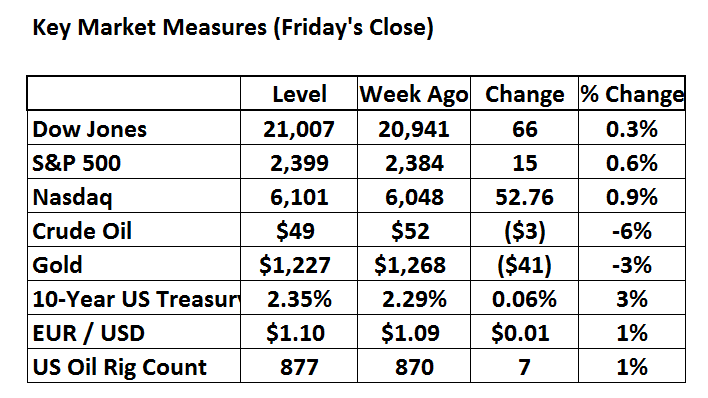
by Todd Shaver | May 7, 2017 | Weekly Newsletter 7pm Sunday
The Week Ahead
Well, it’s graduation week. Class of 2017 graduates are hitting the stage to accept their diplomas, listen to a keynote speech, make one last party, and then head out into the great big world. What will they find? GDP growth moving to 4% or stalling out around 2%. Will geopolitical tensions escalate as early as this year or find a sustainable comfort zone? Can equity prices hold? How bad will rising rates hurt the bond market? Everybody from the newest participant in the labor force to the most experienced must wrestle with these questions in the year ahead. We at The Bull Market Report hope to help you with some good insights about what to make of it all—week in and week out.
There is always a bull market here at The Bull Market Report! This week we highlight the following securities: Eli Lilly, Home Depot, Netflix, Splunk, PayPal, and VMWare. And a few others!
Highlights From The Past Week
Federal government expanding investigation of Fox News. The aggression against the media continues. Current and former Fox News employees have been interviewed, as authorities try to determine how settlement payments for sexual-harassment allegations were structured and which executives played roles in the payments. One source tells the WSJ that the investigators seem to be interested in intimidation tactics that former CEO Roger Ailes signed off on. The investigators are in the securities unit of the US attorney’s office, and no prosecution will necessarily follow. What does this all mean? You need to find trusted sources of information in this world. We strive to make The Bull Market Report a reliable and honest source of information for you to rely on.
It's the strangest thing: A hedge-fund manager apologizing for bad calls. Wellington Management Sr. VP Nick Adams isn't just apologizing for his mistakes on Silicon Valley venture deals -- which differ from the bank stocks he has a proven record with -- he's refunding fees. Adams, who has lost money two out of the past three years, put hundreds of millions of dollars into Mozido and Powa Technologies, which are both financially distressed. Adams has promised he won't ever invest in similar private deals in his flagship fund again. People familiar with the firm's finances say that after investors including Blackstone (BX) withdrew their cash, Adams's portfolio at the start of 2017 was $6 billion, down 40% from 2014. Adams has now returned to investing in traditional lenders like Bank of America and Citi, and his main fund rose 12% in Q1. We think there are lots of lessons to learn from this situation. For instance, if you ever wonder why many of The Bull Market Report’s stock picks are in household names that are often large cap stocks, well, now you know why. Traditional investing is a proven money maker and we try to take you where you can make money.
Don't assume the Healthcare industry will be fine. We think the market is right to assume that the Republican replacement for Obamacare won't be passed in its current version, but anything that hurts earnings for the sector could bring prices down, and the failure to pass any sort of healthcare reform may make a tax reform harder to achieve, which will be a negative for stocks more broadly. We all must keep an eye on this important event unfolding in Washington in the weeks ahead.
BMR Companies and Commentary
Eli Lilly (LLY: $83, +0.5% - All changes are for the week) Eli Lilly has more growth drivers than all its peers, but its continued pledge of "at least 5% annual sales growth" for 2015-20 is being called into question because a big portion of growth comes from two drugs - Jardiance and Trulicity - that have recently faced setbacks. We think Eli Lilly is a topnotch franchise in Healthcare and will overcome these hurdles.
Jardiance is a drug for type 2 diabetes. Johnson & Johnson has a competing drug called, Invokana, which is set to release new trial data in June. Everybody is saying that if Johnson & Johnson’s drug has good data, then there will be more pricing competition in 2018 for Eli Lilly’s drug. We think this risk is widely known, already factored into the numbers, and not a reason to not own Eli Lilly’s common stock.
Trulicity is also used for type 2 diabetes. It faces risks from the FDA's decision last August on Novo Victoza, specifically that this drug had problematic heart effects. Will the FDA say the same thing about Trulicity? We will find out in 2018. For now, it is overly pessimistic to assume Trulicity faces serious FDA challenges.
Note that Lilly's drug unit accounted for 83% of 2016 sales, with the balance coming from animal health, so the story is not just all about drugs. Also, Eli Lilly's operating margin trails most of its peers, except Bayer, and by leveraging new-drug launches, it aims to reduce R&D and SG&A expenses to 50% or less of sales in 2018 versus 56% in 2015. This target is achievable by Pharma standards as Jardiance's new heart label drives growth and Trulicity, an established product, continues to add to margins.
Lilly investors may be relieved by the good set of results in 1Q following recent drug setbacks. Older drugs, such as Cymbalta and Strattera, beat consensus, lifting margins and feeding through to the 2% EPS beat. Diabetes was strong with both Trulicity and Humalog beating consensus, while Jardiance missed by a little. Jardiance is a key driver of growth and while the miss raised eyebrows we say stay the course.
BMR Take: Eli Lilly is a top franchise in Healthcare boasting a market cap of $91 billion. On track to clear $5 of EPS, the stock is a good value.
Home Depot (HD: $156, flat)
A lingering debit/credit card breach has kept a lid on shares of Home Depot. The bad news is that it is so sad to see some large-scale breaches at US companies like Target and now Home Depot. The good news is Home Depot has taken strong steps to remedy the situation. In any case the stock is $1 from an all-time high, fast approaching $200 billion in market cap.
Companies hit by data breaches often face class action complaints filed by consumers. They also face lawsuits from shareholders looking to thwart future breaches and restore financial stability to companies in which they have invested. Home Depot's willingness to take meaningful but financially limited remedial mitigating action achieves a mutually beneficial resolution that companies facing any kind of data breach lawsuits, such as Yahoo, may rely on to improve their corporate data governance.
Under the proposed settlement, Home Depot will change many of its cybersecurity corporate governance policies. Home Depot agreed to document the duties and responsibilities of the chief information security officer; conduct table top exercises; monitor computer networks; maintain a “Data Security and Privacy Governance Committee;” hire a “dark web mining service;” receive reports on the company's information technology budget; join an information sharing program; and authorize the board to retain its own IT and data security professionals. Home Depot also agreed to pay $1.1 million in attorney’s fees and and $1.5 million to the shareholder representatives. They agreed to the settlement because it saw the attorneys’ fees as a minimal money issue and it believed the actions “would restore trust” in the company.
BMR Take: Home Depot is on track to deliver $10 of EPS and $100+ billion of sales. Don’t sweat the small stuff. Sorry to see the cyber breach, but the core business is doing great.
Netflix (NFLX: $157, +3%)
What could be more exciting than a Netflix merger with Apple? The world continues to talk about the prospects. Let’s break down the potential reality.
There may be as good as 40% odds that Apple acquires Netflix. The research arm of the investment bank Citi released a report with seven potential merger and acquisition targets for Apple. Tops on the list is Netflix. Elon Musk's Tesla, on the other hand, is only 5% likely. The full list of acquisition targets includes three media firms, three game developers, and, of course, one car manufacturer. Disney and Hulu are the media firms joining Netflix, while Activision, Electronic Arts, and Take-Two are the gaming companies.
Netflix makes a ton of sense, of course, as the company dominates streaming media both domestically and abroad. Disney has a strong list of properties as well, but slightly more oriented to traditional media consumption, whereas Netflix is well-positioned to take advantage of the continuing trend to cut the cord (cord-cutting has jumped 5x). Plus, Disney is worth $177 billion, whereas Netflix is worth $67 billion.
BMR Take: The future of TV consumption swings in the balance as the world moves away from traditional cable to the internet. Netflix is the powerhouse making the company a coveted asset in media. On track to do $10 of EPS by 2020 we see compelling value in the shares as a standalone entity even at current levels. A take-out could offer huge upside.
PayPal (PYPL: $49, +3%)
The PayPal network effect is working like charm. Investors in PayPal had plenty of reason to cheer last week when the company reported earnings. Nearly every metric was up by a better-than-expected percentage, surpassing expectations of all but the most bullish on the company.
More exciting to long-term investors, however, was the account growth and increase in user engagement with the company's core platform. Six million active accounts were added during the quarter, increasing the total to 203 million for the digital payments company. These active accounts now average almost 32 transactions per year, a 12% increase year over year. More customers using the company's platforms more often was a winning combination that the market liked.
PayPal's growth is beginning to fuel a powerful network effect opening a new window for the company. The beauty of this type of growth is that it drives itself. The more users that sign up for the platform the more important the service becomes for retailers to adopt it and the more places that accept it, the more attractive it becomes to new users. Get it?
At the end of March, 16 million retailers were accepting PayPal's core platform as a method of payment. Management is well aware of this virtuous cycle. During the conference call, CEO Dan Schulman stated: “Our powerful two-sided network engages both consumers and merchants, and the larger our scale, the stronger our network effect becomes. We made meaningful progress in advancing merchant adoption of PayPal in the quarter. At the end of March, the number of active merchant accounts on our platform increased to 16 million. The size of our merchant base is a formidable competitive advantage and is extraordinarily difficult for others to replicate.”
BMR Take: We think PayPal is in the middle of a decade-plus growth cycle that will deliver real value for shareholders. Stick around. They are already closing in on $3 of EPS.
Splunk (SPLK: $67, +4%)
Progress at Splunk is happening. Splunk, a provider of the leading software platform for real-time Operational Intelligence, recently announced support for SaaS Contracts in AWS Marketplace. Working with Amazon is a big deal!
The new globally available API capability* enables seamless procurement and deployment of Splunk® Cloud. The automated and accelerated purchasing process for Splunk Cloud via AWS Marketplace ensures fast time-to-value for customers leveraging Splunk solutions to gain real-time security, operational and cost management insights across their Amazon Web Services (AWS) and hybrid environment.
* Application program interface (API) is a set of routines, protocols, and tools for building software applications
The University of San Francisco is home to an innovative academic community of more than 12,000 students, faculty and staff. “As a higher education institution, USF prides itself on being at the forefront of technology, which is why we turned to Splunk and AWS,” said the vice president of information technology and chief information technology officer, University of San Francisco.
BMR Take: Working with Amazon gives Splunk big growth potential. The EPS outlook calls for great than 3x growth from $0.41 of EPS in 2017 to $1.35 of EPS in 2020. Ride this growth wave!
VMware (VMW: $94, flat)
VMware is out with some good news. The company is the first mobile application management provider to manage and secure hundreds of Oracle business applications and custom applications. As such, enterprise IT organizations can manage their Oracle application suite on a single unified platform together with their other business-critical applications and devices. Users who count on Oracle's business applications to make better decisions, reduce costs and increase performance can benefit by being able to access these applications through a simple digital workspace environment – be it from a mobile device, laptop or desktop – with VMware Workspace ONE and AirWatch.
What does that mean? VMware is continuing to make end roads in the lucrative cloud business, where growth is driving real results for stockholders.
The Chief Operating Officer, customer operations, said: "Mobilizing critical business processes is at the core of both of our organizations' DNA and this collaboration will help us advance this shared vision for our customers and their end users alike. We're proud to come together with Oracle to make it easier for IT administrators to secure and manage these critical mobile apps and help their end users seamlessly access them from any endpoint.” VMware Workspace ONE is the industry's only integrated platform for application and access management and unified endpoint management that enables simple enterprise secure access to any app from any device, accelerating adoption of digital workspaces.
BMR Take: The company is working. EPS is on track for $4.90 this year with growth upside to $6 in the next few years led by the cloud business and partnerships like the one described above serving Oracle.
Economic Outlook for the Coming Week
Monday, May 08, 2017 10:00 AM ET
United States - Labor Market Conditions
Period: APR
Actual: N/A
Consensus: N/A
Prior: 0.40
Labor market conditions index is derived from a dynamic factor model that extracts the primary common variation from 19 labor market indicators. It measures the changes of condition in the labor market. We expect to continue to see signs of a healthy labor market.
Tuesday, May 09, 2017 6:00 AM ET
United States - NFIB Small Business Index
Period: APR
Actual: N/A
Consensus: N/A
Prior: -$176B
NFIB Research Foundation has collected Small Business Economic Trends data from a sample of members from the National Federation of Independent Business (NFIB). Data from quarterly surveys since 1973 is based on 10 survey indicators. We expect to see an improving small business economy.
Tuesday, May 09, 2017 10:00 AM ET
United States - JOLTS Job Openings
Period: MAR
Actual: N/A
Consensus: 5,750K
Prior: 5,740K
Part of the US Bureau of Labor Statistics, the Job Openings and Labor Turnover Survey (JOLTS) program produces a monthly study that has been developed to address the need for data on job openings, hires, and separations. With the release of 2003 data, the JOLTS program began publishing industry estimates. We expect to see the JOLTS figures reveal a healthy labor market.
Wednesday, May 10, 2017 2:00 PM ET
United States - Treasury Budget NSA
Period: APR
Consensus: $166B
The monthly U.S. government surplus/deficit is published in the Monthly Treasury Statement (MTS). The MTS is assembled from data in the central accounting system. The major sources of data include monthly accounting reports by Federal entities and disbursing officers, and daily reports from the Federal Reserve banks. These reports detail accounting transactions affecting receipts and outlays of the Federal Government and off-budget Federal entities, and their related effect on the assets and liabilities of the U.S. Government. It is very critical what happens with Trump now negotiating the government budget and we are excited to see if he can get it under control and address the national debt.
Friday, May 12, 2017 08:30 AM ET
United States - Retail Sales ex-Auto
Period: APR
Actual: N/A
Consensus: 0.45%
Prior: 0.0%
Retail and food service sales data excluding motor vehicle are included in the Advance Monthly Sales for Retail and Food Service report, which provides an early indication of sales of retail and food service companies. We are keenly concerned about brick and mortar Retail sales declines and look to this economic release to assess the damage and potential impact.
MORE COMMENTARY ON BULL MARKET REPORT STOCKS
First Solar (FSLR: $35, up 17%) reported first-quarter earnings of 25 cents a share. The Street was looking for a loss of 13 cents.
Revenues hit $890 million in the quarter destroying the estimate of $700 million. (Who are these analysts anyway?) Revenues grew slightly from last year, up 2%. Profit was $84 million, down from $275 million a year ago. Ouch, but expected.
First Solar has $1.65 billion in cash, up from $1.35 billion at the end of the previous quarter. Long-term debt is $265 million at the end of the first quarter.
The big news is guidance. The company raised its revenue guidance to $2.9 billion from $2.85 billion. This is minuscule, but the Street liked it, pushing the stock up big. Gross margins guidance was moved to 13.5% from 12%.
Full-year earnings are now expected in the range of 25−75 cents per share, compared with the prior guidance of a breakeven to 50 cents.
We’ve said many times that this company is innovative and successful and that the turnaround will take time. This is the first positive information we have seen publicly that good things are actually happening. If you have patience, stick with First Solar. If you don’t, now is the time to take it off the table after this nice 17% run-up.
Facebook (FB: $150, flat)
Monthly active users totaled 1.94 billion while daily active users hit 1.28 billion. Expectations were for these numbers to hit 1.90 billion and 1.26 billion, respectively.
Facebook reported earnings of $2.5 billion or $1.04 per share on revenue of $8.03 billion. Expectations were for earnings of $0.87 on revenue of $7.83 billion. Huge beat. “We had a good start to 2017,” Mark Zuckerberg, Facebook founder and CEO, said. “We’re continuing to build tools to support a strong global community.”
Mobile is big at the company, as advertising revenue on mobile represented 85% of total advertising revenue, up from 82% a year ago. Ad revenue grew 51% over last year to $7.85 billion.
As of the end of the first quarter, the company had $32 billion in cash, and had almost 19,000 employees, up 38% from last year.
As Facebook nears the 5-year anniversary of its initial public offering, note this: In 2012, Facebook was the world's 10th-biggest seller of ads behind a bunch of traditional media companies such as CBS and 21st Century Fox. It has trounced almost all of them to rise to number two in the rankings, surpassed only by Alphabet, the Google parent that dominates search ads. Together, these two companies controlled 20% of the $550 billion spent on ads last year, up from 10% in 2012.
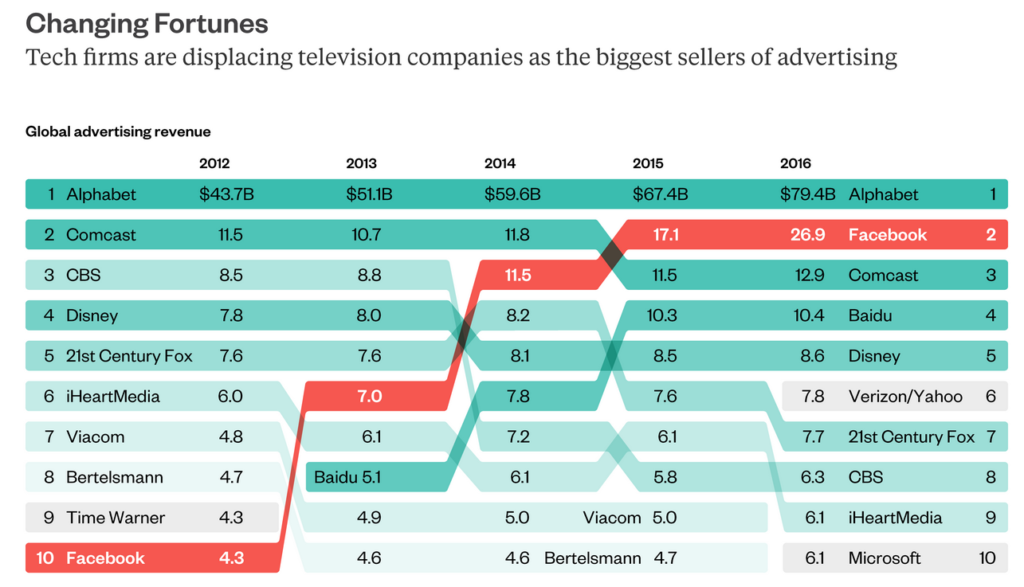
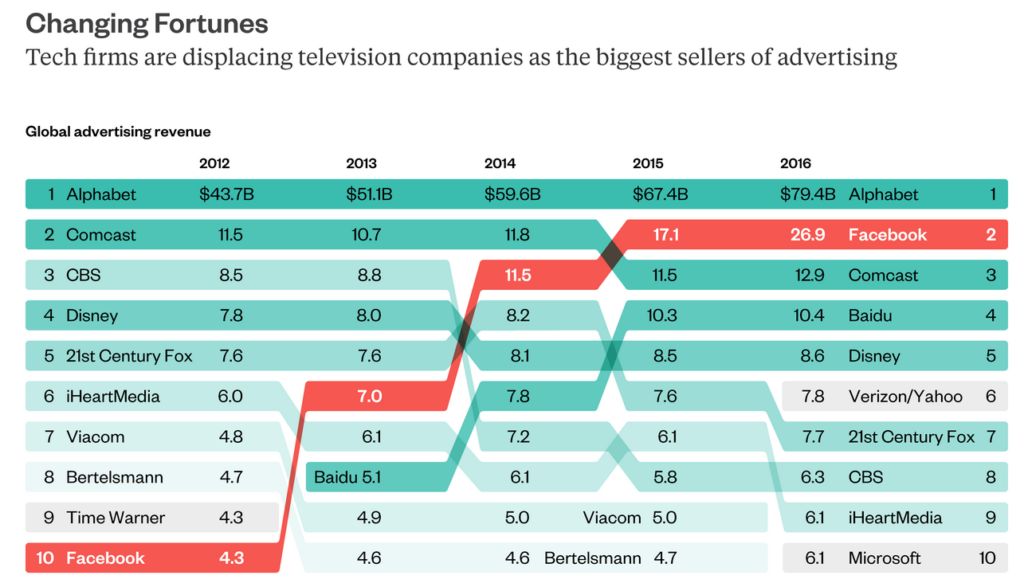
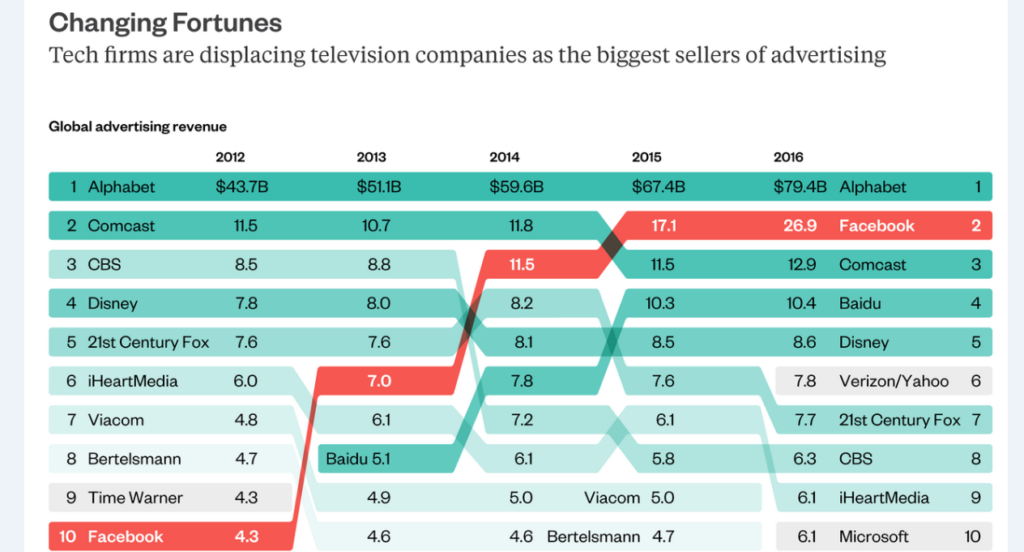
Source: Zenith Media
Jefferies hiked its price target on Facebook to $192 from $175, JPMorgan to $182 from $170, RBC Capital to $185 from $175, and Cowen to $170 from $156.
BMR Take: Our Target is in reach at $165. We would add to our positions at every opportunity. Wait until they hit 2 billion users. There will be fireworks and articles about the company galore and we just might see this as early as July. When this happens we can predict new all-time highs hit left and right.
Shopify News
We Tweeted this out on Friday:
“Shopify is on fire! All-time high at $86, up 5%. Stock was $73 a week ago. STRONG REVENUES will do it! Will eBay make an offer?” [The stock closed at $86 on Friday, up 13% for the week!]
The stock (SHOP) closed at $86 on Friday. We’re up 18% since we added the stock a little over a month ago. Our Target is $90. We can’t wait for it to hit so we can raise it to $100 or higher. And wouldn’t it be nice to see a stock split soon? What ever happened to stock splits? The markets in the 80s and 90s LOVED splits. We could see a 10-1 split for Amazon, bringing the price down to $93, and Google could split 20-1 bringing the price down to $46. Now wouldn’t THAT shake things up on Wall Street! The market would go wild.
Square (SQ: $19.78, up 8%) had a super good week. Square makes credit-card readers that plug into mobile phones and tablets and we were happy to see Square swing to a profit in the first quarter and raise full-year revenue guidance.
Led by Twitter Chief Executive Jack Dorsey, the company posted a quarterly loss of 4 cents per share on a revenue jump of 22% of $460 million. Analysts had expected a loss of 8 cents per share on revenue of $450 million, so of course the market liked what they saw. Square has predicted 2017 total revenue of $2.14 billion.
The company's gross payment volume - the total dollar amount of all credit card payments processed by sellers - jumped 33% to about $14 billion. We like numbers like this.
Another subsidiary, Square Capital, which offers loans to customers in exchange for a fixed percentage of their daily card sales, originated $250 million in loans in the first quarter of 2017, up 64% from a year earlier. We like large percentage increases like this. (We sound like a broken record…)
Square continues to move towards bigger customers. They said that 44% of the money flowing through its systems came from merchants that have over $125,000 in volume on the company’s platform, up from 39% a year ago. CFO Sarah Friar said: “That ongoing shift is good to see because those folks are not new to the payments world.”
Citigroup upped its price target on Square to $23 from $21, and Pacific Crest to $21 from $19.
BMR Take: We’re looking for $24, and hereby raise our Sell Price from $14 to $17.
Apple (AAPL: $148, up 4%) announced that it has $257 billion in cash as of the end of the quarter. They added $10 billion in the quarter which equates to about $800 million a week, or over $150 million per work day! Repeat: $150 million per work day. The company said it will return more of that to shareholders, announcing $50 billion in new stock buybacks and a 63-cent quarterly dividend. The company had already announced $175 billion in repurchases, helping maintain the stock price in lulls between new products, so the upcoming total is now $225 billion. Take a look at this chart of their cash buildup over the years:
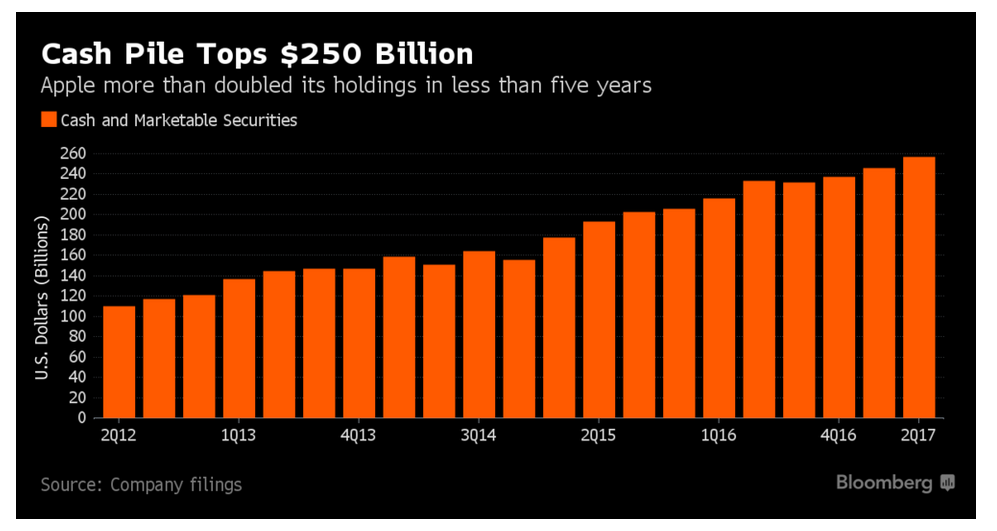
Twilio (TWLO: $24, down 27%) We reported via News Flash on Tuesday that despite strong revenues the market didn’t like the results. The biggest knockoff was the fact that one of their big customers, Uber, has decided to go it alone. Uber provides 12% of total revenue for the company, but Twilio grew revenue by 60% not including Uber. So ultimately, we are not that worried about future revenues. We believe they will continue strong. (We think they will come back to Twilio at some point.) WhatsApp, owned by Facebook is also a large customer, so some people are worried about this large concentration of revenue in one customer. We’re not. There is no word as to whether they are considering leaving. We would suggest that they are quite happy with the service they receive. And again, note that the company added 4,000 customers in the quarter – amazing really – giving them more than 41,000 customers, up from 29,000 at this time last year.
We had a letter from a reader about Twilio and we said this to him:
Bob -- Be prepared for anything that might happen. We could see $20 before we see $30. I hope this is not the case, but it could happen. Uber is slowly leaving as a customer and they had 12% of revenues. So, this will take some time to work out. They did add 4000 customers last quarter and are now over 40,000. They normally add 2800 a quarter. But unfortunately, like First Solar, this is going to take some time.
The Options Corner
We had mentioned in our News Flash about Twilio that we would do a column about options if anyone was interested. Well, we had a strong show of support for this. So here you go.
There are myriad of options strategies if you want to maintain a position in Twilio and you believe it will come back like we do. Of course, most options trades are risky except for selling covered calls, which are still risky but less so than buying options outright. The premiums on Twilio options are relatively high so that usually points to two types of options trades: doing covered calls, and selling naked puts or calls. The latter two are very dangerous.
Selling covered calls: Selling covered calls on Twilio is fairly straight forward. With the stock at $24 you can get about $1.80 for the January $30 call. If you have 1000 shares, you can sell 10 options and receive $1800 in your account that day. The downside is that you would be obligated to sell your stock at $30 if it goes higher than that. But, you can always buy back the option if the stock goes above $30. Depending on how long it takes the stock to get there will determine the price at which you have to buy back the options. If the stock goes to say $32 by January, then you could buy them back for about $2, losing about 20 cents, or $200. But with the stock at $32, you would feel good about that. The downside is that if someone buys Twilio out at $40 a share, you would be forced to sell your stock at $30. Not pretty.
If the stock stays below $30 until January, then you can turn around and sell another out-of-the-money option for a few dollars and wait for the stock to move higher and each time you do this you put cash into your account.
As you can see there are lots of scenarios that can happen so you have to watch carefully. Make sure you have the advice of your broker.
Buying options: If you think the stock can get to the $40 level or higher by say January 2019, you can buy out-of-the-money options inexpensively. But you could lose all of your money if the stock doesn’t reach the strike price that you choose. For example, you can buy 10 options, controlling 1000 shares, at a strike price of $40 expiring in January 2019 for about $2,300. If the stock goes to $45, these options would be worth at least $5,000. If it goes to $50, the options would be worth $10,000.
Or you could buy the January 2019 50s for about $1400 and if the stock goes to $55 they would be worth $5,000. BUT, if the stock doesn’t get to your strike price, they expire worthless.
Selling naked puts: YOU SHOULD ONLY DO THIS IF YOU WISH TO BUY THE STOCK and if you have the money to do so. You could sell the January 2019 $25 put for about $7, or $7,000 for 10 options. That would obligate you to buy the stock at some point between now and the expiration date at $25, BUT you got $7 per share so your net price is $18. You could do the same thing with a $20 put and get $4.30 per share, obligating you to buy the stock for a bit below $16. We like this latter strategy. Suffice it to say that selling naked puts on stocks you want to buy at a lower price, is a good thing. Again – very risky. Why? What if the stock goes to $10. You would be forced to buy the stock at $18 or $16 as described above. Not fun.
Send us your questions and comments please! Info@BullMarket.com.
Tesoro (TSO: $80, up 1%) moves in the wind with crude oil. Crude got down to $45 early Friday and bounced back to $46 by the close. We like the company but can’t be part of it if crude is headed to $40. If you know where crude is headed you’ll know what to do with your position in this fabulous refiner. Unfortunately, we don’t. If we knew, we could make $1 million trading crude oil futures. We added the stock at $85 in November and have a Sell Price of $75. But we would hate to have the stock go that low, so we are hereby raising our Sell Price to $78, which is two dollars below the current price. So, if Tesoro closes below $78 we are out.
Carlyle Group (CG: $18.10, up 2%) posted first quarter earnings that handily beat expectations on Wednesday, in line with its peers, after a strong stock market last quarter lifted investment returns. Carlyle's peer Blackstone Group (BX: $30, down 2%), a Bull Market Report favorite, reported first-quarter earnings that surpassed expectations.
Carlyle said it earned economic net income (ENI)* of $365 million after taxes, more than six times what it earned a year earlier. That translated into $1.09 EPS, well above analyst forecasts for 38 cents per share and the second-highest on record since the fourth quarter of 2013.
* ENI is a crucial performance measure for U.S. private equity firms as it accounts for unrealized gains or losses in investments.
Carlyle said its private equity investments appreciated 9% in the first three months, better than a 5% gain in the S&P 500 index in the same period. Carlyle Co-CEO William E. Conway, Jr. said, “We deployed capital at a strong pace in the first quarter, with $4.4 billion of capital invested despite a difficult environment. We believe we are well-positioned to continue this strong pace. We have already announced substantial new investments and almost $4 billion of exits that we expect to close in the coming quarters.”
BMR Take: Carlyle is still way undervalued but is paying you 4% while you wait. We’re waiting patiently for the market to recognize this situation. We are up 12% since March, but we sure would like to see our Target hit of $20.
The High Yield Corner
By Michael Foster
It’s finally started.
It’s a bit late, but we’re finally seeing a correction in the BDC world. The UBS BDC ETF (BDCS: $23, down 3%) got hammered in a week that was pretty humdrum for high yield and not bad for the stock market as a whole, despite a lot of drama. Yet BDCs are back to underperforming, as they should. Overstretched valuations and high premiums to NAV were unjustifiable before this week. Now that many companies have reported lackluster earnings, those premiums are even less justifiable.
Ironically, however, this isn’t hurting the most overvalued BDC of them all: Main Street Capital Corporation (MAIN: $40, up 1%), which closed the week strong as investors sighed relief following the company’s earnings. Net interest income rose 9% from a year ago to 61 cents per share and the company’s NAV rose nearly 2% to $22.44. There are two big implications for this: firstly, the company’s dividend coverage is 109% and there’s room for years of dividend growth to continue. We have a feeling Main Street management has the ultimate goal of becoming the first BDC Dividend Aristocrat*. We’ve still got about two decades until they can qualify, so it won’t be easy. But if that is their goal, Main Street is easily the best managed and most long-term focused BDC in the world.
* The Dividend Aristocrats are a select group of 51 S&P 500 stocks with 25+ years of consecutive dividend increases.
That doesn’t mean you should go out and buy. We at The Bull Market Report were happy with our pick and happy to see it rise. But we are not happy to pay an 80% premium to net asset value. Consider this: if you considered Main Street to be the best BDC in the world, you wouldn’t want to compare its premium valuation to the valuation of other BDCs. You’d probably want something safer, like a megabank like Bank of America, which not only lends to small and medium sized banks but also mega-corps and governments while diversifying in other banking activities like M&A advisory, retail deposits, and so on. Or at least you’d want your BDC valuation to be less than the valuation of these banks, right? But if you compare Main Street’s valuation to the price-to-book valuations of these big banks, Main Street is overvalued by 40% at a minimum. This just isn’t good enough for a very well-run but extremely undiversified asset.
The market has begun to realize just how silly BDC valuations were getting, but the market has made an exception for main Street largely due to the fact that just about every other BDC reported awful earnings. Net investment income fell for almost all BDCs that have reported so far, with Hercules Capital (HTGC: $13) seeing NII down 33% from the prior quarter. The dividend is now less than 100% covered. NAV fell a bit as well (over 1%). What happened? The market dumped shares, which fell over 16% in a week. This used to be considered one of the safest and best specialty BDCs out there, but the market can turn very quickly on this asset class. We’re not saying anything similar will happen to Main Street anytime soon, but it is a serious risk.
Then there’s Goldman Sachs’s BDC (GSBD: $24), which fell 3% this week due to a decline in net investment income and virtually flat NAV. The stock is still up 3% year-to-date so you’re paying a higher premium for shares, though. Now you’re paying 32% over what the underlying assets are worth. Of course, this BDC is up big over the past year, thanks in part to the secular bull market in BDCs and thanks in part to the Goldman brand. But, as we’ve written here previously, there is a complicated conflict of interest going on with this BDC that makes us extremely cautious. Goldman Sachs’s management is not duty bound to restrict their deal making just to this BDC, and so there’s a chance (although no evidence this is the case) that management can select better deals for the parent company and keep lesser deals for the BDC business. Without clearer governance resolutions, this makes us extremely cautious. And, at the end of the day, this demonstrates one of the structural problems with many BDCs: management and investors’ interests do not align.
Some of the BDCs in the business were loved for avoiding this trap. The big Ares Capital Corporation (ARCC: $16.60, down 6%) is a good example. But this stock tanked as well, after reporting earnings fell 50% from a quarter ago and NAV rose less than 1%. We don’t need to emphasize how bad those results are, and how they deserve a discounted valuation. But Ares is still trading at a slight premium to NAV.
Obviously, a bigger correction in the BDC market is coming, so where else can we look? REITs and municipal bonds remain our favorite corners of the high yield market. The iShares S&P National AMT-Free Municipal Bond Fund (MUB: $109, flat) remained sleepy due to the risk-on nature of the market encouraging more investors to avoid the asset class, despite the growing number of undervalued bonds and great opportunities to get low risk yield for fund managers. Bull Market Report favorites remained flat for the week, Invesco Municipal Trust (VKQ: $12.69, flat) and The Nuveen AMT-Free Fund (NVG: $14.79, flat) Buying more of either fund at this juncture would make a lot of sense.
And then as REITs go, the SPDR Dow Jones REIT ETF (RWR: $92, down 1%) fell slightly with investor apathy hitting the asset class on little news. This again is resulting in plenty of good deals among REITs, and The Bull Market Report continues to have high conviction for long-term sustainable yields from Digital Realty Trust (DLR: $114, down 1%), Omega Healthcare Investors (OHI: $32, down 2%), and Care Capital Properties (CCP: $27, flat) in particular. Looking forward, we will be looking closely at how REIT earnings results and more market responses from the BDC market causes a reset in high-yield land that offers an opportunity to rebalance the portfolio.
Good Investing,
Todd Shaver, Founder
The Bull Market Report
CEO and Editor in Chief
Founded 1998