December 21, 2017

by Todd Shaver | Dec 21, 2017 | Monthly Newsletter Daily 12pm if new
The Weekly Summary
Star Wars ‘The Last Jedi’ topped $100 million on opening weekend, only the second film to do it, the first being Star Wars ‘The Force Awakens’. Americans are feeling good right now watching movies and buying Christmas gifts, as all-time high equity markets have their portfolios in great shape. Mergers and acquisitions are popping off with Disney buying assets from Fox and several other big-name deals announced this week. These are great times. It has been an incredible bull market. In fact, they say this past year was the least volatile on record in a hundred years. From the depths of the Financial Crisis to today marks an amazing journey for the markets. We can’t help but keep stressing that it won’t always be this good.
We’re not worried – just watching. We heard a presentation from a research specialist from Citibank on Thursday and he talked about and gave us charts on where the market is historically. He said the PE of the market (S&P 500) is 26, way above the historical average of 16. He said the VIX (^VIX) is sitting at about 10, way below the historical average of 14 or so. And he said the market ALWAYS REVERTS TO THE HISTORICAL MEAN. We took this all in, have thought about it for days and much before that and we must say that we effectively agree with this analysis. Remember the phrase “the new normal”? They said this about Internet stocks in 1999-2000 – remember what happened. They said that about the bull market leading up to 2008. Remember what happened. And they are saying that about this bull market and the low interest rate environment that we have seen for decades, with the 10-year Treasury still at historic lows of 2.35%.
Again, we’re not worried – but we are watching. We think this bull can run for another two years at a minimum.
No matter what is happening out there, there is always a bull market here at The Bull Market Report! This week we highlight some of our favorite stocks where we think you can still make good money, including: Bristol-Myers Squibb, Nutanix, Annaly, Tesla, Twilio and asset managers (Blackstone, BlackRock, and Carlyle Group).
SPECIAL HOLIDAY OFFERING
Get The Bull Market Report for just $199 for the entire year. It is published Weekly on Sunday evenings and we send you News Flashes during the week. We have six portfolios with over 40 stocks that we follow. Some are up 25%; some are up 50%; a few are up over 100%. And in our High Yield Portfolio we have stocks paying 6%, 8% and 10%.
Give a GIFT TO YOURSELF or a loved one or a good friend. It will be the best Christmas present EVER.
Go here now:
https://www.bullmarket.com/subscription/
BMR Companies & Commentary
Asset Managers:
Blackstone (BX: $33)
BlackRock (BLK: $517)
The Carlyle Group (CG: $22)
Asset managers sure look like a compelling place to put money to work. We highlight some of the key data points about current market conditions. The strong fundamentals point to more and more money being made on Wall Street, which means more money for asset managers, and in turn more money for the investors in asset managers, meaning you of course.
Investment banking data were mixed in the week. Equity underwriting volume was 12% above the 4Q17 weekly average, and announced M&A volume was 67% above the 4Q17 weekly average, while completed M&A and debt underwriting were 45% and 20% below the 4Q17 weekly average, respectively; debt underwriting is steady.
Equity trading volume was 8% above the 4Q17 weekly average level, while equity option volume was 10% below the 4Q17 weekly average.
Corporate bond trading volume was steady. The 10-year Treasury yield increased 1 bp to 2.38% (up 4 bps quarter to date (QTD)), the Bank of America U.S. High yield increased 3 bps (up 32 bps QTD), and MBS securities yields (15-year and 30-year) declined 3 bps and 0 bps, respectively (up 14 bps and up 4 bps QTD, respectively).
Equity fund outflows (on a one-week lag) persisted, totaling $3.6B ($36B QTD), while bond fund inflows (also on a one-week lag) continued, totaling $4.3B ($52.0B QTD). This is certainly not good and amazing that the stock market has been able to absorb this negative news and rally like it has.
BMR Take: Take your pick between Blackstone, BlackRock, and The Carlyle Group, or own them all. These companies make money from all of the fees, deals, and rising asset prices. They are a center of profits. We see opportunity for meaningful stock price appreciation if current fundamental trends persist, as we believe it will. They are WAY UNDERVALUED in our opinion.
-------------------------------------------------------------------
Bristol-Myers Squibb (BMY: $61)
Bristol-Myers Squibb has licensed a phase 1 immuno-oncology drug from Japan’s Ono in a $40 million upfront pact. This geographically complex deal, which builds on a collaboration the pair have had for a number of years now, sees Bristol-Myers solely responsible for the development, manufacturing and commercialization of Ono’s selective Prostaglandin E2 receptor 4 antagonist. This program is aimed at targeting immuno-suppressive factors in the tumor microenvironment.
To improve long-term outcomes for more patients with cancer, Bristol believes more immuno-oncology-based combinations may be required, and they are pleased to continue the long-standing collaboration with Ono with this focus in mind. This new program offers the potential to develop targeted therapies that counteract the effects of an immunosuppressive tumor microenvironment. Researching Prostaglandin E2 receptor antagonists in combination with the oncology portfolio has the potential to result in an enhanced response in a broad range of tumors.
BMR Take: Bristol is going to generate $3.00 of EPS this year and around $3.25 next year, then growing toward $4.50 by 2020 as the immune-oncology drugs gain traction. That means the stock is dirt cheap and now is a great entry point. Remember, activist investor Carl Icahn is in the stock and we could see him push for a sale of the company resulting in a huge M&A premium some day in the future.
-------------------------------------------------------------------
Nutanix (NTNX: $35, up 3% last week)
Wow, Nutanix has doubled in recent months. Got your attention now? Let’s review what’s happening.
Nutanix started out as a hyperconverged (HCI) vendor. Starting in 2009, they created the market for HCI. They thought that HCI was a step in the journey to where organizations were headed, which was around becoming truly enterprise cloud software companies. This is what you hear and see Nutanix focusing all their energy on. Nutanix customers are looking at HCI as a critical step in this new era journey. They're looking at Nutanix as a full stack offering that allows them to build this platform, above, that's beyond storage and compute and includes virtualization. It helps them with networking, security, but most importantly now helps them with the transition that's happening in the market around the world of multiple clouds, where customers are trying to figure out how to handle a hybrid cloud environment, where customers want to put some of their workloads in the public cloud, but they also have a private cloud infrastructure that gives them the security that actually is probably even more cost effective for their enterprise apps like SAP, Microsoft and Splunk.
BMR Take: Look, we can’t explain all the finer details around the inner workings of HCI. However, we know that tech-savvy people are thrilled about what is going on at Nutanix. The company is on track to swing from losses to over $1 of EPS in 2021. The company’s customer base has doubled. The stock has doubled. We see all the elements of success and continue to like the stock at this level.
-------------------------------------------------------------------
Annaly Capital Mortgage (NLY: $12.01, up 2%)
The Fed raised rates and guess what, Annaly’s stock went up. What? The company is going to be able to navigate the interest-rate environment just fine. In fact, the Chairman of the Board just bought 125,000 shares this week at $12. At the end of the day, it’s been proven by numerous studies, that following insider buying from key business leaders is a way to make money in the markets. People sell stocks for all sorts of reasons, but they only buy stocks with one thought in mind, “I am going to make money on this purchase.” When that buyer is the Chairman of the Board with all that insight and industry expertise, you have to assume either this guy is a reckless idiot with his money or he is on to something.
Who is Denahan J. Wellington? She is Chairman of the Board of Directors and Executive Chairman of Annaly. Ms. Denahan is a co-founder of Annaly and has over 20 years of financial services experience. She was one of the co-founders of Annaly in 1994 and has been with the firm all this time. Ms. Denahan holds a B.A. in Finance from Florida State University and is the third-highest paid female CEO making over $26 million a year.
BMR Take: We see value in Annaly shares which are trading just above book value of $11.20 with a dividend yield of 10%. We think placing your capital alongside Ms. Denahan is a smart move. We have to say we love this company. We’ve loved them for about 20 years through high interest rate environments, through bull and bear equity markets, through negative naysayers both personally and on the Street, and they just keep coming through year after year. Sorry for gushing!
-------------------------------------------------------------------
Tesla (TSLA: $329, up 9%)
Tesla looks to be catching a break in Congress, as electric vehicle tax breaks appear to be maintained in the current legislation.
House and Senate negotiators have agreed to spare the electric-vehicle tax credit and wind production tax credit in their compromise package, according to a Republican familiar with the process. As part of the $1.5 trillion House tax bill, the $7,500 electric-vehicle tax credit would have been eliminated and the wind production tax credit would have been curtailed. The Senate bill didn’t do either, and that is part of the package set for release.
The vehicle tax credit, adopted as part of the 2009 stimulus bill, helps automakers from Detroit to Yokohama bet big on an electric future with plans to spend billions of dollars on new pure-electric models to be rolled-out in the coming years despite limited sales of the vehicles to-date. Availability of the credit has been capped at the first 200,000 qualifying vehicles sold by each manufacturer. No automaker has reached that cap yet. Tesla sold about 127,000 Model S sedans and Model X sport utility vehicles through August.
BMR Take: The tax credit is a nice incentive for sales of Tesla vehicles. More sales means more cash flow. More cash flow means a greater franchise value on the stock. We like what we see happening with Tesla, from innovation to DC policies. Keep this stock tucked away in your portfolio (but know that is one of your most speculative holdings.)
-------------------------------------------------------------------
-------------------------------------------------------------------
Economic Calendar
Initial Claims
Thursday, December 21st, 10 AM
Period: 12/16
Actual: N/A
Consensus: 235,000
Prior: 225,000
New Home Sales
Friday, December 22nd, 10 AM
Period: November
Actual: N/A
Consensus: 655,000
Prior: 685,000
-------------------------------------------------------------------
Update on Twilio (TWLO: $25, up 3%)
Twilio hosted its first-ever investor day two weeks ago. Despite many quarters of strong results, the stock has remained under pressure.
Twilio aims to be the "future of communications," the way other cloud platforms like AWS has reshaped compute infrastructure and Stripe has revolutionized payments.
Twilio addresses a huge marketplace and has the potential to scale into a much larger company than it is today. The company continues to grow at a 40% rate, even as it approaches a $500 million run-rate.
Twilio's gross margin is much lower than most software companies due to its position of being a "middleman" between developers and telecom networks. The rise of possible competition from services like AWS is a concern.
Based on research from Gartner, the leading software industry analyst, Twilio believes its opportunity in communications to be 40% of the global IT market ($3.6 trillion).
Twilio also reminded investors that its sales model is unique among enterprise software companies by focusing on software developers rather than enterprise CIOs, attributing to its lower spending on sales and marketing. In its most recent quarter, it spent just 23% of its revenues on sales and marketing. This is low compared to the majority of high-growth software companies, that can typically spend upwards of 50% of revenues on sales and marketing.
Twilio also plans to greatly expand its count of quota-carrying reps (QCRs). At the end of 2016, Twilio's sales organization only had 23% of its headcount as QCRs - indicating that the bulk of the company's new sales hires weren't fully ramped yet to the $1.5-$2 million in revenue that the typical QCR brings in. At the end of 2017, however, Twilio estimates that 46% of its sales organization will be QCRs. This will drive further growth in the company.
Revenue guidance calls for $104 million, a strong 25% growth rate. More good news is that active developer accounts are up 35% over last year, and customer retention rate is literally close to 100%.
The company has generated 56% in gross margins year-to-date, the company believes it can attain gross margins of up to 65% in the long term. Twilio is operating at near-breakeven now, but the company expects to attain an operating margin of at least 20% in the future.
BMR Take: We are hanging tough with this great company. Patience will win out in the end, as revenues drive all.
-------------------------------------------------------------------
-------------------------------------------------------------------
Cryptocurrency Update
Bitcoin (BTC-USD, $15,100 – prices change by the minute and trade 24-7)
The bitcoin boom is raging. It’s being discussed on every news network, in every paper, and even in questions asked to the Chairman of the Federal Reserve. The bitcoin rage is best exemplified by the following tale, which is a true story. Erik Finman invested a $1,000 cash gift from his grandmother into bitcoin six years ago. He was 12 years old. Erik is now a millionaire at 18. There are dozens and dozens of these situations being reported. Bitcoin has turned into a full-blown frenzy. It is said that the wealth created in bitcoin has served as an economic stimulus for millennials. Many feel that it going much higher The future of digital gold is here. The end of government controlled fiat money manipulation is upon us. That is what they are saying. But some more cautious investors are saying we will look back and call this the obvious bitcoin bubble. Will we? Only time will tell. Either way the frenzy is an exciting dynamic rarely seen in the markets. Place your bets wisely on the future of cryptocurrencies.
If you wish to learn more about bitcoin and other cryptocurrencies, go to www.Bitcoin.com and sign up for their daily newsletter. Also, www.CoinTelegraph.com has a great one. For info on the 1300 ICOs – Initial Coin Offerings – go to www.CoinMarketCap.com.
-------------------------------------------------------------------
A Word from Gary Jefferson
Jefferson Financial Group
First Vice-President, Investments
UBS Financial Services, Inc.
The year is basically over and we will leave it with the following comments on what may lie ahead. The only thing we can be sure of next year is that the vast majority of predictions or forecasts will end up missing the mark to one degree or another, as the market never follows a predictable pattern or does what everyone, especially the experts, expect. The bottom line to all the following information is simply this - Investors should not get all worked up about the numbers or economic forecasts for 2018. We believe the single most important economic fact that investors need to know is that the world is doing OK.
The current UBS "technical" forecast:
[Be prepared for some serious technical jargon.]
“It is remains our contention that the confusion within the US equity markets, pitting the bulls against the bears, lies in the lack of understanding by investors and traders about the significance of the two current powerful but competing market trends. That is, there is a maturing/aging cyclical bull trend (March 2009) operating within a newly confirmed structural bull trend (secular bull markets last an average of 8 to 20 years in length) that began in earnest in May 2013 via a breakout above 1,576/1,600, which was further validated in 2016 by a positive outside year. As with all cyclical trends, the current 9-year cyclical bull will likely end as early as the second half of 2018 and possibly into early 2019. This will be followed by either a deep correction (10–20%) or by a cyclical bear decline (20–30%) rather than by another structural bear decline (30%-plus). Since the current structural bull trend is only four years old, this long-term trend can sustain for another four years (2021) and possibly extend for another 16 years under ideal conditions. This would imply that the S&P 500 may quickly achieve our technical target of 2,850 as early as the first half of 2018 and possibly overshooting to 3,000 before sustaining a major drawdown. Under the backdrop of a structural bull trend, the S&P 500 can reach an optimistic technical target as high as 3,685 in the years ahead."
Thus, under a worst-case scenario where this new secular bull market which began in 2013 only lasts the minimum 8 years instead of the maximum 20 years - therefore lasting another four years - the technicians are forecasting the S&P 500 could reach 3685 over that 4 year period. This would equate to about 40% upside or 10% annually. However, trying to time this projected correction or cyclical bear decline in later 2018 or the first half of 2019 (or reaching the level of 2994-3045) will be nearly impossible, and could cause timers to miss an important move higher.
Keep in mind that this is a "technical" forecast based on charting and technical historical patterns. It is one of many tools used by money managers in reaching their final investment strategy and asset allocation decisions.
The UBS "fundamental" forecast also offers a positive outlook:
“US stocks rarely experience a sustained downturn outside of economic recessions. In fact, since 1960, the median S&P 500 calendar year total return is 15% in non-recession years. While gains in 2018 are unlikely to match the advance of this past year, US equities should continue to rise and outperform bonds as the US and global economic expansion continues. Historically, stocks rise 88% of the time in non-recession years.
2017 review: Solid S&P 500 EPS growth of 10% underpinned US equities in 2017. Market gains were amplified by higher valuations driven by strengthening and synchronized global growth and inflation generally undershooting market expectations.
2018 outlook. We forecast 2018 S&P 500 EPS to rise another 8% to $141 if tax reform is not passed. With expected tax reform benefits, profits could get an additional 6-10% boost. Solid and steady economic growth and still-low interest rates should continue to support above-average market valuations, although we are not assuming further multiple expansions. Putting it all together, we expect that the S&P 500 will end 2018 between 2,850 and 2,950 if tax reform legislation is enacted. Should tax reform efforts fail, 2,600-2,700 is a more likely base case."
At this point we are going to assume that tax reform happens. Thus, the read we get on the economy is overwhelmingly positive. Maybe it's the Christmas Spirit, but it seems there’s so much going on right now that investors should celebrate. We just had two consecutive quarters of 3%+ GDP growth. We have historically low interest rates which make it cheaper for consumers and businesses and the government to borrow and spend. Inflation, which is a great enemy of both bond and stock investors, has been kept in check through many things such as demographics and technology innovation. We have cheap energy thanks to the technological revolution in fracking and horizontal drilling, and, most importantly, we have rising corporate profits. Ultimately, as they have for all of history, share prices will follow earnings.
So, if you look at this confluence of events: strong economic growth, strong corporate profit growth, low inflation, low interest rates, cheap energy – it’s almost ideal. Several noted stock "gurus" even refer to it as a “Goldilocks economy” where things could hardly be much better. We remain positive about 2018.
-------------------------------------------------------------------
The High Yield Corner
By Michael Foster
We need to spend this week discussing one our favorites - Pimco.
For nearly two years, The Bull Market Report has recommended PIMCO Dynamic Income Fund (PDI: $30, down -3%) for two reasons. The first and most important is the income. The Dynamic Fund has a sustainable 8.9% dividend yield, and it has earned that dividend solidly for as long as the fund has been around. Such a high-income stream is hard to find anywhere - but finding one that is as sustainable and high as this is near impossible. So there has always been good reason to buy and hold the fund.
The second reason to hold this fund is the underlying trends that are good for the main asset class in this fund: mortgage-backed securities. Without getting into a slew of data, the U.S. economy is improving and Americans are paying their mortgages on time more frequently than they did a decade ago. That has translated into a solid run-up for MBSs, many of which were bid down to absurdly cheap levels shortly after the housing crisis in 2007-2009. That, by the way, is what caused Pimco to start the Dynamic fund in the first place; they saw a ton of attractive assets in the mortgage market that were discounted to as little as pennies on the dollar, and they knew those mortgages were a lot safer than the market expected. So they launched the fund to capitalize on that unusual inefficiency in the market, and the Dynamic fund has benefitted healthily since then. It’s up 18% per year on average since its IPO nearly 6 years ago.
That massive run-up is the result of two things: strong income from the portfolio and capital gains from the value of the bonds in the portfolio. In years past, one or the other caused extra upside. In 2017, the upside was from capital gains: the value of the bonds went up. Income, on the other hand, did not exceed expectations. The reasons for that are complicated, but it largely is the result of the MBS market getting crowded. Back in 2011-2013, many people were so terrified of the MBS market that they wouldn’t touch it with a 10-foot pole. Yet it was the absolute bottom of the market. Pimco realized this, and bought when the assets were cheap. They were cheap because the market was expecting net investment income (NII) to be a lot lower on those bonds, but in reality, the income turned out to be higher because defaults were going down. Pimco benefitted handsomely in excess NII.
Closed End Funds tend to return excess NII to investors in the form of a year-end dividend. That’s why at the end of 2016 there was a special $1.45 dividend payout. The fund paid an extra $1.00 in 2015. In 2013? An eye-watering $5.00 in extra income! The special payout in 2013 was so high because the market just wasn’t expecting MBSs to be as safe as they were, so the yield on those bond prices was extremely high. Over time, MBSs in the fund’s portfolio have matured, and Pimco has been buying MBSs at a higher price and lower yield. So NII has declined - but there is still less demand in the MBS market than an equilibrium would assume, so there are still NAV gains in the Pimco fund.
It’s a little complicated, but the moral of the story is this: 2017 saw the Dynamic Fund's NAV total return at 21% and an 18% total price return. PDI’s fundamentals are still outperforming the stock, which is very good. It also means PDI’s NAV is going up. NAV started 2017 at $25.90 and it’s now at $28.70 (11%). The Dynamic Fund is both an appreciating asset and a sustainable high yield asset - both things that The Bull Market Report looks for in its high yield portfolio.
There is just one problem: The lower NII means there isn’t extra income to pass out to investors in the form of a special dividend. We had been saying earlier this year that we did not expect PDI to pay out a special dividend, and it looks like we’re right. Last week on Friday, the company announced that one of its other funds would issue a small special dividend, and the Dynamic Fund would issue no extra dividend at all. This means its yield is going to stay at 8.9% instead of the huge double-digit yields we’ve seen in the past. But the normal dividend is going to remain, and NAV gains could continue throughout 2018 and beyond.
Is it time to sell? No. Although the fund’s special dividends may have come to an end, and with it the near 18% annualized returns, this fund is still good for 10% or more annualized for at least a few years. There will come a day when the MBS market is overbought and it’s time to sell this fund. That day has not come yet. The lack of a special dividend might be a slight disappointment now, but the long-term gains this fund has provided are not going to stop. Enjoy the 8.9% yield and sleep well at night knowing it’s not going to get cut anytime soon.
Good Investing,
Todd Shaver
Founder and CEO
The Bull Market Report
Since 1998
December 17, 2017
by Todd Shaver | Dec 17, 2017 | Weekly Newsletter 7pm Sunday
The Weekly Summary
Star Wars ‘The Last Jedi’ topped $100 million on opening weekend, only the second film to do it, the first being Star Wars ‘The Force Awakens’. Americans are feeling good right now watching movies and buying Christmas gifts, as all-time high equity markets have their portfolios in great shape. Mergers and acquisitions are popping off with Disney buying assets from Fox and several other big-name deals announced this week. These are great times. It has been an incredible bull market. In fact, they say this past year was the least volatile on record in a hundred years. From the depths of the Financial Crisis to today marks an amazing journey for the markets. We can’t help but keep stressing that it won’t always be this good.
We’re not worried – just watching. We heard a presentation from a research specialist from Citibank on Thursday and he talked about and gave us charts on where the market is historically. He said the PE of the market (S&P 500) is 26, way above the historical average of 16. He said the VIX (^VIX) is sitting at about 10, way below the historical average of 14 or so. And he said the market ALWAYS REVERTS TO THE HISTORICAL MEAN. We took this all in, have thought about it for days and much before that and we must say that we effectively agree with this analysis. Remember the phrase “the new normal”? They said this about Internet stocks in 1999-2000 – remember what happened. They said that about the bull market leading up to 2008. Remember what happened. And they are saying that about this bull market and the low interest rate environment that we have seen for decades, with the 10-year Treasury still at historic lows of 2.35%.
Again, we’re not worried – but we are watching. We think this bull can run for another two years at a minimum.
No matter what is happening out there, there is always a bull market here at The Bull Market Report! This week we highlight some of our favorite stocks where we think you can still make good money, including: Bristol-Myers Squibb, Nutanix, Annaly, Tesla, Splunk, and asset managers (Blackstone, BlackRock, and Carlyle Group).
BMR Companies & Commentary
Asset Managers:
Blackstone (BX: $31, down 2%)
BlackRock (BLK: $512, down 1%)
The Carlyle Group (CG: $22, up 3%)
Asset managers sure look like a compelling place to put money to work. We highlight some of the key data points about current market conditions. The strong fundamentals point to more and more money being made on Wall Street, which means more money for asset managers, and in turn more money for the investors in asset managers, meaning you of course.
Investment banking data were mixed in the week. Equity underwriting volume was 12% above the 4Q17 weekly average, and announced M&A volume was 67% above the 4Q17 weekly average, while completed M&A and debt underwriting were 45% and 20% below the 4Q17 weekly average, respectively; debt underwriting is steady.
Equity trading volume was 8% above the 4Q17 weekly average level, while equity option volume was 10% below the 4Q17 weekly average.
Corporate bond trading volume was steady. The 10-year Treasury yield increased 1 bp to 2.38% (up 4 bps quarter to date (QTD)), the Bank of America U.S. High yield increased 3 bps (up 32 bps QTD), and MBS securities yields (15-year and 30-year) declined 3 bps and 0 bps, respectively (up 14 bps and up 4 bps QTD, respectively).
Equity fund outflows (on a one-week lag) persisted, totaling $3.6B ($36B QTD), while bond fund inflows (also on a one-week lag) continued, totaling $4.3B ($52.0B QTD). This is certainly not good and amazing that the stock market has been able to absorb this negative news and rally like it has.
BMR Take: Take your pick between Blackstone, BlackRock, and The Carlyle Group, or own them all. These companies make money from all of the fees, deals, and rising asset prices. They are a center of profits. We see opportunity for meaningful stock price appreciation if current fundamental trends persist, as we believe it will. They are WAY UNDERVALUED in our opinion.
-------------------------------------------------------------------
Bristol-Myers Squibb (BMY: $62, flat)
Bristol-Myers Squibb has licensed a phase 1 immuno-oncology drug from Japan’s Ono in a $40 million upfront pact. This geographically complex deal, which builds on a collaboration the pair have had for a number of years now, sees Bristol-Myers solely responsible for the development, manufacturing and commercialization of Ono’s selective Prostaglandin E2 receptor 4 antagonist. This program is aimed at targeting immuno-suppressive factors in the tumor microenvironment.
To improve long-term outcomes for more patients with cancer, Bristol believes more immuno-oncology-based combinations may be required, and they are pleased to continue the long-standing collaboration with Ono with this focus in mind. This new program offers the potential to develop targeted therapies that counteract the effects of an immunosuppressive tumor microenvironment. Researching Prostaglandin E2 receptor antagonists in combination with the oncology portfolio has the potential to result in an enhanced response in a broad range of tumors.
BMR Take: Bristol is going to generate $3.00 of EPS this year and around $3.25 next year, then growing toward $4.50 by 2020 as the immune-oncology drugs gain traction. That means the stock is dirt cheap and now is a great entry point. Remember, activist investor Carl Icahn is in the stock and we could see him push for a sale of the company resulting in a huge M&A premium some day in the future.
-------------------------------------------------------------------
Nutanix (NTNX: $36, up 3%)
Wow, Nutanix has doubled in recent months. Got your attention now? Let’s review what’s happening.
Nutanix started out as a hyperconverged (HCI) vendor. Starting in 2009, they created the market for HCI. They thought that HCI was a step in the journey to where organizations were headed, which was around becoming truly enterprise cloud software companies. This is what you hear and see Nutanix focusing all their energy on. Nutanix customers are looking at HCI as a critical step in this new era journey. They're looking at Nutanix as a full stack offering that allows them to build this platform, above, that's beyond storage and compute and includes virtualization. It helps them with networking, security, but most importantly now helps them with the transition that's happening in the market around the world of multiple clouds, where customers are trying to figure out how to handle a hybrid cloud environment, where customers want to put some of their workloads in the public cloud, but they also have a private cloud infrastructure that gives them the security that actually is probably even more cost effective for their enterprise apps like SAP, Microsoft and Splunk.
BMR Take: Look, we can’t explain all the finer details around the inner workings of HCI. However, we know that tech-savvy people are thrilled about what is going on at Nutanix. The company is on track to swing from losses to over $1 of EPS in 2021. The company’s customer base has doubled. The stock has doubled. We see all the elements of success and continue to like the stock at this level.
-------------------------------------------------------------------
Annaly Capital Mortgage (NLY: $12.24, up 2%)
The Fed raised rates and guess what, Annaly’s stock went up. What? The company is going to be able to navigate the interest-rate environment just fine. In fact, the Chairman of the Board just bought 125,000 shares this week at $12. At the end of the day, it’s been proven by numerous studies, that following insider buying from key business leaders is a way to make money in the markets. People sell stocks for all sorts of reasons, but they only buy stocks with one thought in mind, “I am going to make money on this purchase.” When that buyer is the Chairman of the Board with all that insight and industry expertise, you have to assume either this guy is a reckless idiot with his money or he is on to something.
Who is Denahan J. Wellington? She is Chairman of the Board of Directors and Executive Chairman of Annaly. Ms. Denahan is a co-founder of Annaly and has over 20 years of financial services experience. She was one of the co-founders of Annaly in 1994 and has been with the firm all this time. Ms. Denahan holds a B.A. in Finance from Florida State University and is the third-highest paid female CEO making over $26 million a year.
BMR Take: We see value in Annaly shares which are trading just above book value of $11.20 with a dividend yield of 10%. We think placing your capital alongside Ms. Denahan is a smart move. We have to say we love this company. We’ve loved them for about 20 years through high interest rate environments, through bull and bear equity markets, through negative naysayers both personally and on the Street, and they just keep coming through year after year. Sorry for gushing!
-------------------------------------------------------------------
Tesla (TSLA: $343, up 9%)
Tesla looks to be catching a break in Congress, as electric vehicle tax breaks appear to be maintained in the current legislation.
House and Senate negotiators have agreed to spare the electric-vehicle tax credit and wind production tax credit in their compromise package, according to a Republican familiar with the process. As part of the $1.5 trillion House tax bill, the $7,500 electric-vehicle tax credit would have been eliminated and the wind production tax credit would have been curtailed. The Senate bill didn’t do either, and that is part of the package set for release.
The vehicle tax credit, adopted as part of the 2009 stimulus bill, helps automakers from Detroit to Yokohama bet big on an electric future with plans to spend billions of dollars on new pure-electric models to be rolled-out in the coming years despite limited sales of the vehicles to-date. Availability of the credit has been capped at the first 200,000 qualifying vehicles sold by each manufacturer. No automaker has reached that cap yet. Tesla sold about 127,000 Model S sedans and Model X sport utility vehicles through August.
BMR Take: The tax credit is a nice incentive for sales of Tesla vehicles. More sales means more cash flow. More cash flow means a greater franchise value on the stock. We like what we see happening with Tesla, from innovation to DC policies. Keep this stock tucked away in your portfolio (but know that is one of your most speculative holdings.)
-------------------------------------------------------------------
Splunk (SPLK: $83, up 2.5%)
Kaminario, a leading all-flash storage company, announced a partnership with Splunk to demonstrate compelling performance gains for customers running Splunk Analytics on the Kaminario K2 storage platform. The K2 Splunk Enterprise app provides users with actionable insight into real-time operational infrastructure.
It is imperative for enterprise customers to gain real-time insight into their infrastructure and turn machine-generated data into usable intelligence to stay competitive, with information automatically streamed and visualized into dashboards, alerts and reports,
Additionally, by supercharging Splunk on the K2 platform, organizations have the ability to meet modern information technology infrastructure needs. Splunk has a modern architecture that can leverage next-gen hardware to eliminate bottlenecks for Splunk’s heavy machine-learning-based processing.
With the Internet of Things and connected devices gaining in popularity, companies have to process and analyze the mountain of machine-generated data super-fast and in real time. This collaboration will allow customers using Splunk and K2 to gain critical insight from their infrastructure backed by the industry’s best performing all-flash array, further enhancing the capabilities to run an autonomous and intelligent datacenter.
BMR Take: Splunk is right at the center of the hottest trend in tech - the Internet of Things. EPS is set to explode from $0.57 this year to over $2.00 by 2021. Grab your share of this stock.
-------------------------------------------------------------------
-------------------------------------------------------------------
Economic Calendar
Housing Starts
Tuesday, December 19th, 10 AM ET
Period: November
Actual: N/A
Consensus: 1,240,000
Prior: 1,290,000
Initial Claims
Thursday, December 21st, 10 AM
Period: 12/16
Actual: N/A
Consensus: 235,000
Prior: 225,000
New Home Sales
Friday, December 22nd, 10 AM
Period: November
Actual: N/A
Consensus: 655,000
Prior: 685,000
-------------------------------------------------------------------
Update on Twilio (TWLO: $25, up 3%)
Twilio hosted its first-ever investor day two weeks ago. Despite many quarters of strong results, the stock has remained under pressure.
Twilio aims to be the "future of communications," the way other cloud platforms like AWS has reshaped compute infrastructure and Stripe has revolutionized payments.
Twilio addresses a huge marketplace and has the potential to scale into a much larger company than it is today. The company continues to grow at a 40% rate, even as it approaches a $500 million run-rate.
Twilio's gross margin is much lower than most software companies due to its position of being a "middleman" between developers and telecom networks. The rise of possible competition from services like AWS is a concern.
Based on research from Gartner, the leading software industry analyst, Twilio believes its opportunity in communications to be 40% of the global IT market ($3.6 trillion).
Twilio also reminded investors that its sales model is unique among enterprise software companies by focusing on software developers rather than enterprise CIOs, attributing to its lower spending on sales and marketing. In its most recent quarter, it spent just 23% of its revenues on sales and marketing. This is low compared to the majority of high-growth software companies, that can typically spend upwards of 50% of revenues on sales and marketing.
Twilio also plans to greatly expand its count of quota-carrying reps (QCRs). At the end of 2016, Twilio's sales organization only had 23% of its headcount as QCRs - indicating that the bulk of the company's new sales hires weren't fully ramped yet to the $1.5-$2 million in revenue that the typical QCR brings in. At the end of 2017, however, Twilio estimates that 46% of its sales organization will be QCRs. This will drive further growth in the company.
Revenue guidance calls for $104 million, a strong 25% growth rate. More good news is that active developer accounts are up 35% over last year, and customer retention rate is literally close to 100%.
The company has generated 56% in gross margins year-to-date, the company believes it can attain gross margins of up to 65% in the long term. Twilio is operating at near-breakeven now, but the company expects to attain an operating margin of at least 20% in the future.
BMR Take: We are hanging tough with this great company. Patience will win out in the end, as revenues drive all.
-------------------------------------------------------------------
-------------------------------------------------------------------
An Update on iShares US Energy ETF (IYE: $38, flat)
This is an ETF that owns a basket of 20 or 30 Energy stocks. If you want to own Energy you should own this stock. It holds about $1 billion of these stocks and is paying a dividend of just less than 3%. 40% of the fund is in two stocks – Exxon and Chevron, which together are worth almost $600 billion.
But it certainly has gone nowhere fast. We added the stock in September last year and it up a whopping 2%. Our Target is $44 which we believe to be in reach, if crude where to move higher from here. But even with the strength in crude of the past few months the stock has been flat. But it is up from the low of $34 in August.
BMR Take: Again, if you want to be in Energy, this is an easy place to be instead of trying to pick one of the many Energy companies out there. Energy will come back some day, of that there is no doubt. But when is the ultimate question and that is something The Bull Market Report can’t tell you!
-------------------------------------------------------------------
Cryptocurrency Update
Bitcoin (BTC-USD, $19,000 Sunday – prices change by the minute and trade 24-7)
The bitcoin boom is raging. It’s being discussed on every news network, in every paper, and even in questions asked to the Chairman of the Federal Reserve. The bitcoin rage is best exemplified by the following tale, which is a true story. Erik Finman invested a $1,000 cash gift from his grandmother into bitcoin six years ago. He was 12 years old. Erik is now a millionaire at 18. There are dozens and dozens of these situations being reported. Bitcoin has turned into a full-blown frenzy. It is said that the wealth created in bitcoin has served as an economic stimulus for millennials. Many feel that it going much higher The future of digital gold is here. The end of government controlled fiat money manipulation is upon us. That is what they are saying. But some more cautious investors are saying we will look back and call this the obvious bitcoin bubble. Will we? Only time will tell. Either way the frenzy is an exciting dynamic rarely seen in the markets. Place your bets wisely on the future of cryptocurrencies.
If you wish to learn more about bitcoin and other cryptocurrencies, go to bitcoin.com and sign up for their daily newsletter. Also, CoinTelegraph.com has a great one. For info on the 1300 ICOs – Initial Coin Offerings – go to CoinMarketCap.com.
-------------------------------------------------------------------
A Word from Gary Jefferson
Jefferson Financial Group
First Vice-President, Investments
UBS Financial Services, Inc.
The year is basically over and we will leave it with the following comments on what may lie ahead. The only thing we can be sure of next year is that the vast majority of predictions or forecasts will end up missing the mark to one degree or another, as the market never follows a predictable pattern or does what everyone, especially the experts, expect. The bottom line to all the following information is simply this - Investors should not get all worked up about the numbers or economic forecasts for 2018. We believe the single most important economic fact that investors need to know is that the world is doing OK.
The current UBS "technical" forecast:
[Be prepared for some serious technical jargon.]
“It is remains our contention that the confusion within the US equity markets, pitting the bulls against the bears, lies in the lack of understanding by investors and traders about the significance of the two current powerful but competing market trends. That is, there is a maturing/aging cyclical bull trend (March 2009) operating within a newly confirmed structural bull trend (secular bull markets last an average of 8 to 20 years in length) that began in earnest in May 2013 via a breakout above 1,576/1,600, which was further validated in 2016 by a positive outside year. As with all cyclical trends, the current 9-year cyclical bull will likely end as early as the second half of 2018 and possibly into early 2019. This will be followed by either a deep correction (10–20%) or by a cyclical bear decline (20–30%) rather than by another structural bear decline (30%-plus). Since the current structural bull trend is only four years old, this long-term trend can sustain for another four years (2021) and possibly extend for another 16 years under ideal conditions. This would imply that the S&P 500 may quickly achieve our technical target of 2,850 as early as the first half of 2018 and possibly overshooting to 3,000 before sustaining a major drawdown. Under the backdrop of a structural bull trend, the S&P 500 can reach an optimistic technical target as high as 3,685 in the years ahead."
Thus, under a worst-case scenario where this new secular bull market which began in 2013 only lasts the minimum 8 years instead of the maximum 20 years - therefore lasting another four years - the technicians are forecasting the S&P 500 could reach 3685 over that 4 year period. This would equate to about 40% upside or 10% annually. However, trying to time this projected correction or cyclical bear decline in later 2018 or the first half of 2019 (or reaching the level of 2994-3045) will be nearly impossible, and could cause timers to miss an important move higher.
Keep in mind that this is a "technical" forecast based on charting and technical historical patterns. It is one of many tools used by money managers in reaching their final investment strategy and asset allocation decisions.
The UBS "fundamental" forecast also offers a positive outlook:
“US stocks rarely experience a sustained downturn outside of economic recessions. In fact, since 1960, the median S&P 500 calendar year total return is 15% in non-recession years. While gains in 2018 are unlikely to match the advance of this past year, US equities should continue to rise and outperform bonds as the US and global economic expansion continues. Historically, stocks rise 88% of the time in non-recession years.
2017 review: Solid S&P 500 EPS growth of 10% underpinned US equities in 2017. Market gains were amplified by higher valuations driven by strengthening and synchronized global growth and inflation generally undershooting market expectations.
2018 outlook. We forecast 2018 S&P 500 EPS to rise another 8% to $141 if tax reform is not passed. With expected tax reform benefits, profits could get an additional 6-10% boost. Solid and steady economic growth and still-low interest rates should continue to support above-average market valuations, although we are not assuming further multiple expansions. Putting it all together, we expect that the S&P 500 will end 2018 between 2,850 and 2,950 if tax reform legislation is enacted. Should tax reform efforts fail, 2,600-2,700 is a more likely base case."
At this point we are going to assume that tax reform happens. Thus, the read we get on the economy is overwhelmingly positive. Maybe it's the Christmas Spirit, but it seems there’s so much going on right now that investors should celebrate. We just had two consecutive quarters of 3%+ GDP growth. We have historically low interest rates which make it cheaper for consumers and businesses and the government to borrow and spend. Inflation, which is a great enemy of both bond and stock investors, has been kept in check through many things such as demographics and technology innovation. We have cheap energy thanks to the technological revolution in fracking and horizontal drilling, and, most importantly, we have rising corporate profits. Ultimately, as they have for all of history, share prices will follow earnings.
So, if you look at this confluence of events: strong economic growth, strong corporate profit growth, low inflation, low interest rates, cheap energy – it’s almost ideal. Several noted stock "gurus" even refer to it as a “Goldilocks economy” where things could hardly be much better. We remain positive about 2018.
-------------------------------------------------------------------
The High Yield Corner
By Michael Foster
We need to spend this week discussing one our favorites - Pimco.
For nearly two years, The Bull Market Report has recommended PIMCO Dynamic Income Fund (PDI: $30, down -3%) for two reasons. The first and most important is the income. The Dynamic Fund has a sustainable 8.9% dividend yield, and it has earned that dividend solidly for as long as the fund has been around. Such a high-income stream is hard to find anywhere - but finding one that is as sustainable and high as this is near impossible. So there has always been good reason to buy and hold the fund.
The second reason to hold this fund is the underlying trends that are good for the main asset class in this fund: mortgage-backed securities. Without getting into a slew of data, the U.S. economy is improving and Americans are paying their mortgages on time more frequently than they did a decade ago. That has translated into a solid run-up for MBSs, many of which were bid down to absurdly cheap levels shortly after the housing crisis in 2007-2009. That, by the way, is what caused Pimco to start the Dynamic fund in the first place; they saw a ton of attractive assets in the mortgage market that were discounted to as little as pennies on the dollar, and they knew those mortgages were a lot safer than the market expected. So they launched the fund to capitalize on that unusual inefficiency in the market, and the Dynamic fund has benefitted healthily since then. It’s up 18% per year on average since its IPO nearly 6 years ago.
That massive run-up is the result of two things: strong income from the portfolio and capital gains from the value of the bonds in the portfolio. In years past, one or the other caused extra upside. In 2017, the upside was from capital gains: the value of the bonds went up. Income, on the other hand, did not exceed expectations. The reasons for that are complicated, but it largely is the result of the MBS market getting crowded. Back in 2011-2013, many people were so terrified of the MBS market that they wouldn’t touch it with a 10-foot pole. Yet it was the absolute bottom of the market. Pimco realized this, and bought when the assets were cheap. They were cheap because the market was expecting net investment income (NII) to be a lot lower on those bonds, but in reality, the income turned out to be higher because defaults were going down. Pimco benefitted handsomely in excess NII.
Closed End Funds tend to return excess NII to investors in the form of a year-end dividend. That’s why at the end of 2016 there was a special $1.45 dividend payout. The fund paid an extra $1.00 in 2015. In 2013? An eye-watering $5.00 in extra income! The special payout in 2013 was so high because the market just wasn’t expecting MBSs to be as safe as they were, so the yield on those bond prices was extremely high. Over time, MBSs in the fund’s portfolio have matured, and Pimco has been buying MBSs at a higher price and lower yield. So NII has declined - but there is still less demand in the MBS market than an equilibrium would assume, so there are still NAV gains in the Pimco fund.
It’s a little complicated, but the moral of the story is this: 2017 saw the Dynamic Fund's NAV total return at 21% and an 18% total price return. PDI’s fundamentals are still outperforming the stock, which is very good. It also means PDI’s NAV is going up. NAV started 2017 at $25.90 and it’s now at $28.70 (11%). The Dynamic Fund is both an appreciating asset and a sustainable high yield asset - both things that The Bull Market Report looks for in its high yield portfolio.
There is just one problem: The lower NII means there isn’t extra income to pass out to investors in the form of a special dividend. We had been saying earlier this year that we did not expect PDI to pay out a special dividend, and it looks like we’re right. Last week on Friday, the company announced that one of its other funds would issue a small special dividend, and the Dynamic Fund would issue no extra dividend at all. This means its yield is going to stay at 8.9% instead of the huge double-digit yields we’ve seen in the past. But the normal dividend is going to remain, and NAV gains could continue throughout 2018 and beyond.
Is it time to sell? No. Although the fund’s special dividends may have come to an end, and with it the near 18% annualized returns, this fund is still good for 10% or more annualized for at least a few years. There will come a day when the MBS market is overbought and it’s time to sell this fund. That day has not come yet. The lack of a special dividend might be a slight disappointment now, but the long-term gains this fund has provided are not going to stop. Enjoy the 8.9% yield and sleep well at night knowing it’s not going to get cut anytime soon.
Good Investing,
Todd Shaver
Founder and CEO
The Bull Market Report
Since 1998
October 30, 2017
by Todd Shaver | Oct 30, 2017 | Earnings Preview 6 AM
Omega Healthcare Investors (OHI: $32)
Bull Market Report Target Price: $45
Bull Market Report Sell Price: $28
Earnings Date: Monday, 4:00 PM ET
Consensus: 3Q17
Revenues: $238 million
EPS: $0.46
Year Ago Quarter Results
Revenues: $185 million
EPS: $0.40
Key Things to Watch For in the Quarter
Omega Healthcare is expected to report a 15% increase in earnings per share and a 30% increase in revenues for 3Q17. The stock has had mixed earnings results over the past four quarters, missing estimates twice and beating twice. This lack of certainty has been reflected in the stock’s performance over the past year, as it has barely moved from its price of $32 this time last year. Although the stock has underperformed the market over the past year, we are still very bullish for Omega as they continue to grow their sales and yield a very attractive 8% dividend.
-----------------------------------------------------------------------------------------------------------------------------
The Carlyle Group (CG: $22)
Bull Market Report Target Price: $28
Bull Market Report Sell Price: $20
Earnings Date: Tuesday, 8:00 AM ET
Consensus: 3Q17
Revenues: $680 million
EPS: $0.49
Year Ago Quarter Results
Revenues: $540 million
EPS: $0.21
Key Things to Watch For in the Quarter
Analysts expect The Carlyle Group to report a 26% increase in revenues and a 133% increase in earnings per share for 3Q17. Although the stock has beaten estimates in only two of the past four quarters, it has still managed to outperform the S&P 500 over the past year, providing shareholders with 44% return. We love this stock! It returns an 8% dividend and currently trades at a PE ratio of only 16, which is quite cheap compared to most of its competitors which are in the 18-20 range.
-----------------------------------------------------------------------------------------------------------------------------
Shopify (SHOP: $107)
Bull Market Report Target Price: $115
Bull Market Report Sell Price: $105
Earnings Date: Tuesday, 8:30 AM ET
Consensus: 3Q17
Revenues: $165 million
EPS: -$0.01
Year Ago Quarter Results
Revenues: $99 million
EPS: -$0.11
Key Things to Watch For in the Quarter
Analysts estimate Shopify will report a 66% increase in revenues and a reduction of its earnings deficit for 3Q17. The stock has been one of the best performers in all of our portfolios this past year, as it appreciated 160%. The company’s ability to growth its profits has been demonstrated over the past three years or so. Since 2014, Shopify has to increased its bottom line by 300%. We expect to see continued growth from Shopify as it continues to provide value for its customers with its cloud-based multi-channel commerce platform.
-----------------------------------------------------------------------------------------------------------------------------
Government Properties Income Trust (GOV: $18.14)
Bull Market Report Target Price: $23
Bull Market Report Sell Price: $15
Earnings Date: Thursday, 11:00 AM ET
Consensus: 3Q17
Revenues: $70 million
EPS: $0.05
Year Ago Quarter Results
Revenues: $65 million
EPS: $0.16
Key Things to Watch For in the Quarter
Government Properties is expected to report an 8% increase in revenues and a 68% reduction in earnings per share for 3Q17. Despite having beaten estimates in three of the past four quarters, the stock has fallen about 5% since this time last year and is currently trading 21% below its 52-week high of $23. The stock took a big hit in July this year when the company announced a secondary offering of 25,000,000 common shares, plus an overallotment sale of 2.9 million shares, raising close to $500 million. Although this action took a toll on the stock in the short term, we don’t see it affecting the performance of the underlying company moving forward. In fact, we love it when a company sells stock and raises capital. We remain bullish on Government Properties and continue to look forward to the 10% dividends that come with this stock.
-----------------------------------------------------------------------------------------------------------------------------
Annaly Capital Management (NLY: $11.61)
Bull Market Report Target Price: $12
Bull Market Report Sell Price: $11
Earnings Date: Wednesday, After Market Close
Consensus: 3Q17
Revenues: $625 million
EPS: $0.30
Year Ago Quarter Results
Revenues: $560 million
EPS: $0.29
Key Things to Watch For in the Quarter
Annaly Capital Management is expected to report an 11% increase in revenues and a 3% increase in earnings per share for 3Q17. The stock has beaten analyst estimates in each of the past four quarters and is up 12% over the past year. The stock returns a 10% dividend and currently trades at a PE of 4, making it one of the cheapest (compared to earnings) stocks in our portfolio. Our confidence in Annaly has increased with recent insider trades from their Chief Investment Officer, David Finkelstein. Just last month, he purchased $1.25 million worth of Annaly’s stock, showing his faith in the company moving forward over the long term.
-----------------------------------------------------------------------------------------------------------------------------
Facebook (FB: $177)
Bull Market Report Target Price: $190
Bull Market Report Sell Price: $155
Earnings Date: Wednesday, 5:00 PM ET
Consensus: 3Q17
Revenues: $10 billion
EPS: $1.28
Year Ago Quarter Results
Revenues: $9 billion
EPS: $1.09
Key Things to Watch For in the Quarter
Analysts estimate that Facebook will report an 11% increase in sales and an 18% increase in earnings for 3Q17. Facebook has beaten estimates in three of the past four quarters, contributing to the stock’s 35% gain over the past year. Facebook’s reinvestment back into the company has been driving growth and innovation, and with increasing capital expenditures we don’t see this growth slowing any time soon.
-----------------------------------------------------------------------------------------------------------------------------
Tesla (TSLA: $320)
Bull Market Report Target Price: $350
Bull Market Report Sell Price: $280
Earnings Date: Wednesday, 5:30 PM ET
Consensus: 3Q17
Revenues: $3.0 billion
EPS: -$2.29
Year Ago Quarter Results
Revenues: $2.3 billion
EPS: $0.71
Key Things to Watch For in the Quarter
Analysts estimate that Tesla will report a 30% increase in revenues and a large earnings deficit for 3Q17. Although Tesla has only managed to beat estimates in two of the past four quarters, the stock is up 60% over the past year. You've heard us speak about Tesla and being patient, and how speculative the stock is. Be careful.
-----------------------------------------------------------------------------------------------------------------------------
Apple (AAPL: $163)
Bull Market Report Target Price: $170
Bull Market Report Sell Price: We would not sell Apple
Earnings Date: Thursday, 5:00 PM ET
Consensus: 3Q17
Revenues: $51 billion
EPS: $1.87
Year Ago Quarter Results
Revenues: $47 billion
EPS: $1.50
Key Things to Watch For in the Quarter
Apple is expected to increase its revenues by 8% and its earnings by 25% for 3Q17. The stock has beatdn earnings estimates in three of the past four quarters and is up nearly 45% since this time last year. This quarter was interesting for Apple, as we saw a number of product releases, namely its iPhone 8 and X. We also suspect an increase in the sale of Apple’s iPad over the next few quarters, which, although isn’t the largest revenue driver, will definitely continue to help push Apple’s top line higher.
-----------------------------------------------------------------------------------------------------------------------------
CBRE (CBG: $39)
Bull Market Report Target Price: $40
Bull Market Report Sell Price: $35
Earnings Date: Friday, 7:00 AM ET
Consensus: 3Q17
Revenues: $3.5 billion
EPS: $0.54
Year Ago Quarter Results
Revenues: $3.2 billion
EPS: $0.50
Key Things to Watch For in the Quarter
CBRE is expected to report a 9% increase in revenues and a 9% increase in earnings for 3Q17. CBRE has beaten analyst estimates in each of the past four quarters, which has been reflected in the stock’s 50% appreciation over the past year. Although the stock doesn’t pay a dividend, it does trade at a reasonable PE ratio of 19. We view this stock as one of the best growth investments in our Stocks for Success Portfolio.
October 29, 2017
by Todd Shaver | Oct 29, 2017 | Weekly Newsletter 7pm Sunday
The Weekly Summary
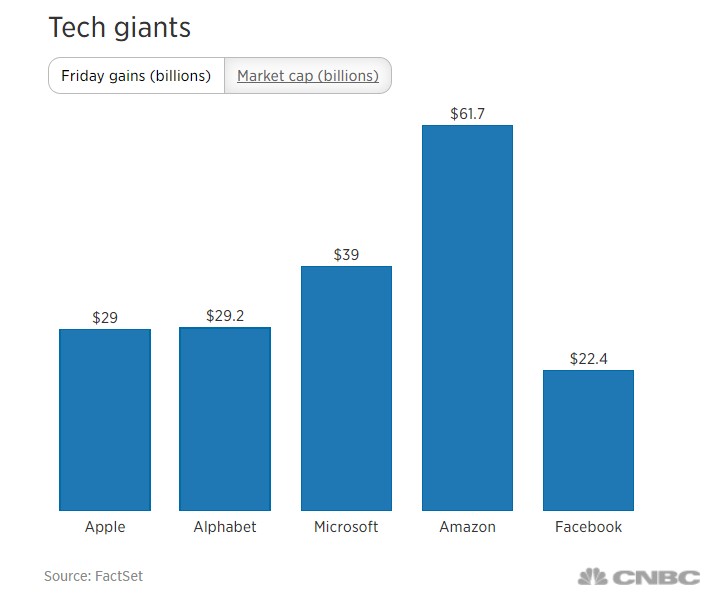
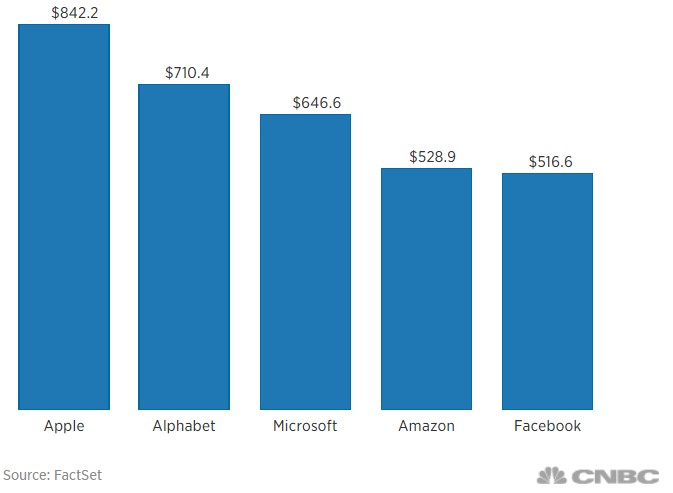
US equities finished the week higher on Friday again. There was a notable rally in Tech with several mega-cap names hitting all-time highs after earnings. Apple, Alphabet, Microsoft, Amazon and Facebook, the world's five most valuable public companies, added $180 billion to their combined market value on Friday. Investors piled into the group a day after Alphabet, Microsoft and Amazon reported better-than-expected earnings. For the stock market, it was more of the same. Those five companies have gained almost $900 billion in market cap over the past year.
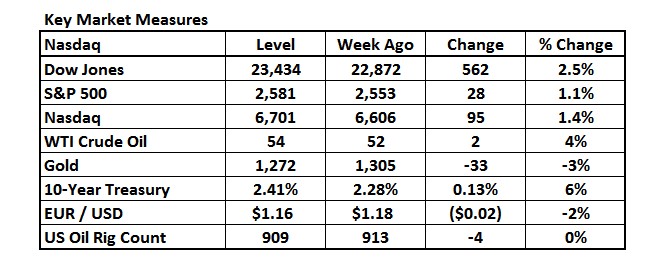
Shares of Amazon and Google both surged past the $1,000 mark and approached all-time highs, with Amazon closing above $1100. To many people’s surprise, we continue to see favorable broad market trends with US equities seeing $14 billion of inflows over the last three weeks.
Friday's Gains:
Market Caps:
There was nothing particularly incremental on tax overhaul this week, as the House narrowly adopted the Senate budget, paving the way for release of initial tax legislation next week. Trump is leaning toward Powell for Fed chair, and the official announcement is expected next week.
No matter what is happening out there, there is always a bull market here at The Bull Market Report! This week we highlight some of our favorite stocks where you can still make good money, including: Apple, Microsoft, Amazon, Celgene, Bristol-Myers, and UPS and a few others.
BMR Companies & Commentary
Apple (AAPL: $163, up 4%)
Well, Apple has still got it! Apple sold out iPhone X pre-orders. Thousands of Apple fans from around the world flooded the website to lock in their pre-orders for the iPhone X. Apple sold out pre-orders for the phone to arrive on the November 3rd launch day in 17 minutes, and the wait time has grown to five to six weeks.
Apple said, "We can see from the initial response, customer demand is off the charts. We're working hard to get this revolutionary new product into the hands of every customer who wants one, as quickly as possible."
Why is this so important? Despite major concerns over manufacturing the deluxe iPhone, and the high price of $999, demand is not lacking at all. This finding bodes well for the stock and future prospects.
BMR Take: Apple sold 41 million iPhones last quarter and will sell over 200 million this year. The holiday quarter is the busiest season of the year, of course, and this year Apple is projected to sell over 80 million iPhones in the Christmas quarter, a new record. With iPhone sales fueling great than 10% EPS growth, we continue to see bright prospects for the stock.
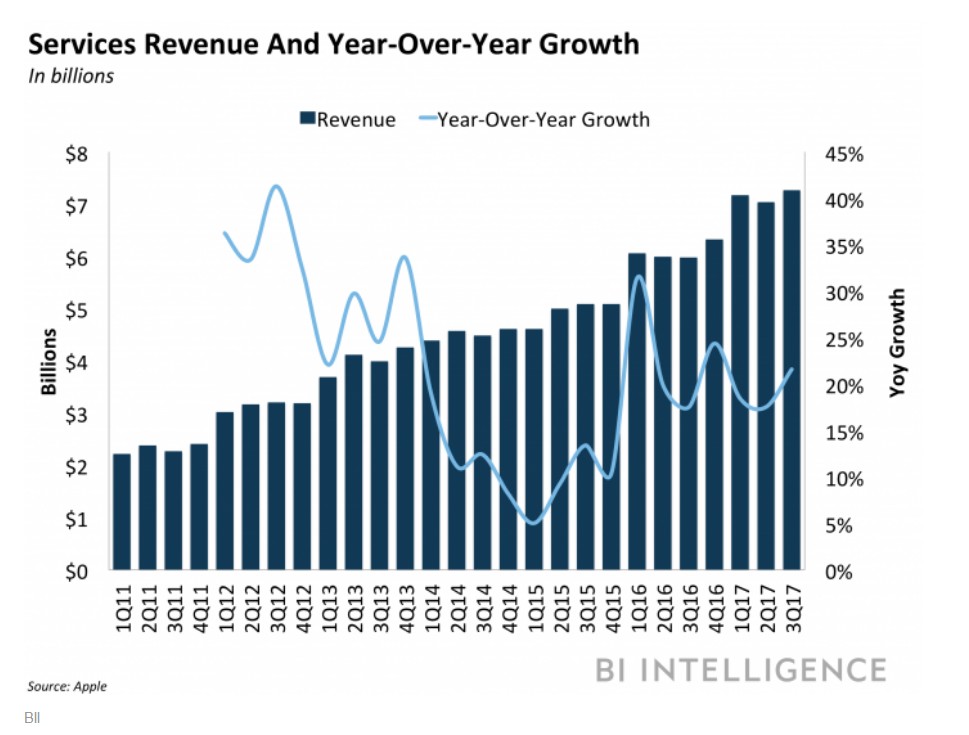
Microsoft (MSFT: $84, up 6%)
Microsoft crushed the quarter. Revenue of $24.5 billion increased 12% from a year ago and beat expectations for $23.5 billion. EPS of $0.84 increased 17% from a year ago and smashed expectations for $0.71.
Earnings rose to $6.6 billion, or 84 cents a share, from $5.7 billion, or 72 cents a share, a year earlier. They are still making 27% profits on sales, AFTER TAX! The strength was broad based.
Analysts were most impressed by momentum in cloud that pushed Commercial Cloud above the company's $20 billion targeted goal they set two years ago approximately three quarters ahead of schedule.
Microsoft’s Azure's cloud revenue increased 90% in the period and has exceeded Amazon’s AWS growth for at least eight straight quarters, but Microsoft has yet to break out the unit's sales. AWS controls 34% of the market while Azure has 12%. However, Microsoft is picking up high-profile clients as it adds features, lowers prices and expands data center capacity around the world.
Amazon’s AWS brought in $4.6 billion in sales, which represents an annualized run rate of $18.3 billion. So you heard it here first, Microsoft is leading Amazon in the world of cloud.
Microsoft continues to increase its share in overall IT spending, and momentum in its results was a clear theme this quarter. Margin performance and free cash flow generation also stood out in the quarter.
BMR Take: With the cloud business tracking way ahead of plan, free cash flow per share forecasts now closing in on $5, and with so many other great things happening at Microsoft we continue to view this stock as a core tech holding for any portfolio. The stock blew through our Target of $78 to a new all-time high, so we hereby adjust it to $92. Our Sell Price remains “We would not sell Microsoft.”
Amazon (AMZN: $1,100, up 13% - $129 a share on Friday!)
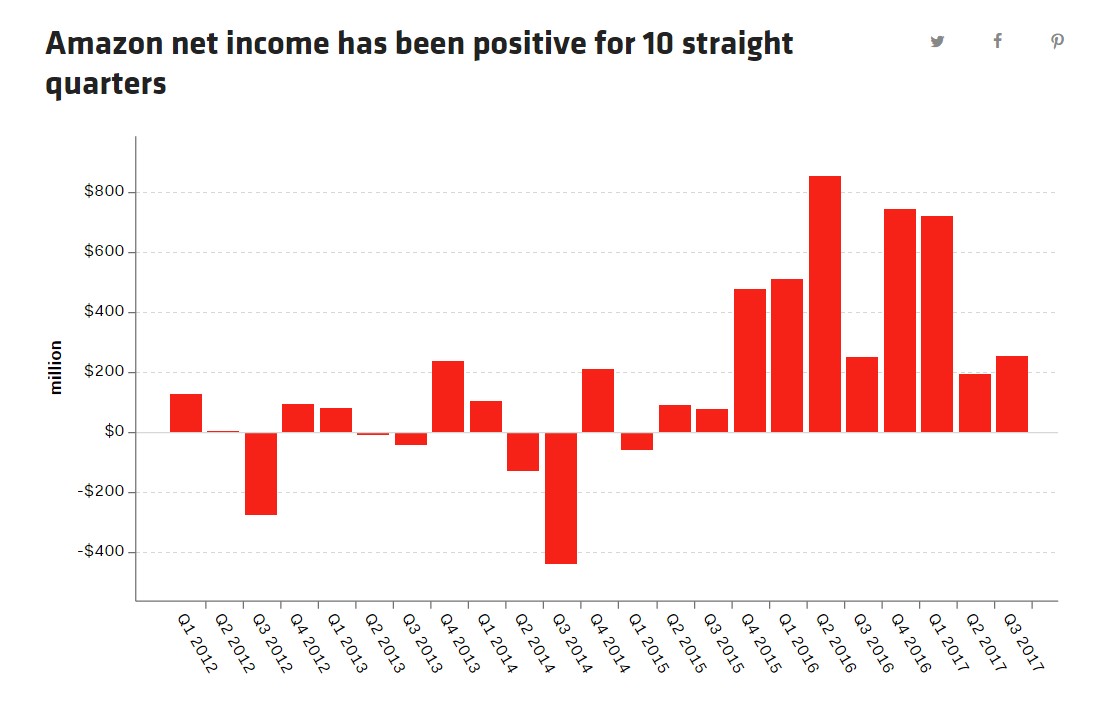
Revenue: $43.7 billion growing 34% from last year, but only $1.3 billion in sales included from Whole Foods, which Amazon acquired in late-August. North American sales were $25.4 billion, up 35% from last year, while international sales grew 29% to $13.7 billion. Amazon gave fourth quarter guidance in the range of $56-60 billion. Wow.
The company’s net income was $256 million, or 52 cents a share. Analysts on average expected earnings of 2 cents a share. (Now THAT is funny. 2 cents a share expected and they report 52 cents! Gotta love this company.

Here we go again! Another industry is about to get “Amazon-ed”. This should be fun to watch and great for the stock:
Pharmacies and Healthcare Distributors continue to trade lower following news that Amazon eying the space. The St. Louis Post-Dispatch reported that Amazon has received approval for wholesale pharmacy licenses in at least 12 states. The topic was discussed further on Amazon’s earnings conference call with the company noting that hospitals and labs were among the areas that could be served under its Amazon Business initiatives. Both distributors and pharmacies are reacting negatively to the perceived threat.
And one potential competitor has jumped the gun by looking to buy a Healthcare company. CVS Health is offering to buy Aetna (AET: $173, down 3% Friday) for more than $200 per share, which would value the company at more than $66 billion. Aetna rallied 12% after the reports. According to the WSJ sources, the merger proposal was spurred by expectations that Amazon might enter the pharmacy business. A tie-up between a retailer like CVS and a health insurer like Aetna may seem surprising on the surface. But experts say both parties need to make strategic moves to address the changes in the sector, including the possible threat from Amazon.
While the above news stole the news headlines this week, keep in mind the core business delivered stellar results.
Revenue beat across all three segment. AWS revenue grew 42% - matching Q2's growth rate, assuaging fears of a deterioration, and beating consensus AWS income by $130 million.

BMR Take: Amazon didn’t just hit smash $1,000 again, the stock rolled right on to $1,102, closing up $128 a share to a new all-time high. With the potential entry into pharmacy, the “innovation machine” called Amazon is alive and well. We see EPS heading to $20 taking the stock much higher over time. We hereby raise our Target of $1100 which it will hit Monday morning, to $1300. Our Sell Price is raised from $970 to $1030.
Celgene (CELG: $98, down 19%)
Celgene had the biggest drop in 17 years on Thursday. Celgene has stumbled, but now is the time to stick with it and accumulate. Why?
Let’s take out all the noise. The fact is the company’s long-term EPS guidance was hardly cut at all from $13 to $12.50. We are still looking at greater than 20% EPS growth through 2020 as revenue explodes from $13 to $20 billion. Specifically, consensus EPS currently resides at $7.30 in 2017, $8.80 in 2018, $10.50 in 2019, and $12.60 in 2020.
Admittedly, it may take a while and we must be patient. There is all sorts of debate about how R&D expenses could disappoint and there are no major catalysts on the drug development front foreseeable in the next 12 months. Then there is also a camp out there that believes that any day now management could make a transformation acquisition that re-ignites excitement about the prospects for the business.
BMR Take: Celgene is the 7th largest component of the Healthcare sector and a $77 billion market cap juggernaut. You have to trust that the franchise is viable and will learn and progress past this current point of disappointment. This looks to us like a classic case of Wall Street exuberance on the downside with this out-of-favor sentiment swing. Take advantage of the drop and accumulate the stock down here.
Bristol-Myers Squibb (BMY: $60, down 7%)
Oh Bristol-Myers. Thou shalt no longer disappoint us at The Bull Market Report. Overall third-quarter revenue rose 7% to $5.25 billion, meeting Wall Street estimates. Earnings rose to $845 million, or 51 cents a share, from $385 million, or 24 cents a share, a year earlier.
Bristol said its gross margin as a percentage of revenue fell to 70% from 73.5% a year earlier due to product mix and higher costs, including a $70 million write-off of inventory for hepatitis C products.
Sales of cancer immunotherapy Opdivo rose 39% to $1.27 billion, in line with the average estimate of $1.21 billion, while sales of blood thinner Eliquis rose 38% to $1.23 billion, matching analyst estimates.
Bristol’s Chairman & CEO had this to say, “We had a good quarter, demand for Eliquis and Opdivo was strong and we advanced our portfolio with important clinical and regulatory milestones, including exciting data for kidney cancer patients with Opdivo + Yervoy. Looking forward, our focus is on continuing to deliver strong commercial performance, advancing our pipeline and ensuring our resources are applied to priority areas of our portfolio for sustainable, long-term growth.”
That said, there remains plenty of merger and acquisition talk, so we are sticking around for what could be a one-day 20-30% premium or higher.
BMR Take: Remember, activist investor Carl Icahn who has a stellar long-term track record is in the stock as one of the largest shareholders. He believes the business is suspect to being taken over and such a sale could unlock tremendous value for shareholders overnight. Stay the course!
The quarter looked pretty good to us. We wouldn’t worry about it too much. The stock may sell off for a few weeks, but we expect it to slowly start to move higher by Christmas.
UPS (UPS: $121, up 1%)
UPS forecasts record holiday delivery of about 750 million packages globally in the 25 days between Thanksgiving and New Year’s Eve. The record-breaking seasonal global delivery volume is about 5% above last year’s season. Of the 21 holiday delivery days before December 25th, 17 are expected to exceed 30 million delivered packages. Mind boggling!
With the launch of UPS Saturday ground pickup and delivery service, customers in nearly 4,700 cities and towns across the country will benefit from five additional ground pickup and delivery days between Thanksgiving and Christmas.
Online and mobile commerce has transformed the retail industry, and UPS is ideally positioned to serve both consumer and business customers during even these busiest of times.
According to the National Retail Federation, retail sales in November and December are forecast to increase 4%, reaching between $680 billion. During the busy holiday shipping season, UPS flexes its global delivery network to process nearly double the regular daily volume of 19 million packages and documents.
UPS continues to invest in the operational and consumer technologies and facility improvements that enable the company to deliver the holidays for customers. Enhanced customer visibility tools, increased consumer convenience, and the availability of the new Saturday ground delivery and pick-up services are all part of the expanding solutions UPS is providing customers, to take full advantage of the holiday season.
This peak season, UPS plans to employ 95,000 temporary seasonal workers, including drivers, delivery helpers who ride with drivers, package sorters, and loaders. Candidates for seasonal jobs can apply on UPSjobs.com. This holiday work often is an entry point for future permanent jobs and career advancement. Almost 35% of those hired seasonally over the last three years now have permanent jobs with the company.
BMR Take: It is crazy to think about just where our country would be without UPS. This business is the backbone of our culture and our economy. It is a must-own in any portfolio. With EPS on track to crack $20 in a few years, the stock remains a good value.
Upcoming Economic News
Personal Income
Monday, October 30th, 8:30 AM
Period: September
Consensus: 0.40%
Prior: 0.20%
Consumer Confidence
Tuesday, October 31st, 10:00 AM
Period: October
Consensus: 121.0
Prior: 119.8
ADP Employment Survey
Wednesday, November 1st, 8:15 AM
Period: October
Consensus: 200,000
Prior: 135,000
Total Light Vehicle Sales
Thursday, November 2nd, 8:00 PM
Period: October
Consensus: 17,500,000
Prior: 18,500,000
Update on Tesla (TSLA: $321, down 7%)
Tesla had a rough week in the markets, dropping $24. We uncovered some information about how the firm is doing in China. It looks like Tesla is making great progress in the difficult China market after all. Elon is great! 🙂
Tesla is moving to begin manufacturing in China. The firm won agreement with Shanghai's government to build a wholly-owned factory in the city's free-trade zone, the first arrangement of its kind in China for a foreign auto maker. Generally, the government makes firms partner with a Chinese company. They didn’t require that in this case with Tesla.
The deal would help Tesla slash its production costs as it would bring down shipping costs and the final price on its electric cars. More significant, it would give Tesla a base from which to export to the rest of Asia. Beijing has mandated a dramatic increase in production of electric vehicles.
BMR Take: The ride with Tesla has its bumps in the road for sure. This week is a further indication of that. They are close to starting substantial deliveries of the Model 3 this year, as they hold cash deposits for almost 500,000 cars. But just as they get closer, production snafus are leaking out from the company and the stock gets hit.
You should only be an investor in this company if you are breathing the happy gas that Elon Musk is sending out. Again, the stock can go to $500 from here, or $200. We’re just not sure which will come first.
A Word From Gary Jefferson
Jefferson Financial Group
First Vice-President, Investments
UBS Financial Services
What's Right with the Market?
As we mentioned last week there had to first be a move to get 51 votes or "it was all just a waste of time". Well, the Senate did pass a budget bill which sets the stage for tax legislation later this year. The significance of the budget passage is that it allows the Senate to now pass their tax legislation with a simple majority of 51 votes rather than the needed 60 votes without one. And since literally no Democrats appear willing to vote for the plan, this was a crucial step for the administration to get their plan approved. The President's plan to cut corporate and individual taxes and to make other business-friendly changes to the tax code have helped to push stocks higher. And, under this potential first major overhaul in about 30 years, corporations would see their top tax rate cut from 35% to 20% - which should obviously be a continuing tailwind for shareholders.
[BMR: Of course, whether this happens or not is certainly not clear. But we will say this: If it doesn’t happen, we are going to see a lower stock market.]
Some thoughts about the length of this bull market and stock overvaluations.
When Treasuries are paying less than 3%, certificates of deposit (CDs) less than 2% and cash less than 1%, it makes quite a bit of sense to continue to use stocks in a portfolio, and not pile into bonds that are tied to the fate of a bond market where when rates rise, bond prices fall.
Anything else right with the market?
Yes. Earnings season started strong and consumer sentiment hit a 13-year high. Companies have started releasing their 3rd quarter earnings reports, and so far, 78% of them beat bottom-line expectations. Corporate earnings have been strong since 4Q16, and this quarter will likely continue that trend, although it may come in a little light due to all the natural disasters. And, the University of Michigan's consumer sentiment poll for September revealed that consumers held positive perspectives overall - across income, age, and political spectrums. Last month's reading reported the highest consumer sentiment since 2004.
One final note – don't get faked out by another 1000 point move in the Dow. That’s because, as the market rises, each 1,000-point advance becomes smaller in percentage terms. For example, the rally between 10,000 and 11,000 in 1999 was, of course, a 10% rise, while the climb from 20,000 to 21,000 for the Dow marked a 5% rise. It's still a good thing, but a 1,000 points is not what it used to be.
That said, next year we may have to get concerned about extended valuations if earnings don't keep up, the length of this bull market if the yield curve inverts, the bearish tendencies of midterm election years, and the ever present Geopolitical risk (N. Korea). Thus, there will still be a wall of worry for the market to climb ……..but this is a good thing. For now, at least, we can enjoy the fact that the "trend is your friend".
Ventas (VTR: $62.50, down 1%)
The company owns more than 1200 healthcare properties in the United States, Canada and the United Kingdom. They are paying a 5% dividend (just raised 6%) and the firm just keeps humming along.
The real estate investment trust, based in Chicago, said it had funds from operations of $373 million, or $1.04 per share, in the period. Funds from operations takes net income and adds back items such as depreciation and amortization. The company had net income of $615 million, or $1.71 per share, on revenue of $900 million in the period.
Ventas expects full-year funds from operations in the range of $4.13 to $4.16 per share.
“We delivered yet another strong quarter for our shareholders. With positive earnings and property growth, improved financial strength and recognition of over $500 million in gains from our ongoing divestiture of our skilled nursing assets, we are in an excellent position,” said Debra A. Cafaro, Ventas Chairman and Chief Executive Officer.
Note that Cafaro was recognized by the Harvard Business Review as one of “The Best-Performing CEOs in the World.” She is one of 23 CEOs named to the Harvard Business Review list for four consecutive years and one of only two women on this year’s list. Ventas’s financial performance ranked 32nd of 900 companies globally for Ms. Cafaro’s tenure, which exceeds 18 years.
During and immediately following the quarter, Ventas sold properties and received final repayments on loans receivable for proceeds of $630 million, with gains exceeding $500 million, consisting principally of the Company’s completed sales of 29 of its Kindred Healthcare skilled nursing facilities (“SNFs”) for proceeds of approximately $570 million. The Company continues to expect total aggregate proceeds of $700 million from sales of its 36 Kindred SNFs in 2017, representing a 7% yield on cash.
The Company has excellent liquidity with $2.9 billion of available borrowing capacity and over $100 million of cash on hand.
BMR Take: We have a Target of $72 so we have a ways to go, but we are happy collecting the dividend and looking for a move to the upper 60s when the world finally wakes up to what a great company this is. Our Sell Price is $58. If you are nervous about the stock market as a whole (and we are not) then moving assets from the Tech sector to Ventas would be a smart move. Big, solid, growth.
From: Trent Thompson [mailto:Trent@xxxxx.com]
Sent: Wednesday, October 25, 2017 2:23 PM
To: info@bullmarket.com
Subject: Options on Nutanix
Hi Mr. Shaver,
I have profited nicely from Nutanix. I have also done well on options strategies as recommended by Bull Market for both Twitter and Microsoft.
I am wondering if you can propose a simple bullish option strategy for Nutanix.
Thanks, Trent.
PS - I very much appreciate your newsletter especially the weekly and ad-hoc reports!
Trent Thompson wanted to see an options strategy for Nutanix (NTNX: $28, up 5%) in his letter above. Good idea, Trent.
So here it is:
Dear Trent:
[Note that this is a RISKY STRATEGY – check with your broker or advisor.]
I like to buy in-the-money LEAPS if I can and if they exist (some stocks don’t have LEAPS.) The reason is that you are not paying as much time premium for the LEAP. Time premium always goes away – it disappears over time and you can be left with losses.
I also like to sell calls against the long LEAP in order to get that time premium back. It’s like selling a covered call but using the LEAP instead of the stock.
The 2020 LEAPs exist, so that is good, but note that the spread is high (bid-ask) so that makes the numbers a little tougher. We are looking for the stock which is currently $28 to go to $40 or higher by January 2020, over two years from now. If this happens we have a home run.
You can buy the 20 LEAP for about $14. With the stock at $28 that means that $8 is the intrinsic part of the price of the option and $6 is the time premium. In order to get some of the time premium back you can sell some options against it. I like to go out 3-6 months to sell the calls and when they expire, just do it again. You can sell the January 30s for about $2 and if the stock stays below $30 they will expire worthless, lowering your price of the LEAP by that $2, to $12. (If it goes over $30, that’s a good thing and you can just buy back the 30 call and sell a 35 call or another option.) You could also sell the April 35 for $2 if you don’t want to get too close to stock price. Or you could sell the April 30 for $3. There are lots of choices!
If the stock is at $30 or below in January, you then sell the June 35s for another $2, lowering the cost basis to $10. Then in June if the stock is at $30 or $35, you sell the January 35 or 40 for another $3-4, lowering your cost basis to $6. NOW WE’RE TALKING! Now you have an option you paid $6 for that is worth $15 if the stock is at $35 and $20 if the stock is at $40.
Obviously this is a very movable strategy and you have to watch the stock and move in and out of the short calls. Plus it is very risky, as the stock could go below $20 and you would lose all of your money. Some of you don’t like to have to watch things so closely, in which case this is not for you. But if you pay attention you can get the cost basis close to zero and if the stock goes to $35 or $40 in two years your return can be very, very big. Did someone say infinity?
With that said, good luck to you, Trent! (And all of our readers.)
Todd Shaver, CEO
The Bull Market Report
I use this site for my pricing, but there are others.
https://finance.yahoo.com/quote/NTNX/options?p=NTNX&date=1579219200
Letter from a Subscriber about Cloudera (CLDR: $14.90, down 8%)
From: Robert Jolliffe [mailto:rjolly1@xxxxxx.com]
Sent: Thursday, October 26, 2017 1:41 PM
To: The Bull Market Report
Subject: Re: News Flash for October 26, 2017: Celgene Lowers 2020 Guidance – Stock Gets Killed
I feel your pain and feel the same with Cloudera. They beat as well and have been falling like a rock the last couple of weeks. I've looked everywhere and can't find anything negative about Cloudera. In fact they just picked up Hitachi as a customer*. WTF! I doubled down here and hope no bad news comes out in the near future.
Our Answer:
I can’t agree more, Robert. What can we do now when we like a company so much, but the market is not cooperating? We can have faith, buy more down here and hope there are no skeletons in the attic.
Look what Nutanix has done lately. And Shopify. And Square. Square has been AWESOME. (Nutanix too.)
Even little old Opko Health. Eventually good companies win out in the end ESPECIALLY when they have GOOD REVENUES. Last quarter saw revenues of $89 million up from $64 million in the year ago quarter, a 39% jump.
Todd Shaver, CEO
The Bull Market Report
* Earlier in the month, Cloudera announced a strategic partnership with Hitachi to offer customers advanced services, support, and training to strengthen adoption of Cloudera Enterprise, the leading machine learning and analytics platform. "Developments in Cloudera's sweet spots - such as machine learning and IoT - are already starting to transform businesses across Asia Pacific and Japan," said Mark Micallef, Vice President, Asia Pacific and Japan at Cloudera. "Partnering with Hitachi is a critical milestone in our journey to simplify the creation of IoT, machine learning, and analytic solutions. It offers a great deal of promise to global enterprises looking to use data to generate new business models and revenue sources, enrich the customer experience and innovate industries."
Some Research from the Street on Shopify (SHOP: $107, up 5%)
We uncovered a research report on Shopify from a big-name Wall Street firm. We found it timely in that the company has been under attack from a firm called Citron, run by Andrew Left. He has made a name for himself by shorting various stocks including Valeant Pharmaceuticals. That was his big winner, but he has had losers too. He shorted Nvidia at $108 in December and it is now at $195. And he has had others.
From the research report we gathered the following:
We expect Shopify to deliver strong 3Q results with revenue and operating income exceeding Barclays and consensus estimates when it reports earnings on October 31. Shares of SHOP have pulled back by 15% in the last month (vs. S&P 500 up 3%) after bearish reports on the company's customer acquisition strategies but are still trading up 130% YTD (S&P 500 up 8%) despite FY18 revenue estimates only increasing by 25% YTD. At 10x FY2 revenues, SHOP's valuation is still a significant premium to peers. We are bullish on SHOP's competitive position in the Small Business ecommerce platform space and the opportunity with Shopify Plus in mid-market category.
Key Metrics for 3Q17: In terms of key metrics, we are modeling total revenue of $166m (+67% y/y), in-line with consensus, near the high-end of company guidance. SHOP has exceeded the high-end of its revenue guidance by an average of 6% over the last five quarters.
FY17 Guidance: Despite the recent pullback, expectations are high for SHOP to raise its FY outlook on 3Q earnings. We forecast FY17 revenues of $650 million, near the high-end of SHOP's current guidance, but we think buy-side expectations are higher.
Subscription Services: We are modeling subscription revenue of $80m in 3Q, up +61% or 5-pt deceleration on 2-yr basis.
BMR Take: We’ve been saying the same thing for a long time. We sure hope the company doesn’t disappoint on Halloween when they report earnings. Because if they do, the stock is going to the 80s. If they produce, like they have been for the past few years, the stock will stay at its current level and may even shoot higher as Mr. Manic, Andrew Left, will have to BUY BACK HIS STOCK. We love short sellers!
But – note what we just said above. The stock could get sacked or it might shoot higher. This stock is not for the faint of heart. If you don’t like the story here then you have two days to sell. You can always get back in.
The Carlyle Group (CG: $22.40) was down 8% this week due to the changeover in leadership. We’re really not concerned and in fact think it was a good move as the founders have reached their late 60s (that’s really young if you know what I mean) and they have outlined the management progression plan that investors are always concerned with. Here’s the gist of the announcement this week:
The Carlyle Group Names New Executive Leadership Team
Glenn Youngkin and Kewsong Lee to Become Co-CEOs
Peter Clare to Become Co-CIO Alongside William Conway
Global alternative asset manager The Carlyle Group announced the following executive leadership changes, effective January 1, 2018: Kewsong Lee and Glenn A. Youngkin will become Co-Chief Executive Officers of The Carlyle Group. Peter J. Clare will become Co-Chief Investment Officer alongside current CIO William E. Conway, Jr.
Carlyle’s current Chairman Daniel A. D’Aniello will become Chairman Emeritus and continue to serve on the Carlyle Board and Executive Group
Current Co-CEOs David M. Rubenstein and William E. Conway, Jr. will become Co-Executive Chairmen of the Board and continue to serve on the Carlyle Executive Group
Glenn, Kewsong and Peter will join the Carlyle Board of Directors
Carlyle Co-Founders Conway, D’Aniello and Rubenstein said, “These promotions ensure continuity in our leadership and maintain the investment processes that have driven our success for 30 years. “As Founders, we are passionate about Carlyle. We will continue to be actively engaged at Carlyle. We are fully committed to and confident in the firm’s future and will continue to be substantial investors in Carlyle funds for years to come.”
BMR Take: This stock is vastly undervalued. We would back up the truck. The dividend is 5.3% and the Chairman of the Board, David Rubenstein, is not selling a share until it hits $30.
The Carlyle Group was founded in 1987 and is based in Washington, DC with additional offices in 33 countries across six continents (North America, South America, Asia, Australia, Europe, and Africa). Carlyle is a global alternative asset manager with $170 billion of assets under management across 300 investment vehicles
Our Price Target is $28 and our Sell Price is moved up from $13 to $20. It’s hard for us to like a stock more.
The High Yield Corner
By Michael Foster
It was a really busy week for The Bull Market Report's High Yield portfolio, with earnings releases and other news events causing a lot of excitement. But at the end of the week, the numbers actually didn’t move all that much.
Of course, there are exceptions. Digital Realty Trust, Inc. (DLR: $117, down 5.5%) saw a sharp decline over the week after reporting earnings that were far above expectations on both the top and bottom lines. The company saw 12% year-over-year revenue growth and FFO growth of 5%. At $1.51 per share, FFO is covering dividends at an even higher rate, which again indicates the need for aggressive dividend increases as we have mentioned over the last few weeks.
Dividend increases should be extremely easy to fund if the company meets its pretty modest guidance. Digital Realty is looking for full-year FFO at $6.00-$6.10, which is about a 3 cent increase from previous guidance. Revenue guidance also bumped up to $2.4-$2.5 billion for the full year.
So why did the stock get hammered so much?
The devil is always in the details, and this time is no different. Digital Realty announced a 4% decline in lease renewals as a result of a 11% decline in Turn-Key Flex renewals (see explanation below.) That was offset by increases for colocation and Powered Base Building products, which combined are slightly more in square feet than Turn-Key. But the massive size of Turn-Key as part of Digital Realty’s entire operations inspired a lot of panic.
So why were the renewals down? It has to do with falling prices. Keep in mind that the decline is in dollar terms, so what happened is a lot of companies renewed at lower prices, driving total revenue for the Turn-Key services lower.
So what exactly is this Turn-Key Flex? Simply put, it’s a 5-year old product that allows renters to design their own server space - meaning electrical, cooling, and other control systems are custom made before the customer moves in. This is different from colocation services, where you simply rent out offsite data facilities without bothering to design the space.
You might be able to see the problem. Turn-Key Flex is obviously a really big ticket item for really big spenders. It’s the kind of white glove service that companies paying 7 or 8 figures are going to demand. And these big customers, who are also dominating tech as the sector gets more consolidated (think Amazon destroying little competitors like Blue Apron), are demanding more discounts as they expand.
That means low sales growth or dollar sales declines, which is what we’ve seen for Digital Realty. But this is hardly a bad thing - it means big clients are spending more with Digital Realty and, as a result, are negotiating lower prices. It’s an understandable trend and actually a good one for Digital Realty.
Note that the company’s data center experts have designed, developed and currently manage over 3.6 million square feet of enterprise-quality data center space throughout the U.S., Europe and Asia Pacific, with over 500,000 square feet of additional, fully improved data center space under construction.
Digital Realty's customers include domestic and international companies across multiple industry verticals ranging from information technology and Internet enterprises, to manufacturing and financial services. Digital Realty's 157 properties comprise approximately 26 million square feet. Digital Realty's portfolio is located in 33 markets throughout Europe, North America, Singapore and Australia.
Elsewhere in earnings news, we saw Ventas (VTR: $63) fall slightly on the week thanks to a Friday recovery on earnings. Revenues rose 4% to beat expectations slightly, but $1.03 FFO was a slight 1 cent miss from expectations. That wasn’t really enough to hurt the stock by the end of the week, and definitely isn’t enough to adjust our expectations for this company.
Again, the details are key. Ventas announced it is expanding its university-based life science operations, meaning the firm is continuing to focus renting space for university research. This is incredibly good, because its mainstay in senior housing is not a growth industry. As paradoxically as it seems, the aging American demographic trend hasn’t actually been as good for senior housing as expected, partly because a lot of aging boomers don’t want to live in senior facilities. But much more importantly, there is a structural reason: seniors can’t afford massive rent raises, which limits organic growth for a senior housing provider.
Seeing this problem, Ventas has diversified into research facility rents, where growth is easy. Why? Because university tuitions keep going up and up, and universities have an incentive to spend as much as they can on research facilities without the market discipline of being cost conscious. In many cases, the signaling benefit of renting shiny new research facilities far outweighs expense concerns for universities struggling to compete in prestige, so that’s a nice profitable business to be in. And Ventas is getting more and more into it, which should result in better margins and a brighter future for Ventas shareholders.
While most of the High Yield portfolio was flat or down 1%, we did see municipal bond funds slide. This is not going to stop anytime soon. Nuveen AMT-Free Municipal Credit (NVG: $15.17, down 2%) and Invesco Municipal Trust (VKQ: $12.33, down 2%) are down largely as a result of selling in anticipation of end-of-year tax-loss harvesting and retail investors taking bets off bonds because of the December interest rate hike that seems a given by the market. While investors could sell these funds to save a possible 1-2% decline in the coming weeks, an even better long-term strategy would be to buy more and more of these funds over the next couple weeks as their yields get closer to 6%. Municipal bonds remain a great place for tax-free income, and the fears of muni regulations changing to remove that tax-advantaged status have dissipated entirely. Washington can’t touch munis. As a result, demand for munis is going to trickle in, especially from the start of 2018. Why not get ahead of that and buy now?
Good Investing,
Todd Shaver
CEO, Editor and Founder
The Bull Market Report
Since 1998
September 24, 2017
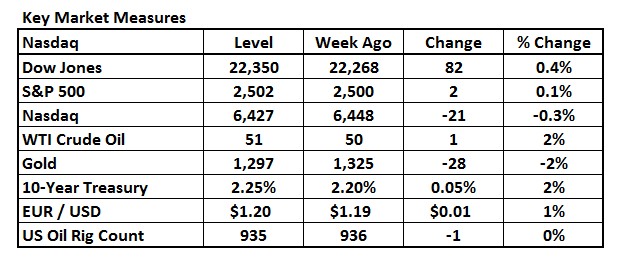
by Todd Shaver | Sep 24, 2017 | Weekly Newsletter 7pm Sunday
The Weekly Summary
Repetitive. That’s what the talking heads are on CNBC. That’s what you see in the local newspaper and even in the Wall Street Journal. All anybody talks about is Trump this and Trump that. Rising interest rates and the Fed. So on and so on. It’s all in hindsight too. Rarely ever do you hear forward thinking. Well, not here at the Bull Market Report. We aren’t anchored to the mainstream. We aren’t beholden to anything or anybody other than giving fresh perspective to you, our subscribers.
This week the one thing that caught our eye was hardly discussed at all in the media. China’s travel and tourism growth rate over the next 10 years is expected to outpace the USA and all other major nations. We are sure you know that China has 1.4 billion people versus our 325 million. We are at a major disadvantage in terms of population size. We better be smart in all we do. We better remember what got us here -- the wisdom of the founding fathers and bold actions (like starting a fight over tax reform by sinking a ship). What wise and bold actions are we taking today? Politically? Financially? Socially? Our Fed can’t even raise rates one-quarter of a point eight years after a crisis. While we are stalled, places like China with 4x the people-power we have are taking over. Let’s go!
No matter what is happening out there, there is always a bull market here at The Bull Market Report! This week we highlight some of our favorite stocks/funds where we think you can still make good money, including: Nutanix, Opko, Apple, Cloudera, Carlyle Group, PayPal, and we discuss Bitcoin.
BMR Companies & Commentary
Nutanix (NTNX: $24.50, up 14% for the week)
Nutanix is on a role. You know why? We’ll tell you the secret. Here is what the smart money sees: It all comes down to new customer growth and average revenue per customer. Sometimes it is just this simple. You look at the business model. You see what is happening with the leading indicators. These are the drivers of where the business is going. And it’s clear what is going to happen.
As of the end of July, Nutanix had 7,050 customers up from 3,770 customers in the year ago period. Out of this pool, there were just 400 customers doing over $1 million of business versus 210 customers in the year ago period.
What does this mean?
The total number of customers just doubled. Hardly any are doing over $1 million of business yet. An analysis of lifetime value from seasoned customers reveals this initial buy is 1x; after 18 months customers spend 4x the initial buy, and the top 25 customers end up around 19x.
So you see it’s just math. We could analyze the product all day (which is fabulous) and the market is buying it. Customers are flocking in.
BMR Take: Nutanix is a once-in-a-generation opportunity according to Goldman Sachs. But note that Nutanix is the classic busted IPO. Busted IPOs are where the initial hype around the first day of official trading on a public exchange gets a bit too high. There is a lot of excitement after all. And there is a lot on the line for investment bankers and management to get top dollar on the IPO price. Then the stock deflates. This is where it is a good time to buy. Nutanix is a great business - not much has changed since the IPO, aside from the fact that now is a much better time to start buying.
Opko Health (OPK: $6.71, up 12%)
The CEO bought 15,000 shares at around $6 per share. They say people sell stocks for any number of reasons. But there is only one reason you buy a stock – you think it’s worth a lot more. Now, when that person happens to be the CEO, that is interesting. The CEO should know the business really, really well. Many academic studies have shown that following insider buying by top executives is a money making strategy in the markets. So again why is the CEO buying shares right now? Whatever he sees leads him to believe he is going to make some money.
BMR Take: Consensus calls for about $1.2 billion of revenue for the company this year heading to $2 billion in a few years. We could be in for some major upside to estimates. Now wouldn’t that be nice, after being so patient with this little $3.75 billion company.
Apple (AAPL: $152, down 5%)
Apple had its worst week in 17 months for a number of reasons but what some say is muted demand. They say the old Apple of Steve Jobs never would have even come out with this phone. Today they just do an upgrade, throw a party, and expect people to flock to it. In fact, they are charging $1,000 now. The old Apple wouldn’t do something unless it was innovative. Nowadays it’s just boring old corporate culture. While demand for the new iPhone was weaker than expected, the reality is it is not a needle-moving matter or a reason to sell the stock. Apple is among the best franchises in the world and they are still selling a millions of iPhones. This is a great buying opportunity.
What else? If you updated to iOS 11 after it launched on Tuesday, chances are that you’ve noticed your battery is draining at an alarming rate. On Thursday, mobile security firm Wandera dove into the update and discovered that iPhone and iPad users who upgraded to iOS 11 are seeing their battery life decay more than twice as fast as it was on iOS 10. So clearly there are some kinks to work through.
BMR Take: We are not particularly concerned with these recent developments. Many times the bad news comes out first after a product launch and then the good news trickles out over the coming weeks and months. Apple is approaching their big selling season here shortly and in October will start taking orders for the Apple X. We will suggest to you here that the orders will be big and the hype bigger, and expect the stock to recover nicely in the coming months.
Cloudera (CLDR: $16.90, down 8%)
Cloudera is issuing new stock, diluting existing stockholders, hence why the stock is down. Specifically, Cloudera announced that it has filed a registration statement with the U.S. Securities and Exchange Commission relating to a proposed follow-on public offering of its common stock. A portion of the shares to be sold in the offering will be sold by existing stockholders of Cloudera, and a portion of the shares will be sold by the company. Cloudera will not retain any proceeds from the shares sold by existing stockholders. The number of shares to be sold and the allocation of the shares between existing stockholders and the company have not yet been determined.
Morgan Stanley, J.P. Morgan, and Allen & Company are acting as lead bookrunners for the offering. BofA Merrill Lynch, Citigroup, and Deutsche Bank Securities are acting as book-running managers and Stifel, JMP Securities, and Raymond James are acting as co-managers.
BMR Take: Two weeks ago they reported this:
Recent Business and Financial Highlights:
Subscription revenue was up 46% year-over-year to $74 million
Subscription revenue represented 82% of total revenue, up from 79% in year-ago period
Subscription gross margin for the quarter was 85%, 200 basis points higher than second quarter fiscal 2017
Dollar-based net expansion rate was 140% for the quarter
45 net new Global 8000 customers added
And they have $500 million in the bank. Yes, they aren’t profitable yet, but remember, revenues tell all.
Taking a step back, companies do what Cloudera just did all the time -- raise equity and use the proceeds for corporate purposes. It is not a reason for us to sell the stock or for the stock to be down as much as it is. The fundamental business has not changed one iota on this development. So it makes sense for us to stay invested. We will certainly keep a close eye on this management team though. For the time being, we are sticking with the company.
The Carlyle Group (CG: $24, up 4% this past week and 17% in the past two weeks)
We have written often about liking Carlyle since it was trading much lower than here. We think $30 is in the cards. Many investors still don’t understand or appreciate the business.
But what is really interesting is that the company just issued a new preferred. But in today’s low interest rate environment, many investors aren’t interested in bonds but still need to find a yield. A lot of money is being made in preferred stocks with their higher yields. Well, Carlyle just issued a preferred stock you can now buy. The Carlyle Group announced the pricing of a $400 million offering of its 5.875% Series A Preferred Units.
BMR Take: We would be buyers of the stock up to $30 a share. But now take a look at this new preferred and make close to a 6% yield. We know that Carlyle knows what to do with $400 million in cash! We just interviewed David Rubenstein, founder and Co-CEO. He is a powerhouse and we are quite happy investing in him and his management team. Have you seen his TV show on Bloomberg TV? Peer To Peer Conversations. Watch this show and buy some stock. You will be happy you did.
PayPal (PYPL: $65, up 6%)
CEO Dan Schulman says the company is looking for acquisitions. Schulman told the media that nothing is imminent but that they are on the hunt.
What could they do?
Historically, they bought money transfer services XOOM and Venmo. These services were natural extensions to PayPal’s brand. They spent a lot of money on tiny revenue producing business, but the technology of these companies is top notch and can scale big time under PayPal brand, so it was a strategic way to not pay a lot for something completely already built.
What would we like to see?
We would like to see the company do something exciting! Little small M&A deals are boring because they take forever to work. We would like to see PayPal take a swing at doing something big.
BMR Take: PayPal is a growth story for decades to come. EPS is growing greater than 10% and has been for a very long time. We see PayPal eventually taking on Visa and Mastercard for the top spot in payments. Setting a new all-time high on Friday, the company is now worth $78 billion. Do you have a PayPal account yet? You will.
Upcoming Economic News
Consumer Confidence
Tuesday, September 26th at 10:00 AM
Period: SEP
Consensus: 120.0
Prior: 122.9
Durable Orders
Wednesday, September 27th at 8:30 AM
Period: AUG
Consensus: 1.0%
Prior: -6.8%
GDP
Thursday, September 28th at 8:30 AM
Period: Q2
Consensus: 2.2%
Prior: 2.2%
A Word from Gary Jefferson
Jefferson Financial Group
First Vice-President, Investments
UBS Financial Services, Inc.
We have looked at the effect the hurricanes might have on the US economy. This is important to the stock market because any disruption to the expectations of continued earnings growth and GDP expansion could trigger a serious correction. The good news is that, although there will be a negative impact, it is not expected to be large enough to "derail" the upward trajectory of earnings growth and higher GDP numbers.
Meantime, one of our favorite resources recently said, "This is now the 2nd longest bull market in history. And I'm betting that it ultimately becomes the longest running bull market in history, eclipsing the current record of 12.3 years. We're less than four years away from surpassing that. And I think we most certainly will, and more……."
We can't argue with this because, fundamentally, the market's gains are rooted in real earnings numbers and economic stats - not speculation. Just one example is the recent solid reading from the Empire State Manufacturing Survey which came in at 24.4 vs. the consensus for just 19.0, and in which analysts noted that the New Orders component grew at the fastest monthly rate in eight years.
And, last but certainly not least, stock valuations, although being higher than historical averages, are nowhere close to "bubble" territory.
Today, if we had to worry, our main fear would be if tax reform ever gets labeled as "dead". If that happens, expect a selloff, but not the beginning of a new long-term bear market. On the whole, the upside momentum for the markets should remain on track.
The Bitcoin Corner
Wow. Where do we start? Discussion of Bitcoin and Ethereum and a host of other cryptocurrencies is skyrocketing. Anything that goes from $2 to $4000 in five years is going to get talked about. Repeat: $2.00 to $4,000.00 – this is not a misprint. The Bitcoin world is now worth about $42 billion which is a tiny part of the world’s money supply, but then again, $42 billion is a big number. We wouldn’t mind having 0.01% of this!
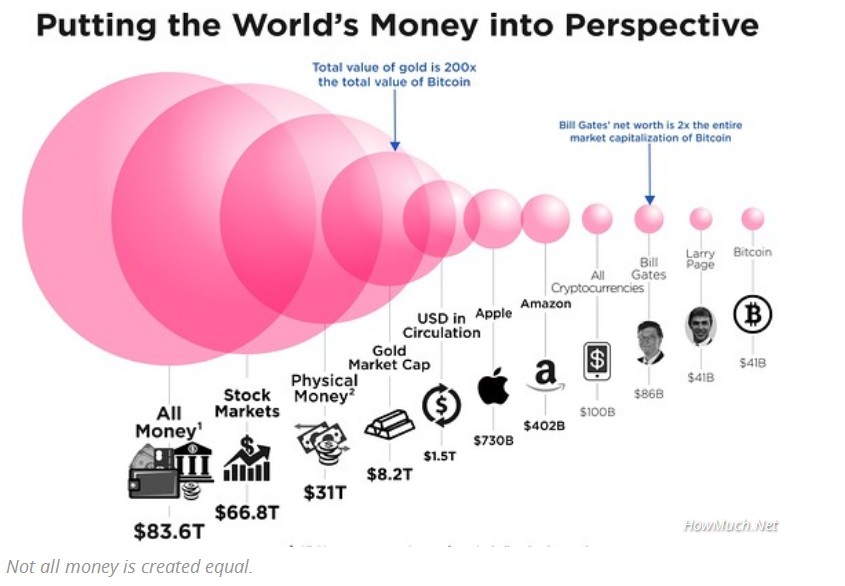
What is Bitcoin?
That’s a good question. For one thing, there can be no more than 21 million of them. There about 16.7 million in circulation and it is getting harder and harder to “mine” them. So one of the reasons for its great rise recently is the scarcity value.
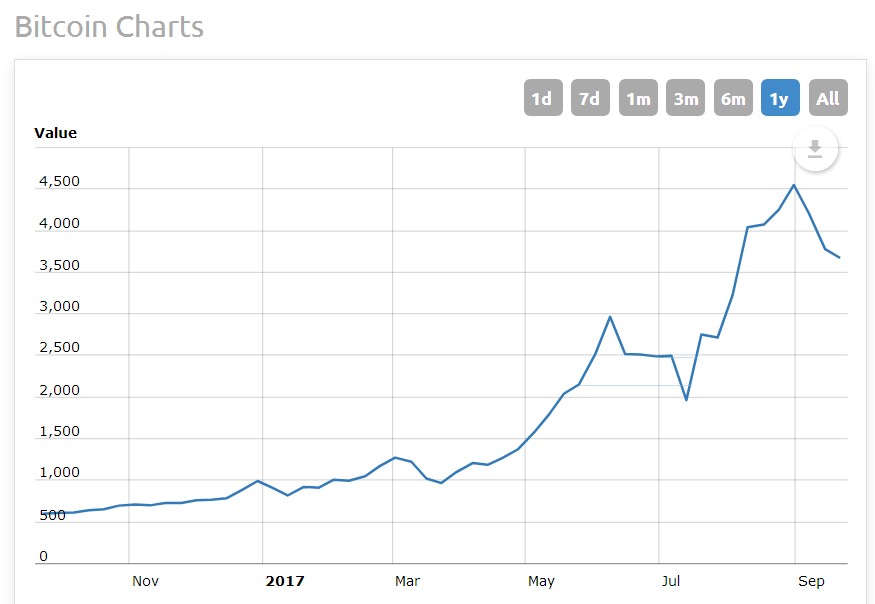
Here is one definition:
Bitcoin is a worldwide cryptocurrency and digital payment system, called the first decentralized digital currency, since the system works without a central repository or single administrator. It was invented by an unknown group of programmers, under the name Satoshi Nakamoto and released as open-source software in 2009. The system is peer-to-peer, and transactions take place between users directly, without an intermediary. These transactions are verified by the network and recorded in a public distributed ledger called a blockchain.
What is a blockchain?
The blockchain is a public ledger that records bitcoin transactions. A novel solution accomplishes this without any trusted central authority: The maintenance of the blockchain is performed by a network of communicating nodes running bitcoin software. Network nodes can validate transactions, add them to their copy of the ledger, and then broadcast these ledger additions to other nodes. The blockchain is a distributed database – to achieve independent verification of the chain of ownership of any and every bitcoin amount, each network node stores its own copy of the blockchain, Approximately six times per hour, a new group of accepted transactions, a block, is created, added to the blockchain, and quickly published to all nodes. This allows bitcoin software to determine when a particular bitcoin amount has been spent, which is necessary in order to prevent double-spending in an environment without central oversight.
We at The Bull Market Report have started buying some ether, another cryptocurrency. We will explain what this cryptocurrency is all about next week. It peaked at about $390 on the 1st of this month and with all the news about China shutting down the exchanges*, the price fell to $206 on the 15th and is around $285 at the moment. But a year ago it was around $12. Don’t ever say that cryptocurrencies aren’t volatile!
Bitcoin peaked at about $4,900 at the start of the month and dropped to $3,000 by the 15th. It is now at $3,670 as we write this. But note that these two cryptocurrencies trade 24-7. That’s right, they trade 24 hours a day, 7 days a week. So by the time you read this, the price will have changed. A year ago it was around $500.
Some symbols for these two are BTCUSD or BTCUSD=X for bitcoin and ETHUSD or ETHUSD+X for ethererum.
* Chinese cryptocurrency exchange ViaBTC has announced its plans to launch a trading platform based outside of China. The decision to establish an overseas-based platform follows announcements that the exchange will shut down operations in mainland China on September 30th.
The debate on bitcoin is raging. The CEO of JP Morgan, Jamie Dimon, called it a speculative bubble and a fraud. The same day Jack Dorsey of Twitter and Square said blockchain is the future and a major unlock opportunity for technology.
So which is it?
The High Yield Corner
By Michael Foster
We have now enjoyed a second week of calm in the high yield world, with a lot of Bull Market Report recommendations seeing slight upticks for the week and a few dipping slightly. The biggest declines, which weren’t really all that big to begin with, were in the REIT space, where nerves about the upcoming interest rate hikes from the Federal Reserve are making investors cautious about future borrowing costs for these firms.
But not all of the declines are in Janet Yellen’s shadow. Digital Realty Trust (DLR: $115, down -2%) continues to see a mixture of profit taking and selling pressure as a result of more predictions about future server needs. Additionally, the debate is hitting many major financial and technology publications, with a growing number of experts weighing in to express caution or contempt for the bearish viewpoint.
Since this debate is heating up, we should dig in a little deeper into its history and the bull and bear cases. We will take this whole issue of The High Yield Corner to discuss this fabulous company (market cap $24 billion, 3% dividend.)
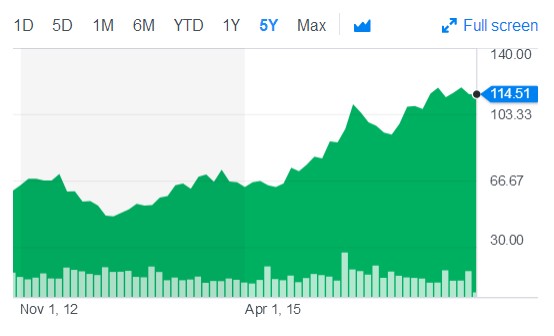
It all began with Social Capital's Chamath Palihapitiya, a CEO who left Facebook to head his own tech investment firm. Palihapitiya has serious tech chops (an is worth $1 billion.) He also worked at AOL and Winamp back when those were big names in tech, and he’s become a titan of the industry by moving to the Next Big Thing before the rest of us realized where the Tech world was going. So when he talks, we should all listen.
Palihapitiya’s idea is simple: Technological improvements are going to cause a rapid and accelerating reduction in the physical size of individual servers. The numbers he threw out boil down to this: 50% of all computing needs will one day run on 10% of the silicon that is currently required. This drastic reduction in the server size will also result in servers being small enough to fit in an RV that you could park beside a data center. "Plug it into some air conditioning and power and it will take those data centers out of business,” he said.
The rebuttal is that it’s going to take a very long time for those developments to come into play. Digital Realty CEO Andy Power made a pretty simple rebuttal: Amazon, Google, and other big tech giants developing and expanding their content delivery network systems around the world are still signing 10 to 15 year leases with Digital Realty. Since Palihapitiya’s bearish view depends on Google developing their own tech to displace Digital Realty, it seems like what Google is really doing contradicts his theory of what they may do at some unspecified point in the future.
That would definitely be a point in Power’s favor. However, we should remember that Digital Realty and Google are counterparties, and tech companies are notorious for trying their best to become less reliant on partners. Google, for instance, famously went against Apple and tried to compete head-on with Android. Then they went against Samsung and acquired their own cell phone company - something that Google recently did yet again. Google is obviously interested in taking as much “in house” as possible, and they have the cash to buy their own real estate and create their own server farms - especially if the size required will be so much smaller in the future.
With that in mind, there’s definitely a pretty strong chance that Palihapitiya will be proven right. Eventually. And that’s the key. In finance, there is a famous adage that “being too early is the same as being wrong.” If Palihapitiya is proven right in, say, 2025, and it causes Digital Realty’s revenues to drop 20% then, but the markets have knocked off 10% of Digital Realty’s valuation in 2017, can we really say that the price hit was fair? Probably not.
And this is the key - a kind of miscommunication between tech and finance that happens all the time. The time horizons are so different, and techies and investors will almost always disagree on the implications of when and how to move investments as a result of changes to the landscape. That, we believe, is what is happening here. Investors are acting too quickly to price in an event because no one really knows how long it’s going to take to actually happen.
What does this mean for Digital Realty’s stock? In most cases of a massive misunderstanding of an emergent technology, you get an S-curve. This happened with Baidu, Facebook, and plenty of other tech stocks. Initial enthusiasm causes a surge in valuations - then the uncertainties around the new technology causes a panic, driving valuations down sharply. Then there’s a recovery as the market realizes they had over-exaggerated the risks, and underestimated the power of the new technology.
With Digital Realty, we think there’s a good chance that we will get this kind of movement. Initial enthusiasm about the technology will cause the REIT to fall further, maybe dragging the price down 10% from its top. Maybe it will go down even more. Then the market will realize they have dramatically overestimated the time frame of these new “microservers” and the stock will recover. Hence an S-curve. The time horizon for this price movement is obviously unpredictable, but tech does tend to move fast. Investors should be prepared for a bit more volatility with Digital Realty over the next few weeks.
Investors should sit tight. If Digital Realty’s dividend yield falls below 4%, it will obviously be a strong buy. Funds from operations and organic growth are strong enough to support the dividend for many years. We may also see Digital Realty increase their dividend (they have the coverage ratio to do it any day now) if the stock falls too heavily. That would be Power’s way of telling investors clearly: “We are confident in our ability to make money.” And that will help the stock recover even faster.
Good Investing,
Todd Shaver
Editor, Founder and CEO
The Bull Market Report
Since 1998