October 1, 2017

by Todd Shaver | Oct 1, 2017 | Weekly Newsletter 7pm Sunday
The Weekly Summary
Welcome to October! Boo! October can be a scary time in more ways than just Halloween. October has a special place in finance, known as the October effect, and is one of the most feared months in the financial calendar. Why? Check the history. There was The Panic of 1907 (October), where multiple bank runs and heavy panic selling occurred on the stock exchange. There was The Crash of 1929 (October), where stock market slides set records. There was Black Monday in 1987 (October), when automatic stop-loss orders and financial contagion gave the market a thorough throttling as a domino effect echoed across the world in a quick 22% drop. In summary, keep a close eye on what’s around the next corner, and don’t get surprisingly spooked by market volatility.
No matter what is happening out there, there is always a bull market here at The Bull Market Report! This week we highlight some of our favorite stocks where you can still make good money, including: Celgene, BlackRock, Facebook, UPS, Home Depot, PayPal, and Government Properties Income Trust.
BMR Companies & Commentary
BlackRock (BLK: $447, up 3% - all prices are for the week)
BlackRock was upgraded to buy this week by Goldman Sachs and placed on the conviction buy list. We love to see Goldman following The Bull Market Report into the stocks we like. This demonstrates the quality of our research and the sincere value we price it at to you our dear subscriber. In other words, it’s not $10,000 a year!
So why all the love for BlackRock right now? It really is as simple as this. The world of ETF investing is dominating the investment management business and BlackRock is the leading provider of ETF products.
BlackRock has $5.1 trillion of assets under management as of December 31, 2016. With employees in more than 30 countries who serve clients in over 100 countries across the globe, BlackRock provides a broad range of investment and risk management services to institutional and retail clients worldwide. The company’s flagship product line-up is the popular iShares exchange-traded funds (“ETFs”). These ETFs are used by everyone from tax-exempt institutions; to charities, foundations and endowments; official institutions such as central banks, sovereign wealth funds, supranationals and other government entities; taxable institutions, including insurance companies, financial institutions, corporations and third-party fund sponsors, and retail investors.
BMR Take: We think BlackRock is a compelling value trading at 17x next year’s consensus EPS estimate of $25. But don’t take it from just us. One of the world’s best hedge funds, Third Point, just bought the stock and believes BlackRock is a “misunderstood franchise” with a massive 38% market share of exchange-traded funds. Third Point’s CEO said he thinks this acceleration in ETFs is just getting started and BlackRock is valued like a traditional asset manager, but it has much greater potential for structural revenue growth and operating margin expansion. We stand by our $510 price target and have already made some good ground on the path here since our initiation to the stock in late August at $415.
Price too high for you? Just buy 20 shares. Just buy 50 shares. Buy 11 shares – but get some BlackRock. Remember, the “price” is irrelevant. What if BlackRock split their stock 10-1 next week? Would that change your thinking because you now have 10 times as many shares at $44 a share? You answered correctly if you said – NO. Of course. The price of the stock would change nothing.
Celgene (CELG: $146, up 1%)
Celgene recently announced that the FDA has placed a partial clinical hold on five trials and a full clinical hold on one trial of the FUSION program for Imfinzi (durvalumab). This is not the best outcome for Celgene, but remember the company’s portfolio is broadly diversified so we view the development as a minor set-back not a game-changer. In fact, most analysts had not yet even been considering the financial impact of these drugs into their estimates. The trials subject to the hold are studying drugs for leukemia and lymphoma. We emphasize that the decision by the FDA was based on safety data derived from other trials involving drugs in patients with multiple myeloma in combination with immunomodulatory agents.
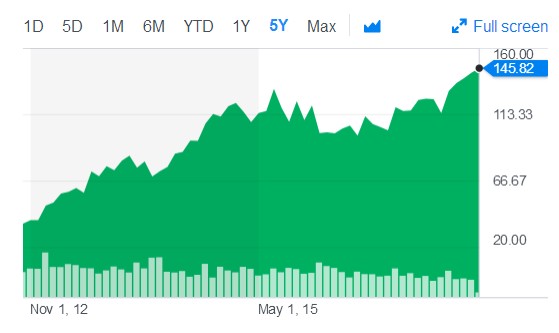
BMR Take: We expect Celgene’s four blockbuster drugs (Revlimid, Abraxane, Otezla, and Pomalyst) to drive revenues of over $13 billion in 2017, and over $21 billion in 2020, while the recent acquisitions of Receptos and Delinia as well as investments in collaborators like Acceleron, Epizyme, Agios, and others will likely ensure growth in 2018 and beyond. We continue to view Celgene as a top large-cap pick in Healthcare. We continue to see our $150 price target as fair for right now, but admit there is upside to our target as the business executes on the revenue path we anticipate.
This is no small company, with a market cap of $115 billion, setting a new all-time high this week. Check out this 5-year chart:
Facebook (FB: $171, flat, after dropping like a stone on Monday to $162)
Instagram recently disclosed that it's added another 100 million monthly users. That brings the photo-sharing app to 800 million monthly active users, up from 700 million in April. This is the fastest 100 million the firm has ever added – five months. When do you think they will hit a billion? Let's see... August 2018?
Five hundred million of those are daily active users, or consistently engaged using the service. That means that Instagram is still far, far ahead of rival Snap in terms of users. Snap said in August that it had 173 million daily active users. The announcement from Facebook-owned Instagram further solidifies Facebook as one of the most dominant companies in online advertising.
Why does all this matter so much? Viewing photos on Facebook used to be very clunky. It was a muddled, buggy experience, yet it’s what most people use Facebook for the most. Over 250 million images are uploaded to Facebook each day, making it the most popular photo-sharing site on the internet. Facebook is without a doubt the YouTube of photos. So Instagram is a critical piece of technology, ensuring the health of the Facebook platform and the future growth and engagement activity of users.
BMR Take: Facebook is an advertising machine and the business is nowhere near mature. EPS is expected to grow more than 20% per year into 2020 bringing EPS close to $10. We hereby raise our target price from $178 to $190 and strongly recommend you get this stock into your portfolio. The Sell Price remains at $155.
UPS (UPS: $120, up 2%)
UPS has been doing all the right things for a long, long time. The latest out of the company this week is a new JV in China.
UPS and SF Express announced approval of their planned joint venture by China’s Ministry of Commerce. The JV enables UPS and SF to collaborate on development and provision of international delivery services from China to the U.S. and, in the future, to other trade lanes. The JV approval is a positive development for international trade and allows the two leading companies to leverage their complementary networks, service portfolios, technologies and logistics expertise.
UPS is the world’s largest express delivery company and a leading global supply chain integrator. SF is a market leader in express delivery in China, with extensive China-wide network coverage, comprehensive service capabilities, and the highest brand recognition in the Chinese small package industry. The newly approved joint venture is a continuation of UPS and SF’s collaboration that began in 2015, when UPS Worldwide Express service was made available at SF’s retail stores in Shanghai and Shenzhen.
BMR Take: This JV is highly symbolic of UPS’s confidence in long-term growth opportunities in China. With EPS growing high-single-digits on its way to $8/share by 2020, we think this stock is a reliable performer for any stock portfolio and stand by our $125 price target for the time being. We’d love to raise it when it hits that magic number.
Home Depot (HD: $164, up 2%)
The story here at Home Depot is that growth is soaring right now. Why? The underlying fundamentals show us one of the best housing markets seen on record. Imagine that after the sub-prime crisis not all that long ago!
Indicators of the housing market were strong in the first half of 2017. Construction starts were healthy for both single-family and multifamily housing. Home purchases were solid while the supply of homes for sale rose for both new single-family homes and previously owned housing. The Federal Housing Finance Agency’s and the CoreLogic Case-Shiller repeat-sales house price indices showed home values rising, with annual price appreciation stable in a reasonable 5-6% range. Based on its National Delinquency Survey, the Mortgage Bankers Association reported that measures of delinquency declined, so people are paying their bills!
BMR Take: A resilient housing market means great things for Home Depot and we sure are seeing that effect take hold. With EPS growing around 10% per year and heading to $10, we raise our price target from $170 to $180 and see even more upside ahead. How’s this for a 5-year chart:

Government Properties Income Trust (GOV: $18.77, up 2%)
Government Properties Income Trust is a real estate investment trust (REIT) focused on owning and operating properties mostly leased to government tenants. Government Properties is the U.S. Government’s largest landlord and owns 74 properties located in 31 states and Washington D.C. containing approximately 11.5 million square feet. Historically, government tenants remain in place significantly longer than private sector tenants, with U.S. Government tenants occupying the same space for more than 20 years.
Properties are 95% leased and occupancy has remained well above 90% since inception. The company is rated investment grade by Moody’s (Baa3) and S&P (BBB-). 88% of rental income is paid by the U.S. Government (on behalf of 37 agencies.)
BMR Take: Look, Government Properties is a niche REIT serving government clients unlike anybody else in the business. They own and rent some of the best properties to clients like the Department of Justice and the IRS. Yes, we need to keep an eye on Trump cutting out all of the fat from the government budget and reducing the size of government. But in reality he can’t vacate signed leases, so there is not much he can do. For right now, however, the outlook looks just fine, and the juicy dividend yield of 9.25% is very attractive.
Moreover, in June, GOV agreed to acquire First Potomac Realty Trust for approximately $1.4 billion. Upon completion, this acquisition will increase exposure to the metro Washington, D.C. market, and expand GOV’s acquisition strategy in that area. We like this catalyst to spur excitement for the stock and for the positive impact it will have on the business. We trim our price target to $24 ($27 previously) out of conservatism.
Update on PayPal Holdings (PYPL: $64, down 1%)
PayPal Holdings is likely to make a strategic acquisition in coming months, according to Bernstein Research and Loop Capital. Last week, the firm put out a note to its customers wherein they believe a purchase of a European payments asset is most probable, with top targets Adyen (private), Klarna (private), Square (SQ) and Stripe (private.) The have an outperform rating on the stock.
“Acquiring Square (SQ: $29) would help PayPal increase its offerings at brick-and-mortar retailers and bring in more customers for PayPal’s Venmo service, as the small business customers on Square could accept Venmo transactions as payment,” they said. “By having both consumers and retailers on its platform, the combined entity would have significantly increased strategic positioning and optionality,” they wrote.
BMR Take: Both PayPal and Square are within a whisker of all-time highs. Square is on a roll and as we have said many times, could be a takeout prospect, and we are only at the beginning stages of Square’s future as a disruptive company in payments. With a market cap of just $11 billion we see big times ahead for this innovative company. And they could be bought out for $15-18 billion in a whisker by one of the big boys. PayPal? We see no top to this amazing success story.
Note this about Jack Dorsey of Twitter and Square:
Dorsey has bought over 1 million shares of Twitter in 2017, while selling much of his position in Square. Dorsey has sold more than $31 million worth of Square stock in that time. After Friday’s purchase, Dorsey owns more than 16 million shares in Twitter. He still owns a big stake in Square, but he is obviously moving to up his investment in Twitter at this time.
Upcoming Economic News
ISM Manufacturing
Monday, October 2nd, 10:00 AM
Period: September
Consensus: 58.0
Prior: 58.0
Total Light Vehicle Sales
Tuesday, October 3rd, 8:00 AM
Period: September
Consensus: 16.3M
Prior: 16.0M
Trade Balance SA
Thursday, October 5th, 8:30 AM
Period: August
Consensus: -$42.9B
Prior: -$43.7B
What follows is not a recommendation, but an information piece on a Nasdaq stock that invests in bitcoin.
Bitcoin Investment Trust (GBTC: $702, market cap - $1.2 billion)
Bitcoin Investment Trust, the only exchange-traded product that offers Bitcoin exposure, is an exchange-traded note, backed by Bitcoin, and it trades at an astonishing 95% premium that has been as high as 125%. That means investors are paying twice as much, plus fees, to own Bitcoin - a premium that will probably disappear as the Bitcoin market matures and access becomes less of an issue.
That’s already happening. In July, the U.S. Commodity Futures Trading Commission unanimously approved LedgerX’s cryptocurrency-trading platform for clearing derivatives; it will start with Bitcoin options. CBOE Holdings and Gemini Trust, the digital currency exchange founded by the Winklevoss twins, announced a partnership to offer Bitcoin futures as early as this year. VanEck has filed to bring products holding Bitcoin “instruments” to market. Exchange-traded fund provider REX is planning two Bitcoin-based derivatives ETFs.
The SEC has rejected Bitcoin exchange-traded funds, citing a lack of regulation of the Bitcoin spot market; a derivatives market in Bitcoin would remedy that. It also doesn’t hurt that Dalia Blass, who hails from the law firm that represented the Winklevoss twins’ ETF, has been named director of the SEC’s Division of Investment Management.
Bitcoin, the cryptocurrency polarizing governments, banks, and investors alike, is currently trading at $4,330, down from its peak of $4,980 in early September, but up from its lows of $3,000 in the middle of September. The sell-off was largely driven by Chinese regulators formally shutting major Bitcoin exchanges. As you can see, it is quite volatile, rising from $600 a year ago.
It didn’t help that JP Morgan Chase CEO Jamie Dimon called Bitcoin a “fraud” and “worthless” and that Bridgewater’s Ray Dalio called it “a bubble” in the days following China’s crackdown. Fundstrat Global Advisors’ Thomas Lee disagrees, saying that China’s recent moves are a short-term head wind, given that the region represents just 20% to 25% of global trading volume. Lee, in a recent note to clients, wrote that Bitcoin was “increasingly representing the gold investment” for millennials and will ultimately displace the precious metal in portfolios. He contends that Bitcoin could reach $25,000 by 2022, given that it accounts for 5% of the $7.5 trillion alternative currency market, which is growing by 6% annually. By early 2018, he sees it hitting $6,000, a whopping upside of 60%.
Here’s an interesting commentary on the bitcoin world, and an interview with John McAfee, the founder of McAfee Associates, the anti-virus software company that was eventually sold to Intel. McAfee is a bitcoin miner now, and appears to be "all-in" on bitcoin.
https://www.cnbc.com/2017/09/13/john-mcafee-challenges-jamie-dimon-bitcoin-skepticism.html
McAfee has stated that bitcoin could go to $500,000. Wow.
Teva Pharmaceuticals Names New CEO
Seven months after Erez Vigodman stepped down, Teva Pharmaceuticals (TEVA: $17.60, up 2%) has appointed a new CEO - Kare Schultz. Schultz, who has served as CEO of Danish pharmaceutical company H. Lundbeck since 2015, will be tasked with reviving sales and reducing debt for the world’s largest generics manufacturer. According to Bloomberg, Schultz will likely face pressure to split the company - with one focusing on “patented specialty medicines and the other on cheap copycat drugs.”
Twilio Shares Drop after Amazon Text Messaging Announcement
Twilio (TWLO: $30, down 3%) is a communications company that uses a cloud-based software to help businesses insert "real-time" communication into their apps. Amazon announced this past week that its Pinpoint system now allows users to trigger 2-way SMS messaging.
Some on the Street think this is bad for Twilio, but Twilio management thinks this is a good thing. "This is a continuation of our technology partnership with Amazon. Two-way texting is another capability being utilized by Amazon Pinpoint as part of our existing relationship," said a Twilio spokesperson.
Twilio CEO Jeff Lawson, who used to work at Amazon, said in a tweet that he's "excited that Twilio is now helping to power engagement on Amazon Web Services Pinpoint."
BMR Take: We believe in this company. Watch revenues – revenues rule all. And revenues have been spectacular as you know, since we have reported on this company continually. The stock is way off its highs of course, but we feel the stock is putting in a strong base here at this level.
A Word from Gary Jefferson
Jefferson Financial Group
First Vice-President, Investments
UBS Financial Services, Inc.
What's going on with the Fed and why should we care? Today, the Fed is sitting tight with rates of 1.0-1.25%. Two weeks it announced it would start reducing their balance sheet in October. So, what does that mean? For years the Fed has been buying trillions of dollars' worth of US Treasuries and mortgage backed bonds, and reinvesting all the earnings back into more of the same. Next month it will start "shrinking" its balance sheet by not buying (reinvesting, or as some call it, "normalizing") tens of billion worth of Treasury's and mortgage bonds. Going forward, the Fed will ramp up the amount "normalized" every three months, hoping that this stair-step approach will not create turmoil in the markets. However, everyone knows the US government has to issue bonds to raise the money needed to pay its debts, so who is going to step in and buy these bonds now that the Fed is gone? That is something that no one knows because it's never happened before.
Our take is that the Fed will continue to monitor the economy and if it senses trouble – either from rising interest rates or the shrinking of their balance sheets – they will back down by either leaving rates alone or even halting the balance sheet reduction strategy. Thus, if the Fed continues to raise and shrink, it means the economy remains on solid footing. If things begin to slow, the Fed will most likely keep rates low and start buying again, both of which should benefit the market. An optimist will see this as a win-win scenario for keeping the market's prospects of continued growth intact.
We tend to be optimists at this point even though we don't like the fact that there seems to be so much dependence upon the Fed. We are optimistic because the market seems to have been able to shrug off not one, but several things that normally would have had some sort of consequential impact upon it. When one considers that Hurricanes Harvey, Irma and Maria slammed into the United States and Puerto Rico, North Korea tested another missile (and have threatened more), President Trump upset the establishment at the United Nations, and London was hit by another terrorist attack – it is remarkable that the market didn't suffer a significant correction. All this tells us that the earnings growth story for the market is for real and, if we can actually get a tax reform bill from D.C. – well, that would conjure up images of Gene Autry back in the saddle singing "Happy Days Are Here Again".
The High Yield Corner
By Michael Foster
The week saw a small bit of volatility for high yield investments in a surprising divergence from the stock market, which has virtually no volatility, and which had yet another strong week.
Is this a cause for concern? To answer that question, let’s take a look at where the biggest weakness was, determine what was the cause of that weakness, and try to extrapolate the probability of that weakness continuing.
Several of The Bull Market Report's high yield picks saw a 1% drop in the last week, such as Omega Healthcare Investors, Inc (OHI: $32, down 1%). For those of you who have followed this Healthcare REIT for a while, you know that a one-week 1% decline isn’t really terribly unusual, so it isn’t something that should inspire any alarm. On top of that, the decline happened without any unusual spike in volume and without any significant news, so we can’t conclude that there’s any material public information driving this decline. Short-term volatility caused by random inflows and outflows of investor capital seem the driver of the 1% fall here.
Not the same could be said for Apollo Commercial Real Estate Fund (ARI: $18.15, up 4%), which announced a 46 cent dividend just two weeks ago - a payout in-line with its previous payouts. It was paid out Thursday, and as per usual, the stock opened up 46 cents lower. So with the stock closing the week up 21 cents, plus the dividend, the stock was up a huge 4% for the week. Remember that the Apollo Fund isn’t a Property REIT but a Mortgage REIT, meaning that the way it earns income and its structure are more like a loan fund than a company like Omega. As a result, Apollo Commercial Real Estate Fund is sensitive to interest rate changes and default rate trends more than on the market’s perception of the value of its holdings, its property cap rates and occupancy rates, and other real-estate specific metrics. And we are in fact seeing an increase in long-term interest rates as we get nearer the December rate hike that the Federal Reserve has strongly hinted is inevitable.
While that’s bad for the Apollo Fund and a justifiable reason for caution, it’s offset by the fact that commercial real estate defaults are extremely low and are not going up. Thanks in part to improving profitability for companies, rising sales, and a stronger GDP growth rate, companies’ ability to pay their mortgages is as strong as could reasonably be expected. That, at the end of the day, is an arguably more important factor in determining the safety of Apollo’s future cash flow.
Is Apollo’s 10% dividend worth investing in? We think so. Risks of a cut are far lower than a double-digit yield would suggest, so investors should consider holding this even if we see some more volatility in the next couple of months before the drama from the Fed plays out in December.
Municipal bonds, which started the week in solid recovery mode, are taking a bit of a break. We’ve seen the sector weaken slightly in the last couple of weeks, and that trend has continued this week. As a result, Nuveen AMT-Free Municipal Credit (NVG: $15.39, down 1%) and Invesco Municipal Trust (VKQ: $12.77, down 1%) both had a bit of softness. While a 1% decline isn’t a lot when compared to just about any other asset class, it is a lot for the typically sleepy muni market. These bonds rarely see big price moves, so a 1% decline is something to consider. We’re still in positive territory for 2017, but that may not last long. The Fed’s interest rate hikes spook muni investors more than perhaps any other group of investors - even if interest rate hikes don’t hurt munis all that much. For that reason, we can’t promise these funds won’t fall later in the year, and even fall into red territory. Looking further, however, there will be a recovery when the market realizes the mistake they made and they start buying back in. After all, that’s what we saw after the hike in December 2015 and the hike in December 2016.
Interestingly enough, the taxable bond world is shrugging off the upcoming Fed rate hikes in the most contemptuous way. Let’s start with AllianzGI Equity & Convertible Fund (NIE: $21, up 1%), which announced its quarterly results that didn’t yield any major surprises. NAV growth and investment income are more than sufficient to yield a strong total return for investors, and the dividend of 7.3% remains very sustainable.
The convertible bond part of the portfolio is rising in value despite the clear message of an interest rate hike. Why? Again, it goes back to the fundamentals. Economic growth is strong enough for companies to pay their bills, which helps bonds rise in value. A similar tailwind has also helped PIMCO Dynamic Income Fund (PDI: $31, up 1%) enjoy a NAV boost for a long time now, so its last week of strength is no surprise. This fund remains priced at a premium to NAV, albeit just 6.5%, which is admittedly a cause for concern.
Additionally, Pimco Dynamic is under-earning its payouts, which means the year-end special dividend is likely to be smaller than it’s been in previous years - if there’s one at all. Still, on a total return basis there is just too much upside still in PDI because of its focus on mortgage-backed securities and corporate bonds.
Good Investing,
Todd Shaver, Founder, CEO and Editor
The Bull Market Report
Since 1998
September 10, 2017

by Todd Shaver | Sep 10, 2017 | Weekly Newsletter 7pm Sunday
The Weekly Summary
Sloane Stephens beat Madison Keys to win the woman’s United States Open Tennis Championship and Rafael Nadal faced off against Kevin Anderson (who?) for the men’s title Sunday. World class tennis looks a lot like the market these days. Lots of long rallies. Excitement. Unexpected turn of events.
The primary news right now is all the hurricanes. Florida and Texas are taking the brunt of the unfortunate weather. We are seeing disruption across industries, from cruise lines to power generation to real estate.
The North Korea crisis lingers. Trump continues to say to China that you handle this. China keeps looking right back at Trump saying, well, you got it. While the US and China agree that North Korea needs to be rid of nuclear weapons, the lack of agreement on how best to achievement that goal has created a stalemate and a lingering overhang on the markets.
Another major event that has sure caught your attention recently was the Equifax data breach. Sensitive data on two of every five Americans was exposed in the cyberattack, making it one of the largest ever recorded. The future of online crime presents serious threats to the economy and the markets. We must keep an eye on these events as they could serve as a sell-off if they all gang up on each other.
If you wish to know what to do about the Equifax issue, here are two articles from The Washington Post and the Chicago Tribune:
https://www.washingtonpost.com/news/the-switch/wp/2017/09/09/after-the-equifax-breach-heres-how-to-freeze-your-credit-to-protect-your-identity/?utm_term=.af2b2f7fb8f8
http://www.chicagotribune.com/business/ct-equifax-consumer-protection-0910-biz-20170908-story.html
No matter what is happening out there, there is always a bull market here at The Bull Market Report! This week we highlight some of our favorite stocks where we know you can still make good money, including: Andeavor, Square, Eli Lilly, Shopify, Home Depot, Cloudera and Celgene.
BMR Companies & Commentary
Andeavor (ANDV: $102, flat)
Andeavor recently announced that it has officially begun operating in Mexico and has successfully opened the first ARCO station in Tijuana, Mexico. Andeavor and ProFuels have an established wholesale marketing agreement and have outlined plans to expand the ARCO brand to achieve a leading market position in the Mexico. Opening the first ARCO station in Northwest Mexico is a natural and strategic link for West Coast operations and the company’s integrated value chain, which furthers marketing integration in a growing market.
This first station marks the beginning of growth to include an anticipated 200 to 400 ARCO stations over the next several years. ProFuels also intends to grow the ARCO brand through supply contracts with independent owners and operators of existing and new gas stations that are interested in marketing fuel under the ARCO brand.
BMR Take: This is a nice catalyst for growth ahead for Andeavor. The company currently trades at 18x this year’s anticipated EPS of $5.60. But the EPS outlook is heading to $7.50-$8.00 next year, which should push the stock price higher. Our Price Target is $110 and our Sell Price is $95.
Square (SQ: $27, up 6%)
Square is applying for a US banking license, signifying the beginning of the firm’s long-speculated push into financial services.
The bank should help bolster Square Capital, the firm’s business lending segment. The bank will be focused squarely on merchants, not consumers. Square Financial Services (SFS) won’t extend consumer loans or house services like Square Cash, but will rather focus on the extension of Square Capital.
And it should help Square grow its burgeoning lending business. Square Capital has posted consistent, steady growth, issuing $1.8 billion in loans to over 140,000 merchants since its launch. SFS could improve that offering by bringing operations in-house, which could increase efficiency and allow the firm to grow or diversify its portfolio and offerings.
BMR Take: Square is among the most exciting companies in all of payments. They are sparking change across the ecosystem and now integrating a bank into their model is just the latest example. Consensus calls for nearly $1 billion of revenue this year with growth running 30% for the foreseeable future. It’s hard to find this kind of growth in the market today making Square a gem. Our Price Target is $29 and we are up 54% on the stock since March. Not bad in six months. But this Square story is just in Chapter One.
Eli Lilly (LLY: $83, up 3.5%)
Eli Lilly recently presented data showing their clinical trial drug lasmiditan significantly reduces pain in patients with migraine. This was very well received by the market. The company presented key primary and secondary endpoint data for lasmiditan, an oral, first-in-class molecule for the acute treatment of migraine, which demonstrated statistically significant improvements compared to placebo in the Phase 3 study. Detailed results were highlighted at the 18th Congress of the International Headache Society (IHC) in Vancouver. Lilly plans to submit a new drug application for lasmiditan to the FDA in the 2nd half of 2018.
BMR Take: Lilly is a healthcare powerhouse. Sales this year will exceed $22 billion. This new drug is just another piece of the story. Hopefully it can contribute $1+ billion of annual revenue when it hits full potential. With many drugs like this, Lilly has a well-diversified portfolio making the stock attractive to us at 20x this year’s consensus EPS estimate of $4.25. Our Target is $88 and we would love to see this by the end of the year.
Shopify (SHOP: $114, up 10%)
Shopify announced the winners of Inaugural Build, a business competition. Winners receive a one-of-a-kind, eight-day entrepreneurship experience, including mentorship from some of the world’s most successful entrepreneurs - Tony Robbins, Daymond John, Debbie Sterling and more.
From March to July 2017, Build a BIGGER Business competitors were asked to grow or scale their businesses using traditional and non-traditional strategies and tactics. To help with this growth, competitors were given access to the exclusive Build a BIGGER Business online academy, including immersion sessions with mentors on topics ranging from organizational leadership to how to optimize your sales funnel. The Build a BIGGER Business Competition attracted applicants from 70 different countries, spread over 750 different cities. Over the course of five months, competitors generated over 8 million orders, resulting in more than half a billion dollars in gross merchandise volume (GMV).
The average growth for the businesses participating in the competition was 14% during the competition period. The Top 10 participants with the highest percentage growth increased their GMV by an average of over 500%. The Top 50 participants with the highest percentage growth increased their GMV by an average of over 100%. To enter the Build a BIGGER Business competition, participants needed to have an existing business on the Shopify Platform with sales between $1 million and $50 million.
BMR Take: You might be saying why do I care about some business competition? Well, you should. Just think about how many businesses took interest in Shopify due to the competition and what the results looked like. It’s proof of the Shopify business model. The whole situation is a genius marketing event by the company and reaffirms why we like the stock. With $650 million of revenue expected this year growing at a rate of greater than 50%, and over 400,000 customers and growing, Shopify is the next best thing to Amazon in eCommerce.
We’re up 56% on this one since late March and our Price Target is $115. We hereby raise our Target to $125 and our Sell Price from $93 to $105. The stock set a new all-time high Friday and is worth $11 billion. That’s a big number for the founders and employees, but a tiny number for the big boys* that are on the lookout for acquisitions. If it were taken out it would have to be $125 to $135 a share.
* Facebook, Amazon, Microsoft, Apple, Google. But you knew that!
Home Depot (HD: $160, up 7%)
Shop from Home Depot with just your voice thanks to the Google Assistant. Really? Sweet!
Need something from The Home Depot? Just ask the Google Assistant. The Home Depot will join Google Express this fall, adding the ability for its customers to shop through voice with the Assistant on Google Home, making it more convenient than ever for customers to shop however they want.
The Home Depot offers customers flexibility with its 2,282 stores and digital endless aisle. Later this fall, customers will have an additional way to purchase innovative products - with the Assistant on Google Home or on the Google Express website or app.

BMR Take: There is a lot going on out there impacting Home Depot. Obviously, the floods could boost sales as repair efforts begin. Beyond this seasonal event, we think it is important to keep an eye on the long term core part of the business, technology. We are really excited to see Home Depot focused on digital. At 22x this year’s EPS of $7.25, we continue to think the stock is a compelling buy.
The stock set a new all-time high on Friday and is now worth almost $190 billion. The company knows what it is doing. Our Target of $160 has GOT TO GO. We hereby raise it to $170, leaving our Sell Price at $150.
Cloudera (CLDR: $21, up 9%)
Cloudera is acquiring Fast Forward Labs, a startup that gives companies the latest information on how to apply machine learning and AI to their businesses, as well as consulting.
Cloudera specializes in operating on top of open-source technology, looking to deliver an enterprise-grade product for larger organizations. The enterprise is more excited about machine learning and applied artificial intelligence than ever. Collecting that kind of expertise is going to be critical as it looks to woo enterprises into paying for additional support and services on top of open-source software.
Cloudera’s business can be a tricky one. Cloudera has to show companies that it can build a better product than they might be able to implement themselves, or simply make it much easier to deploy by paying the company, so it’s another thing those companies don’t have to worry about. This acquisition really helps toward this end.
BMR Take: With $360 million of sales this year growing 40%, Cloudera is an emerging growth stock worth keep an eye on. With acquisitions building out the product suite and accelerating revenue growth, momentum is undeniably picking up. Still under $3 billion in market cap, this company is a pipsqueak in the world of commerce. But given its high growth rate, in 2-3 years, the firm will be a major factor (if the company doesn’t get taken out by the big boys.)
Upcoming Economic News
JOLTS Job Openings
Tuesday, September 12th, 10:00 AM ET
Period: July
Consensus: 6,000,000
Prior: 6,160,000
PPI ex-Food & Energy
Wednesday, September 13th, 8:30 AM
Period: August
Consensus: 0.20%
Prior: -0.10%
CPI
Thursday. September 14th, 8:30 AM
Period: August
Consensus: 0.30%
Prior: 0.10%
Retail Sales
Friday, September 15th, 8:30 AM
Period: August
Consensus: 0.10%
Prior: 0.60%
Celgene (CELG: $140, up 1%)
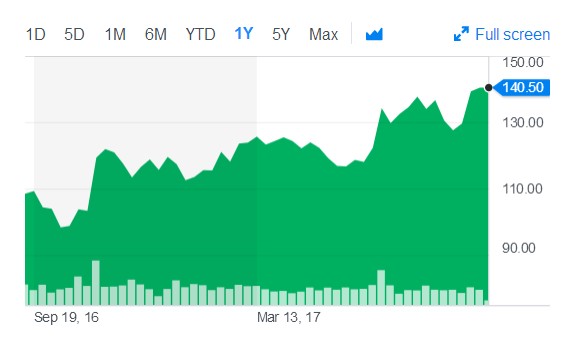
This company has been a big winner for us here at The Bull Market Report. We added the stock at $95 last summer and it is up almost 50% now. The firm is worth a staggering $110 billion. They have $10 billion in cash and just $14 billion in long-term debt. Revenues for the past three years are $7.7 billion, $9.2 billion and $11.2 billion. That’s what we call growth. We would love to see more profitability as they reported $2 billion last year, the same as in 2014. But 2Q17 hit $1.06 billion in earnings, so our wishes are being answered.
Celgene discovers, develops, and commercializes therapies to treat cancer and inflammatory diseases worldwide and they are firing on all cylinders. If you want to be invested in cancer research, this is the place to be. Our Target is $150 and our Sell Price is $125.
A Word from Gary Jefferson
Jefferson Financial Group
First Vice-President, Investments
UBS Financial Services, Inc.
If there is going to be a real market pullback (5% to 10%), history shows us that the Sept-Oct period is the most likely time for it to happen. So, we thought this would be an opportune time to get on the Market Jet, climb to 30,000 feet, and look down at the current "Big Picture". Here is the view from above:
The market has been good to us. We have been in a real bull market since 2009. Until 2015, most experts we respect were split, with one group believing we were still in a secular bear market which began in 2000 and that the bull market beginning in 2009 is only a cyclical bull still within the overall larger secular bear market; i.e. when this 2009 bull ends, the market will reverse course so that we end up back at the year 2000 levels. The other group believes the secular bear market ended in 2013, and that we are now in the 4th year of a new secular bull market. Secular bull markets historically last from 8 to 20 years – in other words we have between 4 and 16 years left for this bull market to run. (The last secular bull market ran from 1982 to 2000). Relying on dozens of experts as well as our 30+ years of experience, we believe we are in a new secular bull market with higher highs to be made over the next 4 to 16 years. We should expect to see a cyclical bear market at some point within the bull market run, but in the "big picture", investors should do well over the coming years.
Several other "big" things are going on. While the DOW and S&P 500 have hit new highs – because the economy is posting GDP growth of 2.5%-3.0% (finally!) – the Utility index hit a new high last week, while copper prices also hit a 3-year high. This is way out of whack. Historically, high copper prices have always signaled higher world growth. Higher growth in turn signals higher interest rates and inflation – all bad news for utilities. What seems to be happening in the "big picture" is that investors are frustrated and tired of waiting for interest rates to rise so they are chasing anything with yields- i.e. utilities. What this is really signaling, however, is that institutional money is buying in to the belief that interest rates are going to remain low for an extended time. Investors cannot ignore the bond market, and when it tells us it believes in lower rates for longer, it bodes well for the bull market hypothesis.
Again, looking at the "big picture" of the overall stock market, it is clear that the market is shrinking big-time. According to CNN Money "America's Stock Market is Shrinking", the number of public US stocks peaked at 7,600 in 1988. By 2015, there were just 3,800 US public companies. Obviously, there are more companies exiting than entering the market. It is shrinking because of an increase in mergers, companies going private and a slowdown in IPO's. Thus, please consider the math – there is a lot more money today chasing a lot fewer stocks. In the big picture, this is also a favorable trend for the stock market.
Finally, the big picture is a little less clear on the subject of taxes. What is obvious is that tax cuts and real tax reform will be great for individuals, businesses and the overall economy. A simple formula would be: Lower taxes = higher profits, more money in consumer pockets, higher spending, higher dividends, more stock buybacks = higher stock prices. Unfortunately, at 30,000 feet or 3 feet, it's impossible to see through the swamp. The only thing that could derail this part of the bull market movement is politicians.
For those worried about the end of the bull market, Barron’s recently put out a new article warning that it may be looming. The piece describes several scenarios for how the bull market might end. There are seven different factors which it identifies as possible catalysts to ending the bull run: a Fed mistake, inflation, China, antitrust, the end of QE, geopolitics, local politics. It does, however, make the point that longevity, high prices, and bad politics are usually not enough to cause a bear market. Recession is what usually causes it, and it makes the further point that the first four catalysts could trigger a recession. The fed mistiming rate hikes could cause big issues, as could a collapse in China, or a big antitrust movement against large tech companies.
These things are all possible, of course, but we believe Barron's should have made their argument in the context of secular bull and bear markets. A secular bear market historically lasts from 8 to 20 years, with intermittent cyclical bull markets within it. We may see a cyclical bear market (normally lasting from a few months to one or two years) inside the current 4-16 year bull move we see ahead of us, but that would not be anything similar to a long term secular bear. Understanding the difference between cyclical and secular market moves is important to being able to see the "big picture". Those that jumped out of the market in 1987 when the bear "crash" (a cyclical bear market) occurred, missed the rest of the move up in the most recent 1982-2000 secular bull market.
The High Yield Investor
By Michael Foster
Part of The Bull Market Report Team
It was another mixed week for stocks and another strong week for The Bull Market Report High Yield portfolio. We saw REITs mostly deliver strong returns, municipal bond funds rise, and a big boost from Pharma.
Let’s start with REITs. Omega Healthcare Investors (OHI: $32, up 0.5%) had another solid week of gains that were neither too extravagant nor disappointing. We’ve seen a lot of investors question the durability of Omega Healthcare’s dividend growth trend, and the doubts have increased lately as a result of one very simple (and, to our mind, naive) hypothesis. The thinking goes like this: Omega focuses on skilled nursing facilities (SNFs), and those facilities are losing popularity among Americans. This is quite surprising, considering America’s demographics: the country is aging rapidly, so expectations of growing demand for SNFs has been somewhat baked into Healthcare REITs’ stock prices for a long time.
Again, that’s the theory, but it’s not quite accurate. While it’s true that SNFs are seeing a decline in demand, it isn’t actually impacting Omega as much as a lot of critics would suggest. Yes, revenue has been challenged by the trend, and a lot of Omega’s tenants have seen more disappointing demand than they were expecting. Nonetheless, again this is all baked into Omega’s stock price. Keep in mind that Omega’s current price point is at the exact same spot where it was 4 and ½ years ago despite the substantial growth in Omega’s operations since then. The reason for this is simple; the disappointing SNF market growth has been priced into Omega’s stock price for a long time.
That’s why this has been a particularly good REIT to buy on dips, especially when it yields 8% or more. We’re at 8% right now, so it’s a strong buy in our book for the reasons mentioned above and for its tremendous income stream. And the income is not under threat. As we’ve mentioned in the past, Omega’s dividend coverage ratio is on the higher end for Healthcare REITs, despite its higher yield. That combination makes this a perfect buy and hold.
Elsewhere in the Healthcare REIT sector, Welltower (HCN: $75, up 1%) ended the week up nicely. Now might be a good time to talk about how this company is different from Omega and why we recommend both. Omega is about 16 years old and has been rapidly growing over the last decade. Welltower started in 1970 and has been an S&P 500 component for years. It also has a tremendous dividend growth track record thanks to improving net income and steady, higher-than-average occupancy rates. In part, that’s because of Welltower’s more diversified approach. While Omega focuses on the riskier SNF sector, Welltower offsets that risk with investments in post-acute care facilities, medical office buildings, and senior housing facilities. As a result of that diversification and longer track record, it is considered more seasoned and conservative and thus their dividend yield is almost half of Omega’s, at less than 5%.
But we still maintain owning both, because the lower volatility in Welltower’s stock can help you offset the psychological impact of temporary dips in Omega’s stock, as we’ve seen in the past. Additionally, there’s a lot more capital gains upside potential with Welltower. The stock isn’t up much over the last 5 years - just about 25% - but that’s a lot better than Omega’s flat pricing. Additionally, we’ve seen Welltower climb steadily throughout 2017 despite the more jittery market demand for Omega. The steady but low-yielding holdings in one offset the more volatile but opportunity-yielding pricing of the other.
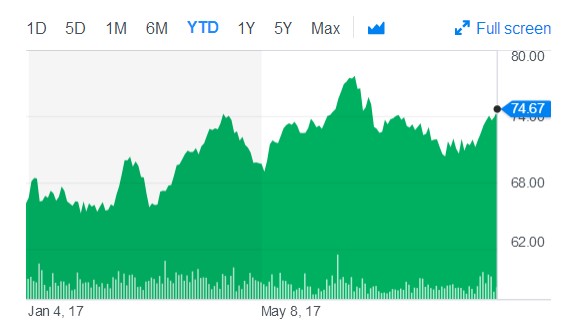
Welltower Chart from the beginning of the year
On the subject of healthcare, let’s jump into AstraZeneca (AZN: $32, up 4%) and its wonderful week. We’ve been watching this one with intense amusement, because a number of bears have come out of the woodwork to attack the company’s product pipeline - ironic, considering the firm’s pipeline looks stronger than ever, with recent trial successes that indicate its R&D department is still yielding a lot of fruit. AstraZeneca scientists are busy presenting on Imfinzi (durvalumab) and Tagrisso (osimertinib) at a lung cancer congress in Europe, and the feedback remains solid enough to drive shares sharply higher. Ignore the bears, because, frankly, they just don’t know enough about the science behind AstraZeneca’s pipeline.
Finally, let’s turn to municipal bonds. A number of Wall Street analysts are noticing that municipal bonds were a sleeper winner in 2017, with modest price gains that were often ignored because of the obsessive focus on the so-call Trump rally. That’s helped Nuveen AMT-Free Municipal Credit (NVG: $15.77, up 1%) and Invesco Municipal Trust (VKQ: $13, flat) recover nicely from their 2016 lows, when The Bull Market Report first recommended these funds. It’s nice to see the mainstream pick up on the quality of this asset class, but we also need to acknowledge how late they are to the party.
Unfortunately, there is a bit of a gray cloud for munis that we need to think about. Inflation trends are weakening and expectations of a third interest rate hike from the Federal Reserve in 2017 are dwindling. A longer path towards raising interest rates is bad for municipal bond closed-end funds, which depend on leverage to extend returns and maintain high yields for investors. The spread between the rate that funds borrow at and the rate that funds can earn through munis has been narrowing. This means dividend cuts might be on the horizon.
We don’t expect the cuts to be massive or come soon, but we do expect the income from these funds to decline slightly (and by slightly we mean less than 5%) in the next few months. I don’t think this is going to impact the pricing of these funds - muni funds often cut dividends without getting a hit to their stock. But keep in mind that the dividend stream from these funds is going to be a bit uneven. That doesn’t mean 5% annualized total returns won’t still come in if we average over a long period of time, but it does mean short-term returns from dividends will be a bit meeker than we’ve seen in the last few months. But that’s ok - we’re up way more than 5% in the last few months alone from both of these funds.
Good Investing,
Todd Shaver
CEO, Editor and Founder
The Bull Market Report
Since 1998
August 20, 2017

by Todd Shaver | Aug 20, 2017 | Weekly Newsletter 7pm Sunday
The Weekly Summary
It was rough week with lots of domestic and international issues popping up, producing anguish. In particular, nine CEOs turned their back on Trump. It all started when first Merck’s Kenneth Frazier, then Under Armour’s Kevin Plank and Intel’s Brian Krzanich stepped down from a White House business group set up to advise Donald Trump. While none mentioned the president, Frazier, one of the country’s most-prominent black chief executive officers, quit the council as Trump was being assailed for failing to quickly condemn white supremacists for deadly violence at a rally Saturday in Charlottesville. Frazier said he was acting on a “matter of personal conscience.” Trump shot back on Twitter Tuesday morning, saying, “For every CEO that drops out of the Manufacturing Council, I have many to take their place.
Then on Wednesday President Trump rushed to announce that he was shutting down the two advisory councils of business leaders, after the members had decided on their own to disband in the wake of the president’s comments on the events in Charlottesville. Of course, these kinds of advisory councils seldom accomplish much of anything.
Look, all this drama will pass. The market will move on. But there is definitely an unsettled feeling out there. It is good that the market showed signs of turning around at week’s end, but we did see a few glimpses of nasty selloffs in a few trading sessions this week. It was a rough week. If you are super worried, then we suggest you take some profits off the table. There are many choices for you to move your money to in the High Yield and the REIT portfolios. These are much more secure, stable stocks with very nice dividends that you can enjoy and sleep better with.
No matter what is happening out there, there is always a bull market here at The Bull Market Report! This week we highlight some of our favorite stocks/funds where we think you can still make good money, including: high yield equities like Annaly and larger caps like Apple, Google, Microsoft, Home Depot, and Visa,
BMR Companies & Commentary
Annaly Capital Management (NLY: $12.34, up 1%)
Annaly recently reported respectable earnings at the beginning of the month. Here are our thoughts on the outlook for the rest of the year and what to watch. Many people are cautious given Annaly’s fixed-rate agency exposure and the current valuation. We know that the company has a set yield on government guaranteed paper. So while there is no credit risk other than the full faith and credit of the United States, there is interest rate risk – we know this and accept this. The newer investments are coming on at lower rates with higher yielding holdings rolling off. And we know that if short term rates rise the current portfolio valuation will be sensitive to the movements. We are likely to see some pressure on Annaly’s business model.
But what can the company do? They can rotate into higher yielding MBS* investments. They can increase leverage. They can do a number of things to cover the dividend. Look, if you think a business model is flawless without risk then you don’t know it well enough. Annaly has rsk to higher rates, but higher rates are ultimately good for the company. And investors are missing all the offsetting possible moves management can take. Remember, this is a company that is 18x the size of the median mortgage REIT by market cap, has outperformed the S&P 500 by 3x since its IPO for total return, and has successfully raised $1.5 billion in new capital this year. They know the world they live in and have survived and thrived for 20 years.
* Mortgage-backed Securities
BMR Take: A Director at the company just bought 13,500 shares. Another one just bought 17,700 shares. We love love love to see that! We are looking at a $0.30 dividend paid quarterly for the time being which is good. The stock looks compelling based on this income stream, producing a dividend over 10%.
Apple (AAPL: $158, flat) is Getting into Programming
Apple has set a 12-month budget of $1 billion to develop original programming. Apple could buy and produce as many as 10 TV shows. Apple's first two efforts -- Planet of the Apps and Carpool Karaoke -- have not been warmly received by critics. Apple executives are talking with Hollywood agents about shows that Apple can buy.
BMR Take: Note that Apple has $260 billion in cash now, and with a market cap of $813 billion cash is 32% of the stock price. So $50 of the stock price is in cash. This is UNPRECEDENTED in the history of Wall Street. Apple remains an exciting investment opportunity. The services business is projected to double in revenue to $50 billion over the next several years. The Services business is much more profitable than hardware so the impact to earnings is even better. Don’t sell a share. We believe Apple has a lot more room to go on the upside.
And how about Apple's performance last week in a very tough week for equities.
Google (GOOG: $911, flat)
The Cloud is a huge opportunity in technology and all the industry giants are fighting to grab their fair share. Let's stipulate up front that Amazon Web Services (AWS) remains the top choice for most companies that are thinking about moving their data and software into cloud data centers. Having said that, however, Amazon's cloud is no longer the only option that companies consider. For example, those companies wanting extensive analytics are taking a good hard look at the Google Cloud Platform. And many firms are hedging their bets by using multiple cloud providers to avoid being stuck with one down the road.
While AWS is still the largest cloud provider by far, Microsoft and Google are coming on strong. AWS's revenue growth appears to be slowing, in part because it's hard for such a huge business - AWS is expected to produce $16 billion in revenue this year - to grow as fast as its younger, smaller incarnations. Startups are considering alternatives now for several reasons: standard cloud computing and storage services from the three top players are all seen as competitive, and no one thinks any of the three major cloud contenders is going away. Basically, AWS, Microsoft, and Google are seen as safe bets.
BMR Take: Google took a hit on the recent earnings report. Buy the dip. This company will generate over $40 of EPS in 2018. The stock is far from a stretched valuation.
Microsoft (MSFT: $72, up 1%)
As Internet-of-Things (IoT), artificial intelligence (AI), smart factories and intelligent applications continue to advance, businesses are increasingly turning to these technologies to create new business solutions with greater agility in order to drive competitive advantages. Microsoft launched its IoT Innovation Center in Taiwan last October to spur development between IoT partners and international enterprises and organizations. In September, Microsoft will hold its second IoT Expo in conjunction with the World Congress on Information Technology. Jason Zander, Corporate Vice President, Microsoft Azure, will deliver a keynote on "Leading Digital Transformation and Landing IOT Value with a Strong IoT Partner." Zander oversees the development and global deployment of cloud infrastructure and technology, including Microsoft Azure IoT. In addition to sharing the success of Microsoft's IoT Innovation Center and its partners, Mr. Zander will also provide Microsoft's vision of the development of IoT and in-depth analysis on the integrated application solutions of the world's leading IoT partners.
BMR Take: The Internet of Things is a megatrend. We are going from 10 billion devices connected to the internet to 30 billion. Your hair dryer will be connected to the internet someday. All of this is going to be a huge opportunity for Microsoft. The company is on track to generate $4 of EPS in 2018. The valuation remains compelling.
And note how strong Microsoft was last week in the very rough week on Wall Street. This company is solid.
The Home Depot (HD: $147, down 4%)
Home Depot took a bad hit on earnings. But we feel this is a great time to initiate a position or add to an existing one. A few Wall Street analysts upgraded the stock to Buy reaffirming our confidence.
Revenue for the quarter was $28.1 billion versus the consensus for $27.8 billion. Revenue guidance for the year is $95 billion, short of the $99 billion consensus. EPS of $2.25 beat the consensus of $2.21. Chairman, CEO Craig Menear said: "We were pleased with our results this quarter as our customers rewarded us with the highest quarterly sales in company history. We also achieved the highest quarterly net earnings in company history."
So what happened? Analysts were largely upbeat on the results, with same store sales beating expectations despite a tough backdrop for all of the Retail industry. Specifically, same store comparable sales growth was +5.5% beating the +4.6% guidance. So all the momentum looked good this quarter but why the bad outlook for lower revenue? The shares traded down because of this guidance miss. But under the covers many people just think it is conservatism from management, not something serious.
BMR Take: We expect to see momentum continue over the rest of the year following what was the largest quarter ever, pointing to strong sales growth, operating margin expansion and EPS growth. With EPS heading to $9 in 2018 we this valuation is compelling right here to be buying.
Visa (V: $103, up 3%)
Visa announced a multi-year, global partnership with Marqeta, the open API payment card issuing platform, to drive further innovations in commercial and consumer payments. Additionally, Visa has made a strategic investment in Marqeta to support both company’s domestic and international growth objectives.
The Fintech industry is booming, Fintech being short for financial technology. Everybody in financial services from banks like JP Morgan to networks like Visa are having to figure out how to keep up with the technology revolution in finance. That is why this deal is so key for Visa. Visa is embracing the change and going to be delivering the most innovative solutions in payments for years to come. This supports why we love the Visa EPS growth story and believe the stock should be a core holding in your portfolio.
The initial efforts of the partnership will involve growing opportunities for virtual, physical and tokenized payments across a number of commercial markets and use cases that can benefit from Marqeta’s developer-friendly platform.
The market for electronic payments continues to grow in commercial payables, alternative lending, disbursements, eCommerce, on-demand services and P2P payments. To enable this growth, Marqeta’s platform allows companies of all sizes to authorize their own card transactions, fundamentally changing how companies engage with card issuing and transaction processing.
This is the latest partnership and investment for Visa with an emerging innovator within the payments ecosystem. As a global payments technology company, Visa continually evaluates technologies of all kinds – especially those that have the potential to advance digital payments for Visa’s clients and their customers. Recently, Visa has made investments in Chain, Klarna, Square and Stripe, among others.
BMR Take: Visa is a safe haven investment. With EPS heading to $4, we continue to see tremendous value here.
Upcoming Economic News
Richmond Fed Index
August 22th, 10:00 AM
Period: August
Consensus: 12.0
Prior: 14.0
New Home Sales
August 23th, 10:00 AM
Period: July
Consensus: 614,000
Prior: 610,000
Building Permits
August 24th, 8:00 AM
Period: July
Consensus: 1,223,000
Prior: 1,223,000
Blackstone (BX: $32, down 1%) Entity Merging with Starwood Homes
Invitation Homes (INVH, $23), a portfolio company of The Blackstone Group, is merging with Starwood Waypoint Homes. The combined company, to be called Invitation Homes, will have 82,000 homes. Once the deal closes Invitation Homes stockholders will own about 59% of the combined company. The total enterprise value of the deal is $20 billion.
Invitation Homes, a U.S. home rental company, went public in February. Blackstone will own about 40% of Invitation.
--- The portfolio of homes will be focused on high-growth markets, with nearly 70% of revenue coming from the Western US and Florida.
--- The merger is expected to drive $50 million in annual synergies.
--- Continued strong performance with the combined company experiencing 7% same-store NOI growth in Q217 with over 95% occupancy.
--- The two companies have invested nearly $2 billion, an average of approximately $22,000 per home, in renovations and maintenance, improving resident experience and driving economic growth and job creation in local communities.
BMR Take: Just one more example of the innovation that Blackstone is involved with day in and day out. With a dividend of 7% and a leader (Schwarzman) dedicated 24-7 to moving the stock higher, what is there not to like. $38 billion market cap. Reaching the all-time high of $44 set in 2012 is surely on the horizon.
Tesla Near to Completion of Gigafactory
Tesla ($348, down 3%) has released some interesting pictures and a video of their gigafactory in Nevada, 95 times (sic) bigger than a football field. New drone footage shows how massive Tesla's Gigafactory is.
http://www.businessinsider.com/tesla-gigafactory-pictures-facts-2017-8
In other news, Tesla raised $1.8 billion in a bond sale on Friday, boosting the amount by $300 million to meet demand. The 8-year bonds were priced at a record-low yield of 5.3%. The 5.3% coupon is a record low for a bond of its rating and maturity, according to data compiled by Bloomberg. The sale was managed by Goldman Sachs Group and Morgan Stanley.
BMR Take: The bond market loves this company. We do too. But we know the risk involved here is on the high end of the scale. Tesla is either headed to $400 a share or $300. And one could make an argument for either. If it hits $400 and they continue to ramp up production as promised, then $500 is a great possibility. But if it goes to $300, $200 would be in range. You want a risky stock? Then Tesla is your baby.
A Word from Gary Jefferson
Jefferson Financial Group
First Vice-President, Investments
UBS Financial Services, Inc.
Earnings were everything expected, plus a little more. So here we are with about six weeks before the 3rd quarter comes to a close. Unemployment is low, interest rates are low, energy costs are low and consumer confidence is fairly high. Besides a garden variety correction, what could derail the markets? - not counting a war, which in our opinion and most experts we listen to is a fairly low probability. The most likely candidate would be a recession. With earnings growth better now than the past eight years, this critical element in the recession scenario seems relatively safe for the next several quarters.
However, after speaking with some very learned folks in the banking industry, there is one problem that has caught our attention. We have been told that it is very difficult for banks to make enough profit to lend money when short-term and long-term interest rates are less than 1%. Today, the difference between a 2-year Treasury note and a 10-year Treasury bond remains less than 1%. Rate hikes have a history of producing bear markets in the past and could do so again because there just isn’t enough profit for commercial banks to lend money. Recessions develop out of these situations. We are not yet in an "inverted yield curve" situation (where short-term rates are higher than long-term rates), which is a classic signal of a coming recession, and we don't believe banks are to the point that they are going to substantially curtail lending. However, it is something we will watch for over the coming quarters.
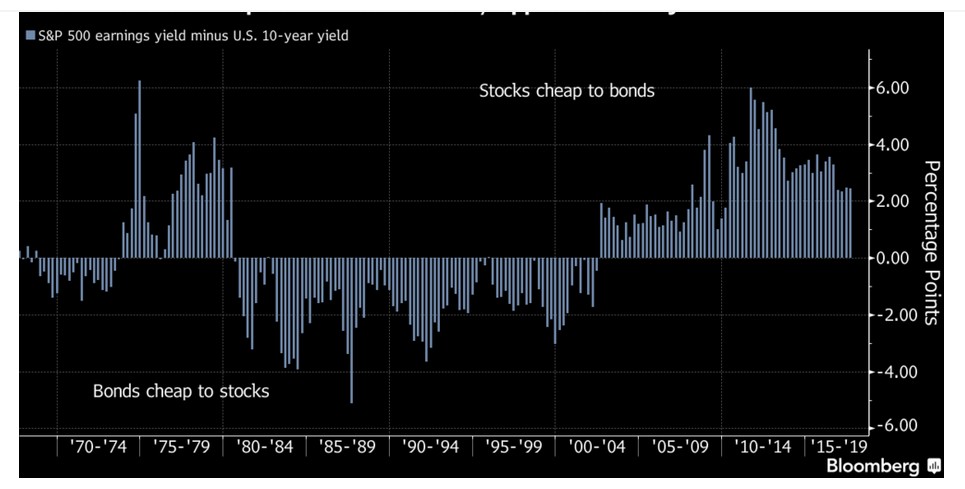
As we said last week, stocks don't go straight up forever. There will be volatility and pullbacks as Fed-tightening continues, but until we see actual signs of an approaching recession, we believe stocks continue to offer better value than bonds.
Amazon Sells Bonds for Whole Foods Acquisition
Speaking of bond sales, Amazon (AMZN: $958, down 1%) went to the markets for money last week and sold $16 billion of unsecured bonds to fund its $14 billion acquisition of Whole Foods Market. And in a sign of market interest, the longest portion of the offering, a 40-year security, was sold at a yield of 1.45 percentage points above Treasuries.
BMR Take: Now that is just unreal low. The company has $21 billion in cash so they didn’t need to go to the bond market but did because rates are so low. Smart thinking, Jeff. The deal is the 4th largest this year, behind ATT and Microsoft.
Apple Goes to the Debt Market in Canada
Apple raised $2.5 billion at a rate of 2.51% in a 7-year note sale in Canada on Tuesday. At $2.5 billion the financing is the largest corporate non-financial borrowing in Canadian history.
Stocks Cheap Compared to Bonds
 We’re Just Sayin’
Cantor Fitzgerald: OPKO Health - Overweight Rating, $20 Price Target
And how about this:
In other Opko Health news, Director John A. Paganelli purchased 5,000 shares of the company’s stock on June 1st. Following the transaction, the director now owns 350,000 shares in the company. Director Richard A. Lerner purchased 10,000 shares of the company’s stock on June 5th. Insiders have bought a total of 1,600,000 shares of company stock worth $10,000,000 in the last three months. Insiders own 40% of the company’s stock.
There are eight research companies following Opko. Six have a buy rating; two have a hold. Their average price target is $16.40.
BMR Take: For those of you still hanging in there with Opko Health (OPK: $6.12, down 2%) this report from Cantor Fitzgerald is good news. $20 Wow. That is over three times the current price. What are we missing here? Oh – I know. We are missing a higher stock price! Well maybe, just maybe this is the start of the re-rising (is that a word?) of the stock to the $8 level and then $10 and then on to the races from there. Hope springs eternal, doesn’t it? Well, yes, but with all the good things this company has going for it, for it to stay at $6 any longer JUST DOESN’T MAKE ANY SENSE!
The High Yield Report
By Michael Foster
We’re continuing to see market chaos and a lot of selling of high quality assets although the macro risks from political uncertainty are dwindling. But the current selloff is very different from the previous week’s in one very telling, interesting way: Not all assets are falling at the same rate, and some are actually doing very well.
To wit, take a look at The Bull Market Report’s Healthcare REIT pick Omega Healthcare Investors (OHI: $31) which had a strong showing this week after some initial weakness, helping Omega Healthcare end the week up 2%.
We’re seeing a lot of reshuffling in the markets, with investors rotating in and out of funds, stocks, and assets as they rise or fall due to market demand. This is the real “random walk” of Wall Street, and it’s a dynamic that makes short term trends for any individual asset to be unpredictable. In reality, we’re seeing a lot of individual investors making choices to buy on the dip - and they’re pulling money from other assets to do so.
What can an investor do in such an environment? Simple: sit tight. If you have extra cash on the sidelines, now is the time to deploy into the high yield picks that The Bull Market Report has been recommending for a long time. Last week we suggested buying more of Omega Healthcare shares; it’s up 2% since then. Now is the time to do the same with other REITs seeing irrational weakness like Sabra.
You can also consider adding Kimco Realty Corporation (KIM: $19.34) and Apollo Commercial Real Estate (ARI: $17.92) to your shopping list after Kimco fell over 3% in the last week and Apollo remained flat. There is no change in these companies FFO to justify the decline, and Kimco’s year-long weakness on the often-touted (and always inaccurate) “death of retail” has made it just that much more compelling. We have discussed at length here why Retail isn’t dead, and how Amazon’s recent purchase of Whole Foods indicates that the shift from pre-dotcom retail to mobile “bricks and clicks” commerce is far more complicated than the simple narrative of dying malls. In any case, Kimco doesn’t buy enclosed malls! It’s a high-quality strip mall-focused REIT, and Whole Foods (and thus soon Amazon) is one of its biggest tenants.
There are more buying opportunities beyond REITs, and investors are keen to lighten up their cash allocation to consider the other funds and stocks in the High Yield portfolio. However, there is one word of caution to consider when it comes to one of our best performing picks, the PIMCO Dynamic Income Fund (PDI: $29). This fund was flat last week.
What’s going on here is a pretty basic misunderstanding of the fund’s future income potential. You see, Pimco releases a monthly scorecard of net investment income (NII) on its website, while also calculating its dividend coverage ratio. And, simply put, the news isn’t good for the Dynamic Income Fund.
In the past, Pimco easily out-earned its dividend and had a tremendous amount of undistributed net investment income (UNII). That’s why the fund paid a special dividend of $1.45 at the end of 2016. By this time last year, the fund had around $1 in UNII, so it was pretty obvious that a big special dividend was coming (we discussed this at the time and estimated a strong special dividend at the end of last year – and nailed it). This year, however, the Dynamic Income fund has only 4 cents in UNII - a pretty tremendous drop from a year ago!
There are a few reasons why the fund isn’t earning as much income as it used to, most of which revolves around the crowding out of great investment opportunities in mortgage backed securities. The MBS is a pretty daunting asset made sinister by The Big Short and growing awareness of their role in the subprime housing crisis. However, that crisis is a decade behind us, and the quality of MBS investments has skyrocketed. While Pimco was one of the few asset managers aggressively buying up these assets in the past, there are now a lot of people wanting to buy them. That means lower yields for the assets, thus weaker income for the Dynamic Income Fund.
However, at the same time, it also means growing market prices for these assets. This fund’s NAV has risen by 10% so far in 2017, largely a result of that constant demand for MBS’s in the market. Last year, the Dynamic Income Fund’s NAV had risen by far less than 1% over the same time period, because the demand for these assets simply wasn’t there. That means that the fund is sitting on a lot of capital gains with dwindling income.
What does this mean for shareholders? In all honesty, it’s hard to tell. The fund hasn’t really faced a crowding out of supply due to strong demand since 2012. It has enjoyed both NAV and income gains in earlier years, and the end-of-year special dividends reflected that. We simply don’t know if the fund’s managers will decide to return some of those capital gains to shareholders or hold on to it and give a massively reduced special dividend at the end of the year.
It seems that the market has begun to price in the likelihood of a lower special dividend. The fund’s premium to NAV has plummeted from over 10% earlier this year to just 3%. It may fall even further as we get closer to December. If Pimco surprises and gives a big special payout at the end of the year, that could reverse quickly. If it doesn’t, we’ll probably see middling price growth throughout 2017.
The risk with the fund is that its Net Investment Income continues to fall and it fails to cover its dividend on a long-term basis. While we’ve seen hints of that now, it’s far too early to conclude that this risk is really here and it’s time to sell. But investors need to prepare for that eventuality. We will keep a close eye on this trend and advise you if it’s time to move out of this great fund. Hopefully we won’t have to recommend selling anytime soon.
How should you react? Holding the fund for its income stream makes sense now, and buying more when the fund’s premium disappears and it starts trading at a discount also makes sense. That means there’s no reason for investors to get scared and sell off the fund, but it also means investors shouldn’t expect a massive jump in the fund’s price throughout 2017. That’s not a bad thing - it really reflects what the fund should be seen as: A source of steady and reliable income.
Good Investing,
Todd Shaver, Founder, CEO and Editor
The Bull Market Report
Since 1998
May 21, 2017
by Todd Shaver | May 21, 2017 | Weekly Newsletter 7pm Sunday
Let's Get Started
The President took Air Force One for an international tour to promote peace, justice, and stability. His first stop is in Saudi Arabia to meet with over 50 Muslim leaders to discuss a shared fight against radical beliefs and terrorism. He will make his way next to Jerusalem and Bethlehem to re-build relationships that deteriorated under the last administration. Thereafter, he will spend time with the Pope at the Vatican strategizing on how Christian beliefs can bring about more peace in the world. We learned Saturday morning that Trump was greeted on his first stop in Saudi Arabia with $110 billion of deals for US companies in the region, in particular for General Electric and Halliburton. This one of the reasons why America voted for the man? But we’ll see if anything comes of it.
There is always a bull market here at The Bull Market Report! This week we highlight the following stocks: Athenahealth, Home Depot, Amazon, Facebook VMware, and Kinder Morgan.
Highlights From The Past Week
Why have stocks bounced? We see no one specific factor behind a stock market bounce that followed the biggest selloff since last September on Wednesday. Some are focused on the pervasive buy-the-dip mentality since the financial crisis bottom in 2009. The initial flurry of Trump impeachment talk following the Comey memo leak seems overdone. Trump heading overseas may shift some of the focus away from recent controversies toward foreign policy (and dampen his more combative tone). A stabilizing influence is Robert Mueller’s appointment as special counsel in the Russia investigation which brings credibility amid the chaos. Despite all the talk about the threat to Republicans’ legislative agenda, policy expectations have already been meaningfully dialed back. There is little change in a fairly upbeat fundamental narrative that has revolved around expectations for an upswing in global growth. In addition, central banks are still in an easy money stance.
Bullard says Fed’s path may be “overly aggressive”. At an address at Washington University, St Louis Fed President James Bullard noted that in the wake of the Fed’s March rate hike, financial markets saw declining long-term yields and weakening inflation expectations. He observed that this may suggest that the FOMC’s contemplated policy rate path is overly aggressive relative to actual incoming data on US macroeconomic performance. Bullard noted that labor market improvements have slowed over the last two years, and that inflation and inflation expectations have surprised to the downsize in recent months. Note that Bullard has been quite dovish in the past relative to rates, saying in January that there was no reason to move rates dramatically and standing by his forecast for a single rate hike in 2017. In statements following his presentation, Bullard reiterated his call that the Fed should shrink its balance sheet to gain policy space, and said the central bank should retain the option for future quantitative easing should it be necessary.
Oil supported by deal extension headlines. Oil posted a nice gain this week on growing expectations exporters will extend output cuts to curb a persistent glut in inventories at next week’s OPEC meeting. This follows headlines earlier this week that Saudi Arabia and non-OPEC Russia agreed to a 9-month extension. Reuters, citing OPEC sources, said the cartel’s panel reviewing scenarios for the 25-May meeting is looking at the option of deepening and extending the deal to reduce oil output. No agreement has been made on final scenarios. Some say a deeper cut in output is an option depending on estimated growth in supply from non-OPEC producers and US shale oil.
BMR Companies & Commentary
Athenahealth (ATHN: $130, +19% - all price changes are for the week)
Top-notch hedge fund Elliott Associates disclosed a 9.2% stake in Athenahealth this week sending the stock soaring.
Elliot believes the company operates in a highly strategic area at the intersection of technology and healthcare with a disruptive value proposition, a leading competitive position, and a compelling product set, the value of which is not reflected in the company's current market value. Interpretation: The stock is cheap. Elliot believes that there are numerous operational and strategic opportunities to maximize shareholder value. Elliot will engage in a dialogue with the company's board regarding these matters.
Elliot may consider and develop plans and make proposals with respect to operations and management, and all types of other changes that will add value to the stock.
Looking at the software landscape, IBM and Inuit have expressed a desire to break into Healthcare. Reports have also speculated that Aetna and UnitedHealth may also be interested.
BMR Take: Elliot Associates is the real deal as highlighted by Athena’s 19% move higher last week. We hit our Target of $125, having added the stock at $101 in November, so we are up 30% in six months. Not bad. We definitely would stick around to see what happens here. We could see another big move higher should the company be sold. We hereby Raise the Target Price to $140, and the Sell Price which was originally at $90, is now at $105, to $125. We don’t want to lose any of these massive gains.
Home Depot: (HD: $156, down 2%, but up from $144 a month ago)
Home Depot just blew earnings out of the water while the rest of Retail keeps falling apart. With mall retailers such as Sears and J.C. Penney seemingly on their deathbed, Home Depot once again proves why it pays to sell lumber and nails.
Last week, the home improvement retailer delivered first quarter results. EPS of $1.67 beat consensus of $1.61 on revenue of $23.9 billion versus consensus of $23.7 billion. Management reaffirmed full year sales growth guidance of +5% and lifted expectations for EPS growth 11% to $7.15. In February they announced an increase to $15 billion in the stock buyback program.
All merchandise departments delivered sales increases. Sales from contractors were stronger than those from typical consumers. Online sales surged 23%. "The housing market is very strong", Home Depot CFO Carol Tome said, adding that sales in May have been "very good."
So far, the U.S. housing market has withstood the rising interest rate environment (which we see as very insignificant). In turn, home improvement retailers such as Home Depot have continued to thrive as existing homeowners renovate their homes -- which are rising in value -- and builders try quickly to bring on badly needed supply.
Home improvement spending still remains healthier than most areas in retail. Trends remain strong as building materials, hardware and garden supply sales have grown 6.4% year over year.
BMR Take: Stick with this blue chip. Many analysts see the EPS outlook as conservative. Despite its impressive $95 billion sales base, Home Depot has ample opportunity to grow, especially in eCommerce. The company will continue to benefit from healthy home improvement spending, market share gains, and strong execution. The home improvement sector remains well-positioned to benefit from continued modest GDP growth, home price appreciation, and solid household formation. Our Target is $160 – getting close. We can’t wait to raise the Target soon.
Amazon (AMZN: $960, flat)
Amazon cut the price of the Echo to the lowest level in 2017. For a limited time users can purchase two Amazon Echos with the promo code ECHO2PACK effectively dropping the price to $140 each. The normal price is $180.
Why do we care?
Echo is Amazon’s ticket into a massive Home Services Market. It lets Amazon gather data for what is happening in the house as it records everything. It also provides a door for instant on-demand ordering. We have one and we love it!
Amazon, which launched its Home Services unit in 2015, now offers 1,200 services in more than 50 U.S. cities. Customers can select assembly or installation services, which will compete against those offered by retailers like Home Depot or Best Buy, in addition to other services like house cleaning, home repair and yard work, which will compete with Angie’s List. Throughout its 20-year history, Amazon has continued to explore areas of commerce that it believes it could disrupt and this is one ripe for disruption. In March, Amazon estimated that the on-demand Home Services market was valued between $500 and $700 billion.
BMR Take: Amazon is a serial monopolist company that picks markets to enter, disrupts them entirely, and runs away with market share. Home Services looks like the next target. Amazon is really expensive at 145x this year’s earnings, but Amazon doesn’t trade like a normal company. Bezos has said profits will come in due time. Lately they have been knocking out much bigger profits and the Street is content to wait and wait as the stock goes up and up. There remains a ton of upside to Amazon long term as the company is investing massively for growth and future earnings power more than supports the current valuation.
Facebook (FB: $148, -1.5%)
Facebook and Major League Baseball struck a deal to live stream games. The move is the latest initiative by Facebook to expand into the world of live programming. Facebook said that it would stream one game a week beginning immediately and the broadcasts would be available to everyone on Facebook in the U.S.
What does this mean? More engagement. More engagement means more advertising opportunities and more revenue. It’s great news.
MLB Commissioner Rob Manfred said at a news conference in New York, "Probably the most important single announcement is we've done an agreement with Facebook. It's really important for us in terms of experimenting with a new partner in this area. We are really excited about this."
"It's pretty cool," Ian Desmond of the Rockies said. "It's an opportunity to provide the game to everybody. That's what we're trying to do -- expand the game and make it more diverse. It's a step in the right direction. They're doing a good job with that."
BMR Take: The stock is having a great year so far, and we see so much more potential still. Consensus estimates call for EPS near $10 by 2020. At the current PE multiple or 27 where the stock is today, this implies shares can double.
VMware (VMW: $93, -1%)
VMware, a global leader in cloud infrastructure and business mobility, announced it will deliver VMware Horizon Cloud on Microsoft Azure. The integration helps customers accelerate the move to Windows 10 and brings VMware virtual desktops and applications to the increasing global presence of Azure in the enterprise -- available in 38 regions globally.
This is a great news item! Microsoft Azure is connected to so many of the world’s enterprises (large, medium and small) it is mind boggling. By becoming integrated with Microsoft Azure, VMware is now able to tap into all of these customer relationships. What a revenue opportunity.
BMR Take: The addition of a major cloud platform such as Microsoft Azure to VMware’s customer database has the potential to accelerate the growth of the company. VMware is expected to generate $5-6 of EPS consistently for the foreseeable future. Putting it all together, the outlook suggests the stock should continue to do well. We have a Target of $95 on the stock. We can’t wait to raise this Target when hit.
Kinder Morgan (KMI: $20, -2%)
Kinder Morgan had a rough week on some news about more obstacles surfacing. The Alberta Securities Commission is reviewing an environmental group’s request to halt a $1.28 billion share sale that Kinder Morgan needs to help finance the expansion of its Trans Mountain pipeline.
Earlier this month, Greenpeace Canada sent a letter to the Alberta commission, saying Kinder Morgan may have used outdated oil projections in its IPO prospectus. The Alberta commission acknowledged receiving the challenge and will give it "consideration.”
Kinder Morgan had been running a dual-track process, exploring both an IPO and a joint venture to finance the Trans Mountain expansion. In a regulatory filing earlier this month, the company said it was no longer looking into a joint venture.
BMR Take: Kinder Morgan needs to get this together and do so fast. With EPS in recovery mode from $0.66 this year back to $1.00 by 2020, this coincides with more normalized earnings levels prior to the recent drop in oil prices. We don’t need any hiccups to the business plans that push out earnings, especially as oil prices remain volatile.
You know what? The more we think about this company the more we think it is time to move on. $1.00 of earnings (previous paragraph) by 2020? That’s a long time to wait. We’ve got a LOT BETTER places to put our money than this one. Just take a look at any one of our High Yield portfolio stocks, or the REIT portfolio. We are just tired of waiting and waiting – it’s been over a year. We added the company in early 2016 at $18 and exit here at $20.
Upcoming Economic News
Tuesday, May 23, 2017 10:00 AM
New Home Sales
Period: APR
Consensus: 610,000
Prior: 620,000
Wednesday, May 24, 2017 10:00 AM
Existing Home Sales
Period: APR
Consensus: 5,650,000
Prior: 5,710,000
Thursday, May 25, 2017 08:30 AM
Initial Jobless Claims
Period: 5/20
Actual: N/A
Previous: 232,000
Consensus: 237,000
Friday, May 26, 2017 08:30 AM
GDP
Period: Q1
Actual: N/A
Consensus: 1.9%
Prior: 1.9%
A Word from Gary Jefferson
Jefferson Financial Group
First Vice-President, Investments
UBS Financial Services, Inc.
Friday the 12th marked the 13th straight day in which the S&P 500 failed to move more than 0.5% in either direction on a closing basis, the longest such streak since 1995.
Q1 results from 95% of S&P 500 members show earnings are up +14% from the same period last year on +8% higher revenues, with 72% beating EPS estimates and 66% beating revenue estimates. The proportion of companies beating both EPS and revenue estimates is 52%.
Importantly, the growth performance is broad-based and not narrowly concentrated. We had the leadership from the Finance space earlier in the reporting cycle, but the baton has since shifted to Tech and other areas, including Industrials, Basic Materials, and Energy. The big disappointment – you guessed it: brick and mortar retail stores. While brick and mortar stores may be ailing, however, online sales are doing great.
Here is the important takeaway: When looking at the last three quarters, the overall strong Q1 showing represents a notable acceleration in the growth momentum. We have never seen a bad market during a period when it was in the midst of an accelerating growth trend. It could happen of course as wild cards such as oil or geopolitical risks are always present, but if there was ever a silver bullet for the market, it is an accelerating earnings momentum. We do not expect to have a slew of 2nd quarter earnings revisions to the downside begin cropping up over the next few weeks. Rather, with any kind of good news from D.C. such as healthcare reform, tax reform or infrastructure programs, we expect the growth momentum to continue to accelerate on a year-over-year comparison.
Bottom line: Earnings are strong, rates should rise in conjunction with a tightening labor market and we believe stocks still offer greater upside than bonds or cash. Here are the numbers that we feel support this opinion:
The Q1 earnings season was better than expected, and it’s resulted in 2018 S&P 500 earnings estimates bumping up $1 from $134 to $137. (Source UBS) At the higher end of that range, the S&P 500 is trading at 17X next year’s earnings. That’s high historically to be sure, but it’s not "crazy" as some of the doom and gloomers are arguing, especially given low Treasury yield levels and expected macro-economic fundamentals. On the downside, if the S&P 500 were to drop to 2300, then the market would be trading at 16.7X 2018 earnings. In this environment (low yields, stable macro environment), the market could easily be considered fairly valued and a buying opportunity.
Right now, it’s more likely earnings expectations get revised higher in the future, not lower, and that will make the market cheaper.
Sectors which have strong momentum currently include Financials, Healthcare, Technology (including cyber security, which is in the forefront as "ransomware" attacks go worldwide) and Energy.
Square Announces a Debit Product
Square Cash, the mobile peer-to-peer (P2P) payment offering from Square, will launch a physical prepaid debit product. The card is funded by customers’ Square Cash balance, and can be used anywhere that accepts Visa.
Square (SQ: $20, flat) wants to get a bigger piece of the P2P space. Mobile P2P payments are growing fast. That’s increasing competition in an industry where no one player holds a true market majority. Square Cash is an important player, but it's not as well-positioned as market leader Venmo, owned by PayPal (a Bull Market Report favorite) or Zelle, which will have access to up to 85 million customers and is backed by Bank of America, U.S. Bank, and Wells Fargo and 17 other banks. Zelle Network Banks Processed 170 million P2P Payments, Totaling $55 billion in 2016. The market is BIG!
Cash and checks have historically dominated the P2P world. But as smartphones become a primary computing device, top digital platforms, like Venmo and Google Wallet, have enabled customers to turn away from cash and make those payments digitally with ease. A shift to mobile payments across the board and increased spending power from the digital-savvy younger generation will cause the mobile P2P industry to skyrocket.
Consumers want mobile P2P services, and they’re turning to them. As smartphones are increasingly used as computing devices, these consumers look to such services for fast and easy ways to pay.
Monetizing P2P is more important than ever. As volume grows and user bases scale fast, finding ways to monetize quickly should be a priority for firms looking to stay ahead. We believe Square has a good shot of winning a good piece of this market.
In-store card payments are still substantially more popular than any form of P2P transfer. A physical card could help Square stand out. Gaining access to a traditional card could help users form habits and encourage customers to run a Square Cash balance, thus engaging them more with the product and increasing volume.
Our Target is $24. We can see this getting hit and our having to raise the Target to $34 and beyond. Square could be a big one.
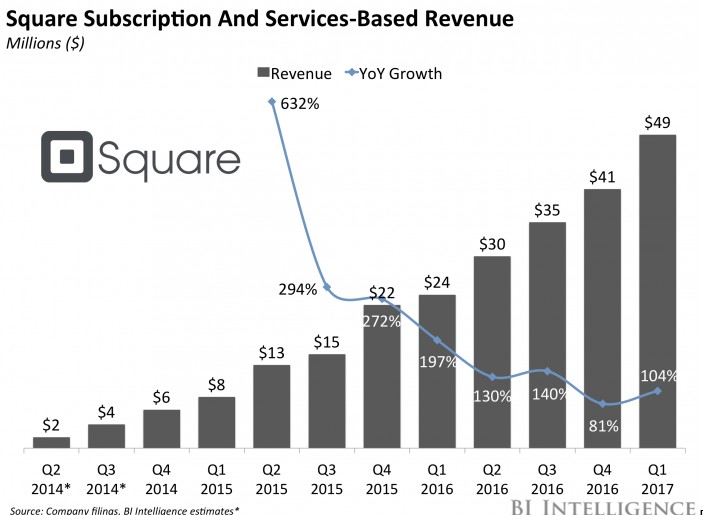
And this just in:
Washington, D.C., is enlisting Square’s help as its taxi commission tries to help the city’s cabbies compete with Uber drivers. By the end of August, all of the taxis in Washington have to tear out their traditional meters and start using smartphones or tablets. The Department announced that Square will process the payments going through those mobile devices.
Wow – that’s good news. Our takeaway is that this is a great PR move that will get more and more people to use Square. We use it. We love it. You will too. And the more customers the better. AND a higher stock price.
Annaly Keeps Chugging Along
Annaly Capital Management (NLY, $11.50) was up 2% this week and showed us a nice bounce back from recent lows after trading in the high 11s in early May. We have said this many times – the stock has its ups and downs and they are not anything to be worried about. The “interest-raising-talk” will accelerate in the press in the next few weeks, as the Fed prepares to raise in June or July, so buckle up your seat belts and sit back and watch Annaly handle all the bumps in the air. We are not worried. We’re quite content to sit back and collect the fabulous 10.4% yield.
Mazor Keeps Chugging Along
Mazor (MZOR: $43) had a stellar week, closing up 7%. Pretty volatile little stock, isn’t it? It hit $45 on Thursday and closed at $43. Crazy. We think it better to watch this stock on a weekly basis instead of daily!
Amazon Keeps Chugging Along
Amazon (AMZN: $960) was flat for the week, even after dropping $22 on nasty Wednesday. It bounced right back on Thursday. Love this company. Are you still hung up on the stock PRICE? Well, don’t be. Get some shares on Monday. On May 22, 2018 you will be ONE HAPPY CAMPER!
The High Yield Corner
By Michael Foster
The financial press was particularly amusing this week. On Wednesday we had a market correction that was called a disaster, a sign of turmoil, and a harbinger for a market crash. What caused the crash? Depends on who you read. We’ve seen explanations range from algorithmic trading going haywire, bank unwinding, bad earnings (really?), and, of course, geopolitical turmoil because of the Russia scandals. None of these really make any sense, and some are just plain wrong (earnings growth has accelerated, making S&P 500s forward P/E ratio relatively low), but the media keeps clutching for a narrative.
What are the facts? [No FAKE NEWS here at The Bull Market Report!] The Fed announced industrial production rose 1% in April, the largest gain since 2014 and near its all-time high. Unemployment claims fell to 232,000, maintaining levels lower than what we saw in the 1990s and early 2000s. Mortgage rates also fell to less than 4% (mortgage rates have been falling for a few weeks), and some analysts expect this to go lower. [We do.]
This is all good news and better than expected. Macroeconomically, there’s little to worry about in the U.S. And that may explain why the VIX dipped into single-digit territory, which created its own kind of paradoxical panic as many fretted that people aren’t scared enough. But the slew of good news indicates there is little to be afraid of.
That brings us to the most important but most controversial data point: household debt and credit. The Federal Reserve’s Household Debt and Credit Report announced that total household debt reached its highest point since 2008 ($12.7 trillion). While this may ring alarm bells to debt conscious individuals, from a macroeconomic perspective this is a good thing.
Here’s why. American consumers, for the most part, will take on credit only when they feel reasonably confident in their ability to earn money in the future. That’s not to say people are innately responsible with credit, but rather that they will to a certain extent take credit only when they feel confident about their own personal economies. The massive decline in debt following the 2008 crisis is an indication of this, especially when you look into the details. It wasn’t just mortgage debt that fell during the housing crash - it was credit card debt, auto loan debt, and personal loan debt. People just stopped borrowing money during the crisis. This was partly because banks stopped lending, of course, but not entirely. For a large part of America, it was time to tighten belts and weather the storm.
What did this mean for companies? Declining sales. Weaker profits. The need to cut costs, which often meant layoffs which in turn meant more belt tightening and thus even lower sales and weaker profits. This is the "deflationary spiral” economists warn about, and it is the reason why government stimulus is used during a recession.
The opposite of this deflationary spiral is a winding up of credit across the board. Americans are confident of their ability to pay back loans, so they borrow more, and then use that money to spend more. That results in higher sales and bigger profits for U.S. firms. That, in turn, results in firms hiring more people, thus creating a cycle of spending begetting spending and helping GDP rise across the board.
This has several implications for all kinds of investors. For stocks broadly, the news is good: it means higher sales and higher earnings (the S&P 500 has already reported both for the start of 2017). For other sectors, the news is also good but for different reasons.
For business development corporations (BDCs), it’s good because it means small and medium-sized businesses will have much higher demand for credit as they expand operations. This is partly why BDCs have been on a tear for the last couple of years - the market anticipated this expansionary climate. So the UBS BDC ETF (BDCS: $22) is up 10% from a year ago.
There’s just one problem: BDCs aren’t actually better investments.
The distributions that this ETF pays out have fallen in the past year as a result of yields on loans falling for individual BDCs. We’ve seen both NAVs and distributions fall for many BDCs, both big and small, over the last few months. As a result, the BDC ETF is down year to date and the BDC sector is by no means as attractive as it seemed a year ago. But if the macroeconomic climate is better for BDCs, why is this happening?
As we’ve said repeatedly at The Bull Market Report, BDCs are getting squeezed because of the better environment. This is attracting more competition from banks and leveraged lending firms. We’re also seeing smaller BDCs set up shop and compete with big guys like Main Street Capital Corporation (MAIN: $38), making its 70%-ish premium to NAV untenable. That’s why we cut Main Street from the Bull Market Report High Yield portfolio a few months ago, and that decision is finally getting vindicated: Main Street is now 7% off its all-time high reached just a few weeks ago at $41 and is down for the week. We are keeping a close look on the BDC sector and are looking for a company that has a reasonable market price and a strong income-producing portfolio. Until that shows up, we recommend caution.
Better options exist in municipal bonds for income. This sector has lost market favor for a very long time due to its more risk-hungry approach, and that’s caused yields on many muni funds to rise. Bull Market Report favorites Invesco Municipal Trust (VKQ: $12.64, flat) and the Nuveen AMT-Free Fund (NVG: $14.81, up 1%) are now yielding near 6%, tax free. These funds have risen slightly (about 3%) in 2017 but remain down from a year ago. There is still time to jump into these funds, although it appears that the window to get munis at a discount is shrinking.
Over the coming weeks we are going to get more macroeconomic data to determine exactly where we are in the economic cycle. During that time, holding high yield investments and doubling down on munis makes a lot of sense for income-hungry investors. There is a strong chance that the Federal Reserve will raise interest rates next month, and we may see second quarter GDP numbers that are strong. Neither of these are bad for high yield investments, because both signal a market in which people are spending and companies and municipalities can repay their loans. While the market is obsessed over a one-day drop on Wednesday, we will keep our eyes focused on the data to tease out what is really going on beyond popular distractions.
Good Investing,
Todd Shaver, Founder, CEO and Editor
The Bull Market Report
Since 1998
May 15, 2017
by Todd Shaver | May 15, 2017 | Earnings Preview 12 PM
The Home Depot (HD: $157)
Bull Market Report Target Price: $160
Bull Market Report Sell Price: $144
Earnings Date: Tuesday, 9:00 am ET
Consensus: 1Q17
Revenues: $24 B
EPS: $1.61
Year Ago Quarter Results
Revenues: $23 B
EPS: $1.44
Key Things to Watch For in the Quarter
Analysts across Wall Street estimate that Home Depot will report 4% growth in sales to $24 billion and 12% growth in EPS to $1.61 for 1Q17. Home Depot has provided investors with 15% returns on their investment over the past year. The stock currently trades up 33% from its 52-week low and 24 times earnings, which is comparable to its number one competitor, Lowes (LOW: $84). Home Depot’s growth has been spurred by an increase in home sales and home improvements.
We look forward to its continued growth going forward as the stock approaches our $160 target. We can't wait to raise the Target! We hereby raise the Sell Price from $144 to $150. We wouldn't want to lose our 33% gain on the stock since we added it in early 2016.
