January 14, 2018
by Todd Shaver | Jan 14, 2018 | Weekly Newsletter 7pm Sunday
The Weekly Summary
Everybody has an opinion. Go search the internet and you’ll hear one fellow say the market is going to crumble, the next person say new highs are on the horizon, and the third individual tell you something that doesn’t make sense because they don’t even know what they are talking about. Accordingly, we feel the need to break it all down this week. No fluff. No spin. No wild opinions. Just a little ‘telling it like it is’ as a reminder that this The Bull Market Report. We aren’t like what you see on TV. And we aren’t like what you read elsewhere. We are just like you. Looking for the cold hard honest facts.
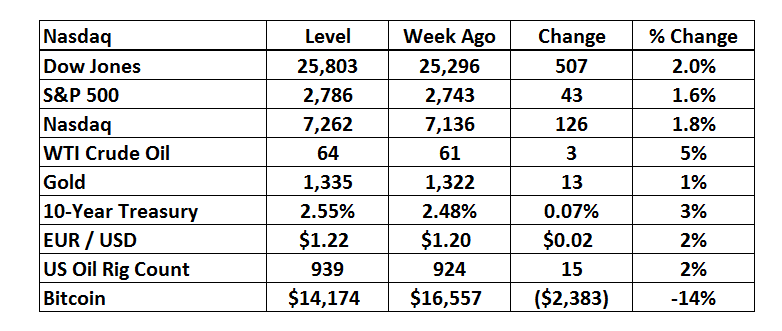
US equities ended the week higher in a quiet Friday of trading. Cyclical and value plays were among the better performers. The equity market is already up over 3% this year with some of our stocks like Amazon and Nutanix up more. Bonds are down this year and Treasuries were mostly weaker as investors realize the Fed is serious about raising rates. We saw more flattening of the yield curve indicating caution. In fact, the two-year T-note rose and hit 2.0% for the first time since 2008. Gold was higher for fifth straight week. Crude ended higher for the fourth straight week.
No matter what is happening out there, there is always a bull market here at The Bull Market Report! This week we highlight: Cloudera, Blackstone, Amazon, Google, Eli Lilly, and Home Depot.
BMR Companies & Commentary
Cloudera (CLDR: $18.14, up 5%)
Cloudera met with investors this week at Citi’s Global TMT West Conference. The CEO discussed all that they are doing in terms of new technology. Let’s recap. Remember, understanding the big picture of what the company is doing is how you build real confidence in your investments.
First it is important to understand the backdrop of why Cloudera is such an exciting company. Everything right now is going through a major technological revolution. Look what is happening in cars, health, and virtual reality. Everything is getting connected. This newly-created connected world is creating a backdrop for data that is unprecedented. And in this area of the economy is where the world’s most valuable companies reside—Apple, Google, Facebook, and Amazon. They are all data driven. Economists say the world’s most valuable resource is now no longer oil, but data.
So where does Cloudera fit it? Cloudera helps enterprises enter this new world of machine learnings and artificial intelligence. Cloudera gives them access to this data to transform their business to become data dependent. The old days of just working with a database storage provider and some simple analytics are gone. Today, companies turn to Cloudera to build best-in-class artificial intelligence solutions that optimize all the available data out there, not just their own.
BMR Take: Machine learning and artificial intelligence are megatrends for the next 5 years. Get involved. Cloudera is a great opportunity. Revenue will explode from $360 million this year to $570 million in 2 years. We see Cloudera breaking the $1 billion revenue mark possibly as early as 2020. We added the stock at $22 in June so it has certainly been an underperformer for us. But we are very confident in the success of this company and continue to have a $28 price target on the stock. Sometimes one has to be patient to see the big gains that we expect. Cloudera is still tiny with a market cap of $2.5 billion. But they are growing 40% a year. We would expect to see this little gem grow to the $10 billion level at some point and then get plucked up by one of the big boys. And this might even happen sooner than you think.
------------------------------------------------------------------------------
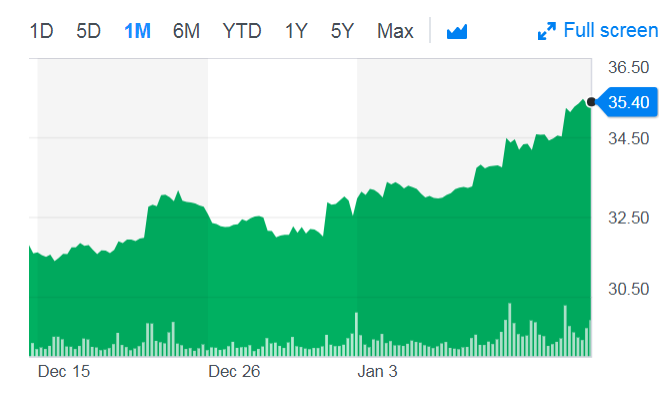
Blackstone (BX: $35, up 7%)
Blackstone is on a roll and caught an upgrade from JP Morgan. We love it when the professionals come around to our side of the table!
The reason to be excited at this point is that there is going to be a major fundraising cycle for Blackstone over the next two years. The company is expected to raise over $200 billion. The way the company makes money is through these massive fundraisings, then deploying the capital, and then getting a share in the profits from the investments.
The fundraising will happen in two funds. The first is Flagship Real Estate BREP-IX in 2018. The second is Flagship Private Equity BCP-VII in 2019.
BMR Take: Blackstone has been an underperformer relative to its peer group. And the peer group of these private equity companies hasn’t done too well. The entire space is relatively new to the public equity markets. Retail investors just don’t have the comfort level they have with other financials like AIG or JP Morgan. But we think that will all change. These companies print money. Blackstone will do over $3.00 of EPS in 2018. The stock is very inexpensive right now.
We’re up 30% on the stock since we added it in early 2016. Good but not great. The dividend has helped though, as that 5% a year adds up. But we expect more from this great company. Our Target was just reached this week, so we are going to go out on a limb and raise the Target to $42. If things go right, we would expect to see this by year end, but perhaps sooner.

------------------------------------------------------------------------------
Amazon (AMZN: $1,305, up 6%)
Amazon Fresh prices are up to 20% cheaper than major UK supermarkets.
Look out! We are going to see Amazon really shake-up the grocery market this year. Amazon's online grocery service Amazon Fresh is selling some products up to 19% cheaper than major supermarkets, new research suggests.
Amazon Fresh is a subsidiary of the Amazon.com. It is a grocery delivery service currently available in some U.S. states, London, Tokyo, Berlin, Hamburg and Munich. It will also launch in Australia soon.
The cost of a shopping cart from Amazon Fresh turned out to be 11% cheaper than the same online shopping from Tesco, and up to 19% cheaper than other competitors. The study was done by the consulting firm Oliver Wyman. The geography was in London.
Amazon Fresh is still relatively small but the internet giant has very serious ambitions in the grocery sector, suggesting that it may be looking at more acquisitions.
BMR Take: Amazon is a never-ending innovation machine; essentially a massive start-up. Look, the company will do $177 billion of revenue this year and we could rant and rave about the revenue growth outlook. But nobody knows what businesses Amazon will even be in over the next 3 years. They are knocking down doors and running through walls into new markets. Grocery will be tens of billions of dollars for Amazon in a market that the firm has been in for less than a year.
The stock had a banner week and hit our $1300 Target, setting a new all-time high. We believe we will see $2,000 someday in the future, but obviously not right away. But we can see $1,500 in the not-too-distant future, so we hereby raise our target to that level. The Sell Price is raised from $1,030 to $ 1,225.
------------------------------------------------------------------------------
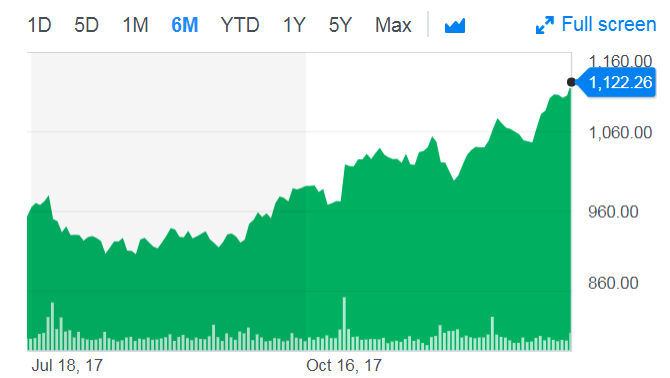
Google (GOOG: $1,122, up 2%)
Apple came under massive scrutiny this week. Parental oversight organizations said Apple should take more responsibility over how children use their devices in particular addition to the technology. We think Apple, Google, and Facebook in particular are making so much money they are likely to be the target of increased scrutiny by governmental authorities. In fact, we saw this week similar outcries against Google. We keep an eye on this risk but would not let it shake us out of any of these holdings.
Google has been profiting from a practice in the United Kingdom but banned in the US, in which brokers secretly reap millions of pounds from addicts seeking treatment in the UK. An undercover investigation by the Sunday Times has discovered a large fraud in this area. As a result of an in-house investigation, Google pulled all addiction-industry-related advertisements from its UK platforms.
BMR Take: Without question, Google and its peers will have to invest more in meeting social responsibilities and being a good corporate citizen. That said, Google can manage through this. We are looking at EPS going from $32 this year to nearly $60 by 2020. We can live without $1 or $2 of EPS if the company addresses these social issues and spends money to prevent thing like this advertising scheme being run through the platform in the UK. In fact, we encourage it, as it could result in a premium valuation.
Google set a new all-time high this week and is now worth $780 billion, closing in on Apple at $900 billion. (Of course, Apple set a new all-time high this week as well, so it’s certainly a good race!) Our Target has been $11,00 which was hit this week, and we expect a continued strong stock market which should proper Google higher. Thus, we hereby raise our Target to $1,450 and our Sell Price to $1,010.
Don’t like high-priced stocks? GET OVER IT. Buy some Google. Buy some Amazon. Buy 7 shares. Buy 23 shares. Just own these fabulous companies!
------------------------------------------------------------------------------
Eli Lilly (LLY: $87, flat)
Eli Lilly caught a big upgrade from Argus Research. Again, we love it when the professionals come around to liking our holdings!
What’s the excitement? Tax reform is a major positive for the company. Additionally, the company is working to sell its Animal Health business. The combination of these two events will create a cash windfall. Now the CEO is talking about doing a large acquisition.
Previously, big time M&A was just a distraction for the company as Lilly could not be competitive due to its balance sheet. However, now there is some real interest to move bigger into immune-oncology. Could we see them try to buy Bristol-Myers? (BMY: $63) Maybe; but that’s a big bite to chew off – around $120 billion.
BMR Take: Lilly is going to do $4.65 of EPS in 2018. They have $4.5 billion of cash. They have more cash than debt. They could do a mega-deal and this could get really exciting. We see why Argus upgraded the stock with a $115 price target.
We at The Bull Market Report have a Price Target of $88 on the stock at the moment, but we expect mid-90s by summer, so we hereby raise our Target to $96. Our Sell Price moves higher too, from $76 to $82.
------------------------------------------------------------------------------
Home Depot (HD: $196, up 2%)
To be honest, we are frankly a bit upset at Home Depot right now. We expect a lot from our companies - we wouldn’t recommend them to you otherwise. Home Depot put out this official statement on tax reform back in November, “The Home Depot is very supportive of tax reform that would fuel the economy by putting more money in the majority of Americans' pockets while improving the competitive position of companies so they can create more jobs. We applaud Congress for its efforts in moving tax reform forward.”
What is it missing?
Where is the minimum wage hike? Where is the $1,000+ bonus to employees. Walmart, some big banks, and many other companies took additional actions. All Home Depot did was issue a press release of encouragement.
We will get over it. But Home Depot missed an opportunity to demonstrate its corporate leadership in this country.
BMR Take: Home Depot is going to do nearly $9 of EPS in 2019. EPS should grow at least mid-single digits. The housing market is doing great and we expect ongoing favorable tailwinds for Home Depot. The stock is still going to go higher, but it could go much higher if they would not miss opportunities to build goodwill with the market as an exceptional corporate citizen.
Our Price Target is $205 which we will leave here for the time being. The Sell Price of $178 is hereby increased to $186.
------------------------------------------------------------------------------
------------------------------------------------------------------------------
Economic Calendar
Capacity Utilization
Wednesday, January 17th, 9:15 AM
Period: December
Consensus: 77.3%
Prior: 77.1%
Housing Starts
Thursday, January 18th, 8:30 AM
Period: December
Consensus: 1,278,000
Prior: 1,297,000
Michigan Sentiment
Friday, January 19th, 10:00 AM
Period: January
Consensus: 97.0
Prior: 95.9
------------------------------------------------------------------------------
------------------------------------------------------------------------------
Time to Take Our Profits in Tesla?
Tesla (TSLA: $336, up 6%) had a great week, but the more we think about it, the more worried we become. They have orders for 400,000 Model S cars and said last year that they would be delivering 5,000 a week starting in October, 2017. Well, guess what, this 5,000 number has slipped a number of times so that now they are talking about the 2nd quarter of this year. That’s a big slip. Maybe there is something seriously wrong here. No one seems to know and the company certainly isn’t helping us with solid information.
The company is going to need massive amounts of cash this year. They are bleeding money each day, each week, each month, so we expect more secondaries this year, diluting existing stockholders. And more bond sales as well.
Can the company survive and thrive? That’s the question that we are wrestling with.
We love the company; the world loves the cars. We love Elon Musk, but he is a promoter for sure. A loveable genius with a $56 billion market cap company.
The more we think about it and the more we write about it, we just have to book our profits. We are up 69% since we added the company two years ago at $199. OK, wait a minute. We’ll let the market tell us when to sell: If the stock goes to $320, we are OUT.
It’s tough to invest in a visionary. The vision always takes longer than the genius or the masses of followers expect.
------------------------------------------------------------------------------
Apple's App Store Broke Records this Holiday Season
Apple’s App Store started off 2018 by breaking app purchasing records on New Year's Day. Consumers spent $300 million in app purchases on January 1, 2018, marking the highest sales day for the App Store since its launch in 2008.
This outstrips last year’s record-breaking figure of $240 million in purchases on New Year’s Day. Customers spent $890 million on apps from December 24th-31st. Insights into app spending during the holiday season are indicative of the strength of the iOS platform for the year to come, as many consumers receive smartphone devices and purchase new apps, games, and subscriptions over the holiday period.
Apple’s App Store revenue gets bigger each quarter and each year. Developers received $26.5 billion for the year, up 30% year-over-year, and is now over $86 billion since 2008. For 2017 the $11.4 billion in revenue was almost 5% of the company’s projected $237 billion in total revenue.
------------------------------------------------------------------------------
------------------------------------------------------------------------------
A Word from Gary Jefferson
Jefferson Financial Group
First Vice-President, Investments
UBS Financial Services, Inc.
Earnings season officially kicked off last week with the big banks leading the way. We expect decent to good numbers, but the big thing to watch for will be forward guidance, particularly on how much tax cuts will impact the bottom lines. Some sectors like Energy will likely benefit more than others which traditionally have been able to pay lower effective rates such astech.
Last week, Bank of America analysts raised their earnings forecast for the S&P 500 by $14 to $153 per share, as a result of the new lower 21% tax rate. (Source: Merrill Lynch). In market-speak, that means that if corporate earnings for 2018 reach $153, and the market's trailing PE is 18, the S&P 500 will be trading at 2754. Today it is trading at 2786…………………….oops, that doesn't sound very promising. For the market to reach 3029 (a 9% gain), the S&P 500 would need to trade around 20X trailing earnings. That is of course doable, and not outside the realm of just being a high-priced market rather than a bubble, but it would be a lot better from a fundamental standpoint if the market could see fit to earn a higher number this year. We should have a better grasp on a projected year-end earnings target after earnings and guidance are announced over the next several weeks.
Meanwhile, what a week the market enjoyed two weeks ago. It was one of the best first weeks of any new year in history. There are plenty of historical stats which show that if the market has a good January, most of the time the year will end up with positive numbers as well.
Even though the jobs report missed expectations for 191,000 new jobs being created last month by coming in at 148,000 instead, the great big story was that this number had 146,000 private sector jobs versus only 2,000 public sector ones. Always remember that government doesn't create jobs – it only takes away from the private sector when it grows, and because it is the private sector that creates jobs, a growing government is the worst case scenario for a growing economy. So "hip, hip hooray" for this ratio of jobs because it is just what the doctor could order for a healthy and robust economy.
The biggest winners for job creation were in Healthcare with 31,000 new jobs (300,000 for 2017), Construction with 30,000 new jobs (210,000 for all of last year), and Manufacturing with 25,000 new jobs (196,000). We also saw gains in Food Services & Drinking Places (government-speak for restaurants and bars), and Professional & Business Services. Thus, these are not part time or low paying jobs for the most part, which is equally important for a growing economy.
Again, we have to keep everything in perspective. The following stats are from Pension Partners:
"From August 18th to November 29th, the Dow went 72 straight trading days without an intraday move greater than 1%, by far the longest stretch in history.
“The S&P has now risen for 14 consecutive months, the longest run in history.
“The Dow closed at an all-time high 71 times during the year, the most in history.
“There was a sharp flattening in the yield curve throughout 2017. At 0.51%, the spread between 10-year and 2-year yields on the last day of trading was the flattest level of the expansion. (This is a "flag" we are watching).
“In spite of this backdrop, the Fed only hiked rates 3 times in 2017, to a year-end range of 1.25 to 1.50%. After subtracting inflation (core CPI of 1.7%), this leaves the Real Effective Fed Funds Rate in negative territory for the 9th year in a row – another longest stretch in history.
“On the flip side:
Unemployment rate (4.1%) – lowest since 2000
Jobless Claims – lowest since 1973
Consumer Confidence – highest since 2004
ISM Manufacturing Index – highest since 2004"
Our take is that we should expect a correction along the way this year to keep this market from reaching the dreaded "bubble status", but we should also not be scared out of the market due to the length of this bull market. All good things eventually come to an end, but all records are also made to be broken. We have no idea when this earnings growth cycle will come to an end, but we simply do not see earnings growth stuttering or falling at this time - just the opposite, in fact, as corporations become ever so more competitive with the reduction of what had been among the world's highest and most onerous tax rates. (35% now cut to 21%). In this environment, we believe earnings will be the game changer – i.e., we are in the proverbial market of stocks, not a stock market. Companies with outstanding earnings growth will continue to provide outstanding returns.
------------------------------------------------------------------------------
PayPal Holdings (PYPL: $80.50) was upgraded by analysts at Cowen from a "market perform" rating to an "outperform" rating. They now have a $88 price target on the stock, up previously from $79. They must be reading The Bull Market Report. Interesting: Our price Target is $87, because that’s the price at which the company will be worth $100 billion. The stock set a new all-time high on Friday.
------------------------------------------------------------------------------
------------------------------------------------------------------------------
The High Yield Corner
By Michael Foster
Vice President, High Yield
Let’s start with a stock that fell below an important number and then quickly recovered.
Omega Healthcare Investors, Inc (OHI: $26, down 3%) has been The Bull Market Report’s big contrarian call for a while now. If you’re a regular reader, you know that we’ve frequently discussed the issues regarding Omega’s tenant insolvency and current negotiations. This has spooked a lot of investors and turned a once 8% yielding stock into a 9% yielding one. At the start of last week, the stock dipped below $27 for the first time since 2014 - a significant development.
There’s no news to drive this. No insider selling announcements, no updates on the ongoing negotiations with Orianna, which could result in a small decline in income or a protracted dispute in bankruptcy court. In either case, Omega is very likely to get paid out something. In both cases, though, Omega’s cash flow is going to suffer.
And what of that cash flow? Again, it’s helpful to look at the numbers. FFO for the last 12 months is $3.40, while annualized dividends are $2.60. In other words, the dividend coverage ratio is 131% - just above the important 130% level that we demarcate as the start of the safest REIT distributions. At its current level, Omega will maintain its payouts with ease.
But what about the haircuts? Orianna provides 5% of Omega’s FFO, so if Omega lost all of that money (a virtual impossibility), the FFO would fall to $3.23, leaving Omega with a 124% coverage ratio. That’s lower than we like, but it’s still over 100%, meaning we aren’t anywhere near a cut.
Let’s project into the future to see exactly when the dividend would get risky. If Omega lost 5% of its portfolio every year, 2019’s FFO would fall to $3.07. The next year’s would be $2.92…and in fact, it would take until 2023 (i.e., 5 years from now) before Omega’s FFO would fall to less than its current payouts. Then, it would hit $2.50.
Keep in mind that we’re playing with the worst possible case here - but let’s play with the math and see what happens to our income stream.
If the future was as bleak as this, 2023 would result in a 3.8% dividend cut to make payouts sustainable. At current prices, that would make Omega Healthcare yield 9.2% (instead of its current 9.6%).
If this is our worst case scenario, it looks pretty rosy. Getting a near 10% dividend over 5 years before a dividend cut that then brings your yield to a still impressive 9% - that’s not much downside.
There is one other consideration. Omega increases its dividend by a penny per quarter. We’ve have written in the past about this; it’s good for investors in the short term, but it will expedite the schedule for when Omega will have to cut its distributions. For that reason, we think it would be best for Omega to stop its quarterly hikes and telegraph to the market its plans to do so many, many months in advance.
We are disappointed that Omega hasn’t done that yet, but we also wouldn’t be surprised if they did this sometime this year. The recent price action demonstrates that the market is expecting the dividend hikes to stop relatively soon. That gives Omega a nice window to make the move without hitting the stock too much further - but we are not sure they will actually make this move at all.
And the reason is simple. We on the outside see a very slow demise of the dividend - management does not. In the last earnings call, CEO Taylor Pickett addressed the issue with some promising numbers:
"We are hopeful, we can develop an out-of-court plan, which if successful, would likely result in cash rents of $32 million to $38 million per year, as compared to the current annual contractual rent of $46 million.”
If successful, that would lower FFO by 1.5% - in other words, hardly anything at all.
Additionally, Omega continues to expand. The company invested over $300 million in the third quarter of 2016, which on its own more than covers the lost FFO from the Orianna issue. By how much? Pickett noted that Omega targets a 9% capitalization rate for investments, meaning that $300 million investment will be almost twice that of the lost cash rents from Orianna.
What about the properties currently occupied by Orianna? Omega is currently working to sell or rent to new operators who are in a better financial position. If successful, this could cause FFO to grow significantly in the next 2 years - and that will make Omega shares skyrocket.
We have faith that Omega’s managers can navigate this admittedly complicated and tricky transition, and that’s why we remain constructive on the stock.
Finally, let’s quickly turn to some other high yield assets: Municipal bonds and closed-end funds. Nuveen AMT-Free Municipal Credit (NVG: $15.65, down 2%) and Invesco Municipal Trust (VKQ: $12.65, down 1%) had a decent showing for the week, in no small part thanks to a seasonal and rather predictable trend. Retail investors sell municipal bonds at the end of the year and buy again in January. This is classic tax loss harvesting at work, and any year where losses in munis are to be found, this trend is noticeable. So far, 2018 has been good to munis - and that is likely to continue. Thanks to the investors looking for their tax-free income streams, both the Nuveen and Invesco funds are seeing positive inflows - something that we are also seeing across the municipal bond market.
Good Investing,
Todd Shaver, CEO and Founder
The Bull Market Report
Since 1998
December 10, 2017

by Todd Shaver | Dec 10, 2017 | Weekly Newsletter 7pm Sunday
The Weekly Summary
The countdown to Christmas is underway, which means this year is coming to an end and the focus is turning to the outlook for 2018. This bull market has been nothing short of spectacular. We expect high-single digit returns in the stock market again in 2018. Our view is supported by rigorous analysis from Guggenheim Research, which points to the US not reaching a recession until late 2019 or 2020. Specifically, they say, the business cycle is one of the most important drivers of investment performance. It is therefore critical for investors to have a well-informed view on the business cycle so portfolio allocations can be adjusted accordingly.
At this stage, with the current U.S. expansion showing signs of aging, focus is now just gradually shifting toward the timing of the next downturn. Using history as a guide, however, you will find that it is possible to get an early read on when the next recession will begin by analyzing the late-cycle behavior of several key economic and market indicators. Together, they have provided advance warnings of a downturn. The best indicator is the Leading Economic Indicator Index, which compiles all the various indicators into one data set. The 10 components of the index cover weekly hours worked, manufacturing orders, initial jobless claims, building permits, new private housing units, interest rate spreads, and consumer sentiment. An analysis of these metrics suggests that the current expansion won’t end until late 2019. So keep your foot on the gas!
No matter what is happening out there, there is always a bull market here at The Bull Market Report! This week we highlight some of our favorite stocks where you can still make good money, including: Tesla, Twilio, PIMCO Dynamic Income Fund, Amazon, Google, First Solar, and more.
BMR Companies & Commentary
Tesla (TSLA: $315, up 3%)
Anheuser-Busch has placed an order for 40 of Tesla’s new all-electric Semi trucks. The maker of Budweiser seeks to reduce fuel costs and vehicle emissions, along with other companies across sectors through the Tesla revolution.
Anheuser-Busch plans to use the trucks for shipments to wholesalers within 150 to 200 miles of its brewery locations - well within the 500-mile range that Tesla Chief Executive Elon Musk has promised. The vehicles would be deployed among the brewer’s dedicated fleet of 750 trucks, which bear the company’s branding but are owned and managed by outside carriers.
Anheuser-Busch’s preorder is still tiny relative to the broader heavy-duty-truck market, which produces 250,000 to 300,000 big rigs a year. Anheuser-Busch spends about $120 million on fuel each year for its dedicated fleets and long-haul transportation by for-hire carriers moving beer between breweries and wholesalers. The company wants to cut its carbon footprint by 30% by 2025, and has invested in alternative-fuel vehicles, such delivery trucks that run on compressed natural gas. This is big stuff!
BMR Take: Tesla is currently losing money, but the consensus 2020 EPS outlook is over $10. At some point we see all the innovation, like electric trucks, turning into major profits. Tesla remains one of the most exciting businesses in America.

--------------------------------------------------------------------
Twilio (TWLO: $25, down 5%)
Twilio hosted its analyst day in San Francisco this week. It was a good day. Twilio did a nice job of conveying the momentum in its business and how it plans to continue to drive rapid revenue growth at scale, but it did not guide to gross margins for 2018, and suggested that near term, gross margins may still move around a bit, even though management is confident in its longer-term target of 60-65%. The stock was under modest pressure accordingly.
Twilio provided three new disclosures to help investors better understand these gross margin dynamics, including: 1) gross margins have consistently been around 60%; 2) gross margins are negatively impacted by the international mix, which was 53% in 3Q17 for core voice and messages, far higher than the 24% figure Twilio discloses for the international revenue breakdown by account location; and 3) gross margins are positively impacted by application services revenue, which was $10 million in 3Q17, up 100% from a year ago and representing 9% of total revenue.
The company reinforced that demand is not an issue for Twilio. For example, the COO shared a story about how one sales representative was “drowning in leads.” He also disclosed that Twilio receives more than 7,000 “data-driven alerts,” or leads per month.
Twilio claims that it won 80% of new business opportunities against the top-five competitors in the first three quarters of the year. According to management, the top reasons customers select Twilio include: 1) trust; 2) omni-channel capabilities; 3) flexibility; and 4) innovation.
Twilio Investor Day tone was positive, says Baird. They remain positive on the company's competitive position and long-term growth opportunity fueled by increasing cloud communications use cases. They also remain positive on its stronger revenue growth and ability to improve margins long term. Baird reiterated their Outperform rating and $37 price target on Twilio shares.
BMR Take: Twilio currently trades at a big discount to where comparable high-growth cloud communications companies trade. We think this valuation disconnect will correct itself, leading to strong stock appreciation. With revenue exploding at greater than 60% per year towards $600 million by 2019, we see a compelling value here. The stock has been painful to watch but one of these days, Wall Street will take notice (again) and we will all be rewarded with our patience. If you can't take the pain, then you may just want to switch to some of the larger, safer investments like Apple or Google. We’re going to be right on this. Eventually. Watch and wait.
--------------------------------------------------------------------
PIMCO Dynamic Income Fund (PDI $31, up 1%)
With rising geopolitical tensions and good money been made in the stock market, we stress the importance of increasing your bond allocation. Pimco Dynamic Income is a great way to do it.
The portfolio maintains moderate exposure to US interest rates, where Pimco continues to emphasize the intermediate portion of the yield curve. However, due to historically low yield levels and continued flattening of the yield curve, the fund has some exposure to the long end of the US Treasury curve. Outside of the US, Pimco also has modest exposure to UK rates and an underweight to Eurozone rates.
Pimco maintains a focus on non-agency Mortgage-back securities (MBS) purchased at discounts to par, which provide a potential source of income and capital appreciation, as prices in this asset class continue to be supported by limited new supply and a strong US housing market. Pimco maintains exposure to corporate credit, including an allocation to high yield bonds in the Financial sector. The banking exposure is focused on slightly more risky opportunities that are more lucrative, given how stable the banking system is at this moment. PDI has exposure elsewhere in corporate credit, including allocations to select attractive names in Retail, Media, and Telecom. Pimco’s exposure to emerging markets remains highly selective and is focused on issues offering attractive spread premium and real yields coupled with strong underlying fundamentals, such as select Brazilian and Russian corporates, as well as Argentinian sovereign debt.
BMR Take: Pimco is offering just less than a 9% yield. And the fund is up over 20% this year. For fixed income this is amazing. This fund is a great place to increase your fixed income exposure and protect against unexpected drawdowns in the stock market.
--------------------------------------------------------------------
Amazon (AMZN: $1,162, flat)
The road is not always easy. Not even for Amazon.
Maine has canceled Amazon’s application to become a pharmaceuticals wholesaler. Their applications were canceled because they did not contain all the required information, and no action had been taken by the applicant to complete them, according to the state Department of Professional & Financial Regulation.
Amazon had submitted three pharmaceutical applications in October – all three expired on Friday, Dec. 1, according to the board’s online license check. Analysts are trying to decide whether Amazon merely stumbled and missed a local deadline, or if Amazon abandoned the license applications because it realized they were unnecessary if all it wants to sell are medical devices, not pharmaceuticals.
We have confidence Amazon will get it right!
BMR Take: The innovation machine is disrupting the globe. EPS estimates are now up over $20 by 2020. Amazon continues to have a long way to run. Our Target is $1200, but in our heads we are looking for $1500 and then $2000. We can’t tell you when the latter will occur, but we sure would like to see the former happen sometime next year.
--------------------------------------------------------------------
Google (GOOG: $1,037, up 3%)
Google is about to launch a small but useful update to Google Maps that will give you live guidance and interactive real-time notifications during your journey. The idea here is to give you real-time updates while you are traveling.
To get started, you search for your transit directions in Google Maps as usual. So far, so good. What’s new here is that you’ll soon be able to tap a “start” button at the bottom the screen with the details about your route and get live updates as you walk or ride on your local buses and trains.
Our understanding is that Google Maps will even remind you to get off your bus or train when you get close to your stop. That’s definitely useful when you’re traveling somewhere new. The notifications on the lock screen are also new. One nifty feature here is that they are interactive, so you can scroll right through your journey’s steps.
While Google Maps always did a good job of giving you detailed directions, the process generally involved keeping track of your own progress along the route. With this update, transit notifications become a bit more like using Maps for walking, biking and driving. This update is to go live soon.
BMR Take: Google is always advancing the world and this is just the latest example. When you can make the world a better place, revenue and profits follow. Google is expected to earn $57 of EPS by 2020 up from $32 this year. What a great place to invest!
The information here isn’t earth-shattering – (it’s hard to come up with earth-shattering news every single day (but we try)), but we’re trying to make a point here and that is that this company continues to innovate every day. A little here and a little there and eventually it goes to the bottom line. Revenues for the past few years look like this: $55 billion in 2013, $66 billion in 2014, $75 billion in 2015 and $90 billion in 2016. What about 2017? They’re on track for $105 billion. They made $19 billion after tax last year and they are going to better that for 2017, and with $100 billion in cash on the books and virtually no debt, we can’t think of a better place to put some of our hard-earnings savings.
--------------------------------------------------------------------
First Solar (FSLR: $70, up 16%)
A lot of bad press is confusing the outlook for renewables. Don’t get confused. Renewables are the future and First Solar is going to play a critical role.
What is being said? Less than a year into President Trump’s time in office, clean energy developers face a slew of unanticipated threats from the White House and Republicans in Congress that could slow the industry’s growth in ways unimaginable just a year ago. During Trump’s presidential campaign, energy analysts were skeptical of his promise to preserve the coal industry at the expense of wind and solar. Even the most aggressive attempts at regulatory rollback couldn’t reverse the market forces driving the decline in coal, they reasoned.
But the administration has not stopped at mere deregulation. From the threat of a subsidy for coal-fired power plants to a tax bill that hurts the financing of clean-energy projects, Republicans in Washington have launched a campaign against renewable energy that includes market interventions that alarm other industries, including Oil and Gas. Even if these measures never come to fruition (advocates of transitioning from fossil fuels are pushing back) the changed mood in Washington threatens to undermine the confidence of companies planning to invest in renewables.
BMR Take: First Solar is taking the Energy sector forward with the most sustainable technology on the market. Expected EPS of nearly $4 by 2020 is up from $2.50 this year, but the 10-year outlook is where the real money is. This company is just getting started. Our Target is $65, but the stock has blown through this. So we hereby raise our Target to $78 and our Sell Price from $45 to $61.
--------------------------------------------------------------------
--------------------------------------------------------------------
Economic Calendar
JOLTS Job Openings
Monday, December 11th, 10 AM Eastern
Period: October
Actual: N/A
Consensus: 6,100,000
Prior: 6,093,000
PPI ex-Food & Energy NSA
Tuesday, December 12th, 8:30AM
Period: November
Actual: N/A
Consensus: +2.3%
Prior: +2.4%
Initial Claims
Thursday, December 14th, 8:30 AM
Period: December 9th
Actual: N/A
Consensus: 240,000
Prior: 236,000
Capacity Utilization
Friday, December 15th, 9:15 AM
Period: November
Actual: N/A
Consensus: 77.2%
Prior: 77.0%
--------------------------------------------------------------------
--------------------------------------------------------------------
Some Tidbits – Apple, Home Depot, Cloudera, Bitcoin
Apple (AAPL: $169, down 1%) is confident that apps removed from the China app store will be reinstated, Reuters says. Apple's CEO Tim Cook said the company is optimistic that apps that were pulled from its China App Store will be reinstated.
Also, Dialog Semiconductor is losing staff to Apple, Business Insider reports. Apple is continuing to hire away designers and engineers from Dialog Semiconductor (DLGNF), one of its suppliers. Around 28 Dialog engineers and designers have moved to Apple between March 2016 and now.
Also, the new tax plan would cut $47 billion from Apple's tax liability, The Financial Times reports, if Republicans push through their current tax plan, making it the biggest beneficiary of the legislation now working its way through Congress.
--------------------------------------------------------------------
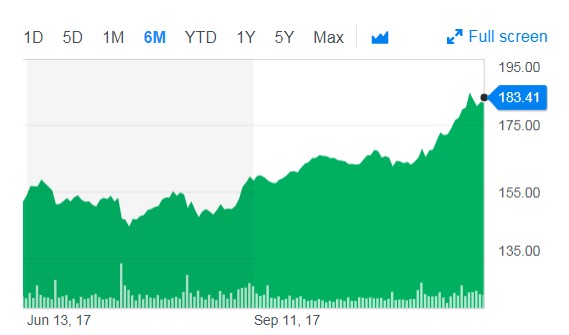
Home Depot (HD: $183, up 2%) set a new all-time high this week. It is now worth $215 billion. Wow. The company announced a $15 billion stock buyback, and the initial reaction on the Street was a slight sell-off. Silly.
How’s this for a 6-month chart?
--------------------------------------------------------------------
Cloudera Reports Strong Revenues
Cloudera (CLDR: $16.84, up 6%) reported that revenue rose to $95 million from $67 million in the year-ago period, a gain of 42%. Profits were in the negative, so although we are pleased with the revenue growth, we’re not happy with the losses. The stock had a little bump last week and it may go a bit higher, but it is not going to $30 or higher where it ought to be until it starts actually making money. We love this company but realize this is a multi-year investment from here. Patience is key here. But our patience is certainly running thin. The quarter was strong, so that gives us hope.
Bitcoin (BTC-USD: $14,840) has a market cap of about $250 billion, about the size of Visa. It was quite a week, as it rose from the $11,000 just one week ago. In the interim it hit $17,000 or so, and futures trading starts Sunday (the 10th).
Bitcoin Chart for the Past Month

--------------------------------------------------------------------
--------------------------------------------------------------------
The High Yield Corner
By Michael Foster
While the stock market went nowhere fast last week, high yield investments were a bit more mixed. We saw strength in municipal bonds for the first time in a long while, as this was overdue. The uncertainty regarding tax reforms caused some selling, but now the market is realizing that muni bonds are vastly oversold, which is helping to bring some money back into the market. Additionally, the slightly more risk-averse market is helping some money flow into muni bond funds, driving them up again.
As a result, Nuveen AMT-Free Municipal Credit (NVG: $15.68, up 2%) and Invesco Municipal Trust (VKQ: $12.57, up 2%) both had a good week, meaning the strong buying opportunity is mostly over. It’s not entirely over, however. Both funds are trading at about a 6% discount to NAV on average, a bit lower than the 5% discount we saw for much of 2017. What’s much more encouraging is the positive change in NAV we’ve enjoyed throughout 2017 - these funds are up about 5% on average on their net asset value even after their 5% dividend payouts. That means these dividend payouts remain sustainable and investors can expect a strong total return in addition to the tax-free income stream these funds provide. We wouldn’t be surprised if we saw more investors jump into the muni market, driving these funds higher and their discounts lower.
Elsewhere in the high yield world, we saw growing discontent. Specifically, Government Properties Income Trust (GOV: $18.29, down 3%) had a challenging weak on no news. This is largely a result of continued concern that Government Properties is overly levered and highly dependent on government agencies who are squarely in the majority Republicans’ crosshairs when it comes to cutting expenses wherever possible.
Of course, neither of these facts have changed in the last week, but admittedly the 8% and 7.5% yields that this stock offered earlier in the year were too low to compensate for the risks that the fund’s portfolio afforded.
Some context is important here. The Bull Market Report first recommended this stock back in April of last year when it was yielding 9.5%. Since then, the stock has given a near 14% total return to investors thanks to a slight bump in price and a consistent 43 cent quarterly dividend payout.
The Bull Market Report did not recommend selling this fund during its run-up earlier in 2017 for one specific reason: income sustainability. The most crucial metric to look at with REITs is FFO* and its relation to dividend payouts. Over the last 12 months, this REIT’s FFO was $2.15, while the dividend is an annualized $1.72. That’s a 125% dividend coverage ratio, slightly short of our preferred 130% dividend coverage target. But that shortfall is compensated for by the higher yield.
* Funds From Operations
To put that into context, let’s think about another beaten-down REIT: Omega Healthcare Investors, Inc (OHI: $28, up 1%), which has around a 130% dividend coverage ratio and a 9.4% dividend yield. With such a strong and sustainable income stream and a high yield, these are ideal contrarian income plays despite the justifiable concerns about the fundamentals. With Omega, the worry is that there are too many skilled nursing facilities and lower-than-expected demand. With Government Properties, the worry is that there is going to be depressed demand from a belt-tightening government.
These concerns are well compensated for by yields over 9%. When you get to double-digit yields (which is very unlikely with Omega but not impossible with Government Properties), you’re getting paid too much for the risks. We believe there is a chance of seeing its stock drop to a level where yields are 10%, which makes it a hold right now but not an absolute great buy. But when it comes to the sustainability of the dividend, we clearly see no risks at all to the dividend for a long time - in fact, possibly for several years.
How many years? To answer that, we need to look at the duration of outstanding leases in Government Properties’ portfolio. At 5.1 years, 28% of the company’s leases will expire before 2020. And in the next 5 years, almost 60% of the company’s leases will expire.
This is a double-edged sword. On the one hand, there is a risk that the company won’t be able to lease those properties to new tenants, causing occupancy rates to fall, income to fall as well, and the dividend to be increasingly at risk. On the other hand, there’s an opportunity for the company to lease those properties to those tenants or new tenants at the same or higher (possibly much higher) rents. This latter scenario is how we feel. The government needs the space and the record of the government in cutting down its size is, as you know, abominable.
So what is the likelier scenario - falling occupancies or rising rents? Bears are arguing for the former, and we would argue that that scenario is already priced in. However, falling occupancies is more unlikely than the market is expecting for a couple reasons.
Firstly, commercial leasing activities are going up. According to Jones Lang LaSalle, one of the biggest commercial leasing firms in America, leasing activity is at its highest point in 2 years and it’s trending higher. Government Properties has been shifting away from government leasing to office leasing, so it will benefit more and more from this trend. Thus the chances of finding new tenants paying higher rents is actually pretty good.
Secondly, there’s a paradoxical market lockup in commercial real estate REITs despite strong rent growth. Office-space REITs are one of the most heavily discounted (infrastructure and data centers are the most premium priced) in large part because of the market jitters about future occupancy rates, which paradoxically is forcing more conservative fiscal decisions among office REITs like Government Properties. But we have clearly hit a bottom in terms of pessimism, and when enthusiasm comes back to office space REITs, which will likely come as soon as the market notes the strong growth in leasing activity and rent growth, companies like Government Properties will be able to expand even more.
That means patience is in order. Expect more negativity and worries about Government Properties in the short term. But the fears about its soon-to-expire portfolio are overblown, and when the market realizes this, more capital will flood into the stock. It may take until 2019, when 18% of the company’s portfolio expires. If those spaces are re-leased at the same or higher rates (which seems inevitable given the strength in the commercial real estate market), expect the stock to rise. Best to hold the stock now, collect the income, and wait for that bump in a couple of years.
Good Investing,
Todd Shaver, Founder and CEO
The Bull Market Report
Since 1998
November 13, 2017

by Todd Shaver | Nov 13, 2017 | Earnings Preview 12 PM
Home Depot (HD: $165)
Bull Market Report Target Price: $170
Bull Market Report Sell Price: $144
Earnings Date: Tuesday, 9:00 AM ET
Consensus: 3Q17
Revenues: $25 billion
EPS: $1.82
Year Ago Quarter Results
Revenues: $23 billion
EPS: $1.60
Key Things to Watch For in the Quarter
Home Depot is expected to report an 8% increase in earnings with a 9% increase in revenue for 3Q17. Home Depot has beaten estimates in each of the past four quarters, which has been reflected in the stock’s 30% increase over the course of the past year. The stock currently trades at a PE of 23 and yields 2%. Home Depot is one our favorite stocks for the long haul. Investors have realized incredible appreciation over the decades (445% since 2010) along with consistent income through the stock’s dividend payouts.
The stock has done so well that we hereby raise the Sell Price to $158 from $144. We can’t wait to raise our Target but will be patient and look for the stock to move $3-4 higher before we do.
----------------------------------------------------------------------------------------------------------
Splunk (SPLK: $69)
Bull Market Report Target Price: $75
Bull Market Report Sell Price: $60
Earnings Date: Thursday, 4:30 PM ET
Consensus: 3Q17
Revenues: $310 million
EPS: $0.14
Year Ago Quarter Results
Revenues: $245 million
EPS: $0.12
Key Things to Watch For in the Quarter
Analysts expect Splunk to report a 26% increase in sales along with a 16% increase in earnings for 3Q17. The stock has beaten estimates in each of the past four quarters and has appreciated 18% over the past year. Splunk successfully provides its customers with quality software that enables organizations to gain real-time operational intelligence. Gross margins of 70% indicates the firm's potential to generate significant profits down the road if it can improve on its operations. We strongly believe in management's ability to reduce their operating costs and in turn grow its bottom line.
As you can see from the chart, this one is volatile, but overall the stock has done well this year.

November 12, 2017
by Todd Shaver | Nov 12, 2017 | Weekly Newsletter 7pm Sunday
[Note that the formatting is not up to our normal layout. We are having some editing issues. Next week should be better.]
The Weekly Summary
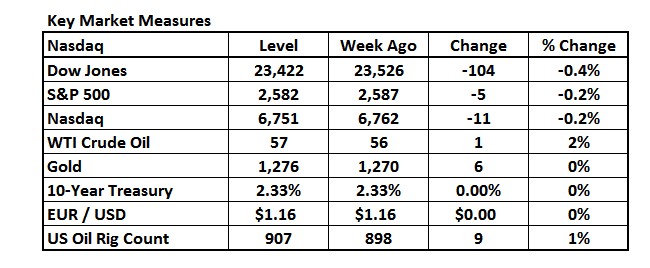
The big story right now remains central banks. The reversal of easy central bank monetary policies across the globe has begun to reverse. Quantitative easing had a meaningful favorable impact to asset prices to the upside. The removal of this stimulus will work in reverse. Accordingly, investors should be prepared for more volatility in the months ahead. Major central banks say they want to normalize monetary policy, which suggests higher interest rates and the eventual end of nearly a decade of quantitative easing. As widely expected, the US Federal Reserve said in September that it would begin the multiyear process of reducing its $4.5 trillion portfolio of US Treasury and mortgage-backed bonds. But it also confirmed that another interest-rate hike is likely in December and we could see three more hikes in each of 2018 and 2019. By this time next year, investors will be staring at a completely different market environment.
No matter what is happening out there, there is always a bull market here at The Bull Market Report! This week we highlight some of our favorite stocks and one not so favorite including: First Solar, Opko Health, Apple, CBRE Group, Twilio, and Andeavor.
BMR Companies & Commentary
First Solar (FSLR: $62, up 3%)
First Solar designs and manufactures solar modules using a proprietary thin film semiconductor technology that is one of the lowest cost in the world. The firm’s objective is to reduce the cost of solar electricity to levels that compete on a non-subsidized basis with the price of retail electricity in key markets throughout the world. What a lofty goal and an exciting opportunity!
What is the most recent progress to report? First Solar has confirmed that PlantPredict, the company’s solar photovoltaic energy prediction software, has been used to generate the reference energy predictions in the sale of three utility-scale projects totaling more than 350 MW.
PlantPredict is a sophisticated solar energy modeling tool designed to develop energy estimates for utility-scale solar PV installations. Easy to use with advanced modeling options, PlantPredict reduces uncertainty to generate more accurate energy predictions. More than 500 companies have already used PlantPredict to model energy predictions for their solar sites.
The transactions demonstrate that the cloud-based modeling tool has gained acceptance by lenders and asset owners as a bankable primary resource in analyzing and predicting performance of utility-scale solar projects.
This is a lot of jargon. What it means is that there remains big demand out there for solar.
BMR Take: First Solar is doing $3 billion in sales and $2 of EPS right now. Looking down the road, we think there is plenty of room in the overall market opportunity for sales and EPS to double. Now that is the kind of growth we love to find.
----------------------------------------------
Opko Health (OPK: $5.50, down 16%)
Opko took an unfortunate nose dive on its earnings report this week. Revenue of $264 million badly missed the consensus for $319 million and was down from $298 million a year ago. OPKNet loss was $46 million compared to a loss of $15 million for the comparable 2016 period.
What the heck happened?
Rayaldee commercial activities continued to progress, but just not as much as expected. Total prescriptions for Rayaldee, as reported by IMS, increased 66% during the three months ended September 30th compared to the three months ended June 30th. Opko expanded its sales force from 35 to 71 as of October 1st. The commercial and medical science liaison teams now total more than 80 professionals.
BMR Take: Many are saying to be patient; that Rayaldee still has big time long term potential and this is just one of multiple opportunities in front of Opko; that revenue is forecast to double from $1.0 billion to $2.0 billion by 2020. Some say that if we see this top line growth, profitability is going to come quickly, and when that happens, the stock is off to the races.
Well, we say hogwash. We are VERY DISAPPOINTED in this company. They have one of the biggest hype machines out there and we have fallen for it. We have waited and waited, being very patient, as the stock goes down down and down.
Look, if you wish to stay in an wait another year, more power to you and I hope the company crushes from here and the stock goes to $15.
But we are OUT. We added the stock 14 months ago at $10 and exit Monday at $5.50. Not happy about this one.
----------------------------------------------
Apple (AAPL: $175, up 2%)
Augmented reality (AR) is a big theme in the markets. The technology is going to shake things up. This means some people are going to make money and some people are going to lose money. Apple is on the right side of the trend.
Apple is working on a augmented reality display. In the company’s most recent financial results conference call, Apple CEO Tim Cook once again made it clear that AR is at the top of his agenda, saying it will “change the way we use technology forever.”
Of the new iPhones and a new version of iOS just released, all boast augmented reality as a selling point. Apple says the A11 Bionic chip inside both the iPhone X and the iPhone 8 series is specifically designed for AR.
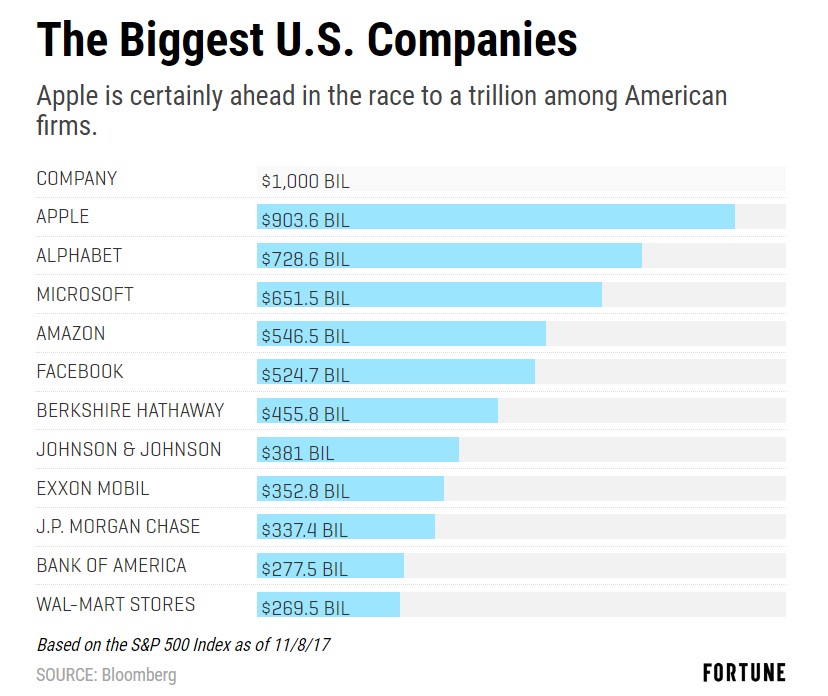
At least 13 brokerages raised their price targets on the stock, with Citigroup making the most bullish move by raising its price target by $30 to $200.Of the 37 analysts that track the stock, 31 had a “buy”, or higher rating. None had a “sell”. With the latest brokerage actions, at least nine Wall Street analysts now have target prices that put Apple’s market value above $1 trillion. Drexel Hamilton is still the most bullish raising their target price further to $235.
Apple has 5.17 billion shares outstanding and could reach the $1 trillion-dollar market cap level if its shares rose to $194.
Apple is already the largest market cap stock in the S&P 500 and made up 4.5% of the index's market cap as of Friday's close. If Apple's market cap rose to $1 trillion, the stock would be 4.75% of the S&P 500's market cap, ranking Apple ninth when looking at the stocks with the largest percentage of the S&P's market cap at year-end since 1980. IBM holds the top four spots with AT&T taking the next two and Exxon and Microsoft (in 1999) rounding out the top eight.
If Apple's stock can reach the $1 trillion market cap some on Wall Street say that it validates the belief that Apple is not just a smartphone business but a platform.
BMR Take: Apple did $9.21 of EPS this year and estimates call for greater than $11 next year. AR technology is the future and Apple’s ability to participate supports EPS growth continuing on like we are seeing now for a long time ahead. Apple set a new all-time high last week and since the stock has passed our Target of $170, we hereby raise our target to the level to which the market cap will reach $1 trillion. That number is $194. Our Sell Price remains: “We would not sell Apple.”
CBRE Group (CBG: $41.50, up 4%)
Never higher. CBRE has never been higher. CBRE is arguably the leading real estate company on the planet. As a highlight of how locked in the company is, look at CBRE Research’s 2017 Tech-30 report that was just published where they demonstrated exceptional expertise. The company ranked the strength of tech job growth across 30 North American office markets, which is creating stability and demand-driven performance through occupancy gains and rent premiums. Four key points are highlighted below.
--- Tech jobs grew four times faster than the national average. San Francisco was the top high-tech job growth market for the sixth year in a row.
--- Eighteen markets added more tech jobs over the past two years than the prior two-year period.
--- Tech’s share of major leasing activity has nearly doubled to 19% over the past five years, resulting in strong occupancy and net absorption gains.
--- Desirable tech submarkets are priced at a premium, while emerging submarkets often offer discounts. The overall average asking rent of tech submarkets is priced at a 16% premium.
BMR Take: We are staring at the company’s EPS power closing in on $3. This stock remains a compelling value at the current level. We don’t see the company doing anything but maintaining and growing its leading market share for the foreseeable future.
----------------------------------------------
Twilio (TWLO: $25.50, down 15%) on Earnings Report
Revenue reported was strong, and you know how we feel about revenue. We will tell you what happened, and let’s stay focused on the long term.
The company lost $0.08 versus $0.04 a year ago. Revenue was $101 million versus $72 million a year ago. The good news is that revenue beat the consensus of $93 million. Moreover, the company guided to a better outlook for the remainder of the year.
So what the happened here? Uber.
While total revenue growth of 41% was strong, we believe it is important to look at the underlying growth of Twilio’s core business. In particular, we consider base revenue excluding Uber, which came in at $87 million, up 63% from a year ago. Revenue from Uber hit $14 million in 4Q16 and came in at $5 million in 3Q17, down 53% y/y. Management expects a modest sequential decline in Uber revenue in 4Q17. The loss of Uber business continues to weigh on results.
Total revenue rose to $100 million from $71 million. Management itself had called for a net loss of $0.08 per share on sales near $92 million. The adjusted loss was right in line with that forecast, but Twilio crushed its own sales expectations.
For the upcoming quarter, Twilio expects an adjusted loss per share of 6 cents and revenue of $103 million. Analysts are predicting an adjusted loss per share of 6 cents and revenue of $99 million.
Jeff Lawson, Twilio’s Co-Founder and Chief Executive Officer said, “We hit a number of exciting milestones in Q3, including our first $100 million revenue quarter, our first enterprise license agreement for our higher level software products, and the launch of Twilio Studio. With Twilio Studio, the visual builder for Twilio, we can accelerate our customers’ roadmaps and help an even larger set of users build on our platform. We are excited by the size, scale and diversity of what new and existing customers are creating with Twilio.”
Recent Business Highlights – released by the company:
46,500 Active Customer Accounts compared to 34,400 a year ago. Twilio Studio was introduced in the third quarter, giving clients a simple drag-and-drop tool to simplify and accelerate their production efforts. Twilio already offers separate production tools for popular platforms such as Android and iOS, but the new Studio streamlines the development process in ways that had not been available before.
Announced our commitment to meet the new GDPR (General Data Protection Regulation) requirements coming from the EU, using this as an opportunity to raise the bar for data protection worldwide for all of our customers.
Expanded the reach of our Super Network by announcing the availability of Twilio phone numbers in more than 100 countries.
Average revenue per user rose 18% to $8,000.
Cash position strong: Twilio held $284 million of cash equivalents at the end of the third quarter, down from $289 million in the second quarter and $306 million by the end of fiscal year 2016.
Guidance: – released by the company:
Full year ending December 31, 2017:
Total Revenue - $387 million
Loss from operations (millions) $22.0 to $23.0
Net loss per share - 0.22 to 0.23
BMR Take: The good news is Twilio continues to innovate and add net new customers at a remarkable clip (3,100 in 3Q17), which is driving strong underlying revenue growth. The company remains one of the fastest top line growers in all of cloud computing.
This company is one the most frustrating that we follow. With another stellar report like we describe above, any normal stock would be up 10%. Not Twilio. Down 15%, now well below our Sell Price of $29. We are going to stay the course but you might get tired of waiting and sell in order to redeploy these assets into something better like Nutanix or Square. With that said, we believe Twilio should be a $50 stock, a long way from where it is today. But again, top line growth will win in the end. Do you and we have enough patience to endure these losses? That is the ultimate question.
----------------------------------------------
Andeavor (ANDV: $107, down 3%)
Could oil breech $80 before Christmas? Some options traders think so. With oil trading near its highest level in two years, some traders are betting that the price rise could have more room to run.
A total of 48,000 option contracts traded over the last few days that would profit most if crude spikes before Christmas, including several large individual trades. They all expire on Dec. 21.
Oil prices have rallied in recent weeks as OPEC supply cuts help to rebalance an oil market plagued by oversupply. More recently, growing tensions between Saudi Arabia, OPEC’s largest oil producer, and some of its neighbors helped prices break above $60 a barrel for the first time since 2015.
Andeavor Reported Third Quarter 2017 Results on November 8th.
Earnings of $550 million, or $3.50 per share; results included the following pre-tax items
Returned $345 million to shareholders including $252 million in share repurchases; they expect to repurchase $300 million of shares in 4Q17
Total retail and branded stations up 27% year-over-year to over 3,100 stores
On October 30th, Andeavor closed its $1.7 billion acquisition of Western Refining Logistics
New totals for Andeavor
Number of Refineries: 10
Refining Capacity: 1.2 million bpd
Employee Count: More than 13,000
Retail Sites: More than 3,100
Barrels of Storage Capacity: More than 46 million
Miles of Pipelines: More than 5,300
Marine, Rail and Storage Terminals: 40
Natural Gas Processing Complexes: 6
States where they operate: 18
BMR Take: Higher oil prices above $80 could be a huge positive for many companies including our beloved refiner Andeavor. Recall, Andeavor’s net asset value is $120 and the stock still trades an unwarranted discount. We think more stable energy markets are the first step needed for good sentiment to return to the oil patch stocks like Andeavor. And we’re certainly on the way with crude being so strong of late.
----------------------------------------------
Upcoming Economic News
PPI ex-Food & Energy
Tuesday, November 14th, 8:30 AM Eastern
Period: October
Consensus: 2.2%Prior: 2.2%
Retail Sales ex-Auto Wednesday, November 15th, 8:30 AM
Period: October
Consensus: 0.20%
Prior: 1.0%
Initial Claims
Thursday, November 16th, 8:30 AM
Period: 11/11
Consensus: 235,000
Prior: 239,000
Housing Starts
Friday, November 17th, 8:30 AM
Period: October
Consensus: 1,193,000
Prior: 1,127,000
----------------------------------------------
A Word from Gary Jefferson
Jefferson Financial Group
First Vice-President, Investments
UBS Financial Services, Inc.
The markets seem to be firing on all cylinders. Is there anything that could derail it before year-end? About all we can see is the Russian investigation (none and no chance), the tax-cut drama (possibly, but more likely to cause a correction rather than a derailment), a government shutdown (slim if any chance at all) or a major Fed rate hike (little to no chance).
A couple of things have caught our attention, however. What usually derails a bull market is a recession. At this point, we don't see the usual suspects that signal a coming recession, such as widening credit spreads, deteriorating market internals, collapsing commodity prices, falling new orders or falling earnings. In fact, it is just the opposite.
However, two things are not making sense from a historical perspective. First, with near full employment and accelerating worldwide growth, inflation remains stubbornly low. This is usually not the case. Inflation signals rising prices and continued rising earnings. It should be readily apparent but it simply isn't expressing itself even at this stage of the earnings growth cycle.
Secondly, if there is one warning signal for an approaching recession that is more reliable than all the others, it might be an inverted yield curve. Since January, the spread between the 10-year Treasury and the 2-year Treasury has fallen from about 1.30% to 0.75%. In our experience, whenever we have seen accelerating revenue growth, rising earnings, potential tax cuts – i.e. so many positives – the yield curve should be steepening, not flattening. Maybe we are experiencing a "new norm" in the markets, or it "is different this time" (the four most dangerous words in our industry), or this is going to be normal as part of the 4th Industrial Revolution we have supposedly entered (artificial intelligence, augmented reality etc.). In any event, we are going to closely follow the lack of inflation and the yield curve because neither is "confirming" this bull market rally as each would normally do if one looks back at the history of the market.
----------------------------------------------
Square (SQ: $39, up 6%) Continues to Shine
A few Wall Street firms had some new announcements on Square this week. The target raised to $38 from $34 at Stephens. They believe the stock "can grind higher" following the company's Q3 report. They still sees Square as likely to change the game for Small and Mid-sized business payments and thinks the likelihood of it achieving true "platform for small business" status gets more likely every quarter.
Square price target raised to $33 from $23 at Craig-Hallum
Square price target raised to $35 from $24 at SunTrust. SunTrust said that it is entering a period requiring heavier investment which will weigh on margin expansion. They said that Square trades at a significant premium of about 60-times FY18 EBITDA relative to 13-times for its peer group.
GoDaddy (GDDY: $48) announced two new integrations with Square that help small businesses thrive with online and offline selling and payment capabilities. By collaborating with Square, GoDaddy is making this an easy reality for tens of millions of people building small businesses. Integrating GoCentral Online Store and Square online payments enables small businesses to easily sell their products and services online and in person through a single Square account and GoDaddy website. The second integration provides service-based businesses, such as personal trainers, hair stylists and photographers, the ability to book client appointments online, sync calendars using GoCentral, and get paid using Square. Payment transactions can be processed online, in-person or both without switching accounts.
Square target raised to $41 from $31 at Cantor Fitzgerald citing accelerating revenue growth. The firm expects Square's "rapid growth" to continue and further margin expansion going forward. He notes that Gross Payment Volume growth remained above 30% in the quarter.
Square target raised to $41 from $31 at RBC Capital. The firm says the Q3 beat and raise for 2017 outlook is indicative of the company's ability to drive its products into existing partners and expanding to larger merchants.
BMR Take: This one has a long way to go on the upside.
----------------------------------------------
Options Corner – All about Square
From time to time we like to bring you an interesting options trade. We like to do long-term bullish trades on stocks, unless we find one that is going to go bankrupt in which case we can design a trade to profit from the demise of a firm using puts.
Square has been knocking the cover off of the ball of late. We added the stock at $17 in March of this year and it is now $39, setting a new all-time high on Friday, so we are up 130% in 8 months, giving us an annualized return of ……. Well, you get the point! A great stock pick. A great stock. Better yet: A great company. With a market cap of $15 billion now, it is moving into the big leagues. We have said quite a few times that Square would be a great buyout candidate for one of the big boys (Amazon, Microsoft, Apple, etc.) but they better move fast before the stock hits $20 billion.
And in fact, we think a $20 billion valuation is quite possible next year. That would equate to a $52 stock. Can that happen here with Square? We certainly think so.
An options trade can produce much bigger returns than this 33% increase, if it were to happen. But guess what? OPTIONS ARE RISKY! Please repeat after us. Options are very risky.
OK. Let’s get started.
We love long term options called LEAPS. They expire in January as long as they have at least six months of life. So the January 2018 options aren’t called LEAPs any more. But the Jan 2019 options are. And soon we should see the Jan 2020 options start trading. We can’t wait.
We like to buy options that are in the money. With the stock at $39, the 35s are $4 in the money. Better yet the 30s are $9 in the money. They are worth $9 but they trade for $13. Why is that? The $4 is the TIME PREMIUM. And note that that time premium will go to zero eventually as it approaches the end of its life in January 2019.
In order to pay for the time premium we like to SELL calls against the long LEAP to recoup this time premium and also to help us get our cost down on the option that we bought. Let’s look at some real numbers.
Buy the Jan 2019 30 LEAPs for $13,Sell the June 45 call for a little less than $6.
The cost of this trade is now $7 for an option WORTH $9. Do you understand this? If not, go back to the top of this article and re-read. These options discussions are confusing the first time, but It WILL come to you if you re-read this 3-4 times. We are serious.
Now, let’s say the stock goes up a bit and is selling at $45 in June. Your June option is going to expire worthless (great) and now you SELL a January 2019 call, say the 50 call, for approximately $7. (We are not sure of these numbers because it is so far into the future but we think this is about right -- we hope you get the point.) The cost of the trade is now zero. You are in this trade for zero dollars. (Gosh, we love this trade!)
Now, let’s tally up. If the stock goes to $50 or higher by January 2019, you will be left with an option worth $20 ($50-$30). If you had bought 10 options for $7,000, they are now worth $20,000, almost a triple (185%), with a stock that went from $39 to $50 or 28%. If you had put $25,000 in this trade (the equivalent of buying 640 shares of Square) you would now have $75,000 and that’s real money.
This options trade will more than likely take lots of tweaking of your position and the return could be better or worse depending on where the stock goes. No one is going to hand you a triple without a little bit of work. But it could be a super trade IF the stock heads to $50.
The downside is that the stock goes down to $30. You will lose money but if you religiously sell calls against your position, you can get your cost down to close to zero, thus minimizing your losses.
Note that if this all-options trade is too risky or confusing to you, you can just do a normal covered call trade by buying the stock and selling calls against it. If you were to buy 1000 shares at $39 for $39,000 and the sell the calls as described above, you would bring in $6000 for the June $45 call and $7000 for the January $50 call giving you a purchase price of $26,000. If the stock goes to $50 you have a $50,000 position, and a return of 92%. Not bad.
But, again, lots of “ifs” in these scenarios. Invest with caution.
----------------------------------------------
The High Yield Corner
By Michael Foster
Last week, AstraZeneca PLC (AZN: $33, down 5%) reported strong revenue and earnings above expectations, but that wasn’t enough to keep the stock from being the biggest loser of the week for the Bull Market Report’s high yield portfolio. A deeper dive into the results can explain what happened—and why this isn’t really a cause for concern.
To start with: revenues rose 9.3% on a year-over-year basis in the third quarter to $6.23 billion with solid EPS of $0.54, which was a little shy of expectations: analysts were expecting just 55 cents per share in earnings. In their press release, the company highlighted weak sales in the U.S. as a cause of the weaker earnings, while also pointing out that weakness was offset by major growth elsewhere: emerging markets were up 5%, China was up 12%, and Japan was up 3%. Those numbers were all higher on a constant currency basis.
But the U.S. weakness is a large part of the stock decline. AstraZeneca pointed to continued weakness in Symbicort as a cause for the weakness; the asthma drug’s challenges have been a major issue for this company, which analysts see as being heavily reliant on for future sales. Nonetheless, a closer look at the drug pipeline indicates there are other sources of growth to come.
More specifically, AstraZeneca highlighted that Lynparza, a breast cancer drug, has received priority reviews in America and Japan, while Imfinzi, a lung cancer drug, has received the same in America while also getting regulatory acceptance in the EU and Japan. A total of 7 drugs got new regulatory approvals as of the end of the reporting period, including two type-2 diabetes drugs that will obviously have tremendous appeal for this widespread ailment.
So the company’s pipeline looks fine. The focus on Symbicort unquestionably overlooks that fact, and provides a buying opportunity at this current price—provided the pipeline remains healthy.
Elsewhere in high yield investing, we saw a really mixed week despite the market’s weakness towards the end of the week. This is pretty unusual—high yield tends to be more volatile in REITs, high yield bonds, and BDCs, but we didn’t see that happen yet. That could mean more aggressive selling is yet to come in late 2017, especially as tax-loss harvesting becomes more commonplace, but that doesn’t change the fundamental strength and attractiveness of many high yield assets.
There are exceptions, however. Municipal bonds were relatively untouched by last week’s jitters, possibly as risk-averse investors were adding to municipal allocations as a result of what they saw in the stock market. Invesco Municipal Trust (VKQ: $12.34, flat) saw little movement on strong volume while Nuveen AMT-Free Municipal Credit (NVG: $15.36, up 1%) gained slightly. Both remain high-quality municipal bond funds with above-average yields and excellent management teams. Neither looks significantly overpriced right now.
Bigger news came from the REIT world, but the news had little effect. Welltower (HCN: $68, up 2.5%) had strong earnings, with FFO per share of $1.08 a 2 cent jump from the prior quarter and NOI up 4.1% on same-store senior housing operations. RevPAR also gained by 3.9%, which helped the company’s revenue rise nearly 1% to $1.1 billion for the quarter. FFO was a 3 cent beat over expectations, and higher earnings guidance (the company now expects normalized FFO per share of $4.19 to $4.25 for the full year) make Welltower’s valuations even more attractive, especially after the stock price remained stuck for the week. Defying negativity in the skilled nursing facility world, Welltower’s massive size and market penetration are proving stores of value and investor safety; the stock is a better buy now than it’s been for most of this year.
*Revenue per available room
That’s it for earnings news this week, but a lack of major news didn’t stop Government Properties Income Trust (GOV: $18.76, up 2%) from having a strong week, thanks in small part to the continued recovery from last month’s anxiety that the company’s earnings results at the end of October proved to be a paranoid non-issue. However, protracted worries about Omega Healthcare Investors, Inc (OHI: $28, down 1%) and their very disappointing earnings are keeping shares down and the yield up at the 9% level. That more than compensates for the risks, which makes this a very appealing option for investors who accept that the dividend growth is likely going to end in 3-5 years’ time. The market is discounting a cut to dividend growth much sooner, making this an irrational price and a good bargain right now.
Elsewhere, we are seeing growing anxiety in Collateralized loan obligations (CLO) and high yield corporate bonds, but that hasn’t stopped AllianzGI Equity & Convertible (NIE: $21, unch.) and PIMCO Dynamic Income Fund (PDI: $30, up 1%) from proving resilient. That’s in no small part thanks to the high-quality management teams of each, which have wisely avoided the more exotic high-yielding CLO markets and shifted towards much safer MBS’s and away from the riskiest junk bonds. The market is rewarding both with price stability. That may not last - after all, irrational selling is still very much a thing in modern markets - but that just means a buying opportunity will open up. Neither fund shows any indication of weakness despite the broader worries growing in the credit sectors.
Good Investing,
Todd Shaver, Founder and CEO
The Bull Market Report
Since 1998
(Again, sorry about the crazy formatting this week.)
November 5, 2017

by Todd Shaver | Nov 5, 2017 | Weekly Newsletter 7pm Sunday
The Weekly Summary
US equities ended higher this week, again! Major indexes ended at their best levels in history. Economic data, earnings, M&A and the recently released House tax plan grabbed most of the attention. Tech and Healthcare were the best performing sectors. There was lots of focus on the recently released House tax plan. As expected, backlash has heated up quickly, particularly when it comes to who get the benefits of new incentives between the super-rich and the middle class. The tax bill is not expected to survive in current form and some focus is already shifting to the Senate’s revisions.
In terms of other developments surrounding Washington, Trump said "We'll see" if Secretary of State Tillerson makes it through his term. Jay Powell was named by President Donald Trump as his nominee to serve as the next chair of the Federal Reserve, as he moved to make his mark on the world’s most powerful central bank. The news ends months of speculation ahead of the end of Janet Yellen’s first term as chair in February. The 64-year-old Mr. Powell has been a serving Fed governor since 2012. A centrist on monetary policy, he is known as a pragmatic and down-to-earth official with private sector and government experience. A trained lawyer and former partner at private equity firm Carlyle Group, he also served in the Treasury under former president George H. W. Bush in the 1990s. Powell is worth upwards of $50 million.
Consumer Confidence hit a 17 year high. Are you confident in this bull market? Good. We are too. And again, if you want to cash in some chips and buy some REITs and some high-yield stocks, we have two fabulous portfolios loaded with stocks that are paying 4%, 6%, 8% and 10%. But we are sticking with our Tech stocks, especially FAAMG stocks – Facebook, Apple, Amazon, Microsoft and Google. Their combined market cap is $3.3 trillion. We’re looking for $4 trillion next year. With Apple at $890 billion now, we could see them be the first trillion dollar company in history. (That price would be around $194 – not too far away.)
No matter what is happening out there, there is always a bull market here at The Bull Market Report! This week we highlight some of our favorite stocks where we know you can still make good money, including: Facebook, Microsoft, Home Depot, CBRE Group, Tesla, and Apple.
BMR Companies & Commentary
Facebook (FB: $179, up 0.5% - all % changes are for the week)
Facebook reported revenue of $10.3 billion compared to just $7.0 billion last year. EPS was $1.59 versus $1.09 last year. Revenue beat expectations by nearly 5% and EPS was a big $0.31 ahead of the consensus.
Wow.
“Our community continues to grow and our business is doing well," said Mark Zuckerberg, Facebook founder and CEO. "But none of that matters if our services are used in ways that don't bring people closer together. We're serious about preventing abuse on our platforms. We're investing so much in security that it will impact our profitability. Protecting our community is more important than maximizing our profits."
The majority of analysts were bullish on the report. Facebook continues to grow at an impressive rate with strong profitability as gross margin was way better than expected. User engagement continues to increase and is helping drive demand and in turn pricing. One of the more negative data points brought up was how duplicate accounts now compromise 10% of global monthly active users, but nonetheless both monthly and daily active users came in slightly ahead of consensus expectations.
BMR Take: Facebook remains the greatest advertising machine the world has ever known. With consensus EPS forecasts of $5.80 this year heading to $10.00 by 2020, this stock remains a compelling value.

A 1-year Chart for Facebook
+++++++++++++++++++++++++++++++++++++++++++++++++++
Microsoft (MSFT: $84, flat)
We love to see marquee deals and partnerships. They are symbolic signs of a vibrant business.
Microsoft and United Technologies (UTX: $121 - $97 billion market cap), a major industrial company, on Wednesday announced a strategic agreement that will create a differentiated customer and employee experience using intelligent technology innovation.
United Technologies builds and services millions of products in the field, from elevators in some of the world's tallest buildings, to engines and aerospace equipment in the skies, to commercial products that power smart buildings. Leveraging Microsoft Dynamics 365 and Azure, United Technologies intends to empower employees globally with the digital tools and information needed to support customer interactions for faster, better and more personalized service.
"United Technologies is a global leader in the aerospace and building industries and has a deep commitment to innovation," said the executive vice president, Worldwide Commercial Business, Microsoft. "The combination of United Technologies’ customer service expertise together with Microsoft's intelligent cloud will provide a digital business model for United Technologies businesses across multiple industries."
BMR Take: One of the reasons we see so much upside ahead for Microsoft is the breadth of their customer base that includes so much of the Fortune 500. This deal with United Technologies is just a reminder that Microsoft can sell the right product into this customer base with ease. Recall that earnings expectations were recently reset much higher by most analysts, calling for upward of $5.00 of EPS, which supports this stock heading much higher.

A 1-year chart for Microsoft
+++++++++++++++++++++++++++++++++++++++++++++++++++
The Home Depot (HD: $164, down 2%)
Don’t fret about Home Depot being down a bit this week. There was some chat that concerns about e-commerce have driven down the valuations of some retailers, and that short interest in the six largest brick-and-mortar retailers is currently higher than the levels hit in 2008 during the throes of the economic downturn. This impacted Home Depot’s stock this week.
There was also chat about how management teams at a number of beaten-up retailers are buying back shares, and that the economy should keep consumers shopping during the holiday season. So the world is not coming to end this year.
In other news, while online competition may be pressuring some retailers to hire fewer seasonal workers this holiday season, staffing firms suggest the problem is deeper, with prospective employees seeking more flexibility with their schedules, training, and pay. This could cause some more ongoing headline news that negatively impacts Home Depot.
BMR Take: Home Depot is a bellwether of industry. In such cases, these types of stocks are more susceptible to the large macroeconomic factors as opposed to company specific fundamentals. Stay focused on the latter. Home Depot is due to report EPS of $7.25+ this year heading to around $10.00 by 2020. Earnings power ultimately drives stock prices and we expect that to happen here. Can you believe this company is worth almost $200 billion? $170 a share will do it!

A 1-year chart for Home Depot
+++++++++++++++++++++++++++++++++++++++++++++++++++
CBRE Group (CBG: $40, up 1%)
CBRE reported revenue of $3.6 billion versus $3.2 billion last year. EPS was $0.64 versus $0.50 a year ago. Revenue was about $100 million above the consensus estimate. EPS beat expectations by $0.07. The strength in the quarter was expected to be maintained as the company raised its full year EPS guidance up by $0.05. Awesome quarter!
The strength of performance in Q3 was broad-based. Each of the company’s three global regions produced solid organic growth. Leasing returned to double-digit growth, and was especially strong in the U.S. Revenue growth accelerated in outsourcing business, as the company continue to capitalize on its commanding position in this growing sector. Global property sales saw healthy growth, despite a generally tepid market for transaction activity, reflecting the strength of the company’s brand and ability to take market share. Finally, the business also delivered excellent performance across all of their real estate investment businesses.
BMR Take: With the business closing in on $3 of EPS, we think the current stock price undervalues this leading franchise. CBRE is the ‘Mercedes Benz’ of the real estate world. Own this one for the long-haul!
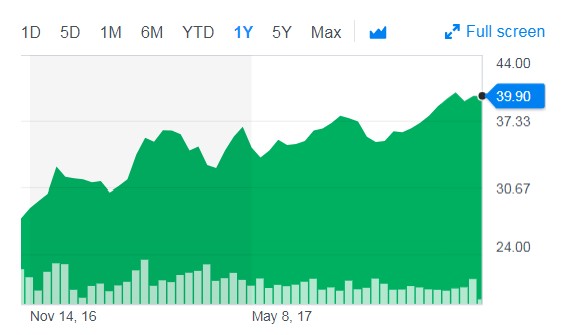
1-year chart for CBRE
+++++++++++++++++++++++++++++++++++++++++++++++++++
Tesla (TSLA: $306, down 5%)
Tesla reported revenue of $3.0 billion versus $2.3 billion a year ago. EPS was -$2.92 versus +$0.71 a year ago. Revenue barely beat expectations but earnings were much worse than expected. Ouch!
Tesla is one of the most closely watched tech companies in the world, where its zero-emissions vehicles resonate with environmental sensibilities. But with that scrutiny has come a great deal of criticism over labor issues in its plant, along with customer complaints about materials and workmanship, and frequent production delays with all of its vehicles.
Analysts were quick to jump on the per-share losses and problems getting the entry-level Model 3 sedan to market. Though Tesla is promising more Model 3 production in 2018, 2017 has been a miss to this point in terms of model production. Of note is Tesla pointing to difficulties in producing the battery packs at the Gigafactory for the vehicle. On a brighter note, Model S and Model X demand still seems to be doing well, but the fact remains that Tesla is still burning cash and needs to right the ship with Model 3 in order to succeed.
BMR Take: Tesla is set to lose over $3 per share this year. But the 2020 consensus forecast is for great than $11. Somewhere here we expect a major swing to profitability. With a brand that stands for innovation, we can see Tesla emerging to become a cherished stock once the profits start rolling in. Speculative? You bet. But we love that buy Musk.
+++++++++++++++++++++++++++++++++++++++++++++++++++
Apple (AAPL: $173, up 6%)
Apple delivered $53 billion of revenue versus $47 billion a year ago. EPS was $2.07 versus $1.67 a year ago. It was a really good quarter for Apple.
In a quarter which many thought would be more subpar due to delayed shipments of the iPhone X and due to many reports indicating weaker than expected sales of the iPhone 8, Apple delivered results that were much better than expected, and it is guiding for a generally strong next quarter as well.
iPhone sales of 47 million grew by 3% from a year ago and were slightly above consensus of 46 million. We saw strong and accelerating growth in services (up 24% from last year). Apple’s Services revenue of $8.5 billion is heading towards $50 billion annually. We observed good growth in China and strong growth in emerging markets (with India more than doubling). iPhone X is about to ramp in sales helping the average selling price. The iPhone X, with a price of $999 to $1,149 (vs. Apple’s blended price of $618 last quarter) becomes available this week, and we expect iPhone average selling price to increase to over $700. We could go on and on.
BMR Take: We reiterate our strong enthusiasm for Apple that we had before the quarter now that the results are in. EPS was $9.20+ this year and heading to greater than $11 next year. With cash and equivalents now totaling $270 billion, wow, this company remains as solid as a rock!
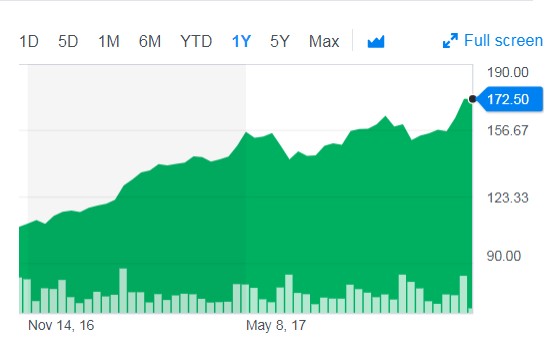
1-year Chart for Apple
+++++++++++++++++++++++++++++++++++++++++++++++++++
+++++++++++++++++++++++++++++++++++++++++++++++++++
Upcoming Economic News
JOLTS Job Openings
Tuesday, November 7th, 10:00 AM, Eastern
Period: September
Consensus: 6,082,000
Prior: 6,082,000
Initial Claims
Thursday, November 9th, 8:30 AM
Period: Week of 11/4
Consensus: 230,000
Prior: 229,000
Michigan Sentiment (Preliminary)
Friday, November 10th, 10:00 AM
Period: October
Consensus: 100.2
Prior: 100.7
+++++++++++++++++++++++++++++++++++++++++++++++++++
Eli Lilly ($87, flat)
Solidity Personified
If you want solidity and stability you can get it here. Eli Lilly and Company was founded in 1876 and is headquartered in Indianapolis. The company is worth $87 billion, pays a 2.5% dividend and has moved from $20 in 2008 to its current level, in a pretty straight line. Revenues are solid too. Revenues had a nice bump from the $20 billion in 2015 to the 2016 total of $21.2 billion. This year looks like $23 billion is in the bag. Slow and steady. And profitable. $2.7 billion ($3.00 a share) to the bottom line after taxes in 2016 up from $2.4 billion in 2015. Not counting some non-recurring charges this year, the company should hit north of $4 billion before tax and about the same as last year in 2017. Solid.
The company is in two primary areas of pharmaceuticals: Human Pharmaceutical Products and Animal Health Products. The company offers products to treat diabetes; osteoporosis in postmenopausal women and men; human growth hormone deficiency; and testosterone deficiency. It also provides neuroscience products for the treatment of depressive disorders, diabetic peripheral neuropathic pain, anxiety disorders, fibromyalgia, and chronic musculoskeletal pain; schizophrenia; attention-deficit hyperactivity disorders; depressive, obsessive-compulsive, bulimia nervosa, and panic disorders; and adult brain imaging. In addition, the company offers products to treat non-small cell lung, colorectal, head and neck, pancreatic, metastatic breast, ovarian, bladder, and metastatic gastric cancers, as well as malignant pleural mesothelioma; and cardiovascular products to treat erectile dysfunction and benign prostatic hyperplasia; and migraine headaches. And this is just a small part of what they do for humans. They do similar things for animals and are noted for their science and expertise. Plus they have collaboration agreements with Daiichi Sankyo, Incyte, Pfizer, AstraZeneca, William Sansum Diabetes Center, Purdue University, and Nektar Therapeutics. Truly a worldwide leader in big pharma.
BMR Take: This amazing company should hit another $3 a share in 2017, giving the firm a PE of under 28. We expect the company to hit the $4 level in a few years and wouldn’t be surprised to see the stock in the 90s within two years. Solid as a rock.
+++++++++++++++++++++++++++++++++++++++++++++++++++
Amazon’s Jeff Bezos Sells Shares
Jeff Bezos sold 1 million shares of Amazon (AMZN: $1112, up 1%) this week for $1.1 billion. The sale represented 1.3% of his holding and leaves Bezos with a 16.4% stake in the company. The world’s richest man said in April he would sell $1 billion a year in Amazon stock to fund Blue Origin, the rocket company he owns to explore Mars and outer space. He had already sold another batch of a million shares in May. So that’s 2 million shares in our book.
+++++++++++++++++++++++++++++++++++++++++++++++++++
From: Ron Shepro [ronshepro@xxxzz.com]
Sent: Tuesday, October 24, 2017 8:50 PM
To: 'The Bull Market Report'
Subject: RE: EARNINGS PREVIEW FOR THE WEEK AHEAD
Hi Todd – I Just wanted to say thanks for your good work. I find it interesting that Paul Mxxxxxx (a money manager), comes up with new recommendations that you had ages ago. Latest one being Splunk (SPLK: $68, up 1.5%). Looks like you are ahead of the legends. There are more, but I am sure you are aware of them. You also made the call on Paypal earlier.
Our Answer: Thanks, Ron. I think we have a fine little financial newsletter here. We just need another 5000 subscribers! We’ve had some nice wins with Nutanix, Square, PayPal as you mentioned, and CBRE (CBG) – the quiet real estate company.) And of course Splunk, which we added at $46.
Good Investing,
Todd Shaver
+++++++++++++++++++++++++++++++++++++++++++++++++++
A Word from Gary Jefferson
Jefferson Financial Group
First Vice-President, Investments
UBS Financial Services
After the week before "melt-up", we noticed that the fear factor kicked up another notch. This past weekend, media pundits again started making comparisons to the March 2000 crash. Back then it was referred to as either the dot.Com bubble or the Tech Wreck. But there are some differences that should be noted. In 2000, the PE of the S&P 500 was about 30X, and many tech stocks had PE's in the triple digits or no PE's at all because they didn't even have revenues yet, much less earnings. Today's trailing PE is estimated to end the year somewhere in the area of 18X. This is higher than average, but not nearly as frothy as the 2000 period.
The question now becomes, "With this being the second longest and second biggest bull market in history, and with valuations as high as they are, can stocks keep climbing?" The easy answer is "yes", and the reasons are readily apparent. We have a strong economy and it is getting stronger. It is not just the US economy either – most major world economies such as Europe, Japan and China are also experiencing solid economic growth. Thus, we are part of a worldwide bull market, which makes it much easier on the US market.
More importantly, earnings are still getting stronger rather than leveling off or declining. According to Thomson Reuters, earnings growth for the third quarter is now 6.7%. Of the companies that have posted earnings, 74% have topped expectations - compared to the 72% average that beat expectations over the past four quarters. Good earnings growth is the key reason stocks can and should continue to climb higher. And, any tax reform will make it all the more likely that earnings growth will continue to be robust for the next year or two.
We also have history on our side. In the year after reaching a new peak, the S&P 500 has had positive growth 72% of the time. (Bloomberg) We would, however, caution investors that the bar is much higher today than it was over the past several years, and therefore the pace of growth may not be as rapid or the returns as high as we have experienced over recent years. In our experience, "euphoria" has never been a part of any successful investment strategy.
+++++++++++++++++++++++++++++++++++++++++++++++++++
The High Yield Corner
By Michael Foster
Obviously, the biggest news of the week for high yield investors came from Omega Healthcare Investors ($28), which fell massively on an earnings and revenue miss. The stock immediately fell over 3% on the news and has been falling further, causing a stock that was flat year-to-date to suddenly be down 7%. Panic selling also means the dividend yield has risen to 9.2% - a level we haven’t seen since 2011. Note that the company paid out a 65 cent dividend on Monday. So it really wasn’t as bad as it seemed.
This sounds like a time to sell, but it really isn’t. When we take a deeper look at the earnings result, we quickly see why.
The company reported a 2.2% decline in revenues on a year-over-year basis and a near 5% decline in FFO per share for the same period. This was all due to a $6.3 million loss in FFO, which was itself the result of late rent payments from the company’s biggest tenant, Orianna Health Systems. The story is pretty complicated, but it means that Omega Healthcare and Orianna are going to need to renegotiate their current arrangement, which could mean Omega cutting their rent down (this would be the best case), or an outright bankruptcy that results in Omega fighting for their back payments in court (the worst case).
If they are able to reduce rents, it could mean Orianna will start paying their bills again and FFO will start to trend upwards. And even if we are stuck with a bankruptcy proceeding, Omega will still get some money back, but predicting how much and when would be impossible (anyone who has ever been through America’s civil court system knows rulings can get pretty bizarre).
So what we are facing now with the stock, following Omega’s write-down of Orianna, is the worst situation. There is upside in either the best or worst case, but the amount of upside will depend on which route they go and how fast a deal is made. For now, Omega Healthcare’s dividend coverage has taken a hit - there’s no denying that. With the decline in earnings, the dividend is now only covered by… 130%.
That’s right. What we are looking at right now is a REIT yielding 9% that still has 130% dividend coverage. That’s at the bottom end of what’s ideal for REITs in our mind (regular readers know we look for 130% dividend coverage for REITs as the starting point for a safe yield), and that’s more than compensated by the 9% dividend yield.
It also means that a dividend cut is really unlikely to happen anytime soon. Omega Healthcare has established a track record of penny-per-quarter dividend increases, and if it continues that trend for the next year, its dividend coverage will fall to 128% by the end of next year, assuming no increase in earnings.
Do we think Omega will be able to continue its penny-per-quarter dividend increases forever? No. But we do think it can continue this trend for the next five years at the very least. But with the latest price drop, the market is pricing in the company stopping these increases much sooner. The market will probably realize the error of its ways pretty soon. Maybe next quarter when Omega shows stability or improvements, the market will buy in again. Maybe it’ll take a few quarters until Omega and Orianna reach a deal and the market realizes their fears were overblown.
Either way, now’s a great time to buy a 9% yielding stock with 130% dividend coverage.
Let’s move on to other news - there was a lot last week.
Digital Realty (DLR: $119, up 2%) announced another dividend (the December one) at a 93 cent per share distribution, in-line with the previous payout. This is not good. As we’ve written about frequently, we want Digital Realty to increase distributions because of their exploding FFO, which is far ahead of the dividend. But we understand why the company sees no need to give shareholders a pay raise quite yet - the stock has rebounded about 3% off its post-earnings low, so demand for the stock is definitely still there.
That, by the way, is why investors should continue to hold Digital Realty. There is tremendous value here, and the recent price dip was a buying opportunity - not unlike the more recent dip in Omega.
In other earnings results, Apollo Commercial Real Estate Finance (ARI: $18.35) saw NII jump 34% from a year ago, above expectations. This is pretty impressive, because expectations have heated up for this specialty mortgage REIT, and its stock price has soared in recent months accordingly. But the company is not running out of deals to make, with $425 million in new investments in the recent quarter, bringing the annualized deal flow to $1 billion by the end of the year. Also, last quarter’s dividend coverage ratio was a nice 117%. Keep in mind that coverage ratio thresholds are different for mREITs compared to property REITs. Because of their use of bond spreads to make a profit and their lack of dividend growth, lower coverage ratios are to be expected. And from a mREIT perspective, 117% is nice.
The stock got a slight price bump after the results, but nothing major. That was no surprise - the market has had high expectations for this firm for a while.
Finally, another REIT reported earnings last week: Government Properties (GOV: $18.43, up 2%), which beat on revenues thanks to a near 9% year-over-year increase, but FFO was a penny shy of expectations. That’s really too small of a miss to matter, especially since the market has discounted poor earnings for months now. So the stock actually went up over 1% following the release and over 2% for the week. We still need to see dividend coverage improve, but there is fundamental stability which indicates this remains an attractive 9% yielder.
Good Investing,
Todd Shaver, Founder and CEO
The Bull Market Report
Since 1998