February 12, 2017
by Todd Shaver | Feb 12, 2017 | Weekly Newsletter 7pm Sunday
The Week Ahead
“Trump Mulls New Order On Travel” was the weekend’s front page Wall Street Journal headline. Everyone can’t seem to look away from what is happening in the oval office. Big name after big name investor keeps trying to make a call on the future from what is happening in Washington, only to be proved wrong. The latest is the $30 billion money manager Seth Klarman of Baupost. He says to look out for a negative year from equities due to elevated volatility from Trump’s leadership style; a major pick-up in inflation; problems from rising rates to the US debt; and slower global growth from protectionist trade policies.
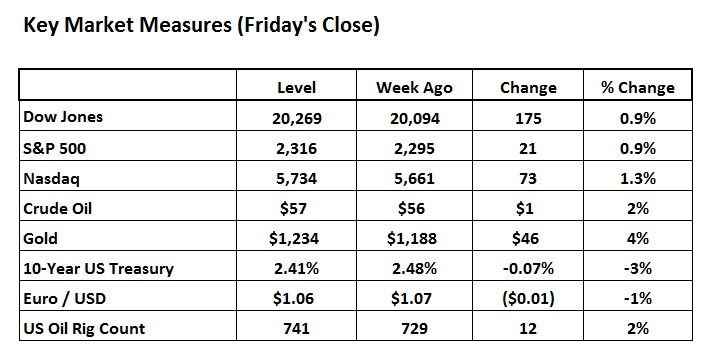
The S&P and Dow closed at a record high for a second straight session, while the Nasdaq extended its streak of record closes to a fourth day.
With more than 70% the S&P 500 having reported results, fourth-quarter earnings are on track to have climbed 8%, which would be the best performance since the third quarter of 2014. The S&P 500 posted 48 new 52-week highs and no new lows; the Nasdaq Composite recorded 150 new highs and 22 new lows.
The reality is there is always a Bull Market somewhere and right now it is in the United States. This week we provide some insights on our latest thinking for Twilio, the iShares Energy Sector ETF, CBRE Group, the Nuveen Municipal fund, and Facebook.
Highlights From The Past Week
Leadership Turnover At The Fed. This week Dan Tarullo unexpectedly announced that he is resigning in early April, just days after the Fed's general counsel Alvarez also announced that he is departing the Fed. What makes Tarullo's resignation particularly notable is that he has been the Fed's "regulatory point man" since 2009, suggesting some regulatory friction has emerged. In light of Trump's vow to crush Wall Street regulations, one can see why Tarullo thought his services are no longer necessary. His brief resignation letter to Fed Chairwoman Janet Yellen didn’t give a reason for his departure. He said he has been privileged to serve at the Fed for eight years. The letter said his resignation will take effect “on or about” April 5. We wonder just what is in store for Yellen and other members of the Fed. This is such a critical juncture for interest rates.
Prime Minister Abe Visits The USA. With a hug and a handshake, President Donald Trump and Japanese Prime Minister Shinzo Abe opened a new chapter in U.S.-Japan relations on Friday with Trump abruptly setting aside campaign pledges to force Tokyo to pay more for U.S. defense aid. Trump avoided repeating harsh campaign rhetoric that accused Japan of taking advantage of U.S. security aid and stealing American jobs. "We are committed to the security of Japan and all areas under its administrative control and to further strengthening our very crucial alliance," Trump said. "The bond between our two nations and the friendship between our two peoples runs very, very deep. This administration is committed to bringing those ties even closer," he added.
BMR Companies and Commentary
Twilio (TWLO: $32, +2% for the week*)
*All prices in The Bull Market Report are for the week
We wrote early this week about Twilio’s encouraging quarter. We wanted to circle back and follow up with more detail here about what investors are worried about. Sometimes when you ask the hard questions and go searching for the answers, you find out that the risks are less of a concern than one fears on the surface.
Investors’ worries on this stock generally fall into several categories: 1) gross margins; 2) eventual competition from AWS**; 3) pricing pressure from current competitors; and 4) the lock-up expiration. Let’s hit each one.
**Amazon Web Services
Twilio’s gross margin of 59% this quarter was above consensus of 56%. When asked about how the company plans to get from here to its long-term target 60-65%, CFO Lee Kirkpatrick pointed out that Twilio has “significant levers” that it can pull. The first is product mix. Management described the second lever as efficiencies gained through scale – this includes driving better deals with carriers and passing less of the savings to customers.
Another risk for investors to keep an eye on longer term is the potential for competition from AWS. AWS is not a competitor today, but Amazon CEO Jeff Bezos is known to covet large markets and the communications services market is substantial. In fact, Amazon and Twilio are currently working together. The Amazon relationship seems to be strong and is multifaceted. Note that Twilio runs entirely on AWS. Second, Twilio is already helping AWS with mobile products. Third, CEO Jeff Lawson was on stage at AWS re:Invent in November and commented, “We’re really excited to announce some upcoming collaboration with AWS soon.” Last, Rick Dalzell (Amazon’s former SVP of Worldwide Architecture and Platform Software and CIO) has been a member of Twilio’s board of directors since 2014.
Investors are also concerned Twilio may face pricing pressure from its current competitors, which include Nexmo (Vonage acquired them in May) and Plivo, among others. Twilio’s services are generally priced at a premium to these competitors. For example, for outbound SMS messages, Twilio charges $0.0075/message, compared to $0.0061 for Nexmo and $0.0035 for Plivo. Our view is that Twilio is generally able to charge a premium because it: 1) has significant mindshare within the developer community; 2) offers a high-quality, reliable solution; and 3) continues to release new features and software products. Mr. Lawson indicated on the earnings call that he seeks to “build a broad platform that is widely applicable, priced aggressively, and designed to enable developers’ creativity to flourish across the widest set of use cases imaginable.”
The availability of additional shares for sale in the market could adversely affect Twilio’s stock price. Twilio went public in June, selling 10 million shares at $15. Twilio completed a follow-on offering in October selling 7 million shares at $40. Roughly 30 million shares cleared lock-up restrictions in December and another 36 million shares were set to clear lock-up restrictions on January 19th. However, roughly 31M of those shares were subject to the company’s black-out period for insiders. Our understanding is these shares will clear the restricted period this Friday. Some of the largest shareholders of Twilio include Bessemer Venture Partners, Union Square Ventures, and Redpoint Ventures, which owned 17M, 10M, and 3M shares immediately after the follow-on offering, respectively.
BMR Take: Okay, we might see some pressure from the lock-up expiration that happened on Friday, but this is normal Wall Street procedure. Besides, we are sure that many of these owners will want to hold on for the coming years of growth. Furthermore, the business is building momentum making the stock attractively priced at this level.
CBRE Group (CBG: $34, +8%)
What a week. CBRE ended 2016 on a high note. For the year, revenue was $13.1 billion, up 20%, and EPS was $2.30, up 12%. CBRE recorded double-digit earnings growth for the fourth quarter and the year, with excellent performance in all three regional services businesses.
These results are particularly noteworthy in a year of generally softer market-wide property sales volumes, virtually no carried interest income, and tepid global economic growth. In fact, the company’s revenue and earnings performance set new record highs in 2016.
In addition to achieving record financial performance, very importantly, CBRE continued to advance its strategy. This strategy centers around delivering exceptional outcomes to clients. The company’s people and the operating platform that supports them are the key elements to delivering these outcomes. Both advanced materially in 2016, and the impact is showing up on the company’s results.
CBRE is in a stronger competitive position than ever. A good example of the strategic gains made in 2016 is the work done integrating the Global Workplace Solutions acquisition, one of the largest and quite possibly the most complex in the history of the real estate sector. This effort involved massive client facing, and line of business and back-office transformations. The result of having largely completed this challenging work is that the company’s occupier outsourcing business is much larger, much more capable of producing strong client outcomes, and well-positioned for strong long-term growth.
The company is now serving clients with employees on the ground in over 100 countries. What a big business. CBRE remains riveted on sustaining progress with particular focus on areas such as technology and data analytics where it can capitalize on the expertise and vast amounts of information it possesses. For example, last month CBRE acquired Floored, a leading software-as-a-service platform that produces scalable, interactive 3D visualization technologies for commercial real estate. Clients should expect continued visible advancements from CBRE in the technology area.
BMR Take: CBRE’s nickname is the “Bentley” of the real estate sector and in 2016 the business lived up to the expectations. The key takeaway from the earnings call was that no matter the interest rate environment, performance should be rock solid in 2017.
iShares Energy Sector ETF (IYE: $40, -1%)
The largest holding of the ETF at 22% is Exxon Mobil (XOM: $83, $340 billion market cap). The second largest holding is Chevron (CVX: $113, $210 billion market cap) at 14%. With the most recent earnings reports of these two behemoths of the Energy sector still being digested by the markets, we wanted to weigh in.
Exxon delivered its first increase in revenue after nine quarters of declines. The company provided a reassuring long term outlook. Global energy demand is expected to grow about 25% by 2040. Oil and natural gas is expected to meet about 60% of global energy demand by then. Attention quickly turned to 2017 capital expenditure guidance, with several suggesting the plans may be a bit aggressive at an early stage in the recovery, while others believe the increase shows increased management confidence in the recovery and the company's cash cycle. Everyone is much anticipating the expected detailed presentation on spending during the March analyst day meeting.
Chevron returned to profitability on Friday, reporting a huge quarterly earnings beat as the company continued to cut costs amid a protracted oil price rout now entering its third year. The company made progress toward its goals of lowering the cash breakeven in the upstream business and getting cash flow balanced. Capital spending and operating expenses have been reduced by over $10 billion since September 2015 as a result of a series of deliberate actions taken by the company.
BMR Take: The Energy sector recovery is happening. You can see in the rig count numbers and the earnings results out of both industry titans Exxon and Chevron. The IYE ETF gives you broad diversified exposure to the whole sector. There is a lot more room to run here for this stock.
Nuveen Municipal Credit Income Fund (NVG: $14.62, flat)
The AAA municipal curve steepened over the week outpacing the sell-off in Treasuries. 2 yr, 10 yr and 30 yr AAA municipal yields increased 2 bp, 17 bp, and 15 bp respectively over the past week. Supply dwindled at the end of January as this week's supply is projected to be just under $7 billion after $9 billion last week.
Meanwhile, the upcoming 30-day supply is at $11 billion, near the lowest level in a month and below the $12 billion 1 year average. On the demand front, mutual funds saw their first weekly inflow since the election. Mutual funds saw $1.6 billion of inflows for the week ending January 11th after 13 weeks of outflows. The outflow cycle was relatively short from a historical perspective as the last 3 cycles of mutual fund outflows averaged 24 weeks while this current outflow cycle stands at just 13 weeks. However, there is more room for outflows as new taxes are debated and uncertainty looms over the municipal market.
On the macro front, the Treasury curve steepened over the past week as 30 year rates increased 6 bp while the 2 yr was unchanged due to elevated CPI and positive NY Empire Manufacturing Survey buoyed rates. After two months of gains following the November post-election optimism, we are not yet seeing the underlying economic data improve to match the optimistic expectations. The Fed’s Empire Manufacturing Survey moved lower highlighting no spike in manufacturing business conditions. Hard data like industrial production remains lackluster. The decline in forward looking indicators such as new orders further suggests that underlying activity in the factory sector is not building any momentum. Trump-related euphoria might begin to dissipate.
All eyes remain on underfunded pension risks. Connecticut may be the next shoe to drop. The chief investment officer of the $30 billion Connecticut Retirement Plans, Hartford, resigned last week. We see a back story here that is troublesome.
BMR Take: The Municipal bond sector still represents a safe haven for those of you more focused on protecting your principal right now as opposed to trying to make a fortune. Nuveen Municipal Credit Income Fund is a solid fund for the job.
Facebook (FB: $134, +3%)
The controversy is nearing an end as Facebook committed to an audit of ad metrics by a media watchdog. Facebook agreed to submit to audits by the media industry’s measurement watchdog, the Media Rating Council, helping address concerns among some advertisers who had become skeptical of the social network’s metrics.
Facebook had come under fire recently after a series of missteps in which it disclosed several mistakes in reporting data to partners and advertisers. The company conducted its own review of practices and vowed to be more transparent about errors in the future. According to plans for the next year laid out in a statement Friday, Facebook said it aims to release more detailed information, such as metrics on how long users view an ad and how much of it was visible on the screen.
“We want to provide transparency, choice and accountability,” Facebook said. “Transparency through verified data that shows which campaigns drive measurable results, choice in how advertisers run campaigns across our platforms, and accountability through an audit and third-party verification.” Representatives from Facebook gave a presentation Thursday in Washington to the board of the Association of National Advertisers, a trade group for marketers. The meeting attendees were particularly interested in the promise for more transparency and an audit process.
BMR Take: Investors have been waiting for the advertising reporting issues to go away. Well, here we are - the event is happening. This new audit should address and resolve the issue. No more overhang for the stock from this. Having an independent organization validate the metrics Facebook puts out makes the data more trustworthy and provides advertisers with the ability to compare results across ad platforms. Now we can go back to focusing on the fundamentals where Facebook is firing on all cylinders. We are big believers in Facebook as it hovers near its all-time high of $135.50. And despite all of the controversy as discussed above, the stock stays within a whisker of its all-time high.
Upcoming Economic News
TUESDAY, FEBRUARY 14
Producer Price Index – January
Time: 8:30 am
Forecast: 0.2% overall, 0.2% core
The January Producer Price Index is forecast to report steady gains for the third straight month. The recent run-up in the index brought the yearly gain to 1.6% in December, the fastest rate in 27 months. Yet businesses should be well-equipped to handle somewhat quicker cost growth after the PPI rose only 0.9% annualized over the past five years.
WEDNESDAY, FEBRUARY 15
Consumer Price Index – January
Time: 8:30 am Forecast: 0.3% overall, 0.2% core
Higher gasoline costs can lead the Consumer Price Index to expand for the sixth straight month in January. Those fuel price gains have joined with rising housing costs to lift the broad CPI by the 30- month high rate of 2.1% yearly to December. Yet with crude oil prices holding flat last month, the significant feed-through to higher consumer prices may not accelerate substantially after the first quarter.
Retail Sales – January
Time: 8:30 am
Forecast: 0.1% overall, 0.4% ex auto
The drop in Auto sales may produce a lackluster overall result for January Retail sales. Auto sales eked out only a 0.7% year-over-year gain in the three months ending January, removing a once strong contributor to retail results. Sales outside of autos and gasoline managed a stronger if not overly robust 3.6% yearly gain in the fourth quarter, aided by rapid growth in online sales.
Industrial Production & Capacity Utilization – January
Time: 9:15 am
Forecast: 0.0% industrial production, 75.4% capacity utilization
Moderating Utility sector output can leave industrial production unchanged in January. December’s 6.6% gain in utility output was the largest monthly advance in 27 years. Meanwhile, manufacturing is pushing toward more sustained growth, rising 0.2% yearly to December for the first annual gain in six months.
NAHB Housing Market Index – February
Time: 10:00 am
Forecast: 68
Homebuilder confidence is likely to remain elevated in February, keying off especially strong expectations for future sales. The index of projected sales was at 76 in January, well above the historical average of 57. Seasonally warm weather is giving a near-term boost to building, with the 36,000 added construction jobs in January representing the most in 10 months.
Business Inventories – December
Time: 10:00 am
Forecast: 0.4%
Business inventories are expected to expand strongly for the second straight month in December. Inventories added 1.7% to the overall gain in fourth quarter GDP, the largest such positive contribution in 10 quarters. The inventories-to-sales ratio is edging lower after hitting the post-recession high last March, giving businesses reason to boost output.
THURSDAY, FEBRUARY 16
Housing Starts & Building Permits – January
Time: 8:30 am
Forecast: 1.23 million starts, 1.23 million permits
Recent gains in building permits give Homebuilding activity an upward bias in the near future. Permits rose 20% annualized in the fourth quarter, undoing the weak levels seen early in 2016. That raises the prospects that 2017’s total starts can achieve the projection of 8% yearly growth after almost always falling short of expectations over the past decade.
FRIDAY, FEBRUARY 17
Leading Economic Indicators Index – January
Time: 10:00 am
Forecast: 0.5%
The Leading Economic Indicators Index is anticipated to equal December’s strong gain thanks in part to falling unemployment insurance claims and a projected increase in building permits. Multi-decade lows in unemployment insurance claims point to labor market tightness where firms are extremely reluctant to cut staff. That condition naturally points to continued hiring gains and potential wage increases.
More On Stocks We Follow
Opko Health Update (OPK: $8.22, down 4%) Here is a typical report from a typical day in the life of Opko CEO Philip Frost: “CEO Philip Frost bought 10,000 shares of the business's stock in a transaction on Monday, January 30th. The shares were acquired at an average price of $8.49 per share, with a total value of $85,000. Following the transaction, the chief executive officer now directly owns 3,069,000 shares of the company's stock, valued at $26,055,000. The acquisition was disclosed in a document filed with the Securities & Exchange Commission.”
Here is another: “Opko Health CEO Phillip Frost acquired 12,000 shares of the business's stock in a transaction dated Friday, January 27th.”
BMR Take: This guy knows something we don’t know. Have you read the article in Forbes about him yet? We published the url twice now. (If you haven’t read it and would like to, please write us at Info@BullMarket.com) Despite these purchases the stock remains weak. We believe in this man and this company. We would buy some here, buy some at $7 if it goes lower, and we would buy some every dollar higher as it moves towards $15 again.
A Word from Gary Jefferson
Jefferson Financial Group
First Vice-President, Investments
UBS Financial Services, Inc.
According to Thomson Reuters, 72% of the S&P 500 companies that have already reported have beaten earnings estimates. Based on the current reports and estimates, profit growth looks to be around 7% for the fourth quarter - its fastest pace in two years. That's good news and guidance for 2017 earnings seem to indicate there is more of this to come.
Prior UBS predictions as to what Trump growth policies could add to overall earnings growth estimates: as much as 15% over the next three years. Gains follow earnings, and assuming the 15% is equally divided over the three years, estimates could reasonably be revised upwards to gains hitting around 12% at yearend. If the economy does get jump-started by the repatriation of cash overseas, deregulation and infrastructure stimulus, we could see far more than a 5% rise for the Dow and S&P 500. Even if this happens, however, it should still beat bonds on a total return basis.
On the flip side, fund managers are holding the least cash in history. As of the end of December, mutual fund managers had 3% of their assets invested in the most liquid instruments that are readily exchanged for cash. That's the smallest cash cushion they've ever had, and with the increase in short-term interest rates, their "cash deficit" is now the most extreme since 2007.
Regardless of how good earnings are, money has to come from somewhere in order to buy stocks and drive prices higher. If it comes from selling one stock to buy another, we may be facing big sector rotation moves, a scenario of haves and have nots, and a lot more volatility than we would like to see. Fund managers have no alternative to selling stocks to cover redemptions when their cash positions are too low. This could be an interesting twist to an otherwise very positive outlook.
The World of the Supernova
This is Tom Friedman’s name for the Cloud. We don’t generally plug books here at The Bull Market Report, but if you want to know what the world of Technology is doing right now, the book to read is his new book, Thank You for Being Late. What the internet and Moore’s Law* is doing in this world of ours is astounding. Here’s some food for thought, a quote from Tom Goodwin of Havas Media in March, 2015: “Uber, the world’s largest taxi company, owns no vehicles. Facebook, the world’s most popular media owner, creates no content. Alibaba, the most valuable retailer, has no inventory. And Airbnb, the world’s largest accommodation provider, owns no real estate. Something interesting is happening.” Friedman goes on to say: “In the age of the supernova, there has never been a better time to be a maker – anywhere.”
*Moore’s Law – The power of the microprocessor doubles every two years. Since 1971.
BMR Take: Why are we printing this here? We want you to THINK about the Technology companies that are driving this growth. The Facebooks, the Apples, the Googles, the Amazons, the Microsofts. These companies are all in our High Technology portfolio and they will continue to lead and drive the growth and innovation in the world in the next decade(s).
What the Street Thinks of Athenahealth (ATHN: $114, up 5%)
Consensus Ratings: 1 Sell, 8 Hold, 12 Buy
Consensus Price Target: $135
Some Ratings from the Street:
2/6/2017 KeyCorp Target $140
2/7/2017 Piper Jaffray Target $162
2/7/2017 Berenberg Bank Target $143
2/6/2017 Dougherty Target $143
2/4/2017 Oppenheimer Holdings Target $142
2/3/2017 Robert W. Baird Target $155
1/31/2017 Cantor Fitzgerald Target $135
1/4/2017 Pacific Crest Target $140
What the Street Thinks of United Parcel Service (UPS: $107, flat)
Ratings Rating: 1 Sell, 8 Hold, 5 Buy
Consensus Price Target: $114
Some Ratings from the Street:
2/8/2017 Aegis Target $120
2/7/2017 Loop Capital Target $124
2/5/2017 Credit Suisse Group Target $110
2/1/2017 Barclays PLC Target $115
2/1/2017 BMO Capital Markets Target $115
A Letter from a Subscriber
From: Richard Reed [reed99277@xxxx.com]
Sent: Friday, February 10, 2017
To: Info at The Bull Market Report
Hello Todd,
I owned Annaly years ago when I subscribed to your service the first time. Three questions about it. First, is this a good entry point? The current price is near the 52 week high. Second, how safe is the dividend? Last, based on your email statements you feel that rising rates may not necessarily impact the stock price negatively. If rates go up gradually over the next few years do you feel the stock price won't be negatively impacted?
Richard Reed
Our Answer:
Hi Richard –
Annaly Capital Management (NLY: $10.52, up 2%, 11.5% dividend) – The stock could be headed to $11 or $10; no one can really say. What we do know is that they have weathered bull markets and bear; and high interest rate environments and low for the last 20 years. They are worth almost $11 billion, listed on the NYSE.
Interest rates – I personally feel that the bull market in bonds is NOT over (meaning rates will continue to go down.) Yes, they are up big since November, but they have actually been declining since December 15th, almost two months. So predicting interest rates is of course impossible.
Their dividend varies each quarter. Up a little; down a little. Management knows what they are doing and unless interest rates jump 100 basis points in a month or two, which is highly unlikely, Annaly should be able to continue to churn out their high dividends each month.
Todd Shaver
The Bull Market Report
PS: Note that we featured Annaly back in the late 1990s when it was paying 18% a year. It’s one of our favorites.
The High Yield Corner
By Michael Foster
Special to The Bull Market Report
This week was another quiet one for the markets, and high yield assets saw minimal movements with a couple of important exceptions. The biggest exception is the BDC sector, which was driven higher by some good earnings results. The UBS BDC ETF (BDCS: $23, up 2%) was one of the biggest gainers among high yield ETFs this week, thanks to constituent firms like Pennant Park Floating Rate Capital (PFLT: $14.00) and Medley Capital Corporation (MCC: $8.00) reporting solid earnings. Medley alone soared over 4% by the end of the week despite a 1% decrease to NAV that has become expected for BDCs. Also baked into valuations was a 16% decrease in net investment income per share - we’re now sitting at 19 cents for the company. Yet Medley’s dividend is 22 cents per share, so this quarter the company under-earned its payout by over 13%. That’s a pretty big miss.
Medley Capital is just one example of a problematic industry that requires more selective investing and a lot more due diligence than was necessary in the past for BDCs. These are effectively funds that leverage assets that are then lent to companies picked by management. In such a situation, debt quality is critical. Yet many of these companies have no real credit rating to speak of - and many of them are tiny, with revenues below $100 million per year. BDCs comprise dozens, sometimes over 100 of such companies. To really determine the value of a BDC and its relative future strength, you would need to look into the revenue trends for each of these companies and the condition of their existing capital. No small task, and a lot of time to invest for what should ultimately remain a very small portion of any one investor’s portfolio.
And that’s why we’re currently on the BDC sidelines, despite some strength in the broader index. The problem is this: we’re seeing net investment income per share drop for most of these companies, with only the best and brightest outperforming. In the past, such as in 2013, the market viciously punished these sorts of declines, but we’re not seeing that punishment yet. There is a clear disconnect between fundamentals and the value that the market is seeing in the BDC space. That’s enough to make anyone cautious, and has left us clearly on the sidelines until we can get some more coherent and consistent income growth. Especially since income growth is easy to find in many other pockets of the market.
Take, for instance, PIMCO Dynamic Income Fund (PDI: $29, up 1%), which has seen its NAV grow at an annualized 17% since its IPO. The fund has already appreciated by over 2% in 2017, and we’re not even at Valentine’s Day. The feat this fund has accomplished is really incredible - so much so that many people fundamentally misunderstand and mistrust how this fund makes money.
So how do they do it? The rather simple answer is asset selection. By combining undervalued corporate bonds with a variety of mortgage-backed securities, the Dynamic Income Fund has been able to sustainably return double-digit yields to investors without depleting capital. The market has rewarded this outperformance with a premium to NAV - something that one must always watch carefully, especially in a world as volatile as closed-end funds. And PDI’s premium is growing. In fact, PDI’s 10% premium is almost at the highest level we have ever seen for this fund. But there’s no fundamental weakness in this fund and no reason to expect its strong historical performance to stop.
So what is an investor to do? At the moment, we recommend holding, but a rotation of assets from PDI to a similar but better-valued fund may be in order in the future. This is an area worth watching closely and we’ll have ideas for you if things change.
It would be nice to see a similar problem come to the AllianzGI Equity and Convertible Income Fund (NIE: $19.44, up 1%), but this fund’s current 10% discount is pretty much par for the course when we look at its historical discount. Allianz’s fund hasn’t been priced at a premium since 2009, but its discount has frequently dipped below 15% in recent years. The fact that we’re at the upper end of the historical range for the discount indicates that even this unloved but strong performer is getting closer to pricing to perfection. But that doesn’t mean we need to sell the fund. This is a great closed end fund that has given investors a 6% annualized NAV return since inception, and its NAV is even 9% higher than it was at inception - a rare feat for CEFs. Allianz has done a great job of doing, in the convertible and equity sectors, what Pimco has done with its Dynamic Income Fund in the corporate and mortgage-backed bond markets: Make great investments by selective choices, and provide a strong return as a result.
This doesn’t mean we’re recommending holding these funds forever. We are getting closer and closer to a portfolio rotation moment in high yield, which means watching the market weekly is getting more important than ever before.
And the markets are telling us that there’s some exhaustion in the protracted Trump bull rally. Again, you can forget the political controversies surrounding the executive orders; they make great talking points for both sides of the aisle, and they’ve unfortunately made their ways into the editorial pages of the financial press, but none of this has any significant impact on America’s financial or economic future at the moment. The real action is elsewhere, namely in monetary policy and GDP growth. We really need to see changes to the Fed’s monetary policy (or at least a delivered rate hike as promised) or significant changes in the GDP growth rate to drive high yield assets away from their current trendline.
We’re not seeing that, so the indexes are a bit sleepy. The SPDR Barclays High Yield Bond ETF (JNK: $37) and the SPDR Dow Jones REIT ETF (RWR: $94) were flat for the week, with minimal gains in the REIT world offset by a small decline in the Alerian MLP ETF (AMLP: $13.04, down -2%). Meanwhile, there was more sleepy action with the iShares S&P National AMT-Free Municipal Bond Fund (MUB: $108, flat).
This quiet is actually good news for long-term investors. We’ve been inundated with gloom and doom economic forecasting since 2008 - and why not? Plenty of data points look bad, and the Global Financial Crisis is still a recent memory for most of us. And every passing year since the crash urges more pundits and analysts to tell us that we’re “overdue” for a correction or an outright recession. Yet the markets do not see things that way.
At the same time, markets aren’t going crazy. We’re not seeing the heady bubble days of 2006-2007. No one is suggesting there is any “sure thing” in the markets, just like people insisted buying a house was a “sure thing” in 2006. There is a lot of price growth in equities, but no real sign of a runaway market where prices have gone far past fundamentals. Things look even more cautious in the municipal and junk bond markets, where prices still remain below their high point in 2014 and 2015. We are far away from the irrational exuberance that Nobel-winning economist Robert Shiller warned about both before the dotcom bust and before the housing crisis. That means income-seeking investors can still find funds to invest their money and get strong returns.
Unfortunately, such a state of affairs won’t last forever, so investors need to remain aware of the risks in the market. But they don’t need to be in a panic.
Finally, a quick word on one outperformer that bears a bit of particular scrutiny. AstraZeneca (AZN: $29.50, up 6%) continued to have a monstrous bull run after their recent earnings results. Fourth quarter earnings surged 56% and beat expectations by 3 cents at $1.21 per share despite a 13% slide in total revenues. This was driven by a 52% decline in Crestor sales and a 14% decline in Symbicort sales, which was offset by growth in newer drugs like Zoladex. Following the news, Bloomberg published a rumor that the company may sell off its old drug businesses to raise cash that could be applied to new research initiatives.
Our take on all this is clear: AstraZeneca has been a thorn in our high yield portfolio, being the only significant decliner in a portfolio of otherwise sharp outperformers. It was only a matter of time before the company lived up to its potential, and we’re happy to finally see that start to happen. We’re still down slightly from a year ago (excluding dividends.) But the recent turnaround tells us there’s more room for Astra-Zeneca to redeem itself.
Good Investing,
Todd Shaver, Founder, CEO and Editor
The Bull Market Report
February 5, 2017

by Todd Shaver | Feb 5, 2017 | Weekly Newsletter 7pm Sunday
The Week Ahead
“US Stocks Rise On Banks” was the front page of the paper going into the weekend. This highlights continued optimism about the prospects for the economy under the new administration. Specifically, at the moment, the rolling-back of Dodd-Frank is front and center. Can the momentum continue? Will new policies lead to real results? These are questions yet to be answered. But there is certainly a widespread optimism good things can happen.
This week we provide some insights on our latest thinking for Amazon, Facebook, Apple, Google, Athenahealth, Visa, and Blackstone Group.
Highlights From The Past Week
Trump signs order to roll-back Dodd-Frank. President Trump signed an executive order to begin rolling-back Dodd-Frank. The legislation was put in place after the Financial Crisis to crack down on the banking system and help protect the consumer. The Financial sector traded up on the news. Among the targets are rules that protect against predatory lenders, force brokers to lower fees for retirees, and ban proprietary trading. While it will take a while to fully roll back the financial regulations, Wall Street is likely already preparing for a big push into more aggressive business practices. And this latter point is why the market rallies in spite of what many in this country call chaos in the White House. Let’s give it some time. Remember, the checks and balances built into the Constitution may just begin to take effect over the coming months and years.
Japan set to make huge investment in the United States. They are calling it the "Appease Trump" proposal. Japan is putting together a package it says could generate 700,000 U.S. jobs. The five-part package, to be unveiled when Prime Minister Shinzo Abe visits Trump on Friday in Washington, encompasses investments in infrastructure projects such as high-speed trains and cyber security. Apparently, Abe wants to be sure Trump doesn't blow up at Japan again as he did earlier this week when he accused it of devaluing its currency, which hurt Japan’s yen and government bond yields.
Military tensions rise. While there were some hopes President Trump would demilitarize US presence in the Middle East, they are quickly getting dashed with every passing day. Following Trump's announcement last week that he would implement "safe zones" in Syria which would boost US troop presence in the region, US officials announced Friday they had moved a Navy destroyer - the USS Cole, which in 2000 was infamously attacked by terrorists while on dock in Yemen's Aden harbor - off the coast of Yemen to protect waterways from Houthi militia aligned with Iran. Tensions with Iran increased further on Friday when the U.S. Treasury Department announced sanctions on 13 people and 12 entities.
BMR Companies and Commentary
Amazon (AMZN: $810, -3% for the week)
Amazon traded lower on earnings results. The spending outlook took the shine off profit in the holiday quarter that beat analysts’ estimates. Net income was $750 million, or $1.54 a share versus analyst estimates for profit of $1.36 a share. We are happy to see the company bring profits higher but the Street didn’t feel quite the same.
Amazon will spend big in the coming months on warehouses, movies, gadgets and growth into India, renewing investor concerns that CEO Jeff Bezos cares more about generating revenue far in the future than turning a profit now. The company will double-down on its delivery system that gets products quickly into the hands of its customers. It will keep investing in original movies and shows to encourage people to buy Amazon Prime memberships, which makes them loyal shoppers. It will enhance its hot-selling Echo voice-activated personal assistant to gain a presence in homes.* And it will keep pushing into India, which it sees as a vast frontier for e- commerce growth.
*We at The Bull Market Report have one here at home and we love it. We get most of our music from Alexa and query Wikipedia through her probably 10 times a day.
All these initiatives will crimp profits. Operating income in the current quarter will be $250 million to $900 million, less than a year ago even though revenue is forecast to increase as much as 23% to $36 billion. “When you see revenue go up and earnings go down, it spooks people,” said a Wall Street analyst. “It’s called negative leverage and the Street hates it.”
Some Street Ratings on Amazon:
2/3/2017 Wedbush Reiterated Outperform $900.00
2/3/2017 FBN Securities Boost Price Target Buy $925.00
2/3/2017 J P Morgan Chase Price Target Buy $945.00
2/3/2017 Jefferies Group Set Price Target Buy $975.00
2/3/2017 Macquarie Set Price Target Buy $895.00
2/3/2017 Atlantic Securities Set Price Target Buy $960.00
2/3/2017 Stifel Nicolaus Boost Price Target Buy $912.00
2/3/2017 Cantor Fitzgerald Price Target Buy $965.00
2/3/2017 Credit Suisse Price Target Buy $900.00
2/3/2017 RBC Capital Mkts Price Target Buy $900.00
2/3/2017 Mizuho Price Target $905.00
2/3/2017 Evercore ISI Price Target $970.00
2/3/2017 Morgan Stanley Price Target $900.00
2/1/2017 Piper Jaffray Reiterated Rating $900.00
Amazon posted a 55% rise in fourth-quarter profit. But shares of the online retailer dropped in after-hours trading as the company's total sales fell short of analyst expectations. Again, for the quarter, profits rose to $750 million, or $1.54 a share, from $480 million, or $1.00 per share, a year earlier. Sales of $44 billion, up from $36 billion, were below analysts' expectations of $44.7 billion. Sure didn’t miss by much.
BMR Take: Amazon is in growth mode again. We like the long term outlook, but admit heavy investment could bring more near-term volatility. Hold on tight through the turbulence. Amazon is doing all the right things to cause the stock to soar over the long term, including announcing last Monday it would build a $1.5 billion air hub near Cincinnati to accommodate its growing fleet of cargo planes!
More on Amazon:
Amazon has something up its sleeve that may just compete heavily with Google and Facebook. Online advertising. There’s a category in their financials called Other Revenue which jumped 60% in 2016 to $1.3 billion. Still small, but obviously growing rapidly. Amazon has been ramping up its online advertising offerings and could one day be a major threat in the industry. The company said: "Our goals in advertising are to be helpful to customers and enhance their shopping and viewing experiences, mostly with targeted recommendations. We think that's a good strategy rather than invasive things that take away from the shopping experience."
They also said "sponsored product" ads were "off to a great start" and a "very effective way" to reach interested customers, adding that the company was working on some video ads as well. "We are balancing customer experience with advertising at all times, and we like the team that's working on it."
Facebook (FB: $131, -1%)
Facebook’s fourth-quarter revenue climbed more than forecast, driven by advertisers’ continued push to reach consumers on mobile phones. The world’s largest social-media company said sales jumped 51% to $8.8 billion, topping the $8.5 billion average analyst projection. Monthly active users on its main social network increased 17% from a year earlier to 1.86 billion people, with 1.2 billion checking daily and 1.7 billion accessing it via their smartphones.
Total revenue of $8.8 billion increased 51% from last year. The company posted a profit of $4.15 billion, or $1.41 a share, compared to the year-earlier profit of $1.56 billion, or 54 cents a share. We were particularly encouraged with engagement trends whereby improvement was seen across the U.S. and Canada, Europe, and Asia. We like that Instagram now has 400+ million daily active user, adding 100 million new daily users to its impressive tally in just over seven months. We note that WhatsApp now has 1.2 billion monthly active users. We also like the fact that Facebook’s top 100 advertisers represent less than 25% of total revenue, a ratio that decreased from 4Q15, highlighting the company’s increasingly broad and diverse marketplace revenue stream.
Facebook has solidified its position as #2 in the market for mobile advertising, behind only Google. However, it’s still early in the game, as just last year Facebook started selling more marketing spots and added e-commerce tools to Instagram, its photo-sharing app that now has more than 600 million users. Facebook also just recently expanded video advertising, drawing ad dollars that might otherwise have gone to television commercials. So the fight between Facebook and Google over the top spot in advertising is just getting going.
Facebook’s revenue gains had been expected to slow this year because the company has said it won’t keep increasing the percentage of ads shown in users’ News Feeds. That means it’s leaning on other growth areas, like Instagram, as well as new forms of advertising, such as ads in live video. Meanwhile, the company has said it plans to substantially increase its spending on new data centers and engineers.
All in all, “There’s effectively no change in the outlook,” per Chief Financial Officer David Wehner on the earnings call. “We continue to invest aggressively to grow out the business for the long term.”
BMR Take: As Facebook’s influence grows, its users have also started to hold it more accountable for its role in society. Around the U.S. presidential election last year, the company faced an uproar over the use of its social network to spread fake news. Accordingly, poor sentiment has really held the stock back in recent months, but that trend seems to be turning, and turning quickly.
Facebook earnings. Listen to this:
Revenue (Q4): $8.8 billion vs. $5.8 billion last year
Revenue Change (Y-o-Y): 51%
Earnings (Q4): $4.15 billion vs. $2.27 billion last year
Earnings Growth (Y-o-Y): 83%
The stock set a new all-time high of $135 in after-hours trading after they announced. The company is now worth almost $400 billion.
So on $8.8 billion of revenue they made $4.15 billion in profit, AFTER TAXES!! That’s 47% after tax. Insane.
Apple (AAPL: $129, +6%)
Apple will begin assembling iPhones in India by the end of April. The U.S. company has tapped Taiwan’s Wistron Corp to put together its phones in the tech capital of Bangalore. The start of iPhone assembly in India signals a renewed focus on India, perhaps as growth begins to slow in China and other more mature markets. Apple is said to have put forward a long list of demands in negotiations with India’s federal government, including a 15-year tax holiday to import components and equipment.
We highlight the above because we could see President Trump soon having something to say about this. Chief Executive Officer Tim Cook said on the earnings call this week that India is “the place to be.” Apple doesn’t manufacture devices itself, but rather partners with contract manufacturers to handle the capital intensive demands of building factories and hiring staff. Could Trump force Apple’s hand to move all that activity to the US? He expressed interest in doing so during the campaign.
BMR Take: We see a lot of upside for Apple. We just hope the company stays out of the political spotlight. The all-time high of $134 is within sight. The market cap is now a stone’s throw from $700 billion and they have $246 billion in cash, or $47 per share. So, of the $129 you pay for a share, $46 or 36% is in cash. This is unprecedented in the history of Wall Street. We continue to wait for the repatriation push from President Trump – the freeing up of the more than $1.3 trillion of cash being held overseas. This alone could cause a surge in stock prices in the Tech world as well as the overall market.
Blackstone Group (BX: $31, -2%)
President Donald Trump and top U.S. executives had a spirited, balanced discussion about tax issues during a gathering Friday, according to Blackstone’s CEO Steve Schwarzman, who attended the meeting.
“It was spirited intellectually,” Schwarzman said in an interview, adding that differing views were raised about the new administration’s proposed border-adjusted tax, which would put tariffs on imports.
Some companies run by leaders in attendance, including Walmart’s CEO Doug McMillon, have disagreed with Trump and Congressional Republicans on the proposal. “You don’t want to do something that hurts a significant part of the economy, but you want to get benefits from the exports,” Schwarzman said. “Both sides have good points.”
Trump invited 18 executives to the White House to discuss topics ranging from trade and education to women’s roles in the workforce. He called the members “the biggest and best minds in the country.” Trump appointed Schwarzman, who has a net worth of $11 billion, as chairman of the council in December, with the goal of receiving advice on economic growth and job creation from a group of business leaders.
BMR Take: We think Schwarzman’s tight relationship with the President positions Blackstone to be on the winning end of the political change happening. We continue to believe the stock is undervalued. And we can’t help but note a level of optimism in the stock. It appears to us to be “inching up.” Watch this one please. We believe this stock should be at $40. With Schwarzman's more public profile lately, this just might relate to a higher stock price. But at the same time, beware of getting too close to Trump. The CEO of Uber, Travis Kalanick, has resigned from the Trump Advisory Council after taking lots of flak from investors and customers. You just never know.
Athenahealth (ATHN: $109, -13%)
Athenahealth missed the mark this quarter. Earnings were 42 cents per share, which beat consensus of 27 cents. However, the figure came below the 45 cents posted in the year-ago quarter. Revenues of $288 million missed consensus of $304 million but increased 12% from $257 million a year ago.
The company’s expanding network now connects care across nearly 88,000 providers, nearly 86 million patients*, and over 143,000 offices. And, as the largest network in Healthcare, its data-driven insights combined with highly efficient and scalable back office work enables doctors to focus on the health of their patients, not paperwork, and expand their market share and get paid more, faster. Management is more confident than ever about its ability to achieve its vision of building the Healthcare internet. Its increasing depth and breadth of product management, technical design and development expertise, combined with increasing bandwidth to focus on its strategy versus the government mandates of recent years, should make Athena even more productive in 2017 as it deepen its services and builds out its unique network.
*We find this number hard to believe, but it came from the company. We double- and triple-checked.
That said, near-term, the business is tracking below annual targets. The number of new enterprises that went live with the platform was at an all-time high, growing the large customer base. But some doctor and hospital attrition offset some of this and weighed on growth.
Cash was $147 million at the end of 2016 compared with $142 million at 2015 end. Long-term debt was $18 million compared with the 2015-end level of $11 million.
BMR Take: All in all, management maintained 2017 guidance calling for revenue of $1.31 billion and annual bookings of $425 million. The prospects for the company are still bright. We think this week’s sell-off was overdone.
Google (GOOG: $801, -3%)
Planet Labs, a startup that launches small satellites into orbit and sells the imagery, is acquiring the Terra Bella satellite business of Alphabet in a bid to take on larger industry incumbents. In return, Alphabet’s Google is taking a stake in the startup. Google has agreed to purchase satellite images captured by Planet in a multiyear deal.
"It’s a big deal," said Will Marshall, Planet’s chief executive officer. "What this enables us to do is tap into new markets, like certain aspects of the financial markets, insurance and disaster relief." With the deal, Planet will receive seven high-resolution satellites that Terra Bella currently has in orbit. Planet plans to launch an additional six of Terra Bella’s satellites. They are larger than Planet’s existing satellites and offer up to six times better imagery resolution.
Google acquired its satellite division, then called Skybox Imaging, for $500 million in 2014. About 80 Google employees are heading to the startup which has raised more than $180 million. Marshall said the company does not plan to raise additional funds despite the influx of employees and equipment.
BMR Take: Google is at it again. The company is just doing things nobody else is doing. Through innovation, the company is creating its own growth path thereby controlling their own destiny. To re-visit the latest numbers, which were great, Google reported 4Q16 revenue of $26.1 billion, which grew 22% from a year ago and came in about 3% above the consensus. EPS of $8.81 also grew nicely from $7.06 a year ago and was about 7% above the consensus. There was much to like about the quarter - we can't highlight it all, but we will highlight this: Google demonstrated commitment to being an AI-first (Artificial Intelligence) organization with 350+ product launches enabled by AI in 2016. This is just great to see as we believe long term, AI is a mega-trend. All in all, the business is firing on all cylinders, we see compelling long term prospects ahead, and our $900 target is in reach as long as Trump doesn’t derail the stock market. If we hit that target we are raising it to $1000.
Visa (V: $86, +3%)
Visa climbed the most in the Dow Jones Industrial Average on Friday after fiscal first-quarter profit beat analysts’ estimates and the payments network said it expects to meet 2017 revenue forecasts even as a stronger U.S. dollar weighs more heavily on its business.
Revenue will probably increase 16-18% for the full year, the firm reiterated, even accounting for a bigger drag from currency swings. “I feel great about the future of Visa,” CEO Al Kelly told the Street. “We’re on track to meet our financial goals.”
Visa went on to discuss how it completed its roughly $20 billion purchase of Visa Europe, bringing the two firms together after eight years as separate companies. The deal is part of Visa’s strategy to increase its presence in the region and improve global digital offerings to better compete against Mastercard. Getting the event out of the way has been long awaited for.
BMR Take: We are very encouraged to see the stock performance and business results overcome foreign currency risks. The outlook for a stronger dollar could really hurt an international company like Visa. This week was very relieving. For example, foreign exchange effects weighed on growth by 3% this quarter. This figure could easily be greater than 10% in a more tough currency environment.
Upcoming Economic News
TUESDAY, FEBRUARY 7
Trade Balance – December
Time: 8:30 am
Forecast: -$45 billion
The advance report on trade in goods showed solid gains for both imports and exports in December, likely leaving the overall trade deficit little changed. Higher commodity costs and dollar strength helped turn trade into a major drag on last quarter’s GDP, subtracting 1.7% from the real growth rate.
FRIDAY, FEBRUARY 10
Import Price Index – January
Time: 8:30 am
Forecast: 0.2%
Gains in raw materials costs are projected to lift the Import Price Index in January for the fourth time in the past five months. Import prices have not been a major drag on broad price trends of late; the 1.8% yearly rise of the Import Index through December is the quickest pace in four years. While improved prospects for the commodities sector are lifting inflation pressures, renewed dollar strength can moderate the ongoing acceleration in prices.
University of Michigan Consumer Sentiment – February
Preliminary Time: 10:00 am
Forecast: 97.9
Sentiment in the February Michigan survey is expected to dip after ascending to the 13-year high in January. Continued strong jobs gains and quicker income growth can keep confidence above the average level seen during the current recovery. Yet elevated expectations can be curbed a bit as some of the more overly optimistic projections for economic growth may fall short of the mark.
A Letter from a Reader
From: John Tennant [mailto:jotenn@xxxxx.com]
Sent: Sunday, January 29, 2017 5:10 PM
To: Info@BullMarket.com
Subject: OPKO (OPK: $8.61)
Great Forbes article on CEO Frost of Opko. He just keeps buying his stock too, showing the tenacity cited in the article. I sure hope he continues his successful ways, as I am also a firm believer in OPKO and just bought more as the stock drifted below $8.50.
Regards, John
Our thoughts: John was referring to the Forbes article we told you about last week, which blew our mind. Here’s what we said last week:
“Frost is the CEO of Opko and after reading this article, if we at The Bull Market Report invested in our stocks, which we don’t, we would take a lot of our pennies and dollars and invest in this man. Read for yourself:
https://www.forbes.com/sites/schifrin/2017/01/03/meet-miamis-renaissance-billionaire/#3912053b7306
“The chart below lists all of Frost’s and Opko’s investments. This list is AMAZING, and we are not exaggerating. We would strongly suggest that some or all of them will pay off in the future.
https://www.forbes.com/sites/schifrin/2017/01/03/the-buffett-of-biotechs-portfolio/#5cd7e7c3a4a3
BMR Take: We have a Sell Price of $8 on the stock, but we are contemplating buying more if it hits this level. Stay tuned. And write us here after you read the article: Info@BullMarket.com. We would love to hear your thoughts.”
Tesla (TSLA: $251, flat) Morgan Stanley upgraded Tesla to $305. We note that the stock held steady last week after rising from $215 at the end of the year.
A Word From Gary Jefferson
Jefferson Financial Group
First Vice-President, Investments
UBS Financial Services, Inc.
What was GDP growth for 2016? It began with 0.8% the first quarter; 0.9% the second; 3.5% the third and then – uh oh – only 1.9% in the 4th quarter. That's well short of the consensus forecasts, and results in a very lackluster 2016 number for annual GDP growth of about 1.4%. Fortunately, earnings guidance for 2017 has been much better than what we saw this time last year. This is important because the market looks ahead, not behind. And, disposable personal income (income after taxes) increased 0.3% in December and is up 3.7% from a year ago.
It appears to us that President Trump is very intent on providing a clear and consistent pro-growth agenda. This should pave the way for the market to continue on a move towards a break above 2300 on the S&P 500 Index. The market reacted negatively to what is being described as "uncertainty" following President Trump's orders to curb travel and immigration from Syria, Iraq, Iran and four other countries on the grounds of national security. This type of "noise" will likely be around for the foreseeable future. Regardless of your political perspectives, moments of change can elicit emotional reactions from even the most rational investors. As always, emotions have no place in investing. Remember that "fear, greed or hope" will get you every time if you let your emotions guide you. That said, we agree with this recent comment from a market maven: "We believe that now is the time to continue focusing on quality U.S. companies with consistent dividend increases, earnings growth and strong fundamentals - not who is in the White House".
The problem we had the past eight years of getting to at least a 3% GDP rate was not so much the private sector, but rather expanding government largess. Before the Panic of 2008, government transfers – Medicare, Medicaid, Social Security, disability, welfare, food stamps, and unemployment insurance – had climbed to roughly 14% of income, which certainly didn't help prevent the recession. Now they're surged even higher to around 17%. Redistribution hurts growth because it shifts resources away from productive ventures and, among those getting the transfers, weakens work incentives. That's why, for the first time we still have a Plow Horse economy, not a Race Horse economy.
The RACE
In which we plot the prices of four of our favorites. Price of course is irrelevant, but fun to watch. So skip this if you think it is silly. But sometimes we like to be a little silly at The Bull Market Report
Google - $801, down $22.
Apple - $129, up $7 – but we have to reverse out the 7-1 split from 2014, so we get $903, up $49. WOW.
Facebook - $130, down 1 (but setting an all-time high Thursday of $135.) Again, we bring Facebook into the race by multiplying by 7, giving us $910. Facebook had its big run from $115 at the end of the year.
Amazon - $810, down $26.
Results: Google and Amazon fell sharply while Apple had an amazing week and almost caught Facebook. The Race heats up!
UPS Got Hit This Week
This $93 billion market cap company had a rough week. UPS (UPS: $107, down 9%) reported earnings this week. The company reported 4Q16 revenues of $16.9 billion against analysts’ estimates of $17.0 billion. Compared with 4Q15’s revenues of $16.0 billion, the company’s 4Q16 revenues rose 5.5%. On a yearly basis, UPS’s revenue increased to an all-time high of $61 billion in 2016. It was up 4.4% compared with the previous year. UPS Ground business segment saw revenue growth of 7.1% in 4Q16. The Cargo business saw revenue growth fall 12% on a year-over-year basis in 4Q16. During the 2016 peak season, UPS delivered more than 710 million packages around the world, representing a 16% growth compared with 2015. It’s all about e-commerce demand fueling the company’s record package volumes.
Management expects total revenues to grow 5%–7% in 2017, surpassing its historical norms. The company expects e-commerce continued growth to drive revenues. And they believe they will have the power to increase prices due to their size and strength.
BMR Take: We think the reaction on Wall Street was unwarranted and would look at the 9% price drop as an opportunity to buy the biggest and best delivery service on the planet. 710 million packages delivered last year? Two and quarter million packages a day for six days a week? This is strength. This is power. This will drive the company to the $150 billion club within 2-3 three years. And they are paying 3% a year to boot.
Apple Sells a Record Number of iPhones, Beating Expectations as Cash Hits $246 Billion
Apple reported Q1 earnings which not only beat on the top and bottom lines, but also sold a record number of iPhones - 78 million, 2 million more than expected. Earnings of $3.36 were higher than the $3.22 expected, on record revenue of $78.4 billion, above the $77.3 billion expected, and 3.3% higher than a year ago. Revenue in China declined by 12% in the quarter, the 4th consecutive quarterly decline in a row.
--- Gross margin: 38.4%
--- iPhone sales generated $54.4 billion in revenue, 69% of total. This compares to 2.5% in Q1 2008
--- iPhone average selling price: $695
--- Cash now at $246 billion, or $46 per share.
--- App store sales increased 40% YoY in the quarter.
Tim Cook had this to say: “We’re thrilled to report that our holiday quarter results generated Apple’s highest quarterly revenue ever, and broke multiple records along the way. We sold more iPhones than ever before and set all-time revenue records for iPhone, Services, Mac and Apple Watch. Revenue from Services grew strongly over last year, led by record customer activity on the App Store, and we are very excited about the products in our pipeline.”
BMR Take: Now that’s EXACTLY what we thought Cook might say! Seriously, we can see no reason why Apple won’t set a new all-time high sometime soon, as long as the market stays above 20,000 and in fact starts a run towards 21,000.
Twilio
JMP Securities upgrades the company less than a week before it steps up for an important earnings report. One of the most encouraging aspects of JMP Securities turning bullish is the timing of the move.
Twilio (TWLO: $31, up 6%) moved higher this week. The provider of cloud-based communications solutions got a boost after JMP Securities upgraded the stock from Market Perform to Outperform.
They show that developer demand remains strong for Twilio's platform that integrates communication features into existing applications. The Twilio sales team is having a hard time keeping up with all of the inbound leads, a good problem to have when it comes to assessing the dot-com darling's near-term growth potential.
They see a scenario where the stock could hit as high $45 if things go really well for Twilio, a call that would result in a pop of 50% if it plays out.
Twilio reports quarterly results Tuesday. An analyst firm jumping into the fray at this point implies a high degree of confidence in the call. They could have just waited six days for the report to confirm or debunk his refreshed thesis.
The stock has nearly doubled since going public at $15 seven months ago, but the shares have fallen sharply since peaking north of $70 in late September. JMP Securities says there is a real company here -- and it's hitting all of the right notes. And we at The Bull Market Report couldn’t agree more.
JMP says that developers behind some of the hottest apps -- from Uber to WhatsApp to Airbnb – have hopped on Twilio's real-time communications solutions. There were 34,000 developers on Twilio at the end of September, a 45% surge over the past year. We can’t be more pleased. Fingers crossed for a strong earnings report on Tuesday.
Letter to the Editor
Todd, Have you ever looked at Verizon (VZ, $49)? Might be good at this level ? Art
From: Art Weed
Our response:
Hi Art –
Yes, down from $54 – looks appealing. For us though, it is just too big. Almost $200 billion in market cap. Not that we don’t like big companies, but Verizon has have never really gone anywhere. It was $60 in 1999!! So, not for us.
Thanks for writing and good investing in 2017.
Todd Shaver, Founder and Editor in Chief
GoPro was down 13% to $9.57
Thursday, GoPro (GPRO) said it earned 29 cents a share on sales of $541 million in Q4. GoPro lost $115 million, or 82 cents a share.
GoPro went public in June 2014 at $24 and rose as high as $98 in October 2014 before flaming out. It hit a low of $8.55 on Dec. 15.
We’re glad we got out of this one in July at $13.
The High Yield Report
By Michael Foster
Special to The Bull Market Report
The biggest move this week was in BDCs. The UBS BDC ETC (BDCS: $23, down 2%) was the weakest of all high yield sectors. This sell-off happened for a very good reason: The industry has gotten far overbought. This overbought situation drove us to remove Main Street Capital (MAIN: $36) from our high yield portfolio and as we see growing risks with the sector as a whole. Main Street continues to be an outperformer in the sector, but we don’t like what we’re seeing in broader terms. The sell-off looks like the beginning of profit taking. This may reverse, but the risks seem much higher for this already risky sector. We want to jump back in and get 8% yields from companies that can provide credit to high quality smaller firms, but it’s going to take a while for this trade to become attractive again.
There is one additional concern to consider before jumping into a BDC: Dodd-Frank. BDCs were an unexpected beneficiary of greater banking regulations and “banker paranoia” about regulators breathing down their necks. Did you know the big banks are now spending roughly 25% of earnings on regulatory compliance? The overhead that regulations have put on banks, combined with the fear of public embarrassment, shame, and fines has driven investment and retail bank management to conservatism to a fault. This was most noticeable in 2009-2010 when it was almost impossible to get a mortgage with less than 25% down; the banks were just too paranoid to lend. Things are laxer now, but in the corporate finance world there is still a relative tightness compared to actual credit demand.
That’s where the BDCs came in; they could lend to firms that got turned down by big banks. Fueled by a clever common stock issuance structure that allowed them to expand when deals were possible, this industry exploded to fill demand. This was also happening when Treasury yields were crashing, so there was more investor demand for BDCs to get higher yields.
What if banks come back to lending to the middle market firms that now rely on BDCs? Surely more competition will be a headwind for the industry. That makes us wonder if paying a high premium to NAV for a company in the sector, even one as well managed as Main Street, is wise. And that keeps us firmly on the sidelines.
In the rest of the high yield universe, things were rather quiet. The SPDR Barclays High Yield Bond ETF (JNK: $37) and the Alerian MLP ETF (AMLP: $13.29) ended the week flat. High yield bonds are in a state of uncertainty at the moment as a result of higher interest rates (which is bad) but stronger economic tailwinds (which is good). On the one hand you have investors who worry that companies will struggle to refinance their debt load given higher servicing costs, but on the other hand you have investors who are certain that higher economic growth will translate into better revenues and profit margins that will counteract the servicing costs. And, of course, you have the issue of tax reform, which will also be a boon to American firms if it manifests itself. That could also give firms a lot more room to pay back loans, thus counteracting the higher interest rate issue even further.
What this tells us is that the interest rate hike paranoia of 2013-2015 is over. We’re now seeing capital flows being driven by new considerations and new developments in the market. This is a good thing. It means we can be less obsessed with Janet Yellen & Co. and focus on fund quality over all else.
That brings us to our favored high yield funds. The AGIC Equity and Convertible Income Fund (NIE: $19.26, down -1%) and the PIMCO Dynamic Income Fund (PDI: $29, up 1%) cancelled each other out and ended the week with relative stable pricing. This no action keeps us in a holding pattern and encourages us to stand pat on these two funds.
Finally, a quick word on municipals. Invesco Municipal Trust (VKQ: $12.67, up 1%) and the Nuveen AMT-Free Municipal Credit Income Fund (NVG: $14.59, up 1%) had a solid week of gains, with Invesco continuing to be a strong performer since our recommendation. We don’t see massive capital appreciation in municipal bonds anytime soon, but we think this sector remains overly ignored by investors looking for 7%-9% yields. This is folly when you can get tax-free yields of 4-5% that effectively becomes the same cash in hand as you’d get from 7% taxable yields. More investors will realize this, probably after they file their taxes. That in turn is going to increase demand for municipals. Fears about their tax treatment and again about interest rates are overly priced into these assets. Investors will come back to munis - and we encourage you to be there first.
Good Investing,
Todd Shaver, Founder, CEO and Editor
The Bull Market Report
Since 1998
January 22, 2017

by Todd Shaver | Jan 22, 2017 | Weekly Newsletter 7pm Sunday
The Week Ahead
This week will be a thriller. President Trump and his cabinet of business leaders will be laying out action plans for a new governing structure for America. Carl Icahn said we haven’t seen a structural reform like this in government in a generation. In this newsletter, we provide some insights on our latest thinking for Bristol-Myers Squibb, Splunk, Kinder Morgan, VMware, Visa, Home Depot, Invesco Municipal Trust, Under Armour, Tesla and Netflix.
Highlights From The Past Week
Trump releases formal agenda. According to a statement posted on the White House website, President Trump’s economic plan will create 25 million new jobs in the next decade, return to 4% annual economic growth, lower rates for Americans in every tax bracket, simplify the tax code, and reduce the U.S. corporate tax rate. We’ll see how Congress will modify these lofty goals.
A few ways the markets could be surprised, according Credit Suisse. The S&P 500 hits 2,500 before falling back to 2,000, versus the consensus view of the index going to 2,300 and leveling off. The Euro falls to $0.90 then strengthens sharply to $1.20, versus consensus outlook for moderate drift to $1.00. Chinese GDP growth slows to 5%, versus consensus of 6.8%. Trump’s policies don’t work, as inflation expectations rise and protectionist policies disrupt world trade. Oil prices hit $75 by year end, versus consensus outlook of $62.
Wake up call. Yes, American politics is not great. But at least we aren’t Brazil. The death of Brazilian Supreme Court Justice Teori Zavascki who had presided over the sprawling "Carwash" corruption scandal, and who died yesterday in a freak airplane crash Thursday has sent shockwaves both around the globe and in Brazil, because while few in polite company will discuss it, it has opened the possibility of political assassinations as a means of "quieting" legal proceedings.
BMR Companies and Commentary
Bristol-Myers Squibb (BMY: $49, -12% for the week)
Bristol-Myers announced that it has decided not to pursue an accelerated regulatory pathway for the combination of Opdivo plus Yervoy in first-line lung cancer in the United States based on a review of data available at this time. In order to protect the integrity of ongoing studies, the company will not be providing additional details. This news sent the stock price tumbling this week.
The situation is just very unfortunate. As Citi’s analyst put it, “We never believed Bristol-Myers had an accelerated pathway to market for Opdivo and Yervoy in front line lung cancer.” This was just totally botched communication by management. As the Citi’s analyst went on to put it, “On a fundamental basis, in our view, nothing has really changed aside from credibility in the guidance.”
What happened? Some people in the investment community started speculating Bristol-Myers could take the accelerated regulatory pathway to catch up to Merck on developing imuno-oncology. The company never stated this. Bristol should have been more vocal that this strategy was not in the cards. They needed to be more pro-active.
The reality is unfortunate for us shareholders having to stomach the near-term volatility. But we should not be worried about the long term picture. As the company put it, “Our vision for the future of cancer care is focused on researching and developing transformational Immuno-Oncology (I-O) medicines that will raise survival expectations in hard-to-treat cancers and will change the way patients live with cancer.”
BMR Take: Bristol is still going to do great things over the long term in cancer and healthcare. We are excited about it. If you aren’t involved in Bristol yet, lucky you. If you have some shares and you have some additional cash to put into this company, we would do it. The shares under $50 are a screaming value. This is an $82 billion market cap behemoth in Healthcare we are talking about; not some pre-revenue biotech moonshot.
Splunk (SPLK: $54, -5%)
Splunk recently hosted its analyst day setting the stage for the stock to rock and roll. Specifically, management laid out monster guidance. Management spoke of the path for Splunk, which is expected to end 2016 at nearly $1 billion in revenue, to hit $2 billion in revenue and $2.3 billion in billings in 2019. This path is driven by accelerating customer growth (with Splunk ending 2019 with 20,000 customers, up from 12,700 in 3Q16; growing deals over $1 million (reaching 300 such deals in 2019, up from 140 in 2016), and the license average selling price growing from $55,000 in 2017 to $80,000 in 2019. This guidance suggests a 3-year revenue growth rate of 29% annually.
On top of the revenue picture, management said that at $2 billion in revenue, Splunk is expected to more than double its operating margin from 5.5% (the midpoint of 2016 guidance) to 12-14% in 2019, mostly through sales and marketing leverage. Wow!
BMR Take: We like Splunk because: 1) it is the leader in operational intelligence software that helps enterprises make sense of machine data; 2) it addresses a large and expanding market; 3) its model is becoming more predictable as the revenue base grows; 4) the company has a long runway to sustain 30%+ growth; and 5) we believe its strong business momentum will continue.
Kinder Morgan (KMI: $22.50, flat)
Kinder Morgan reported earnings of $0.08 per share, which was better than the $0.32 loss reported a year ago, but not as good as consensus analyst expectations for $0.18. There were minor disappointments causing some weakness in the stock after the announcement, but expectations were and remain low and overall you should walk away from the quarterly results feeling that operations are in a stable to improving place.
The company plans to invest $3.2 billion in growth projects during 2017, which it says will be funded with internally generated cash flow without the need to access equity markets. We are encouraged to hear the word “growth” being discussed in the Energy market nowadays.
Even though Kinder Morgan's balance sheet remains of a concern for us, the company did significantly enhance its credit profile by reducing debt by over $3 billion during 2016. You have to give them some credit. In fact, they finished ahead of plan for 2016 year-end leverage, and are progressing toward reaching the targeted leverage level of around 5 times debt to earnings, which will position them to return substantial value to shareholders through some combination of dividend increases, share repurchases, additional attractive growth projects or further debt reduction.
BMR Take: We remain bullish on the rebound for Kinder Morgan along with the rest of the MLP sector. Kinder Morgan has an unparalleled asset footprint spanning the breadth of the United States with leading North American industry positions in each of its five business segments – Natural Gas Pipelines, CO2, Products Pipelines, Terminals, and Kinder Morgan Canada. They really have a great franchise here.
VMware (VMW: $83, +1%)
We are excited to now be involved in VMware. The company’s server virtualization technology helped spark the cloud computing phenomenon. VMware has nearly doubled revenues in the last five years, growing from $3.8 billion in 2011 to $6.6 billion last year. We think there is more room for this bull to run.
Sanjay Poonen is chief operating officer at VMware. He joined VMware in 2013 from SAP, where he was responsible to “build bridges” between the data center and the public cloud, and to the end user through better mobile tools. Serving enterprise mobile users is an effort SAP began in earnest in 2014, with the acquisition of mobile device management company AirWatch. Now VMware has Poonen working on building a similar strategy for shareholders.
VMware sees the hybrid-cloud model as an extension of VMware’s original mission. In a hyper-cloud setup, storage, computing and networking capabilities are integrated and handled largely by software, rather than hardware. The “single box” can save companies from having to buy separate components to integrate manually. Managing a unified system through software also lets technology executives to make changes, such as adding storage space, more easily and less expensively than performing the same changes on individual pieces of hardware and software. It better technology for users. It’s cheaper for users. It’s a major win.
BMR Take: Hybrid-cloud is changing the economics of enterprise IT. VMware is going to win a good chunk of the opportunity. Partnerships are already in place with Amazon and IBM.
Visa (V: $82, +1%)
Walmart reached an agreement to continue accepting Visa credit cards across Canada, ending the retailer’s threat to bar the world’s largest payments network from its 410 stores in the country.
Walmart’s Canadian unit threatened to expel Visa from all of its stores nationwide unless the network agreed to lower the amount it charges for credit-card transactions. Walmart Canada, which has said it pays more than $76 million annually on credit-card transaction fees, called the amount Visa charges “unacceptably high.”
BMR Take: What a battle royal. Visa versus MasterCard. Not quite as good as Ali vs. Frazier. The bad news is that they had to cut their fees. The good news is that Visa didn’t lose the battle and will reap huge revenues from the largest retailed in the land.
Home Depot (HD: $136, flat)
Home Depot has fallen right in the middle of a big debate. The Republican border-adjustment proposal aimed at taxing imports may pressure retailers’ earnings by driving up the cost of their inventory.
However, gauging the plan’s exact impact on retailers including Home Depot is difficult because the companies do not break out what percentage of their inventory is imported, and many goods produced in the United States rely on imported material.
Trade associations for large retailers have been voicing opposition to the proposal, with the National Retail Federation saying it is a “scary proposal with a lot of unknowns.”
One analyst’s research that suggests the tax bills of six large retailers may jump about $15 billion to a total of $28 billion under the current House plan, though some advocates say currency adjustments will offset the tax changes and mute retailers’ objections.
BMR Take: Trump’s first 100 days will be loaded with market moving events. We will be closely watching the border-adjusted tax situation. Trump is already backing away from the proposal saying it is too complicated. So the outlook is all clear for the moment.
Invesco Municipal Trust (VKQ: $12.51, flat)
The recent blow-up of the Dallas Police and Fire Pension System was entirely predictable. While it is tempting to blame unusual circumstances for the recent lock-up of redemptions and substantial reductions to pensions for those still in the fund, many other American pension funds are heading down the same road.
The combination of overpriced financial markets, inadequate contributions and overly generous pension promises mean dozens of US local and state government pension plans will end up in the same situation. The simple math and political factors at play mean what happened at GM, Chrysler, Detroit and now Dallas will happen nationwide in the coming decade.
Pew Charitable Trusts research estimates a $1.5 trillion pension funding gap for the states alone, with Kentucky, New Jersey, Illinois, Pennsylvania and California going backwards at a rapid rate. Using a wider range of fiscal health measures the Mercatus Center has the five worst states as Kentucky, Illinois, New Jersey, Massachusetts and Connecticut. The five state pension plans in Illinois have an average funded ratio of just 38%.
BMR Take: All the above is not good and is unsustainable. It’s weighing on Invesco Municipal Trust. But honestly, it is not as bad as it sounds. One needs to be more specific and not paint everything with the same brush. Take for instance the Dallas Texas credit in the portfolio. They are getting crushed on this pension news story. But the reality is Dallas is one of the most vibrant cities in the America. You can pick-up some of the general obligation bonds of the city at a 4% yield right now compared to the benchmark curve at just 2%. They are rated AA too!
Upcoming Economic News
TUESDAY, JANUARY 24
Existing Home Sales – December
Time: 10:00 am
Forecast: 5.50 million
December existing home sales are forecast to decline after rising a 9-year high in November. The Pending Home Sales Index fell to the 10-month low in November, a warning that existing home sales have lost some momentum. Yet some buyers are looking to move before mortgage rates potentially rise further, as the moving 4-week average of mortgage applications for home purchases recently rose to the highest level since last June.
THURSDAY, JANUARY 26
New Home Sales – December
Time: 10:00 am
Forecast: 585,000
New home sales may have dipped in December after reaching a 4-month high in November. But the long-term sales trend has been stellar, with sales of new homes rising 20% year-over-year in the quarter ending November. And sales still have much more room to grow to get back to historically normal levels relative to the size of the population. The most recent monthly new home sales pace trails the average of the past 20 years by 19%.
Leading Economic Indicators Index – December
Time: 10:00 am
Forecast: 0.5%
Spikes in stock prices and consumer confidence can power the Leading Economic Index in December to the largest gain in five months. The policies of the incoming administration will determine if this burst in optimism can translate into a sustained upturn in growth. Yet quickening wage growth gives a clear signal that consumers now have more resources to increase spending.
FRIDAY, JANUARY 27 GDP
Fourth Quarter (Advance Estimate)
Time: 8:30 am
Forecast: 2.1%
A widening trade gap is expected to lead slower GDP growth in the fourth quarter after reaching the fastest rate in two years in the previous quarter. The future effects of trade on US output are rife with uncertainty with regard to the evolution of policy and the value of the dollar. But the underlying pace of consumer spending is holding firm, getting a lift from the recent upside surprise in auto sales.
Durable Goods Orders – December
Time: 8:30 am
Forecast: 2.2% overall, 0.4% ex transportation
Solid recent indicators for industrial demand hint that Durable Goods orders can rise for the fourth straight month in December. The new orders reading from the ISM Manufacturing Index jumped to the two-year high of 60.2 last month, raising expectations for near-term industrial output. Core durable goods orders have also shown similar vigor of late, rising at the 2-year high rate of 5% annualized in the three months ending November.
University of Michigan Consumer Sentiment – January
Final Time: 10:00 am
Forecast: 98.0
The final reading on sentiment in the January Michigan survey is forecast to show only a mild decline from December’s multi-year high. Significant increases in consumer inflation expectations in the initial January survey signal that prices are poised to accelerate a bit.
A Word from Gary Jefferson
Jefferson Financial Group
First Vice-President, Investments
UBS Financial Services
Earnings season will continue this week. Fourth quarter results for several of the largest banks were announced last week - JPMorgan Chase, Bank of America, Wells Fargo and PNC – and they were generally quite strong.
Remember – earnings for 3Q16 were up 3.1%, which broke the back of the preceding 6-quarter earnings recession. According to Thomson Reuters, earnings for the S&P 500 are expected to increase by 6.1% in the fourth quarter. Last year still didn't see 3% GDP growth, but expectations are for that plus more this year. UBS's pre-Trump forecast was for earnings growth of 5.9% in 2017, and that figure is expected to be revised higher based on the implementation of Trump economic policies.
The biggest question marks for 2017 may not come from economic data alone, but instead, from changes in political leadership. As everyone knows, stocks have already rallied on hopes that President-elect Trump will reduce regulation and taxes while increasing infrastructure investment. However, no one knows for sure what actual changes could be on the horizon - or how Trump's policies will affect trade. Or how Congress may bottle up his potential policies. Trump will lay out an economic "game plan" which could ease some of the market uncertainty that still swirls around the dramatic change in Washington politics. One thing we are concerned about is the formula of “Hope + Uncertainty = ?” In our experience, the answer to that equation is most often "volatility".
Meanwhile, the market still functions on basic fundamentals [and as noted above there are lots of economic reports coming out this week.] And, investors will be watching oil prices, along with gold, the dollar and interest rates. That's because the investment landscape has changed from the expectation of lower interest rates and slower growth for longer periods of time to the possibility of moderately stronger growth and a stronger dollar with higher interest rates due to potentially higher future domestic inflation.
• Oil Prices - Oil began the new year higher as U.S. Crude rose to $54 a barrel.
• Gold - Gold has recovered a bit to start the year, closing at $1210 an ounce on Friday.
• U.S. Dollar - The U.S. dollar index continued to show strength.
• U.S. Treasury Rates - The yield on the benchmark 10-year Treasury settled at 2.47%.
Tesla Motors (TSLA; $245, up 3%) Tesla continues higher. From a low of $181 in early December, the stock is up 35% reaching $39 billion in market cap and stretching for the all-time high of $275 in the summers of 2014 and 2015. What will this summer bring? Good question, but we will tell you that this summer the firm will be a lot closer to delivering the new exciting Model 3 that they are holding 400,000 $1000 deposits on. That’s $400 million in cash that the firm can use for corporate purposes.
Tesla saw some upgrades on Wall Street recently. Morgan Stanley raised their Target to $305 from $242. Goldman is stuck at $190. Wake up Goldman! Robert Baird is looking at $338 and Guggenheim has a $280 target in place. There are six Sell Ratings, 11 Hold Ratings and 12 Buy Ratings. We maintain our Target Price of $290.
Under Armour (UA: $25.16; UAA: $29.02) Two things here. First, the stock. The Class A shares trade under the symbol UA, and the Class C shares trade under the symbol UAA. They both have close to 200 million shares outstanding and the average volume for both is around 3 million a day. But, the company has changed the voting rights of each class of stock. The UAA shares have one vote per share. The UA shares have none. Many other companies have done this, primarily so the founders can maintain control. Google has done it – GOOG has no voting rights, GOOGL has one vote – same story as Under Armour. And there is a class B share in both companies that actually have 10 times the voting rights of the Class A shares. Guess who owns the Class B shares? Kevin Plank, the founder.
BMR Take: Both classes of stock are fine for us, the small investor. Ultimately the UA shares will have more liquidity as the UAA shares are retired, so go with the UA shares if you are buying new positions.
Secondly, the company. What can we say? The company had a bad year and the stock has been hammered. We believe that over the course of the next five years the firm will grow and prosper dramatically. With the stock this low (trading at the same level as 2014), we see tremendous value here. The all-time high is $50 set in the summer of 2015 and we see no reason why it won’t hit this level again. Yes, that’s right – a double from here.
Look at revenues: $2.3 billion in 2013, $3.1 billion in 2014 and $4.0 billion in 2015. We think they could hit $5 billion in 2016 when they report 4th quarter earnings on January 31st. We think they will hit $6 billion in 2017. Long story short – we think this is a huge growth story – the kind of company we would love to own for the coming decade.
Netflix killed last quarter. Netflix (NFLX; $139, up 4% to a new all-time high)
The bad news: The DVD service shed 160,000 subscribers during the final three months of last year to end December with 4.1 million customers. That’s an 11-year low. But the business hangs on and is VERY profitable.
The good news: The streaming service now boasts 94 million subscribers in 190 countries, after adding another 1.9 million in the U.S. and 5.1 million in overseas markets during the final three months of last year. One firm predicts Netflix will have 160 million streaming subscribers by 2020. The company is coming off its biggest quarter of customer growth yet.
The financial quarter for Netflix was huge. The company reported revenues of $2.48 billion, up 36% from $1.8 billion. Earnings were $66 million, up 55%. Cash flow – up 125%. These are huge numbers. One small problem, their earnings equate to only 15 cents a share. They need to beef this up in the coming quarters and years. We think they can and they will.
The stock has blown through our Target of $133. We still like the stock and think it is going much higher over the coming decade. We hereby raise our Target to $165 and raise our Sell Price to $125.
We had a question from a reader about our new Invesco Municipal Trust recommendation (VKQ: $12.49)
From: Bob Valentine
Sent: Thursday, January 19, 2017 2:59 PM
To: info@bullmarket.com – The Bull Market Report
1. Just because bonds can be called, why do you think they will be called over the next couple of years?
2. Your research report says 25% of the fund’s assets will or could either mature or be called over the next two years. Can you send me your calculation as I do not come close to this.
3. Why do you think bonds that are maturing will be invested at higher rates than what they are already invested at? it appears possible that they will have to be invested at lower rates based on my review.
Here is our response:
Hi Bob –
1. Bonds tend to be called when debtors can get a lower interest rate. This may still be possible for municipalities if they call shorter-term bonds and issue longer-term ones or if their credit quality improves. In a rising interest rate environment, there’s good reason to call short-term bonds and issue new long-term bonds to lock in lower interest rates. Of course in a falling interest rate environment (which is extremely unlikely right now) you call bonds and issue new ones to cut down your interest costs.
2. The article does not say 25% of the fund’s assets - it says 25% of the bonds. That’s an important difference. Look at all of the portfolio here:
http://hosted.rightprospectus.com/Invesco/Fund.aspx?cu=46131J103&dt=AR&ss=ce
You’ll see that 20 holdings expire in 2017 and 32 expire in 2018. There are a bit over 200 bonds in the portfolio total, meaning nearly a quarter of its bonds will either be called or redeemed by the end of 2018.
3. Interest rates have gone up for all municipal bond indices over the last year, see here:
https://www.bloomberg.com/markets/rates-bonds/government-bonds/us
Thanks you for writing, Bob.
Todd Shaver and Michael Foster
The Bull Market Report
The High Yield Corner
By Michael Foster
Special to The Bull Market Report
The biggest news for markets and the world was the inauguration of President Trump. The markets’ response to this news was muted. at the start of the new President’s speech, stocks dipped but by the end of Friday, all of the major indices had recovered to pre-speech levels.
The excitement that gripped political pundits and policy junkies has been a non-starter for us more economically- and financially-minded types. You can see this by tracking the changes in asset classes around the election according to retail investor interest. More esoteric asset classes like junk bonds and market volatility were relatively unmoved. The SPDR Barclays High Yield Bond ETF (JNK: $37) stayed pretty much flat before and after, and ended the week flat. We also saw trading volumes below average for this ETF and for the asset class as a whole.
This observation leads us to a much more pressing issue: The market is losing steam. If you look at the S&P 500’s performance since the election, you see a hockey stick jump after the slight pre-results dip. That bull run peaked on December 13th and the index has not recovered from that level since. But it hasn’t crashed either (we’re less than 1% down from the all-time high). Instead, we’ve seen a tight range of around 2% movement from top to bottom in the last month - and the bottom was at the end of December, where tax-loss harvesting is to be expected. The market quickly recovered, but has stayed flat since the start of 2017 excluding the recovery on January 3rd.
What does this mean? It means the bull run has either stopped or is taking a pause. It may come back before turning into a bear trend. This will ultimately depend on upcoming economic data over the next few weeks, especially unemployment, CPI trends, and GDP estimates. None of these are expected to be weak, so a slight miss probably won’t cause a huge decline.
But markets are fickle. One bad note, however minor, can lead to a panic. We remember the start of 2014 when weak manufacturing data from China led to a huge market correction; investors were terrified that this single data point was the canary in the coal mine, and a broad global slowdown was in the works. This didn’t happen and the markets recovered, but this kind of irrational response to one data point is always possible after a long-term bull run loses steam. This bears watching right now.
For these reasons there is good reason to be cautious in the short term and keep some dry powder available to buy heavily discounted assets. When it comes to high yield, we remain constructive on all of our recommendations but the possibility of a major price correction in these assets in the short term is greater than it has been since last summer. Investors should keep this in mind.
Alongside junk bonds, most high yield asset classes showed little signs of life this week, staying mostly flat. One exception was The SPDR Dow Jones REIT ETF (RWR: $93, up 1%) as REITs continue their recovery from the summer sell-off that extended after Trump’s victory.
We’ve remained positive on selected REITs, and our picks once again outperformed the sector. Digital Realty Trust (DLR: $106, up 2%), Omega Healthcare Investors (OHI: $32, up 3%), Kimco Realty (KIM: $25, up 2%), Government Properties Trust (GOV: $19.80, up 2%), and Care Capital Properties (CCP: $25, up 1%) all saw higher price growth this week, and once again it’s interesting to note that the more volatile picks in our REIT portfolio did not go up significantly more than the lower-volatility ones. This is often a sign of complacency, but it seems a bit early to come to that conclusion for REITs. It does however suggest that one may want to wait for a correction before adding more in these assets, and instead look for alternatives in the high yield space.
For alternatives, The AllianzGI Equity and Convertible Income Fund (NIE: $18.80, down -1%) offers a yield as strong as REITs without leverage despite the fund’s strong holdings in high quality firms in various sectors. The fund’s discount is now over 12%, slightly lower than its historical average but not significantly so. There is a chance, but not a certainty, that a major market correction would lower this fund’s NAV and cause the discount to widen, bringing its price lower, which would make it a great buy. How low can it go? Assuming a 5% market correction and a premium widening to 17%, which is at the extreme end of the fund’s historical trend, we could see the stock fall to around $16.90. That’s a full 10% lower than its current level, so there is a lot of downside potential here. With that in mind, an investor who wants to invest cash now might be wise to buy some NIE, wait and track the markets for the next month, and buy more if the market falls by around 5%.
Keep in mind that these short-term market timing strategies are not for the faint of heart and involve some level of risk. Nonetheless, a post-bull run flat market like this very frequently results in a short-term correction. Making some liquid assets available for such an opportunity can often result in higher long-term returns and, most crucial for the high yield investor, provide opportunities to buy high quality assets and get a high dividend yield.
Good Investing,
Todd Shaver, Founder, CEO and Editor in Chief
The Bull Market Report
January 19, 2017

by Todd Shaver | Jan 19, 2017 | Monthly Newsletter Daily 6am if new
The Week Ahead
We are quickly approaching Donald Trump’s Friday inauguration. The event will mark a key inflection point for the markets. After the big rally in stocks and sharp sell-off in bonds following the November election, a plethora of expectations for the future will soon meet the reality of what is possible, as we move into the first 100 days of the President’s term.
This week we provide some insights on our latest thinking for Amazon, Facebook, Google, Netflix, Bristol-Myers Squibb, and Tesoro Petroleum.
Highlights From The Past Week
Recession Watch. History has shown us that a recession has generally occurred during the first term of a new president, especially when following a two-term presidency. Could this be the case this time around? The leading economic indicators (LEIs) are positive, and there has never been a recession without those indicators going negative. CEO confidence is moving up and consumer confidence is exploding, which seemingly points to the likelihood that a recession is not imminent. We are not big believers in patterns, to tell you the truth. So we are leaning towards a continued strong economy and a continued bullish stock market.
There may be a Trump backlash coming though. You know, the one we expected in November after the election. We have talked to a number of our subscribers and many of you are worried about this. Our suggestion is that if you are worried so much so that you are losing sleep, with commissions as low as they are in this century, it is easy enough for you to sell those stocks that make you nervous and look to some of the issues in our High Yield Portfolio. They are generally more stable than other stocks.
However, there is also talk that the Trump presidency could be the best thing Wall Street has seen in a long time. Cutting taxes, bringing back the huge horde of cash overseas, tackling the infrastructure building that needs to be done, etc.; these are all things that could help the economy. Dow 25,000 soon? Oh wait – we haven’t hit 20,000 yet! Stay tuned.
Interest Rates. If the economy continues to grow steadily, the US Treasury 10-year Note could hit 6% in four years, about the time of the next presidential election, up from its current level of 2.4%. Inflation and economic growth are already at levels similar to 2006, when interest rates were at that level.
Stronger dollar. The dollar holds a unique position in the global economy, and a rapidly rising dollar exchange rate has historically caused something somewhere in the global economy to break. Those in emerging markets that have borrowed in dollars face the reality of a liability stream that has become more expensive to repay. Meanwhile, the second largest economy on the planet, China, has informally pegged the yuan to the dollar. A stronger dollar generally means a stronger yuan; a stronger yuan means a less competitive export sector for an economy that is all about trade.
BMR Companies and Commentary
Amazon (AMZN: $817, +3% for the week)
JP Morgan Chase is offering a new, co-branded Visa rewards card through Amazon that offers compelling rewards for both Amazon Prime purchases and all other purchases outside of Amazon. Specifically, the new Chase card offers 5% cash back on all Amazon purchases by eligible Amazon Prime members. This deal marks another win for Amazon deepening their existence in banking.
How about the core business of Retailing? What started out as an online bookseller is now on pace to overtake Macy’s as the world’s largest apparel retailer, a startling development when you remember that e-commerce was once considered an impossible way to sell clothing. Amazon has reportedly recorded record holiday season sales at the same time that traditional department stores, including Macy’s, Sears, and Kohl’s, have reported declines. These companies aren’t adding thousands of new workers like Amazon. To the contrary, Macy’s plans to close 100 stores to improve profitability, and Sears has sold its Craftsman tools line for $900 million to raise cash.
BMR Take: Amazon is currently not far from its all-time high of $844, set in October. There is still the potential for upside for investors here, and the stock could go even further, perhaps passing the $1,000 mark sometime in 2017 or 2018.
Facebook (FB: $128, +4%)
Facebook has underperformed the Nasdaq since the company’s 3Q16 earnings report, due to a number of factors, including concerns about slowing growth, heightened expenses in 2017, and sector rotation out of Technology.
Investors have also cited concern about the headwind from a possible 1Q17 IPO of Snap. As far as the competitive risks of new more exciting Tech IPOs stealing away investors from Facebook, any impact is likely to be temporary and potentially more modest than investors fear. Press reports suggest that Snap (aka Snapchat) was considering an IPO as early as March at a valuation as high as $40 billion. Given that Snap’s IPO will represent the largest tech IPO since Alibaba went public in 2014, some investors have begun to question how the issuance may impact existing public market Tech stocks and in particular its closest comp, Facebook.
BMR Take: Yes, it has underperformed since November, but it has been on a TEAR since the start of the year. Be advised that the upcoming Snapchat IPO will be all over the headlines, but don’t sell your Facebook over this. Facebook’s long term prospects are fantastic. Facebook is fast approaching its all-time high of $133.50 set in October. And fast approaching 2 billion users. The company adds 1 million subscribers every two days. With growth of 35% a year projected for the next two years, the stock is not over-priced.
Netflix (NFLX: $134, +2%)
A big name stock analyst that was short Netflix covered his call this week. It’s nice to see them come join our camp. There is so much to like about Netflix. In fact, the stock hit an all-time high of $133.93 this week!
On the heels of new details about Hulu’s upcoming live TV offering (pricing, content lineup, etc.), Netflix reiterated that it has no plans to make any other meaningful changes to its business model or content strategy, stressing that the simplicity of its offering is a key advantage.
The company has also evaluated the merits of an ad-supported model but continues to believe that focusing on its core business provides the greatest return on investment. Looking back at Netflix’s pricing changes and the un-grandfathering it worked through in 2016, the company feels good about its pricing power and is satisfied with the outlook. They also expect future price increases to be more staggered by country/region rather than by universal global changes.
While Netflix intends to keep pricing relatively consistent globally, in Japan, for instance, it has a lower price for its lowest tier ($5/month) in order to address Netflix’s more limited brand recognition in that market (i.e., to better spur new user adoption).
Netflix now has 50%+ of its content catalog available for downloads on Android and iOS today, and it expects that percent to increase. The company is increasingly self-producing content, which it believes can ultimately be 30%+ cheaper than licensing. Like what began in 3Q16, this will continue to impact cash burn in the near-term given the up-front costs associated with producing content.
BMR Take: Netflix is changing the game for television. We continue to believe they are on a long term path to 2020 EPS of $10 where a 20x PE multiple supports a $200+ valuation.
Google (GOOG: $808, flat)
Speaking of the future of media, Google’s YouTube is just crushing it. We highlight the following data points tracking YouTube through December 2016:
--- YouTube worldwide video views for the top 1000 publishers in December 2016 totaled 70 billion, which was up dramatically from last year. This brings total cumulative views on YouTube for these top publishers to 1.97 trillion – wow. On a trailing three-month basis, total views were 190 billion - these numbers are astronomical! In November 2016 alone, videos uploaded to YouTube generated 147 Billion views, both organic and paid.
--- The total number of subscriptions to the top 1000 YouTube video publishers’ channels was 3.9 billion at the end of December, adding 120 million channel subscriptions in the last month alone, up nearly 70% from this time last year.
--- The total number of videos available on YouTube from these top publishers was 5 million at the end of December, accounting for 19% more content on the platform than in December 2015.
BMR Take: If these numbers don’t describe a healthy business, we don’t know what does. We view Google as a core holding, given: 1) the company remains a top player in the internet space 2) management's track record of execution, 3) the potential to maintain double-digit earnings growth for many years, and 4) attractive valuation.
Tesla (TSLA: $238. Up 4%) has been on a tear. At $182 on December 1st, the stock is up over 30%. The company just opened a showroom in Aspen and the place is packed. I met a friend on the street on Friday and motioned for him to come in. Guess what: He is taking a test drive next week and might buy one of the Model X’s that start at $85,000. 0-60 in 2.9 seconds. Call it a cult, or call it what you will, but this company is real and this company is exciting. With Saturday’s Space X launch of 10 satellites on the Falcon 9 and then landing the rocket on the drone ship in the ocean, Elon Musk’s star is riding high. Musk sent out this Tweet:
Elon Musk @elonmusk
Mission looks good. Started deploying the 10 Iridium satellites. Rocket is stable on the droneship.
BMR Take: We’ve said many times before in these pages that the stock is not for the conservative and that the stock could go to $150 before it goes to $250 due to its volatility, but we will tell you that this stock could go to $400 this year or next. We hereby raise the Price Target from $250 to $290 and raise the Sell Price from $150 to $180.
FAANG Stocks Bite Back Adding $90 Billion In Market Cap Over the Past Two Weeks. Technology stocks have found a cure for whatever was plaguing them during the early stages of the Donald Trump bull market. In especially brisk health is the FAANG block of Facebook, Amazon, Apple, Netflix and Google, which have rallied at 3.8% on average this week, poised for their best performance since October. About $85 billion has been added to their value as investors rotate back into post-election laggards. FAANG stocks were oversold after the election, although there’s likely no real impact from a Trump administration on the highest quality internet names. These five stocks could potentially outperform in 2017, despite pretty clear skepticism among almost all investors, who see a sustained rotation away from growth stocks in the wake of the Trump election. Not us. We are sticking with them. Like glue.
Alphabet (GOOG: $802, up $30)
Apple (AAPL: $119, up $3)
Facebook (FB: $127, up $12)
Amazon (AMZN: $808, up $58)
Netflix (NFLX: $140, up $16)
The Border Tax
Notes at the Margin
Philip K. Verleger, Jr.
Former Director of the Office of Energy Policy
at the United States Department of Treasury
The House of Representatives’ Republican leadership seems set on pushing the plan through despite suggestions from some experts that it is a bad idea. Indeed, their determination to pass the law seems palpable even though major economic players such as James Bullard, president of the Federal Reserve Bank of St. Louis, have admitted publicly that they do not understand the concept.
Still, for the world’s oil industry, it is critical to understand the border tax quickly. Why? Because its passage will likely change oil flows completely. Most US oil producers would have every incentive to sell at home and none to export. Bluntly speaking, for oil the law’s passage is pure mercantilism. Exporters from Mexico, Canada, and the rest of the world could be shut out.
How might this happen? Start with the fact that the “Made in America” price could be 25% higher than world prices. The boost occurs because US producers would pay no tax if they export oil while US importers would pay a 20% tax. This means US producers would receive $50 per barrel if they export. On “paper,” at the margin they would have to pay a 20% tax if they sell to domestic buyers. This means those buyers would have to pay $62.50 per barrel in a $50-per-barrel world for the domestic producer to net $50.
The High Yield Corner
By Michael Foster
Special to The Bull Market Report
It was a quiet week for the markets, with the S&P 500 ending flat with few dramatic days. Donald Trump’s odd press conference, in which the president-elect took a victory lap after his election win but failed to provide clarity on fiscal spending plans or an economic blueprint, caused a brief upset to the markets, but strong results from financial firms on Friday offset the macro worries quickly.
With that in mind, it’s unsurprising that the market was mostly quiet for high yield assets. The UBS BDC ETF (BDCS: $23) was mostly unchanged this week after accounting for its dividend payout, while the SPDR Barclays High Yield Bond ETF (JNK: $37) also saw no major move in any direction. Impatient traders may be frustrated at the lack of volatility, but we are pleased. Junk bonds and BDCs had a tremendous year in 2016, causing many funds and companies in these spaces to become worryingly overvalued. If we don’t see an aggressive run-up in pricing this year, we would be in a better position to hold our positions, add more on short-term dips, and avoid the need to sell overbought assets without viable alternatives for our cash.
This situation is particularly good for the PIMCO Dynamic Income Fund (PDI: $28, down -1%), which fell slightly this week but still has excellent dividend coverage and growth potential. After the fund paid out a massive special dividend last month (which we predicted), the fund is now in a position to accumulate new investment income and pay another big special at the end of this year. We fully expect this to happen, so we want to hold on. There’s only one problem: this fund's premium to its NAV is around 9%, bringing us dangerously close to a point where we would need to offload and choose another, lower-priced bond fund. We’d rather avoid making that trade because there are maybe two funds in the world that can match this fund in terms of yield, portfolio quality, and management acumen. As it stands, we can avoid choosing an alternative to the Pimco fund and enjoy its massive yield.
While things were quiet in BDCs and corporate bonds, there was a bit more action in municipal bonds, although this sleepy asset class is notorious for its low volatility and small moves. The iShares S&P National AMT-Free Municipal Bond Fund (MUB: $109) was flat this week, but our municipal bond picks both outperformed the broader index. Invesco Municipal Trust (VKQ: $12.58) and the Nuveen AMT-Free Fund (NVG: $14.63) both rose over 1% this week thanks to the market finally realizing these funds were underpriced relative to their portfolio quality. It makes little sense for these funds to offer discounts to their NAV, so we expect both to continue to rise in price as municipal bonds strengthen from the blood bath of 2016. For this reason we recommend a solid weighting of your overall portfolio in these bond funds for the foreseeable future.
Our biggest winner this week was AstraZeneca (AZN: $29, up 3%), which has been recovering from the broad panic that President-elect Trump is going to reign in drug prices and pressure Pharmaceutical firms’ profit margins. While a lot of talk before the election from both sides of the aisle pressured Pharma firms, the lack of clarity in Trump’s speech this week was ironically a positive for AstraZeneca. Investors are becoming more certain than ever that promises to reign in drug prices will get watered down heavily before they ever become a legislative reality - and that might never even happen. With that in mind, the big dip that this and other Pharma companies have suffered over the last year is becoming a buying opportunity. We’re pleased to keep AstraZeneca in our high yield portfolio for this very reason.
There is one sector that really took a beating this week: REITs. The SPDR Dow Jones REIT ETF (RWR: $93, down 2%) was the biggest loser of all the indices we track, but our REIT picks outperformed by a substantial margin. Even high-risk and overly volatile Government Properties Trust (GOV: $20, down 1%) saw declines only a fraction of the REIT sector as a whole. This is rare, as Government Properties Trust is notorious for rising more aggressively and falling more precipitously than REITs more broadly.
With one exception, our other REITs fared as well or better. Omega Healthcare Investors (OHI: $32, down 1%) and Care Capital Properties (CCP: $25, down 1%) fell slightly alongside the market, but Digital Realty Trust (DLR: $102) held on to its 2016 gains and ended the week flat. Digital Realty Trust has seen some of the highest capital gains of any of our high yield picks, but we aren’t selling quite yet. As we lap the year since we picked this stock and short-term capital gains become long-term capital gains, we might revisit this stock and consider changing our recommendation to a sell if (and only if) its price rises too fast and its upcoming earnings results shows weak FFO growth. This is something for us to keep our eye on.
Finally, our REIT under-performer is a surprising one: Kimco Realty (KIM: $25, down 3%). Usually a solid and low volatile firm, Kimco slid this week despite getting an upgrade by Raymond James. Kimco also announced that its next dividend will match its last one: 27 cents per share, which is up over 6% from just four months ago. The sell-off may be a result of impatient investors disappointed that we aren’t seeing another rate hike, although Kimco tends to do just one rate hike per year, and they did their last one last quarter. We’re shrugging at this dip, although it does mean Kimco is now flat on a year-over-year basis. Still, we aren’t in Kimco for capital gains, we’re in it for the dividend, so if we see Kimco start to fall further we might recommend doubling down.
All in all, a peaceful week for high yield, which is great for us since we’re getting paid 8% to hold these names. It’s also nice to see high yield resist growing market certainty that an interest rate hike is around the corner. If this trend continues for a few more weeks, we could easily expect high yield to be one of the strongest asset classes of 2017.
This coming week: Watch for a new research report on a fast-growing, powerful company in the virtualization and cloud infrastructure solutions space. Sounds pretty technical, doesn’t it? We’ll make it simple and understandable for you. As always.
Good Investing,
Todd Shaver, Founder, CEO and Editor
The Bull Market Report
January 15, 2017
by Todd Shaver | Jan 15, 2017 | Weekly Newsletter 7pm Sunday
The Week Ahead
We are quickly approaching Donald Trump’s Friday inauguration. The event will mark a key inflection point for the markets. After the big rally in stocks and sharp sell-off in bonds following the November election, a plethora of expectations for the future will soon meet the reality of what is possible, as we move into the first 100 days of the President’s term.
This week we provide some insights on our latest thinking for Amazon, Facebook, Google, Netflix, Bristol-Myers Squibb, and Tesoro Petroleum.
Highlights From The Past Week
Recession Watch. History has shown us that a recession has generally occurred during the first term of a new president, especially when following a two-term presidency. Could this be the case this time around? The leading economic indicators (LEIs) are positive, and there has never been a recession without those indicators going negative. CEO confidence is moving up and consumer confidence is exploding, which seemingly points to the likelihood that a recession is not imminent. We are not big believers in patterns, to tell you the truth. So we are leaning towards a continued strong economy and a continued bullish stock market.
There may be a Trump backlash coming though. You know, the one we expected in November after the election. We have talked to a number of our subscribers and many of you are worried about this. Our suggestion is that if you are worried so much so that you are losing sleep, with commissions as low as they are in this century, it is easy enough for you to sell those stocks that make you nervous and look to some of the issues in our High Yield Portfolio. They are generally more stable than other stocks.
However, there is also talk that the Trump presidency could be the best thing Wall Street has seen in a long time. Cutting taxes, bringing back the huge horde of cash overseas, tackling the infrastructure building that needs to be done, etc.; these are all things that could help the economy. Dow 25,000 soon? Oh wait – we haven’t hit 20,000 yet! Stay tuned.
Interest Rates. If the economy continues to grow steadily, the US Treasury 10-year Note could hit 6% in four years, about the time of the next presidential election, up from its current level of 2.4%. Inflation and economic growth are already at levels similar to 2006, when interest rates were at that level.
Stronger dollar. The dollar holds a unique position in the global economy, and a rapidly rising dollar exchange rate has historically caused something somewhere in the global economy to break. Those in emerging markets that have borrowed in dollars face the reality of a liability stream that has become more expensive to repay. Meanwhile, the second largest economy on the planet, China, has informally pegged the yuan to the dollar. A stronger dollar generally means a stronger yuan; a stronger yuan means a less competitive export sector for an economy that is all about trade.
BMR Companies and Commentary
Amazon (AMZN: $817, +3% for the week)
JP Morgan Chase is offering a new, co-branded Visa rewards card through Amazon that offers compelling rewards for both Amazon Prime purchases and all other purchases outside of Amazon. Specifically, the new Chase card offers 5% cash back on all Amazon purchases by eligible Amazon Prime members. This deal marks another win for Amazon deepening their existence in banking.
How about the core business of Retailing? What started out as an online bookseller is now on pace to overtake Macy’s as the world’s largest apparel retailer, a startling development when you remember that e-commerce was once considered an impossible way to sell clothing. Amazon has reportedly recorded record holiday season sales at the same time that traditional department stores, including Macy’s, Sears, and Kohl’s, have reported declines. These companies aren’t adding thousands of new workers like Amazon. To the contrary, Macy’s plans to close 100 stores to improve profitability, and Sears has sold its Craftsman tools line for $900 million to raise cash.
BMR Take: Amazon is currently not far from its all-time high of $844, set in October. There is still the potential for upside for investors here, and the stock could go even further, perhaps passing the $1,000 mark sometime in 2017 or 2018.
Facebook (FB: $128, +4%)
Facebook has underperformed the Nasdaq since the company’s 3Q16 earnings report, due to a number of factors, including concerns about slowing growth, heightened expenses in 2017, and sector rotation out of Technology.
Investors have also cited concern about the headwind from a possible 1Q17 IPO of Snap. As far as the competitive risks of new more exciting Tech IPOs stealing away investors from Facebook, any impact is likely to be temporary and potentially more modest than investors fear. Press reports suggest that Snap (aka Snapchat) was considering an IPO as early as March at a valuation as high as $40 billion. Given that Snap’s IPO will represent the largest tech IPO since Alibaba went public in 2014, some investors have begun to question how the issuance may impact existing public market Tech stocks and in particular its closest comp, Facebook.
BMR Take: Yes, it has underperformed since November, but it has been on a TEAR since the start of the year. Be advised that the upcoming Snapchat IPO will be all over the headlines, but don’t sell your Facebook over this. Facebook’s long term prospects are fantastic. Facebook is fast approaching its all-time high of $133.50 set in October. And fast approaching 2 billion users. The company adds 1 million subscribers every two days. With growth of 35% a year projected for the next two years, the stock is not over-priced.
Netflix (NFLX: $134, +2%)
A big name stock analyst that was short Netflix covered his call this week. It’s nice to see them come join our camp. There is so much to like about Netflix. In fact, the stock hit an all-time high of $133.93 this week!
On the heels of new details about Hulu’s upcoming live TV offering (pricing, content lineup, etc.), Netflix reiterated that it has no plans to make any other meaningful changes to its business model or content strategy, stressing that the simplicity of its offering is a key advantage.
The company has also evaluated the merits of an ad-supported model but continues to believe that focusing on its core business provides the greatest return on investment. Looking back at Netflix’s pricing changes and the un-grandfathering it worked through in 2016, the company feels good about its pricing power and is satisfied with the outlook. They also expect future price increases to be more staggered by country/region rather than by universal global changes.
While Netflix intends to keep pricing relatively consistent globally, in Japan, for instance, it has a lower price for its lowest tier ($5/month) in order to address Netflix’s more limited brand recognition in that market (i.e., to better spur new user adoption).
Netflix now has 50%+ of its content catalog available for downloads on Android and iOS today, and it expects that percent to increase. The company is increasingly self-producing content, which it believes can ultimately be 30%+ cheaper than licensing. Like what began in 3Q16, this will continue to impact cash burn in the near-term given the up-front costs associated with producing content.
BMR Take: Netflix is changing the game for television. We continue to believe they are on a long term path to 2020 EPS of $10 where a 20x PE multiple supports a $200+ valuation.
Google (GOOG: $808, flat)
Speaking of the future of media, Google’s YouTube is just crushing it. We highlight the following data points tracking YouTube through December 2016:
--- YouTube worldwide video views for the top 1000 publishers in December 2016 totaled 70 billion, which was up dramatically from last year. This brings total cumulative views on YouTube for these top publishers to 1.97 trillion – wow. On a trailing three-month basis, total views were 190 billion - these numbers are astronomical! In November 2016 alone, videos uploaded to YouTube generated 147 Billion views, both organic and paid.
--- The total number of subscriptions to the top 1000 YouTube video publishers’ channels was 3.9 billion at the end of December, adding 120 million channel subscriptions in the last month alone, up nearly 70% from this time last year.
--- The total number of videos available on YouTube from these top publishers was 5 million at the end of December, accounting for 19% more content on the platform than in December 2015.
BMR Take: If these numbers don’t describe a healthy business, we don’t know what does. We view Google as a core holding, given: 1) the company remains a top player in the internet space 2) management's track record of execution, 3) the potential to maintain double-digit earnings growth for many years, and 4) attractive valuation.
Bristol-Myers Squibb (BMY: $56, -6%)
We take Donald Trump’s critical comments on drug pricing and overseas manufacturing in this past week’s press conference as tapping into his two pre-election populists themes of Healthcare affordability and US job creation. While we understand the market’s nervous reaction, there remain considerable political and practical barriers to implementation of the much-feared worst case scenario for the industry. We continue to envisage a robust reimbursement for drugs covered under a medical as opposed to a pharmacy benefit despite the evident uncertainty.
Combative comments on drug pricing and price controls triggered the industry selloff this week. Little here is new as Trump has addressed all the above issues previously, most recently in a TIME interview. However, we believe he will face resistance from within the GOP given 1) minimally anticipated savings as scored by the CBO for Medicare negotiation and 2) the proposed Health Savings Account replacement for Obamacare depends heavily on the very same high deductibles that he has criticized. Separately, border taxes for generic companies would impair cost savings associated with the introduction of multi-source generics.
BMR Take: Bristol along with others in Healthcare are simply an out-of-favor sector for the time being. We think sentiment will change and that now is an opportune time to take a hard look at this exceptional franchise.
Tesoro Corporation (TSO: $80, down 5%)
As the post-election euphoria for US refiners surrounding potential tax cuts begins to fade, talk of a Border Tax Adjustment (BTA) has forced investors to consider its impacts. (See Notes at the Margin, below) Washington policy analysts currently peg the chance of passage as only 40% as the impact would be highly complicated with far too many moving pieces to address with confidence. But the overall impact would be clearly negative for US refiners, driving the US crude price to a material premium, reversing recent global advantages, while increasing domestic product prices and accelerating demand destruction. Tesoro is one of the most exposed companies.
As part of the House GOP tax plan, a Border Tax Adjustment would significantly alter how taxes are calculated, by imposing a 20% tariff on imports, while exempting revenues earned through exports. (The plan has several other key changes including a reduction in the corporate tax rate to 20%, immediate and full deduction of capital investments, the elimination of tax breaks and subsidies, among others). Tax-reform has been a priority for the incoming administration, with a vote expected in the first 100 days. Implementation would likely be a late 2017/early 2018 event but could take effect sooner. The myriad impacts of a BTA will be difficult to gauge until they can be observed in real time due to their interdependency. But the big picture is obvious, refiners like Tesoro import a lot of crude oil, meaning they would face a new more onerous tax burden.
We see reason to add to our positions here. First, as we initially highlighted, the BTA will be extremely complicated to put into place and there is still a good change it never happens. Second, Tesoro is now trading at just .67 times its Net Asset Value, a cheap valuation relative to Phillips 66 which is trading at a premium to NAV. Third, we scrubbed some Wall Street analyst estimates, and do you know what the EPS impact would be of the BTA? About 10%, so the stock has already adjusted for the worst case scenario.
BMR Take: They are undergoing a transformational expansion through the acquisition of Western Refining in the first half of this year as announced in November ($4.1 billion.) We think Tesoro is having a bargain bin sale right now and we see a very compelling risk/reward in the shares at current levels.
Upcoming Economic News
WEDNESDAY, JANUARY 18
Consumer Price Index – December
Time: 8:30 am
Forecast: 0.3% overall, 0.2% core
Higher fuel costs can bring annual growth in the Consumer Price Index above 2% for the first time in over two years. The core CPI had long ago breached that level, as growth in shelter costs in excess of 3% has been a consistent cost pressure for consumers. Alternative measures of core price growth have not run as hot. The Federal Reserve’s preferred core PCE Price Index has not topped 2% yearly growth since 2012.
Industrial Production & Capacity Utilization – December
Time: 9:15 am Forecast: 0.6% industrial production, 75.5% capacity utilization
Undoing declines in Auto and Utility sector output can guide industrial production in December to one of the largest monthly increases of the past two years. Warm weather created three consecutive monthly declines of at least 2% in Utility sector output for the first time on record. December’s unexpectedly sharp gain in auto sales can give a near-term boost to US output.
NAHB Housing Market Index – January
Time: 10:00 am
Forecast: 69
Homebuilder confidence may dip a bit in January after leaping to the 12-year high in December. Yet based on builder sentiment, 2017 is shaping up for strong gains in residential construction. The index measuring expected sales over the next six months rose to 78 last month, far above the historical average of 57.
THURSDAY, JANUARY 19
Housing Starts & Building Permits – December
Time: 8:30 am
Forecast: 1.20 million starts, 1.22 million permits
Housing starts look to surge ahead in December after taking a dive in the previous month. Permits rose 32% annualized in the three months ending November against the prior three months, a strong indicator for near-term building activity. That spike in permits is pointing starts to a much faster pace than the limp 1.4% year-over-year advance to the quarter ending November.
Tesla (TSLA: $238. Up 4%) has been on a tear. At $182 on December 1st, the stock is up over 30%. The company just opened a showroom in Aspen and the place is packed. I met a friend on the street on Friday and motioned for him to come in. Guess what: He is taking a test drive next week and might buy one of the Model X’s that start at $85,000. 0-60 in 2.9 seconds. Call it a cult, or call it what you will, but this company is real and this company is exciting. With Saturday’s Space X launch of 10 satellites on the Falcon 9 and then landing the rocket on the drone ship in the ocean, Elon Musk’s star is riding high. Musk sent out this Tweet:
Elon Musk @elonmusk
Mission looks good. Started deploying the 10 Iridium satellites. Rocket is stable on the droneship.
BMR Take: We’ve said many times before in these pages that the stock is not for the conservative and that the stock could go to $150 before it goes to $250 due to its volatility, but we will tell you that this stock could go to $400 this year or next.
We hereby raise the Price Target from $250 to $290 and raise the Sell Price from $150 to $180.
The RACE:
Facebook (FB: $128 = $896)
Apple (AAPL: $119 = $833)
Amazon: (AMZN: $817)
Google (GOOG: $808)
Facebook is the clear leader for the 2nd week in a row.
Twilio (TWLO: $28, flat) continues to underperform. And we at The Bull Market Report continue to hold out hope for this company. There were some upgrades announced on the Street this past week. On Thursday Oppenheimer made Twilio its Top Pick with a Price Target of $50. Two other firms issued a Buy rating with targets of $35 and $36. And the week before, KeyCorp and Pacific Crest issued an Overweight rating with price targets at $36. All in all, out of 15 firms, there are 8 Hold ratings and 7 Buys with a Consensus Price Target of $40.
BMR Take: We are going to be right about this one - you wait and see! We await the earnings report in early February. If revenues are stellar for the last quarter of 2016, we are going to a very happy newsletter. In this case, as in most cases (see Amazon), it is all about revenues.
The Border Tax
Notes at the Margin
Philip K. Verleger, Jr.
Former Director of the Office of Energy Policy
at the United States Department of Treasury
The House of Representatives’ Republican leadership seems set on pushing the plan through despite suggestions from some experts that it is a bad idea. Indeed, their determination to pass the law seems palpable even though major economic players such as James Bullard, president of the Federal Reserve Bank of St. Louis, have admitted publicly that they do not understand the concept.
Still, for the world’s oil industry, it is critical to understand the border tax quickly. Why? Because its passage will likely change oil flows completely. Most US oil producers would have every incentive to sell at home and none to export. Bluntly speaking, for oil the law’s passage is pure mercantilism. Exporters from Mexico, Canada, and the rest of the world could be shut out.
How might this happen? Start with the fact that the “Made in America” price could be 25% higher than world prices. The boost occurs because US producers would pay no tax if they export oil while US importers would pay a 20% tax. This means US producers would receive $50 per barrel if they export. On “paper,” at the margin they would have to pay a 20% tax if they sell to domestic buyers. This means those buyers would have to pay $62.50 per barrel in a $50-per-barrel world for the domestic producer to net $50.
The High Yield Corner
By Michael Foster
Special to The Bull Market Report
It was a quiet week for the markets, with the S&P 500 ending flat with few dramatic days. Donald Trump’s odd press conference, in which the president-elect took a victory lap after his election win but failed to provide clarity on fiscal spending plans or an economic blueprint, caused a brief upset to the markets, but strong results from financial firms on Friday offset the macro worries quickly.
With that in mind, it’s unsurprising that the market was mostly quiet for high yield assets. The UBS BDC ETF (BDCS: $23) was mostly unchanged this week after accounting for its dividend payout, while the SPDR Barclays High Yield Bond ETF (JNK: $37) also saw no major move in any direction. Impatient traders may be frustrated at the lack of volatility, but we are pleased. Junk bonds and BDCs had a tremendous year in 2016, causing many funds and companies in these spaces to become worryingly overvalued. If we don’t see an aggressive run-up in pricing this year, we would be in a better position to hold our positions, add more on short-term dips, and avoid the need to sell overbought assets without viable alternatives for our cash.
This situation is particularly good for the PIMCO Dynamic Income Fund (PDI: $28, down -1%), which fell slightly this week but still has excellent dividend coverage and growth potential. After the fund paid out a massive special dividend last month (which we predicted), the fund is now in a position to accumulate new investment income and pay another big special at the end of this year. We fully expect this to happen, so we want to hold on. There’s only one problem: this fund's premium to its NAV is around 9%, bringing us dangerously close to a point where we would need to offload and choose another, lower-priced bond fund. We’d rather avoid making that trade because there are maybe two funds in the world that can match this fund in terms of yield, portfolio quality, and management acumen. As it stands, we can avoid choosing an alternative to the Pimco fund and enjoy its massive yield.
While things were quiet in BDCs and corporate bonds, there was a bit more action in municipal bonds, although this sleepy asset class is notorious for its low volatility and small moves. The iShares S&P National AMT-Free Municipal Bond Fund (MUB: $109) was flat this week, but our municipal bond picks both outperformed the broader index. Invesco Municipal Trust (VKQ: $12.58) and the Nuveen AMT-Free Fund (NVG: $14.63) both rose over 1% this week thanks to the market finally realizing these funds were underpriced relative to their portfolio quality. It makes little sense for these funds to offer discounts to their NAV, so we expect both to continue to rise in price as municipal bonds strengthen from the blood bath of 2016. For this reason we recommend a solid weighting of your overall portfolio in these bond funds for the foreseeable future.
Our biggest winner this week was AstraZeneca (AZN: $29, up 3%), which has been recovering from the broad panic that President-elect Trump is going to reign in drug prices and pressure Pharmaceutical firms’ profit margins. While a lot of talk before the election from both sides of the aisle pressured Pharma firms, the lack of clarity in Trump’s speech this week was ironically a positive for Astra-Zeneca. Investors are becoming more certain than ever that promises to reign in drug prices will get watered down heavily before they ever become a legislative reality - and that might never even happen. With that in mind, the big dip that this and other Pharma companies have suffered over the last year is becoming a buying opportunity. We’re pleased to keep Astra-Zeneca in our high yield portfolio for this very reason.
There is one sector that really took a beating this week: REITs. The SPDR Dow Jones REIT ETF (RWR: $93, down 2%) was the biggest loser of all the indices we track, but our REIT picks outperformed by a substantial margin. Even high-risk and overly volatile Government Properties Trust (GOV: $20, down 1%) saw declines only a fraction of the REIT sector as a whole. This is rare, as Government Properties Trust is notorious for rising more aggressively and falling more precipitously than REITs more broadly.
With one exception, our other REITs fared as well or better. Omega Healthcare Investors (OHI: $32, down 1%) and Care Capital Properties (CCP: $25, down 1%) fell slightly alongside the market, but Digital Realty Trust (DLR: $102) held on to its 2016 gains and ended the week flat. Digital Realty Trust has seen some of the highest capital gains of any of our high yield picks, but we aren’t selling quite yet. As we lap the year since we picked this stock and short-term capital gains become long-term capital gains, we might revisit this stock and consider changing our recommendation to a sell if (and only if) its price rises too fast and its upcoming earnings results shows weak FFO growth. This is something for us to keep our eye on.
Finally, our REIT under-performer is a surprising one: Kimco Realty (KIM: $25, down 3%). Usually a solid and low volatile firm, Kimco slid this week despite getting an upgrade by Raymond James. Kimco also announced that its next dividend will match its last one: 27 cents per share, which is up over 6% from just four months ago. The sell-off may be a result of impatient investors disappointed that we aren’t seeing another rate hike, although Kimco tends to do just one rate hike per year, and they did their last one last quarter. We’re shrugging at this dip, although it does mean Kimco is now flat on a year-over-year basis. Still, we aren’t in Kimco for capital gains, we’re in it for the dividend, so if we see Kimco start to fall further we might recommend doubling down.
All in all, a peaceful week for high yield, which is great for us since we’re getting paid 8% to hold these names. It’s also nice to see high yield resist growing market certainty that an interest rate hike is around the corner. If this trend continues for a few more weeks, we could easily expect high yield to be one of the strongest asset classes of 2017.
This coming week: Watch for a new research report on a fast-growing, powerful company in the virtualization and cloud infrastructure solutions space. Sounds pretty technical, doesn’t it? We’ll make it simple and understandable for you. As always.
Good Investing,
Todd Shaver, Founder, CEO and Editor
The Bull Market Report
