January 8, 2017

by Todd Shaver | Jan 8, 2017 | Weekly Newsletter 7pm Sunday
The Week Ahead
As the champagne glasses clink in Washington over a record-breaking streak of job growth, the percent of the population employed (aka the labor force participation rate) has slumped. Indeed, the Obama "recovery" has officially been the worst recovery in US history as measured by cumulative real GDP growth. After 32 quarters we are up barely double digits. The standard for an economic recovery is up 15-25%. The great expansions recorded real GDP growth of up 30%, 40%, and even 50% over the cycle. Even worse, we got not just weak results, but added $10 trillion to the national debt in the process. 2017 will be the year of the Orange Swan (aka Trump). Did America pick the right man to lead us back to economic prosperity? Can we get there without geopolitical turmoil?
This week we provide some insights on our latest thinking for Under Armour, Eli Lilly, Microsoft, Alphabet, Apple, Amazon, and Facebook.
Highlights From The Past Week
Tech’s Optimism For Cash Repatriation. Record high-grade US Tech debt issuance has been driven by over $530 billion of offshore cash and investments. The Tech companies can’t get their money back here to the United States so they borrow – at historically low rates. However, the industry’s cautious optimism on a potential 10% cash repatriation centers on gaining access to these funds, which could boost domestic capital spending, M&A, and buybacks. Repatriation would be a windfall for shareholders.
FAANG Stocks Bite Back Adding $85 Billion In Market Cap This Week. Technology stocks have found a cure for whatever was plaguing them during the early stages of the Donald Trump bull market. In especially brisk health is the FAANG block of Facebook, Amazon, Apple, Netflix and Google, which have rallied at 3.8% on average this week, poised for their best performance since October. About $85 billion has been added to their value as investors rotate back into post-election laggards. FAANG stocks were oversold after the election, although there’s likely no real impact from a Trump administration on the highest quality internet names. These five stocks could potentially outperform in 2017, despite pretty clear skepticism among almost all investors, who see a sustained rotation away from growth stocks in the wake of the Trump election. Not us. We are sticking with them. Like glue.
Alphabet (GOOG: $806, up $34)
Apple (AAPL: $118, up $2)
Facebook (FB: $123, up $8)
Amazon (AMZN: $796, up $46)
Netflix (NFLX: $131, up $7)
THE RACE:
[Whereby Apple, Google, Amazon and Facebook are racing with a pure stock price number. Listen – this is not a sophisticated lineup here. It is pure price – nothing to do with percentage increase or market cap increase. We’re just having fun here!]
Converting Apple back to its pre-split price gives us $826, up $14 for the week. Same for Facebook (multiplying by 7) gives us $861, up $56. Wow. Google was up $34 to $801 and Amazon was up $46 to $796.
Clear winner this week? Gotta go with Facebook!
Dismal Year For Brick & Mortar Retail. Disappointing holiday-season sales at Macy's, Kohl's, and Sears underscored the uphill task facing department stores to win back shoppers, who are increasingly turning to online retailers and spending less on apparel. Macy's reported comparable sales fell 2.1% in November and December combined, and the company said it expected a similar decline in 2017. Ouch. Sears and Kmart stores reported a 12-13% drop in same-store sales for November and December - even bigger ouch. The companies are struggling against an overall holiday season that was modestly good. The National Retail Federation estimates that 2016 holiday period delivered sales growth of 3.6% helped by a jump in spending in the last days of December making up for a slow start to the shopping season. By the way, Amazon said it had its "best ever" holiday season shipping more than 1 billion items worldwide -- just crushing it.
BMR Companies and Commentary
Facebook (FB: $123, up 7% for the week)
Facebook is turning to a former television news journalist to help smooth over its strained ties to the news media. It has hired Campbell Brown, a former NBC News correspondent and CNN prime-time host, to lead its news partnerships team, starting immediately. The company does have some seasoned journalists in its ranks. But it does not have any in a senior position working on its newsroom partnerships, contributing to a disconnect between the company and news organizations.
The addition of Ms. Brown comes as Facebook is struggling with its position as a content provider that does not produce its own content — that is, as a platform, not a media company. In the past few months, Facebook has faced criticism for giving too much prominence to fake news; for censoring as offensive an iconic Vietnam War photograph of a naked girl fleeing a bombing attack; and for allegations that members of its “trending topics” team, which is now disbanded, penalized news of interest to conservatives.
BMR Take: The new hires goes a long way to addressing the weak sentiment around Facebook’s content quality and control. Investors can now return focus on the 1.8 billion user franchise and all the possibilities for marketing revenue. We continue to remain long term investors in the company as they move towards their short term goal of 2 billion users, and their next goal of 3 billion. We at The Bull Market Report are starting to use Facebook for marketing the newsletter. Of the 1.8 billion users, we are confident that 100 million+ have an interest in the stock market.
Amazon (AMZN: $796, up 6%)
Prior to the holiday season, it was estimated that Amazon’s Echo device had reached a sales milestone, with a recent report suggesting that the retail giant had sold 5.1 million of the smart speakers in the US since it debuted two years ago. Now reports say the Amazon Echo was among the best sellers this holiday season. Momentum continues building.
Amazon Echo is a hands-free speaker you control with your voice. Echo plays music, provides information, news, sports, and so on. We at The Bull Market Report bought one. We love it, especially for music. We can ask it to play a specific song or symphony and it starts playing within two seconds. We are also big Wikipedia users. Now we don’t have to open our iPhone and punch in the buttons, we just talk to Alexa and ask her to find the information and tell us about it.
We see endless possibilities for the voice control technology. When you give a command to Alexa, a recording of that command is stored on Amazon's servers. Right now on the Echo you can place an order to buy something from Amazon simply by saying the words and the goods will be at your door in two days, if you have Prime. Imagine how this technology could be leveraged across enterprise systems. For instance, perhaps in 10 years when you want to buy a stock you just speak the order to the computer and it executes.
Note that Prime now has over 70 million users, paying $99 a year. That’s $7 billion coming in each year – in cash. More than half of all Amazon users subscriber to Prime. (We love it because it comes with Amazon Music for free. And millions of movies as well. For free.)
The e-commerce giant is hardly done with wooing new potential members - and for good reason. Prime shoppers spent about $1,200 on average last year, compared to about $500 for non-members.
BMR Take: We go back to our initiation report on Amazon, which we discussed the business as not an e-commerce company, but rather an innovation machine. Well, they just did it again!
And don’t be intimidated by the price of the stock. Just imagine that they split the stock 10-1, which they just may do some day. That $800 price would then be $80. So if you don’t have $80,000 for a 100 share order, just buy 10 shares, or 40 shares, or 72 shares. The stock price is IRRELEVANT. What IS relevant is the value of the services the company provides and the profit it makes from the revenue it generates. Amazon just celebrated its 22 year anniversary, but we are here to tell you that they are just in the bottom of the 4th inning in a 9-inning game. They have a LONG way to go. $1000 a share is quite possible this year. $1500 a share? Quite possible next year.
Apple (AAPL: $118, up 2%)
Apple customers’ App Store spending jumped 40% in 2016 - fueled by games such as Pokémon Go and Super Mario Run - to provide a much-needed boost to services revenues, at a time when iPhone growth remains sluggish. Payments to app developers, after Apple took its cut, rose to more than $20 billion last year, with growth accelerating in China. This would suggest that Apple itself produced $8 billion in revenue, as Apple gives 70% to the developers and keeps 30% for itself. Both Apple and the developer community are thriving on this front of the business. Very important.
“2016 was an amazingly great year for the App Store," said Apple's senior vice president of worldwide marketing. "We continue to advance what is available for developers to create. And our catalog of apps grew 20% to 2.2 million." We have always loved this part of Apple’s business. For every iPhone, iPad and Mac that is sold, that new user goes right to the App Store for all types of products, especially music and productivity tools. And that revenue goes right to the bottom line and is recurring. We LOVE recurring income.
Why does it matter? In the early years of the App Store, much of the growth was driven by the increasing installed base for smartphones and tablet. But now as the market is maturing, it is notable that Apple’s success is based on driving increased revenues from its existing users. So we need to see solid fundamental trends out of the service business for the stock to work. And we are.
In recent months, Apple has put a spotlight on revenues from online services such as the App Store, iCloud and Apple Music, in order to counterbalance concerns on Wall Street about the iPhone, which saw its first ever drop in sales last year. The App Store growth figures are another great data point.
BMR Take: Even as unit sales are declining, the total number of people who own and use an Apple device has continued to grow, sustaining the App Store’s momentum. The jump in spending is a indicator of health. We look for the services business to support investor confidence in the stock at unit sales face the realities of a mature growth profile.
Alphabet (GOOG: $806, up 5%)
Google's Android Auto is facing a pushback from automakers led by Ford and Toyota. Ford and Toyota recently said four medium-sized automakers — Mazda Motor, PSA Group, Fuji Heavy Industries and Suzuki Motor - have joined their SmartDeviceLink Consortium, which aims to develop an open-source software platform that app developers can use as an alternative to Apple's CarPlay and Google's Android Auto.
We don’t think the news necessarily spells doom. Google has some of the best technologists in the world. Open-source will allow other talented engineers to be able to compete, but that doesn’t mean they will win.
Google has revved up efforts to integrate their smartphone technologies with auto communications systems. Google and Fiat Chrysler Automobiles, which have teamed on autonomous-driving technology, recently said they would expand their relationship to create an in-car infotainment system using Google's software.
BMR Take: We see Google as a leader in autonomous cars and connected communication software in vehicles. Both are lucrative end markets and support our favorable outlook for the business.
Microsoft (MSFT: $63, up 1%)
A new survey found that enterprises strongly prefer Microsoft’s Azure cloud technology. The survey was conducted in order to gain more knowledge on the "Big Three" cloud providers: Amazon Web Services (AWS), Google Cloud Platform (GCP), and Microsoft Azure.
Nearly 40% of Azure users surveyed identified as enterprises. The trends among enterprises reflect the strength of the Microsoft platform. It goes back to the trust and familiarity issues. Windows Server and other Microsoft technologies are prevalent in the enterprise world. Azure provides the consistency required by developers and IT staff to tightly integrate with the tools that Microsoft-leaning organizations are familiar with.
(This previous paragraph may need to be read again. It is a powerful little piece of information.)
Interestingly, breaking down the Cloud opportunity, the research suggested that infrastructure-as-a-service will reside mainly on AWS, cloud services will be on Microsoft's side, while Google will dominate analytics. While every platform offers each type of service, people will want the best.
BMR Take: We are thrilled to learn Microsoft’s enterprise relationships are healthy and transferring over into the Cloud opportunity. Overall, this looks like a win win win as three of the companies in our portfolio benefit from the Cloud.
Eli Lilly (LLY: $76, up 3%)
Eli Lilly announced a series of changes to its organization and leadership structure to better align them with the company's growth opportunities. Lilly begins 2017 with a clear view of its opportunities for growth in the years ahead. The adjustments announced to pharmaceutical therapeutic and geographic business areas are designed to maximize the potential of the late-stage pipeline and newly launched medicines, while improving productivity.
The organizational changes are expected to increase productivity and simplify Lilly's global commercial organization. These changes also result in a reduction in leadership positions. In December, the company announced reductions to its US field force in anticipation of patent expirations for key products later this year and in response to clinical trial results on solanezumab.
With new medicines recently launched - and potential new medicines in development for cancer, diabetes, autoimmune diseases, neurodegeneration, and pain - Lilly is in the early stages of a new growth period. Now is the time to make sure that the organization is set up to make the most of these opportunities. With clear priorities and the right structure, achieving growth while improving productivity will go hand-in-hand.
BMR Take: We are excited to see these leadership changes be announced. Eli Lilly is in a turnaround situation. Change is warmly welcomed.
Under Armour (UAA: $30, up 5%)
Under Armour revealed a new revolutionary sleep and recovery system including the brand's first-ever Athlete Recovery Sleepwear powered by TB12™ and a new UA Record™ app experience, both designed to improve sleep and overall athlete performance. UA Athlete Recovery Sleepwear was developed in collaboration with Under Armour athlete Tom Brady, who credits sleep as one of the most important components to his training regimen.
Through the new UA Athlete Recovery Sleepwear, Brady and Under Armour aim to provide all athletes with the off-field support that will maximize their ability to perform. Under Armour has incorporated the bioceramics technology - used and validated by TB12 - into a pattern lining the garments, which are designed to maximize comfort and fit. The pattern includes special bioceramic particles that absorb infrared wavelengths emitted by the body and reflect back Far Infrared, helping the body recover faster while promoting better sleep.
By using the Athlete Recovery Sleepwear and UA Record together as a system, athletes will be able to accelerate recovery time and gain a deeper understanding of their sleep. As part of the system, Brady also helped develop six steps to better sleep to further educate athletes, which will be incorporated in retail packaging and available on UA.com/TB12.
Under Armour's science-backed approach to sleep and recovery is strengthened by a new collaboration with Johns Hopkins Medicine centered around tracking, understanding and analyzing sleep patterns. Under Armour has engaged a team of sleep experts at Johns Hopkins Medicine who are working to study the effectiveness of sustained patterns in improving overall sleep behaviors. This in-depth evaluation on sleep comprises the first scientific study powered by the Under Armour Connected Fitness platform and will help shape the brand's sleep products and UA Record user experience.
BMR Take: There is a big opportunity in health data analytics. Under Armour is well positioned to win it. The news of this sleep product is just the tip of the iceberg. Stay tuned. And stay tuned for a higher stock price in 2017. This stock WAY underperformed in 2016. This year the company will outperform.
Upcoming Economic News
THURSDAY, JANUARY 12
Import Price Index – December
Time: 8:30 am
Forecast: 0.8%
Rising commodity prices can lead the December Import Price Index to the biggest gain in seven months. Yet even with frequent monthly gains throughout last year, the yearly decline of 0.1% for the Import Index in November hints that price pressures on consumers and businesses have not been overly burdensome.
FRIDAY, JANUARY 13
Producer Price Index – December
Time: 8:30 am
Forecast: 0.3% overall, 0.1% core
Higher fuel costs can lead the Producer Price Index to the second straight substantial monthly gain in December. The PPI now points to an end of a disinflationary period, rising at the two-year high rate of 1.3% yearly to November. That trend gives the Federal Reserve some confidence that it can tighten monetary policy.
Retail Sales – December
Time: 8:30 am
Forecast: 0.4% overall, 0.5% ex auto
Rising incomes and higher gasoline costs can lead a solid gain for retail sales in December. Sales have shown some uplift of late, rising 3.8% yearly in the three months ending November - the best such result in seven months. But while the rate of retail sales and personal income point to healthy consumer trends, they fall short of the more dynamic growth periods of the recent past when these items rose in excess of 5%.
Business Inventories – November
Time: 10:00 am
Forecast: 0.3%
Business inventories are projected to expand in November at the fastest rate in eight months after sliding in the previous month. The inventories-to-sales ratio of 1.37 in October is the lowest in 15 months. A positive sales trend is now lifting the corporate outlook.
University of Michigan Consumer Sentiment – January
Preliminary Time: 10:00 am
Forecast: 99.0
Consumer sentiment in the Michigan survey may reach its highest level in over a decade as postelection optimism persists. Higher fuel costs may have a key role in influencing sentiment in the months ahead. Though more expensive fuel can weigh a bit on confidence, it can also lift consumer inflation expectations from their record lows.
Some Recent Upgrades for Apple ($118).
1/5/2017 Longbow Research set its Price Target to $140
1/4/2017 Nomura Securities set its Price Target to $135
1/4/2017 Guggenheim initiated coverage with a Buy and a Target of $140. (Where have you been all these years Guggenheim?)
1/3/2017 Drexel Hamilton reiterated a Buy rating of $185.
Remember, Apple’s all-time high is $134 – only $16 away. We have been predicting that this record will fall. Wait until Trump starts talking repatriation of all the cash that is overseas.
Opko Health News
Two interesting events popped up in the insider trading report for Opko Health (OPK: $9.38, flat). Executive VP for Administration, Steven Rubin, purchased 2,000 shares at $9.17 a week ago Friday, and CEO Philip Frost has continued his open market purchases too - 25,000 shares the same day.
Interestingly, Rubin owns 5,573,000 - and yet he is still buying more. Let’s hope they know something positive is coming.
A Word from Gary Jefferson of UBS Securities
Jefferson Financial Group
First Vice-President, Investments
2017 won't be any different from any other year in that it will bring unlimited challenges and opportunities for investors. The new year also always brings with it a "market opinion", which provides the basis for building or adjusting portfolios around that investment outlook. Additionally, when there is a change in market sentiment, it’s usually also time for a change in portfolio direction. For example, during the past few years the sentiment favored deflation. After the election, it clearly favors inflation.
The market has just experienced a post-election melt-up which is utterly opposite of what was predicted by nearly every expert. Because it is the same elites and mainstream media who now are predicting a strong bull market ahead, we are going to take a slightly more cautious approach. We are bullish, but it is simply too early to know whether this rally is the start of a new bull market or just a big sigh-of-relief rally that will eventually fall back into a wait-and-see market. The "what-ifs" are still here, and are too many to just shrug off with abandon. Some of these include: 1) What if the repeal of Obamacare bogs down? 2) What if there is a serious breakdown in China trade relations? 3) What if the Fed raises rates too fast? 4) What if Brexit creates disorder in the European markets? And we could go on and on. (And don’t forget about black swans. Black swans are events that happen that NO ONE thought about beforehand.)
That said, we are optimistic about the US markets for the primary reason that corporate earnings are expected to rise by double digits in 2017 and again in 2018. As long as we have reasonable expectations of earnings growth, we believe the market will rise higher on those expectations. We will remain somewhat cautious so that we can better adjust to any "What-ifs" that may occur, but we enter 2017 with a confidence we didn't have the past two years when we were in an earnings recession. This new "Trump Revolution", as some are calling it, could be a once-in-a-generation changing of the guard that will have a powerful impact on domestic policy, geopolitics and the American economy. It has the potential to provide a powerful tailwind for the US stock market over the coming years and, at this juncture, we are excited about the potential that 2017 and beyond holds.
Twilio Update
A reader, Rob Jolly, wrote us and mentioned a negative article about Twilio from one of our competitors. We find this company to be very superficial sometimes. Here is what we wrote him back.
Hi Rob –
There is nothing new in this report. It is just an advertising puff piece. What IS new is the lower stock price. It is very distressing and we really won’t know anything until earnings come out on February 2nd or so. It is torture waiting for this date though, especially after last week’s showing. The earnings release will show if Twilio is still on track for great things as we expect. But the stock dropping like this can cause great upset.
Todd Shaver
Twilio Consensus Ratings
There are six Hold Ratings and six Buy Ratings on Twilio (TWLO: $28, down 4%)
The Consensus Price Target is $41.
1/5/2017 KeyCorp has a Price Target of $36
1/5/2017 Pacific Crest - $36 Price Target
12/19/16 Drexel Hamilton initiated coverage with a Buy and a $45 Target
A Review: (Some of this may be dry to you, but if you can wade through it, you may see the potential in this company like we do.)
Twilio offers Cloud Communications Platforms. The Company enables developers to build, scale and operate real-time communications within software applications. Its Programmable Communications Cloud software enables developers to embed voice, messaging, video and authentication capabilities into their applications via its Application Programming Interfaces. The Super Network is its software layer that allows its customers' software to communicate with connected devices globally. It interconnects with communications networks around the world and continually analyzes data to optimize the quality and cost of communications that flow through its platform. The Programmable Communications Cloud consists of software products that can be used individually or in combination to build rich contextual communications within applications. The Programmable Communications Cloud includes Programmable Voice, Programmable Messaging, Programmable Video, and Add-on Marketplace.
The Options Corner
Buying LEAPS
What are LEAPS? They are options that expire in January that have a least six months of life. Thus we are looking at January 2018, January 2019 and occasionally January 2020.
Why LEAPS? They allow you to control a stock for 20-40% of the cost of buying it outright. Also, it allows you to buy an $800 stock for $100-200 or less.
Here’s an example: Say you want to buy Google because you think it is heading to $900. The stock closed at $806 on Friday, but let’s round this to $805. You could buy the January 2018 700 LEAP for $145 a share, or just 18% of the stock price. Let us explain. That gives you control of the stock at $700 a share. In other words, the option gives you the right to buy the stock for $700 a share for the next year. But as you can see, there is a cost to that. The option is WORTH just $105. Do you see that? If you can buy the stock for $700 and it is trading at $805, then the option is WORTH $105 (intrinsic value). Since the option is trading for $145, what is the rest of the cost? TIME VALUE. And that time value will go away between now and the expiration on the 3rd Friday of January, 2018. Is it worth it to you to do this? Well, that is the age-old question.
Let’s look at some scenarios. Let’s first look at the bullish argument and then the bearish argument. Oh – By The Way (BTW), OPTIONS ARE RISKY. Consult your advisor before jumping in.
OK – let’s say the stock goes to $900 by expiration. Is that possible? Well, it sure is. It’s like a $81 stock going to $90 in a year. Is that possible? Sure.
Now, if the stock goes to $900, the option HAS TO TRADE for at least $200. Why? Because you have the right to buy Google at $700. Do you see this? If not, go back and re-read the above. You could sell the option then and take your profit. (Keep in mind that options are mostly fairly liquid, so unless there is a market panic, there is a market for the option, meaning you can sell it whenever you like.)
How about a negative scenario. If the stock goes to $700 by expiration guess what the option will be trading for? ZERO. And here’s the rub: If you own the stock, you have lost 13% - it went from $805 to $700. But if you bought the LEAP, you have lost 100%. The good thing is you only had 18% of the value of the stock invested.
SELLING OPTIONS AGAINST THE LONG LEAP
Since about $40 of the cost of the LEAP in the above example is TIME PREMIUM which goes away a little every day (wasting asset), it is a wise idea to SELL an option against the LEAP in order to get the cost of the options down. If you owned the stock and sold options against it, it is called a covered call. In this case it is a covered LEAP.
Example: Using the same option above, you could SELL an option on Google. You could go out to June and SELL the 850 call. That would bring in about $28 per share. Since you paid $145 for the call, your cost has just been lowered to $117. If the stock stays below $850, the 850 call will expire worthless and then in June you can do this again – you could sell a December or January call and bring in another $28-30, further reducing the price of the LEAP to around $90. If the stock stays above $790 you will make money from this trade. In fact, if the stock goes to $900, you would more than double your money (Cost - $90, LEAP would be worth $200.)
There are endless strike prices and expiration dates for options. The January 2019 700 LEAP for example trades for $180. More expensive than the example above, but you have one more year that the 2018 option, giving time for Google to rise AND to sell options against the LEAP. The January 2019 800 call trades for $120. This gives you another year, but most of it is time premium. Ah – so many choices and decisions!
There is so much more to write about trades like these. And there are many ways that things can change during the year, that this is not for the conservative investor. But if you are aggressive, I think you can begin to see the potential benefits of options. And the risks!
The High Yield Corner
Last week was one of the strongest weeks for high yield assets in the last year. That’s saying a lot. We’ve seen double-digit returns yields on many of our picks and throughout various high yield sectors and asset classes. The fact that this strength is continuing deserves some consideration.
Keep in mind that mainstream media outlets have pounded the table with a clear warning: “Interest rates are going to go up, and high yield assets will lose favor as a result. Investors will sell corporate bonds, municipals, and other high yielders in favor of better-yielding U.S. Treasuries.” This warning has been in the air since 2011, but there’s real bite to it now. The Federal Reserve has hinted that three rate hikes are coming in 2017, and they even more recently asserted that a path towards higher interest rates is “appropriate” for America’s economy today. It seems clear that interest rates are bound to rise.
Yet high yield assets are not selling off as expected. There are several reasons for this, which we discuss below. But before we get into that, it’s important to put this in perspective. We have been hearing for half a decade that higher interest rates will cause massive selling of high yield assets. We saw those sell-offs in 2013 and 2014 when the Fed postponed rate hikes. Now the Fed is raising interest rates - and the high yield assets aren’t selling off. Is the market just too slow to respond?
Of course not. A slow market would provide arbitrage opportunities for hedge funds. The reality is more mundane - and more predictable.
The mainstream media outlets are wrong.
They are wrong that high yield assets will sell off in a rising interest rate environment because: They are working on the overly simplistic assumption that people who are buying REITs, junk bonds, etc. will jump into U.S. Treasuries en masse. While we must expect some migration, the question is how much. A spread between those yields and U.S. Treasury yields must exist - but as long as it exceeds the expected risk of those asset classes, people will still demand REITs, junk bonds, and so on.
Right now the spread between high yield assets and Treasuries is about 4%. We are nowhere near the peak levels of 1997 and 2007, when the spread was less than 3%. If we get to that point, we may see a serious high yield selloff, and that will encourage us to be less bullish on high yield assets. Until that point, however, we are maintaining our high yield recommendations with conviction.
The UBS Etracs BDC ETF (BDCS: $23) was an exceptional performer, rising 3% this week on little news but continued optimism about inflation and demand for financial activity. Remember that many BDCs finance firms in the infrastructure sector - and that sector is poised to get a lot of demand if President-elect Trump’s promised spending plans actually materialize. The market is betting on that, driving the sector higher.
The SPDR Barclays High Yield Bond ETF (JNK: $37) was the weakest high yield asset class this week, up a mere 1%. The fact that a 1% weekly increase is the worst performer demonstrates the serious strength in high yield assets, and steels our resolve to hold on to both our favored high yield bond funds and high yield assets in general.
The Alerian MLP ETF (AMLP: $12.81) saw a near 2% rise this week, driven in part by higher oil prices. There is renewed confidence that OPEC will succeed in its oil production cut, which in turn is driving energy stocks up all over the place. However, the impact of higher oil prices on MLPs is unclear, since many deal in natural gas and most don’t benefit from higher oil prices in any direct manner. This leaves us cautious about jumping into this sector as always; it remains uncertain whether MLPs will continue to shoot up this year even if oil prices go up. We will need to see fundamentals at MLPs improve first before recommending this sector.
The SPDR Dow Jones REIT ETF (RWR: $95) was the biggest winner this week, rising over 3%. There are two reasons for this strength. First and most important, REITs are still recovering from their oversold correction in late 2016. Again, rising inflation and higher infrastructure spending will have a positive impact on many REITs, both in and out of the infrastructure sector. Commercial REITs and REITs that lease retail shops should see a benefit from the increased spending, as well as renewed consumer confidence. And that confidence seems to be coming. Hourly wages rose 2.9% according to the government’s last study - a very strong increase indeed, and one of the best readings we’ve seen in a decade. What this means for REITs is simple: More money in Americans’ pockets will mean more spending at retail shops, which will mean more demand for retail space. The benefits for REITs across the board are clear, which is why the market is finally realizing it made a big mistake selling these stocks and is buying them back at a quick pace. This purchasing is likely to continue for a few weeks.
With this bullish activity, our picks had a great week.
Digital Realty Trust (DLR: $98) rose nearly 6% in just one week. Our resolve to hold onto this high growth REIT has paid off, and we are enjoying the 3% dividend yield and appreciate the highly sustainable income that is set to grow. We expect one very large dividend increase from DLR this year, or possibly two small ones; with that in mind we are not considering selling even after the surge last week.
Similarly, Kimco Realty (KIM: $26) rose over 4% as the strength in REITs swept this firm up in its tide. It’s a topsy-turvy world. Kimco is a larger, slower-growth REIT yet its dividend is over 4%, significantly higher than Digital Realty’s. This will not last. We expect Kimco to rise significantly in price this year until its yield falls lower than Digital Realty. For this reason, our strategy with this stock is a bit different: We’re waiting for enough price appreciation to warrant selling. For this reason we are lifting our target price to $35, which is above its 52-week high. This would be a great exit point for Kimco, and we expect it to reach that price either this year or next.
Municipal bonds are continuing their recovery, giving us more confidence in our soon to be added stock: Invesco Municipal Trust (VKQ: $12.42) to the High Yield Portfolio. The Trust rose 2% in the last week and is now over 4% above its 52-week low. We like its price right now for more purchases, and we expect it to keep rising in the coming weeks as the Municipal Bond market returns to reality. This fund is down nearly 3% in the past year, giving us plenty of room for capital gains in the short term. With this in mind, there is a good reason to bet heavy on municipal bonds, and this is a great fund to do it.
Look for the Research Report Tuesday morning.
Additionally, we saw the Nuveen AMT-Free Municipal Credit Income Fund (NVG: $14.70) rise over 3% last week. That’s helped the fund go positive on a year-over-year basis, excluding payouts.
That’s all for High Yield this week and for this week's newsletter.
Good Investing,
Todd Shaver
CEO and Founder
The Bull Market Report
December 18, 2016
by Todd Shaver | Dec 18, 2016 | Weekly Newsletter 7pm Sunday
The Week Ahead
The stock market is trading at all-time highs on a price basis, a price to sales basis, and a price to book basis. Price to earnings ranks in the top decile of historical valuations. The optimism/pessimism index is now over the 70 level on the optimistic side, but which has never been sustained for very long. Times are good. We don’t see the weeks ahead with the holidays disrupting the market’s current feeling. But prices are starting to bake in high expectations. We are going to need to see some real tangible progress from the economy starting off the year in 2017.
This week we provide some insights on our latest thinking for Annaly Capital Management, Apple, Bristol-Myers Squibb, Eli Lilly, Home Depot, and Netflix.
Highlights From The Past Week
China-US Relations. China must have access to US consumer markets, and President Elect Donald Trump knows it. The US is not dependent upon China for any strategically important commodities or products and the US has significant extra capacity in many of its manufacturing sectors. Data and opinions are pouring in about a potential US-China trade war. Sorry to break it to some of these folks, but trade has and will always be a war. Donald Trump is just way more outspoken about negotiation tactics. There is nothing new under the sun here. Get ready for some near term negative consequences from US-China relations stemming from US leadership turnover, but keep your head up, the trade deficit with China is so bad for the US it is hard to see how Donald Trump can do any worse. Trump named Iowa Governor Branstad the Ambassador to China and billionaire Wilbur Ross Secretary of Commerce - these guys are seriously qualified and talented and accomplished, although there are many that will fight them in Congress. What else is new?
Technology Sector Visits Trump Tower. Many of the companies we cover had their CEOs invited to Trump Tower to meet with the President Elect. The gathering included Jeff Bezos of Amazon; Elon Musk of Tesla; Tim Cook of Apple; Sheryl Sandberg of Facebook; Larry Page and Eric Schmidt of Alphabet, Google’s parent company; and Satya Nadella of Microsoft, among others. Trump told the crowd, “There is nobody like you in the world;” “I am here to help you;” and “We want you all to do really well.” Microsoft CEO Satya Nadella brought up perhaps the most thorny issue, immigration, saying how the government can help Tech with things like H-1B visas to keep and bring in more talent. Alphabet Executive Chairman Eric Schmidt, who briefly noted that he pondered what he would do if he were president, then made the point that governmental information technology programs were antiquated and unsafe, and needed to be upgraded. How exciting is this - to see our greatest leaders finally all sitting around the table discussing and solving problems!
Interest Rate Outlook. We have to keep an eye on the interest rate situation. The 10-year US treasury is now at 2.60%, up from 1.70% before the election. On the one hand, the stock market has been STRONG in the face of this rate risk, the exact opposite situation many were inferring would happen whereby stocks go down when rates go up. However, we are not yet out of the woods. Fed Chairwoman Yellen suggested that three rate hikes likely in 2017, up from two. Goldman Sachs claims that at the current pace of interest rate hikes, the yield curve will finally start to offer decent returns by the end of 2017. This means we could see some investors who have been sticking around the stock market due to the terrible bond rates start to finally reallocate their money into the bond market. This is a trend that could develop and would not be great for the stock market. Interest rates have risen at one of the fastest rates in history. We would love to see a breather here in order for all markets to assimilate this big move. And we are talking the US stock market as well as overseas markets. The latter needs to assimilate the much stronger dollar as well as the higher rates.
BMR Companies and Commentary
Annaly Capital Management (NLY: $10.20, -3%) Interest rates have been on the rise and are likely to continue moving higher. The market assumes that rising rates hurt Annaly. This is actually not so. Yes, the company can be impacted in the short term. But in the long term the company receives a much higher return from their investments and is more profitable for the firm. Book value was $11.69 at the end of the third quarter. Analyst estimates call for book to decrease by 9% to $10.62 in the fourth quarter. But in this case numbers don’t tell the whole story.
Let’s revisit how Annaly makes money. Annaly invests in US Government MBS (Mortgage Backed Securities). Recall, Agency MBS is simply all the good residential loans made to the qualified deserving buyers who meet minimum standards (such as income, debt to income, loan to value, etc.) as set by the government agencies (Fannie Mae, Freddie Mac, and so on). The government agencies buy all these loans from banks and other lenders, then package them up into huge pools, and sell them through MBS to investors like Annaly.
Annaly’s portfolio of Agency MBS declines in value as interest rates rise, just like a bond. The company hedges to help dampen the impact. Analyst estimates say that in the fourth quarter the net decline in book value was $1.26.
BMR Take: Rising rates is a tough backdrop for Annaly but what people forget is that Annaly is laddered. They have notes maturing every month of the year. And guess what? They get to invest that at the higher interest rates that prevail at that time. So yes, book will be down in the short term, but soon enough book will pop right back up again as the company continues to roll over lower interest rate vehicles and invests in the new higher rates. This is what we love so much about Annaly.
Apple (AAPL: $116, +2%) The Apple train keeps rolling. One of the top Wall Street analysts who started following the company at $2 per share wrote his last note, as he is moving on to start a venture capital fund. He told everyone to stick with the stock as the train is heading toward $150.
As we move into 2017 investors will be focused on growing anticipation around iPhone 8 and a favorable long-term trajectory for Services growth. Some investors might be concerned that Apple could miss iPhone sales estimates for the first half of the year because of relatively little innovation in the iPhone 7 and buyers holding out for the next version. (We’ve heard this SO many times.) Should there be a first-half 2017 iPhone hiccup, we expect minimal downside, as investor focus narrows on the iPhone 8, which is why we started this paragraph making this point.
For those in the know, the Services business is actually a reason to be excited about 2017. Apple's Services business includes Apple Music, Apple Pay, iCloud backup and other offerings. Services accounted for 11% of Apple's total revenue in the fiscal year ended September 25, which amounted to $24.3 billion. Services revenue in fact rose 22%, where Apple's overall revenue fell 8%. Note that if Apple’s Services business were a standalone company it would rank in the Fortune 100. Look for Services revenue to clear $28 billion in 2017.
BMR Take: There is much conjecture and anticipation of the new Trump presidency and his talk about lowering taxes for repatriation of corporate cash overseas. With more than $200 billion overseas, Apple is listening and watching and so are we. We believe the Trump hype. We think it will happen. All signs point to more upside ahead for the Apple story.
Bristol-Myers Squibb (BMY: $59, +3%) Bristol is roaring back, up 20% from the recent sell-off lows. Recall that in October, Bristol announced an evolution of its operating model to drive the company’s success in the near and long term through a more focused investment in commercial opportunities, streamlined operations, and realigned manufacturing facilities. We are already seeing progress.
This week, Bristol announced investments in the (i) construction of a new R&D building at the company’s New Jersey campus that will co-locate lab-based Discovery and Translational Medicine activities, (ii) construction at its New Brunswick, New Jersey facility to support biologics development, and (iii) construction to continue expansion of its biologics campus Massachusetts.
The company also announced it intends to initiate a phased multi-year closure of its Hopewell, New Jersey site by mid-2020 and will not renew its lease in Seattle in 2019. The company confirmed previously announced plans to close its Wallingford, Connecticut site by the end of 2018, and also announced it will no longer build a Connecticut Development site. The company expects many of the roles from Wallingford, Hopewell and Seattle will transition to other U.S. locations.
BMR Take: We were so excited on the last earnings call to hear the company commit to operating expense discipline. Watching them follow through so quickly is encouraging.
Eli Lilly (LLY: $73, +8%) Lilly’s stock took a big hit last month on the failure of an experimental Alzheimer’s drug. However, this week, Lilly gave an upbeat outlook for the coming year, estimating that both sales and earnings will come in above Wall Street’s expectations.
This huge Pharmaceutical company expects adjusted earnings between $4.05 and $4.15 a share on revenue of $21.8 billion to $22.3 billion, well above analysts’ forecasts for earnings of $3.97 a share on $21.7 billion. Lilly is not a broken company just like we thought!
Lilly said the new estimates signal mid-single-digit growth from the current year, boosted by increased volume from new products. Lilly also projected an increase in gross margin despite offering discounts for its insulin brands for certain patients, as the Pharmaceutical industry has come under fire for soaring prices.
Some upgrades from the major research firms certainly helped. Morgan Stanley bumped their Target to $82. Goldman Sachs raised them to a “Conviction Buy,” whatever that means. We’ll say that is good(!) Jefferies is at $100 and Argus is at $95. All good. Our Price Target remains at a very doable $80 but we are secretly ready to raise the Target by $10. Don’t tell anyone. Having added the stock on Tuesday at $69, we are quite pleased so far. This one is big company with a $77 billion market cap. And while you wait, it is paying close to 3%. We expect good things from this company.
BMR Take: Lilly's new product growth drivers are in place, and we believe Lilly's guidance is low risk and achievable. Additionally, management has a history of providing conservative guidance, so we should see more weeks of solid stock performance ahead like this past week.
Home Depot (HD: $135, +1%) Housing starts tumbled 19% in November, which was way more than most expected, and we need to keep an eye on how higher interest rates impact household’s ability to buy new homes or spend money on their existing homes. Despite this issue , the 2017 outlook for Home Depot is encouraging.
Home Depot’s sales growth last quarter accelerated to a 6% pace from 5%, which trounced rival Lowe's 3% uptick. Professional customers are descending on the company’s stores. These shoppers spend far more than the company average -- over $900 per transaction in many cases -- so even a small increase in demand from these customers translates into significant gains. Last quarter we saw high-dollar transactions grow 11%.
The company is generating excess capital, enough to fund nearly $5 billion of stock repurchases and $2.6 billion of dividend payments annually. Home Depot is more generous with the dividend payout of 50% of earnings versus Lowe’s 35% target. We look for a similar smart use of capital to lift results in 2017.
BMR Take: We are encouraged by what is happening at Home Depot as the economy slowly churns out bigger numbers with no let-up in sight. The stock is closing in on all-time highs at $139.
Netflix (NFLX: $124, +1%) Netflix members worldwide can now download as well as stream great TV series and films at no extra cost.
While many members enjoy watching Netflix at home, the company has often heard customers also want to continue their binges while on airplanes and other places where Internet is expensive or limited. Now, customers can just click the download button for a film or TV series and can watch it later without an internet connection.
Many of people’s favorite streaming series and movies are already available for download, with more on the way, so there is plenty of content available for those times when customers are offline.
BMR Take: Aside from maybe You Tube, nobody is winning in the television and movie game as big as Netflix right now. They will spend $6 billion on content in 2017 and as we know, content is king. We see so much opportunity for the business ahead. Yes, they are taking a big step and some say a big risk, but they continue to blow away their competition by adding huge numbers of subscribers each quarter.
Athenahealth (ATHN: $115, +19%) Athena soared nearly 23% Thursday after the company reaffirmed its guidance for the fiscal year and issued an upbeat forecast for 2017.
The company, which provides cloud-based services for Healthcare, said for 2016 it expects earnings in the range of $1.65 and $1.85 per share on revenue between $1.085 billion to $1.115 billion. Analysts expected $1.79 a share on revenue of $1.10 billion.
Athena also said total annual revenue could hit as much as $1.33 billion in the new year. These are very healthy figures confirming that the company’s core services are in hot demand.
BMR Take: We like where we added the stock to our portfolio ($101 on November 11th.) And we like the prospects for the business. Now it’s time to enjoy the ride.
Upcoming Economic News
WEDNESDAY, DECEMBER 21
Existing Home Sales – November
Time: 10:00 am
Forecast: 5.5 million
As with housing starts, existing home sales in November are expected to decline following October’s 9-year high. Home sales continue to push higher, but tight inventory is limiting the pace of growth. The volume of existing homes available for sale in October is equivalent to 4.2 months at the latest sales pace, well behind the historical average of 6.1 months.
THURSDAY, DECEMBER 22
GDP – Third Quarter (Third Estimate)
Time: 8:30 am
Forecast: 3.3%
Third quarter economic output was underpinned by the firm 2.8% pace of consumer spending. Yet over the long-term, spending has shifted lower, with the yearlong advance of 2.6% to the third quarter representing the slowest pace in eight quarters. The slower pace of jobs gains and renewed monetary tightening will push against the potential growth boosts from fiscal stimulus in the year ahead.
Durable Goods Orders – November
Time: 8:30 am
Forecast: -3.8% overall, 0.4% ex transportation
A large downshift in Transportation sector orders is forecast to lead a decline in November durable goods orders after producing the sharp gain of the previous month. Core orders can show more stability in industrial demand by rising for the third straight month in November. Core capital goods orders rose 4.4% annualized in the months ending October, a promising signal for business investment after deep declines were registered in the first half of this year.
Personal Income & Spending – November
Time: 10:00 am
Forecast: 0.3% income, 0.5% spending
Personal income may only expand at a measured pace in November after a weak result for average hourly earnings growth. The 2.5% yearly advance of hourly earnings to November equals the slowest pace of the last eight months, which can prevent income growth from approaching 5% in the near future. Yet with alternative measures of wage growth showing more vigor and the labor market continuing to tighten, both hourly wages and income may skew higher in the quarters ahead.
Leading Economic Indicators Index – November
Time: 10:00 am
Forecast: 0.2%
Exceptionally few unemployment insurance claims and higher stock prices can push the Leading Economic Indicators Index up for the third straight month in November. Recent tallies of unemployment claims have produced some of the lowest counts of the past four decades. The indicator of a robust job market can feed into quicker wage growth and limited letup in the solid pace of hiring.
FRIDAY, DECEMBER 23
New Home Sales – November
Time: 10:00 am
Forecast: 575,000
Insatiable demand for new construction has new home sales positioned to rise in November. Sales rose 18% year-over-year in the quarter ending October, more than making up for the more measured gains seen earlier this year. Given how the level of homebuilding remains historically depressed, the uptrend in new home sales has some room to resist the recent rise in mortgage rates.
University of Michigan Consumer Sentiment – December
Final Time: 10:00 am
Forecast: 98.2
The final reading on consumer sentiment in the December Michigan survey can improve on the initial 2-year high result. The end of a trying election season has reduced the anxiety of many consumers.
Tesoro Petroleum (TSO: $91, flat) was upgraded recently by Wells Fargo to Outperform without putting a Price Target on it. Credit Suisse has a $100 Target, Citigroup has a $102 Target, Barclays is at $105 and Bank of America is at $109. We are in good company here. We added the stock on November 15h at $85 and we sit with our Price Target of $110. With OPEC bringing Christmas presents to the Energy markets, we’re looking for slow and steady growth from this medium-sized $11 billion market cap company, paying you a 2.4% dividend while you wait.
THE RACE
Google (GOOG: $791)
Apple (AAPL: $116 - $810 equivalent)
Amazon (AMZN: $758)
For the week:
Google was flat. (BTW, we love calling them Google, rather than…… A to Z.)
Amazon was down 1%.
Apple – Up 2%. Yea. Remember that we are reversing out the 7-1 split in 2014 so that Apple is now at the equivalent of $812. Apple is the clear winner so far! And Apple is doing it with the far bigger market cap than the other two. Apple is at $618 billion. Amazon is at $360 billion and Google is at $550 billion. It should be easier theoretically for Amazon to grow faster. But Apple just keeps chugging higher. Love this company! We can’t wait for it to set a new high at $134 and then shoot to $150. That will show all those naysayers. Yea.
A Discussion of Twilio (TWLO: $29, flat)
Twilio’s high valuation builds in a great deal of growth, and there is a lot of downside risk. The stock trades at 11 times sales while operating at a loss. The market has high expectations for the stock. Buying Twilio here at such expensive prices is a risky proposition. As richly valued as Twilio stock may be, however, it was trading at an even higher multiple of sales in October. The stock reached its 52-week high of $71 in September, and at that price we saw a multiple of nearly 25 times sales, a very high expectation.
The lock-up period is expiring on December 20th and Twilio’s largest stockholder, Bessemer Venture Partners at 25%, may sell some stock. So look for a drop this week and then the bottom will be set.
First Solar (FSLR: $35) had a good week, rising 4%. As we have mentioned many times, this is a great company that is going through tough times. We think it will take until late 2017 for them to straighten things out, but this company has a history of big revenues and strong earnings. Perhaps they will turn it around sooner. We don’t know, but we do know we wouldn’t sell the stock here. In fact, we would take some of our aggressive money and add to positions here.
The High Yield Corner
The biggest news for our High Yield portfolio came from Pimco. The special end-of-year distributions were finally announced, and as we expected, our Pimco fund had the highest special payout of all the Pimco funds. It’s important to reflect on what this means for high yield investors.
Throughout 2016, we have consistently and constantly recommended Pimco Dynamic Income Fund (PDI: $29, up 1%) even as the fund soared to our Target Price and its discount to Net Asset Value (NAV) turned into a premium. Often, investors and financial advisors sell Closed End Funds when they reach a premium to their NAV, because it looks like an opportunity to sell $1.00 of assets for more than $1.00 - every value investor’s dream. We recommended not falling for this temptation for one simple reason: The Pimco fund has been a monster in earning a strong return, building up an income reserved, and paying investors a high yield.
In fact, the yield on the fund has been so high - over 9% for most of the year and briefly over 10% - that many investors felt it had to be too good to be true. This yield is over a 4 times the premium to the 10-year U.S. Treasury, now at 2.6%, implying a massive amount of risk and danger. That, in turn, has kept unsophisticated investors out. The reality is that the Pimco fund offers a tremendous return on NAV for several reasons.
First and foremost is the mandate. The fund operates by investing in mortgage backed securities as well as other high quality high yield assets, including some well-picked junk bonds. This has made it possible for the fund to outearn its dividend since its inception.
Additionally, there is the quality of fund management. Pimco is one of the best asset managers in the world with unique access to opaque assets most investors simply cannot get their hands on. This is true of all of Pimco’s funds, and the Dynamic fund is no exception.
This means that Pimco’s closed-end funds are declaring tons of special dividends now that the calendar year is ending. Pimco Corporate & Income Opportunity Fund (PTY: $14.40) is offering the smallest special dividend of just 16 cents. Our pick is offering the most - $1.45.
This is more than we previously estimated, and brings the fund’s annualized yield to 14%. That is not a typo. That also means the fund’s annual yield is higher than Pimco High Income Fund (PHK: $9.10), which cut its payouts last year while the Dynamic fund increased payouts. The High Income fund’s price has also gone down 40% since inception, while the Dynamic fund has gone up 15%. At the same time, the High Income fund has suffered massive asset erosion while the Dynamic fund’s net asset value has gone up.
In short, The Dynamic fund has provided capital gains and the highest yield possible from Pimco. This is why we picked the fund earlier this year and why we recommended keeping it even when it had gained over 6% year-to-date. Now we get to enjoy the payoff in the form of that special dividend.
The world at large. Let’s extend our vantage point here at talk about the big picture. The FOMC* made its much-anticipated rate hike with a new Fed funds rate target 25 basis points above the previous one. That wasn’t the shocking news, but the expectation of three rate hikes in 2017, up from two expected, was the surprise. Apparently the Federal Reserve is expecting more inflation next year and a tighter monetary policy will be necessary. That caused the broader market to dip slightly, but a recovery later in the week saw equities close out flat for the week. The S&P 500 is holding on to its double-digit gains for the year, and it seems likely that it will close out the year with those gains.
*FOMC – Federal Open Market Committee, part of the Federal Reserve Board
This surge in equities means the market is now outperforming high yield assets after underperforming them for most of the year. The SPDR Barclays High Yield Bond ETF (JNK: $36) was flat this week, giving it a year-to-date return of 7% excluding dividends. Granted, those dividends bring it near S&P 500 performance, and the low beta on the fund means that junk bonds are also lower risk and lower volatility than stocks. So, in all, holding a junk bond index fund meant you outperformed the market in 2016 on a risk-adjusted basis. This should be good news for high yield investors. They can sleep soundly knowing that they are not sacrificing safety by looking for income, which was certainly the case back in 2013 and in years past.
Will this trend continue in a rising rate environment? We think so. The lack of a real correction in junk bonds after the rate announcement indicates that the market has priced in higher rates in junk as well as corporate bonds. This also is good news for rate-sensitive assets. This week we saw Main Street Capital ($37) and Digital Realty Trust (DLR: $95) resist the rate hike expectations and end the week flat. On the other hand, more rate sensitivity was felt in Omega Healthcare Investors (OHI: $30, down 1%) and Kimco Realty (KIM: $26, down 2%), although fundamental strength in funds from operations and occupancy rates keeps us invested in these REITs. More worrying is the greater weakness in Government Properties Trust (GOV: $19), which fell 5% this week. More short-term declines are likely if investors remain worried about interest rates. Government Properties is one of the more volatile REITs in the marketplace, suggesting it will fall steeply in moments of panic. Since its dividend is sustainable for a while, we do not believe its income stream is at risk. However, keeping a close eye on its price, and rebalancing your portfolio accordingly would be a prudent position in the short term.
Christmas Season is Upon Us
That’s a wrap for this week. Next week is Christmas and the markets are usually quite calm with most of Wall Street taking off for the Holidays. So we will not publish next week. BUT, if major events happen we will keep you informed via News Flash.
If you have a moment, we would love to hear from you on two fronts. What section of The Bull Market Report do you like best? And which section do you skip over every week? And as always, we are all ears for any input, suggestions, commentary, complaints or kudos. Send them our way at Info@BullMarket.com.
The Bull Market Report will be raising some angel money in January directly from our subscribers under a 506(b) offering, in order for us to grow the company to new heights. We will be raising just $100,000 from 4-5 investors and offering an equity stake in the company. If you are interested, write me directly at Todd@BullMarket.com. Include your phone number – Todd or one of our staff will call you.
Good Investing,
Todd Shaver
CEO, Founder and Editor
The Bull Market Report
December 11, 2016

by Todd Shaver | Dec 11, 2016 | Weekly Newsletter 7pm Sunday
The Week Ahead
This was the first week in history that the Dow Jones, S&P, and Nasdaq all moved higher every single day in a week. What a rally we are experiencing! Some of our subscribers have suggested worry over these new highs. Our thoughts below.
The week ahead brings a FOMC meeting and a certain rate hike. We will all need to watch to make sure Yellen doesn’t point to raising rates more than two times next year, which would turn down the music at this market rally party.
This week we provide some insights on our latest thinking for Athenahealth, Goldman Sachs, Under Armour, Aetna, Blackstone, and Bristol Myers-Squibb.
Key Market Measures (Friday’s Close)
Highlights From The Past Week
Financials Valuations. The sounding board of the stock market is arguably the Financials sector. These are controlled by the so-called money men. They live and breadth arbitrage, risk-parity, and all things finance. With the recent big run-up in the past several weeks in the Financial sector, what are we all to make of it? Here are two anecdotes. First, JP Morgan CEO Jamie Dimon was asked at this week’s Goldman Sachs Financials Conference what he was currently doing with the company’s stock buyback program. Dimon answered by saying the buyback program has been halted as he wants the staying shareholders to be getting a deal not the exiting shareholders. How telling! Second, Customers Bank (CUBI) issued a press release stating how big of an accomplishment that its market capitalization has reached $1 billion since the company was founded seven years ago, which is being ridiculed as an indicator of euphoria not seen in a long time - what company issues a press release regarding their market capitalization?!?
Looming Pension Crisis. Two days after the Mayor of Dallas filed a lawsuit against the Dallas Police and Fire Pension system to block withdrawals, which he referred to as a "run on the bank" of an "insolvent" pension system in "financial crisis”, the Pension's board has finally taken steps to halt further withdrawals. Of course, this delayed action has come only after $500 million in deposits have been withdrawn since just August. Nonetheless, The Dallas Police and Fire Pension System's Board of Trustees suspended lump-sum withdrawals from the pension fund Thursday, staving off a possible restraining order and stopping $154 million in withdrawal requests. Approving the request would have sent the pension below mandatory minimum liquid asset levels. This is just the tip of the iceberg of a looming pension crisis. It is unclear exactly how bad the situation will get.
ECB Starts Tapering. In an unexpected twist to the consensus announcement, Mario Draghi turned hawkish after all, and while the European Central Bank kept all rates unchanged, it announced that it would effectively taper its bond purchases from €80 billion a month to €60 billion starting in April, until the end of the year. This matters big time. We saw the taper tantrum in the US back in 2013 crush bond returns. The implications of Europe now heading this direction could spell at the very least volatility overseas that spreads to US markets.
BMR Companies and Commentary
Under Armour (UA: $28, +16%) Big news out of Under Armour this week! The company will outfit all Major League Baseball players starting in 2020 in a 10-year deal announced Monday, marking the brand's first uniform agreement with an American professional league. The sports apparel and footwear maker will supply all 30 MLB clubs with uniforms. Under Armour's partner in the agreement, sports merchandise retailer Fanatics, will have licensing rights to manufacture and distribute fan gear. The deal represents a "watershed moment" for the 20-year-old Baltimore-based company. You are watching Under Armour continue to cement itself as the millennials’ leading sports brand.
Separately, the company’s class A shares now trade under the ticker UAA and the class C shares have the old ticker UA. The A shares have one vote and the C shares have none. Founder and CEO Kevin Plank still owns all outstanding B shares, giving him 65% of the company's total voting rights. Thus, the voting rights that come with Class A shares offer virtually no benefit to the vast majority of smaller investors. For us, the jury is still out on which shares to track from here on out, although we think that ultimately the class C shares (UA) will be the stock to buy. We will let you know as time progresses which one we favor. For now, if you are an owner there is nothing for you to do. Just sit back and enjoy this stock getting back to its all-time highs of $72 in 2014. We will settle for $40 in the first half of 2017 though.
BMR Take: We remain very excited about the prospects for Under Armour. Management sees revenues hitting $10 billion in the years ahead versus current levels of $7-8 billion. We think the stock at this level is a compelling value.
Goldman Sachs (GS: $242, +8%) Goldman Sachs had another great week pushing to fresh new highs. What’s happening?
The large-cap banks and investment banks have been the most structurally impacted by the burdensome regulatory regime following the financial crisis. Accordingly, the Trump administration’s general proposals for “less regulation” will most positively impact these sectors, which includes Goldman Sachs.
What could change? Financial companies like Goldman Sachs may be required to hold less capital on their balance sheet as reserves for future losses. However, all the specifics remain unclear at this point. Looking at the Financial CHOICE Act as a potential blueprint, we note that both Morgan Stanley and Goldman Sachs are currently operating below the 10% leverage ratio threshold. (Goldman is at 6.3%.) What does this mean? In order to fall into the technical category for having "too much regulation", the Financial CHOICE Act states you would need to currently have a 10% leverage ratio or higher. Those with 10% leverage ratio or higher will be given an "off ramp" to less regulation in a Trump Administration. However, since Goldman doesn't meet the initial qualification in terms of capital levels, they may not even get to participate in what the Trump Administration is planning.
BMR Take: The stock is trading well above book value of $172 as of the most recent quarter. Goldman has been a great pick for is and the franchise is strong. This is a company that knows how to make money in good markets and bad. But good markets are always much better for Financial firms like Goldman. And we are in a big bull market now as you know. We issued a News Flash on Thursday raising the Target to $270 and moving the Sell Price to $234 which will cement our gains, having added the stock in January at $147.
Bristol Myers-Squibb (BMY: $57, +2%) Bristol shares are putting in a strong bottom at this point. The stock moved off of the $50 lows around the third quarter earnings release and it hasn’t looked back. This week Bristol announced it increased its quarterly dividend by 2.6% to $0.39 from $0.38 per share. The dividend hike is tiny, yes, but it is also a reminder to the market that Bristol is delivering very healthy profitability and returning a lot of money to shareholders. Recall, along with the release of 3Q16 results, Bristol announced a new $3 billion repurchase authorization and a commitment to flat operating expenses through 2020. Also note that Bristol has an extensive track record of not just paying their dividend, but hiking it, and current earnings are comfortably above the dividend level, meaning it is safe.
BMR Take: We see a turnaround ahead for Bristol and considerable upside. The immuno-oncology franchise has recently stumbled, but the core business is healthy and there remains prospects for a turnaround in immuno-oncology. The stock screams cheap relative to the 2017 EPS outlook of around $3.00 where expectations call for 15% EPS growth through 2020.
Athenahealth (ATHN: $96, flat) Athena shares are still finding their floor. We continue to like what we see from the company and would be buyers at this level. On the drug pricing front, Athena’s CEO did some public relations work this week to help people better understand the drug pricing debate that is crushing sentiment for many Healthcare stocks including Athena. He said a lot of the criticism is misplaced. If new drugs are keeping people out of the hospital, and offsetting the much higher cost of surgery, then they're worth it. This thinking is underpinned by what's called “value-based care,” a way of paying for healthcare that aims to improve the quality of care and cut costs. He said, "If you make a 99% profit on a $80,000 drug, and you take $120,000 of 2% profit margin hospital cost out of the system, God bless you, you just took $40,000 of cost out of the Healthcare system." It’s a very insightful perspective, we believe.
Second, Athena is the leading cloud IT company in the Healthcare market and they aren’t holding back. This week Athena announced a deal with Automatic Data Processing (ADP) to offer payroll, and time and attendance software to the small hospital market. This is great news as ADP is a wonderful partner for Athena. We hope to see more products offerings like this.
BMR Take: Sentiment remains weak for Healthcare stocks including Athena but the company is fighting back. The core business is doing well with new product offerings cementing the company’s leadership as the top cloud IT company. We think shares are a compelling value on this recent pullback.
Blackstone (BX: $30, +14%) The sails of Blackstone are catching wind causing momentum for the shares to acceleration. We’ve been saying this for months now, and are almost blue in the face. But this week the market finally took notice. Beyond the broader market rally, there is a particular force at play garnering more attention from the investment community for Blackstone.
Recall, this past quarter management reiterated the “huge” opportunity within the Retail channel (retail in reference to products sold with little to no minimum requirements, as opposed to institutional products that require at least a $1 million minimum purchase). All of Blackstone's products fully comply with the new Department of Labor (DOL) Fiduciary rule, which will do away with more aggressive products being sold. Basically, the new rule expands the standard of fiduciary obligation to apply to more brokers in more circumstances. Accordingly, many corners of the market, like non-traded REITs in particular, are not going to be able to be sold like they used to.
What does all this mean for Blackstone? Blackstone offers a world class investment product line-up, which should benefit as the new DOL rule cleans up some of the bad behavior in the industry and pushes the investment community toward Blackstone's products.
Demonstrating early favorable indicators of the trend, retail fundraising historically represented about 10% of firm-wide capital raised, but accounted for a higher 15-20% over the past three years, a trend we anticipate will persist.
BMR Take: Given the elevated growth trajectory at Blackstone, we view shares to be a compelling risk/reward. We think the stock is still cheap trading at under 10x the 2017 EPS outlook, and you get a huge 5.6% dividend yield along the way.
Aetna (AET: $129, -3%) The Justice Department hammered away in court Thursday at the viability of a plan by Aetna and Humana to sell off assets to alleviate antitrust concerns about their proposed $34 billion merger. The department, which is suing to block the merger, questioned the ability of the proposed asset buyer, California-based Molina Healthcare, to keep the market competitive for private Medicare plans for senior citizens if Aetna and Humana combine. Currently the two large health insurers compete head-to-head in hundreds of counties for the sale of Medicare Advantage plans, which are government-backed alternatives to traditional Medicare.
BMR Take: With the big recent run-up in the stock, the valuation is looking pretty reasonable on earnings assumptions that account for the merger happening. If the merger were to be blocked and were to fall apart, there could be severe damage ahead for the stock. We added the stock at $105 in February and currently at $129 the stock is up 25%. We hereby exit our position considering the unfavorable risk/reward.
But stay tuned for a substitute that we will issue a News Flash about on Tuesday morning.
Upcoming Economic News
TUESDAY, DECEMBER 13
Import Price Index – November
Time: 8:30 am
Forecast: -0.4%
The Import Price Index is projected to fall in November after two straight monthly advances. Even after expanding in seven out of eight months through October, the Import Index only managed a piddling 0.5% annual advance. Uplift in oil prices can boost the index in the near-term, yet dollar strength is likely to limit gains in the year ahead.
WEDNESDAY, DECEMBER 14
Retail Sales – November
Time: 8:30 am
Forecast: 0.4% overall, 0.5% ex auto
Retail sales look to grow strongly for the third consecutive month in November, bolstered by steady job and income gains. Disposable personal income grew 4.1% year-over-year in October, the fastest such pace since January. That acceleration in income growth suggests strongly positive, but not overly robust results for holiday retail sales.
Producer Price Index – November
Time: 8:30 am
Forecast: 0.1% overall, 0.2% core
The Producer Price Index is forecast to edge higher in November after holding flat in the previous month. Although the 0.8% annualized increase in the PPI in October is the highest in almost two years, that pace points to very modest pressure on business costs. The core PPI presents a similarly subdued trend, rising no more than 1.3% annually at any point over the past 21 months.
Industrial Production & Capacity Utilization – November
Time: 9:15 am
Forecast: -0.2% industrial production, 75.1% capacity utilization
Industrial production is expected to decline for the third time in four months in November, with warm weather greatly limiting utility sector output. Manufacturing sector production has been lackluster over the long-term, falling 0.2% yearly as of October. Positive industrial orders data in recent months and auto sales volume that has beat expectations of late can help turn around overall output trends.
Business Inventories – October
Time: 10:00 am
Forecast: -0.1%
Business inventories are projected to fall slightly in October after expanding in the two previous months. After long being a drag on overall output, businesses have a better handle on their stockpiling needs. Inventories added 0.5% to third quarter GDP growth, the first such positive contribution of the past six quarters.
FOMC Rate Decision
Time: 2:00 pm
Forecast: 0.5%-0.75% fed funds target range
The first and only fed funds hike of 2016 is all but certain to occur at the December 2016 FOMC meeting. The more interesting question revolves around policymaker projections for the fed funds rate in 2017. Consistent uplift in inflation and wage growth will be needed to increase the pace of policy tightening. Until the data for inflation and wage growth comes in consistently strong, we don't see Yellen quickly moving up the Fed Funds rate. It will be slow and steady, unless the numbers portend an overall economic slowdown.
THURSDAY, DECEMBER 15
Consumer Price Index – November
Time: 8:30 am
Forecast: 0.2% overall, 0.2% core
The Consumer Price Index is in line to increase steadily in November, keeping the annual core price trend north of 2%. Housing costs are keeping the core price growth elevated, with the cost of shelter rising 3.5% year-over-year in October.
FRIDAY, DECEMBER 16
Housing Starts & Building Permits – November
Time: 8:30 am
Forecast: 1.23 million starts, 1.23 million permits
After jumping to the 9-year high in October, housing starts are likely to step backwards in November. Yet an improving permits trend will continue to guide starts higher over the long-term. Permits rose 4% year-over-year in the three months ending October, greatly improving on the 10% yearly decline recorded in the second quarter.
Ferrellgas Partners (FGP: $6.65, up 19% after paying a 10 cent dividend) has been hit hard as you know. What do some of the big Street research firms have to say about the company? Barclay’s is looking for $15. Janney Montgomery Scott has a $20 price target. Royal Bank of Canada - $11. Citigroup - $21. Wow.
BMR Take: We think the selloff is way over done. This is a franchise that has been making money for decades. They made a bad mistake by buying into a new business they knew little about. And now they are paying for it with increased debt service and much lower profits. For the patient investor hopefully the bottom has been reached and we can see $10 in the first half of 2017.
The Google Amazon Apple Race
Google (GOOG: $789, up $40, 5%)
Amazon (AMZN: $769, up $29, 4%)
Apple (AAPL: $114, up $4, 4%) - $798 equivalent, reversing out the 7-1 split in 2014.
Apple leads the race!
Tesla On Track to Ship 80,000 Cars This Year
Tesla (TSLA: $192, up 6%) has stated numerous times that it will produce the first Model 3 by late 2017. This is the car that almost 400,000 people gave the company $1000 as a down payment earlier this year when it was announced. (That’s $400 million in cash that the company gets to use.) Other pundits state it will be late 2018 before the first unit roles off the assembly line. And remember, the company has said they will produce 500,000 cars by 2018. So there is conjecture in the air. This is why we have always said the stock could be so volatile, perhaps hitting $150 before it hits $300. And some skeptics think there is no chance that Tesla will ever survive. But Tesla has hired an expert production executive from Audi to help make this transition from assembling around 100,000 vehicles annually to 500,000 by 2018. All this appears completely doable to us and we continue to be believers in the company.
OPEC CUTS
OPEC has persuaded 11 non-members to cut oil production. Non-members agreed to cut almost 600,000 barrels per day for six months starting Jan. 1st, renewable for another six months after that. These non-member cuts come on top of an OPEC decision in late November to reduce their own output by 1.2 million barrels a day. We personally feel this is a drop in the bucket, as the world burns 95 million barrels of oil a day, but sentiment is important here. The thinking is that if OPEC can cut here, they may just cut more in order to prop up the price of crude which hovers around the $50 mark. The 11 non-OPEC countries taking part in the agreement are: Azerbaijan, Bahrain, Brunei, Equatorial Guinea, Kazakhstan, Malaysia, Mexico, Oman, Russia, Sudan and South Sudan. Most of the cuts would come from Russia.
High Yield Corner
It’s been something of a quiet week for high yield after weeks of volatility and uncertainty. This is ironic, since we’re a week away from the Fed’s expected rate hike announcement, but that is already priced in to just about every asset class, and the market seems to be accepting higher interest rates. Some believe that high yield bonds are not pricing this rate hike in well enough, which is why we have diversified our high yield portfolio with stocks, REITs, and other asset classes that are pricing in the rate hike more clearly. That said, we are confident that bond markets will not collapse after the Fed makes its move, and we believe the response is going to be quite muted. Remember, last year the rate hike was relatively unprecedented and unexpected; this year it’s widely expected and we have recent history to guide us in how high yield assets will respond. High yield assets are all up strongly before the rate hike, which suggests the risks aren’t really that great. The lack of a sell-off right now makes a lot of sense in that context.
So let’s take a look at individual asset classes. The SPDR High Yield Bond ETF (JNK: $36) and the iShares AMT-Free Municipal Bond ETF (MUB: $108) rose over 1% this week. The market seems to have accepted that the rate hike is coming and is already well priced in. Some high yield asset classes acted as if the market has over-priced the rate hike in. The SPDR Dow Jones REIT ETF (RWR: $94) surged over 3% this week, and many of our REIT picks performed even better. REITs were theoretically going to be hard hit by rate hikes with higher borrowing costs and less investor demand. While that’s true, the downside was clearly overstated in the recent sell-off. The market now realizes this, and REITs are climbing upwards.
AstraZeneca (AZN: $27) got a huge bump this week after durvalumab, a new cancer drug being developed by the company, got priority review status by the FDA. When we first recommended AstraZeneca, we liked the drug pipeline of this company, and we’re happy to see the pipeline perform strongly. The company still has a long way to go; the stock is down 20% year-to-date and down 4% from when we recommended it. Still, we fully expect investors to realize this company has many tricks up its sleeve, and we’re confident that the company will outperform the Biopharma industry even as it appears to be under attack by newly elected Donald Trump, who has targeted high drug costs as one focus of his upcoming presidency.
On the issue of government intervention in capitalism, Government Properties Income Trust (GOV: $19.70) surged over 6% this week and is up 24% year-to-date. The REIT rout that we’ve suffered since summer is waning and the market finally realizes it has oversold many great companies. We’re not surprised to see this REIT return to a more appropriate valuation, although we are getting close to our price target. When we recommended this company, it was yielding 11%. Don’t expect that yield to return anytime soon. FFO over the last 12 months is 142% of the dividend, meaning the company will have no problem paying out distributions in the short term. This dividend coverage is also higher than many other REITs, meaning its high yield implies more risk than is really there.
What about our other REIT picks? Starting with Kimco Realty (KIM: $26), up over 3% for the week. Yet Kimco is still down slightly year-to-date, meaning more upside is available very soon. The company’s FFO has gone up since we started the year, and the dividend went up 6% in October while FFO also went up 6%. This all demonstrates the durability of this high-yielding REIT and makes it a hard hold. Ignore analysts at Goldman Sachs who downgraded the REIT to Sell at the end of November. The stock is flat since they made that call, and the argument that rising rates will hit REITs is getting weaker - the market has clearly already priced that risk in.
Digital Realty Trust (DLR: $94) is one of the most exciting REITs in our portfolio because it benefits with the growth of cloud computing yet has little volatility relative to tech stocks. We’re up 6% last week, bringing DLR’s year-to-date performance to 24%. FFO is still far above the payout and 25% year-over-year revenue growth last quarter shows just how much growth is in this stock. At a 3.7% yield, the market has realized there’s limited risk in this stock, but that also means we’re reaching a sell point. We aren’t there yet, however, so we recommend holding this stock for now.
Finally, we have two Healthcare REIT picks to go over. Omega Healthcare Investors (OHI: $31) and Care Capital Properties (CCP: $25) rose nearly 5% each this week on fundamental optimism in the Healthcare REIT sector. With this entire sector down double digits year-to-date and many Healthcare REITs near 52-week lows, it seems clear that investors realize we’re at a bottom for this asset class. That’s why we recommend holding and enjoying the 8% to 9% yields these REITs offer.
Now let’s turn to the more diversified funds, which had a subdued week. AllianzGI Equity and Convertible Income Fund (NIE: $18.80) rose over 2% thanks to steady NAV appreciation in its equity holdings. This fund holds great companies like Amazon and Google, but it trades at a 14% discount. This means for every $1 you spend on NIE shares, you’re getting $1.14 in assets. Unfortunately, this fund has traded at a discount to NAV since 2009, and it hasn’t traded at a discount larger than 10% since early 2015. We feel this price pressure is due to the smallish size of the fund and concerns that rising interest rates (which have been an ongoing drama for years now) will hurt the value of the convertible bonds in the fund. Ironically, rising rates will help the covered call side of the fund, meaning the downside is hedged internally in the fund. The market doesn’t really care about this, though, so its discount is still large. But markets don’t stay inefficient forever, and we’re fairly confident the market will realize it has underpriced this fund for years. That’s why we recommend holding it and enjoying the NAV appreciation and the 8% income stream.
Our other big fund pick is Pimco Dynamic Income Fund (PDI: $29) which was flat this week and paid out another 22 cent dividend. There’s nothing to report on the Pimco fund from a price or performance standpoint, but the real frustration is that Pimco still hasn’t released its special dividends for this fund or any other fund. This fund traditionally pays a very large special dividend, and there is a lot of undistributed net investment income that is likely to be paid out by the end of the year. Last year, Pimco announced its special payouts on December 11th; since the 11th is a Sunday this year, we were expecting Pimco to announce earlier. The announcement is coming later, however, and we wouldn’t be surprised if was made on Monday. It could be as late as Friday, however. This means sit tight and wait one more week to see just how much extra income we’re going to get. It seems there is a high probability that the extra income will be over $1.00 and could be even as high as $1.40. We just need to be patient and see.
Good Investing,
Todd Shaver
Founder and Editor
The Bull Market Report
November 21, 2016
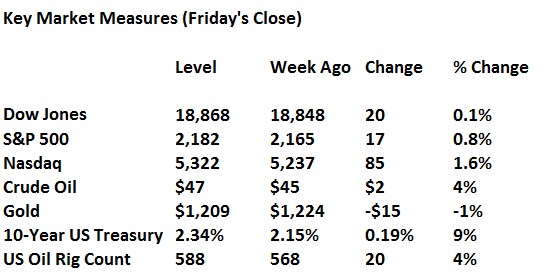
by Todd Shaver | Nov 21, 2016 | Monthly Newsletter Daily 6am if new
The Week Ahead
We finished this week above the fresh all-time highs set just a week ago. But we raise the question - have we come too far to fast? The frenzy seen post- election is seemingly pricing in a lot of good to come from new leadership in Washington. Are expectations reasonable or too aggressive? We note that Caterpillar recently said even if a $1 trillion infrastructure spending bill was passed today, it would take at least a year for projects to start, given the timelines for making the equipment needed. And we haven’t yet passed a $1 trillion infrastructure bill nor have we any clarity about how one would be funded. This infrastructure example highlights one market over-reaction to Trump, which is happening across many more sectors.
Good stock picks can make money in any market. This week we provide some insights on our latest thinking for Under Armour, Tesoro, Facebook, Amazon, and Microsoft.
Highlights From The Past Week
Repatriation. Many people are asking the question - If new leadership in Washington does lower repatriation taxes so that US companies bring home the $2+ trillion currently parked overseas, what will the money be used for?
The prevailing view at this time seems to be that much of the capital repatriated from overseas will be returned to shareholders, via repurchases and dividends. This is good for the stock market and for investors like us. However, we need to keep a close eye on how everything develops. Some are saying if the money just goes to buybacks and dividends rather than capital expenditures, then we won't see the big benefits to job growth and middle class income. There is talk of a flat 10% repatriation tax which should bring billions back to the US, but we’ll have to wait and see!
Fiscal Stimulus. Like Andrew Jackson’s populism, people are saying that we’re going to build an entirely new political movement: It’s everything related to jobs. They will be able to push a trillion-dollar infrastructure plan. With negative interest rates throughout the world, it’s the greatest opportunity to rebuild everything. Ship yards, iron works, new infrastructure projects get them all jacked up. We can just throw it up against the wall and see if it sticks. It will be as exciting as the 1930s, greater than the Reagan revolution. Exciting times! (We shall see.)
Interest Rates. The bond market bloodbath continues. The 10-year US Treasury yield is up a stunning 65 basis points from the Trump-win lows, spiking to 2.35% - the highest since December 2015. In fact, the entire Treasury yield curve is now higher in yield on the year, leaving most of everything newly issued in 2016 now under water. We are going to have to keep a close eye on where rates stand going forward. The cornerstone of fiscal stimulus will be low rates. But if the bond market re-prices rates much higher, the increased interest expense could throw a wrench in gears turning all of the current excitement.
BMR Companies and Commentary
Facebook (FB: $121, up 3% today)
Again, Facebook has found more miscalculated advertising metrics. The company said it has uncovered several more miscalculated metrics related to how consumers interact with content from marketers and publishers, and it unveiled additional independent review of some measurements to calm unease over the their data. An internal metrics audit found that discrepancies led to the undercounting or overcounting of four measurements, including the weekly and monthly reach of marketers' posts, the number of full video views and time spent with publishers' Instant Articles.
Does it matter? Should we be worried? What is the impact?
None of the metrics in question impact Facebook's billing. The only financial impact would be from customer perception about what has occurred, leading to customers shying away from spending money to advertise with Facebook because they have new concerns over these metrics. It is a stretch to go there. Facebook has well over 1 billion users. Just because a few mistakes were made on some back-office tasks doesn’t change how the business model connects advertisers to world. (We are not discounting this issue, but we think the market will perceive it to be a small matter. The company is already working on the PR to reduce the impact on perception.)
Let’s stay focused on what matters. Recall, it was a stellar quarter just recently reported. Facebook's Q3 earnings update that came in better than expected on top line revenues of $7.0 billion versus the $6.92 billion consensus and EPS of $1.09 was ahead of the Street's $0.97 expectations. Daily active users of 1.18 billion and monthly active users of 1.8 billion were both ahead of the Street's expectations as well. Management offered updated guidance on expense growth of 40-45% that was lower than the prior 45-50%. The negative takeaways were comments about decelerating revenue growth and heavy investments in 4Q16 and 2017. Many people think this was just management setting the bar low so they can beat it more easily. We agree.
BMR Take: If the first time miscalculated metrics didn’t shatter the Facebook growth story, we don’t think the second time around will. Clearly an operational mistake we don’t like to see, but we don’t see reason to exit our position in the stock over it. We think the company is set up to deliver better than expected financial results over the next several quarters. Stick around!
And this just in: Facebook will repurchase up to $6 billion in stock (first time they have ever done a stock buyback.) The buyback will start in the first quarter of 2017, using some of their $26 billion in cash. The market liked the news: the stock was up over a $1 in after-hours trading Friday.
BTW, we just noticed that Facebook’s all-time high is the same as Apple’s - $134. We wonder who will get their first. Our guess? Facebook. Why? Smaller market cap - $340 billion vs. $590 billion. Higher growth rate. So now we have two races to watch. Google vs. Amazon is the other. They both closed at the same price Friday. Love it!
Amazon (AMZN: $776, up 3% last week and up $16 today)
The word is CEO Jeff Bezos is telling executives to “Do what it takes to succeed” in India. Amazon fell a little behind in China early and business never quiet was able to recover to be as big as it could have been. Bezos is going on all in on India to ensure the same thing doesn’t happen twice.
Amazon had been India’s #2 ecommerce player. But that has changed. Bezos is now communicating to the market that Amazon has pulled ahead to be #1, with market share estimated around 28%.
India is a huge opportunity for Amazon. India has a population of 1.2 billion with about 40 million online shoppers. Goldman Sachs calls for ecommerce sales in India to grow 10-fold from today’s level of $11 billion over the next decade. And since only about one-third of Amazon’s sales are international, there is tremendous room for growth here. We understand that Bezos is going to invest another $3 billion in June into the India operation, in order to make the business even better. Amazon currently has over 80 million products selling in India. (This is not a misprint.) And they have more than 120,000 sellers, compared to 40,000 sellers a year ago. In June, the company said it will invest an additional $3 billion in India after it exhausted its earlier investment pledge of $2 billion. The company also launched its Prime membership program in July in more than 100 Indian cities, offering one-day and two-day delivery
BMR Take: Amazon’s stock has been down since the latest earnings report. The concern is that they are in a short term cycle of big investment spending. This news of more investments in India certainly plays right into the bearish outlook. Long-term, we think every dollar Bezos spends re-investing in the business will pay dividends later on. In the near-term, we brace for negative sentiment about how profits are being weighed down today due to these investments. Listen, we are not negative on the company nor the stock. We just want to give you both sides of the story. In fact, we think the market will shrug off this news and do what it always does, buy the story of bigger is better, awaiting huge profits in the future. But you never know…
Microsoft (MSFT: $61, up 2% last week)
Goldman Sachs upgraded the stock to Buy with a $68 price target. What’s the story here? Why did they upgrade? What are they now saying? Why is Microsoft all the sudden a buy?
The company got off to a strong start to FY17 as revenue and EPS came in above consensus estimates. The strength was driven by growth of Azure (the cloud business) and adoption of Office 365 (the web version of Office).
Many are now expecting the upcoming quarter to be an inflection point for Microsoft, as the company will complete the sale of its phone business and the acquisition of LinkedIn, signifying the end of the old and the beginning of the new.
We believe the integration of LinkedIn will enhance the value proposition of Microsoft’s entire platform, including Azure, Office 365, and Dynamics. As such, we believe the best is yet to come as we expect revenue growth acceleration and margin expansion ahead.
BMR Take: Glad to see Goldman Sachs come around to support our outlook. What a humbling game investing is. The world’s most powerful investment bank is playing catch up to a little tiny newsletter service out of Aspen, Colorado.
Goldman Sachs (GS: $210, +19% in the past two weeks)
Financials including Goldman Sachs rallied the most this past week. With rates finally rising, a steeper yield curve is good for banking and capital markets. More importantly, plans to roll back regulation are coming, which is huge for all of Financials, as they have had a bad stigma for years under the Elizabeth Warren era of denouncing Wall Street.
The regulatory discussion is currently all over the map right now about what we could see. The end of Dodd Frank? The termination of the Consumer Financial Protection Bureau? No more Volcker Rule allowing proprietary trading (again)? Some even say Glass-Steagall* could be on the table (again). Note that Trump has called for a general guideline of allowing new regulations to be implemented only if they replace two existing regulations. This all amounts to positive implications for Goldman Sachs.
*The Glass–Steagall Act describes four provisions of the U.S. Banking Act of 1933 that limited securities, activities, and affiliations within commercial banks and securities firms.
One more thing to ponder - who will Trump name as Treasury Secretary? The position once held by Alexander Hamilton is considered one of the highest honors in all of Finance for those asked to serve. Rumors are floating that Goldman’s CEO Lloyd Blankfein is possible candidate, as well as CEO Jamie Dimon of JP Morgan Chase.
BMR Take: Goldman is the #1 investment banking franchise. The investment banking business follows a boom-bust cycle. With the sharp rally recently, we are implementing a stop at $196 to protect our gains but we do not want you to miss more upside if the train keeps rolling. We added the stock at $147 in February, so we are up 43% in nine months.
Upcoming Economic News
Tuesday, November 22nd
Existing Home Sales – October
Time: 10:00 am
Forecast: 5.46 million
Existing home sales are projected to be little changed in October with tight inventories constraining transactions. Sales fell 0.4% year-over-year last quarter for the first decline of the past two years. Sharply rising Treasury bond rates will feed through into higher mortgage rates, adding another impediment to existing home sales growth.
Wednesday, November 23rd
Durable Goods Orders – October
Time: 8:30 am
Forecast: 1.0% overall, 0.2% ex transportation
Rising aircraft orders in October following two straight deep monthly declines can lead a strong overall gain in durable goods orders. Industrial demand has shown some recent promise; core capital goods orders increased 5.2% annualized in the third quarter against the previous quarter. Yet that recent burst in activity is tempered by the weak long-term trend; such orders fell 4.1% year-over-year during the same period.
New Home Sales – October
Time: 10:00 am
Forecast: 585,000
New home sales can dip a bit in October yet still point to strong long-term growth. Third quarter sales rose 23% year-over-year, as volumes continued to trend higher from depressed post-crisis levels. Though up substantially on an annual basis, last quarter’s 600,000 unit annualized pace trails the average rate of the past 20 years by 18%.
University of Michigan Consumer Sentiment – November
Time: 10:00 am
Forecast: 91.6
The post-election bounce in the stock market may ultimately feed into somewhat higher readings in consumer sentiment. The preliminary reading in the November Michigan survey was the highest in five months as consumers are reporting improved financial conditions. Renewed declines in oil prices can also spur stronger inclinations to increase spending on other items.
FOMC Meeting Minutes
Time: 2:00 pm
Given the jolt to interest rates and inflation expectations following the election, the minutes of the early November FOMC meeting will be somewhat stale. Yet the general push toward hiking the Fed Funds target in December will likely find additional support in the minutes. The next key question for monetary policy is how much policy tightening is likely in the year ahead. Economic projections released by the Federal Reserve next month will provide crucial guidance on this subject.
Twilio (TWLO: $37) had a good week, rising 17%. We’ve said many times how much we like this one, but the market has been hammering the stock these past few weeks. The turnaround in a week when most Tech stocks were hit hard, is impressive. Again, we think this is a $75 stock if they continue their phenomenal revenue gains that we saw in the past few years, and certainly last quarter. Twilio did $167 million in sales last year, up from $90 million the year before and the company is on a $1 billion annual run rate by the second half of 2018. Can’t wait for next quarter’s earnings. If strong, the stock should get back to the 50s and 60s in no time.
The Energy Corner
North Dakota’s crude-oil production in September dropped to the lowest level in more than two years. Crude production fell 1.1% on the month to 970,000 barrels a day in September, the lowest level since February 2014. North Dakota is home to the Bakken Shale formation, one of the world’s highest-cost oil fields. Growing confidence that crude prices will rise in coming months is sustaining the expansion of oil drilling in the shale patch. Rigs targeting crude rose 19 to 470 this week, the biggest increase in the last 16 months, according to Baker Hughes data reported Friday. Shale drillers have now added 155 rigs since an expansion started at the end of May. Gas rugs were flat, bringing the total for oil and gas up by 20 to 588.
This news just in - the Obama administration on Friday banned offshore drilling in the Arctic, setting a likely collision course with President-elect Donald Trump, who has vowed to “unleash” new energy production in the United States by rolling back restrictions on oil. Great – a new story for us to worry about.
So, US rig count is up sharply, which should produce greater volumes as we move into 2017. This counteracts the move by OPEC to cut production, which hasn’t been approved yet, and may indeed never happen
Interest Rate Corner
Federal Reserve Chairwoman Janet Yellen reiterated that an increase in short-term interest rates "could well become appropriate relatively soon" but offered no new signals about what the central bank will do at its meeting next month.
We are in the camp at The Bull Market Report that a ¼ point rise is baked in for December. Of course, she could surprise us with a ½ point rise, which would probably tank the markets like what happened last December. We hope she maintains some sense here. The 10-year Treasury note has exploded, from a low of 1.37% in July to 1.80% before the election to 2.34% Friday.
Tesla Update: It’s official: Tesla (TSLA: $187, down 2% last week) shareholders approved the acquisition of SolarCity. The company is now an unequivocal sun-to-vehicle energy firm. And Chief Executive Officer Elon Musk didn’t take long to make his first big announcement as head of this new enterprise. Minutes after shareholders approved the deal - about 85 %of them voted yes - Musk told the crowd that he had just returned from a meeting with his new solar engineering team. Tesla’s new solar roof product, he proclaimed, will actually cost less to manufacture and install than a traditional roof - even before savings from the power bill. “Electricity,” Musk said, “is just a bonus.”
If Musk’s claims prove true, this could be a real turning point in the evolution of solar power. The newly announced rooftop shingles are made of textured glass and are virtually indistinguishable from high-end roofing products. They also transform light into power for your home and your electric car.
“So the basic proposition will be: Would you like a roof that looks better than a normal roof, lasts twice as long, costs less and - by the way - generates electricity?” Musk said. “Why would you get anything else?” On a large house over a long period of time, the value of that electricity could exceed $100,000. The new roofing material he unveiled this past week is considerably cheaper, and it's considerably more promising for the future of rooftop solar power.
We love Musk. He never ceases to amaze and shock. Can he pull this off? Will he have enough cash to make it work? We think yes. But again, this stock could hit $150 before it hits $250. Volatile!
Goldman Sachs Maps Out Its Top Market Themes for 2017
They're heavily influenced by President-elect Trump.
Goldman Predicts: U.S. recession risk remains low in 2017
Goldman released its top 10 market themes for next year. "High growth, higher risk, slightly higher returns," is how their strategists view the year ahead - and it's clear that their outlook has been heavily influenced by the pending regime change in Washington.
Here's a brief summary some of the themes Goldman sees as forming the backdrop for investing in 2017. All thoughts and comments are for Goldman.
Expected returns: Only slightly higher
Relative to its 2016 forecasts, Goldman says owners of financial assets can reasonably able to expect more upside - but stresses that these returns will still likely remain low. The best improvement in the opportunity in global equities is in Asia ex-Japan, where we forecast returns of 12.5% (versus 3.8% for 2016.) At the other end of the equity spectrum, in Japan we are forecasting declines of 3.7% on the Topix (vs. +5.2% for 2016).
U.S. fiscal policy: A pro-growth agenda
President-elect Donald Trump's focus on infrastructure spending during his victory speech on Nov. 9 - rather than trade protectionism or immigration restrictions - catalyzed the risk-on sentiment that's pervaded markets.
Markets are starved for growth
This is plainly visible in the eagerness with which markets seized on Trump’s growth-focused message. It is also visible in the speed with which the market’s narrative on the economic outlook under Trump has shifted from uncertainty to growth. Fiscal stimulus in the U.S. will help reflate the economy, and stands a good chance of passing through Congress.
U.S. trade policy: Concerns are likely overdone
Goldman doesn't see an imminent trade war on the horizon, and expects any re-negotiation of agreements currently in place (like NAFTA) to focus on attempts to improve the prospects for the U.S. manufacturing sector. We think the popular media narrative on the downside risk of a trade war is overstated. Our tentative view is that Trump’s use of punitive tariffs will be just as pragmatic as President Obama’s, albeit more vocal.
Emerging markets risk: “Trump tantrum” is temporary
Emerging market assets have been crushed since the election, as the rise in Treasury yields has reduced the need to reach for yield overseas, and the potential for protectionist trade policies threatens to curtail growth opportunities.
Monetary policy: Focusing the toolkit on credit creation
Better-targeted monetary stimulus could help avoid some negative side effects associated with quantitative easing and negative rates that inhibit credit creation.
Corporate revenue growth recession: Signs of inflection
For years, S&P 500 companies have exceeded analysts' expectations on the bottom line more often than the top line during quarterly earnings seasons, as a combination of cost-cutting and shrinking share count, rather than soaring sales, fueled the growth in earnings per share. However, Goldman expects 2017 to confirm that the U.S. corporate sector has emerged from its recent 'revenue recession.' A firming global economy and recovery in oil prices from their February lows significantly buoys the outlook for revenue growth stateside.
For 2017, Goldman expects that modest improvements in the macroeconomic backdrop will help lift S&P 500 operating EPS by 10% and they have a year-end S&P 500 target of 2200, currently 2180 now. [Not terribly exciting if you ask us. We differ. We don’t normally predict, but we would certainly be looking for 2300 or 2400.]
Inflation: Moving higher across developed markets
Market-based measures of inflation expectations in the U.S. have spiked since the election, as traders bet that Donald Trump will be the inflation president.
What seems clear to us, as argued above, is that economic issues, notably tax cuts, infrastructure spending and defense spending, are high on the agenda - a recipe for reflation. We are forecasting large boosts to public spending in Japan, China, the U.S., and Europe, which should fuel inflationary pressures in those economies.
The next credit cycle: Kinder and gentler
While commodity-sensitive segments of the credit market have suffered pain in 2016, there hasn't been much in the way of contagion. Goldman's team expects more of the same in 2017, with the credit cycle not making a turn for the worse. The strong ‘business cycle’ component in the behavior of high yield defaults, and our view that U.S. recession risk remains low in 2017, leave us comfortable with the view that the inflection point is unlikely to materialize next year, despite the weak state of corporate balance sheets.
Mortgage Rates Surge After Election
Here is some news on the state of the mortgage market. Mortgage rates surged after the election win of Donald Trump. But housing experts say consumers shouldn't get carried away by the post-election wave. The advance of the past week or so, stoked by a surprise victory that turned economic expectations on their head, could soon settle.
"Consumers considering buying or refinancing now should stay patient, as we'll likely see rates stabilize once markets find a new equilibrium," says Zillow, the mortgage rate real estate company.
In the week ended Thursday, the average rate on the 30-year fixed-rate loan jumped to 3.94% from 3.57% the previous week, mortgage company Freddie Mac reported. A year ago the market was at 3.97%. The average for a 15-year mortgage climbed to 3.14% from 2.88%
The High Yield Corner
We have seen our first full post-Trump trading week, and it wasn’t bad. Actually, things were impressive considering the expectations and last week’s bull run. The S&P 500 rose nearly 1% by the end of the week, but the really interesting story is the difference between different stock groups. Large caps underperformed small caps significantly - this has a lot of important implications for high-yield investors, so is worth a closer look.
The Dow Jones Industrial was pretty much flat last week, while the Russell 2000 went up 2.6%. The difference between these two is the result of different trends between different investors: the risk-averse are more worried than the less risk-averse, who are willing to give small caps a chance in the hopes that they will deliver the higher-than-big-cap returns that they gave in the past. This has pushed small caps up to a 17% year-to-date return after rising 8% in the last month.
But here’s the really interesting part: the Dow Jones is up 10% year-to-date after a 4% return over the last month. The S&P, however, is up 7% year-to-date after rising 2% in the last month.
What this means is that risk appetites have grown in the last month while the more cautious are less eager to jump into the Trump rally. They aren’t avoiding it, but they aren’t going into it as much as the more risk-tolerant investors. In other words, we’re having a growing disagreement about future risks with the economy as a whole.
This is not uncommon, but wasn’t the case earlier in 2016. Both large caps and small caps had similar high returns for much of 2016 - and now that convergence is subsiding.
This is important for high yield investors for two reasons. First, junk bonds and BDCs tend to trade closely with small cap stocks as they attract similar investors: risk-tolerant institutions. Second, a market where the risk-averse are more cautious and the risk-hungry are less so often portends a bubble followed by a crash. That is not in the cards quite yet, but it does make one wonder if the industries getting a big boost - Financials in particular - might get overbought if they haven’t already.
With this as our backdrop, let’s take a look at how each asset class performed in the last week and why:
REITs - Initially REITs were the hardest hit by Trump’s victory on fears that his spending plans would kickstart inflation and thus increase REITs’ borrowing costs. This remains a concern, as the U.S. Treasury 10-year keeps going higher, but we’ve finally gotten to a point where the risks are priced in. Fortunately for REITs they already began correcting before the election, so this week’s return was just barely green, according to the SPDR Dow Jones REIT ETF (RWR: $89. Flat).
Results for individual REITs varied, but our picks did OK. Kimco Realty (KIM: $26) rose slightly, Digital Realty Trust (DLR: $90) rose over 1%, Omega Healthcare Investors (OHI: $28) was flat, Care Capital Properties (CCP: $24) rose 4%, and Government Properties Income Trust (GOV: $18.90) rose less than 1%. We also added a new REIT to our portfolio: Ventas (VTR: $60), which rose 2% this week. Ventas is one of the few REITs that is up year-to-date in the Healthcare space: rising 6% so far this year, but its price-to-FFO ratio and growth potential make it extremely attractive.
Junk bonds - The corporate bond market is now dominated with changing inflation expectations. Love him or hate him, but the market believes Trump is going to cause inflation to accelerate. This isn’t a testament to his failures or abilities, however; much of these expectations are the end result of the Fed’s constant efforts to improve inflation rates and a time when low oil prices and high supplies are priced in. There are many reasons beyond Trump to think inflation will not stay low forever, and having a president in the office (whoever it may be) who is focused on rising inflation with a House and Senate that will work with him, almost seems a perfect formula for rising inflation.
That is why junk bonds have done particularly badly after Trump, but the real surprising thing is that they didn’t do poorly for longer. Last week the SPDR Barclays High Yield Bond ETF (JNK: $36) rose over 1% and is now up 5% from the beginning of the year. Yet the fund has a near 7% dividend yield that is far higher than it has been in recent years. This is partly because of expectations of a rate cut for the fund*, which has happened in the past, so it’s important to keep in mind the more actively managed alternatives that aren’t tied to an index** and thus have more flexibility to ensure payouts remain constant. Note that the ETF recently registered $342 million asset inflows for a 3.15% increase.
*JNK's distribution cut is expected because the BofA High Yield index has fallen. Since JNK tracks that, its distribution should fall too.
**Active funds like PDI vs. passive indexing funds like JNK. In other words, “alternative funds that are actively managed" makes that clearer.
Our pick to take advantage of this strategy remains Pimco’s Dynamic Income Fund (PDI: $27), which had a nice 4% gain this week to offset last week’s massive decline. The fund is still down over 4% from a month ago which means it is poised to improve in recent weeks. The fund is also now flat year-to-date with a near 10% dividend and a looming special dividend that we believe will be at least 3%. That turns this fund into a 13% dividend payer with a sustainable dividend. That is almost impossible to find in the market (we know as we’ve looked for more, but Pimco’s fund seems to be it!)
Municipal bonds - Rising interest rates are a problem for all bonds, but they are actually worse for corporate bonds than municipal bonds because of the risks and the way these are structured. Yet looking at the municipal bond world lately, you’d think it’s the riskiest asset in the world. The iShares National Municipal Bond ETF (MUB: $108) fell 1% this week and is down 3% over the last month. The ETF is also down 2% for the year, making municipal bonds one of the few asset classes that has had negative returns for the year.
We have been wary of municipal bonds this year because of their massive run-up before the summer and rate hike concerns. We don’t believe rate hikes directly are a drain on municipal bonds, but fears about rate hikes often overshoot the real risks and cause a big and prolonged selloff. We saw this in 2015 and have seen this to a lesser extent this year. This is why we have only recommended one municipal bond fund this year: the Nuveen Enhanced AMT-Free Municipal Credit Opportunities Fund (NVG: $14:04). The fund is down 2% over the last week and is down 3% year-to-date. The most shocking figure is the three-months metric: the fund is down 14% in that time.
We expect these massive declines to reverse, but it is going to take a while for that to happen and it is difficult to time. While municipal bonds are already oversold, that does not mean the market knows they are oversold, and they can go down even lower. Nuveen’s fund is a good long-term hold and we expect it to hold its NAV for the long term, as it has done for over a decade already. However, we also expect greater volatility to hit this and all municipal funds. Anyone wishing to invest in munis now will have to endure these short-term price declines with patience, buying more as the stock goes down.
From one extreme of the risk/reward spectrum to the other, let’s turn to BDCs. The UBS BDC ETF (BDCS: $22) rose over 1% over the last week and has had a somewhat strong showing after the Trump election. While BDCs aren’t going up nearly as much as Financials, they are both rising for the same reason: an expectation that deregulation is going to cause credit to flow and the Financial sector to boom. BDCs cannot help but benefit from this, so they are rising with the Financial sector. However, they are not rising from an extreme bottom as Financials are, so the asset class’s 2% monthly return is a fraction of the double-digit returns of the Financial sector as a whole. This is unlikely to change.
At the same time, we have finally gotten to a point where Main Street Capital (MAIN: $36.50) has gotten overbought. The BDC is now up 16% from when we recommended it in April after rising 8% in the past month alone. We waited for this week’s dividend distribution to see if the stock would fall further after the payout, but it hasn’t; in fact the stock is up over 1% after its recent payout. That now means Main Street is selling at a 70% premium to its net asset value and it has passed our target price. We are keeping our price targets on Main Street, which means recommending selling at these levels and waiting for the price to correct before jumping back in. Main Street remains an excellent firm with impressive advisors and the capability to increase dividends for a long time, but the cost of that expertise and growth potential is too high now. We will buy again when the stock is more fairly priced.
Good Investing,
Todd Shaver, Founder and Editor in Chief
The Bull Market Report
November 20, 2016
by Todd Shaver | Nov 20, 2016 | Weekly Newsletter 7pm Sunday
The Week Ahead
We finished this week above the fresh all-time highs set just a week ago. But we raise the question - have we come too far to fast? The frenzy seen post- election is seemingly pricing in a lot of good to come from new leadership in Washington. Are expectations reasonable or too aggressive? We note that Caterpillar recently said even if a $1 trillion infrastructure spending bill was passed today, it would take at least a year for projects to start, given the timelines for making the equipment needed. And we haven’t yet passed a $1 trillion infrastructure bill nor have we any clarity about how one would be funded. This infrastructure example highlights one market over-reaction to Trump, which is happening across many more sectors.
Good stock picks can make money in any market. This week we provide some insights on our latest thinking for Under Armour, Tesoro, Facebook, Amazon, and Microsoft.
Highlights From The Past Week
Repatriation. Many people are asking the question - If new leadership in Washington does lower repatriation taxes so that US companies bring home the $2+ trillion currently parked overseas, what will the money be used for?
The prevailing view at this time seems to be that much of the capital repatriated from overseas will be returned to shareholders, via repurchases and dividends. This is good for the stock market and for investors like us. However, we need to keep a close eye on how everything develops. Some are saying if the money just goes to buybacks and dividends rather than capital expenditures, then we won't see the big benefits to job growth and middle class income. There is talk of a flat 10% repatriation tax which should bring billions back to the US, but we’ll have to wait and see!
Fiscal Stimulus. Like Andrew Jackson’s populism, people are saying that we’re going to build an entirely new political movement: It’s everything related to jobs. They will be able to push a trillion-dollar infrastructure plan. With negative interest rates throughout the world, it’s the greatest opportunity to rebuild everything. Ship yards, iron works, new infrastructure projects get them all jacked up. We can just throw it up against the wall and see if it sticks. It will be as exciting as the 1930s, greater than the Reagan revolution. Exciting times! (We shall see.)
Interest Rates. The bond market bloodbath continues. The 10-year US Treasury yield is up a stunning 65 basis points from the Trump-win lows, spiking to 2.35% - the highest since December 2015. In fact, the entire Treasury yield curve is now higher in yield on the year, leaving most of everything newly issued in 2016 now under water. We are going to have to keep a close eye on where rates stand going forward. The cornerstone of fiscal stimulus will be low rates. But if the bond market re-prices rates much higher, the increased interest expense could throw a wrench in gears turning all of the current excitement.
BMR Companies and Commentary
Under Armour (UA: $31, down 3% for the week)
Sneaker outlet Foot Locker reported earnings. The CFO commented that inventory is fresh and well-positioned for the important holiday selling season, which keeps the company on track to achieve mid-single digit comparable-store sales gains and double-digit earnings growth.
So the shoe business is going well? Perhaps not so much for Under Armour. Foot Locker’s CEO raised concerns that the Curry 3.0 is not selling as well as anticipated. The CEO said the third iteration of the Curry basketball shoe is off to a slower start than the first two. Recall that Under Armour recently signed NBA All Star Stephen Curry of the Golden State Warriors to an endorsement contract. They took him on a marketing trip through China to stir up excitement, and expectations for what Curry and his dedicated shoe line-up could do for Under Armour’s brand and revenue have been set high.
Under Armour ended the week near a fresh 52-week low after the comments out of Footlocker hit the market.
BMR Take: We think all of the above is just market noise. The Under Armour brand is growing because Stephen Curry is now on the team. Whether his shoes sell a little more or less doesn’t really matter. Literally, the revenue doesn’t move the needle for the company, and it doesn’t change the fact that more and more big name athletes are increasingly likely to sign with Under Armour over Nike. We view weakness in the stock as a buying opportunity.
Tesoro (TSO: $83, down 3%)
Tesoro announced a $6.4 billion acquisition of Western Refining (WNR: $37, up 29%) It’s good news. The company expects 2018 EPS to go up 10-13% because of the deal.
Through the purchase, Tesoro adds two very respected refineries to the portfolio - El Paso, TX and St Paul, MN. This expands Tesoro’s footprint beyond the West Coast, which makes Tesoro’s portfolio even more attractive to a potentially larger buyer one day.
There are an estimated $350 to $425 million of cost synergies to be realized in the deal. This level represents about 33-45% of Western Refining’s normalized EBITDA. That is a big percentage! Typically, in M&A perhaps you see 10% synergies. The number is so big in this deal because of the nature of the refining business. It’s all about scale.
BMR Take: The Western Refining acquisition is yet another solid deal by Tesoro to build out the portfolio, which already ranked as the best asset on the West Coast. Net asset value post the deal is now expected to be around $140 versus the current stock price of $83. We, along with many people on Wall Street, see a lot of value management can create for shareholders by realizing net asset value. With this common knowledge on the Street why isn’t the stock trading at $125 or $140 now? You have to sell assets to unlock net asset value. Until then Wall Street will just give you credit for the cash flow you are generating from the assets. Phillips 66 (PSX: $84) trades at 120% of NAV because everybody thinks Warren Buffett is going to buy it. Right now Tesoro is a big lumbering asset that is just producing income. So the gap in valuation for Tesoro from the current price to NAV would close quickly if management were to sell off some assets, raising cash and reducing debt and readying itself for sale (to Warren Buffett.)
Facebook (FB: $117, -2%)
Again, Facebook has found more miscalculated advertising metrics. The company said it has uncovered several more miscalculated metrics related to how consumers interact with content from marketers and publishers, and it unveiled additional independent review of some measurements to calm unease over the their data. An internal metrics audit found that discrepancies led to the undercounting or overcounting of four measurements, including the weekly and monthly reach of marketers' posts, the number of full video views and time spent with publishers' Instant Articles.
Does it matter? Should we be worried? What is the impact?
None of the metrics in question impact Facebook's billing. The only financial impact would be from customer perception about what has occurred, leading to customers shying away from spending money to advertise with Facebook because they have new concerns over these metrics. It is a stretch to go there. Facebook has well over 1 billion users. Just because a few mistakes were made on some back-office tasks doesn’t change how the business model connects advertisers to world. (We are not discounting this issue, but we think the market will perceive it to be a small matter. The company is already working on the PR to reduce the impact on perception.)
Let’s stay focused on what matters. Recall, it was a stellar quarter just recently reported. Facebook's Q3 earnings update that came in better than expected on top line revenues of $7.0 billion versus the $6.92 billion consensus and EPS of $1.09 was ahead of the Street's $0.97 expectations. Daily active users of 1.18 billion and monthly active users of 1.8 billion were both ahead of the Street's expectations as well. Management offered updated guidance on expense growth of 40-45% that was lower than the prior 45-50%. The negative takeaways were comments about decelerating revenue growth and heavy investments in 4Q16 and 2017. Many people think this was just management setting the bar low so they can beat it more easily. We agree.
BMR Take: If the first time miscalculated metrics didn’t shatter the Facebook growth story, we don’t think the second time around will. Clearly an operational mistake we don’t like to see, but we don’t see reason to exit our position in the stock over it. We think the company is set up to deliver better than expected financial results over the next several quarters. Stick around!
And this just in: Facebook will repurchase up to $6 billion in stock (first time they have ever done a stock buyback.) The buyback will start in the first quarter of 2017, using some of their $26 billion in cash. The market liked the news: the stock was up over a $1 in after-hours trading Friday.
BTW, we just noticed that Facebook’s all-time high is the same as Apple’s - $134. We wonder who will get their first. Our guess? Facebook. Why? Smaller market cap - $340 billion vs. $590 billion. Higher growth rate. So now we have two races to watch. Google vs. Amazon is the other. They both closed at the same price Friday. Love it!
Amazon (AMZN: $760, up $21, +3%)
The word is CEO Jeff Bezos is telling executives to “Do what it takes to succeed” in India. Amazon fell a little behind in China early and business never quiet was able to recover to be as big as it could have been. Bezos is going on all in on India to ensure the same thing doesn’t happen twice.
Amazon had been India’s #2 ecommerce player. But that has changed. Bezos is now communicating to the market that Amazon has pulled ahead to be #1, with market share estimated around 28%.
India is a huge opportunity for Amazon. India has a population of 1.2 billion with about 40 million online shoppers. Goldman Sachs calls for ecommerce sales in India to grow 10-fold from today’s level of $11 billion over the next decade. And since only about one-third of Amazon’s sales are international, there is tremendous room for growth here. We understand that Bezos is going to invest another $3 billion in June into the India operation, in order to make the business even better. Amazon currently has over 80 million products selling in India. (This is not a misprint.) And they have more than 120,000 sellers, compared to 40,000 sellers a year ago. In June, the company said it will invest an additional $3 billion in India after it exhausted its earlier investment pledge of $2 billion. The company also launched its Prime membership program in July in more than 100 Indian cities, offering one-day and two-day delivery
BMR Take: Amazon’s stock has been down since the latest earnings report. The concern is that they are in a short term cycle of big investment spending. This news of more investments in India certainly plays right into the bearish outlook. Long-term, we think every dollar Bezos spends re-investing in the business will pay dividends later on. In the near-term, we brace for negative sentiment about how profits are being weighed down today due to these investments. Listen, we are not negative on the company nor the stock. We just want to give you both sides of the story. In fact, we think the market will shrug off this news and do what it always does, buy the story of bigger is better, awaiting huge profits in the future. But you never know…
Microsoft (MSFT: $60, +2%)
Goldman Sachs upgraded the stock to Buy with a $68 price target. What’s the story here? Why did they upgrade? What are they now saying? Why is Microsoft all the sudden a buy?
The company got off to a strong start to FY17 as revenue and EPS came in above consensus estimates. The strength was driven by growth of Azure (the cloud business) and adoption of Office 365 (the web version of Office).
Many are now expecting the upcoming quarter to be an inflection point for Microsoft, as the company will complete the sale of its phone business and the acquisition of LinkedIn, signifying the end of the old and the beginning of the new.
We believe the integration of LinkedIn will enhance the value proposition of Microsoft’s entire platform, including Azure, Office 365, and Dynamics. As such, we believe the best is yet to come as we expect revenue growth acceleration and margin expansion ahead.
BMR Take: Glad to see Goldman Sachs come around to support our outlook. What a humbling game investing is. The world’s most powerful investment bank is playing catch up to a little tiny newsletter service out of Aspen, Colorado.
Goldman Sachs (GS: $210, up 5%)
Another strong week for Goldman as the stock reached its highest level of 2015 and well as this year. It was only higher in 2007, hitting $248. Keep a tight stop in case the market starts to sell off, to protect your gains. But there’s a good chance we might see new all-time highs in Goldman in 2017.
Upcoming Economic News
Tuesday, November 22nd
Existing Home Sales – October
Time: 10:00 am
Forecast: 5.46 million
Existing home sales are projected to be little changed in October with tight inventories constraining transactions. Sales fell 0.4% year-over-year last quarter for the first decline of the past two years. Sharply rising Treasury bond rates will feed through into higher mortgage rates, adding another impediment to existing home sales growth.
Wednesday, November 23rd
Durable Goods Orders – October
Time: 8:30 am
Forecast: 1.0% overall, 0.2% ex transportation
Rising aircraft orders in October following two straight deep monthly declines can lead a strong overall gain in durable goods orders. Industrial demand has shown some recent promise; core capital goods orders increased 5.2% annualized in the third quarter against the previous quarter. Yet that recent burst in activity is tempered by the weak long-term trend; such orders fell 4.1% year-over-year during the same period.
New Home Sales – October
Time: 10:00 am
Forecast: 585,000
New home sales can dip a bit in October yet still point to strong long-term growth. Third quarter sales rose 23% year-over-year, as volumes continued to trend higher from depressed post-crisis levels. Though up substantially on an annual basis, last quarter’s 600,000 unit annualized pace trails the average rate of the past 20 years by 18%.
University of Michigan Consumer Sentiment – November
Time: 10:00 am
Forecast: 91.6
The post-election bounce in the stock market may ultimately feed into somewhat higher readings in consumer sentiment. The preliminary reading in the November Michigan survey was the highest in five months as consumers are reporting improved financial conditions. Renewed declines in oil prices can also spur stronger inclinations to increase spending on other items.
FOMC Meeting Minutes
Time: 2:00 pm
Given the jolt to interest rates and inflation expectations following the election, the minutes of the early November FOMC meeting will be somewhat stale. Yet the general push toward hiking the Fed Funds target in December will likely find additional support in the minutes. The next key question for monetary policy is how much policy tightening is likely in the year ahead. Economic projections released by the Federal Reserve next month will provide crucial guidance on this subject.
Twilio (TWLO: $37) had a good week, rising 17%. We’ve said many times how much we like this one, but the market has been hammering the stock these past few weeks. The turnaround in a week when most Tech stocks were hit hard, is impressive. Again, we think this is a $75 stock if they continue their phenomenal revenue gains that we saw in the past few years, and certainly last quarter. Twilio did $167 million in sales last year, up from $90 million the year before and the company is on a $1 billion annual run rate by the second half of 2018. Can’t wait for next quarter’s earnings. If strong, the stock should get back to the 50s and 60s in no time.
Two Questions from The Bull Market Report:
Last week, we asked you if a high stock price intimidates you. And we asked which stock, Google or Amazon that are both trading at virtually the same price, will win the ultimate race. Here is a letter from John Herlihy, one of our subscribers.
Hi Todd, To answer your first question, Yes, I do feel intimidated by the high price of those two stocks, although I am not sure "intimidated" is the right word. Logic demands some common sense, so that if a person's stock purchase gains by 2%, it doesn't matter whether you have 500 shares of an expensive stock or 5,000 shares of a less expensive stock, if the amount spent is the same. I play around with about $100,000. At $750 a share, that's about 135 shares. Doesn't sound like much. A $25 stock would be 4,000 shares. Just sounds better even if the profit would be the same on a percentage gain.
To answer your second question: I would go for Google. Amazon seems to be more at the risk of the market place and the consumer spender, while Google just seems to be a powerhouse, not necessarily at the whim of the consumer.
As always, I value (and treasure) The Bull Market Report and its stock advice. I couldn't do without it.
John Herlihy
University Professor
Qatar University
Doha, Qatar
And this was our response:
Hi John –
Just what we thought about a high-priced stock. It’s that good old human nature thing. And of course this is the reason that most companies split their stock. Of course, Google and Amazon don’t give a damn. Apple finally succumbed with the 7-1 split in 2014. (I wonder if they will ever succumb on giving back some of their cash!)
Hard to say who will win – tough to count out Bezos though, as his Cloud operation is exploding.
Thanks and good investing.
Todd Shaver, Editor in Chief
The Bull Market Report
A Powerful Financial Newsletter
@BullMarketRept on Twitter

A Word from Gary Jefferson
Jefferson Financial Group
First Vice-President, Investments
UBS Financial Services, Inc.
Yogi Berra proved once again last week why he's the greatest philosopher of the modern era with his Yogism "It ain't over 'til it's over." Instead of the Trump crash predicted by 99% of all the financial pundits, the market took off for its best week in over five years.
The Financial Times published an article last week laying out the seven key ways that Donald Trump is set to change America, and in doing so, change the investment landscape and financial markets:
1.Trade - Where Trump may tear up trade agreements and start a trade war by raising tariffs on China to 45%. We didn't come to the same conclusion as this fairly radical interpretation, but rather that he wants a level playing field for US companies. Remember, Trump's expertise is in making deals, not breaking them, and we believe the end result will be good for American business.
2. Foreign policy - Likely to change under Trump, such as abandonment of the deal with Iran and closer ties with Russia.
3. Healthcare - Likely to drastically change (for the better), as Trump has said he will get rid of Obamacare. We think this is a BIG deal for healthcare, big pharma and especially biotech companies, all of which should have a real tailwind next year from the expected changes. [Trump is already tempering his position, so stay tuned.]
4. Tax reform will be another huge area where Trump wants radical reform, promising that companies will not pay more than 15% tax and individuals less than now. This should be big for equities and not so good for bonds. In fact, bonds are already getting hit hard. The total global value of bonds declined by over $1 trillion these past eight days as U.S. President-elect Donald Trump’s policies are seen boosting spending and quickening inflation, according to Bloomberg. Bank of America Merrill Lynch data indicates that the $1 trillion-plus weekly plunge has only happened twice in two decades. Where is all that bond money going? The total global value of equities increased by $1.3 trillion during that same period.
5. The Supreme Court - Trump is likely to be able to easily replace one or two judges with his conservative picks.
6. Climate change policy - Trump has called climate change a “hoax” and says he wants to cancel the Paris accord and cut funding to UN climate initiatives.
7. Immigration - Trump wants to dramatically tighten immigration policy.
All of these policies tell us several things: overweight equities versus bonds; buy American companies with a higher degree of sales and production inside the US; be sure to include biotechs, pharma and healthcare in portfolios. If earnings growth next year is in the 12-14% range, we should have a very good equity market over the next 12 months. And, if the 10-year Treasury rate rises to 3%-3 ½% as some predict, bonds should struggle as will interest rate sensitive equities like utilities.
The Energy Corner
North Dakota’s crude-oil production in September dropped to the lowest level in more than two years. Crude production fell 1.1% on the month to 970,000 barrels a day in September, the lowest level since February 2014. North Dakota is home to the Bakken Shale formation, one of the world’s highest-cost oil fields. Growing confidence that crude prices will rise in coming months is sustaining the expansion of oil drilling in the shale patch. Rigs targeting crude rose 19 to 470 this week, the biggest increase in the last 16 months, according to Baker Hughes data reported Friday. Shale drillers have now added 155 rigs since an expansion started at the end of May. Gas rugs were flat, bringing the total for oil and gas up by 20 to 588.
This news just in - the Obama administration on Friday banned offshore drilling in the Arctic, setting a likely collision course with President-elect Donald Trump, who has vowed to “unleash” new energy production in the United States by rolling back restrictions on oil. Great – a new story for us to worry about.
So, US rig count is up sharply, which should produce greater volumes as we move into 2017. This counteracts the move by OPEC to cut production, which hasn’t been approved yet, and may indeed never happen
Interest Rate Corner
Federal Reserve Chairwoman Janet Yellen reiterated that an increase in short-term interest rates "could well become appropriate relatively soon" but offered no new signals about what the central bank will do at its meeting next month.
We are in the camp at The Bull Market Report that a ¼ point rise is baked in for December. Of course, she could surprise us with a ½ point rise, which would probably tank the markets like what happened last December. We hope she maintains some sense here. The 10-year Treasury note has exploded, from a low of 1.37% in July to 1.80% before the election to 2.34% Friday.
Tesla Update: It’s official: Tesla (TSLA: $188, down 2%) shareholders approved the acquisition of SolarCity. The company is now an unequivocal sun-to-vehicle energy firm. And Chief Executive Officer Elon Musk didn’t take long to make his first big announcement as head of this new enterprise. Minutes after shareholders approved the deal - about 85 %of them voted yes - Musk told the crowd that he had just returned from a meeting with his new solar engineering team. Tesla’s new solar roof product, he proclaimed, will actually cost less to manufacture and install than a traditional roof - even before savings from the power bill. “Electricity,” Musk said, “is just a bonus.”
If Musk’s claims prove true, this could be a real turning point in the evolution of solar power. The newly announced rooftop shingles are made of textured glass and are virtually indistinguishable from high-end roofing products. They also transform light into power for your home and your electric car.
“So the basic proposition will be: Would you like a roof that looks better than a normal roof, lasts twice as long, costs less and - by the way - generates electricity?” Musk said. “Why would you get anything else?” On a large house over a long period of time, the value of that electricity could exceed $100,000. The new roofing material he unveiled this past week is considerably cheaper, and it's considerably more promising for the future of rooftop solar power.
We love Musk. He never ceases to amaze and shock. Can he pull this off? Will he have enough cash to make it work? We think yes. But again, this stock could hit $150 before it hits $250. Volatile!
Goldman Sachs Maps Out Its Top Market Themes for 2017
They're heavily influenced by President-elect Trump.
Goldman Predicts: U.S. recession risk remains low in 2017
Goldman released its top 10 market themes for next year. "High growth, higher risk, slightly higher returns," is how their strategists view the year ahead - and it's clear that their outlook has been heavily influenced by the pending regime change in Washington.
Here's a brief summary some of the themes Goldman sees as forming the backdrop for investing in 2017. All thoughts and comments are for Goldman.
Expected returns: Only slightly higher
Relative to its 2016 forecasts, Goldman says owners of financial assets can reasonably able to expect more upside - but stresses that these returns will still likely remain low. The best improvement in the opportunity in global equities is in Asia ex-Japan, where we forecast returns of 12.5% (versus 3.8% for 2016.) At the other end of the equity spectrum, in Japan we are forecasting declines of 3.7% on the Topix (vs. +5.2% for 2016).
U.S. fiscal policy: A pro-growth agenda
President-elect Donald Trump's focus on infrastructure spending during his victory speech on Nov. 9 - rather than trade protectionism or immigration restrictions - catalyzed the risk-on sentiment that's pervaded markets.
Markets are starved for growth
This is plainly visible in the eagerness with which markets seized on Trump’s growth-focused message. It is also visible in the speed with which the market’s narrative on the economic outlook under Trump has shifted from uncertainty to growth. Fiscal stimulus in the U.S. will help reflate the economy, and stands a good chance of passing through Congress.
U.S. trade policy: Concerns are likely overdone
Goldman doesn't see an imminent trade war on the horizon, and expects any re-negotiation of agreements currently in place (like NAFTA) to focus on attempts to improve the prospects for the U.S. manufacturing sector. We think the popular media narrative on the downside risk of a trade war is overstated. Our tentative view is that Trump’s use of punitive tariffs will be just as pragmatic as President Obama’s, albeit more vocal.
Emerging markets risk: “Trump tantrum” is temporary
Emerging market assets have been crushed since the election, as the rise in Treasury yields has reduced the need to reach for yield overseas, and the potential for protectionist trade policies threatens to curtail growth opportunities.
Monetary policy: Focusing the toolkit on credit creation
Better-targeted monetary stimulus could help avoid some negative side effects associated with quantitative easing and negative rates that inhibit credit creation.
Corporate revenue growth recession: Signs of inflection
For years, S&P 500 companies have exceeded analysts' expectations on the bottom line more often than the top line during quarterly earnings seasons, as a combination of cost-cutting and shrinking share count, rather than soaring sales, fueled the growth in earnings per share. However, Goldman expects 2017 to confirm that the U.S. corporate sector has emerged from its recent 'revenue recession.' A firming global economy and recovery in oil prices from their February lows significantly buoys the outlook for revenue growth stateside.
For 2017, Goldman expects that modest improvements in the macroeconomic backdrop will help lift S&P 500 operating EPS by 10% and they have a year-end S&P 500 target of 2200, currently 2180 now. [Not terribly exciting if you ask us. We differ. We don’t normally predict, but we would certainly be looking for 2300 or 2400.]
Inflation: Moving higher across developed markets
Market-based measures of inflation expectations in the U.S. have spiked since the election, as traders bet that Donald Trump will be the inflation president.
What seems clear to us, as argued above, is that economic issues, notably tax cuts, infrastructure spending and defense spending, are high on the agenda - a recipe for reflation. We are forecasting large boosts to public spending in Japan, China, the U.S., and Europe, which should fuel inflationary pressures in those economies.
The next credit cycle: Kinder and gentler
While commodity-sensitive segments of the credit market have suffered pain in 2016, there hasn't been much in the way of contagion. Goldman's team expects more of the same in 2017, with the credit cycle not making a turn for the worse. The strong ‘business cycle’ component in the behavior of high yield defaults, and our view that U.S. recession risk remains low in 2017, leave us comfortable with the view that the inflection point is unlikely to materialize next year, despite the weak state of corporate balance sheets.
Mortgage Rates Surge After Election
Here is some news on the state of the mortgage market. Mortgage rates surged after the election win of Donald Trump. But housing experts say consumers shouldn't get carried away by the post-election wave. The advance of the past week or so, stoked by a surprise victory that turned economic expectations on their head, could soon settle.
"Consumers considering buying or refinancing now should stay patient, as we'll likely see rates stabilize once markets find a new equilibrium," says Zillow, the mortgage rate real estate company.
In the week ended Thursday, the average rate on the 30-year fixed-rate loan jumped to 3.94% from 3.57% the previous week, mortgage company Freddie Mac reported. A year ago the market was at 3.97%. The average for a 15-year mortgage climbed to 3.14% from 2.88%
The High Yield Corner
We have seen our first full post-Trump trading week, and it wasn’t bad. Actually, things were impressive considering the expectations and last week’s bull run. The S&P 500 rose nearly 1% by the end of the week, but the really interesting story is the difference between different stock groups. Large caps underperformed small caps significantly - this has a lot of important implications for high-yield investors, so is worth a closer look.
The Dow Jones Industrial was pretty much flat last week, while the Russell 2000 went up 2.6%. The difference between these two is the result of different trends between different investors: the risk-averse are more worried than the less risk-averse, who are willing to give small caps a chance in the hopes that they will deliver the higher-than-big-cap returns that they gave in the past. This has pushed small caps up to a 17% year-to-date return after rising 8% in the last month.
But here’s the really interesting part: the Dow Jones is up 10% year-to-date after a 4% return over the last month. The S&P, however, is up 7% year-to-date after rising 2% in the last month.
What this means is that risk appetites have grown in the last month while the more cautious are less eager to jump into the Trump rally. They aren’t avoiding it, but they aren’t going into it as much as the more risk-tolerant investors. In other words, we’re having a growing disagreement about future risks with the economy as a whole.
This is not uncommon, but wasn’t the case earlier in 2016. Both large caps and small caps had similar high returns for much of 2016 - and now that convergence is subsiding.
This is important for high yield investors for two reasons. First, junk bonds and BDCs tend to trade closely with small cap stocks as they attract similar investors: risk-tolerant institutions. Second, a market where the risk-averse are more cautious and the risk-hungry are less so often portends a bubble followed by a crash. That is not in the cards quite yet, but it does make one wonder if the industries getting a big boost - Financials in particular - might get overbought if they haven’t already.
With this as our backdrop, let’s take a look at how each asset class performed in the last week and why:
REITs - Initially REITs were the hardest hit by Trump’s victory on fears that his spending plans would kickstart inflation and thus increase REITs’ borrowing costs. This remains a concern, as the U.S. Treasury 10-year keeps going higher, but we’ve finally gotten to a point where the risks are priced in. Fortunately for REITs they already began correcting before the election, so this week’s return was just barely green, according to the SPDR Dow Jones REIT ETF (RWR: $89. Flat).
Results for individual REITs varied, but our picks did OK. Kimco Realty (KIM: $26) rose slightly, Digital Realty Trust (DLR: $89) rose over 1%, Omega Healthcare Investors (OHI: $28) was flat, Care Capital Properties (CCP: $24) rose 4%, and Government Properties Income Trust (GOV: $18.70) rose less than 1%. We also added a new REIT to our portfolio: Ventas (VTR: $60), which rose 2% this week. Ventas is one of the few REITs that is up year-to-date in the Healthcare space: rising 6% so far this year, but its price-to-FFO ratio and growth potential make it extremely attractive.
Junk bonds - The corporate bond market is now dominated with changing inflation expectations. Love him or hate him, but the market believes Trump is going to cause inflation to accelerate. This isn’t a testament to his failures or abilities, however; much of these expectations are the end result of the Fed’s constant efforts to improve inflation rates and a time when low oil prices and high supplies are priced in. There are many reasons beyond Trump to think inflation will not stay low forever, and having a president in the office (whoever it may be) who is focused on rising inflation with a House and Senate that will work with him, almost seems a perfect formula for rising inflation.
That is why junk bonds have done particularly badly after Trump, but the real surprising thing is that they didn’t do poorly for longer. Last week the SPDR Barclays High Yield Bond ETF (JNK: $36) rose over 1% and is now up 5% from the beginning of the year. Yet the fund has a near 7% dividend yield that is far higher than it has been in recent years. This is partly because of expectations of a rate cut for the fund*, which has happened in the past, so it’s important to keep in mind the more actively managed alternatives that aren’t tied to an index** and thus have more flexibility to ensure payouts remain constant. Note that the ETF recently registered $342 million asset inflows for a 3.15% increase.
*JNK's distribution cut is expected because the BofA High Yield index has fallen. Since JNK tracks that, its distribution should fall too.
**Active funds like PDI vs. passive indexing funds like JNK. In other words, “alternative funds that are actively managed" makes that clearer.
Our pick to take advantage of this strategy remains Pimco’s Dynamic Income Fund (PDI: $27), which had a nice 4% gain this week to offset last week’s massive decline. The fund is still down over 4% from a month ago which means it is poised to improve in recent weeks. The fund is also now flat year-to-date with a near 10% dividend and a looming special dividend that we believe will be at least 3%. That turns this fund into a 13% dividend payer with a sustainable dividend. That is almost impossible to find in the market (we know as we’ve looked for more, but Pimco’s fund seems to be it!)
Municipal bonds - Rising interest rates are a problem for all bonds, but they are actually worse for corporate bonds than municipal bonds because of the risks and the way these are structured. Yet looking at the municipal bond world lately, you’d think it’s the riskiest asset in the world. The iShares National Municipal Bond ETF (MUB: $108) fell 1% this week and is down 3% over the last month. The ETF is also down 2% for the year, making municipal bonds one of the few asset classes that has had negative returns for the year.
We have been wary of municipal bonds this year because of their massive run-up before the summer and rate hike concerns. We don’t believe rate hikes directly are a drain on municipal bonds, but fears about rate hikes often overshoot the real risks and cause a big and prolonged selloff. We saw this in 2015 and have seen this to a lesser extent this year. This is why we have only recommended one municipal bond fund this year: the Nuveen Enhanced AMT-Free Municipal Credit Opportunities Fund (NVG: $14:04). The fund is down 2% over the last week and is down 3% year-to-date. The most shocking figure is the three-months metric: the fund is down 14% in that time.
We expect these massive declines to reverse, but it is going to take a while for that to happen and it is difficult to time. While municipal bonds are already oversold, that does not mean the market knows they are oversold, and they can go down even lower. Nuveen’s fund is a good long-term hold and we expect it to hold its NAV for the long term, as it has done for over a decade already. However, we also expect greater volatility to hit this and all municipal funds. Anyone wishing to invest in munis now will have to endure these short-term price declines with patience, buying more as the stock goes down.
From one extreme of the risk/reward spectrum to the other, let’s turn to BDCs. The UBS BDC ETF (BDCS: $22) rose over 1% over the last week and has had a somewhat strong showing after the Trump election. While BDCs aren’t going up nearly as much as Financials, they are both rising for the same reason: an expectation that deregulation is going to cause credit to flow and the Financial sector to boom. BDCs cannot help but benefit from this, so they are rising with the Financial sector. However, they are not rising from an extreme bottom as Financials are, so the asset class’s 2% monthly return is a fraction of the double-digit returns of the Financial sector as a whole. This is unlikely to change.
At the same time, we have finally gotten to a point where Main Street Capital (MAIN: $36.50) has gotten overbought. The BDC is now up 16% from when we recommended it in April after rising 8% in the past month alone. We waited for this week’s dividend distribution to see if the stock would fall further after the payout, but it hasn’t; in fact the stock is up over 1% after its recent payout. That now means Main Street is selling at a 70% premium to its net asset value and it has passed our target price. We are keeping our price targets on Main Street, which means recommending selling at these levels and waiting for the price to correct before jumping back in. Main Street remains an excellent firm with impressive advisors and the capability to increase dividends for a long time, but the cost of that expertise and growth potential is too high now. We will buy again when the stock is more fairly priced.
That’s all for this week.
Good Investing,
Todd Shaver, Founder and Editor in Chief
The Bull Market Report
