March 19, 2017

by Todd Shaver | Mar 19, 2017 | High Technology
A Top Innovator In Payments
Square: (SQ: $17.30)
March 20, 2017
Company Description
Square provides mobile payment solutions. The company develops point-of-sale software that helps in digital receipts, inventory, and sales reports, as well as offering analytics and feedback. Square also provides financial and marketing services.
If your neighborhood bakery now accepts credit cards as well as cash, you might have Square to thank for the convenience. Square provides hardware (a square-shaped card reader) and software to merchants and other service providers that enable them to accept credit card payments. The card readers attach to smartphones and tablets, providing a business with a low-cost point of sale system. Square's software handles the backend of the transaction, making sure accounts square up between the merchant, the card company, the bank, and the consumer. Square charges a per-transaction fee (its standard rate is 2.75%). An early provider of mobile payment equipment and software, Square faces competition from established financial and technology companies.
Investment Thesis
We believe Square - by virtue of its strong brand and cohesive payment and business software platform that addresses the major challenges small merchants face to start, run, and manage their businesses - is well-positioned to capture a significant piece of a large market opportunity. We see potential for strong multi-year growth and improved EBITDA profitability as the business scales.
The large, underserved market opportunity presents a long growth runway. We believe Square offers the most complete and cohesive payments and business software platform for small and mid-market merchants, which addresses many challenges facing small businesses including hardware, software, and payment services from different vendors and pricing that is often complex and opaque. We believe the market is large and underserved with an addressable market opportunity of 30 million merchants in the U.S., representing a “greenfield” opportunity, as 20 million of these merchants currently do not accept electronic payments.
Square’s products offer a cohesive payments platform for merchants. We believe Square has evolved from a payments company to one that offers a full range of products and services to sellers to help them start, run, and grow their businesses. In addition to processing payments on its sellers’ behalf, Square provides analytics, capital, invoicing capabilities, customer engagement services, and payroll services, among other offerings. As sellers grow, Square's business with those customers grows in parallel, both through increased processing volume, complementary services, and the incremental payment volume that those services can generate.
Consensus expectations are modeling 30% and 28% growth in revenue over 2017 and 2018. While the story will evolve, we see Square driving strong revenue growth of 20-25% long-term while balancing improved profitability. Not many people have caught on to just how strong the long term growth tailwinds could be, we believe. We anticipate Square will continue to invest in its platform, but we do not believe it is a “grow at all costs” story. We believe Square is committed to improving profitability
IPO
Square raised $240 million in its initial public offering late in 2015. The company's offering price was $9 a share, which was less than investors had expected. The stock closed out 2015 at around $14.
Operations
Square extends its platform by offering products and services such as Square Cash, a peer-to-peer payment service using debit cards for businesses and consumers; Square Payroll, which helps merchants track employees' hours and wages; and Square Capital, which extends credit to Square customers. Square also has services that help its customers engage with their customers.
Square generates 85% of its revenue from transactions fees charged to its general customers. Transaction fees for Starbucks accounted for as much as 10%. Some 5% of revenue comes from software and data products and hardware.
Geographic Reach
Square began generating revenue outside the US in 2014 and international sales, in Canada and Japan, accounted for 10%% of revenue in 2016.
Sales and Marketing
Square has pitched itself as the company that enables small businesses to accept almost any kind of payment and that seems to work. Small businesses account for most of its sales. Its customers with less than $125,000 in annual revenue account for 62% of sales. Those with revenue between $125,000 and $500,000 generate 27% while those with more than $500,000 account for 11%. The mix has changed over Square's history with the less than $125,000 segment declining from 88% of Square's revenue in 2011; a good thing.
The company advertises through channels that include online, mobile, email, direct mail, and direct response TV. Square's sales and marketing expenses include the costs of making and distributing the Square Reader for magnetic stripe cards. The company offers the reader free on its website. Customers who buy card readers can get a full rebate on the price.
Strategy
From the foundation of its mobile payments customers (which Square calls “sellers”), Square is building an ecosystem of financial and management systems directed mostly at small businesses, the ones who have neither the time, money, nor inclination to install and learn big software systems. The company has added products that help analyze sales, manage a business, track payroll, make appointments, and engage with customers. Square's products work with payment options such as Apple Pay and Android Pay as with near-field communications and card chip systems. It also encourages the creation of apps for its platform by third-party developers.
Since it was founded in 2009 Square has attracted millions of small businesses to its platform, which underscores the value of its brand.
While the company has grown quickly, it has drawn several competitors as the market for mobile payments has grown. Some of them such as Visa, MasterCard, Google (with Google Wallet), Intuit and PayPal are more established companies with deeper resources. Amazon, which launched a Square competitor in 2014, pulled the plug on the service in 2015.
Starbucks transactions accounted for 14% of Square's revenue in 2014. But Square's agreement to provide point-of-sale services for Starbucks came to an end in late 2015, taking a chunk out of Square's revenue. On the other hand, the Starbucks deal was a money loser for Square. Overall, Starbucks was a good deal for Square by boosting brand awareness.
Another widely cited issue for Square is that its CEO, Jack Dorsey also is the CEO of Twitter. He was a co-founder of Twitter and had previously served as its CEO. He founded Square and has been its only CEO. It remains to be seen how the arrangement will affect each company. We don’t think it matters too much at this point.
BMR Take: We see a major bull market in mobile payments and identify Square to be front and center in shaping the future of the industry. The company has a track record of outstanding innovation and a brand that is challenging the likes of big names like Visa, MasterCard, and American Express (what great company to be in!). You know we like PayPal which now has a market cap of over $50 billion. Square at bit of $6 billion has the potential to grow to PayPal size. Now wouldn’t that be nice! We are placing a Price Target of $24 on the stock, an upside of 40%, and a Sell Price of $14.
Consensus Ratings for Square
Ratings Breakdown: 9 Hold Ratings, 20 Buy Ratings
3/06/2017 Instinet Price Target: $21
2/24/2017 Susquehanna Bancshares Target: $20
2/23/2017 Royal Bank of Canada Target: $18
2/23/2017 Wedbush Target: $19
2/23/2017 Goldman Sachs Group Target: $17
2/23/2017 Mizuho Target: $19
March 12, 2017
by Todd Shaver | Mar 12, 2017 | Weekly Newsletter 7pm Sunday
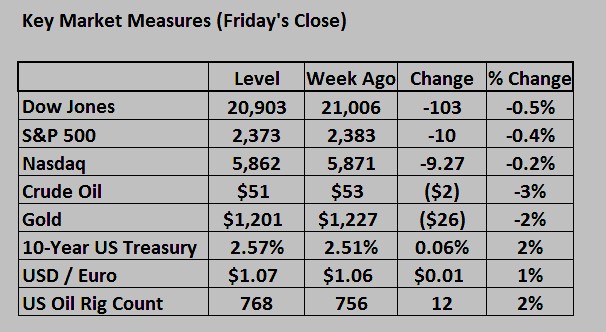
What a week just passed. The bond market sold off hard. An interest rate hike this coming week is as close to guaranteed as it gets. But how many more hikes will we see this year - 2 or 3 or 4 in total? Some savvy long timers are starting to talk about the days when the Fed hiked more than a quarter point per meeting. Could this return? Aside from Fed policy, the Trump team is on a roll. The appointed head of the Commerce Department, Wilbur Ross, spoke to his new 40,000+ employee team, and formally established so many new directives to change the game of US and global trade. The prospects for the bull market run in the stock market remain bright!
No matter what, there is always a bull market here! Week in and week out, you can find it right here at The Bull Market Report. We currently see a bull market across many parts of the stock market. This week we highlight the following securities: Bristol-Myers Squibb, Facebook, Simon Property Group, Tesla, VMware, Celgene and Amazon.
Highlights From The Past Week
Up, up, and away for stock markets. While expansion in PE multiples has sent the S&P 500 to a level above the 90% percentile of historical valuations, higher corporate profits are likely to push the equity market to even higher levels. We could see near-term weakness as earnings forecasts are revised downward due to tax reform occurring in 2018 versus 2017, but this should not jitter long term investors.
Record net inflows. "Fear of missing out" is quickly becoming the go to phrase for many of America's stock market investors. As The Wall Street Journal reports, investors poured money into stocks through mutual funds and exchange-traded funds in 2017, with global equity funds posting record net inflows in the week ended March 1st based on data going back to 2000. Inflows continued the following week.
Great Jobs report. Steady U.S. job growth has set the stage for the Fed to raise interest rates. A wave of hiring in February — President Trump’s first full month in office — pointed to a strong foundation for the nation’s economy, providing further evidence for the Federal Reserve that the moment to raise interest rates has come. The Labor Department reported a gain of 235,000 jobs and healthy wage growth in a month when even the weather cooperated. It was the last major data release before Fed policymakers meet Tuesday and Wednesday, when they have signaled their intent to increase the benchmark interest rate.
BMR Companies and Commentary
Bristol-Myers Group (BMY: $58, +2% - all price changes in this report are for the week)
Scott Gottlieb, a former deputy commissioner of the U.S. Food and Drug Administration, is President Donald Trump’s choice to lead the agency, per White House media relations.
Gottlieb, 44, served in several senior positions at the FDA during the Bush administration. He’s a partner at one of the world’s largest venture capital firms, New Enterprise Associates, which has a portfolio of more than 300 businesses in the Technology and Healthcare industries. He has talked extensively about how to lower the cost of prescription drugs by modernizing the agency’s approval process and speeding cheaper generic competitors to market. Since leaving the FDA, Gottlieb has worked as an adviser to investment firms and as a fellow at the conservative-leaning American Enterprise Institute, a Washington think tank. He has been the drug industry’s preferred choice for the FDA job and has worked as a consultant to some of its companies.
Bristol is largely already a good actor, but could have been taken down with the broader industry. Management understands the concern that with escalating healthcare costs, and with the increased burden they place on patients and their families, there needs to be close scrutiny. At the end of the day, Bristol feels that prices of its medicines should reflect the value they bring to patients, healthcare providers, payers and society as a whole. The results of how Bristol has contributed to the transformation of the treatment of diseases like HIV, HCV and cancer demonstrate that the model for sustainable innovation is working - which is good news for patients and society. For example, in melanoma, prior to the availability of Immuno-Oncology treatment options, 25% of patients diagnosed with metastatic melanoma survived 1 year. This increased to 75% with Immuno-Oncology therapies.
So you see Bristol is making real progress towards the goal of shifting cancer from a death sentence to a chronic disease that can be managed and controlled. Bristol is leading the way on the conversation for fair, reasonable, and visible drug prices, and the appointment of Gottlieb is far less disruptive than it could have been.
BMR Take: The event is a major positive for the Drug industry. The reason why is more so the counterfactual. With the current battleground discussion happening over the cost of drugs, Gottlieb is a far less extreme pick than some of the other candidate contenders. This means less pressure going forward for Bristol and others to lower prices.
Facebook (FB: $139, +1%)
Facebook has scored a deal to lives stream Major League Soccer matches. As competition in the live streaming space heats up, Facebook has scored a significant deal that will allow it to stream at least 22 live Major League Soccer matches on its social network.
Through a collaboration with both MLS and Univision, Facebook gained the rights to stream the 2017 MLS regular-season matches in English, as well as enhance the video content with various interactive elements. The streams will include Facebook-specific commentators and interactive graphics, as well as fan Q&A and polling features that let Facebook viewers engage with the commentators as the matches take place.
These are the same games that are being broadcast on Univision networks in Spanish, but Facebook has scored exclusive rights to the English language streams.
As a part of the deal, MLS will also produce more than 40 original “Matchday Live” analysis shows that will be posted to the MLS Facebook page. These shows will include feature highlights and discussions from around the league, as well as previews of the upcoming matches.
BMR Take: Soccer is the sport of the globe. Facebook just found a way in the back door to this global sport. It is exciting to see Facebook leverage the audience into stronger user engagement. Sitting at an all-time high of $139, we see no reason why the stock can’t continue higher. With management like Zuckerberg driving growth, we see this investment is in good hands. We hereby raise the Target to $150, and our Sell Price to $125.
Simon Property Group (SPG: $168, -6%)
We have here a REIT focused on owning and managing commercial real estate. The Simon portfolio is dominated by malls and premium outlets located in the U.S. Shares have been under elevated stress in recent weeks. Two factors are driving the concerns. First, a rising rate cycle presents headwinds. Second, retail exposure could be toxic.
The rising Fed Funds rate is leading to increasing debt costs for Simon. The company must successfully pass these increases to its tenants or operating results will suffer. Moreover, all of Simon's tenants will also have their own funding costs moving higher, which squeezes their capacity to pay rent. A challenging operating environment.
Malls and physical retail are also subject to secular pressure thanks to the internet's inroads throughout the retail space. Target and Macy’s recent earnings miss are the latest sign of the wave of stress coming. The fear is that if major anchor tenants in malls go down, then who could possibly step in to replace them. The answer is not clear.
We admit that Simon's has some great assets and can leverage them. However, the internet may affect the company in the future. BusinessWeek, in an article on Macy’s, said: “Long term bets on retail real state could be risky. America has too many stores, and more than 10% of US retail space - almost 1 billion square feet – may need to be closed, be converted to other uses, or charge less rent in the coming years. That could leave some REITs in trouble if they load up on losing properties or can’t find tenants, or if real estate values plummet. The larger retailers are shrinking their footprint. The question is, how far do they shrink it?”
BMR Take: We don't always get it right. But we do always address issues with you honestly when they happen. We are exiting our Simon position.
Tesla (TSLA: $244, -3%)
Tesla recently published its annual report and we have some notes to share.
SolarCity contributed $84 million in revenue from 11/21/16 to the end of the year. Their 10-K filing shows 2016 revenue totaled $730 million.
Tesla had 790 Supercharger stations worldwide at 2016 end, up from 715 locations globally at 3Q16 end (+8% q/q). The net book value of the Supercharger network was $207 million at FY16 end.
The company notes over 7,100 Tesla wall connectors have been installed at more than 4,100 locations worldwide to enable vehicle charging.
The company plans to begin production of its solar roof product at the Gigafactory 2 in Buffalo this summer, to be ready for customer installations later in the year.
Tesla estimates combined tax savings under agreements with the California Alternative Energy and Advanced Transportation Financing Authority will total approximately $200 million.
BMR Take: After reading the company’s annual report, we find a lot of tidbits of good information. Overall we continue to like the company’s prospects.
Elon Musk and His Take on Solar Panels for Your Home
Have you seen the presentation Elon Musk has put out for all to see?
Check it out here: http://read.bi/2mN4SLN
These new solar panels for your home look like any normal roof, but are indeed solar panels. Can you imagine how big this market is? We have solar panels on our roof here in Aspen and we don’t pay for electricity for eight months of the year. But we had to install those giant, bulky solar panels. Wouldn’t it be great to have a roof look like a roof but have it be totally solar?
Musk says his roofs are not expensive; we disagree. But what we do know is that over time the price will come down so everyone with a home will be able to afford a new solar roof.
Musk has grand ideas, some of which work, some of which don’t. (Have you heard that he is guaranteeing to fix Australia’s power outages for $100 million, but if he can’t do it in 30 days, the $100 million is on him!)* We love him for his brave ideas.
* From Reuters: Tesla boss Elon Musk on Friday offered to save Australia's most renewable-energy dependent state from blackouts by installing $25 million worth of battery storage within 100 days, and offering it for free if he missed the target.
The offer follows a string of power outages in the state of South Australia, including a blackout that left industry crippled for up to two weeks and stoked fears of more outages across the national electricity market due to tight supplies.
Musk made the offer on social media. He said via Twitter: "Tesla will get the system installed and working 100 days from contract signature or it is free. That serious enough for you?"
BMR Take II: We sure wish the stock wasn’t so darn volatile. We believe in Musk and we believe in Tesla (Solar City included.) And we think the stock can go to $400 and beyond. But the company certainly has its challenges financially. The market is so fickle that it might must crush the stock because of some short-term issue, scaring us and many investors out of this great company. Be diligent, Investors!
VMware (VMW: $90, flat)
VMware recently spoke at an investor conference. We wish to recap part of the discussion for you.
2016 was a very interesting year for VMware. It was a year that ended up with the company being in a much better position than what people expected, both in terms of the growth rate and customer satisfaction.
The company’s Chief Operating Officer specifically said one of the biggest things accomplished in 2016 was refining its strategy for customers. The Software-Defined Data Centers are the key part of the new strategy. The company has moved beyond compute to storage and networking. Four years ago, all VMware could talk about was Compute. Now, VMware has gone from nothing to the leader in storage and networking software with 7,000 customers. Plus, the recent Dell partnership just became a big opportunity for more growth.
BMR Take: VMware has been a great pick out of the gate for us at The Bull Market Report. We continue to believe in the company and believe the stock will go much higher towards our Target of $95. We just may raise the Target here soon.
Celgene (CELG: $124, flat)
Celgene recently spoke at an investor conference. We wanted to recap part of the discussion for you.
The big takeaway was this: The President of the Oncology division said, “I think it's fair to say that Celgene is at an inflection point. We have an incredible momentum as we've been saying and additional drivers that should absolutely enable us to achieve our 2020 numbers. The recent positive results that we have been reporting on ozanimod in relapsed multiple sclerosis have not been fully baked into the $21 billion revenue number of 2020. We have multiple Phase III studies, reading out. Five of them are going to read out by this year. So, I think we have a great opportunity to not only achieve but then overachieve what we've been telling you we should have as a financial goal for 2020.”
That is sure exciting. Don’t you agree?
BMR Take: Celgene is widely cited by Street analysts as a top pick in the space. We love it too. We raise our Price Target to $135 and our Sell Price to $115.
Upcoming Economic News
TUESDAY, MARCH 14
Producer Price Index – February
Time: 8:30 am
Forecast: 0.0% overall, 0.2% core
The downdraft in oil prices can leave the Producer Price Index unchanged in February after three straight monthly increases. Ahead of this potential pause, businesses were feeling somewhat higher cost pressures with the PPI equaling the 29-month high annual rate of 1.6% in January.
WEDNESDAY, MARCH 15
Consumer Price Index – February
Time: 8:30 am
Forecast: 0.0% overall, 0.2% core
While a decline in fuel costs can restrain the Consumer Price Index in February, the annual pace of growth will remain substantially elevated. The CPI has rapidly accelerated from the yearly advance of just 0.8% last July to the five-year high of 2.5% in January. The core CPI has long been pointing to livelier underlying inflation trends, rising more than 2% annually for 14 straight months.
Retail Sales – February
Time: 8:30 am
Forecast: -0.1% overall, 0.1% ex auto
A drop in gasoline sales is projected to lead a poor result for February retail sales. Outside of gasoline and plateauing auto sales, retail sales rose at the solid 5.0% yearly rate in the three months ending January. This points to higher potential for real consumer spending.
NAHB Housing Market Index – March
Time: 10:00 am
Forecast: 65
Homebuilder confidence is expected to remain elevated in the March NAHB index. Despite some slowing in the pace of new home sales, builders still foresee strong sales growth well into the future. The index of expected sales over the next six months was at 73 in February, far above the historical average of 57.
Business Inventories – January
Time: 10:00 am
Forecast: 0.3%
Business inventories are in line to expand for the third straight month in January amid improving production trends. Sharp growth in imports indicate that investment and output trends are moving into positive territory after extended soft periods.
FOMC Rate Decision
Time: 2:00 pm
Forecast: 0.75%-1% Fed Funds target range
Barring an unforeseen shock, the Federal Reserve is pushing toward lifting the Fed Funds target range at the March FOMC meeting. The more aggressive tightening stance is not entirely surprising, as a rate hike would have to be imminent to live up to policymaker projections of three increases this year. Unlike what has transpired in the past few years, there have been no financial market volatility or economic shortfalls to push the Fed off track.
THURSDAY, MARCH 16
Housing Starts & Building Permits – February
Time: 8:30 am
Forecast: 1.26 million starts, 1.25 million permits
Housing starts are forecast to hold steady in February, maintaining strong near-term gains. Starts rose 17% annualized in the three months ending January against the previous quarterly period, as homebuilding is recovering from the weak results in the middle of last year. The uplift in starts is set to continue with building permits rising 10% annualized in the three months ending January.
FRIDAY, MARCH 17
Industrial Production & Capacity Utilization – February
Time: 9:15 am
Forecast: 0.2% industrial production, 75.5% capacity utilization
Industrial production is looking to turn higher in February after the utility sector led an overall decline in January output. The manufacturing sector is reporting consistently positive results, rising in four of the last five months through January. The broad recovery in manufacturing will likely get little help from the auto sector, after auto output declined at least 2% in both November and January as sales slow.
University of Michigan Consumer Sentiment – March
Preliminary Time: 10:00 am
Forecast: 96.3
Consumer sentiment in the March Michigan survey is likely to be little changed from February’s three month low. Yet even with modest declines in the overall index, the Michigan readings on consumers’ assessments of current economic conditions have barely changed from December’s 11-year high. Continued positive trends in hiring and income are bolstering confidence, helping to lift potential consumer outlays.
Leading Economic Indicators Index – February
Time: 10:00 am
Forecast: 0.3%
Rising stock prices and the falling count of claims for unemployment insurance can help the Leading Economic Indicators Index expand for the sixth straight month in February. Much of the optimism baked into record stock index levels are derived from expectations of corporate tax cuts.
Amazon (AMZN: $852, flat) Grocery Sales
Nielsen, a consumer monitoring company, released a report entitled, The Digitally Engaged Food Shopper. It said that Amazon is 9th in groceries sales now. But they will be moving to 3rd by 2022. Wow. They said that online grocery shopping could grow 5-fold over the next decade, with American consumers spending upwards of $100 billion on food-at-home items by 2025. Online grocery spending could grow during the 2016-2025 forecast period from 4% of the total U.S. food and beverage sales to as much as a 20% share, based on the most upbeat scenario. Last year, online grocery sales were about $20 billion.
Amazon is setting up stores where you can order online ahead of time and then either pick up your order yourself, or have it packed and delivered to your home, usually within two hours. In fact, Amazon Go lets customers walk in, grab food from the shelves and walk out again, without ever having to stand in a checkout line. This is a new concept and they are just starting to test this in Seattle, their home base. The stock is trading within a whisker of an all-time high of $860, set on February 23rd. We have a $900 price target on the stock, but if and when it hits this number we are raising it to $1000.
Notes at the Margin
Philip K. Verleger, Jr.
Former Director of the Office of Energy Policy
at the United States Department of Treasury
March 13, 2017
Expectations Frustrate Oil Producers
The oil industry’s “high and mighty” met last week in Houston during IHS CERA’s annual conference. Oil ministers and company CEOs addressed the throngs in attendance. Separately, key individuals met privately. Lacking a castle in Scotland, the key OPEC representatives met with several CEOs there. As they did, the company counsels likely trembled while thinking of the potential antitrust implications.
Quoting one official on how companies are moving aggressively to bring breakeven costs down:
“Everyone is driving break-even prices down,” Deborah Byers, head of U.S. oil and gas at consultants Ernst & Young, said in an interview at the meeting, the largest annual gathering of industry executives in the world. "It isn’t just shale companies; it’s everyone, from deep-water to conventional."
Some examples:
--- Statoil has driven the costs for its next generation of projects from $70 per barrel to well below $30.
--- Exxon’s CEO Darren Woods and Total’s Patrick Pouyanné believe many projects can be profitable at $12 per barrel.
--- Rystad Energy sees a 46% decline in shale costs from 2014 to 2016.
--- Shell’s reported the company had cut deepwater costs 50% over two years.
The conference speakers all touted the increased output they expected to achieve, some mentioning rates of twenty and thirty percent per year. Markets responded to the news. Crude oil prices dropped sharply. The decrease in cash markets began on Wednesday. In three days, prices fell $4.50 per barrel,
[Verleger’s Conclusion: The world oil market has become much too sophisticated for OPEC management. ]
A Word from Gary Jefferson
Jefferson Financial Group
First Vice-President, Investments
UBS Financial Services, Inc.
Twelve days ago President Trump delivered just what investors wanted to hear during his Joint Session of Congress address. He talked about a large corporate tax cut, massive infrastructure spending, and tax relief for the middle class. All of these are pro-growth initiatives and were clearly the catalysts behind the impressive bull run the day after the speech.
Amazingly enough, we heard a couple of financial pundits on TV say something that actually made sense – that before the market moves much higher, investors will likely demand more proof of the actual implementation of these pro-growth policies. We say that the faster things come together the better. And, the longer it takes, the tougher it will be to continue to make new highs.
We think the market will focus in on three key things: The February Jobs Report, February CPI and the Fed's March Meeting. Unless there are some really bad surprises, we believe the Fed will raise rates at their March meeting this week. How high do rates have to go to raise a red flag for equities? The Oracle of Omaha recently stated that he thought the stock market would be fine until the 10-year Treasury rose above 3%. It's currently trading right around the 2.6% level, which is not that much higher than the average dividend yield of S&P 500 stocks.
Consensus Ratings for AstraZeneca (AZN: $29.50)
Ratings Breakdown: 1 Sell Rating, 5 Hold Ratings, 11 Buy Ratings
Consensus Price Target: $36
3/7/2017 Barclays Initiated Coverage - Overweight
Two Letters from Our Readers:
From John Tennant
Good call on OPKO in your March 5th report! I have been loading up under $8..... One of my larger positions now, average cost $8.50. Note new info from Dow Jones this morning. "OPKO Health: EU Orphan Drug Status Granted for AntagoNAT to Treat Dravet Syndrome"
Our answer:
Yes, so far so good. But $9 would make us feel a LOT better!
[Note: the stock was up 7% this week.]
Hi Todd,
After reading your newsflash on The Carlyle Group (CG: $15.70), I went to Yahoo Finance. The dividend shows $0.64. I then went to TDAmeritrade where it shows $1.84. Fidelity shows the same as TDAmeritrade. And the screen shot you shared shows $1.60.
I am a little confused as to which is the correct information. Could you please help resolve this? Thanks again for all your guidance week in week out. It is greatly appreciated.
Regards, Nilanjan Das
Our Answer:
Hi Das –
The problem for all reporting companies like us is that this company issues a different dividend each quarter. The last four dividend payments were: 26 cents, 63 cents, 50 cents and 16 cents. That’s $1.55. The four before that total $2.07. So go figure!
The point here is that the company will be paying out as much as possible, and we think that average will be around $1.60 to $1.80.
Todd Shaver
The Trillions of Dollars of Cash Overseas
We had a discussion with a friend of ours recently who is a very astute investor and we were impressed with actually how smart he is. On Election Eve when it was clear that Trump had won the election, the futures market was down 800 Dow points. He said he bought over $1 million of equities in the overnight trading markets. And he still has those positions. He wouldn’t tell me how much he is up but I can guess – 20%? 30%? Wow.
We then had a discussion over how much corporate cash is sitting in banks overseas. We know that Apple has over $250 billion stashed in Ireland and other places, and we always thought the total amount of cash was hovering around $1.3 trillion. He said that the number was $2.5 trillion. Well, we did a little research and found out that he is exactly right. $2.5 trillion is sitting overseas waiting to come back to America when Trump lays out his tax cut plans. We don’t think an overall corporate and personal tax cut is a good idea, but Trump says he is going to do it so we have to roll with it. Increasing the $20 trillion debt it not a good thing in our book, but Trump also says he can wipe out the debt in eight years. This ain’t gonna happen, folks.
But repatriating 50-75% of this cash will change America for the good. What can corporations do with this cash? Stock buybacks, starting new companies, investing in technology, hiring more people. The list is endless. Keep your eyes peeled for this big move from the White House.
The High Yield Corner
By Michael Foster
This week, we need to start with Treasuries.
High yield investors don’t buy Treasuries, especially not in a post-2006 world. After all, a 10-year Treasury note is paying a whopping 2.6% yield. With inflation going up, that’s not enough to cover the rising cost of living let alone provide a real inflation-adjusted return. But high yield investors need to keep paying attention to U.S. Treasuries, because they represent the baseline - the limit that high yield investments can go before they yield too little to warrant buying, given their greater risk.
That baseline is going up because Treasuries are going down. As Treasury prices fall, their yield goes up. And the 10-year yield has skyrocketed from less than 2% in 2016 to the 2.6% we’re seeing today. As a result, anyone who bought Treasuries in an attempt to find a low-risk investment is down on their investment big time. The iShares Barclays 20+ Year Treasury Bond ETF (TLT: $117) has fallen over 7% in the last year. So much for avoiding risk!
And while I pity people who bought Treasuries in 2016, I can’t say I’m all that surprised. Yields had fallen to their all-time historic low and political pressure on the Federal Reserve to raise interest rates made the low yield on long-term Treasuries untenable.
Here’s the problem for high yield investors: This makes the situation for many riskier debts untenable.
In particular, we are at a crossroads for the high yield world in which corporate bonds are getting to their breaking point. To demonstrate this, we need to look at a relatively obscure financial metric known as the Merrill Lynch US High Yield Option-Adjusted Spread. This is an index that calculates the difference between junk bond yields and Treasury yields..
This index tends to revert to its mean and go up and down wildly. When it’s at its highest points, like in early 2016, the market has sold off corporate bonds to such an extreme that there are a lot of bargains for selective investors. When it’s at its lowest points, like in June 2007, the market is way too complacent and a sell-off is likely on the horizon.
This index was at 8.6 in February 2016 when The Bull Market Report began aggressively recommending high yield investments. The index is now at 3.9. The bigger the spread, the more risk-averse bond investors are acting. The smaller the spread, the more risk hungry
We’re still 50% above its low in 2007, so we’re not at the top of a bubble by any means. But the index is at about the same level it was at in July 2014. That’s when the SPDR Barclays High Yield Bond ETF (JNK: $36) reached its top only to fall 21% until reaching its low in 2016.
The SPDR junk bond fund fell 2% this past week. It is flat year-to-date and up over 7% from a year ago. There is no indication that junk bonds are going to crash - but we also have clearly left the bullish trend that we saw in 2016.
This means investors need to stay cautious and ready to rotate out of junk bonds in the coming months. This is especially a prudent course of action before the Federal Open Market Committee’s March meeting next Tuesday and Wednesday. Janet Yellen has already dropped several strong hints that she is set to raise interest rates at this meeting. The futures market also thinks an interest rate raise is coming, with the futures market implying a 97% probability.
The drop in long-term Treasury prices is simply the market anticipating the Fed driving up short-term Treasury interest rates. But that doesn’t mean the move is fully priced in. What’s more, the junk bond market has not really priced this in at all. Junk bonds are up 7% during a time period when the Treasury market is down 7%. This is wild. With junk prices up, the rates have fallen. With Treasuries down, the rates have risen; and thus the spread between the rates has gotten about as small as it ever does outside of an unusual bubble situation like the housing disaster of last decade.
As a result, it’s time for high yield investors to lay off of junk bonds. We do not recommend selling all junk bond holdings, but a lighter allocation to previous BMR recommendation PIMCO Dynamic Income Fund (PDI: $28, down 1%) makes sense here. This fund’s near-5% premium pricing no longer makes sense in the current bond market, even though fundamentally this is a great fund to buy in most market conditions. A rebalancing slightly out of PDI now that the junk bond market is heating up makes sense, while still holding some shares to enjoy the double-digit yield.
So where should that money go instead? While corporate bonds have not priced in interest rate risks due to intense investor demand, the more easily frightening municipal bond market has. The Invesco Municipal Trust (VKQ: $12.16, down -3%) and Nuveen AMT-Free Fund (NVG: $14.11, down -2%) have continued to slide and are now yielding 6% each. Depending on your tax bracket, that could mean a taxable equivalent yield of 9%, making them close to PDI in terms of post-tax income.
At the same time, these funds have not been bid up in an overly risk-tolerant market like PDI, meaning the risks of capital loss are not as acute.
In fact, there is a lot of undue fear that tax policy changes will remove the tax benefits of municipal bonds, but now that the Trump administration has released its new budget plans, it seems that muni bonds are not a target. We at The Bull Market Report have reiterated this position repeatedly; it makes no sense for the Republicans to alienate retirees by cutting tax benefits to municipal bonds. But the market is still treating muni bonds as unduly risky, currently not a bad thing as yields have remained high.
Using Warren Buffet’s terminology of “greedy,” we like the more fearful approach of the municipal bond market, which is making investors more greedy. Conversely, the more greedy approach of the junk bond market is making us more fearful.
The same dynamic exists in other parts of the high risk lending world. BDCs are showing signs of weakness, but they aren’t suffering the kind of sell-off after last year’s run up. The UBS Etracs BDC ETF (BDCS: $23, down 1%) remains in the green for 2017 and is up a whopping 19% over the last year excluding (!) its 8% dividend.
This wouldn’t be a real problem if BDCs were reporting good earnings, but that’s not happening. Blackrock Capital Corporation (BKCC, $7.72) reported a 2% year-over-year decline in net asset value per share and the company cut its dividend by 14%. Yet the stock is up 11% year-to-date and has seen large daily drops and increases over the last week. This kind of volatility and disconnect between stock price and fundamentals is dangerous.
But it’s not just happening with Blackrock Capital. KCAP Financial (KCAP: $4.02) and Horizon Technology Financial Corp (HRZN: $10.33) reported a similar drop in NAV this week.
It isn’t all doom and gloom in the high yield sector though. REITs saw a sharp sell-off this week, uncovering some more bargains for income-hungry investors. The SPDR REIT ETF (RWR: $90) fell over 4% to show a 1% decline from a year ago. This is good news because it is unlocking several high quality REITs whose investment income remains strong and whose borrowing costs are still extremely manageable despite the shenanigans at the Fed, all of which is giving us continued opportunities to accumulate these high yields.
Healthcare REITs were particularly hit hard, which has resulted in BMR favorites Omega Healthcare Investors (OHI: $31) and Care Capital Properties (CCP: $24) to struggle. These REITs fell 5% last week and are down 6% and 12% respectively over the last year. This means it’s time to buy more. Omega’s yield is approaching 8% but its FFO is still amply covering dividends. Care Capital is now paying a huge 9% but it too is covering dividends. Both stocks are a screaming buy at this current level. After the Fed raises rates and the market sees that this won’t actually change much for the REITs, we’ll see both companies recover. Now is the time to get in before that happens.
Good Investing,
Todd Shaver, CEO and Editor
The Bull Market Report
Since 1998
March 5, 2017
by Todd Shaver | Mar 5, 2017 | Weekly Newsletter 7pm Sunday
The Week Ahead
“Smart Investors Turn To ETFs” was the front page Wall Street Journal headline over the weekend. It is sort of laughable. Wall Street seems to always proclaim it has found the holy grail. They sell product after product with the same pitch. This time we are seeing it happen in ETFs. Don’t be fooled. Look, we like ETFs. We have the Energy ETF in our portfolio. Beyond Sector ETFs, we think there are good investment opportunities in broad-reaching global ETFs. Yet, there remains good investment opportunities in individual common stocks. If anything, the time to by buying your favorite stocks is when everyone else is blindly buying ETFs.
No matter what, there is always a bull market here. Week in and week out, you can find it right here at The Bull Market Report. We currently see a bull market in the REIT universe. This week we highlight the following securities: Simon Property Group, Anally Capital Management, Care Capital Properties, Government Properties, and Welltower. Check out our new REIT portfolio on the website. If you have forgotten your User ID or Password, write us here: Info@BullMarket.com.
Highlights From The Past Week
IPO window wide open as Snap goes public. Having priced at $17, Snap (SNAP) opened for trading at $24, valuing the company over $34 billion - almost three times the size of Twitter, bigger than both HP and CBS, and almost as big as eBay. With losses running greater than revenue, investor demand for the Snap IPO reveals nothing less than a vibrant IPO market. And some craziness! And then the next day it jumped another 10%.
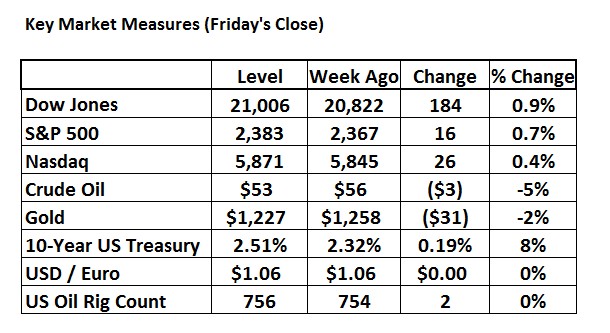
Goldman raises March rate hike odds move to 95% after Yellen speech. Following Yellen's speech which did not throw any curve balls to this week's sharply revised, hawkish narrative by her FOMC peers, a March rate hike - according to Goldman Sachs Research - appears to be in the books. Fed Chair Yellen said that a rate increase at the March FOMC meeting “would likely be appropriate”, as long as incoming data continue to confirm officials’ outlook. Goldman sees this as a “strong signal for action at the upcoming meeting, and we have raised our subjective odds of a hike to 95%." We’re not too worried. Rates hikes are good and bad. They are bad because no one wants to pay higher rates for loans. But they are good because it shows the economy is doing well.
The Fed Is preparing $1 trillion in Qualitative Easing (QE) for the next recession. Should the US encounter a recession in the next several years, the most likely reaction by the Fed would be another $1 trillion in QE, according to Deutsche Bank, delaying indefinitely any expectations for a return to a "normal" balance sheet. This provides downside protection in the event the current bull market loses any momentum.
BMR Companies and Commentary
Simon Property Group (SPG: $179, down 3%)
Houston we have a problem? Nope. Houston-area malls owned by Simon Property Group have not been harmed by market-specific energy-related challenges or broader retail-industry struggles.
Simon’s two Houston properties total 3.7 million square feet worth about 2% of the portfolio. Trends have been stable. Its top Houston mall, The Galleria, is in the midst of a redevelopment to add high-end shops and restaurants into a former Saks. The Galleria is anchored by Neiman Marcus, Nordstrom, Macy’s, and previously Saks. The other of the two malls, Katy Mills, is anchored by Neiman Marcus and Saks 5th Off.
It is not just Simon’s properties holding up. We see the same stability from General Growth Properties (GGP), which owns five Houston properties that total 5.5 million square feet, which is much larger than Simon’s.
BMR Take: The oil bust of late has placed some sour sentiment on any security with exposure to the commodity. The same thing is happening with regard to brick and mortar retail sales. We have not yet seen the two concerns hurt Simon. We are keeping a close eye out for any signs of stress. There is some concern in certain quarters that online shopping will ultimately impact the mall owners of the world like Simon. We don’t believe so, as people like the concept of shopping at 150 stores at a time in real stores, rather than sitting hunched over a computer. But, with that said, if Simon heads lower from here we are going to take a quick, minor loss and look for other places to put our money.
In the interim, we believe stocks like Simon are trading at compelling values.
Annaly Capital Management (NLY: $10.96, down 1%)
Annaly is an internally-managed Mortgage REIT based in New York City with total assets of $83 billion. Incorporated in 1996 and public since 1997, Annaly is by far the largest of the six public Mortgage REITs, which invest in Agency residential mortgage-backed securities.
The company currently invests solely in mortgage securities that are guaranteed by government-sponsored entities, Freddie Mac and Fannie Mae, or by an agency of the federal government, Ginnie Mae. All of these securities have an actual or implied AAA credit rating.
Annaly's principal business objective is to generate income for distribution to investors from the spread between its agency RMBS portfolio and the cost of borrowings. The key point to understand is that Annaly’s business model is very sensitive to interest rates, more so than even other REITs.
BMR Take: With the 10-year Treasury stepping up 19 basis points to 2.51% this week, Annaly shares remained relatively stable. This was a $10.22 stock a month ago, so we remain quite pleased with this investment.
Care Capital Properties (CCP: $26, up 1%)
Care Capital is a self-administered, self-managed Real Estate Investment Trust ("REIT") engaged in the ownership, acquisition and leasing of skilled nursing facilities and other healthcare assets operated by private regional and local care providers.
Care Capital primarily generate revenues by leasing properties to third-party operators under triple-net leases, pursuant to which the tenants are obligated to pay all property-related expenses, including maintenance, utilities, repairs, taxes, insurance and capital expenditures.
As of December 31, 2016, Care Capital had a diverse portfolio of 345 properties and 40 private regional and local care provider relationships. The portfolio is spread across 36 states and contains a total of roughly 38,000 beds/units.
Management is in the process of “re-positioning” the portfolio to improve portfolio metrics. The company was spun out of Ventas in August 2015 and since then has been selling assets and reinvesting in new development and redevelopment.
BMR Take: While near-term portfolio “re-positioning” is weighing on rental revenues and divestitures are resulting in lower earnings assets, ultimately we think the transition is working to produce a high quality better run portfolio that will receive more favor from the market.
Government Properties (GOV: $20, down 2%)
Government Properties is an externally advised real estate investment trust that owns, acquires, and manages office properties leased primarily to government tenants. The company’s niche focus afforded it the opportunity to go public in the midst of the financial crisis in 2009 where it raised $230 million.
Admittedly, core results have been mixed. Despite solid leasing volume, the real estate optimization strategy among government tenants remains a headwind. Average term of just 3.3 years marks the lowest term in recent memory. Tenants contributing 2.6% of rents are scheduled to vacate soon, as the Department of Justice, which currently represents 3% of rents, has moved from the “at risk” bucket to “vacating”. Fortunately, there is some offset by the National Institutes of Health, which has decided to stay. We don’t want to alarm you about recently mixed core results. It is the natural ebb and flow of the business. It could all easily swing the other way.
Providing some comfort, management had alluded to an expanding deal pipeline, given frothy pricing and demand for government-tenanted properties. We are seeing it happen. The company recently announced three acquisitions totaling roughly $130 million, with the largest asset being a 98% leased office park in Virginia; this property represents the largest investment since 2014.
BMR Take: Government Properties serves a unique niche in the REIT space and we see compelling value in the shares.
Welltower (HCN: $70, down 1%)
Welltower is at the forefront of investing in innovative healthcare infrastructure to create the physical and social environments necessary to promote wellness and quality of life for the aging population. Welltower’s operating platform supports post-acute care, independent living, assisted living and memory care facilities for more than 200,000 elderly residents and state-of-the-art outpatient medical facilities handling more than 16 million patient visits annually.
Recently, Welltower began collaborating with Johns Hopkins in a major new partnership. Johns Hopkins Medicine is one of the world’s pre-eminent patient care, research, and teaching institutions. Initially, Welltower and Johns Hopkins Medicine will explore joint initiatives in areas including: measuring quality outcomes in assisted living and memory care; educational programs for patients and care givers; and sharing of health and wellness and business expertise, information, best practices and research. The collaboration will also assess healthcare market opportunities and investments in modern, efficient infrastructure to deliver better care at a lower cost.
Americans ages 65 to 85 is the fastest growing segment of our population and the largest consumers of healthcare. Welltower is a leader in the space on all fronts from infrastructure to science.
BMR Take: The consensus forecast is for a dividend of $3.50 this year, $3.57 next year, and $3.82 in 2019. This 5% dividend yield looks compelling for a leading Healthcare REIT.
Upcoming Economic News
MONDAY, MARCH 6
Factory Orders – January
Time: 10:00 am
Forecast: 0.9%
Sizable growth in transportation sector orders is likely to lead overall factory orders higher in January. Core durable orders are showing positive trends for business investment in the near-term. Such orders rose 10.1% annualized in the three months ending January—the best such gain in nearly three years.
TUESDAY, MARCH 7
Trade Balance – January
Time: 8:30 am
Forecast: -$45.7 billion
The US trade deficit is likely to widen in January as the advance report on trade in goods showed significant gains in imports. Despite the growing trade gap, exports are once again adding to US output as opposed to representing a major drag on growth. Exports rose at the two-year high rate of 1.8% year-over-year in the fourth quarter while December’s 2.7% monthly advance was the best result in four years.
WEDNESDAY, MARCH 8
Productivity & Unit Labor Costs – Fourth Quarter
Time: 8:30 am
Forecast: 1.5% productivity, 1.5% unit labor costs
Long moribund productivity trends showed some uplift in the second half of last year, rising 2% annualized. Yet that recent bump needs to be sustained for quite some time to greatly undo the sickly 0.5% annualized gain for productivity over the past three years. Of concern to the Federal Reserve is the stronger pace of gains exhibited by unit labors costs, which rose 2.4% annualized over the same three-year period.
Import Price Index – February
Time: 8:30 am
Forecast: 0.1%
Moderation in the pace of raw materials price gains is expected to limit the February Import Price Index to its smallest gain of the past three months. Higher oil prices are facing resistance as current values entice a broader array of producers to drill. But the rising cost of imported goods is already weighing on consumer purchases, as the Import Index rose at the five-year high annual rate of 3.7% in January.
FRIDAY, MARCH 10
Employment Report - February
Time: 8:30 am
Forecast: 174,000 nonfarm payrolls, 4.7% unemployment rate
Job growth is showing no signs of stalling out after workers on nonfarm payrolls increased at the four-month high count of 227,000 in January. Employers are very hesitant to lay off staff, resulting in new claims for unemployment insurance hovering near lows not seen in over 40 years. That signal of labor market tightness can carry over to faster wage growth, helping to push up worker earnings above levels that remain historically weak for an extended economic expansion.
Apple Increases Research and Development Spend
Apple (AAPL: $140, up 2%) is pouring money into R&D in an attempt to improve products that don't currently generate revenue, but might in the future, according to remarks made by Apple CFO Luca Maestri at the Goldman Sachs investor conference Tuesday.
The company spent a huge $2.8 billion on R&D in 4Q16, bringing the total to nearly $10.5 billion in total for the year. Apple's annual spend is up by roughly $4 billion since 2014, marking a very noteworthy increase.
Why? Apple's hardware product range is growing. The iPhone is driving the company’s growth and it is adding new products to the lineup to further growth. The price of the phone is pricing out many customers, so we expect to see lower priced phones in the future, allowing them to sell a phone to everyone in the world.
Plus Apple's Services business, which comprises revenue from internet services, Apple Care, Apple Pay, licensing, and the App Store, is expected to grow to the size of a Fortune 100 company this year, according to Apple CEO Tim Cook. That's about $28 billion in revenue for the year, or a year-over-year growth of 15%.
BMR Take: Apple is sitting at an all-time high. We’ve been beating the drums, through endless negativity, especially when the stock fell into the 90s last summer. We were right and we are here to tell you that $150 is not out of sight. And we CAN’T WAIT until the President comes up with his repatriation plan for the $250 billion in cash the Apple has tucked away overseas.
Opko Health Discussion
Opko Health (OPK) had a rough week, losing 12% to $7.45. Earnings were reported last week. Revenue for the quarter was $275 million, flat from the year before. For the year: $1.22 billion, up from $490 million last year. Earnings for the quarter – a loss of $14 million. For the year: a loss of $25 million, compared to a small profit last year. The numbers were skewed by the purchase of BioReference Labs in 2015 for $1.5 billion, which added over $1 billion to revenues last year.
Opko says the potential market for Rayaldee, the kidney disease drug, could be as high as $10 billion but the drug didn't launch until November so there was no breakout of revenues that many were waiting for. We’ll just have to wait until next quarter to see any type of results from this drug.
The 4KScore test, launched several years ago, measures four prostate-specific substances in the blood to identify men who have a high likelihood of developing an aggressive form of prostate cancer. Opko that in Q4 about 18,000 4Kscore prostate cancer tests were ordered, representing growth of more than 12% compared to Q316. Some said they were looking for much bigger numbers here. The company has $170 million in cash and long-term debt of $110 million.
Consensus in the analytical community show that of the six analysts that follow the stock, four rate Opko a Buy, while two rate the stock a Hold. The stock’s consensus target price stands at $13.30.
BMR Take: We’ve said two things before: that if the stock hit $8 we would sell. But recently we said if the stock hit $8 we would buy more. We are going to reiterate this position now. We would buy more here. The caveat is that you have time to wait. Good things comes from patience. But patience in the financial world can be upsetting and cause you to lose sleep. So if this is the case with you, there are lots of other places to put your money. This company has great potential but we don’t control the marketplace that they live in and we don’t control management. We believe in management, but they might disappoint us. (See Under Armour.) Wall Street certainly thinks highly of the company. We give you the Consensus so that you can evaluate the whole picture. Some say that Wall Street analysts are mostly wrong. We don’t believe that. (See Apple, where EVERY ANALYST thinks the stock is going higher, and of course, the stock is sitting at an all-time high.) In any case, this company has amazing potential. Revenues are strong; cash and debt are certainly in line; it should be just a matter of time before we see positive results.
A Letter to the Editor about Simon Property Group (SPG: $179, down 3%)
Hello Bull Market,
Simon Property Group has been doing well but my concern is about the trend toward online retail which has and should continue to have a chilling effect on mall traffic. Doesn't it worry you that several large retailers that are anchor tenants at malls like Macy's and Sears have plans to close stores all over the country? To the extent that online purchases increase won't that hurt brick and mortar retail and foot traffic through malls? Thanks.
Richard Reed
Hi Richard -
We've discussed this with some folks on the Street as well as my own analyst team and it's no doubt that this is the biggest risk factor. If we start to see the risk having a bigger impact on the business, that would be a reason for us to exit. Not that we like to play with fire or pick up coins on the railroad track, but the reality is all businesses are not flawless and have their risks, so it not a reason to not invest. The good news here is that everyone knows this risk so we would argue that it is already baked into the stock's current price. And we must say that shopping online and shopping at 150 stores in a mall are two completely different experiences. It's pretty tough to buy a suit online. And furthermore, people love the social aspect of shopping in stories. That will never change.
BMR Take: Bottom line – if the overall stock market falters, and/or if Simon moves lower, we will take a small loss and move on. But we are believers in the company long term and we are watching closely.
A Word from Gary Jefferson
Jefferson Financial Group
First Vice-President, Investments
UBS Financial Services, Inc.
There are plenty of fundamental evidence in favor of US equities. The ISM Manufacturing Index, NFIB small business confidence gauge, and Consumer Confidence measures are all higher than 12 months ago and, historically, S&P 500 earnings growth has averaged nearly 15% in the year after such a simultaneous rise. UBS Financial is looking for 11% growth in 2017. UBS research also shows that since 1960, investors who have bought in when the market has been at an all-time high have performed similarly to those who have bought at other times. And investors who have bought in when the market has been trading in the current 18-20x PE valuation range have seen annualized returns of 10% and 7%, over one and 10- year time frames, respectively.
With all that being said, we are still in a rhetoric phase rather than a reality phase. In order to buck the odds of major stock market correction, we believe the following promised catalysts will have to show up this year:
Corporate Tax Break: The campaign pledge of a 15% rate is a powerful idea that would generate abundant earnings, GDP and equity growth. This is the "Holy Grail" for investors.
Individual Tax Break: This is also good for the economy, but the direct correlation to stock price gains is not expected to be as strong as the corporate tax break.
Infrastructure Spending: This should provide another big economic benefit.
We still believe an overweight in US equities and underweight in traditional bonds remains a valid tactical allocation in a rising interest rate cycle and expanding economy.
Analysts' Ratings for Under Armour (UA, $18.64, down 6%)
6 Sell Ratings, 21 Hold Ratings, 9 Buy Ratings
2/27/2017 Nomura $16
2/27/2017 Instinet $16
2/14/2017 Morgan Stanley $20
Things just keep getting worse at Under Armour. A tragedy.
Analysts' Ratings for Tesla Motors (TSLA: $251, down 2%)
7 Sell Ratings, 10 Hold Ratings, 12 Buy Ratings
Consensus Price Target: $256
2/27/2017 Morgan Stanley Outperform $305
2/27/2017 Guggenheim Buy $300
2/27/2017 Goldman Sachs Group Sell $185
2/24/2017 Deutsche Bank AG Hold $215
2/23/2017 RBC Capital Markets Target $314
2/23/2017 Royal Bank of Canada Target $314
2/23/2017 Robert W. Baird Outperform $368
Tesla was downgraded by analysts at Goldman Sachs from a “neutral” rating to a “sell” rating in a research note issued to investors on Monday, They presently have a $185 price target on the stock. Dougherty & Co lowered their price target from $500 to $375 and set a “buy” rating on the stock. Royal Bank of Canada increased their price target from $245 to $314 and gave the company a “sector perform” rating.
Analyst Ratings for Kimco Realty (KIM: $24, down 4%)
1 Sell Rating, 7 Hold Ratings, 8 Buy Ratings
Consensus Price Target: $30
2/3/2017 Canaccord Genuity Buy $34
1/23/2017 Barclays Overweight $27
1/9/2017 Raymond James Financial Outperform $28
THE HIGH YIELD CORNER
BY MICHAEL FOSTER
In high yield, this week was eventful on two fronts. Those who invest in closed-end funds likely received shareholder notices during the week, but the more exciting activity was in the BDC sector. A few BDCs reported this week and more are coming. Among the companies reporting was Goldman Sachs BDC (GSBD: $24.20), which reported a NAV decline exceeding 1% during the quarter and a near 3% decline in net investment income (NII). That wasn’t as bad as TCP Capital Corporation’s (TCPC: $17.20) 7% NII decline over the same period.
Neither stock was negatively impacted by the news, which wasn’t far from expectations anyhow, although Goldman’s BDC fell for the week and TCP Capital surprisingly rose. Goldman’s decline was modest and may ironically be a result of the company’s conservative approach. As one analyst wrote shortly after the earnings release, NAV’s decline is largely “a result of restructurings of non-accruals” and the firm’s more conservative approach to credit issuance. To wit, Goldman has not been expanding its loan portfolio significantly in a market that the fund’s managers have complained is not conducive to BDCs because of tight credit spreads, too much capital chasing too few deals, and overall risks in the marketplace. That has kept Goldman out of the market.
But surely Goldman can originate loans easily. Isn’t Goldman’s management in a position to throw billions of dollars’ worth of loans to their BDC? Well, yes; Goldman knows just about every wealthy person and multi-million dollar company on Earth.
The problem is a lack of incentives; Goldman has little reason to throw business the way of the totally separate and autonomous Goldman Sachs BDC, which is itself an entirely separate corporate structure. Combine this with the challenge of finding deals in a highly competitive marketplace, and you see why Goldman’s BDC is choosing to grow slowly rather than quickly.
The big takeaway from this is that now is not a good time to be in the BDC business. This is even truer for investors that rely on BDCs for passive income. There is so much competition between BDCs, that getting yields on loans is getting harder. And then there is so much competition between investors in BDCs, that premiums to stock values are getting higher, which in turn lowers dividend yields. Goldman Sachs’s BDC is trading at nearly a 30% premium to its NAV and is near its highest premium in history.
This is why we reluctantly sold Main Street Capital Corp (MAIN: $37) and continue to fret over the now absurd the 68% premium to NAV that the stock is currently trading at. Main Street is in our view the best BDC in the world but it’s just too expensive to own with a clear conscience. A diversified BDC fund like the UBS BDC ETF (BDCS: $23) is even worse, providing exposure to overpriced BDCs AND BDCs with bad portfolios or shady management. The sector provides value when it’s out of the market’s favor, but it’s in favor now so we continue to urge caution.
So where can an investor go for high yield? Other sectors are faring much better, and the 2016 muni bond rout seems to be fully behind us. The iShares S&P National AMT-Free Municipal Bond Fund (MUB: $108) had a flat week, but BMR pick Invesco Municipal Trust (VKQ: $12.53, up 1%) fared slightly better. Nuveen AMT-Free Fund (NVG: $14.41) fell a bit though, dropping just a shade over 1.5%.
These funds are paying around 5% in dividends, but remember that this is tax-free money. Depending on your tax status, that could mean an 8% taxable equivalent yield. With such a return, there is little rationale in staying away from municipals and taking on higher risk BDCs where defaults are much more likely, management fees are much higher, leverage is much more severe, and dividend payouts are much less sustainable.
On the issue of returns, let’s consider a moment the concept of the risk premium. Basic financial theory states that at-risk investments will always earn a return that is higher than the risk-free rate of return (ROR). There’s no such thing as 100% risk free, but U.S. Treasuries are about as close to risk free as you can get as long as you hold them to maturity. The Fed Funds rate is set to rise to 0.75% or even higher if Janet Yellen raises interest rates this month, which she says she will, and could go as high as 1.5% or above within a year or so. At-risk assets, then, need to offer a ROR above 0.75% for short-term assets. The calculation that is made is always between Treasuries and whatever risky investment you’re analyzing: Treasuries and oil junk bonds for instance.
However, there is another risk premium calculation that investors should make even though they generally don’t: The difference between the ROR on the investment you are considering and the taxable equivalent yield on municipal bonds. Why? Because retail investors can easily buy municipal bonds and get the income from those instead of choosing the riskier asset. This alternative means there is always a limit to just how low yields can go on at-risk assets before retail investors turn away from them.
Just how low is that yield? That’s a complicated calculation that would take a lot of data and a lot of analysis to figure out, but we can do a rough spot calculation by looking at the popular municipal bond ETFs, calculate their taxable equivalent yields, and compare that to the yields on taxable high yield assets. Doing so tells us that 4% is pretty much the limit. Corporate bonds now are apparently at or around their fair value from this metric.
Does that mean it’s time to buy these assets? Not really, but it’s not time to sell either. That means the SPDR Barclays High Yield Bond ETF (JNK: $37, flat) is not set for any great collapse but it isn’t exactly where you want to be either. It also means the near-term seems OK for BMR picks. The PIMCO Dynamic Income Fund (PDI: $29, up 1%) has reached a somewhat distressing premium to NAV of 8% but the fund’s sharp performance makes this bearable. The AGIC Equity and Convertible Income Fund (NIE: $19.73, up 1%) is seeing its discount to NAV remain around 11%, rather high from a long-term perspective and an attractive reason to hold.
Now, to REITs. The best news for BMR subscribers came from this sector this week, as the SPDR Dow Jones REIT ETF (RWR: $94.45, down 1%) saw a modest decline that was overshadowed by BMR’s REIT picks. Digital Realty Trust (DLR: $107, flat), Omega Healthcare Investors (OHI: $33, flat), and Care Capital Properties (CCP: $26, up 3%) were significantly better performers with flat to slightly up growth for the week. Government Properties Trust (GOV: $20, down 1%) tracked the market quite closely, showing that risky REITs are not selling off greater than the broader market, which is usually the signal of a broader and more worrisome panic. However, the most risk averse investors who look for more stable and less risky REITs are clearly selling off, as Kimco Realty (KIM: $24, down -4%) had a truly awful week. This appears indicative of a broader market trend towards risk aversion that is only beginning in the REIT sector but may continue in the weeks to come. Now is a good time to remain vigilant with the REIT sector and look to rebalance as mispricings continue. For now BMR’s recommendations remain unchanged, but more declines in Kimco could cause us to suggest a bit of rebalancing in the short term.
A final word on AstraZeneca (AZN: $30, up 2%). BMR has been following this drugmaker for a while and have held through months of weakness as the biotech industry was destroyed by political risk-related fears. Trump is now president and despite his tweets about drug prices, drugmakers don’t seem to be in any immediate danger. The market has recognized this and is slowly tiptoeing back into the sector. Astra-Zeneca is up 10% year-to-date for this reason alone. The pipeline hasn’t changed, but everyone is getting more enthusiastic about the company’s prospects. This remains a good time to remain long this stock.
Good Investing,
Todd Shaver, Founder, CEO and Editor
The Bull Market Report
Since 1998
February 26, 2017
by Todd Shaver | Feb 26, 2017 | Weekly Newsletter 7pm Sunday
The Week Ahead
“US Talks With Mexico Clouded By Mixed Message” was the front page Wall Street Journal headline going into the weekend. For months now all the focus has been on the new administration. Does anything else matter? Washington DC policy is seemingly the only driver of financial markets right now. Accordingly, we will likely need to start seeing some tangible results on healthcare, tax, and trade reform sooner than later. We eagerly await to see where reality meets the promises made on the campaign trail.
No matter what, there is always a bull market here. Week in and week out, we you can find it right here at The Bull Market Report. This week we highlight evidence of a bull market in the following securities: Amazon, Apple, Home Depot, Netflix, Bristol-Myers Squibb, and Tesla.
Highlights From The Past Week
Top Investor Says He Is Disinvesting. Jeffrey Ubben, the CEO of activist investor ValueAct Capital, told the press that his firm had been taking money out of the capital markets as valuations have become overextended, leaving it with $3 billion in cash. "I really feel that the large-cap activist plays are very treacherous with high PEs and not a lot of growth," Ubben said, speaking at the Reuters "Future of Shareholder Activism" event in New York.
Well, it takes all kinds. That’s what makes a market. We certainly aren’t jumping on his bandwagon. We’re watching, but this market may have a LONG way to go on the upside. Over-extended markets can get more over-extended and who’s to say the market is over-extended? We don’t think so. Either way, we at The Bull Market Report are not trying to predict the macro direction of the world. Our philosophy is that it is unknowable. What we can do is recognize good companies that will do well no matter what the world throws its way.
Are Trump’s Aggressive Plans Achievable? Concerns about Trump's tax cut plan - arguably the biggest catalyst behind the market's daily record highs - are mounting. Rising opposition to a simple "repeal and replace" of Obamacare could spill-over into other domestic policy targets, most notably tax reform. The current debate suggests that tax legislation might not be finalized until late 2017 or early 2018. Along with the potential for a phased-in tax cut, this would likely spread the growth effects between 2018 and 2019. That’s a long way away and lots can happen in the meantime.
We at The Bull Market Report feel that a tax cut is a bad idea. The budget is operating at a deficit now, so a tax cut will make it worse. David Stockman, former Budget Director under Reagan and the perennial bear feels this would be a disaster financially for the United States. We generally don’t agree with Stockman much because he is SO negative but we sure do in this case.
Look – we are flirting with a debt of $20 trillion. Cut taxes and we could be looking at $22 trillion to $25 trillion in debt. It just scares us to write this. And it seems like no one is talking about the debt any more. Listen, if you own a company and it brings in $5 million in revenue but you have $5.5 million in expenses you have to borrow that $500,000 to move to the next year. If it happens the following year, you now owe $1 million. If you do it EVERY YEAR you eventually have to cut people, cut expenses, and ultimately if you don’t act fast enough, you go bankrupt. Just add 10 or 20 zeros to this example to get the results for the United States. (Just kidding about the 20 zeros, but we hope you get our point.)
BMR Companies and Commentary
Amazon (AMZN: $845, flat for the week – all prices in The Bull Market Report are for the week)
This week was the launch of DXagents, a first-of-its-kind group of business leaders and technologists from leading private, public and not-for-profit organizations in Canada, that aims to accelerate the national digital transformation. The year-long partnership includes Deloitte, SAP, Amazon Web Services (AWS), Intel, and others. The mission of the group is to help Canadian businesses better understand and get on the path to realizing their digital transformation opportunities.
Digital transformation refers to the adoption of digital technologies such as cloud, big data, mobile and social media. With recent IDC research finding that 63% of Canadian companies are 'digital laggards' leaving themselves vulnerable to competition from less risk-averse global peers, DXagents was created as a community for Canada-based CIOs, CFOs and other decision makers to more easily and effectively share and discuss experiences related to digital innovation.
BMR Take: Here is a big growth opportunity (this time Canada). Yet again, guess who is involved? (Amazon). Where is Microsoft Azure? Where is Google Cloud? It sure looks like Amazon Web Services has an “in” to doing more business with Canadian companies.
Apple (AAPL: $137, +1%)
Apple has Samsung on the ropes like never before. The competition for the lucrative high-end of the smartphone market is a race between these two companies, which ship over 36% of smartphones globally, according to an IDC estimate.
The war between the two companies for smartphone buyers has raged for years, but the power balance is shifting in favor of Apple, especially after last year's Galaxy Note 7 fiasco and the rising anticipation for the next iPhone.
Mobile World Congress kicks off Monday. This event is one of the biggest smartphone trade shows of the year. Although Apple never makes announcements at the conference, competitors, especially Samsung, usually launch their new mobile product in order to get some press. This year, Samsung is not expected to launch a new phone at the show. Instead, it will likely launch new tablets. While it could be nothing, it could also be a leading indicator that Samsung is really in a tough spot this year, perhaps something has gone really wrong with this year’s model. In contrast, over in Apple’s camp, Apple's Asian supply chain is raising rumors of a very cool redesigned iPhone, with a better screen, longer battery life, and a next-generation 3D selfie sensor.
BMR Take: Apple is taking a bigger bite out of the smartphone market as Samsung is stumbling. Apple is leading the way by innovation. That is what we love to see for our stock picks at The Bull Market Report.
SEE MORE on Apple below in this Report.
Home Depot (HD: $146, +2%)
It’s not too late to buy into the housing recovery. While some fear we are in the 8th or 9th inning of the housing cycle, a recent fundamental analysis published by a major Wall Street investment bank suggests we are not yet that far along. This mean there is still some gas left in the tank for Home Depot.
Home Depot is enjoying strong fundamentals as housing demand continues to outstrip supply. Rising interest rates are not likely to hurt the industry near-term as bad as some may think. For example, it usually takes as much as eight quarters for tightening interest rate cycles to hurt home improvement spending, and Home Depot stock has performed well in rising rate environments in the past.
There is more to like. Home Depot has more stores than peer Lowe’s in yet-to-recover and recovering markets. Accordingly, many think there is upside to the consensus same-store growth outlook of 4-4.5% for Home Depot in 2017-2018. One can also argue that the stock is nowhere near stretched, trading at a PE of 20 that is on par with the 3-year average, and is compelling relative to expectations for low-teens EPS growth.
BMR Take: Business at Home Depot is charging forward. Don’t let all the “late-cycle” discussion talk you out of this holding.
Bristol-Myers Squibb (BMY: $56, +3%)
Bristol is our featured story of the week. It has been a bit of a turbulent ride so far. But hang in there, big time help has just arrived. While JANA Partners pushing for more buybacks and board seats has been helpful, the one and only Mr. Carl Icahn just showed up. Icahn has a history of taking positions in companies and then working to force a sale. Worth about $20 billion, Icahn primarily invests his own fortune.
Icahn was reported to see this drug-maker as potentially ripe for a takeover. Possible buyers could include Pfizer, Gilead Sciences. and Novartis, all of which have an interest in cancer drugs and have money to spend. “I think everybody is looking at Bristol,” Allergan CEO Brent Saunders said in an interview.
Bristol-Myers was itself once one of the drug industry’s major acquirers, snapping up pipeline assets in what it referred to as its “string of pearls” strategy. Those deals landed it the drug Opdivo, which uses the immune system to attack cancers and got remarkable results in once-fatal diseases like advanced melanoma. More recently, though, it’s lost ground to rivals like Merck, which has a similar drug, Keytruda, that has taken the lead in some oncology markets.
Bristol-Myers is still a tempting takeout target. If you believe in the immuno-oncology franchise, then it’s obviously an attractive asset because there’s not many ways to get into this space. While Pfizer has a partnership in immune-system-based cancer drugs, it’s well behind Bristol-Myers and Merck. Novartis, another player in oncology, could raise the cash to do a deal through asset sales and debt. Gilead has amassed billions of dollars from sales of its hepatitis C drugs and is looking for its next move.
BMR Take: Icahn has made a fortune for himself as well as the shareholders who have been there alongside him. Bristol just became one of the most interesting holdings in your portfolio.
Tesla (TSLA: $257, -6%)
What does Tesla's new CFO mean for business? Tesla CFO Jason Wheeler is leaving the company after just 14 months on the job and will be replaced by the electric car maker's original CFO. Tough to be the new guy?
Wheeler, who left his job as vice president of finance at Google to join Tesla in 2015, is leaving to pursue a position in public policy. Hmmm. We wonder what the real story is. When a company changes CFOs -- particularly by returning to a previous CFO -- it's often an indication that it's "tightening up operating performance” and specifically focusing on margins. Tesla's gross margins showed a drastic decline from 28% in the third quarter to 19% in the fourth quarter. The executive level change is likely a step to fix this problem.
Investors want to know if Tesla is going to lose money on each car it manufactures now as it ramps up production, or if it can come close to earning money off each sale. Tesla said that its Model 3 automobiles will start at a price of $35,000, but the company spends about $80,000 to build each car. Many say that this includes capital investment so it not a comparable statistic. There is a lot of heavy lifting to be done to get to profitability.
BMR Take: Change can be good or bad. In this case, we see good things happening. Tesla is getting back some needed deep expertise at a critical juncture. We continue to see long term value in Tesla. Who else is disrupting the Auto industry is such a big way? (Hint: no one.) But we also note that innovation in the Auto industry is a tough business. It hasn’t been done for decades, so an investment here is fraught with risk. As we’ve said many times using different numbers, Tesla could be heading to $400, or $150, we’re not sure which. And if it does go to $400, it just might hit $150 first. If you don’t like risk, please exit the kitchen.
Netflix (NFLX: $143, +1%)
Competition is getting red hot. Sling TV is helping Dish Networks add subscribers. U.S. satellite TV provider Dish Network reported a better-than-expected profit as it unexpectedly added more pay-TV subscribers in the fourth quarter than expected.
Analysts said the subscriber additions were largely driven by Dish's lower-priced streaming service Sling TV, even as the company's quarterly revenue missed estimates. Sling TV, launched in 2015, is a way for Dish to target cord-cutters, or customers who are dropping traditional cable TV for streaming services like Netflix.
BMR Take: The success of Sling TV can be viewed from a few different angles. On one hand, it further reaffirms the momentum in chord cutting, meaning the sandbox Netflix is playing in is extremely lucrative. On the other hand, perhaps Sling TV is turning into more of a competitor for Netflix. Even if the latter trend is true, we think the former trend is big enough overall to take Netflix shares higher. Remember we also have the potential upside of the rumored Apple Services move into TV. People are saying Apple is going to get much, much bigger in this area. After all, everyone is watching Netflix on their Apple phones and tablets!
Upcoming Economic News
MONDAY, FEBRUARY 27
Durable Goods Orders – January
Time: 8:30 am
Forecast: 2.0% overall, 0.5% ex transportation
Durable goods orders are forecast to expand in January after being held back by the Transportation sector in the two previous months. Core orders growth is steadily improving, rising 2.1% year-over-year in the fourth quarter for the largest gain in two years. The general strengthening of global growth prospects and the upturn in the commodity sector are lifting demand for US produced goods.
Pending Home Sales Index – January
Time: 10:00 am
Forecast: 0.9%
The Pending Home Sales Index is set to rise for the second straight month in January as the housing recovery remains firmly on track. Existing home sales rose to a 10-year high in January, lifting sales over the past three months by 6% year-over-year. The home sales pace is aided by rising home lending volume. The MBA index of mortgage applications for home purchases saw its moving four-week average reach a 7-month high in January before dipping a bit in February.
TUESDAY, FEBRUARY 28
GDP – Fourth Quarter (Second Estimate)
Time: 8:30 am
Forecast: 2.1%
Trade activity held back GDP growth in the fourth quarter and continued gains in imports may produce a similar result in the current quarter. But the underlying pace of consumer spending is holding firm, with Retail sales excluding autos and gasoline rising 0.7% in January, equaling an 11-month high. Though annual growth for real GDP is still likely to top 2% this year, lowered expectations for fiscal stimulus reduce much of the potential upside.
S&P Case-Shiller Home Price Index – December
Time: 9:00 am
Forecast: 5.2% yearly change of 20-city index
Historically tight supply of existing home available for sales can keep the S&P Case-Shiller Home Price Index chugging along in excess of 5% annually to December. The four months’ worth of inventory of existing homes at January’s sales pace is near the record low. That has kept home prices rising significantly faster than broad inflation growth for over four years, as seen in the 6.9% yearly rise of the median price of existing homes sold in January.
Conference Board Consumer Confidence – February
Time: 10:00 am
Forecast: 110.9
The Conference Board measure of consumer confidence can continue to ease back a bit in February after reaching the 15-year high in December. Robust levels of confidence will not necessarily translate into a big burst of consumer spending, as the share consumers who indicated in January that they intend to buy a car or home lags the average of the past three years. Yet firmly positive income expectations still point to a solid pace of spending among other consumer goods and services.
WEDNESDAY, MARCH 1
Personal Income & Spending – January
Time: 8:30 am
Forecast: 0.3% income, 0.3% spending
Skimpy recent monthly gains in average hourly earnings hint of a restrained advance for personal income in January. The recent 2.5% annual advance in hourly earnings is not showing the break out in wages many expected, although some other indicators point to faster growth. Continued labor market progress will be needed to push annual income growth back above 4% for the first time since late 2015.
ISM Manufacturing Index – February
Time: 10:00 am
Forecast: 55.8
Heightened business sector confidence and positive output trends are forecast to keep the February ISM Manufacturing Index near January’s two-year high. The new orders component of the index topped 60 in each of the past two months, a firm signal of rising demand. And manufacturing output’s annual pace was positive in each of the three months ending January after declining on this basis throughout much of last year.
Construction Spending – January
Time: 10:00 am
Forecast: 0.8%
Sturdier growth in residential activity is expected to lift overall January construction spending after a decline in December. Housing starts rose 6% year-over-year in the three months ending January following lackluster results towards the middle of last year. And private commercial construction is also aiding the cause, rising 7% year-over-year last quarter.
Vehicle Sales – February
Forecast: 17.6 million
Vehicle sales may show little movement in February relative to January after falling sharply from December’s 11-year high. Even including December’s cyclical high, the yearly advance in the three months ending January was a mere 0.7%. While vehicle sales volume is likely to remain strong in 2017 amid improving consumer finances, sharp gains of the recent past leave little room for further growth.
FRIDAY, MARCH 3
ISM Non-Manufacturing Index – February
Time: 10:00 am
Forecast: 56.5
The ISM Non-Manufacturing Index is projected to hold onto its post-election bounce in February due to sturdy demand for domestic services. The sub-index measuring general business activity in the service sector topped 60 in each of the past three months, signaling a sustained upturn in sales growth. Yet businesses will have to contend with some rising cost pressures, as the Non-Manufacturing index reading on prices rose to the 30-month high in January
Our Take on the Snap IPO
If you are looking at the soon-to-come Snap IPO, look long and hard. It’s coming out at a high valuation and the market may push it much higher after it starts trading. Note that management has gone overboard on the different classes of stock, offering stock to you with NO voting rights, and maintaining 100% control, no matter how many shares you own. This is not the American way. Google has done this and Facebook has done this, but they have done it in a quiet, professional way. And furthermore we know their track record. Snap is being belligerent about it and they have no public track record. We are passing on the stock.
How to Use Options to Lower the Cost of Buying High-Priced Stocks
Tesla ($257), Google (GOOG: $829) and Amazon (AMZN: $845) have risen so much that sometimes folks don’t like to buy the stock at these lofty levels. After all, with Google, 100 shares will cost you $83,000. We at The Bull Market Report don’t have a problem with this but many of you do. If you only have $20,000 to invest in Google then just buy 24 shares. After all, they could split the stock tomorrow 10 for 1 and the price would drop to $83, and you would then have 240 shares. It’s all the same. It is just psychological.
OK, with that said, using options you can control 100 shares of Google for only $18,000. How? You could buy the January $700 2019 option (called a LEAP) for $18,000, or $180 per share. There are two negatives though. 1) You would control the stock for only two years, and 2) You would pay a $50 premium to the price of the stock today. In this example this option allows you to buy the stock at $700, but you have to pay $180 for it, which gives you a breakeven price of $880. If the stock goes higher than $880 in two years you make money, possibly a lot. If it goes lower, you can lose some or all of your investment. So it is not for all. And like everything in life there are at least two sides to every story. If you would like us to expound on this concept please drop us a note at Info@BullMarket.com.
A Word from Gary Jefferson
First Vice-President, Investments
Jefferson Financial Group
UBS Financial Services
"Don't fight the tape." "The trend is your friend." "If you're not long, you're wrong"…………..These are just a few of the Wall Street adages being bantered about as the market continues to climb higher.
What the market senses and, more importantly, expects, is a reduction in corporate and personal income taxes and a meaningful reduction in government regulations that stand to increase (perhaps doubling) the rate of gross domestic product (GDP) growth by the year's end. Investors who are betting against this inertia are, in track parlance, trying to beat the favorite horse by picking longshots.
How high can the market go? That's the biggest question on investors' minds. What we have learned over the past 30 years is that market predictions are not much better than a coin flip. In fact, a lot of them are mostly headline grabbers and entertainment marketing rather than a serious study of behavioral science. Remember back in the 1990s, when some of the best sellers were "DOW 36,000: Why This Time Is Different"…….or "DOW 40,000: Strategies for Profiting from the Greatest Bull Market in History". That said, every serious investment firm is obligated to make a prediction, and each one generally has one which is reasonably based on a set of "what if's"; i.e., if earnings are this, then the market should be that. One publication that has taken forecasting to a new level based on scientific quantifying of "uncertainty" is Modern Trader. They say that there is a possible downside of about 6% and upside of about 24%.
Some other interesting forecasts we read recently include what many experts believe will be the most profitable sectors. There is a consensus that the best performers include Healthcare (biotechs), Financials (regional banking) and Technology, with a lot of support for Energy.
There are many opinions on what will be the biggest fundamental factors affecting the market. Some of our favorite picks were:
1. Interest rates, the dollar, and the price of oil. (Throughout our 30 years in the business, oil has always been a wild card for the market.)
2. Tax cuts and infrastructure investment.
3. Brexit, Chinese economic growth, South China Sea tension.
4. Three things: Trump, Trump and Trump.
Finally, Modern Trader selected Cybersecurity as the one sector every investor should own in 2017, citing the consistently growing number of cyber incidents across the globe and analyst expectation of worldwide spending on cybersecurity to eclipse $1 trillion cumulatively for the five-year period from 2017 to 2021.
[Note that The Bull Market Report pick Splunk (SPLK: $63) is up 36% since we added it 11 months ago. Our Target Price is $75.]
Letter to the Editor – about First Solar (FSLR: $38, up 9%)
From: Peter Goransson
[Note that we had sent out a News Flash last week saying that the stock was down sharply in after-hours trading after the earnings report came out, and we were a bit worried about the stock.]
Peter said: “First Solar is actually up 11% today [Thursday]. Looks like yesterday's movement may have been an overreaction. Are you still considering removing this from portfolio?”
Our response:
Hi Peter –
The market turned around this morning when level heads prevailed. We are breathing a sigh of relief.
It was terribly disappointing to us to see the reaction to the earnings announcement Wednesday evening, so this 11% move today is very heartening. No, we are not going to remove the stock from our portfolios. We are going to hang with it for a while.
We really do love this company and if you look at their history, their revenues have been very big, and we believe they will get big again. And earnings will follow, because historically they are very profitable.
Todd Shaver
Ferrellgas (FGP: $5.89, down 8%)
This stock continues to disappoint and we’ve decided not to wait any longer. The company made a terrible decision in buying Bridger Logistics with the whopping price tag of $840 million. And it bought Sable Environmental for $125 million in 2014. These purchases were financed mostly by new debt and this is what is dragging down the company. The firm has made over 240 acquisitions over the past 75 years but these two are icing on the cake – heavily, sludge-filled icing – that is bringing down the company. When we added Ferrellgas to our High Yield portfolio last year we had no idea how bad a deal this was for the firm and more importantly for the stockholders. We have said many times that the turnaround is going to take 12-18 months. We now feel it may be on the order of 2-3 years, if not longer, and may in fact bring the entire company down.
We’re not going to wait any longer. We hereby remove the stock from our High Yield portfolio. (It’s not even a high yield stock anymore. As they have cut their dividend so drastically because they are losing money.)
Now, what should YOU do? If you have a small position in the company you might just forget about it, keep it in your portfolio, and take a look in a year. If you have a big position then you might consider taking a loss and moving into some stable growth companies.
More on Apple
Berkshire Hathaway’s gain on Apple is more than $1.6 billion after shares have surged since it hit $105 in November. In fact, Apple was the Dow’s best performer in 2016. The news just came out on Warren Buffett’s investment in Apple: Berkshire Hathaway bought 61 million shares last year for $6.75 billion, at an average of about $110 apiece. The holding was valued at more than $8.3 billion as of Friday’s $137 closing price.
Berkshire became one of the top 10 Apple investors in 2016, taking a stake of more than 9 million shares in the first quarter and then accelerating purchases in the last three months of the year. The initial purchases were for an average of $99. Not that Buffett’s company bought $12 billion in stocks after the Nov. 8 U.S. election, indicating a continued strong faith in the American economy. Buffett said the market system that has propelled U.S. economic growth for more than two centuries will continue unabated, echoing his optimism about the country. “The build-up of wealth will be interrupted for short periods from time to time, but it will not, however, be stopped. I’ll repeat what I’ve both said in the past and expect to say in future years: Babies born in America today are the luckiest crop in history.”
Now there is one bullish investor! (With a stock price of over $250,000 a share!) We tend to agree with Warren and we would be vigilant in making changes in our portfolio if the market decides it has peaked. If, and we repeat IF that were to happen, there are lots of great stocks in our High Yield portfolio that will allow us 6, 8 and more than 10% a year returns while we sit and watch the market take a breather. However, at this time the market remains strong, with the Dow at 20 thousand eight. That’s 20.8 thousand. Or 20,822. For heaven’s sake, we just hit 20,000 on February 3rd!
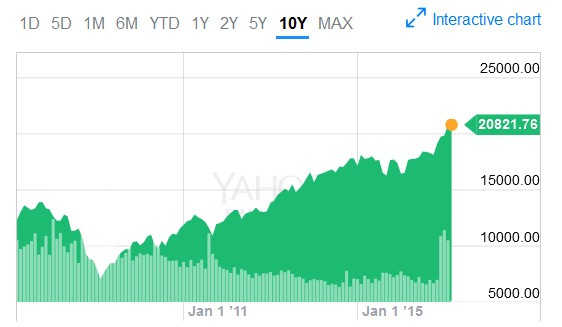
The Weekly High Yield Report
By Michael Foster
Special to The Bull Market Report
It's been another quiet week in the markets, and even quieter in high yield than anywhere else. But before we get to that, we want to talk a bit about some Wall Street chatter we've been hearing from friends both on the buy side and the sell side of the business. Hiring is up in fixed income, especially in the high yield and distressed debt sectors. This bit of insider gossip doesn't sound all that exciting, but it's actually a really big deal. Wall Street hiring is trend driven and often a leading contrarian indicator. When Wall Street starts to invest heavily in one particular corner of the market that is a signal that that part of the market is at or near its peak and a downturn in the next couple of years is likely.
Let's take a look at why that's the case. If you're an investment bank, you make money buying and selling assets for investors. Investors tend to avoid assets when they're down (thus exacerbating the trend) and pile in when they're up (think of how many people were buying investment houses in 2005-2006). When more investors want to buy, say, junk bonds, that creates more demand for people to buy and sell junk bonds, thus turning into more jobs in that sector.
This is especially worrying because hiring is down across Wall Street. This has been an issue since 2008 and it is just getting worse. The fact that fixed income has a temporary reprieve suggests that demand in that sector is really getting hot.
If you want proof, just look at the SPDR Barclays High Yield Bond ETF (JNK: $37). This fund is already up 20% including dividends over the last year, the best one-year performance since 2009. Volumes have also exploded five-fold over the same period. Demand for high yield bonds has heated up.
But what about those surging defaults? Remember in late 2015 when everyone was panicking about the oil-driven defaults in corporate bonds? There was worry that the real risk that higher interest rates would cause even more defaults as cash-strapped companies struggled to keep cash flow enough to service their outstanding obligations. Remember that revenues hadn't been growing for years back then? That's why high yield bonds fell 20% in a little over a year after Yellen raised interest rates.
Those risks remain, but investors don't care anymore. This doesn't surprise us, as the risk of those defaults have been priced into the corporate bond market for over a year now.
There are two lessons to learn here. Firstly, ignore financial press headlines warning about an upcoming apocalypse in an asset class. Trading on that noise is a fast track to poverty. Secondly, being a contrarian investor and rotating into unfavored assets can produce strong medium-term returns.
But now that corporate bonds aren't unfavored, does that mean it's time to sell? Not exactly. There remain good funds that trade in corporate bonds or similar assets like the AGIC Equity and Convertible Income Fund (NIE: $19.46) and the PIMCO Dynamic Income Fund (PDI: $28), which are up about 24% and 26% respectively, including dividend payouts, over the last year. And the dividend payouts haven't gone down and remain safe. If anything, they're getting safer as interest rates go up. That means there is no reason to sell either of these until the market bids their prices to an absurd premium. The Pimco fund is unfortunately trading at an 8% premium to NAV, almost its highest premium in history.
This is especially disconcerting because the Pimco fund historically trades at a discount and it's rarely desirable to buy a closed-end fund at a premium pricing. We would not recommend buying this fund at its current price level, but selling is not a good idea yet either. This is a very obvious hold in lieu of desirable alternatives. Outside of Pimco, there are few funds that can deliver such a substantial market out-performance.
But we also don't think the fund's premium is going to disappear anytime soon. The closed-end fund investment world is getting smarter and the fund's primary income stream (mortgage-backed securities) are getting less underpriced. In the past, a lot of money avoided this sector because of the hangover of the subprime mortgage crisis. That was an irrational mispricing of the sector, so now money is coming back. As money comes back, it makes sense for Mortgage Backed-focused funds to start trading at smaller discounts or, in the case of Pimco's Dynamic Income Fund, at a premium.
Elsewhere in the high yield world, funds have had a muted week indicating there's still time to buy where there is an undervaluation relative to history. The Invesco Municipal Trust (VKQ: $12.65 , down -1%) and Nuveen AMT-Free Fund (NVG: $14.64, flat) had a week of muted action although the news regarding interest rate hikes remains unchanged: The Fed signaled what everyone was already expecting this week, which is great for high yield. Similarly, things were quiet in REITs as higher borrowing costs is causing less panic than it used to. The SPDR Dow Jones REIT ETF (RWR: $95) rose a bit over 1%, with only a few REITs under- or over-performing in a week of little news.
For now, high yield remains an attractive sector but it's not a "no brainer buy” like it was a year ago. There are pockets of attractive undervaluations, especially municipal bonds and some REITs, while fair valuation is becoming more common in the junk bond sector. This is a trend that's likely to continue for a while, assuming we don't get any shocking news to the upside or downside. This confirms our view to buy and hold these funds, since they have outperformed the broader market and are likely to continue to do so for a very long time.
Good Investing,
Todd Shaver, CEO, Founder and Editor
The Bull Market Report
Since 1998
February 20, 2017
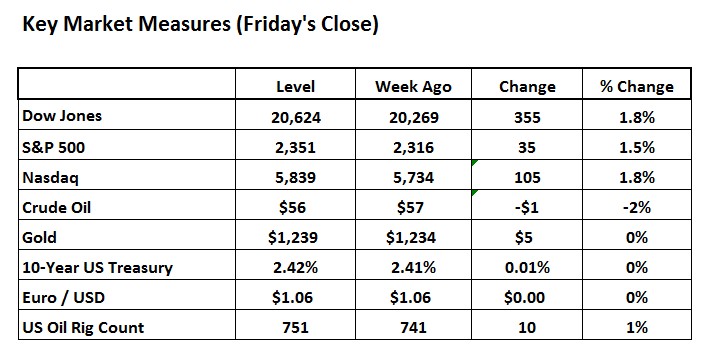
by Todd Shaver | Feb 20, 2017 | Monthly Newsletter Daily 6am if new
The S&P, Nasdaq and the Dow closed at a record high Friday.
With more than 75% the S&P 500 having reported results, fourth-quarter earnings are on track to have climbed 8%, which would be the best performance since the third quarter of 2014. The S&P 500 posted 48 new 52-week highs and no new lows; the Nasdaq Composite recorded 150 new highs and 22 new lows.
The reality is there is always a Bull Market somewhere and right now it is in the United States. This week we provide some insights on our latest thinking for Twilio, the iShares Energy Sector ETF, CBRE Group, the Nuveen Municipal fund, and Facebook.
Highlights From The Past Month
Leadership Turnover At The Fed. Dan Tarullo unexpectedly announced that he is resigning in early April, just days after the Fed's general counsel Alvarez also announced that he is departing the Fed. What makes Tarullo's resignation particularly notable is that he has been the Fed's "regulatory point man" since 2009, suggesting some regulatory friction has emerged. In light of Trump's vow to crush Wall Street regulations, one can see why Tarullo thought his services are no longer necessary. His brief resignation letter to Fed Chairwoman Janet Yellen didn’t give a reason for his departure. He said he has been privileged to serve at the Fed for eight years. The letter said his resignation will take effect “on or about” April 5. We wonder just what is in store for Yellen and other members of the Fed. This is such a critical juncture for interest rates.
Prime Minister Abe Visits The USA. With a hug and a handshake, President Donald Trump and Japanese Prime Minister Shinzo Abe opened a new chapter in U.S.-Japan relations a week ago with Trump abruptly setting aside campaign pledges to force Tokyo to pay more for U.S. defense aid. Trump avoided repeating harsh campaign rhetoric that accused Japan of taking advantage of U.S. security aid and stealing American jobs. "We are committed to the security of Japan and all areas under its administrative control and to further strengthening our very crucial alliance," Trump said. "The bond between our two nations and the friendship between our two peoples runs very, very deep. This administration is committed to bringing those ties even closer," he added.
BMR Companies and Commentary
Apple (AAPL: $136, +3%)
It’s 13-F season. The 13-F report is filed by all investment shops detailing their holdings. This is where anybody with a computer and the internet can peer into the investment portfolios of the best investors on the planet. Well, our curious mind traveled through quite a few of the filings. We were surprised – though not really – to see investor after investor had recently increased their stake in Apple. The list of famous investors includes Greenlight Capital, Berkshire Hathaway, and Third Point. Berkshire won the prize for the largest increase in the size of their position, +277%. We recall that Warren took a position in Apple in May, right at the lows. He now holds 57.4 million shares, worth $7.8 billion. (This is the influence of Warren’s new young bucks who are making many of the new decisions in the company as the founder is now 86.)
So something must be going very right. Big investors are buying. Goldman Sachs research raised their price target from $133 to $150. What is going on? It is slowly coming to light just how undervalued the Services business is. People still don’t widely appreciate that Apple’s Services business alone would be a Fortune 100 company. Services now contributes profit greater than all non-iPhone segments combined.
UBS research estimates that if Services were valued similarly to PayPal, shares would be at least 10% higher.
BMR Take: There are times to be a contrarian, but now sure does not look like one of those times. The Apple train is breaking new speed.
Consensus Ratings for Apple
1 Sell Rating, 10 Hold Ratings, 36 Buy Ratings, 2 Strong Buy Ratings
2/14/2017 Robert W. Baird Target: $145
2/13/2017 Goldman Sachs Target: $150
2/8/2017 Bank of America Target: $145
2/7/2017 Canaccord Genuity Target: $154
2/6/2017 RBC Capital Markets Target: $140
2/2/2017 Wells Fargo & Company Target: $117
Come on, Wells Fargo. Get with the program!
Apple set a new all-time high last week of a shade over $136. We hereby raise the Price Target from $140 to $155. Our Sell Price remains: “We would not sell Apple.”
Twilio (TWLO: $32, +16% for the month*)
*All prices in The Bull Market Report are for the past 30 days
We wrote early this in the Weekly Bull Market Report week about Twilio’s encouraging quarter. We wanted to circle back and follow up with more detail here about what investors are worried about. Sometimes when you ask the hard questions and go searching for the answers, you find out that the risks are less of a concern than one fears on the surface.
Investors’ worries on this stock generally fall into several categories: 1) gross margins; 2) eventual competition from AWS**; 3) pricing pressure from current competitors; and 4) the lock-up expiration. Let’s hit each one.
**Amazon Web Services
Twilio’s gross margin of 59% this quarter was above consensus of 56%. When asked about how the company plans to get from here to its long-term target 60-65%, CFO Lee Kirkpatrick pointed out that Twilio has “significant levers” that it can pull. The first is product mix. Management described the second lever as efficiencies gained through scale – this includes driving better deals with carriers and passing less of the savings to customers.
Another risk for investors to keep an eye on longer term is the potential for competition from AWS. AWS is not a competitor today, but Amazon CEO Jeff Bezos is known to covet large markets and the communications services market is substantial. In fact, Amazon and Twilio are currently working together. The Amazon relationship seems to be strong and is multifaceted. Note that Twilio runs entirely on AWS. Second, Twilio is already helping AWS with mobile products. Third, CEO Jeff Lawson was on stage at AWS re:Invent in November and commented, “We’re really excited to announce some upcoming collaboration with AWS soon.” Last, Rick Dalzell (Amazon’s former SVP of Worldwide Architecture and Platform Software and CIO) has been a member of Twilio’s board of directors since 2014.
Investors are also concerned Twilio may face pricing pressure from its current competitors, which include Nexmo (Vonage acquired them in May) and Plivo, among others. Twilio’s services are generally priced at a premium to these competitors. For example, for outbound SMS messages, Twilio charges $0.0075/message, compared to $0.0061 for Nexmo and $0.0035 for Plivo. Our view is that Twilio is generally able to charge a premium because it: 1) has significant mindshare within the developer community; 2) offers a high-quality, reliable solution; and 3) continues to release new features and software products. Mr. Lawson indicated on the earnings call that he seeks to “build a broad platform that is widely applicable, priced aggressively, and designed to enable developers’ creativity to flourish across the widest set of use cases imaginable.”
The availability of additional shares for sale in the market could adversely affect Twilio’s stock price. Twilio went public in June, selling 10 million shares at $15. Twilio completed a follow-on offering in October selling 7 million shares at $40. Roughly 30 million shares cleared lock-up restrictions in December and another 36 million shares were set to clear lock-up restrictions on January 19th. However, roughly 31M of those shares were subject to the company’s black-out period for insiders. Our understanding is these shares will clear the restricted period this Friday. Some of the largest shareholders of Twilio include Bessemer Venture Partners, Union Square Ventures, and Redpoint Ventures, which owned 17M, 10M, and 3M shares immediately after the follow-on offering, respectively.
BMR Take: Okay, we might see some pressure from the lock-up expiration that happened a week ago Friday, but this is normal Wall Street procedure. Besides, we are sure that many of these owners will want to hold on for the coming years of growth. Furthermore, the business is building momentum making the stock attractively priced at this level.
CBRE Group (CBG: $36, +16%)
What a week. CBRE ended 2016 on a high note. For the year, revenue was $13.1 billion, up 20%, and EPS was $2.30, up 12%. CBRE recorded double-digit earnings growth for the fourth quarter and the year, with excellent performance in all three regional services businesses.
These results are particularly noteworthy in a year of generally softer market-wide property sales volumes, virtually no carried interest income, and tepid global economic growth. In fact, the company’s revenue and earnings performance set new record highs in 2016.
In addition to achieving record financial performance, very importantly, CBRE continued to advance its strategy. This strategy centers around delivering exceptional outcomes to clients. The company’s people and the operating platform that supports them are the key elements to delivering these outcomes. Both advanced materially in 2016, and the impact is showing up on the company’s results.
CBRE is in a stronger competitive position than ever. A good example of the strategic gains made in 2016 is the work done integrating the Global Workplace Solutions acquisition, one of the largest and quite possibly the most complex in the history of the real estate sector. This effort involved massive client facing, and line of business and back-office transformations. The result of having largely completed this challenging work is that the company’s occupier outsourcing business is much larger, much more capable of producing strong client outcomes, and well-positioned for strong long-term growth.
The company is now serving clients with employees on the ground in over 100 countries. What a big business. CBRE remains riveted on sustaining progress with particular focus on areas such as technology and data analytics where it can capitalize on the expertise and vast amounts of information it possesses. For example, last month CBRE acquired Floored, a leading software-as-a-service platform that produces scalable, interactive 3D visualization technologies for commercial real estate. Clients should expect continued visible advancements from CBRE in the technology area.
BMR Take: CBRE’s nickname is the “Bentley” of the real estate sector and in 2016 the business lived up to the expectations. The key takeaway from the earnings call was that no matter the interest rate environment, performance should be rock solid in 2017.
Facebook (FB: $133, +4%)
The controversy is nearing an end as Facebook committed to an audit of ad metrics by a media watchdog. Facebook agreed to submit to audits by the media industry’s measurement watchdog, the Media Rating Council, helping address concerns among some advertisers who had become skeptical of the social network’s metrics.
Facebook had come under fire recently after a series of missteps in which it disclosed several mistakes in reporting data to partners and advertisers. The company conducted its own review of practices and vowed to be more transparent about errors in the future. According to plans for the next year laid out in a statement Friday, Facebook said it aims to release more detailed information, such as metrics on how long users view an ad and how much of it was visible on the screen.
“We want to provide transparency, choice and accountability,” Facebook said. “Transparency through verified data that shows which campaigns drive measurable results, choice in how advertisers run campaigns across our platforms, and accountability through an audit and third-party verification.” Representatives from Facebook gave a presentation Thursday in Washington to the board of the Association of National Advertisers, a trade group for marketers. The meeting attendees were particularly interested in the promise for more transparency and an audit process.
BMR Take: Investors have been waiting for the advertising reporting issues to go away. Well, here we are - the event is happening. This new audit should address and resolve the issue. No more overhang for the stock from this. Having an independent organization validate the metrics Facebook puts out makes the data more trustworthy and provides advertisers with the ability to compare results across ad platforms. Now we can go back to focusing on the fundamentals where Facebook is firing on all cylinders. We are big believers in Facebook as it hovers near its all-time high of $135.50. And despite all of the controversy as discussed above, the stock stays within a whisker of its all-time high.
Upcoming Economic News
WEDNESDAY, FEBRUARY 22
Existing Home Sales – January
Time: 10:00 am
Forecast: 5.55 million
Existing home sales look to move higher in January after sliding in December. Sales rose 7% year-over-year in the fourth quarter, keeping the housing recovery steadily on track. With only four months’ worth of inventory at the latest monthly sales pace, prices will continue to climb, encouraging more homeowners to sell.
FOMC Meeting Minutes
Time: 2:00 pm
The minutes from the uneventful February FOMC meeting will give some indications about what policymakers expect for growth and inflation. The outlook for the economy is clouded by the potential actions of the new administration. Yet some near-term upward pressure on prices and wages still keeps the Fed on track to lift its policy rate three times this year. SO THEY SAY. Who is they? The analysts and pundits. We at The Bull Market Report aren’t so sure. We are watching the 10-year note which is stuck at the 2.4% range. We are in the camp of LOWER interest rates ahead, not higher. Watching and waiting are we.
FRIDAY, FEBRUARY 24
New Home Sales – January
Time: 10:00 am
Forecast: 575,000
New home sales are projected to rebound sharply in January after slumping to a 10-month low in December. Even with the December setback, the sales pace remains exceptionally strong at 25% year-over-year in the fourth quarter. Growth in new home sales can continue to be stellar. The most recent monthly sales pace is 25% above the average of the past 20 years.
University of Michigan Consumer Sentiment – February
Final Time: 10:00 am
Forecast: 96.0
The preliminary value of the Michigan Sentiment Index showed above-average confidence despite slipping from January’s 12-year high. Consumers are starting to feel the bite of higher gasoline prices, as short-term inflation expectations rose to equal the 23-month high. But long-term inflation expectations are muted at just 2.5% annualized between five and ten years ahead, as a sustained acceleration in price growth is doubtful.
Our Favorite Warren Buffet Quote:
"You can't produce a baby in one month by getting nine women pregnant." -- Warren Buffett
Love it. Be patient out there.
More On Stocks We Follow
Opko Health Update (OPK: $8.81, flat) Here is a typical report from a typical day in the life of Opko CEO Philip Frost: “CEO Philip Frost bought 10,000 shares of the business's stock in a transaction on Monday, January 30th. The shares were acquired at an average price of $8.49 per share, with a total value of $85,000. Following the transaction, the chief executive officer now directly owns 3,069,000 shares of the company's stock, valued at $26,055,000. The acquisition was disclosed in a document filed with the Securities & Exchange Commission.”
Here is another: “Opko Health CEO Phillip Frost acquired 12,000 shares of the business's stock in a transaction dated Friday, January 27th.”
BMR Take: This guy knows something we don’t know. Have you read the article in Forbes about him yet? We published the url twice now. (If you haven’t read it and would like to, please write us at Info@BullMarket.com) Despite these purchases the stock remains weak. We believe in this man and this company. We would buy some here, buy some at $7 if it goes lower, and we would buy some every dollar higher as it moves towards $15 again.
Annaly Capital Management (NLY: $10.82, up 5%).
Why We Love Thee.
With an 11.1% dividend yield, it's one of the highest yielding stocks on the market today. It is a real estate investment trust and a Mortgage REIT, specializing in mortgage-backed securities, or MBS's. A REIT is simply an investment fund that owns income-producing real estate or real estate-related assets. Among other requirements, a REIT must invest at least 75% of its total assets in real estate assets and cash, and derive at least 75% of its gross income from real estate-related sources. And it has to pay out 90% of its income.
In Annaly's case, it doesn't invest directly in real estate, but rather in MBS's. These are fixed-income securities, much like bonds, that are backed by residential mortgages. Annaly invests in securities that are issued by Fannie Mae or Freddie Mac, and are thus backed by the full faith and credit of the United States government. It means that the risk that its assets will default is nil.
On Annaly's most recent balance sheet, for instance, agency MBS's accounted for $82 billion out of $88 billion in total assets.
Annaly's biggest task is to deal with the interest rate risk. Annaly uses leverage to buy assets. They borrow money at low short-term interest rates and invest that money in higher-yielding long-term assets - MBS's. The firm has $88 billion in assets, composed of $13 billion in equity and $75 billion in debt. Thus the leverage is about 5 to 1. In years past, this leverage has been as high as 10-1. We are pleased to see the leverage at this lower level. Annaly hedges the risk of rising short term rates by buying interest rate swaps. These are financial derivatives designed to lock in the cost of financing. Annaly has outstanding interest rate swaps of approximately $31 billion.
As we mentioned above, as a REIT Annaly must distribute at least 90% of its income to shareholders to qualify as a REIT. Thus, Annaly doesn't have to pay corporate income taxes on its earnings.
The dividend yield of Annaly is currently 11.1%. That's almost six times greater than the 1.95% yield on the S&P 500.
In order to grow its capital Annaly sells new shares of stock in secondary offerings. In the old days they used to do this as much as twice a year, each time raising $500 million to $1 billion in fresh equity. In the new Annaly world, they don’t do as many secondaries, as management is content with growing the NAV slowly, with the company now worth over $11 billion.
BMR Take: We are comfortable with the company growing NAV slowly, as we hope you are too. Patient investors can sit back contentedly and enjoy the 11% dividend and if the stock is up just 50 cents in a year, that’s another 5% in overall growth producing over 15% in a year. And note that last week the stock was up 30 cents!
The Yield Curve Today. Or, Where are Interest Rates Going?
“Everyone” thinks rates are going higher. Right? You feel this way too, don’t you! Well, we don’t think this way. We think rates might just decide to peter out here and fall back. The 10-year US Treasury Note is at 2.42% right now, up from the 1.8% level before the election. But note that rates around the world are in many cases much lower than what we have in this country. In fact, late last year over $11 trillion was paying ZERO interest.
Take a look at this chart, concentrating on the 10-year notes in gray:
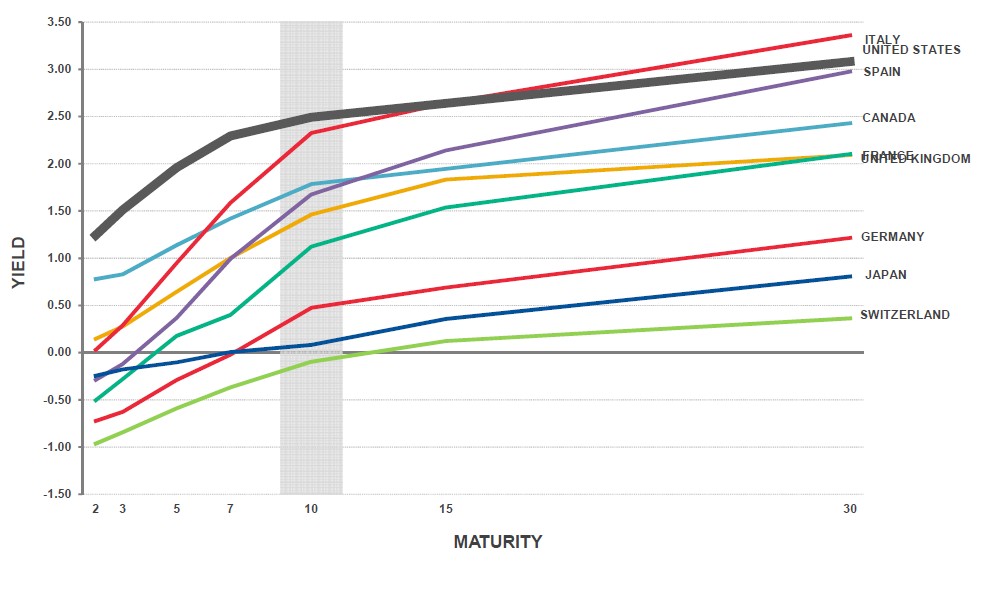
Note that Germany, Switzerland and Japan are hovering around 0%. How could this be? The answer to that may take our writing a book, but suffice it to say that IT IS REAL. And if it can happen in Germany and Switzerland, can it happen here?
BMR Take: The short answer? Yes it can. It “could” happen here. Will it? We wish we knew, but with all the turmoil in the world economically, we think there is more likelihood of rates going down rather than up at this time. We are not convinced that Yellen will have the power to buck THE MARKET. The MARKET will dictate interest rates, not the Fed. We see interest rates going lower rather than higher. And when rates go down, bonds and bond-like funds go up. Food for thought.
The World of the Supernova
This is Tom Friedman’s name for the Cloud. We don’t generally plug books here at The Bull Market Report, but if you want to know what the world of Technology is doing right now, the book to read is his new book, Thank You for Being Late. What the internet and Moore’s Law* is doing in this world of ours is astounding. Here’s some food for thought, a quote from Tom Goodwin of Havas Media in March, 2015: “Uber, the world’s largest taxi company, owns no vehicles. Facebook, the world’s most popular media owner, creates no content. Alibaba, the most valuable retailer, has no inventory. And Airbnb, the world’s largest accommodation provider, owns no real estate. Something interesting is happening.” Friedman goes on to say: “In the age of the supernova, there has never been a better time to be a maker – anywhere.”
*Moore’s Law – The power of the microprocessor doubles every two years. Since 1971.
BMR Take: Why are we printing this here? We want you to THINK about the Technology companies that are driving this growth. The Facebooks, the Apples, the Googles, the Amazons, the Microsofts. These companies are all in our High Technology portfolio and they will continue to lead and drive the growth and innovation in the world in the next decade(s).
What the Street Thinks of Athenahealth (ATHN: $119, down 1%)
Consensus Ratings: 1 Sell, 8 Hold, 12 Buy
Consensus Price Target: $135
Some Ratings from the Street:
2/6/2017 KeyCorp Target $140
2/7/2017 Piper Jaffray Target $162
2/7/2017 Berenberg Bank Target $143
2/6/2017 Dougherty Target $143
2/4/2017 Oppenheimer Holdings Target $142
2/3/2017 Robert W. Baird Target $155
1/31/2017 Cantor Fitzgerald Target $135
1/4/2017 Pacific Crest Target $140
The High Yield Corner
By Michael Foster
Special to The Bull Market Report
This week was another quiet one for the markets, and high yield assets saw minimal movements with a couple of important exceptions. The biggest exception is the BDC sector, which was driven higher by some good earnings results. The UBS BDC ETF (BDCS: $23, up 2%) was one of the biggest gainers among high yield ETFs this week, thanks to constituent firms like Pennant Park Floating Rate Capital (PFLT: $14.00) and Medley Capital Corporation (MCC: $8.00) reporting solid earnings. Medley alone soared over 4% by the end of the week despite a 1% decrease to NAV that has become expected for BDCs. Also baked into valuations was a 16% decrease in net investment income per share - we’re now sitting at 19 cents for the company. Yet Medley’s dividend is 22 cents per share, so this quarter the company under-earned its payout by over 13%. That’s a pretty big miss.
Medley Capital is just one example of a problematic industry that requires more selective investing and a lot more due diligence than was necessary in the past for BDCs. These are effectively funds that leverage assets that are then lent to companies picked by management. In such a situation, debt quality is critical. Yet many of these companies have no real credit rating to speak of - and many of them are tiny, with revenues below $100 million per year. BDCs comprise dozens, sometimes over 100 of such companies. To really determine the value of a BDC and its relative future strength, you would need to look into the revenue trends for each of these companies and the condition of their existing capital. No small task, and a lot of time to invest for what should ultimately remain a very small portion of any one investor’s portfolio.
And that’s why we’re currently on the BDC sidelines, despite some strength in the broader index. The problem is this: we’re seeing net investment income per share drop for most of these companies, with only the best and brightest outperforming. In the past, such as in 2013, the market viciously punished these sorts of declines, but we’re not seeing that punishment yet. There is a clear disconnect between fundamentals and the value that the market is seeing in the BDC space. That’s enough to make anyone cautious, and has left us clearly on the sidelines until we can get some more coherent and consistent income growth. Especially since income growth is easy to find in many other pockets of the market.
Take, for instance, PIMCO Dynamic Income Fund (PDI: $29, up 1%), which has seen its NAV grow at an annualized 17% since its IPO. The fund has already appreciated by over 2% in 2017, and we’re not even at Valentine’s Day. The feat this fund has accomplished is really incredible - so much so that many people fundamentally misunderstand and mistrust how this fund makes money.
So how do they do it? The rather simple answer is asset selection. By combining undervalued corporate bonds with a variety of mortgage-backed securities, the Dynamic Income Fund has been able to sustainably return double-digit yields to investors without depleting capital. The market has rewarded this outperformance with a premium to NAV - something that one must always watch carefully, especially in a world as volatile as closed-end funds. And PDI’s premium is growing. In fact, PDI’s 10% premium is almost at the highest level we have ever seen for this fund. But there’s no fundamental weakness in this fund and no reason to expect its strong historical performance to stop.
So what is an investor to do? At the moment, we recommend holding, but a rotation of assets from PDI to a similar but better-valued fund may be in order in the future. This is an area worth watching closely and we’ll have ideas for you if things change.
It would be nice to see a similar problem come to the AllianzGI Equity and Convertible Income Fund (NIE: $19.44, up 1%), but this fund’s current 10% discount is pretty much par for the course when we look at its historical discount. Allianz’s fund hasn’t been priced at a premium since 2009, but its discount has frequently dipped below 15% in recent years. The fact that we’re at the upper end of the historical range for the discount indicates that even this unloved but strong performer is getting closer to pricing to perfection. But that doesn’t mean we need to sell the fund. This is a great closed end fund that has given investors a 6% annualized NAV return since inception, and its NAV is even 9% higher than it was at inception - a rare feat for CEFs. Allianz has done a great job of doing, in the convertible and equity sectors, what Pimco has done with its Dynamic Income Fund in the corporate and mortgage-backed bond markets: Make great investments by selective choices, and provide a strong return as a result.
This doesn’t mean we’re recommending holding these funds forever. We are getting closer and closer to a portfolio rotation moment in high yield, which means watching the market weekly is getting more important than ever before.
And the markets are telling us that there’s some exhaustion in the protracted Trump bull rally. Again, you can forget the political controversies surrounding the executive orders; they make great talking points for both sides of the aisle, and they’ve unfortunately made their ways into the editorial pages of the financial press, but none of this has any significant impact on America’s financial or economic future at the moment. The real action is elsewhere, namely in monetary policy and GDP growth. We really need to see changes to the Fed’s monetary policy (or at least a delivered rate hike as promised) or significant changes in the GDP growth rate to drive high yield assets away from their current trendline.
We’re not seeing that, so the indexes are a bit sleepy. The SPDR Barclays High Yield Bond ETF (JNK: $37) and the SPDR Dow Jones REIT ETF (RWR: $94) were flat for the week, with minimal gains in the REIT world offset by a small decline in the Alerian MLP ETF (AMLP: $13.04, down -2%). Meanwhile, there was more sleepy action with the iShares S&P National AMT-Free Municipal Bond Fund (MUB: $108, flat).
This quiet is actually good news for long-term investors. We’ve been inundated with gloom and doom economic forecasting since 2008 - and why not? Plenty of data points look bad, and the Global Financial Crisis is still a recent memory for most of us. And every passing year since the crash urges more pundits and analysts to tell us that we’re “overdue” for a correction or an outright recession. Yet the markets do not see things that way.
At the same time, markets aren’t going crazy. We’re not seeing the heady bubble days of 2006-2007. No one is suggesting there is any “sure thing” in the markets, just like people insisted buying a house was a “sure thing” in 2006. There is a lot of price growth in equities, but no real sign of a runaway market where prices have gone far past fundamentals. Things look even more cautious in the municipal and junk bond markets, where prices still remain below their high point in 2014 and 2015. We are far away from the irrational exuberance that Nobel-winning economist Robert Shiller warned about both before the dotcom bust and before the housing crisis. That means income-seeking investors can still find funds to invest their money and get strong returns.
Unfortunately, such a state of affairs won’t last forever, so investors need to remain aware of the risks in the market. But they don’t need to be in a panic.
Finally, a quick word on one outperformer that bears a bit of particular scrutiny. AstraZeneca (AZN: $29.50, up 6%) continued to have a monstrous bull run after their recent earnings results. Fourth quarter earnings surged 56% and beat expectations by 3 cents at $1.21 per share despite a 13% slide in total revenues. This was driven by a 52% decline in Crestor sales and a 14% decline in Symbicort sales, which was offset by growth in newer drugs like Zoladex. Following the news, Bloomberg published a rumor that the company may sell off its old drug businesses to raise cash that could be applied to new research initiatives.
Our take on all this is clear: AstraZeneca has been a thorn in our high yield portfolio, being the only significant decliner in a portfolio of otherwise sharp outperformers. It was only a matter of time before the company lived up to its potential, and we’re happy to finally see that start to happen. We’re still down slightly from a year ago (excluding dividends.) But the recent turnaround tells us there’s more room for Astra-Zeneca to redeem itself.
Good Investing,
Todd Shaver, Founder, CEO and Editor
The Bull Market Report
Since 1998
