March 5, 2017
by Todd Shaver | Mar 5, 2017 | Weekly Newsletter 7pm Sunday
The Week Ahead
“Smart Investors Turn To ETFs” was the front page Wall Street Journal headline over the weekend. It is sort of laughable. Wall Street seems to always proclaim it has found the holy grail. They sell product after product with the same pitch. This time we are seeing it happen in ETFs. Don’t be fooled. Look, we like ETFs. We have the Energy ETF in our portfolio. Beyond Sector ETFs, we think there are good investment opportunities in broad-reaching global ETFs. Yet, there remains good investment opportunities in individual common stocks. If anything, the time to by buying your favorite stocks is when everyone else is blindly buying ETFs.
No matter what, there is always a bull market here. Week in and week out, you can find it right here at The Bull Market Report. We currently see a bull market in the REIT universe. This week we highlight the following securities: Simon Property Group, Anally Capital Management, Care Capital Properties, Government Properties, and Welltower. Check out our new REIT portfolio on the website. If you have forgotten your User ID or Password, write us here: Info@BullMarket.com.
Highlights From The Past Week
IPO window wide open as Snap goes public. Having priced at $17, Snap (SNAP) opened for trading at $24, valuing the company over $34 billion - almost three times the size of Twitter, bigger than both HP and CBS, and almost as big as eBay. With losses running greater than revenue, investor demand for the Snap IPO reveals nothing less than a vibrant IPO market. And some craziness! And then the next day it jumped another 10%.
Goldman raises March rate hike odds move to 95% after Yellen speech. Following Yellen's speech which did not throw any curve balls to this week's sharply revised, hawkish narrative by her FOMC peers, a March rate hike - according to Goldman Sachs Research - appears to be in the books. Fed Chair Yellen said that a rate increase at the March FOMC meeting “would likely be appropriate”, as long as incoming data continue to confirm officials’ outlook. Goldman sees this as a “strong signal for action at the upcoming meeting, and we have raised our subjective odds of a hike to 95%." We’re not too worried. Rates hikes are good and bad. They are bad because no one wants to pay higher rates for loans. But they are good because it shows the economy is doing well.
The Fed Is preparing $1 trillion in Qualitative Easing (QE) for the next recession. Should the US encounter a recession in the next several years, the most likely reaction by the Fed would be another $1 trillion in QE, according to Deutsche Bank, delaying indefinitely any expectations for a return to a "normal" balance sheet. This provides downside protection in the event the current bull market loses any momentum.
BMR Companies and Commentary
Simon Property Group (SPG: $179, down 3%)
Houston we have a problem? Nope. Houston-area malls owned by Simon Property Group have not been harmed by market-specific energy-related challenges or broader retail-industry struggles.
Simon’s two Houston properties total 3.7 million square feet worth about 2% of the portfolio. Trends have been stable. Its top Houston mall, The Galleria, is in the midst of a redevelopment to add high-end shops and restaurants into a former Saks. The Galleria is anchored by Neiman Marcus, Nordstrom, Macy’s, and previously Saks. The other of the two malls, Katy Mills, is anchored by Neiman Marcus and Saks 5th Off.
It is not just Simon’s properties holding up. We see the same stability from General Growth Properties (GGP), which owns five Houston properties that total 5.5 million square feet, which is much larger than Simon’s.
BMR Take: The oil bust of late has placed some sour sentiment on any security with exposure to the commodity. The same thing is happening with regard to brick and mortar retail sales. We have not yet seen the two concerns hurt Simon. We are keeping a close eye out for any signs of stress. There is some concern in certain quarters that online shopping will ultimately impact the mall owners of the world like Simon. We don’t believe so, as people like the concept of shopping at 150 stores at a time in real stores, rather than sitting hunched over a computer. But, with that said, if Simon heads lower from here we are going to take a quick, minor loss and look for other places to put our money.
In the interim, we believe stocks like Simon are trading at compelling values.
Annaly Capital Management (NLY: $10.96, down 1%)
Annaly is an internally-managed Mortgage REIT based in New York City with total assets of $83 billion. Incorporated in 1996 and public since 1997, Annaly is by far the largest of the six public Mortgage REITs, which invest in Agency residential mortgage-backed securities.
The company currently invests solely in mortgage securities that are guaranteed by government-sponsored entities, Freddie Mac and Fannie Mae, or by an agency of the federal government, Ginnie Mae. All of these securities have an actual or implied AAA credit rating.
Annaly's principal business objective is to generate income for distribution to investors from the spread between its agency RMBS portfolio and the cost of borrowings. The key point to understand is that Annaly’s business model is very sensitive to interest rates, more so than even other REITs.
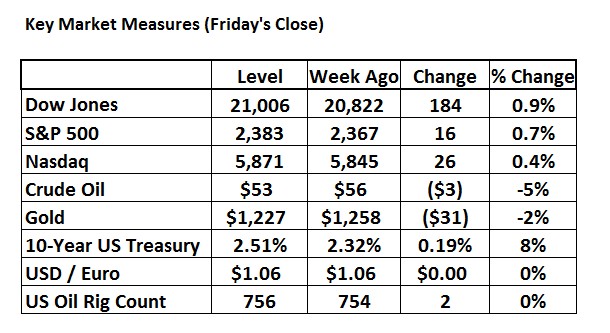
BMR Take: With the 10-year Treasury stepping up 19 basis points to 2.51% this week, Annaly shares remained relatively stable. This was a $10.22 stock a month ago, so we remain quite pleased with this investment.
Care Capital Properties (CCP: $26, up 1%)
Care Capital is a self-administered, self-managed Real Estate Investment Trust ("REIT") engaged in the ownership, acquisition and leasing of skilled nursing facilities and other healthcare assets operated by private regional and local care providers.
Care Capital primarily generate revenues by leasing properties to third-party operators under triple-net leases, pursuant to which the tenants are obligated to pay all property-related expenses, including maintenance, utilities, repairs, taxes, insurance and capital expenditures.
As of December 31, 2016, Care Capital had a diverse portfolio of 345 properties and 40 private regional and local care provider relationships. The portfolio is spread across 36 states and contains a total of roughly 38,000 beds/units.
Management is in the process of “re-positioning” the portfolio to improve portfolio metrics. The company was spun out of Ventas in August 2015 and since then has been selling assets and reinvesting in new development and redevelopment.
BMR Take: While near-term portfolio “re-positioning” is weighing on rental revenues and divestitures are resulting in lower earnings assets, ultimately we think the transition is working to produce a high quality better run portfolio that will receive more favor from the market.
Government Properties (GOV: $20, down 2%)
Government Properties is an externally advised real estate investment trust that owns, acquires, and manages office properties leased primarily to government tenants. The company’s niche focus afforded it the opportunity to go public in the midst of the financial crisis in 2009 where it raised $230 million.
Admittedly, core results have been mixed. Despite solid leasing volume, the real estate optimization strategy among government tenants remains a headwind. Average term of just 3.3 years marks the lowest term in recent memory. Tenants contributing 2.6% of rents are scheduled to vacate soon, as the Department of Justice, which currently represents 3% of rents, has moved from the “at risk” bucket to “vacating”. Fortunately, there is some offset by the National Institutes of Health, which has decided to stay. We don’t want to alarm you about recently mixed core results. It is the natural ebb and flow of the business. It could all easily swing the other way.
Providing some comfort, management had alluded to an expanding deal pipeline, given frothy pricing and demand for government-tenanted properties. We are seeing it happen. The company recently announced three acquisitions totaling roughly $130 million, with the largest asset being a 98% leased office park in Virginia; this property represents the largest investment since 2014.
BMR Take: Government Properties serves a unique niche in the REIT space and we see compelling value in the shares.
Welltower (HCN: $70, down 1%)
Welltower is at the forefront of investing in innovative healthcare infrastructure to create the physical and social environments necessary to promote wellness and quality of life for the aging population. Welltower’s operating platform supports post-acute care, independent living, assisted living and memory care facilities for more than 200,000 elderly residents and state-of-the-art outpatient medical facilities handling more than 16 million patient visits annually.
Recently, Welltower began collaborating with Johns Hopkins in a major new partnership. Johns Hopkins Medicine is one of the world’s pre-eminent patient care, research, and teaching institutions. Initially, Welltower and Johns Hopkins Medicine will explore joint initiatives in areas including: measuring quality outcomes in assisted living and memory care; educational programs for patients and care givers; and sharing of health and wellness and business expertise, information, best practices and research. The collaboration will also assess healthcare market opportunities and investments in modern, efficient infrastructure to deliver better care at a lower cost.
Americans ages 65 to 85 is the fastest growing segment of our population and the largest consumers of healthcare. Welltower is a leader in the space on all fronts from infrastructure to science.
BMR Take: The consensus forecast is for a dividend of $3.50 this year, $3.57 next year, and $3.82 in 2019. This 5% dividend yield looks compelling for a leading Healthcare REIT.
Upcoming Economic News
MONDAY, MARCH 6
Factory Orders – January
Time: 10:00 am
Forecast: 0.9%
Sizable growth in transportation sector orders is likely to lead overall factory orders higher in January. Core durable orders are showing positive trends for business investment in the near-term. Such orders rose 10.1% annualized in the three months ending January—the best such gain in nearly three years.
TUESDAY, MARCH 7
Trade Balance – January
Time: 8:30 am
Forecast: -$45.7 billion
The US trade deficit is likely to widen in January as the advance report on trade in goods showed significant gains in imports. Despite the growing trade gap, exports are once again adding to US output as opposed to representing a major drag on growth. Exports rose at the two-year high rate of 1.8% year-over-year in the fourth quarter while December’s 2.7% monthly advance was the best result in four years.
WEDNESDAY, MARCH 8
Productivity & Unit Labor Costs – Fourth Quarter
Time: 8:30 am
Forecast: 1.5% productivity, 1.5% unit labor costs
Long moribund productivity trends showed some uplift in the second half of last year, rising 2% annualized. Yet that recent bump needs to be sustained for quite some time to greatly undo the sickly 0.5% annualized gain for productivity over the past three years. Of concern to the Federal Reserve is the stronger pace of gains exhibited by unit labors costs, which rose 2.4% annualized over the same three-year period.
Import Price Index – February
Time: 8:30 am
Forecast: 0.1%
Moderation in the pace of raw materials price gains is expected to limit the February Import Price Index to its smallest gain of the past three months. Higher oil prices are facing resistance as current values entice a broader array of producers to drill. But the rising cost of imported goods is already weighing on consumer purchases, as the Import Index rose at the five-year high annual rate of 3.7% in January.
FRIDAY, MARCH 10
Employment Report - February
Time: 8:30 am
Forecast: 174,000 nonfarm payrolls, 4.7% unemployment rate
Job growth is showing no signs of stalling out after workers on nonfarm payrolls increased at the four-month high count of 227,000 in January. Employers are very hesitant to lay off staff, resulting in new claims for unemployment insurance hovering near lows not seen in over 40 years. That signal of labor market tightness can carry over to faster wage growth, helping to push up worker earnings above levels that remain historically weak for an extended economic expansion.
Apple Increases Research and Development Spend
Apple (AAPL: $140, up 2%) is pouring money into R&D in an attempt to improve products that don't currently generate revenue, but might in the future, according to remarks made by Apple CFO Luca Maestri at the Goldman Sachs investor conference Tuesday.
The company spent a huge $2.8 billion on R&D in 4Q16, bringing the total to nearly $10.5 billion in total for the year. Apple's annual spend is up by roughly $4 billion since 2014, marking a very noteworthy increase.
Why? Apple's hardware product range is growing. The iPhone is driving the company’s growth and it is adding new products to the lineup to further growth. The price of the phone is pricing out many customers, so we expect to see lower priced phones in the future, allowing them to sell a phone to everyone in the world.
Plus Apple's Services business, which comprises revenue from internet services, Apple Care, Apple Pay, licensing, and the App Store, is expected to grow to the size of a Fortune 100 company this year, according to Apple CEO Tim Cook. That's about $28 billion in revenue for the year, or a year-over-year growth of 15%.
BMR Take: Apple is sitting at an all-time high. We’ve been beating the drums, through endless negativity, especially when the stock fell into the 90s last summer. We were right and we are here to tell you that $150 is not out of sight. And we CAN’T WAIT until the President comes up with his repatriation plan for the $250 billion in cash the Apple has tucked away overseas.
Opko Health Discussion
Opko Health (OPK) had a rough week, losing 12% to $7.45. Earnings were reported last week. Revenue for the quarter was $275 million, flat from the year before. For the year: $1.22 billion, up from $490 million last year. Earnings for the quarter – a loss of $14 million. For the year: a loss of $25 million, compared to a small profit last year. The numbers were skewed by the purchase of BioReference Labs in 2015 for $1.5 billion, which added over $1 billion to revenues last year.
Opko says the potential market for Rayaldee, the kidney disease drug, could be as high as $10 billion but the drug didn't launch until November so there was no breakout of revenues that many were waiting for. We’ll just have to wait until next quarter to see any type of results from this drug.
The 4KScore test, launched several years ago, measures four prostate-specific substances in the blood to identify men who have a high likelihood of developing an aggressive form of prostate cancer. Opko that in Q4 about 18,000 4Kscore prostate cancer tests were ordered, representing growth of more than 12% compared to Q316. Some said they were looking for much bigger numbers here. The company has $170 million in cash and long-term debt of $110 million.
Consensus in the analytical community show that of the six analysts that follow the stock, four rate Opko a Buy, while two rate the stock a Hold. The stock’s consensus target price stands at $13.30.
BMR Take: We’ve said two things before: that if the stock hit $8 we would sell. But recently we said if the stock hit $8 we would buy more. We are going to reiterate this position now. We would buy more here. The caveat is that you have time to wait. Good things comes from patience. But patience in the financial world can be upsetting and cause you to lose sleep. So if this is the case with you, there are lots of other places to put your money. This company has great potential but we don’t control the marketplace that they live in and we don’t control management. We believe in management, but they might disappoint us. (See Under Armour.) Wall Street certainly thinks highly of the company. We give you the Consensus so that you can evaluate the whole picture. Some say that Wall Street analysts are mostly wrong. We don’t believe that. (See Apple, where EVERY ANALYST thinks the stock is going higher, and of course, the stock is sitting at an all-time high.) In any case, this company has amazing potential. Revenues are strong; cash and debt are certainly in line; it should be just a matter of time before we see positive results.
A Letter to the Editor about Simon Property Group (SPG: $179, down 3%)
Hello Bull Market,
Simon Property Group has been doing well but my concern is about the trend toward online retail which has and should continue to have a chilling effect on mall traffic. Doesn't it worry you that several large retailers that are anchor tenants at malls like Macy's and Sears have plans to close stores all over the country? To the extent that online purchases increase won't that hurt brick and mortar retail and foot traffic through malls? Thanks.
Richard Reed
Hi Richard -
We've discussed this with some folks on the Street as well as my own analyst team and it's no doubt that this is the biggest risk factor. If we start to see the risk having a bigger impact on the business, that would be a reason for us to exit. Not that we like to play with fire or pick up coins on the railroad track, but the reality is all businesses are not flawless and have their risks, so it not a reason to not invest. The good news here is that everyone knows this risk so we would argue that it is already baked into the stock's current price. And we must say that shopping online and shopping at 150 stores in a mall are two completely different experiences. It's pretty tough to buy a suit online. And furthermore, people love the social aspect of shopping in stories. That will never change.
BMR Take: Bottom line – if the overall stock market falters, and/or if Simon moves lower, we will take a small loss and move on. But we are believers in the company long term and we are watching closely.
A Word from Gary Jefferson
Jefferson Financial Group
First Vice-President, Investments
UBS Financial Services, Inc.
There are plenty of fundamental evidence in favor of US equities. The ISM Manufacturing Index, NFIB small business confidence gauge, and Consumer Confidence measures are all higher than 12 months ago and, historically, S&P 500 earnings growth has averaged nearly 15% in the year after such a simultaneous rise. UBS Financial is looking for 11% growth in 2017. UBS research also shows that since 1960, investors who have bought in when the market has been at an all-time high have performed similarly to those who have bought at other times. And investors who have bought in when the market has been trading in the current 18-20x PE valuation range have seen annualized returns of 10% and 7%, over one and 10- year time frames, respectively.
With all that being said, we are still in a rhetoric phase rather than a reality phase. In order to buck the odds of major stock market correction, we believe the following promised catalysts will have to show up this year:
Corporate Tax Break: The campaign pledge of a 15% rate is a powerful idea that would generate abundant earnings, GDP and equity growth. This is the "Holy Grail" for investors.
Individual Tax Break: This is also good for the economy, but the direct correlation to stock price gains is not expected to be as strong as the corporate tax break.
Infrastructure Spending: This should provide another big economic benefit.
We still believe an overweight in US equities and underweight in traditional bonds remains a valid tactical allocation in a rising interest rate cycle and expanding economy.
Analysts' Ratings for Under Armour (UA, $18.64, down 6%)
6 Sell Ratings, 21 Hold Ratings, 9 Buy Ratings
2/27/2017 Nomura $16
2/27/2017 Instinet $16
2/14/2017 Morgan Stanley $20
Things just keep getting worse at Under Armour. A tragedy.
Analysts' Ratings for Tesla Motors (TSLA: $251, down 2%)
7 Sell Ratings, 10 Hold Ratings, 12 Buy Ratings
Consensus Price Target: $256
2/27/2017 Morgan Stanley Outperform $305
2/27/2017 Guggenheim Buy $300
2/27/2017 Goldman Sachs Group Sell $185
2/24/2017 Deutsche Bank AG Hold $215
2/23/2017 RBC Capital Markets Target $314
2/23/2017 Royal Bank of Canada Target $314
2/23/2017 Robert W. Baird Outperform $368
Tesla was downgraded by analysts at Goldman Sachs from a “neutral” rating to a “sell” rating in a research note issued to investors on Monday, They presently have a $185 price target on the stock. Dougherty & Co lowered their price target from $500 to $375 and set a “buy” rating on the stock. Royal Bank of Canada increased their price target from $245 to $314 and gave the company a “sector perform” rating.
Analyst Ratings for Kimco Realty (KIM: $24, down 4%)
1 Sell Rating, 7 Hold Ratings, 8 Buy Ratings
Consensus Price Target: $30
2/3/2017 Canaccord Genuity Buy $34
1/23/2017 Barclays Overweight $27
1/9/2017 Raymond James Financial Outperform $28
THE HIGH YIELD CORNER
BY MICHAEL FOSTER
In high yield, this week was eventful on two fronts. Those who invest in closed-end funds likely received shareholder notices during the week, but the more exciting activity was in the BDC sector. A few BDCs reported this week and more are coming. Among the companies reporting was Goldman Sachs BDC (GSBD: $24.20), which reported a NAV decline exceeding 1% during the quarter and a near 3% decline in net investment income (NII). That wasn’t as bad as TCP Capital Corporation’s (TCPC: $17.20) 7% NII decline over the same period.
Neither stock was negatively impacted by the news, which wasn’t far from expectations anyhow, although Goldman’s BDC fell for the week and TCP Capital surprisingly rose. Goldman’s decline was modest and may ironically be a result of the company’s conservative approach. As one analyst wrote shortly after the earnings release, NAV’s decline is largely “a result of restructurings of non-accruals” and the firm’s more conservative approach to credit issuance. To wit, Goldman has not been expanding its loan portfolio significantly in a market that the fund’s managers have complained is not conducive to BDCs because of tight credit spreads, too much capital chasing too few deals, and overall risks in the marketplace. That has kept Goldman out of the market.
But surely Goldman can originate loans easily. Isn’t Goldman’s management in a position to throw billions of dollars’ worth of loans to their BDC? Well, yes; Goldman knows just about every wealthy person and multi-million dollar company on Earth.
The problem is a lack of incentives; Goldman has little reason to throw business the way of the totally separate and autonomous Goldman Sachs BDC, which is itself an entirely separate corporate structure. Combine this with the challenge of finding deals in a highly competitive marketplace, and you see why Goldman’s BDC is choosing to grow slowly rather than quickly.
The big takeaway from this is that now is not a good time to be in the BDC business. This is even truer for investors that rely on BDCs for passive income. There is so much competition between BDCs, that getting yields on loans is getting harder. And then there is so much competition between investors in BDCs, that premiums to stock values are getting higher, which in turn lowers dividend yields. Goldman Sachs’s BDC is trading at nearly a 30% premium to its NAV and is near its highest premium in history.
This is why we reluctantly sold Main Street Capital Corp (MAIN: $37) and continue to fret over the now absurd the 68% premium to NAV that the stock is currently trading at. Main Street is in our view the best BDC in the world but it’s just too expensive to own with a clear conscience. A diversified BDC fund like the UBS BDC ETF (BDCS: $23) is even worse, providing exposure to overpriced BDCs AND BDCs with bad portfolios or shady management. The sector provides value when it’s out of the market’s favor, but it’s in favor now so we continue to urge caution.
So where can an investor go for high yield? Other sectors are faring much better, and the 2016 muni bond rout seems to be fully behind us. The iShares S&P National AMT-Free Municipal Bond Fund (MUB: $108) had a flat week, but BMR pick Invesco Municipal Trust (VKQ: $12.53, up 1%) fared slightly better. Nuveen AMT-Free Fund (NVG: $14.41) fell a bit though, dropping just a shade over 1.5%.
These funds are paying around 5% in dividends, but remember that this is tax-free money. Depending on your tax status, that could mean an 8% taxable equivalent yield. With such a return, there is little rationale in staying away from municipals and taking on higher risk BDCs where defaults are much more likely, management fees are much higher, leverage is much more severe, and dividend payouts are much less sustainable.
On the issue of returns, let’s consider a moment the concept of the risk premium. Basic financial theory states that at-risk investments will always earn a return that is higher than the risk-free rate of return (ROR). There’s no such thing as 100% risk free, but U.S. Treasuries are about as close to risk free as you can get as long as you hold them to maturity. The Fed Funds rate is set to rise to 0.75% or even higher if Janet Yellen raises interest rates this month, which she says she will, and could go as high as 1.5% or above within a year or so. At-risk assets, then, need to offer a ROR above 0.75% for short-term assets. The calculation that is made is always between Treasuries and whatever risky investment you’re analyzing: Treasuries and oil junk bonds for instance.
However, there is another risk premium calculation that investors should make even though they generally don’t: The difference between the ROR on the investment you are considering and the taxable equivalent yield on municipal bonds. Why? Because retail investors can easily buy municipal bonds and get the income from those instead of choosing the riskier asset. This alternative means there is always a limit to just how low yields can go on at-risk assets before retail investors turn away from them.
Just how low is that yield? That’s a complicated calculation that would take a lot of data and a lot of analysis to figure out, but we can do a rough spot calculation by looking at the popular municipal bond ETFs, calculate their taxable equivalent yields, and compare that to the yields on taxable high yield assets. Doing so tells us that 4% is pretty much the limit. Corporate bonds now are apparently at or around their fair value from this metric.
Does that mean it’s time to buy these assets? Not really, but it’s not time to sell either. That means the SPDR Barclays High Yield Bond ETF (JNK: $37, flat) is not set for any great collapse but it isn’t exactly where you want to be either. It also means the near-term seems OK for BMR picks. The PIMCO Dynamic Income Fund (PDI: $29, up 1%) has reached a somewhat distressing premium to NAV of 8% but the fund’s sharp performance makes this bearable. The AGIC Equity and Convertible Income Fund (NIE: $19.73, up 1%) is seeing its discount to NAV remain around 11%, rather high from a long-term perspective and an attractive reason to hold.
Now, to REITs. The best news for BMR subscribers came from this sector this week, as the SPDR Dow Jones REIT ETF (RWR: $94.45, down 1%) saw a modest decline that was overshadowed by BMR’s REIT picks. Digital Realty Trust (DLR: $107, flat), Omega Healthcare Investors (OHI: $33, flat), and Care Capital Properties (CCP: $26, up 3%) were significantly better performers with flat to slightly up growth for the week. Government Properties Trust (GOV: $20, down 1%) tracked the market quite closely, showing that risky REITs are not selling off greater than the broader market, which is usually the signal of a broader and more worrisome panic. However, the most risk averse investors who look for more stable and less risky REITs are clearly selling off, as Kimco Realty (KIM: $24, down -4%) had a truly awful week. This appears indicative of a broader market trend towards risk aversion that is only beginning in the REIT sector but may continue in the weeks to come. Now is a good time to remain vigilant with the REIT sector and look to rebalance as mispricings continue. For now BMR’s recommendations remain unchanged, but more declines in Kimco could cause us to suggest a bit of rebalancing in the short term.
A final word on AstraZeneca (AZN: $30, up 2%). BMR has been following this drugmaker for a while and have held through months of weakness as the biotech industry was destroyed by political risk-related fears. Trump is now president and despite his tweets about drug prices, drugmakers don’t seem to be in any immediate danger. The market has recognized this and is slowly tiptoeing back into the sector. Astra-Zeneca is up 10% year-to-date for this reason alone. The pipeline hasn’t changed, but everyone is getting more enthusiastic about the company’s prospects. This remains a good time to remain long this stock.
Good Investing,
Todd Shaver, Founder, CEO and Editor
The Bull Market Report
Since 1998
January 1, 2017
by Todd Shaver | Jan 1, 2017 | Weekly Newsletter 7pm Sunday
The Week Ahead
The Dow Jones Industrial Average shook off its worst start to a year ever to score its best performance since 2013, as investors banked on an improving economy. What’s ahead for 2017? US-Russia relations, Trump-flation, and stagflation will be central themes. We see an Energy sector recovery gaining momentum. Higher interest rates could pressure stock prices. Gold could be putting in a bottom as we speak.
It’s a light week ahead for economic news. But here we provide some insights on our latest thinking for Opko, Apple, Microsoft, Facebook, Kinder Morgan, Twilio, Celgene, Gilead, Bristol-Myers Squibb, and AstraZeneca. Happy New Year!
Highlights From The Past Week
US-Russia Relations. Trump and Putin have emerged as two of the most cunning leaders on the global scene. What these two men are up to in 2017 will certainly impact markets. Recently, Russian diplomats have been sanctioned by the US. Are dicey relations emerging? Putin says, “We reserve the right to retaliate, but we will not sink to the level of this irresponsible ‘kitchen’ diplomacy. We will take further moves on restoring Russian-American relations based on the policies that the administration of President-elect Donald Trump adopts.” Separately, the appointment of Rex Tillerson, Chairman and Chief Executive Officer of ExxonMobil, as Secretary of State, as well as various insinuations by the President-Elect to lift sanctions, all point to possibly greater oil production from Russia ahead. Russia has recently claimed that it will beat 2016’s estimated oil production total of 253 million tons in 2017.
Trump-flation. One idea most widely agreed upon is that Trump will spur inflation and US Treasuries are the last place to be. There is growing fear of a bond bubble. Trump-flation should drive equity prices higher and could kick-start a big rally in gold. We will be keeping an eye on inflation expectations in 2017.
Stagflation. Admittedly, the current economic expansion is quite advanced. It has already lasted about 18 months longer than the median completed expansion since the mid-1800s. And while expansions do not die of old age, history shows that they are at greater risk when spare capacity is exhausted, as it probably is now. So it is especially important to monitor whether growth may be running out of steam. The most important recession predictors, at horizons longer than the next few quarters, are spare capacity and past credit growth. Spare capacity has dwindled, which has boosted the recession probability somewhat, but output is not yet meaningfully above potential.
BMR Companies and Commentary
Opko Health (OPK: $9.30, -21% for the week)
Opko said its experimental drug for growth hormone deficiency (GHD) in adults failed to provide a statistically significant benefit over a placebo in a late-stage study. Investors were counting on the drug for future growth. Consequently, the disappointing news sent Opko’s shares much lower.
GHD is a rare disorder characterized by the inadequate secretion of the growth hormone from the pituitary gland, an organ responsible for the production of multiple hormones. The disorder can be hereditary, can be acquired as a result of trauma, infection, radiation therapy or brain tumor growth, and can even emerge without a diagnosable cause. OPKO was developing the drug with Pfizer to address GHD.
Is everything lost at this point? No.
While the recent study failed, Opko said it had started another late-stage study to evaluate the drug against Genotripin, which is another type of growth hormone disease more narrowly found in children. Opko will have world-wide collaboration rights and licensing rights with Pfizer for this drug to target Genotripin, if it is successful.
BMR Take: We have high hopes for this company and the new drug. We added the stock at $10 in September and it rallied to a shade under $12 just a few days ago. But Wall Street has been known for its mean responses to situations like this. They don’t have the patience that we generally have. So with that said, we are going to stick with our Sell Price of $8. If it hits $8 we are out.
Apple (AAPL: $116, flat for the week)
Some news just out - Apple will trim production of its iPhones by at least 10% in the first quarter of 2017.
The latest news comes after Apple slashed output in the January-March quarter of 2016 due to accumulated inventory of the iPhone 6S line at the end of 2015. That experience led Apple to curb production of the iPhone 7, introduced in September, by around 20%. Information on production of the latest models and global sales suggest cuts in both the 7 and 7 Plus lines in the coming quarter.
BMR Take: Don’t get too concerned about this discussion of product cuts in the first part of 2017. We have been talking about this for a while. Buy the stock on weakness. As we move through 2017, investors will be focused on growing anticipation around the iPhone 8 and a favorable long-term trajectory for Services growth.
With Trump working on a plan to help companies return the cash they hold overseas, there is no company that will benefit more than Apple, with their hoard of well over $240 billion in cash, most of which is overseas. We expect a good year for Apple’s stock performance in 2017.
Microsoft (MSFT: $62, flat)
Microsoft had a tremendous year in 2016. Let’s re-visit some of the big events. We understand it’s a backward looking exercise, but sometimes it’s helpful to do such a review in order to reaffirm our confidence that the franchise is on very solid footing.
Microsoft released its first major feature update for Windows 10. Dubbed the "Anniversary Update", this release featured improvements to the Start Menu, Action Center, Settings and Microsoft Edge, among other upgrades.
The Universal Windows Platform went even more universal this year, with Microsoft announcing Universal Apps for Xbox One. This unleashed a whole new market of apps for the Xbox, essentially turning it into a PC.
Microsoft surprised the entire gaming industry this year by announcing its brand new console, scheduled to launch in the fall of 2017, a whole year early. Microsoft originally had no plans to announce Project Scorpio in 2016, but with looming pressure coming from Sony and the PlayStation 4 Pro, the company felt they needed to get something out there and let gamers know Microsoft is serious about gaming.
Microsoft blew the crowds away with the Surface Studio announcement. It was known for some time that the company was interested in building an All-In-One PC, but we didn't know exactly what they had planned. When the unveiling finally arrived, the company once again proved to be staying current with product cycles.
The Creators Update is the next major version of Windows 10, scheduled to launch in early 2017 and is bringing several new features designed for creators.
BMR Take: The era for Microsoft under CEO Satya Nadella is blossoming. It is not just about all the product innovation discussed above that he is bringing to the forefront as a former engineer at the company. He is also quietly leveraging the balance sheet to buy back stock. In September 2016 he announced a $40 billion stock buyback program.
Facebook (FB: $115, -2%)
What’s in the news for Facebook lately? A bunch of noise about censorship. Facebook put a temporary ban on Kevin Sessums, who is well known for his celebrity profiles for Vanity Fair and two best-selling memoirs. The event triggered civil unrest over free speech and Facebook was painted as the enemy.
The journalist was temporarily banned from Facebook after sharing a post from an ABC political analyst, which called Trump supporters some derogatory names.
Facebook “reviewed and restored” Kevin Sessums’s ability to post messages. “We’re very sorry about this mistake,” a Facebook spokesman said. “The post was removed in error and restored as soon as we were able to investigate. Our team processes millions of reports each week, and we sometimes get things wrong.”
BMR Take: Facebook is on track to be the greatest advertising money-making machine of all-time. Censorship is a reality of the business, but not new nor disruptive. We think recent softness in the shares presents a great spot to buy more.
Kinder Morgan (KMI: $21, -2%)
Massachusetts has agreed to a $640,000 settlement from Kinder Morgan to allow the company to run a pipeline through conservation land in Berkshire County on its way from New York to Connecticut. The money will be spent on “mitigation and improvements” in the Otis State Forest and also to buy more conservation land in the area.
The Massachusetts Pipeline Awareness Network continues to object to the pipeline based on water quality concerns, and the disruption of stone walls important to Native American tribes.
There is a big shift going on regarding the above situation. A Trump administration is about jobs, jobs, jobs. He has been very outspoken about putting business above people’s sensitivities to the environment. The settlement Kinder Morgan just did may be a very early indicator of the courts moving in Trump’s direction to squash disputes and get business rolling. The Dakota Access Pipeline owned by Energy Transfer Partners (ETE: $36, a $20 billion market cap company) may be the first big test of this Trump concept. It will not be pretty if he reverses the hold that Obama has ruled.
BMR Take: Kinder Morgan is the best operators in a very tough business to enter. It requires a large sum of cash to acquire land rights to lay down a pipeline and a lot of expertise to obtain all the needed permits. With the energy sector on the recovery road, and Kinder Morgan’s un-rivaled assets, the outlook is very positive for the stock price.
Twilio (TWLO: $29, -10%)
While potential future competition from Amazon is a risk factor that investors must consider with respect to Twilio, today the Amazon relationship is healthy. The association is multi-faceted. First, Twilio runs entirely on AWS, Amazon Web Services. Second, Rick Dalzell (Amazon's former SVP of Worldwide Architecture and Platform Software and CIO) has been a member of Twilio's board of directors since 2014. Third, Twilio is already helping AWS build better products.
How tight is Dalzell to Amazon? Mr. Dalzell was Amazon CEO Jeff Bezos’ “right-hand man” at Amazon for a decade before retiring in 2007. As retold in the book, The Everything Store: Jeff Bezos and the Age of Amazon by Brad Stone, (a great book we have just finished reading and highly recommend), Bezos gave Mr. Dalzell quite a going away party: Four months later, enjoying retirement, Dalzell decided to visit his daughter in college in Oregon. His wife chartered a private plane for her husband, herself, and Dalzell’s parents. Strangely, their driver took them not to their usual airport but to a private airfield down the street from Boeing Field. Dalzell finally started to notice something was amiss when the car pulled up to a familiar hangar sheltering a Dassault Falcon. When he walked into the airplane, he found it full of friends, colleagues, and Jeff Bezos, all of whom shouted, “Surprise!” They were going to Hawaii for a gala given in appreciation of Dalzell’s longtime service. Andy Jassy, who attended the party, is the CEO of Amazon Web Services today.
Counter to concerns about the counterparty risk, in the near-term, the AWS relationship could improve, not get worse. At AWS re:Invent in November 2016, Twilio CEO Jeff Lawson hinted at an increasing level of collaboration between Twilio and Amazon when he said, "We're really excited to announce some upcoming collaboration soon."
BMR Take: Sentiment and the volatility in Twilio has been a roll coaster. The Amazon risk factor seems to be getting blown out of proportion right now. We actually like the prospects for the Amazon relationship in the near-term. As to the stock we remain a big believer in the company even as the stock is down dramatically from where we recommended it in October.
Celgene (CELG: $116, -3%)
Celgene must face a whistleblower lawsuit accusing it of promoting its cancer drugs Revlimid and Thalomid for off-label uses that were paid for by Medicare and Medicaid, a federal judge has ruled. Yikes! A U.S. District Judge in Los Angeles ruled that the lawsuit, brought by a former Celgene sales representative, can go forward for claims submitted to Medicare and most state Medicaid programs.
It’s not good, but things like this happen at big companies. Remember the London Whale incident for JP Morgan. Don’t panic.
There is much to like about Celgene. The drug in Celgene's lineup with the fastest sales growth is Otezla. Sales for the anti-inflammatory drug nearly doubled in recent quarters. Otezla appears poised to become yet another blockbuster for Celgene. Celgene's president of global inflammation and immunology, describes Otezla as transformational in the psoriasis market. When the drug was first approved, there was some skepticism about how it would compete against a crowded field of powerful biologics. However, Smith explains that 80% to 90% of Otezla patients weren't previously treated by biologics. Otezla didn't have to just grab its sliver of pie, it made the pie bigger.
BMR Take: Celgene hopes to expand the indications for Otezla. Late-stage studies are underway for treating ankylosing spondylitis (a form of arthritis affecting the spine and large joints) and Behcet's disease (a rare inflammation of blood vessels). Two mid-stage studies are also in progress for treatment of atopic dermatitis and ulcerative colitis. Celgene expects Otezla to reach peak annual sales of $2 billion if it wins regulatory approval for these additional indications. Rock on Celgene shares!
Gilead Sciences (GILD: $72, -3%)
Things are getting worse more slowly at Gilead Sciences, which should offer some comfort to investors. Recent data shows that total prescriptions for the company’s portfolio of hepatitis C drugs were down 4% in the fourth quarter compared with the previous three months. This is a significant improvement from the third quarter, when prescriptions were down by about 9%.
The stabilization should be a relief for investors. The stock has shed about 30% of its value this year as the hepatitis C franchise, which accounts for about half the company’s sales, has slowed down. A complete picture of the hepatitis C business won’t be available until Gilead reports fourth-quarter results in early February. So we are admittedly in more of a wait and see mode at the moment. In particular, our sources do not cover Gilead’s major customer the Department of Veteran Affairs, so there may be some inaccuracy.
BMR Take: We would be adding to our positions in Gilead here. The stock trades at less than seven times forward earnings estimates. Any glimmer of positive news will push the stock higher.
Bristol-Myers Squibb (BMY: $58, down 2%)
Bristol-Myers Squibb and Calithera Biosciences announced a clinical trial collaboration to evaluate Bristol’s Opdivo in combination with Calithera’s CB-839 in patients with clear cell renal cell carcinoma (ccRCC). CB-839 is an orally administered glutaminase inhibitor currently in Phase 1/2 clinical studies.
We will stop talking science right there.
Why does the above matter? We recently spoke to several executives at major Healthcare companies. All of them say the Opdivo franchise of Bristol will be a strong business for the company over a 5 year horizon. Bristol’s stock has been crushed because of some mishaps over Opdivo in the near-term. The above event just highlights there is a path forward for the Opdivo franchise, which our discussion with industry executives confirms is very likely to happen.
BMR Take: Don’t be timid here. Bristol is one of the top franchises in all of Healthcare. Now is an opportune time to be buying the shares for the long term.
AstraZeneca (AZN: $27, flat)
AstraZeneca has completed the sale of its small molecule antibiotics business to Pfizer. As part of the deal, Pfizer has acquired the commercialization and development rights of AstraZeneca’s approved antibiotics Merrem, Zinforo, and Zavicefta, as well as its ATM-AVI and CXL which are in the clinical development stage.
Pfizer has paid an upfront payment of $550 million for the late-stage antibiotics business in all markets where AstraZeneca holds the rights, mainly outside the US. Pfizer will make a deferred payment of $175 million in January 2019. Additionally, Pfizer had also agreed to make milestone payments for the small molecule antibiotics to AstraZeneca up to $250 million and up to $600 million related to sales and tiered royalties on sales of Zavicefta and ATM-AVI in select markets.
BMR Take: This deal was announced back in August. We highlight it again now because we are excited to see the cash flow on the way to AstraZeneca’s bank account. The cash cushion is like a 5% dividend yield at current levels. We see compelling value in the stock reaffirmed by the recent Pfizer deal.
Upcoming Economic News
It’s the first week of the New Year. Very light news flow. Lots more to discuss in the weeks ahead.
Have you heard about the BORDER TAX?
If not, READ THIS from Phil Verleger:
Notes at the Margin
Philip K. Verleger, Jr.
Former Director of the Office of Energy Policy at the United States Department of Treasury
Preparing for a Border Tax
This report can be described as nerdy or geeky. It never gets the attention that publications by Goldman Sachs, PIRA, or IHS receive. Its author is regularly ignored by the editors and reporters for Argus Media, the Energy Intelligence Group, and Platts. He is never invited to speak at conferences sponsored by these organizations, probably because he does not engage in the group think that is so essential to those attending. The lack of coverage is a source of dismay. We acknowledge, though, that the goal of our report is to inform and challenge, not to comfort. As noted last week, the oil industry prefers group think as it marches to oblivion.
However, the annoyance is offset by the fact that this publication was the first to understand the implications of the border tax adjustment proposed by House Republicans, a tax that now could become law. If it does, the change will impose billions if not tens of billions of losses on the industry. Most of those in it will be blindsided by this.
News organizations such as Argus Media, Platts, EIG, Financial Times, and The Wall Street Journal did not see the border tax coming.
Now as the tax comes hurtling toward us, everyone is scrambling to understand it. OPEC has been rendered irrelevant and the recent program to eliminate the global stock overhang “Trumped.” As The Wall Street Journal reports, House Ways and Means Committee chairman Kevin Brady intends to have a tax bill on President Trump’s desk within one hundred days of the inauguration. By May 1, the US may have a new corporate tax structure.
How the Tax Works
With apologies to readers who long ago moved away from algebra, we offer here a short mathematical explanation of how a border adjustment tax would work. Those not wishing to endure the pain—and believe me I understand—can jump to “Results” below. I add that the presentation here resulted from a long night lying in bed developing the equations as sleep refused to come. The equations have since been confirmed to be accurate and not the ramblings of a crazy insomniac.
Results. The analysis shows that domestic prices would be 25% percent higher with a 20% tax. Domestic prices would be 18% higher with a 15% tax.
The RACE
Google (GOOG: $772, down $18)
Apple (AAPL: $116, down $1) – Equivalent of $812, after reversing out the 7-1 stock split.
Amazon (AMZN: $750, down $11)
And let’s add Facebook (FB: $115, down $2) – Multiplying by 7 gives us a price of $805.
We’d say that Apple and Facebook are neck and neck. Google and Amazon had a rough week. Of course, we would put our money on all four of these great stocks. We just wonder who will win the race this year!
CBRE Group (CBG: $31, flat) continues on its powerful path to future success. We know how strong this company is in the commercial real estate world in NYC, London, Paris, Miami, Los Angeles, etc., but most on Wall Street don’t. But from the low of $23 in February we have seen a steady rise. We see no reason for this company to halt its tremendous growth. From $6.5 billion in annual revenue in 2012, to $7.2 billion in 2013, to $9.0 billion in 2014 and $10.8 billion in 2015, the company looks on track to report well over $12 billion in 2016, which we will be able to verify when they report earnings in the first week of February.
Earnings? From 86 cents in 2013 to $1.63 is pretty powerful. We expect around $2.20 for all of 2016. We’d buy this stock at $31, at $26 and at $36. We wouldn’t be surprised to see the stock in the 40s a year from now.
The High Yield Corner
By Michael Foster
An Integral part of The Bull Market Report Team
Happy new year everyone! 2016 was an exciting and eventful year both in and out of the markets. High yield investing had a banner year, with many assets reaching new heights while others saw intense volatility. The volatility wasn’t where most would naturally expect it; in fact, one of the biggest underperforming assets was municipal bonds, ending the year down slightly and falling 4% from their 2016 high.
This is partly why we hesitated to offer many muni bond picks this year (although more are coming very soon), limiting ourselves to just one high-quality muni fund: the Nuveen AMT-Free Municipal Credit Fund (NVG: $14.50), which ended the year with a 6% total return. That is better than many muni funds, thanks in large part to the fund’s strategic bond selection that has helped its NAV grow.
There were several picks that were much kinder to us in 2016.
At the end of February, we added our first high yield pick: the AllianzGI Equity & Convertible Fund (NIE: $18.40), which offered an 15% total return from the day when we picked it.
Shortly after recommending AllianzGI Equity & Convertible Fund, we recommended the Pimco Dynamic Income Fund (PDI: $28), which rose 22% since our recommendation. But even this stellar return was not our best performing high yield pick for 2016, but remains a mainstay of our high yield recommendations for 2017. This is a great, overlooked, high-yielding fund that offered a whopping 15% dividend yield including its December special dividend, which exceeded our conservative estimates with a $1.45 special payout on December 22nd. We were right to suggest keeping this fund for its special dividend, and we are confident it will continue to deliver in 2017 and beyond.
Our next pick is a classic story of growth and value: Digital Realty Trust (DLR: $98), which offered an 18% total return since our recommendation. This was the first of several REIT picks, and has withstood the recent correction in REITs that has tempered our returns and also urged us to be more cautious about the REIT universe in recent months. That caution is waning, however, and we expect to add more REITs to the High Yield portfolio throughout 2017.
In addition to Digital Realty, March brought Omega Healthcare Investors (OHI: $31) to the High Yield portfolio. Omega Healthcare has been a bit of a disappointment, falling 2% since our pick on a total return basis. However, its dividend has gone up twice in the 9 months since we picked it, and is set to continue to rise. If you bought this stock on our recommendation and held it have so far received a reliable 7% income stream that will continue to grow. Yes, the capital losses have offset that in the short term - but we recommend holding and waiting for the selling in Omega to stop. And we are confident that the selling will stop at some point in the next year.
Our final REIT pick for March was Kimco Realty (KIM: $25), which fell 3% on a total-return basis since our recommendation. Again, the massive REIT correction has caused the gains in this stock (which rose as much as 28% from our pick to its peak last year) has been the cause of this fall. We again expect this to be a short-term issue, as Kimco’s dividend coverage is better than the majority of REITs, and, like Omega Healthcare, Kimco raised its dividend after we recommended it.
Our next pick was admittedly a short-term dud: AstraZeneca (AZN: $27), which has fallen 7% on a total-return basis since our recommendation. However, we remain confident in the company’s product pipeline and remain confident that the political grandstanding about reigning in drug prices is more hot air than real policy, and drug companies will continue to financially benefit from improving people’s lives. Note that AstraZeneca and its biopharma peers fell steeply at the end of the presidential campaign as Hillary Clinton put them in the crosshairs; Trump’s recent populist snipe at these firms has caused that selling to continue. We expect this rout to abate next year as Trump’s policies on drug prices become clearer and less extreme. That makes AstraZeneca a better buy now than ever before.
Our next pick did so well that we had to change our target price several times. Main Street Capital (MAIN: $37) soared 26% at its peak and is up 24% from our recommendation date. Obviously this remains a good company, but is expensive at this level, which is why we remain cautious about buying it back now. But we do like it as a long-term dividend machine, although we remain worried that its price will correct in 2017.
We removed the stock at $37 in November. Here’s what we said in our newsletter of November 20th:
At the same time, we have finally gotten to a point where Main Street Capital has gotten overbought. The BDC is now up 16% from when we recommended it in April after rising 8% in the past month alone. We waited for this week’s dividend distribution to see if the stock would fall further after the payout, but it hasn’t; in fact the stock is up over 1% after its recent payout. That now means Main Street is selling at a 70% premium to its net asset value and it has passed our target price. We are keeping our price targets on Main Street, which means recommending selling at these levels and waiting for the price to correct before jumping back in. Main Street remains an excellent firm with impressive advisors and the capability to increase dividends for a long time, but the cost of that expertise and growth potential is too high now. We will buy again when the stock is more fairly priced.
In April we added a new and controversial REIT to the portfolio: Government Properties Trust (GOV: $19.07), which is up 11% since we recommended it. Shortly after we recommended this company, several professional investment bank analysts recommended selling it. The stock soared after they made the wrong call, and was up 40% at one point from the date of our recommendation. It’s corrected since then, but may return to that high point soon.
In September, we added a new Healthcare REIT to the portfolio: Care Capital Properties (CCP: $25), which has fallen 11% on a total-return basis since our recommendation. We ascribe that fall to short-term volatility and the broader correction in the REIT market. Nonetheless, the basis of our recommendation was its 8% dividend yield and the hopes for long-term capital gains. This short-term volatility, which has impacted all Healthcare REITs, should not be confused with the fundamental long-term strength of this company. We urge you to wait out this bump in the road and give Care Capital a chance - at least until a year has passed since our recommendation.
Our final recommendation in 2016 was Ventas (VTR: $62.50), which has gone up 5% since we recommended it in November. Again, short-term price gains are more a sign of volatility than anything else, so we won’t crow about this quite yet. In fact, the gains from Ventas help offset the declines in Care Capital Properties and provide a better averaged entry point for a diversified high yield portfolio. Still, it is far too early for us to see how our Healthcare REIT picks have shaped up, and we recommend holding all of these names until later in 2017 when the market’s mispricing of the industry and broader panic abates.
Overall, it has been a very good year for our High Yield portfolio. We had several double-digit gainers and an average yield of 8% across the portfolio. Providing an 8% income stream while also delivering capital gains across the portfolio is extremely difficult to do; in fact, many financial advisors will dismiss such a goal as impossible. Yet we have delivered it here at The Bull Market Report in 2016 and will deliver it again—and more—in 2017.
Equity Raise
The Bull Market Report will be raising some angel money this month directly from you, our subscribers, under a 506(b) offering, in order for us to grow the company to new heights. We want to increase the number of portfolios to at least eight and have 8-10 stocks in each. We wish to start an options newsletter, specializing in covered calls. We want to have more News Flashes each week. And we want to hire a CEO to run and company and add additional research analysts to give you the best consumer newsletter offering institutional-quality research.
We will be raising $100,000 or more from 2-3 investors and offering an equity stake in the company. If you are interested, write me directly at Todd@BullMarket.com. Include your phone number – I will call you personally.
Good Investing,
Todd Shaver
CEO, Founder and Editor
The Bull Market Report
December 18, 2016
by Todd Shaver | Dec 18, 2016 | Weekly Newsletter 7pm Sunday
The Week Ahead
The stock market is trading at all-time highs on a price basis, a price to sales basis, and a price to book basis. Price to earnings ranks in the top decile of historical valuations. The optimism/pessimism index is now over the 70 level on the optimistic side, but which has never been sustained for very long. Times are good. We don’t see the weeks ahead with the holidays disrupting the market’s current feeling. But prices are starting to bake in high expectations. We are going to need to see some real tangible progress from the economy starting off the year in 2017.
This week we provide some insights on our latest thinking for Annaly Capital Management, Apple, Bristol-Myers Squibb, Eli Lilly, Home Depot, and Netflix.
Highlights From The Past Week
China-US Relations. China must have access to US consumer markets, and President Elect Donald Trump knows it. The US is not dependent upon China for any strategically important commodities or products and the US has significant extra capacity in many of its manufacturing sectors. Data and opinions are pouring in about a potential US-China trade war. Sorry to break it to some of these folks, but trade has and will always be a war. Donald Trump is just way more outspoken about negotiation tactics. There is nothing new under the sun here. Get ready for some near term negative consequences from US-China relations stemming from US leadership turnover, but keep your head up, the trade deficit with China is so bad for the US it is hard to see how Donald Trump can do any worse. Trump named Iowa Governor Branstad the Ambassador to China and billionaire Wilbur Ross Secretary of Commerce - these guys are seriously qualified and talented and accomplished, although there are many that will fight them in Congress. What else is new?
Technology Sector Visits Trump Tower. Many of the companies we cover had their CEOs invited to Trump Tower to meet with the President Elect. The gathering included Jeff Bezos of Amazon; Elon Musk of Tesla; Tim Cook of Apple; Sheryl Sandberg of Facebook; Larry Page and Eric Schmidt of Alphabet, Google’s parent company; and Satya Nadella of Microsoft, among others. Trump told the crowd, “There is nobody like you in the world;” “I am here to help you;” and “We want you all to do really well.” Microsoft CEO Satya Nadella brought up perhaps the most thorny issue, immigration, saying how the government can help Tech with things like H-1B visas to keep and bring in more talent. Alphabet Executive Chairman Eric Schmidt, who briefly noted that he pondered what he would do if he were president, then made the point that governmental information technology programs were antiquated and unsafe, and needed to be upgraded. How exciting is this - to see our greatest leaders finally all sitting around the table discussing and solving problems!
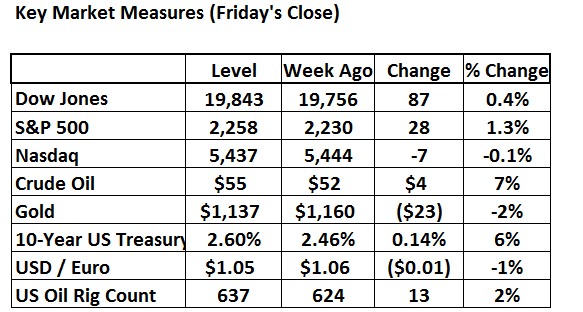
Interest Rate Outlook. We have to keep an eye on the interest rate situation. The 10-year US treasury is now at 2.60%, up from 1.70% before the election. On the one hand, the stock market has been STRONG in the face of this rate risk, the exact opposite situation many were inferring would happen whereby stocks go down when rates go up. However, we are not yet out of the woods. Fed Chairwoman Yellen suggested that three rate hikes likely in 2017, up from two. Goldman Sachs claims that at the current pace of interest rate hikes, the yield curve will finally start to offer decent returns by the end of 2017. This means we could see some investors who have been sticking around the stock market due to the terrible bond rates start to finally reallocate their money into the bond market. This is a trend that could develop and would not be great for the stock market. Interest rates have risen at one of the fastest rates in history. We would love to see a breather here in order for all markets to assimilate this big move. And we are talking the US stock market as well as overseas markets. The latter needs to assimilate the much stronger dollar as well as the higher rates.
BMR Companies and Commentary
Annaly Capital Management (NLY: $10.20, -3%) Interest rates have been on the rise and are likely to continue moving higher. The market assumes that rising rates hurt Annaly. This is actually not so. Yes, the company can be impacted in the short term. But in the long term the company receives a much higher return from their investments and is more profitable for the firm. Book value was $11.69 at the end of the third quarter. Analyst estimates call for book to decrease by 9% to $10.62 in the fourth quarter. But in this case numbers don’t tell the whole story.
Let’s revisit how Annaly makes money. Annaly invests in US Government MBS (Mortgage Backed Securities). Recall, Agency MBS is simply all the good residential loans made to the qualified deserving buyers who meet minimum standards (such as income, debt to income, loan to value, etc.) as set by the government agencies (Fannie Mae, Freddie Mac, and so on). The government agencies buy all these loans from banks and other lenders, then package them up into huge pools, and sell them through MBS to investors like Annaly.
Annaly’s portfolio of Agency MBS declines in value as interest rates rise, just like a bond. The company hedges to help dampen the impact. Analyst estimates say that in the fourth quarter the net decline in book value was $1.26.
BMR Take: Rising rates is a tough backdrop for Annaly but what people forget is that Annaly is laddered. They have notes maturing every month of the year. And guess what? They get to invest that at the higher interest rates that prevail at that time. So yes, book will be down in the short term, but soon enough book will pop right back up again as the company continues to roll over lower interest rate vehicles and invests in the new higher rates. This is what we love so much about Annaly.
Apple (AAPL: $116, +2%) The Apple train keeps rolling. One of the top Wall Street analysts who started following the company at $2 per share wrote his last note, as he is moving on to start a venture capital fund. He told everyone to stick with the stock as the train is heading toward $150.
As we move into 2017 investors will be focused on growing anticipation around iPhone 8 and a favorable long-term trajectory for Services growth. Some investors might be concerned that Apple could miss iPhone sales estimates for the first half of the year because of relatively little innovation in the iPhone 7 and buyers holding out for the next version. (We’ve heard this SO many times.) Should there be a first-half 2017 iPhone hiccup, we expect minimal downside, as investor focus narrows on the iPhone 8, which is why we started this paragraph making this point.
For those in the know, the Services business is actually a reason to be excited about 2017. Apple's Services business includes Apple Music, Apple Pay, iCloud backup and other offerings. Services accounted for 11% of Apple's total revenue in the fiscal year ended September 25, which amounted to $24.3 billion. Services revenue in fact rose 22%, where Apple's overall revenue fell 8%. Note that if Apple’s Services business were a standalone company it would rank in the Fortune 100. Look for Services revenue to clear $28 billion in 2017.
BMR Take: There is much conjecture and anticipation of the new Trump presidency and his talk about lowering taxes for repatriation of corporate cash overseas. With more than $200 billion overseas, Apple is listening and watching and so are we. We believe the Trump hype. We think it will happen. All signs point to more upside ahead for the Apple story.
Bristol-Myers Squibb (BMY: $59, +3%) Bristol is roaring back, up 20% from the recent sell-off lows. Recall that in October, Bristol announced an evolution of its operating model to drive the company’s success in the near and long term through a more focused investment in commercial opportunities, streamlined operations, and realigned manufacturing facilities. We are already seeing progress.
This week, Bristol announced investments in the (i) construction of a new R&D building at the company’s New Jersey campus that will co-locate lab-based Discovery and Translational Medicine activities, (ii) construction at its New Brunswick, New Jersey facility to support biologics development, and (iii) construction to continue expansion of its biologics campus Massachusetts.
The company also announced it intends to initiate a phased multi-year closure of its Hopewell, New Jersey site by mid-2020 and will not renew its lease in Seattle in 2019. The company confirmed previously announced plans to close its Wallingford, Connecticut site by the end of 2018, and also announced it will no longer build a Connecticut Development site. The company expects many of the roles from Wallingford, Hopewell and Seattle will transition to other U.S. locations.
BMR Take: We were so excited on the last earnings call to hear the company commit to operating expense discipline. Watching them follow through so quickly is encouraging.
Eli Lilly (LLY: $73, +8%) Lilly’s stock took a big hit last month on the failure of an experimental Alzheimer’s drug. However, this week, Lilly gave an upbeat outlook for the coming year, estimating that both sales and earnings will come in above Wall Street’s expectations.
This huge Pharmaceutical company expects adjusted earnings between $4.05 and $4.15 a share on revenue of $21.8 billion to $22.3 billion, well above analysts’ forecasts for earnings of $3.97 a share on $21.7 billion. Lilly is not a broken company just like we thought!
Lilly said the new estimates signal mid-single-digit growth from the current year, boosted by increased volume from new products. Lilly also projected an increase in gross margin despite offering discounts for its insulin brands for certain patients, as the Pharmaceutical industry has come under fire for soaring prices.
Some upgrades from the major research firms certainly helped. Morgan Stanley bumped their Target to $82. Goldman Sachs raised them to a “Conviction Buy,” whatever that means. We’ll say that is good(!) Jefferies is at $100 and Argus is at $95. All good. Our Price Target remains at a very doable $80 but we are secretly ready to raise the Target by $10. Don’t tell anyone. Having added the stock on Tuesday at $69, we are quite pleased so far. This one is big company with a $77 billion market cap. And while you wait, it is paying close to 3%. We expect good things from this company.
BMR Take: Lilly's new product growth drivers are in place, and we believe Lilly's guidance is low risk and achievable. Additionally, management has a history of providing conservative guidance, so we should see more weeks of solid stock performance ahead like this past week.
Home Depot (HD: $135, +1%) Housing starts tumbled 19% in November, which was way more than most expected, and we need to keep an eye on how higher interest rates impact household’s ability to buy new homes or spend money on their existing homes. Despite this issue , the 2017 outlook for Home Depot is encouraging.
Home Depot’s sales growth last quarter accelerated to a 6% pace from 5%, which trounced rival Lowe's 3% uptick. Professional customers are descending on the company’s stores. These shoppers spend far more than the company average -- over $900 per transaction in many cases -- so even a small increase in demand from these customers translates into significant gains. Last quarter we saw high-dollar transactions grow 11%.
The company is generating excess capital, enough to fund nearly $5 billion of stock repurchases and $2.6 billion of dividend payments annually. Home Depot is more generous with the dividend payout of 50% of earnings versus Lowe’s 35% target. We look for a similar smart use of capital to lift results in 2017.
BMR Take: We are encouraged by what is happening at Home Depot as the economy slowly churns out bigger numbers with no let-up in sight. The stock is closing in on all-time highs at $139.
Netflix (NFLX: $124, +1%) Netflix members worldwide can now download as well as stream great TV series and films at no extra cost.
While many members enjoy watching Netflix at home, the company has often heard customers also want to continue their binges while on airplanes and other places where Internet is expensive or limited. Now, customers can just click the download button for a film or TV series and can watch it later without an internet connection.
Many of people’s favorite streaming series and movies are already available for download, with more on the way, so there is plenty of content available for those times when customers are offline.
BMR Take: Aside from maybe You Tube, nobody is winning in the television and movie game as big as Netflix right now. They will spend $6 billion on content in 2017 and as we know, content is king. We see so much opportunity for the business ahead. Yes, they are taking a big step and some say a big risk, but they continue to blow away their competition by adding huge numbers of subscribers each quarter.
Athenahealth (ATHN: $115, +19%) Athena soared nearly 23% Thursday after the company reaffirmed its guidance for the fiscal year and issued an upbeat forecast for 2017.
The company, which provides cloud-based services for Healthcare, said for 2016 it expects earnings in the range of $1.65 and $1.85 per share on revenue between $1.085 billion to $1.115 billion. Analysts expected $1.79 a share on revenue of $1.10 billion.
Athena also said total annual revenue could hit as much as $1.33 billion in the new year. These are very healthy figures confirming that the company’s core services are in hot demand.
BMR Take: We like where we added the stock to our portfolio ($101 on November 11th.) And we like the prospects for the business. Now it’s time to enjoy the ride.
Upcoming Economic News
WEDNESDAY, DECEMBER 21
Existing Home Sales – November
Time: 10:00 am
Forecast: 5.5 million
As with housing starts, existing home sales in November are expected to decline following October’s 9-year high. Home sales continue to push higher, but tight inventory is limiting the pace of growth. The volume of existing homes available for sale in October is equivalent to 4.2 months at the latest sales pace, well behind the historical average of 6.1 months.
THURSDAY, DECEMBER 22
GDP – Third Quarter (Third Estimate)
Time: 8:30 am
Forecast: 3.3%
Third quarter economic output was underpinned by the firm 2.8% pace of consumer spending. Yet over the long-term, spending has shifted lower, with the yearlong advance of 2.6% to the third quarter representing the slowest pace in eight quarters. The slower pace of jobs gains and renewed monetary tightening will push against the potential growth boosts from fiscal stimulus in the year ahead.
Durable Goods Orders – November
Time: 8:30 am
Forecast: -3.8% overall, 0.4% ex transportation
A large downshift in Transportation sector orders is forecast to lead a decline in November durable goods orders after producing the sharp gain of the previous month. Core orders can show more stability in industrial demand by rising for the third straight month in November. Core capital goods orders rose 4.4% annualized in the months ending October, a promising signal for business investment after deep declines were registered in the first half of this year.
Personal Income & Spending – November
Time: 10:00 am
Forecast: 0.3% income, 0.5% spending
Personal income may only expand at a measured pace in November after a weak result for average hourly earnings growth. The 2.5% yearly advance of hourly earnings to November equals the slowest pace of the last eight months, which can prevent income growth from approaching 5% in the near future. Yet with alternative measures of wage growth showing more vigor and the labor market continuing to tighten, both hourly wages and income may skew higher in the quarters ahead.
Leading Economic Indicators Index – November
Time: 10:00 am
Forecast: 0.2%
Exceptionally few unemployment insurance claims and higher stock prices can push the Leading Economic Indicators Index up for the third straight month in November. Recent tallies of unemployment claims have produced some of the lowest counts of the past four decades. The indicator of a robust job market can feed into quicker wage growth and limited letup in the solid pace of hiring.
FRIDAY, DECEMBER 23
New Home Sales – November
Time: 10:00 am
Forecast: 575,000
Insatiable demand for new construction has new home sales positioned to rise in November. Sales rose 18% year-over-year in the quarter ending October, more than making up for the more measured gains seen earlier this year. Given how the level of homebuilding remains historically depressed, the uptrend in new home sales has some room to resist the recent rise in mortgage rates.
University of Michigan Consumer Sentiment – December
Final Time: 10:00 am
Forecast: 98.2
The final reading on consumer sentiment in the December Michigan survey can improve on the initial 2-year high result. The end of a trying election season has reduced the anxiety of many consumers.
Tesoro Petroleum (TSO: $91, flat) was upgraded recently by Wells Fargo to Outperform without putting a Price Target on it. Credit Suisse has a $100 Target, Citigroup has a $102 Target, Barclays is at $105 and Bank of America is at $109. We are in good company here. We added the stock on November 15h at $85 and we sit with our Price Target of $110. With OPEC bringing Christmas presents to the Energy markets, we’re looking for slow and steady growth from this medium-sized $11 billion market cap company, paying you a 2.4% dividend while you wait.
THE RACE
Google (GOOG: $791)
Apple (AAPL: $116 - $810 equivalent)
Amazon (AMZN: $758)
For the week:
Google was flat. (BTW, we love calling them Google, rather than…… A to Z.)
Amazon was down 1%.
Apple – Up 2%. Yea. Remember that we are reversing out the 7-1 split in 2014 so that Apple is now at the equivalent of $812. Apple is the clear winner so far! And Apple is doing it with the far bigger market cap than the other two. Apple is at $618 billion. Amazon is at $360 billion and Google is at $550 billion. It should be easier theoretically for Amazon to grow faster. But Apple just keeps chugging higher. Love this company! We can’t wait for it to set a new high at $134 and then shoot to $150. That will show all those naysayers. Yea.
A Discussion of Twilio (TWLO: $29, flat)
Twilio’s high valuation builds in a great deal of growth, and there is a lot of downside risk. The stock trades at 11 times sales while operating at a loss. The market has high expectations for the stock. Buying Twilio here at such expensive prices is a risky proposition. As richly valued as Twilio stock may be, however, it was trading at an even higher multiple of sales in October. The stock reached its 52-week high of $71 in September, and at that price we saw a multiple of nearly 25 times sales, a very high expectation.
The lock-up period is expiring on December 20th and Twilio’s largest stockholder, Bessemer Venture Partners at 25%, may sell some stock. So look for a drop this week and then the bottom will be set.
First Solar (FSLR: $35) had a good week, rising 4%. As we have mentioned many times, this is a great company that is going through tough times. We think it will take until late 2017 for them to straighten things out, but this company has a history of big revenues and strong earnings. Perhaps they will turn it around sooner. We don’t know, but we do know we wouldn’t sell the stock here. In fact, we would take some of our aggressive money and add to positions here.
The High Yield Corner
The biggest news for our High Yield portfolio came from Pimco. The special end-of-year distributions were finally announced, and as we expected, our Pimco fund had the highest special payout of all the Pimco funds. It’s important to reflect on what this means for high yield investors.
Throughout 2016, we have consistently and constantly recommended Pimco Dynamic Income Fund (PDI: $29, up 1%) even as the fund soared to our Target Price and its discount to Net Asset Value (NAV) turned into a premium. Often, investors and financial advisors sell Closed End Funds when they reach a premium to their NAV, because it looks like an opportunity to sell $1.00 of assets for more than $1.00 - every value investor’s dream. We recommended not falling for this temptation for one simple reason: The Pimco fund has been a monster in earning a strong return, building up an income reserved, and paying investors a high yield.
In fact, the yield on the fund has been so high - over 9% for most of the year and briefly over 10% - that many investors felt it had to be too good to be true. This yield is over a 4 times the premium to the 10-year U.S. Treasury, now at 2.6%, implying a massive amount of risk and danger. That, in turn, has kept unsophisticated investors out. The reality is that the Pimco fund offers a tremendous return on NAV for several reasons.
First and foremost is the mandate. The fund operates by investing in mortgage backed securities as well as other high quality high yield assets, including some well-picked junk bonds. This has made it possible for the fund to outearn its dividend since its inception.
Additionally, there is the quality of fund management. Pimco is one of the best asset managers in the world with unique access to opaque assets most investors simply cannot get their hands on. This is true of all of Pimco’s funds, and the Dynamic fund is no exception.
This means that Pimco’s closed-end funds are declaring tons of special dividends now that the calendar year is ending. Pimco Corporate & Income Opportunity Fund (PTY: $14.40) is offering the smallest special dividend of just 16 cents. Our pick is offering the most - $1.45.
This is more than we previously estimated, and brings the fund’s annualized yield to 14%. That is not a typo. That also means the fund’s annual yield is higher than Pimco High Income Fund (PHK: $9.10), which cut its payouts last year while the Dynamic fund increased payouts. The High Income fund’s price has also gone down 40% since inception, while the Dynamic fund has gone up 15%. At the same time, the High Income fund has suffered massive asset erosion while the Dynamic fund’s net asset value has gone up.
In short, The Dynamic fund has provided capital gains and the highest yield possible from Pimco. This is why we picked the fund earlier this year and why we recommended keeping it even when it had gained over 6% year-to-date. Now we get to enjoy the payoff in the form of that special dividend.
The world at large. Let’s extend our vantage point here at talk about the big picture. The FOMC* made its much-anticipated rate hike with a new Fed funds rate target 25 basis points above the previous one. That wasn’t the shocking news, but the expectation of three rate hikes in 2017, up from two expected, was the surprise. Apparently the Federal Reserve is expecting more inflation next year and a tighter monetary policy will be necessary. That caused the broader market to dip slightly, but a recovery later in the week saw equities close out flat for the week. The S&P 500 is holding on to its double-digit gains for the year, and it seems likely that it will close out the year with those gains.
*FOMC – Federal Open Market Committee, part of the Federal Reserve Board
This surge in equities means the market is now outperforming high yield assets after underperforming them for most of the year. The SPDR Barclays High Yield Bond ETF (JNK: $36) was flat this week, giving it a year-to-date return of 7% excluding dividends. Granted, those dividends bring it near S&P 500 performance, and the low beta on the fund means that junk bonds are also lower risk and lower volatility than stocks. So, in all, holding a junk bond index fund meant you outperformed the market in 2016 on a risk-adjusted basis. This should be good news for high yield investors. They can sleep soundly knowing that they are not sacrificing safety by looking for income, which was certainly the case back in 2013 and in years past.
Will this trend continue in a rising rate environment? We think so. The lack of a real correction in junk bonds after the rate announcement indicates that the market has priced in higher rates in junk as well as corporate bonds. This also is good news for rate-sensitive assets. This week we saw Main Street Capital ($37) and Digital Realty Trust (DLR: $95) resist the rate hike expectations and end the week flat. On the other hand, more rate sensitivity was felt in Omega Healthcare Investors (OHI: $30, down 1%) and Kimco Realty (KIM: $26, down 2%), although fundamental strength in funds from operations and occupancy rates keeps us invested in these REITs. More worrying is the greater weakness in Government Properties Trust (GOV: $19), which fell 5% this week. More short-term declines are likely if investors remain worried about interest rates. Government Properties is one of the more volatile REITs in the marketplace, suggesting it will fall steeply in moments of panic. Since its dividend is sustainable for a while, we do not believe its income stream is at risk. However, keeping a close eye on its price, and rebalancing your portfolio accordingly would be a prudent position in the short term.
Christmas Season is Upon Us
That’s a wrap for this week. Next week is Christmas and the markets are usually quite calm with most of Wall Street taking off for the Holidays. So we will not publish next week. BUT, if major events happen we will keep you informed via News Flash.
If you have a moment, we would love to hear from you on two fronts. What section of The Bull Market Report do you like best? And which section do you skip over every week? And as always, we are all ears for any input, suggestions, commentary, complaints or kudos. Send them our way at Info@BullMarket.com.
The Bull Market Report will be raising some angel money in January directly from our subscribers under a 506(b) offering, in order for us to grow the company to new heights. We will be raising just $100,000 from 4-5 investors and offering an equity stake in the company. If you are interested, write me directly at Todd@BullMarket.com. Include your phone number – Todd or one of our staff will call you.
Good Investing,
Todd Shaver
CEO, Founder and Editor
The Bull Market Report
December 11, 2016

by Todd Shaver | Dec 11, 2016 | Weekly Newsletter 7pm Sunday
The Week Ahead
This was the first week in history that the Dow Jones, S&P, and Nasdaq all moved higher every single day in a week. What a rally we are experiencing! Some of our subscribers have suggested worry over these new highs. Our thoughts below.
The week ahead brings a FOMC meeting and a certain rate hike. We will all need to watch to make sure Yellen doesn’t point to raising rates more than two times next year, which would turn down the music at this market rally party.
This week we provide some insights on our latest thinking for Athenahealth, Goldman Sachs, Under Armour, Aetna, Blackstone, and Bristol Myers-Squibb.
Key Market Measures (Friday’s Close)
Highlights From The Past Week
Financials Valuations. The sounding board of the stock market is arguably the Financials sector. These are controlled by the so-called money men. They live and breadth arbitrage, risk-parity, and all things finance. With the recent big run-up in the past several weeks in the Financial sector, what are we all to make of it? Here are two anecdotes. First, JP Morgan CEO Jamie Dimon was asked at this week’s Goldman Sachs Financials Conference what he was currently doing with the company’s stock buyback program. Dimon answered by saying the buyback program has been halted as he wants the staying shareholders to be getting a deal not the exiting shareholders. How telling! Second, Customers Bank (CUBI) issued a press release stating how big of an accomplishment that its market capitalization has reached $1 billion since the company was founded seven years ago, which is being ridiculed as an indicator of euphoria not seen in a long time - what company issues a press release regarding their market capitalization?!?
Looming Pension Crisis. Two days after the Mayor of Dallas filed a lawsuit against the Dallas Police and Fire Pension system to block withdrawals, which he referred to as a "run on the bank" of an "insolvent" pension system in "financial crisis”, the Pension's board has finally taken steps to halt further withdrawals. Of course, this delayed action has come only after $500 million in deposits have been withdrawn since just August. Nonetheless, The Dallas Police and Fire Pension System's Board of Trustees suspended lump-sum withdrawals from the pension fund Thursday, staving off a possible restraining order and stopping $154 million in withdrawal requests. Approving the request would have sent the pension below mandatory minimum liquid asset levels. This is just the tip of the iceberg of a looming pension crisis. It is unclear exactly how bad the situation will get.
ECB Starts Tapering. In an unexpected twist to the consensus announcement, Mario Draghi turned hawkish after all, and while the European Central Bank kept all rates unchanged, it announced that it would effectively taper its bond purchases from €80 billion a month to €60 billion starting in April, until the end of the year. This matters big time. We saw the taper tantrum in the US back in 2013 crush bond returns. The implications of Europe now heading this direction could spell at the very least volatility overseas that spreads to US markets.
BMR Companies and Commentary
Under Armour (UA: $28, +16%) Big news out of Under Armour this week! The company will outfit all Major League Baseball players starting in 2020 in a 10-year deal announced Monday, marking the brand's first uniform agreement with an American professional league. The sports apparel and footwear maker will supply all 30 MLB clubs with uniforms. Under Armour's partner in the agreement, sports merchandise retailer Fanatics, will have licensing rights to manufacture and distribute fan gear. The deal represents a "watershed moment" for the 20-year-old Baltimore-based company. You are watching Under Armour continue to cement itself as the millennials’ leading sports brand.
Separately, the company’s class A shares now trade under the ticker UAA and the class C shares have the old ticker UA. The A shares have one vote and the C shares have none. Founder and CEO Kevin Plank still owns all outstanding B shares, giving him 65% of the company's total voting rights. Thus, the voting rights that come with Class A shares offer virtually no benefit to the vast majority of smaller investors. For us, the jury is still out on which shares to track from here on out, although we think that ultimately the class C shares (UA) will be the stock to buy. We will let you know as time progresses which one we favor. For now, if you are an owner there is nothing for you to do. Just sit back and enjoy this stock getting back to its all-time highs of $72 in 2014. We will settle for $40 in the first half of 2017 though.
BMR Take: We remain very excited about the prospects for Under Armour. Management sees revenues hitting $10 billion in the years ahead versus current levels of $7-8 billion. We think the stock at this level is a compelling value.
Goldman Sachs (GS: $242, +8%) Goldman Sachs had another great week pushing to fresh new highs. What’s happening?
The large-cap banks and investment banks have been the most structurally impacted by the burdensome regulatory regime following the financial crisis. Accordingly, the Trump administration’s general proposals for “less regulation” will most positively impact these sectors, which includes Goldman Sachs.
What could change? Financial companies like Goldman Sachs may be required to hold less capital on their balance sheet as reserves for future losses. However, all the specifics remain unclear at this point. Looking at the Financial CHOICE Act as a potential blueprint, we note that both Morgan Stanley and Goldman Sachs are currently operating below the 10% leverage ratio threshold. (Goldman is at 6.3%.) What does this mean? In order to fall into the technical category for having "too much regulation", the Financial CHOICE Act states you would need to currently have a 10% leverage ratio or higher. Those with 10% leverage ratio or higher will be given an "off ramp" to less regulation in a Trump Administration. However, since Goldman doesn't meet the initial qualification in terms of capital levels, they may not even get to participate in what the Trump Administration is planning.
BMR Take: The stock is trading well above book value of $172 as of the most recent quarter. Goldman has been a great pick for is and the franchise is strong. This is a company that knows how to make money in good markets and bad. But good markets are always much better for Financial firms like Goldman. And we are in a big bull market now as you know. We issued a News Flash on Thursday raising the Target to $270 and moving the Sell Price to $234 which will cement our gains, having added the stock in January at $147.
Bristol Myers-Squibb (BMY: $57, +2%) Bristol shares are putting in a strong bottom at this point. The stock moved off of the $50 lows around the third quarter earnings release and it hasn’t looked back. This week Bristol announced it increased its quarterly dividend by 2.6% to $0.39 from $0.38 per share. The dividend hike is tiny, yes, but it is also a reminder to the market that Bristol is delivering very healthy profitability and returning a lot of money to shareholders. Recall, along with the release of 3Q16 results, Bristol announced a new $3 billion repurchase authorization and a commitment to flat operating expenses through 2020. Also note that Bristol has an extensive track record of not just paying their dividend, but hiking it, and current earnings are comfortably above the dividend level, meaning it is safe.
BMR Take: We see a turnaround ahead for Bristol and considerable upside. The immuno-oncology franchise has recently stumbled, but the core business is healthy and there remains prospects for a turnaround in immuno-oncology. The stock screams cheap relative to the 2017 EPS outlook of around $3.00 where expectations call for 15% EPS growth through 2020.
Athenahealth (ATHN: $96, flat) Athena shares are still finding their floor. We continue to like what we see from the company and would be buyers at this level. On the drug pricing front, Athena’s CEO did some public relations work this week to help people better understand the drug pricing debate that is crushing sentiment for many Healthcare stocks including Athena. He said a lot of the criticism is misplaced. If new drugs are keeping people out of the hospital, and offsetting the much higher cost of surgery, then they're worth it. This thinking is underpinned by what's called “value-based care,” a way of paying for healthcare that aims to improve the quality of care and cut costs. He said, "If you make a 99% profit on a $80,000 drug, and you take $120,000 of 2% profit margin hospital cost out of the system, God bless you, you just took $40,000 of cost out of the Healthcare system." It’s a very insightful perspective, we believe.
Second, Athena is the leading cloud IT company in the Healthcare market and they aren’t holding back. This week Athena announced a deal with Automatic Data Processing (ADP) to offer payroll, and time and attendance software to the small hospital market. This is great news as ADP is a wonderful partner for Athena. We hope to see more products offerings like this.
BMR Take: Sentiment remains weak for Healthcare stocks including Athena but the company is fighting back. The core business is doing well with new product offerings cementing the company’s leadership as the top cloud IT company. We think shares are a compelling value on this recent pullback.
Blackstone (BX: $30, +14%) The sails of Blackstone are catching wind causing momentum for the shares to acceleration. We’ve been saying this for months now, and are almost blue in the face. But this week the market finally took notice. Beyond the broader market rally, there is a particular force at play garnering more attention from the investment community for Blackstone.
Recall, this past quarter management reiterated the “huge” opportunity within the Retail channel (retail in reference to products sold with little to no minimum requirements, as opposed to institutional products that require at least a $1 million minimum purchase). All of Blackstone's products fully comply with the new Department of Labor (DOL) Fiduciary rule, which will do away with more aggressive products being sold. Basically, the new rule expands the standard of fiduciary obligation to apply to more brokers in more circumstances. Accordingly, many corners of the market, like non-traded REITs in particular, are not going to be able to be sold like they used to.
What does all this mean for Blackstone? Blackstone offers a world class investment product line-up, which should benefit as the new DOL rule cleans up some of the bad behavior in the industry and pushes the investment community toward Blackstone's products.
Demonstrating early favorable indicators of the trend, retail fundraising historically represented about 10% of firm-wide capital raised, but accounted for a higher 15-20% over the past three years, a trend we anticipate will persist.
BMR Take: Given the elevated growth trajectory at Blackstone, we view shares to be a compelling risk/reward. We think the stock is still cheap trading at under 10x the 2017 EPS outlook, and you get a huge 5.6% dividend yield along the way.
Aetna (AET: $129, -3%) The Justice Department hammered away in court Thursday at the viability of a plan by Aetna and Humana to sell off assets to alleviate antitrust concerns about their proposed $34 billion merger. The department, which is suing to block the merger, questioned the ability of the proposed asset buyer, California-based Molina Healthcare, to keep the market competitive for private Medicare plans for senior citizens if Aetna and Humana combine. Currently the two large health insurers compete head-to-head in hundreds of counties for the sale of Medicare Advantage plans, which are government-backed alternatives to traditional Medicare.
BMR Take: With the big recent run-up in the stock, the valuation is looking pretty reasonable on earnings assumptions that account for the merger happening. If the merger were to be blocked and were to fall apart, there could be severe damage ahead for the stock. We added the stock at $105 in February and currently at $129 the stock is up 25%. We hereby exit our position considering the unfavorable risk/reward.
But stay tuned for a substitute that we will issue a News Flash about on Tuesday morning.
Upcoming Economic News
TUESDAY, DECEMBER 13
Import Price Index – November
Time: 8:30 am
Forecast: -0.4%
The Import Price Index is projected to fall in November after two straight monthly advances. Even after expanding in seven out of eight months through October, the Import Index only managed a piddling 0.5% annual advance. Uplift in oil prices can boost the index in the near-term, yet dollar strength is likely to limit gains in the year ahead.
WEDNESDAY, DECEMBER 14
Retail Sales – November
Time: 8:30 am
Forecast: 0.4% overall, 0.5% ex auto
Retail sales look to grow strongly for the third consecutive month in November, bolstered by steady job and income gains. Disposable personal income grew 4.1% year-over-year in October, the fastest such pace since January. That acceleration in income growth suggests strongly positive, but not overly robust results for holiday retail sales.
Producer Price Index – November
Time: 8:30 am
Forecast: 0.1% overall, 0.2% core
The Producer Price Index is forecast to edge higher in November after holding flat in the previous month. Although the 0.8% annualized increase in the PPI in October is the highest in almost two years, that pace points to very modest pressure on business costs. The core PPI presents a similarly subdued trend, rising no more than 1.3% annually at any point over the past 21 months.
Industrial Production & Capacity Utilization – November
Time: 9:15 am
Forecast: -0.2% industrial production, 75.1% capacity utilization
Industrial production is expected to decline for the third time in four months in November, with warm weather greatly limiting utility sector output. Manufacturing sector production has been lackluster over the long-term, falling 0.2% yearly as of October. Positive industrial orders data in recent months and auto sales volume that has beat expectations of late can help turn around overall output trends.
Business Inventories – October
Time: 10:00 am
Forecast: -0.1%
Business inventories are projected to fall slightly in October after expanding in the two previous months. After long being a drag on overall output, businesses have a better handle on their stockpiling needs. Inventories added 0.5% to third quarter GDP growth, the first such positive contribution of the past six quarters.
FOMC Rate Decision
Time: 2:00 pm
Forecast: 0.5%-0.75% fed funds target range
The first and only fed funds hike of 2016 is all but certain to occur at the December 2016 FOMC meeting. The more interesting question revolves around policymaker projections for the fed funds rate in 2017. Consistent uplift in inflation and wage growth will be needed to increase the pace of policy tightening. Until the data for inflation and wage growth comes in consistently strong, we don't see Yellen quickly moving up the Fed Funds rate. It will be slow and steady, unless the numbers portend an overall economic slowdown.
THURSDAY, DECEMBER 15
Consumer Price Index – November
Time: 8:30 am
Forecast: 0.2% overall, 0.2% core
The Consumer Price Index is in line to increase steadily in November, keeping the annual core price trend north of 2%. Housing costs are keeping the core price growth elevated, with the cost of shelter rising 3.5% year-over-year in October.
FRIDAY, DECEMBER 16
Housing Starts & Building Permits – November
Time: 8:30 am
Forecast: 1.23 million starts, 1.23 million permits
After jumping to the 9-year high in October, housing starts are likely to step backwards in November. Yet an improving permits trend will continue to guide starts higher over the long-term. Permits rose 4% year-over-year in the three months ending October, greatly improving on the 10% yearly decline recorded in the second quarter.
Ferrellgas Partners (FGP: $6.65, up 19% after paying a 10 cent dividend) has been hit hard as you know. What do some of the big Street research firms have to say about the company? Barclay’s is looking for $15. Janney Montgomery Scott has a $20 price target. Royal Bank of Canada - $11. Citigroup - $21. Wow.
BMR Take: We think the selloff is way over done. This is a franchise that has been making money for decades. They made a bad mistake by buying into a new business they knew little about. And now they are paying for it with increased debt service and much lower profits. For the patient investor hopefully the bottom has been reached and we can see $10 in the first half of 2017.
The Google Amazon Apple Race
Google (GOOG: $789, up $40, 5%)
Amazon (AMZN: $769, up $29, 4%)
Apple (AAPL: $114, up $4, 4%) - $798 equivalent, reversing out the 7-1 split in 2014.
Apple leads the race!
Tesla On Track to Ship 80,000 Cars This Year
Tesla (TSLA: $192, up 6%) has stated numerous times that it will produce the first Model 3 by late 2017. This is the car that almost 400,000 people gave the company $1000 as a down payment earlier this year when it was announced. (That’s $400 million in cash that the company gets to use.) Other pundits state it will be late 2018 before the first unit roles off the assembly line. And remember, the company has said they will produce 500,000 cars by 2018. So there is conjecture in the air. This is why we have always said the stock could be so volatile, perhaps hitting $150 before it hits $300. And some skeptics think there is no chance that Tesla will ever survive. But Tesla has hired an expert production executive from Audi to help make this transition from assembling around 100,000 vehicles annually to 500,000 by 2018. All this appears completely doable to us and we continue to be believers in the company.
OPEC CUTS
OPEC has persuaded 11 non-members to cut oil production. Non-members agreed to cut almost 600,000 barrels per day for six months starting Jan. 1st, renewable for another six months after that. These non-member cuts come on top of an OPEC decision in late November to reduce their own output by 1.2 million barrels a day. We personally feel this is a drop in the bucket, as the world burns 95 million barrels of oil a day, but sentiment is important here. The thinking is that if OPEC can cut here, they may just cut more in order to prop up the price of crude which hovers around the $50 mark. The 11 non-OPEC countries taking part in the agreement are: Azerbaijan, Bahrain, Brunei, Equatorial Guinea, Kazakhstan, Malaysia, Mexico, Oman, Russia, Sudan and South Sudan. Most of the cuts would come from Russia.
High Yield Corner
It’s been something of a quiet week for high yield after weeks of volatility and uncertainty. This is ironic, since we’re a week away from the Fed’s expected rate hike announcement, but that is already priced in to just about every asset class, and the market seems to be accepting higher interest rates. Some believe that high yield bonds are not pricing this rate hike in well enough, which is why we have diversified our high yield portfolio with stocks, REITs, and other asset classes that are pricing in the rate hike more clearly. That said, we are confident that bond markets will not collapse after the Fed makes its move, and we believe the response is going to be quite muted. Remember, last year the rate hike was relatively unprecedented and unexpected; this year it’s widely expected and we have recent history to guide us in how high yield assets will respond. High yield assets are all up strongly before the rate hike, which suggests the risks aren’t really that great. The lack of a sell-off right now makes a lot of sense in that context.
So let’s take a look at individual asset classes. The SPDR High Yield Bond ETF (JNK: $36) and the iShares AMT-Free Municipal Bond ETF (MUB: $108) rose over 1% this week. The market seems to have accepted that the rate hike is coming and is already well priced in. Some high yield asset classes acted as if the market has over-priced the rate hike in. The SPDR Dow Jones REIT ETF (RWR: $94) surged over 3% this week, and many of our REIT picks performed even better. REITs were theoretically going to be hard hit by rate hikes with higher borrowing costs and less investor demand. While that’s true, the downside was clearly overstated in the recent sell-off. The market now realizes this, and REITs are climbing upwards.
AstraZeneca (AZN: $27) got a huge bump this week after durvalumab, a new cancer drug being developed by the company, got priority review status by the FDA. When we first recommended AstraZeneca, we liked the drug pipeline of this company, and we’re happy to see the pipeline perform strongly. The company still has a long way to go; the stock is down 20% year-to-date and down 4% from when we recommended it. Still, we fully expect investors to realize this company has many tricks up its sleeve, and we’re confident that the company will outperform the Biopharma industry even as it appears to be under attack by newly elected Donald Trump, who has targeted high drug costs as one focus of his upcoming presidency.
On the issue of government intervention in capitalism, Government Properties Income Trust (GOV: $19.70) surged over 6% this week and is up 24% year-to-date. The REIT rout that we’ve suffered since summer is waning and the market finally realizes it has oversold many great companies. We’re not surprised to see this REIT return to a more appropriate valuation, although we are getting close to our price target. When we recommended this company, it was yielding 11%. Don’t expect that yield to return anytime soon. FFO over the last 12 months is 142% of the dividend, meaning the company will have no problem paying out distributions in the short term. This dividend coverage is also higher than many other REITs, meaning its high yield implies more risk than is really there.
What about our other REIT picks? Starting with Kimco Realty (KIM: $26), up over 3% for the week. Yet Kimco is still down slightly year-to-date, meaning more upside is available very soon. The company’s FFO has gone up since we started the year, and the dividend went up 6% in October while FFO also went up 6%. This all demonstrates the durability of this high-yielding REIT and makes it a hard hold. Ignore analysts at Goldman Sachs who downgraded the REIT to Sell at the end of November. The stock is flat since they made that call, and the argument that rising rates will hit REITs is getting weaker - the market has clearly already priced that risk in.
Digital Realty Trust (DLR: $94) is one of the most exciting REITs in our portfolio because it benefits with the growth of cloud computing yet has little volatility relative to tech stocks. We’re up 6% last week, bringing DLR’s year-to-date performance to 24%. FFO is still far above the payout and 25% year-over-year revenue growth last quarter shows just how much growth is in this stock. At a 3.7% yield, the market has realized there’s limited risk in this stock, but that also means we’re reaching a sell point. We aren’t there yet, however, so we recommend holding this stock for now.
Finally, we have two Healthcare REIT picks to go over. Omega Healthcare Investors (OHI: $31) and Care Capital Properties (CCP: $25) rose nearly 5% each this week on fundamental optimism in the Healthcare REIT sector. With this entire sector down double digits year-to-date and many Healthcare REITs near 52-week lows, it seems clear that investors realize we’re at a bottom for this asset class. That’s why we recommend holding and enjoying the 8% to 9% yields these REITs offer.
Now let’s turn to the more diversified funds, which had a subdued week. AllianzGI Equity and Convertible Income Fund (NIE: $18.80) rose over 2% thanks to steady NAV appreciation in its equity holdings. This fund holds great companies like Amazon and Google, but it trades at a 14% discount. This means for every $1 you spend on NIE shares, you’re getting $1.14 in assets. Unfortunately, this fund has traded at a discount to NAV since 2009, and it hasn’t traded at a discount larger than 10% since early 2015. We feel this price pressure is due to the smallish size of the fund and concerns that rising interest rates (which have been an ongoing drama for years now) will hurt the value of the convertible bonds in the fund. Ironically, rising rates will help the covered call side of the fund, meaning the downside is hedged internally in the fund. The market doesn’t really care about this, though, so its discount is still large. But markets don’t stay inefficient forever, and we’re fairly confident the market will realize it has underpriced this fund for years. That’s why we recommend holding it and enjoying the NAV appreciation and the 8% income stream.
Our other big fund pick is Pimco Dynamic Income Fund (PDI: $29) which was flat this week and paid out another 22 cent dividend. There’s nothing to report on the Pimco fund from a price or performance standpoint, but the real frustration is that Pimco still hasn’t released its special dividends for this fund or any other fund. This fund traditionally pays a very large special dividend, and there is a lot of undistributed net investment income that is likely to be paid out by the end of the year. Last year, Pimco announced its special payouts on December 11th; since the 11th is a Sunday this year, we were expecting Pimco to announce earlier. The announcement is coming later, however, and we wouldn’t be surprised if was made on Monday. It could be as late as Friday, however. This means sit tight and wait one more week to see just how much extra income we’re going to get. It seems there is a high probability that the extra income will be over $1.00 and could be even as high as $1.40. We just need to be patient and see.
Good Investing,
Todd Shaver
Founder and Editor
The Bull Market Report
December 4, 2016
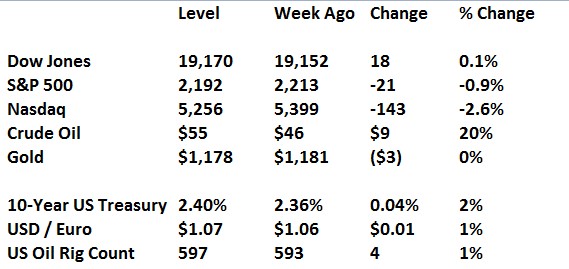
by Todd Shaver | Dec 4, 2016 | Weekly Newsletter 7pm Sunday
The Week Ahead
The S&P was up 4% in the month of November. We've seen a 6% rally since the US Presidential election. With so much money being made in the month of November, we are hopeful for December’s prospects but realistic that repeating November’s performance is a tall order. One particular area to focus on this month is the upcoming Fed meeting. Everyone will be watching for clues from Yellen about the pace of interest rate hikes for next year. The market is currently pricing in two hikes so anything more would be troubling.
This week we provide some insights on our latest thinking for Athenahealth, Apple, Amazon, Splunk, and the iShares Dow Jones US Energy Sector ETF.
Key Market Measures (Friday’s Close)
Highlights From The Past Week
Looming Pension Crisis. Stanford University’s pension tracker database pegs the 2015 market value of California’s total pension debt at $1 trillion or $93,000 per California household. In 2014, California’s total pension debt was calculated at $77,700 per household, but has increased dramatically in response to abysmal investment returns at California’s public pension funds that hover at or below 0% annual returns. Looking back to 2008, the under-funding levels of California's public pension have skyrocketed 157%. The fact that CalPERS is having such a difficult time with what should have been an easy decision to lower their long-term return expectations to 6% from 7.5%, just further reinforces how big of a mess this entire pension issue is.
Italian Referendum. The vote happens today. While the post-Trump euphoria in US stocks has been the perfect distraction from the ugly realities elsewhere, this weekend's Italian Referendum could well be the biggest 'revolt' yet, topping Brexit and Trump. Should Italy vote "no", as polls forecast, Prime Minister Renzi may quit, which would leave the Italian bank recapitalization underway in jeopardy. Some say, this could cause a Greece-like market reaction on steroids.
The Future of the Fed. As Trump and his new appointments take power, the Federal Reserve could be targeted for overdue changes and reforms. Let’s take a look at how the Trump administration may change the Fed, as ultimately, the future leadership of the Fed will mean a lot for interest rate levels and so much more. It’s no secret that Trump has a bone to pick with the Fed, so he could be the first President in years to strip away its independence. There’s no law on the books that protects the Fed’s independence. The broad freedom assumed by the Fed over the past several decades relies solely on the president’s discretion. Just days before the election, perhaps sensing reason to be worried, Fed Chair Janet Yellen started to publicly argue the importance of an independent Fed.
Separately, Trump himself has toyed with the idea of putting America back on the gold standard. There are two empty seats on the Board to fill. Fed Chair and Vice Chair appointments will happen very soon in 2018. So much to watch.
BMR Companies and Commentary
Athena (ATHN: $96, -6% for the week) The stock struggled this week. There was no company-specific news; rather, broader industry events developing. President-elect Donald Trump’s selection of Republican Tom Price to head the Department of Health and Human Services signals that the new administration is all-in on both efforts to repeal the Affordable Care Act and restructure Medicare and Medicaid. This change is going to matter for Athena.
Privatizing the Medicare program for seniors and disabled people and turning the Medicaid program for the poor back to the states are long-time goals for Republicans in Congress and the White House. They say the moves could help put the brakes on healthcare spending.
Why does the policy change have to be done? Healthcare spending is out of control. Medicare, which covers roughly 57 million elderly and disabled Americans, and Medicaid, which covers more than 77 million people with low incomes, are among the biggest items in the federal budget, together costing an estimated $1 trillion in 2016, according to the Congressional Budget Office.
However, cutbacks to healthcare spending will weigh on companies in the industry, like Athena. Estimates from the Urban Institute say that new proposals could result in 17 million people losing coverage and that payments to healthcare providers could be cut by nearly a third. Ouch.
We want to point out that that the potential repeal of The Affordable Care Act does not impact Athena as their market share as of this point is virtually zero. While the numbers look big at first glance, don’t panic because it doesn’t mean the cuts will hit everybody equally. Athena is very well-positioned to see much less headwind than others. Plus, whatever reimbursement headwinds surface to pricing, Athena can offset that by more volume through working with more providers and offering more products.
BMR Take: We think now is an opportunistic time to be buying Athena. The company is a leading provider of cloud-based services and mobile applications for medical groups and health systems. Sentiment around healthcare is at noteworthy low levels. You can buy a superior company in the space for under $100 that was not long ago greater than $165.
Amazon (AAPL: $740, -5%) Amazon’s annual AWS re:Invent conference was held in Las Vegas this week. New products, features, and services are extending Amazon’s cloud lead across the cloud computing sector.
AWS (Amazon Web Services) introduced over 24 new products and features this week and is on track to add 1,000 new products this year (up 40% from a year ago). One of the key announcements was improvements to the database storage product, Aurora, which is the fast growing product within AWS.
Enterprises, both large and small, are increasingly adopting more of AWS’s products and services, creating a more loyal base among its 1 million+ users. As an example, the government agency FINRA (Financial Industry Regulatory Agency) was at the conference discussing how they not long ago made the decision to move to AWS. FINRA’s adoption of AWS took 2.5 years to complete and is one of the largest migrations to-date due to its vast amount of data. FINRA oversees around 4,000 financial institutions, 64,000 brokers, and stores 75 billion events per day generating 20+ petabytes of data and trillions of records, and now 90% of its total data volumes are stored in AWS. What a success story!
BMR Take: AWS is on track to contribute $17.5 billion of revenue for Amazon this year, that’s up 40% from a year ago. The cloud business remains explosive and one of the core reasons we are positive on the stock.
Apple (AAPL: $110, -2%) After skipping Black Friday last year, Apple returned to the traditional one-day shopping event with Apple Gift Card discounts across products such as the iPhone, iPad, Apple Watch, Mac and Apple TV. Apple remains one of the best-positioned tech companies to benefit from spending trends this holiday season with a well-received iPhone 7 and 7 Plus, a new Apple Watch, and a new MacBook Pro with Touch Bar. It was exciting to see the company get back in the discount game with the “one-day shopping event” and we are confident the marketing strategy boosted holiday sales.
For several years, Apple participated in the Black Friday celebration; however, the company surprised everyone when it sat out last year's Black Friday celebration. The company returned this year with Apple Gift Cards with the purchase of certain iPhones, iPads, Apple Watches, Macs and Apple TVs. In 2014, Apple offered RED iTunes Gift Cards during Black Friday but this year is offering Apple Gift Cards.
Specifically, for iPhones Apple was offering $25 and $50 Apple Gift Cards. This implies a discount of 6-9%.
BMR Take: We think Apple at $110 is a compelling value (with $44 of that in cash.) We see the return to discount pricing as a potential game changer for holiday sales this year. If true, the Wall Street adage of “better numbers means the stock is going higher,” seems at play.
Splunk (SPLK: $54, -8%) Splunk reported earnings this week. The company delivered a strong quarter, with revenue of $245 million, up 40% from a year ago, versus consensus of $230 million and EPS of $0.12 versus consensus of $0.08 and $0.05 a year ago. Splunk raised full-year guidance as overall execution is running solid. A very strong report.
The highlight of the quarter was an acceleration in license growth from 32% a year ago in Q2 to 34% in Q3, which dramatically beat consensus expectations calling for deceleration to 23%. Splunk added 500 new customers and completed 480 deals over $100k, up 30% from last year. Cloud business tripled, once again exceeding the company’s plan. All great stuff!
BMR Take: It was nice to see quarterly results largely confirm why we like the outlook for the stock. Many analyst price targets remain at $70 or higher. In fact, one investment bank just recently initiated the company with a $80 price target. All signs point higher.
iShares Dow Jones US Energy Sector (IYE: $41, +3%) Did you catch the crude oil price change in the Key Market Measures chart earlier in this report? Crude oil at $55 up 20% from just last week. Not a typo! OPEC reached a deal to cut production. Oil prices surged upon Saudi Arabia and Iran signing on to a deal at the OPEC meeting in Vienna.
They say Russian President Vladimir Putin played a crucial role in helping OPEC rivals Iran and Saudi Arabia set aside differences to forge the cartel's first deal with non-OPEC Russia in 15 years. Putin’s role was also a testament to the rising influence of Russia in the Middle East since its military intervention in the Syrian civil war just over a year ago.
BMR Take: With OPEC, Putin, and Trump all pushing for higher oil prices, it sure seems like the $50-60 level is here to stay, or even perhaps the $60-70 level may be quickly approached. Investing in the Energy sector recovery remains one of our favorite ideas.
Upcoming Economic News
MONDAY, DECEMBER 5
ISM Non-Manufacturing Index – November
Time: 10:00 am
Forecast: 55.1
The ISM Non-Manufacturing Index looks to edge higher in November as consumer spending on services continues to advance at a steady pace. Real spending on services rose at least 2.5% in each of the past two quarters, avoiding the letdown seen in the Manufacturing sector. The new orders component of the Non-Manufacturing index exceeded the solidly expansionary level of 57 in four of the past five months. That indicator supports growing demand for services in the months ahead.
TUESDAY, DECEMBER 6
Trade Balance – October
Time: 8:30 am
Forecast: -$40.0 billion
Rising imports are expected to cause the US trade deficit to widen in October. Exports have been on a tear of late, adding 1.2% to real growth in the third quarter - the largest contribution in 11 quarters. Yet that boost came before the latest run-up of the dollar, which will challenge export growth going forward.
Productivity & Unit Labor Costs – Third Quarter
Final Time: 8:30 am
Forecast: 3.2% productivity, 0.3% unit labor costs
The revision of third quarter productivity figures will likely confirm the strongest result of the past eight quarters. Positive effects from growing inventories and relatively restrained hiring growth has boosted output efficiency. Yet with productivity growing a mere 0.3% annualized over the past two years, stronger sustained trends in investment are needed to improve the long-term pace.
Factory Orders – October
Time: 10:00 am
Forecast: 2.4%
A bulge in Transportation sector orders is forecast to lead overall factory orders higher for the fourth consecutive month in October. Near-term business investment trends are looking solid after core capital goods orders rose 4.4% annualized in the quarter ending October. Yet continued progress is needed to lift industrial output trends, as such orders fell 3.6% against the same period in 2015.
FRIDAY, DECEMBER 9
University of Michigan Consumer Sentiment – December
Preliminary Time: 10:00 am
Forecast: 94.0
Consumer sentiment may rise to the highest level in 7-months in December, perhaps reflecting some of the same post-election optimism seen in the stock market. Prior to recent OPEC moves to tighten supply, consumers benefitted from gasoline prices that fell to 7-month lows in late November. However, those gains may not filter to retailers, who are being hurt by having to offer consumers greater discounts.
Eli Lilly (LLY; $67, down 2%) The Latest News
Eli Lilly is a $71 billion machine that has seen a rocky road these past few weeks. After hitting the $78 level in early November the stock got hammered down to its current level due to Lilly’s announcement that its Alzheimer's drug solanezumab had failed to significantly improve on cognition. But then on Friday we saw some good news with an announcement that the FDA approved Lilly's new drug application for Jardiance to be used in reducing cardiovascular mortality in adults with type 2 diabetes. One analyst reported that Lilly’s revenue could increase by $1.7 billion in 2025 on expanded Jardiance sales. Wow. The good with the bad. The bad with the good. All in all, Lilly will survive and thrive. And we are preparing a research report and should be able to publish this mid-week.
Apple Investment Idea
The Options Corner
Here’s an idea for the aggressive investor to put some cash in your account using this stock. If you agree with the premise that every share of stock at $110 includes $44 in cash, you might conclude, like we do, that there is somewhat of a floor under the stock. There is no other company in the history of Wall Street that has had this much cash as a percentage of the stock price. $44 a share is in cash. That’s 40% of the price of the stock. So you get the entire company, ex-cash for only $66. Now, with that said, what we are going to suggest here is a very risky idea: Selling naked puts on Apple.
Selling naked puts offers you two things: Being able to but the stock at a lower price than it is now (if the stock falls), and a way to put cash in your account immediately. But it comes with great risk.
There are lots of choices of selling puts on Apple, but let’s say you think the stock going down to $100 by February 17th is not likely. And in fact, if it did, you wouldn’t mind buying the stock down there. What you can do is to sell the February 100 put for $1.45. Since options are traded in 100 share lots, that means you can get $1,450 for every 10 options that you sell. Now by doing this transaction you are obligated to buy 1000 shares at $100 if it goes below $100. So you must have $100,000 at the ready to do this. The stock is at $110 now so buying it a $100 sounds good at this point. Also, since you got $1.45 a share for selling the put your actual purchase price is $98.50. Again, this sounds good, unless the stock goes to $95 and you are forced to buy it at $100, which can happen, and that’s why selling naked puts is risky.
However, you can always BUY BACK the options that you sold to get out of the trade. In other words, you are not 100% obligated to buy the shares if it goes lower – you can always buy back the option which leaves you with no position and thus no risk. You may have to pay a higher price for it since the price will go up as the stock goes down, and thus you will lose money on the trade, but at least you can get out of the trade if you like. Note that as time goes by – as you get closer to the expiration of the option, February 17th, and if the stock stays in the same general area of $110, the price of that option will approach zero which of course is exactly what you want to have happen. (If you sell something first, you want it to go to zero. If you buy something, you want it to go up. Right?)
That’s our discussion of options this week. You can do this with most stocks, so it doesn’t have to be Apple. Virtually all stocks have listed options and you can check them out here:
http://finance.yahoo.com/quote/AAPL/options?p=AAPL&date=1487289600
This is a great site with a wealth of information about option pricing. You can spend hours here researching all of your favorite stocks.
Groundbreaking news: The US is Now a Net Exporter of Natural Gas The U.S. exported an average of 7.4 billion cubic feet of gas a day in November, more than the 7.0 billion it imported, with the biggest buyers being Mexico and Canada. Gas exports have risen more than 50% since 2010. The Energy Department says the country will be the world’s 3rd-largest producer of liquefied natural gas by 2025, trailing Australia and Qatar.
FANG Stocks Taking a Breather
Three of the four big internet stocks that make up the FANG group took a pounding last week, despite upbeat reports from various firms on the Street. FANG is made up of Facebook (FB: $115, down 4%), Amazon.com (AMZN: $740, down 5%), Netflix (NFLX: $121, up 3%) and Google-parent Alphabet (GOOG: $750, down 1%). We always like to add Apple, to make it FAANG because there is so much value represented here, Facebook - $330 billion; Amazon - $350 billion; Apple - $585 billion (largest in the world); Netflix - $52 billion – just a puppy; Google - $520 billion - Going to catch Apple some day?
BMR Take: Since Trump was elected these stocks have been poor performers. Do we care? Well, we care but we are not worried. Why? Because we know that the companies don’t care – in other words, all they care about is increasing revenues and profits; well, at least all of them except Amazon! We kid about Amazon. We just read the book The Everything Store by Brad Stone. Shall we say this is a must-read? Wow – what a story. Read this and you will think like we do that Amazon can go to $1500 a share in the near future. Amazon is making money – it’s just that they are spending it just as fast on infrastructure build. We secretly believe that they could report stellar earnings any time they darn well please. But since DAY ONE they have been building for the future. And selling over $30 billion each QUARTER is proof that they are on to something big.
We digress. Our point is this: Each of these five stocks is growing revenues in a big way. Profits have followed at all of them but Netflix, but they are building for the next decade and are spending big money on content ($6 billion next year). So again, we are not worried about a slight lull in the upward march of the stock prices for these five. It will come in due time,
Ferrellgas Update
Ferrellgas (FGP: $5.65, down 14%) cut the dividend from $2.00 a share to 40 cents, bigger than what we had thought and bigger than the market had anticipated. This is a savings for about $160 million a year. The company cited difficulties in its midstream business due to the loss of its largest customer (supplier Jamex Marketing), a warmer-than-expected early winter season, and "general market conditions." Blah, blah, blah. We’ve heard that story before. A lot of this mess was caused by buying troubled midstream company Bridger Logistics last year which has caused big writedowns and liquidity issues. What a way to destroy a strong, old line, profitable company.
Obviously, we should have stuck to our guns of selling at $15 when we first issued our research report in September. Why didn’t we? Well, discipline. The lack thereof. It’s human nature and we are human just like you are. We added the stock at $17, we had a Sell Price of $15 so we should have removed the stock at $15. That’s it, pure and simple. But we got swayed by the lower stock price and how cheap the stock was, being down from its 52-week high of $21 and an all-time high of $28 set in 2014. We couldn’t see the forest of the trees, and certainly didn’t anticipate that management would make such a big mistake by buying Bridger.
What to do now? It all depends on how much stock that you have and what percentage this investment is in your overall portfolio. So we can’t answer this question for you here personally in this forum. The company is operating on thin ice and the stock could stay here for many months, if not years. But if you want a personal opinion on what to do in your own portfolio, don’t hesitate to write us here at Info@BullMarket.com. Give us some details and we’ll give you our opinion.
Goldman Sachs Group Update
Goldman Sachs (GS: $223, up 6%) had another amazing week and hit $227 on Thursday before pulling back a bit on Friday. We hereby raise our Sell Price from $196 to $214, preserving our big gains, currently up 52%. And we are raising our Target Price from $220 to $245.
The High Yield Report
A Close Look at the Municipal Market
The biggest news in the high yield world right now is actually hard to find; many leveraged closed-end funds reduced distributions this week, after Nuveen cut dividends on a number of funds. This impacted one of the funds in the Bull Market Report portfolio: the Nuveen Enhanced AMT Free Municipal Bond Fund (NVG: $13.90), which fell a little less than 1% this week as the municipal bond market continued to struggle. The decline seems unrelated to the distribution cut, but it is something that investors should be aware of.
At the same time, there’s no reason to panic. The distribution cut was a little over 4% to 7.25 cents from 7.6 cents every month. That’s a loss of 4.2 cents per year, meaning the fund’s yield is still above 6%. Dividend cuts are never welcome news, but as these things go this one is quite small.
Could this cut have been predicted? In a broad sense, yes; as a general rule the ultra-low interest rate world we live in puts inevitable pressure on high yield, which is why investing in these selectively is crucial. On the other hand, the timing of this cut is odd. Interest rates have actually been rising lately, with A-rated bond yields up 18% in the last month. To make things even stranger, Nuveen did not cut distributions on all municipal bond funds. On top of that, Nuveen cut distributions on dozens of funds, ranging from equity-focused to municipals. It seems Nuveen decided to lower distributions to make payouts more manageable across its fund offerings except in those cases where distributions where already so very low that distributions could easily be maintained.
Nuveen is a good fund manager and has done a good job with the Enhanced AMT Free Fund. The fund’s NAV has grown over 6% since inception and the stock has gone up over 7% in the last three years. The recent collapse in the municipal bond market means its NAV is down 3% year-to-date, which is the case for pretty much all municipal bond funds. Cutting distributions to protect future payouts and keep some capital to invest in new municipal bonds makes sense right now, despite the frustrations to investors.
Fortunately, NVG is just one of the 14 high yield recommendations in the Bull Market Report portfolio, so the distribution cut will have a marginal impact on our total payouts. We are still bullish on the fund as an outperformer in the municipal bond market and we are still bullish on municipal bonds, so we are not changing our recommendation for this fund right now. Instead, we encourage you to consider slowly building on your position in the Nuveen fund in anticipation of the inevitable municipal bond recovery.
That brings us to a bigger question - why are munis tanking? Most municipal bond indexes have fallen over 3% in a month’s time. A muni index fund like the iShares S&P National AMT-Free Municipal Bond Fund (MUB: $107) lost 1% this week (more than the Nuveen fund did) and is down nearly 6% over the last three months. Munis are supposed to be a stable asset class. What is going on here?
There are two main causes of the municipal bond rout, and they’re worth understanding in detail.
1. Retail fears. Retail investors dominate the municipal bond market and they will sell off in moments of particular panic. We are in such an environment right now, with greater uncertainty about the future of Treasuries, the economy as a whole, and trade relations between America and foreign nations. Fear is motivating selling.
2. Possible tax cuts. This is arguably the biggest driver behind the municipal bond sell-off. Why do investors choose munis over corporates? One is the relative safety of munis, but a much bigger reason is the tax benefits. Muni bond distributions are tax free, corporate bond distributions are not. With President-elect Trump widely expected to change the tax code, the future of muni tax treatment is uncertain. The thinking is that a big tax cut could motivate people to leave munis because the tax benefits are less than they used to be.
Will Trump change the tax code? We’re not political analysts, and Trump is very unpredictable, so we can’t give an answer with any sort of confidence. What we can say is that the municipal market is over-reacting to the risks of this eventuality. To understand how this is the case, let’s take a close look at the spread between corporate and muni 5-year bond yields. A-rated 5-year munis yield 2.11% on average versus 2.28% for corporates. That’s a difference of 0.17%, or $1.70 for every $100 invested. A month ago, the difference was 0.28%, or $2.8 for every $100 invested.
This means that the market has removed 39% of the tax-based arbitrage opportunity investors have to buy municipal bonds instead of corporates. In other words, the market is anticipating that the tax benefits of munis will disappear and is pricing them accordingly.
The closer municipal bond yields come to corporate bond yields, the bigger opportunity there is for municipal bond prices to rise if the tax benefits do not disappear, since prices are inverse to yields. Additionally, the arbitration opportunity for investing in munis because of their lower default rate also goes up as their yields get closer to corporates. For this reason, we are going to keep a close look at municipal and corporate bond rates to identify when we reach the bottom for munis. It is clearly coming soon, and may arrive before the end of the year.
On the topic of closed end fund distributions, we also heard from one of our favorite funds - the Pimco Dynamic Income Fund (PDI: $29), which soared 3% this week. The fund is now up 5% year-to-date. The fund’s regular dividend is staying the same at a 9% yield, but we did not hear about the fund’s special dividend yet. Pimco seems to be waiting a bit before announcing special dividends on its funds; we expect to hear about this next week or, at the latest, the week after. We know many folks who are buying this stock to get the anticipated big dividend. Of course, be aware that on ex-dividend date the stock opens lower that morning the exact amount of the dividend. So it’s not all icing on the cake, but generally over time the stock moves back to where it was. The operative word is “generally” so be a good investor and be wary.
Finally, on BDCs: The UBS Etracs BDC ETF (BDCS: $21.90) fell 1%, mostly in line with the broader market. This is a modest move, indicating that BDCs are maintaining their strength alongside the Financial sector. We remain constructive on Main Street Capital (MAIN: $36, down 1%) but are still waiting for it to reach a lower level before jumping back in.
Good Investing,
Todd Shaver
Founder and Editor
The Bull Market Report
